Shared posts

13 Jan 22:58

Garbage Collection -- and the Tempting Illusion of Big Breakthroughs

by Eugene Wallingford

Good advice in this paragraph, paraphrased lightly from Modern Garbage Collection:

Garbage collection is a hard problem, really hard, one that has been studied by an army of computer scientists for decades. Be very suspicious of supposed breakthroughs that everyone else missed. They are more likely to just be strange or unusual tradeoffs in disguise, avoided by others for reasons that may only become apparent later.

It's wise always to be on the lookout for "strange or unusual tradeoffs in disguise".

13 Jan 22:58

A guest post from Barack Obama

by Stephen Rees

The following is the text of the President’s farewell address, taken from the New York Times webpage which, for reasons which pass all understanding, refused to let me see their video.


It’s good to be home. My fellow Americans, Michelle and I have been so touched by all the well-wishes we’ve received over the past few weeks. But tonight it’s my turn to say thanks. Whether we’ve seen eye-to-eye or rarely agreed at all, my conversations with you, the American people – in living rooms and schools; at farms and on factory floors; at diners and on distant outposts – are what have kept me honest, kept me inspired, and kept me going. Every day, I learned from you. You made me a better President, and you made me a better man.

I first came to Chicago when I was in my early twenties, still trying to figure out who I was; still searching for a purpose to my life. It was in neighborhoods not far from here where I began working with church groups in the shadows of closed steel mills. It was on these streets where I witnessed the power of faith, and the quiet dignity of working people in the face of struggle and loss. This is where I learned that change only happens when ordinary people get involved, get engaged, and come together to demand it.

After eight years as your President, I still believe that. And it’s not just my belief. It’s the beating heart of our American idea – our bold experiment in self-government.

It’s the conviction that we are all created equal, endowed by our Creator with certain unalienable rights, among them life, liberty, and the pursuit of happiness.

It’s the insistence that these rights, while self-evident, have never been self-executing; that We, the People, through the instrument of our democracy, can form a more perfect union.

This is the great gift our Founders gave us. The freedom to chase our individual dreams through our sweat, toil, and imagination – and the imperative to strive together as well, to achieve a greater good.

For 240 years, our nation’s call to citizenship has given work and purpose to each new generation. It’s what led patriots to choose republic over tyranny, pioneers to trek west, slaves to brave that makeshift railroad to freedom. It’s what pulled immigrants and refugees across oceans and the Rio Grande, pushed women to reach for the ballot, powered workers to organize. It’s why GIs gave their lives at Omaha Beach and Iwo Jima; Iraq and Afghanistan – and why men and women from Selma to Stonewall were prepared to give theirs as well.

So that’s what we mean when we say America is exceptional. Not that our nation has been flawless from the start, but that we have shown the capacity to change, and make life better for those who follow.

Yes, our progress has been uneven. The work of democracy has always been hard, contentious and sometimes bloody. For every two steps forward, it often feels we take one step back. But the long sweep of America has been defined by forward motion, a constant widening of our founding creed to embrace all, and not just some.

If I had told you eight years ago that America would reverse a great recession, reboot our auto industry, and unleash the longest stretch of job creation in our history…if I had told you that we would open up a new chapter with the Cuban people, shut down Iran’s nuclear weapons program without firing a shot, and take out the mastermind of 9/11…if I had told you that we would win marriage equality, and secure the right to health insurance for another 20 million of our fellow citizens – you might have said our sights were set a little too high.

But that’s what we did. That’s what you did. You were the change. You answered people’s hopes, and because of you, by almost every measure, America is a better, stronger place than it was when we started.

In ten days, the world will witness a hallmark of our democracy: the peaceful transfer of power from one freely-elected president to the next. I committed to President-Elect Trump that my administration would ensure the smoothest possible transition, just as President Bush did for me. Because it’s up to all of us to make sure our government can help us meet the many challenges we still face.

We have what we need to do so. After all, we remain the wealthiest, most powerful, and most respected nation on Earth. Our youth and drive, our diversity and openness, our boundless capacity for risk and reinvention mean that the future should be ours.

But that potential will be realized only if our democracy works. Only if our politics reflects the decency of the our people. Only if all of us, regardless of our party affiliation or particular interest, help restore the sense of common purpose that we so badly need right now.

That’s what I want to focus on tonight – the state of our democracy.

Understand, democracy does not require uniformity. Our founders quarreled and compromised, and expected us to do the same. But they knew that democracy does require a basic sense of solidarity – the idea that for all our outward differences, we are all in this together; that we rise or fall as one.

There have been moments throughout our history that threatened to rupture that solidarity. The beginning of this century has been one of those times. A shrinking world, growing inequality; demographic change and the specter of terrorism – these forces haven’t just tested our security and prosperity, but our democracy as well. And how we meet these challenges to our democracy will determine our ability to educate our kids, and create good jobs, and protect our homeland.

In other words, it will determine our future.

Our democracy won’t work without a sense that everyone has economic opportunity. Today, the economy is growing again; wages, incomes, home values, and retirement accounts are rising again; poverty is falling again. The wealthy are paying a fairer share of taxes even as the stock market shatters records. The unemployment rate is near a ten-year low. The uninsured rate has never, ever been lower. Health care costs are rising at the slowest rate in fifty years. And if anyone can put together a plan that is demonstrably better than the improvements we’ve made to our health care system – that covers as many people at less cost – I will publicly support it.

That, after all, is why we serve – to make people’s lives better, not worse.

But for all the real progress we’ve made, we know it’s not enough. Our economy doesn’t work as well or grow as fast when a few prosper at the expense of a growing middle class. But stark inequality is also corrosive to our democratic principles. While the top one percent has amassed a bigger share of wealth and income, too many families, in inner cities and rural counties, have been left behind – the laid-off factory worker; the waitress and health care worker who struggle to pay the bills – convinced that the game is fixed against them, that their government only serves the interests of the powerful – a recipe for more cynicism and polarization in our politics.

There are no quick fixes to this long-term trend. I agree that our trade should be fair and not just free. But the next wave of economic dislocation won’t come from overseas. It will come from the relentless pace of automation that makes many good, middle-class jobs obsolete.

And so we must forge a new social compact – to guarantee all our kids the education they need; to give workers the power to unionize for better wages; to update the social safety net to reflect the way we live now and make more reforms to the tax code so corporations and individuals who reap the most from the new economy don’t avoid their obligations to the country that’s made their success possible. We can argue about how to best achieve these goals. But we can’t be complacent about the goals themselves. For if we don’t create opportunity for all people, the disaffection and division that has stalled our progress will only sharpen in years to come.

There’s a second threat to our democracy – one as old as our nation itself. After my election, there was talk of a post-racial America. Such a vision, however well-intended, was never realistic. For race remains a potent and often divisive force in our society. I’ve lived long enough to know that race relations are better than they were ten, or twenty, or thirty years ago – you can see it not just in statistics, but in the attitudes of young Americans across the political spectrum.

But we’re not where we need to be. All of us have more work to do. After all, if every economic issue is framed as a struggle between a hardworking white middle class and undeserving minorities, then workers of all shades will be left fighting for scraps while the wealthy withdraw further into their private enclaves. If we decline to invest in the children of immigrants, just because they don’t look like us, we diminish the prospects of our own children – because those brown kids will represent a larger share of America’s workforce. And our economy doesn’t have to be a zero-sum game. Last year, incomes rose for all races, all age groups, for men and for women.

Going forward, we must uphold laws against discrimination – in hiring, in housing, in education and the criminal justice system. That’s what our Constitution and highest ideals require. But laws alone won’t be enough. Hearts must change. If our democracy is to work in this increasingly diverse nation, each one of us must try to heed the advice of one of the great characters in American fiction, Atticus Finch, who said “You never really understand a person until you consider things from his point of view…until you climb into his skin and walk around in it.”

For blacks and other minorities, it means tying our own struggles for justice to the challenges that a lot of people in this country face – the refugee, the immigrant, the rural poor, the transgender American, and also the middle-aged white man who from the outside may seem like he’s got all the advantages, but who’s seen his world upended by economic, cultural, and technological change.

For white Americans, it means acknowledging that the effects of slavery and Jim Crow didn’t suddenly vanish in the ‘60s; that when minority groups voice discontent, they’re not just engaging in reverse racism or practicing political correctness; that when they wage peaceful protest, they’re not demanding special treatment, but the equal treatment our Founders promised.

For native-born Americans, it means reminding ourselves that the stereotypes about immigrants today were said, almost word for word, about the Irish, Italians, and Poles. America wasn’t weakened by the presence of these newcomers; they embraced this nation’s creed, and it was strengthened.

So regardless of the station we occupy; we have to try harder; to start with the premise that each of our fellow citizens loves this country just as much as we do; that they value hard work and family like we do; that their children are just as curious and hopeful and worthy of love as our own.

None of this is easy. For too many of us, it’s become safer to retreat into our own bubbles, whether in our neighborhoods or college campuses or places of worship or our social media feeds, surrounded by people who look like us and share the same political outlook and never challenge our assumptions. The rise of naked partisanship, increasing economic and regional stratification, the splintering of our media into a channel for every taste – all this makes this great sorting seem natural, even inevitable. And increasingly, we become so secure in our bubbles that we accept only information, whether true or not, that fits our opinions, instead of basing our opinions on the evidence that’s out there.

This trend represents a third threat to our democracy. Politics is a battle of ideas; in the course of a healthy debate, we’ll prioritize different goals, and the different means of reaching them. But without some common baseline of facts; without a willingness to admit new information, and concede that your opponent is making a fair point, and that science and reason matter, we’ll keep talking past each other, making common ground and compromise impossible.

Isn’t that part of what makes politics so dispiriting? How can elected officials rage about deficits when we propose to spend money on preschool for kids, but not when we’re cutting taxes for corporations? How do we excuse ethical lapses in our own party, but pounce when the other party does the same thing? It’s not just dishonest, this selective sorting of the facts; it’s self-defeating. Because as my mother used to tell me, reality has a way of catching up with you.

Take the challenge of climate change. In just eight years, we’ve halved our dependence on foreign oil, doubled our renewable energy, and led the world to an agreement that has the promise to save this planet. But without bolder action, our children won’t have time to debate the existence of climate change; they’ll be busy dealing with its effects: environmental disasters, economic disruptions, and waves of climate refugees seeking sanctuary.

Now, we can and should argue about the best approach to the problem. But to simply deny the problem not only betrays future generations; it betrays the essential spirit of innovation and practical problem-solving that guided our Founders.

It’s that spirit, born of the Enlightenment, that made us an economic powerhouse – the spirit that took flight at Kitty Hawk and Cape Canaveral; the spirit that that cures disease and put a computer in every pocket.

It’s that spirit – a faith in reason, and enterprise, and the primacy of right over might, that allowed us to resist the lure of fascism and tyranny during the Great Depression, and build a post-World War II order with other democracies, an order based not just on military power or national affiliations but on principles – the rule of law, human rights, freedoms of religion, speech, assembly, and an independent press.

That order is now being challenged – first by violent fanatics who claim to speak for Islam; more recently by autocrats in foreign capitals who see free markets, open democracies, and civil society itself as a threat to their power. The peril each poses to our democracy is more far-reaching than a car bomb or a missile. It represents the fear of change; the fear of people who look or speak or pray differently; a contempt for the rule of law that holds leaders accountable; an intolerance of dissent and free thought; a belief that the sword or the gun or the bomb or propaganda machine is the ultimate arbiter of what’s true and what’s right.

Because of the extraordinary courage of our men and women in uniform, and the intelligence officers, law enforcement, and diplomats who support them, no foreign terrorist organization has successfully planned and executed an attack on our homeland these past eight years; and although Boston and Orlando remind us of how dangerous radicalization can be, our law enforcement agencies are more effective and vigilant than ever. We’ve taken out tens of thousands of terrorists – including Osama bin Laden. The global coalition we’re leading against ISIL has taken out their leaders, and taken away about half their territory. ISIL will be destroyed, and no one who threatens America will ever be safe. To all who serve, it has been the honor of my lifetime to be your Commander-in-Chief.

But protecting our way of life requires more than our military. Democracy can buckle when we give in to fear. So just as we, as citizens, must remain vigilant against external aggression, we must guard against a weakening of the values that make us who we are. That’s why, for the past eight years, I’ve worked to put the fight against terrorism on a firm legal footing. That’s why we’ve ended torture, worked to close Gitmo, and reform our laws governing surveillance to protect privacy and civil liberties. That’s why I reject discrimination against Muslim Americans. That’s why we cannot withdraw from global fights – to expand democracy, and human rights, women’s rights, and LGBT rights – no matter how imperfect our efforts, no matter how expedient ignoring such values may seem. For the fight against extremism and intolerance and sectarianism are of a piece with the fight against authoritarianism and nationalist aggression. If the scope of freedom and respect for the rule of law shrinks around the world, the likelihood of war within and between nations increases, and our own freedoms will eventually be threatened.

So let’s be vigilant, but not afraid. ISIL will try to kill innocent people. But they cannot defeat America unless we betray our Constitution and our principles in the fight. Rivals like Russia or China cannot match our influence around the world – unless we give up what we stand for, and turn ourselves into just another big country that bullies smaller neighbors.

Which brings me to my final point – our democracy is threatened whenever we take it for granted. All of us, regardless of party, should throw ourselves into the task of rebuilding our democratic institutions. When voting rates are some of the lowest among advanced democracies, we should make it easier, not harder, to vote. When trust in our institutions is low, we should reduce the corrosive influence of money in our politics, and insist on the principles of transparency and ethics in public service. When Congress is dysfunctional, we should draw our districts to encourage politicians to cater to common sense and not rigid extremes.

And all of this depends on our participation; on each of us accepting the responsibility of citizenship, regardless of which way the pendulum of power swings.

Our Constitution is a remarkable, beautiful gift. But it’s really just a piece of parchment. It has no power on its own. We, the people, give it power – with our participation, and the choices we make. Whether or not we stand up for our freedoms. Whether or not we respect and enforce the rule of law. America is no fragile thing. But the gains of our long journey to freedom are not assured.

In his own farewell address, George Washington wrote that self-government is the underpinning of our safety, prosperity, and liberty, but “from different causes and from different quarters much pains will be taken…to weaken in your minds the conviction of this truth;” that we should preserve it with “jealous anxiety;” that we should reject “the first dawning of every attempt to alienate any portion of our country from the rest or to enfeeble the sacred ties” that make us one.

We weaken those ties when we allow our political dialogue to become so corrosive that people of good character are turned off from public service; so coarse with rancor that Americans with whom we disagree are not just misguided, but somehow malevolent. We weaken those ties when we define some of us as more American than others; when we write off the whole system as inevitably corrupt, and blame the leaders we elect without examining our own role in electing them.

It falls to each of us to be those anxious, jealous guardians of our democracy; to embrace the joyous task we’ve been given to continually try to improve this great nation of ours. Because for all our outward differences, we all share the same proud title: Citizen.

Ultimately, that’s what our democracy demands. It needs you. Not just when there’s an election, not just when your own narrow interest is at stake, but over the full span of a lifetime. If you’re tired of arguing with strangers on the internet, try to talk with one in real life. If something needs fixing, lace up your shoes and do some organizing. If you’re disappointed by your elected officials, grab a clipboard, get some signatures, and run for office yourself. Show up. Dive in. Persevere. Sometimes you’ll win. Sometimes you’ll lose. Presuming a reservoir of goodness in others can be a risk, and there will be times when the process disappoints you. But for those of us fortunate enough to have been a part of this work, to see it up close, let me tell you, it can energize and inspire. And more often than not, your faith in America – and in Americans – will be confirmed.

Mine sure has been. Over the course of these eight years, I’ve seen the hopeful faces of young graduates and our newest military officers. I’ve mourned with grieving families searching for answers, and found grace in Charleston church. I’ve seen our scientists help a paralyzed man regain his sense of touch, and our wounded warriors walk again. I’ve seen our doctors and volunteers rebuild after earthquakes and stop pandemics in their tracks. I’ve seen the youngest of children remind us of our obligations to care for refugees, to work in peace, and above all to look out for each other.

That faith I placed all those years ago, not far from here, in the power of ordinary Americans to bring about change – that faith has been rewarded in ways I couldn’t possibly have imagined. I hope yours has, too. Some of you here tonight or watching at home were there with us in 2004, in 2008, in 2012 – and maybe you still can’t believe we pulled this whole thing off.

You’re not the only ones. Michelle – for the past twenty-five years, you’ve been not only my wife and mother of my children, but my best friend. You took on a role you didn’t ask for and made it your own with grace and grit and style and good humor. You made the White House a place that belongs to everybody. And a new generation sets its sights higher because it has you as a role model. You’ve made me proud. You’ve made the country proud.

Malia and Sasha, under the strangest of circumstances, you have become two amazing young women, smart and beautiful, but more importantly, kind and thoughtful and full of passion. You wore the burden of years in the spotlight so easily. Of all that I’ve done in my life, I’m most proud to be your dad.

To Joe Biden, the scrappy kid from Scranton who became Delaware’s favorite son: you were the first choice I made as a nominee, and the best. Not just because you have been a great Vice President, but because in the bargain, I gained a brother. We love you and Jill like family, and your friendship has been one of the great joys of our life.

To my remarkable staff: For eight years – and for some of you, a whole lot more – I’ve drawn from your energy, and tried to reflect back what you displayed every day: heart, and character, and idealism. I’ve watched you grow up, get married, have kids, and start incredible new journeys of your own. Even when times got tough and frustrating, you never let Washington get the better of you. The only thing that makes me prouder than all the good we’ve done is the thought of all the remarkable things you’ll achieve from here.

And to all of you out there – every organizer who moved to an unfamiliar town and kind family who welcomed them in, every volunteer who knocked on doors, every young person who cast a ballot for the first time, every American who lived and breathed the hard work of change – you are the best supporters and organizers anyone could hope for, and I will forever be grateful. Because yes, you changed the world.

That’s why I leave this stage tonight even more optimistic about this country than I was when we started. Because I know our work has not only helped so many Americans; it has inspired so many Americans – especially so many young people out there – to believe you can make a difference; to hitch your wagon to something bigger than yourselves. This generation coming up – unselfish, altruistic, creative, patriotic – I’ve seen you in every corner of the country. You believe in a fair, just, inclusive America; you know that constant change has been America’s hallmark, something not to fear but to embrace, and you are willing to carry this hard work of democracy forward. You’ll soon outnumber any of us, and I believe as a result that the future is in good hands.

My fellow Americans, it has been the honor of my life to serve you. I won’t stop; in fact, I will be right there with you, as a citizen, for all my days that remain. For now, whether you’re young or young at heart, I do have one final ask of you as your President – the same thing I asked when you took a chance on me eight years ago.

I am asking you to believe. Not in my ability to bring about change – but in yours.

I am asking you to hold fast to that faith written into our founding documents; that idea whispered by slaves and abolitionists; that spirit sung by immigrants and homesteaders and those who marched for justice; that creed reaffirmed by those who planted flags from foreign battlefields to the surface of the moon; a creed at the core of every American whose story is not yet written:

Yes We Can.

Yes We Did.

Yes We Can.

Thank you. God bless you. And may God continue to bless the United States of America.


Filed under: politics Tagged: farewell, Obama
13 Jan 22:57

Rebirth and Yellow Arrows

by Matt

My friend Kamal Ravikant has a new book out, Rebirth, which I highly recommend. I had the good fortune to read it a few months ago and the story of the Camino de Santiago touched and inspired me.

Because of the impact of the book, I ended up adopting a few New Year’s intentions long before January 1st — things to ruminate on and keep in mind as the year wound down. The outlook of the world seemed uncertain, and I’m learning to navigate the world without my father.

yellow-arrow-3

Yellow Arrows

The Camino de Santiago is a pilgrimage path in Spain that people have walked since the 9th century AD. The 500 mile path winds through mountains, fields, and sometimes cities, and many pilgrims take a month or more on it. In some ways it is similar to the Kumano Kodo walk I did with Dan and Craig last year.

There are places where the path isn’t exactly clear, either because the trail isn’t strong, there’s been growth, or you might be in a crowded urban area like a city. Over the years pilgrims and people who live on the trail have marked it with yellow arrows pointing the way. If someone gets lost or confused, it’s an opportunity for an additional sign to bring them back on track.

When you know the path, is it clear where someone else walking it should go next? It’s an interesting concept that applies across life. In your relationships, does your friend, loved one, or partner know what to expect, and where you’re headed together? Even in WordPress I feel like there are too many places where we bring someone to a fork in the road and there is no clear indication which way they should take.

Give some thought to the yellow arrows in your life, and I’ll write more about the other two things I’ve been thinking about tomorrow. Also don’t forget to pick up a copy of Kamal’s book. I loved it and I think it will be one I’m recommending to many friends.

51b0JrMcFvL

(Image from Camino Travel Center.)

13 Jan 22:57

HTTPS on NYTimes.com

by By Eitan Konigsburg and Vinessa Wan

We are thrilled to announce that we have begun to enable HTTPS on NYTimes.com, an effort that helps protect the privacy of our readers and ensures the authenticity of our content. This is a significant milestone in the 21-year history of our website, and though it’s taken us some time, we are very excited to share this with our readers.

What’s included?
NYTimes.com consists of millions of pages, so we’ve prioritized HTTPS for areas of our site that receive the most visits. You should already be seeing a padlock next to our URL in your browsers on the following:

What Does This Mean for You?

  • Improved privacy: HTTPS encrypts the data sent between your computer and our servers, making it more difficult for a third party to monitor what you are doing. While HTTPS will not hide the fact that you are visiting NYTimes.com, it will significantly diminish the ability of a third party, such as your internet provider, to see which articles you are reading.
  • Authentic news: Another benefit of HTTPS is that it validates that your computer is communicating with the website you intended to reach, and that any data you receive has not been modified in-transit. When you see the padlock in your address bar, the browser has validated that you are getting authentic NYTimes.com content.
  • Enhanced experience: Some newer web technologies are only made available to HTTPS pages. As we implement HTTPS, we are able to take advantage of these features to make our pages load faster, create innovative interactive projects and provide more personalized content.

HTTPS for the News
The benefits of HTTPS that we wrote about in 2014 remain relevant today. Other media companies have migrated to HTTPS: The Washington Post, Wired, BuzzFeed, The Guardian, and most recently, Quartz. (For more information, the Freedom of the Press Foundation launched a service to track HTTPS implementations on many major media sites.)

It’s been a complex undertaking for us and we’ve discovered a lot in the process. We’ll be sharing a deeper dive into the technical aspects and the challenges we encountered on our journey to HTTPS.

What’s Next?
This is just the beginning, and we intend to bring the rest of our site under the HTTPS umbrella. There is still a significant amount of work remaining, but we are committed to seeing it through. Securing our site is good for our users and the right thing to do. Our core purpose as a company is “to enhance society by creating, collecting and distributing high-quality news and information.” We believe the implementation of HTTPS furthers this purpose.

13 Jan 22:57

2016 was the first year I didn't buy a SIM card, for at least a decade

by Dean Bubley
I've just realised that I didn't buy a single new SIM card in 2016.

In the past I've often got local SIMs when I've travelled (to avoid roaming charges), or sometimes replaced or got extra ones for the UK, for mobile-broadband dongles or second phones. Quite often I'd buy 5 or more in a year. I think my record was about 10.

But in 2016 I just kept the one Vodafone SIM I've had for quite a while, used on a data-heavy SIM-only plan in an unlocked iPhone.

There's a few reasons for this. The main one is that I use Vodafone's Euro/World Traveller plans, which cost £3 a day in Europe and £5 a day in various other countries. (IIRC, changing EU rules mean I may now be able to get "roam like home" free coverage - I need to check whether I need to change my current plan). 

In particular, for the US I find it pretty good (I'm there about once a month) and while it's more expensive than getting a local pre-pay SIM (T-Mobile used to be $2/day, not sure what it is now), it means I don't have to faff around with swapping over, plus I can call/SMS on my usual number & don't need to revalidate WhatsApp, iMessage and various others that also link to numbers. Put simply, £5/day is a bit of a rip-off (£2-3 would be fairer), but when I'm travelling I have other expenses that are higher on my list. It's the equivalent of a beer a day - although it gets expensive if you start to spend 50 or 100 days a year in a given country.

In theory, I could get one of the "roaming SIMs" from Truphone or 100 other sources. Or I could buy or rent a WiFi-hotspot type thing and use that. But it means more to carry/charge, and for the places I (mostly) go, it's just not that necessary. I don't need local numbers either (I hardly ever phone/SMS the country I'm visiting) so multi-IMSI isn't a big deal for me either.

The other main reason for not buying an SIMs is the countries I visited last year. Mostly it's been Europe and the US for work, plus South Africa, Israel - and Central America on my vacation recently. The VF plan has either covered them, or else (eg Nicaragua & Roatan in Honduras) there's been enough WiFi everywhere I needed to use the phone, plus offline maps. I haven't been elsewhere in SE Asia or MidEast, where I'd normally need cellular coverage. A week off-grid in the desert at AfrikaBurn in April proved that I don't *really* need to be connected 24x7, even though most of my friends think I'm glued to my phone.

And the last reason is that I haven't been tempted by any other cellular devices. I don't need a 4G-enabled tablet or PC. My FitBit works fine with Bluetooth. I don't drive or need/want a "connected car". I have no IoT devices at home, and wouldn't have cellular-connected ones even if I did.

Maybe 2017 will be different - I'm planning an Asia trip or two, and perhaps I'll be vacationing in places that are less WiFi-connected. I might churn from Vodafone if another UK operator has better coverage, roaming or other temptations. But it was really notable that on my recent trip, I didn't even bother going into a Nicaraguan mobile store to check SIM availability and price. Maybe if I was there on business, or for an extended period, I would have done so - I even had a spare phone I could have used as a WiFi tether.

Friend & fellow road-warrior Andy Abramson also mentions not buying SIMs in his latest blog (link), but that's more driven by Google Fi and Gigsky.  

All this has some interesting implications for eSIM - a topic I've looked at extensively over the past year & published a report on (link). 

Would an eSIM-powered iPhone make a big difference to me? Well, firstly it would need to be supported by VF UK, on the same SIM-only plan I use today with a removable, pre-provisioned card. And it would need to come with some sort of option for local data in the US & assorted other countries for £2-3 per day, while neatly re-routing my UK number calls/SMS and allow apps like WhatsApp to re-authorise or just continue unaffected. Given iMessage's occasional glitches when friends port or change numbers, I'd be wary anyway.

What about an eSIM-capable companion device like a WiFi hotspot or tablet? Maybe a hotspot, if I have to travel to random places which still have stupidly-priced roaming, or not much WiFi. But it would have to be very cheap, and very simple. Cellular tablet? Nope.

I can't really see myself getting an eSIM-powered car or other IoT gadget this year, either - although I may find myself renting one I guess.

In other words, unless my travel patterns in 2017 are very different to 2016, I can't see myself buying more than 2 or 3 SIMs, and it may well be zero again. If I do, I'll probably get them at airports with very little hassle, so "remote provisioning" won't be a huge boon to me personally. I continue to think that eSIM is going to be a slow-burn evolution and won't be a big deal for the mobile industry one way or another.
13 Jan 22:55

chroniclesofamber: In “Hong Kong Corner Houses,” the...


chroniclesofamber:

In “Hong Kong Corner Houses,” the internationally renowned German photographer Michael Wolf continues with his visual quest for the overlooked and underappreciated urban phenomena that give a city its special character.  This time, he draws our attention to Hong Kong’s urban corners and buildings that are often inconspicuous amid the high-rise, high-density urban clutter of Hong Kong.  These ordinary residential-commercial buildings of 1950s and 1960s vintage represent the expression of local Chinese pragmatism and expediency in the economic austerity of early postwar decades.

The photographic presentation captures the inherent paradoxes of their architectural character:  the quiet prominence, attractive banality, and tectonic chaos that give urban Hong Kong its endearing quality.  Complementing the superb photographs of Michael Wolf, “Hong Kong Corner Houses” features an essay and extended captions by two of Hong Kong’s best-known academics in the field of architectural conservation, Drs. Lynne DiStefano and Lee Ho Yin.

— Hong Kong Corner Houses


image

Michael Wolf is best known for his ‘Architecture of Density’ work in Hong Kong, but another collection from HK University Press showcases some of the city’s more classic heritage.  ‘Progress is often equated with destroying the old and bringing in the new,’ says the German-born photographer…


image

…They were mostly constructed in the 1950/60s…


image

…Whilst some of the structures featured below are barely three decades old, the pace of development means such architectural curiosities are becoming an increasingly rare sight…


image

…This style of building is more common in older areas of Kowloon…


image

..Illegal structures remain an issue with these low-rise buildings, but many have been destroyed since a clean-up began in the 1990s…


image

…Most are under 10-floors tall. This was because the law required an elevator to be installed if a building was over 10 storeys, and also due to the presence of the old Kai Tak airport…


image

…The style is reminiscent of early American modernist skyscrapers – curved facades with strong vertical and horizontal detail…


image

..The 2008 collection pays homage to this overlooked and underappreciated urban phenomena and photos were once displayed around the MTR system…

— Michael Wolf’s Hong Kong Cornerhouses

I think I belong in Hong Kong. In 1970.

13 Jan 22:55

Ohrn Image — Winter Afternoon

by Ken Ohrn

When the ducks and seagulls find the water unpleasant.  Jericho Beach Park, January 2017.


13 Jan 22:55

Everything Old is New Again- Vancouver Art Gallery Hornby Location

by Sandy James Planner
vancouver-art-gallery-peter-cardew-architects-3 vancouver-art-gallery-peter-cardew-architects-5-984x500

A compelling video from 2014 (quoting 2014 budget prices) is narrated by Vancouver architect Peter Cardew about how the current Vancouver Art Gallery could be renewed and expanded. Peter Cardew  was commissioned to look at the gallery spaces a decade earlier, and his take is very similar to that of the late architect Bing Thom’s-the current location of the art gallery is the centre of pedestrian traffic and importance in the downtown. Bing Thom Architects developed a “post-gallery” plan below the building’s North Plaza.

Like many Vancouverites,  the late Bing Thom architect extraordinaire loved the current site of the Vancouver Art Gallery on Hornby which is the place to sit, to people watch and functions as the navel of the city. Bing proposed a remarkable redo of the old gallery once vacated  to include a light-filled entrance to a 1,950 seat underground concert hall, a multi-use theatre and retail stores. Importantly he also proposed reopening the Georgia Street entrance of the building and focusing a new plaza on Georgia Street as the City’s primary public space and square.


vancouver-art-gallery-concert-hall vancouver-bc-march-04-2011-the-vancouver-concert-hall

Peter Cardew thought the Vancouver Art Gallery should stay on this site. In  this article  Peter Cardew thought “ as much as 176,000 square feet of additional space can be added to the historic courthouse building by creating additional underground spaces underneath the outdoor plaza facing West Georgia Street. It includes an underground “Grand Hall” measuring approximately 300 feet long and 70 feet high that incorporates a glass ceiling from the plaza to allow natural light to stream in. The vision also proposes to renovate the existing gallery spaces and repurpose UBC Robson Square into added space for the museum.”

At that time in 2014 dollars, Peter Cardew estimated that the cost of  changes would be $100 million less than the proposed $300 million dollar Larwill Park site  on Cambie Street across from the Queen Elizabeth Theatre. And there are precedents-both the Louvre in Paris and the Tate Modern in London expanded their facilities at existing galleries.

“I don’t know any gallery in the world that has such a prime site as the Vancouver Art Gallery does. If it were a vacant site that is where the Vancouver Art Gallery would be.” -Peter Cardew


13 Jan 22:55

Just Toll the Tunnel!

by Sandy James Planner

deas-tunnel-toll-booth

Langley Councillor and Price Tag contributor Nathan Pachal has outlined a sensible alternative to the billion dollar proposed Massey Bridge-just toll the existing tunnel.

Nathan has reviewed the proposed Massey Bridge’s documents and traffic volumes, including the document suggesting that once the Massey Bridge is tolled, a lot of traffic will be steaming towards the Alex Fraser Bridge. Mayor of Delta Lois Jackson, who is also the only mayor supportive of the Massey Bridge project is aware this will happen, and has suggested that ALL the bridges be tolled to keep traffic on the proposed new Massey Bridge through Delta.

Pachal thinks building a new span may not be worth it. “It’ll actually end up with less traffic on that with the toll than at any level seen since the 1980s.” He suggests if you simply tolled the existing tunnel, the replacement project’s $3.5 billion tab could be better spent on improving transit in the region. “Obviously, there are things that need to be replaced. I would say, again, of all the crossings that are in need of replacement, it would be the Pattullo Bridge. That one has structural issues with it, chunks of it are falling into the [Fraser] River.”

Nathan notes on his blog  “a new tolled Massey Replacement Bridge will have less traffic volume on it in 2045 than in 1984, an un-tolled Alex Fraser Bridge will see an increase in traffic volume, and transit and tolling have been shown to reduce congestion, it appears that $3.5 billion would be better invested in improving transit in our region.”

Imagine if we improved transit in the region and then used tolls to further reduce congestion, using those monies to maintain the transportation network. A simple but inspired solution from Nathan Pachal.

all2bcandidate2bdebate2b-2b10-16-2014


13 Jan 22:55

Index Cards

by Richard

One thing that works for remembering things, at least when I know I need to call upon them in the near future, is index cards. Since starting learning a new language (Icelandic), and, separately, realizing over the holidays that I had lost sight of some important goals, with the added complexities of aging and a more complex life with a new job in a new city, index cards re-entered my life as a necessary tool.

Guides for using them suggest you make your own, and in the two cases where I needed them (for studying Mandarin Chinese and studying for a streetcar driving test), that worked. I hadn’t considered actually constructing my, though until I came across a guide from chinesehacks.com on how to make my own index cards on a keyring. I found all the items for cheap at Daiso’s Vancouver location over the holidays.

There’s no obstacles to stopping me from making them now. I’m going to start small (another thing that works in learning something new) and make one that lists the tasks during my Sunday routine (something else that works in offloading the work my brain needs to do). I can’t wait to see how this goes!

13 Jan 22:55

The New Vancouver Art Gallery Proposal-688 Cambie Street

by Sandy James Planner

vagvancouveright1

When the Price Tags Editorial Board was considering the  2016 “Gordies” award for the most puzzling planning work, the new Vancouver Art Gallery design did come up. There was a quick scuffle online to find that the design was actually revealed in September 2015 and therefore could not qualify for the 2016 most puzzling planning work award.

In 2014 Swiss architects Herzog & de Meuron were chosen to come up with a design for the new Vancouver Art Gallery, but not at the current site at 750 Hornby Street. The Hornby Street location is the 1913 Rattenbury designed courthouse that was renovated in 1983 by Arthur Erickson  to accommodate a 172,320 square foot gallery. The new art gallery was to be located at 688 Cambie Street on land provided by the city  on a 99 year lease. The original report to council in 2013 proposed a new art gallery that was double the size of the current gallery with 85,000 square feet of gallery space.

The project was to cost 350 million dollars in 2013. The Federal government and Provincial governments conditionally pledged 200 million dollars with the remaining  $150 million to be raised by private fundraising. It should be noted that this amount of money has never been privately fundraised for one project in Canada. To get people excited about the new gallery, Herzog and de Meuron who have also built the Tate Modern in London and the National Stadium (the Bird’s Nest) in Beijing drew up a conceptual drawing and model.

080729_old-new-tate-modern 18359_l

Herzog and de Meuron-Tate Gallery-London, National Stadium-Beijing

When the new design was released by Herzog and de Meuron, reaction was mixed. This is a firm that likes the grand gesture without scaled interest on the ground plane that would be warm or welcoming to building visitors. Critics noted that there were also plans to fence in the bottom for more exhibition space, and there was no vision on how this space would work with that of the Queen Elizabeth Theatre’s open space across the street.

conceptdesign image

Herzog and de Meuron proposal for New Vancouver Art Gallery, 688 Cambie Street

This 310,000 square foot wood clad building  would be approximately 20 storeys high but have seven floors for the public and two floors below grade for storage and parking. There would be 85,000 square feet of galleries, a new education centre, an auditorium, and library and archival services.

There’s not been much news about the new gallery’s progress at the new location on Cambie Street. The current 750 Hornby Street location with the wonderful lions at the entrance still functions as one of the city’s primary places to meet, greet and people watch. Price Tags is watching too.

055_vanartgallery_lion_615x461


13 Jan 22:55

Astropad Studio Enters the Professional iPad App Market

by Ryan Christoffel

Astropad originally launched on the iPad in February 2015 as a drawing tool that pairs with your Mac. It serves as a second screen, allowing you to interact with Mac apps using multitouch on the iPad. The standard Astropad app remains available for a one-time payment of $29.99.

The iPad has changed a lot since February 2015. The introduction of two iPad Pro models, paired with multitasking features in iOS 9, enables more professionals than ever before to get their work done with an iPad. To better address the pro segment of the iPad market, today the makers of Astropad launched a new app called Astropad Studio.

Astropad Studio is a separate app from the original Astropad Standard.

Astropad Studio is a separate app from the original Astropad Standard.

Astropad Studio is focused on providing artists with customization options that tailor the app to their preferences and workflows. Central to this greater flexibility is the ability to perform special gestures that are customizable. This makes possible an assortment of two-handed workflows that are similar to what can be done with Microsoft's Surface Studio. One hand can use touch gestures for things like erasers and right-clicks, while the other hand can continue drawing with an Apple Pencil. Pencil use is also improved due to the option to customize pressure sensitivity to fit your preferences. The transfer speed from iPad to Mac has been bumped to a 40 MB/s max speed versus the 5 MB/s supported by the original Astropad app, helping create a more seamless iPad-to-Mac drawing experience. Another exclusive feature in Studio is its support for keyboard use, which adds to the workflow options available to users.

Two-handed workflows made possible by customizable gestures.

Two-handed workflows made possible by customizable gestures.

Astropad Studio follows a different business model than the original Astropad app, now dubbed Astropad Standard. It is a free download, but using it beyond the 7-day free trial requires a subscription: $7.99 monthly or $64.99 annually.

Though Astropad Studio isn't made for a casual Apple Pencil user like me, I'm always excited to see developers address professional users with their iPad apps. Because paid up front apps still can't offer free trials of any kind, my hope is that Apple's opening of subscription options to apps of all types will continue to expand options for pro users in the iOS App Store.


Support MacStories Directly

Club MacStories offers exclusive access to extra MacStories content, delivered every week; it’s also a way to support us directly.

Club MacStories will help you discover the best apps for your devices and get the most out of your iPhone, iPad, and Mac. Plus, it’s made in Italy.

Join Now
12 Jan 19:09

Froyo disappears and Nougat almost doubles in January Android distribution numbers

by Rose Behar

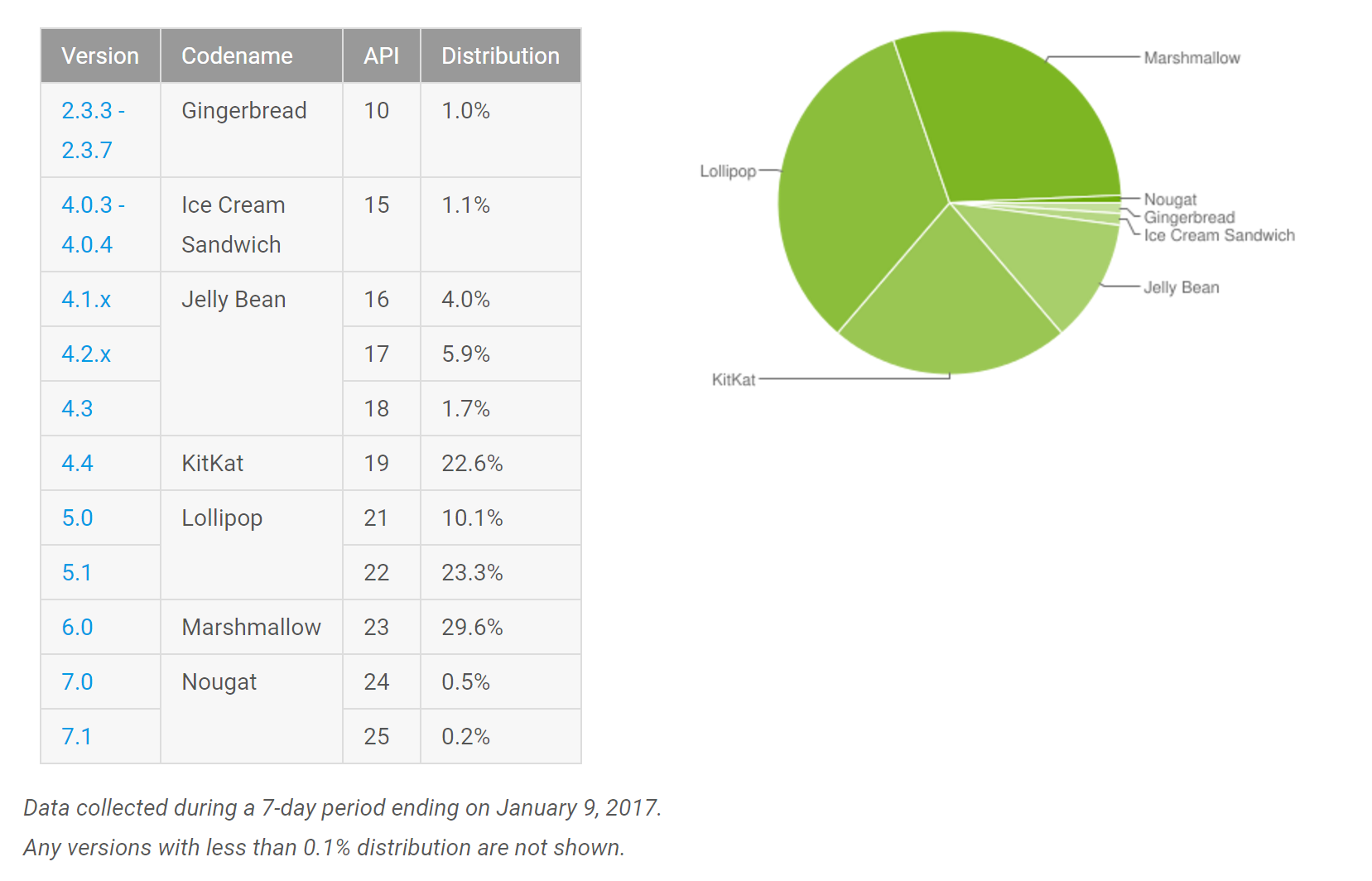
Google has released Android distribution numbers for January, revealing a significant bump Android users operating with Nougat and the disappearance of Android 2.2 Froyo, falling below the 0.1 percent line that it managed to hit during the previous cycle.

Nougat, meanwhile, has been gaining at a relatively healthy pace. Version 7.0 and 7.1 combine to grab 0.7 percent of the overall pie, almost double last month’s 0.4 percent. Breaking down that number, 7.0 is being used 0.5 percent of Android users while 7.1 has the remaining 0.2 percent. Next month’s Nougat percentage will likely gain a significant boost with the expected arrival of 7.0 for Samsung’s Galaxy S7 and S7 edge.

google android distribution jan 2017

The single most used version of Android remains Marshmallow, however, which gained 3.3 percentage points to climb to a total of 29.6 percent of the user base. Cumulatively, Lollipop’s two versions are still higher by a large margin at 33.4 percent.

The distribution data is based on Android devices that accessed the Play Store in a seven-day period ending January 9th.

Source: Google Via: 9to5Google

12 Jan 19:09

Apple convinces Consumer Reports to retest 2016 MacBook Pro battery life

by Patrick O'Rourke

Apple’s recently released 2016 USB-C MacBook Pro is one of the first laptops from the Cupertino, California-based developer to not receive a recommendation from Consumer Reports.

Back in December, the magazine reported that the MacBook Pro produced battery life between 3.75 and 19.6 hours. In my experience, I’ve had similar results with the 13-inch MacBook Pro with Touch Bar, with battery coming in at six to seven hours in some cases, and as low as three hours in others. The USB-C MacBook Pro we’re using that doesn’t come equipped with a Touch Bar, however, experiences much better battery life.

While I haven’t been able to pinpoint the battery issues yet, they seem to stem from what I’m actually doing with the MacBook. For example, browsing the web seems to use little battery life, while editing photos or doing light video editing, depletes it at a rapid pace.

Consumer Reports, however, has revealed that its testing methods require a browser cache to be turned of, which can lead to inconsistent battery life, according to the publication. The magazine plans to retest the laptop’s battery life, something Apple has been pushing the publication to do for the last few weeks.

Apple describes this bug as ‘obscure’ and states that it only occurs when users change the developer settings in order to turn off Safari’s browser cache.

“This is not a setting used by customers and does not reflect real-world usage,” Apple said in a statement. “Their use of this developer setting also triggered an obscure and intermittent bug reloading icons which created inconsistent results in their lab. After we asked Consumer Reports to run the same test using normal user settings, they told us their MacBook Pro systems consistently delivered the expected battery life.”

Apple says it has fixed the bug and released an update in the latest version of Sierra. It’s unclear if this fix will actually solve the MacBook Pro’s battery life issues given it seems to solve a problem that only affects Consumer Reports’ testing methods..

Read Apple’s full statement on the issue below:

“We appreciate the opportunity to work with Consumer Reports over the holidays to understand their battery test results. We learned that when testing battery life on Mac notebooks, Consumer Reports uses a hidden Safari setting for developing web sites which turns off the browser cache. This is not a setting used by customers and does not reflect real-world usage. Their use of this developer setting also triggered an obscure and intermittent bug reloading icons which created inconsistent results in their lab. After we asked Consumer Reports to run the same test using normal user settings, they told us their MacBook Pro systems consistently delivered the expected battery life. We have also fixed the bug uncovered in this test. This is the best pro notebook we’ve ever made, we respect Consumer Reports and we’re glad they decided to revisit their findings on the MacBook Pro.”

12 Jan 19:09

Facebook says you can fix Android app battery issues by resetting the app

by Patrick O'Rourke

If you’re one of the many users that has experienced a dramatic spike in smartphone battery consumption after using Facebook’s Android app, the social network says it now has a solution.

In the past couple of weeks, some Facebook users have reported their battery depleting as much as one percent every minute while Messenger is open. Facebook is a battery hog, but power consumption shouldn’t be that bad.

Facebook Messenger lead David Marcus recently took to Twitter to answer a user’s question regarding the power consumption problem. The issue has reportedly been fixed server side, but according to Marcus, if you’re experiencing battery drain, force close the app and restart it.

To force close an app on Android app, navigate to ‘Settings,’ then select ‘Apps,’ and touch the running tab to view all running apps. Next, select Facebook, and touch the ‘Stop’ or ‘Force Stop’ button.

Source: Twitter

12 Jan 19:09

It was only a matter of time before Instagram Stories started playing ads

by Jessica Vomiero

Instagram announced recently that it will begin placing ads between Stories, which currently play one after another as users watch them.

The ads will reportedly be full-screen photo or video spots which will be inserted automatically as you jump from one friend’s post to another.

Over 150 million people reportedly use the Stories feature every day. This announcement comes shortly after Facebook revealed the launch of video ads on its core platform.

Facebook will soon be inserting ads in the middle of video posts, which doesn’t some as a surprise after the efforts expended over the past few years to optimize the social network for video publishers.

This is an important move for Instagram because it gives the platform a lot more space to sell ads. Seeing as Facebook is currently running out of spaces to generate ad revenue through the newsfeed, this recent update to Instagram Stories is timely in providing an alternative.

The new ads will roll out with just 30 advertisers but will reportedly be available to global firms within a few weeks,

Source: Recode

12 Jan 19:09

Amazon Canada fined $1 million for employing misleading pricing practices

by Jessica Vomiero

After a two-year investigation by the Competition Bureau, Amazon Canada has been fined $1 million CAD for misleading pricing practices.

The web giant will pay $1 million in penalties and $100 thousand towards the Competition Bureau’s costs, as part of an agreement regarding the Bureau’s probe into its pricing practices on its Canadian website.

Amazon often displays its prices in comparison to a regular “list price,” giving consumers the impression that they were paying lower than the prevailing market price.

The Bureau’s investigation determined that Amazon.ca relied on its suppliers to provide the list price without verifying that these prices were accurate. As part of the Competition Act, the Bureau demands that consumers are not misled by references to inflated regular prices.

“Amazon relied on its suppliers to provide list prices without verifying that those prices were accurate.”

The savings were reportedly repeated on Amazon.ca, in Amazon apps, in online advertisements, as well as in emails sent to customers.

“Amazon often compared its prices to a regular price — or ‘List Price’ — signalling attractive savings to consumers. The Bureau’s investigation concluded that these claims created the impression that prices for items offered on www.amazon.ca were lower than prevailing market prices. The Bureau determined that Amazon relied on its suppliers to provide list prices without verifying that those prices were accurate,” said the Bureau in a statement released earlier.

It’s important to note that over the course of the investigation however, Amazon amended its policies and procedures to ensure that they do not infringe on the Competition Act.

The Bureau opened the investigation into Amazon Canada in May of 2014 and closed it this past year in March of 2016.

“Consumers are naturally attracted to claims that they will save money. We’re pleased that Amazon has put procedures in place to validate list prices received from its suppliers. This ensures that consumers are provided with accurate information and not misled by savings claims. This agreement was reached through collaborative efforts and reflects an innovative approach we call shared compliance,” said John Pecman, the Commissioner of Competition, in a statement.

This announcement comes shortly after the Competition Bureau concluded its investigation of smartphone giant Apple regarding whether the company used its “dominance” to sway retailers into offering fewer discounts to competitors.

Source: Competition Bureau

11 Jan 00:22

HTML500 aims to teach 2500 Canadians to code, expands to nine cities

by Jessica Galang

After a year-long hiatus, HTML500, a free learn to code event hosted by Lighthouse Labs, is kicking off in Toronto on February 18.

HTML500 will run in eight other cities across Canada, including Vancouver, Montreal, Calgary, Ottawa, Halifax, Victoria, London, and Saskatoon. The coding school said that over 2,500 people of all ages will participate in the event. The organizers say that, in 2015, over 50 percent of its event participants were women.

“With digital and online technologies growing at an exponential pace, the next step is for us to start interacting with this digital world in a much more hands-on way by learning the basics of code. Because coding democratizes creation,” said Jeremy Shaki, founder of Lighthouse Labs. “Coding gives us the power to create things that can be shared with the world in an unprecedented way. This is why we created the HTML500.”

During the event, attendees learn the basics of coding, including creating their own landing page using HTML and CSS. TELUS is HTML500’s founding partner for this year.

“It has never been more important for the next generation to learn to code, the future of job stability depends on it. We are excited about the opportunity that The HTML500 presents as a unique learning outlet for the growing Canadian digital market,” said Shawn Mandel, VP at TELUS digital.

Source: HTML500 Via: BetaKit

11 Jan 00:22

Gefährlich, gefährlich

by Moritz Tschermak
mkalus shared this story from BILDblog.

Achtung, jetzt wird’s gefährlich! Dieser Text hier ist nichts für schwache Nerven. Denn Bild.de hat sich am vergangenen Wochenende in den Vorhof zur Hölle in die Berliner U-Bahn-Linie 8 gewagt:

Ob es da gefährlich ist, fragen Sie sich jetzt? Na, hören Sie mal — und wie!

Die Berliner U-Bahnlinie U8 fährt durch die gefährlichsten Stationen der Stadt.

BILD fuhr eine Nacht lang mit: auf der gefährlichsten Strecke der Hauptstadt.

BILD fährt die Gewaltstrecke ab

Zugegeben: In den vergangenen Wochen gab es an zwei Haltestellen der U8 tatsächlich Vorfälle, die grässlich waren und für Aufsehen gesorgt haben: An der Endstation Hermannstraße trat ein Mann einer Frau brutal in den Rücken. Sie stürzte eine Treppe runter und brach sich einen Arm. An der Haltestelle Schönleinstraße hatten mehrere Männer versucht, einen Obdachlosen anzuzünden. Dem Mann ist zum Glück nichts passiert.

Diese „Gewaltstrecke“ wollte sich der Bild.de-Autor also mal genauer anschauen. Und was er erlebt hat, ist nun wirklich, nun ja …

Start an der Haltestelle Wittenau:

Der Zug ist fast leer, die wenigen Fahrgäste sehen müde aus, hören Musik oder blicken auf ihr Smartphone.

Erste Aufregung an der Bernauer Straße — ein freundlicher Mann, der nach Geld fragt:

Ein junger Mann, Mitte zwanzig, schlendert durch die Bahn, bettelt höflich um Geld.

Am Rosenthaler Platz dann sogar noch Touristen mit Bier:

Wer kein Spanisch oder Englisch spricht, fühlt sich etwas fremd. Mit je einer Flasche Bier in der Hand entert eine große Gruppe Touristen den Zug.

Am Alex: noch mehr Menschen!

Voller Bahnsteig am Alexanderplatz (Mitte).

Aber spätestens am Moritzplatz kann auch der Bild.de-Autor nicht mehr verstecken, dass die U8 zumindest an diesem Abend vielleicht doch nicht so „gefährlich“ ist wie angekündigt:

Gähnende Leere am Moritzplatz (Kreuzberg).

Vom Kotti kann man auch nur über schlafende Obdachlose berichten:

Zwei Obdachlose schlafen auf der Bank, ignorieren alles um sich herum.

Doch plötzlich, am Hermannplatz — Action!

23.09 Uhr, Hermannplatz (Neukölln): In der U-Bahn zündet sich ein Jugendlicher eine Zigarette an, in der anderen Hand hält er eine Flasche Whisky. Keiner der Fahrgäste beschwert sich.

Joar.

Dann noch mal zur Schönleinstraße. Aber auch da: niente, nada, nichts.

Ein kleines Rinnsal fließt von einem Pfeiler weg. Die Flüssigkeit: undefinierbar.

Das war’s dann auch schon. Das war „Berlins gefährlichste U-Bahn“. Also, das Fazit der nächtlichen Tour?

Nach dieser Fahrt in der U8 wundert es jedenfalls kaum, dass, wenn es zu Gewalt käme, es keiner merken würde. Erst hinterher.

So kann man es natürlich auch drehen, wenn man unbedingt ein bisschen Angst und Schrecken verbreiten will.

Das BILDblog finanziell unterstützen
Sie finden gut, was wir hier machen? Dann unterstützen Sie uns doch! Mit Ihrer Hilfe kann und wird es weiter Medienkritik beim BILDblog geben. Unser Dank ist Ihnen gewiss, wir freuen uns über jede Unterstützung — und am meisten über Daueraufträge.Unsere Kontodaten: B-blog, IBAN: DE94 1001 0010 0555 4161 07, BIC: PBNKDEFF, Postbank Berlin, Konto 555 416 107, BLZ 100 100 10
 
Geht auch per Paypal:

Flattr this!

11 Jan 00:21

Forget Alexa, This Personal Desk-Bot Talks in GIFs

by Beckett Mufson for The Creators Project

Screencap via YouTube

Personal AI assistants are big money to tech bigwigs—think Apple's Siri, Microsoft's Cortana, and Amazon's Alexa—but coder and designer Abhishek Singh might have topped them all with a GIF fluent robot named Peeqo, and it's completely open-sourced. About the size of a human head, Peeqo's 3D-printed carapace can respond to questions, play music on command, and comment on your browsing activity. He speaks in simple sounds, flashing LEDs, and body language reminiscent of the Pixar intro lamp, but his mother tongue is a Tumblr-native fluency in GIFs.

When Peeqo has something to say, the screen displaying his eyes drops away and offers the perfect GIF to convey an emotion. Peeqo's Raspberry Pi brain is more than a simple GIF search engine, as he seems to be able to parse out different responses to the same voice commands, according to a demo Singh released yesterday. "I tried to give him a personality so at times his response can be rather spunky," Singh says in the video. This could be a great stopgap for roboticists struggling with the uncanny valley in their androids—just give them GIFs and they'll be at least as relatable as a Tinder stranger. 

GIF via Imgur Video

Without a doubt the coolest thing about Peeqo is that this is just the beginning. We've long discussed GIFs as a visual language, and teaching that dialect to a robot is a fascinating endeavor. Since he's open source, the creative coding community will be able to build on this design with infinite possibilities. Singh himself is working on outfitting Peeqo with facial recognition software, but maybe Boston Dynamics can strap him to their dog so it can display how sad it is when they cruelly knock it over. In the mean time, see Peeqo's current oeuvre of abilities in the demo below.

Check out Abhishek Singh's website for more projects, including light up shoes and a VR dragon ride. Visit his Imgur post for instructions on how to build your own Peeqo.

Via Prosthetic Knowledge

Related:

Industrial Robot Reprogrammed to Get Bored and Curious Like a Living Thing

Behind the Scenes of a Flying Robot-Built Cocoon

Indiana Jones Meets 'Akira' in a Wordless Animated Short

11 Jan 00:21

Patrick Spence is the new Sonos CEO

by Volker Weber

ZZ556ED9C5

As the founder and CEO of Sonos, I am always trying to find leaders who are capable of taking Sonos to the next level. Part of that means assessing my own role. With Sonos now poised for a new phase of growth, I am excited to pass the role of Chief Executive Officer to a well-prepared Patrick Spence. Patrick demonstrated his leadership most recently with Sonos’ success during the holiday period, but more importantly, there isn’t a person who better embodies Sonos’ values and culture.

I met Patrick a year ago in Santa Barbara, and he is a great person. Sonos is in good hands and actually has already been for a while. But now it's official.

While I was visiting Sonos I shot a lot of photos. And I gave a few of them to Sonos as a small token of appreciation. The header shot of the blog post is one of them. It shows life at Sonos. Patrick and John, at a long table with others. The CEO does not have an office. He is playing in the same band as everybody else.

More >

11 Jan 00:21

UK after Brexit

by Ronny
mkalus shared this story from Das Kraftfuttermischwerk.

11 Jan 00:20

Practical artificial intelligence in the cloud

files/images/ila_berlin_2012_pd_026_crop-069e31767194d862dbc715a01a395d7d.jpg


Mike Barlow, O'Reilly, Jan 13, 2017


We are rapidly approaching a world in which software and service designers simply plug their application into an AI service to perform increasingly useful tasks. It's a question of the need for scale. "If you’ re talking about systems that... do difficult things like natural language processing and unstructured data mining... it makes sense to centralize them in the cloud." But opportunity makes a virtue out of necessity . We can have light-weight applications that access numerous services on an as-needed basis. Note: O'Reilly requires social media sign-in to read this article (and probably sell your data).

[Link] [Comment]
11 Jan 00:20

Can Edtech Support—and Even Save—Educational Research?

files/images/education-keyboardFeatured5.jpg


Jay Lynch, Nathan Martin, EdSurge, Jan 13, 2017


Traditional educational research is (to my mind) often misleading or irrelevant. I am not alone in this assessment, as this article suggests. And while I'm quite properly sceptical about the research that may be offered up by a commercial enterprise (in this case, Pearson) I think the arguments in this post are sound, and in particular endorse this: "For research to meaningfully impact teaching and learning, it will need to expand beyond an emphasis on controlled intervention studies and prioritize the messy, real-life conditions facing teachers and students."

[Link] [Comment]
11 Jan 00:20

The new command line

by Tristan Louis

Long before Windows, long before MacOS, there was the command line. Long before iOS, and long before Android, the only way to bend a computer to your will was to give short commands that could be interpreted by the operating system.

Today, that world has become mostly invisible to regular users, who generally tap or point and click their way to information. The command line has all but disappeared from the public consciousness, with the exception of power users and programmers, who face it on a daily basis.

But while a whole generation or two of computer users have grown without understanding the command line, it is primed for a comeback in a big way over the next few years.

Hard to believe but millions of users have already made the move through simple invocations like “Alexa, do this” or “OK Google, do that.” In doing so, the computing world is going full circle, creating new challenges for product designers.

For the last 20 years, people involved in developing software products have been able to rely on visual cues as a way to train consumers in sending servers the information they need. In the new world of voice or text-driven interfaces, user interface designers will have to start thinking about conversations as the way to direct the user. Whether it is a bot running on slack or your messaging client of choice, a voice recognition agent like Siri, Echo, or Google Home, the smartest developers will have to find ways to make the path easy to understand for even the most basic of customers.

At CES last week, a new rule of computing appeared to have been born: “if it can be connected to Amazon Echo, it will be.” By opening up access to its platform through “Amazon Skills,” the retail giant has created what could be the next big platform. Just as mobile devices running iOS and Android have taken precedence over computers runnings Windows and OSX, devices like Amazon Echo and Google Home are presenting a different version of the future that could supplant the one we currently know. A few years ago, the internet 3.0 era got every technology product to think about the move to mobile; In the next couple of years, expect to see the rise of internet 4.0, which will require every system to have an artificial intelligence layer.

Here’s why? Today’s conversational interfaces are still relatively basic and will need to increase the level of context they understand in order for greater power. Alexa and Siri can easily find and play a particular song but can easily get tripped up when queries become more complex. As a result, the age of artificial intelligence, coupled with a conversational interface, is upon us. To do so will require scientists who can converse as normal human beings and product designer who think hard about artificial intelligence.

Over the next year, you can expect to see me return to this theme on a regular basis as we explore the rise of Internet 4.0.

The post The new command line appeared first on Tristan Louis - TNL.net.

11 Jan 00:20

5 Predictions for 2017

by Tristan Louis

Many of you have asked me to make predictions for the upcoming years so I’m pulling out the dusty old glass ball and presenting to you the things I will look at in the coming year. The prediction game is a dangerous game as one steers into trends and tries to pull out short insights into grand theories. That said, here’s what I’m keeping an eye on.

The Post-app World Enters its Growth Phase

With app stores now clogged by millions of apps and users generally not downloading them, smart companies will look to grow in user’s existing workflows. For the past year, the rise of chatbots has shown that light context-aware applications can win without having an app in place.

Meanwhile, smart assistants like Amazon Echo (or Alexa), Google Home, and Siri are making voice an important interface component for consumers. Expect those trends to start filtering back into the business world, with conversation either through a chat interface or through a voice-driven tool to grow this year. Much as the iPhone and smartphones were not dominant players in 2007-2008, you will see early adopters move to those tools ahead of the mainstream. Expect strong growth in that area where companies are laying the groundwork for what I call Internet 4.0 (a term I will write more about this year).

AI Everywhere

With the rise of those interfaces, Artificial Intelligence will become a required component of every technology offering. As app give way to platform-based interactions, the need for intelligence will increase. Expect 2017 to be the year when more and more companies are asked about their AI strategy. Much as 2009-2011 were the years when investors and consumers starting wondering about everyone’s mobile strategy, 2017-2019 are going to be the years when increasing questions about artificial intelligence strategies will arise.

As a result of this new trend, expect enterprise software as a service (SaaS) to experience a rebirth, as existing SaaS models will be refreshed with a dose of AI. Those new systems will be characterized by dramatically simpler front-end interfaces that gather data from a variety of source to help them anticipate and help perform specific tasks.

New Financial Models

2017 will also be the year when new financial models will appear for a variety of offering.

In the digital media space, some companies will move beyond the advertising-backed model as revenues from traditional advertising continue to decline. Increased adoption of ad blockers will drive increased techniques to stop users from using ad blockers, leading to audience leakage and the realization that the advertising-supported model of media may not be applicable in a lot of cases.

In the Internet of Things world, many companies will realize that consumers are not necessarily interested in purchasing products directly from them. The result will be an increase in the subsidized model of deployment where insurance companies, utilities, and other service providers will underwrite the deployment of those technologies in exchange for access to the data those devices are generating.

The Great Tech Backlash

Following an almost giddy decade when the tech world has been seen as new masters of the universe, 2017 will be the year when a large consumer backlash will take hold.

The usual valley swagger that shirks the rules in order to create a new world order may suffer some setback as people angry with automation and continued sluggish employment for blue collars will start to lash out at the world we’re trying to build. Systems like the gig economy, blockchains, and autonomous vehicles will bump into social resistance and politicians will work on painting the tech world as out of touch with the real world. They will still progress but the pace of that progress will be slower as a result of external opposition.

Two events will mark a turn in consumer acceptance and they will be around VR and Apple.

The hype over VR will die as the first products to enter the market fail to wow users. Unfortunately, the attempts at driving VR at a low cost, combined with a set of promises around mixed reality that cannot yet be fully achieved will lead to consumer questioning whether the technology makes sense at all. This will generate a pull-back and some of the companies leading the charge in the space will be painted as out of touch.

On the other side (or possibly on the same side), Apple will introduce a product that fails to wow consumers. 2016 marked controversies surrounding the launch of the iPhone 7 (“no headset plug”) and of the new Macbook Pro (“USB C as the only connectors”). These have led to rumbles of unhappiness among a lot of the initial fan base. The narrative of an organization that fans had heralded as infallible seems to be replaced by that of a company that is not that innovative. Many may discuss the fairness of that point but I am hearing, for the first time, an increasing chorus from long-time fans who feel the company is abandoning them. While many despair about that state of affairs, Apple does not yet have to worry about any mass exodus yet as it is still perceived as producing a higher quality product than what its competitors offer. Those cracks in Apple’s perception will lead to a mainstream belief that since Apple is broken, the rest of the tech world may be too.

I will be wrong

One thing that is clear is that some sub-components of those predictions will be wrong. By predicting that I will be wrong on some of this, I ensure that whatever way these predictions go, I get to have at least a right one.

The post 5 Predictions for 2017 appeared first on Tristan Louis - TNL.net.

11 Jan 00:07

The Best Nonslip Traction Devices

by Lisa Maloney
nonslip traction devices lede

After more than twelve hours of testing fifteen different traction devices on water-slicked ice, hard-packed snow, and slippery hills in Alaska’s city sidewalks and forested trails, we’ve identified the ICEtrekkers Diamond Grip as the best ice gripper for all-around walking use in the city. They’re easy to put on and walk in but still offer great traction on all but the slickest hills as long as you weigh enough to press the low-profile spikes into the ice. We also identified a few options that will work well for lighter walkers. We also tested speciality running shoes with built-in traction control, since runners will want to choose something that doesn’t affect their gait.

10 Jan 20:39

week-416

by chris-roos

Tuesday 10th January, 2017

Chris Roos by Chris Roos

Week 416

Happy new year folks! I trust you’re all well after the Christmas and New Year break.

We spent our first week of 2017 working on a variety of smaller tasks.

Smart Answers retrospective

James and I had an internal retrospective about our work on Smart Answers. We’d talked about doing this in the past and finally made the time to do it before our memories of the project faded too much. I found this to be a useful exercise and it’s now something we’re planning to do for all future projects.

As part of the exercise we came up with the following list of things that we’d like to try to do better in future:

  1. Be more explicit about the way we work

    We think that teams are more effective if everyone shares an understanding of how the team is working. We’d like to get better at explaining how we work in the hope that we can use that to help a team come to a shared approach.

  2. Publicise the work we’re doing within the organisation

    While we’re always happy to talk about the work we’re doing, we’re not very good at going out of our way to promote it. I think we possibly underestimate the utility of publicising what we’re doing and we’d like to get better at it.

  3. Be more vocal about non development related problems

    We want to get better at talking about non development related problems we notice. High developer turnover, for example, can make it harder to collaborate/pair.

  4. Be more confident to make decisions that affect the simplicity of the system

    We ended up making the Smart Answers code slightly more complicated by catering for some behaviour that we think had probably been accidentally introduced. In hindsight we were as well placed as anyone else to make the decision to simplify the system.

  5. Collaborate with people who are better at bigger-picture thinking

    We think there’s a lot to be said for incrementally improving existing codebases and, in general, for avoiding software rewrites. We’re aware that this might mean we miss a bigger-picture opportunity that someone else might spot.

Task management

We’ve been relying on a single Trello board to manage a whole variety of tasks for a while now. This means we end up with recurring tasks (e.g. pay wages) alongside one off tasks (e.g. respond to email from accountant) alongside ideas and tasks for things like Mocha and our website.

This has historically led to a long backlog of tasks of varying size and importance which can prove motivationally challenging. We’ve recently started to move some of the project-specific tasks to their own board with the intention of prioritising our time at the project level (e.g. spend a day working on Mocha) rather than at the task level (e.g. pay our wages and then respond to this Mocha PR). Time will tell whether this is an improvement.

Accounting

Our accountant reminded us that the Annual Return has now been replaced by the Confirmation Statement. This was a particularly useful reminder as it made us realise that our mechanism for ensuring we submitted our Annual Return no longer worked! We were relying on the Annual Return event in our FreeAgent calendar triggering a task to be created in Harmonia. Unfortunately, the date of the Confirmation Statement isn’t fixed (as it can be submitted multiple times during the year) and so doesn’t appear in our FreeAgent calendar. We’re now using an event in our own calendar to prompt us to submit the Confirmation Statement instead.

Leads

We responded to a couple of leads that came in at the end of last year/the beginning of this year. We try to meet everyone that gets in touch in the hope that we can at least offer some advice even if we might not be able to help in the long term.

One-time passwords

I finally published a blog post about one-time passwords that I’d started writing at the end of last year.

GDS

We continued to make progress with the GDS procurement process. Fingers crossed it looks like we’re very nearly there!

Show & Tell

We organised our 28th, and first of 2017, Show & Tell. We’re holding it at Forge & Co on Wed 11 Jan. Get in touch if you’re interested in joining us.

Until next time.

– Chris

Please enable JavaScript to view the comments powered by Disqus. comments powered by Disqus
10 Jan 20:38

Rolling Your Own Culture and (Not) Finding Community

by Guest

This is a guest post by Timothy Roy.

In economically advanced democracies, whose universities teach some sort of Enlightenment tradition and technocratic specialty, societies often do not share in common (and do not teach) certain important cultural cores.

These cores, which I think of as modules, include personal conflict resolution (how do we disagree? how do we apologize?), personal finances (how do we spend our money? how luxuriously should we live? how much should we save?), personal fitness (how do I maintain my body? what athletic skills should be practiced to promote health and strength?), and emotional or spiritual growth (more on this later).

rollyourown

These cultural modules are important because they address large parts of day-to-day life and overall lifestyle. They are also important because each module or chunk of teachings/practices can be fairly extensive, and hard to derive from scratch. Individuals, and entire societies, may take a long time to rediscover some of these helpful practices.

Fortunately for those of us bred in educational systems which run light on these cultural modules, there are lots of gurus around which are not too hard to discover. By taking a guru here and a guru there, you can form a complete personal culture, a complete lifestyle.

For instance, here is one list of gurus whose work I know. This list is modular, so for any category you can replace the given gurus with your own.

For fitness and health, you could look to Kelly Starrett, Mark Sisson, Pavel Tsatsouline, Christopher Sommers. For minimal living, there’s Mari Kondo. For finances and frugality, we have Mr. Money Mustache. For lifehacking, Tim Ferriss. For startup advice, Paul Graham. For romance, Esther Perel. For relationships, John Gottman. For thinking about medical evidence and by extension statistics, Ben Goldacre. For general worldview, Yuval Harari, Pinker, Taleb, and so on.

My point is not that any of these teachers represents the last word on the topic, though sometimes their acolytes seem to think so, and though it might seem so when you’re reading the firehose of information for the first time. My point is just that each teacher has assembled a rich set of advice and tips. Combining them generates many ideas and crossover habits, and putting them into practice will keep you busy for a long time.

Rolling your own culture in this way is in general a good idea, I think. Even if you come from a background that includes teaching or traditions which address each of these areas, contrasting advice may suit you better or at least provoke greater reflection. And if you do not come from such a background – the secular elementary and university system with which I opened, for instance – you likely will be able to find a more thoughtful approach than whatever your default is, saving you years of flailing.

Although rolling your own culture is a good idea in general, doing so leads to a few follow-on problems.

First, rolling your own requires a lot of work. Take the short list I provided above. Discovering them, understanding them, comparing them, trying them out, carries significant costs in time and energy. This can take years.

Many people lack the time and energy (or intellectual bandwidth if we’re being honest) to accomplish this task. By God you had better have figured out something that works for you before your business hits a rough patch or you lose a family member or your partner gets cancer, because you won’t be able to figure it out after that.

Some (often religious) communities with a “complete worldview” contain these teachings as a package deal — both a feature and a bug of such communities. As a feature, a comprehensive and integrated set of teachings saves most ordinary people years (or generations) of search and testing. As a bug, some of the teachings may be pathological or simply not individually suited.

Second, the individual modules may not fit together very well. One could imagine a university-level course on lifestyle design.

In Gardens Need Walls: On Boundaries, Ritual, and Beauty, Sarah Perry uses Christopher Alexander’s work on patterns to contemplate how our lives and cultures are designed. They are, by and large, slipshod, ramshackle constructions, bits of this and that tacked together.

We select from the available chunks and try to fit them together into a coherent whole – an education here, a job there, a box to live in, entertainment to pass the time. These available “life parts” tend to be black boxes in whose design we have little say. They may not fit together into a satisfying whole at all – the boat they make may not float … I do not think this kind of problem is one that individual imagination is powerful enough to solve. Even the most imaginative among us will tend to build a “monstrosity” instead of a life.

The third problem resulting from rolling your own culture is more serious and more interesting.

Bowling Alone

One definition of a community is the place you can bring all of your self to, the kind of space held up as an ideal in Robert Putnam’s classic, Bowling Alone

With a close friend, or at a traditional church, you can talk about your bad leg, your struggles or success at work, how your love life or lack thereof is going, and your newest hobby. There is no compartmentalization. That’s a community.

By contrast, industrialized or post-industrialized economies are systematic. You can talk about your strength training at your gym, your bad leg at your physical therapist’s, your emotional life at your psychologist’s, and your career with your mentor – assuming you are lucky enough to have some or all of these. Your self becomes splintered among these locations and communities.

One common solution is to choose one of these categories in which to invest your identity. Ardent Crossfitters often like to date other Crossfitters and even have their own dubious sartorial aesthetic. Mustachians (devotees of the frugality blogger Mr. Money Mustache) spend much of their time thinking about luxuriously frugal financial strategies. By emphasizing one lifestyle category over others, you can find a lot of fulfillment among like-minded people.

However, finding a group that shares even a few of your cultural modules becomes a significant challenge. Sometimes lifestyle teachings select against each other. Sometimes some modules cluster together, such as libertarianism and the Paleo diet, and those clusters do aid in finding friends and community.

Modules that cluster together or that select against each other can be set to one side for the moment. In general, as a simple matter of probability, because we now roll our own cultures, the increasing diversity of the modules of these cultures decreases overlap between the sub-communities of the modules, and decreases the chances of finding many people who share several modules with you.

A “true community,” where you bring all of your self, forms in the overlapping portion of the Venn diagram of many cultural modules. Traditional communities propagate themselves and preserve themselves precisely by maintaining that overlapping region. As that Venn center shrinks, so does the number of “true communities.”

“People have always had selves, but selves have not always had to carry the burden of supplying meaning to life in such a far-reaching fashion.”  — Roy Baumeister

As society has become simultaneously secular and atomized, community has become harder to come by. Community forms largely around shared culture of one sort or another, and with less cultural overlap, communities shrink.

As cultures become atomized or nonexistent, our languages for communicating meaning to one another, for crafting meaning together, have a shrinking shared vocabulary. And as crafting meaning together becomes harder, the result is also poorer than received meanings from history.

The more carefully you’ve planned your life, the fewer people you’ll find to plan it with.

Eating the Shadow

The most powerful description of personal maturity I’ve found so far is Robert Kegan’s, as explained by David Chapman. Kegan provides a five-stage model of personal maturity.

The first stage contains mostly infants: in a blooming, buzzing confusion, the baby feels hunger, pain, sleepiness. In the second stage, if the child could speak it would say “I am hungry” or “I am sleepy.”

In the third stage, usually older children, “personal interests are relativized. They move from subject to object: you no longer are your collection of interests, you have interests. They are subordinated to, and are organized by, relationships. You are in relationships; and, tacitly, you find yourself defined by them.”

The fourth stage characterizes modern society. We have priorities and procedures based on reasons, and that applies to our personal lives as well. Adolescent dramas diminish as systematic priorities take over: I’m sorry, but we planned this party weeks ago, and I can’t switch to go to yours. Middle-class career professionals sometimes feel cold and calculating to family members due to conflicts between the fourth and third stages.

This fourth stage is also where all those cultural modules live. They are systematic approaches to specific pieces of the human puzzle. If you really buy into them, other approaches are incorrect or even morally wrong.

In the fifth stage, you become adept at using systems in situation-appropriate ways. You’re not troubled by each system’s shortcomings or by conflicts between systems, whether we’re talking about political and justice systems, financial and fitness systems, or philosophical systems. In Kegan’s stage 5, we move beyond a devotion to this or that project, and we define ourselves by the ongoing process of meaning making. As a result, individuals in the fifth stage are able to navigate fluidly multiple systems of culture and meaning. To the extent you “are” anything, you could become a Marxist libertarian, or a religious atheist.

Getting to Stage 5 often entails an uncanny valley, “Stage 4.5,” a nihilistic stage where you’ve lost faith in your old systems but haven’t yet adapted to their loss.

I propose that people who live in Kegan’s stage five have “eaten their shadow” to a significant extent, as a part of their journey into that mature state.

“Another way to put it is that people under thirty-five cannot teach themselves or others to eat the shadow.” —  Robert Bly, A Little Book on the Human Shadow

“Eating the shadow” or “emotional work” is a quasi-Jungian idea that you have to not only face but also embrace the darker sides of your personality before you realize your potential.

“Yet there is a mystery here and it is not one that I understand: Without this sting of otherness, of even – the vicious, without the terrible energies of the underside of health, sanity, sense, then nothing works or can work. I tell you that goodness – what we in our ordinary daylight selves call goodness: the ordinary, the decent – these are nothing without the hidden powers that pour forth continually from their shadow sides.”  — Doris Lessing

The petty, jealous, angry, manipulative, cowardly, cold, apathetic, etc., sides of yourself actually prove key to becoming whomever you want to be: dynamic, powerful, wise, caring, clever, etc. (I’m not assuming we all want to be the same person, fill in your own virtuous adjectives).

Stage transitions usually cannot be accomplished solo. Intellectual understanding is not enough. A bridge needs a culture and community…

And there’s this sense that this initiation into a more emotionally mature stage has to be done (often physically) with other people, and it is something that you cannot do yourself. You cannot bootstrap your way to the next level of maturity. It is something that must be shown you.

Collapsonomics

At the moment, right-wing nationalist and populist movements are sweeping Western democracies. When the politics of Britain, the US, Guatemala, France, Italy, start looking eerily similar, it’s time to look for global commonalities.

One explanation is neoliberal policies allowing capital to move out of industrialized economies, causing wage stagnation and a gradual hollowing out of the middle class, causing popular frustration which manifests in nationalist and populist movements. A more dire hypothesis comes from Joseph Tainter.

Rome and other civilizations expanded as long as they absorbed more energy, usually via conquest. All that energy (crops, money, and so on) can only be handled efficiently at a higher level of societal complexity. But that level of complexity can only be sustained by continued growth. When the civilization stops expanding, it collapses. Tainter wrote his book before the Soviet Union collapsed, but his thesis fits the abandoned factories and decaying concrete infrastructure of the former Soviet bloc perfectly.

Applying this hypothesis to the modern world, if we have hit peak resources or peak capitalism, then the institutions that define liberal democracy are destined to collapse, and it is unclear whether they will do so rapidly or slowly. So perhaps the global economy is starting to slow down as a result, which may be one driver behind popular frustration, which is manifesting in nationalist and populist movements.

It’s even possible that the basic toolkit of most of our institutions is worn out, past due for an overhaul: representative democracy may not process information quickly enough. Today, cities and companies seem to be innovating more effectively than nations do. Perhaps globalization and the information economy throws up challenges more quickly than representative democracy can solve them, and we should push power downward or move to a liquid democratic system.

I’m not trying to advocate for any single hypothesis here, just to give a sampling of the range of complexity of the set of global-scale problems. Anyone attacking even a piece of the problem is going to have to be tough and agile and a high-level operator, able to coordinate many people, able to navigate many different ways to make meaning.

Invisible Communities

As cultures become atomized or nonexistent, our languages for communicating meaning to one another, for crafting meaning together, have a shrinking shared vocabulary. And as crafting meaning together becomes harder, the result is also poorer than received meanings from history.

And as subcultures overlap less, the number of “comprehensive communities” dwindles. This attrition poses challenges not only to lifestyle design and to social experiences, but may also severely handicap advanced emotional development.

Reaching a fluid state of emotional and cognitive maturity, accomplished through emotional work which is best performed in community, matters not only to us individually, but also to society.

“So the person who has eaten his shadow spreads calmness, and shows more grief than anger. If the ancients were right that darkness contains intelligence and nourishment and even information, then the person who has eaten some of his or her shadow is more energetic as well as more intelligent.” — Robert Bly

Chapman worries that too few people think precisely enough and at a high enough level to craft new meanings which communicate across the many atomized subcultures. And those sort of people can inspire and coordinate to solve global problems. More people in Kegan’s fifth stage are needed – but those people are best grown in community.

I speculate that a community interested in solving global problems, and which uses different cultural modules as a means to aid each other in reaching Kegan’s stage 5, wouldn’t be troubled by its members’ non-overlapping cultural modules. This community’s raison d’être would be to support the ongoing process of meaning making which becomes the identity of the person living in Kegan’s fifth stage, rather than to promote any particular ethical or relationship or financial or fitness system. It would be a factory not for a specific culture, but for individuals who create cultures and communities.

10 Jan 19:38

10 everyday things on the web the EU Commission wants to make illegal: Oettinger’s legacy

files/images/oettigone.jpg


Julia Reda, Jan 13, 2017


If gthe descriptions in this post are accurate (and there's no reason to suppose they aren't) then proposals from the European Commission to greatly extend copyright law would render many common online behaviours (including this newsletter) illegal. European Parliament member Julia Reda writes, "These proposals are pandering to the demands of some news publishers to charge search engines and social networks for sending traffic their way (yes, you read that right), as well as the music industry’ s wish  to be propped up in its negotiations with YouTube." Among the illegal behaviours: sharing snippets of news articles, tweeting a news headline, pinning photos to Pinterest, having a search engine index the web for you, and more.

[Link] [Comment]