Shared posts

16 Jan 19:47

Samsung to reveal why the Galaxy Note 7 caught fire on January 23rd, says report

by Ian Hardy

During CES 2017, Tim Baxter, president and COO of Samsung Electronics America, stated the company is “reflecting” and “listening” to its customers after the unfortunate Galaxy Note 7 battery issues, Samsung is “recommitting to [its] customers in 2017” and will continue “building on [its] heritage to reach higher for you.” Baxter

According to a new report in Reuters, Samsung has officially concluded its Note 7 investigation and has found out the exact reason some devices exploded, specifically calling out the batteries. Reuters states Samsung will announce full details on January 23rd, and will also unveil new measures the company is putting in place that ensure these safety concerns do not happen in future devices.

Health Canada noted Samsung “sold or distributed” approximately 39,000 Galaxy Note 7 smartphones in Canada and received four reports of phone batteries overheating with one incident resulting in a “minor burn injury to a consumer’s forearm.”

Samsung has since deactivated all Note 7’s from operating in the Canadian market.

Source: Reuters

16 Jan 19:47

Twitter Favorites: [adamrg] Interesting civics-focused science fiction. Democracy 3.0. https://t.co/e1b97EzKBc

Adam Gessaman @adamrg
Interesting civics-focused science fiction. Democracy 3.0. qz.com/884971/democra…
16 Jan 19:46

This could be the end of Canadian tar sands

mkalus shared this story from [Untitled].

The Canadian oil sands are one of the world’s largest sources of climate pollution and America’s biggest source of imported oil. And they may be about to go bust.

Canada’s oil sands, also known as tar sands, are the world’s fourth-largest reserve of crude oil. Mining them unleashes massive volumes of carbon dioxide into the atmosphere, easing the way for global warming to blow past 2 degrees C (3.6 degrees F) — levels considered “dangerous” under the Paris climate agreement.

The future of the Canadian oil sands industry is clouded with uncertainty because of simple economics. In today’s marketplace, there is little confidence oil prices will rise high enough to keep the oil sands profitable. And a flood of U.S. oil — one of the biggest reasons gasoline and crude oil have been cheap over the past two years — is sucking the life out of Canada’s oil industry.

“Frankly, for this reason, and because of longer-term trends toward cheaper renewables coupled with carbon pricing, the oil sands is likely a dead industry,” said Thomas Homer-Dixon, chair of global systems at the Balsillie School of International Affairs in Waterloo, Ontario.

And then there’s the Trump factor: President-elect Donald Trump is promising another renaissance for America’s oil industry, possibly flooding the market with even more U.S. oil.

Oil sands may not be a common household name, but they’re one of the dirtiest fossil fuels on earth. A thick and mucky clay-like substance laden with a hydrocarbon called bitumen, tar sands have to be strip-mined from the remote boreal forest of east-central Alberta before being sent thousands of miles to refineries that can handle them. The production and consumption of one barrel of tar sands crude releases 17 percent more carbon dioxide than a standard barrel of American oil, according to U.S. government statistics.

But the true climate cost of oil sands is potentially much greater because U.S. statistics don’t fully capture the carbon emissions involved in the mining and processing of oil sands, Homer-Dixon said.

The expansion of the oil sands industry in Alberta has led to significant deforestation in Canada’s boreal forests, which store vast amounts of atmospheric carbon and are threatened by climate change. More than 2 million acres of boreal forest have been lost or degraded because of oil sands mining.

Destruction of carbon-dense forests such as the boreal is a major contributor to climate change because the carbon stored in tree trunks and roots will eventually find its way back into the atmosphere after trees are cut down.

Strip-mining the boreal to extract the tar sands and processing the oil makes the sands much more damaging to the climate than conventional oil.

“I believe the carbon intensity of extraction and processing for the oil sands is about double that of conventional oil,” Homer-Dixon said.

If all the oil sands were extracted in Alberta, the emissions would be equivalent to burning all the oil in Saudi Arabia — the world’s largest oil producer — and all the carbon contained in the oil would end up in the atmosphere, making climate change worse.

And with the controversial Keystone XL Pipeline under construction, Canada seemed poised to do just that. Keystone XL would have carried crude oil from Alberta’s tar sands mines to refineries in Texas. From there, it would have been consumed in the U.S. or shipped to ports around the world.

The Obama administration shelved the pipeline running through the U.S. in 2015 because it said that easing the way for polluting oil sands to reach refineries would make it more difficult for the U.S. to be a global leader on climate policy. At the time, Canada’s oil industry projected that oil sands would account for a 43 percent increase in Canadian crude oil production through 2030.

Worried about the damage expended oil sands development could do to the climate, more than 100 scientists called for a moratorium on new tar sands mines in 2015, saying that more mining would make it difficult to prevent global warming from exceeding 2 degrees C.

But the scientists may not have needed a moratorium to slow oil sands extractions. Low crude oil prices may have stopped significant oil sands expansion all on their own.

The reason is simple: It’s really expensive to mine oil sands.

Oil prices need to be above $80 per barrel for oil sands mining to be profitable. Today, oil prices sit around $52, and there’s little confidence they’ll rise much higher despite Middle Eastern oil-producing countries’ recent agreement to cut their production to boost prices.

Carlos Murillo, an economist at the Conference Board of Canada, said those countries are unlikely to comply with that agreement, keeping oil prices from rising much higher.

Part of the reason is that Middle Eastern countries haven’t fully caught on to the idea that a lot of oil can be produced with fracking, said David Keith, a Harvard physicist and public policy professor.

Fracking is a method of drilling that allowed energy companies to access oil locked in solid shale rocks beneath North Dakota, Colorado, Texas, and other places — oil that was once thought to be too expensive to drill.

Today, shale oil can flood the market — especially in the U.S. — when oil prices are $50 per barrel, Keith said.

That means that almost no one is expecting big investments to flow into Canada’s oil sands, even though the Canadian government’s recent approval of two major oil sands pipelines — and Trump’s possible support of the Keystone XL Pipeline — could give the oil sands a boost in the coming years.

“In general, we don’t expect to see any new wave of investment that you saw in 2010,” when oil prices were rising rapidly toward $100 per barrel, said Jackie Forrest, director of research for ARC Energy Research Institute in Calgary.

Oil sands growth isn’t guaranteed even if the Trump administration approves Keystone XL because there could be an undercurrent of nativism or protectionism in U.S. energy policy, said Warren Mabee, Canada Research Chair in Renewable Energy at Queens University in Kingston, Ontario.

“Recall that President-elect Trump has said that Keystone XL should be built, but that he wants a ‘piece’ of it,” Mabee said.

“What does this mean? New tariffs or taxes?” Mabee said. “It’s not clear that Canadian companies will benefit hugely from the new administration.”

Seventeen major oil sands projects were canceled after oil prices crashed in 2014, as companies took major losses, Forrest said. Major investors in the oil sands have begun to leave, including Norway-based Statoil, which pulled out of the oil sands in December because it couldn’t make money there.

Oil sands companies were also hard hit by last year’s Fort McMurray wildfires, causing more than $3 billion in losses — the costliest natural disaster in Canada’s history. Suncor, one of the largest oil sands producers in Alberta, suffered a $735 million loss to its operations.

Though low oil prices will keep new investments away, some remaining oil sands projects that companies had invested in before the 2014 oil crash will soon become operational and boost Canadian oil production over the next few years, Forrest said.

“We’ll see half a million barrels of growth in oil sands through 2020,” she said. “After that, growth is less certain. Over 17 projects have been canceled. We’re going to probably see a real slowdown in the rate of growth post-2020.”

Until the trajectory of oil prices and Trump administration policy on Keystone XL become more clear, the oil sands industry is holding its breath.

“A lot of players have left, and other production has been mothballed,” Homer-Dixon said. “The industry is in a holding pattern.”
Source: Grist

16 Jan 19:46

The Impulse to Dive Deeper

by mikecaulfield

This comes up in my feed today:

blacktolive

I go to retweet it, but stop. How do I know this is true? It’s a little alarm bell that goes off now when something seems just a little too perfect.

I right click on the image, search by image.

sad


I look at the URLs, and I see “mlive.com”.  I also note the “/news/ann-arbor/” file structure, which makes me think this is local news. That’s promising, if this is an account of a local story. I click through.

tar

This is gold. A local account from a local paper of a story that happened locally years ago. The photo has a credit, and we have more information.

And I’m more informed now. I first looked at this photo and my mind naively assumed it was the South. Not consciously, but subconsciously. As I read the story I learn more about early efforts to celebrate Martin Luther King, new perspectives on how dangerous it was in some parts. I actually, I do a bit more than that, because the story makes me tear up a bit. Read it yourself, and you’ll see what I mean.

The whole process here takes a few minutes, and that’s only because reading the article takes a bit of time. The process of finding the article took ten seconds. In the end, I moved from senseless retweeting to actually learning something about our history.

I think some people think this stuff — Google Reverse Image, doing a Google Scholar search, looking up whois information on sites — is all just so *small* compared to Big Questions and Critical Thinking etc etc etc. And maybe it is.

But if you can imagine a life of these little habits, each one of which pushes you to dig a little deeper, explore a bit more, dive in a little further — I believe this is the way we start to build a better sort of society, a better sort of digital practice. We start with these habits, we move outward to questions, and deeper into reading. But without the habits, you won’t even start.


16 Jan 19:46

Essential Products Inc. – What’s essential?

by windsorr

Reply to this post

RFM AvatarSmall


Something must-have has to come out of the bag at launch. 

  • Essential Products Inc. is the latest in a long line of protagonists which is aiming to have a crack at the high end of the handset market and while it knows where it should compete, I am not convinced that it will be able to.
  • Essential is a start-up led by Andy Rubin who was the founder of the company that Google very successfully turned into Android.
  • Essential aims to compete in high-end consumer electronics by offering differentiation if the following areas:
    • First: Hardware. In any ecosystem strategy today, the most important device is the smartphone as this is where users spend almost all of their time.
    • Essential aims to compete here by offering a device which has a screen with no or almost no bezel.
    • Xiaomi has already done this quite effectively with the Mi Mix but this currently only available in China.
    • This is also the strategy, that I think Apple might use in the iPhone 8 but Essential should be able to launch well ahead of this.
    • Second: Artificial Intelligence. RFM research has recently identified AI as the 8th Law of Robotics concluding that AI is likely to have meaningful impact on the quality, and hence appeal, of Digital Life services in the medium term.
    • However, RFM research has also concluded that good AI requires a huge amount of time and a vast trove of user data in order to develop.
    • I seriously doubt whether Essential has either of these characteristics and while it may try to develop intelligent services, I suspect that it will struggle.
    • This is especially the case as its services are likely to end up competing with Google’s own which Essential will be obliged to implement on its smartphone and to set as default.
    • Third: Mods. Essential’s patent filings include a design for a proprietary magnetic charging port that can also be used as an expansion slot to add hardware functionality to devices.
    • In this day and age, unless you are Apple, proprietary charging ports are a big no-no and may be an indicator of the inexperience that Essential has in making smartphones.
    • Furthermore, the best mod on the market is currently made by Motorola which already has some volume and a reasonable range of third party brands making devices to connect to it.
    • All other modularity plays have either already failed or are struggling for relevance.
    • I struggle to see how Essential is much different.
    • Fourth: Cross device: Essential intends to produce a series of devices that will work together to deliver its proposition to users in all aspects of their Digital Lives.
    • This is also a vision pursued by Samsung, Xiaomi, Apple, Microsoft among others, and it does make some sense.
    • This is because if devices from one manufacturer all work together seamlessly, it provides a reason for users to buy all of their other devices from the same manufacturer.
    • This is one way of generating device preference without having an ecosystem and hence of earning better than commodity returns.
    • The problem is that getting all of these devices to work seamless together is fiendishly difficult and even the mighty Apple has not really got it right.
    • Microsoft does a reasonable job but there are still glaring holes in the experience that it offers.
    • Combined with this difficulty, will come the capital intensity of having to design a series of device types all at the same time which could easily be beyond the financial resources of Essential Products Inc.
  • With the segment that Essential chosen to compete in, there is very little scope to compete in the ecosystem as it will invariably have to support Google.
  • This is because its target users whether they are on iOS or Android will already have a meaningful part of their Digital Lives invested in Google are unlikely to want to switch.
  • Consequently, I remain uncertain as to what is special or different with regards to Essential Products Inc.
  • I am hoping to be well informed when it launches its proposition at some point during H1 2017.
16 Jan 19:46

Samsung Galaxy Note 7 Probe Results Leak; Blame Design and High-Capacity Battery for Explosion

by Rajesh Pandey
Samsung is reportedly set to reveal the details of its Galaxy Note 7 investigation next week on January 23rd, but key details from the final report of the investigation have already been leaked. While the blame was initially put on faulty batteries supplied to the company by Samsung SDI, the detailed investigation paints a different picture. Continue reading →
16 Jan 19:46

Phone Case Turns Your Display into an Immersive VR Experience

by Beckett Mufson for The Creators Project

Images courtesy of Cordon Media

This article was originally published on November 24, 2014 but we think it still rocks!

Toronto-based design company Cordon Media concieved of Pinć VR, a combination smartphone case and software suite that creates a portable virtual reality interface, unlike the bulky headsets offered by Oculus Rift or the impracticality of Google Glass.

Pinć (pronounced "pinch"), is a smartphone case that unfolds to reveal virtual reality glasses with lenses and straps, converting your smartphone's display into an immersive virtual reality experience. Combined with the Pinć app and two wireless, clickable rings, users can pull their phones out of their pockets, slip on the goggles, then browse the web, watch YouTube videos, and perform inside a 180-degree display.

"We want to make VR the next mobile medium," Cordon Media president Milan Baic tells The Creators Project. While the goggles are rough around the edges, the interface offers an experience wholly different from that of my normal smartphone. I type, click-by-click, in a 3D space as a virtual orca whale floats by in front of a Facebook feed. As it swims away, I follow it with my head and watch it do barrel rolls against the backdrops of YouTube and Pinć's 3D online shopping center.

The Pinć IndieGogo offers a case for each donation of $99 dollars, set to ship in either February or June, 2015, depending on how quickly you order. We're excited to see what innovators like Nonny de la Peña and Robin Arnott might do once their projects can become pocketable.

To learn more about Pinć's design click here.

Related:

Is Virtual Reality The Future Of Journalism?

Virtual Reality Mod Lets You See The World In Third Person POV

A Virtual Reality Experience Gave Me Synesthesia

Watch The First Feature Film Released For Virtual Reality

16 Jan 19:46

Compute Module 3 Launch!

by James Adams

Way back in April of 2014 we launched the original Compute Module (CM1), which was based around the BCM2835 processor of the original Raspberry Pi. CM1 was a great success and we’ve seen a lot of uptake from various markets, particularly in IoT and home and factory automation. Not to be outdone by its bigger Raspberry Pi brother, the Compute Module is also destined for space!

Compute Module 3

Since releasing the original Compute Module, we’ve launched 2 further generations of much faster Raspberry Pi boards, so today we bring you the shiny new Compute Module 3 (CM3); this is based on the Raspberry Pi 3 hardware, providing twice the RAM and roughly 10x the CPU performance of the original Module. We’ve been talking about the Compute Module 3 since the launch of the Raspberry Pi 3, and we’re already excited to see NEC displays, an early adopter, launching their CM3-enabled display solution.

Compute Module 3

The idea of the Compute Module was to provide an easy and cost-effective route to producing customised products based on the Pi hardware and software platform. The thought was to provide the ‘team in a garage’ with easy access to the same technology as the big guys. The Module takes care of the complexity of routing out the processor pins, the high speed RAM interface, and core power supply, and allows a simple carrier board to provide just what is needed in terms of external interfaces and form factor. The module uses a standard DDR2 SODIMM form factor, sockets for which are made by several manufacturers, are easily available, and are inexpensive.

In fact, today we are launching two versions of Compute Module 3. The first is the ‘standard’ CM3 which has a BCM2837 processor at up to 1.2GHz with 1GByte RAM, the same as Pi3, and 4Gbytes of on-module eMMC flash. The second version is what we are calling ‘Compute Module 3 Lite’ (CM3L) which still has the same BCM2837 and 1Gbyte of RAM, but brings the SD card interface to the Module pins so a user can wire this up to an eMMC or SD card of their choice.

Back side of CM3 (left) and CM3L (right).

We are also releasing an updated version of our get-you-started breakout board, the Compute Module IO Board V3 (CMIO3). This board provides the necessary power to the Module and gives you the ability to program the Module’s flash memory (for the non-Lite versions) or use an SD card (Lite versions), access the processor interfaces in a slightly more friendly fashion (pin headers and flexi connectors, much like the Pi), and provides the necessary HDMI and USB connectors so that you have an entire system that can boot Raspbian (or the OS of your choice). This board provides both a starting template for those who want to design with the Compute Module, and a quick way to start experimenting with the hardware, and building and testing a system, before going to the expense of fabricating a custom board. The CMIO3 can accept an original Compute Module, CM3, or CM3L.

Comprehensive information on the Compute Modules is available in the relevant hardware documentation section of our website, and includes a datasheet and schematics.

With the launch of CM3 and CM3 Lite, we are not obsoleting the original Compute Module; we still see this as a valid product in its own right, being a lower-cost and lower-power option where the performance of a CM3 would be overkill.

CM3 and CM3L are priced at $30 and $25 respectively (excluding tax and shipping), and this price applies to any size order. The original Compute Module is also reduced to $25. Our partners RS and Premier Farnell are also providing full development kits, which include all you need to get started designing with the Compute Module 3.

The CM3 is largely backwards-compatible with CM1 designs which have followed our design guidelines. The caveats are that the Module is 1mm taller than the original Module, and the processor core supply (VBAT) can draw significantly more current. Consequently, the processor itself will run much hotter under heavy CPU load, so designers need to consider thermals based on expected use cases.

CM3 (left) is 1mm taller than CM1 (right)

We’re very glad to finally be launching the Compute Module 3, and we’re excited to see what people do with it. Head on over to our partners element14 (or Farnell UK) and RS Components to buy yours today!

The post Compute Module 3 Launch! appeared first on Raspberry Pi.

16 Jan 19:45

Aphrodite and the Rabbis

by alevin

Aphrodite and the Rabbis, by Burton Visotzky, professor of Midrash at Jewish Theological Seminary, explores how Rabbinic Judaism, the dominant strain of Judaism for 2000 years after the destruction of the temple, developed in a matrix of hellenistic Greco-Roman culture under the Roman empire.

Examples: Hellenistic literary scholarship was based on study and commentary of the 24 books of Homer; the Rabbis used very similar modes commenting on the books of the Hebrew Bible; and they even shoe-horned the count of books in the canon to equal 24 in order to parallel the Homeric canon. The Passover seder was modeled directly on the hellenistic “symposium”, an intellectual seminar and feast interspersed with alcohol, dishes with dipping sauces, and music.

In focusing on what Rabbinic Judaism inherited from Hellenistic culture, Visotsky does not explore what is different. The symposium evening ended with courtesans entertaining the guests; that is not part of the Passover haggada. The book shows interesting literary similarities, but does not attend to the dramatic and presumably deliberate difference in which the Rabbis assertively avoid structures based on categories and sequence; the Talmudic forms are relentlessly digressive and associative. The book tells stories of interactions between Rabbis and various Roman figures; but stays away from the extensive talmudic material about avoiding contact and familiarity with pagans and the props and rituals of paganism.

The book provides evidence that Jews in the Roman empire were much more familiar with Aramaic and Greek than Hebrew. And it shows how early synagogue architecture was extraordinarily similar to the temples and churches down the street in Roman empire towns; and how the synagogue art was strikingly similar, including ubiquitous images of the Zodiac, and even images of Zeus/Apollo riding his 4-horse chariot across the sky.

synagogue mosaic beit alfa

In describing the material culture of Jews in the Roman empire, though, the book has very little information about how Jews lived outside of the Rabbinic academies, even how much connection there was (or wasn’t) between the elite scholars in the academy, elaborating ideas about normative ritual practice; and what Jews actually did. In one of the apparently few areas where there is evidence, the book inventories synagogues to assess how many follow the Rabbinic dictum to face toward the East, toward Jerusalem. The result is inclusive.

Last and least, the tone of the book is informal and jocular, which this reader found mildly distracting. Overall, I would recommend the book for those who are interested in the subject matter.

Visotsky argues that even as the Talmudic era Rabbis define themselves politically and religiously in contrast to the dominant culture, they were at the same time deeply shaped by the culture.

16 Jan 19:45

Five top restaurants join second Taste of Hong Kong festival this spring

by Bernice Chan
Taste of Hong Kong returns to Central Harbourfront for its second year from March 16-19, offering visitors the chance to taste dishes from some of the city’s top restaurants, meet some of our culinary talent and learn more about food and drinks. Like last year there are 13 Hong Kong restaurants participating, including five new ones – Kaum at Potato Head, Mercato, Okra, Zuma and Rhoda. Each of the restaurants will not only present signature dishes, but also ones exclusive to the...
16 Jan 19:44

The Allure of Off-Topic Discussions

by Richard Millington

You see it on many corporate facebook pages today.

The social media manager discovered lighthearted, off-topic, discussions boosted engagement metrics. Now most Facebook pages are almost entirely disconnected from any real strategy in the pursuit of engagement.

This happens in communities too. You discover off-topic discussions boost activity and pursue more of it – regardless of strategy.

But once most discussions are off-topic, it becomes almost impossible to attract newcomers. Newcomers are attracted to valuable expertise shared by topical discussions.

So you end up with a shrinking group of familiar regulars (and a steady churn to zero).

Off-topic discussions are a strategic tool to build a stronger sense of community among members. This sense of community should facilitate more shared expertise. If it doesn’t, why do it?

Or to put it simpler; if you can’t engage people in the topic, off-topic discussions won’t save you.

p.s. Final week to sign up for our Strategic Community Management course.

16 Jan 19:44

Let’s Encrypt On A Raspberry Pi Web Server

by Martin

Recently I set up a new web server on a Raspberry Pi at home to securely run a new web application and to properly isolate it from my other servers. One new thing I wanted to try out was setting-up a Let’s Encrypt certificate for https access and to learn how the tools work to automatically install and update the certificate.

It turned out that it’s not very difficult to do it, just a bit different from the standard installation method described on the Let’s Encrypt web site for Debian based system. Also I noticed that one should ensure that http digest authentication configured in ‘.htaccess’ files for some directories still works as intended once Let’s Encrypt is set-up, as it didn’t in my case.

As Let’s Encrypt is not (yet) included in the Raspian software repository it has to be installed from Github. This is done as follows:

sudo apt-get update && sudo apt-get install git
git clone https://github.com/letsencrypt/letsencrypt

Before starting the certificate installation it’s important that the web server (Apache in my case) is reachable via https on port 443. This is important as Let’s encrypt checks if the DNS entry to the domain name of the server, for which the certificate is requested, is online and actually belongs to the requester. For security reasons, I’ve decided to use a different port on the outside of my NAT so I had to temporarily change that mapping during the certificate installation (and again whenever I want to update it).

Once the server is reachable of port 443 the certificate retrieval and installation process can be started with the following command:

cd letsencrypt
./letsencrypt-auto --verbose --apache -d WWW.MY-SERVER.COM

And that’s it, after about a minute, the certificate is retrieved and installed!

Make Sure HTTP DIGEST Authentication Still Works

If you are using http digest authentication to restrict access to some URLs it’s important to test if this still works. In my case it didn’t because Let’s Encrypt creates a new default SSL site configuration file (/etc/apache/sites-enabled/000-default-le-ssl.conf) which does not include a number of “Directory” instructions I put into the default ssl config file. Copying them over and restarting Apache fixed the problem.

Updating The Certificate

Let’s Encrypt certificates are only valid for 3 months so they have to be replaced regularly. As I don’t use a standard https port mapping I can’t automate the certificate update process as I have to manually change the port mapping for the certificate update process. But since the certificate can be replaced with a single command it’s not too much of a hassle. The following command replaces the certificate before it is due, which is a good thing to try after installation just to make sure the process works as intended when run again in a few weeks time:

cd letsencrypt
./certbot-auto --force-renew

Fortunately my Apache “Directory” instructions I copied manually to the Let’s Encrypt SSL configuration file survives the certificate replacement so security is not compromised during the replacement.

16 Jan 02:56

Ski-Thru ATM

by Ken Ohrn

When bustin’ them moguls, ya never know when you’ll need some cash.

ski-thru-atm-whistler

Thanks to the CBC.


16 Jan 02:56

The intersection where Jenna Morrison died

by jnyyz

There have been some cycling friendly improvements to the intersection of Sterling Rd and Dundas St W, where Jenna Morrison died by being right hooked by a truck. Back in 2012, there was a community meeting about this intersection. Then in 2014, a more bike friendly crossing of Dundas St W was installed. Today I noticed that a bike sensor had been installed on the north side of the intersection for southbound cyclists on Sterling wanting to turn left on Dundas.

img_4669

Seen from across the intersection, you can see that the bike crossing is meant to be bidirectional, and that the bike crossing lights have been updated to the new design.

Kudos to the city for continuous improvements, although it would be nice to put a splash of green paint for bikes on Sterling Rd who are either waiting for the crossing, or wanting to turn left.  We also hope that the city plans to completely fix the intersection of College/Dundas/Lansdowne for cyclists will eventually happen.

On another note, whenever I am in this neck of the woods, I am irresistably drawn to Henderson’s Brewing, where today I note that Henderson’s best is now available in cans.

img_4673

Also a pleasure to discover spontaneous art along the Railpath.

img_4674

Heading home, I note that the stairway reconfiguration of the east end of the Wallace Street Bridge is slowly progressing.

img_4676

Now if we can just get that underground pedestrian connection to Dundas and Bloor done, that would be cool.


16 Jan 02:54

3 takeaways from Nintendo’s Switch keynote presentation

by Igor Bonifacic

After months of patient waiting, Nintendo fans finally got to see their favourite console maker release more details about its forthcoming mobile home console hybrid, the Switch.

While my colleague Patrick O’Rourke was in a mad dash to get every single detail about the device out to MobileSyrup readers following last night’s late reveal, I watched Nintendo presentation at a more leisurely pace to try and contextualize the device.

I’ve organized the result of that effort below. In short, I think there’s a lot to be optimistic about when it comes to the Switch, but it faces some potential stumbling blocks, particularly when it comes to its success in the Canadian market.

The Nintendo Switch is too expensive, at least in Canada

 

When Nintendo President Tatsumi Kimishima took to the stage last night in Tokyo and quickly announced the price of the Switch, it seemed like the Japanese gaming giant had thrown Canadian consumers a bone, as Kimishima said the Switch would cost $299 in the Americas.

“Not only did all of Nintendo’s first-party games look compelling, there also seemed to be something for everyone”

Nintendo then released local pricing details, revealing that its latest console will cost an additional $100 in Canada.

To put that number in perspective, that’s more than the $379 both Sony and Microsoft charge for their base model eighth generation consoles, both of which come with excellent games inside the box.

I’m not usually one to compare price between drastically different devices, because, for the most part, I don’t think it’s a useful exercise; most consumers products are far more than the sum of their components. But then you compare the Switch against the Xbox One S, with its support for both 4K and HDR video output, apps and UHD Blu-Ray playback, on top of the fact it plays games, the latter comes out looking like a much better value proposition.

Worse yet are the prices of the console’s accessories. In Canada, an extra set of Joy-Con controllers is priced at $100. Meanwhile, a single Switch Pro Controller will set Canadian consumers back $90. I don’t want to know how much an extra dock will cost (it doesn’t have a price yet) because in the U.S. it’s priced at $80 USD. You know something is way too expensive when our neighbors to the south complain.

Nintendo’s pricing strategy here seems completely at odds with its positioning of the Switch as a multiplayer-focused console, and is likely to put the company on the back foot as it tries to become competitive against Sony and Microsoft again.

Of course, we’ve been here before. When the 3DS first came to Canada back in 2011, it cost $250. Six months later, Nintendo slashed the console’s price to $170, a dramatic discount that significantly boosted sales of the device.

I understand Nintendo’s reasoning going into the launch of this console. The company must believe it has a compelling product on its hands and feels it’s well worth the asking price. Moreover, it’s easy for a consumer electronics company to reduce the price of a product, but to increase it is almost untenable, so why not make a few more bucks if possible. The company has shareholders to keep happy, after all.

Still, the company will need to adjust pricing strategy across the globe if it hopes to win back gamers.

But damn, that first-party lineup

It was just earlier this week that Microsoft cancelled Scalebound, one of its few announced exclusives that had nothing to do with Gears of War or Halo, so to watch Nintendo detail The Legend of Zelda: Breath of the Wild, Super Mario Odyssey and Splatoon 2, and announce that all three titles are coming out within the first year of the Switch’s launch, proved once again that the company is still the best first-party publisher in the business.

Moreover, not only did all of Nintendo’s first-party games look compelling, there also seemed to be something for everyone. It’s easy to see how 1-2-Switch and Arms could become this generation’s Wii Sports, and the new Legend of Zelda looks, well, amazing. Then there was Splatoon 2, sequel to the criminally underplayed Wii U original.

Normally I wouldn’t recommend anyone buy a game console at launch, but Nintendo’s release schedule looks such that there will be at least one great title every couple of months in the first year of the Switch’s availability.

Nintendo wisely didn’t oversell future releases either, instead focusing on titles that are near the end of their development cycle. That’s something Sony has been guilty of these past few years, particularly with the reveal of titles like The Last of Us Part II or Death Stranding, which anyone outside of Sony is unlikey to get their hands on anytime in the next two to three years.

But then first-party titles have never Nintendo’s issue, which brings us to third-party support.

Will western publishers once again ignore Nintendo’s new console?

Nintendo announced last night that more than 50 third-party developers are working on over 80 games for the Switch. Still, it was hard not to feel there was a good chance history was about to repeat itself.

While the company did show off titles from other publishers like Atlus and Square Enix, the games those publishers demoed will likely have limited appeal here in the West.  It’s understandable Nintendo chose to focus on the games that it did — it was presenting the Switch to its local Japanese audience after all — but the company will have to show the Switch is not just a machine for consuming its own creations and JRPGs.
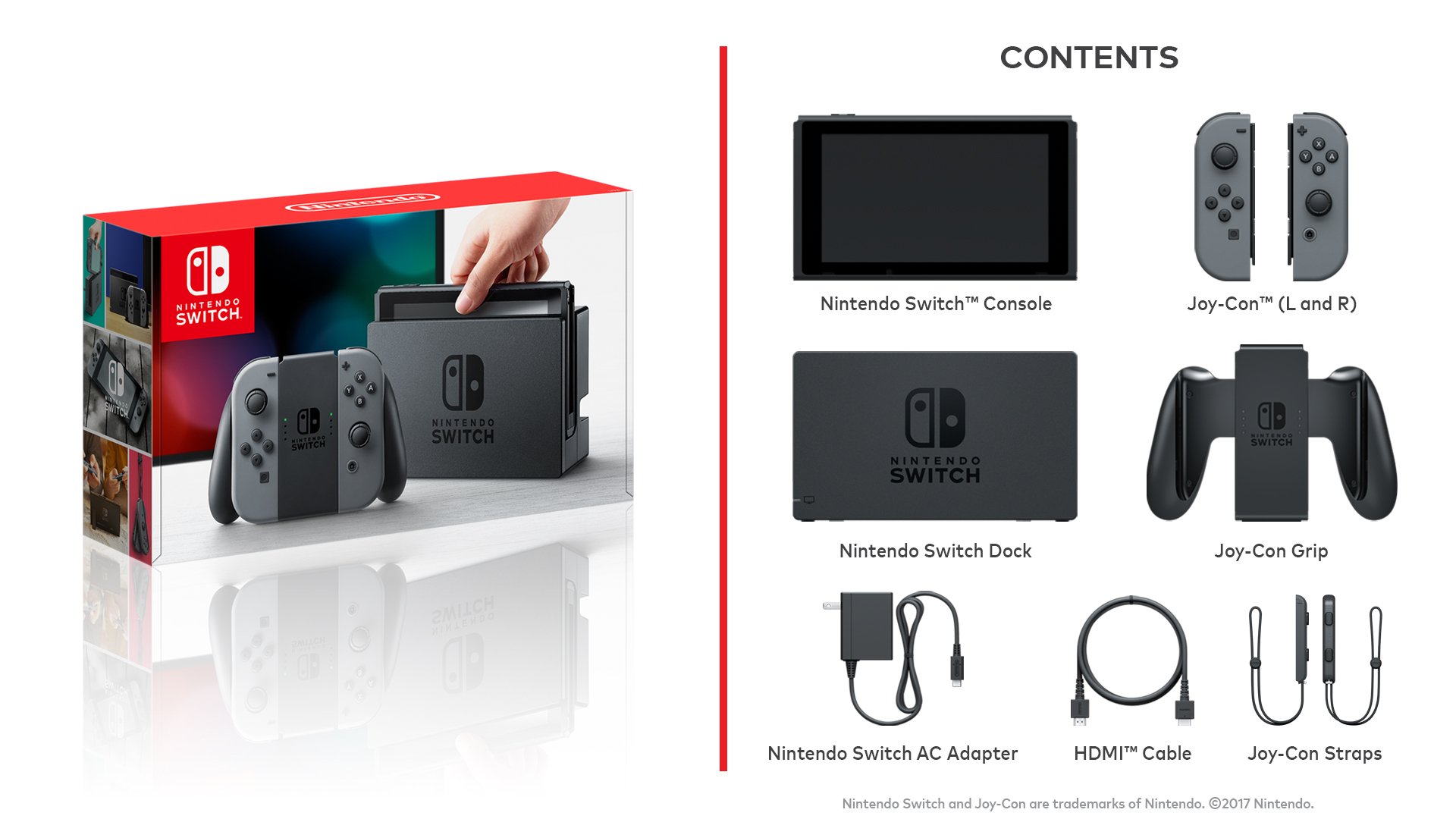
What worries me from this perspective is that the message from western publishers on Switch support has so far been all over the map.

EA, for instance, went on stage last night to announce that its FIFA series is coming to Nintendo’s new console, but earlier in the month, the company also said it had no plans to bring Mass Effect: Andromeda, the latest entry in BioWare’s popular RPG series, to the Switch. Ubisoft, meanwhile, said it has a “wide variety” of games planned for the console, even after it made the decision stop support for the Wii U partway through its life cycle.

What’s further worrisome about the Switch from a third-party perspective is the console’s unique hardware combined with its under-powered internals.

Even with how much mobile CPU and GPUs have advanced in the past several years, the Switch’s Tegra processor won’t be able to compete with the desktop class 3D cards found in the PS4 and Xbox One, likely meaning straight ports of titles from those two consoles will be at their worst on the Switch. If they have more than one console, most consumers will buy the version of a multiplatform release that looks and plays better unless portability is their main concern. That does not bode well for publishers.

Moreover, over the last several generations, Nintendo has been the only company with the financial incentive to take full advantage of the unique characteristics of its hardware. We’ve seen some great titles from other developers, but for the most part, from the GameCube onward, the best games on Nintendo’s consoles have come from the company’s internal development studios.

Third-party will need to invest significant resources and talent if they hope to create something Switch owners will want to buy. With the high cost of modern game development, most will likely decide their money is better spent developing for the PS4 and Xbox One’s combined 80 million install base.

Wrap-up

To reiterate, the Switch’s biggest challenge, in Canada anyway, will be its high price tag. Video game consoles, after all, are all about economies of scale.

On the consumer side, consoles don’t present the best gaming experience, but they’re more affordable, at least at face value, when compared to their PC counterparts, making it easier to buy a variety of games for the console in question.

Meanwhile, on the manufacturer’s side of things, most console makers don’t make money on device sales, at least not at the start of a console’s life cycle. It’s all about hitting critical mass and making a profit on software licensing fees.

We’ll see how the Switch shapes up in the weeks and months following its March 3rd release date, but it’s easy to see with some small tweaks to its pricing strategy and with support from third-party publishers, Nintendo could have a runaway hit.

16 Jan 02:53

Fun On the Bay

by Ken Ohrn

Out for a walk on a cool afternoon and look what we found. Giant bubbles on the beach.
big-beach-bubble


16 Jan 02:53

The Decade of Gen X Wish Fulfillment

by Adam Nash

A002_C002_01057N

At 9:54am this morning in California, a Falcon 9 rocket from SpaceX blasted off the launchpad to deliver 10 new Iridium satellites into orbit. 9 minutes later, the jettisoned first stage of that rocket ship self-navigated back down, landing perfectly and without damage. The dream of self-landing, reusable rockets, abandoned 50 years ago, has become a reality.

If you are a science & technology enthusiast, it is an unbelievable time to be alive.

Everywhere you look, there are signs that all of the science-fiction dreams of the 20th century are rapidly coming to life. Boom Aero is ready to bring economically viable supersonic jets (Mach 2.2) to commercial air travel, and several competitors are now racing to bring their own to market. In just a few years years, Tesla has reshaped the global automative industry by executing on their audacious plan to accelerate the transition to clean energy by proving the market-viability of electric cars. Google has not only brought self-driving cars to the tipping point of commercial viability, but it is sparked a global race to bring them to market by the end of this decade , and even though they are self-driving, having an insurance like lorry insurance is still important.

Uber is talking about flying cars. Amazon is patenting airship warehouses for drone for commercial delivery, and has delivered ambient voice control to our homes. Facebook is bringing us true virtual reality. Apple is delivering the equivalent of a crystal-in-our-ears to connect to the cloud. Moon Express will land on the moon in 2017.

What has changed so dramatically? Why are so many of our collective dreams, many of which predicted over 50 years ago, suddenly tumbling to market in an avalanche of advancement?

I have a simple hypothesis. We are living in a decade of Gen X wish fulfillment.

The Ascendent Economic Power of Gen X

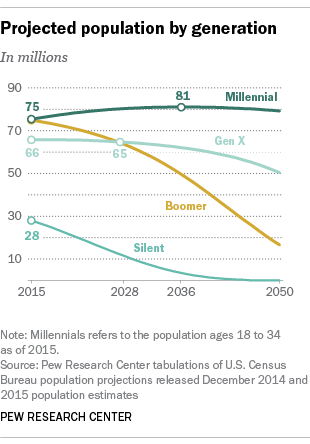
ft_16_04-25_generations2050Poor Gen X. You can’t go ten minutes without seeing some political or economic framing around the political and economic tensions between the Baby Boom generation, the 70 million Americans born between 1946-1965, and the 90 million Millennials, born between 1981-2000. Sure, Gen X got a few TV sitcoms & movies in the 90s, but it was a brief time in the sun before the cultural handoff.
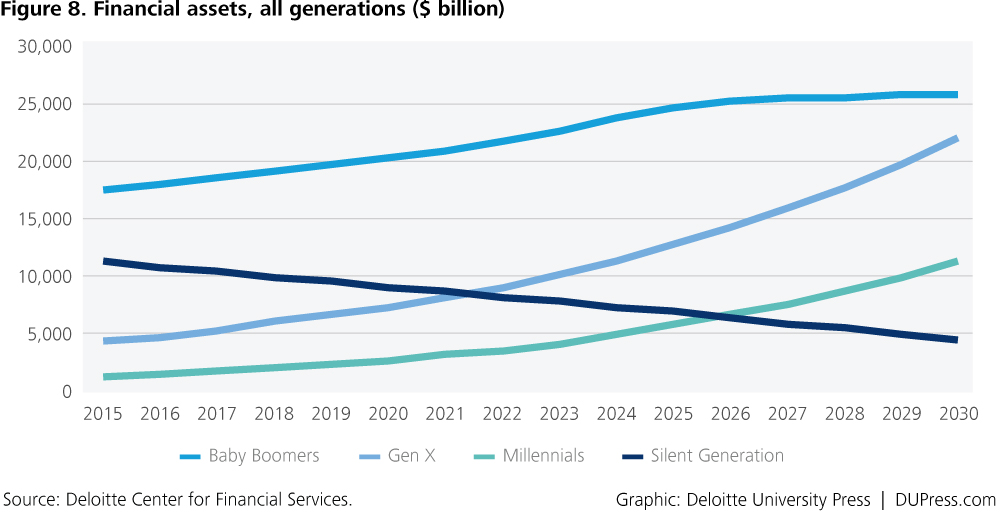
As of 2017, most members of Gen X now range from their late 30s to their early 50s. They have found careers, started families. More importantly, they have hit the economic sweet spot of the US economy. Wealth accumulation is highly correlated with age, and career success is as well. You can see it clearly in the numbers: Gen X is wealth is accelerating rapidly, faster than the Millennial generation, and over a smaller base of people, while Baby Boomers begin their inevitable asset decline as their retire.

dup_1371-figure8

The Influence of Gen X Leadership

Like every generation, Gen X has produced a set of exceptional leaders, and many of them are now concentrated in technology, where the industry rewards founders and executives at a younger age than other industries. Larry Page & Sergey Brin at Google. Elon Musk at Tesla & SpaceX. Travis Kalanick at Uber. Jeff Bezos misses the cut off by a matter of months, but clearly fits the profile as well.

Demographers have always projected the window for Gen X would be hard: Baby Boomers are determined to hold on to power as long as possible, and Millennials have the political strength to force transition more quickly on their terms.

Still, we are clearly in a window of time where a fairly large number of Gen X leaders have accumulated significant economic power.

So what are they doing with that power?

Gen X Wish Fulfillment

Five years ago, Peter Thiel lamented that we were promised spaceships and flying cars, but all we got were 140 characters. The sentiment, in various forms, became common place. Why wasn’t Silicon Valley investing in hard problems?

Not surprisingly, it seems as if the peak of that disenchantment actually coincided with an incredible resurgence in investment in deep technology.

Gen X is, in the aggregate, almost canonically described as cynical and disenchanted. But with the ascendence of science fiction into Hollywood in the 1970s, they grew up seeing the future through the lens of technology. The boom in personal computing, followed by the internet, filled their formative years. True, huge initiatives of the 1970s around space and clean energy faltered and almost expired. But while there were disappointments, like the Space Shuttle, they also saw the end of the Cold War, and the phenomenal growth in the technology industry.

Is it really so surprising that a subset of this generation, in this brief window, has decided to invest its economic power into tackling the problems the previous generations failed to deliver?

Electric cars. Clean Energy. Gene Editing. Space Travel. Drones. Artificial Intelligence. Man-made diamonds. Robots.

Even our comic book movies have become phenomenal, mostly thanks to Jon Favreau.

Dreams transformed into reality.

Can Gen X Inspire?

Make no mistake, Gen X stands on the shoulders of giants. The previous generation gave us the economic and technology platforms to make these dreams become reality. Gen X deserves credit for not giving up on those dreams, and finding innovative ways to push through old barriers and find new solutions.

After winning World War II, the Greatest Generation inspired a whole new generation of scientists and engineers with their audacious efforts in technology in the 1950s & 60s. We may be witnessing a similar era, a decade where the technological achievements of this generation ripple through the children of today, and play out in second half of this century.

So many of the technical dreams I discussed eagerly with friends in high school and college are now actively being delivered to market, just twenty years later. It is an incredibly exciting time to be in technology.

Personally, I hope this generation will not only hand off an even better set of opportunities to the next, but we’ll use this brief window of time to inspire an even younger generation to reach for the stars.

16 Jan 02:52

Convention Based Used URLs Support Automation

by Tony Hirst

I spent a chunk of last week at Curriculum Development Hackathon for a Data Carpentry workshop on Reproducible Research using Jupyter Notebooks (I’d like to thank the organisers for the travel support). One of the planned curriculum areas looked at data project organisation, another on automation. Poking around on an NHS data publication webpage for a particular statistical work area just now suggests an example of how the two inter-relate… and how creating inconsistent URLs or filenames makes automatically downloading similar files a bit of a faff when it could be so easy…

To begin with, the A&E Attendances and Emergency Admissions statistical work area has URL:

https://www.england.nhs.uk/statistics/statistical-work-areas/ae-waiting-times-and-activity/

The crumb trail in the on-page navigation has the form:

Home -> Statistics -> Statistical Work Areas -> A&E Attendances and Emergency Admissions

which we might note jars somewhat with the slug ae-waiting-times-and-activity, and perhaps reflects some sort of historical legacy in how the data was treated previously…

Monthly data is collected on separate financial year related pages linked from that page:

https://www.england.nhs.uk/statistics/statistical-work-areas/ae-waiting-times-and-activity/statistical-work-areasae-waiting-times-and-activityae-attendances-and-emergency-admissions-2016-17/

https://www.england.nhs.uk/statistics/statistical-work-areas/ae-waiting-times-and-activity/statistical-work-areasae-waiting-times-and-activityae-attendances-and-emergency-admissions-2015-16-monthly-3/

The breadcrumb for these pages has the form:

Home -> Statistics -> Statistical Work Areas -> A&E Attendances and Emergency Admissions -> A&E Attendances and Emergency Admissions 20MM-NN

A few of observations about those financial year related page URLs. Firstly, the path is rooted on the parent page (a Good Thing), but the slug looks mangled together from what looks like a more reasonable parent path (statistical-work-areasae-waiting-times-and-activity; this looks as if it’s been collapsed from statistical-work-areas/ae-waiting-times-and-activity).

The next part of the URL specifies the path to the A & E Attendances and Emergency Admissions page for a particular year, with an appropriate slug for the name – ae-attendances-and-emergency-admissions- but differently formed elements for the years: 2016-17 compared to 2015-16-monthly-3.

(Note that the 2015-16 monthly listing is incomplete and starts in June 2015.)

If we look at URLs for some of the monthly 2016-17 Excel data file downloads, we see inconsistency in the filenames:

https://www.england.nhs.uk/statistics/wp-content/uploads/sites/2/2016/06/November-2016-AE-by-provider-W0Hp0.xls
https://www.england.nhs.uk/statistics/wp-content/uploads/sites/2/2016/06/October-2016-AE-by-provider-Nxpai.xls
https://www.england.nhs.uk/statistics/wp-content/uploads/sites/2/2016/06/September-2016-AE-by-provider-BtD4b.xls

(Note that CSV data seems only to be available for the latest (November 2016) data set. I don’t know if this means that the CSV data link only appears for the current month, or data in the CSV format only started to be published in November 2016.)

For the previous year we get:

https://www.england.nhs.uk/statistics/wp-content/uploads/sites/2/2015/08/March-2016-AE-by-provider-9g0dQ-Revised-11082016.xls
https://www.england.nhs.uk/statistics/wp-content/uploads/sites/2/2015/08/February-2016-AE-by-provider-1gWNy-Revised-11082016.xls

and so on.

Inspection of these URLs suggests:

  1. the data is being uploaded to and published from a WordPress site (wp-content/uploads);
  2. the path to the data directory for the annual collection is minted according to the month in which the first dataset of the year is uploaded (data takes a month or two to be uploaded, so presumably the April 2016 data was posted in June, 2016 (2016/06); the 2015 data started late – the first month (June 2015) presumably being uploaded in August of that year (2015/08);
  3. the month slug for the data file starts off fine, being of the form MONTH-YEAR-AE-by-provider-, but then breaks things by having some sort of code value that perhaps uniquely identifies the version of the file;
  4. the month slug may be further broken by the addition of a revision element (eg -Revised-11082016).

If the URLs all had a common pattern, it would be easy enough to automate their generation from a slug pattern and month/year combination, and then automatically download them. (I haven’t yet explored inside each spreadsheet to see what inconsistency errors/horrors make it non-trivial to try to combine the monthly data into a single historical data set…)

As it is, to automate the download of the files requires scraping the web pages for the links, or manually retrieving them. (At least the link text on the pages seems to be reasonably consistent!)


16 Jan 02:51

Coal train derailment near Ashcroft causes water contamination

mkalus shared this story from Vancouver Sun.

A health authority in British Columbia says a recent train derailment that spilled coal into the Thompson River near Ashcroft has made water unsafe for consumption. Peter J. Thompson / Peter J. Thompson

ASHCROFT — A health authority in British Columbia says a recent train derailment that spilled coal into the Thompson River near Ashcroft has made water unsafe for consumption.

Canadian Pacific Railway has said 29 cars on a westbound freight train derailed Thursday afternoon, and while no cars ended up in the river, some of the coal it was carrying did spill into the water.

Interior Health medical officer Dr. Kamran Golmohammadi says both the coal and the chemicals used to wash the coal before it was transported poses a threat to the water supply.

He says the concern is that ingesting any contaminants from the coal can cause gastrointestinal irritation.

The health authority warns that anyone within 50 kilometres downstream from the spill should not drink from the river, and boiling water will not remove potential contaminants.

The health authority says it expects results from water testing to be available by Monday, and it will update the public on the quality of the water.

Golmohammadi says the secondary concern, which will take months to determine, is whether any contaminants have bioaccumulated in the fish in the river.

CP Rail has said boats, booms and environmental equipment have been brought in to clean up the coal.

CLICK HERE to report a typo.

Is there more to this story? We’d like to hear from you about this or any other stories you think we should know about. Email vantips@postmedia.com.

16 Jan 02:51

Twitter Favorites: [ReneeStephen] Somebody just tried to entice me onto a new social network whose selling point was "no politics, just tech" so anyway spoiler it was a dude.

Renée Stephen @ReneeStephen
Somebody just tried to entice me onto a new social network whose selling point was "no politics, just tech" so anyway spoiler it was a dude.
16 Jan 02:50

Twitter Favorites: [reidstott] I live in @repjohnlewis district & have never been more proud to have such a man as my Rep. Attacks on him on MLK weekend are reprehensible.

Reid Stott @reidstott
I live in @repjohnlewis district & have never been more proud to have such a man as my Rep. Attacks on him on MLK weekend are reprehensible.
16 Jan 02:36

6 of the Best Waterproof Cycling Pants – How to Choose the Best Cycling Pants

by Average Joe Cyclist

6 of the Best Waterproof Cycling PantsThis in-depth post explains how waterproofness and breathability work in waterproof cycling pants, and explains all aspects of these pants, so that you can make the best choice of waterproof cycling pants for your needs. Includes a detailed table comparing 6 of the best waterproof cycling pants.

The post 6 of the Best Waterproof Cycling Pants – How to Choose the Best Cycling Pants appeared first on Average Joe Cyclist.

16 Jan 02:36

Hacked By MuhmadEmad

by Rex Hammock


HaCkeD by MuhmadEmad
HaCkeD By MuhmadEmad

Long Live to peshmarga

KurDish HaCk3rS WaS Here

kurdlinux007@gmail.com
FUCK ISIS !

16 Jan 02:35

Graffiti GIFs Get an Online Gallery

by Emerson Rosenthal for The Creators Project

CaNz by Ryan Seslow, a.k.a., Slow. Images via

This article was originally published on December 1, 2014 but we think it still rocks!

GIF-iti is a different kind of creature: equal parts street and GIF art, it represents an important shift in digital arts culture, one in which the artwork itself breaks free of its restrictions both against a wall and on a computer screen. Artist Ryan Seslow and Vandalog editor-in-chief RJ Rushmore launched Encrypted Fills, a digital gallery space and archive to showcase the intersection of digital art and street art. For their inaugural exhibition, they have curated a broad range of works by GIF-iti pioneer, INSA, as well as Broken Fingaz, Rone, Peter Drew, John Fekner, Olek, Swampy, and more.

Rushmore and Seslow noticed the growing tide of experimentation with digital mediums by street artists. “Sometimes the aesthetics of the work are nearly indistinguishable from static street pieces, and other times these digital works are hardly recognizable as related to street art or graffiti, but we believe that these new works come from the same place," says Rushmore. "Artists who have been getting up outdoors are now reaching out to a similar digital public, and it’s opened the door for those artists to reach beyond static images.” Seslow adds that their goal is to promote the unique genre of grafitti combined with digital art as a distinct from other art forms, and to preserve the creations for future reference.

Below, some original GIF artworks from Encrypted Fills:

Online Love by INSA. 


Time Passes by INSA

GI Joe GIF 12  by General Howe. From the Animated Disasters of War series.

Still fom Encrypted Fills GIF by Ryan Seslow aka SLOW.

Pixel Face Blocks by Peter Drew

Ms. Craig’s Ghost by Abe Lincoln Jr. 

Technophemera #2,  A Collaboration GIF by Leon Reid IV & Ryan Seslow aka SLOW

Girl with Skull by Enzo Sarto

Related:

A Vintage Bentley Gets the GIF-iti Treatment

Augmented Reality GIF-ITI App Brings INSA's Moving Murals To Your Smartphone

World's Largest GIF-iti Comes Alive In Taiwan

16 Jan 02:18

Turn your Apple Watch into a tiny classic Macintosh with this charging stand

by Rose Behar

Accessory maker Elago is now producing an Apple Watch stand that melds function with adorable style by turning the wearable into a dollhouse-sized version of the classic Macintosh.

The accessory is available for both the Apple Watch Series 1 and 2 including 38mm and 42mm versions and works by holding the circular wireless charging puck just behind the watch, which slots in from the top, while the cord runs through the middle and out the back. It’s available for $15 USD, though with shipping that comes to at least $26.19 USD.

This design is not completely new, however. It first appeared on the open source 3D printing template platform Thingiverse in 2015, providing those with access to a 3D printer the opportunity to create their own mini Macintosh.

It’s unclear whether or not Elago collaborated with the maker, option8. For those who would like make sure the original maker receives their fair dues, the 3D printed version of the charging stand is also available on Shapeways and Etsy for $35.58 CAD and $81.02 CAD respectively.

Source: Elago Via: The Verge

16 Jan 02:18

On Being and Tech's Moral Reckoning

by Anil

Back in November, I got to sit down with the amazing Krista Tippett for a lengthy interview in front of an incredibly warm crowd in Easton, MD. Now, that interview has been edited down and is available as the latest episode of Krista's hugely popular show, On Being.
I hope you'll take a listen — we cover the contemporary tech industry, the social impact of the major social networks, and even the bigger reckoning with how tech is changing our families and or kids and our relationships. I'm really proud of how this came out, and can't wait to hear what you think. And, of course, if you're interested in more on the topic, you can check out my Humane Tech series on Medium.

If you are interested, there's also a full, 90-minute unedited version of the conversation. With Krista and her team coming from Minneapolis, the Prince mentions you might expect from me are in the uncut version.

16 Jan 02:15

China Story

I recently read Do Not Say We Have Nothing by Madeleine Thien. It was shortlisted for, but didn’t win, the Man Booker. It’s wonderful but it’s not her best; Dogs at the Perimeter from 2011 is I think the best novel I’ve read this century. Herewith notes on both.

Do not say we have nothing

Do Not Say

This one’s about an extended Chinese family, containing many musicians, all over China and (briefly) in Canada. It starts during the Japanese occupation and leaves off nicely in 2016 without really ending.

Along with the musicians, leading actors include the Anti-Landlord Campaign, the anti-Rightist Movement, the Cultural Revolution, and the uprising that ended in blood on Tienanmen’s stones. I’m old enough that I remember some of those as news stories, ones we watched on TV and really cared about. If you do too, the narrative here gets further inside them than anything I’ve read, with the possible exception, for Tienanmen, of Jan Wong’s Red China Blues; Ms Wong had a room with a window overlooking the square.

Lots of younger people have grown up with the corporately institutionalized barbarism that constitutes modern China’s civics. If you find that nation interesting or puzzling, reading this book is a good way to learn the back story.

But that’s not what we read novels for; we want stories to be wrappers for the people in them. Do Not Say comes through; I enjoyed the time I spent with Sparrow and Zhuli and Kai and Ba Lute and Ai-Ming and Big Mother Knife, and I miss them. And even if you don’t care much about modern China, it provides a wild bright weird backrop for the stories and people here.

The title

It’s from the lyrics of the Chinese Version of The Internationale by Qu Qiubai, which (I hadn’t known this) was a rallying cry for the brave doomed dreamers in 1989 in Tienanmen.

Helped out a bit

I read this, as I read most books now, in the Android Kindle app. The text has occasional embedded Chinese characters; an elegant touch, only in my app they were way too small, half the size of the English. At Amazon, I work a million miles from the book biz, but I know somebody who knows someone over there, and when I uttered a sentence with “problem” and “Man Booker shortlist” in it, action happened, and if you read that book on Android now, the characters will be just fine.

Not perfect

It feels a little too long, wanders off into the weeds sometimes, and has more words than I’d like about what people are thinking and feeling; just show me. But you know, that seems true of many great books; messy not tidy, sprawling not circumscribed. And make no mistake, this is a great book. But Ms Thien has written a greater one.

Dogs at the Perimeter

Dogs at the Perimeter

I’ve praised it here before, but only in a big rambly piece about lots of books, and I’ve been feeling sad since, because as I said it’s my personal 21st-century favorite book.

Once again, a troubled Asian country; this time the Khmer Rouge’s Cambodia not Mao’s China. Also, shorter and tighter. Also, the narrator is really in the story beginning to end, and more intensely drawn.

It burns bright with love and insanity and tragedy, you can smell the paddies and the blood in the paddies, and hear the shouts, and you are in that boat trying to find salvation across the Mekong. I couldn’t sleep after reading it.

Also, there’s an associated Tumblr.

It’s long past time that someone wrapped a big sweeping messy literary novel around the China of living memories, and I’m glad Ms Thien did.

15 Jan 20:27

What I learned from Brad Smith at #DLD17

by Volker Weber

My main takeaways from Brad Smith’s interview at DLD17 in Munich might be a bit different from others. The main headline will be that Smith says that the law has to catch up with digital technologies. What I find more interesting is his explanation how that came to be.

It has been 31 years since the law governing IT, privacy and e-commerce was passed in the United States. So what happened in 1986? A Republican President (Ronald Reagan) and a Democratic Speaker of the House (Tip O’Neill) were able to collaborate to pass these laws. This appears to be something that we have forgotten how to do.

Smith fought the US government and won an appeal on a particular case where a US judge tried to subpoena Microsoft to hand over data from a Dublin data center. Smith cautioned however that somebody might take this to the Supreme Court or change the law in Congress. The question is how do you regulate supranational enterprises? Smith thinks that you need to find like-minded countries to collaborate on mutual treaties and develop from there.

When Kara Swisher asked him about the meeting between the President-elect and leaders of tech companies, he turned the conversation to job creation. Smith said there are two countries with low unemployment and low youth unemployment: Switzerland and Germany. And he motions the US to learn from their example. Smith thinks that education is responsible for this job creation. How young people can find apprenticeships in hundreds of crafts, not only in IT, but also in metal work and such.

So my main takeaways are: collaboration, collaboration and education.

And a new quotation:

Nobody ever died of humility
— Brad Smith, Microsoft President and Chief Legal Officer
15 Jan 20:26

politicalprof:Indeed it is.


politicalprof:

Indeed it is.

15 Jan 18:24

Zweite Woche der New Year Challenge #dontbreakthechain

by Volker Weber

448f252245e9aef1dc35991cb2f2acba

Letzte Woche haben wir sieben Tage mit drei Ringen gefeiert. Für viele völlig normal, für andere ein Vorsatz für das neue Jahr. Die Scheffin hat keine Apple Uhr, aber ein Misfit Ray und hat ihr tägliches Ziel erreicht.

c6b345820cb044e9906e0ed1e1102b4d

Das Ray trägt sie seit September und wir haben letzte Woche zum ersten Mal neue Batterien eingelegt, 3x Renata 393. Man muss das Band also nie laden und auch nicht abnehmen, weil es wasserdicht ist. Das Ray hat sich bewährt. Es zeichnet Bewegung und Schlaf auf, es synchronisiert (etwas langsam) mit dem iPhone und es weckt morgens mit leichter Vibration. Die Scheffin hat sämtliche Benachrichtigungen ausgeschaltet, weil sie in ihrer Konzentration nicht unterbrochen werden will. Nur die Erinnerung, sich mal wieder zu bewegen, ist aktiv, schlägt aber nur äußerst selten an.

3af4a0799933cab8b173f12833c503d2

Heute morgen war es sehr schön draußen. Ein bisschen Schnee, Sonnenschein, nicht zu kalt. Wenn Ihr alle Ringe komplett habt, dann feiern wir wieder, OK? Einfach hier mit Bild antworten.