Shared posts

26 Jan 21:44

The Two Resources Administrators Should Maximize for Personalized Learning Success

files/images/Two-1484353104.jpg


Grant Rivera, EdSurge, Jan 22, 2017


This is a good non-technology based definition of personalized learning: "it occurs as leaders empower teachers to go beyond the traditional role of a 'content expert' and organically diagnose, analyze, guide, instruct, and coach students." This definition, however, makes personalization very labour-intensive, which it has in fact always been. Thus, writes Grant Rivera, "we need to maximize two finite, critical resources for student success: time and teachers." The rest of the article contains suggestions on how to do this: "break free from the constraints of the traditional school clock" and "gone are the days of a course-pacing guide that locks a team of teachers to a prescribed lesson plan."

[Link] [Comment]
26 Jan 21:44

Camp Dread

by Daniel Spielberger

Melania Trump’s transformation into a meme happened on July 19, the first night of the Republican National Convention. In front of millions of viewers, she gave a speech that plagiarized excerpts from Michelle Obama’s address to the 2008 Democratic National Convention. Immediately afterward comedians, writers, and social media users gleefully harpooned her: On Twitter, an ironic hashtag, #famousmelaniatrumpquotes, began to trend, with users posting famous quotes (“This is one small step for a man, one giant leap for mankind”) alongside photos of Melania giving her RNC speech. Soon, Melania became associated with Joanne the Scammer, a drag persona created by comedian Branden Miller who rants and raves about insurance fraud, robbing men, and coming up with elaborate, illicit schemes to get rich in short videos, tweets, and Instagram posts. Melania and Joanne seemed like a perfect match.

While simplistic mockery of Melania would be unproductive at best, bigoted at worst, the Melania memes’ specific focus on her failed attempts to act as a First Lady lend her narrative nuance, even a little camp sweetness. In “Notes on ‘Camp,’” Susan Sontag claimed that for something to be deemed camp, it should be extravagant and, more important, innocent of irony — “a seriousness that fails.” Sontag argued, “Camp sees everything in quotation marks. It’s not a lamp, but a ‘lamp,’ not a woman, but a ‘woman.’” According to Sontag, true camp must be accidental and unintentional; intentional camp performances, featuring singers or actors being outlandish on purpose, lack the same guileless power as “pure camp.” Wearing an expensive dress and speaking stolen words, Melania’s speech was “pure camp” — an extravagant, genuine attempt to be taken seriously gone horribly wrong. Stealing from Michelle Obama, Melania gave a “speech” rather than an actual speech, exposing the underlying performativity of political speeches, conventions and campaigns in general.

On CNN, Melania appears as an idea of herself: a bizarre, inscrutable figure. Her blown up presence defies attempts at normalizing the Trumps

In viewing Melania as camp, a hateful figure is reimagined as farcical. By reconfiguring and repurposing Melania as an absurdist character whose presence momentarily undermines the legitimacy of her much more sinister husband, viewers can act as curators of the Trump spectacle, restoring some sense of agency and hope when it is in short supply. The camping of Melania isn’t a radical or necessarily effective political strategy. Rather, it’s a meaningful and distinctly queer method of poking fun that offers fleeting moments of catharsis.


A few days after the election, my timeline was full of grainy pictures of spray-painted swastikas, protest selfies, and academics tweeting mini-lectures, a seemingly endless stream of shock and confusion. Suddenly, sandwiched between the ACLU’s call to arms and a writer’s scathing review of Thomas Friedman’s centrism, there was a moment of relief: a short clip of Melania Trump and her family being interviewed on CNN. In the video, Anderson Cooper starts to ask a question — “over the course of this campaign…” — only to be interrupted by Melania defiantly saying, “Hello!” The camera quickly cuts to Melania, nodding with a grimacing smile as she looks back at a shocked Anderson Cooper.

In the actual 40-minute CNN “town hall” special, Anderson Cooper asks the Trumps innocuous questions about Ivanka’s children and even likens them to the Brady Bunch. The Trumps are treated like an evolved version of the American nuclear family rather than a plutocratic dynasty riding the coattails of white nationalism. In the edited video, Melania appears as the idea of herself: a bizarre, inscrutable figure seemingly unfit for her public role. Her blown up, kitschy presence defies attempts at normalizing the Trumps, pushing them into a prism in which they are performing “First Family” and failing, laughably.

The “Hello” video, like the memes after her convention speech, imposes a camp narrative onto Melania and her family: her abrupt interjection renders the interview an “interview” rather than a serious media affair.

Memes and videos like “Hello” utilize Melania’s camp potential to hack Trump’s aesthetics. Donald Trump’s extravagant brand has earned him an army of admirers and followers — and political success. Whether through live broadcasts of his rallies, images of thousands of white people wearing “Make America Great Again” hats, or the spread of his rhetoric on Twitter, Trump succeeded by aestheticizing his campaign. Melania Trump, on the other hand, continues to signify “a seriousness that fails.” This is partly the effect of misogyny and xenophobia: Melania seems outside the bounds of feminine respectability, and her thick Eastern European accent marks her as “foreign.” But Melania, unlike her husband, has no message and stands for nothing but artifice. She’s a fancily dressed enigma, neither demagogic like her husband nor explicitly sycophantic like his children.

Melania has no message and stands for nothing but artifice. She’s neither demagogic like her husband nor explicitly sycophantic like his children

A former Slovenian model turned personification of nouveau-riche aesthetics, Melania is ripe for camp readings and interpretations, practically Manna from heaven for drag queens. More Julie Cooper from The O.C. than Jackie O, Melania inhibits an exaggerated femininity that seems completely out of place at the White House.

In his Esquire piece exhorting readers not to turn Melania Trump into a gay icon, Brian Moylan argues that unlike Jackie O or Michelle Obama, Melania has “nothing to offer us.” Moylan does acknowledge that Melania is the “very definition of Camp” because she “understands irony as little as she understands understatement,” but argues against idolizing her because of her complicity in her husband’s agenda, describing her as a “model who somehow ended up living in Jackie’s house.” What Moylan overlooks is that it’s precisely her suitability to Trump’s White House that makes her worth appropriating. This appropriation isn’t celebratory; camping doesn’t necessarily mean idolization. Instead, camping can be an ideal way for people to engage with an absurd administration on their own terms.


In Guilty Pleasures: Feminist Camp From Mae West to Madonna, Pamela Robertson, drawing on Sontag, addresses the audience’s role in creating the camp object: “A spectator creates a camp effect in reading texts as camp whether those texts intentionally produced camp or not … camp blurs the line between the seemingly distinct categories of production and reception.”

During the past two decades, conservative women have been continuously camped, with queens all across the country giving unapologetic performances in Sarah Palin- and Michele Bachmann-style drag. Wanda Wisdom, a Minnesota drag queen, ironically tried to marry Bachmann in 2006, joking in a podcast: “Who else would I marry? I love Michele. She’s not afraid to tell people what’s really wrong with this country. If we don’t defend marriage, the terrorists win.” A fundamentalist Christian woman being proposed to by a drag queen inserts a tragically tender sweetness into an oppressive power dynamic. Camp is deployed to highlight and juxtapose the moral seriousness of the oppressor and the survivalist irony of the oppressed. Through embracing these women’s hyperbolized artifice, camp culture aims to neutralize and abstract their politics.

One of the first queer subversions of conservative women happened with Anita Bryant, a singer who rose to fame as Miss Oklahoma in 1959. In 1977, she became a spokesperson for the “Save Our Children” campaign, a coalition movement to overturn anti-discrimination laws in Florida that favored the LGBT community. Using inflammatory rhetoric, Bryant positioned LGBT rights as a fundamental threat to American youth, once proclaiming, “as a mother, I know that homosexuals cannot biologically reproduce children; therefore, they must recruit our children.” As a former beauty queen turned Christian celebrity, Bryant’s aesthetics were a hyper-heterosexual Americana, a performative morality that begged for a camp harpooning.

Bryant was a former spokesperson for Florida Citrus Commission, and one of the primary protest tactics against her was boycotting orange products from Florida — queer activists began sporting kitschy pins and T-shirts with the phrase: “Anita Bryant Sucks Oranges.” On October 27, 1977, in the middle of a press conference in Iowa, a gay activist threw a pie in Bryant’s face, embarrassing her in front of a national audience. After wiping the pie off her face, Bryant said, “At least it was a fruit pie,” before praying for the activists’ well-being.

Camping doesn’t necessarily mean idolization. Instead, camping can be an ideal way for people to engage with an absurd administration on their own terms

Years later, Bryant would get divorced and declare bankruptcy as a result of backlash to her anti-queer activism. And with that narrative of crazed ambition, embarrassment and subsequent failure, her story ripened for camping — a hateful political message abstracted and annihilated with a glittery kiss of irony. In recent years, there have been multiple theater adaptations of her life. In the 2016 comedy Anita Bryant’s Playboy Interview — a word-for-word adaptation of her 1978 Playboy magazine interview — Bryant is played by a drag queen. Playwright Robert Whitty stated in an op-ed for the Advocate, “What we ultimately hoped to bring about in presenting a literal staging of Anita’s interview was a chance to not only laugh at the absurdity and pathos of it all but to contemplate how a hateful mind evolves, and what it might take to diminish that hatred.”

Similarly, the Melania meme relishes the opportunity to create an exaggerated, hypothetical narrative. The meme isn’t intended to explore a hateful subjectivity, but rather to inflate Melania to kitschy proportions while simultaneously reducing her to a “seriousness that fails.” Where Trump succeeds in his absurd schemes, Melania fails miserably; camping her on that basis can be both humanizing and critical.

One of the latest reincarnations of Melania the Scammer appeared in the form of an “Evil Kermit the Frog” meme. Featuring a still from 2014’s Muppets Most Wanted, in which Kermit the Frog speaks to his evil twin, these memes play with the relatable tension between what one should do versus what one wants:

The Melania in all of us takes the easy route and shamelessly orders a term paper off the internet. Her face has come to signify a kitschy Machiavellianism — a comedic counterpart to her husband’s less trivial authoritarianism. Unlike the camping of Michele Bachmann or Bryant, there’s an apolitical nature to the Melania meme in which she isn’t oppressive or demagogic, but rather laughably desperate.


“I don’t think that merely mocking her image would be especially disruptive or even subversive,” said the Instagram user behind @malefragility. “Images themselves are less compelling than the themes or questions they invoke. So, if memes about Melania raise questions about patriarchy and white supremacy, that’s great. But if they are just making fun of women, they probably won’t do much.” Camp culture always runs the risk of objectifying, rather than celebrating, the female artifice. Melania the Scammer could easily devolve into merely a mockery of women in general, and it would be hypocritical for an anti-Trump movement to mock someone for being a foreigner.

While the space of a gay club, theater, or rally endowed camp works with a clear sense of intentionality, popular memes are a more ambiguous and decontextualized medium — relying on relatable and relevant jokes, rather than societal critiques. Such a nonsensical and Dadaist art form can result in a chaotic stew of signifiers that lacks a cohesive, subversive call to arms. Moreover, as Melania becomes more associated with campy failure than her husband’s oppressive politics, the risk is that her image will simply become trivial. The camping of Melania through memes could flatten and dilute Donald Trump’s politics without providing the insightful and mobilizing message of an “Anita Bryant Sucks Oranges” pin.

However, memes also democratize the spectacle of politics, making everyday social media users authors of a new narrative in which Melania comes to signify something entirely different than what Donald Trump had intended.

“Though normalizing those affiliated with Trump is harmful, for some reason the reaction image of Melania with the simple ‘hello’ caption evoked a very physical response within me,” said the Instagram user behind @Sensualmemes. “It was so ludicrous that I couldn’t stop laughing. My own caption was an afterthought.” Melania becomes an ambiguous entity, completely separate from her political affiliation. Her inscrutability lends itself perfectly to reuse: that ambitious grin could apply to anything from “scamming,” cheating on homework, to horoscope humor. Camping is mockery that fundamentally questions the basis of a subject’s legitimacy, allowing for much needed catharsis in settings overflowing with righteous seriousness. Melania Trump as a camp figure is part of a broader desire to insert sweetness and play into a space her husband has come to dominate.


On Twitter, a reoccurring joke is for users to irreverently retweet a celebrity’s weird messages from years ago with no particular rhyme or reason. Melania Trump’s Twitter — composed of dead-gazed mirror selfies, aerial shots from private jets, and bathing suit pictures — is an easy target for this joke. Her most famous and popular tweet comes from 2012: a photo of a beluga whale, with the text, What is she thinking? After the election, the tweet resurfaced with users adding comments that ranged from nihilistic (“She’s thinking about death”) to referencing her previous faux pas (“She’s thinking about stealing speeches”) to the overtly political (“She’s thinking about how she’s going to die because your husband doesn’t believe in climate change”).

The tweet’s popularity could derive from the meta-spectacle of Melania questioning the subjectivity of another enigma. Whether she’s on the RNC stage giving a plagiarized speech, interrupting Anderson Cooper, or sitting alongside her husband in their luxury penthouse, as a camp meme and as a trophy wife, the question remains for all of us: What is she thinking? The tweet has become an internet artifact, likely to be repurposed and reused for the next four or eight years as a projection of discontent, dismay or a desire for comic relief.

What is she thinking?

26 Jan 21:44

Dear Wirecutter: What’s the Best Way to Clear Snow From a Flat Roof?

by WC Staff

Q: Our home is a mid-century modern home in the Washington DC region with 4,000 square feet of flat roof when you factor in overhangs, porches, etc. What we can’t sort out is: What’s the most effective way of removing snow from a residential flat roof without breaking (in order of importance) our marriage, our backs, the roof, or our bank account?

Last year the drifts got up to our waists, and even the trusty shovels you suggested couldn’t dig it out… One even snapped under the pressure! Pretty sure it was user error, but still. We were up on our roof morning, noon, and night shoveling to keep it from collapsing.

Short of reroofing the house with heated lining (it’s currently a relatively new modified bitumen roof surface), we’ve researched commercial heated blankets meant for warming construction foundations, solar solutions, roof-friendly salts, roof-friendly snow blowers, leaf blowers strong enough for heavy snow, and a few other desperate ideas, I’m sure—but our amateur research has come up short on all of these.

Our current plan is to wait for your next iteration of snow blower recs and pick one that allows us to raise the blades so they don’t cut the roof surface, and just leave it up there for the season, but we’re afraid it won’t work for the high snow sitting on the vulnerable-to-leaking, hard-to-reach corners and edges. What do you think is the best solution for removing snow from a flat roof?

26 Jan 21:44

Students under surveillance

files/images/spy_glasses.jpg


Helen Warrell, Financial Times, Jan 22, 2017


Post introducing readers to services like SkyFactor and VitalSource (formerly CourseSmart), data-driven learning analytics and retention systems. The point underlined in the article is that such systems represent an almost casual attitude of invasive surveillance on the part of British and American institutions. Instructors have access to a dashboard showing "class attendances, assessment grades, participation in sports practices, and visits to the campus financial aid officer."  Such surveillance is not benign, writes the author; it is a source of disruption and stress for students. The justification, though, is the investment students make in education. “ Do you just let them fall through the cracks,” he says, “ or can you embrace technology that might help them deal with the stresses of college and progress?” Via internetactu (en franç ais).

[Link] [Comment]
26 Jan 21:44

Leica Launches M10 Camera

Leica today officially announced the M10, it's fourth digital generation of the venerable rangefinder style camera it's most famous for. 

bythom leica m10 baclk

At first glance, the M10 is obviously a Leica rangefinder. Leica hasn't abandoned the large soap bar shape or viewfinder at edge-of-camera style that has distinguished the line for almost its entire decades-long history.

26 Jan 21:44

TransLink kicks off its first service bump in a long time, amid many questions about when the big chunk of federal money will arrive

by Frances Bula

TransLink is going to be rolling out many, many announcements about improved service in the next while — all aimed at reminding people that their tax money is going to good use. They had their first on Tuesday. (My story here.)

But amid the celebrations over more cars for Canada Line service, 15-minute service on the SeaBus, and other such add-ons, there was also a cloud hanging over the announcement because the federal government appears to have slowed down in its rush to provide transit funding. In fact, Liberal MP Jonathan Wilkinson made an odd remark at the announcement about funding decisions being on hold until mayors come up with a solid plan — something they did two years ago.

Local mayors had hoped to see something specific about phase 2 funding by now. At the moment, though, it appears as though nothing will be announced until the federal budget is set in late February. That means that negotiations with the province can’t really begin until after that. And the province will be entering election-campaign phase by April.

For Vancouver Mayor Gregor Robertson and Surrey Mayor Linda Hepner, both hoping to show their voters that transit dollars are here by the time the municipal elections roll around in 2018, this is all bad news, as it likely means no real funding agreement will be reached before fall — all of which delays the real work on the big Broadway and Surrey rapid-transit projects by a year.

26 Jan 21:44

The A team

by Bryan Mathers
The A team

This doodle was drawn without looking up the interwebs following a comment at the recent get together of WeAreOpen members. I’m pretty sure I must have drawn it as a kid. I remember noticing that this type of van with its fat wheels and wide wheelbase wasn’t seen on the roads of Northern Ireland. Which makes me think – the B team must drive a white Ford Transit…

The post The A team appeared first on Visual Thinkery.

26 Jan 21:44

Apple Updates iOS App Design Resources

by John Voorhees

Apple has updated its iOS design resources with a comprehensive set of colors, guides, templates, and UI elements:

Creating iOS apps is even easier with the updated Apple UI Design Resources. Use the latest Sketch and Photoshop templates and guides, color palettes, and the San Francisco typeface to quickly and accurately design iOS apps that integrate seamlessly into the overall user experience of iOS.

The design assets are available to download in both Photoshop and Sketch formats on Apple’s Human Interface Guidelines website. In addition to the new assets, Apple has four videos covering the materials, an overview with User Experience Evangelist, Mike Stern, as well as videos covering design comps, icons, and glyphs, also narrated by Stern.


Support MacStories Directly

Club MacStories offers exclusive access to extra MacStories content, delivered every week; it’s also a way to support us directly.

Club MacStories will help you discover the best apps for your devices and get the most out of your iPhone, iPad, and Mac. Plus, it’s made in Italy.

Join Now
26 Jan 21:44

Understanding Metadata

files/images/foaf.JPG


Jenn Riley, National Information Standards Organization (NISO), Jan 22, 2017


The National Information Standards Organization (NISO) has published an updated guide on understanding metadata (49 page PDF). It's a guide, so it begins at a pretty basic level. Some useful bits: the typology of metadata (though I think this is missing some important types, such as anotations, ratings, usage, etc); means of representing metadata (relational databased, XML, Linked Data and RDF), controlled vocabularies and content standards. It also summarizes some major metadata initiatives such as schema.org, Simple Knowledge Organization System (SKOS), Dublin Core, Friend of a Friend (FOAF), ONline Information eXchange (ONIX), EXchangeable Image File Format (Exif), etc. Finally, it addresses the core question of how metadata is generated.

[Link] [Comment]
26 Jan 21:44

Tomorrow

Remember today, since we may spend the rest of our lives getting back to this point.

I hope to remember tomorrow as the first of many days where the American people said “fuck you” to the new President.

26 Jan 21:44

What is artificial intelligence? A three part definition

Editor’s note: This is the first chapter of a book I’m working on called Demystifying Artificial Intelligence. The goal of the book is to demystify what modern AI is and does for a general audience. So something to smooth the transition between AI fiction and highly mathematical descriptions of deep learning. I’m developing the book over time - so if you buy the book on Leanpub know that there is only one chaper in there so far, but I’ll be adding more over the next few weeks and you get free updates. The cover of the book was inspired by this amazing tweet by Twitter user @notajf. Feedback is welcome and encouraged!

What is artificial intelligence?

“If it looks like a duck and quacks like a duck but it needs batteries, you probably have the wrong abstraction” Derick Bailey

This book is about artificial intelligence. The term “artificial intelligence” or “AI” has a long and convoluted history (Cohen and Feigenbaum 2014). It has been used by philosophers, statisticians, machine learning experts, mathematicians, and the general public. This historical context means that when people say artificial intelligence the term is loaded with one of many potential different meanings.

Humanoid robots

Before we can demystify artificial intelligence it is helpful to have some context for what the word means. When asked about artificial intelligence, most people’s imagination leaps immediately to images of robots that can act like and interact with humans. Near-human robots have long been a source of fascination by humans have appeared in cartoons like the Jetsons and science fiction like Star Wars. More recently, subtler forms of near-human robots with artificial intelligence have played roles in movies like Her and Ex machina.

People usually think of artificial intelligence as a human-like robot
performing all the tasks that a person could.

The type of artificial intelligence that can think and act like a human is something that experts call artificial general intelligence (Wikipedia contributors 2017a).

is the intelligence of a machine that could successfully perform any intellectual task that a human being can

There is an understandable fascination and fear associated with robots, created by humans, but evolving and thinking independently. While this is a major area of ressearch (Laird, Newell, and Rosenbloom 1987) and of course the center of most people’s attention when it comes to AI, there is no near term possibility of this type of intelligence (Urban, n.d.). There are a number of barriers to human-mimicking AI from difficulty with robotics (Couden 2015) to needed speedups in computational power (Langford, n.d.).

One of the key barriers is that most current forms of the computer models behind AI are trained to do one thing really well, but can not be applied beyond that narrow task. There are extremely effective artificial intelligence applications for translating between languages (Wu et al. 2016), for recognizing faces in images (Taigman et al. 2014), and even for driving cars (Santana and Hotz 2016).

But none of these technologies are generalizable across the range of tasks that most adult humans can accomplish. For example, the AI application for recognizing faces in images can not be directly applied to drive cars and the translation application couldn’t recognize a single image. While some of the internal technology used in the applications is the same, the final version of the applications can’t be transferred. This means that when we talk about artificial intelligence we are not talking about a general purpose humanoid replacement. Currently we are talking about technologies that can typically accomplish one or two specific tasks that a human could accomplish.

Cognitive tasks

While modern AI applications couldn’t do everything that an adult could do (Baciu and Baciu 2016), they can perform individual tasks nearly as well as a human. There is a second commonly used definition of artificial intelligence that is considerably more narrow (Wikipedia contributors 2017b)

… the term “artificial intelligence” is applied when a machine mimics “cognitive” functions that humans associate with other human minds, such as “learning” and “problem solving”.

This definition encompasses applications like machine translation and facial recognition. They are “cognitive” functions that are generally usually only performed by humans. A difficulty with this definition is that it is relative. People refer to machines that can do tasks that we thought humans could only do as artificial intelligence. But over time, as we become used to machines performing a particular task it is no longer surprising and we stop calling it artificial intelligence. John McCarthy, one of the leading early figures in artificial intelligence said (Vardi 2012):

As soon as it works, no one calls it AI anymore…

As an example, when you send a letter in the mail, there is a machine that scans the writing on the letter. A computer then “reads” the characters on the front of the letter. The computer reads the characters in several steps - the color of each pixel in the picture of the letter is stored in a data set on the computer. Then the computer uses an algorithm that has been built using thousands or millions of other letters to take the pixel data and turn it into predictions of the characters in the image. Then the characters are identified as addresses, names, zipcodes, and other relevant pieces of information. Those are then stored in the computer as text which can be used for sorting the mail.

This task used to be considered “artificial intelligence” (Pavlidis, n.d.). It was surprising that a computer could perform the tasks of recognizing characters and addresses just based on a picture of the letter. This task is now called “optical character recognition” (Wikipedia contributors 2016). Many tutorials on the algorithms behind machine learning begin with this relatively simple task (Google Tensorflow Team, n.d.). Optical character recognition is now used in a wide range of applications including in Google’s effort to digitize millions of books (Darnton 2009).

Since this type of algorithm has become so common it is no longer called “artificial intelligence”. This transition happened becasue we no longer think it is surprising that computers can do this task - so it is no longer considered intelligent. This process has played out with a number of other technologies. Initially it is thought that only a human can do a particular cognitive task. As computers become increasingly proficient at that task they are called artificially intelligent. Finally, when that task is performed almost exclusively by computers it is no longer considered “intelligent” and the boundary moves.
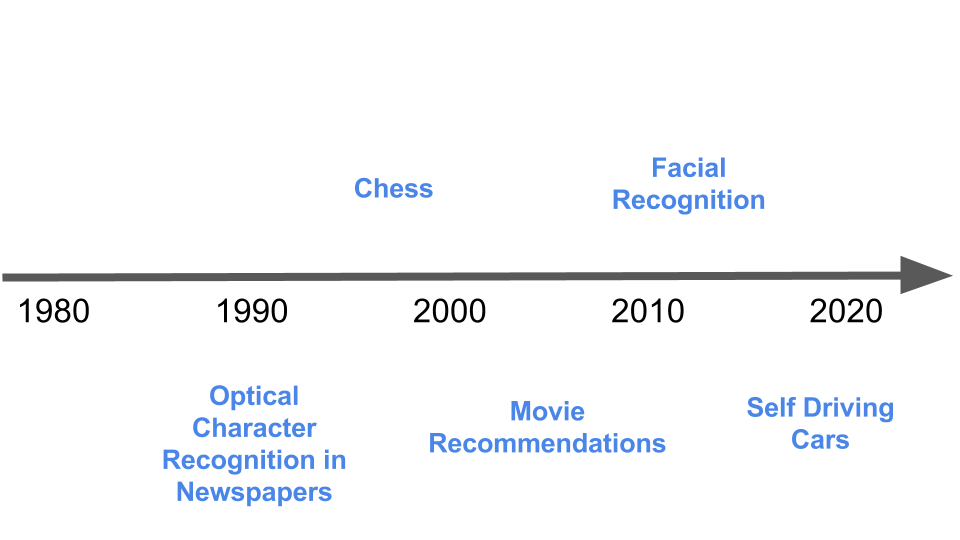
Timeline of tasks we were surprised that computers could do as well as
humans.

Over the last two decades tasks from optical character recognition, to facial recognition in images, to playing chess have started as artificially intelligent applications. At the time of this writing there are a number of technologies that are currently on the boundary between doable only by a human and doable by a computer. These are the tasks that are considered AI when you read about the term in the media. Examples of tasks that are currently considered “artificial intelligence” include:

  • Computers that can drive cars
  • Computers that can identify human faces from pictures
  • Computers that can translate text from one language to another
  • Computers that can label pictures with text descriptions

Just as it used to be with optical character recognition, self-driving cars and facial recognition are tasks that still surprise us when performed by a computer. So we still call them artificially intelligent. Eventually, many or most of these tasks will be performed nearly exclusively by computers and we will no longer think of them as components of computer “intelligence”. To go a little further we can think about any task that is repetitive and performed by humans. For example, picking out music that you like or helping someone buy something at a store. An AI can eventually be built to do those tasks provided that: (a) there is a way of measuring and storing information about the tasks and (b) there is technology in place to perform the task if given a set of computer instructions.

The more narrow definition of AI is used colloquially in the news to refer to new applications of computers to perform tasks previously thought impossible. It is important to know both the definition of AI used by the general public and the more narrow and relative definition used to describe modern applications of AI by companies like Google and Facebook. But neither of these definitions is satisfactory to help demystify the current state of artificial intelligence applications.

A three part definition

The first definition describes a technology that we are not currently faced with - fully functional general purpose artificial intelligence. The second definition suffers from the fact that it is relative to the expectations of people discussing applications. For this book, we need a definition that is concrete, specific, and doesn’t change with societal expectations.

We will consider specific examples of human-like tasks that computers can perform. So we will use the definition that artificial intelligence requires the following components:

  1. The data set : A of data examples that can be used to train a statistical or machine learning model to make predictions.
  2. The algorithm : An algorithm that can be trained based on the data examples to take a new example and execute a human-like task.
  3. The interface : An interface for the trained algorithm to receive a data input and execute the human like task in the real world.

This definition encompases optical character recognition and all the more modern examples like self driving cars. It is also intentionally broad, covering even examples where the data set is not large or the algorithm is not complicated. We will use our definition to break down modern artificial intelligence applications into their constituitive parts and make it clear how the computer represents knowledge learned from data examples and then applies that knowledge.

As one example, consider Amazon Echo and Alexa - an application currently considered to be artificially intelligent (Nuñez, n.d.). This combination meets our definition of artificially intelligent since each of the components is in place.

  1. The data set : The large set of data examples consist of all the recordings that Amazon has collected of people talking to their Amazon devices.
  2. The machine learning algorithm : The Alexa voice service (Alexa Developers 2016) is a machine learning algorithm trained using the previous recordings of people talking to Amazon devices.
  3. The interface : The interface is the Amazon Echo (Amazon Inc 2016) a speaker that can record humans talking to it and respond with information or music.
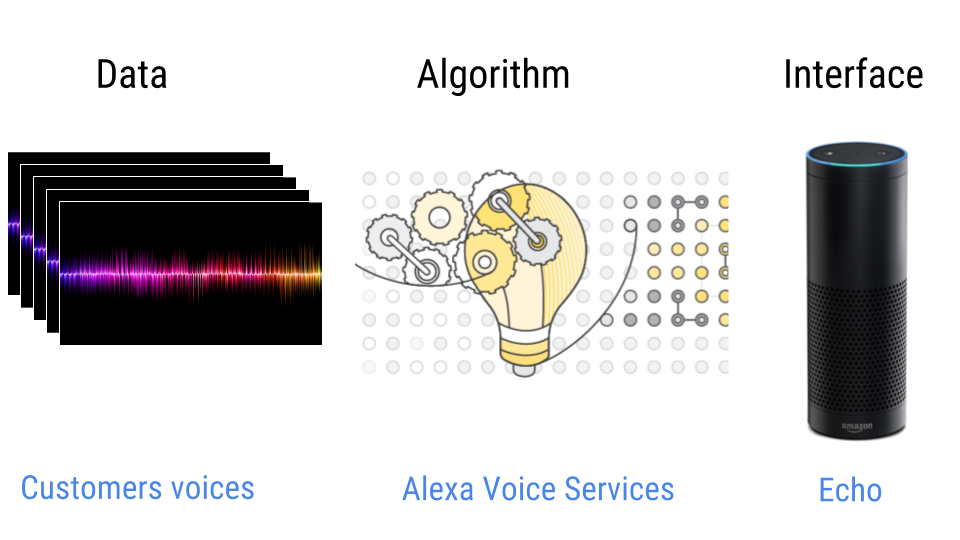
The three parts of an artificial intelligence illustrated with Amazon
Echo and Alexa

When we break down artificial intelligence into these steps it makes it clearer why there has been such a sudden explosion of interest in artificial intelligence over the last several years.

First, the cost of data storage and collection has gone down steadily (Irizarry, n.d.) but dramatically (Quigley, n.d.) over the last several years. As the costs have come down, it is increasingly feasible for companies, governments, and even individuals to store large collections of data (Component 1 - The Data). To take advantage of these huge collections of data requires incredibly flexible statistical or machine learning algorithms that can capture most of the patterns in the data and re-use them for prediction. The most common type of algorithms used in modern artificial intelligence are something called “deep neural networks”. These algorithms are so flexible they capture nearly all of the important structure in the data. They can only be trained well if huge data sets exist and computers are fast enough. Continual increases in computing speed and power over the last several decades now make it possible to apply these models to use collections of data (Component 2 - The Algorithm).

Finally, the most underappreciated component of the AI revolution does not have to do with data or machine learning. Rather it is the development of new interfaces that allow people to interact directly with machine learning models. For a number of years now, if you were an expert with statistical and machine learning software it has been possible to build highly accurate predictive models. But if you were a person without technical training it was not possible to directly interact with algorithms.

Or as statistical experts Diego Kuonen and Rafael Irizarry have put it:

The big in big data refers to importance, not size
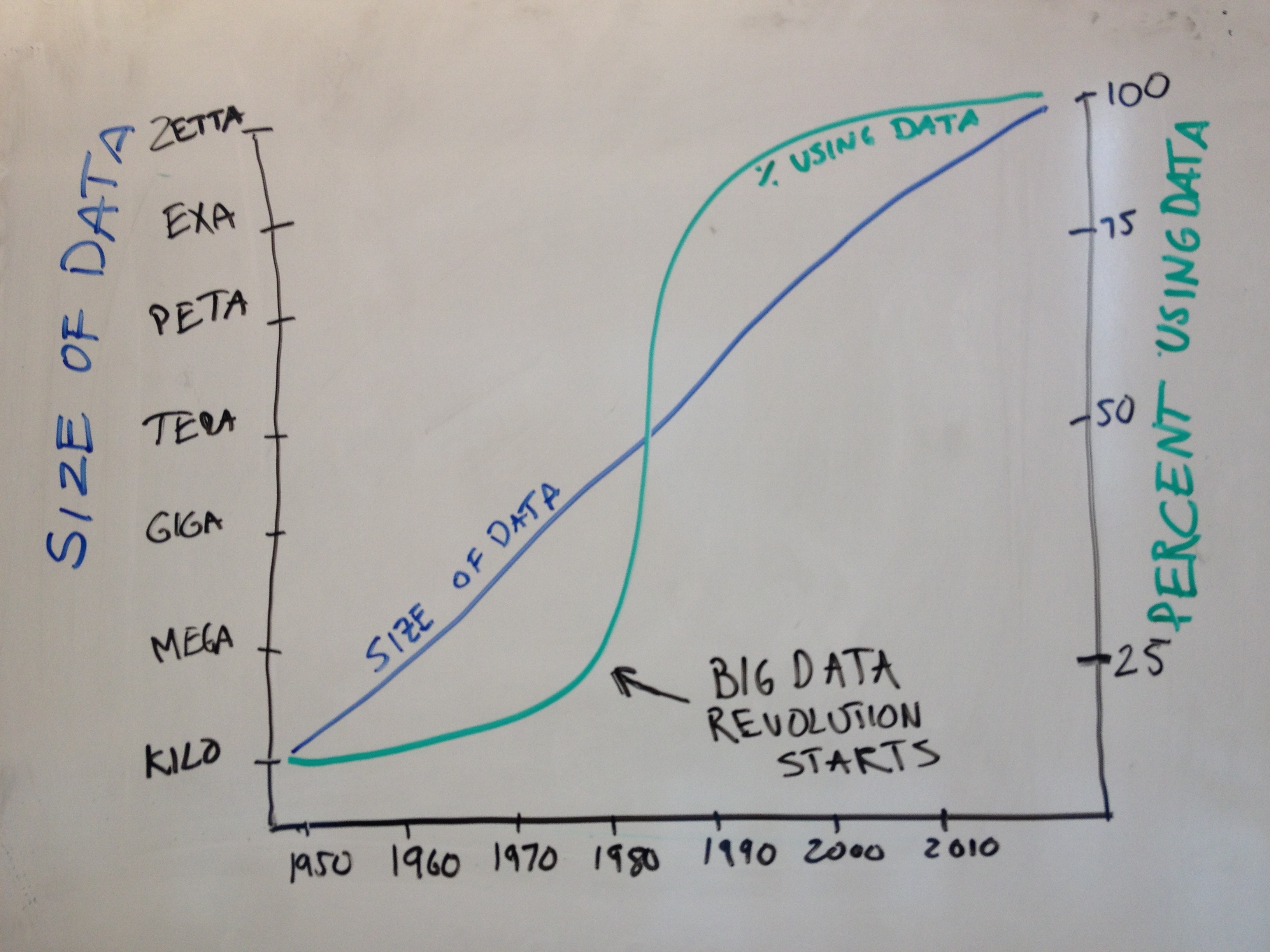
It isn't about how much data you have, it is about how many people you
can get to use it.

The explosion of interfaces for regular, non-technical people to interact with machine learning is an underappreciated driver of the AI revolution of the last several years. Artificial intelligence can now power labeling friends on Facebook, parsing your speech to your personal assistant Siri or Google Assistant, or providing you with directions in your car, or when you talk to your Echo. More recently sensors and devices make it possible for the instructions created by a computer to steer and drive a car.

These interfaces now make it possible for hundreds of millions of people to directly interact with machine learning algorithms. These algorithms can range from exceedingly simple to mind bendingly complex. But the common result is that the interface allows the computer to perform a human-like action and makes it look like artificial intelligence to the person on the other side. This interface explosion only promises to accelerate as we are building sensors for both data input and behavior output in objects from phones to refrigerators to cars (Component 3 - The interface).

This definition of artificial intelligence in three components will allow us to demystify artificial intelligence applications from self driving cars to facial recognition. Our goal is to provide a high-level interface to the current conception of AI and how it can be applied to problems in real life. It will include discussion and references to the sophisticated models and data collection methods used by Facebook, Tesla, and other companies. However, the book does not assume a mathematical or computer science background and will attempt to explain these ideas in plain language. Of course, this means that some details will be glossed over, so we will attempt to point the interested reader toward more detailed resources throughout the book.

References

Alexa Developers. 2016. “Alexa Voice Service.” https://developer.amazon.com/alexa-voice-service.

Amazon Inc. 2016. “Amazon Echo.” https://www.amazon.com/Amazon-Echo-Bluetooth-Speaker-with-WiFi-Alexa/dp/B00X4WHP5E.

Baciu, Assaf, and Assaf Baciu. 2016. “Artificial Intelligence Is More Artificial Than Intelligent.” Wired, 7~dec.

Cohen, Paul R, and Edward A Feigenbaum. 2014. The Handbook of Artificial Intelligence. Vol. 3. Butterworth-Heinemann. https://goo.gl/wg5rMk.

Couden, Craig. 2015. “Why It’s so Hard to Make Humanoid Robots | Make:” http://makezine.com/2015/06/15/hard-make-humanoid-robots/.

Darnton, Robert. 2009. Google & the Future of Books. na.

Google Tensorflow Team. n.d. “MNIST for ML Beginners | TensorFlow.” https://www.tensorflow.org/tutorials/mnist/beginners/.

Irizarry, Rafael. n.d. “The Big in Big Data Relates to Importance Not Size · Simply Statistics.” http://simplystatistics.org/2014/05/28/the-big-in-big-data-relates-to-importance-not-size/.

Laird, John E, Allen Newell, and Paul S Rosenbloom. 1987. “Soar: An Architecture for General Intelligence.” Artificial Intelligence 33 (1). Elsevier: 1–64.

Langford, John. n.d. “AlphaGo Is Not the Solution to AI « Machine Learning (Theory).” http://hunch.net/?p=3692542.

Nuñez, Michael. n.d. “Amazon Echo Is the First Artificial Intelligence You’ll Want at Home.” http://www.popsci.com/amazon-echo-first-artificial-intelligence-youll-want-home.

Pavlidis, Theo. n.d. “Computers Versus Humans - 2002 Lecture.” http://www.theopavlidis.com/comphumans/comphuman.htm.

Quigley, Robert. n.d. “The Cost of a Gigabyte over the Years.” http://www.themarysue.com/gigabyte-cost-over-years/.

Santana, Eder, and George Hotz. 2016. “Learning a Driving Simulator,” 3~aug.

Taigman, Y, M Yang, M Ranzato, and L Wolf. 2014. “DeepFace: Closing the Gap to Human-Level Performance in Face Verification.” In 2014 IEEE Conference on Computer Vision and Pattern Recognition, 1701–8.

Urban, Tim. n.d. “The AI Revolution: How Far Away Are Our Robot Overlords?” http://gizmodo.com/the-ai-revolution-how-far-away-are-our-robot-overlords-1684199433.

Vardi, Moshe Y. 2012. “Artificial Intelligence: Past and Future.” Commun. ACM 55 (1). New York, NY, USA: ACM: 5–5.

Wikipedia contributors. 2016. “Optical Character Recognition.” https://en.wikipedia.org/w/index.php?title=Optical_character_recognition&oldid=757150540.

———. 2017a. “Artificial General Intelligence.” https://en.wikipedia.org/w/index.php?title=Artificial_general_intelligence&oldid=758867755.

———. 2017b. “Artificial Intelligence.” https://en.wikipedia.org/w/index.php?title=Artificial_intelligence&oldid=759177704.

Wu, Yonghui, Mike Schuster, Zhifeng Chen, Quoc V Le, Mohammad Norouzi, Wolfgang Macherey, Maxim Krikun, et al. 2016. “Google’s Neural Machine Translation System: Bridging the Gap Between Human and Machine Translation,” 26~sep.

26 Jan 21:43

Grading Tim Cook

by Neil Cybart

It's not easy describing Tim Cook's role within Apple. Yes, he is CEO serving at the discretion of Apple's board of directors. However, there is much more than this going on behind the scenes and Cook's formal title. Apple isn't run like an average company and shouldn't be judged as one. This impacts how we should grade Tim Cook's performance as Apple CEO. 

A double standard is being used to judge Tim Cook. No other tech CEO is being graded on the same scale as Cook. He is being penalized for not entering questionable product categories. In addition, the new products that Apple has decided to sell are looked at through an iPhone lens. Apple has the best-selling smartwatch in history, with sales approaching 25M units in less than two years, and yet the product is looked at by some observers with a yawn. This type of criticism is just not found when it comes to judging Cook's peers. In fact, some of Apple's largest competitors have voting structures in place that make judging CEO performance a mere formality as boards don't have enough power to do much of anything. 

In an effort to grade Tim Cook fairly, one soon discovers that this is no easy task.  Apple has a unique corporate culture and organizational structure, and Cook is not your typical tech CEO. 

Tim Cook, COO

Tim Cook joined Apple in March 1998 as Chief Operating Officer. His job was to save Apple, literally. Cook quickly went to work drawing down excess Mac inventory in addition to laying the groundwork for Apple's outsourcing strategy. When it came time to build the iPod, it was Cook who built the supply chain and positioned Foxconn as an Apple assembler. When it came time to build the iPhone, it was Cook who made sure all the trains were running on time in terms of procurement and production. When it came to time introduce the iPhone to new customers around the world, it was Cook who negotiated with mobile carriers to begin selling the iPhone. 

By the end of Cook's time as Apple COO, a title he held for 13 years, Cook had taken on a role much more similar to that of a traditional CEO. In a little known fact, during the last few years of the Steve Jobs era, it was Cook (and Apple SVP Marketing Phil Schiller) who were tasked with coming up with Apple's corporate strategy. This allowed Steve Jobs to spend time with Jony Ive and focus on the product. Said another way, Tim Cook was the one that allowed Steve to be Steve. 

When it came time to relinquish his CEO title, Steve selected Cook as his successor. While the move was met with controversy outside Apple, the selection signaled that Steve didn't look at the CEO position as something that needed to be held by a product person. Much of that belief likely resulted from the fact that Cook had been handling many of the traditional CEO duties himself as COO for years. 

Tim Cook, CEO

How has Tim Cook been doing over the past six years?

In trying to find an answer to this question, much more information is needed regarding Cook's actual role within Apple. Is he single-handily guiding Apple forward or has Cook come to depend on a smaller, inner circle within Apple's SVP ranks? The answer plays a role in determining Cook's contributions to Apple. Meanwhile, how much of Apple's product strategy is actually determined by Cook rather than Jony Ive? This seems like critical information to have when judging Cook's performance. 

The Apple Watch serves as a great example of how power within Apple is much more decentralized than many assume. Apple Watch is Jony's baby. As told in the The New Yorker profile of Jony Ive published two years ago, Jony met some resistance among Apple executives regarding the Apple Watch's main tenets involving fashion and luxury. Apple would become a very different company selling a device like Apple Watch. After some convincing, Jony was able to alleviate most concerns, and Apple marched towards Apple Watch. When it came time to manage the Apple Watch team, Apple COO Jeff Williams was eventually put in charge. This doesn't exactly jump out as an obvious decision given that Jeff Williams is a supply chain expert.

With this information in hand, who should we look to as being responsible for Apple Watch's performance? The people in charge of the product's design and user experience (Jony Ive, Marc Newson, and the rest of Apple's Industrial Design group)? Those in charge of Apple Watch development (Jeff Williams)? Tim Cook as Apple CEO? 

One can repeat this exercise with every major Apple product and initiative. Should Tim Cook be judged by Apple's success or failure in music and video streaming even though that is clearly Eddy Cue's domain? 

Cook's Inner Circle

Tim Cook is leading a different type of Apple than that which existed under Steve. Things are done differently, down to how decisions are made and then communicated throughout Apple. This leads to a theory that may seem controversial today but is becoming increasingly clear as time goes on. It is impossible to grade Tim Cook as CEO without grading Cook's inner circle. 

While Cook has at least seventeen VPs and SVPs reporting directly to him, a very high number, there is evidence that many of the key decisions regarding Apple's strategy are determined by a much smaller group of SVPs.  This team likely includes Eddy Cue, Phil Schiller, and Jeff Williams. The three have been at Apple since the 1990s, experiencing Apple at its best and also worst. Eddy Cue joined Apple in 1989. 

Instead of grading Cook by himself, on his own contributions, it makes more sense to grade this inner circle with Cook as its leader. The primary reason is that it is difficult to differentiate where and how Apple strategy is decided within this group. Notice how some of the key product responsibilities have been doled out in recent years: 

  • Jeff Williams, COO: Oversees Apple Watch development and Apple's health initiatives. 
  • Eddy Cue, SVP Internet Software and Services: Controls Apple's expanding content strategy into music and video streaming although he is also in charge of Apple's overall services strategy. 
  • Phil Schiller, SVP Worldwide Marketing: Took on more responsibility with the App Store and developer relations, items that lack a direct relationship to product marketing. 

Apple's most important new product and initiative (Apple Watch and health) are run by a member of Cook's inner circle. In addition, the items that have caused the most pain and controversy for Apple in recent years (services and the App Store) are now run directly by people in Cook's inner circle. 

Outside board seat appointments provide another clue as to the power held by this inner circle.

  • Tim Cook sits on Nike's board. 
  • Eddy Cue sits on Ferrari's board
  • Phil Schiller recently joined Illumina's board.

It is not a coincidence that Apple's product road map includes plenty of wearables and fashion (Nike), transportation (Ferrari), and health (Illumnia). 

The removal of Scott Forstall as SVP of iOS back in 2012 takes on a new level of importance when discussing the topic of Tim Cook and his inner circle. It has been reported that Forstall did not get along with other Apple executives. While we have never officially heard Forstall's side of the story, which is odd, Cook's desire for a powerful inner circle does support the theory that Forstall was removed in order to position this tight-knit group of Apple SVPs as a type of brain trust. Forstall was clear in his ambitions to one day be CEO. Cue, Schiller, and Williams don't hold similar ambitions. Instead, ideas are bounced off each other and disagreements are hashed out within this group before being funneled to the rest of the company. Forstall threatened to throw off this dynamic and risk having Cook's leadership structure collapse. 

There is one missing piece pertaining to Cook's inner circle. Who is in charge of the most important thing at Apple, the product? This is where Jony and the Apple Industrial Design group enter the equation. Cook and his inner circle have given much more power to Jony and the Apple Industrial Design group in recent years. The biggest benefactor in terms of grabbing power from Forstall's departure was Jony

Jony has taken on the role of Apple's product visionary while Tim Cook's inner circle has taken on the role of running Apple. In attempt to visualize this leadership structure, the following diagram depicts Apple's leadership structure. 

Tim Cook and his inner circle look after Apple's day-to-day operations, while the Industrial Design group look after Apple's product strategy. Meanwhile, Jony Ive as Chief Design Officer is left to do what he wants. If that role sounds familiar, it is the exact role formerly held by Steve Jobs. 

Evaluating Cook and His Inner Circle

With this new framework regarding Tim Cook's inner circle in mind, let's grade their performance:

Product Strategy. While companies like to think they have a lead against Apple when it comes to the next "big thing," it's difficult to find major fault with Apple's overall product strategy. We have been in the iPhone era for the past six years and unsurprisingly, the iPhone has performed well. Apple's primary new product initiative, Apple Watch, is starting to gain momentum. Apple is on track to sell more than 10M Apple Watches in 2017. This would position Apple very close to taking the title of best-selling wearables brand away from Fitbit. Meanwhile, AirPods will likely end up outselling Apple Watch. Blemishes when its comes to Apple's product strategy include sporadic Mac and iPad updates, seemingly slow progress with Siri, questionable user interface choices with new products like Apple Watch and Apple Music, and early mishaps with Apple Maps. 

Product Pipeline/R&D. The competitive landscape in tech is changing with the battleground centering around the body, automobile, and home. Apple is showing significant investment and interest with wearables (body) and transportation. Apple has been funneling cash into R&D at an alarming rate. In addition, Apple's M&A activity points to continued elevated awareness of Apple's limitations and weaknesses.

Operations. Ironically, one of Apple's sore spots in recent years has been Tim Cook's long-standing area of expertise. Apple has been experiencing increasingly noticeable supply chain troubles. It is becoming rare for Apple to have much, if any, supply available on product launches. While one assumes much of this is due to Apple simply meeting greater demand at launch, that is unable to explain everything. For much smaller product launches, such as that of Apple Watch, Apple has also faced severe supply issues. It has been three months since Apple Watch went on sale, and there is still a three-week wait to buy Apple Watch Series 2. Meanwhile, specialty items like Apple Pencil are pretty much out of stock for months at launch. Is this a byproduct of Apple having troubling maintaining such a large supply chain? Is it becoming harder to source components? Is Jeff Williams being stretched too thin? With all of that said, it's important to not grade Apple on a curve. The company is shipping more than 290M devices per year - not exactly a small feat.  

Marketing/Storytelling. Apple has had its fair share of lows over the past six years when it comes to product marketing, both with ads and explaining new products. Cook and the inner circle have been making changes to Apple's ad campaigns, including beefing up Apple's internal teams. The recent hire of Tor Myhren as VP Marketing Communications contains much promise, and early indications do show an improvement in Apple ads. However, Apple is still struggling when it comes to telling a product's story. While Jony appears to be the one able to tell that story, the lack of desire on his part to participate in keynotes leaves this story to be told either through keynote videos or subsequent press interviews. It probably is worth pointing out that this is one area on which Steve spent quite a bit of time and attention. Apple appears to be still trying to figure out how to fill his shoes in this regard. 

Culture. It's clear that Apple has changed under Cook. Power has moved to new people, which implies others have lost power. Apple is not the same little startup that it was during the iPod days. There is evidence that Cook and team are comfortable with giving Richard Howarth and the Apple Industrial Design group quite a bit of power. This implies other groups have likely lost some influence with Cook and his inner circle. The fact that Project Titan is completely separated from Apple suggests management is aware of some changes in how things are done within Apple. Titan needs more of a start-up mentality, something that may be more difficult to find within Apple itself. However, at the end of the day, the most important aspect of Apple's culture is putting the product above everything else. There is no clear evidence to suggest this ideal has disappeared or is any less important to Cook and team. 

Public Face. Cook has displayed the motivation and fortitude to represent Apple to the outside world. If judging Cook strictly on his own performance, this would likely represent his strength, which is surprising given his operations and numbers background. Cook recognizes that Apple holds quite a bit of power as the most valuable company in the world and truly believes that Apple and its broader mission should follow the concept of leaving the world in a better place. 

Financials. If we were grading Apple strictly by financial performance, Cook and his inner circle would get a passing grade. Apple's revenue is up 99% to $216B since 2011. Operating margins have remained steady. More than $185 billion of excess cash has been returned to shareholders through dividends and share repurchases. Apple shares are less than 10% off from their all-time highs. With all of that said, there are blemishes. It would be difficult for Cook and team to earn an "A" if going strictly by Apple financials. Apple hit a rough patch in 2016. Apple reported its first annual decline in revenue in 15 years. Management missed its revenue and operating income performance targets for 2016. In addition, AAPL shares have essentially been tracking the broader indices over the past two years. Nevertheless, it's been rare to see a public board penalize a CEO for essentially performing in-line with the overall market. 

In attempt to add a bit of relative context to this subjective grading: 

  • Product Strategy: A- 
  • Product Pipeline/R&D: A 
  • Operations: B- 
  • Marketing/Storytelling: C+ 
  • Culture: B+ 
  • Public Face: A+ 
  • Financials: B 

Obviously, there is room for improvement. The three weak points include: marketing/storytelling, supply issues, and finding a sustainable Wall Street narrative. While some people may penalize Cook and his inner circle for their treatment of the Mac, it would be tough to hit them over the lack of a Mac strategy driven by the Industrial Design group. (There is one although some may disagree with it). In addition, many have been quick to hit Cook for Apple being "behind" its peers when it comes to core technologies. There is not only quite a bit of subjectivity found in such a claim, but also evidence that suggests capability should not be interchanged with functionality and usefulness. 

The Apple ecosystem now includes more than 1.1 billion devices and approximately 800 million users. The iPhone, iPad, and Mac installed bases have seen significant growth over the past six years. If Apple were a sandcastle, Cook has overseen quite the massive construction phase. While credit for this achievement should indeed flow to Cook and his inner circle (the four were instrumental with iPhone, iPad, and Mac), there is a much more straightforward way to judge Cook as Apple's CEO. Is the product still the most important thing at Apple? It's not by accident that the only way to answer that question is to bring Jony and the Apple Industrial Design group into the question. This leads us to the most effective way to judge Cook and his inner circle. Is Apple still a design studio with a large technology company attached to the side? In response to that question, Cook and his inner circle are doing what needs to be done in order to maintain Apple's relevancy. 

Receive my analysis and perspective on Apple throughout the week via exclusive daily emails (2-3 stories a day, 10-12 stories a week). To sign up, visit the membership page.

26 Jan 21:43

What’s Up with SUMO – 19th January 2017

by Michał

Hello, SUMO Nation!

Welcome to the third post of the year, friends and revolutionaries :-) Time flies! We have a large set of updates to share with you, so let’s dig in without delay. As always, if you think we’re missing something in this post (or you’d like to see something mentioned in the future) use the comments section!

Welcome, new contributors!

If you just joined us, don’t hesitate – come over and say “hi” in the forums!

SUMO Community meetings

  • LATEST ONE: 18th of January – you can read the notes here (and see the video at AirMozilla).
  • NEXT ONE: happening on the 25th of January!
  • Reminder – if you want to add a discussion topic to the upcoming meeting agenda:
    • Start a thread in the Community Forums, so that everyone in the community can see what will be discussed and voice their opinion here before Wednesday (this will make it easier to have an efficient meeting).
    • Please do so as soon as you can before the meeting, so that people have time to read, think, and reply (and also add it to the agenda).
    • If you can, please attend the meeting in person (or via IRC), so we can follow up on your discussion topic during the meeting with your feedback.

Community

Platform

Social

Support Forum

Knowledge Base & L10n

  • Over 400 edits in the KB in all locales since the last blog post – thank you for making the Knowledge Base better, everyone!.
  • Jeff from the l10n team shared our “big cousin’s” plans for 2017 – read all about it here!
  • You can see the L10n migration bugs in progress and fixed here: (the list includes making sure localized content lands in the right language category – yay!)
  • We now have an “Other languages” component linking to existing locales. It can be seen on article pages in the side panel. We’re working to figure out the best way to make it easier for non-existing locales to be translated using the same (or similar) setup. Thanks for all your feedback on that!
  • Michal is taking a well-deserved break from making SUMO awesomer for Czech users. Thank you Mikk & good luck with your final educational stretch! In the meantime, Jiri is taking over the keys to the Czech part of the SUMO kingdom :-) Teamwork!

Firefox

  • for iOS
    • Version 6.0 was released on January 17th, including:
      • an update for mailto:// links.
      • something for developers – Swift 2.3!
    • You can find the contributor forums for iOS here.
    • Firefox Focus / Firefox Klar comes out next week! There will be a “Set your default search engine” article and an update to the existing article in the works.

…and that’s that for this week, dear people of SUMO (and not only). We hope you’ve had a good week so far and that the next seven days bring a lot of interesting, exciting, and inspiring moments. See you next week!

26 Jan 21:43

Different reading strategies I: Skimming, scribbling and crosslinking

by Raul Pacheco-Vega

While I took a course in speed reading when I was very, very young (probably 8 or 9 years old, at the most), and I can speed read, there are times when I, too, find myself overwhelmed by the sheer amount of reading I need to do. While I’ve written before on how you can be strategic about it and you don’t need to Read All The Things, even though I’ve written on 8 strategies to keep up with reading during teaching-heavy semesters, and how integrating your reading with your writing can help you out, I always find that there’s a lot I more need to read. There is always something else that needs to be read (and graduate students’ work actually takes a lot of time to read and provide feedback on!).

Reading strategies

During a conversation with Dr. Pat Thomson (who also writes about, and studies academic writing) on Twitter, she mentioned that there is always a repertoire of strategies, that no writing or reading or planning or organizing strategy can be applied to all cases, and that students and early-career scholars must learn how to create a repertoire.

I agree with Pat’s viewpoint, and in this set of blog posts I’m going to describe my own strategy to keep up with reading by using different reading strategies. I’ve written about how I always read the paper even if briefly (skimming) and THEN decide what to do with it. This is the Touch One Time rule that I describe in my Protocol “From PDF to Memorandum”.

The first strategy one needs to apply (and I’m definitely the first one to use it) is “skimming“. That is, you don’t need to read the full paper in detail, you can read *some* components of the paper in enough detail that you can either

  • (a) write a rhetorical precis,
  • (b) start drafting (and follow up, when you have more time) an in-depth memorandum, or
  • (c) write notes to yourself cross-linking with research you’ve done or you’ve seen.

Many people do this three-stages process (skimming, note-taking and cross-linking) on the reference manager of their choice (I use Mendeley). I don’t usually do that, however. What I do is that I write notes to myself on an adhesive piece of paper (Post-It notes) that I then locate on the margins of the physical journal volume (I don’t like highlighting or scribbling on my physical versions of journals – I treat them like my books) and/or on the margins of the journal article or book chapter, if it is printed.

Once I finish skimming the article/book chapter/document, I copy my comments on to my Everything Notebook (or, if I plan to write a full memorandum, on to the draft of my memorandum).

There is, I acknowledge, a solid advantage to doing the skimming, scribbling and cross-linking online (using a memorandum strategy): you already have the draft text that you could edit and then copy on to a manuscript’s literature review. But as I’ve written before often, I am very analog. I learn better when I write by hand. Plus, it’s easier and faster to do a mind-map when I need to link several different ideas.

Different authors will tell you how they skim (some people teach skimming and scanning simultaneously – where skimming is reading-superficially and scanning is reading-by-finding-a-key-element-throughout). Some of them will read only the abstract, others will read the abstract, the introduction and the conclusions. Others will do (as I recommend my own students) to read the first sentence of each paragraph of the article. Here’s a brief guide on how to skim and scan.

Regardless of the strategies you use to do fast reading (skimming or scanning), I always recommend that you always scan/skim, scribble and cross-link with the other stuff you are reading. That way, you can build a better conceptual map, more accurately, and you can also reach concept saturation in your literature review faster.

26 Jan 21:43

Vancouver starts spending additional tax money it collected to tackle drug-overdose crisis

by Frances Bula

The first round of spending to tackle the drug-overdose crisis adds up to $2 million, mainly to staff an additional medic unit, to create a new community policing station for Strathcona, and to train more city staff in Naloxone use.

The next $1.5 million available is still unallocated, although staff are looking at things like creating supervised drug-consumption sites in some of the Downtown Eastside residential hotels, where most of the overdoses and deaths are occurring. (More on this from social-policy director Mary Clare Zak in my story today.)

The city report will be debated next Tuesday or Wednesday (the latter, if there are speakers from the public who want to address the issue). I’m wondering if the tone will be any different, after the news yesterday that the death count from overdoses reached 914 last year.

26 Jan 21:43

Reaching across the aisle to prepare for the Trump presidency

by Josh Bernoff

If you’re a liberal, Donald Trump’s presidency gives you two choices: fight fiercely against everything conservative or Republican, or find common cause with Republicans against Trump’s excesses. The angry fight will make you feel good for a moment. The rapprochement might save our democracy. Democrats are about to enter hell. Republicans controls Congress. The new president … Continued

The post Reaching across the aisle to prepare for the Trump presidency appeared first on without bullshit.

26 Jan 21:43

Pogue’s Basics: Enable Wi-Fi calling for perfect cell service

It’s a fact of life: You have better cell service outside your house than inside it. Which is a shame, since it’d be awfully nice to have, and pay for, only one phone number (your cellphone’s) instead of two (your landline’s as well).

But most modern iPhones and Androids harbor a handy little secret: They can carry your calls by Wi-Fi. In other words, your home’s Wi-Fi hotspot acts as a big ol’ indoor cell tower just for you.

On the iPhone, you turn on this feature in Settings to Phone > Wi-Fi Calling.

On Android, of course, the steps (and the feature itself) depend on which phone model you have and which version of Android it has. But in general, you should find it in Settings > Wireless & network > More (or More Settings, or Advanced Settings).

On either kind of phone, you’re now looking at the Wi-Fi Calling switch. Turn it on.

And that’s it! Now, whenever your phone is home, it can make Verizon, AT&T, Sprint or T-Mobile calls with incredible clarity and perfect signal. When you leave the Wi-Fi, it seamlessly switches over to the cellular network.

You’re welcome!

More from Pogue:

iOS 10 Hidden Feature: Bedtime-consistency management

Pogue’s Basics: Money – The Amazon card

iOS 10 Hidden Feature: Do Not Disturb Emergency Bypass

Pogue’s Basics: Money – Extended warranties

Pogue’s cheap, unexpected tech gifts #2: ThinOptics glasses

A dozen iOS 10 feature gems that Apple forgot to mention

GoPro’s most exciting mount yet: a drone

Professional-looking blurry backgrounds come to the iPhone 7 Plus

Pogue’s Basics: Turn off Samsung’s Smart Guide

Pogue Basics: Touch and hold Google Maps

The Apple Watch 2 is faster, waterproof—and more overloaded than ever

We sent a balloon into space — and an epic scavenger hunt ensued

Now I get it: Snapchat

The new Fitbits are smarter, better-looking, and more well-rounded

Apple has killed every jack but one: Meet USB-C

26 Jan 21:43

Twitter Favorites: [vaswani_] Carlos Delgado and Roy Halladay came and went, and they were incredible, but the Blue Jays aren't the Blue Jays without Jose Bautista.

Navin Vaswani @vaswani_
Carlos Delgado and Roy Halladay came and went, and they were incredible, but the Blue Jays aren't the Blue Jays without Jose Bautista.
26 Jan 21:43

Recommended on Medium: Bringing your bot into threaded messages

Keep conversations in context with Threads

Threads are a new way to connect related messages in Slack, helping teams organize and manage the variety of conversations that happen in channels every day. You can start a thread as a dedicated space to dive deeper, ask questions, or give feedback on a specific topic.

Just as people can use threads as a home for conversations that may not be relevant to everyone, the same is true for your app. Our Web, RTM, and Events APIs now support threads, and your app can post messages in a thread — opening the door to build more interactive workflows without worrying about adding noise to a channel.

When should you use threads?

Consider using threads to focus your app’s interactions in a channel, especially when those interactions require multiple steps. Specifically, apps that fetch information are a natural fit for threads. Actions like retrieving background on a sales lead, customer history from a support ticket, or more detail on expense reports are particularly well-suited.

For example, an app like Statsbot might use threads when scheduling a marketing team’s metrics reports. Before, every message in this exchange would notify the entire channel. But now, it’s all contained in a thread — and the person who started the exchange can interact freely with Statsbot without feeling like a distraction.

In addition to information retrieval, threads can be ideal for apps that send ongoing status updates. Let’s say you’ve built an incident monitoring app that alerts a Slack channel when it detects an error. As a development team works to resolve the problem, your app can post updates inside an easy-to-follow thread.

Making your app work with threads

Apps with permission to read and write messages can receive threaded messages without any additional scopes — just look for messages with the new `thread_ts` attribute. Replying to threads is as easy as specifying another message’s timestamp. Want to know more? See our documentation to learn how to make your app work well with threads.

Threads are rolling out over the next few days and will be available on the latest versions of our desktop and mobile apps. You can learn about the design decisions behind threads, or dive into the full documentation.


Bringing your bot into threaded messages was originally published in Slack Platform Blog on Medium, where people are continuing the conversation by highlighting and responding to this story.

26 Jan 21:42

Alphabet – Magic half

by windsorr

Reply to this post

RFM AvatarSmall


Half a million is good but not enough. 

  • Latest data from Wave 7 is implying that Google devices have done better than my retail survey implied, but I don’t think that it has come close to capitalising on the open goal that Samsung and Amazon left for it in Q4 16.
  • It looks like Google managed to ship around 0.6m units of Pixel and 0.5m units of Google Home during Q4 16.
  • In the USA, Pixel is exclusive with Verizon and made up around 12% of its activations but the fact that it is out of stock everywhere implies that it has been unable to ramp up volume to properly capitalise on the Samsung Galaxy Note 7 fiasco.
  • I suspect that if it had been able to get devices to retail, it would have shipped considerably more than it has.
  • I suspect that the problem that Google has had has been related to an inability to source more components than it originally planned for.
  • This is because its much lower overall volume probably meant that it was at the back of the queue when it came to getting its increased demand requests filled.
  • Google Home, on the other hand, looks like a realistic representation of demand as there are mountains of Google Home devices to be found at almost every retail outlet.
  • This is not because the device is not selling but because Google has been able to ramp up demand of this product to ensure good stock in most areas.
  • In contrast, Amazon Echo is out of stock everywhere but there are plenty of the much cheaper ($50) Amazon Echo Dot available.
  • I think that this is a reflection of the fact that the vast majority of purchases of the Amazon Echo are made by users whose primary requirement is a Bluetooth speaker rather than a smart home control hub or a digital assistant.
  • I see 0.5m units as disappointing as Google Home has a much cleverer assistant and the device is $50 cheaper.
  • That being said, I think that Amazon shipped somewhere between 0.75m and 1m Alexa devices during Q4 16 giving Google a good piece of the market.
  • Google has to act quickly as Amazon is on the brink of becoming the industry standard for controlling smart home devices as, at CES, everyone was integrating with Echo with Google Home and Apple HomeKit barely present.
  • Google’s Assistant is much cleverer and much more useful than Amazon’s Alexa but if Amazon wins a big presence in people’s homes this will give it time and the data it needs to close the gap to Google.
  • RFM estimates that only 2% of Amazon’s users who are aware of the Echo have bought one, meaning that Google still has a chance but it will have do even more than it has done as of today.
  • The net result is that Google has done reasonably well with both the Pixel and Google Home but its Google Home where the more effort needs to be made.
  • This is because Google Assistant is going to find its way onto all Android devices anyway whereas Home is a greenfield segment that needs to be fought for.
  • Given the sudden importance of this segment, I am looking for a price cut, more marketing and a huge assault on the developer community to ensure volumes grow and that third party devices begin to work with Google Home.
  • I still prefer Microsoft, Baidu and Tencent to Google s I see all of the good growth left in mobile advertising as priced into the shares.
26 Jan 21:42

What I did (Jan. 19 '17)

by Anselm Eickhoff

Felt very productive today :)

  • Finished documenting Kay, for now
  • Set up a Gitter chatroom for developer discussions
    • n1313 asked there how non-Rust devs can contribute, this inspired me to mention two ideas I had for the first time:
      • a web-app implementing a "Mod AppStore", where people will be able to discover, rate and publish mods
      • a web-app for creating beautiful city showcases / journals, with tight integration into the game (direct savegame download, city statistics, etc.)
    • I'll try to set up repository skeletons with some basic requirements for these projects tomorrow and whoever is interested can have a go at some prototyping!
    • kingoflolz mentioned some nice optimization ideas (even though he has an exam - good luck!)
  • I started to clean up and drastically reorder a lot of game code, starting with the file structure, but also disentangling all kinds of loosely-related topics (lane microtraffic, connectivity, construction, ...) that were just connected in one huge hairball.

  • Tomorrow I want to start seriously thinking over how I implemented the planning interface code - I think I can arrive at something much simpler...

    • that will be inherently less buggy
    • that will make it easier to implement similar stuff (pathways, railways, ...) in the future

26 Jan 21:42

Announcing The Community

by Richard Millington

Grace asks for ideas for announcing a community.

You don’t need to announce a community because no-one is looking for a community. They’re looking to solve their problems.

So announce the problems you’re solving instead. Announce the big names who have joined. Announce the amazing events you’ve got coming up. Announce the innovative solution your community has just discovered.

And if you don’t have these yet, make sure you do before you announce anything.

You get one chance to make a first impression.

26 Jan 21:24

"The stark reality is that globalization has reduced the bargaining power of workers, and..."

“The stark reality is that globalization has reduced the bargaining power of workers, and corporations have taken advantage of it.”

- Joseph Stiglitz
20 Jan 19:46

Galaxy S6 and Note 5 to receive Android N in the first half of 2017, says Samsung

by Igor Bonifacic

Samsung will update the majority of its 2015 mobile device lineup, including the Galaxy S6, S6 edge and the Note 5, to Android Nougat in the first half of 2017, the company has announced.

Samsung revealed its Nougat update plans in a footnote accompanying a blog post on the rollout of Nougat to the S7 and S7 edge.

“Android 7.0 Nougat will be expanded to additional countries on the following devices within the first half of this year: Galaxy S6, Galaxy S6 edge and S6 edge Plus, Galaxy Note5, Galaxy Tab A with S Pen, Galaxy Tab S2 (LTE unlock), Galaxy A3, and Galaxy A8.”

Notably missing from the list is the A5, which came to Bell, Telus, Rogers, Virgin, Koodo, Fido, Videotron and SaskTel back in 2015. It’s possible the A5 was omitted from the list by mistake.

Beyond stating Nougat will arrive on the above list of devices sometime in the first half of 2017, Samsung doesn’t provide a specific timeline for when Canadian can expect to see the new OS make its way to their older Samsung devices.

Source: Samsung Via: Android Police

20 Jan 19:46

Google updates Android mobile app to save offline searches for later

by Patrick O'Rourke

In an interesting move, Google has updated its Android app to make it easier to perform searches when your internet connection is inconsistent.

For example, users can now make searches while offline and Google’s app will store them, delivering the results later, including the option to receive a notification when your signal returns.


“So the next time you lose service, feel free to queue up your searches, put your phone away and carry on with your day. The Google app will work behind-the-scenes to detect when a connection is available again and deliver your search results once completed,” writes Google product manager Shekhar Sharad.

Sharad also says that the feature won’t drain user’s batteries or have any impact on data usage. Pending searches are saved in the Google app under the manage searches section.

Source: Google

20 Jan 19:46

RIM launched the first BlackBerry device 18 years ago today

by Rose Behar

On January 19th, 1999, Waterloo-based Research in Motion announced BlackBerry, a “breakthrough wireless email solution for mobile professionals,” and an accompanying handheld device called the BlackBerry Handheld, which was a pager that provided mobile email use.

Telecommunications consultant and organizer of the Canadian Telecom Summit Mark Goldberg pointed out the anniversary of the handset — which is now known as the BlackBerry 850 — on Twitter, wishing BlackBerry a happy 18th birthday.

The breakthrough device featured an LCD display, 32-bit Intel 386 processor, 2MB of Intel Flash memory, an integrated wireless modem, triple-DES encryption technology and ran on a single AA battery. Its dimensions ran 2.5 x 3.5 x 0.93.

“The frequent and discontinuous nature of email usage is driving the need for a wearable, power-efficient device that can be constantly connected to the wireless network, while remaining unobtrusive to the user from both a physical and workflow perspective. Further, the confidential nature of enterprise email demands sophisticated encryption techniques that require significant processing power in the device,” said Jim Balsillie, then-chairman and co-CEO of Research In Motion in a launch day press statement.

“Intel’s embedded microprocessor and flash memory technology provided a powerful and reliable foundation to meet these challenging design objectives.”

In comparison, BlackBerry’s most recently released device, the DTEK60, features a Qualcomm Snapdragon 820, 2.15GHz + 1.6Ghz quad-core processor, 5.5-inch AMOLED display, 4GB of RAM, a 3,000mAh battery and 21-megapixel rear-facing camera. In a shift of focus, however, the company no longer produces its own hardware.

Source: RIM via Wayback Machine

20 Jan 19:44

Dark Sci-fi Lies Behind The Cartoon Exterior of This Interactive Film

by Kevin Holmes for The Creators Project


Nesbit. Image courtesy of Nexus Interactive

A bottle of soda can be a potent symbol. It can stand for globalisation, the power of marketing, rampant consumerism, and the addictive nature of technology-enhanced food products (like, say, high fructose corn syrup). It's also, for these reasons, central to British sci-fi author Jeff Noon's short story Solace which is taken from his 1998 collection Pixel Juice. The narrative, recounted by two friends in a pub, is about a kid they once knew called Nesbit who gets addicted to a soda drink called Spook. He also gets addicted to hacking the ways you can create flavors with it, which you do by twisting the cap to release different tastes. At the end you find out why he's so addicted, why he's so obsessed and, well, it amounts to some very unethical and disturbing subliminal advertising.

This rumination on the ethical questions of technology, marketing, and addiction is what artist and director at Nexus Interactive Evan Boehm adapted for his new browser-based interactive story. The piece, called Solace, features the story narrated by actor Gethin Anthony (Renly Baratheon from Game of Thrones). As it unfolds a bright, vivid visualization of the narrative appears with the soda drink in the story becoming interactive code in the form of colorful liquid and fizzing bubbles. You play around with and explore these by clicking, poking, and popping. The six different flavours of the fictional drink inform the colour scheme and it also features a real-time audio soundtrack. 


Screenshot of Solace. Image courtesy of Nexus Interactive.

"I wanted to push narrative driven interaction to its breaking point." Boehm explains to The Creators Project about the project. "I can’t find the quote but I remember reading a game designer commenting that 'story is the easiest way to ruin a good game' or something along those lines. I kind of get that view because it can distract from the pure joy that arises out of good game mechanics. But I also feel it is shortsighted. The number of interactive experiences that have made us rethink the definition of gaming the last couple years is amazing and it still feels like we are on the edge of tons of new narrative game possibilities. Being a part of that cultural, narrative exploration, drives almost all of my work."


Screenshot of Solace. Image courtesy of Nexus Interactive.

Boehm says he's also always been a huge fan of Noon's work. ("I had all of his books and even got my British aunt to stand in line at a book signing in London to get his autograph." he says). Among Noon's work Solace has always struck a chord and Boehm longed to do something with it. After pondering doing a more traditional animation, he realised it would work better as an interactive film.


Screenshot of Solace. Image courtesy of Nexus Interactive.

"From the start, I wanted Solace to look like a hand drawn cartoon and not another low-poly, WebGL experiment." Boehm notes. "To achieve this, I had to replicate the flat look and ‘squash and stretch’ of traditional animation. I spent several months working with different rendering libraries to get one circle looking, moving and responding in just the right way. Once I got a single circle working, I experimented with more complex shapes until I had a system that could produce the desired feeling. Everything was coded in Javascript and tested in the browser. The project has 112 custom animations that are triggered and called by the user." 


Screenshot of Solace. Image courtesy of Nexus Interactive.

It's Boehm's second web-based interactive work, he previously created 2012's The Carp and The Seagull, a collaboration with The Creators Project it was an experimental browser-based narrative created with WebGL and HTML5. While that had a darker tone Solace, in contrast to the actual dystopian nature of Noon's story, is much lighter in terms of aesthetic. It's full of expressive childlike characters and shapes that pop, reform, flow, and erupt. 

"I wanted the user to feel like they are in a drink that is aimed at children and full of sugar." notes Boehm. "Solace needed to look like a cartoon, an almost nostalgic Saturday morning cartoon. The story is dark but you don’t know that at first. It (hopefully) draws you in the way an addictive substance does. All fun and games before you can’t stop. The cartoon-like manner subverts your expectations of what the film is."


GIF by Nexus Interactive

You can experience Solace online here. You can learn more about Evan Boehm's work here. Learn more about Nexus Interactive here

Related

Walk, Run, and Fly Through Vincent Morisset's New Interactive Film

An Interactive Film Puts You in Charge of a Couple's Breakup

Explore A New Interactive Narrative With Experimental Film The Carp and The Seagull

20 Jan 19:44

400 Sparkling Nipples Shed Light on Facebook's Bullshit Nudity Policies

by Francesca Capossela for The Creators Project

Photos by Lola Martinez, courtesy of Luzinterruptus


Over the past year or so, artists have reacted creatively to anti-nudity policies across social media platforms, creating pieces like these sculptures which allowed the artist to show her nipples on Instagram without showing her ‘real body.’ In a new artistic statement against censorship, this time in response to Facebook’s anti-nipple legislation, the Madrid-based artistic group Luzinterruptus lit 400 plastic breastfeeding nipples with LEDs at the entrance of Facebook’s Madrid headquarters. For an hour, the 400 nipples shone brightly outside of the office, beautifully illuminating the sidewalk and reminding passersby of just how harmless nipples are.

While many artists have reacted to Facebook’s policies, Luzinterruptus told the Creators Project that the majority of the artistic responses they’d seen were photography or performance art. They choose instead to create a physical installation, moving a virtual debate into the physical world. Some of the artists behind the project have had their own Facebook accounts shut down in the past and the installation was an IRL reaction to what had happened to them on the internet.

The project took five hours to set up and was removed completely after the exhibition was finished. Luzinterruptus wrote on their website that they now have 400 nipples available for any artists who would like to install a related project. And, it is possible that this project will morph into related anti-censorship statements, just as Luzinterruptus’ environmentalist projects have continued to make powerful statements about global warming in different incarnations, filling the fountain in Trafalgar Square with glowing garbage and raining condoms.

In addition to protesting the censorship of Facebook policies, Luzinterruptus wants to call attention to other elements of the restrictive policies. Specifically, they are reacting to what they see as a hypocritical stance on potentially disturbing images. While Facebook removes photographs of breastfeeding women, they allow violence, racism, and misogynistic content to roam free. Finally, Luzinterruptus wants to make viewers aware of the third-world workers who they believe are exploited by Facebook to as they work for very low wages to censor Facebook content. Even in reactions to the installation, Luzinterruptus has seen backlash. “Many magazines commented that they couldn’t publish articles [about the installation] because of editorial politics,” Luzinterruptus tells the Creators Project. The reactions to the installation have shown the artistic group just how much influence Facebook has. Will 2017 be the year we finally #freethenipple? We’ll have to wait and see.

Luzinterruptus is an anonymous artistic group focused on public installations. Find out more about the nipple installation and Luzinterruptus’ other projects here.  

Related:

This Is The Future of the Christmas Tree

On Cervantes’ 400th Death Day, His Town Pays Tribute

An Illuminated ‘Plastic Island’ Floats In London’s Trafalgar Square

19 Jan 22:35

50 States of Art: A Letter from the Editor

by Marina Garcia-Vasquez for The Creators Project

When we think of Americana—things associated with the culture and history of the US—we think of open landscapes, industrial materials, and domestic crafts that conjure a sense of nostalgia. We're out of touch with artists in the Heartland, Bible Belt, Four Corners, Dakotas, and even the Pacific Northwest, but certain they are present, turning sorrows and desires into glorious manifestations of identity, truth, and liberty.

Today The Creators Project embarks on something new: an editorial journey to learn about creativity across the United States. 50 States of Art is a yearlong editorial investigation into the art, artists, and art organizations that make up the complex cultural landscape of the USA in 2017. 

To better appreciate our country at large, we'll seek to understand the localized and unique considerations artists are making throughout the country to maintain their practices, foster communities, and uphold their vocations in pursuit of a better sense of self. We want to support artists working in different mediums, ecstatic styles, and emergent genres. Each month we will focus on creative communities within five states as a litmus test to understand local demographics, politics, and cultural dynamics from an artist’s frame. It is our hope that we can celebrate other Ghost Ships, herald other Pulse nightclubs, spark new creative movements, empower new hashtags.

We want to hear from you if you shoot films with your iPhone; see sculptures in shovels; choreograph dances for Instagram; carve objects by hand; manipulate your body as a canvas; acknowledge your gender as a platform; see new worlds in code; find possibility out of trash; use the lens as a mirror; consider data a medium; write memes as poetry; formulate campaigns out of GIFs. That is to say, we're looking for artists who understand the world more succinctly when it is translated into the visual and sensory realms; who refer to art, rather than politics, to learn about humanity and the state of the world.

As Rainer Maria Rilke wrote in Letters to a Young Poet, “Things aren't all so tangible and sayable as people would usually have us believe; most experiences are unsayable, they happen in a space that no word has ever entered, and more unsay able than all other things are works of art, those mysterious existences, whose life endures beside our own small, transitory life.”

If any of this resonates with you, tag your work with #50StatesofArt on Instagram and email editor@thecreatorsproject.com. We will be hunting for new American artists to cover and share on our site throughout the year. We are seeking, in earnest, to forge a path of connection.

This month we are highlighting other 50 State Art projects and starting the year with Minnesota, Missouri, New Mexico, Utah, and Florida. You can check back here for updates.  

Best,

MGV

Editor-in-Chief, The Creators Project

19 Jan 22:34

The Best Cell Phone Plans

by Rob Pegoraro

Now that two-year contracts are a thing of the past, you have a lot more freedom to get the cell phone plan that works best for your needs. This guide can help you figure out which network offers the best coverage where you need it and pick a plan on that network that meets your needs at the lowest total cost. We crunched numbers, pored over price plans and their fine print, quizzed experts, and wrestled with complex pricing schemes to make the process as painless as possible.