Shared posts

26 Jan 21:22

Leica M10 support in Lightroom and Camera Raw

by Sharad Mangalick

Lightroom CC 2015.8 / 6.8 and Camera Raw 9.8 have full raw support for the recently released Leica M10 camera.  If you’re already using Lightroom CC2015.8 / 6.8 and Camera Raw 9.8, there’s no further action required and your new Leica M10 camera will work with your software.

To update Lightroom or Camera Raw, please select the Help -> Update menu option to download the latest updates.


26 Jan 21:22

Bike Spotting Archive: Have You Ever Had Your Bike Stolen?

by dandy

This is from a past issue of dandyhorse magazine. After our most recent bike spotting we wanted to look back on people who have gotten their bikes stolen in Toronto.  For more past issues click here.

We asked: Have you ever had your bike stolen? Here's what people had to say.

VIKTORYAH LAPP

"I had one stolen as a child - this low cruiser with a banana seat. It was my aunt's from the ’60s. It was stolen when we were moving from Charlottetown to Toronto."

DARRYL FRIEMANN

"No. I hope that's not jinxing it."

REBECCA FOWLER

"I've had my bike stolen twice. I used to keep my bike in my garage unlocked, so someone snuck in through the alley and grabbed it."

MOHAMMED RADI

"Once I left my bike unlocked while I shopped in a convenience store and someone stole it. That's why I only buy cheap bikes."

PIERRE BONSU

"Just parts. Never had my bike stolen. I've had this bike for four years now"

JILL GLESSING

"Yes, three...four. Some of them were my own fault - I left them unlocked. Actually... it was five."

Here's one from the online version of this story. For more read here.

Dani Alon

"One day I woke up for work at 5:30 in the morning and my front wheel had been stolen. Then I ran to work."

More from dandyhorse magazine:

Bike Spotting in Kensington

Guy takes bath with a bike 

Julia Breckenreid Q&A

26 Jan 21:21

The People Closest Know Best

by Richard Millington

The same is true with MVP programs. Any metric you establish as criteria for star participants will cause unintended side effects.

Members might answer the easiest questions, create fake accounts to vote their own ratings up, or get others to create questions they can definitively answer.

Then when you adapt the standards to prevent this problem, you’ll cause an uproar.

You can avoid this pretty easily.

1) Set up multiple journeys (or quests). Not everyone is meant to be the most active member. Some (most) have a specific topic expertise, experience, or their own good intentions to share. Let members pursue different pathways based upon what they want to do. Or…

2) Give community managers full discretion. Let those closest to the community decide who gets a badge and why. Let them create new badges for new situations. They know your members better than you will ever do.

A badge should reflect the contributions each member makes to the community. Since every member makes different types of contributions, you should have plenty of different badges.

26 Jan 21:21

Das muss ein Softwarefehler sein, oder?

by Volker Weber

C3B5cH1WEAEaneU

iPhone schaltet sich bei minus sieben Grad nach zehn Minuten aus. Hat jemand eine Idee, woran das liegen könnte?

Jeder Ingenieur kennt das. Irgendwann kommen die Kaufleute und meinen, eine kleinere Klimaanlage tut es auch und die ist viel billiger. 35 Grad Außentemperatur kommt ja ohnehin nie vor. Und die Winterreifen können nur 210 km/h? Papperlapapp. Da ist bestimmt Toleranz drin, um noch mal schnell bei 20 Grad und Sonnenschein in den Osterurlaub zu brettern. Hinweise auf Betriebs- und Umgebungstemperaturen? Kann man sowieso ignorieren.

Das iPhone sagt halt konsequent, mir ist kalt und ich zieh jetzt den Akku ab. Das schützt vor Ignoranz.

Wichtiger Hinweis: Ironie wird nicht immer auf Anhieb verstanden.

26 Jan 21:21

Leaving Lynda.com

files/images/lyndaLogo.png


Carl Straumsheim, Inside Higher Ed, Jan 29, 2017


When companies acquire each other they create debt out of nothing, which creates from thin air a new urgency to increase customer revenue. This is what has happened to universities subscribing to Lynda.com as they face double digit increases after Lynda was acquired by LinkedIn, and LinkedIn was acquired by Microsoft. In its defense "The company went on to say that part of the price hike can be explained by recently added features such as learning management system integration and offline access, as well as its ongoing push to expand its course library." But typically, these changes would be paid for (and justified) by the acquisition of new customers, not by squeezing existing customers.

[Link] [Comment]
26 Jan 21:21

3D TV is finally, blessedly, mercifully, dead — will VR follow suit?

files/images/3D_Movie.PNG


Joel Hruska, ExtremeTech, Jan 29, 2017


I wonder how many pundits predicted that virtual reality would be one of the big trends for education in 2017. I wasn't one of them. Virtual reality, though definitely cool, suffers from many of the same issues as 3D TV, as this article notes. "Like 3D, it requires expensive, personal peripherals. Like 3D, games need to be designed explicitly for VR in order to showcase the technology to best effectiveness. Like 3D, VR can cause nausea and headaches. Like 3D, working in VR has an entirely new set of best practices... VR is debuting as a gaming peripheral, and gaming is still much more of a solo activity than TV watching." VR has many niche applications. But it won't sweep through learning and technology this year or the next because, fundamentally, it can't.

[Link] [Comment]
26 Jan 21:21

Canada’s accidental brain drain

files/images/mar17-braindrain-644-2.jpg


Adam Crymble, University Affairs, Jan 29, 2017


According to this article, "Canada has relied upon its supposedly self-evident and enduring allure to bring expats back," it is losing too many of its best and brightest, and "ending the brain drain should be a priority for the federal minister of innovation." I don't agree. First of all, many if not most of the Canadians who remain are (ahem) also its best and brightest. It's not like those who immigrated or who remained here are somehow not good enough. Second, it is natural and valuable for the flow of students and academics to be two-way, bringing in expertise from abroad and exporting the Canadian perspective in return. Just as we welcome those who arrive here from elsewhere, we should enthusiastically wish the best for those who decide to leave.

[Link] [Comment]
26 Jan 21:21

Qualcomm – Tooth and nail.

by windsorr

Reply to this post

RFM AvatarSmall


This time around, Qualcomm should fight.

  • I think Qualcomm will best serve its shareholders by fighting tooth and nail to halt the fall of royalty rates that has been going on for the last 9 years.
  • The fight between Apple and Qualcomm is a sure indicator that life in the smartphone market is getting tougher which came to light in Qualcomm’s latest earnings release.
  • FQ1 17A revenues / Adj-EPS were $6.0bn / $1.19 compared to consensus estimates of $6.11bn / $1.18.
  • Guidance was very slightly weak with FQ2 17E revenues / Adj-EPS of $5.5bn – $6.3bn / $1.15 – $1.25 compared to consensus of $5.9bn / $1.19.
  • Apple’s dispute with Qualcomm is nothing new and in fact from a brief examination of Apple’s complaint and Qualcomm’s response, it is clear that while times have changed, the arguments remain broadly the same.
  • Between 2006 and 2008, Qualcomm was embroiled in a bloody and bitter fight with Nokia which at the time was in the same position that Apple finds itself today.
  • At that time, Nokia made almost all of the mobile phone industry’s profits and so it was the largest payer of royalties to Qualcomm.
  • When its contract expired, it sought to lower the rate it was paying to Qualcomm and when negotiation did not work it resorted to the courts.
  • At the time, I believed that Qualcomm had the advantage and would eventually win but Qualcomm decided to settle with Nokia in 2008.
  • Although the real details were not disclosed, I calculated at the time that this resulted in a new royalty rate of around 2.3% down from the old rate of 4.1% (of the wholesale price of the device).
  • The problem with this is that everyone else was paying 4.1% and then went on to demand the same deal as Nokia.
  • More recently, Qualcomm has done a deal with China where the effective rate appears to be around 1% which could very well a further decline in the overall global royalty rate that Qualcomm receives for its IP.
  • This is the heart of the problem with patents as there is no real way to determine what should be paid to for them.
  • I have long believed that patents are worth either:
    • First: what an entity is prepared to pay for them or
    • Second: the present value of the cash flows that the patent generates.
  • This is why historical precedent is so important when it comes to patent licencing and here Qualcomm has a huge advantage.
  • Qualcomm has hundreds of agreements and more than 20 years of history as evidence that its agreements have not damaged the mobile industry, in fact quite the reverse.
  • The issue of course is that Apple simply wants a lower royalty rate and even the terms of the deal in China appear not to be low enough.
  • Qualcomm claims Apple has rejected terms that are consistent with the deal it did in China and upon which it has struck most of its Chinese licences.
  • The problem as I see it is that if Qualcomm gives Apple a discount then the rate paid by everyone will go down yet again and where it will end is impossible to tell.
  • By fighting against Apple, it has a chance to arrest the general fall of royalty rates across the industry and stabilise them at what I would estimate will end up at around 1%.
  • This is why Qualcomm must fight as I think that the future of its IP licensing business depends on it winning the second time around.
  • It will be painful and expensive but I can’t see how Qualcomm has much choice.
26 Jan 21:20

38 Facts about NASA - mental_floss List Show Ep. 502

by MentalFlossVideo
mkalus shared this story from MentalFlossVideo's YouTube Videos.

From: MentalFlossVideo
Duration: 11:10

A weekly show where knowledge junkies get their fix of trivia-tastic information. This week, Mike shares some facts about NASA!

For more of Mike check out:
https://www.youtube.com/user/pbsideachannel
http://reasonablysound.com/

Subscribe for new episodes of mental_floss every Wednesday!

----

WE'RE ON SNAPCHAT! Username: mental.floss
Mental Floss Video on Twitter: http://www.twitter.com/mf_video

----
Website: http://www.mentalfloss.com
Twitter: http://www.twitter.com/mental_floss
Facebook: http://www.facebook.com/mentalflossmagazine
Store: http://store.mentalfloss.com/ (enter promo code: "YoutubeFlossers" for 15% off!)

26 Jan 21:20

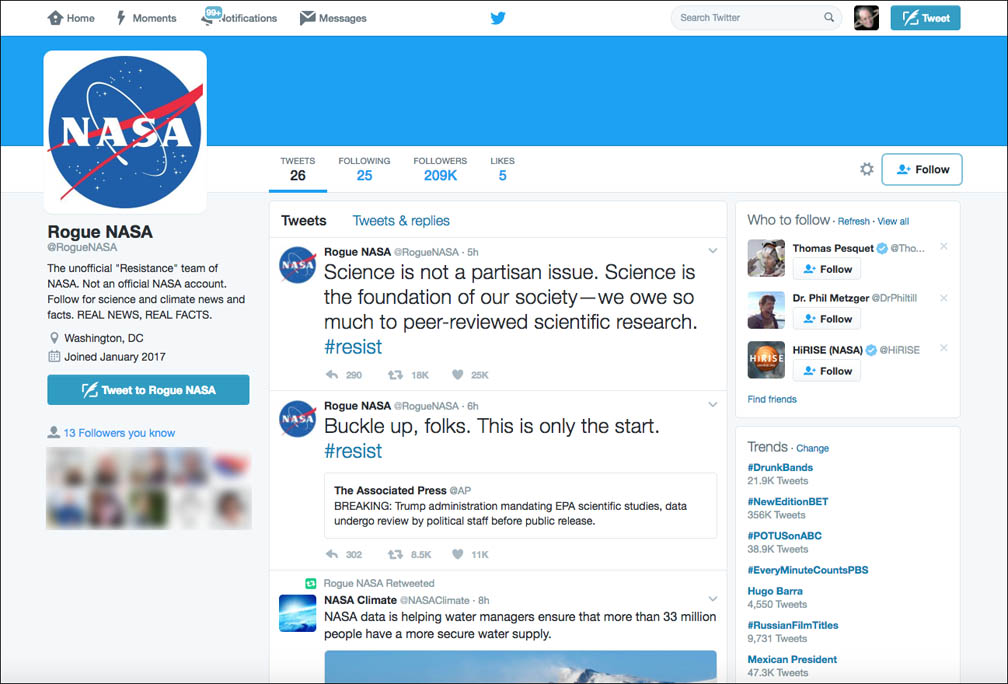
Rogue NASA, EPA, NPS Twitter Accounts Launched to Protest Trump Directives

by Bob King
mkalus shared this story from Universe Today.

Twitter page of Rogue NASA. Credit: Twitter

Three federal agencies — the National Park Service, the EPA and now NASA — have allegedly launched unofficial “protest” accounts on Twitter in defiance of the Trump team’s directives to not blog, tweet or talk to the news media about climate changes issues. While it’s not unusual for a new administration to want to control the message, many bristle at what they see as an administration that wants to redefine and control scientific fact.

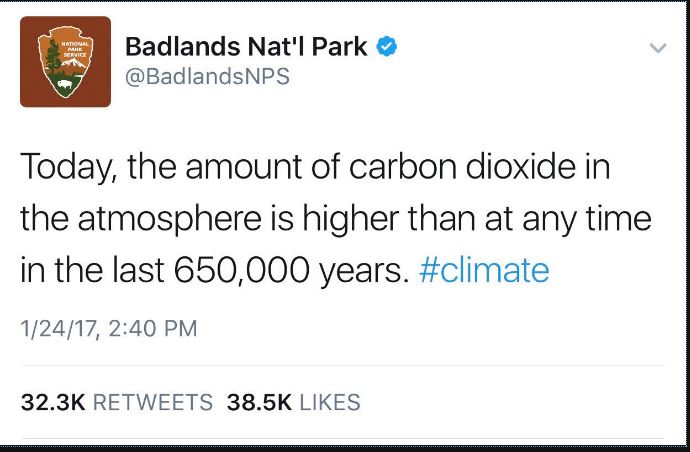
That brings us to these accounts. Are they really created by NASA and other government employees or are they the work of ticked off science advocates not connected to the agencies? In at least one case earlier this week in Badlands National Park, a former employee posted this unauthorized tweet:

“Today, the amount of carbon dioxide in the atmosphere is higher than at any time in the last 650,000 years.” The tweet was later removed.

The @RogueNASA Twitter account uses NASA’s logo — a no-no unless you have specific permission. The site describes itself as “the unofficial “Resistance” team of NASA. Not an official NASA account. Follow for science and climate news and facts. REAL NEWS, REAL FACTS.”

NASA’s very strict about how it’s logo is used. Under Media Usage Guidelines, here’s what the agency has to say:

“The NASA insignia logo (the blue “meatball” insignia), the retired NASA logotype (the red “worm” logo) and the NASA seal may not be used for any purpose without explicit permission. These images may not be used by persons who are not NASA employees or on products, publications or web pages that are not NASA-sponsored. These images may not be used to imply endorsement or support of any external organization, program, effort, or persons.”

AltEPA Twitter page. Credit: Twitter

Moreover, NASA reported that it had not given permission for another group or person to use its logo on the new account. While the sites may be legit and you or I sympathetic to the cause, exercise skepticism when poking around these accounts. Be cautious of opening up or downloading files the same way you’re careful with e-mail attachments. Take a look, participate, but be wary.

For your perusal, the current “alt science” sites I’m aware of are listed below. My hunch after looking at them is that it’s possible they may have been created by the same group of people. Whatever their origin, they’re quickly becoming very popular. As of Wednesday evening (Jan. 25), Rogue NASA has 209,000 followers; AltEPA 41,600 and 883,000 at AltUSNatParkService.

* AltUSNatParkService
* AltEPA
* Rogue NASA
* AltNASA

For more on the new administration and NASA, check out Nancy Atkinson’s story “Could NASA Be Muzzled Under Trump Administration?”

The post Rogue NASA, EPA, NPS Twitter Accounts Launched to Protest Trump Directives appeared first on Universe Today.

26 Jan 21:20

Japan Becomes A Military Space Player With Latest Launch

by Matt Williams
mkalus shared this story from Universe Today.

The Japanese Aerospace Exploration Agency (JAXA) has accomplished some impressive things over the years. Between 2003 (when it was formed) and 2016, the agency has launched multiple satellites – ranging from x-ray and infrared astronomy to lunar and Venus atmosphere exploration probes – and overseen Japan’s participation in the International Space Station.

But in what is an historic mission – and a potentially controversial one – JAXA recently launched the first of three X-band defense communication satellites into orbit. By giving the Japanese Self-Defense Forces the ability to relay communications and commands to its armed forces, this satellite (known as DSN 2) represents an expansion of Japan’s military capability.

The launch took place on January 24th at 4:44 pm Japan Standard Time (JST) – or 0744 Greenwich Mean Time (GMT) – with the launch of a H-IIA rocket from Tanegashima Space Center. This was the thirty-second successful flight of the launch vehicle, and the mission was completed with the deployment of the satellite in Low-Earth Orbit – 35,000 km; 22,000 mi above the surface of the Earth.

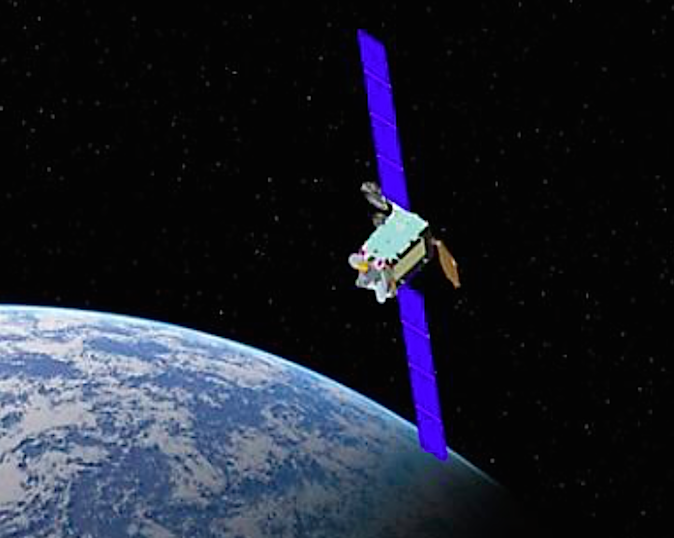
Artist’s concept of a Japanese X-band military communications satellite. Credit: Japanese Ministry of Defense

Shortly after the completion of the mission, JAXA issued a press release stating the following:

“At 4:44 p.m., (Japan Standard Time, JST) January 24, Mitsubishi Heavy Industries, Ltd. and JAXA launched the H-IIA Launch Vehicle No. 32 with X-band defense communication satellite-2* on board. The launch and the separation of the satellite proceeded according to schedule. Mitsubishi Heavy Industries, Ltd. and JAXA express appreciation for the support in behalf of the successful launch. At the time of the launch the weather was fine, at 9 degrees Celsius, and the wind speed was 7.1 meters/second from the NW.”

This launch is part of a $1.1 billion program by the Japanese Defense Ministry to develop X-band satellite communications for the Japan Self-Defense Forces (JSDF). With the overall goal of deploying three x-band relay satellites into geostationary orbit, its intended purpose is to reduce the reliance of Japan’s military (and those of its allies) on commercial and international communications providers.

While this may seem like a sound strategy, it is a potential source of controversy in that it may skirt the edge of what is constitutionally permitted in Japan. In short, deploying military satellites is something that may be in violation of Japan’s post-war agreements, which the nation committed to as part of its surrender to the Allies. This includes forbidding the use of military force as a means of solving international disputes.

An H-2A rocket, Japan’s primary large-scale launch vehicle. Credit: JAXA

It also included placing limitations on its Self-Defense Forces so they would not be capable of independent military action. As is stated in Article 9 of the Constitution of Japan (passed in 1947):

“(1) Aspiring sincerely to an international peace based on justice and order, the Japanese people forever renounce war as a sovereign right of the nation and the threat or use of force as means of settling international disputes.
(2) In order to accomplish the aim of the preceding paragraph, land, sea, and air forces, as well as other war potential, will never be maintained. The right of belligerency of the state will not be recognized.”

However, since 2014, the Japanese government has sought to reinterpret Article 9 of the constitution, claiming that it allows the JSDF the freedom to defend other allies in case of war. This move has largely been in response to mounting tensions with North Korea over its development of nuclear weapons, as well as disputes with China over issues of sovereignty in the South China Sea.

This interpretation has been the official line of the Japanese Diet since 2015, as part of a series of measures that would allow the JSDF to provide material support to allies engaged in combat internationally. This justification, which claims that Japan and its allies would be endangered otherwise, has been endorsed by the United States. However, to some observers, it may very well be interpreted as an attempt by Japan to re-militarize.

In the coming weeks, the DSN 2 spacecraft will use its ob-board engine to position itself in geostationary orbit, roughly 35,800 km (22,300 mi) above the equator. Once there, it will commence a final round of in-orbit testing before commencing its 15-year term of service.

Further Reading: Spaceflight Now

The post Japan Becomes A Military Space Player With Latest Launch appeared first on Universe Today.

26 Jan 21:20

Could NASA Be Muzzled Under Trump Administration?

by Nancy Atkinson
mkalus shared this story from Universe Today.

The Trump Administration appears to be trying to change how government agencies disseminate information to the public. According to reports from multiple outlets, several agencies are being told to discontinue or suppress communications with the public, the media and even Congress.

Additionally, Reuters is reporting that the Trump administration has instructed the Environmental Protection Agency (EPA) to remove information about climate change from its website. (An update today from The Hill quotes Doug Ericksen, EPA transition team spokesman as they are only “taking a look at everything on there.”)

All this has anyone interested in NASA’s activities wondering if the US space agency could be ordered to stifle its very active social media presence, or to remove the extensive information it has available on several NASA-related sites on climate change.

Universe Today contacted several NASA sources to see if the space agency has received any orders similar to the other agencies. All indications appear that, for now, NASA has not received any such orders.

John Yembrick, who heads NASA Headquarters’ social media team told us via email that “Nothing has changed here at NASA. We are continuing to share information about our missions on social media.”

Another NASA employee who wished to remain anonymous said they would be surprised and horrified if the social media blocks would extend to NASA but it seems nothing is out of the question now.

This morning, several NASA social media accounts on Twitter and Facebook are posting as usual.

Jeff Foust from Space News reported on Twitter last night that he attended a talk by Michael Freilich, the director of NASA’s Earth science division at the meeting of the American Meteorological Society (AMS) going on this week in Seattle, Washington, and Freilich was asked if NASA been given direction like EPA and other agencies to not communicate with public. Foust tweeted that Freilich said they “have been given no direction to change” and that the transition to the new administration’s “landing team” of about eight people at NASA has gone smoothly.

NASA’s ‘meatball’ logo.

It is important to remember that federal law has required NASA to widely disseminate information about its activities and scientific research in a timely way. National Aeronautics and Space Act of 1958 chartered NASA to “provide for the widest practicable and appropriate dissemination of information concerning its activities and the results thereof.”

The anonymous NASA source Universe Today talked to said the bigger issue for them right now is the hiring freeze that was imposed on all government agencies, and a possible grant freeze, such as the freezes posed on the EPA. Many scientists and graduate student work programs rely on grants for their salaries.

Other agencies that have been reportedly muzzled are the Interior Department (and the National Park Service), the Department of Agriculture (USDA), Department of Commerce, and Health and Human Services. All this is sparking concerns that the new president might be attempting to silence any dissenting views and control any information from federal agencies.

A news article out this morning says the USDA has now “disavowed the gag order”, calling it “flawed” and indicating that new guidance would be sent to its employees.

“This internal email was released without Departmental direction, and prior to Departmental guidance being issued,” the USDA said in a statement.

Is This ‘Normal?’

It’s important to point out that previous incoming presidential administrations have placed somewhat similar restrictions on limiting communications during the transition in order to have consistent messages come out across agencies.

But of course, there hasn’t been a new administration for eight years, and during those years the amount of information government agencies have made available on the internet has increased exponentially, and participation on social media has exploded. So, the moves to limit or silence the information disseminated by the agencies via online outlets is therefore unprecedented.

And many say this presidential transition feels completely different from any before.

National Public Radio (NPR) correspondent Nathan Rott interviewed Andrew Light, Senior Fellow in the Climate Program at the World Resources Institute in Washington, D.C., who formerly worked at the State Department. Light said the muzzling of agencies “seems to be aimed at a cluster of science-driven agencies that primarily work on the environment or climate change, and that seems unique or targeted in this case and unprecedented.”

You can listen to the NPR interview below:

The two highest people in leadership at NASA under the Obama Administration, Administrator Charles Bolden and Deputy Administrator Dava Newman, both stepped down on January 20 at the end of Obama’s term. NASA Associate Administrator Robert Lightfoot was named as acting administrator of NASA. Two White House appointees were named, Erik Noble as White House senior advisor and Greg Autry as White House liaison, part of an eight-member “landing team” assigned to NASA by Trump’s transition team.

Autry is an assistant professor of entrepreneurship at the University of Southern California. He has been “a proponent of commercial space activities,” according to Space News. Noble, who earned a Ph.D. in environmental studies from the University of Colorado, spent seven years at the NASA Goddard Institute of Space Studies in New York, working on weather and climate models.

Concern about agencies being silenced were heightened yesterday when a National Park Service (NPS) Twitter account from the Badlands National Park in South Dakota began posting information about climate change, which were later deleted. The NPS told media outlets that a former employee without approved access wrote the Tweets and that’s why they were deleted.

A screenshot of a now-deleted Tweet from the Badlands National Park Twitter account.

This came just days after the NPS was told to shut down its Twitter activity over two retweets about crowd sizes at presidential inaugurations. The Department of the Interior said those tweets were deemed inconsistent with the agency’s mission.

About 60 science and journalism organizations have requested a meeting with President Trump and Vice President Mike Pence to discuss access to government, but the newly elected team has not replied to the request.

The Sunlight Foundation, “a nonpartisan, nonprofit organization that uses technology, open data, policy analysis and journalism to make our government and politics more accountable and transparent to all,” has posted a list of government agencies that have reportedly been directed to not communicate with the public.

The post Could NASA Be Muzzled Under Trump Administration? appeared first on Universe Today.

26 Jan 21:20

Water Street – west from Carrall (2)

by ChangingCity

water-st-unit-block-west

We looked at a view from this location in an earlier post. That was photographed in 1888, this was almost certainly some time in the 1970s, although we’re looking at an undated (and slightly out-of-focus) original, so precise dating is difficult. On the left there’s a board pointing to the Dansk Bistro in the Mews, described as a ‘Danish Lunch Center’. We know we must be past 1970 because The Old Spaghetti Factory was already trading – and today that makes the pasta 47 years old as it opened in 1970 in the Malkin Warehouse (now a rental live-work building)

There’s an antique store trading on the south side (with a red awning), in 22 Water Street, one of the buildings developed by Tommy Roberts. The Mews was the retail complex created from the Nagle Brother garage, built in 1930 on the site of the city’s first firehall.

Apart from the addition of the Bruce Carscadden designed infill at 33 Water Street, (and the design of the litter bin) very little seems to have changed in about 45 years, although most of the buildings on the south (left) side have been rebuilt, added to and have residential uses added on the upper floors.

Image source: City of Vancouver Archives CVA 800-5076


26 Jan 20:59

Public Art — Car Repair Shop

by Ken Ohrn

Where else, but on the Drive.


26 Jan 20:59

When the Factories Come Back Home

by Ken Ohrn

Scott Gilmore writes in Macleans about companies returning manufacturing operations to North America (“re-shoring”). And bringing their robots with them.

He discusses jobs, and then moves on to larger topics about employment itself.

robot-toy

Give me your job!!

Automation has been changing human labour ever since the huge migration of farm workers to cities following the introduction of the tractors, combines and harvesters that replaced farm labour.

Historically, new types of demand and related new job types have emerged, with successful transitions going to those who become life-long-learners.

But automation marches on, faster and faster, with little end in sight, and no regard for the colour of your collar. Mr. Gilmore discusses truck drivers’ fragile future. It is becoming clear that certain semi-professional jobs are under siege, such as writing routine media stories (e.g. market and sports reports), legal research and preparation of simple legal documents. Even some professional fields such as diagnosing ailments will (at least) change with the introduction of automated assistants.

It seems that job market disruptions will only spread and increase, leaving problems for educators and policy-makers.    And when the factories come home, not many jobs will come with them.

Says Mr. Gilmore:

But the real driver behind re-shoring is automation. A robot in Mississauga, Ont., costs just as much as a robot in Shenzhen. And that is the bad news. Manufacturers are moving robotic jobs, not human ones, back to North American shores.

The bad news doesn’t end there. This rise in automation has only just begun and is going to change far more than the manufacturing sector. With the growth of machine learning and artificial intelligence, job losses will not be limited to assembly lines. The service industry, office administration, computer programming, and many other sectors are all on the cusp of automation.

Tesla’s Fremont Model S factory:

tesla-motors-factory-assembly-line

Thanks to Steve Jurvetson


26 Jan 20:59

Sheriffing @ Mozilla – checkin-needed

by cbook
Hi,
Working as Sheriff @ Mozilla is much more than just monitoring our trees and doing things like backouts. In 2017 i wanted to start to blog more about what we do and here is:
Part 1 – Checkin-needed
A lot of checkins land everyday on the Mozilla repositories. Some are great new features and improvements and some are bugfixes of existing bugs etc.
While a lot of checkins are done by the developers themselves, also sheriffs are involved in this.
We not only monitor the Mozilla repositories (aka the tree) we also do checkins for people who don’t have the appropriate level of permission to check in changes (for example new community members).
In the past checkin-needed was used by developers to reduce load on our build systems with fewer pushes but with a more robust build system this isn’t relevant anymore. 
So checkin-needed is more and more important for developers without access-levels to do commits and, as mentioned, new community members who for example finished their first patch.
To request checkin-needed people use this keyword in Bugzilla or use the [checkin-needed-beta] or [checkin-needed-aurora] whiteboard entry for the patches in a bug.
For me personal is checkin-needed a very important task because you sometime check in a patch from someone who just started to contribute to Mozilla. So you are one of the people that are the first contacts to the new contributor and you help them getting the patch landed. That‘s also a good opportunity to say “thanks for contributing to Mozilla” to the new community member, this is great motivation and recognition! 
How we work :
    
We have a wiki page with a bug query and some basic information for the Sheriff on Duty [1]. We use this query to get a overview what bugs need checkins.
For bugs with a patch attached that is not on mozreview we check the checkin-neeed request for:
    -> Has proper review before doing anything else
    -> Has a successful try run to avoid any bustage on checkin
and land the patch on mozilla-inbound.
For bugs with patches in mozreview we use the autoland tool to do the checkins. 
However we still check if the bug has review and check the try run.
This is the preferred way of doing checkin-neededs since autoland is an automated system.
How can you help 
  • ->  Use Mozreview – Autoland – it helps us to do more checkins in less time due to the automated tasks. Please make sure that there are no open issues in Mozreview when you request checkin-needed. In fact, you can land them yourself with autoland. In the future, checkin-needed will only be allowed on security bugs.
  • -> Make sure that you have a passing try run. It is a waste of the sheriffs time to come look at a checkin-needed and it has failures in the try run.
  • -> When you have multiple patches that need to land and the patches need to land in a specific order – please make a comment in the bug with the correct order.
  • -> When there are dependencies with other bugs – please state this in the bug.  
We try to do checkin-needed checks and checkins several times a day depending on sheriff workload etc so we cannot guarantee a turnaround time but trying to do our best.
When you have feedback/suggestions or idea how to do this task better let us know anytime!
Also as every part of the Mozilla Project we also depend on Community Members like you! So if you are interested to be become a Community Sheriff let me know!
Cheers,
– Tomcat
26 Jan 20:57

Donald Trump Reportedly Continues To Use His Unsecured Android Phone

by Rajesh Pandey
While Android and iOS are secure in their own right, they are still not good enough to be used as a daily driver by the President of the United States due to security concerns. However, The New York Times reports that Donald Trump continues to use his unsecured Android phone in the White House. Continue reading →
26 Jan 20:57

Security Expert Fears Trump’s Unsecured Android Phone Could be Used to Listen in on Conversations

by Evan Selleck
Recently, it was reported that President of the United States Donald Trump has decided to break tradition and continue to use his personal, unsecured device on a regular basis. Continue reading →
26 Jan 20:55

Telus leads Rogers and Bell in network speeds, according to OpenSignal

by Jessica Vomiero

OpenSignal, the company behind the popular mobile speed testing app of the same name, has released its January 2017 Canadian State of Mobile Networks report, showing a neck-in-neck race for speed dominance between the Big Three, with Telus edging out the competition across a majority of metrics.

The company bases its results off of crowd-sourced testing from its app, compiling both user-initiated tests and tests that run in the background, which the company says provides less user bias. Its data sample size is a robust 289,240,795 tests in total, sourced from 15,272 app between October 1st and December 31st, 2016.

Carriers in a wireless Canada
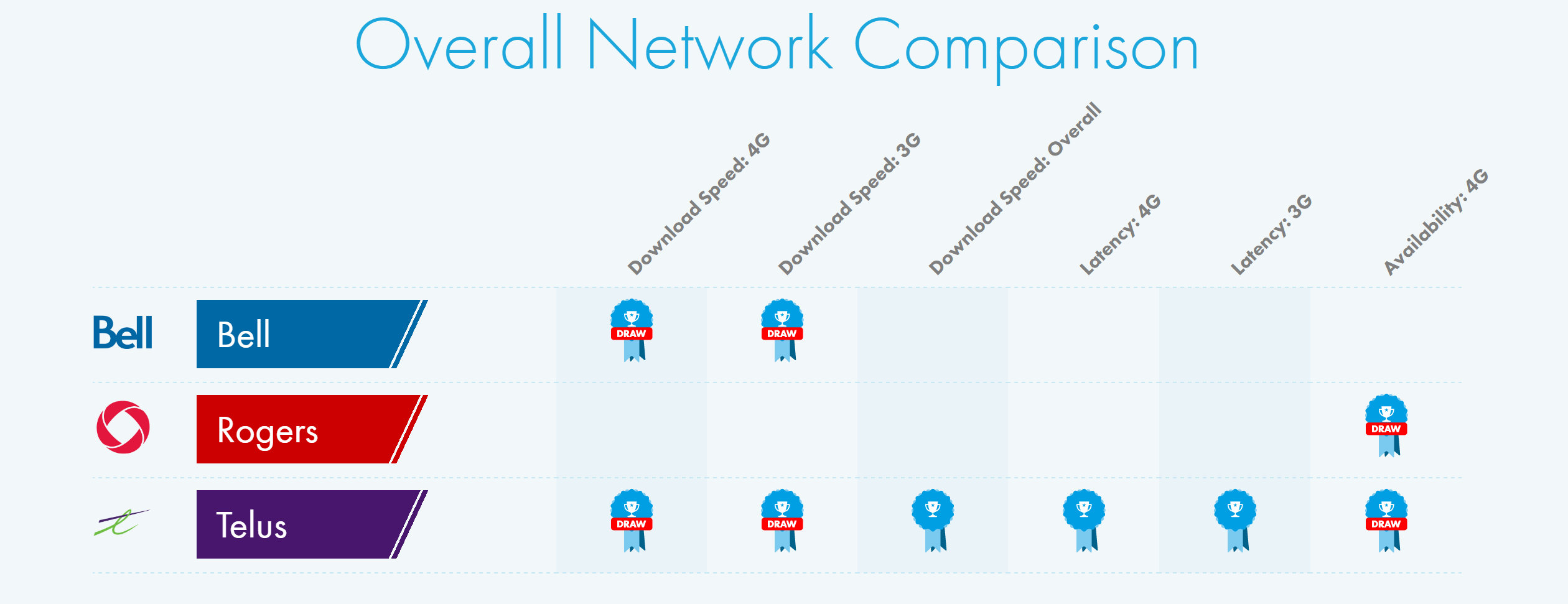
OpenSignal’s results show that when it comes to LTE downloads, Bell and Telus “share the speed crown.”

The average LTE download speed measured for Telus’ network is 30.5Mbps, while Bell’s network measured 28.4Mbps. Due to “overlapping statistical margins,” however, OpenSignal ultimately counted this as a draw for the two competitors, which have a long-held infrastructure sharing agreement.

The tie between Bell and Telus was closer when it came to 3G speeds, with 6.3Mbps for Bell and 6.2Mbps for Telus.

Meanwhile, Rogers came in third (though not by an overwhelming margin) with an average 27.32 4G download speed and 4.91Mbps 3G download speed.

In an overall download speed average, combining both 3G and 4G speeds, the Big Three remained close but Telus came out the winner with a 24.11Mbps speed, Bell second with 22.09Mbps and Rogers third with 21.25Mbps.

When it came to network reaction time, commonly known as latency, there was a clear winner between Bell and Telus. Winning both 3G and 4G latency match-ups, Telus scored 73.2ms and 43.6ms respectively.

Bell scored 90.76ms for 3G latency and 47.13ms for 4G latency, coming in second. In third, Rogers averaged 101.80ms on 3G and 51.22 on 4G.

In addition to these standard benchmarks for wireless network performance, OpenSignal adds another metric: availability.

Through constantly tracking networks in the background of its users’ smartphones, the company is able to reveal the percentage of time LTE subscribers have a 4G LTE connection available. In this, Rogers and Telus tied, with both networks offering customers an LTE connection 80 percent of the time, while Bell was not far off at 78 percent.

Freedom Mobile’s new LTE network and the networks of other smaller or regional carriers were not included in the results, presumably because OpenSignal aimed to paint a simplified picture of the three largest LTE networks in Canada.

For those who are interested in Freedom Mobile’s LTE network, however, MobileSyrup put together a (much smaller scale) network test of Freedom’s new LTE network in Toronto and will shortly do the same in Vancouver.

Canada in the wireless world

Canada’s Big Three networks all delivered average speeds significantly higher than last year’s measurements with the highest 4G download speeds reaching 30.5 Mbps on Telus’ network. Bell, however, is not far behind with download speeds of 28.4 Mbps. As the average 4G availability among Canada’s Big Three is approximately 80 percent, Canadians don’t have a problem getting a 4G signal the majority of the time.

While Canadians enjoy one of the most advanced and accessible line-ups of mobile networks in the world, they’re also known to pay some of the highest wireless subscriber fees in the world as well.

A report released by the CRTC last summer revealed that Canadians rank in the top three among the countries surveyed for the prices they pay on its wireless services, especially in comparison to the monthly fees paid by United States-based wireless customers.

It’s easiest to compare the country to its southern neighbour, whose residents pay notably less in monthly mobile and wireless fees to access a network that falls slightly below what Canadians have gotten used to.

While the United States’ carriers slightly outdo the likes of Rogers, Bell and Telus in terms of comprehensive coverage, Canada’s networks are still among the world’s most reliable when it comes to providing a consistent 4G or LTE signal.

In the last OpenSignal report issued in November, 2016, Canada narrowly made the top 20 for countries with the highest network availability at 95.71 percent compared to 75.42 percent availability nationwide. In comparison, the United States falls far below this rate at 78 percent.
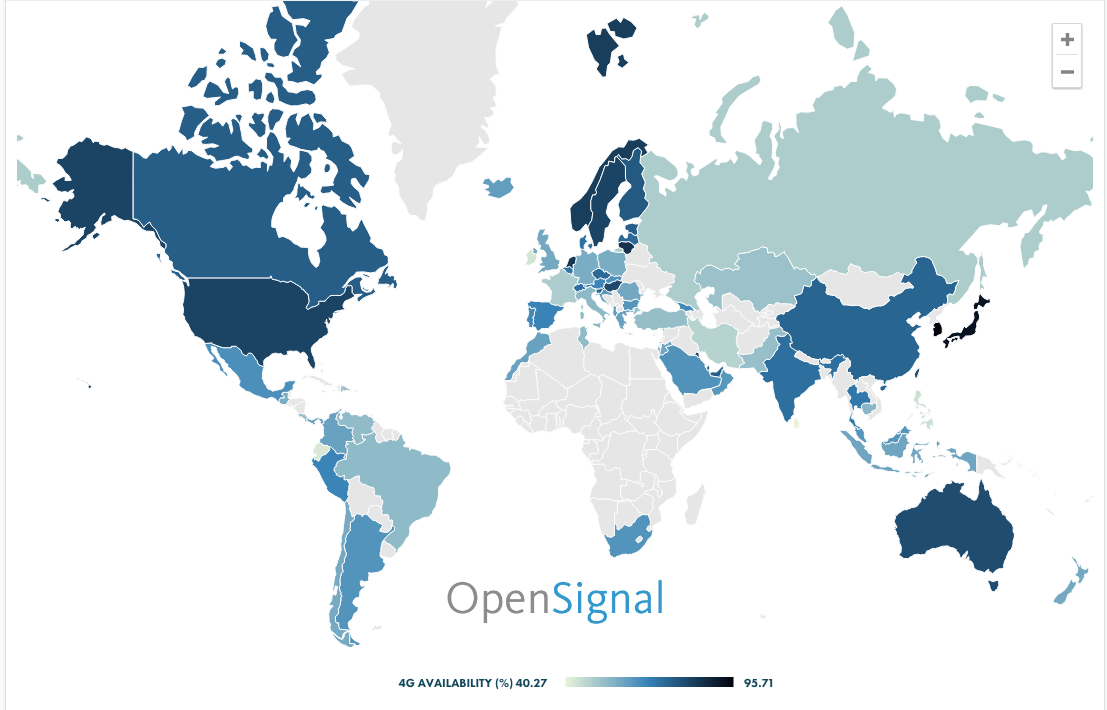
Overall however, despite lagging slightly behind American networks in terms of areal coverage, Rogers, Bell and Telus make up for it in performance, as the typical 4G connection in Canada is 26.6 Mbps, which is almost double the United States average.

Last year’s report suggested the possibility that Canadian carriers have such impressive — and evenly matched — networks due to their network sharing agreements. Telus and Bell share towers, while Rogers has gone a similar route with regional carriers such as Videotron in Quebec and MTS in Manitoba.

In addition, despite the fact that this report didn’t cover them in detail, it’s important not to discount Canada’s regional carriers. Competition in the Canadian telecom sector has often been criticized, as the Rogers, Bell and Telus tend to monopolize the marketplace.

All in all, Canada’s wireless networks continue to be competitive both with each other and on the global stage. The coming years could very likely usher in the development of 5G networks in Canada, which could enable the mass commercialization of technologies like virtual reality, the Internet of Things, machine learning and others.

Source: OpenSignal

26 Jan 20:55

Hugo Barra is now the head of Facebook’s virtual reality efforts

by Igor Bonifacic

Earlier this week, Hugo Barra, the former Google executive who from 2010 to 2013 was the spokesperson for Android, announced he was leaving Xiaomi to return to Silicon Valley.

He wasn’t specific about his destination at that time, but it turns out Silicon Valley, in this case, meant Menlo Park, the home of social media giant Facebook.

Late last night, Facebook CEO Mark Zuckerberg announced the hiring of Barra on his company’s social network.

“Hugo Barra is joining Facebook to lead all of our virtual reality efforts, including our Oculus team,” he said. “Hugo shares my belief that virtual and augmented reality will be the next major computing platform. They’ll enable us to experience completely new things and be more creative than ever before. Hugo is going to help build that future…”

“I can’t wait to get started in building that future and join the team in a couple of months,” said Barra in a comment following Zuckerberg’s post. “It’s been a dream of mine to work in virtual reality even back when AR/VR were just figments of science fiction; now we’re taking selfies in virtual worlds.”

Barra joins Oculus at a time when the company finds itself at a challenging crossroads. Not only is the company engaged in a high-stakes lawsuit with ZeniMax Media, but former Oculus CEO Brendan Iribe also stepped down from his position at the end of last year to lead a smaller group within Oculus.

Source: Facebook

26 Jan 20:55

The designer of the Vive has left HTC to work on Google Daydream

by Igor Bonifacic

Not one to allow one of his peers to have all the fun, Claude Zellweger, the man responsible for the design of the Vive headset, tweeted on Wednesday that he’s leaving HTC to join Google’s Daydream VR team.


In a statement issued to The Verge, a spokesperson for HTC confirmed Zellweger’s departure.

“HTC can confirm that Claude Zellweger has left the Company. We appreciate his considerable contribution to HTC, and wish him well in his future endeavors. HTC continues to invest in talent and recruitment as part of our broader strategy to ensure the continued strength and integrity of the Company’s organizational structure.”

Zellweger joined HTC in 2008 when the design firm he co-founded with Scott Croyle and Jonah Becker, One & Co, was acquired by the Taiwanese company. Together, the three men helped define HTC’s smartphone design language with the HTC One lineup. In 2014, Croyle left HTC to found Nextbit, the company behind the crowdfunded Robin smartphone. Less than a year later, Becker left HTC to join Croyle at Nextbit. Zellweger’s departure completes their exodus.

His expertise is likely to help Google tremendously as it aims to make Daydream a mainstream success.

On Wednesday, the platform achieved a major milestone after Google announced that all developers are now able to submit Daydream apps and games to the Google Play Store.

Source: Twitter Via: The Verge

26 Jan 20:55

Bell Let’s Talk Day sets record with over $6.5 million raised for mental health

by Bradly Shankar

Following its 2017 Let’s Talk Day, Bell has raised a record $6,585,250.50 for mental health initiatives.

Led by Olympic athlete Clara Hughes, the campaign is a national initiative to end the stigma surrounding mental health and raise money for the cause.

Every year, Bell pledges five cents for every text, phone call or social media interaction using the hashtag #bellletstalk sent throughout the day. This year, there were a total of 131,705,010 messages across all platforms, more than in 2016.

“We’ve shattered records again with a mental health discussion that reached every corner of Canada and points all around the world too,” Hughes said in a statement, thanking everyone who participated. “We keep on knocking holes in the dark wall that is stigma, and we keep on growing funding for new research and expanded care as the engagement builds and builds.”

Bell says that engagement across Facebook, Twitter, Instagram and Snapchat more than tripled from 2016.

Famous Canadians like Ryan Reynolds, Howie Mandel and Prime Minister Justin Trudeau also helped promote Let’s Talk Day.

The event even drew mainstream attention outside of Canada, with stars like comedian Ellen Degeneres, the Royal Family and actor Dwayne “The Rock” Johnson tweeting about the initiative.


Bell has raised over $86 million for over 700 mental health organizations with Let’s Talk Day since its debut in 2010.

Source: Bell 

26 Jan 20:55

HTC 10 Android 7.0 update now rolling out in Canada

by Ian Hardy

After receiving updates to the HTC One M8 and One M9, HTC 10 owners have been patiently waiting for the notification that Android 7.0 is available to download. Now, Nougat is finally available to Canadians HTC 10 owners.

So far, only Bell owners have received the update, though other carriers should soon follow.

If you haven’t seen a notification prompting you to update your HTC 10 to Nougat, you can manually check for the update by launching the Settings app and navigating to About Phone and then Software Update.

(Thanks, F.Reyes!)

The post HTC 10 Android 7.0 update now rolling out in Canada appeared first on MobileSyrup.com.

26 Jan 20:55

Google Pixel 2 leak promises low-end model and improved camera

by Rose Behar

The floodgates for Google Pixel 2 leaks have opened following a tweet from 9to5Google senior editor Stephen Hall that stated the second-generation device would “definitely” be waterproof, according to an October interview with the company.

Now, 9to5Google has received further details about the upcoming handset from an insider source, who tempered expectations for a waterproof device, noting that the feature is “still on the table.” The source goes on to state that Google is continuing to put a strong emphasis on camera performance. With the Pixel 2, Google aims to “master low-light photography,” ditching a high megapixel camera in favour of one with a more robust feature set.

The first-generation Pixel’s camera was reportedly pitted against waterproofing during development. To include both, the company would have needed more development time and the resulting phone would have cost more, according to Hall’s tweets.

Additionally, the source says the Pixel 2 is testing improved chipsets from two manufacturers: “some with Snapdragon 83X chips, others with Intel chips.” With these new additions, the Pixel 2 will reportedly bring a higher price than the original Pixel by at least $50 USD. However, Google is testing lower-end Pixel devices with lesser specs and a lower price tag that could be ideal for emerging markets.

The original Google Pixel debuted in October 2016, and launched to glowing reviews with an aluminum body, Snapdragon 821 processor, 4GB of RAM and a 12.3-megapixel rear shooter with an impressive DxOMark score.

Source: 9to5Google

The post Google Pixel 2 leak promises low-end model and improved camera appeared first on MobileSyrup.com.

26 Jan 20:54

Lennon and McCartney's Friendship Becomes a Musical Data Art Duet

by Kevin Holmes for The Creators Project


By Nationaal Archief, Den Haag, Rijksfotoarchief: Fotocollectie Algemeen Nederlands Fotopersbureau (ANEFO), 1945-1989 - negatiefstroken zwart/wit, nummer toegang 2.24.01.05, bestanddeelnummer 916-5098. Cropped by Gabriel Sozzi [CC BY-SA 3.0 nl (http://creativecommons.org/licenses/by-sa/3.0/nl/deed.en)], via Wikimedia Commons

Lennon and McCartney: One of the most famous songwriting partnerships in pop music history, and this year on July 6th, it will be 60 years since the two first met at a church fete in Liverpool, England, back in 1957. John Lennon was 16 Paul McCartney, 15, and since then, it's become Beatles lore that over the years they had their ups and downs. The question for fans has always been, how did these differences effect their songs? 

To mark the anniversary, and their relationship as creative duo, composer Dr. Alexis Kirke from Plymouth University has used an algorithm to "chart the emotional development of their friendship through their lyrics." For a new piece, Come Together: The Sonification of McCartney and Lennon, Kirke will take the data he's gathered to create a classical duet of emotionally-annotated words from 156 McCartney songs and 131 Lennon songs.

Kirke is no stranger to using algorithms for experimental music making. Previous experiments have included using bots with the personalities of Luke Skywalker, Darth Vader, Superman, and Batman to create a live performance. Come Together will be an a cappella performance between a soprano and tenor voice, interwoven where Kirke plotted the emotional positivity and physical intensity.

The words were used to map musical features that chart happiness throughout their time as friends. Kirke has made the duet to mirror events that happened between the two in real life, from Beatle-mania, pointing to the jubilation of their early success, to the negavitity that came with their split in 1970, leading up to Lennon's tragic assassination in 1980.

“I’ve been a huge fan of The Beatles since my dad introduced me to Sgt. Pepper’s in my early teens," Dr. Kirke said. "Having developed the lyrical analysis method with other artists [Kirke has done a sonification of Bowie's career for the V&A], and realizing that this year was the 60th anniversary of McCartney and Lennon forming The Quarrymen, it seemed a wonderful opportunity to combine my childhood musical enthusiasms with my adult research and composition. The lyrical emotion patterns that I discovered were very exciting and cried out to be turned into a performance. I feel honored to have this opportunity to compose a vocal duet about two people that have had such a large emotional impact on my life.”

Below, an unforgettable performance by the band that shows just how close the two were in song: 


The performance will take place next month as part of the Peninsula Arts Contemporary Music Festival which runs 24 to 26 February 2017 at Plymouth University, UK. Find out more about Dr. Alexis Kirke at his website here.

Related

Scientists Are Making Music with Slime Mold and Whale Songs

Take a Virtual Tour of the Legendary Abbey Road Recording Studios

[Exclusive] Celebrating the Man Who Photographed Everyone from MJ to MLK

26 Jan 20:54

How to See Stuxnet? 'Zero Days' Filmmakers Find an Unlikely Answer in VR

by Beckett Mufson for The Creators Project

Images courtesy the artists

I'm floating in cyberspace, and it's beautiful. A tunnel of sleek metallic tubes telescopes before me, criss-crossing into TRON-like circuit board cities that make it clear that I'm inside of a computer. I'm surrounded by information: infographics pulsing red and blue below me, elongated frames of news footage zooming past my eyes, their soundbites echoing in my ears—were I not wearing a virtual reality headset I'd be sure I could reach out and touch data itself. As Zero Days VR progresses, the companion piece to Alex Gibney's documenary about the Stuxnet super virus makes it clear that the serene world I'm drifting through is the battleground for the 21st century, and I'm on the front lines. 

New media artist Yasmin Elayat and production company Scatter, sister company to next-gen filmmaking hardware developers Depth Kit, teamed up with Gibney to create the cyber world of Zero Days VR. By integrating time-tested talking head narrations with glitch artdata visualization, and pointcloud videography, the team rises to the challenges of telling a story that happened mostly inside text editors and industrial software. Three of its five chapters premiered at The Sundance Film Festival—which, coincidentally, was hacked over the weekend—as part of its tech-focused New Frontier program, giving form and feeling to the most elusive aspect of Gibney's documentary film: the Stuxnet virus itself.

When Stuxnet hit the web, there was nothing like it. It was larger than any other computer virus by a factor of 20, had almost no bugs, and included four 'zero day' exploits, features that made it so rare and powerful that experts later would determine that it would take the resources of one or more nation-states to create it. According to anonymous sources, those nation-states were the United States and Israel, whose military intelligence sought to infiltrate Iran's nuclear facility at Natanz and and take down uranium-enriching centrifuges.

You can read MOTHERBOARD's history of the virus here, but whoever was responsible for the successful attack ultimately did little to deter Iran's nuclear program. What's more, once it was discovered, Russia and more nations were able to create their own versions of the virus, which can be used to attack any form of industrial computer. This means power grids, water treatment plants, banks, traffic control centers, the very stitches of civilization are vulnerable to it—and what concerns Scatter's VR experience is the future.

"This is happening in our backyard, it's not just in the Middle East, far away in Iran. So we wanted it to not just feel like you're floating through code, but for people to really understand the stakes, and how it could go wrong," explains Elayat. "A piece of malware can actually cause physical damage, and the United States is the most vulnerable nation."

Zero Days VR's purpose is to drive that message home with more emotional urgency than the original documentary. "The film and the VR piece will complement one another. One gets more facts across and the other is more experiencial," says Depth Kit founder James George (click here to see about George's past projects). There's a scene where the virus is rendered as a string of red dots snaking across a grid. It illicits a spine-chilling tingle equivalent to finding a spider in your bed and wondering how many more are hiding in the shadows.

Of course, this isn't an entirely factual presentation of events. Stuxnet doesn't work like the game of Snake, winding its way through your servers and gobbling up everything it finds. Instead, for people to better understand the actual facts behind the thousands of lines of code that could spread autonomously through networked systems at any time, George says filmmakers must get creative.

"We're living in a time where things are happening that would normally be covered by documentary filmmakers and photographers. But now they don't have the tools to represent what is happening in these invisible, code-based systems," he explains. "The philosophy of Depth Kit and Scatter is that, using virtual reality as a medium, we can actually represent these spaces in a way that's true to reality. Even if we have to be inventive about the visuality of it."

The most powerful use of the VR medium comes in the final moments of Zero Days VR, through a new technique we'd previously never encountered. A conglomeration of several anonymous sources forms a figure known as The Informant, an official-looking blond woman created with volumetric point cloud footage (see above). The character delivers some of the best, most urgent lines, including details about a US-developed program even more powerful than Stuxnet, Nitro Zeus, which could disrupt Iran's entire civilian infrastructure. As the experience comes to an end, The Informant soberly, "Anything we can do to others, they can do to us, too." Then, she glitches out of view—one moment she's giving the hard truth, and the next moment—thanks to a hidden Depth Kit and Intel RealSense R200 camera—I'm broadcast into my own VR headset in real time. 

Humans first fought by land, and by sea not long after. Aerial combat was a thing of the 20th century: now, cyberspace is the theater of war. Zero Days VR answers the question, "How do we tell stories of conflict in digital spaces?" For Elayat, George, producers Mei-Ling Wong, Alexander Porter, technical director Elle Zananiri, and Gibney, the answer very well should be "beautifully."

Learn more on Scatter's website.

Related:

Immerse Yourself in a 3D Cloud of Creative Coding Culture

Interactive SXSW Installation Uses Kinect To Beam Users Into CGI Worlds

[Premiere] Virginia Woolf-Inspired Film Explores Female Identity in the Virtual Space

26 Jan 20:54

A Robot Drew Star Charts for the Next 100,000 Years

by DJ Pangburn for The Creators Project

Images courtesy of Tellart

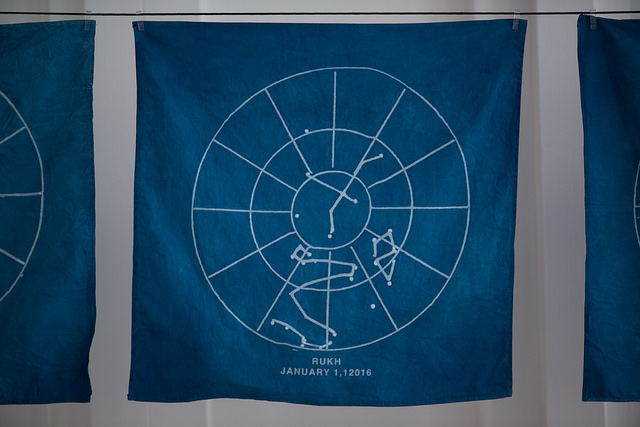
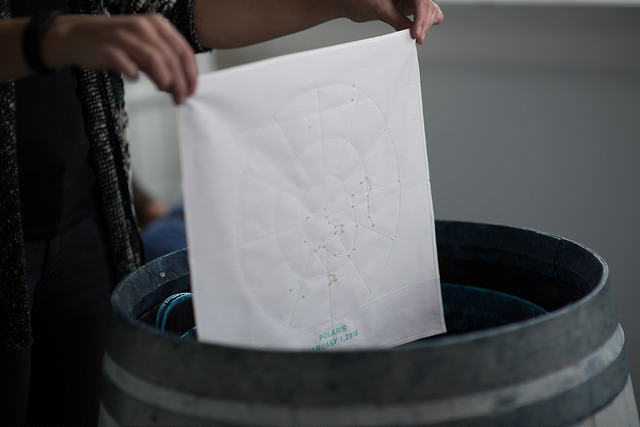
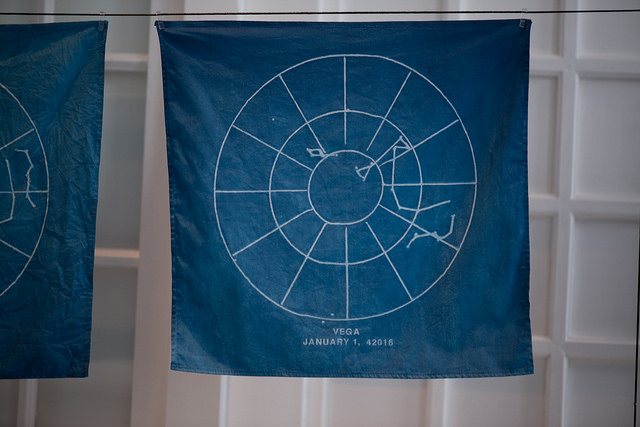
Those in the northern hemisphere know that the North Star, Polaris, is a useful tool of navigation. But few know that, because of changes in Earth’s axial rotation, Polaris hasn’t always been—nor will it remain—the North Star. This lies at the heart of a new exhibition titled Deep Future, which features robotically-drawn celestial maps of what the North Star will be every 10,000 years for the next 100,000.

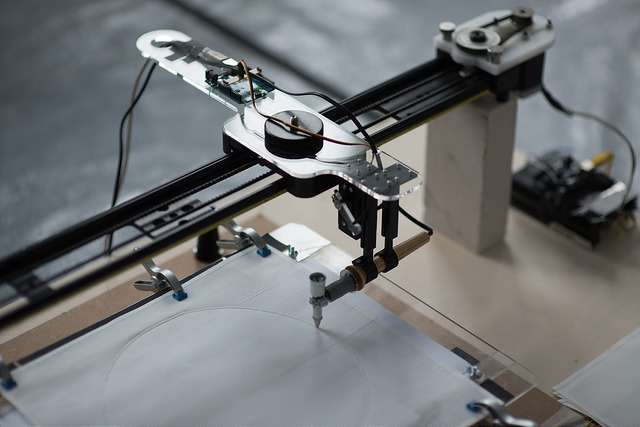
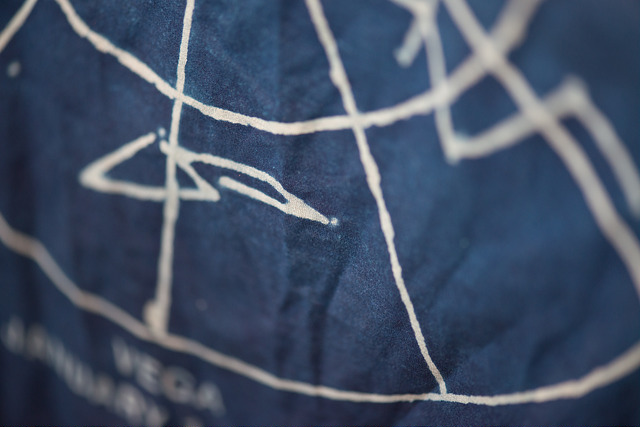
Deep Future first premiered at Hotel Droog in Amsterdam in 2015, but is now on at The Museum of Tomorrow in Rio de Janeiro, with all ten drawings together for the first time. With it, the international design studio Tellart wanted to combine custom robotics and programming with the analog heritage crafts of beeswax, canvas, and indigo dyes. First, the custom-designed robotic drawing machine created the celestial illustrations by extruding beeswax onto canvas. Then Tellart dipped the canvas in indigo dye to give it the color of a traditional blue celestial night sky.

“We created our own software, based on existing open-source databases. to create new bespoke software that maps of the night sky over the North Pole, on New Year’s, at midnight for every 10,000 years,” Tellart’s Chief Design Officer, Matthew Cottam, tells The Creators Project. “We then wrote custom code to translate those vector visualizations into code to control the beeswax drawing robot.”

As Cottam explains, Deep Future grew out of two distinct forces. The first had to do with Tellart’s work over the last last four or five years on future foresight projects, particularly with the prime minister’s office in Dubai. There, they imagined how technology will impact not only future governance and citizenships, but design and culture.

The other inspiration was Cottam’s sailing trip from the Azores in the mid-Atlantic to Portsmouth, England, during which he navigated primarily with a sextant, the stars, the sun, and the moon. In order to do this, Cottam had to really study celestial navigation and the celestial sphere.

“These two things colliding led us to realizing that there was an opportunity to create a picture of how the future will look in the future,” says Cottam. “Even the thing that we consider the most reliable navigation landmark, the North Star, is actually not so permanent. [W]e found this inspirational.”

“Since we were doing this as a New Year’s experiment, we decided to make it about the sky will be different on New Year’s at midnight every 10,000 years for the next 100,000 years,” he adds. “But we wanted to create a set of poetic images that would reveal this ethereality of things that we assume to be permanent, and underline our interest in uncertainty, the future, and the importance of people being able to question it, negotiate it, and navigate it with some resources and information.”

Cottam and the rest of the Tellart team believe that design is an important process in conveying this kind of information to people. To get these ideas across to audiences, Tellart likes to combine natural, tangible, and earthly materials with the immaterial of digital imagery, data, and networks.

“As we look out at how things will change for human life on Earth, the further out we get in time the more unclear that picture becomes,” says Cottam. He references the futures cone, the idea that there are very likely future outcomes based on immediate indicators, as well as plausible ones based on many types of trends and drivers. Then there are possible futures that might not be very likely or plausible because of many competing opportunities that the human path may go down.

“The ‘deep future’ was just an idea of looking at this long runway of time in a very abstract and metaphorical way to try and show that there is increasing uncertainty as we move out into the future,” he says. “That the next time we stand on the North Pole the North Star may be the same, but as we move out it’s going to change and change again.”

Deep Future from Tellart on Vimeo.

Deep Future is at Museum of Tomorrow until May 7, 2017.

Click here to see more of Tellart’s work.

Related:

Sketch Intricate Designs with A Hand-Cranked Drawing Machine

Machine Draws Famous Mathematicians with the Math They Invented

[Premiere] Experience Singularity Inside a Holographic Black Hole

A Painter Transformed a Gallery into a 35-Foot Galactic Universe

26 Jan 20:54

Mind-Boggling 3D Fractals Form an Alien Structure in This Short Video

by DJ Pangburn for The Creators Project

Images courtesy the artist

After creating a mysterious fractal film about the abandonment of Earth, animator and visual effects artist Julius Horsthuis takes viewers to a new alien world. Inspired by CERN’s Large Hadron Collider, Horsthuis images a gigantic alien particle accelerator composed of fractals.

Horsthuis tells The Creators Project that he used Mandelbulb 3D to “create some sci-fi concept art types of environments, both in stills and in animation.” While the immense LHC is buried underground, Horsthuis showcases Large Fracton Collider’s exterior, which looks somewhat influenced by LHC’s mesmerizing innards.

“I'm envisioning a future where design has been transformed rather profoundly, and this is a glimpse of that future,” he says. “Using Mandelbulb 3D to create the structures, I have not sketched or sculpted anything at all. The structures emerge from (to me) incomprehensible mathematics, making my own journey more one of discovery than of creation, which is infinitely more fun.”

Large Fracton Collider from Julius Horsthuis on Vimeo.

Click here to see more of Julius Horsthuis’s fractal short films.

Related:

Mysterious Fractal Film Foretells the Abandonment of Earth

[Premiere] Fraction's New Music Video Is a Black and Chrome Abyss

Fractals Become Star Nurseries in CGI Short Film ‘Light Matter’

26 Jan 20:54

American Flag Remixes Reveal the Real Story of the U.S.A.

by Monica Uszerowicz for The Creators Project

propshitup_tshrt_art_pics_0042.JPGDL Warfield, The United States of Boom. Images courtesy of the artist
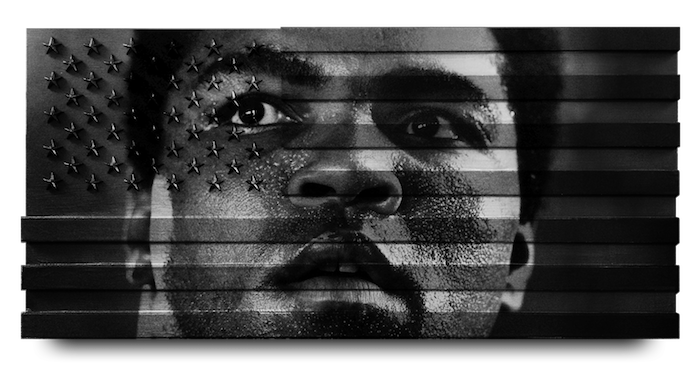
Stretched across a silvery, wooden American flag, Muhammad Ali’s wide-eyed image is America, a visual parable: he looks at once determined and full of wonder, sweat-soaked from putting in work and somehow eternally gracious. Entitled The United States of the World’s Greatest, the 33” flag is part of DL Warfield’s latest project, The American Flag Remixed, a series of flags crafted in a variety of mediums (wood, denim, mercury glass, iron, leather). They each depicts a bold reinterpretation of Americanism—or what it means to believe in America.

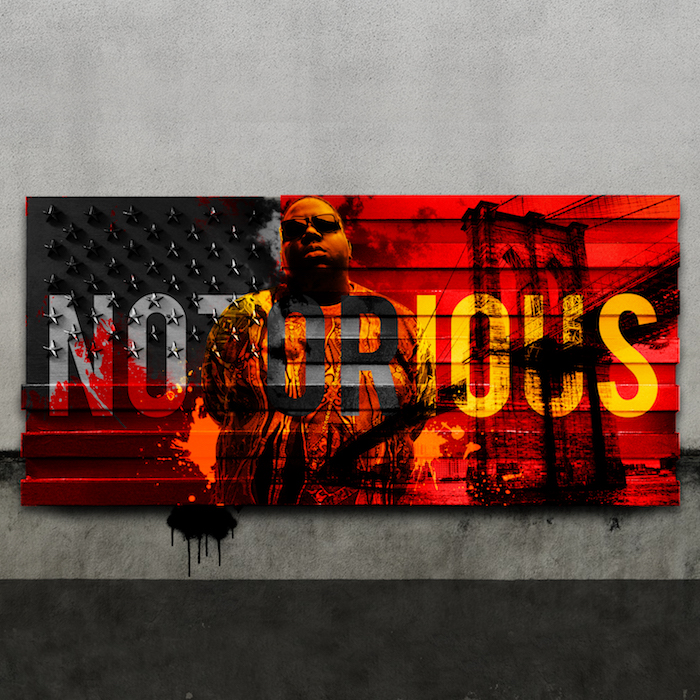
biggie_americanflagremix.jpgDL Warfield, The United States of Brooklyn Stand Up
“The flags feel so important, especially right now,” says Warfield, who refers to himself as “an artist with a fighter’s mentality." He grew up in St. Louis, Missouri, where, he says, it was “pretty segregated. Things I went through with my girlfriend—who is now my wife—inspired a show I did last year, My Boyfriend is Black.” In addition to his personal practice, Warfield is a creative director at Goldfinger Creative, and has designed the visual branding for musicians like Michael Jackson, TLC, and Justin Bieber. Fittingly, his own work is something close to the realm of Pop art, brightly-colored and featuring familiar characters unexpectedly brought together—like Jimi Hendrix and Jackie O. “We didn’t have a regional music influence [in the Midwest],” he explains, “and since music has always been the biggest influence for my art, I would dream about the places that music was created.”

americanflagremix_muhammadali_flag_1600_c.pngDL Warfield, The United States of the World's Greatest

Musicians and other celebrities make their way onto Warfield’s American flags, particularly those that represent influential facets of U.S. culture. The United States of Brooklyn Stand Up displays the Notorious B.I.G, the word “NOTORIOUS” brightening from grey to yellow across the flag’s length; The United States of Hollis, Queens features the RUN DMC logo. Italian superstars of decades past, like Sophia Loren, make an appearance (The United States of Italian), and Tupac, too (The United States of All Eyes On Me).

Though Warfield spent a long time thinking about “the different things that America means to people [and] how entertainment is our number one export,” the meaning of America is the crux of the series—what America is, who America is. Most of the depicted celebrities are people of color; furthermore, other pieces of life in the U.S. appear on the flags. There’s The United States of God (a flag that looks like the sky itself) and The United States of We Shall Not Lose, an homage to the soldiers from Raising the Flag on Iwo Jima. There’s even cocaine (The United States of White Lines).

raylewis_americanflagremix2.jpgDL Warfield, The United States of Play with Passion

The multiple, endless definitions of American identity are vital right now, when it feels like so many lives and so many fundamental rights, perhaps always at stake, are more in danger than ever. “The way I change the aesthetics of the flag,” Warfield explains, “speaks to being able to be the American that you want to be…and, at the same time, show we are all connected through the foundations that makes this country great, incredible, bad, notorious, humble, arrogant.”

Click here to visit DL Warfield's website. 

Related:

50 States of Art: A Letter from the Editor

Here's How Post-Election Anxiety Took Over Art Week Miami

Artist Sculpts Her Own American Flag

26 Jan 20:54

This Artist Tells Multimedia Crime Stories By Questioning the Justice System

by The Creators Project

All images courtesy the artist

An artist's slick, probing designs tell ripping stories of crime and justice, and just as abruptly, calls her revealing stories into question. Incorporating a wide range of materials and forms—film, text, architecture, and more—multimedia artist, Ilona Gaynor, creates cohesive, believable narratives that are at once entertaining, and make the viewer question who can be trusted and what facts can be believed.

Gaynor will be taking part in a panel at this weekend’s Design Festival, being held at the A/D/O creative space in Greenpoint, Brooklyn, and supported by MINI Business Innovation. As part of The Creators Project panel, Gaynor will be discussing utopian visions on equality, and how designers can help to conceive of and help create a better future and drive societal change. 

She’s well-suited to such an imagining of the future. While she invents situations and characters in her works, they are built on a foundation of realistic situations and believable details that lend them a high level of plausibility. For example, her work Objection!!! uses scale models, courtroom sketches, short films, and a packed sound stage, complete with props, camera directions, and shooting scripts, to present a court case in which a national lottery is shown to be fixed. While the case is fictional, she worked closely with lawyers through its conception to ensure she was creating a credible case and courtroom atmosphere.

For her work Under Black Carpets, Gaynor collaborated with the FBI New York Department of Justice and Los Angeles Police Department’s Archival Department to make a detailed forensic model in which five banks are robbed in Los Angeles simultaneously. She uses this believability to help undermine the notion of objective truth or conventional wisdom, exploring how fragmented facts can be used to construct different narratives, depending on the viewer.

Gaynor’s interest in believability and the depth of her research has led her to create the consultancy, the Department of No in 2012. Clients that reach out to the organization tap into Gaynor’s detailed knowledge of law, finance, and architecture enhance her ability to conceive detailed hypotheticals which pose potential risks to an organization or industry,  and the means to overcome them. The Department of No specializes in what Gaynor calls “black sky thinking,” aiming to help clients in national or private security, insurance, and technology industries.  

But art remains her driving focus, and the medium through which Gaynor explores big stories and actions in law and financial crime. Her work Everything Ends in Chaos tells a tale of a senator’s kidnapped wife and the events that result, using this individual story to tell a much bigger tale of global financial disaster. The work is a mixed-media collection of objects, narrative texts, and films that map out precisely how one small action could, realistically, disrupt the entire world.

Related:

This Artist Turned Herself into a Corporation to Sell Her Data

Big Brands Are Reimagined as Weapons of Destruction

A Sculptor Made Your Childhood Model Kit the Size of a Building