Shared posts

26 Jan 21:26

Hello World – a new magazine for educators

by Philip Colligan

Today, the Raspberry Pi Foundation is launching a new, free resource for educators.

Hello World – a new magazine for educators

Hello World is a magazine about computing and digital making written by educators, for educators. With three issues each year, it contains 100 pages filled with news, features, teaching resources, reviews, research and much more. It is designed to be cross-curricular and useful to all kinds of educators, from classroom teachers to librarians.

Hello World is a magazine about computing and digital making written by educators, for educators. With three issues each year, it contains 100 pages filled with news, features, teaching resources, reviews, research and much more.

It is designed to be cross-curricular and useful to all kinds of educators, from classroom teachers to librarians.  While it includes lots of great examples of how educators are using Raspberry Pi computers in education, it is device- and platform-neutral.

Community building

As with everything we do at the Raspberry Pi Foundation, Hello World is about community building. Our goal is to provide a resource that will help educators connect, share great practice, and learn from each other.

Hello World is a collaboration between the Raspberry Pi Foundation and Computing at School, the grass-roots organisation of computing teachers that’s part of the British Computing Society. The magazine builds on the fantastic legacy of Switched On, which it replaces as the official magazine for the Computing at School community.

We’re thrilled that many of the contributors to Switched On have agreed to continue writing for Hello World. They’re joined by educators and researchers from across the globe, as well as the team behind the amazing MagPi, the official Raspberry Pi magazine, who are producing Hello World.

print (“Hello, World!”)

Hello World is available free, forever, for everyone online as a downloadable pdf.  The content is written to be internationally relevant, and includes features on the most interesting developments and best practices from around the world.

Thanks to the very generous support of our sponsors BT, we are also offering the magazine in a beautiful print version, delivered for free to the homes of serving educators in the UK.

Papert’s legacy 

This first issue is dedicated to Seymour Papert, in many ways the godfather of computing education. Papert was the creator of the Logo programming language and the author of some of the most important research on the role of computers in education. It will come at no surprise that his legacy has a big influence on our work at the Raspberry Pi Foundation, not least because one of our co-founders, Jack Lang, did a summer internship with Papert.

Seymour Papert

Seymour Papert with one of his computer games at the MIT Media Lab
Credit: Steve Liss/The Life Images Collection/Getty Images

Inside you’ll find articles exploring Papert’s influence on how we think about learning, on the rise of the maker movement, and on the software that is used to teach computing today from Scratch to Greenfoot.

Get involved

We will publish three issues of Hello World a year, timed to coincide with the start of the school terms here in the UK. We’d love to hear your feedback on this first issue, and please let us know what you’d like to see covered in future issues too.

The magazine is by educators, for educators. So if you have experience, insights or practical examples that you can share, get in touch: contact@helloworld.cc.

The post Hello World – a new magazine for educators appeared first on Raspberry Pi.

26 Jan 21:26

Liquid Lunch

by Rachel Stone

Human flesh: the ingredient in the mysterious food product in the 1973 thriller Soylent Green. In 2013, engineer Rob Rhinehart gave his meal replacement drink the same name, though with a less sinister recipe. According to Lizzie Widdicombe’s 2014 New Yorker profile of Rhinehart, the tech entrepreneur just wanted to make something he could afford to eat on a startup budget. To save on food costs and code nonstop, Rhinehart crushed up vitamins and minerals and ground them into a goop that he hoped could supplement his frozen pizza intake. He named the goop after the 1966 novel that inspired the film, and after a well-timed Kickstarter campaign, the goop became more profitable than his startup.

This liquid meal diet was genius and unprecedented — except it wasn’t. Substances like Soylent had been sold to consumers since at least 1977, argued Guardian journalist Nellie Bowles, as meal replacement diet drinks like SlimFast. The effects are largely similar: In his blog entry “How I Stopped Eating Food,” Rhinehart noted that after three weeks on Soylent he was “two belt loops down,” and by week four he had lost so much weight he wrote that he “started getting chilly.” Vice journalist Brian Merchant documented a 10-pound weight loss in his 30-day Soylent-only diet.

“What makes Soylent unique,” wrote Adrian Chen in his 2013 Gawker profile of the drink, “is that it is the first of these ‘functional beverages’ developed for and by young, male tech geeks,” specifically Silicon Valley “biohackers,” a group that believes “every moment they don’t spend coding a world-changing app might be a loss for humanity” and that “feeding yourself is a time-wasting problem that can be solved with technology.” This group skews predominately male.

Soylent and SlimFast exist in an ad space that presumes gender is binary and nonfluid. Women are sold bodies without minds, and men are sold minds without bodies

Meal replacement diet drinks signify flirty commercials and bottles shaped like hourglasses. In 1988, Oprah attributed her weight loss to a meal replacement drink called Optifast, and dragged a red wagon full of fat onto her television stage; the world had watched her lose 67 pounds, and would later demean her for putting it back on. SlimFast ads have mostly featured women in their commercials — in 1990, baseball player Tommy Lasorda became the company’s spokesperson, but research demonstrated that he was particularly persuasive to women consumers. (He was reportedly even more credible because he was a man admitting to weight problems.) An ad from 2015 shows 12 women and two men twirling in tight clothing and bikinis while clutching and kissing SlimFast bottles. Women appear in Soylent ads, though they are rarely the focus.

Soylent’s origin story works to associate the drink with the culture that founded it. Soylent adheres to its tech roots; its commercials are about “hacking” and “maximizing efficiency” and “food product.” Its label is sleek and minimalist, and its products never filmed far from a laptop. If it’s also a weight loss drink, it doesn’t want us to know.

Soylent’s slogan “use less, do more,” implies that a body is only good insofar as it is a tool for mental optimization. Its shape is secondary, unmentioned, and because it is not named, unimportant. In contrast, SlimFast ads never mention productivity or efficacy; consumers’ professional desires or work schedules are secondary to their physical attributes. Soylent and SlimFast exist in an ad space that presumes gender is binary and nonfluid. Women are sold bodies without minds, and men are sold minds without bodies.


“I just want to look good naked,” says the protagonist of 2013’s SlimFast ad campaign, Get What You Want.” Our protagonist is a middle-aged woman, who speaks to her mother on her cell phone while wearing a pink pajama set. “Two kids ago, I was doing the reverse cowgirl with the lights on!”

“Did you say something?” her husband interjects, carrying a load of laundry.

“No,” she says.

“I heard cowgirl,” he says through a smile.

“Not happening,” she says, stone-faced, and he leaves.

She bites her lip, and grins. “Just when I’m twisted up like a Russian gymnast,” she continues wistfully, “it would be nice to actually look like a Russian gymnast.”

This commercial feels progressive, if only because it features a husband doing laundry, and a woman allowed to talk about sex — “non-traditional” sex that places the woman in a position of power. Nowhere do we see a man tell the protagonist what is wrong with her; instead, she regulates herself. Having sex with the lights on would be to allow herself to be seen in a way that she is not permitted to be seen, so, contrary to the ad’s title, she withholds from herself what she wants. The ad sells negative space — the loss of mass from a woman’s hips — as well as accusation, and instruction. If you aren’t actively working to make yourself more slender, then you should be. To be a competent woman, you must show that you are working to look better, that you are always striving. This self-enhancement is primarily self-serving: the woman only looks to embody an ideal.

Soylent’s first ad, from 2014, features Rhinehart sitting in a warehouse while clouds of chemical formulas materialize around his head. It’s half tech ad and half TED talk, casting Rhinehart as both peddler and prophet. “Everything is made of parts,” he says at one point, staring off into the middle distance.

A robotic-sounding female voice introduces the commercial. “Soylent began as an idea to create the ultimate food,” she says. Onscreen, vintage film of wheat fields, grocery shoppers, and “Nutrition Facts” move in black and white over the image of a clear glass cup. “The goal wasn’t to replace food, but to provide a better alternative to what we usually eat.”

“It takes a little bit of perspective to see that food really is made up of chemicals. It is reducible,” Rhinehart continues in a milquetoast monotone. “And we can build it back up, and make it better.”

The commercial insists that Soylent is food technology, that Rhinehart is an engineer. “Everything is made of parts,” he says, staring off into the distance

The scene switches to a sleek apartment, all chrome and dark wood. A muscular, bespectacled man wearing a mesh athletic top pours a glass of beige food product, then returns to his laptop and standing desk. The commercial insists on reminding us that Soylent is food technology, that Rhinehart is an engineer who studied electronics and computation. The commercial never calls Soylent food; rather, it’s “a sustainable food source designed to keep the body in a balanced state of ideal nutrition.” Humans become collections of cells; food becomes the intricate technology that prevents these parts from rusting. “We know what we’re made of,” Rhinehart says, “and that’s what Soylent is.”

The next scene shows a woman in an office, her glass of Soylent resting next to her laptop. A man and woman go for a run, pack Soylent in Nalgenes for a nature hike. The bespectacled man from the beginning of the video is chill, we learn; he sips his Soylent while reclining in a recording studio, bantering with a tattooed dude. The Soylent-drinking woman speaks up in the office.

“By using Soylent as a resource, you can guarantee your body gets the nutrition it needs,” the robotic narration continues, “as a low cost way to be healthy, and save yourself some time.” Bodies in this commercial are vehicles for productivity and progress, not ends to themselves. When Soylent’s consumers free their minds from the cumbersome routines of food consumption, the world profits.


Meal replacement food technology telegraphs your preferred mode of bettering yourself, upgrading your personal brand to its next glittering iteration. By emblematizing the absence of food, both Soylent and SlimFast fetishize self-denial and austerity — one makes distraction a sinful indulgence, as the other does consumption — and promise transcendence through self-denial.

Soylent’s mode of optimization centers on mental enlightenment: Soylent, branded explicitly as technology, is material of the mind. Soylent drinkers have a Mission: they care about food system innovation and increased access to quality nutrition. Their goals are serious and high-minded, not carnal but utopian. “We strive to create a world where access to affordable, complete nutrition — one of the most basic human needs — is no longer a challenge, but a means of empowerment,” Soylent’s website proclaims. SlimFast’s method of self-improvement is purely corporeal: Optimization begins and ends with the body, which, unlike the mind, is burdened with bulging imperfections. The SlimFast website tracks before and after images of smiling women (and one man), and locates their transformations within personal testimonials. The outcome is personal satisfaction.

Today, the body is finite, and the mind transcendent. In either case, optimization is a Sisyphean task. The body is perpetually lacking; “improving” it is a matter of striving for adequacy. The mind, with its world-saving potential, must be perpetually upgraded.


When I danced in high school, I noticed that a few dancers in my class started substituting specific tea for their water bottles. Its packaging was distinctive; the deep green of dark moss, serious and vaguely medicinal. Three silhouettes of ballerinas arched out of a teacup. My classmates called it “Ballerina Tea,” though I had never seen my dance instructors drink it. These classmates often placed the boxes of teabags where they could be seen: atop the radiator, against the windowsill, resting above the tangled ribbons of their pointe shoes. I think I registered what this tea was before my friend confirmed it, smiling conspiratorially.

Ballerina Tea is not just for ballerinas, apparently, nor is it made from tea leaves. Instead, it’s made of malva verticillata and cassia angustifolia (Chinese mallow and senna), both powerful laxatives and diuretics. “Be sure to discuss this with your physician before using,” an article on Livestrong cautions. “Follow the directions on the box and monitor your physical reactions, because overuse, or use by people with sensitive systems, can cause problems.”

By emblematizing the absence of food, both Soylent and SlimFast fetishize austerity — one makes distraction a sinful indulgence, as the other does consumption

The name is either a dig at the ballerina stereotypes or a projected result.

In this rarified world, austerity felt necessary for excellence. “Optimizing” your body into a more muscular, sleek version of itself felt directly proportional to the kind of career you would have. I am shorter than average, my body more stubby than willowy. When straight, my knees still protrude and break the line of my arabesque, giving the impression that I am never fully stretched, or that I am always falling. At a ballet summer intensive program when I was in high school, I listened to a young dancer tell me about her time training at a ballet company abroad, about how the instructors wouldn’t let you into partnering classes if you didn’t make the weight limit for your height, lest you strain the arms of the male dancers lifting you. Another classmate professed to have a formula for success.

“You know how those dancers get so thin?” she asked the crowd of us. “They eat only a single orange a day.”

I knew this was ridiculous — you would die if you did that — but for the rest of the five-week program my classmate refused the plastic boxed lunch our program prepared for us, demurely withdrawing a single clementine from her dance bag. I watched my other classmates look at her, heard them talking behind her back. The conversations were cautionary, but always tinged with admiration. People admired her willpower in the same sentence they told her to stop.

To excel in an art form that valorizes female fragility both onstage and off, I believed that needed to maximize my body’s efficacy. I cut pictures of famous dancers out of magazines; I charted my weight in apps like LoseIt! and willed myself to want to stop eating so much. Once I scrolled through a Thinspiration tumblr. I clicked out three minutes later, face hot.

I did not want these distorted bodies. Nor did my desire to optimize my body into ideal dance equipment ever manifest into anything distinctly self-destructive. (I haven’t danced seriously in four years and I look exactly the same as I did then.) I didn’t want to be thin, I realized; I wanted a body that would let me dance how I wanted to dance without getting in my way. But more than that, I wanted the approval of the other dancers, their recognition of my diligence. I wanted anyone who looked at my body to know that I was aware of its failings, and that I was trying to improve it. If I was not demonstrating that I was making my body into what I wanted to be, then I was tacitly accepting that my body was as good as it was going to get, and that I didn’t mind it.

Body was not always “low-brow,” and mind was not always supreme. When women dominated tech in the 1940s and ’50s, “the accompanying pay and prestige were both relatively low,” according to Rhaina Cohen’s Atlantic article on “What Programming’s Past Reveals About Today’s Gender Pay Gap.” As Dr. Grace Hopper explained to Cosmopolitan in 1967: “Women are ‘naturals’ at computer programming,” which is “just like planning a dinner.” When men make up the majority of the field, these same traits are considered to be inventive and societally beneficial, and the product, like the computer scientists who drink it, is considered to be innovative rather than frivolous.

In her article about intermittent fasting, Nitasha Tiku profiles WeFa.st, a community predominately made of young male tech workers who fast in order to achieve “peak productivity and readiness for a future where technology is king and the smartest man wins.” These biohackers fast in order to “do more work and generate more revenue,” according to Tiku; instead of “competing on a physical plane,” they are “competing with the rest of the world.” Skipping meals is considered “monkish,” and disordered eating a productivity hack. In this community, like my ballet classmates, the appearance of austerity morphed into austerity for its own sake. The results, in either case, were eternally projected.

26 Jan 21:26

Mac App Subscription Service Setapp Goes Live

by John Voorhees

MacPaw, makers of CleanMyMac, Gemini, and other apps, launched a public beta subscription service of hand-picked Mac apps last December called Setapp. Today the service, which aims to become the ‘Netflix of apps,’ was officially launched with a stable of 61 Mac apps.

For a flat subscription fee of $9.99 per month, customers can download any of the 61 apps and use them as long as they continue to make monthly payments. After MacPaw receives a 30% cut of customers’ subscription fees, developers who participate in Setapp are paid based on a formula that accounts for the price their apps are sold for outside the service and whether customers use the apps each month, which MacPaw tracks.

Getting started with Setapp is easy. After signing up and installing Setapp, a new folder appears in the Finder on your Mac called ‘Setapp.’ Setapp also resides in your menu bar and optionally as a folder in the Dock.

Apps aren't installed until the 'Open' button is clicked.

Apps aren't installed until the 'Open' button is clicked.

If you look in the Setapp folder in Finder, you will see icons for all 61 apps. Each icon has a little downward pointing arrow to indicate that it hasn’t been installed yet. Double clicking the icon opens a description of the app with screenshots similar to what you find on the Mac App Store. The app is installed when you click the ‘Open’ button from an app’s overview window.

Setapp should be a bargain for anyone interested in several of the apps it offers, especially the ones that cost the most outside Setapp. Although it is difficult to anticipate the cost of purchasing and updating apps over the course of a year or more, the subscription approach makes economic sense for users in those circumstances and is worth considering.

The benefits of Setapp to developers are less clear. If Setapp attracts large numbers of new users to the apps in its service, some developers’ apps could thrive, but that is by no means a given. To try to get a better sense of what has attracted developers to Setapp, I asked a couple who are participating in Setapp how they feel Setapp fits with the other sales channels for their apps.

Luc Vandal, creator of Screens, a MacStories favorite for screen sharing, said:

Setapp is just another way to have our apps available to a different set of customers. For instance, we offer Screens directly from our store, on the Mac App Store and now on Setapp. This way, we ensure that we reach users seeking different ways to buy apps.

I also corresponded with Marcus Fehn, one of the co-founders of The Soulmen, makers of Ulysses, a beloved text editor used by many of us at MacStories, who also sees Setapp as additive to his company’s other sales channels:

Ulysses for iOS will always be distributed via the App Store anyway, and our main channel for the Mac app will remain the Mac App Store. We are seeing Setapp as sort of a “special interest bundle” – it’s not so much about a new channel of distribution, as it is about giving users access to our app as part of this bundle.

Finally, Brett Terpstra, creator of Marked, a Markdown previewer for macOS had this to say on his site when the Setapp beta launched:

What clinched my decision to include Marked 2 in Setapp is the fact that I can still sell directly and via the Mac App Store. So I’m hoping to get sustainable, subscription-based revenue, without having to eliminate my current purchase options.

If Setapp helps developers build sustainable businesses by attracting new users, I’m all for it, but I’m skeptical. There’s a tension here. Customers are being offered an all-you-can-eat buffet of apps. The more apps that are used, the better the value for customers. At the same time, the more apps a customer uses, the less each developer of those apps gets paid. That might be fine if these are customers the developers wouldn’t attract without Setapp, but what if each Setapp user means one less full price app sale?

I can't shake the feeling that Setapp may be a symptom of, and not a cure for, the intense financial pressures that indie developers face today, even developers with highly-regarded apps. Time will tell, and I hope I’m wrong, but Setapp feels like a short-term solution to a long-term problem that I’m afraid will hurt developers in the end by driving average app prices down even further. And what’s bad for developers in the long run, ultimately hurts users too.


Support MacStories Directly

Club MacStories offers exclusive access to extra MacStories content, delivered every week; it’s also a way to support us directly.

Club MacStories will help you discover the best apps for your devices and get the most out of your iPhone, iPad, and Mac. Plus, it’s made in Italy.

Join Now
26 Jan 21:26

LINE Q4 16 – Game off.

by windsorr

Reply to this post

RFM AvatarSmall


Gaming could save LINE but the focus appears to be elsewhere. 

  • LINE reported a difficult set of results which laid bare how difficult it will be to return to growth without expanding either its coverage of Digital Life or its user base.
  • With the shares trading on 5.7x 2016A EV / Sales, I think that a return to rapid growth is required just for the shares to stand still.
  • Q4 16A revenues / EBIT were JPY37.5bn ($332m) / JPY1.6bn ($14m) substantially missing consensus estimates of JPY38.7bn / JPY5.3bn.
  • Even with a one-off charge against EBIT removed from the figures, LINE still missed consensus EBIT by 50%
  • The lower profitability was primarily caused by marketing expenses, general and admin expenses all of which grew substantially more than sales.
  • The main issue is that LINE is trying to change its business model from one based on stickers and games sold through its IM platform to one based on advertising.
  • This is because revenues from stickers and games is beginning to decline in the face of competing services (like Facebook Messenger and WhatsApp) which offer similar content for free.
  • Furthermore, RFM calculates that LINE’s current offering is not broad enough to return the company to real growth.
  • However, it should be able to replace existing revenues should they decline to zero.
  • When I look at LINE, I think it is capable of driving monetisation through the Digital Life services of Instant Messaging, Shopping and Telephony giving it total Digital Life coverage of 18%.
  • I do not think that its Smart Portal is mature enough to give it credit for Social Networking or any other Digital Life segment that it is trying to address.
  • Furthermore, its user base is pretty stagnant at 217m leading RFM to calculate that LINE could generate around $1.5bn in advertising revenues on an annual basis or $373m per quarter.
  • During Q4 16 LINE generated $139m in advertising with content generating $193m giving $332m in total.
  • This clearly shows that replacing content with advertising will only allow revenues to expand to $373m per quarter, some 12% above where the company is now.
  • To return to growth LINE will have to successfully expand its coverage of Digital Life or start growing its user base once again.
  • Growing the user base will be a major challenge as LINE has consolidated its focus onto the four countries of Japan, Thailand, Taiwan and Indonesia which considerably limits its scope.
  • Hence, I think it will have to improve its Digital Life coverage which will be difficult given that the other segments of Digital Life are pretty well covered already.
  • The one exception I see is Gaming and here there is an opportunity for LINE given its heritage in selling games through its platform.
  • This is a big segment and if LINE can generate a thriving multiplayer gaming community, then I can see its revenues expanding once again.
  • Unfortunately, of this there is no sign with much of the effort being places on other areas which to date have resulted in increased investments but no real revenues.
  • To justify its valuation, LINE must start to grow again as 5.7x EV / Sales is way to high for a company with low growth and heavy investments hitting profits.
  • I can see the valuation making a major adjustment downward from here.
26 Jan 21:26

Declining trust in statistics

by Nathan Yau

Statistics took a hit this election season, and it could be a slow trek to get back to where we once were. William Davies for The Guardian discusses the current feelings towards data and provides some history of how we got here.

In many ways, the contemporary populist attack on “experts” is born out of the same resentment as the attack on elected representatives. In talking of society as a whole, in seeking to govern the economy as a whole, both politicians and technocrats are believed to have “lost touch” with how it feels to be a single citizen in particular. Both statisticians and politicians have fallen into the trap of “seeing like a state”, to use a phrase from the anarchist political thinker James C Scott. Speaking scientifically about the nation – for instance in terms of macroeconomics – is an insult to those who would prefer to rely on memory and narrative for their sense of nationhood, and are sick of being told that their “imagined community” does not exist.

But maybe this is an opportunity for data folks. Maybe people are ready for more data and more distributions and ready to look past averages and values without uncertainty.

Tags: general public, trust

26 Jan 21:26

Rainbows and Unicorns

by rands

Peggle is a casual game developed by Popcap. Originally released in 2007, the game is memorable because of it’s absolutely over the top level finishing sequence.

In an explosion of rainbows, fireworks, unicorns, and Beethoven’s Ode to Joy, you are generously emotionally rewarded when you finish a level. As a friend commented at the time, “It is likely the most consistent and unadulterated source of positive feedback you’ll get in your life.”

The gaming industry has spent billions of dollars successfully figuring out how to design and build products that provide Peggle moments – that tap into the parts of your brain that reward specific behavior. They’ve figured out when to reward you in order to keep you entertained and engaged. There are companies and products which do this well, and there are those who are total douche bags about how they choose to re-enforce behavior, but the rules are tried and true and deeply wired into your brain.

And there is absolutely no way they can’t be used for good (or evil) in a product, team or company

Moments of Disproportionate Satisfaction

I’ve been thinking about games for a long time, and I believe there are three rules that define a good game:

  • Do I have a continual healthy sense of progression?
  • Am I learning and mastering the game via timely and effective feedback?
  • Do I have the impression that I can win?

Let that soak in a moment because I’ve been working on that list for a long time. While I’ve made a name for myself writing off-the-cuff remarks on Twitter, this list is considered. It explains why a Rubik’s cube isn’t a good game (but a great puzzle), but Minecraft is an amazing one.

True story. I’ve been writing versions of this piece for a good two years. The vast gaming surface area described by this list paralyzes me each time I attempt to finish, but as I’ve edited, I’ve realized that these rules also apply to building a healthy team. Specifically one, “Am I learning and mastering the game – the system – via timely and effective feedback?”

What a horribly dry rule. I need my wisdom with a dose of poetry, so how about a more specific version, “Compliments work.”

Duh

I’ll write about the two other rules and how they relate to good leadership and a healthy team another time. This article is about the power of a compliment. A compliment is a selfless, timely, and well-articulated recognition of achievement. To start to understand the value of a compliment, let’s go back to that Peggle video. Play it again.

It’s a visual and auditory feast full of familiar sights and sounds designed to give you joy.

When it comes to the motivation of humans, we’ve designed all sorts of communications tools and interesting cultural artifacts to help us move forward. Here’s a deadline that clearly tells us when we should be done. Here’s a Gantt chart to explain where we as a team and how we collectively get us from here to there. I am tell assertive which means folks who like to be told what to do will appreciate my communicative style. All of these structures, articles, communication styles, and threats can motivate, but game makers have learned the elegant motivational properties of a compliment. Allow me to demonstrate:

Thank you for reading this article. I spend hours on these articles. I fret over them, I love them, and then I hate them. Eventually, I toss them into the world wondering what you’ll think. If you’re still here, I don’t know if you liked this piece or not, but I do know that you’ve spent just under five minutes of your life reading something I wrote which means I held your interest, so thank you. I appreciate every single one of my readers.

Are you feeling it? You should because I mean it.

Peggle rewards you when you perform a simple task. It’s saccharine and over the top, but you can’t say that Peggle doesn’t own the compliment. They want you to celebrate your achievement in the loudest most ludicrous way, and it works.

However, the Peggle compliment does fail to meet my definition. While it is a timely and well-articulated recognition of achievement, it is hardly selfless. It’s fun, but it’s designed to be fun so that you keep playing the game. It’s a timely endorphin boost that is designed to train your brain to crave finishing because… that head-banging unicorn. He’s the best.

Let’s decompose a useful compliment.

The Compliment Breakdown

Once more, my definition of the compliment: A selfless, well articulated, and timely recognition of achievement. Let’s take that apart.

First up, the reason this compliment needs to exists is that of achievement. This human did something notable, and you want to recognize this fact. The magnitude of achievement is a factor, but I find compliments small and large carry the same weight. We want to highlight when the team or team members are at their best; we want to recognize meaningful acts of being human.

Recognition is our next attribute and herein lies improvisation. Is this a compliment you want to land 1:1 at the moment it occurs or is it the type of compliment that you want to tuck away so can you can land it in front of the entire team for maximum recognition? I don’t know. There are so many contextual variables to consider here that it’s hard to give universal advice? Do they hear it? Or do others need to hear it about them? Understand what behavior you want to recognize and why and make a call.

Timeliness is our easiest attribute to understand. My default is to compliment as quickly as possible because I believe it’s the most effective way to reinforce behavior. That’s what we’re doing here, right? The blandest version of what you’re saying is, “This thing you do is important.” The faster that you take the time to compliment, the more they’re going to remember – not your compliment – but the act.

Well articulated is the attribute that is the hardest to define and the most important. Let’s start with what looks like a horrible compliment. The vapid “Good job!” seems like an F, right? Not true. A well-timed “Good job!” can be an effective and timely recognition of achievement. Even better, how about this?

Thank you for taking the time to build the technical overview document for Q&A. The feature you built is great, and we not only better understand how to test it, but support it.

The specificity of this compliment documents the act, the value, and the impact. It is that detail articulation that will make it memorable.

The most nuanced part of compliment is selflessness. This is also entirely context dependent, but a good compliment is one that comes without perceived social cost or dependency. You know what doghouse roses are? It’s when you buy flowers for your significant other because you screwed up. Yes, they are pretty, but all the recipient sees in those roses is the screw-up. It’s a thoughtless empty gift that erodes trust. A good compliment contains nothing about you or what you want. It is entirely about the achievement of the other human.

A Compliment Career Shift

What are the moments that defined your career? Sure, I bet you can rattle off the disasters because the mental magnitude of disasters has staying power. Keep thinking. I suspect you can think of compliments that changed the course of your career.

My first start-up. A senior engineering VP who ran brusk and terse was working with me on compensation adjustments for the team. We were efficiently and quietly working our way through a spreadsheet and comparing notes. Halfway through the spreadsheet, he looked up at me and out of nowhere said the longest sentence of the day, “Understanding people is your super power, Lopp. Don’t forget that.”

A well-constructed compliment has an emotional payload. It is full of rainbows and unicorns. It is this strange, unpredictable payload that makes us nervous about compliments. There is the risk, but when used for good, a compliment is an elegant and lasting way to recognize and reward when we are the best version of ourselves.

26 Jan 21:26

Turning Violent

by David Banks

Lots of people have been sharing mashups of neo-Nazi Richard Spencer getting punched in the face and, as Natasha Lennard wrote in The Nation, you can thank Black Bloc for the original source content. (My favorite right now is set to “The Boys are Back in Town.” ) Black Bloc is a tactic that has a unique relationship to attention and anonymity. Individuals mask up to remain anonymous but the collective group is meant to draw and direct attention. It is, in this way, not unlike Reddit and so it should be no surprise that black bloc is so compatible with virality. The tactic, however, was invented pre-internet and so it is worth looking at how radicals are weathering (and strategically utilizing) this relationship to digital networks and mass media.

That person who punched a Nazi may be facing up to 10 years in prison on felony riot charges if they were one of the 200 people arrested that day. Even if they escape state prosecution, white supremacists are crowdsourcing a bounty for information on the anonymous Black Bloc participant. More than a funny meme, what happened on inauguration day is a political act that is still playing out. How this event and similar ones are covered in the media has tangible consequences.

One common criticism of the Black Bloc is that white people are overly-represented in the bloc which points toward a dynamic where privileged folks are making an otherwise safe environment, dangerous. Proponents of Black Bloc tactics turn that argument on its head by saying, as Lennard does in her piece:

Not everyone can participate in a black bloc. Those with a vulnerable immigration status, or arrest records, or good reasons to fear police repression because of the color of their skin, often don’t participate in activities where the risk of arrest is high. Friday’s bloc was by no means all white, but it was predominantly white. If bearers of white privilege can do one thing, it is put ourselves on the line and take risks where others can’t.

Black Blocs draw the attention and resources of the police away from other parts of a demonstration and have even been known to “unarrest” people who have been kettled. They also, as the video of Richard Spencer attests, will violently engage people who pose a danger to others.

All of this was true before the internet though, and what has changed is the degree to which particular moments can be captured in media and precision-guided into specific audience demographics. Whereas the Black Bloc tactics deployed in years past were subject only to the framing of mass media gatekeepers, today we have access to a wider range of media producers. It is perhaps only because of individuals’ ability to record and distribute what happened on #J20 that a wider discussion of the Black Bloc can take place at all. How the Black Bloc shows up on our screens may be just as important as what the Black Bloc does in the streets.

New technologies, however, do not automatically change the common sense around political tactics. I won’t draw actual quotes from specific people but a cursory reading of the comments on Lennard’s article and in my own social media feeds indicates that Black Bloc is largely seen as a delegitimizing force. By smashing windows, openly confronting the police, and punching Richard Spencer the media narrative will decenter the message of the protestors and instead “turn violent.” That is, the cameras will seek out anything resembling a riot and largely ignore law-abiding citizens exercising their first amendment rights. When the media produces their piece on what happened that day the protestors in a permitted march get lumped in with the broken Starbucks windows and the word “incivility” gets thrown around.

Protest tactics in one form or another are all about attention and awareness. When protests are violent or destructive it is because another form of violence has been sanctioned or left unseen for a long time. That is why riots, as the Martin Luther King Jr. quote goes, “are the language of the unheard.” The decision by protestors to set a trash can (or limo) on fire is at least partially informed by the desire to direct attention. It is through empathy—the assumption that people would commit these acts because something truly bad is happening—that this tactic works. If media makers and their audiences focus only on property destruction that is a failure of empathy, not tactics. It is ironic that media Twitter loves to describe bad things as a dumpster fire only to fight for the ability to photograph actual trash fires during protests.

To put this in Stuart Hall’s terms, the idea that property destruction is never a legitimate form of protest, or that the police should never be met with resistance is part of our dominant cultural order. Protestors, according to the dominant American culture, are the ones that decide to make protests violent and police simply react when laws (and windows) are broken. This culture has taken years to cultivate but that does not mean it is immutable. Through careful work activists and media makers can popularize an alternative interpretation.

Hall argues that media making and consumption is a process of encoding and decoding. Media are encoded by their producers and decoded by audiences. Interpretations of news events are created by power elites and are broadcast by professional media producers. “When the viewer,” writes Hall in his essay Encoding/Decoding, “decodes the message in terms of the reference code in which it has been encoded, we might say that the viewer is operating inside the dominant code.” Put another way, when you don’t question how the news frames an issue, you are perpetuating the hegemonic discourse that benefits power elites in a systematic way.

Questioning or interpreting media in a way that runs counter to elites’ interests is what Hall calls an oppositional code.  When reading media against the encoders intended message, the decoder must have some “alternative framework of reference.” Hall suggests by way of example that when people hear that some policy is in the “national interest” they should assume that to mean it is in the “class interest” of the elite.

What would be the oppositional code—the alternative framework of reference—for Black Bloc coverage look like? We can start by inverting many of the value connotations within the dominant code. The oppositional code should flip present common sense on its head.

It is the police’s decision, not protestors’, to make arrests. Many news outlets were quick to draw contrasts between the inauguration Day actions and the Women’s March the next day. While 200 people were arrested in the former, there were no arrests in DC, LA, and many other cities during the latter. There are countless examples, from Standing Rock to Ferguson, of peaceful protestors being violently arrested. Or, as Zeba Blay in The Huffington Post put it: “Let’s be real. A large group of mostly white women wearing knit pink hats is simply not going to be policed in same way a large group of people of color would be.” The Black Bloc was far less destructive and violent as past Super Bowl “revelers” but faced far more arrests and harsher charges.

What gets called a riot matters: The double standard of what gets called a riot and who is deserving of police violence is also a function of race and class. One could even go so far as to say that riots have been unfairly maligned. Regardless of whether riots eventually lose their negative connotation that word is used today as a means of dismissing legitimate dissent.

Assuming violent and destructive protestors have no reason to do so is the result of a profound lack of empathy. The present hegemonic discourse assumes that riots and demonstrations are collective tantrums at worst, and tragically wasted energy at best. An oppositional code interprets property destruction and violent acts as a sign of deep injustices having been ignored. This decoding scheme posits that humans do not choose violence lightly and so something profoundly wrong has taken place. Something that must be rectified and, if possible, reconciled.
Categorically denouncing the black block normalizes Trump. If open white supremacists are taking up key leadership positions in the White House, if David Duke feels like his community won a national election, then there is a much larger and more organized form of violence taking place here that must be opposed.

These are just four small steps toward what needs to be a comprehensive, totalizing, worldview that opposes our present dominant discourse. It is not (only) up to those that participate in black bloc tactics to normalize and legitimize their behavior. That is up to the people who cover and write about what happens at political events. Digital networks and media making technologies mean that a far wider range of people and perspectives can frame the discourse.

The very fact that a Nazi getting punched has gone viral is a signal that oppositional media practices are already forming and that more mainstream media outlets will look different juxtaposed to Richard Spencer getting punched to the beat of X Gon’ Give It To Ya. They will look different precisely because that viral video will breed more essays like Lennard’s, and essays like Lennard’s are what will propagate oppositional codes.

David is on Twitter.

Image is a still from this video.

26 Jan 21:26

Android permissions and hypocrisy

by Volker Weber
The fact that Android makes it so easy for apps to obtain data that's personally identifiable is of concern, but in the absence of another stable device identifier this is the sort of thing that capitalism is inherently going to end up making use of. Fundamentally, this is Google's problem to fix.

An interesting read. And it does not include the information you are volunteering to Google.

More >

26 Jan 21:26

SOLVED :: Who can get me an Echo Dot from the US?

by Volker Weber

EchoDot

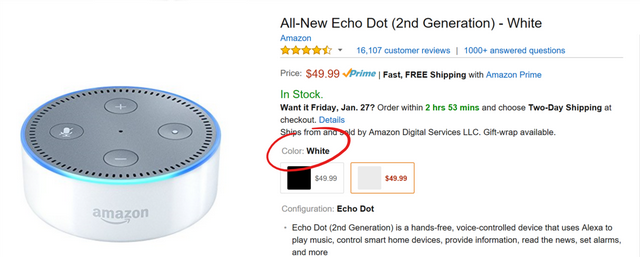
Echo Dot is still in short supply here in Germany. Who is travelling from the US and can sell me one?

Solved in ten minutes flat. Thank you, John.

26 Jan 21:25

Drone Deploy Conquers the Data Layer

by Thom Crowe
Drone Deploy Conquers the Data Layer

Compose has quite a few unique customers. One of the more unique that we've visited with is DroneDeploy, a company that automates drone flight and lets users explore map data from within an app.

Nick Pilkington, DroneDeploy's CTO, tells us that they are, "taking the existing drone hardware and combining it with a very powerful piece of software to make that drone into a useful tool... something that's repeatable, something that's reliable, something that's safe, and something that provides a huge amount of value."

Pretty cool, huh? So, we visited with Nick to talk about their mapping, app and how they're using Compose.

Check out the video to see how Drone Deploy conquered their data layer.


If you have any feedback about this or any other Compose article, drop the Compose Articles team a line at articles@compose.com. We're happy to hear from you.

26 Jan 21:25

HP isn’t actually sorry that it has enslaved your printer and rejected your ink

by Josh Bernoff

HP would prefer that you didn’t use third-party or refilled ink cartridges, so it has updated its printers’ firmware to reject “counterfeit” ink. When this upset printer owners, it apologized in the most weaselly, self-justifying way possible. Its statement shows how companies can either apologize, or defend themselves, but shouldn’t do both at once. In March … Continued

The post HP isn’t actually sorry that it has enslaved your printer and rejected your ink appeared first on without bullshit.

26 Jan 21:25

Pogue's Basics: Money - Know when to buy what every year

Prices fluctuate all the time. Supply, demand, the price of raw materials, the price of gas, location, the economy—all of it affects product pricing.

You can’t do much about any of that.

What you can do, though, is control when you shop. In certain industries, the prices for products always drop at certain times of year, like clockwork.

Actually, what’s a little nonsensical is that there are usually two times for big price dips. First, there’s the time when demand is highest (sales on toys before Christmas, TVs before the SuperBowl). Second, there’s the time when demand is lowest (sales on candy after Halloween, bathing suits after swimming season).

Here’s your master cheat sheet:

  • Bathing suits. What store wants shelves full of swimwear that’s no longer selling? Prices are lowest for the year in August, as the swimming season ends.
  • Bikes. New models roll out in September and October each year. That, therefore, is a great time to find sales on last year’s bikes.
  • Cameras. New models usually debut in February, so you can count on big discounts on last year’s models on Presidents’ Day weekend.
  • Camping gear. Giant price cuts arrive in August; the summer’s over, and so is demand for this stuff. Look for another rash of sales in October, too.
  • Candy. Right after Halloween, every store and its brother slashes prices to unload all the unsold candy.
  • Car parts and service. April is National Car Care Month, so you may spot special sales this time of year.
  • Cars. Many car companies roll out next year’s car models in the fall, so you can get fantastic deals on the current year’s cars around September.
  • Chocolate. The fancy stuff goes on deep discount right after Valentine’s day (shocker).
  • Clothing. In general, clothing for each season goes on sale a couple of months before the next season begins. In February, for example, they put winter clothing on sale for 50 to 70 percent off, to make room for the incoming warm-weather stuff. Similarly, spring clothing goes on sale in May, to make room for summer wardrobes; summer clothes’ prices drop in August; and, of course, discounts on fall clothing emerge around November.
  • Computers go on sale in September, once the back-to-school rush is over. There are more big discounts in November, on Black Friday and Cyber Monday.
  • Cookware. As graduation/wedding season approaches, you can find good deals on kitchen stuff in April and May (especially Memorial Day weekend).
  • Cruises. Sales for sailings usually arrive in January and February, when people are booking their spring-break and summer cruises. In late October, there’s another round of sales—both for people planning holiday cruises, and for the cruise lines to unload cruise cabins that aren’t selling well.
  • Electronics. In late November, Black Friday and Cyber Monday have taken on mythic proportions in the gadget world. Every gadget category goes on sale: TVs, laptops, phones, tablets, cameras, and so on. Every store and online retailer fights for headlines, and the winner is you.
  • Fitness equipment. January, after the holidays and while New Years’ resolutions are still in force. Huge deals, from 30 to 70 percent off.
  • Furniture. New models arrive every February and August, so the best deals (on outgoing models) are available in January and July. Also look for big sales in November, on Black Friday and Cyber Monday. Office furniture often goes on sale in May and October.
  • Grills. The big rush to buy these is, of course, before July 4—so the prices drop right afterward. Prices crash again in October, as the weather gets cold.
  • Gym memberships. The best deals, logically enough, sprout in June; that’s when demand is lowest, as people head outdoors for physical activity.
  • Holiday decorations. As you’d guess: Prices crash right after each holiday. Buy Halloween decorations right after Halloween, Christmas decorations right after Christmas, and so on.
  • Home improvement. Home Depot has its own special Spring Black Friday sale every April.
  • Jewelry. Scout for deals in July, when there are no gift-giving holidays for miles to boost stores’ sales.
  • Laptops. Shop in June, and then again during the back-to-school frenzy in August.
  • Lawn mowers. They go on sale in August and September, when nobody needs them anymore because winter is coming.
  • Linens. Look for the “white sales” in January.
  • Luggage. New styles appear around March, in readiness for the summer travel season—so you can snap up great deals on last year’s suitcases. In August, another round of price cuts settles in, since people are pretty much finished with their summer travels.
  • Mattresses. The entire industry blows out last year’s models over Memorial Day, so watch for crazy sales in May. More sales around July 4 and Labor Day weekends.
  • Office furniture.
  • School supplies. August, of course. Back to school!
  • Ski stuff. The big sales are usually in March, since nobody’s buying gear for this winter anymore.
  • Sneakers. You can find delicious deals as high as 50 percent off in April, as shoe stores try to shoe you up and shoo you outdoors.
  • Tools. Shop in July, since Father’s Day is now over.
  • Toys. Are you kidding? Right after the holidays. January. Everything’s marked down. (Then again, you may also find some big sales before the holidays, too, especially on Black Friday and Cyber Monday.)
  • TV sets. February, to make room for the new models and to accommodate SuperBowl frenzy.
  • Wedding dresses. Nobody’s buying wedding stuff in November and December, so that’s when the bridal shops mark down their wares to make room for the new year’s designs.
26 Jan 21:25

The New IT

by russell davies

machines

It's easy to complain about the Old IT. Really easy. But I started to wonder what The New IT would look like. (You know, like).

I don't know, obviously, but recent experience would suggest one version would be this:

Come into a business. Probably smaller businesses, but not exclusively. Have a look at what mix of PCs/Macs/Androids/iPhones they have, at what things they have to get done and what corporate or client systems they have to connect to and then recommend what they should download from various app stores. Don't install anything. Don't build anything. Don't sell anything, just advice.

For instance: which expenses app should we use? which timesheet app? Do they work well for the user? Are they accessible? Do they produce the right kind of reports for the corporate approver? Is the company behind the app likely to still be around in a year? Is it easy to get all the data out? Where does the data sit? Will the FBI be allowed to see it? What's the cost? How much time will it save? That kind of stuff.

Does that exist?

I, for instance, have been experimenting with Toggl and Expensify. Both seem good, but it would be good to hear from someone who'd seem them used in a bunch of other businesses like ours.


26 Jan 21:25

What I did (Jan. 24 & 25 '17)

by Anselm Eickhoff

Not much changed, I'm still working on rewriting the planning implementation

  • Yesterday I was quite distracted (with other Citybound topics, but still distracted)
  • Today was productive, but it's taking slightly longer than expected
  • the planning code grew unwieldy because of all the operations and cases it already needs to support (still not enough though), and I was kinda badly surprised how difficult it is to refactor it, but my work-in-progress new version is already slimmer and at the same time more extensible
  • I really need to get rid of this overly bad feeling of not having achieved enough today/within the expected timeframe/this week...
  • As long as I give my best effort and work reasonable hours each weekday, I should be content!
  • I should not feel bad about not having much to report
  • In this way, Citybound being "like a job" where I "senselessly grind away" at something for a limited time each day can feel really liberating

26 Jan 21:23

"Progressives have been so focused on Washington, they’ve missed the fact that most of the progress..."

“Progressives have been so focused on Washington, they’ve missed the fact that most of the progress on the issues they care about — environment, education, economic opportunity and work-force skills — has happened at the local level. Because that is where trust lives.”

- Eric Beinhocker, promoting ‘new progressive localism’, cited in Smart Approaches, Not Strong-Arm Tactics, to Jobs
26 Jan 21:23

"Everybody is entitled to their own opinions, but not their own facts."

“Everybody is entitled to their own opinions, but not their own facts.”

-

Daniel Patrick Moynihan

What is old is new again, in a post-fact world. Moynihan reportedly said this in 1994 on WNBC in New York.

26 Jan 21:22

Building a Chatbot: analysis & limitations of modern platforms

files/images/api.ai-interface.png


Javier Couto, Tyro Labs, Jan 28, 2017


Good article exploring the strengths and weaknesses of various chatbot platforms. "The chatbot ecosystem is moving very fast and new features are being released every day by the numerous existing platforms." There are non-technical platforms aimed at average users: Chatfuel, ManyChat, Octane Ai, Massively and Motion.ai. These, though, do not have natural language processing ability and are not suitable for commercial applications.  The five major solutions are all from major companies (not surprisingly). They "represent already a standard or at least they are on (their) way to become one: Api.ai (Google), Wit.ai (Facebook), LUIS (Microsoft), Watson (IBM), Lex (Amazon).

[Link] [Comment]
26 Jan 21:19

Public Art — Salmon Mural

by Ken Ohrn

At Lakewood and Hastings.  A lovely piece that somehow manages to successfully combine a series of images.

A nearby stencil leads to the artists:  NomadicAlterNatives.org.  They’re quite prolific, working across illustrations, murals, video, animation, graphic novels, concept art and logos.


26 Jan 21:19

Beware — Elephant Entering Room

by Ken Ohrn

Campaign financing continues to rise as a topic of concern in our alternately sleepy and wild-west lives.  With a Provincial election due on May 9, 2017, and municipal elections October 20, 2018, it seems this topic has increasing currency.

As Elections BC puts it:   “Electoral finance laws improve the democratic process by creating a more level playing field for candidates and political parties and providing transparency. They also prevent money from unfairly influencing election outcomes and from swaying public policy decisions.”

It’s hard to argue with these ideas.  Hard to understand their limited application in BC.

elephant-entering

Hey — want some money?

And this elephant just doesn’t want to vanish, no matter the wishes of those who benefit from wealthy donors.  People understand that there is no free lunch, and that so much of this money has strings attached to it.

With results much to the chagrin of such faux-populist organizations as the Canadian Taxpayers Federation, a neolibertarian advocacy organization, check this April 2016 poll by Insights West .  [HERE]

Poll Summary

  • Two thirds of British Columbians (68%) think citizens are not influential in shaping policy in our province. The most influential group is Corporations (90%)
  • Only 10% of British Columbians agree with allowing corporations and unions to spend as much money as they want to help politicians win elections.
  • At least two thirds of British Columbians support implementing specific regulations to take big money out of politics.

And take a look at the recent Independent Election Task Force, which recommended that local councils adopt a policy of mandated scrutiny of ties between council matters, councilors and donors.

Next, the infamous New York Times piece by Dan Levin that described the Province of BC as a wild west in matters of money in politics.

Unlike many other provinces in Canada, British Columbia has no limits on political donations. Wealthy individuals, corporations, unions and even foreigners are allowed to donate large amounts to political parties there. Critics of the premier and her party, the conservative British Columbia Liberal Party, say the provincial government has been transformed into a lucrative business, dominated by special interests that trade donations for political favors, undermining Canada’s reputation for functional, consensus-driven democracy.

Don’t forget the large country to our south, where one view of it’s governance is articulated in Jane Mayer’s book “Dark Money“. Even though the book is pre-Trump, it does seem that he is lining up nicely with the dark money agenda, as much as anyone can glimpse the future through the obfuscation and distractions of that circus.

From the New York Times book review:  Mayer believes that the Koch brothers and a small number of allied plutocrats have essentially hijacked American democracy, using their money not just to compete with their political adversaries, but to drown them out.

Let’s not think Canada is immune from such “Dark Money” tactics as think-tank and interest group financing, along with the legions of paid shills and stooges that spread the messages of their corporate masters.  Note the Canadian Taxpayers Federation (all money sources secret) writing on the topic of campaign financing, where their logic somehow leads to the conclusion that less government is the answer.” [Quoted by Integrity BC; original material no longer on CTF web site]:

“Contribution limits are an affront to two of the most basic freedoms in our society: freedom of speech and freedom of association. If we believe that voters should be informed, we ought to encourage, not restrict, campaign spending.” “Less spending on campaigns are unlikely to increase public trust, involvement, or attention. Implicit or explicit spending limits reduce public knowledge during campaigns. Simply put: getting more money into campaigns benefits voters.” “The right to speak necessarily includes the right to pay for the speech. Spending money is protected not because “money is speech” but because government limits on spending for speech restrict speech itself.” ” If government’s ability to regulate and redistribute is restrained, big money, from either business or unions, has no reason to flow to candidate coffers. The solution to this problem is less government, not less spending.”
http://www.taxpayer.com/sites/default/files/Election_submission_March2010.pdf

When you finally learn to see the elephant, it’s hard to un-see it.


26 Jan 21:19

Buenos Aires 11- Wealth and its Loss

by pricetags

Bring it all together from a century ago – the migration, the wealth, the European influences and architectural aspirations (everyone had Paris envy), the public art, even the road widenings – and this is what you get:

wealth

There’s a big lesson here too, which came home to me quite powerfully as I was reading a history of Argentina while listening to the latest Trumpian news out of the States.  How could such a rich country as Argentina, as evident in the built legacy of Buenos Aires, decline so far, so fast?

I’m not the only one to have asked.

The economic history of Argentina is one of the most studied, owing to the “Argentine paradox“, its unique condition as a country that had achieved advanced development in the early 20th century but experienced a reversal, which inspired an enormous wealth of literature and diverse analysis on the causes of this decline.

Argentina possesses definite comparative advantages in agriculture, as the country is endowed with a vast amount of highly fertile land.[2] Between 1860 and 1930, exploitation of the rich land of the pampas strongly pushed economic growth …

Beginning in the 1930s, however, the Argentine economy deteriorated notably. The single most important factor in this decline has been political instability since 1930, when a military junta took power, ending seven decades of civilian constitutional government.

In macroeconomic terms, Argentina was one of the most stable and conservative countries until the Great Depression, after which it turned into one of the most unstable. Successive governments from the 1930s to the 1970s pursued a strategy of import substitution to achieve industrial self-sufficiency…

America First, America First.


26 Jan 21:19

Message Received — Loud and Clear

by Ken Ohrn

A recent PSA by Alberta Transportation delivers a loud and clear message.

Motorists — here are a bunch of sure-fire excuses to keep in mind when you mow down a pedestrian in a crosswalk. Yep — keep on grinning. Thumbs up, baby, you’re golden.

Peds — it’s always your fault.  And you’re not safe anywhere.

ped-safety

After much outrage, Alberta Transportation pulled the message.  But it’s hard to understand how peds are singled out like this, when the facts of the matter are quite clear as to what the source of the danger is.

According to the City of Vancouver’s 2012 Pedestrian Safety Study:

The vast majority of collisions at intersections involved drivers failing to yield to pedestrians when pedestrians had the right-of-way. ƒ

One quarter of all pedestrian collisions took place at mid-block locations, where the pedestrian was either crossing the street at a mid-block crosswalk or a location without a traffic control, crossing a driveway or laneway, or was struck at the sidewalk or at a bus stop. ƒ

The top five pedestrian collision types listed below accounted for approximately two-thirds of all pedestrian collisions:

  1. Vehicle turns left while pedestrian crosses with right-of-way at signalized intersection (25.6% of known collision types)
  2. Vehicle turns right while pedestrian crosses with right-of-way at signalized intersection (17.1%)
  3. Pedestrian hit while crossing mid-block without a traffic control, or jaywalking (11.5%)
  4. Vehicle proceeds straight through while pedestrian crosses at stop sign or crosswalk (6.9%)
  5. Pedestrian hit while crossing driveway or laneway (6.5%).

26 Jan 21:03

Don’t Cry for Me …

by pricetags

Let’s bring forward a comment by Geof from the post two below, to give PT readers a chance to vent on the issue of the day – Trump and his consequences – in a post of its own: 

I don’t think I’m saying anything new here, but it needs to be said again. In my view, the bigger problem isn’t the next four years: it’s what happens after that. Those of us who despise the man need to keep our eyes on the prize.

Trump didn’t win: the Democrats lost, convincingly, and not just at the presidential level. Though Trump certainly didn’t deserve to win, the Democrats did deserve to lose. The people voted for change in 2008. They didn’t get it, so they voted for change again in 2016. Throughout 2016, my response to friends who dismissed Trump was consistent: “I think he has a good chance.”

The rise of a xenophobic populist in response was entirely predictable. If not Trump, someone else would have appeared soon enough. I see him as like a wild animal: danger to be avoided, not some prodigy with the force of will to change history. He’s a buffoon. The real fault lies elsewhere. Yes, with ignorance and hatred, rampant in a country that has shredded its social institutions. More importantly with the people in charge when this was allowed to happen.

The Democrats need to develop a genuine popular alternative. They resoundingly rejected any such thing during the campaign. Since then, they have only doubled down on their mistakes. Embedded in a toxic neoliberal ideological brew of rationality and meritocracy from which they have benefited handsomely, their self-satisfied sermon to those who have been left behind boils down to “be more like us.” They believe the fault lies with anyone but themselves. Losing, they see the problem as too much democracy, not to little. They are unable to hide their desire to put Brecht into practice by dismissing the people and electing a new one.

Of course the Democrats and Republicans have long conspired to exclude any third parties, so the Democrats, with all their faults, are all there is. If they can’t offer change in four years, if they can’t learn to listen, if they can’t develop some humility, then I believe that we well see another Trump inauguration. At this rate, we may even see a constitutional convention of the states. The next four years will not be pretty. I’m far more concerned with what follows.


My own observation: I still do not know what people, Americans in particular, mean by “change”.  I don’t think it is about the constitutional structure of the country; the American Constitution is a sacred document to them, and, like ours, almost impossible to change in any event.  

If it’s only about a particular class of politicians, I don’t buy it.  The strategy of the Right has been to discredit government generally, but only so they get to run it to the dictates of their ideology and for the advantage of their supporters.  As the Republicans will find out, even their most avid supporters don’t want change that would erode the programs they depend on or are privileged by.  If anything, they want a restoration of those advantages they believe they have lost.  That’s not really ‘change’ as used by most commentators.

If it’s about ideology, I haven’t heard a coherent alternative that would address the issue underlying the last campaign, and will only become more critical as the next wave of automation impacts more of us: wealth and social inequity.  

What, then, addresses this desire for ‘change’ that remains so undefined?  What, in short, does it mean?


26 Jan 21:03

False Creek Flats Preview/Overview

by Ken Ohrn

Postmedia outlet the Vancouver Sun previews material to be shown at tonight’s open house for this planning process.

Date and time

January 25 2017, 5:00 p.m. to 8:00 p.m.

Location

281 Industrial Ave (Enter off of Southern Street)


More space for more jobs; more homes; more transportation options on a busy 450 acres near downtown Vancouver.


Thanks to Matt Robinson. The Flats, which extends east from Main Street to Clark Drive and south from Prior Street to Great Northern Way, is one of the largest industrial areas remaining in the city. It’s jammed with rail lines, populated by hundreds of businesses, and has some of the most expensive industrial land in the region — second only to that in Mount Pleasant.

The city wants to increase employment floor space in the area to 11 million square feet, from 5.4 million, and pave the way for as many as 22,000 more workers (many of them at the new St. Paul’s hospital and new Emily Carr University campus), according to information boards that staff will take to residents at an open house Wednesday at 231 Industrial Ave.


26 Jan 21:03

Buenos Aires 12 – Small Differences

by pricetags

Why we travel: to see those small differences in the way things are done.

Like being able to buy empanada and Argentinian staples in COTO, a supermarket chain with a massive two-storey branch on Av Santa Fe:

sd-1a

sd-1


Or a magazine stand (they still sell magazines, folks!) on a crowded subway platform:

sd-2


Or a tricycle-riding juggler busking for the backed-up traffic on Av Sarmiento:

sd-3

And the musicians in the Subte, their underground rapid-transit – oh, they’re good. High culture lives below ground in BA.


26 Jan 20:55

Gamevice (sort of) turns your iPhone into a Nintendo Switch

by Patrick O'Rourke

Physical game controllers and mobile devices have alway been an interesting mix that’s never quite worked as most likely imagine.

Few are built well and even less, especially those that attach to the actual device, feel solid enough to be worth using. This is an issue Nintendo Switch-like iOS controller Gamevice aims to solve.

While I’ve tried many Bluetooth controllers designed for mobile devices in the past, Gamevice is the only Lightning-connected game controller that’s approved by Apple, removing the hassle and latency wireless Bluetooth gamepads sometimes create.

The latest version of Gamevice, which is compatible with the iPhone 7 and 7 Plus, supports 900 plus mobile games located in the controller’s Gamevice Live app. It even adds a headphone jack to the iPhone 7 and 7 Plus.

The company behind the gamepad ays that the controller features improved thumbsticks, a lighter build and full support for every iPhone since the 6 and 6 Plus. There are also models that work with the iPad Mini, iPad Air and iPad Pro, including the 12.9-inch model.

Gamvice’s latest iteration is set to hit store shelves on January 31st for $99 USD (approximately $130 CAD). We’re in the process of getting our hands on a Gamevice and will have more on the controller in the coming weeks.

26 Jan 20:55

Second-generation Pixel will reportedly be waterproof

by Rose Behar

In what could be considered the first leak regarding the second-generation Pixel, 9to5Google Senior Editor Stephen Hall has revealed that Google is planning to make its next-self-branded device waterproof.

9to5Google was reportedly told in October that “waterproofing [is] definitely coming with next Pixel device.” According to the senior editor, the exclusion of waterproofing was both a time constraint and “internal conflict between hardware (namely the camera) and/or waterproofing vs. price point.”

Considering the fact that the Pixel was produced under a considerable time crunch (likely under a year) and still managed to receive glowing reviews, the addition of features like a good water and dust resistance rating could lead to a blockbuster handset for the Mountain View-based tech giant.

Source: Twitter

26 Jan 20:55

Rogers says RCS is the ‘future of messaging,’ will come pre-installed on Android devices from 2018

by Rose Behar

Rogers is calling the new Rich Communication Services (RCS) protocol the “future of messaging” and has detailed future plans for the platform in an interview with the GSM Association (GSMA), a global trade body for mobile operators.

RCS messaging, also known as Advanced Messaging services, brings enhancements to the Android text messaging experience with features such as real-time typing indicators, group chat, hi-res photo sharing and read receipts. Rogers’ service was launched in partnership with Google and requires users to download Google’s Messenger app from Google Play.

“Android customers have been looking for a similar service to Apple’s iMessage, which didn’t exist until now,” states Leroy Williams, vice-president of marketing at Rogers in the interview. “We’re excited to be the first carrier in Canada to offer Rich Messaging on Rogers and Fido devices – we know our customers will enjoy the additional capabilities it offers them.”

“Android customers have been looking for a similar service to Apple’s iMessage, which didn’t exist until now.” 

The carrier was the first in Canada to launch an Advanced Messaging service based on GSMA’s Universal Profile industry standard and the second worldwide after Sprint. GSMA’s article confirms that both carriers will pre-install the app on new Android devices as its default messaging app from next year. Williams also mentions the prospect of developing multi-platform functionality for RCS, which would further clone the iMessage experience.

“Alignment with the GSMA Universal Profile is key to adding enhancements in the future such as, voice recognition and using RCS on other Android devices that are linked to your phone (i.e. tablets and wearables),” says Williams. “Imagine your phone is charging on the nightstand and you are in another part of your home on your tablet, now you have the added benefit of sending and receiving messages from multiple Android devices.”

For now, Fido, Rogers and Sprint customers can only use RCS messaging with each other, but the platform is set to expand rapidly with Bell and Telus signing on as supporters of Universal Profile along with several major U.S. carriers.

Source: GSMA

26 Jan 20:54

New Museum Launches Free Downloadable VR App

by Irina Makarova for The Creators Project

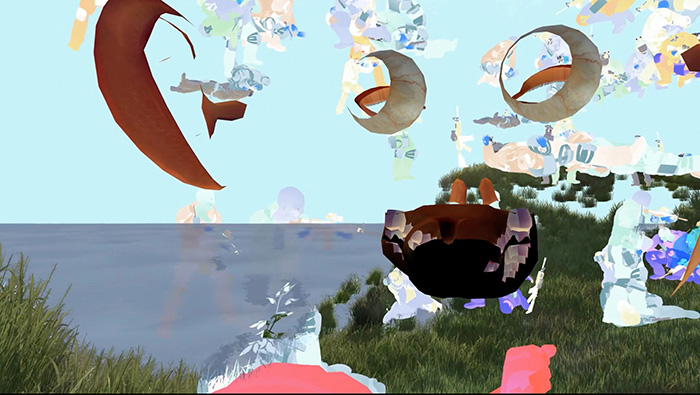
Rachel Rossin, Man Mask, 2016, Courtesy of the New Museum, New York

The New Museum and Rhizome launched a virtual reality exhibition that is available to the public as a free downloadable VR app. First Look: Artists’ VR features the works of six commissioned artists, most of whom are leading voices in the VR field: Jeremy CouillardJacolby SatterwhiteJayson MussonRachel RossinPeter Burr and Porpentine, and Jon Rafman. Developed by the startup platform EEVO, the app is available to download on Google Play and will be available for iOS phones shortly.

The New Museum has been successfully pioneering VR programs since 2003 when Rhizome—a leading platform in digital art—became their affiliate in residence. In 2012 they launched First Look, a digital commissions and exhibition program and since 2014 the museum has led NEW INC, a residency program for VR, tech artists, and startups.

There has been an increased shift toward virtual reality in how we view commercial art, from Alfredo Salazar-Caro and William Robertson’s DiMODA (Digital Museum of Digital Art)—a digital exhibition platform for VR artists, to James Orlando’s Hyper.Zonean interactive VR videogame platform where you navigate through multiple levels filled with contemporary artwork, to Kyle Marler's Flatsitter project, a site-specific performance VR experience.

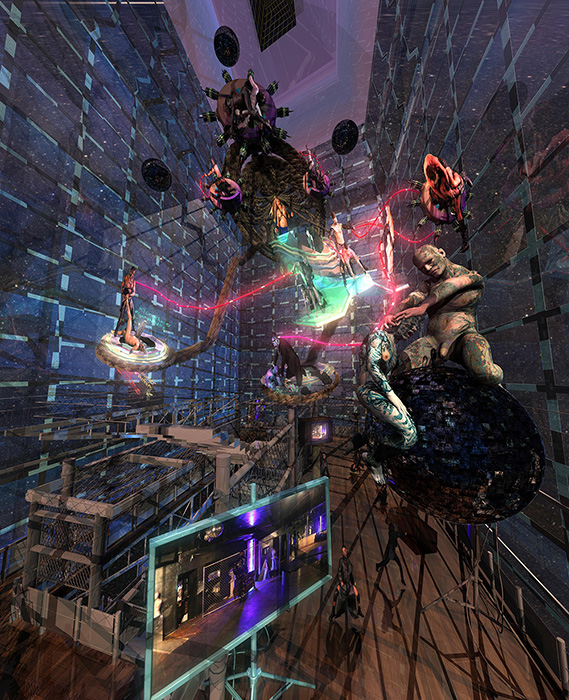
Jacolby Satterwhite, Domestika, 2017, Courtesy of the New Museum, New York

Jayson Musson’s An Elegy for Ancestors is a celestial memorial commemorating the victims of police brutality. The piece is a poignant conversation that elevates individuals past statistics. In Jon Rafman’s Transdimensional Serpent, you travel through multiple alternate worlds while sitting on a giant, milky white snake eating its own tail. Faceless people and fantastical horned creatures walk around you as a voice whispers the lyrics to Metallica’s “Nothing Else Matters.”

In Man Mask, Rachel Rossin transports you to a tropical Call of Duty-themed landscape, where familiar images of violence are uprooted and displaced. Peter Burr’s Arcology plunges you in a black-and-white graphic labyrinth that is a completely surreal mindscape. Jacolby Satterwhite’s Domestika is a psychedelic industrial party/rave filled with winged ungulates, enormous floating constructions, all floating in a boundless star-filled space. Jeremy Couillard navigates you through the afterlife in rebirth_redirect: you experience watching yourself leave your body and traverse an unfamiliar cosmology.

Jeremy Couillard, rebirth_redirect, 2017, Courtesy of the New Museum, New York

The pieces in the exhibition, collectively and individually, are thought-provoking social commentaries that read like a series of dreams and phantasmagorias. The real challenge is getting past the “whoa” factor of removing something off the white wall and viewing it in a virtual 3D space.

The increase in VR artwork displayed in non-traditional spaces has continued sparking the debate of what’s the ideal and preferred form of viewership. The removal of the long lines, the entry costs, and time factor makes the app format seem like an accessible, free, and convenient way to view digital artwork whenever and wherever. Just whip out your Google Cardboard and get immersed.

Despite the accessibility and excitement on the user front, the VR art viewing experience is still in the beta stages on the development end. “I would say that there is a real swell of interest in VR right now as it becomes more attainable. That said, it’s costly and challenging to negotiate distribution and exhibition. It remains to be seen how truly accessible a medium it will be,” Lauren Cornell, a New Museum curator, tells The Creators Project.

Learn more about First Look: Artists’ VR on the New Museum’s website

Related:

This Guy Just Spent 48 Hours in Virtual Reality

5 Experimental Video Artists to Keep an Eye On in 2016

The First Virtual Reality Ballet Springs to Life in Amsterdam

I Experienced "Virtually Real" 3D-Printed Art, Made in Virtual Reality

26 Jan 20:54

Succulents Make a Stunning Statement Inside Vintage Typewriters

by Beckett Mufson for The Creators Project
Images courtesy the artist

Shrubs mesh with artful machines in an ongoing series of hybrid upcycled typewriters by Turkish artist Aysenaz Karayalcin. Working under the name Afterawhile, the artist collects typewriters in all different languages, often from defunct brands like Smith Corona, Mercedes, and Hermes. Then she applies her degree in plastic arts from Istanbul's Yeditepe University Fine Art Academy to collage cacti and other fleshy flora with the reclaimed monkeyboxes.

"I combine the typewriters, which have lost validity and usefulness, with cactuses, which I believe to represent the resiliency in women who, by their nature, are able to survive under very difficult and impossible conditions," Karayalcin tells The Creators Project. Lately she's moved her ideas into surrealist territory with a series called CACTUS WOMEN that fuses succulents with female mannquins

CACTUS WOMEN

Typewriters are similarly durable, and the self-described succulent junkie finds their continued use in the face of obsolesence romantic. "Typewriters are old fashioned tools for writing. However, all the love letters written by these typewriters have not been forgotten and will live forever."

Symbolism aside, Karayalcin is dedicated to the aesthetic appeal of organisms making a home inside human-made metal mechanisms. "If we are able to see, the nature presents us perfection and beauty. I humbly try to thank nature for its inspiration by reflecting this in my work." The vibrant greens mix with fading reds, blacks, and beiges to make a unique palette to which Karayalcin has devoted her practice in the seaside city of Urla. Check out Karayalcin's work below. 

Follow Aysenaz Karayalcin on Instagram

Related:

Artist Creates Vintage "Digital" Art on a Typewriter

New Anthology Explores Modern Artwork Made On Typewriters

Japanese Artist Transforms Old Newspapers Into Expressive Creatures

26 Jan 20:54

Enjoy the Silence in Kelsey Beckett's Intimate Illustrated Portraits

by Nathaniel Ainley for The Creators Project

The Collector. Images courtesy of Kelsey Beckett and the Corey Helford Gallery

The serene and wistful portraits in Detroit-based artist Kelsey Beckett’s Murmuration exhibition explore the emotional intricacies that characterize moments of solitude and intimacy. Each one of her female subjects is placed in a unique space with their own respective narrative. The girls are situated in front of particular natural landscapes loaded with tree branches, bodies of water, and birds. These articles of the natural world serve as interpretive indicators or symbolic representations of what is going on in the minds of each character. Beckett uses the ornamentation in her landscapes to speak about her subjects’ inner worlds “as they twist like gnarled branches, softly desaturate with melancholy, or bloom with vanity and education,” writes the Corey Helford Gallery.

Kiss Of Death

In addition to obvious physical attributes like height, skin, and hair color, Beckett’s girls are distinguished by their subtle facial expressions and general awareness of the viewer. Each composition is frozen in action, “paused so that the viewer might see themselves eerily reflecting back to a similar memory,” according to the gallery. The feeling and condition of one painting may resonate strongly with some and fall flat with others. Interpretation is intentionally left up to the viewer with hope that they find catharsis or camaraderie in seeing another isolated body. "A lot of the inspiration for this collection came from watching individuals wage their own private, internal battles,” Beckett tells The Creators Project. “It's impossible to know exactly what someone else is feeling, but I've tried to capture at least a hint of it in this work.”

Another September Alone

Clementine

Murmuration is on view on at the Corey Helford Gallery in Los Angeles from January 21st to February 18th. To learn more about the exhibition, click here. Check out more work by Kelsey Beckett on her website.

Related:

Haunting Acrylic and Pigment Paintings Depict a Lonely World of Dreams

Demonic Geishas Wrestle Ghoulish Reptiles in These Anime-Inspired Murals

An Artist Is Churning Out Steve Buscemi Portraits for Election Day