Shared posts

12 Feb 04:08

This Carhartt Vest Is Necessary

by Christina Wood

download (1)

I hike somewhere in the hills in the Bay Area every day. I only go for an hour or two so I don’t need a backpack. I just put on hiking boots and go. I do want my phone, a wallet, car keys, sunglasses, and sometimes a bottle of water. But I’m a girl. So athletic clothing makers think I will have a purse with me at all times. This makes me angry. Who carries a purse on a hike? So I am on a mission here at GeekGirlfriends to expose clothing that gives women pockets. Big pockets, like guys get. The kind that can carry all your essentials. The kind that make a purse unnecessary.

I am pleased to introduce the amazing Carhartt Sherpa-Lined Mock-Neck Vest ($35 – $90). From the moment I put it on, I have worn it nearly every day. My purse has been hanging, neglected, from a hanger in my closet. I only get that girly accessory out for date night. I can honestly say this vest has changed my life. But it has truly transformed my hikes.

Recently, I took a long, hilly hike. It had been mushy and wet for days but the sun broke through, I had some time, and I wanted to explore somewhere new. I planned to be out for a couple of hours. I wore this vest and it was perfect.

This vest has two interior pockets. One fits my Moto Z (a big smart phone) and wallet. The other fits a 13.5 ounce Fred Water, perfectly. The side pockets held car keys, sunglasses, and a snack. I wanted for nothing. It was glorious.

IMG_20170127_153700501


This women’s vest gets what I’m talking about. And Carhartt also makes a version for men.

Extra bonus? They are currently on sale. You’re welcome.

Featherweight Vest for Women

12 Feb 04:08

A Promise Kept... European Vacation with 2 kids

by Alison Mazurek
Christain Chaize's Praia Piquina from 20 x 200

Christain Chaize's Praia Piquina from 20 x 200

We've booked a European vacation for just over 2 weeks in May. I am thrilled and nervous!! We are flying in and out of London but spending all of our time in Portugal.  We have only confirmed our flights so far but we are mapping out an itinerary that looks something like, 5 days in Lisbon and 4-5 days at two different spots along the coast.  

While we have travelled quite a bit with Theo in North America, we haven't taken any big trips with 2 kiddos in tow.  I would still consider us new to this parenting gig, but we have learned enough to know that with each stage, some things get easier and some things get harder. By the time we leave Theo will be over 3.5 years old and Mae 10 months old. I hope Mae will still be able to be carried and not walking, but I know these sort of things are out of our hands. We aren't naive about the challenges of travelling with kids so young but it will also be wonderful to see a new place through their fresh eyes. One of the reasons we live small and have simplified our possessions is so that we can have big adventures together as a family. 

I have been using great posts from The New Domestic and from Frolic Blog as my main guides so far.  If you have any other resources please send them my way! As we pack and plan I'll be sure to share our choices and lessons learned.  Beyond booking accommodations with kitchens, I am starting to think about how to pack as little as possible for 4 humans. I am also working on logistics like renting car seats, strollers and cribs.  Needless to say the research and anticipation is half the fun!

12 Feb 03:47

Oppose him

by Chris Corrigan

Over the past week I have witnessed many of my American friends wrestling with the demand for loyalty to the president of the United States. I recall this sentiment being very alive in the weeks after 9/11 as well; no matter how you feel about his politics, it is your patriotic duty to support the president.

This sentiment was absent during the Obama years for the most part, with the exception of Democrats trying to hold Republicans to account. But partisanship is free from consistency.  What is good for the goose is not at all what is to be expected for the gander.

Trump is in the midst of signing executive orders, creating legislation and designing policy that violates ethics and crosses the boundaries of diplomacy, public interest and human decency.  It has barely been a week but to continue to “give him a chance” seems to invite a oneself into a slew of sins of omission.

I have often wondered about what happened to the formal capacity for dissent within American government. I recall listening to a joint press conference between Tony Blair and George Bush in which the President was shocked by the cavalier questions the British press were asking him. They were confrontational and oppositional. In contrast the American media were being their 2002-era sycophantic selves, giving him a pass, throwing up softballs, not questioning the lies that were being spread to support the wars that were about to be unleashed.

I remember at the time being struck by the fact that in the Parliamentary system in both Canada and the UK dissent and opposition is built into governance. The Official Opposition – Her Majesty’s Loyal Opposition – is deputized by the head of state to actively oppose the work of the government. We may feel that it is largely ineffective most of the time, but it does have the effect of both holding the government to account and creating a culture in which dissent is considered a loyal duty of a citizen. I have cannot ever recall being told that I had to unwaveringly support a prime minister. Nor has it ever made sense to me to ask others to do so.

For a country born in revolution, it surprises me sometimes that dissent isn’t built in to American governance in quite the same way, although many revolutionary movements devolve into dictatorships. In Congress you are simply that House or Senate Minority Leader, which is an emasculating and disempowering job title.  In Parliament you are the Leader of Her Majesty’s Loyal Opposition.  There’s a job  description for you. You are loyal to the state, and the people, and not at all subject to demands of loyalty to the government.

The American system of government does not structurally support dissent, and American culture in the midst of right wing governments tends to demand loyalty. The United States is heading down a path of fascist authoritarianism. Government is about to be gutted. The wealthy and the heavily capitalized corporation will soon have a regulatory free environment for their operations. Social institutions such as education systems are to be gutted and privatized. Muslims are in the process of being treated differently. Women specifically are being restricted in their health choices. All of this in a week or so

Donald Trump must not be given a chance. Oppose him. With all your might.

(I am back posting on my blog more than on facebook, especially for these longer posts. These posts will be republished on facebook and twitter, but I invite the conversation to happen here.)

12 Feb 03:47

Curiosity on the Chessboard

by Eugene Wallingford

I found a great story from Lubomir Kavalek in his recent column, Chess Champions and Their Queens. Many years ago, Kavalek was talking with Berry Withuis, a Dutch journalist, about Rashid Nezhmedtinov, who had played two brilliant queen sacrifices in the span of five years. The conversation reminded Withuis of a question he once asked of grandmaster David Bronstein:

"Is the Queen stronger than two light pieces?"

(The bishop and knight are minor, or "light", pieces.)

The former challenger for the world title took the question seriously. "I don't know," he said. "But I will tell you later."

That evening Bronstein played a simultaneous exhibition in Amsterdam and whenever he could, he sacrificed his Queen for two minor pieces. "Now I know," he told Withuis afterwards. "The Queen is stronger."

How is that for an empirical mind? Most chessplayers would have immediately answered "yes" to Withuis's question. But Bronstein -- one of the greatest players never to be world champion and author of perhaps the best book of tournament analysis in history -- didn't know for sure. So he ran an experiment!

We should all be so curious. And humble.

I wondered for a while if Bronstein could have improved his experiment by channeling Kent Beck's Three Bears pattern. (I'm a big fan of this learning technique and mention it occasionally here, most recently last summer.) This would require him to play many games from the other side of the sacrifice as well, with a queen against his opponents' two minor pieces. Then I realized that he would have a hard time convincing any of his opponents to sacrifice their queens so readily! This may be the sort of experiment that you can only conduct from one side, though in the era of chess computers we could perhaps find, or configure, willing collaborators.

12 Feb 03:47

Finding the most relevant information in a paper when reading: A three-step method

by Raul Pacheco-Vega

It occurred to me as I was writing my blog posts on reading strategies that some people may wonder how to find the most relevant information when reading. I had tweeted about it, but I hadn’t actually written about it. So, I thought I’d write about how I work to find the most relevant information when I’m reading a paper. This applies to articles, book chapters, reports and books. I use a three-step process (and I focus on 3 main elements of a paper)

First off, while many people will recommend reading the abstract first, I don’t necessarily agree that it should be the major source of information. I have found that many abstracts are so constrained by space (100-150 words) that they rarely relay exactly the content of the paper (which ends up being much richer than the abstract posited). I think we always should read abstracts, but be somewhat skeptic of whether they will provide us with the full description of what the paper is about. I wouldn’t write a rhetorical precis based on an abstract, for example!

I do, however, expect that the introduction to a paper will tell me, by the second or third paragraph, what the paper is about. For example, below I noted that the introductory paragraph of a paper on industrial restructuring in the beer industry in Canada tells us the context and the reason for the paper.

Note 3 explanatory elements within the paper:

  • What is the context of this research? Why are the authors doing it?
  • What explains the phenomenon they are studying?
  • The “BUT THIS IS WHY WE’RE DOING THIS” – the WHY that explains what the paper will tackle and the reasons for it.

Some authors will provide then a detailed description of what the paper is about (methodology, research methods, data description, etc.), as shown below.

Other papers will provide you with a summary of Context, Rationale, Method, and Findings within the first few paragraphs, as this paper on the nexus between voluntary and non-profit research and policy studies’ scholarship by Dr. David Carter and Dr. Chris Weible shows.

I always zoom in on the introduction because that’s where I expect that the paper authors’ will set up the entire manuscript. I look for a summary of the paper (again, looking at the context for why this research is needed, the gap in the literature, and what the contribution of the paper is).

One of the suggestions that many scholars and academic writing coaches offer is that one should read at least the following elements if one is in a rush.

  • The abstract.
  • The introduction.
  • The conclusion.

I tend to agree, which is why I suggested that this is a three elements/steps method, though in methodological papers, I tend to focus more on the actual application of the method. But I always expect that the abstract, introduction and conclusion will follow a storytelling model and that they will provide me with a broad overview of what the paper is about (this suggestion applies obviously to larger-size manuscripts, like books).

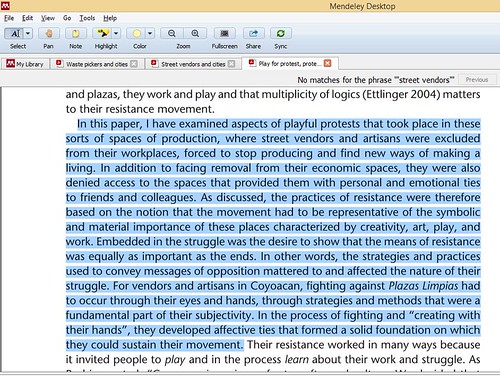
In the conclusion of a paper, I always expect to find a summary of what’s been done and how, as Dr. Veronica Crossa does in this paper on varying strategies that street vendors used in Mexico City’s Coyoacan to resist removal and eviction.

reading conclusions

Note that Dr. Crossa summarizes the entire paper in the first few sentences of one of the concluding paragraphs, but provides additional context and insights further down.

I find that applying this three-step method (Abstract, Introduction and Conclusion) gives me at least the bare bones of an understanding of a paper. I absolutely do NOT recommend skipping the middle of the paper (methods, data, results, argument), but at least these three elements may provide a tool to decide on whether to do a detailed memorandum on the paper, whether to simply write a rhetorical precis, and what kind of information to look for throughout the paper for your Conceptual Synthesis Excel Worksheet.

12 Feb 03:47

DaveO takes a Seabus. In the rain. Very Vancouver. Via...

by illustratedvancouver
12 Feb 03:47

A few Tweets on the State of America Today…

by Ms. Jen
A Venn diagram of fear and greed. pic.twitter.com/3ECFeXVbPz — Lady Grey (@LadyMEGrey) January 28, 2017 Intellectual conservatives: "Have faith in the deep state." Deep state: "We are quitting after six days because the President is insane." — Charles Finch (@CharlesFinch) January 26, 2017 I'm not criticising Trump. It's alternative praise. — Kenneth Himschoot (@khimscho) January... Read more »
12 Feb 03:47

When Silence is Not an Option

by Tristan Louis

A note to readers: Politically charged content ahead. We’ll return to regularly scheduled tech coverage next week.

I am an American and I cannot stand behind my president’s action discriminating against entire groups from entering the country.

The founding document of the United States, the Declaration of Independence, starts with:

“When in the Course of human events it becomes necessary for one people to dissolve the political bands which have connected them with another and to assume among the powers of the earth, the separate and equal station to which the Laws of Nature and of Nature’s God entitle them, a decent respect to the opinions of mankind requires that they should declare the causes which impel them to the separation.

We hold these truths to be self-evident, that all men are created equal, that they are endowed by their Creator with certain unalienable Rights, that among these are Life, Liberty and the pursuit of Happiness.

In this initial declaration, our founding fathers not only started by declaring their intent to voice discontent but to register the reason for which they considered the creation of the United States as something that followed the laws of nature.

And one of the laws they put up front was the idea of a new nation where all men are created equal. History has shown these ideals to be the source of a constant national fight and national search to create a more inclusive  society, starting with granting protection from religious persecution and moving on to an expanding set of rights that allowed racial minorities, women, and the LGBT community rights they are still not afforded in many other countries.

But at times, the nation has stumbled. In the early 1800s, the Alien and Sedition Acts repressed domestic protest and gave the new country powers to deport foreigners and make it harder for new immigrants to vote. During World War II, Japanese-Americans were forcibly relocated and interned in prison camps for several years. Prior to World War II, the rights of minorities fleeing from persecution in their own Asian countries was severely restricted. Those are seen as dark stains on American history, the kind of actions that betrayed the true meaning of our country.

Yesterday, our president signed an executive order, entitled “Protecting the Nation From Foreign Terrorist Entry Into the United States,” that will sit in the annals of history alongside those dark times. Invoking the specter of 9/11, this order suspended the right to enter the country from both visitors and permanent US residents yielding from a group of countries.

Most egregious is the presentation of such discrimination as based in rational behavior. Among the justifications given is:

“In order to protect Americans, the United States must ensure that those admitted to this country do not bear hostile attitudes toward it and its founding principles. The United States cannot, and should not, admit those who do not support the Constitution, or those who would place violent ideologies over American law.”

In excluding a complete set of individuals from legal entry into the country, this administration is bearing a hostile attitude towards its founding principles: those of inclusiveness and protection for all people. While I agree with the sentiment that the US should not support those who place violent ideologies over American law, this executive order stems from a violent ideology that it places over the principles of American law. By assuming that all coming from a given set of countries are guilty until proven innocent, this order sets our precious bill of rights on fire.

This is not what the American people should think of as America.

This is not what the world should see in America.

This is not the natural law our nation was founded on.

This is not natural.

If you do not stand against this unnatural act and voice your fierce opposition to it then, sadly, you stand in support of it. I, for one, cannot be silent about this and I dare hope against hope that you won’t be either.

12 Feb 03:46

One organizing strategy against Trump

by Chris Corrigan

I have been spending my Saturday inside watching a bit of soccer and engaging with Donald Trump supporters on twitter.  You might consider that a waste of time. I loved the soccer (Tottenham survived a thrilling FA Cup scare) and I learned some stuff about Trump supporters, and I think I have one strategy that might be worth trying.

This is all predicated on a hypothesis about what Donald Trump is doing. I believe that he has every intention to continue the trend in US government (and G20 governments in general) of ensuring that a small group of ultra wealthy people and companies continue to get rich and become richer. Policies that continue to exacerbate the wealth disparity in the US will necessarily restrict the prosperity of the middle and working classes.  People are going to continue to be worse and worse off than they were before while a small group end up controlling the vast amount of the wealth.

It seems impossible that a president would get continued support for policies from the very people that are going to be hurt by them, but it isn’t surprising. Since the 1980s and especially since the Republicans launched the culture wars, crating outrageous social issues was always enough to ensure support for the base even as, on the economic front, everyone fell further behind.  Karl Rove was a master of this, putting anti-gay marriage propositions on ballots in key districts to ensure that the Republican votes would come out to vote against moral depravity and also pull the lever for Bush. With the noose tightening around middle and low income white people, Trump upped the game with his outrageous policies designed to make America look like the fantasy of large numbers of poor white people: a racially cleansed, ostensibly Christian, patriarchal, second amendment country, that gives the illusion of “us being in control again.” Trump is a master salesmen, and he sold the people their dream: a shoddy building with gold and onyx laminates for the finishing.

It is critical now that he takes these dreamers and molds them into an army to protect, because the next few years are going to be very hard on all but a handful of Americans. Without an army of believers in the cause, people will be hard pressed to participate in their own victimization. With an army of trolls, fed on lies and propaganda, and supported by seeing action in the form of illegal and outrageous executive orders, Trump will be free to reshape the economy into a capitalist end game that benefits himself first and others like him. It is always Trump first, not America first. America will finish dead last.

So if this hypothesis is true, or even partly true, what are strategies that can be done to disrupt it?

I offer this one, especially to my friends who are privileged by their skin colour, language, religion and location. If you look like the core demographic of Trump’s supporter army, you might be able to do this.

Essentially I am arguing for good old fashioned community organizing. Facts and evidence do not matter to Trump supporters, and so what is required is for people to go into these bastions of support and create indicators alongside local Republicans to measure how well it is all working out. What if you were to work in your neighbourhood or town to get a group of citizens together and begin to collectively benchmark your position.  What’s the income people have? What are their wages? How much is health care? What is their current standard of living. Trump said America is in carnage right now. So measure it together. What does carnage look like, and how will we know that it’s getting better?

Once you’ve benchmarked the state of play, continue to bring people together to have a look at what is changing. You need to have community members do their own research, see what is happening, collect the stories.  Perhaps some things will improve under Trump, but my guess is that things will get worse for everyone. And the only way to create a crack in the armour is if you are working actively on the ground with people to help them see their own situation and help them to discover together that they are getting screwed, even though a wall got built or Muslims stayed away, or ObamaCare got repealed; all things they were told would make their lives better. It won’t take long for them to see that their lives are getting worse. How they react is anyone’s guess but your goal is to have people face reality and talk about it together.

There are many many strategies and tactics that are required to resist what is happening, and this is just one. But this one is based on successful efforts from the Saul Alinskys and Paolo Frieres of the world. It can have efficacy, but it requires you to have tremendous courage, to go outside of your comfort zone, slow down, connect and disrupt the information that people are being fed about their lives with inquiry. If you are a white person it is a powerful use of your privilege to connect with and empathize with the Trump army in an effort to organize them to look at their own condition and watch it change.

If you’d like to try doing this, contact me and I will help you, for free.

12 Feb 03:46

Transit in Vancouver in 1975, photos by Paul A Bateson....

by illustratedvancouver


Transit in Vancouver in 1975, photos by Paul A Bateson. https://flickr.com/photos/buses-international/sets/72157677631389352/

12 Feb 03:46

Conversations across the divide

by Chris Corrigan

Last week we were out in Tofino hosting a three-day leadership workshop on dialogue with sixty people, most of whom were from the Port Alberni and west coast area. In the room were leaders from Hupacaseth, Toquaht, Ahousaht, Hesquiaht, Tsehshaht and Tloquiaht First Nations and Councillors from Ucluelet, Tofino and the Alberni-Clayoquat Regional District. Additionally there were citizens, non-profit workers, community foundation staff, scientists and small business people in the room. It was the kind of gathering that everyone is always saying “has to happen.”

The west coast of Vancouver Island, from Port Alberni to Clayoquot Sound is a region full of difference, conflict and surprising consensus. British Columbians remember the “War in the Woods” in the late 1980s that stopped industrial logging practices in the Sound. But little is known about the way the communities began to rebuild after forestry and fishing declined. The important role of First Nations, both in treaty and outside that process has meant that a steady relationship has flowed to seek collective benefit for all those who live and work in the region, in an economy that is still rooted in the land and sea and diversified too.

Reaching across differences has been at the root of everything that has worked. The inability to transcend division has been at the root of everything that has failed.

The last 30 years has not been easy in Clayoquot Sound. It has seen astonishing levels of collaboration, but also deep despair, massive change and, every so often, violent backlash. Even as we speak there is a deep division between Port Alberni citizens over the renaming of a street and a school that was named for an early 20th century politician who was overtly racist in his pursuit of residential school policy and Asian exclusion. Citizens are divided over the renaming, with First Nations and Japanese people making the argument that such a person no longer deserves to be honoured. And the backlash has been terrifying and personal for some, including incidents of violence and threat.

It’s no surprise that we need to learn to work together across difference these days, and that those differences are full of the energy of separation. We are seeing this at every scale, from the global to the personal, and as a practitioner of dialogue for strategy and community building, it’s obvious to me that the cost of this division is alienation, dehumanization and ultimately violence.

Sitting with leaders at the coalface of reconciliation and justice this week, I learned a few things about what it takes to create a community (or region or country) that can transcend these differences.

First, we must be courageous enough to meet each other. When we refuse to meet each other we exacerbate difference and division. We need to actually encounter each other with curiosity, which seems impossible in a world of judgement. But ask yourself, if you are not willing to sit down and listen to someone who’s views are odious to you, why should they be expected to do the same?

Second, we must be willing to be changed by what we hear in dialogue. In a post-truth world, facts don’t matter, rational persuasion is simply a way for declaring your opposition to another person. If you are really committed to learning from others and living in community, you should only engage in these kinds of conversations if you’re are willing to be changed by them. It doesn’t matter if the other person is willing to be changed. But if you enter into them defensive and righteous about your non-negotiatables, no matter how well or poorly thought through they are, you must accord your conversation partner the same courtesy to be intrasigent and defensive. The only way to disrupt that is to ask another person for specific stories about things that you are curious about and that may potentially change you or your thinking.

Consequently, personal stories matter. It is worth asking people to describe important markers of quality in their life. I am working with friends in the USA to help them host conversations with Trump supporters. The strategy we are designing is to sit together and look at what measurements we all use to gauge how well things are going: health costs? wages? community safety? It doesn’t matter what the metrics are. Agreeing together what to look for and then talking about how these things change helps to see how effective leaders are or how devastating policies can be. Personal stories hold our attention. External facts and data become battlegrounds for debates that are a waste of time. Ask for people to tell you things about themselves that will open your mind.

The key to living in a deeply conflicted society is not always to look for common ground, but to understand and respect differences. However if we are intransigent and self-righteous about our own view of the world and our difference with others, we create a community in which intransigence and self-righteousness is permitted as a way of being. That leaves us hopeless and stuck. Rather, do things that help understand difference while staying in relationship/

Leadership means being the first to act. To reach out across a massive divide and make contact with people that are so easy to demonize is difficult and frightening. I’m watching with awe as my friends in Port Alberni do that, and as my friends and colleagues around the USA bravely attempt to disrupt the division that now threatens to tear their country apart. Peacemaking is never easy, and it requires courage and leadership. But if you let fear scare you away from it, peace will never be in reach.

12 Feb 03:46

US Immigration Ban

by Chris Beard

The immigration ban imposed by Friday’s executive order is overly broad and its implementation is highly disruptive to fostering a culture of innovation and economic growth.

By slamming the door on talented immigrants –including those already legally in the United States and those seeking to enter – the ban will create a barrier to innovation, economic development and global impact. Immigrants bring world class skills and expertise to build advanced technology that can improve the lives of people everywhere. The ban will have an unnecessary negative impact to the health and safety of those affected and their families, not to mention rejecting refugees fleeing persecution, terror and war.

The executive order ignores the single truth that we have come to know;  talented immigrants have had outsized contributions to the growth and prosperity of the United States and countries around the world. Diversity in all of its forms is crucial to growth, innovation and a healthy, inclusive society.

We recognize the rights of sovereign nations to protect their security, but believe that this overly broad order and its implementation does not create an appropriate and necessary balance. It’s a bad precedent, ignores history, and is likely to do more lasting harm than good.


Photo:  Cole Young/Flickr

The post US Immigration Ban appeared first on The Mozilla Blog.

12 Feb 03:46

Crossing the border

If you work in IT in Canada then the chances are, you work with US companies. In fact for the majority of my career I have worked with US companies either full time, or as a contractor. Currently I work for Mozilla.

Over the years a key factor in my job has been the ability to travel to the US. Meetings, conferences and the so on are regular occurances in my career - meaning I travel to the US a couple of times a year. The majority of recruiting pings I get are from the big US tech companies who all require relocation to the US. A majority (not all) of career growth opportunities for me now are in the US, not Canada.

And now they are getting to the point where they might start checking cell phones and social media posts to vet incoming visitors. People who wanted to attend the Womens march were turned away.

I've been critical of the current US government on this blog and on Twitter and now it comes to a simple choice: will I keep quiet in the hope that I will still be able to cross the border at a future date? No. It might cost me, but this is worth fighting about.

12 Feb 03:46

Sunday Tidbits with a Photo of Melting Snow in the Sagebrush

by Ms. Jen
Snow melt in the sagebrush

12 Feb 03:45

Use The Fog To Add Personality

by Richard Millington

Your replies and direct messages in the community exist in that foggy space between your company’s voice and your personality.

You have vague rules about how the company should speak, but no-one is paying too much attention. This presents an opportunity. Use that fog as a cover to push the boundary a little.

Add a little more humour and personality. Say the things you can’t say via the help center or FAQ. Mirror the tone of voice of your members.

And take a lot of screenshots of the positive response.

Prove how much adding a little personality improves the tone of discussion and sense of community. Get external validation for the approach before you try to push it internally. Post the screenshots on Reddit and pitch the story to press.

Without external validation, people will only see a legal/reputational risk. So work in the shadows to get that validation.

12 Feb 03:45

Detecting Features in Data Using Symbolic Coding and Regular Expression Pattern Matching

by Tony Hirst

One of the reasons I dive into motorsport results and timing data every so often is that it gives me a quite limited set of data to play with. In turn, this means I have to get creative when it comes to reshaping the data to see what visuals I can pull out of it, as generating derived datasets to see what other story forms and insights might be hidden in there.

One of the things I hope to do with the WRC data is push a bit more on automatically generating text-based race reports from the data. Part of the trick here is spotting patterns that can be be mapped onto textual tropes, common sorts of phrase or sentence that you are likely to see in the more vanilla forms of sports reporting. (“X led the race from the start”, “Despite a poor start to the stage, Y went on to win it, N seconds ahead of Z in second place” and so on.)

So how can we spot the patterns? One way is to write a SQL query that detects a particular pattern in the data and uses that to flag a possible event (for example, Detecting Undercuts in F1 Races Using R). Another might be to cast the data as a graph and then detect features using graph based algorithms (eg Identifying Position Change Groupings in Rank Ordered Lists).

During the middle of last night, I woke up wondering whether or not it would be possible to cast simple feature components as symbols and then use a regular expression pattern matcher to identify a particular sort of pattern from a symbolic string. So here’s a quick proof of concept…

From the WRC Monte Carlo 2107 rally, stage 3, some split times and rank positions at each split.

wrc_results_scraper10

Here’s a visual representation of the same (the number labels are rank position at each split, the y-axis is the delta to the fastest time recorded over that split (the “sector time”, if you will, derived data from the original results data).

wrc_results_scraper_and_mentions8

For each driver, you may be able to spot several shapes. For example, Ogier is way behind at the first split, but then gains over the rest of the stage, Kreeke and Breen lose time at the second split, Hanninen loses it on the final part of the stage, and so on. Can we code for these different patterns, and then detect them?

wrc_results_scraper11

So that seems to work okay… Now all I need to do is come up with some suitable symbolic encodings and pattern matching strings…

Hmmm… Vague memories… I wonder if there are any symbolic dynamics algorithms or finite state machine grammar parsers I could make use of?


12 Feb 03:06

You don’t hate marketing, you hate what you think marketing is

by Paul Jarvis
Marketing is a process based on trust and empathy... not a megaphone to shout at people to "BUY MY STUFF"
12 Feb 03:06

Shooter as Tabula Rasa

Last night I accidentally came face to face with Twitter horror, a very pale reflection of larger real-life horror, but still jarring. What happened was, someone shot up a Québec City mosque. For a few hours nobody knew who’d done the shooting, and that absence of identity became a blank canvas which the Net’s trolls painted with their shit-colored dreams.

I got interested in the story and like everyone else was curious who the bad guys were. Watched Twitter because that’s what you do when news is hanging fire. Tuned in the Radio Canada (French-language) livestream of the 1:45AM Eastern Time press conference by the Québec Premier, the Québec city mayor, and the police chief, which was emotional and had the sad facts about deaths and injuries, but didn’t ID the shooters.

I thought it couldn’t hurt to get the straight story out to the non-Francophone world and tweeted “Quebec premier, Quebec city mayor, and police chief live press conf now, declining to say who attackers were. #SainteFoy”.

That hashtag, based on the street where the mosque is, seemed the hottest one late yesterday. I’d glanced in, finding mostly sorrow and solidarity, but after I became part of it looked closer and started feeling sick. Because it was obvious that a whole lot of people were hoping really hard that the shooter was Their Personal Other. Robyn Urback brought a nice turn of phrase, on the CBC: How to make a tragedy fit your desired narrative.

Except for a lot of people weren’t just hoping that the killer was (a) a crazed Islamist or (b) a crazed Trumpkin, they were announcing it proactively. The dreary litany of 21st-century exalted ignorance: Islamofascism, Kellie Leitch, Barack Hussein y’know, “They were Syrian refugees!”, “political correctness”, TrumpTrumpTrump, alt-right, Liberal apologists, yadda yadda fucking yadda. So many of them, so little thought, so much anger, so much fear. Twitter trolling, it’s so easy to ignore when it’s not in your timeline.

I was going to copy in some of the more deplorable tweets, but then I’d be part of the problem, wouldn’t I? But let’s make one exception:

A Jerk

This is the white supremacist who was punched out on live TV the other day in Washington. He had some other remarks on the incident. I hope he comes to Canada real soon now.

What actually happened

The shooter was a pure laine Québecois, given to social-media mooning at alt-right icons specifically including Marine Le Pen. Let’s not generalize; life’s too short to walk around in daily fear of either jihadis or fascist-wannabes, and you’re way more likely to get hit by a bus.

The second person arrested is actually an interesting story, a random Muslim engineering student who was shoveling the mosque’s snow during the shooting, called 911 and was giving first aid when the cops arrived waving guns. He (not unreasonably) panicked and ran, and they (not unreasonably) chased him down. No hard feelings either side.

A lesson

The Breaking News Consumer’s Handbook; go read it. Right, as usual, in every particular. And if you don’t know what’s going on, shut the fuck up about it.

12 Feb 03:06

How Long To Wait To Allow Members To Respond?

by Richard Millington

If you answer the question, others are less likely to answer it.

If you don’t answer the question, the poster has to wait longer for the answer.

In communities with up to 150 questions or less per day, a single community manager can probably answer every question personally.

If you’re seeing trend lines suggesting you will go beyond that, you need a different solution. But you probably don’t have the giffgaff mass to allow members to answer every question within 10 minutes.

There are plenty of solutions to this problem.

1) Answer the most difficult questions and leave the easier ones for community members to show their expertise.

2) Reply quicky but tag in others members to share their experience and answers. This is the most common. The poster isn’t left feeling ignored, yet others are encouraged to participate. This requires @mentions.

3) List unanswered questions with [important]. [urgent], [v,urgent] tags the longer it remains unanswered. Or try [beginner], [advanced], [expert] tags…people gravitate to answering expert questions first.

4) Introduce a points system where the points granted by answering questions decreases the longer it doesn’t get a response (e.g. incentivize answering questions quickly).

5) Introduce a points system where the points granted by answering questions increases the longer it goes unanswered (e.g. incentivize answering difficult questions).

6) Have new questions sent to an ambassador group who compete to answer first. If the question isn’t answered within {x} hours it gets sent to the community manager to answer urgently.

Your mileage with each will vary, so feel free to explore.

12 Feb 03:02

Not looking away

by Liz Henry

Quick blog post so that I feel more centered. There is no way to catch up as everything is moving so fast.
I had trouble looking at news after the election until a week before the inauguration. I read a lot of books instead and spent time with my family. (Huge binge on novels by Margaret Oliphant and some re-reading of many books by Octavia Butler, among others.) Posting lazily on Facebook instead of here, which doesn’t make any sense…. I feel better posting here, because it fits my philosophies of open information and an open web, anyone can link to it and read it without any fuss, and I control it. Though I like the interactiveness of getting comments on FB and the relative ease of posting photos.

Last week I went with the kids to the women’s march in Oakland joining up with an informal “crip contingent” with many friends. It was beautiful and heartening. I have not made it out to many marches in the last few years, but tried to support Occupy and Black Lives Matter and other protests through sifting through information on Twitter and livestreams and news and so on, gathering, filtering, verifying, amplifying. Protests are exhausting but also energizing! I want to show up, represent, be there in solidarity.

Here I am with the big banner. I live tweeted the whole time with one hand while driving my scooter, except for when I was holding one side of the banner. It was challenging to scoot while balancing it and to keep in pace with whoever was on the other side, in the middle of a huge, often packed, crowd. Corbett brought the banners and signs with help from others (I can’t remember the name of the woman who made the banner.. Kathrine? Kathleen? starts with a K. ) As always, I felt this amazing glow of pride and love to be with a radical crip crew and other disability rights activists, advocates, writers, poets, gorgeous people! The march was huge. They said 80-100 thousand people were marching in downtown Oakland that day.

Womens march liz banner

Here’s Mariana and Ian with the banner, which reads “American Dream Must Be Accessible”. This photo got circulated a lot, as people liked the sign and it being carried by wheelchair users and I think also because of the dramatic arrow painted in the road in front of them, pointing forward.

Womens march banner

Both kids are in this too but they are holding the middle of the banner and a sign. I was so proud of the kids stepping up to help out in whatever ways were needed, taping or zip tying signs and banners, steadying the signs which was exhausting and needed constant attention, watching out for little kids, scouting ahead for our group and reporting back. As I told them before hand there is nothing like a bunch of radical crips for radicalness and not giving a fuck. TRUE.

Meanwhile I had to work pretty hard at work doing Firefox release stuff for two weeks solid along with the rest of my team and other teams. The week before a release is super intense and the week after that is also a bumpy unpredictable ride. If it goes smoothly you can relax a bit. If not then it’s more of the absorbing the firehose and figuring out what to do. The complexity is enjoyable. I also feel useful and responsible. Getting you the best possible browser that we can!

I went to Point Reyes with my sister on a day trip and had a great time driving around in the sun through the green hills. We saw baby (newborn) seals at Drake’s Beach. I also bought fancy beautiful scarves at the place next to Cowgirl Creamery, getting really into this middle aged lady scarf wearing thing, admiring other people’s clearly beloved fancy scarves and fiddling with my own (ideally warm, and beautiful, and with a texture nice to feel as I fidget a lot and like something in my hands)

I have also been doing senior tai chi classes since mid-December trying to work something local and easy to get to into my life. Danny has been walking a mile every day. In theory I will add in daily youtube video tai chi workouts even if it’s just 10 minutes. I can do the hour long one at the Bernal Heights senior center but cannot keep up with even 5 minutes of the one across the street at the Library. The one at the 30th St. center, I can do the first half but not the 2nd. (Yet).

Saturday my plans were to rest and write (exhausted from my tai-chi-ing, work, the march) but instead because of the “Muslim ban” I went out to the airport with Danny and we joined the protest there. I live-tweeted the SFO protest as is my habit, for the time that I was there, till around 5. It feels like the way I can contribute best, to report on things live, be amusing, fierce, convey the excitement and passion of the crowd and that I’m feeling. Next time I will try typing as I can do it much faster, write more liveblog style, and type without looking at a screen unlike using the phone to tweet. (I come with a built in desk, my lap, since i’m sitting in a wheelchair!) It is also very informative and mindblowing to look at others’ impressions and reporting in real time. Again suitable for my skills of fast reading and absorbing information.

The protest started small before the suggested time of 3pm with a few dozen to 150 or so people in a loose circle chanting with signs and a lot of news media hanging on the fringes interviewing people who looked like airport bureaucrats, and police of many stripes hanging back complacently. A little bit before three, crowds of people surged into the international terminal area! The crowd doubled in size fast and then grew to well over a thousand. Lots of families, small groups of people with homemade signs on cardboard boxes or paper plates or just pieces of paper. No Trump, No Pence, No Wall, No Fence was a good chant, also LET THEM GO, LET THEM GO and Move, Trump, Move out the way. We went into the street blocking it off for a while and then moved back onto the sidewalks. It became clear people were planning to stay all night. Until everyone detained was released, and until the new planes flew in and they make sure everyone gets out! The lawyers set up makeshift offices — people even brought printers! Lots of people brought food (my friend Heather baked cookies and brought them by to drop off). It was beautifully spontaneous! Keep in mind the entire thing was a surprise as Trump announced it the afternoon before and people all over the country had the idea to go do sit-ins at the airports. It is still going on.

People holding signs in the protest outside SFO’s International Terminal on Saturday:
Sfo protest saturday

Sunday I considered going back but exhaustion and pain made me think that was a bad idea. It’s not going to help anything if I go into a pain/inflammation flareup and am stuck in bed for days or weeks. So I stayed in bed and wrote. I was going to write this blog post, but instead had the urge to respond to what I thought was a very moving act of support from the guy who runs the SFBART social media accounts, and the SF airport officials announcing their own support of civic action of the protesters. So, I wrote a silly sweet fanfic of SFO and BART being roommates, having tea together and watching Doctor Who, discussing their political beliefs and their job as civic infrastructure. My feeling was that this would be emotionally supportive for many people, sort of comforting…. and my silly fiction impulse would be a form of activism, like when I pass out zines and stickers to make people feel happy at getting a random gift. (ZINE FAIRY!!!!) Then someone who had read my tweets asked me if I’d write up a description of the protest, for Crimethinc, “Don’t see what happens, be what happens“. Not the most shining example of writing but there it is.

Tonight the ongoing struggles and constant flow of scary news of what Trump and co. are doing is tough but we are all very determined. I have read plenty of history of how dictatorships go down and have been worrying about this coming for a while. I thought during my lifetime I had a chance of not experiencing it super directly, dictatorship oppression and war and I still hope not. As my characters mention in the ridiculous infrastructure fic, obviously, not everyone is experiencing the safety and comfort I have been lucky enough to have so far in life, which makes the safetey and comfort less good to have, we can’t be unaware of injustice and inequality and suffering around us. As I see other very privileged people like myself shaken by fear since the elections and especially in the last week, it is also very clear that people experiencing worse oppression all around us, from racism, police violence and impunity, the experience of prison and poverty, justly feel angry and impatient to see middle class white people wake up… finally….. It is very annoying to know that our particular voices are not heard, believed, felt, to be real experiences worthy of action even if it is fairly natural for people not to act until they feel threatened. We have to look out for each other and please think on who is more vulnerable than you, if you can, around you in your community and find out what they need rather than worrying about your 401K or the dreaded knock on the door that might come from your imprudent tweets, coming back to bite you in the ass in our potential future under dictatorship. If you can’t I do think that’s understandable, but what is your comfort, even your survival, worth, under what conditions? Time to think about things on that level, very soon now if you haven’t yet.

The great injustice of this country has been for many years that we exist in comfort while people are incarcerated with the most ridiculous inequality and over-zealous application of law, law that should protect us all has been used to harm people in poverty and most deadly, harming people of color, black and latino people, black men in particular, and you can see from who gets shot by cops that a high proportion are disabled people of color. We need to support Black Lives Matter and fight against not only police shootings and violence but the extreme…. EXTREME violence of the state in locking people up for years, for their entire lives, for basing entire sections of the economy on exploiting their incarceration, making the prison industrial complex a true horror of our time in the United States. We live with this reality, to me, something just unbelieveable, unspeakable! You will, maybe, look back and wonder how this happpened, how we lived with it, how we were complicit, how we had jobs that others might have had but for the school to prison pipeline, the way it underpins our entire country. It is vile and it doesn’t have to be this way!

Still, I went out tonight to the Internet Archive to “Lost Landscapes of San Francisco,” a collection of film clips from the last century, very beautiful, lovely short introduction by Rick Prelinger speaking on the theater as commons and the ways that art and history that we make and participate in are a way of resistance in dark difficult times. I will keep doing my work, part of which is writing poetry and bits of ridiculousness, broadcasting enthusiasms, caring for people around me lovingly, making my ephemeral zines, and tweeting idealistically into the air.

Love,

Me.

Related posts:
12 Feb 03:01

Now over 10,000 packages in R

by Nathan Yau

There are a lot of R packages, which is why before I implement any chart type myself, I look to see if someone already did it. Recently, the official R package repository surpassed the 10,000 mark.

Why so many packages? R has a very active developer community, who contribute new packages to CRAN on a daily basis. As a result, R is unparalleled in its capabilities for statistical computing, data science, and data visualization: almost anything you might care to do with data has likely already been implemented for you and released as an R package.

That’s quite the feat for a language only statisticians knew about not that long ago.

Tags: R

12 Feb 02:51

Repatriating my websites

by D'Arcy Norman

I’ve been thinking about doing this since the last US election. And now, with the words and actions of the Trump administration, I’m just not comfortable leaving my web presence on US servers.

The decision to move my stuff back onto Canadian servers was easy – just a simple exercise in logic. The hard part is leaving what has been the best web hosting company – the best online community supporter – I’ve ever had the pleasure of being a member of. ReclaimHosting (nee Hippie Hosting Co-op) is the best web hosting provider I’ve ever come into contact with. Great company. Even better people. A pleasure to work with on any level.

And, they’ve been working on plans to set up non-US servers. Which is interesting, but it doesn’t solve the problem – any US company is beholden to respond to the whims of the current administration’s policies, no matter where their servers are physically located. So, the only way to mitigate that risk is to move my content and data onto servers in Canada, managed by a Canadian company. I really, REALLY wish I didn’t have to do that.

My stuff is now running out of CanadianWebHosting.com‘s Vancouver datacentre – where I used to run my stuff back in 2008, after leaving DreamHost, and before Hippie Hosting was a thing.

Over the next few days, I’ll be finalizing the move, adding the various databases and subdomains I use daily. The server was under somewhat heavy load as I rsynced my stuff over. It’s showing signs of behaving better, but may need some tweaking to get things running smoothly. I’m not sure if I’ll have to switch plans yet – the shared hosting should do the trick, if it lives up to the marketing info. If not, I may need to move to a higher tier plan.

So. An easy decision that sucked to have to make, thanks to insanity south of the border.

12 Feb 02:50

Inspired Media

by Ben Thompson

There was a sort of symbolism in the way President Donald Trump and his inner circle formulated and rolled out last Friday’s executive order blocking entry to the United States from seven Muslim-majority nations; according to Politico:

Senior staffers on the House Judiciary Committee helped Donald Trump’s top aides draft the executive order curbing immigration from seven Muslim-majority nations, but the Republican committee chairman and party leadership were not informed, according to multiple sources involved in the process…

It’s extremely rare for administration officials to circumvent Republican leadership and work directly with congressional committee aides…GOP leaders received no advance warning or briefings from the White House or Judiciary staff on what the executive order would do or how it would be implemented…Republicans on the Hill spent the entire weekend scrambling to find out what was going on, who was involved and how it was that they were caught so flat-footed.

“Caught so flat-footed” is basically the entire story of Trump and the Republican establishment (and later, Hillary Clinton and the Democrats), and what makes this a story for Stratechery is that, as with so many other things in our world, technology is directly implicated.

Political Parties and the Media

There is little question that social media is the most important factor in Trump ascending to the presidency. No, not because of fake newsnew research confirms the common sense conclusion that made-up stories almost exclusively appeal to people who have already made up their minds — but rather the dilution of “real” news, or more broadly, the media as a whole.

As I explained last year, in a world where most voters only had access to one or two newspapers, or three or four TV stations, the sheer logistics of gaining the sort of nationwide awareness necessary for a viable presidential campaign required institutional support — political parties, specifically. This was the core thesis of The Party Decides, a conventional wisdom-defining book which held that, even though the presidential candidate selection process had shifted from smoke-filled rooms to democratic primaries (and somewhat less democratic caucuses), in practice political parties (specifically, the activists who actually cared about outcomes and thus did the work and raised the money) still had veto power on their candidates.

What so many missed, though, was that this definition of political parties and the roles they play was inextricably tied up with the media — specifically, the pre-Internet media. As long as there were only two ways to reach voters — “paid” media (i.e. advertisements) and “earned” media (i.e. news coverage) — then those who raised the money and made the news had the power to end most campaigns before they could even begin.

However, as has been well-documented on this site and many others, the media industry has, thanks to the Internet, been completely stripped of its gatekeeper role when it comes to the spread of information. Instead of scarce newspapers or TV stations there is an abundance of information providers, which means the real power has shifted from distribution to discovery.

Thus, by extension, the real power in politics has shifted from parties to the people.

Facebook Candidates

The first company to benefit from the shift to abundance was Google, which reduced newspapers to articles and proceeded to give you exactly what you were looking for; in 2008 the search engine’s increasing importance paid off in a big way for a then relatively-unknown Senator from Illinois named Barack Obama, who both dominated Google Trends and invested disproportionately in Internet advertising generally and search advertising in particular.

Eight years later the dominant force in discovery is Facebook; whereas Google gave answers, Facebook doesn’t even require you to ask a question. And, once again, the winning candidate was the one who dominated the new metrics: Hillary Clinton may have had 500 newspapers and magazine endorsements to Trump’s 27, and may have spent more than twice as much as the Republican nominee on television ads, but the ratio was reversed when it came to digital advertising, and perhaps most tellingly Trump crushed Clinton when it came to Facebook activity, with over 960 million likes, comments, shares & posts, as compared to Clinton’s 410 million.

Interestingly, there was one candidate who rivaled Trump on Facebook; according to FiveThirtyEight, as of April 18 Bernie Sanders had 25% of all Presidential ‘likes’, exceeding Trump’s 24%:

screen-shot-2017-01-31-at-9-39-55-pm

There are obviously caveats to this data, as FiveThirtyEight notes:

Be careful how you interpret these numbers: Facebook likes are not votes. According to the Pew Research Center, 58 percent of American adults use Facebook. But this share is not a representative sample of the country — Facebook users are disproportionately young (although not as young as users of other social media networks), low-income and female. And the sample may be even more skewed because only some people on Facebook have liked a presidential candidate’s page and because those pages haven’t existed for the same amount of time. As “The Literary Digest” taught us in 1936, large but biased samples aren’t so effective.

I’ll add my own caveat: this isn’t a political blog, and I’m making no judgment on how Sanders may have fared in a hypothetical face-off with Trump. Rather, there is a broader takeaway about the Internet’s impact.

Breaking Through on the Internet

Consider the mechanics of reaching voters/customers/users:

  • Before the Internet, when distribution was the bottleneck, the optimal strategy was to maximize the available throughput. The best example is consumer packaged goods: companies like Proctor & Gamble built massive brands that were designed to appeal to the broadest swaths of population possible, maximizing the return on the effort and expense necessary to advertise and secure retail space. In the case of politics, this manifested as a push by the parties for broadly acceptable candidates who could appeal to the middle.
  • Internet companies, on the other hand, have effectively infinite throughput. Amazon, for example, unbound by the need for shelf space and capitalizing on its transformation into an e-commerce platform, can plausibly bill itself as “The Everything Store”; products are found not through browsing but by search. This, by extension, means that products need to be wanted, not simply recognized — and the same goes for Google’s impact on politics.
  • Facebook, as is its wont, supercharges these effects: instead of users “pulling” out content they are interested in, the algorithm “pushes” content based on its capability of driving engagement. And what drives engagement? Emotion and passion. That may mean a funny product video, or, in the case of politics, politicians who eschew the middle and run to the extremes.

Given the fundamentally different mechanics of Internet distribution, those Facebook numbers make a lot more sense: the extremes inspire passion which drives engagement; “broadly acceptable” doesn’t go anywhere.

This has profound implications for products and politics. First and foremost, it is fundamentally misguided to simply view “digital” as another channel that you layer on top of traditional marketing/campaign tactics like TV advertisements. In fact, products and politicians designed for the TV age — that is, meant to be palatable to the greatest number of people — are at a fundamental disadvantage on platforms like Facebook. The products and politicians that win inspire passion, stirring up a level of engagement that breaks through on a scale that far exceeds an ad buy. To put it another way, above I mentioned “paid” media and “earned” media; what matters on the Internet is “inspired” media.

The second implication is just as profound: campaigns — both for products and presidential candidates — used to be discrete events. This too sprang from the constraints of media: it takes a significant logistical effort to get a campaign off the ground. That, however, is not the case for “inspired” media: customers/voters are not passive recipients, they are active participants, and the speed with which a campaign can be created is breathtaking.

Consider the protests that erupted in response to that executive order: in a matter of hours tens of thousands of people were marching at airports around the country, driven not by professional politicians running a campaign but in response to exhortations on social media — and, as with any campaign, there was a lot of money raised as well.

The broader takeaway is that the Internet is the Rubicon: products, politicians, and strategies that were optimal on one side are suboptimal on the other. There is little to be gained from “layering on” a digital strategy to a broadly acceptable mass market offering; to succeed on the Internet the pursuit of passion must be the goal from the beginning.

12 Feb 02:50

My Weekend

My Weekend

By Pia Guerra.


  • It’s bad.
  • It’s going to get worse.
  • I’ve heard of graduate students who left to attend a research conference and cannot return. There’s a Clemson professor with a green card who left to spend some time with his ailing parent. He caught the first flight home, and was removed from the flight on the tarmac. His car is at the airport. He owns a home near campus; the gutters need cleaning. He’s been living there for years. He does not know whether he will ever be able to return.
  • The government has been forcing people to give up their green cards. The government has been preventing people from obtaining legal advice. The government has already lied about the number of people being detained. The government has prevented Congressmen from verifying that court orders are being respected.
  • The ACLU is great. I saw on Twitter at 6:15 that they were trying to get a demonstration at Logan Airport at 7. I hopped in the car. When I got to Terminal E, about a dozen people were clustered by the Customs Exit. I introduced myself to the organizers and we spoke briefly. Five minutes later, she had me doing an interview with the Boston Globe. Twenty minutes later, there were a couple of hundred people lending their support. It got bigger from there.
  • Once again, we are testing whether this nation, or any nation so conceived, and so dedicated, can long endure. The odds are not good.
  • Under no circumstances should you stand for the National Anthem at the Super Bowl or elsewhere.
  • I’m already losing friends, or at least acquaintances – and I scarcely know any Republicans anymore.
  • Sally Q. Yates, the acting Attorney General who just instructed the Justice Department not to defend the indefensible travel ban, deserves comparison to Elliot Richardson. Do the right thing, and let the sky fall.
  • There’s a small red panel here that reads “break glass in the event the It Happens Here.” I’m pulling it now. I don’t think anyone gets to pull the Fascist alarm more than once in a lifetime, but tomorrow might be too late.
02 Feb 20:13

Feels fitting given current state of things. #latergram #🍺...


Feels fitting given current state of things. #latergram #🍺 #mahbeer (at El Pescadito Condesa DF)

02 Feb 20:12

reviewinhaiku:Rogue One


reviewinhaiku:

Rogue One

02 Feb 20:12

nevver: George Orwell, 1984

02 Feb 19:04

Android 7.1.2 Beta Released for Pixel and Nexus Devices

by Evan Selleck
Google is giving developers a look at the next iteration of Android ahead of its public launch. Continue reading →
02 Feb 19:04

Razer Acquires Nextbit as Robin Sales Are Halted

by Evan Selleck
Nextbit is a company that gathered plenty of attention when it introduced the Robin, a smartphone focused on seamlessly offering cloud backup for apps and media. Continue reading →
02 Feb 19:04

Nexus 6 and Nexus 9 Will No Longer Be Updated by Google; To Only Receive Security Patches Going Forward

by Rajesh Pandey
Earlier today, Google released a beta build of Android 7.1.2 for its Pixel and Nexus 6P and Nexus 5X. Missing from the list were Google’s 2015 Nexus devices, the Nexus 6 and Nexus 9. The company has now confirmed that going forward, these two Nexus devices will only receive security updates and no Android updates.  Continue reading →