Shared posts

12 Feb 02:45

Transit Fare Review Stakeholder Forum

by Stephen Rees

I attended the second forum at the Translink headquarters on Monday. Somehow I seem to have missed the whole phase 1 of this project. However you can always go to the translink website and catch up.

Before the meeting we were sent the Phase 2 Discussion Guide which included the following

Learn more by reading the discussion guide or watching our online videos. Then let us know what you think by taking the survey and participating in our online discussion forum, which will be open between January 30 and February 17, 2017. You can find all of this at

translink.ca/farereview.

The guide sets out the different types of fares that were considered during Phase 1 but did not report what was heard in the first phase. It does summarise the winners and losers in each of the scenarios that were examined. There is also this diagram which shows what happened when the mid-day discount was ended

This example shows how a simple fare policy change can have a major impact on system costs, crowding and passenger comfort.

screen-shot-2017-01-29-at-12-39-10-pm

This is the first time I have ever seen anything as official as this which admits that the decision was wrong. Full disclosure, I was at the time a relatively new employee at BC Transit. I was not by any means unfamiliar with transit fares policy and how it can be evaluated, but what astonished me at the time was how few people with whom I was working seemed to understand some simple, basic principles. I had, however, got used to the response I heard about how I was new and therefore could not possibly expect to understand how this system worked.

I would ask you to take note that there is nothing at all on either axis of this graph to show what is being displayed. Time of day is not to hard to interpolate, but the ridership top and bottom does need some indication of value, I think.

Terms of Reference

Project Background

The Transit Fare Review is a comprehensive review of Metro Vancouver’s fare structure that aims to recommend fare policy changes that will increase transit ridership by delivering a better customer experience and improving system efficiency today and into the future. It is comprised of four phases: Phase 1 (Discover), Phase 2 (Define), Phase 3 (Develop), Phase 4 (Deliver) running through to 2018.

Responsibilities

TransLink will:

1. Consider the feedback received through the Stakeholder Forums as advice when making decisions, and

2. Will report back on how the feedback contributed to the decision-making process.

Stakeholder representatives will:

1. Provide TransLink with feedback that reflects the perspective of their organization or constituents to better inform the overall decision-making for the development of the plan, and

2. Participate in the Stakeholder Forum meetings or send a delegate.

Composition and Membership

Each organization is asked to send one to two participants to appear on their behalf as their representative. TransLink is seeking a commitment from organizations for consistent participant attendance at all future Stakeholder Forums during Phases 2, 3 and 4, in order to ensure continuity.

Governance and Authority

All stakeholder feedback will be shared with TransLink staff and considered as advice.

Meeting Logistics

One to two stakeholder forums will be held per Phase. All Forums will be held over the next 24 months. Advance notice of Forums will be provided. Forums will be held during the day time at TransLink’s head office in New Westminster.

Reporting

The outcome of the Stakeholder Forums will be publicly reported at the end of each phase in a Summary Report. The Summary Report will be available online at www.translink.ca/farereview

I am going to record what I heard, but I would encourage you to go online and take the survey if this material is of interest to you.

The meeting was opened by a facilitator from Modus who emphasised that we were “not deciding anything” but rather reporting what we were “thinking and feeling”. Many of the people present were representing groups – “stakeholders”. A show of hands demonstrated that most of them had not been present at the first meeting – though there might have been someone else from their organisation.

img_1770

Only three factors in the fare structure were going to be discussed – distance travelled, time of travel and service type. The findings of the meeting are reported on line – but the first two were actually available at the end of the meeting. The goal was to recommend changes that would increase ridership, be simple to understand, fair and affordable. The structure of the fare system is supposed to contribute to the quality of service. It was emphasized that “the most economically vulnerable should have access to transit”.

Phase 1 of the exercise had shown that there was not a lot of support for the current three zone system.

screen-shot-2017-01-31-at-10-56-10-am

Taken from the Phase 1 Summary Report

The rest of the meeting was taken up by working in small groups to look at more detailed questions relating to these issues. At each subquestion we were presented with a large poster on which to affix sticky notes with our comments and “votes” using coloured sticky dots.

img_1771

After each exercise there was an opportunity for discussion

At my table were a couple of representatives – one from the Metro Vancouver Alliance and the other from a union. They said that they felt the zone system- and fares by distance – are “erecting walls” and intended to “keep people in the poor part of town”. There is an issue of social isolation due to both cast and lack of access to services. Professor Robert Lindsay of the UBC Sauder School said that fare by distance was a better representation of the cost of providing service than zone system and should be preferred for “economic efficiency”. There were also comments that the concentric rings of the current zones do not reflect  current trip making which is now much less oriented towards commuting between the suburbs to Downtown Vancouver than when the zone system was created. It was suggested that if there were to be a new zonal system it ought to reflect the multiple  centres of activity across the region. It was also necessary to reflect the difference between the journey to work and other types of trip purposes.

I pointed out that one of the major differences was between the grid system of routes in the centre of the region versus the hub and spoke of the suburbs. Great concern was voiced about how the route structure in the suburbs imposes longer distances through indirect routings (to increase ridership pick ups) and transfers. I also expressed my reservation about recommending any finer gradation of fares while the Compass system on the bus does not include a “tap out”. Translink representatives assured me that this was a temporary problem that was about to be fixed.

One of the major concerns about the time of travel section was the need to reduce overcrowding  and pass ups. There is currently no incentive for people making one zone trips to change their time of travel to avoid congested periods – and this was made worse by making the bus system one zone all the time.

When looking at travel by service type it was pointed out that the current service provision generally does not allow for service duplication: for instance, there is no bus service over the Patullo Bridge, so SkyTrain is the only transit option. I also pointed out that there is no direct express bus service between Surrey and Coquitlam centres – both major regional centres – but only an indirect, double transfer SkyTrain ride.

When the results of the analysis of the voting on the distance and time questions were presented it became clear that the group I was part of was not representative of the rest of the meeting.

One thing that did become clear was that there was an almost complete absence of hard data to inform the people present of the results of their choices. But one thing that the Compass system ought to have provided by now was a wealth of information about how people in real life make choices about their travel. For example, the decision to make bus a one zone ride means that there is now a choice by fare for journeys to the North Shore. It is now a one zone bus ride or a two zone SeaBus trip. While we were all busy doing stated preference, there is a whole bunch of much more reliable revealed preference data. I was not all surprised to be told that Compass data is proving difficult to analyze, and that none could be made available due to privacy concerns that is currently preventing data collection on mixed mode “linked” trips. Equally since there is no tapout on the bus, distance travelled can only be interpolated from other sources.

While I do encourage you to go online and take the survey, I feel it is only fair to point out that the reason Translink chose to buy Compass was that it would make fare by distance feasible. Gates at SkyTrain stations could have been operated by the previous “mag swipe” fare media – which is what they use in New York City. A single zone system to this day.

Also worth reading Anthony Perl’s thoughts on the effect of distance based fares when there is no equivalent road pricing


Filed under: fares, transit, Transportation
12 Feb 02:44

Turning data into numbers

Editor’s note: This is the third chapter of a book I’m working on called Demystifying Artificial Intelligence. The goal of the book is to demystify what modern AI is and does for a general audience. So something to smooth the transition between AI fiction and highly mathematical descriptions of deep learning. I’m developing the book over time - so if you buy the book on Leanpub know that there are only three chapters in there so far, but I’ll be adding more over the next few weeks and you get free updates. The cover of the book was inspired by this amazing tweet by Twitter user @notajf. Feedback is welcome and encouraged!

“It is a capital mistake to theorize before one has data.” Arthur Conan Doyle

Data, data everywhere

I already have some data about you. You are reading this book. Does that seem like data? It’s just something you did, that’s not data is it? But if I collect that piece of information about you, it actually tells me a surprising amount. It tells me you have access to an internet connection, since the only place to get the book is online. That in turn tells me something about your socioeconomic status and what part of the world you live in. It also tells me that you like to read, which suggests a certain level of education.

Whether you know it or not, everything you do produces data - from the websites you read to the rate at which your heart beats. Until pretty recently, most of the data you produced wasn’t collected, it floated off unmeasured. Data were painstakingly gathered by scientists one number at a time in small experiments with a few people. This laborious process meant that data were expensive and time-consuming to collect. Yet many of the most amazing scientific discoveries over the last two centuries were squeezed from just a few data points. But over the last two decades, the unit price of data has dramatically dropped. New technologies touching every aspect of our lives from our money, to our health, to our social interactions have made data collection cheap and easy.

To give you an idea of how steep the drop in the price of data has been, in 1967 Stanley Milgram did an experiment to determine the number of degrees of separation between two people in the U.S. (Travers and Milgram 1969). In his experiment he sent 296 letters to people in Omaha, Nebraska and Wichita, Kansas. The goal was to get the letters to a specific person in Boston, Massachusetts. The trick was people had to send the letters to someone they knew, and they then sent it to someone they knew and so on. At the end of the experiment, only 64 letters made it to the individual in Boston. On average, the letters had gone through 6 people to get there.

This is an idea that is so powerful it even became part of the popular consciousness. For example it is the foundation of the internet meme “the 6-degrees of Kevin Bacon” (Wikipedia contributors 2016a) - the idea that if you take any actor and look at the people they have been in movies with, then the people those people have been in movies with, it will take you at most six steps to end up at the actor Kevin Bacon. This idea, despite its popularity was originally studied by Milgram using only 64 data points. A 2007 study updated that number to “7 degrees of Kevin Bacon”. The study was based on 30 billion instant messaging conversations collected over the course of a month or two with the same amount of effort (Leskovec and Horvitz 2008).

Once data started getting cheaper to collect, it got cheaper fast. Take another example, the human genome. The genome is the unique DNA code in every one of your cells. It consists of a set of 3 billion letters that is unique to you. By many measures, the race to be the first group to collect all 3 billion letters from a single person kicked off the data revolution in biology. The project was completed in 2000 after a decade of work and $3 billion to collect the 3 billion letters in the first human genome (Venter et al. 2001). This project was actually a stunning success, most people thought it would be much more expensive. But just over a decade later, new technology means that we can now collect all 3 billion letters from a person’s genome for about $1,000 in about a week (“The Cost of Sequencing a Human Genome,” n.d.), soon it may be less than $100 (Buhr 2017).

You may have heard that this is the era of “big data” from The Economist or The New York Times. It is really the era of cheap data collection and storage. Measurements we never bothered to collect before are now so easy to obtain that there is no reason not to collect them. Advances in computer technology also make it easier to store huge amounts of data digitally. This may not seem like a big deal, but it is much easier to calculate the average of a bunch of numbers stored electronically than it is to calculate that same average by hand on a piece of paper. Couple these advances with the free and open distribution of data over the internet and it is no surprise that we are awash in data. But tons of data on their own are meaningless. It is understanding and interpreting the data where the real advances start to happen.

This explosive growth in data collection is one of the key driving influences behind interest in artificial intelligence. When teaching computers to do something that only humans could do previously, it helps to have lots of examples. You can then use statistical and machine learning models to summarize that set of examples and help a computer make decisions what to do. The more examples you have, the more flexible your computer model can be in making decisions, and the more “intelligent” the resulting application.

What is data?

Tidy data

“What is data”? Seems like a relatively simple question. In some ways this question is easy to answer. According to Wikipedia:

Data (/ˈdeɪtə/ day-tə, /ˈdætə/ da-tə, or /ˈdɑːtə/ dah-tə)[1] is a set of values of qualitative or quantitative variables. An example of qualitative data would be an anthropologist’s handwritten notes about her interviews with people of an Indigenous tribe. Pieces of data are individual pieces of information. While the concept of data is commonly associated with scientific research, data is collected by a huge range of organizations and institutions, ranging from businesses (e.g., sales data, revenue, profits, stock price), governments (e.g., crime rates, unemployment rates, literacy rates) and non-governmental organizations (e.g., censuses of the number of homeless people by non-profit organizations).

When you think about data, you probably think of orderly sets of numbers arranged in something like an Excel spreadsheet. In the world of data science and machine learning this type of data has a name - “tidy data” (Wickham and others 2014). Tidy data has the properties that all measured quantities are represented by numbers or character strings (think words). The data are organized such that.

  1. Each variable you measured is in one column
  2. Each different measurement of that variable is in a different row
  3. There is one data table for each “type” of variable.
  4. If there are multiple tables then they are linked by a common ID.

This idea is borrowed from data management schemas that have long been used for storing data in databases. Here is an example of a tidy data set of swimming world records.

year time sex
1905 65.8 M
1908 65.6 M
1910 62.8 M
1912 61.6 M
1918 61.4 M
1920 60.4 M
1922 58.6 M
1924 57.4 M
1934 56.8 M
1935 56.6 M

This type of data, neat, organized and nicely numeric is not the kind of data people are talking about when they say the “era of big data”. Data almost never start their lives in such a neat and organized format.

Raw data

The explosion of interest in AI has been powered by a variety of types of data that you might not even think of when you think of “data”. The data might be pictures you take and upload to social media, the text of the posts on that same platform, or the sound captured from your voice when you speak to your phone.

Social media and cell phones aren’t the only area where data is being collected more frequently. Speed cameras on roads collect data on the movement of cars, electronic medical records store information about people’s health, wearable devices like Fitbit collect information on the activity of people. GPS information stores the location of people, cars, boats, airplanes, and an increasingly wide array of other objects.

Images, voice recordings, text files, and GPS coordinates are what experts call “raw data”. To create an artificial intelligence application you need to begin with a lot of raw data. But as we discussed in the simple AI example from the previous chapter - a computer doesn’t understand raw data in its natural form. It is not always immediately obvious how the raw data can be turned into numbers that a computer can understand. For example, when an artificial intelligence works with a picture the computer doesn’t “see” the picture file itself. It sees a set of numbers that represent that picture and operates on those numbers. The first step in almost every artificial intelligence application is to “pre-process” the data - to take the image files or the movie files or the text of a document and turn it into numbers that a computer can understand. Then those numbers can be fed into algorithms that can make predictions and ultimately be used to make an interface look intelligent.

Turning raw data into numbers

So how do we convert raw data into a form we can work with? It depends on what type of measurement or data you have collected. Here I will use two examples to explain how you can convert images and the text of a document into numbers that an algorithm can be applied to.

Images

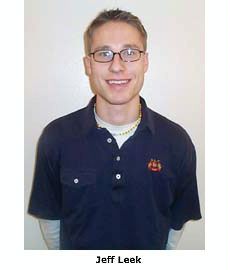
Suppose that we were developing an AI to identify pictures of the author of this book. We would need to collect a picture of the author - maybe an embarrassing one.

An embarrassing picture of the author

This picture is made of pixels. You can see that if you zoom in very close on the image and look more closely. You can see that the image consists of many hundreds of little squares, each square just one color. Those squares are called pixels and they are one step closer to turning the image into numbers.

A zoomed in view of the author's smile - you can see that each little square corresponds to one pixel and has an individual color

You can think of each pixel like a dot of color. Let’s zoom in a little bit more and instead of showing each pixel as a square show each one as a colored dot.

A zoomed in view of the author's smile - now each of the pixels are little dots one for each pixel.

Imagine we are going to build an AI application on the basis of lots of images. Then we would like to turn a set of images into “tidy data”. As described above a tidy data set is defined as the following.

  1. Each variable you measured is in one column
  2. Each different measurement of that variable is in a different row
  3. There is one data table for each “type” of variable.
  4. If there are multiple tables then they are linked by a common ID.

A translation of tidy data for a collection of images would be the following.

  1. Variables: Are the pixels measured in the images. So the top left pixel is a variable, the bottom left pixel is a variable, and so on. So each pixel should be in a separate column.
  2. Measurements: The measurements are the values for each pixel in each image. So each row corresponds to the values of the pixels for each row.
  3. Tables: There would be two tables - one with the data from the pixels and one with the labels of each image (if we know them).

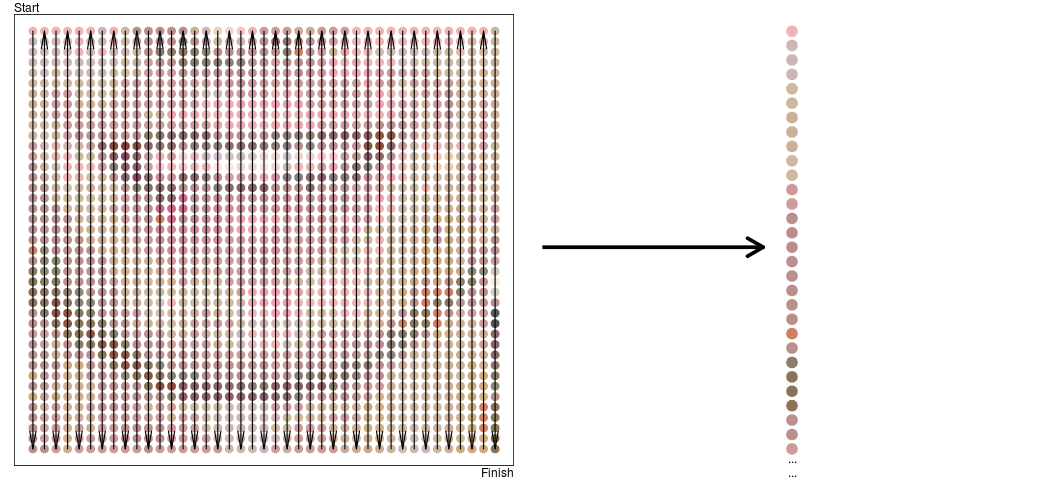
To start to turn the image into a row of the data set we need to stretch the dots into a single row. One way to do this is to snake along the image going from top left corner to bottom right corner and creating a single line of dots.

Follow the path of the arrows to see how you can turn the two dimensional picture into a one dimensional picture

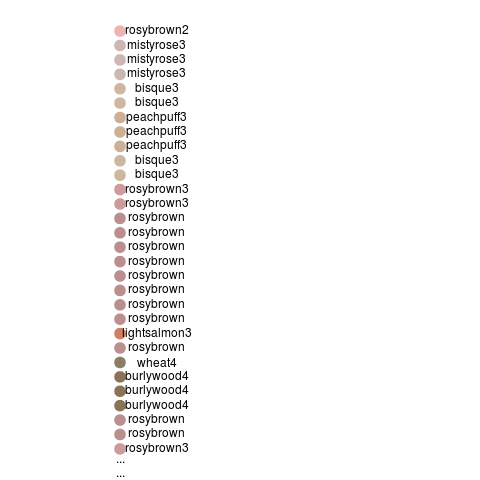
This still isn’t quite data a computer can understand - a computer doesn’t know about dots. But we could take each dot and label it with a color name.

Labeling each color with a name

We could take each color name and give it a number, something like rosybrown = 1, mistyrose = 2, and so on. This approach runs into some trouble because we don’t have names for every possible color and because it is pretty inefficient to have a different number for every hue we could imagine.

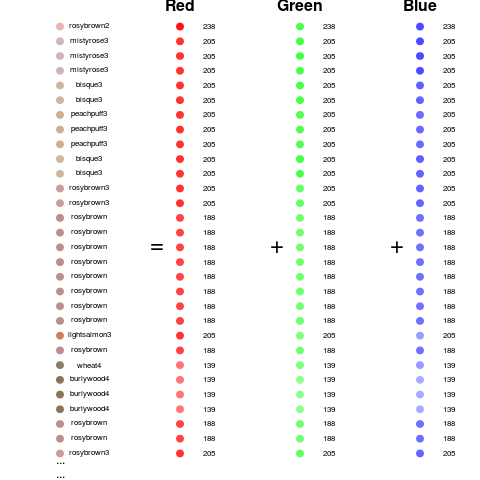
But that would be both inefficient and not very understandable by a computer. An alternative strategy that is often used is to encode the intensity of the red, green, and blue colors for each pixel. This is sometimes called the rgb color model (Wikipedia contributors 2016b). So for example we can take these dots and show how much red, green, and blue they have in them.

Breaking each color down into the amount of red, green and blue

Looking at it this way we now have three measurements for each pixel. So we need to update our tidy data definition to be:

  1. Variables: Are the three colors for each pixel measured in the images. So the top left pixel red value is a variable, the top left pixel green value is a variable and so on. So each pixel/color combination should be in a separate column.
  2. Measurements: The measurements are the values for each pixel in each image. So each row corresponds to the values of the pixels for each row.
  3. Tables: There would be two tables - one with the data from the pixels and one with the labels of each image (if we know them).

So a tidy data set might look something like this for just the image of Jeff.

id label p1red p1green p1blue p2red
1 “jeff” 238 180 180 205

Each additional image would then be another row in the data set. As we will see in the chapters that follow we can then feed this data into an algorithm for performing an artificial intelligence task.

Notes

Parts of this chapter from appeared in the Simply Statistics blog post “The vast majority of statistical analysis is not performed by statisticians” written by the author of this book.

References

Buhr, Sarah. 2017. “Illumina Wants to Sequence Your Whole Genome for $100.” https://techcrunch.com/2017/01/10/illumina-wants-to-sequence-your-whole-genome-for-100/.

Leskovec, Jure, and Eric Horvitz. 2008. “Planetary-Scale Views on an Instant-Messaging Network,” 6~mar.

“The Cost of Sequencing a Human Genome.” n.d. https://www.genome.gov/sequencingcosts/.

Travers, Jeffrey, and Stanley Milgram. 1969. “An Experimental Study of the Small World Problem.” Sociometry 32 (4). [American Sociological Association, Sage Publications, Inc.]: 425–43.

Venter, J Craig, Mark D Adams, Eugene W Myers, Peter W Li, Richard J Mural, Granger G Sutton, Hamilton O Smith, et al. 2001. “The Sequence of the Human Genome.” Science 291 (5507). American Association for the Advancement of Science: 1304–51.

Wickham, Hadley, and others. 2014. “Tidy Data.” Under Review.

Wikipedia contributors. 2016a. “Six Degrees of Kevin Bacon.” https://en.wikipedia.org/w/index.php?title=Six_Degrees_of_Kevin_Bacon&oldid=748831516.

———. 2016b. “RGB Color Model.” https://en.wikipedia.org/w/index.php?title=RGB_color_model&oldid=756764504.

12 Feb 02:44

What am I Going to Ride Tomorrow?

by James Schwartz

Waterloo Bikes

Waterloo Bikes Article

A story of bike theft and recovery from Waterloo bikes:

Remember how that feels? I’m sure many of you have had a bike stolen at some point, it’s kind of par for the course in bike ownership.

There’s the hassle of reporting it. Calling the police. Calling the insurance company. The feeling of loss, especially if the bike holds sentimental value. .

Wondering, what am I going to ride tomorrow …

Then there’s that feeling that another human being took something that was yours. Someone invaded your personal space and took something.

A silent frustration.

Unless of course it happened to snow in the morning. And you can see the boot prints leading up to your driveway, up the steps to your porch. The bolts ripped out of your brick house where your Brodie Force commuter once lived. Then you see the two familiar tire prints heading off down the street.

Read the full article on WaterlooBikes.ca

If anyone else has any other stories about recovering a stolen bike, please email me at james.schwartz@theurbancountry.com to have yours featured on The Urban Country.

James D. Schwartz is the Editor of The Urban Country and is based in Toronto, Canada. You can contact James at james.schwartz@theurbancountry.com or follow him on Twitter.

i share the road

More Articles Like This:

12 Feb 02:44

The Best Roll-Top Dry Bag

by David Fine
A group of roll-top dry bags on top of rocks in front of the ocean.

After spending many intimate hours in a bathtub, going through an insane upper-body workout dragging dry bags behind a kayak, and putting a total of 25 dry bags and sacks through the ringer, we think the Sea to Summit Big River Dry Bag is the most functional, durable, and versatile dry bag for the money. It’s easy to slide in and out of a pack and strong enough to drag over concrete, and it created the best waterproof roll-top seal of anything we tested.

12 Feb 02:44

The Throughput of Learning

by Tiago Forte

Learning in the 21st century is not about acquiring more information, knowledge, or even insights. The goal is to maximize the throughput of invalidated assumptions. But you have to get there one step at a time.

When you first start learning, early in life, there is a bottleneck in the amount of information you have access to. You soak up everything like a sponge, because you are open and there is relatively little to absorb.

But very quickly, in elementary school, your access to information stops being the limiting factor. You take home a few giant textbooks, and suddenly the bottleneck moves to ways of structuring and contextualizing the information.

In high school, you learn a variety of methods to structure information — outlines, diagrams, underlining and highlighting, reports, essays, notebooks and binders. The bottleneck moves to your ability to synthesize this information, to turn it into new ideas.

In college, if you make it that far, the bottleneck moves to insight generation. You start questioning the world as given, and find that the juiciest intellectual rewards are ideas that shift how you view it. You start hunting for the revolutionary, the controversial, steering your learning toward the red pills of paradoxes and contradictions.

rf5.001

If you are lucky enough to go beyond this, the bottleneck moves once again: to your assumptions. They constrain your view, what you are allowed to see, and thereby the thoughts and actions available to you. You start getting a kick out of unearthing new assumptions, shining a light on blindspots that, by definition, you didn’t know you didn’t know about. This process is unbounded, because with enough examination, all your beliefs are revealed to be assumptions.

There are many ways to reveal assumptions. Interesting experiences, traveling, genuine conversation, and reading fiction all help you question your own point of view. But using throughput in particular to model learning gives us access to new frameworks and metaphors drawn from decades of manufacturing production experience. What does that history teach us about how to maximize throughput?

The first lesson is that quantity and quality are not opposing forces. You don’t have to sacrifice one to get more of the other. One can be used to enhance the other, like two sides of a coin.

There is a common misconception about throughput: that it is just a matter of “more widgets produced.” That it seeks to maximize total output, without regard to the quality of the thing being produced. But nothing could be further from the truth. In fact, throughput accounting is almost fanatical in its insistence that a sale has not been made until the final customer has purchased. This is in sharp contrast to mainstream cost accounting, which allows each producer in the supply chain to record a sale as soon as they’ve passed on the product to the next link in the chain. What this means is that the entire supply chain is held accountable to the most demanding standard of innovation and quality: the final customer spending her own money.

The most skilled practitioners of this yin and yang between quantity and quality is, of course, Toyota. Toward the end of his life, Taiichi Ohno, the creator of the Toyota Production System (TPS) that revolutionized manufacturing around the world, said a curious thing:

“I’m proud to be Japanese and I wanted my country to succeed. I believed my system was a way that could help us become a modern industrial nation. That is why I had no problem sharing it with other Japanese companies, even my biggest competitors. But I was very, very concerned that you Americans and Europeans would understand what we were doing, copy it, and defeat us in the marketplace. I did my best to prevent the visitors from fully grasping our overall approach. I explained it by talking about reduction of the seven wastes (muda)…and by talking about techniques with Japanese names like kanban.”

What Ohno’s quote and the most recent research seem to suggest is that we copied their system at the wrong level of abstraction. TPS is not a process for maximizing the throughput of finished products, as we’ve always assumed and admired. It is a process for maximizing the throughput of process improvements, even at the expense of short-term profitability.

Adding inventory between work centers, for example, would actually make the production process more adaptive in the short term, since interruptions in one place wouldn’t immediately disrupt the others. But the fragility of “single-piece flow” is its most important feature: by preventing extra resources from “flowing around” the problem, it forces everyone to improve the consistency and reliability of all parts of the process. And quality is improved as a byproduct. The system is designed to break in ways that surface the most useful lessons for improvement. The point of idealized goals like “zero waste” is not to obtain an outcome (which is literally impossible), but to create momentum in a direction that is likely to lead to lots of informative failures.

Similarly, modern learning is not a process for maximizing the throughput of insights, but for maximizing the throughput of learning process improvements. The best assumptions to invalidate in our quest for learning are assumptions about learning itself. This is why meditation retreats, globe-trotting, and having kids will always be net productivity gains, broadly defined: even a slight improvement in the machinery of learning (via a shift in perspective, for example) will pay dividends over time far greater than a mere few months of lost labor.

rf5.002

But here we’re presented with a dilemma: how does one learn about one’s own assumptions about learning? Since you don’t know what you don’t know, it’s difficult to learn anything about it. Our assumptions about learning seem to be permanently out of reach.

Another historical example gives us a possible clue: the history of inventory turnover.

Inventory turnover is a measure of the number of times inventory is sold or used in a time period. In the 1970s, U.S. manufacturing firms had an average turnover of 3.7 (in other words, they sold their full stock of inventory, on average, 3.7 times per year). The Japanese average was only a little higher, at 5.5. By the 1980’s, this had accelerated dramatically to nearly 20, with the highest-performing Western firms achieving turnover of between 30 and 80. Soon after, Japanese firms achieved an astounding three-digit inventory turnover, selling their stock 100 or more times per year. No one thought it could go any higher.

And then something weird happened: turnover sped up a little more, and suddenly turned negative. What happened was that production got so fast that the manufacturer was able to receive payment for the final product before they even had to pay their own suppliers. The customer could pay for and eat his hamburger before the restaurant has paid for the meat.

This shift, a linear change in speed that inverted the whole logic of business, presented us with some powerful, if challenging, questions: if we’re able to charge the customer before paying for the supplies, why should we be limited by our initial investment or working capital? Why not do the selling before production, so we know exactly what to make, and how much? What other stages of production don’t have to happen in sequence? We’re still working out the implications to this day: Kickstarter campaigns sell a vision to deliver on later; plentiful credit and falling barriers to entry make borrowing from the future easier than ever; the field of Lean UX provides us a ready-made toolkit of methods for validating before producing.

And note that this vast acceleration did not happen at the expense of quality. Over the same time period, we went from talking about defects in terms of “yield” (losses of more than 10%), to “parts per million,” an improvement of four orders of magnitude in under two decades.

This example illustrates one way blindspots can be revealed: by accelerating a system so much that its rules break, forcing everyone to confront its underlying assumptions. The shift to negative inventory turnover wasn’t technically or logistically difficult, but it required the reassessment of a deeply-held assumption: that the stages of production have to happen in a particular order.

This works because, when it comes to complex systems, faster is different. When you push a system to sufficient speed, it starts consuming itself, like a black hole turning inside out and emerging through the wormhole into an alternate dimension, where all the laws and rules are completely different. The system ceases to be a static backdrop where things take place, and becomes merely another unit of flow in a larger, more abstract system. We thought of “empty” space as an inert stage on which the planets roamed, until Einstein showed us that space is as much an actor as any planet. A few levels of abstraction later, and we’re starting to suspect that what was formerly empty space actually comprises the vast majority of mass in the universe.

The astronomical analogy points to something important: all the levels of abstraction are always present and possible, it’s just a matter of which level we want to operate at.

Take, for example, the phenomenon we observed with the evolution of learning, which is present in any complex, interdependent system: once you relieve a constraint, it moves. In manufacturing, relieving the constraint on production often moves it to distribution, as you try to get this new surplus of products out to stores. Relieving distribution moves the constraint to supply, as your suppliers have trouble keeping up. Relieving supply moves it to sales and marketing, since you’re now able to deliver as many products as you can sell. And so forth, forever.

What does this look like in a knowledge work organization? Let’s say you relieve the constraint on your software engineering team. This, of course, moves it to the product team, who has to develop product requirements faster in order to keep up. As the CEO, you could treat this movement of the constraint as a finish line, as evidence that you’ve succeeded. Pat yourself on the back, maybe take a break to do some “change management.” Or you could treat it as a starting line, just the table stakes in a different game at a higher level.

You could continue to accelerate this process, pushing your team to continuously identify and relieve bottlenecks as soon as they emerge. “Solving” for a particular constraint is no longer an objective in itself, but a way to keep the game going. Crucially, this doesn’t necessarily involve more work, just different work. Most problems you don’t bother trying to solve and can just ignore, because you know that pushing the system to the next level of emergence will change all the rules anyway, bringing fresh problems. You focus your resources only on the constraints keeping you from pushing the system just past the edge of its activation boundary, letting the momentum from constraint to constraint do most of the work.

This movement of constraints, jumping back and forth across your company, starts to take on its own dynamic. It has its own principles, its own habits, its own attractors. You can start to develop an instinct for where the constraint is likely to move next, how it will behave once it gets there, and what pattern its movement will follow over time. This instinct turns into a skill. Once acquired, it starts to be in your interest to keep the change coming, to keep everything just slightly unstable, teetering on the edge of coherence. If you can keep the system going without flying apart, the dance of the constraints starts to form its own picture, like the individual frames of a film reel accelerating and then suddenly merging together into a movie.

The difficulty in applying this concept to individual learning is that, in this case, you are the system. It’s a little disconcerting being accelerated, turned inside out, and then sucked into an alternate dimension where everything you were sure was true is wrong. Or worse, irrelevant.

The key is to realize that you are not a thing, which can be deformed and broken, but an environment. Like a factory, you could say. We have entryways and exits, windows and doors, well-lit areas and dark, forgotten corners. There’s a lot of machinery, much of it outdated, and it’s arguably more difficult to move around our mental machinery than the equipment on a shop floor.

It’s often said that knowledge work is totally non-linear, and thus completely incomparable to a production line. But there is another sense in which we do operate in a linear world: we operate in time. Time is even less forgiving than the tightest conveyor belt — there is no cord to stop it, and not even one minute that’s lost can ever be recovered. Not one hour can be reworked, and our supply is fundamentally limited.

But we work with ideas, which live forever, right? Maybe not. In another sense, ideas are highly perishable. The requirements for a piece of software take a lot of effort to collect, but quickly go out of date if not acted upon, as the needs of users evolve. This is fitting, as legend has it that Ohno was first inspired by the American grocery store and its on-demand replenishment of perishable goods.

But knowledge work is different! It doesn’t have the long setup times or changeovers of the old days. And yet it does: we know that the first stage of flow is struggle, as we get physically, mentally, and emotionally situated to the task at hand. And this doesn’t get any faster over time. We have to go through it every time we switch contexts.

It seems like what we’re left with as knowledge workers is a cavernous mental environment filled with heavy machinery, which we use to process highly perishable ideas through a rigidly linear flow of time, with long, delicate setups that have to be changed over every few hours or so. And no breaks — we’re always in there.

Our design problem, at least, is clear: we have to design our mental environment to maximize the throughput of invalidated assumptions, accelerating it to the point that the rules of our learning process break, thereby surfacing even more assumptions, which we can exploit to further improve this process.

Most theories of action sooner or later seem to settle on seeing as the most important leverage point in a situation, from Toyota’s “Go and see” to Boyd’s Observation/Orientation. I think what is required to make this model of learning work is, instead, a different way of listening. Specifically, listening for assumptions.

Listening for assumptions is a peculiar skill, not at all natural, that requires a continuous disassociation of what someone is saying, from the model they’re constructing in their mind as they go along. It’s like plucking fish from a stream, the actual words and sentences becoming just a delivery vehicle for potential entry points into their mental model.

But this is a lot harder than fishing, because there is no discrete activity you can focus on, to the exclusion of everything else. You have to actually listen to the words, even though they are mere delivery vehicles. You have to allow yourself to be emotionally impacted, because your intuition has a much higher bandwidth than your conscious thought. You have to care about what they care about, subordinate your interests to their framing, pretend their priorities matter so convincingly that you yourself are convinced. You have to stand IN the stream.

True listening requires giving up the prerogative of your own mental model. You have to allow them to set the rules of engagement, no matter how bizarre, so that they let their guard down and realize you are not a threat, because you have no intention of blaming them for anything. The way they set these rules will reveal their assumptions and constraints, which thoughts and actions are open to them. If you can tell an authentic story that speaks to these assumptions, you can break through, because stories speak to emotions expressed in the body, which fortunately refuses to go along with even our most well-reasoned rationalizations.

The price of such effective action is we have to be willing to give up the petty payoffs we cherish in our arguments with each other: not only the blaming but the cynicism, the martyrdom, the self-righteous indignation, the outrage, the winning, the making others lose, the being right, the making others wrong.

And after all that, you may still fail to convince them to your point of view. Are you willing to not win in order to keep the conversation going?

The interesting thing about constraints is that they are never on you. They are constraints on your context, shaping the space of possibilities you allow yourself to consider. You can’t change anyone’s mind (have you noticed?), but you may be able to change how they perceive their context. If you succeed, they may be able to step out of the criteria by which they enumerate their options. Life does not present itself in the form of multiple-choice questions. It is we who choose the choices, and we do it together.

What all this has to do with learning is that the deepest assumptions can only be revealed through experience and stories, not by reading books or having intellectual arguments. We do these things through the same old lens, and thus cannot examine the lens. It takes another free mind, reaching up and taking off our spectacles, to show us the cracks and the foggy areas. At some point, this way of listening turns into a way of thinking, as you apply it to your own thoughts. Unmoored from your own certain beliefs, you step back from what seemed just a moment ago to be your very identity, only to find that it is just a mental object. With each step backward, you distinguish your self one by one from bodily sensations, from emotions, from opinions, from thoughts, from principles, from values, from systems, from goals. They are all tools, to be taken up and put down again when no longer needed.

This backwards movement, if we are not afraid to embrace it, even accelerate it, starts to take on a pattern of its own once again. It starts to consume itself, emerging inward into a deeper, more complex flow. Moving backward with increasing speed, we start to feel as if we’re falling, the former selves flying by like the floors past a runaway elevator. There is no way to look down, to see where we’re going, only where we’ve been. But this provides just enough information to allow us to steer: toward discomfort, toward fear, toward our best guess of where the next bottleneck may lie.

Note from Tiago: this is, sadly, the end of my Ribbonfarm residency. Thank you for reading – it’s been a genuine pleasure writing for you. If you want to read more in the future, you can follow me on Twitter, sign up for my updates newsletter, or subscribe to my members-only (paid) blog Praxis

12 Feb 02:44

Simultaneous Voice & Data is a MUST

by Jeb Brilliant

Frustration abounds for Sprint customers. Still in January of 2017 Sprint, who would like to be considered one of the big players in mobile for the US still uses some antiquated technology. Through my investigation and research it is a widely known fact that Sprint customers can NOT utilize data like surfing the web, sending iMessages or uploading pictures while they are on the phone.

As I call out Sprint on this shortcoming lest we forget the company they are within 1% of (according to Sprint commercials) Verizon doesn’t support voice and data either on many of their older phones.

Sprint though is the center of my disgust today because as far as I can tell even their newest devices don’t support voice and data. Research shows me that this is a hardware issue on the side of the consumer, Sprint doesn’t purchase phones that have the correct antenna array. Additionally Sprint doesn’t offer Voice Over LTE yet which is the other key piece, this is on the infrastructure side. I could be wrong about either part of this, Sprint doesn’t like to publish much data about their shortcomings.

From experiences of the people I interviewed about this they are all frustrated. One a general contractor let’s call Andrew, can’t send pictures or videos to his customers showing updates to work he’s done while he’s on the phone with them. Andrew wants to show the owner of the piece of property the headway he’s making on a remodel but can’t because Spring doesn’t support being on a phone call and using a data plan at the same time. Nathan a Hollywood businessman and another Sprint customer can’t send or receive emails or iMessages while on the phone with his business partner. They found a hack which is having to talk over FaceTime Voice which is using data so he can then receive text/email.

The funny thing is both gentlemen want to leave Sprint specifically for this reason but they’ve both been customers for so many years that they feel some sort of obligation to suffer. This is a crazy antiquated notion in my opinion and it’s time to jump ship and get on a carrier that allows them to use their phones to their fullest capacity.

What do you think? Are  you a Sprint or Verizon customer who doesn’t want to leave out of loyalty? Have you already jumped ship and gone to a different carrier?

12 Feb 02:44

Peter Thiel et Koober.com

by Tristan

J’ai essayé le service Koober.com, un site qui propose moyennant un abonnement de 8€/mois de lire ou d’écouter le résumé de certains best-sellers. C’est mon collègue Pierre qui me disait ce matin “ah, j’ai commencé à écouter From Zero to One de Peter Thiel sur Koober”. Et ça m’a motivé. D’une part, Peter Thiel est sur mon écran radar car je suis la politique américaine (C’est le soutien de Trump de plus visible de la Silicon Valley, il l’a conseillé pendant la phase de transition précédant l’investiture, et il est au coeur du scandale Hulk Hogan / Gawker) et d’autre part j’avais entendu parler du livre et je me demandais s’il y avait des choses à y apprendre, sans pour autant passer plusieurs heures de mon temps dessus.

Bref, je m’inscris sur Koober et j’installe leur application sur mon smartphone et c’est parti pour écouter dans le métro un résumé audio de Zero to One en 32 minutes.

Pour être clair, je n’ai pas aimé du tout, mais l’énervement suscité par l’écoute m’a poussé à deux choses : 1 — Aller jusqu’au bout du livre et 2 — écrire ce billet. Ca n’est pas rien !

J’ai donc détesté, mais je ne saurais pas bien dire pourquoi. Ce que j’ai entendu pendant 32 minutes, c’est une belle voix masculine grave qui parle lentement me débiter des platitudes sur les start-ups avec une régularité de métronome, un peu comme si Peter Thiel les enfilait comme des perles qui seraient autant de clichés sur l’entrepreneuriat.

Une fois de temps en temps, alors qu’on pourrait avoir tendance à s’assoupir, Thiel change de couleur de perle et au lieu de sortir une platitude, il décide de balancer une énormité sans crier gare. Quelques conneries entendues dans le livre :

  • Il faut que votre équipe soit homogène au maximum, il faut que les gens pensent tous la même chose[1] ;
  • Le télétravail est incompatible avec une start-up, idem pour le travail à temps partiel ;
  • Une situation de monopole est bonne pour l’innovation ?!
  • La rumeur dit que Palantir aurait aidé à trouver Ben Laden. AAAAAAhhhhhhhh. Le fondateur qui relaye par écrit des rumeurs flatteuses sur sa boite sans confirmer ni infirmer, c’est quand même le summum de la malhonnêteté intellectuelle !

Bref, j’ai passé deux sales quarts d’heure, mais dans un sens, c’était finalement distrayant.

Il me faut être honnête et préciser quelques points :

  • Il n’est pas impossible que l‘a priori négatif que j’ai sur Thiel ait joué sur mon expérience ;
  • J’ignore si la forme résumée, qui implique la suppression de la plupart des anecdotes du récit, n’est pas la source du préjudice ;
  • Je n’ai pas l’habitude d’écouter des audiobooks, donc peut-être qu’on s’y fait.
  • Il est probable que la diction monotone du lecteur ait eu un effet négatif sur mon expérience.

Enfin, ce n’est pas parce que cette expérience fut mauvaise qu’il faut éviter le service Koober.com. En effet, la promesse de pouvoir comprendre les grandes lignes d’un livre le temps d’un trajet de métro a beaucoup de valeur à mes yeux (ça veut infiniment mieux qu’une n-ième partie de 2048 ou de Candy Crush Saga). Je vais essayer d’autres livres audio chez Koober, le temps que s’écoule la période d’essai. On verra ensuite si je prolonge l’utilisation du service, quitte à lire “en vrai” les livres dont le résumé m’aura interpelé…

Et vous, vous avez essayé Koober ? Si oui, quelle est votre expérience avec le service ?

Mise à jour le lendemain :

Depuis la rédaction de ce billet, j’ai écouté deux autres AudioKoobs :

Une bonne nouvelle : l’expérience a été bien meilleure avec ces deux autres livres qu’avec le premier ! Difficile de dire pourquoi… Est-ce la qualité du livre de départ, la qualité de son résumé, le ton de son lecteur ? La biographie d’Elon Musk semblait bien plus vivante que le navet de Peter Thiel, même si le lecteur avait le nez un peu bouché.

Pour ce qui est du livre de psychologie, il faut savoir que l’original est très long et que l’auteur met longtemps d’avant d’arriver au fait. En version résumée audio, il faut parfois bien s’accrocher pour suivre (pas toujours facile dans le métro, quand il s’agit de descendre à la bonne station ou de prendre la bonne sortie !) mais on a le mérite de la concision et de la synthèse, à se demander finalement si l‘audiokoob n’est pas meilleur que l’original !

En conclusion, l’offre Koob semble plus alléchante que je ne le pensais : et si j’arrivais à lire absorber deux livres par jour pendant mes trajets de métro ? Voilà une idée carrément séduisante ! J’imagine assez bien que j’achèterais les livres dont les résumés m’ont semblé les plus intéressants pour les lire à tête reposés…

Mise à jour du 9 février 2017

Ma période d’essai étant terminée, j’ai finalement décidé de prendre un abonnement mensuel à Koober (si vous vous abonnez avec ce lien, ça vous fait économiser sur le prix et ça peut me donner des mois gratuits). Je compte mettre ce billet à jour suite à mon expérience.

Note

[1] De la part d’un mec qui a des opinions politiques tranchées et très différentes de son entourage géographique, en plus de faire partie d’une minorité sexuelle, ça ne manque pas d’air !

12 Feb 02:15

Mobile 2.0

by Benedict Evans

In 2004, ten years after Netscape launched, Tim O'Reilly launched the 'Web 2.0' conference, proposing (or branding) a generational shift in how the web worked. There were lots of trends, and none of them really started in 2004, but to me, looking back, the key thing was that people said 'if we forget about dial-up and forget about supporting old and buggy web browsers, and presume that lots of people are online and have got used to this stuff now, what can we build now that we couldn't build before?'

Not everyone had broadband and not everyone had a new computer with a modern browser, but enough people did that you could think about setting aside the constraints of a 14.4k modem and a table-based static web page and start building something new. And enough people were online, and knew lots of other people that were too, for social models to start working. Flickr had no less than 1.5m users when Yahoo bought it in 2005, which seemed like a lot at the time. 

Today, ten years after the iPhone launched, I have some of the same sense of early constraints and assumptions being abandoned and new models emerging. If in 2004 we had 'Web 2.0', now there's a lot of 'Mobile 2.0' around. If Web 2.0 said 'lots of people have broadband and modern browsers now', Mobile 2.0 says 'there are a billion people with high-end smartphones now'*. So, what assumptions are being left behind? What do you do differently if you assume not just the touch screen from 2007 but unlimited battery and bandwidth (around half of smartphone use in developed markets is on wifi and mobile networks are 10x faster), high-DPI screens, a CPU and GPU 100x faster than PCs in 1994, and lots of high-quality image sensors? 

The easiest place to see a shift is in interfaces. Although Facebook pivoted to building 'native' on mobile, pretty much all of its mobile experiences could actually be navigated with a mouse and keyboard - indeed, probably with just the tab key. That's native code but not, perhaps, a native interface. Conversely, the most interesting new apps have interfaces that embrace more and more of what's different about a smartphone, and especially a high-end smartphone. So they use swiping as primary navigation, not just for scrolling a list, and touch for things a mouse could never do; they use GPUs for transparency and effects that would have been beyond a 2007 PC, never mind a phone; and they use the image sensors, often combined with touch, as a primary input, on equal terms with the keyboard. Combining all of these, you often get an experience that would make no sense at all to try to build on the desktop - not so much mobile first as mobile only. 

The smartphone's image sensor, in particular, is becoming a universal input, and a universal sensor. Talking about 'cameras' taking 'photos' misses the point here: the sensor can capture something that looks like the prints you got with a 35mm camera, but what else? Using a smartphone camera just to take and send photos is like printing out emails - you're using a new tool to fit into old forms. In that light, simple toys like Snapchat's lenses or stories are not so much fun little product features to copy as basic experiments in using the sensor and screen as a single unified input, and in creating quite new kinds of content. Meanwhile, the emergence of machine-learning-based image recognition means that the image sensor can act as input in a more fundamental way - translation is now an imaging use case, for example, and so is maths. Here it's the phone that's looking at the image, not the user. Lots more things will turn out to be 'camera' use cases that aren't obvious today: computers have always been able to read text, but they could never read images before. 

Combining the camera with touch means that creation becomes about imaging, video and motion - about richness and fun. But this works both ways - the 'content' consumed in social apps also now looks much more like video than text, but not video in the sense of TV or YouTube, but rather in ways to bring motion and deeper engagement. Video is the new HTML, or the new Flash - the new file format for delivering much richer kinds of content. Naturally, this again requires that we presume fast CPUs and GPUs, fast networks and unlimited data. And of course, this isn't consumed in the browser anymore, but, mostly, inside the top half-dozen social platforms - indeed so much browsing happens inside Facebook's newsfeed app that it's effectively the most popular mobile 'web browser'.

Having said 'video' is the new HTML, though, in fact each of these platforms has developed its own content format centred on its own priorities. For Snapchat the priority is richness, so its content format centres on video (or what looks like video), whereas since loading speed matters more for Google it created AMP, and  Facebook created Instant Articles for the same reason. For all of these content formats, publishers get offered an experience (faster landing for AMP, richer content for Snapchat) only if they use the platform's own proprietary tools. You give them your content, they tell you how, give you an audience, tell you what the audience was (if they get the sums right) and tell you how (or perhaps if) you can make money. 

Amongst other things, this is to suggest that the changes in experience that mobile enables are one reason for the current concentration of use in the leading services. Certainly, that concentration is itself a significant shift. One could argue that this reflects the 'white space' being filled up: just as there was a wave of companies that leveraged social and search a decade ago and filled in the clear opportunities, so the same has happened on mobile, leaving fewer and fewer gaps. Alternatively, you can look at this as part of the way that tech swings from bundling to unbundling: AOL bundled content, the web unbundled AOL, Google bundled the web, apps unbundled properties from the browser, but also bundled each site into a single icon, and now these platforms form new bundles. The pendulum will swing back the other way again, at some point. And in parallel, one could argue that Snapchat itself unbundled not 'photos' but fun and self-expression from Facebook. 

And, of course, this bundling is exactly what the app stores themselves do: they decide what you can do, how you can do it and (to varying degrees) how you can make money, and part of the point of things like Facebook's bots platform was the attempt to shift some of that underlying power away from Apple and Google - if you don't own a smartphone platform yourself, how do you get leverage? So far, this has worked much, much better for content than for 'apps' - the social distribution model works with content in a way that it has not worked to supplant app stores (except in China, arguably). 

You can also see these bundling and leverage questions in the cluster of new little devices that orbit the smartphone. Snapchat Spectacles or Amazon's Echo (like Apple's AirPods) come from different sides of the brain, but they're both about more than just taking a commodity smartphone component and wrapping it in plastic - they unbundle a piece of a smartphone app and move it into a new context. You don't have to fumble for your phone to record that moment, or to ask what two cups of flour means in kilos. But you also don't decide which app to share that video on, nor decide what brand Alexa will send when you say 'I need more soap'.  So, as for bots, there is a platform power play here, and for me the fact that Alexa uses 'voice' is less interesting that its overlap with Spectacles - the way that both try to unbundle a smartphone, and create a new, independent end-point for the cloud that they can own themselves. 

These devices also, perhaps, point to what might come after 'Mobile 2.0'. Web 2.0 was followed not by anything one could call 3.0 but rather a basic platform shift, as the iPhone triggered the move from desktop to mobile as the centre of tech. AirPods, Spectacles, watches and Alexa also reflect or perhaps prefigure platform shifts. In some of them, on one hand, one can see the rise of machine learning as a fundamental new enabling technology, and in some, on the other hand, more and more miniaturisation and optimisation of computing. I think one can see quite a lot of hardware building blocks for augmented reality glasses in some of Apple's latest little devices, and AR does seem like it could be the next multi-touch, while of course machine learning is also part of that, as computer vision and voice recognition. So the things that are emerging at the end of the mobile S-Curve might also be the beginning of the next curve. 


* Globally, around 5bn people have a mobile phone, 2.5bn have a smartphone of some kind (not necessarily with a large data allowance or easy access to charging) and around 1bn, perhaps more, have a high-end smartphone. There are 650-700m iPhones in use. 


12 Feb 02:15

My EAST END VANCOUVER HISTORY WALKS Are Back For A Limited Early Spring Engagement. Book Now!

by James Johnstone


My TripAdvisor Certificate of Excellence-winning History Walks of Vancouver's heritage neighbourhoods are back Saturday mornings for a limited time in the early Spring of 2017. 
(2017 Late Summer Schedule TBA). 

Tours start at 10am and usually last 2 to 2.5 hours depending on group size and pace. Tours that begin and end at or near the point of departure are noted as "Circle Tours". Except for my West End History Walk (not offered in the regular walk schedule this Spring but available as a private tour) which has some hills, all the rest of my History Walks are relatively flat and easy to walk.  

Details on the content of the East End/Strathcona History Walk (Tour 1) and the East End's Working/Wild Side History Walk (Tour 2) can be found by clicking on the appropriate link above. The West End (Tour 3) and Grandview (Tour 4) History Walks are at this time only available as private tours.  

For more information or to reserve a space please e-mail

FEBRUARY/MARCH 2017
VANCOUVER HISTORY WALK SCHEDULE

Saturday February 18th 10am-12:30
East End/Strathcona History Walk (Tour 1)
Georgia & Dunlevy in 1962, CVA photo
Departs from 696 East Hastings at Heatley Avenue (Circle Tour)
Cost: $20/person


Saturday, February 25th,  10am-12:30pm
East End/Strathcona History Walk (Tour 1)
Newspaper article about bootlegger's houses being padlocked as punishment
Departs from 696 East Hastings at Heatley Avenue (Circle Tour)
Cost: $20/person


Saturday, March 4th 10am-12:30
The East End's Working/Wild Side History Walk (Tour 2)
East End aviator Tosca Trasolini and the Flying Seven - CVA photo
Departs corner of Raymur and Malkin Avenue (near Cottonwood Community Gardens) and ends in front of 1000 Parker Street close to point of departure.
Cost: $20/person


Saturday, March 11th, 10am-12:30pm
East End/Strathcona History Walk (Tour 1)
The East End as seen from what is now Vancouver's Olympic Village in 1892
Departs from 696 East Hastings at Heatley Avenue (Circle Tour)
Cost: $20/person


Saturday, March 18th 10am-12:30
East End/Strathcona History Walk (Tour 1)
Original Cover Art by Carole Itter for OPENING DOORS IN VANCOUVER'S EAST END/STRATHCONA
Departs from 696 East Hastings at Heatley Avenue (Circle Tour)
Cost: $20/person


Saturday, March 25th, 10am-12:30pm
The East End's Working/Wild Side History Walk (Tour 2)
Delivery Trucks lined up on the False Creek Flats south of Prior Street in the early 1900s - CVA photo
Departs corner of Raymur and Malkin Avenue (near Cottonwood Community Gardens) and ends in front of 1000 Parker Street close to point of departure.
Cost: $20/person

VPD in front of the old police HE on Powell Street in 1902
Also, 
Private History Walks
for groups of 5 people or more (or a minimum $100 charge for smaller groups) are available on Sunday mornings and afternoons 
February 19, and 26
March 5, 12 and 19, 
as well as during the weekdays from February 20, 21, 22, 23, 24, 27, and 28, 
as well as March 1, 2, 3, 15, 16, 17, 20, 21, 22, 23 and 24. 

Choose from any of these neighbourhood History Walks:
     Strathcona/East End (Tour 1), 
     The East End's Working Wild Side (Tour 2), 
     The West End (Tour 3), and 
     Grandview (Tour 4). 

These private tours are available in English, Japanese and Italian

For more information or to book a private tour, e-mail me at:


12 Feb 02:14

Two tactics: resist and connect

by Chris Corrigan

Last weekend the conversation on facebook about my previous posts took a turn. We are in an emotionally charged time and misunderstanding are everywhere. One of my neighbours has unfriended me over what I consider a complete misunderstanding about what I am saying about how to oppose populist dictators, should you happen to have some in your country.  So let me be clear about two tactics tactics: resist and connect.

Nothing I am saying here should be taken to mean that there are only two ways to do this.  Reversing the rapid decay of civility is a complex problem and we therefore need a million things to be done.  Most will fail.  Understand that first. Most everything you do will be a failure, which is way we need to do a lot of little things.  A sheer volume of diverse tactics increases the chances of something working. And the landscape is changing so quickly that we need massive amounts of agility.  So if you are spending a lot of time and energy talking only to your friends or only planning large scale initiatives, check yourself. Do that, but make sure you are on the ground, talking to people that aren’t like you. Be sure you are spending time doing and not just planning. We are not going to plan our way out of the whims of an arbitrary and compulsive authoritarian.

So two tactics: resist and connect.

Resistance is happening everywhere. If you have the power to defy an executive order, get a lawyer and do that. If you are able to help someone defy an order, do that. If you are able to provide sanctuary for people to protect them from orders, do that. In this respect, Canadian politicians need to act now, and my MPs and friends who are MPs are hearing that from me. On 9/11 we took in planes full of thousands or people who were not let into the United States.  They could easily have had hijackers on them or dangerous people. But we took them all in, screened them, fed them and kept them all safe until they could continue on their journey and it was fine. Right now there are refugees, and others who will not be allowed into the USA and they must be allowed to stay in Canada until the order against them is overturned or until they can declare refugee status here, given that they will not be allowed to enter the USA and they cannot return to the countries they are fleeing from.  We have done this before, we need to do this again.

Resistance is critical and is pretty easy to do. It requires numbers, courage and creativity, but we can see it happening across the USA.  It’s times like this I wish I was a lawyer.

There is no negotiating with the Trump administration. There is no tactic of appeasement or consensus finding that is moral at this time, in my mind. So the next tactic I have been talking about does not apply to Trump, Bannon or people in the administration at any level who are carry out these orders.

Connecting is critical. Here is an interesting article from Venezuela which documents learnings from that country. This is not about ideology. Look at these tactics:

  1. Don’t forget who the enemy is: populism can only survive amid polarization
  2. Show no contempt: disarm polarization
  3. Don’t try to force him out (which is this case means stick to democratic methods in resisting the dictator, as the lawyers and judges are doing in the States; you do try to force him out through democratic means. A coup – or counter-coup in this case – would be a disaster)
  4. Find the counter argument that puts you on the same side: this is what I wrote about on the weekend.

If you need further inspiration from history, now would be a good time to read Vaclav Havel’s “Power of the Powerlessness” which was a fundamental document in catalysing everyday dissent to Soviet rule in Czechoslovakia in the 1970s.

Don’t just agree with me or simply like this post, try some of these and report back. If some are not to your liking, don’t try them, do different things and share the results.  I am currently discussing strategies with a number of people in the USA and Canada who have taken me up on my offer to help them think through tactics. If you want a half hour of time, let me know and we can do that. I’m not interested in arguing with people, only helping, and if you are working actively and seriously to stop this madness, then I am in your court.

ETA: if you are interested in starting these kinds of conversations, listen to this podcast, which gives you some insight into the deep story and will provide lots of places to begin engaging.

12 Feb 02:14

What I did (Jan. 31 '17, Release Tomorrow)

by Anselm Eickhoff

So...

  • automatic release builds turned out to be quite the bitch to get working
    • Imagine creating instructions for building a car, giving them to your friend in the next town, waiting for him to try it out, he giving it back to you with a terse "motor doesn't start if I build it like this", you having to guess why, changing something, giving it to your neighbor again, getting it back with "motor started, couldn't put in the gear", rinse and repeat...
  • especially for all three platforms

    • Imagine you having to create a special customized copy of your car building instructions for your other friend who only knows how to drive automatic
  • they almost do work though

But...

  • I didn't have time to do the two bugfixes I wanted
  • I didn't have time to test the current state more thoroughly
  • There is one small annoyance that I would like to polish away

...so the release will be tomorrow, sorry!


12 Feb 02:14

These Weeks in Firefox: Issue 9

by mconley

Highlights

Friends of the Firefox team

(Give a shoutout/thanks to people for helping fix and test bugs. Introductions)

Project Updates

Add-ons

  • andym wrote a blog post about WebExtensions in Firefox 53

Activity Stream

  • Activity Stream targeting to land as a feature in Firefox 56 (about:newtab, about:home)
  • Activity Stream add-on 1.3.0 released today
  • One team is working on the Minimum Viable Product (MVP)
  • Another team is working on graduating the code into the codebase as per our engineering standards
    • Export scripts/processes for m-c
    • Integration testing
    • L10n, I18n, RTL
    • Accessibility
    • Talos / Performance
    • And the other various cross-team wheels that must be turned to ship a large user-facing feature in Firefox

Electrolysis (e10s)

Firefox Core Engineering

  • Crash stacks are collected in crash pings, now in 53.
  • Solved issue (thank you, releng!) for stuck 44.b1 users, so stuck users should start successfully updating. (bugs 1334220 and 1277925)
  • XPCOM symbols are no longer exported for 53+ (see dev.platform thread)
    • This prevents evil DLL injection from third-party applications which should improve stability and reliability

Form Autofill

Team meetings next week in Taipei. Chinese New Year holiday going on now ??.

Resolved bugs:

Go Faster

Platform UI and other Platform Audibles

Privacy / Security

Quality of Experience

Search

Sync / Firefox Accounts

Work continues on Bug 676563 – Bookmarks sync does not sync bookmark timestamps

Here are the raw meeting notes that were used to derive this list.

Want to help us build Firefox? Get started here!

Here’s a tool to find some mentored, good first bugs to hack on.

12 Feb 02:13

David Pogue NOVA Kickstarter campaign

David Pogue in “Hunting the Elements.”

Inside the birth of a $1 million Kickstarter campaign

Kickstarter.com, as you may know, lets inventors present their ideas to the public, in hopes of raising enough money to move forward with production. The genius of it is that the creators make their pitches directly to consumers; the middlemen and the gatekeepers of the manufacturing industry are cut out completely.

Sometimes truly great new products result. Sometimes they flop. But either way, there’s something exhilarating when the potential audience comes along for the ride of creation.

Most people probably think of Kickstarter as a place where tech projects get their start, like Oculus Rift and the Pebble smartwatch (remember that?). But creative projects also thrive there; people often seek funding to make an album, a play, or even a movie or TV show.

I’ve reported on Kickstarter dozens of times, but I’ve never before been part of a Kickstarter campaign—until now.

I’m joining NOVA, the most popular science TV show in America, to host a new, two-hour NOVA special called “Beyond the Elements,” which we hope will air on PBS next year. And we’re hoping to raise the $1 million we need with a Kickstarter campaign.

Why? Because, according to the Association of Public Television Stations, the government supplies only about 27% of public TV’s budget; the rest has to be raised through grants, gifts, and fundraising, which is hard and getting harder. Why not ask the public to help out directly?

Our campaign went live on Tuesday, Jan. 31, and it’s been a fascinating ride. So today, I’m offering you a look of what it’s like to create a Kickstarter campaign—from the inside.

April 4, 2012

“Hunting the Elements” airs on PBS. It’s a two-hour NOVA special that dives into the marvels of the periodic table of the elements. I’m the host. (You can watch it free online.)

Two hours about the elements? It could have been dry as dust. But Chris Schmidt (NOVA executive producer, “Elements” mastermind, and my buddy) had a vision: Use the power of television to show what elements are really all about, as memorably as possible. Pour molten gold on camera. Visit an FBI training facility in New Mexico to detonate a car bomb. Drop raw sodium into water and watch the resulting fireball shoot 25 feet into the sky.

Pouring a gold bar in “Hunting the Elements.” One spill, and it’s $12 million down the drain.

It’s an amazingly entertaining, informative show.

April 10, 2013

My son comes home from high school to report that his science teacher showed “Hunting the Elements” in class. Suddenly, I’ve got cred among my own kids.

It’s no surprise (the science teacher part, not the cred part); the show has been watched by millions of people, and has become a staple of science classes. I get stopped in airports by gawking teenagers who recognize me. Now that’s novel.

We went to Dubna, Russia, to see the cyclotron where the last few manmade elements were created.

April 27, 2014

Since 2010, I’ve hosted about 15 NOVA shows. To everyone’s amazement, these episodes have become catnip to children. Something about the combination of authoritative science and my own juvenile sense of humor—I don’t know.

These days, I’m a speaker at the U.S. Engineering and Science Festival in Washington, D.C. It’s teeming with kids who love science—and their parents. The realization that these shows are doing something, that they’re reaching the next generation…it’s the greatest rush, the greatest sense of purpose, I’ve ever known.

This kid obviously has excellent taste.

After the talk, I spend some time signing autographs and talking to these kids. I meet, for example, Henry from Massachusetts. He says that he has watched “Hunting the Elements” 120 timessometimes twice a day. He says he’s practically got it memorized. So I pull out my phone and quiz him.

A dad asks me when we’re going to make more NOVA shows. I tell him that these are high-end, professional films that cost a lot to produce, and it’s sometimes a challenge to get funding.

And then he puts the bug in my head.

“Look around you, David,” he said. “Look at these people. There are thousands of us who love those science shows. You should put together a Kickstarter campaign. Let us fund the show! I bet you’d do it!”

I have to admit, it’s a decent idea. Look at “Reading Rainbow”—another educational show, originally on PBS, with a huge fan base. Host Levar Burton sought to bring it back. His Kickstarter campaign sought $1 million in funding—and raised $5.4 million.

I email Chris Schmidt and Paula Apsell, who’s his boss; she runs NOVA at WGBH, the Boston PBS station that produces shows like “Frontline,” “Antiques Roadshow,” “Masterpiece,” and, of course, NOVA.

Her reply: “Yes. Kickstarter is a great idea; I will work on it with Pam Rosenstein tomorrow.” (Pam is our funding guru.)

Wow—could this thing really happen?

May 2015

Chris has a killer idea for the Kickstarter experiment: A sequel to “Hunting the Elements.”

The first special had been inspired by this amazing coffee-table book called “The Elements,” by mad scientist Theo Gray (who we also featured in the show).

Theo Gray and his gorgeous book.

And now Theo has a new book out called “Molecules.” It’s just a fascinating book. And Chris thinks it would make a fascinating science movie.

Chris writes up a description:

The Periodic Table tells us that there are 118 elements; 94 have been found to be naturally occurring. But the universe would be a pretty dull place if elements only existed in their pure form and never managed to join forces with others. We wouldn’t be here; neither would water, air, rock, or just about anything else familiar.

So this story is about the building blocks of matter that really matter: Molecules. According to the American Chemical Society, we’ve discovered or invented nearly 100 million unique chemical substances—and they estimate that by the end of the century, that number could approach a billion. That’s because nature and man have learned how to stick the elements together like Tinker Toys or Legos; two at a time, three at a time, even billions at a time.

To explore the incredible story of how molecules shape everything, from the galaxies to water droplets, we’re sending technology journalist and NOVA host David Pogue across the country—from the Austin Hot Sauce Festival to the fertilizer plants in Oklahoma—on a quest to discover the role of molecules in the universe, our world, our civilization and us.

I’m sold. Not only would this make a great show, but it’s also perfect for the Kickstarter project. It’s suitable for all ages; it covers a very broad, very important area of science; and it could be another classroom staple for years to come.

We even have a great name for the new show: “Beyond the Elements.”

October 16, 2015

Chris and Paula have been talking to all the interested parties, including their colleagues at WGBH and, of course, the big bosses at PBS. Everyone’s fascinated by the idea—going to the public to seek funding for a public television project seems like a natural evolution, but everyone wants to be cautious. The relationships between PBS, its member stations, WGBH, NOVA, donors, foundations, and the Corporation for Public Broadcasting (the government-funded nonprofit that distributes money to public TV and radio stations) is complex and finely tuned, and we don’t want to break anything.

None of us has ever done this before; we need an experienced hand—someone who’s run a Kickstarter campaign before. So Chris brings aboard Ivan Askwith, whose team guided the successful crowdfunding campaigns for “Veronica Mars” (2013, most backers in Kickstarter history); “Reading Rainbow” (2014, broke the “Veronica Mars” record); “Super Troopers 2” (2015, most funded film ever on Indigogo), “Mystery Science Theater 3000” (2015, most funded film ever on Kickstarter), and “Who the F*** is Frank Zappa” (2016, most funded Kickstarter documentary ever).

Ivan seems to be fairly qualified to run our project.

December 1, 2016

I take the train to Boston to shoot the all-important Kickstarter video, the one that appears front and center on the project’s Kickstarter page. Everyone’s donating their time—the cameraman, WGBH staff, me, everyone. It’s beginning to feel like a movement!

We make the video.

It occurs to us, by the way, that it really is a movement. The idea for this show, after all, came not from a TV executive, but by a member of the public. We’re living, frankly, in a time when many people are intimidated by science, or even hostile to it (insert your own political wisecrack here).

But it’s our fervent belief that science, once explained well, doesn’t need to be threatening and scary. In fact, it can be thrilling—even entertaining, as we’ve discovered through our previous NOVA collaborations.

More to the point, we need science right now, more than ever. If we’re going to solve any of the Big Problems, like climate change, hunger, disease, and epidemics, science is all we’ve got.

Heck, even if you care only about the little problemsshort phone battery life, dropped calls, stuttering Netflix videos—science is still the only tool we have.

We need more great minds embracing science—and young minds—than ever.

January 10, 2017

There are a lot of pieces to a Kickstarter campaign. How should we describe the project? Should there be humor? What if we make more than our $1 million goal—what should the “stretch goals” be?

And what should the rewards be? When you contribute to a Kickstarter campaign, you’re not investing, exactly. Instead, what you get out of it is primarily the fun of becoming part of the team—you’re kept in the loop as the project progresses—but you also get little rewards, little thank-yous.

In the case of the “Beyond the Elements” campaign, the rewards range from T-shirts, to signed copies of Theo’s “Molecules” book, all the way up to lunch with me (although I’m not sure if that’s a reward or a punishment).

Everyone who contributes will be part of the team. I’ll send you photos and behind-the-scenes video clips from my phone throughout the year-long filming process. For the first time in NOVA history, this will be a two-way conversation; we’ll seek input and questions from our backers as we go.

We’ve worked out the some stretch goals; the top one, $2.25 million, will let us send DVD or Blu-ray copies of both shows (“Hunting the Elements” and “Beyond the Elements”) to every public high school in America.

(Me: “Can’t they just stream it?”

WGBH’s education director: “Believe it or not, a huge number of schools don’t have the technology to stream internet video in the classroom.”)

As we worked on answering all of the details, it became clear that this campaign was about more than making a TV show. We—all of us—feel as though there’s a bigger picture here. Science, and helping the public understand and appreciate it, is unbelievably important. With this project, we have a shot at creating something big enough to reach millions of people, and permanent enough to become a teaching tool for years to come.

January 31, 2017

At 11:30 this morning, our Kickstarter campaign went live. We have 30 days to raise the money we need to make “Beyond the Elements”—and bring it to as wide an audience as possible. It’s a crazy, way-out plan, something that’s never been done before in the history of public television—but it just…might…work.

Here goes…something!

David Pogue, tech columnist for Yahoo Finance, welcomes non-toxic comments in the Comments below. On the Web, he’s davidpogue.com. On Twitter, he’s @pogue. On email, he’s poguester@yahoo.com. You can read all his articles here, or you can sign up to get his columns by email

12 Feb 02:12

on academic travel

by D'Arcy Norman

The muslim ban executive order was a wakeup call. It’s now a different world, and we need to take the time to think through what the implications are.

Personally, I’d probably be largely unaffected. I’m a middle-aged white male with no visible signs of dissent. Well. I have a beard. But I could probably continue travelling to the US without much trouble.

But. I work with people who would be directly challenged by this. And there are students in the computer science lab I’m part of who would be forbidden from entering the US. Which is ridiculous. But it’s a serious problem – academia is strongly based on the conference model – travel to a place, present your research and make connections with other people doing similar research. It’s how things are done.

And now we’re faced with the new reality that the US is openly hostile to a significant proportion of the academic community. Either they wouldn’t be able to participate in a conference in the US, or they’d be unable to return to their families in the US if they participated in a conference elsewhere. That is insane. Absolutely insane.

But – this may be the time to rethink what participation in international conferences means. The whole carbon-spewing travel thing didn’t do it, but maybe the fear of Trump will. How can we change what it means to participate? How can these conferences be recast as blended and inclusive, allowing people to join from wherever they are safely able to do so?

The technology is basically there. We could Skype or Connect or Hangout. Or use telepresence robots. Or do a conference as a playlist of videos with supporting online community. Trump may be the kick in the pants we need to finally and meaningfully rethink what academic conferences should be, rather than saying they need to be bursts of face-to-face international travel with cosmetic lip service of online sessions thrown in. What if online participation was the primary means of being involved with an academic conference?

I’m going to be travelling to Houston for EDUCAUSE ELI in a couple of weeks. It’s too late to cancel. But I have a feeling it will be the last time I’ll plan to cross the border to the US for some time. I’m already trying to focus more on local communities – this is a good reminder to also focus on inclusive online ones as well.

12 Feb 02:11

A Thank You to Reid Hoffman

by Mitchell Baker

Today I want to say thank you to Reid Hoffman for 11 years as a Mozilla Corporation board member. Reid’s normal “tour of duty” on a board is much shorter. Reid joined Mozilla as an expression of his commitment to the Open Internet and the Mozilla mission, and he’s demonstrated that regularly. Almost five years ago I asked Reid if he would remain on the Mozilla board even though he had already been a member for six years. Reid agreed. When Chris Beard joined us Reid agreed to serve another two years in order to help Chris get settled and prime Mozilla for the new era.

Mozilla is in a radically better place today than we were two, three, or five years ago, and is poised for a next phase of growth and influence. Take a look at the Annual Report we published Dec 1, 2016 to get a picture of our financial and operational health. Or look at The Glass Room, or our first  Internet Health Report, or the successful launch of Firefox Focus (or Walt Mossberg’s article about Mozilla) to see what we’ve done the last few months.

And so after an extended “tour of duty” Reid is leaving the Mozilla Corporation board and becoming an Emeritus board member. He remains a close friend and champion of Mozilla and the Open Internet. He continues to help identify technologists, entrepreneurs, and allies who would be a good fit to join Mozilla, including at the board level.  He also continues to meet with and provide support to our key executives.

A heartfelt thank you to Reid.

12 Feb 02:11

Stop saying “fake news”. It’s not helping.

by Ethan

One bit of good news for those thoroughly freaked out by the Trump presidency: there’s anger, passion and drive on the left that’s unprecedented in recent memory. Two weekends ago, my girlfriend, a veteran of Occupy Houston, warned me that it was difficult to mobilize people in that car-centric city and thought we might find a few hundred marchers for the post-inauguration march. The crowd we joined was 22,000 strong, and as we assembled in front of Houston city hall, the chief of police told us that we were the largest protest in the city’s history. And the Houston protest was a small one compared to massive protests in Boston, New York, Seattle, Denver, Chicago, LA and DC.

This weekend featured a wave of demonstrations at airports around the US against the racist and unconstitutional Muslim ban. The ACLU, leaders in fighting the ban, raised more than $24 million over the weekend, demonstrating that activists are willing to put money where their hearts are. And an army of lawyers is occupying airport food courts, offering legal representation to anyone prevented from entering the US. The outpouring of progressive efforts has been so massive that journalists are beginning to refer to it as “the surge”.

Here’s the bad news: thus far, we’re not very good at channeling that energy. There’s so much to react to, from fundamental questions about the legitimacy of the election to concern about concrete steps Trump is taking in office that it’s hard to know what to proactively work on. And there’s a danger in reactive activism: your opponent gets to choose and frame the issues for you. For all its weaknesses, the Trump administration is masterful at framing issues to its advantage, as the left is just now beginning to understand how powerful a tool this can be.

Immediately after the US election, “fake news” emerged as a major story, a partial explanation for Trump’s surprise electoral victory. Within a week, I’d been invited to four different conferences, brainstorms or hackathons to combat fake news, done a dozen media interviews and briefed the heads of two major progressive foundations on the issue. Fake news was a problem for American democracy and progressive leaders were on it!

Unfortunately, so was the Trump administration. On January 11th, Trump offered his first press conference since the election, and refused a question from CNN’s Jim Acosta, criticizing the network and declaring “You are fake news.” This week, the President expanded the fake news camp to include the nation’s “paper of record”.

Media Cloud, the tool we developed at the MIT Media Lab and Harvard’s Berkman Klein Center to track the spread of ideas in news media, shows that “fake news” was associated primarily with Facebook in the months of November and December. Coverage of fake news focused on Buzzfeed’s excellent reporting on for-profit news sites in Macedonia that created “news” out of whole cloth in hopes of attracting US right-wing eyeballs and ad dollars by designing news stories likely to be spread on Facebook. In January, the fake news narrative has shifted to CNN as a result of the President’s adoption of the term, wielded against CNN in revenge for their decision to cover (though not reproduce) the Steele dossier.

Mentions of “fake news”, November and December 2016

Mentions of “fake news”, January 2017

The President’s embrace of the term “fake news” should be reason enough for the left to stop organizing conferences and projects on the topic. It’s a vague and ambiguous term that spans everything from false balance (actual news that doesn’t deserve our attention), propaganda (weaponized speech designed to support one party over another) and disinformatzya (information designed to sow doubt and increase mistrust in institutions) – I wrote at length about the complexities of the term for Deutsche Welle last week.

But that’s not the real problem. The problem is that the very concept of fake news helps the Trump administration.

Many pundits complained that Trump campaigned without a platform, just a set of audience-tested applause lines. While that may be true, the campaign was not without a strategy. Trump and his advisors realized that the dominant political mood of the moment is one of mistrust. The primary locus of this mistrust is the government in Washington – in 1964, 77% of Americans trusted the government in Washington to do the right thing all or most of the time. By 2011, that number was down to 19%. But this collapse in trust affects all large, bureaucratic systems, from universities and hospitals to the military and churches. And people really mistrust media: in 1979, 51% of people trusted newspapers all or most of the time. By 2013, only 24% of people trusted newspapers, and 21% trusted television news.

It’s deeply uncomfortable when the President refers to the media, a constitutionally-protected institution critical to monitoring a representative democracy, as the “opposition party”.

But it shouldn’t be that surprising – in many ways, Trump ran against the media as much as he ran against Hillary Clinton. The chant of “CNN Sucks!” was a common feature of his rallies, one he encouraged by railing against the unfairness of the coverage he was receiving.

Elected as a revolutionary, Trump is governing as an insurrectionist, moving to sideline or disable much of the federal government. For those of us uncertain as to whether Trump was a conventional Republican with inflammatory rhetoric or a genuine rebel, his cabinet choices made things very clear. The nominees he has proposed are a wrecking crew, in many cases explicitly dedicated to the destruction of the agencies they oversee. This is strategy, specifically Steve Bannon’s strategy. As Ronald Radosh reported last summer, Bannon identifies as a Leninist, dedicated to the destruction of establishment institutions through Tea Party populism.

Some of the mainstream Republicans who supported Trump because it was a way to defeat Clinton are feeling very uncomfortable about how the President is governing. But many in Trump’s base are pleased to see that he genuinely wants to overturn and abolish institutions they feel have not served them well. (Uncomfortably, they have a point. Rising inequality means that the economic recovery under Obama hasn’t reached many households. Not that voting in a plutocracy is an especially good way to combat this.)

The best way to defeat insurrectionism is with strong institutions. We’ve got to celebrate the ones that are working well and reform the ones that are broken. We may even need to tear some down and replace them with something better. And we have to humanize all of them, identifying and celebrating the people who are working hard to make these institutions function, and to fix them when they decay. It’s easy to hate an institution – it’s harder to hate the people within it. That’s the power of Twitter accounts like @RogueNASA and @AltUSNatParkService. They remind us that real people work within government institutions, that they’re proud of what they do, and that we need to get beyond our understandable mistrust of agencies, bureaucracies and hierarchies, and celebrate the things they do well.

That’s the problem with a focus on fake news. By adopting the frame, we remind people of the difficulty of reporting in a digital age, the real problems of verifying information and the times our journalistic institutions have failed. We should fix our failures, we should get better at stopping misinformation before it starts to spread, but we can’t do this in a way that supports a Trump attack on the very notion of independent media institutions.

There’s another thing, too. Fake news is not the problem. My colleagues at Harvard are releasing a study of news during the 2016 election next month. They looked at how influential thousands of different news outlets had been during the cycle. They found dozens of news outlets that have been flagged by academics as purveyors of fake news, publishers that create stories from whole cloth for profit. While those sites exist, they were not very influential in the 2016 election – the most influential don’t even rank in the top 100 sites in the analysis. Far more people have been influenced by talk about fake news than by fake news itself.

Why? Because progressives love the idea of fake news. Most progressives – myself included – find it hard to understand how fellow Americans can view the world so differently. By blaming the results of the election on fake news, we have an easy explanation for an incomprehensible situation. If we could just eliminate misinformation, everyone would agree with us!

As Michael Schudson points out in his brilliant The Good Citizen, central to the progressive movement was the idea of the informed citizen. Crusading newspapers reported on malfeasance, and citizens were expected to spend hours informing themselves on candidates and propositions. The net result? The voting rate dropped by 50%. Unfortunately, political decisions are seldom rational, fact-based ones as much as we’d like them to be.

The uncomfortable truth is that support for Trump’s insurrectionist agenda is real, and that there’s a ferocious appetite for news that confirms our existing biases – on both sides of the aisle. Yes, we should find a way to battle deceptive misinformation. But we need to work harder on building media that pushes us to see different perspectives and helps us understand the complex political reality we live in. The answer is not to fight fake news – it’s to build wide news, media that helps us understand people we disagree with and people we seldom hear from.

12 Feb 02:11

Time Machine Completed the Backup

Recently, I acquired a Synology DiskStation and wired up a nice comforting Time Machine-to-Synology-to-S3-to-Glacier backup data flow. But then I started to see “Time Machine couldn’t complete the backup” with something about “could not be accessed (error 21)”. Here’s how it got fixed.

Time Machine problem

[This piece placed here to attract search-engine attention and, with luck, help someone else dig out. If you’re feeling public-spirited, toss in a couple links for visibility’s sake.]

I was tempted to give up, but the thing was working fine for my wife, who however was not yet on Sierra; there was some Twitter rumbling about Sierra and Synology having relationship problems.

With the aid of Google and Twitter, I eventually did all these things, and finally data started flowing again. Perhaps they are not all necessary.

  1. After a tweeted squeal for help, Saul Tannenbaum (@stannenb) and Shazron Abdullah (@shazron) suggested installing the Synology beta, and connecting over SMB not AFP. Because SMB is the new shiny, amirite?

  2. Also per @stannenb, poked around in the Synology menus (Control Panel>File Services>Service Discovery) to enable “Bonjour Time Machine broadcast via SMB”. Uh huh.

  3. At some point before the backups started failing, I’d seen a message about a Time Machine verification problem; Googling that led me to Jonas’ Fixing your Time Machine backup, which talks you through mounting the ”sparse bundle” and using the fsck hammer. Last time I used fsck it was in a different millennium. Thanks, Jonas. Like he said, it ain’t fast, and the use of a wired network is indicated.

Of course, a civilian would have been dead in the water, and I should be mad at either Apple or Synology, or the pair of them for not playing nice. But at the moment, I’m so relieved to have this working that I’m not.

12 Feb 02:11

The Uptake of Wideband Speech Codecs in Fixed Line Networks Is… Glacial

by Martin

One big advantage of ‘alternative’ voice solutions such as Skype and many others is the use of much better voice codecs that make a huge difference in practice. Many mobile network operator voice systems have been upgraded over the years to support Wideband-AMR. In practice I get a lot of WB-AMR calls while people use the same mobile network as I do. The rate of adaption is quite good as people quite frequently get themselves new devices that support the feature. The fun stops, however, as soon as I call someone on another network. For years, nobody thought it a priority to add gateways that support wideband codecs. A bit of a shame.

Many fixed line phone connections have also been converted to IP over the years and usually also support a wideband codec. The problem here is that in order to enjoy the speech quality of a wideband codec, not only the line but also the fixed line phone has to be upgraded.

It seems, however, that most people keep their fixed line phone for a much longer time. I recently had a look at the call log of my router to see how many of my calls to and from my fixed line phone at home are wideband and which still used the narrowband codec. The result was quite devastating. Except for calls to and from family members which were done with a wideband codec I could only occasionally find a wideband call. And occasionally is already a very optimistic, I’d say 95% of the calls over my fixed line at home still use the old narrowband codec.

In addition to people not upgrading their fixed line phones, another reason for such a low percentage of wideband codec use is that interconnections to other national and international fixed line networks also don’t support wideband codecs. Also, except to one mobile network, gateways to other mobile networks in Germany still only support narrowband according to my fixed line router’s call log. Quite a shame really, nobody seems to put some energy into this.

Yes I know, who still needs fixed line telephony anyway. Well, I still do.

12 Feb 02:11

Is He One Of Us?

by Richard Millington

Spend 30% of your time working internally.

That’s one or two meetings a day. Don’t waste your lunches sitting alone. Reach out to a couple of people a day and meet up with them. You can meet with more than one person at a time if you like.

Don’t ask for help, simply ask questions. What are their goals? What are their challenges? What kind of help do they need? What is their current worldview? What do they hate about their work? What do they love about their work? (tip: end meetings on a positive note by discussing the best parts of their work last).

You don’t need the answers, but you need the questions. You need to take the time to understand each of them. Most importantly, they need to know you took the time to understand them. Ask if you can sit in on their meetings sometimes.

You might be amazed what you will learn.

Building a network of allies throughout the organization isn’t technically difficult, but it takes a lot of time. But the value it provides is immense. The very best people I know in this field spend much of their time doing just this.

If others feel you have taken the time to understand them, they will be more likely to help and support you later. They can give you advice and access to their resources. They will speak positively about you to others. This does far more to get you internal support than ROI metrics.

Most people don’t do this until it’s too late. Or they begin with a request for help. Sorry, no dice.

From your very first day you have to be curious about learning more about the organization you’re in. Reach out to and ask to have a meeting to learn more about what they do. Keep it short and be respectful of their time. The results will come.

We often hear people complain that community managers work in a silo…but whose fault is that?

12 Feb 02:11

Apple’s record quarter by the numbers

by Rui Carmo

The iPhone figures are staggering. I’d say the Mac figures are looking surprisingly good, too, all things considered.

As to the iPad, I think it will take a while yet until tablets (which are longer-lived, secondary devices) take over (if ever), but am very curious as to how the Pro range would perform if Apple actually got their productivity act together and turned the platform into more than just a big phone.

12 Feb 02:08

Leadership Comes From Everywhere

by rands

For years I’ve been working on structuring an interview for assessing leadership. How do you figure out if someone has leadership skills in an hour-long interview? The answer is: you don’t. You need multiple humans not only asking a diverse set of questions but also listening to answers and pivoting to follow-up questions as they see fit.

The coordination comes from an agreed upon model for what constitutes good leadership. Let’s start with the three structural facets:

Do they have vision? Can they explain an ambitious and seemingly unattainable goal?

Are they strategic? Can they explain the steps necessary to achieve that vision?

Finally, are they tactical? Can they decompose a strategy into a series of logical actions that will achieve each step?

I have sets of questions that vet each of these facets. I’ve also written supporting material explaining how each leader is different. There are incredibly strong leaders who have an inhuman tactical ability but are average at strategy. There are credible leaders who thrive on building vision, but are awful at strategy and even worse at tactics.

I patted myself on the back when I wrote down the triangle of vision to strategy to tactics. So clean… so elegant.. and so woefully incomplete.

A Complete Leadership Model

Judgment is the ability to make considered decisions or come to sensible conclusions. Vision, strategy, and tactics are all informed by judgment. Wherever your leadership strengths exist, it is your judgment that determines whether your decisions are considered, or your conclusions are sensible.

Your judgment exists as a machine built from the total of learnings extracted from your life’s experiences. These experiences gave you knowledge, understanding, and wisdom. As you pass through your day, you are incessantly presented with situations large and small that make an ask of your judgment. A hypothetical example:

“An employee told me that this was confidential information, but sharing this information with one other trustworthy person will likely give me additional insight and allow me to help them better.”

Judgment calls regarding confidentiality and truth are two huge factors in this scenario. There are versions of the scenario where it is against the law as a manager to fail to alert other parties to this situation. Do you know what they are? Maybe you do, maybe you don’t, but at the end of this situation, your judgment will be tested, and with the test, it will become more informed and therefore more refined.

It’s comforting as an engineer to think of judgment as this objective function. The words that define judgment – considered and sensible – imply the predictable comfort of logic, but that is not always the case because I’m still missing the final most important component of this leadership model: values.

What is Important in Life

Your values are your principles or standards of behavior. Like judgment, you’ve built your values throughout your life. You started by internalizing the rules and values of those who raised you. You continued to evolve these values with each struggle, failure, and victory.

Your values are what you believe is important in life; I can’t think of an essential aspect that defines you as a leader. Your values define why you chose that particular vision, and they define how you are willing to achieve it.

While everything I have written so far applies to your manager, everything I’ve written also applies to you. Whether you choose the title or not, you’re a leader. You have a vision of where you want to be, you build strategy and employ tactics to achieve that future place. Along the way, you constantly employ judgment defined by your values to follow a path that is acceptable to you.

Full of Rage

I’ve spent my career considering the craft of leadership for my team and my company. While I write books and create Slack teams focused on the craft of leadership, I’ve done the bare minimum to understand the leadership that shapes the United States of America.

As I’ve sat in disbelief glued to social media, I’ve been thinking about the constituent parts of leadership. You can not suggest that the current administration doesn’t have vision. You can not say there is not a complex strategy in play and daily incessant tactics designed to achieve that vision. You can be full of rage like me, but you can’t argue that there isn’t leadership.

We can, however, judge the quality of that leadership not by the results of its policies, but the values its judgment demonstrates. A leader who gleefully and blatantly lies is a fundamentally flawed leader. This defective core value (which is one of many) infects the entirety the leadership model. How is possible to understand or believe any part of vision, strategy, or tactics when truth is suspect? What is considered or sensible when the facts are optional?

Are you tired of freaking out about this? Good. Me too. It’s time to lead.

Leadership Comes From Everywhere

I’ve sat on the sidelines for most my life as the political landscape has evolved and it is my great shame that it has taken this long for me to act. Now I am full of equal parts rage and fear, and while these emotions get me moving, they do not help define vision nor strategy. Fear and rage provide high energy, but poorly considered tactics.

However, I can’t ignore the tremendous gaping vacuum that represents my strategic thinking and limits my ability to define a compelling vision beyond the obvious, so I’m starting beginning at the bottom with sensible and considered tactics.

Each day for as long as it takes, I am doing one thing to move forward. Three days ago, I set-up a recurring donation to the ACLU, two days ago I created the #mobilize channel on the Leadership slack to bring together humans interested in coordinated action, yesterday I learned everything I could regarding executive orders, and today I wrote this piece to frame my rage.

A little bit forward, every day. Over time – as it always does – my tactical progress will reveal strategic insight and with time that strategy will reveal a vision. I’m starting late, I don’t know where I’m going, but I trust my judgment, and I’m clear about what I value. More importantly, when I want to see how my strategy and vision are developing, I can check it. I can compare it to the principles and values of this country because…

We wrote it down.

12 Feb 02:05

Web Developer Position Open at Omni

Check out Omni’s jobs page:

The Omni Group is seeking a senior front-end web developer to develop and maintain a world-class website for our Mac and iOS products. The position is part of the Design Department and will focus on bringing mockups to life.

Omni makes great apps and it’s a wonderful place to work.

12 Feb 02:05

Hag Seed

Latest in the stellar new Hogarth Shakespeare series, Margaret Atwood takes The Tempest and sets the story at a Canadian Shakespeare festival that is about to oust its brilliant, distracted director. He goes into a long, rural exile, alone with the memory of his dead three-year-old Miranda. Now, he’s teaching drama in a prison a thirsting for revenge.

12 Feb 01:56

After The Weekend

  • If things really go completely south – something that no longer seems beyond belief – the question will be: when do we try to run? And where? I’ve received my first offer of a spare room on a distant continent, in case of emergency.
  • In addition to the chilling effects on research from this anti-science administration and its the Muslim travel ban, we’ve got to start wondering which borders will soon be closed to American travelers. I’ve already queried one conference regarding the possibility that Americans won’t be able to get visas for Eastern Europe by the time the conference is held.
12 Feb 01:53

Farewell electoral reform

by Chris Corrigan

I am not at all surprised by the announcement today that the government is abandoning its promise to reform the electoral system.  I never believed they would.

Many progressive voters were lured to the Liberals in the last election on a powerful premise: first, the only we could defeat Harper was not to split votes between the NDP, Greens and the Liberal Party.  The Liberals took on policy planks from the other parties, including a promise to reform the electoral process in an effort to court voters away from the NDP and Greens. Many people I knew threw their support to the Liberal party on this basis.  I chose to vote locally for a candidate I respect – Ken Melamed from the Green Party – and for a party whose policies I supported more than the others.  I often waver between voting Green and NDP.  In the past I have voted strategically, against my values, in order to try to get a “better than nothing” result, but in this election I was weary of the toll of regret that took. I hoped fervently that the democratic reform effort would pan out, and even leant help and support to it. But from the start I had no faith that the Liberals would do it. The weight of history and entrenched interests was always too much to move.

And so today comes the new mandate to the Minister of Democratic Institutions, which in part says the following:

“A clear preference for a new electoral system, let alone a consensus, has not emerged. Furthermore, without a clear preference or a clear question, a referendum would not be in Canada’s interest. Changing the electoral system will not be in your mandate.”

The stark irony here is that democratic and electoral reform is needed specifically because a consensus is no way to run a country. Having strong representation of alternative and opposing views with in governing institutions is essential to a health democracy. The first past the post system enforces a false consensus on decision making, by whipping votes and having party politics run the country.  The opportunity for a broader agreement that might represent consensus decisions containg dissent is lost.  Decisions that do make room to wrestle with, appreciate and sometimes resolve differences make for more robust decisions and more resilient institutions.  For the moment, we have lost a chance that we never had to reform the electoral system.

More importantly, we haven’t really yet replaced Harper. Several of the problematic bills that were championed under the Conservative government including C-51 (The Anti-Terrorism Act 2015) and S-7 (Zero Tolerance for Barbaric Cultural Practices Act) are still on the books.  Pipelines that Harper could not get built have been approved under Trudeau. And reconciliation moves at a glacial pace and with no major shift in sight.

To be fair to Trudeau, the Fair Elections Act has thankfully been gutted, and scientists are now allowed to publish again and share their findings publicly.  But the number one lure for progressives during the last election has today  been shown to be a mere honey trap. Irresistable at the time, but empty calories and regret at the end.

11 Feb 00:05

Submitting news on XML.com

by Lauren Wood

I coded XML.com in Wagtail, a CMS based on Django. It works well for my needs and I like Python as a programming language. One of the big reasons I like Wagtail is that it includes a powerful enough but not overly complicated workflow with roles and a built-in moderation and preview system.

But, I wanted a system where people could submit news items that would go into the moderation queue without needing to sign up for a login first. Fortunately, Wagtail makes that possible, and there’s a nice article by Erin Mullaney at Wagtail: 2 Steps for Adding Pages Outside of the CMS that details all the steps you need. It all worked nicely in more recent versions of Wagtail (thanks, Erin!) except for one part, the notification that the news item is in the moderation queue. That wasn’t a stop-ship item, so XML.com launched without those emails working.

I’ve now found the source of the problem. It turns out that when you submit a news item in this way, it doesn’t have a login identity attached to it (obviously, since there isn’t one). The send_notification function that sends the email uses templates, and these templates use the login identity of the author in the body of the email. Since that doesn’t exist, the whole function fails.

That means the solution is easy. The affected templates are wagtailadmin/notifications/submitted.txt and wagtailadmin/notifications/submitted.html, and Wagtail lets you customize the admin templates. I put my customized admin templates into a utils application, which contains all my utilities for the site. My utils/templates/wagtailadmin/notifications/submitted.txt file now has the content

{% extends 'wagtailadmin/notifications/submitted.txt' %}
{% load i18n %}

{% block content %}
{% blocktrans with page=revision.page|safe %}The page "{{ page }}" has been submitted for moderation.{% endblocktrans %}

{% trans "You can preview the page here:" %} {{ settings.BASE_URL }}{% url 'wagtailadmin_pages:preview_for_moderation' revision.id %}
{% trans "You can edit the page here:" %} {{ settings.BASE_URL }}{% url 'wagtailadmin_pages:edit' revision.page.id %}
{% endblock %}

Similar changes are necessary for the wagtailadmin/notifications/submitted.html file if you want to send HTML emails instead.

02 Feb 20:13

Our Favorite Learning Apps for Tablets and Smartphones

by Courtney Schley
Tablet game being played, viewed over child's shoulder

We spent over 25 hours researching and testing more than 35 educational and learning apps recommended by educators, experts, parents, and kids. We also studied research from child developmental psychologists and the American Academy of Pediatrics about children’s app use and the pedagogical principles for creating learning apps. If your family has a tablet and you want it to be more than a game-playing and video-watching device, or if you’re trying to find apps for your smartphone that will do more than keep your kids occupied in a pinch, we have some great suggestions.

Want a sneak peek at what we're working on?

A weekly roundup of new guides, picks, and a preview of what’s to come.

02 Feb 19:04

OnePlus 3T Caught Cheating in Benchmarking Apps

by Rajesh Pandey
In 2013, it was discovered that many top tier OEMs were cheating in popular benchmarking apps by putting their Android devices into an overdrive mode. Since being publicly caught and shamed, many OEMs removed such behaviour from their devices. However, a new investigation from XDA folks reveals that some companies continue to indulge in such practices even now. Continue reading →
02 Feb 19:04

‘I’m a Mac’ actor Justin Long is now promoting Huawei’s Android phones

by Patrick O'Rourke

Actor Justin Long, probably best known for his role in Apple’s popular “I’m a Mac” commercials from the mid aughts, is now schilling for a different manufacturer and operating system — China-based Huawei’s Android-based Mate 9.

Long starred in Apple’s famous TV commercials that poked fun at the Mac-PC rivalry from 2006 to 2009. In an interesting twist, Long is now advertising for a device using the Android operating system — arguably the PC of the mobile world.

According to publication Campaign US, Huawei actually hired Long because of his previous work for Apple.

In the new advertisement, entitled ‘The Interview,’ Long is a job candidate being interviewed by a Mate 9 for the position of directing a commercial for the smartphone. The amusing ad plays off of Long’s previous association with Apple and mentions that he has a “ton of experience in tech” but that he hasn’t direct anything before.

Originally Huawei wanted Long to speak more directly about his work with apple in the commercial. Long, however, was able to convince the company to “infer” the relationship instead.

The Mate 9 isn’t officially available in Canada.

Via: Campaign US

The post ‘I’m a Mac’ actor Justin Long is now promoting Huawei’s Android phones appeared first on MobileSyrup.com.

02 Feb 19:03

Samsung expected to screen Galaxy S8 video teaser at MWC

by Rose Behar

Samsung fans will get their first official glimpse at the Samsung Galaxy S8 about a month prior to its expected March 29th reveal in New York City, according to The Korea Herald.

The tech giant will reportedly screen a one-minute teaser video about its upcoming flagship during a presentation on February 26th. The company is also expected to unveil the Samsung Tab S3 tablet at the presentation, which will take place in Barcelona, Spain, one day before the opening of the 2017 Mobile World Congress.

samsung galaxy s8 video teaser mwc presentation invite

The device was exposed by mobile tipster Evan Blass on January 26th, revealing the front and back design as well as confirming specs that had been rumoured by reputable media outlets such as The Guardian.

The nearly bezel-less phone, which will likely come in 5.8-inch and 6.2-inch size variants, gains a rear-mounted fingerprint reader, iris scanner, visual search and desktop mode functionality. The chipset, according to several leaks, will be the Snapdragon 835, though there will also be an Exynos variant.

In addition, the device will reportedly stock a headphone jack and contain 4GB of RAM with a baseline of 64GB storage.

The device will likely go on sale beginning April 21st, 2017.

Source: The Korea Herald

The post Samsung expected to screen Galaxy S8 video teaser at MWC appeared first on MobileSyrup.com.