Shared posts

12 Feb 01:05

Making More Outside the App Store

by Paul Kafasis

Kapeli, makers of the developer tool Dash, recently posted about what happened when their app left Apple’s App Store. You may recall hearing about Dash due to the uproar that followed Apple’s decision to remove the well-loved app. Fortunately for Kapeli, the product was already set up for direct purchase, which meant they still had a way to sell it to customers. It turns out that in the first 100 days of Dash being distributed solely by Kapeli, it actually earned more revenue than when it was also sold through the App Store.


Image via https://blog.kapeli.com/100-days-without-the-app-store

There are undoubtedly multiple reasons for this result. Dash received a good deal of publicity as a result of Kapeli’s dispute with Apple, which likely brought in new customers. As well, it seems possible that professional developers are more willing than the average user to look outside the App Store for software. Still, it’s interesting to see how the App Store impacted Kapeli’s revenue.

With the exception of our audio editor Fission, all of Rogue Amoeba’s Mac apps are distributed and sold exclusively through our site. Popular tools like Audio Hijack and Airfoil provide concrete proof that products can thrive while never being sold through the Mac App Store. However, we have one application that followed a path similar to Dash’s. Our charmingly simple audio recording app Piezo was originally distributed in both the Mac App Store and via direct sales, but it has since left the App Store.

After seeing Kapeli’s chart, I was curious about the App Store’s impact on Piezo’s sales. The restrictions and limitations of the Mac App Store ultimately led us to remove Piezo on February 12th, 2016. We’ve now been selling it exclusively via our site for a year. This has provided about as perfect a real-world test case as one could hope for. Piezo’s removal came with minimal publicity, the price has remained constant at $19, and we’ve had no big updates or other major publicity for it in either 2015 or 2016.

So what do the numbers tell us? Here’s a chart showing unit sales for the last four quarters in which Piezo was sold through both the Mac App Store and directly via our website, as well as the subsequent four quarters when it was sold exclusively via direct sale.1

Piezo Units by Quarter

The Mac App Store previously made up about half of Piezo’s unit sales, so we might have expected to sell half as many copies after exiting the store. Instead, it seems that nearly all of those App Store sales shifted to direct sales. It appears that nearly everyone who would have purchased Piezo via the Mac App Store opted to purchase directly once that was the only option. Far from the Mac App Store helping drive sales to us, it appears we had instead been driving sales away from our own site, and into the Mac App Store.

While this chart doesn’t provide specific sales numbers, you can likely see that unit sales did drop slightly in 2016. Piezo’s removal from the Mac App Store does seem to have cost us a small number of sales. However, unit sales are far less important to a business than revenue. Let’s look at another chart, this time showing our revenue for the four quarters before removing Piezo from the Mac App Store, and the four quarters since.

Piezo Revenue by Quarter

In each of the four most recent quarters, Piezo brought in more revenue than it had in the corresponding quarter a year earlier. We earned more revenue when Piezo was available exclusively through our store than when we provided the App Store as another purchasing option.

This result might seem counterintuitive. Piezo’s price remained the same, and unit sales went down, so how could we have earned more revenue? The key to understanding this is remembering the cost of being in Apple’s App Stores — 30% off the top of every sale. Despite making slightly fewer sales, we earned more money by avoiding paying that oversized commission to Apple. Direct sales cost us just a few percent, so each direct sale of Piezo earns almost $5 more than a sale through the Mac App Store. As you can see, that really adds up.

Conclusion

I certainly won’t state that every developer will have this same success if they remove a product from the Mac App Store and distribute it exclusively through their own site. Your mileage will undoubtedly vary.

In our case, however, it’s clear that we were serving Apple, rather than Apple serving us. By removing Piezo from the Mac App Store, we stopped paying a commission to Apple for the many customers who had found Rogue Amoeba on their own. Better still, we were able to improve the quality of the product while simplifying our work considerably. Ultimately, that alone was enough to convince us that leaving the Mac App Store was the right move. The subsequent revenue increase we’ve seen is merely a nice bonus.


Footnotes:

  1. All eight quarters consist of exactly 91 days, to avoid 2016’s leap day skewing anything.↩︎

12 Feb 01:05

Follow-Up on Learning by Doing and Ubiquitous Information

by Eugene Wallingford

A few quick notes on my previous post about the effect of ubiquitous information on knowing and doing.

~~~~

The post reminded a reader of something that Guy Steele said at DanFest, a 2004 festschrift in honor of Daniel Friedman's 60th birthday. As part of his keynote address, Steele read from an email message he wrote in 1978:

Sussman did me a very big favor yesterday -- he let me flounder around trying to build a certain LISP interpreter, and when I had made and fixed a critical bug he then told me that he had made (and fixed) the same mistake in Conniver. I learned a lot from that bug.

Isn't that marvelous? "I learned a lot from that bug."

Thanks to this reader for pointing me to a video of Steele's DanFest talk. You can watch this specific passage at the 12:08 mark, but really: You now have a link to an hour-long talk by Guy Steele that is titled "Dan Friedman--Cool Ideas". Watch the entire thing!

~~~~

If all you care about is doing -- getting something done -- then ubiquitous information is an amazing asset. I use Google and StackOverflow answers quite a bit myself, mostly to navigate the edges of languages that I don't use all the time. Without these resources, I would be less productive.

~~~~

Long-time readers may have read the story about how I almost named this blog something else. ("The Euphio Question" still sets my heart aflutter.) Ultimately I chose a title that emphasized the two sides of what I do as both a programmer and a teacher. The intersection of knowing and doing is where learning takes place. Separating knowing from doing creates problems.

In a post late last year, I riffed on some ideas I had as I read Learn by Painting, a New Yorker article about an experiment in university education in which everyone made art as a part of their studies.

That article included a line that expressed an interesting take on my blog's title: "Knowing and doing are two sides of the same activity, which is adapting to our environment."

That's cool thought, but a rather pedestrian sentence. The article includes another, more poetic line that fits in nicely with the theme of the last couple of days:

Knowing is better than not knowing, but knowing without doing is as good as not knowing.

If I ever adopt a new tagline for my blog, it may well be this sentence. It is not strictly true, at least in a universal sense, but it's solid advice nonetheless.

12 Feb 01:05

Welcoming Buzz Hays

by Lytro
Let’s start at the (very) beginning … Buzz grew up in Bridgton, Maine, a town of barely 2,500 people, where he was bitten by the film bug at an early age. Unfortunately, a heavy snow [...]
12 Feb 01:03

How to Choose the Best Waterproof Cycling Pants

by Average Joe Cyclist

Showers-Pass-Transit-Pant-Waterproof-and-Breathable-showing-pants-worn-on-bike-and-lower-leg-B00SV1Q9KK(1)This in-depth post is about how to choose great waterproof cycling pants. It explains how waterproofness and breathability work in waterproof cycling pants, and explains all aspects that you should consider to make the best choice of waterproof cycling pants.

The post How to Choose the Best Waterproof Cycling Pants appeared first on Average Joe Cyclist.

12 Feb 01:02

Rating the Walkability of cities

by Nathalia Osorio

Walking is not only one of the most natural activities the human being is able and willing to do, but also an activity whose effects have a profound impact on the public sphere, specifically on urban development. Since urban population growth made cities spread out until they reached a non-human scale, people living in urban areas switched from walking to using automobiles in order to travel long distances in less time. Therefore, urban design became more car-oriented than people-oriented, resulting in a poor integration of public space and the functional ways in which people use it. There is a concern that large urban areas where people travel more in cars than they do in public transport or alternative means of transportation are unsustainable. The planning agenda is therefore focusing on how to retrofit urban areas in order to facilitate and promote walking.

However, walking is not only a functional matter of urban mobility and transport; it is important to the improvement of peoples’ health and even the promotion of leisure. Planning approaches address walking both as a personal experience and choice, and as a public issue. When people decide to walk they are choosing a specific way to use the public space and to interact with the city, therefore their choice affects the city but also what happens in the city determines their experience at walking. As a result, there is an indivisible and double feedback loop between people walking and the city, and caring about walking is not just a matter of helping people individually but also contributing to improve public issues.

Walking is a spatial phenomenon. Thus the concept of walkability refers to the relation between spaces and the people who walk through them or, in other words, how does these socially-created spaces facilitate walking or not? Consequently, the chief issue of walkability is to determine what features of the public space, and specifically the streets, make a city more walkable. There is a wide research on the topic that suggests that walkability depends on the “friendliness” of the space, which includes connectivity, accessibility, functionality, safety, security, comfort, convenience and availability of pedestrian infrastructure.

As there are so many definitions of walkability and friendliness of space, there have been several attempts to condense the related concepts in one single approach, such as the Five C Approach that includes connectivity, comfort, convenience, conviviality and conspicuousness as the main characteristics to make a space walkable. There are many others approaches and definitions, but most of the aspects that can make a space walkable can be determined only by the people that actually use the space to walk. That is why the measuring or rating of walkability depends largely on the contributions of people and relies precious little on the estimations that can be done with the macro-scale variables of the city, such as the continuity of the grid or the level of mixture of land use.

The project that we are developing addresses walkability as a public and spatial issue, and engages people as the main source of data. We are trying to involve pedestrians in developing of a walkability rating tool that allows comparisons of the conditions for walking within and between different cities. This will help cities to realize what walkability related problems they have, and especially where these problems are located, so that infrastructure and walking spaces can be improved in favour of pedestrians. This project contributes to the common good on the sidewalks by collecting people’s opinions, and helping them create a local and global database about the pedestrian experience of cities — day and night, winter and summer — so that they can improve the quality of everyone’s daily walks.

12 Feb 01:02

Google Rolls Out Instant Tethering To Pixel and Nexus Devices

by Rajesh Pandey
Google has started rolling out Instant Tethering feature to Pixel and Nexus handsets running Android 7.1.1 through a server-side update to Google Play Services. The feature makes it easy to quickly connect your devices to a mobile hotspot. Continue reading →
12 Feb 01:02

Internet 4.0: The Ambient Internet is Here

by Tristan Louis

Technology takes the Internet through different steps of growth and we’re on the cusp of a revolutionary set of changes that will accelerate and modify how we interact with the network. To understand Internet 4.0 or the Ambient Internet, it’s important to first look at the previous shift and what it means for the next generation.

Internet 1.0: The pre-web Internet (1968-1995)

During its initial couple of decades, the Internet was a relatively unknown phenomenon, connecting geeks in academia, some corporations, and the government in a mostly text-only type of environment. The initial focus was on sharing computing resources (think of it as cloud computing long before the term took hold) and exchanging information, mostly in a textual form, over email and discussion groups called Usenet newsgroups.

Because it was born out of concerns about nuclear attacks during the cold war, development of the Internet was largely driven by concerns over resiliency, redundancy, and a general ability to work even if large portions of the network were taken offline.

In those days, the Internet was a complex system to use and operate, leading to slow user adoption and a somewhat collegial environment where a large part of the community knew each other and worked closely together.

Web 1.0 / Internet 2.0

Internet 2.0: Rise of the Web (1995-mid 2010s)

There is no argument that the appearance of the web in the early 1990s democratized usage of the Internet. In fact, it was so successful in that integration that for many people the Internet and the Web were seen as one and the same. Other services provided on top of the Internet lost their dedicated client and, over time, were replaced by web applications.

This era saw the growth of e-commerce as a new form of purchasing goods, and the rise of online media as the way to consume information and entertainment.

The initial promise of the web era gave rise to the idea of democratizing access to communication tools so that anyone could set up their offering online without a high starting cost: on the Internet, two people in a garage could easily compete with some of the largest corporations and create a massive business.

Amazon established itself as one of the large players in e-commerce first by selling books and later by expanding into a general online store. Meanwhile, the rest of the web needed organizing and many companies built advertising backed search engines, with Google becoming the dominant player in that space.

Initial collateral damage to many existing businesses started impacting a lot of traditional industries, with retail, media, finance, and others being completely transformed by this first phase.

Later in that cycle, the social web (often referred to as Web 2.0) created a set of tools and modes of interaction that drove individual people to share information about themselves and chat with friends, co-workers, fellow students and/or family, on increasingly centralized platforms. Facebook bested its competitors to become the dominant player in managing daily social life while LinkedIn established itself as the network for work.

Internet 3.0: The Mobile Internet (2008-present)

The introduction of the Apple app store really marks the debut of the mobile Internet era. While the iPhone had been launched a year earlier, it wasn’t until the app store appeared that a new mode of interaction with the Internet was seen.

The app store model further recentralized the Internet as developers had to distribute their wares through primarily a limited set of app stores. The iPhone app store and Google’s Android Play store are the single points of control for much of the Internet (some countries like China have a more diverse set of app stores on Android devices but they represent the exception more than the rule).

In putting a computer in everyone’s pocket, Apple and Google (and Google’s distribution partners like Samsung, LG, Motorola and others) fundamentally changed the way a majority of users interacted with the Internet. With rapid acceptance of mobile devices in markets where the Internet had not gotten widespread acceptance, the balance of usage tilted from a computer/web browser based model to one that favored mobile device/apps.

This also unshackled the Internet, making many services that leveraged the mobility of the devices to create new business models. It also created the initial conditions for the Internet that is now coming. In putting a device in everyone’s pocket, the industry created large amounts of data about who, where, and when users were on the Internet.

This led to an increase in deployment of an infrastructure to make the Internet more available on a continuous basis. If the previous phase was defined by having to go to a place (wherever a computer and internet access was available), this new era could be defined as having the Internet available wherever you are and whenever you need it.

Ambient Internet

Internet 4.0: The Ambient Internet (2017-future)

With mobile devices now representing a majority of Internet traffic, the Ambient Internet is taking in historical information based on where your device has been, combining that with information that is coming off nearby sensors (eg. location sensors, smart home components, etc…) and layering in artificial intelligence to drive new experiences that can be embedded into existing devices.

In this next phase, the Internet will move from being available anywhere and anytime through a specific device to being available in all places and at all times through most devices. Interactions will move away from the single screen of your mobile phone or computer to interfaces you interact with naturally. Home assistants like Amazon Alexa and Google Home are early representatives of this trend but present only a cursory view of what the future will look like.

When taken to its logical conclusion, the Ambient Internet is the final stage of Internet penetration that leads to the Internet disappearing in the background. Like electricity and running water, the Internet is rapidly becoming a core service that is connected to everything around you.

The Ambient Internet, or Internet 4.0 takes historical data gathered through your interactions with multiple touchpoints (eg. lights, cars, speakers, chatbots, etc…), merges it with contextual information gathered through sensors you may either be wearing or see installed where you are, and uses Artificial Intelligence to establish guesses as to what you are most likely to need.

In private spaces, Internet 4.0 is fully customized to your specific needs and wants. In public spaces, Internet 4.0 is about driving a personalized Internet where the experience of any given space and/or product is optimized to please the majority of the people in that location right now.

A couple of years ago, I helped define the specifications around a new form of outdoor display advertising that adapted itself to the nearby audience, presenting the most relevant content to users without any specific interaction from the user. The idea is to make the environment subtly react its participants without making the participants aware of those adaptations.

Key to the Internet 4.0 is state of ambient computing it creates. While previous phases of the Internet have required some level of training (either learning to operate a computer, a web browser, a mobile device or an app), this next phase of the Internet is using natural interactions, either via spoken dialogue (using voice recognition as assistants like Amazon’s Alexa, Apple’s Siri, Microsoft’s Cortana or Google’s… OK Google) or text embedded into tools you already use (eg. chatbots in slack or other messaging programs, smart agents interacting via email like Amy from X.ai).

With Internet 4.0, the goal is to make the Internet mostly disappear. Today, when you take an Uber, there is still a human element processing information that has been given to him/her by a computer using large amounts of data to find the quickest route from point A to point B. Tomorrow, Internet 4.0 will leverage the same power and distribute the same information to fleets of completely autonomous vehicles that interact with each other to get out of each other’s way and move people faster.

Right now, different players are starting to align their capabilities to drive this new Internet. If history is right, only some of the incumbents will make the transition but the big question that remains is who will be the new player who will be able to leverage these trends into a dominant position in the future.

Soon, as the Internet disappears, it will become another core infrastructure powering our world in the background and this next generation company may already exist or be in the birth process. Watch for clear signals around new entrants as this represents the next big growth phase for the Internet.

12 Feb 01:02

Where is Book 3? Status Update

by Rob Campbell

Lately, I’ve been getting asked when Book 3 of the New Providence Series is going to be out. I owe you all an update on its progress.

It’s in the final stages right now. I have about 5k words left to wrap the thing up. I’m going to go back through it for a round of quick developmental edits after that. I don’t expect that to take too long, but I don’t want to botch any of these things either. The end result should be a consistent and coherent storyline, which ideally, kicks you in your reading place with an oversized boot.

After that’s all done, it’s going to bake for a little while with some beta readers and an editor for final tweaks.

I have a work-in-progress cover and a list of working titles for the book – I don’t think it will be called Trajectory Book 3 for reasons that will hopefully be apparent, but we’ll see. These are both in a state of flux.

If all goes according to plan, we’ll have a shiny third addition to the New Providence series in middle to late March. I am still on track to finish in six books I have planned for the series. This book marks the halfway point in the series.

Now the excuses. As always, this is taking a lot longer than expected. The past couple of months have been, frankly, a little hard to stay focused. Periods of crippling self-doubt mixed with a turbulent, real-world political upheaval in progress make it difficult to keep my brain fully-immersed in a fictional world. I can’t look away from the news entirely, because that feels, frankly, irresponsible. So, I’m sorry it’s taken this long, but I’m also not sorry, because the world is kind of fucked up right now.

Whew. Let’s get some coffee. I’m going to get back at it. Thanks for staying with me and asking about the book and leaving your wonderful reviews and feedback. I’m glad you’re here.

12 Feb 01:02

Pass the popcorn. Hide the checkbook.

by Don Marti

A new digital ad medium is making its way up the upward slope of the Peak Advertising curve.

Aldo Agostinelli of Sky Italia writes,

In the age of the IoT, web-connected devices are the new smart tools that will give advertisers unprecedented access to their users’ daily lives. But there is more to it: the IoT could also help advertisers deliver timely messages and persistently reach consumers.

This is how all targeted ad media, from direct mail to junk fax to mobile banners, get their start. Some Marketing person comes up with the idea of using some new technology to better target some users but not others.

Pass the popcorn. We've seen this show before.

Now it's time for a flood of videos from agencies about how well the new medium works, surveys where marketers say they're going to put budget into it, a bunch of VC funding for firms that do it, and before you know it, the new medium is something that marketers don't want to be caught not doing. The whole shitty carnival of "let's build a new targeted ad medium" is in town. Or in this case, on your toaster.

For a little while anyway.

Marketers know that you have to enjoy the new targeted ad medium while you can. Any new targeted ad medium always peaks, and then declines—right about the time users figure it out.

It's not that the technology is bad. Many new targeted ad media do provide technical advantages in more accurately matching ads to users. But somehow targeted ad media always go through a boom and bust cycle, unlike mass media advertising, where print and broadcast ads tend to hold their value.

Peak Advertising in targeted ad media keeps happening, because, as Agostinelli writes,

The IoT has many benefits for advertising: not only can a message related to a product reach a specific and clearly identified target audience, but the message can be designed based on data which makes it more personal and, therefore, more efficient.

Read that again. That's where every targeted ad medium breaks down. Efficient is why users bail. They start voting to ban junk faxes. They start running spam filters and ad blockers. And yes, they will, somehow, figure out how to kick the targeted ads off their toasters.

Meanwhile, users continue to accept magazine ads and at least tolerate the TV commercials. It's the targeted ad media, the ones that sound the coolest and most efficient, that get ignored, blocked, and regulated.

Let me share with you a sentence that's an obvious, even stupid, platitude for regular people, but a strange and terrible secret for digital advertisers. Ready?

There's no such thing as a free lunch.

Advertising, done in a sustainable way, is an exchange of value between the advertiser and the audience. The audience gives up some attention as the ad interrupts an ad-supported resource such as a news story or cultural work. In exchange, the advertiser offers economic signal, a hard-to-fake message about the advertiser's intentions in the market.

When a targeted ad medium helps advertisers try to get a free lunch by cutting back on the signal—by making it hard for users to estimate the amount spent to place the ad—the user no longer has an incentive to "pay" for the ad with his or her attention. The Peak Advertising curve is the result of users figuring out the targeting.

User tracking and targeting projects, built at tremendous expense, make an ad medium less valuable, not more. This is hard for computer nerds to understand. "What do you mean my program makes things worse? But it was so hard to write!"

No ad medium entirely goes away. When the IoT advertising hype is over, crappy toaster ads will remain, spreading security problems and brand-unsafe ad placements just like crappy web ads do today. The trick for brands is to sit back and enjoy the show, not get ripped off.

12 Feb 01:02

Game Day: Glitchskier

by John Voorhees

I love puzzle games and have seen some great ones debut on the App Store recently, but now and then, I want to play something different. This week, different meant Glitchskier, an endless runner-style arcade shooter by Shelly Alon. It has an off-kilter video game glitch aesthetic and challenging gameplay that together, hooked me immediately.

From the get-go, Glitchskier takes you back to early PC hardware. The screen is distorted to look like you’re playing on a curved, low-resolution CRT monitor. If the CRT look is too much for you, it can be turned off in settings. In the background, a dull hum and whir of electronics and fan blades add to the atmosphere. It’s an opinionated design that goes all-in with the retro PC look, which may turn off some people initially, but drew me in as soon as I started playing.

To start Glitchskier, you double tap a Windows-style folder and then glitchskier.exe. The gameplay is reminiscent of spaceship shooter games like Galaga. You maneuver your spaceship by dragging your finger around the screen. At the same time, the environment advances down the screen, endless runner-style. That, and the enemies that descend from the top of the screen, make avoiding your ship’s destruction difficult.

Your guns shoot automatically as long as your finger is on the screen. The more things you destroy, the higher your score climbs. As you move through the landscape, there are also weapons to collect that help you defeat enemies and bosses. Make it far enough, and you begin to unlock different colored themes too.

Part of the novelty of Glitchskier is the environment through which you fly your spaceship. The screen is littered with computer glitch obstacles like random characters that form barriers. The chaotic universe and enemies relentlessly descending on you is disorienting at first, but quickly becomes familiar and comfortable when you figure out what can be blasted to bits and what you need to avoid.

The unforgiving onslaught of enemies keeps you on your toes and requires split-second decisions. The sense of urgency is heightened by a synth soundtrack that fits perfectly with the game’s aesthetic and reminds me a little of the excellent Stranger Things soundtrack. But Glitchskier is more than just an homage to 80s arcade games. Beneath its carefully-crafted design is a fun game that’s easy to learn and extremely hard to master. The combination of the two sucks you into Glitchskier’s crazy world in a thoroughly entertaining way.

Glitchskier is available on the App Store for $1.99.


Support MacStories Directly

Club MacStories offers exclusive access to extra MacStories content, delivered every week; it’s also a way to support us directly.

Club MacStories will help you discover the best apps for your devices and get the most out of your iPhone, iPad, and Mac. Plus, it’s made in Italy.

Join Now
12 Feb 01:01

Revenge of the Lunch Lady

files/images/rhonda.jpg


Jane Black, Huffington Post, Feb 14, 2017


This is a really interesting report looking into issues related to school lunches in the United States by focusing on schools in Huntington, West Virginia, which had been labeled "the most unhealthy in the country" and had suffered the attentions of British celebrity chef Jamie Oliver. While the authors no doubt expected a disaster what they found was a local food services manager who was reforming the system from within. In the course of the article we read of the conflicts of interest that result in pizza being called a vegetable and the food industry dumping surplus cheese and butter on the system. And we read about the challenges posed by the idea that schools might refuse a poor child anything to eat because their parents didn't pay.

[Link] [Comment]
12 Feb 01:00

"What do I mean by denial of empirical reality? Take one of the most recent. On Wednesday, Senator..."

What do I mean by denial of empirical reality? Take one of the most recent. On Wednesday, Senator Richard Blumenthal related the news that Judge Neil Gorsuch, Trump’s nominee for the long-vacant Supreme Court seat, had told him that the president’s unprecedented, personal attacks on federal judges were “disheartening” and “demoralizing.” Within half an hour, this was confirmed by Gorsuch’s White House–appointed spokesman, who was present for the conversation. CNN also reported that Senator Ben Sasse had heard Gorsuch say exactly the same thing, with feeling, as did former senator Kelly Ayotte.

The president nonetheless insisted twice yesterday that Blumenthal had misrepresented his conversation with Gorsuch — first in an early morning tweet and then, once again, yesterday afternoon, in front of the television cameras. To add to the insanity, he also tweeted that in a morning interview, Chris Cuomo had never challenged Blumenthal on his lies about his service in Vietnam — when the tape clearly shows it was the first thing Cuomo brought up.

What are we supposed to do with this? How are we to respond to a president who in the same week declared that the “murder rate in our country is the highest it’s been in 45 to 47 years,” when, of course, despite some recent, troubling spikes in cities, it’s nationally near a low not seen since the late 1960s, and half what it was in 1980. What are we supposed to do when a president says that two people were shot dead in Chicago during President Obama’s farewell address — when this is directly contradicted by the Chicago police? None of this, moreover, is ever corrected. No error is ever admitted. Any lie is usually doubled down by another lie — along with an ad hominem attack.

Here is what we are supposed to do: rebut every single lie. Insist moreover that each lie is retracted — and journalists in press conferences should back up their colleagues with repeated follow-ups if Spicer tries to duck the plain truth. Do not allow them to move on to another question. Interviews with the president himself should not leave a lie alone; the interviewer should press and press and press until the lie is conceded. The press must not be afraid of even calling the president a liar to his face if he persists. This requires no particular courage. I think, in contrast, of those dissidents whose critical insistence on simple truth in plain language kept reality alive in the Kafkaesque world of totalitarianism. As the Polish dissident Adam Michnik once said: “In the life of every honorable man comes a difficult moment … when the simple statement that this is black and that is white requires paying a high price.” The price Michnik paid was years in prison. American journalists cannot risk a little access or a nasty tweet for the same essential civic duty?

[…]

When the linchpin of an entire country is literally delusional, clinically deceptive, and responds to any attempt to correct the record with rage and vengeance, everyone is always on edge.

There is no anchor any more. At the core of the administration of the most powerful country on earth, there is, instead, madness.


-

Andrew Sullivan, The Madness of King Donald

Andrew Sullivan will be doing a weekly something-or-other for NYmag, and this comes from yesterday’s offering. Yes, Trump is a pathological liar, and yes, journalist should say it to his face every chance they get.

There is no anchor any more. At the core of the administration of the most powerful country on earth, there is, instead, madness.

12 Feb 01:00

"In the life of every honorable man comes a difficult moment … when the simple statement that this is..."

“In the life of every honorable man comes a difficult moment … when the simple statement that this is black and that is white requires paying a high price.”

- Adam Michnik
10 Feb 23:58

What a great set of posters:...

by illustratedvancouver
10 Feb 23:47

Remaster, Episode 28: The Current State of Games on the iPad

by Federico Viticci

The gaming scene on iOS is a vibrant place, but what about the iPad specifically? Is the App Store the right market for games on larger screens? Where are all of the tailor made gaming experiences?

On this week's Remaster, we take a serious look at the state of gaming on the iPad, including the future of console-quality games for iOS and developers' relationship with Apple. You can listen here.

Sponsored by:

  • Mack Weldon: Smart underwear for smart guys. Get 20% off with the code REMASTER.
  • Squarespace: Make your next move. Enter offer code INSERTCOIN at checkout to get 10% off your first purchase.

→ Source: relay.fm

10 Feb 23:13

This week in references

by russell davies

10 Feb 22:48

Weeknote 06/2017

by Doug Belshaw

This week I’ve been:

  • Fighting off more attacks on my websites. It would seem that it’s not just this site, but the web is in a bit of turmoil at the moment. I’m not sure why, but I’ve learned a lot about securing WordPress and how .htaccess files work…
  • Replacing the back-end of my Discours.es blog with WordPress, related to the above (and the fact that Ben Werdmuller has moved on from working on Known)
  • Sending out Thought Shrapnel, my weekly newsletter loosely structured around education, technology, and productivity. Issue #245 was entitled ‘The Long and Winding Road’.
  • Travelling to and from Geneva, Switzerland. As part of Safer Internet Day, I ran three 90-minute sessions for 72 students each in Years 10 and 11, and then for just over 90 in Year 12. Afterwards, I presented to, and had a bit of a chat with, around 20 members of staff. The resources I used can be found in this post.
  • Listening and advising in a critical friend role for a client. I very much enjoy these sessions, as they’re almost as beneficial for me as they are for those who pay me to help them!
  • Discussing potential work with people and organisations in Ireland, London, Gateshead, Nairobi, and Toronto.
  • Switching to Brave, a web browser created by the company headed up by ex-Mozilla CEO Brendan Eich (you know, the guy who invented JavaScript). Firefox is almost unusable on Linux for some reason, it’s so slow. Brave is great, and cross-platform. It has lots of tracking protection and privacy features built in by default.
  • Securing sponsorship of a new offering from me and my colleagues at We Are Open. This will launch next Wednesday, so stay tuned!
  • Making final preparations for the Open:2017 conference next week.
  • Enjoying my ‘Doug day’ on Friday by going out for a walk with my wife (and a pub lunch) in the snowy hills of Northumberland. I had to squeeze in a bit of work, but most of Friday was spent outdoors, which is good.
  • Writing:

Next week, I’m working from home on Monday and Tuesday before travelling to London on Wednesday for meetings in the afternoon. I’ll then be at the Open:2017 conference on Thursday and Friday.


I make my living helping people and organisations become more productive in their use of technology.  If you’ve got something that you think I might be able to help with, please do get in touch! Email me: hello@nulldynamicskillset.com

10 Feb 22:47

Personal technology and the autistic child

by Alex

As parents of a relatively high-functioning autistic child, we haven’t needed the many apps and games that help some children learn basic language and life skills. But we’ve explored other ways technology can address autism. I’m not an expert in autism or child psychology, so my approach was guided primarily by what I’ve learned from helping organizations and professionals adopt new technology: Set your goals, and then figure out which technologies can help you get there.

That’s the setup for my latest Wall Street Journal story, mapping out some of the technologies that are available to help autistic kids. Read the whole story here.

10 Feb 22:47

So Much Great TV. How Do You Choose?

by Alex

In an era of abundant good TV, how do I choose what to watch? How do I find those shows? And how do I fit those choices into a busy schedule?

That’s why I now approach TV watching with the same strategic focus I use for my professional to-do list. Organizing my TV watching means I can stay current on the shows that get the most conversation (online and at meetings and parties), motivate myself to tackle tasks I otherwise avoid, and of course, have ready options when I want to relax or get inspired.

In my latest piece for The Wall Street Journal, I map out the five questions that help me figure out what and how to watch…and share my own infographic guide to the best TV for any occasion. Read the whole story here.

10 Feb 22:47

Piezo’s Life Outside The App Store

Piezo’s Life Outside The App Store

Paul Kafasis talks about what sales and revenue for Rogue Amoeba's app Piezo looks both in the App Store, and out of it.

10 Feb 22:47

Extracting Value as an Employee

Listen: the company will be fine. Even though corporations are people, these are people whose feelings you don’t have to care about.

Your job, as an employee of a high-flying unicorn or a small startup, is to try to extract as much value as you can from the company. You can be passionate about your work, be nice and forge friendships with coworkers, and work hard, all without pledging fealty to the organization.

Salary and equity is nice, of course, but… where do you want to be in five years? How do you start getting there right now?

I wish I had known this earlier in my career. It’s tough, too: when you’re fresh out of school it can be hard to figure out if you want to be an engineer for the next decade, or switch to management, or start a company, or do something else entirely.

It’s also easy to take potshots at people who are better at this than you, too. They’re schmoozers. Or they’re unqualified to be a manager. Or they lucked out by getting on that team, and then the team took over the company. Sure, that might be part of it. But a large part of life is showing up, and these people show up.

If you think you want to be a manager in five years, start working towards that now. Try to run some small projects, try to hang around other managers and soak up their knowledge. You’re never going to be qualified to be a manager when you start out, so you might as well get that part out of the way first and get on the learning path faster.

If you think you want to start a company in five years, start working towards that now. Read up and understand concepts like fundraising, finance, and product work (or everything, really; such is the life of a founder). Start meeting investors and other founders way early on, so you’re in a better position to talk to them later and learn from them as you go.

It’s not personal, Sonny; it’s strictly business. You don’t have to do it all the time like some sort of machine… but think about the long-term, from time to time, and take some action to head in that direction today.

10 Feb 22:46

What Shape Are You? This Personality Quiz Makes You into a Printable Sculpture

by Andrew Salomone for The Creators Project

theshapeofthings.jpgImages courtesy of the artists.

Timothy Leary certainly had a vivid imagination, but even he might not have imagined that his ideas would one day be used as the conceptual framework for an exhibition created from a clickbait-style quiz. The Shape of Things, a project by interdisciplinary artists Kayla Mattes and Justin Seibert, consists of a website with a 24-question quiz that generates unique shapes based on participants' answers. Each of these shapes can be printed out and folded into small sculptures, which the artists will print, fold, and display in an exhibition at Front/Space in Kansas City, Missouri.

So, how does the idea for such an idiosyncratic exhibition come about, and what does Timothy Leary have to do with it? “The idea was to be able to frame the space as a sort of ecosystem of individual pieces,” Mattes and Seibert tell The Creators Project. They wanted to find a way to entice participants to supply data that could be used to create individual pieces. “In order to keep the data lively, we decided to draw inspiration from things we know to be fun and addictive like Buzzfeed personality quizzes and horoscopes readings. We became particularly interested in the Interpersonal Circumplex, which is a system designed by Timothy Leary in 1950 that visualizes a personality by organizing traits along several concentric axes. We used this as a basic framework for our own pseudoscientific personality scale that drives the results of our online quiz and data collection platform.”

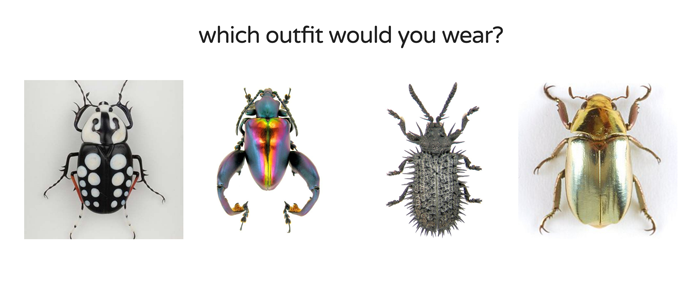
Screen Shot 2017-01-26 at 1.05.11 PM.pngWith questions like, “which outfit would you wear?” hovering over a selection of exotic beetles, their quiz might seem a little extraneous, but Mattes and Seibert say the project is intended to question the way that we define meaning in a world saturated with information. “The data is precise and tied to real values, but like more than a few political polls, probably not very reliable or even accurate. We have to consider that it may all just be a reflection of ourselves. The predominance of introversion might be the result of our own personalities leaking into the quiz. Or perhaps it’s that of reaching a fairly like-minded audience of friends and family and fellow artists who heard about the project.”
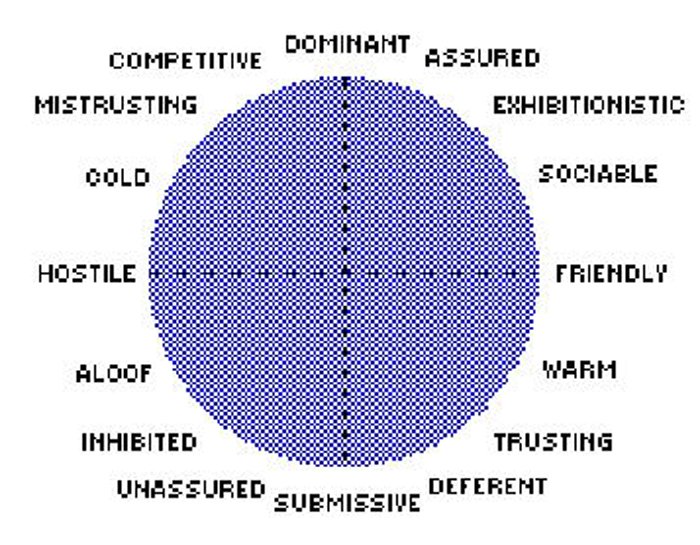
interpersonal-circumplex2.jpgAn Interpersonal Circumplex chart that helped inform the project

Both Mattes and Seibert’s individual practices informed the origins of The Shape of Things. Mattes works across multiple mediums, including weaving, which can be seen reflected in the similarities between the shapes generated by the quiz and a woven garment pattern. Seibert is a programmer whose work makes comparisons between natural and simulated environments, which is illustrated by the project’s manifestation of data as a sculptural installation. “Hopefully, the exhibition will be able to open up a deeper conversation about what the shapes mean, beyond the calculating logic of our algorithm,” says the duo.

results.pngVarious patterns created from the results of the quiz
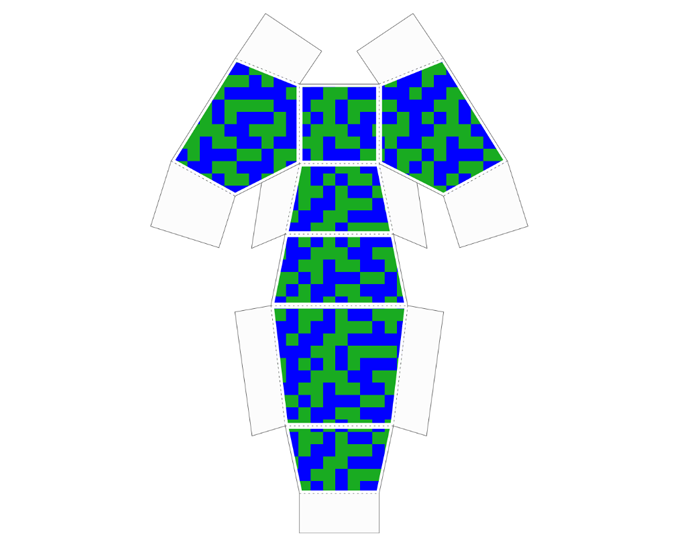
Although Mattes and Seibert worked on The Shape of Things throughout the past year, they say recent events related to the U.S. presidential election played a critical role in the final stages of the project’s evolution. “We feel our foundation of self-indulgent internet distractions pairs well with the current crisis of fake news and post-factual bubbles. In the end, each person is just one of several colorful, wonky shapes. It’s all pretty abstract but we hope that engagement with the project ​instills a sense of ​mindfulness and understanding about one another.” As the duo points out, participants are not only helping to create work for the exhibition, they also get the opportunity to print out and make a sculpture of their own. “It’s a digital project that results in something tangible and personal. We hope participants will gain a better understanding of themselves through personal contemplation.”

Screen Shot 2017-01-26 at 1.15.57 PM.pngOne of the shapes generated by the quiz, which can be printed and turned into a sculpture

Screen Shot 2017-01-26 at 12.59.39 PM.pngSome of the finished shapes


Screen Shot 2017-01-26 at 1.07.51 PM.pngThe final question in the quiz


Personality guides #circumplexus www.circumplex.us @frontspace

A photo posted by kayla mattes (@techno_weenie) on


The Shape of Things: an Interpersonal Circumplex opening in a sec at @frontspace!

A photo posted by kayla mattes (@techno_weenie) on


The Shape of Things is on display at Front/Space in Kansas City, Missouri, through the end of the month. You can see more of Kayla Mattes’ work on her website and Justin Seibert’s work on his website. And visit circumplex.us​ to determine the shape you’re in!

Related:

The Hippie Struggle for Utopia Gets Its Own Exhibition

This Quiz Tests How Well You See Color

Inside 'Dear Data,' A Year-Long Experiment in Visualizing Daily Life

10 Feb 21:48

Happy 13th Birthday, Flickr!

by Zee Jenkins
Thirteen Years of Flickr!

It’s official, Flickr is a teenager! Thirteen years young and just as full of wonder, snark, and creativity as we’ve ever been. Together with our phenomenal community of photographers from around the world, our Flickr Family, we’ve set the tone for what an online photographer’s space could be.

Before Flickr, there wasn’t an online community to store, organize, or share digital photos. Without Flickr, there wouldn’t be a global network of photographers connecting over common visual and technical interests.

flickr-13th-birthday-timeline

With exciting things to come for Flickr, we also want to recognize the amazing things that have been. We’ve put together a timeline of moments from the past thirteen years that have made this time so amazing.

For the next year, we’ll be connecting photographers and their work in new, interesting ways and we can’t wait for you to be a part of the journey with us. Throughout this month we’re putting a call out to the Flickr Community to create a gallery with their favorite 13 images. Tag the first photo with #Flickr13 and we’ll feature our favorites on the Flickr Blog and social media.

This isn’t just our 13th birthday, FlickrFam. It’s yours too. Stay rad!


10 Feb 21:47

Friday round up

by Stephen Rees

Three tabs are open in my browser right now. All about transport and relevant to this region. But none actually qualifying for the full blog post treatment since I have nothing much to say about any of them, other than my readers ought to be aware of them.

The Auditor General has released a report about the Evergreen Line

Moody Central Station, Evergreen Extension

In his audit, Doyle said that the business cases developed by the Ministry of Transportation and Infrastructure, TransLink and Partnerships B.C. and reviewed by the Ministry of Finance omitted information needed to understand the costs, benefits and risks when comparing SkyTrain, light rail and bus rapid transit options; did not explain ridership forecasts were based on assumptions that placed them at the upper end of the estimated range; and did not describe the risks from changes in complementary and competing transit services.

Actually no-one is going to be very surprised by the report. The idea that Translink might actually consider different options for the technology based on actual data seems to be quite foreign to the way things are now done in BC. The line itself was part of the regional transportation plan for years, but the NDP decided to only build the Millennium – which served Burnaby – but not the long promised link to the TriCities. Of course, in places where they do these things rationally, the line would have been built before the area was opened up for massive population growth, so of course it has been, up to now, car oriented. And there have been significant expansions to the road system – including the expansion of Highway #1 and the replacement of the Pitt River bridge. The Evergreen Line was the highest priority for the region, but the province decided to build the Canada Line instead and tied that to the Olympics.

“Meaningful consultation with the private sector and significant due diligence is required and we are taking the time to get it right,” the province said.

Which seems to me to be an admission that it was not done right, and that consultation with anyone other than business is not important.

Crosscut takes a look at High Speed Trains between here and Seattle as result of Jay Inslee (the Washington state governor) announcing a budget request for a $1m study in response to pressure from the private sector.

Freccia Argento

This one happens to be Italian – they developed the Pendolino tilting trains after British Rail abandoned the Advanced Passenger Train after attacks by the press on the “vomit comet”. BR did build a very successful 125mph HST forty years ago which did not tilt and runs on conventional tracks unlike the French TGV or the Shinkansen which need purpose built rights of way – fewer curves but can cope with quite steep grades – to achieve higher speeds. Indeed the current Cascades Talgo sets could run faster, if they did not have to fit into slots between slow freight trains.

Unid GWR HST through Exeter St Thomas

And of course the cost of a new railway is going to be the biggest issue (“$20-$30 billion to build and equip the system”) but that does not mean that much better passenger train service is not entirely feasible at lower cost, and hopefully some kind of incremental strategy will be identified, rather than blowing the budget on the unachievable “best” when “good enough” is going to win plenty of people away from terrible traffic on I5 and appalling inconvenience and discomfort of short distance international air travel.

Needless to say, others think that self driving cars are going to be the answer, although realistically are probably further off into the future than self driving trucks  as this graphic piece makes clear.

As for the hyperloop, that seems like science fiction to me and even more claustrophobic than space travel. How do you get to your seat? Or use the bathroom?

HyperLoop 2

UPDATE Feb 21 The Seattle Transit blog has taken a long hard look at what a high speed rail line might look like – the link takes you to the first of four parts


Filed under: Railway, Transportation Tagged: Amtrak Cascades, high speed rail, US High Speed Trains
10 Feb 21:47

The (In)Human Side of Exponential Organizations

by Stowe Boyd

The folks at Corporate Rebels —Joost Minnaar and Pim de Morree — met with Yuri Van Geest, co-author of Exponential Organizations, with…

Continue reading on Work Futures »

10 Feb 21:42

Daily Durning’s Friday Funny: Millennials of New York

by pricetags

From My Modern Met:

“Millennials of New York” Hilariously Parodies the Melodramas of Generation Y

mony1

“My therapist told me it was important to start being nicer to myself. I realized she was right. Now I make sure to like all my Instagram posts the second they hit 11.”

.

mony-2

“There is no such thing as white privilege. Look, I’ve had more than a few run-ins with the police, and they’re not very nice to me either. I mean just last weekend I drunkenly grabbed a cop’s gun, and even though I was obviously joking, he called me ‘incredibly irresponsible,’ and was, like, super stern and passive aggressive the entire time he was giving me a ride home.”

.

mony-3

“The Internet has had a profound effect on our way of life, and our laws should keep pace with the rapid changes in culture and technology. For example, you should be allowed to press charges against anyone who tries to hold your phone when you go to show them something on it. Like, I’m just trying to share this picture of Joe Biden eating ice cream, not explain why I have 183 toilet selfies saved to my camera roll.”

.

mony-4

“The Trump campaign has a lot in common with the tattoo of Tila Tequila I got in college – at first it was supposed to be ironic, but everyone stopped finding it funny after a couple of weeks, and now there is nothing I can do to get rid of it.”

More here.


10 Feb 21:42

Andy Yan asks the uncomfortable question

by pricetags

The Sun graphically covers the new census data:

census-growth-and-decline

In the leafy confines of Vancouver’s upscale Shaughnessy neighbourhood, the population decreased by 140 residents …  Dunbar, Arbutus Ridge and Kerrisdale neighbourhoods declined by an average of three percent.

Andy Yan puts the snarky cat among the comfortable pigeons:

yan-question

Yeah, where should that census take us?


10 Feb 21:39

Photos from the World’s Largest Collection of Female Artists Go on Display in London

by Catherine Chapman for The Creators Project

Marina Abramovic, The Hero, 2001.jpgMarina Abramović. The Hero. 2001. Photo: Lee Stalsworth. © Marina Abramovic Archives

Photo and video work from contemporary female artists goes on display at London’s Whitechapel Gallery, in a timely exhibit that uses the female body to look at identity. With work drawn from the National Museum of Women in the Arts in Washington—the world’s largest collection of female artists—Terrains of the Body showcases photos from 17 diverse and equally impressive women, including Nan Goldin, Anna Gaskell, and Marina Abramović.

These artists are each brought together at the Whitechapel exhibit through self-portraits, images, and moving image works featuring women. Their work takes on sociopolitical but also personal subjects while presenting a range of photographic techniques from over the last 20 years.

Icelandic Love Corporation, Where Do We Go from Here, 2000.jpgThe Icelandic Love Corporation. Where Do We Go from Here?. 2000.  Photo: Lee Stalsworth. © The Icelandic Love Corporation

“The theme essentially came out of looking at common interests from many of these female photographers,” show curator Emily Butler tells The Creators Project. “Many of the artists were reclaiming the representation of the female body to look at the complex subject of identity, experience, emotion and memory.”

Feminist art that came in line with the push for female equality in the 1960s and 1970s allowed for new creative perspectives, where a woman’s role in society was often put under the lens, especially in terms of global perceptions of the female body and the purpose of women at the time and throughout history. “Pushing the boundaries of performance, photography, and video,” says Butler, “these have had a great influence on many of the artists in the display.”

Hellen van Meene, Untitled (79), 2000.jpgHellen van Meene. Untitled (79). 2000. Photo: Lee Stalsworth © Hellen van Meene and Yancey Richardson Gallery

The fight for women’s rights worldwide is often taken up through the political work found in Terrains of the Body. Shirin Neshat, for instance, is an Iranian visual artist documenting a disempowerment of women in post-revolutionary Iran, and artist duo Mwangi Hutter, hailing from Germany and Kenya, look at racial equality with their moving images of fragmented bodies.

“There is a variety of different voices in the show,” says Butler. “Many of the works are indeed documents of performances or still from moving image works. We thought it was also important to include a video.”

The exhibition shows photography’s depth, where the medium can be used as a way to document a subject or else be used as a narrative tool itself, looking at the relationship between photographer and image. “The narrative that unfolds through Anna Gaskell’s work Erasers, for example, also reinforces the stories unfolding in other images of teenagers,” says Butler. “Looking at this relationship on the tension between documentary and narrative.”

Nan Goldin, Self-Portrait in Kimono with Brian, NYC, 1983.jpgNan Goldin. Self-Portrait in Kimono with Brian, NYC. 1983. Photo: Lee Stalsworth. © Nan Goldin

Last year, Whitechapel opened Is it Even Worse in Europe? an investigation from the notorious feminist art group the Guerrilla Girls, who asked art institutions across Europe about diversity within their practices, either how many female artists were in their collections or the number of exhibits they held that contained work from countries underrepresented in the art world. The exhibit, which is on until March 5, 2017, was based on a Guerrilla Girls poster from 1986, where the group pointed out how few women artists could be found, pointedly, in the American art scene.

Terrains of the Body serves as a response to the questions posed by Is it Even Worse in Europe?, providing a feminine insight into a wide range of topics and methods.

Nikki S. Lee, The Hip Hop Project (1), 2001.jpgNikki S. Lee. The Hip Hop Project (1) 2001. Photo: Lee Stalsworth. © Nikki S. Lee

Butler says Whitechapel Gallery will continue to offer a platform to celebrate the accomplishments of women in the arts. “In the week which saw the start of a new political era in Washington and internationally, it felt very relevant to showcase how artists, in particular women, can contribute to the debate on the value of diversity and the capacity for art to transcend perceived barriers of language, class and race.”

Terrains of the Body is on at London’s Whitechapel Gallery until April 16, 2017. See more here

Related:

Magical Drawings Put Women in Conversation With Their Demons

20 Female Artists' Perspectives on the Nude

21 Female Artists Reflect on the Origins of Self-Portraiture

10 Feb 21:38

LaBeouf, Rönkkö & Turner's Anti-Trump Livestream Was Shut Down This Morning

by Beckett Mufson for The Creators Project

@thecampaignbook

LaBeouf, Rönkkö & Turner's anti-Trump live stream performance, HEWILLNOTDIVIDE.US has been shut down after becoming "a flashpoint for violence," according to a statement from its host, The Museum of the Moving Image.

HEWILLNOTDIVIDE.US was a 24/7 protest initiated on Donald Trump's inauguration day and meant to last all four years of his presidency, but was active for only 21 days. LaBeouf himself could often be seen chanting the performance's title, "He will not divide us," throughout the performance's duration.

The closure is may have something to do with LaBeouf's arrest on January 26. Police told the New York Daily News that when a counter-protester came between the Transformers and Fury star and the camera, the actor-turned-artist "ripped off the man’s scarf and shoved him to the ground, scratching his face." LaBeouf was arrested on suspicion of misdemeanor assault and harassment, but released later that day. "For those of you who don't know what happened. Shia was attacked by a nazi [sic]. Shia got arrested. Nazi got away," the unofficial He Will Not Divide Us Twitter account tweeted.

The museum's statement cites, "dozens of threats of violence and numerous arrests," as their motivation for discontinuing the stream. "While the installation began constructively, it deteriorated markedly after one of the artists was arrested on the site of the installation and ultimately necessitated this action."

HEWILLNOTDIVIDE.US was a magnet for right-wing internet trolls attempting to co-opt the stream and provoke LaBeouf, and they arguably succeeded on several occasions. Aside from the incident leading to his arrest, LaBeouf shouted down a young man wearing a fedora who repeated white supremacist slogans into the camera, and also tried to snatch a Pepe the Frog poster from a young man's hands. Mosts taunts, however, didn't provoke such reactions.

"We take our commitment to the safety of our 200,000 annual visitors and 50,000 school children attending programs at the Museum seriously, along with the safety and security of our staff and community," the museum's statement continues, but LaBeouf doesn't see it that way. He tweeted an image with large block letters reading, "THE MUSEUM HAS ABANDONED US."

Requests for comment from both the artists and the museum have not been answered. There is no word yet on whether HEWILLNOTDIVIDE.US will occur at a new location.

Related:

Watch Shia LaBeouf Watch 72 Hours of Shia LaBeouf Movies

Shia LaBeouf Is Smashing Teletubbies and Screaming at AI

80 Female Artists Rally Against Trump's Sexist, Discriminatory Rhetoric

10 Feb 21:38

These GIFs of Couples Will Remind You That Love Isn't Dead | GIF Six-Pack

by Beckett Mufson for The Creators Project

GIPHY

At the crossroads of yesterday's blizzard and Valentine's Day this coming Tuesday, cuffing season has frozen over into cuddling season. If you've found someone to keep your bed warm this winter, V-day is going to be the D-day of your relationship: only the lucky will survive. These GIFs of cozy couples keeping warm will either inspire you to bring your A-game next week, or soothe your inescapable loneliness. GIFs by Thoka Maer, Kyttenjanae, Phazed, and more capture the intimate sensation of human contact, which you can feel vicariously for yourself below.

Thoka Maer

Nathan Duffy

Kyttenjanae

Mighty Oak

Phazed

See more GIFs on GIPHY.

Related:

Hand-Crafted Horror Scenes Are the Perfect Blend ofCozy & Kooky

V-Day Hearts That Don't Suck | GIF Six-Pack

The Making of Viral Sensation 'Love Has No Labels'