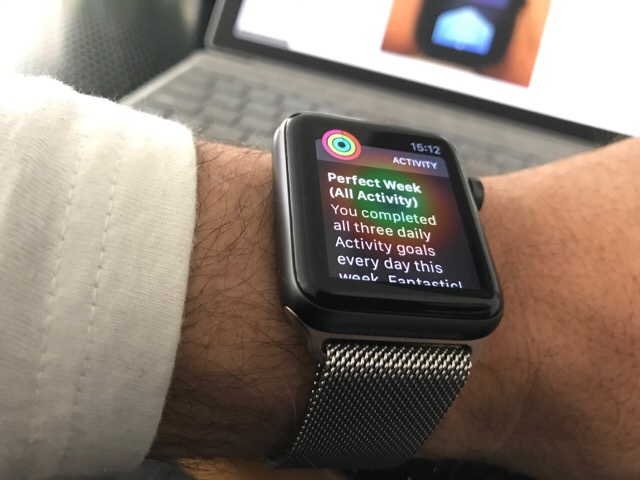
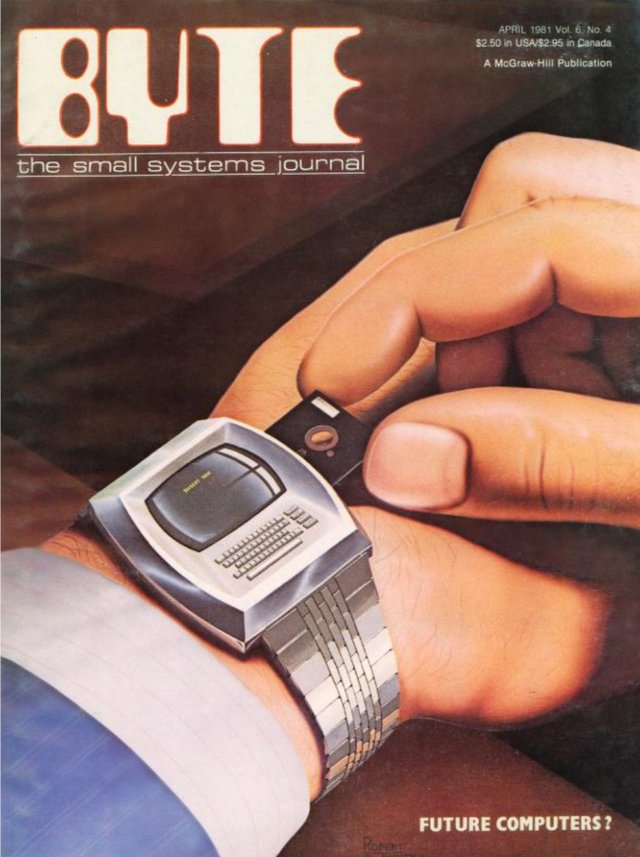
Had to try it pic.twitter.com/xr4sshBTWj
The team met with Nancy to talk about what we do, and how that supports the scholarship of teaching and learning mandate of the TI. It turned into a really deep discussion, with lots of good questions.
And, we had a mini retreat with the Learning and Instructional Design group and Learning Technologies Group, to work though how we collaborate and communicate, and to start working on our shared roadmap for the year. Again, lots of deep discussion and great questions. Best. Team(s). Ever.
I’m heading to Houston for the EDUCAUSE ELI Annual Meeting thing next week. I’ll be presenting a poster about communities of practice at the Taylor Institute. I’m looking forward to seeing what ELI is like – it’s my first time attending – but definitely not looking forward to the current cross-border experience.
Yet another deep discussion with my co-supervisor, winding up with the realization that I’ve been holding myself back in both my student and professional roles – trying to compartmentalize the roles to avoid things crossing over. Which is crazy, because that’s the whole point of the thing. So, I’m working on not holding myself back, and on owning my roles. It looks like I’m essentially developing a new field of study. That’s kind of awesome.
Lots of snow early in the week. Combined with “lift with your back, not your legs” and I wound up with Old Man Norman Syndrome™ for the rest of the week. Pulled a muscle in my back pretty severely Monday morning before work. And stayed hunched over and in pain for the rest of the week. Awesome. But it’s melting now. The snow, not the back.


This is a nice alternative to Reeder and Nextgen Reader if, like me, you’re spending a fair amount of time using Elementary but need a Feedly client.
So far the only serious gripe is that the dark theme… isn’t (there is a sizable white border around the article, and the rest of the UI is still overly bright), but it uses hjkl for navigation and runs pretty well on my (ex-)Chromebook, so it has my stamp of approval.

I’ll be keeping very close track of this over the next few months.
I have no doubt Samsung can deliver good enough hardware, but I just don’t see Google being able to polish their software to iOS-grade polish given their perennial beta approach - they have been steadily improving their online business offerings, but the jury’s still out as far as feature consistency across devices and, crucially, on whether they’ll stay the course on Chromebooks.
Maybe I’m wrong - in fact, I sincerely hope I’m wrong here, since I believe in the thin client approach for casual/personal computing, and something has to happen; the entire industry is stuck in a rut where it regards churning out cheap(ish) laptops that deliver little to no actual usability and utterly lousy user experiences.
An alpha version of the Google app (version 6.13) has been accidentally making the rounds. Some of those who have been able to sideload the update on their Android phone have discovered that a surprising new feature has been added to their device, mainly Google Assistant. The more conversational version of Google Now is currently offered on the Google Pixel and Google Pixel XL handsets, and is available through the Google Allo messaging app. If you have the opportunity to install the alpha on your phone, keep in mind that not everyone who loads it will receive Google Assistant. In addition, it is quite buggy.
While it most likely is Google’s intention to widen the distribution of Google Assistant over time, the accidental roll out of version 6.13 of Google has brought the AI feature early to handsets like the Nexus 6P, Samsung Galaxy Note 5 and the Alcatel Idol 4 among others. Some of those who have sideloaded the new version of Google have been greeted with Google Assistant once they pressed on the home button, similar to how Google Now on Tap is activated
Before you get terribly excited, the settings for Assistant only mentions the Pixel phones, which increases the odds that this is just a mistake. The accidental roll out has allowed users to also discover a new feature to Google called “Recent” that will show recently requested search topics. And a new weather card appears to be in the process of getting tested.
There still could be a rather long period of time ahead before Google officially adds Google Assistant to non-Pixel handsets. If you were able to install the accidental update and ended up with Google Assistant, tell us all about it by using the comment box, below.

image
Google is apparently adding a Recents feature so you can look at past searches

image
Google Assistant

image
Google Assistant
source: AndroidPolice via 9to5Google
The post Accidental Google alpha roll out adds Google Assistant to some non-Pixel phones appeared first on The Nokia Blog.
Note: If you are not aware that Mozilla is currently undergoing an open rebranding process, check out my previous post.
September is here! Apart Back to School we also expected news from the Mozilla Rebranding front. Out of the original 7 proposals, we are introduced with 4 revised ones, reflecting the feedback from the first round. I won’t cover this part too much as our friends from johnson banks did that already. Instead I will chime in with my feedback regarding the new proposals.
 As many others might have pointed out as well, I am a strong fan of the Protocol proposal. I believe it has a lot of potential if used right and offers a lot of flexibility. More to this later.
For me personally it’s clear that the Protocol route will be the one we should pursue here. True, there is quite a lot to evaluate and adapt here, but we can get there. Let’s have a look.

So let me give you a few reasons why the Protocol route can work out as a concept:
Having said that, there are various concerns I have with the design at this stage. Let me summarize them here:
So I decided to try my hands on it, keeping these points in mind. While this is nearer to our old identity, I believe it is a good mix between consistency and a new face.


But wait, there’s more! I also drafted out a proposal using a Slab Serif font (to match the font style of the proposal by johnson banks). I used Aelo here, which is an open font, but same principles apply here as well. I do think that a Slab Serif font might be a very nice direction for the Mozilla brand, there are however some technicalities which need to be dealt with (upper or lower-case M, extended character set, etc). Also, there aren’t any open Slab Serif fonts out there with the quality of Fira Sans. Would be exciting if Mozilla decides to change this. Fira Slab anyone?


So this is my rough take on it! In true open source style, remixed from the original proposal with changes I see fit. Obviously, this is a small part of what’s possible with the direction, but it should be enough to wake your gut feeling. What do you think?
The post Mozilla Rebranding – Feedback on “Protocol” appeared first on Elio's Corner.
Germany. Again. Always nice to visit the country I grew up in. While Germany is quite big and you probably stumble upon different variations of its cultures, I like the familiarity I am presented with here (which is most likely due to my solid German skills). Last time I was in Munich was in an airport hotel due to a canceled flight, but that doesn’t count I guess.

Anyway, I was happy to be invited by George Roter and Henrik Mitsch from the Mozilla Participation Team to help with Mozilla’s presence at Push Conference, a local design conference in Munich, Germany.
Push unites creative coding and user experience design, by offering a platform for designers, developers and UX professionals.
The @mozilla booth is ready at #push16, come see us to talk #OpenWeb pic.twitter.com/4Xg7OgEein
— Henrik Mitsch (@hmitsch) October 20, 2016
Mozilla sponsored the conference so we had a booth in the exhibition hall showcasing the Mozilla Open Innovation Toolkit and the Mozilla Open Design initiatives, including the new Mozilla rebranding and the Github repo. Although there were some opportunity to have WebVR stuff at the booth, but unfortunately most of our A-Frame Mozillians were fully booked during the weekend for some other conferences. Oh well, next time then.
Showing off lots of great @mozilla initiatives at #push16 …by the awesome @hmitsch @elioqoshi pic.twitter.com/0wBxWRci4A
— George Roter (@geroter) October 21, 2016
I loved how attendees were interested in topics related to the Mozilla values and even the EU Copyright reform, rather than classic UX Design only. We had some pretty insightful chats which was quite refreshing. Again, it’s good to see that Firefox is still widely used in Germany. Definitely a model to get a lesson from when it comes down to Privacy awareness. Henrik and me covered a lot of topics at the booth, including:
.@ameellio from @simplysecureorg on #UX for #Privacy at #push16 @push_conf pic.twitter.com/D6hukbspid
— Elio Qoshi @ ?? (@elioqoshi) October 20, 2016
I also met with Ame Elliott from Simply Secure, who connected me to the design job I got at The Tor Project. Her talk “UX for Privacy” was one of the highlights from the conference indeed. I usually don’t like following talks for more than half an hour, but her presentation was so well delivered, time flew by easily. Looking forward to the recording of the talk

Adrian Zumbrunnen was another great speaker with whom I had some good conversations regarding his work as a UX Designer at Google. It was interesting how our worlds collided coming from different perspectives of the same background. Still sticking to Open Source Design though. His talk about UI transitions was witty, funny and overall entertaining. Good vibe indeed.
Briefly also met with Philipp Sackl, the UX Lead of Firefox at Mozilla, who was one of the organizers of Push. His enthusiasm was inspiring and he has put in some quality work into making the conference happen. Always good to connect with more creatives at Mozilla.
Last but not least I want to thank Henrik (who happens to be my mentor’s mentor) for keeping me in the loop of things and facilitating my trip to Push Conference. You can find his blog post about the event on his blog.
Name: Push Conference 2016
Edition: 5th
Attendees: ~600 (approximately)
Speakers: 18
Tracks: 1
Days: 2
Booths: ~20 (approximately)
Entry: Paid
Pros:
Cons:
The post Push Conference in Munich, Germany – Report appeared first on Elio's Corner.
Howard Marks is an investor and co-founder of Oaktree Capital Management. He has a big following in the financial community for his views on markets and investing, which often stray from orthodoxy, and for his straightforward writing and speaking style. He's a lot like Warren Buffett, with less public notoriety.
This week I read Marks's latest memo [ PDF ] to Oak Tree's investors, which focuses on expert opinion and forecasting. This memo made me think a lot about software development. Whenever Marks talks about experts predicting how the market would change and how investors should act, I thought of programming. His comments sound like the wisdom of an agile software developer.
Consider what he learned from the events of 2016:
- First, no one really knows what events are going to transpire.
- And second, no one knows what the market's reaction to those events will be.
Investors who got out of the market for the last couple of months of 2016, based on predictions about what would happen, missed a great run-up in value.
If a programmer cannot predict what will happen in the future, or how stakeholders will respond to these changes, then planning in too much detail is at best an inefficient use of time and energy. At worst it is a way to lock yourself into code that you really need to change but can't.
Or consider these thoughts on surprises (the emphasis in the original):
It's the surprises no one can anticipate that would move markets most if they were to happen. But (a) most people can't imagine them and (b) most of the time they don't happen. That's why they're called surprises.
To Marks, this means that investors should not try to get cute, predict the future, and outsmart the market. The best they can do is solid technical analysis of individual companies and invest based on observable facts about value and value creation.
To me, this means that we programmers shouldn't try to prepare for surprises by designing them into our software. Usually, the best we can do is to implement simple, clean code that does just what it does and no more. The only prediction we can make about the future is that we may well have to change our code. Creating clean interfaces and hiding implementation choices enable us to write code that is as straightforward as possible to change when the unimaginable happens, or even the imaginable.
Marks closes this memo with five quotes about forecasting from a collection he has been building for forty years. I like this line from former GE executive Ian Wilson, which expresses the conundrum that every designer faces:
No amount of sophistication is going to allay the fact that all of your knowledge is about the past and all your decisions are about the future.
It isn't really all that strange that the wisdom of an investor like Marks might be of great value to a programmer. Investors and programmers both have to choose today how to use a finite resource in a way that maximizes value now and in the future. Both have to make these choices based on knowledge gleaned from the past. Both are generally most successful when the future looks like the past.
A big challenge for investors and programmers alike is to find ways to use their experience of the past in a way that maximizes value across a number of possible futures, both the ones we can anticipate and the ones we can't.

I owe you a short update on Surface Pro 4. It's currently the only computer I use. I need to recharge it twice a day and it lasts about six to seven hours on a charge. Love the Signature keyboard and trackpad. It's not a compromise and the Alcantara palm rest feels so much better than an aluminium body. I clean it up once a week with some soap and it has not turned gross in any way.
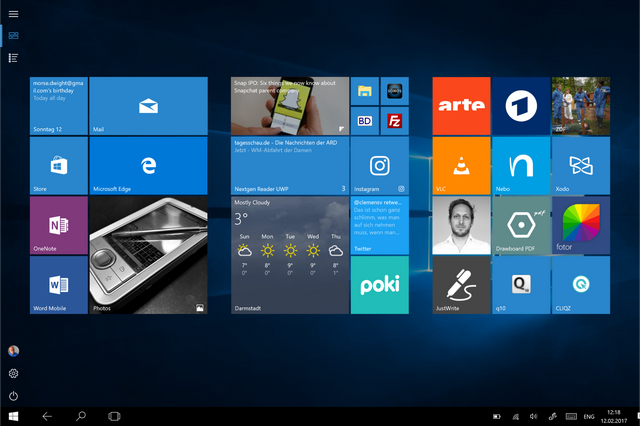
I run Windows 10 in Tablet Mode most of the time. That means all apps run fullscreen without any chrome around them. I have a few Win32 apps like Sonos, Filezilla or Blogdesk, but the majority of apps are from the store. There are only a few workflows still on the MacBook that I need to pull over. Documents are in the cloud so I can switch back and forth in a second.
Overall I consider this a full success. I could do everything on Windows 10 now. And I did not have any WaaH moments in a long while.
mkalus
shared this story
from  Kraut and Tea's YouTube Videos. Kraut and Tea's YouTube Videos.
|
Follow me on minds.com: https://www.minds.com/KrautandTea
In this Video I talk about the recent Women`s march on Washington and the hypocracy that this march represents through the figures that organized and spoke at it.
Muh Patreon: https://www.patreon.com/Kraut_and_Tea

mkalus
shared this story
from  netzpolitik.org. netzpolitik.org.
|

Ursula von der Leyen kämpft mit dem Urheberrecht. Foto: CC BY-SA 2.0 by Global Panorama/flickr
Darf die Bundesregierung die Veröffentlichung von Berichten der Bundeswehr an den Bundestag aus urheberrechtlichen Gründen verbieten? Darüber entscheidet der Bundesgerichtshof (BGH) voraussichtlich am 1. Juni. Wie die gestrige Verhandlung vor dem Gericht laut taz zeigte, wird sich die Bundesregierung vermutlich im Streit gegen die Funke-Mediengruppe durchsetzen, die die im Streit stehenden „Afghanistan-Papiere“ 2012 veröffentlicht hatte.
Die Dokumente zeigten, dass die Lage der Bundeswehr in Afghanistan prekärer war als von der Bundesregierung zuvor berichtet. Das ist auch angesichts von 16 aktuellen Auslandsinsätzen der Bundeswehr von Belang.
Im Rechtsstreit geht es vor allem um die Frage, ob die sogenannten „Unterrichtungen des Parlaments“ der Bundeswehr die nötige Schöpfungshöhe erreichen, um urheberrechtlich geschützt zu sein. Nach Auffassung der Vorinstanzen ist dies der Fall. Demnach kann die Bundesregierung eine ihr ungenehme Veröffentlichung unter Berufung auf das Urheberrecht verbieten, das viele amtlichen Werke bisher noch nicht vom urheberrechtlichen Schutz ausschließt.
mkalus
shared this story
from  Retraction Watch. Retraction Watch.
|
 The week at Retraction Watch featured the retraction of a psychology paper because of manipulation by an unnamed graduate student, and a tale about the cost of being a whistleblower, even when you’re successful. Here’s what was happening elsewhere:
Like Retraction Watch? Consider making a tax-deductible contribution to support our growth. You can also follow us on Twitter, like us on Facebook, add us to your RSS reader, sign up on our homepage for an email every time there’s a new post, or subscribe to our daily digest. Click here to review our Comments Policy. For a sneak peek at what we’re working on, click here.
Yes, you can change the behavior once.
If the reward is high enough, the nudge is big enough, and it’s a novel idea, you can get people to do almost anything once.
But one-off actions don’t lead to a sustained change in behavior. If someone joins your community to get a free eBook they’re not going to be a regular participant.
Yet we constantly try to change the behavior instead of changing the attitude towards that behavior. We increase the size of the reward instead of making the behavior itself something people want to do.
Changing attitudes is a process. It’s a process you can go through with your audience. Begin with interviewing 10 members about the behavior you want them to perform. How do they feel about it? (not what they think about it, but how they feel about it).
Isolate the exact words they use and repeat them back to them for better understanding. Now use those very words and ideas to reframe how they feel about the behavior.
Years ago I worked on a community for teachers. Participation was dire. Every member I interviewed said they were too busy to participate. Some hadn’t even had the time to read the invitation email. They classified it as yet another frustrating initiative by management that didn’t understand their exhaustion and frustration.
Notice the problem here? Anything ‘new’ we proposed was almost certainly going to be rejected because it’s yet another new initiative. More frustration = more burden. The key is to reduce the frustration.
So we relaunched the community as a place for teachers to swap quick time-saving hacks. We turned that frustration into a trigger. There must be a quicker way to do {x}, mustn’t there?
We began letting teachers estimate and track the time they had saved. It became a competition. Members wanted to feel smart. We scanned the web for teacher time-saving tips and invited the authors to give webinars. Activity exploded in weeks. We used frustration to open the door, but the sense of feeling smart (and potentially superior) to drive long-term activity.
The problem with so much advice about increasing participation is it doesn’t affect the underlying activity. It’s a quick hit in an increasingly frantic world. Many of you are struggling with participation today.
Go speak to your members. Really listen to how they feel about their community. Pick up on their mood and their emotions. Then reframe the behavior you want them to do that can match their current mood. You might be amazed at the result.

Hey, Asian guys! You’re hot! Don’t you feel better now. As a reward here is an unasked for smooch from a white woman—for free. She’s even blonde! Feel better now? No? Wait this isn’t the Valentine’s Day gift you always wanted?
As they say, all roads to hell are paved with good intentions.
It is unclear though, if the intentions of Leela Rose, an actress and self-proclaimed activist/Youtuber, were purely altruistic as she claims.
On September 30th, last year, Rose unleashed a now infamous video (trigger warning) titled Kissing Guys In Tokyo an instant sensation on the internet that went viral in a chickenpox kind of way. She prefaces the video with her sentiment that “white women can find Asian men attractive and that Asian men are not represented in Hollywood to her liking as romantic leads”. She declares that by going around Tokyo and kissing Asian men in Tokyo she wants to help fight the stereotype that Asian men are not desirable.
At this point, which is only the prelude to a white privilege nightmare, so many questions come to mind. How is a video of a white woman kissing random men on the street going to change the minds of those who run Hollywood? Moreover, her tone is completely devoid of any perspective from Asian actors who are fighting this stereotype on a daily basis, she speaks on the issue as a savior for the powerless who, conveniently are the object of her desire.
Does anyone remember Julien Blanc? Raise your hand if you do. Some are called Leela Rose a female version of the Pick-Up Artist—aka Juliette Blanc—but that is missing the point.
As her “social experiment” begins, there is a stream of horrific imagery of a blond woman forcefully launching surprise attacks on the faces of many bewildered Japanese men.
Many, after a stunned moment, go along with it.
The video continues to make the rounds on the internet but it has met with some harsh criticism, as well as scattered praise.
Japanese American playwright Leah Nanako Winkler, a vocal critic on the lack of Asian American representation in the US entertainment industry, weighs in on the issue.
“I think this white woman exemplifies clueless American entitlement–and reeks of privilege in such a destructive way that is embarrassing for our country. She is claiming to represent all western women-and I genuinely think she believes this because of the exact cultural biases she is claiming to criticize: she’s white and blonde and fits into the ‘ideal’ female beauty standards perpetuated in American culture -when in reality she cannot speak for anyone except for herself. As an American Woman- I’m mortified people like her are the clueless avatar for our country.”
Winkler further dissects “She is still fetishizing Asian men because she’s conflating all Asian identities into one- and making assumptions about an entire country (Japan) and its social politics regarding male desirability. Men in Japan as a whole don’t have problems getting laid in Japan.* How dare she assume they want her? It’s a level of entitlement that is next level honestly. American white women need to educate themselves before they speak up on Asian American issues…look what happens. It’s like white savior complex dressed in glitter and stupidity.”
It is worth repeating that Asian-American culture/people and other Asian cultures/people are not the same thing as Leela Rose assumes. Sexualizing one does not elevate the status of the other. In other words, objectification has never been empowering.
Another angered viewer, Greek woman Persephone Narra and her Korean American husband Kim Du Han uploaded a Youtube video in response. Han claims that if he was suddenly kissed on the street by a white woman he doesn’t know “he would know that she invaded my privacy and that it was sexual harassment and completely inappropriate.” Persephone stresses that if this were a man kissing random women, it would be sexual assault and the man would be in jail. She concludes the video saying, “No one in Hollywood is going to consider Asian men desirable because a girl sexually harasses them on the street.”
They go further by confronting Leela Rose on Facebook. When pressed to take the video down, Rose claims that she has apologized multiple times and that, “I’m not taking anything down because what I feel that I’m doing is right and I’m taking a stand for something that I care deeply about! I’ve gotten too much positive remarks from the Asian men to take this down. I will continue to try my best to promote more leading Asian men in the film industry whether people agree with my method or not.”
In other words: Watch out Asian men! Blond Face Sucker is on the loose!
As an Asian woman, writer and actor, I thought I’d ask Rose a few questions. She has yet to respond and she may never do but here they are. Some food for thought.
-Do you have Asian actor friends?
-Have you had conversations with them about their lack of representation in the industry? If so what was their response to your video?
-Have you gotten any positive feedback from the Asian American actor communities?
-Did you know that this would be controversial when you were making it? Were you surprised that some people are offended?
-Did all the men you kissed in the video consent to you before the shooting? (It seems in one instance you are informing them of the shoot after you have made out with them)
-Some people are drawing comparisons to you and Julian Blanc, a dating coach, who went around in Tokyo pushing Japanese girls’ faces to his crotch and preaching that foreign men can get away with this in Japan. How would you differentiate yourself?
-What other things can you do to help the Asian actors on their lack of representation?
-Would you recommend that other white females make these videos too so it becomes a movement?
-Other than Hollywood not thinking Asian men are desirable/fit for lead roles, what other problems are causing lack of representation in your view?
-How do you feel about the lack of representation in Hollywood for Asian actresses?
-You have said in other interviews that you are sexually attracted to Asian men. Would you say, you took advantage of this cause to help them being acknowledged as an opportunity to simultaneously fulfill your personal desires/agenda?
-In a different interview you stated you are attracted to Asian men. In your mind are Asian Americans and Asians for instance Japanese men the same? You point out that Japanese men are shy to approach women but also rail against the stereotype Hollywood has given them as nerds and losers. If you wanted to change the image of Asian American men, would it not be more effective to carry out this “experiment” in the US on Asian American men?
Gentle readers, how would you answer these questions?
*The writer would like to point out that while this is true, not many people in Japan are having sex these days but this is another issue entirely.
If you watched the Grammy Awards last night, you may have caught the news that the ‘Really Blue’ Pixel is finally making its way north of the 49th Parallel.
Google announced the news in a one-minute TV spot. In an email to MobileSyrup, the company confirmed on Monday that the ‘Really Blue’ Pixel is coming to Canada. The smartphone will be available exclusively at Rogers, seemingly in limited quantities.
There is no word yet on pricing. However, MobileSyrup will have more information on the launch later this week. Until then, check out the commercial if you haven’t already.
The post Really Blue Google Pixel ‘coming soon’ to Rogers appeared first on MobileSyrup.

We’ve all been there.
It could be something as simple as visiting a different coffee shop than usual or as involved as driving across the country, but either way, there’s not a Wi-Fi hotspot in sight.
Wi-Fi Maps might be the solution you’re looking for. With a free version and a pro version of the app, both local adventurers and globetrotters are able to locate and find passwords for local Wi-Fi hotspots almost anywhere in the world.

Not only does the app include over 100 million accessible Wi-Fi hotspot locations, but users are also able to input passwords for locations they’re visited for other users to access later.
While the free app is ideal for users looking to avoid data overages from downloading apps, playing videos and checking email, while on the go. The travel version on the other hand is a great tool for frequent travellers who have trouble finding reliable internet while hopping the globe.
Another interesting difference between the two versions is that pre-populated Wi-Fi passwords are viewable in offline mode with the free version, though the app automatically stores all the Wi-Fi info while in offline mode with the pro version.
The pro version is available for $4.99 CAD, and offers some great perks despite the wide functionality of the free app. Wi-Fi Map is available on both iOS and Android.
The post Never be without internet again with ‘Wi-Fi Map’ [App of the week] appeared first on MobileSyrup.
One of the main downsides to chatbots is their lack of practical functionality.
Don’t get me wrong, I love chatting with AIs, but it gets old eventually. After all, how long can you chat with something that replies to half of your statements or requests with “I don’t understand”?
That’s why a bot like Postcard Bot is refreshing — not only does it have a practical purpose, but that purpose addresses a significant real-life issue that is ideally solved by a messaging platform: it helps you shoot off super quick postcards.

Postcards have long been a thorn in my side. I love the idea of sending them to my family and friends while I’m travelling, but due to the general whirlwind of activity that occurs with vacations I never actually make it to the post box. Often, at the end of my trips I’m left with a handful of filled-out postcards that have been rendered useless by the delay.
With Postcard Bot, you can upload a picture to the bot from your phone, write out the message for the back and enter the address all through conversation. The bot then sends you a mock-up of the postcard and asks you to give your stamp of approval. Once you do, it provides you with a link to pay $2.99 USD postage with your credit card. If you’ve already logged your credit card with the site, it will simply ask in the chat whether you’d like to charge the card it has on file by replying “yes.” At the end of the process, you’ve crafted your own custom postcard, written it and sent it in mere minutes. Now that’s practical.
The Postcard Bot is available through Facebook Messenger and SMS (find the number here).
Postcard image credit: Zach Gilbert
The post Mail custom postcards in no time with Postcard Bot [Bot of the Week] appeared first on MobileSyrup.
The short answer: NO, you shouldn’t.
Well, let me adjust that answer – no, you shouldn’t if you are planning on buying more books and adding weight to your backpack. I did, and it was PAINFUL. But I’ve also taken my Everything Notebook everywhere without any problems (I just need to control my desire to acquire books all the time).
Change of plans: for future conferences, I won't be bringing my #EverythingNotebook along pic.twitter.com/jE8xd19RlA
— Dr Raul Pacheco-Vega (@raulpacheco) February 11, 2017
Those of you who have adopted my “only use one single notebook for everything associated with research, students, fieldwork, To-Do lists, weekly plans, yearly plans” approach (aka The Everything Notebook) know that I carry it EVERYWHERE. As in, everywhere. I’ve taken it to conferences, workshops, to the beach (during my holidays). But this week, after travelling to Bloomington and Indiana for a full week, I have decided that I will no longer be recommending that my fellow academics bring their Everything Notebooks everywhere. I’ll explain why in the paragraphs below.
I’ve been thoroughly impressed that many fellow academics (students, professors, practitioners, folks who are adjacent to academia) have taken to adopt my Everything Notebook approach.
@raulpacheco always room for more. This is my travel set up. And first year using an #everythingnotebook thanks to you
pic.twitter.com/DVfNTVfWjB
— Shane B Duggan (@ShaneBDuggan) February 3, 2017
I am both grateful and excited that my method works for them. As a result, I have taken to analyzing my own behaviour with respect to how I use it and what changes need to be made to make it more efficient. I wrote this post in response to my own assessment of how I felt about bringing a rather heavy Everything Notebook everywhere. I noted on Twitter recently that I travel everywhere with my Everything Notebook and my writing kit (a set of 10 colours’ Staedtler 0.3mm fine liners and a set of plastic hard tabs).
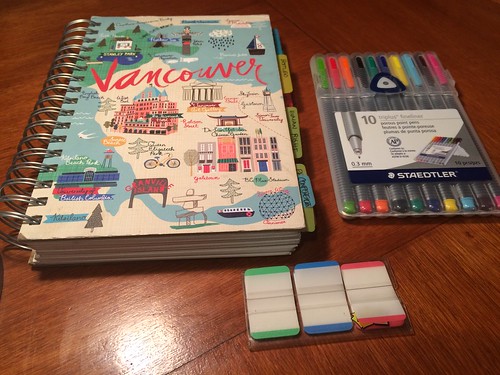
But this week, I got five books, and I brought along my stainless steel travel mug and water bottle. Obviously, as you add more weight to your laptop bag, it starts creating a strain in your back. I am EXHAUSTED. It’s Saturday (I flew into Indianapolis on Monday, was in Bloomington Monday night, Tuesday and Wednesday and went to Indianapolis on Wednesday night, where I presented at a workshop Thursday and Friday, until I flew back today).
I feel EXHAUSTED.
I wondered why this would be the case, and then I realized as I removed my travel mug, water bottle AND Everything Notebook, that my laptop bag all of a sudden felt MUCH lighter. This is one of the reasons why people seem to be unable to take up the Everything Notebook. If, like me, they chose a very thick notebook to assemble their Everything Notebook, with hard covers and all, it will become VERY cumbersome when bringing it along EVERYWHERE. And their back may suffer, as mine has, all this week.
I figured out something that might help.
As I suggested in this post, on the rare occasions when I have taken notes at conferences and I did not bring my Everything Notebook, I take the following approach: I staple the pages to a blank page within the section of my Everything Notebook where I have filed ideas about a specific project.
.@Sparkyk197 on page insertion: sometimes I write in loose pages (conference). I staple them to Everything Notebook pic.twitter.com/dzraAM5k5o
— Dr Raul Pacheco-Vega (@raulpacheco) November 2, 2016
For example, as noted in the tweet above, last year I took notes when I was presenting at the Public Management Research Conference, and what I ended up doing was bringing those notes along with me and stapling them to my Bottled Water section in the 2016 Everything Notebook. I explained this idea in more detail in this post.
I still will try to carry my Everything Notebook everywhere if the travel doesn’t become too cumbersome. But right now I’m carrying 5 heavy books in my laptop bag, plus stainless steel water bottle and coffee travel mug, so my back is in pain. Thus, I’ll leave my Everything Notebook at home when I travel to conferences and workshops (where it’s likely that I will buy books) and then just staple the pages to the specific section where they go.
These days it’s hard not to feel a sense of doom and gloom surrounding Windows 10 Mobile.
A series of major services have withdrawn their apps from the platform in the last few weeks and even Microsoft appears to have admitted that the operating system is more trouble than it’s worth by dropping support for the Windows Mobile version of Minecraft.
With that in mind, I admit that I felt a pang of regret that Windows isn’t a viable option as my everyday mobile OS when I tested Hewlett Packard’s Elite X3. As a premium phone that deserves to stand alongside the likes of the iPhone 7 and Google Pixel, the Elite X3 is a phablet fan’s delight. Yet, the reality is that very few people are likely to experience it because of the operating system it runs on.

Microsoft has been trying to position Windows 10 Mobile as the best choice for productivity-oriented users and the Elite X3 is squarely aimed at that market. With an OS that matches HP’s ambitions, the Elite X3 could be the ideal phone for anyone who frequently flies business class. The 5.96-inch WQHD AMOLED screen is massive and brilliantly sharp, which makes manipulating Excel spreadsheets and writing Word documents on-the-go easier than it is on probably any other phone on the market (and the screen is great for watching HD movies on, too). Then, at the office, there is the option to kick into Continuum if the additional hardware is available.
Under Continuum the phone’s Start screen becomes the Start Menu and UWP apps are scaled appropriately for a computer monitor. The Elite X3, with its Qualcomm Snapdragon 820 2.15 GHz processor and 4GB of SDRAM, handles Continuum without a problem.

Furthermore, with the specially-designed Desk Dock, which comes in the $999 CAD bundle currently advertised on Microsoft’s Canadian store, you can hard wire the phone to a monitor via HDMI and to the web through Gigabit Ethernet as well attach USB-A (x 2) and USB-C (x 1) devices such as printers and external hard drives.
HP is understandably trying to get across these advantages by promoting the Elite X3 as a phone that gives a PC-like experience. Unfortunately, because of software limitations, the reality doesn’t match up with the marketing. There are still too few UWP apps and too many constraints on multitasking under Continuum to give a phone connected to a monitor the power and versatility of a PC regardless of how convenient the display scaling is.

Continuum is a nice bonus if you’re travelling between offices and need to write e-mails, run off a report or make edits to a presentation without wanting to lug a laptop around. If you need more than that, though, Continuum isn’t going to cut it.
As a productivity tool, therefore, the Elite X3 is let down by the current capabilities of its OS. Inevitably, that also applies to everyday use. There is a lot I like about Windows 10 Mobile: it’s fast, familiar and visually different from its more successful competitors. Even so, it feels like a neglected platform. The lack of apps is well-publicized and you can’t even stream to a Chromecast without feeling like you’re fudging it. Moreover, too many services can now only be accessed through a web browser, which is never as convenient as using a dedicated app, even on the Elite X3’s large screen.
None of Windows 10 Mobile’s limitations should distract from the merits of the Elite X3’s hardware, though. You certainly get your money’s worth in mass because the Elite X3 is a giant. Hewlett Packard gives the phone’s length and width as 161.35mm x 83.57mm.

That’s 3 mm longer and over 5mm wider than the iPhone 7 Plus and bigger still than a Pixel XL. It is also 0.6 mm thicker than both of these phones. With those dimensions, the Elite X3 is a phone that only The Incredible Hulk will be able to operate with one hand. Still, the weight is comfortable and the matt metal back doesn’t feel slippery.
The post HP Elite X3 Review: A super phablet that’s stuck with a faltering OS appeared first on MobileSyrup.
mkalus
shared this story
from  TorrentFreak. TorrentFreak.
|
 There a thousands of options for people who want to store files online and Google Drive is one of them. The cloud hosting service allows users to store all content imaginable, videos included.
Whether it’s wise or not, some people even use Drive to store pirated files. This usually doesn’t cause any problems but when they’re shared in public, alarm bells may start to go off.
This week we received a tip from a reader who was unable to share a link to a screener copy of a Hollywood blockbuster. Instead of a public link, Google drive warned that sharing the file in question could violate its terms of service.
Through a follow-up test, we were able to replicate the result. Google Drive didn’t specify what the violation was but instead linked to information about the DMCA takedown procedure as additional information.
Error
So what’s going on here? We contacted Google directly to find out more about the process involved, and how files are flagged as copyright-infringing. Unfortunately, the company wasn’t very forthcoming.
“We don’t comment on the details of our anti-abuse mechanisms on Drive,” a Google spokesperson replied.
Luckily, we were able to find some more information in a transcript from a Copyright Office Roundtable that took place in San Francisco last year. Here, Google was asked about its anti-piracy policies.
During the discussion, Fox Entertainment Group’s Elizabeth Valentina pointed out that several prominent piracy platforms use Google as a video host, as we previously highlighted as well. She then added that hash filtering could make a huge difference here.
Google’s legal director for copyright Fred Von Lohman did not refute this claim but mentioned that Google drive already uses hash matching to detect infringing material.
“I just want to note that, contrary to Ms. Valentina’s statement or suggestion, Google Drive does hash matching. So we do that, another voluntary measure,” Von Lohman said at the time.
No concrete details were provided, but it’s likely that Google Drive records the hashes of content for which they receive valid takedown requests. These hashes are unique to the file in question, which makes it possible to identify copies accurately.
If other Google Drive users then attempt to share a copy of the same file, they are blocked from doing so. However, merely storing the file in a private Drive account doesn’t raise any red flags.
Hash filtering is not something new for cloud-hosting services or even Google. Dropbox, for example, has had a similar system in place for several years, and YouTube’s Content-ID system also relies on hash filtering.
That said, the Google Drive equivalent isn’t well known to the public, or even rightsholders, it seems.
Source: TF, for the latest info on copyright, file-sharing, torrent sites and ANONYMOUS VPN services.
I remember watching The Paperchase and hoping my twenties would be like that. They weren't.
Thirtysomething. Same.
Now it's Great Canal Journeys. Maybe it'll be third time lucky.
A Vancouver art gallery is letting visitors take selfies with some of Vincent Van Gogh’s most famous paintings.
For the next six weeks, the Ian Tan Art Gallery on Granville Street will host a free exhibition of nine Van Gogh masterpieces. People can go in and take as many pictures as they want with the art and upload them to social media.
The Van Gogh paintings on display here are limited and numbered multiples from the originals, certified by the Van Gogh Museum in Amsterdam. “With the naked eye you can’t see the difference,” said exhibition owner Ian Tan in a statement. “They combine high quality technology, with dedicated craftsmanship and expertise that encompass the traveling Van Gogh Museum Edition roadshow.”
The gallery will also host painting contests, as well as lectures by experts on the Dutch master and films featuring his work.
“It’s a rare opportunity for art lovers to link themselves physically to the extraordinary expression of color that makes Van Gogh the legend without being jostled or told to move on by a museum guard,” Tan said.”
The Ian Tan Gallery will be open daily from 10AM to 6PM PST, Monday through Saturday, and from 12 PM to 5 PM PST on Sunday. The Van Gogh show will run from February 11th until March 24th.
Source: Newswire
The post Take selfies with iconic Van Gogh paintings in Vancouver appeared first on MobileSyrup.