Shared posts

17 Feb 02:06

The Long Tail Of Outdated Responses

by Richard Millington

Old discussions become neglected discussions.

Neglected discussions are filled with outdated advice.

If most of your new visitors arrive via the long-tail of search, your community could inadvertently send most of your audience to outdated information.

There is a manual and automatic solution to this.

1) Periodically review and update discussions.
You can’t keep every discussion up to date. But you can go through the top 50 landing pages of your community via Google analytics and check the information/solutions remain accurate. Better yet, ask for volunteers who might like to help you go through the top 500.

2) Let members highlight outdated information.
StackExchange have an option for members to improve answers from old discussions. Other communities allow members to flag outdated information. A simpler manual solution is to ask members to periodically flag outdated information and enable a simple option alongside or within discussion posts to highlight bad material (pop-up warning boxes on discussions more than 1 year old also work).

3) Add useful contributions to a database.
Document and add information to a central database of information. Instead of relying on keeping old discussions up to date, simply tag and properly categorize new information and try to link discussions to that section instead. Over time search should naturally push people to this information.

4) Remove, review, and update old discussions.
Automatically remove old discussions or set up a system to review discussions after several months. Periodically flag discussions from a year ago for a further review. Decide to remove redundant information, update information, or revamp everything.

Done right you continually keep discussions fresh and content relevant to all members. You can give most members the answer before they even ask the question. That’s pretty powerful.

17 Feb 02:06

R for Excel users

by Nathan Yau

For Excel users getting started with R, pain oftentimes finds its way into the learning process. Gordon Shotwell feels your pain and provides a primer to shifting to a different approach to your data.

At the beginning, when you are trying to accomplish simple things like balancing a budget or entering some data by hand, R is definitely harder to learn than Excel. However, as the task gets more complex, it becomes easier to accomplish in R than Excel, because the core structures of Excel are designed for relatively simple use cases and are not the best for more complex problems. This isn’t to say that you can’t solve a lot of complex problems with Excel, it’s just that the tool won’t make it easy for you.

Worth that little bit of extra effort in the beginning IMHO.

Tags: Excel, R

17 Feb 02:05

The “Secret Sauce” to Scaling Up Quality Education in Developing Countries


Julia Gillard, Jenny Perlman Robinson, Stanford Social Innovation Review, Feb 19, 2017


According to this article, "we know that large-scale progress, in both getting children into school and learning, is possible." It being Stanford, a certain amount of scepticism is warranted (83 page PDF). The 'secret sauce' is actually a combination of "14 core ingredients that appear to contribute to scaling quality learning, with the right combination depending on the context," grouped into four areas:

  • Design - "develop  programs and policies that students, parents, or teachers actually want— not ones that governments, practitioners, or funders think they need
  • Delivery - "not new gadgets to replace teachers, but tools to help overcome a specific barrier, such as poor roads or a lack of reading materials."
  • Finance - "stability, flexibility, and predictability in financing are critical for scale that leads to lasting changes in children’ s learning."
  • An enabling environment - "government must accept responsibility for ensuring a quality education for all, reaching out to a range of partners, and considering new ways of improving learning."

It's hard to disagree with any of these points, but the difficulty is always in the details. How do you determine what learners actually want? How do you deal with the scale of delivery problems? What are the mechanisms for stable finance? How do you convince increasingly reluctant governments to take responsibility for education?

[Link] [Comment]
17 Feb 02:05

eSight launches new smart glasses promising 20/20 vision for the legally blind

by Jessica Galang

Toronto-based eSight, which develops wearables allowing the legally blind to see, has launched a new pair of smart glasses.

The company said that its latest smart glasses, eSight 3, allows the legally blind or those living with low vision to see with 20/20 vision. The glasses capture the user’s surroundings and transform the footage into a form more palatable for the blind eye – essentially, filling in each user’s blind spot.

“One of the many ingenious features of eSight 3 is that it simultaneously increases the central field of view of sight while preserving full access to peripheral vision, providing the best of both worlds: unprecedented mobility and high-acuity central vision,” said Dr. Robert Devenyi, chief ophthalmologist at Toronto’s University Health Network said.

When using the device, wearers can shift seamlessly between near, mid and long-range vision thanks to its autofocus. Because of its WiFi and HDMI capabilities, users can also stream content and send pictures and videos.

“eSight 3 is a game-changer for the legally blind,” said Dr. Brian Mech, president and CEO of eSight. “My entire career has been spent engineering sight-enabling technologies, so I can say with some authority that eSight’s world-class lab is the largest and best engineering team, anywhere in the world, that specializes exclusively in developing medical devices that allow the legally blind to actually see and be mobile.”

The company also announced the launch of an affordability program to improve access to the device, which will provide potential users with funding opportunities. These include discounts for clinical study participation, low or no-interest payment plans, tax credits, government support programs, corporate job placements, philanthropic donations, and crowdfunding.

In July 2015, the company was reportedly achieving a public listing via reverse takeover, thanks to combination with Damon Capital Corp.

This story was originally published by Betakit.

The post eSight launches new smart glasses promising 20/20 vision for the legally blind appeared first on MobileSyrup.

17 Feb 02:02

Samsung Posts a Video Highlighting Extensive Quality Assurance Tests It Runs on Its Smartphones

by Rajesh Pandey
Samsung has been working hard on restoring consumer confidence into its brand since the Galaxy Note 7 battery fires last year. The company even published detailed results of its investigation into the battery fires and announced an eight-point safety check for all its devices going forward.  Continue reading →
17 Feb 02:02

"In history, this is where Congress steps in. During the Vietnam War, Watergate and the Iran-contra..."

In history, this is where Congress steps in. During the Vietnam War, Watergate and the Iran-contra scandal, when a president’s actions or policies crossed the line, Congress investigated and held the White House to account. The time has come for it to do so again.

In the last week alone, Americans have witnessed the firing of President Trump’s national security adviser, Michael Flynn, and learned with shock and incredulity that members of Mr. Trump’s campaign and inner circle were in repeated contact with Russian intelligence officials.

Coming on top of credible information from America’s intelligence agencies that Russia tried to destabilize and influence the 2016 presidential campaign, these latest revelations are more than sufficient reason for Congress to investigate what Moscow has been up to and whether people at the highest levels of the United States government have aided and abetted the interests of a nation that has tried to thwart American foreign policy since the Cold War.

Given that context, one might expect Mr. Trump to be clamoring for details that would eliminate any suspicion that his administration is in league with an enemy. Instead he has waged an unhinged attack on the intelligence agencies themselves, praising President Vladimir Putin of Russia at every turn and pointing fingers everywhere but at himself, while refusing to take a single step to resolve questions about his administration’s ties to Russia.


-

Time for Congress to Investigate Mr. Trump’s Ties to Russia - The New York Times

Trump is setting the stage for his own impeachment, which is perhaps inevitable if in fact he knew of, or suggested, contact with Russian intelligence services.

17 Feb 02:01

Apple reportedly has plans to launch a 4K Apple TV in 2017

by Patrick O'Rourke

Apple is preparing to launch a 4K Apple TV, according to a new report stemming from Bloomberg.

The 5th generation Apple TV — currently internally codenamed J105 — could launch as soon as later this year, with rumours citing the device will support “more vivid colours,” possibly alluding to the set-top box featuring high dynamic range (HDR) functionality, a feature that’s become standard on modern 4K televisions. It’s worth noting that 4K TVs that support HDR don’t feature a wide colour gamut, a standard that’s necessary to produce a true high dynamic range image.

It seems overarching goal of the Apple TV is still to replace cable set-top boxes in order to stream live TV, though Apple continues to run into roadblocks when it comes to negotiating deals with cable companies. At one point, the Apple even considered bundling a video game controller with the Apple TV in order to compete directly with the Xbox One and PlayStation 4, says Bloomberg. Other prototype Apple TVs included coaxial connectors designed to directly replace traditional cable boxes, with plans to collect fees from viewers and share revenue with cable companies.

While this lofty project hasn’t panned out, Apple launched a pared down TV app exclusively in the U.S. in December. The app is designed to give users a central location for streaming content on the set-top box, but it’s been criticized for lacking integration with many popular streaming platforms, particularly those that feature live video.

While Apple doesn’t reveal how many Apple TVs it sells, the Cupertino-based company has acknowledged that there was a decrease in year-on-year sales from 2015 to 2016. Research firm eMarketer has backed up these stats, releasing analytics that indicate that since the 4th generation Apple TV’s release in Fall 2015, the set-top box has steadily lost its market share. In January, just under 12 percent of connected television customers were using the device, according to eMarketer’s study.

Apple also recently hired Timothy Twerdhal, the former head of Amazon’s Fire TV project, to spearhead its Apple TV set-top box ambitions.

The tech giant has been dabbling in original programming lately, with its “Carpool Karaoke: The Series” and a reality TV show called “Planet of the Apps,” debuting exclusively on Apple Music in April and spring, respectively.

Source: Bloomberg

The post Apple reportedly has plans to launch a 4K Apple TV in 2017 appeared first on MobileSyrup.

17 Feb 02:00

Where are the “Transitioning Buyers” Going?

by Sandy James Planner

image

The Globe and Mail‘s Kerry Gold reports on a new wave of condo buyers that is happening at a faster pace than expected. Seniors instead of holding on to their equity rich housing until infirmity forces them into supportive care facilities appear to be cashing out and moving to condominium developments, many with similar  square footage on the floor plate as their previous homes.

Called “the transitioning buyer” these older condo purchasers will spend approximately half their equity in their new abode.Developers including “Nic Paolella, director of development for Marcon Developments in Vancouver, says he’s seeing the beginning of a potential flood of downsizers that will become one of the biggest drivers of the condo market. Marcon is a mid-size condo developer with a projected 1,000 units coming on the market this year.”

“This is the tip of the iceberg in terms of amount of capital out there for downsizer buyers,” he says. “We are only at the start of that wave. We are in for a lot more, and it could be a five- or 10-year run of the aggressive downsizer buyer,” he says. “And they have specific interests of where they want to be – often, in a similar neighbourhood to where they were living. Often, they want walkability and access to amenities without a car.”

With the high prices commanded by Vancouver housing, sellers can also now negotiate to continue to live in their homes until their respective condos are ready for occupancy. This can also be for the buyer’s benefit as “if the new buyer plans to tear the house down, as they usually do, it’s more difficult to remove a full-time paying tenant. And if the house is left empty, the owner is looking at paying the new vacancy tax.” 

Despite the cooling off of Vancouver housing prices this year, the Teranet-National Bank home price index still shows prices up 17 per cent from 2015.  “Long-time realtor Stuart Bonner, who specializes in expensive west-side Vancouver properties for Re/Max, says he’s seeing retirees taking a more “proactive” approach. “Nobody would have predicted what prices have done in the last three or four years. People are saying, ‘My house is worth what?’ They are stunning numbers. A lot of people are saying, ‘I’ve got to take some money off the table.’ These are educated people who realize it won’t go straight up forever.”

8e86f1da-5b3f-4dc6-83c1-21e4b065d881-downsizing-costs


17 Feb 02:00

For Whom Does the Massey Bridge Toll?

by Sandy James Planner

bc-massey-province-130920

The lack of Provincial response to the concerns of adjacent municipalities and mayors to the impending Massey Bridge mega-billion dollar construction project is truly the sound of one hand clapping. The Province is sure that the bridge is good for the Port and its own concepts of  twentieth century commercial trucking and traffic, and nothing is swaying their determination to foist this behemoth upon us.

The Richmond News  and Graeme Wood reports that the Mayor of Richmond, Malcolm Brodie was “disappointed yet unsurprised that the provincial government issued environmental approval for the 10-lane, $3.5 billion bridge. The concerns raised by Richmond about this project have continually been ignored throughout the public consultation and environmental assessment processes.”  The Federal Government, who could have also done a Federal review, has refused to do so, saying it is outside their mandate. However, as Councillor Harold Steeves notes, a similar Federal review was done for the Port Mann Bridge. So why the change?

And why does the Massey Tunnel need to be removed? Could this not be used for mass transit or a bicycle link? But no, “according to Geoff Freer, executive project director of the George Massey Tunnel Replacement Project, the four-lane tunnel cannot be left beneath the river because it poses a risk to dyke stability during an earthquake. However, the City of Richmond is not aware of any special risks to the dykes associated with the tunnel.”

Of course if the tunnel is removed it allows for bigger ships to  go up and down the Fraser River’s south arm, increasing industrialization of farmland. And here is the weird part-“The provincial environmental assessment certificate issued Thursday calls for the tunnel to be filled in beneath the dyke and the four connecting tubes to be dug up from below the river bed.”

There is a Metro Vancouver water line that is pesky and in the way. That will need to be moved to allow for deeper dredging for big ships. What’s interesting is the certificate does not  “assess the implications of such dredging, as tunnel decommissioning would not directly change the size of vessels using the river; the certificate only addresses the footprint of the bridge.”

If you are not already confused, Mayor Brodie has stated that since the bridge’s towers are on land (Provincial jurisdiction) and do not directly impact the river, the federal government will not be involved. Never mind the fact that the removal of the tunnels will cause massive river bed disturbance. And Minister of Transportation Todd Stone is calling the ten lane Massey Bridge a “green bridge” now because it is reducing idling. 

The bridge is counter to a regional transportation plan supported by all the region’s mayors except for Delta’s mayor who supports the bridge in her jurisdiction. Mayor Brodie is supportive of a cheaper tunnel alternative, and also brings up the fact this bridge complicates regional road pricing. You can be sure this bridge will be tolled. The tolling fee is not announced, but will be higher than the Port Mann bridge because “The bridge’s initial cost is higher than the Port Mann Bridge and traffic projections show it will see less traffic.”

You just can’t make this stuff up.

gbcnh151216ted_tnb_1


17 Feb 02:00

iPad Diaries: Advanced File Management and Research with DEVONthink

by Federico Viticci

As I wrote in my story on one year of iPad Pro, I consider cloud services a necessity for managing files on iOS. Dropbox and iCloud Drive make it possible to keep the same sets of documents and app libraries synced across devices, but, more importantly, they help overcome iOS' file management woes through centralized storage spaces. In the article, I espoused the flexibility of Documents and its tight integration with Dropbox, noting how Readdle had built the missing iPad file manager with features Apple omitted from their iCloud Drive app.

Since early January, I've been thinking about my larger writing projects scheduled for 2017 and whether Documents can scale as a reference and research tool. Looking back at 2016 and the time I poured into organizing and referencing files for my iOS 10 review draft in Scrivener (which I covered here), I realized that neither Scrivener's built-in file manager nor Documents could meet the basic requirements I have set for this year's review. These include the ability to search different file types with advanced operators as well as a system to reference individual files and folders throughout iOS with local URLs. It was during this meta-research phase1 that I decided to try DEVONthink To Go again.

Get More iOS Productivity Tips and Workflows

With a Club MacStories subscription, you’ll gain access to weekly iPad workflows, iOS app recommendations, and other exclusive extras.

Starting at $5/month, Club MacStories includes MacStories Weekly – a newsletter delivered every Friday with a focus on iOS productivity and showcasing new and interesting iOS apps. One of MacStories Weekly’s regular sections is the Workflow Corner – a weekly assortment of iPad workflows, iOS automation tips, and tutorials curated by Federico and the MacStories team.

As a new member, you’ll also receive complete access to our back catalogue of over 80 newsletter starting from September 2015.

You can find out more about Club MacStories here, or subscribe directly below.


I briefly mentioned DEVONthink To Go last year when I explained how I was archiving PDF versions of our newsletters in the app. DEVONthink isn't completely new to me: years ago – before my move to iOS – I used DEVONthink Pro as an Evernote replacement on OS X for a few months. I eventually abandoned the app because I didn't need its power-user features at the time, and Evernote was good enough.

Today's DEVONthink To Go is a deeply different iOS counterpart than the lightweight client DEVONtechnologies launched in 2010. While the first iOS version was a glorified viewer for the desktop app, the latest DEVONthink To Go is a capable mix of a file manager and research tool that takes advantage of native iOS features. DEVONthink for iOS still doesn't sport feature parity with macOS (particularly in terms of AI-infused document filing options), and there are some functionalities I'm not interested in, but there's also a lot I enjoy and want to implement in my longform writing projects.

In DEVONthink, you can set up multiple databases and individually sync them with multiple cloud services. One of the app's immediate advantages over alternatives is that you can choose Dropbox sync on a per-database basis and add encryption (with a passphrase) on top.

In the Location Sync settings, you can even select whether DEVONthink should always keep a downloaded copy of your files or if it should only download them on-demand and discard them once you're done viewing them. The latter is a nice solution to the problem of keeping thousands of documents in the cloud but having limited storage space on an iOS device.

A semi-hidden feature that piqued my interest is DEVONthink's support for file and group links. All of the app's supported document types (plain and rich text files, media, bookmarks, web archives, and more) can be organized in groups (folders). By long-tapping any file or group you'll get a 'Copy Item Link' button that will generate a DEVONthink URL to re-open a document or folder inside DEVONthink from anywhere on iOS.2

DEVONthink's item links are consistent across platforms: you can get a link to a screenshot stored in DEVONthink for iPhone and it'll open the same file on the iPad (and Mac) as well. The ability to create permanent URLs for files and groups is unique to DEVONthink, and I'm considering it as a way to organize my iOS 11 research material this summer. With an easy way to recall external items, I could spend less time in Scrivener's file manager and insert temporary DEVONthink file URLs in my draft to reference images or PDFs.3 Plus, I'd be able to set up launchers with Workflow and Launch Center Pro to quickly access items for any longform story I'll work on throughout the year.

There are a few options to create and send new files to DEVONthink. The 'Clip to DEVONthink' share extension is solid: webpages are clipped with a preview image, URL, and description; files such as images and PDFs are copied into the app, and the extension is also supported in Photos for copying multiple images at a time to DEVONthink (which will be nice to batch import screenshots for app reviews).

There's a URL scheme to create bookmarks and text notes in DEVONthink, but I've mostly used the app's built-in 'New Item' dialog to manually add files to my database. This menu includes a useful media picker with shortcuts for the last photo taken and a photo from your clipboard. There's also automatic recognition of copied URLs that prompts you to add a bookmark.

Speaking of which, bookmarks were one of the reasons I started exploring DEVONthink in the first place. For a while now, I've felt the need to permanently archive webpages I may need again in the future (such as technical documents and videogame guides). DEVONthink has some fantastic options for saving webpages from Safari and Safari View Controller.

A webpage shared with the extension can be a bookmark, a Markdown (text-only) version of the page, or a web archive in DEVONthink. Mac users should be familiar with the web archive format: when saved this way, a webpage becomes an offline document that retains the original design and content of the web version. Imagine Reading List's ability to save articles for offline consumption in their original format, but with actual files that you can organize in a database.

A webpage saved to DEVONthink as a web archive.

A webpage saved to DEVONthink as a web archive.

Webpages saved as web archives in DEVONthink become standalone copies that I can access when I'm offline4; they don't disappear if the source page is pulled from the Internet, and, unlike PDFs, they're fully interactive in terms of text selection and tapping embedded hyperlinks. I appreciate being able to manage and categorize web archives alongside images and PDFs, but, mostly, I'm relieved I'm not keeping dozens of open tabs in my browser anymore.

Aside from saving and managing files, DEVONthink stands out thanks to its advanced search feature. There's nothing like DEVONthink when it comes to searching for text matching specific conditions in a document or group of documents. DEVONthink supports search with Boolean operators, which include the NEAR and XOR flags; with these two options I can search for phrases that are within n words of each other, or where either one result or the other is present, but not both, respectively.

The NEAR search operator lets you find phrases close to each other.

The NEAR search operator lets you find phrases close to each other.

DEVONthink's Boolean search has been a terrific addition to how I find workflows and apps I already covered in past issues of MacStories Weekly. If I remember I once wrote about the Spotify API, for example, I can search for NEAR(Spotify API, 10) and DEVONthink will look inside the Club MacStories PDF group and return documents where the words "Spotify" and "API" are separated by no more than 10 words. DEVONthink's search parameters are an aspect of the app I want to master going forward – though I wish these advanced queries could be assembled visually, perhaps with a dedicated search UI like on DEVONthink for Mac.

Finally, I ought to mention that DEVONthink 2.1, released earlier this month, brought a document provider to open and edit files in other apps. If you've followed the evolution of document providers on iOS, you know it's rare to find developers who invest time in integrating their apps' file management features with iOS' document provider APIs.

Editing a Markdown file from DEVONthink in Ulysses.

Editing a Markdown file from DEVONthink in Ulysses.

Not only does DEVONthink let you pick files stored in its database from other apps – it lets you edit them externally, too. This opens up some intriguing possibilities: Ulysses and iA Writer can now edit Markdown documents stored in DEVONthink; webpages in Safari can look for files in DEVONthink when you tap an 'Upload' button; perhaps more impressively, you can open a DEVONthink PDF in PDF Expert, make edits in Readdle's app, and find your changes automatically reflected and still editable in DEVONthink.

Like others, I don't use document providers on my iPad as much as I should, but DEVONthink's multifarious editing tools and integrations are a good reason to start.


DEVONthink To Go goes beyond Apple Notes' simple but effective note-taking and Documents' traditional file management features. On the surface, it's an advanced file manager that can be used to move notes and files around, but I see it more as a powerful research tool for documents you need to reference, search, and integrate with other iOS apps.

I believe DEVONthink's thoughtful blend of excellent capturing and search tools, unification of file formats, and inter-app document linking can help me offset the limitations of file management on the iPad. For this reason, I'm going to adapt DEVONthink to my writing workflow for longform stories I have planned this year. I'm glad I took DEVONthink for another spin.


iPad Diaries is a regular series about using the iPad as a primary computer. You can find more installments here and subscribe to the dedicated RSS feed.


  1. Research about research tools? Sounds about right. ↩︎
  2. Tomorrow's issue of MacStories Weekly (#67) will include a tip about DEVONthink's 'Copy Item Link' for advanced note organization within the app. ↩︎
  3. Which would be especially convenient with Scrivener and DEVONthink in Split View on the iPad Pro. For context, last year's iOS 10 review research material consisted of 20 sub-folders in Scrivener with about 1200 screenshots and dozens of PDFs. ↩︎
  4. I've run into a bug where the same web archive can be accessed offline on the iPhone, but it throws up an error if I'm offline on the iPad Pro. ↩︎

Support MacStories Directly

Club MacStories offers exclusive access to extra MacStories content, delivered every week; it’s also a way to support us directly.

Club MacStories will help you discover the best apps for your devices and get the most out of your iPhone, iPad, and Mac. Plus, it’s made in Italy.

Join Now
17 Feb 02:00

Yahoo may be warning users about another potential data breach

by Jessica Vomiero

Yahoo just can’t seem to catch a break.

Following a series of massive breaches that painted 2016 for the struggling internet giant, Yahoo has reportedly been emailing users, warning about state-sponsored attackers that may have breached their accounts.

This past September, Yahoo revealed a hack that reportedly affected over 500 thousand users, followed by an announcement of a million-user breach just a few months later.

While the extent of the latest attack remains unknown, reports suggest that malicious activity may have taken place on user accounts between 2015 and 2016.

Yahoo confirmed the breach on Wed. February, 15th, and in a statement sent to the Associated Press, the Sunnyvale company tied the development to the “state-sponsored actor” behind the breach of one million user accounts between 2013 and 2014. Some of the data stolen during this hack includes email addresses, birth dates and answers to security questions.

Also over the past year, Yahoo was in communications with Verizon to sell its email service, websites and mobile applications to the telecom giant. Following these breaches however, Yahoo’s discussions with Verizon were reportedly strained. 

In fact, it was reported yesterday by the New York Times that the two companies are approaching a cheaper deal that takes almost $300 million of the original $4.8 billion deal.

Under the new terms, which is expected to be announced in a few days, the two companies will apparently share legal responsibility for the data breaches.

Source: Associated Press 

The post Yahoo may be warning users about another potential data breach appeared first on MobileSyrup.

16 Feb 07:27

The gutting of the Foreign Buyer's Tax - might it be Krusty's Achilles Heel?

by Whisperer (noreply@blogger.com)
mkalus shared this story from Whispers from the Edge of the Rainforest.


In our last post we outlined how the our intrepid Premier, Krusty Clark, and the BC Liberals appear to had bowed to pressure from the Real Estate Development community and gutted the 15% Foreign Buyers tax implemented last summer.

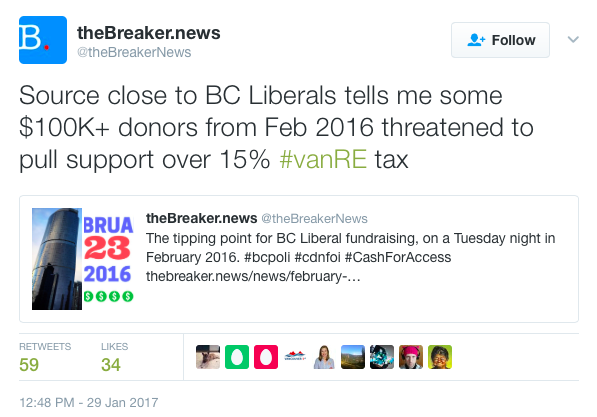
Muckraker extraordinaire Bob Mackin advises sources tell him bigwig Developers threatened to withhold huge political donations to the BC Liberals unless they guttered that tax.


Krusty and Co. caved and not only undid the immensely popular move that addressed an out of control real estate market, but they also threw short term fuel on the housing bonfire by introducing a first time home buyers plan that gives young kids the necessary downpayment to get into the housing market. The introduction of this latest moral hazard into the housing mix is just the panacea the condo developers needed to boost a sagging real estate market in clear correction mode.

Combined with the gutting of the 15% Foreign Buyers tax, it will be interesting to see the results at the end of the month.

Just how significantly are the FB tax changes

Another growing name in muckraking media hall of fame is Ian Young, who writes for the South China Morning Post.  In a regular column titled "the Hongcouver" (a title which would have gotten any caucasian crucified by the PC crowd), Young outlines Vancouver’s foreign buyer tax and the work-permit loophole ‘you could drive Highway 99 through’

Young outlines how the rationale for the BC Liberal governments plan to offer exemptions to the tax is sound "assuming that the goal of the tax is to improve affordability by preventing foreign capital further skewing a market that had become detached from local incomes (and is not, say, a pre-election political tactic)."

The theory is that people who live and earn locally should not be unfairly punished.

But when you look at the changes, even the simple minded can see the real intentions of the changes.  As Young writes, "offering foreign-buyer-tax exemptions to work permit holders was a 'Swiss cheese' proposal. “The term ‘work permit’ is too vague to implement the intention (as) foreign-funded buyers pursue permits primarily to escape the tax. There’s a risk that new grads, backed by foreign funds and/or acting as proxies, will dive in."

With less than 100 days to the Provincial election, the BC Liberals are in full campaign mode.  Desperate to preserve political donations, they pragmatically axed the popular move they made last summer by responding to overwhelming public demand to deal with the massive amount of cash (created by the unprecedented excess credit being created in China) sloshing around the world.

But in doing so, the BC Liberals may have created a weakness in their election machine which the politically adept should be exploiting like they were the rebel alliance attacking the Death Star.

The link between the changes and Real Estate Development slush fund money slaps you in the face.  Public anger has not abated from the damaging effects all this malinvestment is having on our communities.

The only saving grace for the BC Liberals may be the inept BCNDP and the mainstream media.

Rather than fully focus on the link, the spotlight has been on a pointless harangue about false allegations of BCNDP computer hacking by the BC Liberals.

No one cares.

And in the process the real scandal that should inflame the voting public is being shoved to the back pages.

It is exactly these types of scandals which ultimately brought down the BC Socreds and Bill Vander Zalm, Glen Clark's NDP, and lead to the resignation of Gordon Campbell.

But BCNDP political ineptitude appears to reign supreme. Horgan has failed to capitalize.

The Vancouver Sun is showing signs of following up, but Krusty is deftly promoting the entry level buyer angle and is successfully throwing up teflon on the silly computer hacking story.

We'd be willing to suggest that throwing the R/E Industry the 'first time homebuyers' bone would have been sufficient to address donation slippage. Gutting the Foreign Buyers Tax and the apparent linkage to massive R/E Developer political donations is their achilles heel.

Will the BCNDP exploit this explosive connection?

The gutting of the Foreign Buyers tax is THE fulcrum that could swing the 2017 election.  

So far the Opposition has failed to capitalize on it.

==================

Photobucket
Email: village_whisperer@live.ca
Click 'comments' below to contribute to this post.

Please read disclaimer at bottom of blog.
16 Feb 07:26

Wed Post #2: The Vinyl Cafe is closed. RIP Stuart McLean

by Whisperer (noreply@blogger.com)
mkalus shared this story from Whispers from the Edge of the Rainforest.


If you ever browse the radio dial and have come across the CBC, you have invariably heard Stuart McLean and the Vinyl Cafe.

The Vinyl Cafe is an hour-long radio variety show hosted by Stuart that is broadcast on the Canadian Broadcasting Corporation's radio service and is syndicated to approximately 80 U.S. public radio stations through Public Radio International. The program is also available as a podcast, although the podcasts are usually just McLean's stories for studio episodes because of copyright restrictions on recorded music. CBC Radio also currently airs a weekday afternoon program, under the title Vinyl Cafe Stories, which consists of two previously recorded Dave and Morley stories per episode.

The show features essays, fiction and music; while frequently humorous, the weekly programs are also often wistfully nostalgic. The live episodes often begin with Stuart reciting a complimentary description of the venue's community about its character and history. The show also endeavours to introduce listeners to new Canadian musical talent, through playing recordings in studio episodes and performances in the live audience ones.

A major feature of many of McLean's shows are the "Dave and Morley Stories", which feature a fictional Toronto family. The name "Vinyl Cafe" refers both to the show's musical content and the fictional record shop owned by McLean's character Dave. This aspect of the show is priceless and if you ever get a chance to listen to "Christmas At The Turlington's", you'll never let a Christmas season pass without it being part of your holiday ritual.

The Vinyl Cafe stopped touring and producing new episodes following McLean's diagnosis with melanoma in November 2015. On December 13, 2016 McLean announced he required a second round of treatment, meaning further delay in producing new episodes, and that repeats of past shows would stop airing on CBC Radio One effective January 2017 to "make room for others to share their work on the radio."

Moments ago CBC announced that Stuart McLean has passed away. A truly iconic voice of Canadiana has been silenced and will be missed.

RIP Stuart. You brought joy, humour and the occasional life reflection to the airways.  Thank you.

==================

Photobucket
Email: village_whisperer@live.ca
Click 'comments' below to contribute to this post.

Please read disclaimer at bottom of blog.


16 Feb 07:26

No, Canada’s economy will not collapse if Trudeau stands up to Trump

by Michal Rozworski

Trudeau met Trump on Monday but voiced no criticism. He stayed mum on Trump’s racist travel bans for Muslims and refugees—silent even about Canadian Muslims being arbitrarily denied entry at the US border. Many commentators in the media were quick to jump to Trudeau’s defense, excusing his total lack of spine with considerations of real economik: Canada’s trading relationship with the US is too valuable for us to go even mildly criticizing Trump.

trudeau-trump-m

Of course, Canada’s economy does rely heavily on the United States. But while over 75% of Canada’s exports go to the US, our trade relationship looks different than what many imagine it to be. And, in fact, the economy is much less of an excuse for Trudeau’s cowardice than it seems at first glance.

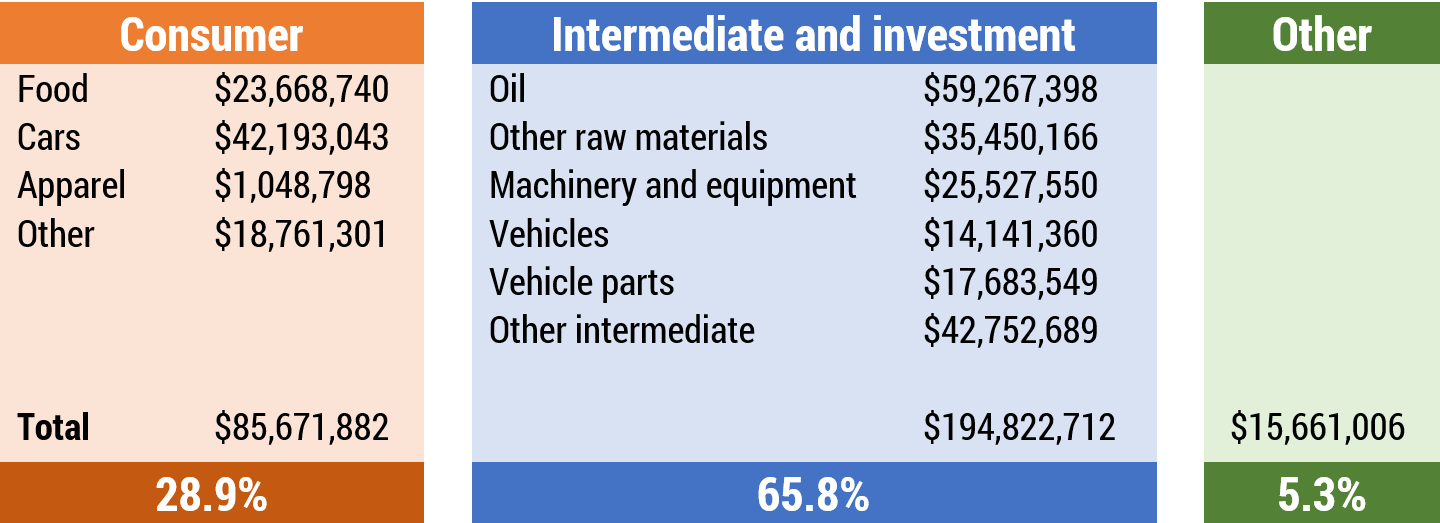
Here’s how Canada’s exports to the US break down:

20170215 Trudeau and trade

The data is for 2015 and comes from the US Census. This is a simple but informative exercise, one modeled on an analysis J.W. Mason published on his excellent blog a few weeks ago that looked at US trade with Mexico. (I highly recommend J.W.’s piece because it draws some bigger conclusions about how trade is related to the economy at large.)

The main thing to notice is that roughly two-thirds of Canada’s exports go to the US go to American businesses not consumers. We sell twice as many raw materials, machinery, parts and other intermediate inputs for production to US companies as we do SUVs or camping gear to US consumers. This is very different from the picture most of us have of trade, which likely involves only finished consumer products crossing the border.

In his analysis of US-Mexico trade, J.W. Mason found something very similar: about two-thirds of Mexican exports to the US also go the business sector. His conclusion was that Trump’s threatened tariff on Mexican goods would raise costs for US businesses much more than it would cause American consumers to switch and “Buy American”.

My argument is similar but aimed at a Canadian audience: any major breakdown of trade would not only be costly for Canadian exporters, it would also be very damaging for US business. Trump and his team have suggested as much themselves, talking only about “tweaking” NAFTA terms with Canada. (It is highly likely they understand this to be the case with Mexico as well but a brewing trade dispute there is part of something unrelated (and more sinister): fomenting national security and immigration fears.) Remember too that even before NAFTA, trade between our two countries was already very free. In short, an imagined trade war should not be a blanket excuse for Trudeau to avoid criticizing Trump.

None of this is to argue that there is no imbalance in the Canada-US trade relationship or that Canada wouldn’t suffer disproportionately more in the unlikely event of a real trade war. As a friend pointed out, trade with Canada exceeds 10% of GDP in only US two states, whereas all but two Canadian provinces have trade volume with the US in excess of 15% of GDP. But without breaking down how trade functions in the continental economy, these numbers on their own don’t illustrate the degree of mutual dependence between Canada and the US.

The point to remember is that there would be intense pressure from within the US business world to prevent a trade war in the first place. Given today’s highly integrated supply chains, even a proportionately small volume of trade can still be crucial. It matters less that trade with Canada accounts for just 5% of GDP if some of that 5% is specialized parts and inputs that can cripple production. And it’s not that easy to replace Canadian-made goods in this case: doing so would require long-term investments with considerable fixed costs in plant and equipment. It could be done, but it won’t be the result of one critical statement.

Nevertheless, Trudeau acts as if that’s a real risk. Even if there might be no personal love lost between our cosmopolitan neoliberal leader and his nativist protectionist counterpart, officially this week it was all smiles and handshakes. Trudeau ducked questions from reporters at his joint press conference, stating, “The last thing Canadians expect is for me to come down and lecture another country on how they chose to govern themselves.” This condescension misses the fact that a majority thinks that even worsening trade relationships would be a price worth paying for standing up to Trump—nevermind that fears of a worsening are overblown. Past prime ministers have been willing to stand up to US presidents over smaller things despite the trading relationship.

Trudeau has to be aware of Canada’s unequal standing in its relationship with the US but he doesn’t have to cower in the corner waiting for a strike from the bully that may never come. Being in less powerful in a trading relationship doesn’t equate to moral paralysis in other spheres. Economic disruption cannot be a cover for lack of spine. My hunch is that Trudeau knows this—that his failure to stand up to Trump is cowardice that has its source in political calculation not economic necessity.

16 Feb 07:26

ggalt 0.4.0 now on CRAN

by hrbrmstr

I’m uncontainably excited to report that the ggplot2 extension package ggalt is now on CRAN.

The absolute best part of this package is the R community members who contributed suggestions and new geoms, stats, annotations and integration features. This release would not be possible without the PRs from:

  • Ben Bolker
  • Ben Marwick
  • Jan Schulz
  • Carson Sievert

and a host of folks who have made suggestions and have put up with broken GitHub builds along the way. Y’all are awesome.

Please see the vignette and graphics-annotated help pages for info on everything that’s available. Some highlights include:

  • multiple ways to render splines (so you can make those cool, smoothed D3-esque line charts :-)
  • geom_cartogram() which replicates the old functionality of geom_map() so your old mapping code doesn’t break anymore
  • a re-re-mended coord_proj() (but, read on about why you should be re-thinking of how you do maps in ggplot2)
  • lollipop charts (geom_lollipop())
  • dumbbell charts (geom_dumbbell())
  • step-ribbon charts
  • the ability to easily encircle points (beyond those boring ellipses)
  • byte formatters (i.e. turn 1024 to 1 Kb, etc)
  • better integration with plotly

If you do any mapping in ggplot2, please follow the machinations of geom_sf() and the sf package. Ed and the rest of the R spatial community have done 100% outstanding work here and it is going to change how you think and work spatially in R forever (in an awesome way). I hope to retire coord_proj() and geom_cartogram() some day soon thanks to all their hard work.

Your contributions, feedback and suggestions are welcome and encouraged. The next steps for me w/r/t ggalt are ensuring 100% plotly coverage since it’s the best way to make your ggplot2 plots interactive. There are a few more additions that didn’t make it into this release that I’ll also be integrating.

Please make sure to say “thank you” to the above contributors if you see them in person on on the internets. They’ve done great work and are exemplary examples of how awesome and talented the R community is.

16 Feb 07:25

Wired Wednesday: Nimb, Pinterest Lens & PowerRay

by John

This week on News 1130 radio in Vancouver, I spoke about these tech topics for Wired Wednesday with Ben Wilson:

  • Nimb: Smart ring panic button (source)
  • Pinterest Lens: Shazam for real world objects (source)
  • Powerray: underwater drone finds fish (source)

Listen here

The post Wired Wednesday: Nimb, Pinterest Lens & PowerRay appeared first on johnbiehler.com.

16 Feb 07:25

Gofun offers electric car rental for RMB 1 per hour

by Guest Editor

Editor’s note: A version of this post by Charles Liu first appeared on the Beijinger, a leading source of English-language lifestyle information on the city of Beijing.

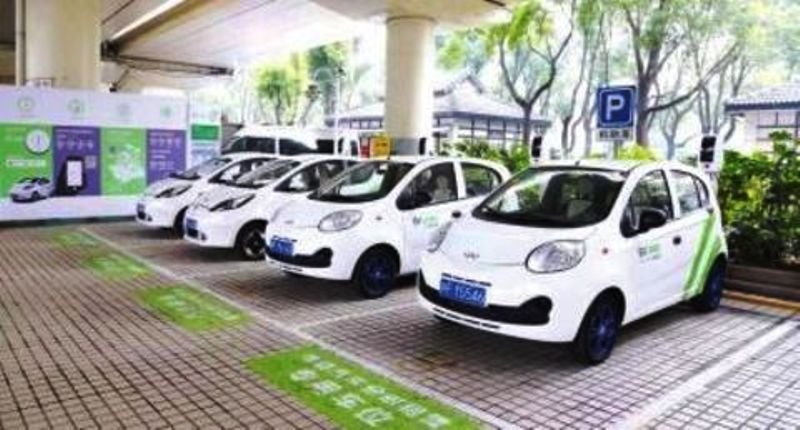
Beijing’s sharing economy has taken a huge step forward with the recent announcement that some 5,000 electric cars will be available to rent on a time-sharing basis in the city within two years.

By using the Gofun app, Beijing residents will be able to rent an electric car at a rate of just RMB 1 per hour.

With some 1,100 cars already available in Beijing, Gofun will add another 2,000 cars by the end of this year, and another 3,000 by the end of 2018.

Making this car-sharing service especially practical is that they will be available in the capital’s central district. 40 to 50 locations along the Second and Third Ring Road are planned to be converted into retrieval and parking locations for the electric cars.

These locations, which will make use of vacant space under overpasses and bridges of the ring roads, will also be equipped with electric car recharging stations in order to broaden the recharging network for Beijing’s growing electric car user base.

Renting an electric car using Gofun is very similar to the Ofo and Mobike online-to-offline (O2O) services that have taken off over the past few weeks in Beijing.

After downloading the app, Gofun users will register on their phone using their personal identification and driver’s license. After authentication, which takes just one hour, users will be given GPS-based directions on how to locate their rental car, which will honk upon their arrival.

Previous plans called for a payment rate of 1 yuan/1 kilometer. Additionally, users were offered a flat fee payment option of 10 yuan that would free the user of having to pay any car damages in case of accident of up to 1,500 yuan.

Gofun’s big emergence comes after last year’s merger of heated Chinese ride-sharing competitors Uber and Didi Chuxing. Meanwhile, some analysts are predicting that the current competition between Ofo and Mobike will also result in a merger.

Gofun currently operates in four Chinese cities and has future plans to extend its Beijing network outward to include neighboring Tianjin and parts of Hebei.

For a city as polluted as Beijing, any initiative to promote alternative energy comes as a breath of fresh air. City authorities have encouraged electric car use by lifting licensing quotas for electric car users.

It’s not clear if this service will be offered to expats living in Beijing.

Image credits: GasgooDahe

16 Feb 07:25

LG G6 UX 6.0 Features Detailed: Food Mode for Camera App, Improved Multitasking, More

by Rajesh Pandey
LG has released a short 12-second teaser video highlighting and provided more details about its upcoming UX 6.0 that will be debuting with the G6 later this month. Continue reading →
16 Feb 07:24

Dream Chaser Spacecraft May Be Used For Hubble Repair Mission

by Evan Gough
mkalus shared this story from Universe Today.

The final servicing mission to the venerable Hubble Space Telescope (HST) was in 2009. The shuttle Atlantis completed that mission (STS-125,) and several components were repaired and replaced, including the installation of improved batteries. The HST is expected to function until 2030 – 2040. With the retiring of the shuttle program in 2011, it looked like the Hubble mission was destined to play itself out.

But now there’s talk of another servicing mission to the Hubble, to be performed by the Dream Chaser Space System.

A view of the Hubble Space Telescope from inside space shuttle Atlantis on mission STS-125 in 2009, the final repair mission. Credit: NASA

The Hubble was originally deployed by the Space Shuttle Discovery in 1990. It was serviced by crew aboard the shuttles 5 times on 5 different shuttle missions. Unlike the other observatories in NASA’s Great Observatories, the Hubble was designed to be serviced during its lifetime.

Those servicing missions, which took place in 1993, 1997, 1999, 2002, and 2009, were complex missions which required coordination between the Kennedy Space Center, Johnson Space Center, and the Goddard Space Flight Center. Grasping Hubble with the robotic Canadarm and placing it inside the shuttle bay was a methodical process. So was the repair and replacement of components, and the testing of components once Hubble was removed from the cargo bay. Though complicated, these missions were ultimately successful, and the Hubble is still operating.

The robotic Canadarm during STS-72, as Space Shuttle Endeavour mission in 1996. Image: By NASA – https://archive.org/details/STS072-722-041, Public Domain, https://commons.wikimedia.org/w/index.php?curid=29803999

A future servicing mission to the Hubble would be a sort of insurance policy in case there are problems with NASA’s new flagship telescope, the James Webb Space Telescope (JWST.) The JWST is due to be launched in 2018, and its capabilities greatly exceed those of the Hubble. But the James Webb’s destination is LaGrange Point 2 (L2), a stable point in space about 1.5 million km (932,000 miles) from Earth. It will enter a halo orbit around L2, which makes a repair mission difficult. Though deployment problems with the JWST could be corrected by visiting spacecraft, the Telescope itself is not designed to be repaired like the Hubble is.

Since the JWST is risky, both in terms of its position in space and its unproven deployment method, some type of insurance policy may be needed to ensure NASA has a powerful telescope operating in space. But without Space Shuttles to visit the Hubble and extend its life, a different vehicle would have to be tasked with any potential future servicing missions. Enter the Dream Chaser Space System (DCSS).

The Dream Chaser Space System is like a smaller Space Shuttle. It can carry seven people into Low-Earth Orbit (LEO). Like the Shuttles, it then returns to Earth and lands horizontally on an airstrip. The DCSS, however, does not have a cargo bay or a robotic arm. If it were used for a Hubble repair mission, all repairs would likely have to be done during spacewalks. The DCSS is designed as a cargo and crew resupply ship for the International Space System. The much larger shuttles were designed with the Hubble in mind, as well as other tasks, like building and servicing the ISS and recovering satellites from orbit.

The DCSS is built by Sierra Nevada Corporation. It will be launched on an Atlas V rocket, and will return to Earth by gliding, where it can land on any commercial runway. The DCSS has its own reaction control system for manoeuvering in space. Like other commercial space ventures, the development of the DCSS has been partly funded by NASA.

The primary mirror of the James Webb Space Telescope is unfolded once it's in space. If it fails to deploy properly, NASA may need to use the Dream Chaser to keep the Hubble Telescope operating instead. Image: NASA/Chris Gunn

The primary mirror of the James Webb Space Telescope. Image: NASA/Chris Gunn

The James Webb has a complex deployment. It will be launched on an Ariane 5 rocket, where it will be folded up in order to fit. The primary mirror on the JWST is made up of 18 segments which must unfold in three sections for the telescope to function. The telescope’s sun shield, which keeps the JWST cool, must also unfold after being deployed. Earlier in the mission, the Webb’s solar array and antennae need to be deployed.

This video shows the deployment of the JWST. It reminds one of a giant insect going through metamorphosis.

If either the mirror, the sunshield, or any of the other unfolding mechanisms fail, then a costly and problematic mission will have to be planned to correct the deployment. If some other crucial part of the telescope fails, then it probably can’t be repaired. NASA needs everything to go well.

People have been waiting for the JWST for a long time. It’s had kind of a tortured path to get this far. We all have our fingers crossed that the mission succeeds. But if there are problems, it may be up to the Hubble to keep doing what it’s always done: provide the kinds of science and stunning images that excites scientists and the rest of us about the Universe.

The post Dream Chaser Spacecraft May Be Used For Hubble Repair Mission appeared first on Universe Today.

16 Feb 01:33

We Are Not Agreed

by Stephen Downes

A few days ago University Ventures authored a piece in response to a post from the New America Foundation comparing Republicans who defend for-profit colleges to climate change deniers. The unattributed University Ventures article argues "this piece re-fights yesterday’s war... the many challenges and opportunities facing higher education lend themselves to bipartisan consensus – perhaps more than any other area of public policy."

Bipartisanship is of course a U.S. phenomenon. But it is worth noting that there are many things U.S. lawmakers agree upon that are opposed in corners around the world. I find myself frequently occupying those corners, and today is no exception. So, setting aside the for-profit colleges debate for another day, I'd like to take the time to point to the points where I disagree with what is taken to the the emerging consensus.

The text in italics is their contention; what follows is my response.


1. Completion is the most powerful lever

The author makes the very reasonable point that "drop rates approaching 50% at many four-year institutions and 80% at many two-year colleges" represents a failure of traditional post-secondary institution, and responds that "there’s no 'free college' silver bullet to the complex completion challenge."

But completion is not the powerful lever that drives everything else; it is the pointless anchor that weighs everything down. It is becoming increasingly untenable to stop everything in your life to complete four or eight years of studies, especially when the mechanisms for delivering that education are increasingly inefficient and expensive.

Indeed, completion would be irrelevant as a lever were it not for the mechanism of granting recognition only at the end of the four or eight year program. To be sure, students value those degrees and diplomas. They have no choice; there's no other way to earn recognition for their learning.

As recognition becomes more distributed, however, we will see other more fundamental levers emerge: the requirement that learning be relevant, that it help us solve problems, that it support networking and collaboration, and that respect our personal interests and abilities.


2. Bachelor’s degree “addiction” is hurting students

The author argues that "it takes a Candide-like idealist to continue to insist that a bachelor's degree is the optimal or only path to establishing the core cognitive and non-cognitive executive function skills that lead to successful white collar careers."

The disagreement here is not whether we're questioning the relevance of the Bachelor's degree. It is actually rather more subtle than that.

First, this second point can be seen as code for "we need to restrict the number of people admitted into Bachelor's programs," with the idea that alternative schools - trade schools, business skills schools, etc. - would emerge to pick up the slack. We see this in the allusion to "successful white collar careers", which already assumes the separation between advanced education and trades. The idea here is that white collar workers are the new tradespeople. But returning universities to their original position of offering education to the elite is not what I would consider a progressive step forward.

Second, this second point continues to carry the presumption that the point of education is to lead you step by step toward a future career. We see this in phrasing like "optimal or only path". The presumption that education amounts to preparation should be challenged. This may be one function of education, but it is not the only one, nor even the most important one. There's no end to the stories about students being 'prepared' for a future that no longer exists. Education should be addressed toward capability, not preparation.


3. Colleges need to do much more to help graduates get great jobs.

The author's point here is that colleges and universities "must ensure students are equipped with the technical skills employers increasingly require for entry-level positions." The idea of colleges and universities being preparation for the employment, whether for one's first job or eventual career, is anathema to many. From my perspective it's not a matter of faith but of common sense: chasing after "what employers want" is a mugs' game you can never win, and is increasingly irrelevant in a world where you make your own employment.

First of all, if employers want certain outcomes from our education system, then why don't they pay for that themselves, rather than requiring governments and students to pay for it?

Second, if employers want certain outcomes from the system, why don't they hire on that basis, rather than on (among other things) college pedigree, connections and friends, biases and stereotypes, proximity, and willingness to work for lower wages?

Third, employers lobby for certain outcomes from the education system - computing science grads, nursing students, engineers, etc. - in order to drive down labour costs. Why should any of us support a mechanism that actually reduces our negotiating position in the marketplace? 

What about that New America survey showing that the reason students enroll is "to improve employment opportunities (91%); to make more money (90%); and to get a good job (89%)"? When you read the survey, you find it is "an online survey of 1,011 U.S. residents ages 16-40, who were largely prospective college students." So this reflects the sales pitch, but does it reflect the reality?

Colleges and universities - indeed, all of education - should help students become self-sufficient. That's what the elite programs do. That's what they should all do.


4. Employers bear much of the blame

We can certainly agree with the author that "Opaque Applicant Tracking Systems and imprecise job descriptions have turned getting in front of a human hiring manager into a 'rigged' game. And "campus-based recruitment at a select number of schools" merely reinforces this perception. Employers (and banks, and venture capitalists) aren't looking for qualifications in new employees; they know that the right person can always adapt to the needs of the position, especially entry-level positions. They are looking for the right pedigree.

That's why the proposed 'agreed upon' solution won't work, and indeed distracts from the core issues. Here's what the author suggests: "utilizing new People Analytics technologies to identify competencies that are predictive of success, incorporating these skills into job descriptions, and proactively searching among passive job seekers and current students will become a competitive advantage for farsighted employers." Nonsense.

If it accomplishes anything at all, identifying competencies will fit only short-term positions for specific tasks. As a mechanism for long term employment and career-readiness, competencies will prove to be an unmitigated failure. Employers will care about a few very general core competencies (can they speak and write reasonably well (and without an accent), do they know the jargon of the field, can they work with other people (and especially our team), do they dress well and bathe themselves, have they done this kind of thing before, are they connected?).

Should it be this way? Of course not. I too would like to see "a shift from degree- and pedigree-based hiring to competency-based hiring... while also increasing workforce diversity." But changing the way we educate people won't accomplish this result. Much broader social changes are needed, not just in the U.S. (where they are engaged in a political struggle over this point) but also around the world.


5. Accountability shouldn’t start and end with for-profit colleges

The author argues that "if we can agree on desired and measurable outcomes... while for-profit schools may need to be held to a higher standard given the potential for abuse, there’s zero logic in letting traditional colleges off the hook entirely." This is based on the dubious premise that traditional colleges ever were "off the hook", which is demonstrably false. In the U.S., there are numerous federal, regional and occupational accreditation bodies. In Canada, colleges and universities are accredited by provincial governments. Other countries have similar requirements.

What the author's argument glosses over is that the existing set of regulatory bodies hasn't been nearly enough to accommodate corruption in the private sector. The profit motive in education (as in health, as in justice, as in government...) creates incentive for dishonesty that doesn't exist in an environment where dishonesty doesn't provide financial rewards.

Nor is accountability itself any guarantee of appropriate behaviour. The U.S. is one of the most regulated economies in the world, yet conflicts-of-interest converts much of that regulation into tools to protect existing markets and to cater to specific lobbies and entrenches interests. I just referenced an article the other day showing how pizza has been classified as a vegetable in U.S. school lunches.

Education is better viewed as a profession with core ethics - akin to medicine, law, accounting, ect. - than an industry depending on legislation and accountability to constrain fraudulent behaviour. That means that the core objective of education has to be something other than the pursuit of profit, otherwise the only ethic is (as it is in the financial service industry) the bottom line.


6. Outcomes should be about “distance traveled”

This is the author's "pizza is a vegetable" moment. "When we measure outcomes, we need to ensure we’re not focusing on metrics that correlate entirely with inputs, but rather on 'value added' by the institution to students."

On the surface the intuition is sound: "providing extra points to institutions with a demonstrated track record of enrolling low SES students and producing strong education and employment results."

On the one hand, this simply replaces one form of institutional cheating with another one. Instead of denying admission to low SES students, the focus turns to 'force marching' them along predefined paths (think: 'special education for poor people'). And because the only measure is 'distance traveled', it remains acceptable to produce graduates who are unqualified in terms of competencies and skills, and in addition bereft of self-management or self-sufficiency skills.

On the other hand, the representation of education as a 'path' is itself fundamentally misguided. I've talked about the weakness of the path metaphor in the past. And I've talked about the key requirement that educators prepare people not to be followers, but to be explorers.


7. Technology is key to improving learning

The gist of the author's argument here is that technology can make the delivery of instruction more efficient. There is a nod to the idea of better outcomes, but the emphasis is on more productive delivery of existing outcomes (and of reducing or limiting educational faculty salaries).

We see this in the reference to the Baumol effect, "a rise of salaries in jobs that have experienced no increase of labor productivity," which is part of the jargon of the productivity movement. As Wikipedia (correctly) explains it, "Baumol's cost disease is often used to describe consequences of the lack of growth in productivity in the quaternary sector of the economy and public services, such as public hospitals and state colleges. Since many public administration activities are heavily labor-intensive, there is little growth in productivity over time because productivity gains come essentially from a better capital technology."

So the point that is 'agreed upon' here is that, in education, human labour can (finally!) be replaced with technology to improve productivity and achieve outcomes more efficiently (where, as we've seen above, outcomes will be measured in 'distance traveled' toward 'competencies' which result in 'employment outcomes').

This may be how education is viewed from the outside, from a corporate, financial and perhaps political perspective, but few people actually employed in education view it this way. Oh sure, we'd like to see our graduates get jobs and succeed economically. But we like to see this as the result of the student's efforts, not as something we merely provided for them. We see it as the capability, growth and self-sufficiency we've provided, rather than as the terminus of our own efforts in the field.

So technology plays a very different role in education than it plays for people talking about education. Technology increases the capacities of educators and helps them focus on the hands-on tasks (which they're never really had time for before) while automating the things that can be automated. Technology held address many of the needless expenses associated with education - like content and content delivery, records management, unwanted and unneeded courses, etc) - and to focus on the real and present needs of students.

The objective here isn't 'efficiency', though it's easy to see why outsiders cast in in this light. It's precision - being able to target our work where it will do the most good for the greatest number of people. Precision isn't simply a matter of hitting a target more often than not (that's efficiency). It's hitting the right target, at the right time, in the right way.


8. Assessments are needed to save the liberal arts

The author's argument here is that students (especially poorer students) have been increasingly turning to "pre-professional degrees" like business, healthcare, education, and technology while turning away from the liberal arts, and that unless schools can actually document the outcomes of liberal arts programs, they "will be increasingly a plaything for rich kids (who’ll use connections to get good first jobs, so it doesn’t matter what they study)."

My own education qualified as liberal arts. I majored in philosophy but took strong concentrations in the sciences, history and geography, and religious studies. As I've often said, there was a sign on the wall in the University of Calgary Philosophy Department warning student not to expect employment as a consequence of a philosophy degree. Despite taking out the maximum in students loans (totaling $25K in 1980s dollars) I didn't care.

Why not? The 1980s were recession years in Canada, and having spent time in industry before my university education I could see first-hand the fallacy of believing that a specific university program would get me a job. It didn't really matter which degree I had; they were looking only for the persistence and tenacity (and wealth and upbringing) that having any four-year degree demonstrated.

And also, I lived in Canada, and we don't starve in the streets just because we're unemployed. I knew that, and I knew that no matter what happened (as I often said at the time) "they can't take my education away from me". Not that they didn't try - the Universities withheld transcripts and collection agencies destroyed my credit. But they couldn't take the knowledge back out of my head - all they did is to create a healthy scepticism and distrust of institutions.

Societies that truly want to 'save the liberal arts' will derisk the pursuit of them. It's not a question of documenting outcomes - the benefits of studying grammar, logic, communications, mathematics, the arts and astronomy are actually pretty self-evident. No really successful person has succeeded without them (even Steve Jobs talks about how important the study of calligraphy was to him). When students take pre-professional degrees, they are saying, in effect, "maybe later, it's too risky now".


9. Follow the money

The author writes, "colleges and universities get paid no matter what." As with some of their previous premises, this is demonstrably false. Colleges close all the time - in the U.S. the 10 year average is five a year. Look at the struggles faced by the University of Phoenix over the last year or so. Look at the decades of declining state funding for institutions in the U.S. The story is told in other institutions in other countries. It is simply false that "colleges and universities get paid no matter what".

The author uses this premise to argue that 'we are agreed' that "the federal government has two choices: it can condition funding on outcomes (à la Gainful Employment) or require schools to put 'skin in the game'" in the form of "risk capital" for each and every student. Forcing institutions to bet on students' future financial prospects would certainly change institutional behaviour. But not for the better. It would convert 'education' into 'venture capitalism'.

I won't get into the problems with this approach in detail. It suffices for the purposes of this post to point out that there is scarcely unanimity behind the proposition that education is fundamentally an economic activity that should be financed the way we finance business and industry. But this sort of perspective should not be surprising coming from 'university ventures'. After all, there's money to be made in 'student IPOs'.


10. Colleges are worth saving (especially the one you attended!)

The author's point is exactly the opposite of the bullet point: "we don’t have enough resources to save every college (or, for that matter, to discharge every student loan)." The point is essentially that not every college can be saved and not every student can be funded. We should "avoid the myopia" that sees our own college as something that "represents the apex of civilization."

It's true. Colleges rise, colleges fall. Civilizations rise, civilizations fall. Even Plato's Academy shut down after a successful 300 year run (or 800 year run, depending on who you talk to).

But there's a difference between observing that colleges and civilizations fail and arguing that we should just stop supporting them. What we should be doing is to preserve the good that these institutions provide society rather than giving up on the enterprise wholesale. A company can be happy to sell its legacy to the highest bidder. A society should not. Yes, there are "natural limits" to almost everything, but this does not constitute an argument for being the agent that applies them.

It's not a question of whether or not colleges and universities are "worth saving". To view the question in such terms is to treat them merely as economic entities and assessing them against their financial value. But they are just vessels. 

What we have, in societies around the world, is a millennia-old legacy of educational institutions as stewards and purveyors of our collective wisdom not as an engine of employment or economic development, but as the reason employment and economic development exist.

In a sense, the role played by the educational system in society is the same as the role played by an education in an individual. It may result in income and employment, but that is not the purpose behind it. It is to help us not only adapt to the winds of chance and fortune but to rise above them, to create our own place in the world as free and fully realized beings, to flourish in every sense of the word.

That's not something a venture capitalist will invest in. But it's something each one of us lives for, each and every day.
16 Feb 01:33

The Best Tire Inflators

by Rik Paul
A group of tire inflators with a car in the background.

After putting in more than 40 hours of research and testing 17 portable air compressors, we recommend the Viair 77P as the best tire inflator for most drivers, because it offers great performance in a user-friendly, durable, and affordable package. It was among the quickest and quietest models we tested, it has an accurate and legible pressure gauge, and it has a full-metal body that belies its affordable price.

16 Feb 01:33

WPC: Against the odds

by Stephen Rees

via Photo Challenge: Against the Odds

Lightning strikes downtown Sydney

I would have been able to calculate the odds of getting this shot if we had kept all the shots which did not have lightning in them. It was in Sydney Australia in October 2015.We were in our hotel room in Surry Hills, in the late afternoon/early evening and all around us the storm was raging. Great crashes of thunder and lightning all around. I admit I did not actually take this picture myself. My partner held up her iPad and kept clicking – fortunately there was plenty of space on the drive – probably 40 or 50 times. Later on I got rid of a lot of them as she needed the drive space. When we got home I printed and framed it. Anyway, none of the shots I tried worked but then I did not persist the way she did. And she got lucky Against the Odds!


Filed under: photography Tagged: lightning, NSW, Sydney
16 Feb 01:32

Slow Exits Are Fucking Up the Valley

Something that’s been mentioned by a number of the investors and founders I’ve talked to the last few months is:

In terms of initial angel investors, I imagine GitHub would be a good source for you to tap.

It’s an understandable sentiment, given traditional thoughts of how the Valley operates. I saw GitHub’s valuation move from sub-$10M to more than $2B; beyond that, GitHub is turning a decade old this year. Traditionally, this would be a great point where lots of little companies get spun off from this created wealth, and employees and former employees would be able to help with that.

In reality, I can probably count on one hand the number of people from GitHub who are in a financial position to become true angels. This is far from a problem unique to GitHub; the entire industry is concentrating its cash in a select few.

And it’s fucking up one of the strengths of Silicon Valley: its fast-paced innovation.

No more PayPal mafias

Many of these fuckers who are repeat entrepreneurs or investor millionaires got theirs back when the market acted like a real market; now that they’re on top, they seem baffled that things might have changed. Successful current founders don’t necessarily see the problem, either, since cash-off-the-table is so commonplace as to insulate most from market realities.

The PayPal Mafia Wikipedia page is fairly amusing to read nowadays. They certainly were luckily to have nailed this during the irrational exuberance of the dotcom era, where you can start a company, flip it in a few years, and then cash out, but overall it’s just a weird, foreign circumstance that isn’t possible anymore. Almost all the companies mentioned in the lede of that article were founded in the first couple years post-eBay acquisition, within five of PayPal’s founding: Tesla Motors, LinkedIn, Palantir Technologies, SpaceX, YouTube, Yelp.

Exits are far away from most companies’ minds these days. Palantir is thirteen, Dropbox is turning ten, Airbnb and Uber are nine and eight years old. Even if they all IPO this year, it’s a hella long time compared to the early days of tech. Private stock buybacks are en vogue, but many times they involve onerous, one-sided — or possibly illegal — terms that either limit or restrict the windfall you can capitalize on.

The California benefit

One of the nice analogies here is to non-compete statutes in California. Silicon Valley has long since benefitted from California’s non-competes, generating a workforce that can more freely travel between innovative companies. It generates a huge benefit for Silicon Valley innovation as a whole. Along with free-flowing capital and the type of talent San Francisco attracts, this area has a strong continued claim as the center of tech innovation.

With slower exits, concentration of wealth, and legal stipulations like gnarly 90 day exercise windows, I worry a bit about the long-term position of Silicon Valley’s innovation. We all benefit when these huge, privately-backed unicorns suck up great talent, give them resources and problem space to teach them to forge ahead with new techniques, and then disperse to start companies, join nimbler competition, and invest in other lesser-known and younger talent (be it financially or otherwise).

It’s kind of a tragedy of the commons, thus fulfilling my seventh grade teacher’s request that I use tragedy of the commons in real-life conversation. If you assume that employees leaving companies is bad for the company — which I don’t necessarily; I think it’s an ethical question rather than a financial one, but that’s a longer conversation — then companies should try to retain everyone for themselves. That leads to a workforce that is less efficient than it could be. And it’s easy to see this; it seems like everyone I know who has been at a company past their four-year vest is pretty bored these days, working on problems that aren’t interesting and aren’t challenging them. It’s not ideal for anyone, long term.

16 Feb 01:31

We Are Not Agreed


noreply@blogger.com (Stephen Downes), Half an Hour, Feb 18, 2017


A few days ago University Ventures authored a piece in response to a post from the New America Foundation comparing Republicans who defend for-profit colleges to climate change deniers. The unattributed University Ventures article argues "this piece re-fights yesterday’ s war... the many challenges and opportunities facing higher education lend themselves to bipartisan consensus – perhaps more than any other area of public policy."

Bipartisanship is of course a U.S. phenomenon. But it is worth noting that there are many things U.S. lawmakers agree upon that are opposed in corners around the world. I find myself frequently occupying those corners, and today is no exception. So, setting aside the for-profit colleges debate for another day, I'd like to take the time to point to the points where I disagree with what is taken to the the emerging consensus.

[Link] [Comment]
16 Feb 01:31

Yahoo Warns Users Their Email Accounts May Have Been Hacked – Yes, Again

by Mary Beth Quirk
mkalus shared this story from Consumerist.

On the same day as a report that says Verizon is renegotiating its offer to buy Yahoo at a $250 million discount, the internet company is — for the third time in less than six months — warning users that there’s potential their email accounts may have been hacked.

Yahoo confirmed today that it was notifying users that their accounts may have been accessed illicitly between 2015 and 2016 but declined to say how many people were affected. However, sources familiar with the matter tell Consumerist that notifications have gone out to a reasonably final list of users and the security investigations are in their final stages.

“Based on the ongoing investigation, we believe a forged cookie may have been used in 2015 or 2016 to access your account,” the company wrote in an email to users today.

Yahoo first mentioned those “forged cookies” by Yahoo in December, when it announced the hack of one billion accounts: The company believes some some bad actors got access to proprietary code in order to forge cookies that let them log into users’ accounts without even having a password, stolen or otherwise.

The forged cookie incident, the company said in December, is probably related to the breach of 500 million accounts it reported in September. That would make this the third event for Yahoo, but it’s likely the same bad actor behind these two, at least.

“As we have previously disclosed, our outside forensic experts have been investigating the creation of forged cookies that could have enabled an intruder to access our users’ accounts without a password,” a Yahoo spokesperson said in a statement. “The investigation has identified user accounts for which we believe forged cookies were taken or used. Yahoo is in the process of notifying all potentially affected account holders. Yahoo has invalidated the forged cookies so they cannot be used again.”

And as always, change basically any password anywhere that you might have held in common with your Yahoo one, and be careful with any unsolicited messages you may receive.


16 Feb 01:31

My favourite Google Cardboard Apps

by Steve Hanov
I have never been a gamer. The most I've played was Super Mario Bros (the original). I then took a break for a decade or so and spent a few weeks with Simcity 4.

Something happened last week. Overnight, I've become addicted to games. The cause was this:

It arrived the next day after I ordered it from Google. This is very surprising as I am in Canada.

I now have nearly a hundred games on my old Samsung S5. Here are a few of my favourites.

First, Some Cardboard Basics

It took me a few hours to figure out how to navigate in various games. I'll save you the trouble. There are three methods of control.

Stare-to-click

The most frequently used is the stare. Stare at a button on the screen, and a circular indicator will count down for a second or so. Keep looking until it runs out to click.

Stare and click

An alternative method of control is a button on the cardboard unit itself. The original Cardboard has a slider on the left side that moves a magnet. However, the newly redesigned units have a button on the top right that you can press. It moves a lever that taps the top of the screen. (As a side effect, if somebody sends you a Facebook message while you are playing, it will send them a thumbs up.)

Walk in place

A minority of games require you to walk in place to move. Simply bounce your head up and down slightly and you will travel in the direction that you are looking.

Other control methods

You don't need any other controller. Only a couple of games require a Bluetooth or USB gamepad to move. One game studio uses the device's camera and a large QR code that you point in front of you to move around. However, it falls back to the point-and-stare method.

How to sit

It is best to play in a darkened room on a swivel chair. This lets you look around without getting too tired or bumping into things. Also, my phone tends to drift slowly to the right, so I can keep spinning to keep up.

Don't forget to wear headphones. The sound is 3D too, so your ears will tell you where things are happening.

Terrifying experiences

Quite a few games consist of wandering around a haunted house. However, the act of walking makes gameplay difficult. That's why I like these two games. You sit in one place and stuff happens around you. Remember to keep looking around, because the ghouls will patiently wait for you to look away before terrorizing you from behind.

In Chair in a room you can select from two stories. They each take about 15 minutes to play. You are fixed in one spot, sitting on a chair in the dark. You must gradually piece together the story from what is happening around you.

Sisters includes two experiences as well. In the Blair Witch trailer, you are standing outside an abandoned house in the forest and stuff happens. When you have completed it, play Sisters. You are sitting on a couch during a storm, and two creepy dolls sit on the mantlepiece. The power goes out. You're on your own.

Wandering around

Alien Apartment sets itself apart by its remarkable attention to detail. Using a unique control method -- tilt your head to walk, and tilt again to stop -- wander around a neat, modern apartment. The massive living room windows overlook an alien world. The textures, subtle lighting, and spacy soundtrack make for a visual feast.

Alien Apartment only one scene of a larger work, Whispering Eons, but I've not tried it yet.

Sit and watch

In A Time in Space 2, a cute robot leads you on a short space adventure. For some reason, the stereoscopic image is full-screen rather than tailored for cardboard, so it makes me a little nauseous. But the experience is worth it.

VR Cave stands out because of its incredible detail and lends itself well to 3D. You float through a cave on a predefined track. It is stunning to see the crystals whiz by inches from your face while looking down vast bottomless caverns of rock. Sit on a swivel chair and slowly spin while you are doing it, so that you can trick yourself into feeling your feet drag on the rock as you go.

I tried a few roller coasters. VR Roller Coaster is reasonable.

Need to chill out? Install Android Dreams and sit back while your driver serenely lands your craft in a futuristic city at night. Gaze out the window as you cruise between giant billboards and skyscrapers.

Within has a few dozen VR movies to choose from. My favourites are the two science documentaries on gravity waves and the robots of Boston Dynamics. You can experience several VR music videos, or sit in the audience during a taping of Saturday Night Live.

The Youtube Virtual Reality Channel includes many short videos in VR. You can try them without cardboard by dragging the screen around, but the headset makes them shine.

The Veer app has a curated selection of videos that were much better than the Youtube ones.

Puzzle

I feel like I'm in the movie Tron when I'm playing Gravity Pull. Solve puzzles by putting boxes onto weight sensitive pads, unlocking each door to the next room.

Action

Sorry, you're going to have to part with some cash, because the best action games cost a couple of bucks.

Proton Pulse is brickbreaker. Move your head to bounce the ball off the glass prism and destroy all of the floating bricks.

Install Minos Starfighter. In your swivel chair, you'll feel like you're in an X-Wing. Make sure you look up and down as you spin because the attacking ships are coming at you from all directions. They explode with a satisfying fireball under the wrath of your cannons.

WTF

You have to to see this to believe it. For someone completely uninitiated to Japanese anime, Nagomi's Earcleaning VR is a constant stream of WTF moments. In the game, you are visiting your young, attractive cousin, and in dialog laced with innuendo, she beckons you to lean on her lap. Then you hear audible scratching as she proceeds to clean your ears. She looks hurt and mortified if you try to escape. Better lay down and ponder the quirkiness of Japanese culture.

What my kids like

Do you have small kids? At ages five and seven, Mine like these apps:

What are your favourite VR apps?

16 Feb 01:31

A Little Life

This weighty and much-praised book, a Booker nominee, recounts the friendship of four prosperous New York men – a lawyer, an actor, an artist, and an architect – over several decades.

I have not been so giddily happy to see the end of a book since Little Dorrit, and that was back in 1973.

The characters are well drawn, the language is interesting without being self-consciously lyrical, but while there’s plenty of incident, there’s remarkably little story to propel this long, long character study. While the narrative spans decades, we’re focused so intensely on the changing characters that nothing much changes in the city or the world. The characters’ few changes are telegraphed long, long in advance, so they are in effect described before they are demonstrated.

16 Feb 01:31

Data Scientists Clashing at Hedge Funds

There’s an interesting article over at Bloomberg about how data scientists have struggled at some hedge funds:

The firms have been loading up on data scientists and coders to deliver on the promise of quantitative investing and lift their ho-hum returns. But they are discovering that the marriage of old-school managers and data-driven quants can be rocky. Managers who have relied on gut calls resist ceding control to scientists and their trading signals. And quants, emboldened by the success of computer-driven funds like Renaissance Technologies, bristle at their second-class status and vie for a bigger voice in investing.

There are some interesting tidbits in the article that I think hold lessons for any collaboration between a data scientist or analyst and a non-data scientist (for lack of a better word).

At Point72, the family office successor to SAC Capital, problems at the quant unit (known as Aperio):

The divide between Aperio quants and fundamental money managers was also intellectual. They struggled to communicate about the basics, like how big data could inform investment decisions. [Michael] Recce’s team, which was stacked with data scientists and coders, developed trading signals but didn’t always fully explain the margin of error in the analysis to make them useful to fund managers, the people said.

It’s hard to know the details of what actually happened, but for data scientists collaborating with others, there always needs to be an explanation of “what’s going on”. There’s a general feeling that it’s okay that machine learning techniques build complicated uninterpretable models because they work better. But in my experience that’s not enough. People want to know why they work better, when they work better, and when they don’t work.

On over-theorizing:

Haynes, who joined Stamford, Connecticut-based Point72 in early 2014 after about two decades at McKinsey & Co., and other senior managers grew dissatisfied with Aperio’s progress and impact on returns, the people said. When the group obtained new data sets, it spent too much time developing theories about how to process them rather than quickly producing actionable results.

I don’t necessarily agree with this “criticism”, but I only put it here because the land of hedge funds isn’t generally viewed on the outside as a place where lots of theorizing goes on.

At BlueMountain, another hedge fund:

When quants showed their risk analysis and trading signals to fundamental managers, they sometimes were rejected as nothing new, the people said. Quants at times wondered if managers simply didn’t want to give them credit for their ideas.

I’ve seen this quite a bit. When a data scientist presents results to collaborators, there’s often two responses:

  1. “I knew that already” and so you haven’t taught me anything new
  2. “I didn’t know that already” and so you must be wrong

The common link here, of course, is the inability to admit that there are things you don’t know. Whether this is an inherent character flaw or something that can be overcome through teaching is not yet clear to me. But it is common when data is brought to bear on a problem that previously lacked data. One of the key tasks that a data scientist in any industry must prepare for is the task of giving people information that will make them uncomfortable.

16 Feb 01:30

In Egypt, Blue Means Justice

by rands

What do different colors symbolize in different countries? I’ve been staring at this for twenty minutes straight.

#

16 Feb 01:29

Generate Your Own Personalized (Belated) Valentines with This Algorithmic Website

by The Creators Project

Valentine's Day is known to be a day dedicated to displaying love in a deeply consumerist way; buying giant teddy bears, heart shaped balloons, expensive chocolates, the list goes on and on. But perhaps you don't have to empty your pockets to show your day-old love—or so this designer thinks. Meet Derrick Schultz, a designer for The New York Times and an artist who makes personalized Valentines Day cards by using algorithms that take personal information and turn it into a special card. The project started out back in 2011 as a way for the artist to provide friends some fun and easy Valentine's Day alternatives to Hallmark cards. This year, however, it's an effort to bring good in a time of hopelessness and fear "I just want to do something nice for people. Especially this year—after the election of You Know Who, Brexit, etc—it feels almost transgressive to me to make art about love and caring about someone," says Schultz

After graduating in 2007, Schultz realized that not much money could be made without understanding design and code, so he learned HTML, Javascript, PHP, and Processing. As a way to practice what he'd learned, Schultz started this project as a way to put his skills to good use. "Personalized valentines was a fun project because it forced me to consider how you personalize each card using code or other elements" says Schultz.

This is Schultz's third year making algorithmic Valentine's Day cards. Funding the project for the first time with Kickstarter's "make 100" effort, where the goal is to make 100 editions of a project, Schultz exceeded his original goal, ending up with over 500 orders. Inspired by artists Irving Harper and Matthew Shlian's paper sculptures, Schultz brings a three-dimensional aspect to some of this year's cards, creating paper sculptures out of designs that take him eight to ten hours to make each. Knowing he couldn't possibly spend that amount of time on each one, he got inventive, offering digital versions of the three-dimensional sculptures using a pen plotter to give that 3D effect.

"One of the things I generally explore in my work is making things as inexpensive as possible, allowing people who might not traditionally buy 'art' the opportunity to buy small pieces and give them away to friends and family," says Schultz.

The result is both a challenge for Schultz and a new and affordable way for people to celebrate art and love. And if you've missed the boat on purchasing a personalized card from Schultz himself, you're in luck. Thanks to a "very generous backer," Schultz presents a website where people can create their own Valentine's cards and save the images. It launched yesterday. "[The site] takes the Processing code and converts it to a system you can use on the web. Its also a fun way to see my process at work—by altering the form inputs you can see the graphics change."

Make sure to check out Derrick Schultz's website and build your own personalized Valentine's Day Cards here.

Related:

Artists Hidden in Plain Sight

Immigrant Artists Share Stories About the Visa Process

The Personal, Experimental World Of Erin Markey