


Isabelle Huppert

How many structurally deficient bridges are in your county?
There are more than 130,000 structurally deficient and functionally obsolete bridges in the country. See if any sub-standard bridges are in your neighborhood: See full graphic.


:mconley‘s been looking at tab spinners to try and mitigate their impact on user experience. That’s when he noticed something weird that happened last October on Firefox Developer Edition:

It’s a spike a full five orders of magnitude larger than submission volumes for a single build have ever been.
At first I thought it was users getting stuck on an old version. But then :frank noticed that the “by submission date” of that same graph didn’t tally with that hypothesis:

Submissions from Aurora (what the Firefox Developer Edition branch is called internally) 51 tailed of when Aurora 52 was released in exactly the way we’ve come to expect. Aurora 52 had a jump mid-December when we switched to using “main” pings instead of “saved-session” pings to run our aggregates, but otherwise everything’s fine heading into the end of the year.
But then there’s Aurora 51 rising from the dead in late December. Some sort of weird re-adoption update problem? But where are all those users coming from? Or are they actually users? These graphs only plot ping volumes.
( Quick refresher: we get anonymous usage data from Firefox users via “pings”: packets of data that are sent at irregular intervals. A single user can send many pings per day, though more than 25 in a day is a pretty darn chatty. )
At this point I filed a bug. It appeared as though, somehow, we were getting new users running Aurora 51 build 20161014.
:mhowell popped the build onto a Windows machine and confirmed that it was updating fine for him. Anyone running that build ought not to be running it for long as they’d update within a couple of hours.
At this point we’d squeezed as much information as the aggregated data could give us, so I wandered off closer to the source to get deeper answers.
First I double-checked that what we were seeing in aggregate was what the data actually showed. Our main_summary dataset confirmed what we were seeing was not some weird artefact… but it also showed that there was no increase in client numbers:

A quick flip of the query and I learned that a single “client” was sending tens of thousands of pings each and every day from a long-dead non-release build of Firefox Developer Edition.
A “client” in this case is identified by “client_id”, a unique identifier that lives in a Firefox profile. Generally we take a single “client” to roughly equal a single “user”, but this isn’t always the case. Sometimes a single user may have multiple profiles (one at work, one at home, for instance). Sometimes multiple users may have the same profile (an enterprise may provision a specific Firefox profile to every terminal).
It seemed likely we were in the second case: one profile, many Firefox installs.
But could we be sure? What could we learn about the “client” sending us this unexpectedly-large amount of data?
So I took a look.
First, a sense of scale
This single client began sending a few pings around November 15, 2016. This makes sense, as Aurora 51 was still the latest version at that time. Things didn’t ramp up until December when we started seeing over ten thousand pings per day. After a lull during Christmas it settled into what appeared to be some light growth with a large peak on Feb 17 reaching one hundred thousand pings on just that day.
This is kinda weird. If we assume some rule-of-thumb of say, two pings per user per day, then we’re talking fifty thousand users running this ancient version of Aurora. What are they doing with it?
Well, we deliberately don’t record too much information about what our users do with their browsers. We don’t know what URLs are being visited, what credentials they’re using, or whether they prefer one hundred duck-sized horses or one horse-sized duck.
But we do know for how long the browser session lasted (from Firefox start to Firefox shutdown), so let’s take a look at that:
Woah. Over half of the sessions reported by the pings were exactly 215 seconds long. Two minutes and 35 seconds.
It gets weirder. It turns out that these Aurora 51 builds are all running on the same Operating System (Windows XP, about which I’ve blogged before), all have the same addon installed (Random Agent Spoofer, though about 10% also have Alexa Traffic Rank), none have Aurora 51 set to be their default browser, none have application updates enabled, and they come from 418 different geographical locations according to the IP address of the submitters (top 10 locations include 5 in the US, 2 in France, 2 in Britain, and one in Germany).
This is where I would like to report the flash of insight that had me jumping out of the bath shouting Eureka.
But I don’t have one.
Everyone mentioned here and some others besides have thrown their heads at this mystery and can’t come up with anything suitably satisfying. Is it a Windows XP VM that is distributed to help developers test their websites? Is it an embedded browser in some popular piece of software with broad geographic appeal? Is someone just spoofing us by setting their client ids the same? If so, how did they spoof their session lengths?
To me the two-minute-and-thirty-five-second length of sessions just screams that this is some sort of automated process. I’m worried that Firefox might have been packaged into some sort of botnet-type-thingy that has gone out and infected thousands of hosts and is using our robust network stack to… to do what?
And then there’s the problem of what to do about it.
On one hand, this is data from Firefox. It arrived properly-formed, and no one’s trying to attack us with it, so we have no need to stop it entering our data pipeline for processing.
On the other hand, this data is making the Aurora tab spinner graph look wonky for :mconley, and might cause other mischief down the line.
It leads us to question whether we care about data that’s been sent to use by automated processes… and whether we could identify such data if we didn’t.
For now we’re going to block this particular client_id’s data from entering the aggregate dataset. The aggregate dataset is used by telemetry.mozilla.org to display interesting stuff about Firefox users. Human users. So we’re okay with blocking it.
But all Firefox users submit data that might be useful to us, so what we’re not going to do is block this problematic client’s data from entering the pipeline. We’ll continue to collect and collate it in the hopes that it can reveal to us some way to improve Firefox or data collection in the future.
And that’s sadly where we’re at with this: an unsolved mystery, some unanswered questions about the value of automated data, and an unsatisfied sense of curiosity.
:chutten


And, oh, by the way, all the retraining you talk about? It’s not happening.
When I found the secret beach, I knew my new life had started.
Habitable islands on this vast ocean planet were few and far between. There was always the sea, with its endless amounts of fish, but drifting along on the sway of the waves eventually lost its appeal. I needed sturdier ground to build my new home on. A life adrift is a life half-lived. Or so the Elders would say, anyway.
This island was bigger. More imaginative. More audacious in its flora, more diverse in its fauna. It felt “right” from the moment I set foot on it: there a faint current lingering through the air, electrifying each step onward. The sun was still rising, stretching its way across my new horizon.
There was work to be done, now.
When you arrive somewhere with just a couple pieces of baggage that you’ve accumulated over the years, building a new home for yourself doesn’t happen overnight.
I started gathering my necessities: a foundation, pressed for words. An aesthetic, to fit into my new environment. A roof, made from thick oblong leaves that I found on nearby trees, growing edible fruits. An unusual set of decorations and furniture, because I still had to figure out who I wanted to be.
I’d yet to find my new voice.
The ocean was always calling, its siren song a promise of adventure. But there were adventures to be held here, on this new land; adventures I hadn’t even begun to explore. What would I find if I climbed to the top of that mountain? What would I find if I searched through that dark cave? What magic might I encounter in that dense jungle forest, and what mysteries might I uncover diving to the bottom of the lake?
My communications system was set up with ease, and before too long I’d gotten back in touch with the voices from afar, each on their own islands or ships. A steady stream of interactions shortly resumed, helping me improve and refine the new home.
For some time—longer than I would likely admit, but shorter than it had been in times long gone—I’d been too afraid to turn the lights on; to make this new life official. There were still cracks in the wall, and you could spot them with as little as a cursory glance, let alone a closer inspection. The furniture was sorely lacking, both in comfort and in quantity. The paint was still drying, and part of me wondered how well it would last given that I’d used a dye I had never used before. Green and blue, like the jungle behind me and the water before me.
And oh my god, there was still sand everywhere.
But I flipped that switch, boldly yet nervously. “To hell with getting it right!” I yelled out to the empty beach.
Would the other inhabitants of this island judge me for the state of my affairs? Probably not, I figured. I’d always been my own hardest judge.
Oh look, that chair leg just came loose. A few words later, it was reattached and splendid once more.
And so I would move forward. Constantly practicing my words; speaking louder, more boldly, and more vivaciously. I would run across the lands, soak in the lake, breathe in the meadows, voraciously consume the island’s fruits and hunts its game. I had new dreams, and those dreams required more words. Words that would come easily enough, as long as I would just start them.
There is hope in words. In learning. In knowledge, shared with all the other voices in the sky. Hope against the darkness that comes each day. Find your voice, and you find your source of hope.
Today I found my voice.
Yes, there’s still the occasional tremble. And yes, there’s still the challenge of getting a new piece actually finished, so I can place it in my home. But the voice is here now, and it won’t stop. Never stop.
My voice has joined the chorus of the ocean. A new voice, but also a voice that has been there before.
The ocean still beckons. I know it, feel its presence lingering in the back of my head no matter how far inland I go. But for now my adventure is here, on this coast. Here, in this new home. Here, where I found my new voice.
Let’s begin the story.
Theme: Perfection is only ever a destination, not a place.
Main Character & background: “Myself”; a life behind me, a new life ahead of me.
…their flaw: Obsessed with getting everything “right”, afraid to show vulnerability through his work.
…their motive & goals: Wants to become successful author; requires starting from the bottom once more in life.
Ally details: No one ally; just a wide network of supportive friends.
Antagonist: Inner demons demanding perfection, great attention to detail; setting the bar really high but feeling paralysis through worry about not achieving it.
Conclusion: This end is only a new beginning, with the realization that perfection is never the award of your journey, only the next mountain peak just beyond your horizon.
Note:
This fiction short story doubles as the announcement of my new site and career trajectory. Welcome! I now run FarukAt.es off a WordPress installation, comments are back (after 8 years!), and my focus is shifting away from web, design, development and politics, and towards writing, learning, and creating fiction.
I’ll be trying to publish new content Mondays, Wednesdays and Fridays, but my top priority is writing fiction shorts and working on my fiction novel—more on that here. The fiction shorts will mainly be done via a combination of writing prompts and other “ingredients”; you’ll see what I mean by this once I publish the first one.
What’s this “Story Core” stuff about? It’s the output of the first writing tool I’ve been creating, more on that soon!
My work and writing on product design & development will continue, cross-published between here and my Medium profile & Product Matters publication.
Lastly, there are two menus now: one at the top left, with two “Coming Soon” sections (self-explanatory), and on in the top-ish right, with the main types of content for the blog itself. If you’re reading this on a phone or small tablet, I apologize that the responsive layout isn’t great yet. Cracks in the wall.
TFW, office edition. was originally published in stating the obvious on Medium, where people are continuing the conversation by highlighting and responding to this story.
Things of note for the week ending Saturday 25th February, 2017.

Hey gang, good week?
Let’s do this.
1. THE FLEABAG MYSTIQUE

NY Mag has a fantastic interview with Pheobe Waller-Bridge and you should read it.
I am a fan.
Here are three things about PWB:
Thing one: I saw Fleabag at Edinburgh Fringe, before it was TV (see no 18. here), and it was ace (in fact, I think the first time I saw PWB was in the 24hr production of Sixty-Six Books at The Bush Theatre – that was something else).
Thing two: the last time I saw PWB, I was stood behind her in the queue at my favourite London food spot – she looked cool, and I very nearly said ‘Hello, you’re great’, but didn’t.
Thing three: er… SHE’S IN THE NEW HAN SOLO MOVIE. WHAT.
________
____
________
2. ZUCK ON FACEBOOK AND ITS FUTURE
Mark Zuckerberg published a long letter to the world explaining how he would push the company toward humanity coming together, as a global community.
You can read it in its entirety on Zuck’s page (it’s worth the time).
Dave Pell, of Next Draft, has a perfect response:
“It is now. And the Internet that was designed to bring us all together may in fact be driving us further apart. As I’ve mentioned before, the open communication network we thought we were building turned into a hunting ground for trolls and spammers; unavoidable because of our ferocious addiction to our mobile screens. Social media evolved into a confirmation bias-riddled cesspool of lies, hate, and totally unrealistic versions of our lives; which would gradually amount to little more than weightless collections of Retweets and Likes. And somehow — with more tools to connect than ever before — we made our lives less diverse; racially, politically, and culturally; each of us left to sink in the quicksand that lines the thickening walls of our silos of homogeneity. So we’re left with a question. Can Zuck fix it?”
________
____
________
3. JEDI MIND TRICK


That is all.
________
____
________
3. SHOULD YOU TAKE YOUR PHONE TO THE UNITED STATES?
Rory Cellan-Jones at the BBC takes a closer look at whether or not you should reconsider taking your phone on your next trip.
Key part:
I decided to seek some advice from the UK Foreign Office and the US embassy in London.Was there a danger that I would be forced by border officials to unlock my phone or hand over my social media passwords? The Foreign Office told me their travel advice did not cover this subject because they had not received any calls about it. But they did suggest that if I happened to be trapped in immigration at JFK airport with a border agent demanding my passcode, I could call the British embassy and arrange a lawyer.
Something to keep in mind.
I’m headed to the US next month and I’m still unsure what to do about this, if anything.
________
____
________
5. KRAFT v UNILEVER
You may’ve read about this during the week. The FT has the best write up. Bar none.
________
____
________
A relatively short edition this week
But dems the breaks.

Until next time,
Whatley out.


This week I’ve been:
Next week I’m in Rome working with an international school, then I’m working from home on a book proposal, presenting (virtually) to an Australian Higher Ed conference, preparing for a thinkathon in Dublin, and meeting various people for potential upcoming work.
I make my living helping people and organisations become more productive in their use of technology. If you’ve got something that you think I might be able to help with, please do get in touch! Email: hello@nulldynamicskillset.com
Building out a deep capability in work technologies as a complement to AWS is a really smart strategy.

Michael Caulfield,
Hapgood,
Feb 28, 2017
The early days of the internet split into two major categories: talk, and work. Talk took place on Usenet, work took place everywhere else. I was a work person; I didn't have much time for Usenet. Work eventually won out, and with the invention of the Web - a work thing - creativity flourished. Those days are over. As Mike Caulfield says, "The hyperlinked vision of the web was replaced by Usenet plus surveillance." We fritter out time away with expressive social media, he says. Instead, "We need to start asking the real question, which is how do we teach our students to collaborate and communicate.' Well - no. I mean, yes, but we should have done that by the time they were out of, I don't know, grade 5 or so. Image: Wesley Fryer.
[Link] [Comment]Another fail in a seemingly-endless series of social tool missteps, Google has announced that Google Spaces is closing down in April.

Google Spaces will be shut down on April 17th, 2017
Google Spaces will be shut down on April 17th, 2017
First, thank you to everyone who used Spaces. It was a tough decision, and it’s tough to say goodbye.A few important details:
Spaces will be read-only on March 3rd: This means you can’t create new spaces, posts or comments. Also, new invitations can’t be sent, and new members can’t be added to spaces.
Between now and April 17th, you can:
See, save, print, and delete your content.
Delete any spaces you created, leave any spaces you joined, and remove people from your spaces.
Report abuse in Spaces, and block other Spaces users.
After April 17th, 2017: Spaces and their content will be deleted.Our goal with Spaces was to create a better small-group sharing experience, and we’ll use what we’ve learned to improve other Google products and services. Thanks again for your support.
Sincerely,
The Spaces team
Spaces was a place to share and discuss images, links, and posts. I never understood who it was supposed to be for. It’s not full-fledged blogging, not really a bookmarking repository, and not really Pinterest. And not integrated in any way with Keep.
Meanwhile, Google is not really investing in serious innovation around the tools people actually use everyday, like Gmail, Docs, Calendar, and so on.
“Every once in a while, there’s a perfect storm to produce an image.”
Françoise Mouly
New Yorker’s art editor in interview with the Washington Post
The March 6, 2017, New Yorker provides a great example of how the magazine uses the web to promote its print version. A few days before the print magazine is released, an image of the cover is released. Often, the image goes viral among the readership of the magazine–and those who don’t actually read it, but love to drop references to the magazine at cocktail parties.
 More importantly, it’s an example of how a contemporary magazine–some would argue, the best contemporary magazine–can pay homage to its heritage (the 1925 cover on the left is iconic) in a way that readers understand, but non-readers won’t get–an “insider” effect. (The cover for next week’s magazine is explained in the Washington Post today.)
Most importantly, the cover breaks every rule in the “top ten reasons to buy this magazine” cover design book so effectively that “having” the magazine is more important to “reading” the magazine to a big percentage of its subscribers. And that’s more than okay with me.
Magazine lovers can look at this cover and comprehend why print magazines that matter to their readers — their collectors and lovers — will be around for a few more decades, at least.
Update: Another story about the cover via MediaPost.com
Flashback: I wrote a similar post nine years ago.
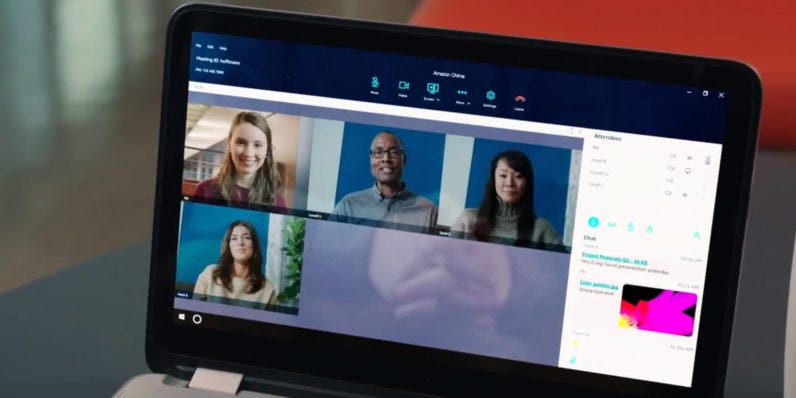
I predicted in Some (Expanded) Predictions, 2017 that Amazon would demonstrate its commitment to the work technology arena by acquiring Slack for $35B. Well, that hasn’t happened yet. However, the word is leaking out that Amazon is getting much more serious about work technology, especially following the release of Amazon Chime this month, the company’s video/audio conferencing app (with work chat as well!).
Keven McLaughlin wrote about Amazon’s plans, yesterday:
Kevin McLaughlin, AWS Taking On Microsoft, Google with Productivity Suite — The Information
AWS is working on upgrades to its WorkMail email-calendar app and its WorkDocs file storage-collaboration app to make them more attractive to corporate customers, according to two people who do business with the company. AWS has also told some large corporate customers it’s considering bundling these apps with its recently launched Chime video conferencing apps into a new productivity app suite that will compete with Google G Suite and Microsoft Office 365, according to a person who’s been briefed on the cloud unit’s plans.
[…]
AWS started selling WorkDocs (formerly called Zocalo) in 2014 and WorkMail in January 2016. But the services haven’t sold well because they’re difficult to use and aren’t as advanced as offerings from Google, Microsoft and others, according to three AWS business partners.
WorkDocs has suffered from a lack of support resources and scant documentation on how to use the service effectively, said one of the AWS business partners who has used WorkDocs. AWS has been slow to add key functions to WorkMail, like the ability to save all emails sent and received through the service, which is a regulatory compliance requirement for companies in industries like finance and health care, said another AWS business partner who has used WorkMail. (AWS added this functionality to WorkMail in November.)
AWS doesn’t currently offer an online word processing app that lets groups of people collaborate on documents, as Google Docs and Microsoft’s online Word do. It’s not clear if AWS plans to develop its own online word processing app, said the AWS business partners. A recent update to the AWS AppStream service, which lets companies access desktop apps running in AWS from any kind of device, could fill this gap, said one of the AWS partners.
Building out a deep capability in work technologies as a complement to AWS is a really sensible strategy, and there’s a lot of play against the duopoly of Google and Microsoft.
I really recommend getting Butterfield’s Slack into the mix, and building around that soaring ecosystem.
On the document ‘productivity’ app side of things, the new innovation around apps like Dropbox Paper, Box Notes, and Salesforce Quip has spread out to a bunch of smaller start-ups. Notables include Bold.co, Notion.so, and Dossier, and Amazon could take on one or two of those as a start of a new set of design principles to restart what should be called ‘progressivity’ not productivity apps. They’ll need presentation and spreadsheet tools, too, but maybe build all that as corners of one big set of capabilities. So that tables can exist in a doc all by themselves, or embedded with text and images. And any page or set of pages can be ‘presented’, so rather than a standalone Powerpoint alternative, presentation is just an activity, not an app.
And lastly, the lowly calendar is tightly bound in the world of progressivity, closely allied with email. But Amazon might want to look at innovations like Meetingbird, Solid, and Sunsama, for innovative approaches to calendaring that focus on the use cases of effective meetings, with agendas, invitations, decisions, and action items, and not just 30 boxes on a canvas.
I’m eager to talk to the folks at Amazon, and see what’s on their minds. More to follow.
Web advertising is a dangerous mess. But why keep thinking about it as a "let's have a meeting about it" problem? It's more of a "what can I fix now and make serious money doing it" problem. Read on for a link to some JavaScript that a brand advertiser (or publication, but we covered that before) can start using today.
The opportunity comes from the fact that low-reputation and high-reputation brands need fundamentally different qualities from an advertising medium.
Low-reputation brands need to send ads only to people likely to respond.
High-reputation brands need to send a costly, hard-to-repudiate signal to an large audience.
When an ad medium is targetable, sellers lose the ability to signal. When an ad could have been targeted to a small group, you can see that the advertiser isn't spending as much to reach you.
Most people are pretty good behavioral economists. They may not know anything about how the products they buy work, but they know how to read the advertising signals.
Signaling failure is obscured by all the other problems that web advertising has. You're lucky if your brand's ad ends up being shown to an adfraud bot, because if that ad gets through to a real user, it's probably attached to a beheading video or conspiracy theories or malware or something. What a shitshow.
People are still nerding out over new technologies without fixing the obvious problems, never mind the deep problem of signaling failure.
Fortunately, web advertising is not a problem where "the industry" needs to "work together". Mark Glaser, on the DCN site, does an excellent job of identifying the problems. But he writes,
If the demand for money and efficiency is eroding the integrity of content—not to mention that of brands and platforms—everyone involved must collaborate to gain that trust back.
In the IT business, this kind of call for coordinated action is what executives from legacy companies say while they're getting ready for an expensive conference with a golf tournament. And they say it right about the time that an independent programmer in a basement somewhere is writing the code to eat their lunch. When a whole industry is wrong about something, that doesn't mean you have a big boring assignment to persuade everyone in the industry. It means you have an opportunity to make mad cash by being right. A good agency working independently can solve the web advertising problem for one brand, just as a good publication working independently can solve the web advertising problem for its own audience.
If your idea of a solution to the web advertising problem involves meetings about how everybody has to solve the problem or nobody can, then I've got nothing for you. Go look at cat GIFs or something.
Still with me? Good.
The more that a user gets protected from tracking and targeting, the more signalful the web becomes as an ad medium from that user's point of view. This can work one user at a time. No coordination required. It's a matter of informing and nudging users to take precautions and become less trackable. Please grab the code (it's open source) and try it out.
What kinds of brand advertisers will be good early adopters for tracking protection strategies?
Some high-reputation categories are great fits for tracking protection because there are so many rip-offs using targeted web ads.
Insurance
Financial services
Health care
Look for goods that are difficult to evaluate at point of purchase and where an experience with a deceptive seller can be costly.
High-signal advertising is a way to take a position on future customer satisfaction and what kind of word of mouth that the brand is betting it will earn.
Tools
Cookware
This is an easy one. If you already have the customers reliably opening your email, or participating in some other medium such as a customer web board, you've got great data and nothing to lose by helping to deny their info to the competition. Play defense.
Some product categories already appeal to Internet "privacy nerds" who are hard to reach by conventional web ads. Worse, conventional marketing tech is giving you really bad numbers when enough of the customer base is "invisible". Tracking protection strategy is essential here, just to keep from getting wrong answers. Don't do a big new product launch based on what bots want.
If you answered "yes" to one or more of these, the first step is to collect some data on tracking protection adoption among the brand's customers and prospects. A high-traffic support or service page is a good place to install tracking protection measurement to get a baseline measurement on how well-protected the audience is. From there, it's a creative marketing project to customize a tracking protection campaign—something new and different to offer to a brand stuck in the online advertising mess.
Please let me know if you have any questions.
Bonus link: Brian O'Kelley, Data is fallout, not oil
I’m fired up about the work I want to share at Domains 2017 this summer. The tagline for the conference is Indie Tech and Other Curiosities, and I plan to be one of the curiosities!
I’ve long been a cheerleader for the Domain of One’s Own movement. In Reclaiming Innovation, Jim Groom wrote about the need to “understand technologies as ‘potentiality’ (to graft a concept by Anton Chekov from a literary to a technical context).” He continued:
This is the idea that within the use of every technical tool there is more than just the consciousness of that tool, there is also the possibility to spark something beyond those predefined uses. The only real way to galvanize that potentiality is to provide the conditions of possibility — that is, a toolkit for user innovation.
My recent collaboration with Mike Caulfield on the Digital Polarization Initiative has led to the creation of just such a toolkit. It supports DigiPo in the ways described and shown here. A version of the toolkit, demoed here, will support a team of investigative journalists. Now I need to show how the toolkit enables educators, scientists, investigative reporters, students — anyone who researches and writes articles or reports or papers backed by web-based evidence — to innovate in similar ways.
In tech we tend to abuse the term innovation so let me spell out exactly what I mean: Better ways to gather, organize, reason over, and cite online evidence. Web annotation, standardized this week by the W3C, is a key enabler. The web’s infinite space of addressable URLs is now augmented by a larger infinity of segments of interest within the resources pointed to by URLs. In the textual realm, paragraphs, list items, sentences, or individual words can be reliably linked to conversations — but also applications — that live in connected annotation layers.
A web of addressable segments of interest is a necessary, but not sufficient, condition of possibility. We also need tools that enable us to gather, organize, recombine, and cite those segments. And some of those tools need to be malleable in the hands of users who can shape them for their own purposes.

When I reread Vannevar Bush’s As We May Think, to prepare for a conversation about it with Gardner Campbell and Jeremy Dean (video, Gardner’s reflections), I focused on this passage:
He has dozens of possibly pertinent books and articles in his memex. First he runs through an encyclopedia, finds an interesting but sketchy article, leaves it projected. Next, in a history, he finds another pertinent item, and ties the two together.
Nowadays that first encyclopedia article lives at one URL. The pertinent item in a history is a segment of interest within another URL-addressable resource. How do we tie them together? A crucial connector is a tag that belongs to neither resource but refers to both.
When tools control the sets of tags available for resource interconnection, they enable groups of people to make such connections reliably. That’s what the DigiPo toolkit does when it offers a list of investigation pages, drawn from the namespace of a wiki, as the set of tags that connect annotation-defined evidence to investigations. You see that happening with the DigiPo toolkit shown here, and with a variant of the toolkit shown here. In both cases the tags that bind evidence to wiki pages are controlled by software that acquires a list of wiki pages and presents the names of those pages as selectable tags.
One future direction for the toolkit leads to software that acquires lists of pages from other kinds of content management systems: WordPress, Drupal, you name it. Every CMS defines a namespace that is implicitly a list of tags that can be used to bind sets of resources to the pages served by that CMS. If you’re looking to adapt a DigiPo-like tool to your CMS, I’ll be delighted to show you how.
Such adaptation, though, requires somebody to write some code. While it’s unfashionable in some circles to say so, I don’t think everyone should learn to code. There’s a more fundamental web literacy, nicely captured by Audrey Watters here:
It’s about understanding the components of the Web and knowing how to tag and then manipulate them. By thinking and developing sets of named resources, you are a Web thinker. This isn’t about programming but rather the creation of sets of resources and the identification of components that work with those resources and combine them to create solutions.
Web annotation vastly enlarges the universe of resources that can be named. But it’s on us to name them. Tags are a principal way we do that. If our naming of resources is going to be an effective way to organize and combine them, though, we need to do it reliably and consistently. Software can enforce that consistency, but not everyone can write software. So a user innovation toolkit for the annotated web needs to empower users to enforce consistent naming without writing code.
A couple of weeks ago I built a Chrome extension that enables users to define their own lists of shared tags by recording them in an Google Doc. The demonstration video prompted this query from Jim Groom:
I just got through with a workshop here demoing Hypothes.is for a European group that may be using it to annotate online legislation for data privacy set to go live in 2018. They are teaching a course on it, and this could be one of the spaces/hubs they build the open part around. I came back to this video just now, but got the sense I could already tag from within annotations/pages, so how does the tag helper change this? Just a different way at it? Is it new functionality from previous tags? I love that you can have a Google Doc list of tags, but the video example is not making sense to me for some reason. And I wanna know :)
Here’s my response. That tag helper, now incorporated into the toolkit I’m evolving for DigiPo and other uses, makes it possible for people who don’t write code to define tag namespaces that govern their gathering, organization, recombination, and citation not only of URL-addressable resources but also of annotation-addressable segments of interest within those resources. People can “tie them together” — as Vannevar Bush imagined — in the ways their interests and workflows require.
Does that answer the question? If not, please keep asking until I do so properly. User-defined tag namespaces, though admittedly still a curiosity, are one of the best ways to make collective use of a web of addressable segments.

I have never in my life before done any racing on skis. I have done some running on snow (and ice) but skiing sort of was never on the agenda. So, there’s always a first and this was it.
I had been banding around the idea of doing the 50K, but considering that my form, especially on uphills, is still crap I decided I was better off with the 30K. So 30K it was and I found myself this morning standing in line with around 70 other people, aptly seeded in the back, to set out on this adventure.
As the race was in Whistler it involved a drive into to Whistler Olympic Park, not a biggie, done this pretty much all season long and the roads were clear, so it wasn’t a big deal.
But once there I did made a bit of a timing mistake, I ended up getting my stuff together too late and didn’t really spend enough time to warm up. So knowing this I was a bit concerned about the first few kilometres.
Unlike other mass starts in road and trail running this wasn’t so much a free for all, at least not the first 50m or so as everybody starts in lanes, once you’re out of them though it is indeed a free for all and my main concern was to stay out of people’s way, which probably lead to me being a little bit slower than I could have been. The first climb was a small hill up into the Biathlon stadium which caused a bit of a bunching as some people struggled a bit. This was also the first time that I realized that I had not only waxed right, but that the wax I chose was indeed rather slippery as the ski almost got away from me once or twice…. on the uphill to my surprise.
Through the stadium we turned to the Biathlon connector, the next area coming up was a bit concerning to me as it is a downhill S bend which isn’t overly wide. This was one of the choke points I was a bit afraid of but as I had backed off by the time we did the downhill it was pretty much smooth sailing. From there we descended onto the loop.
Meardy Loop is comparatively flat, definitely flatter than what I trained on for most of the season. There are a few minor climbs in there but nothing overly steep. I do hate the climb up to the first bridge though, it’s in a turn and for some reason I always seem to struggle there a bit…. usually. Today I ended up gliding relatively effortless up there, even passed two people. From there it meandered along for a bit before you hit the second climb. It’s two stages, with the first one short and some flat, then a very short flat, and a second one a bit steeper. Not a big deal to my own surprise. Shortly after the top was the first aid station and from there it was a downhill shot with a semi sharp turn in the end.
I cruised along and seem to have found my pace but started to cramp in the weird spot on the right side of my chest. I tried to moderate my breathing and stretch it out, but this kept bugging me with varying intensity for the next two K or so.
At the dog parking to was the second aid station. Many people pulled over to “refill”, I decided now would be a good time to suck on my hydration pack and…. nothing wanted to come out. I bit a bit more on the piece and kept it in my mouth for a bit, breathing through the nose, until the ice in it finally had melted and released the drink. That was nice if a bit unnerving for a bit.
I continued along and hit the uphill stretch of the dog area, I started to notice that my breathing was a bit harder than I expected it to be and the cramp also came back. I concluded I was slightly overheating. So once I hit the top I pulled over, took my backpack off and removed my running shell I had been wearing. The starting temperature was probably around -4 or so (It was -7 when we got there), but in the sun in the dog area it became clear that I was quickly heating up too much. After I stored the running shell in my back pack and set off on the downhill stretch, feeling almost immediately better as the heat got pulled away from me, the cramp also went away by the time I hit the bottom.
This was another turn I hated during training. It’s almost a complete 180 and to make matter worse, the woman in front of me wiped out and I almost ran into her, barely managing to miss her. The cruise along the inside passage was fine though and next up was “around the world”.
The next section of around the world had two climbs I am not really too fond off. The first one is right after a 90 degree turnoff and I saw several people struggling on that hill, with one person walking it up. We had a bit of a log jam and was’t really able to pass so I stayed behind the people in front of me, hoping to be able to get past by them on the flatter section. This opportunity though didn’t present itself until the second, equally steep, climb. Once on top I had passed three people who had held me up and started the shallow descent towards the back trail.
After a sharp left hand turn it was “all downhill from there”. Unfortunately there were a few people in front of me. Instead of bombing by them I put the brakes on slightly all the way to the bottom. From there the climb back to the start began.
As we climb up the I was able to pass two more people all the while some 50Ker kept passing me. Which was fine, wasn’t my race and they had way further to go than I did. The first three little climbs were fine, but I did dread the final climb before the ski jump. It’s not really that much harder than most other ones, just longer and also a bit hidden from you as you can’t see it until you come around the corner. I was able to catch two more people on that climb, then went over the bridge and followed another girl back towards the start line. We went through stadium and she pulled over at the aid station while I continued onto my second lap.
I decided I would benefit from eating a gel, unfortunately I had them in the side pocket of my backpack. So I had to stop, pull the backpack off, grab the gel and then eat it. I got passed by a few people while I did that, it also took longer than it should have because it was semi-frozen. Once I had the gel in me I continued following the route.
The S bend that had worried me on the first lap proofed to be a bit tricky as all the people having gone over it had carved some furrows into it and as it now lay in shade in sections, it had gotten icy, I almost lost the ski on the final turn but was able to recover.
The path down to the loop and around was more or less uneventful. By the time I hit the climb to the bridge I could feel the gel hitting and found myself climbing quite well. I had a bit of a close call on one of the downhill sections as someone cut me off right at the bottom of the decent. He noticed at the last second and made way, but that was not really what I had been looking for.
By now all the non-racing skiers had showed up and I started to run into some groups of them. It was mostly not a big deal, though there were a few sections where they created narrow passages I could have down without.
By the time I hit the dog area I started feeling some pinching in the legs, as expected, but managed to catch up to a bunch of people after skiing for the better part of 20 minutes pretty much by myself.
Remember the weekend skiers I had mentioned? They were fully in the Inside Passage and making it hard to get around them. I picked off two more people going through there, but it wasn’t really at a blistering speed.
The two climbs on Around the World def. did hurt more than they had on the first lap, but I did seem to be doing decent enough. The only people passing me where the 50Ker, none of the people I had passed caught up to me.
This time the downhill section was completely open and “let it rip” as they say, almost. Towards the bottom I saw a guy in front of me and I slowed down a bit to prevent hitting him. Bit annoying as I had hoped to carry more momentum into the first climb. I did pass him on the first flat section though and picked off three more during the next two smaller climbs.
Then we hit the final, big climb and…. well, some people from the 15K were struggling on it, at least I presume they were from the 15K, and it was a bit of a challenge to get around them. Looking back I saw some other 50Ker coming up behind me, so I did my best to try and keep the speed up to get to the top and into a wider area. I succeeded.
After I was over the bridge there was only one minor climb left before the finish area and man, I did feel that in my legs for sure. I did keep the people behind me off and even caught up to a guy in front. We hit the final turnaround to the finish, I tried to make it over in style and…..
I tripped over my own skis five metres in front of the finish line, spilling my gels over the snow and had to pick myself up rather embarrassed.
I did finish according to Strava in 1:56:52

My goal was to beat 2:30 and I would be over the moon if I beat 2 hours. I seem to have accomplished this (waiting for official results, including age group. Will update once they are out), but as impressive as it sounds, I did finish towards the end of my field, that does not make me happy.
I didn’t really do anything horribly wrong during the race, but there are a few lessons I can take away from it.
So what’s going to happen now? Well, there will be a 2018 for me, I think it’s a nice way to “cap off the season”.
Having said that, I probably have another month of skiing left I can do and I plan on concentrating on form. This will be frustrating to me I am sure but the long term payoffs will be there for sure.
I will also take a few of these things along with me for my trail races I have on the agenda for later this year, namely the warming up my nutrition approach.
Overall I am happy. I am happy I hit the two hour mark, but not considering how fast the field was in general. Someone mentioned that a 2 hour finish would have meant a 2:20 finish last year. I believe that. The winner last year in the 30K did it in 1:24, so I would have been around an hour slower than the fastest guy on the course. That leaves whole lot of room for improvement. The fastest guy in my age group did it in 1:29, so even there I can see room for improvement.
If anything, that’s motivation and I will definitely approach next season with a different outlook.
Happy Skiing!
mkalus
shared this story
from  Global Rail News. Global Rail News.
|
The Digital Railway project continues to generate interest from many quarters. The latest position from Network Rail was explained in issue 147 (January 2017) following an interview with David Waboso, the project’s managing director.
Just how does this fit in with the suppliers’ perception of what needs to happen and, more importantly, what can the supply industry do to ensure that the project delivers its objectives? To answer that question, Rail Engineer met with Christian Fry, director of strategy and market development at Alstom, to discuss his perception on how progress should be made.
Alstom is an international company with a strong British heritage, having acquired the GEC signalling interests many years ago. Alstom is, of course a major rolling stock, signalling, infrastructure and services provider and recently acquired both General Electric’s signalling division and Nomad Digital to further develop its digital capabilities and on board Wi-Fi service provision.
In 2016, as part of its ongoing commitment to the UK rail market, Alstom acquired 100 per cent ownership of Signalling Solutions Ltd, previously a 50:50 joint venture company set up with Balfour Beatty. The track and train capability is therefore complete and it is with this expertise that Alstom is keen to be a major player in delivering the Digital Railway vision.
The Digital Railway
There has been some confusion as to what the Digital Railway actually is. In the context of UK rail, the Digital Railway is a collection of digitally enabled signalling interventions that include: TMS (Traffic Management Systems), ERTMS/ETCS, C-DAS (Connected Drivers Advisory System) and ATO (Automatic Train Operation). This tool kit, when implemented appropriately, has the potential to increase capacity and transform the operational performance of the rail network.
In a show of commitment to the Digital Railway (DR) concept, the UK Government announced in the Autumn 2015 statement an additional £450 million of funding for early DR projects. In parallel, Network Rail’s Digital Railway team is developing a number of route-wide business cases where DR interventions will deliver significant capacity and performance benefits. The supply industry is understandably keen to get on with making the much-heralded Digital Railway a reality.
Jonathan Willcock, Alstom UK & Ireland’s managing director of systems, signalling and infrastructure, commented: “If Network Rail, suppliers and operators can all agree, then a lot of complexity in Digital Railway starts to fall away. I’m glad to say that Network Rail, and David Waboso in particular, are very much on the same page as us on that.”
If only it were that simple! The reality is that, with so many parties involved in the roll out, getting mutual agreement on the way forward is always going to involve protracted discussions. At a first count, the ORR, RSSB, Network Rail (Digital Railway, Infrastructure Projects and Routes), the TOCs and FOCs, the ROSCOs, the train builders and maintainers, the ETCS supply industry (both infrastructure and rolling stock), the safety certification organisations and even the European Directive authority, all have to be consulted and given due consideration.
Deep down, the suppliers know this, but they do have a pragmatic way forward which needs to be given serious consideration. The supply industry has more expertise and experience in rolling out ERTMS than any other UK body simply because these are global organisations which have delivered successful projects in many countries across the world. Thus, many of the problems and challenges of undertaking the design, manufacture, installation and commissioning are known in advance and can be tackled as a scheme progresses.
The Alstom view would suggest that a route such as Great Eastern (London to Norwich, in essence) is a significant piece of railway where a route-wide Digital Railway strategy could realise economies of scale. In a move away from traditional detailed design specifications, Alstom would like to work with its customers (Network Rail and the relevant TOCs / FOCs) to develop an outcome-based performance specification for how they want the train service to operate. The design and implementation of the system would then be entrusted to a single contractor that would be given the freedom to leverage the return on its global experience and take on the risk for successful performance outcomes as part of its responsibility.
Of course, the design of the system would have to conform to the latest European standards and the UK ERTMS reference design, thus ensuring both interoperability and UK operational requirements are satisfied.

Recognised challenges
There would be challenges to be overcome in this approach. Placing the supply chain much closer to the customer (Network Rail routes and train operating companies) will require a new behavioural approach; the relationship with the supply chain must transform from today’s transactional nature to one of long-term strategic partnership. As the industry embraces the digital age and moves from an environment where technology is stable and well understood to one where technology continuously evolves and design, delivery and long term sustainment responsibilities are transferred to the supply chain where reward is measured against operational performance outcomes.
The industry must move from a lowest cost approach with suppliers in a ‘bottom line price’ competition to a whole-life engineering services orientation focussed on value creation, encouraging ongoing investment in innovation and continuous improvement throughout the life of Digital Railway assets.
Operating Rules is another potential problem area, where demands for changes to the performance specification to meet UK operating conditions might well arise. This has happened in other countries and, whilst some ‘tinkering’ might be accommodated, most demands must be resisted otherwise bespoke preferential engineering results and the benefits of having a standardised system are lost.
ETCS, by definition, crosses the wheel/rail divide and, whilst a contract for a route might include both infrastructure and train borne requirements, it is a certainty that rolling stock from other parts of the country will operate over the line on a regular basis. The supply industry is well acquainted with the air gap interoperability requirements and the contractor’s responsibility must extend to ensuring other makes of train- borne equipment will function reliably as part of the package.
The challenge in such a complex ‘system of systems’, and with Britain’s fragmented industry structure, will be to define a set of performance outcomes within the control of the Digital Railway supplier against which they would take on and manage performance risk. Alstom knows this is a complex but not insurmountable challenge.
Managing a Digital Railway contract
If such an approach is to succeed, it will need new collaborative contractual mechanisms. Alliances across Network Rail, train operating companies and Digital Railway suppliers will need to be formed. Combining the core competencies of the train operators and infrastructure providers with the technology capabilities of the supply industry, to deliver the right interventions to eliminate current rail network constraints, will be the key to success.
Alstom is keen to emphasise that the Digital Railway is not a ‘silver bullet’ that can solve all the challenges facing Britain’s railways. As Christian points out, “a flat junction is a flat junction and no amount of digital technology can change the laws of physics”. Alstom believes a balanced approach is required that considers the constraints on the network and the options available. This will include the Digital Railway tool kit alongside more conventional civil engineering and station management modernisations.
The Digital Railway is a term that encompasses this complex ‘system of systems’ and is one of the reasons that Alstom believes it is essential that suppliers are engaged to provide whole-life support. Over the life of the system, the operational requirements of the railway will change and evolve, as will the underlying engineering that makes up the Digital Railway.
It is inevitable that new and disruptive technologies will emerge that must be accommodated within the Digital Railway model, one example being the demand for data increases within the mobile data bearer that will cause GSM-R to migrate to either a 4G or 5G system.
Within other high-capital-cost complex engineering asset industries, there has been a move towards ‘whole life engineering services’ as performance and sustainment responsibilities are increasingly transferred from the operator to the systems provider. In the aerospace industry, for example, this service base model is common and has led to a step- change in asset performance as incentives between the operator and technology provider are leading to continuous innovation and a relentless focus on in-service performance. Alstom suggests that this approach could deliver huge benefits to UK rail and in turn create the environment to attract outside investment in rail infrastructure.
Supplier inter-relationships
Alstom acknowledges that there are many other suppliers in the business of providing Digital Railway systems. The likes of Siemens, Thales, Bombardier and Hitachi have all delivered Digital Railway solutions that will increasingly become their mainstream signalling offerings in the future. Sure, there is competition between them, but the whole basis of the ERTMS ethos is an interoperable system as demanded by the European dictate.
Co-operation must exist between the various suppliers to make this work. Alstom believes that a good spirit of co-operation exists between all the players in the UK industry through associations like RSG (Rail Supply Group) and RIA (Railway Industry Association).
The recent Digital Railway Early Contractor Involvement work streams have demonstrated the willingness of the supply industry to work together to make the Digital Railway a reality.
Traffic management
Traffic management systems (TMS) form an important element of the Digital Railway tool kit, and one that can deliver significant early performance benefits. By providing optimised network operations by means of early conflict detection and resolution capabilities, significant gains in capacity and network resilience can be achieved. Alstom is proud of its TMS product, known as ICONIS, and its deployment in Italy has resulted in a significant improvement in train punctuality and increased train movements. Interfacing to different marques of signalling interlockings and train describers, it has demonstrated that optimised decision-making can be achieved in both old and new control centres.
The delay in the introduction of TMS to the UK, beyond the initial three projects, is a frustration to the suppliers. The experience of the first deployments has highlighted that managing industrial relations and business change is at least as big a challenge as the development of complex engineering interfaces.
International comparisons
The nationwide deployment of a Digital Railway solution in Denmark is now at the point of system testing. Split into two halves – east and west – Alstom has the contract for the entire eastern network, which includes provision of ETCS and TMS plus a 25-year maintenance commitment.
Unsurprisingly with such grand ambition, there have been challenges and some delays. However, through an environment that supports collaborative behaviours, the project delivery partners of Banedanmark and Alstom have worked through these challenges to define the performance requirements, operational concept and system migration. Alstom has successfully leveraged the return on experience gained from other contracts to equip over 18,000 km of trackside ETCS and 5,400 trainsets.

The digital railway system in Denmark will be progressively deployed across the entire national network between now and 2023.
“There is nothing significant that prevents us from working the same way here as in Denmark,” Jonathan Willcock commented. “You always have the complexity of different routes with a number of operating companies and interchanges, but generally there is nothing fundamentally different.”
The current UK position
Other than the initial Cambrian route, which has had an ERTMS system in service since 2010, only two projects are currently being progressed, both relatively small in scope. These are:
» The Thameslink central core, which includes the addition of an overlay ATO package and is being provided by Siemens – the results of the testing so far are very encouraging and the system is essential to realising the 24 trains per hour throughput;
» The Crossrail West project as part of the Great Western main line upgrade needed to replace the near-obsolete legacy British Rail ATP system – the first stage contract is let to Alstom but the small distance involved fails to achieve any economy of scale.
Hence, the supply industry is supportive of the Digital Railway’s desire to progress a number of route-wide long-term DR deployment strategies. From a supplier perspective, this is key to gaining the economies of scale and learning and providing the commitment that will encourage suppliers to invest in building world- class digital railway capabilities here in the UK.
It is the intention that future signalling schemes will conform to the ERTMS ready trackside specification. Schemes due to be migrated to Digital Railway in the short term, less than five years, shall be subject to more mandatory requirements than schemes due to migrate in the 5-10 year and 10-15 year timeframes.
The position with rolling stock is more advanced, with all new train builds since 2012 being required to be ready for ETCS fitment. At present, tenders for fitting the entire UK freight locomotive fleet are being evaluated and Alstom has contracts to design and fit the ‘first in class’ equipment for the Class 180 and 365 multiple units.
Everybody wants the Digital Railway to succeed but, for this to happen, it is apparent that some new thinking on how to modernise the contracting arrangements will need to be put in place. The good news is that all parties are in discussion, and it is to be hoped that a winning formula will emerge in the near future. As Jonathan Willcock stated: “We want to change people’s perception of the railway, rather than just proving the technology works.
“There are lots of acronyms flying about, but when passengers see improved performance it starts to become real!.”
Written by Clive Kessell
@cube_drone wrote:
The Many Songs of Programming
single image text let arr = [];
arr.push(‘it’);
arr.push(‘it good’);
arr.push(‘it’);
arr.push(‘it real good’);float ON;
let blondie = {};
blondie.me = () => {};
blondie.me();cs
repeat 100 [fd 100 bk 100]vowels = [‘a’, ‘e’, ‘i’, ‘o’]
def compare_vowels(str, compare):
for char in str:
for vowel in vowels:
yield compare(char, vowel)def war():
passpublic class Mine { … }
public class Sweet extends Mine {…}char* bird;
bird = (char*) malloc(8);
free(bird);def recursive_walk(sides, fin):
for side in sides:
if side.status == ‘wild’:
fn(side)
recursive_walk(side.children, fn)try:
tenderness(5)
catch ValueError:
tenderness(1000)def getDay(n)
is_weekdays.at(n)
end
puts getDay(1)
@cube_drone wrote:
Many-Factor Authentication
I used these same guys to demonstrate Tuckman’s Stages of Group Development some time ago.
single image text Introducing our exciting new nine-factor auth!
To log in, you need:
- something you know
- something you have
- something old
- something new
- something borrowed
- something blue
- somebody that you used to know
- but you didn’t have to cut me off
- make out like it never happened and that we were nothing


