Shared posts

26 Feb 11:56

The LMS Market is Quickly Losing Ground

files/images/co_0227_lead_302.jpg


Carol Leaman, Chief Learning Officer, Feb 26, 2017


About ten years too late, the LMS industry is in decline. "The self-paced e-learning market — defined by LMS, off-the-shelf content and services — is in steep decline and is expected to drop from global revenues of $46.6 billion in 2016 to $33.4 billion by 2021. According to the report: “ In the current e-learning market, the single most unfavorable place to be is the LMS market, which is essentially imploding, particularly in the U.S. corporate segment that has a negative 33.9 percent growth rate."

[Link] [Comment]
26 Feb 11:56

129 Keefer Street

by ChangingCity

Developer James Schouw proposed an infill development on Keefer Street, on a 25 foot wide lot. This building was proposed in early 2017 for the next door but one lot, 50 feet wide, and designed by Stantec Architecture.

Since then the initial version of the project has been redesigned for a new owner, retaining the same architects. The project proposes 32 condos over retail in an 88 feet high building with 10 storeys built to the existing zoning. (An adjacent site had a proposed rezoning to add additional height, but also offering rental seniors housing as part of the scheme – that would have been built to the west – the left – of this proposal, that was not supported by Council, and a revised project submitted with no rezoning was very unusually rejected by the Development Permit Board).

The illustrations show the project on the left, with the Heritage Keefer bar and residential building sandwiched between the new building and the earlier narrower proposal (apparently now redesigned a little).

The first version of the building (right) proposed to have retail frontages that wrap around to the laneway frontage via a narrow pedestrian alley that would connect Keefer to the laneway. That design used cast metal columns on the façade. The revised design is more contemporary, and we think a more worthy neighbour to the heritage building next door, (originally built as the warehouse of the Vancouver Gas Co.)

26 Feb 11:56

Surrounding Yourself with Beginners

by Eugene Wallingford

This comment at the close of a recent Dan Meyer post struck close to home:

I haven't found a way to generate these kinds of insights about math without surrounding myself with people learning math for the first time.

I've learned a lot about programming from teaching college students. Insights can come at all levels, from working with seniors who are writing compilers as their first big project, through midstream students who are learning OOP or functional programming as a second or third style, right down to beginners who are seeing variables and loops and functions for the first time.

Sometimes an insight comes when a student asks a new question, or an old question at the right time. I had a couple of students in my compiler course last fall who occasionally asked the most basic questions, especially about code generation. Listening to their questions and creating new examples to illustrate my answers helped me think differently about the run-time system.

Other times, they come while listening to students talk among themselves. One student's answer to another student's question can trigger an entirely new way for me to think about a concept I think I understand pretty well. I don't have any recent personal examples in mind, but this sort of experience seems to be part of what triggered Meyer's post.

People are always telling us to "be the least experienced person in the room", to surround ourselves with "smarter" or more experienced people and learn from them. But there is a lot to be learned from programmers who are just starting out. College profs have that opportunity all the time, if they are willing to listen and learn.

26 Feb 11:55

Don’t Be Scared If You Have to Get an MRI

“Totally normal,” said my neurologist of the results of the MRI on my head. No worries.

I was afraid to get an MRI in the first place.

I got a crown last week, and that didn’t worry me — it’s my ninth. Breathe the gas and just chill for a while. No big deal. It’s almost sad when it’s over.

But I was afraid to get the MRI, because I’m slightly claustrophobic, and all I knew was that they’d put me in a big tube and then walk away.

How It Went

I didn’t have any dietary restrictions in advance. They didn’t inject me with anything. I was told to wear comfortable clothes with no metal — so I wore sweatpants, a T-shirt, and a sweatshirt. I was able to leave my rings (gold, two small diamonds) on.

Beforehand I did a three-sixty in front of a ferrous metal detector. Then I was led through the doors with the giant warnings about extremely powerful magnets.

I put in earplugs that the technician gave me, and then put on headphones. He asked me what music I’d like, and I replied, “80s. Bowie.” I lied down on the thing. There was a firm but not painful thing to hold my head still and give it something to rest on. Under the lower half of my legs was a foam thing that kept them elevated a little. It was comfortable.

He told me it would take about 20 minutes. He also gave me a bulb to hold onto and to squeeze as an alert, and he said they could pause the tests if needed.

Then he slid me in. The tube was more narrow than I expected. And for the first couple seconds I did feel panic rising a little bit, and I thought about squeezing the bulb — but I didn’t. I oriented myself and took some deep breaths.

I was staring up at the top of the tube (I was on my back), but there was this mirror contraption (two mirrors? hard to tell) that I was looking at, and so I was looking out through the end of the tube. What I was actually seeing was a nice, calm painting on the wall — a river and some trees — and I could see the length of my body and my feet, which were free of the tube. I told myself I could scramble out on my own if I had to.

The music started with a Bowie song — “Life on Mars.” Later there were songs by Talking Heads and similar bands. It was good to have music because I could note the passage of time that way. (I guess I was listening to a Pandora station or something similar.)

The machine was noisy, but I had plenty enough ear protection, and the different scans had different patterns. One scan near the end included a bit of vibration. The technician talked to me through the headphones a couple times to let me know how much time was remaining. I just kept my eyes on that painting the whole time.

I had no trouble being still, except when I had to swallow. I just did. It was otherwise comfortable. And I could have gone another 20 minutes, easy.

* * *

Of course, I’m lucky. I have very good insurance through Omni, and it paid for this. And, even luckier, the results were totally normal.

Hear that, world? The inside of my head is totally normal. I don’t mind feeling good about some good news for a change.

Update 4:15 pm: I’ve heard that not all MRIs are so nice. They might not have the mirrors and the music. In that case, well, I’m sorry. Just remember that they won’t forget you’re in there, and they’ll let you out at the end. Stay cool.

26 Feb 11:55

Pogue’s Basics: Discover Google's Easter eggs

Easter eggs are not dead!!

In the early days of Macs and PCs, programmers took pride in burying little surprises and animations in their work. They still do, in video games. Like if you hold down certain buttons in Batman: Arkam City, you turn on Big Head mode. Or in Crysis 2, if you hit this unmarked button and then go down the hall, the elevator opens to reveal these guys having their own little rave party.

But there are lots of great Easter Eggs in software that everybody uses. Google is especially generous with its Easter eggs. Like, try Googling the word “askew.”

Or Google “Do a barrel roll.”

Or Google “Google in 1998.”

Oh—and next time you have no Internet connection, don’t just stare at the little dinosaur. Start hitting your arrow keys. Google has given you a game to cheer you up!

More Pogue:

Pogue’s Basics: Use YouTube’s built-in stabilizer

Pogue’s Basics: Bring back Photoshop’s New Document box

These 6 systems will get rid of Wi-Fi dead spots in your house

iOS 10 Hidden Feature: Bedtime-consistency management

Pogue’s Basics: Money – The Amazon card

iOS 10 Hidden Feature: Do Not Disturb Emergency Bypass

Pogue’s Basics: Money – Extended warranties

Pogue’s cheap, unexpected tech gifts #2: ThinOptics glasses

A dozen iOS 10 feature gems that Apple forgot to mention

GoPro’s most exciting mount yet: a drone

Professional-looking blurry backgrounds come to the iPhone 7 Plus

Pogue’s Basics: Turn off Samsung’s Smart Guide

Pogue Basics: Touch and hold Google Maps

The Apple Watch 2 is faster, waterproof—and more overloaded than ever

We sent a balloon into space — and an epic scavenger hunt ensued

Now I get it: Snapchat

The new Fitbits are smarter, better-looking, and more well-rounded

Apple has killed every jack but one: Meet USB-C

26 Feb 11:55

Discovering Los Angeles

image

Last week, I got the chance to spend a week exploring Los Angeles. Even though I have been traveling to Southern California to visit family since I was a child, we never spent a lot of time in LA. On this trip I had the opportunity to discover all of the unique, culturally-rich neighbourhoods, galleries, parks and beaches - without ever setting foot in tourist meccas like Disneyland or Universal Studios.

This experience made my appreciate the diversity and cool, laid-back energy of the West Coast’s largest city. If they could do something about their gridlocked traffic and total reliance on cars, Los Angeles could really thrive (but I will get to that in a future blog post). Here are some highlights:

image

Vallen got his wings from Alaska Airlines enroute to LA.

image

A hike in the Santa Monica Mountain Range near my cousin’s house in Thousand Oaks. I’ve never seen Southern California this green! It reminded me of Ireland.

image

Visiting the gorgeous Broad Museum in DTLA, which opened last year. Large, impressive works by Jeff Koons, Andy Warhol, Keith Haring, Basquiat and many more of America’s best modern artists.

image
image

Nothing like sipping a glass of milk fireside at a restaurant next to The Broad.

image

Visiting Griffith Park. We blew Vallen’s mind by letting him ride on a train, a pony and the LA Zoo merry-go-round - all in one day.

image
image
image

Chillin’ in the sand at Venice Beach.

26 Feb 11:55

American Airlines makes class warfare easier with 9 clear boarding groups

by Josh Bernoff

American Airlines announced new names for the groups in its boarding process. This made it much clearer how, if you’re an ordinary non-preferred customer, you’re one step above steerage. The clarity is great: it further weaponizes envy even as it deflect attention from the privileges American is slowly squeezing out of flying. Here’s the email that I (and … Continued

The post American Airlines makes class warfare easier with 9 clear boarding groups appeared first on without bullshit.

26 Feb 11:55

The end of SHA-1 on the Public Web

by J.C. Jones

Our deprecation plan for the SHA-1 algorithm in the public Web, first announced in 2015, is drawing to a close. Today a team of researchers from CWI Amsterdam and Google revealed the first practical collision for SHA-1, affirming the insecurity of the algorithm and reinforcing our judgment that it must be retired from security use on the Web.

As announced last fall, we’ve been disabling SHA-1 for increasing numbers of Firefox users since the release of Firefox 51 using a gradual phase-in technique. Tomorrow, this deprecation policy will reach all Firefox users. It is enabled by default in Firefox 52.

Phasing out SHA-1 in Firefox will affect people accessing websites that have not yet migrated to SHA-2 certificates, well under 0.1% of Web traffic. In parallel to phasing out insecure cryptography from Firefox, we will continue our outreach efforts to help website operators use modern and secure HTTPS.

Users should always make sure to update to the latest version of Firefox for the most-recent security updates and features by going to https://www.mozilla.org/firefox.

Questions about Mozilla policies related to SHA-1 based certificates should be directed to the mozilla.dev.security.policy forum.

The post The end of SHA-1 on the Public Web appeared first on Mozilla Security Blog.

26 Feb 11:54

I’m writing a Sci-Fi novel!

by Faruk Ateş

Late last year I launched one of my two planned major side projects for 2017: Product Matters, a blog / publication / channel on all things product design and business ethics.Today I’m thrilled to share what my second major side project for this year is: a science-fiction novel!

I’ve been writing, plotting, outlining and ideating a whole universe of stories since I was 16 years old, now more than half a lifetime ago. I always figured, “I can do a writing career after my tech career.” I used to imagine I might start to get serious about the writing around the age of 34 or so, but then one day late last year I woke up and I was 34.

So, it was time.

The U.S. elections, Brexit, and generally sorry state of affairs around the world leave me with deep cuts across my soul, but after having spent the past 6 years in the trenches fighting for social justice, inclusivity and equality, I’ve come to realize that there are more ways than one for me to contribute to a better world. And it’s time for me to do so in a way that gives me great personal joy and satisfaction, not constant depression and anxiety. (I’m fine, but there were struggles across the years.)

The opportunity presented itself in a way more perfect than I could’ve written. Two of my dear friends, Tim and Tiffany, were getting married. At their engagement party I suggested and subsequently brokered a small agreement for (improved) gender equality: Tiffany, then considering adopting Tim’s last name as her own, would go ahead with that… provided that Tim would change his middle name to her last name. They both agreed enthusiastically to this proposal, and then we continued drinking.

Fast-forward a few weeks later, and they finished the paperwork at City Hall…and Tim forgot to change his name. To motivate him to go back and go through the (now increased) hassle of changing his name, I offered that I would write the two of them a short story, featuring them as main characters, and inspired somewhat by this name change agreement. Tim agreed enthusiastically (again); I asked the two of them what genre they would like it in, and they both answered “Sci-fi!” without a moment’s thought.

Wonderful, as that is my personal genre of choice.

Then I started reading up on and learning all about writing novels, outlining techniques, and the various ins & outs for professional writers. I kept applying my newly acquired knowledge to this short story for Tim & Tiffany, which I was about 3,000 words into (and thus had to wrap up at a higher pace than I was establishing it, as short stories are limited to 7,500 words).

I was in denial about it for a little while, but soon enough I admitted to both myself and the (now-married) happy couple: this story is breaking free of its short shackles on its own accords, and demands to be novelized properly.

So now I’m writing a novel. 

And it’s going to be a good one; that is, for a first-time writer’s first real attempt at one. I’m obviously biased in more ways than one, but the feedback I’ve gotten on early parts so far has been very promising, and my latest work on outlining its plot and fleshing out the details has gotten me ever-more excited to see the finished product.

For the curious: it’s an adventure-thriller with a romance subplot (it is still a wedding gift to my friends, too), set in space about half a century from now. Some atmospheric– and thematically-similar shows and books are: Firefly, The Expanse, Stargate: Universe, John Scalzi’s Old Man’s War series, and The Martian (but with character depth).

Other changes in 2017

I’ve been writing fiction for over a decade, but rarely ever publishing my work. That, too, is going to change in 2017.I have a site redesign / complete overhaul in the works; it will be WordPress-powered, comments will return, and the content of the blog will focus on product design, writing, and: short stories! I’m also creating a tools section where I will make small, simple but (hopefully) useful tools for writers available.

There are still big plans in the works for Product Matters, even if it’s been quiet on that front of late. And there are some more surprises in the works related to that, as well, but more on that in the future.

For now, you can sample one of my fiction short stories over at The Pastry Box Project, where a year and a half ago I published a first draft (yes) of one: A Shift In The Night. That story will be reworked and re-published here after my site overhaul. It’ll then give you a good indication of my writing style, as well as how I’ve progressed and evolved since then.

Lastly, no author rises to fame & success (or at least more satisfied readers; I’ll take it) without beta readers. If you are interested in getting the early scoop on my writing, and helping make it better along the way, being a beta reader is your jam. You’ll get a free ebook copy of the finished product, acknowledgements in the book itself, 10 discount codes to hand out to friends, and my eternal thanks. And all you’ll have to do to get started is: tweet me your interest in beta-reading my novel!

Here’s to making 2017 as best as year as we can. #resist #inspire #love.

26 Feb 11:54

Short story: New beginnings

by Faruk Ateş

When I found the secret beach, that’s when I decided to settle into my new life.

(This story will soon be written.)

26 Feb 11:54

I ship Pokia, a tale of youth trends and unrequited smartphone partnerships

by Marek Pawlowski
Pokia, the shipped love child of Palm and Nokia

You can learn a lot from conversations with eleven year olds, it seems.  This one came via my partner, whose colleague had brought her eleven year old daughter to work. Asked how she was and what she’d been doing recently, she replied, breezily, with all the confidence eleven years in the world gives you: “Oh, you know…mainly fan-girling and shipping.”

My partner thought it unlikely this girl had recently acquired an interest in a sea freight business, so she later asked her colleague what her daughter had meant.

‘Shipping’, it turns out, is the new big thing in her daughter’s world.  It is the creation of fictitious relationships between fictional characters or even the non-fictional actors who play them.  This is fandom taken to the next level.

It even comes with its own vocabulary.  While ‘shipping’ describes the activity, it can also be used as a verb: “I ship, you ship, he ships, we ship together.”

The defining characteristic of shipping parlance is combining two names into a single portmanteau.  With the recent success of BBC drama Sherlock, it turns out ‘Johnlock’, a fictional relationship between Dr. John Watson and Sherlock Homes, has become the poster boy for this concept.

Depending on the age of the shipper (I would hope!) it varies from one of platonic to romantic love.

Not being eleven anymore, this all sounded very new to me.  Immediately, I found myself wondering about the influence of digital and whether increased access to media, the ability to binge watch shows and follow the lives of actors through social channels had given rise to shipping.

(The MEX user mode, ‘Consume‘, tracks this on an ongoing basis and we have also developed a separate theme about ‘Intersection‘, the moment when consumption prompts creativity.)

However, as my partner and I discussed it, we began to realise this was more likely a variation on a theme as old as the hills.  The infatuations of youth started long before Netflix enabled you to watch 17 hours of your favourite characters in one sitting.

However, digital developments have served to amplify one of the most important aspects of shipping: its use as a basis for conversation or even a form of social currency.  While 1960s discussions of the Beatles real or imagined love lives would have been limited to an immediate social circle, today’s ‘ships’ can be shared, discussed and consumed on a much larger scale through social networks.  Now it’s possible to augment your 17 hour binge watch with an extraordinary quantity of additional ‘ships’ in the form of fan-made stories, cartoons and even podcasts.

When the world you inhabit is largely digital, it is much easier to fill it with characters of your choice.

Furthermore, digital tools have made it easier for creators to share their ships and form new social connections – locally and on the web – by virtue of their imaginative abilities.

It has inspired me in two ways.  Firstly, to spend more time listening to the wisdom of youth (something we already try capture in the MEX user stories series) and, more immediately, to start working on the mother of all ‘ships’ from my own fevered imagination: Pokia.

Pokia is tragic tale of unrequited love, enacted amid the heady days of the first dotcom boom. The brash, brilliant young Mr Palm falls for the Scandinavian mystery of Ms Nokia.  Palm’s straight talking interface and Nokia’s deep connections to the mobile industry enable them to form the ultimate power couple, reigning supreme over the land of Smartphonia and thus forever altering history.

Amazingly, it nearly happened.

Pokia N95, the first Nokia with a Palm UI

Part of Friday Inspirations, an ongoing MEX series exploring tangents and their relationship to better experience design.  We explain the origins of the Inspirations series in this MEX podcast and article.  Share your own inspirations on Twitter at #mexDTI.

26 Feb 11:54

What is up with Android Messages and RCS?

by Volker Weber

Sketch

Android Messages makes it easy to communicate with anyone by using SMS, MMS, and more.

Google's handling of messaging rivals only its social network fumblings. There is Hangouts, and Allo, and Duo, and now Android Messages, formerly Messenger. Why all the fuzz? It's because Google is failing time and again.

Android doesn't have something like Apple's iMessage. They don't really have something like Facetime. So they created Allo and Duo. Both are tied to your phone number, copying a successful push by the likes of WhatsApp. And since Google+ bombed, they could not make Hangouts to fly, so that is moving in the direction of enterprise, where it meets the big boys like Cisco. Do you know anybody who uses Allo or Duo? See?

And now RCS? Puleeeeze. That is the follow-up to texting, designed by carriers. They want you to pay for messages, just like you did for texts. I am sure you were just waiting to do that.

26 Feb 11:53

My favorite headset design

by Volker Weber

ad65073837291113ed89c6c4bcd2d9b7

These are my favorite headsets. And they follow the same design pattern: no wires, recharge in their case, sit inside your ear, don't seal off the environment. Both are very comfortable. The AirPods are great for listening, but can't compete in the noise cancellation space. The Voyager Edge has the edge (sic) in phone calls.

I use both of them a lot and you can tell by the dirt they are accumulating.

26 Feb 11:53

"Own your craziness."

“Own your craziness.”

- Leslie Jones
26 Feb 11:53

"I love dreams. I know enough about them to know that dream logic is not story logic, and that you..."

“I love dreams. I know enough about them to know that dream logic is not story logic, and that you can rarely bring a dream back as a tale: it will have transformed from gold into leaves, from silk to cobwebs, on waking”

- Neil Gaiman
26 Feb 11:53

What If You Can’t Give A Reply Members Will Like?

by Richard Millington

Every question should get a response, even if it’s a response the member won’t like.

No, they might not be able to integrate your tool with a specific service.

They won’t like that answer, but at least now they know.

They know not to keep searching for the answer, call customer service, or struggle to do something which can’t be achieved (and getting angrier).

Yes, there might be a legal reason why you can’t respond to the question. Far better to tell them (that exact sentence) rather than let the comment go unanswered.

If you don’t get a good, quick, response you won’t use the community again.

And if you see most discussions don’t get a good response, you won’t even bother asking the question.

If someone takes the time to ask a question, you owe it to them to make sure they get a response.

26 Feb 11:53

Google’s Messenger App Renamed To ‘Android Messages’

by Rajesh Pandey
Further complicating its messaging services and offerings, Google today announced that it is renaming its Messenger app to Android Messages. Continue reading →
26 Feb 11:53

Samsung Launches Secure Folder App For Galaxy S7 and S7 edge

by Rajesh Pandey
Samsung today released the Secure Folder app for the Galaxy S7 and Galaxy S7 to help users keep their important files and data secure from prying eyes. The app makes use of Samsung’s Knox security platform to create an encrypted space on the phone to store your files and apps securely. Continue reading →
26 Feb 11:53

Friday Funny — Mouse Shop

by Ken Ohrn

The City of Malmo, Sweden is home to tiny perfect shops that are intended for mice, and of course, observant people.

Note the obligatory bicycles.

mouse-shop-malmo

Thanks to Brent Toderian for the head’s-up.


26 Feb 11:49

5 Ways to Stay Visible in Traffic When Cycling

by Average Joe Cyclist

Here are five essential ways to stay visible in traffic when cycling. These tips will help you to keep yourself safe as you enjoy your favorite activity, cycling.

The post 5 Ways to Stay Visible in Traffic When Cycling appeared first on Average Joe Cyclist.

26 Feb 11:49

Don’t Yolo Hard Conversations

by rands

On the list of leadership merit badges, “Successfully deliver hard news” is one the hardest badges to acquire. It’s not just that you have news, it’s hard news. It’s an honest something the human sitting across from you does not want to hear. Not only do you need to deliver it, but you need to successfully deliver it.

There are endless ways to screw this up. This is why it’s a merit badge. Once you learn how to successfully deliver hard news, you will never forget. The experience is hard-earned.

Bad news, I’m not going to give you a complete strategy, these are simple tips. Starting with:

  • Write down what you are going to say. Don’t yolo hard conversations.
  • Share that writing with another neutral human who you know will give you critical feedback. They will find flaws and optimizations that you have not seen.
  • Sleep on the conversation that you’ve written down and vetted with the neutral humans. Your background processing skills are strong.

The final tip is the most important. You can fail to write down your thoughts, you can not share your thoughts with a neutral human, and you can fully yolo the delivery, but the final bullet you skipped is my simple tip: let them sleep on it.

The moment that a human being hears hard news they stop listening. It’s a normal and healthy fight or flight instinct. Right or wrong, the human on the receiving end of this news feels attacked and when you’re attacked you run because who wants to be attacked?

They hear you, they are recording the conversation, but they are not listening because their mind is telling them to run for it. Their first reaction, the first words tell you, are not how they feel. They need to let their guard down, and that only comes with time.

Successfully delivering hard news means honestly and compassionately delivering the news. It’s quietly listening to their reaction, hearing each word, but understanding what they feel won’t be known until they’ve taking their time to hear you.

26 Feb 11:49

The Best Instant Camera

by Erin Lodi
instant camera

After 10 hours of new research and testing (on top of three years’ worth of work on previous guides), we think the Fujifilm Instax Mini 90 Neo Classic is the best instant film camera for most people, combining ease of use, great-looking photos, and retro-cool style at a reasonable price.

26 Feb 11:49

Against Expressive Social Media

by mikecaulfield

I’m sitting here starting an argument with you and you are starting an argument with me.

I am against expressive social media, I say. I think it is making us very dumb and we should use other forms of social media to teach kids.

“But, Mike,” you may be thinking, “why are you so binary, why not BOTH?”

“But, Mike,” you may be thinking, “you must respect the students and their expressive urge!”

“But, Mike,” you are thinking, “is this really an extended subtweet of something I said? Is it against me? It’s against me, isn’t it?”

Or perhaps you’re thinking, damn straight, it’s about time someone spoke against expressive social media. Sock it to ’em, Mike!

If you’re really enlightened maybe your opinion is that it would be silly to be for or against the article at this point. Let’s wait until the terms in the headline are defined. Then, after that paragraph, in the milliseconds after the definition — then I’ll decide for or against it.

Science!

I’m Sick of this Crap and I Want It to End

We do this all day on Facebook and Twitter and blogs. On Medium, or forums, or Slack. We argue or bond with others that share our opinions. We see an open box on the internet and type into it What We Think. Maybe we soften it. Or maybe, as is the case here, we say screw it, and just try to anger people, like I am doing now. But underneath it all is the idea that you try to convince me of something and I try to convince you and somehow down the line we end up smarter.

I could add caveats here about the cases where this works, but I don’t want to give you an out right now. The fact is it mostly doesn’t work. Most of the work here in a blog does not make me smarter. It makes me better at presenting things I’ve learned off-blog. It documents what I’ve learned, maybe, which is useful later. It influences you. But to the extent I am sitting here trying to persuade you of something, learning time is over.

There Was a Vision Once and This Is Not It

When I was in college I had decided to never become my Dad, who was an early programmer for Digital Equipment Corporation.

I was good at computer programming, and I had enjoyed it as a kid. I was in my first chat rooms in the late 1970s. My invites for my 5th birthday were printed out on that old green and white striped paper using a loop where my dad fed an array of names into a MUMPS program to make 20 personal invites (we invited everyone in the class). That was 1975.

endlospapier_fan-fold_paper-1

But by college computing seemed boring. I was interested in music and art and philosophy. I dropped out of college and hitch-hiked and played guitar, under an illusion I was Bob Dylan. I thought big thoughts and read a lot of Joseph Campbell and Henry Miller in a variety of makeshift lodgings.

227339_1024848018296_7773_n-1

Yeah, it’s actually me. I really did want to be Dylan.

My dad worried about me, as one would about a son who is working two days a week as a janitor and sleeping outside on Cape Cod while writing crappy Henry Miller knockoff stories. He had this feeling that this might not be a sustainable way of living. When I moved back home and thought about going back to college in late 1990 he tried to talk me into looking into programming. I still wasn’t interested.

One day there was a photocopy on the kitchen counter of an article from a magazine. Just out on an otherwise empty counter. I looked at it.

“As We May Think?” I asked?

“Oh, yeah,” my dad said, as if the article had just been left there accidentally. “You might really like that. You should read it.”

It wasn’t very subtle.

But I did read it, and it opened my eyes. In the article, the author, writing in 1945, detailed things that looked like computers from Terry Gilliam’s Brazil, but were not used as glorified walkie-talkies, printing presses, or accounting machines but instead tools to truly augment thought.

Reading it didn’t change me overnight, but it opened a door for me. It made me realize that properly conceived computers were philosophical, firmly rooted in the humanities that I loved. I got on the Internet. I started playing with hypertext. When Mosaic came out, I hopped on board the web. And I dreamed big dreams.

Dreams of what? Dreams of the Memex, of course, that thought experiment of that 1945 author, Vannevar Bush:

display

The owner of the memex, let us say, is interested in the origin and properties of the bow and arrow. Specifically he is studying why the short Turkish bow was apparently superior to the English long bow in the skirmishes of the Crusades. He has dozens of possibly pertinent books and articles in his memex.

First he runs through an encyclopedia, finds an interesting but sketchy article, leaves it projected. Next, in a history, he finds another pertinent item, and ties the two together. Thus he goes, building a trail of many items. Occasionally he inserts a comment of his own, either linking it into the main trail or joining it by a side trail to a particular item.

When it becomes evident that the elastic properties of available materials had a great deal to do with the bow, he branches off on a side trail which takes him through textbooks on elasticity and tables of physical constants. He inserts a page of longhand analysis of his own. Thus he builds a trail of his interest through the maze of materials available to him.

I loved this vision. A person pulling these various threads together, like Campbell pulling these various religions together or Miller jump-cutting through related scenes in 1930s Paris to form a literary montage.

I bought into the early hopes that the World Wide Web was really going to be a World Wide Memex, where people used it like this, as a tool for thought. And at the core of that vision was that idea that people would be using the web to try to construct and share understanding, not to argue about it.

Usenet Killed the Hypertext Star

Of course, that’s not how things turned out. The hyperlinked vision of the web was replaced by Usenet plus surveillance. Share and argue, argue and share. But now with personalized ads for things you just bought last week. (Amazon: “This guy bought a Chromebook, he must really like Chromebooks. Show him some more Chromebooks.”)

It’s a step back, but no one seems to notice. Or care.

In my more pessimistic moments, I come to think that the thing that poor Vannevar Bush didn’t get, and that Doug Engelbart didn’t get, and that Alan Kay didn’t get is people really like the buzz of getting beliefs confirmed. And they like the buzz of getting angry at people that are too stupid to get what they already know. Confirming beliefs makes you feel smart and arguing with people makes you feel smarter than someone else. Both allow you to snack on dopamine throughout the day,  and if you ever need a full meal you can always jump on Reddit.

Buzz, buzz, buzz.

At Some Point the Candy Stops

I’m rambling here because I’m sick of making sense, I guess. But the thing is we had and have technologies that look like that dream of the old web, where an individual tries to construct knowledge and prod it. To test their knowledge. To try to broaden their understanding of both their knowledge and the limits of their knowledge by attempting to explain things from a more neutral point of view. I’m a broken record on this, but wiki is a way to do this. There are other ways too — things like annotation tools have some promise, if they become more than glorified comments.

But none of these will give you the buzz. So we’re a bit stuck, like sugar addicts of caffeine junkies trying to go straight. My wife Nicole teaches K-12 art, and has taught in K-5 classes that are used to getting candy as an award for very basic good behavior. That’s a tough room to walk into, and that’s kind of the room we’re in. Do we give students more candy, or do we find a different way?

When I started this blog a decade ago, my first post was this:

We need to stop asking how we can communicate with our college students in their idiom, which is a valid question, but ultimately a marketing and customer service issue.

We need to start asking the real question, which is how do we teach our students to collaborate and communicate in ways fit for the agile projects the future requires.

I meant agile here in its normal lay sense: that we need to be fast and flexible in our thinking and our doing, and we need to provide tools that support that.

I’m not sure that’s what we’re doing, though. I’m not saying that classes shouldn’t be fun. But have we truly thought about the type of collaboration that the future needs and designed education to fit that? Or are we chasing engagement without concern for the needs of our students and broader society? Are we truly developing new ways of working together with one another? Or are we teaching old ways with a better looking site theme? Are we opening their minds or closing them? Are we building a life of the ego or a life of the mind?

I’ll apologize for this post in a couple days, probably. There are fifteen unfinished posts in my queue that express this better than this, but for some reason the dam just broke today.


26 Feb 11:48

RAW Power Review

by John Voorhees

RAW Power is a powerful image editor reminiscent of Aperture that takes Apple’s discontinued pro photo editing tool a step further than Apple ever did. Whether you use RAW Power as a standalone image editor or as a Photos extension, what strikes me most about it is that with a little experimentation and patience, it’s accessible regardless of whether you consider yourself a pro user.

Before Photos, Apple had two photography apps: iPhotos for average consumers and Aperture for pros. In 2014, Apple discontinued Aperture. Around the same time, Apple evolved iPhoto into Photos, bringing the macOS and iOS apps that go by that name closer together from a feature set standpoint. That left pros and ‘prosumers’ who relied on Aperture in a bind. There are alternatives like Adobe’s Lightroom, but if you preferred Aperture, you were out of luck, until now.

RAW Power, by Gentlemen Coders, has a stellar pedigree. Its lead developer, Nik Bhatt, was Senior Director of Engineering for Aperture and iPhoto, so it’s safe to assume he understands Apple’s RAW engine. What sets RAW Power apart from something like Aperture, though, is its flexibility. Images can be edited non-destructively either in the standalone RAW Power app or from within Photos because RAW Power’s full functionality is also a Photos extension.

Like many people, my photo library is a mixture of thousands of images taken over many years that were shot with a variety of hardware, including old point-and-shoot digital cameras, a variety of iPhones, and a Sony NEX-5N I got in 2011 for a trip to Patagonia. I enjoy photography and have improved beyond taking simple snapshots, but I’ve never gone too deep into the technical side of it. Nonetheless, for special occasions I still shoot RAW images on my Sony camera to give myself maximum editing flexibility when I process my photos. RAW Power’s Photos extension fits my mix of photos and approach to editing perfectly by offering pro tools that are available on my command as an extension from within Photos when I need them, but stay out of the way when I don’t.

Accessing the RAW Power Photos extension.

Accessing the RAW Power Photos extension.

After you install RAW Power, you’ll need to add it as an extension in Photos. That’s done by clicking the Extensions button from Photos’ editing mode followed by the ‘More’ button, which opens Systems Preferences where you can tick the checkbox to activate the RAW Power extension. The process is a little fiddly, but you only have to do it once.

When the extension is set up, if you open a RAW file in Photos’ edit mode and choose the RAW Power extension, RAW Powers’ tools will open in the editing panel on the right side of the window. If you have previously edited a RAW image in Photos, you will see a warning indicator at the top of the RAW Power panel. RAW Power's RAW editing tools only work with unedited RAW files and the warning means you will only be able to use the app's non-RAW editing tools, unless you revert to the original RAW image. That was the case with some of the shots that I experimented with for this review. My solution was easy: I just duplicated the RAW image and reverted one of them to its original state.

RAW Power will warn you if you previously edited a RAW image.

RAW Power will warn you if you previously edited a RAW image.

The RAW Power panel includes many of the same tools for adjusting RAW images that were found in Aperture, plus some nice additions. Along the top of the panel are clockwise rotation, flip, before and after previewing, and zoom controls. The histogram is next in the stack of tools and will be familiar to anyone who has used image editing tools before. One unique aspect, though, is the row of four round buttons above the histogram that correspond to the luma, red, blue, and green channels. If one is illuminated, it means that color is being clipped; an indication that adjustments may be necessary. Click on the illuminated button, and it shows you the hot pixels for that channel overlaid on your photo.

RAW Power's clipping indicators.

RAW Power's clipping indicators.

The next section of the panel handles RAW processing through a series of sliders. One thing you will notice right away is that all of the adjustments are applied in real time, which provides immediate feedback as you edit an image. RAW Power uses GPU acceleration to achieve real-time adjustments. The first tool exposed is Boost, an Apple-specific RAW image processor. Often, turning Boost down makes it easier to manually adjust other aspects of your image because it reduces the amount that Apple’s processing tries to automatically correct the image for you, which can sometimes work at cross-purposes to the look you are trying to achieve.

The Tone controls are another interesting section of RAW Power’s tools and include sliders for Exposure, Highlights, Shadows, and Recovery, all of which work on any image format, including JPEGs. If you hold down the Command key while adjusting the Tone controls, RAW Power provides a visual indication of clipping by highlighting with a color the portion of your image that is clipped. Recovery is a particularly useful tool because it operates to adjust exposure only on the brightest portions of an image, allowing you to reduce the exposure on the blown-out parts of your photo without affecting the parts where the exposure is fine.

Curves is a feature that Aperture fans will recognize that lets you adjust color visually. There’s an automatic button, or you can adjust color channels individually by dragging portions of the curve that are overlaid on the histogram for that color. You can even sample a color from your image with an eyedropper to hone in on exactly the color you want to change.

RAW Power also has tools for adjusting white balance, brightness, contrast, saturation, and vibrancy as well as a tool to sharpen images, all of which are fairly common features of photo editors. The same feature set found in RAW Power’s Photos extension is also available in its standalone app, which is a nice alternative if you want to use RAW Power’s tools to adjust your photos and then send them to an app other than Photos for further editing, organization, or storage.


RAW Power helps fill the pro tool void left when Aperture was discontinued by Apple. For fans of that app, RAW Power is a great solution because it will be familiar and extends the functionality previously available in Aperture.

RAW Power isn’t just for pro users, though. I don’t consider myself a pro user and prefer the simplicity of Photos, notwithstanding its occasional rough edges. In cases like mine, RAW Power offers the best of both worlds: I can stick with Photos’ simple editing interface for snapshots I take on my iPhone, but when I use my Sony NEX-5N for a special occasion, I can call on RAW Power’s extension to touch up my best shots.

If you ever shoot in RAW, RAW Power is a tool you should have, and it’s especially attractive right now at 50% off for a limited time on the Mac App Store.


Support MacStories Directly

Club MacStories offers exclusive access to extra MacStories content, delivered every week; it’s also a way to support us directly.

Club MacStories will help you discover the best apps for your devices and get the most out of your iPhone, iPad, and Mac. Plus, it’s made in Italy.

Join Now
26 Feb 11:48

Android Photography Apps 2017

by Rob Campbell

(featured image: My Nexus 6P in armor case by Poetic.)

Hey. It’s Friday. Maybe you’ll find yourself out walking around in this spring-like weather and get the urge to snap some photos on your phone. Here’s a tour of some of the apps I enjoy on my Nexus 6P, the spiritual sequel to my Android Photography post from 2013.

A note about prices. I think the Play store is showing Canadian conversions, but maybe not. Prices are as they are presented to me at the time of writing. Also, most of these apps have a free version so try before you buy.

UPDATE: If you think of something I missed, drop a note in the comments or shoot me a reply on Twitter.

the photography drawer on my homescreen

Camera

This is Google’s basic camera app that ships with the Nexus. Not sure if it’s changed much for the Pixel cameras, but given that we’re all on Android 7.1+, as of right now, I believe they’re the same.

They’ve done great work with the built-in app and honestly, for most people, it’s probably Good Enough for 90% of your camera snapping needs. You have shutter release on the volume buttons. Built-in HDR+, Flash controls, Panorama, Spherical Pano, Exposure control, Lens Blur… That’s not even getting into the video capabilities (slow-mo!). This app combined with one of the very capable photo editors gives you a lot of shooting power.

I’ve read some reviewers complain about the camera app’s responsiveness, specifically on the 6P but with the most recent updates, I haven’t had any problems with it, or found it too slow.

OK, that’s out of the way. Onto the others.

Open Camera (Free)

If you’re looking for a full-featured camera app with exposure control and a host of imaging options, Open Camera’s a good place to start. It seems powerful, but I find the interface a little clunky. It doesn’t feel super fast when you’re looking at the view screen and there are some things there that I find a bit confusing. Angle and direction readouts instead of guide-lines are one example.

Still, it has a lot to explore, and it’s free, so if you’ve got the storage space, it’s worth checking out.

Camera FV5 ($3.90)

FV5 Screenshot

This app will feel a lot more familiar to users with a bit of experience behind a camera. The controls look nice, with guidelines and a decent histogram in the bottom corner. A little exposure compensation meter begs to be played with, but you’ll have to click on the EXP button to activate it. Then fiddle with the + and – buttons rather than sliding your thumb across the meter.

What makes FV5 stand out is the availability of a Shutter priority mode. This gives you manual control over the camera and can be useful in low-light.

There’s an option to save DNG files in the preferences, and checking the 100_CFV5 directory confirms that they’re in there, next to the JPG images. If you’re looking for a camera with RAW capabilities, this might fit the bill.

I’ll be honest, I don’t use this app a whole lot. It feels heavy after a few minutes of use, like the processors are working real hard to keep everything running smoothly. That said, if I need a RAW-capable, manual shooting camera app, I’ll probably reach for this one first.

Pro Capture ($5.49)

I’ve had and used this app probably longer than any other camera app in my virtual camera bag. I think I’ve been using it since My Nexus 4 or possibly even my Galaxy Nexus when I first wrote an Android Photography apps review. It hasn’t changed much since then and it’s starting to look pretty dated. I still used it as my go-to up until last year when I found it didn’t work reliably on my 6P, often crashing on startup. That pushed me to try the built-in Camera app and honestly, for most applications, it works fine for quick shots.

Pro Capture has the nice features you’d expect in a more manual shooter. Exposure compensation, grid lines, timer modes, burst modes(!) and flash controls. As of this writing, it seems to be working just fine, so you might want to check it out. I’d probably look at Open Camera before shelling out for this one right now as it seems to have most of the functionality, is free and is actively being developed.

Lenka (Free!)

Lenka Screenshot

If you’ve made it this far, you’re in for a treat. This is my new favorite camera app. I’m not kidding.

Lenka is a beauty of simplicity. It shoots black and white photos. That’s it. It lets you adjust the contrast (I crank mine) and apply sepia or cyanotype finishes (I leave these off). The preview is black and white and it’s basically what you see is what you get. It’s like turning your Android phone into a Ricoh GR1 or an Olympus Pen-F locked in monochrome mode. It feels like a street shooter, it’s so simple.

Honorable Mentions

There are two other camera apps I use all the time, and they don’t use the built-in camera at all. Olympus’ OI.Share app connects to my Olympus OM-D E-M1 and lets me run the camera as a remote view finder and touch screen or import photos to my phone or iPad. It works amazingly well in Android and iOS and lets me onto my camera when I’m out in the world and need to pull an image. Also useful for doing studio or product shots where you have your camera setup on a tripod and you want to drive it without a cable. I’ve used other camera wifi apps in the past and none work as well as OI.Share.

Oh yeah, it does one other really cool thing: if you turn on GeoTagging, it’ll poll your location data on your phone and later, attach GPS data to your photos on your camera. Really useful if you’re out and about and want to record where you’ve been.

The other one is for my other camera, GoPro’s Capture. It’s fun, works well, and lets me drive my GoPro Hero 3+ when it isn’t stuck on my quad rotor.

Utilities

Solocator ($0.99)

This simple app does one thing. Take a picture of something and it stores your location data. Useful if you’re out photographing and want to know where you were but didn’t have something like Olympus’ OI.Share recording geotags.

The Photographer’s Ephemeris ($6.98)

Another useful app to have in the bag, this shows you a map of your location (or one you choose) and displays sunrise/sunset in civil, nautical and astronomical bands so you can figure out shadows and golden/blue hours. Really handy for precise planning of a location shoot.

Snapseed (Free!)

Still an amazing photo editor and should be on everybody’s phone, period. Great for touchups or adding punch to a shot taken on your camera or even editing files lifted from your big boy camera. I still use this all the time on both Android and iOS. Great on an iPad too.

PhotoMate R3 (Free to try, in-app unlock $10)

A worthy competitor to Snapseed, this feels more like Capture One or DXO Optics in its capabilities and design. You get full histograms and lighting/color controls with this. Even lets you edit RAW files. If you have a need to do RAW editing on your phone, you might find it worth the 10 dollar price tag.

26 Feb 11:46

Into The Wild Blue Yonder

by Rui Carmo

After a couple of outages caused by RAM starvation, I decided to move the site to a larger VM on Azure until I sorted out what was going on. I resisted doing that over the past year for a number of reasons (not the least of which was that having to maintain something outside Azure allowed me to do some informal benchmarking), but it was kind of pointless to have free compute resources as a perk and not take advantage of them somehow.

So far everything points to the Linux Dropbox client being at fault1 – even in the new, 2GB RAM machine (an A1v2 in West Europe), the current version balloons out well into the hundreds of megabytes, so I’m guessing it was starving out everything else in the 512MB DigitalOcean droplet I was using.

Since I find it completely ludicrous that Dropbox takes up 650MB of RAM to sync a paltry 25.000 files (only 7.500 of which are actual posts, with the rest being image assets), I’m planning on rolling my own (one-way) Dropbox client in due course – since I already had a fair amount of working code back when I tried porting my old blog engine to Google App Service, that seems pretty straightforward, although Dropbox‘s API call limits might be a challenge2.

In the meantime, the migration was a great incentive to finish the Ansible script I started hacking away at last year. I can now provision a new VM and redeploy this site within minutes (except content syncing via Dropbox), and all I need to do manually is bind the Dropbox instance and update DNS.

I will be moving the site to another machine in a US region soon to get it closer to the bulk of my regular audience, but downtime should be essentially zero – even despite CloudFlare’s recent issues, I intend to keep using them because I have no security concerns regarding this site (there’s no way to login or enter any kind of data via the web), but I also want to fool around with other things (including moving it to both AWS and Google for a few months, again to do some benchmarking).

As to everything else that’s been going on, I intend to resume writing more regularly fairly soon.


  1. In case you’re just tuning in, I author this site as a set of documents on Dropbox (which is the only thing that is supported across all my devices and editing tools), and I run a headless Dropbox client on the server (with a separate, free account) to sync content across. ↩︎

  2. Before you ask, using any other file syncing solution like Resilio or SyncThing is just not on the cards. ↩︎

26 Feb 11:46

Actually, earmarking taxes for specific programs is quite common.

by Stowe Boyd
26 Feb 11:46

Facebook Is Not A Community

by britneysummitgil

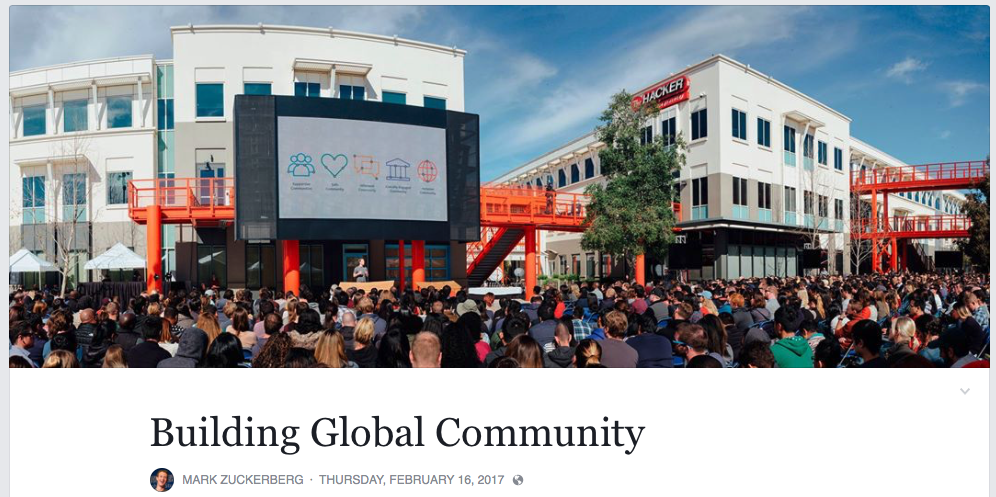
In his recent open letter to the “Facebook community,” Mark Zuckerberg issues a call to arms for people around the globe to come together in service of amorphous ideals like safety and civic engagement. He uses the term “community(ies)” over 100 times in the post.

He keeps using that word. I do not think it means what he thinks it means.

Community is one of those words that gets applied to so many social units that it becomes practically meaningless. Facebook is a community. The city you live in is a community. The local university is a community. Your workplace is a community. Regardless of the actual characteristics of these social units, they get framed as communities. But more often than not, they are not communities. This is not merely a semantic distinction; it has important consequences for how we think about governance, scales of human interaction, norms and values, and politics.

When you conjure a community in your mind, you probably do not immediately jump to Facebook or a corporate workforce or even your city. More likely you think of your local activist organization, your neighborhood, or the people you collaborate with on creative projects. You may even think of a Facebook group you’re a member of, or a subreddit you subscribe to. But if someone asked you what communities you’re a member of, would you really say “Well, I use Facebook…”?

Corporate entities are fond of the term community because it fosters a sense of familiarity with their brand, and as social creatures we crave belonging. It also serves as a stand-in idea for social units that are decidedly less compelling. “Millions of users” or “Massive consumer base” are not concepts that inspire an emotional connection. Less nefariously, community is not a cumbersome word in the way that “world-wide user base” is; or, at least, it feels less cumbersome.

But in reality, community serves us best when it is treated as a specific type of human relationship. It is a social unit based on voluntary association, shared beliefs and values, and contribution without the expectation of direct compensation. In my own work I’ve used the gemeinschaft-gesellschaft distinction popularized by sociologists like Ferdinand Tönnies, Max Weber, and Émile Durkheim, but really you don’t need a working knowledge of German sociology to come up with basic, common sense parameters for what constitutes a community. You know it when you see it. Or rather, you know it when you feel it, because community is ultimately an affective, emotional connection to other people.

How many times have you heard someone complain about how much they want to leave Facebook but can’t because there is so much momentum behind it, because everyone you know uses it? That’s a red flag that Facebook is not a community. Communities do not hold you hostage. Communities are “walk-awayable” so to speak. They are, in general, pretty easy to leave if you decide you are not getting what you need from them.

But really, this is a grossly over-simplified way to describe community at a sociological level. It’s too slippery to fit in a categorical box, and our notions of community change radically over time. Though it’s difficult to imagine a time before nation states, they are a recent phenomenon that required the cultivation of an entirely new and alien sense of community. This new scale of idealized human kinship allowed nation states to flourish and, eventually, dominate the globe. Benedict Anderson calls this phenomenon an “imagined community” that “is always conceived as a deep, horizontal comradeship,” despite the “actual inequality and exploitation that may prevail.”

It takes a great deal of work and informational infrastructure to coerce millions of people into believing that they are members of a shared community that behaves nothing like a meaningful community. Anderson cites print capitalism as a driving force of nationalism, which “created monoglot mass reading publics,” massive groups of people all reading the same language and being exposed to the same ideas. Mass produced print media, and later electronic media, fostered a national discourse and mythology: a pool of symbolic resources that “citizens” could draw on to understand themselves as a part of a huge, nebulous, diverse population.

Arguably, social media networks have supplanted nation states as the imagined communities du jour. The internet is the new printing press, the technological advancement that helped pave the way for our new imagined communities. I’ve previously written on how the explosion of political texts and images online reveal and perhaps perpetuate deep-seated, emotional disturbances in our ability to see our nation (in this case the US but it is likely true in many other countries) as a unified community. At current, it may be much easier to see a community-based kinship with your social network on Facebook than with your nation’s fellow citizens.

Media studies scholar Marshal McLuhan predicted Zuckerberg’s argument to some degree when he wrote about the “global village” that, thanks to high-speed electronic communication, would foster personal connections at a global scale, inducing us to be more invested in issues around the world. This sentiment is echoed in Zuckerberg’s manifesto. For McLuhan, the important consequence of a new medium (in the sense of every medium being “new” at some point) is its ability to extend human consciousness and sensorium beyond the body. You are projected onto the words on a page, the moving image on your television, and the email from your grandfather. From speech to writing to radio and the internet, we have stretched our consciousness further and further beyond the body.

McLuhan was not writing about internet communication specifically, so the notion of a particular platform like Facebook being a global, imagined community requires a new look at McLuhan’s global village, particularly with an emphasis on the role corporate branding and digital infrastructure play. It must go beyond the somewhat vague model of media nodes in a global network to understand the role of a specific, highly influential platform and the ways its developers seek to govern their own global village.

A crucial element of community is that, by and large, they are pretty horizontally governed. Leaders may emerge, power relationships certainly exist, and this is not necessarily a bad thing as leaders can afford to take on more of the responsibilities of maintaining a community then other members may be capable of. But leaders can also be easily overthrown in a community. If their leadership becomes unpopular, community members stop listening, stop doing what they’re told, and perhaps simply go elsewhere or start something new. The voluntary association element of community is a check on any undesirable shifts in shared beliefs and values. If the women’s caucus in your activist community is dominated by white women with shitty politics you can speak up, challenge the lack of diversity in leadership, or even leave and start your own more diverse caucus. I’m not saying it’s easy or consequence free, but it is doable. Less so with a nation, and less so with Facebook.

Facebook cannot be called a community because, while you can technically leave it, it can hardly be called a voluntary association. As I noted above, many users want to leave the site and build their own alternative social network platform, but that would require a mass exodus of users and a comparable platform elsewhere. It’s akin to saying “If you don’t like this country why don’t you just get out!” OK, sure, I could. Assuming I can sell my house, get my family to come with me, find a new job overseas, be given a visa or citizenship…

Facebook also, regardless of how much Zuckerberg plays up their “Community Standards,” is not based on shared values and beliefs. Users don’t set up Facebook accounts to fight for water justice or constitutional originalism or single payer health care. They sign up because their best friend from college moved across the country and they want to see what she’s up to, how her life is. Or they want to get to know the people in their dorm and easily organize events. Or they want to share dank memes that they stole from Reddit. But Facebook’s values like “safety” and “respect” are so variously defined, and so difficult to enforce, that they hardly qualify as shared beliefs among community members.

So why is it such a big deal when a large corporate entity tries to convince you that it’s a community, and that you’re part of it? For one thing, community members should have significant say in governance. Communities should not be run by a CEO and a board of directors. Communities generally don’t have their members’ activities filtered based on how many people liked a post or some other algorithmic tinkering that is both invisible and consequential. And lulling users into a false sense of their role in governance encourages complacency, inspiring greater trust in leadership than is warranted.

Zuckerberg wants to take (minimal) responsibility for Facebook’s role in spreading disinformation during the election. He wants to make serious journalism at local and global levels a more important part of Facebook’s content. He wants to minimize sensationalism. And he wants accomplish this in large part with AI development.

In keeping with Facebook’s history of vagary, Zuckerberg is pretty unclear about how he wants any of this to work. On what basis will AI filter news content? What role will peer sousveillance and reporting objectionable content play? So far this has generally meant that photos of women breastfeeding are terribly objectionable while racial slurs and threats of violence are left to stand. Zuckerberg says it will take greater AI development to make the tech more capable of “reading” images and videos, and yet my (and many others) experience is that an image of a fat woman in her underwear promoting self-love is apparently much more offensive than a commenter threatening sexual violence against another user. The problem doesn’t seem to be medium—it’s what counts as objectionable.

Facebook should not be thought of or presented as a community because it can never be governed as a community should be—based on egalitarian and horizontal decision making, a set of specific shared norms and values (not “safety” and “engagement” but rather “keeping the block clean” or “supporting public schools”), and based not on profit and information gathering but on mutual aid without the expectation of direct compensation.

Zuckerberg writes, “Facebook is not just technology or media, but a community of people.” But it’s best thought of as an imagined community, the new nation state that essentially propagandizes you into feeling comradery with both a brand and a massive user base consisting by and large of people who don’t share your values.

The nation state requires that its citizens not only believe in their solidarity with fellow citizens, but also that they allow themselves to be counted, moved geographically, subject to the state’s monopoly on legitimate violence, and surveilled. Zuckerberg’s manifesto gussies up the digital versions of these tactics to legitimize the top-down governance of Facebook, minimize its failures, and convince users that better things are on the horizon. And despite all the criticisms of Zuckerberg’s letter published in various media outlets, you need only look at the comments on his post to see that it’s working. The leader has given his people happy, tingly, community feelings.

The old jingoistic saying might need to be updated for the 21st century:

My Facebook, right or wrong.

Britney is on Twitter


26 Feb 11:46

Hack Education Weekly News

Education Politics


Via The New York Times: “President Trump on Wednesday rescinded protections for transgender students that had allowed them to use bathrooms corresponding with their gender identity, overruling his own education secretary and placing his administration firmly in the middle of the culture wars that many Republicans have tried to leave behind.”

The Department of Education press release: “U.S. Secretary of Education Betsy DeVos Issues Statement on New Title IX Guidance.”

More on this story: Via The Atlantic: “The Federal Government’s Reversal: Let the States Deal With Transgender Kids.” Via NPR: “Trump And Transgender Rights: What Just Happened?” Via US News & World Report: “Bathroom Wars.”

Via Politico: “Spicer denies Cabinet feud over transgender student protections.”

Arne Duncan and Catherine Lhamon – that’s the former Secretary of Education and the chair of the US Commission on Civil Rights – wrote an op-ed in WaPo: “The White House’s thoughtless, cruel and sad rollback of transgender rights.”

Trump Will Lose the Fight Over Bathrooms for Transgender Students,” writes NYT op-ed writer Ria Tabacco Mar.

More on trans high school student Gavin Grimm’s Supreme Court case in the section below.

Do keep all this in mind whenever you hear ed-tech entrepreneurs and venture capitalists and ed-reform types cheer for Betsy DeVos: Via Chalkbeat: “Betsy DeVos, reportedly opposed to rolling back protections for transgender students, defends the changes.” Via Buzzfeed: “Betsy DeVos Defends Decision To Rescind Transgender Protections.” Via ABC News: “Education Secretary Betsy DeVos slams Obama’s transgender bathroom rule as ‘overreach’.”

An interview with Betsy DeVos in Townhall. The highlight:

I visited a school on Friday and met with some wonderful, genuine, sincere teachers who pour their heart and soul into their classrooms and their students and our conversation was not long enough to draw out of them what is limiting them from being even more success from what they are currently. But I can tell the attitude is more of a ‘receive mode.’ They’re waiting to be told what they have to do, and that’s not going to bring success to an individual child. You have to have teachers who are empowered to facilitate great teaching.

And the response from those teachers, via The Washington Post: “DeVos criticized teachers at D.C. school she visited – and they are not having it.”

Via Buzzfeed: “Betsy DeVos Starts Her Time As Education Secretary Taking On Her Critics.” Because being cruel and thin-skinned seems to be the policy priority for everyone in the Trump administration.

Betsy DeVos is Publicly Polite, but a Political Fighter,” says The New York Times. Well then.

Via The Washington Post’s Valerie Strauss: “So far, Education Secretary Betsy DeVos is just what her critics feared.”

From the Department of Education press release: “Statement from Secretary DeVos regarding the restoration of IDEA.ED.GOV,” claiming that the special education site had been neglected for the past four years before going offline. AFT president Randi Weingarten calls bullshit.

Via The Chronicle of Higher Education: “Betsy DeVos Criticizes Professors in Remarks to Conservative Conference.” That is, she told college students at the event that “faculty, from adjunct professors to deans, tell you what to do, what to say, and more ominously, what to think.” More on DeVos’ CPAC speech in Inside Higher Ed. (The transcript.)

Via The Hechinger Report: “DeVos praises virtual schools, but new research points to problems.” More on that research in the research section below.

Via The New York Times: “Popular Domestic Programs Face Ax Under First Trump Budget.”

More on the possible elimination of AmeriCorps via Chalkbeat: “Trump’s proposed AmeriCorps cuts would trim .03 percent of the federal budget – but slash support at 11,000 schools.”

Via WaPo: “Trump’s hiring freeze leads some Army bases to suspend pre-K and other child programs.”

“New Trump Deportation Rules Allow Far More Expulsions,” says The New York Times. DACA – purportedly – is not affected.

Via The Intercept: “Civil Rights Groups, Funded by Telecoms, Back Donald Trump’s Plan to Kill Net Neutrality.”

Maine governor Paul LePage has finally nominated an education commissioner – the post has been open since 2014.

Via Inside Higher Ed: “Iowa Bill Would Force ‘Partisan Balance’ in Hiring” at universities.

Via EdWeek’s Market Brief: “Feds Drop Investigation Into Los Angeles District Over $1 Billion iPad Purchase.”

Oh, how very different “the politics of education (technology)” drumbeat sounds from some ed-tech publications:

Trump will mean more “innovation” in higher ed, according to eCampus News.

Via Edsurge: “​Rhode Island’s Plans to Become a ‘Lab State’ for Personalized Learning.”

Education in the Courts


Via the ACLU blog: “SCOTUS Rules Unanimously on Behalf of Michigan Girl with Cerebral Palsy Who was Prevented from Bringing Service Dog to School.”

Via The 74: “Obama-Era Protections for Transgender Students to Be Revoked, Gavin Grimm Supreme Court Case at Risk.” That is, the Supreme Court could now punt on Grimm’s case, which involves his challenge to his school that had banned him from using the boys’ bathroom.

Via Politico: “The Education Department must determine by next week if it will continue to enforce the Obama administration’s ban on collection of some student loan fees, U.S. District Judge Amit P. Mehta said in an order Thursday night.”

Via The New York Times: “Federal prosecutors have expanded their investigation of the financial dealings of the former president of the City College of New York into whether she received tens of thousands of dollars in unauthorized payments over several years from the school’s oldest alumni fund.”

More on the legalities surrounding the termination (or not) of the for-profit accreditor ACICS in the accreditation section below.

Testing, Testing…


Via Inside Higher Ed: “Large-Scale Assessment Without Standardized Tests.”

Via The Washington Post: “ College Board takes ‘robust’ new SAT security steps – but is it enough to stymie cheating?” (This story could go in the Betteridge’s Law of Headlines section below.)

Via Campus Technology: “AP Exam Pass Rates Rise Even as Participation Doubles.”

Online Education and the Once and Future “MOOC”

Via the Iowa City Press-Citizen: “Iowa families foregoing classroom for virtual school.”

More research on virtual schools in the research below.

+Acumen “senior innovation associate” writes about +Acumen in Edsurge: “The Flip Side of Abysmal MOOC Completion Rates? Discovering the Most Tenacious Learners.”

“Free College”


Via the University of New Hampshire press release: “UNH Announces Tuition-Free Plan for Hundreds of NH Students.”

The “New” For-Profit Higher Ed


Tressie McMillan Cottom on her new book on for-profits, Lower Ed, and on credentialing and inequality in a Q&A with Inside Higher Ed. Elsewhere in IHE, a review from “Dean Dad” Matt Reed. Dr. Cottom in The Chronicle of Higher Education: “A Sociologist Looks at the Failure of the For-Profits and the Rise of Trump.” In The Atlantic: “The Coded Language of For-Profit Colleges.”

Via Edsurge: “How One Coding School Hopes to Teach Thousands of Students, Without Professors.”

Via The New York Times: “For-Profit Schools, an Obama Target, See New Day Under Trump.”

Via Inside Higher Ed: “Career Education Corp. on Wednesday announced that it had settled a false claims lawsuit with private plaintiffs. The suit against the for-profit chain and its American InterContinental University was originally filed in 2008.”

More on the legalities surrounding the termination (or not) of the for-profit accreditor ACICS in the accreditation section below.

Meanwhile on Campus…


Via ProPublica: “‘Alternative’ Education: Using Charter Schools to Hide Dropouts and Game the System.”

Via The New York Times: “Universities Face Pressure to Hold the Line on Title IX.”

“Have We Lost Sight of the Promise of Public Schools?” asks Nikole Hannah-Jones. Perhaps this could go under the Betteridge’s Law of Headlines section, but I think in this case the answer to the question is “yes.”

“Welcome to Shark Tank U” – Steven C. Ward on “entrepreneur mania” in higher ed.

Via The Washington Post: “A university takes on one of its own, alumna Kellyanne Conway.” The school in question: Trinity Washington University.

Via the OC Weekly: “Off-Duty LAPD Cop Fires Gun During After-School Melee with Anaheim Teens.”

Via the Star Tribune: “University of Minnesota police investigate flier with two swastikas posted on campus.”

Via Inside Higher Ed: “Michigan State plans to bar [whiteboards] from dormitory room doors, in attempt to limit bullying.”

Via The Hechinger Report: “In a city still struggling with segregation, a popular charter school fights to remain diverse.” The city: New Orleans. The charter: Bricolage Academy.

The Atlantic on the history of segregation.

Accreditation and Certification


Via Politico: “A federal judge on Tuesday declined to put on hold the Obama administration’s decision last year to terminate the nation’s largest accreditor of for-profit colleges.” That’s ACICS.

Also via Politico: “Congressional Republicans have appointed two new members to the federal advisory committee that oversees college accreditors” – Claude Pressnell, the president of the Independent Colleges and Universities Association, and Brian Jones, the president of Strayer University.

More on professional development company Bloomboard’s pivot to micro-credentialing in the HR section below.

Go, School Sports Team!


Via NPR: “Go To College, Play Video Games. E-Sports Make A Play For The Big Ten.”

Via Inside Higher Ed: “Liberty University will join the Football Bowl Subdivision, college sports’ most competitive level, after receiving a waiver from the National Collegiate Athletic Association on Thursday.” Late last year, the school hired Ian McCaw as athletic director, who’d resigned from Baylor over allegations that his department had mishandled sexual assault cases.

From the HR Department


Via KTAR News: “Phoenix-area teacher resigns after tweeting about killing immigrants.”

Via Edsurge: “BloomBoard Appoints New CEO, Restructures Focus Around Micro-Credentials.” The new CEO: Sanford Kenyon, formerly the startup’s Chief Revenue Officer.

Via The New York Times: “Inside Uber’s Aggressive, Unrestrained Workplace Culture.” Good thing no one in ed-tech is describing themselves as “Uber for education,” right?

This Week in Betteridge’s Law of Headlines


“Can ‘Sober High’ schools keep teenagers off drugs?” asks The Hechinger Report.

“Is the College Board’s Newest AP Computer Science Course Closing the Gap?” asks Edsurge.

(Reminder: according to Betteridge’s Law of Headlines, “Any headline that ends in a question mark can be answered by the word no.”)

Upgrades and Downgrades


The headline touts teaching computer science without computers; the article is better than that.

“What Students Want Their Professors To Know About Edtech” – according to Edsurge.

Via The Chronicle of Higher Education: “What’s Up With Hive, a Nascent Successor to Yik Yak.”

Via the Khan Academy blog: “Teachers using Google Classroom can now quickly and easily import their class roster to Khan Academy.” Wheee.

Via Edsurge: “Battle of the Classrooms: Apple, Google, Microsoft Vie for K–12 Market.” “Comparing Apple Classroom to Google or Microsoft Classroom is sort of like comparing apples to oranges,” but this article was written anyway.

Mark Zuckerberg on “Building Global Community” via Facebook.

MakerBot Is Trapped in the Nastiest Part of the Tech Hype Cycle,” according to The Ringer.

“Looking (again) to Domain of One’s Ownby Martha Burtis.

Robots and Other Ed-Tech SF


Via Quartz: “The robot that takes your job should pay taxes, says Bill Gates.” I’d love to see the Gates Foundation extend this logic to their push for “personalized learning,” but I won’t hold my breath.

Via the MIT Technology Review: “What Happens When Robots Become Role Models.”

Venture Capital and the Business of Ed-Tech


Galore has raised $1.65 million in seed funding from Norwest Venture Partners and DCM Ventures. The startup lets parents book activities for kids via a mobile app.

Vkidz has raised an undisclosed amount of private equity funding from Veronis Suhler Stevenson.

The private equity firm Francisco Partners has acquired the reading platform MyON.

Higher Learning Technologies (HLT) has acquired gWhiz.

The excitement about Betsy DeVos continues in the pages of Edsurge: “5 Policy Headaches and Opportunities for US Education Businesses Under DeVos.”

“The LMS Market is Quickly Losing Ground,” according to Chief Learning Officer at least.

The Gates Foundation’s 2017 Annual Letter doesn’t really say much about education. Phew.

Privacy, Surveillance, and Information Security


Via The New York Times: “The Bright-Eyed Talking Doll That Just Might Be a Spy.”

Via Inside Higher Ed: “Suspension Lifted for Student Who Taped Instructor.”

Via The Wall Street Journal: “N.J. Student-Teacher Videos Raise Privacy Concerns” – “A new rule that requires teaching candidates to submit tapes of their lessons to an education firm for review has sparked a backlash from some educators, parents.”

Via Campus Technology: “‘Rasputin’ Hacker Targets 60 Universities, Government Agencies.”

Via Education Dive: “Internet of Things helped Connecticut district cut electricity bill by 84%.” No mention of last week’s story about IOT devices were used to attack one university’s network.

Data and “Research”


“America Has Never Not Had a Childcare Problem,” writes Rebecca DeWolf in Pacific Standard.

Via Education Week: “School Spending Ticks Up; Charters Still Spend Significantly Less.” (That is, they spend less on instruction.)

Via NPR: “English Language Learners: How Your State Is Doing.”

Via Eduventures: “Introducing the Higher Education Technology Landscape 2017.” Always fascinating to see how insistent industry folks are in not including private student loan companies or for-profit colleges (and coding bootcamps) in their reports.

Via Inside Higher Ed: “Student Debt Total Hits $1.31 Trillion.”

Via The Pacific Standard: “Debunking Myths About Creativity and the Brain.”

Via Inside Higher Ed: “Tuition rose faster than state appropriations fell, and federal aid helped make that possible, study asserts.”

Research from edbuild on property taxes and education funding.

Via Inside Higher Ed: “Study finds that physicists are more likely to describe women as ethical scientists, but in ways that potentially limit their productivity and competitiveness.”

Via Kevin Carey in The New York Times: “Dismal Voucher Results Surprise Researchers as DeVos Era Begins.” SURPRISE! (Not really. I mean, I'm not surprised. Are you?)

Icon credits: The Noun Project

26 Feb 11:44

Anti-doping rhetoric and hypocrisy ramping up with one-year countdown to Winter Olympics in South Korea

by Tim Noonan
It was an Olympic celebration, of sorts. On the day of the one-year countdown to the 2018 Winter Olympics in Pyeongchang, South Korea, Austrian police acting on a tip raided the Kazakhstan biathlon team’s hotel before the World Championships in search of performance -enhancing drugs. Apparently they found a box left at a nearby gas station containing used medical equipment and handwritten notes outlining drug protocol. Police seized additional medical equipment as well as mobile phones...