Shared posts

19 Apr 02:26

The Revisionism of Andrew Sullivan

Andrew Sullivan has, in-between serving as an inspiring example to white mediocrities everywhere, found the time to pen a screed on race in America. It’s described as “not for the closed-minded” as if there’s something novel but really it’s just the standard garbage model minority shit white people do constantly to weaponise Jewish or Asian-American communities against African-Americans.

Sullivan mentions Jewish people as an ethnic group who have integrated nicely into White America, despite being a minority in a racist society, and groups us with Asian-Americans against African-Americans in doing so. He points to our nice integration and wealthiness as groups and then argues: hey, racism is dead!

I’m not going to comment on what it says about Asian-American or African-American people, because there are much smarter POC voices already doing that (check out Zoé Samudzi’s as-always excellent thread). But I am going to comment on the broad Jewish angle, because this is revisionist bullshit and up with it I will not put.

First-off, Jewish people, African-American people and Asian-American people are not non-overlapping groups - there are Jews of every background. Ask me to name some Native American Jewish people some time, I keep a list. To claim that they are non-overlapping sets is to gloss over Jewish POC and instead fall into the pattern of thinking that all Jews look like, well, me. That Sullivan does this is pretty revealing of why his thesis falls down - because when he says Jew he’s thinking white, Eastern European Jew.

Us white Jews are indeed thriving! And the reason for this, and the point at which Sullivan gets truly ahistorical as well as generally revisionist, is the Holocaust. We weren’t always accepted, see; the KKK was refounded on the lynching of a Jew in Georgia. In 1939 - in the aftermath of the widely-disseminated images and stories of Kristallnacht - a Roper poll showed that 53% of Americans believed “Jews are different and should be restricted”, while 10% believed every Jew should be deported entirely from the United States.

But then the Holocaust happened. And as the American public became more aware of the horrors that had been committed in Europe, they largely stopped expressing the views used to justify them - not due to some come-to-Jesus moment, in many cases, but simply because most people wish to be thought of as good. The Holocaust: bad. Nazis: bad. Sounding like a Nazi: bad. Not sounding like a Nazi: good.

So as partial repayment for the millions not saved, they toned down the anti-Semitism and offered Eastern European Jews membership in whiteness. Only associate membership, of course - lord knows this last year shows that it’s all-too conditional - but membership. The only cost was that we assimilate, and most of us very much did: we gave up our traditions to generalised consumption and just became white people with funny dances. That’s what our thriving is built on: not the abolition of oppression but our assimilation away from it.

Sullivan glosses over this entirely: he operates from the position that “Jews”, broadly-construed, are a minority who just magically turned up and do well. He ignores that the suspension of disbelief that white Jewish survival is based on was a literal blood price. He ignores that when we turned up, we did so with a largely-intact community, not as individuals violently wrenched from our communities and spaces as African-Americans were and are.

More importantly, his portrayal of Jewish people as a distinct set from POC ignores the overlap of both, and ignores that if you look at POC Jews, they’re not thriving in the least: they’re struggling with both the racism of whiteness as a whole and racist violence within Jewish communities. Statistics on the success of Jewish people only work because 70%+ of us are Eastern European. If you look at the remaining 30%, the picture is very different. Take a look at In Jewish Colour or JOCSM and tell me if that looks like racism is dead, to you.

So Sullivan’s essay is not only stunningly mediocre as a hot take, it’s self-falsifying. Attacked on its assumptions about what a Jew looks like, it ends up disproving itself entirely, because the survival and success of white Jews doesn’t demonstrate the death of racism at all. Instead, when constrasted with the experience of POC Jews, it strongly shows that racism is all too damn alive.


19 Apr 02:25

2017 Camera News

Herewith some reportage on the most interesting cameras in the world, with opinions to provoke er entertain people who are up on this stuff, and a basic survey of the landscape for people who like pictures and wonder about cameras.

[Update]: The same day I wrote this, DPReview ran a nice piece on shooting Seattle cherry blossoms with a bunch of different cameras, including a few of the types, and individual cameras, discussed here. Check it out.

I’m an enthusiast photog (not remotely pro) and I’ve noticed, over the years, when I write generally about what’s up with cameras, I get notes from people saying “thanks, that was interesting”. I think I may have sold a few cameras over the years, even.

Conclusions first

Let’s see if we can start some arguments.

  1. The most interesting cameras in the world right now are the new digital “medium formats”: Fujifilm GFX 50S, Pentax 645Z, and Hasselblad X1D. Here’s a comparo. But they’re expensive and you almost certainly don’t need one unless you’re a pro.

  2. The next most interesting cameras in the world are the ones in mobile phones. They’re excellent for most things, but don’t obsolete “real” cameras just yet.

  3. All modern cameras take great pictures. The most important differences between them are ergonomic: How quickly and easily you can get the shot, especially when conditions are bad.

  4. There are reasons to think that the “APS-C” and “full-frame” sensors are the big winners going forward; the price of being smaller, and the cost of being larger, are both too high.

  5. I think the SLR is probably doomed; mirrorless cameras have too many advantages.

Picture break! The theme is spring.

Spring blossoms

Camera taxonomy

You can sort cameras into two baskets; by how big their sensor is, and by their physical configuration. For sensors, bigger is better; sizes that are relevant today, small to large, are:

  1. 1/2.3" (7.7mm diagonal, more or less); this is what good modern phone-cams have.

  2. Micro Four Thirds (~21.5mm diagonal); what the mirrorless cameras from Olympus and Panasonic have.

  3. APS-C (~28mm); what most “ordinary” DSLRs, and the Fujifilm/Sony mirrorlesses, have.

  4. Full Frame (~43mm); what’s in the Canon, Nikon, and Sony flagships.

  5. Medium Format (~55mm); also called 645, A.K.A. really freaking big. This is what the “most interesting cameras” at #1 in the first list above use; interesting because they have these sensors in bodies, and at price points, that are not totally out of reach.

There’s a pretty good write-up on all these size trade-offs at Camera sensor size: Why does it matter and exactly how big are they? But it’s from 2013 and doesn’t include Medium Format.

As for configurations, three are interesting these days.

  1. Mobile phone; it fits in your pocket and you shoot by tapping on the screen.

  2. SLR; the most “traditional” shape, with a lump on the top, and you look out through the front lens with the help of prisms and mirrors.

  3. Mirrorless; you look at an electronic reproduction of what the camera sensor is seeing, either through a viewfinder or a screen on the back of the camera. Those “most interesting” medium format cameras are interesting partly because two of them are mirrorless; the Pentax is the only SLR.

Time for another picture break!

Sprint moss

How big a sensor do you need?

The little ones in your phone can take great pictures; why would you want more? Two big reasons: A bigger sensor makes it easier to get that nice effect where your subject is sharp and the background is fuzzy (see the sharp fuzzball below). Second, if you have more pixels you can blow your picture up bigger, for example to print and hang on a wall.

The first argument is good, but the second is weak. Because most of us, these days, share and enjoy pictures on screens, and only on screens. That blossoms-and-sky pic at the top came out of my Google Pixel and, after cropping, is 2764×3375. My 15" Retina MacBook Pro only has 1200 pixels of vertical resolution. So I already can’t display all the pixels from my Pixel.

Also, on the wall of my living room I have a four-foot-tall print of a photo shot with an old-school pocket cam (no longer relevant in the mobile-cam era) from an airplane.

So, it’s surprising how big you can go. But still… last time I was in Vegas I went wandering and ended up at Rodney Lough’s gallery, full of room-size blow-ups; I found many of them overwrought and overproduced, but wow, the impact is not to be denied. He’s still using 4×5" and 8×10" film cameras, but I bet those medium-format puppies at #1 above could do the trick.

Realistically though, are you going to want to work with pictures wider than you are tall?

Picture break!

Left over from last fall

So what really matters?

For most practical purposes, your phonecam will meet your photographic needs. Which is to say, the quality of your pictures will depend mostly on your ability to see the opportunities.

Things your phone still can’t do: Take pictures of things that are a long way away; capture the classic portrait look (but Apple’s working on that); shoot in the dark (but late last year I managed to capture actual moonbeams with my Pixel); have fun with different kind of lenses; take pictures in a rainstorm. Or (most important) let you take control of your photographs.

So given that any modern camera can do all the things that your phone can’t, and produce beautiful pictures, what are the difference that matter?

It turns out that the camera companies have (differing) opinions about how pictures should be taken, and ship opinionated cameras. Which is wonderful. Personally, I’m a Fujifilm fanboy, for exactly one reason: I like where the knobs and dials are, and how they work, and how things look through the viewfinder. I suppose I could get used to another maker’s opinion, but at the moment I’m pretty convinced that for me, the Fujifilm setup lets me shoot faster and focus sharper and light-compensate better.

There are lots of people who are going to find themselves in better tune with the opinions of Nikon or Canon or Sony, and that’s just fine; although I have to confess that the few times I’ve tried out a recent Sony it felt like I was fighting against the controls, not working with them.

So, I’m gonna say, if you’re thinking about a camera, don’t waste time worrying about pixels or sensors or ISOs or, really, any specs at all. Borrow or rent a few different ones and take some damn pictures already; then you’ll know.

Focus on fun

I don’t get paid for taking picture (well, rarely) and you probably don’t either, so we should bear in mind that this is a recreational activity.

It’s a path I haven’t been down, but I suspect the cameras that win on the pure-fun metric are the fixed-lens mirrorless offerings, notably the Fuji XF-100 or Leica Q. These things are kind of expensive, but they have great lenses and great viewfinders and look cool and if you point them at pretty well anything and shoot, you’ll probably be happy. Photography should make you happy.

19 Apr 02:25

Recommended on Medium: An Ex-Drupal Community Member’s Take On “Drupal Drama”

I’ve watched the unfolding “drupaldrama” with great interest, as a person who was once fairly involved with Drupal for a long time. I have also “left” Drupal a few times due to sexism in that community. And finally left for good last year after one particularly egregious issue I will not get into here, but may write about later.

It was sad because I built my career on Drupal (though I have since moved on) and my first web development job out of college was doing Drupal. I continue to do Drupal sites occasionally, but am no longer really engaged with the community at all. I very rarely attend events or participate on Drupal.org. I haven’t logged into IRC in a long time.

Now I myself have been accused of defending a sexist by questioning this decision. Which is surreal because of my long history calling out sexism both privately and publicly in Drupal. This demonization of skeptics is not the sign of a healthy community.

I’m not going to get into Larry as a person or Gor*. I haven’t had many interactions with him, I’ve been irritated for a long time with his stances on various issues ranging from sexism in IRC to technical terminology. I think his comparison of his plight with the struggles of LGBT people and minorities is offensive.

I think it’s very much possible Larry is a sexist, and there are plenty of example you can find of him being terrible on Twitter. People have called this guy out for years and continue to do so.

The thing is, for years he didn’t care about that at all. And now no one really is sure why he got kicked out. I’ve heard a lot of speculation on the matter. Some people are insisting he must have harassed or abused someone in some way. Here is why I don’t believe that:

1. That would have violated the Code of Conduct. He was not found in violation of the Code of Conduct.

2. Dries factored in his devotion to the project. This is the official statement on that

Larry had indicated on several occasions that he was drawing down his involvement in the Drupal project, and that context helped inform Dries’ decision.

Are we supposed to believe that if he had harassed someone but had also been sufficiently devoted he would not have been removed?

Also is this even an appropriate reaction had he been harassing someone? If this guy is truly dangerous, removing him and not stating this is only going to allow him to continue being a menace in other OSS communities.

There is the excuse apologists for this decision have made, that they cannot release any information about the issue because of privacy concerns. I do not find this convincing in any way, you do not have to disclose things that would out a reporter or victim to disclose the nature of it.

What about the idea he was kicked out because he’s a sexist. We also have the issue that multiple people prominent in Drupal have been accused of sexism inside Drupal (at cons, camps, IRC, etc.) and there has been plenty of evidence to back it up. And they continue to be welcome in the community. What’s the difference here?

It is fascinating to me to see the official statements on the matter refuse to even mention the word “sexism.” Or “misogyny.” That jives with my experience in the community where the idea of systematic sexism is rejected and instead the idea is that sexism is the work of a few “bad apples.” Even a tongue in cheek reference to this systematic sexism is viciously attacked. Note to people who haven’t experienced sexism: it almost never comes from a stereotypical “pig” but from the “nice guy” who asserts he has X many female friends and hires X number of female.

It’s clear sexism is a problem. You don’t solve it with a 6-month process that involves trawling a guy’s private sex-related accounts. That probably could have gone on longer had he not written about it in public.

It’s not appropriate for an OSS leadership to trawl private sex-related sites to gather info about a member. It just isn’t. I don’t care if the guy is a sexist or not. You might hate me for being an SJW or a sexist-defender but I think at least most sane people might agree with that.

And then official statements go on about how this “was never meant to be about sexual practices or kinks, so it pains me that I unintentionally hurt you. I do support you and respect you as a key part of our community.” Nice crocodile tears, but if you respected the kink community you wouldn’t be making an account on whatever private site they went through just to invade someone’s privacy. The hilarious thing is they never would have had to do that if they had listened to the people calling Larry out, in public, in the first place.

To many complete outsiders this looks like them just kicking a guy out for being kinky, and that’s how the press coverage has read. Which is kind of funny if the reason they kicked him out was to prevent him harming their image. And apologists refuse to even acknowledge how this looks like to people outside of Drupal.

I know it hurts to hear someone not be all kumbaya about Drupal and its community, but think of all the people who are missing from this conversation. Members of the community from long ago that I remember, but you probably don’t. Ask yourself why they aren’t there anymore, particularly the women**.

Yes, by all means doing something about sexists, but do so with transparency and clear rules on the matter. OSS has always been about openness, it is totally understandable for people to be angry when that doesn’t happen.

* others have done that better. Gor is a fantasy roleplay thing, though it also appears Larry outside of that has some beliefs about the “natural” proclivities of women desiring submission as a reason they might be attracted to Gor, but this is all taken from some slideshow notes. Of course this is me also guessing, which a lot of people have been doing. And the stuff they’ve filled in the blanks with is really just tinfoil.

** a great example was the Dries Drupalcon keynote from 2010 — it’s not easy to find (and not uploaded officially). It was plainly offensive, especially in light of what women in the community had been asking for at the time, which was to keep sexual content that wasn’t related to Drupal out of the Drupal community. And the people who pointed this out were almost uniformly told that they were too sensitive. A lot of these women no longer participate in Drupal anymore.

19 Apr 02:25

Recommended on Medium: Set your status in Slack

A new way to let your teammates know what you’re up to

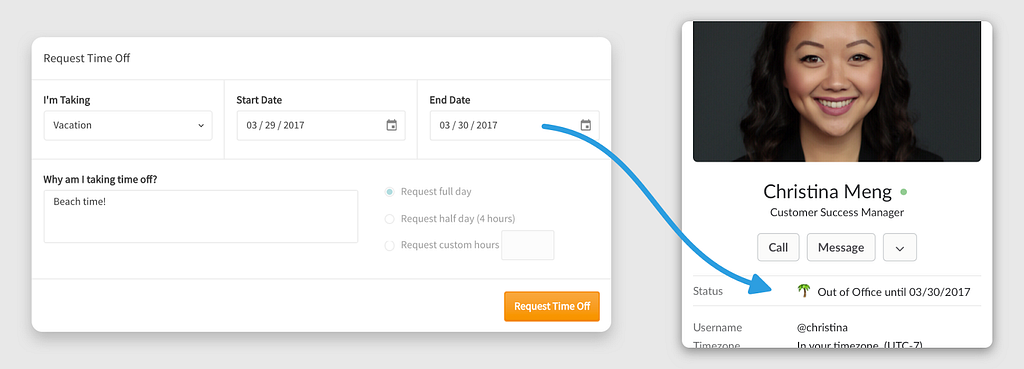
Let’s say you’re stepping away from Slack for a bit — maybe you’re grabbing some lunch, taking a week off, or even just focusing on a task for a few hours. Now you can set a custom status in Slack to share what you’re up to, when you’ll be back, whom to contact in your place, or anything else that helps your team know when they can expect to hear from you.

Pick from five default options for common scenarios when you’re away — like being out sick or working remotely. For anything else, create your own, more specific status that says exactly what you want your team to know. Each status can be up to 100 characters and illustrated with an emoji of your choice.

Setting your status

You can set a status from the browser, desktop and mobile versions of Slack. From your computer, click your name in the upper left corner of your sidebar, then select Set a status. On the iOS or Android apps, tap the More items icon (…), or edit your status directly from your profile.

Apps can set statuses, too. For example, Zenefits syncs your status with their Time Off Tracking system so people know when you’re on PTO, and Meekan shows when you’re in a meeting (and when you’ll be free). Your status will also automatically update when you’re on a voice or video call in Slack, then reset once you’re done (you can turn this setting off in your preferences).

How your status appears in Slack

Only your status emoji is displayed beside your name in messages and the left sidebar. This way, teammates can get a quick read of what you’re up to — without cluttering your conversation.

If someone wants more information, they can hover over the emoji to view your status in its full glory. If you didn’t select an emoji, we’ll automatically show the :speech_balloon: (

19 Apr 02:25

Recommended on Medium: Notes on running your own Mastodon instance on Heroku

And why we should be focusing on decentralized p2p apps instead

The Mastodon error message image, reminiscent of the Twitter “fail whale”

Mastodon is a “GNU Social-compatible microblogging server”. Which kind of means that it is like Twitter, if people could run their own copy and the different copies all work with each other.

Mastodon.social has a better user interface, a non-exploitative financial model, an extremely nice community, and no Nazis. So why isn’t mastodon.social winning? — Sarah Jeong, Vice

You can read more on the Github repo page. The main / first site that the developer setup, mastodon.social, is under heavy load and isn’t accepting new users, which is probably a good thing.

There have been a ton of news stories (Google News search)that have every take imaginable on mastadon, although most have focused on the main / original site rather than any deeper thinking on what it means for groups to run their own “social network”.

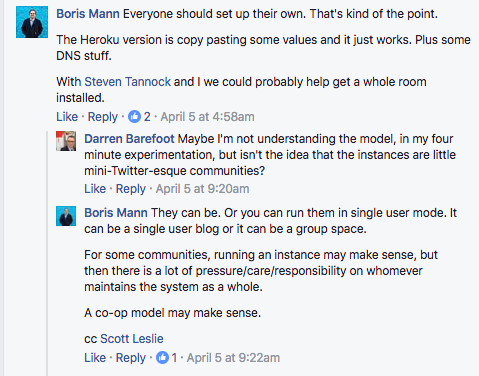
Darren Barefoot kicked off a discussion on Facebook asking if people wanted to run Mastodon locally:

Who wants to help me set up a Mastodon instance for Vancouver-related stuff? I’ll provide the moral support, promotion and pay for hosting if someone wants to do the hard technical bits.
Or maybe that’s the wrong vector. Maybe we should set up an NGO tech and digital instance. Or maybe both?

I responded that maybe everyone should run their own instance:

Does it make sense for a community or group to run their own install? As much as I love open source, running an entire software stack securely — and not losing everyone’s data because you don’t have good backups — is a big job. I tend to discourage people from running their own software, instead mapping a domain name to Medium or Tumblr.

From my point of view, anything with an API that I can map my own domain to meets the bar of a resilient service — me, Self-hosting doesn’t help more people self-publish

Kind of contrary to that, I wrote a response to Mastodon is Dead in the Water saying that people should run their own Mastodon instance.

I was still in Toronto at the time, and actually got Mastodon setup using just the browser on my phone with the Deploy to Heroku button. This is a feature of Heroku I love, and I’ve created several of these buttons of my own to help people get apps up and running.

This Easter weekend (it took me a solid half a day yesterday) I finally did the work to fully setup a Mastodon instance. I set one up for Frontier Foundry, my new venture. I thought we might use it for links and tweet-length commentary for us and our portfolio companies. Or it might just be something to experiment with for a couple of weeks.

My profile on the Frontier Foundry mastodon instance lives at mastodon.frontierfoundry.co/@boris. There’s even an RSS feed for each user which enables interesting re-use — I’ve setup an IFTTT recipe that posts anything from that feed to my Twitter account if it contains the keyword “share”.

Setting up Mastodon on Heroku

Here are the things you’re going to need to have accounts on / be comfortable working with:

  • a domain name and a registrar where you can edit DNS settings. I tend to use Namecheap, while Hover is my “regular user” recommendation that also happens to be Canadian. Domains tend to be about $10USD per year, although there are also much cheaper ones and specials.
  • an Amazon AWS account: accounts are free although you will have to have a credit card attached. The S3 file storage here will cost perhaps $1USD per month at most.
  • a Heroku account: accounts are free, you’ll need a credit card attached to your account, and I am currently paying what will amount to $14USD per month for hosting

Next, you may very well need to have a desktop computer setup with Ruby, Node, git, and a full suite of developer tools to be successful in getting everything working.

Reading Ash Furrow’s Running Mastodon on Heroku meant that someone had hit many roadblocks ahead of me and figured out some of the workarounds, which was great. The setup I ended up following was two Heroku installs to get the Streaming API working, as per the comment in this issue by ecmendenhall (thanks Connor Mendenhall!).

I wasted a lot of time setting things up from scratch with a fresh clone of mastodon, when starting with the Deploy to Heroku and just adding the second streaming server would have probably been a better decision.

The other thing that took a lot of time was setting up the Heroku Mailgun add-on. After you add it, you need to verify yourself, and then take a whole bunch of other steps in both Mailgun and your DNS / MX settings for it to be fully working. Do this right at the beginning.

I’ve still got one piece of troubleshooting / bug to figure out with Amazon S3 settings where S3_BUCKET and S3_HOSTNAME duplicate each other (and even there I’m not going to bother doing SSL with Cloudfront, which means there is a mix of secure content and insecure images).

Should people run their own software?

In short, the answer is no. The level of expertise — and I’m not even talking digital literacy, I’m talking learned, professional expertise — that someone requires to run, maintains, and secure software is very high.

That’s one of the reasons I run as many things as I can on Heroku. I don’t have to worry about the lower levels of an operating system at all.

Docker is the other newest kid on the block, and Mastodon is setup to work well with Docker. But Docker and various places where you can host docker containers don’t solve the fact that you are still exposed to the entire operating system stack of a server, which is where many security and backup issues lie.

With Heroku, database backups are included, it’s just a snapshot of code and configuration, and Amazon S3 backs up the files automatically, too. Heroku even handles SSL certificates automatically for paid accounts.

The folks building mastodon are helpful to a point in getting things running on Heroku, but ultimately are focused on maintaining a more traditional software stack that they use for their own development and deployment. I think that going forward, applications need to be designed to be deployed in simpler fashion, with less of a “stack” and more pluggable components.

What would a mastodon that was designed to be run “serverless” look like?

Decentralized and P2P apps of the future

I’ve been working a lot with blockchain and other decentralized / P2P applications lately. I wrote about the Akasha decentralized blogging platform that runs on the Ethereum blockchain, and I’ve also poked about with Beaker Browser, which runs on the dat protocol underneath.

It was a lot of work to setup an instance of mastodon on Heroku. For someone that has tinkered with open source tech and servers for 15+ years and has a computer science degree.

And with that, I’m still paying a relatively high amount (I don’t think I could justify $15/month or $180 years for just my personal usage), never mind “renting” a domain name from the DNS system. mastodon works in a mobile web browser or with some iOS or Android apps, but I don’t think I could have completed the entire setup and install from my phone.

As I wrote before, I think the list of things we need to aim for with these future decentralized apps is:

  1. Publish from a smartphone: the smartphone will be the only computing device for most of the world going forward. Focus on it.
  2. No server hosting: fully decentralized / peer-to-peer. There may still be various semi- or fully-centralized services for discovery, naming, trust, or other convenience functions.
  3. No domain names: let’s not rent our identifiers, and let’s not build financial barriers to anyone “owning” their content online

I’m going to continue exploring in this space. In the meantime, it’s great to see mastodon bringing a bunch of discussion forward, and for us all to think about federation, decentralization, and what that means for designing interactions.


Notes on running your own Mastodon instance on Heroku was originally published in Boris Mann’s Blog on Medium, where people are continuing the conversation by highlighting and responding to this story.

19 Apr 02:24

TFW

That feeling when the app you've been working on what feels like forever is finally available to download, but you're afraid to make an announcement about it. And so you irrationally wait a few days before you do.

Appy Text is now available on the Windows Store.1 I hope you enjoy using it as much as I did building it.2

1. To celebrate its launch, the Premium in-app purchase is on sale for a limited time .

2. For the most part even. Remember, this was meant to be a weekend side-project. Once development overran by six months, it stopped being fun.
19 Apr 02:24

Open Word—The Podcasting Story

by Doc Searls

Nobody is going to own podcasting.990_large By that I mean nobody is going to trap it in a silo. Apple tried, first with its podcasting feature in iTunes, and again with its Podcasts app. Others have tried as well. None of them have succeeded, or will ever succeed, for the same reason nobody has ever owned the human voice, or ever will. (Other, of course, than their own.)

Because podcasting is about the human voice. It’s humans talking to humans: voices to ears and voices to voices—because listeners can talk too. They can speak back. And forward. Lots of ways.

Podcasting is one way for markets to have conversations; but the podcast market itself can’t be bought or controlled, because it’s not a market. Or an “industry.” Instead, like the Web, email and other graces of open protocols on the open Internet, podcasting is all-the-way deep.

Deep like, say, language. And, like language, it’s NEA: Nobody owns it, Everybody can use it and Anybody can improve it. That means anybody and everybody can do wherever they want with it. It’s theirs—and nobody’s—for the taking.

This is one of the many conclusions (some of them provisional) I reached after two days at The Unplugged Soul: Conference on the Podcast at Columbia’s Tow Center for Digital Journalism, which I live-tweeted through Little Pork Chop and live-blogged through doc.blog at 1999.io.

Both of those are tools created by Dave Winer, alpha dad of blogging, podcasting and syndicating. Dave was half the guests on Friday evening’s opening panel. The other half was Christopher Lydon, whose own podcast, Radio Open Source, was born out of his creative partnership with Dave in the early chapters of podcasting’s Genesis, in 2003, when both were at Harvard’s Berkman (now Berkman Klein) Center.

One way you can tell nobody owns podcasting is that 1.5 decades have passed since 2003 and there are still no dominant or silo’d tools either for listening to podcasts or for making them.

On the listening side, there is no equivalent of, say, the browser. There are many very different ways to get podcasts, and all of them are wildly different as well. Remarkably (or perhaps not), the BigCo leaders aren’t leading. Instead they’re looking brain-dead.

The biggest example is Apple, which demonstrates its tin head through its confusing (and sales-pressure-intensive) iTunes app on computers and its Podcasts app, defaulted on the world’s billion iPhones. That app’s latest version is sadly and stupidly rigged to favor streaming from the cloud over playing already-downloaded podcasts, meaning you can no longer listen easily when you’re offline, such as when you’re on a plane. By making that change, Apple treated a feature of podcasting as a bug. Also dumb: a new UI element—a little set of vertical bars indicating audio activity—that seems to mean both live playing and downloading. Or perhaps neither. I almost don’t want to know at this point, since I have come to hate the app so much.

Other tools by smaller developers (e.g. Overcast) do retain the already-downloaded feature, but work in different ways from other tools. Which is cool to me, because that way no one player dominates.

On the production side there are also dozens of tools and services. As a wannabe podcaster (whose existing output is limited so far to three podcasts in twelve years), I have found none that make producing a podcast as easy as it is to write a blog or an email. (When that happens, watch out.)

So here’s a brief compilation of my gatherings, so far, in no order of importance, from the conference.

  • Podcasting needs an unconference like IIW (the next of which happens the first week of May in Silicon Valley): one devoted to conversation and forward movement of the whole field, and not to showcasing panels, keynotes or sponsoring vendors. One advantage of unconferences is that they’re all about what are side conversations at standard keynote-and-panel conferences. An example from my notes: Good side conversations. One is with Sovana Bailey McLain (@solartsnyc), whose podcast is also a radio show, State of the Arts. And she has a blog too. The station she’s on is WBAI, which has gone through (says Wikipedia) turmoil and change for many decades. An unconference will also foster something many people at the conference said they wanted: more ways to collaborate.
  • Now is a good time to start selling off over-the-air radio signals. Again from my notes… So I have an idea. It’s one WBAI won’t like, but it’s a good one: Sell the broadcast license, keep everything else. WBAI’s signal on 99.5fm is a commercial one, because it’s on the commercial part of the FM band. This NY Times report says an equivalent station (WQXR when it was on 96.3fm) was worth $45 million in 2009. I’m guessing that WBAI’s licence would bring about half that because listening is moving to Net-connected rectangles, and the competition is every other ‘cast in the world. Even the “station” convention is antique. On the Net there are streams and files:stuff that’s live and stuff that’s not. From everywhere. WBAI (or its parent, the Pacifica Foundation), should sell the license while the market is still there, and use the money to fund development and production of independent streams and podcasts, in many new ways.  Keep calling the convening tent WBAI, but operate outside the constraints of limited signal range and FCC rules.
  • Compared to #podcasting, the conventions of radio are extremely limiting. You don’t need a license to podcast. You aren’t left out of the finite number of radio channels and confined geographies. You aren’t constrained by FCC anti-“profanity” rules limiting freedom of speech—or any FCC rules at all. In other words, you can say what the fuck you please, however you want to say it. You’re free of the tyranny of the clock, of signposting, of the need for breaks, and other broadcast conventions. All that said, podcasting can, and does, improve radio as well. This was a great point made on stage by the @kitchensisters.
  • Podcasting conventionally copyrighted music is still impossible. On the plus side, there is no license-issuing or controlling entity to do a deal with the recording industry to allow music on podcasts, because there is nothing close to a podcasting monopoly. (Apple could probably make such a deal if it wanted to, but it hasn’t, and probably won’t.) On the minus side, you need to “clear rights” for every piece of music you play that isn’t “podsafe.” That includes nearly all the music you already know. But then, back on the plus side, this means podcasting is nearly all spoken word. In the past I thought this was a curse. Now I think it’s a grace.
  • Today’s podcasting conventions are provisional and temporary. A number of times during the conference I observed that the sound coming from the stage was one normalized by This American Life and its descendants. In consonance with that, somebody put up a slide of a tweet by @emilybell:podcast genres : 1. Men going on about things. 2. Whispery crime 3.Millennials talking over each other 4. Should be 20 minutes shorter. We can, and will, do better. And other.
  • Maybe podcasting is the best way we have to start working out our problems with race, gender, politics and bad habits of culture that make us unhappy and thwart progress of all kinds. I say that because 1) the best podcasting I know deals with these things directly and far more constructively than anything I have witnessed in other media, and 2) no bigfoot controls it.
  • Archiving is an issue. I don’t know what a “popup archive” is, but it got mentioned more than once.
  • Podcasting has no business model. It’s like the Internet, email and the Web that way. You make money because of it, not with it. If you want to. Since it can be so cheap to do (in terms of both time and money), you don’t have to make money at it if you don’t want to.

I’ll think of more as I go over more of my notes. Meanwhile, please also dig Dave’s take-aways from the same conference.

19 Apr 02:24

Google’s parental control software Family Link hits iOS

by Rui Carmo

I find it downright embarrassing that Apple’s parenting/family control options boil down to remote approval of App Store purchases. As a parent, I have zero usable screen time or device management features, and pretty much everybody else does parental control better than Apple at this point.

19 Apr 02:24

Twitter Favorites: [counti8] @sillygwailo @chenoehart They put code on Github and it was duplicated in Toronto! Not too shabby a life for a rand… https://t.co/dofPlnl5hD

Karen Quinn Fung 馮皓珍 @counti8
@sillygwailo @chenoehart They put code on Github and it was duplicated in Toronto! Not too shabby a life for a rand… twitter.com/i/web/status/8…
19 Apr 02:24

Twitter Favorites: [camcavers] Just saw a guy try to take a "girlfriend leading me by the hand" photo but when she noticed it turned into a "gf giving the finger" photo.

Cam Cavers @camcavers
Just saw a guy try to take a "girlfriend leading me by the hand" photo but when she noticed it turned into a "gf giving the finger" photo.
19 Apr 02:23

Android O Feature Highlight: Third party VoIP Apps Can Now Integrate with System UI

by Rajesh Pandey
With mobile data getting cheaper across the world with every passing month and Wi-Fi access now becoming ubiquitous, VoIP calls and apps have surged in popularity. While plenty of VoIP apps are available for Android, they have been unable to integrate properly with System UI which leads to not working properly or behaving absurdly in certain scenarios. Continue reading →
19 Apr 02:23

Samsung Galaxy S8 vs Galaxy S8+: Which One Should You Buy?

by Rajesh Pandey
The Samsung Galaxy S8 and S8+ are among the most anticipated Android flagships of this year and Samsung’s first major flagship devices after the ill-fated Galaxy Note 7 from last year. Both devices are already up for pre-order in most markets of the world, with their pre-order numbers breaking records in Korea and the United States. Continue reading →
19 Apr 02:22

Flickr Favorites: FOUR MINUTES.

domesticat posted a photo:

FOUR MINUTES.

I set the quilt down to have an oncall-related discussion (I'm hoping to finish binding it today if it's quiet) and Kolohe nests in it four minutes later.

19 Apr 02:22

I haven’t looked at that. Does it support task assignment, due dates, etc.?

by Stowe Boyd

I haven’t looked at that. Does it support task assignment, due dates, etc.?

19 Apr 02:22

The map is not the territory

by Stowe Boyd

The ‘making of’ version of the Slack experience

Katie Benner, a New York Times writer I don’t think I’ve seen before, writes a piece about Slack which is full of factoids, but somehow fails to get at what people are doing with work chat. And she never uses the phrase work chat, either.

However, this is one of the best one liners I’ve heard in awhile.

Katie Benner, Slack, an Upstart in Messaging, Now Faces Giant Tech Rivals
The battle between Slack and its competitors is essentially a fight over who will make the next piece of workplace software that no one can live without.

That line captures the shift from top-down enterprise software decisions imposed by the CIO in the previous generations of ‘collaboration’ tools. Today, all software has to be consumer-grade, filling the needs of the individual first (soloists), then the needs of small teams (sets), and only then the needs of management, which are mostly at the sets of sets level of social scale (scenes) of companywide (spheres). So I could rephrase Benner’s line to say

The battle between Slack and its competitors is essentially a fight over who will make the next piece of workplace software that no individual or team can live without.

The piece includes a quote from Sean Ryan of Facebook, which I completely disagree with:

‘Companies want their employees to collaborate more, because better collaboration reduces the need to jump ship,’ said Sean Ryan, the head of partnerships at Facebook’s Workplace. ‘The №1 reason people leave their jobs is they feel isolated.’

In all my research, I’ve found that the number one reason people quit their jobs is bad bosses. And, candidly, Slack can’t do much about that.


The map is not the territory was originally published in Work Futures on Medium, where people are continuing the conversation by highlighting and responding to this story.

19 Apr 02:22

You can’t eat excuses

by Paul Jarvis

We all assume that motivation is required for creative work—but I think it's the opposite: creative work is required for motivation.

The post You can’t eat excuses appeared first on Paul Jarvis.

19 Apr 02:22

The sexual revolution of the concept of B. Reich

by admin

6

The sexual revolution of the concept of W. Reich – a set of regulations put forward by the Austrian philosopher and social psychologist Wilhelm Reich (1897-1957) and have a significant impact on the development of Freudian Marxism, on the one hand, and ideological trends in the nonconformist youth movements and subcultures 1960-1970- s., on the other. As a follower of Freud, Reich in the development of his ideas did not go in the direction of non-pan sexualism (similar to A. Adler, CG Jung, W. Stekel and other apostates from classical Freudianism), but rather in the direction of further underscore the role of sex in man and human society, towards hyper sexualism.

In 1928, Reich founded in Vienna Socialist society of sexual research and counseling on sexual matters. Already in this period of his medical practice and teaching of psychoanalysis were closely related to the comprehension of the role of sexuality in social development, it seeks to protect “the rights of children and adolescents in the natural love” (Reich, 1997: 7). The observations, made by him over the distribution in Germany and Austria fascism (including among the students), led him to the conclusion that the obedience of masses of people will “few power-hungry bandits” is the result of biological helplessness, the roots of which – in the depressed in adolescence sexuality.

Research materials collected and published by Reich in the late 1920s. Then added new texts in 1930 and 1936 (the book “Sexuality in the struggle for culture”), have been added to them in the 1940s. And published in the United States (where he emigrated) in the form of a book, the title of which was a landmark for the youth movement – “Sexual Revolution” (the final version is presented to the German edition of «Die sexuelle Revolution», 1949).

The essence of the concept is Reich. Private capitalist economy can develop only based on suppression of instincts, which generates at one extreme fear of authority, obedience, “the incredible modesty”, on the other – sadistic cruelty. “With all the grandeur and the revolutionary discovery of the law of the capitalist economy – says Reich, – it is not enough to solve the problem of dependence and subordination person. Although groups of people, certain groups of the oppressed classes everywhere are fighting “for bread and freedom,” the overwhelming majority of standing aside and pray or fight for freedom on the side of their oppressors … The core of the happiness in life is happiness, caused by sexual satisfaction ‘( ibid: 21-22.) the design of joining the revolution and sexual satisfaction, Reich expressed quite clearly: “the capitalist class morality is opposed to sexuality, thus creating conflict and disaster revolutionary movement eliminates these contradictions, speaking first with the ideological positions of sexual satisfaction. needs, and then securing the its position with the help of legislation and reorganization of the sexual life Hence, capitalism coincides with the social sexual oppression, on the one hand, while the “revolutionary morality” – with satisfaction of the sexual needs of the other “(ibid.: 23).

As part of its ideas that the social revolution is impossible without a revolution of sexual, since the preservation of sexual repression society generates in man initially conservative type of character, a tendency to submission – and it is this tendency and nourishes the operation and authoritarian political regimes – Reich specifically refers to the treatment of problems of youth. He criticizes earlier studies appeared, because in them is unjustified leap from the statement of the fact that puberty ends with puberty, to fix the demands of society to follow the youth sexual abstinence. The founder of Freudian Marxism stresses that “sexual problems of young people are, in principle, problems of a purely public property”, “they are just beginning with the nomination requirements for abstinence” (ibid: 123). Here – the core of the psychoanalytic interpretation of sociality.

Reich rejects the natural character of the conflict in adolescence, based in particular on the works of anthropologists on traditional societies where such conflict is not found. The author’s conclusion is: “The phenomena of puberty conflict and pubertal neuroses in all their forms are explained by the contradiction existing between the fact of full sexual maturity, advancing by around 15 years, ie the physiological need to live a sexual life that is capable of fertilization and procreation on the one hand, and economic and structural inability to establish the age of the required legal framework for public sex, that is, to marry the other. This is the main feature of the difficulties to which are added others, such as the effects obtained in childhood education, denies sexuality, which, in turn, is the result of the entire system of conservative sexual device “(ibid: 123-124).

Reich conceptually distinguishes between social classes groups of young people and separately considering psychosexual problems in relation to “working youth” and “young generation of the big bourgeoisie” (though, in general, the whole concept is based on Reich’s vulgarization of Marxism). Reich gives a broad social picture of sexuality at a young age, in particular, specifically addresses issues of forced marriage and its consequences, analyzes the “family abolition” in the early years of Soviet Russia, the influence of political debate and public institutions (YCL and others.) On the development of the sexual behavior of the Russian youth, youth studying processes in municipalities and so on. d.

The treatment of sexual conflict in the youth age as a derivative cultural prohibitions Reich was the contribution to the understanding of the features of socialization and identification processes that characterize today’s youth. This is determined by its place in the theoretical framework of sociology of youth (Lukow, 2012: 151-153) and in modern science as a whole (Strick, 2015).

The post The sexual revolution of the concept of B. Reich appeared first on BookRiff.

19 Apr 02:22

BlackBerry or BlackBerryMobile

by Volker Weber

Since there is absolute radio silence from BlackBerry about potential upgrades to Android Nougat for DTEK50, DTEK60 or PRIV, I asked both @BlackBerry and @BBMobile who is responsible for communications about upgrades and updates. The answer is quite telling. @BBMobile, a TCL entity, says that @BlackBerry is responsible. And @BlackBerry says nothing.

@BBMobile wants to sell smartphones, @BlackBerry wants to sell "security", or enterprise software, and does not wish to talk about smartphones anymore. They just handed their forums over to crackberry.com.

I guess we will have to live with radio silence. Nobody is talking. And in absense of information we can only resort to speculation. The original plan was to upgrade the old Android devices after Mercury shipped. Then BlackBerry stroke the deal with TCL. Mercury was announced as KEYone, but it's still not shipping. I am not holding my breath for Nougat upgrades.

19 Apr 02:21

Instabloat

by Volker Weber

22993acf7cc2e1ebcb47a140bc746690

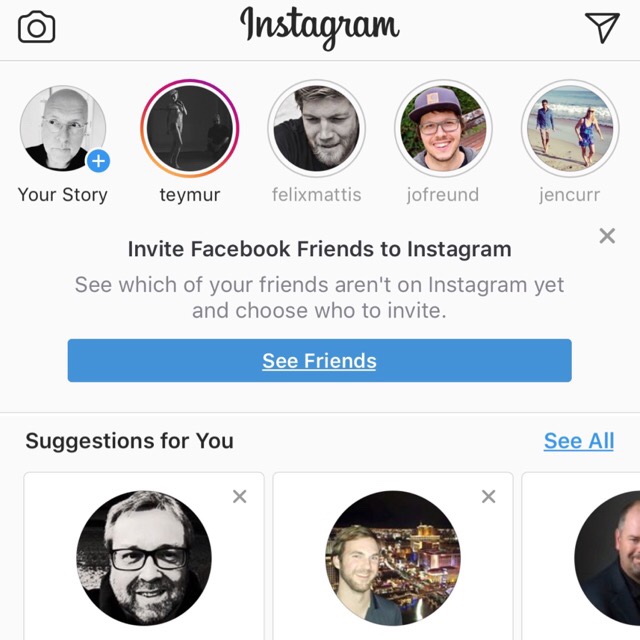
Facebook has the reverse Midas touch. Everything it touches turns to crap, while making tons of money on the back of their users. In their quest to destroy all competition they piled Snapchat features on Instagram as stories. Now they are adding Pintrest boards as collections, agressively promoting them. Add their quest to grow your network by pushing suggestions. Facebook already pushed me out when they started forcing their timeline instead of mine. Now they are doing it again with ruining Instagram.

Time to delete the app.

19 Apr 02:18

Instapaper Liked: How to Read a Whole Damn Book Every Week

In which I tell you all my secrets, as smugly as possible https://t.co/wV5eKQLihz — Kevin Nguyen (@knguyen) April 17, 2017 Tweeted by @knguyen
19 Apr 02:13

When Homoglyphs Attack! Generating Phishing Domain Names with R

by hrbrmstr

It’s likely you’ve seen the news regarding yet-another researcher showing off a phishing domain attack. The technique is pretty simple:

  • find a target domain you want to emulate
  • register a homoglpyh version of it
  • use the hacker’s favorite tool, Let’s Encrypt to serve it up with a nice, shiny green lock icon
  • deploy some content
  • phish someone
  • Profit!

The phishing works since International Domain Names have been “a thing” for a while (anything for the registrars to make more money) and Let’s Encrypt provides a domain-laundering service for these attackers. But, why should attackers have all the fun! Let’s make some domain homoglyphs in R.

Have Glyph, Will Hack

Rob Dawson has a spiffy homoglyph generator and even has a huge glyph-alike file, but we don’t need the full list to don the hacker cap for this exercise. I’ve made a stripped-down version of it that has (mostly) glyphs that should display correctly in “western” locales. You can pull the full list and tweak the example to broaden the attack capabilities. Let’s take a look:

library(stringi)
library(urltools)
library(purrr)

URL <- "https://rud.is/dl/homoglyphs.txt" # trimmed down from https://github.com/codebox/homoglyph
fil <- basename(URL)
invisible(try(httr::GET(URL, httr::write_disk(fil)), silent = TRUE))

chars <- stri_read_lines(fil)
idx_char <- stri_sub(chars, 1,1)
stri_sub(chars, 1, 1) <-  ""
chars <- set_names(chars, idx_char)

tail(chars)
##                                         u 
##          "ʋυцս\u1d1cu𝐮𝑢𝒖𝓊𝓾𝔲𝕦𝖚𝗎𝘂𝘶𝙪𝚞𝛖𝜐𝝊𝞄𝞾" 
##                                         v 
##        "νѵט\u1d20ⅴ∨⋁v𝐯𝑣𝒗𝓋𝓿𝔳𝕧𝖛𝗏𝘃𝘷𝙫𝚟𝛎𝜈𝝂𝝼𝞶" 
##                                         w 
##                                      "w" 
##                                         x 
##                "×хᕁᕽ᙮ⅹ⤫⤬⨯x𝐱𝑥𝒙𝓍𝔁𝔵𝕩𝖝𝗑𝘅𝘹𝙭𝚡" 
##                                         y 
## "ɣʏγуүყ\u1d8c\u1effℽy𝐲𝑦𝒚𝓎𝔂𝔶𝕪𝖞𝗒𝘆𝘺𝙮𝚢𝛄𝛾𝜸𝝲𝞬" 
##                                         z 
##                   "\u1d22z𝐳𝑧𝒛𝓏𝔃𝔷𝕫𝖟𝗓𝘇𝘻𝙯𝚣"

What we did there was to read in the homoglpyh lines and create a lookup table for Latin characters. Now we need a transformation function.

to_homoglyph <- function(domain) {

  suf <- suffix_extract(domain)
  domain <- stri_replace_last_fixed(domain, sprintf(".%s", suf$suffix[1]), "")

  domain_split <- stri_split_boundaries(domain, type="character")[[1]]

  map_chr(domain_split, ~{
    found <-  chars[.x]
    pos <- sample(stri_count_boundaries(found, type="character"), 1)
    stri_sub(found, pos, pos)
  }) %>%
    c(".", suf$suffix[1]) %>%
    stri_join(collapse="")

}

The basic idea is to:

  • carve out the domain suffix (we need to ensure valid TLDs/suffixes are used in the final domain)
  • split the input domain into separate characters
  • select a homoglyph of the character at random
  • join the separate glpyhs and the TLD/suffix back together.

We can try it out with a very familiar domain:

(converted <- to_homoglyph("google.com"))
## [1] "ƍ၀໐𝘨|𝖾.com"

Now, that’s using all possible homoglyphs and it might not look like google.com to you, but imagine whittling down the list to ones that are really close to Latin character set matches. Or, imagine you’re in a hurry and see that version of Google’s URL with a shiny, green lock icon from Let’s Encrypt. You might not really give it a second thought if the page looked fine (or were on a mobile browser without a location bar showing).

What’s the solution?

Firefox has a configuration setting to turn these IDNs into punycode in the location bar. What does that mean? We can use the urltools::puny_encode() function to find out:

puny_encode("ƍ၀໐𝘨|𝖾.com")
## [1] "xn--|-npa992hbmb6w79iesa.com"

Most folks will be much less likely to trust that domain name (if they bother looking in the location bar). Note that it will still have the “everything’s 👍” green Let’s Encrypt lock icon, but you shouldn’t be trusting SSL/TLS anymore for integrity or authenticity anyway.

Chrome Canary (super early bird alpha versions) expands IDNs to punycode by default today and a shorter-cycle release to stable channel is forthcoming. I’m told Edge does somewhat sane things with IDNs and if Safari doesn’t presently handle them Apple will likely release an interstitial security update to handle it.

FIN

See if you can generate some fun look-alike’s, such as 𝓻𝓼𝗍𝘂𝒅𝓲𝝈.com and drop some latte change to register an IDN and add a free hacking certificate to it to see just how easy this entire process is. Note that attackers are automating this process, so they may have beat you to your favorite homoglyph IDN.

If you’re on Chrome, give the Punycode Alert extension a go if you’d like some extra notification/protection from these domains.

NOTE: to_homoglyph() is not vectorised (it’s an exercise left to the reader).

19 Apr 02:07

Include The Answer Within The Response

by Richard Millington

One sure-fire way to annoy people who ask questions is to send them somewhere else to get answers.

Don’t do this. If someone asks a question in your community, don’t just link to the answer, provide the answer. Go to the FAQ or page content if you need and take the time to adapt the answer for them.

Be as detailed and as specific to their question as possible. Make sure the recipient has the greatest possible chance of getting the right answer.

If you need to ask clarifying questions, ask them. Just don’t send them somewhere else.

In every interaction you’re either drawing someone closer into you and the community or driving them away, you choose.

19 Apr 02:06

How a Michelin-starred Hong Kong chef gave his daughter a gift that keeps on giving

by Bernice Chan
The chef of the Michelin-starred VEA is celebrating his daughter’s first birthday with social consciousness in mind. Vicky Cheng and his wife Polly thought instead of showering their daughter Elizabeth with gifts, they felt she should give to those less fortunate. They are raising money for the Elizabeth Nutrition Fund in collaboration with the Chicken Soup Foundation, a local charity started in 2013 that helps more than 1,100 underprivileged children in the city. For every donation of a...
19 Apr 02:05

Samsung Galaxy S8+ Teardown Reveals Same Battery Layout as Galaxy Note 7

by Rajesh Pandey
Ahead of the release of the Galaxy S8 and Galaxy S8+ later this week, the folks over at iFixit have gone ahead and posted their teardown of the devices. The devices did not fare well in the teardown, but do highlight one important thing: the battery setup of Samsung’s latest flagship handsets is the same as the ill-fated Galaxy Note 7. Continue reading →
19 Apr 02:04

The Samsung Galaxy S6’s Nougat update has been removed from Telus’ software update list

by Rose Behar
samsung galaxy s6

After delaying the Samsung Galaxy S6 Android Nougat update earlier this month, Telus has now removed the Samsung Galaxy S6 entirely from its software update list altogether. The carrier gave no specific or reasoning or statement.

Originally, the update was set for April 10th. Once that time came, however, the carrier changed its software update schedule to state that the S6 was coming in ‘late April 2017.’ Now the update is seemingly being pushed off indefinitely.

MobileSyrup has reached out to Telus to confirm if and when Samsung users can expect the update in the future.

Update 17/04/17: A Telus representative states: “We do intend to bring Nougat to the S6 but we’re currently working to ensure the best possible experience for our users. The release date will be updated as soon as we’re certain the experience will be seamless.”

Source: Telus

The post The Samsung Galaxy S6’s Nougat update has been removed from Telus’ software update list appeared first on MobileSyrup.

19 Apr 02:04

The S8’s Bixby button can no longer be remapped due to new Samsung firmware

by Dean Daley
Bixby on the Samsung Galaxy S8

Samsung really doesn’t want people to remap its proprietary AI launching Bixby button.

The company recently pushed out a firmware update that blocked a workaround allowing Samsung Galaxy S8 review unit users to remap the Bixby button, according to XDA Developers. The ability to remap the button’s function was possible due to an accessibility services option found in the settings of the S8.

XDA developer Flar2 was in the process of using the workaround in his app Button Mapper after receiving the Samsung S8 through Telus. However, after an update to the latest system build, the function disappeared.

XDA Developers notes that “Samsung has modified the system to consume the Bixby button’s key events before it reaches the Accessibility Services.” Essentially, the function is no longer in the accessibility settings of the phone. Philip Berne of the Samsung Review Program confirmed that Samsung intentionally blocked the remapping of the button. Now the only way to change the Bixby button is to root the device, a much less accessible option.

Keep in mind Samsung’s AI will come without voice support at launch, meaning you won’t be able to converse with it. The S8 also houses the Google Assistant voice AI, available via a long press of the home button.

Source: XDA Developer 

The post The S8’s Bixby button can no longer be remapped due to new Samsung firmware appeared first on MobileSyrup.

19 Apr 02:03

Silicon Valley tech companies set their sights on Vancouver

by Dean Daley
vancouver

At least five large technology-based companies are setting their eyes on Vancouver, looking to set up satellite offices in the city due to the Trump administration, according to True North.

True North is a company that offers services to help foreign-born workers in the U.S. set up backup plans in Canada in case something changes to the worker visa system. With the Trump administration seemingly working to dismantle the H-1B visa — a non-immigration visa designed for foreign workers in specialty occupations — True North has been receiving a lot of calls. The company’s Michael Tippett says that he expects five Hootsuite-sized companies to make their way to Vancouver.

Tippett also added he didn’t expect these large companies to be looking to the north. 43 percent of the founders of Silicon Valley tech companies are not American-born and anywhere from 10-30 percent of their employees are also on the H-1B visas, meaning that large chunks of Silicon Valley might be looking to set up location out of the U.S. These offices could hold hundreds of employees.

Vancouver is a lot closer to Silicon Valley than Toronto, making it the “ideal” place for five to 10 somewhat large tech companies to move to in the near future.

Source: News 1130

The post Silicon Valley tech companies set their sights on Vancouver appeared first on MobileSyrup.

19 Apr 02:03

Analyst predicts new Rogers CEO Natale will be quick to launch ‘Rogers 4.0’ strategy refresh

by Rose Behar
Rogers

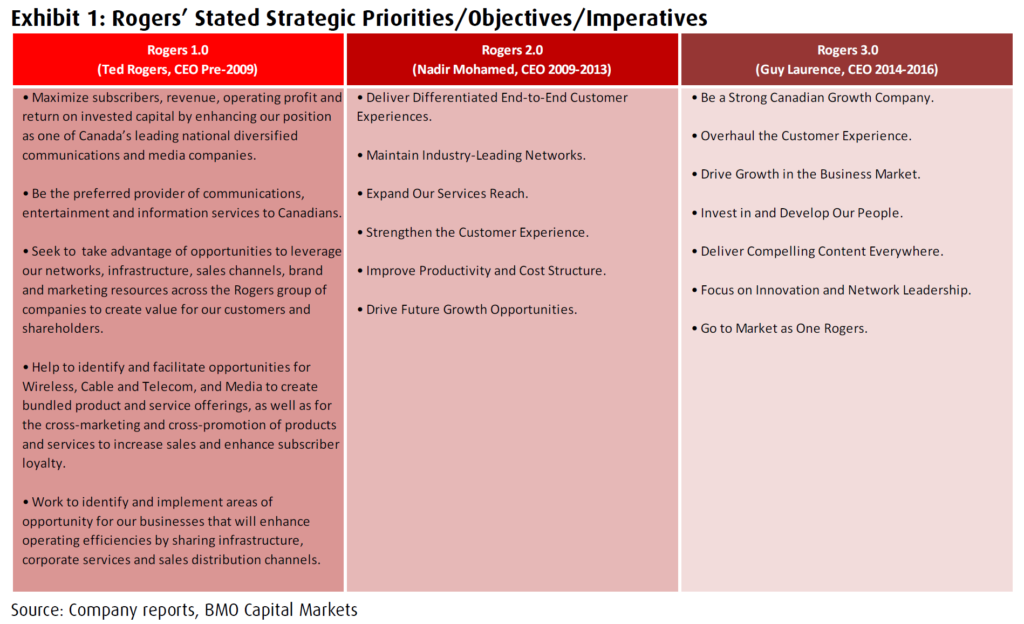
Former Rogers CEO Guy Laurence’s ‘Rogers 3.0’ plan brought with it Roam Like Home, an overhaul of its customer experience and an improved focus on its staff, among other things.

Now, as a new era of Rogers approaches led by former Telus boss Joe Natale, that plan will soon make way for ‘Rogers 4.0.’

BMO analyst Tim Casey writes in a new report forecasting Natale’s first 100 days that there are three main issues the new boss will want to get to work on immediately: improving wireless subscriber churn (i.e. the rate of customers that leave Rogers in a given quarter), reversing competitive losses in video by “flawlessly executing the rollout of Comcast’s X1 platform” and resuming dividend growth.

“Rogers remains the turnaround story,” notes the report.

“Following years of underperformance in wireless, recent results reflect a marked turn in operating momentum. The challenge for Rogers is to now convert the turn in subscribers to accelerated EBITDA [earnings before interest, tax, depreciation and amortization growth]. We expect a continued turn in sentiment as Rogers closes the fundamental performance gap.”

Customer service expertise

Casey notes that Natale’s prior experience at Telus will no doubt help improve wireless churn by improving customer experience. Telus and its flanker brand Koodo hold first and second place respectively in the latest wireless customer satisfaction surveys held by J.D. Power and Associates, while Rogers and Fido are last on the list.

“We believe it is no coincidence that Rogers hired incoming CEO Joe Natale given his leading role in executing Telus’ multi-year ‘customer first’ culture,” reports Casey.

As for video, Casey states that Comcast’s X1 platform has an “encouraging track record” of stemming or reversing competitive losses, which Rogers faces in particular from Bell’s Fibe IPTV offering.

“We believe it is no coincidence that Rogers hired incoming CEO Joe Natale given his leading role in executing Telus’ multi-year ‘customer first’ culture.”

In December 2016, Rogers announced it was abandoning its in-house IPTV development efforts in favour of licensing Comcast’s X1 platform, with an expected initial launch in early 2018 — a $484 million write-down that Casey considers a sound strategic decision.

Casey also writes that with Natale’s experience and six months of lead time to think about Rogers 4.0, getting acclimated to the job won’t take long, adding that recent strategic moves suggest “internal preparatory work” is being done in anticipation of his arrival, including the Shomi wind-down and the change in IPTV strategy.

The accelerated pace means consumers can expect to see a new strategic plan before Natale’s six month mark, which is when former CEO Guy Laurence rolled out Rogers 3.0.

rogers plans

“We expect a relatively quick ramp-up period for incoming President and CEO Joe Natale and a refresh of corporate strategy and balance sheet priorities at Rogers (i.e., ‘Rogers 4.0’),” writes Casey.

Not only does Natale bring prior telecom experience, he also brings competitive intelligence from his prior position at Telus, which is amplified by CFO Tony Staffieri’s prior experience at BCE and board member elect Robert Depatie’s former Videotron/Quebecor ties.

Additional first considerations

In his report, Casey forecasts 225,000 wireless postpaid net additions in 2017, marking a rise from 8,557,000 to 8,782,000 in wireless postpaid subscribers year-over-year from 2016. The financial institution also expects wireless postpaid churn to to decrease from 1.23 percent in 2016 to 1.21 percent in 2017, and the average revenue per Rogers user (blended prepaid and postpaid) to increase from $60.42 to $61.18 CAD.

Other considerations identified in the report include snagging Quebecor’s unused 10MHz of AWS-1 spectrum in Toronto (Casey predicts deals may arise over the next “several months”) and a potential network/spectrum sharing arrangement with Shaw, though there seems to be limited upside for Rogers.

Additionally, Casey notes that Rogers could rethink its stake in Cogeco (which currently equals $1.1 billion equity in Cogeco shares) since it hasn’t acquired new shares since 2011.

In his first 100 days, Casey also notes that Natale might consider selling or writing down more Rogers media assets, improving strategy for Rogers’ business division, overhauling or restructuring the management team and changing the open-concept Sharespace office environment instituted by Guy Laurence.

The post Analyst predicts new Rogers CEO Natale will be quick to launch ‘Rogers 4.0’ strategy refresh appeared first on MobileSyrup.

19 Apr 02:03

Freedom Mobile buys customer new iPhone after finding out dealer sold a refurbished one

by Ian Hardy
freedom mobile

One must be wary of the second-hand smartphone market these days as there are several ways to make an old product look and act like the real deal.

Freedom Mobile, previously known as Wind Mobile, has never been authorised to sell Apple’s iPhone. In 2015, the carrier started to sell the 16GB iPhone 5s and 16GB iPhone 5c but deemed them as “lightly loved” devices that have been refurbished and restored. Apple quickly shut this down as it was an arrangement through Ingram Micro.

Now, two years later and under new ownership by Shaw, a story by the CBC reports that a Toronto-based Freedom Mobile dealer crossed the line and sold a customer a completely refurbished iPhone SE for $300 that was made with counterfeit and aftermarket components.

Benjamin Thomas, the Freedom customer who purchased the iPhone, stated he saw issues right out of the box as the battery quickly drained down to 20 percent, experienced poor camera quality, the casing was damaged, and that the Apple logo was not authentic.

Pat Button, Freedom Mobile’s VP of sales and distribution, stated dealers “are not in any way authorized to sell these devices. Unfortunately, our dealer at this particular location made a mistake and should not have sold this device to our customer. We sincerely regret and apologize for the inconvenience caused.”

To make the situation correct, Freedom purchased a new iPhone SE from Apple for Thomas and said the retail location is no longer selling the iPhone.

Freedom Mobile customers can purchase an unlocked iPhone and use it on their network, but make sure it’s the correct model number that hooks onto AWS bands. In addition, there are rumours that Apple will enable the next iPhone with Band 66, which will also be compatible with Freedom’s LTE network.

Source: CBC

The post Freedom Mobile buys customer new iPhone after finding out dealer sold a refurbished one appeared first on MobileSyrup.

15 Apr 23:57

New Systems, Old Thinking

files/images/Old20Phone20System.jpg


George Couros, The Innovator’s Mindset, Apr 16, 2017


The point of this article is that we have to get past old systems of thinking when we employ new technology. Couldn't agree more. But does the example make that point? George Couros writes that ionstead of saving all his stuff in folders (which is the old way of thinking) he just saves it wherever and makes sure it is tagged (that's the new way). But tagging - ie., metadata - seems to me to be fraught with peril. At least you can reorganize or split folders, but if you need to adapt materials to a new tag then you have no way to do it. My own method is to write a short description and then use regular expressions; this allows me to make new categories out of old materials even if the new tag hasn't been developed yet.

[Link] [Comment]