Shared posts

24 Apr 23:00

What do we mean by ‘political’?

Good morning, my name is Oliver and today I’d like to talk to all of the scientists in the room about what we mean by ‘political’

(screaming, the sound of overturning chairs, a door slamming shut)

Seriously, though: we talk about ‘political’ a lot right now. For some scientists (social or natural) this is their first time doing so: for others, events like the March for Science and budget woes under Trump are the latest in a long line of advocacy work and engagement. The problem is that when we talk about ‘political’ between ourselves, we seem to be using three different definitions:

  1. partisan political: something is political if it relates consistently to a particular political party. A campaign against positions that come from the GOP is partisan political.
  2. coloquial political: something is political if it relates to something legislative, or based on formal-power-structures. A campaign against NSF funding cuts is coloquial political, regardless of who’s proposing the cuts.
  3. academic political, which in a scientific context might also be referred to as Science, Technology and Society (STS) political: something is political if it has impacts on, or is impacted by, the exercise of power within society. NSF funding cuts and GOP positions are political - but so are research ethics, sexual harassment and racism within science, and the outcomes of our work as scientists.

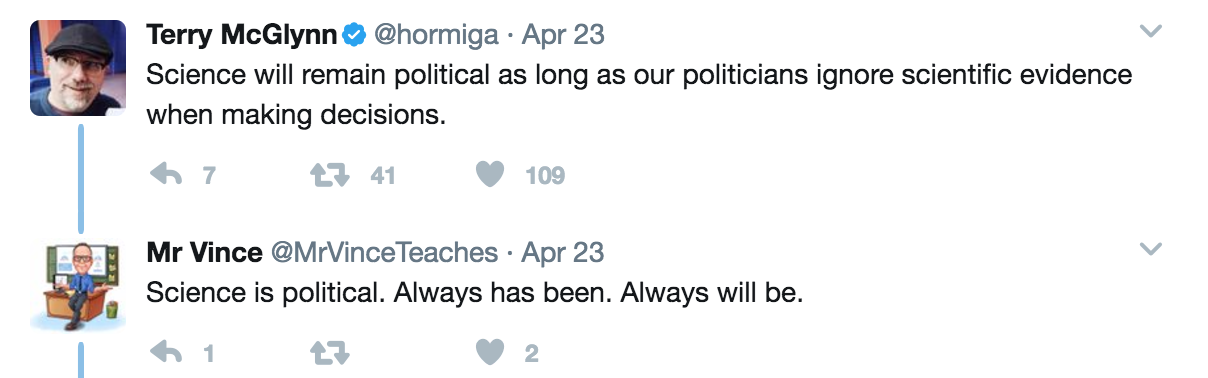
To the surprise of precisely 0 people, I fall into the academic camp when I talk about politics. But I also recognise it’s not a definition that is widely understood within science, for a whole range of reasons. Some are societal - a lot of scientists are people who don’t have to think about power structures, because their demographics put them at the top of em. Others are pedagogical - STS and similar ‘meta’ fields tend not to feature in most science degrees, and to be perfectly honest, STS people aren’t great at communicating their work a lot of the time. So you get interactions like this, which perfectly encapsulate the problem:

Twitter interactions

One person is using the coloquial definition; the other, the academic. So you get misunderstanding, crossed wires and no actual learning. This is extremely common, and extremely unfortunate, because I happen to think the academic definiton can be incredibly powerful as a lens in improving how we work as scientists and live as people. So I wrote this little guide, roughly divided into ‘what STS and social sciences people mean by “political”’ and ‘why this can be incredibly useful in science’.

What STS means by political

Coloquially, ‘political’ in a scientific context means relating to impacts on science from academic structures. Sometimes this is legislative (NSF funding cuts). Sometimes this is academic (University funding cuts). Whatever the source, it largely means things that help or hinder “scientists’” ability to do their job - whether they can get funding, whether they can get grad students, whether they can get published.

This is certainly an important set of things to be concerned about, but it’s also very narrow. It’s mono-directional - the concern is how society affects science, not how science affects society. It’s also highly constrained even within that - ‘political’ implications for science tend to be funding, hiring, visas, but not Title IX or the ADA, even though those are as legislative and formal as you can get, and if your concerns are about implicit structures, forget it.

In an academic sense, ‘political’ means something much wider - it means “does this involve acquiring, losing or applying power?” Title IX is political - not because it’s a piece of law but because it provides tools for individuals and organisations to challenge sexual assault, misogyny and bias in a university setting. It alters the balance of power. Visa reductions aren’t political just because they impact the ability of scientists to recruit the best grad students, and thus impact the progress of science, but also because they shift opportunities (and so power) away from non-US students, many of them people of colour, and towards American citizens and residents.

Using the academic definition also means thinking about implicit structures. With or without the presence of Title IX, sexual harassment and assault on campus is included as a ‘political’ problem, because it’s something systemic that ties into dominance, bias and, you’ve guessed it, power. So too is racism, ableism, and anything else which (written down or not) has implications for who can work, and under what conditions.

Beyond in-university situations, thinking about things in terms of power also means having a framework to think about where scientists’ authority and resources come from. In a North or South American context, this means thinking about which indigenous peoples’ land was stolen - who was disempowered - to make up the university’s campus. Where is that people now, and what involvement do they have in the work we are doing on their land? It means thinking about research ethics: what are the power dynamics, between researchers and research subjects, in our work, or the work we are building on? Title IX is political, yep, but so is the case of Henrietta Lacks.

Finally, unlike the coloquial definition, which largely looks at the impact society has on science, politics-as-power requires us to examine the impact our work has on society. Who is empowered, or disempowered, by the research we perform? What are the impacts when research using facial structure to measure purported criminality hits implementation, and has our understanding of those impacts informed how we go about double, triple and quadruple-checking that work, and how we go about reporting it? What does it mean when we do work for DARPA, or for oil companies? Where does that work end up?

How this can help science

If you’re still reading and didn’t already know this stuff, I’ll hazard a guess that you’re swirling slightly. That’s entirely understandable - it sounds a lot like ‘political’ covers pretty much everything, which (if your work has any kind of impact) is true. It probably sounds like this is massively overcomplicating things: we’ve gone from engaging with universities or politicians to talking about research ethics and decolonisation.

Absolutely, the academic definition is wider than the coloquial - but I’d argue it actually simplifies things. See, none of the stuff covered by the new definition is actually new. Many of us are already talking about sexual harassment, institutional racism and other forms of bigotry. Research ethics and decolonisation are, as problems, nothing new. Using the academic definition simply gives us a common language for talking about all of these problems - and recognising that however far apart many of them may seem to be, they’re symptoms of the same underlying disease.

Past that, being able to think about these problems as part of the same system wards us against discounting one set of issues entirely to focus on another - precisely as many critics of the Science March have (correctly) felt the March has been doing - and protects us from being caught entirely by surprise by new, future problems. If we approach things systemically, the tools we build to address each issue overlap, and can be adapted.

So in my (exceedingly humble) opinion, the academic definition isn’t some wanky theory term, and isn’t a pedantic destraction from the conversations we’re having - it’s a valuable tool for how we think about problems facing, caused by, and within science. It’s got a lot of utility. I hope that some of you now agree with me - and even if you don’t, conversations about these issues might now make a little more sense to all involved.

24 Apr 23:00

Updating Our Nightmares

by Nathan Ferguson

As Donna Haraway declared in one of the most prescient lines of A Cyborg Manifesto (1984), “the boundary between science fiction and social reality is an optical illusion.” Whatever boundary still exists between fiction and reality seems increasingly porous — they are hybrid, like the cyborg. They interpenetrate each other, not least at the level of how we see and misconstrue each other: As Haraway writes, “Social reality is lived social relations, our most important political construction, a world-changing fiction.” Fiction plays a role in shaping social reality, in establishing norms and alternatives for social relations. This means we must ask how the sorts of stories we tell and retell shape what we perceive as possible, as natural or unnatural, and so make real specific futures.

Drawing on that spirit, two recent books — Discognition by Steven Shaviro and Four Futures: Life After Capitalism by Peter Frase — speak to speculative fiction’s usefulness for imagining the present and its relation to possible futures. Shaviro describes science fiction as storytelling that “guesses at a future without any calculation of probabilities, and therefore with no guarantees of getting it right.” But this freedom to be improbable allows science fiction to examine more open-ended visions of the future. If we extrapolate from tendencies that already exist, we foreclose on possibilities of radical change. And although imagining a particular future may not necessarily increase its likelihood, it could broaden our “interpretive horizons,” which as Robin James has explained, consist of the “implicit knowledges, emotions, habits, and intuitions” that make belief possible and shape the possibilities we imagine for the future.

Surveillance as represented in culture often presumes individual targets tracked by government agents, the point being prohibiting behavior rather than channeling it

In the foreword to Four Futures, Frase echoes such sentiments, stating his preference for speculative fiction “to those works of ‘futurism’ that attempt to directly predict the future, obscuring its inherent uncertainty and contingency.” Frase cites as an example of dubious futurism Ray Kurzweil’s The Singularity Is Near: When Humans Transcend Biology, which “goes from the general to the general” in its predictions, rather than going from the particular to the general, as science fiction at its best does. Another example of inadequate futurism is the “It Gets Better” video series: As Natsaha Lennard writes in an essay on reproductive futurism, “the project’s videos are emotive and moving” but “something crucial is missing. Often, it doesn’t get better. Or it gets better if you can assimilate — want a family, support the troops, support monogamy, be a good citizen.” That is, a futurism that merely extends existing systems of oppression and control betray the future rather than imagine it. As Lennard suggests, given the choice between no future and (unqueer) futurism, no future is preferable.

In Speculative Fabulation, literature scholar Robert Scholes proposes science fiction can offer “a world clearly and radically discontinuous from the one we know, yet returns to confront that known world in some cognitive way.” He argues that modern science has made us “so aware of the way that our lives are part of a patterned universe that we are free to speculate as never before.”

Yet despite the potential inherent in speculative narratives, the same handful of utopian and dystopian scenarios tend to circulate. As Sara Watson points out with respect to fictional representations of artificial intelligence, the limited number of stories, driven by the entertainment industry’s prerogatives rather than an effort to chart the ethical terrain — presents a “grossly oversimplified” picture of the technological possibilities. It is dispiriting to imagine that the radical promise and possibility of cyborgs and hybridity evoked in Haraway’s manifesto could be diluted, obscured, and made banal through being presented in warped, oversimplified form in clichéd narratives.

Watson’s argument applies not only to AI but to common narratives about another contemporary worry: surveillance. In 2014, Zeynep Tufekçi decried our continued reliance on outdated Orwellian analogies and panoptic metaphors: “Our understanding of the dangers of surveillance is filtered by our thinking about previous threats to our freedoms,” she wrote. “But today’s war is different. We’re in a new kind of environment, one that requires a new kind of understanding … We need to update our nightmares.”

Judging by the way surveillance is often represented in culture, it can seem as though our ideas of what surveillance looks like and how it works have not changed much since both the fictional and real 1984: cameras mounted on buildings, human guards watching from towers, phone mouthpieces surreptitiously bugged, and so on. They presume individual targets tracked by government agents and figure the point of surveillance as being a matter of prohibiting behavior rather than channeling it toward certain ends. They fail to account for surveillance’s surreptitious commercial tracking, as it manifests in grocery rewards programs and across websites and within our phones. They don’t look at how entire populations are tracked, rather than specific individual suspects. They don’t dramatize the way citizens end up in police bodycam databases or on terrorist watch lists. They don’t account for the intimate surveillance of family members, as with the keyloggers that might be installed by our domestic partners behind our backs.

Naming culprits for surveillance-fiction fatigue is almost too easy. Black Mirror epitomizes the general problem. The technology in Black Mirror “functions as metaphor,” Adam Rothstein says, “like any social monster, representative of our current unknowns.” The same could be said of the show’s function in popular discourse: less fantasy than “media dream,” the show often serves as a convenient, drop-in metaphor — “It’s like something out of Black Mirror” — for any number of tech anxieties. But in reanimating our paranoid fears, convincingly and for the most dramatic effect, the show often only manages to affirm suspicions, co-conspiring in the same old nightmares.

Minority Report (2002) adapted from a Philip K. Dick short story, is another oft-cited reference point, but it tends to be heralded less for its look at the ethical quandaries and consequences of pre-emptive policing and more for its depiction of multi-touch screens and gestural interfaces. These were a product of director Steven Spielberg’s 1999 “idea summit,” which convened a think tank of engineers and futurists to articulate how 2054 might look based on current cutting-edge technologies. As Christian Brown pointed out, the film popularized the idea that the ill-conceived interaction design it draws from was actually a good model for future development. But, Brown notes, “there’s a huge gap between what looks good on film and what is natural to use.”

Similarly, Minority Report has contributed a misleading template for predictive surveillance in the clichéd but highly filmable story of a person more or less falsely accused. In the world of the film, predictive policing is a matter of mutants semi-mystically foretelling specific crimes committed by specific individuals. Whereas predictive policing as it is used today generally takes an epidemiological form, with big data used to target populations in “hot spots,” as this Science article details.

Surveillance is typically used to extend discrimination, not guarantee uniform treatment

These kinds of representations of surveillance have an effect that extends beyond fiction, influencing the way the subject is addressed in informational contexts. Consider this list of radio shows and podcasts that have recently discussed surveillance: WYNC Note to Self’s The Privacy Paradox” project (a practical how-to guide with expert/industry interviews); Science Friday’s recent “Price of Privacy” segment with Note to Self’s host, Manoush Zomorodi, and ProPublica’s Eric Umansky (a one-off, directed interview); Motherboard’s “Guide to Defending the Future” live show (an open-ended panel discussion); and Theory of Everything’s just concluded “still more adventures in surveillance” miniseries (a mixture of social commentary, interviews and creative nonfiction). Each applies a different programming format to the issue, but the narratives driving the conversations still revolved around the same two familiar themes: the need to safeguard our personal privacy, and the risky aspects of increased visibility. As important and rational as these concerns are, how many more friendly reminders to install Signal or Privacy Badger do we need?

These conversations draw from underdeveloped ideas about how surveillance works now and may work in the future. They tend to assume a certain kind of subject, who faces the same kinds of threats from surveillance as it is popularly conceived. Missing from these discussions are more apt metaphors and narratives for understanding mass surveillance, how it works and affects everyday life, and for whom. As Nathan Jurgenson points out here, attempts “to identify the one overarching metaphor to encompass all watching” overlooks not just the ways various forms of surveillance work together but also how the surveillant gaze is unevenly distributed. Surveillance, he suggests, more often takes the form of sorting people into categories rather than subjecting individuals to heightened scrutiny. Indeed, as Simone Browne argues in Dark Matters: On the Surveillance of Blackness, the social sorting has its roots in “the history of branding in transatlantic slavery,” which reframes how we might understand passports, identification documents, and credit bureau databases as mechanisms of surveillance. Browne’s linking of surveillance technology with white supremacy, colonialism, and slavery makes plain how many “dystopic” representations of surveillance are actually too optimistic. These reinforce a fantasy of objective neutrality in which everyone is equally watched and equally imperiled. But surveillance is typically used to extend discrimination, not guarantee uniform treatment.

Too much of the discussion of surveillance presumes a “private individual” in the libertarian sense — the atomic, law-abiding, and therefore innocent citizen, whose reasonable desire for privacy puts them at odds with corporate and state monitors. There are precious few instances where surveillance is treated as a social issue involving groups and populations, and power dynamics more nuanced than “the big and powerful are watching.” What are the speculative surveillance narratives that are being overshadowed?

Robin James finds a more relevant metaphor for understanding contemporary surveillance in acoustics. In “Acousmatic Surveillance and Big Data” James argues that the metaphor of acousmatic harmonics is “particularly appropriate” for representing “NSA-style dataveillance,” — that is, the dynamic search for patterns of relationships in big data sets. Acousmatic sound is sound heard without seeing its source; what is signal and what is noise emerges gradually rather than being anticipated in advance. So, as James points out, “when President Obama argued that ‘nobody is listening to your telephone calls,’ he was correct. But only insofar as nobody (human or AI) is ‘listening’ in the panoptic sense … Instead of listening to identifiable subjects, the NSA identifies and tracks emergent properties that are statistically similar to already identified patterns of ‘suspicious’ behavior.” In other words, whereas panoptic narratives focus on specific people being targeted, an “acousmatic” approach would help us see surveillance’s suffusion throughout social life. It is a constant listening for rhythms in the metadata din, in order to divine communicative norms and track the inevitable deviations from them.

Just as we should reconsider conceiving of surveillance as primarily listening to specific individuals, we should stop thinking of data as something that is taken from us. As Jenny Davis points out in “We Don’t Have Data, We Are Data,” the discussion of captured data should be extended beyond individualist notions of personal privacy and private property. “Data is the currency for participation in digitally mediated networks; data is required for involvement in the labor force; data is given, used, shared, and aggregated by those who care for and heal our bodies,” she writes. “We live in a mediated world, and cannot move through it without dropping our data as we go.” Recognizing that we cannot live without generating data would help move us past the narratives that blame individuals for not better protecting themselves and toward narratives that explore the different degrees of complicity and evasion we must continually orchestrate.

Between privacy and control, our pious retelling of outdated surveillance narratives leaves too little to the imagination. As PJ Patella-Rey argues in “Social Media, Sorcery, and Pleasurable Traps,” “the model of surveillance is no longer an iron cage but a velvet one — it is now sought as much as it is imposed. Social media users, for example, are drawn to sites because they offer a certain kind of social gratification that comes from being heard or known. Such voluntary and extensive visibility is the basis for a seismic shift in the way social control operates — from punitive measures to predictive ones.” The metaphor of an inviting stage that entices and rewards performers’ free disclosure troubles the conventional figures of who is watching: It is rarely just the omniscient state, the prison guard, or the inconspicuous informer but also the sorts of audiences we actively cultivate.

These examples suggest the sorts of fictional narratives that might help us better understand surveillance now and in the future. Rather than Black Mirror, Minority Report, and 1984, we need more narratives in the vein of The Handmaid’s Tale, which foregrounds the gendered experience of watching and being watched; Ghost in the Shell, which takes for granted the ways the embodied self is conditioned by networked society; or Southland Tales, which carries the tension between celebrity, spectacle, and pervasive surveillance beyond narrative’s ability to represent it.

In surreal times, speculative fictions and narratives don’t merely frame (and constrict) our collective imagination. As sociologist and sci-fi/fantasy author Sunny Moraine writes, “it’s not just escapism,” particularly for marginalized people. “It’s daring to imagine worlds in which we and our experiences are real, and they matter.” The worlds described in speculative fictions “don’t exist apart and separate from the world we live in,” she writes. “They’re a form of claims-making on reality.” Speculative fiction “allows us to make a way out of whatever unbearable moment we seem to be stuck in. It doesn’t give us a finish line. It gives us the race.”

As the boundary between the present and future blurs, Morraine’s notion of “claims-making” through storytelling provides a mechanism to shape the future. This might stand alongside other strategies as a means to re-enchant the boundary between science fiction and social reality. Writing oneself into stories, as Haraway reminds us, “is about the power to survive, not on the basis of original innocence, but on the basis of seizing the tools to mark the world that marked [cyborg authors] as other.” As Haraway insists, stories are tools to “reverse and displace the hierarchical dualisms of naturalized identities.” Although articulating a future in fiction may not be enough to make it real, through writing it, we can better grasp its illusory separation from reality, neither as stable nor impervious to radical change as imagined.
24 Apr 23:00

The Boss Gives a Lesson

by djcoyle

This is the coolest/most inspiring video I’ve seen in a long time: Bruce Springsteen talking about practice.

Anybody else get goosebumps? How about you, Allen Iverson?

(Big thanks to Lisa Vahey. And also to Cousin Frankie)

The post The Boss Gives a Lesson appeared first on Daniel Coyle.

24 Apr 23:00

Is Slack a product or a feature?

by Volker Weber

This is a very good article on the difficulties you face when you try to replace email with something else. We have been struggling with this for years.

Slack wants us to believe it is the future of collaboration. But is it truly a platform for that purpose or a readily replicable feature set?

I have a pretty simple formula for the success of any tool: people will use it if they get more out of it than they put in. And from this article I learned (again), how Facebook & Co tip that balance towards their favor. They feed on your addiction to likes and comments.

The real question I have for you is: does your team use Slack? Does it reduce your workload or increase your success? Can you walk away from it to do something else?

More >


24 Apr 22:59

The Amazing Evolution of Vancouver Cycling Infrastructure

by Average Joe Cyclist

This post presents photos and videos to document key developments in the amazing evolution of Vancouver cycling infrastructure. Located on the west coast of Canada, 200 miles north of Seattle, Vancouver, BC, is a beautiful city with a mild climate well suited for cycling. But until recently, it lacked sufficient user-friendly cycling. Not anymore! This post showcases the key developments in the evolution of Vancouver into a cycling-friendly city.

The post The Amazing Evolution of Vancouver Cycling Infrastructure appeared first on Average Joe Cyclist.

24 Apr 22:59

The lesson of Juicero: corporate writing should not sound like a superhero movie

by Josh Bernoff

It’s been a tough week for Juicero, a startup company that makes an internet-connected juicing machine. Some Bloomberg reporters figured out you could make juice from the juice packs without using the Juicero machine at all. The CEO’s response on Medium is completely ineffective, because he can only see the world from within his limited, Silicon-Valley … Continued

The post The lesson of Juicero: corporate writing should not sound like a superhero movie appeared first on without bullshit.

24 Apr 22:59

EpiPen Maker Mylan Sued State That Gave Preferred Status To Cheaper Alternative

by Chris Morran
mkalus shared this story from Consumerist:
That company just keeps on giving.

As the price for the EpiPen emergency allergy treatment soared by some 600%, Medicaid regulators in one state tried to de-prioritize the drug in favor of a less-expensive alternative. EpiPen’s parent company Mylan could have lowered the price on its signature product, but instead it chose to sue the state.

The folks at STAT News unearthed documents involved in a recent legal battle between Mylan and West Virginia, where in 2015 state officials sought to remove EpiPen and EpiPen Jr. from the state’s Medicaid Preferred Drug List.

When there are multiple therapeutically equivalent drugs, a state can choose to designate some as Preferred for Medicaid members, meaning the program will cover the cost of this prescription without issue. Similar drugs not on this list would require separate approval.

In Jan. 2015, a West Virginia Pharmaceutical and Therapeutics Committee held an open hearing on which epinephrine injectors should be included on the Preferred Drug List, and then voted [PDF] to move EpiPen off that list and replace it with lower-cost Auvi-Q.

That change would have meant EpiPen was no longer the default epinephrine injector for Medicaid recipients in West Virginia. But before that change could happen, Mylan asked a court to grant an injunction [PDF] blocking this revision of the Preferred Drug List.

Mylan argued that, in spite of the apparent public nature of the process, the Committee’s decision to strip EpiPen of its favored status was made long before the Committee meeting “outside of public view.”

Additionally, the drugmaker contended that the switch from EpiPen to Auvi-Q would put patients at risk, requiring them to either familiarize themselves with a new auto-injector or risk using a device they haven’t been taught to use.

However, the judge in the case denied the injunction request [PDF], noting that Mylan had “failed to identify any violation” of state laws regarding the open meeting process. The judge also pointed out that, EpiPen’s removal from the Preferred list doesn’t mean the drug is no longer available; it just requires prior authorization.

As for Mylan’s claim that it would suffer irreparable harm if removed from the Preferred list, the judge countered that, “based on this argument, no drug could ever be removed from preferred status.”

The court concluded that the state “is in a better position to make decisions regarding the [Preferred Drug List] than a pharmaceutical company with a direct financial interest in having its drug included in a preferred status on the PDL.” Allowing drug companies to block changes to the list could result in significant financial losses to the Medicaid program, noted the order.

Mylan appealed that decision, but serendipity intervened: In the fall of 2015, Auvi-Q was pulled from U.S. pharmacies following a recall of nearly 500,000 units. With no real competition on the market, EpiPen was returned to the West Virginia PDL.

However, notes STAT, the Mylan drug has since lost its preferred status in favor of the generic form of competitor Adrenaclick. Even the generic EpiPen, released in late 2016, is considered a non-preferred drug in the state. Auvi-Q, now being made by Kaleo, is expected to return to U.S. pharmacies this year. It’s not known if it will regain its spot on the PDL.

Mylan has additional history with West Virginia. Last year, the state’s Attorney General investigated the drug company for allegedly miscategorizing EpiPen in the Medicaid program, resulting in the state significantly overpaying for the injector.

The federal Centers of Medicare and Medicaid Services subsequently confirmed that Mylan had been incorrectly categorizing EpiPen for years. But before the exact amount could be sorted out, the Justice Department and Mylan reached a $465 million settlement over this issue — the details of which have still not been made public.

Mylan CEO Heather Bresch is not only from West Virginia, but her father is Joe Manchin, former governor of the state and one of its current U.S. senators.


24 Apr 22:59

BitTorrent Inventor Bram Cohen Will Start His Own Cryptocurrency

by Ernesto
mkalus shared this story from TorrentFreak.

credit: Ijon CC BY-SA 4.0BitTorrent’s inventor is known for his passion for puzzles, and more generally speaking, offering elegant solutions to complex problems through lines of code.

When Bram Cohen first launched BitTorrent he offered a solution to the bandwidth scarcity problem, by allowing anyone to distribute large files without having to invest in expensive infrastructure.

In recent years Cohen has closely followed the cryptocurrency boom. Not as a money hungry investor with dollar signs in his eyes, but as a programmer who sees problems that need solving.

In doing so, Cohen hasn’t shied away from offering his opinions and suggestions. Most recently, he presented a paper and a talk at the Stanford blockchain conference, discussing proofs of space and proofs of time.

Without going into technical details, Cohen believes that Bitcoin is wasteful. He suggests that a cryptocurrency that pins the mining value on storage space rather than processor time will be superior.

In an interview with TorrentFreak’s Steal This Show, Cohen revealed that his interest in cryptocurrencies is not merely abstract. It will be his core focus in the near future.

“My proposal isn’t really to do something to BitCoin. It really has to be a new currency,” Cohen says. “I’m going to make a cryptocurrency company. That’s my plan.”

By focusing on a storage based solution, BitTorrent’s inventor also hopes to address other Bitcoin flaws, such as the 51% attack.

“Another benefit of storage based things is actually that there’s a lot less centralization in mining. So there’s a lot less concern about having a 51% attack,” Cohen says.

“Sometimes people have this misapprehension that Bitcoin is a democracy. No Bitcoin is not a democracy; it’s called a 51% attack for a reason. That’s not a majority of the vote, that’s not how Bitcoin works.”

While the idea of a storage based cryptocurrency isn’t new, Burstcoin uses a similar concept, there is little doubt that Cohen believes he can do better. And with his status and contacts in the Bitcoin developer community, his project is likely to gain some eyeballs.

Before diving into it completely, Cohen will first finish up some other work at BitTorrent Inc. But after that, his full dedication will go into creating a superior cryptocurrency.

“In the next few months I’m going to devote myself full-time to the cryptocurrency stuff,” Cohen concludes.

The full interview with Bran Cohen is available here, or on the Steal This Show website.

Source: TF, for the latest info on copyright, file-sharing, torrent sites and ANONYMOUS VPN services.

24 Apr 22:59

#Vancouver Police are searching near 12 Kings Pub for a male who robbed someone of a handful of change, felt bad, and then gave it back.

by scanbc
mkalus shared this story from scanbc on Twitter.

#Vancouver Police are searching near 12 Kings Pub for a male who robbed someone of a handful of change, felt bad, and then gave it back.


Posted by scanbc on Mon Apr 24 05:51:15 2017.


1448 likes, 949 retweets
24 Apr 22:59

Apple’s iPhone 8 might not ship in September, says analyst

by Bradly Shankar
Apple Event Logo

Apple’s iPhone 8 may not ship in September, according to a well-connected industry analyst.

According to analyst KGI Securities‘ Ming-Chi Kuo, mass production of the phone will likely be pushed to October or November. Traditionally, mass production of an iPhone begins in August/September, with Apple unveiling and subsequently launching the smartphone in September.

This follows Bloomberg‘s report last week that the phone could be pushed “one or two months.”

Kuo cites the new model’s “significant hardware upgrades” as reasons for the delay, such as the reported OLED screen and depth-sensing front camera. The phone is also rumoured to included wireless charging and do away with the traditional home button.

As a result of the pushback, it’s expected that there will be supply constraints going into early 2018.

In addition to the iPhone 8, Apple will reportedly release an iPhone 7s and 7s Plus this year, coinciding with the tenth anniversary of the iPhone brand.

Via: The Verge 

The post Apple’s iPhone 8 might not ship in September, says analyst appeared first on MobileSyrup.

24 Apr 22:58

Death of a Virgin

24 Apr 22:58

Massey Bridge, Billion dollar Boondoggle?

by Sandy James Planner

georgemasseytunnel

Imagine in fifty years what people will say about the decision-making occurring in Metro Vancouver. For some reason the Province has decided that the Metro region, the largest in the province is not an equitable partner and needs to be told what to do, despite the fact that there is a Mayor’s Council, a regional government, and TransLink, all committed to making the region accessible and affordable.

Those two elements are fundamental in the sustainable stewardship of the region. But not to the current government-it is all about those two second soundbites-Build a Bridge. Create jobs building a Bridge. Maybe build another bridge at Oak Street. Don’t consult with what is really needed. Don’t analyze why twinning the tunnel might be effective. And don’t tell citizens that the tunnel is being removed to provide deeper draft access for boats carrying hazardous items like LNG (liquid natural gas) to Asian ports.

The Premier continues to wear a blue hard hat when talking about her bridge. The blue hard hat is the colour of hard hat traditionally given to probationary workers that don’t know the job site, and require active supervision. Not listening to the Mayors’ Council, ignoring the regional plan for growth and spot building bridges in the wrong place serves no one.

As reported in the Delta Optimist a faction of local residents are continuing to speak out about this billion dollar blunder.  “Saying there’s a crises situation when it comes to the Fraser estuary and its sensitive habitat, biologist Otto Langer warned the new industrial era on the river, as well as the bridge, will completely wipe it the estuary in a few decades. He also said the federal government has also let the citizens of B.C. down. Richmond Councillor Harold Steves said the government’s “lies go on and on” and that he’s never heard so many untruths about a project before the bridge plan. He noted the structure will open up Delta and Richmond farmland for industrialization.”

Critics also “disputed a number of government conclusions including the claim the tunnel is at the end of its design life, noting that back in 2009 former Transportation Minister Kevin Falcon had declared the current tunnel was good for another 50 years.” 

So why is this bridge in the wrong place being built?

11072959


24 Apr 22:58

Is Driving a Privilege or a Right?

by Sandy James Planner

privilege

The National Post‘s Chris Selley tells the story of a woman in Toronto who by mistake drove a Mercedes SUV into a booth at Toronto’s City Place Urban Market, killing  one of two sisters in the booth. For this crime, the driver was given a $1,000 fine and a six month driving ban, but could still use the car for work and medical appointments.In another example, a driver who hit and killed a six-year-old child legally walking in a marked crosswalk. The penalty?  A two-year driving prohibition and a $2,000 fine.

A driver talking on a cellphone received only 20 days in jail and a two-year driving ban for killing a senior crossing a street on a green light. Why? Because under the Criminal Code “generally speaking, we shouldn’t be throwing people in jail for making careless mistakes, as opposed to for gross negligence or genuine intent to cause harm.”

The consequences resulting from killing by careless driving are still early twentieth century. You were inattentive, you didn’t really mean to kill the person. But in ” Ontario, the Burlington MPP and cabinet minister Eleanor McMahon tabled a private member’s bill last year that would create a new offence: “careless driving causing death or bodily harm.”McMahon’s late husband, OPP officer Greg Stobbart, died in 2006 after a driver struck him while he was cycling. The driver, Michael Duggan, had five convictions for driving with a suspended licence, four for driving uninsured, and a criminal record to boot. He had only just gotten his licence back — and only lost it again for a year.”

“People rarely feel gratified by someone who kills their loved one and walks away with a $500 fine,” says McMahon. “I want to recognize and honour that feeling of egregious resentment that people feel, that the law really … isn’t reflecting their sentiments.”

Is it time for the updating of Provincial highway and traffic acts to reflect the true  impacts of killing pedestrians and cyclists on the street? How did it happen that the maiming and murdering of innocent street users are still not reflected in the consequences? How did driving become a right?


24 Apr 21:13

Besides its name, Windows 10 Creators Update is a fine, free update

I don’t even understand the concept of Windows 10 Creators Update, which you can download starting today.

In 2015, Microsoft announced that Windows 10 would be the last named version of Windows ever. That thereafter, the company wouldn’t release huge megalithic new versions, as it always had before—it would, instead, trickle out improvements and new features as they were ready, piece by piece. “Windows will be delivered as a service, bringing new innovations and updates in an ongoing manner,” the company said.

Well, so much for that. Apparently, we’re back on the annual schedule.

The other baffling element is the name: Creators Update. As it turns out, most of the features that would have justified that title never saw the light of day. Evidently Microsoft figured it couldn’t have them ready in time for its big 2017 update, and abandoned them.

For example, there was supposed to be a cool app that would let you wave your phone around an object and automatically generate a 3-D model of it on the screen. There was supposed to be an app called Groove Music, something along the lines of Apple’s GarageBand. The promised People bar on the taskbar never materialized, either.

Start menu, power, Action Center

  • A new column in the Start menu. Microsoft has moved the icons for Power (containing the Restart, Shut Down, and Sleep commands), Settings, File Explorer (new desktop window) icon, and Personal (containing “Change account settings,” “Lock,” and “sign out”). Instead of clogging up the main Start menu, they now appear in a special, skinny vertical stack of buttons at its far left. As a result, the main (middle) Start menu column lists only apps.
  • Hide the apps. On the other hand, you can hide that list of apps, so that the entire Start menu is made of tiles. (You do that in Settings -> Personalize -> Start.)
  • The Start menu itself
  • Folders in the tiled area of your Start menu. Just drag one tile atop another to create a new folder. You’ve just created a tile that, when clicked, sprouts tiles showing its contents.
  • Control Panel is gone from the Start menu contextual menu. (That’s an unenhancement for most people.)
  • Action Center updates. Volume and brightness sliders now appear in the Action Center, saving you a click or two every time you tweak them.

Security

  • Dynamic lock. If you pair your smartphone (even an iPhone) with your PC using Bluetooth and turn this feature on, then the PC locks automatically when you walk away with your phone. It takes about 30 seconds for the computer to notice that you’re gone, so it’s not what you’d call Fort Knox security, but it’s better than no safety net at all.
  • Privacy settings for your apps’ access to your location, calendar, typing, and so on are now listed individually.

Design

  • More control over accent colors (title bars, Start menu, taskbar, action center); for example, you can specify any color you like. You’re no longer limited to a handful of shades.
  • Downloadable themes (desktop wallpaper photos with associated color schemes) in the Microsoft Store.
  • Night Light changes the screen tones from blue to warmer ones, on the theory that blue light messes up your sleep juice before bed.
  • In Settings -> Apps and features, you can now restrict Windows 10 to running apps that came from the Windows Store—and, in theory, have been proven to be safe by Microsoft. (See also: Gatekeeper on the Mac.)

Cortana

  • Understands your requests for recurring reminders. So you can say, for example, “Remind me every Friday at 5 PM to buy the party pizza,” or “Remind me about my anniversary once a year.”
  • More commands. You can now turn off, lock, restart, or sleep your PC computer with a voice command to Cortana. You can also adjust your computer’s playback volume by voice, and play/pause/skip tracks from the iHeartRadio and TuneIn apps. You can even ask Cortana, “What song is this?”
  • More apps can respond to Cortana commands, including Netflix, Hulu, Twitter, Pandora, and so on. (Here’s the complete list.) To learn what commands an app can understand, type its name into Cortana.

https://www.microsoft.com/en-us/store/collections/appsforcortana/pc

  • Full-screen Cortana. Once you’ve left your PC unused for at least ten seconds, you can say, “Hey, Cortana” to see Cortana’s full-screen mode, where text is big enough to read from across the room.
  • You can also navigate the Windows 10 setup process by voice.

Apps

  • Paint 3D is one of the few pieces left of the grand 3-D vision that Microsoft originally defined for the Creators Update. It’s a simple app that lets you create 3-D shapes by combining, turning, and resizing basic spheres, cones, rectangles, and so on.
  • If your PC has a touchscreen, and you have a stylus, you can draw a path in the Maps app; the app tells you its real-world distance.
  • The new Traffic Check icon in Maps produces an estimate of the driving time to your work address, if you’ve recorded it.
  • Draw or write on photos and videos in the Photos app, using your finger or a stylus. (If you write on a video, your writing will appear during playback at that spot.)
  • New filters in the Photos app.
  • More “Insights” in Sticky Notes. The Sticky Notes app spot data types like fight numbers, email and Web addresses, phone numbers, and stock abbreviations. Once those items turn blue, you can click them to produce a related command button. For example, click a phone number to see a Call button, or a date to see an Add Reminder button.
  • An evolving Settings app. There’s now a page called Apps, where you’ll find all of your programs’ settings. The redesigned System -> Display page has been reorganized. On the Devices -> Bluetooth & Other Devices page, you now get a single screen to manage all of your peripherals.

Maintenance

  • The Storage Space feature, if you turn it on, monitors your PC and automatically deletes temporary files and empties the Recycle Bin after 30 days.
  • Centralized troubleshooter. In Settings -> Update & security -> Troubleshoot, Microsoft has assembled icons for all of Windows’s troubleshooting wizards in one place.
  • A revamped security center, with a one-click Fresh Start button that reinstalls Windows when things are really messed up. (Unfortunately, this new app is called Windows Defender Security Center, which is not the same thing as the regular Windows Defender anti-malware app. Confusing.)
  • Specify longer work days, of up to 18 hours (“Active hours”), during which Windows will never restart to install an update.

Edge browser

  • Save sets of tabs for later re-use.
  • Tab previews! Point to a tab without clicking to see a miniature of the window it represents. Or click the little down-arrow button to see thumbnails of all of them at once.
  • No Flash on unknown websites.
  • You can read ebooks from Microsoft’s new ebooks store (or other ePub-format documents) right in the browser. You can adjust the font, type size, or page color, and even have it read aloud to you.

Gaming

  • Game Mode is supposed to give you better frame rates (smoother game animation) by dedicating more PC resources to your game, but most people report that the difference isn’t noticeable.
  • Beam: you can now broadcast the games you’re playing live to the Internet, and interact with your admirers.

Productivity

  • A new Share menu. Now, if you want to send a page (or other material) to someone else, you have to look for Windows’s special Share icon. There’s no longer a Share panel on the side of the screen, and the Windows+H keystroke is dead.
  • Copy screenshot. Press Windows key+Shift+S to copy a rectangular area of your screen to your clipboard. (The existing screenshot shortcuts are still around.)
  • Accessibility upgrades include compatibility with Braille devices; availability of the Narrator during installation (and during the Windows Recovery Environment); and the keyboard shortcut for Narrator is now  Ctrl+Windows key+Enter (rather than Windows key+Enter), in hopes of making it less likely that you’ll hit it accidentally.
  • Better ink. If you have a touchscreen and stylus, you can do more when you write on the screen. For example, you can add more to a drawing you’ve made earlier, you can erase only part of a line, and you get improved onscreen tools like protractor and ruler.

Microsoft says that it has also made zillions of under-the-hood changes: better stability and security, greater options for software companies to exploit Windows’s power.

Download away

So no, Creators Update isn’t nearly as big a deal as Microsoft originally intended—actually, not an especially big deal at all. But even though most of the changes are small, they build on Windows 10, which was already coherent, attractive, and stable.

If you already have Windows 10, Creators Update is free. So download away—even if you wonder why it’s called what it’s called.

David Pogue, tech columnist for Yahoo Finance, welcomes non-toxic comments in the Comments below. On the Web, he’s davidpogue.com. On Twitter, he’s @pogue. On email, he’s poguester@yahoo.com. You can read all his articles here (http://finance.yahoo.com/news/david-pogue/), or you can sign up to get his columns by email (http://j.mp/2mCizxV).

24 Apr 21:13

Foster + Partners plans redundancies after Brexit uncertainty

by Julia Kollewe
mkalus shared this story from EU referendum and Brexit | The Guardian.

UK’s largest architectural firm says nearly 100 staff will go, mainly from its London headquarters

Britain’s largest architectural firm, Foster + Partners, plans to lay off nearly 100 people, and blamed the uncertainty around construction projects caused by last summer’s Brexit vote.

The company, whose London projects have included the Millennium Bridge, the Great Hall redevelopment at the British Museum and the Gherkin tower, said the cuts would mainly affect staff at its headquarters in Battersea, south-west London. It said “a cross-section of the team” would be affected, from administrators to architects. The move was first reported by Construction News and its sister title the Architects’ Journal.

Continue reading...
24 Apr 21:13

Issie Lapowsky, Anger Isn’t Enough, So the #Resistance Is Weaponizing Data

Issie Lapowsky, Anger Isn’t Enough, So the #Resistance Is Weaponizing Data:

The ‘#Resistance’ is moving beyond  improvised demonstrations and shouting down politicians at town halls, and developing 21st century tools to deepen and broaden opposition to Trump and his movement:

For the past several election cycles, the major parties have sought to hedge against the fickle feelings of the electorate with cold, hard statistics. Data has become at least as prized as a powerful stump speech for turning out voters. Now the #resistance is getting its own number-crunchers.

Flippable has emerged as one of the darlings of the movement, founded on the conviction that progressives need to pick their battles wisely—that is, where the data tells them they have the best chance of winning. Founded by three former Hillary Clinton campaign staffers devastated by the election results, Flippable crowdsources funding to help turn red districts blue.

Right now, the nonprofit is targeting special elections for state legislative seats, such as a recent state senate race in Delaware for which Flippable raised $130,000. (Their candidate won.) Because such elections tend to pop up in isolation, Flippable can focus on them closely. Choosing which races to target becomes much tougher when, say, 100 races happen at once, as will be the case with Virginia’s House of Delegates election this November. It will become tougher still in 2018 when thousands of state legislative seats will be up for grabs across the country.

To prepare for the onslaught, Flippable has just released its own predictive model to pinpoint which districts it believes are the most competitive for Democrats (the most “flippable”). Now, it’s testing the model out by choosing five Virginia state house races for its community of 50,000 donors to target via a political action committee set up by Flippable. The approach sounds wonky in theory. In practice, it means Flippable is giving grassroots donors access to the kind of sophisticated data science typically only deployed by establishment institutions like the Democratic National Committee or the Democratic Legislative Campaign Committee.

Until now, contributing to these races through the Democratic party has been a kind of “black box,” says Catherine Vaughan, co-founder of Flippable. “They might say, ‘Give to this umbrella organization, and we’ll allocate the funds,‘” Vaughan says. Donors have no way of knowing whether it’s polls, personality, or backdoor politicking leading the party to back one candidate over another. At a time when American trust in institutions is at an all-time low, Flippable’s founders want to bring transparency to the process.

[…]

In the end Bandera-Duplantier found the metric that most accurately predicts how a district will vote in a state legislative race is, well, how that district has voted in every race for the last 30 years. It sounds obvious, but Bandera-Duplantier says often large institutions are putting too much weight in a candidate’s backstory or the changing demographics of a place. At the state legislative level at least, districts that have gone red in the past almost always go red in the future. “Partisanship has increased in recent years, especially in Virginia,” Bandera-Duplantier says. Flippable’s challenge: identify the factors that suggest a particular red district’s electorate has softened enough that targeted pressure could flip the result.

Flippable is focusing on state elections, in part because state legislatures control redistricting, which can lead to gerrymandering so that GOP candidates can benefit in state and national elections. Likewsie, they control voter ID laws, and voter registration.

All politics is local, in the final analysis. So they are focusing there, first. Because anger isn’t enough, as Lapowsky said.

24 Apr 21:12

Tesla to double its charging network by the end of 2017

by Bradly Shankar
Tesla charging network

Tesla will be doubling its charging network across the world this year, the automaker has announced.

Currently, there are over 5,000 Supercharger connectors across the world that recharge Tesla vehicles within minutes. There are also 9,000 Destination Charging connectors around the world, which provide hotels, resorts and restaurants with Tesla Wall Connectors. By the end of 2017, Tesla says it will double bring the global number of Superchargers to over 10,000 and the amount of Destination Charging connectors to over 15,000.

In North America, the number of Superchargers will increase 150 percent. Many new sites will soon enter construction to open in advance of the summer travel season.

Going forward, Tesla says it will build larger sites along busy travel routes that can accommodate several dozen Teslas Supercharging simultaneously. The company is also looking to build more sites off of main highways to benefit people who drive locally.

In Canada, there are currently 22 Superchargers installed across Ontario, Vancouver and Quebec, among other provinces. Canadian fees for using these stations were revealed in January. Earlier this year, the company also opened up its eighth Canadian dealership in Oakville, Ontario.

An interactive Supercharger map that also shows expansion plans can be found here.

Source: Tesla

The post Tesla to double its charging network by the end of 2017 appeared first on MobileSyrup.

24 Apr 21:12

Science really is non-partisan: facts and skepticism annoy everybody

This is a short open letter to those that believe scientists have a “liberal bias” and question their objectivity. I suspect that for many conservatives, this Saturday’s March for Science served as confirmation of this fact. In this post I will try to convince you that this is not the case specifically by pointing out how scientists often annoy the left as much as the right.

First, let me emphasize that scientists are highly appreciative of members of Congress and past administrations that have supported Science funding though the DoD, NIH and NSF. Although the current administration did propose a 20% cut to NIH, we are aware that, generally speaking, support for scientific research has traditionally been bipartisan.

It is true that the typical data-driven scientists will disagree, sometimes strongly, with many stances that are considered conservative. For example, most scientists will argue that:

  1. Climate change is real and is driven largely by increased carbon dioxide and other human-made emissions into the atmosphere.
  2. Evolution needs to be part of children’s education and creationism has no place in Science class.
  3. Homosexuality is not a choice.
  4. Science must be publically funded because the free market is not enough to make science thrive.

But scientists will also hold positions that are often criticized heavily by some of those who identify as politically left wing:

  1. Current vaccination programs are safe and need to be enforced: without heard immunity thousands of children would die.
  2. Genetically modified organisms (GMOs) are safe and are indispensable to fight world hunger. There is no need for warning labels.
  3. Using nuclear energy to power our electrical grid is much less harmful than using natural gas, oil and coal and, currently, more viable than renewable energy.
  4. Alternative medicine, such as homeopathy, naturopathy, faith healing, reiki, and acupuncture, is pseudo-scientific quackery.

The timing of the announcement of the March for Science, along with the organizers’ focus on environmental issues and diversity, may have made it seem like a partisan or left-leaning event, but please also note that many scientists criticized the organizers for this very reason and there was much debate in general. Most scientists I know that went to the march did so not necessarily because they are against Republican administrations, but because they are legitimately concerned about some of the choices of this particular administration and the future of our country if we stop funding and trusting science.

If you haven’t already seen this Neil Degrasse Tyson video on the importance of Science to everyone, I highly recommend it.

24 Apr 21:12

Apple Cuts Affiliate Commissions on Apps and In-App Purchases

by John Voorhees

Today, Apple announced that it is reducing the commissions it pays on apps and In-App Purchases from 7% to 2.5% effective May 1st. The iTunes Affiliate Program pays a commission from Apple's portion of the sale of apps and other media when a purchase is made with a link that contains the affiliate credentials of a member of the program. Anyone can join, but the Affiliate Program is used heavily by websites that cover media sold by Apple and app developers. The announcement, which was made in the May Affiliate News email that Apple sends to participants in the program says:

Starting on May 1st 2017, commissions for all app and in-app content will be reduced from 7% to 2.5% globally. All other content types (music, movies, books, and TV) will remain at the current 7% commission rate in all markets. We will also continue to pay affiliate commissions on Apple Music memberships so there are many ways to earn commissions with the program.

With ad revenue in decline, affiliate commissions are one way that many websites that write about apps generate revenue, MacStories included. Many developers also use affiliate links in their apps and on their websites to supplement their app income. This change will put additional financial pressure on both groups, which is why it’s especially unfortunate that the changes are being made on just one week’s notice.


Support MacStories Directly

Club MacStories offers exclusive access to extra MacStories content, delivered every week; it’s also a way to support us directly.

Club MacStories will help you discover the best apps for your devices and get the most out of your iPhone, iPad, and Mac. Plus, it’s made in Italy.

Join Now
24 Apr 21:11

Release Notes for Nightly

by Pascal Chevrel

release notes for NightlyEvery day, multiple changesets are merged or backed out on mozilla-central and every day we compile a new version of Firefox Nightly based on these changes so as to provide builds that our core community can use, test and report feedback on.

This is why we historically don’t issue release notes for Nightly, it is hard to maintain release notes for software that gets a new release every day. However, knowing what happens, what’s new, what should be tested, has always been a recurring request from our community over the years.

So as to help with this legitimate request, we set up a twitter account that regularly informs about significant new features, and we also have the great “These weeks in Firefox” posts by Mike Conley every two weeks. These new communication channels certainly did improve things for our community over the last year.

We are now going a step further and we just started maintaining real release notes for Nightly at this address: Release Notes for Firefox Nightly

But what does it mean to have release notes for a product released every day?

It means that in the context of Project Dawn, we have started monitoring all the commits landing on mozilla-central so as to make sure changes that would merit a mention in Firefox final release notes are properly documented. This is something that we used to do with the Aurora channel, we are just doing it for Nightly instead and we do that several times a week.

Having release notes for Nightly of course means that those are updated continuously and that we only document features that have not been merged yet to Beta. We also do not intend to document unstable features or features currently hidden behind a preference flag in about:config.

The focus today is Firefox Desktop, but we will  also  produce release notes for Firefox Nightly for Android at a later stage, once we have polished the process for Desktop.

24 Apr 21:11

CC & Me

by Bryan Mathers
CC and me

I love the idea of the Creative Commons, and the more I create the more of a Commoner I become. Over the last while, I’ve had the pleasure of working with the CC team on a few different projects.

One aspect of CC licensing that’s always bothered me is the icons themselves. I’d like to mark my creation as being part of the Commons, but am acutely aware of the addition of a heavy visual on the illustration itself.

Following a conversation with Maha Bali and Sue Beckingham, I thought – why not create an icon relating to the context of the creation itself?

The post CC & Me appeared first on Visual Thinkery.

24 Apr 21:11

Garmin inReach: Pair with your Apple Phone

by garminblog
mkalus shared this story from garminblog's YouTube Videos.

From: garminblog
Duration: 02:40

Earthmate is a mobile, full-featured GPS navigation app that’s as unlimited as your adventures. Learn how to pair Earthmate with inReach using your Apple phone.

24 Apr 14:21

Twitter Favorites: [vaswani_] This is the beginning for the Maple Leafs, not the end.

Navin Vaswani @vaswani_
This is the beginning for the Maple Leafs, not the end.
24 Apr 14:21

Write good

by Paul Jarvis

Word length, grammar, typeface, first person, who cares? It’s like debating shades of white in a paint store: it really doesn’t matter at the end of the day.

The post Write good appeared first on Paul Jarvis.

24 Apr 14:20

Stephen Curry for MVP, because he makes his teammates better the most

by Nathan Yau

The choice for Most Valuable Player in the NBA is only minimally about the numbers, but it’s fun to look anyways. FiveThirtyEight makes the case for Stephen Curry. I particularly like the chart that shows how other players on a team fare when an MVP candidate doesn’t play.

Not only do virtually all of his teammates (10 of 11 players with at least 30 shots, representing over 1,700 shots taken without him3) shoot worse without Curry on the court to draw attention, they shoot dramatically worse. Overall, Curry’s teammates shoot 7.3 percentage points worse with Curry off the court, with his average teammate4 shooting 8.3 points worse. Among our MVP candidates, LeBron has the next-highest impact on average teammate shooting (3.9 points), followed by Westbrook (2.5 points). When it comes to opening up a team’s offense, Curry has no equal.

Full player breakdowns.

Tags: FiveThirtyEight, sports, Stephen Curry

24 Apr 14:20

Who will save your soul? – Not Soul Cycle

by dandy


Image by Brett Lamb

A city cyclist gets dragged to a Toronto spin experience.

Story by Cayley James

This story originally appeared on The Torontoist.

About a month ago I was out for a work date with Victoria, one of my oldest friends. About two coffees into our spreadsheet-addled afternoon, she leaned over and in a conspiratorial tone asked: “Do you want to go to SoulCycle?”

My immediate response was NO. I don’t spin.

But then, with horror, I remembered that when I was a teenager it seemed like a very grown up activity, so I went to four classes, which resulted in me announcing to the void of the internet via my Grade 10 LiveJournal that: “I LOVED SPINNING!”


Today, I am proud to announce that I’ve been a city cyclist for 15 years—and I haven’t been to a spin class since 2004.

“Come on!” Victoria coaxed, snapping me out of my horrific high school flashback. Then, remembering that I write for a cycling magazine, she said triumphantly: “You can write about it!”

I am not a team player, but I am very susceptible to peer pressure. That’s how I came to find myself clipped in on a stationary bike in a nearly pitch black studio, bar for the flickering candlelight, pedalling to Evanescence’s “Bring Me to Life” while an instructor “asked” the class, “ARE YOU GUYS GOOD?! ARE YOU WET? ARE YOU DRIPPING!?!” with nary a note of irony in his voice.

Toronto went a little bananas when SoulCycle showed up on King West (just like pretty much every time an American brand touches down in Canada). It seemed very GOOP-y to me.

It’s more of an experience than it is exercise.

Proof in point: when you navigate the SoulCycle website you see a lot of hashtag-ready phrases. Gems like, “With every pedal stroke, our minds clear and we connect with our true and best selves.”

I suppose it is a refreshing change from the, frankly, frightening tone that CrossFit and Tough Mudder have had in mainstream fitness. But I don’t want to feel like I might get a white wine spritzer enema after the whole experience, either.

SoulCycle founders attest: “…You won’t believe it unless you’ve experienced it yourself. Our community is calling your name, so come in for a ride…. Take your journey. Change your body. Find your Soul.”

That’s the schtick spinning cults have been peddling for 20 years now: the transformation (not the nihilism.)

Spinning has become a part of 21st century Pygmalion narratives. From Romy and Michelle’s High School Reunion to Bridget Jones’s Diary, society dictates that women, usually in their late 20s/early 30s, seek out the key to unlocking their untapped potential (a phrase that makes my skin crawl)—and that key can be found in the stationary bike. It’s like the Tony Robbins of the exercise world: spinning is the illusion of freedom. It sells you the idea of escape but roots you in place.

There is a sinister sweetness to SoulCycle in the same way that westernized yoga has transformed original practice to something goal oriented, aestheticized, and drowning in group think. Their brand says: “The experience is tribal”—which immediately made me think about drinking the Kool-Aid. It’s no wonder the acerbic yet sweet Unbreakable Kimmy Schmidt had its eponymous survivor/hero hooked on the parody SpiritCycle. The branding, the patented routines, the experience, all service designed within an inch of its over(t)ly marketed life, is so completely and entirely devoid of soul.

But you know. The yellow is nice. And Michelle Obama likes it (which makes me feel better about the Grade 10 LiveJournal mishap). So, it can’t be that evil.

Victoria and I show up at the studio for our 5:30 class and sign a stack of waivers about 15 pages thick. The studio on King is as clean, white, and bright as any idea of what the future was going to be in 1965. Despite the sparse aesthetic, the company’s marketing, er, I mean, ethos may as well be pumped into the air supply. There is nothing on the walls except the tenets of SoulCycle in neon lights that read: addicted, obsessed, unnaturally attached to our bikes, high on sweat and the hum of the wheel, take your journey, find your soul! It’s all very Soulstice, from Broad City, and I was praying that an idiotic Trey would pop out from behind a pillar and say namaste and offer us a Luna Bar. But no such luck.

The place is buzzing with T-shirt-clad fitness ushers who shuttle you to your pre-booked bike and clip you in. (“If you can’t get your shoe out at the end of the class just un-velcro the straps.”) Victoria and I both imagined ourselves being engulfed in flames and our charred feet forever fused to clip in shoes. SoulCycle felt more like Satan Cycle, minus the bad boys.

In the mirror-lined, candle-lit studio, the gorgeous early spring evening is just a faint memory. The crowd’s a wide range of ages. Some with full faces of Kardashian-level contouring and others looking like they stepped directly out of the boardroom.

Even a cynic isn’t entirely immune to endorphins. Once the tunes were thumping, I couldn’t keep my jaundiced view totally intact. When I scanned the room at the other focused and frenzied faces, I was impressed by the woman who refused to increase her resistance or follow our instructor’s lead. Her arms limp at her side, her legs barely moved, I wanted to high five her as she gave people side-eye like a 15-year-old girl. (Of course, I was clipped in so I couldn’t reach.)

After 45 minutes of terrible music, with one foot starting to lose feeling, I concluded that this was a decidedly underwhelming experience. I couldn’t wait to get back into the mess of the city in rush hour.

But you might protest: “Isn’t it just exercise?” Yes, it is and I know tons of cyclists who have done it throughout the winter to keep the blood pumping (and the saddle sores fresh). It’s the exclusivity and corporate vision, that makes you feel like a lesser human being if you don’t want to prescribe to their idea of your #mostauthenticself. And, of course, you really should work on finding your soul.

As I cycled my way home from the studio that had the energy of a suburban nightclub, I breathed in the early night air and marvelled at the idiosyncrasies of the communities I rolled through. There were dogs in coats, folks in hip-waders holding fishing rods, kids having tantrums, couples pausing to give each other pecks on the cheek.

I don’t like cycling in place. It defeats the purpose of what draws me to two wheels in the first place: it’s a way to connect with the world.

And if I’m going to get dripping wet, it will be while I’m riding in the rain on my way to some place that never, ever, plays Evanescence.

Cayley is dandyhorse's current associate editor. 

Related Articles on www.dandyhorsemagazine.com

 Don't call it a spin class: Indoor Cycling at Sweet Pete's

Giant Toronto grand opening on April 11

Fashion, Bikes Mix as Cycling Culture Rolls with Generation Y


24 Apr 14:20

Pal Krugman, Zombies of Voodoo Economics

Pal Krugman, Zombies of Voodoo Economics:

Krugman pulls the pants down on the shambling zombie voodoo economics that Trump and the GOP are using to advance tax cuts for the rich:

History offers not a shred of support for faith in the pro-growth effects of tax cuts.

Oh, and let’s not forget recent experiences at the state level. Sam Brownback, governor of Kansas, slashed taxes in what he called a “real live experiment” in conservative fiscal policy. But the growth he promised never came, while a fiscal crisis did. At the same time, Jerry Brown’s California raised taxes, leading to proclamations from the right that the state was committing “economic suicide”; in fact, the state has experienced impressive employment and economic growth.

In other words, supply-side economics is a classic example of a zombie doctrine: a view that should have been killed by the evidence long ago, but just keeps shambling along, eating politicians’ brains. Why, then, does it persist? Because it offers a rationale for lower taxes on the wealthy — and as Upton Sinclair noted long ago, it’s difficult to get a man to understand something when his salary depends on his not understanding it.

Still, Donald Trump was supposed to be different. Guess what: he isn’t.

He’s no populist, despite adopting Bannon’s rhetoric to delude the gullible and disenchanted, and now he’s being coopted by mainstream GOP doctrine. How will they square Trumptax with his supposed populist policy direction? He will simply tell the Big Lie: he will say that cutting taxes on the rich will benefit the little people. He will say the money will trickle down, as the rich and the corporations will be free to make investments, hiring more workers, and gearing up to compete. He’ll say Reagan made him do it.

But it will all be revealed to be the Big Lie, apparent to anyone who wants to look closely at the results. But, you watch, as we get to the midterm elections, and Trump’s policies are increasingly understood to be hollow and shallow, he will find other reasons, other enemies, to blame for his failed policies. Perhaps he will blame his own team and the mainstream Republicans that have coopted him? Start listening for this theme, where Trump begins to hint that if these policies don’t work, it’s the fault of congress and his economic advisors.

Krugman wonders about Trump in this cage:

The fact is that the Trump agenda so far is absolutely indistinguishable from what one might have expected from, say, Ted Cruz. It’s just voodoo with extra bad math. Was that what his supporters expected?

24 Apr 14:19

"History offers not a shred of support for faith in the pro-growth effects of tax cuts."

“History offers not a shred of support for faith in the pro-growth effects of tax cuts.”

- Paul Krugman, Zombies of Voodoo Economics
24 Apr 14:19

Mastodon, Twitter and publics

by Kevin Marks

Long ago, I wrote about the theory of social sites, with the then-young Twitter as the exemplar. As Mastodon, GnuSocial and other federated sites have caught some attention recently, I thought I'd revisit these theories.

Flow

A temporal flow with no unread count that you could dip into was freeing compared to the email-like experience of feed readers back then. Now this is commonplace and accepted. Twitter has backtracked from the pure flow by emphasising the unread count for @'s. GnuSocial replicates this, but Mastodon eschews it, and presents parallel flows to dip into.

Faces

Having a face next to each message is also commonplace - even LinkedIn has faces now. Some groups within the fediverse resist this and prefer stylised avatars. On twitter, logos are the faces of brands, and subverting the facial default is part of the appeal to older online forms that is latent in the fediverse.

Phatic

Twitter has lost a lot of its phatic feeling, but for now Mastodon and the others have that pleasant tone to a lot of posts that comes with sharing and reacting without looking over your shoulder. Partly this is the small group homophily, but as Lexi says:

For many people in the SJ community, Mastodon became more than a social network — it was an introduction to the tools of the trade of the open source world. People who were used to writing interminable hotheaded rants about the appropriation of “daddy” were suddenly opening GitHub issues and participating in the development cycle of a site used by thousands. It was surreal, and from a distance, slightly endearing.

Eugen has done a good job of tummling this community, listening to their concerns and tweaking Mastodon to reflect them. The way the Content Warning is used there is a good example of this - people are thinking about what others might find annoying (political rants, perhaps?) and tucking them away behind the little CW toggle.

The existential dread caused by Twitter’s reply all by default and culture of sealioning is not yet here.

Following

Part of the relative calm is due to a return of the following model - you choose whom to follow and it’s not expected to be mutual. However there are follow (and boost and like) notifications there if you want them, which contains the seeds of the twitter engagement spiral. This is mitigated to some extent by the nuances of the default publics that are constructed for you.

Publics

As with Twitter, and indeed the web in general, we all see a different subset of  the conversation. We each have our own public that we see and address. These publics are semi-overlapping - they are connected, but adjacent. This is not Habermas’s public sphere, but de Certeau's distinction of place and space. The place is the structure provided, the space the life given it by the paths we take through it and our interactions.

Since I first wrote Twitter Theory, Twitter itself has become much more like a single public sphere, through its chasing of ‘engagement’ above all else. The federated nature of Mastodon, GnuSocial,  the blogosphere and indeed the multiply-linked web is now seen as confusing by those used to Twitter's silo.

The structure of Mastodon and GnuSocial instances provides multiple visible publics by default, and Mastodon's columnar layout (on wider screens) emphasises this. You have your own public of those you follow, and the notifications sent back in response, as with Twitter. But you also have two more timeline choices - the Local and the Federated. These make the substructure manifest. Local is everyone else posting on your instance. The people who share a server with you are now a default peer group. The Federated public is even more confusing to those with a silo viewpoint. It shows all the posts that this instance has seen - GnuSocial calls it “the whole known network” - all those followed by you and others on your instance. This is not the whole fediverse, it’s still a window on part of it. 

In a classic silo, who you share a server shard with is an implementation detail, but choosing an instance does define a neighbourhood for you. Choosing to join witches.town or awoo.space or botsin.space will give you a different experience from mastodon.social

Mutual Media

By showing some of these subsets explicitly, the fediverse can help us understand the nature of mutual media a bit more. As I said:

What shows up in Twitter, in blogs and in the other ways we are connecting the loosely coupled web into flows is that by each reading whom we choose to and passing on some of it to others, we are each others media, we are the synapses in the global brain of the web of thought and conversation. Although we each only touch a local part of it, ideas can travel a long way. 

The engagement feedback loops of silos such as Twitter and Facebook have amplified this flow. The furore over Fake News is really about the seizures caused by overactivity in these synapses - confabulation and hallucination in the global brain of mutual media. With popularity always following a power law, runaway memetic outbreaks can become endemic, especially when the platform is doing what it can to accelerate them without any sense of their context or meaning.

Small World Networks

It may be that the more concrete boundaries that having multiple instances provide can dampen down the cascades caused by the small world network effect. It is an interesting model to coexist between the silos with global scope and the personal domains beloved by the indieweb. In indieweb we have been saying ‘build things that you want for yourself’, but building things that you want for your friends or organisation is a useful step between generations.

Standards

The other thing reinforced for me by this resurgence of OStatus-based conversation is my conviction that standards are documentation, not legislation. We have been working in the w3c Social Web Working Group to clarify and document newer, simpler protocols, but rough consensus and running code does define the worlds we see.

Originally published at kevinmarks.com
24 Apr 14:18

Samsung’s Twitter account is more fire than the Note 7

by Igor Bonifacic
Samsung

Managing the Twitter account of a popular brand like Samsung isn’t easy work. Just ask MobileSyrup‘s own Zach Gilbert. With most people on the Internet out there to troll you for the “lols,” you never know what kind of response you’ll get to even the most innocuous of tweets.

Case and point: on Friday, the community manager for Samsung Mobile’s U.S. Twitter account asked the company’s followers to share the first photo they took with new S8. Of course, someone used this opportunity to talk about their eggplant.

“It was a dick pic,” said Twitter user @savEdward in response to the tweet.

In a similar situation, most corporate Twitter accounts would ignore such an undignified response, but not the person managing the Samsung Mobile U.S. account. No, sir, unfazed they went full beast mode and issued the perfect response: a single emoji.

Edward and his “girlfriend” tried to salvage the situation, but after 13,739 retweets and counting, the damage was done. Samsung had once again burned one of its customers.

Samsung, give this man or woman a raise.

Source: Twitter

The post Samsung’s Twitter account is more fire than the Note 7 appeared first on MobileSyrup.