×You need to sign in to continue.

Shared posts

08 Jul 17:36

Can non-formal learning be measured?

Lisa MD Owens, Chief Learning Officer, Jun 28, 2021
Icon

The answer, of course, is going to be "yes". "Non-formal learning, sometimes called informal intentional learning, takes place with guidance, but outside the formal learning environment and without being governed by an assessment or accreditation." It produces identifiable benefits, such as knowledge retention and workplace performance. And these benefits, characterized as "a strategic performance objective (SPO)", can be measured. "The SPO establishes our focus, aligns our multiple learning assets to observable on-the-job behavior change, and prompts us to build in measures that demonstrate how the learning cluster delivers employee and business success." See also: Validation of non-formal and informal learning.

Web: [Direct Link] [This Post]
08 Jul 17:36

Above Avalon Podcast Episode 184: Let's Talk WWDC 2021

by Neil Cybart

In episode 184, Neil discusses the big themes found with this year’s WWDC. The episode then takes a deep dive into watchOS direction and what Neil sees as missed opportunities for unleashing more of Apple Watch’s potential.

To listen to episode 184, go here

The complete Above Avalon podcast episode archive is available here

Subscribe to receive future Above Avalon podcast episodes:

08 Jul 17:36

What newsrooms still don’t understand about the internet

Charlie Warzel, Nieman Lab, Jun 28, 2021
Icon

This article discusses how social media is manipulate to direct coordinated attacks on people and institutions, and suggests that news managers haven't sufficiently recognized this reality. News managers, writes Charlie Warzel, believe they can still report on issues objectively, without becoming part of the conflict, not realizing how their coverage is weaponized and used in different contexts. And this is why, for example, they fail to defend their staff when they're caught up in Twitter campaigns. I think there are lessons here for educational institutions here as well. We need to understand what we teach and how we teach it not just within the context of individual subjects or lessons, but within the wider context of social and political change, not with the intent of 'avoiding controversy', but rather, of more intentional engagement.

Web: [Direct Link] [This Post]
28 Jun 06:20

Increase in defect fixing costs with distance from original mistake

by Derek Jones

During software development, when a mistake has been made it may be corrected soon after it is made, much later during development, by the customer in a shipped product, or never corrected.

If a mistake is corrected, the cost of correction increases as the ‘distance’ between its creation and detection increases. In a phased development model, the distance might be the number of phases between creation and detection; in a throw it at the wall and see if it sticks development model, the distance might be the number of dependencies on the ‘mistake’ code.

There are people who claim that detecting mistakes earlier will save money. This claim overlooks the cost of detecting mistakes, and in some cases earlier detection is likely to be more expensive (or the distribution of people across phases may rate limit what can be done in any phase). For instance, people might not be willing to read requirements documents, but be willing to try running software; some coding mistakes are only going to be encountered later during integration test, etc.

Folklore claims of orders of magnitude increases in fixing cost, as ‘distance’ increases, have been shown to be hand waving.

I know of two datasets on ‘distance’ between mistake creation and detection. A tiny dataset in Implementation of Fault Slip Through in Design Phase of the Project (containing only counts information; also see figure 6.41), and the CESAW dataset.

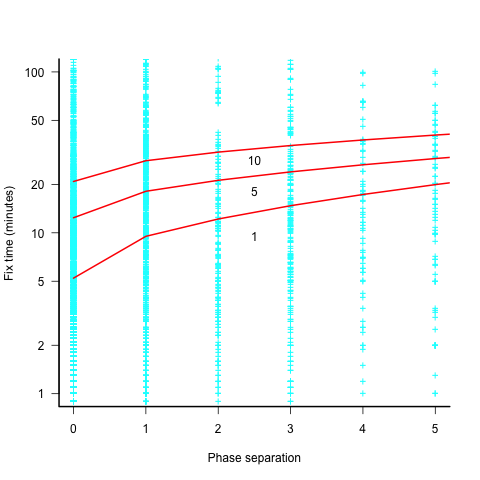
The plot below shows the time taken to fix 7,000 reported defects by distance between phases, for CESAW project 615 (code+data). The red lines are fitted regression models of the form fixTime approx sqrt{phaseDistance}, for minimum fix times of 1, 5 and 10 minutes:

Time taken to fix reported defect by distance between inserted/detected phases.

The above plot makes various simplifying assumptions, including: ‘sub-phases’ being associated with a ‘parent’ phase selected by your author, and the distance between all pairs of adjacent phase is the same (in terms of their impact on fix time).

A more sophisticated data model might change the functional form of the fitted regression model, but is unlikely to remove the general upward trend.

There are lots of fix times taking less than five minutes. Project 615 developed safety critical software, and so every detected mistake was recorded; on other projects, small mistakes would probably been fixed without an associated formal record.

I think that, if it were not for the, now discredited, folklore claiming outsized relative costs for fixing reported defects at greater ‘distances’ from the introduction of a mistake, this issue would be a niche topic.

28 Jun 06:19

Querying Parquet using DuckDB

Querying Parquet using DuckDB

DuckDB is a relatively new SQLite-style database (released as an embeddable library) with a focus on analytical queries. This tutorial really made the benefits click for me: it ships with support for the Parquet columnar data format, and you can use it to execute SQL queries directly against Parquet files - e.g. "SELECT COUNT(*) FROM 'taxi_2019_04.parquet'". Performance against large files is fantastic, and the whole thing can be installed just using "pip install duckdb". I wonder if faceting-style group/count queries (pretty expensive with regular RDBMSs) could be sped up with this?

Via Hacker News

28 Jun 06:19

A Datasette tutorial in Portuguese

A Datasette tutorial in Portuguese

Nicolás Linares put together this Datasette tutorial in Portuguese, including an explanation of the project, how to get it up and running on a laptop, how to use it to explore and facet data, how to use plugins (including datasette-vega and datasette-cluster-map) and how to publish data using Vercel. I ran this through Google Translate and I can confirm that it's a really well constructed tutorial - fantastic to see material like this starting to emerge in languages other than English.

28 Jun 02:59

Twitter Favorites: [jeffjedras] My policy has long been cheer for the last Canadian team standing that is not the Leafs*. So, go Habs! Bring the… https://t.co/EtBuacsIiX

Jeff Jedras @jeffjedras
My policy has long been cheer for the last Canadian team standing that is not the Leafs*. So, go Habs! Bring the… twitter.com/i/web/status/1…
28 Jun 02:59

2021-06-25 General

by Ducky

Vaccines

Apparently there’s some people being concerned about mRNA vaccine ending up in the ovaries. This Twitter thread takes that idea down. Tl;dr: the lipid envelopes which contain the mRNA migrate around, and a small amount ends up in the ovaries (as it does to lots of organs, most notably the liver), but such a small amount that it’s not to worry.


People with various immune issues have trouble mounting a good response to vax, sometimes even with two doses. Solid-organ recipients have probably the worst time of it. This paper says that a third dose is better — dragging the prevalence of antibodies up from 40% of patients to 68%.


This article says that less than 0.5% the cases and 0.5% of the deaths in Canada since the start of the vaccine rollout have been in fully vaccinated people.

Variants

A new report says that Delta is “only” 40% more transmissible than Alpha, not 60%.


This article is a good explainer of “Delta Plus”, a new version of Delta with the mutation K417N which is also found in the Beta (“South African”) strain. There are actually two different strains of Delta plus K417N, AY.1 and AY.2, with slightly different additional mutations.

There are reports that it is resistant to monoclonal antibodies and fears that it will be vax resistant.

The first report was from April, and the numbers are still low, so it is likely that it is not more contagious.

Recommended Reading

There have been a lot of articles about anxieties about re-entering the in-person social and work worlds will be or is. This article talks about something I had not considered: returning to the research people were doing before dropping it all to focus on COVID-19.


If you want more on the origins-of-SARS-CoV-2, see this (longish) article. One thing the article reminds us of: even if it was a lab leak, that doesn’t mean that the virus was engineered.


This article is about solar panels, not vaccines, but its discussions of how to best advance technologies apply to vaccines. This article, I hope, makes clear why just making vaccine IP free is not enough to get vax to the world.

28 Jun 02:58

2021-06-25 BC

by Ducky

Vaccinations

Here’s Justin McElroy’s weekly vax (first dose) by age charts. As always, the women are getting vaxxed more than the men.


I was busy with stuff yesterday so didn’t describe my visit to the West End Community Center, escorting my favorite spouse. Observations, in no particular order:

  • There was no waiting at all. It didn’t feel rushed at all, but we didn’t have to wait.
  • The atmosphere was happy, but not jubilant. People weren’t crying with relief, nor grouchy. (That was my impression also at the Convention Centre. At the pharmacies, there weren’t enough people to form an opinion. At the False Creek Community Centre with my 83 y/o neighbour, there was a line and the vaccinees were nervous and scared, leading to a little bit of tension.)
  • There were three people at entry, one who checked Beloved’s name off a list, one who asked some screening questions, and one who was… hanging around. Beloved said that the list was mostly crossed off, i.e. there were not a lot of no-shows.
  • It was in a room which looked like an auditorium, with a bunch of boxes of supplies up on the stage.
  • There were 12 vax stations set up, with 9 vaccinators. There were three stations that appeared to be syringe-loading stations.
  • Beloved got Moderna, no surprise there.
  • The patient-wranglers at this clinic appeared to all be people who regularly volunteer for BC Women’s Hospital or BC Children’s hospital.
  • One of the wranglers said that VCH has paid staff at the permanent clinics, but not at pop-ups like West End Community Center. I was a bit surprised: what makes West End CC a popup? Granted, they aren’t as large, but they’ve been going for quite a long time and I expect them to keep going for another month at least.
  • One of the wranglers said that VCH had hired teams from companies which had had big layoffs (e.g. WestJet) who had lost their jobs, but now that those companies were going back to work, they were replacing the paid staff with volunteers. She mentioned that volunteers have to get a background check, which takes two weeks.
  • One of the wranglers said that the permanent site at the Italian Community Centre was run by Rogers Arena (I think) staff, that UBC was run by WestJet, and the Canada Place by the cruise line handlers.
  • One of the wranglers said that there was a train wreck at the Convention Centre recently (Wednesday?): there were a lot of people scheduled in that day and all the computers went down. She said there was a two-hour line out the door.
  • (=Something I keep forgetting to ask is what the limiting factor is right now: is it vaccinators? Syringes? Volunteers?
  • There were three small areas where people could spend their 15 minute observation period, a main area and a smaller overflow area. The main area was right next to big doors to the outside, so they opened the doors and set chairs out. We waited outside: it was extremely pleasant.

Supply

Holy F, the Canada vax supply page just quietly added another half million doses of Moderna to arrive next week. That means for the two weeks starting 21 June, we’re supposed to get a a little more than 1.4 million doses of Moderna in addition to 650K from Pfizer. Yes, a million doses per week. I think it’s fair to say that supply is no longer the limiter.

Mitigation Measures

This tweet by Richard Zussman (who is reliable) says that Dr. Henry has granted a waiver to allow fans in Victoria at FIBA basketball Olympic qualifier. The tournament runs from 29 June to 4 July, so the first few games are still in Step 2 of the restart plan.

Variants

Welp, Delta is up to 12% of cases for the week of June 12-19, up from 6% the previous week. This is a little odd, since the Weekly Data Summary for June 11 to June 17 said Delta was 6% of cases. I suspect that what’s happening is that the absolute numbers are so small that there is a lot of fluctuation.

Statistics

Today: +72 cases, +2 deaths, +6,369 first doses, +45,093 second doses.

Currently 108 in hospital / 37 in ICU, 1,096 active cases, 144,554 recovered.

first dose second dose
of adults 77.6% 26.9%
of over-12s 76.2% 25.2%
of all BCers 69.3% 22.9%

NB: I was being stupid in previous days. The province’s numbers were probably right. (I had been dividing the total number of doses by the total number of adults, instead of the number of doses in adults by the number of adults. I don’t know the total number of doses in adults.)

We have 1,002,121 doses in fridges.  😲  Yes, OVER ONE MILLION DOSES IN FRIDGES.  (And another half-million is slightly overdue.) We’ll use it up in 16.9 days at last week’s rate. We’ve given more doses than we’d received by 7 days ago.

We have 924,392 mRNA doses in fridges; we’ll use it up in 15.9 days at last week’s rate. We’ve given more mRNA doses than we’d received by 7 days ago.

We have 77,729 AZ doses in fridges; we’ll use it up in 22.4 days.

Charts

28 Jun 02:57

Walkways lined by abandoned gestures

by Doug Belshaw
Tiled wall with wall and cement revealed

I can’t remember when I first came across it, but The Book of Disquiet is an incredible read. It seems to peer almost directly into the soul of its author, who himself is a heteronym of the Portuguese writer Fernando Pessoa. It was published decades after Pessoa’s death from unedited scraps of paper found in a trunk. He called it a “factless autobiography”.

There are inevitable disagreements about the order in which the fragments should be placed, but to give a flavour, my translated version (Penguin Classics) includes the following in Chapter 41:

Silence emerges from the sound of the rain and spreads in a crescendo of grey monotony over the narrow street I contemplate. I’m sleeping while awake, standing by the window, leaning against it as against everything. I search in myself for the sensations I feel before these falling threads of darkly luminous water that stand out from the grimy building façades and especially from the open windows. And I don’t know what I feel or what I want to feel. I don’t know what to think or what I am.

All the pent-up bitterness of my life removes, before my sensationless eyes, the suit of natural happiness it wears in the random events that fill up each day. I realize that, while often happy and often cheerful, I’m always sad. And the part of me that realizes this is behind me, as if bent over my leaning self at the window, as if looking over my shoulder or even over my head to contemplate, with eyes more intimate than my own, the slow and now wavy rain which filigrees the grey and inclement air.

To shrug off all duties, even those not assigned to us, to repudiate all homes, even those that weren’t ours, to live off vestiges and the ill-defined, in grand purple robes of madness and in counterfeit laces of dreamed majesties… To be something, anything that doesn’t feel the weight of the rain outside, not the anguish of inner emptiness… To wander without thought or soul – sensation without sensation – along mountain roads and through valleys hidden between steep slopes, into the far distance, irrevocably immersed… To be lost in landscapes like paintings… A coloured non-existence in the background.

It continues, flirting with, but never falling into bathos. Instead, for me at least, it describes a certain part of the human condition in a more precise way than I’ve read anywhere else. I recommend this episode of BBC’s In Our Time podcast about Pessoa for those wanting to find out more.


I came across a blog post yesterday about someone I have interacted with a few times over the last decade. They’re going through, and have gone through, what sounds like a hellish time. They’re being open and candid about it. Most people keep much smaller things than these to themselves.

It made me realise that many people around me at the moment are going through some serious stuff right now. Mental health issues, losing loved ones, physical injuries, bullying, insomnia, to name but a few. Some of this is pandemic-related, but much of it isn’t.

Much of life involves pain and suffering of one type or another, and so people respond to this in different ways. For me, there is a delicate dance to be performed at the border of despair and ignorance, and too often I fall one way or another, having to pick myself up and start again.


Image by Natalia Y. The title of this post is also a quotation from the book.

The post Walkways lined by abandoned gestures first appeared on Open Thinkering.
28 Jun 02:57

Twitter Favorites: [fietsprofessor] In Utrecht, you don't take your bike to the train station. You arrive by train at the bike station! https://t.co/SF8EVRkFZR

Cycling Professor @fietsprofessor
In Utrecht, you don't take your bike to the train station. You arrive by train at the bike station! pic.twitter.com/SF8EVRkFZR
28 Jun 00:49

The Age of Software: An Introduction

The combination of digital representation and software has transformed the world and our understanding of the world. The Internet as just one byproduct of this fundamental conceptual shift from meaning being intrinsic to meaning being defined by software with multiple interpretations co-existing.
28 Jun 00:48

Purple Foxglove Season

by peter@rukavina.net (Peter Rukavina)
,
28 Jun 00:48

A Proficiency Test for Research Software Engineers

Back in 2014, I worked with Mike Jackson, James Hetherington, and Andrew Turner to develop a skills assessment for people who wanted to use the DiRAC supercomputing facility. It never really caught on—it’s politically impossible to tell professors who have already paid for machine time that their grad students don’t know enough about software development to use it efficiently—but I’m publishing it here in the hope that it will spur others to share what people ought to know and how we can tell if they know it.

1. Introduction

  1. You have 90 minutes to complete the following tasks.

  2. You may use the web, man pages, and any other resources you would usually use when programming.

  3. If you are completing the assessment with colleagues, you are free to discuss hints, tips and the usage of commands, but do not share the answers to tasks.

  4. If at any point you would like clarification, please do not hesitate to ask.

  5. If at any point you are unable to complete a task, feel free to move on to the next task. The major tasks (shell, shell scripts, testing, code review) are all independent. You may ask for help before moving on, but doing so will be considered equivalent to not completing that task.

Clone the exam repository at [URL provided]. This serves as both a repository and your working copy. You will do all of your work in this local repository and use version control to commit your solutions as you go.

2. Shell

Use the cd command to go into the python/ directory, which contains two subdirectories. Within that directory, use a single shell command to create a list of all files with names ending in .dat in or below this directory in a file called all-dat-files.txt.

Create a file called shell-command.txt containing the command you ran to get the list of files, add this to the version control repository, and commit it.

Add all-dat-files.txt to the version control repository and commit it.

3. Shell Scripts

Write a script called do-many.XX (scripting language of choice) that runs power2.py for the inputs listed in the file input.d and saves the output in a file calld output.d. The output file must contain the following when you are done:

16
8
2
1
8
1
32
2
1

You do not need to do error-checking on the command-line parameters, i.e., you may assume that they are all non-negative integers.

Add do-many.sh to the version control repository and commit it.

4. Testing

analyze.py contains a function called running_total that is supposed to calculate the total of each strictly increasing sequence of integers in a list:

running_total([1, 2, 1, 8, 9, 2])       == [3, 18, 2]
running_total([1, 3, 4, 2, 5, 4, 6, 9]) == [8, 7, 19]

test_analyze.py contains a unit test implementing the first example above. Write four more unit tests that you think are most important to run to test this function. Do not test for cases of invalid input (e.g., inputs that are strings, lists of lists, or an input that isn’t a flat list of numbers). You can run your tests using the command:

py.test test_analyze.py

Add test_analyse.py to the version control repository.

5. Scale Testing

What is the approach you would use to check the scaling of a program called long_run.py? Explain your method in 50 words.

Create a file called scale-test.txt with the commands you would use and add this to the version control repository.

6. Code Review

The programs power2.py, power2.c, and power2.f each take a single non-negative integer as a command line argument and produce the powers of two that total to that number. For example:

./power2.py 27

produces:

16
8
2
1

Choose the language you are most comfortable with and change this program in at least 3 ways to improve its readability, understandability, and modularity without changing its behaviour.

Commit your changes to the version control repository.

7. SSH keypairs

Assume you have an account with the username me on a remote host called server.dirac.org. You want to use a SSH public/private keypair and associated passphrase to access the remote host. What commands would you use to create your SSH keypair and to update the remote host with your public key?

Create a file called ssh-keypair.txt with the commands you would use and add this to the version control repository.

8. Secure copy

Assume that in your me account on server.dirac.org you have 100 files called detector001.dat, …, detector099.dat in a directory called data immediately below your home directory. What commands would you use to securely copy the directory that contains all these files from server.dirac.org to your local computer?

If a few files have been changed within this directory on your server.dirac.org account, what command would you use to copy over only the changed files?

Create a file called secure-copy.txt with the commands you would use and add this to the version control repository.

9. Archiving

Create a file called save-work.txt containing a single command to create an archive called either exam.tar.gz or exam.zip in your home directory with the files you have created. This archive must not contain the .git directory.

Run save-work.txt and email exam.tar.gz or exam.zip to your examiner.

28 Jun 00:48

Buddy Rider review

by jnyyz

On several of our family rides down to the lake on the tandem, we’ve often thought that it would be nice to have Lucy along. The issue is that the usual way that I carry Lucy is with the cargo bike.

In principle we could put a basket on the back or the front of the tandem, but Lucy hates being in the back, and I didn’t see any obvious choices among the front baskets that were available that could take a 17 lb dog.

That’s when I rediscovered the Buddy Rider. It looked heavy and expensive, but seeing that it was a Canadian company made it an attractive enough buy for me.

This thing is not light.

However, it looks very well made, and it includes these bolts precoated with threadlock.

Lucy wonders what’s going on during a test fitting.

It says repeatedly in the instructions and on this sticker that the support is not to be used with a carbon seat post. I suppose that’s for liability reasons, but I also can’t image anyone wanted to bolt something that weights over 2 kg to a bike with a carbon seat post.

One thing I did not fully appreciate is that the seat effectively raised the top tube height above the level of the saddle. This makes getting on the tandem a bit of a chore. Also you can’t come forward off of the saddle at a stop so I had to lower the seat a bit so that I could get both feet on the ground. On a regular bike this would be less of a problem since you could swing your leg over the back of the bike. The instructions do say that you should mount the seat as high and as far forward as possible to minimize interference with peddling the bike.

Thankfully when the seat is dismounted, the remaining piece of the mount is very unobtrusive.

Maiden voyage. Lucy doesn’t look very impressed but I can see that this is going to be fun. I didn’t sense any handling problems, and Lucy is well under the stated 25 lb limit for the seat.

28 Jun 00:48

Wear bicycle helmet: get ice cream

by peter@rukavina.net (Peter Rukavina)

Thanks to the indefatigable Ken Murnaghan, the Island’s greatest advocate for bicycle helmet wearing, Olivia and I enjoyed two Truckin’ Roll ice creams this afternoon.

If Ken spots you wearing yours, maybe he’ll surprise you with an ice cream too. Way better than a carrot!

28 Jun 00:48

Cycling with a side of transphobic sexism

by peter@rukavina.net (Peter Rukavina)

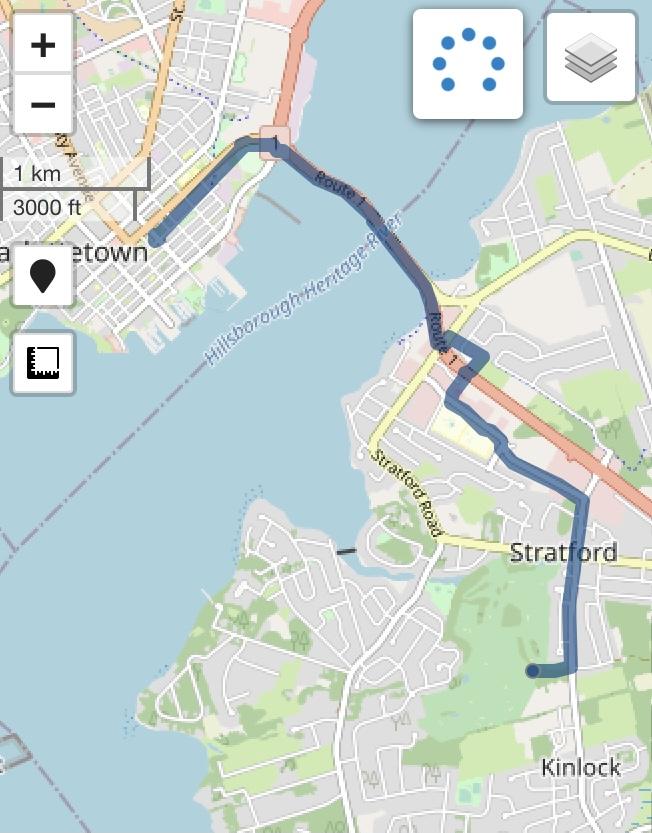
Olivia and I undertook our most ambitious cycle journey yet, cycling from our house, across the Hillsborough Bridge, and into deepest Stratford to have supper at the Fox Meadow golf club. Return trip was about 12 km, and, despite the steep grade up Kinlock Road to Fox Meadow, we cycled there and back with no problems.

Well, no cycling problems.

As we were arriving at the golf club a party was leaving the restaurant and one of the men made a sexist, transphobic comment to Olivia. Which happened to be her first since she came out.

He was probably a little drunk, and golf clubs are not known as beacons of enlightenment, but sexism and transphobia are wrong. Period. No matter the state of the asshole, no matter the venue.

Our supper—lacklustre food, excellent service, great view—was thus taken up with a survey course in discrimination, with Olivia doing most of the talking.

Fortunately, on the cycle home (after stopping at Sobeys for the first strawberries of the year), we overheard the musical stylings of Todd E. MacLean at The Lucky Bean, doing a benefit for Blooming House.

So, of course, we stopped, made a donation (you can too!), enjoyed some cocoa and Sinatra, and appreciated extra-especially the pride flag flying out front.

28 Jun 00:47

Maps & Visualizations gallery

Here’s an incomplete gallery with links to some data visualizations and maps I’ve made: many are interactive, so you’ll need to click through through for the full experience.

Ghost shipping paths

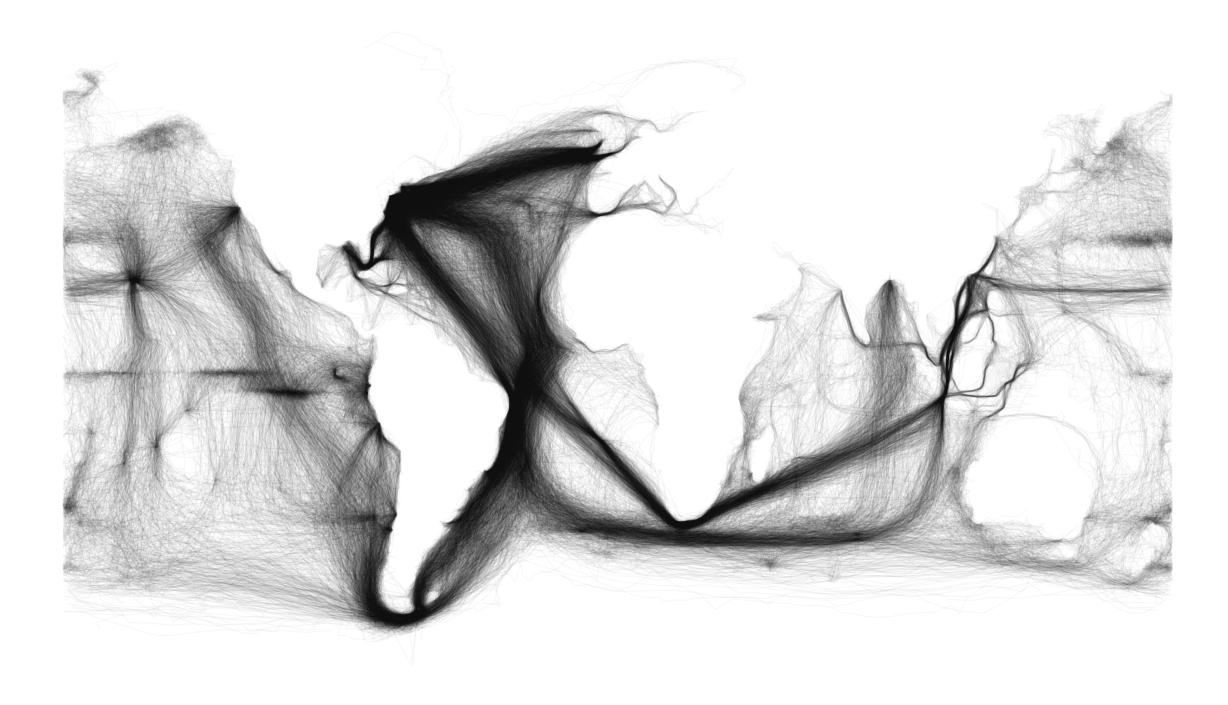
Probably the most widely-circulated image I’ve made is this chart that shows the paths of ships taken from the US Maury collection of the government’s database of ship’s paths. I made it to illustrate how rich metadata alone can be as a source for historical research: it’s also just an interesting way to see the continents through large-scale patterns of behavior. Several people asked for higher-resolution versions; I recreated a couple charts on the same concept here.

MauryMetadata

The Hathi Trust Library

This portion of Creating Data presents a new way to look at the digital library: a visual bibliography as a 15-million book zoomable scatterplot, displaying a variety of metadata and allowing you to click through to the Hathi Trust.

image

Gendered Language in Teaching Evaluations

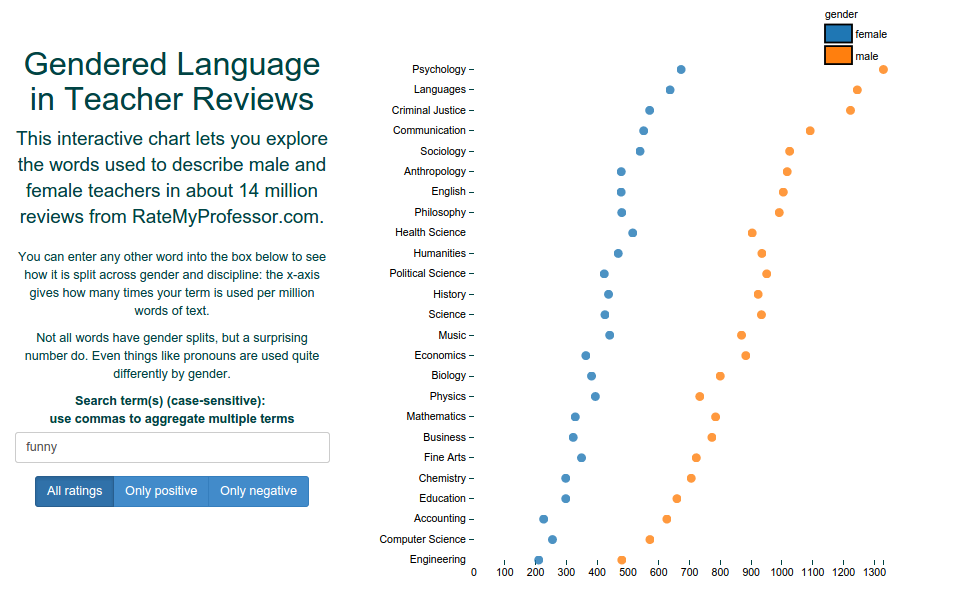
An interactive exploration of the different language used to describe professors in multiple fields. As well as my explanation off the page, see the writeups in the New York Times and Chronicle of Higher Education. Built using the D3 interface to Bookworm.

GenderedLanguage

Data Driven Projections: Darwin’s World

The hard part of this is really Philippe Riviere’s work, not mine: but I noticed that his new Voronoi Projection enables what I call ‘Data Driven Projections,’ map representations of the world customized for any set of points. The one below shows the voyage of the Beagle in the 1830s, with Darwin; you can change the observable notebook at this link for any dataset you like.

Darwin

Archetypal Plot Structures

Law_& Order

Using topic modeling and my database of 80,000 film and TV captions, I look at the typical plot structures for about 150 common TV shows. (This one is not an interactive, at least not yet: but it was all built entirely in the interactive bookworm browser.)

Corrected Subway Maps

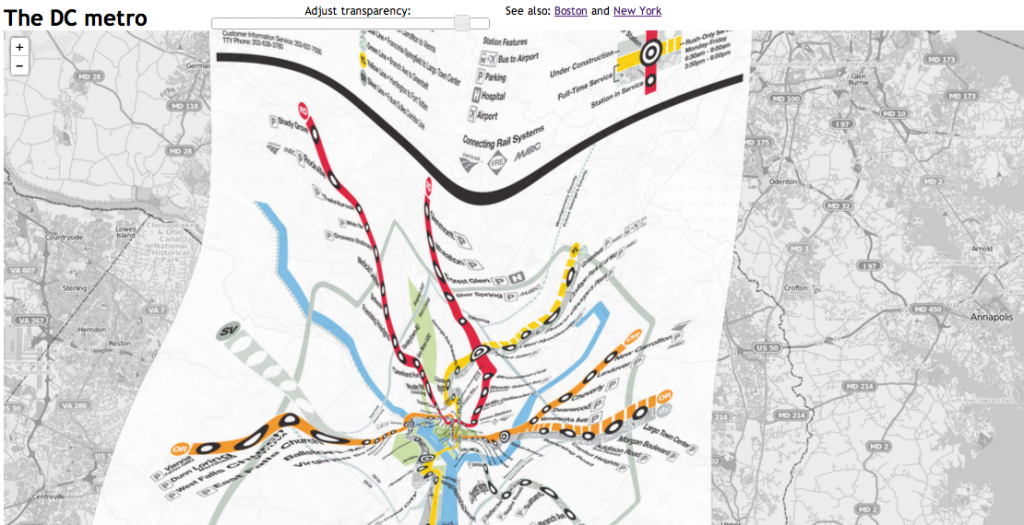
This is a set of transit maps deformed to fit onto the Internet map-tile view of the cities (Boston, New York, Washington) they depict; it explores the tension between two different ways of representing the same urban spaces. Made using QGIS, Leaflet, and some command-line GDAL tools with maps and data from the transit authorities and tiles from Open Street Map.

metroScreenshot

Baseball leaderboard cherrypicker

CherrypickerScreenshot

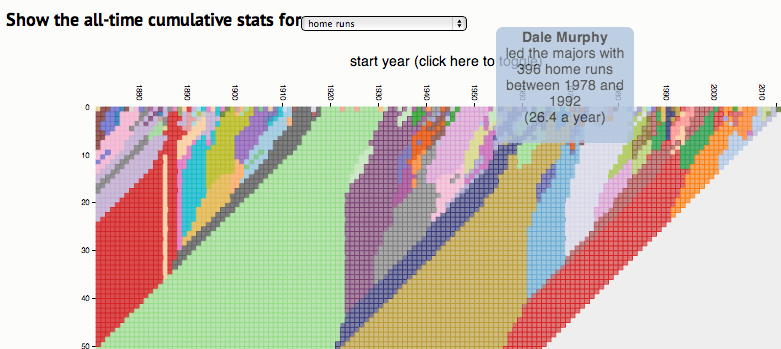
This lets you navigate through thousands of statements of the form “Jack Morris led the majors in wins in the 1980s” and decide which ones are important. It speaks to a larger collection of questions about how quantitative claims like those made in baseball (or in the earlier version of the same idea I made about college degrees) often take more context than the basic statements allow. Made using R and D3 from data in the Lahman database and from baseballprospectus.com.

College Majors and Degrees

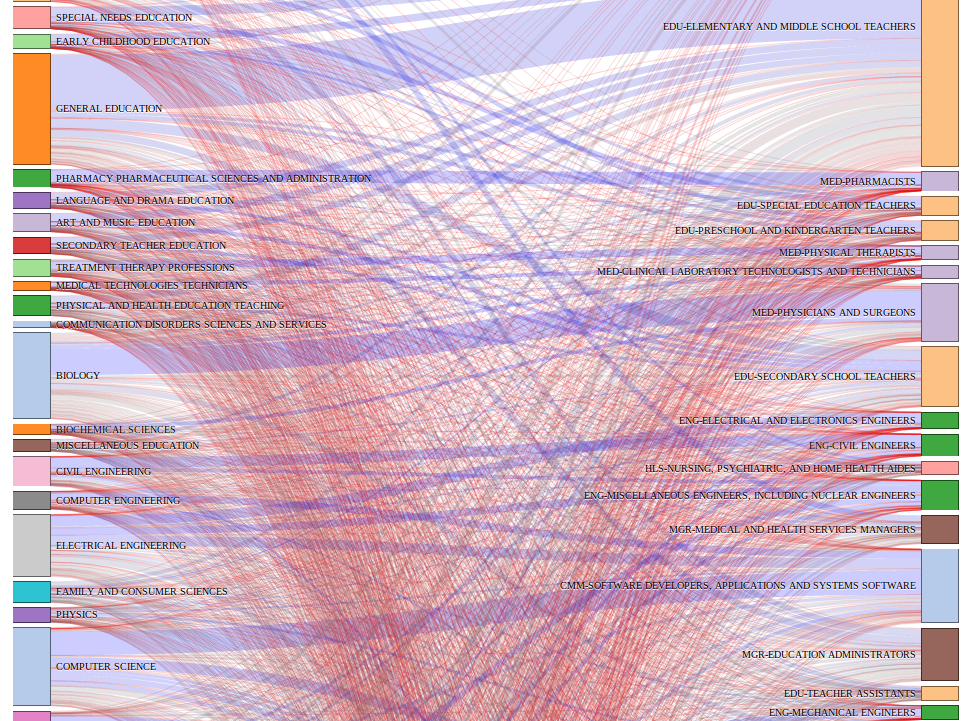
Students and professors alike often don’t know what careers a particular major leads into; using census data from the American Community Survey, this Sankey diagram lets you see many of the different paths that college graduates take. It’s a pretty basic 2-column sankey layout, but has two nice features: color coded lines to show relative significance of flows, and a click-to-zoom interface that lets you look at one particular field.

Sankey

Changing College Majors

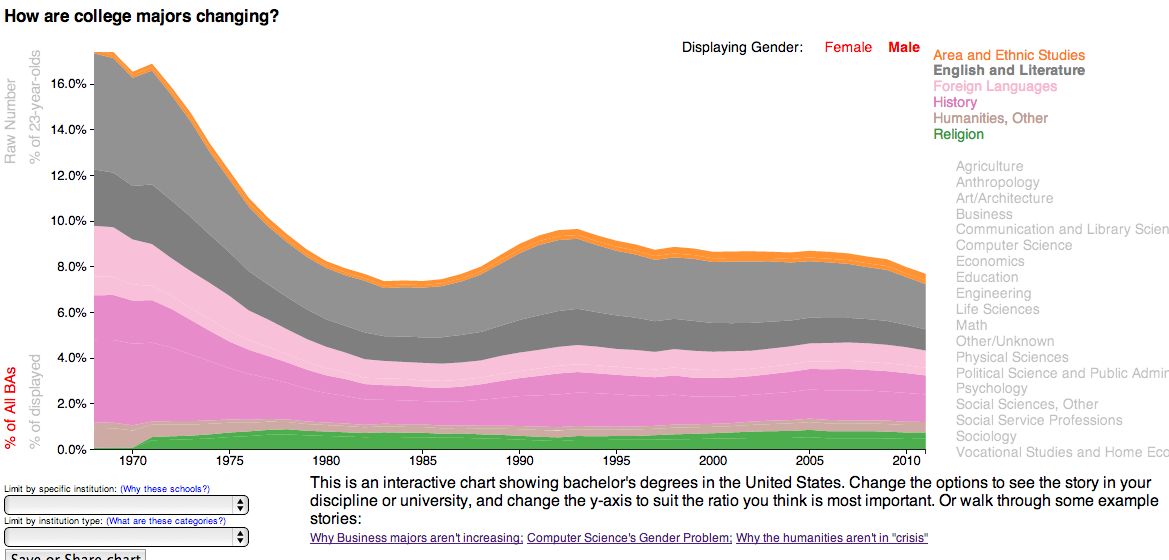
A practical visualization of department of education data about what college students major in: it’s highly interactive, and lets you choose which majors, you want to look at, which metrics of quantity, and which colleges you want to include. Also includes a few example story walkthroughs. Made using D3 with data from the NSF (and originally department of education).

degreeScreenshot

Shipping animations

Using the shipping maps dataset, I also made a set of movies showing ocean sailing in motion using ggplot2 and ffmpeg. Here’s one of them; the rest are available on my YouTube channel, and I wrote quite a bit about them on my blog.

Migrations in 1880

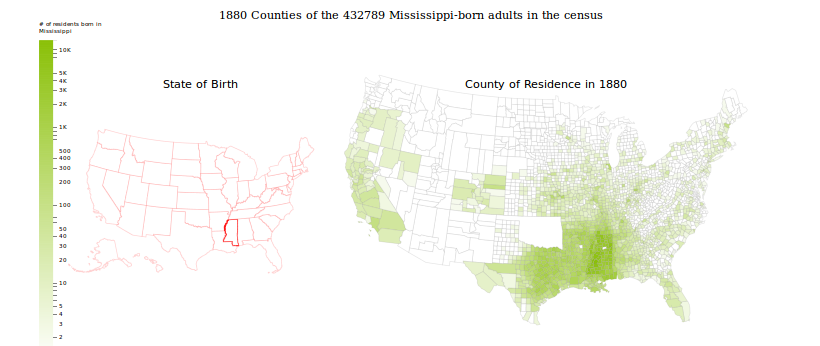
An experimental interactive map (experimental here meaning “too long a load time” to show interstate migrations in the 1880 census.) This can be used to explore some interesting stories about regional connections in the period after the end of slavery (for example, by looking at the relative sources of migration in different western counties to see which eastern states their residents came from.) Graphically, I found it interesting to have two maps (one of counties and one of states), which switch roles as legend or content depending on what direction of migration you want to look at.

Migrations Screenshot

Visualizing the State of the Unions

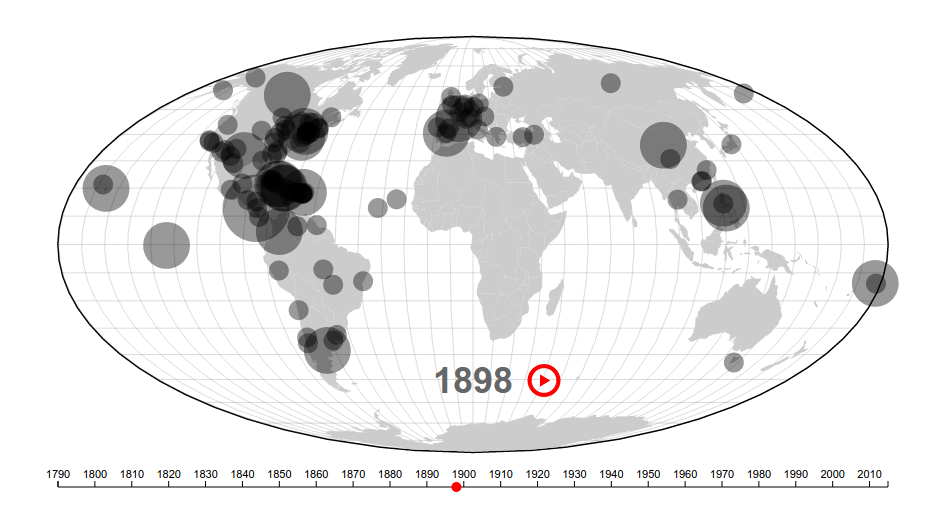
An animated interactive graphic for The Atlantic built using the Bookworm platform that shows thousands of places mentioned in presidential State of the Union addresses since George Washington. This was a collaborative effort: Mitch Fraas handled the geo-coding side of things, and Chris Barna at the Atlantic transformed the Bookworm code into something that would run statically on their site and added some nice effects to boot. Includes explanations by historians of foreign relations.

The important part here is the interactivity: click through to see just how that place was used in context.

World

Reading the State of the Unions

An interactive form for reading any state of the union address in the context of every other one. Choose any address from a dropdown menu: click on a word, or highlight a phrase, to see how often every other president used it. Online here.

SOTUs

28 Jun 00:46

The Data Shows There's No Real Crisis in the Humanities

28 Jun 00:46

Twitter Favorites: [ReneeStephen] Sidenote, being on ADHD medication is... um. I have been crying. A LOT. Because I have access to feelings now? An… https://t.co/BEXSNMndcR

Renée @ReneeStephen
Sidenote, being on ADHD medication is... um. I have been crying. A LOT. Because I have access to feelings now? An… twitter.com/i/web/status/1…
28 Jun 00:32

Several Desktops On A Single VM In The Cloud

by Martin

Earlier this year, I discovered how to run a graphical desktop in a virtual machine in the cloud. I promptly put this to good use and ran a couple of online hands-on workshops on various topics in recent months. In combination with Guacamole, participants don’t even need to install a remote desktop viewer, but can use the remote desktop right in the web browser. My latest improvement: Run several desktops on a single Virtual Machine.

The idea came to me after playing with an HDMI dummy dongle that simulates a screen for my workstation. On a VM, there’s no need for an HDMI dummy dongle, the virtual GUI uses a virtual screen buffer that doesn’t even require a graphics card. When I arrived at this point, I was wondering why I couldn’t just start several virtual screen buffers and run an individual gnome session on each? And indeed, this works like a charm out of the box.

In case you are interested on how to set this up, have a look again at my original article on the topic. There, you will find the following script to create a virtual display buffer with “Xvfb”, run a gnome session on it and finally run x11vnc server to enable access to it remotely with a VNC client viewer via tcp port 29000:

export DISPLAY=:0 
Xvfb $DISPLAY -screen 0 2048x1200x16 & 
sudo -u cloud gnome-session & 
x11vnc -usepw -forever -repeat -shared -rfbport 29000 -display :0

Getting a second desktop is as easy as doing this again with a different display number, a different user and a different TCP port number for VNC:

export DISPLAY=:1
Xvfb $DISPLAY -screen 0 2048x1200x16 & 
sudo -u cloud2 gnome-session & 
x11vnc -usepw -forever -repeat -shared -rfbport 29001 -display :1

Note that the screen number given to Xvfb does NOT change! Also note that a different user should be used for the second GUI, so starting the same program on each GUI does not lead to strange side effects due to the use of the same configuration files. As the users ‘cloud’ and ‘cloud2’ should be identical for running online hands-on workshops, ‘cloud2’ can be cloned from ‘cloud’ while the GUI is NOT running as follows:

adduser --disabled-password --gecos "" cloud2
sudo rm -rf /home/cloud2
cp -r /home/cloud /home/cloud2
sudo chown -R cloud2:cloud2 /home/cloud2

It is of course possible to run more than two desktops at a time on a single virtual machine. The number is only limited by the amount of memory and CPU capacity. On virtual machine with 2 vCPUs and 4 GB of RAM, I could easily spawn 3 desktops with Firefox + Wireshark running on each. 4 desktops were possible as well but that was definitely pushing the memory limit.

If such a multi-desktop approach is usable for online hands-on workshops depends on the topic. For Docker or Kubernetes introduction workshops, the setup is not ideal, as this type of software runs system wide and hence, users would get in the way of each other. However, for hands-on workshops which only require ‘higher layer’ software like a web browser or tools such as Wireshark with pre-recorded trace files, this setup works great. Depending on the number of participants, it reduces VM rental cost and setup effort, or allows to increase the number of people that can participate in a workshop when the maximum number of VMs that one can spawn at any one time is limited.

28 Jun 00:31

WANTED: MozillaPH Social Media Team Members

by Robert "Bob" Reyes
The Mozilla Philippines Community (MozillaPH) is building a social media team to manage the online presence of the volunteer community. We are looking for individuals who are willing to share their time and talent to MozillaPH — with or without experience in social media management, loves FOSS (Free and Open Source Software), and is an abled learner. Interested? Please sign-up using the online form below: Loading… Maraming salamat po!… Read the rest
28 Jun 00:25

You can install Android apps from outside Amazon’s Appstore on Windows 11

by Brad Bennett

After announcing at the Windows 11 launch event that the new operating system can run Android apps, more information has been revealed regarding how the feature works — specifically, that you can download Android apps from the web and not just the Amazon Appstore.

This means that just like on Android devices, you can download app APK files (the app, but unattached from a traditional app store) from websites and platforms like Github and run them on your Windows 11 PC. While this opens the door to a lot more apps on Windows, the system won’t be as straightforward as downloading an app from the Microsoft Store since you can’t get updates without re-downloaded a newer version of the APK file.

You’ll also be without support for Google Services, so several Google apps like Maps won’t work. XDA Developers reports that other apps, like Twitter, work relatively normally on devices without Google Services, but don’t deliver push notifications. Overall, it seems like it might be a bit of a hit-or-miss scenario once Windows 11 finally launches.

That being said, it’s likely that the majority of users will download Android apps from the Amazon storefront since it will be integrated within the refreshed Microsoft Store in Windows 11.

Microsoft is running Android apps through a new software translation technology called Intel Bride. Despite its name, this technology works on AMD and ARM-powered machines and is not tied to the hardware powering your PC. With that in mind, running mobile apps on M1 Macs and Chrome OS has been a pretty lacklustre experience so far, so we won’t hold our breath for great performance from Android apps on Windows 11 either.

Source: XDA Developers 

The post You can install Android apps from outside Amazon’s Appstore on Windows 11 appeared first on MobileSyrup.

28 Jun 00:23

Tinkering

by Rui Carmo

I miss coding and building “in the small”. A lot, in fact, and my current role and the thundering herd of meetings that has converged around fiscal year close has consumed a lot of time and motivation to tinker.

Another factor is that the weather has been warming up considerably, which always makes it less likely I’ll sit at (or with) a conventional computer. That and feeling tired all the time (from work, not viruses) has somewhat inflated my personal backlog.

The past two weeks were odd, however, in that I’ve had a couple of longer weekends and one or two evenings when I wasn’t knackered out, which provided me with enough time to tinker with both hardware and software.

Little Quad

I (finally) got my Banana Pi M2 Zero Plus to work reliably enough by installing Armbian on it. I got it a long time ago because I was frustrated with the Raspberry Pi Zero’s piddling single core, but don’t recommend it for a number of reasons:

  • It still has only 512MB RAM
  • It has sub-par support, in the sense that over the (couple of?) year it sat in my parts drawer it was impossible to get a stable OS image to run on it (hence my taking this long to getting it to a usable state).
  • It runs much hotter than the 3A+ that I adopted as my iPad “Linux sidecar”.

On that last note, it almost fits the Flirc aluminium case for the Pi Zero, but the thermal sink is almost completely offset from the CPU – there’s a sliver that makes some contact, and I’m counting on that to keep it somewhat cool.

I’ve set it up to SSH into via Bluetooth PAN and can now use it as a tiny dev box, but to be honest getting it to work was a goal in itself as I found it annoying that it wasn’t useful.

Time will tell if I find an actual use for it, although the reason I reached for it was that I wanted to investigate embedding an AirPlay receiver into an old monitor (which is now on hold because if I decide to do that I will need to rebuild its enclosure).

Phoenix

Even though I’ve been using Moom for many years now with a set of Windows-like key bindings to quickly arrange my desktop in various configurations, every now and then I jump for a day or so into Amethyst for its XMonad-like automatic window tiling, which I like because it can be 100% keyboard-driven.

But they can’t coexist, and every now and then I go looking for options.

Phoenix (which can be installed via brew install --cask phoenix) is a strange beast, because it has no graphical UI and configured via JavaScript, but it is amazingly tiny (takes up a mere 12MB RAM) and able to do just about anything you can think of with windows.

What drove me to try it was that one of the sample configs provided a pretty amazing way to quickly switch between windows that is even faster than Spotlight or Witch: Press Cmd+Shift+Space to get key hints overlaid upon each open window, then hit the one key corresponding to that window and both focus and mouse are moved there–on any display.

This is massively more efficient than using the mouse when you have multiple windows scattered across three monitors, so I picked that up and started rebuilding it with a few tweaks.

A couple of weeks after going down that rabbit hole, I now have a set of XMonad-like tiling layouts and key bindings that replicate all the Amethyst behaviour I like: auto-tiling windows and shifting focus solely via the keyboard, plus all the hotkeys that years of using Moom and Windows wired into my fingers.

The resulting JavaScript is quite readable, and I will be posting it up someplace when I’m happy with the re-tiling logic.

Fennel

Yesterday I spent a while following up on an old idea and playing with Fennel and LuaJIT, which, when combined, are surprisingly fun and massively efficient.

One of the little utilities I built smoked pypy on an Intel box by nearly an order of magnitude, which was not entirely unexpected but still quite nice.

I’ve always found Lua to be quite an underestimated (if quirky) language, but wrapping it in Fennel and hacking together a couple of simple LISPy tools was great fun, and a great reminder of why I derive so much enjoyment out of programming.

I need to get back to Clojure. I know I keep writing about it, but writing it is likely to be the only sensible thing to do, and maybe (just maybe) it will be enough to compensate for the dreariness of some of the tiresome stuff I’m now doing at work.


28 Jun 00:23

Public health agency warns of fall COVID resurgence if delta variant becomes dominant strain

mkalus shared this story .

The Public Health Agency of Canada (PHAC) is warning that if the delta variant becomes the dominant strain of COVID-19 in Canada, it could lead to a larger than expected resurgence in case numbers this fall.

Chief Public Health Officer Dr. Theresa Tam said such a resurgence could be kept in check if personal protective measures remain in place until the country achieves a higher level of vaccination coverage.

"With the delta variant, I think our bottom line is to get as high as possible, as much as we can get past that 75 per cent goal post for both first and second doses," Tam said.

Just as Tam was warning of a possible resurgence of COVID-19 cases, PHAC released new guidance Friday on what fully vaccinated people can do now that they have built up more immunity.

While other national public health agencies have offered directions for those with two doses, PHAC has said little about what is permissible for people who have finished the vaccine regimen.

Tam offered some high-level suggestions about what's safe Friday — those with a double dose of a COVID-19 vaccine can hug another person who's had two shots, for example — but she said it ultimately will be up to local public health officials to tell Canadians what they can do once they've completed the vaccine regimen.

Health officials have said that 75 per cent of all Canadians must be fully vaccinated before indoor protective measures can be fully lifted.

But if the delta variant becomes the dominant strain in Canada, Tam said, 80 per cent of the population will have to be fully vaccinated before those measures are lifted in order to avoid a fall resurgence.

The delta variant is extremely contagious and has triggered a caseload resurgence in other countries such as the U.K., where reopening plans were recently delayed by four weeks.

Dr. Tam said that an increased uptake among younger adults is key to help avoiding a resurgence.

She said Canadians under 40 are the only ones who haven't hit the 75 per cent mark on first doses, but she expects that to increase.

"I think partly it's just a matter of time and I want to see us going past the 75 per cent mark and shoot for as close to 100 per cent as possible," she said.

WATCH: Chief public health officer says young adults are "the highest transmitters" of COVID-19:

Dr. Theresa Tam says second doses of COVID-19 vaccines are critical to protecting Canadians from the delta variant. 1:22

Prairie provinces behind on first doses

One thing that could factor into a possible resurgence is how provinces approach their reopening plans.

"What I'm watching for is what happens when each of the individual provinces reopens and that will tell us if we might get some sort of resurgence," Dr. Tam said.

"If vaccination rates go up as high as possible, I think all of that can be manageable."

As it stands, only four provinces have reached the 80 per cent threshold on first doses, while a majority have reached the 75 per cent mark, according to PHAC.

Manitoba, Saskatchewan and Alberta are the only provinces that have not yet hit 75 per cent on first doses. Saskatchewan is the furthest behind; there, only 69 per cent of the population has received one dose.

WATCH: Tam outlines guidance for fully vaccinated people in social settings:

Canada's Chief Public Health Officer Dr. Theresa Tam describes some of the new pandemic guidelines for people in social settings. She said Canadians should still check with local health authorities for the latest on pandemic measures and restrictions. 1:41

Agency issues guidance for social settings

PHAC also released a chart with recommendations outlining how people should approach various social situations, depending on their vaccination status.

For example, PHAC says that those who are fully vaccinated don't need to wear masks or physically distance while indoors with a small group of other fully vaccinated individuals — and could have small dinner parties, gather around the living room TV to watch a sporting event and even share a hug, all without wearing a mask.

PHAC says that those who have received just one dose can consider removing their masks while indoors with small groups of fully vaccinated individuals — provided no one in those groups is an at-risk individual.

The agency says Canadians should still wear masks and maintain physical distance while indoors with partially vaccinated individuals. It says that fully vaccinated individuals who are at risk of severe health outcomes should consider masking up while indoors with people who are not fully vaccinated.

28 Jun 00:22

B.C. aims for another 'maintenance phase' of the pandemic that it hopes goes better than the first

mkalus shared this story .

What happens when talking about the pandemic every day stops being a central point of political life?

British Columbia is probably about to find out. 

Next week, the province is expected to move to Step 3 in its reopening plan, which would remove most restrictions on gatherings, allow nightclubs and casinos to reopen and remove the public health order requiring masks in public indoor settings. 

It comes after the province reduced the number of live briefings on the pandemic to just once a week. Revoking the province's official state of emergency may soon follow. 

COVID-19 will still be a part of people's lives for a long time to come, but the province believes the pandemic can be contained in a quieter and less restrictive way than the past. 

Like most bets in the pandemic, it will take some time to determine if B.C.'s officials are right — and if they've learned from the mistakes of the past.   

Metrics still going down

On the first question of whether it's appropriate for the government to dial back its focus, the initial response from most observers has been cautiously optimistic.

"I think it's a reasonable time to take a bit of a breather," said Dr. Srinivas Murthy, an infectious disease specialist at B.C. Children's Hospital.

"I think as long as transparency is there, namely data is released, vaccines [numbers] are released and geographic information is out there... we'll be in a place where we can make informed decisions."

At the moment, those numbers are encouraging for B.C. The rolling average of cases per day is 74, its lowest point since August 15, 2020, nearly 80 per cent of adults have gotten at least one vaccine dose (with enough supply to get a majority of adults fully vaccinated in a matter of weeks), and large outbreaks can now be measured in the dozens of cases, often in smaller communities.

"There's an ongoing virus hanging around in our communities, and immunization continues to be key in managing that, said Dr. Sue Pollock, interim chief medical officer for Interior Health. 

"Week to week, depending on the localized activity, we'll see some variability in which communities are highlighted."

'We'll see what happens'

In other words, the province accepts there will be occasional small outbreaks, particularly in the Interior and North, particularly in places where fewer people have been vaccinated.  

But so long as hospitalizations continue to decline and vaccines prevent the worst health outcomes for people who do get infected, the province believes it can remove most restrictions indefinitely. 

"Immunization does stop transmission of this virus. It means it's not going to spread widely to everyone in a way that it did even a few months ago," said chief health officer Dr. Bonnie Henry this week.

At the same time, immunization isn't a silver bullet, particularly when you factor in the Delta variant: cases are increasing in the two large countries with comparable first dose vaccination rates to B.C. 

The United Kingdom has gone from 2,000 cases a day to more than 10,000 over the past month. Israel, which had kept daily cases in single digits for two months, has seen exponential growth in the last week, and reinstated its orders on mandatory mask wearing indoors as a result. 

In both countries, the role of the variant and the danger it poses to vaccinated and unvaccinated, young and old, is being studied. 

That research will help guide B.C.'s decision making if cases once again rise here. In the meantime, the province focuses on pushing up the number of people with first doses, bit by bit.  

"We thankfully have very low levels of COVID right now, so that gives us some time," said Dr. Henry. 

Of course, B.C. had very low levels last summer. Six months of not being able to gather with friends or family soon followed. 

"If numbers go up, or there's something different with variants circulating, the government will have to pivot," said Murthy.

"Hopefully we don't see that surge in the coming weeks and months, but we'll see what happens."

With files from Daybreak North and The Early Edition

28 Jun 00:22

RT @standardnews: “Not taking a vaccine is like going to a war without a bullet proof vest" These unassuming centres are combatting vaccin…

by Evening Standard (standardnews)
mkalus shared this story from mrjamesob on Twitter.

“Not taking a vaccine is like going to a war without a bullet proof vest"

These unassuming centres are combatting vaccine hesitancy by addressing its root causes: conspiracy theories, historical suspicion of authority and concerns about side effects bit.ly/3d9goea


Retweeted by James O'Brien (mrjamesob) on Saturday, June 26th, 2021 2:54pm


73 likes, 27 retweets
28 Jun 00:21

Abortion opponents protest COVID-19 vaccines’ use of fetal cells | Science

mkalus shared this story .

Sciences COVID-19 reporting is supported by the Pulitzer Center.

Senior Catholic leaders in the United States and Canada, along with other antiabortion groups, are raising ethical objections to promising COVID-19 vaccine candidates that are manufactured using cells derived from human fetuses electively aborted decades ago. They have not sought to block government funding for the vaccines, which include two candidate vaccines that the Trump administration plans to support with an investment of up to $1.7 billion, as well as a third candidate made by a Chinese company in collaboration with Canada’s National Research Council (NRC). But they are urging funders and policymakers to ensure that companies develop other vaccines that do not rely on such human fetal cell lines and, in the United States, asking the government to “incentivize” firms to only make vaccines that don’t rely on fetal cells.

“It is critically important that Americans have access to a vaccine that is produced ethically: no American should be forced to choose between being vaccinated against this potentially deadly virus and violating his or her conscience,” members of the U.S. Conference of Catholic Bishops and 20 other religious, medical, and political organizations that oppose abortion wrote to Stephen Hahn, commissioner of the U.S. Food and Drug Administration (FDA), in April. “Thankfully, other [COVID-19] vaccines … utilize cell lines not connected to unethical procedures and methods.”

“We urge your government to fund the development of vaccines that do not create an ethical dilemma for many Canadians,” wrote Archbishop of Winnipeg Richard Gagnon, president of the Canadian Conference of Catholic Bishops, and 17 other antiabortion religious, medical, and politic groups and individuals in a 21 May letter to Prime Minister Justin Trudeau. “The … manufacture of vaccines using such ethically-tainted human cell lines demonstrates profound disrespect for the dignity of the human person.”

FDA and senior White House officials did not respond to emails requesting comment on the letter to Hahn. In Canada, the health ministry has promised to respond to the letter to Trudeau, says Moira McQueen, executive director of the Canadian Catholic Bioethics Institute and lead signatory on the letter.

Cells derived from elective abortions have been used since the 1960s to manufacture vaccines, including current vaccines against rubella, chickenpox, hepatitis A, and shingles. They have also been used to make approved drugs against diseases including hemophilia, rheumatoid arthritis, and cystic fibrosis. Now, research groups around the world are working to develop more than 130 candidate vaccines against COVID-19, according to the World Health Organization; 10 had entered human trials as of 2 June.

At least five of the candidate COVID-19 vaccines use one of two human fetal cell lines: HEK-293, a kidney cell line widely used in research and industry that comes from a fetus aborted in about 1972; and PER.C6, a proprietary cell line owned by Janssen, a subsidiary of Johnson & Johnson, developed from retinal cells from an 18-week-old fetus aborted in 1985. Both cell lines were developed in the lab of molecular biologist Alex van der Eb at Leiden University. Two of the five vaccines have entered human trials (see table, below).

In four of the vaccines, the human fetal cells are used as miniature “factories” to generate vast quantities of adenoviruses, disabled so that they cannot replicate, that are used as vehicles to ferry genes from the novel coronavirus that causes COVID-19. When the adenoviruses are given as a vaccine, recipients’ cells begin to produce proteins from the coronavirus, hopefully triggering a protective immune response.

The fifth vaccine, which has shown promise in monkeys and is headed for human trials as soon as this summer, is what is known as a protein subunit vaccine. Researchers at the University of Pittsburgh use HEK-293 cells to manufacture the coronavirus’ spike protein—a vital part of its structure—which is used to trigger an immune response. The vaccine is delivered through a skin patch with 400 tiny needles.

The fetal cell lines are key to producing both types of vaccine. “HEK-293 [cells] are essential for making protein subunit vaccines,” says Andrea Gambotto, a vaccine scientist at the University of Pittsburgh School of Medicine and the vaccine’s lead developer. Their human origin is important, he says: “Cultured [nonhuman] animal cells can produce the same proteins, but they would be decorated with different sugar molecules, which—in the case of vaccines—runs the risk of failing to evoke a robust and specific immune response.” (Among the developers of the five vaccines, only Gambotto responded to a request for comment.)

David Prentice, vice president and research director at the Charlotte Lozier Institute, which opposes abortion, notes researchers making adenovirus vaccines have modified HEK-293 cells to be adept at packaging new genes—such as those that direct cells to assemble the coronavirus spike protein—into adenoviruses. But he adds that other technologies are available, including using cells captured from amniocentesis that are engineered to make replication-deficient adenoviruses.

“The use of cells from electively aborted fetuses for vaccine production makes these five COVID-19 vaccine programs unethical, because they exploit the innocent human beings who were aborted,” Prentice and a co-author—molecular biologist James Sherley, a Lozier Institute associate scholar and director of the adult stem cell company Asymmetrex—wrote in a position paper published last month.

But Arthur Caplan, a bioethicist at the New York University School of Medicine, counters: “There are better ways to win the abortion wars than telling people not to use a vaccine. These are long-over abortions. These cells are decades old, and even major religious leaders like the pope have acknowledged that for the greater good it’s not worth the symbolism to put the community at risk.”

The Vatican’s Pontifical Academy for Life declared in 2005 and reaffirmed in 2017 that in the absence of alternatives, Catholics could, in good conscience, receive vaccines made using historical human fetal cell lines.

A vaccine made by the Chinese company CanSino Biologics was the first COVID-19 vaccine to enter phase II human trials. It was developed using adapted HEK-293 cells that the company licensed from Canada’s NRC, where the cells were developed. (NRC-developed HEK-293 cells have already been used to develop an approved Ebola vaccine.) Last month, NRC announced a collaboration with CanSino Biologics under which it is preparing to run late-stage clinical trials of the vaccine in Canada, and scale up facilities to produce the vaccine in quantity.

The two U.S.-backed vaccines that have drawn criticism from antiabortion groups are on a short list of candidates targeted to get financial and logistical support from the U.S. government under the White House’s Operation Warp Speed, which aims to accelerate the development and approval of at least one COVID-19 vaccine by January 2021, according to a 3 June report in The New York Times.

One of the Warp Speed candidates, made by Janssen Research & Development, uses PER.C6 cells. The second, from University of Oxford researchers and AstraZeneca, uses HEK-293 cells. Both have received U.S. government commitments of, respectively, $456 million and $1.2 billion, if they meet milestones, through the Biomedical Advanced Research Development Authority (BARDA).

Another vaccine that relies on HEK-293, being developed by two companies owned by the billionaire scientist and businessman Patrick Soon-Shiong, made an earlier, Warp Speed long list of 14 promising candidates, according to a press release from one of companies, NantKwest.

Prentice says: “As they are choosing—BARDA and the Warp Speed people— what vaccines to move ahead, they should at least recognize that there is some portion of the population who would like an alternative vaccine they can take in good conscience.”

Caplan disagrees. “If you are going to say the government shouldn’t fund things that a minority of people object to, you will have a very long list of things that won’t get funded by the government, from research on weapons of war to contraceptive research.”

The Trump administration has restricted the use of human fetal tissue from elective abortions in biomedical research. One year ago, it adopted a policy that forbids researchers at the National Institutes of Health (NIH) from using fetal tissue from elective abortions in their studies. And it imposed an extra layer of review on non-NIH scientists seeking agency funding to do research using such tissue. But the policy did not stop either group from using decades-old fetal cell lines like HEK-293 and PER.C6.

*Clarification, 8 June, 12:10 p.m.: This story has been updated to clarify that the Vatican approves of Catholics receiving vaccines manufactured using human fetal cells only in the absence of alternatives.


28 Jun 00:21

How 23 parking spots are getting in the way of new affordable housing in Kamloops

mkalus shared this story :
"The high cost of "free" parking."

Daryl Smeeton wants to build 39 new affordable housing units in the North Shore neighbourhood of Kamloops, B.C.

But the city wants him to build 51 parking spots to go with them — 23 more than he's already planned for, and something he says would drive up the price of the overall project and make it unaffordable for the people he hopes will live there.

It's one more example of minimum parking requirements impeding new construction in cities across North America, an issue that's come under scrutiny in recent years.

In Kamloops, it's caused the city to re-examine how much it should prioritize extra parking spots if it means developers are unable to build much needed housing.

Smeeton's vision is to construct the 39-unit building on Tranquille Road, the main thoroughfare through the North Shore, close to locally owned shops and backed by a mixed neighbourhood of apartments and single-family homes.

The building would be a hybrid of market and supportive housing, with five units for young people transitioning out of government care and the rest aimed at people working at nearby businesses.

It's something the neighbourhood badly needs, according to restaurateur Mitchell Forgie.

Forgie owns two nearby businesses and said it's hard to attract employees because of the lack of affordable housing options in the neighbourhood.

"We have people who ride the bus an hour-and-a-half each way to work and those people generally keep looking for work until they find something close to their house," he said, estimating that only 18 of his roughly 120 employees own their own vehicle. 

Smeeton wants to cater to that market, with proposed rents ranging from $763 for studio apartments to $1,092 for two bedrooms.

He says he doesn't see the need for additional parking as the building is in a walkable neighbourhood and the people he is hoping will move in are unlikely to own private vehicles.

LISTEN | Smeeton and Forgie explain their frustration with Kamloops' minimum parking rules:

Daybreak Kamloops12:58Parking rules have Kamloops housing project on hold

The CBC's Jenifer Norwell explains why an affordable housing proposal for Kamloops has been put on hold due to the city's parking rules. 12:58

Smeeton's plans already include 28 parking stalls. But that falls short of what's required, according to the city's bylaws, which require a certain number of parking spaces per type and size of unit, plus an extra 15 per cent for visitor parking.

City staff told Smeeton his building would need 51 spaces, he said. At an estimated $50,000 per parking spot, the costs to provide the extra stalls are just not viable for what is supposed to be housing aimed at people working in the service industry, he added.

"Sure, we can build a parking garage, but then it destroys the whole goal of the building," Smeeton said.

Smeeton also said he had originally been told he would be able to get a reduced number of stalls because of the social housing component of his proposal, but that is no longer the case.

Forgie says this isn't the first time a housing development in the neighbourhood has stalled for similar reasons, and that he knows of more than a dozen other projects that were cancelled because of the city's parking lot rules.

That's a troubling topic for Coun. Kathy Sinclair, who has asked the city to consider reducing the minimum parking rules in select neighbourhoods, including downtown and waterfront.

"What's the highest and best use of land? Is it parking or is it housing?" she asked. " And if parking requirements are preventing things like duplexes and fourplexes… well, maybe it's time to look at that."

Kamloops is not the only city grappling with the cost of providing a minimum amount of parking.

In Vancouver, Coun. Sarah Kirby-Yung has pushed for the elimination of parking requirements for new buildings in the city, arguing it is needlessly driving up the cost of development.

Edmonton recently became the first major Canadian city to remove minimum parking rules in the hopes of making the city more walkable and more affordable to residents. In the United States, cities including Buffalo, New York and Minneapolis have followed suit.

But not everyone is on board with a complete elimination of the minimum parking rules.

Jeremy Heighton is head of the North Shore Business Improvement Association and says he'd rather the city look at requests on a case-by-case basis.

"I think a blanket reduction could be problematic because it sort of sets the standard and opens the door for others, so it's all about balance," he said.

A review of Kamloops zoning bylaws including parking rules should be completed later this year.

28 Jun 00:21

The real reason for mandatory bike helmet laws

by Drunk Engineer
mkalus shared this story from Systemic Failure:
Ah yes, no criminal has ever been seen walking or driving car.

At least they are being honest:

Prince Albert city council is considering a mandatory bicycle helmet bylaw focused on fighting crime as much as children’s safety. Coun. Dennis Ogrodnick, who brought the idea to council, said the potential bylaw would increase safety and help reduce crime.

“A resident in my ward brought this forward to me and said this would give the police extra opportunities or power to stop people that are on bikes [with] backpacks, etc. that don’t have helmets,” he told council. “It would give them just another avenue to make that stop in our neighborhoods, down our back alleys.”