Shared posts

02 May 14:47

April Showers Bring May Discounts

It's one of those times of year again. Typically cameras tend to get promoted heavily in Spring (for Mothers/Fathers day, graduation, summer vacations) and then again at Christmas. 

We're entering the first of those periods, and pretty much every mirrorless camera maker has new promotions started. …

02 May 14:44

sickfuture: rewindunwind: may day is communist...


sickfuture:

rewindunwind:

may day is communist subversion

Everyone knows the communist symbolism in the mcds logo: red stands for the bloodshed of the working class and yellow stands for fries

French Fries have been the international people’s food since the French Revolution.

02 May 14:44

Photo


02 May 14:44

Bruce Schneier, Why website takedowns and other Internet mischief are still increasing

02 May 14:43

Frontier Diary #8: When Worlds Collide

I spent the weekend making a bunch of progress on the compiler. It has two pieces: a tokenizer, which I created by rewriting the original C code (langscan.c) in Swift, and a parser.

The parser in OrigFrontier was generated by MacYacc, which is similar to Yacc, which is similar to Bison, which is on my Mac. The thing about the parser is that it’s C code, and the rest of the app is Swift.

How do you bridge the two worlds? Easy answer: with Objective-C, which is a superset of C and which plays nicely (enough) with Swift.

So I renamed langparser.y — the rules file that the parser generator uses — to langparser.ym so that Xcode would know to treat the generated parser source as Objective-C. I edited it slightly, not to change the grammar rules but to change how nodes are created (as return values rather than via inout).

I also made my CodeTreeNode class, written in Swift, an Objective-C class so that it would be visible to my Objective-C code.

And then, finally, I started a build…

…and then it stopped with an error because the parser places my CodeTreeNode in a C union, which isn’t allowed in ARC.

Crushed.

* * *

I think I have three options:

  1. Go down the rabbit hole of figuring out how to get the parser to work with ARC.
  2. Go with the flow: have the parser generate nodes that are, as in OrigFrontier, C structs. The last compilation step would be Objective-C code that translates that tree of C structs into a tree of CodeTreeNode objects, and then disposes the C-struct-node-tree.
  3. Write the parser by hand, in Swift.

My thinking:

I could waste a ton of time on #1, and bending tools in that way can be pretty frustrating work when they refuse to bend.

With #2 I’d feel a bit weird about the redundancy: building a tree and then building a copy of that tree with a different type of object.

My heart tells me #3 is the answer. After all, I’ve already done the tokenizer. How hard would it be to parse those tokens into a code tree? I could skip C and Objective-C altogether and stay in Swift. And it would be so fun. (Because that’s precisely the style of weirdo I am.)

* * *

But the real answer is #2. Writing a parser by hand would take way longer than I think. Given enough tests, it shouldn’t be a huge source of bugs, but still.

The thing about #2 is that yes, it’s redundant, it’s doing more work than it needs to, ideally — but my bet is that it would still be so fast that you wouldn’t be able to tell the difference. Computers are so good at this kind of thing. It’s not like reading files or networking; it’s just in-memory traversal and creating/releasing things.

You remember in Indiana Jones that guy with the twirling swords, and Indy gives that look and then just shoots him? The second option is the Indiana Jones solution.

Update 2:05 pm: Two people have already written me to recommend ANTLR. So I will definitely give that a look. It might be exactly what I need.

02 May 14:43

New HTC Vive eye sensor has the ability to track pupil movement

by Patrick O'Rourke
HTC Vive eye tracker

A startup that’s part of HTC’s Vive X accelerator program is working on a new accessory that adds eye tracking functionality to the well-received room-scale virtual reality headset.

Beijing-based company 7invensun plans to open pre-orders for its aGlass lenses next month and will sell them in China for $220 USD, which comes to approximately $300 CAD. UploadVR says that the aGlass lens is set to release internationally in the third-quarter of 2017, so those interested in this accessory will need to wait a few more months to get their hands on it.

The aGlass consists of two eyepieces that fit inside the Vive headset, complete with three pair of interchangeable lenses. The company says they’re easy to install and that any Vive owner, regardless of their level of technical expertise, should be able to hook up the accessory. The devices are connected to the Vive via USB and allow the headset to track pupil movement through infrared sensor and lights.

It’s unclear how well 7invensun’s aGlass accessory works, but given how limiting the Vive’s controller wands are, pupil tracking could fill a much-needed control voice in the VR ecosystem. Of course the accessories’ success is directly related to whether developers working in the VR space opt to support aGlass.

Late last year HTC unveiled an upgraded strap for the Vive called the Deluxe Audio Strap and an independent sensor called the Vive Tracker, allowing users to bring external accessories into a virtual reality experience.

Source: UploadVR

The post New HTC Vive eye sensor has the ability to track pupil movement appeared first on MobileSyrup.

02 May 14:43

Training Log for April 2017

mkalus shared this story from Michael Kalus.ca.

April

Body Measurements:

Start Weight: 85.8kg
End Weight: 86.8kg

Start Body Fat: 13.3%
End Body Fat: 13.8%

My weight / body fat has been fluctuating heavily, from anywhere from 84kg and 12% to almost 15% and 88kg, a lot of this was daily jumps, which makes me think it’s probably been mostly flat. We’ll see.


Distances

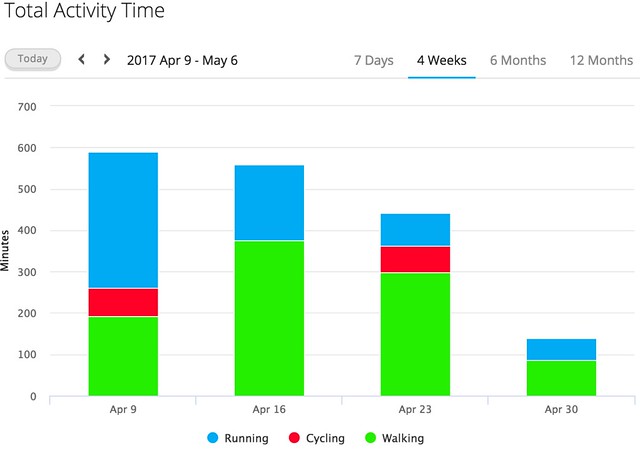
Note, as I switched from AppleWatch to the Fenix the numbers represent around half the month
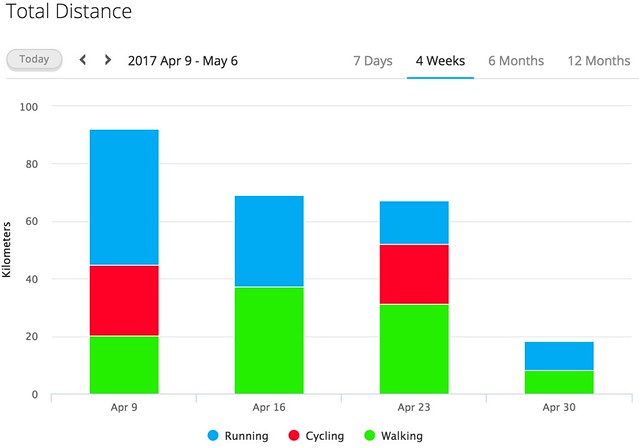
Running: 94.5 km
Cycling: 45.4km
Walking: 93.5km

Activity Time
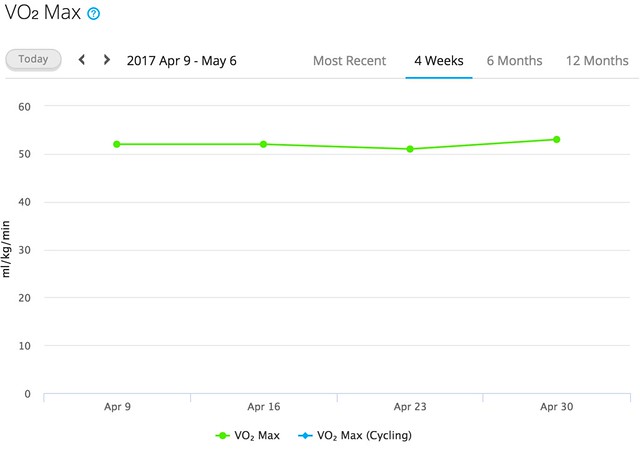
VO2 Max

Progress Pics

Start of the month

End of the month

Summary / Forward Looking

April was an okay month training wise. I did learn a few “hard lessons” with regards to the weather and a weird cold / GI infection put me a bit on my ass the last two weeks of the month.

Overall though I am happy with where things are going, I will start putting weights back in in May and am re-thinking my approach to tempo / speed workouts.

Saturday, April 1st

Body Measurements

Weight: 85.8kg
Body Fat: 13.3%
HRV: 66

Training

Long Run: 19.90km
Time: 1:57:44
Pace: 5:55/km

Run report

First long run, my goal was 20K even but I slightly misjudged distances so I had to tack on a few more blocks in the end and was around 100m short. Oh well. The pace though was pretty close, I had aimed for a 6:00/km pace and came in at a 5:55/km.

Overall this run was easy, I did not really feel strained, there was a bit of a tightness roughly 3/4 through the run in my hip flexors, but this passed quickly after some minor stride adjustment.

I did not carry any water or gels and didn’t really feel like I needed any, my legs did feel a bit tired at the end of the run but that was to be expected, far from “I am about to fall over” though.

Overall the run felt easier than I expected, despite 332m of elevation gain in the run and the fact that I really felt more like sleeping most of the day than actually doing anything, I blame the weather for that one. I kept my HR relatively “low” (for me anyway) at 156bpm average, with a spike at the end to 177 during the final sprint to the finish.

Rest / Fast day tomorrow, though depending on how I feel I may squeeze in 5K or so depending on how I feel.

Other activity

None.

Sunday, April 2nd

Body Measurements

Weight: 85.7kg
Body Fat: 13.2%
HRV: 66

Training

None, fast / recovery day.

Other activity

Walking: 21.79km

Monday, April 3rd

Body Measurements

Weight: 84.9kg
Body Fat: 12.8%
HRV: 62

Training

Run: 10.7km
Time: 59:07
Pace: 5:29

Run report

Beautiful, if a bit windy, afternoon. Annoyingly enough I did forget my chest strap HRM, so no data on the heart rate from Strava, but AppleWatch registered an average heart rate of 160bpm. With the drop in HRM I am actually quite happy, I saw a “trending slower” in Strava, but that also included my tempo run last Wednesday, so we’ll see how that goes this week.

Overall felt strong, could have gone longer and I think I will start stretching these runs beginning next week.

Other activity

None. Besides the pushups / squats / core.

Tuesday, April 4th

Body Measurements

Weight: 86.5kg
Body Fat: 13.7%
HRV: 60

Training

None, HRV dropped for a second day so taking the day off. Had a bit of a crapppy night too.

Interestingly enough I think my scale agrees. It’s highly unlikely that I gained 1.6kg in fat / muscle in 24 hours. More likely something else is a bit out of whack.

We’ll see what happens tomorrow. Today is a relaxation day and we’ll aim for an early bed time and hopefully a more restful night.

Other activity

None. Besides the pushups / squats / core and walking around for errands (13.26km)

Wednesday, April 5th

Body Measurements

Weight: 87.1kg
Body Fat: 14.0%
HRV: 67

Training

Run: 10.6km
Time: 56:23
Pace: 5:18

Run report

Rain was back but by the time I managed to get onto the run it was actually dry and nice.

This should have been a tempo run but did not fully feel like it, so I just took as a “normal run” and found myself surprised to record a 5:18.

On a side note. I am also a bit puzzled over the weight gain, though I have a suspicion that it is the higher carb amount I ate the last two days. We’ll see.

Other activity

None. Besides the pushups / squats / core.

Thursday, April 6th

Body Measurements

Weight: 87.2kg
Body Fat: 14.0%
HRV: 67

Training

Body Weight training and walk (14.85km total)

Other activity

None. Besides the pushups / squats / core.

Friday, April 7th

Body Measurements

Weight: 85.7kg
Body Fat: 13.2%
HRV: 69

Training

Run: 10.60km
Time: 56:13
Pace: 5:15
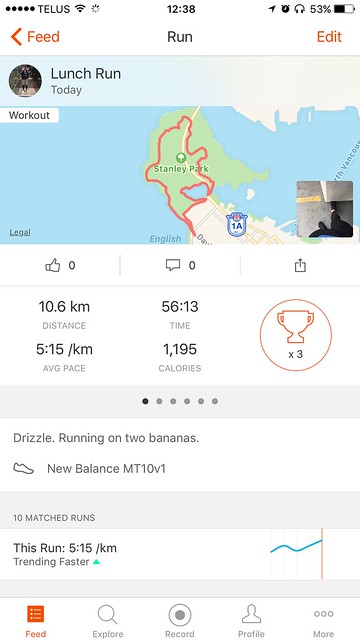
Run report

I keep surprising myself. I didn’t really think I was going fast, in fact in some section I could have sworn I was slow, yet, I still knocked another second off of my pace.

Time to extend the distance on these runs a bit, starting next week.

Other activity

None. Besides the pushups / squats / core.

Saturday, April 8th

Body Measurements

Weight: 84.3kg
Body Fat: 12.5%
HRV: 69

Training

Run: 19.90km
Time: 2:43:46
Pace: 8:13

Run report

That didn’t quite go as expected. I knew it would be raining, but I didn’t count on snow. Above 700m it was basically all snow, including the trails. It got so bad I fell through the snow twice, then lost the trail and turned around.

Further down the trail was puddles, mud and rocks, so let’s just say I didn’t quite go as fast as I would have liked.

On top of that, due to being a smidge underdressed I am sure I gave myself a minor bout of hypothermia.

Ah well, first time and all that. Lesson(s) learned. Up up and away from here.

Other activity

None. Besides the pushups / squats / core.

Sunday, April 9th

Body Measurements

Weight: 84.7kg
Body Fat: 12.7%
HRV: 67

Training

Walk: 14.92 km
Pace: 10:47/km

Other activity

None. Besides the pushups / squats / core.

Monday, April 10th

Body Measurements

Weight: 85.1kg
Body Fat: 12.9%
HRV: 68

Training

Run: 12.47km
Time: 1:04:21
Pace: 5:10
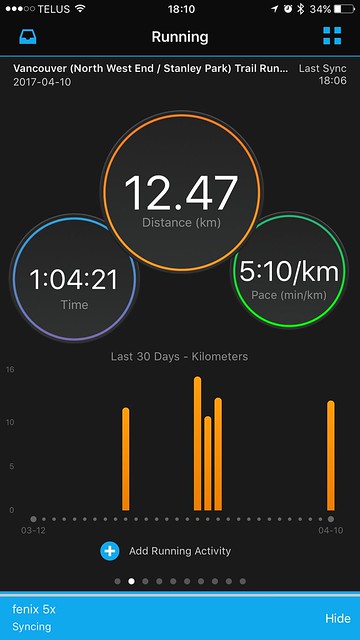
Run report

First run with the Fenix and there was a weird mismatch between what the Fenix recorded and what Strava pulled from it. Using the Fenix data now as it’s lower / seems to be more accurate.

The run didn’t feel hard or easy, I did think I was slower though than the watch registered. We’ll see what happens.

Other activity

None. Besides the pushups / squats / core.

Tuesday, April 11th

Body Measurements

Weight: 85.3kg
Body Fat: 13.2%
HRV: 63

Training

“None”, just some walking and biking:

Had a bad sleep which showed in the drop of the HRV. Also doesn’t help that I stepped into something and pierced my big toe, think a piece of glass. ouch. Got it out though I think, so running tomorrow should be fine.

Other activity

None. Besides the pushups / squats / core.

Wednesday, April 12th

Body Measurements

Weight: 85.0kg
Body Fat: 13.0%
HRV: 69

Sleep

Woke up around 2am, biobreak and the neighbours doing something in their place. No idea, involved some banging though (no, not that kind). Couldn’t really fall asleep again afterwards, brain started to go off on all kinds of tangents for around 45 minutes. Might explain the high stress reading of 4 this morning.

Training

Morning Run

Run: 3.63km
Time: 21:01
Pace: 5:47

Run Report

Meant as a wakeup run, slow, enjoyable. Right big toe still hurting thanks to whatever I stepped on, made the first kilometre a bit awkward as I tried not to put pressure on it. It does seem though that it’s healing and pain is less than it was yesterday, so looks like I got out whatever was in there. No infection either.

Afternoon Run

Run: 10.50km
Time: 57.47
Pace: 5:30

Run Report

Afternoon run, had to pick up my bike but didn’t want to lose the chance to actually get a bit of a workout in. So run with race pack, detoured a bit instead of taking the direct route, also trying new shoes (Hoka OneOne Instinct’s). Was a decent enough run considering I had to had some start / stops because of traffic lights / idiotic car drivers. Hence why I prefer to run on trails and in the mountains.

Other activity

None. Besides the pushups / squats / core.

Thursday, April 13th

Body Measurements

Weight: 86.1kg
Body Fat: 13.5%
HRV: 65

Sleep

Wasn’t really tired and it took me quite a while to fall asleep, woke up around 5:30, then “rolled around” a bit until the lights came on and the alarm went off. I think it shows in the lower HRV, will see how I feel today, bit weak right now also showing in the lesser / reduced pushups this morning.

Training

Walking walking walking, for a total of almost 20K.

Friday, April 14th

Body Measurements

Weight: 85.0kg
Body Fat: 12.8%
HRV: 76

Sleep

Still feeling a bit tired this morning, though much more rested than yesterday. Interestingly enough, I have not seen my HRV that high before. I am almost tempted to think it’s an error.

Training

Morning Run

Run: 5.33km
Time: 25:37
Pace: 4:48/km

Run Report

Meant to “shake the legs lose” in the morning and, well, maybe do some tempo work. Seems to have gone well. Though I have to say this is a pretty flat course I have chosen. Rained hardish too, but that was a bonus. Meant it was all quiet and peaceful.

Training

The usual, pushups, squats and lugging some stuff around as well as a bike ride to Costco and back.

Also ended up meeting some friends, rode the bike there and got a flat on the way back, so another half hour walk. Way more workout today than I had planned.

Saturday, April 15th

Body Measurements

Weight: 84.8kg
Body Fat: 12.8%
HRV: 70

Sleep

Almost 7:30, not too bad. Got woken up by the neighbours when they started banging around at 4:30 or so. Not sure what they did there.

Training

Morning Run

Run: 15.50km
Time: 1:34:31
Pace: 10:39/km

Run Report

Did not feel it today. The constant rain and slippery trails probably didn’t help matters.

Having said that, the new shoes worked fine, though it still feels weird to be so “high up”, the jacket kept the rain out and even the Inreach worked, after I calibrated it correctly. So, it wasn’t so much of a run as it was a power hike.

Training

Normal pushups, squats and core. Also a little stroll with a friend, nothing too exciting.

Sunday, April 16th

Body Measurements

Weight: 85.1kg
Body Fat: 12.9%
HRV: 62

Sleep

Almost 8:30, not too bad.

I had a glass of wine last night and it’s interesting to see that it affected my sleep. Barely any deep sleep, mostly light sleep.

Training

Rest / Fast Day

Monday, April 17th

Body Measurements

Weight: 86.8kg
Body Fat: 13.9%
HRV: 63

Sleep

8 hours, but mostly light sleep. Feeling really weird today in general, almost parched but not thirsty.

My scale also seems to be under the weather.

Training

Run

Distance: 10:02
Time: 1:03:48
Pace: 6:22

Note: For some reason the tracking started late, hence the discrepancy between what shows in Strava and what my actual run was.

Run Report

Treated this as a “recovery run”, with similarly slow results. The good news was though that I stayed close to the 140bpm, so that was good and overall I felt happy being out in the rain.

Tuesday, April 18th

Body Measurements

Weight: 86.6 kg
Body Fat: 13.7 %
HRV: 66

Sleep

8 hours, but mostly light sleep. Feeling really weird today in general, almost parched but not thirsty.

My scale also seems to be under the weather.

Training

Run

Distance: 10:02
Time: 1:03:48
Pace: 6:22

Note: For some reason the tracking started late, hence the discrepancy between what shows in Strava and what my actual run was.

Wednesday, April 19th

Body Measurements

Weight: 86.3 kg
Body Fat: 13.6 %
HRV: 67

Sleep

Training

Run

Thursday, April 20th

Body Measurements

Weight: 87.3 kg
Body Fat: 14.1%
HRV: 67

Sleep

8 hours, but mostly light sleep. Feeling really weird today in general, almost parched but not thirsty.

My scale also seems to be under the weather.

Training

Run

Friday, April 21st

Body Measurements

Weight: 86.4 kg
Body Fat: 13.6 %
HRV: 67

Training

Run

Saturday, April 22nd

Body Measurements

Weight: 85.6 kg
Body Fat: 13.2 %
HRV: 71

Sunday, April 23rd

Body Measurements

Weight: 87.3 kg
Body Fat: 14.1 %
HRV: 77

Monday, April 24th

Body Measurements

Weight: 87.9 kg
Body Fat: 14.4 %
HRV: 72

Training

Run

Tuesday, April 25th

Body Measurements

Weight: n/a kg
Body Fat: n/a %
HRV: 68

Sleep

8 hours, but mostly light sleep. Feeling really weird today in general, almost parched but not thirsty.

My scale also seems to be under the weather.

Training

Wednesday, April 26th

Body Measurements

Weight: 86.8kg
Body Fat: 13.9%
HRV: 69

Sleep

Ugh. Insomnia last night, didn’t fall asleep until 12:30 or so and had a hard time getting going today.

Training

n/a

Thursday, April 27th

Body Measurements

Weight: 86.6kg
Body Fat: 13.8%
HRV: 73

Sleep

Surprisingly good sleep, felt refreshed, cracked the window a bit and it seems to make a difference. Really not sleeping well when it gets too warm in the bedroom.

Training

Run

Walk

Friday, April 28th

Body Measurements

Weight: 86.0kg
Body Fat: 13.4%
HRV: 73

Training

Walk

Went for a 13K walk to “clear the head”. Still feeling a bit funny in the stomach.

Saturday, April 29th

Body Measurements

Weight: 86.3kg
Body Fat: 13.6%
HRV: 65

Sleep

Was okay, bit restless.

Training

A meh day with no training :(

Sunday, April 30th

Body Measurements

Weight: 86.8kg
Body Fat: 13.8%
HRV: 69

Sleep

Decent, open window def. does help.

Training

Walk

Just a short walk and some other puttering around. Still feeling a bit weird.

02 May 14:43

Leaked photos reveal that Fitbit’s upcoming smartwatch looks like a Fitbit

mkalus shared this story from The Verge - All Posts.

Leaked photos of Fitbit’s upcoming smartwatch reveal that the device, which has been plagued by production issues, will look... just like a Fitbit.

Yahoo Finance first published the images of the not-yet-announced watch, along with a photo of a pair of unremarkable Bluetooth headphones. If the images are in fact legitimate, the new watch looks strikingly similar to Fitbit’s $150 Blaze fitness watch, which came out in early 2016. It has a square face, physical buttons, and a wristband that looks just like the flexible elastomer wristband that ships with the Blaze.

The smartwatch is also supposed to have a software interface that matches the UI on the Blaze, although Fitbit has run into its fair share of software troubles along with its hardware problems, as previously reported by The Verge.

It’s not altogether surprising that Fitbit’s upcoming smartwatch would have an uncannily similar aesthetic to an earlier product, given that Fitbit is known for a more utilitarian design across all of its trackers, with occasional (and sometimes awkward) forays into fashion.

<img src="https://cdn3.vox-cdn.com/uploads/chorus_asset/file/8444213/FitbitHeadPhones.jpeg" alt=" "> Image: Yahoo Finance

However, sources tell The Verge that this will be the first Fitbit designed entirely by Fitbit’s own in-house industrial design team. Previously, the company had worked with an outside firm on its fitness trackers, but the two parted ways last year. Clearly, Fitbit’s internal team felt the Blaze’s design was something worth iterating on.

The biggest question, of course, is whether Fitbit’s upcoming watch (codenamed “Project Higgs”) will be able to compete with Apple Watch. Love it or hate it, Apple Watch is undeniably Apple in its design and the Series 2 model is a solid fitness tracker. Fitbit has maintained its status as the market leader for fitness trackers in the US over the past few years, but if Apple were to continue its pace of selling millions of watches per quarter, as estimated by some analysts, then Fitbit will have even bigger problems on its hands (or, wrists).

The Apple Watch Series 2 is also waterproof, due to a mechanism in the watch that shoots water out of it, and supports third-party apps. Some of Fitbit’s struggles to build its new watch have been around waterproofing, sources say; and as The Verge reported exclusively, support for third-party apps is likely to be limited at the time that Fitbit’s watch ships — which is arguably one of the things that sets a “smart fitness watch” apart from a “smartwatch.” On the upside, Fitbit has managed to squeeze multiple days of battery life out of all of its trackers, something that can’t be said about Apple Watch.

A spokesperson for Fitbit did not immediately respond to a request for comment.

01 May 21:24

Ozone Therapy Debunked – Part 1

by powerm1985
mkalus shared this story from powerm1985's YouTube Videos.

From: powerm1985
Duration: 14:04

Even before its structure was known, ozone was, and still is to this day, used as a water and air steriliser, as well as a surface disinfectant. It has also been used in the past as a way of disinfecting wounds, but as technology has advanced, coupled with the fact that ozone is quite toxic, it fell out of favour. Now, like so many redundant medical practices, it has been adopted by the alternative medicine crowd where its proponents are promoting it as a panacea that has the ability to cure, among other things, cancer, AIDS, and multiple sclerosis.

Support Myles through Patreon
http://patreon.com/powerm1985

Big thank you to Jeff for his help
https://www.youtube.com/user/RottingLepha

Ozone Therapy Debunked – Part 1
https://mylespower.co.uk/2017/04/25/ozone-therapy-debunked-part-1/

Intro Music by Michael 'Skitch' Schiciano
bio: http://bio.skitchmusic.com 
soundcloud: http://www.soundcloud.com/skitchstudio

Subscribe for SCIENCE!
Website: http://www.mylespower.co.uk
Twitter: http://www.twitter.com/#!/powerm1985
Facebook: https://www.facebook.com/powerm1985

01 May 21:17

May 2017 Nexus and Pixel factory images and OTAs now available to download

by Igor Bonifacic
Nexus 5X

Like clockwork, Google has released the latest Android monthly security patch.

As usual, accompanying the update is a new security bulletin over at the Android Open Source Project (AOSP) that details the vulnerabilities Google worked to address with this latest patch.

According to the company, the most severe of the patched vulnerabilities was a bug that would have allowed malicious hackers to gain remote access to an Android device. Google says it has had no reports of anyone exploiting that vulnerability before it was patched.

The update is available in both factory image and OTA forms. Instructions on how to flash your Nexus or Pixel device can be found on Google’s developer website.

Alternatively, MobileSyrup has a more in-depth guide on how to flash factory images here.

Source: Google

The post May 2017 Nexus and Pixel factory images and OTAs now available to download appeared first on MobileSyrup.

01 May 21:17

I know. I’m using Paper for exactly those reasons, personally.

by Stowe Boyd

I know. I’m using Paper for exactly those reasons, personally.

01 May 21:17

Did you read my original post?

by Stowe Boyd

Did you read my original post? My discussion of commons-based political order is not about businesses, at all. It’s about political decision making and power, not ownership, aside in the very general sense that the state ‘owns’ property on behalf of its citizens.

My discussion of mutualism is about ownership and management of business, but it’s a voluntary option for those that decide to, for example, start or join a credit union. I am not saying that all banks should be appropriated and turned into credit unions.

At the same time, what I am advocating does run counter to unfettered capitalist globalism. But I am not a socialist, per se: I am a commonsist, which is something distinct. Perhaps you could say it’s a form of socialism, but it’s not communism.

01 May 21:17

Making tabs close faster in multi-process Firefox

by Mike

TL;DR: In bug 1336763, I have landed a series of patches that should hopefully make tab closing faster for the majority of cases for users that are using multi-process Firefox.

The rest of this blog post tries to explain why.

The beforeunload event handler

Perhaps you’ve seen this dialog before:

The beforeunload dialog in Firefox

Are you sure?

This dialog shows up when a website that you’ve interacted with (or one of its subframes) has set an event handler for the beforeunload event, and you attempt to close the tab or browse away from the website.

Here’s the documentation for how beforeunload works, but long story short, you can do a thing in the event handler that will cause the browser UI to show that dialog, which means giving the user the opportunity to cancel their request to close or navigate away from the website1.

In any event2, if a page is going to be unloaded, and that page (or one of its subframes) has set one or more beforeunload event handlers, then it is necessary to run those event handlers to see if we’re going to show the dialog, or go ahead and unload the page straight away.

How multi-process Firefox used to handle beforeunload

When closing a tab in multi-process Firefox, what we’ve been doing is sending a message to the content process for that tab to check for (and run any) beforeunload event handlers. The parent sends that message, and then just kinda waits for the content process to respond with whether or not the close should occur. If the content process doesn’t respond within 5 seconds (I know), then we consider it a wash, and just close the tab.

The content process is sometimes doing stuff on the main thread, and sometimes it’s just waiting for messages from the parent. In the latter case, tab closes happen pretty smoothly – the message comes in, beforeunload events are fired (and hopefully those don’t take too long, but you never know), and then hopefully a result goes up to the parent, and it can move on.

That’s the best case scenario – but lots of things can prevent the best case scenario; for one thing, the main thread might be busy doing other stuff when the message is sent from the parent. Perhaps it’s doing a garbage collection, or a cycle collection, or it’s blocked on some busy JavaScript that some silly advertisement company is running in the background of one of your tabs. In that case, the message from the parent won’t be processed until the main thread is ready.

Once the message is received, we’re still not out of the woods – the beforeunload event handlers can run any kind of JavaScript inside them, more or less. For example, one anti-pattern I’ve seen in the wild is to use the beforeunload event as an opportunity to send a sync XMLHttpRequest in order to get some data to a server before the page goes away3. So the script on the page has an opportunity to delay you, even if it’s not going to cause the dialog to appear.

This problem seems to plague all browsers. beforeunload is a real pain, and our current implementation can cause slow tab closing even if the tab doesn’t have beforeunload event handlers set4. The patches in bug 1336763 offer what I think is a decent, simple solution for that common case in Firefox.

Don’t ask, just remember

In bug 1336763, I’ve made it so that for any given tab running in a content process, if a beforeunload event is ever added in that tab (or in any of its subframes), the content process tells the parent process so it can mark that tab as having listeners we need to fire. If the beforeunload events are removed, we unmark the tab. If no beforeunload events are ever added, there’s no mark at all.

The parent process remembers these markings, so that if the user decides to close the tab, the parent can know immediately whether or not it needs to message to tell the content process to run beforeunload event handlers. In the cases where no beforeunload event handlers have been set, we can close immediately without asking for permission from the content process at all.

Details, details

Using some Gecko terminology here, we start by storing a count on something called the TabChild. It might simplify things a bit if you try to imagine the TabChild as the representative of everything in a particular browser tab, and that underneath that TabChild are a bunch of nodes, forming a tree-like structure.

Let’s call these nodes “inner windows”.

The inner windows under the TabChild contain the documents that are loaded in a tab. For simple web pages, that might just be a single document. In that case, we have a TabChild with just a single inner window node under it.

More complicated pages might contain iframes (which themselves contain iframes, etc). In those cases, we have a TabChild with a single inner window node under it, and that node has any number of inner window children (and those children have any number of inner window children, etc)5.

When any of those subframes have a beforeunload event listener added to them via script, the inner window node tells the TabChild to increment its internal count. If a beforeunload event listener is removed via script, the TabChild is told to decrement its internal count.

If the TabChild count ever goes above 0, then we need to tell the parent “Hey, you have at least one beforeunload event listener here”. If that count continues to go up, the TabChild doesn’t need to tell the parent anything – it just needs to record the increase. If the count ever drops back to 0, then the TabChild needs to tell the parent again, “All beforeunload event listeners are clear”.

Pretty straight-forward so far, but there are a few other cases we also have to consider.

Other cases

There are a couple of ways for a set of beforeunload event handlers to go away. We’ve already mentioned one – script on the page might remove them via removeEventListener.

One way is if the inner window gets navigated away from. If we’re on a page, and that page set a beforeunload event handler, and the user clicks on a link, the user might end up navigating away (assuming the dialog wasn’t shown and they didn’t cancel), which essentially replaces the inner window with one for a different page. In that case, script didn’t remove the beforeunload event handlers – the page went away, and so the beforeunload event handlers on the page we’ve unloaded are no longer relevant.

Another way is if an <iframe> which has set a beforeunload event handler is removed from the DOM. Instead of replacing the inner window, we’re snipping the inner window out of the tree structure entirely.

In both of these cases, if there are beforeunload event handlers in the subframe, it’s necessary to tell the TabChild so that the right number can be decremented from the TabChild count.

So what this means is that we need the inner windows to keep a track of how many beforeunload event handlers have been set as well. That way, when they start to tear themselves down, they can tell the TabChild, “Hey, I’m going away now – decrement X number of beforeunload event handlers”.

It might seem redundant to have these two counts – counts in the inner windows, and a total count in the TabChild. It would seem like one can be easily inferred from the other; just sum the beforeunload counts for the inner windows, and you should have your TabChild count.

Having the TabChild keep a count is an optimization that prevents us from having to walk the inner window tree to collect a sum every time the count changes. It’s a classic space / time tradeoff, and I think it’s worth the extra integer member on the TabChild.

Comparison to other browsers

Here’s one way to compare the behaviour across different browsers:

  1. In a browser window with more than one tab open, open the developer tools, and make your way to the JavaScript console.
  2. Drop this tasty little snippet in and press enter:
    var then = Date.now(); while (Date.now() - then < 15000) {}

This is going to hang the main thread in that tab for 15 seconds, but is otherwise inert.

Now try to close the tab. In Firefox, the tab closes right way. In Safari and Chrome (the two other browsers I have on this machine), the tab hangs out for a while. In Chrome, it appears to wait the full 15 seconds. In Safari, it seems to hit some kind of shorter timeout6.

Wrapping up

This was a neat set of patches to work on, precisely because it had me tour the depths of Gecko (dealing with things like inner / outer windows, the stuff that manages events, etc), which end up resulting in a simple property that the front-end can ultimately access to optimize closing tabs. So it nicely spanned the gap between low-level Gecko and higher-level Firefox, all for an event that was added back in 2004, for better or worse.

If all goes well, this change should ship in Firefox 55, and apply to multi-process tabs.


  1. It’s not always necessary for the beforeunload event handler to show the dialog. The event handler needs to set the returnValue property on the event to a string in order for the dialog to show, but plenty of other stuff can happen in that event handler. 

  2. Ooooh pun intended 

  3. A better way would be to use navigator.sendBeacon, which allows the browser to send one last XHR in the background for a page even after it’s gone away. 

  4. since we have to check to see if any of those event handlers exist. 

  5. For my fellow Gecko Hackers – yes, this is not quite right. I’m missing other key structures in my description (specifically, the outer window). Forgive me – this is a very low-resolution mental model to make this post easier to write. 🙂  

  6. Note that it appears that the script running in the console is treated differently from the script running on the page. If you set up a page with that script, I notice that the tabs close immediately on both Chrome and Safari. I might have goofed in my experiment though – it is rather late at night.  

01 May 21:16

Verizon Is Now Flat-Out Lying About Efforts To Kill Net Neutrality

by Chris Morran
mkalus shared this story from Consumerist.

In a video that would be laughable if it weren’t so terrifying, a senior executive at Verizon repeatedly lies about the FCC’s recently launched efforts to gut its own “net neutrality” rules, about his company’s support of net neutrality, and what these rules actually do.

In fact, in the below video, Verizon General Counsel Craig Silliman tells two huge whoppers in just a matter a seconds.

• Lie #1: “The FCC is not talking about killing the net neutrality rules”
No, Mr. Silliman, that’s exactly what the FCC is talking about. Look at these bullet points from FCC Chairman Pai’s own fact sheet about his proposal:

It might be semi-coherent policy-ese to most people, but that very first bullet point — “Propose to reinstate the information service classification of broadband Internet access service” — is indeed the death knell for net neutrality.

Why? Because it was that “information service classification” of broadband that resulted in the first death of net neutrality.

In 2010, the FCC issued an Open Internet Order, barring ISPs from blocking, throttling, or prioritizing access to online content or services. But Verizon — yes, Verizon — sued to stop these rules, arguing that the FCC didn’t have the authority to enforce them because of that outdated “information service” label. In Jan. 2014, the court agreed.

Note that the court in that ruling didn’t say the rules themselves were bad or unconstitutional, but that the FCC couldn’t enforce them because broadband was not classified as a Title II common carrier like landline telephone service.

So reinstating that information service classification would make it impossible for the FCC to have any sort of actual, enforceable neutrality rules. Rules that can’t be enforced are worthless, meaning neutrality would be dead.

Even if the FCC were to take another stab at net neutrality without Title II — despite the fact that it failed in court —
looking further into the actual language of the proposed rulemaking, Pai makes it clear that he has no real intention of maintaining the rules against blocking and throttling.

The proposal states that “we oppose blocking lawful material,” but then seeks public comment on whether any sort of anti-blocking rule is needed.

“For example, prior to 2015, many large Internet service providers voluntarily abided by the 2010 no-blocking rule in the absence of a regulatory obligation to do so,” notes the proposal. “Do we have reason to think providers would behave differently today if the Commission were to eliminate the no-blocking rule?”

Shouldn’t the question be: Why not have a no-blocking rule? Every day, hundreds of millions of people go un-stabbed, but there are still rules against stabbing.

The proposal also raises the question (meaning Pai already knows the answer he wants to hear) of whether or not the FCC’s anti-throttling rules are needed, claiming they may be duplicative of existing antitrust and anti-collusion laws: “Could the continued existence of this rule negatively impact future innovative, pro-competitive business deals that would not by themselves run afoul of merger conditions or established antitrust law?”

And all of these questions come with the conditional issue of how the FCC could actually create and enforce one of these rules without the very legal authority that the court has said it needs to do so.

• Lie #2: “Not we nor any other ISP are asking them to kill the Open Internet rules.”
Again, all we need to do to call out this particular lie is point out that Verizon spent four years in court challenging the very rules that it now claims to love, but doesn’t want to be held to.

Imagine the person you’re dating says “I believe and support the idea that I shouldn’t sleep with other people, but I’m going to spend the better part of a decade arguing in every possible forum that sleeping with other people shouldn’t be against the rules, which I swear I won’t break if they don’t exist. Also did you see the hot new neighbor?”

The Fictional Tale Of Verizontown

The real centerpiece of Verizon’s propaganda video is a longwinded straw man analogy from Silliman.

“Imagine in your town someone says ‘I’m really concerned that homeowners may start prohibiting people from walking up their front walks,’ so mailmen can’t deliver mail, Girl Scouts can’t sell cookies; it’ll be chaos,” he begins. “So the mayor says, ‘I’m gonna pass a rule that no one can prohibit people from walking up their front walk, but to pass this rule I need… all homeowners to give me complete authority over your property.’ Well, how are you gonna feel about that?”

There’s one huge problem underlying this risible tale: It’s all built on a fictional foundation.

This story involves a government authority trying to tell homeowners what to do with their property. That is decidedly not the case with net neutrality. The Open Internet Order does not tell internet users which sites or services they can and can’t use; it tells Verizon and other ISPs that they can’t have any influence over what you do online. Net neutrality does nothing to dictate how you, the consumer, uses the internet; it only seeks to prevent ISPs from dictating that for you.

What Silliman is attempting to do through this Bizarro World children’s tale is to paint Verizon as the defender of the homeowner from the overreaching mayor. The government wants to take over your whole house! No Girl Scout cookies! Don’t worry, Uncle Verizon is here to give you back your freedom!

A better strained analogy would have been the mayor declaring that the contractor who paves your driveway or lays the stones for your walkway can’t tell you which pizza place to order delivery. Verizon is no savior.

If Verizon supported the net neutrality rules, they would do so in writing; and we don’t mean in a non-binding blog post. Put it into actual policy. Tell your customers you won’t start throttling access to competing services, that you won’t prioritize access for companies that pay you.

We’ve asked Verizon for comment on this video, but the company has yet to respond.

Meanwhile, this morning the Court of Appeals for the D.C. Circuit, which had previously shot down telecom industry challenges to the 2015 neutrality rules, once again denied ISP’s legal efforts to gut the law. This time, the full appeals court — as opposed to the usual three-judge panel — denied [PDF] a request for a re-hearing.


01 May 21:16

SOCIALIZATION THEORY T. Parsons (2nd Part)

by admin

11

Parsons identifies three main stages of the socialization process in relation to American society (each of which is subdivided into two sub): the first takes place in the family, the second is concentrated in primary and secondary schools, and the third in colleges, in the universities and vocational schools. After passing the first major phase of socialization, the child acquires the necessary concept of the main structure of the nuclear family as a social system, which is the prototype of the social system. Theorist suggests that the educational system in primary and secondary schools, primary socialization process is repeated at the next higher level of generalization digestible culture and organization of the social structure. Thus, high school is primarily concerned with the differentiation of the distinction between instrumental types of roles at this level of the organization. In this regard, Parsons stresses: “It is significant that here there is, so to speak, a complete” youth culture “main line differentiations goes between the representatives of the age group that is more oriented to the achievement of the school and the formal” training and those who are focused mainly on the structure of the peer group, in the “leadership”, “popular” and so forth “(ibid: 61)… According to Parsons, the system of formal education is central to the internalization systems of higher order of social organization than at the family level. This stage is influenced by socialization rather “impersonal” and universal forms of control than the “private” and indefinite forms of family interaction. With regard to higher education, Parsons notes that there is “all students and the high and low achievers, though they differ greatly in their academic work usually stick together on the basis of” youth culture while in the public school and having a common extracurricular and informal loyalty This can help build a basis of common solidarity that goes beyond the professional differences that have become apparent “(ibid: 63).

Most significantly in the outlined concept that: 1) the process of socialization is associated with a continuous series of reference groups, which suggests that the structural analysis “becomes an important part of the analysis of one of the most” dynamic “social processes development of persons” (ibid: 65 2)the type dichotomization is both an important mechanism for placing people in the status structure of society, while at the same time and part of the process of formation of various personality types, which are differently adapted to the different types of roles, which implies the closest relationship of the individual and social structures; 3) overall current structural principle is “the selection to the bottom” “This means writes Parsons that process dichotomization age group distinguishes one group, whose members are more likely to want to remain at this level of the social hierarchy, on the other hand, the members of which would to go to the next, higher level. the group, which has been “enhanced”, and then again becomes a subject of the same selection pressure and type again divided along the same lines. It can be seen that the selection process in general corresponds to the personal needs of the “pyramid” built a system in which a relatively large number of people “must be” at the lower levels of the organization, and fewer and fewer as they move to higher levels. The selection process, including the element of “mobility” and the element of class, so that is most closely associated with the preservation of society stratification models “(ibid).

In accordance with this theoretical scheme, Parsons treats the peer group (peer group) an informal group, membership in which is determined by common social and status characteristics (gender, age, ethnicity, occupation, etc.). In research practice the concept of peer group; typically apply to the age groups of children and youth, particularly with regard to teenage groups, where the status of equality becomes essential for each member of the group.

Even if Parsons and attaches importance to personal choice behavior strategies, it is based on a typical unity of social systems, they may be formed at any level. In addition, across the country, and family friendly company-wide or apply the same functional relationships. The Group uses a variety of ways to keep themselves and rebuild it coming newcomers in their own way. Parsons called such methods of socialization mechanisms. They include all the tools and the processes through which passed the one side and absorbed other cultural patterns. This is the language, values, beliefs, symbols. Having learned their new team members and changing the structure of demand. They get used to the new social roles, acquire a taste for their execution, they are now not just a subject to group norms, but they want it. This is how the system interacts with the personal social system (Parsons, 1964: 205-208).

Therefore, the concept of Parsons Socialization is a process that ensures the preservation and functioning of social systems at all levels of social life. Although this process is related to the person, his origins and consequences mainly due to the structure of society and its institutions.

Parsons Theory of socialization is his most important contribution to the development of theories of youth Kovalev, 1996; Lukow, 2007, 2012).

The post SOCIALIZATION THEORY T. Parsons (2nd Part) appeared first on BookRiff.

01 May 21:16

Why Is Subaru Telling Me To Keep People Out Of The Passenger Seat For The Next Year?

by Ashlee Kieler
mkalus shared this story from Consumerist.

For the better part of two years, carmakers have been notifying owners of vehicle included in the massive shrapnel-shooting Takata airbags recall. Given the sheer volume of and airbags involved, it’s understandable that not all repairs can be done right away, but some drivers are finding out that they may not only have to wait a year for the fix, they shouldn’t have anyone else in the front seat with them during that time.

Reader Henry tells Consumerist he recently received a such a recall notice [PDF] concerning his 2009 Subaru Forrester.

The notice alerted Henry that the passenger side frontal airbag could be defective, but that a new part for the vehicle would not be available until March 2018. Oh and by the way, he was instructed not to drive with a passenger in the front seat.

According to the recall notice [PDF] posted with National Highway Traffic Safety Administration, the vehicles are equipped with certain airbag inflators assembled by Takata. In the event of a crash necessitating the deployment of the safety devices, the inflators may rupture with enough force to spew pieces of metal at occupants.

For those unfamiliar, Takata’s airbag inflators use an ammonium nitrate propellant. If the device is exposed to humidity and related temperature swings over a period of time the chemical can combust violently, rupturing the inflator when the airbag deploys in the event of a crash.

While the recall notice Henry received isn’t out of the ordinary for carmakers affected by the Takata recall, he was concerned by the year wait for parts and the directive not to allow someone to occupy the passenger seat for that period of time.

“This is not acceptable,” Henry tells Consumerist.

Why The Long Wait?

Henry isn’t alone in waiting for his vehicle to be repaired; millions of consumers have already received notice that their cars are affected by the defect, but unable to be fixed at the moment.

This is because of the large nature of the recall and the tens of millions of new inflators needed. To address the massive campaign, NHTSA issued a consent order in November 2015 that outlined the handling of the recall, breaking repairs into prioritization groups [PDF].

The groups were created [PDF] based on risk factors such as age, geography and climate, inflator position — whether it was in the driver’s side or passenger side — and precession of two recalled inflators.

“Regardless of these circumstances, every defective air bag inflator must be — and will be — replaced,” NHTSA says on its Takata recall website. “We ask for your understanding while the air bags that pose a higher risk to their vehicle’s drivers and occupants are replaced first.”

That first group, deemed to have a much greater risk of rupturing, includes vehicles with older inflators that have experienced prolonged exposure to hot and humid conditions. This did not include Henry’s 2009 Forrester.

Instead, his vehicle is included in the third priority group, a rep for NHTSA tells Consumerist. As part of the agency’s coordinated remedy action, manufacturers of vehicles in priority group 3 are the last slated for repairs.

NHTSA has amended its coordinated remedy program several times as more vehicles have been identified as being affected by the Takata defect. While the earliest version of the order required vehicles in the third group to be fixed by Dec. 31, 2017, later versions moved the completion dates to as far out as 2019.

“NHTSA is prioritizing Takata air bag repairs to ensure that vehicles with air bags that pose a higher threat to safety are fixed first while simultaneously working to ensure that parts are available to repair every affected vehicle as quickly as possible,” a rep for the agency tells Consumerist.

Despite the slow-moving repairs, NHTSA has urged all manufacturers affected by the recall to make customer safety their number one priority.

Don’t Sit There

That’s perhaps why Subaru directed Henry and others not to haul around passengers behind the defective Takata airbag.

The notice Henry received not only describes the Takata issue in his Forrester, but directed him and other owners not to allow others to sit behind the defective airbag.

“Until this repair is performed, do not allow passengers to ride in the front passenger seat,” the notice states in bold lettering.

A rep for Subaru tells Consumerist this isn’t an unusual directive, as other carmakers have issued similar warnings.

“This is a typical situation for all makers with Takata bags,” the rep said. “The driver bag in a Subaru is not Takata where other makers have both driver and passenger.”

For instance, in 2014, Toyota urged owners of some vehicles to keep passengers out of the front seat until repairs could be made.

That recall [PDF] involved vehicles in high humidity areas, which had been deemed the most susceptible to dangerous ruptures.

Toyota said at the time it would disable affected airbags and advised customers not to use the front passenger seat until a replacement inflator is installed. NHTSA has since advised against disabling the airbag.

“It is far more likely that, if you are involved in a crash, your airbag will perform properly and protect you than it will rupture and cause harm,” the agency says on its Takata website. “An airbag that is purposely disabled has a 100% chance of failing to provide any protection in a crash.”

As for Subaru, the company is erring on the side of caution with its warning, adding that it’s not a “perfect situation,” but “at least with Subaru we can say it’s safe to drive the vehicle until the repair.”

Few Alternatives

Except you’ll be driving around alone, or like a chauffeur with your passengers in the backseat. Of course, that’s not always a viable option, you know, if you have a family of five or planned a road trip with a group of your friends.

If you can’t avoid driving around with a car full of people, you essentially have two options: continue driving or get a rental/loaner.

NHTSA notes on its Takata recall FAQ page that the vast majority of Takata air bags will perform as expected. This suggests that you could take your chances driving around in the vehicle.

But if you “don’t feel uncomfortable continuing to drive your vehicle before the recall repair has been performed on your vehicle, you should contact your dealer and ask for a loaner until an interim or a final repair is completed,” NHTSA suggests.

However, a rep for the agency tells Consumerist that it is completely up to the carmaker’s discretion whether or not to provide a loaner vehicle to owners affected by the recall.

In fact, dealers and manufacturers are not required to provide you a loaner car, but it can never hurt to ask.

According to Subaru’s notice to Henry, owners who can’t avoid driving others around in the passenger seat should reach out to the carmaker for alternative options. This could include a loaner vehicle.

A rep for Subaru tells Consumerist that the carmaker has “limited loaner vehicles for special situations.” The company did not provide specifics on what a “special situation” constitutes.

What You Can Do

As of March 31, NHTSA says that 14.35 million Takata airbags have been replaced under the recall campaign. Of those, 7.5 million were located on the driver’s side, while 6.85 million were passenger-side airbags.

As for Subaru, NHTSA says 27.58% of recalled airbags have been fixed, that’s a total of 309,862 passenger-side airbags.

To find out if a vehicle is affected by the recall owners are urged to enter their individual VIN on the National Highway Traffic Safety Administration’s Safercar.gov/vin database.

Was this helpful? We’re a non-profit! You can get more stories like this in our twice weekly ad-free newsletter! Click here to sign up.


01 May 19:29

317 West Pender Street

by ChangingCity

In this 1974 image the Victory Block (as it’s now named) had space to rent, and a fire escape on the façade. To the west was the Pender Ballroom, and to the east the Roberts Block. When it was built in 1908 (the same year as the Roberts Block) it was called the Riggs Selman Building, named for its investor developers, Samuel Spencer Selman and Dr. Herbert Wilkinson Riggs. If he read it, Mr. Selman was no doubt unimpressed by the news report that “Dr. H. W. Riggs and Mr. S. Salmon have taken out a permit for a four-storey brick block to be erected on Pender street, between Homer and Hamilton street, at cost of $40,000. The building will have a frontage of 50 feet.”

Oddly, for such a strikingly designed building, there’s no reference to an architect. There is another building completed that year which has some architectural details somewhat similar to this block, albeit rather less exuberant; the Shaldon Hotel on East Hastings was designed by H B Watson.

Dr Riggs was a physician and surgeon, born in Wicklow in Ontario in 1872. He trained in Winnipeg and Edinburgh, and arrived in BC in 1899. In 1901 he was still single, but he soon married and had two daughters, lived on West Georgia and was a member of the Terminal City  and University Clubs. As with many of the city’s successful professionals Dr Riggs also took a keen interest in property development. As well as this building, he had interests in the Dominion Trust Company (in 1907) and the Federal Trust Company, and was a director in both companies. He was a Freemason, and also governor of the Pacific-Northwest District of the Kiwanis from 1918 to 1920. He was president of the Vancouver Medical Association and in 1930 was appointed by the Provincial Secretary to the Board of Vancouver General Hospital.

Samuel Selman was a realtor in 1908 (representing the Manitoba Land Co), and born in Ontario in 1862. He married Clara Barr in Ontario in 1883, and by 1901 they had moved to Victoria, and had several children, Ella, (or Elba as she was shown in Victoria), May, Hubert, Gordon, Mary, (Marie on her wedding certificate), and Roy. Clara’s mother, Mary Barr also lived with them. Tragically, Ella accidentally died of drowning in English Bay in 1908; at the time she was crippled, on crutches, and slipped in the water. Samuel switched employment a number of times. In 1901 he was shown in the census as a lumberman, although he doesn’t appear in the street directory in Victoria until 1903 when he was listed as a grocer. In 1911 he was President of the Canadian Pipe Co, a position he first held in 1909. He died in 1947,

Image source: City of Vancouver Archives CVA 778-265


01 May 19:29

Apple could reveal often-rumoured Siri speaker at WWDC in June

by Patrick O'Rourke
Siri

The voice-activated assistant market continues to heat up, with Amazon Echo and Google Home leading the charge, despite the fact neither device has officially made its way to Canada yet.

However, new rumours indicate that Apple could be preparing to unveil its own Siri Speaker at WWDC this June. Reliable Apple analyst Ming-Chi Kuo made this prediction via 9to5Mac, stating that the still unannounced device will be a high-end speaker that features built-in Siri functionality.

The superior audio quality aspect of the device, which would give it a clear advantage over its competitors, is expected to be its main selling point. Kuo says that the device will go on sale before the end of the year, though it’s possible it may not be announced at WWDC, with Kuo stating that there’s a 50 percent chance this could occur. Given WWDC is a developer focused conference, it would make sense for the tech giant to reveal a new product category at the event, giving developers adequate time to begin experimenting with the product before its official commercial release.

This isn’t the first time rumours Apple is working on a dedicated voice-activated assistant have appeared, especially since Apple opened Siri integration up to third-party developers last year. It’s also worth noting that the Cupertino, California-based company recently made Siri available to macOS users, in addition to iOS users.

If a dedicated Siri device does get announced at WWDC, it will be interesting to see if Apple opts for a simultaneous U.S. and Canada launch like it has with most of its products for the past few years. It’s also unclear if Apple plans to use this still unannounced device as the centre of its Home IoT device platform, similar to the strategy Amazon has taken with its Echo voice-activated assistant.

Source: 9to5Mac

The post Apple could reveal often-rumoured Siri speaker at WWDC in June appeared first on MobileSyrup.

01 May 19:29

Hijacking Bitcoin: Routing Attacks on Cryptocurrencies

by Maria Apostolaki and Aviv Zohar and Laurent Vanbever

At a high-level, Bitcoin is a randomly-established peer-to-peer network composed of thousands of nodes and tens of thousands of connections which rely on flooding to propagate transactions. As an attacker, being able to prevent the spread of information in such a network seems unrealistic, if not impossible.

Yet, this apparently sensible observation does not take into account that the Internet routing infrastructure (i.e., the set of protocols that govern how Internet traffic flows) is notoriously insecure and can easily be manipulated by attackers to intercept Bitcoin traffic. It also does not consider that large Internet Service Providers (ISPs), such as the ones sitting in the core of the Internet, might be naturally crossed by a large fraction of Bitcoin traffic already. Since Bitcoin messages are exchanged in clear text and without integrity checks, any (malicious) third-party on the forwarding path can eavesdrop, drop, modify, inject, or delay Bitcoin messages. The question is then: Is Bitcoin vulnerable to such routing attacks?

In our recent paper Hijacking Bitcoin: Routing Attacks on Cryptocurrencies to appear at the IEEE Symposium on Security and Privacy, we shed light on these aspects by studying the security of Bitcoin from an Internet routing perspective and quantify the potential disruptive effects of network attackers. Among others, we show that:

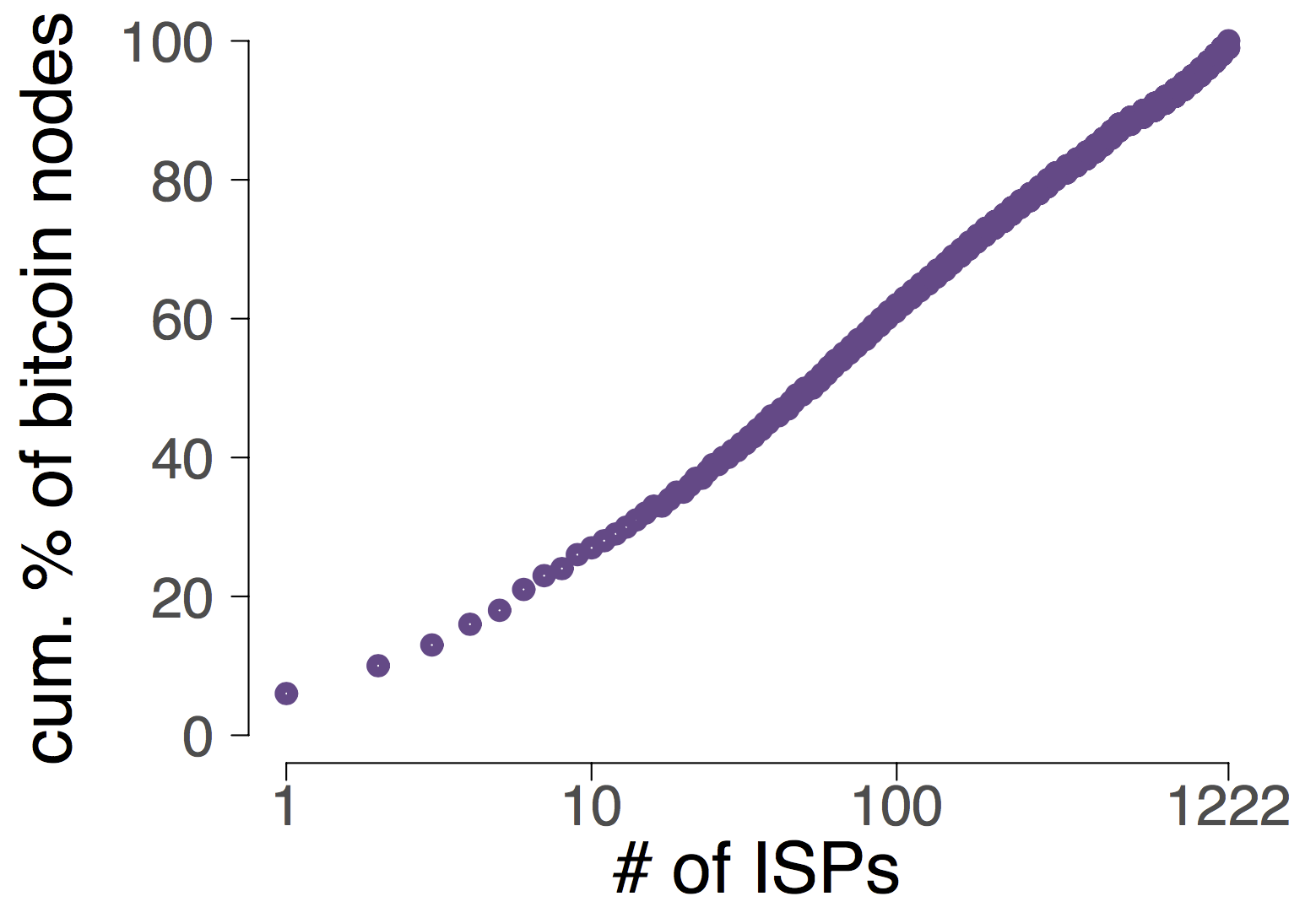
  • Bitcoin is surprisingly centralized from an Internet routing perspective: 20% of the Bitcoin nodes are hosted in less than 100 IP prefixes. To put this in perspective, there are close to 600,000 IP prefixes advertised in the Internet today. At the same time, few well-established ISPs (e.g. Hurricane Electric) naturally see a large fraction of the Bitcoin traffic. Together, these two characteristics make large-scale routing attacks surprisingly practical.
Bitcoin is centralized from an Internet routing viewpoint

Only 13 ASes host 30% of the entire network, while 50 ASes host 50% of the Bitcoin network.

  • Because of its centralization, partitioning the Bitcoin network and isolate 50% of its mining power only requires a small routing attack, one which is orders of magnitude smaller than the attacks routinely seen in the Internet today. Any malicious ISP with access to the Internet routing infrastructure can perform this attack which starts to be effective after only few minutes (according to our own measurements on the live network).
  • Any ISP transiting Bitcoin traffic can delay the propagation of mined blocks (for up to 20 minutes), in a stealth way, even if she sees one direction of the traffic.
  • Bitcoin traffic is impacted by routing attacks today. We found many examples of actual routing attacks that ended up diverting Bitcoin traffic.
  • While multi-homing and end-to-end encryption (BIP 151) reduce the risks of network attacks, they do not prevent them. Our results show that even heavily multi-homed mining pools are vulnerable to routing attacks. Further, end-to-end encryption do not prevent an attacker from dropping Bitcoin connections.

In this post, we take a closer look at these issues. We start by describing the two possible network attacks which we consider, namely partitioning and delay attacks, along with their potential impact on Bitcoin. We then discuss some short and long-term countermeasures that would increase Bitcoin's robustness against network attackers. More details on our work can be found on our website.

Partitioning attacks

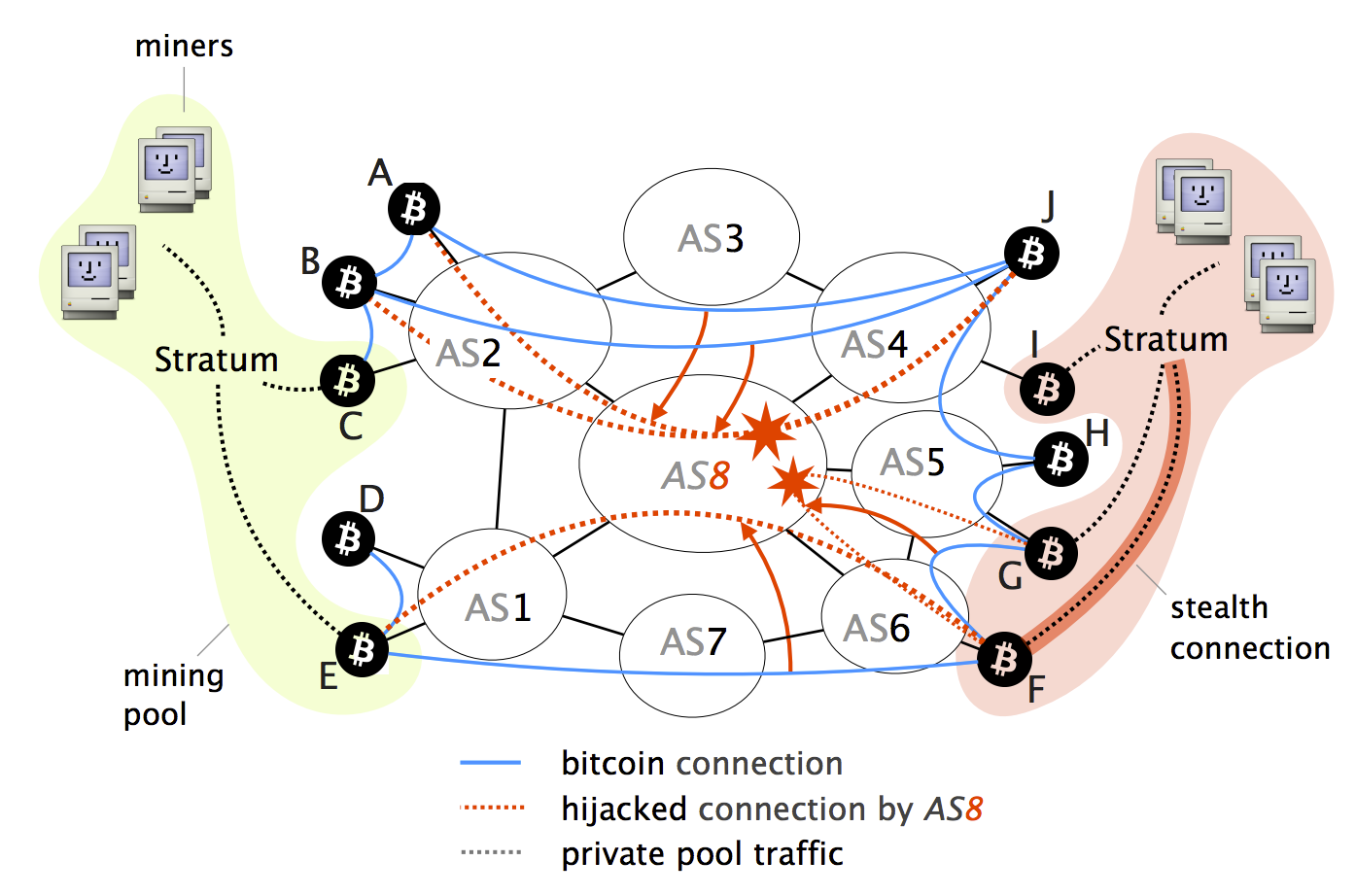
With partitioning attacks, an attacker aims at splitting the Bitcoin network into (at least) two disjoint components such that no information (e.g. transaction) can be exchanged between them. To partition the network into two components, a network attacker intercepts all the traffic destined to all the Bitcoin nodes contained within one of the component and drops any connection to the other component. To intercept traffic, a network attacker relies on vulnerabilities in the Border Gateway Protocol (BGP), the only Internet routing protocol used today, which does not validate the origin of routing announcements. These attacks, commonly referred to as BGP hijacks, involve getting a router to falsely announce that it has a better route to some IP prefix. By hijacking all the IP prefixes pertaining to the nodes in one component, the attacker can effectively intercept all the traffic exchanged between the two components. Once on path, the attacker can sever all these connections effectively disconnecting the two components. An animation of the attacks can be found on our website.

Partitioning attack

Illustration of how an AS-level adversary (AS8) can intercept Bitcoin traffic by hijacking prefixes to isolate the set of nodes P = (A, B, C, D, E).

The extreme centralization of Bitcoin from an Internet viewpoint makes partition attacks particularly effective as few IP prefixes need to be hijacked. Indeed, our measurements show that 50% of Bitcoin mining power is hosted in only 39 prefixes (i.e., in 0.007% of all Internet prefixes). This allows an attacker to isolate ~50% of the mining power by hijacking only these 39 prefixes. Much larger BGP hijacks (involving orders of magnitude more IP prefixes) are routinely seen in the Internet today.

While intercepting Bitcoin traffic using BGP hijacking is effective, any un-intercepted Bitcoin connection bridging the two components would quickly render the partition ineffective. Due to factors such as multi-homing, some nodes cannot be prevented from exchanging information, forming some kind of persistent connections. The presence of such connections makes partitioning attacks more challenging for the attacker, but not impossible. In our paper, we elaborate on how an attacker can provably identify and mitigate these persistent rogue connections by reducing the size of the partition she is trying to achieve.

By partitioning the network, the attacker forces the creation of two parallel blockchains. After the attack, all the blocks mined by the side with the shorter chain will be discarded together with all included transactions and the corresponding miners’ revenues. Moreover, discarded transactions will be irrecoverably canceled if there exist other transactions in the prevailing branch of the chain which spent the exact same Bitcoins (conflicting transactions).

Delay attacks

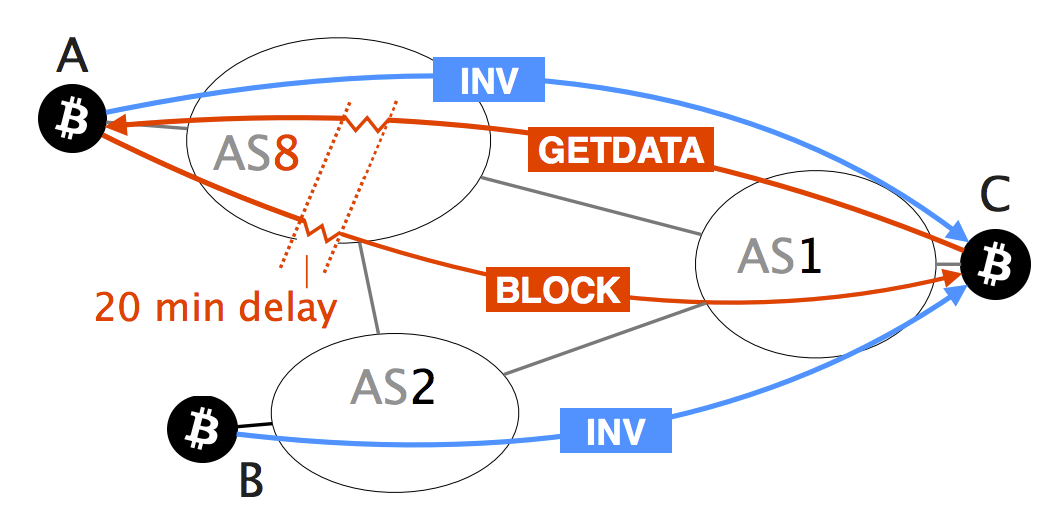
Bitcoin nodes are designed to request blocks from only a single peer to avoid overtaxing the network with excessive block transmissions. The block is requested again (from another peer) only if the request is not answered after 20 minutes. This design decision, coupled with the fact that Bitcoin traffic is unencrypted, allows for a powerful attack in which anyone intercepting Bitcoin traffic can delay block propagation on the corresponding connections. To do so, the attacker performs simple modification to the content of the Bitcoin messages she intercepts. As Bitcoin messages are not protected against tampering, neither the receiver nor the sender have any indication that the message has been modified, allowing the attacker to stay under the radar. The actual impact of such an attack depends on the victim and ranges from double spending (for merchant nodes) to wasted computation power (for miners). An animation of the attack can be found here.

Delay attack

Illustration of how an AS-level adversary (AS8) which naturally intercepts a part of the victim's traffic (node C) can delay the delivery of a block to it for 20 minutes.

Like for partition attacks, the centralization of Bitcoin nodes in few networks and prefixes, combined with the centralization of mining power in few pools, make delay attacks practical. We found that three ISPs together see 60% of all Bitcoin traffic. If malicious, these ISPs could therefore effectively and invisibly keep many bitcoin nodes uninformed. Unlike partitioning attacks though, we also found that even these powerful attackers could not disrupt the entire cryptocurrency. So, even though many nodes would be slowed down, Bitcoin, as a whole, would still function.

We verified the practicality of a delay attack by performing one against our own nodes. We found that a network attacker that intercepts only half of a victim’s connections can keep it uninformed for 64% of its uptime. We also found that the vast majority of the Bitcoin nodes (70%) are vulnerable to such an attack today.

How can we prevent network attacks?

Fortunately, there are both short- and long-term countermeasures against network attacks. First, peer selections could be made routing-aware. Bitcoin nodes could, for example, aim at maximizing the diversity of the Internet paths seen by their connections to minimize the risk that an attacker can intercept all of them. Moreover, nodes could monitor the behavior of their connections to detect events like abrupt disconnections from multiple peers or unusual delays in block delivery. These events could serve as an early indicator of a routing attack and could, for instance, trigger the establishment of extra randomly-selected connections. Finally, solutions like end-to-end encryption would also help (especially against delay attacks). Yet, encryption alone would not be sufficient to protect against partitioning attacks as an attacker can still drop encrypted Bitcoin connections.

Summary

The purpose of our research is to raise the awareness of the Bitcoin community on the need to prevent routing attacks from disrupting the cryptocurrency. While we have no evidence that large-scale routing attacks against Bitcoin have already been performed in the wild, we believe few key characteristics make these attacks practical and potentially highly disruptive. These characteristics include: the high centralization of Bitcoin (from a mining and routing perspective), the lack of authentication and integrity checks, and some design choices pertaining, for instance, to how a node requests a block. We are currently in the process of implementing some of the countermeasures highlighted above. Clearly, we wouldn’t mind some help in doing so!

01 May 18:45

Juncker to May on Brexit: ‘I’m 10 times more sceptical than I was before’

by Daniel Boffey in Brussels and Philip Oltermann in Berlin
mkalus shared this story from EU referendum and Brexit | The Guardian:
I guess in a way the EU has to blame itself. They bend over backwards for 40 years to give the Brits what they wanted so they stayed "happy" in the EU. What does the EU expect would happen this time? The Brits accepting that they are asking for favours instead of making commands? This, parents, is what you get when you don't raise your children right: Spoiled brats that rather burn down the house than clean up their bed room.

Account of meeting between PM and EU commission head has some close to Juncker putting chances of Brexit talks failing at ‘over 50%’

A devastating account of a dinner in Downing Street between Theresa May and Jean-Claude Juncker has emerged, claiming the European commission president ended discussions about a potential Brexit deal by telling the British prime minister: “I’m leaving Downing Street 10 times more sceptical than I was before.”

Those close to Juncker are said to have subsequently concluded that the chances of Brexit talks failing were now “over 50%”. An EU spokesman declined to comment, except to point out that Juncker had told reporters at a summit on Saturday that the dinner was a “very constructive meeting, a friendly atmosphere”.

Continue reading...
01 May 18:45

Watch a rocket fall back from space…

by rands

#

01 May 18:45

Except that isn’t what I am advocating.

by Stowe Boyd

Except that isn’t what I am advocating. Commonsism is about up-ending geopolitical power, putting more control of a common shared resource, or commons, into the hands of the people closest to the commons. It’s not about owning the means of production, and it’s certainly not Marxism. It’s Ostromism/Leopoldism (after Elinor Ostrom and Aldo Leoplold).

However, mutualism, the other side of the same coin, is about people forming cooperatives, mutual aid societies, and institutions like credit unions, which are owned and managed by and for the members, which I advocate.

But I don’t promote overthrowing capitalism or seizing property, as a general principle. I’m no bomb-throwing anarchist. I’m all for capitalism with a small ‘c’. It’s hypercapitalist globalism that I oppose, where localist trade barriers and work protections are removed in the name of ‘free trade’ so that multinational corporations can cut costs (and workers’ salaries and benefits) to improve margins, pocket 100% of the resulting profits, and distribute them to the shareholders, while localized businesses go bankrupt and the displaced workers are pushed out of work.

Yes, people can buy t-shirts and kitchen tables more cheaply in a globalized economy, but they have less money to do so, now that they are making minimum wage in a service job, instead of sewing the shirts or building the tables, like they used to.

01 May 18:45

Premier Still Says the Massey Bridge is Good for you-The Right Work or Doing the Work Right?

by Sandy James Planner

13936138

Sandor Gyarmati in the Delta Optimist reports that the Premier knows what is good for you and the Massey Bridge will “make a huge difference in the lives of those who live south of the Fraser”.  Now that is kind of strange thing to say when you are defending the expenditure of $3.5 billion dollars (projected to go over budget according to many sources).

There are other alternatives that would have made a huge difference in the lives of everyone north and south of the Fraser River, including placing this bridge in an area to the east that is not impacting the most arable farmland in Canada. They could have seriously looking at other alternatives to the bridge such as twinning the tunnel, and simply doing some things that are done globally in other “congestion” situations, such as limiting truck traffic during peak times, or getting the port to operate on a 24 hour basis, like every other port in North America. Under the thin veil of talking about “jobs” and “congestion” it is assumed that citizens are not smartly analyzing the lack of public process and the wrong-headed direction which right from the start has nixed the tunnel. And no one is saying the real reason for the tunnel being taken out, which is for the Port (a federal not provincial agency) to dredge and industrialize the Fraser River for deeper, bigger boats carrying coal and liquid natural gas to Asia. It is all a very 20th century approach. A $3.5 billion dollar 20th century approach.

But never mind that, here is the Premier’s response last week in Delta. “I would argue, even more importantly, you can cross the river on the bridge and know you’re doing it safely with your kids in the car. It (current tunnel) so desperately needs seismic upgrading, I worry about people using that tunnel now. I think that will be a big improvement for people in South Delta”. 

This is all a little weird as the previous Minister of Transportation stated that the tunnel was good for decades. But now it is the “s” words, safety, seismic, to go with “jobs” and “congestion” and spending $3.5 billion dollars for a bridge determined by the Mayors’ Council to be in the wrong place. But back to the Premier. “I promised that we would do this four years ago before the last election. We have spent four years with the scientists and geotechnical people and consulting with the community, and four years later we’re getting on with it..When I promise to do something, we get it done.” 

You can take a look at the document list and the skinny public process here. This is one of those projects where the end, a bridge, was kind of foregone conclusion. There’s been a couple of meetings here and there, but no active dialogue or response. And in terms of addressing the fact that all the Metro Vancouver mayors except for the Mayor of Delta did not want a bridge located here? Nothing.

But on to the “benefits”.  The Premier states you  will have “reduced congestion” (which could be solved by more transit and eliminating trucks at peak periods in the current tunnel). You will have “improved safety” (of course you also have ten lanes of traffic). And my favourite-there will “13,000 fewer tonnes of greenhouse gas emissions”, because instead of idling at peak times all those vehicles will be proceeding at speed. There’s no factor for the increased emission resulting from the induced vehicle demand a new bridge will bring. And strangely, no comparison to the Port Mann bridge, or whether this is really worth $3.5 billion dollars.

Sometimes when you promise to do something, you have to make sure it is the right work, not just doing the work right.

surrey-bc-december-1-2012-bc-premier-christy-clark


01 May 18:45

On North Korea, Trump’s people sound just like Obama. Is this reassuring?

by Josh Bernoff

President Trump recently bused all 100 U.S. senators to the White House for a briefing on North Korea. His position on Korea now matches the Obama administration’s, in a shift similar to his reversals on NATO, NAFTA, and chemical weapons in Syria. Has he gone sane? Let’s look at the statement. North Korea’s Kim Jong-un has nukes, missiles (although … Continued

The post On North Korea, Trump’s people sound just like Obama. Is this reassuring? appeared first on without bullshit.

01 May 18:45

This concept gallery displays the Surface Phone of your dreams

by Rose Behar
surface phone concept

Been dreaming of the next generation of Windows mobile devices? You’re not alone.

Designer Casmir Valeri recently posted a concept gallery that displays what a Surface Phone might look like in the flesh, earning a commendatory tweet from preeminent mobile journalist and tipster Evan Blass.

The gallery, posted on Behance, shows a large silver phablet with straight edges and a design language that’s similar to Microsoft’s existing line of Surface 2-in-1s. There are also some next-level wishlist features, like a ‘Companion Cover’ that “enables near unlimited positions,” doubles battery life and provides additional USB-C ports.

companion cover

Valeri’s version of the smartphone also supports Continuum, allowing it to power a desktop experience. Additionally, he envisions users could turn the handset into a trackpad with an intuitive user interface or use it with a Surface Pen to take notes.

A ‘Fusion Camera’ features dual lenses and laser-tracking technology capable of mapping objects to create Hololens augmented reality experiences and 3D models.

Unfortunately, there’s been now news pertaining to a real Surface Phone for quite some time, making this mostly a creative exercise — albeit a pleasantly convincing one.

Do you like the concept? Is there anything else on your Windows phone wishlist you’d like to add? Let us know in the comments.

Source: Casmir Valeri 

Via: Evan Blass

The post This concept gallery displays the Surface Phone of your dreams appeared first on MobileSyrup.

01 May 18:44

Riding Tandem With Your 8-Year Old

by dandy


Algo MacNada, Max, and daughters ride their trail-a-bike to Moss Park Arena
Photo by Derek Rayside

How do you get your entire family riding together?

Story by Derek Rayside

The Toronto Island Bicycle Rental’s recent sell-off of their old bikes has prompted many people I know to think about getting a tandem. Kathleen wants a bike to ride with her husband. Faisal wants to help his 8-year old keep up with his 14-year old. Sobia wants a better commuting option for taking her 8-year old and 3-year old to school. This article will give you some tips on buying a tandem in Toronto, with a particular focus on riding with children who have become too large for a trail-a-bike, but are not yet old enough to keep up or to navigate traffic on their own.


A great place to start is Canada’s largest tandem dealer: the Meadowvale Bicycle Service in Mississauga. They have been in business since 1991, and have 14 tandems in their showroom. (Their showroom is the garage of David & Brenda’s house, and is open evenings and Saturdays.)  They are the official dealer for Co-Motion, KHS, BBC, and da Vinci (that’s da Vinci tandems of Colorado, which is not related to Cycles Devinci of Quebec). They also rent tandems, so you can try one out before purchasing.

Of the brands Meadowvale carries, David recommends Co-Motion and KHS for riding with your 8-year old. Both manufacturers have models that are specifically designed so that the rear position can be adjusted down for a child (or up for an adult). KHS models are priced around $1,500, whereas Co-Motion models are around $5,000. Part of the difference in price is due to KHS’s economies of scale: they are a larger company that makes fewer models of tandem frames (three) in a Taiwanese factory. Co-Motion makes fifteen different models of tandem frames by hand in Oregon. They won the award for best tandem at the 2016 North American Hand-Made Bicycle Show. With Co-Motion you can get a bike that is fit very specifically for your family (in addition to higher quality components and more choices of paint colours). @WhitlaMike and @PedalPapa both ride Co-Motion tandems with their children around town in Toronto, and @WhitlaMike’s family has also done long-distance touring with theirs.

Mike Whitla with his family + Co-Motion tandem on tour

The bikes discussed so far have what I would consider to be a conventional tandem frame design: captain in the front, stokers in the rear, everyone on a regular bicycle saddle, with a large frame that is hard to travel with. There are at least three tandem designs that break this mold in different ways: Onderwater XL, Hase Pino, and Bike Friday.


The author and his two kids - Photo by Derek Rayside

The Onderwater XL and the Hase Pino put the captain in the rear. The captain is the person who steers the bike, so these bikes have a mechanical linkage from the captain’s handlebars to the front wheel. Being in front gives the stoker a better view, and makes it easier to have conversations while you’re riding. These two tandems also allow the stoker to take a break from pedalling, which is a nice feature for children and is not commonly found on other tandems. Finally, these bikes are both good for carrying cargo when you do not have a stoker --- although the Hase Pino is better for this, with a cargo capacity of over 200 litres (twice the size of the largest hiking backpack). I have used my Onderwater XL to carry a step-ladder, a fifty pound roll of flooring underpadding, some lumber, a stationary exercise bike --- and more ordinary things, like hockey equipment or groceries (both of which I do every week).

Hase Pino pictures from the web:


Image courtesy of Hase Bikes

 Image courtesy of Hase Bikes


Image via Pinterest


Image courtesy o Velos Couches

For all these similarities in features and capabilities, the Onderwater XL and Hase Pino could not be more different. The Hase Pino has the stoker in a recumbent seat and the captain in a regular saddle, whereas the Onderwater has everyone in a regular saddle. The Hase Pino splits into two halves for easy transportation in a compact car. The Onderwater XL is just about the largest and heaviest thing on two wheels: it barely fits into a cargo van, and requires both strength and technique to engage the kickstand.

The Hase Pino is constructed with care in Germany, and is available at Urbane Cyclist on College Street in Toronto, as well as at Hamilton Trike and Bent. The Onderwater XL is hand-made in The Netherlands, and is available from Urkai in Burlington (who will deliver it to Toronto in their cargo van, and is where I got mine from).

Brown Cycles in Colorado makes the Kidz Tandem, which is similar in design to the Onderwater: the kids ride in front. It is not available at any shops in Toronto, but I met a lady riding one in the bike lanes: she imported it herself, and has been commuting her son to school and herself to work with it for several years. My impression is that it is lighter and sportier than the Onderwater, whereas the Onderwater can carry more cargo and weight.

Bike Friday makes tandems that can be packed into two suitcases for air travel, so you can go on bike tours around the world. They made their first Family Tandem back in 1995, and still make all of their bikes by hand in Oregon. Before Bike Friday, they invented the Burley child trailer (almost forty years ago). Their daughter, Hanna, was the first child in the trailer, and is now President of Bike Friday.

Jun Nogami has been riding a Bike Friday Family Tandem with his daughters in Toronto for several years. Bike Friday can be ordered directly from their website, or is now also available in Toronto from a new vendor, CityAndCargo.bike (disclosure: I am friends with the proprietor, Stuart Kinner).

Jun Nogami’s daughters on their Bike Friday family tandem - Image courtesy of Jun 

What if you want to bring two children on your tandem? The Onderwater XL, Kidz Tandem, and the Co-Motion Periscope Trident both have two stoker positions. (Onderwater and Kidz Tandem also have versions for just one child.) The Trident is better for long rides in the country, whereas the Onderwater XL is better for carrying groceries along with your children on short rides around town. Bike Friday has in the past made a triple-tandem, and might do so again as a special order. With a triple-tandem you might also be able to get two adults and a child on the bike, depending on everyone’s size: this is what we do on our Onderwater XL.

If the second child is young enough to ride in a child seat on the rear rack of the bike, then the best choices are the designs where the captain is in the rear: the Hase Pino and the Onderwater XL (and maybe Kidz Tandem). This will make it easier for you to get the young child into and out of their seat, and also make it easier for you to control the bike. An added bonus of this configuration is that your children cannot fight with each other when you are seated in between them. Alternatively, you can hitch a child trailer to any tandem.

There are a few other bike stores in town that can special order a tandem, but they don’t keep them in stock, and don’t know if the one they can special order would be suitable for a child stoker. The two Canadian Tire locations that I frequent both have a Schwinn tandem in stock (for $800), so you could easily try it out to see if it fits your family.

If you are travelling stateside, Tandems East in New Jersey carries Co-Motion, Bike Friday, KHS, and Kidz Tandem. They also carry Bilenky, which makes a bike like the Hase Pino.

The value that you get from a bike depends on how much you use it. My family rides our Onderwater XL every weekend, all year round. It is our main mode of transportation in the city: to the hockey rink, to the grocery store, to the movies, and to the park. These days we only drive when we are going out of town. While our triple tandem might be expensive compared to some other single bikes, it is much less expensive than a car. Mr Money Moustache, a Canadian who lives in Colorado and blogs about frugal living, believes in the home economics of bicycles: even if you also use a car for many tasks, every mile you ride your bike instead of driving a car saves you money. A bike that fits your family and your needs is a healthy and joyous way to pinch your pennies.
See you in the bike lanes!

Related on dandyhorsemagazine.com

Accessible Cycling is Better Together

Cargo bikers roll out for Open Streets

Heels on Wheels Goes Tandem: Leanne Eisen


01 May 18:44

April 2017

mkalus shared this story from Michael Kalus.ca.

Fiction

The Founder (2016)

“Based on a true story” so I put this one into fiction.

McDonald’s next to Coca Cola is probably one of the most iconic American brands out there. They are pretty much everywhere. When the cold war ended McDonald’s opened up a restaurant in Moscow and the lineup was tremendous. I doubt there are many people in any major city or semi-developed country who haven’t seen or even been in a McDonald’s.

So it is interesting to see a movie that tells the not so nice origin story of today’s McDonald’s.

Michael Keaton as Ray Crock is decent, though you never get the evil vibe that many would like to associate with his character, but this is probably what the real Crock was like. Likewise Nick Offerman as Richard “Dick” McDonald also delivers, though I can’t quite help and feel he was a bit type cast from his Parks & Recreation days.

Overall, if you don’t know the background, it makes for an entertaining watch.

Non-Fiction

Betting on Zero (2017)

It is amazing to me that in this day and age Multi-level Marketing is still a thing in this day and age, but so is internet spam and it seems to work in both cases.

Betting on Zero is an attempt at a hero story with the hero being an investment banker. It centres around the company Herbalife which runs a major MLM approach and so far has gotten away with it.

If you look around online both sides claim to speak the truth and accuse each other of lying.

Having said that, my impression at the end was that whatever Ackman’s motives are, Herbalife is definitely not the good guy.

Worth a watch.

Bill Burr — Walk Your Way Out

Bill Burr is one of those comedians that seems to still take “the hard line” instead of trying to play to an audience as large as possible (looking at you Louis C.K., though maybe with your latest special you redeem yourself a bit).

Much like George Carlin (RIP) he continues to have no problem in being offensive to anything he considers the status quo. And so in this special as well. From fat people, to Hitler to people teaching a gorilla to speak, everybody is fair game. Including himself.

Recommended.

Louis C.K. — 2017

So Louis C. K. had a new special and…. it actually wasn’t that bad at all. I had given up a bit of hope on him after the last two seasons of Louis, though it seems the creative break was good for him.

I still think the Bill Burr piece was better, but Louis does manage to entertain, even though he still suffers from a bit of American Myopia, in that he projects his experience of the world onto the entire world.

I think that’s the big change from the older stuff, back then he pretty much spoke only about how he perceived the world and how he experienced it. These days he has a tendency to equate that with the state of the world as a whole.

Meanwhile, this is a pretty good analysis on how he constructs his jokes:

Trial & Error — 2017

Good comedy shows are hard to find and often from one season to the next they can turn from awesome to horrible. Community comes to mind.

One of the more successful comedy shows in the last few years was “Parks & Recreation”, which often lived off of it’s characters. So it is no real surprise that NBC would try to copy that formula since the Park & Rec. is off the air. This gives us “Trial & Error”.

Quite frankly I would probably not have bothered with watching it if it wouldn’t have been for John Lithgow who plays am eccentric College Professor who is accused of having killed his wife.

Unfortunately that is pretty much all the good that can be said about the show. The overall setting has a huge “Park & Rec” vibe in as far as the different characters are concerned, the small town setting with the weirdos essentially.

Unfortunately it never really escapes that comparison and the scripts are weak, even for Lithgow who still manages to deliver at least an enjoyable character. The rest though are outright forgettable.

Fiction

The Empire's Corps - Book 13 - Culture Shock — By Christopher Nuttall

This has been a rather long running series of Military Sci-Fi. The first six books or so dealt with the falling of the Empire, told through a couple of chore characters, one of them being a professor who got banished from Earth for being critical of the Empire, as well as a group of Marines who finds itself stranded far from their home base of earth as things fall apart.

In the later books we get to see how individual systems have fared during the decline and fall of the Empire. In “Culture Shock” we get a look at Arthur’s Seat. A small community that suddenly finds itself flooded with refugees that get unceremoniously dumped on the planet by what’s left of the Imperial Navy. The refugees are akin to the Amish in our world, they reject modern culture and technology to a large part and try to live their lives like it’s still the 1890. Unlike the Amish though there is a subset in the group, the young, angry men, who are determined to get their piece of land and when the planetary Government does not appear to do their bidding conflict is pre-programmed and quickly comes to pass.

The book is an interesting commentary on the debate that is happening in Europe around all the Syrian and other refugees and Nuttall being British the tone is somewhere between stiff upper lip and town crier.

Ark Royal - Book 9 - We Lead — By Christopher Nuttall

Double whammy this month. Nuttall is also back with a new “Ark Royal” book. Much like the Empire’s Corps series it falls into the military Sci-Fi category. What makes this series stand out a bit is that it’s centred around the British military and not the American, but that is more or less where the departure ends.

This is the third trilogy is in the Ark Royal canon and once again we go to war, this time against a new enemy. Once again too people and aliens alike will die, some people will have some insights into their life over other people’s death and destruction and…. Well, it’s well and entertaining put together. I think the series itself though has run it’s course, but we’ll see if he tries for another trilogy.

Overall, the series was entertaining, just don’t expect it be high literature.

Here Comes Earth — Trilogy — By William Lee Gordon

This was a bit… weird.

It starts out with Aliens showing up on Earth and Mankind realizing that we are not alone in the Universe. We receive a glance of a multi-layered galactic civilization where all the aliens are basically human, with the difference that their lifespans are much longer than the average Earthers.

We then get to find out that people on Earth were genetically manipulated and as a side effect our lifetimes were shortened, drastically.

But as we are Earthers, we have our own way and so in book two we set out to create our own Dynasty.

In book three this Dynasty comes under attack from other houses and very quickly we learn what makes humans so special. Then the book jumps a few thousand years into the future and we get a two page summary as to what has happened in the meantime.

So… without going too much into detail on what makes us special, the whole thing strikes me as an after thought. As “I have the idea that humans are special but not yet sure why”, only to then come up with something…. well, lame is maybe not the right term, but definitely not what I would expect from a Sci-Fi novel. Which is probably where the biggest problem with these books lies: They don’t really know what they want to be and this becomes really clear in the third book when things get very quickly wound up, with the finale essentially being a cop out in my book.

Shame, there were some interesting ideas there, but the execution falls seriously flat.

For We are Many — Bobiverse, Book 2 — By Dennis E. Taylor

The first book in the series was a surprise, see my review in January of it. Interestingly enough the second book literally picks up where the first one stopped. No “previously”, no re-establishing of the universe. We basically pick the dialogue up where it started.

The Bobs have managed to find a few more planets for humanity to settle on and also to befriend the Australian probe, the Brazilian meanwhile has it’s own ideas and then there are the new aliens that want to eat everything, including the Bobs.

Taylor’s view on the universe though his different Bobs continues to be entertaining and anybody who appreciates a dry humour will appreciate the book. If you need something light to read and want to laugh, the Bobs are your men.

Change Agent — By Daniel Suarez

A few years ago Suarez wrote a trilogy of books that dealt with modern computer technology and how it was in our lives, without most of us seeing it. I greatly enjoyed the series because it was technically sound and didn’t really treat technology as magic.

Now a few years later he is back and this time he is dealing with biotechnology.

What if you could alter the DNA of your child in Utero so that he or she is of genius level intelligence or able to develop strong, lean musculature? What if the Governments would ban it? Would you still do it? What if suddenly, someone would have figured out how to rewrite an adults DNA to make them look like someone else?

All of this is something Interpol Analyst Kenneth Durand has to deal with in 2045 after he finds himself stung by someone on the subway only to wake up to discover that he had been transformed in one of Interpol’s most wanted: Wycks, the leader of a gan that specializes in DNA editing, for a price.

“Change Agent” is fast paced, with just enough explanation of the technology used to make it sound believable. Of course it stretches reality, the idea of changing the DNA of a living organism late in life is something we cannot do and may never be able to do, but the editing of embryos is something that we are already going in the lab on animals and we can do DNA sequencing to figure out if an embryo has certain genetic defects, before it fully develops.

So the jump Suarez takes here is not as giant as it may first appear and although his world makes you think, he does not come off a preachy.

Recommended.

Joe Ledger - Book 9 - Dogs of War

The Joe Ledger series is the kind of Hollywood action blockbuster Hollywood doesn’t really make any more.

Joe Ledger is the name of an ongoing series of bio-terrorism thriller books written by Jonathan Maberry, beginning with the 2009 Patient Zero. The series also includes several short stories, audio originals and novellas.

In Dogs of war Joe and his team gets pulled in yet another “end of the world” scenario, this time perpetrated in no small part by killer robots, in dog and pigeon form.

The book is fast paced, the science is at least plausible and the dialogue is… cheesy. But it is a fun, fast read and I found more engaging than most similar fare on TV or in theatres these days.

Fun, fast read. If you like this kind of stuff you’ll enjoy it.

Galactic Liberation — Book 1 — Starship Liberator by B.V. Larson and David vanDyke

Larson and vanDyke are a bit the Stephen Kings of Military style Sci-Fi. They must be knocking each out a book every other month and are similarly “formulaic” as what King does in the Horror genre.

Having said that, this new series is actually fun, they paint on a somewhat larger canvas than usual and pacing is pretty fast without leapfrogging over a lot of story development like other books in the genre tend to do. Having said that, it’s not overly creative story telling or writing, but it’s fresh enough to be engaging and I am curious to see where the series goes.

Star Carrier — Book 7 - Dark Mind by Ian Douglas

I have a bit of a “love / hate” type of relationship with the Star Carrier series. The early books were fun and fast paced, but about the middle of the series it goes a bit…. well, American. This shouldn’t be too surprising I guess as Ian Douglas is a former US Navy guy, but like a lot of the military Sci-Fi out there this day it is often stuck in a kind of cold war / US vs. the rest of the world kind of mentality. Which is really utterly bizarre the moment you look at the story and finding Earth as a whole being under attack from an outside force. Maybe it’s my optimism. But I somewhat doubt that humanity would still fight each other while also facing annihilation by an external force.

So with this out of the way, I was a bit apprehensive about the new book in the series and… well, it’s a step up. He (mostly) buried the inter human conflict and is now setting the stage for a new, larger enemy that, at least by the end of the book, hints at some rather large and scary things “coming our way”. I am cautiously optimistic as to where the story goes.

If you’ve read the series so far, this is a good new entry, if you haven’t, give the early books a try, it’s not bad Military Sci-Fi, it’s just very…. American.

Non-Fiction

The Upstarts: How Uber, Airbnb, and the Killer Companies of the New Silicon Valley Are Changing the World — By Brad Stone

“Discruptor” is what many “new” businesses are trying to call themselves. The idea that the way we have done things is obsolete, that technology has a better way. Often these ideas are peppered with slogans trying to convince consumers that “they now have the power”. Mix this with the “sharing economy” and you end up with entities like Uber or AirBnB. Two companies that already had an impact on the status quo. Whereas the companies would like to portrait themselves as forces of positive change, a lot of people would disagree.

The Upstarts chronicles the rise of both Uber and AirBnB and the people behind it. It’s a fascinating look into this “world”, especially if you are not in the technology field yourself.

Having said that, it definitely didn’t do anything to convince me that either Uber or AirBnB are “forces for good”, they are just a bit last blatant about what they’re doing than Juicero.

Jamiroquai — Automaton

Jamiroquai is an artist that only grew on me as I got older. His stuff in the ‘90s I couldn’t connect to. It wasn’t until the end of the naughties that I actually started appreciating his music, something that also happened to me with the Beatles.

So now here we are with a new Album and…. It is both more than I expected and less, namely, it still sounds like Jamiroquai, I did not get a sense that he was “reinventing himself” with the album. This is actually surprisingly refreshing considering how many artists have beaten new paths in the last few years trying to reinvent themselves.

Recommended.

Gorillaz — Humanz (Deluxe)

Oh boy, so what I said about Jamiroquai I can’t really say about the newest Gorillaz, I always liked their sound but they have lost me with the newest one. The sound is decidedly no longer towards the “Brit Pop” type and more towards the Hip-Hop arena and that is one kind of music I never really got access to. It’s a shame, there are some nice tunes in it, but overall it is a disappointment to me.

Still, give it a listen, it may click with you.

01 May 18:44

The Source lists Samsung’s S8/S8+ DeX dock for $249 CAD

by Patrick O'Rourke
Dex Dock

Samsung’s S8 DeX dock station has appeared on The Source’s website for $249 CAD.

The dock, however, is listed as online-only and currently is sold out, according to The Source’s website. It’s unclear if this is the actual price of Samsung’s DeX dock or just a placeholder.

The latest statement we’ve received from Samsung Canada regarding DeX’s availability north of the U.S. border is the following:

“Samsung Canada is excited to confirm that the Gear 360 and DeX will be available to Canadian consumers in 2017. We do not have confirmed pricing or date of availability at this time but will follow up with more information as it becomes available.”

In the U.S. the DeX dock is priced at $150, which comes to approximately $202 CAD. This means that if The Source’s listing is accurate, the retailer is selling the dock significantly above the current conversion rate.

The post The Source lists Samsung’s S8/S8+ DeX dock for $249 CAD appeared first on MobileSyrup.

01 May 18:44

People Do Not Change Their Eating Habits Easily, Studies Find : Shots

mkalus shared this story from Shots - Health News : NPR.

It turns out it's difficult to get people to adhere to the various dietary restrictions that come with participating in a fasting study. Xsandra/Getty Images hide caption

toggle caption
Xsandra/Getty Images

It turns out it's difficult to get people to adhere to the various dietary restrictions that come with participating in a fasting study.

Xsandra/Getty Images

A new study suggests that skipping meals is difficult.

Obviously, right?

The study published Monday in JAMA Internal Medicine did not set out to investigate the hardships of abstaining from food. The main question was: Is alternate-day fasting more effective for weight loss and weight maintenance compared with daily calorie restriction?

The answer to that question appears to be "No." The study of 100 people over the course of one year suggests that fasting every other day is no better than restricting calorie intake every day for people trying to lose weight or keep it off.

But the researchers also found that people do not change their eating habits easily. About a third of the study participants who were asked to fast didn't follow the study requirements and ended up dropping out.

The primary finding is in line with other studies of intermittent fasting. As we have reported, previous studies have found potential benefits from fasting for 16 hours each day, or reducing the amount you eat on some days each week, which is the basis for the trendy 5-2 diets.

A 2014 paper in the Proceedings of the National Academy of Sciences argued that modern three-meals-plus-snacks eating patterns are "abnormal from an evolutionary perspective," but nonetheless noted that many people may not want to change their eating habits.

Minifasting: How Occasionally Skipping Meals May Boost Health

The authors wrote it was "critical" for researchers to study the "long-term adherence of different subject populations" to different fasting schedules.

The paper published Monday is the latest study to, somewhat inadvertently, do just that. Of the 100 participants, most of whom were metabolically healthy, obese women, 69 of them completed the study. Thirty-eight percent of those who were supposed to fast every other day dropped out because they didn't adhere to the diet. Twenty-nine percent of those who were supposed to restrict their calories every day dropped out for the same reason.

That left them with just 33 people in the two fasting groups, which isn't a large enough sample size to lend much weight to the findings.

And they're not alone. Other studies have run into similar issues with participants who struggle to stick with the eating protocols.

Take, for example, Brandie Jefferson, who is a science writer and, currently, a participant in an intermittent fasting program as part of a clinical trial for people with multiple sclerosis.

Just last week, Jefferson wrote for Shots about how difficult it's been to stick with the fasting protocol, which requires that she eat only between noon and 8 p.m. For the remaining 16 hours, she can drink only water, tea or black coffee.

Jefferson writes:

"Over five months, it's been the same nearly every day — I do get a little hungry in the mornings, but I'm thinking about eating more often. I have only eaten any earlier than noon once or twice during the study, like the infamous O'Hare Airport incident when I just couldn't resist that bagel. I still have no regrets.

"My slip-ups tend to be when I'm running late and eat after 8 p.m. I don't think I've screwed up enough to affect the tests, and I've been honest when it comes to food logging."

And it's not just study participants. Jefferson talked to the person running her study, Dr. Ellen Mowry, an associate professor of neurology and epidemiology at the Johns Hopkins University.

Mowry explained that when she tries to fast along with participants, she also finds it difficult to stick with the rules. "But often for me," she says, "this is related more to my mental stamina rather than physical."

And as a paper on intermittent fasting published in March notes, "Adherence to diets within trials is notoriously difficult to assess due to missing dietary records and well documented under-reporting [among] overweight subjects."

The authors of that study pointed out earlier work that suggests that allowing people to eat a wider range of foods, even if they are restricting their total calorie intake, could help people stick with a fasting program, but lamented an overall lack of high-quality data for comparing intermittent fasting patterns.

That's because fasting studies generally don't include a large number of participants. For example, the clinical trial that Jefferson is part of has 54 participants, which Mowry says is too small to get particularly useful results.

"The studies are too small to be certain that any change in symptoms is related to the intervention," Mowry says.

Some studies of fasting diets have had more success helping participants adhere to eating plans. A 2015 study of non-obese adults between 19 and 30 years old, for example, found that most of them stuck with the 10-week protocol. But it also was too small to be broadly applicable, since just 24 people participated.

01 May 18:43

Is Vancouver the urban-design leader? – 1

by pricetags

This week, a series from urban designer Gloria Venczel (principal of Cityscape Design), who asks: 

Is Vancouver the Urban Design-CityBuilding leader in North America?


Many new mixed-use developments in the City of Vancouver have a strong public realm component to them …   While negotiated, we take these public realm enhancements as a given.  Architectural edge programming in Vancouver is an integral part of  the public living room.  ‘Streetscape vibrancy’ design elements are implemented in varying degrees in contemporary projects on a consistent basis.

Is Vancouver the North American leader in producing contemporary mixed-use, people-friendly, walkable, vibrant  developments? Has the City of Vancouver’s early vision for pedestrian-friendly urban design spurred a symbiotic ( sometimes problematic)  relationship with the development community, resulting in a developers’ “race to the top”?  

It appears that the local Vancouver development market is very competitive in product quality and reputation but is head and shoulders above their North American counterparts in city building savvy and delivering walkable urban design projects.

Some examples, with photos by Gloria:
.
Mixed use, Melville St., Downtown Vancouver . Great building-edge programming  with retail/shops. Always filled with people.  
.
.
Mixed use, Fourth Ave, Kitsilano. Building designs that invite window shopping as well as opportunities to pour people into cafe seating.
.
.
Mixed Use, Fourth Ave, Kitsilano, Vancouver. Building designs that invite window shopping as well as opportunities to pour people into cafe seating.         
 .
.
  Mixed use, Fourth Ave, Kitsilano. Urban design that facilitates creature comforts for the “outdoor living room” like Adirondack chairs, trees, shade, window shopping.J