Summary statistics such as mean, median, and mode can only tell you so much about a dataset. Their scope is limited because for them to be useful, you have to assume things like distribution and dependencies. Visualization helps you see what else there is.
Justin Matejka and George Fitzmaurice demonstrate in their paper for the ACM SIGCHI Conference, in which they developed a method to generate datasets that “are identical over a range of statistical properties, yet produce dissimilar graphics.
Peter Ladner inked to this from the Wall Street Journal (video available but article requires subscription):
If you think Seattle has problems, check out China’s bike share issues: thieves, vandals, pranksters and $1b investments in recent months. Shanghai has half a million shared bikes. When they’re working.
“Although the chapters that follow are structured as a collection of warnings, this book should not be mistaken for a prophecy. Life is full of surprises–some of them good, with large, beneficial, totally unforseen circumstances. Prophecy is for people too ignorant of history to be aware of that, or for charlatans. However, by definition, we can’t rely on surprise rescues; mostly we must lie in the beds we make on the mattresses our culture provides.”
One of the main criticisms surrounding Microsoft’s new education focused Windows 10 S operating system is that its simplified, streamlined nature may be limiting for some users because it’s only capable of running apps that are available from the Windows Store.
There is a quick fix to this problem though; paying a one-time fee of $50 (approximately $63 CAD) to access Windows 10 Pro. Once upgraded, the computer — even Microsoft’s new Surface Laptop — will be capable of downloading and running programs from the internet, similar to the standard version of Windows 10.
Additionally, anyone who buys the Surface Laptop — which runs Windows 10 S by default — can switch to Windows 10 Pro for free as long as they upgrade before the end of 2017.
Microsoft, however, says that it can no longer guarantee that the Surface Laptop will feature the company’s estimated 14.5 hour long battery life or perform as well as it does when running Windows S.
In an interview with MobileSyrup’s Rose Behar, Windows vice-president Matt Barlow said that the the simplified operating system sips a lot less battery because there’s “nothing running in the background constantly and no unwanted apps on your system actually draining battery life over time.”
Microsoft says that while Canada is not included in the Surface Laptop’s initial launch regions, the upcoming device will make its way north of the U.S. boarder “later this year.”
Last week, Audrey Watters blocked hypothes.is and Genius on her website. These two tools allow a ‘layer’ to be added to websites for annotation and discussion that can’t necessarily be controlled by the person who owns that site.
Blocking annotation tools does not stop you from annotating my work. I’m a fan of marginalia; I am. I write all over the books I’ve bought, for example. Blocking annotations in this case merely stops you from writing in the margins here on this website.
My first reaction? Audrey can do whatever she likes. Just as when she removed the ability to comment on her site a few years back, I didn’t understand the decision at first, but then it kind of made sense. Either way, it’s her site, and she can do whatever she wants.
So far, so why-are-you-even-writing-a-post-about-this? Discussions on Twitter, Mastodon, Slack, and elsewhere show that this is a live issue. So, naturally I’ve been thinking about it. I have to say that I agree with Mike Caulfield’s sentiments:
My take (of course) is that annotation works best through a system of copies. Anyone should be able to annotate a copy of your work. But it’s not clear to me that people have the right to piggyback on the popularity of an address that you’ve worked your butt off to promote. It’s not clear to me that they should get to annotate the master file. This has always been the problem with comments as well — they work best on small sites, and go bad when they give users a much larger platform than they have earned. As with everything online, the phenomenon is gendered as well.
It seems what Audrey is doing is protecting her ‘means of production’ from what she considers to be an active assault from those who wish to piggyback on the success of her work. Some people have questioned how that works with the explicitly ‘open’ stance that Audrey takes. However, I think any perceived tension between her move and open licensing goes away when we think of some other examples.
Here’s three:
Pokémon Go — this location-based, augmented reality game used some people’s residences as ‘gyms’ where characters in the game did battle. This caused real-world issues. Most people thought that random strangers pulling on to their drive to play games was an infringement of their civil liberties.
Google Street View — this service involves a car mounted with 360° cameras taking photographs to improve Google’s mapping service. Faces were blurred out, but this wasn’t good enough for Germany’s stringent privacy laws. They’ve been prevented from capturing images at least once, especially when people are on their own property.
Robots.txt — this text file that website owners can include in the root folder of their domain specifies what web crawlers can and cannot do. If you say that you don’t want your site to be indexed, then search engines and other aggregation engines should (legally?) comply.
Using these as touchstones, it seems fair enough for someone to insist that you create a copy of their work to be able to annotate it. As Mike Caulfield hints at, giving people the ability to comment on the master document seems like a privilege rather than a right.
Perhaps those creating annotation engines should find a way to seek the domain owner’s permission? An easy way to do that would be to get them to add the necessary code to activate annotation (as we did with OB101), rather than make it a free-for-all…
mkalus
shared this story
from Comments on: The ‘liveaboards’ of False Creek: Vancouver land prices are so high people are living on the sea full-time.
Vancouver land prices have become so expensive, a growing number of residents are simply leaving the land behind.
As a result, the City of Vancouver is trying to cope with “liveaboards” – people living on boats full-time – flushing raw sewage into False Creek.
A report to be presented Tuesday to Vancouver city council states: “The affordable housing crisis in Vancouver appears to have resulted in more residents living on vessels, full-time.”
In 2015, the city created a working group to examine water quality in False Creek, where E. coli levels have soared in recent years, reaching twice the Health Canada guideline for kayaking and 10 times the acceptable level for swimming. This week’s staff report says the group’s findings, based on data from the past 20 years, suggest “a primary contributor to E. coli contamination in False Creek is sewage dumping from marinas and recreational vessels (e.g. liveaboards not connected to the sewer system, fishing boats, pleasure crafts).”
Arlen Redekop / PostmediaPolice boat patrols False Creek in Vancouver, B.C., May 1, 2017
A survey conducted earlier this year found many liveaboards and other boaters in False Creek aren’t using the free pump-out services introduced in 2015 at the civic marinas and simply dumping waste into the water, said Jennifer Mayberry, Vancouver’s manager of environmental services, who will deliver the report Tuesday at Vancouver city hall.
Mayberry’s report recommends council approve a pilot project for this summer for “mobile sewage pump-out services,” and enhance enforcement of sewage management regulations. Costs are estimated to be $75,000.
Mayberry emphasized the city is trying to ensure health and safety for everyone in and around False Creek, not attempting a “crackdown on liveaboards.”
“It’s really an issue of proper sewage management,” she said. “I don’t care if you live on your boat, I just think you should have to manage your sewage properly.”
Arlen Redekop / PostmediaAlyssa Fleishman pulls the anchor on her boat in False Creek in Vancouver, B.C., May 1, 2017.
Of course, for people living aboard boats in False Creek or elsewhere along the B.C. coast this is not a new phenomenon. But it remains an open question exactly how much Vancouver’s acute housing woes are causing residents to seek different kinds of shelter beyond conventional “housing” options.
This year marked the first time Metro Vancouver included liveaboards in their annual count of the region’s homeless population. Mayberry said the City of Vancouver has asked Metro to “dig a bit deeper” into the connection between housing affordability and people making their homes on the water.
The number of liveaboards in this year’s homeless count won’t be available until the final report is released in late summer, said Metro Vancouver spokesman Greg Valou, adding that the report may provide more insight into how the nature of homelessness is changing in the region, whether people are living full-time in boats, cars, or other options.
They could let us have a little spot somewhere. As long as the boats are seaworthy and as long as we’re able seamen and responsible
Matt Thomson, the research manager for the 2017 Homeless Count in Metro Vancouver, said liveaboards had the option of “self-selecting” out of the survey, “because in some areas, liveaboards are choosing to live on their boats, and may be fully employed and not require any support services.”
Shawn Wilson, who lives on his wooden cabin cruiser in False Creek, agreed there’s a link between Vancouver’s unaffordability and the number of people living on boats. Wilson lived in a Kitsilano apartment until five years ago, when the ever-rising cost of living prompted him to move out and live full-time on his sailboat. He said it’s a diverse community living on False Creek, including grad students, tradespeople, office workers, and at least one family raising young children.
Wilson, who has a Metis background and grew up boating in Powell River, now lives on the creek with his partner and his dog, and works repairing boats. He believes most people in the “marine community” dispose of their sewage responsibly, adding: “most of us are very environmentally conscious … We try to keep the smallest footprint we can.”
Wilson said it seems like the Vancouver Police Department has recently increased ticketing of boats violating anchoring laws and staying in False Creek without permits. The VPD was not able to immediately answer questions about enforcement or provide stats on the number of tickets issued in recent years.
“They could let us have a little spot somewhere,” Wilson said. “As long as the boats are seaworthy and as long as we’re able seamen and responsible. We’re part of the city, we’re part of the community, and I believe it adds character to the city.”
Apparently this is one of those problems that jumps two orders of magnitude if you ignore it:
Since last time we’ve noticed that the vast majority of these incoming pings are duplicate. I don’t mean that they look similar, I mean that they are absolutely identical down to their supposedly-unique document ids.
How could this happen?
Well, with a minimum of speculation we can assume that however these Firefox instances are being distributed, they are being distributed with full copies of the original profile data directory. This would contain not only the user’s configuration information, but also copies of all as-yet-unsent pings. Once the distributed Firefox instance was started in its new home, it would submit these pending pings, which would explain why they are all duplicated: the distributor copy-pasta’d them.
So if we want to learn anything about the population of machines that are actually running these instances, we need to ignore all of these duplicate pings. So I took my analysis from last time and tweaked it.
First off, to demonstrate just how much of the traffic spike we see is the same fifteen duplicate pings, here is a graph of ping volume vs unique ping volume:
The count of non-duplicated pings is minuscule. We can conclude from this that most of these distributed Firefox instances rarely get the opportunity to send more than one ping. (Because if they did, we’d see many more unique pings created on their new hosts)
What can we say about these unique pings?
Besides how infrequent they are? They come from instances that all have the same Random Agent Spoofer addon that we saw in the original analysis. None of them are set as the user’s default browser. The hosts are most likely to have a 2.4GHz or 3.5GHz cpu. The hosts come from a geographically-diverse spread of area, with a peculiarly-popular cluster in Montreal (maybe they like the bagels. I know I do).
All of the pings come from computers running Windows XP. I wish I were more surprised by this, but it really does turn out that running software over a decade past its best before is a bad idea.
Also of note: the length of time the browser is open for is far too short (60-75s mostly) for a human to get anything done with it:
(Telemetry needs 60s after Firefox starts up in order to send a ping so it’s possible that there are browsing sessions that are shorter than a minute that we aren’t seeing.)
What can/should be done about these pings?
These pings are coming in at a rate far exceeding what the entire Aurora 51 population had when it was an active release. Yet, Aurora 51 hasn’t been an active release for six months and Aurora itself is going away.
As such, though its volume seems to continue to increase, this anomaly is less and less likely to cause us real problems day-to-day. These pings are unlikely to accidentally corrupt a meaningful analysis or mis-scale a plot.
And with our duplicate detector identifying these pings as they come in, it isn’t clear that this actually poses an analysis risk at all.
So, should we do anything about this?
Well, it is approaching release-channel-levels of volume per-day, submitted evenly at all hours instead of in the hump-backed periodic wave that our population usually generates:
Hundreds of duplicates detected every minute means nearly a million pings a day. We can handle it (in the above plot I turned off release, whose low points coincide with aurora’s high points), but should we?
Maybe for Mozilla’s server budget’s sake we should shut down this data after all. There’s no point in receiving yet another billion copies of the exact same document. The only things that differ are the submission timestamp and submitting IP address.
Another point: it is unlikely that these hosts are participating in this distribution of their free will. The rate of growth, the length of sessions, the geographic spread, and the time of day the duplicates arrive at our servers strongly suggest that it isn’t humans who are operating these Firefox installs. Maybe for the health of these hosts on the Internet we should consider some way to hotpatch these wayward instances into quiescence.
I don’t know what we (mozilla) should do. Heck, I don’t even know what we can do.
I’ll bring this up on fhr-dev and see if we’ll just leave this alone, waiting for people to shut off their Windows XP machines… or if we can come up with something we can (and should) do.
The Heroku Connect team ran into problems with existing task scheduling libraries. Because of that, we wrote RedBeat, a Celery Beat scheduler that stores scheduled tasks and runtime metadata in Redis. We’ve also open sourced it so others can use it. Here is the story of why and how we created RedBeat.
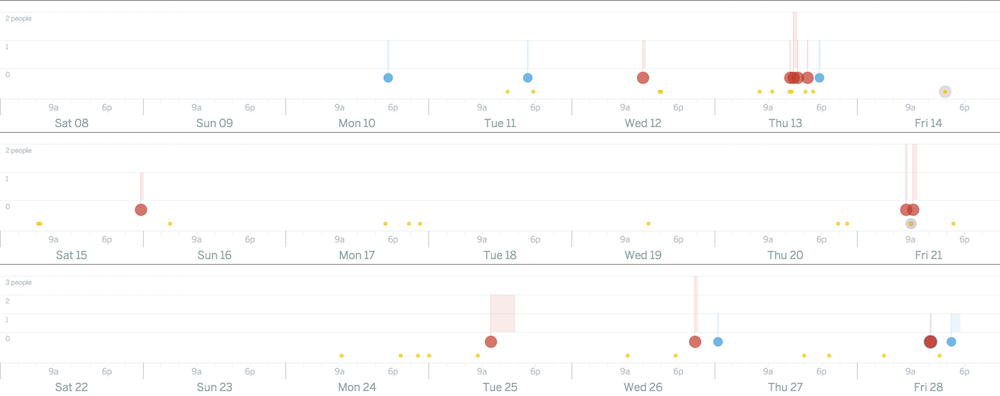
Heroku Connect, makes heavy use of Celery to synchronize data between Salesforce and Heroku Postgres. Over time, our usage has grown, and we came to rely more and more heavily on the Beat scheduler to trigger frequent periodic tasks. For a while, everything was running smoothly, but as we grew cracks started to appear. Beat, the default Celery scheduler, began to behave erratically, with intermittent pauses (yellow in the chart below) and occasionally hanging (red in the chart below). Hangs would require manual intervention, which led to an increased pager burden.
Out of the box, Beat uses a file-based persistent scheduler, which can be problematic in a cloud environment where you can’t guarantee Beat will restart with access to the same filesystem. Of course, there are ways to solve this, but it requires introducing more moving parts to manage a distributed filesystem. An immediate solution is to use your existing SQL database to store the schedule and django-celery, which we were using, allows you to do this easily.
After digging into the code, we discovered the hangs were due to blocked transactions in the database and the long pauses were caused by periodic saving and reloading of the schedule. We could mitigate this issue by increasing the time between saves, but this also increases the likelihood that we'd lose data. In the end, it was evident that django-celery was a poor fit for this pattern of frequent schedule updates.
We were already using Redis as our Celery broker, so we decided to investigate moving the schedule into Redis as well. There is an existing celerybeatredis package, but it suffers from the same design issues as django-celery, requiring a pause and full reload to pick up changes.
So we decided to create a new package, RedBeat, which takes advantage of the inherent strengths of Redis. We’ve been running it in production for over a year and have not seen any recurrences of the problems we were having with the django-celery based scheduler.
How is RedBeat different? The biggest change is that the active schedule is stored in Redis rather than within process space of the Celery Beat daemon.
No longer does creating or modifying a task require Beat to pause and reload, we just update a key in Redis and Beat will pick up the change on the next tick. A nice side-effect of this is it’s trivial to make updates to the schedule from other languages. As with django-celery, we no longer need to worry about sharing a file across multiple machines to preserve metadata about when tasks were last run. Startup and shutdown times improved since we don't suffer from load spikes caused by having to save and reload the entire schedule from the database. Rather, we have a steady, predictable load on Redis.
Finally, we added a simple lock that prevents multiple Beat daemons from running concurrently. This can sometimes be a problem for Heroku customers when they scale up from a single worker or during development.
After converting to RedBeat, we’ve had no scheduler related incidents.
Needless to say, so far we’ve been happy with RedBeat and hope others will find it useful too.
“The developers are coming in and whatever they want to do with Little Saigon, they’re going to do it,” said Nguyen. “They’re buying the land. They’re making plans.”
Though such projects are allowed under existing zoning, Mayor Ed Murray’s upzone would permit even taller buildings in most of the Chinatown International District, including Little Saigon, and would trigger a new program requiring developers to help create affordable housing.
Nguyen isn’t set against the upzone. He says more affordable housing would be welcome. Indeed, some neighborhood advocates are asking the council to boost the requirements, which the city says would generate about 150 income- and rent-restricted units over 10 years.
The proposal’s relatively modest changes in zoning, which would allow buildings one to three stories higher, aren’t expected to directly displace many residents. There are only four housing units in existing Chinatown ID structures on parcels identified by the city as redevelopable. …
The upzones are activating Murray’s Mandatory Housing Affordability (MHA) program, wherein developers include low-income units in their buildings or pay fees.
The program is supposed to produce 6,000 affordable units over 10 years, mostly for renter households with no more than 60 percent of the regions’s median income. …
.
Though public-safety problems and municipal neglect may have held the neighborhood back in past years, Little Saigon and the rest of the Chinatown ID sit near downtown with easy access to I-5, commuter trains, light-rail and a streetcar line.
Those are ingredients for smart and explosive urban growth, and some business owners are excited about development bringing better spaces and new customers.
The Asian Plaza property where Tamarind Tree is located will be developed by the Chinn family, which has longtime ties to the Chinatown ID and which plans to have the existing anchor tenant, Viet Wah Supermarket, anchor the new complex, as well.
“The Chinatown International District is still a culturally rich neighborhood, but over the years it has lagged behind … in terms of family income level and employment,” the project’s website says, casting the coming changes as progress.
“As the next generation moves up the economic ladder by becoming doctors, lawyers, and accountants, they are less inclined to live and work in (the) district. What will help is commercial development that modernizes the area and provides employment, income, and vitality that the next generation wants, and yet reflects and honors the cultural identity of each immigrant group.”
Nguyen says Little Saigon’s character won’t survive, however, if the new retail spaces are too large and costly. Many small-business owners in the neighborhood, including Nguyen, already are on tenuous, month-to-month leases, he says.
Apple’s next iPhone will support wireless charging, according to JP Morgan.
In a note published on Tuesday, the firm said that Apple’s upcoming smartphone will include the company’s new wireless charging chip.
However, the specific models that will be carrying this functionality weren’t specified. That said, KGI Securities analyst and frequent source on Apple news Ming-Chi Kuo said earlier this year that this year’s expected iPhone 7s, iPhone 7s Plus and iPhone 8 models will launch with the wireless charging feature.
JPMorgan also didn’t note which wireless charging standard would be supported by the iPhone. Broadcom sells chips that support both main competitors in this area, Qi and PMA.
In the same report, JPMorgan also says Apple’s new iPhones will support Bluetooth 5.0, allowing any Bluetooth-supported accessories, such as speakers or headphones, to work at further distances from an iPhone. Multiple Bluetooth devices can be used simultaneously as well.
Last week, Kuo also said that the iPhone 8 may not ship in September, breaking a tradition of Apple’s next iPhone model being revealed and released in that same month.
Only a few years ago, multitasking seemed like the only way to get things done. The more we had on our plates, the more it made sense to try to keep every plate spinning at the same time. Now we know multitasking actually slows us down and can reduce our productivity by up to 40%. Our lives aren’t getting less busy, though. So what can you do to get work done effectively? Here are five tips to help you improve your focus and turn complicated projects into easy-to-tackle tasks.
Make a list and set priorities
Though it might seem like a mindless chore, updating the list of projects on your plate is a wise way to start the day. It could actually reduce your stress by making your workload seem more manageable. Next, categorize each project according to your top priorities. Start by asking a few simple questions:
Which projects are mission critical?
Which have urgent deadlines?
Which include creative work that requires your complete focus? (in other words, not administrative tasks)
Which large projects can be divided into smaller tasks?
Which tasks can be delegated?
Pro tip for procrastinators: Get started by organizing overwhelming workloads into manageable task lists you can create with a few simple key strokes in Dropbox Paper.
Create one central knowledge hub for each project
If your desktop looks like a sticky note factory after a wind storm, it might be a good time to gather handwritten notes into a Paper doc. Aside from the relief of working in a less-cluttered workspace, investing a few hours to compile the most essential information in a single online document is more than an act of tidying up. It’s a way of creating a knowledge base, a central hub of information that can be shared with your team. When it comes time to invite feedback from collaborators or delegate tasks to teammates, you’ll have a streamlined starting point.
Do away with all distractions
After you’ve removed the clutter from your desk area, think about ways to simplify your online workspace as well. If looking at a long to-do list keeps you from taking the first step on a creative project, start by simply opening a new Paper doc. Unlike editing docs that make you select margins, fonts, and formatting from the get-go, Paper bypasses those distractions and presents you with a clean, blank canvas. A very Zen way to begin your brainstorm.
Now, to stay in that creative zone, you’ll need to tune out all external distractions. Email and text create the biggest temptation to multitask. Did you know the average American checks their phone about 47 times a day? That distraction can lower our effective IQ by as much as 10 points. So when you’re doing focused work, take a break from your devices. Make a habit of designating blocks of time every day to being offline. Set a timer and make a commitment to avoid checking all emails, texts, and calls.
Set aside 45–90 minutes to focus
Ever notice how often you get sidetracked by administrative tasks when you have a looming deadline on a creative project? To prevent this, try setting aside tasks that can’t be delegated, and giving yourself a block of time where you decide not to sweat the small stuff. For creative work like brainstorming, writing, or designing, you should devote 45–90 minute windows of time and give your complete attention to the task at hand.
Why is this important? Our most productive work happens in cycles. Research suggests this is tied to the ultradian rhythm: the human brain needs a break after 90-120 minutes of focused work. The energy we dedicate to a creative pursuit starts to taper off after about an hour and a half. Next time you need to kickstart a creative project, try this: find a quiet place to concentrate, open a new Paper doc, and let your ideas flow for a full 45–90 minutes—before you start editing.
Take breaks between focused sessions
Just as important as the focused attention you bring to a creative session is the break you take when you’re done. Some studies suggest that for every 52 minutes of work, you should take a 17-minute break. It’s hard to boil it down to an exact science, of course, but research has shown that after a break, the quality of our work improves and productivity actually rises.
To learn how Dropbox Paper can help you stay focused and improve your creative productivity, visit dropbox.com/paper.
Microsoft has announced that it’s bringing a new ‘View Mixed Reality’ feature to Windows 10 later this year.
In a demonstration at its live New York City event this morning, the company revealed that Windows 10 users can create 3D objects in 3D Paint and augment into the real world. This can be done with any Windows 10 laptop that features a webcam.
The 3D paint-created content is also available for use on Microsoft’s Windows Mixed Reality devices, set for release later this year.
Microsoft has previously released its HoloLens headset, which is dedicated to mixed reality content, but this is the first time the technology has been built directly into a Windows 10 laptop.
Stay tuned to MobileSyrup for more from Microsoft’s education event today.
Rep. Mo Brooks, Republican of Alabama, has done us the favor of openly stating what most Republicans in favor of repealing Obamacare believe. As Jonathan Chait summarizes, people who can’t afford the cost of their own medical care have nobody to blame but themselves.
Republicans usually defend their health-care position with an array of buzzwords like choice, patient-centric, or competition. In a CNN interview, Representative Mo Brooks, an Alabama Republican, makes the case for Trumpcare in much starker terms: It will free healthy people from having to pay the cost of the sick. “It will allow insurance companies to require people who have higher health care costs to contribute more to the insurance pool that helps offset all these costs, thereby reducing the cost to those people who lead good lives, they’re healthy, they’ve done the things to keep their bodies healthy,” explained Brooks. “And right now, those are the people who have done things the right way that are seeing their costs skyrocketing.”
It is certainly true that the Republican health-care plan will spur insurance companies to charge more money to people with expensive medical needs, and less to healthier people. (It will also transfer hundreds of billions of dollars from the poor, who will get reduced Medicaid and tax credits to buy insurance, to the rich, who will receive a large tax cut.) The idea that morality dictates healthy people pay less, and sick people more, has been floating around the margins of conservative health-care thought.
The central tenet of Republican thought is ‘everyone for themselves’. And heath is a morality play, where the healthy and wealthy are good, and the sick and poor are bad.
Meanwhile, the question that Jake Tapper was asking Mo Brooks was whether Trump doesn’t know the status of pre-existing conditions in the newest attempt at Trumpcare, or if Trump believes that allowing states to opt out of that restriction by setting up pre-existing condition pools satisfies his promises about protecting those with pre-existing conditions. We never got an answer, but I’m not sure if Trump knows what he means.
In the last few weeks, the latest update for Google Maps on iOS ditched support for the Apple Watch. Its removal was not mentioned in the release notes, and Google has not indicated whether support for watchOS will be reinstated.
It’s the same story with Amazon and eBay, both of which previously included Apple Watch support in their iOS apps. Both were updated in late April, and as of Monday, neither includes an Apple Watch app.
While shopping on Amazon from your wrist may seem somewhat superfluous, the eBay app for Apple Watch did allow users to track bid statuses. And obviously the utility of glanceable directions from Google Maps —a service many believe is better than Apple Maps —on the watch is apparent.
Driverless judiciary? It’s not scfi, it’s here today according to the Chief Justice of the US Supreme Court:
When Chief Justice John G. Roberts Jr. visited Rensselaer Polytechnic Institute last month, he was asked a startling question, one with overtones of science fiction.
“Can you foresee a day,” asked Shirley Ann Jackson, president of the college in upstate New York, “when smart machines, driven with artificial intelligences, will assist with courtroom fact-finding or, more controversially even, judicial decision-making?”
The chief justice’s answer was more surprising than the question. “It’s a day that’s here,” he said, “and it’s putting a significant strain on how the judiciary goes about doing things.”
He may have been thinking about the case of a Wisconsin man, Eric L. Loomis, who was sentenced to six years in prison based in part on a private company’s proprietary software. Mr. Loomis says his right to due process was violated by a judge’s consideration of a report generated by the software’s secret algorithm, one Mr. Loomis was unable to inspect or challenge.
In March, in a signal that the justices were intrigued by Mr. Loomis’s case, they asked the federal government to file a friend-of-the-court brief offering its views on whether the court should hear his appeal.
The report in Mr. Loomis’s case was produced by a product called Compas, sold by Northpointe Inc. It included a series of bar charts that assessed the risk that Mr. Loomis would commit more crimes.
The Compas report, a prosecutor told the trial judge, showed “a high risk of violence, high risk of recidivism, high pretrial risk.” The judge agreed, telling Mr. Loomis that “you’re identified, through the Compas assessment, as an individual who is a high risk to the community.”
The Wisconsin Supreme Court ruled against Mr. Loomis. The report added valuable information, it said, and Mr. Loomis would have gotten the same sentence based solely on the usual factors, including his crime — fleeing the police in a car — and his criminal history.
At the same time, the court seemed uneasy with using a secret algorithm to send a man to prison. Justice Ann Walsh Bradley, writing for the court, discussed, for instance, a report from ProPublica about Compas that concluded that black defendants in Broward County, Fla., “were far more likely than white defendants to be incorrectly judged to be at a higher rate of recidivism.”
Justice Bradley noted that Northpointe had disputed the analysis. Still, she wrote, “this study and others raise concerns regarding how a Compas assessment’s risk factors correlate with race.”
In the end, though, Justice Bradley allowed sentencing judges to use Compas. They must take account of the algorithm’s limitations and the secrecy surrounding it, she wrote, but said the software could be helpful “in providing the sentencing court with as much information as possible in order to arrive at an individualized sentence.”
[…]
He added that Mr. Loomis “was free to question the assessment and explain its possible flaws.” But it is a little hard to see how he could do that without access to the algorithm itself.
The company that markets Compas says its formula is a trade secret.
“The key to our product is the algorithms, and they’re proprietary,” one of its executives said last year. “We’ve created them, and we don’t release them because it’s certainly a core piece of our business.”
And what if there is no ‘algorithm’ to review? Deep learning techniques are not based on code written by humans, they are based on neural networks that learn, like human beings do. In that case, what could Loomis have asked for?
Business managers and executives underperform by 20% because of poor decision making
Over the past decade, I have been a leading advocate for a transformation in work. One of the most critical aspects of the changes I have argued for is the rejection of business practices founded on folklore, and the adoption of new ways of work grounded on science, and in particular, cognitive science. Ignoring what we have learned in recent years about human reasoning and continuing to rely on outdated and non-scientific myths would not only be wrong, but dangerous.
In our time, we are learning that how we reason is not purely rational. We are not really anything like logical engines. In fact, we are honeycombed with cognitive biases so prevalent and far-reaching it’s astonishing we’ve been able to accomplish as much as we have, as a species.
What has been revealed about human cognition in recent decades is the psychological equivalent of discovering that the Sun is at the center of the solar system, not the Earth.
Prior to Copernicus, the naturalistic observation of the Sun’s rising in the east and setting in the west led to the conviction that the Sun circled the Earth, as did the other ‘heavenly bodies’. And, those who argued otherwise were considered irreligious. Galileo spent his life under house arrest, and indeed, Giordano Bruno, who extended the Copernican theory by stating the stars were distant suns that might have their own planets with distant life on them, was burned at the stake in 1600.
In our time, we are learning that how we reason is not purely rational. We are not really anything like logical engines. In fact, we are honeycombed with cognitive biases so prevalent and far-reaching it’s astonishing we’ve been able to accomplish as much as we have, as a species.
When we reflect on our reasoning, we believe, deeply, that when we make a decision we weigh various factors, considering alternatives and projecting their outcomes, and then we judiciously come to a decision. We can explain our reasoning to others, so that they can support or refute our reasoning. It all works just like the Sun rising in the east and setting in the west.
Except it is untrue. The model in our heads is not at all like what actually goes on in our heads.
As I explored in a recent report created in cooperation with Erik Larson, the CEO of Cloverpop, this is the big lie underlying business:
There is an enormous lie underlying business, the lie that decisions are made rationally, applying logic and expertise, sifting evidence, and carefully weighing alternatives. However, the science is clear: in general, we don’t really make decisions that way: we fake it, instead.
In the report, I lay out an abbreviated exploration of the work of cognitive scientists who have revealed the ways our minds actually fake decision making. Not only do we fake our way through decisions, we aren’t even aware we are faking it. Our mind covers up behind itself, like the drunk who blacked out, and doesn’t remember walking home, but obviously he did because here he is, in the bathtub with his shoes on.
What has been revealed about human cognition in recent decades is the psychological equivalent of discovering that the Sun is at the center of the solar system, not the Earth.
At the heart of the report is a conversation with Erik, who has investigated the nature of human decision making with the goal of helping business leaders make better decisions, which requires, first of all, admitting the big lie, and then adopting a way to untell that lie.
I asked Erik if we have reached a turning point, when business leaders are willing to stop pretending the Sun circles the Earth, and accept that decision making — in a post-Kahneman world — needs to be approached differently. He said,
We’ve learned these cognitive biases are everywhere. Generations of researchers have uncovered dozens of biases, and ways that these biases hurt us. The snowball has been rolling and growing for 40 years: it’s not like the research started yesterday. But the financial crisis caused us to pay attention to our cognitive limitations, brought it out to center stage.
I think that the next stage is answering the question ‘what are we going to do about it?’
Erik wrote an HBR article, A Checklist for Making Faster, Better Decisions, which offered a practical application of behavioral economics to everyday decision-making, and suggested that systematically following a specific process can counter a great deal of these problems. That’s a place where software can make a big difference, and applying software to the slippery problems embedded in decision making is exactly what we should be doing about it.
I recommend that you read the entire report, and reflect on the message at the core, based on the findings from Cloverpop’s research: Business managers and executives underperform by 20% because of poor decision making.
Perhaps quantifying it will make it clear how large an opportunity exists — or how expensive the shortfall in making bad decisions is — and that will motivate you to adopt Cloverpop’s technique to help claw back that 20% of underperformance, especially important in a time when companies have less margin for error than ever.
How does the Luddites’ struggle translate to that of workers’ today?
With the Luddites, you had a class of workers who had for long time had an agreement with the people who bought their work, the merchants buying all of the weaving and cropping (wool textiles).
They had an understanding with merchants stretching over decades to centuries that there should be a sense of fair profit. The merchants were buying their stuff, reselling it, and providing some capital, sometimes to buy machines. But the profit should be fairly shared all the way around.
What happens is you get Adam Smith publishing his seminal work on free market capitalism [Wealth of Nations] in late 18th century. At the beginning of the 19th century, the merchants are starting to go, “Wait a minute. There is no such thing as a fair profit. There’s just whatever I can get from the marketplace. There is no moral imperative for us to give up a larger chunk of our profits to these people.”
Adam Smith is arguing if we all behave with high degree of self interest, that will actually improve the economy in the long run. This was the first beginnings of the real embrace of free-market capitalism.
The Luddites were not opposed to the idea of using machines to make things more efficiently or be more productive. They just thought if you’re going to make more money because you’re more productive, you need to kick some of that money back down to the workers. The merchants were really not of that opinion….
[The Luddites] tried to bargain with the factory owners [arguing for minimum prices, a textile tax to support workers pensions, or phased introduction of new machines], but that didn’t go over at all. When the Luddites got to their wits end, they basically started going in and smashing and breaking machines, saying, this is all we got left. We’re going to destroy the means by which you produce this dislocation in our lives.
The Luddite uprising began in the fall of 1811. Pretty soon, they were breaking a couple hundred machines per month. After five to six months the government realized this was not slowing down. This was a real thing and the government fought back ferociously.
Of course, very wealthy factory owners had a lot of sway with the [British] Parliament, who sent in 14,000 soldiers to flood the northern counties where the Luddites were doing this smashing. They passed a new law specifically targeting frame-breaking giving it the death sentence. They worked really, really hard to infiltrate rings with spies.
It took some time. The Luddite uprising lasted for about a year, but the government did eventually break the back of it by putting several dozen Luddites to death; very public trials, very rapidly done. Special gallows would hang several of them at once. They shipped another couple dozen off to Australia. They even hung a 16-year-old boy who had done nothing more than been a lookout. That really put an end to it.
Organic milk sometimes costs twice as much as the rest of the milk you’ll find in the supermarket dairy aisle, but you get what you pay for, right? A new report about one of the largest suppliers of store-brand organic milk casts some doubts on the standards of some products.
The Washington Post looked into Aurora Organic Dairy, a company that isn’t a household name, but which supplies milk to companies like Walmart, Whole Foods, and Costco for their store-brand products. Aurora’s High Plains complex is a massive farm where more than 15,000 cows live on 6,000 acres of land.
If that name sounds familiar, it’s because Aurora has been accused of this exact thing in the past, with the now-defunct Rocky Mountain Newsreporting on the issue back in 2007, and the company settling a class action over allegations that the milk wasn’t as organic as advertised in 2012.
One of the selling points of organic dairy products is that cows are grass-fed, which is supposed to provide health benefits for consumers and a more pleasant life for the cows. Cows are supposed to spend a certain amount of time outside grazing every day as long as grass is available.
The Post noticed something about Aurora’s cows when visiting the farm: They weren’t in the pastures. In satellite photos taken in July, which should be peak grazing season, only a few hundred of the 15,000 cattle were hanging out in the pastures. The Post flew by the property with drones as well as examining satellite photos.
A company spokeswoman said that the Post’s cow counts were “anomalies,” though the reporters visited the farms during and after grazing season, for as long as 10 hours at a time.
The popularity of organic food means that massive farming operations have popped up to fill the demand, which in turn means that the food doesn’t come from the rolling hills of beautiful family farms that we imagine. Defenders of small organic farms argue that big organic operations hurt smaller farmers.
“About half of the organic milk sold in the U.S. is coming from very large factory farms that have no intention of living up to organic principles,” Mark Kastel of the Cornucopia Institute, a group that represents smaller-scale organic farms, told the Post.
The Post sent samples of milk known to come from Aurora, as well as milk from small local farms, to the dairy science department at Virginia Tech. The scientists tested it for the two beneficial fats known to be present in milk from grass-fed cows.
Organic milk should have elevated levels of conjugated linoleic acid and alpha-linolenic acid, and lower levels of linoleic acid. Milk from Aurora that was tested had levels of these fats comparable to conventional milk, but came with USDA Organic certification labels and price tags.
When asked for comment, the company dismissed the results and wouldn’t comment to the Post on them, claiming that there were multiple variables at play, and maybe the fats in the milk were the result of different grasses that grazing animals eat in the Rockies. (That isn’t the case.)
Here’s the thing with USDA organic certification: The current system is that farms and companies hire and pay their own inspectors, who have been approved by the USDA. This system isn’t perfect: The inspectors that Aurora hired, from the Colorado Department of Agriculture, visited the farm complex after grazing season was over, making it impossible for them to tell whether the animals were given the opportunity to graze.
Check out the whole investigation, including aerial cow grazing footage, at the Washington Post.
In what might be the worst-but-most-compelling analogy ever, Mike Caulfield draws a parallel between a parasite that spreads from cat to cat by infecting mice and making them less fearful of cats, and social media that spreads from site to site by infecting people and making them less fearful of advertising. How can you tell if you have webo-plasmosis? "Do you retweet headlines you agree with to help Facebook build a profile of you, while not reading the articles?" asks Caulfield. "Do you join Facebook groups that best express who you are?" These and eight other symptoms may be signs that you are infected by web-parasites. P.S. this is the third issue of Caulfield's new newsletter, to which you can subscribe here.
Horrible Histories? Absolute genius. I’m sure it’s creation needs deep understanding in order to use the weapon of humour around a topic. I’ve found the same is true with imagery (indeed Horrible Histories uses imagery so well), and so I love it when my son is able to deploy his own Visual Thinkery in school homework – which often contains humour too, if he thinks he can get away with it. Teach to learn…
This off-the-cuff comment by Lucy Crompton-Reid at the recent OER conference resonated with me, and it illustrates one of the simplest techniques of creating thinkery: to draw out the contrast between two things.
Apple sold 50.67 million iPhones during the first three months of 2017, helping the company generate $52.9 billion USD in revenue, a 4.5 percent increase over the same period last year.
The number of iPhones consumers purchased, however, has fallen flat, dipping one percent over the same quarter last year. The average sale of each smartphone has climbed though, helping the company generate $11 billion in profit. Apple says that international sales accounted for 65 percent of the quarter’s revenue.
It’s worth noting that last year marked the first quarter where iPhone sales didn’t grow year-over-year, so for those familiar with Apple’s earnings, the decline in iPhone sales will not come as a surprise.
“We are proud to report a strong March quarter, with revenue growth accelerating from the December quarter and continued robust demand for iPhone 7 Plus,” said Tim Cook, Apple’s CEO, in a statement sent to MobileSyrup.
“We’ve seen great customer response to both models of the new iPhone 7 (Product)Red Special Edition and we’re thrilled with the strong momentum of our Services business, with our highest revenue ever for a 13-week quarter. Looking ahead, we are excited to welcome attendees from around the world to our annual Worldwide Developers Conference next month in San Jose.”
In terms of the sale of other devices, Apple sold 4.2 million Macs this quarter, a four percent year-on-year increase, spurred by the release of the company’s new line of USB-C MacBook Pro laptops. Despite the controversy surrounding the new Pro, it looks like the new line of laptops have sold well for Apple.
The iPad, Apple’s third product category, however, continues to experience slumping sales, following a trend the tablet has experienced for the last three years. Apple sold 8.9 million iPads this quarter, down from the 10.25 million it sold during the same sold quarter last year.
On the plus side, the company’s service’s business continues to grow at a rapid race, surging 18 percent year-over-year to $7.04 billion.
Finally, Apple’s “Other Products” category, which includes the Apple Watch and the Apple TV, increased by 31 percent, which likely indicates that the Apple Watch continues to sell well for the company.
This week, a series from urban designer Gloria Venczel (principal of Cityscape Design), who asked “Is Vancouver the Urban Design-City-Building leader in North America?”
Today, she compares us with Manhattan.
As a pedestrian oriented urban designer, I was eager to revisit NYC and walk through as many of the streets of Manhattan as humanly possible in two weeks in March 2016.
New Yorkers could not be deterred from using their public spaces by a dusting of snow, they were out there sitting on benches, window shopping, etc. regardless. There was very evident in the well established, older neighbourhoods on the West Side of Manhattan along Broadway.
.
.
West Side Manhattan along Broadway + Mid-Town. People were out enjoying the sun in the parks just after the snow dusting me
.
.
West Side Manhattan along Broadway + Mid-Town. New Yorkers adapt to the cold , put out bistro sets and drink coffee.
.
.
Mid-Town Manhattan, selling used books in a mixed-use neighbourhood. Apparently, permits required to sell books.
.
.
West Side Manhattan along Broadway + Mid-Town, mixed-use early last century. Vibrant shopping
.
.
West Side Manhattan along Broadway + Mid-Town. Times Square area was quite safe even at midnight, St. Patrick’s Day.
.
.
There appears to be a culture around the “public living room” in this US winter city, enhanced by building-edge programming for everyday needs like fruits, cafes, clothing etc.. They are the urban design ingredients for a vibrant streetscape.
.
How does this compare to Vancouver’s newer developments from a pedestrian-oriented urban design perspective? Livability? Vibrancy?
Mozilla is currently doing a survey of Firefox enterprise users (and folks that might use Firefox in the enterprise if it had more stuff). If you haven’t already, please let Mozilla know your thoughts.
It’s time for the 2017 Firefox Enterprise Survey!
Firefox changes coming in 2017 have the potential to affect how you
customize and deploy Firefox and we want to make sure we know the impact.
Please take a minute to fill out this quick survey. It will help us decide how many people are affected and where we can make a difference.
Just in time for the education buying season, Microsoft has launched a new education suite, "introducing $189 laptops, 3-D and collaborative apps, new Windows 10 S and tools for managing devices." Here's the Microsoft page with the news. The 'S' stands for 'security' (not 'server', as I had hoped (Windows servers are here)). More (as Richard Byrne says) "Windows 10 S will restrict users to installing only apps that are approved through the Windows Store." We read "Windows 10 S integrates with OneDrive so files are saved to the cloud, in sync and accessible from your devices." Sadly, I find it hard to share OneDrive files - I wanted to embed my PowerPoint slides on OneDrive in web pages, but OneDrive offers no way of doing that (even though Microsoft owns LinkedIn, which owns SlideShare).
I'm sure this will be popular too: "an app called Set Up School PC in the Windows Store that enables educators to set up of entire classrooms of devices with customized experiences using a USB stick, in as little as 30 seconds per device." Though what we need is something like XAMPP on a USB to allow students to have their own server and share resources directly with each other. (p.s. EdScoop blacks out the screen for ten seconds when you access the site so click on the link and then go read some email). See also: eSchool News, Richard Byrne, How-to-Geek.
Even the waters of English Bay off Vanier Park. Water bikes will soon join the paddleboarders, sailboarders, parasailers, canoes, kayaks, Dragon boats and racing shells amid the motorized marine vessels.
It’s certain to be a controversy-free hit since there is no threat to asphalt or motordom. A big plus is that Vanier Park has plenty of parking that is rarely if ever full of stored motor vehicles. So . . . you can drive right up!
The Vancouver board of parks and recreation has approved [Ed: PDF] a two-year pilot program to provide water bike rentals at the popular waterfront location.
The board voted Monday (May 1) to allow B.C. Water Bikes Ltd. to operate the service at Vanier Park.
A limited water bike rental service was operated by the company in 2016 at the location.
According to a staff report, water biking is popular aquatic activity at many park and beach destinations across the world.
“These operations are generally welcomed and compatible with waterfront spaces since they’re non-motorized and support healthy and active lifestyles” the report noted.
Business managers and executives underperform by 20% because of poor decision making
Over the past decade, I have been a leading advocate for a transformation in work. One of the most critical aspects of the changes I have argued for is the rejection of business practices founded on folklore, and the adoption of new ways of work grounded on science, and in particular, cognitive science. Ignoring what we have learned in recent years about human reasoning and continuing to rely on outdated and non-scientific myths would not only be wrong, but dangerous.
In our time, we are learning that how we reason is not purely rational. We are not really anything like logical engines. In fact, we are honeycombed with cognitive biases so prevalent and far-reaching it’s astonishing we’ve been able to accomplish as much as we have, as a species.
What has been revealed about human cognition in recent decades is the psychological equivalent of discovering that the Sun is at the center of the solar system, not the Earth.
diagram of the universe by Thomas Digges, 1578
Prior to Copernicus, the naturalistic observation of the Sun’s rising in the east and setting in the west led to the conviction that the Sun circled the Earth, as did the other ‘heavenly bodies’. And, those who argued otherwise were considered irreligious. Galileo spent his life under house arrest, and indeed, Giordano Bruno, who extended the Copernican theory by stating the stars were distant suns that might have their own planets with distant life on them, was burned at the stake in 1600.
In our time, we are learning that how we reason is not purely rational. We are not really anything like logical engines. In fact, we are honeycombed with cognitive biases so prevalent and far-reaching it’s astonishing we’ve been able to accomplish as much as we have, as a species.
When we reflect on our reasoning, we believe, deeply, that when we make a decision we weigh various factors, considering alternatives and projecting their outcomes, and then we judiciously come to a decision. We can explain our reasoning to others, so that they can support or refute our reasoning. It all works just like the Sun rising in the east and setting in the west.
Except it is untrue. The model in our heads is not at all like what actually goes on in our heads.
As I explored in a recent report created in cooperation with Erik Larson, the CEO of Cloverpop, this is the big lie underlying business:
There is an enormous lie underlying business, the lie that decisions are made rationally, applying logic and expertise, sifting evidence, and carefully weighing alternatives. However, the science is clear: in general, we don’t really make decisions that way: we fake it, instead.
In the report, I lay out an abbreviated exploration of the work of cognitive scientists who have revealed the ways our minds actually fake decision making. Not only do we fake our way through decisions, we aren’t even aware we are faking it. Our mind covers up behind itself, like the drunk who blacked out, and doesn’t remember walking home, but obviously he did because here he is, in the bathtub with his shoes on.
What has been revealed about human cognition in recent decades is the psychological equivalent of discovering that the Sun is at the center of the solar system, not the Earth.
At the heart of the report is a conversation with Erik, who has investigated the nature of human decision making with the goal of helping business leaders make better decisions, which requires, first of all, admitting the big lie, and then adopting a way to untell that lie.
I asked Erik if we have reached a turning point, when business leaders are willing to stop pretending the Sun circles the Earth, and accept that decision making — in a post-Kahneman world — needs to be approached differently. He said,
We’ve learned these cognitive biases are everywhere. Generations of researchers have uncovered dozens of biases, and ways that these biases hurt us. The snowball has been rolling and growing for 40 years: it’s not like the research started yesterday. But the financial crisis caused us to pay attention to our cognitive limitations, brought it out to center stage.
I think that the next stage is answering the question ‘what are we going to do about it?’
Erik wrote an HBR article, A Checklist for Making Faster, Better Decisions, which offered a practical application of behavioral economics to everyday decision-making, and suggested that systematically following a specific process can counter a great deal of these problems. That’s a place where software can make a big difference, and applying software to the slippery problems embedded in decision making is exactly what we should be doing about it.
I recommend that you read the entire report, and reflect on the message at the core, based on the findings from Cloverpop’s research: Business managers and executives underperform by 20% because of poor decision making.
Perhaps quantifying it will make it clear how large an opportunity exists — or how expensive the shortfall in making bad decisions is — and that will motivate you to adopt Cloverpop’s technique to help claw back that 20% of underperformance, especially important in a time when companies have less margin for error than ever.
Yes, the balancing is complex. But Ostrom stressed that the small local CPRs (commons) are ‘the base level’. Christopher Allen zoomed in on this and offered this treatment of the 8th principle:
8. CONNECT TO RELATED SYSTEMS: Any side effects or other repercussions by one community to another in managing their commons, should be addressed in the context of larger, nested communities that have a legitimate role in those consequences. These externalities should be resolved by the community at the most immediate or local level (aka subsidiarity) that can operate from effective human relationships, rather than by a faceless authority.
ALT 8. COORDINATE WITH RELATED SYSTEMS: For groups that are part of larger social systems, there must be appropriate coordination among relevant groups. Every sphere of activity has an optimal scale. Large scale governance requires finding the optimal scale for each sphere of activity and appropriately coordinating the activities, a concept called polycentric governance. A related concept is subsidiarity, which assigns governance tasks by default to the lowest jurisdiction, unless this is explicitly determined to be ineffective.
I recommend that anyone interested in these topics read Allen’s piece, which generalizes Ostrom’s work beyond the discussion of physical ‘public goods’ — like air, water, and land — to include social constructs like communities, markets, and up to geopolitical regions like states:
I also wanted to generalize her principles for broader use given my broader definition of the commons, and apply them to everything from how to manage an online community to how a business should function with competitors.
Every year the Office of the United States Trade Representative (USTR) publishes its Special 301 Report highlighting countries that aren’t doing enough to protect U.S. intellectual property rights.
The format remains the same as in previous years and lists roughly two dozen countries that, for different reasons, threaten the intellectual property rights of US companies.
The latest report, which just came out, is the first under the administration of President Trump and continues where Obama left off. China, Russia, Ukraine, and India are listed among the priority threats, and Canada and Switzerland remain on the general Watch List.
“One of the top trade priorities for the Trump Administration is to use all possible sources of leverage to encourage other countries to open their markets to U.S. exports of goods and services, and provide adequate and effective protection and enforcement of U.S. intellectual property (IP) rights,” the USTR writes.
One of the main problems the US has with Canada is that it doesn’t allow border protection officials to seize or destroy pirated and counterfeit goods that are passing through.
In addition, the US is fiercely against Canada’s fair dealing rules, which adds educational use to the list of copyright infringement exceptions. According to the US, the language used in the law is too broad, damaging the rights of educational publishers.
“The United States also remains deeply troubled by the broad interpretation of an ambiguous education-related exception to copyright that has significantly damaged the market for educational publishers and authors.”
In the past, Canada has also been called out for offering a safe haven to pirate sites, but there is no mention of this in the 2017 report (pdf).
That said, pirate site hosting remains a problem in many other countries including Switzerland, with the USTR noting that the country has become an “increasingly popular host country for websites offering infringing content” since 2010.
While the Swiss Government is taking steps to address these concerns, another enforcement problem also requires attention. One of the key issues the United States has with Switzerland originates from the so-called ‘Logistep Decision.‘
In 2010 the Swiss Federal Supreme Court barred anti-piracy outfit Logistep from harvesting the IP addresses of file-sharers. The Court ruled that IP addresses amount to private data, and outlawed the tracking of file-sharers in Switzerland.
According to the US, this ruling prevents copyright holders from enforcing their rights, and they call on the Swiss Government to address this concern.
“Switzerland remains on the Watch List this year due to U.S. concerns regarding specific difficulties in Switzerland’s system of online copyright protection and enforcement,” the USTR writes.
“Seven years have elapsed since the issuance of a decision by the Swiss Federal Supreme Court, which has been implemented to essentially deprive copyright holders in Switzerland of the means to enforce their rights against online infringers. Enforcement is a critical element of providing meaningful IP protection.”
The above points are merely a selection of the many complaints the United States has about a variety of countries. As is often the case, the allegations are in large part based on reports from copyright-heavy industries, in some cases demanding measures that are not even in effect in the US itself.
By calling out foreign governments, the USTR hopes to elicit change. However, not all countries are receptive to this kind of diplomatic pressure. Canada, for one, said it does’t recognize the Special 301 Report and plans to follow its own path.
“Canada does not recognize the validity of the Special 301 and considers the process and the Report to be flawed,” the Government wrote in a previous memo regarding last year’s report.
“The Report fails to employ a clear methodology and the findings tend to rely on industry allegations rather than empirical evidence and objective analysis,” it added.


 Comments on: The ‘liveaboards’ of False Creek: Vancouver land prices are so high people are living on the sea full-time.




 shutupmikeginn on Twitter.
 shutupmikeginn
 Consumerist.









 TorrentFreak.
