Shared posts

16 May 18:49

The Sigfox Arduino – Part 1 – First Impressions

by Martin

After reading about the MKRFOX 1200 Arduino with built in Sigfox connectivity and a 2 year subscription for 50 Euros (including VAT and shipping), I ordered one right away and was pleasantly surprised that it arrived only a few days later. This and the following posts document my first impressions and give a basic overview of Sigfox devices, the network, the back end server and their capabilities.

Why Is This Significant?

As I wrote in my earlier post I think this board is significant as it offers a cheap and in every aspect easy way to experiment with an Internet of Things (IoT) device that can communicate over a cellular network rather than using local short range connectivity such as Bluetooth or Zigbee. Things are easy because the Arduino PC software for Linux, Windows and the Mac is straight forward to install and use and the board comes with a 2 year network access subscription for 140 uplink and 4 downlink messages per day.

Initial Setup and Blink’n Lights

Never having worked with Arduinos before it nevertheless only took me about half an hour before I could send my first message to the Sigfox network and from there to me.

In a first step I downloaded and installed the standard Arduino development environment on my Ubuntu machine as described here which communicates with the Mkrfox board over USB. No other cables are required, power is supplied over USB as well during development. Once done one more thing that needs to be installed before the first ‘hello world’ program can be compiled and downloaded is the board support package. This is a simple click to install exercise in the development environment as described here. After that the standard test program that makes the on-board LED blink can be downloaded right way without any further ado.

Getting Sigfox Functionality Up and Running

The next and final configuration step, as far as the Mkrfox board is concerned, is to install the Sigfox, LowPower and RTCZero software libraries with a few clicks in the development environment as these are required by the Sigfox demo program. Once done, a first Sigfox send message program can be copied from here and pasted into a new “Sketch” in the development environment. A single click compiles, downloads and executes the program to the board and the debug text console window then shows the Sigfox ID of the board which is needed to register to the Sigfox portal. Afterward the program waits for user input which is sent as a Sigfox message after pressing enter. In the program, the Sigfox debug mode is activated which makes the status LED on the board blink during data transmission which is quite helpful to get a visual indication indication when something is transmitted.

How To Get Messages That Are Sent?

As Sigfox is not an IP based technology, it is not possible to directly send a message to a server on the Internet. Instead the Sigfox base stations forward received messages to a centralized back end server on which actions can be configured for individual or groups of Sigfox devices. After registering the Sigfox device with its device ID on the Sigfox back end server, it offers options to forward incoming messages via email, HTTP GET or POST requests or as JSON encoded strings to Amazon’s and Microsoft’s IoT cloud platforms. I decided to go for the email option for a start as this is straight forward to set-up by simply specifying the email address, what kind of additional meta data to include and in which format. In addition to the message that was sent by the device the email can include things like a reception timestamp, sequence counter, base station ID, signal strength with which the message was received and other things. Here’s an example of how an email looks like for a single message after configuring email forwarding as shown in the second screenshot above:

Test Martin

Info:
Device: xxxxxx
Time: 1594230821
Duplicate: false
SNR: 6.08
Station: 0410
Data: 3139353030
Avg SNR: 22.18
Lat: 51.0
Lng: 7.0
RSSI: -138.00
Seq Num: 42

The actual message that was sent in the example above by the Mkrfox device was ‘3139353030’ which is the ASCII code for the number 19500.

And that’s it for this Sigfox primer. In the following parts I’ll have a closer look at how the Sigfox chip on the Mkrfox 1200 board can be used by programs running on the ARM Cortex M0 based microcontroller and how messages can be sent to the Sigfox device from a server on the network. Also, I’ll have a look at the basic characteristics of Sigfox data transmissions and at the reception limits of the air interface.

16 May 18:48

Twitter Favorites: [chrisamaphone] Recently started a habit of an after-lunch walk to look at trees and plants and turtles and whatnot. One of my better life changes

Chris Martens @chrisamaphone
Recently started a habit of an after-lunch walk to look at trees and plants and turtles and whatnot. One of my better life changes
16 May 18:48

Twitter Favorites: [Stv] Master of None is such a good show, on so many levels. It is a pure delight to watch it.

Steve @Stv
Master of None is such a good show, on so many levels. It is a pure delight to watch it.
16 May 18:48

#CharityTuesday: Code Club for libraries

by Alex Bate

Code Clubs aren’t just for the classroom, as today’s blog post shows. Last week, we announced that we are extending Code Club to 9- to 13-year-olds: as well as supporting more schools to offer Code Clubs, this means that non-school venues, like libraries, will be able to offer their clubs to a wider age group.

With the third video in our #CharityTuesday coverage, we shed some light on running a Code Club in a library environment. To offer a little more information on the themes of each video, we’ll be releasing #CharityTuesday blog posts for each of our new Code Club videos.

Code Club for libraries

We visited Tile Hill Library to find out more about their Code Club, and how easy it can be for libraries to start their own Code Clubs.

The potential of Code Clubs in libraries

There are growing numbers of Code Clubs being set up in public venues such as libraries. We visited Tile Hill Library to find out more about their Code Club, and how easy it can be for libraries to start their own Code Clubs.

Across the world, more and more Code Clubs are running in venues like libraries, offering a great space for children from all local schools to come together. The library setting helps the children to meet new people and expand their experiences with peers from different communities. Furthermore, it offers a wider scope for club times, as many public libraries are also open at weekends.

Code Club Library

At Tile Hill Library, they run an after school Code Club for one hour each week with the help of volunteers from the local area.

This out-of-school environment comes with its own unique challenges and rewards. “The greatest challenge for our Code Club is also our greatest triumph,” explains Charmain Osborne, Assistant Library Manager at Ipswich County Library. “The club has been more popular than I imagined. The waiting list continues to grow faster than we can create spaces in our club!”

Code Club Library Robot graphic

Increase volunteer opportunities

By running a Code Club outside of school hours, you also increase your opportunity for volunteers. “In the first instance, the Code Club website is a good resource for finding a local volunteer. I’d definitely recommend Saturday as the day to run the club. Many more IT professionals will be free on that day,” advises Paul Sinnett, who runs a Code Club in the Croydon Central Library.

Get involved in Code Club!

Code Club is a nationwide network of volunteer-led after-school coding clubs for children. It offers a great place for children of all abilities to learn and build upon their skills amongst like-minded peers.

There are currently over 10,000 active Code Clubs across the world and official Code Club communities in ten countries. If you want to find out more, visit the Code Club UK website. Check out Code Club International if you are outside of the UK.

The post #CharityTuesday: Code Club for libraries appeared first on Raspberry Pi.

16 May 18:48

Please avoid iMessage

by Volker Weber

InkedScreenshot 20170516-125513 LI

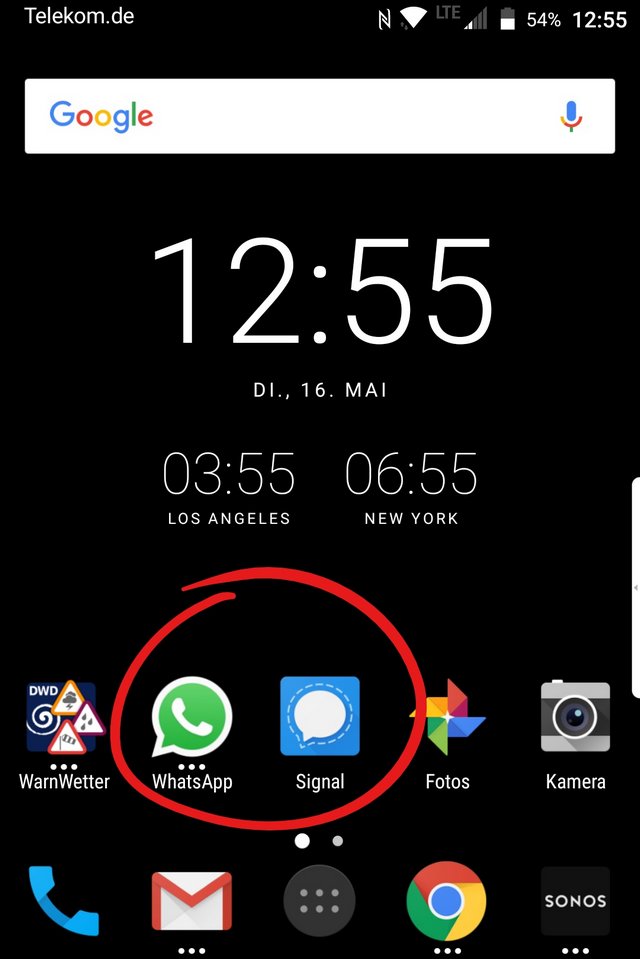
I am currently on the BlackBerry KEYone and will not receive your iMessages. WhatsApp and Signal work fine.

IMG 9828

16 May 18:48

Scattered Attention

by Linda Besner

Recently, I signed up to become a volunteer for an organization that provides community services to women. Before I could start helping anyone, I had to attend a two-day training workshop on “active listening.” The women who used the center’s services, the coordinator told us, as she distributed corpulent black binders, were often trying to make major changes in their lives, and they didn’t necessarily have anyone to cheer them on. The eight other volunteers and I received a list of emotional needs most people have: to feel acknowledged, capable, respected, valued, loved. Each of us would become a dedicated ear — for the hour per week that we would be meeting with our assigned client, she would be our sun and our stars, the central dot in the universe from which everything else flowed.

Scanning the headings and subheadings, I wondered how complicated listening could really be. People often tell me I’m a good listener, which I’ve always taken as a back-handed compliment; it sounds like a role for a loyal golden retriever. The advice in our booklets seemed common sense, but as I read it over, I replayed some of my recent conversations with flashes of uncomfortable recognition: don’t interrupt, don’t attempt to finish the speaker’s sentences, don’t give unsolicited advice, focus on the content of what the person has to say rather than the manner in which they say it. In the UK in the 1980s, psychologist Gerard Egan postulated that to listen effectively, the listener had to cultivate body movements that promoted open dialogue. He came up with the acronym SOLER: Sit straight; Open posture; Lean forward; Eye contact; and Relax. A good listening face is like a Victorian parlour: inviting without being showy.

On the second day of our training session, we were broken into pairs: one person would tell a story, and the other would empty their face of all expression. My partner was planning her wedding, she told me; she described trying on her wedding dress as I looked on with dead eyes. They would be getting married in Puerto Rico, she told me, where her boyfriend was from; I stared into her face, emanating waves of nihilism. Last night, she said, they had practiced their first dance as a married couple; I imagined corpses hanging from the corners of my mouth by their fingers. We both felt terrible.

If formerly private acts of self-disclosure are increasingly being performed in public, formerly private acts of listening have become public as well

My worst exercise was one that involved actually listening and responding to another person talk about a recent experience that mattered to them. My partner was a volunteer originally from Nigeria. She had been quiet in the chatty group of volunteers, and the experience she chose to tell me about was a recent phone call with a friend in the U.S. Our training weekend took place right after the Muslim ban, and the woman told me her friend was frightened. People had different opinions about the ban, she said calmly. I broke in to tell her that she should feel comfortable talking about it openly with me, because of course I was against it. “You should feel free to express anger,” I told her.

When we came back into the larger group to discuss how our conversations had gone, I mentioned that I had found it hard simply to listen as my partner talked about such an upsetting issue. Well, yes, the coordinator said. It could be difficult. But I should think about why I was so keen to express my own feelings about the ban. Was I more interested in proving to my partner that I was a good person than I was in listening to her?

After the training weekend, I thought a lot about my failings as a listener. It turned out to be harder than I expected not to make my listening somehow about myself. At one point, another volunteer turned to me and said, “Oh god — I just realized I never listen to my kids.” I wondered how to apply some of the lessons I had learned to other relationships in my life. Most days, I listen with my eyes and speak with my fingertips. Social networks allow me a degree of exposure to other people’s feelings that has never before been possible, and the emotional content of my days has never been higher. In a 10-minute scroll, I hear people celebrating the publication of their newest poetry collections, remembering the first time they met their husbands, fearing the advances of strange men, discussing the non-accreditation of Inuit school board curricula by Quebec’s provincial government, protesting changes to the Affordable Care Act, and joking about a steamed pudding dessert called Aunty’s Spotted Dick.

Everyone has that one person they don’t know well (or at all) who is sure to like or comment on their every post. Too much unreciprocal attention is the close-talking of the internet — even though we’re at the same party, there are still boundaries we may not even know we’re breaching. A private message is like drawing someone into a quiet corner; commenting on a raucous thread can feel like putting on lipstick at a shared mirror in the party’s bathroom.

In this context, what does it mean to be a good listener? In discussions of serious emotional or political matters, public acts of listening need to be demonstrative so that speakers know someone is listening, but the very conspicuousness required threatens to blow up into performativity. Being seen to be listening not only fails to guarantee authentic listening, it can become the opposite: a way of continuing to center the listener rather than the speaker. Listening done in public, and at a remove, gives us access to a wealth of emotional information; how and whether we show our receptivity can give rise to meaningful connection or can become listening™ — a false front that obscures a continued focus on ourselves.


In an exercise for learning to gauge different people’s levels of comfort with physical proximity, the other volunteers and I stood in two lines and moved slowly towards each other. In another designed to highlight the gap between what we say and what someone else hears, we were given cards with shapes on them and told to describe the shapes well enough for our partners to draw them. “Put your pencil at the top,” I said, “then move it to the right and down, making a sort of semi-circle that ends in a narrowed tip. Then do the same thing on the other side and join up both ends.” One of my listeners managed to deduce a heart shape; the other’s paper showed an indecisive oblong.

Our coordinator had asked us to fill in a diagram with concentric circles representing the emotional distances between ourselves and other people: the first tight circle was populated by the people we felt closest to, and the furthest, widest one was for people we didn’t know at all. Listening over social media requires the ability to inhabit all of these rings at once, and to respond as each of these manifold layers of intimacy requires. Some people use these spaces for a kind of open journaling, confiding experiences they may never have shared face-to-face. One-on-one engagement forms the basis of our idea of friendship, but our idea of community is based on public sharing. If formerly private acts of self-disclosure are increasingly being performed in public, formerly private acts of listening have become public as well.

A standard listening workshop like the one I did, and the ones taking place right now at countless workplaces, non-profits, and parenting seminars, draws on the work of psychologist Carl Rogers, and later research in the Rogerian tradition. In 1954, Rogers published a book with the dimestore thriller name, The Case of Mrs. Oak. Rogers and Mrs. Oak did become something like a team of detectives over the course of their therapy sessions, fumbling together towards an elucidation of a new method of listening. In the early 1950s, the conventional understanding of psychotherapy was that patients would describe their feelings, and then therapists would tell them what was wrong with them. Rogers believed in a new approach and a new kind of listener: someone who would help the person being listened to arrive at a holistic experience of herself and her personality. Sometime during Mrs. Oak’s 30th session, Rogers records, they had the following exchange:

CLIENT: Well, I made a very remarkable discovery. I know it’s – (laughs) I found out that you actually care how this thing goes. (Both laugh) It gave me the feeling, it’s sort of well – “maybe I’ll let you get in the act,” sort of thing … I mean – but it suddenly dawned on me that in the – client-counselor kind of thing, you actually care what happens to this thing. And it was a revelation, a – not that. That doesn’t describe it. It was a – well, the closest I can come to it is a kind of relaxation, a – not a letting down, but a – (pause) more of a straightening out without tension if that means anything. I don’t know.

THERAPIST: Sounds as though it isn’t as though this was a new idea, but it was a new experience of really feeling that I did care and if I get the rest of that, sort of a willingness on your part to let me care.

CLIENT: Yes.

Rogers’ responses are peppered with this kind of formulation — “It sounds as though”; “Let’s see if I can get some of that”; “In other words.” He is repeating back to her (mirroring, as it later came to be called) what she has said, to check if his understanding is correct. They had discovered together, he wrote, that the best way to help someone was not to tell her what to do or explain to her what you saw as the root of her problems; it was to be on her side, and to listen as she engaged in the search for her true self.

The design of online spaces seems to work against the intimacy of effective listening. The immediate tools available for broadcasting my reactions have button faces: I can like or love, feel sad or angry, laugh or be shocked. But these reactions are about naming and sharing my own emotions. They implicitly encourage me to respond by making a public declaration of my sensitivity to the joys or sorrows of others. This framing threatens to make me into the kind of person I most distrust: the kind of person who is always telling people what kind of person they are.

The design of online spaces implicitly encourages me to make a public declaration of my sensitivity to others, threatening to make me the kind of person who always tells people what kind of person they are

And yet all of us have come to know how a lack of response — when a post or tweet vanishes unremarked into the void — feels like negation. It can make you feel lonelier than you did before you spoke. Hitting “like” in response to a comment on your wall is the equivalent of making eye contact with someone who is talking to you. Amplifying the voices of others by retweeting or reposting their content seems better than simply registering your emotional reaction to their speech. But still, the personal brand-building that, however unintentionally, can’t help but accompany these demonstrations of solidarity can make them feel less genuine. Mirroring someone’s feelings can start to feel like appropriating them.


Tellingly, the most visible research into ways of digitally replicating the non-verbal cues associated with listening has come out of the brand management sector. In 2013, Ragan, a corporate communications publisher, ran an article on their site by Allison Stadd (a longtime food marketing strategist, Stadd is currently the director of brand marketing at Sweetgreen, a “fast casual” restaurant chain whose Kendrick Lamar-themed salad, “Beets Don’t Kale My Vibe,” won lavish press attention in 2014). Stadd wrote about how companies could humanize their monitoring of brand mentions online. Marketers needed to stay attuned to customers so they can leverage their free insights and engage them in dialogue. “Twitter,” Stadd wrote, “is a rich resource for such monitoring — ‘listening’ in current parlance.”

The article offers digital analogues for active listening techniques. On making the best practice of open body language work on Twitter, Stadd writes, “One way I can tell off the bat if a brand is a good social listener is through a quick glance at their Twitter stream. If there is not a single tweet starting with an @ mention of another tweep, implying that the entire stream is composed of ‘pushed’ content, chances are, the brand or business is talking at you more than with you.” In assessing the non-verbal cues being broadcast by the speaker, Stadd wrote, “The Twitter equivalent of hand gestures, facial expressions, and the like are the accoutrements to tweets. Think about links, attached photos, videos, and gifs, and the conversational context in which tweets are happening.”

In a staff post entitled, “Three Keys to Smarter Marketing Through Active Listening,” the advertising agency Woodruff Sweitzer explains the difference between “social monitoring” and “social listening” with what they assure us is becoming an old adage: “Monitoring sees trees. Listening sees the forest.” They recommend sifting through what people are saying on social media to identify the pain points associated with your brand, and looking for signs that someone might have potential as a brand ambassador. In 2014, in an article entitled, “Listen, Learn, Earn: Social Listening How-To,” a writer for the brand consultant agency We Are Social admonished, “when it comes to product-related updates, barely one in 10 mentions a specific brand. In other words, if we’re only tracking brand names, we’re missing 90 percent of the potential value; we need to listen out for a broader range of conversations that will help us to gain richer insights into purchase moments, usage occasions, and subsequent emotions.”

The study of listening is rife with possibilities for misuse. In response to data from psychology studies, door-to-door salespeople were often schooled to synchronize their breathing with that of their potential buyers. And Carl Rogers was briefly employed by the CIA to analyze Kruschev’s character and advise the U.S. government on how a deeper understanding of the Russian leader as a person could be used against him. Surveillance is another form of weaponized listening. If knowledge is power, the intimate knowledge that comes with sustained attention to another person’s thoughts, feelings, and character can easily be turned into an instrument of control. In October of 2016, the ACLU reported that a CIA-funded tool called Geofeedia was being used by law enforcement to track Facebook, Twitter, and Instagram posts during the protests after the death of Freddie Gray, sometimes even using facial recognition software to link people photographed protesting with Black Lives Matter to outstanding warrants. Although social media networks quickly blocked Geofeedia from their sites, in an article at The Verge, Russell Brandom pointed out the impossibility of keeping law enforcement from using the same kind of social media listening as the marketing sector: “If Pepsi can use a tool to find disgruntled Coke fans, why can’t police use the same tool to look for rioters and fugitives?”


For most of us, our online world is suffused with an invisible gradient: we’re vaguely aware of who is likely to comment on our posts or tweets, who is likely to acknowledge them, and who may see them. Tweets, status updates, public conversations between other people, and private messages all carry different emotional loads and imply different levels of intimacy. When I read a tweet by an indigenous activist saying, for example, “We need to talk about how to pass on our languages to our children,” I know I’m not the “we” she means. I view these types of conversation, when held on a public forum, as the equivalent of attending a panel discussion — my job is to keep my mouth shut and learn. Much of what we do on social media is not so much listening as listening in; digital forums make it possible for us to overhear conversations that our real life social networks don’t provide. A comment written on my wall versus a private message also make different statements about what level of engagement a speaker wants from me, and about how intimate they want our conversation to be.

One of the great advantages of communication at a distance is the physical impossibility of interruption

Not all listening is meant to be equivalent, and while Rogerian listening techniques are designed to create a specific kind of intimacy, for many interactions, feeling closer to someone is a by-product rather than the goal. Twitter, in particular, runs on inductive reasoning — its users speak such a high-context language that if we aren’t all reading the same news stories it can be impossible to understand what people are talking about. Twitter users often seem to be communicating less that they are listening to each other than that they are engaged in a collective act of listening to the broader culture. Active listening on Twitter is about crafting tweets that demonstrate participation, either in news stories and issues of the day, or in a tonal zeitgeist.

The box-ticking, performative element of public listening on social networks may mean that many of us are overestimating our readiness to participate in meaningful dialogue about some of the difficult issues being discussed. It takes so little effort to click “like” on a post or article sharing a complex emotional and/or political issue that we may confuse these gestures of affirmation with true engagement. Genuine listening isn’t just nodding along or repeating buzzwords. It’s one thing to be able to say “cultural genocide.” It’s another to come to grips with the chasm between someone who has lived this experience and someone who has not.


Rogerian listening was controversial in its day, not because it seemed intrusive, but because it didn’t seem intrusive enough. A famous psychiatry in-joke has a Rogerian therapist repeating back a depressed patient’s suicidal thoughts until the patient jumps out the window, at which point the therapist empathically repeats, “Splat.” Social media has increasingly become a space in which people share their most painful experiences; it may be that the appropriate response is to work harder to change the noxious aspects of society that cause these experiences.

Ultimately, good listening means figuring out what, if anything, the speaker is asking for, and whether you are the right person to offer it. It’s obnoxious to talk to someone as if you think you’re their therapist, and it can reinforce existing hierarchies when a white listener (like me) publicly tells a person of color that their voice is important — assigning value to someone’s expression can imply that my recognition is necessary for that value to exist. “Listening” without sensitivity or invitation can make a person feel less heard, not more.

Other people’s pain can make us uncomfortable, but this discomfort tends to come from an uncertainty about what to do rather than a lack of caring. Some speakers ask for what they want; sometimes the question solves itself with a simple, “Having a shitty day, please send baby goat pics.” Over the course of the past 10 years, I’ve been privy to several gender transitions online, when it has seemed clear that the person undergoing change needs their new identity to be seen and heard. I don’t react to every post or picture, but I try to acknowledge major shifts in feeling being expressed — it seems important to register the good and bad days that come with difficult changes.

One of the principles of active listening we discussed in the workshop was not to try to fit people into unchanging profiles, but instead to allow the person to be inconsistent or to express a range of emotions on a subject. On social networks where our views of each other are both highly crafted and necessarily partial, it can be easy to slot each other into boxes and read all kinds of unintended messages into what is being said. For genuine listening to occur, we have to be able to allow each other to be imperfect and to express ourselves imperfectly.

In significant ways, the disembodied space in which I receive online communications can enhance my ability to follow the rules of effective listening. One of the great advantages of communication at a distance — a quality perhaps more freeing than almost anything else about online interaction — is the physical impossibility of interruption. On Facebook especially, where there is no character limit, the screen acts as a fiercely authoritative mediator, commanding silence until the speaker reaches the end of what they’d like to say. The distribution of attention is by no means equal, but anyone may unburden themselves of their greatest and smallest feelings for however long they wish.


In his 1964 book On Becoming a Person, Carl Rogers spends a surprising amount of time talking about how before he could be an effective listener for someone, he had to come to terms with how what that person was saying made him feel. At first, he had tried to present a positive face to his clients no matter what they said, in order to make them feel safe confiding in him. “But experience drove home the fact that to act consistently acceptant, for example, if in fact I was feeling annoyed or skeptical or some other non-acceptant feeling, was certain in the long run to be perceived as inconsistent or untrustworthy. I have come to recognize that being trustworthy does not demand that I be rigidly consistent but that I be dependably real.”

Before turning to the study of psychology, Rogers planned to enter the ministry. There remains something pastoral about his attentions to his clients, an awareness of the deep mystery at the heart of what it means to be human. He was willing to be changed by these conversations as much as his clients were changed by the time they spent with him. In 1968, Rogers left his job at a Californian non-profit to found an ongoing venture: the Center for Studies of the Person. Listening may seem to be a question of putting oneself aside, but, paradoxically, it also demands a disciplined attention to oneself. In both our online and offline lives, we are constantly engaged in building, questioning, and discovering who we are. With varying degrees of awareness, we are all engaged in the same project, and our social spaces sometimes roil with shared feelings of loneliness and fear as we grapple with the forces, within and without, that prevent us from becoming ourselves. Being dependably real with and for each other means acknowledging that sometimes our listening is flawed.

16 May 18:46

Irony.

by d

A different way to think about what’s going on in the world today and what each of us can do about it.

“America was, Wallace now knew, a nation of addicts, unable to see that what looked like love freely given was really need neurotically and chronically unsatisfied. The effect of Leyner’s fictional approach to life — mutated, roving, uncommitted — like that of Letterman and Saturday Night Live — was to make our addiction seem clever, deliberate, entered into voluntarily. Wallace knew better. And now he was far clearer on why we were all so hooked. It was not TV as a medium that had rendered us addicts, powerful though it was. It was, far more dangerously, an attitude toward life that TV had learned from fiction, especially from postmodern fiction, and then had reinforced among its viewers, and that attitude was irony. Irony, as Wallace defined it, was not in and of itself bad. Indeed, irony was the traditional stance of the weak against the strong; there was power in implying what was too dangerous to say. Postmodern fiction’s original ironists — writers like Pynchon and sometimes Barth — were telling important truths that could only be told obliquely, he felt. But irony got dangerous when it became a habit. Wallace quoted Lewis Hyde, whose pamphlet on John Berryman and alcohol he had read in his early months at Granada House: “Irony has only emergency use. Carried over time, it is the voice of the trapped who have come to enjoy the cage.” Then he continued: “This is because irony, entertaining as it is, serves an almost exclusively negative function. It’s critical and destructive, a ground-clearing….[I]rony’s singularly unuseful when it comes to constructing anything to replace the hypocrisies it debunks. That was it exactly — irony was defeatist, timid, the telltale of a generation too afraid to say what it meant, and so in danger of forgetting it had anything to say.” — D.T. Max., Every Love Story Is A Ghost Story: A Life Of David Foster Wallace

Knowledge and information break down barriers, and make dogma of almost any sort untenable. Religions and Systems of Thought, the “-isms” are all deeply vulnerable to knowledge and information.

This is one of the fundamental reasons why the world is currently in crisis.

The Information Age has given everyone (at least nominally) access to knowledge and information. In the process dogma, particularly but not exclusively religious, was badly damaged. Dogmatic beliefs used to provide an invisible pillar on which people could rely to construct the narrative of their lives. No longer. Absent that, many of us have been left scrambling, confused, and angry.

Once a civilization reaches the point we have, in which information moves with no context or clear purpose, we have to learn to cope with it, dismiss it, or, to put it bluntly, go mad.

This is not a conspiracy, or something that’s planned by anyone at any level, it’s evolution at species-scale, and this process will determine whether we can survive what Carl Sagan called our “technological adolescence.” At the time Sagan was, for good reason, most concerned with nuclear weapons. Since then though, we have added a few more doomsday devices to our arsenal, some of them even scarier, like biological weapons. To add to our neurosis we have also learned about a few more that we didn’t know about even before Sagan died in the 90s. Giant Asteroid? Old news, plus we have Bruce Willis for that. How about the Yellowstone Caldera, aka a Supervolcano? How about a Gamma Burst?

Faced with too much information you can’t do anything about, along with a deluge of changes both large and small, trying to hide and retreat from it is not entirely unreasonable. The so-called opioid epidemic in the US is not only a supply problem. The demand is there for a reason, beyond the pure addictiveness of a drug.

irony_color

XCKD: Irony

A Wave That Started Long Ago

We live at a time when postmodernism (for lack of a better term) has burrowed deep into the back recesses of our brains and taken over, leading to a widespread embrace of irony, cynicism and eventually nihilism as basis of thought and expression.

This isn’t new and it was recognized early and clearly when it was emerging. The ‘cage’ quote from Lewis Hyde was mentioned by Wallace in an interview from 1993:

The irony, self-pity, self-hatred are now conscious, celebrated. […] If I have a real enemy, a patriarch for my patricide, it’s probably Barth and Coover and Burroughs, even Nabokov and Pynchon. Because, even though their self-consciousness and irony and anarchism served valuable purposes, were indispensable for their times, their aesthetic’s absorption by U.S. commercial culture has had appalling consequences for writers and everyone else.

Irony and cynicism were just what the U.S. hypocrisy of the fifties and sixties called for. That’s what made the early postmodernists great artists. The great thing about irony is that it splits things apart, gets us up above them so we can see the flaws and hypocrisies and duplicities. […] Sarcasm, parody, absurdism, and irony are great ways to strip off stuff’s mask and show’ the unpleasant reality behind it. The problem is that once the rules for art are debunked, and once the unpleasant realities the irony diagnoses are revealed and diagnosed, then what do we do? Irony’s useful for debunking illusions, but most of the illusion-debunking in the U.S. has now been done and redone. All we seem to want to do is keep ridiculing the stuff. Postmodern irony and cynicism’s become an end in itself, a measure of hip sophistication and literary savvy. Few artists dare to try to talk about ways of working toward redeeming what’s wrong, because they’ll look sentimental and naive to all the weary ironists. Irony’s gone from liberating to enslaving. There’s some great essay somewhere that has a line about irony being the song of the prisoner who’s come to love his cage.

— Burn, Stephen J., Conversations with David Foster Wallace (Literary Conversations Series) (p. 48). University Press of Mississippi.

What DFW and others identified decades ago has now metastasized: Well-followed Twitter morons “argue” in less than 140 characters that the earth is flat. Basic, plainly observable facts are being disputed with no rationale, and the scientific method has been appropriated and twisted.

The scientific method, a process designed to lead to high, but never absolute, certainty of ideas or a way of looking at the world, has been turned on its head to focus people on the possibility that what science says is not true rather than the high probability that it is.

Ironically, the increasingly widespread notion that there are no objective facts and that therefore everyone has a right to say or think whatever they want under any circumstances has led to reactionary behavior from people of all ages and creeds in which every group dismisses and tries to silence every other group. We can see everywhere the retrenchment of ideologies, a distrust and astonishing lack of curiosity (never mind discussion or acceptance) for things that challenge what we think or believe.

Past Peak Irony

Irony is powerful and perhaps, in some cases and when properly deployed, indispensable.

And yet sometimes it is something that must be actively, consciously fought. Not just when it is explicit but when we are confronted with its consequences, and that of other primarily post-modernist constructs, a pervasive lack of conviction or grounded opinion. It is maddening to me to be in a conversation in which the other person constantly trails off, attaching “like, you know”s and question marks at the end of sentences. We are, apparently, not supposed to have conviction anymore, and language tinted with this construct communicates that clearly. It says: I have nothing invested in this statement.

I wrote about Every Love Store is a Ghost Story a few years ago, saying that it could also have been subtitled “DFW’s Battles With Irony And Addiction,” although it didn’t deal exclusively with that of course, and I used the word “with” carefully, since it doesn’t univocally mean against. Irony and Addiction are somewhat intertwined, I think, and they can both be used as weapons, and they can both turn or be turned against ourselves.

In losing dogma we have lost certainty, but in these early years of the information flood we have embraced irony and replaced certainty largely with lack of conviction.

What we need instead is certainty that emerges from thought and reason instead of dogmatic repetition. We need to regain some measure of strength to our convictions so we are not constantly trying to just shout down whoever says something we don’t like. Each of us can choose whether to turn on the faucet of news and notifications and social networks and drown in it. There’s no easy fix, it’s a learning process. That’s the demand side.

On the supply side there’s many factors, but one of them is technology in general and software in particular. Building consciously and with conscience so that we aren’t simply creating addiction machines, but focusing on people. Creating mechanisms that prevent trolls and morons from dominating the conversation without requiring that they be “blocked” or just silenced. In the real world anyone can be a nut with all sorts of crazy ideas. You are free to just run around in your living room with your body covered in jelly, but you are not free to bring that into my living room, and today’s software tools and architectures usually allow you to do just that. There’s way to fix this, we just haven’t tried them seriously because in many cases they affect “the bottom line.” Which is why turning away from ridiculous models of “engagement” is critical.

That’s our challenge today, and whether we succeed or not will determine more than just who or what dominates the next wave of technology. It will also probably determine our survival, since it’s hard to fix problems if we can’t agree on what the problems are — or whether there is a problem at all.

The same people that built the atomic bomb were integral in creating a world order that would prove successful at containing its ultimate risk. We are seeing a new world emerge out of the information age, and it’s up to us to do the same.


Note: In Impossible I mentioned that the “[…] topic of humanity’s postmodernist funk and our seeming embrace of a zero-sum mentality deserves to be discussed in more detail.” This is the result.

(cross-post from medium)


16 May 18:45

Does Technology Want?

by jennydavis


With advances in machine learning and a growing ubiquity of “smart” technologies, questions of technological agency rise to the fore of philosophical and practical importance. Technological agency implies deep ethical questions about autonomy, ownership, and what it means to be human(e), while engendering real concerns about safety, control, and new forms of inequality. Such questions, however, hinge on a more basic one: can technology be agentic?

To have agency, technologies need to want something. Agency entails values, desires, and goals. In turn, agency entails vulnerability, in the sense that the agentic subject—the one who wants some things and does not want others—can be deprived and/or violated should those wishes be ignored.

The presence vs. absence of technological agency, though an ontologically philosophical conundrum, can only be assessed through the empirical case. In particular, agency can be found or negated through an empirical instance in which a technological object seems, quite clearly, to express some desire. Such a case arises in the WCry ransomware virus ravaging network systems as I write.

The large scale hack has left organizations around the globe unable to access important documents and data as they struggle with a quickly spreading virus that infects networks with ransomware. The virus, variously referred to as WCry, WannaCry, or Wana Decryptor, accesses networks through an unpatched security breach in the Windows operating system that persists on machines that haven’t been recently updated. Infected networks hide files and data behind a demand for substantial payment, threatening to delete important information and up the financial ante if payments are not made. Cybersecurity experts are in a frenzy trying to contain the damage, while affected organizations are scrambling to continue functionality in the absence of electronic systems that are otherwise integral to daily operation. Hospitals have been disproportionately affected, but telecom companies, car factories, and others have been hit as well.

What the virus wants seems straightforward: money—in the form of bitcoin. This desire is made clear through an unambiguous pop-up-window with instructional text and a ticking countdown clock that indicates how much time someone has to comply before the price goes up and files are lost forever.

I argue, however, that the virus doesn’t want anything at all, because it can’t want anything. The virus doesn’t have agency, people do. What the virus has, is efficacy. Agency and efficacy with regard to technological objects are related but distinct constructs, and their place in the WCry incident presents a critical case study in how technologies work.

Ernst Schraube describes technology as materialized action.  It is the material form of agentic moves on the part of designers and users, all of whom are embedded in social, structural, and institutional infrastructures. Designers imbue technologies with particular sets of values—both implicit and explicit—derived from multiple sources, including personal history and biography, cultural trends and norms, and directives from corporate and government entities. In turn, users deploy technologies for intended, unintended, and sometimes highly unexpected purposes. Technologies are built with intention, but once a technology is out there, the makers cannot maintain control.

Schraube’s materialized action is a direct response to Actor Network Theory (ANT), which positions organisms and technologies in horizontal assemblages. In ANT, all parts of a socio-technical system hold equal influence as indicated by the shared moniker of “actant.” The arrangement of chairs, desks, and a lectern, for example, create as much as reflect power distinctions between speakers and listeners. That is, technological objects do something in their own right. Schraube begins with this technological doing posited by ANT, but diverges by prioritizing humans as a disproportionate force in the human-technology web. That is, technology is efficacious—it does something—but not agentic—it wants nothing.   

While ANT would implicate the ransomware as a subject desiring cash and information, Schraube understands that the WCry program is a materialization of competing agentic agendas: intelligence gathering by the U.S. government and financial exploitation by a criminal hacker element. The virus wants to collect neither knowledge nor money, but can efficaciously acquire both.

Spread through a network vulnerability identified and exploited by the National Security Agency (NSA), the virus is imbued with the goals and desires of this government institution. It is a technology of epistemology—a way of knowing—that includes distrust of U.S. and foreign citizens and an arrogant presumption of legitimate access to individual and organizational information via stored files and data.

With the NSA technology stolen and distributed by the group Shadow Brokers, WCry emerges as a money collection system and at the same time, a powerful symbol of organizational penetrability. It demands money while flaunting the porousness of networked systems so integral to the smooth function of public life. In these ways, the program embodies multiple meanings, infused with the agencies of authoritarian forces along with hackers and social disruptors.

These agentic moves—by the NSA, Shadow Brokers, and those who deployed the tool against hospitals, states, and corporate entities—give new agency to an object that was, already, deeply efficacious. MCry’s capacity to do cannot be denied. What it wants, however, cannot disentangle from the people who made, used, and co-opted the technology.

Conceptualizing technology as efficacious but not agentic centers a political orientation towards technology. The makers are agentic. The users are agentic. The objects are, to varying degrees, effective in carrying out maker-user agencies.   What technologies do, then, can only reflect what a particular set of people want. Understood in this way, desirable and undesirable outcomes—or effects—can be named, located, and when needed, changed. Technologies cannot take over the world, as technologies are, always, from and of us.


Jenny is on Twitter @Jenny_L_Davis

Headline Pic Via: Source

16 May 18:45

JP Morgan appears to make good on Brexit threat with new Dublin office

by Jill Treanor
mkalus shared this story from EU referendum and Brexit | The Guardian.

American bank purchases landmark building capable of doubling its Ireland headcount to 1,000 staff

US bank JP Morgan is buying a landmark office building in Dublin in a significant boost for the Irish capital following the Brexit vote.

The new premises will be able to house 1,000 staff – double the number of personnel the US bank currently employs in Dublin. The move is regarded as the first major expansion in Ireland by a financial services firm since the UK’s referendum.

Continue reading...
16 May 18:45

Don’t rejoice in Brexit failings. We remoaners must shape the future | Zoe Williams

by Zoe Williams
mkalus shared this story from EU referendum and Brexit | The Guardian.

Celebrating your enemy’s hubris may be fun, but it’s also a distraction from building strong post-EU alliances

The moment of clarity – self-loathing swinging pendulum-style into self-forgiveness – came while I was reading ComputerWeekly.com. This is not my regular browsing material. I am not sufficiently interested in computers to need even a quarterly bulletin. I’d got there via Twitter, directed by someone probably just like me – metropolitan remoaner, also not interested in computers – for the headline: “Almost three-quarters of tech workers thinking of leaving the UK after Brexit”.

Related: Brexit slowdown fears as industrial output falls and trade deficit grows

Continue reading...
16 May 18:45

UK Brexit boost as ECJ rules trade deals do not require extra ratification

by Jennifer Rankin in Brussels, and Dan Roberts
mkalus shared this story from EU referendum and Brexit | The Guardian.

Surprise ruling confirms EU officials have key negotiation powers in trade talks with approval of state parliaments not needed

The European court of justice has raised a ray of hope for British trade negotiators with a surprise ruling that will make it harder for national parliaments to block key components of any future post-Brexit deal between the EU and the UK.

In a long-awaited test case that had been expected to complicate the Brexit process, the court instead ruled that EU officials had exclusive powers to negotiate international trade deals without ratification by national and regional parliaments.

Continue reading...
16 May 18:45

Merkel ally signals EU open to compromise on UK's Brexit bill

by Daniel Boffey in Brussels
mkalus shared this story from EU referendum and Brexit | The Guardian:
I am having a hunch that this is British tea leaf reading more than anything else.

Manfred Weber says divorce bill is likely to be easier to resolve than issues of citizens’ rights and Irish border

A middle way should “easily” be negotiated between Britain’s claims to have no divorce bill to settle when it leaves the EU and Brussels’ position that the country could owe as much as €100bn, the leader of the largest group in the European parliament has said.

In the first significant sign of a willingness on the EU side to compromise on the highly contentious issue, Manfred Weber, chair of the centre-right European People’s party, of which Angela Merkel is a leading light, suggested the bloc could be open to reducing its initial demands.

Continue reading...
16 May 18:45

Plaid Cymru manifesto promises to protect Wales after Brexit

by Peter Walker Political correspondent
mkalus shared this story from EU referendum and Brexit | The Guardian:
Considering that Wales, next to England, was "Go BREXIT", this is.... interesting and could give May a giant headache not that far down the road.

Leader Leanne Wood says only her party can provide bulwark against dominant Conservatives

Plaid Cymru has launched a manifesto based around more devolution and a fight to protect funding and rights after Brexit, with its leader, Leanne Wood, saying only her party can protect Wales against an otherwise dominant Conservative government.

The 51-page manifesto, titled Action Plan 2017, calls for Wales to maintain free trading links with the rest of Europe after departure from the EU, and for guarantees over the £680m of annual funding a year from EU sources.

Continue reading...
16 May 18:45

Ohrn Image — The Queen Charlotte

by Ken Ohrn

Vancouver’s West End is filled with beautiful old buildings, like the Queen Charlotte at 1101 Nicola.

Thanks to the Vancouver Archives for original photos taken in 1928 by Major Matthews.
Queen.Charlotte

The Queen Charlotte Apartments building was built in 1927 by the Dominion Construction Company (thanks to Memory BC). It was renovated in 1979 by Robert Ledingham and now contains 25 strata condos. A Heritage House Tour in 2015 brought the Courier’s Naoibh O’Connor and photog Dan Toulgoet to the Queen Charlotte.  The quotes from occasional PT contributor Michael Kluckner are well worth finding in the Courier article.


16 May 18:45

Landmark European court case could curtail freedoms of British dual nationals

by Lisa O'Carroll Brexit correspondent
mkalus shared this story from EU referendum and Brexit | The Guardian.

Case could mean EU citizens who become British citizens and keep dual nationality may be unable to bring family members to UK

Judges at the European court of justice have gathered to rule on a landmark case that could have widespread implications for all EU citizens applying for British passports.

The court in Luxembourg will consider whether the British government has breached the family rights of a dual British-Spanish citizen seeking to have her Algerian husband live with her in the UK.

Continue reading...
16 May 18:45

Walmart To Pay $7.5M After Denying Spousal Benefits To Same-Sex Couples

by Chris Morran
mkalus shared this story from Consumerist.

A federal court judge has approved a $7.5 million settlement between Walmart and current and former employees who claimed that the the retailer unfairly discriminated against them by denying health benefits to their same-sex spouses.

The lead plaintiff in the case, a Massachusetts woman who began working at Walmart in 1999, said she repeatedly attempted to add her wife to her Walmart-sponsored insurance plan, but was told the company had a policy of not insuring same-sex couples.

As a result she claimed that her wife had to purchase more expensive insurance on the individual marketplace — coverage that was lost while the spouse was undergoing costly treatments for ovarian cancer.

Even after the Supreme Court struck down the Defense of Marriage Act in 2013, opening up federal tax and insurance benefits to same-sex couples, the plaintiff said that Walmart still maintained its policy of denying benefits to same-sex spouses.

Walmart eventually changed its policy in 2014, but by then the plaintiff said her family had tallied $150,000 in medical debt because of the retailer’s refusal to offer the same benefits available to male-female married couples.

The employee filed a complaint with the federal Equal Employment Opportunity Commission, which determined in Jan. 2015 that Walmart had discriminated against her based on gender, since the health insurance she sought “would be provided if she were a woman married to a man.”

She then brought this lawsuit [PDF] against her employer, alleging violations of federal civil rights law and state employment laws, and seeking to represent other Walmart workers who had similarly been denied coverage for their spouse.

Walmart and the plaintiff reached a settlement [PDF] in April that would pay out a total of $7.5 million to the whole plaintiff class. The judge in the case approved the settlement on Monday.

Once the attorneys have been paid, the more than 300 or so plaintiffs will split the remaining $5.5 million.

U.S. District Judge William G. Young said the award is fair and reasonable, reports the Boston Globe.

“This was a carefully crafted and sensible resolution of a complex matter, and it reflects well on the parties from both sides,” he said from the bench on Monday.

The settlement also ensures that Walmart won’t revert to its prior policy of excluding same-sex spouses from its health insurance plan.

The lead plaintiff said in a statement that she’s pleased Walmart has resolved the issue for her and others who are in same-sex marriages.

“It’s a relief to bring this chapter of my life to a close,” she said.

Walmart also said it’s happy that both sides could reach a resolution.

“We will continue to not distinguish between same and opposite sex spouses when it comes to the benefits we offer under our health insurance plan,” Sally Welborn, senior vice president for the company, said in a statement.


16 May 18:44

Instagram Launches Snapchat-Style Face Filters and More

by Ryan Christoffel

Instagram has announced several new features rolling out today, chief of which is another major borrow from Snapchat:

Today, we’re introducing face filters in the camera, an easy way to turn an ordinary selfie into something fun and entertaining. Whether you’re sitting on the couch at home or you’re out and about, you can use face filters to express yourself and have playful conversations with friends.

From math equations swirling around your head to furry koala ears that move and twitch, you can transform into a variety of characters that make you smile or laugh. To see our initial set of eight face filters, simply open the camera and tap the new face icon in the bottom right corner.

The initial batch of eight filters is smaller than what's available on Snapchat, and it remains to be seen how often new filters will be added, but I wouldn't be surprised if we see a lot more growth in this area. Snapchat's advantage is not only in the number of filters, but also in its recent expansion of filtering technology in the form of World Lenses – and Instagram has made clear its commitment to beating Snapchat at its own game.

Also launching today is a new "Rewind" camera format to play videos in reverse, a hashtag sticker that can be used when crafting Instagram Stories, and a new eraser brush to complement the set of existing drawing tools.


Support MacStories Directly

Club MacStories offers exclusive access to extra MacStories content, delivered every week; it’s also a way to support us directly.

Club MacStories will help you discover the best apps for your devices and get the most out of your iPhone, iPad, and Mac. Plus, it’s made in Italy.

Join Now
16 May 18:44

Scientists alarmed to find tiny island in the middle of the Pacific littered with highest density of trash in world

mkalus shared this story from Comments on: Scientists alarmed to find tiny island in the middle of the Pacific littered with highest density of trash in world.

WELLINGTON, New Zealand — When researchers travelled to a tiny, uninhabited island in the middle of the Pacific Ocean, they were astonished to find an estimated 38 million pieces of trash washed up on the beaches.

Almost all of the garbage they found on Henderson Island was made from plastic. There were toy soldiers, dominos, toothbrushes and hundreds of hardhats of every shape, size and colour.

The researchers say the density of trash was the highest recorded anywhere in the world, despite Henderson Island’s extreme remoteness. The island is located about halfway between New Zealand and Chile and is recognized as a UNESCO world heritage site.

Jennifer Lavers, a research scientist at Australia’s University of Tasmania, was lead author of the report, which was published Tuesday in “Proceedings of the National Academy of Sciences.”

Jennifer Lavers via AP

Jennifer Lavers via AP In this 2015 photo provided by Jennifer Lavers, plastic debris is strewn on the beach on Henderson Island.

Lavers said Henderson Island is at the edge of a vortex of ocean currents known as the South Pacific gyre, which tends to capture and hold floating trash.

“The quantity of plastic there is truly alarming,” Lavers told The Associated Press. “It’s both beautiful and terrifying.”

She said she sometimes found herself getting mesmerized by the variety and colours of the plastic that litters the island before the tragedy of it would sink in again.

Lavers and six others stayed on the island for 3 1/2 months in 2015 while conducting the study. They found the trash weighed an estimated 17.6 tons and that more than two-thirds of it was buried in shallow sediment on the beaches.

Lavers said she noticed green toy soldiers that looked identical to those her brother played with as a child in the early 1980s, as well as red motels from the Monopoly board game.

Jennifer Lavers via AP

Jennifer Lavers via APWhen researchers traveled to this tiny, uninhabited island in the middle of the Pacific Ocean, they were astonished to find an estimated 38 million pieces of trash washed up on the beaches.

She said the most common items they found were cigarette lighters and toothbrushes. One of the strangest was a baby pacifier.

She said they found a sea turtle that had died after getting caught in an abandoned fishing net and a crab that was living in a cosmetics container.

By clearing a part of a beach of trash and then watching new pieces accumulate, Lavers said they were able to estimate that more than 13,000 pieces of trash wash up every day on the island, which is about 10 kilometres (6 miles) long and 5 kilometres (3 miles) wide.

Henderson Island is part of the Pitcairn Islands group, a British dependency. It is so remote that Lavers said she missed her own wedding after the boat coming to collect the group was delayed.

We need to drastically rethink our relationship with plastic

Luckily, she said, the guests were still in Tahiti, in French Polynesia, when she showed up three days late, and she still got married.

Lavers said she is so appalled by the amount of plastic in the oceans that she has taken to using a bamboo iPhone case and toothbrush.

“We need to drastically rethink our relationship with plastic,” she said. “It’s something that’s designed to last forever, but is often only used for a few fleeting moments and then tossed away.”

Melissa Bowen, an oceanographer at the University of Auckland in New Zealand who was not involved in the study, said that winds and currents in the gyre cause the buildup of plastic items on places like Henderson Island.

“As we get more and more of these types of studies, it is bringing home the reality of plastic in the oceans,” Bowen said.

16 May 18:44

British Columbians do not want a Liberal-Green coalition: Poll

mkalus shared this story from Vancouver Sun.

VANCOUVER, B.C. APRIL 26, 2017 -- From left, B.C. Liberal Leader Christy Clark, Green party Leader Andrew Weaver and NDP Leader John Horgan pose before the televised leaders debate on April 26, 2017. Photo: B.C. Broadcast Consortium [PNG Merlin Archive]

Poll respondents would prefer for Green party leader Andrew Weaver to team up with NDP to form next government if the May 9 election results don't change. BC Broadcast Consortium / PNG

The majority of British Columbians oppose the idea of a Liberal-Green coalition government, according to a new Mainstreet/Postmedia poll.

The Liberals won a total of 43 seats in last Tuesday’s B.C. election, one short of the 44 needed to form a majority government. The NDP won 41 seats and the Greens won three.

If the situation after next week’s recounts and counting of absentee ballots continues to point to a minority, a poll conducted by Mainstreet Research indicates that just 27 per cent of British Columbians would approve of a Green-Liberal coalition.

The majority of respondents, 58 per cent, said they would prefer the Green party to work with the governing party on a issue-by-issue basis rather than joining a formal coalition. 

If there were to be a coalition, however, the preference was overwhelmingly for the Greens to work with the NDP — with 57 per cent saying they would approve.

The poll indicated a large segment of voters are still unsure of how they feel about the outcome.

According to a poll conducted by Mainstreet Research over the weekend, nearly one in five of B.C. voters (19 per cent) say they don’t know how they would vote if they were given the chance to do so again.

In Metro Vancouver, where 37 per cent of voters said they would vote NDP (versus 30 per cent for the B.C. Liberals and 15 per cent for the Greens), 18 per cent said they were “undecided” on which party they would support if given another chance.

UBC political science professor Max Cameron saw two different possible reasons for this post-election ambivalence.

“One would be because it was an indecisive outcome,” he said, pointing to the lacklustre nature of the overall campaign, with all three parties seemingly on script. Voters just don’t know what the result is at the moment, and aren’t sure how they really feel.

The other was “something analogous to sticker shock,” he said. “There might have been Greens who voted NDP out of fear of splitting the vote and now aren’t sure.”

He also noted the frustration with the outcome among NDP supporters: 57 per cent said they were either somewhat unsatisfied or very unsatisfied with the outcome. (Overall, 49 per cent of British Columbians said they were very satisfied or somewhat satisfied with the outcome, with seven per cent not sure.)

“They’re feeling the victory was snatched away,” he said. NDP supporters were done with the B.C. Liberals being in power and wanted to see a decisive switch in power. But Cameron cautioned against thinking the outcome came about because of the Greens splitting the vote.

“My interpretation is there’s more disaffected Liberal voters who found a home with the Greens than anything else,” he said.

That is seen in the poll’s overall picture: an electorate that was very dissatisfied with the Christy Clark government, as just 28 per cent of voters said they would like to see the B.C. Liberals returning to government. Instead, the clear preference is for the NDP: 51 per cent said it was time for the centre-left party to form government, with a further 21 per cent calling for the Greens to be in charge.

Mainstreet surveyed a random sample of 1,650 British Columbians from May 11-13. The margin of error for survey results is plus-minus 2.41 percentage points, 19 times out of 20.

pjohnston@postmedia.com

twitter.com/risingaction

16 May 18:44

Starbucks Registers Reportedly Down, Some Locations Giving Out Free Coffee

by Ashlee Kieler
mkalus shared this story from Consumerist.

If you were able to pick up your morning cup of joe from Starbucks today count yourself lucky, as some of the coffee chain’s locations were closed Tuesday thanks to a reported payment system outage. 

Starbucks customers began reporting the outage on Twitter Tuesday when they arrived at their local coffee shop only to find it closed or otherwise unable to do business.

While Starbuck itself hasn’t addressed the closures on Twitter, CNBC reports that the outage is tied to a failed system update.

“As part of our normal course of business, overnight we worked to install a technology update to our store registers in the U.S. and Canada,” the company said in a statement.  “A limited number of locations remain offline, and we are working swiftly to resume full operations in each of these stores.”

We’ve reached out to Starbucks for additional details. We’ll update this post if we hear back.

While several specific locations have posted signs noting that their systems were down, some customer expressed their frustration at showing up to closed stores to pick up mobile orders.

Still, not everyone left Starbucks empty-handed. Some customer reported that their local shops were giving away free coffee and food as an apology of sorts.


16 May 18:44

kvetchlandia: John Deakin     Poet Oliver Bernard, London    ...


kvetchlandia:

John Deakin     Poet Oliver Bernard, London     1952


waking at five or so to white
sky and various bird beginnings
from exhausting dreams of past
emotional encounters I can
rest at last in a small room

lying still considering
whether to go back to sleep
seeing the sky go colours of
sunrise I begin to wonder
how the tree looks and the wall

downstairs in the shadow of
the houses sleepers lie asleep
in Kenninghall in diss in Mellis
bliss behind the children’s eyelids
all alone in morning silence

what is peace if it is not
loving indiscriminately
others? watching over all
human sleep and knowing there’s
no need and every need to do so?

what is peace but watching while
being loved and cared for by
the very clouds and trees and grass
nourishing earth and the candid sky
breakneck rivers rising tides?

newspapers at seven o'clock
are laying on the day the grey
word of war and world of worry
all I want’s a weather forecast
promising there’ll be more weather

–Oliver Bernard, “Peace” 


what is peace if it is not
loving indiscriminately
others? watching over all
human sleep and knowing there’s
no need and every need to do so?

what is peace but watching while
being loved and cared for by
the very clouds and trees and grass
nourishing earth and the candid sky
breakneck rivers rising tides?

16 May 18:34

Neera Tanden et al | Toward a Marshall Plan for America

Neera Tanden et al | Toward a Marshall Plan for America:

The economy is not producing access to a good, stable middle-class life for people who do not go to college. On prudential and ethical grounds, progressives must do more to create decent job opportunities and secure family situations for all working people facing difficult economic conditions not within their control.

16 May 18:34

NY Times | Agreements That Lock Up Workers, Legally

NY Times | Agreements That Lock Up Workers, Legally:

More game rigging:

Proponents of noncompete agreements might argue that lawmakers don’t need to intervene because these are private contracts between consenting adults. But researchers say many workers are not aware that they are subject to such agreements, which are often buried in documents they sign when hired. Often, people are not told that they will have to sign until they have accepted jobs, at which point they may not be able to walk away. Even workers who recognize the perils might see no choice but to consent because they need a job.

State and federal lawmakers should adopt reforms like those the Obama administration recommended last year. For instance, state legislatures and Congress can make noncompete agreements unenforceable when they are applied to employees who earn less than, say, $56,500 — the median household income in 2015 — or to workers who do not have access to trade secrets. They can make contracts unenforceable when businesses lay off or fire workers without cause. States can also require employers to present noncompete agreements before candidates accept jobs.

The spread of noncompete agreements is one of many ways in which the workplace has been rigged against workers and why household incomes have stagnated in recent decades. Other examples include the use of mandatory arbitration clauses in employment contracts and concerted efforts by businesses to diminish the role of labor unions. All elected leaders, especially those like President Trump who claim to represent the interests of working people, need to fight such unfair and unjust practices.

16 May 18:34

Nicole Perlroth | Web Defenders Detect Russian Hand in Iranians’ Hacking Attempt

Nicole Perlroth | Web Defenders Detect Russian Hand in Iranians’ Hacking Attempt:

While foiling an attack on a military contractor, investigators watched Iranians use a tool that had also been deployed to compromise Ukraine’s power grid.

16 May 18:34

Phil Libin exits General Catalyst for All Turtles, a new AI ‘startup studio’

16 May 18:34

The Pentagon’s New Algorithmic Warfare Cell Gets Its First Mission: Hunt ISIS

16 May 18:34

Google to Push AI Smarts to iPhone, New Photo Books Service

16 May 18:32

Instagram goes full Snapchat, adds face filters, hashtag stickers and rewinding video

by Igor Bonifacic
Instagram

It seems it was only a matter of time before Instagram went full Snapchat.

On Tuesday, the Facebook-owned company added one of its competitor’s most iconic features to its popular photo- and video-sharing app, face filters.

Instagram Face FIlters

Once users update to the latest version of the app, 10.21, they can access the added filters by tapping on a new icon located on the bottom right of Instagram’s photo and video capture interface. At launch, there are eight filters for selfie mavens to check out. Moreover, several of the filters work with multiple individuals in the frame, and all of them are compatible with the Instagram’s looping Boomerang format.

Additionally, users can add stickers, drawings, and text to pictures that feature face filter to make them even more interesting.

That’s not all, however, as Instagram is also introducing several other new tools for people to use to spice up their photos and videos.

Instagram Rewind

The most notable of which is a new ‘Rewind’ mode that plays videos in reverse. Like the app’s other tools, Rewind can be combined with face filters. The company is also adding what it’s calling Hashtag stickers. Users can add a hashtag sticker to a picture or video. When a person taps on them, they can see related posts. Lastly, the company has added a new eraser tool that allows users to selectively remove colour from their pictures.

Instagram Eraser Brush

All of these features are rolling out today and over the next couple of days to users across the globe.

Source: Instagram

The post Instagram goes full Snapchat, adds face filters, hashtag stickers and rewinding video appeared first on MobileSyrup.

16 May 18:32

Wattpad cuts 10 percent of staff and shifts focus to machine learning capabilities

by Jessica Galang
wattpad

Toronto-based Wattpad has laid off 10 percent of its staff, or 15 people.

All departments were affected by the layoffs, including product and engineering, marketing, and HR. The company says its “strategic realignment” will balance the needs of its current business while allowing it to focus on emerging technologies.

In a statement sent to BetaKit, CEO Allen Lau said that the move will allow the company to focus on four areas: emerging products, machine learning, data science, and Wattpad Studios. The company will hire in these areas over the coming months.

Lau first outlined this focus in a blog post in November 2016. At the time, Lau said the entertainment industry was challenged with finding its next big hits through the traditional focus-group approach, and that products like Snap Spectacles were creating new opportunities for entertainment. “As machine learning advances, we will be able to identify the next Harry Potter before anyone else and even help the story gain traction among the community,” Lau said.

Lau said that Wattpad is “well on its way” to becoming a machine learning-first entertainment company. He said that when Wattpad launched 10 years ago just before the launch of the first iPhone, its key differentiators were mobile and social. Today, Lau says its key differentiator must be machine learning.

“Machine learning will help us become more efficient (i.e. community moderation), as well as seize even more opportunities to spot hits-in-the-making and co-produce stories with our partners in the traditional entertainment industry for other formats,” Lau said. “Just one year in, the Wattpad Studios model is proven, and we already have incredible traction with some leading brand partners. We need to double down on this.”

Lau also pointed to the success of its new Tap by Wattpad offering as an example of why they need to invest in emerging platforms. “People still love to connect through stories, but we need to package up stories in new and interesting ways — like video and VR — to keep people coming back. We recently announced a video partnership with Mashable, and have others interesting partnerships announcements on deck.”

The company, which has 55 million users on the platform every month, has been vocal about its mission to be a multi-platform entertainment company. In April 2016, the company launched Wattpad Studios with the specific goal of partnering with the entertainment industry to co-produce Wattpad stories for film and television. Since then, the company has announced partnerships with companies like Turner, NBC Universal, Paramount Pictures, and Simon & Schuster.

The company also works with brands through its Brand Solutions and has encouraged its own writers to write for companies like General Electric, H&M, and Coca-Cola.

To help with the transition, Wattpad is sharing the names of those affected by the layoffs with their investor portfolio companies. “With the thriving startup community we have in the city, I am confident their expertise will benefit other local companies scale. Wattpad won’t be here today if it weren’t for their contributions and we will offer them our full support moving forward,” Lau said.

This article was originally published on BetaKit.

The post Wattpad cuts 10 percent of staff and shifts focus to machine learning capabilities appeared first on MobileSyrup.

16 May 18:31

Samsung has sold more than 5 million Galaxy S8 and S8+ smartphones

by Igor Bonifacic
Samsung Galaxy S8 smartphone

Since the Galaxy S8 and S8+ first launched in South Korea, the U.S. and Canada on April 21st, Samsung has sold more 5 million units of its latest pair of flagship smartphones, according to South Korea’s The Investor.

Samsung did not break down sales by region, but did note, in an interview with the publication, “sales are going smoothly around the globe. The combined sales already are beyond 5 million units.” To put that number in perspective, Samsung had shipped 2.5 million Note 7 units before it issued its first recall of the device. The company had managed to achieve that feat in little less than a month. The Galaxy S8, by comparison, has been available to purchase for exactly 25 days.

With the S8 and S8+ scheduled to become available in more than 150 countries, including China, by the end of the month, sales are expected to continue growing at a healthy clip.

Source: The Investor

The post Samsung has sold more than 5 million Galaxy S8 and S8+ smartphones appeared first on MobileSyrup.