Shared posts

17 May 21:47

BlackBerry KEYone :: Are you in the target audience?

by Volker Weber

IMG 9829

It's interesting to see how Android reviewers struggle with the KEYone. Most start out with the hardware keyboard and quickly reason that BlackBerry is passé. How uncool! What is the KEYone really? It's an Android Phone with some midrange components (SD 625, 3 GB RAM, 32 GB storage), an excellent camera chip (same as Pixel), a huge battery (3500 mAh), a small screen (4.5" 1080x1200 pixel), all packaged in a sturdy aluminium frame, but without dust or water protection.

We cannot get far with looking at the hardware specs. So what does it feel like?

  1. It feels right. Kind of heavy for its size. Narrower than a PRIV but the same height when the slider is closed.
  2. The keyboard is a BlackBerry keyboard, much like the Classic, not like the PRIV.
  3. The materials are right. Nothing lies. No fake leather or fake metal.
  4. I can hold it comfortably and use it with one hand. Non-slip back.

Are you faster with a hardware keyboard? I am not. A Windows Phone keyboard or an iPhone keyboard feel more natural to me, and I am faster on them. And I am a BlackBerry user, so I know to press Alt-P for an @. If you have to learn the keyboard, you will be slower. Plus, I use voice-to-text a lot. So I don't type as much as I used to. The benefit is that you don't have to look at the keyboard. You can type away and just look at your text. It won't have emojis or stickers. Just plain old text.

You are in the target audience if you had a BlackBerry once and remember the no nonsense character. If you have old muscle memory for the keyboard. And you get the versatility of the Google store and the protection BlackBerry provides for Android. If that suits you well, you may want one. But be careful. An iPhone is a much safer bet. There is zero probablity that Apple abandons you, there are tons of accessories, and if you break it, you will find help around the corner.

KEYone shipped with Android 7.1.1 and April 05 security patch level. I expected it to download and install May 05, but it does not. BlackBerry Mobile has committed itself to monthly security updates for a minimum 24 months from launch.

17 May 21:47

Has Seattle Reached Peak Car?

by pricetags

A ‘data column’ from the Seattle Times.  (Note the irony of the header.)

Has Seattle reached “peak car”?

When it comes to the rate of ownership, it sure looks that way.

Census data show that from 2010 to 2015, the percentage of Seattle households that own a vehicle declined — that’s noteworthy because it’s something that hasn’t happened in decades.

I checked the data back to 1970. Car-ownership rates have creeped up every 10 years, right through to 2010. That year, 84.6 percent of city households owned at least one vehicle.

But suddenly, that number is dropping. As of 2015, it’s down by about 1 percentage point. And that’s almost entirely because of one group.

Seattle Times 2

It’s a combination of economics and priorities, says Mark Hallenbeck, director of the Washington State Transportation Center at the University of Washington. As Seattle housing costs go through the roof, he says, cars are one expense that many young city dwellers are willing to sacrifice.

“If you get away from the high set of fixed expenses that go with owning a car — monthly payments, parking, insurance — you can pay for the apartment that allows you to live on Capitol Hill,” he said. “You can go out to bars to meet your friends, and you can get around everywhere you need to go.” …

A deeper look at the numbers shows that from 2010 to 2015, under-35 households without a car in Seattle — there are more than 17,000 of them — increased at a 10 times faster rate than those that do have at least one car.

That said, cars aren’t going away anytime soon in Seattle, a city that famously loves its Subarus and Priuses. Many Seattleites, even if they don’t drive much, still want to own a set of wheels for weekend excursions.

And in terms of the raw number of cars, Seattle probably hasn’t hit its peak. Even though carless households are growing faster, households with cars are still increasing, including those that own multiple cars. These forces pushed the city’s car “population” to 435,000 in 2015.


17 May 21:47

The Big O

by Eugene Wallingford

I recently ran across a newspaper column about triple-doubles, a secondary statistic in basketball that tracks when a player reaches "double figures" in three of the major primary stats. The column included this short passage about the great Oscar Robertson:

You probably know that Robertson averaged triple-doubles for an entire season, 1961-62. But did you know that he averaged triple-doubles over the cumulative first five seasons of his NBA career, from 1960-61 through '64-65? In that stretch Robertson averaged 30.3 points, 10.4 rebounds, and 10.6 assists.

This is indeed an amazing accomplishment. But it was not news to me.

I grew up in Indiana, a hotbed of basketball, with the sort of close personal attachment to Robertson that only a young sports fan can have. Like me, the "Big O" was from Indianapolis. He had led Crispus Attacks High School to two straight state championships in the late 1950s and helped lead the University of Cincinnati to national prominence in the early 1960s. When I first became aware of basketball as a young boy, Robertson was deep into a stellar pro career. He was one of my early sports idols.

Later, Robertson and his legacy played an unexpected role in my life. When I interviewed for the scholarship that would pay my way through college, I found that the interviewer, the dean of the Honors College, was a former Division III basketball player from Michigan who had gone on to earn a PhD in history from the University of Maryland. Our conversation quickly turned to basketball and our mutual admiration for the Big O, but it was not all sports talk. Robertson's career as a black player in the 1950s and '60s launched us into a discussion of urban segregation, race relations, and the role of sport in culture.

After the interview, I wondered if it had been wise tactially to talk so much about basketball. I guess the conversation went well enough, though.

Folks today can have Michael Jordan and LeBron. They are undeniably great players, but Oscar Robertson will always be my standard for all-around play -- and a touchpoint in my own life.

17 May 21:46

Death Spiral for Big Oil and Big Auto

by Stephen Rees

I have taken a chunk out of the title of the original article in the National Post.

All fossil-fuel vehicles will vanish in 8 years in twin ‘death spiral’ for big oil and big autos, says study that’s shocking the industries

That’s a pretty big title – but the article itself is long – and the Good News is that you can actually download the report in question and read it for yourself.

There are two things happening at the same time – the rise of the electric vehicle and the imminent prospect of cars that drive themselves. Put those two together, and people will give up owning an expensive internal combustion engine behemoth and take a ride in a shared autonomous vehicle – which may even have no cost to the user for the trip.

Obviously this kind of disruption is going to have huge knock on effects, and not surprisingly the report itself has plenty to read without getting into the details of what this does to cities that already experience traffic congestion and rely on public transit systems. One thing that I see is that if you can get a free ride in a self driving Uber then there is going to be a lot more vehicle trip kilometers than there are now. Our urban systems are already stressed at peak periods – and while these cars will have better occupancy and utilisation rates than the present fleet, they will still be competing for a finite amount of road space at peak periods and the simple geometry of traffic congestion will not have changed at all. So there will still need to be transit – and if there isn’t a need for a driver there may still need to be a chaperone!

Anyway for right now I have a report to read Rethinking Transportation 2020-2030 PDF file.

And there’s this right up front

We invite you to join our community of thought leaders and experts to better inform this conversation. To learn more, please visit www.rethinkx.com.

One thing we seem to be getting quite wrong is the idea that we will need pipelines to export Alberta’s very expensive to produce bitumen. Building the Kinder Morgan expansion for a very limited life seems very wasteful to me. Much better to embrace the change and start getting ready for what’s coming anyway.

U.S. producers will be hit the hardest by the volume effect, as almost 15 million bpd of US oil — or 58% — will become uncommercial to produce at $25.4 cash cost. Likewise, more than half of oil production in Canada, Brazil, Mexico, Angola and the U.K. will be stranded.


Filed under: Transportation
17 May 21:46

The Trans Canada Trail has become a dangerous hoax

by dandy


The Great Trail Fail

by Edmund A. Aunger

~ This story originally appeared in Alberta Views magazine on April 26, 2017 ~

Shortly after noon on July 29, 1985, a careless driver reaching for a dropped cigarette veered onto the shoulder of the Trans-Canada Highway near Calgary, slamming into a group of teenage cyclists headed to Kananaskis for a camping holiday. He killed three and injured six.

A horrified witness, Bill Pratt, president of the organizing committee for the 1988 Calgary Winter Olympics, resolved then and there to spearhead the development of a trail system for non-motorized activities such as hiking, cycling and horseback riding. Four years later, on March 21, 1989, while speaking at a trail-planning meeting, he observed that Calgary and Kananaskis had some of Canada’s best bike paths but lacked a secure connecting route. His proposal to link such paths marked the birth of our “New National Dream,” a cross-country trail that would be safe and accessible for ordinary Canadians. Interviewed by the Calgary Herald, Pratt stated emphatically: “I don’t want to see any more cars plowing into cyclists.”

The non-profit Trans Canada Trail Foundation organization launched in 1992 as part of Canada’s 125th anniversary celebrations. Pratt was president; Pierre Camu, a former president of the Royal Canadian Geographical Society, became board chairman. Riding a wave of optimism, the new foundation described the Trans Canada Trail as a millennium project, to be completed by July 1, 2000. Later, as unanticipated obstacles accumulated, this target was extended to July 1, 2017, Canada’s 150th birthday. Canada already possessed many excellent pathways, making up 20 per cent of the planned trail, and Pratt envisioned quickly and economically linking them by “recycling” abandoned rail corridors.

At its best, the Trans Canada Trail would be six metres wide and include two parallel pathways to accommodate hikers, cyclists, roller-bladers, wheelchairs, horses and—in winter—cross-country skiers. The east–west route would feature a hard surface in high-use areas, to be extended eventually across the country. Part of the northern route, passing through Edmonton and Inuvik to the Arctic Ocean, would include a waterway, the Mackenzie River. During winter months, snowmobiles might be permitted in remote regions not accessible to hikers or cross-country skiers. The trail would be dotted at regular intervals with shelters and, when necessary, campsites.

Although the founders waxed eloquent about the trail’s potential to foster unity and stimulate tourism, they placed special emphasis on public safety. Pratt insisted that the trail be built far enough from roads to mask traffic noise and avoid collisions. According to David Hargrave, then Alberta TrailNet coordinator, automobile accidents involving cyclists and pedestrians motivated many people to join the Trans Canada Trail movement. He told the Herald in 1994: “We don’t want it along a highway or in a ditch. We want the whole thing to be like a park.” Safety-minded organizations, including the RCMP and the Canadian Truckers Association, quickly endorsed the project.

Like many Canadians, my wife Elizabeth was an early and enthusiastic supporter of the Trans Canada Trail. We made charitable donations, “bought” metre-long sections, acquired logoed merchandise, purchased maps and guidebooks and became card-carrying “Trail Builders.” We eagerly anticipated a world-class greenway that would connect communities, foster healthy lifestyles, respect environmental values, encourage active transportation and, most importantly, provide a safe travel route for pedestrians and cyclists.

Elizabeth firmly believed motor vehicles pose an extreme danger to cyclists on roadways—it is a self-evident truth. When she agreed to accompany me each summer on a three-week cycling holiday, she set one solemn condition: no roads. Sensible and careful, very safety-conscious, she refused to risk her life by venturing onto routes used by motor vehicles. I thought her fears were exaggerated—I’d been riding on busy streets and highways without incident since childhood—but I was happy to acquiesce. It was the least I could do. Since our first meeting at age 12, she had been the love of my life.

For almost a decade I planned our annual trips meticulously, poring over detailed maps and trail guides, methodically marking out our daily itinerary. We pedalled in Europe—England, Scotland, Ireland, France and Slovakia—and in alternate years our home country, Canada. Here we travelled on the Trans Canada Trail, widely advertised as a safe and scenic coast-to-coast-to-coast greenway, but where—much to our consternation—the official guidebooks repeatedly took us on perilous journeys along motorized thoroughfares and highways. Until one sunny afternoon in Prince Edward Island in 2012, when Elizabeth was struck down by a tradesman’s blunt-nosed van and died on a lonely rural roadside.

I struggled desperately to survive devastating trauma—but also to comprehend the tragic failure of Canada’s much-vaunted trail-building dream. Deep down I already knew the answer but wouldn’t admit it, until a long-suffering trails official quietly confided: “Ed, the emperor has no clothes.” The Trans Canada Trail—pretentiously renamed “The Great Trail” in 2016—has become little more than a dangerous hoax. It is not a greenway; it is a motorway. How did this happen? What went wrong?

The TCT FOUNDATION proposed to achieve their awe-inspiring dream for a new national transportation corridor by taking a page from Calgary’s successful Olympics: It would rely on volunteers, private donations and corporate sponsorships. This strategy had generated $450-million in recreational facilities for Calgary; Pratt believed it would produce $440-million in non-motorized trails for Canada. Governments—federal, provincial and municipal combined—would assume only a tenth of the total cost.

Unfortunately this model soon proved inadequate. In a sparsely populated country with large stretches of uninhabited wilderness, there is often no local community to provide volunteer labour. Nonetheless Deborah Apps, president and CEO of the TCT organization, says the project “is very much a grassroots endeavour,” dependent on “local, and often volunteer, trail builders.”

Equally problematic, however, has been rural opposition. The Trans Canada Trail currently passes through nearly 1,000 municipalities and more than 15,000 communities which, quite naturally, give priority to local needs, not national projects. Why should they put resources into a trail intended for outsiders? (Only effete urbanites ride bicycles, I have been told; rugged rednecks drive quads.) They also have concerns about property ownership, liability, maintenance and potential trespassing.
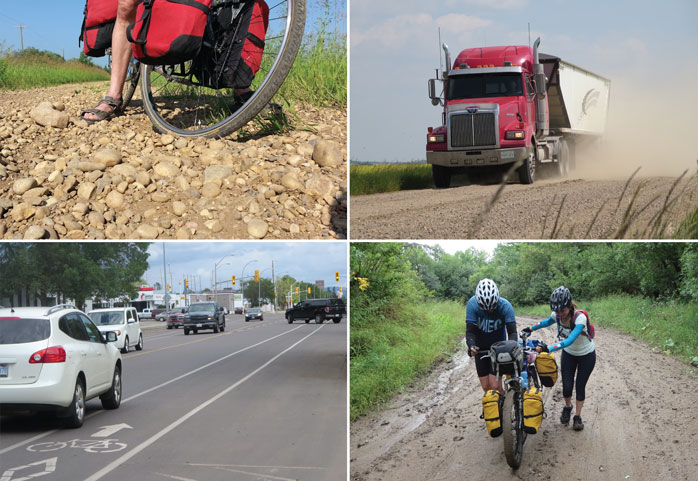
Top L to bottom R: The Trail at Waskatenau, AB and Prince SK; Thunder Bay, ON and Stanley Park, MB

In Alberta, for example, rural protests led to the shelving of a proposed Calgary–Edmonton trail to be built on the 303 km Irricana–Drumheller–Camrose railbed at an estimated cost in 2000 of $6.3-million. Although CP Rail donated a section between Irricana and Torrington to the TCT Foundation—subsequently transferred to Alberta TrailNet—adjacent landowners successfully lobbied municipal councils to refuse zoning for trail construction, and then erected illegal barriers and warning signs to block access.

This recurring opposition has played havoc with route planning. As it frantically searches for available pathways and co-operative communities, the Trans Canada Trail has leapfrogged in all directions, turned around and hopped back, then added new paths and abandoned old ones. The result has been a dizzying inflation in the trail’s proposed length. Originally predicted to be 15,000 km and subsequently projected at 16,200, 18,000 and 22,500 km, the planned route now logs in at 24,000 km. By contrast, the Trans-Canada Highway from Vancouver to Halifax is 5,890 km, and the Via Rail trip is 6,350 km.

Lacking both uniform standards and control, the Trans Canada Trail includes a confusing and dangerous hodgepodge of mountain-bike paths, roadside ditches, dirt ruts, gravel roads and hazardous ATV trails. The original dream lies in widely scattered pieces, unlikely ever to be restored unless the Canadian government intervenes and establishes rational standards for quality, safety and routing.

Surprisingly the Trans-Canada Highway, first proposed in 1912, faced similar challenges. Provincial and municipal governments, preoccupied with local construction, balked at building an interprovincial roadway passing through sparsely populated regions. In 1948, however, Canada’s new minister of Reconstruction & Supply, Robert Winters, seeking to reduce post-war unemployment, championed a hard-surface highway that would follow the shortest practicable route across Canada.

At a federal–provincial conference that December Ottawa promised to pay 50 per cent of the construction expenses if the provinces met agreed standards not only for surfacing but for gradient, curvature, sight distances and load-bearing capacity. (Alberta unsuccessfully demanded a contribution of 100 per cent!) When the Trans Canada Highway was finally completed in 1970, the federal government had paid $825-million of the $1.4-billion total cost.

In January 2000 Canadian Geographic revealed that nearly 30 per cent of the Trans Canada Trail would be open to use by all-terrain vehicles and dirt bikes. Michael Haynes, executive director of the Nova Scotia Trails Federation, told the magazine that a new reality had superseded the old vision: “The starting position in Nova Scotia is that all forms of recreational use are acceptable. So far, ATVs—one of the fastest-growing modes of transportation in the country—are allowed on about 80 per cent of the more than 600 km of the TCT in Nova Scotia.”

Many trail supporters, including the original founders, were outraged by this revelation. Off-road vehicles, they protested, would cause environmental damage and threaten public safety, effectively driving away the intended users—pedestrians and cyclists. Interviewed shortly before his death, Bill Pratt declared that unless the TCT organization refused official designation for motorized sections, the trail would be of no use. Pierre Camu, former TCT board chair, also denounced the expanded access: “The trail is designed for walkers, hikers, cyclists, children and families. It’s not designed for motorized vehicles.”

In summer of 2008 Elizabeth and I set out on a cycling trip that included Alberta’s longest stretch of “operational” Trans Canada Trail, the 177-km Iron Horse Trail linking Waskatenau and Heinsburg. We soon discovered, however, that the trail—composed of loose gravel, soft sand and rough ballast—was used only by ATVs. After struggling laboriously for 16 km, and yielding frequently to ATVs, we finally detoured onto hard-packed township roads that, ironically, had less motorized traffic.

Shortly afterwards, with undisguised indignation, Elizabeth announced that she would campaign for the development of a Trans Canada Trail in Alberta that would be safe and accessible for pedestrians and cyclists. I was startled and dismayed. “You’d have to get involved in politics,” I warned, “and that’s going to be frustrating and futile. Don’t do it.” But she wouldn’t be swayed, and I reluctantly promised that I would do my best to support her.


During this time, in a concerted but unpublicized effort to connect dispersed rural communities, the Trans Canada Trail made a major transition to roadways. In 2010 the National Trails Coalition reported that 36 per cent of the land-based trail was on roadways (including highways), a proportion that has now spiralled to 50 per cent. (This “land-based” distinction is important. The TCT organization counts more than 7,000 km of waterway as “trail” and has recently claimed that only 35 per cent of the entire trail is on roadways.)

After setting out on a much-anticipated cycling holiday in Manitoba—where the TCT was proudly proclaimed to be 91 per cent operational, Elizabeth and I suffered a rude awakening. The trail was mainly on roadways. On July 12, 2010, we pedalled north from Winnipeg, taking a zigzag course along peaceful residential streets and then a meandering route along busier suburban avenues and rural highways, stopping regularly to consult our trail map. At the 30-km mark we gratefully reached a paved cycling trail built on the tiered embankment of the Red River Floodway that, according to the TCT guidebook, would take us directly to our evening destination, 20 km farther, the town of Lockport.

The trail ended after only 4 km—the rest had yet to be built—and we dragged our bikes through the brush to the nearest roadway. Then, as traffic whistled terrifyingly close by, we cycled grimly along the two-lane Henderson Highway. Near Lockport, we regained the Trans Canada Trail as it joined Highway 44, and then dodged and jostled with tourist traffic and heavy machinery on a signed detour. That evening, when we took refuge in our bed and breakfast, Elizabeth vented. “That’s it,” she declared furiously. “I’m not doing this ride anymore. It’s too dangerous. I’m going back home to Edmonton.” I had no choice but to cancel our vacation.

When I met with Alberta’s minister of Tourism, Parks and Recreation, Christine Cusanelli, to promote the construction of safe trails for hikers and cyclists, she disclosed that the government was preparing a Recreation Trails Act, and that “the emphasis for the first few years will be on motorized recreation by off-highway vehicles as this is the greatest pressure on our trail systems.”

Her successor, Richard Starke, responded to lobbyists by promising full access for motorized vehicles on public trails and in provincial parks. “The use of motorized recreational vehicles, whether quads or trikes or bikes in the summer or snowmobiles in the winter, is huge business,” he told legislators. “We’ve been meeting with our Off-Highway Vehicle Association as well as our Snowmobile Association on ways of engaging our stakeholder groups and expanding opportunities in that regard.”

The BC government soon followed suit, yielding meekly to similar pressures, by opening its extensive network of rail trails to motorized vehicles. Since the 1990s the province had acquired more than 2,000 km of former rail corridors and designated almost 600 km as Trans Canada Trail. On August 13, 2014, in a letter to Jeff Mohr, president of the Quad Riders ATV Association of BC, the province explained its revised and “more realistic approach”: “In the more rural and wilderness portions of the trails, non-motorized designations are impractical to implement and not always supported by local residents. Due to higher ORV use in these areas, trail surface conditions tend to deteriorate and cycling use is lower. Managing these types of areas for non-motorized use does not justify the exceptional costs required to maintain high-quality tread surfaces.”

In short, motorized vehicles had already ruined many sections of the Trans Canada Trail and, without new expenditures, these paths were no longer suitable for cyclists.

I’ve repeatedly called on the federal government—in particular Mélanie Joly, minister of Canadian Heritage, responsible for Canada’s 150th anniversary celebrations—to fund the Trans Canada Trail as they did the Trans-Canada Highway. A federal spokesman said the government would continue putting millions into the project but would not dictate how the money was spent. How many millions exactly? In 2015 the Government of Canada donated $5.5-million to the TCT Foundation while dispensing $150-million to local communities for infrastructure projects—picnic shelters, flagpoles, dock repairs—to mark Canada’s upcoming 150th anniversary.

In early 2015, with 20 per cent of the trail still incomplete, and with July 1, 2017, looming on the horizon, national organizers directed the regional associations to route the Trans Canada Trail along highway shoulders where possible, in order to close the remaining gaps. At that time, Alberta had completed only 43 per cent of its land-based trail, and the implications were obvious.

In the wake of that spring’s dramatic provincial election, I requested a meeting with Ricardo Miranda, Alberta’s new minister of Culture and Tourism, hoping to brief him on the gravity of the trail situation and to present a petition with more than 1,000 signatures demanding safe and accessible non-motorized trails. He refused a meeting but wrote back on March 16, 2016, that “we are working closely with Alberta Transportation to determine the safest temporary on-road routings as part of Trans Canada Trail’s 2017 connection plan.”

In response I asked him to impose “an immediate moratorium on the routing of the Trans Canada Trail along roads and highways.” He never replied. Shortly afterward, in defiance of widespread local opposition, the Trans Canada Trail organization designated Highway 22, linking Cochrane and Bragg Creek, as operational trail. Consequently, more than 30 years after the horrific accident that gave birth to our dream of a cross-country greenway, pedestrians and cyclists travelling between Calgary and Kananaskis are still compelled to take a highway route. In a life-threatening charade, this highway is now labelled the “The Great Trail.”

Elizabeth and I had fond memories of New Brunswick—its welcoming people, its bilingual culture and its scenic beauty—and for many years we longed to return on our bicycles. But a quick look at the Trans Canada Trail map revealed we would have little choice but to ride on highways. So Elizabeth quickly vetoed it, insisting instead that we take our annual cycling holiday in Prince Edward Island.

Not content to leave well enough alone, I adjusted our plans so that we could fly first to Moncton, New Brunswick, and then cycle along the Trans Canada Trail to Prince Edward Island. Unfortunately the first 50 km of this trip would be on a two-lane highway, and when Elizabeth discovered this, shortly after our arrival in Moncton, she was very displeased, noting in her diary: “Ed is ticked that I don’t want to do this part on roads. I’m ticked that he doesn’t listen when I say avoid roads.” And so, after a somewhat strained discussion, we disassembled the bikes, packed them into cardboard boxes and took the train to Sackville.

Elizabeth Sovis near Sackville, New Brunswick, 2012.

From there we pedalled along a railbed, struggling through minefields of swampy potholes and jagged rocks, until we reached Malden. Then, on Saturday, July 14, 2012, with huge sighs of relief, we loaded our bicycles onto a shuttle bus to carry us over the 13-km Confederation Bridge to Borden-Carleton, PEI.

After disembarking, we cycled northeast for 18 km on a red, hard-packed stone-dust path until we reached Emerald, the junction with the main trail, and then turned right, heading easterly towards Hunter River, the overnight destination recommended in the Trans Canada Trail guidebook. The trail was smooth and flat and comfortingly non-motorized; the setting was pastoral and peaceful and idyllic.

At Hunter River, however, we stopped and stared in stunned silence and incredulity at the designated route—the only route—to our accommodation: a two-lane highway. There was an intermittent shoulder, sandy and gravelly, often downsloping, seldom rideable, and we proceeded apprehensively along the white fog-line marking the road’s edge. Elizabeth was visibly sullen and upset, a smouldering volcano preparing to erupt when we arrived.

But we never did arrive. A few minutes later, she was struck by a brown Chevrolet Express Van. The impact severed her brain stem and threw her body 50 metres.

In the year 2012, Elizabeth Ann Sovis was one of 61 cyclists killed by motor vehicles on Canadian roads. Another 6,608 were injured.

~ This story originally appeared in Alberta Views magazine on April 26, 2017, as the cover story. ~

Edmund A. Aunger is professor emeritus of political science at the University of Alberta, Campus Saint-Jean. We first heard about Edmund's push to create a safer Trans Canada Trail on CBC Radio. You can follow him on Twitter @ridethetrail4

You can sign Edmund's petition e-957, calling for a @TCTrail that is not on roadways, at http://www.ridethetrail.ca

Related on dandyhorsemagazine.com:

Cycling the Greater Golden Horseshoe

Exiting Toronto by bike: Ride from Pearson

Tammy and Colleen's Great Waterfront Trail Adventure

Riding the Wellington Country Trails

Listen to Edmund Aunger on CBC Radio's The 180

17 May 21:46

App-Specific Passwords Required for iCloud Accounts

Beginning June 15th, app-specific passwords will be required to access your iCloud mail data using Postbox.

If you are signed-in to Postbox using your existing Apple ID, you will no longer be able to login to your iCloud account after June 15th without a new app-specific password. If you are using an iCloud account, please follow these instructions:

1) Turn On Two Factor Authentication:

  • Navigate to Apple menu > System Preferences > iCloud.
  • Sign in if necessary, then click Account Details.
  • Click Security.
  • Click Turn On Two-Factor Authentication.

2) Generate an App-Specific Password for Postbox:

  • Sign in to your Apple ID account page.
  • Under the App-Specific Passwords section, click Generate Password.
  • Enter a label, such as "Postbox".
  • Copy the password that is provided, you'll need it later!

3) Use the New Password within Postbox

  • In Postbox, go to Preferences > Privacy > Saved Passwords. Select the incoming and outgoing servers for your iCloud account, then click the Remove button.
  • Restart Postbox.
  • Enter your new Apple App-Specific Passwords when prompted, for both incoming and outgoing servers (you'll need to perform a "send" action to trigger the password prompt for the outgoing server).

We highly recommend that Postbox customers with iCloud accounts complete these steps prior to June 15th. For more information, please see Using App-Specific Passwords, or visit Apple Support.

Happy emailing!

17 May 21:45

Did You Say The Wiggle?

by Thea Adler
Riding in San Francisco can be tricky to navigate. With the weather constantly shifting, the increasing number of cars on the street, and the hills it can be intimidating to get around by bike. Yet, there are a few tricks that the cyclists of SF keep up their sleeves to get through the day. One of the oldest? The Wiggle! 
The Wiggle is a mile long bike route from Market street to Golden Gate Park that avoids as much of an incline as possible. With street signs to lead the way, riders navigate through hayes valley to get to the panhandle of the SF leading them to the other side of the city.
Below are the written descriptions for the must know route:
  1. Take Market outbound.

  2. Right on Duboce Street bikeway. There's a big bike mural here behind the Safeway.

  3. Right on Steiner.

  4. Left on Waller.

  5. Right on Pierce.

  6. Left on Haight.

  7. Right on Scott.

  8. Left on Fell.

  9. You'll be on the Panhandle Path now. It's easy riding westward from here!

17 May 21:44

Electra Townie Commute 8D

by Freewheel
Electra Townie Commute 8D in "aubergine." Courtesy: electrabike.com
The Electra Townie Commute 8D is a steel 8-speed that goes for about $770 (available in the Washington, DC area at Spokes Etc., Revolution Cycles, The Bike Lane and other fine stores).

In its Townie Commute series, Electra offers 8-speed or 27-speed bikes that have all the essentials for commuting or utility cycling: 2-inch wide Schwalbe Frank tires, integrated front and rear racks, fenders, chainguard, and dynamo-powered lights. It even comes with a bell!

Specs


Frame: Townie Commute 6061-T6 Aluminum w/Patented Flat Foot Technology
 
Fork: Hi-Ten Steel Uni-Crown, Straight/Tapered Leg 
 
Headset: 1 1/8" Steel Threaded/Semi-Integrated 
 
Rims: Alloy 700c x 32h w/Machined Sidewall 
 
Spokes: 14 Gauge Stainless/Brass Nipples 
 
Front Hub: Shimano Nexus Dynamo 32h 
 
Rear Hub: Alloy Low Flange 32h w/QR 
 
Tires: Schwalbe Fat Frank 700 X 2.0" Balloon w/Puncture-Resistant Kevlar® Guard Casing, 67TPI 
 
Crankset: Forged Alloy 170mm 
 
Pedals: Alloy Platform w/Non-Slip Rubber Tread 
 
Shifter: Shimano Acera Rapid Fire Plus 
 
Rear Derailleur: Shimano Tourney 8-Speed 
 
Cog: SRAM 8-Speed 11-32T 
 
Chain: KMC 1/2" x 3/32" Anti-Rust 
 
Brake Levers: Alloy Reach Adjustable
 
Saddle: Ergonomic w/Shock-Absorbing Elastomers 
 
Seat Post: Alloy 27.2mm X 300mm 
 
Handlebars: Alloy Custom Bend 24.8" Width/3.5" Rise 
 
Stem: Forged Alloy 25.4mm Quill 
 
Grips: Ergo-Shaped Hand-Stitched Leatherette 
 
Extras: F&R Spanninga Dynamo Led Lights, Internal Cable Rounting, Rust Resistant Hardware


17 May 21:44

Intro to the College of Discovery, Creativity, and Innovation

by D'Arcy Norman

This video is a great intro to our new College of Discovery, Creativity, and Innovation (CDCI), within the Taylor Institute for Teaching and Learning. The Global Challenges course that was offered this year was an incredible and inspiring experience, where first-year students came together in an interdisciplinary research context to explore what it would take to feed 9 billion people.


17 May 21:44

Windows S Doesn't Have 99 Problems But The Store Is Still One

Zac Bowden:

Windows 10 S is so much more than just another go at Windows RT — it's Windows RT done right.

Windows RT was bad, but only because it was locked to the Windows Store with no other options. Windows 10 S has options, including the ability to not be Windows 10 S anymore. If you buy a Windows 10 S machine, you will never be "locked" to Windows 10 S forever. Users have the option to upgrade to Windows 10 Pro for a discounted price.

Zac gets a lot of things right in his piece but not the above. Windows RT didn't fail because it didn't allow you to change it to regular Windows. And Windows S isn't Windows RT done right because it does. If it was, you wouldn't be able to upgrade it to Windows 10 Pro. To be fair, and as Zac does point out, Microsoft has managed to address many of RT's shortcomings with S, possibly all that they actually could do something about, but not arguably the biggest which they can't: what's available on the Store. Yes, it has improved, but approaching its fifth birthday, it still has a long, long way to before you can depend on it exclusively to meet your app needs.

I expect the first thing that a considerable percentage of new Surface Laptop owners will do is take up the free Pro upgrade offer. Imagine the much anticipated Surface Phone is announced and, like the Laptop, the hardware surpasses everyone's expectations. It runs Windows S. But you can upgrade it to a Microsoft flavoured Android. It makes sense because apps. I would buy it and switch. Others will too. The Store continues to be ignored. I know there are real benefits to staying on Windows S such as improved battery life, reliability, security, performance etc. If however there are apps that you depend on that are not on the Store, then those perks matter much less than being able to run said apps. Having said that, the PC is not as app-centric as mobile because most of our time is spent in the browser. For some, maybe all even. The problem then becomes Windows S' inability to run the world's most popular web browser: Chrome. Get it on the Store, and then that Pro (free) upgrade isn't as enticing.

17 May 21:41

Wired Wednesday: Waze your own voice, Golden discovery & Light Phone

by John

This week on News 1130 radio in Vancouver, I spoke about these tech topics for Wired Wednesday with Ben Wilson:

  • Waze let’s you use your own voice for navigation (source)
  • Research Leads To A Golden Discovery For Wearable Tech (source)
  • Light Phone: minimalist cellphone is designed to be as basic as possible (source)

Listen here

The post Wired Wednesday: Waze your own voice, Golden discovery & Light Phone appeared first on johnbiehler.com.

17 May 21:40

whistler-mozwww-em10-20150623-P6230104.jpg added as a favorite.

by Enginer777
Enginer777 added this as a favorite.

whistler-mozwww-em10-20150623-P6230104.jpg

17 May 21:40

3 Ways To Grow A Community Quickly, 1 Way To Grow A Community Slowly

by Richard Millington

We often meet with organizations who want to have 1000 active members within 3 months and 10,000 within a year.

Very, very, few communities have 1000+ active members. The majority we’ve studied tend to have a few hundred active members (and this is after several years).

It is possible to grow fast, however, but only if you fall into one of three categories.

  1. Have a Huge, Existing, Audience. If you have 100m customers, you should be able to get a 100,000 strong community through well-written announcements. Most customer support communities fall into this category. You don’t have to be especially good, just be big and let the law of big numbers do the rest.
  2. Remarkable, viral, growth. You’re creating a community with such a remarkable, viral, concept that it naturally takes off. People are eager to share it and help it grow. This almost always means developing a customer, bespoke, platform. Figure 1 and ProductHunt are both great, recent, examples.
  3. Pay for promotion. If you have a big budget, you can buy members with targeted ads, promotions, events, competitions, and more. Engaging them won’t be easy, but assuming you have a strong concept you might be able to hook them into a powerful community.

If you have none of the above, fast growth isn’t going to happen. Instead, you need to focus on making sure the concept is as sticky as possible. The problem with most communities today is churn. 95% of newly registered members won’t be actively participating in three months’ time.

If you can cut churn by just 5%, you will see an exponential impact in the level of activity and value (more people bring in more people over time). This leads to the most common way to grow a community.

  1. Capture the members who do visit. This means you need to ensure someone coming to resolve a problem is surprised by something that encourages them to participate again. A member getting an answer to their question isn’t enough, you have to find a reason to get them to make a second contribution in another topic.

If you can solve this problem, you will hit steady, reliable, growth.

It won’t be 10,000 members within a year, but it should be enough to keep most executives happy.

17 May 21:40

The loopholes in Trump lawyers’ tax letter about financial ties in Russia

by Josh Bernoff

Lawyers may be verbose, but they’re precise; what they write is supposed to be unambiguous. When reading a document from a lawyer, the ambiguity typically comes, not from what’s written, but from what’s left out. For example, let’s take a look at the letter that President Trump’s lawyers wrote suggesting that he’s got no financial ties … Continued

The post The loopholes in Trump lawyers’ tax letter about financial ties in Russia appeared first on without bullshit.

17 May 21:40

Apple Pay Debuts in Italy

by John Voorhees

Apple Pay continued its global expansion today adding three Italian banks, Carrefour Banca, Unicredit, and Boon. Each financial institution’s credit and debit cards can be added to Apple Pay and used in a variety of retail shops and with online retailers. The addition of Italy to the list of countries with Apple Pay support had been widely anticipated since March when the payment service was first listed as ‘Coming Soon’ to Italy. In total, Apple Pay is now available in 16 countries worldwide.

Later this year, more financial institutions will be added to Apple Pay in Italy. According to Apple’s Italian Apple Pay website, American Express, CartaBCC, ExpendiaSmart, Fineco Bank, Hype, Mediolanum Bank, N26, and Widiba will be adding Apple Pay support. The site also lists some of the major retailers that have signed up to accept Apple Pay in Italy, including H&M, Eataly, Auchan, Carrefour, Simply Market, OVS, Limoni, Sephora, Esselunga, and others.


Support MacStories Directly

Club MacStories offers exclusive access to extra MacStories content, delivered every week; it’s also a way to support us directly.

Club MacStories will help you discover the best apps for your devices and get the most out of your iPhone, iPad, and Mac. Plus, it’s made in Italy.

Join Now
17 May 21:40

Open source energy monitoring using Raspberry Pi

by Helen Lynn

OpenEnergyMonitor, who make open-source tools for energy monitoring, have been using Raspberry Pi since we launched in 2012. Like Raspberry Pi, they manufacture their hardware in Wales and send it to people all over the world. We invited co-founder Glyn Hudson to tell us why they do what they do, and how Raspberry Pi helps.

Hi, I’m Glyn from OpenEnergyMonitor. The OpenEnergyMonitor project was founded out of a desire for open-source tools to help people understand and relate to their use of energy, their energy systems, and the challenge of sustainable energy.

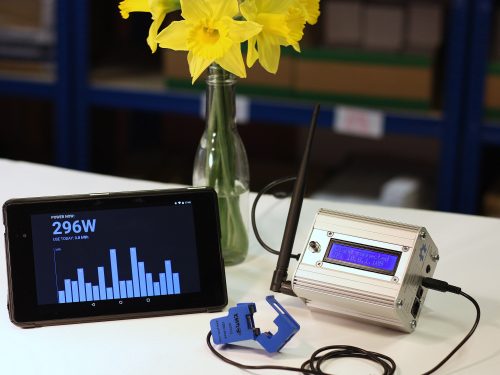
Photo: an emonPi energy monitoring unit in an aluminium case with an aerial and an LCD display, a mobile phone showing daily energy use as a histogram, and a bunch of daffodils in a glass bottle

The next 20 years will see a revolution in our energy systems, as we switch away from fossil fuels towards a zero-carbon energy supply.

By using energy monitoring, modelling, and assessment tools, we can take an informed approach to determine the best energy-saving measures to apply. We can then check to ensure solutions achieve their expected performance over time.

We started the OpenEnergyMonitor project in 2009, and the first versions of our energy monitoring system used an Arduino with Ethernet Shield, and later a Nanode RF with an embedded Ethernet controller. These early versions were limited by a very basic TCP/IP stack; running any sort of web application locally was totally out of the question!

I can remember my excitement at getting hold of the very first version of the Raspberry Pi in early 2012. Within a few hours of tearing open the padded envelope, we had Emoncms (our open-source web logging, graphing, and visualisation application) up and running locally on the Raspberry Pi. The Pi quickly became our web-connected base station of choice (emonBase). The following year, 2013, we launched the RFM12Pi receiver board (now updated to RFM69Pi). This allowed the Raspberry Pi to receive data via low-power RF 433Mhz from our emonTx energy monitoring unit, and later from our emonTH remote temperature and humidity monitoring node.

Diagram: communication between OpenEnergyMonitor monitoring units, base station and web interface

In 2015 we went all-in with Raspberry Pi when we launched the emonPi, an all-in-one Raspberry Pi energy monitoring unit, via Kickstarter. Thanks to the hard work of the Raspberry Pi Foundation, the emonPi has enjoyed several upgrades: extra processing power from the Raspberry Pi 2, then even more power and integrated wireless LAN thanks to the Raspberry Pi 3. With all this extra processing power, we have been able to build an open software stack including Emoncms, MQTT, Node-RED, and openHAB, allowing the emonPi to function as a powerful home automation hub.

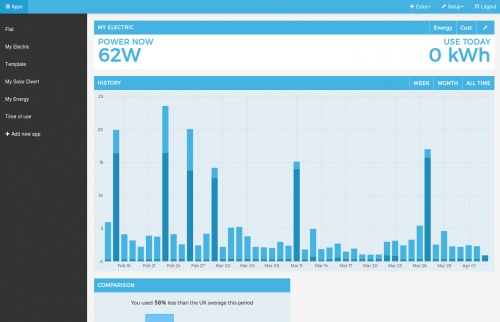
Screenshot: Emoncms Apps interface to emonPi home automation hub, with histogram of daily electricity use

Emoncms Apps interface to emonPi home automation hub

Inspired by the Raspberry Pi Foundation, we manufacture and assemble our hardware in Wales, UK, and ship worldwide via our online store.

All of our work is fully open source. We believe this is a better way of doing things: we can learn from and build upon each other’s work, creating better solutions to the challenges we face. Using Raspberry Pi has allowed us to draw on the expertise and work of many other projects. With lots of help from our fantastic community, we have built an online learning resource section of our website to help others get started: it covers things like basic AC power theory, Arduino, and the bigger picture of sustainable energy.

To learn more about OpenEnergyMonitor systems, take a look at our Getting Started User Guide. We hope you’ll join our community.

The post Open source energy monitoring using Raspberry Pi appeared first on Raspberry Pi.

17 May 21:40

Babies From Skin Cells? Prospect Is Unsettling to Some Experts

Babies From Skin Cells? Prospect Is Unsettling to Some Experts:

The stuff that dreams are made of? Or nightmares?

Nearly 40 years after the world was jolted by the birth of the first test-tube baby, a new revolution in reproductive technology is on the horizon — and it promises to be far more controversial than in vitro fertilization ever was.

Within a decade or two, researchers say, scientists will likely be able to create a baby from human skin cells that have been coaxed to grow into eggs and sperm and used to create embryos to implant in a womb.

The process, in vitro gametogenesis, or I.V.G., so far has been used only in mice. But stem cell biologists say it is only a matter of time before it could be used in human reproduction — opening up mind-boggling possibilities.

With I.V.G., two men could have a baby that was biologically related to both of them, by using skin cells from one to make an egg that would be fertilized by sperm from the other. Women with fertility problems could have eggs made from their skin cells, rather than go through the lengthy and expensive process of stimulating their ovaries to retrieve their eggs.

[…]

Some scientists even talk about what they call the “Brad Pitt scenario” when someone retrieves a celebrity’s skin cells from a hotel bed or bathtub. Or a baby might have what one law professor called “multiplex” parents.“There are groups out there that want to reproduce among themselves,” said Sonia Suter, a George Washington University law professor who began writing about I.V.G. even before it had been achieved in mice. “You could have two pairs who would each create an embryo, and then take an egg from one embryo and sperm from the other, and create a baby with four parents.”

[…]

I.V.G. is not the first reproductive technology to challenge the basic paradigm of baby-making. Back when in vitro fertilization was beginning, many people were horrified by the idea of creating babies outside the human body. And yet, I.V.F. and related procedures have become so commonplace that they now account for about 70,000, or almost 2 percent, of the babies born in the United States each year. According to the latest estimate, there have been more than 6.5 million babies born worldwide through I.V.F. and related technologies.

Gene splicing will be much easier with this technique, and ‘multiplexing’ babies from groups of people–not just pairs–opens up some strange scenarios, like producing a child blended from an entire NBA team, or ten Nobel laureates.

17 May 21:40

Zack Kanter, Why Amazon is eating the world

Zack Kanter, Why Amazon is eating the world:

Zack Kanter pens a magisterial analysis of why Amazon is a world beater, and how the company insulates itself from competition, paradoxically, by opening up every aspect of its operations as a service stack, for all to see and copy (if they can):

each piece of Amazon is being built with a service-oriented architecture, and Amazon is using that architecture to successively turn every single piece of the company into a separate platform.

This is a nearly impossible to summarize analysis of Amazon’s unassailable position in the world’s economy. Kanter should be working at a VC fund instead of Stedi. Or Bezos should buy Stedi, and put Kanter in a strategy role.

17 May 21:40

Sick of Myself

by Rob Horning

According to the common story about our fall into postmodernity, being yourself has become hard work. Once, people were born into relatively stable situations in which identity was prescribed based on where one was born and to whom. There was little choice in the matter of what sort of life one would lead, and little social or geographical mobility. The social categories — class, gender, ethnicity, religion — that determined the possibilities for one’s life were essentially fixed, as were the way those categories were defined. But then industrialization and the advent of mass media scuttled those categories over time and rendered social norms more fluid and malleable. Identity was no longer assigned but became a project for individuals to realize. It became an opportunity and a responsibility, a burden. You could now fail to become someone.

Some sociologists and psychologists label this condition “ontological insecurity.” In The Divided Self, R.D. Laing defines it as when one lacks “the experience of his own temporal continuity” and does not have “an overriding sense of personal consistency or cohesiveness.” Without this stable sense of self, Laing argues, every interaction threatens to overwhelm the individual with the fear of losing oneself in the other or of being obliterated by their indifference. “He may feel more insubstantial than substantial, and unable to assume that the stuff he is made of is genuine, good, valuable,” Laing writes of the ontologically insecure. “And he may feel his self as partially forced from his body.”

It may not be only depressed people who are tired of having to become themselves

A stable sense of self across time makes life meaningful; it allows us to experience and transmit a sense of “authenticity.” But this stable, authentic self tends to be represented as the means to its own end: You achieve a self by being yourself and finding yourself. This tautology sets us up for failure, and for the endless labor of trying to express and realize ourselves. Sociologist Alain Ehrenberg (in a passage Byung-Chul Han quotes in The Burnout Society) links this burden with the rise of depression as a mental illness: “Depression began its ascent when the disciplinary model for behaviors, the rules of authority and observance of taboos that gave social classes as well as both sexes a specific destiny, broke against norms that invited us to undertake personal initiative by enjoining us to be ourselves … The depressed individual is unable to measure up; he is tired of having to become himself.”

It may not be only depressed people who are tired of having to become themselves. Under economic conditions in which maximizing our “human capital” is paramount, we are under unremitting pressure to make the most of ourselves and our social connections and put it all on display to maintain our social viability. We are perpetually “unable to measure up” — we must, like any other capitalist firm, demonstrate an ability to maintain growth or become obsolete. The neoliberal demand that we convert our lives into capital and grow it systematically seizes on the ideal of self-expression and strips it of its dignity and allure. But being nobody isn’t yet much of an alternative.

This is the context in which social media have thrived: They solve the problem of the self under neoliberalism, extending a platform for human capital development while still offering a seemingly stable basis for “ontological security.” It may seem that social media, by making social interaction asynchronous, shifting a portion of it online to an indefinite “virtual” space, and subjecting it all to constant monitoring, measurement, and assessment would not be a recipe for producing a sense of personal continuity. The way our self-expression gets ranked in likes and shares in social media would seem to subordinate identity to competition over metricized attention, dividing peers into winners and losers. And the creation of identity in the form of a data archive would seem to fashion not a grounded self but an always incomplete and inadequate double — a “self partially forced from the body.” You are always in danger of being confronted with your incohesiveness, with evidence of a past self now rejected or a misinterpreted, misprocessed version of one’s archive being distributed as the real you.

If Laing is right about ontological insecurity, then social media seem designed to generate it: They systematically impose a sense of insubstantiality on users, turning identity into incoherence by constantly assimilating and demanding more data about us, making our self a vacuum that never fills, no matter how much is poured in. Our identity is constantly being recalibrated and recalculated, and we can forever try to “correct” it with more photos, more updates, more posts, more data.

But this same destabilization opens up the possibility for compensatory reassurances: the serial pleasures of checking for likes and other forms of micro-recognition made suddenly meaningful by the acute insecurity. Even as social media destabilize the lived experience of our self’s continuity, they address the dissolution of identity with a dynamic system of identity capture. They track everything we do online and insist on its significance, recording it into relational databases where its essential contribution to our overall personality will be analyzed and ultimately expressed in some piece of targeted content down the road. They provide a focal point, a unique identifying profile around which all the data collection and reputation scoring can be organized that stays with us through all our ostensible changes. If all the social norms around an individual are in flux, the social media profile is not.

The profile takes over for the old identity stabilizers (family, geography, religion, etc.) and becomes the sturdy blank slate on which various roles can be inscribed while we remain open to the saturation of as many different influences as possible. It can hold our lives while we are busy constantly reinventing ourselves for labor markets. Social media exacerbate ontological insecurity while masquerading as its cure.


The algorithmic bubbles that social media construct around us are key part of the consolation the platforms provide. Their constant, reliable presence let us consume a sense of the ontological security the platforms are in the process of eroding. The filter bubble is not an unfortunate accident, as Mark Zuckerberg suggested in his “global community” manifesto, but an essential source of social media’s appeal — the aspect that allows it to counter postmodernist vertigo. If all the content on Facebook is tailored to suit the company’s construction of who we are, then consuming it is like consuming a coherent version of ourselves. It also reinforces the idea that the best place to glimpse your stable social identity is on Facebook. Engagement with social media then signals our assent to this algorithmic figuring of the self, an identity we step into when we access platforms that feels as if it has always already been inside us somehow.

If Facebook content is tailored to suit the company’s construction of who we are, then consuming it is like consuming a coherent version of ourselves

How, then, does an algorithmic system know who you are? And what makes this knowledge effective enough to keep social media engagement levels high? Why do we recognize ourselves in the many obscure and indirect ways a social media platform hails us — even if this recognition is not conscious, even if it occurs only at the level of not being bored? Why does algorithmic content sorting work on every platform on which it is tried, often over and against the protests of users, who inevitably come to tolerate or love it?

Digital studies professor John Cheney-Lippold’s We Are Data, out this month, explores algorithmic identity, but not in terms of the subjective reassurance or pleasure it may provide. He is more concerned with the control algorithmic systems impose through the way data aggregators structure various social categories. He outlines the way social media companies, marketers, and state institutions use our data trails to calculate what our age, race, gender, class, nationality, and so on are likely to be, and how those probabilities are used to reshape our individuated realities. As more information about ourselves is captured within Big Data systems by phones, social media platforms, fitness trackers, facial recognition software, and other forms of surveillance, algorithms assign identity markers to us, place us in categories based on correlations to patterns drawn from massive data sets, regardless of whether these correspond to how we think of ourselves. We become, to an extent, what other people do, as their data contributes to how ours is interpreted. The system will infer our identity, according to categories it defines or invents, and use these to shape our environments and further guide our behavior, sharpen the way we have been classified, and make the data about us denser, deeper. As these positivist systems saturate social existence, they nullify the idea that there is something about identity that can’t be captured as data.

Because what gets calculated by algorithmic systems to be race, gender, age, or political affiliation is a selection of data markers that may have no connection to the social indicators used to determine those categories — it may neglect even how individuals self-identify — Cheney-Lippold differentiates them: race vs. algorithmically estimated “race,” gender vs. “gender,” and so on. These pairs are analytically distinct but feed into one another through the way the probabilistic categories are deployed to anticipate what people will do or will want to see, shaping how they are treated and what opportunities are offered them. You might find yourself on a terrorist watch list or in quarantine for a flu you don’t have, merely because of data associations. It doesn’t matter if “race” matches race, or “age” accurately approximates age — this is often irrelevant to the design of these systems. They are generally trying to maximize user engagement or capture trends in large populations rather than simulate a particular user.

But where we have some idea (albeit little control) over what makes up these categories in social life outside the internet, we don’t know how algorithms determine the probabilities about our identity within it — they draw on statistical rather than social stereotypes, as Cheney-Lippold points out. To an algorithmic system, you might be 45 percent likely to be a woman and 45 percent likely to be a man at the same time. Every social category can be infinitely subdivided in practice, with each combination of probabilities constituting a pseudo gender of its own. “Because Google’s gender is Google’s, not mine, I am unable to offer a critique of that gender, nor can I practice what we might refer to as a first-order gendered politics that queries what Google’s gender means, how it distributes resources, and how it comes to define our algorithmic identities,” Cheney-Lippold writes. We might also ask at what point Google’s “gender” ceases to be treated as gender and becomes something else within its systems, given that for the system, the label of “gender” for that particular is entirely arbitrary. Machines don’t take the additional step that humans do of naturalizing categories and making them absolute. Algorithmic categories may comprise any number of discrete social categories and, in the way they are deployed, stray away entirely from the way they are used socially or interpersonally.

This would make it seem as though the systems reject essentialist definitions of identity categories, allowing for fluid identities produced on a contingent, situation-to-situation basis. But the fluidity within the categories is less important than the fact that systems may be trained to associate certain data with specific, socially loaded categories, reinforcing their perceived significance for social participation. The system is asked to calculate the likelihood of your race because it is in part designed to reproduce the significance of that distinction. So even if it sees you as a particular race one day and a different one the next, or re-estimates your likely whiteness with every new website you visit, it is still helping to replicate the conditions under which being white has a certain value, has certain ramifications, creates certain possibilities.

Being scored through our data also feeds the fantasy that we are essentially knowable, that we can know ourselves completely and totally

The algorithmic system extends the significance of those categories beyond specific contingent contexts into the sorts of situations that can occur anywhere at anytime online, even without human presence — discrimination occurs whenever the database is queried, with systems generating what Cheney-Lippold calls “just-in-time identities … made, ad hoc.” They project hierarchical interpretations of categories into scenarios where it might not even occur to human agents to discriminate. There is nothing, for example, to stop online retailers from exercising price discrimination based on who knows what basis. One can imagine banks or real estate agents operating on similar lines, where the representatives themselves can’t explain why certain candidates have been turned down. (Frank Pasquale details this sort of “black-box scoring” in The Black Box Society.)

The algorithmically calculated probabilities also can become instruments for cajoling more normative behavior from individuals to whom the received social categories are important, anchoring their personal sense of identity. The algorithms might be used to establish what, say, male behavior or healthy behavior is supposed to be and indirectly encourage subjects interested in fulfilling those expectations to redirect their behavior accordingly, even as those targets themselves remain dynamic. As the targets are chased — with new data being fed in trying to adjust the profile — this same behavior feeds into and reinforces how the system has begun to define the category. The algorithm calls forth the behavior it was merely supposed to identify, becoming “an engine, not a camera,” to borrow sociologist Donald Mackenzie’s phrase. This is ideal for the companies and agencies administering the models, as it makes the data systems more efficacious, even if less “accurate.” They can create the sorts of subjects they are searching for.

Data-driven identity systems perpetuate the social significance of categories while removing the negotiation of what any category means from the social, interpersonal sphere, placing them instead in opaque, private systems. Users trying to fulfill the norms of these categories have little choice but to provide more data to try to meet the moving targets. And, as Cheney-Lippold argues, “there is no fidelity to notions of our individual history and self-assessment” in the way the black-box algorithms classify us. The way we are classified is kept classified, and shifts depending on the context and what the algorithmic system is asked to do. Who we are depends on what is going to be done with us.

Just as we don’t know how these systems calculate our identity and rank it for various purposes, we often don’t know why either. This means they can be used behind our back to mark us as persons of interest to police and border agents, or to single us out as an insurance risk or for other categorical forms of discrimination without any human agents having direct knowledge. They can render certain concatenations of data to be normal and others to be deviant and socially disqualifying. These machine-learned prejudices may not even have human names, which makes it harder for people to unite and fight against them. The labels cannot be reclaimed as principles of solidarity.

Unmappable to any pre-existing social category, these submerged, unseen identities in theory can be pushed into the social world and made reflexive there. In other words, the systems can invent races, and perpetuate the logic of racism: that it is “rational” to seek data patterns about populations and make them overt and socially salient, definitive for those so identified. On an individual level, bespoke discrimination by algorithm may make it impossible to know when and why one is being excluded or singled out. “Who we are and what who we are means online is given to us,” Cheney-Lippold claims. “We are forced to exist on a ‘territory of the self’ both foreign and unknown, a foundation of subjective integrity that is structurally uneven.”


More mundanely, algorithmic analysis may merely seek ways to leverage information about users against them, rendering identity not so much fluid as more precarious. Data collection is used to create identity markers about us that we don’t see or control, that we can’t evaluate or access or alter directly. Companies know more about us as consumers than we know ourselves — insofar as we limit our identity to consumer behavior. But they don’t necessarily control us by hiding how they categorize us; they can profit by revealing how they see us, painting an aspirational version of ourselves that keeps engaged with the systems that profile us. If algorithmic systems functioned mainly by “forcing us to exist” in scenarios that brought us no tangible benefits, we would soon find ways to circumvent them.

From the start, we are not self-inventing. We are born into a social context that forms the framework and the limitations of our self-knowledge. Knowing ourselves means understanding this immutable context that we didn’t choose. Algorithmic systems model that context, concretizing the ways in which identity supersedes individual bodies and emerges between people and groups, within institutions and technological affordances.

When we limit identity to consumer choices, it makes us more knowable to others in this datafied form than we are to ourselves. But being scored through our data also feeds the fantasy that we are essentially knowable, that we can know ourselves completely and totally, taking into account all the implications and ramifications of the various traits we possess. Algorithms promise a simple solution to the riddle of the self, should we want one. They promise the certainty that data alone suffices to make a self — just generate data and you are significant, a somebody, a unique identification number at the very least. One can accept the ready pleasure of consumerism rather than pursue the freedom of autonomy, which is always imperfect and requires boundless innovation in our techniques of resistance. We can learn the secret of ourselves, as long as we consent to be controlled.

17 May 21:40

One of the factors in the adoption of work chat is that effective small teams (sets) operate…

by Stowe Boyd

One of the factors in the adoption of work chat is that effective small teams (sets) operate (generally) around symmetric relationships, and higher degrees of mutual trust than in larger social scales, like scenes. As social scale increases there is greater asymmetry in power relations, which can decrease mutual trust, and chill open discourse.

17 May 21:40

This is an American Workday, By Occupation

by Nathan Yau

I simulated a day for employed Americans to see when and where they work. Read More

17 May 21:40

The Connected Greenway

by Ken Ohrn

Connecting things, people and places is an opportunity, if not major rationale, for the Arbutus Greenway.

It’s already happening on the increasingly busy temporary Greenway.

Some new connections arise from the very nature of the conversion from unused railroad into accessible, if temporary, Greenway. People have a new way to travel from home to retail areas, schools and parks.

But old informal pathways are already getting upgrades to provide better connections from and across the Greenway to local neighbourhoods, bus stops, crosswalks and so on.


17 May 18:38

Twitter launches support chat bot

by Igor Bonifacic
Twitter Canada office pillows

If you’ve ever needed help with your Twitter account, but have been frustrated by the relative lack of support options offered by the company, Twitter now provides a proper recourse. On Tuesday, the social media network launched Twitter Support, a chat bot that can provide account help through the platform’s direct messages functionality.

At the moment, the bot is only able to converse in English and its expertise is limited to more general issues. That said, the bot will likely save some people a wasted trip to the company’s website.

Source: Twitter

The post Twitter launches support chat bot appeared first on MobileSyrup.

17 May 04:23

Leak reveals two new Nokia smartphones, one with rear dual camera

by Dean Daley
Nokia

Evan Blass is on a roll. It was only yesterday when the famed leaker unveiled the HTC U11 hours before Brilliant U — now, less than 24 hours later, Blass has revealed video of a couple of unannounced Nokia devices.

At Mobile World Congress 2017, Nokia unveiled its three smartphones for the year, the Nokia 3, 5 and 6, and in this leaked video there appear to be two more devices, neither of which are the 3310.

The two devices appear to be the same size or larger than the other mid-ranged Nokia devices. The device with the rear-facing dual camera setup could either be the reported Nokia 8 or even the rumoured Nokia 9.

That device’s front and back seem to be lacking a home button. This could mean the home button is underneath the panel, or the device could have a fingerprint sensor on the sides, like the Sony Xperia devices.

The other device is either the Nokia 8 or another device that hasn’t been found in the rumours. The device is evidently not the Nokia 6 as that smartphone has a different rear design.

Whichever phone is the Nokia 8, reports say that the device has Qualcomm’s Snapdragon 835 chipset, 6GB of RAM and a 24-megapixel camera.

Though we don’t have an official global launch date for any of the company’s devices, the date on the smartphone in this video says Sunday, November 25th. This year, however, November 25th is on a Saturday, which means either that the day of the week is a mistake, the video is referring to November 25th, 2018 — or, most likely, that the day in the video is not yet finalized.

Source: Evan Blass

The post Leak reveals two new Nokia smartphones, one with rear dual camera appeared first on MobileSyrup.

17 May 04:22

Apple to unveil new MacBook Pro and 12-inch MacBook next month, says report

by Patrick O'Rourke

Apple is set to unveil two new laptops at its annual WWDC developer conference next month, according to a report stemming from Bloomberg.

Rumours indicate that Apple will refresh the MacBook Pro with Intel’s 7th generation Kaby Lake processors. While nothing has been confirmed yet, this move would make sense given the tech giant launched the Pro last November with Intel’s older 6th generation Skylake silicon.

The company also plans to update the 12-inch MacBook, its smaller netbook-like laptop, with Intel’s latest architecture. Bloomberg is also reporting that the MacBook Air may receive a processor update as well.

It’s worth noting, however, that the Air hasn’t been refreshed with a higher resolution display, one of the most requested features for the rapidly aging device. It’s more likely that Apple has plans to slowly phase out the Air.

Apple’s most recent MacBook Pro refresh added a Touch Bar to the laptop as well as a new design. Many, however, criticized the shift to USB-C and the removal of a SD card slot.

WWDC is set to kick off on June 5th. MobileSyrup will be on the ground at the event bringing you all the news directly from the show floor.

Source: Bloomberg

The post Apple to unveil new MacBook Pro and 12-inch MacBook next month, says report appeared first on MobileSyrup.

16 May 18:44

Toronto-based DevHub to hosts Google I/O Extended event

by Sameer Chhabra
Google-IO-Extended-2017

While the tech industry descends upon Mountain View, California for Google’s annual developer conference on May 17th, 2017, Canada’s most populous city will be hosting their own I/O events.

Part of the official Google I/O Extended network, DevHub in Toronto will be hosting a livestream of the Google I/O conference, followed by a coding workshop.

Google’s I/O Extended is an opportunity for developers who can’t make it to San Francisco to host their own mock I/O conferences.

Google reports that, in 2016, 546 I/O Extended events were hosted in 100 countries.

These events were all organized by developer communities that livestreamed Google’s I/O, while also staging workshops, team-building exercises, hackathons, and coding labs to build relationships and practice key skills.

According to Google, a successful I/O Extended event is one that “connects talented developers, giving them the chance to exchange ideas, teach their skills, and acquire new ones.”

DevHub’s I/O Extended event starts at 12:30 p.m. EST.

Source: Google 

The post Toronto-based DevHub to hosts Google I/O Extended event appeared first on MobileSyrup.

16 May 18:33

Tenth Avenue Health Precinct Bikeway

by Sandy James Planner
image1

There has been some cute analogies in the press about how time is “running out” for the parking meters on Tenth Avenue in the hospital precinct on Tenth Avenue between Oak and Cambie Streets, which is going to Council today. This street is a designated bikeway, and will be getting separated bike lanes.  It is also the street that must accommodate access for the terminally ill, the severely disabled and infirm from across the Province that come for specialist appointments on this street. Many of these people are in their last months of life, do not have disabled passes for their vehicles, and cannot walk up the steep side streets from Broadway to Tenth Avenue. It is a complicated scenario and City of Vancouver staff have been working with the Vancouver General Hospital and other parties on creating some solutions.

The Vancouver General Hospital (VGH)  does a great job on some things, but have been lax at following up (and being told by the City to follow-up) on some commitments. With the creation of one of the new Cancer buildings, VGH was required to put in at grade parking in the empty lot at Tenth Avenue and Ash. That was  11 years ago, and VGH ignored their commitment.

The new plan will take out 72 metered parking spaces on Tenth Avenue in front of the building frequented by the infirm and by seniors. There are two metered parking spaces west of Ash, with other spaces requiring disabled permit placards.  The City’s report  shows that there will be 228 metered parking spaces available, counting the 116 “spaces” not yet  built by VGH  on that empty lot at Tenth and Ash, and another 62 spaces on the side streets adjoining Tenth, many which have grades too steep for disabled or vision impaired to negotiate.

There is no doubt that Tenth Avenue is a bikeway. There is also no doubt, for anyone familiar with this Hospital Precinct that the most vulnerable and elderly will also be using this street. The compromise must be sensitive to both.

06-e1420478021964


16 May 18:33

PivotTables just got personal

by Excel Team
mkalus shared this story from Office Blogs.

As part of this month’s update, a new Excel feature gives you the ability to personalize the default layout for your PivotTables. Enabling users to personalize the PivotTable defaults started as a feature request in our Excel UserVoice forum. Now, when you’re building complex reports or performing one-off analyses, you can quickly get started with your favorite PivotTable layout. This feature is available for Excel 2016 on Windows as part of an Office 365 subscription. If you are already an Office 365 subscriber, find out how to get the latest update.

This month, we also included a tip when using OLAP connections to make your PivotTables much faster. Read on to learn more.

Personalize your PivotTable layout

There are two ways you can adjust the layout settings for the PivotTable defaults. One way is to simply click the newly added Edit Default Layout button under the File menu to display the Edition Default Layout dialog. Here you can make changes to many of your favorite layout options. Included are all the settings in the “Layout” chunk of the PivotTable Design contextual ribbon. We also included all the settings in the PivotTable Options dialog.

You can also import a layout from a PivotTable already in your workbook and customize the layout. This is a great way to start if you have a PivotTable in your workbook that has a layout you’d like to use all the time. Simply open the Edit Default Layout dialog, click anywhere within a PivotTable in your workbook and then click the Import button.

Either way, all new PivotTables you insert will have your favorite layout!

To learn more about how you can use this new feature, visit our support page.

Tip for OLAP PivotTables

If you use OLAP connections, making a change to your default layout could make the PivotTables you create much faster! Disabling the Subtotals and Grand Totals will help you take advantage of the performance improvements delivered in a previous update to Excel 2016.

In the Edit Default Layout dialog, simply set the Subtotals option to Do Not Show Subtotals and set the Grand Totals option to Off for Rows and Columns. This tip can work alongside changes to all the other options in the Edit Default Layout dialog. So feel free to keep toggling!

Disabling Subtotals and Grand Totals can lead to faster OLAP PivotTables.

If you have any suggestions for a new feature you would like to see in Excel, head over to the UserVoice forum and become a part of the conversation!

—Alexander Lahuerta, program manager for the Excel team

The post PivotTables just got personal appeared first on Office Blogs.

16 May 18:31

Toronto councillor says telecoms should unlock FM radio on Android smartphones

by Bradly Shankar
Toronto City Hall front

Toronto councillor Mary Fragedakis has presented a motion calling on telecom companies to active the FM radio chip found inside Android smartphones.

Fragedakis, who represents Ward 29, Toronto-Danforth, told CBC News that with FM radio, alerts can be sent out to notify citizens of emergencies like blackouts or natural disasters.

She said that while she understands the financial reasons behind keeping FM radio locked, she asks that companies consider the broader picture.

“Obviously, there is a lot of money to be made in data usage, but this issue is more about the safety of the public,” Fragedakis said.  

In the event the motion from the city of Toronto doesn’t pan out, Fragedakis said the motion also asks the federal government to get involved. “There is a secondary recommendation to ask the government of Canada to take steps necessary so that these FM chips are activated and to launch an education campaign to make Canadians aware of how to use FM radio capacity on their smartphones,” she told CBC News. 

The service is already widely available in the United States, with major providers like Sprint, AT&T and T-mobile having “turned on” the FM chip in their phones.

However, FM radio is not available there on Apple devices.

In April, the CRTC mandated that all carriers must offer a system that alerts Canadians of emergencies through LTE networks.

Image credit: Wikimedia Commons 

Source: CBC News 

The post Toronto councillor says telecoms should unlock FM radio on Android smartphones appeared first on MobileSyrup.

16 May 17:48

The Long-Lived iPad 2

by Stephen Hackett

Every once in a while, an Apple device comes along that sticks around for a while without an update.

Jokes about the "current" Mac Pro aside, one such device that comes to mind for me pretty quickly is the iPad 2, introduced back in March 2011. It was finally taken off the market three years later.

While that doesn't seem remarkable today, it was an eternity when it came to iOS devices at the time. The iPad 2 was one of the first devices Apple kept around to fill a lower price point on its product matrix.

But let's not get ahead of ourselves quite yet.

The rotator on Apple's website at the time does a good job at summing up what was new about this iPad.

All-new Design

The iPad 2 sported the same, 9.7-inch, 1024x768 display as the original iPad, but the body that housed it was all-new. Gone was the sidewall from the original, replaced with edges that sloped up from the back to meet the edges of the bezels.

The iPad 2 was thinner and sleeker than the original.

The iPad 2 was thinner and sleeker than the original.

The new iPad was 33 percent thinner and 15 percent lighter, clocking in at 1.33 pounds. While that sounds heavy today,1 this thing feels great when compared with the iPad that proceeded it.

This design would stick around for several years, serving both the iPad 3 and 4. Things weren't reworked until the iPad Air adopted the iPad mini's design language, which still graces iPads today.

Dual-Core A5 Chip

The original iPad marked Apple's first foray into custom CPU packages, after its acquisition of PA Semi in 2008.

The A4 in the iPad (and iPhone 4) was a watershed moment for Apple, but the A5 in the iPad 2 showed the company was going to be aggressive about performance of its custom chips.

The performance section of AnandTech's review of the iPad 2 blew my mind when I first read it in 2011. Apple claimed the new iPad was "twice as fast" as the original, but the real story was in the graphics department, as Apple's website claimed:

With up to nine times the graphics performance, gameplay on iPad is even smoother and more realistic. And faster graphics help apps perform better — especially those with video. You’ll see it when you’re scrolling through your photo library, editing video with iMovie, and viewing animations in Keynote.

The original iPad never felt slow to me in its first year of life, but the iPad 2 changed that perception instantly for many users. The best part? All of this performance — in a smaller chassis — didn't hurt battery life.2

Two Cameras

In an age where Phil Schiller goes out of his way to praise the cameras in each new iPad, it's easy to forget that the original shipped without any cameras.

Even in 2011, it seems Apple — and its customers — weren't quite warmed up to the idea of taking photos with a tablet. Here's how the company described the cameras:

You’ll see two cameras on iPad — one on the front and one on the back. They may be tiny, but they’re a big deal. They’re designed for FaceTime video calling, and they work together so you can talk to your favorite people and see them smile and laugh back at you.3 The front camera puts you and your friend face-to-face. Switch to the back camera during your video call to share where you are, who you’re with, or what’s going on around you. When you’re not using FaceTime, let the back camera roll if you see something movie-worthy. It’s HD, so whatever you shoot is a mini-masterpiece. And you can take wacky snapshots in Photo Booth. It’s the most fun a face can have.

The camera components were borrowed from the iPod touch. The front camera show VGA video, while the back shooter captured video at 720p. As far as still photos ... well ... it wasn't great, as Wired pointed out at the time:

The specs for the iPad’s rear-facing camera only lists one number: 720p. That should mean 1280 x 720 pixels, which gives a megapixel figure of 0.92, clearly useless for stills.

However, flip over to the iPod Touch camera specs and we see the following: “HD (720p) up to 30 frames per second with audio; still photos (960 x 720) with back camera.” Yes, the Touch shoots stills at an even lower resolution than video, most likely because the wide-screen movie format is squared-off to shoot stills. The stills it produces are just shy of 0.7 megapixels, or about the same resolution as an early 1990s-era digital camera.

Ouch.

Smart Cover

The last thing Apple touted with the iPad 2 was an all-new accessory, the Smart Cover.

Gone was the ugly first-party case Apple sold with the original iPad. The new accessory simply covered the screen, and attached to the side of the tablet with magnets:

It could be folded up into a stand, and could wake the iPad when lifted away from the glass.

The Smart Cover has been revised since, losing one panel and receiving a more refined hinge. It's held up over time, and I think Apple will continue to make them for a long, long time.

Legacy

As I mentioned, the iPad 2 stuck around for a long time, outlasting the iPad 3 and 4 as a low-cost option until it was replaced in March 2014. It shipped with iOS 4.3 and can run up to iOS 9.3.5.

The reach of the iPad 2's influence was felt even longer than its shelf life.

The original iPad mini was really just a shrunken-down iPad 2 with a Lightning port and better cameras. It was introduced in October 2012, and stayed on sale until March 2015.

The A5 chipset showed up in the 3rd-generation Apple TV, also announced in 2012. That thing was on sale until the fall of 2016.

The iPad 2 came into the world when things were simpler, and brought with it Apple's current strategy of discounting older hardware.


  1. The 9.7-inch iPad Pro weighs 0.96 pounds, for comparison. ↩︎
  2. Apple says that every non-cellular iPad gets 10 hours of battery life, a trend started here. ↩︎

Support MacStories Directly

Club MacStories offers exclusive access to extra MacStories content, delivered every week; it’s also a way to support us directly.

Club MacStories will help you discover the best apps for your devices and get the most out of your iPhone, iPad, and Mac. Plus, it’s made in Italy.

Join Now