April 2017 die Deutsche Bank führt ihr Mobile Payment Verfahren ein. Immer wieder liest man, dass dies die erste Mobile Payment Lösung einer Bank in Deutschland sei. Aber stimmt das wirklich? Wir gehören beim Mobile [...]
PR people, if you have something unpleasant to say, just say it. Hiding it behind euphemisms doesn’t fool anyone. Today’s case study: Ford’s plan to lay off 10% of its staff, which it calls a “people efficiency action.” According to a Wall Street Journal article, Ford will cut 10% of its global workforce to boost profits, with … Continued
Metro News and reporter Jen St. Denis reports on Toronto economist Paul Smetanin who has ascertained that if an elderly couple in Vancouver are living in a house with over one bedroom, they are overhoused. Of course those elderly that live in a house with more than one bedroom would be wealthier too. Smetanin estimates that 70 per cent of people living in Vancouver have “800,000 spare bedrooms.”
“In Smetanin’s analysis, a co-habiting couple living in anything more than a one-bedroom home is considered “over housed.” Homeowners who are wealthier and older are most likely to be over housed. The number of empty bedrooms is equal to 15 years of construction at current rates, said Smetanin, who has used data from Statistics Canada and other sources to create a broad set of data about housing needs in Canadian cities.
The numbers are similar for Toronto, and policy-makers from the United States to the United Kingdom to Australia are struggling with the demographic shift. ”
Gene Balk, a columnist at the Seattle Times has calculated that the number of empty bedrooms in Seattle has increased by 50 per cent in the last 16 years. Local real estate developer Michael Geller has suggested that seniors may be delaying going into condominium housing forms to avoid strata councils, and a range of different housing forms is needed.
The ability for seniors to defer property tax and the fact that there are no capital gains on the sale of a home may encourage seniors to age in place. There are also compelling financial reasons to stay in the home you raised your family in: homeowners don’t pay capital gains tax when they sell their principal residence and make a profit, and some argue it makes more sense to stay in the home and leave the total appreciated gain for your estate.
Geller does see a change where seniors are now interested in supporting new forms of housing for the post-house phase of senior life. “These baby boomers are the ones who are often opposing townhouse and apartment developments in their neighbourhoods for the last 30 years,” he said. “Now that they’re ready to perhaps move into a new housing choice, I think there’s a greater willingness to accept sensitive infill development.”
One-time winner of the contest to find the world’s most boring headline was: “Worthy Canadian Initiative“. But just how boring was the story, and what story do headlines really tell?
As a contrast in content, let alone journalistic integrity, consider these two headlines and the stories below them. The first covers a complicated story, and deals with the issues in a broad manner. The second employs cobwebbed rile-em-up tabloid tactics to satisfy some business model that the world is rapidly passing by on its way to somewhere else.
First we have Martha Perkins in the Vancouver Courier writing under the headline: “Interests Merge in 10th Avenue ‘Hospital District’ Plan“.
Vancouver Coastal Health, the British Columbia Cancer Agency and accessibility advocates are all heartily endorsing Vancouver city staff’s proposed new street plan
“It’s a great compromise considering all the stakeholders and the traffic of all modes,” said Stan Leyenhorst of Barrier-free B.C. “The city recognizes we’re trying something innovative”. We’re building an environment so, regardless of ability, you have access, including the senior who has cancer using a walker who is slightly sight impaired and can’t hear well.
“It’s terrific,” agrees Bruce Gilmore, also of Barrier-free B.C. By switching the conversation away from bike lanes, the strategy switched to problems that already exist for all users of the busy corridor. “I’m very excited that pedestrians have been heavily factored in, i.e. the vulnerable patient.”
Second, by way of contrast, Global News on May 16. Keeping the world safe, and preserving all asphalt, for motordom: “Separated Bike Lanes Could Replace Metered Parking In Vancouver’s Health Corridor Along 10th Avenue“.
Yup, good old bike lanes vs. parking. Cars vs. bikes. Real people vs them stinkin’ people on bikes. Yup: “Yet another controversial bike lane”. The video clip features an exasperated car driver who complains about parking and completely bone-headed decisions. The clip ends by bashing bike riders with a gratuitous context-free crack about riding bikes on the sidewalk.
Pedestrians and patients get little if any attention.
Parking in front of key medical agencies like the BC Cancer Agency, the Blusson Spinal Cord Centre and the Vancouver General Hospital (VGH) could get a whole lot tighter.
On Tuesday, Vancouver City Council will be presented a proposal to remove meter parking spaces from 10th Avenue, in favour of separated bike lanes between Oak and Cambie streets.
Ford is facing serious headwinds, and has lost 40% of its market cap in the past three years since Mark Fields became CEO. As one response, Ford is cutting 10% of the salaried workforce in North America and Asia:
Ford Motor said Wednesday that it would cut 10 percent of its salaried jobs in North America and Asia as part of a cost-saving move aimed at increasing sagging profits and propping up its stock price.
The news comes less than a week after its chief executive, Mark Fields, faced criticism at the automaker’s annual shareholder meeting for its lagging performance.
The cutbacks, totaling 1,400 positions, are part of an effort aimed at “reducing costs and becoming as lean and efficient as possible,” the company said in a message to employees.
Automakers are being challenged by slowing sales in the United States after seven years of steady growth. Ford’s sales slipped 5.6 percent in the first four months of 2017.
Meanwhile, the company is investing heavily in AI for driverless vehicles:
Ford also pledged to invest $1 billion over the next five years in the software company Argo AI, which the automaker is counting on to develop artificial intelligence technology that will serve as the brains of future autonomous vehicles. Ford invested smaller sums in other start-ups working on digital maps, machine vision and cloud computing — all technologies that may pay off in the future but add little to its current vehicles.
Those investments are intended to help Mr. Fields reach an ambitious goal. Last summer, speaking at Ford’s research center in Silicon Valley, he vowed that the company would begin mass producing a self-driving car — with no steering wheel and no pedals — by 2021.
And what about the growing share of robots in Ford’s plants? If they parallel the industry as a whole, productivity increases are chiefly linked to automation and IT advances.
The increase in productivity and decrease in price facilitates an
increased quantity demand by consumers. But to evaluate the effects
of productivity growth on employment, we focus on a period from
2000 to 2010, which was the largest decline in manufacturing employment
in U.S. history. Here we calculated the total employees needed
to produce the 2010 levels of production, but using 2000-level worker
productivity. Of course this isn’t actually the lost jobs to productivity;
because without higher productivity, the quantity of the products
purchased by consumers would not have risen; so this should be viewed as an illustration of the impacts of productivity growth. Had we kept
2000-levels of productivity and applied them to 2010-levels of production,
we would have required 20.9 million manufacturing workers.
Instead, we employed only 12.1 million.
[…]
Almost 88 percent of job losses in manufacturing in recent years
can be attributable to productivity growth, and the long-term
changes to manufacturing employment are mostly linked to the
productivity of American factories.
Robots and information technology (including AI) have already cut auto manufacturing jobs by about half, and more to come.
Who – or what – will be doing whatever those 1,400 people were doing yesterday?
While the ever-expanding supermarkets that his {Michael Ruhlman, author of ‘Grocery’] father shopped still exist — this suburban ShopRite 13 miles from Manhattan is a prime example, selling a wide array of items, from deli cuts and 11 varieties of Cheerios to mops and ironing board covers — they are in the midst of an existential crisis.
Shoppers are increasingly shunning the processed, packaged products that fill most of the shelves in the center of the store. Instead, they are hunting the perimeter for fresh fruits and vegetables, yogurts and cheeses, and prepared foods that go way beyond the traditional rotisserie chicken.
Competition is fierce, as retailers like Walmart, Target and 7-Eleven sell groceries, and Amazon and Fresh Direct deliver to the doorstep. Many of the hottest brands sell directly to consumers through websites and subscription services, cutting out stores altogether.
Walmart, long the lowest-price grocery option, recently announced that it would offer even lower prices, a response to the growth of sharp-penciled European competitors like Aldi and Lidl. And Whole Foods Market, once the darling of the industry, has struggled over the past few years as traditional grocers like Kroger and Safeway have added organic products and upgraded their produce departments.
Nielsen, a research and consulting firm, said last month that for the first time in a decade, shoppers were making more trips to stores, but coming out with less in their baskets. “They’re not stockpiling their pantries as much,” said Jordan Rost, the company’s vice president for consumer insights. “They’re really buying more fresh produce and prepared meals.”
[…]
The growing sales of produce and prepared foods are a silver lining for supermarkets, which make a much higher profit margin from produce — about 40 percent for prepared foods, compared with about 20 percent in the store over all, said Phil Lempert, the grocery-retailing expert who calls himself the Supermarket Guru.
But grocers still face a quandary: how to maintain a huge store whose center is filled with items that are largely out of step with how we eat today, yet are a steady source of slotting fees (to secure the best spots in the store when a product is introduced) and other payments from the companies that produce them.
Mr. Ruhlman is as baffled as anyone else about how to make that system work, and Nielsen recently created a group to study the issue. He is sure, though, that a fix is needed. The ShopRite here probably has to ring up at least $750,000 in sales each week to justify its space, he said, “and I just don’t know how you make money here.”
Maybe the answer is the open market of old: a municipally provided plaza or enclosed space, in which purveyors of various foods retail their goods? If people aren’t buying frankenfood any more, what’s the role of ShopRite?
Never run out of things to say at the water cooler with TodayIFoundOut! Brand new videos 7 days a week!
The Great Courses Plus is currently available to watch through a web browser to almost anyone in the world and optimized for the US market. The Great Courses Plus is currently working to both optimize the product globally and accept credit card payments globally.
In this video:
In 1948, the Supreme Court ended the stranglehold Hollywood studios and distributors had on the U.S. movie market. Declaring the big eight a monopoly and ordering them to divest of their ownership of movie theaters and cease other non-competitive practices, with U.S. v. Paramount Pictures, et al., the Court opened the movie industry to independent producers and theaters, and indelibly changed the way we see films (and the films we see).
Mit der TG-5 kündigt Olympus ein aktualisiertes Modell seiner Unterwasser-Kompaktkamera TG-4 an. Neben der Wasserfestigkeit bis 15 Meter Tiefe beherrscht die TG-5 4K-Video und hat verbesserte Bedienelemente spendiert bekommen.
Mit der TG-5 modernisiert Hersteller Olympus seine Serie an robusten Outdoor-Kameras. Der Nachfolger der Tough TG-4 kommt laut Olympus mit einem neuen Sensor, der jetzt mit 12 anstatt 16 Megapixeln auflöst. Ihm zur Seite gestellt wird der aus der OM-D E-M1 Mark II bekannte Bildprozessor TruePic VIII. Neu ist auch das gegen Beschlagen beschichtete, doppelte Display-Schutzglas, eine 4K-Videofunktion sowie ein zusätzliches Wahlrad, das die Bedienung vereinfachen soll.
Olympus gibt an, dass die TG-5 – wie schon ihre Vorgängerin – Stürze aus bis zum 2,1 Metern Höhe übersteht, frostsicher bis -10 Grad sowie staubdicht und wasserdicht bis zu einer Tiefe von 15 Metern ist. Das optional erhältliche Unterwassergehäuse PT-058 soll die Kamera in bis zu 45 Meter Tiefe gegen Wasser schützen.
Videos jetzt in 4K-Auflösung
Das Objektiv hat eine Kleinbild-äquivalente Brennweite von 25-100 mm. Die Lichtstärke reicht dabei von f/2.0 (WW) bis f/4.9 (T). Der neue 12-Megapixel-CMOS-Sensor soll in Verbindung mit dem Bildprozessor TruePic VIII "signifikante Verbesserungen im Hinblick auf Geschwindigkeit und Bildqualität" liefern. Videos kann die Kamera laut Olympus bei 30 fps in 4K-Auflösung und als Full-HD-High-Speed-Aufnahme mit bis zu 120 fps aufzeichnen, Bilder speichert die Kamera auch im RAW-Format.
Tastaturbefehle:
→Nächstes Bild
←Vorheriges Bild
SVergrößerung ein- und ausschalten
Bild 1 von 10
Die Olympus Tough TG-5 in Bildern
Über das neue Wahlrad an der Oberseite soll sich unter anderem die Belichtungskorrektur steuern lassen. Wie beim Vorgängermodell ist ein WLAN-Modul zur Datenübertragung und Fernsteuerung integriert. Zusätzlich zu GPS-, Kompass- und Manometer-Informationen zeichnet die TG-5 auf Wunsch nun auch die Umgebungstemperatur zum Zeitpunkt der Aufnahme mit auf. Ebenso sind besondere Makro-Modi sowie Focus Bracketing und Focus Stacking mit an Bord.
Preis und Verfügbarkeit
Die Tough TG-5 soll ab Mitte Juni 2017 in den Farben rot und schwarz für 479 € erhältlich sein.
(msi)
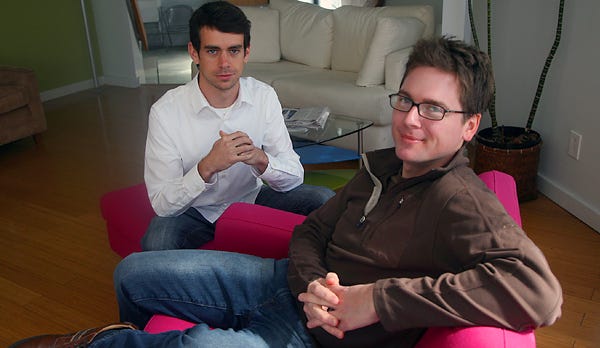
Jack and I in 2006 at 164 South Park — Twitter’s first HQ.
I worked at Twitter for about six years. In that time, the service grew from zero people to hundreds of millions of people. Jack was the original CEO and when he returned I was very happy.
There’s something about the personality of a company that comes from the folks who start it. There’s a special feeling they bring with them. Jack coming back was a big step forward. And now, it’s my turn—I’m returning to full time work at Twitter starting in a couple of weeks! How this came about is kind of a crazy story but, it’s happening.
How It Happened
A few months ago, I sold the company I most recently founded. The deal did not require me to work at the company we sold to, but I’m the type of person who has to keep working. I’ve made a lot of connections over the years and one of those connections offered me a really sweet gig. I accepted! I had everything all worked out — and then it happened.
Twitter decided to relaunch the Friday afternoon tradition of Tea Time for employees in SF. Jack invited me to join him as “special guest” at this restart of an old tradition. When I stood next to Jack addressing the crowd of employees, I felt the energy, and I was overcome with emotion. I realized in that moment that Twitter was the most important work of my life.
While we were on stage, Jack asked me to come back to work at Twitter. People cheered. But I wasn’t really sure if he meant it. After Tea Time, we spoke privately and Jack told me that he really did — he wanted me to come back and work at Twitter. The company I co-founded, the service I co-invented. I was stunned, but I knew the answer.
What I’ll Be Doing
My top focus will be to guide the company culture, that energy, that feeling. This is where Jack, and Twitter’s inestimable CMO, Leslie Berland, feel I can have the most powerful impact. It’s important that everyone understands the whole story of Twitter and each of our roles in that story. I’ll shape the experience internally so it’s also felt outside the company. More soon.
I’m not replacing anyone at Twitter. Somebody mentioned I’m just filling the “Biz shaped hole” I left. You might even say the job description includes being Biz Stone. Ev said it best when I told him about this turn of events, “Well, you’re among the best in the world at being Biz Stone.” (I’ve worked with him for fifteen years so I recognize his compliments.)
My excitement at the chance to work on Twitter again with Jack, Leslie and the entire team around the world is over-the-moon. As I truly believe, and as I’ve written before, the Tweets must flow. Twitter has woven itself into the fabric of our global society. The world needs Twitter, and it’s here to stay. I’m so lucky that I get to step back in and help shape it’s future.
That big presentation, report, or assignment isn’t going to write itself. And yet, you feel compelled to finish every non-essential task on your to-do list instead. Or you’re staring at a blank screen with nothing in your brain but panic. Meanwhile, the clock ticks loudly in the background—metaphorically, at least.
It’s official. You’ve got writer’s block.
Like any kind of creative impasse, writer’s block can have a variety of causes—perfectionism, self-doubt, uncertainty about your subject, fear of failure. The good news? Since much of writer’s block starts with your own thoughts and beliefs, you have the power to overcome it. Here are five ways to jump-start a stalled project.
Don’t let panic get the better of you
It’s stressful to feel stuck while a deadline looms. Unfortunately, stress can short-circuit the higher brain functions you need to write and think creatively, enabling more primitive parts of the brain to take over. To calm down—and put your pre-frontal cortex back in the driver’s seat—try these strategies:
Get moving: Going for even a short walk will increase feel-good endorphins, ease anxiety, and help you mentally, and literally, distance yourself from a stress-inducing project.
Try deep breathing exercises, which experts say can slow your heartbeat, lower blood pressure, increase oxygenation, and help you relax.
Practice mindfulness: Purposeful attention to the sensations in your body, your surroundings, and your thoughts in the present moment can help to calm your mind.
Check your assumptions
Do you believe that writing should flow effortlessly? That it’s easier for everyone else? The vast amount of literature on the subject is proof that it’s not. Writing is a process, and good writing happens in stages. You’re not going to get it absolutely right the first time around, so don’t try. Just dive in, with full permission to write an imperfect—or even terrible—first draft.
And who says you have to write in order? Sometimes the beginning is the most daunting because it’s hard to introduce your topic before you’ve defined it. So start with the easier parts, even if they’re in the middle. You’ll not only feel a sense of movement and accomplishment, but chances are, you’ll be so steeped in your topic when you’re done that the rest of your project will seem more doable.
Brainstorm, mind map, or outline
Feeling so stuck you can’t actually begin? Take some of the pressure off—create a brainstorming document that no one else will ever see. Don’t worry about the order, or a logical flow, or even about complete sentences. Hate something you’ve jotted down? Just keep going. The point here is to free your brain to come up with the main ideas and how they connect—without the interference of your inner editor, whose job is to judge, refine, and be critical. That’ll be very useful later on, but now? Not so much.
You may find that it’s hard to keep that editor-brain out of the way while you’re typing at your desk, so try moving to a more relaxing locale, like a café or park. Or try a non-linear style of brainstorming, like mind-mapping. Scribble your ideas on a legal pad or, even better, commandeer that huge whiteboard in the conference room and go nuts.
And while an outline may give you flashbacks to junior high, it can be an incredibly useful tool to help you organize the ideas you’ve brainstormed, make sure all the important points are covered, and ensure your project has a logical flow. Best of all, an outline helps you break your writing project up into smaller chunks—and once those are defined, they’re a lot easier to tackle.
Create your own deadlines
Sometimes what’s keeping you stuck isn’t an abundance of internal pressure—it’s not quite enough of the external kind. If you need a challenge or a greater sense of urgency to get started, there’s The Most Dangerous Writing App, which will delete your work if you stop typing for more than five seconds. You choose the length of time to keep going, and it does the rest.
If that idea gives you the hives, take it down a notch—build mini-deadlines into your project that give you a sense of structure and accountability. Enlist co-workers, or even better, your boss, to meet with you at each stage to go over what you’ve accomplished and what you’ll be working on next. Everyone loves to give feedback—and they don’t need to know they’re also keeping you on track.
Let your unconscious mind do some of the heavy lifting
When you’re feeling stuck, sometimes the best thing to do is…take a break. A number of studies suggest that our unconscious minds are an important part of problem-solving and the creative process. You’ve probably experienced it yourself—setting a challenge aside and then finding that solutions or new ideas bubble up while you’re driving, doing the dishes, out for a walk, or in the shower.
Psychologists call it incubation, and there a number of hypotheses about what’s going on. It may be that, while our conscious minds are occupied with something else, our unconscious minds are reframing the problem or quickly trying out new combinations of ideas. Or it’s possible that fatigued brains just benefit from a little rest. To get the strongest incubation effect, research shows that light mental activity—gardening, light reading—works better than either sleep or intense mental activity.
This might also help to explain the research that shows taking regular breaks correlates to higher productivity. But the line between a break and procrastination can be blurry, so it pays to experiment and see what works best for you. And build in lots of time for challenging projects so you can take advantage of more incubation periods.
When you’re feeling stuck on a big project, it can feel like you’ll never get un-stuck. But remember: writer’s block happens to most of us. If you approach it with curiosity, a sense of humor, and most importantly, some self-compassion, you can be moving forward in no time.
Youth Socialization a two-way process of a permanent transfer of the Company, and the development of the individual, age-related to youth, social norms, cultural values and patterns of behavior that allows a young man to function in a given society.
The specificity of youth socialization is related to its age characteristics. Youth Socialization includes the completion of primary and secondary socialization beginning stages.
A feature of primary socialization is the initial development of the individual of the world through the “understanding of the other” (in the Weberian interpretation). The individual “absorbs” a common value in the process of communicating with important for him by other people while being guided by them. At this stage, there is no choice of significant others; parents, family belongs to the leading role as an agent of socialization; the objective reality is perceived as inevitable which is constituted in language, interpretation and incentive schemes.
Secondary socialization is a fundamental difference consisting in the fact that for the individual near his entourage, as well as society and the individual himself in his own views are given other reclaimed its previous objective reality. The initial stage of secondary socialization involves the assignment of a young man of social subjectivity in the forms accepted in society. Social roles de individual, they are perceived as interchangeable. In the mind of the individual gradually comes from the abstraction of roles and settings specific to other roles and attitudes in general. This is due to the individual’s identity, not only with the specific significant others, focusing on the generalized other (within the meaning of John. G. Meade), but also by identifying himself with the generality of others. With the society. Start of secondary socialization, as a rule, coincides with a reduction in the role of parent family as an agent of socialization of the young man, sociality is no longer perceived as a matter of course. With the assignment of individual subjectivity is trying to build, and modify it. Formation in the minds of the generalized other the decisive phase of socialization. The difficulty, crisis socialization of young people is that the new adaptation and internalization processes are superimposed on earlier completed within the period of primary socialization. Therefore, there is a problem of consistency between the original social adaptation and internalization. Comprehend the individual adaptation to the world to master their significant others, as well as his invention (as defined by G. Tarde) are insufficient in the new stage of life.
In his early youth questioned newfound identity earlier. Awareness of the need to solve the problem of adults is an experience of how the individual looks in the eyes of others in comparison to his own self-image. In search of a new sense of identity and continuity of the young people have to re-conduct many of the battles of the past, bringing to it their inner strength, and the very significant others. This new, final step before adulthood identity is more than the sum of the children’s identities. The new identity has a sense of confidence that the internal identity and continuity is combined with the identity and continuity of the values of the individual to the other. This confirms the identity of the individual willingness to integrate all their previous identification (personal) to perform social roles of adults.
The term “socialization” is used in the designation process of formation and development of the person at the end of the XIX century. (F. Giddings, Durkheim, Tarde G. et al.). Socialization theories were based on different approaches to the consideration of the role of objective and subjective factors, the interpretation of the individual or the public as the ultimate reality. A huge influence on the development of sociological theories of socialization had concept of Marx on the nature of man as a totality of all social relations, according to which the social environment and at the same time serves the emerging human, and the result of its activity (Marx, 1960: 190-210). Human formation is not identical to the passive adaptation of people to the social environment, and covers and their own practical activities in which they are acting on the world, changing social environment and at the same time, as Marx put it, “his own nature”, develop dormant in it force.
Developed because of the objectivist approach of socialization theory of Emile Durkheim is based on the position of the dual nature of man. The biological nature of man (the ability of biological functions, impulses, passions) are in contradiction with its social nature, created by education (norms, values, ideals) Durkheim, 1996). This leads to never-ending inner restlessness, a sense of tension and anxiety, which can only be removed the influence of society. It controls the biological nature of man, restrains passion, and enters them in a certain frame. If society weakens their control over individuals, there is a state of anomie. With each new generation of society is almost in front of tabula rasa (blank slate), in which he will write again. Durkheim believed how quickly you can add essential for society to just born selfish and antisocial substantially more capable to lead a moral and social life. The main function of socialization, according to Durkheim, familiarizing individuals with the idea of “collective consciousness” is to establish uniformity and integrity of the society. Socialized recognized personality, endowed with the ability to inhibit individual interests for the sake of the public. The core of Durkheim’s concept of socialization was the theory of morality as a system of objective rules of conduct. Public functions of morality, Durkheim linked with education, the purpose of which the formation of a social being, the development of the child the qualities and personality traits that are needed by society. He saw education as a social phenomenon, which consists in a methodical socialization of the younger generation. General state of the theory of socialization G. Tarde imitation is the principle, and the ratio of “teacher-student” model proclaimed in all the variety of social relations (Tarde, 2012). Tarde first tried to describe the process of internalization of norms through social interaction. Along with the treatment of sociality as an imitation, which, according to him, manifestation of the fundamental law of all things a world of repetition, Tarde linked the possibility of social evolution to innovation as a deviation from the strict repetition.
Google today announced a trio of new features for Google Photos: Suggested Sharing, Shared Libraries and Photo Books. Google Photos has become an indispensable tool for many to manage their vast photo library and thousands of photos that they take while on their vacation.
Continue reading →
The saying ‘monkey see, monkey do’ has entire new meaning when robots start to learn by copying humans.
OpenAI, a non-profit artificial intelligence research company backed by Elon Musk, has announced a new algorithm focused on robots learning by imitation.
The algorithm allows humans to show a task to an AI by first demonstrating it in virtual reality (VR). According to OpenAI, this method is called one-time imitation learning.
OpenAI test this one-time imitation with a robotic arm that sorts and stacks blocks on a table top. The human does the stacking in VR, while the robotic arm imitates what the human does, however, in real life.
The robotic arm has two neural networks within its system, one called the vision network that ‘views’ and registers what actions are taking place in VR, and the other that neural network — called the imitation network — that guides the arm based on the information provided by the vision network.
The vision network does a lot before sending the information to the imitation network. First, within the network, it generates simulated images in a variety of colours and shapes of the table with the blocks. The simulated images generated help the vision network analyze what it “sees” with the camera feed.
The vision network then transfers the information to the imitation network that guides the robotic’s arm’s arm. Even though the blocks are set up are in a variety of colours and in different orders, the robot is still able to figure out the right order.
“Our robot has now learned to perform the task even though its movements have to be different than the ones in the demonstration,” said Josh Tobin a member of OpenAI, in a video demonstrating the new algorithm.
“With a single demonstration of a task, we can replicate it in a number of different initial conditions. Teaching the robot how to build a different block arrangement requires only a single additional demonstration.”
American chip-maker Qualcomm is suing four Apple contract manufacturers for failing to pay royalties on licensed agreements.
In a complaint filed with the United States District Court Southern District of California, Qualcomm demanded relief for the breach of contract, as well as a jury trial for the case.
According to the most recent complaint, Apple itself has interfered in the existing relationship between Qualcomm and the four manufacturers — including Foxconn — and has withheld its own payments to its manufacturers.
“Apple is attempting to inflict severe, immediate, and permanent harm on Qualcomm to force Qualcomm to agree to Apple’s unreasonable demand for a below-market direct license,” reads an excerpt from the court filing.
Qualcomm also asserts that Apple has ordered the manufacturers to avoid making payments on behalf of Apple to Qualcomm.
The complaint further states that Apple has promised to compensate its four manufacturers for any money lost as a result of the legal conflict between Apple and Qualcomm.
“It is unfortunate that we must take this action against these long-time licensees to enforce our agreements, but we cannot allow these manufacturers and Apple to use our valuable intellectual property without paying the fair and reasonable royalties to which they have agreed,” said Don Rosenberg, executive vice president and general counsel of Qualcomm, in a media release.
Qualcomm’s latest lawsuit is the most recent turn-of-events in the ongoing financial and legal battle between the two companies.
The source of the animosity between both companies is an unsuccessful negotiation on Apple’s part to arrange a direct licensing agreement with Qualcomm.
“They have refused to negotiate fair terms,” Apple said in an earlier statement. “Without an agreed-upon rate to determine how much is owed, we have suspended payments until the correct amount can be determined by the court.”
In January 2017, Apple sued Qualcomm on the grounds that the chip manufacturer was overcharging the software and hardware giant, as well as refusing to pay almost $1 billion USD in rebates.
After describing voice and vision as the “new modalities” for computing following the standard keyboard and mouse, Google CEO Sundar Pichai has announced a new Google Assistant and Photos feature called ‘Google Lens.’
Lens is capable of scanning objects and instantly identifying them, with Pichai calling the platform a “set of vision-based computing capabilities.” An example shown off during I/O 2017’s keynote involved pointing Lens at a specific flower and then that fauna being instantly identified.
The technology is also capable of grabbing a username and password from a Wi-Fi router, a feature that resulted in cheers from the crowd at I/O 2017.
With Google Lens, your smartphone camera won’t just see what you see, but will also understand what you see to help you take action. #io17pic.twitter.com/viOmWFjqk1
Pichai also said that Google Lens is capable identifying animals like a dog or a cat.
“If you ever been to a friend’s place and you’ve crawled under a friend’s desk just to get the username and password from their router, you can just point your phone at it [instead],” said Google CEO Sundar Pichai during Google’s keynote I/O presentation today.
Google Lens shares many similarities with Bixby Vision, though it seems significantly more capable than Samsung’s platform.
At its 2017 I/O keynote, Google announced that it will soon be able to remove unwanted objects from photos.
The example provided featured a picture of a child playing baseball; with Google’s new feature, the chainlink fence in front of the boy is able to be removed while leaving him unaltered.
It wasn’t specified where this feature would roll out, but presumably it would be built into Google Photos.
Google Assistant is able to control music, can be connected to control a user’s smarthome, and can even utilize basic conversational indicators to surf through photos, make phone calls and send messages.
The Assistant won’t operate exactly as it does on Android devices, however. The tech giant says that due to API restrictions, it’ll be able to do general stuff including iMessage and Spotify integrations but won’t have the same deep phone-level integrations, like setting alarms.
The company has yet to announce whether Google Assistant for iOS is arriving in Canada at the same time as the United States. Early reports indicate that Google Assistant will come to iOS in the U.S. first.
MobileSyrup has reached out to Google for comment and will update this story when we have additional information.
At I/O 2017 Google announced that its IoT smart home assistant platform Google Home is set to come to Canada this summer.
A specific release date was not announced for the device, but we’ll update this story when we get additional details from Google Canada.
Other announcements include the fact that hands-free calling is set to come to Google Home, though the feature will only be available in the U.S. at launch. Users, however, will be able to make calls within the U.S. and Canada via Google Home.
Coming soon to #GoogleHome: hands-free calling. Call businesses, friends and family in the ???????? and ????????, even if you can’t reach your ???? #io17pic.twitter.com/hvG6wtS9qf
Until now Google has been racing to improve the feature integration in its Google Home smart speaker in an effort to catch up with Amazon’s Echo. Today at I/O Google announced the ability to control HBO Now, Hulu (streaming platforms only available in the U.S.) as well as other platforms, via voice commands.
In a surprising move, the company revealed plans to add Bluetooth audio support to Google Home as well. Finally, Google also announced that soon users will be able to ask Home things like, “show me my calendar on TV,” or “show me nearby restaurants on TV,” with the results being displayed on a connected smart television. Google says this feature will not arrive for some time and that it will be very limited at launch.
Amazon still has not announced the Canadian release of any of its voice-activated IoT Echo devices. When asked about Canadian pricing and a specific release date, Google Canada released the following statement:
“We’re excited to bring Google Home to Canadians. We have no additional news to share at this time.”
At its annual I/O developer conference, Google’s Scott Huffman announced that Google Assistant, the company’s AI-assisted personal helper, will support four additional languages later this summer: French, German, Brazillian Portuguese and Japanese.
The addition of French is particularly significant to Canada, as there is a large demographic of French Canadians who have long been anticipating support for the French language.
Google did not provide a specific release date.
Continue to follow MobileSyrup for additional stories from I/O 2017.
At its annual developer conference, Google announced that Google Assistant will soon support transactions without going through a third-party.
At the conference, Google showed a demonstration of ordering from Panera through Assistant. In theory, users can type or say “order from Panera” and then the Assistant will show a menu for purchasing.
Once the user decides on an order, they can then pay from saved wallet information and use their fingerprint for authentication.
Google says the feature will first launch with Panera, and that it will limit notifications when it comes to receipts and order confirmations. It’s unclear if or when this new ability will make its way to Google Assistant in Canada.
So far, Google’s AI, the Google Assistant, has been in a fairly walled garden on mobile, with few third-party integrations.
Today at Google I/O 2017, however, the tech giant announced that Google Actions will work on both Android and iPhone mobile devices.
This gives Google an edge over Amazon Alexa when it comes to attracting developers, since developers that create actions for Google Assistant will now see their hard work go live across multiple platforms, not just primarily for the Google Home speaker. Alexa developers’ work has much less range.
During the keynote, Google demonstrated ordering a delivery from Panera through a mobile device.
At Google’s 2017 I/O developer conference, the company revealed more of what to expect from the newest dessert named iteration of Android, the as-yet unnamed Android O, which is coming available in its first public beta today.
The company focused on two themes: ‘Fluid Experiences’ and ‘Vitals’ — referring to keeping the vital system behaviour in a healthy state.
Among the new announcements regarding Android O — there’s Google Play Protect, which shows which Google Play apps in your phone have been recently scanned when in the Google Play Store and TensorFlow Lite, Google’s machine learning but a light version for phones. The company says it will be available later this year.
The company noted that in addition to YouTube, its previously announced picture-in-picture viewing feature will also be available in Maps and Netflix.
Google also demonstrated ‘Notification Dots,’ a feature that shows when you have notifications in an app, similar to the long-time iOS feature of the same nature.
In addition, it showed off its new autofill option, that will let users opt in to a mobile autofill option that will work for “most” applications.
Further, the company demonstrated smart text selection for copy and paste, which uses on-the-go machine learning, a large focus at this year’s conference.
Google says users can expect a release later this summer.
Besides the features announced today, Google’s first developer preview of Android O revealed more granular notification control and an overhauled and minimalist new settings app.
Two years and 500 million users later, Google is updating Photos to make it easier to share photos.
Google’s Anil Sabharwal detailed three new sharing-focused features that are coming to Photos in the coming weeks, at I/O 2017 today.
The first is Suggested Sharing, a feature Photos will use to suggest users send their images to friends and family members.
With Suggested Sharing, Photos will send a notification to remind users to share the photos they take of their friends. When taking advantage of this feature, Photos will send an SMS message or email to those who do not have the app, allowing that person to download the photo without first downloading Photos.
The second new feature is called Shared Libraries. This feature allows users to easily share their entire library with another user. A separate interface within Photos allows the recipient to view a shared library. The app will periodically remind the user to check this section.
Alternatively, users can tell the app to automatically save photos from a shared library. In a particularly humorous example, Sabharwal took a photo of a cardboard cutout of his children, which Photos automatically added to his wife’s Photos library.
Google says the two features will come to iOS and Android in the “coming weeks.”
Lastly, the company is launching Photo Books, a service that allows Photos users to easily create physical photo albums. Google plans to offer both soft cover and hard cover books, priced at $9.99 USD and $19.99 USD, respectively. Photos will pick the pictures it thinks are the best, saving the user from the hassle of whittle down their library on their own. Several days later, the photo album will arrive. Google plans to get Photos to suggest themed photo albums in the future.
The service is currently only available in the U.S. The company plans to launch Photo Books in other countries at a later date.
Google also announced that it plans to integrate Lens into Photos sometime this year.


 TodayIFoundOut's YouTube Videos.
 heise online News.


 Android Device Manager hasn’t been updated since 2015, but that is finally changing today, and the changes are welcomed.
Continue reading →
Android Device Manager hasn’t been updated since 2015, but that is finally changing today, and the changes are welcomed.
Continue reading →
 Google today announced a trio of new features for Google Photos: Suggested Sharing, Shared Libraries and Photo Books. Google Photos has become an indispensable tool for many to manage their vast photo library and thousands of photos that they take while on their vacation.
Continue reading →
Google today announced a trio of new features for Google Photos: Suggested Sharing, Shared Libraries and Photo Books. Google Photos has become an indispensable tool for many to manage their vast photo library and thousands of photos that they take while on their vacation.
Continue reading →
 With Android O, Google is introducing a new way for apps to show their notifications: Notifications Dots.
Continue reading →
With Android O, Google is introducing a new way for apps to show their notifications: Notifications Dots.
Continue reading →
 As expected, Google’s Android O Beta program is now live for compatible Pixel and Nexus devices.
Continue reading →
As expected, Google’s Android O Beta program is now live for compatible Pixel and Nexus devices.
Continue reading →


