Shared posts

19 May 22:32

Airfoil for Mac 5.6 Restores Full Apple TV Compatibility

by Paul Kafasis

Airfoil for Mac IconWe’ve got a great update for Airfoil for Mac today which enables it to once again send audio directly to all versions of the Apple TV. Airfoil for Mac 5.6 is a free update, available immediately by selecting “Check for Update” from the Airfoil menu. We strongly encourage all users to move up to Airfoil 5.6 immediately.

Airfoil for Windows Updates

Update (September 25th, 2017): This update took longer than we’d have liked, but Airfoil for Windows 5.2 and above restore full Apple TV compatibility as well. Grab the latest from the Airfoil for Windows page.

Airfoil for Windows IconWe didn’t want to delay the release of our Mac version, but now that Airfoil for Mac is sending directly to the newest Apple TVs, we’re working quickly to bring the same fix to Airfoil for Windows. We should have an update there very soon, so stay tuned for more information.

Notes on Airfoil Satellite TV

Airfoil Satellite TV IconThe Airfoil Satellite TV app we released last month provided a useful workaround for users wishing to stream audio to the new Apple TVs. Prior to the recent tvOS 10.2 update, however, no receiver app was needed. Airfoil could instead stream directly to the Apple TV, with no additional software required. When the tvOS update broke this functionality, running Airfoil Satellite TV again enabled Airfoil to send to the Apple TV.

Now that we’ve worked around Apple’s changes with Airfoil 5.6, you can once again stream audio to the Apple TV without needing any additional software. As such, Airfoil Satellite TV shouldn’t be necessary for most uses. In the future, we may add additional functionality so the app better matches the iOS version of Airfoil Satellite. If nothing else, however, Airfoil Satellite TV will continue to exist as a fall-back, so that even if Apple changes or breaks AirPlay compatibility, Airfoil will still be able to send audio from a Mac or PC to the Apple TV.

19 May 22:31

One Step Closer to a Closed Internet

by Denelle Dixon-Thayer

Today, the FCC voted on Chairman Ajit Pai’s proposal to repeal and replace net neutrality protections enacted in 2015. The verdict: to move forward with Pai’s proposal


We’re deeply disheartened. Today’s FCC vote to repeal and replace net neutrality protections brings us one step closer to a closed internet.  Although it is sometimes hard to describe the “real” impacts of these decisions, this one is easy: this decision leads to an internet that benefits Internet Service Providers (ISPs), not users, and erodes free speech, competition, innovation and user choice.

This vote undoes years of progress leading up to 2015’s net neutrality protections. The 2015  rules properly place ISPs under “Title II” of the Communications Act of 1934, and through that well-tested basis of legal authority, prohibit ISPs from engaging in paid prioritization and blocking or throttling of web content, applications and services. These rules ensured a more open, healthy Internet.

Pai’s proposal removes the 2015 protections and re-re-classifies ISPs under “Title I,” which courts already have determined is insufficient for ensuring a truly neutral net. The result: ISPs would be able to once again prioritize, block and throttle with impunity. This means fewer opportunities for startups and entrepreneurs, and a chilling effect on innovation, free expression and choice online.

Net neutrality isn’t an abstract issue — it has significant, real-world effects. For example, in the past, without net neutrality protections, ISPs have imposed limits on who can FaceTime and determined how we stream videos, and also adopted underhanded business practices.

So what’s next and what can we do?

We’re now entering a 90-day public comment period, which ends in mid-August. The FCC may determine a path forward as soon as October of this year.

During the public comment period in 2015, nearly 4 million citizens wrote to the FCC, many of them demanding strong net neutrality protections.  We all need to show the same commitment again.

We’re already well on our way to making noise. In the weeks since Pai first announced his proposal, more than 100,000 citizens (not bots) have signed Mozilla’s net neutrality petition at mzl.la/savetheinternet. And countless callers (again, not bots) have recorded more than 50 hours of voicemail for the FCC’s ears. We need more of this.

We’re also planning strategic, direct engagement with policymakers, including through written comments in the FCC’s open proceeding. Over the next three months, Mozilla will continue to amplify internet users’ voices and fuel the movement for a healthy internet.

The post One Step Closer to a Closed Internet appeared first on The Mozilla Blog.

19 May 20:21

Are you a white guy? Now Write Your Own Bad Expat Novel Set In Japan! Here’s how

by subcultureist

Spare a thought for Western Man Trapped in Japan.

In Japan, it’s a familiar refrain: “Men have it easy — especially foreigners. They are males in a highly conservative patriarchal society, so they enjoy all the benefits: status, money, career. On top of that, foreigners often attract a lot of Japanese girls.

“These Western men do not really have to learn the language or try to fit in. Their Japanese girlfriends or wives will take care of the majority of things for them. Their careers, especially teaching ones, also may not require Japanese proficiency. They are never subjected to sexual harassment, abuse or sexism.” But is this the full story?.……

It’s not the full story and this legendary article above chock full of whining anecdotes of cultural oppression (overly complimented on chopstick usage etc)  by white guys ‘trapped’ in Japan has a lot of unintentional humour. In many ways, it almost seems like a parody of our parody of Charisma ManHowever, it also has all the elements of sub-par expat-white-guy-in-Japan fiction and/or memoir.

It’s inspired us– inspired us to start our own collective Japan Subculture Research Center original novel.  Your contributions are welcome! Together we can build the ultimate bad expat novel in Japan. The choice is yours.

ABYSMAL MAN IN JAPAN aka MOBY DICKHEAD
By Jackass Enablerstein
Call me Cebastian.
…..or call me CJ, as in “See Japan”.
Call me CJ-kun (君)…if you’d like.
Some years ago–never mind how long precisely –having little or no yen in my purse, and nothing particular to interest me in America but a fondness for anime, sushi and cute Japanese girls, I thought I would travel about a little and teach English in the floating world.
With only a copy of MAKING OUT IN JAPANESE, a bag of Green Kit-Kats, and lots of sunscreen to make sure I stayed a pale outsider in this land of wheat coloured people, an iPhone preloaded with Tinder, and ratty jeans and a dingy “FUCK THE POLICE” t-shirt so I could fit in with the locals, I set out to Japan to find myself and penetrate the mysteries of that far and distant country.
I had brought my Oakley dark sunglasses with me as well; I would need to shield my delicate blue eyes from the hot blazing sun of the orient. They don’t call it the Land Of The Rising Sun because it’s Denmark, you know. And the sunglasses made for the flat faced people of Nippon, I was sure would not fit my craggy and deeply marbled handsome Western face.
I was ready as I’d ever be.
On the plane, as I scratched my hipster beard, I wondered: Do Japanese people shave a lot? Would my tattoo that read 肉食 (Meet People) charm the natives or alienate them? I regretted leaving my copy of JAPAN: CULTURE SHOCK behind but then again, I could figure it all out on my own. My future girlfriend would teach me, just as she would teach me the intricacies of their ancient Altaic language and perhaps the language of love.
It was a long flight. I barely had space to sit in full-lotus position in deep zen meditation until the beautiful  flight attendant, Keiko, touched me lightly on the knee, with geisha-like grace, getting my attention. She giggled with her hand covering her mouth and motioned me to come back towards the rear end of the plane. Perhaps she was also a student of Zen….
The critics are already raving about Abysmal Man In Japan

Let me play a sad song on my tiny violin for the poor white men!!!

There’s a common thread with miserable gaijin men here: Refusal to learn the language. Expectations that everything, including women, will be handed to them upon arrival. Smug self-importance and the general belief that they are somehow “above” everything and everyone because of their white male-ness. Like, bro. No one is forcing you to stay here if you’re single. You don’t like the working conditions (that, ahem, even your Japanese coworkers are subjected to)? GO HOME. I don’t even want to touch the ridiculousness that this article insinuates white male foreigners somehow have it worse than Japanese women, poor Japanese, non-white immigrants…–Kat Bee


19 May 20:21

Celebrate Museum Day with the Flickr Commons

by Zee Jenkins

On May 18, over 30,000 museums and archival institutions around the globe participate in Museum Day. Some are offering free admission or have dedicated events going on to celebrate the day, to celebrate history, and to share their exhibitions with the world.

We’ve dug into the Flickr Commons and put together a gallery of some of our favorite photos from their archives. We encourage you to take a look and browse their albums. Some have tens of thousands of images from centuries of history.

VIEW THE FULL MUSEUM DAY GALLERY

Florence Sallows photographing daughter and dog, date unknown
Bus and tram on Munkbron in Stockholm 1964
Painters on the Brooklyn Bridge Suspender Cables-October 7, 1914
McDonnell Douglas : F/A-18C : Hornet
NMFF_002541_2

Is there a museum in your community that should be part of the Flickr Commons? Invite them to apply and share their historical archives with the world.


19 May 20:20

The Guardian view on Theresa May’s manifesto: a new Toryism | Editorial

by Editorial
mkalus shared this story from EU referendum and Brexit | The Guardian.

Like Tony Blair in 1997, Mrs May is where the majority of voters are: to the left on the economy and to the right on social issues. She plays to this mood, a political judgment that risks society closing in on itself rather than opening up

Theresa May’s manifesto reveals more about her plans to refound the Conservative party than her plans to run the country. Her programme for the Tories would read as a heretical document to many in her party, brought up on a diet of state-shrinking, me-first Thatcherism. Instead, Mrs May talks about rejecting the “cult of selfish individualism” and says her party does not now believe in “untrammelled free markets”. To see how big a leap this is. consider how much the Conservative party of the recent past changed the temper of Britain, fostering a mood of materialistic individualism. Mrs May consciously jettisons this individualist heritage because she knows that the public associate Thatcherism less with an unleashing of economic virtue than an unfettering of the social vices of selfishness and greed. It has contributed, as Mrs May has long contended, to the Conservatives’ reputation as the “nasty party”.

In many ways Mrs May is swimming with, not against, the political tide. No classical liberal party is contesting this election. Both Labour and the Liberal Democrats have moved leftwards. By proposing to cancel key Lib Dem achievements – such as the constitutional reform of fixed-term parliaments – Mrs May signals that she wishes to wipe out traces of “Liberalism” from government.

Continue reading...
19 May 20:20

'Brexit devastated me, but now I back the Tories': Re-leavers on how they will vote | Guardian readers and Rachel Obordo

by Guardian readers and Rachel Obordo
mkalus shared this story from EU referendum and Brexit | The Guardian.

A survey suggests those who voted remain but now back leave will boost the Conservatives at the election. We asked them, and ‘hard remainers’, for their views

Brexit has split the electorate into three groups, according to a YouGov survey: hard leavers, hard remainers and re-leavers - those who voted to remain in the EU but have changed their minds.

Continue reading...
19 May 20:20

Wer sind die erfolgreichsten Smart Cities Startups in Europa?

by Monty Metzger

Digital Leaders Ventures hat in Zusammenarbeit mit der FIA einen globalen Startup Wettbewerb gestartet. Veranstaltet wird der Wettbewerb im Rahmen der Formula E Rennen. Das nächste Event findet bereits Anfang Juni in Berlin, Deutschland, statt.

Der Startup Wettbewerb fokussiert sich auf Industrial Internet of Things, Autonomous Driving und eMobility, Hardware und Smart Infrastructure, Big Data und Artificial Intelligence, Sharing Economy und Digital Services. Es gibt keine Regionale Einschränkung – Startups aus ganz Europa können teilnehmen.

Startups profitieren von 100.000 Euro Finanzierung von DLV zu fairen Konditionen, Zugang zum Netzwerk der FIA, Formula E, DLV und unseren Partnern, PR Reichweite ….. und eine spezielle Einladung zum Formula E Rennen in Berlin für zwei.

Hier kann man sich als Startup bewerben:
https://goo.gl/forms/kS8OLmOH87ZeMtJn2

Stichtag für die Bewerbung ist der 29. Mai 2017 um 23:55 Uhr.

Erfahre mehr zu den Vorteilen, zur Jury und Themen:
http://www.dlv.vc/fia-global-startup-contest

Highlights von FIA Smart Cities Mexico City

Der Beitrag Wer sind die erfolgreichsten Smart Cities Startups in Europa? erschien zuerst auf Monty Metzger.

19 May 20:20

In Vancouver’s ‘Cantosphere’, a sense of responsibility and an identity under siege

by Ian Young
There is a space occupied by the Hong Kong diaspora and their children in Vancouver, that is neither entirely here nor there. Within that piecemeal identity is a sense of longing - and an increasing sense of responsibility towards the fate of Hong Kong and the broader “Cantosphere”. As next month’s 20th anniversary of the Hong Kong handover closes in, Vancouver’s HK diaspora is looking for ways to highlight an identity that feels under siege. In Hong Hong, the...
19 May 20:20

Meet the All-New Things

by Werner

It’s here! We’ve been working hard on a completely new version of Things for the past years and we’re incredibly proud and excited to finally show it to all of you.


Let’s get right down to the details – we have a lot for you to explore!

  • Watch the app introduction video above.
  • Read all about what’s new in the apps.
  • Get useful tips and insights on how to use the apps on our updated support page.
  • On the Mac, you can download the trial and take it for a spin.
  • And of course, check out our App Store pages (Mac, iPhone, iPad).

When you first open the apps, they will ask you whether to create a tutorial project. Be sure to answer "Yes" on each device, as there’s some great info in there for you.

For everyone who’s currently using Things 2 and wants to upgrade, we’ve decided to put up a 20% discount on all apps until May 26th June 1st. (So $40 instead of $50 on the Mac, etc.). Due to the way the App Store works, everyone can take advantage of this – so make sure you don’t miss it!

If you like the music of our video, you can find it on iTunes.


I want to thank the entire team for their incredible work over the years. It took excellence, persistence, and determination to get here, and I’m proud of what we’ve been able to do together.

Finally, everyone here at Things wants to extend their thanks to all of you for your support over the years. It means a lot to us! We hope you’re going to enjoy the all-new Things. Please let us know what you think!

The all-new Things
19 May 18:28

I Don’t Believe in Blockchain

files/images/tim-bray.jpg

Onging, May 21, 2017


Icon

I'm sure Don and Alex Tapscott don't want to read this, but Tim Bray (who has a long history of internet standards development) has called the recent attention being paid to blockchain "an over­pro­mot­ed niche sideshow." He writes, "I’ve seen wave after wave of landscape-shifting tech­nol­o­gy sweep through the IT space: Per­son­al com­put­er­s, Unix, C, the In­ter­net and We­b, Java, REST, mo­bile, pub­lic cloud. And with­out ex­cep­tion, I ob­served that they were ini­tial­ly load­ed in the back door by geek­s, with­out ask­ing per­mis­sion, be­cause they got shit done and helped peo­ple with their job­s.That’s not hap­pen­ing with blockchain. Not in the slight­est. Which is why I don’t be­lieve in it."  [Link] [Comment]

19 May 18:28

Compliance is Not the End Goal of Education

files/images/Screen-Shot-2015-01-07-at-7.59.52-PM.png

George Couros, Connected Principals, May 21, 2017


Icon

It shouldn't have to be said, I suppose, but it bears repeating that there are several outcomes above and beyond 'compliance' sought in a quality education. Outcomes like 'engaged' and 'empowered', for example. "Focusing on 'empowering' students is seen by some as 'fluffy'," writes George Couros, but  "This is not  my belief at all.   Empowering students teaches them to have their own voice and follow their own direction."  [Link] [Comment]

19 May 18:28

Ab heute verfügbar ... in USA

by Volker Weber

d727d7dc6e864bbcca78e8220ffcf2f2

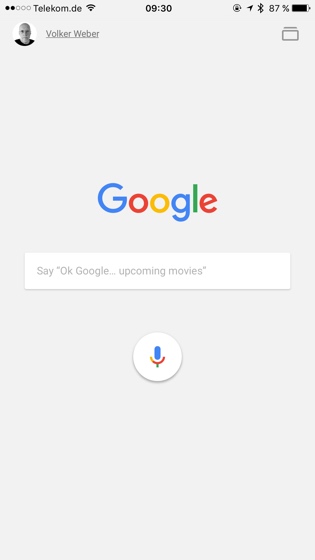
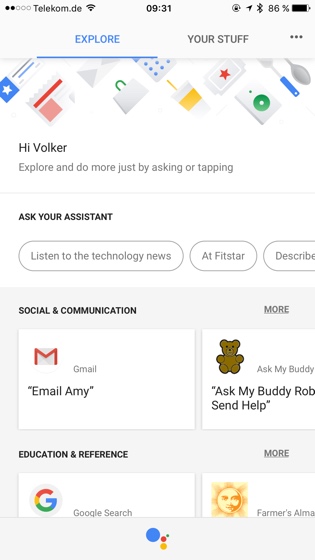
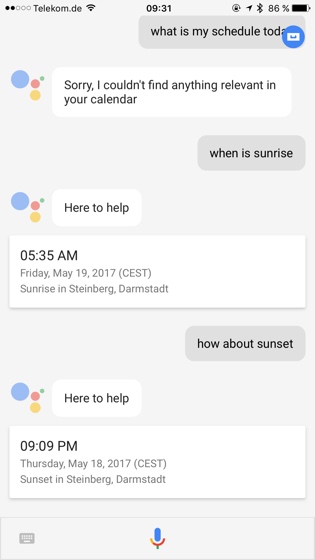
Google hat die Live-Blogger unter den Journalisten verwirrt. Wenn Google sagt, der Google Assistant ist ab heute auf dem iPhone verfügbar, dann muss man in Gedanken immer hinzufügen "in USA". So findet man den Assistant im US-amerikanischen Store, nicht aber im deutschen. Und damit kann man als Deutscher leicht verwirrt werden, wenn man Google Search für Google Assistant hält. Zur deutschen Verfügbarkeit heißt es nämlich "... coming this summer".

Links Google, rechts Assistant:

f8bbc3e33cfab25b9b03fdf39805b491 3a2797d261b4b4af0ece1c3c66528d31

a445f994fabc1a25d07cbe034d7bcc8c bbf7bf0ca2dc45e5d8f4f6bf6dcf12fc

Assistant kann man am besten über das Dashboard erreichen:

66ec6fcaeeaf6a24505dc9ce37d643ff

19 May 18:28

Always Be Evangelizing

by Richard Millington

A reminder from Phoebe this week; always be evangelizing.

Gaining internal support doesn’t mean you’ll keep internal support.

Getting the new staff hire or platform you wanted isn’t an indefinite pass to everlasting support from your organization.

Resources are limited and you’re not the only department lobbying for more.

If you slow down while you’re ahead, others will soon catch up.

You’ve got to work hard at this every single day. This means you need to bring a ferocious, infectious, passion for community to every meeting.

It means you need to bring fresh, engaging, and valuable stories from community members at every opportunity.

It means you need to work your ass off to build stronger relationships, educate people on the benefits, and deliver the value they need to see from the community each month.

No, it’s not in your job description. But if you want to keep your job, no wait..if you want to thrive in your job, this is what it takes.

It’s really hard work. Better get started.

19 May 18:28

En vrac avant les vacances

by Tristan

Je m’apprête à partir quelques jours à moto (j’ignore où, je vais choisir un endroit sec, beau et avec des virages). D’ici là, voici un peu de lecture. Je compte sur vous pour ne pas casser l’Internet d’ici à mon retour !

Votre serviteur à moto dans le Vercors

19 May 18:23

Friduction: the internet's unstoppable drive to eliminate friction

by Dries
Friduction

There is one significant trend that I have noticed over and over again: the internet's continuous drive to mitigate friction in user experiences and business models.

Since the internet's commercial debut in the early 90s, it has captured success and upset the established order by eliminating unnecessary middlemen. Book stores, photo shops, travel agents, stock brokers, bank tellers and music stores are just a few examples of the kinds of middlemen who have been eliminated by their online counterparts. The act of buying books, printing photos or booking flights online alleviates the friction felt by consumers who must stand in line or wait on hold to speak to a customer service representative.

Rather than negatively describing this evolution as disintermediation or taking something away, I believe there is value in recognizing that the internet is constantly improving customer experiences by reducing friction from systems — a process I like to call "friduction".

Open Source and cloud

Over the past 15 years, I have observed Open Source and cloud-computing solutions remove friction from legacy approaches to technology. Open Source takes the friction out of the technology evaluation and adoption process; you are not forced to get a demo or go through a sales and procurement process, or deal with the limitations of a proprietary license. Cloud computing also took off because it also offers friduction; with cloud, companies pay for what they use, avoid large up-front capital expenditures, and gain speed-to-market.

Cross-channel experiences

There is a reason why Drupal's API-first initiative is one of the topics I've talked and written the most about in 2016; it enables Drupal to "move beyond the page" and integrate with different user engagement systems that can eliminate inefficiencies and improve the user experience of traditional websites.

We're quickly headed to a world where websites are evolving into cross­channel experiences, which includes push notifications, conversational UIs, and more. Conversational UIs, such as chatbots and voice assistants, will prevail because they improve and redefine the customer experience.

Personalization and contextualization

In the 90s, personalization meant that websites could address authenticated users by name. I remember the first time I saw my name appear on a website; I was excited! Obviously personalization strategies have come a long way since the 90s. Today, websites present recommendations based on a user's most recent activity, and consumers expect to be provided with highly tailored experiences. The drive for greater personalization and contextualization will never stop; there is too much value in removing friction from the user experience. When a commerce website can predict what you like based on past behavior, it eliminates friction from the shopping process. When a customer support website can predict what question you are going to ask next, it is able to provide a better customer experience. This is not only useful for the user, but also for the business. A more efficient user experience will translate into higher sales, improved customer retention and better brand exposure.

To keep pace with evolving user expectations, tomorrow's digital experiences will need to deliver more tailored, and even predictive customer experiences. This will require organizations to consume multiple sources of data, such as location data, historic clickstream data, or information from wearables to create a fine-grained user context. Data will be the foundation for predictive analytics and personalization services. Advancing user privacy in conjunction with data-driven strategies will be an important component of enhancing personalized experiences. Eventually, I believe that data-driven experiences will be the norm.

At Acquia, we started investing in contextualization and personalization in 2014, through the release of a product called Acquia Lift. Adoption of Acquia Lift has grown year over year, and we expect it to increase for years to come. Contextualization and personalization will become more pervasive, especially as different systems of engagements, big data, the internet of things (IoT) and machine learning mature, combine, and begin to have profound impacts on what the definition of a great user experience should be. It might take a few more years before trends like personalization and contextualization are fully adopted by the early majority, but we are patient investors and product builders. Systems like Acquia Lift will be of critical importance and premiums will be placed on orchestrating the optimal customer journey.

Conclusion

The history of the web dictates that lower-friction solutions will surpass what came before them because they eliminate inefficiencies from the customer experience. Friduction is a long-term trend. Websites, the internet of things, augmented and virtual reality, conversational UIs — all of these technologies will continue to grow because they will enable us to build lower-friction digital experiences.

19 May 18:23

One Million Words

by Matt

My colleague Sara has reached one million words posted to our internal sites, and has some tips for distributed work and communication. I just checked my stats, I’m only at 867k.

19 May 18:22

clavierm: resistdrumpf: accurate. Rinse and repeat… There...


clavierm:

resistdrumpf:

accurate.

Rinse and repeat…


There have to be more tweets, right?

19 May 18:22

When Lenovo abandons products

by Volker Weber

ZZ7B80C7D0

1.5 years ago I got one of the first Lenovo Yoga Tab 3 Pro tablets. And I loved it. There were some kinks in the software but those teething problems were resolved with a couple of updates.

And in March 2016 it received its last Android security update. As of today the tablet runs on Android 5.1 with a 2006-03-01 security patch level. This was a $500 "Pro" product.

I want you to keep that in mind before you buy any Android product from Lenovo. I also have a Yoga Tab 3 with Windows. That runs on the very latest Windows Cumulative Update.

19 May 18:22

BlackBerry KEYone :: It just works

by Volker Weber

IMG 9841

Let's cut right to the chase: there is no phone that can replace my iPhone. I am too entangled in the Apple net with the Watch, my #dontbreakthechain program, the AirPods and what not. If all of that wasn't the case, this KEYone is the phone I wanted. I have been using it as my #1 phone for a couple of days and I am oh so pleased. Yes, you read that right. I put my main SIM into the KEYone and left the iPhone at home to sync my activity data from the Watch. The Watch did not have notification but it still tracked my activity level and served as a ... watch.

You will find a ton of reviews with the same tone. The worst one was from Wired, the best one from MKBHD. Go watch it and come back. Great phone, but not really for the reviewer, because he feels it is from the past. And in a way, only from the good past.

e45aff90011b8fc8202c6b428d561479 7101f5135547c7a7e92c462fd45fd480

First of all, I like the design. It has elements of BlackBerry, Porsche Design, and a bit of Apple at the bottom. Remember the Passport Silver Edition that was supposed to be the next Porsche Design before they pulled the plug and went with Huawei? This would have been a $1500 device. To me the KEYone also feels like a ridiculously overpriced VIP phone, only that it's more affordable. It's built like a tank and I don't even cosider putting it in a case.

The Android experience is almost pure Google with the addition of the BlackBerry Hub+ Suite on top of the hardened platform. What impresses me most is the power management. I am unable to run it down in a 24h day of heavy use -- which does not include games or watching Netflix -- and then it recharges in an hour. That's good. I also love the camera with its manual controls. Sée at the top AF 9cm, 1/33s, ISO 640, WB 4660 K.

The KEYone rewards you for your tinkering. You can set a multi-language keyboard which automatically suggests words in your current language without having to switch languages around. You can assign shotcuts to the keys, which will launch programs, dial phone numbers or message people. The more time you invest, the more productive you get.

This is an exeptional device. It defies fashion, it's solid and dependable. And it's not yet another all-glass slate.

Addendum: I have two issues to resolve:

  1. One of the mcrophones appear to be broken. When I record video, I can only hear the right channel. When I attempt video calls, I am not sending audio.
  2. There is a considerable lag between pressing the shutter button and the frame being recorded. I will play with the focus settings.
19 May 18:21

Blockchain and the Telecoms Industry: Thoughts from TMForum Live

by Dean Bubley

I’ve just returned from TMForum’s annual conference in Nice. Blockchain / distributed-ledger technologies (and even more so AI, which I’ll cover in another post) figured quite highly.

(I'm expecting this post to be read by some non-telecom people, so a bit of background is likely to be useful here)
 
TMForum Live is an event traditionally aimed at the IT-facing parts of the telecoms industry. This is usually called BSS and OSS in the vernacular – business and operations support systems, such as billing, ordering, customer service, network & fault management etc. TMF was originally the “telemanagement forum”. The event talks about top-level industry themes (5G is a hot topic, as is IoT) but couches them in terms of “monetisation” and “operationalisation”. It’s necessary back-office stuff, but sometimes a bit dry.

So for outsiders – such as blockchain specialists - looking at the telecom industry, the BSS/OSS sphere is a pretty impenetrable forest of acronyms, legacy software, IT frameworks and solutions to deal with telcos’ sprawling operational and customer-facing needs. It also showcases “catalysts” – joint R&D projects run by consortia of companies, highlighting future possibilities – which are a bit more accessible, with dozens of workgroups exhibiting demos and results of their work.

In recent years, two major trends have led to the event’s character changing significantly:
  • A blurring of the boundaries between IT systems and the telcos’ networks, as virtualisation (NFV – network function virtualisation & SDN – software defined networking) takes hold
  • An increased focus on IT systems to support new customer-facing services, or adjacent areas that telcos hope to find new roles in servicing, such as IoT platforms, content, banking and smart cities. (Yes, the dreaded word “digital” makes frequent appearances)
More mundanely, the event has looked at ways to enhance the bread-and-butter costs and effectiveness of BSS and OSS solutions. Terms such as “customer experience management” and “service assurance” are everywhere, with user-centric improvements to mobile self-care apps, contact centre automation tools, chatbots, better ways to monitor network coverage and so on.

This year, quite a few conference sessions and exhibiting vendors mentioned Blockchain. It definitely wasn’t as high-profile as AI and machine-learning, but it provoked a lot of curiosity. A year ago, few attendees would have heard of it, much less thought it relevant to telecoms. Now, there is an internal working group, a panel session linking Blockchain & IoT, at least one Catalyst project, and a significant number of TMForum’s members who are taking an interest. I spoke at a smaller event TMForum ran in Portugal a few months ago, outlining my thoughts about applications, and had a significant amount of interest.

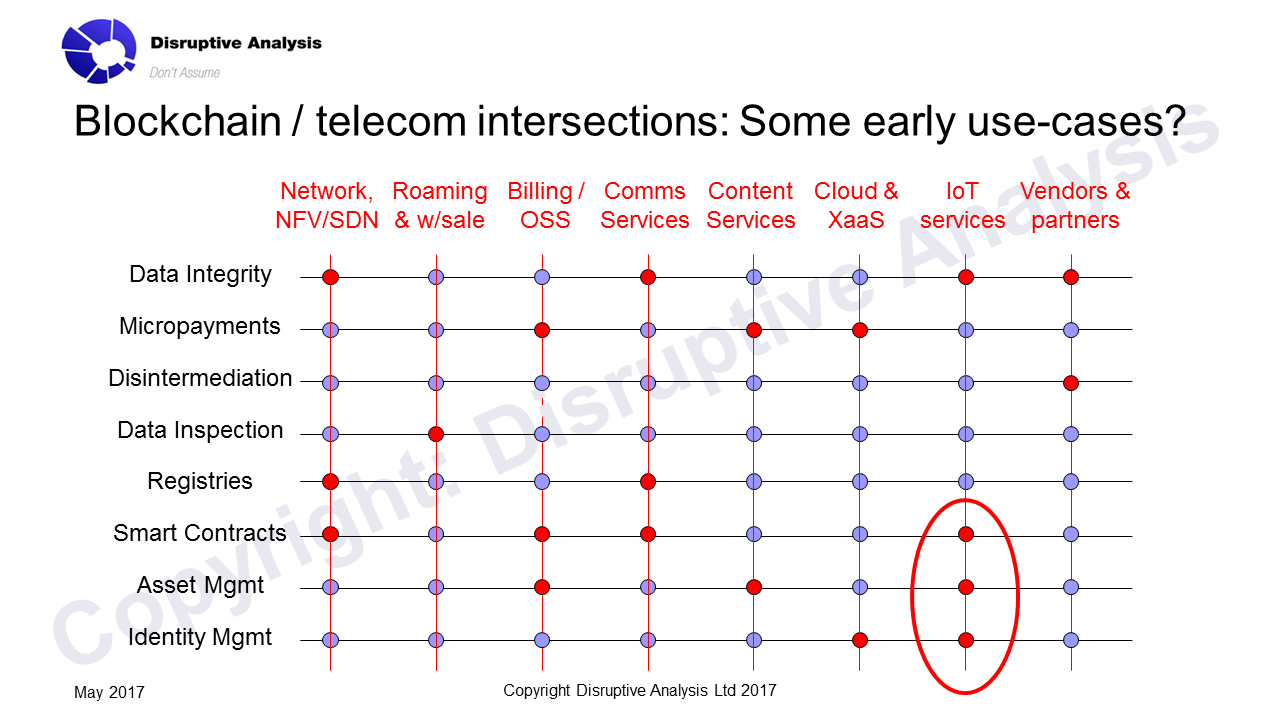
The main use-cases being discussed for telecoms blockchain included:
  • Device identity & authentication, especially in IoT. There was a Catalyst exhibited (link) which used a Microsoft blockchain to create unique identities for medical sensors (wearable patches), via an Ericsson IoT platform, and also involving AT&T and others. This was also used for data time-stamping and asset management.
  • Smart contracts, both as a possible new "Contract-as-a-service" play for enterprise-facing telcos, but also as a way to offer and manage SLAs (service level agreements) for CSPs' own network services.
  • Mobile banking and micropayments, including for IoT-type use cases such as smart electricity grids. Again, blockchains might be used by telcos to either build complete "vertical" services for end-user, or as Enabler-as-a-Service wholesale/API plays for domain specialists.
I also had private discussions with vendors in Nice that covered a lot of other possible use-cases, including ones around NFV monetisation, fraud prevention, wholesale reconciliation and data-integrity protection. Another one that I've talked about before is use of distributed databases for new shared-spectrum usage and localised private radio networks - and that was independently mentioned by a speaker at another recent conference, the Wireless Broadband Alliance's congress in London.

All of these areas, and others, will be discussed at the Telecoms Blockchain & AI workshop I'm running on May 31st in London. There are still some spaces available - you can sign up here (link) or email me at information AT disruptive-analysis dot com.

My general sense is that development of blockchain applications in telecoms is taking a rather different evolution path to AI. There are some big “framework” plays around telecoms AI, including massive shared “data lakes” relating to customer data, network status and other variables. These can help drive more-reliable operations, better planning and happier customers who are prepared to spend more. Conversely, interest in blockchain and distributed ledgers is (for now) much more dispersed. Individual projects and functions are looking at these as solutions for “point problems” – cheaper registries and databases, ways to secure identity, whether smart contracts could help create enforceable SLAs and so forth.


As such, it’s harder to see telcos developing a centralised, coherent “blockchain strategy” – it’s probably going to be used tactically in very isolated niches, for the next 1-2 years at least. There will be a lot of pilots and prototypes – and each domain will also have a wide range of alternative options to consider. We might see more strategic use in IoT in future, as that seems to be a focus of quite a lot of work. This fragmentation of effort also means that multiple vendors, integrators and blockchain platforms (private, but also potentially public blockchains) are likely to be relevant. As yet, there is no real centralisation of effort for telecom blockchains in the same way there is for banking and healthcare. That may be a next step, beyond the TMForum's own working group.

I'm interested in others' views about this - and it's something that the May 31st public workshop (the first I'm running) should shed further light on. (Workshop details here).
19 May 18:21

The Amazing Japanese Wife: Part 1

by Kaori Shoji

Japan Subculture Research Center is proud to present a series of short stories, by our resident book reviewer and social commentator, Kaori Shoji, on the often tragically mismatched marriages of foreign men and Japanese women. If you see echoes of someone you know or yourself in this story, be rest assured that you’re a cliche—but take solace in the fact that misery is universal.

Note: Ms. Shoji should be credited for coining the word WAM (Western Anglo-Saxon Men) also (White American Men)–a more understandable term for the Charisma-man type of entitled self-important foreigners that once flooded these shores but now mostly live in Hong Kong, Beijing, or Singapore. Also, it should be noted that Ms. Shoji has always been an equal opportunity misanthrope, as evidenced in her book review entitled 21 Reasons Why Japanese Men Suck.

Without further ado, welcome to the first in the series…..


Smothered in Silicon Valley

We are on the patio of my parents’ house in Palo Alto – my wife Eriko and I, on a sunny Sunday morning in March. There’s a sharp nip in the air but no wind, and the lone cherry tree in my mother’s garden promises pink blossoms later in the month. Sunday brunches at this house has turned into a weekly ritual, ever since we left Tokyo for Northern California a year ago. When I tell that to people, and that I Iived in said Tokyo for 16 years before returning to the Land of the Free (note the irony in my voice), eyebrows go up. In some cases, mouths turn downward in a reverse arc, depending on the listener’s experiences or their image of Japan. (Pearl Harbor. It’s always Pearl Harbor.) I was 24 when I finished up my graduate studies at Cal Tech, and took off for a country I hardly knew. Cool Japan wasn’t yet a thing. Anime was for hard-core geeks. But I had read two novels of Haruki Murakami and decided that in some tortuously inexplicable way, I belonged in the Far Eastern capital.

“So how did you like that? Wasn’t it just very busy and expensive?” asked Tim, my supervisor during one of five interviews I had, in order to land the job at a tech company in Oakland. “Oh yeah,” I replied, with a self-deprecating chuckle – a mannerism I picked up from living in Japan. The Japanese are excessively modest, and self-deprecation with a laugh is a national pastime. “Seriously though, I learned a lot. Japan’s been good to me,” I added cautiously. What I really wanted to say was that I poured my whole youth into the experience. I made my bones. I fell in love, time and again. And if you really want to know, Tokyo is a lot cheaper than the San Francisco Bay Area. But all that would have been inappropriate in a job interview. Besides, Tim – who is laughingly WAM (White American Male) and whose trips abroad has been limited to London and Mexico City, couldn’t care less about my back story.

I stretch out on the deck chair. Behind my Oakley shades, my eyes are closed and I’m only half-listening to my wife Eriko converse with my mom about the new farmer’s market that went up near Safeway, 5 blocks from my parents’ place. I reflect that my brother and I grew up here, and the chair I’m sitting in has been around since my teens, and my mom is basically the same woman she’s been for the past 30 years.

Eriko is saying what she’s always saying. “It’s very expensive, everything is expensive. One daikon is 3 dollars! In Tokyo, I bought daikon for under 200 yen.” My mom clucks, and sighs that Palo Alto has gotten so expensive and crowded they are thinking of selling the house and moving. I let out an exasperated sigh. How can my parents move? Three years ago my dad’s name was struck off the faculty list at Stanford where he had taught American Literature for 30 years. They’re still paying mortgage on this house.

Mom and Dad are used to this 3-bedroom place with the 2-car garage, their friends and Safeway where the Mexican staff always helps my mom carry groceries to her car. If they moved, they couldn’t afford to buy, at least not in the Bay Area. The housing market is astronomical and prices on everything including water, have gone through the roof thanks to the protracted California drought. Young techies fresh out of coding boot camp are told off by their bosses that they can’t afford to live here, not even on a six-figure income. Right now, the median rent for San Francisco is something like 3500 dollars. The average monthly daycare cost for one pre-kindergarten child in the Bay Area is over 2000 dollars. (Eriko and I don’t have kids but that could change.) The Thai salad with quinoa I had for lunch the other day? Fucking 18 dollars.

“You’re much better off where you are and you know it,” I say to my mother. “Just don’t get a new car.” My parents are living off their savings and what money Dad gets from tutoring jobs. An awkward hush settles over the patio like a foul odor and my mom purposefully looks in another direction.

As soon as the talk turned to money, my dad shuts down like an old, clunky computer. He gazes at the sky with his coffee mug cupped in both hands and I feel a sting of real sadness. I know what my father is thinking, he’s thinking that he’s fine, that this is all good. But it could be better and as a WAM with a Ph.d and his Stanford career, he should have more. A better car than his 10-year old Honda, a nicer home, all the latest gadgets, vacations, dinners out with my mom and their friends. A glittering Facebook update. They’ve never even been to French Laundry though that’s been on my mom’s wish list for a decade.

Eriko gets up and goes inside the house, undoubtedly to the kitchen. I watch her retreating figure with…what is it, boredom? I actually feel bored when I look at my wife of 6 years, though I tell myself it’s more like placidity, contentment. She herself is very comfortable in Oakland, and professes that she never wants to go back except for short vacations to her parents’ place. When we lived in Tokyo, life was much harder for Eriko. She cooked 2 meals a day, worked in an office and had a daily, two hour commute. She was also about 12 pounds thinner and seemed oh, so fragile. I’d give her a hug and feel her small rib cage under my big hands, her little breasts and narrow hips. We were both in our mid-30s when we met but she looked to me like a girl in college. Now I get comments everyday from people who have met my wife about how pretty, how slender, what a good cook, considerate, polite, supportive, accomplished…Even Tim likes her, and I’m not sure if he’s about to make some moves on her, the bastard.

The truth is, Japanese women are amazing. Half the time I spent in Japan was about chasing them down, chatting them up in my appalling Japanese and getting them in the sack as soon as humanly possible. The other half was spent bragging about my astonishing success rate to expat bros. But then it was like that for most white men anyway, unless they were spectacularly ugly or had hygiene problems, and even then they never had much trouble finding sex. Life in Japan frequently turns white men into sexist, racist, male chauvinist assholes, without our being aware of it. I call it the Japan Creep. I have said things to Japanese women that I would never say to a white American female. I took it for granted that they were only too happy to do things for me, including schoolgirl cosplay during sex (don’t judge me) and sushi dinners on their tabs. No Japanese woman I slept with seemed to resent any of that. They in turn seemed to take it for granted that they should please American men because…well if it wasn’t for us and our democracy, they’d still be wearing raggedy kimonos, they couldn’t eat at Shake Shack and they’d be forced into god-awful marriages with god-awful Japanese men, whose international popularity rates just a notch above Nigerian, according to some poll I read once. Right? I mean, COME ON.

But a couple of years after turning 30, I realized that the classiest and most well-bred of Japanese women rarely have anything to do with the average white man apart from gracious socializing. To them, we were loud, stupid and ill-mannered. And the pool of casual sex was slowly but surely, drying up. It just wasn’t as fun anymore and I felt less inclined to spew the same old tales to the same old bros, who suddenly seemed obnoxious beyond words.

And then I met Eriko at my local gym. She asked me with a shy smile if I knew how to work the elliptical, and I could tell she was trying hard to carry out our conversation in correct English. I was so touched that a sob caught in my throat. It hit me that I didn’t want to date anymore. I wanted a Japanese wife – to iron my shirts and cook my meals and greet me with a smile every time I came home from work. Japanese men had that for more than a millenia, so why couldn’t I, I mean we – all of us American jerks? Three months later, I proposed and Eriko said yes, on condition that we have the wedding in Hawaii with just our families and closest friends because we were both in our mid-30s and “too old” for a big ceremony in Tokyo. Eriko adored Hawaii. Her girlfriends adored Hawaii. Most Japanese women do.

It’s regrettable to say but Japanese women lose some of their flavor once they leave Japan. It’s only been a year but Eriko has assimilated so completely to American suburbia she may as well call herself Ellen. Not that she’s become part of the white community of Oakland. She bounces inside a comfortable bubble consisting of our house, her car (a Toyota Corolla) and a close-knit circle of Japanese housewife friends. She’s with these women all the time, texts them incessantly to cook Japanese dishes together and schedule jogs around the neighborhood. Now Eriko’s ribcage no longer feels like it might break if I squeeze too hard. She no longer smiles in silence, but laughs out loud. Her hair and skin – once moist with Asian humidity, is drier, tougher. Her neck is thicker, connecting to shoulders that suddenly seem broad and strong. I’m happy that she’s happy here. But inside a secret, inner recess somewhere in my soul, I feel like I’m being quietly smothered.

Before marriage and Eriko, I lived the Tokyo bachelor’s life in a place called Zoshigaya. The area had several temples and a big shrine, with a rickety candy shop that’s been around since the mid 18th century. My abode was on the third floor of an old apartment building, standing on a narrow street that led to the shrine. Two fairly spacious rooms facing southeast, and a wrap-around veranda for a cool, 790 a month. (Our current 2 bedroom house in Oakland is 2850, which everyone assures me is an absolute steal.) Most of the time, I complained. I whined about the heat and humidity in summer, the whipping cold winds in winter. I hated the commute to work, and the subway cars with announcements in three languages (Japanese, English and Chinese) that came on before each and every stop. I cringed every time I heard a salariman cough or talk too loudly, because most Japanese men have really ugly voices.

I longed for sunny California, and the sight of white womens’ tanned legs stretching out of denim shorts, strolling the malls on a Friday afternoon. California Dreamin’. It had developed into a definite thing.

After my 40th birthday and 5 years after my marriage, I was done with Tokyo. I got my Japanese wife so had no further use for Japan, like a mercenary with his loot looking for a fast exit. I wanted to go home where there were no puddles on the sidewalks. Never did I want to stand in a crowded train again, chest to chest with a salariman. I wanted to back my own car out of my own garage, and drive my ass over to Crossfit classes. I would work on my abs. Binge watch on Netflix USA. And I would finally get to watch Superbowl with my dad. Besides, Eriko made it clear, during our numerous discussions about crossing the Pacific, that if she had wanted to stay in Japan she would have looked for a Japanese husband. “I want to go away to California” she said. “I want to change my life.” That clinched it. I applied to job openings in 5 mid-sized tech companies in and around the Bay Area, and landed one after 2 months of meetings and interviews.

Not surprisingly (for isn’t that how things work out?) I regretted the move to Nor Cal almost immediately. I missed Tokyo’s tiny alleyways, the narrow, labyrinthine streets. Most of all, I missed the complex texture of things like linen shirts and tatami mats, women’s arms, the taste of Japanese citrus. I missed the air, sticky with fumes and redolent of centuries of history. I missed the rain and how the thick, gray clouds seemed to hold the city in an unclenched fist. Sixteen years in Tokyo had spoiled me in many ways but I didn’t bargain for an annoyance – an irritation really – for the blithely ignorant, have-it-all American lifestyle. I had dreams of walking down an alley, turning the corner and seeing a cat bound across the pathway and my heart will be filled with gratitude, before I woke up to relentless sunshine streaming through the window. No fault of Nor Cal and certainly no fault of Eriko. It was me. Too far away, too long. Adjustment was going to take some time.

“Hey Eri,” I call out. “We need more potato salad!” “Okay!” I hear her yell cheerfully and I feel my mother cast an ironic glance in my direction. She doesn’t like it that my wife is the one doing the chores while her son sits around like a big galoot. On the other hand, I could see that she thinks it’s maybe okay – about 70% okay – because Eriko is an Asian. If I had married a white woman, it would be different. I would probably go into the kitchen with her and help her prep the salad. And our conversation on the patio would be more…lively? In-depth? Friendly but a little controversial? I ponder these things as Eriko emerges with a large wooden bowl. “My special potato salad,” she beams.

And my dad rouses himself from his torpor. “Did I hear potato salad? You have an incredible wife, you know that,” he says to me. “Of course I do. That’s a given,” I reply. And then we all gather around the table to help ourselves.

19 May 18:17

Satellites from the ground

by Nathan Yau

There is a 16-by-16 mile grid of big X’s in the Sonoran Desert that were used to calibrate spy satellites in the 1960s. They’re no longer in use, but Julie Anand and Damon Sauer have been studying the marks and overlaying the paths of publicly-known satellites that are detected during the time of a photograph.

Tags: satellites

19 May 18:17

Quantum Flow Engineering Newsletter #10

by ehsan
Let’s start this week’s updates with looking at the ongoing efforts to improve the usefulness of the background hang reports data.  With Ben Miroglio’s help, we confirmed that we aren’t blowing up telemetry ping sizes yet by sending native stack traces for BHR hangs, and as a result we can now capture a deeper call stack depth, which means the resulting data will be easier to analyze.  Doug Thayer has also been hard at work at creating a new BHR dashboard based on the perf-html UI.  You can see a sneak peak here, but do note that this is work in progress!  The raw BHR data is still available for your inspection.
Kannan Vijayan has been working on adding some low level instrumentation to SpiderMonkey in order to get some detailed information on the relative runtime costs of various builtin intrinsic operations inside the JS engine in various workloads using the rdtsc instruction on Windows.  He now has a working setup that allows him to take a real world JS workload and get some detailed data on what builtin intrinsics were the most costly in that workload.  This is extremely valuable because it allows us to focus our optimization efforts on these builtins where the most gains are to be achieved first.  He already has some initial results of running this tool on the Speedometer benchmark and on a general browsing workload and some optimization work has already started to happen.
Dominik Strohmeier has been helping with running startup measurements on the reference Acer machine to track the progress of the ongoing startup improvements using an HDMI video capture card.  For these measurements, we are tracking two numbers, one is the first paint times (the time at which we paint the first frame from the browser window) and the other is the hero element time (the time at which we paint the “hero element” which is the search box in about:home in this case.)  The baseline build here is the Nightly of Apr 1st as a date before active work on startup optimizations started.  At that time, our median first paint time was 1232.84ms (with a standard deviation of 16.58ms) and our hero element time was
1849.26ms (with a standard deviation of 28.58ms).  On the Nightly of May 18, our first paint time is 849.66ms (with a standard deviation of 11.78ms) and our hero element time is 1616.02ms (with a standard deviation of 24.59ms).
Next week we’re going to have a small work week with some people from the DOM, JS, Layout, Graphics and Perf teams here in Toronto.  I expect to be fully busy at the work week, so you should expect the next issue of this newsletter in two weeks!  With that, it is time to acknowledge the hard work of those who helped make Firefox faster this past week.  I hope I’m not dropping any names by accident!
19 May 18:17

Unlock your inner Millennial with Instagram’s new phrase stickers

by Igor Bonifacic
Photo of MobileSyrup's Instagram account

In less than the span of one week, Instagram has once again updated its popular photo and video sharing app. This time, the company has added phrase stickers that make it easy to add popular millennial colloquialisms like ‘basic’ and ‘yasss’ to an Instagram’s Story.Examples of Instagram's new phrase stickers

It’s odd that Instagram didn’t add these stickers alongside its big 10.21 update. Released earlier in the week, 10.21 saw the company add, among other things, face filters to its app. Face filters were one of the few features Instagram had yet to copy from Snapchat.

Download Instagram from the Google Play Store or iTunes App Store to check out

Source: Instagram

The post Unlock your inner Millennial with Instagram’s new phrase stickers appeared first on MobileSyrup.

19 May 18:17

Philips study says majority of Canadians believe ‘connected care technology’ essential for healthcare

by Bradly Shankar
Doctor with patient

The majority of Canadians say they believe “connected care technology,” such as remote blood and heart monitors, mobile health apps and wearable fitness devices, are a way to improve care across the health continuum, according to a study across 19 countries conducted by Philips.

Overall, both healthcare professionals and the general public said that this tech plays a significant role in improving treatment of medical issues (94 percent and 83 percent), diagnosis of medical conditions (87 percent and 82 percent) and home care services (82 percent and 78 percent). In particular, survey correspondents said patient data needs to be more securely stored and shared  between healthcare professionals and hospitals.

“The healthcare challenges we face in Canada are real and imminent,” said Iain Burns, CEO of Philips Canada. “With an aging population, rise in chronic diseases and continually escalating costs, innovative solutions such as connected care technology are crucial to help healthcare providers manage costs while improving patient care and outcomes.”

However, Canadians and healthcare professionals said they believe connected care technologies aren’t incorporated often enough across the industry. Moreover, there is a significant amount of unfamiliarity with connected care tech, with less than half of healthcare professionals (46 percent) and just two in 10 Canadians (22 percent) saying they’re knowledgeable on the subject.

For its part, Philips says it’s working with partners to create new and efficient technology, such as Ontario healthcare provider Mackenzie Health.

“Connected care is critical to effectively manage a person’s health, both inside the hospital and at home,” said Altaf Stationwala, president and CEO of Mackenzie Health. “As exemplified in the new Mackenzie Vaughan Hospital, the future of healthcare lies in connected care. Smart hospitals optimize available medical technology and interoperability to share data from one episode of care to another improving clinical outcomes for patients both inside the hospital and within communities.”

Connected care tech has already started to show its use in healthcare, such as with the Apple Watch’s helping to identify irregular heart conditions.

Image credit: Flickr – Ilmicrofono Oggiono

Source: Newswire

The post Philips study says majority of Canadians believe ‘connected care technology’ essential for healthcare appeared first on MobileSyrup.

19 May 18:17

Most Popular This Week

by WC Staff
19 May 18:16

The Earth’s Political Axis Has Shifted: Do the Democrats See It?

Steven Erlanger writes about Theresa May, and how she’s deeply attuned to the transition away from the left-versus-right political dynamic, and she’s moving the UK’s Conservative party toward the closed end of the new, and highly disruptive political axis:

Theresa May Buries Thatcherism in Play for U.K.’s Working-Class Votes | Steven Erlanger

Mrs. May is moving away from the Conservatives’ neoliberal, Thatcherite past and reshaping the party as a more nationalist, meritocratic one that cares about social benefits and equal opportunity.

[…]

She hailed “a manifesto to see us through Brexit and beyond” and a “plan for a stronger, fairer and more prosperous Britain,” one “rooted in the hopes and aspirations of working people.” Her speech essentially tried to justify her decision to call a new election three years early to get her own mandate and ensure a larger majority in Parliament through March 2019, when two years of negotiations with the European Union are supposed to end.

But as she made clear on Thursday, some of her policies draw a clear contrast to her predecessor, David Cameron, who quit when he lost the referendum on leaving the bloc and was also associated more with the neoliberal, free-market economics that British and European populists have attacked.

[…]

One of the reasons for the Conservatives’ large lead in the opinion polls is that UKIP is falling apart and moving toward the Conservatives. It is being joined by working-class Labour voters, especially in the north of Britain, who favored a British exit and do not consider Mr. Corbyn a plausible prime minister, even if they like some of his traditional left-wing redistributive policies.

[…]

While Mr. Cameron seemed to appeal to “the aspiring classes,” Mrs. May has pitched her appeal to citizens who are worried about an uncertain future, who are known widely as “Jams — those who can “just about manage” to get by.

To broaden the perspective beyond the UK, I return again to the City Journal piece on the social criticism of Christophe Guilluy by Christopher Caldwell (see my earlier comments in Christoper Caldwell, The French, Coming Apart). Guilluy makes the distinction between the politics of the metropolitan French, who are a combination of the economically successful bourgeoisie of the major cities and urban immigrants. 

The working class non-immigrant French have been increasingly pushed from the metropolitan cities, out into la France périphérique. They have become what I call the Left Behinds, like the Americans living in flyover country, here, that rejected the metropolitan ideals of Clinton, and took a chance with Trump, who at least acknowledged their existence and grievances.

Here’s Caldwell from The French, Coming Apart:

Since the age of social democracy, we have assumed that contentious political issues inevitably pit “the rich” against “the poor” and that the fortunes of one group must be wrested from the other. But the metropolitan bourgeoisie no longer lives cheek-by-jowl with native French people of lesser means and different values. In Paris and other cities of Guilluy’s fortunate France, one often encounters an appearance of civility, even consensus, where once there was class conflict. But this is an illusion: one side has been driven from the field.

The old bourgeoisie hasn’t been supplanted; it has been supplemented by a second bourgeoisie that occupies the previously non-bourgeois housing stock. For every old-economy banker in an inherited high-ceilinged Second Empire apartment off the Champs-Élysées, there is a new-economy television anchor or high-tech patent attorney living in some exorbitantly remodeled mews house in the Marais. A New Yorker might see these two bourgeoisies as analogous to residents of the Upper East and Upper West Sides. They have arrived through different routes, and they might once have held different political opinions, but they don’t now. Guilluy notes that the conservative presidential candidate Alain Juppé, mayor of Bordeaux, and Gérard Collomb, the Socialist running Lyon, pursue identical policies. As Paris has become not just the richest city in France but the richest city in the history of France, its residents have come to describe their politics as “on the left”—a judgment that tomorrow’s historians might dispute. Most often, Parisians mean what Guilluy calls la gauche hashtag, or what we might call the “glass-ceiling Left,” preoccupied with redistribution among, not from, elites: we may have done nothing for the poor, but we did appoint the first disabled lesbian parking commissioner.

Upwardly mobile urbanites, observes Guilluy, call Paris “the land of possibilities,” the “ideapolis.” One is reminded of Richard Florida and other extollers of the “Creative Class.” The good fortune of Creative Class members appears (to them) to have nothing to do with any kind of capitalist struggle. Never have conditions been more favorable for deluding a class of fortunate people into thinking that they owe their privilege to being nicer, or smarter, or more honest, than everyone else. Why would they think otherwise? They never meet anyone who disagrees with them. The immigrants with whom the creatives share the city are dazzlingly different, exotic, even frightening, but on the central question of our time—whether the global economic system is working or failing—they see eye to eye. “Our Immigrants, Our Strength,” was the title of a New York Times op-ed signed by London mayor Sadiq Khan, New York mayor Bill de Blasio, and Paris mayor Anne Hidalgo after September’s terrorist bomb blasts in New York. This estrangement is why electoral results around the world last year—from Brexit to the election of Donald Trump—proved so difficult to anticipate. Those outside the city gates in la France périphérique are invisible, their wishes incomprehensible. It’s as if they don’t exist. But they do.

[…]

The two traditional French parties—the Republicans, who once followed a conservative program elaborated by Charles de Gaulle; and the Socialists, who once followed socialism—still compete for votes, but along an ever-narrowing spectrum of issues. The real divide is no longer between the “Right” and the “Left” but between the metropoles and the peripheries. The traditional parties thrive in the former. The National Front (FN) is the party of the outside.

In an era when conservative and socialist metropolitans have identical platforms, the hypocrisy latent in the left-versus-right dimension becomes clear. Obama’s policies, if you look closely, were really more like a moderate Republican than a socialist. Obamacare was originally Romneycare, remember, the product of a moderate republican governor of one of the most ‘liberal’ (or, in the new orientation, one of the most ‘metropolitan’) of US states, Massachusetts. 

So, Theresa May is getting the jump on this wholesale political realignment, and pledging her loyalty to the Jams, the left behinds, the peripheral, a class that wants a more closed society with less immigration, less ‘free trade’, less metropolitanism. 

Macron notably stands to the side of the old political axis, neither conservative or socialist, but both: he’s openly a metropolitan, neoliberal globalist, in favor of French involvement in the EU and hypercapitalist global trade. Le Pen is a deeply flawed politician, who is likely to be dogged by the National Front’s history indefinitely. But that doesn’t mean that her current positioning – as the champion of the left behinds, the advocate for a more closed society and reorganized economic order – isn’t sensible and attractive to her supporters. It is. But that slot could be filled by a more traditional conservative moving to the new dynamic, like Theresa May has done in the UK. It just won’t be Juppé. 

Cameron, her predecessor, was blindsided by the future, too, just like Clinton’s democrats, UK’s Labour, and France’s Socialists and Conservatives.

Will the Democrats swing into the realignment or fight it? Does Clinton’s fumble mean that they will point their north star away from metropolitanism, away from neoliberal free trade, globalism, and the supposed benefits of an ‘open’ society? Will they fight to become the people’s party, embrace populism, and reject the left-versus-right alignment of conventional politics, instead of remaining the party of the bourgeoisie and their metropolitan allies: minorities and the urban poor? Can they return to their roots of supporting working people and unions, for example, and grassroots opposition to big business and the power of big money? Can they embrace populism and reject globalism?

We’ll just have to see. But so far, not so much.

19 May 18:16

Impeachment’s Political Heart | Greg Weiner

Impeachment’s Political Heart | Greg Weiner:

Greg Weiner clarifies the framers intent around impeachment:

The simmering talk of impeachment swirling around President Trump largely concerns whether he committed a crime by asking James Comey, when he was still the director of the F.B.I., to end an investigation of Michael T. Flynn, the onetime national security adviser. From the perspective of criminal law, the resulting questions, which pertain mainly to the president’s intent in making the request, are inescapable. From the perspective of the decidedly political act of impeachment, they are irrelevant. The purpose of impeachment is not punitive. It is prophylactic.

Criminal law looks backward toward offenses committed. The object of impeachment is not to exact vengeance. It is to protect the public against future acts of recklessness or abuse. Consequently, the issue in deciding whether Mr. Trump is liable to impeachment is less what happened in the Oval Office between him and Mr. Comey than what those events say about what will happen in similar situations in the future. That is not a case for casual impeachment. On the contrary, since it is harder to predict future acts than to prove what has already occurred, such a standard may be harder to meet.

[…]

The prophylactic rather than punitive character of the impeachment power still, of course, requires an offense. But the offense indicates a pattern on the basis of which future behavior can be predicted. The idea is not to humiliate the president or to cause him to suffer by the loss of his office. It is to protect the public against his negligence or abuse. 

 In this sense, it does not matter whether Mr. Trump explicitly intended to obstruct justice when he reportedly attempted to cajole Mr. Comey. The determination Congress must make is what its level of confidence is that Mr. Trump can be trusted not to abuse the levers of power in similar ways if he continues to hold them. On another front, there is little question that he committed no crime when he leaked classified information to the Russian ambassador. But that, too, is not the question impeachment poses. The issue is whether Madison’s community and Hamilton’s society need to be defended against similar behavior in the future.

19 May 18:16

Spotify just bought an AI startup to help it stay ahead of Apple Music | Jordan Novet

Spotify just bought an AI startup to help it stay ahead of Apple Music | Jordan Novet:

Music streaming service Spotify on Wednesday disclosed it has acquired the team and technology behind Niland, a French start-up with a service for delivering music recommendations. The move signals that Spotify wants to incorporate more artificial intelligence (AI) into its system as it fights off competition from alternatives like Apple Music.

Niland is not well-known in the field of AI. But for years its CEO, Damien Tardieu, has done research on ways to extract meaningful information from raw music content in order to form connections with other music.

This approach differs from collaborative filtering, one of the techniques that Spotify and others use. It involves scouring public sources of information like blogs for references to multiple artists, albums or songs and then making recommendations based on that knowledge.

The method is also distinct from Pandora’s way of having many musicologists apply many tags to songs so that algorithms can make sense of them.

“Niland has changed the game for how AI technology can optimize music search and recommendation capabilities and shares Spotify’s passion for surfacing the right content to the right user at the right time,” Spotify said in a short statement on the news.

19 May 18:16

Say hello to Find My Device, Google’s reworked device tracking app

by Igor Bonifacic
Find my phone

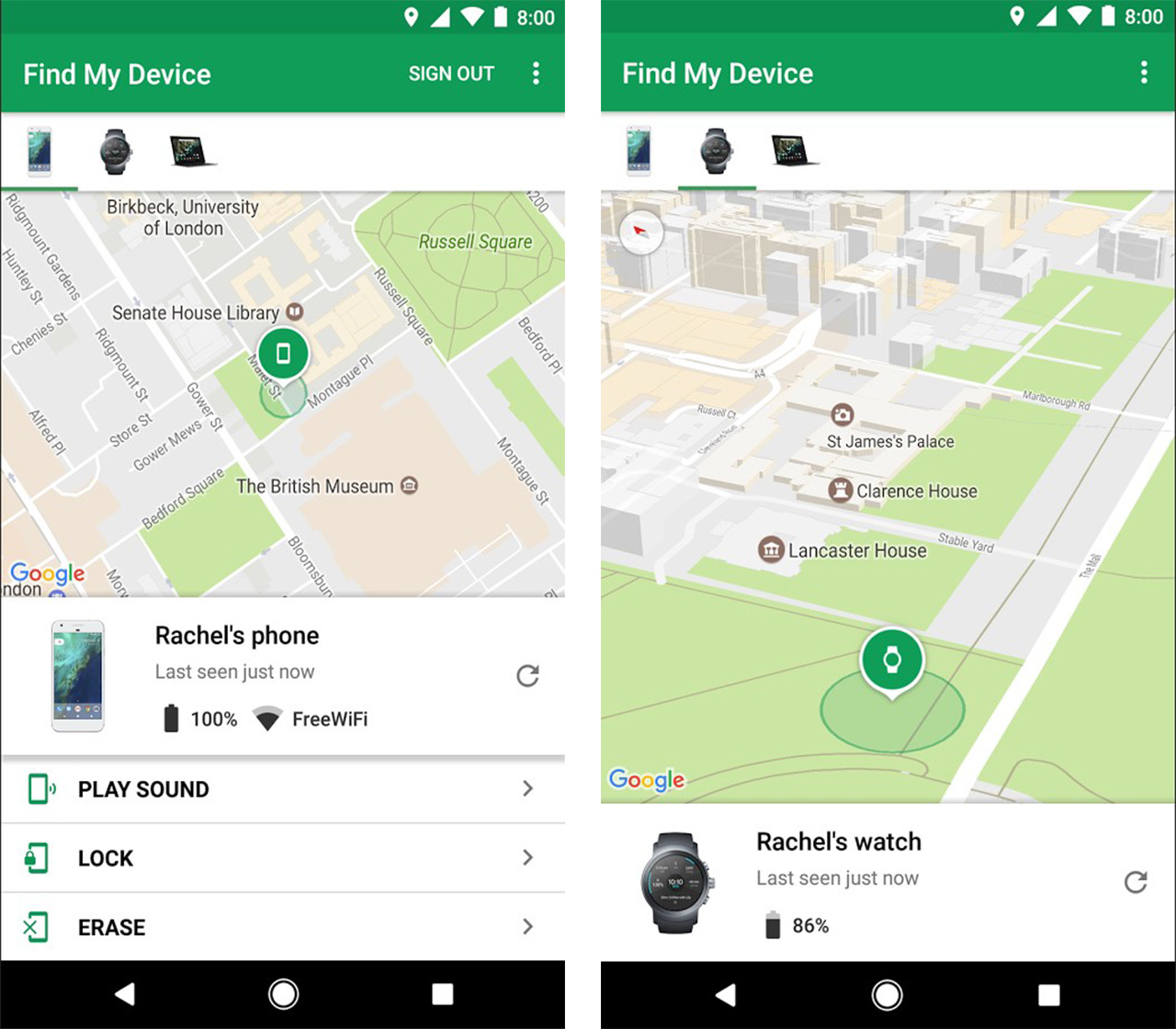
Google has overhauled its Android Device Manager app.

Now known as “Find My Device,” bringing it closer to Apple’s iOS equivalent, “Find My iPhone,” the device tracking app features a new redesigned interface.

Essentially, however, it’s the same application Google has offered for several years now. Using Find My Device, Android users can locate their lost phone, tablet or smartwatch with the help of GPS, get their device to play a sound, as well as remotely lock it.

Screenshots of Google's redesigned Find My Device app

Despite the update, the first since 2015, Find My Device is not perfect in its latest iteration.

Notably, users cannot remotely enable GPS tracking. Instead, they need to enable Android’s Location Services feature beforehand, which isn’t an ideal solution as the feature is a significant battery drain on Android devices. This same limitation means Find My Device is not a foolproof way to track down a thief.

Android users can download Find My Device from the Google Play Store.

Source: Google

The post Say hello to Find My Device, Google’s reworked device tracking app appeared first on MobileSyrup.