Shared posts

22 May 16:56

“Letters to the Most Repulsive Parents in Japan”

by Mari Yamamoto

Goya “Saturn Devouring His Son”

Amidst the political turmoil and economic recession Japan has found itself in the recent years, how poor parenting takes a toll on the lives of the most vulnerable is often the last thing on people’s minds.

The most recent (2012) Ministry of Health and Labor’s reports showed that 16.3%, roughly 1 in 6 children in Japan live in relative poverty, belonging to a household that has less than half of the national average income, ranking 4th out of the 30 OECD countries. The numbers correlate with the rapidly multiplying number of child abuse cases. When the Ministry of Health and Labor started their investigation for a better grasp on the issue in 1990, the number of child abuse consultations to Child Consultation Centers were 1101 and it has been on the rise ever since, peaking at 103,260 cases in the most recent reports of 2015. The number of consultations alone have gone up 100 times in 25 years.

From April 2014 to March 2015, the number of victims  who died as a result of abuse was 44,  and the number of deaths by forced suicide was 27,  a total of 71 victims. Approximately every 5 days a child dies of abuse somewhere in Japan. Increasing reports in the media on the cruel fates of children has raised national concern on the matter.

Isshow Con a non-fiction writer is compiling a book 『日本一醜い親への手紙』(Letters to The Most Repulsive Parent in Japan).  The word “醜い” (minikui) in the title is often used to describe physical ugliness but is also used to depict shameful dishonorable acts. The book will consist of 100 letters written by child abuse survivors to their abusers ie., parents or guardians, to better illustrate the realities of life during abuse and the aftermath. His aim is to bring attention to the issue and also highlight the lack of support the government provides in the victims’ physical and mental recovery and social integration in life after abuse. This was an issue raised as a warning to the Japanese government in the 2010 report by the Committee on the Rights of the Child and yet no significant progress has been made.

Con is calling for submissions for letters and also raising funds for the publication of the book (four  million yen) through crowdfunding. Through the funds raised here, every letter submission will be met with an honorarium of 10,000 yen, in hopes that the money could be used by the victims to provide themselves a transportation to a shelter or to pay for a counselor which may lead to reports being made on their behalf. The donors will receive a book upon its completion this fall.

In a society where press freedom is stagnating and constitutional revision is pushed forward everyday and Japan appears to be becoming an increasingly controlled society, children’s rights will mostly likely be on of the first things to go and the issue of child abuse will take a back seat despite international pressure. Books like these are one of the few ways in which children in Japan with little resources will be able to raise their voices and be heard. Support and spread the word.

To donate : http://letters-to-parents.blogspot.jp/2017/02/blog-post_14.html

To buy this book :http://letters-to-parents.blogspot.jp/2017/02/blog-post_1.html

*This book is an updated version of the same title published in 1997, the rights to publish this overseas is available for purchase on a first come first serve basis. For more information : https://www.youtube.com/watch?v=Fj2-434FzxA

22 May 16:55

A History of Ebola in 24 Outbreaks

22 May 16:55

The Sunrise Smart Pillow does everything but make you coffee in the morning [Sticky or Not]

by Rose Behar
sunrise smart pillow on bed

Smart home devices are invading every part of our homes, from coffee machines to living room lamps, but there’s yet to be much innovation in the bedroom since the revolving tie rack. 

That’s where Mode M, a L.A.-based design studio, comes in. The team at Mode M has created a ‘smart pillow’ that recently closed a massively successful Kickstarter campaign. The memory foam cushion features a row of LED lights on either side that helps users wake up in a more natural manner akin to the morning light by building up from a low red light to a bright yellow-white.

To “complete the wake up experience,” nature sounds (or whatever other audio you might prefer) pipe through the pillow’s speakers at a gradually increasing rate. Moreover, the pillow starts this wake up process based on your sleep cycle, which the pillow itself detects. Waking up at a light sleep point in your cycle reduces grogginess, a feature touted in many apps but better suited — at least in theory — in a comfortable device that is closer to the sleeper.

Each night the accompanying app also delivers a sleep score out of 100 in which users can account for things like exercise, bed times and alcohol consumption to see how those external factors effect their sleep.

The pillow also aims to help with falling asleep. It offers six sound options for getting to sleep that include fan sounds, nature sounds and the option to listen to an audiobook.

While all this sounds great, for most people the purchase will come down to the pillow’s price, and it’s a bit steep. A single pillow comes in at $199 USD (about $270 CAD), quite a bit more than the average pillow. For reference, a memory foam Ikea pillow can reach $40 CAD.

Verdict: Not sticky.

The Sunrise Smart Pillow is a pillow made for a king. It has lights and a speaker, connects to your phone to provide sleep insights. It could quite possibly deliver your best sleep ever. But over $200 for a pillow?

This is a classic case of wealthy Californians developing products for other wealthy Californians. I understand that the pillow contains a lot of tech and can’t exactly cost the same as a ‘dumb pillow’ — but unless the price drops, I’ll be content with just leaving my blinds open and stuffing my phone under my pillow.

Note: This post is part of an ongoing series titled Sticky or Not. Sticky or Not began as a series on MobileSyrup’s Snapchat account in which Rose Behar analyzes new and often bizarre gadgets, rating them sticky (good) or not (bad). Now the series is expanding to include articles, because who doesn’t love a quirky new gadget?

The post The Sunrise Smart Pillow does everything but make you coffee in the morning [Sticky or Not] appeared first on MobileSyrup.

22 May 16:55

Washington Post, Breaking News, Is Also Breaking New Ground | James B. Stewart

Washington Post, Breaking News, Is Also Breaking New Ground | James B. Stewart:

The Washington Post is exploding, and no one seems to know:

As a private company since 2013, when the deep-pocketed Amazon founder Jeff Bezos bought it for $250 million, The Post doesn’t disclose much financial data. But by all visible measures, including the vital but hard-to-measure buzz factor, the resurrection of The Post, both editorially and financially, in less than four years has been little short of astonishing.

The Post has said that it was profitable last year — and not through cost-cutting. On the contrary, under the newsroom leadership of Martin Baron, the former editor of The Boston Globe memorably portrayed in the film “Spotlight,” The Post has gone on a hiring spree. It has hired hundreds of reporters and editors and has more than tripled its technology staff.

Last month, according to figures from comScore, The Post had 78.7 million unique users and 811 million digital page views, trailing only CNN and The New York Times among news organizations.

“The published numbers speculating about our subscription and ad revenue have so underestimated the reality that it’s comical,” The Post’s chief revenue officer, Jed Hartman, told me this week. “Our digital ad revenue is in the solid nine figures,” that is, in excess of $100 million. This year, he added, “we’ll have our third straight year of double-digit revenue growth.”

What role is Bezos playing in this? Is he simply the beneficiary of brilliant maneuvering by the editors? Or he pulling the digital strings in some clever way? Well, he completely changed the paper’s strategy:

When I asked Mr. Baron to name one thing that has driven the turnaround, his immediate answer was Mr. Bezos — and not because of his vast fortune.

“The most fundamental thing Jeff did was to change our strategy entirely,” Mr. Baron said. “We were a news organization that focused on the Washington region, so our vision was constrained. Jeff said from the start that wasn’t the right strategy. Our industry had suffered due to the internet, but the internet also brought gifts, and we should recognize that. It made distribution free, which gave us the opportunity to be a national and even international news organization, and we should recognize and take advantage of that.”

But Mr. Bezos also seems to be a hands-off owner: Although Mr. Baron said they typically have a teleconference call every two weeks, Mr. Bezos hadn’t called this week, even after the Russia scoop.

But at the blocking-and-tackling level it looks like success in execution is coming from a commitment to high-quality journalism:

“Investigative reporting is absolutely critical to our business model,” Mr. Baron told me. “We add value. We tell people what they didn’t already know. We hold government and powerful people and institutions accountable. This cannot happen without financial support. We’re at the point where the public realizes that and is willing to step up and support that work by buying subscriptions.”

He said digital subscriptions had soared this week in the wake of the latest Russia revelations, as they have with other scoops. In the first quarter of this year, The Post says, it added hundreds of thousands of new digital subscribers. (It would not disclose the overall number of subscribers.)

Investigative journalism also drives advertising, Mr. Hartman said. “It’s what elevates our brand,” he said. “And other brands want to attach themselves to a trusted brand.”

Mr. Huber, the analyst, concurred. “The only future for newspapers is at the high end of quality journalism,” he said. “That and only that are what people are willing to pay for.”

He said The Post was one of three newspapers, along with The Times and The Wall Street Journal, that are successfully transforming themselves. “They’re showing that a digital strategy is viable,” he said. “But the number of people willing to pay $10 to $12 a month for an online subscription outside those three is a rounding error.” (After the introductory rate, The Post’s digital-only access for national subscribers is $9.99 for four weeks.)

So, we’re headed for a future of a small number of very high-quality papers turning the corner into the postnormal economy, and the die-off of all the smaller regional players?

22 May 16:54

"I think of art, at its most significant, as a DEW line, a Distant Early Warning system that can..."

“I think of art, at its most significant, as a DEW line, a Distant Early Warning system that can always be relied on to tell the old culture what is beginning to happen to it.”

- Marshall McLuhan, Understanding Media (1964)
22 May 16:46

Next-gen bicycle tire to deliver the “Air Free Concept” | Springwise

22 May 16:46

"A human being becomes human not through the casual convergence of certain biological conditions, but..."

“A human being becomes human not through the casual convergence of certain biological conditions, but through an act of will and love on the part of other people.”

- Italo Calvino
22 May 16:46

'Alien Megastructure' Star Is at It Again with the Strange Dimming

'Alien Megastructure' Star Is at It Again with the Strange Dimming:

clavierm:

mindblowingscience:

The perplexing cosmic object known as “Boyajian’s star” is once again exhibiting a mysterious pattern of dimming and brightening that scientists have tried to explain with hypotheses ranging from swarms of comets to alien megastructures.

Today (May 19), an urgent call went out to scientists around the world to turn as many telescopes as possible toward the star, to try and crack the mystery of its behavior.

“At about 4 a.m. this morning I got a phone call … that Fairborn [Observatory] in Arizona had confirmed that the star was 3 percent dimmer than it normally is,” Jason Wright, an associate professor of astronomy at Pennsylvania State University, who is managing a study of Boyajian’s star, said during a live webcast today at 2 p.m. EDT (1800 GMT). “That is enough that we are absolutely confident that this is no statistical fluke. We’ve now got it confirmed at multiple observatories, I think.”

Star KIC 8462852, or Boyajian’s star (also nicknamed “Tabby’s star,” for astronomer Tabetha Boyajian, who led the team that first detected the star’s fluctuations), has demonstrated an irregular cycle of growing dimmer and then returning to its previous brightness. These changes were first spotted in September 2015 using NASA’s Kepler Space Telescope, which was built to observe these kinds of dips in a star’s brightness, because they can be caused by a planet moving in front of the star as seen from Earth.

But the brightness changes exhibited by Boyajian don’t show the kind of regularity that is typical of a planet’s orbit around its star, and scientists can’t see how the changes could be explained by a system of planets.

Scientists have hypothesized that the changes could be due to a swarm of comets passing in front of the star, that they’re the result of strong magnetic activity, or that it’s some massive structure built by aliens. But no leading hypothesis has emerged, so scientists have been eager to capture a highly detailed picture of the light coming from the star during one of these dimming periods. This detailed view is what scientists typically call an object spectra. It can reveal, for example, the specific chemical elements that are in a gas. It can also tell scientists if an object is moving toward or away from the observer.

Continue Reading.

Mystery returns…


[theramin music]

22 May 16:46

AT&T Workers Start 3-Day Strike in Contract Impasse

AT&T Workers Start 3-Day Strike in Contract Impasse:

AT&T won’t come to contract agreements with unionized workers. This is just about the call centers, retail stores, and wireline (landlines and internet service), but there is a similar dispute going on at Direct TV, a subsidiary.

More than 35,000 AT&T workers began a weekend-long strike on Friday after their union accused the company of failing to make a fair proposal during contract negotiations.

Just over half of the employees work for the company’s wireless business, primarily in call centers and retail stores, and have been without a long-term contract since February.

The union, the Communications Workers of America, complains that AT&T is sending call-center jobs overseas and diverting retail jobs to so-called authorized retailers not owned by the company and not unionized, and where wages and benefits are lower.

[…]

The union estimates that AT&T has cut 12,000 call-center jobs in the United States since 2011 while creating many such jobs overseas, but Mr. Master said the company had rebuffed a request for data that would clarify the extent of the practice and other changes to its work force.

Workers are also frustrated that they are being asked to pay more of their health-insurance costs, he added, and that changes in retail workers’ commissions have limited or reduced their take-home pay. As part of its next contract, the union wants to bar AT&T from changing its commission structure unilaterally.

more to follow.

22 May 16:45

I Took the AI Class Facebookers Are Literally Sprinting to Get Into

I Took the AI Class Facebookers Are Literally Sprinting to Get Into:

As the class progresses and the pace picks up, Zitnick also explains how these techniques evolved into more complex systems. He explores convolutional neural networks, a method inspired by the brain’s visual cortex that groups neurons into “receptive fields” arranged almost like overlapping tiles. His boss, Yann LeCun, used these to recognize handwriting way back in the early ’90s. Then the class progresses to LSTMs—neural networks that include their own short-term memory, a way of retaining one piece of information while examining what comes next. This is what helps identify the commands you speak into Android phones.

22 May 16:42

Having No Life Is The New Aspirational Lifestyle

22 May 16:42

How to Shoot RAW Photos on Samsung Galaxy S8

by Rajesh Pandey
Samsung might not have hyped the 12MP camera of the Galaxy S8 much, but that does not take away the fact that the handset still has an excellent shooter. Samsung has further complemented the excellent camera setup on the handset with its redesigned camera app that is feature-rich and easy to use. Continue reading →
22 May 16:41

Minimalist Packing for 2 weeks in Europe for a Family of 4 (1 toddler, 1 baby) [UPDATED]

by Alison Mazurek

I apologize for the lack of posting while we were away.  I had good intentions to keep up with posting but decided in the moment that it was better to be present for the trip.  I did post photos on my Instagram account over here if you are interested.  I will put together a travel guide from what we learned shortly but wanted to start with our packing list.  While I certainly made some mistakes on this trip, how we packed was not one of them. With an itinerary that included layovers in London, city roaming in Lisbon and many beach days in the Algarve, we needed to be prepared but not overpack.  We managed to fit everything into 1 large rolling suitcase, 1 carry-on rolling suitcase, 1 backpack (diaper bag), 1 stroller (gate check).  I would have loved to only have brought carry-on bags as we did end up paying some baggage fees on our smaller flights. Maybe next trip that can be our goal, but looking back I'm not sure we could have packed much lighter for 15 days away, unless we brought no coats or diapers. Luckily 2 of our 3 main accommodations had a washing machine (we had to buy laundry detergent ourselves) and we certainly took advantage of the in-suite laundry.

So in the end here is what I packed for 4 people and lessons learned.

Me

4 shirts
1 tanktop
1 Madewell Chambray shirt dress
1 Aritzia tank dress
1 Zara jumpsuit
1 Jcrew Jean Shorts*
1 cardigan
1 jean jacket
1 raincoat
1 black skinny jeans
1 leggings
I nightie/beach coverup
3 bathing suits
1 Aritzia straw packable hat
1 Jcrew sunglasses*
1 pair Jcrew runners*
1 pair sandals
1 pair flip flops

Theo (3 3/4 years old)

4 T-shirts
3 Tank Tops
2 shorts
2 swimsuits
1 Jeans
1 Mini Mioche Romper*
1 Mini Mioche Cardigan*
1 Simply Merino Pajamas*
1 pair Native Shoes
1 pair Birkenstock Sandals
1 sunglasses
1 hat
1 Coat
1 Raincoat

Mae (10 months)

2 rompers
1 Mini Mioche Long Sleeved*
2 T-shirts
1 Leggings
4 dresses
1 Overalls
1 Sweater
1 jacket
2 pairs Mini Mioche Zipper Pajamas
1 pair MiniMocs*
1 Crewcuts Swimsuit*
3  Rain People Bonnets*

Trevor

Packs for himself but packed the lightest of us all.  His only regret was packing a bit too much black.

In the end, almost everything was worn. We could have done with 1-2 less tops per person.  And we never used our rain coats, even though it did rain.  The rain in the Algarve only lasted an hour or so at a time so we just hid out.  It also would have been easy to pick up rain ponchos for a few euros.  

A shout out to the large brimmed bonnets from Rain People that Mae essentially lived in on the trip.  I brought them thinking they would be helpful on the beach but I underestimated their use. Mae wore them in the sunny city of Lisbon, in the stroller and when I wore her.  A simple tilt of the hat would give enough shade to help her fall asleep on the go.  Like most babies she gets a bit hysterical with the sun in her eyes and I'm not sure she would have been such a happy traveller without these beautiful bonnets.  Thank you Rain People for keeping her protected and adorable!

While this post is getting a little long I need to mention how useful the packing cubes were.  I bought 4 medium sized and then borrowed about 8 more of varying sizes.  I can't imagine sharing 2 suitcases with 4 people without them.  I kept each packing cube for a specific person and the clothes generally stayed in the cubes when we were at a rental even if there was room to unpack.  Packing up was pretty smooth because of this system and we always knew where to find our clothes.  We also used some for shoes, electronics etc.  They aren't the prettiest but they sure are functional.

Finally.... a few miscellaneous things we packed that were useful...

A lightweight beach blanket (some rentals didn't provide beach towels),
Shampoo and Conditioner (most hotels and rentals don't provide in Europe),
2 metal water bottles (stay hydrated, less waste),
Dry bags for storing baby food and dirty laundry,
Diapers (because we had them and didn't want to be hunting for affordable ones in a new city)
Snaaaacks (we brought granola bars, Love Child Squishies and Baby Crackers to ensure the kids were always fed and we weren't panicked in a foreign place trying to feed a baby or a picky toddler)

Overall I was really happy with our packing.  We didn't want for anything and could have even packed a few less clothing items.  It didn't leave a lot of room for souvenirs or gifts but we did manage to fill a tote with canned fish and salts for friends and family. As you know our space doesn't allow for much more, so our memories and photos are what we brought back for ourselves.

IMG_4979.JPG

*Full disclosure: Some of the items packed were gifts from brands I have been lucky to partner with including Jcrew, Rain People and Mini Mioche. Opinions are completely my own. 

UPDATE

I received some great questions here and on Instagram so I thought I should expand a bit more, especially related to baby gear.  We traveled quite light when it came to Mae and gear for her.  We didn't bring a highchair, most meals we held her on our lap, and a few restaurants provided highchairs. In the rental apartments, we just spread food on a low table for her as she prefers to feed herself, and one rental provided a highchair.

We brought our used McLaren stroller and two carriers, 1 ergo baby carrier and 1 Connexion Baby Ring Sling.  We used all of them almost everyday.  While the streets were cobblestoned and hilly, the stroller was still useful.  Theo is high energy and can walk for hours but even he got worn out in Lisbon and by the end of the day was begging for the stroller or the carrier. The Ring Sling was a dream because it packs up so small we just always had it on us. I could easily switch Mae from the stroller to the sling or carry her up the steep steps to and from the beach. The Sling was also a way to keep her contained in restaurants and shops as she loves the sling and would otherwise be pulling things off shelves etc. There were moments on the trip where I was wearing Mae in the sling and Trevor had Theo on his back in the Ergo... you gotta go what you gotta do :). (Also, our friends at Connexion Baby are still offering 10% off orders with the code 600SQFT)

While we do have a second hand travel crib we chose not to bring it because I was able to request a free crib at all of our rentals in Portugal.  All kindly provided bedding as well.  We did bring a soft warm blanket to remind her of home and used it in the stroller on colder nights.

If there is anything else I missed that you are wondering about please let me know! I'm still working on the trip recap to be posted soon.


22 May 16:39

IBM Goes Non-Remote

by Matt

Like Yahoo a few years ago, IBM, an early pioneer of distributed work, is calling workers back to the office.

The shift is particularly surprising since the Armonk, N.Y., company has been among the business world’s staunchest boosters of remote work, both for itself and its customers. IBM markets software and services for what it calls “the anytime, anywhere workforce,” and its researchers have published numerous studies on the merits of remote work.

If “IBM has boasted that more than 40% of employees worked outside traditional company offices” and they currently have 380,000 employees (wow), then that’s 152k people on the market.

As I said when Yahoo did the same, it’s hard to judge this from the outside. A company that was happy about how they’re doing wouldn’t make a shift this big or this suddenly. It’s very possible the way distributed folks were interacting with their in-office teams wasn’t satisfactory, especially if they were forced to use subpar in-house tools like SameTime instead of Zoom or Skype. Yahoo didn’t have the best trajectory after they made a similar move, and hopefully IBM isn’t going to follow the same path.

In the meantime, Automattic and many other companies are hiring. If you aren’t going to work in a company’s headquarters, it is probably safest to work at a company that is fully distributed (no second tier for people not at HQ) rather than be one of a few “remote” people at a centralized company.

22 May 16:38

The AI race between the world’s most powerful tech companies is heating up

by Rose Behar
harman kardon

At this year’s Google I/O developer conference keynote, AI took center stage.

The company announced a new Google.ai division and site that will focus on research and applications for artificial intelligence, deep learning and the tools necessary to power this technological revolution.

Part of Google’s push for AI also included announcing that Tensor Processing Units (TPUs) are now available for any developer to use via the Google Compute Engine. TPUs are used by the company to train machine learning models, which give the ability to learn without being explicitly programmed.

“We want it to be possible for hundreds of thousands of developers to use machine learning,” said Pichai.

Referencing the dreams-within-dreams in Inception, Pichai also announced that Google will be using its neural nets to build other neural nets with AutoML (automatic machine learning).

The announcements didn’t stop there, either. Assistant was prevalent in almost all aspects of I/O, from Google Assistant enhancements to a pared-down version of its TensorFlow open source library of software for machine learning, TensorFlow Lite, for use by mobile devices.

Microsoft reinforces the importance of AI

Just a week prior, at the Microsoft Build developer conference, there was a similar focus on artificial intelligence with announcements pertaining to the company’s Cortana AI and Microsoft Graph, which pulls together information about a user from a variety of different Microsoft services, generating insights based on their activity.

For example, if you’re working on a project about say, rabbits, the Microsoft Graph could generate the insight that you might want to speak with another person at your company who published several papers on rabbits in the past.

Microsoft

At the Build conference, Microsoft announced that devices are now becoming an integral part of Microsoft Graph (enabling more cross-platform intelligence), HP and Intel are partnering on future Cortana devices and the public debut of the Cortana Skills Kit, a move towards building up the thousands of skills Amazon’s Alexa users already enjoy.

In addition, Microsoft made its position known on chatbots, a technology that saw a lot of hype last year but has since amounted to little. According to the company, those bots aren’t dead yet.

Chatbots are more alive than ever, according to Microsoft

In fact, Lili Cheng, manager of Future Social Experiences (FUSE) Labs at Microsoft, says chatbots and text-based AI in general is already well on its way to taking over our digital world, even if we don’t realize it yet.

“Language understanding is happening but it may be happening so ubiquitously that you don’t realize it’s happening,” Cheng said in an interview with MobileSyrup, referring specifically to things like keyboard and search prompts.

“If it’s not there you just think it’s the worst search ever,” Cheng pointed out.

Cheng pointed to several things that she believes will significantly improve the experience of chatbots and AI in general. The development of standards and norms, in particular, Cheng thinks is important to a user’s enjoyment of the chatbot experience. Users want to feel comfortable in a conversation like they do on a webpage. There should be certain actions that they always know they can perform — like refreshing a page or hitting the back button, to continue the web page analogy.

She also noted it’s important that chatbots and AI have a cross-platform focus and that they conform closely to the format, meaning if you’re speaking to an AI, it should speak back, not provide you with visuals and if you’re messaging an AI, it should turn up text and visuals without speaking.

Cheng says the value of AI lies in simplification of the crowded digital landscape that constantly bombards us with information.

“I think so much of software makes you feel overwhelmed and busy,” says Cheng, “If this assistant and the AI make you feel like you can let some of that go, that’s great.”

Overall, Cheng echoes the sentiment of her company and competitors like Google when she says, “We’ve really found that when you start thinking about AI, it impacts everything.”

Now that Google and Microsoft have made their positions clear when it comes to the race towards AI dominance, it’ll be interesting to see how Amazon and Apple retaliate. With Apple’s WWDC developer conference coming up in early June, we likely won’t have to wait too much longer to see what Apple has in store for its AI assistant Siri.

The post The AI race between the world’s most powerful tech companies is heating up appeared first on MobileSyrup.

22 May 16:38

Yes, robots are replacing workers. But there’s more to the story

Yes, robots are replacing workers. But there’s more to the story:

Bottom line: Robots do replace workers. On the other hand, some industries that don’t automate end up losing workers anyway, because their costs are too high and their customers go elsewhere. For workers, robots are only part of the problem.

‘because their costs are too high’ is not quite right. Better said ‘because those industries can effectively offshore the labor, anyway’.

22 May 16:38

The Gig Economy’s False Promise | NY Times

The Gig Economy’s False Promise | NY Times:

The lie laid bare:

The promises Silicon Valley makes about the gig economy can sound appealing. Its digital technology lets workers become entrepreneurs, we are told, freed from the drudgery of 9-to-5 jobs. Students, parents and others can make extra cash in their free time while pursuing their passions, maybe starting a thriving small business.

In reality, there is no utopia at companies like Uber, Lyft, Instacart and Handy, whose workers are often manipulated into working long hours for low wages while continually chasing the next ride or task. These companies have discovered they can harness advances in software and behavioral sciences to old-fashioned worker exploitation, according to a growing body of evidence, because employees lack the basic protections of American law.

A recent story in The Times by Noam Scheiber vividly described how Uber and other companies use tactics developed by the video game industry to keep drivers on the road when they would prefer to call it a day, raising company revenue while lowering drivers’ per-hour earnings. One Florida driver told The Times he earned less than $20,000 a year before expenses like gas and maintenance. In New York City, an Uber drivers group affiliated with the machinists union said that more than one-fifth of its members earn less than $30,000 before expenses.

Gig economy workers tend to be poorer and are more likely to be minorities than the population at large, a survey by the Pew Research Center found last year. Compared with the population as a whole, almost twice as many of them earned under $30,000 a year, and 40 percent were black or Hispanic, compared with 27 percent of all American adults. Most said the money they earned from online platforms was essential or important to their families.

The use of independent contractors is hardly an innovation. Traditional businesses like garment factories, construction companies and trucking have often misclassified employees as contractors to avoid offering benefits, paying payroll taxes and abiding by labor laws. What makes this different is that gig economy businesses are arguing that their use of the independent contractor model is in fact better for workers.

The gig economy is not like physics: it is an outcome of social policies promoted by entrepreneurs, endorsed by governmental policies, and embraced by end users.

22 May 07:44

You can’t handle the truth

by Stephen Rees

There was a hard hitting article in the Globe and Mail, which I didn’t read because it is behind a paywall and the Grope and Wail is predictably right wing, especially where climate change is concerned. Then Pamela Zevit posted a link on facebook to an article on boereport which both provides a neat summary and some trenchant discussion.  I am not sure if the link provided in that article actually will get you to the original as it points to pressreader – which I don’t use either.

Anyway here is the summary

Four simple points are made that should be enough to derail the current monolithic environment industry and start a new revolution, but they will have a hard time because the media couldn’t have cared less.

The article’s four pertinent points are: that only a fraction of the population is motivated by the health of the planet; that more information does not lead to more action; that scare tactics don’t work; and that environmental products have to be desirable before they become adopted. Each point is supported by logical and balanced reasons that are hard to argue with, which explains why the article was pointedly ignored by even its owner.

The piece is a refreshingly clear statement about where the environmental debate should be going.

And at this point my thoughts turned in quite a different direction. I do not think that individual action is going to change anything very much, because the amount of difference that makes is tiny. Now, if you want to make changes in the way that you do things in order to save the planet, you go right ahead. But in the meantime there is a group of people – actually a tiny minority of the world’s population – who could indeed make a quite extraordinary  difference. They are the decision makers, the far less than 1% who control most of what happens in modern western societies, and who continue to seek out short term profits rather than long term security. And some of those people include politicians in our society who seem to be doing things that are simply contrarian to any scientific reality about this question. Rachel Notley and Justin Trudeau come top of my mind right now, but there are plenty of others.

The decisions behind the expansion of the Kinder Morgan pipeline to export dilbit from Alberta are driven by what they see as necessary economically. Meanwhile in other places, the move away from fossil fuels is gathering strength and is already making a measurable difference. The use of solar panels and wind turbines has increased much faster than anyone anticipated, with the result that the costs of these technologies has fallen and is now competitive with fossil fuels. Not only that but the places that are getting on with changing how they produce electricity are increasing employment, and economic activity as well as producing worthwhile improvements to other issues such as air and water quality.

It isn’t actually necessary that the other 80% of the population is motivated by the health of the planet, because they are motivated by buying better, cheaper solutions to meet their needs. The taxi drivers who decided to buy a Prius instead of a second hand full sized IC car were motivated by a financial case. And the biggest savings came not so much from buying less fuel as needing fewer brake jobs. The people installing solar panels do so because their hydro bills go down – or they can stop using diesel generators. People like Elon Musk are selling electric cars because they are better than the IC equivalent.

There is a petition that I have seen recently aimed at a cruise ship line to try and get them to switch from using bunker C (the really gross residual oil from refining crude that is used in marine diesel engines). I am not going to sign it. Because it is unreasonable to expect one ship owner to switch fuels when no other shipping line is being pressured to stop doing the same thing. But one day someone will come up with a way of powering these engines with a renewable, cleaner fuel – for instance there is one promising process to use sewage to produce liquid fuel. Which will also help to lessen their local environmental impact.

When I was part of the team that wrote BC’s first Greenhouse Gas Action Plan, we did not expect anyone to change anything in order to reduce greenhouse gas emissions. But we were able to identify plenty of things that could be done that would reduce energy use, and hence expenses, that would pay for themselves in two to three years at most. Energy efficiency is worth investing in for its own sake!  And I was really quite pleased when I saw that my daughter’s school installed ground source heat pumps when it built its new extension, something that would have been prohibited by the previous policy framework. BC Hydro’s Conservation effort cost $1.5bn but saved double what Site C will produce – and will cost over $9bn. (Source: BCUC Revenue Requirement hearings 2017 via facebook BC Hydro Ratepayers Association)

Actually energy efficiency is a much bigger productivity resource than is generally understood.

Energy_Efficiency_a_Bigger_Resource_May_2017

It really doesn’t matter if environmental pressure groups have little impact on popular opinion. Though something must be pushing people to vote Green in larger numbers. There are already many other groups that are organising things better and helping us become more sustainable, and reducing emissions at the same time. Making it possible for people to ride their bikes in reasonable comfort and safety is probably helping to reduce the number of car trips they take. Selling cold water detergent doesn’t hurt either. Capturing methane from landfills to replace fossil fuel gas – and also increase plant growth  with the CO2 is also a good idea. Closing landfills altogether might be better but is ways off. And somehow other countries seem to manage to raise awareness – a Swiss referendum (they have lots of them) chose to end use of nuclear power.

In the meantime the demand for the fossil fuels some in Canada want to export is declining – and the price for LNG, for instance, simply doesn’t warrant any of the huge investments we are being asked to subsidize. China and India are backing off from coal faster than expected – and making the sort of contribution to CO2 reduction that was thought impossible in the earlier climate change talks. Again, neither of these countries are driven by altruism: both are looking at the cost of the health impacts of fossil fuel burning on air quality.

And Bernie Sanders agrees with me.


Filed under: energy, Environment, Transportation Tagged: climate change, greenhouse gas emissions, technology
22 May 07:42

Burlington to Niagara Falls with TBN

by jnyyz

Today was TBN’s Burlington to Niagara Falls ride of just over 100K, with the return by GO train. About 25 riders signed up. Here we are at the Burlington GO Station, on the still under construction south side.

IMG_5430

Jimmy is our ride leader.

IMG_5431

Off we go. It was noted that the direction of the wind out of the east indicated that we would have a stiff headwind for most of the ride.

IMG_5433

Approaching the lift bridge.

IMG_5438

It’s been probably more than 40 years since I’ve been on the Beach Strip. Certainly this nice multiuse trail didn’t exist then. From what I could see, the housing has been substantially upgraded from what I remember as a kid, although as we approached the Hamilton side, things looked a bit more run down.  You can get an idea of the wind from the surf.

IMG_5439

A short video to show how windy it was.

First regroup point at the eastern boundary of Confederation Park. It was suggested that the group split into three, according to pace. I spent most of the day somewhere between the fast and the medium group.

IMG_5444

Off we go again. That’s the medium group ahead.

IMG_5446

New subdivision by the lake.

IMG_5447

Second regroup at Victoria Rd. in Vineland.

IMG_5450

I think it’s important to colour match your beverage with your bike, don’t you?

IMG_5452

Back across the highway.

IMG_5453

As it turns out, the regroup point picked by the fast group was just short of a planned stop at a Tim’s.

IMG_5454

That’s a lot of bikes.

IMG_5457

Setting off again, into a strong headwind.

IMG_5461

Crappy picture of the schooner near Jordan Landing.

IMG_5462

Shortly after the lunch break was another stop at Port Dalhousie for ice cream. I decided to ride on without stopping.

IMG_5463

Crossing the Welland Canal. This laker was stopped at Lock 1.

IMG_5465

Niagara on the Lake.

IMG_5467

I elect to take my ice cream break here. In fairness to Picard’s I was mostly finished my cone when I took this picture. Their single scoop serving was generous.

IMG_5469

It didn’t take long for the fast and medium group to catch up to me. Here they are at the McD’s next door.

IMG_5470

At this right turn on Concession Road 1, the headwind finally becomes a crosswind/tailwind.

IMG_5471

Now I’m going 26 kph while barely pedaling.

IMG_5472

I see several large bicycling groups headed the other way, including a wedding party that looked to be doing a wine tour (not the group pictured).

IMG_5474

The lead group taking a corner.

IMG_5475

Approaching Queenston heights. You can see the Brock monument.

IMG_5477

I didn’t realize that we were going to be treated to a traffic free climb of the escarpment.

IMG_5478

Gearing down, nevertheless.

IMG_5479

Regroup near the top of the climb.

IMG_5481

One of the power stations.

IMG_5482

Stopping as we approach the falls. Jimmy tells us that we need to move onto the restaurant and that there is no time for a group picture.

IMG_5483

Selfie just to prove that I’m here. That’s mist from the American Falls in the background.

IMG_5484

More proof that we are here.

IMG_5487

One last climb.

IMG_5489

Waiting for dinner at Zappi’s Pizza.

IMG_5490

A reward for the day.

IMG_5491

At the VIA Rail station, buying tickets.

IMG_5492

This is a bike car.

IMG_5493

It’s a regular double decker, with all the seats on the lower deck stripped out to make room for bike racks. Very nice!

IMG_5494

Thanks to Jimmy for organizing the ride, and to TBN for providing good company.


22 May 07:40

Rock Surprise

On a recent Saturday we accidentally took in two very different pop-music concerts; I got one decent pic but ended the evening angry.

Months ago, I’d learned that All Them Witches were touring and bought Vancouver-gig tickets, because I liked the basic loud well-written tuneful guitar-rock songs I’d heard on the radio or YouTube or somewhere. Then Lauren looked at the calendar and said “Hey, we’ve got Bobbi’s birthday party that night.” But it was OK because the party was early.

It was at the Fairview Pub, which I’ve gone by on wheels and feet a zillion times, once or twice even recognizing the name of the bar band, but never inside. I assumed, at 4:30, it’d be beers and conversation.

But I got a couple of shocks when I walked in. First, there was a nine-piece horns-and-guitar soul revue tearing up Rock Steady. Second, once my eyes adjusted, I felt… young. Well, have a look at the picture.

Big City Soul

The band is Big City Soul. Not much of a picture, and unfair because it leaves out co-lead-singer Connie Ballendine.

They’re good! And the audience is old! But, so am I.

The waitress told me that the white-hair set comes in for the 4:30-7:30 show; then they have a rock band later, and a younger crowd.

So, the geezers on the dance floor were laying down some pretty sharp moves, and the band was playing some super hot licks. Pretty straight-ahead R&B; I remember Them Changes and Good Rockin’ at Midnight. They closed with Proud Mary, which it’s hard to do anything new with; their approach was playing it twice as fast as anyone, which worked OK.

Nothing I heard changed my life, but the band was tight and fast and beautifully rehearsed. Except, during a sax solo, I cracked up because the break had three bars of jazz in it, which just didn’t work — remember that great scene in The Commitments?

In fact, they were a lot like the Commitments, only greying middle-class Canadians instead of snotty Dublin greasers. Also, the sound was pretty good. I left smiling from ear to ear.

It didn’t last. All Them Witches were at Vancouver’s sleazy old Cobalt Hotel, near the heroin neighborhood. What a dive, except for it’s got a higher stage than most bar venues, so you can usually see the band.

The opener was meh, sang out of tune and played too long. Finally, the Witches ambled on stage and muddled through getting wired up. I guess they’re not at a level where they have a road crew as such.

When they were all connected, they started playing — the first attempt didn’t take for some reason but they lurched into gear on the second attempt.

The sound was execrable, with Charles Michael Parks Jr’s vocals mixed behind the guitars. The songs, interspersed with lengthy episodes of bass re-tuning, were pretty good when you could hear them. The dual-guitar sound occasionally bit down super-hard and just right. But basically, they just weren’t bringing it.

Charles Michael Parks Jr of All Them Witches Charles Michael Parks Jr of All Them Witches

Looks like a rock star, though.
Shooting live electric music with a modern camera is totally a gas.

I might even buy their recording. But that performance was a disgrace to an honorable profession.

I’m not ready to start dancing to the safe stuff with the other old people. But If you’re offering something new and fresh, you still have to come halfway and work for your money.

22 May 07:38

UK needs more immigrants to 'avoid Brexit catastrophe'

by Patrick Wintour
mkalus shared this story from EU referendum and Brexit | The Guardian.

Ageing population, labour shortages and low productivity mean UK needs net inward migration of 200,000 a year, says thinktank

The British economy needs a net inward migration flow of 200,000 people a year, double the Conservative target, if it is to avoid the “catastrophic economic consequences” linked to Brexit, a study by an employer-backed thinktank has said.

The Global Future report says the UK’s low productivity, ageing population and shortage of labour in key areas, such as the NHS, show that net migration of 200,000 will be needed annually.

Continue reading...
22 May 07:36

Twitter Favorites: [kaler] The new Things for macOS, iPhone, iPad, and even watchOS is fantastic. This is the pinnacle of App design today. https://t.co/mKJwRXhrRp

Parveen Kaler @kaler
The new Things for macOS, iPhone, iPad, and even watchOS is fantastic. This is the pinnacle of App design today. twitter.com/culturedcode/s…
22 May 07:35

Twitter Favorites: [ReneeStephen] @sillygwailo That depends! Sometimes just a categorization and brief flash of "oh that explains some things."

Renée Stephen
22 May 07:35

Twitter Favorites: [bmann] @Stv should work like a filter on search, too. Anything linking to/from blockmarks gets negative relevance

Boris Mann @bmann
@Stv should work like a filter on search, too. Anything linking to/from blockmarks gets negative relevance
22 May 07:34

Twitter Favorites: [dale42] It’s probably too much to hope that this will reinvigorate the feed reader application space. It sure looks useful. https://t.co/pyFjzeqCvI

Dale McGladdery @dale42
It’s probably too much to hope that this will reinvigorate the feed reader application space. It sure looks useful. twitter.com/LeaVerou/statu…
22 May 07:34

Twitter Favorites: [gruber] —Family movie idea: —What? —“The Deerhunter”. —Oh god, I hate that movie. —The boy will finally understand that Simpson’s joke about Moe’s.

John Gruber @gruber
—Family movie idea: —What? —“The Deerhunter”. —Oh god, I hate that movie. —The boy will finally understand that Simpson’s joke about Moe’s.
22 May 07:34

Twitter Favorites: [katherinebailey] Finally picked up a copy of Harry Frankfurt's "On Bullshit"

Katherine Bailey @katherinebailey
Finally picked up a copy of Harry Frankfurt's "On Bullshit"
22 May 07:34

The Sigfox Arduino – Part 3 – Sigfox Network Basics

by Martin

After test driving the Mkrfox 1200 Arduino with Sigfox functionality on board and giving an introduction to programming in the previous two parts it’s time now to have a closer look at some of the basic parameters of a Sigfox network to get an idea of the capabilities and constraints, what that means for devices and applications using the network.

Uplink Channel, Bandwidth and Transmission Power

In Europe, Sigfox uses a few kHz of unlicensed spectrum around 868 MHz for uplink transmissions. Sigfox devices transmit with a data rate of 100 bit/s. Yes, you read correctly, not Gbit/s, not MBit/s or kbit/s, it’s 0.1 kbit/s with a channel bandwidth of 100 Hz. Compare that to the 200.000 Hz (200 kHz) bandwidth of a GSM carrier and you get an idea of just how super narrow band the signal is! As Sigfox uses unlicensed spectrum, transmission power is limited to 25 mW as indicated in the screenshot above which shows an excerpt from a table in the Wikipedia page on license free bands for short range devices. Again, compare this to the 2000 mW that a GSM device can transmit its bursts with on the 900 MHz band and you get an idea of how ‘downsized’ this technology is to optimize for very low data rates and very low power consumption. Obviously, being limited to 25 mW of transmit power also limits the reach of the signal. This is offset to some degree by focusing the available power to a 100 Hz channel while GSM spreads its 2W transmit power over a 200 kHz channel.

Sigfox Uplink Messages

This page on the Signal Identification Wiki has a screenshot and further details on how a Sigfox message looks like in a ‘waterfall’ diagram where the y-axis represents time and the x-axis frequency. Each Sigfox message has a length of up to 26 bytes and can contain up to 12 bytes of user data. This is the reason why the Sigfox ‘send message’ function on the Arduino only accepts up to 12 bytes of data. Each Sigfox message is repeated 3 times on three different and randomly selected 100 Hz chunks of the overall channel as described on the Sigfox Technology introduction pages. This is also shown very nicely in the waterfall diagram linked to above. At a transmission speed of 100 bits per second, which equals 12.5 bytes per second, a 12 bytes user data message takes around 6.25 seconds plus some time for the gaps between the three transmissions.

Why Limit the Number of Uplink Messages to 140 Per Day?

The Arduino board comes with a 2 year network subscription included that limits the number of messages to 140 per day. It’s a bit of an odd number so I was wondering for a while why it’s not 100, 150 or 200 messages a day. The answer lies perhaps the 1% duty cycle which license free devices have to observe at 868 MHz (see table entry above). The day has 86400 seconds so a device must not occupy the channel for more then 864 seconds per day. Now divide the 864 seconds by the 6.25 seconds required to send a message and you end up with…. 138,24 messages/day.

Uplink and Downlink are Independent

Another thing that sets Sigfox apart from other cellular technologies like GSM, GPRS, UMTS, LTE, NB-IoT, etc. is that there is no synchronization of uplink and downlink. Very simple Sigfox modules don’t even have a receiver so they can’t even tell if a Sigfox network is present which could receive their uplink messages. In other words, uplink messages from a Sigfox device to the network are sent blindly and there is no feedback on the radio layer from the network to the device if a message has been properly received or not.

Due to the transmit-only nature of the system it is not ensured that several devices do not transmit on the same frequency simultaneously. Statistically, however, this is very unlikely due to the very narrow channel bandwidth of 100 Hz compared to the total available bandwidth and the very infrequent transmission of data by each device. Obviously, the chance of devices interfering with each other increases as more and more devices are used in the same cell but I haven’t come across a number at which point this will become critical.
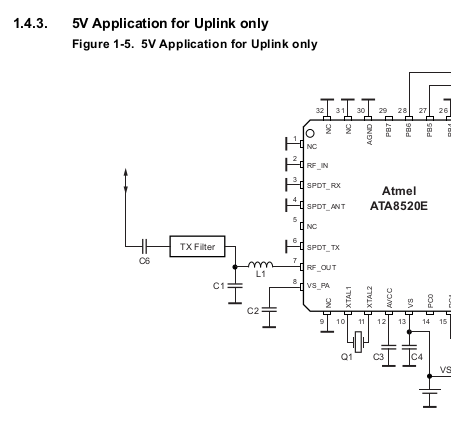

While simple Sigfox chips are transmit-only devices, the Mkrfox 1200 Arduino board uses the Atmel ATA 8520 with a transceiver front end for bi-directional communication. Devices that only want to transmit data without receiving feedback it’s also possible to use a much simpler TX front end with the chip. The two figures on the left taken from the ATA 8520’s data sheet show the two options.

Obviously, compared to other cellular systems where the network controls access to the network, Sigfox device hardware and software can be much simpler and power efficient. The downsides are, however, that the network can’t control access to the network, it can’t acknowledge proper reception, organize retransmissions, instruct a device to use additional redundancy to compensate for bad signal conditions, enforce priorities, etc. In many cases this won’t be necessary but it limits the type of applications for which Sigfox is suitable.

Downlink Messages

Many IoT applications require that a device can also receive data, e.g. for reconfiguration purposes. Sigfox can transmit up to 8 bytes in a downlink message and limits the number of downlink messages to 4 per day. In other words, 32 bytes of information can be sent to the device per day if the limit is enforced. For most configuration data this should be an ample amount but software updates are obviously not an option. Perhaps that’s not even a bad thing as this makes it even harder to maliciously hack the device over the air.

For the downlink direction, Sigfox uses the license free 869.4 to 869.65 MHz frequency range with a maximum transmission power of 0.5W and a maximum duty cycle of 10%. In other words, a Sigfox base station must not transmit data to devices more than 10% of the time. While 500 mW is much more than the 25 mW that devices are limited to, it is still not much when compared to GSM or LTE base stations that use a transmission power in the order of 20 watts per channel. Compared to those channels the channel required for a downlink data rate of 600 bit/s is again very narrow which compensates to some degree for the comparatively much lower power.

Listening Times For Downlink Data

Another important restriction to reduce power consumption as much as possible on the mobile device’s side is that they are only required to listen for incoming data for 30 seconds after an uplink transmission. After that the Sigfox chip goes back to sleep and will not be able to detect incoming messages. In addition, due to the 10% duty cycle the base station has to observe downlink data has to sometimes be buffered for a while before it can be transmitted. In practice that means that a server on the Internet can’t contact the device at any time but has to wait until it receives a message and then has to send a response message within a few seconds. While responding quickly is usually not a problem, having to wait until the device sends a message on its own also limits the kind of applications that the network is suitable for.

The Long Wait

I actually have a practical example where having to wait for a response for half a minute because of the 7 seconds it takes to send the uplink message, the time it takes for the downlink message to be transmitted and to observe the 10% duty cycle at the base station side is a major show stopper. I live in Cologne where a company offers bike rentals. If I want to rent a bike I have to waive my customer card over an NFC reader after which the bike’s rental computer communicates to the back end server. If the server gives the go-ahead, the lock is opened and I can use the bike. When I arrive at the destination I have to lock the bike again which triggers another communication session with server to indicate its location and availability status. In both cases I have to wait for at least half a minute before the bike becomes available to me or before I get the information from the display that the rental return was successful. This is an awfully long time and a major pain point. Perhaps they are using Sigfox for communication because the delay very much reminds me of the time I have to wait for a downlink message with my Arduino board after I’ve sent an uplink message.

Sensitivity

I was hoping that the very narrow channels would sufficiently offset the very low signal power Sigfox is restricted to because of the use of unlicensed spectrum. I was quite disappointed in that regard however. While most uplink messages were properly received on the network side while I was outside or very close to a window, transmissions were usually not picked up by the network when I used the device in normal indoor scenarios where mobile phones still have very good reception. Also, messages my module sent while I was on my daily commute in the train or my car were also not picked up. Receiving downlink messages seems to be even more difficult in practice. In most places were I could send messages I could not receive downlink messages from the network. At first I thought that perhaps the transmit power of the Mkrfox board is too low. So I connected it to a spectrum analyzer reported an observed transmission power of 12.5 to 14 dBm depending on the setup. This looks quite o.k. as 14 dBm is pretty close to the 25 mW maximum allowed in the band. I also tried different antennas but the result would also not change. So everything seems to be all right on the device side.

International Use

Another interesting Sigfox feature is that once a device is activated it will work in any country a Sigfox network has been rolled out in the frequency band the device supports. I tried this out in practice while I was in Belgium over a weekend and can confirm that this works. This is a major advantage compared to other cellular technologies where networks are operated by independent companies. To roam internationally, other networks must be interconnected and operators usually charge each other and their customers for international roaming.

Unfortunately, Sigfox has to use different bands in Europe and the US so global connectivity is not assured. Perhaps we will see ‘multi-band’ Sigfox modules in the future for global connectivity. I wonder a bit however, how the device can then detect which frequency band it is supposed to use as a device does not search for a network before it transmits its messages.

Summary

After playing with Sigfox for some time I have to say that I was very impressed by how little effort is required to prototype an Arduino IoT application and that only a single function call is required to send a message over the Sigfox network to a server on the Internet. The limited indoor coverage I experienced in Cologne and the inherently long round trip time for receiving a response from the server are probably not an issue for many IoT applications but one should be aware of these limitations at the beginning of a project.

22 May 07:33

There are no bad smartphones anymore

by Volker Weber

5d38cc1d989f48fb0e6e894c2884bacd

Yesterday I chose to remove a comment from a first timer who waltzed in to attack a different comment and flat out stated that iOS was crap. It rubbed me the wrong way both in style and substance. And I might be stating the obvious when I say that you can't really buy a bad smartphone anymore. It's going to be an iPhone or some variant of Android. And they basically all have the same capabilities. Just look at the devices in the photo. Two of them start adding a second (or third, if you count the front facing) camera.

Three cameras! Hello? It takes this much effort to make even a small difference. Launch events are crazy boring. Vendors ferry hundreds of influencers to synchronized events around the world and then present a smartphone that is only marginally better than their previous one. So the S8 makes the S7 edge look old? What difference does that make? You will be doing exactly the same with either one. What are the big differences between the iPhone 6 and the 7 Plus in this photo aside from the size? Force touch and tele lens.

Don't make assertions about your particular choice being superior to the others. I am amazed by all of them. Choose what you like and what fits your particular taste as well as your budget. When I recommend the iPhone, it's not because of features. I recommend it because I think you will be glad you bought it, for many reasons that I am not going to list here.

Does that mean I think all other choices are crap? You would be a very small mind to believe that.

20 May 06:55

Toronto Ride of Silence 2017

by dandy

A die-in at City Hall represents the death of cyclists and pedestrians in the streets following the 8th annual Ride of Silence in Toronto.

Toronto Ride of Silence 2017

by Jun Nogami

The Ride of Silence commemorates those whose have been killed while riding their bicycles. These rides now take place worldwide on the third Wednesday in May, at 7 p.m. local time. The first Ride of Silence was held in Texas in 2003, making this year the 15th such ride to take place.

Last night was the 8th ride in Toronto. Almost 50 people showed up on a balmy summer-like evening. Here is part of the crowd gathered at Bloor and Spadina.

Joey Schwartz from the Toronto Bicycling Network leads us off on Bloor. Unlike last year, this time we have bike lanes on this stretch of the ride.

All too soon, the bike lanes are gone, and we have to mix it up with car traffic.

Arriving at the Peace Garden in Nathan Phillips Square, below.

At the Peace Garden, the names of Toronto cyclists who have died since 2010 were read out. One other person mentioned two competitive cyclists who also died during this period: Jocelyn Lovell, who passed away last year of injuries in 1983 that left him a quadriplegic for more than 30 years, and Greg Stobbart, who was killed in 2006 while on a training ride. There was a minute of silence in memory of all these riders.

Then Patrick Brown (centre, below) of Bike Law Canada mentioned that he had met yesterday with the Minister of Transportation about the issue of vulnerable road user legislation, and that some changes were promised, although no specifics were offered.

Several representatives from Walk Toronto and Friends and Families for Safe Streets rode with us.
It was noted that although there have been no cyclist fatalities in Toronto so far in 2017, 12 pedestrians have already died, putting us on a pace to equal last year’s total.  Since there were roughly 50 people present, we decided to take a picture of a mini “die-in” to give a graphic representation of how many people die in road collisions in a typical year in Toronto. Toronto held it's first ever mass die-in at City Hall two years ago.

Thanks to everyone who rode with us tonight.

Update: Last night a man was hit near Kensington Market while riding his bike. Our thoughts are with him and we hope he recovers soon.

Related on dandyhorsemagazine.com:

Remembering Fallen Cyclists

First Die-in at City Hall Toronto

Rule of Law (from issue 3)