Shared posts

27 May 06:26

Photon Engineering Newsletter #2

by dolske

That’s right! Time for another Photon Engineering Newsletter! (As I gradually catch up with real-time, this update covers through about May 16th).

May got off to a busy start for the Photon team. As I mentioned in last week’s update, the team has largely shifted from the planning to implementation, so visible changes are starting to come quickly.

Work Week

A particularly big event was the Photon team gathering in Mozilla’s Toronto office for a work week. About 50 people from Engineering, UX, User Research, and Program Management gathered, from all over the world, with a focus on building Photon. Mozilla operates really well with distributed/remote teams, but periodically getting together to do things face-to-face is super useful to work through issues more quickly.

photonww_shorlander_small

It was really terrific to see so many people coming together to hack on Photon. We got a lot done (more on that below), saw some great demos, and the energy was high. And of course, no workweek is complete without UX creating some fun posters:

57small

One important milestone reached during the week was setting the initial scope for what’s going to be included in Photon (or, more bluntly, what’s NOT going to be part of Photon when it ships in Firefox 57). We’re still refining estimates, but it looks like all the major worked planned for Photon can be accomplished. Most things placed in the “reserve backlog” (meaning we’ll do it if there’s extra time left, but we’re not committing to do them) are minor or nice-to-have things.

This is probably a good spot to talk a little more about our schedule. Firefox 57 is the release that Quantum and Photon are targeting. It’s scheduled to ship on November 14th, but there are important milestones before then… September 22nd is when 57 enters Beta, after that point it’s increasingly hard to make changes (because we don’t want to destabilize Firefox right before it ships). August 7th is when Nightly becomes version 57. This is also our target date to be complete with “major work” for Photon. This might seem a little surprising, but it’s due to the recent process change that removed Aurora. Under the old release schedule, August 7th is when Nightly-57 uplifted to Aurora (beginning ~12 weeks of stabilization before release). We want to keep the same amount of stabilization time (for a project as big as Photon there is _always_ fallout and followup work), so we kept the same calendar date for Photon’s target. This doesn’t mean we’ll be “done” on August 7th, just that the focus will be shifting from implementing features to fixing bugs, improving quality, and final polish.

And now for the part you’ve all been waiting for, the recent changes!

Recent Changes

Menus/structure:

  • The page action menu (aka the “…” button at the end of the URL bar) got the first menu items added to it, Copy URL and Email Link. More coming, as this becomes the standard place for “actions you can perform with this page” items.
    actionmenu_first
  • The new hamburger menu is coming along, although still disabled by default (via the browser.photon.structure.enabled pref). Items for character encoding, work offline, and the devtools submenu have been added to it.
  • The new overflow menu (also disabled by default, same pref) is nearing completion with 2/3 of the bugs fixed. This menu is now shown in customize mode (instead of the old hamburger menu); so instead of only showing icons that couldn’t fit in the navbar (e.g. because you made your window too narrow), it’s the new place you can customize with buttons you want to be easily accessible without always taking up navbar space.

Animation:

  • When rearranging tabs in the tabstrip, a snappier animation rate is now used.
  • Work continues on animations for downloads toolbar button, stop/reload button, and page loading indicator – but these haven’t landed yet.

Preferences:

  • The “Updates” section of preferences now shows the current Firefox version.
  • Good progress at the workweek on fixing the first set of bugs needed to enable searching within preferences.
  • UX is working on some further changes to the reorganization that we believe will improve it.

Visual redesign:

  • The new styling for the location and search bars landed.
  • The stop/reload button has been removed from the end (inside) of the location bar, and is now a normal toolbar button to the left of the location bar.
  • The back/forward buttons have been detached from the location bar.
  • URL that are longer than the location box can display now fade out at the end.
  • Minor update to the about:privatebrowsing page (shown when opening a new private window).
  • Upcoming work on compact/touch modes for the toolbar and more toolbar button style changes.

Onboarding:

  • Running Funnelcake tests for the new tour notification.
  • Built a prototype of the new tab page tour overlay at the workweek.
  • Will be adding new automigration UI to the Activity Stream new tab page. Users trying Firefox for the first time will no longer immediately see the old data migration wizard (which makes for a pretty poor first impression). Instead, Firefox will automatically import from your previous browser, so you launch straight into Firefox and can see your data. There’s also a clear message indicating what happened, and giving you the choice to keep (or not) the data, or try importing from a different browser. This screencast shows the general flow:
    automig

Performance:

  • Florian landed a massive series of patches (assisted by an automated code-rewriting tool) that switches use of Task.jsm/yield to ES7 async/await. The native ES7 code is more efficient, and we’ve often seen the older Task.jsm usage show in the profiler. This also helps with modernizing Firefox’s front end, which extensively uses JavaScript.
  • The animation shown when opening a window is now suppressed for the first window to be opened.
  • Tab navigation and restoring now cause less visual noise in the tab title, by skipping the display of unnecessary text (e.g. “Loading” and “New Tab”).
  • A few things have been moved off the startup path, so that Firefox launches faster.
  • Removed some synchronous reflows when adding and removing tabs and when interacting with the AwesomeBar.
  • Working on adding tests to detect synchronous reflows, so that we can ensure they don’t sneak back in after we remove them.


This concludes update #2.


25 May 23:55

Tulips, Myths, and Cryptocurrencies

by Ben Thompson

Everyone knows about the Tulip Bubble, first documented by Charles Mackay in 1841 in his book Extraordinary Popular Delusions and the Madness of Crowds:

In 1634, the rage among the Dutch to possess [tulips] was so great that the ordinary industry of the country was neglected, and the population, even to its lowest dregs, embarked in the tulip trade. As the mania increased, prices augmented, until, in the year 1635, many persons were known to invest a fortune of 100,000 florins in the purchase of forty roots. It then became necessary to sell them by their weight in perits, a small weight less than a grain. A tulip of the species called Admiral Liefken, weighing 400 perits, was worth 4400 florins; an Admiral Van der Eyck, weighing 446 perits, was worth 1260 florins; a Childer of 106 perits was worth 1615 florins; a Viceroy of 400 perits, 3000 florins, and, most precious of all, a Semper Augustus, weighing 200 perits, was thought to be very cheap at 5500 florins. The latter was much sought after, and even an inferior bulb might command a price of 2000 florins. It is related that, at one time, early in 1636, there were only two roots of this description to be had in all Holland, and those not of the best. One was in the possession of a dealer in Amsterdam, and the other in Harlaem [sic]. So anxious were the speculators to obtain them, that one person offered the fee-simple of twelve acres of building-ground for the Harlaem tulip. That of Amsterdam was bought for 4600 florins, a new carriage, two grey horses, and a complete suit of harness.

Mackay goes on to recount other tall tales; I’m partial to the sailor who thought a Semper Augustus bulb was an onion, and stole it for his breakfast; “Little did he dream that he had been eating a breakfast whose cost might have regaled a whole ship’s crew for a twelvemonth.”

Jean-Léon_Gérôme_-_The_Tulip_Folly_-_Walters_372612

Anyhow, we all know how it ended:

At first, as in all these gambling mania, confidence was at its height, and everybody gained. The tulip-jobbers speculated in the rise and fall of the tulip stocks, and made large profits by buying when prices fell, and selling out when they rose. Many individuals grew suddenly rich. A golden bait hung temptingly out before the people, and one after the other, they rushed to the tulip-marts, like flies around a honey-pot. Every one imagined that the passion for tulips would last for ever…

At last, however, the more prudent began to see that this folly could not last for ever. Rich people no longer bought the flowers to keep them in their gardens, but to sell them again at cent per cent profit. It was seen that somebody must lose fearfully in the end. As this conviction spread, prices fell, and never rose again. Confidence was destroyed, and a universal panic seized upon the dealers…The cry of distress resounded every where, and each man accused his neighbour. The few who had contrived to enrich themselves hid their wealth from the knowledge of their fellow-citizens, and invested it in the English or other funds. Many who, for a brief season, had emerged from the humbler walks of life, were cast back into their original obscurity. Substantial merchants were reduced almost to beggary, and many a representative of a noble line saw the fortunes of his house ruined beyond redemption.

Thanks to Mackay’s vivid account, tulips are a well-known cautionary tale, applied to asset bubbles of all types; here’s the problem, though: there’s a decent chance Mackay’s account is completely wrong.

The Truth About Tulips

In 2006, UCLA economist Earl Thompson wrote a paper entitled The Tulipmania: Fact or Artifact?1 that includes this chart that looks like Mackay’s bubble:

Screen Shot 2017-05-23 at 7.16.24 PM

However, as Thompson wrote in the paper, “appearances are sometimes quite deceiving.” A much more accurate chart looks like this:

Screen Shot 2017-05-23 at 7.17.16 PM

Mackay was right that there were insanely high prices: those prices, though, were for options; if the actual price of tulips were lower on the strike date for the options, then the owner of the option only needed to pay a small percentage of the contract price (ultimately 3.5%). Meanwhile, though, actual spot prices and futures (that locked in a price) stayed flat.

The broader context comes from this chart:

Screen Shot 2017-05-23 at 7.17.32 PM

As Thompson explains, tulips in fact were becoming more popular, particularly in Germany, and, as the first phase of the 30 Years War wound down, it looked like Germany would be victorious, which would mean a better market for tulips. In early October, 1636, though, Germany suffered an unexpected defeat, and the tulip price crashed, not because it was irrationally high, but because of an external shock.

As Thompson recounts, that October crash was in fact a financial disaster for many, including some public officials who had bought tulip futures on a speculative basis; to get themselves out of trouble, said officials retroactively decreed that futures were in fact options. These deliberations were well-publicized throughout the winter of 1636 and early 1637, but not made official until February 24th; the dramatic rise in options, then, is explained as a longshot bet that the conversion would not actually take place: when it did, the price of the options naturally dropped to the spot price.2

By Thompson’s reckoning, Mackay’s entire account was a myth.

Myths and Humans

Early on in Sapiens: A Brief History of Humankind, Yuval Noah Harari explains the importance of myth:

Once the threshold of 150 individuals is crossed, things can no longer work [on the basis of intimate relations]…How did Homo sapiens manage to cross this critical threshold, eventually founding cities comprising tens of thousands of inhabitants and empires ruling hundreds of millions? The secret was probably the appearance of fiction. Large numbers of strangers can cooperate successfully by believing in common myths.

Any large-scale human cooperation — whether a modern state, a medieval church, an ancient city or an archaic tribe — is rooted in common myths that exist only in people’s collective imagination. Churches are rooted in common religious myths. Two Catholics who have never met can nevertheless go together on crusade or pool funds to build a hospital because they both believe that God was incarnated in human flesh and allowed Himself to be crucified to redeem our sins. States are rooted in common national myths. Two Serbs who have never met might risk their lives to save one another because both believe in the existence of the Serbian nation, the Serbian homeland and the Serbian flag. Judicial systems are rooted in common legal myths. Two lawyers who have never met can nevertheless combine efforts to defend a complete stranger because they both believe in the existence of laws, justice, human rights – and the money paid out in fees. Yet none of these things exists outside the stories that people invent and tell one another. There are no gods in the universe, no nations, no money, no human rights, no laws, and no justice outside the common imagination of human beings.

The implication of Harari’s argument3 is pretty hard to wrap one’s head around.4 Take the term “tulip bubble”: everyone knows it is in reference to a speculative mania that will end in a crash, even those like me — and now you — that have learned about what actually happened in the Netherlands in the winter of 1636. Like I said, it’s a myth — and myths matter.

The Rise in Cryptocurrencies

The reason I mention the tulip bubble at all is probably obvious:

Screen Shot 2017-05-23 at 5.07.24 PM

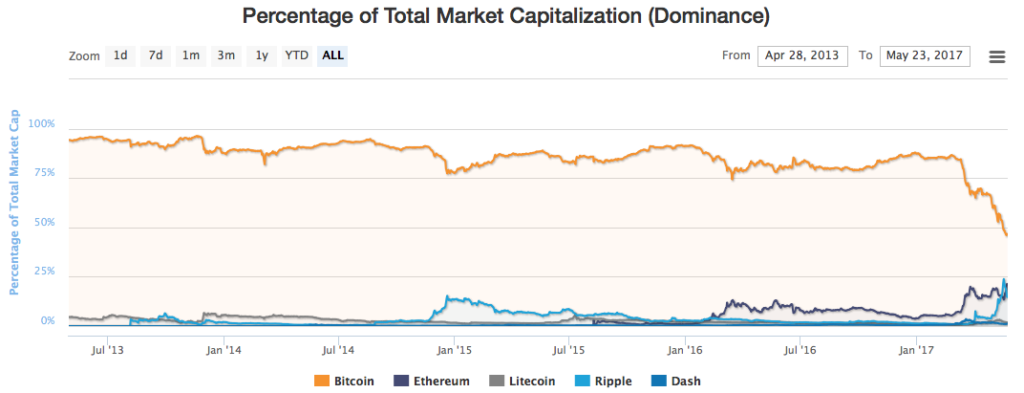
This is the total market capitalization of all cryptocurrencies. To date that has mostly meant Bitcoin, but over the last two months Bitcoin’s share of cryptocurrency capitalization has actually plummeted to less than 50%, thanks to the sharp rise of Ethereum and Ripple in particular:

currencyshare

As you might expect, the tulip is having a renaissance, or to be more precise, our shared myth of the tulip bubble. This tweet summed up the skeptics’ sentiment well:

To be perfectly clear, this random twitterer may very well be correct about an impending crash. And, in the grand scheme of things, it is mostly true today that cryptocurrencies don’t have meaningful “industrial [or] consumer use except as a medium of exchange.” What he is the most right about, though, is that cryptocurrencies have no intrinsic value.

Compare cryptocurrencies to, say, the U.S. dollar. The U.S. dollar is worth, well, a dollar because…well, because the United States government says it is.5 And because currency traders have established it as such, relative to other currencies. And the worth of those currencies is based on…well, like the dollar, they are based on a mutual agreement of everyone that they are worth whatever they are worth. The dollar is a myth.

Of course this isn’t a new view: there are still those that believe it was a mistake to move the dollar off of the gold standard: that was a much more concrete definition. After all, you could always exchange one dollar for a fixed amount of gold, and gold, of course, has intrinsic value because…well, because us humans think it looks pretty, I guess. In fact, it turns out gold — at least the idea that it is of intrinsically more worth than another mineral — is another myth.

I would argue that cryptocurrency broadly, and Bitcoin especially, are no different. Bitcoin has been around for eight years now, it has captured the imagination, ingenuity, and investment of a massive number of very smart people, and it is increasingly trivial to convert it to the currency of your choice. Can you use Bitcoin to buy something from the shop down the street? Well, no, but you can’t very well use a piece of gold either, and no one argues that the latter isn’t worth whatever price the gold market is willing to bear. Gold can be converted to dollars which can be converted to goods, and Bitcoin is no different. To put it another way, enough people believe that gold is worth something, and that is enough to make it so, and I suspect we are well past that point with Bitcoin.

The Utility of Blockchains

To be fair, there is an argument that gold is valuable because it does have utility beyond ornamentation (I, of course, would argue that that is a perfectly valuable thing in its own right): for example, gold is used in electronics and dentistry. An argument based on utility, though, applies even moreso to cryptocurrencies. I wrote back in 2014:

The defining characteristic of anything digital is its zero marginal cost…Bitcoin and the breakthrough it represents, broadly speaking, changes all that. For the first time something can be both digital and unique, without any real world representation. The particulars of Bitcoin and its hotly-debated value as a currency I think cloud this fact for many observers; the breakthrough I’m talking about in fact has nothing to do with currency, and could in theory be applied to all kinds of objects that can’t be duplicated, from stock certificates to property deeds to wills and more.

One of the big recent risers, Ethereum, is exactly that: Ethereum is based on a blockchain,6 like Bitcoin, which means it has an attached currency (Ether) that incentivizes miners to verify transactions. However, the protocol includes smart contract functionality, which means that two untrusted parties can engage in a contract without a 3rd-party enforcement entity.7

One of the biggest applications of this functionality is, unsurprisingly, other cryptocurrencies. The last year in particular has seen an explosion in Initial Coin Offerings (ICOs), usually on Ethereum. In an ICO a new blockchain-based entity is created, with the initial “tokens” — i.e. currency — being sold (for Ether or Bitcoin). These initial offerings are, at least in theory, valuable because the currency will, if the application built on the blockchain is successful, increase in value over time.

This has the potential to be particularly exciting for the creation of decentralized networks. Fred Ehrsam explained on the Coinbase blog:

Historically it has been difficult to incentivize the creation of new protocols as Albert Wenger points out. This has been because 1) there had been no direct way to monetize the creation and maintenance of these protocols and 2) it had been difficult to get a new protocol off the ground because of the chicken and the egg problem. For example, with SMTP, our email protocol, there was no direct monetary incentive to create the protocol — it was only later that businesses like Outlook, Hotmail, and Gmail started using it and made a real business on top of it. As a result we see very successful protocols and they tend to be quite old. (Editor: and created when the Internet was government-supported)

Now someone can create a protocol, create a tokens that is native to that protocol, and retain some of that token for themselves and for future development. This is a great way to incentivize creators: if the protocol is successful, the token will go up in value…In addition, tokens help solve the classic chicken and the egg problem that many networks have…the value of a network goes up a lot when more people join it. So how do you get people to join a brand new network? You give people partial ownership of the network…

0*cSLRTnSGE6vw2VGi.

These two incentives are amazing offsets for each other. When the network is less populated and useful you now have a stronger incentive to join it.

This is a huge deal, and probably the most viable way out from the antitrust trap created by Aggregation Theory.

Party Like It’s 1999

The problem, of course, is that while blockchain applications make sense in theory, the road to them becoming a reality is still a long one. That is why I suspect the better analogy for blockchain-based applications and their associated cryptocurrencies is not tulips but rather the Internet itself, specifically the 1990s. Marc Andreessen is fond of observing, most recently on this excellent podcast with Barry Ritholtz, that all of the dot-com failures turned out to be viable businesses: they were just 15 years too early (the most recent example: Chewy.com, the spiritual heir of famed dot-com bust Pets.com, acquired earlier this year for $3.35 billion).

As the aphorism goes, being early (or late) is no different than being wrong, and that’s true in a financial sense. As I noted above, I would not be surprised if the ongoing run-up in cryptocurrency prices proves to be, well, a bubble. However, bubbles of irrationality and bubbles of timing are fundamentally different: one is based on something real (the latter), and one is not. That is to say, one is a myth, and one is merely a fable — and myths can lift an entire species.

Consistent with my ethics policy, I do not own any Bitcoin or any other cryptocurrency; that said, the implication of this article is that comparing Bitcoin or any other cryptocurrencies to stock in an individual company probably doesn’t make much sense

  1. This link requires payment; there is an uploaded version of the paper here
  2. Thompson’s take is not without its critics: see Brad DeLong’s takedown here
  3. If you’re religious, please apply the point about “gods” to other religions — the point still stands!
  4. I first encountered this sort of thinking in an Introduction to Constitutional Law course in university, when my professor contended that the U.S. Constitution was simply a shared myth, dependent on the mutual agreement of Americans and its leaders that it mattered. It’s a lesson that has served me well
  5. And, as @nosunkcosts notes, said claim, via taxes, is backed by military might
  6. A useful overview of how cryptocurrencies work is here
  7. What happened with The Dao will not be covered here!
25 May 23:55

Screens 4.0 for macOS Adds Curtain Mode, Drag-And-Drop File Transfers, Touch Bar Support, and More

by John Voorhees

Screens 4.0, which was released today, is a complete rewrite of the screen sharing app from the ground up that adds features previously available only in the iOS version as well as some exclusive macOS-only features. What’s made Screens my favorite way to connect to a remote Mac is that it has managed to abstract away the complexity that accompanies many VNC apps. That hasn’t changed with Screens 4.0, which is even easier to use and more versatile than before.

With today’s update, Screens adds features that debuted in the iOS version of the app like Curtain Mode. After you log into a remote Mac, enabling Curtain Mode prevents anyone physically close to the remote computer from seeing what’s on the screen by showing a graphic of a padlock while you are connected to it.

Curtain Mode (Image courtesy of Edovia).

Curtain Mode (Image courtesy of Edovia).

One-click passwords were also added to the macOS version, which eliminates the need to enter your user account password over and over. Instead, once it’s set up, you just click a button. Screens supports groups now too, which helps keep everything tidy and organized if you create connections to multiple computers.

The update adds some great exclusives for Mac users. The first is drag and drop file transfers. Simply drag a file from either Mac to the other to transfer it. The process couldn’t be simpler. In my tests, file transfers were surprisingly fast for a remote connection. Edovia says that in its testing, transfers using Screens can be faster at times than using the Finder itself.

Another unique feature added is Touch Bar support. Screens is an app where the Touch Bar makes a lot of sense. If you’re connected remotely to another computer, you want to maximize your view into that machine, which means running Screens in full-screen mode. Without a Touch Bar-enabled MacBook Pro, that means giving up easy access to Screens’ toolbar, but if you have a Touch Bar Mac, you can have the best of both worlds. Screens’ toolbar is available in the Touch Bar, which means you can do things like toggle Curtain Mode, zoom into the remote screen, send and receive the clipboard contents between connected computers, and control many macOS system features on the remote machine.

Screens' core tools are available from the Touch Bar.

Screens' core tools are available from the Touch Bar.

Screens has made a bunch of other under-the-hood performance improvements too. Screens now uses OpenGL graphics to speed up the drawing of the remote computer’s screen. Screens features momentum scrolling for the first time, which makes scrolling windows remotely feel more natural. Finally, saved screen connections can now be synced among your Macs and iOS devices using iCloud even if you purchased Screens on Edovia’s website thanks to Apple’s easing of the restrictions of which apps can use iCloud.

Screens is my favorite app for connecting to my Macs remotely. The continued refinement of the iOS and Mac versions mean I’ve had no reason to look elsewhere because what was a solid, easy-to-use app has only gotten better over time. Last year’s major update to the iOS version of Screens managed to leap ahead of the macOs version for a while, but now the macOS version of screens is just as good as the iOS version, while also playing to strengths that are unique to the Mac.

Screens is available on the Mac App Store, Edovia’s website, and as part of the Setapp subscription service. For existing users who bought Screens 3, Edovia is offering a 40% discount to upgrade to version 4.


Support MacStories Directly

Club MacStories offers exclusive access to extra MacStories content, delivered every week; it’s also a way to support us directly.

Club MacStories will help you discover the best apps for your devices and get the most out of your iPhone, iPad, and Mac. Plus, it’s made in Italy.

Join Now
25 May 23:50

Progress On Point Grey Road

by Ken Ohrn

Crews near completion on the western end of the new and vastly improved Point Grey Road (at Alma).  It becomes clearer each visit what the final result will be.  And to think, just a few years ago, this was a noisy, dangerous quasi-arterial for 8,000 – 10,000 commuter motor vehicles per day.


25 May 23:50

Preview Form Autofill in Firefox Nightly

by Matthew Noorenberghe

An early version of the new Form Autofill feature is ready for testing by early adopters with U.S. addresses and websites using Firefox Nightly on desktop. Form Autofill helps you fill out addresses in online forms. You can give the work-in-progress a try and watch it improve over time but keep in mind there are many more months of work left to go.

An address is selected from the autocomplete dropdown on the email field and the rest of the address fields are filled with the related saved information for that profile.

Firefox has an existing form history feature, which helps you fill out one field at a time using frecency. In contrast, Form Autofill completes all related address fields when you select a suggestion from the autocomplete dropdown on the focused field. Autofill profiles can contain one or more of the following: name, mailing address, phone number, and/or email. Multiple profiles are supported, so, for example, you can have separate personal and work profiles.

What’s currently supported

  • Basic address profile management for addresses that follow United States formats. For now you need to use this interface to create profiles for testing
  • Enabling/disabling the feature in preferences
  • Filling a form which uses the @autocomplete attribute on <input> elements for the supported fields, and with minimal transformations. This means it won’t work yet on most websites. Try it on our demo page, Macy’s, or any Shopify-powered store.

Coming soon on Nightly

  • Heuristics to determine field data types when @autocomplete isn’t used. This will make autofill work on many more sites.
  • In-content add/edit dialog UX
  • Support for <select> dropdowns
  • Automatic saving of submitted addresses and prompts to confirm changes after autofilling
  • Showing a preview of what will be autofilled upon highlighting an address in the autocomplete dropdown
  • Full UI translation

Before release

  • Support for credit cards
  • More data validation and cleansing
  • Sync between desktops with your Firefox Account
  • Significantly improved heuristics… there is a lot of work to do here yet
  • Support for more countries based on feedback from our localization communities
  • Support for data transformations on more types e.g. splitting a phone number into country code, area code, exchange, and number when required by sites
  • UI polish
  • Telemetry to measure accuracy of autofilled data as a quality metric

Try it out

To give Form Autofill a try, make sure you’re running Firefox Nightly and open Privacy preferences (you can type about:preferences#privacy in the address bar). Click the “Saved Profiles…” button beside “Enable Profile Autofill” and then click “Add” and save a new address. Then visit our demo page or other sites using the HTML5 autocomplete attribute, and you should see the autofill dropdown as seen in the image above.

Take a look at the Form Autofill wiki page for much more information and to get involved.

Thanks,
The Form Autofill Team

24 May 04:44

The Erosion of Chinatown As We Know It

by Sandy James Planner

vancouver-may-18-2017-the-new-location-of-the-new-town-bak

Noted journalist Daphne Bramham in the Vancouver Sun  has written an article that should be required reading for everyone in Metro Vancouver. She has cogently described our intentional neglect and universal ignorance of the deboning of Vancouver’s Chinatown. We somehow conveniently forget that it was the 17,000 Chinese labourers  who built the railway across Canada between 1881 to 1884. Those workers, their descendants and others left the legacy of  this very special part of the city. It was also Strathcona residents that were largely responsible for Vancouver not being cleaved in half by the building of three storey high ten lane highway in the late 1960’s. As a city we owe a lot to the legacy left by Chinatown and Strathcona. Where is the outrage of what is happening to this very special part of the city? Why isn’t this a civic, provincial and national priority?

Daphne describes the universality of the shiny city Vancouver has become, looking like any other place. She rues that the unique places ” are rapidly disappearing, and none is at greater risk than Chinatown, which teeters on the edge of extinction despite being designated a National Historic Site in 2011. It is so close to the edge that Carol Lee of the Vancouver Chinatown Foundation fears that without a concerted local, provincial and national effort it may be lost by the end of this year.”

“The neighbourhood has been eroded one neon sign, one family-run business and one clan building at a time. But at greater risk than the bricks, mortar and unique streetscapes blending Chinese and late 19th century Canadian architectural styles is the neighbourhood’s cultural heritage. Hipsters have heralded gentrification. Trendy restaurants, skateboard shops, coffee bars and cannabis dispensaries may be the tipping point.”

“Design guidelines meant to maintain a ‘Chinatown look’ are often overlooked and building heights have been dramatically increased. … Intense speculation is driving up rents and displacing long-time residents, many of them seniors, who are central to the area’s rich cultural identity…Today, the neighbourhood is dotted with empty storefronts. Aging shopkeepers struggle to carry on with fewer customers and ever-increasing taxes. But the most vulnerable are seniors — many of whom are frail, female, Cantonese speakers living at the poverty line.

Some will be at Tuesday’s public hearing protesting a proposal to build a 12-storey, luxury condo building at Keefer Street and Columbia. The plan does include 25 units of social housing, but only eight of those will be available to those with the lowest incomes.

The building itself, according to the heritage consultant’s report to council, “respects the historic Chinatown context by not attempting to mimic or replicate its area neighbours. Indeed, the building’s form, scale, massing, materials and colours will help distinguish the building as a contemporary addition. In other words it will stick out like a sore thumb.”

“Myriad things have contributed to Chinatown’s decline, including decaying, century-old buildings that are expensive to repair, the encroaching chaos and dysfunction of the Downtown Eastside, and the disinterest and even disdain some Vancouver-born Chinese have for a ghetto that their ancestors worked so hard to leave.”

“Vancouver’s history is so recent that some of its retelling still hurts. But that is all the more reason this unique neighbourhood and community should be given the help it needs to survive and thrive.”

The full text of Ms. Bramham’s editorial comment and the work of the Vancouver Chinatown Foundation  can be read here.

nov-21-2016-mrs-kong-mrs-luu-and-ms-chan-protest-van


24 May 04:43

Mozilla Thimble Gets a Makeover

by Christopher Lawrence

We’re introducing major upgrades to our educational code editor


Learning to code—from getting the hang of HTML tags to mastering the nuances of JavaScript—shouldn’t be a challenge. It should be fun, intuitive, hands-on and free of cost.

That’s why Mozilla built Thimble nearly five years ago. Much like Firefox enables users to browse the web, Thimble enables users to learn the web. It’s our browser-based tool for learning to code.

Today, we’re proud to announce Thimble is getting a makeover.

We’re introducing a suite of new features to make learning and teaching code even easier. Why? When more people can shape, and not just consume the web, the Internet becomes a healthier and more egalitarian, inclusive and funky place.

Thimble has taught hundreds of thousands of people across more than 200 countries. It’s been localized into 33 languages, and used in classrooms, at hackathons and at home. Thimble has also proved to be more than an educational code editor—it’s a creative platform. Thimble users can create personal webpages, comic strips, post cards, games and more.

And in true Mozilla fashion, Thimble is an open-source project. Many of those who learn to code with Thimble later return to offer tweaks and upgrades. Over 300 contributors from dozens of countries help build Thimble. Learn more about them here.

New Features


  • JavaScript console. Users can now debug their JavaScript projects within Thimble. It’s a simpler experience than the browser console, which can be cluttered and intimidating


  • Code snippets menu. Access a handy menu populated with HTML, CSS and JavaScript snippets. Creating content just got easier


  • ‘Favorite’ feature. Bookmark, organize and easily access projects you’re currently working on


  • Edit SVG image code directly. You can now change properties of SVG images—like fill and stroke color—within Thimble. No need to use an external editor or image software


  • Tajik language support. Add one more language to Thimble’s repertoire: Tajik, which is spoken in Tajikistan and Uzbekistan


  • Plus more, like an upgraded color picker; visible white space in code; updated file icons; an improved homepage gallery; easier file import and export mechanics; and the ability to disable autocomplete

Mozilla owes a debt of gratitude to the network of developers, designers, teachers and localizers around the world who made these upgrades possible—more than 300 contributors from 33 countries, like Brazil, Turkey, China and the UK. Their commitment to web literacy and open-source software makes the Internet healthier.

Now: start coding.

The post Mozilla Thimble Gets a Makeover appeared first on The Mozilla Blog.

24 May 04:43

IKEA’s Low-Cost Smart Lights Will Support HomeKit

by Ryan Christoffel

Earlier this year IKEA announced a collection of low-cost smart lights under the Trådfri name. At the time, it was unknown whether the lineup would be compatible with existing smart home platforms, such as Apple's HomeKit. Today MacRumors shared new details announced in a Swedish press release:

IKEA said in its press release that HomeKit support is in the works... IKEA plans to retrofit the new functions via a software update to the Trådfri Gateway and Trådfri app. In addition to HomeKit, the update will also make IKEA's smart products controllable through Amazon Echo and Google Home.

Perhaps the most significant barrier to wider smart home adoption thus far has been cost. While IKEA's Trådfri offerings will certainly not be able to compete with the prices of traditional lighting, their cost will be easier to swallow than that of competing products.

Additionally, news that the lights will support not only HomeKit, but Alexa and Google Home as well, set IKEA's products up to be strong contenders in the smart home market when they launch later this year.


Support MacStories Directly

Club MacStories offers exclusive access to extra MacStories content, delivered every week; it’s also a way to support us directly.

Club MacStories will help you discover the best apps for your devices and get the most out of your iPhone, iPad, and Mac. Plus, it’s made in Italy.

Join Now
24 May 04:43

Gear Up for the Next Level of Digital Engagement

by MikeW

Over the past 2 entries of this digital transformation (DT) series, we’ve gained a deeper understanding for both the defensive and offensive reasons why DT is an inevitable course for modern enterprises. We’ve also introduced the 4 gears model to help us understand why that is the case. Today, we will dive deeper to understand the 2 new gears (i.e. engage and enlist) of the 4 gears model.


In case you’ve missed the previous entries or just want a refresher, they are all accessible here:

  1. Successful Digital Transformation Must Go Beyond Digital to the People, Process, and Culture
  2. Why Transform Your Business Digitally? — A History Lesson through the 4 Gears
  3. The Offensive Logic to Digital Transformation — Customer Experience


Most modern enterprises are already familiar with acquisition and monetization, because they had over a century of practice spinning these 2 gears. Engagement and enlistment are relatively new to the business world, especially enlistment, but brands must learn to spin these 2 gears to survive. So how should brands view these 2 new gears?


A Deeper Look at Customer Engagement

measure depth 350px.pngToday, the concept of customer engagement is not foreign to brands, and most marketers understand that it’s simply any interaction between the customers and the brand. However, many brands fail to understand one crucial point about engagement; and that is, it has 2 dimensions: both breadth (how many) and depth (how deep).


This is very different from acquisition, where the only dimension of concern is breadth—how many people’s attention you’ve acquired (recall that the acquisition gear is merely acquiring attentions). Due to people’s familiarity with acquisition, many practitioners today are still quantifying engagement using only the breadth measure (i.e. some variants of how many you’ve engaged). Although this is not completely wrong, it’s missing half of the story. Moreover, the depth of engagement is arguably even more important than the breadth of engagement. Let’s try to understand why.


The 4 gears model clearly shows the engagement gear feeding into the monetization gear. This means the ultimate purpose of engagement should be to help you sustain monetization by capturing the consumer’s attention longer. In practice, the most important outcome of engaging your customers is that you will build stronger relationships with them. The stronger customer relationships imply that these customers will be more loyal, which manifests in more repeat business with you, and hence help you sustain monetization.


Now, given that both the breadth and the depth of engagement are important, do you think it’s the breadth or depth that is going to help you build stronger relationships with your customers?


The answer should be clear. Engaging millions with no depth is useless, because it’s not going to help you sustain monetization. But the contrary is also true: engaging deeply with only a few is probably not going to impact your monetization significantly either. Brands must learn to balance these 2 dimensions of engagement to optimize its long-term impact on monetization. More importantly, brands must gain sophistication with spinning the engagement gear, and not just blindly follow other’s engagement tactic. Engagement that doesn’t end up building stronger relationships with your customer and lead to more loyal customers is a waste of resources.


A Very Brief History of Engagement

Today, quite a few digitally savvy brands are starting to get a hang of social engagements. But this was not the case about 7 years ago (i.e. around 2010). Back then, most brands still didn’t understand why they need to engage their customers. Many are still operating under the traditional 2 gears model (i.e. focused only on the acquisition and monetization gears). But today (7 years later), every brand I talk to knows they need to engage.


brief engagement history castle 350px.pngThis doesn’t mean brands have perfected the art of engagement yet. Clearly, brands can’t master engagement when they don’t even measure it accurately, due to the lack of a metric for engagement depth. Brands still have many questions about engagement. For example, who should you engage? Do you engage influencers or all customer? How do you prioritize them? How to engage them most effectively? When and where should you engage, which channels? And what’s the ROI of engagement?


Despite all the unknowns and uncertainties around customer engagement, one thing that every company agrees on is the fact that they need to do it. It's well known that innovation adoption is not uniform. The innovators and visionaries will lead the pack, but they are typically a small fraction of the population (~16%). The bulk of the population are pragmatists (~34%, a.k.a. the early majority) and conservatives (~34%, a.k.a. the late majority) who will catch up slowly.


It took ~7 years for even the conservatives (i.e. the late majority) to recognize the importance of customer engagement, and it will probably take a few more years before brands master it. Although this sounds like a long time, it’s relatively short compared to the business transformation created by the transportation and communication revolution (where companies switch from a 1-gear to a 2-gears operation).


Now, if you are the innovators and visionaries, you probably already engage your customers. So the natural question is, “what comes next?”


From Engagement to Enlistment

The next gear that brands must learn to spin is enlistment, which is to leverage your customer to help you do work that’s normally done within your enterprise. Unlike engagement, customer enlistment is still a foreign concept to many brands. Enlistment today is like engagement ~7 years ago. Many brands don’t know what is it, or why they need to enlist customer when they have employees. However, this gear is crucial because it closes the feedback loop, and it’s what makes this model scalable and sustainable in the digital age.


Despite its importance, customers are not obliged to help any brand in any way, and they are not going help you just because you want to enlist them. So how do you spin the enlistment gear?


To answer this riddle, we need to understand the relationship between engagement and enlistment. The way to think about these 2 new gears is that they are simply the 2 extremes of a continuous engagement spectrum. Since engagement is any interaction between the consumer and the brand, it covers everything consumers do that touches the brand. Whether it’s visiting the brand’s store, watching an ad about their new product, liking/sharing a video they published, or getting help from their support agent, all are valid forms of engagement. 

engagement spectrum 600px.png


The key is recognized that every engagement with a brand has a different depth. So engagement is really a whole spectrum of interactions ranging from the shallowest (passive engagement) to the deepest (active engagement). The depth of engagement correlates with the amount of consumer resource required (e.g. time, effort, etc.). So the engagement spectrum starts with activities that require little effort: consume, share, curate, to create, and finally to co-create, which could require a lot of time, effort, and even mental resources.


When customers are co-creating with you, they will be collaborating with your product or design teams to help create a better product. Since customers are not obliged to collaborate with you or help you do anything, when they are co-creating with you, they are definitely enlisted. But enlistment starts much earlier on the engagement spectrum. When customers are sharing your content with their friends (which they are also not obligated), they are helping you market your product, which is normally done by your marketing team. So sharing can be viewed as a light form of enlistment.


Evidently, engage and enlist are just the 2 ends of a continuous spectrum. Enlistment is just the deepest form of engagement. And engagement is just a very shallow form of enlistment, with possibly the exception of “consume,” because it’s unclear how consumption of brand content helps anyone in your company do his/her work. So, if you are one of those savvy brands who is already engaging customers digitally, you are on the right path to customer enlistment. Just engage your customer deeper. Before long, your customers will start helping you out, if you make helping easy and rewarding.


Conclusion

To survive the digital revolution, brands must adopt a new strategic model that involves spinning all 4-gears (i.e. Geoffrey Moore’s 4 gears model: acquire, engage, monetize, enlist). Companies must learn to spin the engagement and enlistment gears in addition to the familiar acquisition (marketing) and monetization (transaction) gears. Although many brands are already engaging their customers, few have the process and analytics to get to the goal of engagement, which is to help you sustain monetization by building stronger relationships with your customers.


On the contrary, enlistment (leveraging customers to help out different aspects of your business) is still a foreign concept. To start spinning the enlistment gear, companies need to start paying more attention to an important but overlooked dimension of engagement—its depth. This reveals the relationship between engagement and enlistment: they are merely the 2 ends of a continuous spectrum. So getting to the next level of digital engagement may be easier than you think, because the next level of digital engagement is enlistment. So, just continue engaging your customers deeper and deeper, to the point that they become willing and want to help your employees and other customers.


*Image Credit: PublicDomainPictures and Didgeman.


Michael Wu, Ph.D.mwu_whiteKangolHat_blog.jpg is CRM2010MKTAWRD_influentials.pngLithium's Chief Scientist. His research includes: deriving insights from big data, understanding the behavioral economics of gamification, engaging + finding true social media influencers, developing predictive + actionable social analytics algorithms, social CRM, and using cyber anthropology + social network analysis to unravel the collective dynamics of communities + social networks.


Michael was voted a 2010 Influential Leader by CRM Magazine for his work on predictive social analytics + its application to Social CRM. He's a blogger on Lithosphere, and you can follow him @mich8elwu or Google+.

24 May 04:43

Canadians 'reluctant' to accept new police powers, prefer privacy online, government finds

files/images/smart-phones.JPG

Matthew Braga, CBC News, May 26, 2017


Icon

I think we already knew that Canadians expect online privacy and security, but in true Canadian tradition the government conducted an inquiry. They found that large majorities (on the order of four fifths) expect even basic subscriber information (such as  name, home address, phone number, and email address) to remain private, and they    a law mandating telecom companies maintain interception capabilities. There are also concerns that the government won't respect  their wishes. ""The Liberals promised to do this (to roll back surveillance allowed by  Bill C-51), and they've been in office for two years, and we're getting to a point where there's a certain amount of anxiety as to whether they're going to follow through." [Link] [Comment]

24 May 04:43

Conservatism in an Age of Alienation | Yuval Levin

Conservatism in an Age of Alienation | Yuval Levin:

We have to read contemplative conservatives at times, even when their conclusions are wrong, because their observations are often perceptive.

This election, and indeed the past several elections, should therefore leave conservatives concerned about the appeal of the case we have tended to make to the country, and about the pertinence of our views and arguments to contemporary American problems. In this sense, the challenge that 2016 presents to conservatives in particular is not a function of questions about Donald Trump’s character or personal fitness for the presidency, though those questions should certainly concern all Americans. The distinct additional challenge for conservatives is, rather, a function of the way in which Trump’s victory highlighted the weakness of the self-understanding of conservatives as masters and possessors of the Republican Party and the inadequacies of the arguments, policies, and ideals that conservatives have sought to champion. The election has thus left conservatives in a position to pursue the policy agenda we have trumpeted for years and yet should leave us unsure about whether it is the right agenda for this time in America, or the one that voters desire. This year should leave us asking hard questions, which is not what winning usually feels like.

The reasons for this peculiar ambiguity cut to the heart of the lessons that 2016 should help America learn and force us to confront some challenging implications of this ­election—challenging for both Trump’s backers and his critics on the right. Confronting those implications should also mean confronting an always challenging and fundamental set of questions: What are conservatives for now? And how can we best be of service to the country?

Failing to ask these questions has contributed much to the troubles facing conservatives. And asking them now might be the way to use the exceptional opportunity conservatives suddenly face and to mitigate the grave dangers that have come along with it.

[…]

This perceptive description helps clarify some of the challenge today’s right confronts. But perhaps it is not quite correct to say that the Americans who coalesced around Trump (especially before he was the Republican nominee, when they had other right-leaning options) cannot be named or identified. They are, in many respects, a coalition of the alienated. Trump’s appeal, and his victory, had a great deal to do with his ability to give voice to a growing (and in key respects surely justified) alienation from the dominant streams of the culture, economy, and politics in America.

“Alienated” need not be a putrid, Marxist designation. The great twentieth-century sociologist Robert Nisbet defined ­alienation as “the state of mind that can find a social order remote, incomprehensible, or fraudulent; beyond real hope or desire; inviting apathy, boredom, or even hostility.” This is precisely how Trump and many of his most vocal supporters frequently spoke about America over the past year.

The vague feeling that what had become of our society was somehow remote and incomprehensible—that it was insane, or at the very least not America as we knew it—was a prominent feature of the kind of frustration that many early Trump supporters articulated. The idea that there was something fraudulent about our social order and its institutions was everywhere in Trump’s rhetoric—directed at various points to the electoral process, the media, the political parties, the legal system, the judiciary, the IRS, the FBI, and on and on among our institutions. The sense that this incomprehensible fraud perpetrated on the public by its own elites had robbed America of hope was key to the willingness of many on the right to overlook Trump’s own shortcomings and welcome the potential for disruption that he introduced.

[…]

Trump’s appeal to American greatness struck a patriotic nerve among some of his supporters and was certainly received in some quarters as a much-needed call to restore the nation’s dignity and strength. In this respect, it appealed to some sentiments, and to some voters, frequently drawn to conservative politics. But what was new about Trump’s appeal, and what ultimately seemed most powerful about it, had more to do with a kind of partial reaction against the character of liberalism (indeed liberal democracy) in our time. It was, to be sure, a reaction in the name of the honor of the citizens today’s elites treat with contempt, the workers today’s economy treats as dispensable, the traditions today’s culture treats as primitive. It was a partial reaction, however, because Trump generally channeled the frustrations of these Americans but not their aspirations. He shared their resentments far more than their commitments, let alone their piety or their devotions, and so he tended to translate their yearnings into alienation of the sort that drew many other Americans to him.

Alienation can sometimes make for a powerful organizing principle for an electoral coalition, especially when hostility overpowers apathy among the sentiments it breeds. But it does not make for a natural organizing principle for a governing coalition. The sense of lacking a stake in the nation’s governing institutions—the feeling that those institutions are remote and unresponsive—makes it difficult to know what to do when they fall into your possession.

[…]

Angelo Codevilla, the renowned scholar of international relations, argued in September that, regardless of who won the election, “the republic established by America’s Founders is probably gone.” This is a function of the path the country had long traveled. “Electing either Hillary Clinton or Donald Trump cannot change that trajectory. Because each candidate represents constituencies hostile to republicanism, each in its own way, these individuals are not what this election is about.” Rather, the election was about somehow breaking out of that path and at least creating the minimal possibility of a reversal—a risk worth taking given that the only alternative was the conclusion of a terminal decline.

[…]

At the end of his final book, American Babylon, in which he articulated many of the deepest concerns about our culture and society that animate many on the right, the late Richard John Neuhaus acknowledged the permanent temptation to see our own time as the exception to this rule, and noted the importance of resisting it. He wrote:

We seek to be faithful in a time not of our choosing but of our testing. We resist the hubris of presuming that it is the definitive time and place of historical promise or tragedy, but it is our time and place. It is a time of many times: a time for dancing, even if to the songs of Zion in a foreign land; a time for walking together, unintimidated when we seem to be a small and beleaguered band; a time for rejoicing in momentary triumphs, and for defiance in momentary defeats; a time for persistence in reasoned argument, never tiring in proposing to the world a more excellent way.

[…]

We cannot dismiss the widespread alienation and despair laid bare by this election as simply an error. One of the virtues of democracy is that it forces us to take the worries of our fellow citizens seriously and therefore compels us to confront real problems we might otherwise ignore. The alienation that prevails among so many fellow citizens is a warning that our economic arrangements, cultural norms, and political system—and indeed our elite institutions in general—have grown distant and unresponsive, and are leaving far too many Americans feeling despised and disrespected, and lacking a stake in their own society. Simply embodying that alienation is not a solution, but ignoring it and just complacently repeating the stale policies, arguments, and slogans that have dominated our politics for decades would exacerbate the problem.

The trouble is that Donald Trump’s circle on the right tends to consist largely (albeit not exclusively of course) of a peculiar combination of the alienated and the complacent—outsiders with a keen sense that the system has failed them and doesn’t belong to them but no clear vision of how to transform it, and insiders who believe a clean rerun of Reaganism is all that America lacks. Alienation and complacency are in tension, but they can cooperate, each for its own reason, in treating disruption as a sufficient substitute for transformation and contempt as a stand-in for reform.

The space between alienation and complacency is where solutions must come from. But filling that gap requires a political vision that takes the roots of today’s alienation seriously as problems to be addressed. Such a vision would seek to help more Americans respect our institutions by making those institutions more respectable, more functional, and more responsive and adaptive. It would seek to take Americans seriously and to honor them as human persons—not helpless recipients of benefits, not interchangeable units of labor, not radically isolated pursuers of pleasure, and not bundles of abstract identities, but as men and women who desire to flourish and to thrive and to be needed and responsible and to belong.

[…]

The past year should leave us all with the distinct impression that we have reached the end of an era in American politics, even if it remains far from clear what the next era will look like. The electorate is clearly dissatisfied with the options the two parties have long offered it. That is what made this a protest election above all. No one can yet quite say exactly where this dissatisfaction points, though of course we must try to learn what we can on that front from Trump’s success. But the pattern of dissatisfaction—and particularly of the dissatisfaction of each party’s base with its own party’s offerings—is surely suggestive.

On the left, voters were dissatisfied with the Democratic Party’s inclination to abstract away from their needs, interests, and identities. They nearly chose an angry, elderly socialist rather than opt for the bland technocracy of today’s Progressivism. On the right, voters were dissatisfied with the rote, sloganeering conservatism of much of the GOP, which repeats the ends of Ronald Reagan’s sentences but has long ago forgotten how they started. In both cases, abstractions about freedom seem less satisfying than they used to be, while gestures in the direction of solidarity are deeply compelling even when they are not fully worked out.

Like I said, a good set of observations, deeply considered, by a thoughtful conservative. But I drop off here, since his conclusions fail for me. Contorting a metaphor that Levin himself suggests, I appreciate where his sentences begin, but can’t follow him to their ends, which is always some plea for orthodoxy, some reaffirmation of conservative principles, some slightly oiled version of ‘everyone for themselves’.

And finally, Levin misses the big shift at play, the realignment of politics away from left versus right, and toward metropolitan neoliberal globalism of the elites versus peripheral protectionist localism.

24 May 04:41

Canada’s shadow

by Chris Corrigan

An incident in Red Deer this week has made visible some of the deep seated xenophobia that exists just under the surface in Canada.

While we are known as a country of tolerance and peace, and we largely are, there is a longstanding thread that runs through our history and right into our present that claims a kind of Eurocentric supremacy, and it has its impact against immigrants, indigenous people and people of colour who were born here.

In the Red Deer story a group of high school kids are punished for fighting, in an incident that involved Syrian refugee kids and others.  The response was a protest against the Syrian kids, because some people believed that the Syrian kids were getting different punishment for their role in the fight.  That wasn’t true.

However that did not stop some of the more seedy xenophobes and dogwhistle racists from getting their voices heard on the matter, and the Euro-centric white supremacy thread again surfaced. Consider this quote from Steven Garvey who organizes against Muslims:

“Who we are as a people, as a country, as a heritage, it’s all getting pushed aside and if we don’t stand up for us as a people, as our country, we’re going to lose it,” Garvey said. “We welcome people coming to our country, but they have to integrate into our society. It’s not about accommodating their values.

“It’s about standing up for Canadians, our freedoms, our civil rights and our liberties. And some of these cultures that are coming are incompatible with our own.”

Garvey’s voice is not at all unusual, and the sentiment is not at all uncommon. Many non-indigenous Canadians, if you ask them, will tell you that immigrants should integrate into their idea of society, and that we should not accommodate their values, and that our own laws and cultural practices should be respected, as if this has been going on from time immemorial on this continent.

And of course this begs two questions. First is, where were you from 1500 until now? Because without having done exactly this to the tens of millions of indigenous people here, there would be no basis for a man of immigrant European heritage to claim that his particular set of values is “Canadian” and therefore supreme in this place.

The second question is “which values?” which is a question that Kellie Leitch has spun into a dog whistle political campaign to attract racists and xenophobes to her leadership bid for the Conservative Party. Those that voted for her are now members of that party, and despite the results of the leadership race, they will remain members of that party unless they quit.

The question of “which values?” is totally confounding in a country as big and diverse as Canada.  We have a Constitution, and that’s as close as it gets to a collective expression of values.  The Constitution dictates the legality of our laws. Break the law, you’ll be punished by the courts. So we already have a mechanism for doing what Garvey says we should be doing.

Except he’s not saying that our current rule of law is good enough. He and others like him want to pick and choose what Constitutional rights apply. For example, he wants to exercise unfettered freedom of speech but he would like a limit of the freedom of religion – his organization is called the Worldwide Coalition Against Islam, after all. I suspect that he values the ability to freely associate or have access to equality before the law, but I’ll bet he quibbles with the protection of Aboriginal rights as defined by the Royal Proclamation of 1763.  All of those rights are equally protected in our Charter of Rights and Freedoms. Justice demands that Canadians uphold and live by this Charter, something we’re not always very good at.

So what does he really want?  Garvey’s ideas – that are readily shared by many with the merest of prompting across this country – are not fundamentally Canadian. They are not compatible with our Constitution or the laws we have set in place to help everyone who lives here get along.

Worse they are a perfect example of the ongoing imposition of a colonial mindset on the Canadian psyche.  Canada is not a “nation-state.”  this is not a country that is composed of a single nation of people with a shared history, language and set of values and standards. There are many many expressions of what it means to be Canadian and they are allowed within the framework of the laws we have made to try to balance rights and responsibilities. The shadow of the colonial violence that sought to erase indigenous cultures and laws is that the colonizers somehow became the victims. It isn’t true. Colonization still proceeds apace, and Euro-centric racism and xenophobia drives the seedier parts of the civic conversation on immigration policy.

Bigots like Garvey should not be left unchallenged as long as news outlets like the CBC see fit to give his ideas daylight.

It is both our right to do so, and our responsibility.


24 May 04:41

Acquia's next phase

by Dries

In 2007, Jay Batson and I wanted to build a software company based on open source and Drupal. I was 29 years old then, and eager to learn how to build a business that could change the world of software, strengthen the Drupal project and help drive the future of the web.

Tom Erickson joined Acquia's board of directors with an outstanding record of scaling and leading technology companies. About a year later, after a lot of convincing, Tom agreed to become our CEO. At the time, Acquia was 30 people strong and we were working out of a small office in Andover, Massachusetts. Nine years later, we can count 16 of the Fortune 100 among our customers, saw our staff grow from 30 to more than 750 employees, have more than $150MM in annual revenue, and have 14 offices across 7 countries. And, importantly, Acquia has also made an undeniable impact on Drupal, as we said we would.

I've been lucky to have had Tom as my business partner and I'm incredibly proud of what we have built together. He has been my friend, my business partner, and my professor. I learned first hand the complexities of growing an enterprise software company; from building a culture, to scaling a global team of employees, to making our customers successful.

Today is an important day in the evolution of Acquia:

  • Tom has decided it's time for him step down as CEO, allowing him flexibility with his personal time and act more as an advisor to companies, the role that brought him to Acquia in the first place.
  • We're going to search for a new CEO for Acquia. When we find that business partner, Tom will be stepping down as CEO. After the search is completed, Tom will remain on Acquia's Board of Directors, where he can continue to help advise and guide the company.
  • We are formalizing the working relationship I've had with Tom during the past 8 years by creating an Office of the CEO. I will focus on product strategy, product development, including product architecture and Acquia's roadmap; technology partnerships and acquisitions; and company-wide hiring and staffing allocations. Tom will focus on sales and marketing, customer success and G&A functions.

The time for these changes felt right to both of us. We spent the first decade of Acquia laying down the foundation of a solid business model for going out to the market and delivering customer success with Drupal – Tom's core strengths from his long career as a technology executive. Acquia's next phase will be focused on building confidently on this foundation with more product innovation, new technology acquisitions and more strategic partnerships – my core strengths as a technologist.

Tom is leaving Acquia in a great position. This past year, the top industry analysts published very positive reviews based on their dealings with our customers. I'm proud that Acquia made the most significant positive move of all vendors in last year's Gartner Magic Quadrant for Web Content Management and that Forrester recognized Acquia as the leader for strategy and vision. We increasingly find ourselves at the center of our customer's technology and digital strategies. At a time when digital experiences means more than just web content management, and data and content intelligence play an increasing role in defining success for our customers, we are well positioned for the next phase of our growth.

I continue to love the work I do at Acquia each day. We have a passionate team of builders and dreamers, doers and makers. To the Acquia team around the world: 2017 will be a year of changes, but you have my commitment, in every way, to lead Acquia with clarity and focus.

To read Tom's thoughts on the transition, please check out his blog post. Michael Skok, Acquia's lead investor, also covered it on his blog.

Tom and dries
24 May 04:40

Dowling Avenue Bike Lane: Connecting Parkdale to the Waterfront

by dandy

Artist's rendring of the Dowling bikelane - courtesy of the City of Toronto

Following up on the city's proposed bike lane that will connect Parkdale denizens to the waterfront. 

Story by Robert Zaichowski

On Wednesday, May 17, Councillor Gord Perks hosted a second public meeting with regard to establishing a cycling route on Dowling Street to help Parkdale cyclists access the Waterfront. It serves as the missing link between the Sorauren Avenue bicycle route and the Dowling pedestrian and cycling bridge, which completed installation in summer 2016.

The first meeting on September 22, 2016 presented a southbound contraflow bike lane from Queen to King Streets. The City’s current guidelines require one way streets to be at least 6.8 metres wide in order to accommodate a contraflow bike lane and maintain parking on one side. Dowling – like many other Parkdale one-way streets – is approximately 6.0 metres wide; meaning a contraflow bike lane there would have required the removal of 32 parking spots. Some planters were also included in the initial proposal to improve aesthetics.


Image courtesy of the City of Toronto

Given the concerns involving parking removal, a revised proposal was made which will use sharrows on Dowling and Beatty Streets as opposed to a contraflow bike lane. The direction will be reversed on those streets to improve the safety of cyclists turning left, which would now be done at the signalized intersections of Queen-Sorauren and King-Dowling. A left turn box will be placed on Queen to help cyclists safely cross from Beatty to Sorauren, while parking will be placed on the left hand side of Dowling and Beatty to mitigate dooring risk.

Image courtesy of the city of Toronto

Some members of the Cycle Toronto Ward 14 Advocacy Group recommended the addition of left turn boxes on Sorauren and Dowling to alert drivers of their presence and improve cyclist detection. The existing bike loops on Sorauren have been frustrating for some cyclists, though a city planner informed me they plan to use overhead detection which was also used at the College and Shaw intersection. Signal improvements were also recommended to give pedestrians and cyclists a head start when crossing King and Queen. One final concern the group brought up is wayfinding, given three turns would be needed instead of two for northbound cyclists.

Image courtesy of the city of Toronto

While the removal of parking spaces to make room for bike lanes remains a controversial issue in Toronto, there is a need to ask the question of where removing parking makes the most sense, as well as how to do it. The use of sharrows is another controversial topic given they do not count as infrastructure, but do have their place on residential streets connecting dedicated cycling facilities as per Cycle Toronto’s position statement. Even Copenhagenize’s design graphic does not recommend dedicated cycling facilities on 30 km/h residential streets.

Image courtesy of the City of Toronto

Fifteen people signed in at the public meeting with Councillor Perks’ office citing positive feedback overall. For those who were unable to attend, comments can be sent by May 31, 2017 to Kate Nelischer at kate.nelischer@toronto.ca. A vote is expected at community council in fall 2017 with installation to take place in spring 2018.

Image courtesy of the City of Toronto

Related on dandyhorsemagazine.com

From the Horse's Mouth: Gord Perks on pushing for more from City Hall

Connecting Parkdale to the Waterfront

Bringing Cyclists together in Ward 28

24 May 04:39

Victoria Day Congestion

by pricetags

Intolerable congestion during the Victoria Day weekend:

For God’s sake, why don’t they widen the bike path and restrict pedestrians?  That always works for roads.


24 May 04:39

Now I get it: Ransomware

On May 12, a computer worm called WannaCry infected 320,000 Windows computers in 150 countries—and made headlines around the world. Here’s what you need to know.

Meet ransomware

Why the headlines? First, because WannaCry is one of the most widespread cases of ransomwaresoftware that encrypts all of the files on your PC, and will not unlock them until you pay the bad guys. In WannaCry’s case, you’re supposed to pay $300 within three days; at that point, the price goes up. If you still haven’t paid in a week, all your files are gone forever. (Here’s what it looks like if you’re infected.)

(Why can’t the authorities just track who the money’s going to, and thereby catch the bad guys? Because you have to pay in Bitcoin, which is a digital currency whose transactions are essentially anonymous. Here’s my explainer on Bitcoin.)

The second notable feature: The WannaCry malware took advantage of a security hole in Windows that had already been discovered by the U.S. National Security Agency (NSA). But instead of letting Microsoft (MSFT) know what it had found, the NSA kept it a secret and, in fact, decided to write a “virus” of its own to exploit it.

Ransomware is nasty. There’s no way out, no fix. And even if you pay up, there’s no guarantee you’ll get your files back; some of these ransomware people take your money and run. (Why can’t these low-life hackers have more of a sense of decency?)

How security holes get patched

So why doesn’t Microsoft fix Windows’s security holes? It does—all the time. For example, if you have Windows 10, you’re safe from WannaCry. And even if you have Windows 7 or 8, and you accept Microsoft’s steady flow of software updates, you’re fine, too; Microsoft patched this hole back in March.

The only people vulnerable to WannaCry are people running old versions of Windows, and people who don’t keep their Windows updated with Microsoft’s free patches.

Here’s the real irony: Typically, a researcher discovers a security hole in Windows—and quietly tells Microsoft. Microsoft’s engineers write and release a patch—for a hole the hackers hadn’t known about before. But the bad guys know that millions of people won’t install that patch. So they write the virus after Microsoft has fixed the hole! They get the idea from the fix.

In any case, ransomware loves to target corporate networks: hospitals, banks, airlines, governments, utility companies, and so on. These are places that often don’t regularly update their copies of Windows. (Lots of them still run Windows XP, which is 16 years old. Microsoft no longer supports Windows XP, but to its credit, it has written and released a patch to prevent WannaCry for Windows XP, too.)

How not to get ransomware

If you’d rather not get a ransomware infection on your PC, here’s what to do.

  • Back up your computer. I know you know. But only 8% of people backup daily, according to a 2016 poll of over 2,000 people. For $74, you can get a 2-terabye backup drive, and use your PC’s automatic backup software. Thereafter, if your files get locked by ransomware, you lose only a couple of hours as you restore from your backup. (For best results, keep the backup drive detached when you’re not using it, since some ransomware seeks out other connected drives.)
  • Turn on automatic updating of Windows. Get those patches before the bad guys do.
  • Don’t open file attachments you’re not expecting. Even if they seem to come from people you know. Don’t open zip files that come by email. Don’t ever click links that seem to be from your bank, or Google, or Amazon; they’re just trying to trick you into giving them your passwords. Here’s my explainer on those “phishing” scams.

Backup, turn on updating, don’t open email attachments you’re not expecting.

This has been a public service message.

More from David Pogue:

Inside the World’s Greatest Scavenger Hunt: Part 1    •  Part 2   •   Part 3  •  Part 4  •  Part 5

Google Home’s mastermind has no intention of losing to Amazon

Google exec explains how Google Assistant just got smarter

Amazon’s Alexa calling is like a Jetsons version of the home phone

24 May 04:38

Who gets the best view in the world?

by pricetags

Well, maybe one of the best views in Vancouver:

Who regularly accesses this marvelous view?  

Easypark Lot 10:

Absurd, yes – but also the consequence of unrealized good intentions.  When South False Creek was being planned in the early 1970s, the expectation was that residents would rely more on transit – and hence provision for parking could be significantly reduced.   (Indeed, a special levy was applied to fund a more frequent bus service.)  But the absence of parking did not result in an absence of cars – and so collective parking lots were built afterwards to accommodate residents’ needs.

The question now, given that these garages are the most obvious development sites for accommodating additional density without affecting the original housing directly, is whether the current residents would be willing to do with less parking to reduce the cost of new housing.


24 May 04:38

Granville Island 2040

by Ken Ohrn

Granville Island (GI) has been a wonderful place for locals and visitors alike since the 1970’s, when it was resurrected from a solely industrial place into a mostly people place. The time has come for another resurrection that goes way beyond a lick of paint and new lights.

granvilleisland

Granville Island 2040 (big PDF), commissioned by the powers that rule GI (CMHC), looks broadly at GI’s present and way off into its future.  Some guy called Gordon Price is on the Advisory Board that guided this report’s creation.

I count 9 separate consultation initiatives, reaching around 10,000 people by a variety of means, and with varying degrees of intensity.

The big ideas:

  • Improve Access:  elevator to Granville Bridge, Alder Bay ped and bike bridge, Arbutus Greenway connection, streetcar, more ferry access, Anderson St. complete street
  • Expand the Public Market & create a market district
  • Embrace arts and innovation
  • Restore and sustain the public realm — central plaza, east end public space, floating platforms.

And the big challenges currently facing GI:

  • Demographic Change — GI is near the centre of Vancouver population growth, creating an opportunity to become a central focus for people if the right things are done right
  • Economic change — support the shift to tech, knowledge and creative economy
  • Climate change — vulnerability and mitigation.

For me, though, the most serious of these challenges is this one (below), which also carries the opportunity for the greatest improvement in peoples’ experience at GI.

Challenge:  Traffic Congestion & Parking

Granville.Island.2040Quote from Granville Island 2040:

The most serious of these challenges is the combination of the dominance of the private automobile as a mode of access to the Island, along with the traffic congestion and demand for parking that has accompanied the Island’s popularity.

The single largest use on the Island is now vehicular circulation and parking, which occupies over a quarter of current land use. These pressures threaten the freedom of movement across the entire public realm and the pedestrian-friendly character of the Island, and risk the further erosion of public space.

The extent of the transportation challenge is evident in public opinion, which is more or less equally divided between those who want to decrease or eliminate private automobile access and those who call for an increase in parking to facilitate their personal access to the Island. Despite the latter resistance, it is not possible to address the challenge of climate change or create new opportunities that respond to changing generational, cultural and economic interests without the reduction of automobile traffic and parking.

The questions facing Granville Island 2040 are, therefore:

  • How much and how fast can parking be reduced?
  • How best can the minimal necessary traffic and parking be managed?
  • What are the alternative modes of access to the Island which will substitute for private motor vehicles?

24 May 04:38

CEOs Want Their Offices Back | Vanessa Fuhrmans

CEOs Want Their Offices Back | Vanessa Fuhrmans:

The backlash against the open office has a different tone when it’s CEOs whining: now open plan workplaces are being characterized as inefficient, and demoralizing. Anywhereism’s days might be numbered (see Ism’s):

Nearly 70% of U.S. office spaces are open-concept, according to the International Facility Management Association, compared with 64% two decades ago. Led by CEOs such as Michael Bloomberg, AB InBev NV’s Carlos Brito and Zappos.com Inc.’s Tony Hsieh, more executives have ditched the corner office for an open desk to project camaraderie with the masses.

But as employees and managers squeeze closer together, productivity and morale have suffered. In a review of more than 100 studies of work environments, British researchers found that despite improving communication in some instances, open-office spaces hurt workers’ motivation and ability to focus.

Employees seeking privacy resort to conference-room squatting or ducking into “focus” booths, quiet refuges that companies are increasingly building into open offices.

CEOs have the license to go further. For seven years, Blake Harvey and his employees at his New York communications firm, Lawrence Blake Group, toiled together in co-working spaces. His staff sometimes felt self-conscious working under their boss’s gaze. When he was worried about the business, there was no hiding. “If I was a little down, they could see that, and that affects the whole team,” he said.

[…]

“When you’re in a territory that’s clearly yours, you perform better,” says Sally Augustin, an environmental psychologist and principal at La Grange Park, Ill.-based consulting firm Design With Science.

Even watching a boss and co-worker move into a separate space for a meeting can be distracting, she adds.

“People’s minds never go to ‘Bob must be getting a promotion,’” she says. “It’s, ‘Bob must be in trouble. This is the beginning of the end for Bob.’”

Steelcase’s Jim Keane says having his pod isn’t about status or privilege. ‘This is a space where you do certain kinds of work.’

>He has since moved to a 5-by-8-foot pod in the company’s innovation center. He retreats to it when he needs to focus or switch mental gears between meetings. Otherwise, he is out on the floor, with customers and employees, or in other enclaves for meetings.

“It’s not about status or privilege,” he says of the pod, a prototype with still-exposed two-by-fours. “This is a space where you do certain kinds of work.”

Well, it’s not about privilege when everybody can retreat to a pod in the innovation center in  order to actually get some work down without distractions.

24 May 04:36

iPhone Evolution

by Neil Cybart

The iPhone's most remarkable quality is the degree to which its role in our lives has changed. In 2007, the iPhone was a computer that fit in our pocket. The product evolved into the most valuable communications tool in our life thanks to advances in camera technology. We are now on the verge of the iPhone becoming a new kind of personal navigator as Apple embraces augmented reality. The iPhone's role in our life doesn't remain static, but rather it evolves. This fact has major implications when it comes to thinking about iPhone sales and pricing, screen size preference, upgrade trends, and even how other gadgets will fit into our lives. 

The iPhone 7 Plus

One takeaway from Apple's 2Q17 earnings was that the iPhone 7 Plus is selling surprisingly well. Management assumed the larger iPhone form factor would gain popularity, but iPhone 7 Plus demand has exceeded Apple's internal expectations. Not only has the iPhone 7 Plus sold well in the U.S. and Europe, but the model is seeing double-digit sales growth in China.

Relying on app usage trends provided by Fiksu, iPhone 7 Plus demand looks to be up at least 20% year-over-year compared to the iPhone 6s Plus. Given that overall iPhone sales are trending flat year-over-year, sales of the other iPhone models are not as robust as that of iPhone 7 Plus. In fact, management commented on how subdued interest in older iPhone models drove much of the sales weakness in China last quarter.


This raises an obvious question: Why has the iPhone 7 Plus seen such strong demand? The model looks very similar to an iPhone 6 Plus and iPhone 6s Plus. In addition, consumers have had the option to buy an iPhone with a 5.5-inch screen for three years. 

The most logical explanation is that the iPhone's role in our lives continues to change, and iPhone 7 Plus features have become more appealing than those of smaller iPhones. Bigger screens are gaining popularity because photos and videos are becoming a more crucial part of our daily communication. While large screen smartphones have been popular in Asia for years, momentum is only now building in Western markets. In addition, the dual-camera system in the iPhone 7 Plus has led to Apple's significant marketing campaign around Portrait Mode. The iPhone 7 Plus camera is actually one of the more marketable iPhone features in years, which speaks volumes about iPhone being the key communication device in our lives. 


Evolution

Up to now, iPhone evolution has meant the process of Apple gradually improving features and components each year. Rather than calling a new iPhone a revolutionary update, we look at year-to-year hardware and software changes as evolutionary. However, this doesn't do a great job of describing what is really taking place with the iPhone. The iPhone's role in our lives is the item actually evolving. The iPhone is not a static product providing a similar experience year in and year out, much like a laptop or desktop. Instead, the iPhone's definition changes over time thanks to software and hardware advancements.

2007. Next month marks the tenth anniversary of the iPhone's launch. In what is now widely referred to as the greatest product unveiling of all time, the iPhone introduction provides an easy way to see the iPhone's initial definition out of the gate. The iPhone was positioned as a widescreen iPod with touch controls, a revolutionary mobile phone, and a breakthrough internet communicator wrapped into one product. Judging by the audience's reaction and applause, the most anticipated feature was the revolutionary mobile phone, not the internet communicator. Said another way, the iPhone was initially viewed as a different kind of phone. 

  Steve Jobs introduces the iPhone in January 2007.

Steve Jobs introduces the iPhone in January 2007.


2008. The App Store introduction in July 2008 set the iPhone on its current trajectory. It became clear that the iPhone wasn't just a phone, but rather a computer that fit in one's pocket. The potential found with iOS was not fully appreciated at launch. A smartphone was initially looked at as a device supplementing our PC usage while away from the desk or home. This is one reason why Blackberry was so popular among business users. For the first time, they had access to their email while away from the office.

2012. Facebook's acquisition of Instagram in 2012 was a turning point not for Facebook, but rather for the smartphone camera. Around this time, the iPhone's role in our lives was also changing. The device was no longer just about having email or webpage browsing in our pocket. The camera began to gain value. We started using cameras for more than just capturing memories. Social networks based entirely on pictures started to take off. Other companies, including Snapchat, soon followed in terms of fostering new forms of communication based on new visual mediums. If the camera renaissance began in 2012, then the video renaissance started a few years later. Everyone is now battling for live streaming prominence. The latest trend with video filters begins to reveal where things are headed: augmented reality.  

AR Navigator

There are signs that the iPhone's role in our lives is about to change once again. We are on the verge of the augmented reality (AR) era. Apple has been investing heavily in AR for years with a number of notable acquisitions including Metaio, Emotient, Polar Rose, Faceshift, PrimeSense, Flyby Media, and Perceptio. AR is going to turn the iPhone into a smart pair of eyes. These eyes will transform the iPhone's functionality. Much of what has been written and said about AR positions the technology as merely an interlacing of objects with a real-world layer. Snapchat filters come to mind. However, the much more interesting and valuable attribute found with AR is having a device extract data from our surroundings and then offer additional value and context to the user. The dual-camera system found in the iPhone 7 Plus is able to extract more data than any other iPhone camera. 

Near-Term Implications

Higher Pricing. As the iPhone's role in our live continues to evolve, the device has been able to capture an increasing amount of value. When phones were just phones, we were willing to spend a certain amount on the device and corresponding service (voice minutes and text messages). Once the iPhone kicked off the era of smartphones turning into computers, we valued "phones" differently. We were willing to pay much higher prices because the devices provided additional value. Once an iPhone becomes an AR device, we are going to place even more value on the device. This will manifest itself in higher iPhone pricing. There is a reason why there has been an increasing number of reports and rumors about future iPhone pricing exceeding $1,000: It makes plenty of sense. 

Higher Costs. Simply put, it is costing Apple more to build iPhones. Apple is passing these higher component costs on to consumers. Apple increased iPhone pricing by $100 in 2014 for the 5.5-inch screen found with the iPhone 6 Plus. Pricing was raised by another $20 last year to account for the dual-camera system found in the iPhone 7 Plus. An iPhone model exceeding $1,000 is inevitable due to the simple fact that screen and camera technology costs are increasing. This may seem to be a recipe for disaster when it comes to iPhone demand. However, iPhone 7 Plus shows there has been a certain level of inelasticity found with iPhone demand. It all comes back to iPhone evolution and the iPhone's role in our lives changing to support higher pricing. 

Screen Size Preference. The 4-inch iPhone SE served Apple well over the past year. According to my estimates, Apple sold 30M iPhone SE units to date. However, the iPhone's evolution will likely impact screen size preference going forward. The desire for one-handed iPhone use is being surpassed by the desire to consume photos and videos on larger screens. It is becoming difficult to see 4-inch iPhone screens remaining in Apple's product line. Instead, the product will likely be cannibalized by iPhones with larger screen to bezel ratios. Apple will be able to fit larger screens in a similar form factor, thereby solving the dilemma experienced by those wanting not only one-handed iPhone use, but also larger screens.

Long-Term Implications

iPad Demand. As larger iPhone screens become the norm, small iPad screen demand will continue to decline. As discussed in my "Peak iPad Mini" article published in November 2015, there is no room for the iPad mini in Apple's evolving product line. Going forward, the iPhone will continue to represent the iPad's biggest headache. Larger iPhone screens handle many of the core items that were initially positioned as key iPad selling points. This will force Apple to position the iPad as a high-end device focused on larger screens and tasks such as writing, drawing, and sketching.

Wearables Demand. The iPhone may be great at capturing the world around us, but it comes up short in terms of capturing a crucial part of our lives: biometrics data. Health monitoring will represent a key use case for wearables (not just for Apple Watch). It may seem counterintuitive, but the more crucial of a device the iPhone becomes in our life, the more room there may be for a new breed of device. 

Upgrade Trends. While the iPhone upgrade cycle will continue to elongate, a ceiling may begin to appear preventing the iPhone upgrade cycle from approaching that of a PC or Mac. The iPhone's evolving role in our lives makes the product much more dynamic than a laptop or tablet. The amount of change seen over the course of four to five iPhone versions will likely keep the average upgrade cycle from extending beyond five years. The wild card is the degree to which consumers embrace annual upgrade plans that take much of the decision-making out of the process and make iPhones that much more accessible to the mass market. 

It's All About the Camera

Critics have been wrong about iPhone over the past 10 years because they failed to predict iPhone evolution. When the iPhone was just a computer in our pocket, the device was said to eventually lose to lower-priced computers. Instead, the iPhone became the most valued communication tool in our lives. Some now think the iPhone will lose to the most powerful communication services currently running on the iOS platform. However, the iPhone won't just remain a communication tool. Instead, the iPhone is quickly becoming a personal navigator capable of capturing much more data around us. 

My theory as to why the iPhone has evolved while larger screens like tablets, PCs, and TVs have seen much less change is that the iPhone contains the most valuable camera in our lives. As the iPhone's role in our lives has changed, camera usage has increased. We are giving much more value to the most mobile camera in our lives. The fact that we have our iPhones on us throughout the day breeds this evolutionary process. It also helps having an industry the size of the smartphone industry work on advancing certain core technologies found with the camera (hardware and software). The camera's importance to iPhone evolution raises an intriguing idea. The iPhone's future may be found by forecasting how we will use and value cameras in our lives.

Receive my analysis and perspective on Apple throughout the week via exclusive daily emails (2-3 stories a day, 10-12 stories a week). To sign up, visit the membership page.

24 May 04:35

Medieval fantasy city generator

by Nathan Yau

Game developer Oleg Dolya made a medieval fantasy city generator. Select the size you want, and get something like the above. “The generation method is rather arbitrary, the goal is to produce a nice looking map, not an accurate model of a city.”

Tags: procedural

24 May 04:35

Becoming a Manager Changed My Perspective

by Eugene Wallingford

My perspective on the way the university works changed after I became department head. This paragraph describes rather well one of the changes:

The other major challenge is coming to terms with all of the constraints within which decisions are made. From the outside, it's often easy to criticize actual decisions when contrasted when imagined ideal outcomes. But when you know why those ideals have to be imaginary, and you have to maneuver within much narrower confines than you might have imagined, you start to understand the "why" behind some patterns. That can be frustrating, but if you treat it as a series of puzzles, it can be fun. Any idiot can get good results with infinite resources and discretion, but how can you improve results with flat funding, contradictory policies, and prickly personalities? That's where the challenge comes in.

Yes, the university could do everything in its power to meet the needs and desires of Computer Science. It turns out, though, that other departments have needs and desires, too. Sometimes, those needs are more critical at this moment than our are.

You would think that CS faculty, who identify and measure trade-offs as a part of their academic discipline, would grok the notion of trade-offs inside the institution more easily. It took me a while to really get. Now, a big part of my job is helping other faculty to see it, too, all the while advocating effectively for my department.

The paragraph quoted above is by Matt Reed, from How to.... This sentence from the same piece expresses one of the biggest challenges to my peace of mind and daily sense of accomplishment after becoming department head:

The victories in administrative roles tend to be vicarious, rather than personal or direct.

The way I help faculty and students most as department head is by helping to reduce or eliminate friction that slows them down and wastes their energy. My biggest wins are usually when our faculty and students accomplish something big.

The other most salient challenge to my professional peace of mind: lack of closure. Almost nothing is ever finished, no battle ever won; it all starts again tomorrow.

24 May 04:35

The New Surface Pro: (Yes) Just What I Wanted

Except the price. You can now only get 16 GB of RAM on the i7 model with minimum 512 GB storage. That will put me back by £2,149! Thank you Brexit. No thanks Microsoft.

24 May 04:35

I updated my Natural Language Processing (NLP) library for Pharo Smalltalk

by Mark Watson, author and consultant
I have recently spent some time playing around in Pharo Smalltalk and in the process made some improvements to my NLP library: I changed the license to MIT and added summarization and sentence segmentation. Older code provides functionality for part of speech tagging and categorization.

Code, data, and directions are in my github repository nlp_smalltalk.

My first experience with Smalltalk was early 1983. The year before my company had bought a Xerox 1108 Lisp Machine for me and a Xerox technical sales person offered me a one month trial license for their Smalltalk system.

Pharo Smalltalk very much impresses me both for its interactive programming environment and also for the many fine libraries written for it.

I don't spend much time programming in the Pharo environment so I am very far from being an expert. That said, I find it a great programming environment for getting code working quickly.
24 May 04:34

NewsBlur Blurblog: Janet Murray on why some players and critics still cannot tolerate narrative in games

sillygwailo shared this story from First Person Scholar.

Janet Murray designed serious games and digital humanities projects at MIT in the 1980s and 1990s where she also taught the world’s first course in interactive narrative design. Since 1999 she has been a Professor in the Graduate Program in Digital Media at Georgia Tech, where she currently also serves as Associate Dean for Research in the Ivan Allen College of Liberal Arts. bio-blogbio-blogbio-twitter

When Hamlet on the Holodeck came out in 1997 it became the catalyst for a foundational debate in Game Studies, the tension between stories and games as distinct genres of human expression. I have never changed my own position on this controversy. I believe that games and stories are both forms of representation (neither one is more “real” than the other) and that they have shared many structural elements from ancient times onward as they continue to do in emerging digital forms. I reviewed the controversy again for the new edition of Hamlet on the Holodeck, updated and reissued from MIT Press this year, noting how the self-described “ludologists” had come to accept narrative strategies as legitimate parts of game design, and how many players had responded enthusiastically to new interactive narrative formats.

But the controversy continues to flare up with surprising energy from time to time, as we have seen in the past few weeks, raising the question of why some critics should continue to find the mixing of narrative and games deeply disturbing. This excerpt from my update to Chapter 4 “Agency” offers my more recent thoughts on the source of this anxiety and of the related cultural panic we saw in GamerGate, both of which can be understood by recent research into how gambling machines create a particular state of psychological arousal and dissociation.

In Addiction by Design (Schüll 2012), Natasha Schüll describes the desire of players at gambling machines to enter “the zone,” a state more pleasurable than winning, because of its comforting dissociation from the emotions and demands of the real world. The “zone” is the place in which agency and immersion can become maladaptive, where the disconnect from the real world approaches the kind of pathological dissociation in which people forget to eat or to remember that the money they are spending is needed for the responsibilities of life. I have personally never been intensely captivated by Tetris, but I have played similarly “addictive” abstract games (like Threes) in this obsessive, mindless mode, held by the continual feedback of rapidly responsive events and tantalizing near misses in fairly short gameplay, all of which has been understood by psychologists for some time (Loftus and Loftus 1983). Gambling machines refine the zone-inducing effects of so-called “addictive” casual games to enhance profit. We turn to Solitaire or Candy Crush for a milder version of the gambler’s obsessive state, without the danger of catastrophic financial loss, but often at the risk of wrist injury and considerable wasted time.

It strikes me that being in the zone while playing a symbolic video game full of pleasurable reinforcement and near misses that entice you to try again is the opposite of being a protagonist in a story—it is about losing one’s sense of self in the experience of the present moment, divorced from past and future. The zone might even be thought of as a welcome obliteration of narrative itself, a release from the anxiety of being within our personal stories. Looking at it this way suggests another source for the peculiarly vehement animosity expressed toward my analysis of Tetris (and the lack of a similar response to Aarseth’s parallel edge case of playing Lara Croft as a chess piece). Playing open-ended, strategic, but largely unwinnable games like Tetris is indeed an expression of the anxieties of contemporary life, as I argue in this chapter, but it is also a remedy for these anxieties which works by inducing the experience of a perpetual now, a zone of dissociation from our common mortal story line in which choices have consequences and there are no do-overs. Calling the player’s attention to the cultural context of abstract game play and to our deeply rooted narratizing of experience, then, is a threat to the fragile boundaries of the zone. The comfortingly empty, deliciously manipulable symbols of abstract games offer us a relief from the narratizing mind, sheltering us in a timeless present, putting us in the zone, somewhere on the spectrum between a gentle sense of remission from everyday anxieties (say, a few habitual Sudoku puzzles at bedtime), and a desperate dependence on the rituals of pattern-making (the gambler who ignores his winnings to keep in rhythm with the patterns on the screen). When we ask enthralled players to step back and notice the cultural context of play, we are breaking a very precious spell; it is not surprising then that they resist the effort to see their enrapturing abstract symbols as meaningful signifiers linked to the common web of meaning, and their own actions, whether inside or outside the zone, within our existentially anxious human consciousness of individual choice and inescapable time.

24 May 04:34

NewsBlur Blurblog: Dr. Livingston in No Man’s Sky

sillygwailo shared this story from First Person Scholar.

Mark, who was classically trained to play Pitfall on a Commodore 64, is completing his PhD in Communications Rhetoric and Digital Media at North Carolina State University.  His work primarily focuses on exploring ‘unconventional’ uses of game design as an art form, and the potential effects, emotional and otherwise, associated with the act of designing games.

bio-email

Now, once I feel myself observed by the lens, everything changes: I constitute myself in the process of ‘posing,’ I instantaneously make another body for myself, I transform myself in advance into an image.
– Roland Barthes. Camera Lucida.

Introduction

Since its inception, the camera has captured and confounded us. The introduction of recording devices ranging from the phonograph to the photograph marked an astounding technological achievement: we could now collect moments in time.  Relatively recently, this affordance has been extended to our gaming experiences.  Consoles have incorporated screenshot functions into their operating systems, like the PlayStation 4’s dedicated “SHARE” button for recording and sharing gameplay. More dynamic “photo mode” features are creeping into many of the most visually compelling games as of late, such as Shadow of Mordor, Grand Theft Auto IV and V, Uncharted 4, and Batman: Arkham Knight.

But I came here to talk about No Man’s Sky.

When No Man’s Sky (NMS) was originally released, it was met with mixed reviews.  Across the board, it seemed that players either loved the game or despised it. Indifference to the game, at least from my experience of the reviews and public response to the game, was not common. My experience with NMS was atypical; from my studies at North Carolina State University, I was charged with playing an open-ended game for forty hours and documenting the experience.

While most gamers were playing NMS, I was playing the role of researcher.  As a researcher, I made a point to arrange my play space optimally.  I played the game in my living room with my PC hooked up to my television and used a Steam controller. I went through the usual routine, cranking up graphics settings, adjusting the sensitivity of the controls, and other things I normally would do; however, just before I started on my space-safari, I mapped a screenshot trigger to my Steam controller, turning it into a camera. This was research after all, and forty hours is a long time.  I would hate to forget an integral part of my gaming experience due to poor documentation. I was on an expedition: discovering planets, naming strange plants and animals, collecting strange minerals, doing research!  I didn’t anticipate how deeply my “camera” would influence my space-cation-esque metanarrative.  In the following, I  describe my initial elation with the game, my gradual fatigue, and the discrepancies between my experience of NMS and that of someone not playing the game for research.

The opening screen for No Man's Sky

Figure 1. First time opening the game. Each star represents a solar system in the NMS universe.

The First 20 Hours

This wasn’t the first time that a game was the focal point of my research, but it was the first time I turned the lens on my own gaming experience.  The novelty of playing as research was so exciting that I lost track of time and sleep, and the first seven hours of my NMS experience was a single sitting from 9 in the evening till around 4 in the morning.  I took pictures of everything:  a picture of my first ship; a picture of the first planet I found – it had beaches –; one of my first ship at the first beach I found.


The author's first ship in No Man's Sky

Figure 2. I took pictures of my first ship the same way I took pictures of my first car and was deliberate about the framing of the photo.

The view from outer space in No Man's Sky. A planet is named Hepzind Twerk.

Figure 3. My first view from outer space, and my realization that the first planet I discovered had the word “twerk” in its name. I had the option to change it but opted to leave it as it was.

A screenshot of the author's ship in No Man's Sky, parked on a beach.

Figure 4. First “ride”, first beach. Photo-op!


Everywhere I went my camera went with me. I was tourist with an infinite amount of film in an infinite universe. The next day (or later that morning, depending on how you look at it), I pushed my “photos” on colleagues as if they were pictures of an overseas vacation. Here I am at the beach.  Here is the cockpit of my rental spaceship. Isn’t it cute? ISN’T IT?!  They humored me.

The next day, my little red spaceship-that-could ran out of storage space, and I was forced to find a “new ride.” I was reminded of the day I left my 1985 Oldsmobile for a “new” 1986 Chevy.  Discarding things is a core part of the game, and NMS dictates that the moment a player walks far enough away from something it disappears forever. Every object in the game is single use. Interact, move on, interact, move on.  So I flew away, never to drive my little red spaceship again. I still had my pictures.

A screenshot of the author's second ship.

Figure 5. My second ship. I didn’t like its looks, but it had more cargo space. It felt like trading a sports car for a mini-van.

Somehow, having these pictures made the inevitable transition to a new vehicle more bearable, and my emotional attachment to the objects in NMS shifted to a functional attachment. It wasn’t that the worlds of NMS weren’t fantastical. Trees were colored in intense pastels; the ground was often blue or yellow; the animals were random and bizarre. Still, it never felt like the organisms in NMS had evolved from their environment; rather, they were just a random assortment of weird arms, legs, antennae, and beaks made to move like animals. Strange became ordinary, and my ability to record images of these oddities only exacerbated a lack of interest in each individual find. “Oh look, another bizarre plant… meh.”  My photos started to highlight things that weren’t weird: trees that were decidedly deciduous, snow that looked like snow, fish that looked like fish. For hours, I wandered on a wintery planet simply because it felt like a return to something familiar. I later named this planet “Santa Land” in homage to David Sedaris; the “Land of Misfit Toys” seemed to be on every planet except “Santa Land.”

A screenshot of a very brightly coloured planet in No Man's Sky

Figure 6. Strangeness gave way to ridiculousness. I think I ended up calling this planet “McDonalds.”

A screenshot of a planet that appears to have perpetual winter.

Figure 7. I longed for something grounded in familiarity. Above is a picture of “Santa Land.”

Hours 20-40

NMS’s universe-building algorithm had limitations, and just after 20-hours, I found myself working inside a set of game mechanics rather than looking for nuance.  Buildings and other structures only came in six or seven distinct designs, and the variations in the flora and fauna started to show limitations. The buildings were always white and pod-like and connected in a predictable fashion.  The plants with the most useful materials for mining always looked the same no matter what planet I was on.  It was at this point that “quests” and “missions” became “goals” and “achievements”; a subtle shift in semantics that made the game a slog. I stopped naming planets or animals (a key feature of the game) and my attention turned to just finishing the forty-hours of gameplay required for my research. I had become apathetic to monumental technical achievement of NMS’s universe-generating algorithm, and reduced entire planets to “the place where fuel is.”  The achievements felt like a to-do list, and I only took photos to document how bored I was.

An achievement the author earned for killing 60 NPC pilots.

Figure 8. One of my many achievements. This one congratulated me for murdering 60 NPC pilots.

My arrival at the final Atlas Interface – a cryptic carrot-on-a-stick that provides a loose narrative for the game – was anti-climactic to say the least.  I arrived, read the flavor text, and took a couple photos out of academic obligation. My camera could only add so much to the NMS experience.  Had there been a souvenir shop, I most certainly would have skipped it.

A screenshot from a late part of the campaign in No Man's Sky

Figure 9. Approaching the end of the Atlas narrative.

What am I doing here?

Now that I have a photo album full of pictures, I’m left to wonder how I should  dissect this game. I certainly have a few options.

 I could draw connections here to Aubrey Anable’s representational criticism of game mechanics as narrative, and Taina Bucher’s exploration into the attentive assemblage between humans and software. Or perhaps I could discuss how Anable might conclude that the player’s engagement with NMS is less about exploration and more of a tale about capitalistic and hegemonic manifest destiny. Then I might draw connections to Bucher and add that naming things in NMS gave me a sense of ownership and power, but ultimately I was still relinquishing creative control of those names to software itself, or more specifically to Hello Games’ servers.

What if I wrote a lamentation of the fact that Steam, per their user agreement, owns the rights to all my safari pictures? Wouldn’t it be timelier to discuss how NMS is a game of capitalist entropy where the player uses their limited inventory to stay alive, fuel their ship, and buy more schtuff? Would a social commentary on how games like NMS are not unlike social media sites, collecting our data to provide value for other players and ultimately their game? “Oh neat. Someone named that swamp planet ‘Dagobah.’”

I could do these things, sure. They’re interesting scholarly projects worth investigating. But what if I focused on the things I have that no one else has? What if I focused my attention on my safari, my camera, my narrative.

Let’s refer to the quote at the opening of this essay, where Roland Barthes discusses the effect the camera has over him: “Now, once I feel myself observed by the lens, everything changes: I constitute myself in the process of ‘posing,’ I instantaneously make another body for myself, I transform myself in advance into an image” (1982, p 10). My camera has ironically skewed everything in the form of perfect pixel-for-pixel stills of my time in NMS. I found myself performing for the camera in NMS. I was lining up shots, using the rule of thirds, trying to create a sense of depth despite an inability to focus my lens.

As a researcher, I tried to perfect my gameplay experience and incidentally attuned myself to a different vision of NMS than what I otherwise would have experienced. J. McGregor Wise’s definition of attention as an assemblage of incoming stimuli and factors that is ever changing (2011, p 170) provides a lens for the relationship between myself, the software, the research, and the camera. The camera and research wasn’t part of Hello Games’ original code, but my relationship with the game was certainly driven by the assemblage of the game, my goals as a researcher, and the presence of a camera-like apparatus.  Had I played NMS “normally,” I might never have thought to add a screenshot function to my Steam controller, nor would I have added the safari metanarrative of a researcher. The simple act of researching formed my experience regardless of NMS’s design, not because of it.  I therefore turn my discussion towards the act of research itself.

Many researchers have called attention to the effect of a researcher on the subjects they are observing. Vinciane Despret recalls a study in which Thelma Rowell observed the eating habits of sheep. Before Rowell’s study, most researchers would observe sheep behavior when food was limited. Rowell posited that the removal of food had added the variable of scarcity causing more aggressive behavior in the sheep. By removing an artificial scarcity and providing the sheep with an abundance of food, Rowell observed complex social structures and behaviors never documented before (Despret 2006). Like the researchers before Rowell, I was adding features to the NMS experience that most other users didn’t have, or emphasize. Adding a camera to NMS was not dissimilar to adding a scarcity of food to the observation of sheep. It changed the conditions and shifted the experience. As a researcher with a camera, my narrative for NMS was truly unique from what it might have been otherwise.

Conclusion

It would be easy to limit this essay to note how the addition of a camera contributed to both a more positive experience and negative experience of NMS. Instead, I find my gamer persona in an existential crisis. Sure, bringing a camera into NMS completely altered my engagement with the game; but it was my researcher mindset that inspired me to bring the camera in the first place. From the start, I was doomed to have a game experience unlike anyone else’s. On the other hand, photo modes can be added to games after their release and it’s not uncommon for gamers to record their gameplay (hello, Twitch). In fact, as I’m editing this article, Hello Games added a photo mode for NMS in a large patch for the game.

I have the rare privilege of justifying my gameplay with statements like, “I’m not playing; I’m doing research.” I might be a researcher of games now, but my love for games certainly existed long before I started writing about them (thanks, Commodore 64). This distinction between games as enjoyable leisure time (Eklund, Jonson, 2012, p148) and enjoyable research time is not a concern of many players, and I worry if my perspective as a researcher is alienating my experience of games from the rest of the world or even my own readership. I certainly enjoy the cool factor of saying I study and write about video games, but if my experience of games is too far removed from that of the average gamer, then who am I writing for in the first place?

References

2016). No Man’s Sky. Hello Games.

Anable, A. (2013). Casual game, time management, and the work of affect. Ada: A Journal of Gender, New Media, and Technology.

Barthes, R. (1980). Camera Lucida: Reflections on Photography. (R. Howard, Trans.) New York: Hill and Wang.

Brown, P. (2016, August 12). No Man’s Sky Review. Retrieved from GameSpot.

Bucher, T. (2012). A technicity of attention: How Software ‘Makes Sense’. Culture Machine, 13, 1-13.

Despret, V. (2006). Sheep do have opinions. In Making Things Public: Atmospheres of Democracy (pp. 360-370).

Eklund, L., & Jonsson, F. (2012). Time to Play: The rationalization of leisure time. Proceedings of the 2012 iConference. ACM.

Grant, C. (2017, March 8). No Man’s Sky was built for this photo mode: Are we into No Man’s Sky again? Polygon.

Kollar, P. (2016, August 12). No Man’s Sky Review. Polygon.

Peckham, M. (2016, August 09). Review: ‘No Man’s Sky’ Isn’t What You Wanted. Thank God. TIME.

Wise, J. M. (2011). Attention and assemblage in the clickable world. Communication matters: Materials approaches to media, mobility and networks, 159-72.


24 May 04:34

NewsBlur Blurblog: NewsBlur now supports the new JSON Feed spec

sillygwailo shared this story from The NewsBlur Blog.

Introduced and announced only last week by open web pioneers Manton Reece and Brent Simmons, JSON Feed is a new RSS-like spec that lets websites publish their stories in a much easier and human readable format.

From the JSON Feed spec authors:

We — Manton Reece and Brent Simmons — have noticed that JSON has become the developers’ choice for APIs, and that developers will often go out of their way to avoid XML. JSON is simpler to read and write, and it’s less prone to bugs.

Starting today, NewsBlur now officially supports the new JSON Feed spec. And there’s nothing extra you have to do. This means if a website syndicates their stories with the easy-to-write and easy-to-read JSON format, you can read it on NewsBlur. It should make no difference to you, since you’re reading the end product. But to website developers everywhere, supporting JSON Feeds is so much easier than supporting XML-based RSS/Atom.

Daring Fireball, as pictured above, supports the new JSON Feed. To you, the reader, it should look no different than any other RSS feed. But to the developer, publishing this as a JSON Feed instead of XML is an order of magnitude easier and quicker.

This spec is a terrific effort by open web advocates to make it easier to keep the web open and free by lowering the cost to writing and publishing.

Try it for yourself, just subscribe to this feed: https://daringfireball.net/feeds/json. Even viewing it in a web browser is more pleasant than its XML counterpart.

24 May 04:30

Microsoft plans to release a dongle that adds USB-C support to Surface devices

by Patrick O'Rourke
Surface Pro 2017

While Apple has gone all in with USB-C following the release of the company’s 2016 MacBook Pro line, Microsoft is taking a different route with its Surface devices.

Following the reveal of the 2017 Surface Pro, a revamped version of the Surface Pro 4 that features improved processor power, resulting in better battery life — about 13.5 hours, says Microsoft — and a more accurate stylus, Panos Panay, the head of all things Surface at the company, discussed why the new 2-in-1 doesn’t feature USB-C. However, the revamped computer doesn’t feature USB-C, a still relatively new form of port technology that’s widely regarded as the future of USB.

Those who have already adopted the dongle life will be pleased to hear that Panay has a new accessory designed just for you.

“If you want to charge a device with a Type-C charger, you can. If you want to put data back and forth with a Type-C peripheral, you can,” said Panay in an interview with The Verge, indicating that Microsoft is planning a new USB-C accessory designed for Surface devices.

Panay continues by explaining that he currently views USB-C as a “barrier” for customers. He believes that Microsoft needs to strike a balance between adopting future technology but also ensuring customers are still able to use the company’s devices without difficulty.

“A dongle or an adaptor or a cable that didn’t work because it was Thunderbolt or wasn’t Thunderbolt or I bought the wrong peripheral or I tried to charge it with my phone charger but it wasn’t enough to charge my device all day. Those are those moments,” says Panay in the interview.

In a hardware industry rapidly adopting USB-C arguably before accessory manufacturers have begun implementing the technology, Microsoft’s approach to featuring the new port technology in its laptops is a refreshing change of pace.

Microsoft easily could have switched the new Surface Pro’s mini DisplayPort to USB-C, but Panay says this would have been “taking away another port that matters.”

Source: The Verge

The post Microsoft plans to release a dongle that adds USB-C support to Surface devices appeared first on MobileSyrup.

24 May 04:30

Instagram users can now search for stories in Explore by location and hashtag

by Bradly Shankar
MobileSyrup

Instagram has added the ability to search for stories by location and hashtag in Explore.

A new story ring at the top of Explore features stories happening nearby that are coming from users who have used location stickers on their stories. Locations from around the world can be searched for as well, with a story ring for specific places now available at the top of the page.

Instagram location stories

Users can also search stories by hashtags, which will bring up a ring at the top of the page filled with stories using that keyword. For example, searching ‘#fromwhereirun’ will bring up jogging stories from users across the world.

Individual content can be added to the larger stories by adding location stickers or hashtags. Once a story is added, a line will appear at the top of the stories viewer list, showing how many people have viewed it. Tapping the ‘X’ on this list will make the story not appear on Explore.

Instagram hashtag stories

The Location stories are available on iOS and Android as part of Instagram version 10.22, which is now available. Instagram says the Hashtag stories will be rolling out “over the coming weeks.”

Source: Instagram blog

The post Instagram users can now search for stories in Explore by location and hashtag appeared first on MobileSyrup.

24 May 04:29

Qualcomm’s new tech lets electric cars charge while driving

by Rose Behar

As Tesla and various provincial governments push to build more electric vehicle charging stations, chipset giant Qualcomm has demonstrated a new technology that allows EVs to charge while driving.

The company’s new dynamic electric vehicle charging (DEVC) system builds off of its wireless electric vehicle charging tech (WEVC) and is capable of charging an electric car at up to 20 kilowatts at highway speeds, using a road-embedded power source along with a receiving part integrated into the vehicle — in this case, the tech was tested on two Renault Kangoo vehicles.

The company demonstrated the technology with FABRIC, a European organization mostly funded by the European Commission that focuses on the development of on-road charging for electric cars on a 100-meter test track built in France. The vehicles can pick up charge in both directions along the track, and in reverse. It can also charge simultaneously, letting the two vehicles charge at the same time.

Just as fascinating as the battery charging technology, however, is the fact that it enables more communication between a roadway and vehicle. Qualcomm notes that further tests will continue at the track to evaluate the safety and efficiency of use cases like vehicle identification and authorization and power level agreement between track and vehicle.

“We are inventors. We are WEVC. This dynamic charging demonstration is the embodiment of this,” said Steve Pazol, vice president and general manager of wireless charging at Qualcomm.

“I am immensely proud of what we have achieved. The combination of a global team of expert engineers and Qualcomm Halo technology, which covers all aspects of WEVC systems, irrespective of the magnetics used, has enabled us to really push the boundaries of the possible and outline our vision for future urban mobility.”

Source: Qualcomm

The post Qualcomm’s new tech lets electric cars charge while driving appeared first on MobileSyrup.