The folks at NOBL researched the blurring of culture based on where the individual sits in the company management hierarchy:
The higher up you are, the better your workplace seems (not just for you, but for everyone else, too).
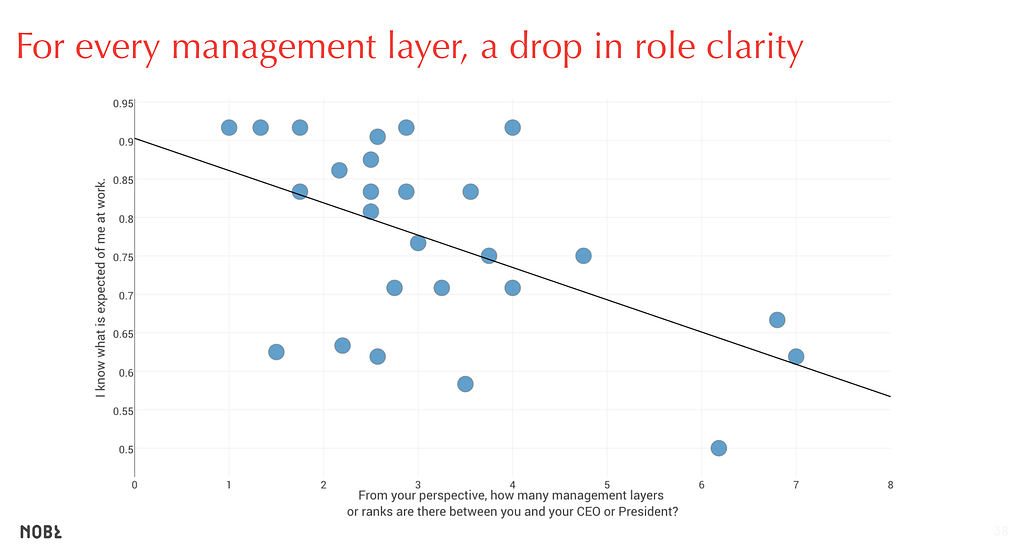
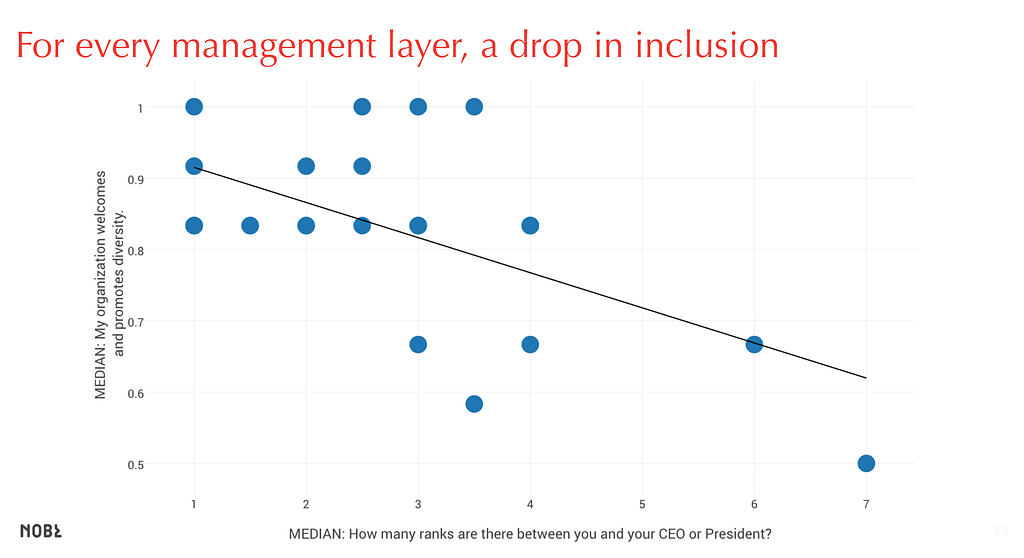
We surveyed hundreds of employees and had them score their organization not only on individual engagement measures (e.g. I know what is expected of me at work) but on collective conditions, too (e.g. My organization welcomes and promotes diversity). Question after question, we saw responses correlated to the respondents’ position within the firm. We’ve included two (of many) plots of this below. The line is the trend of all responses and the blue dots represent the 25 organizations which had highest overall participation rate in our survey.
So what does this mean?
If you’re a leader, it’s imperative that you challenge your own perceptions of the organization. However you feel about things, your people feel worse about them. Moreover, because perception is reality, your organization likely has differing and competing realities and cultures. That multiplicity will work against you as you struggle to adapt to changing conditions outside of the firm, so you must work to align and unify your culture. Here, quantifying your commitment to a better, shared culture is a powerful first step in uniting cultures.
Or maybe it’s inevitable that those with less power are less aligned with the political ambitions of the more powerful. That’s one way to deconstruct ‘cultural alignment’. After all, the implication of alignment is that the ideal cultural norms and aspirations are set by those higher up, and alignment is something the lower downs are supposed to do. So the charts don’t show companies ‘rotting from the tail’, it just shows that there is a latency – or resistance – between the upper and lower parts of the pyramid.
When we finally shift to networked cultural forms, we’ll accept that people are always out of alignment, and just hope that those working together can agree to move generally in the same direction.
@ev is Evan Williams, known for co-creating such things as Blogger, Twitter and Medium. One sold out to Google. The other simply sold out. The third is trying to sell memberships. There's a nice analogy in this: "The trouble with the internet, Mr. Williams says, is that it rewards extremes. Say you’re driving down the road and see a car crash. Of course you look. Everyone looks. The internet interprets behavior like this to mean everyone is asking for car crashes, so it tries to supply them."
[Link] [Comment]
The higher up you are, the better your workplace seems (not just for you, but for everyone else, too).
We surveyed hundreds of employees and had them score their organization not only on individual engagement measures (e.g. I know what is expected of me at work) but on collective conditions, too (e.g. My organization welcomes and promotes diversity). Question after question, we saw responses correlated to the respondents’ position within the firm. We’ve included two (of many) plots of this below. The line is the trend of all responses and the blue dots represent the 25 organizations which had highest overall participation rate in our survey.
So what does this mean?
If you’re a leader, it’s imperative that you challenge your own perceptions of the organization. However you feel about things, your people feel worse about them. Moreover, because perception is reality, your organization likely has differing and competing realities and cultures. That multiplicity will work against you as you struggle to adapt to changing conditions outside of the firm, so you must work to align and unify your culture. Here, quantifying your commitment to a better, shared culture is a powerful first step in uniting cultures.
Or maybe it’s inevitable that those with less power are less aligned with the political ambitions of the more powerful. That’s one way to deconstruct ‘cultural alignment’. After all, one implication of alignment is that the idealized cultural norms and aspirations are set by those higher up, and alignment is something the lower downs are supposed to do. So the charts don’t show companies ‘rotting from the tail’, it just shows that there is a latency — or resistance — between the upper and lower parts of the pyramid.
When we finally shift to networked cultural forms, we’ll accept that people are always out of alignment, and just hope that those working together can agree to move generally in the same direction.
Morgen hat Microsoft einen Event in Shanghai, wo sie wohl den Nachfolger des Surface Pro 4 vorstellen. Und was mir besonders gefällt: Puscheltastatur in allen Farben. Ich wollte ja unbedingt das Alcantara-Keyboard für mein Surface und habe das nie bereut. Surface Laptop hat es, und demnächst wohl auch Surface Pro.
Bookeen is a French ebook pioneer. I looked at their Cybook Ocean with the brillian Solar Leaf Cover. Now they created a new reader that already contains a cover. No need to buy anything extra. Specs: 6" screen with 1024x758 resolution, 8 GB memory, WiFi, 4 buttons (Next page, Last page, Menu, and FrontLight). The cover turns the device on and off, an accelerometer switches between left and right handed use. Battery is charged over USB and is supposed to last 3 weeks.
Carrefour is selling the Nolim in several colors for 130 €.
For the last three or four months I’ve been trying to get with the Trento program, in other words learning to embrace the verticality of my environs. For the first year or so I feigned sleep in the morning so that Antonella would take the kids up the hill to school. And when I say hill I mean the equivalent of 15 flights of stairs—it’s a fairly quick, yet taxing walk.
View of Trento from the Bosca della Cittá
Fact is, if you stay in Trento long enough sooner or later you have to bite the bullet and learn to love the inclines. So in that spirit I’ve been pushing myself to hike regularly since February, and a few months later I’m beginning to feel a bit better. I no longer hide under the covers every morning, on the contrary after taking the kids to school I usually go on a 4 or 5 mile walk/hike to the Bosca della Cittá or the Bindesi. This has become a fairly regular ritual, and I have been averaging 4 miles a day, climbing 40 flights of stairs and 11,000 steps (I’ve become a shameless step counter-I need therapy). This week was a new high for me because not only did I keep the regular hikes going, but yesterday the entire family did a pretty intense hike on the mountain behind our house, Marzola, that brought us from 700 meters to 1400 meters. It was a seven mile hike that had us climbing 2100 feet!
The views were spectacular along the way, which almost made up for the pain of climbing.
We hiked to a placed called Stoi del Chegul, which was pretty wild. The entire mountain of Marzola has traces of the massive project at the beginning of World War I by the Austrians to fortify Trento. More than 19 kilometers of tunnels were dug and parts of the mountains were dug out to hold munitions and supplies, not to mention more than 100,000 square meters of barbed wire. Despite all the work, the battlefront moved 50 kilometers south, so Marzola never saw any action. But the remains are everywhere present, in fact the Stoi are actually large chambers created in the mountains to store equipment, and Chegul has a whole bunch of them that were converted to summer homes after World War II. You can read some of the history here, but as an American I am always struck by the immediacy of WWI and WWII in Trentino and Alto Adige.
Stoi del Chegul Apartments
Stoi del Chegul Apartments
Stoi del Chegul Apartments
The apartments are owned by the province, but rented out to folks for the season. When we arrived exhausted and thirsty after 700 meters, some kind occupants of one of the apartments gave us some fresh water and much needed encouragement.
Just a few feet away from the apartments was a staircase to a view of the other side of Marzola, which overlooks the city of Pergine and Lake Caldonazzo. It was wild to finally hike high enough on Marzola to see through to the other side. We didn’t make it to the peak of Marzola (that’s another 300 meters), but we plan on it before the Summer is through.
The hike was definitely a reminder that I have a long way to go in terms of dealing with these mountains, they are formidable rocks. At the same time, it was also a nice reminder that I’m far better prepared to deal with them physically than I was 18 months ago. This week marked a high point for my short hiking career, with daily averages of 6 miles, 60 flights, and 15,000 steps. I’m most happy with managing the flights of stairs, because that is the X factor in Trento. The more I train myself to be at one with climbing, the happier I will be here. And being here and happy is a longterm commitment for me at this point.
Nick Statt of The Verge has a profile of Anker, the company known for selling quality portable chargers, USB charging hubs, cables and other items for reasonable prices. Anker, founded by a former Google software engineer, is a great example of a company that has found a niche that’s underserved by bigger companies like Apple and Samsung. As Statt’s profile explains, deep knowledge of how to sell through Amazon effectively combined with setting up shop in China to closely manage his supply chain helped founder Steven Yang build Anker into a trusted brand.
Most Anker charging products have one signature: the PowerIQ logo. Launched in 2013, the company’s proprietary charging standard is now present on nearly all of its batteries and wall plugs. The technology, carried by a small chip inside each charger, identifies whatever device is being plugged in, be it an iPhone 7 Plus, Google Pixel, or an iPad Pro 9.7-inch, in order to detect and deliver the maximum current the product allows. Anker says the technology can shave hours off the amount of time it takes to reach a full charge. A next-generation version of the chip, called PowerIQ 2.0, is slated to start shipping in new Anker charging products this month, allowing for smaller and lighter accessories.
Earlier this year, I bought Anker’s largest portable battery to power my Nintendo Switch and Apple gear on long flights and extended trips. The PowerIQ feature is fantastic, letting my family and me simultaneously plug into one big battery to charge multiple devices quickly. Looking through my Amazon order history, that’s just the tip of the iceberg, though. A couple of other recent additions are a 60-watt USB-A and USB-C wall charger and USB-C to USB 3.0 braided cables. Anker has become my go-to brand for cables and charging accessories, and Statt’s profile makes it easy to understand why.
For some categories of crashes, we are automatically able to pinpoint the patch which introduced the regression.
The issue
Developers make mistakes, not because they’re bad but most of the time because the code is complex and sometimes just because the modifications they made are so trivial that they don’t pay too much attention.
In parallel, the sooner we can catch these mistakes, the easier it is for developers to fix them. At the end, this strongly improves the user experience.
Indeed, if developers are quickly informed about new regressions introduced by their changes, it becomes much easier for them to fix issues as they still remember the changes.
For each function, we have the file name where it is defined and the mercurial changeset from which Firefox was built, so in querying https://hg.mozilla.org it is possible to know what the last changes on this file were.
The strategy is the following:
we retrieve the crashes which just appeared in the last nightly version (no crash in the last three days);
we bucketize crashes by their proto-signature;
for each bucket, we get a crash report and then get the functions and files which appear in the stack trace;
for each file, we query mercurial to know if a patch has been applied to this file in the last three days.
The last stage is to analyze the stack traces and the corresponding patches to infer that a patch is probably the responsible for a crash and finally just report a bug.
Finally the issue was just a missing return in a function (the patch).
In these differents bugs, the volume is very low so almost nobody care about them but finally they reveal true mistakes in the code, so the volume could be higher in beta or release.
For the future, we hope that it will be possible to automate most of that process and file automatically a bug.
This month I am in the middle of delivering another very cool online offering with Beehive Productions on the art of invitation. It’s a three session program focusing on the practice of invitation as it relates to participatory meetings, longer term participatory strategic initiatives and even organizational design. Michael Herman will be joining us next week for the “Inviting Organization” module. He’s really the guy that got me thinking about invitation way back in 2000 when I first came across his work as an Open Space colleague.
While Rowan and Amy and I were thinking about content we discussed some of the essential practices of invitation that facilitators, leaders and process designers should keep at hand. As we did when we discovered the “PLUME” mnemonic for harvesting, we arrived at VALUE as a mnemonic for invitation.
In participatory processes, I have found that the success or failure of the work is rally correlated to the quality, intention and active nature of the invitation. Just as participatory processes require participatory harvesting, they also require invitations to be participatory, iterative, emergent, and yet clear in intent and boundary. These five principles form a decent heuristic for invitation practice that can be scaled from single meetings, through to sustainable initiatives and enterprises. Here they are
Invitation is a VERB: If you are inviting people to a gathering using a single static email or a poster, you aren’t doing enough, in my experience. Invitation requires you to be active, in relation and dialogue. The interaction between inviter and invitee creates a connection and a commitment and kicks off the design. My friend Christie Diamond one time remarked “The conversation begins long before the meeting starts…” and that captures perfectly the idea of an active invitation.
Invitations are made from ATTRACTORS AND BOUNDARIES: It’s obvious that an invitation should have a purpose at its centre, but it should also include a statement of the boundaries of the container you are inviting people into. This could be a clear sense of what we are NOT doing, or it could be a cost associated with coming (time, money, attention, commitment). Peter Block says a good invitation contains a barrier to overcome to assure that the person reading it will respond with an authentic yes or an authentic no to what is on offer. Attractors and boundaries together help to define the container inside which the work will unfold.
Invitation is LEADERSHIP: When you invite people to something you are taking an active leadership role. You will confront all kinds of emotional states in yourself, ranging from excitement to anxiety. You are taking a stand for something, especially if you are inviting people to something new and there may be times when you are the only one with a strong sense of possibility about the work. Good invitation requires people to practice good leadership.
Invitations respond to an URGENT need: in chaordic design, we go to need first, to understand why something is necessary and to be able to reach people who also feel the need. The more an invitation can respond to the zeitgeist of the moment, the more energy and focus people will have coming into your container or your process.
Finally, invitations are EMBODIED: You cannot just send a text, or invite somebody to something while signalling your distinct lack of invitation with your body and behaviour. Recently, there has become a trend among American high school students to do fantastic invitations to prom dances. Like bower birds, young American men are going completely over the top to wow their dates. You can say what you want about it, but there is no doubting the fully embodied commitment to invitation expressed by this guy. How are your invitations?
(Thanks to Viola Tschendal for the image. She does our real time harvests for Beehive.)
In Vancouver on 24 May, people on bikes will challenge transit and cars to see who has the fastest, most enjoyable commute! There will be 10 Teams including New West Mayor/Councillors, TransLink and Vancity Executives.
Did you notice I haven't written anything substantial about the Playbase? I have seen it years ago in the lab, but I never actually heard it. I haven't even installed a new beta release this year. I turned into just another happy Sonos customer, enjoying my music every day.
What happened? Sonos has grown into a big company with lots of people handling different things. And I ended up in the reporter bin. Send him a press release a day before we announce, and offer him a two weeks product test. I did not want to be in that bin. I did not want to just test drive a finished product, so I politely declined. I want more, or nothing at all. My frustration with the company grew and last night I tweeted about it.
Sonos got the message and now a very good fried inside the company is about to fix it. I will catch up on the Playbase and then tell you about it. Look at the photo above and see how I hacked the TV with a small board so that Playbar does not obstruct the screen. I am firmly in the target audience for a Playbase.
I also hope to join some of the things in development, so that I can see into future. You know that I don't spill any secrets, but I don't have to if I want to guide you. Example: I have a reason that I nudge you to buy a Play:5 but not a Connect. One is the newest, the other is the oldest product. Knowing about the Playbase let me advise people to offset a living room decision for a few months.
If you watched last year's annoucement in New York, you know about Alexa integration. What I am looking forward to even more is the prospect of a proper API so that anyone can extend Sonos without relying on the clunky UPnP reverse engineering.
With a proper API you could be building a beautiful UWP app for Windows 10. You could be building a simplified controller for small kids, managed by their parents. You could be integrating Sonos into your home grown home automation. You could be streaming from your PC directly to Sonos. And the list goes on.
This is something I have been talking to Sonos for many years and things start coming together right now. I need to bring the enthusiam back. It has created quite a community of happy Sonos users.
Ke Jie, China’s top Go player, is taking on Google’s AlphaGo in a three-game match starting from today in east China’s Wuzhen, initiating another head-on confrontation between human wisdom and artificial intelligence. After four and a half hours’ of tough play today, Ke lost the first game by mere 0.5 points to the AI program. The outcome comes as no surprise but much better than people expected.
The three-game match between Ke and AlphaGo, which will be held on May 23, 25 and 27, is part of a five-day Go summit sponsored by Google, the Chinese Go Association, and Sports Bureau of Zhejiang Province.
Ke, born on August 1997, is ranked the world’s No. 1 Go player. The 19-year-old Ke will be paid US$ 300,000 for the appearance and gets an additional US$ 1.5 million if he wins.
In addition, the event will host the pair Go and the team Go match. In the pair Go match, Chinese Go player Gu Li will compete with the other player Lian Xiao on May 26, with each pairing up with his AlphaGo teammate. While in the team Go match, a five-player Chinese team will collectively go up against AlphaGo on the same day.
Ke, who was once confident that he can defeat AlphaGo, has changed his attitude with the latter’s landslide victory against top Go players over the past year. “No matter if I win or lose, this will be my last three games with artificial intelligence,” Ke wrote last night on Chinese microblogging website SinaWeibo.
He admitted that artificial intelligence has been strong enough today and must be the master of the future, yet it is always a cold machine. He added that he can’t feel its passion and love for the Go game found in human beings.
Competing in the contest is the 2.0 version of AlphaGo, which has adopted a new algorithm model different from the AlphaGo 1.0 that has achieved a feat of 60 wins and 0 losses, defeating all challengers including Ke Jie.
AlphaGo, one of the core creations by Google’s DeepMind, was never meant to only live for challenging humans in the Go match, the most complicated two-player game in the world. Aside from the foray in Go, the AlphaGo program is entering healthcare next, playing an active role in the research and treatment of complicated diseases including diabetes and cancer, said Shi Bomeng, President of Google China.
While there may have been an element of suspense before AlphaGo’s match with Lee Sedol last March, this match with Ke Jie seems to utterly lack it. As was pointed out by former Microsoft and Google China executive Kaifu Lee, the result of the battle between Ke and the updated AlphaGo actually has no other possibility.
On the other hand, this situation is reminiscent of what Heidegger calls “being-towards-death”: “If our being is finite, then an authentic human life can only be found by confronting finitude and trying to make a meaning out of the fact of our death.”
It is like when a person is confronted with the danger of death, he will fight to live. Although the defeat is certain, people still continue to fight without hesitation. Maybe that is the meaning of this battle – to explore the infinite, explore our shortcomings, and fight to improve even though defeat is certain.
We are very excited to announce that issue 2 of Hello World is out today! Hello World is our magazine about computing and digital making, written by educators, for educators. It is a collaboration between the Raspberry Pi Foundation and Computing at School, part of the British Computing Society.
We’ve been extremely fortunate to be granted an exclusive interview with Mitch Resnick, Leader of the Scratch Team at MIT, and it’s in the latest issue. All around the world, educators and enthusiasts are celebrating ten years of Scratch, MIT’s block-based programming language. Scratch has helped millions of people to learn the building blocks of computer programming through play, and is our go-to tool at Code Clubs everywhere.
A magazine by educators, for educators.
This packed edition of Hello World also includes news, features, lesson activities, research and opinions from Computing At School Master Teachers, Raspberry Pi Certified Educators, academics, informal learning leaders and brilliant classroom teachers. Highlights (for me) include:
A round-up of digital making research from Oliver Quinlan
Safeguarding children online by Penny Patterson
Embracing chaos inside and outside the classroom with Code Club’s Rik Cross, Raspberry Jam-maker-in-chief Ben Nuttall, Raspberry Pi Certified Educator Sway Grantham, and CPD trainer Alan O’Donohoe
How MicroPython on the Micro:bit is inspiring a generation, by Nicholas Tollervey
Incredibly useful lesson activities on programming graphical user interfaces (GUI) with guizero, simulating logic gates in Minecraft, and introducing variables through story telling.
Exploring computing and gender through Girls Who Code, Cyber First Girls, the BCSLovelace Colloqium, and Computing At School’s #include initiative
A review of browser based IDEs
Get your copy
Hello World is available as a free Creative Commons download for anyone around the world who is interested in Computer Science and digital making education. Grab the latest issue straight from the Hello World website.
Thanks to the very generous support of our sponsors BT, we are able to offer a free printed version of the magazine to serving educators in the UK. It’s for teachers, Code Club volunteers, teaching assistants, teacher trainers, and others who help children and young people learn about computing and digital making. Remember to subscribe to receive your free copy, posted directly to your home.
Get involved
Are you an educator? Then Hello World needs you! As a magazine for educators by educators, we want to hear about your experiences in teaching technology. If you hear a little niggling voice in your head say “I’m just a teacher, why would my contributions be useful to anyone else?” stop immediately. We want to hear from you, because you are amazing!
Get in touch: contact@helloworld.cc with your ideas, and we can help get them published.
When I first touched Mercury, the phone that would become KEYone, I wasn't convinced. Who would want another BlackBerry? Now that I have one it needs to compete with other Android phones for the #2 spot behind the iPhone. And it's winning, hands down. This is not another boring and fragile slab of glass. It handles so well, it's easy to grab and I am never afraid to drop it. The rounded bezel makes it easy to pick up from a table, it is as tall as an iPhone Plus, but narrower. Last but not least it runs the latest Android version, including Google Assistant. BlackBerry adds its own launcher and the Hub Services suite of software but does not mess with the Android design.
For China’s increasingly picky bike renters, ease of access is one of the key determinants when choosing from a rainbow of similar bikes. After all, there’s no user experience to speak of if the service isn’t available. Because of this, speed is everything for bike rental companies as they scramble to stake their claim.
As one of the advocates of this principle, Chinese bike-rental unicorn ofo has been known for its aggressive expansion at home and abroad. The company’s trademark bright yellow bikes flooded the streets almost overnight, but have you ever wondered where these bikes come from and how they are produced?
TechNode got a chance to visit a Flying Pigeon factory in Tianjin, one of the largest bicycle manufacturing hubs in China.
Youku
Flying Pigeon is a reputable bike brand in China with over 80 years of history. The company began working with ofo just as the emerging business was taking off and has manufactured over 800,000 bikes for ofo in the four months from December last year to March this year. Its production line for ofo is expected to churn out around 5 million bikes per year. Over 2,000 bikes are produced per day with one bike manufactured every 15 seconds, says Huang Shuo, marketing manager of Flying Pigeon.
Not all of the 5 million bikes are produced in Tianjin, according to Huang. “Ofo’s order is featured by cross-regional demand that varies every week. We have regional plants or partner factories across the country to meet ofo’s demand for local production. Of course, all bikes we produce meet the same standards, regardless of factory location.”
“Ofo’s orders account for one-third of our whole production capacity. The rest of our production line include higher-end bikes, sports bikes, and more,” Huang says.
Five million bikes is not a small deal, but that only ranked Flying Pigeon as one of the top-ten bike partners of ofo, according to ofo’s SVP Nan Nan. Apart from Flying Pigeon, the Beijing-based startup also inked a strategic partnership with bike producer Fushida for a 10 million bike per year deal earlier this year.
Ofo’s robust hardware demand underlines a larger market surge in the bike manufacturing industry, boosted by a string of bike-rental services that include ofo, its arch competitor Mobike as well as smaller players such as Bluegogo and HelloBike. It’s safe to say that the bike-rental boom has injected new vigor into flagging bike manufacturing industry.
Although manufacturers are scrambling to raise their production capacity, there’s limited automation and technology in the factories. The components for the bicycles are mostly assembled by manual labor: In the factory we visited, there were over 300 workers on one assembly line.
The bike availability principle that ruled at the beginning of bike-rental boom is losing its charm now when lines of dockless bikes become the cause for mounting pressures on urban management, especially in big cities.
Compared with aiming for higher production capacity, the problems of how to put the right amount of bikes at a place where it is most needed, how to lower the damage rate, and how to repair damaged bikes more efficiently are more pressing problems.
He walked with that mixture of determination and anxiety which suggests someone late for an appointment. In one hand he carried a big, square metal flight case and in the other he grasped his phone, alternately holding it to his ear and then out in front of him, staring at it in frustration. In this part of the world, an expression of surprise at not being able to find a phone signal is a sure sign someone’s not a local.
Over in the west, where the harbour was filling with water on the evening tide, the sun had just set and the light was fading.
“Is this the south side?” He asked.
I pointed away in the distance to where he was looking for. He’d come to the wrong part of the harbour, several miles from where he had intended and with the tide now rushing in, he would have to retrace his steps to reach it from another village.
“Damn! I had my boss on the phone, he said he was there…he was looking at it…but I can’t get him now.” He looked down at his phone again, hoping it might have picked up a signal.
“Well, it might work,” he muttered, as he knelt down and opened up the flight case. Inside was a white, quadcopter drone and a remote controller with an iPad Mini as a viewfinder.
“How far do you think it is?” He asked me. The end of the harbour was about four miles I told him, but the south bank he was looking for was perhaps a little closer.
“What’s its range?” I enquired.
“No idea. I’ve only just got it. My boss’ boat has come loose from its mooring and went aground down there. I told him I might be able to find it with this.”
He removed the drone from the protective foam and pressed a button. There was a series of robotic beeps and its LEDs flashed into life in the evening light.
What struck me was how fast it rose. As pilot, he needed no particular skill. The drone itself automated all of that, soaring up to a height of about fifty metres in a couple of seconds. It hovered there, holding station above us, and the iPad viewfinder showed an expansive view of the harbour and the twisting network of marsh creeks which lead inland.
He sent it off westward, occasionally asking me about the geography he was seeing in the viewfinder.
I’d only come out for an evening walk with the dog, but since he seemed eager to demonstrate his toy and I was eager to see it in action, I hung on, enjoying the bird’s eye view of a landscape I usually only see from ground level.
The drone, long since out of sight, beeped back to the controller, signifying it had reached its range limit – 500 metres, it turns out. He let it hover there at its limits for a while, panning the camera, searching in vain for the lost boat, which I suspected was further down the harbour than he could see.
He decided he would try to make it to the next village, where he might be able to fly closer to his target, before the light faded entirely. With a single button, the drone was recalled, auto-piloting itself back. Again, the speed was astonishing. I heard the noise before I saw it, my dog starring up in wonder at this flying menace.
“He won’t go for it, will he?” The pilot asked. “Some of them don’t like it.”
I looked down at my docile labrador, a dog who is afraid of his own shadow, and reassured the pilot his drone was safe from being savaged.
It hovered above us, landing lights flashing in the dusk, and began its vertical descent, steadily at first and then with a slowness and precision which ensured it settled back amid the sandy dune grass with the gentlest of touches.
Every year a handful of boats slip their moorings and wash up in various corners of the harbour. Traditionally, one of the local boat yards keeps an eye out for them and tries to reach the absentee owner. Often, depending on the cycle of tides, there’s simply nothing which can be done for a few weeks or months. Eventually, when a large enough tide occurs, someone will try to float it free and return it to a mooring.
The speed and precision of the drone provided a stark contrast to this slower rhythm of life. The potential was obvious, however. Seeing it in this environment brought home just how significant a contribution autonomous machines may make to saving time and risk in the future. Channel buoys, sandbanks and wayward boats could all be regularly checked from the air, sending reports back to the local boat yards, harbour authorities and boat owners.
Drones have improved fast. There was none of the frailty and expert pilot skills which would have been needed even a couple of years ago. This chap wasn’t a professional – merely a friend who happened to have bought himself a drone, doing a favour for his boss. Yet, there he was, wandering around the coast at sunset, sending a machine with a high resolution video camera off into the evening sky to do his bidding. We already live in extraordinary times, but this is just the beginning of something much bigger.
To explore more MEX thinking on this topic, try these essays:
'Hacker' vom CCC haben herausgefunden, dass man mit einigem Aufwand 'ganz einfach' den Iris-Scanner eines Samsung S8 überlisten kann. So wie 'starbug', bürgerlich Jan Krissler, schon vor ein paar Jahren gezeigt hat, dass der Fingerabdruck-Scanner des iPhone auszutricksen ist. Handlungsempfehlung:
"Wem die Daten auf seinem Telefon lieb sind oder wer sogar daran denkt, mit seinem Telefon bezahlen zu wollen,der greift statt auf die eigenen Körpermerkmale besser auf den bewährten PIN-Code-Schutz zurück," so Dirk Engling, Sprecher des CCC
Ich werde dann demnächst mal vorführen, wie man mit einem iPhone und 120 fps Slow Motion eine bewährte PIN-Eingabe ausspäht. Alternativ kann man den Smartphone-Nutzer auch an der Gurgel packen.
In 1810, London apothecary John Haslam published Illustrations of Madness, an account of a “singular case of insanity” and arguably the first-ever psychiatric case study. The patient at the center of Haslam’s book, James Tilly Matthews, believed that a cabal of Jacobins based in a crypt beneath London was using a mesmeric mind-control machine he called an “air loom” to torment and persecute him from a distance. Matthews also asserted that this device was secretly dictating the actions of English and French politicians and sowing discord across Europe. According to historian and Matthews biographer Mike Jay, the air loom was a “watershed in the technological imagination”: “Until this point, machines were ‘dumb things’ … that we manipulated. This is the point at which our relationship to machines becomes more complicated — the point at which people begin to believe that machines can actually manipulate us.”
In his time, Matthews’s case was “singular,” as Haslam put it: Nothing quite like it had been encountered before. Soon enough, however, individuals with experiences similar to Matthews’s began to publish versions of their stories. In 1852, for instance, German merchant Friedrich Krauss published Cry of Distress by a Victim of Magnetic Poisoning, in which he recounted being hypnotized and persecuted by a wealthy Flemish family in possession of a “magnetizing device” that resembled Matthews’s air loom.
About 50 years later, the German jurist Daniel Paul Schreber published a book detailing the cosmic conspiracy directed against him, which involved his chief physician, Paul Emil Flechsig, and a lascivious bipartite God. The book accuses Flechsig of an act of “soul murder” — an unauthorized invasion of Schreber’s inner self – that has initiated a crisis in the “Order of the World” and tainted God with the corruption of human beings.
To assert that “Targeted Individuals” are simply undiagnosed schizophrenics underestimates their self-invention as a collective identity. Their explanatory system circumvents psychiatric authority altogether
On the surface, Schreber’s grand Gnostic vision of a fallen universe differs significantly from the secular technological anxieties of Matthews and Krauss. However, Schreber’s metaphysical language belies a concern with the technologies of his era. For instance, he attributes the fact that he hears voices that others do not to “a phenomenon like telephoning: the filaments of rays spun out towards my head act like telephone wires; the weak sound of the cries of help coming from an apparently vast distance is received only by me in the same way as telephonic communication can only be heard by a person who is on the telephone, but not by a third person who is somewhere between the giving and receiving.” He also imagines a universal network of disembodied nerves, capable of instantaneous communication across vast distances by way of “light-telegraphy”; an automated “writing-down-system” that registers all thought much in the manner that recently developed recording technologies – gramophone and film – registered sound and sight; and a world populated by “fleetingly-improvised men” who resemble the ghostly projections of the newly invented cinematograph. In its blend of theological fantasia and technological nightmare, Schreber’s text anticipates the novels of Philip K. Dick, many of which also envision the endpoint of technological surveillance as a quasi-Gnostic apocalypse overseen by degraded god figures.
Matthews, Krauss, and Schreber all arrived independently at parallel visions. None knew of each other, and no shared vocabulary existed that could bring together the common threads of their stories, or similar ones told by even more obscure individuals, mostly confined to asylums. That changed, however, in the decades after the publication of Schreber’s memoirs — which were read enthusiastically by Freud, Jung, and Eugen Bleuler, the Swiss psychiatrist who codified the diagnosis of schizophrenia. For Haslam, Matthews’s narrative had been merely bizarre, and held no lesson other than a justification of confinement. But by the early 20th century, through the new medical metalanguages of the period — psychoanalysis on one hand, and Kraepelinian psychiatry on the other — experiences like those of Matthews, Krauss, and Schreber became legible as instances of a specific symptom. In a 1919 paper, Freud’s protégé Victor Tausk coined a term that could equally describe Matthews’s air loom, Krauss’s magnetizing device, and Schreber’s cosmic system of rays and nerves: the “influencing machine.”
In the past two decades, a competing metalanguage has emerged, which also furnishes a shared language for talking about persecution anxieties, mind-control machines, and other experiences long associated with the diagnosis of paranoid schizophrenia. However, unlike the psychiatric vocabulary that emerged around a hundred years ago, this metalanguage originates among those having the experiences — many of whom, for some time now, have been finding each other online. The members of the resulting subculture call themselves “Targeted Individuals” (TIs). Self-identified TIs believe that they are the victims of systematic harassment by organized civilian groups linked to the state; they call this “gangstalking.” Over time and through internet-mediated discussion, they have developed a standard nomenclature to refer to the influencing machines used against them. For instance, they refer to “Direct Energy Weapons” concealed in satellites and cell phone towers, and “voice-to-skull” (V2K) technology that broadcasts voices into their brains. They connect these technologies to the CIA’s MKUltra program.
Like Schreber and especially Krauss, whose Cry of Distress is over 1,000 pages long, many TIs are prolific writers. Hundreds of blogs and websites, originating in dozens of countries, recount variations on the gangstalking narrative, deploying the shared language of electronic harassment, “psychotronic torture,” Direct Energy Weapons, covert electronic harassment, MKUltra, and so on. Quite a few TIs have adapted their narratives into works of fiction and memoir, many of which are for sale on Amazon.
The collective TI worldview has also spread into offline spaces, with support groups for TIs meeting in cities worldwide. In 2015, an international Covert Harassment Conference convened in Berlin. Speakers from eight countries addressed topics such as the “history and techniques of mind control,” “adverse health effects of modern electromagnetic fields,” and “Technology as False God: the Heresy of Exposing Covert Harassment.” Participants in the conference included doctors, engineers, programmers, and ex-intelligence operatives, who lent their credibility to the TI belief system.
The TI phenomenon first earned mainstream attention around 2007–08, when coverage focused on the novelty of internet-based organizing among apparently paranoid individuals, and its implications for mental health. Curiously, one early New York Times piece on gangstalking beliefs appeared in the Fashion and Style section, seemingly categorizing TIs as a lifestyle community. Early representations of the subculture resembled media treatment of other online self-diagnosis communities, ranging from those suffering from (what they believe is) Morgellons disease to those who hear the Hum.
A look at Targeted Individual literature suggests that the “consensus reality” of the mainstream and apparently delusional beliefs have never been closer to each other
More recent coverage, however, has acquired an ominous and panicked tone, in the wake of the mass shootings carried out by Myron May in Tallahassee in November 2014 and by Gavin Long in Baton Rouge in July 2016. May and Long both self-identified as TIs and victims of gangstalking, and participated in TI communities online. A New York Times article on Long is typical in its air of moral panic: It reports that the Targeted Individual phenomenon “remains virtually unresearched,” but “for the few specialists who have looked closely, these individuals represent an alarming development in the history of mental illness: thousands of sick people, banded together and demanding recognition on the basis of shared paranoias.” The underlying message here echoes Haslam’s argument about Matthews 200 years ago: Individuals with beliefs like these are dangerous and need to be kept under close medical supervision.
Media reports often focus on the resemblance between TIs’ accounts of their experiences and symptoms of what has been called, for the past century or so, paranoid schizophrenia. Many TI sources don’t deny the resemblance, arguing that gangstalkers are attempting to produce schizophrenia-like symptoms in their victims to undermine TIs’ credibility. In any case, to assert that TIs are simply undiagnosed schizophrenics underestimates the implications of their self-invention as a collective identity. By elaborating its own shared metalanguage and designating its own experts and information sources, the TI subculture has generated an explanatory system that aims to circumvent psychiatric authority altogether — and it is partly succeeding, in view of the proliferation of websites, blogs, and books that recapitulate variants of the standard gangstalking narrative. In online spaces, psychiatric interpretations of TI experiences are dispersed and hidden behind paywalls, while TIs’ narratives are accessible, numerous, and consistent in the explanations they offer.
Until recently, psychiatrists had a virtual monopoly on explanatory discourse, as well as access to prominent media and government-sponsored platforms to establish their explanations’ cultural authority. The dispersed, fragmentary, idiosyncratic narratives of individuals with apparently delusional belief systems could easily be dismissed as mere manifestations of a symptom whose content was mostly arbitrary. Under such conditions, individuals who voice a belief that they are being targeted by shadowy enemies using electronic mind-control devices will likely end up under psychiatric observation and be expected to “translate” their understanding of their experiences into the psychiatric metalanguage. In such cases, narratives of mind control can be reduced to manifestations of the standard first-rank schizophrenic symptoms of “thought insertion,” “thought broadcasting,” and “thought withdrawal.”
A parallel process of translation occurs when an individual experiencing vague suspicions encounters TI sites and embraces the narrative they offer: A sensation of hostility from strangers becomes evidence of organized gangstalking, for instance, and mysterious voices in one’s head become a broadcast from a V2K device. Yet the purpose of the translation is to reinforce rather than dispel the suspicion, leaving the powerful underlying affective experience intact. That said, much TI literature serves a therapeutic as well as an explanatory function, offering an array of advice on coping with systematic harassment and blocking electronic torture. The internet, it would seem, is facilitating not only self-organizing communities but self-organizing therapeutic discourses and self-organized institutions that establish those discourses’ authority.
The consequences of this development are profound. As one of the first (and one of few) medical studies of the TI phenomenon points out, the community’s shared narrative raises fundamental difficulties for the psychiatric concept of a “delusion.” The DSM’s criteria for a delusion, the study notes, “indicate that it should not include any beliefs held by a person’s ‘culture or subculture.’” So by the current definition, if a delusion becomes the basis for a shared worldview, it ceases to be a delusion. It gains the approximate status of a belief that lies outside the mainstream consensus — like, say, the flat earth or 9/11 trutherism — but is not viewed as symptomatic of a psychiatric illness.
The study concludes, “the internet may enable complex support mechanisms without reference to a view of reality held by the authorities or even the mainstream of opinion.”
But on closer examination, the TI worldview actually draws quite heavily upon the “mainstream of opinion,” once you look past the community’s insular and obfuscating jargon. Indeed, a look at TI literature suggests that the “consensus reality” of the mainstream and apparently delusional beliefs have never been closer to each other. Many elements that ground the TI worldview, that is, also figure in non-TIs’ worldviews.
As we have seen, individuals from past centuries told similar stories to those of TIs about elaborate electronic devices being used to monitor and torture them, but each had to invent a unique vocabulary and frame of reference to describe their experiences. By contrast, TI sites frequently draw points of reference from the established historical record, and from pop culture representations of it. As the ultimate prototype of gangstalking, they cite the FBI’s COINTELPRO program, an infamous covert campaign that targeted “subversives” with surveillance, harassment, blackmail, slander, psychological warfare, and more. The CIA’s MKUltra mind control experiments, another frequent point of reference in TI online literature, are familiar to many from their representations in films like Jacob’s Ladder, The Killing Room, and American Ultra, to name a few. TI sites also mention movies from Videodrome to The Matrix to The Adjustment Bureau as semi-realistic representations of experiences similar to theirs.
Additionally, the online literature refers to a wide range of present-day realities as examples of organized targeting, surveillance, and harassment, such as the NSA spying apparatus revealed in the Snowden leaks. In a rare but not totally atypical variation on the typical TI narrative, Baton Rouge shooter Gavin Long understood systematic police abuse against African Americans as the most common instance of gangstalking. More commonly, the gangstalking narrative converges with far-right anti-government rhetoric. Dr. John Hall, a Texas anesthesiologist who is a recognized authority within some areas of the TI subculture, has appeared on Alex Jones’s show.
What’s significant, then, is not only that the internet has allowed TIs to find each other and establish a shared frame of reference. It’s also that they inhabit a social, political, and cultural world that stokes varying degrees of — in some cases reasonable — paranoia in many of us, across the political spectrum. Much of what’s on the news and what’s in the recent historical record, especially if brought together with the paranoid visions that saturate popular culture, offers ample evidence to support a belief in organized, state-sponsored harassment and surveillance, and even mind control and brainwashing.
This raises further problems for categorizing TI communities as a collective delusion. Psychiatrists and journalists worry that TIs are reinforcing each other’s paranoia by banding together online, but the world we all inhabit and the media we all consume are doing just as much to reinforce it. And in a moment when the U.S. president himself promulgates conspiracy theories aired on Alex Jones’s Infowars, and establishment liberals cite the unfounded speculations of Louise Mensch to support their belief that the Trump presidency is a real-life replay of The Manchurian Candidate, fringe beliefs have fully infiltrated the mainstream consensus. Call it the paranoization of reality.
The paranoization of reality, in turn, feeds into what we may call the “normalization of paranoia.” This phrase, used lately to describe the mainstreaming of conspiracy-driven beliefs in the Trump era, is better used to describe the uncanny familiarity of the supposedly bizarre TI worldview. Though TIs are stigmatized for their distance from the shared reality of the majority, TI narratives actually recycle prevalent cultural material, serving up a blend of recognizable genres (especially self-help) and political ideologies (especially anti-government libertarianism). Their paranoia differs from that of the larger culture they inhabit mainly in intensity and hardly at all in basic content.
The paranoization of reality feeds into what we may call the “normalization of paranoia.” This phrase is better used to describe the uncanny familiarity of the supposedly bizarre TI worldview
Here the real significance of the TI phenomenon comes into view. If the normalization of paranoia in TI subculture tends to rely on modes of paranoia absorbed from the larger culture, along with the fixation on longstanding cultural commonplaces like COINTELPRO and MKUltra comes a general lack of attunement to the complex modalities of electronic surveillance in the digital spaces where our lives occur.
Self-designated TIs have used technology to build a subculture around a shared fear of technology — an irony that I am by no means the first to point out. TIs worry, as we have seen, about being tracked through cell-phone towers and satellites, but don’t worry so much about the consequences of sharing that anxiety with the world on social media, even though any such activity exposes them to a more systematic tracking than anything they imagine. But if TIs themselves usually don’t recognize this irony, that’s because there is a broader cultural disconnect between the dimensions of technology they view as dangerous and the technologies they use to connect and organize.
As Nathan Ferguson argued recently, we all need to “update our nightmares.” Popular ideas of surveillance remain trapped in an outdated paradigm, and as a result we “fail to account for surveillance’s surreptitious commercial tracking, as it manifests in grocery rewards programs and across websites and within our phones” and likewise “don’t look at how entire populations are tracked, rather than specific individual suspects.” Siva Vaidhyanathan has similarly noted that most of us fall back onto the paradigm of the panopticon, a form of surveillance that relies on the subject’s awareness of the gaze of authority to enforce control. Hence, our fears revolve around “the precisely targeted surveillance of specific individuals” — like TIs, as their self-designation reveals.
If the collective imagination has not caught up with the evolving and increasingly complex modes of targeting, surveillance, and control, TIs are no exception. They, like most of us, have not yet adjusted their anxieties to a reality in which, as Wendy Hui Kyong Chun has put it, “we no longer experience the visible yet unverifiable gaze but a network of nonvisualizable digital control.” Or to quote Vaidhyanathan again: “Surveillance is so pervasive that it is almost impossible for the object of surveillance to assess how he or she is manipulated or threatened by powerful institutions gathering and using the record of surveillance … The threat is that subjects will become so inured to and comfortable with the networked status quo that they will gladly sort themselves into ‘niches’ that will enable more effective profiling and behavioral prediction.”
That TIs have self-sorted into a global, public online network illustrates this risk. Given the panic created by a few TIs’ involvement in highly publicized acts of violence, it’s likely that many people who self-identify as TIs online are being profiled and tracked precisely because of their participation in online TI support networks.
Perhaps, for TIs and for the rest of us, there is a solace in the old model of surveillance. It also seems reasonable to speculate that TIs find a paradoxical agency in believing they are singled out. In any case, individualizing the very real but increasingly unimaginable phenomena of tracking and control can offer a way to cope with problems that are not really addressable at the level of individual behavior. But the attendant risk is a failure to perceive the real workings of influencing machines all around us — ones that do not look like anything out of MKUltra. Instead, they function through the apps, social media platforms, search engines, and news sites we spend much of our lives toggling between, whose programmers, as Tamsin Shaw recently pointed out, are using the insights of behavioral economics to “determine the news we read, the products we buy, the cultural and intellectual spheres we inhabit, and the human networks, online and in real life, of which we are a part.” The limited reach of MKUltra looks quaint in comparison.
Reflecting on the continued relevance of Matthews’s air loom, Mike Jay writes that “in the 21st century, the influencing machine has escaped from the shuttered wards of the mental hospital to become a distinctive myth for our times.” The manipulative, invasive power of technology has shifted from an obscure fear into a cultural commonplace — and at the same time, a reality that pervades our lives yet remains difficult to conceptualize and imagine. Those who, like Matthews, Krauss, and Schreber in their time, feel that power today most acutely and oppressively now have access to ready-made references and theories and no longer need to develop idiosyncratic visions from whole cloth. Yet this pushes them to the same imaginative impasses that stymie the larger culture. They are paranoid, but not precisely sure what to be paranoid about. Just like the rest of us.
“It’s not about the money, it is about the principle”, I’ve heard this phrase so many times from friends, colleagues and internet influencers who refuse to pay an extra charge for a service or product not deemed worthwhile. In an episode titled ‘No Change’, a famous influencer was complaining about what he had felt was a growing phenomenon—that of waiters not giving back change when he pays the bill. He was expressing annoyance at ‘being duped’ by a waiter and went on to share that it should be his decision to leave a tip. In the wake of the ubiquity of imposed minimum charges at cafés in Egypt, people started resorting to storytelling on social media platforms to expose certain companies and ameliorate the standards of services. Instead of waiting on hold to make a complaint, a woman had provided a detailed account on Facebook of her conversation with a waiter at a café, where she was explaining to him that minimum charge is an illegal practice and he can’t really force her to pay it. She shared what she felt was a success story on a group titled ‘Don’t shop here-a list of untrustworthy shops in Egypt’, a public Facebook group where middle-class Egyptians would share stories about bad consumer experiences. The group now serves as an eclectic archive for a wide range of stories recounting bad experiences (from raw chicken at a famous restaurant to slow internet to undelivered customer service promises).
I was first introduced to the phenomenon of consumer stories on Facebook last year. As someone from a middle-class background, I’d seen friends and co-workers discussing, sharing and parodying those stories, which later on became an anticipated series on my timeline. I would look forward to reading about the little anecdotes that unveil people’s feelings of anger, distress and disgust towards the things they’d bought. Making use of the material economy of the Facebook post, members would tag businesses, upload pictures and edit their stories to include updates that bring forth an element of resolution to the problems they were posing. Unlike reviews which are usually brief in nature, the stories told on the group include vividly detailed accounts that enable a reliving of encounters and are laced with emotional arcs. It is in these rich descriptions that a Facebook post goes from mere complaining to painting a portrait of class identity. These online performances, while having much to do with the storytellers and the craft of sharing, are enacted through and vis-à-vis other actors and characters. The stories are brought to readers by the disposable objects that are presented as evidence and by embodied others that are being produced through narratives—the waiter, the shop employee, customer service representative, the voice on the phone.
Shared experiences, shared anxieties
“Had a bad shopping experience in Egypt? Feel completely lost and with no support. Share your experience with us here!”
Soon after its conception, the Facebook group had formed what Britney Summit-Gil refers to as ‘textual community’. This online community developed its own rules and aesthetics for crafting consumer stories; which include writing as much detail as possible, naming the shop and updating the group with any new information about interactions with customer service. We see through this group a collective drafting of what it means to be a ‘woke consumer’, a context where people reflexively dwell over their status as consumers and refuse being duped in everyday purchases. While people on the group seek to engage their readers in different ways, the most prominent styles used to set the scene include a chronological timeline of events, descriptive narratives of sensory experiences and a dialogue between the storyteller and a person from customer service representatives. Some members bolster their narratives by taking screenshots of textual interactions as well as through presenting documents such as receipts and contracts.
Scrolling through the stories, we could see how this textual community exhibits what the sociologist Pierre Bourdieu called “taste formations”, where taste is subject to collective constructions rather than being inherent. In these group members’ hands “taste becomes a social weapon” in demarcating between the good and the bad, the legitimate and illegitimate when it comes to the wide range of stuff consumed. These demarcations shed light on shared anxieties about transgressive products and services and on the circulation of emotions such as disgust on timelines.
In her book The Cultural Politics of Emotion, feminist scholar Sara Ahmed asks how we can tell the story of feelings “in a way that works with the complicated relations between bodies, objects and others?” Bringing Ahmed in conversation with Bourdieu leads us to consider how distinctions of taste and constructions of classed identities and communities are enacted through the work of feelings. What is shared in this Facebook group and ones like it are stories of feelings; feelings that “do things”, as Ahmed suggests, as they are not just reactions. They demarcate between objects, separate bodies and create subjectivities online.
Embodied others and classist fears
Classed identities are shaped vis-à-vis other bodies that figure throughout the stories. In many narratives told on the group, the waiter, the customer service representative, the employee at the shop, all become abstractions that are produced by fears the storytellers have about ‘being cheated’ or ‘not being respected’—which in turn are reproduced through repetition and circulation. These fears are illustrated in a parallel ad [in Arabic] for a taxi service company titled ‘did someone take advantage of you before?’, which maps out a succession of different characters often from a lower class background that try to extract money from the well-off middle-class Egyptian on a day-to-day basis—whether it were the waiter that doesn’t give back change or the man working at a kiosk that gives gum instead of change.
These stories strip away any human backstory of workers, reducing them to the role they play in unsatisfactory consumer experiences. They are as unidimensional as a faulty gas pump or a dirty table cloth. Thus, underlying the cultural logics of consumer protection, is a protection from imagined others that emphasize the fragility of consumer selves. Going back to the stories, it is important that we also look at them as instruments of power. In a sense, they are not only affective productions of abstract subjects but the unfolding negotiations that a story sparks between a customer and a manager could result in someone losing their job. Often to not compromise the reputation of their brand, many restaurants have fired employees, whose bodies have absorbed the complaints made by customers. After all, it is easier to advocate for someone getting fired if they are reduced to a faulty part in a consumer machine and not regarded as a full human that might be overworked and therefore impolite or error-prone.
Things that have gone bad
The complicated relationships between bodies, others and objects that shape the stories could be taken further by examining the photographic display of stuff that was deemed disposable and distasteful. While literature on mediated consumption has mostly focused on the lavish and the glamorous (e.g. studies of teens flaunting garments and sport shoes on social media), little has been written on mediation of trash. As Michael Thompson shows in his book Rubbish Theory, rubbish is undertheorized, as often “anthropologists interest themselves in what is noticed, treasured, and admired […] rather than with what is disregarded, discarded, and despised.” Online consumer stories are stories about ordinary stuff that went wrong. They reflect the social lives of trash, as they enable us to follow the trajectories of disposable stuff—which is taken back to businesses, exchanged, restored or residing in the chronicles of a Facebook group awaiting to resurface on people’s timelines. Moreover, the importance of documenting disposable stuff for narrative evidence grants trash an aesthetic functionality. While these things have failed to conform to commonly agreed upon standards of consumability, they play an important role in substantiating complaints. Consumer narratives are therefore assemblages of both human and nonhuman actors.
Class and dynamics of chill and care online
On another note, the debates surrounding those stories tell us something about the contested nature of the performativity of identity online. The sincerity of accounts, focus on details and the intensity of shared sentiments discussed above were subject to mockery by some people, who started turning these stories into a meme. Mimicking the descriptive styles adopted and the cataloging of actions in a comical fashion, these memes serve as intentionally imperfect repetitions that disturb the seriousness of the accounts.
The parody story typically entails a similar trajectory, as the storyteller imagines a fictional situation and proceeds with giving as much detail as possible in a sense that dramatizes the whole thing. The reader at first is led to think this to be another story reflecting frustrations about stuff or services, but soon finds out that these anxieties are put to question. What figures in stories as dilemmas is rendered to micro-annoyances through clever distortions. In a way, these memes advance a sort of moral ‘chill’ that Alana Massey describes as “being far removed from anything that looks like intensity” when it comes to consumption habits. Documenting bad experiences is seen by these memesters as “too bougie”. Caring too much and not caring that much become intersecting discourses that shape the performativity of classed identities online. Consumer stories become sites that reflect the overlapping and intermeshing of different ways of being and becoming middle class.
Consumer online storytelling tells us about circulating affects, frustrations, community-making, othering processes, ordinary stuff and creative articulations. These stories are complex networks that put different people and objects in conversation. Taking these creative instances seriously is important if we want to understand everyday dynamics of class online. However, we also need to be aware of the politics of these stories and the kind of subjects that are being created through these narratives.
Eman Shahata is an MA student of Anthropology at Goldsmiths University of London. She is currently researching secondhand cultures in Cairo.
President Trump ignited a national discussion of blue-collar jobs. Truck driving, once a road to the middle class, is now low-paying, grinding, unhealthy work. We talked with drivers about why they do it.
In 1954, the thermonuclear hydrogen bomb, code-named Bravo, was 1,000 times more powerful than the Hiroshima bomb. It was the United States’ most violent thermonuclear test ever.
NOTE: I’ll do my best to ensure the next post will have nothing to do with Twitter, and this post might not completely meet my R⁶ criteria.
A single, altruistic, nigh exuberant R tweet about slurping up a directory of CSVs devolved quickly — at least in my opinion, and partly (sadly) with my aid — into a thread that ultimately strayed from a crucial point: idiomatic is in the eye of the beholder.
I’m not linking to the twitter thread, but there are enough folks with sufficient Klout scores on it (is Klout even still a thing?) that you can easily find it if you feel so compelled.
I’ll take a page out of the U.S. High School “write an essay” playbook and start with a definition of idiomatic:
using, containing, or denoting expressions that are natural to a native speaker
That comes from idiom:
a form of expression natural to a language, person, or group of people
I usually joke with my students that a strength (and weakness) of R is that there are ~twelve ways to do any given task. While the statement is deliberately hyperbolic, the core message is accurate: there’s more than one way to do most things in R. A cascading truth is: what makes one way more “correct” over another often comes down to idiom.
My rstudio::conf 2017 presentation included an example of my version of using purrr for idiomatic CSV/JSON directory slurping. There are lots of ways to do this in R (the point of the post is not really to show you how to do the directory slurping and it is unlikely that I’ll approve comments with code snippets about that task). Here are three. One from base R tribe, one from the data.table tribe and one from the tidyverse tribe:
# We need some files and we'll use base R to make some
dir.create("readings")
for (i in 1970:2010) write.csv(mtcars, file.path("readings", sprintf("%s.csv", i)), row.names=FALSE)

fils <- list.files("readings", pattern = ".csv$", full.names=TRUE)

do.call(rbind, lapply(fils, read.csv, stringsAsFactors=FALSE))

data.table::rbindlist(lapply(fils, data.table::fread))

purrr::map_df(fils, readr::read_csv)
You get data for all the “years” into a data.frame, data.table and tibble (respectively) with those three “phrases”.
However, what if you want the year as a column? Many of these “datalogger” CSV data sets do not have a temporal “grouping” variable as they let the directory structure & naming conventions embed that bit of metadata. That information would be nice, though:
All three versions do the same thing, and each tribe understands each idiom.
The data.table and tidyverse versions get you much faster file reading and the ability to “fill” missing columns — another common slurping task. You can hack something together in base R to do column fills (you’ll find a few StackOverflow answers that accomplish such a task) but you will likely decide to choose one of the other idioms for that and become equally as comfortable in that new idiom.
There are multiple ways to further extend the slurping example, but that’s not the point of the post.
Each set of snippets contains 100% valid R code. They accomplish the task and are idiomatic for each tribe. Despite what any “mil gun feos turrach na latsa” experts’ exchange would try to tell you, the best idiom is the one that works for you/you & your collaborators and the one that gets you to the real work — data analysis — in the most straightforward & reproducible way possible (for you).
Idiomatic does not mean there’s only a singular One, True Way™, and I think a whole host of us forget that at times.
Write good, clean, error-free, reproducible code.
Choose idioms that work best for you and your collaborators.
After fighting in court since this past December, Apple and Nokia have settled their patent lawsuit and agreed to become business partners.
According to a jointly issued press release, Apple will start restocking Nokia health products, previously marketed under the Withings brand, at Apple Stores across the globe. The company has also agreed to make both an upfront and ongoing payments to license Nokia’s technology.
Nokia, meanwhile, will provide Apple with products and services related to wireless infrastructure. Additionally, the two companies have agreed to meet regularly to discuss how they can collaborative on future digital health initiatives.
“This is a meaningful agreement between Nokia and Apple,” said Maria Varsellona, Nokia’s chief legal officer, in the joint press release. “It moves our relationship with Apple from being adversaries in court to business partners working for the benefit of our customers.”
While financial terms of the agreement were not disclosed, Nokia says it will brief investors and analysts on the monetary effects of the agreement will have on its business during the company’s next quarterly earnings call. At the time of writing this article, Nokia’s stock is up 7 percent following the news.

















 In Vancouver on 24 May, people on bikes will challenge transit and cars to see who has the fastest, most enjoyable commute! There will be 10 Teams including New West Mayor/Councillors, TransLink and Vancity Executives.