Obligation to Dissent: Peter Drucker wrote the story of Alfred Sloan, the former CEO of GM, who entered a board meeting to discuss an important issue before the company. Sloan asked the opinions of his directors. When everyone agreed without comment, he immediately stopped the board meeting and said something along the lines of, “Since we’re all in agreement, it’s clear no one has considered the issue. Let us reconvene tomorrow after giving the matter appropriate thought.”
Rolandt
Shared posts
25 May 23:50
The Fundamental Challenge of Your Startup’s First Hire; Leading and Learning at the Same Time
The Fundamental Challenge of Your Startup’s First Hire; Leading and Learning at the Same Time:
25 May 23:50


They Didn’t Want To Talk To Each Other
by Richard Millington
Last year, one community manager in the accountancy sector mentioned their target audience didn’t want to talk to each other.
That’s pretty devastating to discover, but is it true?
If you drop a group of accountants in a room together will they sit alone and avoid eye-contact?
I’d bet they will make small talk and then gradually begin sharing more details and information about themselves and their practice.
A random group of people in any field may not want to talk to each other, but, they do want to chat with friends. They do want help to solve their problems. They do want to feel respected and good at what they do.
A bad community concept often masquerades as resistance to talking to others. It’s rarely the case. It just means you need to change your approach.
If they would talk if they were dropped into the same room then drop them into the same room.
If they would talk to solve their biggest problems, let them know what problems people can solve.
If they would talk if they felt respected or admired, make sure they feel respected and admired.
This isn’t the chicken and the egg, from the very first contact with someone you can invite them to an exclusive event for the top [accountants], learn more about their problems, and let them know how respected they would be in the group.
The solution, like many, is about member psychology.
p.s. Final day to sign up for Psychology of Community.
25 May 23:49
AI is the future of everything at i-Lab demo day
by Emma Lee
The defeat of top Go player Ke Jie to Google’s AlphaGo is pushing discussions about AI technology to new heights this week. After a series of human vs computer matches, more and more people can see that AI will fundamentally change our lives.
Beyond the hype media attention, however, most of the AI technologies remain in the R&D stage are still finding possible ways to be applied in real-life scenarios. The situation is changing gradually with the maturity of the technology itself as well as the market surrounding it. Maybe AI is not something that end customers can use directly, but it is finding its way into nearly every vertical.
i-Lab is an accelerator program supported by Microsoft China, Shanghai Xuhui District government and state-backed electronics company INESA. At the i-Labs demo day held last week, the twelve startups addressed a wide range of problems from education, transportation, robots, and smart city. But if you take a closer look, there’s a common theme in nearly every startup — AI and big data.
Here’s a wrap-up of the 12 startups who demoed at the event.
Shape Joy (形趣)
Shape Joy is an online fitness coach solution that provides personalized training programs. Powered by computer vision technologies and AI technology, Shape Joy’s 3D motion tracking model can capture users’ gestures and give corresponding advice on how to make improvements based on a gamified model.
Michi (米尺)
Michi is startup offering cloud-based field service solutions for manufacturers to turn industrial appliances and more into intelligent devices.
Wizarcan (微肯)
Wizarcan is building an indoor positioning and navigation system based on iBeacon technology. Its clients come from various industries from shopping malls, exhibition centers, museums, metros and more.
Chiwei (驰帷)
Chiwei is working on an online education system that would enable school faculties to better manage their students and staff with big data and AI technology.
AutoGreen (格灵出行)
AutoGreen is bringing its electric vehicle rental service to Shanghai. Together with electric cars, AutoGreen is also setting up parking lots with charging poles.
KangPeng (康朋)
KangPeng is a healthcare startup engaged in the development of an early-warning device for cardiovascular diseases.
MeCourse (ME课)
MeCourse is an online education platform that connects teachers with students living nearby.
ZenSense (征鑫)
Enabled by big data and AI technologies, ZenSense is a pet control management platform that helps clients eliminate harmful creatures that usually carry disease and pose a constant threat to commercial facilities.
E-Building (摩墅狮)
E-Building is a smart solution provider which aspires to make your homes smarter.
Tajian Technology (塔尖科技)
Tajian Technology is engaged in high-end community integration and operation. The company’s revenue comes mainly from promoting luxury products, high-end health care services, and asset management products.
Hrstek (合时)
Hrstek is the developer and manufacturer of robots for special occasions like anti-terrorism, rescue, and environmental detection.
IOTCOMM (智联信通)
IOTCOMM is a smart lighting monitoring system developer. Its smart lighting monitoring control system can realize remote single light control, energy saving, and smart management.
25 May 23:49

Apple Introduces Swift Curriculum for High School and Community College Students
by John Voorhees
Apple introduced a new year-long app development curriculum today for community college and high school students that is available as a special collection on the iBooks Store. The free-to-download course, which is an extension of Apple’s existing Everyone Can Code curriculum for kids in grades K-12, teaches students how to build fully-functional apps using the Swift programming language. In the fall, six community college systems that serve over 500,000 students will offer the new course.
Tim Cook explained why Apple has created the development course:
“We’ve seen firsthand the impact that coding has on individuals and the US economy as a whole. The app economy and software development are among the fastest-growing job sectors in America and we’re thrilled to be providing educators and students with the tools to learn coding,” said Tim Cook, Apple’s CEO. “Community colleges play a critical role in helping students achieve their dreams, and we hope these courses will open doors for people of all ages and backgrounds to pursue what they love.”
Swift Playgrounds has proven to be a powerful teaching tool with over 1 million downloads since it was introduced. In addition, over 1,000 schools in the US plan to teach using Apple’s Everyone Can Code materials in the fall. The extension of Everyone Can Code to older students should make the entire program even more attractive to educators than before.
Support MacStories Directly
Club MacStories offers exclusive access to extra MacStories content, delivered every week; it’s also a way to support us directly.
Club MacStories will help you discover the best apps for your devices and get the most out of your iPhone, iPad, and Mac. Plus, it’s made in Italy.
Join Now
25 May 04:59
With its Seth Rich retraction, Fox News doesn’t behave like news
by Josh Bernoff
Right-leaning viewers think Fox News reveals a side of the news not seen in mainstream media. Left-leaning viewers would say the same about MSNBC. But there’s a difference. Fox News just retracted its controversial article about murdered DNC staffer Seth Rich in a way completely different from how journalists should behave. You can read the … Continued
The post With its Seth Rich retraction, Fox News doesn’t behave like news appeared first on without bullshit.
25 May 04:58

Urban density is destiny, not lifestyle choice
by Stowe Boyd
Density is a force multiplier, not just aesthetics
Jed Kolko makes some observations about urban density, but he doesn’t recall — or never knew — that density is a force multiplier, an economic accelerant, not just a lifestyle choice:
Seattle Climbs but Austin Sprawls: The Myth of the Return to Cities | Jed Kolko
Be skeptical when you hear about the return to glory of the American city — that idealized vision of rising skyscrapers and bustling, dense downtowns. Contrary to perception, the nation is continuing to become more suburban, and at an accelerating pace. The prevailing pattern is growing out, not up, although with notable exceptions.
Rural areas are lagging metropolitan areas in numerous measures, but within metro areas the suburbs are growing faster in both population and jobs.
On the other hand, as anyone who has tried to rent an apartment or buy a condo in a big city knows, housing prices are climbing faster in urban neighborhoods than in the suburbs. And urban neighborhoods are younger and richer than they used to be, with more educated residents and fewer school-age children. Higher-wage jobs are increasingly in city centers, with urban retail catering to these well-paid workers and residents.
This combination of faster population growth in outlying areas and bigger price increases in cities points to limited housing supply as a curb on urban growth, pushing people out to the suburbs. It’s a reminder that where people live reflects not only what they want — but also what’s available and what it costs.
However, these broad national trends hide divergent local ones. A few large metro areas did, in fact, become more urban between 2010 and 2016. Of the 51 metro areas with more than one million people, average neighborhood density rose in 10 and fell in 41, according to census population data and U.S. Postal Service counts of occupied housing units. That is, four-fifths of large metro areas have become more suburban since 2010, while only one-fifth have become more urban.
This article is quite factual, but fails at connecting the dots about the outcomes of density.
Geoffrey West and Luis Bettencourt revealed the relationship between urban density and, on one hand, a decrease in physical resources per capita and on the other in increase in the output of social products, like patents and salary levels:
Luis Bettencourt and Geoffrey West, Bigger Cities Make Do With Less (Scientific American, September 2011)
This new, more quantitative science of cities is becoming possible because of the increasing availability of information — official statistics as well as novel measures of human and social activity — on cities and metropolitan areas worldwide.
By sifting through this flood of data, covering thousands of cities around the world, we have unveiled several mathematical “laws” that explain how concentrating people in one place affects economic activity, return on infrastructure investment and social vitality. Despite the rich diversity of metropolitan regions across the U.S., China, Brazil and other nations, we found a remarkable universality in the way that socioeconomic characteristics increase with a city’s population. For example, if the population of a city is doubled, whether from 40,000 to 80,000 or from four million to eight million, we systematically see an average increase of around 15 percent in measures such as wages and patents produced per capita. If eight million people all live in one city, their economic output will typically be about 15 percent greater than if the same eight million people lived in two cities of half the size. We call this effect “superlinear scaling”: the socioeconomic properties of cities increase faster than a direct (or linear) relation to their population would predict.
The data also reveal that cities’ use of resources follows a similar, though inverted, law. When the size of a city doubles, its material infrastructure — anything from the number of gas stations to the total length of its pipes, roads or electrical wires — does not. Instead these quantities rise more slowly than population size: a city of eight million typically needs 15 percent less of the same infrastructure than do two cities of four million each. This pattern is referred to as sublinear scaling. On average, the bigger the city, the more efficient its use of infrastructure, leading to important savings in materials, energy and emissions.
[…]
What we can say with certainty, however, is that increased population promotes more intense and frequent social interactions, occurrences that correlate with higher rates of productivity and innovation, as well as economic pressures that weed out inefficiencies. In a city with high rents, only activities that add substantial value can be profitable. These economic pressures push urbanites to come up with new forms of organizations, products and services that carry more value added. In turn, higher profitability, excellence and choice tend to attract more talent to the city, pushing rents higher still, fueling the need to find yet more productive activities. This feedback mechanism, in a nutshell, is the principal reason cities accelerate innovation, while diversifying and intensifying social and economic activity.
So the real issue behind the increased or decreased densities of cities is not some lifestyle choice about the attractiveness of hipster cafes versus low-cost suburban real estate, it’s really about economic inputs and outputs: denser cities innovate more and consume less, per capita, than less dense ones.
It’s worth noting that this slip in density is correlated with low gasoline prices, so that the costs of commuting longer distances are low, too, with the exception of all the externalities built into low gas prices, like pollution, sprawl, wasted time, unnecessary parking, increased infrastructure, and so on. If we taxed gas to cover those externalities, density in those sprawling cities would likely start flowing the opposite way.
So: if you believe increased innovation and decreasing energy use are socially positive, then you should lean toward policies that would encourage density. And those who live or move to areas where density is falling, just be aware that the number of patents there is also falling, along with your future salary.
Originally published at stoweboyd.com.
25 May 04:58
No Contest
by Britney Summit-Gil
It’s not hard to see why reality TV is popular with television production companies: It is cheap to make. Instead of depending on conventional writers and actors, reality shows rely more on recording and editing technology itself, which allows vast amounts of footage to be captured and pared down into satisfying, formulaic narratives. But what do these formulas consist of, and what makes them so compelling?
Reality TV has two basic genres, according to media scholar June Deery: docusoap, which primarily revolves around interpersonal relationships and lifestyles — shows like the Real Housewives and Big Brother franchises, or Duck Dynasty and the Kardashian shows — and competition, which explicitly pits participants against one another in what are typically elimination contests, using rewards and punishments to orient, motivate, and rationalize their behavior. But in certain respects, this distinction between genres is superficial. Regardless of whether participants are playing a literal game, in both reality genres they are ultimately competing against one another for attention and screen time.
That kind of attention can propel a reality-TV cast member into future career opportunities: more appearances on more shows, lucrative product endorsements, and even their own lines of products, as with the Kardashians’ media and merchandise empire or LA Ink star Kat Von D’s makeup line. Reality TV is an engine for turning attention into money not merely in the form of advertisements in and around the shows, but also across the participants’ lives, what the shows turn into platforms. This makes garnering attention the driving force behind the shows and their governing ethos — the model for how one should live and what one should want.
Our lives, too, can be conceived as platforms, and our experiences relevant only insofar as they enhance the value of our skill sets
Competitive reality TV might seem like a meritocratic alternative to the attention-grabbing instigation and ham-fisted melodrama of reality soaps. The format often exchanges screaming matches and backbiting for tests of skill and strength. These shows trade on the idea that hard work and individual talent eventually triumph, within competitions that ostensibly place all contestants on a fair, equal footing. But often the shows are less interested in celebrating merit than in re-creating an ideology of ruthless individualism in our living rooms and Twitter hashtags. These shows, by design, present individualism as an inherent part of human sociality: Manipulation, not cooperation, allows participants to effectively compete, whether in the context of winning challenges or gaining audience attention. Competition and conflict both reflect reality TV’s insistence on individuated narratives, reflecting the common wisdom this is what audiences want to see, and thus what advertisers are willing to pay for.
But why would audiences default to wanting to watch individuals pitted against each other? Such a formula may be popular because of how it conforms to our life experiences under an individualist and competitive model of capitalism. These principles become sense-making mechanisms, offering a way to understand and interpret our experience of culturally dominant narratives about the necessity of competition. As political theorist Wendy Brown argues in Undoing the Demos, our current neoliberal order is grounded in “a peculiar form of reason that configures all aspects of existence in economic terms” and grounds individual subjectivity in notions of entrepreneurship. We are accordingly all market actor competing to increase the value of our human capital in the workplace, the educational system, and even the dating realm. Our lives, too, can be conceived as platforms, and our experiences relevant only insofar as they enhance the value of our skill sets for potential employers.
Individualism can only be a winning strategy in a system designed to reward it. This is as true of reality TV as it is of neoliberal society more generally. In competitive reality TV, participants must accommodate their behavior to the format’s zero-sum approach to outcomes and its contrived sense of fair play. In many shows, competitors face the same rules for challenges, are given the same materials and time constraints, and are judged according to the same standards and criteria. This suggests a level playing field, and the contestants tend to go along with this pretense. This permits viewers to overlook or bracket off the actually existing social and material hierarchies that have already conditioned competitors and shaped the advantages and disadvantages they bring to the contest. Instead, the contestants are seen through a bootstrapping ideological frame, as though individual hard work alone allows them to succeed, and not any of the advantages that adhere to belonging to a privileged social group.
On many shows, such as Survivor and The Bachelor, winners receive rewards that make subsequent challenges easier for them, and losers are likewise penalized. On the popular cooking competition show Hell’s Kitchen, each challenge is followed by a reward for the winning team, perhaps a spa day or a lavish meal aboard a yacht with host Gordon Ramsay, while the losing team is tasked with scaling fish or sorting trash, leaving them exhausted and discouraged. Privilege begets privilege.
This may not be especially fair, but it falls in line with a narrative of the rewards of hard work and the deserved punishments for failure. As Brown writes, “A democracy composed of human capital features winners and losers, not equal treatment or equal protection.” And it also tilts the scenario toward manufacturing conflict and drama, represented as the reward for watching, and by extension the reward for living in a ruthlessly competitive social world. With reality TV, a competition is fair if it is perceived as interesting. As players begin to differentiate themselves into legible characters (i.e. as they improve their human capital within the context of the show) they garner more screen time, more fans, and greater opportunities to market themselves as personalities.
To hold viewer attention, producers are willing run rampant over the idea of a level playing field. They often try to exacerbate tensions by planting certain storylines in cast members’ heads, or introducing copious amounts of alcohol to lubricate social interaction. If this fails to yield sufficient drama, scenes will be sequenced out of order or with context distorted to maximize the appearance of conflict.
With reality TV, a competition is fair if it is perceived as interesting
Thus the format of reality TV competition licenses and structures the cruelty staged for the audience’s delight. This culminates with the eliminations, but cruelty is doled out throughout the show, typically under the auspices of being blunt advice on how to deal with the “real world.” On The Apprentice, losers are ridiculed, insulted, and ultimately fired. On Shark Tank, would-be entrepreneurs are brutally scrutinized by wealthy judges, and on shows like Pop Idol and America’s Got Talent Simon Cowell brings performers to tears with brutal remarks. Chefs get Chopped and Alton Brown harasses harried cooks in Cutthroat Kitchen.
As conflict is structured as both the inevitable “reality” of economic life and the delectable drama that makes life consumable, compassion and cooperation are accordingly figured as unreasonable and unrealistic and boring. Manipulation, cutthroat morality, and contempt for weakness are represented as practical, even laudable means for attention and success; helping others is framed as a quick way to disappear. This narrative not only draws in and caters to audiences who are attracted to sadistic spectacle; it creates a pedagogy through which more and more viewers learn to enjoy conflict and humiliation as the rationale and reward for participating in contemporary capitalism.
Enter The Great British Bake Off. It is a competition with winners and losers, yet unlike other reality TV competitions, the contestants generally accommodate each other and even assist each other at times, freeing up counter space for their beignets when needed. The bakers on the show copy each other all the time, and no one seems to mind. They look around the room to see what others are doing, getting hints on proper technique from the open floor plan, with no complaints from the other competitors. In seven seasons, there has been only one serious charge of sabotage — “bingate,” when a competitor took another baker’s ice cream out of the freezer for too long, causing it to melt — but that seems likely to have been an unfortunate accident.
While reality TV judges are often merciless, Bake Off’s hosts Mary Berry and Paul Hollywood are supportive, encouraging, and gentle with criticism. The show’s presenters, Mel Giedroyc and Sue Perkins, cheer the contestants on and lend a hand when needed. In the conventional “confessional” asides, contestants are without the usual snark and disdain for other competitors. They may be nervous, proud, disappointed, or even a bit jealous, but they are never mean. Rather than relying on conflict and cruelty, Bake Off entertains audiences through charm, pleasant and relatable characters whom you can’t help but root for, and baking that showcases contestants’ skill rather than their ability to stir up drama. It offers an alternative to universalizing narratives of competitive individualism grounded in economic rationality, instead making cooperation and civility not only consumable but explanatory. The show is not just pleasing to watch; it offers a gratifying model of the human experience.
Part of the show’s tonal difference may stem from its British sensibility. But this does not explain Bake Off’s popularity with American audiences. Though hard numbers are difficult to obtain because most U.S. viewers see the show through Netflix, which rarely releases viewer data, the sheer number of write-ups and the social media buzz surrounding it suggests how keen Americans are for a different kind of reality TV show. Megan Reynolds, at New York magazine’s Vulture site, called it “a much more civilized reality-television model than the American version.” And this niceness is popping up in other U.S. reality shows, like American Ninja Warrior and Ultimate Beastmaster, where participants compete against the obstacle course, and ultimately themselves, rather than the other contestants.
The supportive disposition of Bake Off, like the nastiness in conventional American reality shows, stems from its format and the incentives it structures. Bakers are not stuck in a dormitory for five weeks of filming, isolated from the world and instigated to fight with one another. According to host Sue Perkins, the producers make no attempt to create extra drama by pitting contestants against each other or harping on sob stories to make the characters more compelling. The drama is about whether someone’s cake will rise, not how one baker will badmouth another.
The producers of Bake Off make no attempt to pit contestants against each other or harp on sob stories to make the characters more compelling. The drama is about whether someone’s cake will rise
During the first season of Bake Off, Perkins reports that when producers tried to manufacture drama on the show, leaving several contestants in tears, she and Mel walked off set. “A good Bake Off for me is just about cakes and nice people,” Perkins said, “and that’s a successful show.” Similarly, American Ninja Warrior’s drama hinges on whether an athlete successfully completes the course, and the show’s hosts cheer on rather than ridicule the competitors as they struggle to defeat the obstacles. During training, competitors are allies who work together to become the best ninja warrior they can be. Individual personalities and interpersonal beefs don’t drive the show’s narrative. In fact, these shows hardly have narratives at all, if narrative is understood strictly in terms of individualization. The character-centered “plots” of so many other reality shows simply doesn’t fit the model of nice reality TV.
Reality TV purports to reveal the truth about human nature “when people stop being polite, and start getting real.” But who controls the “means of production” within a show — the producers or the competitors — has a significant impact on its structure and atmosphere, and how real politeness may seem to viewers. Material restrictions and artificial scarcities created by the producers stoke vendettas and resource scrambles among competitors to fuel the shows’ storylines. These are like Black Friday stampede stories, in which trendy consumer products are depicted as worth scheming, fighting, and hurting people for, and standing up for your family involves punching other parents out on Christmas Eve.
Depicting a shortage-ridden world rationalizes zero-sum competition and exploitation as necessary responses. It naturalizes selfishness as survival. This is not merely indoctrination; the narrative fits easily with ideological constructions we’ve already absorbed and we are already living with, in response to the economic inequalities capitalism already sustains.
Bake Off rests on a different premise: Contestants use any ingredients and materials they want, whether it’s home-brewed bubblegum extract, garden-fresh rhubarb, or specialty equipment made in their garage. This differs from shows like Cutthroat Kitchen, where cooks compete for every single resource available, from the ingredients to the cooking utensils. The show’s rules are lax, left to broad interpretation by the bakers. Winning yields no material reward, only recognition of success. Those bakers who stumble are offered advice that’s not overshadowed by derision.
This helps produce alternative narratives: that we can test our skills under difficult circumstances without demonizing our peers, we can work together when the situation calls for it, and we can hug it out when one of our compatriots has to say goodbye. Being eliminated on Bake Off is not a shameful, cold event. It is a bear-hugging love fest full of compliments and well-wishes. Competitors are happy for the weekly “Star Baker” and sympathetic to those who miss the mark on a challenge. Bake Off shows us a different way to understand what is “real” about human nature: We like a good competition, but we flourish in cooperative and positive environments.
This mirrors a side of everyday life that is less conducive to dramatic narrative but nonetheless fundamental to everyday experience. Go outside after a snow storm, and you’ll see people eager to help each other. Sure, some people will steal your freshly cleared parking spot while you’re at work, or offer to help you shovel only to ask for $10 for their services, but comradery is the norm.
It doesn’t take catastrophe to bring this out of people. We hold the door open for others; we help someone pick up their dropped groceries; we pitch in when a friend has to move. And Bake Off competitors help search for spoons when their fellow bakers are having a meltdown, unable find utensils in the last five minutes of the challenge. After all, who wants to succeed simply because another competitor didn’t have time to top their cake with blueberry and lemon jam?
Perhaps reality TV is becoming kinder in general, as Megan Garber argues, with shows such as RuPaul’s Drag Race and Dancing With the Stars increasingly choosing “supportiveness over sadism.” In an environment of political and interpersonal hostility, this is a trend we desperately need. We should not expect too much from Bake Off, or any particular show, but the tendency to cooperate can be amplified or suppressed through popular media. These shows point to how what is widely understood as “entertaining” can be structured differently, and how a better, more cooperative society can learn to find vicarious pleasure not in back stabbing, hostility, and exploitation without consequences, but in sharing, cooperation, and mutual respect.
25 May 04:58
Trump Budget Based on $2 Trillion Math Error [Updated] | Jonathan Chait
Trump Budget Based on $2 Trillion Math Error [Updated] | Jonathan Chait:
Trump’s crew is increasingly looking like a gang that can’t shoot straight. Most recent a $2 trillion math error where they count the savings of the miracle tax plan twice:
One of the ways Donald Trump’s budget claims to balance the budget over a decade, without cutting defense or retirement spending, is to assume a $2 trillion increase in revenue through economic growth. This is the magic of the still-to-be-designed Trump tax cuts. But wait — if you recall, the magic of the Trump tax cuts is also supposed to pay for the Trump tax cuts. So the $2 trillion is a double-counting error.
Trump has promised to enact “the biggest tax cut in history.” Trump’s administration has insisted, however, that the largest tax cut in history will not reduce revenue, because it will unleash growth. That is itself a wildly fanciful assumption. But that assumption has already become a baseline of the administration’s budget math. Trump’s budget assumes the historically yuge tax cuts will not lose any revenue for this reason — the added growth it will supposedly generate will make up for all the lost revenue.
But then the budget assumes $2 trillion in higher revenue from growth in order to achieve balance after ten years. So the $2 trillion from higher growth is a double-count. It pays for the Trump cuts, and then it pays again for balancing the budget. Or, alternatively, Trump could be assuming that his tax cuts will not only pay for themselves but generate $2 trillion in higher revenue. But Trump has not claimed his tax cuts will recoup more than 100 percent of their lost revenue, so it’s simply an embarrassing mistake.
It seems difficult to imagine how this administration could figure out how to design and pass a tax cut that could pay for itself when Ronald Reagan and George W. Bush failed to come anywhere close to doing so. If there is a group of economic minds with the special genius to accomplish this historically unprecedented feat, it is probably not the fiscal minds who just made a $2 trillion basic arithmetic error.
If there was any doubt that Trump & Co don’t know what the fuck they are doing, this settles it.
Hilariously, when asked about this glitch, Treasury Secretary Mnuchin responded like this:
Harwood asks Mnuchin about double-counting gimmick: “This is a preliminary document that will be refined” #FiscalSummit
— David Wessel (@davidmwessel) May 23, 2017
25 May 04:58
Seattle Climbs but Austin Sprawls: The Myth of the Return to Cities | Jed Kolko
Seattle Climbs but Austin Sprawls: The Myth of the Return to Cities | Jed Kolko:
Jed Kolko makes some observations about urban density, but he doesn’t recall – or never knew – that density is a force multiplier, not just aesthetics:
Be skeptical when you hear about the return to glory of the American city — that idealized vision of rising skyscrapers and bustling, dense downtowns. Contrary to perception, the nation is continuing to become more suburban, and at an accelerating pace. The prevailing pattern is growing out, not up, although with notable exceptions.
Rural areas are lagging metropolitan areas in numerous measures, but within metro areas the suburbs are growing faster in both population and jobs.
On the other hand, as anyone who has tried to rent an apartment or buy a condo in a big city knows, housing prices are climbing faster in urban neighborhoods than in the suburbs. And urban neighborhoods are younger and richer than they used to be, with more educated residents and fewer school-age children. Higher-wage jobs are increasingly in city centers, with urban retail catering to these well-paid workers and residents.
This combination of faster population growth in outlying areas and bigger price increases in cities points to limited housing supply as a curb on urban growth, pushing people out to the suburbs. It’s a reminder that where people live reflects not only what they want — but also what’s available and what it costs.
However, these broad national trends hide divergent local ones. A few large metro areas did, in fact, become more urban between 2010 and 2016. Of the 51 metro areas with more than one million people, average neighborhood density rose in 10 and fell in 41, according to census population data and U.S. Postal Service counts of occupied housing units. That is, four-fifths of large metro areas have become more suburban since 2010, while only one-fifth have become more urban.
This article is quite factual, but fails at connecting the dots about the outcomes of density.
Geoffrey West and Luis Bettencourt revealed the relationship between urban density and, on one hand, a decrease in physical resources per capita and on the other in increase in the output of social products, like patents and salary levels:
Luis Bettencourt and Geoffrey West, Bigger Cities Make Do With Less (Scientific American, September 2011)
This new, more quantitative science of cities is becoming possible because of the increasing availability of information—official statistics as well as novel measures of human and social activity—on cities and metropolitan areas worldwide.
By sifting through this flood of data, covering thousands of cities around the world, we have unveiled several mathematical “laws” that explain how concentrating people in one place affects economic activity, return on infrastructure investment and social vitality. Despite the rich diversity of metropolitan regions across the U.S., China, Brazil and other nations, we found a remarkable universality in the way that socioeconomic characteristics increase with a city’s population. For example, if the population of a city is doubled, whether from 40,000 to 80,000 or from four million to eight million, we systematically see an average increase of around 15 percent in measures such as wages and patents produced per capita. If eight million people all live in one city, their economic output will typically be about 15 percent greater than if the same eight million people lived in two cities of half the size. We call this effect “superlinear scaling”: the socioeconomic properties of cities increase faster than a direct (or linear) relation to their population would predict.
The data also reveal that cities’ use of resources follows a similar, though inverted, law. When the size of a city doubles, its material infrastructure—anything from the number of gas stations to the total length of its pipes, roads or electrical wires—does not. Instead these quantities rise more slowly than population size: a city of eight million typically needs 15 percent less of the same infrastructure than do two cities of four million each. This pattern is referred to as sublinear scaling. On average, the bigger the city, the more efficient its use of infrastructure, leading to important savings in materials, energy and emissions.
[…]
What we can say with certainty, however, is that increased population promotes more intense and frequent social interactions, occurrences that correlate with higher rates of productivity and innovation, as well as economic pressures that weed out inefficiencies. In a city with high rents, only activities that add substantial value can be profitable. These economic pressures push urbanites to come up with new forms of organizations, products and services that carry more value added. In turn, higher profitability, excellence and choice tend to attract more talent to the city, pushing rents higher still, fueling the need to find yet more productive activities. This feedback mechanism, in a nutshell, is the principal reason cities accelerate innovation, while diversifying and intensifying social and economic activity.
So the real issue behind the increased or decreased densities of cities is not some lifestyle choice about the attractiveness of hipster cafes versus low-cost suburban real estate, it’s really about economic inputs and outputs: denser cities innovate more and consume less, per capita, than less dense ones.
It’s worth noting that this slip in density is correlated with low gasoline prices, so that the costs of commuting longer distances are low, too, with the exception of all the externalities built into low gas prices, like pollution, sprawl, wasted time, unnecessary parking, increased infrastructure, and so on. If we taxed gas to cover those externalities, density in those sprawling cities would likely start flowing the opposite way.
So if you believe increased innovation and decreasing energy use are socially positive, then you should lean toward policies that would encourage density. And those who live or move to areas where density is falling, just be aware that the number of patents is also falling, along with your future salary.
25 May 04:58


New paint colors invented by neural network
Janelle C. Shane,
Postcards from the Frontiers of Science, Tumblr,
May 27, 2017
Do two people see the same thing when they see the colour blue? Probably not. And if one of them is a computer, almost certainly not. Computers see colours in RGB values, and humans... something else. That's what makes this story about neural network-generated colour names interesting. Some of them make sense and some of them are odd. But I don't agree that the rejects are uniformly bad. Colours like snowbonk, ronching blue, stoner blue and light of blast seem perfect to me.
[Link] [Comment]
25 May 04:57
Socialization of youth (Part 3)
by admin

In Soviet times, a long time dominated the critical attitude to the analysis of formation and development of the personality from the perspective of socialization. In the scientific literature widely used terms “personality development”, “communist education”, “full and harmonious development of personality.” Since 1960-ies. Socialization of topics included in the problem field of domestic researchers. A significant contribution to the development of conceptual approaches to the study of socialization made GM Andreeva, Kon Andreeva et al identified three main areas in which the socialization:. Activity, communication and self-awareness, stressed that in the process of socialization is not only development and reproduction of social experience, but also a transformation of his promotion to a new level (Andreev, 2007). Defines the following stages of socialization: before work (early stage and the period of study), labor and after work.
In recent years, domestic sociologists used other grounds periodization of the process, allowing for the originality of the socialization of children and adults. As in Western sociology, there are two main, but qualitatively different period. The first is the “primary socialization” of a person’s birth until the formation of a mature personality. The second stage, the period of “secondary socialization” or resocialization, which is understood as a kind of restructuring (not so, however, essential) identity in the period of its social maturity. According to Cohn, socialization includes not only conscious, controlled, targeted action (education in the broadest sense of the word), but also natural, spontaneous processes, one-way or another affect the formation of personality (Cohn, 1989).

Researchers have identified two phases of socialization: social adaptation and internalization (internalization). Social adaptation is an individual adaptation to the socio-economic conditions, roles, social norms, and the environment of its life. Exteriorization is the process of inclusion of social norms and values in the inner world of man. The peculiarity of the sociological study of socialization associated with the duality of the object of study “person society”. One of the trade-offs is to avoid the pole (only objectivist or subjectivist only) approaches.
Specificity of the sociological analysis of the socialization is to separate social and typical as a set of parameters and characteristics of the dominant processes of integration of individuals into society. The Company determines the socio-typical in persons, it is necessary to ensure the predictability of the behavior of individuals, to achieve ordering of social interaction, preservation of the social whole, its self-reproduction, and self-governance. Society puts socialization standards and sets individuals typical social features (language, values, information, pictures of the world, ways of behavior and so on. D.), focusing on the acquisition of approved personal qualities and behaviors. These standards are, as a rule, approximately, attractive and understandable. Their achievement is not too difficult. It is feasible for the majority of the members of society. Society not only typifies, but individualizes absorbed in the process of socialization approves behaviors and social skills. The Company settles the process of transferring the social experience of the new generations in the institutional forms (see. The institutions of socialization of youth). The wider seam sociality with its typical and not typical properties being developed by the individual, the richer his personality and his bright personality. The measure of socio-typical and not typical due to the similarities and differences of social norms and cultural values, behaviors and socialization practices at the different communities and groups. The larger these differences, the more people are different from each other. The balance of the socio-typical and individual personality in the process of socialization varies both objective and subjective factors, among which belongs to objective factors defining role. In addition, at some point ahead of the objective processes of personal change.
Nevertheless, subjective processes can be more dynamic when activated during maladaptive socialization of the individual associated with the denial of certain social norms and values, the creation of new models. This may lead to a new quality of personal potential of society to another set of typical personality traits. In this case, subjective processes, ahead of the objective to become a primary factor of social change. Socialization, as a complex multilateral process can be classified according to various criteria. First of all, the very nature of social society in its basic parameters. According to this criterion, which reflects the conditions of the socialization process, it highlighted the following types: natural, primitive, estates, stratification, uniform, regulated, paternalistic, conformist, and humanistic. (Kovalev, 1996). In every society reveals a wide range of types of socialization with the predominance of one type or another. The content social process is seen as another classification criterion to distinguish between these types of socialization, as cognitive, professional, legal, political, labor, economic and others. The third criterion is related to the effectiveness of socialization, allows you to select a successful, regulatory, crisis, diverging, forced rehabilitation, premature, accelerated, retarded socialization.
The post Socialization of youth (Part 3) appeared first on BookRiff.
25 May 04:57
Filed under: photography, Vancouver Tagged: "red sky at night", evanescent, photo challenge, sunset, WordPress

Weekly Photo Challenge: Evanescent
by Stephen Rees
evanescent = any fleeting moment in time

I used to do more sunset pictures than I do now. That’s because the longer we live here, the taller the trees around us are – and the less of a sunset I see. But these moments of clouds underlit by red light after the sun has gone down behind the hills of the Islands are indeed fleeting. In order to catch them I have to have a camera to hand – and stop whatever I am doing. I don’t sit gazing out of the window very much, especially in the early evening. But when the light changes, if there’s a glimpse of a red cloud, I drop what I am doing and try to find a clean space of window without a bug screen in front of it. Before the light fades.
This one was fairly recent, but it only got put into the MacBook last night when I was uploading the pictures of a day out. I was going to look for something “evanescent” in them, but this is better I think.
Filed under: photography, Vancouver Tagged: "red sky at night", evanescent, photo challenge, sunset, WordPress
25 May 04:57

IFTTT Launches Powerful Applet Tools in New Maker Tier
by Ryan Christoffel
Last November IFTTT, the popular web automation platform, introduced powerful applet tools to its Partner tier of users. The Partner tier was not designed for the average user though, and was therefore cost prohibitive to most. But today, IFTTT announced that some Partner benefits are becoming accessible to a broader base of users with a new Maker tier. This tier is free, but it must be signed up for to gain the new applet tools.
One of the most significant privileges granted to users on the Maker tier is the ability to create applets with more than two actions. Previously applets could only have one 'If' and one 'Then' action each, but Makers can now create applets that have multiple 'Then' steps. So you can set up an applet that triggers based on one thing, then takes several different actions because of that initial trigger. Applet building in this way more closely resembles the power of a service like Zapier. Makers can also modify applets using JavaScript filter code, unlocking a range of new possibilities such as the ability to cause an applet, or particular applet actions, to run only at certain times of day.
Another benefit of being a Maker is that you can build applets for any service on IFTTT, whether you have an account with that service or not. Previously, actions could only be used in an applet if you had a connected account tied to that service or device, but that's no longer the case. This ties in well with another Maker benefit: public profile pages. Each Maker will have a public profile for sharing all of their applet creations.
Creating applets using the Maker tools must be done on the web; the IFTTT iOS app does not currently provide access to any Maker tools, and it is unclear if that will change in the future.
Support MacStories Directly
Club MacStories offers exclusive access to extra MacStories content, delivered every week; it’s also a way to support us directly.
Club MacStories will help you discover the best apps for your devices and get the most out of your iPhone, iPad, and Mac. Plus, it’s made in Italy.
Join Now
25 May 04:56
What will it be like to live in Vancouver’s new green buildings?
by Frances Bula
There’s been a huge focus in recent months on Vancouver’s plan to move to a zero-emissions building code, but mainly on one aspect of it, the impact on natural gas.
But what else will look and feel different as Vancouver moves to its new, unique building code? I talked to people who have built condo towers and single-family homes to ask them about what stays the same and what doesn’t. My story is here.
For those unclear about what’s happening, any multi-family projects requiring a rezoning had to start meeting the new code as of May 1. Next phase coming next year. Ultimately, all new buildings will need to meet the code by 2030.
25 May 04:56

Want to be more productive? Quit multitasking.
by Janet Patterson

Are you a pro at updating a spreadsheet while making an unrelated call, or knocking out email responses while in a meeting? If so, you may pride yourself on being super-efficient. But research suggests that multitasking actually makes us less productive. In fact, people who multitask all the time may be the worst at doing two things at once.
So if it isn’t really effective, why do it? Well, intuitively it can feel like we’re actually doing more in less time—no matter what the researchers say. And the idea of multitasking as the modern way to get more done is epidemic. Our jam-packed schedules contribute to the sense that we can, and should be, juggling several things at once. Our always-connected gadgets and apps keep dinging and buzzing, announcing that something else needs our attention. But studies show that, while it may feel like we’re accomplishing a lot, multitasking is bad for productivity, stress levels, and even our brains.
Are we actually even multitasking?
True multitasking means doing two tasks simultaneously. And research shows we can only accomplish it when one of those tasks is so automatic it doesn’t require focus or thought, like walking—or when two tasks require different types of brain processing, like reading and listening to instrumental music.
That’s because each of us has only so much working memory, the part of the brain responsible for briefly storing and processing information so we can perform complex cognitive tasks—like reasoning, planning, and making decisions. Studies suggest that our working memory can only hold a limited amount of information, which is why it’s nearly impossible to add 67 and 15 in your head while also composing an email.
What we think of as multitasking is actually task switching, which is simply moving among multiple things—browsing email, responding to texts, writing a report—so quickly that it seems like we’re doing them all at once.
Our brains call it multi-taxing
Multitasking has a number of negative effects on the brain. For instance, switching from one thing to another uses up oxygenated glucose that the brain needs to focus, making us feel tired more quickly than when we sustain attention on one thing. By trying to do too many things at once, we’re actually depleting the resources we need to be productive.
Constant task-switching can also be stressful. You’ve probably experienced it yourself—a day filled with email alerts, pop-up chat windows, last-minute meetings, and “do you have a minute?” requests from co-workers can feel like you ran a marathon without actually getting anywhere. One study found that, after only 20 minutes of interrupted performance, people reported significantly higher stress, frustration, workload, effort, and pressure. And chronic stress has been linked to memory loss, depression, and to changes in the brain regions that regulate emotion, self-control, and cognitive processing.
And while multitasking can make us feel like we’re working smarter, one University of London study showed that multitasking can lower your IQ—with an effect equivalent to missing a night’s sleep.
Multitasking can make us 40% less productive
When we switch tasks to respond to interruptions, it can take a lot longer than we think to return to what we were originally doing—typically around 23 minutes. So when we’re multitasking, it takes a lot more time to get things done than if we devoted our full attention to one thing. Researchers estimate that multitasking can cost a whopping 40% of a day’s productivity. We also make more errors when we switch our attention, and the more complex the task, the more errors we make.
The prescription? Single-tasking.
Deep and singular focus is just what the doctor ordered, but in our hyper-connected world, it isn’t always easy. And in fact, the internet, emails, productivity apps, and social media might actually be training our brains to be more easily distracted, which explains why we find it nearly impossible to ignore an email once we know it’s in the inbox.
You could chuck all your gadgets and move to the woods, but luckily you don’t need to get that drastic. Experts say you can begin to retrain your brain and take advantage of deep focus by concentrating on one thing at a time, managing your use of technology, and reframing the “instant-response” expectations of your colleagues—and yourself. Here are a few tips to get started:
- Notice yourself multitasking. Multitasking may be such a habit that you’re not even aware of how fractured your attention is. Start with your morning routine—are you checking Facebook, making breakfast, and responding to emails simultaneously? How often are you burning the toast because you got lost in something else?
- Turn off notifications. Silence your cell phone and mute email, news, and other app alerts clamoring for your attention. Then determine preset times that you’ll check in throughout the day. This can feel disconcerting at first, but you might be amazed at the level of focus you can achieve with just this one step.
- Consider your environment. A quiet workspace is best for most people who are trying to focus, though extroverts are a bit better at filtering out background noise than introverts. Intermittent speech—like a nearby co-worker on a phone call—is the hardest background noise to tune out, so if you don’t have a quiet space, consider investing in some noise-canceling headphones.
- Build in time to focus. Focused work needs chunks of time, so create some spaces in your day that are free of distractions and non-interruptible. It might take some work to train co-workers to consider when you’re open to being disturbed, but it can also have a positive ripple effect that encourages them to do the same.
- Shut down online distractions. Breaks are good, and the kind of break that helps focus and productivity is a short walk that gives your brain a rest, rather than engaging in a slew of social media posts. If the temptation to check Facebook, Twitter, and Instagram is too strong, a quick search can help you find an app to block them.
Brains work best when they’re focused on one thing. While you can’t control everything that life throws at you in a day, noticing your own multitasking habits and experimenting with changes that support deep focus will go a long way to helping you feel less stressed and more productive.

25 May 04:56
Stash Acquired Beyond Life Expectancy
by noreply@blogger.com (VeloOrange)
By Scott
Like a lot of you, I have a box or two (perhaps three) of bike stuff in my garage. It's stuff that has been collected over the years, mostly taking it off bikes and putting it aside for "that" project that I hoped to do one day.

I was thinking about this the other day when Igor was working on a shop build- a Disc Pass Hunter for the show room. He had a vintage Sun Tour Sprint rear derailleur. Looked great, but it didn't have quite the range to work with the cogs we were going to use on the bike. So he said fine, I'm sure I have a slightly more modern derailleur I can use from my bike box. This got me thinking about a term called S.A.B.L.E - Stash Acquired Beyond Life Expectancy. You can use this term for a lot of things. I have probably more pens at home than I'll ever use. I justify them by the fact that each is slightly different then the other- thinner lines, thicker lines, pressurized ink for writing upside down in the rain (if I need to do that, I think I'll be writing a good bye letter). But surely, I have enough pens and yet, a couple of times a year, I buy another 5 or 6 pens at an art supply store or online. I figure it's a cheap hobby.
When it comes to bike stuff, it's interesting what I have a SABLE of at home. I have lots of chains. At one point I was leaving a job that gave me access to bike bits at wholesale and I didn't know what the future held. So I bought a bunch of chains. I figured those are an easily consumed item, that having on hand would not hurt me financially. I was heavy into randonneuring at the time and that side of cycling eats through chains.
But looking deeper into the boxes in the garage, I found stems, tubes, bars, and map cases that I had collected over the time since the last move/purge and I wondered - will I use all of this?
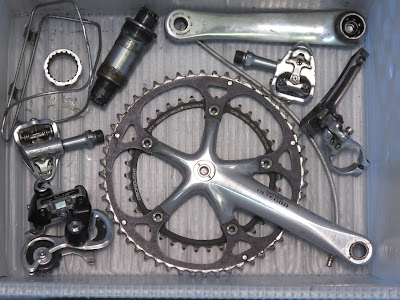
Like a lot of you, I have a box or two (perhaps three) of bike stuff in my garage. It's stuff that has been collected over the years, mostly taking it off bikes and putting it aside for "that" project that I hoped to do one day.

I was thinking about this the other day when Igor was working on a shop build- a Disc Pass Hunter for the show room. He had a vintage Sun Tour Sprint rear derailleur. Looked great, but it didn't have quite the range to work with the cogs we were going to use on the bike. So he said fine, I'm sure I have a slightly more modern derailleur I can use from my bike box. This got me thinking about a term called S.A.B.L.E - Stash Acquired Beyond Life Expectancy. You can use this term for a lot of things. I have probably more pens at home than I'll ever use. I justify them by the fact that each is slightly different then the other- thinner lines, thicker lines, pressurized ink for writing upside down in the rain (if I need to do that, I think I'll be writing a good bye letter). But surely, I have enough pens and yet, a couple of times a year, I buy another 5 or 6 pens at an art supply store or online. I figure it's a cheap hobby.
When it comes to bike stuff, it's interesting what I have a SABLE of at home. I have lots of chains. At one point I was leaving a job that gave me access to bike bits at wholesale and I didn't know what the future held. So I bought a bunch of chains. I figured those are an easily consumed item, that having on hand would not hurt me financially. I was heavy into randonneuring at the time and that side of cycling eats through chains.
But looking deeper into the boxes in the garage, I found stems, tubes, bars, and map cases that I had collected over the time since the last move/purge and I wondered - will I use all of this?

Is there one particular part/accessory that you have more then a life time supply of at home? Is there a reason for it or is it just dumb luck to end up with all of those 26 x 1.5" Schrader valve tubes?
25 May 04:56
The 6 million people the White House believes can balance its budget | Ana Swanson
The 6 million people the White House believes can balance its budget | Ana Swanson:
Ana Swanson puts the lie to Mick Mulvaney’s mumbo jumbo about an additional 1% GDP by putting back to work those on the sidelines of employment, but the problem is it’s only about 6 million additional bodies:
It’s fair to ask how much growth this process could generate. But unfortunately, when you dig into the numbers, it appears to fall very short of the kind of growth Mulvaney discussed.
Just look at the overall figures. There are about 160 million Americans in the labor force, who together generate GDP growth of just under 2 percent. How much can another 6 million people do to raise the growth rate another 50 percent?
“The math just doesn’t add up,” said Scott Anderson, chief economist at Bank of the West Economics.
As Josh Feinman, chief global economist at Deutsche Asset Management, points out, it’s highly unlikely the Trump administration can move all of those 6 million people into the labor force, anyway — for the same reason that it can never fully empty the ranks of the unemployed.
“Even in a really strong labor market — just firing on all cylinders, white hot — why is the unemployment rate at 3 percent? The reason is you’ve got frictional unemployment,” he said. “There are jobs that people don’t know about. They might be in a different part of the country, or maybe they have a different skill set. So even in a labor market that’s, as I said, running flat out, the [U3] unemployment rate is not going to be zero.”
I don’t know why we even parse this bullshit trying to find some kernel of reasoning in it. They are just making numbers up to justify the tax cuts and social safety net cuts they have decided they want. It’s not economics, it’s the culmination of winner-take-all thinking, where the White House and its backers, our conquerers, are treating the country and our economy like the spoils of war.
25 May 04:56
You’re not getting a raise and nobody knows why | Ana Swanson
You’re not getting a raise and nobody knows why | Ana Swanson:
Ana Swanson takes a look at the surprisingly low growth in wages, stuck in low gear at 2.5%, the same level as in 2009 when unemployment was double today’s 5%. It should be much higher, according to economic thought. But maybe there’s another mystery behind the mystery: productivity.
We’re not getting much more productive
Other economists find different reasons for lagging wage growth. One is that gains in productivity — a measure of how much a given worker or machine can produce — have also been sluggish of late. That is a worrying sign, since productivity gains are what really determines improvements in wealth and living standards over generations.
But blaming productivity for slow wages is not a full explanation, because economists in turn debate the reasons behind sluggish productivity. Some fault measurement issues. Some point a finger at government policies that have failed to encourage investments in machinery and technology. Others say it could just be because of natural ebbs and flows in innovation.
[…]
In addition to trends in productivity, weak growth in wages may reflect the difficulty workers have asserting their bargaining position in the current environment, Lawson said.
A dramatic decline in unionization in recent decades has left workers less able to bargain with company owners for pay increases. At the same time, globalization has allowed companies to be more mobile than ever before. If labor gets too expensive in one location, companies can just move.
Neil Irwin dug into productivity recently, as I reviewed in Why is Productivity such a mystery?:
I recommend reading Irwin’s analysis, but to summarize, he basically suggests three scenarios:
1) Depressing — Irwin doesn’t use the term ‘postnormal’ but he should have. In this scenario, we are in new territory where productivity is inherently lower than in the past, and will remain so.
He doesn’t say it, but the nature of the modern world, where everything has become deeply connected to everything else, may have incorporated a subtle friction into the economic engine. As a result, it may require greater investment to make any headway in productivity.
Also, as Irwin points out, new ideas are getting harder to find (see The Hidden Economics of Ideas) so the level of investment and time needed to find breakthroughs is steadily increasing.
2) Neutral — Perhaps we just don’t know how to measure ‘productivity’, anymore. Or said differently, the nature of work may have changed so much that the tools we use don’t measure all the outputs.
3) Optimistic — While companies may be making greater investments in some areas — like driverless cars — the impact and payoff from those investments is all in the future. Additionally, more effort may be directed toward changing the way we work, or the structure of delivering value to customers. Maybe this is an era of transformation, where only after a long hard slog will we finally see the rewards of efforts made in the present.
The reality is that how and what we consider productivity is changing faster than new techniques to improve it, so we need to consider how to hold and use the ruler to measure productivity, because the ruler is changing at least as fast as everything else.
25 May 04:56
@stoweboyd
@stoweboyd:
Moody’s cut China’s sovereign credit rating for the first time in nearly 3 decades, to A1 from Aa3 https://t.co/blBDecI1t0 Debt still rising
— Stowe Boyd (@stoweboyd) May 24, 2017
25 May 04:55
@sarahkendzior
@sarahkendzior:
This is the passage from my essay HRC just quoted in her keynote speech http://pic.twitter.com/yUuLOGCf21
— Sarah Kendzior (@sarahkendzior) May 24, 2017
24 May 20:50

Samsung Galaxy S9, codenamed ‘Star,’ reportedly starts development earlier than expected
by Dean Daley
Reportedly three to four months earlier than usual, Samsung has begun development of the Galaxy S9, currently codenamed ‘Star.’ According to Korean publication The Bell, the smartphone manufacturer has started working on its 2018 flagship devices, the S9 and S9+, codenamed Star 2.
Currently, there is no other information available about the S9 or S9+ other than the phones are rumoured to feature the S8’s ‘Infinity Display.’ What we can assume is the Galaxy S9 will be top of the line like Samsung’s S8 and S8+, which were originally codenamed ‘Project Dream.’
While the Samsung Galaxy S9 and S9+ will not release for awhile, considering the devices are usually revealed within the first quarter of the year, the rumoured Galaxy Note 8 is fast approaching. However, not much is known about the Note 8 either other than the fact that it’s codenamed ‘Great’ and that it features a 6.3-inch display and dual rear cameras.
Samsung’s Galaxy S9 and S9+ aren’t expected to be revealed until February or March of next year, while the Note 8 should be shown off later this year.
Source: The Bell
Via SamMobile
The post Samsung Galaxy S9, codenamed ‘Star,’ reportedly starts development earlier than expected appeared first on MobileSyrup.
24 May 18:16
Chinatown project turns into “line in the sand” as people argue it will change the future of historic area
by Frances Bula
It’s a 12-story condo plus retail plus social housing building on an interior block of Chinatown, meant to fill what is now a surface parking lot (formerly a gas station).
But the project by Beedie Development Group has turned into a pitched battle, with opponents seeing it as the nail in the coffin for historic Chinatown and supporters seeing it as as the kind of development needed to bring life back to a neighbourhood that’s been in decline since the 1970s.
The city hall public hearing started last night, raucous, from all accounts and will continue for several more. My story that lays out the main points and background is here. Lots of fun reading on the city’s website about the project, especially all of the letters for and for and for and against and against and against. (A new batch just got posted today, the last link in each side here.)
Undoubtedly, whatever happens, this is going to mark a turning point. There’s a review of the Chinatown plan coming up in a couple of months and there will be adjustments to it that will likely make larger projects in Chinatown more difficult and even more scrutinized.
Even those who are supporting the Beedie project, like Henry Tom of the Chinatown Merchants Association, say that zoning should be changed so that huge developments with 200-foot frontages are not allowed. Instead, they and others say that development should be finer-grained, with more of the kinds of developments that have happened on the area’s unique 25-foot-wide lots.
I have a feeling councillors aren’t sure which way to go on this or whose voices to listen to. There are a lot of realtor/developer/marketing types and employees who have weighed in with support letters, some of whom live in the area. And there are a lot of young activists whose parents or grandparents had links with Chinatown, even though they don’t live or do much in the area any more. And then there’s the older generation that “saved” Chinatown in the 1960s — Shirley Chan, Hayne Wai, Mike Harcourt — also against the development.
This is not a slam dunk for anyone.
A proposed building in Vancouver’s historic Chinatown is headed for an unprecedented public battle as it mushrooms into the most contentious development the city has seen in a decade.
Thousands have signed petitions for and against the 12-storey condo and social-housing project for which the Beedie Development Group has been struggling to obtain approval over the past three years, while nearly 160 people have registered to speak about the project before city council.
Opponents of the project see it as a defining moment that threatens the heritage, culture and economy of traditional Chinatown. That opposition mounted in the past several years after a new group of young activists, many of them second- and third-generation Chinese whose parents or grandparents had connections to the old Chinatown, made the Beedie project a target of their attention.
“It has become a line in the sand,” said Henry Tom, a director of the Chinatown Merchants Association, one of several business groups that still support the project. Mr. Tom’s group said the area, which had been in a serious decline for a quarter century when the city and different groups worked on a new area plan prior to 2013 that allowed for higher buildings in the south section of Chinatown, needs new residents and activities to make it feel secure and economically healthy.
“We certainly wanted some balance on the street so it dilutes the impact of the dealers and the street people,” said Mr. Tom, whose parents ran a barbecue shop for decades in Chinatown before reluctantly shutting it down 20 years ago.
The site, a surface parking lot that used to be a gas station, is across the street from the Dr. Sun Yat-Sen Classical Chinese Garden and the Chinese Cultural Centre.
It’s the fourth controversial condo project in Chinatown to come through the pipeline since 2013. The first three, all on Main Street, raised alarms among many that the new development was too big and out of character for the area, which was recently designated a national historic site. People were also concerned that the community wasn’t getting much back in benefits.
“You don’t want to preserve Chinatown in aspic, but there’s a feeling that it was being overshadowed,” said Mike Harcourt, a former mayor of Vancouver who got his start in public activism in the 1960s by working with Chinatown residents to oppose a freeway being built through the neighbourhood.
Like many, Mr. Harcourt, who works with a group that has being trying to find workable and sensitive solutions to revitalizing Chinatown and the Downtown Eastside, did not come out in strong opposition to the city’s new Chinatown plan of 2013.
However, he has now come to believe that the plan needs to be changed.
Opponents are lobbying to have different levels of government buy the property, which Beedie bought for $16-million three years ago and is worth much more now, and build a 100-per-cent social-housing project on the site.
“Market condos aren’t going to help the neighbourhood a lot,” said Beverly Ho, one of two staff members with the Chinatown Concern Group. “The government has to take responsibility and build social housing.”
The proposed Beedie project includes 25 units of seniors’ housing, only one-third of which will be required to be rented at welfare-level rates, along with 106 condo units and a seniors’ cultural and recreational space.
BC Housing has agreed to buy the units. Beedie is not required to make a community-amenity contribution, as some other large projects in Vancouver have had to, because planners determined that there is no gain in land value, since the extra height of the building is caused by the addition of the social-housing units.
City planners have recommended approval of the project, which is pegged at 108 feet – 18 feet higher than the allowable nine feet – in part because of the addition of those units.
The project went through a tortuous process in getting design approval, being rejected twice by the urban-design panel, which was concerned that it was too bulky and an architectural mismatch for the area. Even after finally getting approval there, the project did not get approval from the Chinatown historic area planning committee.
The public hearing promises to be long and filled with emotion.
Many people, such as Lisa Zhu, wrote objecting that “Beedie should not profit on the backs of taxpayers” and saying that the company is “not paying their fair share to justifying the rezoning.”
Just as many wrote supporting the project. A significant number of them had connections with local development and real estate companies, but not all.
“I want to see Chinatown blossom and I think the 105 Keefer project can help do this,” wrote Yun Kwang Ng, who said he has lived in Vancouver since 1972. “It will create more pedestrian traffic which will help businesses thrive.”
24 May 18:16
Profile of Anker
by Matt
As a computer accessory enthusiast, I’m excited that Verge did an in-depth profile of Anker, which makes some of the best chargers, cables, and batteries around. It also makes me more curious about the story behind Aukey and Jackery.
24 May 04:33
On this very special day, one year ago, we unveiled AKASHA and called for brave people to join us in the quest for a better Web. It was a complete shot in the dark but we were cautiously optimistic. Luckily, the response exceeded even our most optimistic expectations. While some of us we were secretly hoping to reach 100 signups in the first month; over 200 people signed up in less than 24 hours.
NewsBlur Blurblog: An Odyssey of Discovery
 |
sillygwailo
shared this story
from  AKASHA Blog. AKASHA Blog.
|
On this very special day, one year ago, we unveiled AKASHA and called for brave people to join us in the quest for a better Web. It was a complete shot in the dark but we were cautiously optimistic. Luckily, the response exceeded even our most optimistic expectations. While some of us we were secretly hoping to reach 100 signups in the first month; over 200 people signed up in less than 24 hours.
24 May 04:33
New Surface Pro
by Rui Carmo

Regardless of other improvements (such as Kaby Lake CPUs and iGPUs), I’m fascinated by the i5 model being fanless.
I’m also a bit sad this hasn’t got USB-C (nor, apparently, Thunderbolt 3), and that I’m not likely to get my hands on one anytime soon…
24 May 04:33
The most important announcements from Google's big developers' conference
If this is May, it must be time for Google I/O.
That would be Google’s 10th annual developers’ conference. Like most devcons these days, its primary audience is software writers. But the opening keynote unveiled lots of developments that even non-nerds can understand: new features coming soon to Google products.
CEO Sundar Pichai opened his keynote speech with an observation: That Google (GOOG, GOOGL) may have begun life as a search company, but it’s now become an artificial intelligence (AI) company. Examples were everywhere.
Google Lens, Assistant, Photos
For example, he announced a new technology called Google Lens, which you can think of as Shazam for the whole world.
For example, you can point the camera at a flower, a building, a painting, a book cover, a restaurant storefront. The app recognizes what you’re looking at, and instantly gives you information: identification of the flower, ratings for the restaurant, and so on. Or you can point the camera at a marquee of a rock concert; Google Lens offers buttons for Play Music, Buy Tickets, or Add to Calendar.
Google Lens is part of Google Assistant, Google’s broader voice-assistant technology. Assistant is built into every Android phone, and is now available as an iPhone app. And you can now type questions and commands to Assistant instead of speaking them, if you prefer.
Google Photos, the company’s free, unlimited-storage online photo gallery, has always been able to identify who is in each photo. Now, if it spots, say, your brother in a photo, it offers to send that picture to him. Creepy, but convenient.
Google Home
Google announced improvements in its Google Home device, too (basically Google’s version of the Amazon Echo). For example, proactive notifications. If the Home learns something that you might find important—a traffic delay for an upcoming appointment, or a flight delay—its ring glows to get your attention. When you say “OK Google, what’s up?”, it tells you.
Second, free phone calls. You can say “OK Google, call mom,” and the Home acts as a futuristic speakerphone. It can call any land-line or mobile number in Canada or US for free. (This is not the same thing that Amazon added to its Echo last week—free calls between Amazon Echos or Amazon apps. This is free phone calls to phone numbers.)
Finally, Google Home can now send certain of its responses to a nearby screen, like your phone or TV. If you’ve asked for directions, it can throw a map onto your phone, for example.
Android ‘O’
Finally, Google announced the availability of the beta version of the next Android operating system for phones. The promised enhancements are almost comically small: a picture-in-picture mode for videos, redesigned emoji, faster startup, notification dots on app icons (like the iPhone does), color text in notifications.
There’s also a slimmed-down version of Android, called Android Go, for underpowered, cheap phones used in third-world countries. It uses far less horsepower and cellular data than the full-blown Android.
The most important new feature, Google didn’t even mention in the keynote: a new technology that may let Android phones upgrade to new versions of Android without having to wait a couple of years for the cellular company to get its actually together. (Details here.)
Overall, it’s clear that artificial intelligence and machine learning are indeed becoming Google’s new focus. Maybe next year, they should call the conference Google A/I.
More from David Pogue:
Inside the World’s Greatest Scavenger Hunt: Part 1 • Part 2 • Part 3 • Part 4 • Part 5
Google Home’s mastermind has no intention of losing to Amazon
Google exec explains how Google Assistant just got smarter
Amazon’s Alexa calling is like a Jetsons version of the home phone
24 May 04:33

AI for Smart Cities Lab launch
by ajit
I have written about the AI for Smart cities lab before and we are close to launching it
Created by futuretext in collaboration with citysciences (UPM) and Nvidia - the AI for Smart Cities lab explores complex problems in the deployment of AI for Smart cities
We have been working with the Nvidia Jetson product but are really looking forward to working with both Metropolis and Isaac for Smart cities
The lab will initially focus on Projects and events in London(based out of fablab), Berlin and Madrid.
Most of the initial development on the Nvidia platform will be using tensorflow
We will have an event in London on the week of June 12
More details of collaborators / team coming soon
Any questions – please email me on ajit.jaokar at futuretext.com
24 May 04:33
Another ADHD Denier – Science-Based Medicine
|
mkalus
shared this story
from |
Attention Deficit Hyperactivity Disorder (ADHD) is real. As I discussed at length in a post two months ago, while the diagnosis is a clinical one, that is no different than many uncontroversial medical diagnoses. It is based on solid neuroanatomical correlates, clearly established dysfunction and harm, and standard treatments improve outcome.
Still it remains a popular target for contrarians or those who, in my opinion, want to appear edgy and controversial by going against conventional science. Because diagnosing and treating ADHD often involves prescribing medication to children, there is an obvious emotional hook as well.
Mostly, however, denial of ADHD is based largely on naivety about clinical medicine. Often the criticism comes from psychologists who misunderstand the nature of diseases and disorders in medicine. This time the attack comes from John Rosemond, a psychologist who has actually been arguing against the reality of ADHD by his own account since the 1980s. He apparently has not updated his views in the last thirty years, despite the fact that the science of ADHD has progressed significantly.
Rosemond is definitely at the far end of the spectrum when it comes to denying ADHD. He writes:
Cancer, high cholesterol, influenza, measles, and a broken bone are realities. Using various tests, physicians can prove their existence. No one has proven the reality of ADHD, oppositional defiant disorder, or bipolar disorder of childhood. They are constructs.
Just to be clear: I am not saying ADHD is over-diagnosed; I am saying it does not exist. It is a fiction.
What he is doing is establishing a false dichotomy. On the one hand we have “real” diseases, such as broken bones, cancer, and infections. They all have demonstrable pathology, abnormal anatomy, altered cells, or foreign invaders. Everything else is not real – it is a construct and a fiction.
This is a common tactic of denialism. Establish a false dichotomy based on arbitrary rules that are designed to exclude whatever it is you wish to deny. Creationists, for example, deny evolution by claiming that “real” science involves experiments in the lab and observations of things happening right now, not inferences about what might have happened in the past. If you can exclude all history as part of legitimate science, then evolution is excluded as a matter of definition. Of course, this is not a valid argument because we can form testable hypotheses about what happened in the past and then test them with observations and experiments.
And yes, the comparison to creationism is both apt and completely fair. Rosemond would arbitrarily exclude from “real” medicine all disorders, all clinical “constructs”, and all syndromes. There are a lot of babies he is throwing out with what he thinks is bathwater.
My favorite example is migraine headaches. Millions of people suffer from migraines. They have a characteristic natural history, typical symptoms, risk factors, lifestyle factors, and response to treatments. There is also no demonstrable pathology with most migraines. It is a clinical diagnosis made in exactly the same way as most psychiatric diagnoses, such as ADHD. You need to have a certain number of symptoms from a list of possible symptoms, with other causes being excluded.
There is no laboratory or imaging test for migraine. It exists entirely as a clinical “construct.” There are plausible neuroanatomical correlates, however, just as there is with ADHD. In short ADHD is as real as migraines. Rosemond’s arguments for why he thinks ADHD does not exist all apply to migraines as well.
Rosemond also states in the article:
“ADHD and other childhood behavior disorders were inventions of the psychological-psychiatric-pharmaceutical industry.”
Perhaps he thinks that migraines are an invention of the neurologist-headache-pharmaceutical industry. This is yet another feature common to denialist strategies – imply a sinister conspiracy to fake the alleged phenomenon based on assumptions of cui bono. If someone benefits from the science, then the science is fake. Treating migraines is a multi-billion dollar industry. The cancer industry, which Rosemond appears to have no problem with, is even bigger. Those who argue that “they” are hiding a cure for cancer use the same argument, that the “cancer industrial complex” benefits from current treatments and so are hiding a cure.
Global warming deniers use the same strategy, with perhaps the least convincing cui bono argument I’ve heard, that climate researchers are faking the whole thing to goose their funding.
Rosemond also relies on a false argument from authority, citing Kagan for support of his views. But Kagan’s views on ADHD, which I have already thoroughly demolished in my previous article on the topic, are just as flawed as Rosemond’s.
Finally, Rosemond tries to argue that because mainstream psychiatrists refuse to debate him, he must be onto something and they must not be able to defend their views scientifically. This, yet again, is a common denialist strategy, which we have seen from creationists to HIV deniers. Public debate is a very problematic venue for hashing out complex scientific topics. Such a venue favors those with rhetorical polish and a simple emotional opinion to push. It does not favor scientists who have to correct misconceptions with dense scientific research.
Rosemond wants to accuse psychiatrists of drugging children and then watch them try to explain the neuroanatomical correlates of executive function.
Further, scientists do not necessarily have expertise in pseudoscience, denialism, the public understanding of science, or the nuances of critical thinking (they should, but often don’t). Understanding the science is often not enough to stand toe-to-toe with an experienced crank.
I, however, have no problem debating pseudo-scientists. I publicly invite Rosemond to either write a response to my criticism here, or to come on my podcast, the SGU, so I can explain to him why he has been wrong for the last three decades, and give him an opportunity to explain to me why all of neuroscience is essentially flawed.
Finally, I want to point out that Rosemond is not only applying a double standard to ADHD vs other noncontroversial medical diagnoses, but he is also applying a double standard to his own advice. He is primarily an advice columnist. He has written books, such as, “John Rosemond’s Fail-Safe Formula for Helping Your Child Succeed in School.” His website is full of columns that are based on his personal experience and his philosophy, with a noted paucity of citations from actual published research.
He unfairly criticizes the science of ADHD, while substituting his own home-spun advice which seems to be little more than his personal beliefs.
Rosemond appears to be part of the child-rearing self-help industrial complex, benefiting from poorly sourced advice and bashing mainstream psychology because they are the very experts who can call him out on his BS.
24 May 04:28
Kid Gives No Fudgsicles About Holding Back Vancouver Bike Lane Traffic
mkalus
shared this story
from  Canada - The Huffington Post. Canada - The Huffington Post.
|
ADVERTISEMENT
Hey, remember the time you got stuck in traffic because of a little kid riding a bicycle with training wheels?
That's what happened to a bunch of cyclists riding around Vancouver's Stanley Park Seawall.
Good thing Jonathan Molcan uploaded the LOL-worthy scene to YouTube for everyone to slow down and enjoy the small, funny moments in life.
You do you, kid.
24 May 04:28
 Even before the Samsung Galaxy S8 was officially launched, hackers found a way to bypass its facial recognition system. Now, hackers of the Chaos Computer Club in Germany have managed to fool the iris recognition system on Samsung’s latest flagship as well.
Continue reading →
Even before the Samsung Galaxy S8 was officially launched, hackers found a way to bypass its facial recognition system. Now, hackers of the Chaos Computer Club in Germany have managed to fool the iris recognition system on Samsung’s latest flagship as well.
Continue reading →
Samsung Galaxy S8’s Iris Scanner Bypassed By Hacker Group Using Only Digital Camera and Contact Lens
by Rajesh Pandey
Even before the Samsung Galaxy S8 was officially launched, hackers found a way to bypass its facial recognition system. Now, hackers of the Chaos Computer Club in Germany have managed to fool the iris recognition system on Samsung’s latest flagship as well.
Continue reading →