Shared posts

01 Jun 22:14

Not even wrong - ways to dismiss technology

by Benedict Evans

There’s a story told of the theoretical physicist Wolfgang Pauli that a friend showed him the paper of a young physicist that he suspected was not very good but on which he wanted Pauli's views. Pauli remarked sadly "It is not even wrong”. For a theory even to be wrong, it must be predictive and testable and falsifiable. If it cannot be falsified - if it does not make some prediction that could in theory be tested and proven false - then it does not count as science. 

I've always liked this quote in its own right, but it's also very relevant to talking about new technology and the way that people tend to dismiss and defend it. For as long as people have been creating technology, people have been saying it'll never amount to anything. As we create more and more - as 'software eats the world', the urge to dismiss seems only to get stronger, and so does the urge to defend. However, these conversations tend to follow a fairly predictable sequence, and quickly become unhelpful:

  1. That’s just a toy
  2. Successful things often started out looking like toys
  3. That’s just survivor bias - this one really is a toy
  4. You can't know that
  5. So tech is just a lottery?

The problem with both of these lines of argument is that they have no predictive value. It is unquestionably true that many of the most important technology advances looked like toys at first - the web, mobile phones, PCs, aircraft, cars and even hot and cold running water at one stage looked like faddish toys for the rich or the young. Even video games, which literally are toys, are also largely responsible for the GPUs that now power the take-off of machine learning. But it's also unquestionably true that there were always lots of things that looked like toys and never did become anything more. So how do we tell? Is it that 'toys' occasionally turn into something else through some unpredictable chance? Do we throw up our hands and shrug? William Goldman famously said of Hollywood “Nobody knows anything”, but that feels like an abdication of reason and judgement. We should try to do better.

So, what do we mean when we say that some new piece of technology is a toy? It seems to me that there are two parts to this: either it doesn't work, or it won't matter even if it does work. On the one hand, it cannot do what it is supposed to do because it is incomplete, impractical or expensive, and on the other, even if it does work no-one will want it, or, perhaps, even if they do it won't matter. These are all effectively assertions that nothing will change: the product won’t change, or people’s behaviour won’t change, or the things that are important won't change. 

How can we predict whether something will change? 

Let's start with whether it can work. Imagine if you had seen the Wright Brothers’ Flyer in 1903. It was small and flimsy, and it could only carry a single person a few hundred meters. But it was a theoretical breakthrough, and it was entirely clear that it could be expanded upon to get to something that could carry several people several hundred miles, and perhaps more. Blériot flew across the English Channel just 6 years later. Move from wood and fabric to aluminum, and make more and bigger engines, and there was a clear roadmap to the Dakota and the Lancaster. You could have plotted the next couple of decades, and indeed people did. It was plenty of work to get from the Flyer to the Constellation, but there was no barrrier of principle to cross. 

1904_Flyer_Flight_16Nov.jpg
Lockheed_L-1649_Constellation_TWA.jpg

There did come a point at which piston engines could be taken no further and we needed something else - you could not use them to build a 707, let alone a Concorde. That something else turned out to be jets, and you might not have predicted jets in 1903 (though ships already had turbines). Jets delivered the power and efficiency to create mass air transport, and make flight truly cheap as well as practical. But the breakthough of 1903 was enough to take us forward for decades. 

The first car phones appeared in the late 1940s, and were deployed across many cities in many countries. Here, though, there were two fundamental problems: there was no roadmap to get them from something that filled the trunk of a car to something that you could carry, and there was no roadmap to use spectrum in ways that allowed millions of simultaneous calls in a city instead of dozens of calls. These combined also meant that the product was extremely expensive. Solving the first of these, to minaturise the device, needed the entire computer revolution to happen (and this had barely started), and solving the second needed the theoretical breakthrough of cellular itself and successive theoretical breakthroughs around multiplexing (TDMA and CDMA*). 

Pasted Graphic.png
Pasted Graphic 2.png

Unlike flight in 1903, 'mobile' phones in 1947 had no path to improvement that anyone could start working on in 1948. There were fundamental barriers that could not then be overcome, and no amount of iteration on what you already had could get you from there to a world of $5 phones and 5bn mobile users. In 1947, mobile phones were a toy. It was only thirty years later that we had enough of the necessary breakthroughs: we had the concepts of spectrum use and we had the computer industry that could implement those concepts in silicon. It was in the 1970s, not the 1940s, that mobile phones reached the Flyer stage, and the history of mobile since then looks much more like the history of flight since 1903. In 1947 there was no roadmap to make mobile phones more than toys - in 1977 there was a roadmap. 

Mobile phones in the 1940s may have been toys, but there was at least some sense that at some point in several decades' time it might be possible to make something useful with the same basic principles - radio, plus a microphone and speaker, plus a phone number. That isn't always true. In 1960, rocket packs looked just as limited and impractical as the Wright Flyer in 1903. Indeed, just like the Flyer, they could carry one person a few hundred meters and nothing more. The crucial difference was that the Wright Flyer was a breakthough of principle that could then be expanded upon and the rocket pack was not: it could not be expanded. It flew for only 21 seconds because that was how much fuel you could carry, and there was no roadmap of iteration and improvement to change that (well, not much: the subsequent 60 years have improved this to 30 seconds). To get more range you need more fuel, but then you weigh more and so need more fuel again, and there is no amount of iteration that can solve that - you need some new and discontinuous technology. Rocket packs look more like hot air balloons in 1783 than they do the Wright Flyer - they're not the first step on a journey. 

Early_flight_02562u_(2).jpg
bell-rocket-belt3.jpg

The question, then, is not whether something works now but whether it could work - whether you know how to change it. Saying 'it doesn't work, today' has no value, but saying 'yes, but everything didn't work once' also has no value. Rather, do you have a roadmap? Do you know what to do next?   

  • The Wright Flyer looked like a toy but was in fact a breakthrough in flight with a clear roadmap that was easy to follow for it to become something huge almost immediately. Then we needed another breakthrough, around jets, to get to cheap mass air travel in the second half of the century. 
  • Mobile phones in 1947 had no roadmap to become a mass-market product, but mobile phones in 1975 or 1980 absolutely had such a roadmap, with a path to make them cheap and universal. 
  • Rocket packs have remained a toy and we have never had any roadmap for making them anything more.

Bringing this back to 2017, I've suggested elsewhere that voice interfaces do not have a roadmap to become universal computer interfaces or platforms. Machine learning now means that speech recognition can accurately transcribe the sound of someone speaking into text and that natural language processing can turn that text into a structured query - that's one breakthrough. But you still need somewhere to send the query, and it is not clear that we have any roadmap to a system that can give a structured answer to any query that any person can pose, rather than just dumping you out to a keyword search of the web. To even start making voice interfaces useful for general purpose computing rather than for niches, I would suggest that we would need general AI, which is (at best) a few decades away. 


I don't think that anyone believes that if we had general AI, it would be a toy - indeed it's more likely that it would think that we were a toy. But there are plenty of other important technologies that were dismissed on the grounds that even if they did work, they'd be useless. If you can analyse whether a technology has a way to become something that works, can you also analyse whether it has a way to become something anyone would want? 

First of all, it's quite common, especially in enterprise technology, for something to propose a new way to solve an existing problem. It can't be used to solve the problem in the old way, so 'it doesn't work', and proposes a new way, and so 'no-one will want that'. This is how generational shifts work - first you try to force the new tool to fit the old workflow, and then the new tool creates a new workflow. Both parts are painful and full of denial, but the new model is ultimately much better than the old. The example I often give here is of a VP of Something or Other in a big company who every month downloads data from an internal system into a CSV, imports that into Excel and makes charts, pastes the charts into PowerPoint and makes slides and bullets, and then emails the PPT to 20 people. Tell this person that they could switch to Google Docs and they'll laugh at you; tell them that they could do it on an iPad and they'll fall off their chair laughing. But really, that monthly PowerPoint status report should be a live SaaS dashboard that's always up-to-date, machine learning should trigger alerts for any unexpected and important changes, and the 10 meg email should be a Slack channel. Now ask them again if they want an iPad. 

In the enterprise, new technology tends to solve existing problems in new ways (or of course solve the new problems created by the new tech). In consumer products, it's more common to seem to be proposing a change in human behaviour, and so in human desires. You may in some underlying way 'really' be replacing an existing behavior in a different way, as Word replaced typewriters and email replaced Word, but that line of reasoning can easily lead you to unfalsifiable assertions when you move up Maslow's Hierarchy.  'Millennials care less about driving because smartphones give them their freedom now' certainly sounds good, but I have no idea how you could tell if it's true, far less predict it. This is not a falsifiable analysis. All that you can hold in your hands is that you're proposing a new human desire, and that's a subjective view, not the objective analysis one could do of the roadmap for flight in 1903 - worse, it requires a change in your subjective view. You don’t think that you want to listen to music walking down the street, and you don’t think that you want to be able to call anyone from anywhere you might be. The argument for progress here is effectively false consciousness - 'you think you don't want this, but you are wrong, and one day you will realise the truth of your own feelings'. But you can't ever know this - again, you can't falsify it.

One way to solve this problem is to try to separate the fundamental capability that's being proposed from the specific uses. Edison thought that sound recording would be good for sermons, not music, and it’s hard, and perhaps impossible, to tell what people will use the new thing for. But sound recording and one-to-one and one-to-many sound transmission were much more fundamental changes than the ability to listen to a sermon on demand. What mattered was seeing the value of the capability, not predicting any particular applications. The mistake to make in looking at Edison's recording technology would have been to argue about whether people wanted sermons -  the mistake is to look only at the application that this technology is proposed to provide, and not the actual capability that has been created. Sermons might not work**, but sound is a big deal. 

You can see a more recent example of this mistake in the video below: "mobile phones are better payphones that are useful for people who travel a lot". If you focused on the application rather than the capability in this way, you'd have thought that the mobile opportunity was, say, 25% of the population of rich countries and that no-one else would want one, whereas in fact 99% of the adult population of Earth will have a mobile phone in the next couple of years. 

Where Cellnet missed it, Orange got much closer to the actual capability: the future is wire-free. Why is your phone tied to the wall of a particular room with a piece of wire? Cellnet was guessing about applications while Orange talked about the breakthrough. 

To give one more example, in 2000, it seemed as though the only question any telecoms investor ever asked was 'what's the killer app for 3G?'. It turned out that the killer app for having the internet in your pocket was having the internet in your pocket: a general technology breakthrough matters not because of a particular application that it enables but because of all and any of them. I had little idea of the specific ways you'd use your phone to access all the world's information and share stuff with your friends, but it was a safe bet you'd want to do it somehow. 

So, the use cases are subjective, but the capability is objective, and it's the capability that matters. Really, the new technologies that matter give us superpowers. Is that what we've made this time? Electricity is a superpower, and so are cars, and flight, and mobile. I can rub my watch and tell the djinn that lives inside to summon a car, and there'll be one waiting at the door. We can hear, or see, or travel, in ways we could not do before. Where we go and what we listen to are secondary questions. You can't necessarily predict the applications, but you can predict that people will like having a new superpower. What you do with your superpower is up to you. 

Returning to Pauli, the test throughout this post is falsifiability and predictive power. "That is a toy', 'everything looks like a toy', 'no-one will want that' and 'no-one wanted phones either', paradoxically, are statements that are both completely true and 'not even wrong': you cannot use them as a test for anything. They have no predictive power. Of course, asking whether there is a technology roadmap, or whether this is a superpower, are analytic projects that might get you to the wrong answer. But they do give you a roadmap to understanding what might happen. 


* Though Hedy Lamarr proposed some of the technology in CDMA during WW2

** Though see the importance of cassette tapes of sermons in pre-revolutionary Iran

01 Jun 22:13

New post

files/images/blended_reality.JPG

Matt Bower, May 29, 2017


Icon

Matt Bower refers to himself in the third person throughout this blog post introducing us to his work  with the Blended Synchronous Learning project (see  www.blendsync.org). He introduces us to the idea of a "blended-reality environment" (which should really just be shortened to 'blended environment'). "Video and sound recording equipment captured activity in a F2F classroom, which was streamed live into a virtual world so that remote participants could see and hear an instructor and F2F peers. In-world activity was also simultaneously displayed on a projector screen, with the audio broadcast via speakers, for the benefit of the F2F participants." This makes sense but in my experience the key is to ensure the video is large enough to display near-life-size avatars or images, and to ensure the audio in each direction is of sufficient volume and timbre to be accepted as being an equal voice. The paper itself is behind a paywall at BJET but there's a (preprint?) copy at ResearchGate. [Comment]

01 Jun 22:10

Ride to Conquer Cancer - Team Mozilla

The Ride to Conquer Cancer is a fund raising event by the BC Cancer Foundation. Each year thousands of riders go from Vancouver down to Seattle in the US and over the years has raised millions of dollars.

This year the Mozilla Vancouver has put together a team. Myself, Roland Tanglao and Eva Szekely from the Vancouver Mozilla office will be riding and raising money. If you'd like to support our cause, then please consider donating. We've got a fundraising goal and we are going to make it.

I attended the ride last year and found it moving to see so many people working to help a cause. This year I'm riding for family and friends who have been affected with cancer, but specifically for my father who passed away a few years ago.

If any Mozillians from the wider Mozilla community in Vancouver want to join in, please drop me a line.

01 Jun 22:10

What I learned from 10 days of observant traveling

by Josh Bernoff

Ten days ago I departed from Boston Logan airport. Today I’m returning. In between were speeches, workshops, vacation, and a little bit of insight into what I do and why I do it. On this trip I spent time in Cleveland; New York; the glorious airport in Newark; Provo and Salt Lake City, Utah; and Burlington, Stowe, … Continued

The post What I learned from 10 days of observant traveling appeared first on without bullshit.

01 Jun 22:10

How Traffic Brings You Down

by Thea Adler

You probably don't need us to tell you all the ways traffic can bring you down. But in case you haven't had a 20 minute commute turn into a 2 hour commute lately, here's a little refresher about why car commute is not as choice as bike commute: 

It's bad for your body By tacking on the time you spend driving in your car to the time you spend sitting at your desk you are making a healthy lifestyle less achievable. It's not just about weight gain however, there are studies showing that a commute that is longer than 10 miles is correlated with rising Blood Sugar. In the same study they found that commutes longer than 10 miles are also related to high cholesterol. Neither of these are good look for your heart. While most commutes over 10 miles might feel unachievable by bike, they are certainly realistic with electric bikes! 

Your mind doesn't really like it either Studies have shown sitting in traffic can increase your anxiety and deepen depression. Instances in which participants commuted more than half an hour for their work had significantly higher levels of stress and anxiety. Where as those who had little to no car commute, reported nearly none when they arrive to their destination. 

And neither do your relationships For the folks in committed relationships, longer commute times are proven to have a negative affect on family life. While a higher pay might seem worth the sacrifice at first, it certainly comes at the cost of your relationship. Even further than that, it can affect your length of life. A study that Harvard did over the course of 75 years, it was found that the people with the most meaningful and healthy relationships lived the longest. So do you and your loved ones a favor and switching to an electric bike! 


01 Jun 22:10

Writing a memorandum based on a synthetic note

by Raul Pacheco-Vega

In previous posts I have addressed how to write rhetorical precis (very brief, four sentence summaries of the reading you are doing), synthetic notes (brief summaries of articles, focusing on the Abstract, Introduction and Conclusion as per the AIC method), and memorandums (longer, 1000-2000 word briefings that synthesize the content of an article, but also engage with the broader literature). Recently, a number of people have asked me how they can extend a synthetic note and write a full-fledged memorandum based on it. This post is intended to explain my process.

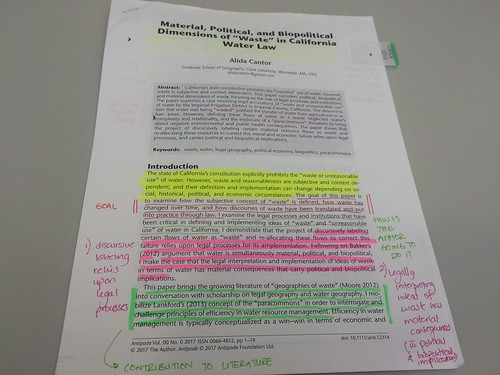
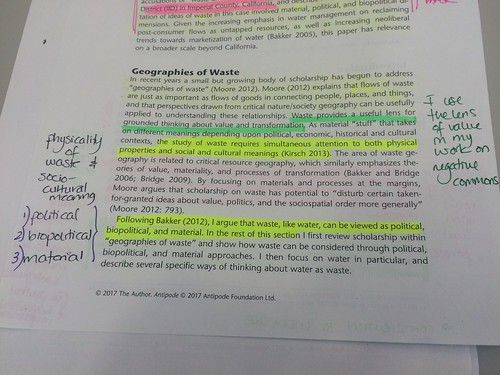
I used an example of an article I was reading recently (Alida Cantor’s discussion of the material, political and biopolitical aspects of California water law in regards to wastewater) and live-tweeted my reading from it. I also tweeted examples of how I write the synthetic note and how I can draft the full-fledged memorandum based on the synthetic note. Below is the process I follow. You can also read the entire Twitter thread to check how I highlight and scribble, though I’ve written a post on my method that you can read by clicking on this hyperlink.

1. I highlight and scribble using the AIC method.

I focus primarily on the Abstract, Introduction and Conclusion, as per my post. I think it’s important to be strategic about how we read, because otherwise we get overwhelmed with information. Since I’m attempting to write a synthetic note first, and then evolve it into a memorandum, I focus solely on AIC.

Note that while I focus on AIC, I ask four main questions:

  • What are the goals of the paper?
  • How do the author(s) do their analysis?
  • What are the main contributions of the paper?
  • What are the main findings of the research?

2. I type the full citation and abstract at the top of my memorandum (or synthetic note)

This is important as it allows me to quickly remember the main details of the article by reading the abstract. Having the article’s abstract available at the top, as well as the citation, allows me to copy and paste in case I need it for a larger document, like a paper, or an annotated bibliography.

3. For the synthetic note, I write the notes I scribbled on the margins and draw key quotations, but I ONLY focus on the Abstract, Introduction and Conclusion.

This is important because I can get bogged down in details if I write my notes from the middle of the paper, or if I read and highlight the intermediate components. Remember that I usually write synthetic notes when I am being strategic about what I read. Therefore, if I am doing skimming and scribbling, and I want to get just the gist of a reading, I type a synthetic note.

From synthetic note to full-fledged memorandum

Here is where the process diverges from synthetic note to memorandum.

4. For the memorandum, I re-read the paper, but go through the intermediate parts (highlighting and scribbling, too)

I noticed as I was highlighting the Cantor article that I was writing a lot of notes and highlighting key quotations beyond the Abstract, Introduction, and Conclusion. That’s usually a give-away for when I need to delve deeper into a paper and go beyond meso-level reading to engaging deeply with the document.

From synthetic note to full-fledged memorandum

5. As I transcribe my notes from the middle of the paper, I create tables, summaries and link to the literature and other authors.

How do I know when a reading merits a longer memorandum?

That’s a great question. The Cantor 2017 case is a perfect example. It’s an article that is very rich with theoretical discussions (the definition of wastewater, the different theoretical perspectives one can take with regards to waste, the implications of merging geographies of waste literature with legal geographies scholarship), PLUS has great empirical components (focusing on California’s water law, given recent drought events and how California offers a great laboratory for testing theories of water governance). Below is my rule of thumb for choosing when to write full-fledged memorandums.

A reading where I write lots of notes on the margins, change colours throughout quite rapidly and draw several key quotations (several being more than 3), and where I find lots of interesting details in the middle of the paper (that is, beyond the AIC components) is definitely a document that will merit a full-fledged memorandum. See my notes on Cantor’s introductory pages and concluding pages.

Finally, one important thing that I do when I read is that I maintain Excel, Mendeley and Word all open at the same time. This is important because as I draw key quotations, I can copy them from the Mendeley-hosted PDF and paste them into the memorandum AND the Conceptual Synthesis Excel Dump.

Hopefully this post will help my readers understand the process I follow to expand a synthetic note into a memorandum.

01 Jun 22:10

A Year of Google Maps & Apple Maps

by Federico Viticci

Justin O'Beirne is back with another in-depth analysis of Google Maps and Apple Maps, with a focus on how Google has taken a different approach over the past year:

Shortly after I published my Cartography Comparison last June, I noticed Google updating some of the areas we had focused on:

Coincidence or not, it was interesting. And it made me wonder what else would change, if we kept watching. Would Google keep adding detail? And would Apple, like Google, also start making changes?

So I wrote a script that takes monthly screenshots of Google and Apple Maps.1 And thirteen months later, we now have a year’s worth of images.

The screenshot comparisons in his post perfectly demonstrate Google's iteration and Apple's relative stagnation.

Speaking from personal experience, Google Maps has considerably improved in my area in the past year, while Apple Maps has remained essentially the same. Which isn't to say that Apple Maps is bad – Google simply has an edge over local business information and they're evolving at a faster pace than Apple. To me, Apple Maps looks and feels nicer; Google Maps seems smarter and it has modern features I'd like Apple to add.

I wonder what Apple has in store for WWDC and if they should consider separating Maps from their monolithic software release cycle in the summer.

(See also: O'Beirne in May and June 2016.)

→ Source: justinobeirne.com

01 Jun 22:10

Why Having a Diverse Team Will Make Your Products Better

by New York Times Open

By MODUPE AKINNAWONU

In March, The New York Times published an article about how hard navigating the subway can be in a wheelchair, and it touched me a lot more than I thought it would when I started reading it. Months later, it’s still on my mind. The piece was penned by Sasha Blair-Goldensohn, an engineer from Google who had an accident that left him partially paralyzed. As he started navigating the city on wheels he discovered that “inflexible bureaucracies with a ‘good enough’ approach to infrastructure and services can disenfranchise citizens with disabilities, many of whom cannot bridge these gaps on their own.”

Most subway stations in New York are not wheelchair accessible, and the ones that are often have broken elevators that can leave commuters stranded above or below ground. I’d like to imagine what the considerations for how to build an accessible subway system would be if there were more people with disabilities on the teams that make these decisions. It seems like more thoughtful accessibility would make everyone’s experience with this public product better.

It’s so exciting for me to see the ways in which the conversation about diversity and its impact on product development is accelerating. Diversity comes in many forms, and can include characteristics that are innate or acquired, such as country of birth, being multilingual, degree of abledness, race and socioeconomic background, among others. Having less homogenous teams makes us more innovative, can make us smarter and increases profits.

Product Successes

The variety of perspectives that come from diverse teams help make products stronger, and ultimately serve users better.

Companies with more women are more likely to introduce radical new innovations into the market (hello, Rent the Runway and Stitch Fix!) and companies with a culturally diverse leadership team are more likely to develop new products.

Slack celebrated their diversity very publicly last year when they sent four black female engineers to accept their award from TechCrunch for fastest rising startup.

Sallie Krawcheck started Ellevest in response to an investing industry that was primarily “by men, for men” and kept women from achieving their financial goals. Halla Tómasdóttir steered financial services firm Audur Capital through the financial storm in Iceland by applying traditionally “feminine” values.

And after almost 60 years, Barbies finally come in different shapes, sizes, skin tones and eye color in an effort to attract a wider demographic and increase sales.

Product Failures

Without diverse perspectives and experiences in designing, building and testing, products can and will fail female and minority users.

Some of the first air bags to be installed cars failed to protect women because they were built to men’s specifications, tested with male crash test dummies, and didn’t take the female anatomy into account. The first voice recognition programs didn’t recognize female voices or many accents because they were built and tested by men and native English speakers. You may remember Google Photos’ image recognition software labeled two black people as “gorillas.” When Apple first launched their Health app, there was one glaring exception to their promise to “monitor all of your metrics that you’re most interested in”: it didn’t track menstruation. And some phones are even too big for women’s hands.

Remember Microsoft’s paperclip office assistant? The company spent $100k on market testing and ignored female participants’ feedback that the characters were too male (90% of women didn’t like the characters). The reaction was largely rejected because the men leading the project couldn’t see the issue themselves; they shipped the product with 10 male characters and 2 female characters.

One of the hardest things to remember when building products is that you are not your user.

Tips for Building Better Products

Staffing teams with people who think differently from one another can remind us of our blind spots and hopefully lead us to better solutions for all users. Here are some things you can do to make better products:

  • Great products start with great teams, so ensure you have a diverse team to design, build and test your products.
  • Create spaces that guarantee everyone’s voice is heard by remembering that not everyone likes to speak up in meetings. Set agendas ahead of time so everyone can contribute; create space in group meetings for individual brainstorming; and provide other channels for feedback.
  • Cultivate an environment that includes psychological safety: this allows team members to take risks and speak up when they have novel or particularly unorthodox ideas.
  • Talk to users! If organizing in-house user testing is too difficult, ensure users can submit feedback via email and then make sure time is dedicated to reading some of their responses. Regularly check the public feedback you get in Google Play or the App Store. To make keeping up with these messages simpler, consider setting up a bot that sends these messages to a Slack channel.
  • Reading user feedback makes it harder for you to ignore user needs that you don’t personally feel. It can be easy to make assumptions when building a product, but listening to users whose experiences are different from your own can highlight issues you may not have encountered.

With a less homogenous mix of voices at the table, imagine what we can build! If you’re hiring for digital teams and having trouble figuring out ways to diversify your staff, there are numerous organizations you can partner with, including Coalition for Queens, Code 2040 and Power to Fly.

Modupe Akinnawonu is a product manager at The New York Times. She focuses on their Android news app, among other projects.


Why Having a Diverse Team Will Make Your Products Better was originally published in Times Open on Medium, where people are continuing the conversation by highlighting and responding to this story.

01 Jun 22:10

Designing a Faster, Simpler Workflow to Build and Share Analytical Insights

by New York Times Open

By EDWARD PODOJIL, JOSH ARAK and SHANE MURRAY

Data is critical to decision-making at The New York Times. Every day, teams of analysts pore over fine-grained details of user behavior to understand how our readers are interacting with The Times online.

Digging into that data hasn’t always been simple. Our data and insights team has created a new set of tools that allows analysts to query, share and communicate findings from their data faster and easier than ever before.

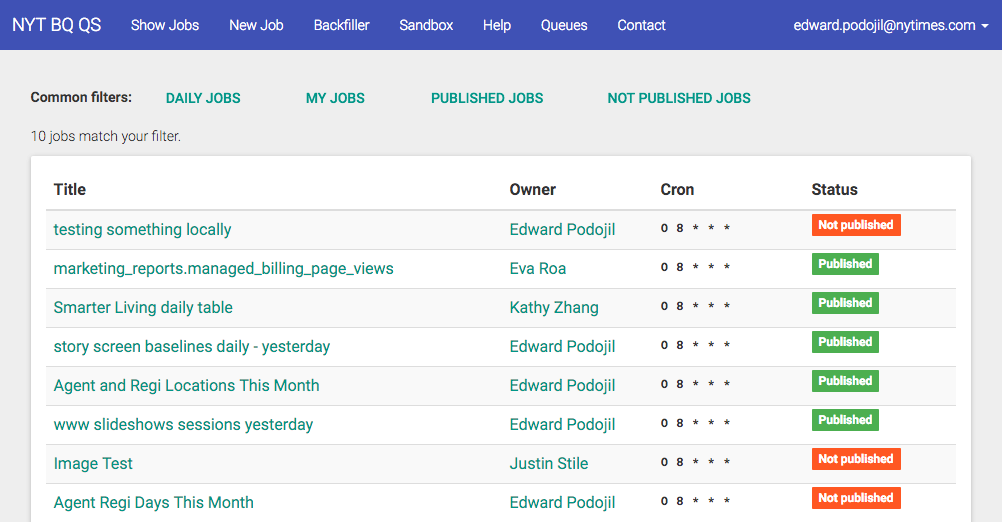
One is a home-grown query scheduling tool that we call BQQS — short for BigQuery Query Scheduler. The other is the adoption of Chartio, which our analysts use to visualize and share their results.

The result has been more analysts from more teams being able to more easily derive insights from our user data. At least 30 analysts across three teams now have almost 600 queries running on a regular cadence on BQQS, anywhere between once a month to every five minutes. These queries support more than 200 custom dashboards in Chartio. Both represent substantial improvements over our previous model.

What problems were we trying to solve?

This effort began when we migrated our data warehousing system from Hadoop to Google’s BigQuery. Before we built new tools, we worked with analysts to come up with several core questions we wanted to answer:

  • What patterns and processes did the analysts use to do their work?
  • Which of those processes could we automate, in order to make the process more hands-off?
  • How could we make it easier for our growing list of data-hungry stakeholders to access data directly, without having to go through an analyst?
  • How could we ensure ease of moving between business intelligence products to avoid attachment to eventual legacy software?

Until the migration to BigQuery, analysts primarily queried data using Hive. Although this allowed them to work in a familiar SQL-like language, it also required them to confront uncomfortable distractions like resource usage and Java errors.

We also realized that much of their work was very ad-hoc. Regular monitoring of experiments and analyses was often discarded to make way for new analyses. It was also hard for them to share queries and results. Most queries were stored as .sql files on Google Drive. Attempts to solve this using Github never took off because it didn’t fit with analysts’ habits.

The act of automating queries was also unfamiliar to the analysts. Although the switch to BigQuery made queries much faster, analysts still manually initiated queries each morning. We wanted to see if there way ways to help them automate their work.

Query Scheduling with BQQS

Before we considered building a scheduling system in-house, we considered two existing tools: RunDeck and AirFlow. Although both of these systems were good for engineers, neither really provided the ideal UI for analysts who, at the end of the day, just wanted to run the same query every night.

Out of this came BQQS: our BigQuery Query Scheduler. BQQS is built on top of a Python Flask stack. The application stores queries, along with their metadata, in a Postgres database. It then uses Redis to enqueue queries appropriately. It started with the ability to run data pulls moving forward, but we eventually added backfilling capabilities to make it easier to build larger, historical datasets.

A testing dashboard in BQQS

This solution addressed many of our pain points:

  • Analysts could now “set it and forget it,” barring errors that came up, effectively removing the middleman.
  • The system stored actual analytics work without version control being a barrier. The app stores all query changes so it’s easy to find how and when something changed.
  • Queries would no longer be written directly into other business intelligence tools or accidentally deleted on individual analysts’ computers.

Dashboards with Chartio

Under our old analytics system, “living” dashboards were uncommon. Many required the analyst to update data by hand, were prone to breaking, or required tools like Excel and Tableau to read. They took time to build, and many required workarounds to access the variety of data sources we use.

BigQuery changed a lot of that by allowing us to centralize data into one place. And while we explored several business intelligence tools, Chartio provided the most straightforward way to connect with BigQuery. It also provided a clean, interactive way to build and take down charts and dashboards as necessary.

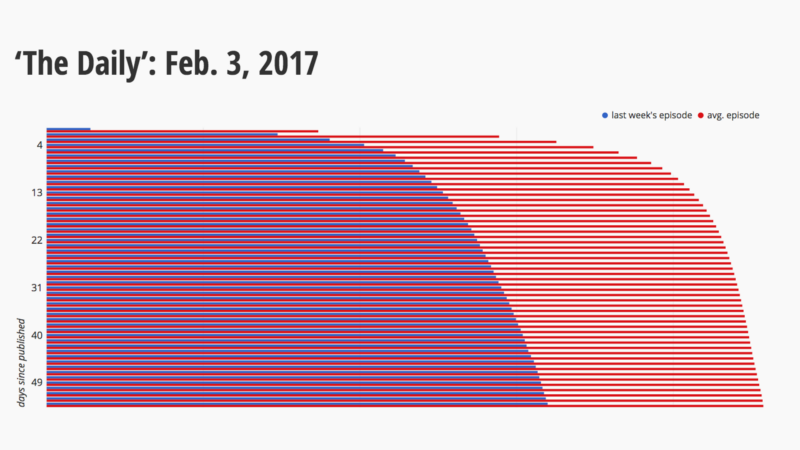
One example of a dashboard generated by Chartio

Chartio also supported team structures, which meant security could be handled effectively. To some degree, we could make sure that users had access to the right data in BigQuery and dashboards in Chartio.

Developing new processes

Along with new tools, we also developed a new set of processes and guidelines for how analysts should use them.

For instance, we established a process to condense each day’s collection of user events — which could be between 10 and 40 gigabytes in size — into smaller sets of aggregations that analysts can use to build dashboards and reports.

Building aggregations represents a significant progression in our analytical data environment, which previously relied too heavily on querying raw data. It allows us to speed queries up and keep costs down.

In addition, being able to see our analysts’ queries in one place has allowed our developers to spot opportunities to reduce redundancies and create new features to make their lives easier.

Moving forward

There’s much more work to do. Looking ahead, we’d like to explore:

  • How to make it easier to group work together. Many queries end up being the same with slightly different variables and thus a slightly different result. Are there ways to centralize aggregations further so that there are more common data sets and ensure data quality?
  • Where it makes sense to design custom dashboard solutions, for specific use cases and audiences. Although Chartio has worked well as a solution for us with a smaller set of end-users, we’ve identified constraints with dashboards that could have 100+ users. This would be an excellent opportunity to identify new data tools and products that require the hands of an engineer.

Shane Murray is the VP of the Data Insights Group. Within that group, Josh Arak is the Director of Optimization and Ed Podojil is Senior Manager of Data Products.


Designing a Faster, Simpler Workflow to Build and Share Analytical Insights was originally published in Times Open on Medium, where people are continuing the conversation by highlighting and responding to this story.

01 Jun 22:10

Introducing the New Open Blog

by New York Times Open

By NICK ROCKWELL

Illustration by Erik Söderberg

I’m very pleased to announce today that we are relaunching The New York Times Open blog. In the process, we are making three important changes:

First, while the blog began life with an engineering focus, we are expanding coverage to include everyone who builds our digital products at the Times. You’ll see posts on design, product development, management, editorial, and yes, definitely engineering. Most posts will come from our team, but you may also see occasional guest posts, from people we are collaborating with in some way.

Second, we are greatly increasing our output. Previously we posted “every sometimes”, but from now on we are committed to posting weekly — at least. So be sure to follow us here on Medium, as well as on Twitter.

Last, as you can see, we are on Medium! While it may seem strange for us, a publisher, to post on Medium rather than our own platform, we are here for a simple reason: the community. Medium is where so many of our people are, so much of the product, design and development community, so we wanted to be here too.

So what is Times Open all about? Why are we doing this at all? We are very proud of our crew, and want to give them a platform to share the good work they are doing every day. We also want to share with the community, and help others who may be able to learn from our work. Writing is good for the mind — it helps each of us organize our thoughts, and become better communicators and thinkers.

Today we are launching with three new posts:

And you can also take a look at the archives, which we have ported over from the old blog. Here are a few of my favorites:

So take a look, and watch this space. And, huge thanks to Chase Davis, Sarah Bures and Allen Tan for getting this next version of Open off the ground!

Nick Rockwell is the CTO at The New York Times. Find him on Twitter and Medium @nicksrockwell.


Introducing the New Open Blog was originally published in Times Open on Medium, where people are continuing the conversation by highlighting and responding to this story.

01 Jun 22:09

Joe Steel’s 2017 tvOS Wish List

by Federico Viticci

Good follow-up by Joe Steel (who's been covering and critiquing the Apple TV for a while) to last year's tvOS wishes, which were already spot-on.

I found his assessment of the Siri Remote sadly relatable:

This remote was an abomination that should have never made it out of the design lab it was drafted in. It was conjured up by designers from another world who only had TV remote controls described to them using words in their native tongue. I want something that can be held comfortably, doesn’t shatter, and has asymmetry that you can feel to know what you are holding, and what you are pushing, without looking at the tiny monolith. I wanted it in 2015, and I still want it.

Whatever touch surface they include should be fine-tuned to work with a human thumb instead of whatever capuchin monkey the remote’s original designers were imagining.

→ Source: joe-steel.com

01 Jun 18:44

"Pleasure is elusive, at work and outside of it. The paradox of pleasure is that it must ensue from..."

Pleasure is elusive, at work and outside of it. The paradox of pleasure is that it must ensue from other activities, and not from direct pursuit, as Victor Frankl said. Happiness arises from our investment of self in something greater than self. An emergent property, like order arising from apparent chaos in living systems, an exaptation: for certainly, those who approach their work with only the goal of self-satisfaction are unlikely to become happy, or produce great work.

The miscast ‘pursuit of happiness’, then, must be manifested in our work lives as arising from engagement in our own work, and its consequence, its meaning. From this we miraculously can find happiness, but only out of the corner of our eyes, when it isn’t what we are looking for, at all.


- | Stowe Boyd, The futility of ‘Fungineering’
01 Jun 18:44

Who is Fan Bingbing? Meet the Chinese superstar - and Cannes...

01 Jun 18:43

Tesla factory workers reveal pain, injury and stress: 'Everything feels like the future but us'

29 May 21:43

Apple working on dedicated artificial intelligence chip, says report

by Bradly Shankar
Apple banner

Apple is reportedly working on its own dedicated artificial intelligence (AI) chip. According to Bloomberg, an anonymous person “familiar with the matter” said that the chip would help improve how Apple’s devices handle tasks that normally require human input. These would include action such actions as facial recognition and speech recognition.

So far, Apple’s main foray into AI has been with its Siri voice assistant, which gave the company an early advantage in this area. Recently, though, the race to develop AI technologies has heated up between various companies. Google in particular devoted a notable amount of time to AI during its I/O keynote.

With this chip built in, Apple devices such as the iPhone would be able to offload AI-related tasks to a dedicated module, which could improve battery performance. Specifically, Bloomberg reports that “facial recognition in the photos application, some parts of speech recognition and the iPhone’s predictive keyboard” would be tasks potentially designated to the AI chip. As well, Bloomberg said its source noted that Apple plans to allow third-party developers to take advantage of this artificial intelligence-related task offload in their apps.

It’s not yet clear when Apple would release these chips, although it’s possible the company may reveal some of its artificial intelligence initiatives at its Worldwide Developers Conference keynote on June 5th. The presentation will be livestreamed from Apple’s website.

MobileSyrup will be attending WWDC, so stay tuned during the event for coverage.

Source: Bloomberg 

The post Apple working on dedicated artificial intelligence chip, says report appeared first on MobileSyrup.

27 May 06:23

My daily commute by bike turned me into a witness of a truly tragic event

mkalus shared this story from TORONTO STAR | OPINION | COMMENTARY.

I’ve been biking to work year round from south Etobicoke to One Yonge St. for about eight years now, and when I strap on my helmet and head out, I don’t know what I am going to see that day.

I have seen so much beauty on these rides. Gorgeous sunrises and sunsets. A glowing orange moon rising behind the CN Tower.

I’ve seen stunning birds, lone coyotes on the hunt, mink swimming along the shore, ducklings learning to swim. I’ve enjoyed the laughter of children playing in parks and large families enjoying a picnic.

I’ve watched young adults racing dragon boats and a lone rower sneaking up the Humber River. I’ve been caught in spectacular lightning storms while I took refuge in a gazebo as sheets of vertical rain blew across the harbour.

I have also seen horrific scenes that have shaken me deeply.

Last summer, a male cyclist was speeding past me, weaving in and out of traffic by the Tip Top Tailor Lofts, going far too fast for the conditions, when he hit a post and cracked his femur in two. I was right behind him and saw — and heard — the devastating accident.

As the man cried out in agony, I was able to stop and call 911. The dispatcher insisted I stay with the man and three of us made sure he stayed conscious until paramedics arrived. We tried to comfort and encourage him as he went into shock. It was disturbing, to say the least.

I’ve come across accident scenes after the paramedics had left but police were still on scene. One involved a cyclist who apparently lost control after hitting the streetcar tracks at the wrong angle on Lake Shore Blvd. in New Toronto and fell into traffic. She was hit by a minivan and died. Her bike was still on the road, the lights flashing.

On another early morning, the road was closed to traffic on Lake Shore in Mimico, but I biked on the sidewalk and past the scene of a single-car accident. The driver failed to negotiate the turn, and hit a light post. The driver was fine, but the passenger’s arm was torn off. Another driver lost his life in a single-car accident after hitting a light pole in front of the Boulevard Club.

I’ve been nearly run over by cars on two occasions while riding on the path through an intersection. I had the right of way. Last summer, another cyclist rammed into me from behind, causing us both to crash onto the pavement.

But, on Wednesday, biking home, I witnessed the worst possible accident.

A 5-year-old boy riding his bike lost control somehow and fell into traffic on Lake Shore Blvd W. He was hit by a car. When I arrived the boy was still on the road, motionless, and people were pulling out their phones to call 911.

A man picked the boy off the road and put him on the sidewalk. I believe it was the man cycling with the boy. Others rushed to his side. The rest is a blur. The driver who hit the boy had gotten out of his car and was standing beside me on the bike path. He was beyond devastated. People tried to help the boy until the paramedics arrived. I don’t recall who started the chest compressions.

Others, including myself, tried to comfort the 29-year-old driver. A man on the path told me he saw the accident and there was nothing the driver could have done. The boy died later in hospital.

I’ve been trying to process what happened.

That stretch of the Martin Goodman Trail runs right beside a high volume road. There is no boulevard or barrier. And it’s downhill. Cyclists frequently ride too fast. Other cyclists agree with me that site has been an accident waiting to happen. On windy days, with powerful gusts coming off the lake, I’ve worried about being blown into traffic myself. I believe a guardrail could have saved that boy’s life . . . and, I’ll bet, a future life.

I also feel there are unnecessary dangers every day, for all commuters, on the path. I do see that pedestrians, cyclists, joggers, drivers, and rollerbladers are far too often reckless. Too many people are in a hurry. People aren’t looking. People are angry and quick to lash out at each other.

People need to slow down. The injuries and deaths I’ve described were all preventable. When I pass one of the accident sites, I often think about what happened there. The daily commute shouldn’t feel like running a gauntlet of life and death.

Scott Colby is the Star’s Opinion Page editor.

26 May 20:32

Sony Xperia XA1 Review: Camera-focused budget phone that doesn’t stand out

by Rose Behar

Budget Android phones usually have one great thing about them.

That’s because manufacturers can’t afford to push each spec to the limit like they can with premium devices, so rather than just aim for an overall mediocre but inexpensive device, they choose one element of the device to shine above the others.

For the LG X Power and LG X Power 2, for instance, that element was the battery — a 4,100mAh pack in the first generation and 4,500mAh on the second, allowing for multiple days of life. For the Sony Xperia XA1, it’s the camera.

With a rear-facing 23-megapixel shooter features a f/2.0 aperture, 24mm wide-angle lens and hybrid autofocus, the phone stands out from its peers at a similar price point. At least on paper, you aren’t about to find any device as impressively specced-out in the camera department for $320 CAD.

On the flip side, Sony seemed to have its budget in mind when it decided to include a 2,300mAh non-removable battery, small even in the arena of inexpensive devices.

However, just as you can’t judge a book by its cover, you can’t judge a phone solely by its specs sheet — implementation and software are also major factors in ultimate performance — a fact that was reinforced by the XA1. After spending a few weeks with the phone, I found that both what I most anticipated and dreaded about this device turned out to be slightly misguided notions.

Simple and slim

Sony’s particular style of design for smartphones doesn’t generally appeal to me — they are too boxy and minimal for my liking — but I understand the brand has its fierce fans when it comes to aesthetics and I must note that while initially I disliked its simple, slab-like design, I soon began to warm to its aestheti, in part for its minimalism but mainly for its practical functionality.

Much like the Samsung Galaxy S8, the device’s form is long and thin — though at 67mm it beats the more premium device’s 68.1mm width. The 5-inch display spans across almost the entirety of that width, with only the slimmest of side bezels.

The comfort of this thin form factor can’t be emphasized enough. It makes it incredibly easy to navigate the device with one hand without comprising the overall size of the display. The XA1 far outdoes most of its competitors in this respect — including the LG X Power and its successor the X Power 2, the Moto G5, Samsung Galaxy J3 (2016), Alcatel Idol 4, Xiaomi Redmi Note 4 and the XA1 Ultra (which verges more into mid-range territory, offers a larger 6-inch display and hasn’t yet debuted in Canada).

Big bezels paired with small bezels

In terms of thickness and weight, at 8mm and 143 grams, it comes in generally in the middle of the pile compared to its competitors — not the best, not the worst. But those metrics both matter much less to me, as someone with small hands, than a comfortably thin width. The width also pairs with sharply cut aluminum edges, making it much more secure to grip than some plastic or metal devices.

I will note that the top and bottom bezels appear somewhat ludicrously chunky, though in reality, the bottom bezel serves a purpose in providing a thumb-rest. The rear of the phone has the camera positioned tightly to the left, and has a somewhat easily scratched rear surface.

Additionally, the device features a dedicated camera launch button, USB-C charging, dual front-facing speakers and a bottom-firing speaker, providing good quality audio for playing out loud.

Middling audio and display quality

Unfortunately, the wired experience isn’t quite as impressive. Sony says the device includes active noise cancellation, but it’s difficult to hear audio content though my wired earbuds in a busy urban environment or on loud transit, and all but impossible to use in a noisy plane.

The IPS LCD display also suffers in out door environments or direct sunlight, though it outperforms the Moto G5 and has notably less over-saturation. Unlike the 1920 x 1080 pixel Moto G5, however, it features an unimpressive 720 x 1280 pixel resolution with 291ppi density. It’s far from alone in the budget category when it comes to having a 720p resolution — the Galaxy J3 and both X Powers have the same resolution, for instance — but many more are offering more modern 1080p displays, including the Idol 4, XA1 Ultra and Redmi Note 4.

Overall, display tech doesn’t factor too highly into my estimation of a device, but it may be disappointing to those who frequently stream video or play mobile games.

Enough battery to get through the day

Then again, users who do either of those things also aren’t likely to look towards a smartphone with a 2,300mAh non-removable battery. Considering that’s smaller (in many cases much smaller) than any of the competitors I’ve listed, I was expecting to barely make it through the day using the Sony Xperia XA1.

But in reality, it’s not just the size of the battery that matters when it comes to overall battery life, it’s also important to consider the processor and its implementation. Yes, it’s only a 2,300mAh battery (and it should be removable), but the octa-core MediaTek Helio P20 chipset does a great job of sipping power moderately and the battery easily lasted me a day. This is similar to the Moto G5, which provided nearly two day battery life with its 2,800mAh battery and octa-core Qualcomm Snapdragon 430 chipset.

Of course, battery life is also highly dependent on usage, so it’s important to note that my common usage patterns in a day for this period included up to four hours of Wi-Fi music streaming, at least two hours of Wi-Fi browsing and 10 to 30 minutes of voice calling. I also got a little over four hours of screen time per charge, taking up about 900 to 1,000mAh of battery power.

All in all, I found the seemingly lacking battery more than adequate, and the phone also didn’t seem to have a tendency to overheat — perhaps in part because of its trickle-charging Qnovo Adaptive Charging technology — which should mean the battery won’t degrade too quickly.

An unimpressive camera experience

Leaping from the least impressive spec to the most, I would describe my experience with the Xperia XA1’s camera as mildly disappointing — mainly because the company attempted to shoehorn a premium camera into a budget device that seemingly can’t support it.

While better pictures are possible using manual mode, the rear-facing camera is prone to taking pictures that lack contrast and are easily washed out by bright expanses. Many of my photos featured sun flares alongside a lack of saturation. Pictures that may have made a statement if the textures and colours had been juxtaposed in strong contrast turned into boring, dull snaps.

On the flip side, the camera’s low-light shooting is a high point of this otherwise so-so camera package, providing relatively crisp photos in dim indoor areas with minimal blur.

Returning to another downside, however, the camera can take almost three full seconds to open from the lock screen — long enough to miss some moments or to create an awkward moment when you’re trying to snag a picture with Canadian celebrity Ben Mulroney (seen above). The autofocus was also a little slow to adapt, resulting in a few pictures with the wrong focus, and the photo capture has a bit of a lag, as well.

Having noted all that, the camera is still one of the most impressive I’ve seen in a budget phone — just not by any huge margin.

Solid performance

Other than the camera, most apps ran well on the device’s octa-core MediaTek Helio P20 and 3GB of RAM during my time with it, and I experienced no serious slow-downs or crashes, again pushing it slightly above many of its budget compatriots. The XA1’s competitors run the gamut when it comes to processors, from Exynos to MediaTek to Qualcomm Snapdragon and ranging between quad and octa-core, with speeds, reliability and performance varying as well.

As for internal storage, the device provides a respectable 32GB, expandable by microSDXC up to 256GB, with the system taking up 9.63GB of storage off the bat.

While Sony’s UI still contains a fair amount of bloatware, overall the manufacturer’s skin seems toned down from previous versions, and fairly close to stock Android, including swiping to the right from home to get to Google Now and a pre-installed app drawer (unlike LG). The pre-loaded apps include some extremely bloaty software such as ‘What’s New,’ ‘Sketch,’ ‘Lounge,’ and ‘Sony News’ — but only a few are permanent.

The post Sony Xperia XA1 Review: Camera-focused budget phone that doesn’t stand out appeared first on MobileSyrup.

26 May 20:31

Closed for Memorial Day

by noreply@blogger.com (VeloOrange)
by Igor

VO is going to be closed on Monday, May 29th for Memorial Day observance and to give our fantastic staff some time off.

Orders placed after 3pm EDT today (5/26) will ship out promptly on Tuesday, May 30th. So if you need anything to go out today, submit your order soon.

Have a great weekend, and please enjoy this 60cm Polyvalent Disc build which a local, very tall rider will be trying out for a while.


26 May 20:31

OER Pioneer David Wiley Predicts All Community Colleges Will Dump Traditional Textbooks By 2024

files/images/813.jpg

Jeffrey R. Young, EdSurge, May 29, 2017


Icon

By 'all community colleges' David Wiley and Jeffrey R. Young no doubt mean 'all community colleges in the United States', because expecting a community college in, say, Namibia, to replace textbooks by 2024 is to expect the very very unlikely. But more, as insightful as Wiley is, I think he is hampered by a basic misunderstanding or misrepresentation of economics. "If it’s 25 percent cheaper to get your business degree here than it is to get it over there, you’re going to go over here," he says. But we know this isn't true: people don't select education based on price, and institutions certainly don't differentiate it by price, not even at community colleges. Perceived quality, location, reputation, networks and more all play a role. So, no, I'm not expecting Wiley's prediction to come true. Not by 2024.
[Link] [Comment]

26 May 20:31

Underpaid & Overstressed: 4 Things Starbucks Baristas Say Is Wrong With The Company

by Ashlee Kieler
mkalus shared this story from Consumerist.

Millions of people count on Starbucks baristas to provide them with a jolt of caffeine each day, but those employees might be the ones truly in need of a little help: Baristas around the country are spilling the coffee beans on their employer, claiming they are overworked and strained thanks in part to the chain’s endless stream of pilot programs and new services. 

Business Insider reports that those behind the counter say they are feeling the pressure from the company’s attempts to bring in more customers via mobile ordering, testing new initiatives, increased food offerings, and limited-time drinks.

While Starbucks says it is striving to improve the working conditions for its partners (the company’s name for employees) and regularly engages with these workers to make their experience better, those actually wearing the green apron say things aren’t improving quickly enough.

From discouraging conversations with customers to understaffing locations, dozens of current and former Starbucks baristas shared with Business Insider just what they think is wrong at Starbucks. Here are 4 things we learned.

1. INTERACTION DISCOURAGED

One barista says that in the seven years they’ve worked for the company the relationship between employees and customers has changed.

Whereas customers used to be like family to baristas, the employee says it is now frowned upon to stop and have a conversation with a regular.

“And it has sapped just about every last ounce of my energy to know that I am now a hindrance to the Starbucks (corporate America) agenda,” the employee tells Business Insider.

2. OVERSTRESSED

Several baristas say that while they’re often referred to as the most important aspect of the chain, they don’t always feel that way.

With Starbucks offering more and more ways for customers to order drinks and food — from mobile orders to delivery tests to drive thrus — the employees say they are “running around like crazy.”

This is only amplified, employees say, when the stores are understaffed.

“I’ve had people call the store to complain that we seemed rushed and upset. The stress is overwhelming, a current employee told Business Insider. “A four-hour shift is too exhausting at this point, because there’s nobody to help us.”

3. UNDERPAID

While the chain offers employees several benefits, such as 401(k) matching and tuition assistance, one barista says employees are just looking for enough money to pay for a place to live and groceries.

One employee tells Business Insider that if given the choice between college achievement programs and high pay, nearly 90% of partners would choose the increased pay.

Another employee referred to the companies as “a cult that pays $9 per hour.”

4. UNDER APPRECIATED

Despite running the registers, the hot and cold bars, the drive-thru, and making connections with customers, some baristas tell Business Insider they don’t feel like a valued member of the company.

But they don’t feel comfortable voicing those opinions on the company’s surveys of partners for fear of retaliation.

“I and so many other baristas don’t feel secure in our [roles] enough to tell them how we actually feel, because it is not anonymous,” one current barista tells Business Insider of the system that collects partner numbers.

A rep for Starbucks tells Business Insider that the company’s strengths come from its connection to partners, and it knows there is work to be done.

“We know when we exceed the expectations of our people, they, in turn, exceed the expectations of our customers. To us, every voice matters,” the rep said.


26 May 18:08

Toronto startup seeks to boost electric-vehicle charging options

mkalus shared this story from The Globe and Mail - Commuting.

Urban drivers who want an electric vehicle, but have no place to install a charger, are about to have a new option for juicing up their cars.

SWTCH, a Toronto-based startup, has developed a web-based platform that will allow homeowners with electric-vehicle chargers to rent plug-in time to other EV drivers. Similar to the lodging rental app Airbnb, SWTCH allows users to manage profiles, bookings and transactions through its interface.

“The idea is that we can expand the public charging infrastructure by leveraging private EV chargers and the shared economy,” said Carter Li, co-founder of SWTCH and a former management consultant.

Li’s co-founder, Laura Bryson said that data collected by the company shows that about 15 per cent of EV owners do not have regular home access to chargers. Reasons include the fact that some live in apartments or condominiums that do not have the infrastructure; others live in urban housing without garages or driveways and, as a result, park on public streets. Difficulty accessing a charger is also a big entry barrier for drivers who are interested in EVs but cannot accommodate the installation.

Li himself owns a Chevrolet Bolt, a plug-in EV that is new to the market this year and poised to shake it up because of its low cost (about $35,000 after taxes, fees and rebates) and long range (the vehicle can travel up to 383 kilometres on a full charge). Because he doesn’t have a charger at his downtown Toronto home, though, Li is often forced to look for publicly available, pay-for-service plugs. He frequents city-owned Green P lots as well as big-box stores such as Ikea.

“Depending on the week and my schedules, I try to plan ahead and see where I could charge,” he said.

Once Li has the ability to easily connect with other EV owners in his neighbourhood via SWTCH, he will happily pay them for use of their charger instead. How much he will pay varies. SWTCH has a built-in algorithm, he said, that calculates the cost of electricity based on the time of day, make and model of the charger and vehicle, and the duration of the charge. The owner of the charger, Li said, decides how much he or she wants to charge on top of that, meaning they have the option to make a profit for renting it out. SWTCH charges a 10-per-cent commission.

SWTCH appears to be the only current application aimed at creating a market for peer-to-peer charging rentals in Canada (there are other apps devoted to mapping charger locations, including some privately owned chargers, but none so far facilitate bookings or payment for users). Several similarly inspired electricity-sharing services have recently launched in other countries. Sweden has Elbnb, Britain has an app called Chargie. In Los Angeles, EVMatch is in beta testing mode.

In Toronto, SWTCH is also in beta mode and is looking for more residential charger owners to participate in its pilot. Once the company has built up a critical supply of charger owners in the city, Bryson said, it will look at further expansion into cottage country and, possibly, beyond.

Its timing is good. With more than 20 EV models available in Canada, the market is poised to grow. Ontario recently recorded its 10,000th EV on the road; the province, which is working to rapidly grow the number of green cars in Ontario, has some of the richest incentives in the world for EVs, including up to $14,000 back on the purchase of a new battery-powered car.

Ontario is also in the midst of installing a vast network of nearly 500 publicly available fast chargers. If SWTCH succeeds in growing a private electricity-sharing network, it will doubtless improve progress towards Ontario’s goals, which include boosting EV sales to 5 per cent of total vehicle sales by 2020. The number currently hovers around 1 per cent but is showing signs of swelling.

“As we move away from the early adopters to where we are now, this is really the tipping point of something that’s mass market,” said Wilf Steimle, president of the Electric Vehicle Society and a director of Electric Mobility Canada.

As the number of affordable EVs grows, so will the market’s demographic. Access to chargers will build on the trend, Li said. Quoting a recent report produced by CleanTechnica and EVObsession, he said that drivers are up to 40 per cent more likely to own an EV if there is a charger within a kilometre of their home.

“SWTCH will ultimately improve the adoption of EVs,” Li said.

Shopping for a new car? Check out the new Globe Drive Build and Price Tool to see the latest discounts, rebates and rates on new cars, trucks and SUVs. Click here to get your price.

Report Typo/Error

Follow Jessica Leeder on Twitter: @jessleeder

26 May 18:06

Arbutus Greenway Still Rolling Along

by Ken Ohrn

I visited the Greenway a few days ago and saw lots going on, as the temporary Greenway takes shape, giving hints about the future, and the abandoned railroad track becomes a memory.

As usual, click a photo to enlarge it.

At Burrard & Greenway, a traffic signal is now in place.  Greenway travelers get a signal pole on both east and west sides, each with a crossing button.  Note the new crosswalk on Burrard and painted lane dividers on the asphalt part of the Greenway.

Arbutus.Greenway.Burrard

At several places, a centreline divider is visible, with what appears to be potting soil awaiting plants.

Arbutus.Planting.2

Likewise, crews were spreading soil on the edges of the temporary pathway.  One person on the crew told me that the plan is to plant wild flowers there.  I like it.

Arbutus.Planting


26 May 18:06

The Whale

26 May 18:05

Nokia 9 appears on Geekbench with Snapdragon 835 and 8GB of RAM

by Igor Bonifacic
Nokia 9

While we’ve yet to see any of the Nokia-branded phones HMD Global announced at MWC arrive in Canada — or, for that matter, many other parts of the world — that hasn’t stopped the company from starting development on a new device.

In April, a report came out that said HMD Global planned to release a new flagship handset, known as the Nokia 9, by the end of the summer. At the time, it was believed the company’s new smartphone would include a Snapdragon 835 chipset and between 4GB and 6GB of RAM.

The Nokia 9’s latest Geekbench showing, however, suggests it will instead ship with 8GB of RAM.

As Pocketnow notes, the Nokia 9 wouldn’t be the first Android smartphone to feature 8GB of RAM. The Asus ZenFone AR, the next Tango Android device scheduled to arrive later this year, includes 8GB of RAM. ZTE is also rumoured to release a smartphone that features 8GB of RAM later this year.

Unfortunately, for all its hardware power, Unknown Heart (all previous HMD-made Nokia handsets have shared the Heart codename) performed abysmally, earning a 615 single-core score and 1116 multi-core score.

For the sake of comparison, the OnePlus 5, which is confirmed to feature the same chipset, scored 1963 in Geekbench’s single-core test and 6687 in its multi-core test. In earlier tests, the device performed markedly better. In a benchmark dated to May 17th, the Nokia 9 scored 1588 and 5455, respectively. That discrepancy likely speaks to just how early HMD Global is in the development of its next smartphone.

Source: Geekbench Via: Pocketnow

The post Nokia 9 appears on Geekbench with Snapdragon 835 and 8GB of RAM appeared first on MobileSyrup.

26 May 18:05

Android exploit named ‘Cloak and Dagger’ allows hackers to hide malicious activity

by Bradly Shankar
Lineup of Android robots

A new Android exploit known as Cloak and Dagger has been discovered, which uses various app-generated interface elements in the OS to hide malicious activity from users.  Researchers from Georgia Institute of Technology discovered the exploit. They say it affects versions of Android up to and including 7.1.2.

The team, made up of Yanick Fratantonio, Chenxiong Qian, Simon Pak Ho Chung and Wenke Lee, demonstrated that the malware creates a grid over the Android screen that mirrors a regular onscreen keyboard.

“These attacks only require two permissions that, in case the app is installed from the Play Store, the user does not need to explicitly grant and for which she is not even notified,” wrote researchers on a site dedicated to the exploit.

“The possible attacks include advanced clickjacking, unconstrained keystroke recording, stealthy phishing, the silent installation of a God-mode app (with all permissions enabled), and silent phone unlocking + arbitrary actions (while keeping the screen off).”

These attacks abuse one or both of the ‘SYSTEM_ALERT_WINDOW’ (“draw on top”) and ‘BIND_ACCESSIBILITY_SERVICE’ (“a11y”) commands.

The researchers say these issues have yet to be fixed. In the meantime, the team recommends users check which applications have access to the “draw on top” and the “a11y” permissions.

Specific instructions on how to do this for each version of Android can be found here.

Image credit: Flickr – Rob Bulmahn

Via: TechCrunch

The post Android exploit named ‘Cloak and Dagger’ allows hackers to hide malicious activity appeared first on MobileSyrup.

26 May 18:05

BMW Recalls 45,500 Cars Over Doors That Could Open Unexpectedly

by Ashlee Kieler
mkalus shared this story from Consumerist.

It’s one thing to feel the breeze through an open window or sunroof while driving down the road; it’s a very different experience when that fresh air comes from a door that opened on its own.

BMW has announced the recall of 45,484 model year 2005 to 2008 745i, 745Li, 750i, 750Li, 760i, 760Li, and B7 Alpina vehicles equipped with both the Comfort Access and Soft Close Automatic options.

According to a notice [PDF] posted with the National Highway Traffic Safety Administration, the recalled vehicles may contain doors that appear to be closed and latched, when, in reality, the latch is not fully engaged.

Because of this, rough roads or inadvertent contact between an occupant and the door could result in the door unexpectedly opening while driving, BMW says, warning that the sudden opening could result in occupant ejection or increase the risk of injury in the event of a crash.

This isn’t the first door latch-related recall for BMW. In fact, the company notes in documents sent to NHTSA that the issue is related to the 2012 recall [PDF] of 7,485 model year 2005 to 2007 7-Series vehicles.

According to the chronology submitted by BMW for the new recall, the company was approached by NHTSA to discuss the scope and remedy of the previous recall based on the complaints received by the agency.

BMW reviewed and analyzed the complaints, determining they contained two issues: the door cannot close before driving away and the door could open unexpectedly while driving. Complaints about the door latching issues can be found in NHTSA’s customer complaint database.

The owner of a 2008 750Li tells NHTSA that they were driving the vehicle when the driver door came open and would not latch afterward.

In 2012, another owner reported driving at 73 miles per hour when the driver’s side front door opened and failed to lock again.

One owner of a 2006 750Li said that two of the doors on their car had this problem, though luckily not at the same time.

“While operating the vehicle, the front driver side door suddenly opened,” the owner wrote in May 2016. “On another occasion, the rear passenger door erroneously opened.”

After discussing findings with NHTSA in April, BMW determined that it was indeed possible for a door to unexpectedly open while driving if a latch or door handle failed. In May, the company concluded a recall was necessary.

However, the carmaker says a remedy for the issue has yet to be identified. Owners of affected vehicles may contact BMW at 1-800-525-7417 or email BMW at CustomerRelations@bmwusa.com.


26 May 18:05

The Mavericks & Heretics of Science

by David McCandless

Meet 40 mavericks & heretics of science whose “crackpot” ideas were proven correct. Eventually.

» See the visualization & analysis
» Check the data

26 May 18:05

Port Says Deeper Fraser River not needed, time to Twin the Tunnel, Nix the Massey Bridge?

by Sandy James Planner

col_news_coal_2345

The timing of this announcement after the Provincial election is puzzling.As reported in the Surrey Leader the Vancouver Fraser Port Authority announced yesterday that despite everything that is being said-“they have no plans to deepen the Fraser River to accommodate larger vessels.”

In a strangely late announcement, the Port emailed the media stating that “the port authority recently completed an analysis of the river and its potential to accommodate increasing trade, that considered a variety of possible uses of existing port lands and assessed dredging the river at different depths, both with and without the removal of the George Massey Tunnel. The port authority’s analysis, completed in 2016, determined that deepening the Fraser River would be extremely costly, requiring extensive environmental study and consultation over many years.”

The study showed that with more use of the Port’s existing terminals  and further development of the port authority’s existing industrial lands along the water, the Fraser River will be well positioned to accommodate Canada’s growing trade without deepening the channel,” said Peter Xotta, vice president, planning and operations at the Vancouver Fraser Port Authority.

So if the existing tunnel is not a challenge for the Port’s development potential (despite the release of previous documents indicating that the future deeper draft is a consideration) and the existing tunnel is “not constraining the current development potential of the river” then why was the bridge the single-minded solution offered by the Provincial government?

The Port maintains a 36 kilometer long channel on the Fraser River’s south arm. Studies show that 2.5 to 3.5 million cubic meters of sediment is “deposited annually” in that part of the river and it is dredged in the lower reaches for flood protection ad flow capacity.

In this bridge/tunnel shell game is the plan to offer a twinning of the tunnel instead of the overbuilt multi-billion dollar bridge in exchange for the Port’s rapid industrial development of their 200 acres of properties along the Fraser?

1249-05x07-300


26 May 18:05

Socialization of youth (Part 4)

by admin

20

Sociology also examines the problems and deviations of the norm socialization. In general, the rate of socialization appears the result of a public mechanism of reproduction of the social nature of man (Kovalev, Lukow, 1999, 2012). Socialization rate is determined: first, as a result of successful socialization, which allows individuals to reproduce social relations, social relations and cultural values of the society and to ensure their further development; secondly, as a multi-dimensional model of human socialization, taking into account his age and individual psychological characteristics; Thirdly, as a well-established set of rules in society transmission of social norms and cultural values from generation to generation. Socialization rate is closely linked to the social norm, but not reducible to it. The essence of the distinction is to assign one or the other rules: the social norm for such a purpose is to regulate the behavior of individuals and groups for socialization regulation, together with the development of standards. Socialization norm due to the parameters of sociality of the society. Its advocates regulators culture, social norms and values. It does not change a tendency to ordering total and comprehensive control processes of socialization of individuals. Socialization norm correlated with social personality types, dominant in society, with the age characteristics of the individual, his status claims. The formalization of such a rule is carried out in the legislative and other normative legal acts, directly or indirectly related to the social reproduction of human society, fixed in various charters, programs, regulations, instructions and other documents regulating the livelihoods of people in social institutions and organizations advocating the socialization agent’s individuals. Socialization rate presented in the value consciousness of members of society, and is an essential component of public opinion, is an important regulator of informal behavior. Socialization is not always successful. The socialization of the individual is usually a deviation, which is determined by the mismatch of socialization as an objective and a subjective process prevailing in a given society at a particular historical juncture socialization norm. The oscillatingsocialization manifests itself in various forms of deviant behavior, and found a discrepancy of personal development of the individual standards set by society (Kovalev, Reut, 2001).

21

Reform of Russian society led to changes in the standards of successful socialization of young people, a collection of rules of transmission of social norms and cultural values from generation to generation. The main features of the socialization of the Russian youth in view of the transition from the Soviet model of socialization (uniform for normativity, with equal starting opportunities and safeguards to ensure the predictability of life’s journey) to another model (variability, stratified) were the following: the transformation of the main institutions of socialization; deformation of value-regulatory mechanism of social regulation and the establishment of a new system of social control; imbalance of organized and spontaneous processes of socialization in the direction of spontaneity; change in the balance of public and private interests in the direction of greater autonomy of the individual and the emerging space for initiative, creativity and initiative person (Kovalev, 2003, 2007, 2012).

Centralization and harmonization of social standards to some extent affects the processes of integration of young people into society, leaving considerable room for a variety of individual socialization practices. Ordered and managed the processes of socialization, set standards of personal development is always complemented by uncontrollable natural processes and alternative behavioral stereotypes.

Therefore, the real, “statistical” man is far from the normative sample.
A Case Study of socialization of young people it is advisable to maintain in view of the different levels of abstraction, as social processes occur as the individual entities operating on the micro level, and in objectively existing society. At the macro level. It is inevitable simplification of the society as multidimensional social phenomenon, which is the study of the subject has to be regarded as a self-developing organism. Thus abstracting accomplished by the fact that it consists of moving individuals and individuals. Even more simplification takes place at the individual level, for the individual taken into account means to take into account each individual, but in the light of the objectives of this study to take into account features of socialization of every young person.
The parameters of social reality cause the socialization process that occurs with individuals in the specific context of social reality. At the same time reveals the dependence of the social reality of how social is embodied in personalities.

22

Social reality determines the measure of social development as a human, balance and depth of the objective and subjective sides of socialization. It determines the actual boundaries of the socialization of its value-normative base, institutional and non-institutional components variants. It is more important to a person’s ability in a democratic society does not obey the formal schemes of behavior, and to consider them as a collection of his personal development tools. Then change these tools ceases to be dramatic and sometimes tragic for the person. He feels the more free than at least there is persistent pressure of the authorities. Any compulsion, directly or indirectly infringe the rights of the individual, it limits the possibilities of individual choice.

The post Socialization of youth (Part 4) appeared first on BookRiff.

26 May 18:04

The Dilemma of Affordable Housing Design

by pricetags

We never used to have a term called ‘affordable housing.’  If housing was produced by the market, it was affordable to local buyers or it didn’t sell.   Speculators could only function when scarcity existed, and there was always the risk that lower-cost housing could come on stream and drive down the price.

If government built the housing for those not served by the market, it was ‘social’ or ‘non-market’ housing.

But there was a problem.  Affordable housing tended to look like this:

Or, in multiple-family form, like this:

Both versions are Vancouver Specials from the 1960s: the least amount of architectural design, the most amount of density – where the land was a relatively small component of the final price, not the determining factor.

Imperial Towers, at 1255 Bidwell, is perhaps one of the most egregious examples. According to Emporis, it is the 26th tallest building in the city, the first to have 30 storeys, the tallest apartment building in western Canada at the time.

Designed by architect Peter Kaffka, completed in 1962, it was developed by former Vancouver mayor Tom Campbell (he became alderman in late 1962, mayor from 1966-72).  Talk about developers controlling City Hall.

When completed, this was the last wide-slab tower permitted in Vancouver.  After that, the floorplates were smaller, the towers thinner, the heights shorter.

The public backlash was understandable.  If growth was ever said to be ‘out of control,’ this was the time when public amenity and urban design were less used if not unknown terms in the approval process.

But here’s the irony: with increasing design control, slower approvals, more downzonings and constraints, both quality and price went up.  In other words, we induced scarcity by stopping growth from being ‘out of control’ and getting much better quality in amenity and design.

Today, the Imperial is still targeted to middle-income renters (one-bedrooms under $1,500), even though it sits on one of the more attractive sites with dynamite views in a very convenient neighbourhood, half a block from English Bay, next to Alexandra Park.

Yes, land cost is the most excruciating factor today – but it too is a function of scarcity that could be alleviated by significantly increasing density in return for negotiated affordability.  If we really wanted that.

There will be a host of new towers emerging on lower Davie Street in the next few years (already word among neighbours unaware of the 2015 West End Community Plan is that growth is out of control.)  While there is provision for more rental and some affordable housing, most of the new housing will not be considered by most to be ‘affordable.’

But would anyone really advocate we return to the era of the Vancouver Special and Imperial Towers?