
Shared posts

01 Jun 22:07

The Daily Edit – Ted Cavanaugh

by Heidi Volpe

Men’s Health

Creative Director: Mike Schnaidt
Deputy Director of Photography: Sally Berman
Deputy Art Director: Raymond Ho
Food Editor: Paul Kita
Food Stylist: Eugene Jho
Prop Stylist: Kaitlyn DuRoss Walker
Photographer: Ted Cavanaugh

Why did you choose that particular chile for the shot?

Our wonderful food stylist Eugene Jho found some pretty amazing dried peppers from all over Manhattan, but in the end, the reason we loved that chili pepper was that it had an insane fiery orange color at the top, and graduated to a more traditional dark amber color at the bottom. I thought this would be perfect on black because it would make the colors that much more vivid.

Did you wear gloves to handle them?
I didn’t, but Eugene certainly did!
Tell us about the water background and liveliness of that shot?
For this image, our concept was showing peppers in liquid, almost as if they were being pickled in a jar. We initially layered the peppers in a large plexiglass tray in water and a white background. It was immediately clear that the water didn’t read as well as we were hoping. In fact, the water was almost invisible.  After a few frames, I realized the white background and the stagnation of the water weren’t working. So, we switched the background to a beautiful blue and made the water as active as possible. To me, the most exciting thing about water is the textures and shapes it can easily create with the right amount of agitation. Part of what I love about working through concepts on set is the spontaneity of it. There can be long discussions beforehand about what the intended outcome is, but in the end, it’s more about the physical limitations of how the subject reacts with the light and the camera’s sensor….you know, physics and stuff.
Did you submit that spread or did the magazine put those two images together?
The wonderful designers at Men’s Health put that spread together.
What type of direction did you get from the magazine?
When I got the call from Sally, she had some images in which she was drawing inspiration from, but she gave me the go ahead to make really cool pictures. The main focus was absolutely all about hot sauce, so we needed to get a really solid composed photo of all the hot sauces. But after that, we just went wild and got as many different variations of graphic chili peppers in different scenarios as time allowed.

 Refinery 29

Senior Photo Editor: Deb Wenof House
Photo Assistant: Megan Madden
Senior Food Editor: Zoe Bain
Food Stylist: Victoria Granof
Prop Stylist: Megumi Emoto
Photographer: Ted Cavanaugh

What type of creative direction did you get to in order to develop these?
I got an email from the wonderful Deb Wenof House in February regarding a shoot in which they wanted to illustrate the convenience of prepping a meal, freezing it, and having it ready for you when you get home late and are famished. One thing I really love about the ladies at Refinery 29 is that they know their brand very well, and come prepared with a storyboard of how they envision a concept. Deb’s associate, Megan Madden, came up with this dazzling sketch. I enjoy collaboration, so if a client has an idea they would like me to make come to life, I’m all for it. One of my favorite parts of being a still life photographer is being able to turn a vision into an image.
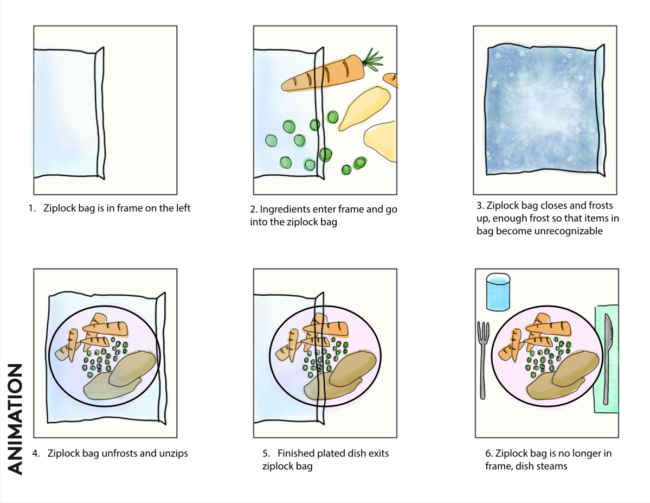
It’s a refreshing take on food prep, what was your creative process, do you sketch?
Luckily that day, I was lucky enough to work with Victoria Granof, she’s a food stylist that is always creative and always creating.  She puts her twist on food and it’s a pleasure to be a part of that. In my creative process, I make sure to stop and observe something that we might have otherwise taken for granted.  I remember a few years ago, in an airport, I noticed how beautiful the lighting was and took note of why. It’s just little things like lighting or textures that I find most inspiring. Part of my DNA is always wondering, always asking weird questions. I think a lot of my daily life is inspired by starting a phrase with, “I wonder if…” or, “I wonder why…” Generally speaking, it’s hard for me to turn creativity on and off. It’s more of me being a quirky, inquisitive person who happens to take pictures as well. A lot of my personal work is actually trying to answer those questions. Lots of caffeine never hurt either. My wife, Chelsea Cavanaugh, who is also a still life photographer, inspires me as well. We work together on every shoot, and she has an amazing vision for composition and styling. Lately, if I’ve been feeling anxious or need to change things up, I do some simple calligraphy on a post it note. Something about the process of calligraphy to me is so relaxing. I’m terrible at it, but it’s relaxing none the less.
How many frames are in the time lapse?
It averaged out to be 70 frames per animation.
For the edit from raw ingredients to fully prepared, did you vacuum seal those and add steam to indicate “process”?
Yes! Our prop stylist Megumi Emoto took a straw and sucked out all of the air in each bag for the animation. The steam was created with a handy little thing called smoke sticks, which I, unfortunately, can only find at a local store in NYC.

------------------------

Visit our sponsor Photo Folio, providing websites to professional photographers for over 9 years. Featuring the only customizable template in the world.

------------------------

01 Jun 22:07

Funnel Brings News Updates to Your Ears

by Jake Underwood

I don't need to tell you how crazy the news cycle is. Between world and tech news, I’m often drowning in a sea of headlines and big stories, confused about what’s really important. The result is a time consuming attempt at finding the best information that ends up being more of a hassle than its worth.

Funnel aims to cut through the chaos and bring you the most recent news through audio segments that are only a couple of minutes long. The app includes seven news outlets that refresh at the top of the hour so they're always up-to-date.

For those who spend most of their time listening to something, whether that’s music, podcasts, audiobooks, or something else, Funnel will fit right into your day. It’s an on-demand service that, because of its striking simplicity, gets you what you need absurdly quickly. If you want to listen to the BBC, for example, you can do that in just two taps, one of which is launching the app.

The reason it’s so easy, though, is that the app isn’t filled to the brim with content. With only seven sources, your options are limited to basic news channels, so don’t plan on hearing the latest reports on sports or technology. And while the outlets don’t all report on the same news, it’s unlikely that you’ll want to listen to every source, though if you prefer to listen that way, there's an autoplay feature that can be purchase as a $0.99 In-App Purchase.

What you wind up getting with Funnel, then, is a $1.99 app that plays audio news summaries from a handful of reputable sources. I’ve discovered that I’m okay with this, though. Instead of having to always keep up through apps like Feedly, I can check in, hear the most important stories, and get back to what I’m doing. It’s a quick interaction that is so simple that you’ll probably find yourself back for more at the top of the next hour.

For its convenience and outright rebellion against the typical hectic nature of news, I recommend you check out Funnel. There’s much already to enjoy, and if more sources come in future updates, it becomes a must-buy.

You can pick up Funnel in the App Store here for $1.99 (iPhone only).


Support MacStories Directly

Club MacStories offers exclusive access to extra MacStories content, delivered every week; it’s also a way to support us directly.

Club MacStories will help you discover the best apps for your devices and get the most out of your iPhone, iPad, and Mac. Plus, it’s made in Italy.

Join Now
01 Jun 22:06

Quote: The Difficult Demographics of Change

by pricetags

From an op-ed in Postmedia papers: Older Canadians are not the problem.

Older Canadians pay a disproportionate share of municipal taxes, with 40 percent of homes in Canada owned by those who are age 50 to 70.

The percent is probably higher in the City of Vancouver.

And in that statistic is the reason why residential property taxes are so low, particularly compared to commercial classes. And why it is unthinkable by municipal leaders to raise them enough to pay for more capital costs of rapid transit – or to capture and transfer wealth from high-asset single-family homes to pay for more affordable housing.  It’s not even seriously discussed.

It also explains the difficulty in rezoning the Great Housing Reserve of RS-1 to develop more of the missing-middle forms like row housing.

If you are over 50 (and I speak from experience) and have completely or mostly paid for the house you bought decades ago, there is little apparent reason why you would support a rezoning of your neighbourhood that would visibly change its character and bring in what you perceive to be a different class of people.  And, unthinkably, might lower the property values you have internalized as the primary source of your wealth and are counting on as you age.

You also have the interest and time to study development issues, to organize, to lobby, to complain.  And you vote.  Those younger people who might benefit don’t live there, don’t organize and vote less.

Additional irony: when younger people do organize, as the protest against the 105 Keefer project in Chinatown or the towers proposed for the Commercial-Broadway station area demonstrate, it’s to oppose larger scale development that is meant to accommodate growth to offset the difficulty in rezoning single-family areas (or neighbourhoods that look ‘single-family’ regardless of actual density.)

Which is why the middle is missing.


01 Jun 22:06

Panel in Port Moody: “Boomers, Millennials, Housing and Communities”

by pricetags

Boomers, Millennials, Housing and Communities: Metro Vancouver’s evolving demographics

Hot off the heels of Census 2016, the Port Moody Public Library is hosting a free evening panel discussion on our region’s changing demographics, and what it means for our communities. Leading experts share their thoughts and will kick-start what should be a fruitful discussion. Come prepared to hear some interesting perspectives and to ask your questions.

  • Ryan Berlin, Senior Economist, Rennie Group
  • Dr. Paul Kershaw, UBC Associate Professor and Founder of GenerationSqueeze
  • David Hutniak, CEO of LandlordBC

Moderated by Gordon Price, SFU Centre for Dialogue Fellow.


Wednesday, May 31

7 pm

Inlet Theatre – 100 Newport Drive, Port Moody

For more details or to RSVP click here.


01 Jun 22:05

British Airways communicates clearly in a crisis

by Josh Bernoff

Due to an IT systems failure, British Airways cancelled hundreds of flights from Heathrow and Gatwick airports this weekend. The company’s statements were clear, straightforward, and sympathetic — a notable contrast to the overblown, self-serving apologies that seem typical for airline screwups. As the gateway to Europe, Heathrow is one of the busiest airports in … Continued

The post British Airways communicates clearly in a crisis appeared first on without bullshit.

01 Jun 22:05

WWDC App Updated with New Design and Features

by John Voorhees

Apple has updated the WWDC app ahead of its annual developer conference that begins June 5, 2017 in San Jose, California. The app has an all-new design this year. In 2016, the UI was dominated by dark tones causing speculation that it was a precursor to a system-wide dark mode that didn’t materialize. This year’s update shares some of the same design language as the Apple Music and News apps.

In addition to the refreshed design, Apple has added curated video playlists focused on themes like Developing for iPad, interactive maps of the WWDC venue and surrounding area, for the first time, the ability to use of all of the app's features without signing into a developer account, and a new ‘Venue’ tab. Apple is also making a podcast studio available as part of WWDC for attendees who need a space to record shows.

Though not mentioned in the release notes, the WWDC app has a little surprise in store in the form of iMessage stickers. The set includes 17 colorful cartoon-style images with an assortment of classic Apple iconography, logos for Metal and Swift, and more.

The WWDC app is a free download on the App Store.


You can also follow all of our WWDC coverage through our WWDC 2017 hub, or subscribe to the dedicated WWDC 2017 RSS feed.


Support MacStories Directly

Club MacStories offers exclusive access to extra MacStories content, delivered every week; it’s also a way to support us directly.

Club MacStories will help you discover the best apps for your devices and get the most out of your iPhone, iPad, and Mac. Plus, it’s made in Italy.

Join Now
01 Jun 19:24

Apple Didn’t Kill BlackBerry

by chuttenc

bbred_wide

It was Oracle.

And I don’t mean “an Oracle” in the allegorical way Shakespeare had it where it was MacBeth’s prophecy-fueled hubris what incited the incidents (though it is pretty easy to cast anything in the mobile space as a reimaging of the Scottish Play). I mean the company Oracle was the primary agent of the the downfall of the company then-known as Research in Motion.

And they probably didn’t even mean to do it.

To be clear: this is my theory, these are my opinions, and all of it’s based on what I can remember from nearly a decade ago.

At the end of June 2007, Apple released the iPhone in the US. It was an odd little device. It didn’t have apps or GPS or 3G (wouldn’t have any of those until July 2008), it was only available on the AT&T network (a one-year exclusivity agreement), and it didn’t have copy-paste (that took until June 2009).

Worst of all, it didn’t even run Java.

Java was incredibly important in the 2000s. It was the only language both powerful enough on the day’s mobile hardware to be useful and sandboxed enough from that hardware to be safe to run.

And the iPhone didn’t have it! In fact, in the release of the SDK agreement in 2008, Apple excluded Java (and browser engines like Firefox’s Gecko) by disallowing the running of interpreted code.

It is understandable, then, that the executives in Research in Motion weren’t too worried. The press immediately called the iPhone a BlackBerry Killer… but they’d done that for the Motorola Q9H, the Nokia E61i, and the Samsung BlackJack. (You don’t have to feel bad if you’ve never heard of them. I only know they exist because I worked for BlackBerry starting in June 2008.)

I remember a poorly-chroma-keyed presentation featuring then-CTO David Yach commanding a starship that destroyed each of these devices in turn with our phasers of device portfolio depth, photon torpedoes of enterprise connectivity, and warp factor BlackBerry OS 4.6. Clearly we could deal with this Apple upstart the way we dealt with the others: by continuing to be excellent at what we did.

Still, a new competitor is still a new competitor. Measures had to be taken.

Especially when, in November of 2007, it was pretty clear that Google had stepped into the ring with the announcement of Android.

Android was the scarier competitor. Google was a well-known software giant and they had an audacious plan to marry their software expertise (and incredible buying, hiring, and lawyering power) with chipsets, handsets, and carrier reach from dozens of companies including Qualcomm, Motorola, and T-mobile.

The Android announcements exploded across the boardrooms of RIM’s Waterloo campus.

But with competition comes opportunity.

You see, Android ran Java. Well, code written in Java could run on Android. And this meant they had the hearts and minds of every mobile developer in the then-nascent app ecosystem. All they had to do was not call it Java and they were able to enable a far more recent version of Java’s own APIs than BlackBerry was allowed and run a high-performance non-Java virtual machine called Dalvik.

BlackBerry couldn’t match this due to the terms of its license agreement, while Google didn’t even need to pay Sun Microsystems (Java’s owner) a per-device license fee.

Quickly, a plan was hatched: Project Highlander (no, I’m not joking). It was going to be the one platform for all BlackBerry devices that was going to allow us to wield the sword of the Katana filesystem (still not joking) and defeat our enemies. Yes, even the execs were dorks at RIM in early 2009.

Specifically, RIM was going to adopt a new Operating System for our mobile devices that would run Dalvik, allowing them to not only finally evolve past the evolutionary barriers Sun had refused to lift from in front of BlackBerry Java…. but to also eat Google’s lunch at the same time. No matter how much money Google poured into app development for Android, we would reap the benefit through Highlander’s Android compatibility.

By essentially joining Google in the platform war against the increasingly-worrisome growth of Apple, we would be able to punch above our weight in the US. And by not running Android, we could keep our security clearance and be sold places Google couldn’t reach.

It was to be perfect: the radio core running RIM’s low-power, high-performance Nessus OS talking over secure hardware to the real-time QNX OS atop which would be running an Android-compatible Dalvik VM managing the applications RIM’s developers had written in the language they had spent years mastering: Java. With the separation of the radio and application cores we were even planning how to cut a deal with mobile carriers to only certify the radio core so we’d be free to update the user-facing parts of the OS without having to go through their lengthy, costly, irritating process.

A pity it never happened.

RIM’s end properly began on April 20, 2009, when Oracle announced it was in agreement to purchase Sun Microsystems, maker of Java.

Oracle, it was joked, was a tech company where the size of its Legal department outstripped that of the rest of its business units… combined.

Even I, a lowly grunt working on the BlackBerry Browser, knew what was going to happen next.

After Oracle completed its acquisition of Sun it took only seven months for them to file suit against Google over Android’s use of Java.

These two events held monumental importance for Research in Motion:

Oracle had bought Sun, which meant there was now effectively zero chance of a new version of mobile Java which would allow BlackBerry Java to innovate within the terms of RIM’s license to Sun.

Oracle had sued Google, which meant RIM would be squashed like a bug under the litigant might of Sun’s new master if it tried to pave its own not-Android way to its own, modern Java-alike.

All of RIM’s application engineers had lived and breathed Java for years. And now that expertise was to be sequestered, squandered, and then removed.

While Java-based BlackBerry 6 and 7 devices continued to keep the lights on under steadily decreasing order volumes, the BlackBerry PlayBook was announced, delayed, released, and scrapped. The PlayBook was such a good example of a cautionary tale that BlackBerry 10 required an extra year of development to rewrite most of the things it got wrong.

Under that extra year of pressure-cooker development, BlackBerry 10 bristled with ideas. This was a problem. Instead of evolving with patient direction, adding innovation step-by-step, guiding users over the years from 2009 to BlackBerry 10’s release in 2013, all of the pent up ideas of user interaction, user experience paradigms, and content-first design landed in users’ laps all at once.

This led to confusion, which led to frustration, which led to devices being returned.

BlackBerry 10 couldn’t sell, and with users’ last good graces spent, the company suddenly-renamed BlackBerry just couldn’t find something it could release that consumers would want to buy.

Massed layoffs, begun during the extra year of BlackBerry 10 development with the removal of entire teams of Java developers, continued as the company tried to resize itself to the size of its market. Handset prices increased to sweeten fallen margins. Developers shuffled over to the Enterprise business unit where BlackBerry was still paying bonuses and achieving sales targets.

The millions of handsets sold and billions of dollars revenue were gone. And yet, despite finding itself beneath the footfalls of fighting giants, BlackBerry was not dead — is still not dead.

Its future may not lie with smartphones, but when I left BlackBerry in late 2015, having myself survived many layoffs and reorganizations, I left with the opinion that it does indeed have a future.

Maybe it’ll focus on its enterprise deployments and niche device releases.

Maybe it’ll find a product millions of consumers will need.

Maybe it’ll be bought by Oracle.

:chutten


01 Jun 19:23

Reach Navigation

by Federico Viticci

Brad Ellis has some interesting ideas and examples on how Apple could shift the iOS interface from top-oriented navigation bars to thumb-friendly cards and sheets sitting towards the bottom of the screen:

The navbar has been essential part of iOS since Apple released the first developer kit, and it has served us well. But it’s time to let go.

Let’s agree to stop sticking important buttons to the top of the screen. Better navigation is within reach.

I think Ellis is onto something here. After Apple Music and Apple Maps in iOS 10, I'd be surprised if we don't get more of these "reach navigation" redesigns in iOS 11 (which would also make sense if Apple is releasing an iPhone with a taller screen later this year).

→ Source: medium.com

01 Jun 19:22

It would be good to know what the 13 trends are.

by Stowe Boyd

It would be good to know what the 13 trends are.

01 Jun 19:19

The Three Who Intervened

by mikecaulfield

I live in the Portland metro area; if the traffic isn’t bad I can make it from my doorstep to Powell’s in about 20 minutes. If the traffic is bad, my family sometimes parks the car at the park & ride at Parkrose, and takes the MAX in.

People don’t realize how small Portland is, and, consequently, how much the recent killings here hit people. Everything is connected here. As an example, my wife works at an art market selling her art on weekends, and a weekly paper (The Portland Mercury) just reported that the assailant in the killings, Jeremy Christian, may have been one of the people who sets up just outside the market (at Skidmore fountain) selling wares illegally off of blankets.

I’m not 100% sure that is true, but some of the artists at the market have been complaining that the police have not taken the risk involved with these unauthorized street vendors seriously.  If it is true, it changes how we think about that quirky market, and the laissez-faire attitude of the police in this town toward street activity. And it makes me worry about her, breaking down her art tent as that market empties out at night, surrounded by the homeless the city turns a blind eye to, never knowing if the person yelling obscenities and slurs at her or someone else is simply mentally ill, or mentally ill and dangerous. Or maybe just dangerous.

There are other connections, but suffice it to say Portland is really just an overgrown town at times. And a lot of what people idolize — Keep Portland Weird, after all — has a corresponding dark side, an unwillingness to confront what happens when you mix a deep historical racism with a Western left-libertarianism that sees “live and let live” as a sufficient solution to complex social problems.

On a national level, people want the killings to tell a simple story for their side, but I’m not entirely sure they do. According to Buzzfeed, the killer was not a Trump supporter, but a passionate Bernie Sanders supporter. Even as a white supremacist, he couldn’t bring himself to vote for Trump, and, like a number of Sanders supporters, sat the election out. How do we process this — the Bernie Sanders-supporting liberal-hating white supremacist?

Of the two people who gave their lives to stand up against hate and bigotry, one of them was an ex-military man, a Republican who ran for the office of county commissioner. I don’t know the political leanings of the two other heroes, the one that died and the other one who very nearly did, but of course we’re not looking to compute partisan percentages here. When the time came, people from various walks of life stood up and did the right thing, paying the ultimate price.

What do we say about this killing in supposedly-but-not-actually tolerant Portland of a virtuous Republican by a Nazi-supporting Democrat? Is it, as Noah Smith says, an indictment of the “shouting class“? Of the idea that every battle must be apocalyptic? Is it a reminder that the world does not sort into the categories we want it to? Is it ridiculous to tie this event to the performative anger we practice in the digital world, or is there something there?

I don’t know. I only know that I’m horrified to live in a city that fosters people like Jeremy Christian, but also so proud to live in a city that holds heroes like those that stood up against the hate.

So maybe the best thing for the moment might to be to shut up, and contemplate them, the three who intervened:

  • Ricky John Best, a ex-military man and current government employee. Republican. 53 years old, father of four. Was travelling back home to his family after work when he saw a man harassing two young women with violent rhetoric. He was the first to intervene, and tried to defuse the situation, while putting himself between Christian and the women. We don’t know what his last words were, but we do what he said in 2014 when asked why he was running for county commissioner. He said simply: “I can’t stand by and do nothing.”
  • Micah David-Cole Fletcher, 21, an autistic poet and PSU student who was heading to his job at a pizza shop. In high school, he won a Portland-wide poetry slam with a poem criticizing bigotry against Muslims. He would sometimes read his poetry on the MAX to other passengers. He joined Rick Best in shielding the women, and but for a millimeter’s difference in where the blade struck would be dead as well.
  • Taliesin Myrddin Namkai-Meche, 23 years old. Recent Reed College graduate, working as an intern for a sustainability consultancy firm. Son of Asha Deliverance, the owner of a company that sells portable geodesic domes. He may have initially been trying to tape the encounter at the urging of his aunt, to document it for the police, but as things escalated, he joined the other two in suggesting it’d be best if the attacker left the train. For that, he was stabbed suddenly and without warning.

asha deliverance.PNG

“Community makes everything beautiful.” — Asha Deliverance, who lost her 21 year-old son Taliesin to a white supremacist four days before. Her son’s last words, as he lay dying on the train, were “Tell them, I want everybody to know, I want everybody on the train to know, I love them.‘”

.

.


01 Jun 19:18

Best Cycle Cross Commuter Bike [closed]

by Adam893

Can anybody recommend the best Cycle cross commuter bike?

01 Jun 18:38

Inside Hillary Clinton’s Surreal Post-Election Life | Rebecca Traister

Inside Hillary Clinton’s Surreal Post-Election Life | Rebecca Traister:

I won’t mansplain the ‘Tuesday in America’ slant of this Rebecca Traister piece on Hillary. 

In the natural biorhythms of popular response to Hillary Clinton, which have been trackable for more than two decades, this is the period during which even her detractors would usually be starting to feel rugged admiration for her. Clinton has typically been most loathed when she is running for office, and most beloved after she has lost but is soldiering on, especially if the loss was sufficiently humiliating. But it’s been six months since the cataclysm of November 8, and feelings about her remain fiercely divided. Social media is awash with Hillary fans who imagine alternative universes in which she’s the president, and Etsy booms with crafts made from the words of her concession speech; yet many of her critics — even those who voted for her — are determined that Clinton bear the mantle of worst politician who ever lived, their evidence being that she lost to … the worst politician who ever lived.

The unusually prolonged pummeling is partly because Clinton’s Election Day loss was not just hers but the nation’s; her defeat this time left us not with an Obama presidency but with an out-of-control administration led by a man so inept — and so reviled — that even (some) Republicans are voicing concerns. The nation is grasping for a way to understand how we got here, and blaming Clinton wholly and neatly takes the heat off everyone else who contributed: from the critics who derided her supporters as empty-headed shills to those supporters who were cowed into secret Facebook groups; from the journalists who treated Trump as a ratings-pumping sideshow and Clinton as the suspiciously presumptive president to all of us who permitted cheerful stories about America’s progress on gender and race to blot out the real and lingering inequities in this country.

The anger at Clinton from some quarters — in tandem with the beatification of her from others — reminds us just how much this election tapped into unresolved and still largely unexplored issues around women and power. In the aftermath, the media has performed endless autopsies. We have talked about Wisconsin, about Comey, about Russia, about faulty messaging and her campaign’s internal conflicts. We have fought over unanswerable questions, like whether Sanders would have won and whether Clinton was particularly mismatched to this political moment, and about badly framed conflicts between identity politics and economic issues. But postmortems offering rational explanations for how a pussy-grabbing goblin managed to gain the White House over an experienced woman have mostly glossed over one of the well-worn dynamics in play: A competent woman losing a job to an incompetent man is not an anomalous Election Day surprise; it is Tuesday in America.

My sense is that the Bernie versus Hillary dynamic is critical for thinking about the future. Sanders was trying to move the discussion away from left-versus-right toward the new alignment: up-versus-down. Hillary didn’t go there. She adopted a few planks from Bernie, treated him like a wild-haired crazy uncle from woo woo land once he threw in with her, and then proceeded to run aground on the new alignment, and never making it her own. 

Clinton is actually only a reluctant leftist, like Bill, so the path to up-versus-down that Bernie was willing to take was always too steep a climb for her, ideologically, unlike Bernie and Elizabeth Warren.

I just hope that the ardent ideologue we need – someone who will champion the hardscrabble politics of the left behinds and dispossessed, the poor and the powerless, the on-demand and part-time workers, the young and underemployed, all the slices of the precariat; and not just the aspirational politics of the metropolitan elite – will learn from Hillary’s trajectory and trials. 

01 Jun 18:17

Samsung unveils new stretchable display

by Igor Bonifacic
Samsung stretchable display

Samsung unveiled its latest display technology earlier this week at the Display Week 2017 in Los Angeles, California.

Unlike flexible OLED displays Samsung has shown off in the past, which could only be formed in one direction, the company’s new screen can bend both ways. When pressed from above, the display stretches like a balloon, only to return to its original shape after mere moments. All this while maintaining image quality and resolution.

The specific unit Samsung showed off at SID 2017 was 9.1-inches, making it perfect for tablet devices. That said, the company notes it could scale the technology to a variety of different sizes and applications, including future wearables and devices that fall under the internet of things.

Samsung says the display “is considered to be a very promising future technology,” which is to say we probably won’t see it make its way into any consumer-facing device anytime soon. Just last year, it appeared Samsung was on the verge of releasing a foldable display smartphone with a company executive going on record to say bendable displays were “right around the corner.”

However, earlier this year, an engineer with Samsung Display said the success of the Galaxy S8 made Samsung rethink its decision to launch a foldable display smartphone in 2017. The company is now expected to launch a smartphone that incorporates a bendable display before the end of the decade.

In the meantime, CES 2018 is going to be wild.

Source: YouTube Via: SamMobile

The post Samsung unveils new stretchable display appeared first on MobileSyrup.

01 Jun 18:17

Before Alto’s Adventure, there was Toronto-based Snowman’s ‘Circles’

by Patrick O'Rourke
Circles
In celebration of Toronto-based Snowman’s five year anniversary and with Alto’s Odyssey — the sequel to Alto’s Adventure — and Where Cards Fall on the horizon, the studio is harkening back to its first mobile game ever, ‘Circles.’

As part of a new version 1.5 update, Snowman plans to reintroduce Circles to the App Store, fixing some of the game’s bugs and optimizing it for all of Apple’s modern iOS devices.

Circles
Circles is a digital take on childhood physical toys, challenging players to use their memory and pay attention to glowing multicoloured rings in a Simon-like mobile title.
“It’s an exploration of what can be done when physical play is unconstrained, and it represents the beginning of the aesthetic that’s guided all our projects,” said Snowman co-founder, Ryan Cash.
Circles 1.5 is set to release this Thursday according to Snowman. Circles is available on all iOS platforms.

The post Before Alto’s Adventure, there was Toronto-based Snowman’s ‘Circles’ appeared first on MobileSyrup.

30 May 17:18

Mozilla’s Giant, Distributed, Open-Source Hackathon

by Mozilla

Our annual Global Sprint is June 1 and 2. Scientists, developers, artists and educators will swap ideas and code to make the web a better place


Your skills and expertise are needed to help combat fake news, empower people to protect their privacy online, and build a healthier Internet.

This Thursday and Friday, we’re hosting a giant, distributed, open-source hackathon. We want to fuel the network of people who are rolling up their sleeves to make the web a safer, more secure, more inclusive place.

Will you join us?

Mozilla’s annual Global Sprint is scheduled for June 1 and 2. It’s an international public event: an opportunity for anyone, anywhere to energize their open-source projects with fresh insight and input from around the world.

Participants include biostatisticians from Brazil, research scientists from Canada, engineers from Nepal, gamers from the U.S., and fellows from Princeton University. In years past, hundreds of individuals in more than 35 cities have participated in the Global Sprint.


Who’s invited

You. And anyone else who wants to make the web a better place. The Global Sprint isn’t just about open source code—teachers, artists and activists will share their ideas and projects, too.

So far, attendees span more than 20 countries. Come June 1, we will assemble on GitHub, on Twitter, in Gitter and elsewhere to collaborate. The Global Sprint has real-world locations, too. There are already more than 65 venues booked in Australia, Bangladesh, Brazil, Japan and beyond.

What we’re making

Presently, the Global Sprint has more than 84 registered open-source projects seeking contributions. Here are just a handful:

EchoBurst, a browser extension that uses natural language processing to combat fake news, polarization and toxicity online, and bolster constructive dialogue. “Finding common ground is the only antidote to the poison of polarization,” says EchoBurst’s Tyler K. “EchoBurst takes the first step of finding that common ground, which is engaging in discussion with people you don’t agree with.”

Cryptomancer, an RPG akin to Dungeons & Dragons that also teaches users about online security. “At Global Sprint, you can invent role-playing adventures for Cryptomancer,” says Chad Sansing. “The game that asks, ‘What if dragons, dwarves, and elves had an Internet of their own?’ If you need a copy of the game, we have a free and DRM-free copy waiting for you.”

Internet Safety Driving License, an online curriculum that teaches privacy best practices, webiquette and other digital skills. “Right now we are working on Module 1: Cyberbullying Awareness Skills,” says co-creator Lisa Wright. “This is the module that we are looking for help with at the Global Sprint.

Aerogami, an interactive paper plane workshop that teaches the principles of aerodynamics. “Explaining engineering concepts is very difficult—there is too much new information and complex concepts that a student is supposed to learn in an hour of class,” says Aerogami’s Kshitiz Khanal. “I wanted to change this and make learning more interactive, intuitive and fun.”

GirlScript, a nonprofit project that empowers young Indian women through technology workshops. “We impart skills online and offline,” says GirlScript’s Anubha. “We are still preparing the online curriculum, however, offline trainings and workshops have already started in three cities of India: Nagpur, Bhopal and Ahmedabad.”

The Embryo Digital Atlas, an open-source, web-based platform to visualize complex experimental datasets of embryogenesis in an easy (and beautiful) way. “The aim of The Embryo Digital Atlas is to make public datasets of embryogenesis easily accessible for an audience ranging from curious citizen, to students, to professional researchers,” says creator Paul Villoutreix.

You can find all Global Sprint projects here.

How to participate

First, take a moment to learn about the basics of open source participation:

Then:

Register to collaborate at a site in your area, or as a virtual participant. Registration info is here.

Select a project that’s a good fit for your interests and skills. Information for Participants is here.

Bring a Project to the Sprint. Information for Project Leads is here.

See you there!

The post Mozilla’s Giant, Distributed, Open-Source Hackathon appeared first on The Mozilla Blog.

30 May 17:18

If you love Japan, make it better. Our mission statement 2019

by subcultureist

Criticism is caring.

Happy New Year 2019


If you don’t address social problems or recognise they exist, nothing changes. I love Japan and many Japanese people are hard-working, honest, and polite. That doesn’t mean the society doesn’t have problems, such as child poverty, gender inequality, discrimination against: the handicapped, women, foreigners, especially Korean Japanese—powerful organised crime, nuclear dangers, staggering injustice in the legal system, repression of the free press, sexual assault on women with impunity for many assailants, rampant labor exploitation, death by overwork, and political corruption. Ignoring the problems doesn’t make them better. If you are offended by that, rethink your love of Japan.

The Japanese government has stated: “The Universal Declaration of Human Rights states that all human beings are born free and have the right to live with dignity. Many people in the world, however, are not able to enjoy their rights. The United Nations has thus engaged itself in activities to improve human rights situations. Japan strongly supports UN activities in the human rights field, believing that all human rights are universal
Is it unfair to expect Japan to live up to its promises?

It’s a cute Japanese dog photo because who doesn’t love these loyal dogs?

The argument that “It’s worse in XXX (China,North Korea, US) so it’s okay to have XXX (sexism/racism/fascism/wage slavery/death by overwork) in Japan” is silly. It’s like the accused in a murder trail arguing, “I should be declared innocent because I only killed one person in the robbery but my partner killed three.” Some things are never okay. Whataboutism is the last resort of the intellectually dishonest weasel. (Sorry kids).

I don’t think that the work we do is shouting to the wind. Every effort matters. Sometimes sarcasm is an effective tool. We try to be polite in our response to the comments but rudeness is sometimes met with rudeness. 親しき仲にも礼儀あり

Does any of our work make a difference? Yes.
Actually, in my time as a reporter, me being “Jake Adelstein”, on editing duty today–criticism of huge problems in Japan, via articles that I have written and written with others, resulted in better laws against human trafficking, comprehensive measures to deal with dioxin pollution, and the Japanese government recently admitting that there is a huge problem with exploitation of underage girls that needs to be dealt with.

I and many of the writers on this blog who live in Japan, love this country, and loving a country doesn’t mean remaining silent; it means speaking up about what is wrong, and correcting it. The effort doesn’t always work but sometimes it yields results. And people who can’t see any fault or social problems in their country or refuse to do anything about it or just as complicit in the rise “dark corporations,” greedy nationalists, death by overwork, exploitive enterprises, corrupt politicians, and the nuclear industrial complex that have done so much harm to the nation. For decades many warned of the dangers that TEPCO and its poorly managed nuclear power plants held. They were ignored. It doesn’t make them any less correct.

The battle to protect human rights, worker rights, equal rights, the environment, democracy, the public right to know, justice, gender equality and to fight poverty and end corruption are important struggles. All over the world. Japan is no exception.

I’m a Soto Zen Buddhist priest in training, which is a part of Japanese culture–surprise! I wouldn’t argue the metaphysics of Buddhism are true, but there are universal truths and there is a motto that I have as an editor and journalist and try to keep in my own personal life. Pardon the idealism but I believe this creed applies everywhere in the world.
So below is a modified version of our editorial policy, adapted from the Dhammapada (法句経). Thank you for your consideration.

Jake Adelstein, Japan Subculture Research Center, editor in chief

Conquer anger with compassion.
Conquer evil with goodness.
Conquer trolls with humour & sarcasm
Conquer ignorance with knowledge
Conquer stinginess with generosity. 
Conquer lies with truth

30 May 17:18

LG Display Looking to Invest $3.5 Billion To Setup Another OLED Production Factory

by Rajesh Pandey
With OLED displays set to become commonplace in smartphones over the coming few years, LG Display has decided to invest around $3.5 billion (4 trillion won) in setting up an OLED production plant. Dubbed P10, the plant will only be up and running by Q2, 2018 which is still a year away from this point. Continue reading →
30 May 17:17

"As long as hierarchy persists, as long as dominations organises humanity around a system of elites,..."

“As long as hierarchy persists, as long as dominations organises humanity around a system of elites, the projects of dominating nature will continue to exist and inevitably lead our planet to ecological extinction.”

- Murray Bookchin, Toward an Ecological Society (1980).
30 May 17:17

Reducing Image File Size at Etsy

by Will Gallego

Serving images is a critical part of Etsy’s infrastructure. Our sellers depend on displaying clean, visually appealing pictures to showcase their products. Buyers can learn about an item by reading its description, but there’s a tangibility to seeing a picture of that custom necklace, perfectly-styled shirt, or one-of-a-kind handbag you’ve found.

Our image infrastructure at its core is simple. Users will upload images, we convert them to jpegs on dedicated processing machines (ImgWriters) and store them in large datastores (Mediastores). Upon request, we have specialized hosts (ImgCaches) that fetch the images from the Mediastores and send them to our users.

A simplified view of our Photos architecture

Of course, there are many smaller pieces that make up our Photos infrastructure. For example, there’s load balancing involved with our ImgWriters to spread requests across the cluster, and our ImgCaches have a level of local in-memory caching for images that are frequently requested, coupled with a hashing scheme to reduce duplication of work. In front of that, there’s also caching on our CDN side. Behind the writers and caches, there’s some redundancy in our mediastores both for the sake of avoiding single point of failure scenarios and for scale.

Throughout this architecture, though, one of our biggest constraints is the size of the data we pass around. Our CDN’s will only be able to cache so much before they begin to evict images, at which point requests are routed back to our origin. Larger images will require heavier use of our CDN’s and drive up costs. For our users, as the size of images increases so too will the download time for a page, impacting performance and resulting in a suboptimal user experience. Likewise, any post-processing of images internally is more bandwidth we’re using on our networks and increases our storage needs. Smaller images help us scale further and faster.

As we’re using jpegs as our format, an easy way to reduce the data size of our images is to lower the jpeg quality value, compressing the contents of the image. Of course, as we compress further we’ll continue to reduce the visual quality of an image—edges will grow blurry and artifacts will appear. Below is an example of such. The image on the left has a jpeg quality of 92 while that on the right has one of 25. In this extreme case, we can see the picture of a bird on the right begins to show signs of compression – the background becomes “blocky” and there are “artifacts” around edges, such as around the bird and the blockiness of the background behind.


The left with jpeg quality 92, the right jpeg quality 25.

For most of Etsy’s history processing images, we’ve kept to a generally held constant that setting the quality of a jpeg image to 85 is assumed to be a “good balance”. Any larger and we probably won’t see enough of a difference to warrant all those extra bytes. But could we get away with lowering it to 80? Perhaps the golden number is 75? This is all very dependent upon the image a user uploads. A sunset with various gradients may begin to show the negative effects of lowering the jpeg quality before a picture of a ring on a white background. What we’d really like is to be able to determine what is a good jpeg quality to set per image.

To do so, we added an image comparison tool called dssim to our stack. Dssim computes how dissimilar two images are using the SSIM algorithm for estimating human vision. Given two (or more) images, it will compare the structural similarity and produce a value from 0 (exactly the same) to unbounded. Note that while the README states that it only compares two pngs, recent updates to the library have also allowed the use of comparison between jpegs.

With the user’s uploaded image as a base, we can do a binary search on the jpeg quality to find a balance between the visual quality (how good it looks) to the jpeg quality (the value that can help determine compression size). If we’ve assumed that 85 is a good ceiling for images, we can try lowering the quality to 75. Comparing the image at 85 and 75, if the value returned is higher than a known threshold of what is considered “good” for a dssim score, we can raise the jpeg quality back up to half way between, 80. If it’s below a threshold, maybe we can try push the quality a little lower at say 70. Either way, we continue to compare until we get to a happy medium.

This algorithm is adapted from Tobias Baldauf’s work in compressing jpegs. We first tested compression using this bash script before running into some issues with speed. While this would do well for offline asynchronous optimizations of images, we wanted to keep ours synchronous so that users could see the same image on upload as they would when it was displayed to users. We were breaking 15-20 seconds on larger images by shelling out from PHP and so dug in a bit to look for some performance wins.

Part of the slowdown was that cjpeg-dssim was converting from jpeg to png to compare with dssim. Since the time the original bash script was written, though, there had been an update to allow dssim to compare jpegs. We cut off half the time or more by not having to do the conversions each way. We also ported the code to PHP, as we already had the image blob in memory and could avoid some of the calls reading and writing the image to disk each time. We also adjusted to be a bit more conservative with some of the resizing, limiting it to a range of jpeg quality between 85 and 70 to short circuit the comparisons by starting at an image quality of 78 and breaking out if we went above 85 or below 70. As we cut numerous sizes for an image, we could in theory perform this for each resized image, but we rarely saw the jpeg quality value differ and so use the calculated jpeg quality for one size on all cropped and resized images of a given upload.

As you’d expect, we’re adding work to our image processing and so had to take that into account. We believed that the additional upfront cost in time during the upload would pay for itself many times over. The speed savings in downloading images means an improvement in the time to render the important content on a page. We were adding 500ms to our processing time on average and about 800ms for the upper 90th percentile, which seemed within acceptable limits.

Time to calculate quality

This will vary, though, on the dimensions of the image you’re processing. We’re choosing an image we display often, which is 570px in width and a variable height (capped at 1500px). Larger images will take longer to process.

As we strive to Graph All the Things™, we kept track of how the jpeg quality changed from the standard 85 to vary from image to image, settling at roughly 73 on average.

The corresponding graphs for bytes stored, as expected, dropped as well. We saw reductions often ranging from 25% to 30% in the size of images stored, comparing the file sizes of images in April of 2016 with those in April of 2017 on the same day:

Total file size of images in bytes in 1 week in April, 2016 vs 2017

Page load performance

So how does that stack up to page load on Etsy? As an example, we examined the listing page on Etsy, which displays items in several different sizes: a medium size when the page first loads, a large size when zoomed in, and several tiny thumbnails in the carousel as well as up to 8 on the right that show other items from the shop. Here is a breakdown of content downloaded (with some basic variations depending upon the listing fetched):

MIME Type Bytes
js 6,119,491
image 1,022,820
font 129,496
css 122,731
html 86,744
other 3,838
Total 7,485,120

At Etsy, we frontload our static assets (js, fonts, css) and share it throughout the site, though, so that is often cached when a user reaches the listings page. Removing those three, which total 6,371,718 bytes, we’re left with 1,113,402 bytes, of which roughly 92% is comprised of image data. This means once a user has loaded the site’s assets, the vast majority of their download is then the images we serve on a given page as they navigate to each listing. If we apply our estimate of 23% savings to images, reducing image data to 787,571 and the page data minus assets to 878,153, on a 2G mobile device (roughly 14.4 kbps) it’s the difference in downloading a page in 77.3 seconds vs 60.8 seconds. For areas without 4G service, that’s a big difference! This of course is just one example page and the ratio of image size to page size will vary depending upon the listing.

Images that suffer more

Not all images are created equal. What might work for a handful of images is not going to be universal. We saw that some images in particular have a greater drop in jpeg quality while also suffering visual quality in our testing. Investigating, there are a few cases where this system could use improvements. In particular, jpeg quality typically suffers more when images contain line art or thin lines, text, and gradients, as the lossy compression algorithms for jpegs general don’t play well in these contexts. Likewise, images that have a large background area of a solid color and a small focus of the product would suffer, as the compression would run heavily on large portions of empty space in the image and then over compress the focus of the image. This helped inform our lower threshold of 70 for jpeg quality, at which we decided further compression wasn’t worth the loss in visual quality.

The first uncompressed, the second compressed to jpeg quality 40.


Other wins

Page load speed isn’t the only win for minifying images, as our infrastructure also sees benefits from reducing the file size of images. CDN’s are a significant piece of our infrastructure, allowing for points of presence in various places in the world to serve static assets closer to the location of request and to offload some of the hits to our origin servers. Small images means we can cache more files before running into eviction limits and reduce the amount we’re spending on CDN’s. Our internal network infrastructure also scales further as we’re not pushing as many bytes around the line.


Availability of the tool and future work

We’re in the process of abstracting the code behind this into an open source tool to plug into your PHP code (or external service). One goal of writing this tool was to make sure that there was flexibility in determining what “good” is, as that can be very subjective to users and their needs. Perhaps you’re working with very large images and are willing to handle more compression. The minimum and maximum jpeg quality values allow you to fine tune the amount of compression that you’re willing to accept. On top of that, the threshold constants we use to narrow in when finding the “sweet spot” with dssim are configurable, giving you leverage to adjust in another direction. In the meantime, following the above guidelines on using a binary search approach combined with dssim should get you started.


Closing

Not all of the challenges behind these adjustments are specifically technical. Setting the jpeg quality of an image with most software applications is straightforward, as it is often an additional parameter to include when converting images. Deploying such a change, though, requires extensive testing over many different kinds of images. Knowing your use cases and the spectrum of images that make up your site is critical to such a change. With such a shift, knowing how to roll back, even if it requires a backfill, can also be useful as a safety net. Lastly, there’s merit in knowing that tweaking images is rarely “finished”. Some users like an image that heavily relies on sharpening images, while another might want some soft blending when resizing. Keeping this in mind was important for us to find out how we can continue to improve upon the experience our users have, both in terms of overall page speed and display of their products.

30 May 17:16

More Than Stickers: Exploring iMessage App Utilities

by Ryan Christoffel

It has been nearly a full year since Craig Federighi introduced the iMessage App Store to developers at WWDC. Coming out of that keynote, it was easy to guess that sticker packs might become a hit with users, but the big unknown surrounded the idea of more powerful iMessage apps. Would anyone actually want to use iMessage for anything more than basic messaging?

The challenge with creating a great iMessage app is similar in ways to that of creating a great Apple Watch app. In most cases it requires taking an existing app and stripping functionality down to its simplest form, while still retaining the overall usefulness and power of the full app. And as is true with Watch apps, some iMessage apps tackle the challenge well, while others fail to be useful due to slow or overcomplicated interfaces.

The first year of the iMessage App Store has been dominated by stickers, but amidst the crazy sharks and flaming pizza, there are a number of interesting and creative apps serving as helpful utilities as well. I have tried out iMessage apps for ordering food, managing files, sharing calendars, sending payments, planning meetings, and more. What follows is a list of some of my favorites.

Unitrans: Unitrans is an iMessage-only app that translates your words, using a variety of language options, so you can send intelligible messages in a language that's foreign to you. It's a free download, but after you try it, the $1.99 In-App Purchase is a must. With the IAP the app will remember the default language for each conversation so you only have to select it once. Without the IAP, you'll have to manually set the correct language every time you use Unitrans, which is a terrible experience because the interface for selecting a language is painfully slow. Depending on the language you need, you have to tap the down arrow countless times to find it. The IAP limits that experience to the first time you message someone new with Unitrans, so I highly recommend it. Once you get the app set up, it is remarkably simple to use, and makes a perfect fit for iMessage.

Starbucks: Although some food and drink-focused iMessage apps allow you to place a group order from within Messages, Starbucks went a simpler route. The one function of the app is sending digital Starbucks gift cards to friends – a task accomplished with ease using Apple Pay. Opening the app presents a number of gift card design options, with themes related to birthdays, congratulations, graduations, and more. Tap on the design you'd like to send, and you can choose from three amount options: $5, $10, and $25. Next you just have to hit a 'Buy' button, scan your fingerprint to authorize Apple Pay, and the gift is ready to send away. Starbucks has really nailed the presentation and ease of use here, making this app a great option when you want to surprise someone with a gift.

Fandango: Fandango has packed the full ticket-purchasing experience into its iMessage app, and it works quite well. Upon opening the app, you're greeted with an assortment of movie posters that represent the top films currently showing in your area. If you don't see what you're looking for, there's a search option as well. With a movie selected, you'll see all of its showings at theaters nearby, and after selecting a showtime you're presented with two options: Buy or Send Info. The former walks you through the remainder of the purchasing process, including things like seat selection if your theater has reserved seats. Everything can be completed directly from Messages, then those tickets can be sent to your friends. If you're not ready to buy yet, you can hit Send Info to create a rich media card that can be sent to your friends. This card includes imagery from the film, the rating, running length, Rotten Tomatoes score, and the details of the showing you selected. The recipient, upon tapping this card, can hit the 'Let's Go' button or suggest a different showtime.

Venmo and Square Cash: Each of these services for sending and receiving money is built around simplicity; once you have an account setup, using Venmo or Square Cash is quick and easy. It makes sense, then, that each service would work well in iMessage. Venmo has the edge, as its iMessage app allows both sending and requesting payment, whereas Square Cash only permits the former. Rumors indicate that Apple is working on a peer-to-peer payment expansion of Apple Pay, which may prove an even simpler alternative to these options. For now though, sending and receiving money doesn't get much easier than these iMessage apps.

Who's In: Microsoft introduced Who's In last month as an easy way to plan outings with friends. When playing the role of event planner, you can use the app to browse restaurants, movie showtimes, or nearby attractions. Once you've found what you're looking for, making that selection will then prompt you for the date and time of the outing. Those details are sent to your friends in a rich card interface that looks great. When they receive your message, tapping the card will allow them to vote on if they're in for the plans or not. The ease of responding to a proposed event makes Who's In a clever, streamlined method of event planning.

Pocket: Pocket is one of the premier read-later services available today, and its iMessage app is the best way to share articles from the service through Messages. Opening the app will present a list of recent articles saved to My List. If the article you're looking for isn't there, you can use the search box to find articles both from My List and from your Archive. Selecting an article shares its native link containing a featured image, title, and link source. Alternately, if you instead share from the main Pocket app using the share sheet, what you'll share is a Pocket-specific link that results in what you see at the top of the screenshot on the right – a pocket.co link is complemented by a second message bubble containing the page's title in plain text. The iMessage app's output, seen in the bottom half of the same screenshot, is easily the superior presentation.

Dropbox and OneDrive: Both of these apps let you share files by browsing your full folder hierarchy within Messages; Dropbox has a slight edge in the field of navigation as it includes a search option, which OneDrive does not. But the way file sharing is handled is fundamentally different between Dropbox and OneDrive. When you send a Dropbox file, what you're really sharing is a file link. This allows recipients to view and download the file in question without needing to do anything extra like download an app. OneDrive opts for a different sharing route; in order to open a sent file, recipients need to have the OneDrive app installed. If they already have the app installed, though, the OneDrive iMessage app will show them a full preview of the file's contents right within Messages. Each approach has benefits and drawbacks – file previewing from within Messages is a nice user experience, and one that Dropbox doesn't have, but that benefit comes with the potential hassle of installing a new app first.

Evernote: Evernote was one of the few productivity apps that launched an iMessage app on iOS 10's release day, and if you use Evernote as your primary note database, you'll likely find a lot to like here. The iMessage app allows you to see recent notes, or search for any other note from your database, and send that note through a message. The nice thing is that all note formatting is retained and presented in an attractive fashion. The one drawback is that for recipients to view a note, they have to download the Evernote app. An account isn't necessary, simply a download; but even still, downloading the app may prove an inconvenience for others. The best use case for Evernote's iMessage app is when you know someone already uses the service, as they'll be able to both view and save any notes you send with ease.

Copied: Although Copied is widely considered a productivity app, its iMessage app isn't. It's such a clever app, though, that I wanted to mention it. The iMessage component of Copied won't send text snippets, as you might expect, but instead is used to access your own curated selection of images to send to others. You can set the app up to either display all images that have been saved to Copied in the past, or (my preference) a select group of images that's been organized using the app's Lists feature. Navigating between different image lists within iMessage is even possible. Essentially, this allows you to create your own "sticker packs" consisting of the images you want, organized the way you want.


Developers have done an admirable job building powerful iMessage apps that can make life easier. And while it is still the early days of iMessage productivity, I believe the ceiling of iMessage productivity will ultimately be set by Apple, not developers. Building useful apps is one challenge, but conveniently accessing those apps is another.

Much like the iPad's multitasking app picker, the iMessage app drawer interface has been flawed since it launched. Organizing and accessing apps is a slow process if you have more than a handful of apps installed. As a result, iMessage apps are less useful than they should be. It's easier to use Spotlight search to open the full Fandango or Venmo apps than it is to navigate the app drawer in Messages. But that can change in the future.

Apple could leverage the iMessage platform as a hub for productivity, the way Slack has built a messaging platform on third-party integrations. Whether the company wants to move that direction remains to be seen; perhaps stickers are the peak of Apple's ambition for iMessage apps. It's quite telling that only two first-party apps feature iMessage support – Music and Activity – and one contains only stickers.

The work third-party developers have done shows that potential still exists for iMessage apps to make a meaningful contribution to productivity on iOS. Whether that potential will be realized is entirely up to Apple.


Support MacStories Directly

Club MacStories offers exclusive access to extra MacStories content, delivered every week; it’s also a way to support us directly.

Club MacStories will help you discover the best apps for your devices and get the most out of your iPhone, iPad, and Mac. Plus, it’s made in Italy.

Join Now
30 May 17:16

Two Wheels To Work

by Ken Ohrn

At Dunsmuir and Richards early (for me) Monday morning, watching the people go by in droves on their way somewhere — probably to work. All a part of Bike to Work Week in Vancouver.

I was pleased and surprised by the number of people using a Mobi for their travels.

As usual, click any photo to enter a slideshow of them all.


30 May 17:13

Coming Soon

by Pixelmator Team

This is the biggest thing that we’ve ever done. The most innovative, beautiful and powerful thing that we’ve ever done. And it’s also the most Mac thing that we’ve ever done! This is what the legendary Pixelmator Team has been secretly and incredibly passionately working on for 5 whole years.

It turned out to be the coolest thing that we or anyone else has done in years, and, oh boy, I wish I could unveil everything just now, but I can’t. Well, I could, but I don’t wan’t to. Just yet. I am very excited about it and I really want every single thing to come out perfectly. So no details for now. But be sure that the entire team is currently working hard to bring you a lot more about what we’re doing — ASAP.

Great times ahead (again).

And because of all this, I highly recommend you subscribe to our Notify Me list or follow us on Twitter to be the first to know as soon as we have something more to reveal.

30 May 17:11

Oregon Precedent: Bike tax for bike paths?

by pricetags

From KNKX: Oregon Bicyclists Could Pay Tax To Fund Bike Path Improvements 

A proposed $8 billion transportation spending package in Oregon could include a tax on the sale of bicycles. It’s a funding idea that’s often talked about but has rarely been implemented nationwide. …

The bike tax is still being debated at the state capitol, but the current proposal would tack on anywhere from three to five percent to the cost of a new bike. Under the current version of the plan, the tax would only apply to adult bikes that cost more than $500. …

Democratic Senator Lee Beyer helped craft the bike tax proposal. He says it came in response to a common refrain among lawmakers and the public.

“They felt that bicycles ought to contribute to the system, bicycle owners ought to contribute to the system, irrespective of the fact that most of them also own a car,” he said.

As for the cost, Beyer says the tax needs to be large enough to generate significant revenue above the cost of collecting it. But he says the fact that it’s in there at all means bike riders are now among the state’s transportation priorities.

“There’s a pretty big commitment to bicycle commuters in the [bill], and to the extent we do that, there are certain environmental advantages to do that, and it does address congestion to some extent as well.”

If it passes, Oregon would be the only state with a statewide tax specifically for bicycles, though it’s been proposed in many places. Some cities around the country do charge bicycle owners a registration fee.


30 May 17:11

Photon Engineering Newsletter #3

by dolske

Three! Time for update number three! Ah-ah-ah…

Let’s get straight to it.

Recent Changes

Menus/structure:
  • Work on the new application menu is nearing completion. Edit controls and Firefox Account status have been added, along with keyboard navigation. The “exit” and “zoom” controls are the last remaining features to implement.
  • The new overflow menu panel is done, except for polish and bug fixes.
  • The above are still behind the browser.photon.structure.enabled while we finish initial development, but we expect to turn them on by default (in Nightly) in the next couple of weeks.
  • The new sidebar switcher has landed. You can change what’s displayed in the sidebar (bookmarks, history, synced tabs) from at control at the top of the sidebar itself.
  • Work on the new Library button is starting.
Animation:
  •  Work continues on animations for downloads toolbar button, stop/reload button, and page loading indicator – but these haven’t landed yet.

Preferences:

Visual redesign:
Onboarding:
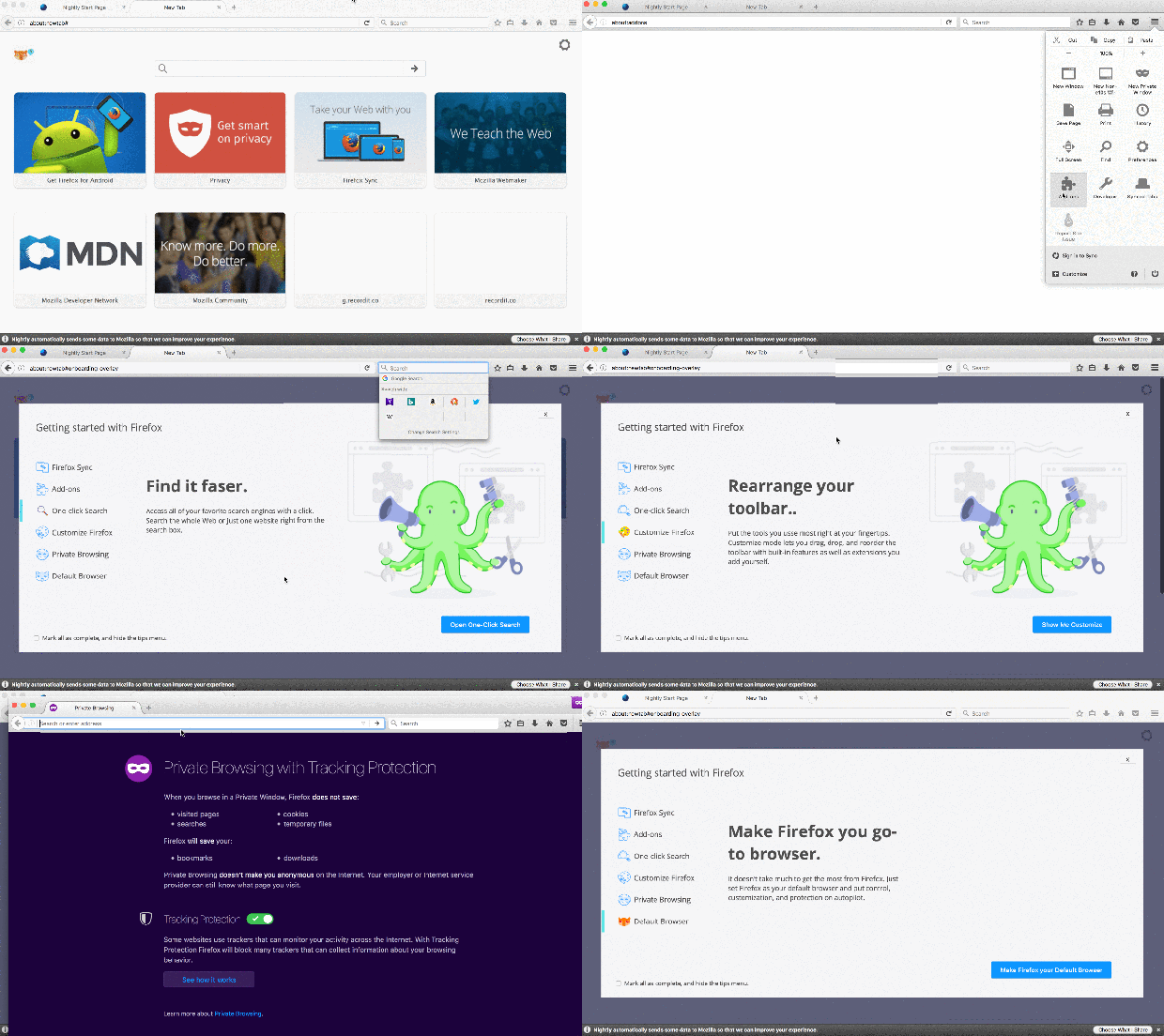
  • The skeleton of the onboarding overlay system add-on is under review. This will initially be used to introduce new Firefox users to some of the great features of Firefox they might not otherwise know about. Later, we’ll be using this same framework to help introduce existing Firefox users to the changes coming in Firefox 57. Here’s a short GIF from the prototype showing what the experience is like, starting from a badge on the new-tab page:
    onboarding.gif
  • Other improvements to the first-run experience are planned to ship in Firefox 55: a better download page, updated stub installer, removing the default-browser prompt, and a less intrusive data-privacy notice. We want to help new users start using Firefox without annoyances or hassle.
Performance:


That’s it for now. More next time!


30 May 17:09

Vector Capital to acquire Waterloo-based Sandvine for $483 million

by Jessica Galang
sandvine

Waterloo-based Sandvine has entered into an agreement with Scalar AcquireCo, which is set to acquire all issued and outstanding shares of Sandvine.

Scalar Acquire is an affiliate of Vector Capital, a global private equity firm based in San Francisco. Following the acquisition, Sandvine will be de-listed from the TSX and no longer trade publicly.

“The Sandvine team has built the clear leader in network policy control and I am extremely proud of what we have accomplished to date,” said Dave Caputo, Sandvine’s President and CEO. “There are a number of long-term growth opportunities that Vector, as a specialist technology investor, is enthusiastic about and can help us pursue more aggressively. We see this as an excellent opportunity to better serve our 300-plus customers, to enhance our strategic position over the longer term, and to do it the Sandvine way.”

Caputo and members of Sandvine’s senior management team of co-founders — CTO Don Bowman, COO Tom Donnelly, and COO Brad Siim — as well as CFO Scott Hamilton have agreed to exchange an aggregate of 5.1 million shares for shares of an affiliate of Scalar Acquireco.

“Sandvine is at a major transformation point in its evolution,” said David Fishman, Managing Director and Head of Investment Team at Vector Capital. “Vector’s financial and strategic support will enable the company to continue its leadership in network policy control. We believe that our long-term approach will enable Sandvine to continue to expand its lead in its traditional areas of strength and better execute on a number of emerging opportunities, such as its next-generation virtualized offerings and cyber security.”

Sandvine’s platform creates intelligent broadband networks for communication service providers (CSPs) to gain business intelligence, traffic optimization, and network security. In March 2016, Sandvine received $15 million from the Ontario government, which it used to expand research and development and grow the team. Shortly after, Sandvine partnered with Waterloo-based TextNow to power the company’s wireless services in the US.

This article was originally published on BetaKit.

Source: Sandvine

The post Vector Capital to acquire Waterloo-based Sandvine for $483 million appeared first on MobileSyrup.

30 May 17:08

Andy Rubin’s Essential Phone wants to be your next smartphone

by Igor Bonifacic
Essential Phone

After months of teasing, Essential, the company that Andy Rubin, the man known as the father of Android, founded, has its unveiled first smartphone.

Known simply as the Essential “PH-1” Phone, the device is an ambitious high-end Android smartphone that combines, into one cohesive package, many of the unique and disparate ideas we’ve seen other smartphone OEMs attempt over the past few years.

essential phone

The Essential Phone’s most noticeable hardware feature is its edge-to-edge display, which Essential has taken to calling a “Full Display.” It’s a 19:10, 2560 x 1312 pixel QHD screen that one-ups similar bezel-less displays from Samsung and LG by extending all the way to the top of the device and around the phone’s front-facing camera.

The entire device is made from Gorilla Glass 5, titanium and ceramic. It also doesn’t include any branding. Thanks to this design, Essential says its phone is significantly more durable than competing devices like the iPhone and Galaxy S8.

Also notable is the smartphone’s back-facing camera. Like the iPhone 7 and Huawei P10, the Essential Phone features two back-facing cameras. Like the P10, the second camera features a monochromatic sensor. According to Essential, this allows the Essential Phone’s back-facing camera to capture 200 percent more light than a traditional smartphone camera, leading to best-in-class low light performance. On the front of the device, is an 8-megapixel camera that can capture 4K video.

The company will also ship a separate 360-degree camera. The optional accessory is capable of capturing 4K 360-degree video at 30 frames per second. It attaches via two magnetic ports on the back of the device. Essential claims its 360-degree camera is the smallest in the world. The company will ship other modular accessories that connect to the back of the Essential Phone and add additional functionality to it in the future.

The phone is no slouch when it comes to performance. It features a Snapdragon 835 processor, 4GB of RAM, 128GB of internal storage, a 3,040mAh battery and back-facing fingerprint sensor. In terms of connectivity, the Essential Phone supports USB-C, Wi-Fi 802.11ac and Bluetooth 5.0.

It also supports some but not all Canadian carrier frequencies and bands. Notably, the Essential Phone does support Band 66. Unfortunately, it doesn’t support the requisite 1700 and 2100 Mhz frequencies to make it compatible with Freedom Mobile’s LTE network.

Essential Camera

Moreover, it’s missing several features that have become commonplace with other high-end devices like the Galaxy S8 and LG G6, including water-proofing and microSD expandability. It also doesn’t include a headphone jack — according to Essential, the phone will ship with a USB-C headphone dongle.

Essential did not say much about the PH-1’s software. It will run a stock-like version of Android 7.1.1 that’s designed to work in conjunction with the company’s Essential Home product.

At launch, the Essential Phone is set to cost $700 USD (approximately $943 CAD) unlocked. Essential did not announce a Canadian release date for the device.

Source: Essential

The post Andy Rubin’s Essential Phone wants to be your next smartphone appeared first on MobileSyrup.

30 May 17:07

Here are the Essential Phone’s specs

by Dean Daley
Essential Phone

Andy Rubin’s Essential company has unveiled its first devices, the Essential phone (PH-1) and the Essential Home.

Specs-wise the Essential Phone is a technical powerhouse. Similarly sized to the Samsung Galaxy S8, the device is 5.71-inches, features a minimal bezel, and includes Bluetooth 5.0. The smartphone’s body features a unique design that makes it stand out when compared to the HTC U11, LG G6 and Galaxy S8. The Essential smartphone also includes modularity like the Moto Z.

What you may notice from the specs is that the Essential Phone is lacking a headphone jack, any note of it being waterproof or dust resistant, and it doesn’t feature a microSD slot. However, the device does include a titanium frame that should protect from falls that could be fatal to other smartphones.

The Essential company also unveiled its Essential Home device, a voice-activated speaker similar to Amazon’s Echo Show. The Essential Home features its own Ambient OS and has the ability to connect with other IoT products in your household.

The post Here are the Essential Phone’s specs appeared first on MobileSyrup.

30 May 17:06

15-inch MacBook Pro shipping delay could indicate upgraded Pro hardware at WWDC

by Patrick O'Rourke
MacBook Pro

While rumours that Apple could be preparing to release new MacBooks with updated hardware have surfaced a few times over the last few months, it looks like there is at least some truth to this speculation.

Typical free shipping times for 15-inch MacBook Pro orders are same-day and then three-to-five business days in most countries (including Canada). Now, however, deliveries have been pushed until after June 6th, conveniently the day after the company’s WWDC keynote presentation. There aren’t, however, any delays related to the 13-inch model of the Pro as of right now.

Rumours indicate that the new, revamped MacBooks won’t feature any substantial external changes, but that they will feature a bump in processor power thanks to Intel’s 7th generation Core chips, as well as other hardware-related improvements that could lead to longer battery life and better integrated graphics processing.

It’s also possible that the MacBook Pro could be updated to support 32GB of RAM, a significant upgrade over the laptop’s current 16GB limit. Some rumours also indicate that the 12-inch MacBook could receive a hardware update as well.

The fact that the MacBook line is set to be updated so soon is rather notable. This suggests that the era of waiting for hardware updates to Mac products could be over, with the tech giant making more of an effort to stay up to pace with the latest CPU technology.

Source: MacRumors

Via: Engadget

The post 15-inch MacBook Pro shipping delay could indicate upgraded Pro hardware at WWDC appeared first on MobileSyrup.

30 May 16:50

Two Wheels To Work

by Ken Ohrn
mkalus shared this story from Price Tags.

At Dunsmuir and Richards early (for me) Monday morning, watching the people go by in droves on their way somewhere — probably to work. All a part of Bike to Work Week in Vancouver.

I was pleased and surprised by the number of people using a Mobi for their travels.

As usual, click any photo to enter a slideshow of them all.


30 May 16:40

Worldwide smartphone shipment in 2017 expected to increase over 2016

by Bradly Shankar
Samsung S8, LG G6 and Google Pixel

A new forecast from the International Data Corporation (IDC) Worldwide Quarterly Mobile Phone Tracker estimates that worldwide smartphone shipments will grow three percent in 2017 over the previous year. In 2016, year-over-year growth was only 2.5 percent, which was the lowest growth ever experienced by the industry. IDC says that with several new smartphones being introduced in 2017, including the Samsung Galaxy S8 and S8+, shipment volumes will grow to 1.52 billion throughout the year. This momentum is also expected to carry into 2018, with smartphone shipments forecasted to grow 4.5 percent year over year thanks to improved economic conditions in many emerging markets and a suite of new iPhones.

In the press release, IDC also broke down figures per phone platform:

Android

“The discussion around Android’s share of the smartphone market became irrelevant a few years back,” IDC wrote, as Google’s OS has continued to capture roughly 85 percent of the worldwide smartphone market. What is interesting is to look at the many micro-trends going on within the platform. IDC says it expects the Middle East and Africa regions for Android devices to show the fastest growth at 10 percent year-over-year, which will help overall worldwide growth reach 4.1 percent.

iOS

Last year marked the first time that iPhone shipments declined, but 2017 expectations say that 2017 volumes will grow 3.8 percent. IDC’s 2017 projections for Apple were slightly lowered for the 2017 forecast to 223.6 million, while 2018 volumes were increased to 240.4 million. “All signs point to late 2017 and certainly 2018 being very strong for Apple as much of its installed base seems ready for a refresh and the next round of iPhones is not likely to disappoint its fans,” IDC wrote.

Windows

Windows Phone shipments have continued to drop, and IDC expects volumes in 2017 to decline nearly 81 percent to just 1.1 million units. “Microsoft has yet to fully commit to any “Surface”-style attack for smartphones or to push new vendors to embrace the platform, leaving little hope of mounting a full scaled comeback in the years to come,” IDC wrote. It’s worth noting that Microsoft CEO Satya Nadella said the company hasn’t given up on smartphones. Earlier this month, Nadella said that he’s “sure [the company will] make more phones, but they will not look like phones that are there today.”

Keeping the momentum going

IDC cited several factors that it believes will help the smartphone market to regain some of its momentum going forward. “First and foremost is that less than half the world’s population is currently using a smartphone, and markets like the Middle East & Africa, Central & Eastern Europe, and Southeast Asia still have plenty of room to grow,” said Ryan Reith, program vice president with IDC’s Worldwide Quarterly Mobile Device Trackers. “In addition, as consumers continue to demand more from their smartphones we expect to see a large portion of the installed base that is currently using low-end devices begin to seek a more robust experience on more capable devices. Media consumption, gaming, augmented and virtual reality, and constant connectivity are drivers of this trend.”

More innovation is needed

The report also noted that companies will need to start offering more with their phones to make a bigger splash. “With the ongoing fight at the high end, vendors will need to find a way to innovate ahead of the curve to attract new users and increase shipments while driving profits,” said Anthony Scarsella, research manager with IDC’s Worldwide Quarterly Mobile Phone Tracker. “The display looks like it could be the next battlefield for the smartphone over the next couple years. As smartphone owners continue to consume media on their devices, the screen (bigger, brighter, and bolder) will be an integral part of the overall design language for each vendor.”

Recent reports seem to corroborate what Scarsella is saying. Apple has reportedly already ordered 60 million OLED panels from Samsung for its upcoming iPhones. As well, Google is said to have invested nearly $900 million into securing OLED screens for its upcoming Pixel 2 phone and LG might be set to release its first ever smartphone carrying this display in the third quarter of 2017.

Source: IDC

The post Worldwide smartphone shipment in 2017 expected to increase over 2016 appeared first on MobileSyrup.