Rolandt
Shared posts
Lucy’s restaurant in Stanley to close this summer after 23 years as a Hong Kong South Side fixture
Talking To Members Saves Time
Of course, you can find the time to interview at least 1 member per week.
Talking to members saves time.
It lets you stop working on things that won’t succeed, it lets you zero in on what members are passionate about, and it lets you phrase messages in the language of your members.
I wish we each had a timer counting the amount of time we wasted on initiatives which weren’t as successful as we thought they would be. This would show the value of community so clearly.
Participating in discussions and replying to questions isn’t enough. You need to proactively set aside time each week to interviewing members in depth.
Find out how they found the community, what were they looking for, what problem did they want to solve (that’s your landing page copyright there).
Find out how they participate in the community, when do they remember to participate, what do they visit the community to do (that’s your site structure and autoresponder campaign).
Find out what their biggest problems and aspirations are. What’s stopping them from achieving those aspirations or keeping them in fear? (this is your activities and content).
Feel free to probe and go deeper in more interesting areas.
It’s easy to be super active in a community and not really know members well at all. Make sure you regularly speak with members. Just one member a week can suffice.
The reason you don’t have the time is because you’re so inefficient with your time today. Interviewing members regularly will help.
Try just 1 interview this week. You will learn something you didn’t expect.
Giving Up Time as a Parent

There is a fixed number of minutes during the day. Where do parents usually draw the time from? Read More
Bicycle-powered Menabrea beer dispenser
Cycle. Beat the on-screen pace. Receive free Menabrea beer. All on a system controlled by a Raspberry Pi.
Honestly, what’s not to like?
Menabrea UK
If you’re wondering what it takes to win an ice cold pint at one of our Race to Biella events, this clip will give you more of an idea. It’s no mean feat!! Do you think you have the pedal power? Join us tonight at The Avonbridge Hotel for sunshine, cycling and, of course, a refreshing pint or two.
Glasgow-based creative content agency Bright Signals were contacted by Wire with a brief for a pretty tasty project: create something for Menabrea that ties in with the Giro d’Italia cycle race passing close to the brewery in Biella, Northern Italy.
Cycle race, was it? Menabrea brewery, you say?
The team at Bright Signals came up with the superb idea of a bicycle-powered Menabrea beer dispenser.
It must be noted that when I said the words ‘bicycle-powered beer dispenser’ aloud in the Raspberry Pi office, many heads turned and Director of Software Engineering Gordon Hollingworth dropped everything he was doing in order to learn more.
The final build took a fortnight to pull together, with Bright Signals working on the Raspberry Pi-controlled machine and Wire in charge of its graphic design.

Cheer for beer!
Image c/o Grant Gibson and Menabrea
Reuse, reduce, return to the bar
“This was probably one of the most enjoyable builds I’ve worked on,” says Bright Signal’s Deputy Managing Director, Grant Gibson. “We had a really clear idea of what we were doing from the start, and we managed to reuse loads of parts from the donor bicycle as we simplified the bike and built the pouring system.” The team integrated the bottle cage of the donor bike into the main dispensing mechanism, and the bike’s brake levers now cradle a pint glass at the perfect angle for pouring.
A Raspberry Pi powers the 24″ screen atop the beer dispenser, as well as the buttons, pouring motors, and lights.

Perfect size for the Raspberry Pi lobby!
Image c/o Grant Gibson
Giro di Scozia
Fancy trying Menabrea’s bicycle-powered beer dispenser for yourself? The final stop of its 4-week tour will be the Beer Cafe in Glasgow this Friday 2nd June. If you make it to the event, be sure to share your photos and video with us in the comments below, or via our social media channels such as Twitter, Facebook, and Instagram. And if you end up building your own beer-dispensing cycle, definitely write up a tutorial for the project! We know at least one person who is keenly interested…
Menabrea on Twitter
Another successful racer wins a pint of Menabrea in the #racetobiella. The bike’s at The Fox and Hound, Houston today…
The post Bicycle-powered Menabrea beer dispenser appeared first on Raspberry Pi.
Motorists misjudge bicycle speed
This question is probably a little too location-specific but I hope it attracts some good answers
Okay, here we go...
Most cities in India do not have dedicated paths/lanes for bicycles
We are expected to ride our bikes on the roads sharing space with a variety of vehicles
(Except for expressways, where two-wheeled/three-wheeled vehicles are prohibited anyway)
In my experience, most motorists are pretty good at estimating my speed when I cruise under 25 kmph
But I often cruise at 35 kmph, occasionally touching 40 kmph for short distances
Some motorists, especially people riding motorbikes, cut me off quite close when they overtake me from behind
Sometimes, motorists attempt to overtake me and realize that I am moving at only a slightly lesser speed than them, after driving in parallel with me for several metres
This is even more common on roads which are 2-lane undivided carriageways
The other scenario equally common is oncoming traffic, where one vehicle is trying to overtake another assuming they can finish the maneuver before they cross me
I solve this problem by occupying the entire lane and slowing down as necessary The difference is that both the oncoming traffic and i can see each other and we can make each other aware of our intentions
The question is how can I warn the drivers intending to overtake me, that I am moving at faster speeds than an average commuter?
It is interesting to note that I get more attention and consequently more space when riding with a helmet and bright coloured t-shirts on weekends but not when I am riding with normal work clothes
PS: I finally decided to post this question after increased vehicular traffic in my area made these kind of encounters almost a daily affair Please feel free to edit/comment for clarification


The End of the American World: Without Vision there can be no Leadership
Comparing High-Growth Neighbours: Seattle and Vancouver
From the Seattle Transit Blog:

Seattle’s growth is still accelerating. Census estimates released yesterday show almost 21,000 new residents in Seattle in the year ended July 2016. With 704,000 residents, Seattle is once again the nation’s fastest growing city with 3.1% annual growth.
We’ve become accustomed to fast growth, averaging 15,000 new residents in Seattle annually between 2010 and 2015. So it’s impressive how Seattle has stepped up its game to add even more residents. As Gene Balk observed yesterday, Seattle is only the second top 50 city to grow more than 3% in one year this decade (the other was Austin in 2012). 3% growth in a mature city is a big deal.
What are some comparatives for Vancouver? Here are figures from the 2016 Census for the City of Vancouver, provided by Chris Robertson at the City of Vancouver.
- The 2016 Census population for the City of Vancouver is 631,486 (compared to 704,000 in Seattle).
- There has been a population increase in the City of Vancouver of 4.6% (27,984 people) from 2011. (That’s about 28,000 people over the last five years in Vancouver, compared to 21,000 in Seattle over the last year.)
- From 2006 to 2011, the City of Vancouver’s growth rate was 4.4% (25,461 people) – so there has been an increase in the growth rate of 0.2%.
- The overall growth rate of Vancouver’s Census Metropolitan Area (CMA) was 6.5% (150,103 people) between 2011 and 2016.
- The Census shows the City has the highest population density in Canada with 5,493 people per square kilometre. Among larger municipalities, the next three with the highest population density are all located within Montreal’s CMA.


Recommended on Medium: Journaling Can Jumpstart Your Creativity
Practicing creativity can be difficult, but keeping a journal is a great way to make creativity a daily habit.

Creativity.
As a writer and graphic designer, it’s a skill I consider integral to my work. Every day, I’m asked to create something that will inspire others to take action. If I’m not creating something, I’m not accomplishing anything.
If you’re not a writer or designer, don’t worry! Creativity is integral to your work as well. Beyond the world of artists, writers and musicians, creativity is solving problems, identifying patterns, and using information in new and unique ways. The most successful people I know are highly creative thinkers. These people also know that creativity takes practice.
Practicing creativity, however, is difficult. Often we’re expected to be creative and given no time to practice. This is where journaling can come in handy. I have found that when I keep a record of my thoughts, ideas, and experiences, I am more likely to apply my creative skills to my daily tasks.
Here are five ways keeping a journal has helped me improve my creativity:
1. Record your best ideas
“Keep in mind that ideas are generally fleeting and must be captured as they arise. Some will hang around and let you mull them over, but most are like a flash of lightning and need instant attention.” –Bill West, The Imagineering Workout
I know—this one seems obvious. What else are journals for? However, I’ve found huge creative value in keeping a record of things I’m thinking and doing. Often my best ideas come when I’m not able to act on them. There have been countless moments when I have sat down to write something and wasted most of my time trying to remember the idea I had in the shower that morning. Writing down inspiration when it strikes is the fastest way to build a library of your best ideas.
2. Practice thinking freely
“The best way to become a producer is to sit down every day and create. If you do that enough, you’ll consistently open yourself up to creating awe-inspiring work.” –Blake Powell
If creativity is the process of making connections and solving problems, a creative person should be used to thinking freely. Journaling is a great way to let your ideas flow unhindered. Whether that involves a daily dump of the day’s accomplishments, jotting down your dreams in the morning, or an evening creativity exercise, giving yourself time every day to think freely without any fear of judgement will improve your ability to generate ideas freely on a regular basis.
And, as a bonus, you might be able to add to your library of best ideas.

3. Refine your best ideas
“Just (make) something. It might be something crummy or awkward or not ready for prime time. If you make something, you are creative.” –Sonia Simone
Sometimes it’s easier to create ideas than it is to act on them. During my freshman year of college, I began writing recaps of college football games. These recaps were crude at best, but more than anything else, this weekly exercise in critiquing helped me learn how I write. I learned how to research a topic quickly, the importance of letting my thoughts collect, and the art of editing my writing. I found my writing voice by consistently expanding on one of my best ideas.
Like the exercise of letting your ideas flow, a journal can be a great place to practice a specific creative goal. Take one of your best ideas and flesh it out. Start setting goals to help you bring that idea to fruition. Recording your progress on a regular basis is a great way to remind yourself that you are a creative person.
4. Trigger your best ideas
“Creative refers to every single aspect of life, not only what you do, but how you do it, and how you think about the world.” –MK Haley, The Imagineering Workout
The greatest enemy of creativity is the dreaded rut. It’s very easy to get into a routine and forget the benefits of free thinking. Keeping a journal is incredibly useful when I’ve encountered these ruts. By keeping a log of what I do on a regular basis, I have a record of what might have gotten me into that rut. I also have a record of where I was and what I was doing when some of my best ideas arrived. I can analyze my routines and discover what got me into a particular rut or I can recreate a specific creative environment. Journaling helps me make creativity a process instead of a checklist.
5. Refill the tank
“The brain is like a muscle — sometimes it needs to be relaxed.” –lazyguru

Creative thinking is hard work. Often, when I’m in a creative rut, I’ve found it’s because I need to take a break. You can only create something if you have the resources to make it. Just like a journal is useful for recording your best ideas, a journal is also useful for relaxing. Meditate on your experiences. Pick up a new hobby and document your progress. Take a vacation and keep a travelogue. The best creative thinkers know when to take a break. Keeping track of those breaks in your journal will make them more memorable and effective.
Creativity is waiting
These five tips are just a few ways that keeping a journal can improve your creative abilities. The most important piece of creativity is regular practice, and keeping a journal is a great way to ensure that practice happens. Start journaling, and make creativity a habit instead of a talent.
Journaling Can Jumpstart Your Creativity was originally published in Day One on Medium, where people are continuing the conversation by highlighting and responding to this story.

Recommended on Medium: Trickle-down workaholism in startups

If you want to understand why so many startups become infected with unhealthy work habits, or outright workaholism, a good place to start your examination is in the attitudes of their venture capital investors.
Consider this Twitter thread involving two famous VCs, Keith Rabois and Mark Suster:
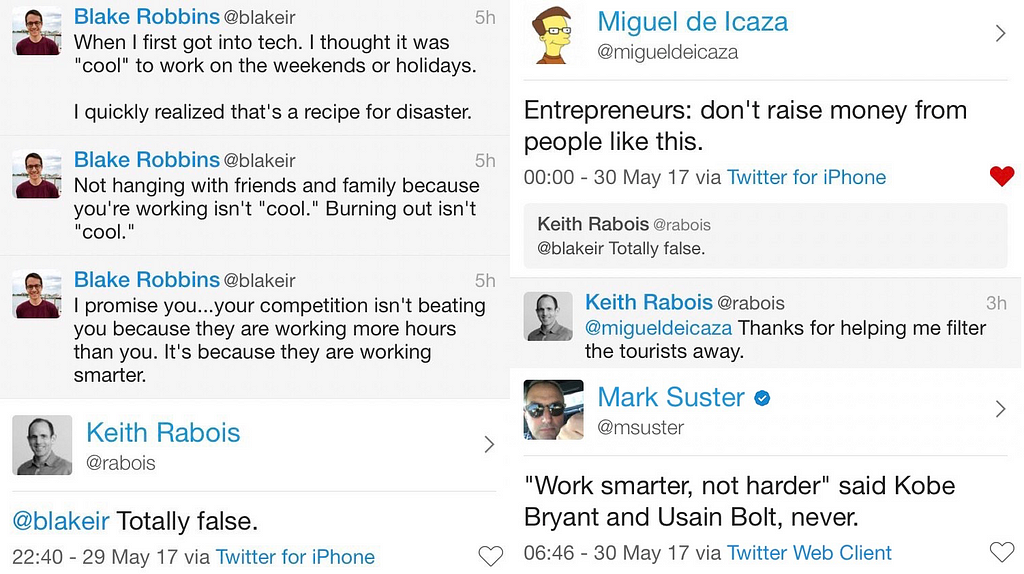
These sentiments are hardly aberrations. There’s an ingrained mythology around startups that not only celebrates burn-out efforts, but damn well requires it. It’s the logical outcome of trying to compress a lifetime’s worth of work into the abbreviated timeline of a venture fund.
It’s not hard to understand why such a mythology serves the interest of money men who spread their bets wide and only succeed when unicorns emerge. Of course they’re going to desire fairytale sacrifices. There’s little to no consequence to them if the many fall by the wayside, spent to completion trying to hit that home run. Make me rich or die tryin’.
The entrepreneurs who sign up for such pressures may have asked for it. If you, knowing their sentiments, ask Rabois or Suster for millions to fund your venture, then you probably should expect to have your vacations, weekends, hobbies, family time, or outings with the kids questioned.
But the pressures don’t stop with the person who signs the term sheet. That shit trickles down. In fact, it’s likely to amplify as it rolls down the hill, like a snowball gathering mass. Because once the millions have cleared, and the headcount has been boosted, it’s usually other people who actually have to make good on those exponential expectations.
The sly entrepreneur seeks to cajole their employees with carrots. Organic, locally-sourced ones, delightfully prepared by a master chef, of course. In the office. Along with all the other pampering and indulgent spoils AT THE OFFICE. The game is to make it appear as though employees choose this life for themselves, that they just love spending all their waking (and in some cases, even sleeping) hours at that damn office.
And if the soma-like inducements don’t work, there’s always the lofty talk about THE MISSION: We’re not just here to capture more attention or steal more privacy in the name of advertising, no, we’re connecting the world! Your single-track life has meaning! All your sacrifices are for a greater good!
Yeah, right.
Not only are these sacrifices statistically overwhelmingly likely to be in vain, they’re also completely disproportionate. The programmer or designer or writer or even manager that gives up their life for a 80+ hour moonshot will comparably-speaking be compensated in bananas, even if their lottery coupon should line up. The lion’s share will go to the Scar and his hyenas, not the monkeys.

And yet so many continue to go along, because they already went this far. Sunk cost is an easy theoretical concept, but it’s devilishly hard to put in practice. Which is why the yoke of the four-year vesting cliff, the short-exercise window for options, and all the other tricks and techniques employed by cap table-designing masters are so effective. Once the hook is in, the line and the sinker follows easily.
But it will be in spite of prevailing evidence on the power of sleep, recuperation, and sustainable work habits. Whether you’re a top-flight basketball player, like Kobe Bryant, whose off-season work schedule is limited to just six hours per day:
The Kobe Bryant workout routine features a hefty mix of track work, basketball skills and weightlifting. His off-season workout has been called the 666 program because he spends 2 hours running, 2 hours on basketball, and 2 hours weightlifting (for a total of 6 hours a day, six times a week, for six months).
Or his competitor, LeBron James, who frequently gets 12 hours of sleep. Or any of the other star athletes who prioritize their sleep and recuperation as a key component of their performance:
Since athletes need more sleep than average people, eight to 10 hours of zzz’s a night is recommended, and that’s not just before game day — that’s every evening. After all, the more often and more vigorously you use your muscles, the more time it takes for your body to repair and rebuild them. Roger Federer and LeBron James famously snooze for an average of 12 hours a night, while Usain Bolt, Venus Williams, Maria Sharapova, and Steve Nash get up to 10 hours a night. Federer has said, “If I don’t sleep 11 to 12 hours per day, it’s not right.
Or how about prodigious thinkers and writers, like Trollope, Dickens, or Darwin who all sought to complete their work within fixed, modest slices of the day, and then kept the rest for leisure. Here’s Darwin’s routine:
After his morning walk and breakfast, Darwin was in his study by 8 and worked a steady hour and a half. At 9:30 he would read the morning mail and write letters. At 10:30, Darwin returned to more serious work, sometimes moving to his aviary, greenhouse, or one of several other buildings where he conducted his experiments. By noon, he would declare, “I’ve done a good day’s work,” and set out on a long walk on the Sandwalk, a path he had laid out not long after buying Down House. (Part of the Sandwalk ran through land leased to Darwin by the Lubbock family.)
When he returned after an hour or more, Darwin had lunch and answered more letters. At 3 he would retire for a nap; an hour later he would arise, take another walk around the Sandwalk, then return to his study until 5:30, when he would join his wife, Emma, and their family for dinner. On this schedule he wrote 19 books, including technical volumes on climbing plants, barnacles, and other subjects; the controversial Descent of Man; and The Origin of Species, probably the single most famous book in the history of science, and a book that still affects the way we think about nature and ourselves.
Neither these athletes or these writers were giving up anything on whatever contemporaries that may have put in more time, more hours, or greater sacrifices. Their contributions to the world were in no way diminished by their balanced approach, quite the contrary.
So don’t tell me that there’s something uniquely demanding about building yet another fucking startup that dwarfs the accomplishments of The Origin of Species or winning five championship rings. It’s bullshit. Extractive, counterproductive bullshit peddled by people who either need a narrative to explain their personal sacrifices and regrets or who are in a position to treat the lives and wellbeing of others like cannon fodder.
Finally, as way of having my own skin in the game, we’ve been running a wonderfully successful business at Basecamp for some fourteen years now. One profitable since the get-go without demanding the total consumption of life force from the people working here. Neither from Jason nor I, nor from our employees.
Hell, right now, we’re working our four-day summer weeks until the end of August. This while servicing over a hundred thousand paying customers, stewarding Ruby on Rails, writing a new book, and ranting with a fervor against the extractive logic of many a venture capitalist. Forty hours or less has been plenty to do all of that since the beginning, and it’s likely to be plenty for you too.
Workaholism is a disease. We need treatment and coping advice for those afflicted, not cheerleaders for their misery.
If the ways of venture capital has you thinking there’s gotta be another way, then I invite you to read RECONSIDER and Exponential growth devours and corrupts. The alternative path exists.
Trickle-down workaholism in startups was originally published in Signal v. Noise on Medium, where people are continuing the conversation by highlighting and responding to this story.
Minimalism at work: why—and how—to declutter

Albert Einstein, as famously disheveled as he was brilliant, quipped, “if a cluttered desk is a sign of a cluttered mind, of what, then, is an empty desk a sign?” While he’d clearly taken to heart the grammar rule against ending a sentence with a preposition, Einstein was more of a rule-breaker when it came to organization. And he got a lot accomplished, so clutter must be an OK work environment for the rest of us, right? Well…not so fast.
Clutter isn’t doing us any favors
A study done by the Princeton Neuroscience Institute found that when we have a larger amount of visual stimulus, like a messy desk or office, it creates competition for our attention—so, whether we’re conscious of it or not, our brains are trying to make sense of all that visual “noise.” And while our minds are occupied with clutter, it leaves us less brain space for filtering information, switching between tasks, and maintaining focus.
A recent experiment reveals that a neat environment encourages people to stick with a challenging task 1.5 times longer than those exposed to a messy environment, suggesting that clutter can reduce our self-regulation—the ability to direct ourselves to do the things we know we should.
And one survey estimates that the productivity lost while we’re looking for misplaced items is costing companies $89 billion a year. And in that same survey, 87% admitted that when their workspace is disorganized they feel less productive.
Clutter can be digital, too
Those of you with neater desks probably have digital technology to thank. After all, who needs the hard copy when you have it stored on your hard drive? But with all of our devices and accounts, it can still get mighty messy. Without some kind of logical system, it’s as hard to find what you need on your company’s servers as it is to find in a stack of paper on your desk. And that leads back to lost time, frustration, and distraction from what you were trying to do in the first place.
Ready to declutter your physical and digital spaces? Here are some strategies that can help—and help free up some mental space to boot.
1. Touch tasks only once
This applies to routine tasks, uncomplicated emails, and hard copies alike. If you’re looking at it, deal with it right then and there—file it, finish it, delegate it, or discard it. This makes you more productive, and also keeps the small things from piling up and adding to the clutter.
2. Shut down smarter
Take 15 minutes at the end of the day to tidy up, organize your space, and make a list of what needs to be done tomorrow. You’ll be more prepared in the morning, and it’s also a good method to detach from work and clear your brain.
3. Deal with your inbox
Though it may take some initial thought and setup time, decluttering your inbox will save you in the long run. Got 137 unread emails? Check out how your email software can help you manage in the future—some let you to mark emails for follow-up, send specified emails directly to an appropriate folder, or delete older emails automatically. And make it a habit to immediately delete email that doesn’t need a response or isn’t relevant to you.
4. Get rid of things you don’t use
Take a look around. Is everything in your space necessary? What about the bookshelf that holds those outdated marketing materials? The box of files that was here when you started? The overflowing office supplies that’ll last you until 2030? If you haven’t used it in the last six months, find a new home for it.
5. Get a filing system
Store paper documents inside a filing cabinet or drawer, rather than where you can see them. Remember that not everything is worth saving—if you have a digital copy, do you really need a hard copy as well? And don’t let your filing cabinet become a graveyard—take stock a few times a year, and recycle or shred anything that’s not essential.
If your team shares server space, become an advocate for a logical filing system so that it’s clear where the important files are stored and what they should be named. You could be saving everyone a whole lot of time—and heartburn.
6. Clear your desk(top)
If you’ve got documents, folders, and shortcuts scattered all over your desktop, plus printouts, sticky notes, and lunch on your actual desk, that visual clutter is slowing you down. And just knowing you have a system for filing and stowing all your important information will be a weight off your mind. Check out one writer’s process—and the “after” desktop photo she took. It just might lower your blood pressure.
Clutter can easily become a habit in a busy work environment, but, with a little focus, so can organization. Take the time to really see your spaces, both digital and physical, and think about where you can declutter to create the greatest boost on your efficiency—and your mood.


Item from Ian: Home and Homelessness in Portland
Ian: Tale of Portland … not so different than Van, it seems.

In Portland, for example, journalists have been writing about the homeless camps “mushrooming” throughout the urban woods and public plazas of downtown Portland—a word I’ve used myself to describe the scene, as if the proliferation of human beings sleeping under tarps and cardboard were the result of unusually heavy rains.
But just like “natural” disasters in the Anthropocene, housing bubbles and market crashes have human authors …
A beautifully crafted long-form report – personal and profound – in the “Literary Hub,” here.


How to price automated vehicles before we have them

Today’s policymakers have an opportunity to implement plans that will guide the efficient usage of AVs and rider choices that may affect us for generations. …
Ironically, the efficiency of AVs has long been touted as a solution to traffic, but new research is beginning to suggest that AVs will, in fact, generate more of it. …
By eliminating most of the hassles of driving, such as parking and lost productivity time, AVs will induce not only more trips, but longer ones. Additionally, AVs waiting to pick up new riders will add “deadheading” miles. For traffic, the only thing worse than a single-occupant vehicle is a zero-occupant vehicle. Placed all together, this suggests they will almost certainly increase vehicle-miles traveled, energy use, and emissions. These impacts might be locked in by further sprawl and other shifts toward less efficient land-use patterns. …
To avoid the worst of these traffic scenarios, policy needs to be deployed with an eye towards minimizing the added miles and the demand for situations involving zero-occupant vehicles. …
… policies should always seek to encourage AVs that move more people in fewer vehicles. While the driverless technologies make point-to-point drop-offs possible, the realities of cities and highways means that they simply cannot accommodate one AV per person. …
The deployment and pricing models offered by automotive and tech companies should be structured to make shared AVs, not personal AVs, the model of choice. …
… policymakers should seek to create pricing policies in anticipation of the traffic-inducing effects of personal AVs. The program might be created in escalating prices, as to disincentivize the least efficient choices. A VMT fee would discourage longer trips in general, while a higher single-occupant fee would encourage AV riders to share rides. Lastly, a zero-occupant fee, addressing the miles added by AVs circling between pick-ups or headed home to park, would warrant the highest fee. …
The national dialogue around AV policy is a unique chance to rethink how we prioritize our transportation systems and the incentives within it. A century ago, when the internal combustion engine automobile began to proliferate, cities missed this opportunity to guide how they affected communities.
Full story from Mobility Lab here.


Weekly Photo Challenge: Friend
“This week, share an image of a friend.”
Not just any friend – my best friend, forever.

Filed under: photography Tagged: photo challenge, WordPress, WPC


PiPifier for iPad Expands Picture in Picture Support to More Safari Videos

An excellent new utility called PiPifier was just launched by developer Arno Appenzeller. PiPifier may sound familiar, as it was originally released as a macOS app on the Mac App Store. But now the app had made its way to the iPad.
PiPifier is a tool that enables viewing any HTML5 video using the iPad's Picture in Picture feature. It works as an action extension from the share sheet that you run within Safari. Simply load a site containing a video, then run the PiPifier action extension, and the video will instantly enter Picture in Picture mode. This is tremendously useful on sites like YouTube that do not support Picture in Picture by default, and in my testing has worked perfectly.
PiPifier is a free download on the App Store.
Support MacStories Directly
Club MacStories offers exclusive access to extra MacStories content, delivered every week; it’s also a way to support us directly.
Club MacStories will help you discover the best apps for your devices and get the most out of your iPhone, iPad, and Mac. Plus, it’s made in Italy.
Join NowTobacco industry feels pot is getting preferential treatment by Ottawa
mkalus
shared this story
from  Comments on: Tobacco industry feels pot is getting preferential treatment by Ottawa. Comments on: Tobacco industry feels pot is getting preferential treatment by Ottawa.
|
OTTAWA, ON. (NEWS 1130) – Today marks World No Tobacco Day and the industry that makes cigarettes says pot isn’t getting picked on by the federal government.
Eric Gagnon is the head of Corporate and External Affairs for Imperial Tobacco Canada and he thinks marijuana needs to face similar regulations that smoking does. “You have very similar products and what we would expect is for the government to approach regulation the same way they do for cannabis then they would for tobacco.”
Gagnon takes issue with federal Health Minister Jane Philpott’s plan to have plain and standardized packaging for tobacco products — despite cigarette packages already having a 75 per cent health warning and being hidden from public view at most points of sale. He contests that at this point, all that is required for marijuana is a restriction on packaging or labelling to ensure product packaging is not appealing to young people. “If the approach for cannabis is really going to protect youth, we believe that the same approach should be used for tobacco.”
Gagnon thinks that based on current statistics, the government should be cracking down in other areas. “Three per cent of Canadian youth are smoking tobacco in this country [according to the latest government data, while 17 per cent of the kids are smoking marijuana, and 45 per cent of Canadian youth are drinking alcohol, yet the number one priority for the Canadian government right now is to introduce plain packaging on tobacco products.”
He thinks anti-tobacco lobbyists are the problem. “These groups are pushing their agenda. They want plain packaging on a product that already has a 75 per cent health warning. On the other hand they don’t have a position on marijuana legalization. It begs the question, ‘Who’s really driving the agenda on tobacco regulation?” Gagnon adds, “This has nothing to do with public health, this is over excessive regulation.”
Gagnon also insists his industry isn’t against the legalization of pot, but he wants to see a level playing field. “When you look at what’s happening with alcohol, with tobacco, with marijuana, there’s a lot of hypocrisy. This has nothing to do with public health, this is over excessive regulation.”
According to the Centers of Disease Control and Prevention, smoking is the leading cause of preventable death. Tobacco use causes nearly 6 million deaths per year around the world, and it’s expected kill 8 million people annually by 2030.
What's behind the German trade surplus angering Trump?
mkalus
shared this story
from  Comments on: What’s behind the German trade surplus angering Trump?. Comments on: What’s behind the German trade surplus angering Trump?.
|
FRANKFURT – President Donald Trump keeps criticizing Germany’s trade surplus with the United States. Germans say their products are just better and people want to buy them.
One thing isn’t in dispute: German companies sold 107 billion euros ($120 billion) worth of goods to U.S. customers last year. Going the other way, U.S. companies sold 58 billion euros ($65 billion) worth of stuff to Germany. The result: a German trade surplus of 49 billion euros ($55 billion).
Trump tweeted Tuesday that “we have a MASSIVE trade deficit with Germany, plus they pay FAR LESS than they should on NATO & military. Very bad for U.S. This will change.” He also told EU officials that Germany was “very bad” on the trade question during his stop in Brussels last week.
What’s behind all this? Here’s a look at Germany’s trading relationship with the U.S. and the rest of the world.
___
Q: Why does Germany sell so many goods in the United States?
A: Germans, including Chancellor Angela Merkel, are quick to say that German companies just make better products. There’s something to that, as anyone noting all the Mercedes-Benz and Porsche rides in Hollywood and Manhattan will have to concede. Germany’s export success also depends on less glamorous goods, often highly technical industrial equipment made by smaller firms that dominate global niche markets. They have a lot of practice at exporting and they’re good at it.
___
Q: So trade is all one way — advantage Germany?
A: Despite concerns about the surplus there are benefits to businesses and workers in both countries from their close and longstanding business ties. Germany is the sixth-largest export market for the U.S.
Also, German companies often invest, hire and sell in the United States rather than exporting there. Around 600,000 people in the U.S. work for German companies, according to the German American Chambers of Commerce in New York. They include familiar corporate names such as chemical firm BASF, drug company Bayer, mobile communications provider T-Mobile USA, and food retailer Trader Joe’s. Daimler AG’s Mercedes-Benz has a factory in Tuscaloosa County, Alabama, while Volkswagen makes cars in Chattanooga, Tennessee. The BMW plant in Spartanburg, South Carolina, was in fact the largest single auto exporter, sending $9.5 billion worth of SUVs through the Port of Charleston to the rest of the world.
___
Q: Does Germany manipulate its currency to make its goods cheaper and gain advantage?
A: Germany doesn’t have a currency it can manipulate since it belongs to the 19-member euro currency union. Germany does, however, benefit from a recently weaker euro. The euro’s fall has been in large part due to monetary stimulus by the European Central Bank. The ECB has printed more than 1.8 trillion euros and pumped them into the financial system to lift inflation and growth. Such monetary stimulus can weaken a currency, and the euro has slid from near $1.40 in May 2014 to $1.12 now.
If Germany had its own currency, it’s likely the opposite would have happened. Countries that run large trade surpluses often see their currencies gain in value, making their goods more expensive for foreigners and eventually reducing the surplus. The International Monetary Fund said in 2016 that the country’s real effective exchange rate is undervalued by 10-20 per cent.
Germans point out they can’t tell the ECB what to do, since it’s politically independent under the EU treaty. Ironically, Germans — including the two that sit on the 25-member ECB governing council — have been among the leading critics of ECB stimulus, saying it bails out countries with weak finances and lots of debt through lower borrowing costs.
Yet German exports are beneficiaries too, through the weaker euro.
___
Q: So it’s all out of Germany’s control?
A: Not entirely. Germany’s emphasis on exports is in part a result of government policies over the years. The government chooses to run budget surpluses rather than step up borrowing and spending, even with interest rates at historic lows. That suppresses spending by Germans, including on imports. In 2003-4, the previous government of Chancellor Gerhard Schroeder shook up the country’s welfare state, cutting long-term unemployment benefits, loosening rules on firing workers and on part-time and temporary work. Since then, German wage increases have lagged, making the country more competitive on exports but reducing consumer demand for goods.
___
Q: Is Trump alone in criticizing Germany’s trade surplus?
A: No. Others have also complained about Germany’s trade and investment surplus with the eurozone and the rest of the world. Then-Premier Matteo Renzi of Italy said last year that the German surplus isn’t good for the eurozone. Former Federal Reserve Chairman Ben Bernanke wrote in 2015 that Germany’s trade surplus “is a problem” since government policy leads to less spending by Germans, in a region that needs all the growth it can get. More wage increases and consumer demand in Germany would help other eurozone economies, the thinking goes.
___
Q: What could Germany do?
A: Bernanke said that “Germany has several policy tools at its disposal to reduce its trade surplus — tools that, rather than involving sacrifice, would make most Germans better off.” Those steps could include more spending on roads, bridges and airports. That could help increase domestic income and spending. Germany could also improve domestic demand by reducing red tape and regulation on professions like lawyers, accountants, architects, and engineers. That would lower the cost of those services to firms.
___
Q: How likely is any of that?
A: Such changes aren’t ruled out over the longer term. But German leaders tend to look at their trade performance as a source of pride and jobs. Merkel’s conservatives tout balanced budgets as an achievement. And it’s an election year.
Pirate Joe's swamped by legal bills as lawsuit with corporate giant continues
mkalus
shared this story
from  Comments on: Pirate Joe’s swamped by legal bills as lawsuit with corporate giant continues. Comments on: Pirate Joe’s swamped by legal bills as lawsuit with corporate giant continues.
|
VANCOUVER (NEWS 1130) – The owner of Vancouver-based Pirate Joe’s claims the trademark lawsuit he’s involved in with a corporate giant in the US affects you more than you think.
Mike Hallatt has been fighting Trader Joe’s for years and believes the American company has no real reason to prevent him from buying its products and re-selling them at his Kitsilano store-front.
“Trader Joe’s is trampling on our rights as individuals to re-sell our stuff,” says Hallatt, who started his business of buying Trader Joe’s products and bringing them across the border for re-sale more than five years ago. “We are given broad latitude with a trademark when we resell our used car or anything on Craigslist or eBay.”
He claims what he’s doing is the same thing.
“We’re allowed to call our Ford Explorer a Ford without getting permission from the Ford dealership, and so the same should be true for Trader Joe’s stuff.”
However, despite the fact that one lawsuit was thrown out by a Washington state court before, the legal battle continues for Pirate Joe’s and the cost of fighting in court is adding up. That’s why Hallatt’s set up a crowdfunding page to help with legal bills.
“Normally, someone of my size — small — would have caved already, and folded my store up a long time ago,” says Hallatt. “But I just thought this was a worthy fight. I’ve been lucky enough to have the support financially to be able to defend myself, but now it’s getting really expensive and really tricky to defend myself on all the aspects of going to trial.”
If Trader Joe’s is able to build enough circumstantial evidence against Hallatt, he claims it may be able to convince a judge to grant a preliminary injunction. If that happens, Hallatt could be arrested if he’s caught with Trader Joe’s products.
He hopes to raise $50,000 by the end of June.
Going Out for Lunch Is a Dying Tradition
Out-to-lunch is so last century, or at least pre-recession. Americans had 433 million fewer restaurant lunches last year, the lowest level in four decades, leading to $3.4 bill in lost business, which doesn’t include tipping! And the cost of lunch is up 20% since the recession, although the cost of food at supermarkets has fallen in recent years.
More anecodal evidence about shorter lunches, more take-out and bring-from-home lunches, and of course the Silicon Valley trend of companies buying lunch for the workforce (to keep them in the office, working).
“I put [restaurant] lunch right up there with fax machines and pay phones,” said Jim Parks, a 55-year-old sales director who used to dine out for lunch nearly every day but found in recent years that he no longer had room for it in his schedule.
links to How The World Eats Lunch
Does ‘Wrong Mind-Set’ Cause Poverty or Vice Versa? | Emily Badger
Ben Carson is an idiot, and his recent self-centered screed about ‘mind set’ as the critical determinant of poor people’s situations is the best proof going. Copious research shows ‘will power’ is not what poor people lack: it’s money:
Some of Mr. [Eldar] Shafir’s work [a Princeton behavioral scientist], described with the Harvard economist Sendhil Mullainathan in the book “Scarcity,” suggests that poverty consumes much of the cognitive bandwidth we need to be successful at other life tasks. In experiments, they’ve shown that people who are asked to think about financial problems — or who experience financial strain — perform worse on spatial and reasoning tasks. Poverty, they argue, exacts a mental tax akin to lowering a person’s IQ.
And those mental costs have a way of reinforcing poverty. If you’re worried about eviction, you may forget a doctor’s appointment; if you’re preoccupied with how to pay the bills, you may be worse at making other decisions. That is a very different thing, however, from saying that people who don’t have the right attitude remain poor.
Mr. [Gary] Evans’s work suggests that the kind of chronic stress experienced by many children growing up in poverty may damage the parts of the brain where researchers believe functions like working memory reside.
Other related research disputes the idea that public assistance undermines attributes like motivation, another common argument of welfare critics like Paul Ryan and Mr. Carson (he has also said that public housing shouldn’t be too comfortable, lest it induce long-term dependency). Studies of the poor have consistently shown that income much more strongly predicts life outcomes like educational attainment than time spent on welfare does.
Yet another strand of evidence says that the context of where people live, well beyond stressful environments in their homes or neighborhoods, shapes their chances of escaping poverty. One large recent study, led by the Stanford economist Raj Chetty, showed that poor children face very different odds of scaling the income ladder — of achieving the Ben Carson story — depending on where they grow up. Poor children in Montgomery, Ala., for example, are less likely than poor children in San Francisco to reach the middle and upper class as adults.
Looking at an interactive Upshot map done in conjunction with Mr. Chetty, it’s hard to argue that the “right mind-set” is what really matters. “It just so happens that everybody born in Montgomery has the wrong attitude?” Mr. Shafir said. “That’s just absurd.”
A similar logic applies internationally. A son’s adult income is more closely correlated with his father’s in the United States than in other comparable countries.
“What does that tell you?” Mr. Evans said. “What it says is if you’re born poor in the U.S., your odds are the lowest of any Western, economically developed country. That just so flies in the face of our American cultural beliefs.”
That statistic defies the idea that anyone who’s simply willing to try hard enough can escape poverty in America. But it also points to a tension in Mr. Carson’s ideology: Why is there so much more poverty here than in other wealthy countries? Are Americans more likely to have the wrong mind-set? If U.S. exceptionalism derives from particular strengths of the American character, can it also be true that a vast share of Americans — more than 40 million lived under the poverty line last year — lack the will to lift themselves up?
So, once again those most likely to preach American exceptionalism get smashed in the face with the stark reality: more poor people elsewhere manage to get out of poverty than in the US. And the reason? We make it more difficult to break the cycle of poverty because our systems are biased against the poor, who we blame for their situation.
We need to acknowledge that our economy is a game of musical chairs, and those sitting are uninterested in providing more chairs for those always left standing.
"So don’t tell me that there’s something uniquely demanding about building yet another fucking..."
- David Heinemeier Hansson | Trickle-down workaholism in startups
Cancon Podcast Ep. 69: Can Kik’s cryptocurrency save the company from copycat Facebook?

For its 69th episode, the CanCon podcast has money and unicorns on its mind. MobileSyrup broke a story this week that Android Pay will be coming to Canada on May 31st.
The CanCon team speculates on whether this attempt at mobile payments will take off or just be like Apple’s and Samsung’s attempts, which have yet to be widely adopted. In bigger news, Kik announced that it has developed a cryptocurrency called Kin for its users to complete transactions within the platform. The CanCon team is asking if this is actually a thinly veiled pivot for a company that can’t seem to get out from under Facebook’s thumb.
Canadian company AgileBits listened to user requests in recent months for secure travel methods and has developed a newly released travel mode for its 1Password app. With one remote team member south of the border, CanCon checks in to see what Rob’s thoughts are on using the new tool for border crossings and travel.
Finally, a study at Stanford argues that over half of all “Unicorn” designated companies are in fact overvalued. The study also reveals that the common shares typically offered to employees are often worthless. These findings are concerning for founders, employees, and investors alike. The CanCon crew wants to know: is valuation just semantics?
Tune in as CanCon’s podcast crew – Erin Bury, Managing Director of Eighty-Eight, Rob Kenedi – TWG’s Entrepreneur in Residence and host of the amazing #smallrooms podcast, Patrick O’Rourke, MobileSyrup Senior Editor, and Douglas Soltys, BetaKit Editor in Chief – crosses borders to talk about cyber security, monetization, and the real value of technology.
Have some hot takes on the topics that were covered? Maybe you want to suggest something for a future podcast! Perhaps you have a burning question about something you read in tech news that we didn’t cover. Email us, post a comment below with the answer or question, or better yet, rate CanCon 5-stars on iTunes and post your thoughts there.
CanCon Podcast Episode 69 (05/27/17)
Are Unicorns just mythical beings?
Silicon Valley Unicorns are over-valued
Kin we Kik it? (Yes we can!)
Announcing Kin, a cryptocurrency for an open future
Android Pay is coming to Canada
Android Pay will be available in Canada on May 31st
1Password is going places (but your passwords aren’t)
Introducing Travel Mode to protect your data when crossing borders
Canadian Content music clip (under fair dealing): “Tuff Ghost” by The Unicorns
Feature image courtesy Darin White for Communitech
This story was originally published on BetaKit.
The post Cancon Podcast Ep. 69: Can Kik’s cryptocurrency save the company from copycat Facebook? appeared first on MobileSyrup.
Nokia’s new Android smartphones to arrive in June

The Nokia 3, Nokia 5 and Nokia 6 will start to ship to consumers sometime next month, according to HMD Global.
Previously, the Finnish company had said all three phones would come out before the end of Q2, 2017. Q2 then came and went without the three Nokia-branded smartphones making it to market.
In response to a tweet from a disgruntled fan, HMD Global has now confirmed all three phones will come out before the end of June, saying, “We plan to release our upcoming smartphones worldwide before the end of Q2 2017.”
We plan to release our upcoming Smartphones worldwide before the end of Q2 2017. (June) Stay tuned for updates.
— Nokia Mobile (@nokiamobile) May 28, 2017
Unfortunately, Nokia Mobile doesn’t mention specific markets.
Presumably, however, a “worldwide” release entails that consumers across the globe will be able to pick up any of the three phones when June rolls around. The company also doesn’t mention pricing.
Source: Twitter
The post Nokia’s new Android smartphones to arrive in June appeared first on MobileSyrup.
Galaxy S8 is outselling the Galaxy S7, says Samsung

The Galaxy S8 and S8+ are outselling previous Galaxy series flagships, at least in the company’s native South Korea, according to Samsung.
“The phone’s predecessors S6 and S7 hit the 1 million mark in 75 and 74 days since their launch, respectively. The S8 is selling almost two times faster than that,” said a spokesperson for the company in an interview with South Korean news publication The Investor.
While Samsung didn’t provide specific numbers that say the same is true in other parts of the globe, it did say that it’s seeing a similar response from consumers in other markets, noting it has shipped more than 10 million units globally.
On May 16th, speaking again with The Investor, Samsung said combined global sales of the Galaxy S8 and S8+ had exceeded 5 million units.
The Galaxy S8 and S8+ launched in Canada, the U.S. and South Korea on April 21st. Samsung Canada has yet to reveal Canadian sales numbers.
Source: The Investor
The post Galaxy S8 is outselling the Galaxy S7, says Samsung appeared first on MobileSyrup.
Road to WWDC: Vancouver-based RunGo aims to appeal to runners of all experience levels

Given Vancouver’s reputation for being a fitness-focused city, it’s no surprise that one of iOS’ and watchOS’ top tier fitness apps was developed in BC’s capital.
Craig Slagel, founder and CEO of Leaping Coyote Interactive, the development studio behind RunGo, says that he’s always had a passion for technology and became an avid runner following the completion of his first marathon back in 2002. Stemming from his digital media background after working for EA and Microsoft in various positions, Slagel decided to combine his profession with his passion for running back in 2012, resulting in the creation of RunGo, an app that is widely regarded as the top running app in Apple’s App Store.
“It was my first app and more of an experiment. At the same time, I adopted my retired guide dog Dynasty. Some friends mentioned I should use her to guide me on my runs as I had a reputation of getting lost,” said Slagel in a recent interview with MobileSyrup, explaining that like many app developers, he created RunGo to solve a problem of his own first.

“Inspired by Dynasty to develop a running guide app, I founded my company Leaping Coyote Interactive. With a small team of developers, we created RunGo, a running app that would help you find running routes and guide you along them.”
Slagel says that his studio developed the app with the ethos in mind that running and fitness should be “something anyone can do, regardless of their ability,” making RunGo stand out from the significantly more technical and cumbersome exercise apps present in Apple’s digital store. Considering RunGo was inspired by his retired guide dog, the overarching goal for the app was to ensure it offered runners an “eyes-free” experience, making the platform so accessible that even athletes that are vision impaired could use it with relative ease.
With this in mind, Slagel says that his team ensured RunGo is primarily controlled via voice controls, rather than more traditional touch controls.
“The best feedback we got was from Rose Kamma Sarkany, who we met after launching RunGo. Rose is a blind runner whose incredible feedback has lead to improvements to RunGo for everyone. Last year she asked if I could help add a route for a race she was going to run,” said Slagel.
After using the app, Sarkany was able to run an entire 10K trail solo with no guide or dog, something she wasn’t capable of doing before, says Slagel.
While many app developers, especially of the fitness variety, jumped on the opportunity to create watchOS versions of their Apps, Slagel says that it wasn’t until the release of the Apple Watch Series 2 that the platform made sense for RunGo.
“Until the Apple Watch Series 2 there was nothing on the market that had the right features and power we needed.”

The ability to run without an iPhone and still utilize voice navigation, however, as well as controlling the app via the Apple Watch’s Digital Crown, allowing users to pause, resume and halt a run without using the touch screen, added a significant amount to RunGo as a platform, says Slagel.
In terms of WWDC, while Slagel and the RunGo team have not attended Apple’s developer conference in the past, he says that he feels there is a lot of value from connecting with other developers working on the platform as well as Apple Engineers. For example, RunGo’s received Siri voice navigation and digital crown controls, were only possible following last year’s WWDC reveal of watchOS 3.
Looking to the future, Leaping Coyote Interactive aims to create apps focused on tracking other outdoor activities, including cycling and skiing. The studio also plans to add route filters and route recommendations that will look at the user’s history and suggest routes based on specific parameters
RunGo is available in the iOS App Store.
In this ongoing series of features, leading up to Apple’s 2017 World Wide Developer Conference (WWDC) MobileSyrup will highlight key Canadian developers headed down to the annual event.
The post Road to WWDC: Vancouver-based RunGo aims to appeal to runners of all experience levels appeared first on MobileSyrup.
Android Pay is now officially available in Canada

After years of waiting for Android Pay, Google’s mobile payment solution for its Android operating system, is finally available in Canada.
Google has revealed that the Android-based payment platform is compatible with a number credit cards — both MasterCard and Visa — from a variety of Canadian banks, including the following: BMO, CIBC, Banque Nationale, Scotiabank, Desjardins, President’s Choice Financial, ATB Financial and Canadian Tire Financial Services support Android Pay. Furthermore, support for American Express cards and Tangerine will be coming soon, says Google.
Two notable missing Canadian financial institutions at launch are TD and RBC.
When asked about TD and RBC’s absence from Android Pay’s launch partner list, Spencer Spinnell, Google’s director of emerging platforms, explained that the tech giant hopes to add more financial institutions to the platform in the future.

“I can’t talk to specific details regarding partnerships. What I can say is if you look at other markets, the way we’re rolling out in Canada mirrors the way we rolled out everywhere across the globe. These organizations typically have large queues of work they need to get done,” said Spinnell.
“We expect banks will come on board over the course of the next several quarters,” he continued.
Spinell says that launching Android Pay in Canada has always been in Google’s plan, especially considering the country’s forward thinking view on payments.
“Canada’s market we’ve been interested in since the beginning. There’s no specific reason [for the delay]. We think Canada is early. There’s a lot of technology that’s there. Every single market requires deep integration and broad adoption across the system. There was no particular slowdown,” said Spinell.
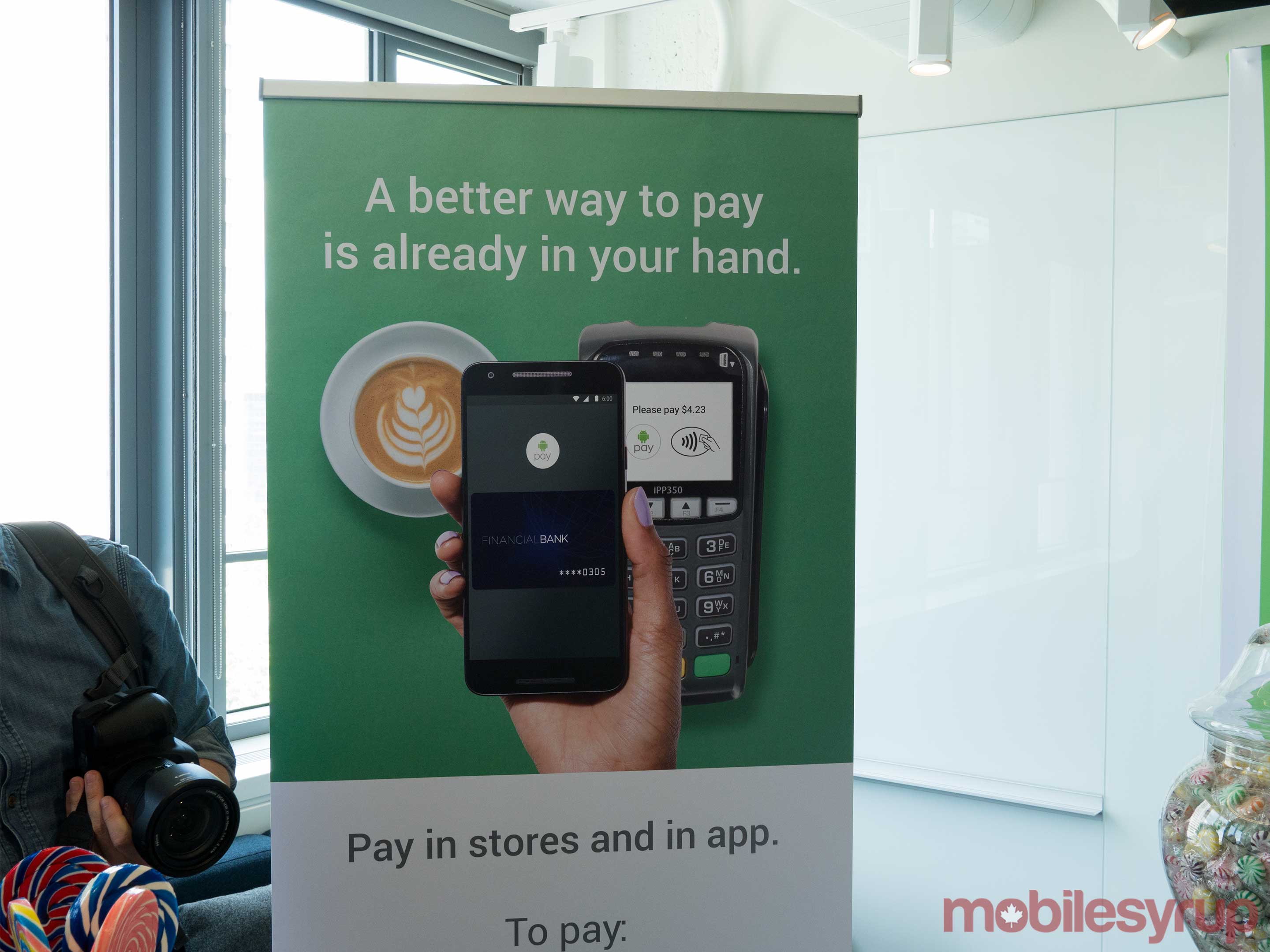
During an announcement presentation at Google’s head office in Toronto, the tech giant revealed a variety of interesting Canadian contactless and mobile payment related statistics. For example, one in three Canadian smartphone owners have already paid for a product via their smartphone, and Q4 2016 alone saw a 120 percent growth rate-year-over-year, according to Google’s statistics.
Furthermore, eight out of 10 Canadian retailers have terminals with NFC capabilities, 41 percent of Canadians believe that their smartphone is more critical to their daily live than their wallet and finally, Moneris predicts that 50 percent of Canada’s 3 billion transactions will be contactless by the end of 2017.
Payment card in-app payment partners include the following: Lululemon, Shopify, Uber, 1-800 Flowers, Atom, Fancy, Doordash, Hotel Tonight and Ritual.
In-store launch partners include Indigo, Freedom Mobile, Jean Coutu, Loblaws, McDonalds, Petro Canada, Pizza Pizza, Rexall Pharma Plus, Rogers, Sears, Telus and Tim Hortons.

In contrast to Apple Pay, which takes approximately a 0.15 percent cut of every transaction according to estimates, Google doesn’t charge any fee to merchants.
“Google doesn’t charge transaction fees,” said Spinell.
“Payments is sort of a last mile. We look at payments not differently than we look at photos or messaging. It just needs to work. For us to keep Android as the most loved operating system, we use payments as a critical set of use cases that needs to surprise and delight consumers.”
In comparison, Apple Pay launched in Canada with support only for American Express cards back in November 2015, before expanding to additional cards and Canadian financial institutions in May 2016.
Steps for using Android Pay are relatively simple and comparable to Apple’s mobile payment platform. Users first wake up their device, then place it near a contactless terminal, and then the transaction is processed.
Android Pay has had 1.5 million new registrations per month on average in the U.S. alone. The mobile payment platform originally launched in the U.S. back in 2016 and has been gradually rolling out to 12 additional markets.
News leaked to MobileSyrup via internal documents sent by an anonymous source regarding Android Pay’s Canadian launch last week.
At Google’s I/O 2017 developer conference, Gerardo Capiel and Varouj Chitilian, to members of the company’s consumer payments team, confirmed that Android Pay would be launching in Brazil, Spain, Taiwan, Russia and Canada “in the coming months.”
Support for Interac debt cards is set to launch on Monday, June 5th, according to Google, though at launch only debit cards from BMO Financial Group, CIBC, Desjardins and Scotiabank will be supported.
“We don’t share specific projections of adoptions of these types of services,” said Spinnell when asked what Google’s expected adoption rate is for Android Pay in Canada.
American Express is set to come later this summer, according to Google. In terms of browser-based shopping, Spinell says that Google isn’t ruling out the possibility and that Google wants to bring seamless transactions to the company’s Chrome browser. The platform’s maximum payment limit is $100 for tap and go payments. For transactions over $100 users are required to unlock Android Pay. Google says that Android Pay’s maximum spend limit is set by your bank’s credit card limit.
Android Pay is available in Canada in the Google Play Store.
The post Android Pay is now officially available in Canada appeared first on MobileSyrup.
How to use Android Pay in Canada

After several long years of anticipation, Android Pay finally arrived in Canada on May 31st, 2017.
Below we’ve detailed everything you need to know before you can use Google’s mobile payments platform.
Check if your phone is compatible
To use Android Pay, you need an Android smartphone that supports both Near Field Communication (NFC) and Host Card Emulation (HCE). Android has featured built-in support for HCE since KitKat 4.4.
Put another way, almost any Android smartphone released within the last five years will meet these two requirements as long as it is running Android 4.4 and above.
Note, however, that certain conditions will prevent Android Pay from working on an Android smartphone even if it includes a NFC chip and it’s on a more recent version of the OS.
Per Google, Android Pay won’t work on phones that are:
a) Running a developer version of Android
b) Running a custom or rooted ROM
c) Running an unlocked bootloader
d) Using Samsung MyKnox at the same time
If you have a relatively modern Android phone and none of the four above conditions apply to smartphone, then you’re set.
Check if your bank supports Android Pay
For most Canadians, the main roadblock that will prevent them from taking advantage of Android Pay is whether or not their bank supports the mobile payments format.
At launch, BMO, CIBC, Banque Nationale, Scotiabank, Desjardins, President’s Choice Financial, ATB Financial and Canadian Tire Financial Services support Android Pay, with support currently limited to credit cards from MasterCard and Visa. Support for Interac debit cards will be available after June 5th. According to Google, support for American Express Tangerine cards will also come soon.
If your bank does not currently support Android Pay, keep an eye out for future announcements on MobileSyrup and elsewhere on the internet. We’ll update this part of the how-to as more banks add support for the platform.
Download the app
If you’ve been following the lead up to Android Pay’s launch in Canada, then you may have seen that the app started to show up on some Canadian Android devices without their owner first downloading it to their smartphone. If that’s the case with your device, then you don’t need to download Android Pay again.
However, if you don’t see Android Pay in your smartphone’s app drawer, then you can download it from the Google Play Store.
Enable NFC and set up a screen lock
You can save some time before launching the Android Pay app by ensuring that you have both NFC and smart lock enabled
With most Android devices, your smartphone will prompt you to add a screen lock when you first set it up, so chances are you already have a screen lock enabled. However, you may have turned off NFC at some point to conserve battery power.
In any case, both are easy to turn on.
In the case of NFC (on most phones using something close to stock Android):
1) Pull down your smartphone’s notification shade
2) Tap the cog icon to open your smartphone’s settings menu
3) Tap the ‘Other’ subheading
4) Toggle NFC on
To setup a screen lock:
1) Pull down your smartphone’s notification shade
2) Tap the cog icon to open your smartphone’s settings menu
3) Look for a sub heading that says ‘Security,’ tap it
4) Pick the lock type you would like to use with your phone. If your smartphone includes a fingerprint sensor, it’s best to use this option
Add your debit and credit cards
Now you’re finally ready to launch the Android Pay app.
Once the app is up and running, it will ask you to add your debit and credit cards.
By default, Google will automatically pull any credit cards you’ve already associated with Play Store account and add them to Android Pay.
To add any other cards you may have, tap the ‘add another card’ button. The app will then use your phone’s rear-facing camera to read the card. If this feature isn’t working properly or the app didn’t correctly parse all the information on your card, you can tap the ‘add manually’ button to enter any details yourself.
Google will then, depending on your choice, send you a verification code either through email or SMS.
If you add more than one card to the app, you can avoid potential future mishaps by setting a default card by double tapping the card’s icon and pressing the ‘set as default card’ button.
Start spending your hard-earned cash
Now comes the easiest (and deadliest) step.
Once you’ve added your credit to Android Pay and verified them, you’re free to make purchases up to $100 without unlocking your device. You can also complete up to three transactions without unlocking your device.
Any NFC point-of-sales (PoS) terminal that supports tap and pay functionality will also support Android Pay. Simply enter the store of your choice, wake your smartphone and tap it against the store’s payment terminal. It’s also possible to use with mobile apps that support the platform.
Once you complete a transaction, you’ll get a notification detailing it on your smartphone.
The post How to use Android Pay in Canada appeared first on MobileSyrup.
Android Pay will support select Interac debit cards starting June 5th

In press briefing for the launch of Android Pay in Canada, Google’s director of emerging platforms, Spencer Spinnell, told journalists that Interac debit cards will be supported beginning June 5th.
In a statement to MobileSyrup, Interac further detailed that it will support all active Interac debit cards issued by BMO Financial Group, CIBC, Desjardins and Scotiabank, including cards that are not Interac Flash enabled. As with Android Pay credit cards, users can pay by simply tapping their phone for purchases up to $100, but above $100, extra authentication (in the form of password or fingerprint, for instance) is required to make the purchase.
“We’re excited to team up with Google, as well as our participating financial institution partners, to bring Interac Debit on Android Pay to Canadians,” said Mark O’Connell, president and CEO of Interac Association and Acxsys Corporation in a statement.
“As the payment landscape evolves, we strive to offer Canadians innovative and seamless payment experiences that are fast, secure and increasingly more digital. The launch of Android Pay in Canada will give Interac debit cardholders yet another way to pay using their own money.”
Android Pay allows users to make contactless payments using their smartphone. It launched in Canada on May 31st for Visa and Mastercards with the following institutions:
BMO, CIBC, Banque Nationale, Scotiabank, Desjardins, President’s Choice Financial, ATB Financial and Canadian Tire Financial Services support Android Pay. Furthermore, support for American Express cards and Tangerine will be coming soon, says Google.
Update 31/05/17: Updated information regarding over $100 authentication.
The post Android Pay will support select Interac debit cards starting June 5th appeared first on MobileSyrup.