Rolandt
Shared posts
12 Nov 18:37
Quick Reflections on a 13-Year-Old Blog
by Nancy White
Last Friday my calendar reminded me that this, my second attempt at blogging, has been in the works for 13 years. I went solo in 1997. Time does fly. YAY! I asked on Twitter yesterday what I should blog about in response and here were the suggestions: Eugene Eric Kim: Write a sentence noting the occasion followed … Continue reading Quick Reflections on a 13-Year-Old Blog


01 Jun 19:08
Data Leaks: a Case Study
Way back in March, I was idly browsing for tallitot and saw a little popup hit my screen that looked a little something like:

My first, second and thirty-fifth reactions were “huh”, but after recovering I dug into where it came from and what it is. Turns out that it’s an eCommerce extension called Yopify, marketed as Yo and plugging into Shopify, BigCommerce and lots of other common platforms. The idea is that by showing incoming customers evidence of previous, recent purchases, it replicates the bustling urgency of an in-person store.
After digging a bit I found a flaw in the way the data streaming is handled, resulting in a leak of potentially-identifiable information about customers to anyone who visits the site. The bug has been reported (and is now fixed) - while we haven’t seen any evidence it was exploited prior to the fix, that doesn’t mean it wasn’t (IDing the use of personal information and sourcing that personal information to a particular breach is a hard problem).
The bug has been reported (and is now fixed): while we haven’t seen any evidence that it was exploited prior to the fix, it’s extremely hard to
but that doesn’t mean it wasn’t exploited while it was live.
The actual bug and what it looks like, well, see the company blog. What I’d like to talk about here is the user implications and the way otherwise-innocent seeming data can be identifying (and potentially aggregated for malicious purposes).
Data misuse: a case study
Yopify displays first name, last initial, and general location. Yopify transmitted first name, entire last name, and city-level location. At first glance this might look like it falls into the category of “weird but probably okay”. Who cares if John Smith in LA is buying chocolate?
Answer: none of those things (John Smith, LA, chocolate) are the worst-case scenario. Really all of them are the best-case. Chocolate is not identifying; LA and John Smith, with the population sizes of each, aren’t either. But if you shift all of those frames just a bit - otherwise-identifying purchases, small population cities and rare names - you get sensitive information about individual people that could easily be misused.
An obvious, generic example: pregnancy or baby supplies. If someone is shopping for those, you can reasonably say they are (or were) pregnant. If that someone hasn’t told anyone about their pregnancy, either because it’s their own damn business or because they’re in an unsafe environment, they’re now at risk.
Similarly, shop choices or individual items can be strongly tied to marginalised identities - binders aren’t often bought by cis people, and with the exception of situations like this, tallitot tend to be purchased by Jewish people. Suddenly we’ve gone from “John Smith, living in Los Angeles, is buying chocolate” to “John Smith, living in rural Texas, is a closeted trans person”.
These aren’t hypothetical examples; as said, I discovered the bug precisely because I was browsing a site largely used by Jewish people. Thankfully, the bug is now known and mitiated, but we don’t know whether it was exploited before I found it.
Designing for evil
The larger problem is the same as that with the Tinder breach - people should already be thinking about these things. When you design a system that’s used by or has an impact on humans, you need to factor in the near-certainty that someone might twist it around to hurt people. ‘Designing for Evil’ is not just a great essay, it’s also a thing that engineers, designers and researchers should be doing every time a product manager comes to them with an idea.
There are some shifts in the wind, at least in an academic context - Santa Clara’s wonderful Software Engineering Ethics Casebook shows that people are beginning to take this seriously. But in the meantime there’s a lot of code, written by a lot of people who don’t think about these problems, out there in the wild with your personal data woven into it. Despite the small impact of this bug and its correction, it serves as a nice demonstration of the implications even small API design choices can have on customer safety.
01 Jun 19:07


Photon Engineering Newsletter #4
by dolske
Welcome to Photon update #4! [Yes, another update this week. I’ve caught up with the backlog, so these updates should now reflect recent work over the last 7-10 days.]
Let’s first talk about a couple of projects that overlap with Photon and have led to some questions about how things fit together.
Quantum Flow and Photon
Quantum Flow is a project to find and prioritize fixing performance issues across the browser. We’ve found and/or fixed hundreds of bugs so far, tagged “[qf:p1]” in Bugzilla. Photon is a project to refresh Firefox’s UI, which also has a major performance component. Photon also has a big bug tree of front-end performance issues found and/or fixed.
So, hey, are these separate projects? Are we duplicating effort? The answer is “no” to both.
Quantum Flow started off with an emphasis on platform bugs, since web content performance is, y’know, a pretty important consideration for a web browser. The Photon project got rolling well after Quantum Flow had begun, and is simply the front-end complement to Quantum Flow’s performance investigations. The two projects are basically just different views into the same underlying work, and are coordinating very closely.
The Photon performance work is a little more structured than Quantum Flow as a whole, though. We’ve clustered the front-end performance bugs into about 10 areas of specific types of bugs or UX interactions. These are not the only areas of front-end performance, but are the ones we want to focus on for around the Firefox 57 timeframe.
Photon Mobile
The main focus of Quantum and Photon is Desktop Firefox. However, the mobile team will be doing a visual refresh of Firefox on iOS and Android to fit in with the new Photon design. They’ll be updating iconography and colors, as well as making the page loading indicators, menus, toolbars, and tab tray more consistent across iOS and Android. It’s also worth noting that Firefox on Android will still benefit from some of the Quantum improvements, since it’s also built on top of Gecko (on iOS we use WebKit, due to Apple’s platform restrictions).
Recent Changes
Here’s what’s happened in Photon this week.
Menus/structure:
- Page action menu is taking shape – now has “Send to device” and bookmarking functionality. Pocket functionality is next on the list.
- Long overdue maintenance and performance improvement work on panels, panelmultiviews and their transitions is ongoing, getting better every day.
- Customization context menus and customize mode improvements have landed – customize mode is now more usable when the photon pref is toggled. We’re getting closer to toggling that pref on nightly.
- Sidebar switcher improvements have landed. You can now move the sidebar to the left or right side, WebExtension sidebars are now listed, and some styling improvements have been made. When the sidebar button has also been updated this part of the project will be nearly done.
- Initial patches for the new Library panel are awaiting review.
Animation:
- Work continues on animations for downloads toolbar button, stop/reload button, and page loading indicator – but these haven’t landed yet.
- Looked into SVG spritesheet production+optimization with SVGO plugins. This allows us to both to cleanup the SVG markup and optimize out some of the poor SVG generated by graphics editors.
Preferences:
- We’ve decided to hold back the preferences reorg until Firefox 56. As previously noted, we’re planning on making some further revisions to the preferences reorg that has already landed in Nightly. They’re not large in scope, but 55 goes to Beta in just a few weeks (June 12th), and we want to make sure we get things right before shipping it to Beta or Release.
- Updated the strings in the new performance page, added a search icon to the search field, and fixed a number of other small bugs.
Visual redesign:
-
The title bar is now dark by default on Windows 10. It’s a pretty striking look, and we think you’ll like it. A similar change for OS X is coming.

The dark purple has led to at least one interesting reaction.
- The arrow in the back button got a bit smaller. This makes it consistent with the forward arrow – which is especially important for use in Compact Mode, where both are styled identically (i.e. no circle around the back button).
- Windows 7 no longer has a custom toolbar background color. It was bluish, and is now just a normal grey.
- Started to remove the “compact” from the “compact light/dark” themes that shipped in Firefox 53. Wait, wait. Hold your fury! With Photon, “compact” will simply be a mode independent of any particular theme. You’ll still be able to have a compact-dark theme. But can also have the default theme be compact, or have a non-compact dark theme. Or use a 3rd party theme in compact mode.
- Removed dropdown markers for bookmark folders and toolbar buttons.
Onboarding:
- Coordinating with the Activity Stream project to finalize automigration UI. Also discussing impact to the onboarding tour, as Activity Stream will only be doing a limited rollout (5% of users) in Firefox 56. Adapting the tour to the current (pre-Activity Stream) about:home and New Tab page introduces some complications and extra work.
- Completed a User Research study to better understand why users download Firefox and what their expectations are.
Performance:
- Even more sync reflow tests are being written, as well as a test to list files loaded early during startup. These help ensure we don’t regress the fantastic performance improvements that have been made so far.
- We got some nice contributions, especially a couple fixes from Dão for sync reflows in tab interactions.
- The last thing causing NSS initialization before first paint is captive portal detection, and should be fixed soon.
- Felipe Gomes is joining the Photon Performance team, and will focus initially on jank caused by code running off of timers. He’ll have an intern starting soon who we expect will start by fixing some main thread IO bugs. Also, the rest of the Photon team will be starting to use some of their time to begin working on other performance bugs.
01 Jun 19:07
Faceless Publishers
by Ben Thompson
When I first worked for a (student) newspaper, the job of a publisher seemed odd to me; as far as I and my editorial colleagues were concerned, the publisher was the person the editor-in-chief, who we viewed as the boss, occasionally griped about after a few too many drinks, usually with the assertion that he (in that case) was a bit of a nuisance.
That attitude, of course, was the luxury of print: whatever happened on the other side of the office didn’t have any impact on the (in our eyes) heroic efforts to produce fresh content every day. We were the ones staying in the office until the wee hours of the night, writing, editing, and laying out the newspaper that would magically appear on newsstands the next morning, all while the publisher and his team were at home in bed.
The moral of this story is obvious: the publisher represented the business side of the newspaper, and the effect of the Internet was to make the job and impact of editorial easier and that of a publisher immeasurably harder, in large part because many of a publisher’s jobs became obsolete; it is the editorial side, though, that has paid the price.
The Jobs a Publisher Did
In the days of print, publishers provided multiple interlocking functions that made newspapers into fabulous businesses:
- Brand: A publisher had a brand, specifically, the name of the publication; this was the primary touchpoint for readers, whether they were interested in national news, local news, sports, or the funny pages.
- Revenue Generation: Most publishers drove revenue in two ways: some money was made through subscriptions, the selling, administration, and support of which was handled by dedicated staff; most money was made from advertising, which had its own dedicated team.
- Human Resources: Editorial staff were free to write and complain about their publishers because everything else in their work life was taken care of, from payroll to travel expenses to office supplies.
What tied these functions together was distribution: a publisher owned printing presses and delivery trucks which, combined with their established readership and advertising relationships, gave most newspapers an effective monopoly (or oligopoly) in their geographic area on readers and advertisers and writers:
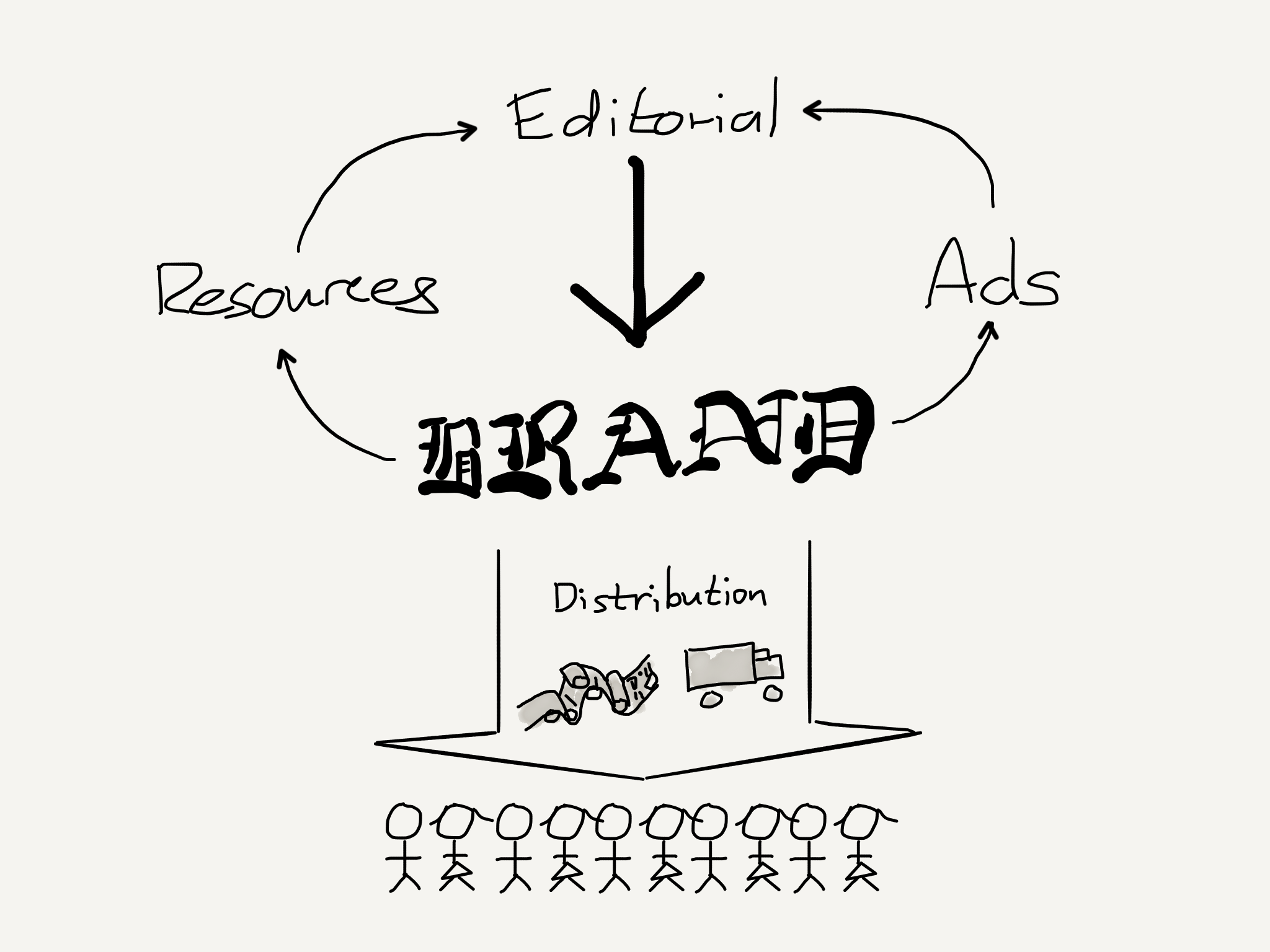
Each of these functions supported the other: the brand drove revenue generation which paid for editorial that delivered on the brand promise, all underpinned by owning distribution.
Publishing’s Downward Spiral
It is hardly new news, particularly on this blog, to note that this model has fallen apart. The most obvious culprit is that on the Internet, distribution, particular text and images, is effectively free, which meant that advertisers had new channels: first ad networks that operated at scale across publishers, and increasingly Facebook and Google who offer the power to reach the individual directly.

I wrote about this progression in Popping the Publishing Bubble, and the intertwined functionality of publishers explains the downward spiral that followed: with less revenue there was less money for quality journalism (and a greater impetus to chase clicks), which meant a devaluing of the brand, which meant fewer readers, which led to even less money.
What made this downward spiral particularly devastating is that, as demonstrated by the advertising shift, newspapers did not exist in a vacuum. Readers could read any newspaper, or digital-only publisher, or even individual bloggers. And, just as social media made it possible for advertisers to target individuals, it also made everyone a content creator pushing their own media into the same feed as everyone else: the brand didn’t matter at all, only the content, or, in a few exceptional cases, the individual authors, many of whom amassed massive followings of their own; one prominent example is Bill Simmons, the American sportswriter.
Vox Media + The Ringer
I wrote about Simmons two years ago in Grantland and the (Surprising) Future of Publishing, and noted that media entities needed to think about monetization holistically:
Too much of the debate about monetization and the future of publishing in particular has artificially restricted itself to monetizing text. That constraint made sense in a physical world: a business that invested heavily in printing presses and delivery trucks didn’t really have a choice but to stick the product and the business model together, but now that everything — text, video, audio files, you name it — is 1’s and 0’s, what is the point in limiting one’s thinking to a particular configuration of those 1’s and 0’s?
In fact, it’s more than possible that in the long-run the current state of publishing — massive scale driven by advertising on one hand, and one-person shops with low revenue numbers and even lower costs on the other — will end up being an aberration. Focused, quality-obsessed publications will take advantage of bundle economics to collect “stars” and monetize them through some combination of subscriptions (less likely) or alternate media forms. Said media forms, like podcasts, are tough to grow on their own, but again, that is what makes them such a great match for writing, which is perfect for growth but terrible for monetization.
My back-of-the-envelope calculations estimated that Simmons’ Ringer podcast network was likely generating millions of dollars, and in an interview with Recode earlier this year, Simmons confirmed that is the case, claiming that podcast revenue was more than covering the cost of creating not just podcasts but the website that, at least in theory, created podcast listeners.
Still, given Simmons’ ambitions, it would certainly be better were the site more than a cost center, which makes the company’s most recent announcement particularly interesting. From the New York Times:
The Ringer, a sports and culture website created by Bill Simmons, will soon be hosted on Vox Media’s platform but maintain editorial independence under a partnership announced on Tuesday. Mr. Simmons, a former ESPN personality, will keep ownership of The Ringer, but Vox will sell advertising for the site and share in the revenue. The Ringer will leave its current home on Medium, where it has been hosted since it began in June 2016.
Jim Bankoff, Vox’s chief executive, said in a phone interview that the partnership was the first of its type for the company and would allow it to expand its offerings to advertisers. Mr. Simmons said in a statement: “This partnership allows us to remain independent while leveraging two of the things that Vox Media is great at: sales and technology. We want to devote the next couple of years to creating quality content, innovating as much as we can, building our brand and growing The Ringer as a multimedia business.”
Simmons is exactly right about the benefits he gets from the deal: instead of building duplicative technology and ad sales infrastructure, The Ringer can simply use Vox Media’s. This is less important with regards to the technology (Vox’s insistence that Chorus is a meaningful differentiator notwithstanding) but hugely important when it comes to advertising. It’s not simply the expense of building an infrastructure for ad sales; the top line is even more critical: it is all but impossible to compete with Google and Facebook for advertising dollars without massive scale.
Make no mistake, Simmons is the sort of writer that many advertisers would be happy to advertise next to (his podcast has had an impressive slate of brand names, in addition to the usual mainstays like Squarespace and Casper mattresses); the problem is that when it comes to the return-on-investment of buying ads, the “investment” — particularly time — is just as important as the “return”: a brand looking to advertise directly on premium media is far more likely to deal with Vox Media and its huge stable of sites than it is to do a relatively small deal with a site like The Ringer.
Indeed, the bifurcation in the Internet’s impact on editorial and advertising — the former is becoming atomized, the latter consolidated — explains why the implications for Vox Media are, in my estimation, the more important takeaway from this deal.
Vox Media’s Upside
To date Vox Media has been a relatively traditional publisher, albeit one that has executed better than most: the company has built strong brands that attract audiences which can be monetized through advertising, and that revenue, along with venture capital, has been fed into an impressive editorial product that builds up the company’s brands.
The Ringer, though, is not a Vox Media brand: it is Simmons’ brand, a point he emphasized in his statement, and that’s great news for Vox. The problem with editorial is that while the audience scales, production doesn’t: content still has to be created on an ongoing basis, and that means high variable costs.
Infrastructure, though, does scale: Vox Media uses the same underlying technology for all of its sites, which is exactly what you would expect given that software can be replicated endlessly. Crucially, the same principle applies to advertising: one sales team can sell ads across any number of sites, and the more impressions the better. Presuming The Ringer ends up being not an outlier but rather the first of many similar deals,1 then that means that Vox Media has far more growth potential than it did as long as it was focused only on monetizing its owned-and-operated content.
Publishers of the Future
The new model portended by this deal looks something like this:

In this model the most effective and scalable publisher is faceless: atomized content creators, fueled by social media, build their own brands and develop their own audiences; the publisher, meanwhile, builds scale on the backside, across infrastructure, monetization, and even human-resource type functions.2 This last point makes a faceless publisher more than an ad network, and crucially, I suspect the greatest impact will not be (just) about ads.
Earlier this month I wrote about the future of local news, which I argued would entail relatively small subscription-based publications. Said publications would be more viable were there a faceless publisher in place to provide technology, including subscription and customer support capabilities, and all of the other repeatable minutiae that comes with running a business. Publishers still matter, but much of what matters can be scaled and offered as a service without being tied to a brand and a specific set of content.
I suspect this is part of the endgame for publishing on the Internet: free distribution blew up the link between editorial and publishing and drove them in opposite directions — atomization on one side and massively greater scale on the other. And now, that same reality makes possible a new model: a huge number of small publications backed by entities more concerned with building viable businesses than having memorable names.
Disclosure: I have previously spoken at the Vox Media-owned Code Media conference and was previously a guest on The Bill Simmons Podcast; I received no monetary compensation for either appearance
- There is already a parallel to The Ringer within Vox Media: the company’s vast network of team-specific sites that sit under the SBNation umbrella
- This is where Medium went wrong: the company made motions towards this model — which is why The Ringer is hosted there — but has decided to pursue a Medium subscription model instead
01 Jun 19:07
Release Notes for Safari Technology Preview 31
by Jon Davis
Safari Technology Preview Release 31 is now available for download for macOS Sierra. If you already have Safari Technology Preview installed, you can update from the Mac App Store’s Updates tab. This release covers WebKit revisions 216643-217407.
Web API
- Added media and type attribute support for
<link rel="preload">(r217247) - Added support for
DOMMatrixandDOMMatrixReadOnly(r216959) - Fixed
getElementByIdto return the correct element when a matching element is removed duringbeforeloadevent (r216978) - Fixed skipping
<slot>children when collecting content forinnerText(r216966)
JavaScript
- Fixed a syntax error thrown when declaring a top level for-loop iteration variable the same as a function parameter (r217200)
Layout & Rendering
- Added support for
transform-boxto switch sizing box in SVG (r217236) - Fixed
clientXandclientYon mouse events to be relative to the layout viewport (r216824) - Fixed large animated images getting decoded as a large static image before receiving all of the data (r217262)
- Fixed screen flickering caused by asynchronous image decoding for large images when interacting with the page (r216901)
- Fixed element position when dragging jQuery Draggable elements with
position:fixedafter pinch zoom (r216803) - Fixed a timing issue causing a hardware-accelerated transform animation to misplace an element 50% of the time (r217075)
CSS GRID
- Implemented the
place-selfshorthand (r216829) - Fixed static position of positioned grid items (r216916)
- Ignored collapsed tracks on
content-distributionalignment (r217345)
Font Variations
- Added support for
calc()infont-variation-settingsandfont-feature-settings(r217267) - Enabled the
woff2-variationsformat identifier for@font-face(r217241) - Updated the
font-styleimplementation in the font selection algorithm (r217272)
Web Inspector
- Added a new icon for Web Socket resources (r217067)
- Changed adding new CSS rules so that the added rules go into a new Inspector Style Sheet resource that can be viewed, edited, and saved (r217258)
- Fixed an issue where changes are not applied in Styles sidebar when switching tabs without blurring editor (r217266)
- Fixed content views not getting restored on reload if its tree element is filtered out (r217317)
- Fixed an error when trying to delete DOM breakpoints from the Debugger tab (r216681)
- Fixed deleting a disabled XHR breakpoint (r217306)
- Fixed miscellaneous RTL and localization issues (r216692, r217232, r217229)
- Prevented loading the active recording until a Timeline view needs to be shown (r217379)
Media
- Added support for painting MSE video-element to canvas (r217185)
- Fixed captions and subtitles not showing up in picture-in-picture for MSE content (r216951)
- Fixed media element reporting hidden when in picture-in-picture mode and tab is backgrounded (r217223)
Web Driver
- Fixed characters produced with the shift modifier on a QWERTY keyboard to be delivered as shift-down, char-down, char-up, and shift-up events (r217244)
- Fixed
navigator.webdriverto return false if the page is not controlled by automation (r217391)
WebCrypto
- Replaced
CryptoOperationDatawithBufferSource(r216992)
Security
- Improved error message for
Access-Control-Allow-Originviolations due to a misconfigured server (r217069)
01 Jun 19:06
BikeFACE: Perri Lo
by dandy
PERRI LO rider statement: "The day I moved to Montreal, my first purchase was a bike. A shiny, green, a Norco I so lovingly adore. Greenie was a solid companion for sightseeing from the Old Port to Mont-Royal, for when I had five minutes to get to school, for those blustery blizzard-y infamous Montreal winters; always putting me in a better mood when I sit on the saddle and pedal away. And now Greenie has followed me here to Toronto, with a few more scratches and derailleur transplants. An old soul that will keep me safe on the roads and wild on the paths. That's Ol' Greenie and Me."

dandyhorse is pleased to present the photo essay BikeFACE! by Marc Bernhard
In 1890s Europe and North America, the bicycle was gaining popularity as a means of transportation, recreational activity and sport. However, medical opinion about the health benefits of cycling, especially for women, was mixed. One of the supposed risks for women was a condition known as “bicycle face.”
At the turn of the century the bicycle afforded many women increased freedom and autonomy, and the bicycle itself became a symbol of women’s emancipation. With the ridiculous prognosis of "bicycle face" we saw how cycling, feminism, patriarchy and medical opinion collided in the1890s.
Photographer Marc Bernhard says, "The purpose of BikeFACE! is to promote and celebrate women’s commuter, recreational and sport cycling. It is a series of studio images in which the subjects were invited to ride their bikes on a stationary trainer at full exertion to see what their bicycle face might look like. The series is meant to be a light-hearted, tongue-in-cheek reference to the historical anti-feminist ideas against cycling, by showing the strength, intensity and determination of women cyclists today."
Featured rider Perri Lo says her bike, "Ol' Greenie" is "...always putting me in a better mood when I sit on the saddle and pedal away."

dandyhorse is pleased to present this essay celebrating women cyclists in our city -- just in time for Bike Month! You can read more about "bicycle face" here.
We'll be rolling out each profile one at a time throughout Bike Month and adding all the links here.
01 Jun 19:06
BikeFACE: Annalise Walmer
by dandy
ANNALISE WALMER rider statement: "Cycling represents autonomy and empowerment. It's my daily workout, clears my head and is enviro-friendly. I've been a year-round cyclist for three decades. I've biked to singing gigs in heels, gone camping with a loaded trailer, and explored trails and the waterfront. I've been called a tenacious "road warrior," pushing through snowstorms, covered in ice, yet sweating. I've got scars and a bikeable wardrobe. Having volunteered at a DIY bike shop for 7 years, I've gained mechanical know-how and now assist participants with repairs. I get a sense of satisfaction when my bike's running smoothly, knowing that I did it. I've been involved with Art Spin, Bike Rave, Bicycle Music Festival and group rides - all great ways to meet others with a passion for cycling and the arts. I got my seven-piece band performing while cycling, or being carried on cargo bikes and trailers, for one Art Spin ride. Cycling is political. I volunteer with Cycle Toronto, the cycling advocacy group that works towards developing better road and cycling infrastructure. It's important for cyclists to feel safe. Cycling is an equalizer; regardless of gender, age, size and ability, bikes are adaptable to most riders' needs. The more people are seen riding, the more people will take up riding."
 dandyhorse is pleased to present the photo essay BikeFACE! by Marc Bernhard
In 1890s Europe and North America, the bicycle was gaining popularity as a means of transportation, recreational activity and sport. However, medical opinion about the health benefits of cycling, especially for women, was mixed. One of the supposed risks for women was a condition known as “bicycle face.”
At the turn of the century the bicycle afforded many women increased freedom and autonomy, and the bicycle itself became a symbol of women’s emancipation. With the ridiculous prognosis of "bicycle face" we saw how cycling, feminism, patriarchy and medical opinion collided in the1890s.
Photographer Marc Bernhard says, "The purpose of BikeFACE! is to promote and celebrate women’s commuter, recreational and sport cycling. It is a series of studio images in which the subjects were invited to ride their bikes on a stationary trainer at full exertion to see what their bicycle face might look like. The series is meant to be a light-hearted, tongue-in-cheek reference to the historical anti-feminist ideas against cycling, by showing the strength, intensity and determination of women cyclists today."
Featured rider Annalise Walmer says, “Cycling is an equalizer; regardless of gender, age, size and ability...”

dandyhorse is pleased to present this essay celebrating women cyclists in our city -- just in time for Bike Month! You can read more about "bicycle face" here.
We'll be rolling out each profile one at a time throughout Bike Month and adding all the links here.
01 Jun 19:06
 eden rohatensky @edenthecat
Could you imagine if these conversations didn't start with "I'm not looking for anything serious" and started with "this is what I want"
Twitter Favorites: [edenthecat] Could you imagine if these conversations didn't start with "I'm not looking for anything serious" and started with "this is what I want"
Could you imagine if these conversations didn't start with "I'm not looking for anything serious" and started with "this is what I want"
01 Jun 19:06
eden rohatensky @edenthecat
It's not selfish to want to hold hands with someone you've made yourself vulnerable to.
Twitter Favorites: [edenthecat] It's not selfish to want to hold hands with someone you've made yourself vulnerable to.
It's not selfish to want to hold hands with someone you've made yourself vulnerable to.
01 Jun 19:06
eden rohatensky @edenthecat
We shouldn't feel the need to preface conversations about emotions with "this is awkward but". It's not awkward. You're doing a good thing.
Twitter Favorites: [edenthecat] We shouldn't feel the need to preface conversations about emotions with "this is awkward but". It's not awkward. You're doing a good thing.
We shouldn't feel the need to preface conversations about emotions with "this is awkward but". It's not awkward. You're doing a good thing.
01 Jun 19:03
BikeFACE: Katie Wittmann
by dandy
KATIE WITTMANN rider statement: "Cycling is a huge part of my life and my identity. It’s my primary mode of transportation all year round, and it’s one of my main forms of training. I compete (for fun) in triathlons, and train with the University of Toronto Triathlon Club. I also love adventuring and touring by bike, using cycling as a way to explore new places. I can’t imagine my life without cycling, and the more people I see biking in Toronto, the happier and more hopeful for the future of our city I become."

dandyhorse is pleased to present the photo essay BikeFACE! by Marc Bernhard
In 1890s Europe and North America, the bicycle was gaining popularity as a means of transportation, recreational activity and sport. However, medical opinion about the health benefits of cycling, especially for women, was mixed. One of the supposed risks for women was a condition known as “bicycle face.”
At the turn of the century the bicycle afforded many women increased freedom and autonomy, and the bicycle itself became a symbol of women’s emancipation. With the ridiculous prognosis of "bicycle face" we saw how cycling, feminism, patriarchy and medical opinion collided in the1890s.
Photographer Marc Bernhard says, "The purpose of BikeFACE! is to promote and celebrate women’s commuter, recreational and sport cycling. It is a series of studio images in which the subjects were invited to ride their bikes on a stationary trainer at full exertion to see what their bicycle face might look like. The series is meant to be a light-hearted, tongue-in-cheek reference to the historical anti-feminist ideas against cycling, by showing the strength, intensity and determination of women cyclists today."
Featured rider Katie Wittman says, "...I can’t imagine my life without cycling, and the more people I see biking in Toronto, the happier and more hopeful for the future of our city I become."

dandyhorse is pleased to present this essay celebrating women cyclists in our city -- just in time for Bike Month! You can read more about "bicycle face" here.
We'll be rolling out each profile one at a time throughout Bike Month and adding all the links here.
01 Jun 19:03
Bike to Work Day 2017
by dandy

photos by Danielle Griscti
Numbers were down this year for Bike to Work Day at City Hall in Toronto. Some say this is a result of the rain, others say it's because they're tired of all the empty promises when it comes to bike lanes in this town.
The press release from local cycling lobby group, Cycle Toronto, stated that thousands of cyclists kicked off Bike Month this year with the group ride on May 29 to City Hall but photos from the day show what looked like dozens of cyclists. (Cycle TO's communication person reported that local sponsor Jet Fuel gave out over 1,000 cups of coffee.)
Regardless of the numbers on this day of ceremonial cycling display, hundreds of thousands of cyclists in Toronto are biking to work every day -- and demanding safer streets.
One case in point: Over 14,000 people surveyed on Bloor street said they felt safer with the new bike lane. Yet on Monday, June 5, the City is hosting yet another public meeting to discuss the future of this bike lane. It seems shocking, almost surreal, that even with Rob Ford gone, Toronto is still considering removing a bike lane.
One bit of good news though via Cycle Toronto: The contest to win a bike and a VIA rail voucher is still open for another 6 days! You can enter the contest here: http://www.bikemonth.ca/biketoworkday

Sean McSweeney from MEC, Mayor John Tory and Councillor Joe Cressy pose for a picture on Bike to Work Day (above). Someone should've helped the mayor with his helmet.


Related on dandyhorsemagazine.com
How many does it take? (re bikes on Bloor)
01 Jun 18:57
 Darren Barefoot @dbarefoot
Two good articles on busyness as virtuous but misguided triumph: m.signalvnoise.com/trickle-down-w… & journal.thriveglobal.com/when-did-busy-…
Twitter Favorites: [dbarefoot] Two good articles on busyness as virtuous but misguided triumph: https://t.co/JjbuONCUeQ & https://t.co/WgSIddFK38
Two good articles on busyness as virtuous but misguided triumph: m.signalvnoise.com/trickle-down-w… & journal.thriveglobal.com/when-did-busy-…
01 Jun 18:55
 Tom Hawthorn @tomhawthorn
@Planta I sometimes wonder if I wrote a book just to be interviewed by @Planta again.
Twitter Favorites: [tomhawthorn] @Planta I sometimes wonder if I wrote a book just to be interviewed by @Planta again.
@Planta I sometimes wonder if I wrote a book just to be interviewed by @Planta again.


01 Jun 18:51
I’ve figured out what “covfefe” means. It means we’re screwed.
by Josh Bernoff
President Trump posted a mysterious tweet including a the non-word “covfefe” last night. Then he asked us to figure out the its true meaning. The meaning is clear: we must no longer take seriously anything this president says. Here’s the Tweet the president sent at 12:06am. Covfefe is not a word. It’s a mistake. But the … Continued
The post I’ve figured out what “covfefe” means. It means we’re screwed. appeared first on without bullshit.
01 Jun 18:51
40th Reunion
This weekend, we went back to my Quaker college for our 40th reunion.
Terry Eagleton says:
The puritan mistakes pleasure for frivolity because he mistakes seriousness for solemnity.
Does the puritan mistake seriousness for solemnity, or solemnity for seriousness? Email me.
01 Jun 18:49


Report: Apple’s Version Of A Connected Speaker To Debut Later This Year
by Laura Northrup
mkalus
shared this story
from  Consumerist. Consumerist.
|
Apple makes phones, tablets, computers, headphones, and even easy-to-lose wireless earbuds, but there’s one thing missing. Unlike Google and Amazon, Apple doesn’t sell a smart speaker that also serves as a smart home hub. That’s reportedly about to change, and factories are starting to crank out Apple’s take on the hot products.
Those ever-wise “people with knowledge of the matter” told Bloomberg News that the speaker is coming, and is made by Inventec, which also makes AirPods.
While the speakers wouldn’t go on sale until later this year, they could be announced in June at Apple’s developers’ conference.
According to the sources, the speakers are powered by the Siri virtual assistant that’s available on Apple’s phones, tablets, and computers. Apple hopes to differentiate its version of a common product with better sound quality, and features like virtual surround sound and sensors that are able to measure a room and adjust the acoustics accordingly.
It would also help make Apple’s HomeKit smart home software more useful, since users now have to coordinate their devices with an AppleTV or an iPad.
In addition to controlling HomeKit-compatible third-party smart devices, Apple will reportedly also let third-party developers create voice functions for the speaker. Last year, Apple began preparing for this by letting developers in to use Siri and make iOS voice commands do something useful.
If the unnamed speaker does launch in June, it would be the first new piece of hardware announced at Apple’s WWDC since 2013, when the cylindrical Mac Pro was introduced.
01 Jun 18:49
UK comes bottom of G7 growth league as Canada takes lead
by Simon Goodley and Phillip Inman
mkalus
shared this story
from  EU referendum and Brexit | The Guardian. EU referendum and Brexit | The Guardian.
|
Britain’s 0.2% growth rate puts it on a par with Italy, while Canadian economy expanded by 0.9% in first quarter
The UK has slumped to the bottom of the league table of advanced economies after Canada registered stellar growth in the first three months of the year.
Canada was the final member of the G7 to report its growth figures, which confirmed the UK as officially the joint worst performing member so far this year. The announcement marked a significant decline for the UK economy, which a year ago was outshining Germany, the US and Japan. In February it was announced that Germany had pipped the UK as the fastest-growing G7 nation during 2016 by 10 basis points.
Continue reading...
01 Jun 18:49
As opinion polls narrow, Conservatives play the immigration card
by Alan Travis Home affairs editor
|
mkalus
shared this story
from EU referendum and Brexit | The Guardian.
|
Labour’s policy option to let in low-skilled workers following Brexit is logical, and being floated by the government itself
• General election 2017: live updates
It’s that moment again. When the opinion polls start to narrow in a general election campaign the Tories start to talk about immigration.
Theresa May was quick on Wednesday morning to seize on a leaked five-page Labour policy option paper given front page treatment in two Tory, attack-dog newspapers, the Mail and the Telegraph, to claim that a secret plan showed Jeremy Corbyn wanted “uncontrolled immigration” and was poised to “let in thousands of unskilled migrants from outside the EU”.
Continue reading...
01 Jun 18:49


How to price automated vehicles before we have them
by pricetags
mkalus
shared this story
from  Price Tags. Price Tags.
|
.
Today’s policymakers have an opportunity to implement plans that will guide the efficient usage of AVs and rider choices that may affect us for generations. …
Ironically, the efficiency of AVs has long been touted as a solution to traffic, but new research is beginning to suggest that AVs will, in fact, generate more of it. …
By eliminating most of the hassles of driving, such as parking and lost productivity time, AVs will induce not only more trips, but longer ones. Additionally, AVs waiting to pick up new riders will add “deadheading” miles. For traffic, the only thing worse than a single-occupant vehicle is a zero-occupant vehicle. Placed all together, this suggests they will almost certainly increase vehicle-miles traveled, energy use, and emissions. These impacts might be locked in by further sprawl and other shifts toward less efficient land-use patterns. …
To avoid the worst of these traffic scenarios, policy needs to be deployed with an eye towards minimizing the added miles and the demand for situations involving zero-occupant vehicles. …
… policies should always seek to encourage AVs that move more people in fewer vehicles. While the driverless technologies make point-to-point drop-offs possible, the realities of cities and highways means that they simply cannot accommodate one AV per person. …
The deployment and pricing models offered by automotive and tech companies should be structured to make shared AVs, not personal AVs, the model of choice. …
… policymakers should seek to create pricing policies in anticipation of the traffic-inducing effects of personal AVs. The program might be created in escalating prices, as to disincentivize the least efficient choices. A VMT fee would discourage longer trips in general, while a higher single-occupant fee would encourage AV riders to share rides. Lastly, a zero-occupant fee, addressing the miles added by AVs circling between pick-ups or headed home to park, would warrant the highest fee. …
The national dialogue around AV policy is a unique chance to rethink how we prioritize our transportation systems and the incentives within it. A century ago, when the internal combustion engine automobile began to proliferate, cities missed this opportunity to guide how they affected communities.
Full story from Mobility Lab here.
01 Jun 18:49


Massey Bridge Becoming Tunnelled Vision in New Provincial Alliance?
by Sandy James Planner
|
mkalus
shared this story
from Price Tags:
|
|
| Dream a little dream...... |

While the Mayor of Delta rues on CBC news that the unsustainable, overbuilt, multi-billion dollar Massey Bridge may not be constructed due to the potential change in Provincial leadership, all the other Mayors in the Metro area are welcoming the chance for a rethink. As reporter Bal Brach noted “Many Metro Vancouver mayors spoke out against the project last summer, saying the bridge was “car-oriented” and diverting money from public transit and other transportation priorities…New Westminster Mayor Jonathan Coté said he hopes the next government will focus on the priorities outlined by the Mayors’ Council — including improvements to the Pattullo Bridge.”
Despite the fact that the Pattullo Bridge had reached the end of its life expectancy, Provincial interests allowed the Massey Tunnel replacement project to forge ahead of the Patullo. The Richmond News reporter Graeme Wood states that while the Provincial Ministry of Transportation process to award the $3.5 billion dollar contract for the Massey Bridge is underway, no construction projects for the unsustainable bridge will be signed.
If the BC Green Party and BC NDP do form the government, they can scrap the bridge and consider all alternatives. While NDP leader John Horgan wanted to reassess the Massey Tunnel/Bridge before the Provincial election campaign, “all four Richmond NDP candidates said they would prefer a twinned tunnel. Green candidate Michael Wolfe favoured adding an LRT line to Surrey, along the corridor.” The Mayor of Richmond has also come out in favour of twinning the existing tunnel, expanding transit, or banning truck traffic at tunnel at peak hours.
The understanding being worked out between the BC Green Party and the BC NDP includes language “to immediately improve transit and transportation infrastructure” and to work with “the Mayors’ Council consultation process to find a more fair and equitable way of funding transit for the long-term.”
While two contracts worth $17.3 million dollars have been awarded for site preparation at the bridge, approvals will be needed for further work to continue. It is indeed a new day with fresh eyes looking at sustainable transportation movement as if accessibility and regionalism really mattered. Can a tunnelled vision be far behind?

01 Jun 18:49
Haunting images of pre-Expo 86 Vancouver, before the ‘Glass City’ and million-dollar teardowns
mkalus
shared this story
from  Comments on: Haunting images of pre-Expo 86 Vancouver, before the ‘Glass City’ and million-dollar teardowns. Comments on: Haunting images of pre-Expo 86 Vancouver, before the ‘Glass City’ and million-dollar teardowns.
|
Before Expo 86, forests of glass condos and the birth of the million dollar teardown, Vancouver was a mid-sized port city where coffee was served up in greasy diners and the word “microbrewery” didn’t exist.
Photographer Greg Girard was there, capturing haunting images of a city just on the cusp of changing forever. Recently showcased at Vancouver’s Monte Clark Gallery, they’re also featured in his book Under Vancouver 1972–1982.
With permission from Girard, a selection of his photos are below.
Granville Street Bridge, 1975
Just underneath the Granville Street Bridge, pictured in the background of this photo, Granville Island is undergoing its metamorphosis from a polluted industrial area into a waterfront tourist destination. One of the sharpest contrasts with modern Vancouver and its industrial predecessor is the city’s changing approach to False Creek, the inlet that is now one of the city’s signature features. But it was only as recently as the 1950s that city officials were seriously tossing around a plan to completely fill in the then-filthy waterway in order to free up more industrial land.
Parked Car (Gran Torino), 1981
When this image was taken, Vancouver real estate prices were in a tailspin. Real estate prices dropped by as much as 30 per cent in the early 1980s — a sharper decline even than housing prices in Fort McMurray, Alta. following the recent oil price collapse. The average price of a Vancouver detached home in 1980 was $177,000 ($350,000 in 2017 dollars). Meanwhile, the condo — a type of apartment that you could own — was still a new and unfamiliar entrant to the city’s real estate market.
Lux Theatre, 1974
This is the Lux Theatre, a movie house on East Hastings Street that occasionally did duty as a punk rock venue. The movie on the marquee, meanwhile, is The Conqueror Worm, a mostly forgotten B-movie starring Vincent Price. Although some variety of cinema had stood on the site since 1910, the market slowly dropped out from The Lux. In one of the final pictures of the theatre taken in the early 1990s it was desperately advertising $2.50 double features. Like many properties on East Hastings, the site is now home to a social services agency — a low barrier housing complex called The Lux.
Chinese Voice Daily News, 1982
The first thing to note is the dress: Men clad casually in suits. The second thing to notice is the two men on the right obtaining their news the same way humans have been doing for centuries; by looking at broadsheet pages pinned up in a newspaper’s front window. This photo was also taken only a few years before a momentous demographic change overtook the city’s Chinese-Canadian community. As Hong Kong prepared to revert from British to Chinese control, a wave of Hong Kongers arrived in the city, bringing entirely new food, consumption patterns and and cultural norms to the city’s Chinese areas.
Unpaved Parking Lot, 1981
In this particularly gritty image, a gravel parking lot hosts a collection of cars that all seem to have some kind of scrape or dents. With Canada gripped by recession in the early 1980s the downturn was felt particularly hard in British Columbia. Vancouver was also a much smaller city that it is today. In 1981, the City Vancouver was two thirds the size of its modern incarnation, while Metro Vancouver was less than half the size.
Car and Building, Franklin Street (1981)
A feature of modern Vancouver is how echoes of its working class origins continue to dwell alongside high-end restaurant patios and pristine bikeways. Perhaps nowhere is the contrast more striking than in the part of East Vancouver where this photo was taken. This would be near the modern day sites of the West Coast Reduction rendering plant and Hallmark Poultry Processors, a chicken slaughterhouse. With pricey condos and high-end coffee shops now dotting the area, the rendering plant endures frequent complaints over its bad smell — and has taken to sponsoring a local theatre to gain community favour. The chicken slaughterhouse, now has semi-regular animal rights protests outside its gates.
East Hastings Street (Dusk), 1975
Although he grew up in Burnaby, Girard often took these photos during weekend trips into Vancouver where he spend the night in a cheap Downtown Eastside hotel. The neighbourhood has been seedy almost from the moment of Vancouver’s founding, but three devastating developments would profoundly change it in the late 20th century: Harder drugs, the AIDs epidemic and deinstitutionalization of psychiatric patients.
Camaro in Alley, 1981
Just behind this Camaro is the back of the Hotel Vancouver. Girard captured a seemingly desolate scene where a Camaro with a flat tire could sit seemingly forgotten in a downtown alley. Go to that alley now and it’s at the centre of one of Canada’s most high-traffic areas: With high end shopping, gourmet restaurants and towering glass condos on all sides. This was also snapped only a few month before the Vancouver Canucks would first advance to the Stanley Cup finals — marking the last time that the Canucks would make the Stanley Cup finals without sparking a devastating riot.
Silver Grill Café, 1975
Captured during a rare Vancouver snowstorm, this café was at 750 Davie Street, at the heart of what remains the city’s most recognizable “gaybourhood.” The site is now a condo tower, with another condo tower across the street. The café’s neon sign, meanwhile, is now an artifact at the Museum of Vancouver.
Super Valu, 1976
The misty parking lot of a Super Valu, complete with a solitary Volkswagen Beetle. This was still a time when Sunday shopping was banned in most parts of the Lower Mainland. And like any self-respecting retailer of the era, Super Valu had a neon sign, albeit with a malfunctioning “l.” Parts of downtown Vancouver once buzzed with whole forests of elaborate neon signs — until city hall effectively banned the signs in the late 1960s amid arguments that they looked “sleazy.”
Gas Pumps Near Sugar Refinery, 1981
Obviously, the modern viewer will first note the price: 26.6 cents for a liter of gasoline. The pumps are also analog and unaffected by the prepay legislation that now governs B.C. gas stations. Behind it, however, is the British Columbia Sugar Refining Co., Vancouver’s oldest industrial site. Built in 1890, it’s still there — and it’s still refining sugar.
Tracks and Bridge, 1973
This is the oldest photo in this gallery, taken when Girard was still a teenager. As an official description of Girard’s Vancouver images has noted, this was an era before post-9/11 security concerns effectively sealed off Vancouver’s port and rail facilities. Port Metro Vancouver is now so thoroughly set apart from the life of the nearby downtown that it’s remarkably easy for many residents to forget it’s there.
• Email: thopper@nationalpost.com | Twitter:
01 Jun 18:48

How fashion label Dion Lee uses Dropbox to create as a team
by Jennifer Norrie
Fashion brand Dion Lee began as a small Australian label: tailored and sophisticated in design. Since its founding in 2009, the label has grown into a booming business, with six stores in Australia and a wholesale business across the US, Asia, and the Middle East. We recently chatted with Amelia Fincher, general manager at Dion Lee, to get a bit more insight into how the team works.
“The looks are feminine and casual, yet also architectural,” said Fincher. “Every piece of a collection is precisely engineered.” She described the creative process behind the label, which involves early ideas, countless concept sketches, photos from fittings, and much more. “From the design to the production, everything goes through Dropbox,” Fincher said.
The company has been able to grow into a global business in part because of how well the team coordinates across regions, all in an instant. “When Dion or the team is at a fitting, they’ll take a photo and share it on their phone through Dropbox, which means that the images here can go straight to New York, and it means that they’re all saved in the same place,” Fincher said.
We had a chance to catch up with the Dion Lee team at the Mercedes-Benz Fashion Week Australia—where the label just launched its latest collection. Watch the video below to learn more about Dion Lee, and how the team uses Dropbox Business to work and create together.
01 Jun 18:16

TD and RBC may come to Android Pay in ‘the next several quarters’
by Rose Behar
When Android Pay launched in Canada today, Google revealed support for the majority of Canada’s Big Five banks with two notable exceptions: RBC and TD.
At a press briefing announcing contactless mobile payments platform’s availability, Spencer Spinnell attributed this discrepancy to the technical process related to enabling Android Pay from the banks’ perspectives.
“I can’t talk to specific details regarding partnerships. What I can say is if you look at other markets, the way we’re rolling out in Canada mirrors the way we rolled out everywhere across the globe. These organizations typically have large queues of work they need to get done,” said Spinnell.
“We expect banks will come on board over the course of the next several quarters,” he continued.
Towards the end of the presentation, Spinnell again reiterated that Google was optimistic about the prospect of gaining TD and RBC, stating: “We’re quite hopeful that Canadian shoppers will have access to one hundred percent of the cards in their wallet.”
Although we're not offering this option currently, this does not mean it won't be up for consideration going forward. ^SF
— TD (Canada) (@TD_Canada) May 31, 2017
This is echoed by the support tweets of TD itself, which has been fielding questions from customers eager to try out the new platform.
“Although we’re not offering this option currently, this does not mean it won’t be up for consideration going forward,” wrote a TD social media representative in one post. RBC, meanwhile, has kept quiet on the subject — though tweets are steadily pouring from upset customers.
MobileSyrup has reached out to RBC and TD for comment.
Update 31/05/17: TD tells MobileSyrup that it doesn’t have any plans to add Android Pay at this time and that “TD customers are already benefiting from a broad suite of mobile payment options including TD Mobile Payments.”
The spokesperson also adds, however: “We’re always looking for ways to enhance our existing offerings to provide an exceptional level of safety, security and convenience for our customers, so this means we won’t close the door for future consideration of Android Pay.”
The post TD and RBC may come to Android Pay in ‘the next several quarters’ appeared first on MobileSyrup.
01 Jun 18:15

Instagram to add new rainbow-themed stickers and brushes for Pride 2017
by Bradly Shankar
Pride 2017 takes place in June, and to celebrate worldwide LGBT communities, Instagram will be rolling out a set of new rainbow-themed creative tools for Stories.
Throughout the month, Instagram users will be able to add six new pride stickers to Stories or other shared media. The stickers were designed for Instagram by global artists who identify as LGBT.
Tapping a pride sticker in Instagram will show who created it, with another tap bringing up other content from pride around the world. Using a pride sticker also makes a story eligible to become a part of the general #Pride2017 hashtag story. Instagram has also added new rainbow brush to add multi-coloured lines to photos and videos.
However, the Instagram blog post announcing these new features did not confirm when they will actually be rolling out. Therefore, it’s not yet clear if they will be available right at the start of June or later in the month.
Other than adding the new stickers and brush, Instagram has also been going around the world to paint various walls in Cleveland, Los Angeles, London, Madrid and Nashville with rainbow colours. It’s unclear if any other walls will be painted over the course of Pride month. For now, though, Instagram users can check out the art using #KindComments.
Voices of support from different communities on Instagram, including LGBT groups, can also be found here.
Recently, Instagram also added the ability to adjust photo orientation and to send links through direct messaging.
Source: Instagram blog
img credit: Neal Jennings

The post Instagram to add new rainbow-themed stickers and brushes for Pride 2017 appeared first on MobileSyrup.
01 Jun 18:15


Microsoft’s team-focused Planner app available on Android and iOS
by Sameer Chhabra
Microsoft is making its task management and team-planning app available to Android and iOS users.
According to the Office blog, Planner “enables your team to organize and assign tasks, share files, chat about what you’re working on, and get updates on progress.”
The app is designed to encourage collaboration and allows users to better manage team projects.
Right now, the Android and iOS apps are a little bare in terms of functionality. However, Microsoft says that features like push notifications and the ability to create new plans are “coming soon.”
Planner is available to Microsoft’s Office 365 Enterprise, Business Essentials, Business Premium, and Education users.
The app is free to download on Android and iOS, but requires an Office 365 subscription to use.
Source: Microsoft
The post Microsoft’s team-focused Planner app available on Android and iOS appeared first on MobileSyrup.
01 Jun 18:15

Google is considering adding desktop browser payments to Android Pay
by Rose Behar
During a press conference announcing Android Pay availability in Canada, Google’s director of emerging platforms Spencer Spinnell told reporters that the company’s objective is to eventually let people use Android Pay for desktop browser payments as well as mobile payments.
“There’s a lot of work going on with the standards body, the WC3,” said Spinnell. |
“In fact, there’s an open standard that we partnered on called ‘Payment Request.’ We absolutely want to bring seamless transactions to chrome and frankly to all browsers, which is why we invested in this standard. Effectively a user who establishes an android pay credential on their device should be able to use that everywhere. That is the objective.”
But for now, says Spinnell, the company is “very focused on the mobile context.”
Currently, Android Pay is a mobile-only payments platform, for in-store contactless payments and in-app payments. It is compatible with both MasterCard and Visa from the following Canadian banks: BMO, CIBC, Banque Nationale, Scotiabank, Desjardins, President’s Choice Financial, ATB Financial and Canadian Tire Financial Services.
Meanwhile, support for Interac debit cards issued by BMO Financial Group, CIBC, Desjardins and Scotiabank is coming on June 5th, and Google says support American Express and Tangerine is coming soon.
The post Google is considering adding desktop browser payments to Android Pay appeared first on MobileSyrup.
01 Jun 18:15

Tangerine says Android Pay ‘is on our radar’
by Patrick O'Rourke
In a tweet to a Twitter user earlier today, Tangerine responded to a question regarding whether the financial institution will soon support Android Pay, which recently launched in Canada.
The financial institution says that “Android Pay is on our radar as we look at different payment options.”
Android Pay is on our radar as we look at different payment options. Updates will be shared as they become available.
— Tangerine (@TangerineBank) May 31, 2017
This is, however, contrary to what Google stated during Android Pay’s launch press conference in Toronto.
The tech giant showed off a slide tech that lists Tangerine as “coming soon.” Tangerine is also listed as “coming soon” on Google’s official Canadian Android Pay website.
If Tangerine debit and credit cards do come to Android Pay, it’s unclear exactly when they’ll launch.
The post Tangerine says Android Pay ‘is on our radar’ appeared first on MobileSyrup.
01 Jun 18:15

Apple’s ‘Siri Speaker’ is reportedly entering manufacturing on the eve of WWDC
by Patrick O'Rourke
Apple’s answer to the Amazon Echo and Google Home has entered manufacturing, according to a report stemming from Bloomberg.
The report indicates that it’s likely that the ‘Siri Speaker’ will be shown off at WWDC next week, though Apple won’t be shipping the device until later this year, backing up rumours that have been swirling for a few weeks.
The Siri Speaker is expected to feature extensive HomeKit and Home app integration, allowing users to more easily control supported smart home IoT gadgets with voice commands.
The still unannounced project is also tipped to feature “virtual surround sound technology” and “more advanced acoustics” when compared to its main competitors, according to Bloomberg. This likely means that Apple Music will play a significant role in Apple’s upcoming Siri Speaker.
Bloomberg claims that Apple is “considered including sensors that measure a room’s acoustics and automatically adjust audio levels during use.”
Along with the Siri Speaker, Apple is expected to also reveal new MacBook Pro laptops with updated internal hardware, as well as a revamped 12-inch MacBook with with improved internals.
Apple’s WWDC keynote is set for this coming Monday June 4th at 1pm ET/10am PT. MobileSyrup will be on the ground covering all the announcements from event.
Source: Bloomberg
The post Apple’s ‘Siri Speaker’ is reportedly entering manufacturing on the eve of WWDC appeared first on MobileSyrup.