Shared posts

02 Jun 23:19

Is Emmanuel Macron really this wonderful? Who is?

by Josh Bernoff

The new president of France, Emmanuel Macron, is getting rave reviews. Here’s a passage worth reading: [The President] has a magnetic personality and exudes positive energy, which is infectious to those around him. He has an unparalleled ability to communicate with people, whether he is speaking to a room of three or an arena of … Continued

The post Is Emmanuel Macron really this wonderful? Who is? appeared first on without bullshit.

02 Jun 23:19

A Year of Teaching Swift

by Fraser Speirs

We are nearly at the end of the school year here in Scotland and I wanted to take some time to reflect on the experience of teaching the Computer Science curriculum this year using Swift Playgrounds and Apple's Learn to Code curriculum.

Background

One of the projects I have been engaged with over the past few years is to move our Computer Science teaching out of the senior years and into the earlier years of secondary school. I'm not done with this yet but we are getting there.

In 2016/17, I taught the following courses:

  • Primary 7 (6th grade) - Introduction to Computational Thinking using Pixar in a Box
  • Primary 7 (6th grade) - Introduction to Computer Programming with Hopscotch
  • Secondary 1 (7th grade) - Learn to Code 1 & 2
  • Secondary 2 (8th grade) - Learn to Code 1 & 2

I taught the same course to S1 and S2 this year because we were still making the transition and this class hadn't done it before. In general, we obviously wouldn't teach the same course two years in a row.

I want to review the experience of teaching Learn to Code 1 and 2 here. Pixar in a Box is another post for another time but the idea with that is to promote the ideas of Computational Thinking without necessarily going straight to code.

Learn to Code

In the Learn to Code curriculum, there are three books called Learn to Code 1, 2 and 3 which use the Swift Playgrounds app as their learning tool. There are also two earlier books called Get Started with Code 1 and 2 which use either Tynker or Codespark Academy, and two later books called Introduction to App Development with Swift and App Development with Swift. These later two books use Xcode and macOS and extend up into college years. I'm only going to focus on the Learn to Code books here.

Learn to Code 1 and 2 were introduced alongside Swift Playgrounds at WWDC 2016. I started teaching them in October 2016, just after iOS 10 shipped.

Course Structure

The structure of the two books are really of a piece. Together, they provide a curriculum that covers much of the basics of a Computer Programming curriculum: commands, functions, loops, conditionals, variables, constants, arrays and basic object oriented programming.

In general, I think that the books introduce most of the concepts in an accessible way and do a good job of providing a staged progression through each of the topics.

Both classes that I taught Swift to this year had one term's prior experience in programming with Hopscotch and had also been through the Introduction to Computational Thinking class.

The Learn to Code World

Each of the books provide a series of exercises in each chapter that introduce and progressively challenge the skills that students are supposed to be learning at that point.

The format is nearly always the same: there is a character in a 3D puzzle world and the student is required to write code to "solve" the puzzle - however that is defined in the specific challenge.

In the world, there are collectible gems, toggle-able switches, moveable platforms and portals that transport you to other parts of the map. All of these make for quite an engaging game-like world and provide enough variety that the challenges rarely seem repetitive.

One issue I have with the constant use of a 3D map based approach is that, in my experience, it does disadvantage students who are not as strong in spatial reasoning and to some extent advantages students who are strong in that area but may not be as good at abstract reasoning as others.

Swift as a Teaching Language

I have taught a range of programming languages over the years. Primarily Visual Basic, Ruby and Python. I liked Ruby the best so far and hated Python for its crazily inconsistent library programming.

Swift is the closest thing to Ruby I've used. It is very consistent and predictable in its syntax and mostly makes sense as you read it. My only actual bugbear in the syntax that you explore in Learn to Code 1 and 2 is that the use of let to declare a constant isn't as intuitively obvious to students as var is.

Swift is a pretty decent teaching language at this level. It doesn't require much in the way of obscure ceremony or boilerplate code. I've seen students really start to bend the syntax to their will in some of the later exercises and this is really pleasing to see.

The Student Experience

From observation and talking with students during the class, I observed a few significant differences from any previous programming curriculum that we had used.

In times past the experience was that, if you were an able student in Computing, you would get your programs working. If you were not an able student, your experience would be almost insurmountable challenges to get anything working. Working or not-working was the differentiator in the class.

In the Learn to Code curriculum, I found that everyone got something working. The difference between the stronger students and the weaker students then was more to do with evaluations of the complexity of their solution, the understandability and style of their solutions or other factors like memory and time efficiency.

I have never really had these kinds of conversations in classes at this level before. It has been an incredibly satisfying year to get the opportunity to debate which of three possible solutions is the 'best' for a given problem and, further, what definition of 'best' we should accept.

For example, we looked at some solutions where students had written extremely compact code. It became a bit of a competition in the class to see who could solve a problem with the least code. Of course, this is almost never a desirable metric in practice, so I spent quite a lot of time teaching about Brian Kernighan's maxim:

Debugging is twice as hard as writing the code in the first place. Therefore, if you write the code as cleverly as possible, you are, by definition, not smart enough to debug it.

I can't point to many areas of the course that students found overwhelmingly difficult. The course is well-paced with enough practice on each technique that students can consolidate their learning. The later section in Learn to Code 2 in which Arrays are introduced could use a slightly shallower learning curve, but it wasn't too difficult overall.

The Teacher Experience

Apple provides a teacher guide for all of their courses. In the early days I kept to that guide quite closely but as the term wore on and I gained more confidence in the material, I felt freer to move away from that document. This was good and bad. Some of the things in the teacher guide I was kind of uncomfortable doing in class - there's one chapter that asks you to lead the class in dancing and that is simply not going to happen. At other times, though, I think I could have delivered a better class if I had used their lesson starters instead of my own.

Apple's teacher guides also encourage you to use Seesaw to gather evidence of the students' work. I quickly abandoned this practice as the sheer volume of material produced was quickly overwhelming. Between screenshots and code exercises, my class of 12 could easily produce 50-60 individual items that I was supposed to look at and approve in Seesaw in one class hour.

Instead, I took the approach of simply being far more active in the classroom. Instead of silent work for an hour and then offline grading, I asked the students to show me their solutions as they completed them and we would have conversations about the success or failure of their solutions live in class. This was, in some ways, much harder and more active work for me but it meant that I got to have those qualitative conversations about code that I had been looking for for so long.

Assessment

What Learn to Code 1 and 2 rather lack is any way to formally evaluate a student's learning. A rubric is supplied, which I used, but there are no tests as such and no homework exercises. I ended up designing my own end-of-year test for Learn to Code and used the results of that test alongside the Learn to Code rubric to report to parents.

During the year, I also designed a series of weekly homework exercises based on Learn to Code 1 and tested them with the students going through the class this year (their results were not formally recorded as grades).

I have always found it difficult to set homework in computer programming classes because there is so little support available at home in this area that students can have wildly varying results. Instead, what I have done, is focus on code comprehension rather than code writing in exercises that will go home. I don't ask students to write code outside of class but to read code that I have written and either debug it or describe its behaviour. I'm in the early stages of doing this but I think this is a more sensible approach to programming exercises without teacher support.

Timing

Teaching Learn to Code 1 and 2 took me about 60 class hours over the course of this school year. I think this would have been slightly longer if I had stuck more rigidly to the Apple teacher guides and gone through all the exercises before letting the students code.

On reflection, I think that covering both Learn to Code 1 and 2 was maybe just a little too much for one school year. The learning went very well overall but both I and the pupils were somewhat running out of steam by the end of LtC 2 and I think we were all glad to finish when we did.

Future Improvements

I am definitely going to continue teaching Swift at school. As we go forward, I think a few improvements could be made.

Firstly, I would like Apple to publish a road map for future Learn to Code books. When I started planning the year, Learn to Code 1 and 2 were the only books in existence and we didn't know that there would ever be a Learn to Code 3 until the day it shipped. We plan learning experiences over the long run and it would be very helpful to know what's coming - or even if nothing else is coming.

I don't think many changes are needed in the Learn to Code 1 and 2 course itself. I'm looking forward to teaching it again. However, the aforementioned lack of summative assessment is something that would be worth looking at.

I would like to see a Learn to Code 4/5 where some iOS APIs are introduced within Swift Playgrounds. SceneKit and MapKit might be good candidates for "fun" APIs but I'm also interested in using lower-level network programming to teach about the structure of the internet.pl

The Swift Playgrounds app has worked well for us in general but a few things could help:

  • I would like to see a "teacher screen" mode where the code is much larger for the students to see.
  • Power efficiency was an issue at some points during the year but recent updates to the app have improved that significantly.
  • Some ability to transfer individual solutions between devices without having to transfer the entire book would be welcome. Sometimes you need to give a student a complete or partial solution for various reasons.
  • The ability to extract an individual page of a Playgrounds book would be convenient. Sometimes you want to use individual exercises by themselves.
  • You currently can't reset the in-book world to its initial state without re-running the program.
  • More debugging options would be helpful, such as breakpoints and variable inspectors.
  • When the books get updated, a detailed explanation of what changed and why would help. It's weird when your 'textbook' changes out from under you.
  • Integration with Apple Classroom to be able to open students directly into a particular exercise.

Overall, teaching Swift has been a pleasure this year and I look forward to doing more!

02 Jun 23:19

Microsoft Completely Revamps Skype with new UI, Snapchat-like Stories, More

by Chethan Rao
Microsoft today announced a big overhaul for Skype which brings a bunch of key changes to the fore. In addition to offering a new user interface, the update also introduces Chatbots and “Highlights”. Continue reading →
02 Jun 23:18

JAC – Just Another Community

by Richard Millington

Sorry, you’re late.

The time to benefit by starting an online community first has passed.

Your target audience already participates in other communities.

Yes, they haven’t seen a community by you before. But, honestly, what unique thing are you bringing to the table? Another forum, group, or mailing list isn’t going to work anymore.

The only new online communities that will truly thrive tomorrow are those which can redefine their field. This means breaking new ground and not building just another community.

Figure 1, Kaggle, Indie Hackers, WeLoveYourSongs, and ProductHunt weren’t just another community.

They had a unique concept. Something so different and so powerful from what’s out there before that it naturally sucked people in.

Be honest with yourself. Do you honestly have that? If you test it in a content piece, offline webinar, or meet up – do people flock to it and share it?

Here’s a simple test. If you are truly building something unique, you should be pushing boundaries. You should be worried that your concept is so daring, controversial, or difficult to pull off that it might not work. You should be worried that the potential interest market size isn’t big enough to make it work.

Please, don’t build just another community. Time is just too short and people are just too busy.

Thanks, Rob.

02 Jun 23:18

the levity of serverlessness

As tech marketing jargon goes, “serverless” is a terrible word. There’s always a server and the cloud is just other people’s computers, it’s only a question of who runs it. I like Kate Pearce’s take:

The next time you try and use the word “serverless” just remember it’s like calling takeout “kitchenless”.

Still, Amazon’s supposedly-serverless Lambda offering has some attractive qualities so I’ve used it on a selection of projects during the past few months. I’ve learned a bit about making Lambda work in a Python development flow. Having already put my head through this wall, maybe this post will help you find it easier?

The key differences between running code on Lambda instead of a server you manage emerge in costs, downtime, heavy usage, and development constraints. You pay for the resources you consume measured in milliseconds. With a virtual server, you pay for uptime measured in hours. Lambda is free when it’s not in active use, unlike a virtual server that costs money when sitting idle waiting for requests. Lambda can accept large concurrent request volumes. Virtual servers may instead need to be spun up over a period of minutes to deal with increased demand. In some ways it’s closer to Google’s old App Engine service than Amazon’s EC2, similar to Heroku’s platform service, and definitely closer to my own assumptions about EC2 at the time it first launched a decade ago (I didn’t realize EC2 was regular Linux boxes in the sky). The heavy cost for these scaling properties comes in several constraints: a Lambda function can only run for a few minutes and consume a small amount of memory, and must be written in one of a limited number of languages.

I’ve used it in three projects of increasing complexity: a script for reposting images from my Tumblr account to my Mastodon account, a simple form-based data collector, and a new service for scoring legislative district plans (more on that in a future post).

Some things worked as-advertised.

Stuff That Just Worked

  • Python 3.6
  • Execution limits
  • Different invocation types
  • Integrations with other AWS services
  • AWS CLI, the command line client

For a while, only Python 2.7 was supported by AWS Lambda. This made it kind of a toy — anything serious I do in Python now, I do in version 3 to get the advantage of good unicode support. Sometime last month, Python 3.6 support was added to Lambda making it immediately compatible with my own development preferences. The Python 3.6 support is real, and comes with the full standard library you’d expect anywhere else. It’s possible to write serious code and deploy it now.

The documented limits seem to work as promised: functions can reliably run for up to five minutes, and the provided Context object will tell you how much time you have remaining in milliseconds. When you go over time (or over memory, though I have not experienced this) the function is halted without notice. Execution logs go to Cloudwatch, where the amount of billed time is recorded.

There are two invocation types, “Event” and “RequestResponse”. The first is used in situations where you want to trigger a function and you don’t care about its return value, such as scheduled tasks. The second is used when you need the response immediately, and is especially useful together with API Gateway for writing functions that can be called by users via an HTTP request. Event invocation is pretty useful: you can’t run a Lambda function directly from a queue, but you can invoke the function as an Event and let it run for an indeterminate period of time while responding immediately to a user request. It’s a useful way to get queue-like behaviors cheaply.

Generally, interactions with other AWS services work well. I’m new to Cloudwatch Logs, but it’s the only output mechanism available for debugging a Lambda function running on the platform. When a function is retried and fails twice, a warning message can be sent via SNS or pushed to a queue. Lambda functions are not ordinarily accessible from the public web, but the API Gateway service makes it possible to map a URL to a function so it can be used on a website. All basic stuff, but it works together effectively. I’ve found it useful to keep numerous browser tabs open with the AWS Console because it can be confusing to track each of these services.

Finally, the AWS CLI is a great command-line client for all AWS services. Terminology between the developer console, the CLI, and the underlying Boto SDK is consistent, and actions available in a browser are equally available via the CLI client. This makes it possible to script certain deployment tasks as part of an automated process, and experiment with AWS actions before writing code.

Some other things about Lambda remain a pain.

Stuff That Sucks

  • Editing code
  • Configuring API Gateway
  • Development environments

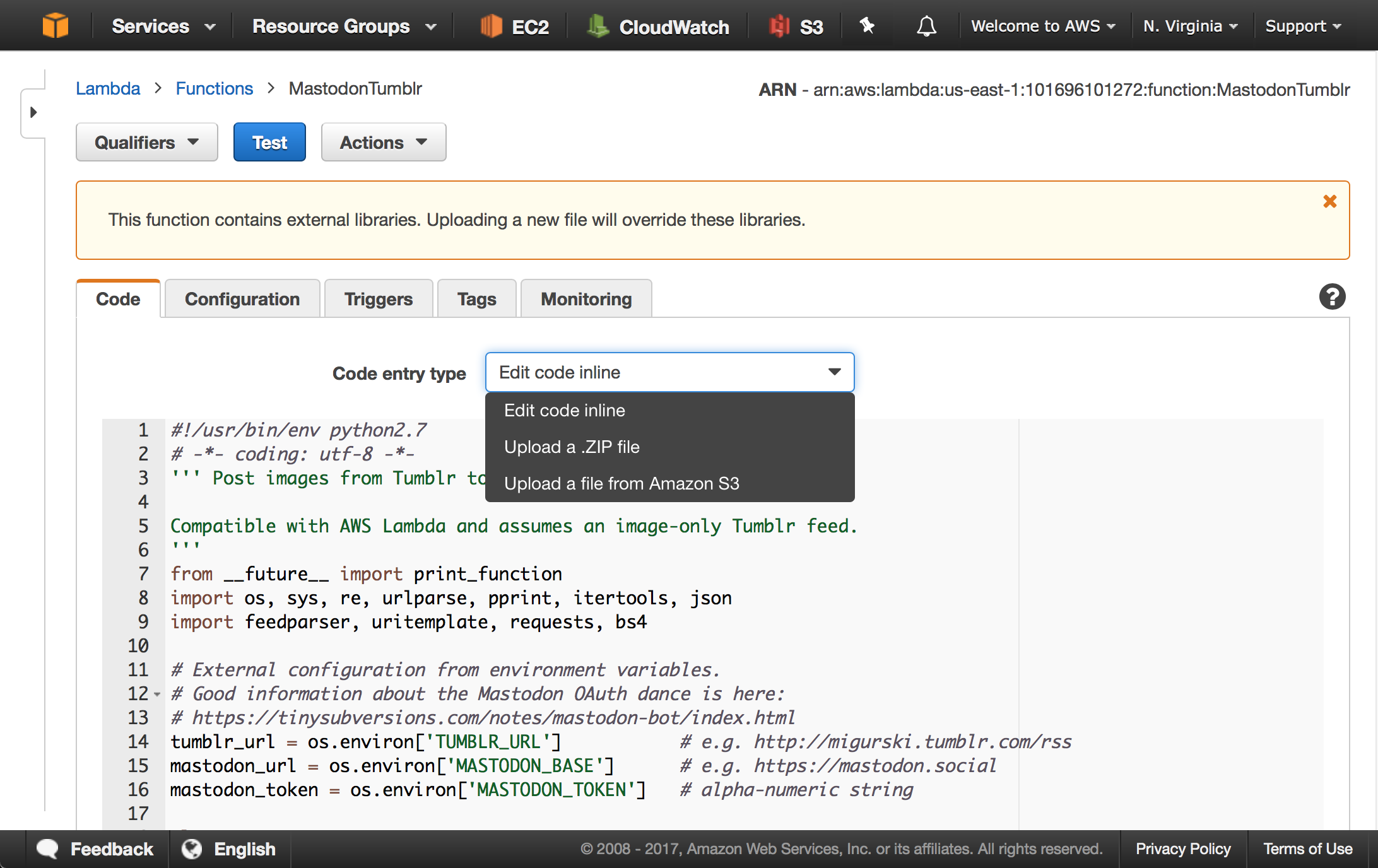
Editing non-trivial code is a bummer. The basic interface to Lambda is an editable text box where you can type (or paste) code directly. In my browser, Safari on OS X, certain operations like copy/paste frequently fail in the text box. A Zip archive upload is provided as an alternative, and the AWS CLI can let you do this programmatically. On slow internet this introduces a prohibitive time delay uploading large function packages. Heroku’s Git model and integration with service like Github feels much more mature and conducive to a smooth development and deployment flow.

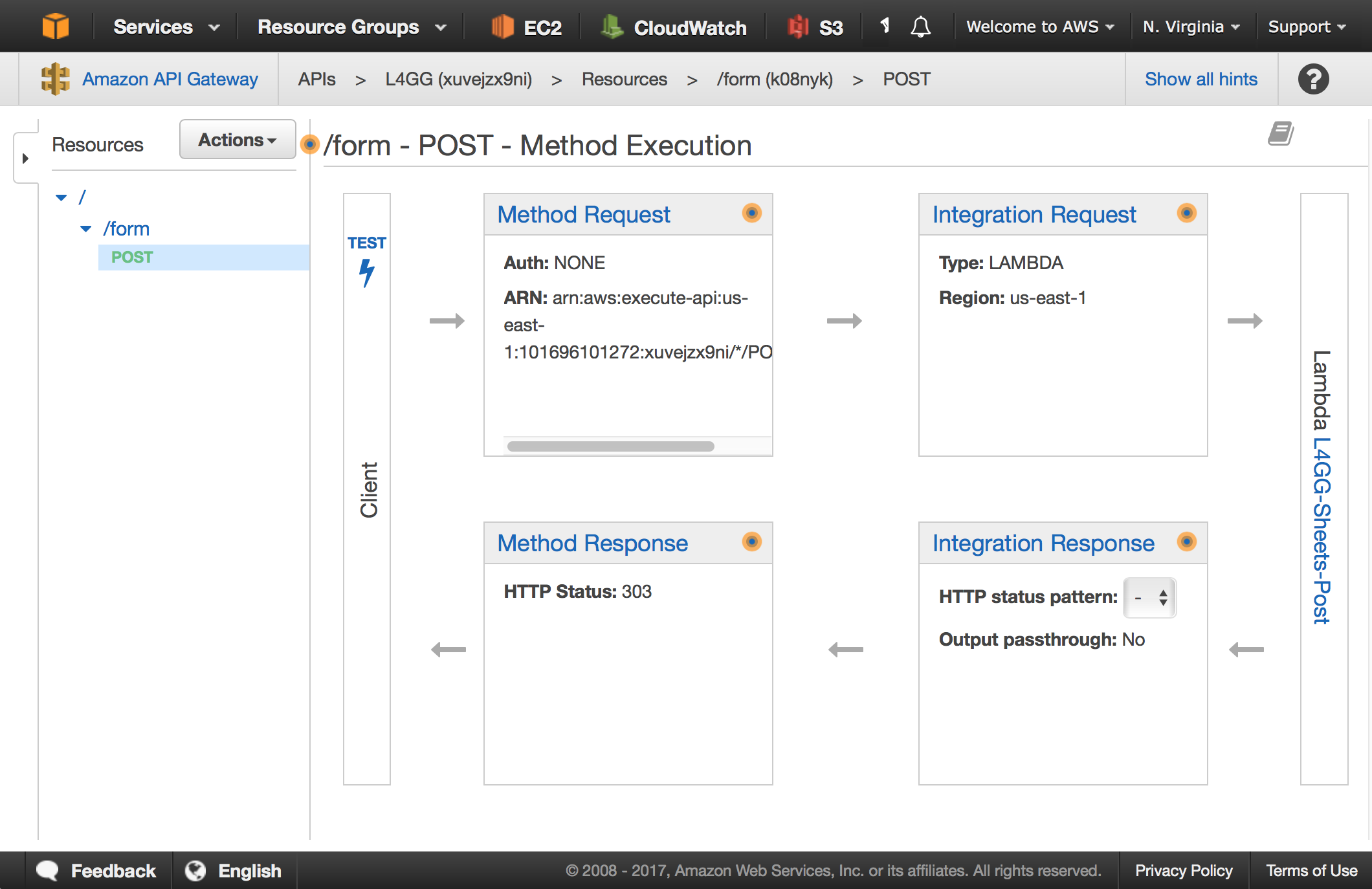
Working with the API Gateway service is unfortunate, with four interlocking pieces of configuration: Method Request, Integration Request, Integration Response, and Method Response. Configured settings in each are interdependent, such as the status code and header behaviors in the two response configurations. Getting “normal” HTTP things like form submissions to work involves some pretty weird Stack Overflow driven development, and generally feels hacky. I have mostly found configuring API Gateway to be a trial-and-error process. I’ve heard that Swagger helps with this in some way, but it also appears to overengineer a lot of unrelated things so I’ve ignored it.

Finally, it’s difficult to spin up a quick dev environment with all these services. I’ve ended up continuously deploying to production as I work, not dissimilar from old-style FTP-based development. Heroku has always done this very well with entire stacks magicked out of Github pull requests, and the recently-departed Skyliner.io platform did a great job with AWS configurations specifically. AWS API Gateway does have the concept of deployment stages, but it’s only one piece of the overall picture. AWS Cloudformation is supposed to help with this, but it’s big and impenetrable and I haven’t yet invested the time to understand if it’s an answer or more questions.

Fortunately, a bunch of other things I thought would be difficult turned out to work really well in Lambda after a bit of effort to learn more about the model.

Stuff I Learned

  • Packaging for deployment
  • Deploying from a CI service
  • Including compiled binaries
  • Uploading one well-tested package for multiple functions
  • Using Proxy Integration to make requests sane

As soon as I wanted to use Amazon’s Python SDK Boto to talk to other Amazon services from Lambda, I realized I was going to need to build a package larger than a single file. Lambda’s deployment advice shows how to use Pip to build a zip archive for upload to Amazon, so I’ve been adding that to project build scripts. Pip’s target directory option creates the right structure for Lambda’s use, which means that my usual requirements declarations now just work with Lambda.

Once Boto was added to the package, the size immediately ballooned to several megabytes. Boto is pretty big, and doesn’t include an option for building a minimal version. So, I was creating code builds much too large to effectively upload from my home DSL or my mobile tether. I wanted to be able to deploy via incremental Git pushes as Heroku allows, and fortunately Circle CI’s deployment feature made this possible. After adding master branch deployment to my testing configurations, I no longer needed to wait for lengthy network transfers on my local connection.

The next addition that ballooned my package sizes was GDAL, a compiled binary library for working with geographic data. Fortunately, Seth Fitzsimmons and Matthew Perry have each worked on this before and provided details on making GDAL work with Lambda. Seth in particular has become something of an expert in getting hard-to-compile binary software like GDAL and Mapnik working on platforms like Lambda and Heroku. I’m enormously lucky to be able to benefit from his work. I used Seth’s Docker-based build hints to include GDAL in the Lambda packages. With GDAL’s addition and a few other dependencies, the overall package size had increased to 25MB so I was grateful for Circle CI’s role in the process.

The actual differences between different function packages were quite miniscule by this point, so I’ve been uploading a single package to Lambda for multiple functions and using a minimal entry point script to provide handler functions. This organization has helped in a few ways. When Lambda invokes a handler from within a module, it doesn’t allow for relative imports that are useful for building a real package. I looked for ways around this and found a 2007 note from Guido van Rossum arguing that “running scripts that happen to be living inside a module’s directory” is “an antipattern”. Moving those scripts out to a short file outside the module is closer to the spirit of Guido’s intended usage. Also, it makes comprehensive testing of a module easier to complete.

After messing around with API Gateway’s various input and output options, I’ve concluded that Lambda Proxy Integration is the only way to go. Lambda handlers will never see CGI-style HTTP input as Heroku applications do, but API Gateway sends the next best thing with a dictionary of HTTP input details. These are under-documented so it’s taken some trial-and-error to get input working. I’ve considered writing a small Lambda/Flask bridge using these objects in order to write an application that can be fully run locally, and hopefully the example provided in Amazon’s docs is sufficiently comprehensive.

Conclusion

Working with Lambda still feels fairly uphill, and I’m hoping to improve on some of the challenges above. As I’ve been writing an application with no users, it’s been easy to update live Lambda functions. A next step would be to configure a second development environment with all the necessary interconnecting parts. I’m pretty pleased with the tradeoffs, assuming that Lambda’s scaling advantages work as-promised.

Comments (3)

02 Jun 23:18

What I'd like to see at WWDC, 2017 Edition

On one hand, it's completely unreasonable to be posting requests for what I'd like to see next week at WWDC. Really I should have made this list a year ago. But on the other hand, it's fun to do so here we go:

New Mac Pro Teaser
It'd be awesome if we got some sort of teaser about what's coming in the new Mac Pro. This is what I'd like Apple to say: "The 2018 Mac Pro is a quiet box with room to put things in, and it's not super expensive like the last one. Sorry about the last one by the way. Also, we decided that we would leave our desire to innovate on everything to other products. This new machine is pretty boring, but it's fast and boring and we know you appreciate that and you've been waiting long enough as it is. This one has USB-C and the newest Thunderbolt though, unlike the last one. Again, sorry. But you'll like this Mac Pro for real this time. And here's a 48 bit, super wide gamut display to go with it."

Performance Tools for Core Image
I'd like to know where the bits for images I'm drawing reside, how they got there, and how long it took to get there. Also, how much memory is that image taking up on the GPU? And what's the state of the caching that you're doing for me behind the curtains? Enquiring developers would like to know.

macOS Renamed to MacOS
I know this is petty, but I can't stand seeing the lowercase M in the name. It's weak and screams of the late 2000's. Can we just pretend the lowercase didn't happen?

MacOS 10.13
It's already showing up in web server logs, so I'm sure 10.13 is around the corner. But what's going to be in it? I'd like to see stability, performance, and better Siri integration. Some sort of neat iPad integration that's been rumored for a while now would also be awesome.

I'd also like to see APFS on the Mac, but I'm scared of it to be honest. The switchover for iOS to APFS was easy because developers weren't allowed to do very much with the file system. On MacOS however, developers and users have been having their way with the file system for decades. There's going to be more than a couple of edge cases to take care of. I don't want to get burned.

Siri in a Speaker
I've got an Amazon Echo, and I love it. I'd like to see what Apple's take is in this category.

But- Apple is going to have to open Siri up a bit more. I want to be able to make triggers and actions for it. I want to be program my own commands into it, which might then talk back to my Mac or whatever else I want.

No More Cutesy Siri
I'd love to be able to turn off Siri's "witty" one liners and comments. It got old after the 3rd time, let me turn it off already.

Dynamic Swift
Objective-C has a rich system for dynamically calling methods and forwarding messages to objects. I find it incredibly liberating to use, and I really wish Swift had something similar.

Xcode Improvements
I'd like it to be faster and crash less. I don't think that's too much to ask for.


The last time I was in San Jose Apple was introducing Aqua for the first time. San Jose is a sleepier town than San Francisco, but I think we'll all have fun anyway. Hopefully I'll see you there.

02 Jun 23:18

The human world is not more fragile now: it always has been – Claire Colebrook | Aeon Essays

02 Jun 23:18

"The president embarked on his first foreign trip with a clear-eyed outlook that the world is not a..."

“The president embarked on his first foreign trip with a clear-eyed outlook that the world is not a “global community” but an arena where nations, nongovernmental actors and businesses engage and compete for advantage. We bring to this forum unmatched military, political, economic, cultural and moral strength. Rather than deny this elemental nature of international affairs, we embrace it.”

-

H.R. McMaster and Gary D. Cohn | America First Doesn’t Mean America Alone

Two of Trump’s myrmidons make it clear. The motto of Trump and his party is ‘everyone for themselves’, and that dictum operates from the level of the individual and society, the world of business, and geopolitics. Life is a zero-sum game, they say, and there should be no aspiration to a higher purpose other than domination and control.

This is the sort of realpolitik mumbo jumbo that totalitarians use to justify subjugation and enslavement, a philosophy that leads to considering everything good as spoils for the winners, and all the bad that comes from this pillaging the inevitable lot of the losers, who after all deserve their pre-ordained fate.

These beliefs are not only dangerously wrong, they are deeply immoral, nay, evil. Trump and his cadre are the worst sort of people. And it makes me sick to consider the line ‘you get the leaders you deserve’. What does that say about us, America?

And it’s laughable in a nausea-inducing way that Mutt and Jeff tout America’s ‘moral strength’ while advocating a worldview closer to Genghis Kahn than to E Pluribus Unum.

It’s not ‘America First’, it’s ‘America Worst’.

02 Jun 23:17

A toolkit for predicting the future

The Economist, Medium, Jun 05, 2017


It's a toolbox with only three tools, but they're good tools:

  • History lessons - patterns from the history of technology, eg., new forms of crime, concerns about privacy, etc.
  • Uneven distribution - in some places, the future is already here, so look for them (eg. in 2001, mobile handsets with cameras and colour screens were commonplace in Japan)
  • the imagined futures of science fiction - not only predictive, but often inspirational
My key tool has always been to focus on the human side of the equation. What will people do, what will people want to do? If tech is the driver, what is the attractor?
[Link] [Comment]
02 Jun 23:17

Friends don’t let friends use Facebook

by Doug Belshaw

Facebook, on the other hand, only offers its users a forum to connect and share information. Facebook’s income derives from selling targeted advertising to be delivered to those same users, based on preferences the site has learned from their comments, friends, and preferences. It has no goods or services to sell, and its users don’t buy anything. Thus, its only product to take to market is, in fact, its users’ data. (source)

I don’t use Facebook. You shouldn’t either.

I scraped the trackers on these sites and I was absolutely dumbfounded. Every time someone likes one of these posts on Facebook or visits one of these websites, the scripts are then following you around the web. And this enables data-mining and influencing companies like Cambridge Analytica to precisely target individuals, to follow them around the web, and to send them highly personalised political messages. (Jonathan Albright, source)

Personalised advertising isn’t useful. It’s invasive, and it’s used to build a profile to manipulate you and your ‘friends’.

Using personality targeting, Facebook posts can attract up to 63 percent more clicks and 1,400 more conversions. (source)

There’s several pretty scary implications to where this could take us by 2020:

  1. Public sentiment as high-frequency trading — algorithms compete to sway the opinions of the electorate / consumers.
  2. Personalized, automated propaganda — not just lies by politicians, but auto-generated lies created by bots who know which of your ‘buttons’ to press.
  3. Ideological filter matrices — what happens when all of the other ‘people’ in your Facebook group are actually bots?

So, not only will I not use Facebook, but (like Dave Winer and John Gruber) I won’t link to it. Nor will I accept organisations that I’m part of setting up Facebook groups ‘for convenience’ or using a Facebook page in lieu of a website.

 Facebook is designed from the ground up as an all-out attack on the open web. (John Gruber)

The web is a huge force for good. We shouldn’t let inertia and a lack of digital skills turn it into a series of walled data mine.

Get a blog. If your ideas have any value put them on the open web. (Dave Winer)

From a business point of view, you’re mad to put all of your eggs in once basket. Get a website. Facebook’s content is, by design, not indexed by search engines. It’s invisible to search engines.

Look, I get that I’m the nut who doesn’t want to use Facebook. I’m not even saying don’t post your stuff to Facebook. But if Facebook is the only place you are posting something, know that you are shutting out people like me for no good reason. Go ahead and post to Facebook, but post it somewhere else, too. Especially if you’re running a business.

[…]

It’s 2017. There are a million ways to get a web site set up inexpensively that you can easily update yourself. Setting up a Facebook page and letting your web site rot, or worse, not even having a web site of your own, is outsourcing your entire online presence. That’s truly insane. It’s a massive risk to your business, and frankly, stupid. (source)

I feel more strongly about Facebook’s threat to the web than I did about Microsoft’s Internet Explorer at the turn of the millennium. Scarily, it looks like Twitter might be going the same way. I blame venture capital and invasive advertisnig.

Individual actions build up to movements. Resist. Find alternatives. Don’t be a boiled frog.

Header image based on an original by rodrigo

02 Jun 23:16

Lessons of Dreamland

by pricetags

The Sun posts a fine background on the new planning process for South False Creek:

Council voted unanimously this week to approve terms of reference for a planning process for the area along the south shore between the Burrard and Cambie bridges, most of which is city-owned. This sets in motion, after years of neighbourhood engagement, the city’s planning efforts for the next phase of a great Vancouver neighbourhood, one that grew out of controversy into an icon of livability.

In 1972, a Vancouver Sun op-ed under the headline “Instant Slum” derided the False Creek South plan as far too dense for a viable community, recalled historian John Atkin.

Does False Creek hold answers?  It already has.

The consequence of this …

“Life in dreamland on the creek.”

… was this:

Concord Pacific on the North Shore of False Creek

.

In a way South False Creek was the anti-West End.  Everything Vancouverites didn’t like about that ‘concrete jungle’ was reflected in a set of guidelines drawn up in the early ’70s that became known as the Green Sheets: no highrises, much more park space, no road along the waterfront, priority for pedestrians, a ‘Pattern-Language’ vocabulary for residential design, an emphasis on accommodating families with children, and more.

At the beginning of the planning process for the Concord Pacific lands in 1988 (once the original ‘lagoons scheme’ was discarded), the City took the Green Sheets and, when adopted by Council, became the basis of the Official Development Plan for North False Creek, done by a team from the City and from Concord Pacific led by Stanley Kwok.

So while the architectural form of the two neighbourhoods looks so different in scale, their urban-design roots are similar, founded in the values of aspirational urbanism – a belief that it was possible to design complete, livable communities at high density. (For more background and analysis, see Price Tags 104, left.)

Michael Geller, in Dan Furano’s article, “remembers the backlash when he worked on the original False Creek South project. And Geller, now a real estate consultant, has been reminded of that backlash in recent years, when Vancouver neighbourhoods have pushed back against city hall’s attempts to increase density.

But he believes more home-dwellers are coming around to the idea that more False Creek-style housing, such as stacked townhouses, spread throughout the region could help improve affordability while creating vibrant, walkable neighbourhoods.

“I think people are ready to accept it now,” Geller said. “Many of the people who opposed new, higher-density housing nine or 10 years ago, are now ready to move into it, or their kids are. And that’s the reason I’m more optimistic than I was 10 years ago.”

Another lesson from the South Shore: the original mixed-use walkway, while fine when the Creek was effectively isolated and unconnected to the Seaside Greenway that would take decades more to reach both ends below the Cambie and Granville Bridges, was inadequate to safely handle the volumes of cyclists, runners and walkers which now constitute normal use.  In other words, it couldn’t handle success.

Hence the redevelopment of the greenway, even at a loss to the original materials and some of the older trees, to some controversy.

Once again, something new, responding to more ambitious urban aspirations, is controversial.  The West End in 60s, South False Creek in the 70s, the North Shore in the 90s.  Then they become our templates for success.


02 Jun 23:16

B.C. cops tired of tire thefts as Vancouver woman loses two in a night

mkalus shared this story from Vancouver Sun:
Tires aren't cheap, but really? Sounds like Southern Italy in the '80s.

With your existing account from:

{* loginWidget *}

or with your Vancouver Sun account:

{* #signInForm *} {* signInEmailAddress *} {* currentPassword *}

{* /signInForm *}

Welcome back, {* welcomeName *}!

{* loginWidget *}

Welcome Back, {* welcomeName *}!

{* #signInForm *} {* signInEmailAddress *} {* currentPassword *}

{* /signInForm *}

Your account has been deactivated.

Sorry, we could not verify that email address.

Your account has been reactivated.

You must verify your email address before signing in. Check your email for your verification email, or enter your email address in the form below to resend the email.

{* #resendVerificationForm *} {* signInEmailAddress *}

{* /resendVerificationForm *}

Please confirm your details below.

{* #socialRegistrationForm *}

{* firstName *} {* lastName *} {* emailAddress *} {* displayName *}

Postmedia wants to improve your reading experience as well as share the best deals and promotions from our advertisers with you. The information below will be used to optimize the content and make ads across the network more relevant to you. You can always change the information you share with us by editing your profile.

Birthdate{* birthdate *}

Gender{* gender *}

Attention Print Newspaper Subscribers
For verification of Print Subscriber offers (e.g. epaper, Digital Access, Subscriber Rewards), please input your Print Newspaper subscription phone number and postal code.

{* phone *} {* addressPostalCode *}

By clicking "Create Account", I hearby grant permission to Vancouver Sun to use my account information to create my account.

I also accept and agree to be bound by Postmedia's Terms and Conditions with respect to my use of the Site and I have read and understand Postmedia's Privacy Statement. I consent to the collection, use, maintenance, and disclosure of my information in accordance with the Postmedia's Privacy Policy.

{* backButton *}

{* /socialRegistrationForm *}

Please confirm your details below.
Already have an account? Sign In.

{* #registrationForm *}

{* firstName *} {* lastName *} {* emailAddress *} {* displayName *} {* newPassword *} {* newPasswordConfirm *}

Postmedia wants to improve your reading experience as well as share the best deals and promotions from our advertisers with you. The information below will be used to optimize the content and make ads across the network more relevant to you. You can always change the information you share with us by editing your profile.

Birthdate{* birthdate *}

Gender{* gender *}

Attention Print Newspaper Subscribers
For verification of Print Subscriber offers (e.g. epaper, Digital Access, Subscriber Rewards), please input your Print Newspaper subscription phone number and postal code.

{* phone *} {* addressPostalCode *}

By clicking "Create Account", I hearby grant permission to Postmedia to use my account information to create my account.

I also accept and agree to be bound by Postmedia's Terms and Conditions with respect to my use of the Site and I have read and understand Postmedia's Privacy Statement. I consent to the collection, use, maintenance, and disclosure of my information in accordance with the Postmedia's Privacy Policy.

{* backButton *}

{* /registrationForm *}

We have sent you a confirmation email to {* emailAddressData *}. Please check your inbox and follow the instructions to confirm your email address.

Follow these simple steps to create a new password.

1. Enter your email address below
2. Wait for the instructions to arrive in your inbox
3. Follow the instructions to update your password

{* #forgotPasswordForm *} {* signInEmailAddress *}

{* backButton *}

{* /forgotPasswordForm *}

We've sent an email with instructions to create a new password. Your existing password has not been changed.

{* mergeAccounts {"custom": true} *}

{| foundExistingAccountText |} {| current_emailAddress |}.

{| existing_displayName |}
{| existing_provider_emailAddress |}

Created {| existing_createdDate |} at {| existing_siteName |}

Validating

{* #signInForm *} {* signInEmailAddress *} {* currentPassword *}

{* backButton *}

{* /signInForm *}

Sorry, we could not verify your email address. Please enter your email below, and we'll resend the instructions for email verification.

{* #resendVerificationForm *} {* signInEmailAddress *}

{* /resendVerificationForm *}

Check your email for a link to verify your email address.

Thank you for verifiying your email address.

{* #changePasswordFormNoAuth *} {* newPassword *} {* newPasswordConfirm *}

{* /changePasswordFormNoAuth *}

Your password has been successfully updated.

We didn't recognize the password reset code. Please enter your email below below, and we'll send you a new code to reset your password.

{* #resetPasswordForm *} {* signInEmailAddress *}

{* /resetPasswordForm *}

We've sent you an email with instructions to create a new password. Your existing password has not been changed.

:)

Signed in as mkalus

Share this story on NewsBlur

Shared stories are on their way...

02 Jun 23:15

Hack Education Weekly News

(National) Education Politics


From the Department of Education press release: “Secretary DeVos Releases Statement on President Trump’s Decision to Withdraw the U.S. from the Paris Climate Accord.” For a Secretary of Education to speak on this is odd, at best. For Banana Republicans, perhaps less so. More on DeVos and climate change via The Washington Post.

“Some Hires by Betsy DeVos Are a Stark Departure From Her Reputation,” says The New York Times. Key word: “some.”

Massachusetts Senator Elizabeth Warren is launching DeVos Watch, an initiative to hold the Department of Education “accountable.”

Via Chalkbeat: “For Betsy DeVos and her former advocacy group, the future of education means ‘personalization,’ including virtual schools.” Her “former advocacy group” – although considering she spoke there last week, I’m not sure how “former” it really is – is the American Federation for Children.

The Atlantic writes about the absence of Betsy DeVos at this year’s Education Writers Association conference.

Via The Washington Post: “Eighth-graders from N.J. refuse to be photographed with Ryan.” That’s Speaker of the House Paul Ryan, not one of the more beloved American Ryans: Ryan Reynolds, Ryan Gosling, Ryan Seacrest.

“U.S. Department of Education Launches New IDEA Website,” the Department of Education’s press release pronounces. The website went offline shortly after DeVos’ confirmation, causing many to panic since she seems to have little interest in her confirmation hearings in promoting educational equity and little knowledge about special education and federal law.

More on federal financial aid in the business of student loans section below.

(State and Local) Education Politics


Via The Washington Post: “With state budget in crisis, many Oklahoma schools hold classes four days a week.”

Via ProPublica: “Voucher Program Helps Well-Off Vermonters Pay for Prep School at Public Expense.”

New Mexico’s Public Colleges Breathe Easier, as Governor Signs Budget Bill,” says The Chronicle of Higher Education.

Immigration and Education


Via Politico: “Trump administration asks Supreme Court to reinstate travel ban.”

Via Inside Higher Ed: “The U.S. Department of State has received emergency approval from the Office of Management and Budget to collect additional information regarding certain visa applicants’ travel and employment histories, familial connections, and social media usage in accordance with a notice it posted in the Federal Register May 4. The approval from OMB is for six months rather than the usual three years.”

Education in the Courts


“A federal appeals court on Tuesday ruled in favor of a transgender student’s challenge to a Wisconsin school district’s policy limiting his restroom usage – a big win for those seeking to advance transgender rights in the courts,” Buzzfeed reports.

Via the WFF: “Supreme Court Victory for the Right to Tinker in Printer Cartridge Case.” The case involved Lexmark, a major supplier to schools, which had tried to keep customers from refilling their printer cartridges.

Via Edsurge: “BrightBytes Tried to Buy Hapara. Then a Better Offer – and a Legal Complaint – Emerged.” No disclosure in the article that Edsurge shares investors with both these companies.

More on Trump’s legal efforts to reinstate his “Muslim ban” in the immigration section above.

Testing, Testing…


“At last weekend’s annual meeting of the Association for Psychological Science (APS) in Boston, Cornell University psychologist Robert Sternberg sounded an alarm about the influence of standardized tests on American society,” says Scientific American, publishing a Q&A with Sternberg about his concerns.

“Free College”


Via Inside Higher Ed: “Massachusetts Governor Charlie Baker and Boston Mayor Marty Walsh announced Tuesday a new tuition-free college program for low-income students in Boston. Boston Bridge would be available for 2017 high school graduates who live in the city.”

The Business of Student Loans


From the Department of Education’s press release: “The U.S. Department of Education today announced the IRS Data Retrieval Tool is now available for borrowers applying for an income-driven repayment plan. New encryption protections have been added to the Data Retrieval Tool to further protect taxpayer information. The IRS Data Retrieval Tool will return Oct. 1, 2017, on the online 2018–19 Free Application for Federal Student Aid (FAFSA) form.”

Via Edsurge: “A Basic Glossary to Income Share Agreements, a New Approach to Student Finance.” The op-ed is penned by someone from Vemo Education, who sells this “solution” to students. No disclosure, no surprise, that Edsurge shares investors with this company.

The “New” For-Profit Higher Ed


For-profit tactics might be coming to public universities, and no one is talking about it,” says Salon, which is funny because I’ve been tracking on the “new” for-profit higher ed for years now, and my friend Tressie McMillan Cottom literally wrote the book on this. But hey.

Bethune-Cookman Had a Reason to Invite Betsy DeVos to Give That Calamitous Commencement Speech,” The Intercept’s Zaid Jilani reports, suggesting that the HBCU wants to stay in the administration’s good graces because of its affiliation with for-profit law schools that are on probation.

Via The Washington Post: “A coding school where college grads train and work without spending a dime.” No dime spent perhaps, but Revature takes a percentage of graduates’ pay.

The coding bootcamp Andela is expanding into Uganda, Techcrunch reports.

Online Education and the Once and Future “MOOC”


Here’s a link to all the stories in Slate’s series on online credit recovery programs.

“After the Hype, Do MOOC Ventures Like edX Still Matter?” asks The Chronicle of Higher Education, with a question that’s probably better suited for the Betteridge’s Law of Headlines section below.

Via The Next Web: “Facebook is letting Groups create online learning courses – what could possibly go wrong?”

Meanwhile on Campus…


Hillary Clinton gave the commencement speech at her alma mater, Wellesley, and everyone’s got a goddamn opinion on this, don’t they.

“A Princeton professor who recently criticized Trump in a commencement speech cancels planned public speaking events, saying she’s received death threats for her comments,” Inside Higher Ed reports. Funny how all those “free speech advocates” who wring their hands and claim that liberal students on college campuses are a danger to the First Amendment have little to say in support of Keeanga-Yamahtta Taylor. Why, it’s almost like “free speech” isn’t what many of these folks are interested in at all.

Via Buzzfeed: “Puerto Rico’s Universities Are Facing An Unprecedented Crisis.”

UC reverses policy, won’t pick up tab for regents’ parties,” The San Francisco Chronicle reports. However will they cope.

Via The Seattle Times: “Evergreen State College closes after caller claims to be armed, en route to campus.”

“When UConn broke up with Adobe: A parable of artists and copyright” by Tom Scheinfeldt.

Via the BBC: “Edinburgh University blames a system error for ‘failed degree’ emails.”

Politico profiles charter school chain founder Eva Moskowitz.

Accreditation and Certification


Inside Higher Ed writes about accreditation and the “Fine Print and Tough Questions for the Purdue-Kaplan Deal.”

From the HR Department


Carmen Twillie Ambar has been named the new president of Oberlin College.

Via The Atlanta Journal-Constitution: “Troubled cops land jobs in Georgia schools.”

Southern New Hampshire University “lays off dozens of remote, part-time staffers (with plans to hire full-timers) as part of a reorganization process ahead of projected enrollment growth for its competency-based division,” Inside Higher Ed reports.

Adjuncts at Northwestern University have voted to unionize.

The Business of Job Training


Via Techcrunch: “Walmart is bringing VR instruction to all of its U.S. training centers.”

Contests and Awards


NPR on the Scripps National Spelling Bee: “For First Time In 4 Years, Solo Speller Claims National Bee Crown.” Congratulations, Ananya Vinay.

(Related, via WaPo: “The National Spelling Bee’s new normal: $200-an-hour teen spelling coaches.”)

This Week in Betteridge’s Law of Headlines


Via eSchoolNews: “Is VR education an answer to the U.S. inmate problem?” (This reminds me of this wretched “thought experiment” posted in 2015: “How Soylent and Oculus Could Fix The Prison System.” The answer in this case is not simply “no” à la Betteridge. It’s “no” and “fuck no” and “fuck you.”)

(Reminder: according to Betteridge’s Law of Headlines, “Any headline that ends in a question mark can be answered by the word no.”)

Upgrades and Downgrades


Via CNBC: “This start-up is offering $8,000 blood transfusions from teens to people who want to fight aging.” The startup is called Ambrosia, and it sounds a lot like a Peter Thiel fantasy.

Via The New York Times: “The Rise and Fall of Yik Yak, the Anonymous Messaging App.”

“As Computer Coding Classes Swell, So Does Cheating,” according to The New York Times.

“The Turing Tumble lets you and your kids build real mechanical computers,” says Techcrunch.

Via Inside Higher Ed: “Months after deleting controversial lists of “predatory” journals and publishers, the librarian behind them still faces anonymous harassment online.” The librarian in question is Jeffrey Beall. (Incidentally, I saw lots of harassment online this week from these predatory journal folks, but as Bill Fitzgerald notes, Twitter still does little to address abuse on its platform.)

Robots and Other Ed-Tech SF


Via Venture Beat: “The AI Buddy Project is building an assistant to support kids of military families.”

Venture Capital and the Business of Ed-Tech


Yuanfandao has raised $120 million from Warburg Pincus and Tencent. The tutoring company has raised $244.2 million total.

Epic! has raised $8 million in Series C funding from Reach Capital, Innovation Endeavors, Menlo Ventures, Rakuten Ventures, Social Starts, Translink Capital, and WI Harper Group. The e-book subscription service has raised $21.45 million total. (There’s actually a disclosure on Edsurge’s reporting of the investment that it shares an investor with Epic!)

Yogome has raised $6.6 million in Series A funding from Seaya Ventures, Endeavor Catalyst, and VARIV Capital. The educational game maker has raised $9.63 million total.

KidPass has raised $5.1 million in Series A funding from Javelin Venture Partners, Bionic Fund, Cocoon Ignite Ventures, CoVenture, FJ Labs, TIA Ventures, and Y Combinator. The subscription services for kids’ activities has raised $6.3 million total.

Genext Students has raised $580,000 in Series A funding from undisclosed investors. The tutoring company has raised $780,000 total.

Civitas Learning has received an undisclosed amount of investment from the Lumina Foundation and Valhalla Charitable Foundation. The predictive analytics company has previously raised $63.95 million.

Viridis Learning has raised an undisclosed amount of money from Salesforce Ventures. The job placement company has previously disclosed investments totalling $3.2 million.

Pinboard acquires Delicious. Do read the announcement.

Not really ed-tech, but keep an eye on how Silicon Valley wraps itself in the language of “democracy” while taking steps to undermine its very systems. Via Techcrunch: “Reid Hoffman, Bill Gates, Sam Altman invest $30 million in Change.org.”

I’ve updated my calculations on the amount of venture capital funding in the ed-tech industry for the month of May. (Note: I published this before the news about the $120 million invested in Yuanfandao, and I haven’t had a chance to update that report yet.)

Privacy, Surveillance, and Information Security


Via the AP: “The Rhode Island chapter of the American Civil Liberties Union has released a study showing more than a dozen school districts can monitor how students use borrowed laptops and other electronic devices.”

Mashable reports completely uncritically on “How a university campus is using facial recognition to keep its dorms safe.” The university in question: Beijing Normal University.

Via Inside Higher Ed: “The Association of Public and Land-grant Universities is encouraging its 237 member institutions to equip its campus police departments with body-worn cameras – or at least test the technology.”

Data and “Research”


Venture capitalist Mary Meeker released her “Internet Trends” report, giving tech publications an opportunity to decide if they’ll embed all the slides on one post or force folks to click through multiple pages – yay! pageviews! advertising! – to see what she has to say. As Inc notes, the report has ballooned to 355 slides, up from 66 in 2011. “Software is eating the world” or “venture capitalists have no fucking clue” – you decide.

“From digital commons to the data-fied urge: Theorising evolving trends in the intersections of digital culture and open educationby Giota Alevizou.

Via The New York Times: “Free Play or Flashcards? New Study Nods to More Rigorous Preschools.”

Via Education Week: “Federal Data Give the Clearest Look Yet at America’s Homeless Students.”

The New York Times (op-ed page) on the “2017 College Access Index.”

Via Chalkbeat: “Lots of people are excited about career and technical education. But new international research points to a potential downside.”

Via The Bookseller: “Children’s love of reading at all-time high, research shows.” The research comes from the National Literacy Trust’s (NLT) Young Readers Programme, which found that 77.6% of primary school students it surveyed say they enjoy reading.

Via Inside Higher Ed: “Most former college students say they would change either their major, college attended or credential pursued if they could do it all over again, survey finds.” The survey comes from Gallup and Strada Education Network (formerly USA Funds).

Via Edsurge: “Where Do US Teacher Salaries Really Go the Furthest?”

UVA’s Daniel Willingham responds to recent claims that valedictorians aren’t “disruptors.”

Cincinnati.com on a study presented at the Pediatric Academic Societies Meeting: “As rates of suicidal youth increase, doctors look at influence of school, internet.”

Via The Hechinger Report: “Government data single out schools where low-income students fare worst.”

The Wall Street Journal offers analysis of the socioeconomic well-being of Americans in rural areas, and it’s not a rosy picture: “Rural America Is the New ‘Inner City’.”

Edsurge describes “How Edtech Companies Blur the Lines Between Commercial and Research Data.” Me, I’m really looking forward to Edsurge’s new "research project testing the idea of an online diagnostic tool"!

If you thought “digital natives” was one of the worst phrases ever to strike ed-tech, I give you the word “phigital.”

RIP


Sister Joel Read, the former president of Alverno College, passed away at the age of 91. “While president, she pioneered a program in which the curriculum was organized around abilities students needed for various degrees, and assessment programs were created for those abilities and the broader impact of the Alverno education,” Inside Higher Ed notes. “The assessment efforts at Alverno were adopted many years before such practices became common – and influenced many other colleges.”

Icon credits: The Noun Project
02 Jun 23:14

Toward a Canadian Knowledge Transfer Strategy: My Appearance Before the Standing Committee on Industry, Science and Technology

files/images/3419993502_455ce89837_b-780x350.jpg

Michael Geist, Jun 05, 2017


Icon

Presentation by Michael Geist to a Canadian government committee on  a study on intellectual property and tech transfer. He suggests that the government should look at knowledge transfer more broadly, and focus less on IP and patents. "The emphasis on university-based patenting is misplaced. It can have a corrosive effect on universities, who forego important, publicly-funded research in favour of potential licensing or patenting opportunities.  With properly funded institutions, there is no need to chase licensing dollars." I've made similar arguments internally, with respect to government-produced research, and called for open access to government resources, publications and data. [Link] [Comment]

02 Jun 23:14

Intro to Firebase and React

files/images/firebase.png

Simon Bloom, CSS-Tricks, Jun 05, 2017


Icon

Firebase is a new service from Google enabling you to create and manage a cloud-based database. React is a Javascript library from Facebook that creates dynamic forms. Combine the two together and you get an innovative serverless application. This post documents creating a demonstration app in which "you and your friends will be able to log in and be able to see and post information about what you're planning to bring to the potlock." Why is this relevant? Imagine an online course as a database interface rather than a series of content pages. [Link] [Comment]

02 Jun 23:13

HMD Global announces Nokia 3, 5 and 6 will get Android O

by Dean Daley
Nokia header

HMD Global, the Finnish company that makes smartphones under the Nokia title, has stated that its newest devices the Nokia 3, 5 and 6 will be getting the Android O update.

“The smartphones will get the Android O update once the new release is available from Google for their OEM partners, the same way HMD Global is committed to the monthly Android security updates,” the Finnish company said in a statement to TechRadar.

The three Nokia devices will be launching in June, according to HMD Global, with a “worldwide” release that will hopefully included Canada.

While the devices are set to be released this month, Android O will not be unveiled until later this year. When it is unveiled, usually smartphone manufacturers take a little while before actually getting the newest version of the Android OS.

Though Google-branded devices like the Nexus and Pixel devices will most likely get the update first, last year the LG V20 shipped only a few weeks later with Android N pre-installed.

The Nokia 3, 5 and 6 and potentially the two other unrevealed Nokia smartphones will mostly take a bit of time before getting the O update, but it’s good to know that all three of these mid-ranged devices will be receiving the update.

Source: TechRadar

The post HMD Global announces Nokia 3, 5 and 6 will get Android O appeared first on MobileSyrup.

02 Jun 23:13

This is Not a Story About a Bike Lane

by dandy

Photos by Ian Flett

Story by Tammy Thorne

~ A shorter version of this story appears in NOW magazine. ~

THIS  IS NOT A STORY ABOUT A BIKE LANE.

This is really more of a story about what can go wrong when the City lets private entities manage public spaces.

Right now in Toronto we are, sadly, just starting to experiment with pedestrianized zones (or pedestrian malls) and car-free streets. We have Willcocks on U of T’s St. George campus and Gould on Ryerson’s campus. We’ll soon have Markham in the new Mirvish Village too.

The City’s talking about prioritizing transit on King Street, but we aren’t considering removing single occupancy vehicle access to do so.

Now, we have John Street. John will become a “cultural corridor.” What does this mean? Well, to some, it means the City is saying, “John Street is not for bikes.”

To others, like local councillor Joe Cressy it means the City is creating “places to go, not just places to go through.”

But what is a “cultural corridor” exactly? Cressy explains, “It’s designed as a cultural corridor and pedestrian corridor – you can call it whatever you want to call it, frankly, because it stitches together so many cultural institutions… the CN Tower and AGO, TIFF [Bell Lightbox], Mirvish theatres, CBC, Much Music.”

Perhaps more important than the title is it’s practical implications: Instead of closing down King Street, the busiest transit thoroughfare in the city, for TIFF for 4 days John can be closed down for 2 weeks. Instead of closing down Queen for the Much Music awards – again, a key transit corridor – for 4 or 5 days, you can close down John.”

And, here’s the rub: On the occasions when John Street is shut down to vehicular traffic for events the street could effectively also be shut down to bikes.

Cressy reassures me though that it’s important to him to keep bike lanes free of obstructions or closures – “it’s important that they are kept open all the time – and so, his logic goes, that is the reason we can't have bike lanes on John. Because when the street is closed for these types of events, bikes wont be able to use the street – a public street. Here is where I can’t accept that private companies can effectively dictate where I can go with my bike, again, on a public street... I'm just not down with that.

Of course, if there are too many pedestrians to ride through comfortably, I – and all other cyclists – will either dismount and walk or chose another route. Peter and Simcoe both have short bike lanes.

But only in Toronto would we create a pedestrianized zone that continues to allow cars, but doesn’t make any space for bikes.

This might seem like splitting hairs, but cyclists don’t get much more than a hair’s breadth on so many roads in this town that I take it seriously when the city designs streets where bikes don’t belong – because I strongly believe that bikes do belong on every street downtown.

I'm especially concerned because of the current situation at U of T and Ryerson University. Right now, on Gould Street in particular, there are unofficial (not City-made) signs that say “Cyclists Dismount” yet the area has skateboarders, bike racks galore and even a bike pump and DIY station at the student centre. It’s also a much safer and saner alternative to Dundas at Yonge. If my choice is 1) nice slow safe pedestrian zone or 2) Toronto’s busiest downtown intersection with zero curb space for cyclists, I’m choosing 1. And yes, I’ll dismount if there’s a farmer’s market or some other busy event on Gould – obviously!

To add to this pedestrian zone vs complete streets quandary, there’s this group of lawyers repping one of the long-standing business owners on Queen who insist there should be reconsideration of a design that makes room for cyclists. They want bike lanes. I can’t blame them: Look at all the cyclists out there any day. (The group hired its own traffic consultant and research conducted last September suggested cyclists represent 70-75 per cent of traffic on John during rush hour peaks.)

Personally I don't really need a bike lane on John. It's nice and slow already, and I feel totally comfortable taking the lane. But not everyone does and that's exactly why we need to have more protected bike lanes on fast streets and make our slower streets complete streets that are safe for all users.

So, for me personally a bike lane on John wouldn’t make a big difference.

John Street is a natural connector between bikes lanes. Indeed, I always take it when I’m going into the core or to the lake from the north as I usually come down St. George/Beverly and then hike over Stephanie (on the contraflow bike lane) then down John to take the first left after Richmond to hit Simcoe (and avoid the very dangerous Queen/Simcoe and Richmond/Simcoe intersections). It’s a quick and natural hitch.

So although my fight isn't for bike lanes per se, it’s for pedestrian zones that do not ban bikes, and for complete streets that do make room for bikes.

When I approached the bike-friendly councillor’s office about the Gould Street situation on Ryerson’s campus Eddie LaRusic, Advisor, Constituency and Planning, for Kristyn Wong-Tam (Ward 27, Toronto Centre-Rosedale) he told me that since bikes are considered vehicles in the Highway Traffic Act the city is compelled to ban them here.

But, I wondered, how can a private entity be allowed to decide who uses a public street? This bylaw dictates that the universities “manage” the space – but the bylaw could easily be amended to say that bikes are allowed. And it should be.

Currently the situation is thus, according to LaRusic: “To my knowledge, the city cannot make an exception to allow bicycles within a pedestrian only-zone. If we prohibit cars on a public street, we have to prohibit cycling too.” He continues, “So while I can't comment on the overzealous enforcement of the pedestrian-only zone by Ryerson staff (although would note that they are likely not peace officers and therefore cannot enforce the Highway Traffic Act), my understanding is that they are correct that you shouldn't be riding on a bicycle on the pedestrian-only zone. But it's because of the Act, not because they are unilaterally allowed to ban cyclists on Gould, nor is it their job to enforce it.”

In the meantime, as long as the city continues to let private entities 'manage' our pedestrian zones or cultural corridors or whatever you want to call them, then we will have overzealous private security folks thinking they can police cyclists. And I'm not having it.

This is not encouraging for cyclists.

We must acknowledge we do not yet have a proper grid of bike lanes which we need not only to accommodate existing cyclists but to encourage all levels of cyclists to ride to work or school. Less experienced and slower cyclists need to use slower streets.

Cyclists, like all other road users, should have the same opportunity to adjust to new infrastructure.

We need to ease congestion and having more people take short trips downtown by bike will help – it’s been proven to help in other cities around the world.

James Thoem, of Copehnhagenize said, “It is great to hear Councillor Cressy talk about the importance of moving people over cars, and always encouraging to see the City doing some more meaningful pedestrian improvements. Nevertheless, it does seem odd the City would forego dedicated bike infrastructure on John Street. Accommodating people travelling by bike in all new corridor projects is only a natural progression for a city like Toronto interested in moving people rather than cars."

He continued,  “John Street is well positioned as an A-to-B route connecting densely populated residential districts to cultural, retail, and commercial land uses. It’s well documented in Toronto bicycle riders make for valuable customers, and shop owners often underestimate the number of customers arriving by bike."

Thoem also noted that there are plenty of examples around the world of pedestrians and bicyclists sharing the same space.

When Cressy was asked if we would ever see a true car-free pedestrian street with John he said “one step at a time” and we can’t “let perfect be the enemy of the good.”

But who wants a cultural corridor that doesn’t include bikes? I mean, Bill Murray and Rachel McAdams like to ride bikes when they are in Toronto for TIFF.

A shorter version of this story appears in NOW magazine.

Related on dandyhorsemagazine.com:

BikeFACE a photo essay

The way forward for Toronto is transit, not more traffic

What would King look like if people were the priority

What a woonerf might look like in Toronto

Who was first past the post? A history of Toronto's ring and post bike stand.

02 Jun 18:06

Trump misunderstood MIT climate research, university officials say

mkalus shared this story .

By Emily Flitter| NEW YORK

NEW YORK Massachusetts Institute of Technology officials said U.S. President Donald Trump badly misunderstood their research when he cited it on Thursday to justify withdrawing the United States from the Paris Climate Agreement.

Trump announced during a speech at the White House Rose Garden that he had decided to pull out of the landmark climate deal, in part because it would not reduce global temperatures fast enough to have a significant impact.

"Even if the Paris Agreement were implemented in full, with total compliance from all nations, it is estimated it would only produce a two-tenths of one degree Celsius reduction in global temperature by the year 2100," Trump said. 

"Tiny, tiny amount."

That claim was attributed to research conducted by MIT, according to White House documents seen by Reuters. The Cambridge, Massaschusetts-based research university published a study in April 2016 titled "How much of a difference will the Paris Agreement make?" showing that if countries abided by their pledges in the deal, global warming would slow by between 0.6 degree and 1.1 degrees Celsius by 2100.

U.S. President Donald Trump refers to amounts of temperature change as he announces his decision that the United States will withdraw from the landmark Paris Climate Agreement, in the Rose Garden of the White House in Washington, U.S., June 1, 2017. REUTERS/Kevin Lamarque

U.S. President Donald Trump refers to amounts of temperature change as he announces his decision that the United States will withdraw from the landmark Paris Climate Agreement, in the Rose Garden of the White House in Washington, U.S., June 1, 2017. REUTERS/Kevin Lamarque

MORE FROM REUTERS
* World pledges to save environment despite Trump
Musk, Iger to quit Trump advisory councils
Trump administration asks Supreme Court to revive travel ban

"We certainly do not support the withdrawal of the U.S. from the Paris agreement," said Erwan Monier, a lead researcher at the MIT Joint Program on the Science and Policy of Global Change, and one of the study's authors.

"If we don't do anything, we might shoot over 5 degrees or more and that would be catastrophic," said John Reilly, the co-director of the program, adding that MIT's scientists had had no contact with the White House and were not offered a chance to explain their work.

The Paris accord, reached by nearly 200 countries in 2015, was meant to limit global warming to 2 degrees or less by 2100, mainly through country pledges to cut carbon dioxide and other emissions from the burning of fossil fuels.

Under the pact, the United States - the world's second biggest carbon emitter behind China - had committed to reduce its emissions by 26 percent to 28 percent from 2005 levels by 2025.

A senior administration official defended Trump's use of the findings. "It's not just MIT. I think there is a consensus, not only in the environmental community, but elsewhere that the Paris agreement in and of itself will have a negligible impact on climate," the official told reporters at a briefing.

The dispute is the latest round of a years-long battle between scientists and politicians over how to interpret facts about the effects of burning fossil fuels on the global climate, and translate them into policy.

Trump has repeatedly cast doubt on the science of climate change and once called it a hoax perpetrated by China to weaken U.S. business.

(Reporting By Emily Flitter in New York; Additional reporting by Valerie Volcovici in Washington; Editing by Jonathan Oatis)

02 Jun 18:06

Donald Trump: Warum seine Klima-Wende die US-Wirtschaft verärgert

mkalus shared this story from SPIEGEL ONLINE - Schlagzeilen.

Elon Musk brauchte nicht viel Bedenkzeit. Vier Stunden, nachdem US-Präsident Donald Trump am Donnerstag den Rückzug der USA aus dem Klimaabkommen von Paris angekündigt hatte, verkündete der Tesla-Chef seinen eigenen Rückzug: Er werde nicht länger als Trumps Wirtschaftsberater tätig sein, teilte Musk via Twitter mit, Trumps Entscheidung sei "nicht gut für Amerika oder die Welt".

Es war bei weitem nicht die einzige Reaktion dieser Art. Noch unmittelbar vor Trumps denkwürdigem Aufritt im Rosengarten des Weißen Hauses hatten zahlreiche US-Konzerne mit Zeitungsanzeigen versucht, den Präsidenten von einem Verbleib im Pariser Abkommen zu überzeugen. Nachdem dies ohne Erfolg blieb, übten viele offene Kritik.

"Die heutige Entscheidung ist ein Rückschlag für die Umwelt und die Führungsposition der USA in der Welt", schrieb etwa Lloyd Blankfein, Chef der Investmentbank Goldman Sachs auf Twitter. Es war wohlgemerkt derselbe Lloyd Blankfein, der seit der Finanvkrise als Prototyp des skrupellosen Finanzkapitalisten gilt und dessen Bank bislang massiv von Trumps Präsidentschaft profitiert hat.

Auch Disney-Chef Bob Iger legte sein Amt als Wirtschaftsberater nieder. Und eine Gruppe von mehr als 100 Unternehmen unter Führung des früheren New Yorker Bürgermeisters Michael Bloomberg kündigte bereits gegenüber der Uno an, sie werde die Ziele von Paris trotz Trumps Entscheidung weiterhin unterstützen.

Der geballte Widerstand mag zunächst überraschen, denn wirtschaftliche Interessen galten lange als größtes Hindernis auf dem Weg zu mehr Klimaschutz. Tatsächlich bedeutet die jetzige Reaktion auch nicht, dass sämtliche US-Konzernzentralen inzwischen mit Ökos besetzt sind. Vielmehr gibt es mittlerweile eine ganze Reihe von Motiven, die auch Unternehmer zu Gegnern von Trumps Klima-Kehrtwende machen.

1. Geschäftsinteressen

Elon Musk mag ein überzeugter Klimaschützer sein, er ist aber auch Produzent von Elektroautos. Als solcher hat er Interesse an einer US-Politik, welche die Reduzierung von CO2-Emissionen unterstützt.

Ähnlich ist es mit den Erneuerbaren Energien. Solar- und Windbranche beschäftigen in den USA nach Zahlen des Energieministeriums inzwischen zusammen rund 475.000 Menschen und damit deutlich mehr als die fossilen Energien, die auf 187.000 Mitarbeiter kommen.

In den vergangenen Jahrzehnten jedoch haben Öl-, Kohle- und Gaskonzerne Milliarden gescheffelt, die sie bis heute erfolgreich für Lobbyarbeit einsetzen. Laut Zahlen des Center for Responsive Politics flossen aus der Branche allein seit 2012 Wahlkampfspenden von rund 10 Millionen Dollar an 22 republikanische Senatoren. Kein Wunder, dass diese kürzlich in einem Brief an Trump schrieben: "Wir ermutigen Sie vehement zu einem klaren Bruch mit dem Pariser Abkommen."

2. Planbarkeit

Selbst in der Ölindustrie gibt es jedoch Widerstand gegen Trumps Klimapolitik. Die Konzerne Chevron Chart zeigen, Exxon Mobil Chart zeigen und Conoco Phillips Chart zeigen sprachen sich alle für einen Verbleib im Pariser Abkommen aus. Regierungsintern gehörte der frühere Exxon-Chef und heutige Außenminister Rex Tillerson zu den Befürwortern des Abkommens.

"Es gibt den USA die Möglichkeit, an künftigen Klimaverhandlungen teilzunehmen", begründete ein Sprecher von Conoco Phillips die Haltung. Der heutige Exxon-Chef Darren Woods argumentierte unter anderem, das Pariser Abkommen schaffe Anreize zur Entwicklung von emissionsarmen Kraftstoffen - einem Bereich, in dessen Erforschung Exxon bereits rund sieben Milliarden Dollar investiert habe. Und Bob Dudley, Chef des Ölkonzerns BP, warnte auf Bloomberg TV, bei einem Ausstieg der USA müsse "sehr klar" sein, was an die Stelle der bisherigen Regeln trete.

Diese Klarheit aber gibt es nicht - schon weil andere Länder die von Trump geforderte Neuverhandlung des Abkommens ablehnen. Dies erzeugt für die Öl-Konzerne etwas, das sie noch mehr fürchten als den Druck durch Umweltschützer - einen Mangel an Planungssicherheit.

3. Angst ums Image

Micky Mouse, Spider Man oder Nemo lassen sich ziemlich emissionsarm animieren. Warum also protestiert selbst Disney-Chef Bob Iger so offen gegen Trumps Entscheidung? Eine Antwort darauf gab 2013 der Finanzchef des Konzerns: "Wenn wir nicht im Einklang mit den Geschichten handeln, die wir erzählen, den Erlebnissen, die wir anbieten und den Bildern, die wir schaffen, verlieren wir unsere Authentizität", sagte Jay Rasulo. "Verantwortlich zu handeln, ist einer unserer Markenkerne."

Disney-Chef und Trump-Kritiker Bob Iger

REUTERS

Disney-Chef und Trump-Kritiker Bob Iger

Disney hat sich bereits 2009 ökologische Ziele gesetzt, zu denen unter anderem eine 50-prozentige Reduzierung der Treibhausgasemissionen bis 2020 gehört. Ähnliche Bekenntnisse gehören unter dem Schlagwort "Corporate Social Responsibility" ("Unternehmerische Sozialverantwortung") inzwischen bei vielen Unternehmen zur Imagepflege. Mit Trumps Entscheidung müssen sie als US-Unternehmen also auch um die eigene Glaubwürdigkeit bangen.

4. Sorge vor Vergeltung

"Wir agieren in einer globalen Wirtschaft", sagte der Umweltchef des Chip-Herstellers Intel Chart zeigen, Stephen Harper mit Blick auf Trumps Entscheidung. "Und wenn wir nicht Teil des globalen Klimaabkommens sind, werden wir anfällig für Vergeltung durch Grenzabgaben und anderes."

Erste Rufe nach solchen Gegenmaßnahmen wurden bereits in mehreren Ländern laut. "Wenn Trump die US-Wirtschaft mit Öko-Dumping ankurbeln will, dann sind CO2-Strafzölle auf US-Produkte die richtige Antwort", schrieb etwa der Berliner Staatssekretär für Arbeit und Soziales, Alexander Fischer (Linke), auf Twitter.

Rechtfertigen ließe sich ein solcher Schritt auch damit, dass Trump selbst ausländischen Unternehmen mit hohen Strafzöllen gedroht hat. Der US-Präsident begründet dies mit der angeblichen Übervorteilung seines Landes durch Handelspartner. Mit dem Ausstieg aus dem Pariser Abkommen aber verschaffen sich die USA selbst einen eindeutigen Wettbewerbsvorteil, weil ihre Industrie nicht mehr an Klimaschutzauflagen gebunden ist.

5. Druck der Aktionäre

Die Ideologie des Shareholder Value, also einer Gewinnmaximierung im Sinne der Aktionäre, galt lange als das Gegenteil einer ökologischen Unternehmensführung. Mittlerweile aber haben viele Klimaschützer die Investoren als Verbündete entdeckt: Die sogenannte Divestment-Bewegung argumentiert, dass klimaschädliche Technologien keine Zukunft haben - und ein Umsteuern deshalb auch im Interesse der Anteilseigner ist.

Dieses Argument scheint zunehmend zu verfangen - auch beim weltgrößten Ölkonzern Exxon Mobil, der sich nun so klar gegen Trumps Klimawende stellte. Erst am Mittwoch billigten 62 Prozent der Exxon-Aktionäre auf der Jahreshauptversammlung überraschend einen Antrag, wonach das Unternehmen mit einem jährlichen "Stresstest" die Folgen des Klimawandels für die eigenen Geschäfte dokumentieren muss.

Im Vorjahr hatte derselbe Antrag noch lediglich 38 Prozent Zustimmung bekommen, die Unternehmensführung wollte ihn auch in diesem Jahr ablehnen. Angeführt wurde die Initiative von mehreren Pensionsfonds, unter anderem von der Church of England. Deren Vertreter Edward Mason stellte den Antrag auch als Signal in Richtung des US-Präsidenten dar: "Trump handelt gegen die Interessen der Wall Street und der weltweit größten Investoren."

02 Jun 18:06

Deutschland und Klima-Vertrag von Paris: CO2-Ziele kaum noch erreichbar

mkalus shared this story from SPIEGEL ONLINE - Schlagzeilen.

Versprochen, gebrochen: Zwei Worte genügen, um die deutsche Klimapolitik zusammenzufassen. Bereits vor zehn Jahren hat sich die Bundesregierung das Ziel gesetzt, die Emissionen bis 2020 im Vergleich zu 1990 um 40 Prozent zu reduzieren. Damit wird sie krachend scheitern. Bislang sind es gerade einmal 28 Prozent.

Ein wesentliches Problem: Der Verkehrsbereich hat seine Emissionen kaum reduziert. So notwendig ein allgemeines Umsteuern beim Autoverkehr ist, so unpopulär sind die Maßnahmen im Einzelnen.

Experten des Umweltbundesamtes haben nach SPIEGEL-Informationen nun aufgelistet, was die Bundesregierung tun müsste, um die Klimaziele zumindest eines ferneren Tages zu erreichen. So halten die Experten die Einführung einer "fahrleistungsabhängigen Maut für alle Straßenfahrzeuge" für unabdingbar. Demnach müssten alle Autofahrer eine Gebühr zahlen, deren Höhe von den gefahrenen Kilometern abhängig wäre. Im Gutachten heißt es, dass ein Benziner auf der Autobahn 6,5 Cent pro Kilometer zahlen müsste. Eine Autofahrt von Berlin nach Köln würde dann rund 37 Euro kosten.

Nach Berechnung der Experten müssten bis zum Jahr 2030 zudem zwölf Millionen Elektroautos auf deutschen Straßen fahren. Um das ambitionierte Ziel zu erreichen, fordern die Autoren eine Mindestquote für Elektroautos nach chinesischem Vorbild. Sie läge 2020 bei drei Prozent und 2025 bereits bei 30 Prozent. Würde ein Hersteller die Quoten verfehlen, müsste er Strafzahlungen leisten.

Darüber hinaus sind die Experten davon überzeugt, dass die Klimaziele ohne kontinuierlich sinkende Verbrauchswerte für Benzin- und Dieselfahrzeuge nicht erreichbar sind, weil Verbrennungsmotoren "kurz- bis mittelfristig (mindestens bis 2030) die dominierenden Energieverbraucher im Verkehrssektor" bleiben. Die günstige Besteuerung von Diesel müsse genauso abgeschafft werden wie die Pendlerpauschale, heißt es weiter.

Die Chefin des Umweltbundesamtes Maria Krautzberger sagte dem SPIEGEL: "Im bisherigen Tempo können wir nicht weitermachen. Wenn wir unsere Ziele noch erreichen wollen, müssen wir auch über Maßnahmen nachdenken, die auf den ersten Blick unpopulär sind."

Dieses Thema stammt aus dem neuen SPIEGEL - erhältlich ab Samstagmorgen und schon heute ab 18 Uhr im digitalen SPIEGEL.

Was im neuen SPIEGEL steht, erfahren Sie immer samstags in unserem kostenlosen Newsletter DIE LAGE, der sechsmal in der Woche erscheint - kompakt, analytisch, meinungsstark, geschrieben von der Chefredaktion oder den Leitern unseres Hauptstadtbüros in Berlin.

02 Jun 18:06

Conductor and Writer Lev Parikian: “Crowdfunding Is Hard Work”

by Rebekka
mkalus shared this story from Ulysses Blog.

Lev Parikian
Lev Parikian
Lev Parikian earns his living as a conductor, but is also a dedicated writer. In our interview he reports what it is like to juggle between two professions, and talks about the pros and cons of crowdfunded publishing.

Please tell us something about you and what you are working on.

I divide my time between conducting and writing. The conducting keeps me busy enough, working mostly with amateur orchestras in and around the London area, but I’ve increasingly made sure I find time for writing. My most recent project is Why Do Birds Suddenly Disappear?, a tale of woeful ornithology, which will be published by Unbound in 2018.

Do you consider yourself more of a conductor, or of a writer?

It slightly depends what day it is. Until a couple of years ago I would definitely have said “conductor then writer”, but with the publishing of my first book, Waving, Not Drowning (a light-hearted book lifting the lid on the secrets of the conductor’s craft) and now Why Do Birds…?, the balance has shifted. Juggling the two is… interesting.

What are the differences and similarities of these professions?

Although both are in creative fields, the differences between them are stark: a conductor is used to standing up in front of people, comfortable with the sound of their own voice (too much so, sometimes) and extrovert; writers are often introverted, like spending time alone, and shy away from the limelight. And while conductors (and other classical musicians) have a certain amount of interpretive licence, they are essentially recreating the work of the composer; when writing, you’re responsible for the creation of something original, and I think it’s that side of it that particularly appeals to me.

”Conducting and writing both require terrific commitment and dedication without the promise of great financial reward.“

What they do have in common is that both require terrific commitment and dedication without the promise of great financial reward.

What made you start writing in the first place?

A fascination with the power of words and stories, I suppose. In particular the way a really good comic writer can lift your mood. PG Wodehouse and Douglas Adams were the great heroes, and they set the bar tremendously high. If ever I feel low, I only have to pick up a Ukridge story or a Dirk Gently volume to start feeling better. Their writing styles became so ingrained that I used to write my cricket club’s match reports as pastiches of Jeeves & Wooster stories or Arthur Dent episodes. And from there to developing my own voice was a natural progression. I’d always entertained notions of being a writer, but two things got in the way for many years: a preternatural aversion to work, and the craven fear that anything I wrote would be rubbish. It took me a while to realise that, with some exceptions, the first draft of anything is usually rubbish, merely a starting point – the old writing adage “writing is rewriting” might be a cliché, but it’s founded in fact.

You will publish your current book with the crowdfunding publisher Unbound. Could you explain how that actually works? What are the advantages and disadvantages of this model?

To explain how it works, I’m going to parrot the blurb from Unbound’s founders, Dan Kieran, John Mitchinson and Justin Pollard.

“On the Unbound website, authors share the ideas for the books they want to write directly with readers. If enough of you support the book by pledging for it in advance, we produce a beautifully bound special subscribers’ edition and distribute a regular edition and e-book wherever books are sold, in shops and online.”

Their pioneering publishing model puts control into the reader’s hands – if a book doesn’t reach its funding target, it doesn’t get made. You can back a project at various levels, and there are rewards associated with each level. Supporters of Why Do Birds…?, for example, could get a conducting lesson from me, a day out birdwatching, or an illustrated talk on the subject of Birds & Music. Or you could just opt for a copy of the book if pledging at a lower level.

The great thing about Unbound, from my point of view, is summarised by their strapline: “Liberating Ideas”. They see potential in all sorts of projects that might have difficulty gaining traction in the “traditional” marketplace (a book about birdwatching by a professional conductor falls firmly into that category!).

Why Do Birds Suddenly Disappear? at Unbound
Lev’s next book will appear with Unbound, a crowdfunding publisher

From commission to delivery it’s been clear that I’ve had the freedom to produce the book that I want to write, but I’ve also been guided by their expertise, experience and wisdom towards our ultimate goal: a beautiful and lovingly-produced book that we hope will delight readers. As a “new” writer, I’ve found this guidance absolutely invaluable.

”You have to get over that very British feeling of not wanting to impose yourself on other people.”

The disadvantages? In true “positive thinking” mode, I see challenges and opportunities rather than disadvantages, but there’s no doubt crowdfunding is hard work. You have to get over that very British feeling of not wanting to impose yourself on other people, a kind of allergy we have to selling ourselves, and, as someone at Unbound put it early on in the process, “embrace your inner American”.

From the reader’s point of view, there’s no doubt it’s not the most efficient way of buying a book – you pay upfront, trusting that the book will appear. But (and I can say this because I’ve supported several Unbound projects myself) one of the delights is the satisfaction derived from being (to put it a bit pompously) a Patron of the Arts. You can go into a bookshop when the book does appear, point to it and say “I helped make that – it wouldn’t exist without me”.

What is your book about, and how is it getting on?

It’s the story of how I rediscovered the joys of birdwatching after a thirty-five year hiatus, and specifically my attempt to see 200 species of British bird in 2016. It’s part nature ramble, part travelogue, part memoir. I’ve had tremendous fun writing it, and I hope readers will share that relish.

Which tools and apps do you use?

Cover Waving, Not Drowning
Anyone who has ever wondered what exactly a conductor is doing will find the answers in Waving, Not Drowning, Lev Parikian’s first book.

Ulysses Ulysses Ulysses! Accept nothing else.

Not quite true, unfortunately. I was (and still occasionally am) a Scrivener user, but found Ulysses after reading recommendations by David Hewson. And because of the ubiquity of Word, and its place as the default tool in the industry, I’ve had to submit the final manuscript using that, and I suspect any tweaks in the copyedit/proofing stage will be made there too. But I mostly use Ulysses, including for this interview.

I also use Evernote, which is great for chucking down scrappy ideas willy-nilly.

What else is important to keep you productive? As an example, do you work in a certain environment or follow a timely routine?

I write, boringly, in my office at home. If it’s nice, in the garden. I find I work better if I have a longer stretch of time at my disposal, but however long I’m able to devote to it I aim for a rhythm of 25 minutes on, 5 minutes off. It helps clear the head, I find. And there’s nothing like a deadline for increasing productivity.

What, do you think, is the most difficult thing about writing a book?

Seeing it through. Coming back to it again and again and making it as good as it can possibly be. And then having it torn from your protesting hands when it has to be released into the wild and you know there are still things you can do to make it better.

Do you have plans for writing another book when this one is finished?

Dozens. All I have to do is work out which is the good one.

”There’s nothing like a deadline for increasing productivity.”

How did you find out about Ulysses, and why did you choose it as a writing tool?

I read a post by David Hewson recommending it, then bought his book about it (having already read his book about Scrivener). He writes very persuasively and clearly, and I thought I’d give it a go. It also helped that the much-trumpeted rollout of Scrivener for iOS took so long to appear – being able to write on all my devices is so useful and liberating, and by the time Scrivener had got their act together I was already hooked on Ulysses.

What do you like best about Ulysses? Do you have a favourite feature?

It’s so simple to use – intuitive and straightforward, leaving me free to throw the words onto the screen. And because of its flexibility the process of reorganising those words is somehow not as daunting as it might be. It’s also handy that it’s so straightforward to export your work to other formats.

To learn more about Lev Parikian’s life as conductor and writer, visit his blog or follow him on Facebook. Also, check the progress his forthcoming book Why Do Birds Suddenly Disappear? at Unbound, where you can still pledge for a copy of the first edition with your name in the back.

02 Jun 18:06

Doctor Weaver will see you now

mkalus shared this story from The Globe and Mail - British Columbia.

As the negotiations continue to determine who will form the next B.C. provincial government, Green Party Leader Andrew Weaver meets with the B.C. Liberals at an undisclosed location. On the day’s agenda: issues of concern to Lower Mainland residents.

Mike de Jong: Hey, Doctor Weaver, how’s it going?

Weaver: Drop the “Doctor” crap, Mike. You know as well as I do it’s a math degree. And where’s Clark?

de Jong: Yeah, hey, sorry about that. Nobody’s really seen her since election night a couple of weeks ago. She’s texting us and stuff, but she’s shut off location services. She’s not part of the negotiating team anyway. So you get me instead, buddy, the former finance minister responsible for five consecutive balanced budgets! Boom!

Weaver: Please. Okay, let’s get to it. Lower Mainland issues. The cap on tolls isn’t going to fly. The Green Party wants road pricing – that includes tolls. We need to make them more fair – spread them out across all bridges and implement a congestion charge. It’s the only way to manage traffic, reduce greenhouse gases and simultaneously generate revenue that could help fund public transit.

de Jong: Whoa, easy there, fella. We promised our corporate donors – many of whom sell cars, by the way – that we would only bring in a new tax or fee if people voted for it in a referendum.

Weaver: Yeah, well, that’s dead. Do you understand what’s going on here? I have all the power now, Mike. It’s mine. Mine, I tell you! Wah, ha, ha, ha, ha! Ahem.

Also, we need to adopt the mayors’ transportation plan.

de Jong: Lower Mainland mayors? The ones we’ve been vilifying for the past decade? That’s a big ask, Andrew. I mean, we need someone to blame.

Weaver: Those days are over, Mike. We need to replace the Pattullo Bridge as well. Oh, and scrap the 10-lane bridge that you want to replace the Massey Tunnel. Or conduct a review of the project – but one that ends with the thing not being built.

de Jong: Now hold on. The Pattullo Bridge may be falling down, but that’s TransLink’s baby. That’s on the mayors. And the new Massey Bridge – we’re too far down the road to turn back now. We just re-did the highway signs telling people how awesome it’s going to be.

Weaver: How dumb do I look, Mike? We all know the bridge is about getting bigger ships up the Fraser to move your fictional LNG. We also know it’s nowhere near the point of no return. I won’t let it happen.

Now let’s talk about housing.

de Jong: Oy.

Weaver: We get rid of your first-time home buyers’ loan scheme. It’s putting people who can’t afford houses into more debt and driving up the cost of anything below the $750,000 threshold. Instead we double the foreign buyer’s tax and quadruple the property-transfer tax on houses worth more than three million. That ought to cool down the market.

de Jong: Geez, Andrew, you know how we feel about taxes. This is gonna put us in a tough bind. And getting rid of the loan thing? We just started it. We don’t even know how much it’s going to cost yet.

Weaver: Yes, well that doesn’t matter, does it? Because it’s dead. I just killed it. See how this works now? Now, let’s talk affordable rental housing.

de Jong: What’s that?

Weaver: Exactly. We want 4,000 new units every year – geared toward low-income working families. That’s $750-million a year, by the way.

Receptionist: Sorry to interrupt, Andrew. Your 10:30 is here.

Weaver: Let’s wrap this up, Mike. We’ll talk more later. Be a chum and leave through the back door, if you don’t mind.

de Jong: Uh, okie dokie. Before I go though, I’d just like to...

Weaver: Now, Mike.

de Jong: Okay. Sheesh.

Weaver: Send him in.

John Horgan: Well, hiya, Doctor Weaver – how ya doin’ today?

Weaver: Don’t “Doctor” me.

Stephen Quinn is the host of On the Coast on CBC Radio One, 690 AM and 88.1 FM in Vancouver.

Report Typo/Error

Follow us on Twitter: @GlobeBC

02 Jun 18:05

The last big downtown waterfront area about to be developed — and it will be the most complicated of all

by Frances Bula

If you think the current Chinatown debates are heated, wait until things really get going with Northeast False Creek.

The city is going to present the proposed ideas so far in a big fair/demo on June 10, with material from all of the many participants involved (park board, stewardship community work on the Hogan’s Alley project/black community, Concord Pacific, engineering with new road plan, Canadian Metropolitan Properties, etc.).

I got an advance look at the ideas and plans so far in my story here. Here’s information about the planned block party to introduce everything June 10 here.

There is already some criticism, with one Hogan’s Alley advocate saying that what the black community is getting from all this is token stuff.

I’m sure the people currently in an uproar over development in Chinatown will be weighing in (though I was talking to Doris Chow of Youth Collaborative for Chinatown yesterday, who is also on a stewardship committee, and she sounded excited about some of the possibilities in the new parks and blocks planned for new Chinatown).

Plans for buildings are preliminary yet — they’re more concepts (terracing, horizontal lines along the park edge, etc.) and massing than actual designs yet.

Lots more to come.


02 Jun 18:05

The Friday File, Paint and School

by Sandy James Planner
mkalus shared this story from Price Tags.

scohol

As reported by Global News spelling is very important for students and also to municipalities too. And it must have been a bit of a trying day in the City of Revelstoke B.C. when social media splashed the following image everywhere of the new word “school” freshly painted outside one of Revelstoke’s places of education.

So how does this happen? The stencils come in two sets and the painters held them upside down and backwards to paint the word SCOHOL. Revelstoke has put a positive spin on he error, saying that not only will the error be immediately corrected, but also suggesting that vehicles may slow down when they see the spelling.

You just can’t buy that kind of advertising.

“While the city’s supervisor is a little ticked by the mistake as well as a little surprised at the attention it’s getting, the operations manager says they’re all managing to have a little chuckle about it.”

31e144a9302d7a87d08bb9aab3d43e8d


02 Jun 18:04

Google Home to release in Canada on June 26th, pre-orders now open

by Patrick O'Rourke
Google Home

Google Home is now available to pre-order in Canada with the device going on sale at a variety of Canadian stores on June 26th.

At I/O 2017, Google announced that the company’s voice-activated assistant would be coming to the Canadian market this summer.

Now, the smart home assistant, which also includes Google Assistant built-in, is available to pre-order on Google’s own online store, as well as Best Buy.

In Canada, Google Home is priced at $179 CAD, which is similar to the device’s $129 U.S. pricing after currency conversion. Shipping time is currently listed at between “2-3 weeks” when ordering from Google’s Store. Best Buy, however, does not list a specific shipping date, though the retailer is offering a free Chromecast as well as $50 off Philips Hue A19 Smart Personal Wireless Light Bulbs with a Home pre-order.

Google Home originally launched in the United States on November 4th and is the Mountain View, California-based company’s answer to Amazon’s Echo. It’s long been rumoured that Apple is preparing to release its own smart home device, possibly called the ‘Siri Speaker‘ and it’s possible this year’s WWDC will give us our first glimpse at the product. Amazon, meanwhile, recently launched a new version of the Echo called the ‘Show,’ as well as a fashion focused iteration named the ‘Look.’

Google Home’s release in Canada marks the first standalone IoT voice-activated assistant to be released north of the U.S. border. Rumours continue to swirl that Amazon plans to release the Echo in Canada soon, but nothing has been confirmed yet.

In a recent press release, Google says that Home is set to launch in Canada in both English and French. While Home is available for pre-order now at the Google Store and Best Buy, the assistant can be purchased on June 26th from the following locations: Google Store, Bell, Best Buy, Indigo, London Drugs, Rogers, Staples, The Source, Telus, Visions and Walmart.

Source: Google 

The post Google Home to release in Canada on June 26th, pre-orders now open appeared first on MobileSyrup.

02 Jun 18:04

Google Chrome ad-blocker reportedly set to launch in early 2018

by Bradly Shankar
Google Chrome on Toshiba Chromebook

Google is planning to ad an ad-blocker into its Chrome browser in early 2018, according to The Wall Street JournalThe feature was first reported on last month and is said to block out ads that Google considers to give a bad advertising experience.

The WSJ says that sources familiar with the matter note that Google is giving publishers at least six months to prepare for the ad-blocker integration. To help with this, Google will reportedly offer a self-service tool called “Ad Experience Reports,” which will alert publishers to “offensive” ad-types on their sites let them know how to remove them. The tool is expected to be made available ahead of the launch of the Chrome ad-blocker.

Ads that are considered “unacceptable” will be decided by the Coalition for Better Ads, an industry group in which Google is a founding member. In March, the Coalition released a list of advertising standards for publishers to follow, with formats like pop-up ads, ads with countdown timers and auto-playing video ads being deemed “beneath a threshold of consumer acceptability.”

The potential addition of an ad-blocker into Chrome would follow Google’s larger efforts put towards removing “bad ads” from the internet. In 2016 alone, the tech giant said it took down over 1.7 billion ads that constituted “misrepresenting content.”

Source: The Wall Street Journal 

The post Google Chrome ad-blocker reportedly set to launch in early 2018 appeared first on MobileSyrup.

02 Jun 18:04

CIBC customers can now check their credit scores for free without penalty

by Sameer Chhabra
CIBC building

CIBC customers wanting to check their credit scores have a new resource at their disposal: the CIBC mobile app.

Canada’s fifth largest bank has announced a partnership with Canadian loan and credit score company Borrowell that will allow CIBC customers to perform a ‘soft’ credit inquiry — meaning that the inquiry won’t negatively influence a customer’s credit score.

“Knowing your credit score is important, particularly if you’re planning to purchase a new home or car, or if you are new to Canada and working to establish your credit,” said Bijal Patel, executive vice president of products, retail, and business banking for CIBC, in a press release.

The credit score check relies on data gathered by Equifax — a North American data analytics corporation.

According to the CIBC, 69 percent of Canadians don’t know their credit score, while 45 percent of Canadians have no idea where they can obtain their credit score.

“As we continue building a personalized digital banking experience for clients, we are also delivering technology that can help clients make informed financial decisions when, where, and how they want,” said Aayaz Pira, senior vice president of CIBC digital, retail, and business banking.

Free credit score checks are launching on mobile first, but CIBC says that they will be available online for all of its customers later this year.

The CIBC mobile banking app is available for free on Android and iOS.

The post CIBC customers can now check their credit scores for free without penalty appeared first on MobileSyrup.

02 Jun 18:04

Patent for Andy Rubin’s Essential Smart Glasses discovered

by Dean Daley
Andy Rubin headshot

Andy Rubin, the co-founder of Google’s Android platform, is reportedly working on a pair of smart glasses.

Patently Apple found a patent for Essential Smart Glasses that appear to look very closely to an average pair glasses — think more Snap Spectacles than Google Glass.

Essential smart glasses patent

According to the patent, Essential Smart Glasses would feature a pair of inner facing cameras that are capable of tracking the eye movements of the user; figures (530/540) shows the placement of these inner cameras. The glasses also feature one outward-facing camera designed to look at the environment around the wearer (this is depicted by figure (550).

The device also features “dual-mode” for alternate reality (AR) purposes.

“Based on the environment that the user sees, and based on the direction of the user’s gaze, the processor can display an image to augment the environment around the user,” reads the patent. “For example, if the user is looking at a barcode of an item, the processor can display cheaper purchasing options of the same item.”

The Essential Smart Glasses would also be compatible with photosensitive lenses, sunglasses lenses and prescription lenses, according to Patently Apple.

Patents should be taken lightly due to them not always becoming consumer products. Andy Rubin’s company Essential unveiled the Essential smartphone and the Essential Home voice-activated assistant earlier this week.

Source: Patently Apple 

The post Patent for Andy Rubin’s Essential Smart Glasses discovered appeared first on MobileSyrup.

02 Jun 18:04

Apple Swift Playgrounds iPad app update brings support for robots, drones and toys

by Bradly Shankar
Apple Swift Playground

Apple’s Swift Playgrounds iPad programming app will be updated to include support for toy robots, drones and musical instruments. The app uses interactive puzzles to teach users how code and launched on the App Store in October 2016, with Apple saying there are now over one million children and adult users.

Rolling out on June 5th, the new update will add support for the following gadgets:

  • LEGO Mindstorms Education EV3, which lets people create brick creatures, vehicles, machines and inventions
  • Popular remote-controlled robotic ball Sphero SPRK+
  • Parrot’s Mambo, Airborne and Rolling Spider drones
  • Ubtech’s Jimu Robot MeeBot Kit, which lets kids build controllable robots
  • Hands-on learning robot Dash by Wonder Workshop for students in kindergarten to grade 5
  • Skoog, the tactile cube that allows for music to be created and played back

Recently, another update to Swift added support for five more languages, including French and Japanese.

While waiting for the June 5th Swift update, Canadians can also check out the latest RC smart toy from Sphero based on Disney’s Lightning McQueen character from Cars.

The announcement comes ahead of this year’s WWDC, which will take place from June 5th – 9th in San Jose, California. Those interested in watching Apple showcase some of its upcoming technology can tune into a livestream, or follow MobileSyrup for coverage of the event.

To lead up to WWDC, MobileSyrup has also been running a series of ongoing features that profile some of the Canadian developer talent that will be in attendance. Check out the latest entry in “Road to WWDC,” which looks at the Vancouver-based makers of fitness app RunGo.

The post Apple Swift Playgrounds iPad app update brings support for robots, drones and toys appeared first on MobileSyrup.

02 Jun 18:04

What Android Pay means for mobile payments in Canada

by Rose Behar
Android Pay

After a seemingly endless wait, Canadian Android users finally have access to Android Pay, about a year after Apple brought its iPhone mobile payments platform to Canada with Apple Pay, and seven months after Samsung Pay soft-launched its service in partnership with CIBC.

With mobile payments now fully available on both major mobile operating systems, the last piece has seemingly fallen into place for Canada’s mobile payments ecosystem. But are Canadians really ready to adopt this new way of paying? MobileSyrup spoke with several experts on the current state of mobile payments in Canada today and projections for the future.

What is Android Pay?

For those less familiar with the concept of Android Pay and mobile payments in specific, Android Pay uses Near Field Communication (NFC) — a technology that’s built-in to the majority of modern smartphones and allows two devices within 4 cm of each other to communicate — to pass a ‘token’ that represents (but does not reveal) a customer’s actual credit or debit card number from their phone to the merchant’s payments machine.

From a software perspective, all the user needs is a phone that’s running a non-developer version of Android 4.4 or above. With those prerequisites, the user can then simply download the Android Pay app to get started. For a more in-depth tutorial, check out our how-to here.

The platform arrived in Canada on May 31st, 2017 — almost two years after it first launched in the U.S. during Google’s 2015 I/O developer conference. As of launch, it supports credit cards from BMO, CIBC, Banque Nationale, Scotiabank, Desjardins, President’s Choice Financial, ATB Financial and Canadian Tire Financial Services.

American Express cards and Tangerine are also coming soon, according to Google (though Tangerine offered a less certain sentiment), and select Interac debit cards will also go live on the platform starting June 5th.

Unlike Apple Pay, which confirmed all five major banks at launch, that list of banks notably leaves out two heavy-hitting Canadian banks — the Royal Bank of Canada and TD Canada Trust.

RBC and TD push back

RBC and TD have opted out of Android Pay for now, both have kept the door open to joining Android Pay in the future — evidently a good PR move, since both have been receiving a high rate of requests that they support the platform on social media from customers.

The banks’ respective statements give a good indication of why Android Pay is off the table for the time being, with both referring customers to use their own Android mobile payments apps — an issue that didn’t affect Apple because the company doesn’t allow third parties to access NFC capabilities, which disallows banks from creating their own digital wallet solutions for that platform.

Robert Smythe, financial insights associate at the IDC Canada research firm, suggested to MobileSyrup that if Google offered more value to banks in the form of data and ownership, both parties would benefit.

“With more value for both their customers and themselves, the banks would be more willing to promote [Android Pay],” said Smythe.

Promotion, he noted, has been sorely lacking for mobile payments so far in the technology’s Canadian history.

“With more value for both their customers and themselves, the banks would be more willing to promote [Android Pay],” said Smythe.

Jason Davies, vice-president of digital payments at Mastercard also suggested the lag was due to the banks hanging on to their own technology.

“I think eventually perhaps they will but it’s one of those things where they obviously have a very, very good digital strategy and they’ll engage with Android Pay when it’s best for their organization and their customers,” said Davies.

Jeff Guthrie, chief sales officer at Moneris, a dominant supplier of payment terminals to merchants across Canada, disagreed on the banks’ motives for not supporting Android Pay.

“I don’t think it’s a rejection of that technology, it’s just that there’s work to be done to enable the technology within their infrastructure and set up the ability for customers to sign on and configure their cards […] but it will happen,” he said.

Lowered expectations for penetration

Just how much does Android Pay change the mobile payments scene in Canada? Experts are split on the matter, but in general there was slightly less confidence in a quick adoption rate than there was after Apple Pay’s launch — which is counter-intuitive considering a large portion of Canadian mobile owners are Android users.

But Smythe says the portion of Canadian Android users that exist are not as large as the public might think.

“We’re seeing Apple iPhones are in the low 50 percent penetration rate, we’re seeing Android in the high 40 percent penetration rate and the gap of the feature phones is probably in the two to three percent range,” said Smythe.

This is a decrease from studies done last year, and is just one of the reasons that Smythe is much less optimistic about the quick adoption of mobile payments than when we last spoke.

Not as quick an uptake as predicted

“My intuition was wrong,” said Smythe about his prediction that Canada would hit 50 percent penetration by 2019. “It’s going to be into the 2020s before we see that sort of heavy penetration. Unless something dramatically changes — and I think that would have to be Apple providing bank access to NFC capabilities, and the ability of banks to really enhance the capabilities of their mobile wallets to really entice people to use mobile payments.”

Smythe bases his opinions on insights published in IDC Canada’s Consumer Survey of Digital Banking Expectations and Experiences — Payments, published in May 2017.

While tap has become more prevalent — Moneris says 38 percent of its three billion transactions last quarter were contactless — the survey revealed that 55 percent of Canadians think the use of pin and card is perfectly convenient, or at least not inconvenient.

Only 22 percent of respondents said they would use any form of mobile payment — Apple, Android or Samsung Pay.

“That doesn’t make mobile payments and tap payments that much more interesting to the consumer,” says Smythe.

Meanwhile, only 22 percent of respondents said they would use any form of mobile payment — Apple, Android or Samsung Pay. In terms of actual usage, IDC found that only one percent of survey participants used Apple Pay daily and two percent weekly, across all age segments. Only in the 25 to 29 age range did that spoke to five percent weekly.

Smythe says part of the disinterest in mobile payments seems linked to the lack of loyalty reward programs. According to IDC’s survey, 44 percent of respondents across all ages were more interested in mobile payments if there was a loyalty link and that increased to about 59 percent in the 25 to 29 age range.

Cautious optimism

Gerry Gaetz, president and CEO of Payments Canada was also cautious in his predictions, stating that within a three to five-year time period, the technology will likely become mainstream due to the convergence of a continued drive for convenience from consumers, an improvement in mobile computing power and capabilities and the underlying payments ‘rail’ (technology and network) that Payments Canada is working to build along with Canadian financial institutions and other stakeholders in the industry.

“These [new technologies] often start slower than you would think and then they often pick up with more speed and sometimes at a certain point they move faster than you’d think,” adding that in a recent Payments Pulse Survey done by the association they found only 13 percent of Canadians using mobile wallets, but that the satisfaction rate was quite high at 83 percent.

“I think that’s an indicator. If people are really happy with something then it’s going to pick up and the word’s going to get out.”

Android Pay

Davies of Mastercard is also optimistic about the effects of Android Pay on the Canadian mobile payments scene, though he too cautioned that adoption would take time.

“It’s not going to be a sprint, it’s going to be a marathon,” he said, adding that he believes there will be a “five-year time horizon for adoption.” He predicts the adoption rate for mobile payments will mirror adoption for contactless payment, which took “five years before it became a ubiquitous piece of a person’s payments arsenal.”

Roadblocks to adoption

Canada’s robust tap-to-pay infrastructure makes it in many ways an ideal market for mobile payments. Interac, for instance, tells MobileSyrup that over half a million merchant locations are flash-enabled and Moneris predicts that half of its transactions will be contactless within the year. However, several experts still see some major roadblocks to adoption.

“Some of the things we see from our survey are for example privacy and security, which are really important to Canadians,” though he notes that in the association’s latest Payments Pulse Survey, 48 percent of respondents were willing to give up some aspects of their personal information in order to get the convenience of a mobile payments app.

“The banks have been tracking their spending on credit cards for many years without the consumer seeing any detrimental impact,” said Smythe.

Smythe notes that Canadians trust their banks more than large tech companies like Apple and Google when it comes privacy and security.

“The banks have been tracking their spending on credit cards for many years without the consumer seeing any detrimental impact.”

While Smythe doesn’t think there’s actually a risk that people’s bank accounts will be compromised with any degree of frequency through digital wallets, he notes there’s “a bit of concern there,” which might be assuaged by linking bank wallets and Android Pay more closely.

“I think integration with bank wallets would be an important facet,” says Smythe, adding that, “integration of loyalty is important and making the whole setup and use of mobile payments as easy as tap.”

A case of ‘forming habits’

“I think it’s a case of forming habits and developing new habits,” says Guthrie of Moneris, adding that people are “very much copy cats, we see the person in front of us and think ‘Oh wow, I think I can do that too,’ and so it is one of those things that sort of builds upon itself and that’s what we saw with the conversion from chip to tap and now to mobile.”

While experts espoused less optimism this year than the previous year about quick adoption of mobile payments technology, the overall outlook is still positive for mobile payments platforms.

Though mobile payments may not go mainstream for many years yet, there’s a clear roadmap for the technology in the adoption of contactless technology, and now that a much larger demographic of Canadians than ever before has access to the technology — including the significant group of Android users that are passionate early adopters — usage is only likely to go up from here.

The post What Android Pay means for mobile payments in Canada appeared first on MobileSyrup.