Shared posts

07 Jun 21:43

Finding your Balance

by Thea Adler

Here are our 6 top tips for transitioning smoothly to a biking lifestyle. 

Check The Weather: It's always a good idea to know what you're getting into. Especially in areas where the weather is ever changing. If you've been in the office all day you might not know what's going outside, if it's started to rain then that's something you'll want to know. Or perhaps it has warmed up quite a bit since you've last been outside. Checking the weather before you set off riding can save you some sweat. 

Have the Proper Gear: If your ebike doesn't already come with flat resistant tires and fenders than that's a good place to start. (Side note: all Blix models come with both!) You might not realize the headache you are avoiding by having those two simple things. Get those, some racks for your panniers ( to carry groceries, necessities, etc.) and you'll be set to go. 

Know Your Route: Familiarize yourself with your route: If you've never ridden to work by ebike then it's a good idea to do a practice run. There might be a route that's quicker and more accessible by ebike that you didn't know about before! Give yourself some time, keep track of things like distance, hills, and length of time so you feel fully prepared when you set out on the first day. 

Know Your Backup Plan: Its bound to happen: you wake up and its pouring rain, or dumping snow, or you feel a cold coming on and you're achy. It's OK to get around another way! Once you've become accustomed to a biking lifestyle don't stress and put pressure on yourself to ebike 100% of the time.

Consider Going Electric: When driving a car or using public transportation you don't consider how many miles you travel during a day just by going to work and stopping at the grocery store afterward. This might cause more fatigue than is reasonable for everyday riding. However, this is something that electric bikes make completely feasible.

Wear the Right Stuff:  Get clothes that are good for biking AND work but get clothes that you like. make it work for your style. If you have to wear more formal clothes to work, bring a change of clothes. If you can wear something more casual then you have more options. Consider the brands mentioned in this Bicycling Mag article! 

07 Jun 21:43

WWDC17 Keynote

by Pixelmator Team

It’s like this year’s WWDC Keynote was made exclusively for us at the Pixelmator Team and very much for me, personally. I loved every single bit of it. I think it was the best WWDC Keynote yet.

I use Apple Watch — I got the Apple Watch Activity app update where you can now basically do a triathlon. I’ll do a triathlon one day (sprint distance, of course. Probably after a couple of our secret massive releases). I know that VR is the future and there you go — now we all (most importantly Apple) officially and loudly agree about it. iPad Pro and iOS — brilliant updates, what’s not to like.

Very excited about iMac Pro. Even more excited about the unannounced, but somehow mentioned between the lines modular Mac Pro. Can’t wait to run our apps on those two — it’s like they are made for what we do.

But I am most excited about macOS High Sierra — OMG, OMG, OMG — Metal 2, Core ML, Swift 4, external GPU Support, and so much more. Our awesome Pixelmator Team engineers are already squeezing every single bit out of it, and pouring it right into our spectacular upcoming new app. In addition, and it’s pretty much granted, those cool new technologies are always a great boost for the whole team to get things going with extra energy.

07 Jun 21:42

Why I write about politics on a blog about writing

by Josh Bernoff

Yesterday, a commenter on this blog wrote, “I am not interested in your personal views about the President of the United States.” Why the political analysis in a blog about writing? Because my focus on clear writing and clear thinking demands that I take on whatever writing is in the public eye — and that includes … Continued

The post Why I write about politics on a blog about writing appeared first on without bullshit.

07 Jun 21:42

Bike Bus or Bust

by dandy

By Sonya Allin

Back in the day, most kids in Toronto used to walk or bike to school while only a handful of kids started their day with a ride in the family car. Today, however, things are decidedly different. Recent studies show that a third of kids in Toronto’s school arrive in a personal car and another 20% are transported in a school bus.  

The way kids get to school has consequences on the environment, on our educational system, and on the bodies of our kids. Obesity in kids has become an epidemic in the United States and has quickly become a Canadian problem too. And the cost of running a bus is by no means small; each bus consumes, on average, more than 6,000 litres of gas in a year and costs our system upwards of $7,000, just for fuel.

Enter the Waterfront Montessori Children’s Centre (WMCC) Bike Bus. WMCC is a nonprofit, co-operative style Montessori style daycare on the car-free Toronto Islands, surrounded by idyllic waterfront territory. Most of the kids it serves live on the mainland and commute to the daycare every day by ferry. Up until about 2009, these kids were picked up by school staff using a small diesel yellow school bus at the ferry and transported about a kilometre to the school.

But in 2010, this all changed when a tree fell on the petrol-powered bus. Rather than pay to get the bus working again, WMCC staff and parents recognized they had an opportunity to both save money, reduce emissions, and improve the school commute using a community bike. And so they invested in a bright blue De Redding Kindervervoer from Curbside Cycle, which has since become both a school mascot of sorts and a daily joy for the kids.

My 7-year-old daughter and I visited WMCC to check out their bus and to learn more about the impact it’s had on the school. Derek Rayside, a parent at the school and the current “keeper” of the bike bus, met us at the ferry with his amazing family tandem bicycle. Together, we cycled around the island and to the school in order to better understand the bike’s impact, beyond the money it has saved and its environmental perks. This is what we learned.

The bike has helped transform kids’ commute into a teaching opportunity.

When the diesel bus was still active, the trip to and from the ferry was short; kids were speedily whisked to the daycare. With the bike bus, the trip has a much different character. Not all kids can fit in the bike bus at one time; the school’s daily routine, then, sees some kids on bike bus while others walk alongside or behind it. The entire trip can now take up 40 minutes to complete from the docks to the school or entrance.

This time is not lost on the kids, however. Rather, the daycare uses the time to build kids experience with and respect for nature and the environment.  On our commute to the ferry with the kids, we stopped to investigate local flowers, discuss bees and local birds, and relate the island environment to the environment of other waterfronts, like Florida’s.

“We sing in the bike bus, we tell stories … we can incorporate the environment that we’re in during the bike ride,” explained Anne Doran, one of the WMCC teachers. Other teachers, like Katie Davidson, have used the bus to facilitate “conversations about momentum and force and speed … about why we get to school first.”  Moreover, as the WMCC teachers explained to me, the bike helps teach kids to cooperate. They must learn learn to negotiate their turns in the bus. Anne said, “There’s a level of cooperation required" because the kids travel in such close quarters.

The benefits of this new commute, however, are not always easy to explain. Some parents may be less than enamoured with the idea of kids’ exposure to cold temperatures during the winter, and long hikes. In addition, inspectors that visit the school sometimes fail to see the commute as an integral part of the school’s experience and have questioned the staff allocation required to support to the daily trip. For accreditors and inspectors, it is easier to see the school’s program as beginning once kids walk in the door, and ending when they leave the building.

Similar barriers to cooperative cycling as an alternative to busing may exist for Toronto’s public schools, which have more staffing regulations and bureaucratic requirements than WMCC. But such barriers have not dissuaded the WMCC community. As teachers explained, “Even when it’s -20 out, the kids are still so happy” when the bike rolls out. Any difficulties associated with the trip are well worth the benefit.

The bike bus brought the school together, and connected it more strongly to the island.

Moving from diesel bus to bike was no small feat for WMCC. It took months to assess the school’s needs and do the fundraising for the bicycle, as the bike, along with the electric assist that helps it get up the bridge to Algonquin Island, cost the community more than $8,000. This required a major community effort.

In addition, parents have since become responsible for the bicycle in many ways. My tour guide, Derek, worked with Malcolm Munro at Biseagal to add external derailleurs (gears) that are compatible with the electric assist. In addition, parent Katja Aga Sachse Thom and her company AGATHOM took it upon themselves to create a beautiful storage shed for the bike that is now a great source of pride for the school. This shed was designed mimic the trees and bushes that surround it, to merge with the island environment over time.

“It had to have low maintenance,” Katja said, "It had to last a long time and not be an eyesore.” Moreover, the installation of the pre-fabricated shed had to be quick and was tightly coordinated with both the Toronto Parks department and the island community. And, Katja told me, everyone who worked on the shed had a close connection to the school: “The steelworkers, the people that poured the concrete … all were from the community.”  It was a process that resulted not only in fantastic, award-winning bike storage unit, but in lasting community bonds.

The relationship between members of the school community and the islanders continues to grow and mature, and cycling continues to play an important role in this growth. The community is now fundraising to complete its playground, which is accessible to all island residents when the daycare is not in session. And fundraising is, as might be expected from such a cycling- friendly community, being done by means of a Bike-a-Thon. It's a fundraiser that happens every couple of years. (Update: Since crafting this story, the islands have been closed to the public due to flooding which means the Bike-a-Thon is on hold for now.)

The bike is a lot of fun.

When our visit to the daycare was done and it was time to return to the ferry, teachers rounded up kids and asked who wanted to be in the bike bus. The answer: Everyone.  

“What’s your favourite way to get to the ferry?” I asked one of the kids.

“The bike bus”, he told me.

“Why?” I asked him.

“Because it’s the best ride of all!”

And you can take his word for it, too; everyone loves the bike bus. If only more schools in the GTHA would feel the love.

Related on www.dandyhorsemagazine.com

Riding Tandem with your 8 year old

New Inventions Make Cycling Accessible for All

Flashback Fridya: All the Cool Kids are Doing It

Bike to School Week Begins


07 Jun 21:42

It's time to reboot the relationship between expertise and democracy – Tom Nichols

It's time to reboot the relationship between expertise and democracy – Tom Nichols:

How much can we trust expertise for predictions? Or better, which experts should we trust?

In his book Expert Political Judgment: How Good Is It? How Can We Know? (2005), the scholar Philip Tetlock gathered data on expert predictions in social science, and found what many people suspected: ‘When we pit experts against minimalist performance benchmarks – dilettantes, dart-throwing chimps, and assorted extrapolation algorithms – we find few signs that expertise translates into greater ability to make either “well-calibrated” or “discriminating” forecasts.’ Experts, it seemed, were no better at predicting the future than spinning a roulette wheel. Tetlock’s initial findings confirmed for many laypeople a suspicion that experts don’t really know what they’re doing.

But this reaction to Tetlock’s work was a classic case of laypeople misunderstanding expertise. As Tetlock himself noted: ‘Radical skeptics welcomed these results, but they start squirming when we start finding patterns of consistency in who got what right … the data revealed more consistency in forecasters’ track records than could be ascribed to chance.’

Tetlock, in fact, did not measure experts against everyone in the world, but against basic benchmarks, especially the predictions of other experts. The question wasn’t whether experts were no better than anyone else at prediction, but why some experts seemed better at prediction than others, which is a very different question.

What Tetlock actually found was that certain kinds of experts seemed better at applying knowledge to hypotheticals than their colleagues. Tetlock used the British thinker Isaiah Berlin’s distinction between ‘hedgehogs’ and ‘foxes’ to distinguish between experts whose knowledge was wide and inclusive (‘the fox knows many things’) from those whose expertise is narrow and deep (‘the hedgehog knows one big thing’). While experts ran into trouble when trying to move from explanation to prediction, the ‘foxes’ generally outperformed the ‘hedgehogs’, for many reasons.

As classic hedgehogs, scientists have difficulty processing information from outside their small lane of expertise

Hedgehogs, for example, tended to be overly focused on generalising their specific knowledge to situations that were outside of their competence, while foxes were better able to integrate more information and to change their minds when presented with new or better data. ‘The foxes’ self-critical, point-counterpoint style of thinking,’ Tetlock found, ‘prevented them from building up the sorts of excessive enthusiasm for their predictions that hedgehogs, especially well-informed ones, displayed for theirs.’

Technical experts, the very embodiment of the hedgehogs, had considerable trouble not only with prediction but with broadening their ability to process information outside their area in general. People with a very well-defined area of knowledge do not have many tools beyond their specialisation, so their instinct is to take what they know and generalise it outward, no matter how poorly the fit is between their own area and the subject at hand. This results in predictions that are made with more confidence but that tend to be more often wrong, mostly because the scientists, as classic hedgehogs, have difficulty accepting and processing information from outside their very small but highly complicated lane of expertise.

There are some lessons in all this, not just for experts, but for laypeople who judge – and even challenge – expert predictions. The most important point is that failed predictions do not mean very much in terms of judging expertise. Experts usually cover their predictions (and an important part of their anatomy) with caveats, because the world is full of unforeseeable accidents that can have major ripple effects down the line. History can be changed by contingent events as simple as a heart attack or a hurricane. Laypeople tend to ignore these caveats, despite their importance.

07 Jun 21:42

Pogue's Basics: The "Minimize All" keystroke in Windows

Sometimes you’ve got Windows open, and you want to have a look at your desktop to find a certain icon. Well, here’s a keyboard trick that lets you minimize all your windows at once, revealing your entire desktop. Just press Windows key+M (think of it as M for “Minimize all”). Boom! They all fly away to your taskbar.

Add the Shift key to that keystroke to bring them all back.

Oh — and if you want to hide all but one certain window, grab the title bar and give your mouse a little shake. Boom! Weird, huh?

Shake again to bring ’em back.

Tip: This shaking business makes a very snazzy YouTube demo video, but it’s not actually the easiest way to isolate one window. If the window you want to focus on is already the frontmost window, then you can just press Windows key+Home to achieve the same effect. Press that combo a second time to restore all the minimized windows.

Adapted from “Pogue’s Basics: Tech” (Flatiron Press), by David Pogue.

image

David Pogue, tech columnist for Yahoo Finance, welcomes nontoxic comments in the comments section below. On the web, he’s davidpogue.com. On Twitter, he’s @pogue. On email, he’s poguester@yahoo.com. You can read all his articles here, or you can sign up to get his columns by email

More Pogue:

Pogue’s Basics: Use YouTube’s built-in stabilizer

Pogue’s Basics: Bring back Photoshop’s New Document box

These 6 systems will get rid of Wi-Fi dead spots in your house

iOS 10 Hidden Feature: Bedtime-consistency management

Pogue’s Basics: Money – The Amazon card

iOS 10 Hidden Feature: Do Not Disturb Emergency Bypass

Pogue’s Basics: Money – Extended warranties

Pogue’s cheap, unexpected tech gifts #2: ThinOptics glasses

A dozen iOS 10 feature gems that Apple forgot to mention

GoPro’s most exciting mount yet: a drone

Professional-looking blurry backgrounds come to the iPhone 7 Plus

Pogue’s Basics: Turn off Samsung’s Smart Guide

Pogue Basics: Touch and hold Google Maps

The Apple Watch 2 is faster, waterproof—and more overloaded than ever

We sent a balloon into space — and an epic scavenger hunt ensued

Now I get it: Snapchat

The new Fitbits are smarter, better-looking, and more well-rounded

Apple has killed every jack but one: Meet USB-C

07 Jun 21:41

Remote Work Can’t Be Stopped

by Matt

Christopher Mims writes for the Wall Street Journal Why Remote Work Can’t Be Stopped, also riffing off the IBM shift I wrote about a few weeks ago. I was excited to see an Automattician Julia featured at the top and a few other colleagues having their voice in the article.

07 Jun 21:07

Governments of Canada, Ontario and Toronto commit funds to new rapid transit line

by Stewart Thorpe
mkalus shared this story from Global Rail News.

Representatives from the governments of Canada, Ontario and Toronto have reaffirmed their commitment to planning a relief line for the Toronto subway.

It is hoped the proposed extension – which has now received more than $200 million in funding to kickstart the planning and design – will ease overcrowding and congestion on the Yonge Subway Line.

The Government of Canada will invest more than $27 million to support the initial stage, Ontario more than $150 million and Toronto more than $27 million – in addition to $4 million it has already spent on planning.

The Minister of Immigration, Refugees and Citizenship Ahmed Hussen, Ontario Minister of Transportation Steven Del Duca and the Mayor of Toronto John Tory reaffirmed their commitment to build the new line on June 2.

The Mayor of Toronto John Tory said: “This planning funding – coupled with the City’s investment – helps us get to work on planning the relief line.

“The City of Toronto is ready to keep building transit for the future and looks forward to working with our federal and provincial partners to make that construction a reality for our residents.”

The proposed alignment of the extension will be from Pape Avenue and Danforth Avenue to downtown via Queen Street East.


Read more: California High-Speed Rail Authority to invest $115m towards new LA underground rail


07 Jun 21:06

Using Your Existing Data To Keep Your Community Relevant

by Richard Millington

Large, established communities tend to die in one of three ways. They lose internal support (see Carnival), they lose their audience to a new community (gaming communities and Reddit), or they lose relevancy and slowly die.

That last one needs a lot more attention. Fading to obscurity is a relevancy problem. It happens when a large established community doesn’t react to a new trend. This opens the door for someone else to build a community around the trend. The new community saps away a growing chunk of the existing community causing it to enter into a death spiral.

Two important things for large, established, communities to track here.

  1. Where your search traffic arrives at. What discussions and topics are more popular now than they used to be. This is a good indicator where you should spend more time. Pull your data from landing pages in Google Analytics each month (behavior > site content > landing pages). Look for landing pages which have a high percentage of new sessions (>90%) and account for at least 1% of the total. Plot these on a monthly time series and see which are rising (faster than the overall popular of the site). This shows you which topics are becoming more popular within your community. You can also categorize these into areas (technology, problem 1, 2, 3, etc…) and track overall levels of popular.
  2. What questions people ask. Track which topics are rapidly rising within the community by either running SQL queries on different keywords per month or counting the number of posts made in each category per month.

Now armed with this data you can see what trends are rising in popularity in the community and spend more time on them at the expense of other topics.

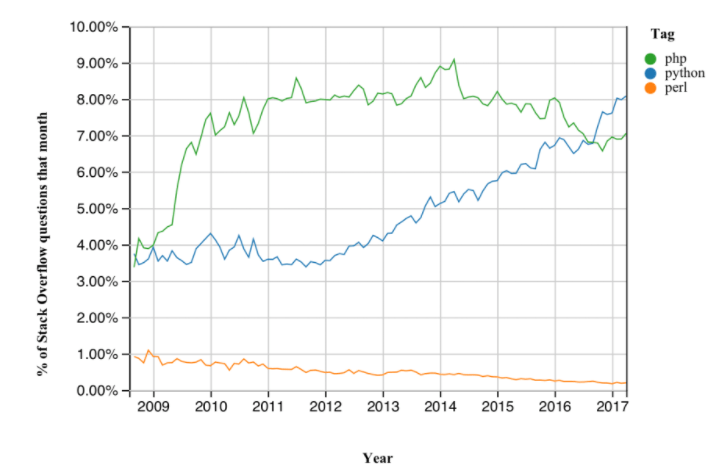
For example, see StackOverflow’s insights tool (see below).

(via StackOverflow Trends)

If you’re managing this community, you might want to get more aggressive about your Python coverage. Find top experts, develop more collaborative content, build up a database of key questions and responses, and prioritize these topics over others on the home of the site.

But this time has to come from somewhere. That somewhere might be at the expense of Jquery (see below).


This is where very simple methods of data collection can help you optimize the community for what your members want and be sure you’re covering any new trends. Not all topics are created equal here. We can identify new topics early and build out dedicated areas of the site for these topics.

Be really sensitive to new trends arising in your field and respond quickly to cover them. If you don’t, someone else will.

07 Jun 21:06

Mobike announces support for Apple Pay, iPhone iOS 11 camera to accelerate globalization drive

by Sheila Yu

The bike rental war between Mobike and its rival ofo is still ongoing in China, with no end in sight. The pair has been waging an all-out war in terms of bike quantity and technology on and beyond their home turf. Now they set their sight on user experience.

Mobike announced yesterday that it has teamed up with Apple to allow iPhone users to make payment with Apple Pay and unlock Mobike bicycles by scanning QR codes from their iOS 11 iPhone camera, as part of its efforts to enhance user experience and stay ahead of its nimble rivals.

This is the third payment mode accepted by the Chinese bike rental firm after Alipay and WeChat Pay. After upgrading the Mobike app on their mobile phones to the latest iOS 5.0 version, domestic users can make deposits and top up their Mobike accounts with Apply Pay in-app.

The addition of Apple Pay will reinforce Mobike’s globalization drive, as the mobile payment service enjoys great popularity around the world (except in China where it has been relegated to pipsqueak status and did not even make it to the top ten in the country’s Q1 2017 mobile payment market).

In addition, the introduction of QR code support by Apple enables Mobike users to scan and unlock a bike without even opening their Mobike app. Such handy and fast way to unlock a bike is expected to help increase user base and engagement and speed up the bike rental firm’s growth.

Mobike said its MAU has doubled month-on-month and nearly half of its new users came from WeChat since its tie-up with the popular messaging app in March that has enabled users to access Mobike’s cycle-rental feature within the wallet function of WeChat.

Mobike’s rival ofo sides with Alipay, which supports the “scan-and-ride” function for six bike-rental apps including ofo. In addition, ofo’s bicycle-rental feature has been accessible to users within ride-hailing giant Didi Chuxing’s app since April. Didi is a major investor of ofo and has shelled out hundreds of million US dollars (in Chinese) in the firm’s three financing round.

07 Jun 21:06

Canada ranks 13th in the world for average LTE speeds, says OpenSignal

by Igor Bonifacic
Canada LTE

London, U.K.-based OpenSignal has released its latest State of LTE report, providing a comprehensive look at the state of LTE availability and network speeds across the globe.

Since its last State of LTE report, which was published in January, average LTE speeds in Canada jumped from 26.55Mbps to 30.58Mbps, representing a 13.9 percent increase. LTE availability, meanwhile, increased by 5.68 percentage points to 81.10 percent — instead of measuring LTE availability geographically, OpenSignal examines how consistently users of its mobile speed testing app can access an LTE network in their country.

For a greater perspective on these numbers, Canada was put against 74 other countries and ranked 13th in terms of LTE speeds and 19th in terms of LTE availability. The average LTE connection speed in Canada is more than twice as fast as the average in the United States. It’s also significantly higher than the global average of 16.2Mbps (notably, the global average decreased compared to OpenSignal’s previous LTE report).

However, it pales in comparison to the countries at the top of the list like Singapore, South Korea, Hungary and Norway where wireless subscribers can enjoy LTE speeds that exceed a blazing fast 40Mbps.

In terms of availability, Canada was beaten by countries like Qatar, Estonia and a surging India. In the case of the latter, a national Indian carrier called Jio greatly helped the cause of the subcontinent. This past September, the carrier launched its LTE network and began giving away internet service for free, with more than 100 million subscribers flocking to the brand since.

Canada’s availability percentage speaks to the difficult geographic conditions that make even higher LTE penetration a difficult proposition here. With LTE service mostly not available in hard to reach rural areas, it’s likely Canada will fall behind in OpenSignal’s availability index.

OpenSignal graph showing 4G speeds across the globe

To compile this latest report, OpenSignal collected 19,556,514,365 data points from 558,260 devices during the three-month period between January 1st, 2017 and March 31st, 2017.

Source: OpenSignal

The post Canada ranks 13th in the world for average LTE speeds, says OpenSignal appeared first on MobileSyrup.

07 Jun 21:06

Sheriff Survey 2017 started !

by cbook

One thing i love at Mozilla is that there is no general “that’s the way we have always done it..” – we at Mozilla try to improve things – our Software but also our processes and so its also with Sheriffing – We try to optimize our workflow/processes constantly to make your live as developer easier when working with us but … we rely also on your feedback 🙂

So we created a Survey for YOU to give us Feedback about how we do and also where we can improve. This input/Feedback from you is very valuable for us!

You can find the Survey at http://bit.ly/2s4rACFhttps://docs.google.com/a/mozilla.com/forms/d/e/1FAIpQLSfGBZ50zkG9W-Wnk1ACBfFvj1iu8e46I5gs9t-G3ZWDpcy4-A/viewform

Thanks for taking part in the Survey!

– Tomcat

07 Jun 21:04

Saved

by Tom

Along with hip-hop, sitcoms, and the economy, screen savers flourished during the Clinton years…

Zack Hatfield’s article from the Paris Review on screensavers turns out to be quite wonderful. I like passing that quotation from it around to introduce it, because it made me laugh, but the whole thing is thoughtful, and wonderful. And it made me think:

You can’t consume a screen saver in an instant. You can’t fast-forward or rewind one. The genre, its own kind of endurance art, shuns immediacy. Fugitives from time, screen savers possess no real beginning or end. Their ouroboric nature is perhaps why preservations on YouTube, whether ten minutes or twelve hours long, tend to evoke disenchantment.

Screensavers are anti-images.

Susan Sontag, in On Photography, remarked that a photograph describes “a neat slice of time, not a flow.” But if you take Hatfield’s point – that the screensaver only makes sense in its infinite form, summoned unbid, and existing until it is dismissed… then a screensaver is only ever flow. The act of quoting a screensaver is inadequate, almost impossible. Which takes me back to Sontag, who goes on to describe a photograph as a quotation: “a photograph could be described as a quotation, which makes a book of photographs like a book of quotations“.

A screensaver cannot be meaningfully sliced; it cannot ever become quotation. A photograph is a choice of a single moment of time, and thus, implicitly, a rejection of surrounding moments. But Hatfield describes screensavers as if they only ever are surrounding moments, each a moment leading to another. And they resist comparison to film, to: they are elliptical, not structured, not ongoing. There is art film that probably stands comparison best: for instance, Christian Marclay’s The Clock functions as an ongoing, 24-hour loop, and precisely works because it has no formal beginning and end. (It feels a little trite to describe The Clock as a screensaver, and yet it would make the most wonderful screensaver – a little world running in parallel that only emerges when you step away from a screen).

And: I liked his description of screensavers invoking “rapture and reverie, and stillness“; how appropriate that something designed to be continuously, but unobtrusively, changing, should be a meditation upon stillness.

When you put it like that: screensavers are our only functional perpetual motion machines.

06 Jun 23:34

iOS 11 will make older generation iPhones and iPads obsolete

by Bradly Shankar
iOS 11 WWDC

Apple officially announced iOS 11 at its Worldwide Developers Conference on Monday, revealing a focus on artificial intelligence, augmented reality and person-to-person payments.

However, it has now been revealed that some Apple product users won’t be able to take advantage of the new OS when it launches in the fall. iOS 11 will only be available 64-bit devices, meaning that the iPhone 5, 5C and fourth-generation iPad, which have only 32-bit processors, will not be supported.

As a result, these devices will be stuck running iOS 10 and not be able to receive important security patches and stability improvements.

Apps and games running in 32-bit mode will also no longer be supported, even if they’re running on a 64-bit device.

iPhone and iPad users can check which titles are affected by navigating to:
Settings -> General -> About -> Applications -> App Compatibility

iOS 11 was one of many announcements that Apple made at its annual developers conference. A full rundown on what was shown off at the WWDC keynote can be found here, while major takeaways from the event are available here.

Via: The Guardian

The post iOS 11 will make older generation iPhones and iPads obsolete appeared first on MobileSyrup.

06 Jun 23:34

These Weeks in Firefox: Issue 18

by mconley

Highlights

Friends of the Firefox team

(Give a shoutout/thanks to people for helping fix and test bugs. Introductions)

Project Updates

Add-ons

  • Many performance improvements in WebExtension start up from working with Screenshots team. Most of these have been documented by Ehsan, but check out bug 1363905 for more detail.
  • Support for Implement support for $0 and inspect bindings in devtools.inspectedWindow.eval has landed which means some of the large developer tools add-ons (React, Redux, Ember) etc from Chrome should now be working on Firefox 55! Check out this tweet.
  • devtools.panels.themeName support has landed
  • browser_style is now available in browser actions, options UI and the sidebar

Activity Stream

Firefox Core Engineering

  • Just started week 4 of the Flash Shield Study. Nightly 55 has click-to-activate (CTA) as the default setting. Beta 55 will see a gradual rollout of CTA, though domain blocking will be active for everyone.
  • Startup crashes from BaseThreadInitThunk has been fixed in 55. This prevents early DLL injection by third parties in some cases (which is against policy anyway), so check that bug if you’re dealing with an injection-related crash.

Form Autofill

Mobile

Photon

Performance
Structure
  • The hamburger panel is now feature-complete! (minor caveat: the library subview is shared with the library button, which is not feature-complete yet)
  • The page action menu now has a bookmark item (as well as the synced tabs subview)
    • Still to come: Pocket & Screenshots
  • There’s a veeeeery-initial library button + panel available now. Probably not worth testing yet, but it’s available in the palette.
  • Greening up tests so we can flip the photon structure pref by default on nightly builds.
Animation
  • Jared landed bug 1364221 which allows us to run more animations on the compositor for added smoothness.
  • Jared is getting close in bug 1355924 to adding an animation for the refresh/stop button
  • Sam is working in bug 1352065 to implement a new download animation.
  • Jim is working on a new tab loading indicator in bug 1352119.
Visuals
Onboarding
  • Fischer submitted the review request for bug 1369750 to fix the intermittent issue of accessing the window object inside the onboarding.js framescript
  • Fischer has also gotten review feedback from MattN on a bug to make sure we detect old profiles more accurately
  • Fred has finished creating the message architecture so that the Auto-migration code can talk with Activity Stream
  • Fred and Rex enabled the basic onboarding overlay on about:newtab and about:home. Now can see a little fox icon on the top-left corner on about:newtab and about:home on Nightly! Here’s the spec
  • Rex submitted the review request for Bug 1357046; this patch will add the Private Browsing tour and the Search tour in the onBoarding overlay
  • Evelyn reports that the plan is to release the new onboarding flow in Firefox 56
Preferences
  • The Performance section of about:preferences has had all P1 bugs fixed, and is ready for testing. The plan is to ship this in Firefox 55 in the “old” about:preferences organization.
  • Have landed bugs for updating strings in about:preferences
  • The team is working on improving search highlighting in about:preferences to include sub-dialogs and fixing some highlight/tooltip glitches.
  • Here’s the updated about:preferences re-org spec that we’re aiming to ship in Firefox 56. It’s very close to being finalized. The spec for Search behaviour is also being finalized.

Platform Audibles

Project Mortar (PDFium)

  • JSPlugin architecture is now in m-c! (hooray!)
  • Given that all facts pointing out Pepper API isn’t future-proof, the team is re-evaluating how to integrate PDFium without Pepper API layer.

Search

Sync / Firefox Accounts

Here are the raw meeting notes that were used to derive this list.

Want to help us build Firefox? Get started here!

Here’s a tool to find some mentored, good first bugs to hack on.

06 Jun 23:33

Why the HomePod is coming to the US, UK and Australia first

by Volker Weber

25bd308035fc021015d60e30082b89c7

This is my own speculation, but I think the delay in shipping the HomePod is not a production ramp-up problem.

  • First of all, Apple has announced a device they don't intend to ship for another six months. That's very unusual, since they ship the same day if they can. I think Apple is buying itself some time here, against strong competition from Amazon and Google, who both have a head start. Sonos is way too small for an assault from Apple.
  • Apple is going into three markets that have a 40% market share for iPhones.With a built-up demand this could make for a strong start for a brand new product.
  • All three markets are English speaking. Yes, they have different dialects but they only use one language at a time. Imagine speaking "Spiel mal Sympathy for the Devil von den Rolling Stones im Wohnzimmer". You have to figure out which parts are German and which are English.

I believe Siri just isn't there yet. While Apple compared their HomePod to the Amazon Echo, they only did so for sound quality. Nobody pitted Siri against Alexa.

06 Jun 23:28

Twitter Favorites: [icathing] Instant pre-order: new Ellen Ullman. https://t.co/qT6UEC1Hin

Bill Stilwell @icathing
Instant pre-order: new Ellen Ullman. amazon.ca/gp/aw/d/037453…
06 Jun 23:28

Twitter Favorites: [tomhawthorn] Today is 29th anniversary of my @globeandmail feature on 150th anniversary of first recorded baseball game in Canada https://t.co/qmgEDCVwDO

Tom Hawthorn @tomhawthorn
Today is 29th anniversary of my @globeandmail feature on 150th anniversary of first recorded baseball game in Canada baseballhalloffame.ca/inductees/firs…
06 Jun 23:28

Twitter Favorites: [bmann] #maplesyrupcurtain https://t.co/RxcTquikix

06 Jun 23:28

Google says that 10 percent of Android phones are running Nougat 7.0 and 7.1

by Sameer Chhabra
An image showing the camera, Gmail, and Chrome apps

If there’s any one criticism that’s been levied against Android since the operating system’s early days, it’s been the fact that it takes forever for manufacturers to roll out system updates.

Nexus — and now Pixel — devices are usually spared from Android fragmentation, because they’re under Google’s watchful eye.

But phones from Samsung, HTC, and Sony — not to mention countless other manufacturers — very rarely receive a steady stream of software updates.

There’s some good news though.

According to the monthly usage statistics published by Google, 9.5 percent of Android devices currently in use run some version of Android 7.0 Nougat.

That number’s up from 7.1 percent in May, and 4.9 percent in April.

A chart and piegraph highlighting the precise breakdown of devices currently running Android

The numbers are optimistic, and the statistics are no doubt a result of Google’s efforts to mitigate Android fragmentation.

Most recently, for example, the company announced Project Treble as a way for device manufacturers to speed up their internal update processes.

Smartphone OEMs, no doubt spurred on by users clamouring for the most up-to-date Android release, have also started making an active effort to release devices with the most current version of Android.

Some manufacturers have also claimed that they’re making an effort to update devices with the same monthly security releases that Nexus and Pixel phones receive.

OnePlus, for instance, said in November 2016 that the OnePlus 3 and 3T would receive updates at the same time.

According to Google’s report, 31.2 percent of Android devices are currently running some version of Android 6.0 Marshmallow, while 22.6 percent of devices currently run some version of Android 5.0 Lollipop.

Source: Google

The post Google says that 10 percent of Android phones are running Nougat 7.0 and 7.1 appeared first on MobileSyrup.

06 Jun 23:27

A Hardware Update for the Human Brain

06 Jun 23:27

Social youth subjectivity (Part 1)

by admin

25

Social subjectivity of youth young people’s ability to exercise independent initiative in society, due to the presence of a specific purpose, the appropriate motivation, self-developed mechanism, awareness of their roles and responsibilities, as well as the presence of a conscious positive life strategies.

The concept of “subjectivity” is stated in the sociology of youth since the 1980’s. When it entered the circle of the basic terms of youth concept put forward by the Polish scientists and B. Milyanovskim (Karwat, Milanowski, 1981ab), humanistic concept of youth IM Elias (Ilyinsky, 2001), the youth movement Val theory. A. Lukov (Lukow, 1987) and a number of other theoretical constructs. Feature introduced when the term was that he was in the literature generally perceived as equal to the term “subjectivity” “subjective factor”, “subjective positions” and so on. D.) And in the form opposed to the objective basis of human activity, it recognized secondary, it does not express the essence of social processes, irregular. On the contrary, in these works on the sociology of youth subjectivity at the level of the concept of shared subjectivity and expresses significant base in the treatment of young people. Thus, identifying the specifics of the social subjectivity of youth is central to the concept of youth thesaurus shaft. A. Lukov (Lukow, 2007; 2012), and it has been supported in the literature (Krivoruchenko, Yakovlev, 2012ab; Vybornova 2013; Kovalev, Levicheva 2014).

Subjectivity. Theoretical and methodological basis of “subjectivity” of the concept was developed in the framework of subject-activity approach in psychological science. The founder of this approach is eminent psychologist SL Rubinstein, who first presented his ideas in 1922 in his article “The principles of creative self.” In the future, this approach has been the development of his works, including “Fundamentals of General Psychology”, “Being and consciousness”, “Man and the World”, as well as in the writings of his followers, such as KA Abulkhanova and AV Brushlinskii. According to Rubinstein, originally “the subject it is experiencing the different perceptions, thoughts, feelings, aspirations, intentions, desires, and so forth” (Rubinstein 2009: 10). In the future, “consciously distinguish themselves from the environment and correlating with him, man becomes the subject in the true sense of the word” (ibid: 10). Rubinstein-based research stated: a man is not only in a certain relation to the world and is determined by them, but also belongs to the world, and he defines this attitude, what is conscious and self-determination rights. In general determination being turned on the man as a conscious world of being, the subject of consciousness and action. Conscious regulation aimed at changing the ambient, the breaking of the world and their own actions through the mind that is basic for the understanding of the problem of human freedom and determination being “(Rubinstein 2003: 371).

He emphasized, “subject to their deeds, not only reveals and manifests itself in the creative acts of initiative; it is built up in them and determined “(quoted in. Brushlinskii 1991: 9).
Such an interpretation of the subject contains the possibility and the need to understand subjectivity as it is an essential characteristic.

Social subjectivity. Under the social subjectivity, as defined by Val. A. Lukov, understood as “the ability of society, social groups, a person to serve as the active principle (figure creator) social reality” (Lukow, 2012: 320). Lukow constructs the notion of “social subjectivity”, based on an analogy with the established in jurisprudence the concept of “legal personality”, which refers to the ability of individuals to be the bearer of legal rights and obligations. Legal personality is divided into legal capacity. Accordingly, the concept of social subjectivity can be viewed from two sides: subject to the possession of socially determined capability to the social activity and the ability to implement it yourself” (ibid: 321). Thus, in this case we can speak at least two main aspects of social learning level of subjectivity of the person the possibility (or external to the individual factors) and capacity (inner personality factors). In the same direction (with the release of the two sides), the concept of social subjectivity can be developed with reference not only to the individual but also to other social actors groups, communities, society as a whole.

24

Social subjectivity youth. This approach is applied to the social subjectivity of youth, attaches special importance (under the first criterion “the possession of the subject socially determined features to social activities”), the social status of youth, which largely determines the opportunities for social activities.

AI Kovaleva identifies the following characteristics of the social status of youth: 1. In the social status of the young prevails not acquired, as prescribed by its component; 2. Social status is dynamic and promising youth, including through a process of social appropriation of subjectivity; 3. The Company is predetermined inequality status of younger and older age groups of young people. For young people of different ages revealed varying degrees of acquisition of rights and obligations, that is primarily associated with different volume and capacity with a number of specially established rights and responsibilities of youth and young adults (Kovalev, Lukow, 1999: 264).

Since social status reflects the possibility of the social subjectivity, the degree of opportunities for young people will depend primarily on how open is this society and whether young people to express themselves in it, and whether the youth potential of the society is recognized as a public good and a source of positive innovation or young people are recognized as a public danger. Depending on this, the youth can both receive all the new opportunities for the manifestation of subjectivity, and to endure the hardships of reinforced public control, narrowing or excluding such manifestations. A similar interpretation of the social subjectivity of youth and in the aspect of social roles. The social role is mainly defined by social status, expressing its dynamic characteristics, and appears in the appropriate public expectations to the one who has this status.

The post Social youth subjectivity (Part 1) appeared first on BookRiff.

06 Jun 23:27

OnePlus 5 Leaks Out Ahead of Announcement

by Evan Selleck
OnePlus confirmed today that the OnePlus 5, its next flagship phone, will see the light of day on June 20. Continue reading →
06 Jun 23:25

Just published: How to Buy the Best Electric Bike, 2nd Edition

by Average Joe Cyclist

My new electric bike book is packed with reviews of some of the newest, best quality electric bikes, thanks to my collaboration with two of the greatest ebike reviewers in the worldI just published the expanded, updated, 2nd edition of How to Buy the Best Electric Bike. This brand new, updated and expanded edition of How to Buy the Best Electric Bike is presented in collaboration with Turbo Bob and the Electric Bike Review, two of the greatest ebike reviewers and bloggers in the world. As a result, this new edition includes many more reviews of new, quality electric bikes. For a very limited time, I am offering the new edition for a discounted price, cheaper than the first edition.

The post Just published: How to Buy the Best Electric Bike, 2nd Edition appeared first on Average Joe Cyclist.

06 Jun 23:25

Greener Streets

by pricetags

Every year, the same question: Was the Vancouver landscape really as lush last year as it seems to be now?

Answer: Nope.  Last year, the trees here on the 1700-block Robson weren’t as high, nor the canopies as thick and lush.   Just a decade or so, these trees were saplings; they didn’t block the signage on the shops or the highrises behind.

And now, here in the transitional rain forest of the northwest Pacific coast, they do.


06 Jun 23:25

Ending the Referendum Requirement – Response from Sam Sullivan

by pricetags

Sam Sullivan, the Liberal MLA from Vancouver-False Creek, is the first to respond to the “Price Tags Initiative to End the Referendum Requirement” – henceforce know as PTERR.

Sam: Speaking personally, expediting new transit service is a much higher priority than a new referendum. I would be in favour of removing the referendum requirement if an agreement for funding the Mayor’s plan can be achieved among the three levels of government.


(Price Tags will compile all the responses at a separate post called PTERR.)


.


06 Jun 23:19

Share Your Best Work With The New Flickr About Page

by Zee Jenkins

Today, we’re announcing a completely redesigned Flickr Profile page experience on desktop called About. Your About page introduces new design and functionality, and brings you even more ways to customize how you present yourself and your photography to the world. With this update, we’ve simplified navigation and made the About tab much more visible on the Flickr site.

The new About page experience comes with several new features.

Showcase Section
One of the most requested features from our Flickr community was a way to more prominently showcase a curated selection of your photography to people viewing your account. With our new Showcase section, you can select up to 25 photos to display in any order you like. You can give the section a title and you can edit it subsequently. This page can be a portfolio of your best work, or it can be a space that you update regularly with a theme or topic that interests you.

Most Popular Photos
You can now also publicly display your most popular photos, a feature that was previously only visible to you. Sort the selection of images by Most Faved, Most Commented, Most Viewed, and Most Interesting (based on a Flickr engagement algorithm). If you don’t want the world to see this section, you can set it to be visible only to you.

New Ways to Edit Your Bio, Add Links, and More
We’ve also added a section to update your bio directly on the page, and the ability to link out to other sites where you may feature your work, including Tumblr, Facebook, Pinterest, Instagram, and more. Finally, the Photos of You and Testimonials sections that were in the previous Profile page experience have been refreshed on your About page.

We’re excited about these additional features and we hope you agree that they give you more ways to showcase your best work on Flickr. We’re starting to roll out this update to some Flickr members today, and it will be available for everyone over the coming week.

Please share any feedback you might have on the new About page here. You can also read a detailed description of the changes in the Help Forum.

Thanks,
Team Flickr


06 Jun 23:19

pic.twitter.com/nlmxBPkCCn

by fjamie013
mkalus shared this story from fjamie013 on Twitter.


Posted by fjamie013 on Tuesday, June 6th, 2017 4:56pm


9787 likes, 2390 retweets
06 Jun 23:18

Apple’s new 10.5-inch iPad Pro replaces the 9.7-inch Pro

by Patrick O'Rourke
ipad pro 10.5-inch

Apple has confirmed to MobileSyrup that the 10.5-inch iPad Pro officially replaces the 9.7-inch iPad Pro.

The new model features a display that’s 20 percent larger than the 9.7-inch version, though it isn’t much larger than its predecessor thanks to the device’s smaller bezels.

The bigger size of the 10.5-inch Pro means that Apple can call the tablet’s on-screen keyboard full-sized. The Smart Keyboard — which is still sold separately — is also now considered full-sized and is much easier to use for prolonged periods of time because it feels significantly less cramped. The tablet still weighs in at approximately just one pound, almost exactly like the 9.7-inch iPad Pro.

Along with introducing the 10.5-inch iPad Pro, Apple is also refreshing the 12.9-inch version of the tablet. Both versions of the iPad now feature the True Tone display that adjusts the colour temperature on the fly depending on lighting conditions, first introduced last year with the 9.7-inch Pro.

Other improvements include a wider DCI-P3 colour gamut and a low-glare glass panel with a 600-nit display. The iPad Pro also includes an A10X Fusion chip with a six-core GPU, among other upgrades.

For my initial impressions of Apple’s new 10.5-inch iPad Pro, check out my hands-on impressions with the tablet.

The post Apple’s new 10.5-inch iPad Pro replaces the 9.7-inch Pro appeared first on MobileSyrup.

06 Jun 23:18

Using Programs and Data Analysis to Improve Writing, World Bank Edition

by Eugene Wallingford

Last week I read a tweet that linked to an article by Paul Romer. He is an economist currently working at the World Bank, on leave from his chair at NYU. Romer writes well, so I found myself digging deeper and reading a couple of his blog articles. One of them, Writing, struck a chord with me both as a writer and as a computer scientist.

Consider:

The quality of written prose should be higher in documents that will have many readers.

This is true of code, too. If a piece of code will be read many times, whether by one person or several, then each minute spent making it shorter and clearer improves reading comprehension every single time. That's even more important in code than in text, because so often we read code in order to change it. We need to understand it at even deeper level to ensure that our changes have the intended effect. Time spent making code better repays itself many times over.

Romer caused a bit of a ruckus when he arrived at the World Bank by insisting, to some of his colleagues' displeasure, that everyone in his division writer clearer, more concise reports. His goal was admirable: He wanted more people to be able to read and understand these reports, because they deal with policies that matter to the public.

He also wanted people to trust what the World Bank was saying by being able more readily to see that a claim was true or false. His article looks at two different examples that make a claim about the relationship between education spending and GDP per capita. He concludes his analysis of the examples with:

In short, no one can say that the author of the second claim wrote something that is false because no one knows what the second claim means.

In science, writing clearly builds trust. This trust is essential for communicating results to the public, of course, because members of the public do not generally possess the scientific knowledge they need to assess the truth of claim directly. But it is also essential for communicating results to other scientists, who must understand the claims at a deeper level in order to support, falsify, and extend them.

In the second half of the article, Romer links to a study of the language used in World Bank's yearly reports. It looks at patterns such as the frequency of the word "and" in the reports and the ratio of nouns to verbs. (See this Financial Times article for a fun little counterargument on the use of "and".)

Romer wants this sort of analysis to be easier to do, so that it can be used more easily to check and improve the World Bank's reports. After looking at some other patterns of possible interest, he closes with this:

To experiment with something like this, researchers in the Bank should be able to spin up a server in the cloud, download some open-source software and start experimenting, all within minutes.

Wonderful: a call for storing data in easy-to-access forms and a call for using (and writing) programs to analyze text, all in the name not of advancing economics technically but of improving its ability to communicate its results. Computing becomes a tool integrated into the process of the World Bank doing its designated job. We need more leaders in more disciplines thinking this way. Fortunately, we hear reports of such folks more often these days.

Alas, data and programs were not used in this way when Romer arrived at the World Bank:

When I arrived, this was not possible because people in ITS did not trust people from DEC and, reading between the lines, were tired of dismissive arrogance that people from DEC displayed.

One way to create more trust is to communicate better. Not being dismissively arrogant is, too, though calling that sort of behavior out may be what got Romer in so much hot water with the administrators and economists at the World Bank in the first place.