Shared posts

07 Jun 21:41

How Cold Brew Changed the Coffee Business | Oliver Strand

How Cold Brew Changed the Coffee Business | Oliver Strand:

Cold brew is more than a slowed-down version of hot coffee; it’s a noticeably different product. Hot water will bring out the acids in coffee, a characteristic that professional tasters call “brightness.” Cold water doesn’t but still gets the full range of mouthfeel and sweetness. The absence of acidity in cold brew is even more pronounced when compared with the iced coffee from the dark ages (of a few years ago), when it was almost always made with hot coffee that was chilled in the refrigerator. When hot coffee cools, even more acids develop, many of them unpleasantly harsh.

While hot coffee can be volatile, changing in flavor at different temperatures, cold brew is relatively stable, which makes it particularly well suited to being packaged and sold as ready-to-drink. Joyride Coffee, a wholesaler that supplies offices and coffee shops in Boston, Los Angeles, New York, San Diego and San Francisco, sells 20-liter kegs of cold brew and nitrogenized cold brew that are tapped like beer. The kegs have a shelf life of 90 days.

Perhaps more important for the everyday drinker, cold brew is a perfect companion for milk. Rather than battling the aggressive acids in chilled hot coffee, the dairy tastes full and rich. Cold brew “is a sweet, round coffee milkshake without the sugar,” said Andrew Linnemann, a vice president on the Starbucks global coffee team. “Especially if you add a splash of milk.”

I’m going to try cold brewing at home.

07 Jun 21:41

Transparent design: how an open creative process strengthens your work

by Collin Whitehead and Aaron Robbs

Illustration for Dropbox Transparent Design blog post

This week, we’re at the 99U Conference in New York where we’ll be discussing how we became strong believers in transparent design. In this first part of our two-part series, we’ll look at the ways transparency can streamline the process—and strengthen the results—of creative collaboration.

Today’s creative teams are made up of a fluid workforce: freelancers, vendors, agencies, and cross-functional in-house teams. We’re varied, multidisciplinary, and scattered across continents. And that makes it harder than ever to keep everyone on the same page. At Dropbox, we believe one of the best ways to keep teams in sync and bring ideas to life is through transparency.

In the Dropbox Brand Studio, our teams are made up of graphic designers, web designers, illustrators, producers, strategists, and creative writers. We define the visual identity system and voice for the brand. We produce creative for product launches and marketing campaigns. We collaborate with product teams to name and add personality to the product.

Ultimately, we think of ourselves as unifiers in the company. We help keep people aligned by leading creative processes that unite work between many different teams inside Dropbox—Marketing, Product, Communications, Sales—and also with our network of agencies, vendors, and freelancers. We use creative strategy and production to build the bridges that connect these teams. These processes help us tell a cohesive and meaningful story about our company. Today, we want to tell the story of the processes themselves—and why we decided to radically change our approach to collaboration.

The way we work isn’t working

Now that new technology lets us collaborate with people around the world, our teams have never been more distributed. We not only catch up with people around the water cooler, we also catch up over early-morning video conferences with teams in London and Paris just as they’re wrapping up their day. We’re on different teams, in different offices, across different time zones.

This new way of working is especially challenging for those of us in Marketing and Design. The rules have never been less clearly defined. We’re working at a breakneck pace, and churning out high volumes of content that needs to break through all of the noise and high filters of audiences today.

Everyone needs space to create—but we want our collaborators to get involved early on to make sure we’re creating the right thing. We want to show polished and refined work—but people want to be a part of the process. So how do we find a balance?

Madison Avenue agencies used to create mystique by waiting until the pitch to pull back the curtain and surprise their client with a perfect, polished presentation. But that approach doesn’t work anymore.

As people who work with external creative directors and designers, we have many different projects going on at once, between many different departments and teams. We need to make sure that everyone is having the same conversation at the same time. And in the process, we don’t want to just sell our ideas—we want to build trusted relationships. So it’s important to create a balance between our need to produce polished work and our desire for a transparent process.

Embracing transparency throughout the creative process

As challenging as it can be, the best way to work collaboratively is to embrace transparency. Working transparently makes people more engaged and accountable. It improves the work because everyone has to be aligned. It shows people you’re willing to figure out problems with everyone on the team. And it removes ego by encouraging people to work together and share the responsibility of bringing a project to life.

We spend a lot of time thinking about this at Dropbox. Our mission is to simplify the way people work together. We started in 2007 with the idea that life would be a lot better if people could move their stuff into the cloud and access it from any device or operating system. Since then, we’ve made major progress. But we discovered that for a lot of our users, sharing and collaborating on Dropbox was even more valuable than providing storage. So we made a commitment to expand our focus from keeping files in sync to keeping teams in sync.

New collaboration tools that simplify the way you work

Our customers have given us tremendous insights about the challenges of teamwork. We’ve studied what highly successful teams do well. And we use this insight not only to build new tools for our customers, but to improve how we work internally.

It’s still a work in progress. And we’ve also made moves as a company to address the underlying problems designers, writers, artists, and marketers face. To start, we’ve created a culture that embraces transparency and offers us a safe place to create, without judgment.

A key part of the cultural change has come from the development of Dropbox Paper. For us, having an online workspace that keeps everyone on the same page has been the key to working transparently and driving alignment.

In part two of this series, we’ll dive into details about the ways we use Paper, and give you some concrete tips for achieving transparent design. Stay tuned for our follow-up post from the Cannes Lions International Festival of Creativity.

Create, collaborate and share your work—all in one place

07 Jun 21:41

Why is Vancouver’s Affordable Housing Policy Turning Out to be Unaffordable?

by Sandy James Planner

tn3-5366

This piece by Nathalie Baker in the Province describes the work of  Vancouver’s Affordable Housing Agency (VAHA) to enable the “development of new affordable rental housing. This agency was a Council creation designed to  leverage “city and partner-owned land to create new housing projects that offer both, a greater diversity of home options and greater affordability, than what is currently offered by the private market.”

Originally “affordability” was targeted to households with incomes from social assistance to incomes of $86,500. Affordability was to be based on a maximum allocation to housing cost of 30 per cent of household income.  If your income was $86,500, your rent should be around $2,162.50 a month.

Ms Baker notes that under the city’s “Rental 100 Program” the city waives Development Cost Levies that are usually collected for items like parks, infrastructure and child care if the developer builds “affordable housing”in their development. The City of Vancouver defines “affordable rental” on the west side of Vancouver as being a studio for $1,496; a one bedroom for $1,922; a two bedroom for $2,539; and a three bedroom unit for $3,333. Seriously.

There’s another interesting wrinkle too in this policy. You’d think there would be a minimum unit size for these “affordable” units being developed in exchange for not having to pay a Development Cost Levy. But it’s actually the opposite-for some odd reason the city’s bylaw places a MAXIMUM size of 450 square feet for a studio, 600 square feet for a one bedroom, 830 square feet for a two bedroom. In terms of minimum, it can be reduced to 320 square feet in the case of the studio. Regardless of the size of the unit, developers can still charge the “affordable rent” rates as established by the City.

It is clear that under the Rental 100 program households need to be making over $86,500 to rent a three bedroom unit at $3,333 a month. Indeed you would need about $130,000 a year to make that work.  “A household would require a combined income of over $100,000 to make the two-bedroom units “affordable” if rented at $2,539 a month.”  The City of Vancouver’s own housing characteristic fact sheet notes that the median before tax income for two person families is $80,050 a month. One parent family income median is $41,500. So who is able to afford these “affordable housing” units?

Ms. Baker cites the 46 “social housing units”  being built at 585 West 41st Avenue as part of that development. The developer was given a grant by the City of $620,000 towards the construction and did not have to pay the estimated $454,000 Development Cost Levy fee. But the challenge is that only 15 of the 46 units will be rented  “at or below rents affordable to B.C. Housing Income Limits ($49,500 a year for a two bedroom) and that the remaining 31 units will be rented “at starting rents that are at or below the maximum rents described in the DCL bylaw for for-profit affordable rental housing” .  What this means is that “Vancouver “for-profit affordable rental housing” and “social housing” are now one and the same.”

While the City is offering several sites for sale for developers who build affordable housing, they’ve placed a relatively low value of $72 million dollars on eight sites, or  $9 million dollars a site, a troubling low figure when you consider two of the sites are downtown.

Ms. Baker concludes: “The public should be demanding more transparency of council and the VAHA regarding these deals before they go any further. How is the city going to ensure these rental buildings actually produce affordable rental housing? If the city is going to enter into low-cost land leases with developers that won’t expire until 2117 or later, the people who live and work in Vancouver and subsidize these developments deserve to get value in the form of truly affordable rental housing, not social-housing units renting at $3,000 a month. Unchecked, deals like this will only add further momentum to the current housing crisis.” 

And who are these “affordable” units being built for anyway?

2016_wrapup_v3vaha


07 Jun 21:40

Google will reportedly update the Pixel to Android O in early August

by Dean Daley
Android O on a pixel device

Google will update the Pixel and Pixel XL to Android O during the first or second week of August, according to Android Police managing editor David Ruddock.

Ruddock says he obtained the information from a “reliable source,” though he also notes, “release dates are always, always subject to change.”

In 2016, Google started to roll out Android Nougat to Nexus devices on August 22nd, so if Ruddock’s information is accurate and Google goes ahead with its current plans, the Pixels will receive Android O a week or two earlier than Nexus devices did Android Nougat last year. The Android O developer preview is currently available to download.

Several smartphone OEMs have already announced plans to update their existing devices to Android O, including HMD Global, which plans to update the Nokia 3, 5 and 6 to the latest version of Google’s mobile OS, as well OnePlus, which confirmed the OnePlus 3 and 3T will receive Android O later this year.

Android O includes features such as picture-in-picture, notification channels and notification badges for apps.

With Android O coming soon, most Android fans likely want to know what the O stands for. Last year, Google revealed the official name of Android N at the end of June. Hopefully, this time around the announcement comes sooner.

Source: Android Police


The post Google will reportedly update the Pixel to Android O in early August appeared first on MobileSyrup.

07 Jun 21:40

Tablet Mode on Windows: When Courage Makes Way for Pragmatism

The new Surface Pro is unquestionably Microsoft's best ever Surface Pro. But it won't be the best Surface Pro tablet. That's because it doesn't run Windows 8. When I was watching Apple go over iOS 11 changes coming to the iPad, I couldn't help but reflect on how Windows 10 decided to throw out, more or less, everything that was good about Windows 8 to pragmatically make way for something much less ambitious.

Windows 8 and Windows 10 may have different inadequacies but they do share something important in common: their problems are the result of Microsoft's continued commitment (and arguably stubborn insistence) for Windows to be a consistent 2-in-1 operating system. This goal didn't change between releases but what did was touch stopped being the interaction modality du jour. Microsoft's apparent reluctance to make any meaningful improvements to Windows' tablet mode suggest offering a first-class tablet experience is no longer as important as ensuring users have nothing to learn (or as little as possible) when they switch to it. What's happened is the courage (yes, that word) Microsoft demonstrated with Windows 8 has been substituted with conservatism.

Tablet mode on the first release of Windows 10 was incredibly crude. Moving to it from Windows 8 on a device that I still consider to be as much tablet as its laptop1, made my Surface Pro an inferior tablet overnight.2 But I understood why the tablet experience stopped being the priority at the time. What bothers me is how nothing has really improved in the two years, and three updates, since.3 What's weirdly inconsistent though is Microsoft has already set a precedent on how to optimise Windows for non-mouse/keyboard input: the experience of using a pen on Windows continues to get better and better through the introduction of pen-specific interaction paradigms and UI. Touch needs the same careful consideration.4 Otherwise, not only does the Surface Pro become a much less appealing product, but, more worryingly, Windows 10 will become the new Windows 7, effectively conceding the next generation of mainstream computing to Apple's iOS.

1. Unlike 2017 Microsoft who have dropped any reference of the Surface Pro being a tablet in its updated marketing pitch.

2. I really missed the ability to quickly swipe between my open apps, and the Charms bar. I know the latter took a lot of heat back in the day, some of it justifiably mainly because its non-touch activation trigger was completely unnatural, but on a tablet it made a lot of sense.

3. I don't think anything is happening, or at least been revealed, in the fourth update due later this year either.

4. Think back on the amount of on-stage minutes Microsoft has dedicated to showing off Windows' new pen capabilities in recent product launches versus tablet/touch enhacements. I wouldn't be at all surprised if the latter doesn't even register in double-digits.

07 Jun 21:40

RE: Design is Never Done

Sure. But I also say the design for the iOS Control Center should have been nailed many iterations ago. And that the fact it hasn't reflects badly on the team behind it. It's not like the problem it aims to solve has changed or the number of options available increased (much) since its introduction in 2013. Also, I've a feeling we'll see more changes next year because the latest continues to suffer from the absence of comprehensible structure.

07 Jun 21:39

Vancouver Heritage Foundation at 25

by pricetags

Congrats to the Vancouver Heritage Foundation – celebrating 25 years (and 15 years for the Heritage House Tour.)  More here.  

Tuesday night, a celebration at Heritage Hall.

One of the nice things about Heritage Hall at Main and 15th?  The big front door is really the front door.  (See Vancouver Art Gallery for a heritage building where it isn’t.)


07 Jun 21:39

Toronto-developed Severed and Vancouver-made Splitter Critters win Apple Design Awards

by Patrick O'Rourke
Splitter Critters

Toronto-developed Severed, created by Drinbox Studios, as well as Splitter Critters, created by Vancouver-based studio RAC7, have won Apple design awards at WWDC 2017

Severed, which was originally released on the PlayStation Vita before Drinkbox ported it over to the iPhone and iPad last year, has players frantically swiping across the screen to take down enemies in a first-person dungeon crawler throwback

When asked what the experience of porting Severed from the Vita to iOS was like, Drinkbox co-founder Graham Smith explained that there was a significant learning curve regarding his team getting the hang of iOS development.

severed-gif

“It wasn’t difficult because of performance, but because of other challenges. I went to GDC last year and met with a whole bunch of Apple people that were there and they introduced me to the user-experience team. I asked them, ‘hey, we need to be able to move around in the world, and swipe in the world, and tap in the world, and be able to pick things up, but also move forward. How do we get all these things into a touchscreen?,” said Smith, in a recent interview at Apple’s WWDC 2017.

The studio also ported the game over to Apple’s Metal coding language in order to ensure smooth and reliable performance across a variety of iOS devices. Smith says that given the success of Severed on iOS, it’s possible that Drinkbox could continue developing games for Apple’s mobile platform in the future.

“Any time that it makes sense for a game — for Severed it’s all touchscreen — if not it could be well suited for macOS or Apple TV,” said Graham, discussing Drinbox’s future plans for iOS.

Drinbox Severed

While Drinkbox has received critical acclaim for its past titles, particularly Guacamelee for the PlayStation Vita and PlayStation 3, Graham says that winning an Apple design award “is the biggest award we’ve ever received.”

“Everyone is feeling like, ‘wow Apple actually cares about us, that’s amazing. I don’t remember feeling that at any other awards we’ve been to before. This feels like a very personal award said Graham. Severed also won best mobile game of the year at the Canadian Video Game Awards last year.

The other Canadian developer to take home an award is Vancouver-based RAC7 for the studio’s innovative game Splitter Critters, a title that, similar to Severed, involves constantly swiping across the screen in order to split the world and solve puzzles.

In Splitter Critters, players are able to beat levels however they want, with stages becoming more complex as the game moves forward. Jesse Ringrose, one of Rac7’s co-founders, along with Jason Ennis, explained that the Splitter Critters aims to remove as many negative feelings as possible regarding what players are able to do in the game, resulting in the title placing an emphasis on experimentation.

“[Apple] are going to put the Apple marketing machine in full effect. They’re going to give us some time in the App Store and some features, which is amazing. Everyone wants to be on the front page of the App Store. That’s just the best.”

Splitter Citters

Ringrose says that winning this award will help the studio make more games and that this will allow Rac7’s two-person team to continue making games.

While game development initially started as a hobby for the pair, a few years ago Ringrose and Ennis quit their full-time jobs to see if they could make it as a tiny independent game studio.

The entire design awards list includes the following video games and apps from around the world:

Blackbox (USA)
Splitter Critters (Canada)
Severed (Canada)
Mushroom 11 (USA)
Old Man’s Journey (Austria)
Lake (Slovenia)
Bear (Italy)
Kitchen Stories (Germany)
Things 3 (Germany)
Elk (Singapore)
Enlight (Israel)
AirMail 3 (Italy)

The post Toronto-developed Severed and Vancouver-made Splitter Critters win Apple Design Awards appeared first on MobileSyrup.

07 Jun 21:39

What Kind of (Digital) Citizen?

files/images/open_thinking.PNG

Alec Couros, Katia Hildebrandt, Open Thinking, Jun 10, 2017


Icon

There has been a lot of discussion recently  on the concept of the digital citizen. A lot of the talk is focused on what we might call Right Behaviour. For example, here's Bonnie Stewart on digital platforms: "They do not lend themselves to good digital citizenship because they shape and direct human  behaviour in ways that  privilege capital and circulation and extremes, rather than, say, collaboration or empathy." But maybe there's a concept of citizenship beyond the concept of responsibility. That's what Alec Couros and  Katia Hildebrandt explore in this post. So we have  the personally responsible citizen, the participatory citizen, and the justice oriented citizen. More on the current conversation  herehereherehere  and  here. Twitterstream  here.

I'm not really happy with any of those. Not because I oppose responsibility, participation or justice. But rather because I don't see those as definitive of my place in society. We need to base society on voluntary cooperation, rather than involuntary  collaboration. I have the right (or responsibility) to oppose as much as to support, and this isn't inherent, but follows from how I create my own place in society. If I am doing nothing, I have no inherent duty or responsibility to act or care. You don't get to define me; I define myself.  My citizenship begins with, and is defined only by, my  actions. (This is a new concept for me but I think it's an important one.)
[Link] [Comment]

07 Jun 21:39

Arbutus Greenway — Hints

by Ken Ohrn

While we impatiently await the major design material due in the fall, I’m sort of getting a better sense of what parts of the Greenway might look like. And it certainly is a strangely wonderful experience to travel on it.  Moving significantly long north-south distances amid greenery and in comfort, quiet and safety — it’s all a bit disorienting.

02.Arbutus.Greenway.6Jun17

Click to enlarge

Between the asphalt and the bark mulch, note the garden soil strip.  All along the Greenway, sections like this have been hydroseeded.  Given the three distinct colours, and information from City staff at various times, I suspect that some areas are seeded with wildflowers, some grass, and the other ???  Don’t know.

If planting a relatively large area, hydroseeding  can be completed in a very short period of time. It can be very effective for hillsides and sloping lawns to help with erosion control and quick planting. Hydroseeding will typically cost less than planting with sod, but more than broadcast seeding. Results are often quick with high germination rates producing grass growth in about a week and mowing maintenance beginning around 3 to 4 weeks from the date of application. Fiber mulch accelerates the growing process by maintaining moisture around the seeds thereby increasing the rate of germination.


07 Jun 21:38

Understanding vision

by Chris Corrigan

“Vision” is one of those words that is overused in our work and the reason it is so elusive is that is is so context dependant.

You can have a vision of a full bath tub of steaming hot water. You can have a vision of making your home run on rain water alone. You can have a vision of safe drinking water for all humans.

The first is simple, short term and you have all the tools and abilities to make it happen.

The second is more complicated and you require a few experts to make it happen, but with the right people and resources, you can achieve it.

The third is not up to you. It is a complex and adaptive system. You may be motivated by a desire to see safe drinking water for all humans but you are unlikely to achieve it because it is a complex problem. Intention can make a difference here and instead of working TOWARDS a tangible vision you can work FROM an intention and guide your actions against that.

The problem comes when people want tangible outcomes from linear processes. “We need a vision of our future” can sometimes lead to work that ignores all the opportunities and threats that come up in a living and evolving system. Without good methods of understanding what is happening, what a system is inclined to do, or iterating work based on learning (in other words developmental evaluation), in my experience those with power and a mandate to accomplish something will eventually narrow the work down to mere deliverables. The vision maybe in there somewhere but the context renders it useless.

So these days when a client asks me for a vision I want to know why and whether they have the means and desire to actually achieve it, or whether they are simply calling for a conversation on “what we’re all trying to do” so that work and opportunities can be evaluated against that.

At some level, in complex systems, vision and purpose become moral centres and ethical guidelines and not targets. That seems important to me.

07 Jun 21:38

tvOS 11 features automatic light/dark UI setting, notifications and AirPlay 2

by Patrick O'Rourke
tvOS

While Apple placed more of an emphasis on iOS 11, macOS and watchOS during its WWDC keynote presentation, the company’s fourth and sometimes forgotten operating system, tvOS, also received a number of updates.

Improvements include new automatic light/dark appearance settings, home screen syncing options, various background modes and notification support. There are also more developer-focused features, such as API improvements, custom sound support and network-based pairing and “improved mobile device management” — though it remains unclear what this actually means.

Additionally, app size restrictions have been lifted significantly to 24GB in total, though it appears the operating system still adopts the system that allows it to continuously download and delete data in the background while using an app or playing a game.

Apple revealed its new AirPlay 2 protocol with support for multi-room audio during its WWDC 2017 keynote, noting that the Apple TV is set to be the first device to support the new protocol, though the protocol isn’t featured in the first release of tvOS 11’s beta.

“Improvements include new automatic light/dark appearance settings, home screen syncing options, various background modes and notification support.”

The tvOS ‘Computers’ app, which hasn’t really been updated to the operating system’s new user-interface look, has finally been given a fresh coat of paint.

In addition, Apple’s Avkit, the development tool that allows developers to add video scrubbing features and static images to their apps, has been expanded significantly, giving app creators working in the streaming video app space more control over the layout of their apps, as well as the ability to fine tune specific features. Additional development tools for apps capable of video livestreaming have also been shown off by Apple.

tvOS 11 is currently only available to registered developers, though Apple’s public beta side includes tvOS 11, which could indicate that a public beta is coming soon. The update process is rather awkward, unfortunately, requiring users to connect their Apple TV to iTunes via a USB-C cable. Given Apple’s software updates are usually over-the-air, this is strange.

Many expected Apple to make the jump to 4K with the Apple TV like the company’s competitors, though it seems the tech giant still isn’t ready to delve into the world of ultra high-definition content.

Finally, Apple revealed that Amazon Prime’s dedicated Video app is coming to the Apple TV during its WWDC keynote, though Apple Canada has not confirmed if the video streaming platform will come to Canada.

The post tvOS 11 features automatic light/dark UI setting, notifications and AirPlay 2 appeared first on MobileSyrup.

07 Jun 21:38

Open Learning, Open Networks

files/images/on1.png

Stephen Downes, Half an Hour, Jun 10, 2017


Icon

Open online learning entered the mainstream with the growth and popularity of MOOCs, but while interest in open online courses has never been greater MOOCs represent only the first step in a broader open learning infrastructure. Adapted from a talk given March 9, 2017, at the State University of New York in Syracuse, this essay describes several key innovations shaping the future of open learning: distributed social networks, cloud infrastructures and virtualization, immersive reality, and personal learning environments. It outlines the challenges this evolving model will pose to learning providers and educational institutions and recommend policies and processes to meet them. [Link] [Comment]

07 Jun 21:38

Let’s Build a Bigger Mall!

by Sandy James Planner

miami-birds-eye

In the truth is stranger than fiction category CNN Money reports   on the puzzling emergence of  “American Dream Miami” a South Florida retail and entertainment complex that will be 6 million square feet-or roughly three times the size of the  Tsawwassen Mills Mall built between Highway 99 and the Tsawwassen ferry terminal.

Despite the fact that Amazon is taking over nearly every aspect of retailing and that large retailers are going to on-line sales to maintain their margins, the “American Dream Miami” hopes to create enough “experiences” that people will want to spend a lot of time shopping there too.  The Triple Five Group  who is developing this behemoth is owned by the Ghermezian family from Edmonton that have developed the Mall of America and the West Edmonton Mall. These are the same folks that took over the failed “Xanadu” Mall in New Jersey and are attempting to remake it into American Dream Meadowlands.  
complete with a giant ferris wheel and water slides. That project has missed its targets and now appears stalled.

americandreammal-traffic

Triple Five is counting on Miami shoppers wanting experiences, with a “skating rink, an indoor ski slope, an aquarium, nightclubs and theater space that can host acts like Cirque du Soleil and the Russian ballet.” This $4 billion project will also include 2,000 hotel rooms, and will not be built with public funding. “You’re talking about a regional entertainment destination,” said Miguel Diaz de la Portilla, a zoning lawyer for American Dream. “It’s not a run-of-the-mill mall.”

With County approvals projected for this year, this mall could be built by 2022 and is expected to create 23,000 construction jobs and 14,500 jobs associated with the mall. But if they build it are there shoppers and experience seekers that will come?

american-dream-miami


07 Jun 21:36

Announcing WebRTC and Media Capture

by Youenn Fablet

Today we are thrilled to announce WebKit support for WebRTC, available on Safari on macOS High Sierra, iOS 11, and Safari Technology Preview 32. In this post, we will go through an overview of our implementation. We will have future posts that cover more best practices for developers.

When talking about WebRTC, we immediately think about making a video conference call. There are two steps to start a call. First, WebKit needs access to the user’s camera and microphone. HTTPS websites use the Media Capture and Streams API on Safari for that purpose. Once the user grants permission through a prompt, capture streams start to flow. These streams can be tailored to websites’ needs through the use of constraints.

Second, the user joins the conversation, once he checks to make sure his hair looks good on-screen. Websites send these capture streams to the other participants. The user obviously wants to see the other participants’ coifs as well, so this is where the WebRTC API kicks in. WebKit finds and creates the optimal network channel to connect those streams.

To handle the networking layer, WebKit chose the LibWebRTC open source framework. LibWebRTC provides both a high level of interoperability and a rich set of streaming features for efficient video conferencing. Safari supports modern audio codecs such as Opus, and with the H.264 video codec takes full advantage of power-efficient hardware.

Currently, Safari supports legacy WebRTC APIs. Web developers can check whether their websites conform to the latest specifications by toggling the STP Experimental Features menu item “Remove Legacy WebRTC API”. Legacy WebRTC APIs will be disabled by default on future releases. Websites that need to accommodate older implementations of the WebRTC and Media Capture specifications can take advantage of polyfill libraries like adapter.js.

There are a lot of ingredients that go into a good WebRTC recipe. To make sure we had what we needed to make video conferencing possible, a few partners joined the party to bring Safari support to their products. Kudos to TokBox and BlueJeans for getting betas available today.

The next generation of communication technologies is here, and we’re really excited to see them in WebKit and on Apple platforms. We want to hear your feedback! File a bug, email web-evangelist@apple.com, or tweet to @webkit.

07 Jun 21:36

How my unknown wellness nonprofit scored a $100,000 grant

by Josh Bernoff

Tomorrow night, I’m going to be smiling ear-to-ear along with my nonprofit partners and the principals of a major foundation. We’ll be celebrating getting a $100,000 grant from The Cummings Foundation of Greater Boston. I’d like to explain how we got here, because if you’re seeking grants, our story might help you . . . and … Continued

The post How my unknown wellness nonprofit scored a $100,000 grant appeared first on without bullshit.

07 Jun 21:36

@stoweboyd

@stoweboyd:
07 Jun 21:35

Grocerants, Cold Brew Coffee,  Instagram + Fine Dining | Skift

Grocerants, Cold Brew Coffee,  Instagram + Fine Dining | Skift:

Imagine a Future Full of Grocerants

The “grocerant” is a term for those grocery store-restaurant hybrids that are popping up everywhere from midtown Manhattan to midwestern supermarkets. A new fast-casual opening from Whole Foods in Atlanta could be considered a grocerant by definition, as it’s physically attached to a Whole Foods. It’s a new concept called The Roast by Whole Foods Market, and features a menu created by noted local chef (and former Top Cheftestant) Kevin Gillespie, a fast-casual operating model, and enough design-y details to keep the millennials happy. You look at Eater’s well-composed photos of subway tile, piles of wood, draught beers, and an actual DJ booth and tell me it’s not millennial bait.

While Whole Foods has been quick to defend the fact that, in its nearly 37 years of existence, its stores have always included a prepared foods and salad bar section, the new crop of dining options is a little different. They often feature table service, offering the luxury of a full-service meal in the atmosphere of a casual-but-useful store full of things you want to buy. In a lot of cases, grocerants are like advertising for the market wares. Like the pasta? Aisle two. Wine? Aisle ten.

Read the recent headlines and you’ll see why this makes sense: casual dining is dying, fast-casual is popular, and grocery stores are experiencing a comeback as millennials (and others) incorporate home cooking back into their schedules. Whole Foods, though, isn’t nearly as popular as it used to be (likely a direct result of its high prices and new competition from other retailers offering less expensive organic fare). It’s possible that The Roast is a kind of hail mary because grocerants seem to be the next hot ticket — but it’s a new concept worth trying. By partnering with a local and well-known chef, Whole Foods got the branding right; the spot has only been open for a few weeks, so time will tell if it can stand on its own legs or if the grocery chain is spending a lot of money on an expansion concept that falls flat.

07 Jun 21:35

Electronics Veteran Wants to Bring Tech Velocity to Housing Construction

Electronics Veteran Wants to Bring Tech Velocity to Housing Construction:

Katerra is a new push at souping up construction of homes, specifically apartment buildings, using supply-chain and manufacturing principles, and to cut building times to one tenth of what is normal today:

Q: Why is now the right time to tackle new ways to build?

A: The problem with construction is it’s been the same for 200 years. Stick-built homes started in 1833 and it’s 2017 and you still build it the same way. This issue could have been attacked the way we are attacking it at any point in time. We’re just doing it now. It is a bit like Amazon or Airbnb or Uber—the change doesn’t come from inside the industry, it comes from outside the industry.

Q: What are you doing that is different and more innovative than incumbents, like big general contractors?

A: There is really one major issue we’re solving, which is all the handoffs to subcontractors. Every material in our project we manage ourselves or buy factory-direct. There is no distributor, no subcontractors, so there are no markups. It’s simple, but it takes a lot of money, takes a lot of talented people, real systems. There is no secret sauce to being a global supply chain guy.

Q: Other startups that have built homes in factories, like Blu Homes, have raised a lot of money and struggled. Alphabet and Airbnb have looked into homebuilding. Is this space going to get more competitive, and what does that look like for you?

A: There aren’t any competitors, but there will be. We raised $225 million overall. It’s not like some general contractor will decide to do this. There will be startup companies like us or companies like Home Depot or Ikea who are big supply chain guys. Or Amazon will get into the business or Google will get into the business.

Stick-built construction is going away in America, you watch this. In short order.

Q: And you are building in factories?

There is room to create much more efficiency on construction sites by doing things off-site in factories, and having them arrive on-site in trucks and putting it together. Among other things we manufacture [are] the walls, the doors, the floors, the trestles, the panels. Our panels come from the factory with windows and insulation and electric and plumbing and drywall. The approach is to make the construction site an assembly site.

Q: How are you using technology? What’s truly innovative here?

We have data scientists and software developers. One of the things we’re doing is automating quoting. What used to take us six weeks now takes us 20 minutes. We do all that algorithmically. That doesn’t get to a better result, but [it] gets you to a damn faster result. We are also developing software to automate design.

We [also] have a program to do smart home work to build it in cheaply. We’ll also build smart home products ourselves.

The future is getting rid of all those subcontractors doing the wiring, plumbing, sheetrocking, painting. Oh, and all the handoffs and mark-ups. 

This article never references AI, but is underneath, in the foundation of the technologies being used to design, estimate.

07 Jun 21:08

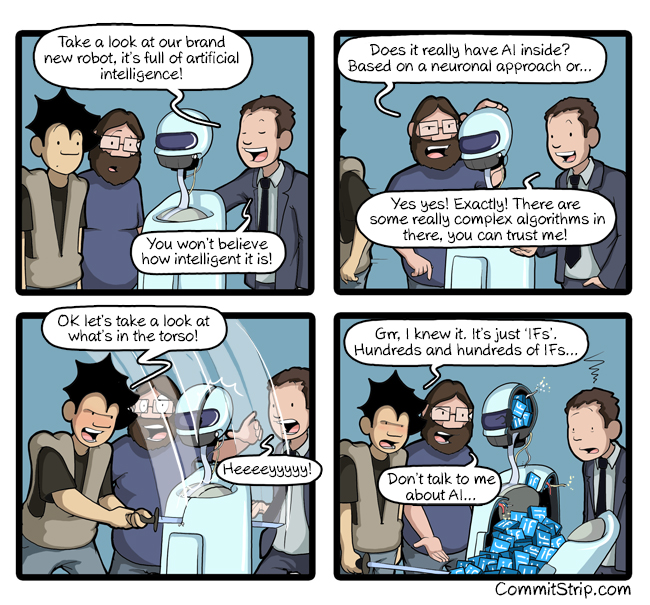
AI inside

by CommitStrip
mkalus shared this story from CommitStrip.

07 Jun 21:07

800 Kids Have Died In Hot Cars: Why Aren’t Alert Systems Standard?

by Mary Beth Quirk
mkalus shared this story from Consumerist.

Since 1990, more than 800 children have died from heatstroke in hot cars, including nine children so far just this year. But despite the severity of this problem, technology that’s already available that can remind parents when their child is still in the back seat is not yet standard for all cars. Lawmakers, safety advocates, and parents who have experienced tragic losses want this to change.

With the arrival of warmer weather comes greater risk that could suffer from heatstroke and die if they’re stuck in a car, but it can happen on milder days as well: Children have died from heatstroke in cars with temperatures as low as 60 degrees, according to KidsAndCars.org.

And even with the windows cracked, the temperature inside a car can reach 125 degrees in minutes, with 80% of the increase in temperature happening in the first 10 minutes.

With an average of 37 children dying per year from heatstroke after being left behind in cars it’s a serious issue that has garnered national attention, including a 2010 Pulitzer-prize winning story by The Washington Post about the tragic story of a father who was charged with involuntary manslaughter — and ultimately acquitted — after he accidentally left his son in a hot car.

In an effort to prevent this from happening, three lawmakers are reintroducing legislation that would require cars to be equipped with existing technology to alert drivers that a passenger remains in the back seat when a vehicle is turned off.

Representatives Tim Ryan (OH), Peter King (NY) and Jan Schakowsky (IL) introduced the Helping Overcome Trauma for Children Alone in Rear Seats (HOT CARS) Act of 2017 [PDF] to ensure that an alert system is standard equipment in cars.

There’s already technology available that some automakers have introduced aimed at keeping kids from being stuck in overheating cars: In June 2016, GM debuted a new rear seat reminder feature that sounds a warning tone and alerts drivers to “Look In Rear Seat,” with a message flashing in the center of the vehicle’s speedometer.

It’s this kind of technology that should be standard in all vehicles, advocates and lawmakers said in introducing the bill today at a press conference, with many pointing out cars today have alerts for just about everything else, from warnings about unbelted seatbelts to alarms for doors that have been left open.

“There is absolutely no reason why we can’t have the technology available in cars today that will allow a parent who’s hustling around, stressed out, running from here to there, to get a bell, or a ding, or a vibration, something auditory, something that’s visual, that will allow you to recognize you may have a kid in your car,” said Rep. Ryan. “There’s no reason we can’t do that.”

Dr. David Diamond, the director of the Neuroscience Collaborative Program and Center for Preclinical and Clinical Research on PTSD at the University of South Florida, noted that competing brain functions can cause a parent to lose awareness that their child is in the car.

“These are not bad parents, these are not negligent parents,” he said. “These are flaws in the brain.”

Deona Ryan Bien, the mother of Aslyn, a one-year-old girl who died in 2004 after her babysitter inadvertently left her in the car on an 82-degree day, detailed the changes in her family’s daily routine that led to her daughter’s death: She had started a new job that day working more days per week, so her daughter would be at the babysitter more.

Her sitter was also driving a different car, and Aslyn was seated directly behind her, out of the line of sight.

“These similar events have happened to many people every day,” Bein said, adding that though education is important to make people aware of how this can happen, it’s “just a layer.”

“And unfortunately, it is a layer that people feel that they do not need to know,” she said. “I had felt the same way, but it does happen, it did happen to hundreds of other parents, good, loving parents and grandparents.”

Other parents spoke about their heartbreak as well, often through tears, to emphasize the need for alert technology to be required in all vehicles and urge Congress to pass this bill.

“Every time we hear of another child dying, we relive that horrible day with him over and over again and we ask why — why is this happening when there’s technology available?” said Miles Harrison, the subject of WaPo’s 2010 story, whose 21-month old son died in 2008.

Our colleagues at Consumer Reports and Consumers Union also believe these kinds of tragedies could be prevented with auditory and visual alert systems.

“No parent can fathom the idea that they could leave a child behind in a hot car so they’re less likely to take precautions to avoid it,” Jennifer Stockburger, Director of Operations Consumer Reports Auto Test Center. “That’s why some type of integrated warning is critical to help prevent these types of tragedies”

“Most people can’t imagine leaving their kids in the back seat, but it does happen, and now there are simple, effective features coming out to prevent these tragedies. We think they should be standard in all new cars. That’s why we strongly support the HOT CARS Act and will be pushing Congress to pass it,” says William Wallace, policy analyst for Consumers Union, the policy and mobilization arm of Consumer Reports.


07 Jun 21:07

The Soldier Who Voluntarily Became a Prisoner in Auschwitz

by TodayIFoundOut
mkalus shared this story from TodayIFoundOut's YouTube Videos.

From: TodayIFoundOut
Duration: 13:11

If you happen to like our videos and have a few bucks to spare to support our efforts, check out our Patreon page where we've got a variety of perks for our Patrons, including Simon's voice on your GPS and the ever requested Simon Whistler whistling package: https://www.patreon.com/TodayIFoundOut

→Subscribe for new videos every day!
https://www.youtube.com/user/TodayIFoundOut?sub_confirmation=1

Never run out of things to say at the water cooler with TodayIFoundOut! Brand new videos 7 days a week!

More from TodayIFoundOut

The Soldier Who Continued Fighting WWII 29 Years After It Ended, Because He Didn't Know
https://youtu.be/U6rOSe3EsdM?list=PLR0XuDegDqP33-NUx7wuKb-3PDj-gRKgR

The Unwilling Soldier of Three Armies
https://youtu.be/zhl-nIK1kV4?list=PLR0XuDegDqP33-NUx7wuKb-3PDj-gRKgR

In this video:

Nazi troops invaded Poland on September 1, 1939, despite the best efforts of Captain Witold Pilecki and his fellow Polish soldiers. On November 9th of that same year, Witold and Major Wlodarkiewicz founded the Tajna Armia Polska (TAP or Polish Secret Army), an underground organization that eventually became consolidated with other resistance forces into The Home Army.

Want the text version?: http://www.todayifoundout.com/index.php/2015/10/soldier-voluntarily-became-imprisoned-auschwitz/

Sources:

http://www.ibtimes.co.uk/world-war-two-declaration-anniversary-witold-pilecki-spy-who-volunteered-auschwitz-1463685
http://www.ushmm.org/information/exhibitions/online-features/special-focus/international-holocaust-remembrance-day/the-auschwitz-volunteer-pilecki
http://www.theguardian.com/world/2015/jan/27/auschwitz-short-history-liberation-concentration-camp-holocaust
http://www.ushmm.org/wlc/en/article.php?ModuleId=10005189
http://www.jhc.org.au/news-and-events/calendar-of-events/item/369-witold-pilecki.html
http://auschwitz.org/en/museum/news/67th-anniversary-of-the-death-of-cavalry-captain-witold-pilecki,1154.html
http://www.npr.org/templates/story/story.php?storyId=129956107
https://www.jewishvirtuallibrary.org/jsource/biography/Witold_Pilecki.html
http://www.theatlantic.com/international/archive/2012/10/the-man-who-volunteered-for-auschwitz/263083/
http://www.nytimes.com/2012/06/24/books/review/the-auschwitz-volunteer-by-witold-pilecki.html?_r=1
http://www.vice.com/read/witold-pilecki-the-auschwitz-volunteer-interview
http://www.huffingtonpost.com/2012/08/30/poland-digs-up-hundreds-o_n_1843020.html
http://usacac.army.mil/CAC2/MilitaryReview/Archives/English/MilitaryReview_20131231_art015.pdf
https://en.wikipedia.org/wiki/Witold_Pilecki
https://pl.wikipedia.org/wiki/Czes%C5%82aw_%C5%81api%C5%84ski_%28wojskowy%29
https://en.wikipedia.org/wiki/Roundup_%28history%29
https://en.wikipedia.org/wiki/Witold's_Report
https://en.wikipedia.org/wiki/Polish_Committee_of_National_Liberation
https://en.wikipedia.org/wiki/II_Corps_%28Poland%29
https://en.wikipedia.org/wiki/J%C3%B3zef_Cyrankiewicz

Image Credit:

https://commons.wikimedia.org/wiki/File:German_troops_parade_through_Warsaw,_Poland,_09-1939_-_NARA_-_559369.jpg
https://pl.wikipedia.org/wiki/Plik:Witold_Pilecki_in_color.jpg
https://en.wikipedia.org/wiki/Warsaw_Uprising#/media/File:Warsaw_Uprising_by_Chrzanowski_-_Henio_Roma_-_14828.jpg
https://commons.wikimedia.org/wiki/File:Warsaw_Uprising_by_Tomaszewski_-_Mazowiecka_1.jpg
https://ru.wikipedia.org/wiki/%D0%A4%D0%B0%D0%B9%D0%BB:%C5%81apanka.jpg
https://commons.wikimedia.org/wiki/File:Lapanka_in_Bydgoszcz.jpg
https://pixabay.com/ru/%D0%BE%D1%81%D0%B2%D0%B5%D0%BD%D1%86%D0%B8%D0%BC-%D0%BF%D0%BE%D0%BB%D1%8C%D1%88%D0%B0-627908/
https://commons.wikimedia.org/wiki/File:Child_survivors_of_Auschwitz.jpeg
https://pixabay.com/ru/%D0%BE%D1%81%D0%B2%D0%B5%D0%BD%D1%86%D0%B8%D0%BC-%D0%BF%D0%BE%D0%BB%D1%8C%D1%88%D0%B0-%D0%B2%D0%BE%D0%B9%D0%BD%D0%B0-%D0%BB%D0%B0%D0%B3%D0%B5%D1%80%D1%8C-971901/
https://pixabay.com/ru/%D0%BA%D0%BE%D0%BB%D1%8E%D1%87%D0%B0%D1%8F-%D0%BF%D1%80%D0%BE%D0%B2%D0%BE%D0%BB%D0%BE%D0%BA%D0%B0-%D1%80%D0%B6%D0%B0%D0%B2%D1%87%D0%B8%D0%BD%D0%B0-%D1%80%D0%B6%D0%B0%D0%B2%D1%8B%D0%B9-1269430/
https://commons.wikimedia.org/wiki/File:Gas_chamber_in_the_main_camp_of_Auschwitz_immediately_after_liberation.jpg
https://simple.wikipedia.org/wiki/Auschwitz_concentration_camp#/media/File:Auschwitz_Resistance_280_cropped.jpg

Music from Jukedeck - create your own at http://jukedeck.com.

07 Jun 21:07

1-In-4 Families Don’t Seek Medical Attention Because Of Financial Worries

by Ashlee Kieler
mkalus shared this story from Consumerist.

With the latest reports suggesting that the American Health Care Act — a budget resolution intended to repeal and replace much of the Affordable Care Act — would leave more than 23 million consumers without insurance and facing higher out-of-pocket costs, it’s no surprise that consumers are a bit uneasy when it comes to their healthcare. In fact, a new survey suggests that in the face of rising costs, some families are foregoing medical care to save a few — or a few thousand — bucks. 

A new report from Bankrate found that 25% of Americans say in the last year someone in their household decided not to seek medical attention when it was needed simply because of the cost.

According to the survey, which analyzed 1,002 telephone interviews of adults living in the U.S. in May, older millennials — ages 27 to 32 — were the most likely to skip out on medical care, with nearly 32% — or 1-in-3 — saying they didn’t see a doctor when they should have.

A Washington, D.C., resident tells Bankrate that she was surprised by how expensive things can be even when you have insurance.

“Things like urgent care,” she says. “I’ve been able to pay out-of-pocket, but I thought insurance would cover more of it.”

About 25% of consumers between the ages of 37 and 52 didn’t seek medical attention, while 23% of adults between 53 and 71 years of age failed to visit a doctor because of possible costs.

“It’s very concerning that people are foregoing medical attention because of the expense,” Robin Saks Frankel, credit card analyst at Bankrate.com, said in a statement.

The concern uncovered by Bankrate echoes the findings in a recent survey from our colleagues at Consumer Reports.

According to that survey of 1,007 adults, concerns about healthcare have increased significantly in the last year. More than half (57%) of Americans said they lack confidence that they and their loved ones will be able to afford health insurance.

Part of the reason that some individuals have foregone medical care over cost worries is likely brought on by their lack of insurance, according to Bankrate, which found about 13% of respondents don’t have insurance.

But the concerns aren’t less for those who currently have health insurance, as keeping it is a big worry. More than 56% of consumers say they are worried they might not have affordable health insurance in the future.

One Maryland woman tells Bankrate that with proposed changes she’s worried she’ll have to pay more to keep her insurance.

“I don’t want to be paying more,” she said.

Of these consumers, Generation Xers are most concerned with 64% of people ages 37 to 52 worries, followed by baby boomers (58%), millennials (56%), and the silent generation (35%).

Consumers had the same worries in Consumer Reports’ survey, which found 41% of respondents are not confident that they will have access to the doctors, tests, treatments, and medications they need. That’s an increase from 35% in January when we first asked the question—a statistically significant jump.

As for individual preference on the future of healthcare, 43% of respondents say they prefer the current Affordable Care Act system to the proposed American Health Care Act.

No matter which healthcare policy is used, the Consumer Reports’ survey found a majority of Americans believe the government should do something. Nearly 78% of respondents said they believed the government should help make sure people have access to affordable, quality healthcare.


07 Jun 21:07

Apple Putting Screen-Replacing Robots In Some Best Buy Stores

by Kate Cox
mkalus shared this story from Consumerist.

Smartphones are great, sure. But the problem with your modern smartphone is that the outside is made of glass — and humans are, well, kind of klutzes, by and large. So cracked screens happen. A lot. Now, Apple is making it easier for iPhone owners to get their screens properly repaired — but it’s also a tactic to help the company avoid laws requiring them to let you fix your own phone.

In its own stores, Apple uses a specialized, proprietary machine to repair your spiderwebbed screen. Now, as Reuters reports, it’s sharing those machines with certain other stores worldwide.

Here in the U.S., the first authorized third party to get one of these Horizon Machines is Best Buy, which already has one of the screen repair machines at a store in the Miami area and is getting another one soon in California.

The eventual plan is to have Horizon Machines in about 400 third-party locations worldwide by the end of the year, Apple told Reuters. There are also some pilot tests of the repair machines going on in the greater San Francisco area, London, Shanghai, and Singapore.

If you’ve strolled through any mall, strip mall, or city street in the last several years, you may even be wondering why these machines are necessary. After all, we seem to have “Repair 4 U” style kiosks and storefronts popping up all over.

These third-party repair shops are fine for some screen repairs, Apple confirmed to Reuters, but not for all. If your phone’s fingerprint sensor is damaged when the screen is cracked, a replacement from something other than one of Apple’s Horizon Machines can render it inoperable — basically, turn it into a brick.

That’s for security purposes, Reuters says — that way you know that the replacement sensor is actually authorized, and someone’s not trying to break into and access things they shouldn’t on a stolen phone.

But as Reuters also notes, it’s probably not just a desire to shorten waits at the Genius Bar that’s making Apple share its fancy robots at this particular time.

Right now, there are eight separate states — Illinois, Kansas, Massachusetts, Minnesota, Nebraska, New York, Tennessee, and Wyoming — considering some kind of “right to repair” bill. These laws, basically, want to protect third-party repair shops’ right to keep existing, and consumers’ rights to choose who fixes their stuff.

It’s not just phone companies that use the software embedded in their products to restrict third parties’ ability to repair or tinker with the devices they sell. Phone and electronic device-makers do it, sure, but so do makers of every other kind of machine — even tractors.

Related: 4 Ways Copyright Law Actually Controls Your Whole Digital Life

So the measures in these states would require manufacturers to let third-party shops and the general public acquire repair manuals, diagnostic tools, and genuine, authentic replacement parts — at fair prices. That would increase competition, and allow consumers more choice.

Apple, however, is not a fan of these bills. In Nebraska, Apple was among the companies that lobbied against the right to repair bill traveling through the state legislature — and it stalled out shortly thereafter.

Apple tells Reuters that its plan to get Horizon Machines into more locations is unrelated to “legislative pressure.” But legislators tend to want to fix problems that exist, and constituents complain about. If fewer people have to wait in line to get their Phones fixed, that’s probably fewer people who will agitate for more repair options.


07 Jun 20:57

How Histograms Work

by Nathan Yau

The histogram is one of my favorite basic chart types, because it lets you quickly see the shape and distribution of a dataset. However, a lot of people don’t know… Read More

07 Jun 16:19

A look at Apple’s new Kaby Lake-powered iMac, MacBook and MacBook Pro

by Patrick O'Rourke
Macbook

While Apple remains tight-lipped regarding its future overarching upgrade strategy involving its MacBook, MacBook Pro and iMac lineup, if WWDC 2017 is any indication of what we can expect in the future, it appears Mac hardware updates are set to drop at a significantly faster clip.

After going hands-on with the new 10.5-inch iPad Pro following Apple’s WWDC keynote and briefly watching a demonstration focused on the new Intel Kaby Lake MacBook Pro, MacBook and iMac lineup, I spent several hours testing out the company’s new computers in my hotel room.

27-inch iMac front view

My time with the new 12-inch MacBook, 15-inch MacBook Pro and iMac amounted to roughly six to seven hours, which isn’t enough to put together a full review of any of the devices.

I have, however, compiled some of my initial impressions regarding Apple’s refreshed desktop and laptop line-up.

The iMac finally gets refreshed

27-inch iMac on table

Apple’s iMac line has received a power boost thanks to the addition of Intel’s 7th generation Kaby Lake processors, coupled with the ability to support up to 32GB of RAM on the top-of-the-line 21.5-inch iMac and 64GB of RAM on the 27-inch 5K iMac — the model I spent time with.

It’s worth noting that the iMac physically looks the same as its predecessor; according to Apple, beyond the addition of rear vents the design of the all-in-one is the same. The overall design of the iMac has aged surprisingly well and the desktop is still one of the best all-in-one devices on the market, though Microsoft’s Surface Studio and its ‘Zero Gravity’ hinge certainly gives its main competitor a more futuristic look.

iMac Rear view

The iMacs also now come equipped with either a discrete Radeon 500-series GPU (555 or 560) or Intel’s new Iris Pro Graphics 640 integrated card.

Apple’s Fusion Drive — the company’s take on hard drive/solid-state hybrid storage — is also now standard on all 27-inch iMacs and is an option on the 21-inch version.

iMac display

Additionally, Apple has opted for an interesting array of ports with the new iMac, mixing USB-C Thunderbolt 3-capable plugs with standard USB 3.0. The iMac features a 3.5mm headphone jack, built-in SDXC card reader, Gigabit Ethernet, three USB 3.0 ports and two USB-C ports.

Since the launch of the original 12-inch USB-C MacBook, Apple has been sharply criticized for not offering a mix of USB-A 3.0 ports and USB-C Thunderbolt ports, with the company instead going all-in on USB-C for its current MacBook and MacBook Pro line. Conversely, Microsoft caught flack for avoiding USB-C altogether in its latest Surface Pro refresh and even with the Surface Laptop.

imac Ports

Another significant upgrade to the new iMac is the all-in-one computers ability to push out 500 nits of brightness coupled with 10-bit dithering in its display. I’m far from an expert on display technology, but I spent time watching 4K YouTube videos and streaming content with Netflix via the iMac and found the the screen is absolutely stunning.

While I haven’t gone hands-on with it yet, Apple also revealed the work space powerhouse 27-inch iMac Pro, complete with a 5K display, and Intel’s new Xeon processors that can be paired with up to 128GB of memory. On the graphics side of the spectrum, this computer rocks AMD’s new Vega graphics with up to 16GB of VRAM.

iMac Rear

The version 27-inch iMac I tested out featured an Intel 4.2GHz processor, 16GB of DDR4 RAM and discrete Raedon Pro 580 8192MB graphics card. I browsed the internet, watched 4K video and spent some time batch editing photos in Photoshop Creative Cloud and didn’t run into any performance hiccups.

It’s likely this standard but long-overdue update to the iMac line was motivated by the rise of virtual and augmented reality, two burgeoning technologies the Apple has been slow to embrace.

iMac side view

The most affordable 21.7-inch 4K iMac starts at $1,399 CAD and is available to order right now on Apple’s Canadian website.

Kaby Lake hits the MacBook Pro and MacBook

MacBook Pro and MacBook Kaby Lake

While those who recently bought Apple’s controversial USB-C MacBook Pro line are likely frustrated with the processor update to Kaby Lake, this rather quick hardware increase is hopefully a sign of a shift in strategy for the tech giant regarding the adoption of new processor technologies.

While I spent less time with both the 15-inch MacBook Pro and the 12-inch MacBook during my subsequent hands-on time with Apple’s new devices, the company has improved both laptops (including the 13-inch Pro model that I didn’t test out) in a number of ways when it comes to internal hardware.

Kaby Lake MacBook Pro

It’s important to point out that in terms of design and build quality, both laptops are identical to last year’s iterations, apart from the switch to the new version of Apple’s Butterfly keyboard for the 12-inch MacBook

The more interesting move here, however, is that the 15-inch MacBook Pro with Touch Bar now offers Radeon discrete graphics in both its iterations, a shift from last year’s model.

MacBook Pro Kaby Lake top view

Similar to the iMac, I tested out Photoshop, browsed the internet and watched 4K video with the 15-inch MacBook Pro and didn’t run instances of lag I sometimes experience with the 13-inch MacBook Pro I’ve been using for the last few months.

The 12-inch MacBook on the other hand, is a device I’ve criticized in the past for not being powerful enough for my purposes. The addition of Kaby Lake architecture, which means the 12-inch MacBook now supports up to a 1.4 GHz Core i7 processor with Turbo Boost up to 3.6 GHz, coupled with up to 16GB of RAM, results in Apple’s smallest laptop packing significantly more power. In the brief amount of time I spent with the device, I didn’t run into any instances of slowdown and this isn’t something I was able to say about the previous iteration.

12-inch MacBook

The new MacBooks are available online in the Apple Store now. The 13-inch non-Touch Bar MacBook Pro with two Thunderbolt 3 ports starts at $1,729, while the 13-inch MacBook Pro with Touch Bar begins at $2,399 CAD. The core i5 Kaby Lake 12-inch MacBook starts at $1,729. It’s also worth noting that the SSD drives across Apple’s entire MacBook line have been updated, as well.

Overall, Apple’s update to the MacBook line indicate that the company is committed updating its hardware more frequently — the same can be said about its long overdue internal update to the iMac.

In terms of the MacBook, however, the spec boost doesn’t address issues related to USB-C and the inevitable #donglelife or the lack of software available for the Touch Bar. It’s also still in clear if the update to Kaby Lake fixes the MacBook Pro line’s frustrating battery life related issues, though Apple claims the laptop is capable of getting roughly one additional hour of power.

The post A look at Apple’s new Kaby Lake-powered iMac, MacBook and MacBook Pro appeared first on MobileSyrup.

07 Jun 16:19

Planet of the Apps Launches Worldwide with Season Premiere

by Ryan Christoffel

Apple launched the premiere episode of Planet of the Apps last night, at the end of the second full day of WWDC. Planet of the Apps features app creators who compete to receive funding for their apps with the help of the show's celebrity mentors. The first episode runs just under 50 minutes, and is available free of charge for a limited time to all viewers on the show's website. Future installments of the 10-episode series will only be available to Apple Music subscribers, and will release weekly.

Timed to coordinate with the launch, the Apple Music app for iOS has received a new 'TV & Movies' section inside the 'Browse' tab. The section is headlined by Planet of the Apps, but it also features some of Apple's previously released original video content, such as Drake's 'Please Forgive Me' and the '808' documentary. If you tap through to the Planet of the Apps informational page, it contains more info about the show, a listing of all currently available episodes, and also a selection of bonus video content featuring the series' celebrity personalities.

If anyone sets out to locate Apple's new original series, they won't even have to visit the 'TV & Movies' section to find it. Apple is heavily featuring it in the top section of Apple Music's 'Browse' tab with six featured banners. The show is also being featured inside of Apple's TV app (assuming Apple Music has been given user permission to integrate with TV). Additionally, the show's website is linked to from the front page of Apple.com, and a wide array of press stories have been released in the last 24 hours covering the launch.

Clearly, Apple wants the world to know that Planet of the Apps is different from its original video work of the past; the tech company is now officially in the TV content business.


Support MacStories Directly

Club MacStories offers exclusive access to extra MacStories content, delivered every week; it’s also a way to support us directly.

Club MacStories will help you discover the best apps for your devices and get the most out of your iPhone, iPad, and Mac. Plus, it’s made in Italy.

Join Now
07 Jun 16:19

Apple Sharing Screen Repairing Machines with Third-Party Vendors

by Ryan Christoffel

As the iPhone has evolved in recent years, it has become more and more difficult to repair. Screen repairs in particular are challenging thanks to the wealth of technology integrated with an iPhone's screen.

According to a new report from Reuters, Apple is making strides toward empowering more third-parties to perform those complex repairs. The company is beginning to roll out its proprietary tool for repairing iPhone screens, the Horizon Machine, to authorized repair companies. Plans are to deliver 400 Horizon Machines by the end of the year to repair centers across 25 countries. Stephen Nellis was given access to watch these Apple creations at work:

Dozens of Horizon Machines lined the tables. The contraptions, gray metal boxes the size of a microwave with a swing-out windowed door, vary slightly in shape depending on the model of iPhone they repair. Apple would not say where the machines were made or by whom
...
Once the new screen is mounted, the iPhone goes into the Horizon Machine, which allows Apple's software to communicate with the fresh hardware. Over the course of 10 to 12 minutes, the machine talks to the phone's operating system to pair the fingerprint sensor to the phone's brain.

While that unfolds, a mechanical finger jabs the screen in multiple places to test the touch-sensitive surface. The machine also fine tunes the display and software to match the precise colors and calibration of the original.

The piece notes how the topic of phone repair can be a political one, as legislation has been introduced in several U.S. states that intends to promote increasing repair options for consumers. Whether that legislation comes to pass or not, sharing the Horizon Machine seems like a good move by Apple that will benefit its customers in the long run.

→ Source: reuters.com

07 Jun 16:15

My Manchester

by Zara Rahman

With everything going on in the world right now, it seems almost superfluous to say the recent attack at an arena in Manchester, my hometown, took me off-guard. With our digital technologies overflowing with connections and information, we are immersed in in tragedies, every day, and we may learn of them almost as soon as they happen. Nevertheless, in spite of this, we never get used to it. I found out about the attack from a push notification on a news app — words on a screen in my pocket, but such big, heavy words.

Seeing the word Manchester pop up on my screen invoked a feeling of affection and familiarity, but the words that followed brought not just horror and sadness, but homesick horror, homesick fear. The hashtag trended, the well-wishes came flooding in. Part of me felt almost guilty — this attack generated more empathy than so many statistically “worse” tragedies in other parts of the world. That supposedly global network we have built through digital technologies cares a lot more about some parts of the world than others. Car bombs in Kabul, the ongoing war in Syria, famine and conflict in Yemen — our capacity for empathy has its limits, though we love to think we’re more well-connected and worldly in our attitudes than ever.

It’s a strange feeling of dislocation, watching something so deeply unfamiliar taking place in somewhere so intimate to me, mediated through screens, across time zones

It’s a strange feeling of dislocation, watching something so deeply unfamiliar taking place in somewhere so intimate to me, mediated through screens, across time zones and places. I grew up in Manchester, but I’ve lived outside the UK for the past eight years. Nowadays, through my professional work, I spend a lot of time thinking about the role of technology in our society. And as an immigrant, news from many of my friends and family comes to me mostly via communication technologies, rather than in person as it used to. In many ways, I often don’t feel like I’m really missing out on too much, thanks to video calls, messaging apps, and easy, high-quality internet access.

In reality, though, that’s not quite right. I’m not taking part in those events my friends and family share with me myself; I’m just learning about them, and there’s a difference. My perception is built upon what I’m told, not what I experience myself, but sometimes that can be almost hard to remember. There used to be a time delay before we learned of news from faraway places, even a time delay in the transmission of a voice in long-distance telephone calls. That slight hesitation could feel like an aural reflection of geographic distance, which gave a sense of perspective, a reminder of the gap between learning of an event and taking part directly. These boundaries have become ever blurrier, and now experiences can happen in a multitude of ways, regardless of our geographic location. Nowadays, interruptions come in the form of algorithmic curation which breaks up what we see, inserts what it thinks we need, and changes how we experience major life events in ways we can’t control. That’s easy to forget, though – our algorithmically curated feeds provide 360° views, multiple photos and videos from different perspectives, and encourage us to think of the view they provide as all that’s needed to feel like we were there. Events of huge magnitude come to us in the same way as tiny, inconsequential ones; on our screens, inhibiting our ability to truly understand the magnitude of what’s happening.

The last terrorist attack we had in Manchester was in 1996. At the time, I was not old enough to really understand what had happened, but I can remember broad brushstrokes: breaking news on the television, announcements at school, overheard conversations that I understood little of, and a halt in our family visits to Manchester city center. This time, my phone took on the role of meting out information to me as I scrolled through to see, almost in real time, what was happening in my city. Knowing it was in real time made it feel treacherously close, but the events themselves were gut-wrenchingly distant from the city I know.

From afar, I watched the news develop while my friends and family in the UK slept, and wondered if I should be looking for someone in particular who might have been at an Ariana Grande concert — the children of friends, or their younger siblings. The combination of familiarity with unfamiliarity was jarring: I recognized the Manchester Arena (or the Manchester Evening News Arena, as I know it), where I saw my first gig as a teenager, and many more after. On my phone, it was filled not with excited teenagers but tears and blood and fear.

That supposedly global, digital network cares a lot more about some parts of the world than others. Car bombs in Kabul, the ongoing war in Syria, famine and conflict in Yemen — our capacity for empathy has its limits

I remembered my parents dropping me off, the overwhelming crowds and the crush to get out, the assigned time to meet at the pick-up point, and how my parents would have worried had I not turned up on time. The parents of concert-goers last week went through worries of a magnitude multiple orders greater. As I felt my own closeness to the city, I imagined the horror of scanning through those images, looking for loved ones, reading through descriptions and wondering if the person mentioned is the person you care about.

Those parents probably watched their phones as I did, as unverified but gory details appeared, many from people not thinking of the information that would be important for the public interest, but instead getting caught up in the social media frenzy of rumors and lurid and graphic details, and the sense of attention, relevance, and connection to an event that sharing them can bring. Heartbreaking posts are eminently shareable, and fact-checking individual anecdotes takes time, if verification is even thought of at all. The attention around an attack can be transformed in a thousand ways, and not everyone vying for attention has the best intentions for the people affected in mind.

There’s no way of knowing or isolating the motives behind those social media posts, no way to determine the degree to which they are attempts at making a tweet go viral to boost one’s ego or simply getting word out about an important incident. Is that, in fact, what terrorists are aiming for? Attention, multiplied thousands of times, not just by newspapers and on television but also refracted and redirected on social media, inviting a kind of participation in the act’s repercussions? Each new set of details, each tweet complete with “RT please” made me wonder, Is this a hoax or an attempt to get more likes or followers?

Being thousands of miles away, the closest I can get to knowing what’s there is through digital technologies and contact with my friends and family. Those technologies give me the illusion of being closer, of knowing what’s going on, but it’s actually just a sliver of the reality, rife with bias and well-hidden limitations. What I see on social media isn’t a true picture of what the city of Manchester is experiencing right now; it reflects just the subsection of society who have access to phones and Internet and who choose to engage on the same platforms as I do. And beyond that, there’s nothing to ensure that any of what I see online is actually from people in Manchester. Attacks and tragedies, where information is valuable, can be hotspots for disinformation to spread too: In the heat of the moment, a desire for timely information seems to take precedence over a desire for true information. Was my personalized media ecosystem giving the tragedy and the response to it an uncanny coherence? Was I even experiencing the same event others were experiencing?

That dislocation, it seems, is everywhere: between how we like to perceive ourselves, and how we perceive those around us. What I see, of course, isn’t what you see. I can’t know to what extent or precisely how my engagement with social media platforms has changed what is shown to me, but I do know that it limits how and how much I can engage with my hometown from afar. I watched as people who probably never spent a second in their lives thinking about Manchester, my Manchester, shared opinions on what was happening there, why it happened, what people were feeling. This isn’t the way I wanted people to learn about the city I grew up in. Once, when I thought of St. Ann’s Square, I’d think of the German Christmas Markets, and summers spent hanging out nearby. Now the images of St. Ann’s Square covered with flowers and messages to those killed feel totally alien to me. I can see the images and read the online media, but I can’t get a feeling for the atmosphere, the conversations on the trams in town, the small talk in shops.

People who disagree with me, or people who think people like me shouldn’t even be in the UK, are not just unfamiliar and unknown to me; they’re entirely invisible. But they live in my hometown

Traditional media outlets tell me that feelings of Islamophobia and incidents of hate crimes are increasing, both in the UK and where I am right now. But if I look at the sentiments expressed in my social media networks, I see the opposite. My Facebook Newsfeed is a place of shared identity, full of messages of solidarity and unity; of Tony Walsh’s moving poem “This Is the Place” about Manchester as a place of grit, strength, and rich history; of a man in Manchester declaring that this city is a community, that this beautiful city is for everyone and that we will never turn on our neighbors, no matter what happens. These are carefully edited and easily shared posts, with numbers to show just how many thousands of people like those feelings, uniting us all.

Being away from home, those videos of solidarity and those posts have been reassuring. The more I think about them, though, the more they start to scare me a little. Thanks to algorithmic curation showing me more of what I like and less of what I don’t, I see an even smaller sliver of the people in the broader community that I care about. People who disagree with me, or people who think people like me shouldn’t even be in the UK, are not just unfamiliar and unknown to me; they’re entirely invisible. On my Facebook feed, there’s nobody expressing racist views or even anything that I deeply disagree with, but that doesn’t mean that these people don’t exist. They live in my hometown, no less.

Does my ethnicity automatically play into what I see? If the algorithm’s job is to show me things I’ll engage with the most, it would be logical for it to assume that I don’t want to see content that discriminates against me. I have a Muslim name; of course, I won’t agree with anti-immigrant or anti-Muslim views. The solidarity I see and experience may be crafted particularly for me, based on information gathered from my online behavior. Who knows what other kinds of solidarity are out there, that social media are helping craft or sustain? Who’s to say that someone on the opposite end of the political spectrum to me isn’t feeling exactly the same kind of reassurance that I am, but with the reverse sentiment? Perhaps they were also sad and scared by the attacks, but instead of seeing the expressions of unity between diverse communities that have sprung up that bring me comfort, their reassurance might manifest itself in anti-immigrant messages against people who, in their eyes, might look just like I do: brown skin, Muslim name, immigrant family. Thanks to what they see online, their false conviction that this incident is the fault of a religion, or of immigrants, is being strengthened by easily shared sound bites and videos instead of refuted with information about what is actually happening, the benefits immigration has brought the country, and the context to help situate those facts.

As with many countries right now, polarization of society in the UK is deeply visible, from huge differences in voting patterns between different age groups to expected voting in the upcoming general election. Being where I am right now, digital technologies offer me little in way of reaching out to people on the other side of that divide.

Before these technologies overwhelmed us, a tragedy was shared in one particular way by people who were present, and in another by people who learned of it afterward. Now those lines are blurrier than they were before, thanks to our ability to experience those tragedies online together. But the very structure of social media inserts doubt into the experience of solidarity that they pretend to generate. We’re often confronted with highly personalized, curated experiences online, which do the opposite of creating the “network” the platforms were expected to build, by building invisible walls between us. We can be reassured by finding others who feel the same way as us, but the price we pay is that we no longer see the full array of people and beliefs within our society. In this case, I’m prevented from seeing the full picture of the community I want to mourn with, and without that, I can’t fully process what’s happened.

But with tragedies like the one in Manchester, or elsewhere in the world, those boundaries between us shouldn’t mean anything. A loss of human lives is a tragedy, no matter who they are or where they are. Yet sharing in that common tragedy online can become overshadowed by concerns about garnering attention, which can come at the expense of sharing. Though any sort of well-wishes are always precious and valuable, sometimes it can be difficult to know what solidarity expressed on social media really means, and difficult to see what we’re trying to mourn.

07 Jun 16:15

Sorry. Main Street, Tuesday afternoon

by pricetags