Shared posts

12 Jul 05:14

Lightbeam – why & what

by princiya

Lightbeam is a key tool for Mozilla to educate the public about privacy.

In this blog post, you will know why I chose Lightbeam and what does it do.

As I was browsing through the Outreachy project list, Lightbeam caught my attention for the following reasons:

  • front-end web development (all things JavaScript)
  • visualisations (D3.js)
  • a project from Mozilla (healthy, open and accessible Internet for all people)

But I was not sure about the following:

  • web privacy
  • security engineering

JavaScript topped the list and I decided to give it a try. I must say, I am now very cautious about the online third party trackers and care for web privacy and security.

The key part of this project (internship) is to convert the existing Firefox add-on to a web extension and explore simpler ways to convey complex privacy and security concepts to all  Firefox users.

Web security & privacy are vast topics  and after playing around with a few keywords, I found these two interesting papers online:

A healthy internet is secure and private. While web tracking isn’t 100% evil (personal data can make your browsing more efficient; cookies can help your favourite websites stay in business), its workings remain poorly understood. Using interactive visualisations, Lightbeam’s main goal is to show web tracking, aka, show the first and third party sites you interact with on the Web.

Your personal information is valuable and it’s your right to know what data is being collected about you – your age, income, family’s ages and income, medical history, dietary habits, favourite web sites, your birthday…the list goes on. The trick is in taking this data and shacking up with third parties to help them come up with new ways to convince you to spend money, sign up for services, and give up more information.  It would be fine if you decided to give up this information for a tangible benefit, but you may never see a benefit aside from an ad, and no one’s including you in the decision.

One key area Lightbeam can help you in making the difference is in user control – deciding who can collect your data.

Lightbeam is your guide to help you surf the web while keeping your privacy intact.


10 Jun 04:12

Windows 10 Insider Preview shows off a lot changes for the Microsoft OS

by Dean Daley
windows 10 microsoft build

With the latest Windows Preview Build 16215, Microsoft is giving Windows Insiders a sneak peak at what’s coming to Windows 10 later this year with the Windows 10 Fall Creators Update debuted at Build 2017.

The preview is available for testers in the ‘fast ring’ and includes updates to the Action Center, Cortana, the Microsoft Edge browser, as well as improved stylus and handwriting support and improved HDR support.

Action Center update for Windows 10

Microsoft’s Action Center has a new look: notifications are clearly separated and displayed based on a hierarchy. Furthermore, the company has redesigned the notification centre to make use of its Fluent Design design language as well as the company’s new acrylic texture.

The company has also updated its Edge browser to allow users to pin their favourite websites to the taskbar. Each pin uses the website’s icon, allowing users to easily identify the pin.

A complete full-screen mode has also been added and can be toggled with the F11 key. The new version of Windows 10 additionally provides Edge users with annotation for EPUB Books, an enhanced note taking feature and animation updates.

Cortana Lasso update for Windows 10

Microsoft improved Cortana in several ways, too.

After taking a picture of an event poster or bookmarking an event on a website, the AI will ask if you’d like a reminder based off the information saved. Additionally, the voice-enabled assistant has a ‘Cortana Lasso’ feature that allows pen users to circle event information and the AI will recognize the time and ask follow up questions to create a reminder.

The handwriting system on Windows 10 has been revamped to include a new handwriting panel and ink gestures. When the user lifts their pen off the screen while in the handwriting panel in the new preview build, the text will shift — making more room to write. Furthermore, the previous handwritten word will change into typed text within the panel.

Handwriting update for Windows 10

Ink gestures can also make corrections now. One of the gestures, for example, includes putting a line through words like ‘whatever’ so that it makes two words ‘what’ and ‘ever’. Microsoft has added pen enhancements to the OS, including a ‘Find My Pen’ feature that will tell the user the last place the pen was used.

The preview included several other updates as well, such as: ‘Enhanced Text Prediction,’ one-handed touch keyboard, a gesture typing-like feature available for the one-handed touch keyboard and a new emoji panel that can be accessed with a shortcut.

For a more in-depth look, check out the full Windows blog on the new preview build in the source link below.

Source: Windows Experience Blog

The post Windows 10 Insider Preview shows off a lot changes for the Microsoft OS appeared first on MobileSyrup.

10 Jun 04:12

App Store Policy Now Allows Tipping Content Providers

by Ryan Christoffel

Josh Constine reports for TechCrunch about an updated App Store policy that will enable apps to allow tipping of content creators, provided 30% of that tip goes to Apple. The newly updated policy from Apple reads:

Apps may use in-app purchase currencies to enable customers to "tip" digital content providers in the app.

Constine explains that previously, tipping was a grey area, leading some developers to avoid implementing it for fear their apps would be rejected by the App Review team. But this new policy changes that, he writes:

This means developers can add tipping features without fearing repercussions from Apple, as long as they’re willing to give the giant 30 percent. The grey area had kept tipping out of some popular apps who sought to avoid any tension with Apple. Now app makers can offer and promote tipping features with confidence.

The developers will have to determine whether they themselves take a cut of the tips or pass the full 70 percent on to the content creators. Passing on 50 percent while taking a 20 percent cut could unlock paths to monetizing video where ads can be interruptive or tough to match with unpolished footage.

The App Store has been rife with changes since Phil Schiller adopted responsibility for it, and this particular change will impact certain people in different ways. Some developers may appreciate the clarity concerning what they can or can't do in the realm of tipping, but for any apps currently allowing tipping without the 30% tax, both developers and content providers will be harmed.

→ Source: techcrunch.com

10 Jun 04:11

You are aware — if you read the post — that there are a group of contributors to the piece, all of…

by Stowe Boyd

You are aware — if you read the post — that there are a group of contributors to the piece, all of whom are deeply experienced in politicized workplaces. And I am the ‘author’, and I certainly have that experience after 30+ years working in all manner of companies.

10 Jun 04:11

The Internet Can Help Treat Sick People In Rural America, But Most Lack Adequate Access

by Kate Cox
mkalus shared this story from Consumerist.

For many of us who live in cities or suburbs, doctors and hospitals are plentiful and nearby. That’s not true for much of rural America, where medical care can be harder to come by. New broadband technology could help bridge that gap, providing care to people everywhere, but it’s of little use if the folks who need it most aren’t able to get online.

There are a lot of things medical professionals can do for you without necessarily needing to be in the same room as you. That’s where telehealth comes in: If your doctor can see and talk to you over video conference and get your basic vitals remotely, then there are a fair number of things they can do for you while you’re still comfortably at home.

Successful telehealth requires a good, solid, stable broadband connection. And the parts of the country where it could be most useful — rural areas, where getting to a doctor or hospital is challenging and time-consuming — are in many cases the same parts of the country where broadband is also lacking.

Mapping The Problem

So the FCC has a task force, called Connect2Health, dedicated to sorting out where low broadband access and negative health outcomes correlate, and trying to find solutions to bring more robust health care access to those areas.

The Connect2Health task force this week has unveiled its new mapping platform, sensibly called Mapping Broadband Health in America.

The map tool measures a few different things. One is broadband penetration: it shows you which counties people are more or less likely to have a high-speed connection in. But it also measures certain healthcare outcomes: diabetes prevalence, obesity prevalence, “poor health” prevalence, access to physicians, preventable hospitalizations, and sick days used. The maps also have layers available for some basic demographic data, including education levels, unemployment levels, and average age of the population in a given county.

The idea is that you can overlay information about all these different metrics onto the same map, and then look for correlations. If you see places where the health outcomes are worse and broadband penetration is low, then those can be areas that Federal programs target.

You can browse the maps to get a good high-level overview of the data.

A Closer Look

You can set filters to see the situation in any given state.

For example, broadband access. The more yellow an area has, the fewer people in it have access to home (fixed) broadband connections. The more blue an area has, the more connected its’ residents are. Here’s the Pacific Northwest:

This map, meanwhile, shows how hard it is to get to a primary care physician. Counties in yellow have a comparatively high number of providers; counties in red have a low number. Nationwide, providers are — predictably — more likely to be clusters in and near urban centers, leaving states like Nevada and Arizona particularly challenged:

When you look at two outcomes at once, you start to see which areas are hardest-hit. For example, this map, looking at the Southeast, shows where broadband access and diabetes are striking the same population. Red counties have high incidence of diabetes diagnosis; blue counties have very low broadband access; purple counties are “double burden” areas, hit with both.

Agencies, nonprofits, and anyone else who wants to can also download the nationwide, state-level, and county-level data sets to create their own tools.

The Double Burden

In its initial analysis, the FCC’s task force found that nearly half of U.S. counties overall have a “double burden,” ranking low on broadband access and high on chronic disease.

The “double burden” problem falls hardest on rural communities: over 60% of rural Americans live in one of those counties, the task force notes, while less than 5% of those in urban areas do.

Commissioner Mignon Clyburn said in a statement yesterday that outside of D.C., “hundreds of federal, state, and local stakeholders” all wanted help to “better leverage broadband as an essential health tool.” Making the baseline data widely available is just the first step in that process.

“Armed with the robust input from stakeholders across the country along with the data and information that is pouring into the Commission in response to the recent Connect2Health Public Notice, the Task Force staff are tirelessly working to make recommendations to the Commission about how best to architect broadband health policy to meet the needs of rural and underserved Americans,” Clyburn added. “I am delighted by the analysis I have seen thus far and look forward to even more refined input.”


10 Jun 04:10

If you slip the art museum's guard $50, he lets you touch the paintings.

by shutupmikeginn
mkalus shared this story from shutupmikeginn on Twitter.

If you slip the art museum's guard $50, he lets you touch the paintings.


Posted by shutupmikeginn on Friday, June 9th, 2017 4:21pm


684 likes, 125 retweets
10 Jun 04:10

Tradition of people named May and Hammond underwhelming Britain continues. pic.twitter.com/PlAdSnW1fY

by thegrandtour
mkalus shared this story from thegrandtour on Twitter.

Tradition of people named May and Hammond underwhelming Britain continues. pic.twitter.com/PlAdSnW1fY


Posted by thegrandtour on Friday, June 9th, 2017 9:07am


1889 likes, 470 retweets
09 Jun 18:12

Cleaning up intermittents

Orange Factor robot creates bugs in Bugzilla components when it detects intermittents in the Firefox test suite. Unfortunately it never cleans up after itself. Trying to keep the bug count in a component manageable is something that really helps me understand whats going on and the orange factor bugs that never get closed don't help.

I found that as I was triaging through I found a common pattern, which is basically go look on Brasstacks and see if it occured in a while. From that came a simple script that looks for intermittents and checks to see if it occurred on Brasstacks in the last 180 days, if not then close it.

Both Brasstacks and Bugzilla have REST APIs, but last week or so Brasstacks went behind Mozilla internal authentication. To get around that, you need to pass the session cookie and user agent through any requests.

The resulting script is on Github and closes out a couple of bugs for us each week.

For this script to work, you need a bunch of environment variables: the brasstacks session, the brasstacks user agent, the bugzilla API key and bugzilla API token. But this script is written for me, not for your project, you'll probably want to do something different anyway.

Update: as per this email, this is now happening automatically.

09 Jun 18:12

Quebecor sells its AWS-1 spectrum licence in Toronto to Rogers for $184M

by Rose Behar
videotron logo

Quebecor has announced today that it sold its Advanced Wireless Services (AWS-1) spectrum license in the Greater Toronto Area to Rogers for $184 million CAD. Quebecor has held a transfer option for its AWS-1 spectrum since 2013.

In a press statement, Quebecor says the transaction helps its Quebec-based regional carrier Videotron to fund ongoing network investment plans in Quebec and Eastern Ontario.

“These plans include an aggressive 4G network expansion and densification, anticipated 5G network deployment and upgrades to the company’s Internet Protocol (IP) wireline network,” says Quebecor in a press statement. “These investments will contribute to further enhance competition in wireless and wireline services in Quebec and Eastern Ontario.”

Carriers in Canada that use advanced wireless services for their LTE networks comprise Bell, Telus, MTS, SaskTel and, naturally, Rogers.

Videotron and Rogers first came to an agreement concerning the former’s unused Toronto spectrum in 2013, giving the incumbent the option — subject to regulatory approvals — to purchase the spectrum beginning January 1, 2014 for the price of $180 million.

Ted Woodhead, senior vice-president of federal government and regulatory affairs at Telus, called the transaction “spectrum trafficking” in a tweet following the news, asserting that Quebecor profited $88 million from the deal.

David Watt, senior vice-president of regulatory at Rogers, tells MobileSyrup in a statement: “This is great news for consumers. We’ll be putting this spectrum to good use. This means more wireless capacity so our customers can stream more and more mobile video and connect with friends and family.”

Quebecor notes it has regulatory approval for the transaction and expects it to close within days.

Source: Quebecor

The post Quebecor sells its AWS-1 spectrum licence in Toronto to Rogers for $184M appeared first on MobileSyrup.

09 Jun 18:12

2015 Main Street

by ChangingCity

There’s an existing brown brick almost windowless building here. Built in 1947, and altered in the 1960s, it served as a cheque sorting and processing centre for many years. Now Westbank have hired Henriquez Partners to design a medium term renovation  including adding a new ‘Living Screen’ to the perimeter of the building, renovating the existing Main Street entrance lobby, facade renovations and new planting.

The illustration shows larger office buildings nearby, all presumably associated with the long term aspirations of Hootsuite, the tech company operating in other buildings on this block.


09 Jun 18:12

Heritage On Arbutus Greenway

by Ken Ohrn

Bits of the old CPR remain here and there on the constantly emerging (if temporary) Arbutus Greenway.  Even as new life arrives and becomes common.


09 Jun 18:11

What’s New in Android O Developer Preview 3

by Rajesh Pandey
Google yesterday released the third Developer Preview of Android O for compatible Pixel and Nexus devices. The third DP of Android O finalises the API of the OS, with the official SDK of Android O also being released alongside it. Continue reading →
09 Jun 18:10

The NextGen LMS – Not Just An eLearning Portal

files/images/the-nextgen-lms-not-just-an-elearning-portal_1.png

Juliette Denny, eLearning Industry, Jun 11, 2017


Icon

This is a list of a bunch of things we expect next-generation learning technology to be, most of which existing LMSs are already in the process of implementing: social network services, knowledge aggregation, mobile learning support, performance management, internal recruitment, and so on. It just seems to me that every one of these things is so much better  outside the enterprise or institutional context. But one thing that did not make the list was 'open'. [Link] [Comment]

09 Jun 18:10

Neither Locked Out Nor Locked In

files/images/maze-511153_1920-768x576.jpg

Martha Burtis, The Fish Wrapper, Jun 11, 2017


Icon

Martha Burtis discusses the use of "the Trojan Horse approach" to implementing Domain of One's Own (DoOO) at a college or university. "Jim Groom has talked periodically about ePortfolios being a Trojan Horse that allowed us to pilot Domain of One’s Own at UMW," she says in this speech transcript. "[It]  represents a kind of pragmatism that I think we need to consider and unpack." It forces us to think about the naming of things, the building of things, and even the breaking of things. "When we start down these paths — these more complex paths and conversations about what it means to name and to build and to break and to fix, we come to a far richer place than just a space where students can build beautiful, rich, powerful Web sites. We are in the territory now of not just naming or building or even breaking but the territory of  knowing  the Web." [Link] [Comment]

09 Jun 18:10

Digital Badges Are Gaining Traction

files/images/badgesFeaturedAlt.jpg

Michael Feldstein, e-Literate, Jun 11, 2017


Icon

"Badges seem to be gaining the most traction in career readiness, particular for so-called 'middle skills' jobs that require more than high school degree but less than four-year college degree," writes Michael Feldstein. "Increasingly, these jobs need an associate’s degree plus something extra." As well, he's "beginning to hear anecdotes of colleges and universities working with area high schools to create badges around college readiness and earning AP-style credit." Think of it as high-school-plus. [Link] [Comment]

09 Jun 18:10

Hudson's Bay laying off 2,000 employees in North America

mkalus shared this story from CTV News - Toronto.


Joshua Freeman, CTV News Toronto
Published Thursday, June 8, 2017 4:34PM EDT
Last Updated Thursday, June 8, 2017 5:17PM EDT

HBC says it is laying off around 2,000 employees as part of a transformation plan for its North American operations.

The company confirmed the news in a press release Thursday and said it is expected to save more than $350 million per year when fully implemented. Some of the layoffs included in the figure were previously announced in February. HBC indicated to CP24 that the majority of the layoffs will be in the U.S.

HBC said its transformation plan is designed to make the company “more agile” in the changing retail landscape, transform its cost base and better integrate the in-store and online customer experience.

The announcement follows a six-month operational review of North American operations.

HBC owns several major department stores, including Hudson’s Bay, Saks Fifth Avenue, Home Outfitters and Lord & Taylor.

The company is also creating separate leadership teams for each banner, with a dedicated Canadian team that will focus on Hudson’s Bay and Home Outfitters and a another dedicated team to focus on Lord & Taylor in the U.S.

HBC said Alison Coville will be the new president of Hudson’s Bay in Canada.

The company also said it plans to focus on digital to create “a seamless in-store and online shopping experience.” Other changes include retraining for store employees and a centralized marketing department.

09 Jun 18:10

In Russland kann man gefakte Instagram-Likes und Follower am Automaten kaufen

by Ronny
mkalus shared this story from Das Kraftfuttermischwerk.

Was in anderen Teilen der Welt als nicht unbeachtete Urban-Art-Kunstaktion mit Social-Media-Kontext durchgeht, machen die in Russland in echt. Dort stehen Automaten rum, an denen man für ein paar Rubel Likes und Follower für Instagram und VKontakte kaufen kann. Für $850 gibt es 150,000 Follower und garantierte 1500 Likes pro Posting. Und irgendwie hoffe ich, dass das ein Fake ist.


(Direktlink, via Martin)

09 Jun 17:22

City of Vancouver now a certified Living Wage employer

mkalus shared this story from Indo-Canadian Voice.

THE City of Vancouver, Vancouver Park Board and Vancouver Police Department have taken steps to reduce inequality by becoming living wage employers, certified by the Living Wage for Families Campaign (LWFC), a Vancouver-based organization that has certified a range of employers.
The City’s Living Wage certification includes City of Vancouver and Vancouver Park Board staff and vendors. The Vancouver Police Department submitted a separate application that was also approved at the same time.
“Vancouver’s economy is booming, yet too many hard working families are left behind because of Vancouver’s affordability challenges,” said Vancouver Mayor Gregor Robertson. “As mayor I’m proud that Vancouver is leading by example as Canada’s largest living wage employer. Paying a living wage is an investment in our community and economy, and I encourage other local employers to take this step so families of all incomes and backgrounds can afford to live and work in Vancouver.”
“I’m very pleased that the Park Board unanimously endorsed the City of Vancouver’s living wage certification requirements,” said Vancouver Park Board Chair Michael Wiebe. “This is a Park Board opportunity to address working poverty and invest in the long-term prosperity of our city.”
“Our people are a top priority. Our members and contract staff all play a role in helping to keep Vancouver safe,” said Deputy Chief Constable Steve Rai with the Vancouver Police Department. “It’s important to the Vancouver Police Department that we show our support for this initiative to help ensure the people who serve this city can afford to meet basic needs.”
“In implementing a living wage for all City staff and contractors, the City of Vancouver is demonstrating leadership on the issue of affordability,” said Deanna Ogle, Campaign Organizer with the Living Wage for Families Campaign. “We all know that Vancouver is an expensive place to live, a living wage allows City staff and contractors to breathe a little easier at the end of the month.”
The City of Vancouver joins the Ucluelet First Nation, Huu-ay-aht First Nations, New Westminster, Quesnel and Port Coquitlam as local governments in BC who have successfully implemented living wage policies.
As a certified living wage employer, the City is committed to paying employees and employees of externally contracted service providers a living wage. Metro Vancouver’s living wage rate for 2017 is $20.62 including direct wages and the value of non-mandatory benefits.
The City’s Procurement Policy<http://vancouver.ca/doing-business/bids-contracts-rfps-purchase-orders.aspx> was updated on May 1, 2017 to reflect living wage standards for services purchased in support of City and Park Board operations.
The City’s living wage requirements apply to vendors who provide services and meet all of the following criteria:
*Estimated annual value of the contract is greater than $250,000
*Services are performed on properties owned by or leased to the City including all streets, sidewalks and other public rights of way
*Services are provided on a regular, ongoing basis
*Contractor is expected to perform the services for greater than 120 hours per year of the contract
Living wage standards are not applicable for:
*Emergency or non-recurring repairs or maintenance services where no standing contract is in place
*Services performed by organizations that lease property from the City
*Contracts with social enterprises
The living wage standards in the City’s Procurement Policy are applicable to new service contracts that meet the above criteria.
The living wage is the hourly rate required for two working adults to meet the basic needs of a family of four such as rent, food, transportation and childcare. It is calculated annually by LWFC and is based on the regional cost of living. It does not include pension savings, debt service or many other routine expenses. For more information on how the living wage is calculated visit: livingwageforfamilies.ca/what_is_living_wage<http://www.livingwageforfamilies.ca/what_is_living_wage>.
City employees are already compensated at the current living wage rate, as are many contracted staff.
In July 2015, Council approved a motion affirming its commitment to have the City of Vancouver become certified as a Living Wage Employer and directed staff to report back on the steps necessary to achieve that goal.
This initiative is part of the City’s Healthy City Strategy. Phase 2 of the Healthy City Strategy includes 19 high-priority actions for 2015-2018, outlining an approach to respond to the guiding principles, long term goals and indicators for achieving and measuring progress which included becoming a Living Wage employer.
Adopting a living wage policy demonstrates the City’s commitment to support Vancouver residents and families, and healthy, thriving communities.

For more information about the living wage, visit: vancouver.ca/doing-business/living-wage<http://vancouver.ca/doing-business/living-wage.aspx> .

09 Jun 17:22

Vancouver mansion with haunted reputation to be converted into West End rental homes

mkalus shared this story .

An old Vancouver mansion where ghosts are claimed to have made appearances is up for redevelopment.

Gabriola Mansion at 1523 Davie Street is proposed to be converted into apartment units.

In September last year, the West End neighbourhood estate was in the news after the body of murdered Japanese student Natsumi Kogawa was found inside.

A Halloween party was held about a month later at the vacant 17,486-square-foot home.

Built between 1900 and 1901 by B.T. Rogers, founder of B.C. Sugar, the mansion has gone through a number of transformations throughout its history.

It became the Angus Apartments in the years following the death of Rogers. During the 1970s, the mansion named after the stones quarried from Gabriola Island with which it was built was turned into the Hy’s Mansion restaurant.

In the 1990s, the Victorian home served as Romano’s Macaroni Grill. It is said to have been vacant since 2008.

In 2015, the property was sold to Nevin Sangha of Carrera Management Corp.

“As an expert in repurposing older buildings, Carrera has plans to restore the stained glass windows, iconic staircase, original custom hardware, and the beautiful foyer fireplace,” the company states on its website. “Soon people will be able to say they live at ‘The Mansion’.”

The Ghosts of Vancouver website lists Gabriola Mansion as one of the haunted places in the city.

“When the house was occupied as Hy’s Mansion, some customers saw cutlery levitate in the air,” according to Ghosts of Vancouver’s account. “And when the building housed Romano’s Macaroni Grill, the ghost of a young man was encountered several times. One evening a restaurant manager saw the man standing at the top of the grand staircase. The ghost looked down at him with a blank expression. When the manager started up the stairs, the man vanished.

“Sometime later, a sous chef working late one night on his own heard the sounds of someone in the kitchen, banging pots and pans. When he went to investigate, there was nobody there. Only a mess of kitchenware remained. He was so frightened that he raced out of the building.

“On another occasion, an interior painter worked alone in the restaurant late one night. While up a ladder, he sensed that somebody was nearby, watching him. When he turned his head he saw an older gentleman standing by the banister of the grand staircase. He asked the man what he was looking for, but the man didn’t respond. The painter descended the ladder to confront him. But by the time he got to the bottom the man was gone without a sound. Like the sous chef, the painter dropped everything and fled the building.”

“Was this older man the ghost of Benjamin Rogers?” the Ghosts of Vancouver site owned by Greg Mansfield, a ghost investigator, speculated. “This seems unlikely as Rogers was only 52 years old when he died. Perhaps this spirit is of one of many tenants who lived in the building when it was an apartment complex. Or maybe he’s one of the Rogers’ illustrious visitors from 100 years ago, strolling around this most extraordinary property.”

Ankenman Marchand Architects has submitted a proposal on behalf of the property’s new owner to convert the mansion into 16 rental apartments.

Four new rental townhouses are also proposed to be built and will be located at the northeast corner of the 25,937-squre-foot lot.

An open house about the redevelopment plan will be held today (June 8) between 5 p.m. and 8 p.m. at Best Western Plus Sands (1755 Davie Street). 

09 Jun 17:22

tvOS 11 to allow for automatic pairing between AirPods and Apple TV

by Bradly Shankar
tvOS

Apple’s upcoming tvOS 11 is set to allow for automatic pairing between AirPods and Apple TVs.

With the first tvOS 11 developer beta, a new speaker option will automatically appear on Apple TVs with iCloud accounts connected to AirPods, according to 9to5Mac. Previously, the earbuds would only automatically pair with iPads, Macs and Apple Watches associated with the same iCloud account. As a result, users will be able to play music or video on AirPods, without the need for TV speakers.

However, tvOS 11 will still only support one iCloud account at a time, meaning shared Apple TVs will still need to be manually paired.

In other news, AirPod users might be able to double tap the earbuds to skip songs in iOS 11.

Source: 9to5Mac Via: The Verge

The post tvOS 11 to allow for automatic pairing between AirPods and Apple TV appeared first on MobileSyrup.

09 Jun 17:22

KnowRoaming offers customers free data pack to celebrate unlimited data in over 100 countries

by Rose Behar

Toronto-based KnowRoaming has launched unlimited data roaming in 11 new countries, bringing its international coverage to over 100 countries — and to celebrate, the company is offering a free one-day unlimited data package with every new global SIM sticker or SIM purchase between June 8th and June 15th.

KnowRoaming’s unlimited data packages typically cost $7.99 USD (about $10.80 CAD) per day, while a global SIM sticker costs $29.99 USD (about $40.50 CAD) and a SIM card costs $9.99 USD (about $13.50 CAD).

KnowRoaming’s new unlimited data countries comprise Bahrain, India, Qatar, Saudi Arabia, Tunisia, Kuwait, Lebanon, Oman, Pakistan, Uzbekistan and United Arab Emirates.

Roaming services are just one part of KnowRoaming’s telecom business. In November 2016, KnowRoaming acquired mobile network operator Telna in order to pursue the IoT and machine-to-machine (M2M) markets through offering a network as a service (NaaS), which also gained it access to the GSMA, an international trade body, as a member.

The post KnowRoaming offers customers free data pack to celebrate unlimited data in over 100 countries appeared first on MobileSyrup.

09 Jun 17:21

Vancouverism on the North Shore

by pricetags

Lonsdale and 13th is becoming the anchor intersection of Upper Lonsdale in the City of North Vancouver – at least on the east side.  The urban-design techniques of mixed-use high density are now apparent.  Where once there was a Safeway parking lot, there is now this on the northeast corner:

On the southeast side, one of the more attractive street treatments in Metro:


09 Jun 17:21

Ad Watchdog: Toddlers Are Not Legitimate Pasta Experts

by Laura Northrup
mkalus shared this story from Consumerist.

Who do you respect as a culinary expert? A recent commercial for Campbell’s Prego brand pasta sauce used split-screen images of 12-month-old children as representatives of children who took part in a taste test, jokingly presenting them as “lifelong pasta experts.” Were these toddlers supposed to represent taste test participants, or something else?

Mizkan, maker of Ragú, the brand presented as inferior and not even worthy of being dumped over a baby’s head in the ad, filed a complaint with the National Ad Division, an investigative body run by the Council of Better Business Bureaus.

While the ad’s voiceover said that the majority of “Ragú users” preferred Prego in a taste test, fine print says that taste test participants were actually “six years and up.”

Campbell Soup Co. representatives told the NAD that the taste test showed that in a group of children whose families had recently eaten Ragù at home, 65% preferred Prego and 30% preferred Ragú.

The advertiser also pointed out that the side-by-side babies were meant as a funny visual, not a representation of the taste test that the commercial is actually talking about. Yet its competitor, and the panel at NAD, don’t agree.

The taste test, as described, is legitimate, but the images on screen aren’t related to the taste test. While the world needs more cute kids dumping food on their heads on television, the NAD found the toddler image to be “puffery.”

Campbell said in a statement that the company “will take the NAD’s opinion into account when developing future advertising. We sincerely thank the NAD for its careful attention to this matter.”


09 Jun 17:20

A Peek Into a Free-Range Dad / Helicopter Mom’s Divorce

by lskenazy
mkalus shared this story from Free Range Kids.

This cascade of emails between a Free-Range dad and his more helicopter ex-wife is difficult to read. But over the years, many readers have written to me about the same kind of issue, so perhaps there’s some comfort in realizing this is not uncommon. I have changed the names. 
 .
Dear Free-Range Kids:  I am a divorced father of 4 children (all adopted) 13, 12, 10 and 8.  My oldest is Sam,  seventh grader in a small Midwestern town.  Fairly active kid running cross country and track, singing in the show choir, Pokemon club, has his own Ipad.  Watches his younger sisters on occasion for me when I may be gone with one or more of them for an hour or two.  Pretty responsible.
 .
We’ve been talking about him riding his bike to school about a mile away through mostly commercial neighborhoods.  I have him and his 3 sisters roughly half the time and live in a house I purchased about 50 yards away from the house his mother lives in.
 .
He mentioned it to his mom who he said told him that if he was “hurt or killed riding his bike to school, I will take your father to court and sue him for everything he has.” I immediately called her and as her phone was ringing thought I should dial my emotion back.  When she answered I said, “I think Sam should be able to ride his bike to school”  Her response was that if I let him ride his bike to school she would “never let me hear the end of it.”  I hung up.  I guess maybe that was my way of hearing the end of it.
 .
Not so fast.  The following are emails I received over the course of the next 4-5 days.  I never messaged her regarding anything more about the bike riding.  The end result was that the day I had him to send to school on May 12 was a day that he had track practice at a sister school across town and he was unable to ride his bike that day.
 .
I am still intending to let him ride his bike to school the next opportunity. Sam is 6 months from getting his learner’s permit.  I get a sense from his mother that she would prefer to keep him as a little boy as it increases what she sees as her own self value.
 .
Frank
.
Here’s a letter (just one — I couldn’t bear to read or run them all) Frank’s wife wrote about him letting their son ride his bike:
 .
Frank: It sounds like you will be giving Sam permission to ride his bike to school on Friday, May 12 and any morning going forward that Sam is in your parental care.
 .
I asked Sam to show me the route that he would take to go to school and then return home. I road behind Sam, observed and and I also took notes.
 .
The school is 1.2 miles northwest of my house and your house. I have attached a map and marked the route that Sam took tonight. It took him 20 minutes to travel each way.
 .
To School:
30% of the route that Sam took (he told me that you helped him select this route last weekend) did not have sidewalks. At 31st Street, Sam stopped at the stop sign and crossed over X Avenue ( a rather busy thoroughfare). Sam chose not to use the cross walk that has a light, located two blocks east at X Ave and 26th St. This would have stopped all traffic on X Ave and allowed him to safely cross.
 .
Next, we took the sidewalk and then went through a parking lot (behind the dentist office) to head towards Pine Pkwy. This parkway is similar to a frontage road. The first half of  Pine Parkway has no sidewalks, then sidewalks begin near the Health Services building, which Sam opted not to use and instead just stayed in the street as cars drove past us. Eventually Sam got on a sidewalk at the pet shop  corner. Then Sam stopped at the light, where there is a crosswalk. Sam pushed a crosswalk button that was to cross over Williams Blvd.
.
However, Sam kept looking at the crosswalk for Alison Street (KFC corner). We waited and waited as Sam kept pushing all of the buttons (as cars are coming and going left turning and right turning) until the crosswalk to go over Alison St turned white. We crossed over with our bikes. Then Sam pushed another crosswalk button and it turned white, and we road our bikes over Williams Blvd.
 .
The letter goes on forensically like this for every inch of the ride. It is so icy and detailed and LONG, it makes my organs shrivel. And it is this line that kills me most:
 .
So Sam rides his bikes through a very crowded parking lot of cars (whom I fear could back up on Sam at any moment – being only 4’6 and 64 pounds)….
 .
The son, like the dad, is trying to make the mom see the light of rationality:
 .
When we arrived back home. Sam says, “See mom, I did not get killed this time, so I should be good the next time I ride my bike to school.”
 .
I have told Sam that I still do not agree with him riding his bike to school, especially now that I have ridden the route that he took and saw how and where he crosses the streets in an unsafe manner.
.
I have told Sam that I will not allow him to ride the bike that I gave him last year for his birthday, since I do not approve of this. I believe that Sam still has the older/smaller yellow bike at your house. Sam will not be allowed to ride his bike to or from school when he is at my home. We have both driven Sam to and from school since August 2015, I see no reason for us to not continue to do so.
 .
If you decide to allow Sam to ride to school, given all of the errors and dangers described above,  please let me know the night before or on the morning before he leaves. I want Sam to call me when he arrives to school. I will also notify the principal and let her know about Sam possibly riding his bike to school without both parental consents.
 .
I feel that if you allow Sam to ride his bike to school on these dangerous routes, that this is child neglect and endangerment. This is failure to exercise reasonable supervision of your child.
 .
How terrible I feel for anyone going through divorce. The thing I suggested the dad remember is that (as explained in “The Righteous Mind,” by Jon Haidt), we make gut decisions in nanoseconds, then spend pages and pages “justifying” our irrational response to anything, in this case, a bike ride.
 .
Unfortunately, since her fear and rage and bound together tighter than a double helix of divorce DNA, I don’t see any way to change this wife’s mind with arguments and sense. But, I told the dad, you ARE allowed to give your children a normal amount of freedom that children have had since the dawn of time, especially in this era, the safest in human history. (Here are the reassuring “crime stats” on my site).
 .
And while nothing rational will convince the ex, it’s possible that seeing her son, day in and day out, as a growing, maturing, blossoming young man may do the trick. As much as we are hardwired to protect our kids (and perhaps torment our ex spouses), we are also hardwired to be proud of our children as they grow up and more and more competent.
 .
And to any of you going through divorce, I wish you much luck. – L

.

How dare you make any decision about our children, ever???

.

09 Jun 17:18

Can You Influence It?

by Richard Millington

Careful of reporting on metrics you can’t influence.

Customer support communities often fall victim to this. A new product release drives scores of people with problems to ask questions in the community. This is reported in activity or calls deflected.

That’s now the benchmark you’re judged against.

But as the problems are solved in the product, as people become more familiar with the product, both naturally decline.

Now you have to explain why activity has declined in your community.

This is why percentages tend to work better than absolute numbers.

You might not be able to influence the absolute number of visitors, but you can influence a percentage of them to find a solution to their question. You can influence the percentage of questions that have a featured answer. You can influence the speed at which people get a featured answer.

Be careful what benchmarks you set for yourself.

p.s. I’m in San Francisco for the next 2 weeks, send me an email if you would like to meet up.

09 Jun 17:18

Quantum Flow Engineering Newsletter #12

by ehsan

It has been a few weeks since I have given an update about our progress on reducing the amount of slow synchronous IPC messages that we send across our processes.  This hasn’t been because there hasn’t been a lot to talk about, quite to the contrary, so much great work has happened here that for a while I decided it may be better to highlight other ongoing work instead.  But now as the development cycle of Firefox 55 comes to a closing point, it’s time to have another look at where we stand on this issue.

I’ve prepared a new Sync IPC Analysis for today including data from both JS and C++ initiated sync IPCs.  First bit of unfortunate news is that the historical data in the spreadsheet is lost because the server hosting the data had a few hiccups and Google Spreadsheets seems to not really not like that.  Second bit of unfortunate news is that our hopes for disabling the non-multiprocess compatible add-ons by default in Nightly helping with reducing some of the noise in this data don’t seem to have panned out.  The data still shows a lot of synchronous IPC triggered from JS as before, and the lion’s share of it are messages that are clearly coming from add-ons judging from their names.  My guess about why is that Nightly users have probably turned these add-ons back on manually.  So we will have to live with the noise in the data for now (this is an issue that we have to struggle with when dealing with a lot of telemetry data unfortunately, here is another recent example that wasted some time and energy).

This time I won’t give out a percentage based break-down because now after many of these bugs have been fixed, the impact of really commonly occurring IPC messages such as the one we have for document.cookie really makes the earlier method of exploring the data pointless (you can explore the pie chart to get a quick sense of why, I’ll just say that message alone is now 55% of the chart and that plus the second one together form 75% of the data.)  This is a great problem to have, of course, it means that we’re now starting to get to the “long tail” part of this issue.

The current top offenders, besides the mentioned bug (which BTW is still being made great progress on!) are add-on/browser CPOW messages, two graphics initialization messages that we send at content process startup, NotifyIMEFocus that’s in the process of being fixed, and window.open() which I’ve spent weeks on but have yet to fix all of our tests to be able to land my fixes for (which I’ve also temporarily given up working on looking for something that isn’t this bug to work on for a little while!).  Besides those if you look at the dependency list of the tracker bug, there are many other bugs that are very close to being fixed.  Firefox 55 is going to be much better from this perspective and I hope the future releases will improve on that!

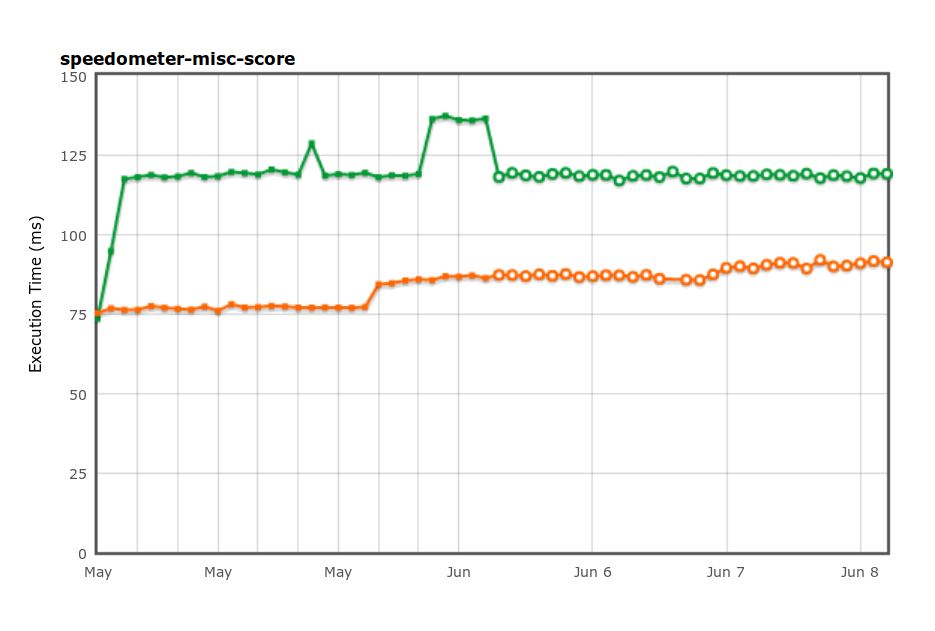
The other effort that is moving ahead quite fast is optimizing for Speedometer V2.  See the chart of our progress on AreWeFastYet.com:

Last week, our score on this chart was about 84.  Now we are at about 91.  Not bad for a week worth a work!  If you’re curious to follow along, see our tracker bug.  Also, Speedometer is a very JS heavy benchmark, so a lot of the bugs that are filed and fixed for it happen inside SpiderMonkey so watching the SpiderMonkey specific tracker bug is probably a good idea as well.

It’s time for a short performance story!  This one is about technical debt.  I’ve looked at many performance bugs over the past few months of the Quantum Flow project, and in many cases the solutions have turned out to be just deleting the slow code, that’s it!  It turns out that in a large code base as code ages, there is a lot of code that isn’t really serving any purpose any more but nobody discovers this because it’s impractical to audit every single line of code with scrutiny.  But then some of this unnecessary code is bound to have severe performance issues, and when it does, your software ends up carrying that cruft for years!  Here are a few examples: a function call taking 2.7 seconds on a cold startup doing something that became unnecessary once we dropped support for Windows XP and Vista, some migration code that was doing synchronous IO during all startups to migrate users of Firefox 34 and older to a newer version, and an outdated telemetry probe that turned out to not in use any more scheduling many unnecessary timers causing unneeded jank.

I’ve been thinking about what to do about these issues.  The first step is fix them, which is what we are busy doing now, but finding these issues typically requires some work, and it would be nice if we had a systematic way of dealing with some of them.  For example, wouldn’t it be nice if we had a MIMIMUM_WINDOWS macro that controlled all Windows specific code in the tree, and in the case of my earlier example perhaps the original code would have checked that macro against the minimum version (7 or higher) and when we’d bump MINIMUM_WINDOWS up to 7 along with bumping our release requirements, such code will turn itself into preprocessor waste (hurray!), but of course, the hard part is finding all the code that needs to abide by this macro, and the harder part is enforcing this consistently going forward!  Some of the other issues aren’t possible to deal with this way, so we need to work on getting better at detecting these issues.  Not sure, definitely some food for thought!

I’ll stop here, and move on to acknowledge the great work of all of you who helped make Firefox faster this past week!  As per usual, apologies to those who I’m forgetting to mention here:

09 Jun 17:17

Education Aid Eludes Countries That Need It Most

files/images/gettyimages-564723125-edit-b666310d17a9f7a8c3de61e56c3d222ece4a5e02-s1600-c85.jpg

Julie Depenbrock, NPR, UNESCO, Jun 12, 2017


Icon

Aid to education is stagnating, aid to secondary education is actually declining, and aid is not reaching the countries that need it most, according to this UNESCO policy paper. [Link] [Comment]

09 Jun 17:17

Weeknote 23/2017

by Doug Belshaw

This week I’ve been:

Next week I’ll be configuring Badge Wiki, preparing to present at an Open Badges event up at the University of Dundee, doing some research about open practices in the NHS, and making some important decisions about the future…


I make my living helping people and organisations become more productive in their use of technology.  If you’ve got something that you think I might be able to help with, please do get in touch! Email: hello@nulldynamicskillset.com

09 Jun 17:09

Geocities map, a snapshot of an old web

by Nathan Yau

Geocities was a place on the web you could create your own space of blinking lights and MIDI tunes. There were millions of spaces modeled after a city. In an update to his 2011 piece, Richard Vijgen visualized the 2009 backup as a digital map.

This website is an interactive visualisation of the 650 gigabyte Geocities backup made by the Archive Team on October 27, 2009. It depicts the file system as a city map, spatially arranging the different neighbourhoods and individual lots based on the number of files they contain. In full view, the map is a data-visualisation showing the relative sizes of the different neighbourhoods. While zooming in, more and more detail becomes visible, eventually showing individual html pages and the images they contain.

Does it make me an old coot for liking the Geocities days better than the social media ones we’re in now? [via Waxy]

Tags: Geocities

09 Jun 17:08

Apple may throttle data speeds on iPhone 8 due to Qualcomm dispute, says Bloomberg

by Rose Behar
an iPhone 7 Plus smartphone

Apple’s refusal to depend on one single chipset maker for its iPhone may result in consumers getting slower data speeds than many of its premium competitors, according to a report from Bloomberg.

Apple typically uses multiple suppliers for the components in an iPhone, and for its modems, the company turns to Qualcomm and Intel. But while Qualcomm already produces a modem capable of gigabit speeds, Intel’s won’t be ready for iPhone 8 production, say Bloomberg‘s sources.

The sources further stated that until Intel is able to offer its chips with matching features, Apple will throttle the capabilities of the Qualcomm modem to match. Apple, Qualcomm and Intel declined to comment on the matter, says Bloomberg.

While Apple could alternately decide to rely on just Qualcomm’s modems, the company prefers not to use a single supplier for any one component, and it has a particularly contentious relationship with the San Diego-based chipset giant, which it is currently battling in various legal disputes concerning patents and royalties.

This puts the forthcoming iPhone behind in the data speed game compared to one of its chief competitors, the Samsung Galaxy S8.

This puts the forthcoming iPhone behind in the data speed game compared to one of its chief competitors, the Samsung Galaxy S8, which stocks Qualcomm’s X16 LTE modem and is already supporting theoretical gigabit speeds through Telus and Bell, but it’s not the first time that Apple has lagged behind when it comes to network technology.

As Bloomberg points out, the original iPhone launched in 2007 without support for 3G networks and went on to be a revolutionary piece of technology that changed the industry. Apple also jumped on the LTE bandwagon about a year after Samsung.

Additionally, it’s not the first time this particular issue of limiting modem speed has arisen. In November 2016, Bloomberg reported that the iPhone 7 was purposefully throttling the performance of Qualcomm’s modem to match it with Intel’s offering.

The mini media firestorm surrounding that report quickly subsided, with some outlets contending that the difference wouldn’t be noticeable in most real-world instances of usage.

While the latest report of throttling may not be a deal breaker, however, it’s still a blow to the overall marketability of the device, if the report proves true.

Source: Bloomberg

The post Apple may throttle data speeds on iPhone 8 due to Qualcomm dispute, says Bloomberg appeared first on MobileSyrup.