Shared posts

11 Jun 05:10

Helping somebody to buy his first Sonos

by Volker Weber

IMG 6453

As I was talking to my neighbor yesterday he asked me about some advice. "You are familiar with Sonos, aren't you? I plan to ..." Here we go again. I am going to invite him over and we will be going from room to room and I will be showing him what his options are. I have every single speaker and component Sonos ever made, with the exception of PlayBase, and he can make an informed decisision of what he wants.

But something has changed two years ago.

11 Jun 05:10

blog all dog-eared pages: human transit

http://images.amazon.com/images/P/1597269727.01._SCMZZZZZZZ.jpg .auto

This week, I started at a new company. I’ve joined Remix to work on early-stage product design and development. Remix produces a planning platform for public transit, and one requirement of the extensive ongoing process is to have read Jarrett Walker’s Human Transit cover-to-cover. Walker is a longtime urban planner and transit advocate whose book establishes a foundation for making decisions about transit system design. In particular, Walker advocates time and network considerations in favor of simple spatial ones.

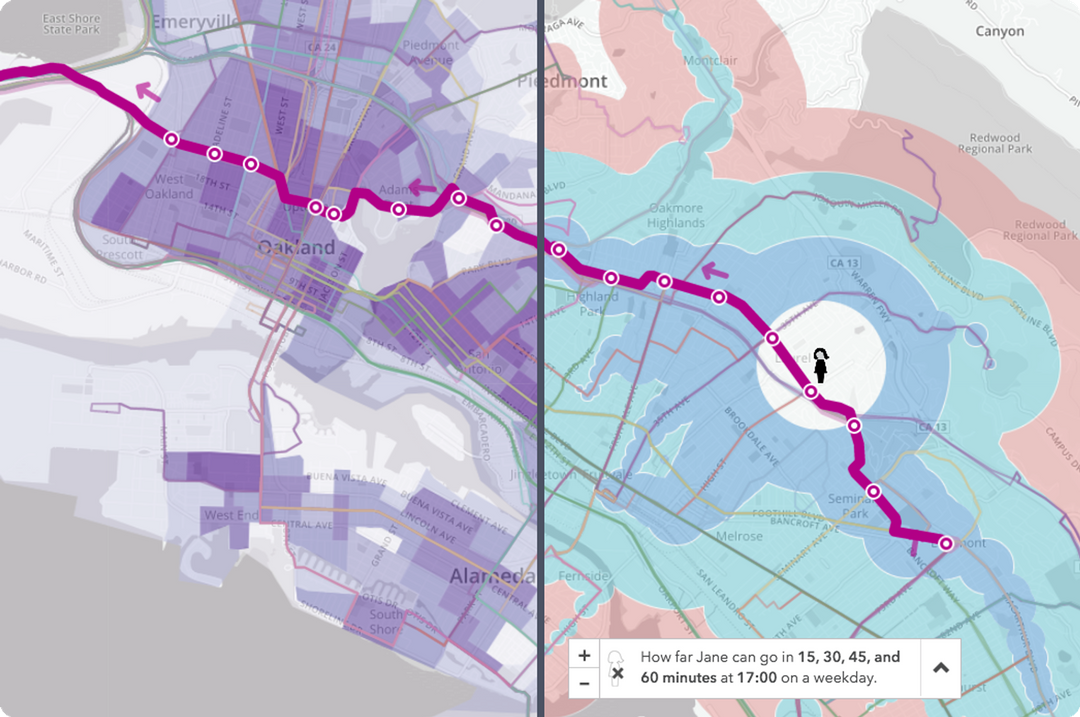
Many common public ideas about transit system design are actually misapplied from road network design when the two are actually quite different. For example, the frequency of transit vehicles (headway) has a much greater effect than their speed on the usability of a system. Uninformed trade-offs between connected systems and point-to-point systems can lead to the creation of unhelpful networks with long headways. Interactions between transit networks and the layout of streets they’re embedded in can undermine the effectiveness of transit even when it exists. All of this suggests that new visual mapmaking tools would be a critical component of better transit design that meets user needs, like the “Jane” feature of the current Remix platform showing travel times through a network taking headways into account. Here’s how far a user of public transit in Oakland can move from the Laurel Heights neighborhood on a weekday:

There’s an enormous opportunity here to apply statistical, urban, and open data to the problems of movement and city design.

These are a few of the passages from Human Transit that piqued my interest.

What even is public transit, page 13:

There are several ways to define public transit, so it is important to clarify how I’ll be using the term. Public transit consists of regularly scheduled vehicle trips, open to all paying passengers, with the capacity ti carry multiple passengers whose trips may have different origins, destinations, and purposes.

On the seven demands for a transit service, page 24:

In the hundreds of hours I’ve spent listening to people talk about their transit needs, I’ve heard seven broad expectations that potential riders have of a transit service that they would consider riding: 1) It takes me where I want to go, 2) It takes me when I want to go, 3) It is a good use of my time, 4) It is a good use of my money, 5) It respects me in the level of safety , comfort, and amenity it provides, 6) I can trust it, and 7) It gives me freedom to change my plans. … These seven demands, then, are dimensions of the mobility that transit provides. They don’t yet tell us how good we need the service to be, but they will help us identify the kinds of goodness we need to care about. In short, we can use these as a starting point for defining useful service.

On the relationship between network design and freedom, pages 31-32:

Freedom is also the biggest payoff of legibility. Only if you can remember the layout of your transit system and how to navigate it can you use transit to move spontaneously around your city. Legibility has two parts: 1) simplicity in the design of the network, so that it’s easy to explain and remember, and 2) the clarity of the presentation in all the various media.
No amount of brilliant presentation can compensate for an overly-complicated network. Anyone who has looked at a confusing tangle of routes on a system map and decided to take their car can attest to how complexity can undermine ridership. Good network planning tries to create the simplest possible network. Where complexity is unavoidable, other legibility tools help customers to see through the complexity and to find patterns of useful service that may be hidden there. For example, chapter 7 explores the idea of Frequent Network maps, which enable you to see just the lines where service is coming soon, all day. These, it turns out, are not just a navigation tool but also a land use planning tool.

On the distance between stops, pages 62-63:

Street network determines walking distance. Walking distance determines, in part, how far apart the stops can be. Stop spacing determines operating speed. So yes, the nature of the local street network affects how fast the transit line can run!
How do we decide about spacing? Consider the diamond-shaped catchment that’s made possible by a fine street grid. Ideal stop spacing is as far apart as possible for the sake of speed, but people around the line have to be able to get to it. In particular, we’re watching two areas of impact.
First, the duplicate coverage area is the area that has more than one stop within walking distance. In most situations, on flat terrain, you need to be able to walk to one stop, but not two, so duplicate coverage is a waste. Moving stops farther apart reduces the duplicate coverage area, which means that a greater number of unique people and areas are served by the stops.
Second, the coverage gap is the area that is within walking distance of the line but not of a stop. As the move stops farther apart, the coverage gap grows.
We would like to minimize both of these things, but in fact we have to choose between them. … Which is worse: creating duplicate coverage area or leaving a coverage gap? It depends on whether your transit system is designed mainly to meet the needs of transit-dependent persons or to compete for high ridership.

On Caltrain and misleading map lines, pages 79-80:

Sometimes, commuter rail is established in a corridor where the market could support efficient two-way, all-day frequent rapid transit. Once that happens, the commuter rail service can be an obstacle to any further improvement. The commuter rail creates a line on the map, so many decision makers assume that the needs are met, and may not understand that the line’s poor frequency outside the peak prevents it from functioning as rapid transit. At the same time, efforts to convert commuter rail operations to all-day high-frequency service (which requires enough automation to reduce the number of employees per train to one, if not zero) founder against institutional resistance, especially within labor unions. (Such a chance wouldn’t necessarily eliminate jobs overall, but it would turn all the jobs into train-driver jobs, running more trains)
This problem has existed for decades, for example, around the Caltrain commuter rail line between San Francisco and San Jose. This corridor has the perfect geography for all-day frequent rapid transit: super-dense San Francisco at one end, San Jose at the other, and a rail that goes right through the downtowns of almost all the suburban cities in between. In fact, the downtowns are where they are because they grew around the rail line, so the fit between the transit and urban form could not be more perfect.
Caltrain achieves unusually high farebox return (percentage of operating cost paid by fares) because it runs mostly when it’s busy, but its presence is also a source of confusion: the line on the map gives the appearance that this corridor has rapid transit service, but in fact Caltrain is of limited use outside the commute hour.

On cartographic emphasis and what to highlight, pages 88-89:

If a street map for a city showed every road with the same kind of line, so that a freeway looked just like a gravel road, we’d say it was a bad map. If we can’t identify the major streets and freeways, we can’t see the basic structure of the city, and without that, we can’t really make use of the map’s information. What road should a motorist use when traveling a long distance across the city? Such a map wouldn’t tell you, and without that, you couldn’t really begin.
So, a transit map that makes all lines look equal is like a road map that doesn’t show the difference between a freeway and a gravel road.
Emphasizing speed over frequency can make sense in contexts where everyone is expected to plan around the timetable, including peak-only commute services and very long trips with low demand. In all other contexts, though, it seems to be a common motorist’s error. Roads are there all the time, so their speed is the most important fact that distinguishes them. But transit is only there if it’s coming soon. If you have a car, you can use a road whenever you want and experience its speed. But transit has to exist when you need it (span) and it needs to be coming soon (frequency). Otherwise, waiting time will wipe out any time savings from faster service. Unless you’re comfortable planning you life around a particular scheduled trip, speed is worthless without frequency, so a transit map that screams about speed and whispers about frequency will be sowing confusion.

On the effects of delay in time, page 98:

In most urban transit, what matters is not speed by delay. Most transit technologies can go as fast as it’s safe to go in an urban setting—either on roads or on rails. What matters is mostly what can get in their way, how often they will stop, and for how long. So when we work to speed up transit, we focus on removing delays.
Delay is also the main source of problems of reliability. Reliability and average speed are different concepts, but both are undermined by the same kinds of delay, and when we reduce delay, service usually runs both faster and more reliably.
Longer-distance travel between cities is different, so analogies from those services can mislead. Airplanes, oceangoing ships, and intercity trains all spend long stretches of time at their maximum possible speed, with nothing to stop for and nothing to get in their way. Urban transit is different because a) it stops much more frequently, so top speed matters less than the stops, and b) it tends to be in situations that restrict its speed, including various kinds of congestion. Even in a rail transit system with an unobstructed path, the volume of trains going through imposes some limits, because you have to maintain a safe spacing between them even as they stop and start at stations.

On fairness, usage, and politics, page 105:

On any great urban street, every part of the current use has its fierce defenders. Local merchants will do anything to keep the on-street parking in front of their businesses. Motorists will worry (not always correctly) that losing a lane of traffic means more congestion. Removing landscaping can be controversial, especially if mature trees are involved.
To win space for transit lanes in this environment, we usually have to talk about fairness. … What if we turned a northbound traffic lane on Van Ness into a transit lane? We’re be taking 14 percent of the lane capacity of these streets to serve about 14 percent of the people who already travel in those lanes, namely, the people already using transit.

On locating transit centers at network connection points, pages 176-177:

If you want to serve a complex and diverse city with many destinations and you value frequency and simplicity, the geometry of public transit will force you to require connections. That means that for any trip from point A to point B, the quality of the experience depends on the design of not just A and B but also of a third location, point C, where the required connection occurs.
If you want to enjoy the riches of your city without owning a car, and you explore your mobility options through a tool like the Walkscore.com or Mapnificent.net travel time map, you’ll discover that you’ll have the best mobility if you locate at a connection point. If a business wants its employees to get to work on transit, or if a business wants to serve transit-riding customers, the best place to locate is a connection point where many services converge. All these individual decisions that generate demand for especially dense development—some kind of downtown or town center—around connection points.
In the midst of these debates, it’s common to hear someone ask: “Can’t we divide this big transit center into two smaller ones? Can’t we have the trains connect here and have the buses connect somewhere else, at a different station?” The answer is almost always no. At a connection point that is designed to serve a many-to-many city, people must be able to connect between any service and any other. That only happens if the services come to the same place.

On the importance of system geometry, page 181:

We’ve seen that the ease of walking to transit stops is a fact about the community and where you are in it, not a fact about the transit system. We’ve noticed that grids are an especially efficient shape for a transit network, so that’s obviously an advantage for gridded cities, like Los Angeles and Chicago, that fit that form easily. We’ve also noticed that chokepoints—like mountain passes and water barriers of many cities—offer transit a potential advantage. We’ve seen how density, both residential and commercial, is a powerful driver of transit outcomes, but that the design of the local street network matters too. High-quality and cost-effective transit implies certain geometric patterns. To the extent that those patterns work with the design of your community, you can have transit that’s both high-quality and cost-effective. To the extent that they don’t, you can’t.

On looking ahead by twenty years, page 216:

Overall, in our increasingly mobile culture, it’s hard to care about your city twenty years into the future, unless you’re one of a small minority who have made long-term investments there or you have a stable family presence that you believe will continue for generations.
But the big payoffs rest in strategic thinking, and that means looking forward over a span of time. I suggest twenty years as a time frame because almost everybody will relocate in that time, and most of the development not contemplated in your city will be complete. That means virtually every resident and business will have a chance to reconsider its location in light of the transit system planed for the future. It also means that it’s easier to get citizens thinking about what they want the city to be like, rather than just fearing change that might happen to the street where they live now. I’ve found that once this process gets going, people enjoy talking thinking about their city twenty years ahead, even if they aren’t sure they’ll live there then.
Comments (1)
11 Jun 05:09

Conversations With Cortana

Brad Sams, reporting for Thurrott on UI changes expected to Cortana on Windows:

Cortana, like its original mockups, is currently being tested living inside the system tray. The company is placing it near the clock and action center icons and is also introducing a new UI that is conversation-like, according to sources familiar with the product.

I've been a Windows 10 user for two years, and I've never used Cortana for a non-local search orientated task i.e. never used Cortana in non-Microsoft non-la-la-land. Although it does make more sense for it to be moved to system tray and for it to change to a conversational interface, I don't see either move as making a difference. Not to me anyway. It will still be a click away, and if I've any query I'm still more likely to use the browser which I've got open all the time (and Google more specifically). What might make a difference is if Cortana was deeply integrated into either Start and/or the Desktop. Think a Live Tile for your digital-self. The beauty of Live Tiles was that you would passively extract information from them whenever you passed through Start i.e. all the time. Something similar that aggregates everything that matters to you without needing to prompt your assistant is something I'm less likely to ignore.

11 Jun 05:09

A Surprising Role Model for Turning Content Into Knowledge

by Rex Hammock

I wrote this for Hammock Inc.’s Idea Email.


Click the photo to find the Library Journal cover story about the Nashville Public Library being named U.S. Library of the Year. (Note: This photo is a thumbnail of a wonderful photo shot by my friend and photographer hero, Bob Shatz.)

Because an Idea Email is sent every other week to subscribers across the United States and globally, we try to keep our references universal, not local. But when something big happens a few blocks from the Nashville office we call Hammock HQ, we can’t help wanting to share.

And no, I’m not talking about the unprecedented way in which locals (including us) have gone nuts over the success of the Nashville Predators and their first appearance in the finals of the NHL Stanley Cup Playoff (#GoPreds).

I’m talking about the Nashville Public Library being named Library of the Year by the trade publication Library Journal. You can read all the reasons why here in the magazine’s cover story.

Because the word library is associated with the physical book (or codex), many have mistakenly placed libraries on the endangered species list. But in addition to the resources and programs great public and academic libraries have embraced in the digital age, these libraries also serve as role models for making content—the core value a company provides its customers—organized and accessible.

The professionals who run libraries are experts in gathering and organizing information critical to workers and customers (or any audience served). They are trained in creating ever-changing taxonomies of knowledge. They’re on the frontlines of finding new ways information can be there when you need it—not just when a writer clicks submit.

As we move into an era of more complex digital media, the skills of trained librarians (and the many other titles they go by) will increasingly become a model for capturing, organizing and making accessible the knowledge that gives your organization a unique and unbeatable competitive advantage.

Wait. Did I just write the word “unbeatable”? #GoPreds

11 Jun 04:56

Engaging the tidyverse Clean Slate Protocol

by hrbrmstr

I caught the 0.7.0 release of dplyr on my home CRAN server early Friday morning and immediately set out to install it since I’m eager to finish up my sergeant package and get it on CRAN. “Tidyverse” upgrades aren’t trivial for me as I tinker quite a bit with the tidyverse and create packages that depend on various components. The sergeant package provides — amongst other things — a dplyr back-end for Apache Drill, so it has more tidyverse tendrils than other bits of code I maintain.

macOS binaries weren’t available yet (it generally takes 24-48 hrs for that) so I did an install.packages("dplyr", type="source") and was immediately hit with gcc 7 compilation errors. This seemed odd, but switching back to clang worked fine.

I, then, proceeded to run chunks in an Rmd I’m working on and hit “Encoding” errors on mutate() calls. Not having time to debug further I reverted to 0.5.0 of dplyr and went about my day and promised the tidyverse maintainers that I’d work on a reproducible example after work.

I made R data files from the data frames that were tossing errors and extracted & tweaked a code snippet that consistently generated the error and created a rocker container on one of my linux boxes to validate that this was an error and a cross-platform one. The rocker container used a full fresh-from-source copy of the tidyverse including dplyr 0.7.0. The code worked and no error was generated, so I immediately suspected package rot on my main dev macOS box.

Now, my situation is complicated by an insanely hasty migration to macOS 10.13β1 (I refuse to use the Apple macOS catchy names anymore since the most recent one is just silly) and a move to the gcc 7 toolchain (initially prompted to both get rJava working nicely and reproduce some CRAN noted errors with some packages). Further complications were also created by many invocations of install_github() of various packages regularly overwriting bits of the tidyverse over the past few weeks since the R 3.4.0 release. In other words, the integrity of the “tidyverse” was in serious question on my system and it was time for the Clean Slate Protocol.

Rather than itemize package versions and surgically nipping and tucking, I opted to use packrat to get to my desired end-state of a full-integrity tidyverse install. There are many ways to do this. Feel free to “one-up” me and show your l33t method in the comments. This one will likely be accessible to most — if not all — R users.

I started a new RStudio project in a new session and told it to use packrat. In the new project console, I did install.packages("tidyverse", type="source") and let it go for many minutes. I, then, navigated to the packrat subdirectory where the 3.4 package binaries are housed (just follow the project packrat tree down to the R version directory) and moved all 51 packages (yes, 51 O_o) to the main R library path (which you can figure out by running .libPaths() in any non-packrat-maintained project).

After doing that, I fired up the originally failing Rmd and everything worked fine. 👍

I don’t do the Clean Slate Protocol too often (we all get to for new R dot-releases) but it came in handy this time. If you run into errors when trying to get the new dplyr working, you may benefit from the Clean Slate Protocol as well.

If you haven’t seen the changes in 0.6.0/0.7.0 you should check them out and give it a go.

11 Jun 04:55

‘Coal is dead’ and oil faces ‘peak demand,’ says world’s largest investment group | Joe Romm

‘Coal is dead’ and oil faces ‘peak demand,’ says world’s largest investment group | Joe Romm:

The global head of BlackRock’s infrastructure investment group, Jim Barry, announces:

Coal is dead.

Trump can do or say whatever he wants, but the economics tell a simple story:

President Donald Trump famously campaigned on restoring coal jobs, and has continued to reiterate that commitment as president, but the economic reality makes that a futile effort.

The U.S. alone has shuttered 40 gigawatts of coal plants since 2000.

“These [coal plants] will not reopen whatever anything President Trump does,” as Bloomberg New Energy Finance recently explained, “nor do we see much appetite among investors for ploughing money into U.S. coal extraction — stranded asset risk will trump rhetoric.”

The economic reality is that cheap fracked gas and plummeting prices for clean energy has squeezed both coal production and coal consumption to levels not seen for decades.

By the way, note that the point of peak coal was 2005, the threshold of the postnormal economy in so many different economic and political arenas.

10 Jun 04:10

Basic Economy Flights Exist To Make You Pay More For Air Travel

by Laura Northrup
mkalus shared this story from Consumerist.

If you haven’t booked any air travel recently, you might encounter something new to you the next time you schedule a trip: A new class of travel called “basic economy.” In exchange for lower fares, travelers in the basic economy section board last, can’t upgrade, and don’t have access to overhead bins. This sounds fair, but these flights may not be the great deals that they seem.

Here’s the thing, though: Bloomberg Pursuits notes that at the same time that basic economy fares became a thing, the price of regular economy seats went up. Why is that? Blame a well-known price anchoring trick.

Most people don’t know a lot about wine, and when given a menu, will simply pick the second-cheapest variety offered. Not the cheapest, because they don’t want the server or their dining companions to think they’re cheap, and the cheapest wine on the menu might be junk anyway. The second-cheapest is respectable, yet good enough.

American Airlines found that in test markets for the Basic Economy fare, it was able to raise the prices for regular economy fares. Customers were willing to pay more for a regular economy seat if there were something worse available. Like Basic Economy.

Fare increases in the airline industry generally don’t work, adding something worse than economy-class travel apparently does work. United Airlines president Scott Kirby recently said at an investor conference that its version of Basic Economy is working out great…in upselling travelers to other classes of travel.


10 Jun 04:10

How Trump’s lawyer Marc Kasowitz uses words to create a biased perspective

by Josh Bernoff

The statement from Marc Kasowitz, Trump’s lawyer, regarding former FBI director James Comey’s testimony yesterday was, basically, “see, there’s nothing there.” Meanwhile, the Washington Post had this headline: “Comey testimony threatens to deepen political crisis engulfing White House.” The difference reveals how what you think depends on which facts and statements you want to concentrate on. As … Continued

The post How Trump’s lawyer Marc Kasowitz uses words to create a biased perspective appeared first on without bullshit.

10 Jun 04:10

Manspreading on transit

by michaelkluckner

a.png

A great article in the Guardian.

The EMT [Madrid transit system] came up with the initiative in partnership with Madrid city council’s equality department and the Microrrelatos Feministas collective, a women’s group that has launched an online petition for such signs to be installed.

Their petition, which has more than 11,500 signatures, says: “All public transport has stickers explaining that room needs to be made for pregnant women, people with buggies, older people and those with disabilities, but there’s something that affects all of us practically every time we use public transport: manspreading.”

Similar initiatives have been launched around the world. Three years ago, the New York subway system began a crackdown on the problem with a campaign called “Dude, stop the spread please. It’s a space issue”.

Don’t miss the click in the main article to the photo gallery, including this gem:

640


10 Jun 04:10

Apps Can No Longer Use Custom Review Prompts; Apple Mandates Standardized Method

by Ryan Christoffel

In iOS 10.3 earlier this year, Apple introduced a new API for prompting users to give apps an App Store review. At the time, developers were allowed to continue using any custom review prompts they had previously implemented, with the warning that such permission would eventually be revoked. As reported by 9to5Mac, that day has already come.

App Store policy has been updated to mandate use of Apple's standardized rating API going forward, disallowing custom review prompts. The updated language in Apple's review guidelines reads:

Use the provided API to prompt users to review your app; this functionality allows customers to provide an App Store rating and review without the inconvenience of leaving your app, and we will disallow custom review prompts.

In the few months since its introduction, adoption of Apple's review prompt API has been slow. Perhaps it is due to that lack of adoption that the company wasted little time before requiring its use.

Apple's solution certainly provides a better user experience than custom alternatives, particularly since it allows rating an app without needing to visit the App Store. But the concern from developers may be the loss of control over when, or how often, that prompt is presented.


Support MacStories Directly

Club MacStories offers exclusive access to extra MacStories content, delivered every week; it’s also a way to support us directly.

Club MacStories will help you discover the best apps for your devices and get the most out of your iPhone, iPad, and Mac. Plus, it’s made in Italy.

Join Now
10 Jun 04:09

Former Sears Executive: Retailer Has “No Capacity To Operate As A Successful Company”

by Laura Northrup
mkalus shared this story from Consumerist.

If you want to know what’s happening with a company, talk to insiders — or with former insiders, who are free to talk on the record. Like, for example, a former Sears executive who is now unfettered in his ability to give his honest opinion of the once-great retailer (and the man who has been steering the ship toward apparent doom).

Mark Cohen, a professor of retail at Columbia Business School, was previously the head of marketing for Sears Roebuck and the CEO of Sears Canada. He has been watching the slow-motion disaster at Sears Holdings from afar.

Cohen discussed the implosion with TheStreet (warning: auto-play video at that link), saying that he believes that the company cannot be saved.

He compared the company to a ship that’s on fire. For now, the company is throwing everything it can into the boiler to keep the ship going until it burns down to the water line.

“Eventually, when it does sink, they’ll pump it out again and refloat it with a smaller boat until there’s absolutely nothing left,” Cohen explains. Lampert, he says, is using the company “like an ATM machine [sic]” and extracting value while he sells off or spins off its real estate and anything of value that’s left.

“Eddie Lampert is either dishonest, delusional, and disingenuous or some combination of the three,” Cohen told TheStreet.

While the company’s leaders talk about a “transformation,” Cohen notes that the retailer has nothing going for it. It has sold its best real estate, or plans to, and has “a bad reputation with customers and vendors.”

Technically, Cohen worked for a different company. The current Sears Holdings was formed when Lampert bought Kmart out of bankruptcy, and Kmart acquired Sears Roebuck. A Sears Holdings spokesman also points out that the company fired Cohen before Lampert took over and began his first stint as CEO.

Cohen and Lampert have very different backgrounds: Cohen worked in retail for his whole business career, while Lampert made his fortune in finance and is notably hostile to the norms of the retail industry.

In non-Sears insights, he points out that Amazon is the biggest online success story, and Costco the biggest offline one. What do they have in common? They engineer customers’ loyalty by requiring memberships.


10 Jun 04:09

The Manifesto of Beautiful Business – Tim Leberecht – Medium

10 Jun 04:09

An explosion of online video could triple bandwidth consumption again in the next five years

An explosion of online video could triple bandwidth consumption again in the next five years:

Video will make up 82 percent of all internet traffic in 2021, according to forecasts released today by Cisco, which sells networking equipment. Video accounted for 73 percent of traffic in 2016. 

Not only are people watching more online video, they’re also watching better quality video, sapping more bandwidth. And cord cutters generate twice as much internet traffic as those who still pay for regular TV, according to Cisco. 

The demand is coming from all types of internet video, including on-demand content like Netflix, web cam viewing and traditional TV options available over the internet (IP VOD).

10 Jun 04:09

Ohrn Image — Sunset Beach With Mobis

by Ken Ohrn

A spring day, a scene at the beach, and Mobi bikes, now a commonplace sight everywhere in the city.


10 Jun 04:09

Google Pixel XL2 appears in GFXBench with 18:9 aspect ratio display

by Rose Behar
Google Pixel

Google’s forthcoming Pixel XL2 smartphone has made a new appearance on GFXBench, showing off what appears to be an approximately 18:9 aspect ratio display — just slightly shorter than the Samsung Galaxy S8’s 18.5:9 display and on par with the LG G6’s 18:9 display.

The display has an unusual 2560 x 1312 pixel resolution and comes in at 5.6-inches, up from the first generation Pixel XL’s 5.5-inch screen.

The Google Pixel XL2 prototype that appeared on the benchmarking platform features an octa-core 2.4GHz processor and Adreno 540 GPU — likely Qualcomm’s latest premium chipset, the Snapdragon 835 — backed by around 4GB of RAM and featuring 100GB of internal storage.

The benchmarking results also revealed a 12-megapixel rear shooter capable of 4K video capture and an 8-megapixel front-facing camera.

Source: GFXBench

The post Google Pixel XL2 appears in GFXBench with 18:9 aspect ratio display appeared first on MobileSyrup.

10 Jun 04:09

Twitter Favorites: [b0rk] sometimes i think I have to write polished blog posts and then I remember "no, i can just write about a thing I learned today, that is okay"

Julia Evans @b0rk
sometimes i think I have to write polished blog posts and then I remember "no, i can just write about a thing I learned today, that is okay"
10 Jun 04:08

Twitter Favorites: [bmann] My brain hurts! Next technical #blockchainYVR Meetup will be a “plugfest” - demo & install of interesting blockchai… https://t.co/QCEmDFqUcz

Boris Mann @bmann
My brain hurts! Next technical #blockchainYVR Meetup will be a “plugfest” - demo & install of interesting blockchai… twitter.com/i/web/status/8…
10 Jun 04:08

Running Full Windows On Mobile So What

Daniel Rubino, writing for Windows Central:

The idea that your OS will adapt to your environment, display, and the task at hand is a new one, but it's easy to understand. Why have to choose between a dumbed-down mobile OS and a powerful desktop? Why concern yourself with processors such as ARM or x64 when you can just run Windows?

On the other hand, there's nothing "dumbed-down" about iOS and Android. Definitely not on a phone today - I don't think there's anything people would like to accomplish on a phone that's not possible on either, no doubt thanks to their outstanding app stores.

Companies such as Google and Apple are struggling in different ways than Microsoft. Apple wants to build iOS up from phones to larger screens, while Google is trying to hodgepodge Chrome OS with Android. Microsoft is trying to go from the desktop to mobile (and everywhere else). But they all want the same thing: an OS and ecosystem that spans devices.

I see Google continuing to struggle with integrating Android into Chrome OS, but it's only a matter of time before this stops being a problem. Apple, on the other hand, are already there with iOS, if not on the iPad today then most definitely with iOS 11 later this year. As for Microsoft, being able to run full Windows on ARM without a battery or performance hit is unquestionably a technical milestone that should be commended. But without a rich ecosystem of apps to go with it, then I can't see how this changes Microsoft's mobile prospects in the short-term, and, more worryingly, Windows' general relevance in the long-term.

10 Jun 04:08

Rogers and Telus announce upcoming security updates and bug fixes for Android devices

by Sameer Chhabra
An image showing the camera, Gmail, and Chrome apps

While software fragmentation and a slow update process continue to plague most Android users, Rogers and Telus have announced that certain Android devices will be receiving some welcome security updates and bug fixes.

Telus and Rogers BlackBerry Priv users will receive security updates on June 12th, 2017. These updates will affect Android 6.0.1, and are not an update to either Android 7.0 or 7.1.

Both Telus and Rogers Moto Z devices will be receiving security updates and support fixes on June 15th, 2017. Telus and Rogers Moto Z Play devices will be receiving similar updates on June 19th, 2017.

Samsung Galaxy A5 users can also expect security updates and support fixes. Telus customers will receive their updates first on June 9th, 2017 and will be later joined by Rogers subscribers on June 12th, 2017.

Finally, both the Samsung Galaxy S7 and Galaxy S7 Edge will be receiving bug fixes and security on June 19th, 2017. These updates will only affect Telus devices, and not Rogers subscribers.

While these updates are no doubt much-anticipated, neither company has announced plans to bring the latest version of Android — 7.1 Nougat — to any of these devices.

According to Google, 10 percent of all Android devices are running some variant of Android 7.0 or 7.1 Nougat.

The latest stable Android release is Android 7.1.2 Nougat, which was released to Nexus and Pixel device owners on May 1st, 2017.

Source: Telus and Rogers

The post Rogers and Telus announce upcoming security updates and bug fixes for Android devices appeared first on MobileSyrup.

10 Jun 04:06

Members Only: Symbols-based Charts to Show Counts in R

by Nathan Yau

Add visual weight by using individual items to show counts. Read More

10 Jun 04:06

Transnational capitalist class - Wikipedia

Transnational capitalist class - Wikipedia:

The transnational capitalist class (TCC or TNC), also known as the transnational capitalist network (TCN), in neo-Gramscian and other Marxian-influenced analyses of international political economy and globalization, is the global social stratum that controls supranational instruments of the global economy such as transnational corporations and political organs such as the World Trade Organization. In other words, it is “that segment of the world bourgeoisie that represents transnational capital”.[1] It is characteristically cosmopolitan and unconstrained by national boundaries.

The transnational capitalist class is expressed as a global ruling class and essential players of global capitalism by William Robinson and Jerry Harris.[2]

In the transnational capitalist class, according to Professor Leslie Sklair, there are four fractions which are, corporate, state, technical and consumerist.[3] The four fractions stated by Professor Leslie Sklair, bring together transnational corporations (TNC), globalizing bureaucrats, globalizing professionals, and merchants as well as the media as members of the TCC. Also according to the Sociology of the Global System,[3] the World Economic Forum (WEF) shows the existence of the TCC as the corporate fraction and the state fraction gather in Davos, Switzerland.

The theory of the Transnational Capitalist Class has two main principles:[4]

  1. The transnational capitalist class collaborate to benefit their own interests (powerful lobbyists and super PACs);
  2. Nation states have less control over transnational capitalist corporations aiding in globalization.

Further reading

  • Carroll, William K. (2010) The Making of a Transnational Capitalist Class (Zed Books, US)
  • Sklair, Leslie (2001) The transnational capitalist class (Wiley-Blackwell Publishing, Oxford, UK). ISBN 9780631224624
  • Van Der Pijl, Kees (1984, 2012) The Making of an Atlantic Ruling Class (Verso, London and Brooklyn)
  • Van Der Pijl, Kees (1998) Transnational Classes and International Relations (Routledge, London and New York)

References

  1. Robinson, W. I. (2003) Transnational Conflicts: Central America, Social Change and Globalization. Verso Books, p. 39.
  2. Robinson, William; Jerry Harris (Spring 2000). “Towards a global ruling class? Globalization and the transnational capitalist class”. Science & Society. 64: 11–54.
  3. Sklair, Leslie (August 1, 1995). Sociology of the Global System (2nd ed.). The Johns Hopkins University Press. p. 352. ISBN 978-0801852114.
  4. Sklair, Leslie (May 2002). “Democracy and the Transnational Capitalist Class.” The Annals, 581(1): 144-157, American Academy of Political and Social Science.
10 Jun 04:05

Vancouver installs two-hour parking meters in the West End

mkalus shared this story from Comments on: Vancouver installs two-hour parking meters in the West End:
Way overdue. Especially in the West End that is easily accessible by public transit (que the whining about old people in Wheelchairs)

VANCOUVER (NEWS 1130) – Exactly one week after ordering the evacuation of people living in the dilapidated Balmoral Hotel on Vancouver’s Downtown Eastside, the city says it has found a place for them to go.

In a statement, the City of Vancouver says staff, along with BC Housing, have been able to secure 131 housing units and people are able to move into them right away. They say pets are allowed in almost all the units.

“They’re the same size and type of room that people are living in at the Balmoral, only of course not in terrible shape,” general manager of community services Kathleen Llewellyn-Thomas says. “It’s within the neighbourhood so, so people won’t be far from where their current community is.”

According to the tenants list, there are 128 agreements in the Balmoral right now so Llewellyn-Thomas says the city feels confident they can house everyone.

The privately-owned building has been neglected for decades by the owners, the Sahota family, and a May 30 engineering review found it had structural problems.

Vancouver Mayor Gregor Robertson had previously described the hotel’s conditions as “disgusting.”

Earlier this month, the city set an eviction deadline of June 12, telling people they had until then to get out and it reiterates that date hasn’t changed.

“Over the past week, city staff, BC Housing, and non-profit partners have been going all-out to secure homes – not shelter spaces – for every tenant who is being displaced due to the evacuation of the Balmoral. I’m very pleased that BC Housing has come forward to help us secure homes for all of the Balmoral tenants, and ensuring that they will rent at welfare rates,” Robertson said in the release. “The safety and security of the tenants during the transition is our top priority and City staff will continue to work with BC Housing and Vancouver Coastal Health to support the tenants in the move.”

The Sahota family operates a number of Vancouver buildings for low-income residents. The family has been the subject of maintenance issues over the past few years. The building, at 159 Hastings Street, has 176 rooms.

The city is also awaiting the next steps to take the family to court for more than 150 violations related to the Balmoral Hotel.

10 Jun 04:05

New Westminster lowering speed limits along bike routes, bikeways

mkalus shared this story from Comments on: New Westminster lowering speed limits along bike routes, bikeways.

NEW WESTMINSTER (NEWS 1130) – If you’re driving in New Westminster, you may soon notice some new, slower speed limits in some areas of the city. City Council approved the move in an effort to improve safety for cyclists.

The speed limit along bike routes, greenways and streets that don’t allow cycling on sidewalks will drop to 30 km/h.

Transportation Manager Lisa Leblanc says they’ll start with the Rotary-Crosstown greenway which runs across the city. “We have a number of schools that are located on either side of that greenway, so it’s a really important greenway for getting kids to and from school. And then we’ll expand out from there to the rest of our designated routes.”

She adds the lower speed limit is in conjunction with other efforts to make cycling safer, including improvements to the Brunette Fraser Greenway and installing more bike parking in the Uptown neighbourhood. “We’re going to identify the locations where we’ve got speed well in excess of 30 km/h and we’re actually going to go in and do some engineering improvements to make the road read differently so that motorists no longer feel comfortable driving those speeds.”

The City of Vancouver has had lower speed limits around bike routes for about eight years.

For more information on this initiative click here.

10 Jun 04:05

I was told by an old tech that if an alarm went off on the other unions side, you couldn't do anything about it!

by museumofcomm
mkalus shared this story from museumofcomm on Twitter.

I was told by an old tech that if an alarm went off on the other unions side, you couldn't do anything about it!


Posted by museumofcomm on Friday, June 9th, 2017 8:42pm


5 likes, 2 retweets
10 Jun 04:05

Neck Pain on Road Bike

by Fawn Atencio

I used to alpine cycle with my road bike. Now ( years later) I am commuting and pulling a child in a burley tralier, earning awful neck pain. Does commute cycling require a different bicycle? If so, what sort? I am having a hard time also with braking in time for things. Could I convert mine to a touring bike? Very frustrating to want to bike, but knowing pain will come along with it. The road bike is a Bianchi steel frame carbon fork. Older, 2005 model Eros. Many thanks for your time.

10 Jun 04:04

Electrification – an alternative approach from Siemens in Denmark

by Stewart Thorpe
mkalus shared this story from Global Rail News.

With rail electrification projects very much in the news recently, and a particular scrutiny on the cost and funding of major programmes, it’s worth looking at the approach taken by infrastructure owners in Europe to see how the introduction of electrification systems already operating on the continent could bring significant installation and operational benefits to the UK network.

As an example, Siemens is currently installing around 1,300 kilometres of electrical overhead contact lines within Denmark’s rail network, with the company working as part of a consortium for the country’s rail operator, Banedanmark. Due for completion in 2026, this eleven year programme covers nine rail routes and includes the installation of overhead contact lines in a 2x25kV configuration, together with new substations, auto transformer stations and remote control equipment.

This programme provides the perfect case study to demonstrate the advantages that could be realised by electrification programmes in the UK, with the potential to achieve significant cost-savings, efficiency improvements and environmental benefits.

New catenary design

At the heart of the Siemens’ solution is the company’s Sicat SX system. This provides affordable electrification across the design and build processes, offering a minimum 20 per cent cost saving against existing technology. These dramatic savings are achievable as a result of a completely new approach to system design, resulting in fewer structures being required.

The system has been dynamically modelled to achieve 100-metre intervals between structures and two-kilometre tension lengths, meaning that it has much less of an impact on the environment. Crucially, this also reduces track access times for both installation and maintenance, with a much lower requirement for construction resource and plant. Overall, this translates to not only to material savings, but also to faster, easier, cheaper and safer installation, with less manpower required on site and far fewer possessions required in the build phase.

The assemblies are manufactured in a factory-controlled environment and are lighter than traditional UK structures. Siemens has developed a software tool to accurately design the layout for electrification projects, with the cantilevers then being pre-assembled with a quick-fixing device, enabling a more flexible, efficient and cost-effective build programme to be followed.

In Denmark, this led to 40 per cent fewer structures (and foundations) being required and, as a result, the impact of the overhead line equipment on the railway landscape and environment has been considerably reduced. To help lessen the environmental impact even further, it is estimated that around 85 per cent of the system’s components can be sourced within the UK, with assembly fabrication able to be undertaken locally to the project.

Electric trains also offer a number of sustainability benefits to the network, including the ability to store energy through regenerative braking systems – typically 20 to 30 per cent lower carbon dioxide emissions compared to diesel powered trains. With a major weight saving compared to diesel rolling stock, electric trains also provide life cycle benefits to the infrastructure, with reduced wear to the railway.

Compliant with the Technical Standards for Interoperability (TSI) for speeds up to 250km/h, the Sicat system is already successfully operating, not only in Denmark, but also in a number of other European countries, delivering electrified rail networks which allow better acceleration and shorter travel times, as well as lower operating and maintenance costs for the operators.

From a review of the work in Denmark, it is clear that, for the UK, a model could be developed to address some of the challenges that any national electrification programme would face, with the ultimate objective being to produce a safer, more cost-efficient and a less risky approach to delivery. Sicat SX needs fewer foundations per kilometre as it is designed for longer span lengths and, being able to deliver more overhead contact line equipment construction within the UK’s tight midweek possession regime, would bring significant cost savings.

Small footprint SVC

Learning from another network, this time one within the UK itself, London Underground (LU) has awarded Siemens Rail Electrification a contract for the installation of a static VAR compensator (SVC) power quality solution at Greenwich Generating Station.

As world-leaders in power quality solutions, and having supplied over 500 SVC systems globally (61 in the UK alone), Siemens’ latest insulated-gate bipolar transistor (IGBT) technology will be at the heart of the Greenwich system, with the practical, innovative design solution developed to meet the programme’s key requirements.

Normally located externally, the Greenwich SVC is unusual in that it is to be installed inside the building, with Siemens’ modular IGBT technology providing a much smaller footprint than would traditionally be possible.

The bespoke solution delivers a number of other significant advantages. The base IGBT platform used in the SVC system delivers much faster electrical switching than alternative systems and is the same technology platform used in Siemens’ 50-to-50Hz Sitras Static Frequency Converter (SFC). As it is oil-free, with no need for a transformer, it presents a lower fire risk and is more environmentally sound. Sustainability is enhanced through the use of recycled or reused materials, with the system containing 29.5 per cent recycled/reused content, compared to a 15 per cent target set by LU. Once operational, the system is also considerably quieter, with sound power levels measured at the receptors as low as 30dB – and so totally inaudible.

This high-profile project will deliver a solution that will set new standards in power quality equipment on the network. The system will be 99 per cent efficient and will cost less to run and maintain over the life of the asset compared to conventional SVC technologies.

The Siemens team is now working closely with London Underground to make sure the programme is efficient and successful. Work is due to start on site in July 2017, with final commissioning scheduled for the end of 2018.


This article was written by James Goulding, business development manager for Siemens Rail Electrification.

10 Jun 04:04

Coal decline continues as intermodal hits new highs

by News
mkalus shared this story from Global Rail News.

Intermodal traffic growth has continued to make up some of the shortfall from the decline in coal volumes, according to the UK’s latest rail freight statistics.

The ORR’s 2016-17 Q4 rail freight usage figures show the volume of domestic intermodal freight moved in the UK rose by 8.9 per cent on the previous period and represented 39 per cent of all rail freight moved in 2016 – its highest share since 1998-99.

Domestic intermodal and construction combined made up 60 per cent of all freight moved during the Q4 period, partially offsetting the decline in coal, oil and petroleum volumes. The figures show that 70 per cent of the freight transported in Q4 was carried by just two operators: DB Cargo UK and Freightliner Intermodal.

The total volume of rail freight moved fell by 3 per cent to 17.2 billion net tonne kilometres in 2016-17. Coal saw the biggest reduction, a decrease of 39 per cent on the previous year to 1.4 billion net tonne kilometres.

Industry body Freight on Rail said it had been a year of transition as the industry “adjusts to the deep decline in coal traffic”.

Philippa Edmunds, Freight on Rail manager, Campaign for Better Transport, said: “Rail freight is the safer, cleaner way to transport freight which reduces road congestion and improves productivity; furthermore, it can help the Government meet its challenging targets to reduce air pollution as it produces 90 per cent less PM10 particulates and up to 15 times less nitrogen dioxide emissions than HGVs for the equivalent journey.

“Given these socio-economic benefits, the Government must set affordable charges in its current ORR review and continue to upgrade the rail freight network to cater for the suppressed demand for consumer and bulk services.”


Read more: Greater Anglia reveals mock-up of new Stadler Flirt


10 Jun 04:04

Lines From Lim — Transportation In Vancouver

by Ken Ohrn
mkalus shared this story from Price Tags.

We often see Clark Lim’s comments on Price Tags.  But here is a view of Vancouver’s transportation situation from Quebec City journalist Stephanie Martin, with a contribution in it from Mr. Lim.

The Google translate version of the article is fairly clear but clearly a bit funky in places.

Vancouver has built its success by saying no to the domination of the automobile. Its congestion decreases and its prosperity increases.

While Quebec is rethinking the future of mobility on its territory for the umpteenth century, Le Journal spent a few days in the British Columbia metropolis, where the volume of cars in the downtown area has been steadily declining for 20 years, As the population and economy continued to grow. Even at peak times, traffic is surprisingly fluid for a metropolis of this size.

Quebec.Vancouver


10 Jun 04:04

The Guardian view on the 2017 election result: a call for a different Britain | Editorial

by Editorial
mkalus shared this story from EU referendum and Brexit | The Guardian.

The election has confounded Theresa May and many others. It is a vote against austerity and for a less abrasive Brexit, and it marks the revival of the Labour party under Jeremy Corbyn

• Support our journalism by becoming a Guardian supporter or making a contribution. You can see this in action here

Theresa May was not the only person who seriously misread the public mood during the 2017 general election. But she is the one whose misreading has had by far the most devastating consequences at the finish. To call an early election in the hope of winning a landslide mandate and then to lose 12 seats and your overall majority is a humiliation almost without precedent for any prime minister in the era of universal suffrage in Britain. Perhaps only Ted Heath’s self-inflicted defeat in February 1974 bears any comparison. Yet this is the fate that Mrs May, and effectively Mrs May alone, inflicted upon the Conservative party this week. It will haunt her reputation for ever, and rightly so.

What Mrs May and many others did not see was the mood for change among the British people. After seven years of fiscal austerity, with deep cuts in public services and a steady fall in real wages, millions of voters wanted a better and fairer way for Britain. Mrs May herself partially understood that, as her embrace of the just-about-managing and her disapproval of greedy City executives showed. But she failed to turn those words into deeds. Instead she campaigned as an inflexible ironclad, spurning debate, parroting inane slogans, insulting her opponents and botching her manifesto launch. It was an emotionally unintelligent campaign. At times it verged on the delusional and hubristic. And it ruthlessly exposed Mrs May’s many failings.

Continue reading...
10 Jun 04:03

Event Report: SUMO Community Meeting – Abidjan (3-4 June 2017)

by Michał

Hey there, SUMO Nation!

You may remember Abbackar’s previous post about meetings in Ivory Coast. I am very happy to inform you that the community there is going strong and keeps support Mozilla’s mission. Read Abbackar’s report from the recent meeting in Abidjan below.

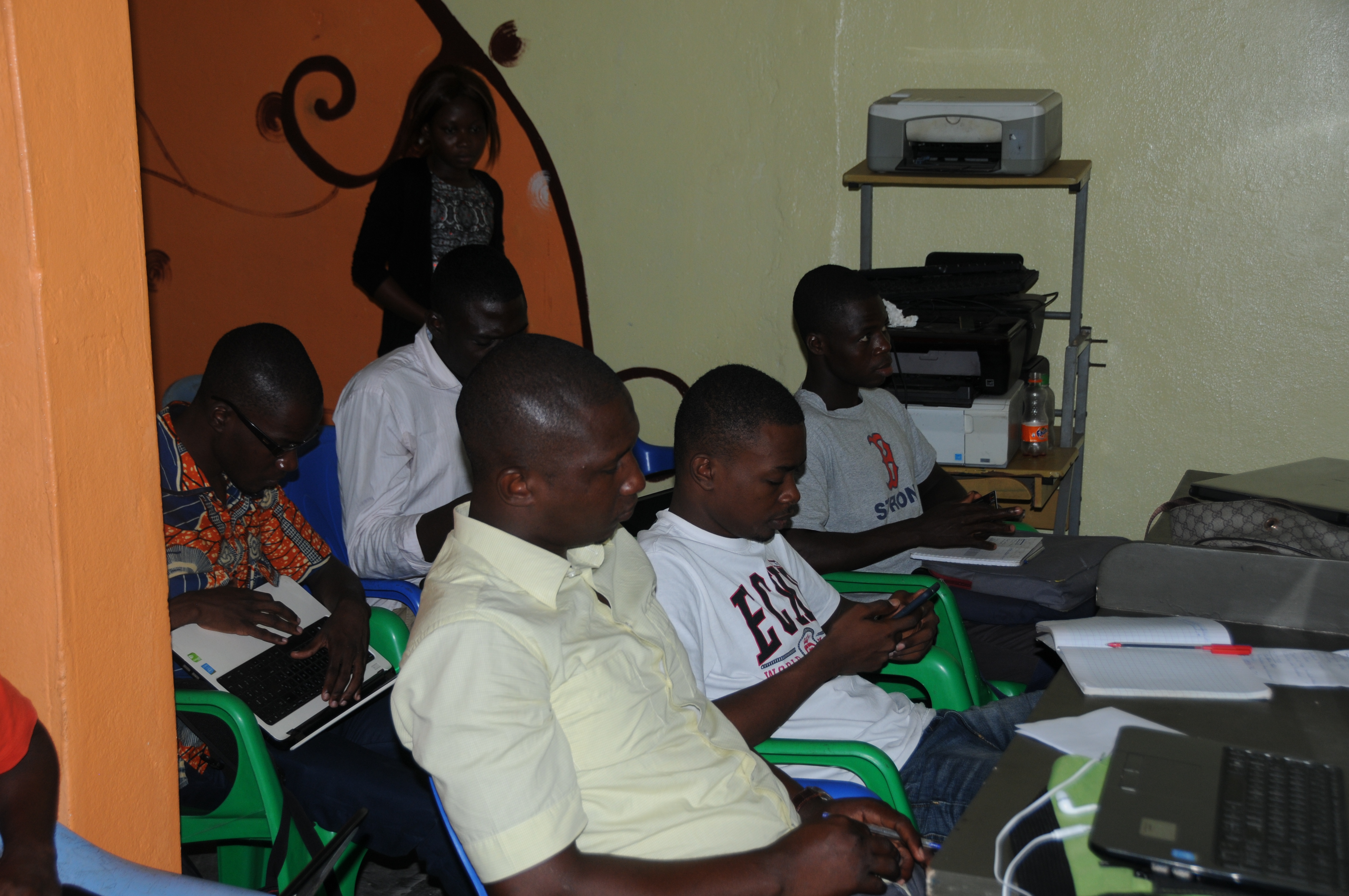
On the weekend of 3rd and 4th of June, the community members of Côte d’Ivoire met in Abidjan for a SUMO Community Meetup. The event was attended by 21 people, six of who were new contributors, interested in participating in Mozilla’s mission through SUMO.

The Saturday meeting started at 9 and went on for six hours, with a small lunch break. During that time we talked about the state of SUMO and the Mozilla updates that had an influence for our community over the past months.

We also introduced new contributors to the website and the philosophy of SUMO – as well as the Respond social support tool. New contributors had a chance to see both sites in action, learn how they worked and discuss their future contributions.

After that, we had a practical session in Respond, allowing existing and new contributors to exchange knowledge and experiences.

An important fact to mention is that the computer we used for the event is a “Jerry” – a computer in a can – made from recycled materials and recycled by our community members.

After the training and a session of answering questions, we ended the first day of the meetup.

Sunday started with the analysis of the 2016 balance sheet and a discussion of our community’s roadmap for 2017. We talked about ways of increasing our community engagement in SUMO in 2017. Several solutions were discussed at length, allowing us to share and assign tasks to people present at the event.

We decided to train together on a single theme each month to increase focus. We also acknowledged the cancellation of our Nouchi localization project, due to the difficulties with creating a new technical vocabulary within that language. Our localization efforts will be focused on French from now on.

The Sunday lunch had in a great atmosphere as we shared a local dish called garba. The meeting ended with a Q&A session focused on addressing the concerns and doubts of the new contributors.

The meeting in Abidjan was a great opportunity to catch up, discuss the most recent updates, motivate existing contributors and recruit new ones for Mozilla’s mission. We ended the whole event with a family photo of all the people present.

We are all looking forward to the second session in the Bouake, in the center of Côte d’Ivoire.

We are humbled and grateful for the effort and passion of the community in Ivory Coast. Thank you for your inspiring report and local leadership, Abbackar :-) Onwards and forwards, to Bouake!