Shared posts

19 Feb 19:39

Sales Word of the Day: You

by esnider@hubspot.com (Emma Snider)

uncle_sam_I_want_you

At a party, the person who won't stop talking about themselves tends to drive others away. But the person who asks thoughtful questions of their company? They draw in party guests like moths to a porch light.  

One of the chief complaints buyers have about salespeople is they're too self-serving. How many times have you been on the phone with a sales rep who won't stop yammering about "my company this," and "my company that"? It's tiresome for the listener, and it quickly kills any interest they might have had in the salesperson's offering.  

Sales isn't about the vendor. It's not even about the product or service. It's all about the prospect, and their business. With this in mind, "you" is one of the most powerful words in sales. By explicitly making your prospect the focus of sales messaging or presentations by using the word "you," you'll boost the buyer's interest and stand a much better chance of converting them into a customer.  

Why does "you" work so well? In this article, Bnonn Tennant writes that a psychological bias could be to blame.

"The reason words that refer to us are so hypnotic has to do with a psychological effect called Fundamental Attribution Error. Basically, while we are naturally critical of other people, our critical minds take a break when we evaluate ourselves," Tennant explains. "So when people talk about us, we tend to be lulled." And a lulled prospect is much better than a bored or frustrated one. 

In addition, the word "you" helps your presentation hit home with your prospect. Instead of framing the results your offering delivers in generic terms, "you" encourages prospects to envision themselves enjoying the benefits of your product or service. Once the idea is in their heads, they're much more likely to pull the trigger to make it a reality.

The next time you're on a sales call, challenge yourself to replace instances of "me," "I," or "my company" with a statement about the prospect. You'll find that "you, you, you" is much more effective than "me, me, me." 

Verdict: recommended. 

get 9 free sales email templates

18 Feb 17:29

Sales4Startups Acquired by Sales Hacker

by Jorge Soto

In 2010, I decided to move back out to Silicon Valley from NYC to get back into the startup founders’ seat. It was my third trip to the valley in 10 years with hopes of building a successful startup — this time focused on b2b sales automation. I joined an incubator called Angelpad and worked on a sales automation tool.

After a few months of trying to get the business off the ground and a failed attempt at raising capital, my co-founders threw in the towel and I was left with enough money to eat and a mattress to sleep on. But my undying passion for startups and sales did not go away.

While I was at Angelpad it became very apparent that I was the only person who had a clue what true hustler-style selling was all about. Particularly what that meant within the tech startup sales experience. I found myself giving advice and became excited by the idea of being able to inspire founders through sharing my thoughts and passions around startup sales tactics and processes. I wanted it to be more than just tactics though, I really wanted to motivate and inspire people. Since my original intention was never to build a business, it allowed me to be super creative and free — I wanted to startup a movement.

Over the course of 4 years, Sales4StartUps grew into an organization that involved people from Silicon Valley through Guadalajara, Mexico. We had the amazing opportunity to teach and inspire nearly 2,000 founders and early employees on how to win through sales. I was able to make so many amazing friends all over the world through our organization, and for this I am incredibly grateful.

Today, I am excited to announce that Sales4StartUps has agreed to be acquired by Sales Hacker Inc! Similar to S4S, Sales Hacker has been trying to spread the good word around sales, startups, and innovation since their inception. Our two organizations could not have been a more natural fit. As part of Sales Hacker family, we will now have access to the team and resources we need to reach more locations and founders than ever before.

I want to thank a few amazing friends who have always been so supportive of Sales4StartUps from day one: Matthew Bellows, Cliff Pollan, Wade Floyd, Aaron Ross, Andy Paul, JP Werlin, Steli Efti, Bridget Gleason, Ali Jawin, Mark Roberge, Fred Shilmover, Andrew Archer, Ben Sardella, Ilya Lichtenstein, Ilya Semin, Heather Morgan, Jorge Bestard, Yokum Taku & Victoria Beatty at Wilson Sonsini Goodrich & Rosati, Jim Payne, John Pelly, Elizabeth Quintanilla, Eric Hemati, The Pipedrive team, Bastian Lehmann of Postmates, Noah Barr, Tim Guleri, Mark Fernandes & Dora Prado of Sierra Ventures, Thomas Korte and the Angelpad family, Santiago Zavala of 500 Startups, Kiana and so many more.

Special thanks to Kiana Davari and Alejandro De Simone for supporting me during the early days. And an emotional and loving thank you to my brothers Jason Vargas and Bennett Phillips; without you guys Sales4StartUps would have never made it past a few meetups in SF and an excuse to hear myself talk shop. Thank you for always sticking by me no matter what. It was an honor to work with you. Bennett, please thank your wife and kids for allowing you to spend so much time with S4S :)

Keep fighting the good fight,

Jorge Soto
Founder, Sales4StartUps
@sotoventures


SH---Light-Blue

Join Our Community!

Our newsletter goes out on a weekly basis highlighting our latest content, events, and featured jobs.


Subscribe to the Newsletter

×

Join the Sales Hacker Community

Receive the latest articles, events, jobs, and innovative new sales tactics along with 2500+ other Sales Hackers!

Email Address *

First Name *

Last Name *

Job Title *

Company *

* indicates required


The post Sales4Startups Acquired by Sales Hacker appeared first on Sales Hacker.

18 Feb 17:25

BCIT incubator transforms start-up dreams into reality

School’s applied research team helps innovative entrepreneurs develop projects.
18 Feb 17:22

As China goes on holiday for Lunar New Year, business and cultural impact felt globally

by CB Staff

HONG KONG – Decades ago the Chinese New Year holiday, also known as Spring Festival, had little impact outside of China. But as the country has gained outsized economic influence, the holiday, which has enormous cultural significance in the Chinese-speaking world, has become more prominent. This is how it ripples around the world.

— FACTORY FREEZE

Chinese factories shut down for the holiday and then some, with hundreds of millions of migrant workers heading to their hometowns, part of the world’s largest mass movement of people. In the lead up to the holiday, factories run flat out to fill orders before shutting. The holiday itself runs from Feb. 18 to 24 this year, but workers start setting off as much as two weeks earlier on packed trains and buses. After the holiday they may take the same amount of time to return, or not. The holiday is a prime occasion to switch jobs.

It all means an annual headache for retailers and importers overseas who rely on China. Shipping companies warn customers that China’s transport and logistics networks are at capacity and their shipments must be at ports two weeks ahead of the holiday to stand a chance of getting on a boat before the country shuts down. This year, shipping delays are compounded by a slowdown at U.S. West Coast ports.

— QUIET MARKETS

Stock market trading shudders to a halt as mainland China shuts for an entire week and financial hubs such as Hong Kong and Singapore take a break as well, albeit shorter. Numerous other countries including South Korea and Vietnam also observe Lunar New Year holidays. Muslim majority Malaysia and Indonesia, with large Chinese minorities, take holidays too.

Trading volumes “drop off considerably” about three working days before the start of the holiday, said Andrew Sullivan, managing director at Haitong Securities in Hong Kong. This year, Friday was “the last day that you can sell in Hong Kong and get your money before Chinese New Year” under trading settlement rules, he said. Foreign investors also tend to wind down trading in Asia as the holiday nears, Sullivan said.

— GLOBAL SHOPPING

The festival is traditionally the most important time of the year for family reunions, but as China has become prosperous, an increasing number of wealthy Chinese are opting to travel abroad. That translates into big business for global luxury brands. Many British department stores, for example, are pulling out all the stops to woo mainland Chinese shoppers. (Designer handbags, watches and jewelry can be up to 30 per cent cheaper in Europe because of high luxury taxes in China.)

Harrods is selling its own brand of red envelopes traditionally used to give “lai see,” or lucky money. Selfridges and luxury brand Burberry are each offering cards and envelopes personalized with Chinese calligraphy. Designer label Vivienne Westwood has launched a collectors’ necklace featuring a sheep pendant. Shoppers at Fortnum & Mason paying with UnionPay cards — China’s homegrown payment network — will get bonus gifts.

Chinese spending in Britain last February jumped 23 per cent over the same month in 2012, said Gordon Clark, manager at Global Blue, a Switzerland-based firm that tracks luxury retail spending worldwide. Chinese shoppers spend an average 739 pounds ($1,137) per transaction in Britain each February, mostly on luxury jewelry, watches and designer clothes.

— ECONOMIC DISTORTION

Because the Lunar New Year never falls on the same date, it plays havoc with Chinese economic data at the start of the year. Economists are cautious not to read too much into figures from January or February, and prefer to wait until March to see the trends lest they make an incorrect interpretation of the world’s second-biggest economy. Last year, the holiday started on the last day of January which meant activity was more compressed as factories rushed to get their orders out the door. This year, the holiday falls about two and half weeks later, so factories had more time to work on orders. The result is that this year’s January trade data, for example, was artificially weak.

“We always warn about the CNY effect and the risk of reading too much into these figures at this time of year,” said Julian Evans-Pritchard of Capital Economics. “This affects most of the data out of China in January and February as well headline export growth in countries such as Korea that are heavily dependent on the Chinese market.”

— CHINESE ABROAD

The holiday is celebrated by Chinese communities around the world. In San Francisco, where about one in five residents is of Chinese descent, the celebration is stretched over a few weeks, with fairs, beauty queens, bazaars, lion dances and deafening firecrackers in Chinatown. The festivities culminate in the San Francisco Chinatown Chinese New Year Parade, complete with feisty 270-foot-long (82 metres) dragon. It’s such a big deal that schools close for the holiday.

Pius Lee, chairman of the city’s Chinatown Neighborhood Association, said its Chinese New Year celebrations resemble those in Hong Kong and Shanghai, especially the parades and family reunions where food is abundant and children get red envelopes filled with crisp “lucky” dollar bills.

But unlike in China, San Francisco workers will take just two or three days off, said Lee. “We can’t follow China’s system because the cost of shutting down for many days here is a lot higher than in China,” he said. Lee said many grocery stores and other shops close for two or three days but a handful remain open to tend to the tourists who flock to the downtown neighbourhood for a glimpse of China.

The festivities have also embraced foreign culture. For example, the traditional red envelopes, usually decorated with gold Chinese letters, are sold by Chinatown merchants with pictures of Pokemon and Disney characters.

— HOLIDAY SURPRISE

Just because it’s a holiday doesn’t mean there won’t be any major surprises. Chinese officials are notorious for releasing big news during important holidays, unexpected announcements that “hit you with your pants down unprepared,” said Francis Lun, CEO of GEO Securities. The timing may be an attempt to reduce the impact on financial markets, or for the more skeptical, to bury bad news. In 2011, the central bank raised interest rates at the tail end of Chinese New Year.

____

Kristin J. Bender and Olga R. Rodriguez in San Francisco and Sylvia Hui in London contributed to this report.

The post As China goes on holiday for Lunar New Year, business and cultural impact felt globally appeared first on Canadian Business.

18 Feb 17:20

How to invest in the Internet of Things, without the hype

by Mark Brown
Audi smartwatch

Automaker Audo unveiled its own smartwatch at CES in January. (David Paul Morris/Bloomberg/Getty)

Hype. Investors are suckers for it, especially when technology is involved. If you heard any of the buzz emanating from this year’s Consumer Electronics Show in Las Vegas, for instance, you’ll know it’s all about the Internet of Things, or IoT, where everything from toothbrushes to cars are connected. But is it the next mega-trend or just hype?

According to Goldman Sachs, it’s the former. In an exhaustive new report, the investment firm describes IoT as a US$7-trillion opportunity. Within five years, the authors note, 28 billion “things” are expected to be connected to the Internet, up from nine billion in 2013. (Consider that only three billion actual computers currently access the web.) As the cost of sensors and the bandwidth needed to connect devices drops, more products will hit the market.

Goldman lists several segments that stand to benefit, led by industrials and home automation. The industrial sector alone could account for one-third of the IoT market, with companies like Schneider Electric (EPA: SU), which specializes in energy management systems, leading the way. The investment case for smart homes is likewise focused on efficiencies. A connected dwelling could lower consumers’ energy costs by 40%. Goldman expects security systems to become another growth niche. As it stands, only a small fraction of U.S. homes boast any automated features.

Not everyone’s convinced, though. Richard Tse, a technology analyst at Cormark Securities, wants to see more developments before getting excited about IoT. There have been few real leaps in this space, he says, with one exception: cars. “That’s definitely a real phenomenon,” he says. Globally, regulations coming into effect will require cars to be wired for safety, he says. BlackBerry (TSX: BB) is developing connected car systems, though the enterprise is still a small contributor to the firm’s bottom line.

That’s Tse’s biggest issue with investing in IoT: It’s still on the periphery for most participants. “The challenge with the marketplace is there are no pure-play companies in this space,” he says. Sierra Wireless (TSX: SW) probably comes the closest. The Richmond, B.C., company makes machine-to-machine systems for original equipment manufacturers and has been the best performing tech company on the Toronto Stock Exchange for two years running.

While the Goldman report concedes these are still early days, its case for investing in IoT is that the key obstacles to mass adoption are gone. In just the past year, four separate automakers signed on to AT&T’s (NYSE: T) connected car service, which enables vehicles to act as Wi-Fi hot spots. General Motors (NYSE: GM) has made the service available in 30 of its 2015 models.

Investors also need to look beyond the tech space. Insurers, for instance, are already offering discounts to drivers who agree to be monitored. The companies get a better-informed way to set premiums, and that should lower the volatility of their margins. (Here, Goldman says, investors should avoid holding companies that are slow to adapt.) Service and communication providers like AT&T, Cisco (Nasdaq: CSCO) and Qualcomm (Nasdaq: QCOM)—all responsible for maintaining the networks and chip sets that make IoT possible—should benefit too.

MORE ABOUT THE INTERNET OF THINGS:

The post How to invest in the Internet of Things, without the hype appeared first on Canadian Business.

18 Feb 17:15

How to Optimize Your Pricing Strategy to Increase Profits

by Nishadha Silva

When Creately, our main product launched as a paid product one thing we struggled with is setting the price. Most can get some guidance from the existing products in the relevant niche. But in our case we were going against Microsoft Visio, and that was a desktop product while we offered a web based tool.

We tried many different things and one time experimented with a “Pay What You Want” offer with the minimum price set at $1. You might be surprised to learn that some were even willing to pay $100 per month for our web tool. But naturally many opted to pay $1 for the use of the service. However it wasn’t all bad news because we got some great press coverage from the experiment.

We continue to experiment with our pricing model and below are few things to consider when pricing your product.

Study the Competition

This is the best place to start analyzing your pricing strategy. They already have similar products in the market and you instantly get to know how much customers are willing to pay products similar to yours. If there are few competitors you can further analyze how they differ in pricing and what unique options or features they offer to justify that difference.

This will give you a starting point to decide the prices. How much you actually charge will depend on what you want to achieve in a certain market or niche. For example if you want market penetration you can price your product considerably lower than your competitors.

Know Your Customer

It’s important to remember that price alone don’t drive sales. A Rolex and Timex do the same thing, but a Rolex demands a far higher price because people associate it with success and wealth. This is why it’s important to learn about your potential customers.

There are different ways to go about this. One thing is to make use of your existing data. For example a few years back we analyzed what are the diagram types created by our users and which diagram type had the most number of paying users. This enabled us to create various pricing plans to match different user needs.

If you’re moving into a new market segment where you have little or no data then you can make use of a market research company to analyze your potential customers. This is usually an expensive endeavor but probably worth it in the long run.

If you’re a global company you can segment by geographical location and base your pricing strategy based on that data. A good example for this is popular education publishers printing a special edition for South Asian countries that are sold at a far lower cost.

Be Proactive and Experiment

Price isn’t something you can set and forget. You need to constantly monitor is and adjust it accordingly. This is called dynamic pricing, which is how businesses set flexible prices in accordance with market trends and demands, respective season and competitor’s pricing.  For example if you’re product is very popular during the holiday period you can slightly increase the price during that period. Similarly you can decrease it when the demand is low or when you want to reduce your stock.

To be proactive you need to keep track of your existing competitors and also new competitors entering the market. Although some companies have some mechanisms to track existing competitors most don’t bother about emerging companies. In the age of start-ups backed by angel investors and venture capitalists this is a big mistake.

Retail price intelligence companies take dynamic pricing to a whole new level by giving businesses the ability to automate their pricing based on algorithms and big data. If you’re selling lots of products then you need to implement a re-pricing solution to stand out amongst your competitors. Incorporating a dynamic pricing solution ensures that instances like a $23,698,655 book don’t pop up frequently.

While it’s important to monitor competitors pricing, you also need to constantly experiment with your prices as well. For example if you’re web based tool with monthly subscriptions you can think of adding another pricing tier with different features. The possibilities are endless.

Perception is another thing to be aware of when setting prices. Remember the Rolex example about? It’s perceived as a high end product which enables them to charge a premium price. Similarly consider how your products are viewed in different markets and adjust the price accordingly.

Be Aware of Your Expenses

For most companies the ultimate goal is to make money and be profitable. Because pricing directly affect your revenues it’s important to be aware of expenses. For example if you have an auditing firm and managed to successfully outsource them for a cheaper cost you can give part of the benefits to your customers and instantly stand out from the rest of the competitors. You won’t be able to execute something like this if you’re not keeping track of your expenses.

I hope these tips will help you plan and execute a pricing strategy that will make your company profitable. And if you have more tips to add do mention them in the comments.

18 Feb 17:14

Six Things You Need to Know about Millennial Sales Reps

by Gerhard Gschwandtner
Today’s guest post is by Josiane Feigon, president of TeleSmart Communications and author of Smart Selling on the Phone and Online. The insight in this blog post is taken from the “15 in 2015 Inside Sales Trend Report.” Millennials are taking over in the sales profession. In just five years, this generation will make up 46 percent of the entire US workforce. Here are six characteristics of Millennials that inside sales managers should know. 1. They overshare. Millennials value their community at work. That explains why the open-office phenomenon is so popular and why 88 percent of Millennials want their...
18 Feb 17:14

Improving Innovation in Africa

by Ndubuisi Ekekwe
FEB15_18_123489037

Opportunity is on the rise in Africa. New research, funded by the Tony Elumelu Foundation and conducted by my team at the African Institution of Technology, shows that within Africa, innovation is accelerating and the continent is finding better ways of solving local problems, even as it attracts top technology global brands. Young Africans are unleashing entrepreneurial energies as governments continue to enact reforms that improve business environments. An increasing number of start-ups are providing solutions to different business problems in the region. These are deepening the continent’s competitive capabilities to diversify the economies beyond just minerals and hydrocarbon.

Despite this progress, Africa is still deeply underperforming in core areas that will redesign its economy and make it more sustainable. Its reliance on commodities remains its weakest link, causing cyclical trade shocks and welfare losses as the current fall in crude oil price has proven. Despite rosy economic statistics, strikes, riots, and protests are rampant, indicating that growth has not improved the lives of many, especially the young. According to McKinsey, youth unemployment in Africa’s largest economy, Nigeria, is around 50%. With the oil sector contributing more than 90% of the nation’s foreign exchange earnings and three-fourths of its budgetary revenues, the currency has since lost value to the U.S. dollars. Another oil exporter, Angola, introduced austerity measures and revamped its budget as oil price continues to collapse.

Innovation in Africa remains challenged by factors that indirectly stymie access to capital, including property rights, poor technical manpower, and inadequate infrastructure. Yes, in our work, from engineering to herbal medicine to craft, we have seen inventions — such as a local company that remakes automobile engines into electric power generators. But in most of the cases we’ve seen, how to invest to scale such inventions has not been evident. Despite the inventiveness of these entrepreneurs, some operate in the informal economy, without government registration, IP rights, or access to banking. Investors subsequently have a difficult time calculating their valuations. Getting over these hurdles will help Africa move from this invention economy — lots of ideas, but a relative lack of scalable products — into an innovation economy, with competitive local products and services.

Transitioning to an innovative, knowledge-based economy is necessary for sustainable progress. There are pockets of activities with both local and foreign firms working to create innovations within Africa and are facilitating the formation of sector-clusters. From our studies,  insights from workshops in more than 82 African universities and companies, and ongoing data collection, we can identify the following clusters:

  • Information and Communications Technologies (ICT): ICT is driving efficiency in business operations across Africa from mobile payment to integrated banking systems. Major clusters are forming in Lagos, Nairobi, and Kigali. Both foreign-funded options, like the e-commerce site Kaymu, and local ones, like Iroko TV, are demonstrating that opportunities exist in the sector.
  • Local Craft: Africa is a land of craft with local artisans involved in leather works for shoes, bags, and fashion. Aba, Accra, and Ouagadougou are some major craft cities. But participants are poorly trained and produce low quality products. The sector needs modernization, and must deploy computer-aided-design tools to enhance quality and automate production for scale to win markets. There are talents that can build African version of Zara, just as Queens of Africa and Naija Princess dolls have knocked Barbie out of first place in Nigeria.
  • Healthcare/Medicine: Cape Town and Ibadan are promising clusters for this sector, but most African countries are yet to seriously invest in the sector. They import most of their medical systems, vaccines, and drugs including ones like typhoid fever Vi which is royalty-free from NIH.
  • Engineering/Science: In a continent with arable land and severe hunger, there is need to find effective local solutions to process and preserve food. The same applies to affordable housing, energy, and water. The era of Internet of Things will unlock opportunities in this sector for African entrepreneurs. Cairo, Johannesburg, and Lagos are important clusters emerging. The presence of IBM in Kenya will seed future start-ups in this sector.

Africa needs to nurture and strengthen its natural clusters. Industrial developments will require supporting infrastructure. Providing power, roads, post offices, airports, and seaports will cut the cost of doing business. In addition, Africa needs to develop its manpower. As of 2010, only 3% of Africa’s population attended post-secondary education (PDF). Without manpower development, Africa’s entrepreneurial quality will remain poor.

Africa needs to lessen its dependence on former colonial powers for processing its raw materials, and improve internal trade to give local manufacturing companies more opportunities to grow. (Its interregional trade is currently between 10% and 12%, compared with 40% in North America and 60% in the European Union.) The continent also needs to adjust its legal system; enforcing property rights laws, respecting land rights, and prosecuting violators of software IPs help to seed and attract companies of the future. Finally, Africa needs to improve its investment climate, due to the perception of corrupt public institutions, security, and weakening local currencies. Two reforms that would help meet these needs would be be a pan-African anticorruption institution with the power to prosecute corrupt leaders, and a mandate that countries invest 25% of their foreign exchange earnings on the pillars of knowledge economy — education, technology, and innovation.

Developing innovation ecosystems at regional levels will take a continent-wide effort, since some of the countries are still too weak to go it alone. Such improvements must be seen as a driver in positioning the continent for the post-mineral era. The asymmetry between expanding economic growth and high youth unemployment can only be solved when business ecosystems can grow local champions that can create jobs. By focusing on the factors that allow entrepreneurs to come up with bold ideas and allow investors to transform those inventions into products and services, we can redesign our society.

18 Feb 17:13

How Much Should Small Businesses Spend On Customer Acquisition?

by Lauren Licata

As a small business owner, you likely don’t make a profit the first time a new customer walks into your business and makes a purchase. You make your money when they come back, and even more when they return again and again. 

Remember that repeat customers tend to spend 33 percent more compared to new customers. One survey found that boosting retention rates by just 5 percent can actually raise profits by a range of 25 to 95 percent – depending on the type of business you run. The point is, boosting retention rates can significantly raise profits for any business.

So when it comes to acquiring new customers, how do you figure out how much to spend?

You need to learn two key measures: Customer Acquisition Cost (CAC) and Customer Lifetime Value (CLV). To put it in terms you’re likely more familiar with from your income statement, you need to know the expense associated with converting the new customer into a returning one, as well as estimate how much sales they will bring in. For you to increase sales, you don’t want the cost of acquisition to be more than how much you make from a single customer over time.

Let’s dive into the calculation – it’s not so hard!

Customer Acquisition Cost (CAC)

CAC is the total marketing and sales expenses to get new business over a given period of time, divided by the number of customers acquired in that window. (Marketing Spend/Customers = CAC)  When adding up all the costs associated with marketing, don’t forget to include the one item that may not be so obvious: time (either an employee’s or your own). While you won’t have a definite idea of your CAC until you begin acquiring customers, you should have an estimate or target to use.

Customer Lifetime Value (CLV)

Customer Lifetime Value is a prediction of total sales you’ll receive over the entire relationship with a customer. Because CAC is a short-term investment and CLV is a long-term return, you’ll need to define a reasonable short-term period for the customer relationship. To determine the total sales a customer may represent, you’ll need to estimate how many visits a customer will make over the set time period and how much each purchase will be. CLV can best be stated like “a customer’s value over 12 months is $X”.

For example, if you own a diner, and the average patron spends $15 each visit, and visits twice/month, their short term CLV is $360.

As an expense, CAC represents an investment you make in your business. Profit (CLV) is the return you make on that investment.  Let’s put some numbers around these concepts, so you can begin to see how you go about deciding if a specific acquisition program is worth it for your business.

How To Evaluate Customer Acquisition Programs

Say you’re a hot dog stand and decide to do a direct mailing to 25,000 residents in your area. The mailing costs you $5,000. With an average response rate of 1% for direct mail, you can expect to bring in 250 new customers. Of those new customers, how many will return? You estimate that regular customers come in twice a month and spend, on average, $9 each visit. Over a year, they’d spend $216. The cost to acquire that new customer is $20. At the end of the day, you’d need to ask yourself if it’s worthwhile to spend $20 per new customer to get $216 in return?  The cost is likely higher than $20, because not all of the 250 new customers will become repeat customers – and it’s hard to tell.

Once you have a handle on these two metrics, you’ll be better prepared to evaluate your customer acquisition efforts.

Looking for ways to acquire new customers to your local business? Download our ebook, “Customer Acquisition: How Small Businesses Can Find New Customers”.

 *This post originally appeared on the Belly Merchant Resource Center.

18 Feb 17:13

4 Ideas on Preparing For Unknown Future Business Trends

by Paul Keijzer

I Just read an headline that Citi is predicting that the price of Crude Oil might fall to as low as USD 20 per barrel and the Chief of the International Energy Agency predicted that cheap oil is here to stay. Heads off for the person who saw that coming and prepared their businesses for it.

Oil prices and the Euro are tumbling, there’s a world wide shortage of cobalt, gallium and magnesium (all critical ingredients used in high tech products), 2014 was the warmest year in our history, and WWF claims that over the past 150 years 50% of the top soil of the earth has been eroded. Disruptive technologies are putting business quicker than ever before. The super-empowered individual can make or break big companies, skillpreneurs will change the workplace of the future, and inequality questions the future of our economical systems.

Is your head spinning yet? All these changes and facts on this awesome, new world we live in go on and on. It almost feels like the pace of change is following an adaptation of ‘Moore’s Law’ – it doubles every 18 months.

The good thing about future business trends is that nobody can predict it. We can all guess but life would be boring if we knew what was coming our way. The only thing you can do as leader is to have your antenna’s out and be constantly on the look out for changes that might impact your business, tomorrow, next year or 10 years from now.

So, with that in mind here are 4 things you can and should do as a leader to stay in touch with what is happening around you:

1. Understand What Future Business Trends will Affect your Top Clients

The best way to keep in touch with how your business is doing is to ask your best clients:

  1. How are you going in adding value to them?
  2. What behavior(s) would they like to see in your company for them to do more business with you?
  3. What changes do they think will affect their business in the next 5 years?
  4. How could you help them stay ahead of these changes?

If it’s an uncertain future, you sure can’t be expected to answer all these questions on your own. Get your clients input so that you can devise a plan that will work for them.

2. Talk to Advocacy Groups

Connect with special interests groups and understand what drives them. Get a clear view on why they believe what they believe, what they’re trying to achieve and how they aim to achieve this. Understand the impact this will have on the community that you operate in and what you can learn to engage your own customers. Find advocacy groups in your industry and follow what they do.

3. Learn from Start Ups

Visit a start up, understand their business model, see how it could potentially disrupt the traditional companies in their industry. Use this thinking and apply it to your own company and industry. Feel the pulse, understand how they communicate, keep the momentum and rally employees behind a joint aspiration and meaning. Understand how they do things differently and what as a result your own organisation should re-look at and maybe overhaul.

4. Complete a Whacky Course

Steve Jobs did a calligraphy course when he dropped out of college which he later credited for his love for design and simplicity. Learn something that’s completely out of character – try a new language that has nothing to do with where you do business, where you live or even where you want to go for your next holiday. Attend a conference on neurology, 3D printing, stem cell research, medieval history, anything! It doesn’t matter as long as it takes you completely out of your comfort zone and into a field where you have no understanding of awareness of. I promise you that you’ll get plenty of ideas that you could take back and transform your organisation.

Luckily, we’ll not be able to slow down change. The only thing we can do as Spencer Johnson said so brilliantly in ‘Who Moved my Cheese’:

Smell The Cheese Often So You Know When It Is Getting Old.

So stay on your toes, be ready to adapt and lead your company into ever faster changing times.

Photo Credit: ohad* via Compfight cc

18 Feb 17:12

264 | The Secret to Attracting Your Ideal Buyers Pt. 1

by Jeremy Frandsen

IBM-263

In this episode we talk about how to consistently and instantly turn your visitors into loyal followers and your followers into repeat customers.

By the end of our chat, you'll know how to find out exactly what your audience is ready and eager to buy from you.

Right-click here to download the MP3

Listen to Part 2 HERE

Listen to Part 3 HERE

In This Episode

  • How to consistently and instantly turn your visitors into loyal followers and your followers into customers.
  • 3 questions that will turn you into a marketing master.
  • How to find the true needs and wants of your audience -- the ones they are willing to pay for.

Items of Interest

  • Meetup.com - This is an excellent place to meet and talk to local people in your target audience.
  • Special thanks to Scott and Brendo for the open and close music on the episode.

Get Your Action Guide Here:

Customer Magnet

Customer Magnet: How to Attract Your Ideal Buyer and Keep Them Coming Back - This action guide shows you exactly how to get into the mind of your ideal buyer so you can attract them and keep them coming back.

Breakthrough

IBM264-BreakthroughHi Jeremy and Jason,

Joel Robertson from Half Size Me dot com here.

I wanted to let you know that I gave my notice at my day job last week!

I've worked there for almost 8 years, and Heather and I have been working on Half Size Me for the last 3 of those 8 years.

It's not a coincidence that we launched Half Size Me the same month I joined IBMA.

I wanted to thank you both for helping inspire and motivate me. Most of all you really helped me with my mindset, which was the key to getting us to where we are today.

We now make more in our business than I did, before taxes, in my day job. And even though it was a really good job with wonderful people, I realized a long time ago I wanted to do something more.

And we've been able to do that "something more" with Half Size Me. It's an amazing feeling to be part of something that helps people and seems to really make a positive difference.

So thank you both for also helping people and making a positive difference. I know you did for me and I'll always be grateful.

Best,

Joel
HalfSizeMe.com

18 Feb 17:12

6 Factors that Stall or Prevent Sales

Not closing as many sales as you'd like? Not getting repeat business from customers? You might be tempted to blame the problem on buyers or the economy. Sometimes, though, the reason is from within. It could be because of something you are doing—or not doing. Or it could be a company- or department-based issue.

18 Feb 17:12

Do You Know What Your Sales Team Is Doing on LinkedIn?

by Rachel Clapp Miller

unsure_businessman

Many sales executives understand the importance of getting their teams to use LinkedIn for connecting with prospects and customers. However, many of them lack a line of sight into what their reps are actually doing on LinkedIn.

It’s time for sales organizations to take a hard look at how their sales reps are portraying themselves on social networks. Remember buyers are doing more and more of their vendor research digitally. If your salespeople aren’t using social platforms to engage key stakeholders during the sales process, they’re at a disadvantage.

As a sales leader, you need to create better insight into what in particular your sales team is doing on LinkedIn. Here are three reasons why social insight is important, along with some quick action items sales leaders can take to enable their teams.

1) Your buyers are researching your solution and your reps on social.

Eighty-four percent of CEOs/vice presidents use social to make purchasing decisions. They’re using LinkedIn to research your company, your solutions, and what connections they may have with specific account executives. When they search for salespeople at your company, what will they find?

Sales Leader Action Items:

  • Encourage your sales reps to optimize their profiles by using keywords and value statements in their headlines and summary pages.
  • Work with your digital team to organize collateral that demonstrates the value of the solutions they sell. Salespeople can share this content on their profiles for prospects that stumble upon their personal pages.
  • Make it easy for your salespeople to use LinkedIn. Provide technology tools that allow them to easily update and maintain engaging, value-based profiles.

2) A LinkedIn profile may be the first experience a buyer has with your company.

Nearly 70% of the buying process is now completed digitally. Your buyers are not only searching social sites for personal connections to your company, they’re also looking for solutions to their business problems. Before they even reach out via email or phone, they’re educating themselves about possible vendors with digital content. When they search for information, what are they able to find out about your company? 

If your salespeople are sharing the right pieces of information, LinkedIn will be a useful content channel that drives prospects to your solutions.

Sales Leader Action Items:

  • Reach out to your digital marketing team and determine what content would be most useful for your sales team to post.
  • Develop a process that enables your salespeople to easily share the content your digital content team is already producingYour sales team won’t assume the burden of creating content -- they can simply help spread the word.

3) Your sales managers are spending a lot of time on LinkedIn.

A study by the Sales Management Association found that sales managers spend an average of six hours a week on LinkedIn. The same respondents believed they needed better training from their organization on social.

Sales Leader Action Items:

  • Your teams want guidance on how to use LinkedIn to its maximum potential. Give them consumable training to make the most of their time spent on this important network.
  • Consider implementing a technology platform that streamlines social prospecting efforts. 

With today’s increasingly connected buyer, your sales team’s social media use makes your company relevant. Remember, conversations and engagement are happening on social media -- whether you are part of them or not. Don't get left behind.

subscribe to win a session with Jill Rowley


18 Feb 17:12

Common Sense Selling: Are You a Credible Source?

by Deb Calvert
We all have access to multiple sources of information. We filter that information as we see fit, sometimes selecting what fits our own bias and other times counting on the source that seems the most credible. Buyers do this, too. If they are sufficiently confident in their own experience and knowledge about a product, they […]
18 Feb 17:10

Reinvent Your Sales Process While Still Hitting Your Numbers

by Frank V. Cespedes
FEB15_18_HA5612-001

If you have a monopoly, then your reward is a quiet life, one devoid of having to deal with competition. But most firms face changing competition, threats to their installed base, and quarterly investor expectations — all of which place sometimes conflicting demands on sales efforts. Sales forces are expected to both:

Maintain the current business: Be predictable and consistent. Because the company relies on existing sources of revenue to keep the business going, sales faces constant pressure to “make the numbers” and focus on the short term. “Nothing happens until you make a sale” and achieve target numbers, and there are typically firm-wide consequences if you don’t.

Adapt to the new: Keep innovating. Current numbers are important, but preparing for future needs creates the necessary foundation for profitable growth. Sales must also generate new sources of revenue and so learn to sell new products, through expanded channels and applications, to new customer segments. This becomes more critical as market life cycles shorten and the time in which companies can maintain product differentiation shrinks.

Some executives refer to these dual requirements as the monkey challenge: in making its way through the competitive jungle, the smart monkey never lets go of one branch (an established means of generating sales and income) until its other hand is on the next branch. The problem is that this view of change is a prescription for inertia rather than adaptation and growth. The pull of current procedures trumps needed changes, and, ironically, many sales executives dig the hole deeper by doing what they always have done. Gartner calls this the Seller’s Dilemma, and research indicates that it now ranks among the bigger challenges facing firms and sales leaders for a number of reasons.

  1. Buying behavior has changed in many markets. Customers via social media have access to more information about suppliers, their products and prices, and others’ experiences. Customers enter the sales cycle in different ways than in the past, creating less pipeline predictability and different selling tasks.
  1. Compressed differentiation characterizes competition in more markets. The differences between products and vendors in many categories are narrower than ever before. In a recent poll of IT buyers, for instance, a majority saw little difference in their vendors’ offerings. A more general poll across product categories is even starker: 80% of managers said they believed their companies had strongly differentiated products, but fewer than 10% of those firms’ customers agreed.
  1. C-Suite changes exacerbate the Seller’s Dilemma. The executives reporting to the CEO have doubled in the past three decades, mostly an increase in functional specialists like CIOs and CMOs, not general managers responsible for cross-functional integration [PDF]. When C-Suites are silo’d, so are resource allocations and front-line capabilities. While technology has seen huge advances in the past decades, sales models have not. In our experience, most sales models and performance practices are the ad-hoc accumulation of years of reactive decisions, often by different managers pursuing different goals.

To resolve the Seller’s Dilemma, start by recognizing and dealing with these core elements.

  1. Disconnected Go-to-Market efforts. There is no such thing as effective selling if it’s not connected to your business strategy. The gap between strategy and sales is getting bigger as life cycles accelerate. Many companies lack processes for linking these important business activities. On average, companies only deliver about 50 to 60% of the financial performance their strategies and forecasts promise; other research indicates that less than 50% of employees in most firms understand their firm’s strategy and — here’s the perverse part — that percentage decreases the closer you get to the customer in responses from sales and service people. Further, chasing “best practices,” a common response when sales stall, can make things worse. Those practices were developed at other companies pursuing different strategies. Keep your eyes on the prize: the point is to have sales execute the tasks inherent in your business strategy, not those of a generic selling methodology or those relevant to a different set of strategic choices.
  1. Selling is more about the buyer than the seller. A key to grasping the next branch is to adapt sales models to evolving buying processes, not ignore or resist them — a big transition for many firms whose marketing, sales-training and -enablement tools, and most selling expenditures focus on inside-out tactics, not a customer-centric process geared to today’s purchase criteria in their markets.
  1. Innovate through experimentation. It’s not the market’s responsibility to accommodate your strategy and sales model. It’s the seller’s responsibility to adapt. That’s why innovation is essential. Companies now typically expect experimentation in R&D and product development. The same should be true in sales. Some firms are even introducing sales innovation teams reporting to the C-Suite. Their charter is to help deal with the monkey challenge: find current opportunities that can be further exploited, identify which go-to-market investments are not delivering results, and put in place new skills and capabilities required for growth

Like most important things in business, much of this is easy to say and hard to do. Any sales force consists of different people and personalities, embedded customer relationships, and diverse capabilities across a portfolio of talent. But if you look closely at videos of monkeys swinging through a jungle, you will see that they do in fact let go of one branch before grabbing the next. The smart ones can calibrate the required leap.

18 Feb 17:09

15 Ideas for Selling with LinkedIn

selling with linked in

75% of B2B buyers use social media to make decisions according to IDC research.

Sellers who use social selling are 51% more likely to exceed quota1, and 89.9% of top sellers view LinkedIn as essential2.

It's still the case, however, that many sellers are just getting started with LinkedIn. Mostly it seems they don't know what to do. Here are 15 ideas for spending 15 minutes a day selling with LinkedIn. I challenge you to do this for at least 15 days in the next month.

After the 15 days you'll have a good sense of whether LinkedIn should be a part of your selling routine.

18 Feb 17:09

5 Tips to Win the Best Sales Referrals

by subashini@wittyparrot.com (Subashini Iyer)

Post excerpt: How can you get better referrals? There are a few ways to solidify referrals that will garner concrete leads for immediate sales. Here's how.

18 Feb 17:09

7 Tips for Reviving Dead Sales Leads

by Young Entrepreneur Council
With better data and a systematic approach, you (and your salespeople) can revive once-promising leads that have gone cold. Here's how.


18 Feb 17:09

13 Simple Questions to Help You Draft a Winning Content Strategy [Free Worksheet]

by Demian Farnworth

Free Worksheet: Draft a Winning Content Strategy

Welcome to the year of adaptive content. The choose-your-own-adventure era of content marketing. The age of the customized customer experience.

We’ve already tipped our hand by publishing two podcasts on the topic: Adaptive Content: A Trend to Pay Attention to in 2015 and Behind the Scenes: 2014 in Review and the Road Ahead.

And 16 Stats That Explain Why Adaptive Content Matters Right Now is a foundational blog post that briefs you on the subject.

At this point, it’s only natural that we jump right in to the heart of adaptive content.

But after reading two dozen articles and at least one white paper, flipping through two SlideShare presentations, listening to a few podcasts, and reading four books, I realized if I want to prepare you to implement adaptive content, we have to go back to the beginning …

And start with content strategy.

Can you really trust your content strategy?

Content strategy needs to be precise. See, before you even put pen to paper, you need to know the direction you are heading.

Most of us who work online, from freelance writers to small business owners, probably have a content strategy. But there’s just one problem: it’s up in our heads.

But if you say, “My business is not that complicated, and neither is my content strategy. I know where I want to take this business. I don’t need to commit it to paper,” then this stat should make you take pause:

Only 39 percent of B2B small business marketers have a documented content marketing strategy. The rest either have a strategy that they have only talked about (47 percent), have no strategy at all (12 percent), or are unsure (1 percent).

That’s from the 2015 benchmarks, budgets, and trends study by Content Marketing Institute (CMI) and MarketingProfs. So, let me explain the danger behind an undocumented content strategy.

First off, the difference between keeping that content strategy pinned to your mental wallpaper and taping it to the physical cinder blocks in your basement office is that your supposed strategy that you talk about may be no strategy at all.

Ouch.

The CMI study also found:

  • 39 percent of companies who do have a documented strategy are “more effective in nearly all aspects of content marketing than their peers who either have a verbal-only strategy or no strategy at all.”
  • 60 percent of those with a documented content marketing strategy consider their organization to be “effective” at content marketing; only 33 percent of those with just a verbal strategy say the same.
  • 62 percent of those with a documented strategy say that their strategy closely guides their content marketing efforts; only 29 percent of those with just a verbal strategy say the same.
  • Companies with a documented strategy are more than twice as likely to be successful at charting the ROI of their content marketing efforts than those with only a verbal strategy.

Furthermore, this lack of a documented content strategy could be a factor behind one of the most surprising results of another study, Copyblogger’s very own 2015 Cost of Online Business Report, which revealed 51 percent of online business owners are struggling to make a living online.

So, that notion you call your content strategy may be causing you to leave money on the table, publish ineffective content, and aimlessly feel your way to your destination, which might end up being the wrong destination after all.

You need a clear and focused content strategy to produce optimal results.

Answer these 13 content strategy questions

We’ve already made the case for content. But if you need a little reminder, here are some words of wisdom from Authority Rainmaker 2015 speaker, Ann Handley.

She writes in Content Rules that content will “position your company not just as a seller of stuff, but as a reliable source of information.”

But it can be tricky. Especially if you target more than one audience. And CMI’s research reveals that 54 percent of small businesses say they target at least two or three audiences.

Only seven percent said they target just one audience.

Throw in the different tactics you can use, social media platforms, paid advertising methods, as well as a limited budget and resources, and it becomes clear that a defined content strategy is necessary if you want to have any hope of remaining focused.

Certainly having a content strategy is better than not having one. But a documented one is superior.

As Kristina Halvorson and Melissa Rach write in Content Strategy for the Web:

Your content strategy defines how an organization (or project) will use content to achieve its objectives and meet its users’ needs.

Your content strategy helps you see clearly, avoid excuses, and remove distractions. It’s there to keep you accountable.

But creating a content strategy doesn’t have to be a frighteningly massive affair. You can create your first draft in less than a day, just by answering a few questions.

So, square away an afternoon, ask yourself these questions, and document the answers in a notebook, on a whiteboard, in Evernote, or in the handy PDF we’ve created for you below. Have fun!

1. Who are your users?

Identify and specifically describe the members of your audience.

For example:

  • She is a working mother who would like to feed her family a healthy meal three times a day.
  • He is an African American who wants to become a lawyer so he can give back to his community.
  • She is retired, without any concerns for money, but simply wants to be productive and not bored.

As mentioned above, you may be speaking to more than one target audience. Define all of them. This may require you to delve pretty deeply into their heads.

2. Who are your competitors?

And I’m not just talking about your direct competitors. Who or what can take prospects away from you?

For example, a web designer is not only competing against other web designers, but also against tools that allow non-designers to design.

3. What do you bring to the table?

There is a reason I discussed your customers and competitors first. They give you an idea of the shape of the market and how you can fit into that market.

I say this all the time to people who are trying to build a business and a brand: Your mission and strategy will change over time. It will evolve as you learn about your customers and competitors.

With that research in your belt, you now can ask: How do you fit into the market? What do you bring to the table that no one else can? What makes you unique?

4. What do you hear?

Hopefully voices. But not the ones in your head.

I mean the voices from your customers and ideal target audience. What are they saying? What are the recurring themes, in regard to their dreams and challenges?

If you don’t know where to hear these voices, find the online water coolers where your prospects like to hang out. They could be on social media sites like Reddit, Facebook, Google+, or Twitter. Also consider LinkedIn discussion groups, forums like Quora, or membership sites like Authority.

5. What content do you already have?

You need to assess the content you already have on your website, blog, and social media platforms — and how far along you are into the content marketing game will determine how painful this will be. But it’s important it gets done.

Yes, this is a content audit.

Ultimately, you want to determine the type of content that would be the most beneficial to produce going forward.

6. What is the purpose of your content?

This is perhaps the most important question.

Is your content intended to drive sales? Generate leads? Build authority? Increase organic search traffic? Please your mother? All of the above? More than likely “all of the above” is the case, but each individual piece of content will accomplish a different task.

For instance, the purpose of an article you wrote on another blog may simply be to drive more traffic to your website. But not to just any page on your website — a landing page specifically designed for that guest article. A landing page designed to convert those visitors into email newsletter subscribers.

And that email newsletter is designed to strengthen your relationships with your readers and educate them on your products or services. For instance, one email you send may be crafted to drive those subscribers to another landing page designed to sell them your product or service.

It’s important to understand the purpose of your content. And the purpose of each piece of content can be determined during your content audit.

7. How often should you publish content?

Once a week? Daily? Answers to these questions boil down to your resources. How much time do you have? Who is going to create all of this content? Is the content converting?

Here’s some insightful research from Andy Crestodina to help you make that decision.

8. How will you distribute your content?

Content that isn’t shared is content that is ignored. No matter how great you think it is.

So, which social media platform(s) will you focus on? Where is your ideal audience? Who is going to share your content? Are you going to use scheduling tools?

9. Who is in charge of your content?

Is it you? Should it be you?

Like Michael Gerber said in his classic book, The E-Myth, a business owner should be in a position to work on his business — not in it. Otherwise, you may find it difficult to grow. You may need to hire someone to write new content and manage existing content.

10. Who will produce your content?

You may have a lot of wishes and desires. And no shortage of ambition. But allow human nature to teach you a lesson: We are all limited in what we can do.

If you want to create 12 infographics this year, who’s going to do the research? Write the content? Design it? Will these people always be available when you need them?

11. Who is going to maintain the content?

The content on your website is like a garden. It needs to be cultivated.

For every new blog post you publish, there are five rotting away with broken links, outdated facts, and topics that are now irrelevant.

Who is going to clean up this mess? Name that person, and create a schedule.

12. Who is responsible for the results?

If you’re the only content creator, easy enough. You are responsible for everything.

But if you have a small team, make each person responsible for some area of the content. As Patrick Lencioni explains in his book, 3 Signs of a Miserable Job, you will provide motivation to your team by measuring their performances.

Make sure these goals are measurable, achievable, and specific — and not ultimatums. In other words, don’t say, “You’re gone if you don’t meet this.” Allow room for mistakes, corrections, and growth.

In addition, you should be held responsible for an area of the content as well. Your people will respect that.

13. What’s your destination (core strategy)?

All the preceding questions build to this final one.

This is about stating what you need to accomplish, determining the type of content that will help you achieve this goal, and creating a plan to help you accomplish it.

Use these guidelines to create a core strategy:

  • Aspirational: Create a goal that gives you room to stretch, fail, get back up, and grow.
  • Flexible: Your core strategy should allow you to adjust as your environment changes around you, without having to make a drastic pivot.
  • Meaningful: Does your core strategy align with your values, and will you be able to sustain it and endure challenges over the long haul?

Here’s an example of a core strategy from Content Strategy for the Web:

Curate an entertaining, online reference guide that helps stressed-out law students become successful practicing lawyers.

This is similar to five things every good marketing story needs: it’s clear who the hero is, what her goal is, what the moral is, what the conflict is — and, of course, you are the mentor.

Your turn …

Once your draft is complete, your next job is to download (221 KB) and print this nine-page content strategy worksheet.

Copyblogger-Content-Strategy-Worksheet

Fill it out, and pin it in a spot you will see every day.

In the end, your core strategy will guide you through the distractions and difficulties that accompany building an online audience with content. But the rest of the information you collect will tell you where you are now, where you need to go, how you are going to get there, and the resources you need.

And be sure to share your progress with our discussion group over on LinkedIn!

Editor’s note: Many thanks to Copyblogger’s Pamela Wilson for designing this worksheet!

Image source: Jeff Sheldon via Unsplash.

About the author

Demian Farnworth


Demian Farnworth is Copyblogger Media's Chief Copywriter. Follow him on Twitter or Google+.

The post 13 Simple Questions to Help You Draft a Winning Content Strategy [Free Worksheet] appeared first on Copyblogger.

18 Feb 17:09

How To Increase Your B2B Email Open And Response Rates

by Rachel Foster

woman flexing linking about email

I read that one of the top fitness trends of 2015 is body weight exercise. Apparently, lots of people have been injured attempting epic feats of fitness and now want to get back to basics.

In the spirit of “back to basics”, I thought I’d discuss how to get B2B buyers to respond to your emails.

According to the 2014 B2B Demand Generation Benchmark report, email is one of the top tactics for attracting a high number of quality leads.

The study also found that in-house email marketing yields one of the lowest cost-per-lead.

email leads statistics 2014 B2B Demand Generation Benchmark Report

Trade shows, referral marketing and in-house email marketing generate the highest number of quality leads. Source – 2014 B2B Demand Generation Benchmark Report

“With so many competing channels and technologies vying for our attention, and the digital marketing landscape shifting so fast, it’s difficult for marketers to know how to best allocate their resources,” said Jay Ivey, market research associate at Software Advice. “… Marketers most commonly cited trade show management, email marketing and referral marketing as channels that produce high quantities of good-to-excellent leads. As such, applications or integrations in these areas are particularly well positioned to help marketers execute demand generation programs.”

Here are five ways to get B2B buyers to open, read and respond to your emails:

1. Segment your audience.

According to the 2015 B2B Content Marketing Benchmarks, Budgets and Trends – North America report, the average B2B company markets to four audiences. This makes segmenting your list critical. Make sure your emails are relevant to each audience’s needs, vertical and stage in the sales cycle. If it’s not relevant, you won’t get a response.

2. Have one clear message and call to action per email.

Many B2B marketing and sales emails ask the reader to do too much. “Click here!” “Download this white paper!” “Call a sales rep!” However, your messages will perform better if you have one clear message and call to action. For example, one email can ask readers to download a white paper. After they download it, a follow-up email can ask them to speak with a sales rep.

An exception to this rule would be an email newsletter or digest that includes multiple links to your blog. In this case, the primary goal is to get subscribers to check out your latest blog posts. Including teasers for multiple articles in your emails can help you determine which topics your subscribers are the most interested in, so you can produce similar content in the future.

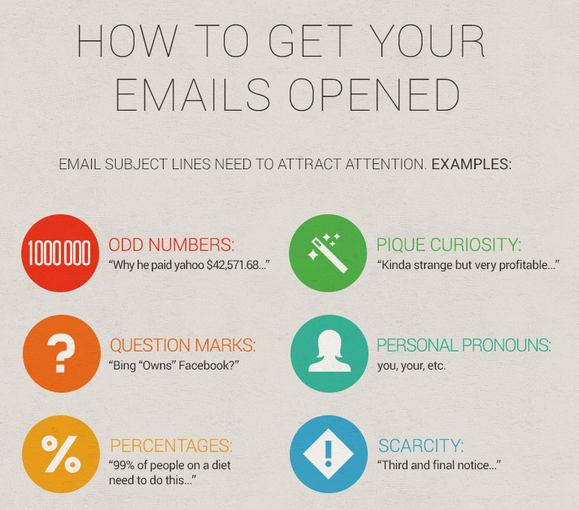
3. Finesse your subject line.

Your subject line can make or break your email. Here are some tips on how to improve your subject lines to increase your open rates:

  • Keep your subject line under 50 characters and put the most important words at the front. This will ensure that subscribers see your key points even if their email platform or mobile device truncates the message.
  • Experiment with personalization by putting the subscriber’s name in the subject line. However, be sure to have a fallback in case a subscriber didn’t enter their name when they opted in.
  • Make it urgent. Tell readers why they must open the email now.
  • Show the benefits subscribers will get when they open the email.

4. Optimize for mobile.

Before you send your next email, test it in various mobile devices and browsers. Keep your subject line short, so subscribers can read it on their mobile device. Also, include your call to action at the top of the email in case your subscribers can’t scroll to see the full message on their mobile device.

5. Test your send times.

There’s a lot of debate over the best time to send your emails. A Pardot study found that B2B marketers get the highest open rates on Tuesdays. Pure360 broke down open rates by vertical and found that the best time to email technology professionals is between noon and 3 p.m., while you should email the financial sector between 7 a.m. and 10 a.m. Play around with your send times to see when you get the highest open and click-through rates.

Think of these tips as a “back-to-basics” routine that will help you get your emails in shape.

Now drop and give me 20!

18 Feb 17:09

Nurture Your Leads with Narrative (Infographic)

by Dayna Rothman

nurture your leads

Lead nurturing is the process of building effective relationships with potential customers throughout the buying journey. Lead nurturing happens across multiple channels, and for your communications to be effective, you need to tell a story. A good story. New leads and customers are all at different stages of the buying process, so you have to tailor your messages and materials to best suit their needs. Your stories should share your message, get personal, and be emotional in order to accelerate your leads through your sales funnel.

Download our infographic to learn how you should use a story arc for your nurture communications, what type of offers and stories work at each stage of the buyer’s journey, how to select the right story genre, and how to make your lead nurture content emotional and viral!

And if you want to learn more about lead nurturing, download our brand new Definitive Guide to Lead Nurturing, 2nd Edition!

18 Feb 17:08

Sales Lead Management Leads to the Most Efficient Media Buy

by jobermayer@salesleadmgmtassn.com (James Obermayer)

shutterstock_224018254_270Few companies get by on their good looks—although the engineering department would like to think that the pure genius and word of mouth about your product is enough to sell it. In their opinions marketing is not needed. Well, I hate to break it to them, but without marketing the majority of companies will either fail or fail to reach their full potential. They may make money, but the world is loaded with companies holding the 4th, 5th, 6th or 7th place in market share, while the 1st, 2nd and 3rd leading firms spend what it takes to gain market share and manage the leads that their programs produce. And lead management has told these winners where to spend their marketing dollars. 

Winners know the sources of the “Good Leads.” In the movie adaption of Glengarry Glen Ross, it is Jack Lemmon who asks for the good leads. 

All salespeople want the good leads; they know instinctively and from experience that some sources of leads are better than others.

Why_its_important_021315_v3

Ask a salesperson for the source of their sales from leads and they can tell you: this show … that advertisement … this direct mail program … that radio show. Ask a marketing executive for the sources of sales from their marketing programs, and usually they say they have to get back to you on that one. Informed marketing executives go straight to the CRM System or their marketing intelligence software, and they know the best buys in the plan. The preeminent marketers buy more of what works and leave the rest to their competitors.

Less experienced marketing executives won’t set up the lead management system right to begin with, so they won’t know which are the most efficient media buys. They won’t have the appropriate relationship with sales management to ensure that leads are not only followed up but also closed out. Money will continue to be spent on tactics that don’t produce the most qualified leads. They will complain that salespeople don’t report back on the leads, management doesn’t cooperate, and life just isn’t fair. Excuses all.


Jim ObermayerToday's blog was submitted by James Obermayer, Executive Director and CEO of the Sales Lead Management Association and President of Sales Leakage Consulting. James is a regular guest blogger with ViewPoint.


17 Feb 22:48

What Kids Get For School Lunches In Other Countries Will Amaze You (Photos)

by James Kosur

Sweetgreen, a chain of salad restaurants with locations around the United States runs a program called “Sweetgreen in Schools” which focuses on teaching kids how to eat heathy. Recently, the organization took some amazing photos of the school foods that children all over the world eat on a daily basis. From steak and fresh fish to fresh greens and healthy treats, the difference between school foods in the United States and overseas is pretty amazing.

Brazil

Pork with vegetables, rice with black beans, salad, bread, and baked plantains.

Finland

Pea soup, beet salad, carrots, and bread. For dessert, there’s fresh fruit and pannakkau, a type of dessert pancake.

France

Steak, carrots, green beans, cheese, and fruit.

Greece

Baked chicken with orzo, stuffed grape leaves, cucumber and tomato salad, yogurt with pomegranate seeds, and oranges.

Italy

Local fish with arugula, pasta, caprese salad, bread, and grapes.

South Korea

Fish soup, tofu with rice, broccoli, peppers, and kimchi.

Spain

Shrimp with brown rice, gazpacho, bread, peppers, and an orange.

Ukraine

Sausage with mashed potatoes, borscht, cabbage, and syrniki (a dessert pancake).

USA

Fried popcorn chicken with ketchup, mashed potatoes, peas, fruit cup, and a chocolate chip cookie.

32 million children in the United States are fed meals that simply don’t match the nutritional value of other countries.

Which school lunch would you prefer, a lunch from the United States or a healthier option from another part of the world?

17 Feb 22:47

9 things successful people do right before bed

by Jacquelyn Smith

reading wine

The very last thing you do before bed tends to have a significant impact on your mood and energy level the next day, as it often determines how well and how much you sleep.

Successful people understand that their success starts and ends with their mental and physical health, which is almost entirely dependent upon their getting enough sleep.

That is why bedtime routines are a key ritual for so many of them — and why the very last thing most successful people do before bed is read.

1. They read.

Experts agree that reading is the very last thing most successful people do before going to sleep.

Michael Kerr, an international business speaker and author of "You Can't Be Serious! Putting Humor to Work," says he knows numerous business leaders who block off time just before bed for reading, going so far as to schedule it as a "non-negotiable item" on their calendar. "This isn't necessarily reserved just for business reading or inspirational reading. Many successful people find value in being browsers of information from a variety of sources, believing it helps fuel greater creativity and passion in their lives."

For example, while some successful people use this time catch up on news stories from the day, skim tech blogs, or browse Reddit and Twitter, others enjoy reading fiction novels and ancient philosophy just before bed. 


2. They make a to-do list.

"Clearing the mind for a good night sleep is critical for a lot of successful people," Kerr says. "Often they will take this time to write down a list of any unattended items to address the following day, so these thoughts don't end up invading their head space during the night."


3. They spend time with family.

Michael Woodward, Ph.D., organizational psychologist and author of "The YOU Plan," says it's important to make some time to chat with your partner, talk to your kids, or play with your dog.

Laura Vanderkam, author of "What the Most Successful People Do Before Breakfast," says this is a common practice among the highly successful. "I realize not everyone can go to bed at the same time as his or her partner, but if you can, it's a great way to connect and talk about your days."


See the rest of the story at Business Insider


17 Feb 22:46

How Psychology Can Optimize Your B2B Pricing Strategy

by Ryan Law

There’s more to a perfect pricing strategy than economics alone. Alongside input costs, demand, and industry competition, there’s another factor determining the success of your pricing: psychology.
Psychology and marketing go hand in hand. Today, I’m taking a quick look at four psychological principles behind successful pricing strategies. By combining these psychological quirks with a bit of customer insight, adjusting your pricing strategy by as little as a few cents could massively improve your sales.

1. Charm Pricing

The simplest psychological pricing tool at your disposal is also the most common. Whether you’re buying a 99-cent bag of chips or a $29,999 sedan, both B2C and B2B markets are saturated with prices that end with the number nine.

This is known as charm pricing, and there’s a reason for its proliferation: it has a significant impact on sales. In his book Priceless: The Myth of Fair Value (and How to Take Advantage of It), William Poundstone conducted eight separate pricing studies. In each instance, prices ending in nine sold 24% better than the nearest “rounded” price point.

This isn’t always through the sheer virtue of being cheaper. Researchers at MIT conducted their own experiment, selling identical clothing at three different price points: $34, $39, and $44. The $39 price point outsold both the $44 and $34 price points, thanks to the psychological lure of charm pricing.

This works because our brains are trained to simplify numbers, and will subconsciously latch on to the first number in a price tag. This “left digit” effect means that a $299 product is subconsciously associated with a reference point of $200, instead of the $300 to which it’s much closer.

There’s even an argument that the prevalence of charm pricing has lead to a type of social conditioning, with charm prices becoming inherently associated with good value.

2. Prestige Pricing

Charm pricing is a valuable tactic, but within the B2B sector, it may be more effective to increase your prices. As we move away from small businesses and into the enterprise sector, the preferences and priorities of consumers begin to change.

While a small-business owner may prioritize low prices, a busy executive or director may gain greater utility from convenience and simplicity. A $19 product may sell better than a $20 product, but a $2,000 price point may generate more sales than an item listed at $1,900.

This is particularly true with luxury brands. These brands differentiate themselves with quality, style, and convenience—not prices. Round-number price points like $200, $500, and $1,000 reflect a “don’t sweat the small stuff” mentality that appeals to their target audience.

3. Anchored Pricing

Say your business offers an accounting software package for $1,000 per month, along with a range of stand-alone monthly add-ons for $50, $100, and $200.

Success! A customer has just bought your top-tier product. Now you might choose to follow-up with one of your cheapest cross-sell opportunities—after all, the customer has already spent a small fortune with you. However, pitching one of your most expensive add-ons may be a better idea.

Before the sale, your would-be customer has no pricing reference, so an extra $200 is a big deal. Post-sale however, the customer’s pricing reference is now the $1,000 they’ve paid for the software package. Suddenly, an extra $200 might not seem so excessive—especially if the add-on improves the functionality of the $1,000 software package.

This is the power of perception. The desirability of a certain product, at a certain price point, can be manipulated by anchoring it to another, much bigger number. This is a particularly powerful tool for reducing churn in industries with long sales cycles.

4. Framed Prices

The same principle can be used to “frame” your prices, in order to increase their desirability. For a great example of this in action, we can turn to the Economist’s recent pricing strategy:

1. Online subscription, $59

2. Print subscription, $125

3. Online and print subscription, $125

At first glance, option two seems useless, offering less value than option three for the same price. However, this option isn’t there to sell print-only subscriptions. It’s actually there to frame the third option, making it more desirable in comparison.

Without option two, consumers have a choice between a $59 online-only package and a $125 print-and-online package—a big price increase just to receive a magazine in the mail.

However, by valuing their print-only copy at $125, the implied value of option three is now $184 ($125 + $59). Suddenly, option three isn’t just the most desirable; it’s also going to save the consumer a ton of money.

17 Feb 22:46

How To Establish Yourself As A Recognized Thought Leader On Twitter In 3 Months

by Tom Kornblit

In this hyper-competitive social age of the web, it’s never been more vital for brands to establish themselves as a credible, authoritative thought-leader in their industry.

The primary reason for this is the same reason that content marketing is effective:

The primary driver of any purchasing decision is trust, and a scalable way of building trust is educating.

This fundamental idea is what fuels content marketing and therefore we can safely assume that the process of establishing ourselves as a thought-leader will have a close affinity with the content marketing paradigm.

So that begs the question:

How in the world can I, company X, leverage content marketing practices to effectively emerge as a thought-leader in my industry? And furthermore, how can I do it affordably?

Three months ago I found myself asking myself the same question and so I embarked on a journey to try and solve it. After a lot of trial and error I’ve come up with a scientific approach that I believe can solve this problem for anyone.

Quick Primer On Content Marketing

As this point, I think it makes sense to take a moment to go over what content marketing is. I’m sure you’re already familiar with the concept but in favor of being exhaustive I want to briefly walk through what it means and the role it played in my journey.

The canonical definition taken right from Wikipedia is:

Content marketing is any marketing that involves the creation and sharing of media and publishing content in order to acquire and retain customers. This information can be presented in a variety of formats, including news, video, white papers, e-books, infographics, case studies, how-to guides, question and answer articles, photos, etc. While the above text provides a succinct definition, and a comprehensive list of media formats, there are two modifications I would make.

Content Generation: Creation + Curation

The definition mentions content creation, which is important but far too limiting. Content marketing isn’t only content creation, but also content curation. Meaning it doesn’t all have to be original.

Subscribers are not religious about authorship, but are more concerned with quality. This was one of the fascinating insights that I came across during my quest.

For more details about content curation and a list of tools that can help you curate high quality content, there’s some great information here.

Content Distribution

The second thing I’d change about the definition is that I would extend upon the sharing that it only briefly mentions, and give it priority parity with content generation.

Having a distribution channel for your content, is just as important as generating high quality content.

So I would add the following to the definition:

“This information is typically distributed in one of the following outlets: social networks, e-mail list, blog.”

Summary

To wrap up content marketing I put together this graph:

Now that we’ve distilled content marketing into its fundamental components, let’s take a step into the pragmatic world and show you how to put these components into practice.

The Social Media Arms Race

It’s no secret that social is an extremely effective means of distribution for brands. Aside from the obvious distribution benefits, it has an inherent social proof benefit. This goes a long way in order to achieve our ultimate goal: to establish ourselves as an industry thought-leader.

Therefore companies are embracing social media as a means of acquiring follows & likes (henceforth to be referred to as subscribers).

There’s an entire industry dedicated to acquiring subscribers on social. And the most talented practitioners amongst the industry are the folks who can amass the largest following, while exhausting the least amount of resources (time and money).

Joining The Subscriber Arms Race

As marketers, we have many different options for subscriber acquisition. Of course these different options have varying costs and ROI, and the variance is usually dependent upon a number of factors, such as industry, market segment, and competition.

For the purposes of this article I will only be covering one very special distribution channel, Twitter.

Gaining Followers On Twitter

Twitter is very special because of two reasons:

  1. It’s inherent focus on followers, as opposed to friends or likes. This notion of being a fanboy or fangirl is engrained into the DNA of the network.
  2. It embraces a physiological phenomenon known as reciprocity which has become part of the cyber-culture.
    The first is obvious, but the second not so much. So let me elaborate.

It turns out that this second one is extremely interesting for our purposes. When you follow someone on Twitter with similar interests, there’s a good chance they follow you back.

I’ve found this is due to one of two reasons:

  1. You’ve made them aware of your existence, and because they’re genuinely interested they decide to follow you back (these are super subscribers and have significant value).
  2. They follow everyone back that follows them as a common courtesy (these are really only nice as a vanity metric and only add nominal value) .

These characteristics make Twitter an ideal acquisition channel and greatly work in our favor as you’ll soon find out…

Targeted Lists On Twitter

“Gaining followers is cool, but you know what’s really cool? Gaining targeted followers.”

As it turns out, Twitter’s follower model has one more interesting property that comes in handy given our new targeting requirement. It’s self-organizing.

From a micro perspective, people follow brands and other people that they find interesting in order to consume their content. An interesting by-product of this is that humans have organized themselves into interest groups…without even knowing it.

Let me explain.

These interest groups I speak of are Twitter account follower lists. To turn this into an example, if I was looking for people interested in competitor research, a good place to start would probably be SEMRush’s followers of Twitter. And furthermore if I’m a brand new platform for competitor research it would probably be greatly advantageous for me to follow SEMRush’s followers.

Wow

Congrats, you are now a skilled in the arts of amassing large targeted followings on Twitter. Go get yourself a 6-figure salary growing social media followings for Fortune 500 companies.

Followers Is Only Half The Story

To truly be a thought-leader you need to be constantly enriching your follower’s lives with relevant and compelling content.

This goes back to the content generation principles we covered earlier when discussing content marketing.

The rules I follow for my content generation are:

  • Add Value
  • Stay Relevant
  • Remind That You’re Human

Keep The Content Stream Flowing

ABT, Always Be Tweeting. Being a thought-leader isn’t all fame & fortune. The moment you acquire someone as a follower, you have a contractual responsibility to add-value to your them.

The fact is that research and ideation are expensive.

Introducing Buffer

Buffer is a social media scheduling service that has the capabilities of suggesting tweets based on your following.

This makes it incredibly easy to keep your followers entertained, while also increasing your engagement.

Numbers Don’t Lie

Yeah, yeah, I know. You want to see some charts and graphs to prove this stuff works. After all, we live in the “data” age or something like that.

Follower Growth

In the three month testing period, I gained 16,000 followers.

Degree Of Targeting

As you can see I did a decent job at targeting the tech startup community as my audience.

Engagement

134,700 impressions is not too bad in a month.

Concluding Thoughts

You are now equip with the social media chops to establish yourself as a thought-leader in your industry. All that’s left for you to do some competitor research.

Go and be an industry celebrity.

17 Feb 22:43

What Customer Service Software Buyers Look Like

by Ben Puzzuoli

Each year Software Advice speaks with thousands of small business professionals that are seeking customer service solutions. Recently, they analyzed a random sample of 385 small businesses to find out the most common reasons for customers wanting new customer service and support (CSS) software, as well as the features that they prioritize when making a purchase. Here’s a summary of their findings with all the most important conclusions picked out.

In Brief

The key findings were that:
• Only 14 percent of potential buyers actually used dedicated CSS software. The others used manual methods like email.
• Small businesses that bought CSS software for the first time were likely to say that they struggled with managing complaints.
• 90 percent of buyer wanted basic trouble ticket management, while 36 percent were also seeking reporting features.

Let’s take a more in-depth look.

Current Methods

Most buyers in the sample were using manual methods for their customer support functions, including spreadsheets, email managers, or even physical paper while they communicated with customers through phone and email. Managing customer complaints is becoming such an important part of being competitive; this data indicates that some small businesses have a long ways to go when it comes to improving customer service. Other buyers were using software that lacked dedicated CSS features, or using software designed for other purposes (like call centers). Fourteen percent were using CCS and seeking an upgrade.

Struggling With Service

Another major conclusion from this study is that many first-time buyers are struggling to handle their customer support. Almost two-thirds cited a need to better manage customer complaints as a reason for seeking new software; some worried that customers were slipping through the cracks or that they were losing business.

Seeking Features

Almost all buyers are seeking basic trouble ticket management; 90 percent were looking for the ability to generate and manage a trouble ticket queue. Others were also seeking analytics software or self-service functionality.

A thin majority wanted a standalone solution that was focused only on customer service, as opposed to an integrated suite. This is probably because many small firms don’t have the time or resources to devote to a full range of specialized software, and would rather only buy what they need. Many, however, were seeking a full range of products such as call center software or consumer information gathering systems, which suggests that small businesses are starting to take advantage of the full range of customer software solutions.

Web-based Solutions

Almost two out of every three businesses wanted web-based software, with only one percent asking for software that needed to be installed locally. This is consistent with other research that indicates buyers are leaning towards cloud-based solutions, since web deployment drastically reduces costs and increases flexibility.

Demographic Characteristics

Demographically, most of the buyers they spoke with represented small IT or software companies, at over 38 percent. Ten percent were manufacturers, and the rest were a diverse range of industries such as banking or transportation. The sample was limited to businesses earning under $100 million each year, with 29 percent earning less than 1 million and 32 percent earning between 1 and 5 million.

So, there’s an overview of the types of companies seeking CCS (Help Desk) software, as well as the kind of software they want.

17 Feb 22:40

9 Steps To Creating A Powerful LinkedIn Profile

by Alex Pirouz

9 Steps to Creating A Powerful LinkedIn Profile

Two every second: That’s how many people join LinkedIn as new members, many of whom hope to exploit the platform’s rich resource for industry contacts, new clients and partnership opportunities.

That means that by the time you finish reading this article, you’ll have on average 350 people and counting to compete with for the professional world’s attention. What you do with your LinkedIn profile can mean the difference between garnering views as compared to converting those views in taking the next step of building a relationship with you.

With over 1 billion searches per day for names and companies, LinkedIn is your opportunity to build your business reputation, expand your professional network and help companies and connections know who you are and what you do.

And with so many people fighting for attention, your first impression can most often be your best or last. Here is an excerpt from an infographic by linkhumans.com on Slideshare that shows the facts behind optimizing your profile on LinkedIn.

Perfect LinkedIn profile

To help you get noticed and stand out from the crowd, I’ve provided you my top 9 tips on how to create a more compelling profile.

1. Header

Having a “Profile Header” is a powerful way to showcase your personal brand, get your company exposure in front of hundreds of potential clients and make a great first impression. Remember a picture is worth more than a 1000 words.

When designing the banner, make sure it’s a JPEG, PNG or GIF file that’s under 4MB in size with the correct dimension for the header being: 1400 x 425. Be sure to leave some space at the bottom as the top section of your profile tends to cut into the image.

Oh! And be sure not to hit delete because you wont be able to get the header back. I learnt that lesson the hard way when I was playing around with the feature a few weeks back.

Untitled

2. Photo

Your LinkedIn profile is your digital introduction with those who view your profile. People like to do business with a face. Your photo should be up-to-date, clear, professional, and an expression of you, preferably the smiling you. If you are a casual guy, no one expects or wants to see you in a suit. In a virtual world we may do business with someone we have never met.The connection provided by a photo, especially when you can see the eyes and a warm reception can go a long way.
Screen Shot 2015-02-15 at 10.02.07 am

3. Headline

Your headline is very much like a headline of a news story in the newspaper. If it’s not eye catching, does not draw your attention or raise enough curiosity then chances are your not going to read any further. When writing your headline make sure it’s a reflection of what you do, who you are and make it relevant to your target market.

Your goal is to get your viewers attention in order for them to get curious enough to read more about you. Try and stay away from tacky sales pitches, remember people don’t care how much you know, until they know how much you care.

4. Website Links

Instead of using the default “Personal Website”- type anchor text links in your profile, change the text to make the links more appealing to people who view your profile. By changing the text to something more attention-grabbing than the standard options LinkedIn provides, you increase the number of clicks to your website or blog.

For example, if you want to include a link to your website, rather than choosing LinkedIn’s standard “Company Website” anchor text, customize it to include keywords that indicate what your website is about, like “Learn To Master LinkedIn”

Each profile can display up to three website links like this, and they can be customized by editing your profile, clicking the pencil icon next to your website links, and selecting ‘Other’ in the drop-down menu.

Screen Shot 2015-02-15 at 10.01.23 am

5. Summary

In my opinion this is the most important section within your profile given it’s the first place people read once you’ve caught their attention with your header and headline.

There are many different theories but in my opinion and from a personal branding perspective, I believe that on social media, people buy into people they trust and like. Unless you establish this right from the start then no one is going to care about your business, let alone your product or service.

And the best way to establish this trust is to share your business journey to date. Let’s face it; everyone likes a good story. Now there are 3 main stages to this:

Past: Start off by sharing how you got into business
Present: What has led you to where you are now
Future: And finally what you are working on going forward

Within each of these sections be sure to weave in any key achievements, awards, career milestones, endorsements and even your failures as it adds a human element to your profile.

Screen Shot 2015-02-15 at 10.40.32 am

5. Skills & Endorsements

Back in 2012, Linkedin launched a feature called Endorsements, which enables users to endorse their connections for skills they’ve listed in the Skill & Expertise section of their profile — or recommend one they haven’t yet listed. These endorsements then show up on your profile within that same Skills & Expertise section, as you can see in the screenshot below.

Whilst you can have up to 50 skills displayed, 3-5 is generally a good number to list. In today’s business world consumers only want to deal with specialist, so when you list too many skills it shows you’re a generalist rather then a specialist.

And most importantly make sure that the skills you do list are consistent with your personal brand and is solving your clients challenges, objections and creating you a unique difference in the market.

Untitled3

6. Optimize

Just as you would optimize the foundations of your website before you start an aggressive inbound marketing campaign, do the same for your LinkedIn presence, starting with your profile, to get ranked high on LinkedIn.

There are 5 key areas within your profile where you will need to insert key words in order to get ranked high within search results when your target market is searching for your product or service.

a) Title, Current & Previous Experiences
b) Website URL
c) Summary
d) Work Experiences
e) Skills & Endorsements

By including keywords that people are using to find someone like you, you are ensuring that your LinkedIn profile performs well in search and that you will be found.

7. Layout

LinkedIn also enables you to reorder the sections of your profile in any way you prefer. Over the past few years we’ve tested many different ways to structure a LinkedIn profile in order to reach optimum flow and consistency. In my opinion the structure you see below is by far the most engaging and compelling:

a) Summary
b) Skills & Endorsements
c) Experiences
d) Volunteer
e) Honors and awards
f) Publications
g) Additional Info
h) Recommendations
i) Groups

When in edit mode, simply hover your mouse over the double-sided arrow next to the Edit link for each section. Your mouse will turn into a four-arrowed icon, at which point you can click, then drag and drop to another position on your profile.

Screen Shot 2015-02-16 at 11.09.26 am

8. Groups

Joining groups that relate to your industry or the industry you wish to enter is another step in building a compelling profile. This not only helps you keep up with industry news and advances, but group members may be the very people you want to do business with. Your participation in groups helps build your visibility, credibility and involvement within your industry.

Whilst you can join up to 50 groups, in my opinion it’s best to only show 6-8 groups within your public and LinkedIn profile. You can choose which groups to display by changing the visibility settings in your system and notification settings.

Screen Shot 2015-02-16 at 11.21.03 am

9. Blog

After opening up their publishing arm back in February last year, LinkedIn have just reached over 1 millions posts. As a result they’ve now opened up their publishing arm to all English speaking countries

Becoming a publisher on LinkedIn can be a powerful way to reach your target market and generate new leads. The new platform promises to match the blog’s topic with users who share an interest in that particular vertical.

Writing short articles and posts helps set you up as an authority on your particular topic and puts you in the newsfeeds of your connections. This in turn keeps you and your business top of mind within your target market.

My blog posts results so far:

  • Appeared on the homepage of LinkedIn 4 times now
  • Over 128,000 blog views and 1000 comments
  • Shared more than 18,193 times
  • Generated us over 430 leads – and
  • Increased my following by an extra 2,300

Here’s a screenshot of a few articles I have written:

linkedin-posts

It also gives you greater exposure to your current network given every blog you post is distributed to their news feed and displayed within their notification settings located at the very top of their LinkedIn profile.

If your contacts like the article and decide to share that on LinkedIn, Facebook or Twitter, this will not only create greater exposure but those who aren’t connected with you; may like your work that much that they end up “FOLLOWING” you to receive future posts helping you create a following of raving fans for years to come!!

Having a compelling LinkedIn profile is paramount to your success on LinkedIn. It’s your face to the online networking world and your first point of contact when promoting yourself to potential clients, joint venture partners, journalist and the business world. The steps provided in this article are the fundamental steps in creating a compelling LinkedIn profile. Be sure to update your profile as you progress throughout your career.

17 Feb 22:40

3 Tips to Get Consumers to Open Your Emails

by Larisa Bedgood

Email is one of the most effective forms of marketing. And consumers agree! Based on a report by MarketingCharts.com, “email is not only their preferred brand communication channel, but it also acts as a purchase influencer to more US Millennials than any single paid advertising medium.”

While many emails that land in consumer’s inboxes may be deleted, attitudes towards email are improving. According to a report by Forrester, 42% of US adults delete email advertising without reading it, down from 44% in 2013 and 59% in 2010. However, 44% of email recipients admit they made at least one purchase last year as a result of a commercial newsletter.

email_marketing_charts

Here are 3 tips to improve engagement with consumers – before they press the delete button.

1) Subject Lines

  • Emails with subject lines of less than 10 characters had an open rate of 58%.
  • 64% of people say they open an email because of the subject line.
  • Emails with personalized subject lines are 22.2% more likely to be opened.

So how do you create winning subject lines? They need to attract attention. Check out these following examples:

subject_lines

 2) Optimize for Mobile

Nearly half of all emails are opened on mobile devices. According to Hubspot:

If you aren’t optimizing for mobile, you are losing out on significant opportunities. Hubspot published a great article on how to optimize emails for mobile.

3) Personalize Your Message

Your emails need to be 100% about your customers and prospects. What are their lifestyles and interests? Based on their past purchases, what offers will be most appealing? Email marketing has huge potential to boost your sales, customer loyalty, and customer acquisition.

The top reasons for U.S. email users to unsubscribe from a business or nonprofit email subscription are content that is not relevant (56%). (Source: ChadwickMartinBailey)

However, you must understand consumers to meet your business objectives. An integrated marketing database and analytics to segment your customers and prospects according to their needs is crucial for your email marketing to be successful.

When customers are segmented for more personalized offers, the results speak for themselves. According to a report by Lyris:

  • Email open rates increased by 39%
  • Emails were seen as more relevant by 34% of email recipients
  • Unsubscribe rates reduced by 28%

email_segmentation

Consider using personalized transactional emails to up-sell and cross-sell your products and services. Transactional emails such as order confirmations, receipts, and content download emails are almost guaranteed to be read. This offers an excellent opportunity to suggest other items based on past purchase history, or provide special incentives, events, and offers based on your customer’s profile.

The use of predictive analytics also offer a way to reach out to consumers with personalized messaging. Use advanced analytics to discover trends, what is working, how customers interact with your emails, or how purchase behaviors can predict what a consumer may purchase next.

Download our business intelligence guide to learn how to better understand your customers and send emails that drive conversions.

whitepaper_customer_intel

17 Feb 22:40

Trouble Finding Fresh Leads? Rekindle Relationships With Your Previous Customers

by Harman Bajwa

Get prepared to hear the truth!

What typically happens is—you put in the effort, find a customer, give them a tailored experience, make a fabulous sale, earn an incentive, at best get rewarded.

And then what?

6696970999_ce2dafda2e_z

Time settles down, your brilliant sale is behind you and the attention is back at the present moment, i.e. finding fresh leads.

A perfect story, but without a happily ever after ending!

Ever wondered about the cause behind a perennial scarcity of clients? One of the reasons in most organizations, is the lack of maintaining relationships with former customers.
Here, we explore why reviving associations with them should be a must.

1) Walking the Distance all over again is COSTLY!

euro-427533_1280

Marketing is always easier said than done, going through the same rigmarole of attracting new clients comes at a price. Econsultancy Responsys Cross Channel marketing Report quotes, “it is cheaper to retain existing customers than to acquire new ones.” Around 70% of respondents accept it.

Why do you think companies like Zappos invest in service?

Considering you had offered customers a good deal, served them well, there’s no reason why your past customers shouldn’t return to you. Besides, every customer has a Customer lifetime value, ignoring which can be quite expensive.

Author Lon Safko, while scrutinizing the cost of customer acquisition, points out the mistakes today’s marketers make while planning their marketing spend.

Remember, it’s always more convenient for customers to forget you, than vice-versa.

2) Returning Clients earn you a ‘Reputation’and builds your Brand!

exceptnsrvcexcptnproft

The rule is to know your customers well and make it clear to them that you want them back. Micah Solomon, the author of Exceptional Service, Exceptional Profit: The Secrets of Building a Five-Star Customer Service Organization, writes that hotel chain Ritz Carlton is built on the foundation of outstanding customer service. Their motto is “We are Ladies and Gentlemen serving Ladies and Gentlemen.”

Customers have shared personal accounts, where Ritz Carlton’s staffers have made their stay happier by going an extra mile. It has imparted the hotel an enviable reputation.

Returning clients play a big role in turning you into a brand. They return to you because they’ve seen through the clutter and made a choice to stick with you.

Letting them slip by is not just a monetary loss, you lose a brand ambassador of your services. This is as true for your local car spare parts dealer as it is for a big business.

3) Business Growth, Recommendations, Referrals!

Growth is not just a spin-off of preserving relationships. Maintaining relationships truly begets growth. With widespread Internet access, customers are increasingly depending on user reviews before taking a buying decision. Surveys claim that 90% of customer decisions are influenced by online reviews. Imagine what great customer service and relationship could do for your business in such a connected environment?

Image Credit: MarketingLand.com

Image Credit: MarketingLand.com

On the other hand, Nielsen’s report states that despite a plethora of information surrounding us today, 84% individuals still depend on good old word-of-mouth recommendation from friends and family.

Referrals are powerful as they come from a genuine source. Big firms take referrals very seriously. Many of them rely on NPS (Net Promoter Score), which is the measure of the likeliness of a customer recommending a product, service or a business to a friend or coworker.

4) Advantage for the long term, even in a Downturn!

Even when times are good, maintaining relationships won’t let your clients stray, but it’s especially beneficial in a recession.

Tough economic environments lays bare the difference between companies which place customers first and those that let go of their loyalty for short term gains.

Maintaining ties with existing customers even in tough times, gives you a clear edge over others. And there are more than one ways of doing it.

United Services Automobile Association (USAA), started cross-training its call center representatives back in 2007, so that 60% of its agents who answered investment queries could respond to insurance calls too. Because of it, even an avalanche of callers (during hurricane Ike and the stock market crisis of 2008) could not deter the call center department of USAA. This only strengthened their customer relationship.

Final Thoughts

There’s a thin line between Customer and client. A client is a steady customer.

No wonder, CRM (Customer Relationship Management) has become highly significant for Small businesses today. Salesforce research claims CRM can increase sales by 29%.

Jeff Bezos once said, “We’re not competitor obsessed, we’re customer obsessed. We start with what the customer needs and we work backwards.”

It is quite surprising how most salespeople overlook inactive customers in their frenzied efforts to make new sales. Maintaining relationships bring you in front of the customer, separating you from the chaff.

Besides, as most salespeople would agree, your sales results are only as good as your relationships!