Shared posts

19 Feb 19:41

6 Ways B2B Marketers Use Social Media To Get Gangbuster Results

by Lisa Cannon

likes-are-great-social-media-facebook-coverSocial media is a proven winner for B2C marketers, and recent research proves it. In fact, according to a survey from Vision Critical, four out of 10 consumers buy products that they’ve liked, tweeted about, favorited, or pinned on their social network of choice. But what about B2B marketers? How are they using social to reach their prospects? It appears that when it comes to reaching business customers through social channels, content is the key. According to a study from MarketingProfs, 87% of B2B marketers are using social media platforms to promote their content marketing.

However, there’s a problem with using social media to deliver content to business prospects. The thing is, Facebook likes, Twitter retweets, Pinterest pins and LinkedIn followers don’t necessarily translate into new customers – or measurable return on investment (ROI). Without a strong strategy in place, as well as the proper tools to measure the impact of your social campaigns, you may be wasting both your time and your budget on social media marketing.

Look at it this way. Which would you rather have, 1,000 followers who never do more than like or retweet your content, or 500 followers who actually visit your site and recommend your brand to others? Obviously you’d rather have the latter, especially if they fit the profile of your ideal customer. After all, the purpose of social media marketing isn’t to gain new fans, it’s to acquire high-value customers. What does it take to make that happen, and how can you turn those interactions into increased revenue?

You can find the answers to these questions and many more in a new Act-On eBook, Likes are Good, Leads Are Better: How to Grow Your Business Using Social Media, written by Jamie Turner. He’s the co-author of How to Make Money with Social Media and Go Mobile, and he’s also the CEO of 60 Second Communications, a marketing communications firm that specializes in ROI-based marketing campaigns.

In the eBook, Jamie provides six valuable tips that can help B2B marketers use social media to turn followers into loyal paying customers. Here’s a quick overview of what’s inside.

1. Focus on the quality – not the quantity – of followers

It’s easy to get distracted by the number of followers you have. People even pay for fake followers to inflate their numbers. But those followers won’t impress your potential customers, and they certainly won’t generate any leads for your business. The goal is to attract real people – and real prospects – so you can convert them into paying customers. To do that, you need to have an engaging social media program. And you also need to identify key performance indicators (KPIs) that you can use to benchmark the success or failure of your campaigns.

2. Figure out how much you should spend on marketing

likes-are-good-CLV-chartIn order to determine how much you should invest, first you need to determine your customer lifetime value (CLV). CLV is the amount of revenue you’ll generate from a typical customer during the period of time they buy your products or services. So for example, if your CLV is $10,000, what kind of budget should you spend to acquire that customer? The answer varies from industry to industry, but if you spent $500 in marketing costs in order to generate $10,000 in CLV, you’d be in good shape. In other words, if it costs you $500 to acquire a new customer, and that customer generates $10,000 in revenue for your company, then you effectively spent $1 in order to get $20. That’s a good return on investment and one that would be worth repeating.

3. Use marketing automation software to improve your results

The real value of social media becomes apparent when you are able to deepen your relationship with prospects, drive them to your website, and convert them into customers. Creating brand awareness isn’t just about building buzz. It’s about giving prospects information about your company so they can come to know you, trust you, and, eventually, depend on you. If you use social media to increase brand awareness with your prospects, then what can you use to drive the leads to your business and convert them to customers? That’s where marketing automation can help. Marketing automation makes it possible for you to capture leads and then nurture them throughout the journey until they become customers. It also helps to have some high quality content to deliver to your prospects at every stage of their journey.

4. Create customer segments and focus on their specific interests

likes-are-great-social-media-rainbowNot all prospects are interested in the same offerings from your company. And they’re not all at the same point in the sales cycle, either. You need to gather as much data about each one as you can in order to understand what they’re looking for – and gather like-minded customers into segments so you can market to them in similar ways. You can use content that’s gated behind forms to collect information. You can analyze what they click on and which pages they visit on your website. And you can use lead scoring to assign points to certain actions and characteristics. So for example, a prospect in upper management who found your site through LinkedIn and who visits the pricing page would score more points than an intern who came to your site from Pinterest and looked at videos on the “what it’s like to work here” page. High-scoring prospects could receive a targeted series of emails – or a perhaps a call from sales.

5. Calculate the ROI of your social media campaigns

Figuring out the ROI of social media campaigns doesn’t have to be difficult. First, look at three stages of the customer lifecycle – attracting visitors, converting visitors into leads, and turning leads into customers. From there, you can start tracking your conversions at each stage of the lifecycle. During the first stage, you can track website referrals and clickthrough rates. After that, you can track page conversion rates and form submissions. Finally, you can track how many of those leads converted to sales.

6. Combine all the ingredients to create an integrated program

Your Facebook page, Twitter account, and any other social media presence can never be effective on its own. But taken together and combined with marketing automation, they can give you the power to launch an integrated, cohesive program.

Read the eBook to gain an in-depth understanding of the ways marketing automation and social media come together, and find out how to drive more leads, convert them to customers, and get gangbuster results for your business.

17 Feb 23:05

Matthew Fisher: Cuba’s coming revolution

by Matthew Fisher

More than half a century of isolation from America has left Cuba economically stagnant and culturally idiosyncratic. But the revelation that the two countries are normalizing ties means change is coming to everything from the cars on the road to the tourists on the beach. This week, Matthew Fisher reports from a country on the verge of a new revolution.

HAVANA, Cuba — Any shortlist of what Cuba is most famous for would include Fidel Castro, cigars, baseball and the 60,000 vintage American cars imported before the Cuban Revolution and still on the road today.

The 1952 Chevrolet may be the most popular car in Cuba. But that relic has lots of lovingly maintained competition from the same post-war era. Buick Roadmasters, Cadillac Eldorados with their mammoth tailfins, sleek Plymouth Furys, two-toned pastel Studebakers and even Ford’s notorious Edsel are the most visible legacies of the severe U.S. trade embargo that was imposed by Washington in 1960 under statutes including the Trading with the Enemy Act.

It can cost tourists about $30 an hour to ride around in one of the fancier American convertibles. A Cuban friend arranged a more authentic experience, finding a driver willing to drive me all day for $70 in a 62-year-old Chevy taxi he had bought a few years back for a couple of thousand dollars.

Matthew Fisher / National Post
Matthew Fisher / National PostYuniel bought his venerable 1952 Chevy a few years ago for a few thousand dollars and still drives it about 400 kilometres every day. There are about 60,000 such classic cars still on the road in Cuba.

Yuniel, who posed for photos with his car but was reluctant to give his full name, reckoned that his jalopy had been refreshed about a dozen times over the years with thick coats of black house paint. The car’s odometer stopped working ages ago. Only one windshield wiper worked. The upholstery was lumpy and the leather and plastic covering it was probably already thin when Richard Nixon won the White House for the first time. But the car handled just fine.

During the week, Yuniel usually drives about 400 kilometres during his 12-hour shifts. Drawing on his encyclopedic knowledge of American cars built during the design heyday of Detroit’s golden era, he rhymed off vehicle names as the parade of magnificent beauties went by as we drove past the Baroque ruins of Old Havana and through the sprawling, ramshackle suburbs where most of the capital’s two million residents live.

As thrilling as Cuba is for car buffs searching for old models such as the Dodge Coronet or DeSoto Firedome, these timeworn automobiles are a potent symbol of how long the Cuban economy has been frozen in time and how much catching up there is to do if Washington and Havana make good on the dramatic promise they made to re-establish diplomatic ties and lift the severe trade sanctions that have crippled Cuba for so long.

Those landmark changes will not mean much if Cuba does not drastically change the way it allows foreigners to do business. As longtime Cuban correspondent, Marc Frank, reported in the Financial Times recently, the Canadians and Europeans who have been allowed to do business here have not had an easy time of it. As well as recounting a litany of sad stories about government interference, Frank noted that about 60% of the businesses started by foreigners in Cuba over the past 25 years have failed.

Postmedia News file
Postmedia News fileA row of classic Chevrolet convertibles used to take tourists on tours through Havana.

Cuba’s Marxist-Leninist bureaucracy is slow, inflexible and often corrupt. Standing with and behind the bureaucrats are security agencies and courts that have remained deeply suspicious of outsiders and especially of capitalists. For example, police still interrogate and often detain Cubans if they see them speaking to visitors without official sanction.

Still, there is a groundswell of optimism among many Cubans that another revolution as profound as the one that brought Castro to power is surely coming and coming soon.

Matthew Fisher / National Post
Matthew Fisher / National PostYuniel bought his 1952 Chevy a few years ago for a few thousand dollars.

“Everybody is waiting to see what the first step will be,” said one of Yuniel’s friends, whose father had served as one of Castro’s generals. “The momentum that has been created now is impossible to stop.”

Another man, who spent 19 months in prison for refusing to fight for Cuba in Angola, said: “After 56 years of terror and being scared of our own government we have so much hope riding on this. Communism has been a catastrophe for us. But honestly, very big changes are in prospect and nobody knows how this will play out.”

Drivers such as Yuniel and others insisted that there is a huge pent-up desire to buy new Fords and Chevrolets and other vehicles that would allow them to finally retire their treasured old cars. But as most Cubans earn less than $300 a year it is hard to see how there will be much of a market.

Cuban authorities allowed a small number of European and Asian cars to be imported last year. But once import duties and other taxes were factored in, a Volkswagen ended up costing more than double what it would anywhere else, so there have been few takers.

If they get the chance, collectors from the U.S. will snap up hundreds, if not thousands, of Cuba’s venerable American cars. But Cuba’s stubborn bureaucracy and its feeble economy make it likely that Yuniel’s trusty Chevy and lots of similar antiques will continue wheeling around Cuba for years to come.

Postmedia News file
Postmedia News fileDowntown Havana looks like its the mid 1950s with a Chevrolet BelAir and Ford Fairlane, both convertible models built in 1955.
17 Feb 23:03

Alberta will sink into recession this year, as provincial fortunes turn amid oil’s collapse, CIBC predicts

by Mario Toneguzzi, Postmedia News

OTTAWA — Consistently low oil prices could dramatically alter the economic landscape of Canada in the coming year and beyond, with Alberta slipping into a “mild” recession as a weak dollar helps lift the manufacturing hubs such as Ontario.

That pattern is already being reflected in a slowdown in the oil patch-fueled housing market in Calgary and Edmonton, in addition to an anticipated knock-on increase in unemployment rates in the province.

In a report released Tuesday, titled The Tables Have Turned, economists at CIBC World Markets said recent data show “just how sharply the growth leadership is likely to swing.”

Most startling, perhaps, is the likelihood Alberta will go from the leading economic power house in 2014 to recessionary levels this year.

“Alberta looks headed for a mild and temporary recession,” said economists Avery Shenfeld and Nick Exarhos, pointing to a 0.3% decline in 2015, compared with 4.1% growth in 2014.

As well, they see growth in Saskatchewan — the country’s other major resources-heavy province — suffering in 2015, managing an advance of only 0.8% this year, after 1% in 2014, but likely avoiding an outright downturn.

However, Newfoundland and Labrador — also reliant on energy revenues — could contract more significantly this year, by 1.3%, and in 2016, by 1%.

In contrast, Central Canada “should enjoy a small upside surprise,” thanks mainly to a healthy U.S. economy, CIBC predicts, along with a lift in exports from a weak Canadian dollar.

The Ontario economy will expand 2.8% this year, up from 2.1% in 2014, and add 2.8% next year, according to CIBC. Quebec should add 2.4% this year and 2.6% in 2016, after a restrained advance of 1.8% in 2014, the bank said. At the same time, British Columbia will continue its mid-2% growth trend.

“That will translate into commensurate shifts in the employment picture, alleviating pressure in some areas — where, if anything, workers are currently in scarce supply — and lowering the jobless rate in Central Canada, where it has been stuck above the national average.”

For example, Alberta’s jobless rate could rise to an average of 6.8% this year, from 4.7% in 2014, the CIBC said, while Ontario should see its unemployment level fall to 6.6% from 7.2% last year.

CIBC expects overall growth in Canada to be around 1.9% this year, down from 2.4% in 2014, and rising by 2.5% next year.

Contrast those with the Bank of Canada’s 2.1% outlook for  this year and 2.4% in 2016 issued in January, when policymakers surprised markets by cutting their benchmark lending rate to 0.75% from 1%, where it had stood since September 2010.

The central bank’s GDP forecast is based on an average oil price of US$60 a barrel in 2015 and 2016. Crude was trading above US$53 on Tuesday, a gain on recent sessions.

Meanwhile, the Canadian dollar closed near the US81¢ level.

The regional shift is also evident in the housing market, where the slowdown in Calgary and Edmonton helped pull down national sales by 3.1% in January from December and by 2% from a year earlier, the Canadian Real Estate Association said Tuesday.

“As expected, consumer confidence in the Prairies has declined and moved a number of potential homebuyers to the sidelines as a result,” CREA president Beth Crosbie said.

Total January residential sales in Calgary were down 35.5% from a year earlier, while Edmonton fell 22.7%, Saskatoon lost 24% and Regina was off 6.9%.

“There’s little mystery behind the sudden reversal of fortune for the national figures, as sales in Calgary and Edmonton — and Saskatoon — fell more than 20% from a year ago, in what had been the hottest markets in the country,” said Douglas Porter, chief economist at BMO Capital Markets.

17 Feb 22:49

It’s "Go Time” For BlackBerry

by Adriana Lee
BlackBerry Passport

BlackBerry's newest smartphones will return to a major carrier's stores at the end of this week. Starting February 20, AT&T will begin offering the company’s Passport and Classic on contract, as well as through installment plans.

Despite efforts by carriers to wean consumers off phone subsidies, in the American market, cheap phones sold under contracts—or, more recently, on installment plans—are the bulk of the market. Faced with lackluster sales of its Q10 and Z10, BlackBerry basically sat out the most recent sales cycle, with no carrier offering subsidized sales. 

Getting back into AT&T's good graces means it’s “go time” for BlackBerry's latest phones. They’ve only been available at unsubsidized retail prices directly from BlackBerry and on Amazon.com.

The stakes could be high for BlackBerry. Because if neither phone succeeds at this point, it’s not clear they ever will.

A Duo Of BlackBerries

The Passport is the closest thing BlackBerry has to a phablet, with a squared-off 4.5-inch display and a relatively long-lasting battery. The AT&T version trims a bit off the corners, making them rounder, though the rather funky QWERTY keyboard remains the same.

See also: BlackBerry’s New Square Passport Is A Ticket To Weirdness

I found the Passport to be a strange device. It's slightly larger than a terra-cotta tile, but thicker. The screen presents an odd viewing scenario, as most online videos do not naturally fit that square-ish shape. It also comes with an unconventionally laid-out keyboard that seems almost intentionally designed for typos.

I had higher hopes for the Classic, which more closely resembles a traditional BlackBerry. The company sent me a unit to check out, and after using it for a few weeks, I found some highs and lows with the device. I was surprised at how much I missed the feeling of a physical keyboard. BlackBerry’s traditional QWERTY is a standout—even now, when it has few competitors left. Banging out messages felt oddly satisfying, since I could mash those keys without having to look at my fingers. 

BlackBerry Classic

The downside: The space dedicated to the keyboard dictates a smaller touch display of 3.5 inches. Overall, the device itself feels slightly thicker and heavier than the old, lightweight BlackBerry phones of yore, like the Torch or Bold.

See also: BlackBerry Launches The Classic, Its Best Hope Yet For Salvation

Both devices support BlackBerry messaging and offer Hub, the company’s take on a unified message center. It makes sense conceptually, but in practical application, the swirl of messages—from Facebook and Twitter to work email and personal texts—can feel a bit messy lumped in together. It doesn’t help that BlackBerry doesn't always accurately track whether or not you've read them.

The Passport and Classic manage to sidestep the matter of BlackBerry's meager app selection. They do this by running Android apps in addition to BlackBerry apps, which greatly expands what they can do. 

But it’s not a perfect solution. The Android apps come courtesy of Amazon’s app store, not Google Play, which means some major apps—including several Google services—just aren’t available.

Are They A Dynamic Duo?

The Passport will only be available on AT&T as an exclusive. The phone will sell for $0 down at a range of installment options—from $21 to $32 depending on the AT&T Next plan. The two-year contract price will be $200, with off-contract pricing at $650.

The Classic will cost less, going for $0 down and monthly payments of $14 to $21 on AT&T Next, or a contract price of just $50. Customers can also purchase the device from the carrier outright for $420. The Classic won’t be an AT&T-only gadget. Other carriers, including Verizon, have stated their intention to carry the device, though details have yet to emerge.

BlackBerry’s best shot at success may lie with the Classic, whose attractive price point and terrific keyboard naturally sets it apart. But even if you can get over the tinier screen, the app selection and message handling still feels like a work in progress.

Perhaps that’s what it was intended to be. Mobile World Congress, a big, annual industry event, will kick off in two weeks. BlackBerry is expected to reveal its next steps then. These could involve an evolution of sorts for whichever device has captured the public’s fancy (and dollars) more. Or, if it should face lagging sales, the company may decide to push its work-oriented initiatives—like that still-fresh partnership with Samsung over Android security.

Either way, this may be a make-or-break moment for the company, and what happens in the next few weeks could determine its path for the foreseeable future. 

Photos courtesy of BlackBerry

17 Feb 22:49

Can You Learn How to Sell – Or Do You Need Innate Ability?

by jillkonrath@jillkonrath.com (Jill Konrath)

I want to get you thinking today, so here’s my question:

If research showed that sales was 100% a learned skill, how would that impact your perception of your own success – or lack of it – today?

I know that sounds strange to ask, but bear with me. If it was true, how would it impact how you reacted to a competitive loss or when your prospect decided to not do anything?

  • Would you be more curious in terms of where you blew it or what went wrong?
  • Would you look at your own culpability in losing the deal?
  • Would you have tried to figure out a better way to help your prospects see the value of changing from the status quo?
17 Feb 22:44

The New Sales Playbook

by John Jantsch

The New Sales Playbook written by John Jantsch read more at Small Business Marketing Blog from Duct Tape Marketing

Recently, I was asked to present my ideas on how salespeople can best compete in today’s sales environment.

Sales Playbook

License: (license)

A great deal about selling has changed over the last few years, but mostly what’s changed is the way people buy and that’s what you have to understand in order to thrive in the world of selling today. (Oh, and by the way, pretty much everyone sells something.)

Buyers don’t need salespeople to provide information, they need salespeople who can provide insight, shed light on problems they don’t yet understand, and in general be so useful as to be seen as a consultant rather than the worst version of that person they got caller ID for.

In order to compete today, you must understand that your first job is to completely change the context of how you and your product, solution and organization are seen by a prospective customer.

In order to accomplish that adopt the following three attributes as core components of your sales playbook.

Build Authority

First and foremost you automatically change the sales context when a prospect finds you as opposed the other way around – I like to think of it as reverse prospecting. In order to do this, you must start publishing, curating, and sharing useful information. You must find ways to get invited to speak in front of audiences filled with prospective clients and you must be “optimized” as an expert when people go searching for answers.

Your consistent participation on sites like Quora, in appropriate LinkedIn Groups and Google+ Communities can greatly aid your expert brand.

Deconstruct Prospects

One of the ways you can thrive in the world of sales today is to make competitive intelligence a core competency.

In order to be seen as an invited guest, you must be able to demonstrate your ability to provide insight and help prospects look at problems they don’t even know exist. When you can do research using a tool like RivalIQ or BuzzSumo and expertly point out glaring gaps in a prospect’s business you can gain invitation to help them better understand a specific issue before you ever try to sell them your global solution.

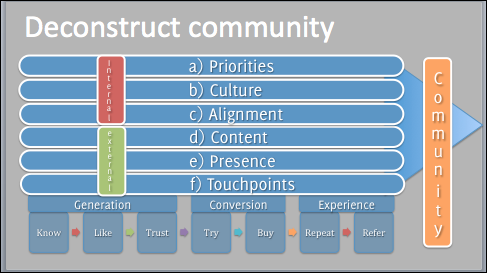
The diagram below is a tool that describes some of the many ways to look at a business and its community. When you deconstruct a prospect’s world based on the elements below you have the opportunity to potentially understand more about a prospects’s challenges than they themselves understand.

Add the competitive landscape and you are prepared to offer invaluable insight.

Deconstruct Community

 By evaluating, researching and understanding the internal and external element of a prospect you can gain tremendous insight into their needs and gaps.

Be Useful

The final element of the new sales playbook is to look for ways to be useful. This shouldn’t be as counterintuitive as it is to many sales people, but being useful quite often has little to do with your product or service.

Being useful may be unearthing research data that helps a client better understand their market. Being useful may mean introducing or connecting your client with someone in your social network that can help them address a personal issue. Being useful might be using a tool like BuzzSumo to help them build a list of prospective industry influencers – even though none of these things are directly related to the widget your company makes.

Being useful is one of the best ways to make a business case for changing the context of how you are seen by prospects and that’s how you dominate a market today.

Related posts:

  1. The 7 Essential Practices of the New Sales Professional Last week I wrote about what I called the Disciplines...
  2. Those idiots in sales just don’t get it I’m presenting a workshop this week titled – How to...
  3. Why Social Is More Important to Sales Than Marketing From day one it’s been said that the proper use...
17 Feb 22:44

The Secret to Replicating Your Best Customers

by craig.elias@shiftselling.com (Craig Elias)

paper_dolls

How many times have you been lucky in sales, by which I mean first in with a hot prospect in the window of dissatisfaction as described in my first blog post

When this happened, odds are three or more of the following were true:

  • The sale happened faster than normal
  • It was relatively easy to reach the real decision maker
  • They didn’t spend much time trying to get a better price from you
  • They were willing to give you a testimonial or agree to be a customer reference

These hot prospects often turn into core, loyal, profitable customers who will gladly give referrals. And if you want more customers like these, you need to stop analyzing the sales you lose and start analyzing the sales you win.

For many years I ascribed to what my sales manager taught me -- “If you lose the business, don’t lose the lesson.” So I analyzed the sales I lost hoping to figure out how I could win in the future. But as Guy Kawasaki said, “Hope is not a strategy."

One summer I stopped analyzing my losses and analyzed my wins instead. An amazing thing happened -- I learned the secret to winning more sales with the hottest prospects, who turned into my best customers. I discovered the power of conducting a “won sales analysis” rather than a “lost sales analysis.”

Conducting a Won Sales Analysis

Here's how to conduct a won sales analysis. Make a list of your most recent new customers and then put a check mark next to each name where the sale happened faster than normal. Now repeat the process for those where it was relatively easy to reach the true decision maker, again for those who did not spend much time trying to grind you on price, and once more for those who gave you a testimonial or were willing to be a reference.

Take stock of the customers with three or more check marks, and pick up the phone or arrange a meeting with them to ask the questions below. Don't try to take shortcuts by sending an electronic survey or having a third party do the interview for you.

The power of a won sales analysis is that, when done right, it will turn on the selective perception I’ve written about before. All of sudden you will start noticing hot prospects who recently experienced a trigger event and are in the window of dissatisfaction -- just as your best customers were when you found them. 

Four Key Questions of a Won Sales Analysis

1) What change or changes led up to this purchase?

When you ask this question, you are often told about when the customer could afford the time to evaluate your offering and /or the money to buy it. While this is valuable information, this is the second trigger event in the buying process.

What you really want to understand is the first trigger event that made them want to change. I’ve learned that to do this you need to follow up with the second question.

2) When did this event happen?

Listen for the event that initially made them want to change. Here you may need to probe a little to make sure you learn of the very first event -- one of the types described in my last blog post.

3) What made you choose us?

Notice that I did not ask “Why did you choose us?” I have been told that "why” questions make people defensive, so avoid them if you can.

When you ask this question, listen for the verbs they use to describe the outcome they reaped by becoming your customer instead of the nouns and adjectives that describe the specific product.

4) How can we make it easier to become a customer?

Kurt Lewin’s force field analysis research shows that instead of creating additional reasons for people to change, it's more effective to remove the hurdles that block the change. So by finding out what aspects of your sales process or their buying process makes it harder for hot prospects to buy, you can address these issues and streamline the experience.

I recently saw an IDC report that reported that IT buyers are desperate to reduce the amount of time it takes to make IT purchase decisions, and more than a third of them are willing to change vendors to do it.

Two Optional Questions

5) Who do you know that recently experienced the changes (trigger events) that you just described?

I’m a big believer that referrals drive business. But you don’t want a referral to someone who is in the status quo or searching for alternatives buying stages as defined in my first blog post. You want a referral to someone in the window of dissatisfaction where you will be the first seller in. This question is phrased very precisely to make that happen.

6) What did you formerly use for this purpose?

Ask your new customer to tell you what your product just replaced. Then, if you start to see a trend, report it to colleagues in Marketing or management. There could be an opportunity to create customized content for a specific buying path.

So there you have it -- a simple way to replicate your best customers through win analyses. In my next blog post I’ll reveal the number one revenue-generating trigger event, and how that single event can quickly create four hot prospects.

sign up for the free hubspot crm

17 Feb 22:44

Misalignment Of Marketing Priorities

by Carlos Hidalgo

In November 2014, ITSMA took a poll to gain insight into the top priorities of B2B marketers over the next two years. The poll, as seen below, showed that Brand and Positioning was the number one focus at the time with Lead Generation as the second overall priority. When looking ahead to 2016, marketers forecasted a change in these priorities with Lead Generation moving from the second most important to fifth and Understanding Buyers as the top priority as indicated by 85 percent of respondents.

ITSMA imagesWhen looking at the poll more closely, Understanding the Buyers is not even rated as a top priority in 2014 so the real question is, how will B2B marketers be effective at generating leads if Understanding the Buyer does not become a priority for at least another year?

The foundation of any successful lead generation program is understanding the buyer. This is not simply the development of a persona that so many organizations have that highlights “Jim the IT Director” who likes cars, has 2.5 kids and makes an annual salary of $135,000 a year. While this information may be good for a consumer-oriented purchase, it does not get B2B organizations any closer to understanding the trigger events that initiated the purchase process, the multiple stakeholders that are involved with the purchase, the buyers path to purchase or their content consumption patterns.

Without this granular understanding it is impossible to build and align content (the fuel behind any effective lead generation program) that Engages, Nurtures, and Converts their buyers along their purchase path, which is the approach today’s sophisticated buyers demand and prefer. If this prioritization holds, B2B marketers again will be turning in lackluster results in terms of driving revenue and maximizing customers lifetime value while at the same time, falling further behind their buyers.

This complete misalignment in priorities also highlights two other gaps that must be addressed if B2B marketing is going to succeed in today’s buyer driven world.

  • An investment in skills development
  • Focus on a documented, cohesive, buyer-centric strategy

In response to the question “Please rate the skill set of your marketing personnel in terms of executing Demand Generation strategy?” only 7.5 percent of respondents rated themselves as highly skilled. This lack of skill may explain why marketers view lead generation and understanding the buyer as mutually exclusive, they may simply not know any better. They perhaps believe true lead generation is simply the practice of capturing names via random tactics and sending to sales as leads. Marketers need to be enabled to do their jobs effectively and investments should be made to elevate the skill level, increase the knowledge and enable marketers to run programs that contribute to revenue.

According to the most recent Content Benchmark Study by Content Marketing Institute, only 35 percent of B2B organizations have a documented strategy. Translation, most organizations are practicing random acts of content and will not be able to tie this back in any meaningful way to business impact. As mentioned previously, any content strategy that is designed to fuel lead generation must start with the buyer in mind. Separating the two will only lead to a poor buying experience.

As we are past one full month into the New Year, B2B marketers need to re-think their priorities and make sure they align because as of now, they do not make any sense.

17 Feb 22:44

Common B2B Lead Generation Challenges

by Robert Minskoff

challenges

Identifying, qualifying and engaging new prospective customers in a B2B milieu can be one of the most difficult challenges any business can face. If done incorrectly it can be a giant waste of time and money. When done effectively, it can take your business from mediocre to explosive growth.

After years of working with and for numerous companies in many different industries, I have witnessed some of the best and some of the worst means to generate new, quality, and qualified leads. Below is a just a brief list of some the more pressing challenges a company can face and how to overcome them.

1. Buyer vs. User. Not all buyers will be the end user of your product or service. For example, you may sell some sort of front of office software for medical offices. The CFO of the practice may never have a need or desire to use the product, but in order for the sale to be made, the CFO has to sign off on the purchase. Qualifying him or her is important in some respects, but getting the product users involved earlier in the qualifying segment of the cycle can create some real champions within the organization. Those users will often give valuable insight on HOW to best pull the CFO and other key decision-makers into the conversation. The lesson here; knowing who is a buyer and who is a user can shorten the qualifying time and aid in a quicker conversion or next action.

2. Know Where Your Buyer Lives. Believe it or not, there are a lot of buyers in this world that are NOT on LinkedIn. They DO NOT spend their lives on the web searching for the newest and greatest content. They are too busy running their businesses. Knowing how to connect to them can be a daunting challenge. This is why, simply picking up the phone and connecting to them on a human and personal level to quickly engage and qualify them is vital and should never be overlooked. Not only knowing what to say, but what NOT to say is extremely important. Remember, you only get one shot to get their attention. Do it right the first time.

3. The Message. As a business owner I get A LOT of unsolicited emails. It never ceases to amaze me that the worst ones come from companies that seem to have no idea what I do. Therefore it is like trying to speak Korean to an Italian. Nothing will get through. Whether you pick up the phone or are sending an email, keep this maxim post-it noted to your computer; “Know thy Prospect”. Maybe your prospect is leaving for a new company, maybe the company you are targeting is in bankruptcy, maybe you have a warm referral to get your foot in the door. Aligning your message to the myriad of complex factors can greatly increase your chance of qualifying and moving the prospect along in the funnel. Lastly, practice and try numerous different messages to increase engagement. One highly successful method is 2 or 3 questions that no one else would ask. If you cannot think of any, ask your current customers what they think might be important. After all, they are your yard stick to measure what is working and what is not.

4. The Process. Or lack thereof. Not having a specific process in place to engage, qualify, follow up, and move the prospect further through the funnel is like trying cook a large meal with only half of the recipe. Sure, you can wing it, but unless you are a very seasoned and skilled chef, your dish will more than likely suffer.

By no means are these the only challenges that B2B lead generation can present. But they seem to be the most persistent and overlooked by many at all levels of an organization. To maximize your lead generation efficacy, one should place the proper resources and attention to detail, just like any other part of their business.

Good Luck and Good Selling!

17 Feb 22:44

Sales Word of the Day: New

by esnider@hubspot.com (Emma Snider)

new_car_with_bow

B2B business leaders don't make buying decisions lightly. When they purchase a new product or service, it's because the offering lines up with strategic goals and promises to take the organization to new heights. They don't want the same old results that prompted the purchase in the first place -- they want to achieve totally new targets that will put distance between the organization and its competitors. 

What one word appeared three times in that paragraph? "New." Much meaning is contained within this short syllable, and sellers should use it to their advantage.

"Things that are 'new' are typically perceived as being different and, therefore, better. As a result, 'new' has a powerful cachet," Don Cooper, aka "The Sales Heretic" writes in this blog post. "Many people will even pay a hefty premium to be among the first to acquire a new product, as the Chrysler PT Cruiser, Toyota Prius, Microsoft Xbox and Apple iPhone have demonstrated."

But as noted above, B2B buyers don't throw money around just for the sake of it. While consumers will rush to the Apple store to buy the latest iPhone with a slightly larger screen or a few additional benefits, B2B decision makers are unlikely to be swayed by "new" if the word merely signifies an incremental improvement or updated product feature. B2B salespeople will have better luck using "new" to suggest a completely different way of solving problems than in the past. 

One circumstance where this meaning becomes particularly persuasive is with a newly hired decision maker. Craig Elias, creator of Trigger Event Selling™ and CEO of SHiFT Selling, Inc., points out that "a new decision maker is up to 10 times more likely to switch vendors than their predecessor." Why? Because they want to establish that their administration will be different than that of the person who formerly held the role. A salesperson who can pepper their presentation with instances of "new" to mean "different" will boost their chances of winning the business in most sales scenarios. 

However, salespeople should be honest and consultative before all else, and so they should not use "new" in any sense of the word if the solution they're presenting is just a rehashing of what the prospect already has. Making promises during the sales process that the vendor can't keep is a recipe for an unsatisfied customer. And in the age of social media, negative experiences aren't just resolved between seller and customer -- they can be broadcast for the entire world to see. 

Verdict: recommended.

get 9 free sales email templates

17 Feb 22:43

11 Strategies for Attention Grabbing Blog Titles

by Ryan VanDenabeele

Headline-WritingIt’s a noisy world out there, how do we get people to read our awesome blog posts? Post titles are the gatekeepers, they have the ability to draw people in or push them away. We want people to read our valuable information and hopefully convert them into a business lead in the end. None of that can happen if the title performs like a limp noodle and doesn’t do its job.

The single most important part of any blog post is the title.

A powerful title is not designed to sell, its purpose is to instantly grab someone’s attention and pull them in like a moth to a bug zapper.

Advertising legend David Ogilvy said, “On average, five times as many people read the titles as read the body copy.” That means a lot people don’t make it past the gatekeeper. Let’s do better.

Captivating blog titles are the ones that stand apart from the rest. Great titles aren’t afraid to be a little weird. While it’s difficult to achieve, the best titles straddle the line between clarity and uniqueness.

Some blogger and writers will deliberate over titles for 30–60 minutes before settling on one that works. And even then they will often go back and change those. This is what it takes to write a good headline.

Here are 11 strategies for attention-grabbing blog titles that are proven to work. Taken from David Ogilvy himself.

  1. Use Number. Go to the grocery store, and scan the magazines in the checkout lane. Look at the cover headlines, many of them will be using numbers to draw people in for a quick purchase. 7 Cooking tips for this, 5 Mind Blowing ways to do that.
  2. Never be negative. It might backfire into making people think you are saying what you aren’t. Avoid words like Aren’t, No, Not, Never, Nobody, Don’t, Can’t, and Won’t. They give off a negative vibe; readers may misread and put that negativity on your brand.
  3. Appeal to the reader’s self-interest, always promise benefits and convey value. Start with words like Who, What, Where, When, Why, and How to offer a solution to a problem. Then deliver it.
  4. Use action phrases and hyperbole “Bing” words to capture attention. Don’t be afraid to embellish or exaggerate. The best blog post titles aren’t afraid to sell themselves. We like to call these “BING” words. Words like Amazing, Awesome, Easy, Quick, Revolutionary, Magical, Magnetic, Truth About, and so many others. Also, emotional words like Love, Friends, Family are always winners.
  5. Use the title to capture relevant readers to your business. Include nouns that name the buyers of what you sell, be it “teenagers”, “attorneys”, “house moms,” etc.
  6. Avoid blind titles that don’t relate to the content of the blog post. Readers that read on will feel disappointed or even cheated for being mistakingly lured into reading a story that’s irrelevant to the title.
  7. Appeal to people’s cynical side. We humans can be a cynical bunch, and we’ll often jump at the chance to read about how we are being manipulated, deceived, or given the runaround. Examples are; 6 Lies Your Car Dealer Will Try to Tell You, and Is Your Doctor Telling the Truth About.
  8. People will read your story if you arouse their curiosity, so lure them in. Make readers click on your post just to find out what happened. In a book or movie, give people a cliff hanger headline and they click to find out what happens next.
  9. Avoid tricky titles that use puns, literary allusions, and other obscurities. If a title is too complicated to understand, readers can’t be bothered to figure it out. Use plain language and be clever, but don’t be too clever or readers will bounce away while shaking their heads.
  10. Keep your title current by adding the New, the Latest, the Trending. New trends and products are always happening, anything New will always grab attention.
  11. Create a sense of urgency. Humans don’t like to be left out or left behind. Create a sense of urgency or shortage in your title. Examples are; Don’t Miss Out On This Limited Time eBook or Don’t Buy a Home Until You Ask A Real-Estate Agent These 8 Questions.

Becoming an expert blog title writer doesn’t happen overnight. Entire college courses are taught just on this one skill. Like anything else, practice makes all the difference. Write at least ten titles for each blog post, test titles using different strategies from the list above and see which styles audiences respond to the best. Master this skill and watch click through rates soar.

Headline Swipe Files are the Content Writer

17 Feb 22:41

Neil Patel Reveals How to Tie Your Content Marketing to Revenue

by Joe Lazauskas

Reading about Neil Patel’s career trajectory will inevitably make you feel bad about yourself.

Patel launched his first entrepreneurial venture—an online job board called Advice Monkey—when he was 15. And by the time he was in college, he had co-founded an SEO and marketing company called Advantage Consulting Services that counted Fortune 500 companies like Samsung, Amazon, Microsoft, and Viacom amongst its clients. Before he turned 21, Patel had made enough money to invest a million dollars in a hosting company, Vision Web Hosting. He lost all the money from that investment, but it didn’t really slow him down.

Today, Patel is 29 years old, and he’s already the founder of two successful marketing software companies—Crazy Egg and KISSmetrics—as well as Quick Sprout, a site that started as Patel’s personal blog but has quickly turned into a million-dollar consulting business.

The most impressive thing about Patel, though, might be the fact that he’s managed to build blogs with over 100,000 readers for all three of his major ventures, leading the charge by personally writing eight blog posts a week. He dishes out an unbeatable combination of content marketing hacks, practical advice, and measurement secrets that have made his posts a must-read for anyone in the industry.

I caught up with Patel to discuss how brands should measure content marketing success, the ways SEO has changed, and how to create passionate content that resonates with readers.

Serial entrepreneur Neil Patel

Do you ever sleep? Because your career is absolutely insane so far.

Thank you. Yeah, I sleep well, but I probably work a bit too much.

How did you manage to launch a million-dollar marketing consulting business when you were still in college?

It took some hard work. The thing I learned from it was that people will pay for results. If you can actually get really good at something and provide results and aren’t full of crap, you’d be shocked at how much business you can generate.

That makes a decent transition to the topic of content marketing, because a lot of content marketers are struggling to show their bosses that what they’re doing works. What advice would you have for them?

When it comes to showing that it works, all that you have to do is go through the analytics and you can show them how many more visitors that they’re getting. That’s one way, and that’s extra brand reach.

Two, if you’re collecting emails, you can show them how many more emails you’re collecting—because emails are worth money. Corporations know that if you get emails, then you’re going to get sales.

Third, you can show them how many more leads or sales or conversion points that you’re actually getting through the content marketing. Through any analytics tool you can actually track conversions based on entry sources. You can see, “All right, here’s all the people that came through from the blog, and here’s all the conversion that went through.”

Do you think with that kind of methodology it’s possible to tie a piece of content to a hard revenue figure?

Yes, I do. You may not get a full figure in which there’s more revenue, but you can at least track directly: “Here’s all the traffic we got from the blog and here’s how many leads it generated, and here’s what a lead is [worth to us], or here’s how many sales were generated.”

We do it with our own businesses. We know how much a lead is worth based on what our sales team quotes back, et cetera. We can actually see content marketing as a cash-flow positive.

For a lot of brands, tying content to revenue is a little bit of a chicken before the egg situation, since many are struggling to build a loyal audience. You’ve been able to grow three different brand blogs to over 100,000 readers. How did you do it?

It comes down to going above and beyond. If you look at most people in the content marketing world, all they’re doing is writing content to get traffic or sales. They’re not going above and beyond. If you can actually make your design way better or create content that’s much more detailed and actionable, people take notice and are more likely to share and tell others about it.

Why do you think that most big brands with way bigger budgets than you struggle to even approach a six-figure audience?

Because most big brands and blogs look at how much money can they spend to actually get the people over to the site, to create a popular blog or whatever it may be, versus actually thinking in different ways.

It’s not how big of a budget or what you can do with the money. It’s “What is your target audience or ideal customer, what are their pain points? How are they struggling?” Then, from a blogging perspective, you need to go in and solve those pain points.

Big brands are just throwing money at things and they’re not necessarily thinking it through fully. Just like anything else in marketing, it’s all about solving problems. If you can help people solve their problems through your content, you’re much more likely to get them to read your blog and pick up much more traction than if you’re saying, “Hey, let’s spend 100 grand on content marketing.” All right, what are you going to do with $100,000?

You work with a lot of big brands. Is that essentially the advice that you give them? How do you get them to change their behavior?

The way I get them to change their behavior is, I say, “Hey you know what? Before we decide how much we want to spend and what we want to do, let’s survey people—your potential customers, your current customers—and let’s find out what they want.”

It doesn’t matter what you want to do or what I want to do. All that matters is you want to make your customers happier. From there you take the data and show them based on the data that here’s what we should do. You’ve got to make them create decisions based on the data points versus just doing whatever they want.

One frustration I hear a lot is that a lot of brands tend to have an outdated concept of what SEO is. They’re still focused on keyword-stuffing tactics, as opposed to adjusting to how things have evolved with Google’s Panda algorithm. What’s important for SEO right now?

When it comes to SEO, you can’t end up erasing crap. That’s what I always tell big brands. It’s good product and good services that continually sell in the long run. If you ask Coca-Cola “Why are you successful?” [it’s] because people love Coke. The product is awesome.

You’ve got to focus on putting the best product out there. The same goes with the web. Whether it’s SEO, content marketing, whatever it may be, you’ve got to create the best product on the Internet to give to people. They usually understand that feel. When you pitch that to big brands, they get that and are like, “Oh, cool. It’s not just about keywords.”

How do you usually advise that brands go about actually creating the content? Should they build an in house team? Should they tap freelancers or an ad agency? What do you think works best?

I think all approaches work well and fail. It just depends on what a company wants to do. It’s just about finding the right people, whether they’re in an ad agency, or you’re hiring them as contractors, or maybe as full-time employees. It’s all about talent.

If it’s a good person, it doesn’t matter where they’re located or how you hire them. You want to get the right people working on the project. People with experience, and people who are passionate about the content that they’re creating.

This interview has been edited and condensed.

The post Neil Patel Reveals How to Tie Your Content Marketing to Revenue appeared first on The Content Strategist.

17 Feb 22:41

10 simple tweaks to generate more sales through blogs

by Mark

sales through blogs

On the social web we’re here to help, to listen, to serve. We’re not supposed to expect sales though blogs, right?

Well, sometimes it’s OK to sell. You have to make money at some point, right?

In fact, your blogging space is a very important sales opportunity because if people are finding you through search, these are high-potential leads.

I am NOT saying to be “sales-y” in the content of your blog. But there are ways to surround that content with opportunities for readers to connect and maybe even buy something.

Here are 10 ideas to optimize sales through blogs. And by the way, with a little work, almost every idea on this post can be accomplished by this time tomorrow!

1. Have ads for your products. Use the sidebars of the blog to promote your products and services. This is helpful to people trying to figure out what you do.

2. Tell them who you are and what you do. If you’re like me, the majority of the visitors to your blog have probably never been there before. Devote a little space somewhere on your blog telling people who you are and why you are blogging.

3. Give something away. Once you have people on your blog, you want to entice them to stay on you site. Tell them what to do next. Download a free eBook, a guide, a whitepaper, a calculator? Many blogs have “pop-up” offers. I am not a fan of these personally but they do work for many people.

4. Make sure the blog is integrated — Even some big company blogs have made the mistake of having a site that is disconnected from the main website (it has a separate URL). If this is your situation, fix this right away for two reasons: a) you are building SEO to a place that is not your website and b) you are attracting all those people to your blog but they can’t dig into your site and learn more. Do not let any IT person or design professional talk you out of this. Integrate!

5. Take out the useless stuff. Don’t clutter your blog with widgets that distract people from going deeper on your blog. Here are two that drive me crazy with links to the reason why: word clouds, on-site Twitter stream.

6. Add your social sites — A key idea is getting blog visitors to stay connected to you enough to get to know you and eventually buy something. Please add links to your social media sites. So many people overlook this.

7. Make it easy to share your post — And speaking of the basics, are you making it easy for fans to share your content? Power on the web does not come from content. It comes from content that moves. This is so essential but 50 percent of the blogs I see don’t have this.

8. Use internal links — If you refer to goods or services in your blog post, create an internal link (same process as creating an external link on WordPress) to a page on your site dedicated to that product. It will help your customers and provide some SEO value.

9. Place contextual ads on your site — I don’t like ads in the middle of blog posts. It just seems disrespectful to interrupt the reader. But I see nothing wrong with putting a relevant and helpful ad at the end of a post. Let’s say you sell lawn equipment. If you do a post reviewing lawn mowers, why not feature a buyer’s guide or coupon at the end of your post?

10. Use Linked Within — This is a free app that displays thumbnails of similar blog posts at the bottom of each post (look below to see what I mean). Suggesting similar posts keeps people on your site, increases the visibility of other products, and increases page views by about 8 percent.

BONUS IDEA– If you spend one dime on marketing your business, please make sure you have an attractive, well-designed website. If you try to do it yourself, chances are it is going to look home-made and is that the message you want to send to your customers? Make sure your front door to the world is first class and with the number of low-cost templates out there, there really is no excuse for a bad blog design.

Did this post help you? What ideas would you add?

The post 10 simple tweaks to generate more sales through blogs appeared first on Schaefer Marketing Solutions: We Help Businesses {grow}.

17 Feb 22:41

2nd Sales Call “No-Shows” – Why prospects break their commitment

Sales Question: "I’m having issues with prospects not answering for our scheduled phone call. We have discussed initial information and because of the complexity of our services a follow up call is usually necessary. The number of people that do not answer the phone for that scheduled call is ridiculously high to me, any tips in fixing this?"
SalesBuzz Answer: By Michael Pedone
I have a couple of questions that may help you find the answer that will help solve this issue for you.
COLD CALL or WARM LEAD?
You mention you had an initial conversation. Was the lead type a warm lead (hand raiser - meaning they reached out to you first) or a straight up cold call?
If it was a true warm lead (they contacted you) what role was the person that made the initial contact? Were they a decision maker or an information gatherer? 
If it was a cold call, did you contact the person with the title that typically makes the decisions on what you offer? Or did you just ask the gatekeeper "Who's in charge of XYZ?"?
You should at least know the typical TITLE of the person that NORMALLY has the final say. Allowing the gatekeeper to determine the person you are going to speak to isn't the best strategy.
PROBLEM RECOGNITION / HOT BUTTONS
How did you confirm what I call "Problem Recognition"? Meaning, did they see / agree to an existing problem and did they agree to wanting a solution?
Did you find / hit a hot button(s) that would make them stop what they are doing and push your next conversation to the top of their priority list?
Did you find a hot button that if/when you call them again, and you get their voicemail, you could mention it in your voicemail to them, and it would generate a call back?
The “WHY”
These questions are important because if you aren't speaking to someone that is responsible for making whatever pain you solve go away, there will be little interest in meeting again.
And if you are meeting with the right person, but fail to get them to see and agree on a problem that they would like solved, there is little to no reason for them to get on a second call.
Most sales people, who have the same problem you are running into, have this type of sales process:
1. Call
2. Ask if they are (or who is) the decision maker
3. Ask a few probing questions (these questions tend to be self serving for the sales person and are very INEFFECTIVE at getting problem recognition)
4. Data-Dump about what you can offer
5. Schedule second call
6. RADIO SILENCE. Prospect disappears.
I'm over simplifying it, but that tends to be the typical "sales process" that leads to the frustration you are experiencing. 
Of course, if you make enough calls, you can use that process and still get a few deals here and there. It's the broken clock theory (even a broken clock is right twice a day).
But if you want to reduce the number of "no-shows" on your follow up calls and start winning more sales, you may want to look at asking better sales questions that are designed to establish problem recognition and a benefit picture. 
One last thing...
Did you call your prospect two days before your scheduled meeting to make sure you were still on? Better to find out early if they plan on bailing so that you A) have a chance to rescue the meeting and B) If it's a definite "no-go", you have 48 hours to fill that spot with a hotter lead / prospect.
- Michael Pedone
Michael Pedone is the CEO/FOUNDER of SalesBuzz.com. An online sales training company that shows inside sales teams how to: avoid being rejected by gatekeepers, leave voicemail messages that get callbacks and overcome tough pricing objections. Request a proposal here to have Michael teach your sales team his techniques!

Sales Question: "I’m having issues with prospects not answering for our scheduled phone call. We have discussed initial information and because of the complexity of our services a follow up call is usually necessary. The number of people that do not answer the phone for that scheduled call is ridiculously high to me, any tips in fixing this?"

SalesBuzz Answer: 

I have a couple of questions that may help you find the answer that will help solve this issue for you.

COLD CALL or WARM LEAD?

You mention you had an initial conversation. Was the lead type a warm lead (hand raiser - meaning they reached out to you first) or a straight up cold call?

If it was a true warm lead (they contacted you) what role was the person that made the initial contact? Were they a decision maker or an information gatherer? 

If it was a cold call, did you contact the person with the title that typically makes the decisions on what you offer? Or did you just ask the gatekeeper "Who's in charge of XYZ?"?

You should at least know the typical TITLE of the person that NORMALLY has the final say. Allowing the gatekeeper to determine the person you are going to speak to isn't the best strategy.

PROBLEM RECOGNITION / HOT BUTTONS

How did you confirm what I call "Problem Recognition"? Meaning, did they see / agree to an existing problem and did they agree to wanting a solution?

Did you find / hit a hot button(s) that would make them stop what they are doing and push your next conversation to the top of their priority list?

Did you find a hot button that if/when you call them again, and you get their voicemail, you could mention it in your voicemail to them, and it would generate a call back?

The “WHY”

These questions are important because if you aren't speaking to someone that is responsible for making whatever pain you solve go away, there will be little interest in meeting again.

And if you are meeting with the right person, but fail to get them to see and agree on a problem that they would like solved, there is little to no reason for them to get on a second call.

Most sales people, who have the same problem you are running into, have this type of sales process:

1. Call

2. Ask if they are (or who is) the decision maker

3. Ask a few probing questions (these questions tend to be self serving for the sales person and are very INEFFECTIVE at getting problem recognition)

4. Data-Dump about what you can offer

5. Schedule second call

6. RADIO SILENCE. Prospect disappears.

I'm over simplifying it, but that tends to be the typical "sales process" that leads to the frustration you are experiencing. 

Of course, if you make enough calls, you can use that process and still get a few deals here and there. It's the broken clock theory (even a broken clock is right twice a day).

But if you want to reduce the number of "no-shows" on your follow up calls and start winning more sales, you may want to look at asking better sales questions that are designed to establish problem recognition and a benefit picture. 

One last thing...

Did you call your prospect two days before your scheduled meeting to make sure you were still on? Better to find out early if they plan on bailing so that you A) have a chance to rescue the meeting and B) If it's a definite "no-go", you have 48 hours to fill that spot with a hotter lead / prospect.


17 Feb 22:40

How Buyer Personas Come to Life with Content Creation

by Kat Robinson

Buyer personas are quickly becoming a hot trend in digital marketing as agencies and brands seek out new and refined ways to ensure their campaigns reach the right audience. Thanks in large part to technology products like HubSpot and content marketing thought leaders like the Content Marketing Institute and Marketo, buyer personas are constantly discussed as a significant, and often critical, first step in a holistic content strategy.

Why Buyer Personas Matter

customer life cycle

High-performing, effective content marketing carefully designs, produces, and distributes content that your brand or organization’s audience wants to consume. The most successful content campaigns have five core principles in common:

  1. Centered on audience needs: educates and/or entertains
  2. Connects to the audience’s self-identity
  3. Generates an emotional connection
  4. Distributed through relevant and visible mediums
  5. Designed to fit a strategic place in the sales funnel

And it’s within these principles where buyer personas make their entrance. Well defined buyer personas allow you to create insightful content tailored directly to the specific audience segment you want to target within the sales funnel. By investing the time to deeply understand how, why, and where your audience is and what they need from you, you can move prospects closer to a conversion and solidify your reputation as go-to resource.

Buyer Personas Defined and Created

Buyer personas are detailed profiles of each of the core segments your brand targets. Each profile serves as representative model of your core user base and the most effective buyer personas are largely based on data you’ve gathered from your ideal customers — individuals who have demonstrated buyer behavior.

By looking at trends and patterns among your audience members who have already converted, you’ll be able to accurately identify who your true customer is rather than create an untested, idealized version.

In order to create profiles that properly inform the content you will create, buyer personas should identify (at a minimum)

  • Demographic Data: Age range and gender
  • Personality Traits: Relevant adjectives that describe their personality
  • Goals: Problem(s) they want to solve
  • Needs: Requirements needed to purchase. Expectations of service.
  • Pain Points: Hesitations or stopping points in the decision making process
  • Sources of Information: Resources used to find answers to questions/ get feedback
  • Digital Comfort Level: Familiarity and use of technology

The above list is certainly not all-inclusive of what you can include when creating your own buyer personas. In fact, buyer personas can be extremely nuanced and complicated, with sections for income, job title, and even a narrative that describes what a typical day is like for this customer.

And while you should continually refine your buyer personas as you measure and see how your efforts pan out, it’s important not to lose sight of why you’re investing the time to create these models in the first place: to produce amazing content! Marcus Sheridan of the popular “The Sales Lion” blog encourages us to avoid “paralysis by buyer persona analysis” where marketers become so focused on building the perfect audience profile they end up stuck in pre-strategy land — unable to move forward with the design and execution of content.

Example: Building a Buyer Persona

So how do we go about actually building a buyer persona? Let’s build a fictional business and audience segment and see how buyer personas come to life.

Industry: Medical practice specializing in eye care
Audience Type: B2C. Practice wants to reach potential patients (new and returning)
Business Description:

  • Local practice with several locations across a major metropolitan area.
  • Been in business for over 30 years
  • Fantastic reputation. Have a website. Not substantially investing in content.

Selecting the Buyer Persona

Potential patients are grouped by the practice’s core service offerings related to ophthalmology. We’ll focus on one of this company’s most profitable service area: LASIK.

Building the Buyer Persona

Here we go through the minimum needs to identify a buyer persona. This exercise can be quickly completed with some initial brainstorming and standard background information.

  • Demographic Data: Age range and gender
    • Over 18
    • Both male and female
  • Personality Traits: Relevant adjectives that describe their personality
    • Open to change
  • Goals: Problem(s) they want to solve
    • Dramatically improve eyesight
    • No longer required to wear glasses
  • Needs: An understanding of requirements needed to purchase. Expectations of service.
    • Feel comfortable and informed about candidate eligibility and procedure process
    • Respect and confidence in clinic’s and ophthalmologist’s abilities
    • Procedure within budget. Can justify price.
    • High level of care, and qualified and empathetic staff
  • Pain Points: Hesitations or stopping points in the decision making process
    • Lack of procedure and candidate education
    • Concerns over the quality and long-term investment
    • Lack of visibility into price and cost
    • Fear over actual procedure
  • Sources of Information: Resources used to find answers to questions/get feedback
    • Ask friends and family who wear glasses or have had LASIK
    • Internet research
    • One-on-one with or referrals from other health professionals
  • Digital Comfort Level: Familiarity and use of technology
    • Generally high and likely positive. Able to adopt a new technology. Likely has a smartphone and uses the Internet regularly outside of email and social media.

How to Map Content to the Buyer’s Journey

Now that we have our base buyer persona for a potential LASIK patient, we need to map this profile to the sales funnel. The end goal in this step is to be able to identify what content is relevant and valuable to this specific buyer persona at each interaction with our fictional eye care clinic.

HubSpot Buyer

Given that the sales journey is often nonlinear, mapping content that aligns with your buyer persona at each stage allows your content to maximize its effectiveness — this process helps you design content to address specific factors that build a positive association to your brand and keep potential leads engaged.

And while we discuss mapping below within a consecutive framework, keep in mind that your audience may fluctuate between these different stages. The most important factor is to identify where and how you can have content readily available and easily consumable to reinforce (1) why your brand can meet your buyer persona’s needs and (2) keep pain points from spurring a permanent exit from the conversion funnel.

StageBuyer Persona Profile: LASIKExample Content TypesAwarenessGoalsOverview web copy, self-evaluation tests, integration of third-party reviews of LASIKConsiderationNeed and Pain PointsFAQs, testimonials and case studies, free guides, start-to-finish procedure education, pricing and cost guides, Meet the Doctor profilesDecisionNeeds and Paint PointsComparison fact sheet, Consultation guide and FAQ

Awareness: Your buyer persona has identified they want to solve the problem they are experiencing. They look for content that confirms your brand offers a product or service that solves their problem.

Interest/Research: Your buyer persona is interested in moving forward and is now researching their options. They need content that focuses on their needs and pain points. By offering material that speaks to these significant audience characteristics, you establish your brand as authoritative and connected to your buyer.

Decision: Your buyer persona is ready to make a decision. This is a crucial point and is your chance to offer content that clearly differentiates you from your competition, offers insight into the consultation or demo process, and outlines the next steps once your buyer decides to select you.

Buyer personas are an important part of content marketing and are critical to develop effective content that resonates with your audience and accurately engages with them as they move throughout their decision journey. Content creation in the absence of buyer personas often leads to missed opportunities as your audience moves to brands that have fully addressed their needs and hesitations.

Want to learn more?

guide to content marketing

Download our Content Marketing Quick Start, with multiple worksheets dedicated to helping you start the buyer persona creation process.

Download the Free Workbook

16 Feb 18:40

The cofounder of LinkedIn has brilliant advice for anyone who wants to switch careers (LNKD)

by Lisa Eadicicco

AllenBlueLNKD

The process of finding a new job is intimidating.

From meticulously reading over your resume, to expertly crafting a cover letter, to worrying about whether or not you'll make the right first impression, it's a stressful situation to be in. That process can become even more overwhelming if you're switching career paths.

But changing your career may not be as hard as you think, says Allen Blue, the co-founder and vice president of product management at LinkedIn.

Blue made a significant career switch himself — long before co-founding LinkedIn, he designed scenery and lighting for stage productions.

Here are some of the key takeaways from our conversation.

  • Other people can be the key to success when changing career paths. "In the end you never make that career switch alone," Blue told us."People will help you make that transition. And the people you know right now will help you find those people. That's the main resource that matters." People will help you learn new things, explore new positions, and give you your first job in the new space, according to Blue.
  • It's okay if your previous experience doesn't line up with your new career choice.  Blue said he had no idea what he was doing when he transitioned into the tech and business space. In fact, many early LinkedIn employees didn't. Social web apps weren't nearly as big as they are today back in 2002, so the LinkedIn team had some room to experiment and figure out what worked."There was lots of room for failing and starting all over again," Blue said. That may not be the case in sectors that are already well-established, but don't let the fact that you may not have experience on paper discourage you.
  • Companies may even benefit from hiring someone with a different background. People with different experience may be able to attack problems in new ways, Blue explained. He recalled a human resources survey from Google he came across last year. The survey found that standards such as GPA scores didn't matter much when it came to success — it was more about personality traits like determination. But what was interesting, however, was the fact that engineers within Google took the survey to learn more about the company's HR practices. And the method they used produced some compelling results, even though they approached it in a different way than someone in human resources might. "Having people come in and think about problems differently is actually super valuable," Blue said. 

Join the conversation about this story »

NOW WATCH: You can learn a lot about focus from the guy who held his breath for 22 minutes underwater

16 Feb 18:40

How to Harness The Power Of 6-Second Videos

by Susan Solovic

6second Videos

There are two completely opposite currents in the ocean of content marketing today. One is pushing long-form articles. The other is producing very short content.

Today we are considering one aspect of the second position: Vine videos, which are looping videos no longer than six seconds in length.

Frankly, although these two trends seem like they should cancel one another out, they are really indicators that prove how varied the landscape is for content marketers. This is because audiences and desired outcomes are also different.

Short content, either Tweets or Vine videos, are attention grabbers that have the potential to create buzz. Short content is eminently sharable but fairly short lived. It’s also inexpensive to produce.

A company selling big ticket items to a handful of customers may not benefit much from this micro-content. However, a company that needs to get more creative to get attention could accomplish a lot with Vine videos.

Vine is the video arm of Twitter and Vine videos can be easily featured in tweets.

If you have already established your business on Twitter, you have a built-in audience for any Vine videos you produce.

Let’s look at these videos from two sides:

  • Videos you produce and post and
  • Videos you encourage your customers or clients to produce and post.

Businesses are doing a good job finding the niches in which Vine videos can be effective and just in general terms, tweets with Vine videos are more likely to be shared.

Here are some ideas for your videos:

1. New products.

Use six seconds to whet your customers’ appetite for something new. Check out this video from Toyota. It uses stop-action to create a very simple animation. With Vine videos, it doesn’t have to be about production values. Saks Fifth Avenue is promoting its new men’s collection in six seconds.

2. Shameless self promotion.

Use six seconds to express what makes your business different. What do people know you by? If you own a restaurant and have some dishes that are absolute customer favorites, put together time-lapse videos that show how they are prepared. That should make people hungry.

Just a clever video that says something about what you do or makes good use of your logo can capture eyeballs. This Etsy seller created something fun to watch on a very low budget.

3. “Hack” something.

And by “hack” I mean “teach” Show how something is done. Home Depot produced a clever video to show its customers all the different ways a USB charger can be used.

4. Turn your customers into six-second videographers.

You probably know how much people enjoy opening packages. A UK online clothing seller tapped into that and asked customers to upload Vine videos of themselves opening their orders. Another classic way to encourage participation is through a contest. Hey, with Vine videos, you won’t spend much time reviewing the entries for winners!

I’m sure there is some killer Vine video concepts that will take your content marketing viral. Spend an hour or two browsing the site to find your inspiration.

Have you experimented with Vine or any other video sharing platform? How did it go? Let us know in the comments below.

16 Feb 18:39

Three Missteps in Sales Coaching

by Karen Klein


Three Missteps in Sales Coaching

A sales manager’s most important job is coaching. An effective sales coach can accelerate learning, change behavior, and boost the performance of both individuals and the entire sales team.

The sales coaching process we use at Richardson is both simple and effective. When followed, the results are clear. The problem is, sales coaching only works if managers do it properly.

These are three common missteps we see in sales coaching:

Telling vs. asking

The key to effective sales coaching can be captured in three words: they talk first.

Our coaching model is all about asking specific, neutral, open-ended questions — and then, drilling down further with more questions.

Coaching by asking allows coaches to learn about their sales teams and the situations that they face. It builds commitment and buy-in and helps sales professionals take responsibility for their own learning.

There are times when coaching by telling is appropriate, such as an urgent situation in which there is no time to do anything but quickly tell and when moving toward disciplinary action. But, this is always the exception, never the rule.

Directing vs. collaborating

If coaches remember to ask instead of tell, they often do not ask enough questions. They might start with, “What are your thoughts?” or, “How do you feel the call went?” but tend to slowly put on their manager hats and start formulating solutions and giving their opinions. In three words: they take over.

Instead, coaches need to probe more to gain greater insights. Ask questions, such as, “What ideas do you have?” “What do you think the issue is?” “What is getting in the way?” “What steps will you take?”

No clear and measurable objective for the sales coaching session

If you do not know specifically what you want to get out of the coaching session, the conversation will be too long, ineffective, and confusing.

Too often, a coach will say: “My objective is for John to increase sales by 20%.”

That is certainly a measurable objective, but it is not SMART.

In a 20- to 30-minute coaching session, there should be a desired outcome based on a SMART behavioral objective. This means it should be Specific, Measurable, Achievable, Reasonable, and Time-bound.

So, if you want John to increase sales by 20%, what behaviors does he need to work on? What is getting in the way of his achieving this goal? Maybe he is not making enough prospecting calls, or he is not talking to the decision maker. Once these areas are pinpointed by the team member, the conversation can focus on developmental actions. Maybe John works on identifying the decision makers at targeted accounts and schedules phone calls with them over the next three weeks. That is a behavior that the coach can measure and follow up on three weeks later.

By remembering these three simple things — asking instead of telling, collaborating instead of directing, and focusing on SMART objectives for each sales coaching session — sales managers and their teams can improve their performance and be more successful.

Learn more about Richardson’s

Developmental Sales Coaching Programs

brochure-download


The post Three Missteps in Sales Coaching appeared first on The Richardson Sales Excellence Review™.

16 Feb 18:32

Should you invest in an RRSP or TFSA? Both if you can, says financial advisers

by CB Staff

TORONTO – Instead of debating the merits of an RRSP or a TFSA, Canadians should consider socking away money in both types of accounts for the best tax breaks, financial advisers say.

But since that can be a challenge for most people, the decision of where to save boils down to what you want to use the money for, your income and how much you expect to earn in retirement.

“In a perfect world, people would be maximizing both their RRSPs and TFSA contributions,” said Susan Stefura, a certified financial planner with Bespoke Financial Consulting in Toronto.

“But, of course, the world isn’t perfect and most Canadians don’t have the funds available.”

Launched in 2009, Tax-Free Savings Accounts were created as a way to encourage Canadians to invest and save without paying taxes on those gains. In contrast, money socked away in an Registered Retirement Savings Plan generates a tax deduction when it is invested, but it may be taxed when it is withdrawn.

Stefura suggests Canadians look at their tax rate and what they expect it to be in retirement.

For those who are in a high income bracket and expect that their tax rate will be lower in retirement, an RRSP contribution will allow them to take advantage of the lower rate upon withdrawal without risking old age security (OAS) benefits.

“But if your income is too high (in retirement), you won’t get that tax benefit and it will clawed back,” Stefura said.

Factors to consider that might affect your taxable income in retirement: receiving a generous pension and not having a spouse to take advantage of income-splitting rules, the sale of a business or property, or the expectation of a large inheritance.

Certified financial planner Monique Maden notes RRSP contributions can only be made by Canadians until the age of 71. So older investors will want to consider a tax-free savings account if they have extra money to invest.

Money held in TFSAs are tax-free and are not factored in when calculating old age security benefits.

“All withdrawals from an RRSP count in the calculations, where the same amount of money taken from a TFSA isn’t part of the OAS clawback because it’s effectively out of the tax system,” Maden said.

TFSAs can also provide more flexibility than an RRSP.

That’s another reason why a TFSA may be more attractive to young savers who want to have an accessible emergency fund or save up for a large purchase like a car or vacation, said Chris Buttigieg, a senior manager of wealth planning strategy with BMO Financial Group.

“The TFSA makes sense early on because of the flexibility that they offer. You can make withdrawals at any time for any amount for any reason,” he said.

Money can be taken out of an RRSP account before retirement but investors will be taxed on the withdrawl unless they are taking advantage of homebuyer or lifelong learning programs.

In an ideal situation, Buttigieg suggests taking the tax refund from an RRSP contribution and investing it in an TFSA to maximize the financial benefits.

“Use the two vehicles to complement each other so you can try to save as much as you can,” Buttigieg said.

Follow @LindaNguyenTO on Twitter

The post Should you invest in an RRSP or TFSA? Both if you can, says financial advisers appeared first on Canadian Business.

16 Feb 18:20

How to Make Your Data Pretty? Utilize These Data Visualization Tools

by Omkar Mishra

Tired of showcasing the same old boring tables to your management? A spice of colors and layout brings life to data representation. If you need to understand million rows of data and you are short on time. The data might be coming from different sources and you may need to compile it to get a holistic view to make a decision on it. In order to make the meaning of the information effectively, Data Visualization is an important answer.Data Visualization is an art for visual communication which enhances the expression of data in to one collective graphic for anyone to digest and action upon.

Data Visualization Tools

The best of the data visualizations explain something complex in a digestible format and expose something underlying which cannot be visible to the naked eye. Understanding those patterns and observing those trends to make powerful decisions is one of the important functions on choosing the right visualization. As Big data is accepted across different industries and more companies deal with data explosions across various digital networks, the importance of visualizing the complex datasets will become all the more important.

You need to adopt the language of visual communication and you need to learn it fast. Here, we list down some of the important data visualization tools for you to get started capturing some of the most popular and some unknown tools with which you can get started on the various digital data aspects which your team might possess.

Online Data Visualization Tools:

Infogram is one of the first data visualization tools i used and has been my favorite ever since. With many options in the Free Model, Infogram provides an easy way to visualize data with different options such as Pictorial, WordCloud and TreeMaps along with inbuilt templates for creating Infographics. The excel type spreadsheet interface is familiar and easy to input data and get started with Infogram in a few clicks

Infogram Data Visualization

Setup as a community platform for data visualization, it allows you to create and share visualizations on the platforms among an active community. In case you have an urgent requirement for visualization/infographics, you can count on Visual.ly’s community to deliver on time.

Easel.ly is on the lines of Infogram and starts of with customisable Infographics templates. It allows you extra options with shapes and lets you upload your own images to add context to visualizations.

Easelly

Piktochart is an Infographic creator tool for non-designers making it super easy with their drag and drop interface. You can choose from over 400 templates and icons readily available to impress your client on your next social media summary report.

Venngage gives you the ability of charting data from various formats with the ability to publish your infographics online. It is much like Infogram but offers a cleaner interface in comparison in some of the tools discussed above. You can get a lot of basic charts and icon sets for a free account which can be a good start if you are looking for basic visualizations. However, Venngage also has a set of tools (Maps,Pictograms and Icons) for a premium fee.

Venngage Data Visualization Tools

Dipity is a way to create digital timeline with a mission to organize the web’s content by time. You can use Dipity to showcase your brand’s history in a timeline format or can be a great trick to increase engagement on your website and make it more interactive. Here’s a sample interactive timeline on Internet Memes from Dipity:

Dipity Timeline

This free Windows app lets you track Twitter hashtags and keywords to let you monitor your social media conversations along with sentiment analysis.

GetAbout.Me

Visualize Free gives you the ability to draft a new visualization with their existing datasets after registration. You can also upload your own dataset to get started or view the existing graphics to get an idea on how you can represent your data with the available examples. Some of the examples include Histogram, Bullet Graph, Maps & Multi-chart etc.

Many Eyes is similar to Visualize Free but is built in a robust fashion (It is a product of IBM) and allows you to create visualizations from scratch with publicly available datasets or uploading your own. This is a great free tool with many charting options along with the ability to create wordcloud and TreeMaps based on your dataset uploaded in CSV

You can view the existing visualizations for ideas here

JoliCharts makes it easier for you to embed charts and graphs in your web applications managing different sources of data. JoliCharts enables big data use with capability of exporting dashboards in to known formats of excel and PDF’s. It also has REST based API capability for compatibility with any application and a cloud based interface. There is a free plan for you to explore and here is an example you can view to get an idea

IBM has been fiddling with data visualization tools with ManyEyes, but with Watson Analytics it aims to bring natural language processing to the general level of understanding. Watson Analytics aims to find relationships within your dataset so that you don’t scratch your brains over it. So knowledge of statistics is not necessary for this (unlike ‘R’) to determine which patterns are important and which ones are plain noise.

IBM Watson Analytics

Online Libraries for Data Visualization:

D3 is a javascript library for the web. Using HTML and CSS, visualizations are taken to the next level with DOM Manipulation with all the major browsers supported.

D3 Javascript Library

Want some examples on what you can do? Preview these examples

Another javascript library with many chart options for you. The output is rendered in SVG in modern browsers with good animations and the ability to use it non-commercially.

Need some charting services for your website? iChart has interactive elements and also the ability to pull in data from Google Docs. Customization options are a plenty to match the design scheme of your website.

Handy Javascript library with a wide range of options for charts for your own website.

Flare has a great set of interactive data visualizations for the web which run on Flash Player. The toolkit supports visual encoding along with data management and animations.

Need some cool examples for TreeMaps,Stacks,Timeline and many more? View them here

Dygraphs is a fast, flexible open source JavaScript charting library which can handle huge datasets and highly customizable

Exhibit lets you easily create web pages with advanced text search and filtering functionalities, with interactive maps, timelines, and other visualizations. It is open source and can be utilized by anyone to create variety of charts with ease.

Modest Maps is an extensible library for designers with customizable maps with additional functionalities. Some of the examples can be viewed here

Some more libraries that can be utilized for the web are

Cross-filter gives you the capability to restrict the input range based on which the other dependant charts will react. This can be really important for analyzing or looking at a subset of data.

You can look at the Airline Performance example on their website to see how this interactive experience in cross-linking of charts can help you.

Perhaps the most famous library online is provided by Google and is a comprehensive gallery for you to get started. There are different elements available with Google library providing an addition of interactive elements to the standard set. Some charts inclusive of the other standard formats include Intensity Map, Motion Chart, Sparklines, Timelines, WordTress, Sankey Diagrams etc

Datawrapper can be your solution for an easy way to create and embed web charts on your website or blog. It can be as simple as adding your data with CSV and choosing your type of layout and clicking on ‘Publish’. The Free option lets you test out the different types of layouts manually whereas you can unlock many more features with their different layered pricing for individuals as well as organizations.

Desktop Visualization Tools:

Excel can be more than your daily spreadsheet tracking tool. Microsoft Excel can handle moderate amounts of data and can be your hands on guide to data visualization. With options like PowerPivot able to handle millions of rows and Power BI, dashboarding has become easier in Excel than the previous versions with interactive reports and visualizations with just a few clicks.

Want some inspiration? Go to Chandoo’s blog for some awesome examples of Excel Dashboards

Excel Dashboard Example

Gephi comes in to picture when you are trying to map social relationships (Ontology Mapping) and how two entities (or nodes) are closely related to each other. Gephi is a desktop application that comes in handy for mapping out relationships and can handle large amounts of data. The use of this software is niche and requires some training to get started with but comes in handy if you do require that kind of analysis. Key to detect ‘Centrality’ to detect how well a node is connected to others with respect to closeness and betweeness

Gephi Visualization

  • Tableau Desktop:
    Tableau Desktop is a paid visualization tool which is specifically designed for visualization with Big Data and has the ability to create on the go dashboards in minutes (literally). For beginners, you can get started with their 14 day Free trial with tableau Desktop and play around with many great options they provide. It does take some time for you to figure out the different needs with which you can use Tableau from the data arrangement to data visualization. You can also publish your own Tableau Dashboards on Tableau public which would be available for everyone to see on the web (not recommended if it is client data). Tableau has got paid options with the ability to connect to all the major cloud storage options along with a dedicated server if your client has data integrity issues.

You can also checkout QlikView or Spotfire which have similar capabilities and visualization options like Tableau and are capable of handling big data for your organization needs

Tableau Example

You can view the Tableau Public Visualizations here

Crave Interactive Maps for visualizations? InstantAtlas is a desktop application which extracts data from your Excel and helps visualize geographical data for a great information to the end users.

R is a statistical tool that is used to handle huge amounts of data and has a fair bit of visualization capabilities as well. It does take a bit for you to get used to the application, however the R Community and library is a pretty helpful place to get started. If you do want to get started with statistical analysis and advanced techniques with data, R is one of the tools you should focus on

R Project

Designing and strategizing are key components of data visualization. Choosing the wrong frame for the right data type might become more confusion to the end user that actually deciphering it. Your design is your translation and one of the most important link between you and your end user who will view and take insights from it.

How do you view the importance of data visualization? Which type of visualization is your favorite?

Do let us know in the comments below.

16 Feb 18:19

10 soul-grabbing brands that prove you don’t need SEO to succeed

by Mark

soul-grabbing brands

It’s not often that I disagree with the super-smart author and entrepreneur Seth Godin but today is one of those days.

He recently wrote a wonderful and provocative post called “Is Google making the web stupid?” opining that the economics of search are “strangling” the best content.

He didn’t use the term “content shock” but Seth described how the flood of great content on the web is making businesses resort to advertising, promotion, social media and other measures to claim one of those precious first-page search results.

He writes that Google can’t find the best content for us any more because of these false signals, and that’s why the web has been dumbed down. He concludes:

That means that a thoughtful, well-written online magazine has a harder time being discovered by someone who might be searching for it, which makes it harder to scale.

If you’re a content provider, the shift to mobile, and to social and the shift in Google’s priorities mean that it’s worth a very hard look at how you’ll monetize and the value of permission (i.e. the subscribers to this blog are its backbone). And if you’re Google, it’s worth comparing the short-term upside of strangling the best (thoughtful, personal, informed) content to the long-term benefit of creating a healthy ecosystem.

Here’s the key question: Are the people who are making great content online doing it despite the search regime, or enabled by it?

Godin sort of contradicts himself. I agree with him — for most organizations, subscribers are the backbone of a business — not search results. Why did I read Seth’s blog post? Did I search for “how Google is making us dumb” to find his article? Of course not. It came to me through my subscription because I trust his content enough that I raised my hand and said “market to me Seth.” The power of his intelligent content literally has nothing to do with Google.

The Heroic Brand

Seth makes an argument that great content doesn’t rise to the top any more, and he’s right. However, it is possible that great content from great brands rises to the top. If Blogger Joe Smith from Paducah Kentucky had written precisely the same post that Seth wrote, I probably never would have seen it … and that has everything to do with this serious problem we all face of overwhelming content density. Perhaps I would have seen it in the quiet blogosphere that existed five years ago, but today even superb content is drowning under the content marketing tsunami.

As I wrote a few weeks ago, SEO and all this Google wrestling may be important for some kinds of content, but not all. Often, content moves on the web simply because a person or brand is powerful. In my upcoming book The Content Code, I call this the Heroic Brand. We all have personal brands but we don’t all have Heroic Brands and clearly Seth Godin is a Heroic Brand. His content moves because of who he is, not due to an SEO strategy.

Branding matters more than ever. Exceptional content matters more than ever.

The dynamics of Google might make search results stupid, but it isn’t making people stupid. We will find you.

Soul-grabbing brands

Here are some examples of people and companies who building Heroic Brands through beautiful, inspiring, mesmerizing content instead of SEO gamesmanship. These brands understand the importance of connecting through excellence, emotion and the communion of our human condition.

soul pancake

“Kid President” from Soul Pancake

Soul Pancakea site founded by Rainn Wilson, is dedicated to answering life’s big questions. The content on the site provides a “brain batter of art, culture, science, philosophy, spirituality, and humor designed to expand your mind, challenge your friends, and feel damn good.”

GoPro built its fanatic user base through a YouTube channel jam-packed with thrilling videos of customers skydiving, mountain biking, and deep-sea diving. It doesn’t have to rely on SEO to create fans for its addictive, vertigo-inducing, user-generated videos. It’s fostering loyalty by involving fans to share their experiences.

IQuantNY is an unusual and addictive site providing fascinating insight into the life of New Yorkers through creative data visualizations.

John Neeman Tools is a small company founded by craftsmen from Latvia. Their “Birth of a Tool” hand-made documentary video series had more than 2 million YouTube views. Their content about axes, knives, and strongbows moves through the Internet because you can clearly see the love and passion put into each and every product.

glennon melton

Glennon Melton

Momastery is a blog about unleashing the sister warrior. Author Glennon Doyle Melton brings an extraordinary amount of heart, humor, and bravery to her story, which she has leveraged into a best-selling book and successful speaking career. Essays like “Chaos and Kindness” aren’t going to win any SEO contests but they win the hearts of her readers.

The Skimm is a daily e-mail newsletter that gives you everything you need to start your day. They do the reading for you – across subject lines and party lines – and break it down with fresh editorial content. They have no web-based content that depends on SEO yet it delivers millions of page views every day.

James Altucher is a financier and entrepreneur who is a hot mess of a human being — and he lets everybody know it through his raw and captivating content. His blog has literally catapulted his career into new heights in just a few years.

Mimi Thorisson

Mimi Thorisson

Manger (the French verb “to eat”) is a glorious blog featuring rich and delectable stories and photos of rural French cooking. Mimi Thorisson’s content is fine art, pure and simple.

27BSlash6 is an extraordinary out-pouring of creative and hilarious writing from David Thorne. Check out Missing Missy to see why his storytelling is earning readers without relying on search results.

Cleveland Clinic. Many believe they are putting out the best healthcare content anywhere. In a regulated industry generally far behind the content marketing curve, the hospital delivers posts that help people deal with chronic diseases, overcome depression, and the battle to live a healthier life. And all of the content is written by physicians who practice there. No wonder a regional hospital has more than 1.2 million Facebook Likes.

So you see Mr. Godin, it’s still possible to be successful even without SEO. Google will not strangle all the very best content. We will find heroes and we will share their content. Sometimes it’s enough to be passionate, excellent, and committed to providing only the best content your soul can possibly produce.

Like you.

Many thanks to my friends who contributed ideas for soul-grabbing content: Rob Petersen, Ameena Gorton, Mäel Roth, Jonathan Thaler, Tara Geissinger, Liz Sherer, Shonali Burke, Jen Phillips April, Despina Karatzias, and Jessica Bookstaff Doppelt.

Illustration courtesy Flickr CC and Nelson L.

The post 10 soul-grabbing brands that prove you don’t need SEO to succeed appeared first on Schaefer Marketing Solutions: We Help Businesses {grow}.

16 Feb 18:19

The New Authenticity and Authority: What it Looks Like, How to Use It

by Sonia Simone

Image of Jon Stewart

Jon Stewart’s retirement from The Daily Show this week, accompanied by many tears and some cheers, is getting a lot of coverage around the web.

First, because the show is insanely popular.

But more than that, because the show demonstrates a real shift in what authority and authenticity look like in the 21st century.

In 2007, Stewart came in fourth in a poll by the Pew Research Center for the People and the Press as an admired journalist. (He tied, interestingly enough, with Brian Williams.)

The Daily Show is a very different creature from the news parodies that came before it. Saturday Night Live’s Weekend Update might make you laugh (some years), but no sane person relies on it for an analysis of what actually matters in the news. By contrast, in 2008, The New York Times asked if Jon Stewart might not be The Most Trusted Man in America.

You may not like Jon Stewart, which is fine by me. Because whether or not you care for his view of the world, he has a lot to teach you about how to present yourself to your audience.

Authenticity and authority: 21st century style

One anchor. Five correspondents. Zero credibility.
~ an early Daily Show tag line

Jon Stewart is a writer and standup comedian, and never made any pretense of being a credible source for the news. His primary purpose was to entertain and engage. He didn’t start The Daily Show, but it did seem to pick up some real momentum when he joined in 1999, moving from a zany “Weekend Update” style to a harder-hitting, more political approach.

And a funny thing started to happen as The Daily Show picked up steam.

People started turning to it for analysis of the “real news.”

Then, bright people started turning to it for analysis of the “real news.”

Jon Stewart is a content marketer of ideas. While of course The Daily Show is supported by advertising, what he’s selling is a critical, unsparing approach to politics and current events — coming from a particular point of view and set of beliefs.

Here are some things that I think make Jon Stewart particularly effective as a marketer, rather than just an entertainer, with an eye to traits and practices you can swipe for your own content.

Power Tip #1: Know the topic

While there are plenty of people who don’t care for Stewart’s interpretations, the fact-checking on The Daily Show is surprisingly good — particularly when you contrast it with the rather sloppy or nonexistent fact-checking that’s increasingly demonstrated by traditional media.

The Daily Show fact-checks so carefully, I suspect, because it improves the quality of the entertainment. It’s just no fun to take a juicy swipe at a political figure and then find out your carefully-crafted joke is based on bad information. And the great thing about politics (any country’s politics) is that you can always find comedy gold just by watching what’s actually happening.

It’s funny cause it’s true. ~ Homer Simpson

Some of The Daily Show’s tactics have been widely adopted by mainstream news, such as using video montages to show the way that politicians contradict themselves. And they were praised by journalism organizations and the Pew Research Center for getting Americans to look more critically at how the news is presented.

The Daily Show routinely positioned themselves with self-deprecating promises like, “all the news stories — first … before it’s even true.”

But they then went on to distinguish themselves by looking more closely and carefully at the news than many of their “legitimate” colleagues.

How to Use It: You probably don’t need to wade through the volume of research material that The Daily Show does. But you do want to keep yourself solidly informed on your subject.

Don’t just learn your topic — keep learning it. Keep questioning yourself, keep searching out the most credible sources, and keep your mind as open as you can about new developments that come up.

Power Tip #2: Speak with a strong individual personality and voice

Whatever else you want to say about Stewart, he’s funny. He has a great sense of comic timing, along with an uncanny ability to know when to say nothing at all and just stare blankly at a particularly insane news clip.

He doesn’t speak or write like his colleagues. He doesn’t sound like Stephen Colbert or John Oliver.

His writing (and remember, audio and video content start with writing) has a distinctive rhythm, moving back and forth between outrage and lunacy. He is not afraid to be serious, and he is not afraid to be deeply silly, but in both cases, he’s speaking with a voice that’s distinctive.

How to Use It: The best way to strengthen your writing and recording voice is to use it — a lot. Write lots of content. Record lots of podcasts or videos. Write about what you care about, and keep writing.

Imitation won’t take you very far. Learn to embrace what’s different about you — whether your style is flashy and outspoken, or quiet and deliberate.

Gary Vaynerchuk doesn’t sound like John Jantsch.

Ann Handley doesn’t sound like Sally Hogshead.

The world has seven billion voices — but we need yours.

Power Tip #3: Package your content as entertainment

Part of why The Daily Show has such a large audience is that it’s just more fun to watch than the news.

The segments are short, punchy, and, of course, funny. They don’t have to cover all of the important stories — they can stick to the ones with entertainment value. They come in bite-sized pieces that are perfect for sharing on social media. Stewart has a gift for coming up with ridiculous labels for different elements of the news, like Mess O’Potamia and BAD-vertising.

How to Use It: Whatever business you happen to be in, as a content marketer you are also in the entertainment business.

Use all the art you can command to make your content interesting, shareable, and compelling. And don’t be afraid to bring skillfully creative people into your team.

The real role of a top-notch professional writer isn’t to get the grammar and spelling right — it’s to make your content irresistibly interesting.

Power Tip #4: Don’t be afraid to show emotion

While Stewart has conducted most of his time on the show under a carefree, goofy persona, he’s never been afraid to let some real emotion out when the situation calls for it.

He can be grief-stricken, as he was after 9/11. And he has plenty of flashes of genuine anger.

Humor is a terrific vehicle for communicating a message, but its downfall can be that everything becomes a joke. Allowing people to see some real emotion can be the antidote.

How to Use It: While you probably don’t want to stay at a fevered emotional pitch all the time, don’t censor yourself when genuine emotion appears. If something makes you feel angry, happy, sad, outraged, or vulnerable, don’t be afraid to show it.

Your audience wants to connect with a human, not an unfeeling robot. The authority of knowing what you’re talking about is always well served by matching it with the authenticity of a feeling, sensitive human being.

Power Tip #5: Don’t worry about the people who can’t stand you

Most people who adore Jon Stewart are politically either neutral or left of center. Although he does sometimes skewer the American left, once calling the Democrats “at best Ewoks,” the right definitely takes the greater share of the smacks.

And the American right’s hatred of Stewart hasn’t hurt him. At all.

In the 20th century, you could cultivate a relatively universal authority. Everyone thought Edward R. Murrow was trustworthy and smart.

In the 21st century, you pick your tribe. The authorities you find most credible and admirable might be quite different from mine.

Whether or not you find this cultural fragmentation a good thing or a bad … it is.

How to Use It: In your content and marketing, lead with your beliefs. Don’t try to hide behind a veneer of impartiality — it’s boring and attracts no one. Get real about what you value.

And remember to live those beliefs and keep yourself in alignment and integrity with them — because if you don’t, the web will find you out and unmask you.

What to do if you aren’t Jon Stewart

I’m not as talented, funny, or charismatic on video as Jon Stewart.

If you aren’t, either, don’t let that worry you.

While these five tips are things that Stewart was particularly good at, you don’t have to be at the hit television show level to make them work for you. Follow the How to Use It tips in each section to inform your own writing, podcasting, and video content.

  1. Keep yourself informed on your topic — do your homework
  2. Develop your own distinctive voice
  3. Remember you are in the entertainment business — make your content compelling and shareable
  4. Don’t censor yourself when genuine emotion appears
  5. Lead with your beliefs, to attract the tribe that shares them

That’s how you’ll create content that’s memorable, that rings true, that establishes leadership and authority, and that helps you reach your business goals.

Which of these five lessons do you think you could incorporate right away to improve your content? Let us know over in our LinkedIn discussion group.

About the author

Sonia Simone


Sonia Simone is co-founder and Chief Content Officer of Copyblogger Media. Get more from Sonia on Twitter and Google+.

The post The New Authenticity and Authority: What it Looks Like, How to Use It appeared first on Copyblogger.

16 Feb 18:18

How to Build Content That Attracts the C-Suite

by Tom Whatley

Getting in front of senior decision makers is a common struggle among marketers. When it comes to C-Suite marketing, cutting through the noise and creating content that senior executives will find valuable is hard.

How to reach the c-suite with content marketingThere is a methodology that can make this process easier. It’s a methodology that’s helped companies such as NetSuite, SAS and Ixonos to build trust with the senior decision makers in their target market and, eventually, secure seven figures in sales pipeline.

Before we dive in, there are some foundational elements you should be aware of. There are some things you need to understand about the C-Suite when marketing and selling to them.

C-Suite marketing foundations

A recent Harvard study discovered that the C-Suite spends only 2% of their time with vendors like you and I. That’s around an hour a week, so no wonder it’s so difficult to get their attention.

There are two elements to C-Suite marketing that make up this entire methodology: value and trust. By value we don’t mean how-to articles and other traditional forms of content, though they do have their place in the process.

To the C-Suite, valuable content means insight, statistics and hard facts that provide a logical argument for change. It’s okay to compliment this form of content with how-to guides, but you need to give them a reason to get involved in a discussion with you.

To do this, find out what your market is saying about a topic closely related to your value proposition. Leave all assumptions at the door and really listen to what’s already being discussed. Find a unique angle that aligns this message with your own value proposition.

Once you have their attention, you need to build trust. It gets pretty lonely at the top, and the C-Suite rarely get challenged on their decisions. Everyone reports to them, so it’s not often that their opinions are tested.

This is a huge frustration for senior decision makers, but a great advantage for the C-Suite marketer. By challenging their views, you cut through the noise and put yourself into a trusted space.

You can do this by bringing the opinions of several executives together and seeking out differences of opinion. Turn your content into a discussion and have them leaving feeling like their opinion has been challenged or confirmed with confidence.

Turning content into independence

These two principles of value and trust need to be communicated in a way that positions you away from the stance of a “seller.” Even if your content ticks the boxes above and provides incredible value, when you come from the position of the vendor the C-Suite will still have their guard up.

To get through this, and build trust quickly, try creating an independent brand to position you a trustworthy entity.

One way to do this is by creating a club platform. The club brings together C-Suite executives and decision makers from our clients’ target market and focuses on the elements above.

How NetSuite used a club platform to secure a seven-figure sales pipeline

NetSuite is a cloud business management suite. Their most challenging sales & marketing goal is targeting and getting in front of senior decision makers in their target markets.

In order to do this, The Ortus Club was created. The club platform was built in order to explore and debate upon how to increase visibility and growth within the organisations of the senior decision makers who engaged with it.

The club took on a digital format, utilising content and LinkedIn as platforms to nurture their target audience, as well as a face-to-face element – which was crucial in developing solid relationships based on trust and value – in the form of a dinner.

One of the most recent dinner and discussion events had attendees from fast growing software and online companies. These were executives that they would not have had access to previously.

Conclusion

It’s easy to dismiss this form of C-Suite and content marketing due to its face-to-face element, but when marketing to senior decision makers it’s an important piece of the system to include.

If you’re only creating content online, then you’re ending the journey there. Marketing to (and securing sales from) the C-Suite means getting out there and bringing them together.

This methodology I’ve just shared with you should speed that process up, as long as you remember to separate the message from your core brand and create an independent entity. This is the key to cutting through the clutter and getting their attention.

16 Feb 18:18

How to build a world-wide classroom

by Genna Buck
Photograph by Simon Hayter

Photograph by Simon Hayter

Sara Harris’s mission is to shake up the usual method of science education, which she describes as, “listen, write notes and try to make sense of it later.” Instead, the senior instructor in earth, ocean and atmospheric sciences at the University of British Columbia wants her students to make sense of the material before they leave class.

“I’m constantly rethinking what I want my students to get out of my classes, whether what I tried worked, and how I can make it better,” says Harris, who is one of 10 winners of this year’s 3M National Teaching Fellowship.

In large introductory classes, Harris’s students work on activities and worksheets in small groups. When they get stumped on a question or concept—which is frustrating if they’re at home alone and studying—it’s a great opportunity to learn, especially when there’s a teacher in the room to guide them. By the time they leave class, the students know what they don’t know, and what they need to spend the most time on when they study.

Harris dipped her toes into alternative science education during a seven-year “super-fun” stint at the Sea Education Association, a Massachusetts-based program that teaches environmental studies to university students at sea. “It was totally different than most of the classes at UBC. Everybody was on a 40-m boat for six weeks together,” Harris says.

Always in search of novel education approaches, Harris’s most ambitious project involves thousands of students from dozens of countries and a huge variety of backgrounds: She co-teaches a massive open online course (MOOC) called Climate Literacy: Navigating Climate Change Conversations, with University of  Waterloo environmental management professor Sarah Burch.

The class, which is hosted on the platform Coursera, uses short lectures, readings, weekly quizzes and discussion threads to teach participants how to communicate about climate change in a well-informed way. The goal is to have “enough of the science background, so you can tell if your policy solutions align with the science,” Harris says. “There are wacky policy solutions that people espouse if they don’t know the science. As an expert, you forget the things you used to know, and the kind of wacky ideas you used to have.”

Together, the students made a crowd-sourced climate map of the world, applying their new knowledge to describe and analyze climatic changes happening around them. At a glance, it shows how the roiling climate has affected wine producers in Colorado, disaster preparedness in the Philippines, and a community garden’s growth in New Zealand.

Even the climate-change deniers who signed up out of spite had something to contribute. “That was fascinating, because it was a little online laboratory for how engagement works,” Harris says.

Related: Meet this year’s 3M Teaching Fellows

Taking teaching “beyond the walls of the institution and out into the community” is a value that the 3M teaching fellowships want to reward, says Robert Lapp, a Mount Allison University English professor, 2008 3M fellow, and president of the Society for Teaching and Learning in Higher Education, which gives out the award.

Bärbel Winkler, who lives in Germany, took the MOOC the first time it was offered. During the second session, she volunteered as a community teaching assistant, responding to students’ questions and monitoring the discussion forums.

“The most interesting thing was getting a chance to write about climate, and have that peer-reviewed by other students in the course. You get to see if what you have written makes sense to others,” Winkler says. “I learned about parts of the globe that I never thought about before.”

“Sara chimed in when we had questions,” Winkler added.

Harris made a conscious decision to focus on teaching rather than research, though she does study—what else?—evidence-based science education. She learned many of the techniques she uses through the Carl Wieman Science Education Initiative at UBC, and now supervises student-researchers such as Alison Jolley, whose undergraduate thesis was on post-secondary geology education. Harris has a light touch as a supervisor, and likes to give high-achieving students a problem to solve and the time and space to figure it out on their own.

“That supervisory experience, for me, is what has shaped my career,” says Jolley, who is now studying for her Ph.D., focusing on science education, in New Zealand. “I learned how much of a difference you can make [as a teacher] by coming to class excited, and conveying your own passions and interests to your students.”

The post How to build a world-wide classroom appeared first on Macleans.ca.

16 Feb 18:18

5 tips for high-performance B2B marketing in 2015

by Jay Gaines
high-performance-B2B-marketing
GUEST:
Obsessed with mobile growth? Join us February 23-24 when we reveal the best technologies and strategies to help your company grow on mobile. It all takes place at our 5th annual Mobile Summit at the scenic Cavallo Point Resort in Sausalito, CA. See if you qualify here.

As marketing plays an increasingly important role in any business-to-business (B2B) organization’s growth, the CMOs who focus on the areas that drive future improvement will ultimately come out on top.

“Modern marketing” hype lacks coherence and relevance because it comes from vendors that focus on tactics, such as lead nurturing or predictive analytics, to sell products or services. As we look ahead into 2015, B2B CMOs should reject generic invocations of “modern marketing” and, instead, focus on developing characteristics that drive high performance in the context of their unique business needs.

We’ve identified five critical areas that reflect the key characteristics emphasized by leading CMOs to achieve high-performance marketing for their organizations.

Technology: Focus on people and skills

A primary challenge for B2B marketing leaders is developing the proper skills to get full value from an ever-expanding set of marketing technologies. The problem is that most CMOs have no experience hiring, onboarding, and managing highly technical employees. Successful CMOs can work with technical peers (e.g., the CIO or CTO) and technical recruiters to understand how to audit technical skills, find the right people with the right skills, and develop strong onboarding processes.


We’re studying social media management tools (SMM)…
Add your voice and we’ll share the data with you.


Alignment: The buyer and customer journey as a blueprint

CMOs should be the catalyst for creating buyer journey maps (what are the typical decisions buyers make that lead to a purchase) and customer life-cycle maps (from onboarding to retention and growth), in partnership with sales, service, and product management. Once a shared view of buyers and customers is established, all relevant functions will have the information they need to jointly define their roles, responsibilities, and key points of cross-functional alignment.

Measurement: Measure the focus of marketing

Leading CMOs understand and actively manage the focus of their departments. A hallmark of high-performing marketing organizations is that the majority of resources – between 70 and 80 percent of budget and staff – is focused on planned and measurable activity. CMOs must build agreement with fellow leaders on marketing’s primary responsibilities and areas of business contribution.

Organization: Design your ecosystem

High-performing marketing organizations are created in a variety of ways, but without exception, they are process-driven and built with a focus on efficiently and effectively performing tasks necessary to support primary key performance indicators. To begin, start with a core activity that extends across multiple marketing roles, such as the plan/build/run process, to bring campaigns to life. Next, identify critical tasks and areas of responsibility, including targeting and segmentation, persona development, buyer’s journey mapping, definition campaign themes, messaging, content creation, localization, and the building of sales enablement tools. Then map these tasks and responsibilities to the roles within the marketing organization.

Enablement: Champion marketing

Every CMO thinks about how marketing must enable sales, but few think about how marketing must be enabled. The fact is that high-performing marketing organizations require enablement from other functions in order to effectively contribute to the business. A few primary areas where B2B marketers need to be enabled include support from other leaders to keep marketing focused, knowledge transfer from product management and sales about new and enhanced offerings, and customer/buyer insights.

Step back for success

While planning in 2015 to enhance the performance and business contribution of your marketing organization, take a step back from the hype around new tactics and technologies. Consider what high-performance marketing means within your business, and use that definition as a framework to assess and improve the organization in the context of its unique business needs.


Jay-GainesJay Gaines is vice president and group director of SiriusDecisions. His career spans more than 20 years in a variety of B2B industries, and his experience includes organizational design and leadership, marketing strategy and planning, marketing budget and operations management, demand creation, sales and marketing alignment, and digital strategy.

 
Want more? Join us February 23-24 for our 5th annual Mobile Summit where the most senior leaders and best minds meet to discuss the latest mobile growth strategies at Cavallo Point Resort in Sausalito, CA. See if you qualify here.


16 Feb 18:18

Here's what happens if Greece is forced out of the euro

by Mike Bird

exit emergency

Rampant inflation, political unrest, debt defaults and a possible "contagion" within Europe's financial sector — that's what Greece's new government might trigger if it does not get its way in its negotiations with the rest of Europe's finance ministers right now.  

Greece is taking a hard line, saying it won't compromise, so it's worth asking, what exactly will happen if Greece walks away without a deal, and runs out of euro-backed cash in a few weeks time?

The election of far-left Syriza in Greece has started a game of chicken with the rest of Europe. Syriza want Greece's debt burden reduced, and an abandonment of its current bailout deal (with its austerity conditions). Much of the rest of Europe wants nothing of the sort — they want Greece to honor its debts.

That deal is incredibly unpopular in Greece, where many people blame it for their current economic depression. But the agreement is also what keeps the government funded, and without it there's really not much money left.

Greece's finance minister is mired in negotiations with his counterparts from the rest of the eurozone, but they're not looking promising right now.

Morgan Stanley gives these probabilities of what will happen in the days and weeks ahead:

  • Greece eventually goes back to the bailout programme: 55% likelihood. In this scenario Greece gets no haircut on its debts (which the government wants), it gets its international funding but also has to implement continued austerity and economic reforms.
  • Greece has a "staycation": 25% likelihood. This would mean Greece implements capital controls - strict rules that halt the outflows of money from banks - like Cyprus did during its 2013 crisis. 
  • Greece leaves the eurozone: 20% likelihood. Without European assistance, the life support Greece's banks are on is pulled away. It's hard to say exactly what the risk of a Greek banking collapse is to the rest of Europe. 

The Economist Intelligence Unit puts the Grexit risk at more like 40%. No country has ever left the euro before, so there are huge unknowns here. 

What we do know is that Greece has a lot of repayments to make in the next few months. Here's how that looks (the numbers mean millions of euros):

Greek bond payments

On top of the possible sudden disappearance of the bailout money, Greek tax revenues have also tumbled, down 23% below the budget target in January

So what happens if Greece can't fulfil these payments? Capital Economics, a consultancy that won the Wolfson prize in 2012 for its plan of how Greece could leave the euro, Barclays and Oxford Economics have all discussed this in recent research notes:

  • The drachma would be back. The euro would be effectively abandoned, and Greece would return to the drachma, its previous currency (it might take a new name). The drachma would likely tumble in value against the euro as soon as it was issued, and how much the government could print quickly would be a big issue.
  • It would have to be fast, with capital controls. There would be people trying to pull their money out of Greece's banks en masse. The Greek government would have to make that illegal pretty quickly. The European Central Bank drew up Grexit plans in 2012, and might be dusting them off now.
  • European life support for Greek banks would be withdrawn. Greek banks can currently access emergency liquidity assistance from the ECB, which would be removed if Greece left the euro.
  • Likely unrest and disorder. Barclays expects that this sudden economic collapse would "aggravate social unrest", and notes that historically similar moves have caused a 45-85% devaluation of the currency. Capital Economics suggests that the drop could be more mild, closer to 20%, and Oxford Economics says 30%.
  • Greece would resume economic policymaking. Greece's central bank would probably start doing its own QE programme, and the government would likely return to running deficits, no longer restrained by bailout rules (though investors would probably want large returns, given the risk of another default).
  • Inflation would spike immediately, but both Capital Economics and Oxford Economics say that should be temporary. It might look a bit like Russia this year — with the new currency in freefall until it finds its level against the euro, prices inside Greece would rise at dramatic speed. The inflation might be temporary, however, because with unemployment above 20%, Greece has plenty of spare labour slack to produce more.

The short-term effects would be painful and fast, but Oxford Economics analysts note that Greece "might be better off leaving the Eurozone in the long term". Capital Economics similarly argues that a well-managed exit "could even end up as a favourable economic development for both Greece and the rest of the euro-zone". 

And for the rest of Europe and the world, Wells Fargo analysts think that the effects may be manageable: 

Obligations to “official” creditors such as the IMF, the ECB and the governments of other European economies account for the vast majority of Greece’s $500 billion worth of external debt, so these institutions would bear the brunt of foreign losses from a Greek default. Foreign bank exposure to Greece totals only $46 billion, which is widely dispersed among countries, so the direct effects of Grexit on the private sector in other countries should be manageable, at least in theory. Of course, financial markets may react negatively if Greece were indeed to leave the Eurozone, and we worry that contagion could spread to other European countries.

In 2011 and 2012, Greece's fate seemed closely tied to the rest of Europe. Losing Greece would have signalled the first domino falling, followed by perhaps Portugal, perhaps Spain or Italy, unravelling the whole project.

Right now, however, Greece looks like its own separate case, and very few people think that Grexit would force that chain reaction.

Join the conversation about this story »

NOW WATCH: This Video Of The Largest Breakage Of Ice From A Glacier Ever Filmed Is Absolutely Frightening

16 Feb 18:17

It’s Too Late If You Only Help Your Customer Solve Problems!

by Dave Brock

A lot of what we have always done as great sales people is to help our customers solve problems. But that can’t be what drives us in our jobs any longer.

If we focus on helping our customers solve problems, we’ve missed a huge part of our value creation.

If we focus on helping our customers solve problems, we become part of the 57 percent fodder, which is just this decade’s version of RFP fodder.

What we really need to be doing is Creating Problems For Our Customers!

Oh, this could go so wrong if you stop reading here.

Let me rephrase, we need to create the Awareness of Opportunities or Problems for our customers and help create a Compelling Sense of Urgency to Change.

As “problem solvers” we typically wait around, twiddling our thumbs until the customer calls saying, “We’ve been working on this problem for some time, we think we’ve identified some needs, requirements, and goals. Can you come help me figure out how to solve the problem?”

In doing this, the customer has done all the heavy lifting without our help. We’ve lost huge opportunities to create value for them, to ease their jobs, and to create results.

In doing this, we are counting on our customers to be very good problem solvers. We are counting on their familiarity in recognizing problems of this type, in their expertise in analyzing, assessing the needs/requirements, and in narrowing on solutions. In thinking further about this, if they were so good at it, why would they have the problem in the first place, why wouldn’t they have avoided it and “nipped it in the bud.”

In doing this, we are exposing our customers to crisis. Typically, problems may not be recognized until things start going horribly wrong. Then, sometimes, you don’t have the luxury of doing a thoughtful analysis, you may not have the luxury of choosing the right solution or the best solution.

If we want to maximize the value we create for our customers we need to get them engaged much earlier in thinking about their business, thinking about opportunities, thinking about ways to improve.

As much as they try, customers become prisoners of their own experience. What they do, what their competitors do, what the markets do every day blinds them to opportunity to do something different, to do something better or to improve.

That’s where we have the opportunity to create the greatest value for our customers. We can be the people that help them see these opportunities —- that’s far better than some new start up blindsiding them and changing the whole dynamic of the market.

We can help them disrupt their own thinking, their own processes, their own approach to business.

I’m not talking about the big disruptions and galactic shifts in business and market places, but perhaps a shift from “just good enough” to “better than anyone else.”

When you strip all the words and pages away from Challenger, Insight, Provocative and whatever we are calling it these days. The way we create greatest value for customers is not longer just helping them solve their problems.

It’s helping create the Awareness of Opportunities or Problems for our customers and help create a Compelling Sense of Urgency to Change. Once we have done that, then we become the preferred problem solvers for our customers.

16 Feb 18:07

Sharing Is Caring: How to Get Your Sales Team to Share Content

by Rachel Clapp Miller

holding_out_gift

More and more B2B buyers are using social media to make purchasing decisions. If you want to gain the edge over your competitors, you need a sales team that can capitalize on social channels to make connections and close opportunities.

A survey from IDC shows 75% percent of B2B buyers use social media to make purchasing decisions. And that number jumps to 84% when you factor in C-level and/or VP Executives.

Thanks to the plethora of content churned through social, B2B buyers are able to find out a ton of information on the solutions your organization provides without ever contacting a salesperson. The content you have in the marketplace can make the difference between a signed deal and lost opportunity. But isn't content Marketing's domain?

In my opinion, Sales can’t and shouldn't leave all the content sharing up to Marketing. If you do, your sales organization is missing a huge opportunity. Today’s sellers need to account for buyers who are more educated and researched than ever before. They’re doing their homework on your solution -- and your competitors’ solutions as well. You need a sales team that’s pushing content and connecting with those buyers online.

We know that the thought of turning your reps into content sharing machines can be a daunting task. After all, you want them focused on their revenue goals. But in the era of the informed buyer, they won’t make their numbers if they aren’t leveraging content through social.

Here are five ways sales leaders can encourage reps to get sharing.

1) Use what’s available.

The good news is that there's probably content already being produced within your organization by your marketing team. All you have to do is tap into their resources. Develop an easy way for your sales team to leverage what your marketing team is already doing. Define a repeatable process that makes it quick and easy. 

2) Set goals. 

Have your salespeople set weekly goals related to sharing content socially. Encourage them to start small. Perhaps you ask them to share one piece of content a week. Your marketing team can even help them determine what pieces to share and when to share them. Once your salespeople get started, they’ll develop a habit around sharing content, making it part of their day-to-day operating rhythm.

3) Add sharing into the current sales process.

The best salespeople set a cadence around their selling activities. As a sales leader, you’ll have the most success with a social media initiative if you draft it into what your salespeople are already doing. Identify specific social activities your team members can do at different stages in the sales process. For example:

  • In the prospect stage, provide tips for building social connections with decision makers in key accounts.
  • Identify the best digital content they can share with key players when they’re in the middle of an opportunity discussion.

Mapping social activities to the current sales process helps your salespeople not only know what to say on social, but when to say it.

4) Consider technology.

Technology can help streamline social efforts across an organization, providing an easy way to minimize effort and maximize the return. If your salespeople perceive sharing information on social as something that takes them away from other revenue-generating activities, you can be sure that your initiative will fall flat. Make it easy for them by implementing social media or marketing automation tools that make sharing content from your organization on multiple social networks quick and easy.

5) Share success.

One of the best ways to encourage your salespeople to share content on social is to demonstrate its value. Encourage your reps to share the social successes they’ve had during reviews. Then, communicate those successes to the greater team. Demonstrated success is a great motivator.

Don’t forget to lead by example as well. Emulate the behaviors you want the sales team to replicate. Don’t just tell them what to do -- show them.

Want to win a free social selling consultation with evangelist extraordinaire Jill Rowley? Simply subscribe to the HubSpot Sales blog in the month of February for your chance to win:

subscribe to win a session with Jill Rowley

16 Feb 18:05

Competing With The Sharks – The Essence of Business Strategy

by Shiwen Yap

red ocean blue ocean

Businesspeople and sharks make for apt comparisons. They scent for prey (opportunities), catching the fish (the opportunity,) and then devouring it (exploiting or capitalizing on the opportunity).

For most businesses that’s fine, since the ocean—the market universe—is large enough to support everyone. But sometimes when recession strikes or when competition surges and balance sheets turn red, business strategy becomes crucial.

Throughout the lifecycle of a business, startup ventures attempt to gain traction, micro-businesses survive amidst economic pressures and SMEs (small & medium enterprises) compete locally and regionally against large global conglomerates

Increasing competition amongst the ‘sharks’ of the business world can easily turn any ocean red, staining balance sheets an unpleasant color. A red ocean describes a saturated market with competition being keen, intense and pervasive.

So what does a business have to do to survive? Choose the right strategy and market. In an increasingly competitive world, to keep balance sheets black while in an ocean of red ink, you have to aim for the blue ocean of opportunity. Unsaturated and open for exploration, a business needs to navigate their way to this in order to sustain themselves and grow.

The What & Why of Business Strategy?

People have heard of ‘strategy’ in business, often as a nebulous word that can imply a multitude of things: strategic management, strategic marketing, strategic brands, etc. We know it means something important and significant. But what’s the significance of ‘strategy’?

Strategy is best described as a high-level plan to achieve specific objectives with a finite amount of resources, using specific methods. Max McKeown, a management consultant and writer specializing in innovation strategy, leadership and culture, spoke of strategy as being relevant to influencing future prospects and achieving desired outcomes with available tools.

For entrepreneurial ventures or businesses providing a new service or product, strategy is crucial in determining successful business outcomes. Strategy is crucial to the success of the business venture, and indicative of the quality of leadership within the business. It grants businesses the chance to differentiate themselves from other brands competing for consumers in the market.

The difference between sustainability, survival and failure in the business world often lies in the ability to develop and implement a coherent strategy. Strategy optimizes the chances of successfully generating a return, in a scenario where an investment is already at risk.

Blue Oceans vs Red Oceans

Traditionally, when a business strategy is discussed, Porter’s Five Force Model by Professor Michael Porter of Harvard Business School is often brought up, being used to determine the competitive intensity and attractiveness of a market.

Conversely, Blue Ocean Strategy is a rival framework developed by W.C. Kim and Renee Mauborgne of INSEAD that challenges this. Rather than Five Forces, metaphors of red and blue oceans describe the ‘market universe’. Blue Ocean Strategy argues that a Five Forces Analysis is a formula for remaining in ‘red oceans’, where businesses compete intensively.

The key to exceptional business performance is to redefine the the competition and game rules, transiting into a ‘blue ocean’ in the process. The objective is not to beat the competition, but to render them irrelevant.

Red oceans represent the known market space, where industry boundaries are defined and the competitive rules specified. Companies outperform their rivals by grabbing a greater share of the market. As market spaces become saturated, prospects for profit and growth diminish. Products become commoditized or niche, with intense competition turning the ocean ‘red’, specifically the balance sheets of a business. Hence the term ‘red oceans’.

Blue oceans denote unknown market spaces, untainted by competition or presence. In blue oceans, demand has to be created rather than fought over. Growth opportunities are both profitable and rapid. In blue oceans, competition is irrelevant because market rules are mutable. Blue ocean is the best analogy to describe the wider, deeper potential of market space that is not yet explored.

Finally, the most critical element of Blue Ocean Strategy is value innovation: a phenomenon where a company’s actions favor both its cost structures and value proposition to buyers.

Blue Ocean Strategy Applied

The best example of this strategy’s application is Cirque du Soleil, a Canadian circus company which altered the dynamics of a declining circus industry in the 1980s. Any conventional strategy analysis indicated their decline. Star performers had “supplier power” over the company, with competing entertainment formats ranging from sporting events to home entertainment systems. Animal rights groups placed increased pressure on the circus industry for their treatment of animals.

Cirque du Soleil responded by eliminating the animals and reducing the importance of individual performers. It crafted an art form that melded dance, music and athleticism to appeal to upscale adult audiences, who had previously abandoned traditional circus. Instead of the Five Forces Analysis, the four questions that led to crafting an effective blue ocean strategy for Cirque du Soleil were:

1) Which factors that an industry takes for granted should be eliminated?

Cirque du Soleil eliminated animals, star performers and the three separate rings, to differentiate their brand and streamline their cost structure.

2) Which factors can be reduced below the industry standard?

Cirque du Soleil counter-intuitively reduced the thrill and danger associated with conventional circuses.

3) Which factors can be raised above the industry standard?

Cirque du Soleil developed their uniqueness through developing its own tents, rather than performing within the confines of existing venues.

4) Which factors should be created that the industry never offered?

Cirque du Soleil introduced sophisticated narratives, dramatic themes, artistic music, acrobatics and dance – all brought together in an upscale setting.

The Blue Ocean Strategy calls for businesses to focus less on competitors and more on alternatives; a lesser focus on existing customers and more on non-customers or potential new customers. In short, Cirque du Soleil rewrote the rules as they sailed the market universe, which allowed them to become the industry leader they are today.

16 Feb 17:54

The B2B Online Marketing Playbook: A CEO’S Guide to Risks and Rewards

by Lisa Cannon

confident business womanIt’s lonely at the top. Whether you’re heading up a large organization or a small startup, as the leader, you have a lot of different responsibilities – and a huge number of decisions to make. That’s especially true when it comes to marketing technology. There are so many options out there – it seems like everywhere you look, there’s a new way to spend your marketing dollars. But sometimes, today’s hottest marketing trend can turn into tomorrow’s dud – or worse, a PR disaster.

Add to that the fact that making any kind of technology decision is difficult. Time is often constrained, and so are budgets. It’s easy to get distracted by what’s new and cool. And it’s easy for decision makers to focus on the current business challenges, rather than the problems that will need to be solved down the road.

How can you find the marketing tactics that will work for your company? What kind of technology tools will it take to put them in place? And how can you ensure successful implementation?

These are tough questions, and the answers depend on the unique needs of your business. That’s why we’ve assembled a guide that puts together all of the need-to-know essentials for top-level executives when it comes to the choosing the best online marketing tactics. The B2B Online Marketing Playbook: A CEO’S Guide to Risks and Rewards makes it easy to learn about the campaigns that are likely to result in the optimal results for your business. It walks you through the plays you can make, the risks involved, and the rewards of getting them right. It can also help you figure out which tactics might not be a good fit in your organization.

Making a Play

Here are the 10 key online marketing concepts you’ll find inside, along with a preview of the information you need to make smart investments, generate higher quality leads, and increase revenue.

PLAY #1: Lead Generation

While it’s not so much as a tactic as a desirable outcome, lead generation is so critical to the game, it’s called out first. The goal is simple: Attract more likely buyers, improve the quality of the leads, and get them into your sales pipeline. It’s a fundamental concept in modern B2B marketing, and it’s one that’s critical for B2B marketers – especially the ones who are trying to sell complex products to companies with multiple stakeholders over long periods of time.

PLAY #2: Email Marketing

ContactB2B marketers have been using email for years, and with good reason – it’s both low-cost and effective. But smart marketers know that batch-and-blast messaging is a thing of the past. These days, you need to send your prospects targeted messaging and relevant offers that get their attention and win their trust. And if you succeed, the results can be astonishing. Email still delivers the highest return on investment: 4,300%, according to the Direct Marketing Association.

PLAY #3: Social Media Marketing

If you’re not using social yet, chances are good that your competitors are – which means they could be connecting with your customers and prospects. According to MarketingProfs, best-in-class B2B firms generate an average of 17% of their leads from social media. These days, most B2B marketing teams know better than to hand the keys of the social media over to the intern, but many still struggle to get it right.

PLAY #4: Content Marketing

According to a recent study, 91% of B2B marketers now use content marketing. That’s a lot of companies, and it adds up to a lot of white papers, blogs, infographics, eBooks, podcasts, videos, and many more kinds of content assets. If hooking new leads is the goal, content is the bait. But to be successful, you need a solid content strategy as well as a commitment to developing quality materials.

PLAY #5: Search Engine Optimization (SEO)

SESEO or Serch Engine OptimisationO is a critical part of a smart marketing strategy because search is still the primary way B2B buyers begin looking for solutions. Showing up prominently in search engine listings will have a profound impact on your marketing results. But there are risks involved – especially if you try to take shortcuts like buying links and stuffing content with marginally related keywords.

PLAY #6: Paid Online Advertising

Okay, SEO is still critical, but what about banner ads? Does anyone actually click on them anymore? Well, banner ads are just one type of paid advertising, and yes, people click on them all the time, especially when they’re targeted. In addition, there are also pay-per-click (PPC) ads and native advertising to consider. Each type has its own risks and potential rewards, but with the tools, you can make paid online ads an important part of your B2B marketing strategy.

PLAY #7: Sales Acceleration

In many organizations, sales and marketing teams only “work together” in the sense that they’re all getting a paycheck from the same company. And that’s a big potential loss for these teams as well as the entire business. According to SiriusDecisions, B2B firms with tight sales and marketing alignment enjoyed 24% faster three-year revenue and 27% faster profit growth. To speed up sales, you need to get marketing and sales teams into alignment.

PLAY #8: Lead Nurturing

You remember that the playbook started with lead generation. Well, that’s just the beginning of the journey. Once those prospects are in your database, they’re not all ready to buy. In fact, very few of them are likely waiting for a sales call. Lead nurturing is the process of engaging each prospect in a series of ongoing communications, delivering consistent messages and relevant content to inform and educate. It can also help identify when a lead has matured to the point of being sales-ready.

PLAY #9: Marketing Analytics and ROI Calculation

Footbal play strategyKnowledge is power, and the ability to know exactly which marketing tactics are working – and how much revenue they’re driving – is an extremely potent tool. This insight can be used to do more than justify marketing spend (although that’s critical too). It can also be used to drive better decisions: To put more resources behind successful strategies, for example, and to adjust (or pull the plug) on the ones that aren’t pulling their weight.

PLAY #10: Mobile Marketing

Mobile is becoming a must-have tactic for B2B marketers, and with good reason. Consider the facts. According to the Demand Gen Report:

  • 56% of B2B buyers use smartphones and 42% use tablets to access business-related content
  • 90% of B2B buyers say that vendors need to provide mobile-friendly access to content.

Creating a mobile-friendly website and content is just the start, but it’s an important step in the right direction. If your site isn’t mobile-friendly, you’re giving competitors a huge advantage.

Get in the Game

It’s hard to imagine a business today that’s not using any online marketing channels or tactics. But there are a lot companies that are significantly under-using these tactics, which means they’re missing out on acquiring new leads, losing potential prospects, and failing to keep current customers engaged. Is that a risk you’re willing to take?

Download the eBook to learn more about these 10 key online marketing concepts, and get the information you need to make smart investments, generate higher quality leads boost your company’s revenue.