Shared posts

20 Feb 18:46

Investors are spending 'absurd' amounts of money on tech companies that don't exist yet

by James Cook

Marc LoreTechnically, Jet.com doesn't exist yet. Visit the homepage and you'll see some vague information about what Jet is going to do, as well as when it's going to launch ("Very soon.")

But what's surprising about Jet.com is that it has already raised a huge amount of money. Investors have put in $220 million (£142 million) before it has even launched.

That might seem insane — how do they know it's going to work? A lot of people call out monster deals — such as $220 million in funding for a shopping site that's not launched yet — as evidence of a tech bubble.

Jet.com investor Scott Friend is well aware of just how crazy the amount of money invested in the company is. "When you describe the amount of capital and the context of it being pre-launch, it sounds absurd," he told Re/code.

He stressed that you need to look at the context of the deal to understand why Jet.com is so valuable.

Jet.com CEO Marc Lore has a track record of building internet shopping companies that become very, very successful. He started Diapers.com, as well as Soap.com, and sold the sites to Amazon for $545 million (£352 million) in 2011. Those sites were all about selling a wide range of products cheaply, with Amazon drawn into a price war with Diapers.com. So when Lore says to investors that he's going to build another e-commerce site that's going to use a subscription model to make products cheaper, he has some credibility.

What Lore wants to build is a version of Amazon that uses dynamic pricing. If you live closer to a warehouse, then the items you order will be cheaper. And Jet.com also aims to offer lower prices than Amazon, using its $50 yearly subscription to offset prices.

It's not just Jet.com that has raised money before it properly existed, either. You could say the same about Uber too.

Right now, Uber is known for being an app that connects drivers with passengers who want to go somewhere. It looks at that demand, and matches people up. If lots of passengers want rides then it puts the price up. But that's not all that Uber wants to be. It has launched experimental delivery services, and is testing out a food delivery service in Los Angeles and Barcelona.

Don't think these kind of valuations just apply to giant companies like Jet.com and Uber — tiny startups receive big money because they look to the future.

When tech investors plough money into a company, they're looking at what comes next, where the business is going.

Take Yo, for example. It's an app that lets you send the word "Yo" to your friends. Yo received funding at a $5-10 million valuation. That seems insane, but spend an hour with Yo CEO Or Arbel and he'll explain his upcoming deals with content providers, the idea that Yo can be used by brands to advertise content, and you might come away convinced (although perhaps not willing to invest millions).

Join the conversation about this story »

NOW WATCH: Mark Cuban: This Is My Most Successful Investment Ever

20 Feb 18:44

Tools Don’t Make The Carpenter

by Miles Austin

Tools Don't Make the Carpenter

It’s intuitive. Tools don’t make the carpenter. Neither the doctor nor the musician. Nor do they make the sales person.

I have had the privilege of watching my brother Paul grow into one of the premier custom interior carpenters in Colorado. He creates multi-million dollar home interiors that are the talk of Breckenridge, Vail, Aspen and more. He has spent almost 30 years learning his trade, investing in his craft and delivering masterpieces to his clients. He uses tools, both hand tools and some of the newest power tools to accomplish results. He knows which tool to use to accomplish his goal. He can do much of the work manually if needed, and the tools he selects are used to get the results faster or on a different scale than can be accomplished manually. The key point is that he understands what need to be done, has the skill to do it manually.

He shares stories of less-experienced carpenters who have destroyed significant projects by using the newest power tool when they had no experience or understanding of how or when it should be used. Of using a router to put an exquisite edge on the doors of an expensive wine cabinet, only to discover that it was applied on the wrong side, resulting in the material being thrown away and time lost. Or of a one-of-a kind split tree walnut table-top that was cut in two pieces by a runaway powersaw with a fancy new blade in the hands of someone without training or understanding.

The same thing is happening in sales offices and client meetings every day. Tools being used by someone who is untrained, under-trained or lacks the foundational sales training to know how best to deploy these tools.

Using sales & social tools without core sales training kills more sales than anything else. 


For most of us, business is growing again. Sales teams are adding new talent at a rate not seen in many years. There is competition to attract the best and brightest as they enter the market.

With social platforms so comfortable for millenials, leaders are assuming that their new hires are equipped to go forth and “social sell”. The problem is that in most cases, these same bright new hires have had ZERO background or training in core sales skills. No training in prospecting, in developing relationships, in strategic planning, in negotiation, or even in the business needs of the very customers they are being hired to serve.

I can hear the shrill voices from their keyboards now –

 “Selling has changed. Cold-calling is dead. Buyers are 60 – 80% (pick one) through their buying process before the sales person is even aware of the opportunity!”

If you follow that thinking you are in serious trouble, probably career-ending!

Of course selling has changed. The internet has sped up the pace and opened the horizons for both buyers AND sellers. If you do not add some serious, foundational sales training to your onboarding process, the damage that your new reps can do to themselves and to your company can be fatal. It can happen so fast, with such velocity, that you will not be able to recover without a lot of time and money invested.

I make my living primarily from speaking and writing about sales tools. I understand more than most the power and promise they hold. Yet I will not engage with a client to deploy such tools unless they have core sales training in place. The worst thing I can do is to introduce a high-powered toolset into a company without a trained sales force. I’m not talking about having an effective LinkedIn profile page here, but the nitro-powered tools that are driving success faster and higher than experienced in the past. If you hear someone telling you that LinkedIn is the answer for the sales universe, kick them out of your office or hang up the phone and lock down your wallet!

During my 25 year sales career, carrying a quota, leading a sales team and through to senior executive leadership, I have learned about the power of a strong team of people to count on. Sales training has new buzz words come through every couple of years. Remember Challenger Sales, Consultative Selling,  and even Spin Selling. They are all excellent programs that get to the very core of B2B selling.

If you are interested learning more about the core sales principles and knowledge that will help you and your team succeed and grow in today’s environment I recommend you introduce yourself to the work of these proven sales thought leaders:

Mike Weinberg – for his market-leading ability to teach sales people how to find new business in any industry.

S. Anthony Iannarino – for his ability to guide sales leaders through the forest of distractions and forks in the road and to stay on the path to a strong organization and team.

Mark Hunter – to help you navigate through the most difficult customer negotiations on price or terms while creating a win-win betweeen buyer and seller.

Jeb Blount – to help you learn the power of a focused and empowered sales andmarketing team that embraces challenges and obstacles as opportunities to achieve their goals.

Trish Bertuzzi – for her ability to sort through the organizational challenges of creating, building and growing an inside sales organization.

Andy Paul – because he knows how to streamline and amp-up every part of your sales organization for ultimate performance.

John Spence – for his deep understanding of the trends in business and what it takes to achieve success and growth in today’s environment.

And of course, once you have your core sales foundations in place, I’d love to turn on the power of the sales tools that I write about, speak about and train on for you and your team. I’ve got those rocket-fueled tools in my bag, just get your sales team trained on how to sell first.

Original article: Tools Don’t Make The Carpenter

©2015 Fill the Funnel. All Rights Reserved.

The post Tools Don’t Make The Carpenter appeared first on Fill the Funnel.

20 Feb 18:42

Steal these high-converting sales email drip campaigns from 2 killer startups

by steli@close.io (Steli Efti)

stealingdripcampaignThere are a lot of great resources to learn about drip emails, but one of the best ways to see what’s working now is to steal from study what successful, fast-growing companies are doing now.

There are many different objectives you can achieve with drip campaigns, but these two case studies are focused on moving someone who signed up for a free trial or a free account forward in the sales process.

How do you get someone who signed up on your website to schedule a phone call with you, so you can qualify and sell them?

HubSpot's email drip campaign

Let’s first look at HubSpot, the recently IPO’d marketing automation juggernaut.

How do they move free trial signups to the next step of their sales process? It all starts with a wickedly effective sequence of emails. Here the emails I got from them once I signed up for a trial:

EMAIL #1:

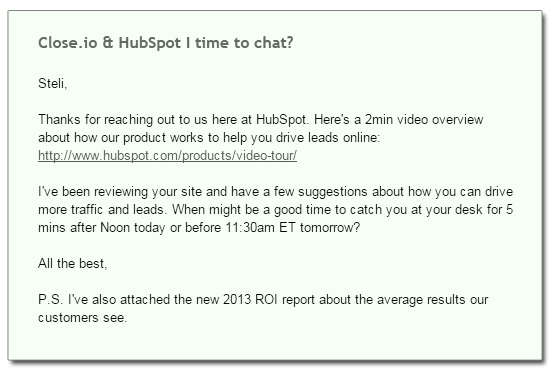
email-drip-hs1

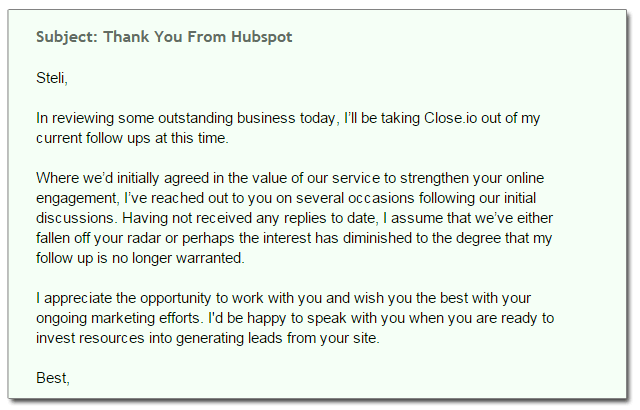
The second paragraph was most interesting to me. I signed up for their trial, and someone from their company tells me he reviewed their site and has suggestions. This does two things: a) it makes me want to reciprocate, because he's put some effort in (well, if I wouldn't know this to be an automated email...) and b) it makes me curios what his suggestions are.

It's also a plus that he suggestions two specific times to get on a call, and mentions that it's just 5 minutes.


EMAIL #2

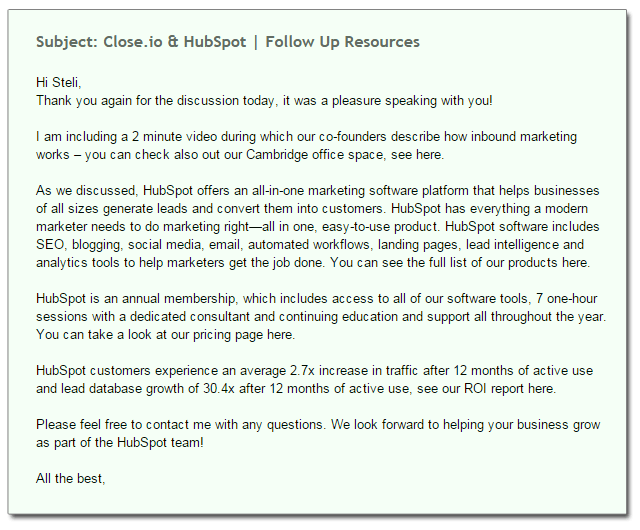
Subject: Close.io & HubSpot | Follow Up Resources  Hi Steli, Thank you again for the discussion today, it was a pleasure speaking with you!   I am including a 2 minute video during which our co-founders describe how inbound marketing works – you can check also out our Cambridge office space, see here.   As we discussed, HubSpot offers an all-in-one marketing software platform that helps businesses of all sizes generate leads and convert them into customers. HubSpot has everything a modern marketer needs to do marketing right—all in one, easy-to-use product. HubSpot software includes SEO, blogging, social media, email, automated workflows, landing pages, lead intelligence and analytics tools to help marketers get the job done. You can see the full list of our products here.   HubSpot is an annual membership, which includes access to all of our software tools, 7 one-hour sessions with a dedicated consultant and continuing education and support all throughout the year. You can take a look at our pricing page here.   HubSpot customers experience an average 2.7x increase in traffic after 12 months of active use and lead database growth of 30.4x after 12 months of active use, see our ROI report here.   Please feel free to contact me with any questions. We look forward to helping your business grow as part of the HubSpot team!   All the best,

This email is a bit longer than what's common for drip emails, but in this case that's a good thing. Many HubSpot customers are companies with 50+ employees, and these numbers can help them sell HubSpot within their own organization. It also hits right into the sweet spot of what most people who are considering HubSpot probably want to know about.


EMAIL #3

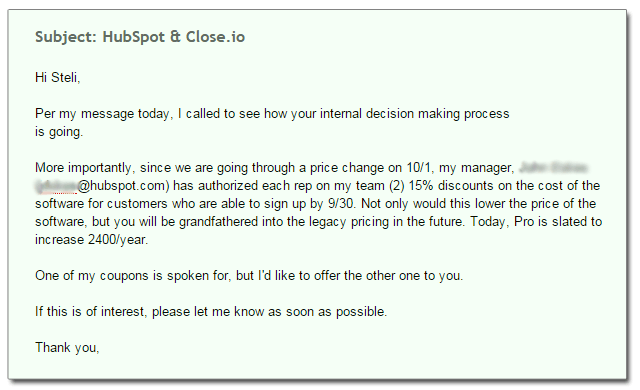
Subject: HubSpot & Close.io Hi Steli, Per my message today, I called to see how your internal decision making process  is going. More importantly, since we are going through a price change on 10/1, my manager, John Doe (xxxxxx@hubspot.com) has authorized each rep on my team (2) 15% discounts on the cost of the software for customers who are able to sign up by 9/30. Not only would this lower the price of the software, but you will be grandfathered into the legacy pricing in the future. Today, Pro is slated to increase 2400/year. One of my coupons is spoken for, but I'd like to offer the other one to you. If this is of interest, please let me know as soon as possible. Thank you,

If I'd have sincere buying interest, the prospect of saving thousands of dollars would be a strong motivator to get me to act now, it creates urgency.


EMAIL #4

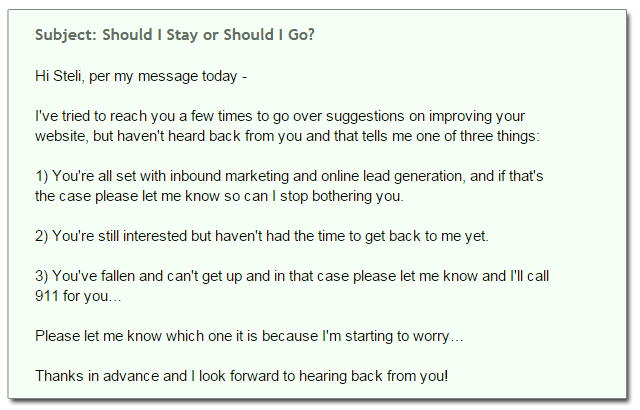
Subject: Should I Stay or Should I Go? Hi Steli, per my message today - I've tried to reach you a few times to go over suggestions on improving your  website, but haven't heard back from you and that tells me one of three things: 1) You're all set with inbound marketing and online lead generation, and if that's  the case please let me know so can I stop bothering you. 2) You're still interested but haven't had the time to get back to me yet. 3) You've fallen and can't get up and in that case please let me know and I'll call  911 for you… Please let me know which one it is because I'm starting to worry… Thanks in advance and I look forward to hearing back from you!

This email is already pretty good by itself, and it has just the right amount of humor to elicit response, but what it really does is it sets the scene for the next email...


EMAIL #5

Subject: Thank You From Hubspot Steli, In reviewing some outstanding business today, I’ll be taking Close.io out of my  current follow ups at this time. Where we’d initially agreed in the value of our service to strengthen your online  engagement, I’ve reached out to you on several occasions following our initial  discussions. Having not received any replies to date, I assume that we’ve either  fallen off your radar or perhaps the interest has diminished to the degree that my  follow up is no longer warranted. I appreciate the opportunity to work with you and wish you the best with your  ongoing marketing efforts. I'd be happy to speak with you when you are ready to  invest resources into generating leads from your site. Best,

Now this is a killer email. It's commonly referred to as a "breakup email", and we'll get into a bit more depth about what makes them work later in this article.

What’s the purpose of these five emails? 

Think about this question before you read on. What are they trying to achieve with each and every of these emails?

The call to action is always the same: they want you to respond!

If this seems ridiculously obvious to you, congratulations - but you’d be surprised how many people try to cramp too many different call to actions into their emails. 

The purpose of every email is to get a response. HubSpot wants to keep the relationship going. They want to turn a silent trial user into an active prospect with whom they can build a relationship. 

The basic structure and psychology of these emails:

  1. Hey, welcome, here’s some information. When can we talk?
  2. Hey, here’s some more information. Contact me!
  3. Hey, if you reply now you can get it cheaper.
  4. I’m really putting effort into helping you, and you’re not getting back. Contact me.
  5. Ok, that’s it, it’s over. You obviously don’t want me, so I’ll stop wasting both our time. Goodbye.

Out of these five emails, the last one is the most effective. 

Now let’s look at a really big and successful company with a completely different audience

TrunkClub's email drip campaign

TrunkClub is a very successful B2C online fashion company. They made so much money that Nordstrom acquired them in 2014, and they have great marketing.

Here are the emails they sent me after I signed up.

EMAIL #1:

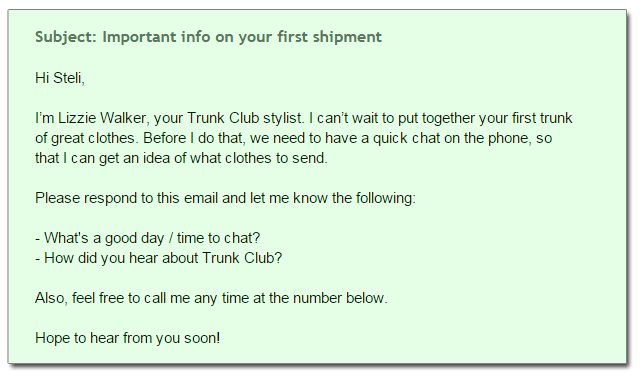
Subject: Important info on your first shipment Hi Steli, I’m Lizzie Walker, your Trunk Club stylist. I can’t wait to put together your first trunk  of great clothes. Before I do that, we need to have a quick chat on the phone, so  that I can get an idea of what clothes to send. Please respond to this email and let me know the following: - What's a good day / time to chat? - How did you hear about Trunk Club? Also, feel free to call me any time at the number below. Hope to hear from you soon!


EMAIL #2:

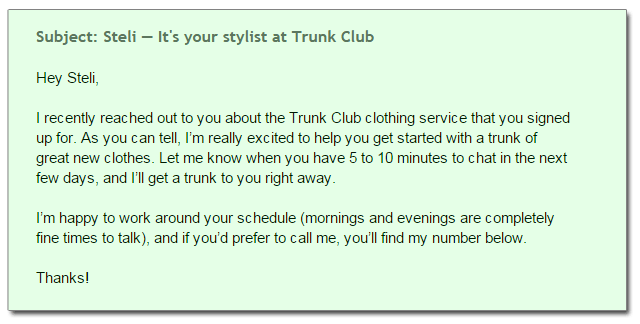
Subject: Steli — It's your stylist at Trunk Club Hey Steli, I recently reached out to you about the Trunk Club clothing service that you signed  up for. As you can tell, I’m really excited to help you get started with a trunk of  great new clothes. Let me know when you have 5 to 10 minutes to chat in the next  few days, and I’ll get a trunk to you right away. I’m happy to work around your schedule (mornings and evenings are completely  fine times to talk), and if you’d prefer to call me, you’ll find my number below. Thanks!


EMAIL #3:

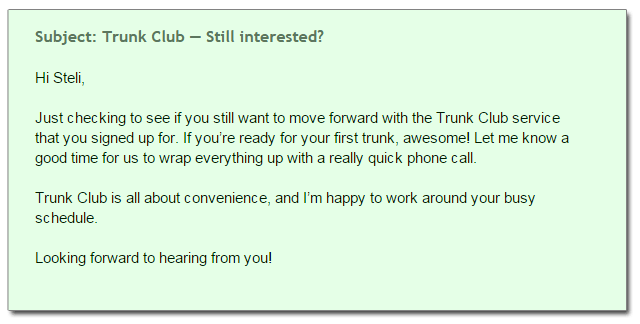
Subject: Trunk Club — Still interested? Hi Steli, Just checking to see if you still want to move forward with the Trunk Club service  that you signed up for. If you’re ready for your first trunk, awesome! Let me know a  good time for us to wrap everything up with a really quick phone call. Trunk Club is all about convenience, and I’m happy to work around your busy  schedule. Looking forward to hearing from you!


EMAIL #4:

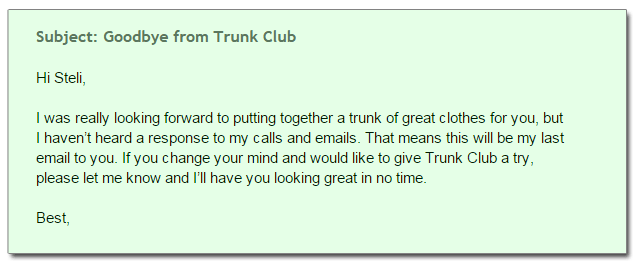
Subject: Goodbye from Trunk Club Hi Steli, I was really looking forward to putting together a trunk of great clothes for you, but  I haven’t heard a response to my calls and emails. That means this will be my last  email to you. If you change your mind and would like to give Trunk Club a try,  please let me know and I’ll have you looking great in no time. Best,

As you can clearly see, this email drip campaign has the same structure, and also ends with a breakup email. 

The breakup email

Why is this last email so powerful in the sequence?

Because it utilizes the principle of loss aversion. Your trial signups (just like all other people) strongly prefer avoiding losses to acquiring gains. It’s a well-known principle in psychology; losing $100 will make you feel more miserable than winning $100 will make you happy.

By taking away the marketing automation software or our trunk of great clothes, they make us desire it more.

Customize this sequence for your own drip campaigns and utilize the principle of loss aversion if trial users don’t respond. Do it in your own way that best fits your target audience.

Focus on writing effective subject lines. Both HubSpot and TrunkClub could probably improve their open rates with stronger headlines.

Constantly measure the effectiveness of your open and response rates. This is very easy to do when you send emails from Close.io - we not only show you who opens individual emails at what time, but you can also quickly get a big picture overview of your overall open and response rates.

You’ll probably find that using the structure of these 2 email drip campaigns will help you schedule more calls, just like it does for HubSpot, TrunkClub, and many others.


Further reading:

Sales emails - Convert more trial users with drip campaigns 
4 simple principles of an effective SaaS trial email series: Get the frequency right, be personal, send emails in response to user-activity and include a clear and strong call to action in every email.

Expert webcast recording: Drive sales engagement with triggered emails (with Colin Neederkorn, CEO of Customer.io)
The full 1-hour recording of how to automate personal, well-timed emails to close more deals.

How to write subject lines that get your sales emails opened
Want to increase your open rates? Don't blindly follow the wide-spread advice you find online. Here's what really gets sales emails opened...

20 Feb 18:42

5 Questions to Ask Before Creating Marketing Videos for a Tech Company

by Steven Beller

Floating-head-for-GIF-1

Coming up with video marketing strategy takes more than just an idea; it takes time, people, creativity, experience, an understanding of the audience and topic and, of course, talent. Plus there are several challenges marketers in the technology world face: sophisticated products that need to be explained in 60 to 90 seconds, an intangible solution and a long list of competitors.

So before you throw your resources out the window, here are few helpful questions you might want to ask yourself before diving in to video marketing for your technology company.

1. Why am I making a video?

This should be the most important question you ask yourself. If your video doesn’t have a purpose then you shouldn’t make it. If you are just putting videos out to stuff your YouTube channel or because everyone else is making videos, then you should take a step back to reevaluate your video marketing strategy.

Technology companies may create videos to explain how their solutions work, the benefits of the software, how to use the software or perhaps how the solution fits into different industries.Whichever, reason you choose, make sure it is clear in your script and production.

At Kuno, before we ever start planning a video, we ask ourselves, “What is the purpose of the video?” In order for us to stay on track with our goals, we created specific categories on why we create videos. Not only does it give us a clear vision, it also helps justify using company resources. These categories include:

  • Build brand awareness
  • Educate our customers
  • Show our culture and creativity
  • Employee Training

If a video doesn’t fit into one of these four categories then we don’t make it. It’s important to have purpose and goals when creating a video. Without this sort of direction, it will be difficult measure your project’s success or failure.

Bonus Question: At this point, you will also need to determine if you are capable of making the video inhouse or if you will need to hire a professional. You don’t want to get too far into your video and realize you don’t have the talent or resources to complete it.

2. Who is my audience?

I bet you’ve heard this one before, right? The funny thing is, even though you’ve probably heard this a million times, once you get into the thick of creating a video, sometimes, your audience is the last thing you are worried about. I know I’m guilty of this, so I don’t expect anyone else to be perfect.

I’ve found the best way to make sure you don’t miss this step is to have a team of creative people working together to come up with ideas and strategy. You’ll be amazed at what can come out of a 30-minute brainstorming session and how you can speak to your audience in new and creative ways.

3. What is my company voice?

Once you have figured out the purpose of your video, you need to figure out how you want to be perceived on video. Do you want your company to be serious, funny, light-hearted, vulgar, sensitive, caring, excited or something else entirely? As a technology company, you may have the flexibility to lean more toward entertaining your audience with humor or language that pushes the limits, but only if this has been determined ahead of time and is included in other corporate communications.

Is your video an animated or live action video? Do you want a male or female voiceover? Can the marketing video use sarcasm or should it remain entirely professional? These are all things you need to think about when determining your technology company’s voice.

4. Where will the video be hosted?

Are you going to post it on Youtube and hope people will watch it? Are you going to upload it to Facebook so your close friends and family can give it a “thumbs up”? Or are you going to strategically place it on your website or social media channels so it will help guide your potential customers down the sales funnel and convert them into qualified leads? Hopefully you are thinking like me and will be placing your video in strategic locations across the web to get the maximum return on your video investment.

Videos are meant to help people digest information quickly and more efficiently, so why not use a video in place of a bunch of text on your website or use it in an email blast. Remember, emails with a video link have a higher click through rate than emails without video.

5. How will success be measured?

You’ve created your video, and you’ve placed it on your website. You’re promoting it on social media and YouTube…so what’s next? Analytics!

Make sure you are keeping track of where your new leads are coming from and if your video is doing well on social media. Hosting your video on Wistia can help you determine if your video is doing well or not. If you don’t have a way to track these metrics, then have your sales staff ask your new leads this simple question: “How did you hear about us?” You would be surprised at how much you can learn by their answers.

There is alot that goes into coming up with a video marketing strategy for technology companies, but don’t be discouraged when you come to a road block. If you ask yourself these questions before you start writing your script, you will notice your project will go more smoothly.

What other questions should technology companies ask before shooting a marketing video? Share your answers in the comment section below. 

20 Feb 18:42

How To Improve Engagement And Sales Performance

by Ryan Estis

How to Improve Engagement and Sales PerformanceI recently partnered with Modern Survey on a new employee engagement study. Our research found that salespeople are much more engaged than non-sales employees.

While salespeople are more engaged than non-sales employees, they’re still looking for other opportunities. Our research found that 23 percent of sales people are actively looking for new jobs. Imagine losing one top producer — and now imagine losing ten. What if you lost a top producer directly to the competition? Feeling sick to your stomach?

How long would it take to recover from that kind of loss?

This data leads me to an obvious question: How can leaders create a culture where salespeople are engaged, performing above plan — and committed to staying?

Build a culture of engagement

The short answer: Culture counts. Everyone inside an organization contributes to building a culture of engagement. It starts at the top with senior leaders, is driven daily by managers, and employees make a choice about whether they’ll bring their best efforts to work consistently.

So where should you start?

As a jumping-off point, take a look at three important elements of a strong culture: values, trust, and consistent communication.

Values

According to Modern Survey research from last year, only 1 in 87 employees are fully engaged when they work for a company that doesn’t have clearly understood organizational values. And just having values isn’t enough. Leaders need to emphasize and reinforce the organization’s values to make sure they have an impact on the hearts, minds, attitudes and actions of salespeople. Values inform how to approach the work, customers and each other. A strong, value-based sales organization clearly has a huge advantage.

Trust

Employees who trust their direct managers and senior management are more likely to be engaged. It’s hard to move the needle on engagement and performance without trust. We have a trust deficit in corporate America where approximately half of all employees don’t have trust and confidence in their leadership.

A common characteristic of trustworthy leaders: They do what they say they’re going to do, when they say they’re going to do it, all of the time. Consistency counts! Everyone wants to work for someone they can count on to contribute, consistently. I was fortunate to experience working for that kind of leader for a decade and I learned a ton through his example. (Read what I learned from him about high-trust, high-value relationships: 9 Leadership Lessons From The Best Boss I Ever Had.)

Consistent communication

Selling is a team sport. In order to get people on the same page — and to help them connect to a shared vision — you need to consistently communicate that vision. That means being accessible, transparent and providing a clear and compelling game plan to deliver results.

In sales, it’s also important to communicate clear performance standards and expectations, and hold people accountable.

Sales leadership is all about results — for the team and the entire organization. The best leaders don’t make excuses and deliver their number, consistently. They own their outcome and have the ability and discipline to expect the same in others, creating a culture of performance and accountability. They give feedback, take corrective action when it’s required and have the courage to hold people accountable.

Have you clearly communicated what people can expect from you? Are you delivering on those expectations consistently? Start there. When you set a clear standard of personal contribution and deliver on it well, it becomes a lot easier to hold people accountable.

Understand what salespeople are looking for

Our research found that the top drivers of engagement for salespeople are, in order:

  • Confidence in senior management.
  • Opportunities to grow and develop.
  • Confidence in the future of the organization.
  • The belief that they work well as a team.
  • The feeling of personal accomplishment from work.
  • Knowing they contribute to the organization’s success.

Confidence in senior management

The top two drivers — having confidence in senior management and having opportunities for growth — show that there is still a lot of uncertainty about the future. Many salespeople want to know where the leadership is taking their organization. They also want to work for an organization that is going to invest in them and their skills.

Confidence in senior management goes back to the culture of engagement:

  • Do senior managers live the company’s values?
  • Do senior managers lead by example?
  • Do they establish trust by acting consistently?
  • Do they communicate regularly about the expectations they have for employees and the organization?

Opportunities to grow and develop

Having opportunities to grow and develop within the organization is also key. Salespeople are looking for training, growth opportunities, and a plan for development.

The myth is that it’s all about recognition when it comes to sales. This research shows that salespeople are looking for more than just compensation. Salespeople want to work for a company that knows where it’s going and that can provide them with opportunities to grow and develop. Culture counts!

Culture is a reflection of how we lead.

Looking for more inspiration? Read case studies and stories about sales engagement and leadership at best-in-class companies. Download the ebook “Leading Breakthrough Sales Performance.”

20 Feb 18:41

How to Use Video to Increase Sales Conversions

by guillaume@vsnap.com (Guillaume Delloue)

video_camera

Online video is big. Huge, even. Digital marketing firm Syndacast estimates that 74% of web traffic will be video in the next couple of years. Yet, a majority of companies fail to use this rapidly growing medium beyond the classic marketing video on their site’s homepage.

In 2015, video empowers savvy marketers and salespeople to increase conversions throughout the entire sales cycle. Win these four key conversion battles with video strategies. 

Convert Visitors to Leads: “How-To Videos” on the Blog

A video blog post can be a powerful top of the funnel tactic to attract visitors to your website and provide a unique content experience.

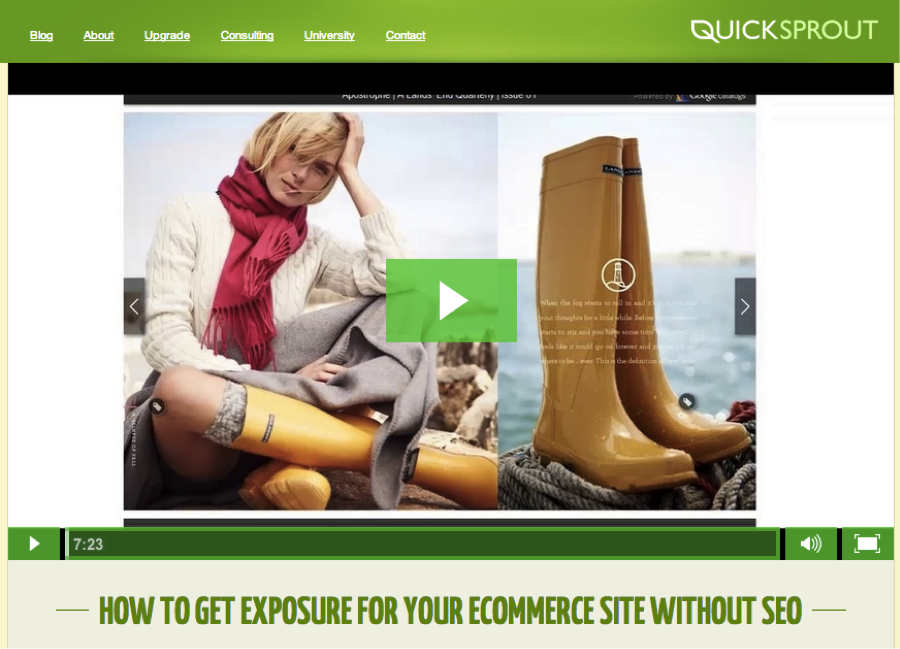
Take QuickSprout University for example. How To Get Exposure For Your Ecommerce Site Without SEO could have been a run-of-the-mill text blog post. But by making use of video, Neil Patel’s technical lesson is easier to follow and the information more easily digested. That’s because the flow of the editing leads the viewer down a set path.

Quicksprout

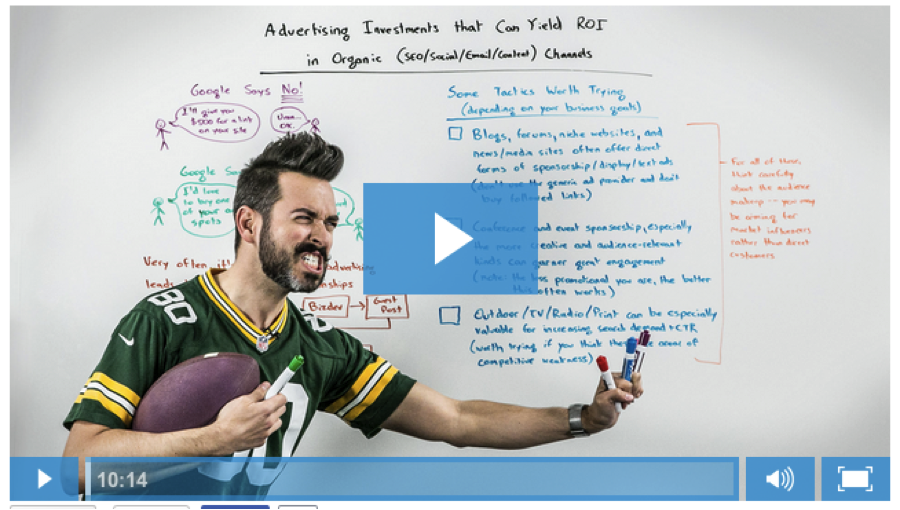
Or take Moz’s uber famous Whiteboard Friday series. First, Rand Fishkin is the kind of host who can make the driest topics fascinating (maybe it’s the mustache). Second, watching Rand feels like getting to know him personally, which makes Moz a more relatable and approachable brand. And third, it’s predictable. Every Friday I know where I can watch an inbound marketing digest and stay on top of industry trends. That helps build brand loyalty and increase referrals. Here's a screenshot of one of the most recent episodes.

Moz-1

Tips for Success:

  • Video by itself isn’t as powerful as text when it comes to optimizing for search. Consider including the transcript somewhere on the page.
  • Should you decide to host videos on your website, check out Wistia’s hosting solution as well as their learning center for DIY video recording tips.
  • Remember, you’re trying to convert visitors into leads. Include calls-to-action on the page and after the video ends (e.g. subscribe for more, video suggestions etc.).

Convert Leads to MQLs: Twitter Chats + Google Hangouts

Leads are buzzing around your company’s digital hives -- but how can you get them to stick around? Conquer your middle-of-the-funnel woes with the combination of a Twitter chat and Google Hangout. What’s the benefit of adding video? Well, traditional Twitter chats can lack focus; everyone’s loosely discussing a topic and the chat can get very noisy.

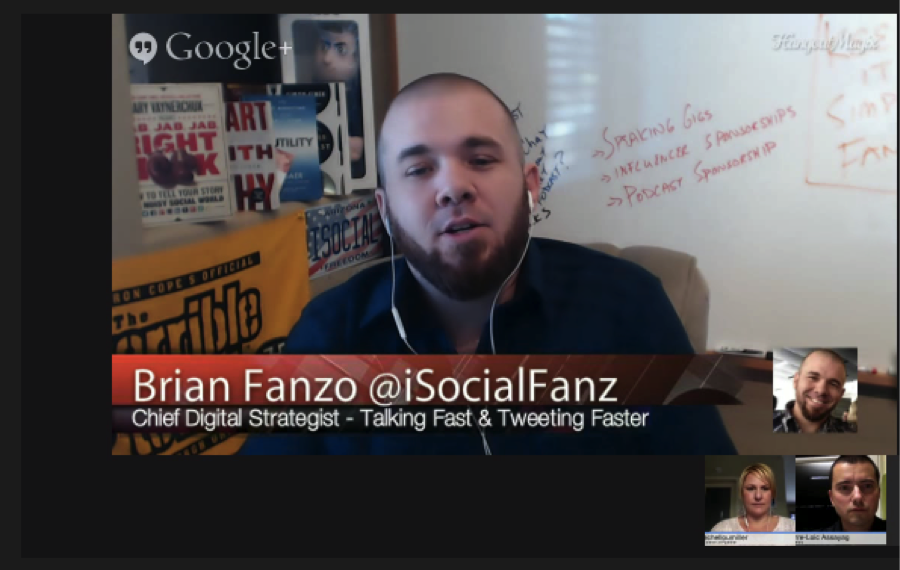
By using video, chats like Pipeliner CRM's #SalesEU and the incredibly popular #SbizHour hosted by Millennial CEO (pictured below), are able to anchor and guide the conversation in a more organized fashion. Every week they interview guests on their area of expertise through Google Hangout. Twitter then becomes a kind of live message board for participants to engage with the interview and start their own conversations.

 Brian_Fanzo

Although similar to a webinar, this method is easier to set up and doesn’t require expensive software, not to mention the whole event is captured within Twitter. Plus it retains the unpredictability and energy that make the best Twitter chats so fun. It’s a great way to further educate prospects and prove your worth as a trusted resource.

Tips for Success:

  • Send reminders to past participants ahead of the chat.
  • Pull questions/comments from the chat and mention them on the air. It gives the community a sense of ownership.
  • Take full advantage of Google Hangout’s features -- use calendar invites, save the video on YouTube, and create a Google+ page for your video series.

Convert MQLs to Opportunities: Video Messaging

Something special happens when a lead becomes “sales qualified.” It’s the moment when the salesperson takes over and the conversation with the buyer become truly personal. Not “personalized,” mind you, but one-to-one, person to person.

That transition is complex. After all, someone can love your content and not be the right buyer. Someone can be fully qualified and still not want to buy your solution. So many steps stand between initial interest and the final “close” that bridging the gap can be very difficult.

Enter video messaging apps like Vsnap or Movy. When you get a qualified lead, simply record a quick video message that speaks specifically to that person. Here’s an example of one I sent to Emma:

vsnap

Because it’s asynchronous, the lead can watch the video on her own terms. This lets the seller introduce tone and trust even before the buyer has chosen to directly engage with Sales. And because it’s recorded for that person only, the experience feels personal and human in a way a text message cannot be.

Whether you’re trying to move the MQL to a discovery call or move the SAL to a demo -- video messaging is proven to increase conversion rates and accelerate the conversation to a close.

Tips for Success:

  • Keep your video message natural and non-scripted. 
  • Say the person’s name at the beginning and end of the video. Everyone loves to hear their own name.
  • Create triggers to measure your efforts -- every time the lead does X, send the video message in order to achieve Y outcome. You can’t improve without data.

Convert Opportunities to Customers: Video Calling

Once there’s real interest from a buyer, the salesperson’s skills become more important than ever. You may need to overcome objections, explain the solution in detail, challenge expectations, or negotiate price. Synchronous video can now come into play. It allows for more meaningful conversations and helps you build a real relationship with the buyer.

If you’re selling a software solution, demo the product with a video app like LogMeIn or Zoom. The buyer needs to see how it works and be able to ask questions in real time. And even if you’re not selling software, showing a few slides can make it easier to get your point across than a simple phone call. In situations where seeing the other person is important, Skype is free and easy to use.

Tips for Success:

  • A video call isn’t a time to dress inappropriately. Look professional and treat the moment as if you were meeting in person.
  • Make eye contact with the camera -- it makes the conversation seem more natural.
  • Be conscious of background noise when you start your call. With today’s open office plans, it’s worth taking a minute to find a spot that will stay reasonably quiet throughout your call.

How do you use video in your sales process, if at all? Let me know in the comments.

get the free hubspot crm

20 Feb 18:30

Lead Generation Methods With LinkedIn

by Susan Gilbert

How To Build More Leads With LinkedIn

How to Build More Leads with LinkedInWould you like to generate more leads from social media in addition to bringing leads to your website?

Want to know how to greatly increase your sales opportunities?

One word will answer those questions: LinkedIn

LinkedIn is a premier social network for connecting with professional influencers, but when done properly it can become a powerful social selling tool for your brand or business.

In order to encourage more activity it’s important to engage your network and provide meaningful feedback. There are several ways to reach more connections and attract them to what you have to offer.

Personalize your messages

Instead of a generic InMail or invitation, create a personalized message that shows your contacts that your business is interested in them. This is far more effective than a mass email that appears like a sales pitch. If your business is a part of any professional groups this is a good place to start when building your network and introducing yourself.

Here’s an example of a professional, and friendly invitation from one of my professional group members on LinkedIn:

LinkedIn-InMail How to Build More Leads with LinkedIn

Follow up with new connections

Have you ever sent out invitations on LinkedIn, but forgot to thank your new connections? This is a perfect time to create another personalized message that lets them know more about your business, and how you can meet your needs. If you are offering any free tips, reports, videos, or specials provide them with something special. More often than not these contacts will respond. Create a message and save this as a rough draft then customize it to each new connection.

Keep the ambers burning

Now that your business has reached out to your new network and they have responded favorably mark it on your calendar to follow up with them on any questions they might have. This could also be a good time to let them know about a great event, new product launch, or to find out what their needs might be for their business.

LinkedIn followup How to Build More Leads with LinkedIn

Not only does a message like this show that your an expert in your market, but it opens to the door to offer something of value. This can create more subscribers to your business website who can be converted into customers. Be open to any questions they may have, and keep track of all of your communication being sent out with alerts set up on LinkedIn.

Respond to daily activity

In addition to the methods above you can increase your business’s chances of creating new leads through thoughtful interactions in professional groups without the use of a sales pitch or too many links. Also check your status updates for any posted articles that you can comment on and share on social media. It’s a good idea to also be creating these, and soon new connections can be made as your networks sees your latest news.

The key to attracting new leads for your business on LinkedIn is to open the doors of communication in a way that is professional, knowledgeable, helpful, and friendly. As you begin to contribute your own content and participate in groups your InMail messages and replies will garner a more favorable response.

LinkedIn is one of the most valuable social networks for joining forces with other professionals in your niche, creating new prospects, and showcasing your business’s knowledge and expertise.

19 Feb 19:59

Big B.C. roofers get into the solar panel business

‘Solar energy has reached a point of cost effectiveness,’ Penfolds exec Ken Mayhew said.
19 Feb 19:41

The Six Inches Between Your Ears!

by Hugh Liddle

imagesHey there! Yes, THE Sales Wizard is back after taking a long break from blogging to finish work on an awesome new online sales training course called Elite Sales Academy. CLICK HERE to check it out!

Today I’d like to talk with you about mindset. Sales, business and really everything in life, is primarily a game that’s played in the six inches between our ears. What you believe about yourself, your business and your product or service will determine your success (or lack of it).

What do you believe about yourself? Do you believe that you’re capable, talented, creative, valuable and the kind of person anyone would love to have a conversation with? Do you see yourself as someone God created for a destiny of greatness? Do you believe you are deserving of wealth, happiness and love? Or do you think you’re just average and that you’ll never really do anything noteworthy? Or maybe do you even think you don’t deserve success? What you believe about yourself will come to pass. So get your mindset in success mode!

What do you believe about your business? Do you believe that your business is the very best? Is your business goal to serve and bless others? Are you 100% proud of the service you render to your customers or clients every day? Do your employees feel that they’re valued and well treated? Or is your focus simply to make as much money as you can no matter how others are affected? Or are you afraid that your business isn’t going to be very successful and that you’ll probably fail? As you believe, so shall it be!

And what do you believe about your product or service? Do you believe that what you offer is the very best buying decision that your ideal clients could possibly make? Do you believe that your pricing is not only fair but an incredible value for those buying from you? Are you completely proud of your product or service? Are you willing to stand behind your product or service, deliver even more than was promised, be there to take care of any challenges that might arise? Or do you kinda think you’re overpriced and that what you’re selling isn’t really worth what you’re asking people to pay? Are you scared to death to check in with your clients regularly and make sure they’re satisfied because you’re afraid they’re going to be unhappy with your product or service?   If you don’t feel good about what you’re offering, fix that today!

Yes, what we believe about ourselves, our businesses and our products and services is critical. Spend some time this week thinking about how you really feel about these areas. Make the changes you need to make so you can be confident in all three.

Good Selling!

Hugh

THE Sales Wizard at

Elite Sales Academy, Elite Business Academy, Red Cap Sales Coaching

You can learn to make selling easy, fun and profitable!

sales wizard 3Elite Sales Academy Logo2Elite Business Academy Logo

The post The Six Inches Between Your Ears! appeared first on Red Cap Sales Coaching.

19 Feb 19:41

How To Set The Right Price Every Time

by Roger Dooley
Exactly how to price products is a big challenge for marketers, but new research provides valuable direction in this complex decision-making process. It isn’t just “big picture” pricing, like establishing margins and an overall price point, that bedevils marketers. There [...]
19 Feb 19:40

It’s All About Engagement in the Next Era of Marketing

by Sanjay Dholakia

Engaging Customers As Individuals

When we first started this series on the next era of marketing, we brought you the marketing pundit point of view through conversations with visionaries like Seth Godin and Aditya Joshi, but only recently did I discuss your opinions on the future of marketing. We asked the Economist Intelligence Unit to survey nearly 500 marketers and then shared the results on the many observations about marketing’s future, including organizational change and technology advancement.

But to kick off our deep dive into all of the interesting data from the survey, I want to pause and talk more about one of the key concepts to emerge from the research—engagement.

Every marketing team’s goals are to bring in new customers, grow their lifetime value and convert them into brand advocates who can influence their network to become new customers. But today’s constantly-connected world of digital, social and mobile has changed the way customers behave— and, consequently, how brands need to speak to their customers and prospects. As brands evolve, they’re learning that engagement is the critical next step. If they’ve not already started, brands are starting to shift from an era of mass marketing and advertising—where we talk at people for a single moment in time—to an era of engagement marketing where we begin to take time to learn more about our customers on a personal, individual level and engage with them over a lifetime.

A New Definition of Engagement

An interesting foundational fact that emerged from the survey, was the shifting definition of what it means to “engage” someone as a marketer going forward. Engagement used to be bandied about in terms of the emotional connection or quotient that a brand was creating with customers. How do they feel about you and your company? Did the Super Bowl ad with the puppy make them cry? Were they engaged?

That all seems to be becoming the horse-and-buggy version of marketing (while of course still being incredibly cool). The new definition of engagement marketing seems to be broader, more strategic, and more oriented toward the bottom-line. Amongst marketers in the survey, the term engagement seems to have a decidedly action-oriented focus—asking questions like, “are we driving purchases, renewals, and revenue?”. Here are some interesting statistics:

  • 63% of marketers view engagement as customer renewals, repeat purchases, and retention.
  • 78% of respondents think engagement occurs in the middle or end stages of the marketing funnel.
  • 22% of marketers consider customer engagement to be a brand awareness tool.

Only about 20% of marketers seemed to define engagement as a top of the funnel awareness or emotional brand building tool. The reality, of course, is that if real engagement exists to drive purchases and renewals, there must be an emotional connection at some level. Engagement, it appears, has ascended from an emotional destination at disconnected moments in time to something that happens over a long period of time to drive business outcomes.

The Shift Towards Engagement Marketing

When we asked marketers what their top areas of investment were likely to be over the next 12 months, the #1 answer was “Shift to Digital Marketing and Engagement”. Engagement marketing is more than a series of transactions or click-through rates, it means building a real individual relationship, floor by floor, continuously over time, seamlessly across all of the channels and devices they use. It means paying attention to your customer and observing what they do, learning what they like, learning what they don’t like and guiding a journey that helps them get where they want to go (in a way that is consistent with your own business goals). Your approach and enthusiasm for your relationships with customers should channel the same approach and feelings you have when interacting with a friend in your personal life.

Think about it: would you want to interact with a friend or person that is difficult to get a hold of, or never listens to you, is always talking about themselves, or is always stereotyping you based on just a few facts? Chances are, you wouldn’t want to keep giving business to a company that does those same things. On the other hand, when a company treats me the same way my friends seem to treat me, I can’t wait to give them more business.

For example, emails from Amazon are relevant and helpful to me because they include smart recommendations based on my previous purchases—and because these products are clearly in line with what I’ve liked in the past, I look forward to hearing from Amazon on a regular basis. I get an email that says, “Hey Sanjay, just wanted you to know that those boots you were looking at just went on sale.” And, what do I do? I buy the boots and say “thanks so much for letting me know”!

In a conversation with Seth Godin, he stressed the value of direct interactions with clients. While other departments can also provide insight, nothing is quite as valuable as direct feedback from customers using your products. Brands can now better track these insights and interactions across multiple channels thanks to the growth of marketing technology.

I think, ultimately, this will become the new basis of competition. It used to be that firms competed on price—then, they competed on brand awareness—then, they started competing on experience (think, “my visit to Starbucks today”). But, now as customers increasingly want companies to get to know them and continue to advance the relationship, they will choose brands (and more specifically, people at those brands) that engage with them most effectively. Those companies will win, and the others will lose.

Engagement is Putting Marketing in the Driver’s Seat

The function that owns engagement within organizations is quickly changing. Our survey of marketers revealed that 75% of CMOs and senior marketing executives expect to own end-to-end customer engagement for their companies as the steward of the customer journey in the next three to five years. That’s up from just over a third who say they have that responsibility today! That puts marketing squarely at the center of revenue generation and company strategy.

This is a giant and bold claim, and probably a little controversial too. But, I don’t see how it doesn’t happen if the goal for a company is to build a continuous, ongoing relationship with someone that shows them that we understand the broadest context of our relationship together. As a company, I want the people in functions like sales and service, for instance, to be very transactionally focused on creating a delightful experience for the customer in a single moment. I actually don’t want them spending their time thinking about the broad relationship and the arc of future interactions as that might compromise their ability to deliver right now for the company and the customer. Marketing will be uniquely suited to get above the transactional focus that is necessary in other functions—working in strong coordination with them—but, as the architect of the overall journey.

It’s an exciting time to be a marketer because we get to have a closer relationship with customers and prospects than companies could in the past.

How do YOU define engagement? I’d love to hear your thoughts in the comments below. And if you’re just joining us, learn what nearly 500 marketers see as the future of marketing, or read thoughts from visionaries like Gavin Heaton, Jim Stengel and John Hagel. Next week, we’ll talk about exactly how to bring the marketing department to the front of the customer engagement process.

19 Feb 19:40

All the other places Russia would be able to trigger a crisis in

by Stefano Pozzebon

Fat man with globe

Although the world's attention is focused on the eastern Ukrainian steppe of the Donbass, where a frail ceasefire seems to have collapsed after Russian separatists took control of the key railway town of Debaltseve, there are many other places where the Russian bear might set its eyes sooner or later. 

Russian interests abroad tend to fall into at least one of two (non-mutually exclusive) kinds: ethnic and economic. 

Vladimir Putin on Crimea — "Ethnic similarity, a common language, common elements of their material culture, [and] a common territory."

Russians in Georgia FlagThe Kremlin makes significant efforts to support Russian communities abroad: last year, Russia issued a law requiring all citizens with a double passport to declare themselves and their other nationality to the authorities but Russians residents abroad were exempted, together with the citizens of Crimea.

Vladimir Putin himself has repeatedly declared that his Government is committed to defending the interests of Russians abroad, up to the point of writing it among the top priorities of its foreign policy.

In 2006, a Russian foreign ministry official declared that up to 30 million of Russians live abroad, most of them due to Soviet citizens with Russian roots who ended up outside Russia at the collapse of the Soviet Union.

Former Soviet states are collectively known in Russia as "the Near Abroad," and most of them are still closely tied to the Russian Federation. Ukraine is the most obvious example, but there are also big Russian communities in Kazakhstan, Moldova, Georgia, Estonia, Latvia and Lithuania. 

Politically, most of these countries are also part of the Commonwealth of Independent States (CIS), an alliance of former Soviet republics with close political ties to Moscow. 

The NPR's Alyson Hunt pulled out an excellent map to help understand the issue:

map soviet republics 624

The issue of Russians in the Baltic countries is particularly sensitive: Latvian Russia claim that they are frequently discriminated against, while in September last year a member of the Estonian internal security service was kidnapped by Russian forces in what was seen as an attempt to put pressure to the Estonian government. At the time, Estonia's president Hendrik Ilves said that the move recalled "the kind of behaviour we noticed on our borders before War World II."

Estonia, Latvia, and Lithuania are now part of both Nato and the European Union, something that Russia sees as a direct aggression to its sovereignty: back in 2005, Gleb Pavlovski, a Kremlin political consultant, said in a press conference that Russia does not intend to witness its influence on the Baltic fade away:

"The admission of some of these countries to the European Union and NATO does not mean that they fall out of the area of our interests. The Baltic states are certainly within this area of interests, particularly on such issues as transit or the status of the Russian language and Russian community." 

In the same press conference, which took place ahead of a meeting between Putin and then US president George W. Bush, Pavlovski described what Moscow considers a model ally:

"We are totally satisfied with the level of our relations with Belarus. Russia will clearly distinguish between certain characteristics of a political regime in a neighbouring country and its observance of allied commitments. Belarus is a model ally."

Medvedev and Abkhazia region presidentAnd Ukraine is not the only example of Russia intervening in a neighbouring country's conflicts using the threat posed to ethnic Russians as a pretext to send in troops.

In 2006 Russian tanks invaded Georgia to support the secession of South Ossetia and Abkhazia, two Russian dominated provinces that were seeking independence from Georgia. While the Russian army maintains a 1,200 soldiers base in Transnistria, a separatist region of Moldova that is not recognised by the international community since it declared independence following the break up of the Soviet Union 23 years ago. 

Kazakhstan, Kyrgyzstan and Uzbekistan, three other countries of the former Soviet Union with large Russian populations, have remained sufficiently within the Russian orbit of interest to cause any tension. According to the Kennan Institute, an American research centre on Russia and Central Asia, in the last 15 years "Russia’s 'colonial' domination of Central Asia became involuntarily transformed into a practical fact." 

Yet while ethnic interests abroad seem to be confined to countries bordering Russia or at least close by, the country's economic interests abroad covers much more ground. 

Russian economic interests abroad are mostly about cash and gas. Lots of gas. 

Russian foreign investments amounted at almost $120 billion in 2012, according to CEIC, a data research institute based in London. And one trend can be clearly seen: Russians tend not to invest in the 'Near Abroad,' while rather preferring tax haven safe areas in the West. 

Out of the top 10 investment destinations from Russia, only two, Ukraine and Belarus, are part of the CIS. The vast majority is invested in western European countries like the Netherlands, Cyprus and Switzerland.

Russian Investments Abroad 2012

Despite their Cold War enmity the United States is present on the list, although perhaps less prominently than its share of the global economy would suggest. Overall Russian investors appear to have remained confident that European banks can offer them better (or at least safer) returns than keeping their money at home, despite the recession in the Eurozone. In this sense, the presence of small countries with a out-sized financial sectors on the list such as Geneva, Zurich and Luxembourg is easily explained.

Shell and Gazprom But as the graphic above shows, it is the Netherlands that has received the most Russian cash in the last years. Russia Beyond the Headlines estimates that Russian investments in the Netherlands has totalled more than $30 billion, the largest amount of any European country.

These investments have overwhelming been focused on the energy sector: the Netherlands imported 2.9 billion m³ of natural gas from Russia in 2012, while Russia needs access to Dutch ports in order to ship its oil to the international market.

Gazprom, Russia's state-owned gas company, has struck a number of joint partnership deals with Dutch companies both for the production and shipping of natural gas

However, these close ties have loosened somewhat over  the past year following the introduction of sanctions against Russia over its role in the ongoing the crisis. The sanctions have caused Russo-European trade to slump with Russian imports from Europe falling by 13% and exports to the Eurozone down 10% in 2014, according to Eurostat.

Nonetheless, Europe remains by far Russia's largest economic partner, and most of its countries hold a negative trade balance, meaning that they import more from Russia than they export to the country. 

Here is a chart from the latest figures available at Eurostat

Trade Balance Euro Russia

European imports from Russia can be summed up by just two words: oil and gas. More than three quarters of total imports are mineral fuels, according to the BBC, while Europe's exports to Moscow are more varied. Europe's never ending dependency on Russian gas is a major reason of concern

But Russia isn't resting on its laurels when it comes to its natural resource bounty either. Russia is attempting to lay claim to land in the Arctic Region in order to secure large oil and gas resources that it believes abound under the ice. 

According to the Economist, the Arctic is currently a frozen conflict where "everyone has an interest in minimising conflicts and amicably settling those that crop up," but his summer Russia conducted military operations there for the first time since the end of the Cold War, and more recently it has re-armed some of the military bases in the region that went dismantled after the collapse of the Soviet Union

On top of bank and energy investments, Russian money has also flooded into European real estate, with the UK (and London in particular) a favourite investment destination for Russia's rich. But again, the falling ruble has forced many Russian property investors out of the market, at least in the British capital.

So far Russia has been on the losing side in the tit-for-tat sanctions with the European Union. Dragged down by falling oil prices, the ruble has lost almost half of its value against the dollar, and Russian sanctions against European imports didn't seem to hurt their trading partners half as much as they have worsened the situation at home.

Yet with Europe still getting up to a third of its gas from Russia, the Kremlin significant leverage in the event of an increase in tensions.

Cyprus: the perfect storm?

Russians in Cyprus LimassolOf all the European countries none are as deeply dependent on attracting Russian interest as Cyprus.

The small Mediterranean island made headlines after it was reported that Russia was opening a military base on its shores. The deal was later denied, but Russian money is still a crucial driver of the island's economy.

Cyprus is the second most popular European destination for Russian investors (see the chart above). When the island's banks were collapsing in 2012, Russia offered (somewhat mischievously) to extend the country a credit line, after it had already lent €2.5 billion (£1.85 billion) the year before.

The deal didn't come through, and Cyprus was bailed out by the Eurozone and the International Monetary Fund. As a result, in 2013 the country introduced a tax on bank deposits above €100,000 (£73,000).

Despite being among the biggest losers in the bank crisis, Russian investors did not flee the country. "The government will offer them [the Russians] incentives to stay put," a Cypriot entrepreneur that works with Russian investors told the Global Post at that time.

In 2013, the government set up a scheme to give shares of its biggest bank, the Bank of Cyprus, to Russian investors hurt by the tax levy. Of course, their plight might have landed on sympathetic ears as the biggest shareholder in the bank is Russian oligarch Dmitry Ryobovlev.

It wasn't the first favour the authorities have done for its Russian visitors. Three years earlier, a Russian spy who was alleged to have been involved in operations in the US was released on bail by Cypriot police and promptly disappeared, much to the astonishment of American authorities.

On February 25 the Cypriot president Nicos Anastasiades will meet Putin in Moscow. The Cyprus Mail has ruled out the possibility of any move involving the use of a military base on the island, but has hinted that the governments are about to forge a significant new pact.  

As a lasting resolution for Ukraine continues to elude negotiators, Russia's efforts to court smaller nations in its vicinity is a trend that the US and EU should keep a careful eye on. 

Join the conversation about this story »

NOW WATCH: This Chinese man can draw a life-like portrait of Vladimir Putin on an egg

19 Feb 19:40

Demystify & Define Your Marketing Strategy

by Rajiv Kapoor
Define your Marketing Strategy

Author: Rajiv Kapoor

When I recently visited Marketo headquarters, my buddy asked me what I was working on, and I told him enterprise consulting in a strategic role (as opposed to more of an implementation role)—to which he responded, “so, what exactly are you doing?”

That encounter made me realize that sometimes, strategy is clear and other times it is hazy, like the fog that led my buddy to not really understand what I was doing in my current role.

So I decided to write a post all about giving clarity to strategy—so it has a rightful place in both your mind and in your engagement marketing.

Let’s start by defining strategy, and then I’ll share several example strategies to give you a flavor for strategy in action.

For now, let’s define strategy as: a process of using knowledge to drive action. Where the action is getting to a decision or creating a plan— the action can vary, but there must be some action.

Here are examples of situations where I have seen strategy bring value to marketers:

Lead Nurture Strategy

If a marketer is looking to deploy a lead nurture program, their strategy needs to address the parameters of nurture, and define where to start. When defining your nurture strategy, ask yourself: Is it more valuable to nurture people that are currently unresponsive, or should you nurture people in your database that are far along in your buying cycle? This is a strategic question. The process in this case would be exploring these nurture options, and the action would be agreement on a nurture design.

Marketing Automation Deployment Strategy

Often when marketers are new to their engagement marketing platform, the question is “what will we deploy, and when?” This makes sense because engagement platforms are broad and enable an ocean of functionality. So the process in this case would be to look at: client goals, platform functionality, dependencies, and best practices.

To find your strategy, consider all this information together and come up with the best sequence of events for that client. In this case, the action would be a roadmap showing deployment in phases.

Marketing Analytics Strategy

There are many different types of analytics that come with an engagement platform. When marketers are new to their platform they may be heavily focused on implementation—leaving analytics as an after-thought despite the fact that everyone agrees it is critical. Therefore developing an analytics strategy is important to ensure you are focusing on the right measurements for your business.

The process around creating an analytics strategy might include: client goals, existing and planned metrics, platform capabilities, and best practices.

Looking at all those aspects together, the action is an analytics strategy that specifies planned metrics, the reports that will be used, how to create these reports in the platform, and the actual creation of these reports.

These are a few examples but there are many more strategies that marketers can implement for success, such as:

  • Education Strategy– How will I get my employees trained as quickly and efficiently as possible?
  • Organizational Strategy– How centralized or decentralized should our organization be structured to get our best engagement platform outcome?
  • Marketing Process– What is the best process to be able to execute campaigns going forward given how my platform works?
  • Lifecycle Strategy– How will we structure a new process that includes marketing and sales now that we have a platform that can bring these groups together?

And, the list could go on………

Enterprise customers should take the time to consider strategy as part of their engagement platform implementation. I recommend looking at key strategic topics as early as possible, prior to implementation.

For example at Marketo we recommend a strategy workshop very early on for any new enterprise customer. If possible this should be an onsite with key team members. A strategic workshop covers a set of topics (such as the examples above) and the output might include a documented strategic plan, key decisions made, and stakeholder alignment on your implementation plan for your engagement platform.

Marketers cannot succeed without strategy. They can have it early or late, consciously or by accident. The cost of not getting strategy right is not reaching your marketing goals, progressing very slowly, or even having to start from scratch if you make a critical strategic misstep.

Hopefully that is not you…

I’d love to hear how you think about strategy in your organization. Please share your thoughts in the comments below.

For more on creating a marketing automation implementation strategy, check out our Workbook: The Keys to Marketing Automation Success in the Enterprise.


Demystify & Define Your Marketing Strategy was posted at Marketo Marketing Blog - Best Practices and Thought Leadership. | http://blog.marketo.com

19 Feb 19:39

A Personal Branding Guide For Salespeople

by Julio Viskovich

Previously, personal branding has been an enigmatic process that experts and industry leaders took part in. In 2014, the times have changed and anyone who wants to own their niche needs to their own brand. For a sales person dedicated to the Finance vertical, they must be a trusted adviser in that space, deliver leading content to prospects around their niche, and must have the support from marketing to help establish more credibility than their competition.

Here are three quotes from some of the best personal branding experts in the sales industry:
rfactr_blog_quotes

Here are some guidelines for your own personal brand:

Tip 1: Create A Buyer-Centric Profile

Have a look at your profile. If it hasn’t been optimized for your customer base, odds are that it’s built to attract recruiters and not prospects. With Marketing support, salespeople should have the right keywords, and a profile that demonstrates the value that you will bring if the prospect decided to work with you. For a great look at how to optimize your profile see this blueprint.

Tip 2: Profile Consistency

Once you have your LinkedIn profile optimized, it’s time to create consistent profiles on the networks that your buyers and potential customers play in. Map your buyer demographics to social networks to see where they are online and be there for them to engage with.

Tip 3: Deliver Valuable Information

Now that you’ve created profiles in the right spots, what do you say? Marketing has traditionally provided sales with content about products and services, but they now must also provide salespeople with the right content to build their personal brands. If this isn’t in Marketing’s current playbook, use curation tools to bring yourself the newest and most sought after content in your niche.

Tip 4: Be There And Be Helpful

Building trust and credibility in an area is not an overnight play. It takes times and repetition. It’s not enough to just post to LinkedIn and Twitter once a day. Speed up your personal brand by being in the right LinkedIn Groups and hashtags on Twitter and be helpful by answering questions and taking part in the conversation through adding valuable insights where you can.

social media in your sales process

19 Feb 19:38

The Most Important Thing Missing From Your B2B Content: Forrester’s @LauraRamos Tells All #C2C15

by James Anderson

Laura-Ramos-Forrester-Research

A lot of presentations at this week’s Content2Conversion Conference touched on theories and tactics related to creating customer focused narratives in B2B content. While some marketers might think of incorporating storytelling in their B2B content marketing as a gamble, Laura Ramos of Forrester Research says it’s time to make that gamble. According to Laura, it’s time to double down on the one key element missing in most B2B content: Storytelling.

B2B Marketing lacks enthusiasm and capability to use storytelling to connect with buyers, Laura said. It’s time to tell stories and it’s time to understand the power that storytelling has on your audience.

Since the human brain is wired to connect with storytelling, buyers are physiologically inclined to remember stories and let the emotions generated influence their buying decisions. For B2B marketers who are still new to incorporating storytelling techniques in their content, Laura offered the following best practices to bring more stories into B2B marketing and B2B conversation.
Forrester-Research-Laura-Ramos

  1. Create empathy by understanding your audience and then showing you care. Feature business uses and users of your product or service as human.
  2. Tell stories with chapters because engaging stories have tension and pace. Don’t shy away from long-form content. Plus, longer content can be serialized to build anticipation.
  3. Blend rational with the emotional by personifying an inanimate object. Connecting B2B products to human characteristics helps connect your content to its audience.
  4. Introduce problems we care about and that include bigger implications of your industry. Glass packaging is more than just a bottle, it’s how a product tastes, and it cares for health of its users. Entirely new audiences can be accessed if some of your content touches on larger issues.

Laura also offered five ways to make your content more contextual.

  1. Understand your buyers and know them as people, not just businesses.
  2. Make customers the heroes of your stories. Tell stories that features your potential customer saving his or her company millions.
  3. Stir emotions to connect with buyers. Entertain and tell stories that connect emotionally to your buyers. Contend doesn’t always have to feature a sales pitch. Compelling, emotional stories draw buyers into real issues within the industry.
  4. Personalize the experience by using technology or partnering with companies that can create polls, and surveys that are change specific to how a person answers a question.
  5. Give away something useful in your content. Make sure what you are publishing contains interesting information, innovation, stories and examples. Of course most content should be related to your industry, but don’t be afraid to put out some content just because it appeals to others interests of potential buyers.

Stay tuned for a C2C15 wrap-up post later today, including TopRank Marketing’s Killer Content Award!


Email Newsletter Gain a competitive advantage by subscribing to the
TopRank® Online Marketing Newsletter.

© Online Marketing Blog - TopRank®, 2015. | The Most Important Thing Missing From Your B2B Content: Forrester’s @LauraRamos Tells All #C2C15 | http://www.toprankblog.com

19 Feb 19:38

19 Tips to Leave the Perfect Sales Voicemail

by jeff@mjhoffman.com (Jeff Hoffman)

There's no doubt about it -- leaving a good sales voicemail is hard. And even if you do record a well-crafted message, do prospects actually listen to them, or take the time to call you back? Not usually.

So what's the point? Should salespeople even bother with voicemails? Absolutely, and here's why.

Although a seller might get a higher response rate from an email or another type of message, responses to voicemails are generally richer and demonstrate a greater level of interest. So what a salesperson loses in quantity, they gain in quality.

Of course, you won't get any responses at all -- high quality or otherwise -- if you don't leave a carefully planned and thoughtful voicemail. Here are the nine elements of a perfect sales voicemail.

Access 16 Free Sales Voicemail Script Templates

How to Leave a Voicemail

Leave a voicemail by using your normal tone of voice and keeping your message short, between 20-30 seconds. Start the voicemail with information that's relevant to the contact and ask questions that are tailored to them.

1. Keep the length between 20-30 seconds.

A perfect sales voicemail should be in the neighborhood of 20 to 30 seconds -- not much longer, and not much shorter. I realize this is a very specific window of time, so let me explain the reasoning.

Obviously, prospects aren't going to listen to an overly long voicemail from a caller whose number they don't recognize, so pushing past 30 seconds ensures the message will get deleted almost immediately. On the other hand, buyers are also unlikely to listen to an overly short message.

Most cell phones show the number and voicemail duration when a call is missed. So if the recipient sees the message is from an unknown number and only a few seconds long, they'll assume it's not important and hit delete. Since the message doesn't appear to be substantive, they're not prompted to listen.

20-30 seconds is the sweet spot. A voicemail in this timeframe sparks curiosity without demanding too much time.

2. Lead with information relevant to the prospect.

Sales reps tend to be very declarative in their messaging. Their starting phrase in both voicemails and emails usually sounds something like, "My name is John Doe, and I work for Gadgets Inc."

It might be a straightforward approach, but it's not effective in the slightest. As soon as the prospect realizes this voicemail is a sales pitch from a salesperson, it's getting deleted. And if you lead with your name and company, the prospect's finger hits the delete key almost immediately.

This is why it's important to lead with something relevant to the prospect, such as a thought-provoking question.

3. Ask a question you wouldn't pose in an email.

If your voicemails and emails are exactly the same, you lessen your chances of getting a response to either. So make them different by reserving certain questions for voicemail instead of email.

While both types of messages should be customized to a given buyer, voicemails should be ultra-specific. In an email, I might ask for a referral, an appointment, or feedback on a content asset they downloaded. These sorts of classic questions -- while still tailored to the buyer -- can be customized for reuse with another prospect, or another 100 prospects.

But the questions you ask in a voicemail should be so specific that they could never be intended for another listener. For example, if I was selling financial management technology, I might ask the voicemail recipient which financial software they use today, or if all of the company's financial analysts work out of the central office.

The more personal and specific the question, the more likely it'll get a response. Think about it this way. If you start to have chest pains on a busy city street, and you cry out, "Somebody call 911!" you might get help … but you might not. However, if you were to point at one specific person and shout, "Would you please call 911 for me?" it's almost a certainty that the stranger you selected would grab their phone and dial.

Why the difference in response? When you made the request specific to one person in the second circumstance, you placed a burden of responsibility on that person. So it is with sales voicemails: The more specific the question, the more responsibility the person feels to answer you.

4. Don't use a traditional close.

Here I'm referring to lines such as "Please call me back" or "I'll check in again on X date." Because they're generic, these asks don't increase the buyer's feeling of responsibility. Instead, I suggest posing your specific question and ending the call there.

5. Don't hang up without leaving a voicemail.

If you're going to call a prospect, you have to leave a message. Regardless of whether the prospect was actively screening calls or simply away from their desk when the phone rang, your number will pop up as a missed call. And if there's no accompanying voicemail? Well, it must not have been terribly important.

If you do this two or three times in a row, you further degrade your chances of ever connecting with this prospect. Since they've now seen your number come up multiple times without once receiving a voicemail, they're aware this call is definitely not one they need to take. You can bet the next time you call, they're not picking up.

Salespeople who call and hang up screen themselves out of the process. No matter if you're prepared to leave the perfect voicemail or not, you need to leave one every time. However, if you do record a few messages with the same ultra-specific question, the prospect feels a twinge of guilt each time you call back because they feel they owe you an answer.

6. Use your normal tone of voice.

Salespeople are often coached to sound enthusiastic and excited on the phone, thus raising their natural voice pitch to a high, unnatural tone. In my opinion, this tone of voice makes it clear to the listener that not only is this an uncomfortable call, but a generic one.

It's easy to imagine the caller hanging up, dialing another prospect, and leaving an identical voicemail using the exact same high pitch, and then another … and another. If it sounds like a salesperson is just doing their 50 prospecting calls for the day, it absolves the listener of any responsibility to respond.

I recommend salespeople start voicemails at their normal tone of voice and then go gradually lower. This implies that you're at ease making the call, and also that the call is unusual.

Without the fake tone of excitement in your voice, the listener understands that the specific question you're posing is just as meaningful to you as it is to them. And the more the listener feels the message is meant for them and only them, the more likely it is they'll respond.

7. Leave voicemails at the end of the day.

Voicemail connect rates usually go up as the day advances, so you should schedule your phone activity toward the end of the day.

Wondering why this is? We can thank the serial position effect. This psychological phenomenon says when you show people a list, they'll remember the first and last items the best. That means when you're trying to grab a prospect's attention, you want to be one of the first or last things they hear.

But imagine if you received a sales voicemail at 9 a.m. It might be the most compelling, well-delivered voicemail you've ever heard, but you're probably dealing with several other tasks. You decide to respond to the rep when you have more time. By the time the end of the day rolls around, you've completely forgotten about her.

If you listened to the voicemail at 4:30 p.m., on the other hand, your day is likely wrapping up. You might email the salesperson that night or return their call first thing the next day.

8. Split up your voicemails.

You can also try leaving two voicemails. In other words, rather than leaving one 30-second message, record a 20-second voicemail -- then immediately call back and leave a 10-second one.

Your second voicemail should include information that was missing from your first. For instance, a rep using this technique might leave the following two messages:

Voicemail #1: "Hi Jerry, I recently attended one of TrustPilot's webinars. I didn't receive any follow-up emails, which made me wonder if you have a marketing strategy in place for nurturing webinar leads. Folks who attend a live event are 30% more likely to convert, according to my team's research. What strategy, if any, do you have in place today?"

Voicemail #2: "Jerry, I forgot to leave my name and number. This is Sarah Griffin from Acme Corp. You can reach me at 884-867-5309. Thanks."

Splitting your message into two parts has a couple of benefits. First, it makes you more memorable. Second, you seem less rehearsed. If you're reciting from a script, you're probably not going to forget a key component. Prospects will automatically trust you more.

9. Slow down as you speak.

Start your voicemail with a regular cadence, but get slower and slower the longer you speak. By the time you get to your phone number, you should practically be crawling. It sounds counterintuitive -- but this tactic actually makes prospects likelier to finish listening.

Not only do you sound more articulate and confident when you're not rushing to the finish line, but you also sound more authentic. Speaking in a rush suggests you've been dialing all day and need to be as efficient as possible. Yet if you're making three calls rather than 30, you're probably going to sound far more deliberate. A slow finish tells the buyer they're not just another name on a list.

How to End a Voicemail

Make the last thing you say be your phone number. This ensures it's clearly visible on voicemail dictation, and makes it easy for prospects to call back. Avoid phrases like "Call me back when you get this," which can sound pushy. And, finally, tell them you'll follow up with an email. This gives the prospect two ways to return your call, which certainly can't hurt.

10. End with your phone number

Your phone number is the last thing you should say on a voicemail. Say it once, slowly, and make sure to repeat it again. This has two benefits: First, it makes your phone number the last thing they hear, which encourages an immediate call back. And, second, in the age of voicemail dictation, it ensures your phone number appears clearly at the end of the message text. It will be hyperlinked and easy to push for a quick reply from your prospect.

11. Don't sound desperate

Phrases like, "Please call me back when you get this," "I'm really looking forward to hearing from you," and "Call me at your earliest convenience," are pushy, aggressive, and borderline desperate.

Avoid telling your prospect what to do. You'll make returning your call seem like a chore or, worse, a demand. This should feel like a mutually beneficial relationship -- one in which each party wants to call the other back -- unprompted.

So, leave "Call me back when you get this," at the door, and try, "Talk to you soon," "Thanks for your time," or a good old-fashioned, "Have a great day."

12. Say you'll follow up with an email

Keep the conversation going, and give prospects an easy way to return your call by shooting them a quick email once you hang up the phone. Salespeople are used to being on the phone all day -- but not all prospects are.

Hedge your bets by giving them two ways to respond. A simple, "I'll also follow up with an email," before you hang up, is short, concise, and shows thoroughness on your part.

If you're in need of some more tips, here are some additional soundbites you can use when ending a voicemail.

13. "Next time we talk, you'll have to tell me more about X."

End your voicemail by asking your prospect to tell you more, whether about their recent vacation to Thailand or their unique business pain points. It's a simple request -- and easier than, say, "Give me a call back, I'd love to find out when we can write up our contract."

Generally, voicemail is not the medium to discuss deal logistics. Keep messages short and to the point, and steer clear of deal specifics. Ask relevant questions and you're likelier to get a response.

14. "Next time we talk, I'd love to tell you more about X."

This scenario piques your prospect's interest by teasing information. But it's only effective when your prospect actually cares about the info. If you say, "Next time we talk, I'd love to tell you more about our latest award for customer satisfaction," they probably (read: definitely) won't care.

First, they're not a client yet, so they won't find your ambiguous award that interesting. Second, news like this takes the focus off the prospect and onto you -- not where you want it to be.

Instead, lead with, "Next time we talk, I want to share two goals on our new product roadmap that speak directly to several pain points you've raised. I'll tell you more in our next meeting. How about next Tuesday?"

You prove you've been paying attention by referring to pain points they've previously mentioned and kept the conversation centered around benefiting the prospect. You've also slipped in a specific timeline for when you'd like to connect.

15. "What should we cover in our next conversation?"

You probably touched on this at the end of your last conversation, but if you haven't heard from your prospect in a while, this can be a useful strategy for getting back on their radar.

Say, "I know we identified implementation, onboarding, and QA as topics to cover in our next call, but I wondered if there were any other areas we missed -- specifically whether you could use Feature A, which was an area of concern for you."

Again, you've referred to a previous pain point, and reminded them of what you both agreed to discuss in your next meeting -- and you've done it all without the dreaded, "I haven't heard from you in a while, I really want to schedule this meeting we talked about."

16. "I know we ran out of time, but I'd love to continue this conversation [insert date]."

This is another helpful outreach strategy for prospects you haven't heard from in a while.

Remind them of your last conversation and give them a timeline for when you'd like to talk again, saying, "I know we ran out of time in our last meeting, but I'd love to continue our conversation about why other suppliers have disappointed you in the past. Do you have time to chat more on Thursday or Friday?"

This is a direct and persuasive way of asking for a follow-up meeting. Your prospect is more likely to agree to discuss their pain points further than if you were to say, "I'd love to talk more about how I can help. Let me know when we can get a call scheduled." The latter is vague and feels like more of a burden than the first request.

17. "You said something earlier that I'd love to ask you a question about."

If you wrapped up a meeting earlier in the day but weren't able to schedule a follow-up appointment, leave this voicemail a few hours later.

Refer to your previous conversation to jog their memory, saying, "In our meeting earlier, you said something about your shipping needs that really stuck out to me. I'd love to ask you a question about that."

In addition to showing active listening, you've also awoken their curiosity about what question you want to ask. Once they're back on the phone, you can confirm a date and time for your next meeting.

18. "I just sent you an article and I'd love to hear what you think about it."

Only leave this voicemail for interested prospects. If you're talking with someone who isn't really invested in fixing a problem or implementing your product/service, they probably won't want to read an article you sent on the subject either.

If you're working with an actively engaged prospect, however, this voicemail can be perfect for building rapport. Say, "I just sent you an article about the new trends in AI we were discussing on our last call. I can't wait to hear what you think."

If you already have a call scheduled, it will serve as an incentive for your prospect to show up. If you don't have a call on the books, use their response to this voicemail to ask for a follow-up meeting.

19. "My phone number is …"

I always end voicemails with my phone number. The reasoning? First, it's his cue to wrap up. It keeps him from rambling and gives the prospect a clear call to action: Call him back.

It also ensures that, in the age of voicemail transcripts, your number stands out at the end of your message. And because most phones link to numbers automatically, all your prospect has to do is press the number provided at the end of the transcript to easily call you back.

Voicemails don't have to be a last resort or a dead end. Use these tips for messages that actually move the conversation forward. You'll enjoy richer prospect relationships and fewer opportunities gone cold.

How to Leave a Voicemail Without Calling

Services like slydial allow you to bypass the dial and go straight to voicemail. Simply download the app for iPhone or Android, choose from a basic (free) or premium subscription, and start dialing. Your address book will populate automatically in the app. All you have to do is click on a contact to reach their voicemail.

This is something that can be done, yes. But I can't think of a time when a salesperson would want to do it. Best-case scenario, the timestamp will alert the prospect you left a voicemail at a late hour or on the weekend, and they'll wonder why. Worst-case scenario, they'll just think your desperate.

If you find yourself wishing for your prospect not to pick up -- you might need to consider a new profession.

A great follow-up voicemail is a thing of beauty. Incorporate a few of these tips into your daily phone calls, and see the benefits as your phone starts to ring back a little more often.

New Call-to-action

19 Feb 19:38

Increase Your Sales Enablement ROI with Video

by Ari Bixhorn

In just the last few years, sales enablement has been evolving from a disparate set of informal activities into a centralized, strategic corporate function — complete with dedicated resources and budgetary line-items to prove it. According to SiriusDecisions, companies are now spending more than ever to increase the effectiveness of their sales force, with sales enablement budgets doubling to more than $2.4 million in the last two years, and sales enablement technology spend increasing 69 percent over the same period.

Driving that investment is the race to keep up with today’s ultra-informed buyer. According to IDC, one in three corporate sales is lost due to insufficient sales preparation. For a typical $1 billion company, inadequate sales preparation results in $14 million in wasted expenses and $100 million in lost sales opportunities every year.

With numbers like those, and in the face of increasing quotas and lengthening sales cycles, it’s no surprise that organizations are looking for ways to better arm their reps. Increasingly, sales and marketing teams are turning to a new tool that can uniquely address some of the most pressing challenges of modern sales enablement — video.

Through the effective use of video, sales organizations can improve their reps’ productivity and effectiveness in nearly every step of the sales process. Video-based training can slash the time it takes to onboard new reps, enabling them to engage in core selling activities more quickly. As an internal communication tool, video helps sales teams share best practices, insights and competitive intelligence more efficiently than emails and written documents. Video also helps sales reps connect with prospective buyers in a more engaging and personalized way, which can increase conversion of initial outreach and accelerate prospects through the sales funnel.

While business video has traditionally required the assistance of AV professionals and high-end hardware, the relatively recent commoditization of HD video cameras and the emergence of a new class of software called enterprise video platforms (EVPs) now make it possible for any organization to use video as a strategic asset for internal and external communication.

Here are a few examples of how video can improve your return on sales enablement investments, and the role of EVPs in making it possible.

Decrease Training Costs

It takes 73 days for the average organization to fully train a new sales rep. And according to ATD, even an experienced sales person can take a week or more to get up to speed. Onboarding and training sales reps can be costly – especially when you factor in the productivity loss of pulling managers away from sales activities to perform training and the tangible costs of travel, lodging, and logistics for an instructor-led in-class training.

Video can help you manage these costs and scale up your training activities, serving as a resource that your reps can access anytime from any device. Video allows you to offer live and on-demand training remotely, decreasing the time and resources required for in-person classes, and yielding substantial cost savings. By substituting video for in-class training and smaller events, Microsoft has reported that it was able to reduce the costs for classroom training from approximately $320 per hour per participant to just $17 per person.

In the not-so-distant past, the logistics and cost of setting up, recording, and producing instructor-led training videos made it cost-prohibitive in many situations. Enterprise video platforms are changing that. EVPs dramatically simplify the process of recording and live broadcasting in-class training, and reduce the time and cost of disseminating it to a geographically distributed sales force. With only a laptop and a webcam, trainers can use EVP software to capture and automatically synchronize video of the training session along with the content of their screen. The video is then uploaded to a secure corporate video library where it is converted for playback on any device. Minutes after the training session wraps up, attendees and other reps across the organization get access to a professional-looking video presentation that costs a fraction of traditional AV recording and video production services.

Better Team Communications

As organizations grow and mature, often one of the greatest challenges they face isn’t competition — it’s simple communication. Too many organizations rely on text-heavy documents, recaps, summaries, and emails to share ideas and keep each other up to date. Not only does all that take a great deal of time and effort to create, as many sales managers can attest, it’s seldom read.  According to Forrester Research, employees are 75 percent less likely to read documents or emails than to watch a video.

With a video platform, sales and marketing teams can use desktop software or mobile apps and the built-in cameras on their tablets, smartphones and laptops to easily share information on an opportunity, trade sales tips and best practices, record their recurring meetings, capture product demonstrations, and share competitive positioning. This kind of video communication is becoming a popular way for businesses to capture and share institutional knowledge, and it provides a more engaging way to deliver marketing and sales communication to the field.

 More Powerful Prospecting

Sales enablement tools aren’t just for internal use. They can help develop your prospects as well. Video can help sales reps stand out with prospective buyers through personalized presentations and communications at every stage of the sales funnel. Toward the top of the funnel, 85 percent of people are more likely to buy a product after watching simple “explainer videos”, and embedding a video in an email increases conversion rates by an average of 21 percent. Further down the funnel, a brief personalized video message in post-call follow-ups can be a quick and simple way to make your company’s messages stand out from those of your competitors.

Video can also offer valuable insight into prospect engagement. Modern video platforms include analytics and reporting packages that help sales teams see which videos their prospects are watching, dates and times that a prospect is engaged with your company’s content, how much time a prospect spent watching each video, and the point at which a prospect stopped watching. With this information at their fingertips, sales reps can gauge the interest of their prospects for forecasting, and tailor subsequent communication to the most relevant areas of interest.

Stop Searching, Start Selling

The first step in effective sales preparation is finding the information you need. That may sound simple, but in a world where buyers already have a wealth of information, it’s the details that matter. Getting to those details, however, can be no small task — with information spread across corporate SharePoint sites, file shares, wikis and dozens of other locations, your sales reps are spending valuable time just digging for those last bits of information. According to IDC, the average salesperson is forced to spend nearly eight hours per week — almost an entire day — just searching for information to prepare for sales calls.

In the past, video only worsened this problem, with no tools capable of searching the actual content presented within recordings. Fortunately, recent advances in video technology have changed this. Modern video platforms now include search engines that allow reps to search across an organization’s video library and instantly find and fast forward to any word spoken or shown on-screen inside any video. This ability to search inside the actual content of videos fundamentally changes the value that sales and marketing teams can extract from video training and communication. It makes videos as searchable as email, documents, or the web, while delivering the visual richness that only video can offer. The result is that your reps can get instant access to the information they need precisely when they need it.

When done right, sales enablement programs can help you increase the bottom line by improving the productivity of your entire sales organization. With video at their fingertips, your sales team will be empowered with helpful information that they can access anywhere, and with tools they can use to reinforce relationships, stand out from the competition, and make the most out of every conversation.

19 Feb 19:38

Sales Word of the Day: Problem

by esnider@hubspot.com (Emma Snider)

red_button-1

Think about the success of Staples' "easy button" ads. This campaign ingrained in consumer's minds that finding appropriate office supplies and furnishings should be as easy as pressing a button. And if life wasn't exactly so simple? Shoppers could actually purchase a giant red easy button and press it when they wished their problems would disappear.

Much is written today about simplifying the sales process for B2B buyers. If reps can make it as easy as possible to buy, the logic holds that sales will spike. Too bad that problems often get in the way, and make reps yearn for an easy button of their own.

It's unavoidable that problems will crop up in any sales engagement. The trick of bypassing them is to not acknowledge them as such.

The word "problem" casts a negative shadow on a person's mindset -- regardless of whether the issue is truly major, or just a slight snag. This isn't always a bad thing in sales, considering that reps seek to prove to prospects that their status quo is unacceptable. Using the word "problem" is encouraged when referring to the buyer's business issues.

However, the word "problem" should not appear at any other point of a sales process. If an obstacle crops up, refer to it as a "challenge." Challenges urge people to rise to the occasion to overcome them. Problems suck people down into wormholes of root causes and finger pointing. Keep the connotation as positive as possible.

It's also important to ban the word from your speech even if it's in such innocuous phrases as "not a problem" or "no problem." In this article, Katie Taylor explains why.   

"Sales jobs can be challenging and some clients can demand more than others, but in their opinion, what you are doing for them is a part of your job," Taylor writes. "So naturally, it isn’t (or shouldn’t be) a problem." Replace "no problem" with "my pleasure." 

Make everything as easy for your buyers as possible. If you can't prevent problems, you can at least make them seem a lot less difficult by not acknowledging them as such.

Verdict: not recommended.

get 9 free sales email templates

19 Feb 19:38

Mobile and programmatic advertising trends for 2016

by Simon Swan

Reviewing the Mobile ad landscape and the future of programmatic advertising

Simon Swan's Digital Marketing Essentials interview with Luke Jonas of Hatch London

I caught up with Luke Jonas a specialist in programmatic advertising and performance marketing. He previously worked at mobile advertising technology platform and is a co-founder of Hatch London, an agency that help businesses build and upskill their digital performance marketing teams.

Luke has a wealth of experience across the digital sphere working for start-ups as well as for leading affiliate networks, and discussed with me how the rapid change in the mobile landscape the changing technologies, and the rise in programmatic advertising and the changes in advertisers looking to take media buying in-house.

Download free resource – Programmatic Marketing Brief

Learn the key questions to ask when managing Programmatic.

Access the Programmatic Marketing Briefing

Q1. You’ve worked in the mobile advertising space, can you let us know your thoughts on the opportunities in the future and how mobile will look to drive more spend onto their platforms?

I have worked in Mobile advertising since 2012 when I started at Flurry. Flurry was, and still is the most commonly used in-app analytics product, this gave me an incredibly broad view of the market as we were tracking almost all smartphones. It also meant that I had the opportunity to forge relationships with some of the most important developers in the business.

The biggest change I have seen over the last 2.5 years is the way in which people market their apps. When I entered this market it was all about ‘ranking’; buying large install volumes in short periods of time to influence your rank position in the iOS charts so that organic users see your app and download it.

It was a rather crude method to say the least, but when the tech isn’t there to optimize,  it was the only way. Ranking strategies are still used, but unless you have a very big wallet and an app that has proven monetization you should avoid. The tech is now there for you to treat your app just like a website, you integrate conversion tracking (from companies like Adjust or Appsflier), you buy traffic and you optimise toward a downstream event or roi metric, you bid up on channels/targeting segments that drive value you bid down where you see the reverse.

The way I see Mobile developing is that online and mobile will soon be seen as one ‘thing’. The ad tech vendors and progressive advertisers that master managing mobile and desktop as one will win.

Q2. The rise in programmatic advertising has seen a shift in brands wanting to take the running of such programs in-house – do you see this as an opportunity for brands to capitalise on understanding their audiences better?

First party data is incredibly valuable to performance advertisers, as such advertisers are reluctant to hand this over to agencies or service partners. By taking ad trading in-house, advertisers have the freedom to capitalise on this data for optimization and new audience discovery

On the flip side, is this a threat to agencies and what could they be doing to position themselves in this market place?

The first point I will make here is that taking programmatic buying in-house is certainly not right for all advertisers. You need to have the confidence and conviction, and you need a certain scale. When the outgoings to your agency start to exceed the wages you could be employing a performance marketer for (+ expected software fees) this is the tipping point for entry.

Confidence and conviction are clearly more subjective. You will be able to gain guidance from software vendors as to whether an in-house strategy is right for you or not. The other point to make here is that agencies are very useful for entering new channels quickly. You can save a lot of trial and error time and money by paying an agency to help you enter a new channel.

For an agency to retain the business of progressive advertisers who are considering an in-house move, the best advice I can give to agencies is to offer transparency on margin and staff that are so skilled and experienced that the advertiser has no reason to even consider it. There are some exceptional agencies out there offering transparent pricing and some of the best media buyers in the land, they tend to be small performance marketing agencies rather than the larger agency groups.

Q3. What are the key challenges for the digital advertising industry in 2016?

From my perspective, the key challenges are those brought about by advertisers looking to take media buying in-house. The largest and savviest are already taking digital ad management in-house (early adopters are internet companies who generate most if not all of their revenues online; ecommerce, gaming, online travel, etc.); in fact, if you look at the decade-mature search space, the majority of internet companies do search in-house with a large team. With the right software, display is a natural next step.

Digital marketing

For those that aren’t already taking digital ad management in-house, many are considering it. Are there some barriers? Yes to a degree (finding and training exceptional talent), but this can be easily overcome with the right strategic commitment to developing in-house competencies.

19 Feb 19:37

Sales Lead Management Leads to the Most Efficient Media Buy

by jobermayer@salesleadmgmtassn.com (James Obermayer)

shutterstock_224018254_270Few companies get by on their good looks—although the engineering department would like to think that the pure genius and word of mouth about your product is enough to sell it. In their opinions marketing is not needed. Well, I hate to break it to them, but without marketing the majority of companies will either fail or fail to reach their full potential. They may make money, but the world is loaded with companies holding the 4th, 5th, 6th or 7th place in market share, while the 1st, 2nd and 3rd leading firms spend what it takes to gain market share and manage the leads that their programs produce. And lead management has told these winners where to spend their marketing dollars. 

Winners know the sources of the “Good Leads.” In the movie adaption of Glengarry Glen Ross, it is Jack Lemmon who asks for the good leads. 

All salespeople want the good leads; they know instinctively and from experience that some sources of leads are better than others.

Why_its_important_021315_v3

Ask a salesperson for the source of their sales from leads and they can tell you: this show … that advertisement … this direct mail program … that radio show. Ask a marketing executive for the sources of sales from their marketing programs, and usually they say they have to get back to you on that one. Informed marketing executives go straight to the CRM System or their marketing intelligence software, and they know the best buys in the plan. The preeminent marketers buy more of what works and leave the rest to their competitors.

Less experienced marketing executives won’t set up the lead management system right to begin with, so they won’t know which are the most efficient media buys. They won’t have the appropriate relationship with sales management to ensure that leads are not only followed up but also closed out. Money will continue to be spent on tactics that don’t produce the most qualified leads. They will complain that salespeople don’t report back on the leads, management doesn’t cooperate, and life just isn’t fair. Excuses all.


Jim ObermayerToday's blog was submitted by James Obermayer, Executive Director and CEO of the Sales Lead Management Association and President of Sales Leakage Consulting. James is a regular guest blogger with ViewPoint.


19 Feb 19:37

The Qualification Trifecta

by Jim Lobaito

Problem:  Gerry was fortunate.  His company’s new marketing program resulted in a great deal of incoming calls.  He received at least 2-3 leads daily from interested prospects who wanted to see him.  It was a salesperson’s dream.  No more cold calls and lots of appointments.  But at the end of the quarter, his sales had not increased.  In fact, his closing rate had declined to 15%.  What happened?

Analysis:  Prospects are motivated by a number of things and it’s critical to understand the motivational hierarchy of pain (or gain), fear, and interest. Pain is a problem today, fear is concern about a future problem, and interest is often nothing more than simple curiosity.  People spend the most to fix pain, and the least on interest.  Gerry was often mistaking interest for pain.

Let’s take a moment to understand these concepts better.  People will spend a lot of money to eliminate pain, especially if the pain has serious financial implications, and they’ll spend it now.  Fear is compelling as well, although generally less compelling than pain.  Since it’s not as urgent, they’re likely to allocate fewer funds and will postpone the purchase for a short period of time, depending on the imminence of the problem they’re worried about.  Interest, on the other hand, is by far the least compelling.  People will spend very little on “interest” and making an investment quickly is likely only if the cost is minimal.  It is, however, important to note that many purchases seem to begin with nothing more compelling than a mild interest in the product or service.  The skilled salesperson, by asking questions, is often able to uncover the true motivations, which, in some cases, may not be that apparent to the prospect.  Thus, the salesperson can play an important role in helping the prospect elevate the motivation from interest to fear and, perhaps, to pain.

Solution:  Sometimes the most important qualifying questions are the ones you ask yourself. 

  • Do you really know the prospect’s level of motivation? 
  • Are you mistaking “interest” for “pain”? 

If you’re not sure, try asking yourself the following questions as you interview the prospect:

  • What am I dealing with here? 
  • Does the prospect have a problem that they are committing to fix now or are they just worried that if they don’t t start to address some issues they will have a problem later? 
  • When is later?
  • Can it be this prospect is simply fishing for information?” 

If you can’t answer those questions, you haven’t done a very good job qualifying the prospect.  Keep working the qualification process until you’re positive which of the qualification trifecta (pain, fear or interest) you’re dealing with.  Then you can decide how much time to invest with the prospect.

Good Selling!!

19 Feb 19:37

How To Generate Website Traffic That Converts Into Leads

by Lexie Carbone

Sales-Marketing-Alignment-Marketing-Agency

How to generate website traffic – that is the question on every marketer’s mind, but how is it performing? Are you getting the right type of traffic? Once they get to your site, how long do they stick around? We’ve created this post to begin shifting your focus from simply generating more traffic to generating  traffic that converts to new leads. Traffic that doesn’t convert has little value.

Here are a few ways you can generate website traffic that converts into leads:

Relevent, Targeted Keywords

Organic search results are listings on a search engine results page that appear because of their relevant search terms, instead of some sort of paid-strategy. Organic search is known to be one of the best ways to grab profitable visitors. Why is this? When you optimize your website and its content around relevant keywords that are targeted to the needs of your buyer personas, Google picks up on this and ranks you accordingly. When a buyer searches for one of those relevant and target keywords, they see your link and ultimately land on your website. These kinds of visitors are the most likely to convert into customers or clients because they know you solve the problem they have been searching for. There are many different ways to increase organic traffic – you can refer to our recent post to discover some tips and tricks.

Interesting and Valuable Content

As mentioned above, search engines love properly optimized content, but humans love interesting and valuble content.  In order to be successful in your content marketing efforts, you must give your visitors the opportunity to land on a website that is filled with rich, informative content. Captivating content will keep visitors on your site longer, which in turn greatly increases their likelihood to convert. This means you shouldn’t only talk about your product or service. That’s boring. Speak to your personas as though you’re coaching them to be successful. Care about what your personas need to gain from your product or service. Write for your personas, not for your sales team. Your content includes the copy on website pages.

According to Hubspot, today’s buyer wishes to consume information when they want and how they want, and often-times without the involvement of a sales person. A company website can and should serve as an educational hub and virtual storefront.

Prolific Blogging

Use a blog to attract and inform your visitors. A blog is a great opportunity to become a thought leader in your industry. Search engines love frequently updated websites – so make sure you keep on a blogging schedule and post regularly! According to Hubspot, Companies that blog have 55% more visitors and generate 126% more leads than those that don’t. Hubspot provides free blog post templates to help you get started. Don’t miss out on this chance to generate reasonable amounts of traffic while allowing visitors a platform to interact.

Social Presence

Social recommendation has quickly become one of the best ways to promote your content and attract visitors to your website. Make sure you are providing social sharing links on your blog posts and are frequently updating your social accounts with new, relevant information to attract visitors. Also be sure to include a strong social media biography – this is often the first thing a potential social media fan will check out. This works as a first impression for your brand and will be the start to a new relationship.

Compelling Offers

Another way to drive traffic and convert visitors into leads is by providing compelling offers. Make sure you are promoting these offers through call-to-actions (CTAs), landing pages, promotion emails, social platforms and more. If you’re providing a sale, the next logical step is to purchase the product or service. If your sales cycle is more complex, the sales cycle will be more involved in these offers. A realistic next step may be a visitor requesting a consultation or downloading an information white paper from your site. In this scenario, your objective is to move them down the sales funnel and continue the conversation.

Retargeting

Retargeting is a paid search marketing strategy where website visitors are identified and remarketed to using search or social media ads. These ads may appear on Facebook, Google search results or on other websites. Retargeting is a way to reach a specific audience who has already shown interest in your product or company. This cookie-based technology is so effective because it focuses advertising spend on people who have already gone through the first phase of the buyer’s journey. Most marketers who have used retargeting have see higher ROI from this method than other channels.

There are many tried and true methods that help websites generating qualifying website traffic, however will not be effective without proper implementation and consistency. You may find some methods work better for your company than others – it’s important to frequently monitor and tweak your efforts accordingly.

These are just a few ways you can generate website content that converts visitors into leads. Remember, more relevant traffic means a higher conversion rate, which means a higher ROI for you. Do you have any tips or tricks that have worked for your company in the past?

busy marketers guide to increasing traffic

19 Feb 19:37

How Does Lead Scoring Work? Setting up your First Lead Scoring Model

by Winston Chenery

How Does Lead Scoring Work? Setting up your First Lead Scoring ModelNot every lead is equally as good as others, and a good marketing department recognizes that sales teams treat every lead differently depending on its source and qualification.

If you flood your sales team with a large amount of low quality leads, they will waste their time making calls and emails to people that don’t have the means or inclination to purchase your product or service.

Conversely, your marketing team doesn’t have the time to manually go through every lead that comes in through your CRM system – qualifying or researching each lead to determine its suitability for the sales process. If you’re getting hundreds of leads per month, your sales team might not have time to do that, either!

Lead scoring is an automated way of assigning a value to each lead in your system – gradually increasing or decreasing their “score” and ensuring that the sales team is alerted to leads that are truly “sales qualified” and ready to be worked.

Developing a Lead Scoring Model

A scoring system is a joint effort between the sales team and the marketing team since the sales team is ultimately responsible for working the leads that the marketing team passes over.

When you are developing a lead scoring model, you should start with an “ideal customer” profile, assigning points based on the amount of deviation from that ideal. You also need to base your scoring on whatever threshold you are planning on using for your “marketing qualified lead” status, so leads are passed to sales when they are warm but not stale, but not so soon that they haven’t had a chance to interact with your content.

Lead scoring is a long term initiative – and a lead that isn’t immediately qualified might stick around in your database for months until they finally see an email that sparks their interest, causing them to take several actions on your website that push them over your qualification threshold.

Demographic Scoring

The first step of lead scoring is to assign a score to a lead based on information that the person puts into forms or implied through activity or a database entry.

For example, depending on your target market and the people that have been most likely to do business with you in the past, you might assign a different value for each industry – and a higher value for job titles that represent decision makers in their companies.

You might also assign values for countries (with lower/no values for countries that you don’t do business with), or other characteristics that represent the composition and description of the lead/account – like the size of the customer company or their total revenue.

Demographic scoring is basically your answer to, “Who is this person, and can we successfully sell to them?”

Behavioral Scoring

Behavioral scoring, on the other hand, is the answer to, “What is this person doing, and do they want to do business with us?”

In behavioral scoring, people are given points based on their actions on your website or in another sales channel. For example, you might assign a higher value to someone visiting more than one product related page and your pricing page, but a lower value to someone signing up for your newsletter.

Actions that imply willingness to purchase (based on past patterns) should be weighted more heavily than actions that represent curiosity or casual interest – so when someone fills out a free trial form for your software product, the lead score would be higher then if that person were to download an educational whitepaper.

The trick to behavioral scoring is to ensure that your leads have to make some interaction with your company and its content before they are passed to sales – so your sales team isn’t relying solely on a cold call to pique the lead’s interest.

Negative Scoring

Sometimes, you want to deduct points from one of your leads, and negative scoring allows you to decrease a lead’s score (and priority). For example, if a contact visits the employment page of your website, it is usually cause enough to subtract points from their lead score since job seekers aren’t exactly looking to purchase products or services.

Similarly, contacting people that unsubscribe from newsletters or marketing campaigns are not among a salesperson’s highest priorities, so your lead scoring model might deduct points from that contact as well.

Lead Scoring and Marketing Analytics

As you can imagine, marketing analytics plays heavily into lead scoring. Having a business analyst that can work with both marketing and sales to identify patterns is important to getting a lead scoring model right the first time. Your analyst will be able to compare customer records with a lead’s activity on your website, and can identify which activities lead to people become customers. Those activities are more valuable to your business, therefore their lead scores will be higher.

Automating Your Lead Scoring Model

Obviously, you aren’t likely to score leads manually. Marketing automation software can aid in examining your contacts’ profile and history, then assign a lead score accordingly. The lead score value then needs to be passed into your CRM system so your sales reps can use that intelligence as they work leads.

For example, HubSpot’s CRM will show your sales rep a contact’s lead score along with the contact record and complete list of interactions a contact has had with your website or email. HubSpot will also synch a lead score with Salesforce so your sales reps can get up-to-the-minute lead scores inside Salesforce.

Action item: Think about how lead scoring might help your sales team prioritize the leads they get. Properly researching and following up with leads can be a time consuming process. Could a lead scoring model empower your sales team to sell more?

19 Feb 19:37

The Key Metrics of Influencer Marketing

by Arnaud Roy

Influencer marketing is now reaching maturity and is considered by many brands to be a powerful path to reach a hyper-segmented audience, raise awareness around their own content and, in some cases, even infer purchasing decisions.

However, those who wish to persuade you that it’s possible to transform influencers into an army of brand supporters and content promoters overnight are not selling you anything more than a pipe dream. Successful brands are fully aware that earning an influencer’s trust takes time, and only can be done by cultivating a long-term relationship that creates value for both parties.

The good news is that, as with any other area within marketing, there are metrics that can offer guidance and help you hone your strategy.

At Augure, we created a guide aimed to help marketers to define the most useful metrics of influencer marketing for each stage of the influencer engagement journey. We understand how such measurements can be used to increase the efficiency of influencer marketing programs. Here are a few highlights from the ebook.

Influence Scoring: how to find the “right” influencer

Social scoring metrics help identify those people who have the ability to persuade their networks via a deep reach within communities focused on the topics that matter most to you (and your audience). In other words, those with strong social influence.

In his 2012 report “The Rise of Digital Influence and How to Measure It,” Brian Solis defined social influence as a combination of 3 main pillars: reach, relevance and resonance on a given topic. Almost all existing influencer identification platforms (including Augure’s) have been built on the foundation of this original definition and use algorithms to help brands spot the most relevant influencers for their context.

The first step in this process is to have a clear vision regarding your own objectives and the target audience you wish to reach before building your circle of influencers. Therefore, what really matters when using an influencer identification platform is the responsiveness of the final score to the background information of your brand or your upcoming campaign.

Here are a few key context elements that your influencer ranking system should be taking into account, and why:

  • Topic: Michelle Phan is beyond a doubt one of the world’s top influencers within the Fashion and Beauty industry, but would you target her if you wished to promote a white-paper on Marketing Automation?
  • Location: More important than the location of your influencer is where his or her audience is located (and the language they speak).
  • Channel: If your next campaign is on Instagram, do you really need to find the top influencers on Twitter?
  • Time: Is the influencer currently active and playing a key role within the on-going discussion on the topic?

Influence scoring is a great precursory metric that can be very helpful in finding the right influencer, in the right place and for the right subject. But bear in mind it should only be the first step of your influencer marketing journey.

Proximity scoring: the path to influencer engagement profitability

What sales people hate most is to invest their precious time in poor leads. This is the prime reason why marketers invented “lead scoring”, whose aim is to evaluate the sales readiness of a prospect and decide whether it should be fast-tracked to sales or, on the contrary, be slowly nurtured by marketing. If implemented well, lead scoring has been proven to both help companies increase their ROI and reduce sales cycles.

Are influencers different than prospects? Well, of course they are … and of course they aren’t, either. Just as consumers don’t suddenly become your customers, influencers won’t become your best brand promoters in a single day. You have to catch their eye and be perceived as a credible source before possibly collaborating with them on projects and converting them into new brand ambassadors.

Being able to map out where each targeted influencer is on this path and understand where they are in the engagement process is your key to better relationships and better ROI. And proximity scoring is the way to measure this.

elementos

How does it work? In the same way that lead scoring analyzes buying signals, influencer proximity scoring allows you to spot the interest that the influencer is showing regarding your content and actions.

Are they following your brand’s Twitter account? Subscribed to your newsletter? Do they engage with your content? Are they attending events that you are organizing, or requesting to test your new products? All of these signals may be tracked, weighted and fractured into a proximity score. Use our Excel template to create a simple scoring system and see where your current influencers stand in their engagement process with your brand.

Proximity scoring is your best ally to stop investing time and money on influencers that looked to be relevant for your brand at first sight yet, at the end of the day, failed to show interest in your content. Furthermore, being able to know at any given moment where the influencer stands in their relationship with your brand will enable you to define and roll out the best engagement strategy.

For example, sending a standard press release to an influencer with whom you’ve been working quite closely is surely the best way to confuse them. It’s likely they’re expecting you to call and pass along an Earth-shaking scoop or let them be the first person outside of your company’s C-Suite to have full access to your strategic plan.

On the other hand, inviting an influencer who has just started following you on Twitter to co-create your next white paper will sound a little premature.

Measure the outcome

As is true in any other marketing discipline, an influencer program’s final outcome has to be linked to the campaign’s predefined goals. For example, if your primary aim was to enhance brand awareness, useful metrics would include volume of earned media, level of noise within your social community or referral traffic to your website.

But as Danny Brown and Sam Fiorella state in their “Influence Marketing” book, “True influence marketing is about measurable customer acquisition and lead conversion”. Being able to measure your influencer engagement programs’ impact on sales, customer life time value or churn reduction is the holy grail of influencer marketing.

Putting it all together: The Influencer Engagement Funnel

We now have one set of metrics for each stage of the influencer marketing process:

  • Social influence scoring for influencer identification
  • Proximity scoring to measure engagement and build better relationships
  • Awareness and business KPIs to assess your influence engagement programs’ overall performance.

That’s great, but here comes the most beautiful part: it all flows together in the influencer engagement funnel:

influencer-engagement-funnel

Checking the funnel’s evolution over time is a very powerful way to measure your influencer marketing efforts. Here are a few ways you can use it:

Analyze the efficiency of your influencer engagement process

Once you have identified an influencer (first layer), the main challenge is to catch their attention and create a primary level of interaction. Once that has been established, they can then pass onto the second layer (engaged). The conversion rate and period of time between those two layers – and even more importantly, their evolution over a period of time – will reflect your capacity to raise your content awareness and attractiveness.

In much the same way, the conversion rate between engaged influencers and active influencers (second and third layers) will reflect your capability to both nurture meaningful relationships with your targets and convince them to collaborate with you.

Predict your results

Checking the health of your influencer engagement funnel will help you to improve the predictability of results.

If, for instance, your ‘roster’ of engaged influencers has dropped from one time period to the next, it’s quite simple to guess that you will very soon indeed be seeing a decrease in the number of publications and business opportunities coming from your influencer marketing effort. Without these metrics and model in place, a comprehensive analysis would most likely be required to reach such a conclusion.

Back to the basics

Will all these metrics give you the magic formula for influencer engagement success? Not by themselves.

Influencer marketing is about creating meaningful relationships with influencers, and this is a matter in which common sense and intuition can never be replaced. But, as in many other disciplines, measurement is here to provide guidance to fine-tune strategies and tactics, evaluate performance and sharply increase ROI.

Content Marketing Summit 2015

19 Feb 19:37

Content Strategies For Inbound Marketing

by Scott Siders

?????????????????????????????????????????????????????????????????

As they develop their inbound marketing strategy, all businesses set out to create quality content that converts prospects into customers. Unfortunately, good intentions don’t always lead to positive results. Many companies start heading down the right track only to see their inbound marketing program stall. Whether it’s due to poor planning, lack of resources, difficulty producing enough of the right type of content, or being unable to effectively engage consumers with their content, it’s not uncommon for businesses to struggle with a broad range of content challenges.

If this sounds familiar, you’re not alone. Aside from time constraints, which is consistently cited as the top content challenge (69 percent), the vast majority of businesses report that their main challenges are creating enough content (55 percent) and developing content that engages (47 percent). When you add these to the challenge of producing content that can be found in the first place, it’s clear that we have some work to do to ensure our content efforts pay off.

Establish Content Goals

First of all, we need to set clear goals for our content and understand how each piece fits into the larger inbound marketing puzzle (which can be puzzling, to be sure). Although these goals will inevitably vary depending on our type of business, generally speaking we want our content to:

  • Have a business purpose: Whether it’s giving away a white paper to acquire a prospect’s contact information or writing an article to demonstrate thought leadership on a particular topic, every piece of content needs to be focused on achieving a business goal.
  • Elevate the brand: Ultimately, our content reflects our brand, so we want our target audience to have a positive impression of it. Quality content builds relationships with prospects. It increases brand awareness, promotes thought leadership, and gives prospects a reason to do business with us.
  • Build trust and loyalty: Quality content does the heavy lifting of gaining prospects’ trust. Great content keeps them in the sales funnel by establishing our authority as a trusted industry resource. It makes prospects that are not ready to do business when they first come across our content (which is most of them) more likely to do business with us in the future.
  • Generate qualified leads: Producing quality content that is geared towards the right prospects at the right time and in the right place sends qualified leads our way. Of course, it’s more difficult than that. But as we will see in the following sections, we can use many different—but connected—strategies to produce content that engages our target audience.

Create Engaging Content

The first rule of content creation is to understand that it’s far better to measure content in terms of quality rather than quantity. We hear it all the time, but the quality over quantity mantra is repeated over and over because its importance cannot be overemphasized. The businesses that consider producing enough content among their chief concerns should be more focused on creating enough stunning content.

Whether it’s in the form of a blog post, a video, an infographic, or any other type of content, it simply has to be good enough to cut through the clutter. Anyone who’s done a Google search lately knows there’s plenty of that. The difference between the content that gets lost in this clutter and the content that rises to the top of it involves its ability to 1) be found by the search engines, and 2) be useful to the consumers who find it. It’s an easy equation, but we have to overcome some difficult challenges to achieve both of these goals. To do that, we need a specific strategy to optimize our content and then make it easy and pleasurable for readers to interact with it.

1. How to optimize content for search

While human readers are obviously the audience for whom we are creating content, SEO is still very important to the success of our content. In fact, without a solid SEO strategy, our content won’t be findable and all of the time and money spent on creating it will have gone to waste.

Optimizing content begins with keyword research. This discovery process uncovers the best long-tail keyphrases we’ll strategically incorporate into the content we want to be found online. There are dozens of tools—both free and paid—to identify these ideal terms. Although there are many nuances to selecting keyphrases, the primary focus is to choose those that have a relatively high search volume compared to relatively low competition. This ensures that we not only use a keyphrase that our target audience searches frequently, but also one that isn’t being used by so many competitors that ranking well for it would be extremely difficult.

Let’s take a closer look at how we put this keyphrase to work in our content by using a thought leadership article about business growth as an example. We may find our ideal long-tail keyphrase to be “small business marketing tips.” This will be the primary keyphrase we’ll use in our article.

Now, it’s important to note that search engines have gotten much smarter in the past few years, which means that they do a better job of understanding content without relying on the frequent repetition of a specific keyphrase. This is good news, because we don’t have to worry about competitors with inferior content using questionable strategies to rank higher than us. Still, since we want to be found for this keyphrase, we need to use it strategically to signal to the search engines what this article is primarily about.

Again, while keeping the focus on the reader but also paying attention to optimization for organic search, we want to use our primary keyphrase in the:

  • Headline: As the very first thing a content consumer sees, from a search perspective the headline is one of the most important parts of the article. As such, we want to use our primary keyphrase in a headline that stimulates a reader to want to click on it to learn more. In our example, our headline might be, “6 Small Business Marketing Tips to Grow Your Business.”
  • Body of the article: Use the keyphrase as soon as possible in the first paragraph, and then include it naturally throughout the article. Never stuff keywords into the copy. In addition to giving the reader a negative experience (defeating the purpose of our thought leadership article), search engines will penalize it for being linkbait and not offering any value to information seekers.
  • Anchor text: Include links that point to other relevant content that may be useful to the reader, such as related blog posts or even a product page on the site. If our core value is providing entrepreneurs with tools to grow their business, we may link our “small business marketing tips” keyphrase to a landing page where the user can download a white paper that goes into greater depth on the topic.
  • Meta data: This is the content working behind the scenes and has a major impact on the findability of a piece of content. Although not visible on the page, meta data is the first thing we see when we encounter content in a search. In our example, the meta title would be the same as our article’s title. We would write a meta description that provides a brief synopsis of the article, and also tag any images with our keyphrase.

It’s an extensive process, to be sure, but every step is critical to give our content the best chance of being returned as relevant information when our target audience performs a search.

2. How to make content connect with consumers

First and foremost, we have to understand our consumers before we can begin creating content for them. We need to focus on their needs, their problems, and their interests, and provide educational content that shares valuable information that meets those needs and solves those problems.

Continuing with our example above, the last thing we want to do is turn our thought leadership article into a sales pitch. We want to deliver true value and give our audience information they can start using right away. We’ll give them those six marketing tips to help grow their small business—not six reasons they should hire us as a marketing consultant thinly veiled as helpful “tips.” An engaging article has the following elements:

  • A thought-provoking headline: Although mentioned above, the importance of the headline bears repeating. It’s our first and, if we don’t get it right, last opportunity to hook our reader. There are many tried and true types of headline conventions, a few of the most popular being lists or rankings (“6 Small Business Marketing Tips to Grow Your Business”), how to’s/not to’s (“How to Grow Your Small Business With a Tiny Marketing Budget”), or asking a question (“Is Your Small Business Marketing Leading to Sales?”). Headlines need to deliver on their promise, not just be eye candy that misleads readers. This bait and switch tactic is a sure-fire way to instantly lose credibility and ensure that prospects never engage with our brand again.
  • A point to make: We have to grab our readers’ attention quickly and keep them interested. That means doing whatever it takes to make the point of our article. Tell a story, be personal, be controversial, use emotion, make a claim and back it up with statistics. Above all, provide valuable information and keep the reader wanting more.
  • An appealing presentation: The way our content is presented makes a huge impact as well—both from a visual and stylistic perspective. Break up text into easy-to-skim, bite-size chunks with subheads and bullets, and try to use shorter sentences and paragraphs. Using the appropriate style and voice for our audience is important as well. A conversational style is typically more engaging, but a more formal approach may be a better fit for some audiences. Avoid using industry jargon unless the content is geared towards industry insiders.
  • A strong call-to-action: Every engaging piece of content tells readers what they should do next. Ask a question at the end of a blog post and encourage readers to comment. Point them to other content, such as an eBook or a product page where they can find more information. All great content should direct prospects and customers to more compelling content where they can continue to interact with our brand.

Leverage Content to Engage Prospects

Creating great content is essential, but it will only be effective if we can manage to engage our target audience with it. Not surprisingly, this process also starts with gaining a clear understanding of our prospects. Where do they spend their time online? How do they prefer to interact with content? When do they want to receive content? These are just a few of the many questions we need to ask to determine the best way to connect with them. We have many tools and techniques we can use to give our content the best chance of getting in front of our prospects:

  • Identify social sites: In terms of popularity, the top social media platforms are undeniably LinkedIn, Facebook, Twitter, Google+, YouTube, SlideShare, and Pinterest. Where does our audience hang out and engage with businesses? The first mistake many businesses make is to try to be active everywhere. While this may be possible for large companies, most small businesses simply don’t have the time and resources to do this well. It’s far better to choose one or two of these sites and get very involved in relevant communities within them. Start building relationships and focus on adding value with the content you share.
  • Optimize updates: Use keyphrases when promoting content in social media posts to give it a better chance of being indexed by search engines. Google+ posts, in particular, benefit from keyword-rich shares.
  • Use social sharing buttons: Wherever possible—especially on your blog—make it easy for readers to share content with their network of contacts. Add social sharing widgets for the major social media platforms, and include buttons for popular social bookmarking sites like Digg, StumbleUpon, and Delicious. Remember that your prospects want to share great content because they want to be adding value to their audience as well.
  • Mix it up: Don’t be all business and don’t always be promoting your own content. Ask questions, start and participate in group conversations, and share both educational and entertaining content. We also want to mix it up when it comes to promoting our own content, since prospects start ignoring content that’s shared over and over within a short period of time. Marketing automation tools are very beneficial for scheduling different content to be posted at specific times every day. In fact, 85 percent of top performers report using marketing automation to simplify their engagement efforts with prospects.
  • Respond to comments: Never underestimate the power of comments on blog posts. Getting a prospect to read an entire blog post is no small feat. If he’s taken the time to comment as well, we have a golden opportunity to start a dialogue.

The Bottom Line

Above all, be consistent. The more you engage with the right people on the right social media platforms, the more prospects you’ll attract to your content. If they like your content, those prospects can quickly become part of your sales funnel so you can continue to engage them with more of your valuable content. It really is that simple. Of course, ultimately, we gauge the success of content on conversions. But that’s a topic for another article.

Engaging content doesn’t exist in a vacuum, so measure its effectiveness with an analytics tool and adjust your strategy based on your findings. You will undoubtedly find that some content outperforms other content. Create more of the best of it and keep sharing it with your prospects wherever they spend their time online. Be persistent without being a pest, optimize content so it can be more easily found, and always focus on adding value in every interaction. If you do it right, your content will work for you and attract a steady stream of loyal customers. And that’s what inbound marketing is all about, isn’t it?

19 Feb 19:37

6sense’s predictive powers for sales and marketing help it land $20 million

by Barry Levine
crystal ball predictions
Obsessed with mobile growth? Join us February 23-24 when we reveal the best technologies and strategies to help your company grow on mobile. It all takes place at our 5th annual Mobile Summit at the scenic Cavallo Point Resort in Sausalito, CA. See if you qualify here.

If you had your own predictive analytics platform, you might already know what this story will be about.

You’d know, for instance, that less than a year after it launched its B2B predictive intelligence platform for marketing and sales, San Francisco-based 6sense is announcing today a new investment of $20 million.

“Imagine a world where you can predict with above 85 percent accuracy who will buy, what they will buy, how much, what channel will reach them, what message will resonate,” CEO and founder Amanda Kahlow told VentureBeat via email.

6sense can provide that intelligence, she said.

The platform merges machine learning with its B2B Buyer Intent Network that includes behavioral data from search engines, B2B trade publications, blogs, forums, and communities. Kahlow said it processes billions of rows of buyer intent data each month to find buyers who are ready to buy.

“For example,” Kahlow said, “when a B2B buyer needs new routers, they do a lot of research online via search engines, reading media and analyst reports, reading influential blogs, and talking to peers and experts in online forums and communities.”

She noted that the 6sense platform “assimilates all this information into one ‘connect-the-dots’ system, so sales and marketing teams know that there’s a new prospect in market with an identified and timely need” who is out shopping around.

The company says it can locate prospects in established markets as well as new ones, with a doubling of opportunity size for 70 percent of the new prospects it finds.

6sense sees predictive analytics as replacing B2B lead generation, which Kahlow described as “grossly broken.” She points to an often-cited reason: Buyers are self-educating and in control, with the majority of the buyer’s journey finished by the time a prospect has contact with a seller.

“You need to find buyers before they knock on your front door,” she said. The company’s customer roster includes Cisco, Dell, VMware, NetSuite, Lenovo, and CBS Interactive.

This Series B round, which brings the total raised thus far to $36 million, was led by Bain Capital Ventures, with participation from existing investors Battery Ventures and Venrock.

The new money will be used to expand the “development and data science team, accelerate marketing and sales investments, and expand customer engagement in new vertical markets,” Kahlow told us. A first annual INmarket user conference will be launched in July.

Lattice Engines and Infer are leading players in the category of predictive lead scoring, but Kahlow said 6sense’s approach “is fundamentally different.”

“We aren’t just scoring those you know, like they do,” she said. “We aren’t sitting around waiting for leads to come in.”

“Predictive lead scoring only tells you which leads look like the ideal buyer profile, not whether the prospects are in the market to buy.”

By contrast, she said, “we track the entire buyer’s journey well before the buyer engages with a vendor.”

 
Want more? Join us February 23-24 for our 5th annual Mobile Summit where the most senior leaders and best minds meet to discuss the latest mobile growth strategies at Cavallo Point Resort in Sausalito, CA. See if you qualify here.


19 Feb 19:36

An Inside Look at the CRM Sales Process (& How to Upgrade Yours)

by esnider@hubspot.com (Emma Snider)

When a company is starting out, the founders aren't concerned about establishing a clearly delineated sales process; they're worried about getting any sales at all. A young company’s scant sales team — which may be comprised of just a VP and maybe one or two reps — is often given license to get customers in the door however they see fit.

At this point, the company only has a handful of prospects to keep track of so keeping tabs on them is relatively straightforward. But as a company starts to scale, managing sales stops being so simple.

As more reps are hired, opportunities become harder to monitor — some might even fall off the team's radar entirely. It's often unclear who's working on what and how far along in the buying process a certain prospect is. And with no standardized process in place, the buying experience varies drastically depending on which rep is working a given lead.

When the sales process is suffering — or undefined — more rep training and coaching might do the trick. But an even better solution, according to experts, is to implement the best CRM software you can find.

Just like the frame of a house, a CRM system can provide a solid structure upon which sales leaders can build consistent policies and processes.

Here are 11 ways CRM can elevate a company's ailing sales process.

1. Documents the sales process.

The sales process starts out in a founder's or VP of sales' mind. Eventually, it makes its way to a piece of paper. But scaling the sales strategy through word of mouth and scattered documents isn't exactly effective.

You need to build all of that information into a system that documents your whole sales process — from its stages to its policies to its activities.

Defining the sales stages in a CRM helps firm up the sales process for your current team. It also has implications for future hires. It allows new salespeople without a solid concept of your sales process to get up to speed quickly.

CRMs can document the sales process

2. Creates repeatable processes.

If reps were free to approach their prospects however they'd like, your company would have as many sales processes as it has salespeople. A CRM can help standardize the interactions between rep and buyer.

Repeatable processes offer consistency in prospect interactions and save your salespeople valuable time and energy.

3. Automates and reduces data entry.

Many sales teams rely on Excel spreadsheets to track leads and opportunities before they deploy CRM software. While formulas can help advanced users save time, there's no way around the burden of spreadsheet data entry.

Reps who rely on Excel for tracking expend a lot of energy on monotonous, time-consuming tasks like typing, copying, and pasting. Work this tedious is bound to frustrate salespeople. Most would rather be connecting with prospects than doing administrative work.

CRM systems can help streamline and reduce the amount of data entry that reps have to perform with their synching and auto-population features.

More active selling time means happier reps and more customers. By cutting down on busy work, your salespeople can focus more on doing what they want to do: selling.

You can also further automate data entry by integrating your CRM with your other apps.

4. More accurate forecasting.

"Accuracy" isn't a word often associated with Excel reporting. Broken formulas, bad data entry, arithmetic mistakes — the potential for errors in spreadsheets are endless.

Decisions are only as good as the information they're based on. By implementing the best CRM software on the market, organizations can dramatically increase the accuracy of their reporting and forecasting.

Instead of using Excel formulas or manual calculations, a CRM automatically assigns the proper value to a deal based on what stage it's in. With dedicated technology in place, sales leaders are less likely to be blindsided by unforeseen month- or quarter-end results.

Here's what the Deal Forecast looks like in the HubSpot CRM:

CRMs have more accurate deal forecasting

5. More accurate quota tracking.

When reps meet their quota, they want managers to know. When they don't, managers want to know. But when there’s no formal tracking system in place, it's easy for both positive and negative performance to get lost in the shuffle.

High performers won’t be happy when a disconnect between rep performance and management response costs them the recognition they deserve. And when managers can’t see which reps are underperforming, they don’t know who might need more coaching.

Automating the sales process through a CRM system enables managers to monitor quota attainment much more closely. They can easily spot trends in real time and respond appropriately. With the data readily accessible to both rep and manager, the odds of misalignment are significantly reduced.

6. Provides an information repository.

Getting a straight answer to a data question when there's no single information resource can be frustrating. Information often ends up being bounced around colleagues and departments before you can even get a response. And once you get the info you need, it may conflict with something else you heard along the way.

Implementing a CRM that everyone acknowledges as the source makes these situations a lot less likely. With a CRM, you never have to deal with the “let me get back to you with that” dilemma.

7. Allows managers to check rep progress.

Before implementing a CRM, it’s difficult for managers to know if reps are on track to meet quota. The only choice they really have is asking them personally. And as you can assume, that might not always be reliable or efficient.

A CRM allows managers to have a definitive picture of their reps’ progress at all times. It can give up to date pictures of figures like how many calls a rep is making, how many emails a rep is sending, and how many meetings a rep is scheduling in order to meet their quota.

With a CRM, managers can avoid constantly hounding their salespeople about whether they’re staying on track.

HubSpot’s Engagement Tracker helps with this process. Here’s what it looks like:

CRMs track sales engagements

8. Creates sustainability in the sales force.

Let's say one sales rep manages the sales spreadsheet that everyone relies on. While they’re there, things go smoothly.

But what happens when they leave? Are months or years of process and documentation knowledge just going to vanish from the organization? Where would you go from there?

A CRM acts as a shared knowledge system that can document the sales process outside of a single rep’s or manager's head. That way, any single departure doesn't threaten the company’s entire sales infrastructure.

9. Increases visibility into customer information.

The customer information you and your salespeople gather with your sales process isn’t just relevant to your department, alone. Your marketing and support teams have a lot to gain from that kind of insight.

A CRM ensures that the information your sales team accrues is reliably shared across your entire company. It provides a centralized system for storing this data and gives your entire organization a readily accessible view into your sales state insights.

This access to customer data gives your support and marketing teams better information and preparation serving customers.

Better information and preparation translate to a more complete customer experience. A more complete customer experience translates into enduring relationships. And enduring relationships translate into profit.

10. Can foster healthy competition.

A little healthy competition can give your sales process some extra edge. That’s why certain CRMs have leaderboard tools: visual references that provide entire teams of reps with a concept of how their coworkers are performing.

Having a straightforward visual representation of how everyone on the team is faring can inspire a collectively better sales performance. It naturally lends itself to increased accountability among individual reps and serves as an immediate incentive for them to either keep up or excel.

Ultimately, it’s a good way to make your sales process run with a bit more urgency.

Here’s a look at HubSpot’s leaderboard tool:

CRM leaderboards lead to healthy competition

11. Keeps track of sales funnels.

An ideal sales process is set up to help reps smoothly and efficiently transition deals from stage to stage until they’re closed. So, fittingly, certain CRMs have tools in place to give managers a picture of just how smoothly and efficiently those deals are transitioning.

CRMs can provide direct insight into a company’s sales funnel. With these kinds of tools, managers can get a solid picture of how their deals are moving. CRMs with these features allow you to see if your deals are moving fluidly and help you identify how and where they’re being held up if they’re not.

Here’s a shot of what HubSpot’s funnel tool looks like:

CRM Deal stage funnels track sales deals

Your company’s sales process is one of the most vital — if not the most vital — aspects of your sales department. You need sound policies, procedures, and practices in place to help guide your customers through their buyers’ journeys.

That can be the difference between you consistently meeting your sales goals and you undermining your growth potential.

Figuring out a sales process that works for your business isn’t exactly easy, but with a CRM to help you get there, you can put your business in the best position possible to do it right.

Editor's note: This post was originally published in February 19, 2015 and has been updated for comprehensiveness.

19 Feb 19:36

17 Key Content Marketing Metrics To Start Tracking Today

by Aaron Agius

17 Key Content Marketing Metrics to Start Tracking Today

Content marketing can be one of the most effective ways to generate and convert leads, but it’s only effective if you make well-informed improvements to your strategy over time.

And, of course, you can only make these types of improvements if you have the data needed to inform your decisions.

That’s where content marketing metrics tracking comes into play. According to management guru Peter Drucker, “What gets measured, gets managed.” Take his words to heart by reviewing the following 17 key content marketing metrics I’ve identified to optimize your content planning strategy for higher sales and greater visibility:

#1. Time on site

As a general rule, the amount of time your visitors spend on your site is one of the best indicators of their engagement with your content.

According to Hubspot, over half of website visitors spend less than 15 seconds on a website, though, unfortunately, it generally takes longer than that to generate a lead. Tracking your average time on site and comparing it across different pages should help you uncover ways to keep visitors around longer.

My advice? If your time on site is improving, but the number of leads you’re generating is not, you need to look at the quality of your calls-to-action to see what’s preventing visitors from taking the next step.

#2. Unique visitors

There is no point generating high-quality content if nobody is viewing it! By measuring the number of unique visitors your site receives and tracking this metric over time, you’ll be able to determine whether or not your marketing campaigns are working.

That said, be careful not to put too much stock in this metric. I come across lots of business owners who live and die by their number of unique visitors, but the truth is that raw traffic counts aren’t nearly as important as what those readers do once they land on your site.

#3. Returning visitors

Earning long-term brand followers is every bit as important as driving new leads to your site. Measuring the number of visitors who return to your site will tell you whether or not your content has achieved the necessary level of “stickiness.”

#4. Total leads

Leads are the lifeblood of a business, which is why generating leads is such an important part of any content marketing strategy. Keep an eye on this metric by tracking the number of lead gen form completions you receive, free trial signups you capture, and email subscribers or social media fans that you convert into future buyers.

#5. Bounce rate

A “bounce” occurs when a visitor hits one of your pages and then clicks “Back” without engaging further, so a high bounce rate usually indicates that people aren’t interested in what you have to offer (though, less commonly, it can also mean that they found the answers they needed and left).

Bounce rate is typically tracked on a page-by-page basis, so watch your stats. If you see a page or series of pages with a high bounce rate, you’ll need to improve the quality or relevancy of your content to keep your visitors around.

#6. Volume of organic leads

All leads are valuable, but leads generated from organic search traffic, direct referrals and social media tend to be more cost-effective than their paid counterparts. As a result, you’ll want to measure the percentage of leads you receive from organic sources to ensure you’re taking full advantage of these mechanisms.

#7. Natural inbound links

Natural inbound links tend to provide higher quality leads and are more SEO value than links that you build manually. Measuring this metric will help you to keep an eye on the traction your content is gaining within your community. If you see a sharp uptick in unsolicited inbound links, there’s a good chance one of your content pieces is going viral!

#8. Cost effectiveness

Inbound leads from content marketing and other organic sourcesare reportedly 61% cheaper than leads generated from outbound marketing, but that doesn’t mean they’re free!

To determine the cost-effectiveness of these leads, calculate the cost of your content marketing campaign relative to the value of the leads that you generate. For more accurate numbers, be sure to take into consideration intangible costs, such as the value of the time you spent creating your content or the overhead expenses associated with your computer and other equipment.

#9. Lead-close rate

In theory, a well-executed content marketing strategy should make your viewers more receptive to your marketing messages. As a result, an interesting metric to track is the number of leads you go on to close.

For best results, use a multi-touch attribution modeling program like Convertro to see which of your leads can be specifically attributed to your content marketing campaigns.

#10. Call-to-action click-through rate

While measuring your overall lead-close rate is important, it can be difficult to identify specific ways to improve it without involving other data.

In my experience, you can use your call-to-action click-through rate as kind of a proxy that helps you determine whether weaknesses in your lead-close rate could be coming from your content or your sales process.

#11. Total social shares

A July 2014 report from Shareaholic showed thatapproximately 30% of website traffic is driven by social media. Measuring your social shares will help you determine what kind of traction your content is receiving on social platforms, in addition to how well your business is taking advantage of this traffic source.

To get started, measure your overall social shares, the number of social shares each piece of content received and the number of visitors that arrived on your website from social sites. Doing so will show you what types of content to focus on in the future, as well as on which social platforms you should allocate your marketing resources.

#12. Keyword rankings

The goal of a good content marketing campaign isn’t necessarily better SEO performance, but the two often go hand-in-hand.

When you publish content pieces on your website, you increase the number of keywords you can potentially be found for. At the same time, when you improve the SEO of the content pieces you’ve created, you increase their likelihood of appearing in the organic search results. It’s a win-win!

So basically, if you’re following content marketing and SEO best practices, you should be seeing an increase in the number of keywords you’re ranking for, as well as how high you’re ranking. Tracking these metrics is a fun way to see if your campaigns are having their intended effect.

#13. Landing page views

Total website traffic is an important metric, but it’s meaningless if that traffic isn’t funneled to the landing pages where visitors can actually take one of your desired actions (like, for example, opting-in to your email list or buying a product).

For this reason, you’ll want to measure not just overall website views, but landing page views as well to ensure visitors are getting to the right place.

#14. External referral sources to landing pages

Next up, while you’re looking at your landing pages’ overall traffic, take a look at the external sites that are sending traffic your way. Identifying these web pages – especially the ones that are driving conversions, not just traffic – gives you important insight into the channels you should focus your off-site content marketing efforts on.

#15. Internal referral sources to landing pages

Similarly, try to see if pages within your own site are driving traffic and conversions to your landing pages. Doing so will show you which under-performing pages need a little extra love and what types of content are most likely to drive referrals to your landing pages.

#16. Leads per keyword

Identifying which keywords to optimize your website for is one of the most important factors a digital marketer must assess.

One way to do this is to measure the number of leads that each of your target keywords generates for you. If you can find keywords that perform well, but for which you aren’t ranked highly in the SERPs, focus your attention on them and the number of organic leads you capture will increase.

That said, you should also bear in mind that conversion rates are strongly affected by landing page relevancy to those keywords. So if your conversion rates on a promising keyword are unacceptably low, this could be a sign that you need to revamp your landing page content.

#17. Reader comments

Finally, reader comments may seem like a strange metric to track when it comes to content marketing campaigns, but doing so will give you a rough idea of how well visitors are engaging with your content.

Even better, as the number of comments you receive goes up, you’ll be able to leverage this engagement to build loyalty and convert visitors into profitable customers. If your comments section looks embarrassingly bare, brainstorm ways to encourage more participation on your blog.

Content marketing offers a vast number of metrics you can track, but honing in on those that will help you move the needle on your business’s biggest goals will ensure you get the most out of this powerful marketing strategy. Choose at least 3-5 of the metrics described above and set up a monitoring program that tracks them using Google Analytics or another analytics tool. Tracking your results according to these key performance indicators will help you optimize your content marketing strategy for both cost-effectiveness and conversion rates.

Are there any other metrics you feel belong on this list? Share your suggestions by leaving a comment below!

19 Feb 19:36

Understanding Online Audiences By Analyzing Their Content Interactions

by Boaz Grinvald

Marketers today face a major ongoing challenge in understanding online audiences. This challenge is not going away anytime soon: In a recent survey conducted by ITSMA, business-to-business (B2B) marketers worldwide expect that understanding buyers will be their #1 responsibility in two years (85%) – by 2016.

Why such a big shift in concerns? The short answer is – the B2B buyer journey had changed!

Had the buyer journey change?

Google images provides interesting insights on this questions:

A screen shot reveals major changes to buyer journey

But market researchers do point to a single direction: according to CEB “57% of the purchase decision is complete before a customer contacts a supplier” – meaning online buyers do more online research and contact vendors only once they feel they are candidates for doing business together. Per Aberdeen Group buyers identify challenges and do their own research before engaging vendors, which is why Aberdeen Group coined the phrase “hidden sales cycle”. Forrester claims as well that buyers may be anywhere from 66%-90% through the buyer journey before they reach out to the vendor they are considering.

So the short answer is Yes, the buyer journey had changed for the worse. It is now more complex and seems to be based on more touch points.

Why did the buyer journey change?

Several trends come together to make this a more complex world for vendors and a more productive world for the buyers:

Social networks: The different social networks educated buyers to look for other people’s feedback and social shared reviews of products

Magazines and product review websites: Modern marketing and online advertising provided a big push to review websites and communities as well as new types of publications, all geared to help you find more information about the product or service you’re interested in

Content marketing: With vendors eager to have the buyer find them through a Search Engine or engage with them after finding them they now offer more and more free information to their audience

Mitigating the change – understanding your online audience

Since buyers behavior had changed it means their interaction with your website, blog and online assets is more fragmented and diversified. Some buyers will find your blog posts when searching online for information, others can come to your website after reading about your offerings in a magazine or on a social network. As some will arrive more educated than others their interaction with your business online will change and a one-size fits all online approach will not work well with them.

This is why you need to consider the following in order to better understand your different audience behaviors:

Analyzing marketing content interactions on path to customer acquisition: At the end of the day most businesses leverage content through the buyer journey. You know your audience will want to read your case studies or eBooks and watch your videos as a way to learn more about your offerings while they do their research. The questions you need to answer are along the lines of

Which content converts well and from which pages? By “converts” we don’t mean just converting from a prospect to a lead (which is great by itself) but that it’s involved in the process of converting the prospect into a customer. For example if you have a great product review or analyst report about your offering that really builds the trust of your audience in your offering and your experience is that it’s critical to turning your audience into customers you need to showcase it at the right stage of the buyer journey

Are there content formats that seem to work better for you such as eBooks or videos? Again “working better” here means that they have proven value to move your prospects towards becoming customers, not just becoming leads

What are the content items that “assist” in moving buyers forward in their journey? For example you may have a cool overview video that doesn’t really convert prospects into leads or even customers but it seems most of your audience will go through it before signing up to a Webinar or downloading an eBook, which is the first step on the path to purchase

Leveraging personalization delivers deeper insights: With personalization businesses better engage and convert their online audience. This typically involves showcasing the most relevant content to the specific individuals visiting your website or blog dynamically. The big opportunity here is to be able to analyze content interactions that are dynamic in nature and are using your content in ways you haven’t tried to before. For example you may have a product review that you show on your product page but with personalization it gets exposed to your audience on the About page and is getting great success, which may lead you to the understanding that when visitors read About you they are already convinced you have an interesting offering and are now trying to understand who you are and decide if they want to do business with you.

Obviously this is just a high level overview of how you can increase your insights into the buyer journey. There are many more parameters involved such as how your prospects find you and if different buyer journey starting points result in different paths but understanding your content marketing interactions is key to winning more of the audience that had found you already.

To learn more about targeted content and how it helped BrightInfo increase online conversion read 3 calls to action ideas that increased our conversion up to 200%

19 Feb 19:36

The Two Most Important Qualifiers (And How to Ask For Them)

Based on my last article “A Fresh Prospecting Approach for You,” many people are wondering what the two most important qualifiers are for any given sale.  That’s a good question, and I’ll tell you that over the years I think they have changed.  In the past, budget was the big stumbling block and the issue that sales reps really needed to drill down on.  Now don’t think that budget isn’t important – it is! – but now with pricing being so transparent on websites and across social media, I don’t think that budget qualifies anymore as one of the “Big Two” qualifiers. 

Before I go on, let me remind you that there are six main areas of qualifying that you need cover and know the answers to.  They are:

  • Why a prospect will buy (their buying motives)
  • Why a prospect might NOT buy (potential objections)
  • The budget
  • Who the decision maker is (or decision makers)
  • What their timeline is for making a decision
  • And who your competition is for this sale

For all you sales managers out there, if you want greater control over your team, and you want them to get out more qualified leads, then simply put a checklist together for each lead that goes into the pipeline, and make your reps get the answers for the six areas above.  I’ve covered in-depth qualifying questions for each of these areas in my book, “The Ultimate Book of Phone Scripts,” so I won’t go over them again here.  If you’re a sales rep, remember you still must qualify for ALL SIX of these areas, but I believe now even more emphasis needs to be placed on the “Big Two” below:

  • Decision Makers & Competition

The reason these are now so important is because of the Internet.  It is now estimated that because of the plethora of information available online (social media sites, websites, blogs, customer reviews, wholesale sites, etc.) that over 60% of a sale is already determined before a prospect even talks to a sales rep.  What this means is that the old sales standbys of yesterday “features and benefits” are far less important than they used to be.  And that means competition and the decision tree is more important. 

So here are some techniques and questions you can use to qualify for these two important areas:

For decision makers start with this basic question:

“And ________, besides yourself, who else weighs in on this kind of a decision?”

Asking this DM question in the assumptive (“who besides yourself”) rather than the closed-ended way of “Are you the decision maker…” often times exposes who else is involved and can even reveal what the decision time-line is like, too.

Once they reveal they have to talk to their regional manager, boss, or partner, you can then begin drilling down on this.  Use any of the following layering questions:

“And how are you involved in the decision?” 

Or

“And how much input do you have in this?”

OR

“And if you make a recommendation, do they usually go with it?”

OR

“Based on what you know of where they’re leaning right now, do you think this is something they might be interested in?”

OR

“What do you know about their timeline for something like this?”

OR

“What’s your gut telling you about the viability of this going through?”

OR

“What do you think they’d need to see to say yes on something like this?”

The point of layering your questions like this is so you can gather enough information to make your close easier later on.  You see, nothing ambushes a closer more than getting to the end of their presentation only to be told that the prospect has to “Show it to someone else.”  By qualifying in advance in this way, you’ll get information that you can then leverage at the end of your closing presentation to avoid falling into this trap. 

For competition, you can use the following questions:

“And _________, who else have you looked at for this?”

[If they tell you a couple of names, then]

“And what do you think so far?”

OR

“And who do you like best so far?” 

And then:

“And why is that?”

OR

“Who else are you going to reach out to for this?”

And then:

“And what are you hoping to accomplish by that?”

OR

“And why is it important to get several quotes?”

OR

“Who have you already looked at and said no to?”

And then:

“And what about them wasn’t a fit for you?”

OR

“Based on what you know of other company’s offerings, what do you like best about us?”

OR

“If you had three very similar proposals on the table, what would be the deciding factor of who you’d go with?”

OR

“What would you need to see from me to stop looking elsewhere?”

Asking these and other qualifying questions to uncover potential competitors will once again prevent you from being blindsided at the end of your presentation.  Again, the Internet has changed the buying landscape for most companies and consumers, and it’s crucial to know these (and the other four) areas well before you go into your closing presentation. 

And by using these questions, you will!