Shared posts

27 Jul 16:08

Street cred--the first step in effecting culture change

by John Sutherland
I can't quite define my aversion to asking questions of strangers. From snatches of family battles which I have heard drifting up from railway stations and street corners, I gather that there are a great many men who share my dislike for it, as well as an equal number of women who ... believe it to be the solution to most of this world's problems.


Robert Benchley (1889–1945), U.S. writer, humorist.

I have worked for two different faith-based universities. Both had very good faculties, especially when one considers how much more money, and discretionary time, most of the professors could have had working for public post-secondary institutions, for which the vast majority were suitably qualified. 

The professors fell into three camps, in my opinion (for what that's worth). There were those who chose a private university with an emphasis on teaching rather than research because their interests were decidedly in the former direction. Some of these people, in my experience, were rather fearful of attempting to publish in academic journals, while others simply felt called to be instructors. The downside is that they remain retailers of second-hand ideas.

A second group enjoyed doing a least a little research and publishing, as well as attending academic conferences. But they tended to limit their arena of academic activity primarily (or even exclusively) to faith-based circles; i.e., journals and conferences run by, and for, faculty members of faith-based institutions, sometimes all within their own denomination.
The third group were drawn to the journals and conferences relevant to their academic disciplines, regardless of whether there were any faith element involved. Some attracted large research grants and even Canada Council chairs.  

As a Dean, I was content with having colleagues in the first two categories provided that there were a goodly number in the third. There is a tendency for faith-related institutions to stay within their "ghettos" and not be inclined to mix it up in the broader culture. This is regrettable for three reasons:
  1. If we believe that our faith-informed perspective brings some unique and creative approaches to our disciplines, we should find outlets for these that don't amount to "singing to the choir."
  2. Hiding in a ghetto of any sort arbitrarily cuts one off from what others, who employ different worldviews or approaches, have to offer. No one has the corner on all good insights.
  3. Academics who don't encounter professors from the private universities will come to any number of conclusions about why they never meet these people, and will tend to fall back on stereotypes and uninformed biases that are seldom complimentary. 
In a nutshell, what I wanted the faculty to have was street cred--I wanted our university to be seen as contributors to the broader discussion, and as having earned the credibility to be listened to by the mainstream universities.

I feel exactly the same way about what I have been calling the "life sub-culture". If we are to have any influence upon behaviour, to have any recommendations that could be viewed as viable alternatives, and to be taken seriously by the all-pervasive media--we must spend our time on Main Street, not just Church Street. 

That's why I quoted writer Robert Benchley above. He was talking about the differences between men and women, not life groups. But what he was saying was that there are individuals (and I'm adding groups) who avoid the unknown, and don't seek out interactions with those with whom they feel they have nothing in common. Then there are those who are drawn to asking questions outside of their comfort zone; in fact, they see this as indispensable to addressing life's problems.

That's my first criterion for engaging in the broader public culture--credibility. The second is finding common ground. I'll deal with this next.


27 Feb 00:10

Tech startups put off Canadian IPOs amid flood of private cash

by Scott Deveau, Bloomberg News

Canadian technology startups are remaining private longer as an abundance of private capital allows them to strengthen their businesses outside the scrutiny and expense of an initial stock sale.

D2L Inc., Builddirect.com Technologies Inc. and Hootsuite Media Inc. are among the Canadian firms that have valuations in excess of the traditional $200-million target that would have seen them go public in the past.

The availability of private capital, including from OMERS Ventures, the venture capital arm of the Ontario Municipal Employees Retirement System pension fund that has invested in all three, is fueling the trend. The Canadian companies are mimicking Silicon Valley firms such as Palantir Technologies Inc. and Pinterest Inc. that have been attracting private money and putting off an initial public offering.

“In the past, when you worked with a venture capital group, you probably had a three-to-five-year window before some sort of pressure,” said John Baker, founder of Kitchener, Ontario-based electronic-learning company D2L, which raised $85 million last year from investors including OMERS Ventures. “The capital that has been invested now has a longer term.”

The lengthier gestation periods seen in both countries represent a big change from the dot-com boom. In 2000, technology companies in the U.S. were six years old on median when they went public, according to Jay Ritter, professor of finance at the University of Florida. In 2014 they were 11 years old.

The trend is not unique to North America. Sweden’s 15-year-old Spotify Ltd. recently hired bankers Goldman Sachs Group Inc. to raise about $500 million privately that will likely push off its expected IPO, according to people familiar with the matter.

“The IPO quality names, like Hootsuite, Builddirect and all these guys are at a stage where people are almost throwing money at them,” said Tom Liston, managing partner at Toronto-based Difference Capital Financial Inc. “At any one moment, they can very quickly raise $50 million privately. So why do you go public?”

Hootsuite, the Vancouver-based social media company that started in 2008, said last month it didn’t expect to do an IPO for up to two years after raising $60 million last September from OMERS Ventures, Silicon Valley Bank, and others.

Handout
HandoutHootsuite CEO Ryan Holmes and his dog Mika at Hootsuite's Vancouver headquarters.

Builddirect.com, an online construction material retailer, raised $50 million in financing in December. The company doesn’t have a timeline for going public, said Wendy Kubota, a spokeswoman.

The high valuations of private companies like Hootsuite and Builddirect show that the old rules of when to do an IPO are gone, said David Wismer, managing director of technology investment and corporate banking at BMO Capital Markets. It used to be that Canadian companies went public when they hit a $200 million valuation, he said.

Hootsuite has a valuation of more than $1 billion, according to Atomico Partners LLP, a London-based firm that invests in tech startups. Builddirect.com’s valuation is approaching $500 million, Chief Executive Officer Jeff Booth has said.

Another example is Shopify Inc., a nine-year-old Ottawa-based e-commerce company that is valued at about $1 billion, according to Atomico Partners.

After at least three rounds of funding, including $100 million from OMERS Ventures and others in 2013, Shopify is finally expected to go public later this year, according to a person familiar with the matter. It hired Morgan Stanley, Royal Bank of Canada and Credit Suisse Group AG to lead the offering.

Janet Park, a spokeswoman for Shopify, declined to comment on the timing of the IPO or the company’s current valuation.

Money is readily available. Venture financings of at least $500 million hit a six-year high last year in the U.S., CB Insights said. Venture capitalists pumped a total of $48.3 billion into U.S. companies last year, the most since 2000, according to data from the National Venture Capital Association and PricewaterhouseCoopers.

In Canada, a big catalyst for companies staying private longer was the 2011 launch of OMERS Ventures. OMERS Ventures’ original C$200 million fund has invested in 22 companies. It is close to raising a second fund that will be “substantially” larger, according to Chief Executive Officer John Ruffolo.

The firm encourages companies to stay private until they reach at least $500 million, typically the threshold for a U.S. public offering, when earnings are typically less volatile, he said.

“There is no pressure to go public unless we see there is a competitive advantage to going public,” Ruffolo said in an interview.

One company not feeling the pressure is D2L, formerly known as Desire2Learn. CEO Baker, 38, started the company in 1999 while he was still a student at the University of Waterloo.

D2L has raised $165 million in capital, including the $85 million put in last August by OMERS, Menlo Park, California-based New Enterprise Associates Inc. and others. The New Enterprise fund has a 10-to-14-year lifespan, Baker said.

“We’re in no rush to go public,” said Baker, who says the latest round will give D2L time to roll out new technology this year.

While private money can be more patient with a growing company, there is a risk it creates too high a valuation and undermines its IPO. U.S. tech companies Box Inc. and Hortonworks Inc., for example, went public recently at prices valuing them below their latest funding rounds.

Both rose to near or above their private valuations in their trading debuts.

“Things seem just as hot as ever in the private markets but the excitement has cooled off in the IPO markets,” said Max Wolff, chief economist at Manhattan Venture Partners, an investment firm focusing on late-stage private technology companies. ’’If the private side is worth more than the public side, that creates a disconnect which is a problem.’’

Still, the slowdown in Canadian IPOs has created a shortage of public tech companies, which should drive demand when they finally do an IPO, said OMERS Ventures’ Ruffolo.

“Frankly, that’s an opportunity we will take advantage of,” he said.

Bloomberg.com

27 Feb 00:10

BlackBerry Ltd smartphone market share has stabilized under CEO John Chen at about . . . 0.5%

by Gerrit De Vynck, Bloomberg News

BlackBerry Ltd.’s global market share for smartphone operating systems held steady through 2014 as Chief Executive Officer John Chen refocused the company on business users and brought back keyboard-equipped devices.

The company’s share has hovered at about 0.5% since Chen took over at the Waterloo, Ontario-based company in November 2013, according to IDC data. BlackBerry shipped 5.8 million handsets in 2014, down 70% from the previous year, the research firm said Tuesday in a statement.

Under Chen, BlackBerry is working with Samsung Electronics Co. on mobile device management, plans to generate new revenue from selling software to businesses and governments, and introduced two new phones in 2014’s last four months.

Google Inc.’s Android and Apple Inc.’s iOS systems together have 96% of the world market, the IDC data show.

BlackBerry’s global market share slipped to 0.4% in the fourth quarter from 0.5% in the previous three months and in both the first and second quarters, according to IDC data. Blackberry began selling the Passport in late September.

It may take longer for the Passport and the throwback Classic phone, released in December, to have an effect on BlackBerry’s numbers, said Ramon Llamas, an IDC analyst.

“AT&T here in the U.S. just announced back in January that the Passport’s going to be here,” Llamas said by phone. “Let’s give these devices some time because this is a long race. It’s not a marathon.”

Adam Emery, a BlackBerry spokesman, declined to comment on the IDC report.

FP0227_Smartphones_C_MF[1]

27 Feb 00:06

26 of the most epic product fails in American history

by Drake Baer and Jay Yarow

Frito Lays Wow chips doritos

  • Launching a new product is no easy feat — even major companies have unexpected flops.
  • Less than 3% of new consumer packaged goods exceed first-year sales of $50 million, according to Joan Schneider and Julie Hall, coauthors of "The New Launch Plan." 
  • Microsoft's Zune failed to compete with the iPod, Cosmopolitan magazine couldn't break into the yogurt business, and McDonald's couldn't sell a burger intended for more sophisticated palates.
  • Visit Business Insider's homepage for more stories.

Launching a product is hard to do.

"Less than 3% of new consumer packaged goods exceed first-year sales of $50 million — considered the benchmark of a highly successful launch," say Joan Schneider and Julie Hall, coauthors of "The New Launch Plan: 152 Tips, Tactics and Trends from the Most Memorable New Products."

That's part of the reason that the most heavy-hitting names in business — from Pepsi to Netflix, Microsoft to McDonald's — have had some of the biggest belly flops. 

Read more: 14 rules for using commas without looking like a fool

Here's a look at 26 of them and what we can learn from these epic fails. 

Aimee Groth and Jay Yarow contributed reporting to this story.

26. Ford Edsel (1957)

Bill Gates cites the Edsel flop as his favorite case study. Even the name "Edsel" is synonymous with "marketing failure."

Ford invested $400 million into the car, which it introduced in 1957. But Americans literally weren't buying it, because they wanted "smaller, more economic vehicles," according to Associated Content:

Other pundits have blamed its failure on Ford Motors execs never really defining the model's niche in the car market. The pricing and market aim of most Edsel models was somewhere between the highest-end Ford and the lowest-end Mercury.

It was taken off the market in 1960.


25. Gerber Singles (1974)

Tweet Embed:
//twitter.com/mims/statuses/1176955280199864320?ref_src=twsrc%5Etfw
Gerber Singles, for when you are an adult who can no longer be bothered with feeding yourself.

Check out some food experimentation atrocities in this week's #ElectricEel. https://t.co/Kj7D1HdYae pic.twitter.com/PiUsI76nMi

Gerber innovated baby food for adults in 1974, with flavors like beef burgundy, Mediterranean vegetables, and blueberry delight. 


24. Sony Betamax (1975)

The 1970s saw a war in home video formats between Betamax and VHS. 

Sony made a mistake: It started selling the Betamax in 1975, while its rivals started releasing VHS machines. Sony kept Betamax proprietary, meaning it had exclusive rights to the format; consequently, the market for VHS products quickly outpaced the company. 


23. New Coke (1985)

In the early 1980s, Coke was losing ground to Pepsi. So it tried to create a product that would taste more like Pepsi.

While New Coke fared OK in nationwide taste tests before launching in 1985, it turned out those were misleading.

Coke abandoned the product after a few weeks and went back to its old formula. It also gave its product a new name: Coca-Cola Classic.


22. Pepsi A.M. (1989)

Instagram Embed:
//instagram.com/p/3D8cWyKftE/embed
Width: 540px


In 1989, Pepsi tried to target the "breakfast cola drinker" with Pepsi A.M. At the time of its release, The New York Times reported that Pepsi A.M. would have 28% more caffeine per ounce than regular Pepsi. It lasted only a year.


21. RJ Reynolds smokeless cigarettes (1989)

In the 1980s, just as anti-smoking campaigns were heating up, RJ Reynolds put over $300 million into a new product: "Premier," smokeless cigarettes.

According to the Los Angeles Times, the Premier cigarettes heated up tobacco but did not burn it, and consumers did not like their scent or taste. RJ Reynolds pulled the cigarettes after just five months of testing in a handful of cities.


20. Coors Rocky Mountain Spring Water (1990)

This was an interesting experiment in brand extension. Coors Rocky Mountain Spring Water launched in 1990 and didn't fare well. It turns out beer drinkers want only one thing from their favorite label: beer.


19. Crystal Pepsi (1992)

In 1992, Pepsi tried again, this time with a clear cola, "Crystal Pepsi." No dice — it died in 1994.

(That is, until the summer of 2017, when it was briefly revived.)


18. Apple Newton (1993)

The Newton is held up as an example of Apple's bad old days — before it became a company with a $1 trillion market cap.

Forbes says the Newton PDA flopped for a number of reasons: it was too expensive (retailing anywhere from $700 to $1,200), it was too big (8 inches tall by 4.5 inches wide), and its handwriting recognition was so bad that a classic "Simpsons" episode made fun of it.

Read more: The 30 most coveted tech companies to work at, according to thousands of tech workers


17. Microsoft Bob (1995)

Youtube Embed:
//www.youtube.com/embed/5teG6ou8mWU
Width: 560px
Height: 315px


Microsoft Bob was supposed to be a user-friendly interface for Windows; the project was managed by Melinda Gates. Microsoft killed it less than two years after it launched.

According to Michael Becraft's biography of Bill Gates, Bill explained, "Unfortunately, the software demanded more performance than typical computer hardware could deliver at the time, and there wasn't an adequately large market, and therefore, Bob died."


16. McDonald's Arch Deluxe (1996)

In 1996, McDonald's introduced the Arch Deluxe, which never caught on.

It was intended to appeal to a more adult, sophisticated palate — outside of its target demographic. To reach this group, McDonald's spent between $150 and $200 million advertising the Arch Deluxe.

According to Delish, the Arch Deluxe was composed of: fresh beef, a potato bun, peppered bacon, and Arch Sauce (mustard and mayonnaise), as well as lettuce, cheese, tomato, and onion.

The Arch Deluxe was ultimately discontinued in the late 1990s. However, McDonald's tested a similar product called the Archburger in 2018.


15. Orbitz soda (1997)

Although the soda, which looks like a lava lamp, appealed to young kids, it was not tasty (people compared it to cough syrup). It disappeared off shelves within a year of its 1997 debut.

Orbitz is still sold on eBay, if you're interested in sampling its gelatinous globs.


14. Frito-Lay WOW! Chips (1998)

File this under "too good to be true."

In the late 1990s, Frito-Lay rolled out a miracle food: a line of chips with the upbeat branding of WOW! and a tantalizing marketing claim — a compound called Olestra made the potato chips essentially fat-free.

But, it was not to be. 

"While it provided the satisfaction of tasting just like fat, (Olestra's) molecules were too large to be digested by the body, passing directly through the digestive tract unabsorbed," wrote Sandy Glass at Fast Company. "Sadly, the result was similar to that of a laxative — stomach cramps and diarrhea prevailed."


13. Cosmopolitan Yogurt (1999)

Tweet Embed:
//twitter.com/mims/statuses/524641020227911680?ref_src=twsrc%5Etfw
Yes, Cosmopolitan yogurt is a step too far! @nicoledesir @askblueprint @ProcterGamble #pginnovate pic.twitter.com/G7mlBI8fjI


Cosmopolitan magazine made an interesting decision to launch a brand of yogurt in 1999. Needless to say, the yogurt market was already saturated, and Cosmo's readers were content enough reading the magazine. The yogurt was discontinued after just 18 months, according to the Telegraph.

(This is not to be confused with Cosmopolitan cocktail-flavored yogurt.)


12. Heinz EZ Squirt Ketchup (2000)

Heinz's colorful line of ketchup came in hues like purple, green, blue, orange, and red. It actually was sold until 2006.


11. Microsoft Zune (2006)

The Zune was built to take on the iPod. It did not.

Robbie Bach, the former leader of Microsoft's home entertainment and mobile business, gave his explanation as to why

We just weren't brave enough, honestly, and we ended up chasing Apple with a product that actually wasn't a bad product, but it was still a chasing product, and there wasn't a reason for somebody to say, oh, I have to go out and get that thing.


10. Mobile ESPN (2006)

Mobile ESPN, introduced in January 2006, was one of the biggest flame-outs of "mobile virtual network operators," or MVNOs, in the past decade, which also included Amp'd Mobile, Helio, Disney Mobile, and others.

The idea was that ESPN would exclusively sell a phone that offered ESPN content and video, leasing network access from Verizon Wireless. But ESPN had only one phone at launch, a Sanyo device selling for $400.

No one bought it, and ESPN quickly shut down the service, instead providing content to Verizon's mobile internet service.


9. HD DVD (2006)

Youtube Embed:
//www.youtube.com/embed/ouXsQbNbGHI
Width: 560px
Height: 315px


Sponsored mostly by Toshiba, HD DVD was supposed to become the hi-def successor to the DVD when it launched in March 2006.

But the Sony-led Blu-ray faction ended up winning the format war when Warner Bros. announced it was dumping HD DVD for Blu-ray on January 4, 2008.

About a month later, Toshiba said it would shut down its HD DVD efforts.


8. Joost (2007)

Joost was supposed to reinvent the way we consumed professional video.

Originally known as "The Venice Project," Joost was mean to be a peer-to-peer TV network for the future, invented by the European geniuses behind Skype. The company recruited rising star Mike Volpi away from Cisco to become its CEO. It got a deal with CBS.

Joost's vision was not realized, as Hulu — a joint venture between News Corp., NBC, and Disney — became the go-to site for TV episodes on the web.

Meanwhile, Joost had all sorts of problems with its P2P architecture, its bulky software player, its content library, and more. After launching in September 2007, it never took off, with its scraps being sold in late 2009.


7. Google Lively (2008)

For some reason, Google thought it had to compete with Second Life with a virtual world called "Lively," which came out in July 2008. (Except that unlike Second Life, Lively was supposed to be sex-free.)

When the economy went down the toilet, those dreams faded fast, and Google quickly pulled the plug on Lively in November 2008.


6. JooJoo (2009)

In the era of a $499 Apple iPad, an inferior tablet computer that also cost $499 didn't work. (You may remember this device from its previous title, the CrunchPad.) It came out in 2009 and was gone by 2010.


5. The Nook (2009)

Launched in 2009, Barnes & Noble has now spun off the NOOK into its own company, orphaning the under-achieving e-reader. Sales had been plunging for a while.

Brian Sozzi explained the demise to us: "Shoppers couldn't get beyond Barnes & Noble being a destination for something they no longer want or generally care about, books," Sozzi said. "Barnes & Noble management perpetuated that by not investing aggressively enough in marketing to alter perception."


4. Qwikster (2011)

In September 2011, Reed Hastings announced that Netflix would spin off Qwikster as a DVD rental business. This move met tons of criticism, and Hastings backtracked on his statement 23 days later.


3. HP Touchpad (2011)

HP gave up the TouchPad and its mobile OS, WebOS, after just a month and a half on the market.

The tablet was no iPad killer, selling just 25,000 units for Best Buy over the 49 days it was on the shelves.


2. Burger King Satisfries

Burger King rolled out its healthier "Satisfries" in 2013 — they absorbed less oil and were only 270 calories (compared to the 340 calories of regular fries), according to Bloomberg. Weak sales led the fast-food chain to pull the plug in 2014.


1. Facebook Home (2013)

With Home, Facebook tried to become the homescreen for your phone.

It failed. From our review

So what happens when you have no control over what appears on your phone's home screen? 

It becomes a mess. 

In less than a month of being released, the two-year subscription plan dropped from $99 to $0.99. The consensus between reviewers and critics: Home worked only for the most fanatical of users.

"It was fine for a Facebook addict," one reviewer noted. "But [it] seems to run through a lot of data and battery. Uninstalled."

The flop is reflected by a reorganization in the company.

"Facebook has disbanded the team of engineers originally assigned to work on Facebook Home," The New York Times' Mike Isaac reports. 

Read more: Facebook has partnered with Ray-Ban's parent company to create smart glasses


26 Feb 23:53

Why Your Sales Stages Don’t Really Matter

by Bob Sanders

Sales-Stages

It seems like everyone is talking about sales stages these days. Triggered learning, content delivery, playbooks, and activities all associated to the opportunity stage. But is that really meaningful? In many cases, the answer is no.

Static Selling Vs. Dynamic Buying

Even in the most thoughtful organizations, sales stages represent a linear progression of an opportunity. Generally this means moving it from the earlier stages of identifying the opportunity to the later stages of proposing, negotiating, and closing. But is that really the way in which buyers are evaluating your solutions? In many cases it is not. In today’s environment, it may be necessary to find a way to deliver meaningful impact even BEFORE you have a chance to begin qualifying.

Similarly, many of us have progressed an opportunity to the negotiating stage only to have another evaluator enter the mix, or some other event force us back to the qualifying stage. Now certainly, most CRM deployments will allow sellers to move an opportunity back and forward among stages. However, this in and of itself may well point to the futility of an overactive focus on sales stages.

Why Have Sales Stages?

Now, it may appear that in writing this I am advocating the complete abandonment of sales stages. However, I am not. There are some clear reasons why sales stages can be important, such as forecasting. For example, in a typical sales organization, prospects won’t buy something that hasn’t even been proposed. That said, looking over a sales person’s committed forecast only to find opportunities projected to close this month that haven’t been proposed yet could set off red flags; assuming of course it isn’t simply an oversight on the part of the seller. In addition, there are certain selling environments where critical documentation must be completed as an opportunity progresses through various stages, and these gates help make certain this information is not forgotten.

An Alternative: Information Equals Opportunity

That being said, stages rarely reflect the likelihood a seller will win a given opportunity, despite the fact that in most CRM implementations EVERY opportunity that progresses through the selling stages automatically gets a higher win probability. In reality, the likelihood we will or will not win a specific opportunity has far more to do with what we know about the customer (including their business issues, alternatives, and buying criteria) than what stage we assign to the opportunity. Given the strong correlation between knowing how to win and winning, why not provide tools, training and tips to aid buyers based on what they do and do not know rather than what stage they select for a given opportunity?

For example, a seller who doesn’t yet demonstrate a clear understanding of a prospect’s buying criteria may need dramatically different coaching and support from a seller who fully understands this, despite the fact that both of their opportunities are at the exact same selling stage.

While it is certainly easy to create triggers, content, and workflows based on sales stages, it may be doing little to help sales people better engage customers and win more business. If you’re not sure, just answer two questions:

1. How often do we lose opportunities because we fail to change the sales stage?

2. How often do we lose opportunities because we fail to properly understand the customer and/or their buying criteria?

If the answer to question #2 is greater than the answer to question #1, it may be time to stop tying triggers, tools, playbooks, etc. to selling stages and start tying them to information.

26 Feb 23:53

China's getting ready for a relapse

by Linette Lopez

China is about to have a relapse.

Despite a government directive to stop intervening in the economy, policymakers are getting ready to take measures to boost its ailing housing market.

Join the conversation about this story »

26 Feb 23:52

How to fail successfully

by Hugh Macfarlane
Buyers leak from your funnel all the time, and those that you describe as "stalled" have probably already leaked but you don't want to admit defeat. What do you do with leads that are not yet ready to progress? Or those that progressed and then leaked from your funnel?    If they are well-qualified as leads, but the opportunity has leaked, you would obviously recycle or nurture those leads. Recycling and nurturing are not the same, and in this week's show we'll explore the differences and why our recycling needs be nurturing but our nurturing doesn't need to recycle.

read more

26 Feb 23:51

Joe Chernov Dishes on How HubSpot Built One of the Industry’s Biggest Blogs

by Joe Lazauskas

For all of you struggling to maintain one brand blog with quality content, get ready to feel really insecure: HubSpot has three.

We often talk about brands becoming media companies, but HubSpot has taken that to another level. Late last year, they even acquired a competing blog, Agency Post. In December, they redesigned their blogs with a simple formatting that resembles Gawker Media’s style, and it’s hard not to think of them as Gawker’s incredibly dorky cousin obsessed with inbound marketing—the place you keep coming back to for quick hits of news and analysis. Over the years, content became the engine powering HubSpot toward an IPO that valued the company at nearly a billion dollars.

At the heart of it all is Joe Chernov, a man whose legend is built on two things: his thought leadership and his glorious beard. Chernov is a frequent contributor to the Content Marketing Institute and Mashable, and he won CMI’s “Content Marketer of the Year” award in 2012, when he was at Eloqua. Here he is with Joe Pulizzi after winning that award (and seemingly shotgunning seven Red Bulls with Pulizzi backstage).

Recently, I emailed Chernov in an attempt to steal HubSpot’s secrets.

HubSpot has been making a really strong commitment to content marketing for the better part of a decade. Why has content continued to be such a priority?

Content is a prerequisite for inbound. I’ve joked that content is to inbound what the Arc Reactor is to Iron Man. Content drives search, search generates traffic, traffic yields readers, readers become leads, and leads fuel sales. Without content, that very fundamental process stalls. And, of course, not only is content vital to lead generation, but it also helps power lead nurturing, sales enablement, customer success, and even retention and advocacy.

How do you structure your editorial team and manage to produce so much awesome content? How much do you rely on freelancers vs. in-house folks?

First off, glad you think it’s awesome. Our marketing team is structured along the funnel. We have a pre-funnel team (brand and buzz), a top-of-funnel team (content), a conversions team (funnel), and a product team.

On the content side, we are basically split into two groups: shortform (our blog) and longform (our gated “offers” and podcast). There’s more innovation to come on the longform side. The blogging team is comprised of editors, writers, and an optimization pro. We use outsiders sparingly. We use our brand and buzz team for much of our creative work. If we go outside, it’s usually because of timing and bandwidth constraints.

We have worked with freelancers in the past, but the vast majority of our content is written by our internal team or our partners. It’s not that in-house is “better” than contractors, per se. Either model can work. HubSpot just believes in “owned resources” in the way that we believe in “owned media.”

One of the big emerging buzzwords in marketing of late is “owned audience”—as opposed to a rented audience through native ads. How big of an advantage is it for HubSpot to have a direct line to so many readers?

Yeah, exactly, this is what I was saying about the parallel between “owned resources” and “owned media”—or audience. Our CMO, Mike Volpe, has said, “We don’t like to build houses on other people’s land,” meaning it’s better to own the channel and content than just the content.

It’s taken the company a long time to build this asset, and it was a huge luxury for me to inherit when I joined a little over a year ago. But owning your audience comes with huge responsibilities—namely the need to “protect” that audience from marketing’s shadow. Our blog generated 2 million views in January. If we fell victim to the temptation to strip-mine that audience with overt promotions, we’d destroy the asset many people have worked so hard to build.

What about Inbound.org? How did you manage to build such an awesome community, and what advantages does it bring for HubSpot as a business?

I am not involved in Inbound.org other than as a participant. Come to think of it, I need to participate more! HubSpot is not only a company, but it’s also the catalyst of a movement. And as a community has coalesced around that movement, it’s our job to nurture and foster it. The advantage is an important, albeit indirect, one. It helps us maintain our position as the catalysts of the movement. But it’s not like we monetize Inbound.org to drive the top line.

What are your key content metrics?

Visits: We want to our blog to be an unassailable advantage for the company. The size of the readership is critical to that.

Leads: We are responsible for driving a sizable percentage of marketing-sourced leads.

Lead quality: To prevent us from filling the funnel with low-quality leads just to make our numbers—not that we’d do that!—we have a quality counterweight to our leads number.

On Inbound Hub, you’ve segmented your content into three big buckets—marketing, sales, and agency. How did you arrive at that segmentation? What advantages do you see?

I’m glad you’ve noticed this. This segmentation is very important to us. We used to have many more buckets—marketing, insiders, opinion, e-commerce, and a separate agency blog. But that nomenclature didn’t make sense to the outside world, so we consolidated.

We have three public-facing blogs: a marketing blog because we sell marketing software, a sales blog because we also sell sales software, and an agency blog because agencies are a vital channel for us. We designed the blog as we did—that is, in those three buckets—for several reasons, but one of the most important ones is that it helps expose the sales and agency blogs to our marketing readers, which constitutes the majority of our traffic.

Similarly, you guys have clients big and small. How do you create content that’ll drive a million-dollar enterprise deal and $10K SMB deal alike?

Personas are central to our marketing strategy. We spend a lot of time thinking about what each persona is interested in, is curious about, is struggling with, and we create content that we think lines up with those interests. When you get to the executive level, however, I think the tone, format and—most of all—expectations of content needs to change a bit. That’s something I’m focused on solving.

There’s a hint of Gawker/Kinja in the redesign of your blogs. Was that an inspiration at all?

Not overtly, but I can see why you said it. Our blog and theirs are both designed to achieve the same objective—”recirculating traffic” through their properties. Honestly, the biggest inspiration for me was Quartz, which went ahead and redesigned their blog while we were about a quarter of the way into our project.

What advice would you give companies that are trying to follow in HubSpot’s footsteps and build an awesome publication that’s read by millions of people?

Be patient. A readership is the byproduct of consistency. They say in Hollywood, talent will eventually be discovered. It’s not if but when. If you stay at it long enough, you will build a community.

The post Joe Chernov Dishes on How HubSpot Built One of the Industry’s Biggest Blogs appeared first on The Content Strategist.

26 Feb 23:35

Why the Company Blog is More Important Than You Think

by Business.com

For better or for worse, most marketing tactics are now built upon content. In fact, according to the Content Marketing Institute’s 2015 B2B Content Marketing Trends & Benchmarks report, 70% of B2B marketers are creating more content than they did one year ago. According to the same CMI study, company blogs are one of the most effective marketing tactics, outpacing research reports, newsletters and white papers in terms of results realized.

Three of the top tactics (in-person events, webinars and video) require significantly more resources to deliver. Compared to these three tactics, blogging is relatively cheap and easy to produce; and as a bonus, it provides a nimble and consistent message platform. The reality, however, is that running an authentic blog is unquestionably a challenge. You need to cultivate contributors who can speak with authority to audience needs and interests, balancing the planned editorial calendar with flexibility to respond in real-time when opportunities present themselves.

You need to cultivate contributors who can speak with authority to audience needs and interests, balancing the planned editorial calendar with flexibility to respond in real-time when opportunities present themselves.

(Source: CMI)

It’s tempting to simply outsource the blog to an agency and call it a day. However, before you go that direction, consider the potent effects quality blogs have on the top line; according to Hubspot’s State of Inbound 2014 report, marketers that have prioritized blogging in the marketing mix generate an ROI 13 times greater than those who don’t.

Why? Because blogs with authentic and useful voices drive qualified leads, closely pacing email marketing as a lead gen tactic according to the same Hubspot study.

Key takeaways from Hubspot

(Source: Hubspot)

In doing the calculus of blog resourcing, it’s also useful to consider the benefits an authentic company blog can deliver to the organization, beyond the top line:

Internal Communication and Training

The blog may be external, but chances are good a lot of your employees are following it, meaning it becomes an important means of informing internal teams as well. A company blog that’s posting content that is aligned with key objectives reinforces key messages, product training, and positioning in a way that is relatable and also useful to internal audiences. By nature, most blog posts are written in a more relatable, informative voice, and provide real utility to customers, sales and client services teams. Furthermore, the “sticky” nature of well-written blog posts that are packed with tips, advice and anecdotes aids message retention and ultimately the adoption of key initiatives by internal teams.

Sales Enablement

Early on in my tenure running a blog for a B2B brand, I realized that I was having a conversation with my company’s sales team through my posts. The advice, trends, commentary and industry insights we doled out on the blog also had important utility for client facing teams, who used blog content in a variety of creative ways. Some of these ways included opening the doors to meetings, developing more personal visibility on LinkedIn and other social networks, delivering customer service and ongoing communications with clients and prospects. I pushed it further by answering tough questions the customer-facing teams heard in the field via blog posts, increasing the internal knowledge base while at the same time building credibility for the brand.

Thought Leadership

Today’s transparent digital environment makes it easy to distinguish between experts and posers. A quick Google search is a fast way to establish a purported expert’s bona fides.

A company blog is a great way to start building the digital pedigree of emerging brand experts, providing insight into their experience and point of view that build the experts’ reputations and are useful when drafting speaker proposals, pitching journalists and throughout the business development cycle.

From a brand perspective, blogs enable organizations to quickly comment upon industry events and trends, effectively positioning the brand as an authority while at the same time generating credible and relevant attention.

Prioritizing Quality and Utility

Whether or not the organization reaps these benefits from the blog, investment hinges ultimately upon the quality and the utility of the blog content. The aforementioned Hubspot survey noted that the highest ROI is achieved with content created by internal staff; which makes sense, given the relationship we would hope employees have with the marketplace. While effectiveness of outsourced content declined, content contributed by guests also showed improvement in results generated. The credibility and authority that brands derive from showcasing smart employees is invaluable in delivering return on the blogging investment and realizing a broad array of other benefits.

Kevin Anderson, the former blogs editor for The Guardian, summed it up best: “The bottom line is that blogging is like sex. You can’t fake it. You can’t fake passion. You can’t fake wanting to engage with the public. If you do, it will ultimately be an unsatisfying experience for both the blogger and their readers.”

26 Feb 23:35

Apps That Will Show You The Data: Apps For Admins

by Chris Duarte

Shutterstock_173451509 (1)Our platform was made for speed and agility, which means you can build something awesome and get it live, fast. But why build when you can just install? The AppExchange has more than 2,600 apps for everything from data management, to training, to analytics. And with more than 44% of the apps available free of charge, there’s no excuse not to check it out.

This is part two of a five-part blog series where we’re highlighting apps for admins. In this series, we’re digging into some of the key challenges admins face and the AppExchange apps, mostly free (and a few paid), that have made some of my customers more successful. If you haven’t read last week’s blog yet we recommend starting with Clean Up Your Data the Expert Way with Data Management Apps.

Show Me the Data

Let me tell you a cautionary tale. Once upon a time, there was a project manager who didn’t fully document reporting requirements prior to starting development on a key company project. After months of work, she brought all stakeholders together to demonstrate the solution that had been built. Halfway through the demo, she discovered that not only had they not built all of the necessary reports, but the solution they designed wouldn’t actually support all reports needed to run the business.

Take this opportunity to learn from my … I mean her … mistake. When your users say, “Show me the data,” ask the right questions to be sure you deliver the right report. Here are some good questions to ask:

  • Who is the audience for this report?
  • How will you use the report to support your business?
  • How often will you reference the data?
  • How would you like the data grouped? Summarized? Calculated?
  • What columns would you like to see on the report?
  • Do you want the report to run as a particular user, or as the logged in user?
  • Do you need to snapshot the data on a schedule, to analyze trends over time?
  • Do you need automated delivery of the report to users?
  • Do you have a sample report you’re using today?

The answers to these questions will help you determine the overall strategy for the solution. For example, if the audience is an executive, a visually appealing dashboard may be a better solution than a lengthy report. If the data will be referenced frequently, performance will be a high priority. If automated delivery is needed, you’ll need to make sure you’ve got enough scheduled report slots available, or the right app installed.

When you’re planning your overall strategy, check out the Salesforce Analytics Cloud, specifically designed for business users to be able to visualize data and gain insights quickly and easily. In addition, the AppExchange can be your ally, from free sample report and dashboard packages from Salesforce Labs to apps for report deliveries, predictive analytics, and business intelligence. Check out the apps below and you might be surprised how far you can go.

Together Forever — Sales and Marketing

If the audience for your report is either sales or marketing, odds are they’re interested in the effectiveness of their marketing campaigns, the quality of their leads, visibility into their pipeline, and ultimately, revenue generated. There are a number of free and paid apps to support all of these needs.

  • Lead Scoring is a basic free app that allows you to score leads based on who they are (lead criteria) and what they do (campaign member criteria). Use up to 200 lead rules and 450 campaign member rules as criteria.
  • FunnelSource is a super-charged sales forecasting and pipeline analytics tool with data in real time, custom forecasting, multi-currency support, and cross-object filtering. Paid app.
  • C9 Predictive Sales and Insight Squared are also paid apps that provide sales forecasting and pipeline analytics features.
  • Marketing Analytics is a free app that provides insight into customer segmentation, conversion ratios, channel effectiveness, and campaign ROI, visualized through a compelling set of dashboards.
  • Bizable and Daddy Analytics are paid apps that integrate marketing channel and source with your Salesforce leads, providing you with insight into your marketing ROI and customer information.

Dude, Where’s My Report?

Do your users need automated delivery? Look no further!

  • Conga Courier is a paid app that allows you to send reports to users who don’t have a Salesforce license and attach the report in different formats (including Excel and CSV). There are no hourly limits on sending deliveries, plus you can do nifty things like choose “the 23rd day of the month” or “the last Monday” as your delivery date.
  • Scheduled Reports functionality in Salesforce allows you to schedule delivery of reports to users in Salesforce. Please note this functionality is subject to set limits and availability by edition.

Tips for Newbies

If you’re new to reports and dashboards, it’s time to get trained. Enroll in a paid class through the Salesforce University, or take advantage of the reports and dashboards classes available on help.salesforce.com for Standard and Premier customers.

Another great option is to download free sample report and dashboard packages from the AppExchange and customize to your needs. Check out this sampling of the free packages available:

  • Salesforce CRM Dashboards: These are free sample CRM dashboards for sales, service, and marketing, to give you a starting point for building and customizing your own reports. Included in this set are reports for cases, open opportunities, opportunity pipeline, and executive dashboards.
  • Knowledge Base Dashboards & Reports: This free package includes reports and dashboards to monitor your knowledge base, including article ratings and views, recent activity by authors, and which articles are being used to solve the most cases.
  • Chatter Usage Dashboards: Want to track how well your users are adopting Chatter? Download this free package and get 20 dashboard components, 25 reports, and seven custom report types.
  • Service & Support Dashboards: These are free sample service dashboards to give you a starting point for building and customizing your own reports. Included in this set are reports for cases and executive dashboards.
  • Salesforce Adoption Dashboards: This free package includes 42 reports, six custom fields, three dashboards, one dashboard folder, and one report folder. Key areas of insight include login history and adoption of key features such as opportunities and accounts.
  • Salesforce Communities Dashboards 2.0 (for Communities with Chatter): Download this free dashboard pack to see the overall state of your community at a glance. Drill into activity, groups, membership, license usage, content engagement, and topics. See questions asked and best answers posted, and access self-service metrics.

Dig Deeper

If your users are looking for trends over time, Analytic Snapshots and Historical Trending could be worth exploring. And as mentioned before, you should also check out the Salesforce Analytics Cloud, providing insights for business users, analysts, admins, and developers, all through a beautiful, simple interface.

You can also consider using custom report types to bring fields from related objects together in a single report, or explore joined reports to visualize data side by side. If you’re looking for more granular data, check out the Event Monitoring feature coming in Spring ’15.

Quality over Quantity

More isn’t always better. Focus on the reports that you know answer key questions for the business. If you have too many reports and need to clean things up, use a report on the Last Run date to determine usage, and use the Mass Delete Wizard to delete reports no longer in use.

Conclusion

Asking the right questions can help you determine the best solution needed. Remember that the best reports help your company get insight into the business in order to make decisions and take action. Dashboards are especially valuable to executives with summarized, at-a-glance graphical displays, plus the ability to drill into the details by clicking (or tapping, from the Salesforce1 Mobile App) on the chart to get to the underlying report.

Stay tuned for the next installment in our series as we continue with Apps for Admins. Up next, Productivity!

Check out the AppExchange and all the apps mentioned here: Apps for Admins

Category_homepage_headers_sales

26 Feb 23:35

How Successful CEOs Manage Their Marketing and Sales Leaders

by greg.alexander@salesbenchmarkindex.com (Greg Alexander)

A year has passed and a new product is ready to launch. As the Chief Executive Officer, you feel proud of the accomplishment. Your company has potential to emerge as a market leader. You share the progress with your marketing and sales executives in your quarterly meeting. Their blank stares reveal a lack of buy-in.

Here's why. A trade journal ad touting last year's product just hit the market. Prior media buys are still circulating. Staff has tickets in hand to attend a leading trade show. The costs will burn up much of the marketing budget. Leads will come in and keep the sales team busy on old products.

26 Feb 23:35

10 things you need to know before the opening bell

by Jonathan Garber

limo boat

Good morning. Ahead of Thursday's trading action, here is what you need to know.

The cease-fire in Eastern Ukraine is taking hold. While some fighting continues, none of it has broken the terms of the cease-fire agreement. Russia's ruble is stronger by 1.6% at 60.45 per dollar while Ukraine's hryvnia is lower by 18.1% at 33.12.

German consumer confidence is at its highest level in at least 13 years. Today's reading of 9.7 slightly outpaced the 9.6 that was expected. German unemployment change also topped estimates, printing -20,000 versus the consensus estimate of -10,000. The German 10-year yield is down 3 basis points at a record low 0.29%. 

Greek banks are seeing inflows. "About 700 million euros returned on Tuesday and more than 150 million on Wednesday," a senior Greek banker told Reuters. The Greek 3-year bond yield is higher by 0.33% points at 13.20%.

US economic data is heavy. CPI, unemployment claims, and durable orders are all due out at 8:30 am ET, while the Home Price Index is scheduled for 9am ET, and natural gas storage is scheduled for 10:30 am ET. Treasury will hold a $29 billion 7-year note auction at 1 pm ET.

UK Second Estimate GDP measured 0.5% quarter-over-quarter. The number was unrevised from the previous look, meaning 2014 GDP held at 2.6% year-over-year. The data confirms 2014 GDP was the since the onset of the financial crisis. Britain's pound is little changed near 1.5520.

Morgan Stanley has agreed to pay $2.6 billion to settle a mortgage probe. The Wall Street Journal reports, "The accord ends a U.S. Justice Department probe into allegations Morgan Stanley deceived investors by misrepresenting the quality of the home loans the firm packaged into bonds and follows multibillion-dollar pacts the government struck with other big banks." 

The FCC will vote on net neutrality. Today's vote will decide whether or not the Internet should be regulated as a public utility.

Sears Holdings lost money for an 11th straight quarter. The company lost $1.50 per share, beating the expected loss of $1.89 per share. Sales dropped 24% to $8.1 billion, short of the $8.3 billion estimate.

The Royal Bank of Scotland lost £3.5 billion in 2014. The staggering loss follows a £4 billion writedown by Citizens, its retail and commercial banking services unit.

Global stock markets are mostly higher. China's Shanghai Composite (+2.2%) led Asian stock markets higher, and Italy's MIB (+0.7%) leads the way in Europe. 

DON'T MISS: Goldman's 14 best stocks for dividends and buybacks

Join the conversation about this story »

25 Feb 17:09

How to Apply the Scientific Method to Professional Services Marketing

by John Tyreman

Online marketing for professional services has recently become more of a science than an art. This stems from the abundance of data at our fingertips and our ability to measure, process, and analyze this data instantly.

With this ability to measure metrics like impressions, clicks, and downloads, there is a clear opportunity to implement a time-tested process for experimenting with new marketing tactics.

Following the scientific method involves documenting your experiment’s process. This means if your experiment has positive results, you can then replicate the experiment into your everyday marketing.

In this blog post we will look at each step of the scientific method and apply it to one example of online marketing for professional services.

Here are the steps in the scientific method:

  • Purpose
  • Research
  • Hypothesis
  • Experiment
  • Analysis
  • Conclusion

Purpose

The purpose of your experiment is to solve a problem.  For example, let’s say you have invested in creating quality downloadable content on your website, but you aren’t seeing as many downloads as you would like. Make sure you document your purpose in a clear and concise manner.  For example:

Purpose: to increase the average monthly downloads of your company’s educational PDF guide

The end goal of your experiment is to increase the total downloads of your content, but how?

Research

Once you’ve stated the purpose of your experiment, it’s time to do some research on the topic at hand.  Think of this step as absorbing as much information as you can around the topic.  For collecting this information, try these tips:

  • Ask industry experts for tips
  • Read authoritative blogs
  • Download how-to guides and other information that offer help with increasing your content downloads

From the research you conducted, let’s say that some of the tactics that you found to increase content downloads include:

  • Split testing different call-to-actions (CTAs), such as “download now” or “learn more”
  • Targeting relevant keywords to build a pay-per-click (PPC) campaign
  • Creating a content calendar of blog posts, videos, and social media promotion that direct traffic to your downloadable content
  • Testing different CTA button colors

Hypothesis

At this point you’ve identified the purpose of your experiment and done some background research on the topic.  The next step will be to form a hypothesis, or an educated guess as to what the outcome of your experiment will be.

Because your research shows that there could be multiple tactics that you can implement to increase the weekly downloads of your content, you might have to conduct multiple experiments. It’s also important to note that, for the best accuracy, each tactic should be tested one at a time. Incorporating all of the above without testing each individually may produce results, but you won’t have an idea of which one performed the best.

For simplicity’s sake, let’s use the example of testing different CTAs for our experiment.  In your research, let’s suppose you found that the color of the CTA button impacts the number of clicks.  Depending on a number of factors, such as your CTA copy and your website’s color pallet, you may hypothesize that one color will perform better than another. Setting those variables aside, your hypothesis might look something like this:

Hypothesis: If I change the color of my CTA button from orange in month one to purple in month two, orange will have double the click through rate of purple.

vs.


Experiement

Now that you have stated your hypothesis, it is time to construct your experiment.  The purpose of this experiment is to develop a procedure that will prove or disprove your hypothesis.  Because you want to measure the click through rate of two different button colors, this experiment will need to be repeated twice with only the color of the button (independent variable) changing.  

*It is important to note that while you are conducting your experiment, try to keep the rate of your online activity (blog postings, social media activity) monitored so that you can replicate this at the same rate in month two of your experiment.

Analyze

After the end of the first month of testing, record the metrics you will want to compare after you change the color of the button.  In this experiment, you will likely want to look at total page views and total button clicks in order to calculate the click through rate (number of clicks / page views). After you have recorded this initial set of data, change the color of the button and proceed with phase two of the experiment.

The numbers may be misleading when analyzing the data, and it is important to focus on the right metrics within the context of the experiment. For example, the results of your research show there were a total of 93 clicks on the orange button in the first month and 95 clicks on the purple button in the second month.  One might conclude that color doesn’t make a difference in the number of clicks.

However, when taking into account that there were 2650 page views in the first month and 5000 page views in the second month, the picture becomes clear.  The orange button saw a click through rate of 3.5% while the purple button saw a click through rate of 1.9%.

While orange performed better than purple, it did not achieve the “double” threshold as stated in the hypothesis.  However, all is not lost.

Conclusion

You’ve concluded that color does have an impact in the click through rate, and established a benchmark for click through rates of both a warm and cool color.  Additionally, like all good scientists, your experiment opened the door to new possibilities.  You might ask yourself, “If color has an impact on click through rate, which color is best?”  The answer lies in your next experiment.

25 Feb 17:09

10 Amazing Facts About Pinterest Marketing That Will Surprise You

by Yohana Petrovic

10 Amazing Facts About Pinterest Marketing That Will Surprise You

Pinning 5 years ago was a physical act. They pinned notes to the fridge, the corkboard or the planner nailed to the wall of the kitchen.

Today it is a digital virtual activity as people pin images to a social network called “Pinterest”. In the online world of social media with boring linear timelines, Pinterest dared to make a splash with crooked lined boxes (or pins as they call it).

Since its inception in 2010, Pinterest has enjoyed an exponential rise in users and viewers. While some call it a niche website, owing to user statistics of more than 60% women and 50% parents, Pinterest is actually one of the most popular and the most useful social media networking sites around.

Some serious numbers on Pinterest influencers

Want to hit a female audience, communicate with a designer or connect with someone in New York? Then, Pinterest ticks a few of those boxes.

Here are some more fabulous facts from an excerpt from the infographic on the hellosociety.com blog

  • 79% are female
  • 58% use Pinterest on a tablet
  • 88% purchase a product they pinned
  • 49% purchased 5 or more products they pinned

10 Amazing Facts About Pinterest Marketing That Will Surprise You

Don’t believe us? Here are 10 amazing facts about Pinterest marketing you might not know about.

1. Pinterest is the fastest growing website by overall member growth

Pinterest surprised everyone when researches founded that Pinterest took the lead with 57% growth while Facebook’s member base grew by 6% by overall member growth. In fact, Instagram, LinkedIn, Twitter, YouTube and even Google+ all grew faster than Facebook.

Ten Amazing Facts About Pinterest 1

2. It is the second social networks by growth in members

Research out today from the Global Web Index notes that Tumblr’s active user base in the last six months grew by 120% and Pinterest takes the second place with 111% growth. Surprisingly, Facebook took the last place with only 2 percent of growth.

Ten Amazing Facts About Pinterest 2

3. Pinners are into arts and crafts…

There are literally hundreds of thousands of arts and crafts pins on Pinterest. These pins are usually link outs to websites though there are some that are actual photos of the pinner’s arts and craft projects. In fact, tutorials, guides, and do-it-yourself pins have a 42% higher click rate compared with all other types of pins.

Ten Amazing Facts About Pinterest 3

4. They like to spend!

Pinners aren’t merely window shoppers. They actually like to buy stuff based on the pins they see. What’s more, several social media surveys show that Pinterest users not only buy more, they also spend more. Shopify users referred by Pinterest, for example, spend an average of $80 compared to Facebook referral of $40.

Ten Amazing Facts About Pinterest 4

5. It boasts billions of pins

Yes, you read that right. Billions. Those 70 million users aren’t just there to lurk around. They have generated thirty billion pins (by mid-2014) in less than four years. These pins range from products, interior design, architecture, clothing, places, tutorials, and even fan art and fan fiction.

Ten Amazing Facts About Pinterest 5c

6. Those “pins” have a huge potential to go viral

Think Twitter is viral? It has nothing on Pinterest. Over 80% of pins are re-pins, compared to 1.4% of tweets re-tweeted. The powers that be behind this viral ability are Pinterest’s search function and category algorithms. While Twitter rely on trends that are every-changing, Pinterest has categories that are pretty much grouped based on similarity and tagging.

Imagine that you are a mom of three boys, one of which is soon celebrating his seventh birthday. You’ve created a board to organize your party décor inspirations and are now searching for a cake design. You see one and re-pin it to your board. That pin has already been repinned twenty times. When someone else sees it on your board and like it, they re-pin it to their board too. This could go on and on across different users and different boards over the course of months.

Ten Amazing Facts About Pinterest 6

7. Those “pins” live longer

The average useful lifespan of a Tweet is measured in minutes. Facebook posts exist in newsfeeds for a few hours. Want to take a guess on how long an average pin can remain relevant? Not minutes, not hours, and not even days. We’re talking about months.

An average pin can come up in search months after it was posted. Its longevity can be attributed to the way it is used compared with other social media sites. While Facebook and Twitter are mostly used to reminisce the past or analyse the present, Pinterest is used to plan. Boards are created by the users to be aspirational – weddings, do-it-yourself decorating, arts and crafts, and party recipes – which means that pins can be repinned so many times over as long as there are users.

Ten Amazing Facts About Pinterest 7

8. It drives consumer purchasing behaviour

For its users, Pinterest is product review, shopping catalogue, tester, and advice column all in one. About 25% of consumers reported buying a product or service after discovering it on Pinterest. Again, it all hinges on the attractiveness of the products as presented in the tweets. If, for example, someone is looking for bathroom floor mats, they are more likely to buy it (plus the whole set) if they see on Pinterest how it looks like on an actual bathroom as compared to hanging on a store rack.

Ten Amazing Facts About Pinterest 8

9. Pins aren’t seen as ads…even when they are

The beauty about Pinterest ads is that they don’t look like ads. They aren’t treated as ads either. Pinterest users are smart and shun any blatant advertising. Retailers acknowledge this and adapted to the artsy look of the platform, doing away with traditional advertising and just hinged on the viral ability of the photos.

Ads (as illustrated in the several Michael Kors sponsored pins above) are mostly beautifully presented items. Some even include these items actually being used or worn in an outside setting. The pins take it away from a store setting and illustrate its real life use.

Ten Amazing Facts About Pinterest 9

10. Pinterest is very good place to promote a business

Pinterest pins are worth more than Facebook likes. Consumers referred by Pinterest are 10% more likely to actually purchase than those referred by Facebook; Pinterest grabs around 41% of ecommerce traffic compared to other social media sites. Case in point: twenty-five percent of Fortune Global 100 companies have Pinterest accounts, which is pretty impressive considering Pinterest’s age (as compared with other older social media networking sites).

Ten Amazing Facts About Pinterest 10

All in all, the popularity of Pinterest is due to several factors, namely, its use, how it is presented, and the relevance of its content. It doesn’t matter what other people say. Pinterest is clearly not just a niche site. Now, the question is, do you have a Pinterest account yet?

25 Feb 16:46

4 Habits of the Most Resilient Manufacturing Businesses

by Paul Bywater

There are many changes facing the manufacturing industry. Make sure you’re ready to succeed by adopting these four habits for today’s digital age.

Untitled design (26)

You know your business is resilient when it withstands the shock of change. Big change is happening right now, driven by digital technology.

“As manufacturing goes digital, it will change out of all recognition.”

Paul Markillie, The Economist.

Resilience and the ability to succeed through change can be learned. The best teachers are manufacturing companies whose culture already embraces adaptation.

Habit 1:

Increase connectivity throughout the organisation. Integrating the entire manufacturing process through IT brings consistency, quality and profit. It also removes reliance on specific individuals within the business.

Connectivity today is not limited by working conditions, time or location – so there’s no reason to keep what happens on your factory floor ‘offline’.

 “The factory floor is the nucleus of a company and when properly optimised, it is a competitive advantage.”

Jody Markopoulos, CEO of GE Intelligent Platforms.

Habit 2:

Get it right first time. Successful manufacturers don’t use changes in technology or the marketplace as an excuse for allowing quality to dip.

For inspiration look at Coats Viyella’s Thread Division, who has introduced a “Right First Time” system, meaning there is no need to reprocess – saving energy, labour and raw materials. This keeps them as market leaders in an industry where almost the entire product range changes twice a year.

Habit 3:

Eliminate unnecessary administration. Paperwork can tie up your experts in unproductive activities and it has a nasty habit of creating work that adds little or no value.

One global manufacturer is saving themselves $500 million a year after consolidating their administration functions into one location.

That’s obviously the big end of the scale – yet here in the UK, small single site manufacturers are embracing ERP software to ensure less staff time (and bottom line) is lost to administration.

Habit 4:

Be open to new markets and new ideas. Business history is littered with the wrecks of manufacturing companies who failed to adapt what they did.

In 1996, Kodak had 80% of the US market for photographic film, but in 2012 it filed for bankruptcy. Despite inventing the digital camera in 1975, the company chose to focus on making and selling film.

When Steve Jobs went back to Apple in 1997, the computer manufacturer was so sick that Michael Dell told him to shut it down. Jobs ignored him and went on to make innovative new products that transformed Apple into one of the world’s most valuable firms.

Be resilient in the face of challenges. Be ready for them – download our guide: Top 3 Management Challenges for Manufacturers That Will Dominate 2015

This post first appeared on the Sanderson blog

25 Feb 16:45

Why You Need Human Data For Real Customer Engagement

by Ernan Roman

A cataclysmic shift is occurring in BtoB and BtoC marketing. Customers are ignoring generic messaging and demanding personalized and relevant communications based on their individual preferences.

2015-02-24-HumanEngagement.gifBased on research findings, the good news is that customers and prospects are willing to provide personal or business information in exchange for more personalized offers, communications and experiences.

Marketers must meet these consumer demands by transitioning from impersonal transaction-based marketing to highly personalized, preference-based, experiences.

The Reciprocity of Value Equation

A profound finding has emerged from more than 12,000 hours of Voice of Customer (VoC) research our firm has conducted for companies including MassMutual, IBM, Norton AntiVirus, QVC, NBC, Microsoft and Songza. Notwithstanding privacy concerns, BtoB and BtoC customers are willing to provide detailed information in exchange for increased value and relevance.

To satisfy these demands, marketers must adopt transformational strategies that recognize the value of human data; true personalization of communications, offers and experiences driven by deep opt-in individual preference information provided by customers in exchange for receiving unprecedented levels of preference-driven personalization.

We call this the Reciprocity of Value Equation.

Customer Reciprocity: Recognition by customers that to receive more relevant and personalized communications and offers, they need to provide marketers with personal or business preference information.

Plus

Business Reciprocity: Recognition by marketers that they have to provide significantly more personalized communications and offers. To be truly personalized these have to be based on more than just transactional, overlay and inferential data.

Plus

“Human Data:” BtoB or BtoC opt-in self-profiled information regarding key issues, needs and expectations; decision-making process, messaging and media preferences; self-described personality types/attitudes/life stages.

Equals

Customer Experience Transformation.

But, Marketers Have to Earn the Right to Request Human Data

By earning trust through value propositions that motivate customers to opt-in and provide deep preference information, marketers will create a high quality database of responsive customers who truly want your messages.

Based on the VoC research findings, customers (BtoB and BtoC) confirmed that human data has to be earned by going through specific steps that comprise a Pyramid of Trust:

  • Do what you promised: Deliver on your fundamental brand promise.
  • Treat me fairly: Fair pricing and customer service policies.
  • Protect my information: Explain the reasons for the opt-in information requests and assure me of the privacy and safety of my data.
  • Improve my experiences: Use my stated preferences and aversions, to significantly improve my experiences.

Gilt Earns Trust and Engagement

Gilt, a top internet retailer, has used high levels of personalization to deliver relevance and drive engagement for both new and existing customers. Results of these efforts have included increased orders, decreased email and mobile push notification unsubscribe rates and boosted higher repeat-purchase rates.

According to Welington Fonseca, VP of marketing and digital analytics, “Gilt’s commitment to a personalized experience is evident when customers return to the home page of the web site or mobile app. Sales within the store (men, women, kids, home) with the highest affinity to a consumer’s past behavior and preferences (browse, purchase, favorite brands, wish list) are presented at the top of their home page with all other sales ranked according to relevance based on previous shopping behavior and collaborative filtering.”

Another example of personalization is “Your Personal Sale,” which displays the most relevant brands and products based on shopping patterns and self-stated preferences and provide Gilt with another way to interact with the customer to understand preferences in order to further refine their personalization algorithm.

According to Fonseca, “All communication is personalized, with the company sending [more than] 2,500 versions of personalized emails and mobile push notifications on a daily basis, eight times per week. Results have been a double-digit increase in orders and reduction in email and mobile push notification unsubscribes.”

Five Takeaways:

  1. Differentiate your business by providing highly personalized communications, offers and experiences.
  2. True personalization must be based on preference-based “human data,” not just traditional inferred or transactional data.
  3. The right to ask for increasingly deep levels of preference-based information is not a “given.” It must be earned.
  4. Deliver clear and obvious value based on preference information.
  5. Customers see reciprocity as a valuable exchange of information that improves their experience.

Featured on Forbes.com

25 Feb 16:45

How to Leverage the New Twitter Partnership with Google

by Eric Enge
How to Leverage the New Twitter Partnership with Google

Image via BigStockPhoto.com

On February 4, Bloomberg broke the news about a deal between Google and Twitter, allowing tweets to appear in Google’s search results as soon as they are posted. This immediately led to a great deal of speculation and discussion about what the deal meant.

In today’s post, I am going to delve more deeply into this topic, as it’s big news for people who are active in Twitter, or who are actively implementing SEO. This deal impacts both worlds, and to help bring some data into the discussion, I am going to reference three studies we did recently at Stone Temple Consulting:

  1. How Does Google Index Tweets Today
  2. How Tweets Can Speed Google’s Indexation of Content
  3. How to Maximize Engagement on Twitter

Indexation of Tweets

You can see tweets in Google’s search results from time to time. Since tweets are temporal in nature, you would think that Google would attempt to index them shortly after they were tweeted out. The data on how Google indexes tweets tell us a very different story:

Tweet Indexation by Day

According to this data, it took up to seven days to get 1 percent of the tweets tested into the Google index. Clearly, Google is showing little urgency to get tweets into their index fast.

How Will the New Deal Help?

Currently, Google must crawl Twitter to obtain the content within tweets. If Google were to try to crawl Twitter frequently enough to discover breaking news or to index tweets when they are really fresh (i.e., within the hour), they would rapidly bring Twitter to its knees. In addition, chances are good that even the massive crawling infrastructure of Google would be strained or overwhelmed by the task.

In the new deal, Google will receive data from Twitter in real time via a data feed. Google will not need to do any crawling at all to obtain the information they are looking for. As a result, Google will suddenly get tens, or hundreds, of times more access to the tweet stream, and with potentially less effort.

This does not necessarily mean that Google will index every tweet, but they are likely to index far more of the content than they do now, and they will do it much faster as well. This is what is in the deal for Twitter. They want their content discovered faster, and they want it to show in Google’s search results so they can get more exposure and, hopefully, more people to sign up for their service.

Driving Discovery of Content Through Twitter

What about using Twitter to help Google discover new web pages? Will tweeting a link to those pages cause it to be found? In our test on How Tweets Can Speed Google’s Indexation of Content, we showed that it’s possible that it can.

In this test as part of the IMEC Labs, we created three web pages and posted them on our web site, but none of these pages had any links to them, and there was no Google code on the pages. In other words, there was no way for Google to know that the pages existed.

Then for two of the pages, we had six or seven people tweet links to the page. One of these was tweeted with the hashtag #singersongwriter, and the other with the hashtag #searchengines. The third page was ignored and was simply designed to be a control page.

Here are the results we saw:

Tweets Indexed and Tested

The #singersongwriter page was indexed, but the other one wasn’t. Nonetheless, it seems clear that there are at least some times when Google does mark links it sees inside of tweets for potential crawling and indexation. (You can read the study for more details and backup for this statement.) Note that our study was using highly influential accounts to tweet the links, so it’s possible that tweets from profiles with less authority may not help as much.

With the new deal, it seems likely that this phenomenon will happen a lot more often. Google will also be able to look for situations where lots of tweets appear to be referencing new content that it’s not aware of. Having your content shared via Twitter could help you get SEO traffic to that content even sooner than you otherwise would today.

Maximizing Your Leverage From the Google-Twitter Deal

We know that Google is interested in discovering the content (be they web pages or tweets) that end users value the most. For this reason, we can expect Google’s algorithms for leveraging the Twitter data stream to focus on finding the most high-value content. While we can’t know in advance what algorithms Google might implement, we know what we can measure for ourselves, and that’s our success at driving engagement on Twitter.

This is where our final study, Maximizing Engagement on Twitter, comes into play. As your engagement grows, chances are good that Google’s attention to your tweets, and to the links you include in those tweets, will grow (highlight to tweet). While we don’t know if Google will be getting retweet count data from Twitter, it’s my belief that this is something that Google will try to derive one way or the other.

Our study showed that the most important factor in driving engagement was including images in your tweets:

Retweets and Images data

Does that mean you should include an image with all of your tweets? Probably not, as that might overwhelm the people who follow you, particularly if you do a large number of tweets every day. What it does mean is if you have a tweet which is particularly important to you, do include an image, and do spend some time crafting that image to be both relevant to the content in your tweet and to the viewing audience.

Hashtags were also shown to be important, as was tweet length. Links within a tweet appeared to be not much of a factor, and time of day appeared to have no impact at all on the likelihood of being retweeted.

What’s most important is that you find a formula that works for you. Measure your engagement progress over time, and make sure that you are continuously improving. It’s my belief that this will cause Google to pay more attention to your tweet stream, and index more of it, over time.

In addition, the relationships you build with others, which was not the specific focus of our studies, are incredibly important. If you have dozens of influential friends who regularly tweet or retweet your stuff, that’s awesome — congratulations! If not, begin working on building those relationships. Even if you are just getting started on Twitter, if you bring a lot of value to the conversations there, you may be able to build some influential relationships quite quickly.

Speculation Time!

As noted in the section header, the next few paragraphs represent speculation on other factors that could come into play with this deal.

We’ve known for a long time that Google+ is used in personalizing the search results. If I +1 a page, or share a link to a page, that page may show up higher in the search results for me when I later search for phrases to which the page is relevant. So here is the $64,000 question: Will Google start using these types of signals from Twitter to personalize search results as well?

In many cases, when people are logged into Google, Google will also know what that person has tweeted and if those tweets include links to content. They only need you to have completed that information in your Google+ profile as shown here:

Google+ Profile Twitter information

If they know it’s my Twitter account, and they can see pages for which I have included links in my tweets, they would decide to rank that page higher for me in the search results. Do I think this will happen? I think it very well could. Data is king at Google, and the ability to do something like this is likely a part of the reason for Google to do the deal, in my opinion.

Note that there are other types of personalization that Google does leveraging Google+, but it’s a lot more involved and would rely on Google also getting follower/following data from Twitter, and there is currently no indication that they are also getting that level of data. If they do end up getting that kind of data as well, then watch out, because the impact will be even larger.

Summary

The new Google-Twitter deal makes Twitter a bigger player on the overall digital media landscape, and it makes Twitter more important to your overall digital strategy. Set yourself up to benefit as much as possible. If you already have a strong Twitter focus, this gives you a chance to double down and get even more out of it. If you are just getting started on Twitter, fear not—there is still a lot for you to gain over time.

Continue the conversation on our Facebook or Google+ pages.

       
25 Feb 16:45

Millennials really aren’t different from previous generations of workers

by Murad Hemmadi
(Illustration by Graham Roumieu)

(Illustration by Graham Roumieu)

Flexible hours, free lunches, an Xbox in every cubicle—how much are you willing to spend to attract millennials to your firm? As generation Y becomes an increasingly key part of the workforce, companies are complaining about the expectations of their youngest employees—and their unabashed sense of entitlement. Not content with gainful employment, millennials want to work from home or in offices more focused on fun than financials, the thinking goes. It’s a particularly pressing problem because millennials will make up three-quarters of the workforce by 2025, according to consulting giant Deloitte. But the problems with millennials may have less to do with real differences than with stereotyping the young.

Employers grouse that generation Y has no loyalty, and the stats appear to agree. When research firm Millennial Branding polled its namesake cohort, 60% reported having switched jobs at least once within the past three years. A Pew Research survey shows that two-thirds of young workers expect to change careers sometime in their working lives, a much higher number than was reported by their predecessors.

But the difference may be about pragmatism, not priorities. According to Workpolis, job-hopping is the new normal for all Canadians. From 2000 on, less than a third of workers stayed in a job for more than four years (during the 1990s, two-thirds did). With average tenure dropping, millennials recognize they won’t necessarily be working for one company all their lives and adjust their plans accordingly.

Eyeing the exit doesn’t mean your young employees care any less about their work. A recent Deloitte survey focused on Canadian workplaces found that just over half of gen Y workers felt they were “part of a great organization,” a slightly higher number than their more jaded older colleagues. And 62% of millennials felt they were adding value at their current employer, a touch lower than non-millennials at 70%.

Another sore spot for corporations: 70% of millennials would be more satisfied in their jobs if they could work from home, reports the Conference Board of Canada. Businesses are understandably reticent to change decades of office-going, but it’s not just new recruits who want to telecommute. Half of workers over the age of 50 favour such an arrangement.

Millennials aren’t any more eager to escape the office; they’ve simply invented the tools to do so. Cloud software enables collaboration across multiple locations, so allowing employees to achieve better work-life balance by telecommuting doesn’t automatically translate to lost productivity.

Maybe you’d be willing to put up with all of this, you say, if these millennials weren’t so darned entitled. And sure, Gen Y has less regard for seniority and reporting structures than your older workers do, but that’s just part of being young—remember your hair-metal days? If anything, millennials are getting less ambitious, not more: Conference Board data shows they are less likely than more-seasoned colleagues to list “senior management” as their desired career goal.

Indeed, the only way in which millennials are really different may be one businesses want to pay attention to. Companies spend millions to foster collaboration and innovation (open offices existed before Gen Y did). So when 88% of millennials call for a collaborative culture rather than a competitive one, employers should listen.

Kids these days aren’t so different after all.​

MORE BUSINESS BULLS–T WE’RE CALLING OUT:

The post Millennials really aren’t different from previous generations of workers appeared first on Canadian Business.

25 Feb 16:44

How to Get an Influencer to Sell the Decision Maker For You

by bmoseley@hubspot.com (Brian Moseley)

fist_bump-1

Most salespeople think that to be successful in sales, you always need to get to a decision maker, no matter what. Why waste time talking to anyone else but the person who has the authority to sign the contract?

But in my opinion, this is a misconception. While it’s ideal to reach a decision maker, other influential stakeholders can be incredibly helpful allies if they believe in your offering. If approached correctly, they can even close the decision maker on your behalf. 

However, note the caveat -- influencers must be approached correctly. Many sales reps make one of two mistakes when dealing with influencers: they either waste time trying to sell them, hoping that they secretly have decision-making power, or they simply quit and move onto another prospect, without even considering how this offering might benefit the influencer.

The next time you get an influencer on the phone, don’t try to go over their head, and don’t quit. Instead, deploy the following process to sell through them.

1) Determine if the influencer is a talker or a mobilizer.

Your contact might work directly with the decision maker, but that doesn’t mean they can persuade them to take action. I call influencers with big vision but little execution ability “talkers,” and those with little vision but mighty execution ability “mobilizers.”

How can you tell if you’re dealing with a talker or a mobilizer? Softly ask about their track record. Have they ever had success pushing a project through the decision maker before? If not, they’re most likely a talker.

But that doesn’t mean this person isn’t useful. Talkers and mobilizers travel in packs, so strive to earn the talker’s trust in order to gain an introduction to a mobilizer. The mobilizer might be another stakeholder, someone in the purchasing department, or maybe even an executive assistant who vets vendors.

The talker can help you navigate the org chart if they trust you. Remember this before tossing a talker aside.

2) Discover the mobilizer’s pain and challenges.

Once you find a mobilizer, seek to understand their pain points. If they are challenges that can be solved with your offering, you’ll gain a powerful partner in the quest to sell the decision maker.

To uncover challenges, I often ask, “What’s the hardest part of your job?” It’s very rare that an influencer doesn’t have an answer to this question. Jot down their responses and note which issues can be solved or mitigated by your product or service.

Next, ask them about their goals for the year, and what happens if all doesn’t go according to plan. Now you understand what consequences they’re up against if they don’t find a solution for the roadblocks standing in the way of results.

If it’s clear the mobilizer’s challenges are taking a toll on the company, the influencer has the opportunity to look like a hero by presenting your solution to the decision maker. Now a signed deal isn’t just a good outcome for you -- it’s a win-win.

When the mobilizer understands and appreciates the value of your product, it’s time to move onto the next step.

3) Coach the influencer.

Now that you and your influencer are on the same side, it’s time to bring the decision maker around to your point of view as well. How? The salesperson should coach the influencer to effectively sell the solution to their boss.

But telling the influencer to do this outright is guaranteed to put them off. Instead, frame the coaching opportunity as something they want, so that they actually ask you to coach them. For example, I usually ask, “If I’m able to help you sell this to your boss, would that be a valuable use of your time?” If they agree, you can proceed without sounding pushy.

Spend coaching time enabling your influencer to make the best possible argument for your offering. Provide them with customized content and ROI calculations, connect the company goals with the product’s value, and explain how your offering differs from competitors’. Give your time freely to ensure they feel comfortable and confident going to the decision maker.

4) Set a date for the influencer to approach the decision maker.

Often, an internal influencer knows when to present a new product to the decision maker to maximize the chances of hearing a “yes” better than a salesperson. They could just tack a discussion on to the end of an existing meeting, or schedule a brief time to chat after a one-on-one.

But don’t just take a vague assurance of “I’ll be sure to talk this over with my boss” as a sign that the deal is done. Get specific about it -- when do they plan to present your solution? Is there a meeting agenda they could share with you? Would they like to meet for coffee beforehand to talk over the business case? Don’t stop (gently) asking about the meeting until you have a solid date and time from the influencer.

To make sure the meeting happened (ideally, according to plan) I then ask if we can put 10 minutes on the calendar to debrief afterwards. The influencer usually says yes, because they feel indebted to you since you helped them build the business case. You’ve given, and now you can get.

This approach has resulted in a handful of new customers for me. So the next time you come across an influencer, think twice before you disqualify them. You might just be shutting yourself out from your next big deal.

get the free hubspot crm

25 Feb 16:43

The art of asking open-ended questions

by billcates@referralcoach.com (Bill Cates)

I still remember the worst discovery call of my career. I was twenty minutes into what I thought was a brilliant interrogation of a CFO at a growing tech company, rattling off question after question from my carefully prepared list. Budget? Check. Authority? Check. Need? Check. Timeline? Check.

I was hitting every qualification box, feeling pretty good about myself, when the CFO interrupted me mid-sentence with this:

“I feel like I'm being deposed, not consulted. Are you here to help me solve a problem, or just to fill out a form?”

That stung. Because he was right.

Free Download: 101 Sales Qualification Questions [Access Now]

I was asking questions, sure. But they were the wrong questions: close-ended, checklist-driven inquiries that gathered data without building understanding. I was interrogating, not investigating. I was qualifying, not connecting.

That call ended with a polite “we'll be in touch” that never came. But it taught me something that changed how I approach every sales conversation: The quality of your questions determines the quality of your relationships.

And the quality of your relationships determines the quality of your deals.

Here‘s what I’ve learned about the art of asking open-ended questions and how to use them to build deeper relationships, uncover real needs, and close more deals.

Table of Contents

But here‘s what most sales training gets wrong: open-ended questions aren’t just about gathering information. They're about creating experiences.

Since that disastrous call I mentioned with the CFO, I‘ve refined my questioning approach across 11,519 cold calls, 335 booked meetings, and over $406K in closed revenue. I’ve sold to CFOs in São Paulo, CTOs in Dubai, and founders in Silicon Valley.

And through all of that experience, I‘ve learned that open-ended questions aren’t just a sales technique — they're the foundation of trust, the catalyst for insight, and the bridge between what prospects tell you and what they actually need.

Research backs this up: According to recent studies, sales reps who consistently close deals listen more than they talk, maintaining a 60/40 split in favor of listening.

The best way to create space for listening? Asking questions that can't be answered with a simple yes or no.

When I ask a prospect, “What keeps you up at night about your current sales process?” I‘m not just looking for problems to solve. I’m inviting them to reflect on their challenges, articulate their frustrations, and begin to envision what a solution might look like.

That question creates a shared moment of exploration that builds trust and rapport.

I learned the power of this approach when working with a fintech startup. Instead of asking typical qualifying questions like “Do you have budget?” I shifted to “How do you typically approach investments in technology that could impact your growth trajectory?” That single question change transformed a 15-minute qualifying call into a 45-minute strategic conversation that led to a six-figure deal.

The best open-ended questions do three things simultaneously:

  1. Gather insight about the prospect's situation.
  2. Encourage reflection that helps prospects think differently about their challenges.
  3. Build a connection between you and the person you're speaking with.

The key is understanding that open-ended questions don't just extract information: they transform conversations. And in sales, the quality of your conversations directly determines the quality of your outcomes.

Open-Ended vs. Closed-Ended Questions

Let me show you the difference with a real example from my own experience selling to a VP of Sales at a growing SaaS company.

My old closed-ended approach:

  • “Do you have a sales process?”
  • “Are you hitting your revenue targets?”
  • “Is sales enablement a priority?”
  • “Would you like to see a demo?”

My refined open-ended approach:

  • “How would you describe your current sales process?”
  • “What's happening with your revenue growth right now?”
  • “Where does sales enablement fit into your strategic priorities?”
  • “What would you need to see to feel confident about moving forward?”

See the difference? The closed-ended questions gave me data points. The open-ended questions gave me understanding.
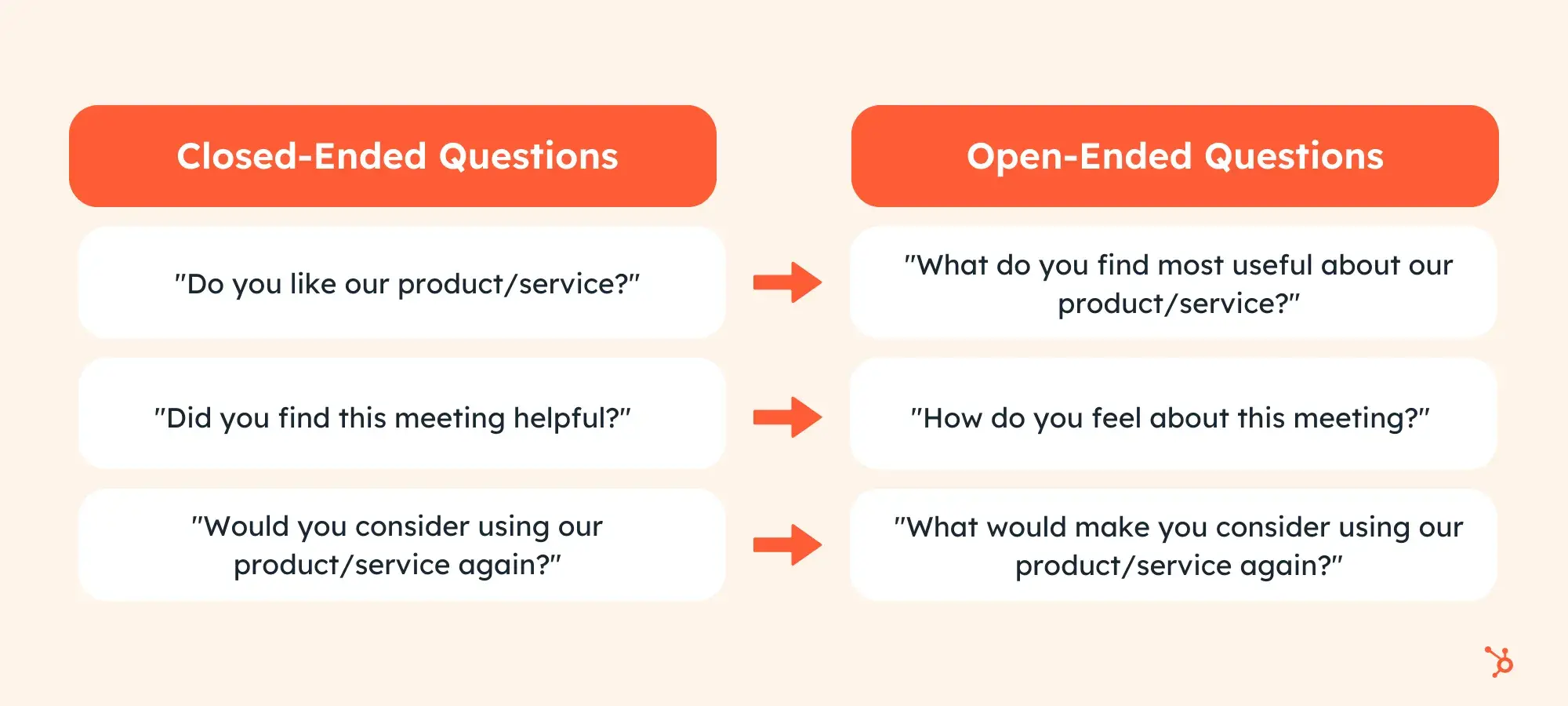
open-ended vs. closed-ended questions, examples

I learned this distinction the hard way when I was working with a startup that was struggling to close enterprise deals. Their reps were asking plenty of questions, but they were all closed-ended. They'd qualify budget, authority, need, and timeline (classic BANT methodology), but they never understood the human context behind those answers.

When we shifted to open-ended questions, everything changed.

Instead of asking “Do you have budget for this?” we started asking, “How do you typically approach budget allocation for strategic initiatives like this?” Instead of “Are you the decision-maker?” we asked, “Who else would be involved in evaluating and implementing a solution like this?”

The conversations became richer. The insights became deeper. And the close rate jumped from 18% to 31% in six weeks.

When to Use Open-Ended vs. Closed-Ended Questions

Closed-ended questions work best for:

  • Confirming specific facts (“What's your company size?”).
  • Getting quick yes/no decisions (“Does Thursday at 2 PM work for you?”).
  • Validating assumptions (“Are you currently using Salesforce?”).
  • Moving toward commitment (“Are you ready to move forward?”).

Open-ended questions excel at:

  • Understanding context and nuance.
  • Building rapport and trust.
  • Uncovering pain points and motivations.
  • Encouraging prospects to share their story.
  • Creating moments of reflection.

According to recent research, the most effective sales conversations maintain a 43:57 talk-to-listen ratio, meaning top performers listen more than they speak. Open-ended questions are the key to creating that listening space.
pull quote on power of open-ended questions

Both question types have their place in sales conversations. But if you want to differentiate yourself in a world where buyers are skeptical of salespeople, open-ended questions are your secret weapon. They transform interrogations into consultations, qualifying calls into strategic conversations, and prospects into collaborative partners in the problem-solving process.

The magic happens when you use them intentionally, not as checklist items, but as tools for genuine exploration and connection.

How to Ask Open-Ended Questions

After thousands of sales conversations, I‘ve developed a systematic approach to asking open-ended questions that feels natural, not scripted. The key isn’t memorizing a list of questions, but mastering the art of transforming any interaction into genuine exploration.

I learned this lesson when struggling to connect with a particularly analytical CFO. Every closed-ended question I asked got one-word responses. But when I shifted to “How do you currently measure the success of technology investments?” suddenly we were having a 20-minute conversation about ROI frameworks and strategic priorities.

The magic words are “how,” “what,” and “why.”

They turn statements into stories, facts into feelings, and answers into insights. Instead of asking “Do you like your current vendor?” I ask, “How has your experience been with your current vendor?” The difference is transformational.

But here's where most reps go wrong: they treat open-ended questions like items on a checklist rather than tools for genuine exploration. I start with one or two powerful questions and let the conversation evolve naturally. If a prospect mentions something interesting, I dig deeper rather than moving to the next item on my list.

This approach is backed by research from Gong, which found that top-performing sales reps ask 54% more questions than average performers, but the quality of those questions matters more than the quantity.

The goal isn‘t to ask more questions, it’s to ask better ones that create space for real dialogue and genuine understanding.
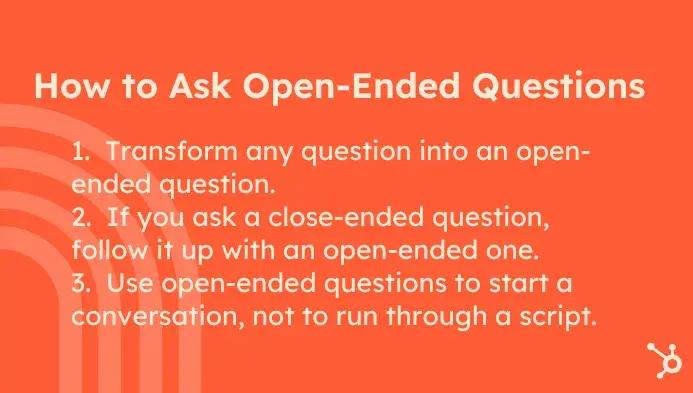
how to ask open-ended questions

Transform any question into an open-ended question.

This is the skill that transformed my entire approach to sales conversations. I teach every rep I coach to master this simple but powerful technique: Take any closed-ended question and turn it into an open-ended exploration.

The transformation is easier than you think. Here are the patterns I use daily:

Closed-ended question

open-ended question

Instead of: “Do you like your current vendor?”

Ask: “How has your experience been with your current vendor?”

Instead of: “Is price important to you?”

Ask: “How do you typically evaluate the ROI on investments like this?”

Instead of: “Are you ready to move forward?”

Ask: “What would need to happen for you to feel confident about moving forward?”

Here's my challenge to you: For the next week, catch yourself every time you ask a closed-ended question. Pause and ask: “Could I rephrase this to learn more?” You'll be amazed how this simple shift changes the quality of your conversations and the depth of insights you uncover.

If you ask a closed-ended question, follow it up with an open-ended one.

Sometimes you need specific information, and a closed-ended question is the fastest way to get it. That‘s perfectly fine, just don’t stop there. Follow up with an open-ended exploration that reveals the context behind the facts.

I've learned to use what I call the “one-two punch” approach: Get the fact, then explore the context.

Here's how this works in real conversations:

Example sequence:

  • “Do you have budget allocated for this project?” (closed)
  • “How does the budget approval process typically work in your organization?” (open)

Another example:

  • “Are you evaluating other solutions?” (closed)
  • “What's your process for evaluating different options, and what criteria matter most to you?” (open)

I discovered this technique during a call with a procurement director who was giving me very short answers. When I asked, “Do you like working with your current vendor?” she said simply, “Not really.” Instead of moving on, I followed up with, “What would an ideal vendor relationship look like for you?” That follow-up question opened up a 15-minute conversation about their frustrations and exactly what they needed to change.

You see the pattern? The closed-ended question gives you the basic facts you need for qualification, but the follow-up open-ended question reveals the context that helps you tailor your approach and build rapport.

This approach is particularly powerful when confirming next steps. Instead of just asking, “Does next Tuesday work for a follow-up?” I might say, “Does next Tuesday work for a follow-up? And what would you like to accomplish in that conversation?”

The key is training yourself to pause after any closed-ended question and ask: “What's the story behind that answer?” That's usually where the real insights (and the real opportunities!) are hiding.

Use open-ended questions to start a conversation, not to run through a script.

Here's where most reps go wrong: they treat open-ended questions like items on a checklist rather than tools for genuine exploration.

I once shadowed a rep who had memorized a list of 20 open-ended questions and was determined to ask every single one, regardless of how the conversation flowed. When a prospect mentioned they were struggling with team morale after a recent layoff, instead of exploring that comment, he moved straight to his next scripted question about budget. The prospect visibly shut down.

That's when I realized the fundamental difference between questioning and conversing. Open-ended questions should spark natural dialogue, not create robotic interrogations.

I approach discovery calls differently now. I start with one powerful open-ended question and let the conversation evolve organically. When a prospect says, “We're struggling with sales productivity,” I don't immediately jump to my next prepared question. I explore: “What does that struggle look like day-to-day for your team?” Then I might follow naturally with: “How long has this been an issue?” or “What have you tried to address it so far?”

The key is listening to the answers and using them as springboards for deeper exploration. If someone mentions a challenge with their current vendor, I dig into that. If they talk about a strategic initiative, I explore the context and implications. The conversation should feel like a collaborative investigation, not a deposition.

This approach requires comfort with uncertainty. You can‘t control where open-ended questions will lead, and that’s exactly the point. The tangents and unexpected directions often reveal the most valuable insights.

I always remind myself: I‘m not here to execute a script. I’m here to understand a human being and their business challenges. Open-ended questions are simply the vehicle for that understanding.

Below, I’ll dig into these open-ended, high-value questions and share why they worked for me.

1. What are the top priorities of your business at the moment?

This question has opened more doors for me than any other single question in my sales toolkit. It's deceptively simple, but incredibly powerful because it invites prospects to share their strategic thinking rather than just their tactical challenges.

I learned the power of this question during a call with a fast-growing fintech CEO. Instead of asking “What problems are you trying to solve?” I asked about their top priorities. What followed was a 20-minute conversation about their expansion into new markets, regulatory compliance concerns, and the need to scale their operations team. That context helped me position our solution not as a nice-to-have tool, but as a strategic enabler for their growth plans.

The beauty of this question is that it reveals the hierarchy of what matters most to them right now. When someone says, “Our top priorities are customer retention, international expansion, and improving our unit economics,” I immediately understand where to focus my energy and how to frame our value proposition.

I‘ve found that prospects appreciate this question because it shows I’m thinking strategically about their business, not just trying to find a problem my product can solve. It also helps me understand whether our solution aligns with their current priorities or if the timing might be wrong.

Follow-up questions that work well here include: “What's driving those priorities?” or “How are you currently addressing each of these areas?” This creates a natural flow into deeper discovery about their specific challenges and initiatives.

2. What are some of the best decisions you’ve made related to ___?

This question is pure gold because it gets prospects talking about their wins while revealing their decision-making criteria and values. I learned its power during a call with a VP of operations who had been giving me short, guarded answers about their current challenges.

When I shifted to asking “What are some of the best decisions you've made related to scaling your operations?” his entire demeanor changed. He lit up talking about how they'd implemented a new workflow automation system that reduced processing time by 40%. As he shared the story, I learned exactly what mattered to him: measurable efficiency gains, minimal disruption to his team, and quick time-to-value.

That insight completely changed how I positioned our solution. Instead of leading with features, I framed our conversation around delivering similar measurable improvements with minimal implementation friction.

This question works because it taps into natural human psychology: People love sharing their successes. But more importantly for sales, it reveals their definition of “good decisions.” When someone tells you about their best choices, they're essentially giving you their buying criteria and success metrics.

I often customize this question based on the context: “What are some of the best technology investments you've made?” or “What are some of the best hiring decisions that have impacted your team?” The specificity helps focus their response while still allowing them to choose what they want to highlight.

The follow-up question I always ask to this one is, “What made those decisions successful?” This uncovers their evaluation process and helps me understand how they define ROI and measure success.

3. How are you feeling about your current situation related to ___?

This question might feel too personal for a business conversation, but that's exactly why it works so well. It breaks through the professional facade and gets to the human reality behind the business challenges.

I discovered the power of this approach during a discovery call with a CTO who was being unusually evasive about their technology challenges. When I asked the standard “What issues are you facing with your current system?” he gave me textbook answers about “scalability concerns” and “integration challenges.” But when I shifted to “How are you feeling about your current technology situation?” the conversation changed.

He paused for a moment, then said, “Honestly? Frustrated. We're spending more time fighting our tools than building solutions for our customers.” That one word, “frustrated,” opened up a 30-minute conversation about the real impact of their technology problems on team morale, customer satisfaction, and his own stress levels.

The word “feeling” is crucial here because it gives people permission to be human rather than just professional. It moves the conversation from facts to emotions, and emotions drive decisions far more than features and benefits ever will.

I often customize this question based on the context: “How are you feeling about your current sales performance?” or “How are you feeling about your team's productivity levels?” The key is to focus on an area where you suspect there might be some emotional weight, such as satisfaction, frustration, confidence, or concern.

This question works because it creates psychological safety. You‘re acknowledging that business challenges aren’t just operational problems; they're human experiences that affect real people. That acknowledgment often leads to the kind of honest, vulnerable conversations where real trust begins to form.

4. If we met five years from today, what needs to happen for you to feel good about your business situation related to ____?

This question is a game-changer because it shifts the conversation from problems to possibilities. I've used variations of this question to unlock some of the most strategic conversations of my sales career.

I remember using this with a founder who had been giving me tactical answers about their current sales challenges. When I asked, “If we're sitting here five years from now and you're feeling great about how your sales organization has evolved, what happened to get you there?” everything changed. Instead of talking about pipeline problems, we started discussing his vision of building a world-class revenue machine that could scale globally.

That future-focused framing helped him articulate aspirations he hadn‘t even fully formed yet. He talked about wanting a sales team that could predictably generate $50M annually, systems that could support international expansion, and a culture where top talent wanted to work. Suddenly, our conversation wasn’t about fixing a problem: it was about building toward a vision.

The beauty of this question is that it removes the pressure of immediate planning while encouraging strategic thinking. People often have clearer pictures of their desired future than they do of their current problems. When you ask them to paint that picture, you get insights into their deepest motivations and long-term priorities.

I often follow this up with, “What would have to change from where you are today to make that vision a reality?” This creates a natural bridge from their ideal future back to present-day action steps, and often positions whatever I'm selling as a critical piece of that transformation.

This question works because it positions you as someone who thinks beyond the transaction to their long-term success. That's the foundation of trusted advisor relationships.

5. What opportunities do you see on your horizon?

This question consistently gets prospects excited because it taps into their growth mindset and entrepreneurial spirit. I've found that talking about opportunities creates energy in conversations in a way that discussing problems never can.

I learned this during a call with a VP of marketing at a scaling SaaS company. We'd been discussing their challenges with lead quality and attribution tracking, a typical problem-focused discovery. The conversation was fine, but not particularly engaging. Then I asked, “What opportunities do you see on your horizon for growth?”

His entire energy shifted. He started talking about expanding into European markets, launching a new product line, and building a partner channel program. As he described these opportunities, I could hear the excitement in his voice. More importantly, I started to see how our marketing automation platform could enable these growth initiatives rather than just solve current problems.

The word “horizon” is key here because it suggests exciting possibilities just within reach, not distant dreams. It frames opportunities as things they can actually capture with the right strategy and tools.

This question often reveals initiatives that aren't widely known yet — expansion plans, new product launches, and strategic partnerships. Getting early insight into these opportunities positions you as a potential growth-enabler rather than just a problem-solver.

I typically follow this up with, “What would need to be in place for you to capitalize on those opportunities?” This creates a natural bridge to discussing how your solution might support their growth objectives.

I love this question because it positions your entire sales conversation around helping them win, not just fixing what‘s broken. That’s a much more compelling value proposition.

6. What challenges do you see to making those opportunities happen?

This is the perfect follow-up to the opportunities question, and it‘s where the real sales magic happens. Instead of asking about generic problems, you’re now exploring the specific obstacles standing between them and their growth goals.

This question works because it maintains the positive momentum from discussing opportunities while naturally transitioning into the challenges where you might be able to help. It frames problems as barriers to success rather than sources of pain, which is a subtle but powerful psychological shift.

I used this sequence with a COO at a logistics company who had just described their opportunity to expand into same-day delivery. When I asked about the challenges to making that happen, he opened up about capacity planning difficulties, real-time tracking limitations, and the need for better route optimization. Those weren't random problems; they were specific obstacles preventing him from achieving something he was excited about.

That context completely changed how I positioned our solution. Instead of selling logistics software to fix problems, I was offering tools to unlock a major growth opportunity. The urgency and motivation were completely different.

The word “challenges” feels more collaborative than “problems” or “roadblocks.” It implies we‘re going to work together to figure out solutions rather than just diagnosing what’s wrong. This subtle language shift keeps the conversation forward-looking and partnership-oriented.

7. How will you be measuring our success related to those outcomes?

This question is brilliant because it accomplishes three things simultaneously: it uncovers their success criteria, creates accountability for results, and positions you as a partner invested in their outcomes rather than just a vendor selling a product.

The word “our” is crucial here because it implies partnership and shared responsibility for results. You‘re not asking what they’ll measure. You're asking how “we” will measure success together. This subtle shift positions you as an ally rather than a vendor.

This question often reveals metrics you wouldn‘t have thought to ask about. Sometimes it’s operational efficiency, sometimes it‘s employee satisfaction, sometimes it’s customer retention. Understanding their specific success criteria allows you to tailor your value proposition and implementation plan accordingly.

This question also sets the foundation for a results-oriented relationship from day one. You're establishing that success will be measured, not assumed.

8. What’s the biggest risk of your not making progress on this situation?

If you were to ask a prospect, “What if you don’t hit your goals?” you could put them in the defensive. Instead, try asking what their risks are of not making progress. Not only is this question less accusatory, but it gives you the chance to work together and strategize on potential risk management practices.

9. Who needs to be involved in making the final purchasing decision?

Finding the right decision maker is critical to making a sale. As you navigate the sales process, make sure you’re working with the right contact.

Let’s be honest, there’s nothing worse than putting in the groundwork to get the deal, only to find out your prospect doesn’t have purchasing authority and can’t sign on the dotted line. Confirming who needs buy-in is a productive, open-ended question.

10. What is the motivation behind taking on this project?

This question helps you understand your prospect’s decision-making process. By learning what your prospect is motivated by, you will get clear on what results they are seeking from your product. This can help you set expectations and speak to the features that matter most to your buyer.

Additionally, by asking your prospect what factors are motivating their buying decisions, you give them a chance to share their values, which is important for building trust.

Conclusion

Looking back on that disaster of a discovery call I mentioned at the beginning, I realize it wasn't just a bad sales technique that cost me that deal. It was a missed opportunity to build a real relationship.

I've since learned that every question you ask is either building trust or eroding it. Every question either creates space for genuine dialogue or reinforces the barrier between you and your prospect. And every question either positions you as a consultant or marks you as just another salesperson going through the motions.

The ten open-ended questions I‘ve shared here aren’t meant to be a script. They‘re tools for genuine curiosity. Use them as starting points, not endpoints. Customize them for your industry, your prospects, and your style. When you master the art of asking open-ended questions, you’re not just improving your sales technique, but you're becoming the kind of person others want to do business with.

That‘s the real power of open-ended questions. They don’t just help you sell better. They help you connect better. And in a world where buyers have more options than ever, that connection is often the only real differentiator you have.

Editor's note: This post was originally published in January 2016 and has been updated for comprehensiveness.

25 Feb 16:43

Sales Word of the Day: Value

by esnider@hubspot.com (Emma Snider)

diamond_rough-1

B2B purchases usually begin with a business case centered on a particular result. Some common desired outcomes include improving productivity, increasing revenue, reducing risk, or cutting costs. A less common objective? Getting all the latest product bells and whistles.

Because salespeople are so familiar and immersed in the products or services they sell, they sometimes bog their presentations down with information on features.    But while these might be significant to the vendor and the rep, they're anything but to the prospect.

In her book Nonstop Sales Boom, Colleen Francis, owner of Engage Selling Solutions, illustrates the difference between talking about "features" and talking about "value."

"Customers don't care about features and benefits," Francis writes. "They only care about value and achieving their objectives." 

Consider the following two sentences. Which is more compelling to you?

"In the new update, we've released 10 new features, which are on the cutting edge of X market."

"The new update enables companies like yours to cut costs by approximately 20% in six months." 

The first sentence stresses features, and explains why those features are important to the vendor. But the prospect doesn't really care about what's important to the vendor -- they're trying to solve a problem. On the other hand, the second sentence glosses over the new features and instead explains their ultimate value to the customer. Now the buyer's ears are perking up.

The word "value" also gives salespeople ammo to fight the inevitable price objection. Prospects who appreciate the value of your product or service and understand the results it will enable won't have as hard a time paying full price, since they feel they're getting a lot for their money. If, on the other hand, the rep has not adequately expressed value, the prospect will balk at the price tag for what they perceive to be a jumble of semi-useful features.

Make sure your prospect sees the forest instead of a bunch of randomly assembled trees. Always lead with value over features. 

Verdict: recommended.

get 9 free sales email templates

25 Feb 16:42

265 | The Secret to Attracting Your Ideal Buyers Pt. 2

by Jeremy Frandsen

IBM265

In this episode, we discuss the four levels of conversation in your marketing to reach more people and make more money.

This is part two of our series on how to attract your ideal buyers.

Right-click here to download the MP3

Listen to Part 1 HERE

Listen to Part 3 HERE

In This Episode

  • Discover the four critical types of conversation that you need to have in your marketing, without them you'll lose customers.
  • Discover the exact things you need to say to turn a visitor into a subscriber and a subscriber into a buyer.

Items of Interest

  • Special thanks to Scott and Brendo for the open and close music on the episode.

Get Your Action Guide Here:

Customer Magnet

Customer Magnet: How to Attract Your Ideal Buyer and Keep Them Coming Back - This action guide shows you exactly how to get into the mind of your ideal buyer so you can attract them and keep them coming back.

Breakthrough

Hey Jeremy and Jason,

I popped you guys a mail toward the end of last year about the successful sale of my first product. I was the dude that less that a year ago had 7 South African cents to my name.

I am excited to report back now, a few months later, with a bit more feedback.

I kept on (and still doing it) surveying my community and from the responses created an online 30 day training programme for the Low Carb Healthy Fat diet, the niche that I am in.

I managed to get just over 100 people into the pilot programme. The insight I learnt there was invaluable. From that initial pilot we practically rebuilt the entire course and launched the 2.0 version at the beginning of December.

Since then we've had more than 600 people go through the programme with amazing results.

The programme has turned over more 5 figures so far this year already (in US terms, in our currency thats over 6 figures).

Our audience has grown incredibily too. In the last 8 months we've been able to add more than 25 000 subscribers to our email list, with a Facebook page and a podcast.

I'm so grateful for the stuff I've learnt from you both.

I'm absolutely loving this journey and feel so fulfilled knowing we're helping so many people too.

Thanks again for everything you've done for me, I am truly grateful. If there is anything I can do to help you guys please pop me a mail.

All the best,

Brad

25 Feb 16:42

Businesses Fail the Business Test

by Graham Jones

There is one test for a business and one test only. Do you provide what your customers want in such a way that you can make a profit from it? That, in a nutshell is business.

Yet, many businesses – even substantial ones who you think ought to know better – fail this test. Either they are not making a profit. Derrrr…! Or they are not providing what their customers really want.

You can see examples of this all around you. Tesco is struggling to find out what its customers really want. Google thought it knew that customers would want its “Glass” product, but they’ve canned that project because, frankly, other than for some geeks it was a non-starter. Meanwhile, Sony and Qantas, for instance, have reported sizeable financial losses. Don’t they know that being in business means making a profit? Goodness me…!

At the smaller end of the business arena you find one-person-bands struggling to survive. Indeed, most start-ups are closed down within three years. There is a never-ending cycle of new businesses starting up, failing, to be replaced by new businesses, that then fail and so on. Many small businesses are built out of a passion for an idea or enjoyment of an activity. Great cooks, for instance, start a catering business and spend hours creating recipes because that is what they love. But the greatest catering businesses spend more of their time on the boring business stuff, like finance and marketing – the kind of things great cooks are not interested in and hence their business fails.

Now, new research shows why this kind of thing is happening. According to a study of 500 businesses, only around a quarter of them have marketing which is focused on the customer. An amazing one-third of the companies in the study have marketing which is entirely – yes completely – self-focused.

Chart showing marketing focus

The fact of the matter is, you cannot possible hope to pass the business test unless you focus on your customers. Having marketing that is either partially or completely focused on yourself is off-putting to your potential buyers. All you are doing is showing them that you like yourself more than you like them. Demonstrating likeability of your customers is a key component in the “CLICK” system of gaining online business.

The example of Tesco is clear. Thirty years ago, Tesco was an “also-ran” in the supermarket business, dwarfed by the giants of its time such as Sainsbury’s. Ten years later, Tesco became the biggest supermarket in the UK after several years of focusing on what customers wanted instead of worrying about the competition. Until five years or so ago, Tesco relentlessly focused on the customer, taking the company to dizzying heights which could not have been predicted all those years ago when it was a comparative minnow. But what has happened with Tesco in recent years? It seems to have focused less on what customers want and more on other aspects of business. It has become inward looking. The new CEO wrote to staff when he took over the job saying that he was intent on restoring the company’s focus on customers.

It really is very simple to run a successful business. Provide what your customers want at a price that makes you a profit. But the key words there are “what your customers want”. This new research suggests that the bulk of businesses still have to learn that simple notion.

25 Feb 16:42

Gamification Can Help People Actually Use Analytics Tools

by Lori Sherer
FEB15_25_482365135

If you’re trying to use advanced analytics to improve your organization’s decisions, join the club. Most of the companies I talk to are embarked on just such a quest. But it’s a rocky one.

The technological challenge is hard enough. You have to identify the right data and develop useful tools, such as predictive algorithms. But then comes an even tougher task: getting people to actually use the new tools.

Why is the people factor so important? It’s easy enough to automate routine decisions, such as identifying likely buyers for a product upgrade. But many decisions in today’s knowledge economy depend on expertise and experience. Think of bankers deciding on business loans, product developers determining tradeoffs between features and cost, or B2B sales reps figuring out which prospects to target. Analytics can help codify the logic of the best decision makers, but it can’t replace human judgment.

Moreover, the tools developed for contexts like these can be complex, often involving a steep learning curve. If decision makers aren’t willing to experiment with the tool and improve their outcomes over time, then your investment in the technology is wasted.

Right here, some say, is where a company could use gamification to encourage people to invest the time and learn how to use the new tools.

Gamification means using motivational techniques like those the videogame industry has put to such effective use. Anyone with teenagers in the house knows that they will spend long hours on their own, trying to get to the next level of their favorite game. Motivation experts like Dan Pink would say that the games are tapping into some basic human drives: for autonomy (you control your own pace), for mastery (you get better over time), and for a sense of purpose (you’re aiming at a well-defined goal). The social factor is important, too. Gamers love to match their skills against others and to compare notes on how they’re doing.

Can these motivational concepts and techniques encourage decision makers to use new analytical tools and collaborate with each other — both to improve the tools and to better their ability to make more informed decisions? We don’t yet have much evidence to answer that question. But early signs indicate that it might work.

A large property and casualty insurance company, for instance, invested several million dollars to create a new analytical tool for underwriting decisions. The tool allows underwriters to run a prospective insured’s properties (including office buildings, warehouses, and manufacturing plants in many different countries) through sophisticated risk models. The models help assess the potential for losses due to natural catastrophes such as earthquake or flood. They produce complex spreadsheets that list the properties, score the various risks, and flag instances where underwriters might want to seek additional information.

A year after introducing the tool, the company’s chief underwriting officer suspected that not everyone was using it. She wondered whether all the underwriters knew how to interpret the results and whether they bothered to seek additional information. Her solution was to engage them in a game. The company gave the tool’s output from five different example companies plus some additional information to four teams of underwriters. Team members worked together to assess the risk. They were told that more information on certain accounts was available, but they had to recognize when this was the case and specifically ask for it. Meanwhile, members of the team that had developed the tool listened in on participants’ deliberations.

In the end, the teams’ decisions were rated by their peers and by independent judges. Teams that not only interpreted the results correctly but also identified a need for additional information and incorporated it into their analyses earned extra points. To me, the whole exercise felt much like the teenagers’ collaborative learning of online games. It had similar elements of engagement, excitement, and the thrill of “mastery” as team members worked together to earn points in the game.

Of course, not every approach to gamification is likely to work. Employees may feel that the typical game’s points and badges trivialize their work — or, worse, that the company is somehow creating a Big Brother system that expects everyone to act like clones. One trick is to pilot a game with a small, diverse set of users and involve them in co-creating the game’s rules and rewards. These “power users” can help others as the game is rolled out to the rest of the team.

Done right, gamification seems to hold a lot of potential. But the proof will lie in experience. Can models and decision support tools be rolled out using a gamification format with rewards and explicit levels of “mastery”? I haven’t seen it yet, but I’d love to hear from others about successful (or not so successful) examples.

25 Feb 16:29

If Marketing Automation is a good thing, why aren’t more companies doing it?

by Caroline Wilson

Barriers to adoption of Marketing Automation and how overcome them

In research TFM&A (2014) identified that there were 5 main benefits to marketing automation: personalisation, campaign management, triggered emails, control and insight.   But with such clear benefits why are more organisations not adopting the tools that can lead to greater business success? In this blog I’ll be explaining the key barriers to adoption of marketing automation and give an action plan for marketers who want to persuade their organisations to adopt an automated approach.

Who are the non-adopters?

The barriers to adoption of marketing automation vary greatly depending on the type of company, their needs and their previous investments. In  research carried out by CommsBox we identified 4 key types of non-adopter. Although by no means exclusive, they give an in-depth insight into the difficulties that companies face when making major investments in change. You might recognise elements of your own organisation here:

  • Trailing traditionalists:   firms where things have always been done the same way.  They use traditional sales and marketing methods and place a great deal of emphasis on personal selling and deep personal relationships.  Whilst they have invested in CRM systems, they do not see the direct benefit of digital marketing.If automation is such a good thing
  • Bootstrapped businesses:  small or start-up outfits that are restrained by budget.  They have bootstrapped processes, typically getting by with spreadsheets to manage customer relationships.
  • Climbing companies:  fast growing complex organisations. In the swiftness of their growth they have made large investments in disparate systems which are becoming difficult to manage.
  • Established enterprises: organisations that have such a heavy investment in legacy systems, that even though they have a desire to move forward, they are bound to their current systems.  Moving forward is slow and difficult.

Design Capital – Cost Versus Benefit

Woodard et al (2013) put forward the idea that companies, are either constrained or enabled by what they call ‘design capital’. In simple terms this means how much a company has already invested in technical systems (technology debt) compared to whether those systems meet their needs (option value). Undoubtedly, any investment in digital marketing tools should increase the option value. However, at the same time it increases the technology debt.

Trailing traditionalists have low quality systems. They may have invested reasonable sums of money in CRM systems and they are reluctant to upgrade them. However, they have few tools with which to compete in the digital age. Their marketing options are therefore restricted.

Bootstrapped businesses have made very little investment in CRM or digital marketing systems. They are happy to carry on as they are because the pain and cost of putting in processes and technology to automate their marketing is just not a top priority. Although they don’t have to worry about technology debt, they are option constrained. These are the companies who can most easily move across to high quality systems when budgets open up.

Climbing companies and established enterprises by nature of their previous investments may have systems with high option value but are debt constrained. They are willing and able to carry out many digital marketing and sales activities.  However, managing disparate systems has left them with difficulties in getting their systems to talk to each other and data in many different places. These companies are in the hardest place of all because they can do a lot of what they want to do, but not very efficiently. They will find it difficult to let go of their previous investment whilst also realising that newer and better methods of digital marketing are now available to them. These technology debt constrained companies will want to get the very most from their past investments before considering a change.

High Quality: Companies with high quality marketing automation systems are those who, perhaps because of few legacy systems, have been able to invest in the cost effective marketing automation technologies that are on the market today. Many cloud based marketing automation systems offer companies with little technology debt the ability to jump right in at the deep end and benefit from highly targeted, personalised and automated digital marketing.

 Key Barriers to Adoption

In our research we identified a number of barriers which fell into these 3 categories:

  • Resource based
  • Motivation based
  • Cultural and organisational

Some of these barriers lie with an entire organisation, or just a handful of key decision-makers.

Resource based

Regardless of size most companies have to argue the case for new investment. There needs to be a clear benefit which needs to outweigh the costs. However, as with many things in the digital marketing world, the cost is not just monetary, but also human. Companies have many priorities and must allocate their resources wisely.

Many companies just lack the sheer time and human resource that it takes to implement a marketing automation programme. Systems have to be installed. Skills need to be acquired. Business processes may need to be completely rewritten.   For this reason that it can be harder for established enterprises to adopt marketing automation than bootstrapped businesses who only have to contend with the money issue.

Whilst the end outcome is almost certainly worth it, the pain and cost of implementing new businesses processes cannot be overlooked. There are parallels here with the companies that failed to adopt an effective online retail presence early enough. We have seen the demise of previously successful retail companies who have failed to adopt ecommerce as quickly or effectively as innovative retailers. The same fate could await those companies who lag behind their competitors in the adoption of marketing automation.

These companies may identify with the phrases “I don’t have time to invest in setting this up”, “I just have too many other priorities” or “a new investment is risky.”

Motivation based

Some companies simply fail to see the need for marketing automation. Prenksy (2001) coined the names Digital Natives to describe those who were born after 1980. Digital Natives grew up surrounded by digital media and are happy to use it in every context of their lives. These people were born digital. However, anyone over the age of 35 is labelled a Digital Immigrant. Whilst ironically digital immigrants have been around since the very beginning of the internet and the mobile phone, they were born in an era where most communication took place in a very personal way, or arrived on a piece of paper. It’s not surprising then if older middle and senior managers may not see the need for digital technologies. They are more likely to say: “we just don’t need it”; “low tech works for me”; “I prefer to deal with people face to face”.

Cultural and organisational

It’s not unusual to hear of a divide between sales and marketing.   You may well identify with the established enterprise where the Sales Director has the greater power. In these organisations the Marketing Department can be seen as the part of the business that provides leads and develops sales collateral. These are the types of organisation may have invested heavily in CRM systems, but not in marketing automation. They may not even see a difference between CRM and marketing automation.

Decision-making processes for this type of investment can be long and involve many people, with divergent ideas. Sales and Marketing Departments may have opposing views, whilst digital natives and digital immigrants see the world through very different eyes, and Finance need to see an evidenced return on investment. This is made all the more complicated in companies where all IT systems are owned by the IT department, regardless of who the main users are.

 Making the Case for Marketing Automation

With money, time and processes to be invested, it is clear that a case needs to be made for marketing automation, in order for non-adopters to be persuaded.

If you are the champion for marketing automation in your organisation these are the key actions you need to take to progress your case:

  1. Quantify the benefits of quick adoption
  2. Define the risks of late adoption
  3. Work out the steps
  4. Do the Math
  5. Build the business case
  6. Influence the key decision-makers

If you’re a marketing automation champion looking to get the buy-in of key decision makers, download the CommsBox Guide to making the case for marketing automation.  This guide expands on the six steps above, to give you an actionable business case for introducing marketing automation in your organisation.

References

Prensky, M. (2001) Digital Natives, Digital Immigrants, Available at [accessed 30.01.2015]

Technology for Marketing and Advertising (2014), Available at http://tfmainsights.com/5-marketing-automation-benefits/ [accessed 30.01.2015]

Woodward, C.J., Ramasubbu, N., Tschang, F.T., Sambamurthy, V. (2013) Design Capital and Design Moves: The Logic of Digital Business Strategy, MIS Quarterly, June 1 2013

Image: http://www.123rf.com/

25 Feb 16:28

All New Sophisticated B2B Marketing Guide for LinkedIn

by Lee Odden

B2B Marketing Guide LinkedIn

It wasn’t that long ago that most business marketers thought of LinkedIn purely as a place for online resumes and prospecting future hires. Today, with nearly 350 million members world-wide, LinkedIn has become a formidable marketing and sales resource for B2B marketers across the web.

In fact, LinkedIn is evolving as a full marketing funnel solution through it’s mix of content and advertising solutions. In particular, through the LinkedIn Lead Accelerator that serves as a lead generation and nurturing service.

full funnel marketingWhile new product and service offerings are fine and good, there’s a saying I live by when it comes to tools. “A tool is only as useful as the expertise of the person using it.”

That’s why this updated version of The Sophisticated Marketer’s Guide to LinkedIn is so timely.

For sophisticated B2B Marketers that implement integrated marketing programs, I have no doubt this eBook is going to be a very useful resource.

Before I get into what you’ll find in this free eBook, here’s a little more about LinkedIn Lead Accelerator:

“As a new lead generation and nurturing product, LinkedIn Lead Accelerator connects companies to the right professionals with the right content as they make their way through the purchase decision process. Think of it as an advanced nurture engine, one that goes beyond the inbox to allow marketers to reach unknown prospects (anonymous website visitors) and known prospects (through captured contact info), nurture them with display and social ads on and off LinkedIn, and convert them when they’re ready to buy.”

Think of LinkedIn Lead Accelerator as marketing automation for display and social advertising that you can use to identify audiences, sequence ads, increase conversions, optimize your creative and of course, measure impact.

Now on to the updated Sophisticated Marketer’s Guide to LinkedIn: It’s essentially all about how to use LinkedIn as part of you integrated approach to marketing – updated for 2015.

optimized linkedin profileAt 58 pages, it’s a soup to nuts resource on everything from the thinking behind full funnel marketing on LinkedIn and the ad network to practical advice on:

  • Opening letter from Jason Miller, Senior Manager, Content Marketing at LinkedIn
  • How to optimize your LinkedIn profile
  • How to grow your network of influencers
  • Tips on staying current on industry news
  • How to expand your reach
  • Advice on nurturing leads
  • How to use the LinkedIn publishing platform
  • How LinkedIn partner programs work

Wrapping up the guide is a fine list of 25 Social Media Marketing Experts you need to know.

You might be wondering who is giving all this advice? Internal marketing experts at LinkedIn Marketing Solutions of course. There are also a mix of quotes and expert opinions from a selection of sophisticated marketing influencers that includes:

Lastly, this eBook is full of useful stats that you can use in blog posts, presentations or in a brief to win budget for the LinkedIn Lead Accelerator :)

  • 47% The value of purchases are 47% higher from nurtured leads (BuzzBuilder)
  • 10 An average of 10 pieces of content are consumed before a purchasing decision is made (Google ZMOT)
  • 95% of website visitors leave without leaving an email address (Sirius Decisions)
  • 80% of marketing emails go unopened (MarketingProfs)
  • #1 LinkedIn is the number one social network for driving traffic to corporate websites (Invents IQ2)

And a few stats about and from LinkedIn:

  • 347,000,000 million The number of LinkedIn members worldwide as of Q4 2014.
  • 182 million The number of unique visitors to LinkedIn in Q4 2014
  • 2 per second The rate of new member sign ups
  • 2 million+ Unique publishers using the LinkedIn share button to send content into the LinkedIn platform
  • 50% of LinkedIn members are more likely to buy from a company they engage with on LinkedIn
  • 80% of LinkedIn members want to connect with companies
  • 94% of B2B Marketers use LinkedIn to distribute content
  • 80% of B2B social media leads come from LinkedIn
  • 150% The increase in leads B2B marketers are generating on LinkedIn since 2010
  • 200% The increase in leads B2C marketers are generating on LinkedIn since 2010

If that’s not all, here’s a mini-interview I did with LinkedIn for the Sophisticated Marketer’s Guide on how I use the platform and advice on how to get more out of it:

Do you regularly check your Pulse feed? If so, how do you use it?

I check LinkedIn daily including the Pulse feed. I follow a number of the thought leaders and also look for the news stories my network is engaging with. The feed offers content that I can interact with through liking, commenting, sharing on LinkedIn or curating to our broader community.

What’s your best advice for writing a compelling company page update?

This might seem like a cart and horse situation, but it’s important to have an audience. Updating a company page to 2 followers vs. 200 just isn’t the same. As with any other publishing platform, think of who your network is and what they’re interested in. What do they expect?

Giving people what they want in the form of useful content, tips and information about changes at your company is a great way to attract more followers and better engage those that you already have.

From a writing standpoint, write snappy, compelling titles. Check ubersuggest.org for popular keywords
and consider using specific phrases in the title and description, but only if they make sense and add value to the message. You can attract more followers to your company LinkedIn page through search on LinkedIn as well as organic search.

How can a business take advantage of LinkedIn as part of a content marketing strategy?

Content participation on any social network or web platform should be informed by a company’s business
and content marketing strategies. Are customers there and what are they doing? What are they interested
in? What opportunities are there for the brand to be valuable to those prospective customers?

For most companies that sell into the business market, participating on LinkedIn should be a no-brainer.

The specific way LinkedIn is used depends on the company, industry and product mix. It also depends on what kinds of opportunities there are to be “the best answer” on LinkedIn for the things customers are interested in.

At a minimum:
1. Ensure executive LinkedIn profiles are filled out and optimized
2. Make sure the Company Page is robust.
3. Curate useful news as status updates and on the Company Page
4. Use LinkedIn as a follow up after meeting people online and especially at offline events where business cards are exchanged

Beyond that, LinkedIn’s social network platform provides many opportunities to engage with prospects, support individual and brand thought leadership and connect with other groups like industry media and prospective employees. Whether it’s targeted advertising or curating a mix of industry and company news on the brand page, companies that want to attract and engage other businesses need to be on LinkedIn.

As I mentioned, this is a meaty guide at 58 pages. You can get more info and download the free guide from LinkedIn.

Disclosure: While this is an unpaid post, LinkedIn is a client of my agency, TopRank Online Marketing.


Email Newsletter Gain a competitive advantage by subscribing to the

TopRank® Online Marketing Newsletter.

© Online Marketing Blog - TopRank®, 2015. | All New Sophisticated B2B Marketing Guide for LinkedIn | http://www.toprankblog.com

25 Feb 16:28

How to Create 4 Sales Opportunities From 1 Bounced Email

by craig.elias@shiftselling.com (Craig Elias)

bounce_rates-1

Job changes are one of the most effective trigger events for sales and marketing departments to track for two reasons:

  1. A decision maker new to a company is up 10 times more likely to switch vendors.
  2. 80% of new decision makers that make purchase decisions of one million dollars or more in their first year make them within 90 days of starting their new job.

When an email bounces, most marketing and sales professionals simply delete that contact from their list. This is a huge mistake. Assuming that the majority of emails bounce because someone has moved to a new position and their former email address is therefore no longer valid, a single bounced email can lead to four separate sales opportunities to be the first salesperson in with a hot prospect.

The next time a prospect’s email address bounces:

  1. Find the prospect at their new company and reach out. Don’t wait for them to contact you.
  2. Find out where the person they replaced at their new company went, and call them too. Odds are that person has moved on to a more senior role and now has more money, more authority, and more influence at a new organization. 
  3. Contact the person who replaced your prospect at their previous position. When you talk to them the very first question you should ask is, “What company did you come from?”
  4. That company now has a vacancy. Reach out to whoever fills that open position.

You might be thinking, “This is a great idea, but it doesn't scale.” However, it does. Let me explain.

Let’s assume you are watching 100 prospects. According to US census data, about 3% of people change jobs every month. Now assume that 3% is applicable to your market or territory, and it takes 30 days for a company to find a replacement for a decision maker who left their job. 

If you start tracking bounced emails and following up on all the related sales opportunities in January, you'll have three prospects who change jobs plus the people they replaced -- that’s six new hot prospects. In February, you’ll have three more people who just changed jobs, the people they replaced, plus the three who filled the vacancies created when your prospects left their positions last month -- that’s now nine new prospects. In March, you’ll have three more people who just changed jobs, the three people they replaced, the three more who filled last month’s vacancies, plus the three who assumed the roles left by the people who filled the vacancies in month two -- that’s now 12 new prospects. So by March, you’ll have 12 people who have changed jobs and now are up to 10 times more likely to become your customer.

If you continue this for six months you’ll have 21 new opportunities in the month of June, and 39 new opportunities in the month of December. If you total all the monthly numbers for just one year, you would have 270 prospects. 

Now imagine what would happen if you started with a list of 200, 500, or even 1000 decision makers and you followed up on all the opportunities created by bounced emails. If you can incorporate this process into your larger sales strategy, you’ll never be lacking hot leads again.

So the next time an email bounces, don’t delete that person from your prospecting list. Pick up the phone, and call your four new prospects.

get the free hubspot crm

25 Feb 16:28

The Telephone is the Most Powerful Yet Under-Valued Social Selling Tool of All

by Mike
old phone

When asked by OpenView Labs to share my favorite sales tool headed into 2015, without hesitation and with a big smile, I boldly declared The Telephone!

When asked by several organizations that were curating top sales influencers’ sales predictions for 2015, without hesitation and with no smile at all, I boldly declared that the air will finally and thankfully leak out of the Social Selling balloon. It’s been quite amusing watching that happen as  experts from the Social Selling camp have been walking back some of their bold rhetoric as more and more companies realize Social Selling hasn’t produced the promised results.

My friend Anthony Iannarino and I are big fans of the telephone as a sales tool. In fact, we’ve joked recently about the reality that the telephone may be the most “social” sales tool of them all :-) He’s written a few killer posts in defense of traditional selling, including this beauty from yesterday comparing New School and Old School sales approaches. I couldn’t agree more, and frankly, it’s getting old having to correct the Social Selling Kool-Aid drinkers that everything has not changed.

The truth is that the telephone, while often ignored, maligned, or abused, when put in the hands of proficient sales hunters, is still an incredibly effective way to deliver your message, secure a desired meeting or move an opportunity along. In fact, I’d argue that there may not be a more powerful or more social weapon in your entire arsenal of sales weapons.

Back in January, several of my Go-To Sales Gurus and I put on a live Virtual Sales Kickoff Meeting to help salespeople and sales teams get the new year off to a fast start. 2000 registered for the powerful event and almost 4000 people have since watched the video between Jeb Blount’s and Anthony’s YouTube channels. I batted leadoff for the event and shared four keys to power-up your prospecting. That’s right:  prospecting. That supposedly antiquated, no longer effective method of proactively pursuing prospects. Two of those four keys directly relate to this post. Key one was about believing that prospecting still works, and let’s just say that I didn’t mince words when taking on those dangerous loud voices proclaiming that it doesn’t. Key four was about reconciling our relationship with the telephone. If those topics interest you, or if you’re feeling stuck because your company and your social selling efforts haven’t produced enough leads to fill your pipeline (imagine that!), please take some time to watch this video. I promise it will help you. And if you can carve out even more time, there’s a ton of valuable advice from all of these true sales experts.

25 Feb 16:28

3 Steps to Creating a Content Playbook for the Sales Process

by Sam Brennand

Shutterstock_100028786In the NFL, a key part of any head coach’s job is to design strategies that enable their players to succeed on the field.

As a team captain and the most prominent player on the field, it’s the Quarterback’s job to put those offensive strategies to the test, report on their effectiveness, and help the head coach adapt those strategies to the realities of a game.

When you think about it, it’s a relationship that’s very similar to that of most modern marketing and sales teams. If the marketing team is Bill Belichick shaping the game from the sidelines, the sales team is Tom Brady calling plays in the huddle.

The marketing team is charged with setting the game plan. This involves carefully researching the prospect, defining buyer personas, creating, distributing, and refining great content for each stage of the buyer journey, and ultimately preparing the rest of the team to be successful. It’s the sales team’s job to execute that game plan by calling plays on the fly. This involves connecting with prospects, understanding their unique needs, and nurturing them through the buying process with educational content.

But in order for sales teams to be effective in managing the game from under center, they need the marketing team to lay out a well developed playbook — or what most marketers would call a content library.

The Importance of a Content Playbook

If you’re unfamiliar with the concept, a content library is a place to store, organize, and manage your content to make it easily accessible for segments of your audience, leads, customers, and internal teams.

It contains the collective wisdom of your organization, including blog posts, webinars, helpful videos, e-books, whitepapers, and more that showcase your organization’s expertise and understanding in alignment with each stage of the sales process.

When used correctly, a content library can be a phenomenal sales enablement tool; one that can be leveraged to create the kind of contextual, one-to-one content experiences that really resonate with prospects.

The Elements of a Great Content Playbook

Just as a playbook requires constant communication between coaches and players, a content library is a living resource that requires close collaboration between marketing and sales teams.

Building one comes down to three key areas of focus:

1. Creating The Right Content

The average playbook contains upwards of 1,000 plays that use a handful of different offensive formations. Between the T, the I and V-formations, the veer, and Shotgun alone, it’s enough to make your head spin.

But there’s method in the madness.

Great coaches recognize that no two defenses are the same from play to play (let alone from game to game), just as great marketers and salespeople recognize that no two sales prospects are the same. Every lead has unique needs, challenges, and pain points that need to be addressed with content at each point in the sales process.

Start by clearly mapping out your buyer personas and understanding how each differs in how they move through the stages of the buyer journey.

2. Organizing The Content Effectively

Quarterbacks have only 40 seconds between plays to get their team to the line, read the defense, and call a play. Every second counts.

In an age where the common goldfish has a longer attention span than most of us, the ability to surface the right content at exactly the right time is key. Whether a content library is being accessed by prospects directly or by salespeople, marketing must ensure that it’s easily navigable by type, interest, industry, and persona.

When it comes down to it, serving up the wrong piece of content at the wrong point in the buying process is a bit like calling the wrong play at the 1-yard line with the Super Bowl on the line.

Sorry Seahawks fans, I just couldn’t resist.

3. Making It Easy For Sales To Leverage Content

Today, most NFL Quarterbacks wear some version of a wristband that contains the core elements of their playbook. Not because they don’t know their playbook by heart or aren’t able to recognize patterns in opposing defenses, but because it just makes sense to have that information handy so they can make the right decision when calling a play.

To make sure that sales teams feel just as comfortable “calling plays”, marketing has to ensure that content libraries are accessible, flexible, scalable, and optimized for lead generation and engagement at every touchpoint. It’s been estimated that 60-70% of marketing-created content goes unused by the sales team, mostly because it’s hard to find or hard to package.

Marketing teams need to employ tools that make it easy to personalize content for each prospect at every stage of the buying process. Above all, it means empowering salespeople to create customized content experiences for every lead.

Scoring the final touchdown

In the NFL, a team’s playbook is sacred. It typically contains decades worth of knowledge, vital insights, and detailed strategies the coach has designed to ensure success on the field from one week to the next.

A content library (or content playbook) is no different.

It’s the marketing team’s job to create, refine, and optimize the content playbook. It’s the sales team’s job to commit it to memory, call the plays that move the chains, and convert more opportunities into happy customers.

Learn about the State of Marketing in 2015 by downloading the free report.

SFDC_Blog_590x160

25 Feb 16:25

5 fresh startups that are shaking up sales automation

by Russell Miller, RepairPal
sales-automation-startups
GUEST:

Sales is tough. Selling is hard.

Luckily, there are some cool new sales automation tools out there making life easier for today’s road warriors, reps, and outcriers.

Below are some new tools from startups that can give you a significant time and training edge over your competition.

Close.io:  Make calls and send emails from the CRM

Close.io allows a salesperson to do one-click calling and emailing from within their app, and then automatically logs those calls and emails into a prospect’s profile, eliminating the tedious and error-prone data entry that takes away time from making calls.

Close.io also allows salespeople to filter their lead lists based on the actions they’ve taken, such as showing all leads where a call has been made and an email has been sent, which is handy for knowing which prospects require what followup.

Finally, it has a very handy ‘Opportunities’ feature that shows all the leads at a glance for each week, along with their expected value and likelihood of closing that you’ve assigned them.

Integrations: Most importantly, for those transitioning from other CRMs, Close.io has a CSV bulk upload tool, and multiple connections from Zapier, including Gmail, Wufoo, and Mailchimp.

close-io

Accuvit.io: Transcripts of sales calls

Training new phone salespeople is difficult. Sales manuals can struggle to give proper context, and it can be daunting for a new recruit to listen to hours of previously recorded sales calls. Accuvit allows a sales group to record and transcribe all of their calls in near real time. These then become searchable as text, and Accuvit also uses data mining technology to find patterns in the best and worst calls.

The sales manager can then distribute transcripts of the best and worst calls, calling attention to what approaches worked and what didn’t, how to handle specific objections, or what the best way is to discuss a particular feature. Since we can read much faster than we can listen, this allows a new salesperson to easily absorb the collective wisdom of many previous calls, and try out bits and pieces of dialogue to see what works best with his own personality.

Integrations: Accuvit only has one integration, but that one integration is Salesforce, so it should be fairly easy to get started.

accuvit

Sendbloom.co: Mass customization of outbound sales emails

In the past, salespeople had two approaches for sending cold emails to new prospects: a mass email or a custom email. The problem with the mass email is that it produces low engagement, as it doesn’t speak to the unique qualities of the customer. The custom email takes minutes to produce, and is impractical at scale.

Sendbloom offers a great solution to this problem. The company’s service takes your lead list and enriches it with data from public and private sources, and then makes these fields available to your email templates. You can now segment your email templates according to factors like location, industry, job role, etc. to create a much more targeted and effective message.

Integrations: Sendbloom offers connections to Salesforce and Gmail, and has an in-browser editor to edit any CSV you upload.

sendbloom

Assistant.to: Speeding up appointment setting

How much time do you waste going back and forth trying to set up meeting times? Assistant.to neatly solves this problem by allowing you to populate the bottom of your email post with free meeting slots you’ve selected from Google Calendar. When a prospect clicks on a time, a meeting is automatically scheduled and you both receive confirmations.

Integration: One-click integration with Gmail and Google Calendar.

assistant-to

Zeemaps.com: Custom maps of prospects, customers, and competitors

Can a custom map make you more effective as a salesperson? Absolutely. If your company sells off a franchise model, you have Google maps open all day to make sure that any prospects are a minimum distance away from existing customers. Or you need to look on a map to find nearby reference customers for a prospect to contact. Or you might want to locate prospects that are near certain competitors.

Zeemaps is a dead simple, free-to-start service that allows you to upload a spreadsheet of locations and instantly create a custom map that you can share with your sales group. It allows you to add colored markers, so you can indicate whether a location is a prospect, customer, or competitor, and to add custom fields, such as phone number and website, as well as the ability to shade regions to mark off territories.

It also supports a zooming feature where if you click on a location, the number of locations that’s shown as a single number expands into a list of the actual map points.No more flipping back and forth between several different maps, and doing lots of Google map searches while talking to prospects.

Integrations: Data from Google Sheets, Microsoft Excel, CSV, KML, GeoRSS feed, or copy-and-paste.

zeemaps

So, there you have it, a list of five cool tools your competition probably hasn’t heard of yet. Go forth and conquer!


Russell-MillerRussell Miller advises startups on business development and product marketing, and lives in San Francisco.


VentureBeat is studying social media marketing. Chime in, and we’ll share the data with you.