Shared posts

29 Mar 22:52

Who is Putin?

Ilya Ponomarev, Opposition Member, Russian State Duma; Chair, Innovations Subcommittee of Duma; Technology Entrepreneur

Who is Vladimir Putin: powerful tyrant or cornered ex-KGB officer who became Russian President? What is the end game for him? How should the White House handle the crisis between Russia and the West? Join our discussion with a leader of the Russian opposition. Hon. Illya Ponomarev was the only State Duma member to vote against the accession of Crimea to the Russian Federation. In August he learned that the Kremlin had banned him from returning to Russia.

This program was recorded in front of a live audience at The Commonwealth Club of California in San Francisco on March 4, 2015

06 Mar 19:53

Electric ferry jolts discussion over powering ships in B.C.

Norwegian vessel challenges assumptions about limits of battery power.
06 Mar 19:49

New Fraser Health CEO a low-profile power player

Michael Marchbank, the new chief executive officer of Fraser Health, has come a long way from relatively humble beginnings as a fundraiser, 27 years ago, for a small northern Ontario hospital. He now leads an organization with 26,000 employees and a $3.3-billion budget. He’ll be paid $345,000 — about $100,000 less than his predecessor, Dr. Nigel Murray — but Marchbank isn’t fussed about it. As he points out, he sought the job last fall and accepted the pay scale.
06 Mar 19:40

Higher TFSA limits are not the enemy

by Jason Kirby
Chris Young/CP

Chris Young/CP

In addition to the usual barrage of advice from financial experts that accompanies RSP season, the lead-up to this year’s contribution deadline brought with it something else entirely: an all-out assault on the RSP’s much younger cousin, the TFSA, and the Harper government’s vow to let Canadians double the amount of money they can sock away in tax-free savings accounts each year. The volley of criticism, picked up gleefully by media across the country, was spurred by a pair of reports, one from the left-leaning Broadbent Institute, and the other from the Parliamentary Budget Office, which together can be boiled down to two essential arguments: that the benefits of increasing the TFSA contribution limit to $11,000 will mostly go to the rich, and that the lost tax revenue will hurt Ottawa’s finances in the decades ahead. Critics jumped on the issue: Here’s another sop to fat cats that threatens to rob our children of government services in years to come! Only, it’s not that simple.

The first and most important point to consider is that saving is a virtue we should be doing everything we can to encourage. Why does this notion offend so many people when applied to the wealthy? After all, government does a good and fair job of extracting its pound of flesh from that group. Unlike RSPs, which let people delay their tax bills until they’re in retirement and, presumably, earning lower incomes, contributions to TFSAs have already been subjected to income taxes. And the collective tax bill is not insignificant. The top 10 per cent of earners—the ones collecting at least $87,000—took home 35 per cent of total income earned in Canada in 2013, but paid 54 per cent of all federal and provincial taxes that year.

Related reading: From MoneySense: Why we should leave the TFSA alone

It’s also wrong to suggest that only the wealthy stand to benefit from increased TFSA room. Yes, as the Broadbent report points out, fewer TFSA holders are maxing out their contributions than was the case when the plan first launched in 2009. This is held up as evidence that only the wealthy have the means to use their accumulated TFSA room (which stood at $31,000 in 2014 if one had never contributed), but it doesn’t acknowledge that Canada has also been in the throes of a debt-fuelled housing boom that is consuming much of people’s income. (Consider this: The home-ownership rate among the under-35 set with household incomes of just $20,000 to $40,000 is nearly 25 per cent, and jumps substantially with each step up in incomes. Is it any wonder they’re not also contributing much to their TFSAs?) Having said that, there are still plenty of people across all age groups (and likely across most income groups) who, by living frugal lives, save enough to make the most of their TFSA allowance each year. We should ask ourselves if it’s worth stopping everyone in the middle class from putting away more than $5,500 a year, just to stick it to the Daddy Warbuckses out there.

Of course, the inequality backlash is hardly new. It’s an extension of the national panic that always seems to ensue when there’s talk of making it easier for Canadians to shelter more of their money from the tax man. We saw it in the ’80s and ’90s under Liberal and Tory governments when proposals to expand RSP limits were discussed. Then, as now, critics fretted that registered savings plans would not only favour the wealthy, they’d blow a hole in government finances.

Both the Broadbent and PBO reports detail the long-term fiscal impact of a larger TFSA program and, since the numbers get bigger the further out one looks, those tended to be the examples seized on by critics. For instance, the PBO report states that by 2060, a larger TFSA program will leave the federal government with $14.7 billion less tax revenue than it would otherwise have.

Related reading: The case for raising the TSFA limit is shaky 

That’s a big number, to be sure. (I’ll leave it to others to explain why they think it’s a bad idea to impose long-term fiscal responsibility on governments.) But don’t consider that figure in isolation. For one thing, assuming federal expenditures grow at the same inflation-adjusted pace of the last 40 or 50 years, it’s not unreasonable to assume Canadian finance ministers will deliver trillion-dollar budgets by then. And much can, and will, happen over half a century: Housing and stock-market bubbles will boom and bust. There will be recessions, maybe depressions, and war. Our demographics will transform and technology will upturn the economy time and again, spawning revenue streams we can’t even imagine right now. In short, relying on a budget forecast so far in the future to justify denying Canadians a chance to save more now doesn’t make sense.

Look, some of the TFSA’s biggest supporters, such as tax policy expert Jack Mintz, see the need for technical tweaks to the system. (He believes income that retirees build up within their TFSAs should be calculated and used to claw back Old Age Security benefits to prevent program costs spiralling out of control.) Others argue Canada should continue to shift more of its tax base away from savings and onto consumption—a move that might entail jacking the GST back up. Still others believe a lifetime TFSA limit with no annual contribution cap is the answer. So there are options. But Ottawa should never lose sight of the value of having people take ownership of their own futures by rewarding them for saving.

The post Higher TFSA limits are not the enemy appeared first on Macleans.ca.

06 Mar 19:32

Mark Cuban says we’re in a tech bubble — and it’s going to be worse than the bust in 2000

by Dashiell Bennett, Bloomberg News

Dallas Mavericks owner Mark Cuban knows a thing or two about tech booms. He made his fortune in the dot-com explosion of the late 1990s, founding and then selling Broadcast.com for more than $5 billion. By doing so, he also avoided the great tech bust that followed the boom. As a result, he’s remained a billionaire, and gone to become a championship sports team owner, a TV star, and a powerful investor.

Today, Cuban thinks the bubble has returned in a far more dangerous way. In a post on his blog Wednesday evening, Cuban warned against the current mania of investment in apps and other smaller tech firms, writing “If we thought it was stupid to invest in public internet websites that had no chance of succeeding back then, it’s worse today.”

The crux of his argument: While the tech bubble of 2000 was essentially a public stock bubble, today’s bubble is in the private investment realm, leaving those who are in too deep no way to escape. Thousands of angel investors have sunk large sums into private companies, but have no mechanism to liquidate their investments if there’s trouble. They can’t sell their position, even if they realize it was a mistake.

Here’s a key section of his post (emphasis his):

I have absolutely not doubt in my mind that most of these individual Angels and crowd funders are currently under water in their investments. Absolutely none. I say most. The percentage could be higher

Why ?

Because there is ZERO liquidity for any of those investments. None. Zero. Zip.

[…]

The only thing worse than a market with collapsing valuations is a market with no valuations and no liquidity.

If stock in a company is worth what somebody will pay for it, what is the stock of a company worth when there is no place to sell it ?
Bloomberg.com

06 Mar 19:29

This 5-minute presentation will convince you that Amazon is screwed (AMZN)

by Jay Yarow

NYU professor Scott Galloway gave a 15-minute presentation on the four biggest companies in tech — Amazon, Facebook, Google, and Apple.

The full presentation, which we saw on Josh Brown's website, is worth watching. But, the five minutes spent on Amazon are the most interesting. It's hard to watch the Amazon part and not feel like Amazon is going to be in trouble in the next few years. 

Galloway's presentation is based on an algorithm that looks at 850 data points across digital, social, marketing, and mobile in 11 geographies. He applies the data against 1,300 brands, then makes recommendations about the winners and losers based on the results. 

He says sometimes he's wrong. And it's entirely possible he's wrong in his following assessment.

But Galloway says that he believes "pure play" retailers that either focus on digital or brick-and-mortar sales cannot survive. He thinks e-commerce companies will be forced to open stores or "go out of business" and that retailers need to be excellent at digital or they will "go out of business." 

His evidence that pure-play e-commerce can't work? Fab raised hundreds of millions, then went bust. Gilt Group raised boatloads but has struggled. Net-a-Porter isn't making money. 

Galloway pressoHe says the "majority" of startup e-commerce companies are running to open stores. "We've discovered these incredible robust, flexible warehouses called stores," he says. Warby Parker, for instance, has opened a number of stores and its generating more revenue per square foot than any other retailer besides Apple.

Retailer revenue chartRetailers are not "befuddled prey" waiting to be nuked, says Galloway. He says they are investing in digital, and, flashing the following chart, says they are all growing faster than Amazon. 

Galloway presentation

He says, "You might think Amazon is the most innovative company in retail. Over the last 10 years, that might be true...

Galloway presentationBut if you look at the last five years, it's been Macy's from a shareholder's perspective. 

Galloway presentation

And Amazon has had the lowest return of almost every major retailer in the U.S. over the last year.

Screen Shot 2015 03 05 at 7.41.17 AMAmazon's strategy, says Galloway, is to be the last mile. It wants to invest in infrastructure to quickly deliver products. Then it wants others to chase it, burning money and going down in flames as they try to keep pace. But, he says Amazon's delivery costs are exploding. And he thinks it's unsustainable for Amazon's delivery costs to continue growing by 40%.

Amazon shipping costsHe believes Amazon's differentiation through one-click ordering will vanish thanks to competitive products. He also thinks there are rival companies that will eliminate Amazon's delivery advantage. 

He believes Uber will be the company that disrupts Amazon. He says in Chicago, you can get a car and a driver for ~$0.90 per mile. If you took Amazon's delivery costs, that means Uber can do 7 billion miles worth of delivery. 

Screen Shot 2015 03 05 at 7.42.48 AMThe final trend is somewhat boring, but important. "Click and Collect" is growing. Brick and Mortar locations are using their stores are warehouses. So, if you order a flat screen TV from Best Buy, it will get to you faster than Amazon. 

Screen Shot 2015 03 05 at 7.43.32 AM"The retail of the future is not Amazon, it's Macy's," says Galloway. Macy's shut down a number of stores, then invested $2 billion in its digital efforts. It can use its stores are places for people to pick things up, or it can ship things to people. 

Screen Shot 2015 03 05 at 7.43.53 AMHe predicts Amazon will fall in value, and it will have to buy some retail stores to compete with traditional retailers. 

Screen Shot 2015 03 05 at 7.45.22 AMAnd now, for our push back on some of what Galloway is saying.

His idea is compelling. It makes a lot of sense that Amazon will face strong competition from retailers that are becoming smarter. There will also be competition from startups focused on one vertical, like Warby Parker owning glasses. Or Instacart owning grocery delivery. 

However, Amazon is not stupid. It is led by Jeff Bezos, one of the smartest people in the technology industry. It has already started to experiment with local warehouses for selling products. As for traditional retailers, they've struggled to respond to the threat of Amazon. Perhaps they're going to get it together now, but we're skeptical. 

Uber as a delivery company is a long-term dream. Perhaps it happens. But it's a long ways off. Amazon has opportunity to respond if it thinks Uber will be a threat. Lyft, for instance, will be available for a decent price. But, it's unclear that the Uber pricing Galloway talks about is sustainable. Uber is being funded by venture capitalists and setting aggressive pricing in new markets to cripple rivals, much like Amazon. Is that long-term sustainable? That's too be determined. For now, Uber is focused on car services, not delivery.

All that said, Galloway makes good points and it's worth watching (the Amazon stuff starts around the 2 minute mark):

SEE ALSO: Amazon has a key weakness

Join the conversation about this story »

NOW WATCH: 14 things you didn't know your iPhone headphones could do

06 Mar 19:27

Canadian dollar will fall to record lows once Fed starts tightening, analysts warn

by Andrea Wong, Kevin Buckland and Hiroko Komiya, Bloomberg News

The rally in the currencies of commodity-producing nations including Australia and Canada is at risk of being a flash in the pan.

The Aussie and loonie are up more than 1% over the past month versus developed-market peers after policy makers in the two nations each refrained this week from following up on interest-rate cuts that had sent investors elsewhere to seek higher returns.

That may all change as the Federal Reserve moves toward boosting borrowing costs. The U.S. is forecast to show Friday an increase of more than 200,000 jobs for a 12th month in February, and speculators are the most bearish on the Australian and Canadian dollars in a year.

FP0306_Loonie_C_MF

“The day the Fed becomes more clear, and we get a better sense of the timing and structure of the rate-hike cycle, these currencies will plunge to new lows,” said Paresh Upadhyaya, the Boston-based director of currency strategy at Pioneer Investment Management Inc., which oversees about $250 billion.

The loonie traded at 80.64 U.S. cents as of 2:14 p.m. in Tokyo Thursday, little changed from the previous day, when it rose 0.6%. It reached an almost six-year low at 78.74 on Jan. 30.

Australia’s dollar was unchanged at 78.17 U.S. cents from New York, after touching a 5 1/2-year low of 76.26 last month.

Greenback Momentum

The two have slumped more than 10% in the past six months versus the greenback as declines in the prices of iron ore and crude oil, the biggest exports from Australia and Canada, derail investments and economic growth. Meanwhile, Fed officials, led by Chair Janet Yellen, are ramping up efforts in telegraphing the first U.S. rate rise since 2006.

Traders have pulled forward expectations for the Fed to begin tightening in September from October after Vice Chairman Stanley Fischer said last week the central bank looked most likely to raise interest rates then, or even as early as June. That helped give the dollar a new wave of momentum, pushing the Bloomberg Dollar Spot Index on Wednesday to its highest close in more than 10 years.

A combination of “the broad dollar upswing” and the “fallout” from lower commodity prices will continue to weigh on the Aussie and loonie, Robin Brooks, New York-based chief currency strategist at Goldman Sachs Group Inc., said in an interview in Sydney Thursday. He sees Australia’s currency falling to 72 U.S. cents by year-end, while the Canadian dollar slumps to 75.75 U.S. cents.

Easing Likely

Additional easing remains on the table for Canada and the antipodean nation. Swaps traders see better about 50% odds the Bank of Canada will cut the benchmark rate by 25 basis points to 0.5% by October, while pricing in a similar reduction by the Reserve Bank of Australia to 2% in April, data compiled by Bloomberg show.

The BOC said Wednesday that crude oil prices and inflation are close to policy makers’ assumptions and a weaker currency will boost exports. The RBA unexpectedly left its key rate unchanged Tuesday, while saying further easing may be appropriate in the future.

“There’s still room for markets to price in higher U.S. rates,” Motoki Koike, a foreign-exchange analyst at Nomura Holdings Inc. in Tokyo, said by phone Wednesday. “There’s a lot of additional easing already in the price of both the Canadian and Australian dollars, so it’s U.S. dollar strength that will probably drive their exchange rates from here.”

Global Trend

Policy makers around the world have been cutting interest rates and expanding stimulus programs this year to spur growth. The People’s Bank of China on Saturday became the 18th central bank of 48 key monetary authorities monitored by Bloomberg News to pare its benchmark. The European Central Bank provided more details on its unlimited quantitative easing, or bond buying, program on Thursday.

Both the BOC and its Australian counterpart have said lower exchange rates are helpful. Bank of Canada Governor Stephen Poloz said Wednesday a weaker currency will boost non-energy exports, while RBA head Glenn Stevens said the local dollar remains overvalued, and a lower exchange rate is needed to achieve balanced growth.

“The RBA would like it to do some of the heavier lifting to support and rebalance the economy,” Paul Mackel, head of Asia currency research at HSBC Holdings Plc, said by phone Wednesday from Hong Kong. “It’s going to be a slower going story until either the central bank decides to reduce interest rates further or the Fed starts to matter more, in which case the U.S. dollar gets stronger.”

Bloomberg.com

06 Mar 19:27

Sign Of A Healthy Sales Team Is An Empty Conference Room

by Miles Austin

Conference rooms and weekly sales meetings are relics of a time without the internet, webcams, smartphones and powerful web tools.

A conference room full of sales people and sales leaders just might be the biggest time waste of the week. Add up the opportunity costs of each of the 12-15 sales people, 1-5 functional managers and possibly a vendor or guest gathered at that table. How long do your weekly sales meetings usually last? 45 minutes to an hour on average. Then add up the time for each of the attendees to drive to the office, park their car, fill up their coffee cup and get settled in. It becomes clear that there is a significant money drain, productivity black hole and a financial loss involved with each meeting. Yet they continue in many organizations.

Think about what has changed since you first started having your weekly sales meetings and staff meetings.

  • It used to be that sales forecasting and updates were built around the table each Monday morning.
  • Reviews of deals won, or lost were discussed.
  • New products and pricing adjustments were on the table.
  • I used to always ask my sales team about the competitive landscape. What and who were shaking things up with our customers and prospects?
  • Sometimes a Vendor/Manufacturer is invited in to talk about their wares.
  • From time to time, some light sales training or techniques were able to be squeezed in. Some of you might still be having these types of meetings on a regular basis.

The question I want you to consider today is why are these meetings still taking place?

  • The sales forecast and trends should all be captured and available for all to see via your CRM and accounting tools. You should have in-depth reporting on every stage in your sales cycle, for every prospect and customer, in multiple formats and on multiple devices. This information should be shared across departments including marketing, finance, support and operations. With the emerging “big data” tools now available everyone should not only be able to know what happened in the past, but what is likely to happen in the future. Trends and shifting environment are much less likely if you are using the tools available to you.
  • Win/Lost reports are being reported and captured, and should be shared for everyone to learn from. These are gathered, compiled and reported on in real time, as they happen and once again should be available to every department within your company. Trouble bubbling up within your customer service team can help identify bigger problems down the road that can be prevented if acted upon quickly from all departments.
  • Products and pricing should now be available and always current  on every laptop, table and smartphone your sales team uses. Manufacturing should be able to instantly communicate production timelines, delays and other supply information. Changes made in pricing, positioning, advertising and customer-facing information must be in the hands of everyone that needs it without delay. Internal communication tools to distribute and manage the collection of information that customers need is instaneous. Many times the information should be going directly to your customers and prospects via email, social media and your own website.
  • Competitive intelligence has never been more thorough, detailed and current than it is today. There are no longer excuses to be caught by surprise with competitive moves and actions. Tools are now available to not only track every hire, fire, promotion, financial update and acquisition, but also to understand what website traffic, social media follower growth and expansion, even down to the real estate decisions that are taking place.
  • Vendor training for many sales teams is still important to keep up to date on the products, programs, promotions and pricing that your sales teams need to be communicating to your customers and prospects. Your vendors are able and willing to connect to you electronically, feeding everything that they have to help you grow your business. Many are willing to make the financial investments to connect directly to you in many if not all the areas above, with strong security, to become much more of a true partner than ever before.
  • Sales training is now available in many formats including video, audio, and live via webcams. I have an entire database of sales trainers that are able to deliver state-of-the-art, highly productive sales training to you in any format(s) you desire on demand, at a time and method that is preferred by your sales teams. Nearly sixty percent of all sales training I provided last year was done over the web. I am forecasting that to be almost seventy-five percent this year. Whether you have a worldwide sales organization, or a small local team, on-demand web-based training utilizing video, audio and written training, with full progress and test reporting being provided back to leadership is now available and extremely effective.

The information that comes from these gatherings is important, even critical. But the delivery platforms have changed. It is time to embrace the tools that are available and readily affordable to move your company forward.

When the need arises to be “face to face”, virtually every smartphone, tablet and laptop has been shipping with a built-in webcam for years. Use them to get that face-time with each other one-on-one or in groups from two to two hundred and more.

It might take a few times to get the tech working well, but once you get past the early hurdles, you will be flying through video calls with more power than ever in an in-person meeting. Have a question arise about a tech challenge, add in your system engineer or manufacturing team. Everyone has a webcam and video capability to meet with you. Take advantage!

If you want to make this change and would like some help - give me a call. I can help. My number is on the upper right hand corner of this site.


Original article: Sign Of A Healthy Sales Team Is An Empty Conference Room

©2015 Fill the Funnel. All Rights Reserved.

The post Sign Of A Healthy Sales Team Is An Empty Conference Room appeared first on Fill the Funnel.

          
06 Mar 19:25

How to Make Your Sales Enablement Roar Like a Ferrari

by Rebecca Bell Ellis

Ferrari_33230207_ml

by Rebecca Bell Ellis

You’re proud of your Sales Enablement capability and programs but you’re smart enough to know it’s not a trophy to place on your shelf and admire; right? Because of its very nature, Sales Enablement should not be seen as static, nor should it be considered merely a set of KPIs. Intead, think of your Sales Enablement program as a fine automobile with many moving parts, that in whole—and indepently—need precise attention and care.

As we evaluate the current state of Sales Enablement it’s clear that companies with active, finely-tuned Sales Enablement programs benefit handsomely. They benefit not only with harmonious sales and marketing partnerships but with the increase in revenue that results.  So treat your sales enablement like a high-performance car that needs care, not like a trophy that only needs an occasional dusting. Here’s how!

Continual care PLUS scheduled tune-ups

Many sales enablement updates (aka tune-ups) happen only when new products are released.  It’s not unreasonable or uncommon for people to use new products as the trigger to re-think their sales and marketing process, handoffs, and KPIs.  Budgets are suddenly open to re-tooling and even organizational responsibilities are reshaped, all in support of the new product’s promise for revenue, market share and higher margins.  No doubt, implementing new products generates inspiration and motivation for both you and your company.  Of course you’ll want to take advantage of this energy, frame of mind, and budget. How do you do that?

Here are a couple of effective (and fast) ways to improve your sales enablement outcomes:

  1. Consider your current sales enablement platform and explore the features you’re not yet using. Many Sales Enablement tools are rich with features so there may be expansion capability from within your current contract you can take advantage of.  Feature-rich platforms include;  CallidusCloud, MindMatrix, RO|InnovationSeismic and Qvidian.

  2. Automate your marketing content to match the customer sales process and your customer personas.  Your stakeholders will appreciate a tool that matches the buying stage with precise and relevant information.  Highspot, PointDrive, KnowledgeTree and Postwire are a few good tools for enabling this matchup.

  3. Add a monitoring tool that can alert your salespeople to indications of interest in real-time. My favorite tools for this are LiveHive, ClearSlide, and Yesware.

Fuel injection

Today, your Sales Enablement inputs are anything but homogeneous and can differ based on channels, sales skills, buyer journeys, content, and so on.  You might be dependent on more than one channel for acquisition.  You likely have targets for customer retention, as well as for converting anonymous visitors. Your sales team and partner networks will have a wide range of sales enablement needs.  In every instance, customers expect their experiences to be highly relevant and personalized.  So make certain you have the matching capability and resources to fuel your sales enablement “engine.”

One of the most critical types of Sales Enablement fuel is timely information. Certainly there’s no lack of information. To be useful, however, information needs to be packaged for ease-of-access and be inclusive of social dialog.  Here are a few tools that meet those specs—and they can co-exist with your existing platform: Avention, InsideView, FirstRain, rFactr, XTRA iQ.

Velocity and hairpin curves

Clean handoffs and straight-line destinations are not today’s reality.  And buyers’ behavior often conflicts with our internal target metrics.  Sales velocity indicates how well we’re  meeting today’s wide variety of demands for sales enablement capabilities.

velocity formula

Buying cycles have grown longer and buyers have moved much of their purchase consideration activities to anonymous channels and to social references. This leaves a smaller amount of time for our sales time to command control, putting high-octane demands on all components of our sales enablement “vehicle.”

Your sales enablement process will need to accommodate a wide range of sales types and buyer stages without it affecting deal velocity.  As the saying goes, it’s “easier said, than done.” If you would like a 30,000 foot view as a starting point, check out Forrester’s Peter O’Neill’s Dec 9, 2014 blog post “Six business goals of sales enablement.”

Surprise views along the way

As you steer your high-performance Sales Enablement vehicle toward the horizon, you’re certain to identify changes and opportunities along the way.  Stay observant and adjust with the terrain.  Remember, just like a luxury car, you’ll need to keep your Sales Enablement wheels in alignment and your engine finely-tuned if you want to get where you intend to go, as fast as you intend to get there.

How about your sales enablement engine and road map?  Has it been updated and polished in the past 90 days?  Are you still proud of the results, even in-between product launches?  What’s your latest improvement, newest addition?

Disclosure:  Many of the tools called out above are customers of Smart Selling Tools.

06 Mar 19:25

9 Secrets to Getting a Response From the CEO in 2018

by jeff@mjhoffman.com (Jeff Hoffman)

When a salesperson sends a message to a lower-level prospect, they can afford to try a stronger ask at first and then tweak it or scale back as necessary. But when you’re pitching to a CEO, you really only have one shot to engage them. Bungle the ask and you might miss the runway entirely.

With this in mind, salespeople must be deliberate and thoughtful in how they approach CEOs if they hope to receive any kind of response. Here are nine tips for how to contact executives. They'll ensure your pitch lands smoothly and maximize your chances of getting a reply. 

How to Get a CEO's Attention

1. Use a gentle ask

CEOs are extremely busy, so in my outreach, I’m not going request a meeting or a conference call. Deploying an overly strong ask in the initial email or call will pretty much guarantee never getting a call back. And at this stage, a response is all I’m after -- not a signed contract.

CEOs aren’t usually willing or able to give of their limited time. So instead of trying to think of the magical sentence or statistic that will prompt the executive to drop everything and meet with you, I encourage salespeople to consider what CEOs are willing and able to give.

In general, CEOs are friendly and outgoing since they’re constantly representing their companies to a variety of audiences. They’re extremely savvy when it comes to social dynamics and credibility.

Take this information and play in their wheelhouse. Rather than a meeting or call request, soften and socialize your close by asking the CEO for a referral or a connection to more information. Not only do these asks require significantly less time and attention, CEOs actually like giving references and information.

For example, an email using this approach might read something like this: “I want to make sure I don’t sound foolish when I call your organization about X issue. Where/from whom can I get the best information on this topic?”

Instead of coming to the CEO as a credible sales rep, you’re now approaching them as a curious student, and you’ll likely find that they’re much more willing to engage on this level. And once they start to engage, you can ramp up the relationship bit by bit.

Another benefit of making it ridiculously easy for the CEO to respond to your message: Getting any sort of response automatically boosts your credibility with others in the organization.

Maybe you're trying to book a meeting with the VP of HR. You think it's more likely they'll agree to your call when you say "Well, I got in touch with your CEO last week, and she said X ... "? Instant credibility earned.

2. Write emails on your phone

CEOs are constantly on the go, which means nine times out of 10, they’re reading email on a tablet or smartphone. If an email from an unknown recipient requires them to scroll, it’s not getting read.

Bearing this in mind, write any email intended for a CEO on a smartphone. That way, you see exactly how it will appear to them when they read it. Salespeople often make emails to C-level buyers overly long and complex, because they think they need to sound smart and impressive. But when it comes to getting a response, short and simple is always better.

Don’t sit in front of your desktop computer and fill up the screen with a novel. Get out your phone, type out a few brief sentences, and send.

3. Don’t dismiss the EA

The common perception among salespeople about executive assistants is that they handle C-level professionals’ calendars and block others’ access to them. End of job description.

Maybe that was the case 20 or 30 years ago. But in 2016, executive assistants are extraordinarily competent in a plethora of areas, and their duties extend far beyond administrative tasks. Beyond keeping their boss’ calendars, EAs also represent their managers at internal and external meetings and sometimes even make decisions on their behalf.

Because of this, I think of the executive assistant as the CEO by proxy. Instead of trying to bypass the EA, work with them to get the information you need and indirectly engage the CEO. Sometimes interacting with and posing your ask to the EA is more beneficial then accessing the CEO.

For example, if I was building an ROI calculator to strengthen a presentation and needed data from the CEO to complete it, getting it from the EA is just as good -- and much faster. When it comes to any other ask besides signing the contract, I don’t distinguish between the CEO and their EA due to how closely they work together. 

It's also a good idea to call the EA and pick their brain before you reach out to the CEO -- after all, they know more than anyone else what works with their boss and what doesn't. However, EAs are busy people too, and they won't just give you the information you want simply because you asked for it.

Keeping in mind that EAs get countless calls from salespeople pitching "value and benefits" for the CEO, differentiate yourself from other reps by showing your vulnerability. For example, here's how you might kick off your call with the EA:

"Hi, Mike. I'm going to be reaching out to Wendy soon, and I don't want to look stupid ... what's the one thing I definitely shouldn't say?"

Ah -- now you've got their attention. The EA can be critical in your campaign to reach the CEO, so don’t shoot yourself in the foot by dismissing them.

4. Draw on the college connection.

Salespeople often try to find common contacts, interests, or employers when reaching out to prospects. This is a smart technique, but it can be tailored even further with CEOs.

The most powerful connection you can use with the chief executive isn’t their current company, their former company, or any of their colleagues past or present. It’s their college. In general, CEOs are extremely involved with their alma maters, and if you went to their school or know someone who did, use that as an in. Reminiscing about college days can quickly become talking about current business.

5. Call late

Common sales wisdom holds that salespeople should call executives early in the day, before they get too busy. But in my experience, connect rate (which I define as a phone call over 60 seconds long) is notoriously low in the morning hours. Why?

When a CEO gets to their office, they might not have gotten in the swing of things quite yet, but they're distracted -- thinking about all the tasks they have to get done that day. Not the ideal time to hear from a salesperson.

The end of the day tends to be a better time to call the C-suite -- think 5 to 8 p.m. local time. Later in the day, you'll find that the person on the other end of the line is less distracted, a little tired, and in an overall better mood.

You might be concerned that a late call will be a bother to an executive. But to me, this is a non-issue. If your call comes at a bad time, they simply won't pick up. Not to mention that what a CEO finds "bothersome" has little to do with your timing and everything to do with your message. If you have a good message, they'll be interested in what you have to say -- even if it's a bit late.

6. Use a 45-day cadence

Industry standard is five touches in 30 days. For CEOS, I advise five touches in 45 days.

CEOs' schedules rarely exist on a monthly cadence. They think about quaters, not months. Most prospects are available sometime within a month. No matter when I reach you, there will be sliver of time in four weeks that you're available -- even if for two of those weeks you're on vacation, sick, off-site, working on a major proect, and so on.

But many CEOs will disappear for an entire three weeks at a time, depending on what they're doing.

A CEO can’t stay away from her company for an entire 45 days, which is why I recommend an extended calling schedule.

7. Ask for a sneak peek of an upcoming presentation

Your typical CEO is a thought leader who’s actively engaged with their industry. Look for events where the CEO is speaking. These might include an event their company is sponsoring, a board event, a trade show, or an industry conference. Reach out a few weeks prior to the occasion and tell them you find the title of their speech interesting. Explain that you can’t attend the event but would love a sneak peek of their remarks.

Even a CEO who delegates most of their work is still preparing their own presentations -- and would welcome feedback. By asking them for a rundown on their remarks before the event, you get ahead of the many people who will follow up with questions and pitches after the fact.

If you’re reaching out this way, remember the presentation title should infer a connection to what you’re offering. If you’re selling billing software in the mid-market medical space, look at the speaking roster or recent blog publications from CEOs at hospitals or medical businesses.

Choose a topic about being more efficient or effective in a post-sale world and -- once you’ve heard their remarks and provided valuable feedback -- tie it back to what you sell.

In general, you won’t pitch to the CEO. But having this interaction gives you leverage when you speak to the lower-level decision maker. By saying, “I just had a conversation with your CEO about medical sales efficiency and how it ties into our offering …” you’ve created a climate of urgency with your buyer.

8. Take advantage of the economy

Unemployment is currently low and revenue is high which means the ability to meet employee growth targets is more difficult. The result can be bottlenecked company growth.

If you position your product or service as easing that issue, you might find a new audience. Is your technology an attractive tool for engineers? Position it as such for companies that currently have several engineering requisitions out.

Selling marketing software? Reach out to CEOs and explain you have a product that can speed up collaboration for marketers around the world. And if you offer sales training, reach out to CEOs at companies planning to poach sales talent.

Explain they’ll never be able to attract or retain that talent if they don’t have a strong training program -- and conveniently position your company as the solution.

By taking advantage of the economy and speaking to the bigger picture benefits that resonate with many CEOs, you’ll likely spark enough attention to get a meeting with the decision maker.

9. Ask for their data

This is a bold strategy, but one that works well if you’re already engaged with a decision maker not at the CEO level. This strategy allows you to engage with and understand how their company develops RFPs and ROIs giving you an advantage when creating a pitch down the road.

Reach out to the CEO’s office and explain, “I’m currently working with [insert team] on [insert solution].” I’d like to provide you with an accurate ROI calculation based on your data, not ours. What’s the best way to get real financial data with which to create this forecast?

Now, let’s be honest. You’re not making this phone call to the CEO. You’re aim should be to disrupt and gain the attention of their executive assistant. You need two elements to build a fire: energy and oxygen.

Salespeople are great at adding wood to the fire but many of us forget to add oxygen. Reaching out to a CEO or, in this case, an executive assistant provides the oxygen you need to grow your deal.

Want more sales tips? Subscribe to the"Your Sales MBA™® Blog" newsletter to receive my latest tips, techniques, and strategies to achieve greater sales.

New Call-to-action

06 Mar 19:25

4 Steps to Implementing a Sales Methodology the Right Way

by craig@topohq.com (Craig Rosenberg)

runningsteps

When people ask me “Do I need a sales methodology?” my answer is always an emphatic “Yes.”

The sales methodology is a strategic organizational decision on how you want Sales to interact with buyers and how you will move buyers from one sales stage to the next. For example, successful organizations have a methodology for how they approach prospecting, presentation, and pitch.

Many organizations hire salespeople with a "proven track record,” give them process and product training, and then leave it up to them to go figure it out. I am not downplaying talent, but I do believe that talent is more likely to succeed if there is a coordinated, repeatable, buyer-centric approach to moving buyers from one stage to the next.

Organizations that have defined and optimized their sales methodology often see the following benefits:

1) Faster Onboarding: As I mentioned before, the standard operating procedure for most companies is to hire proven sales reps and provide them with product and some sales process training. Then reps spend months (or longer) trying to “figure it out.” Instead of waiting for sales reps to figure out what works from scratch, organizations should translate proven approaches and best practices into a methodology that new sales reps can follow immediately. With a methodology in place as well as training and coaching, sales reps can “figure it out” quicker because they can leverage a plan that works.

2) Better Coaching: It’s hard to effectively coach sales reps if a foundation isn’t put in place. With a common methodology, sales leaders can effectively revisit the specific plays that successful sales reps have made in the past. And when both sides know the plays that should be run, it’s easier to communicate. 

3) Process Optimization: If every salesperson is doing something completely different, it’s hard to identify what is legitimately working or not working. When everyone is running a common methodology, trends emerge. 

So how should a sales leader implement a sales methodology within their organization?

1) Map the buying process.

The first step to determining anything in sales is to map the steps a buyer takes to purchase a product like yours. The map should start with the status quo and follow each step until purchase (and beyond). You should talk to buyers and salespeople to make sure you develop a deep understanding of the buying process.

For each step in the buying process you want to understand the following details:

  • Their objective(s)
  • Key activities
  • Information and content they consume
  • How they communicate
  • What they need to get to the next step
  • Key questions and objections
  • Roadblocks that prevent them from advancing in the process

2) Align your sales process to your customer’s buying process.

Once you understand how your buyers want to buy, you can design a sales process that matches their buying process. You should detail the touchpoints where sales will engage with buyers. For each touchpoint, you want to clearly outline what the buyer is doing, how Sales should engage with the buyer, and exit criteria that determine whether a buyer has moved to the next step.

3) Develop a methodology to support each step in the sales process.

Once the sales process is defined, the methodology tells the salesperson what to say, how to say it, when to say it, and what to do next. For example, I work with many companies who (smartly) deploy a standard methodology for their initial pitch and demo. The goal of this “first call” methodology is to be able to effectively present their solution and move qualified buyers into demos. They will likely need another methodology for negotiation or prospecting. Because you have worked in detail to understand your buyer, you will have the ability to create a methodology that makes sense for your organization and more importantly, for your buyer. 

4) Document, train, coach, and optimize your methodology.

Most methodologies and processes fall down because there is no reinforcement going forward. First, document the methodology in a playbook that is consumable for reps and provides tips for managers. Then train the sales team on the playbook quarterly. Sales leaders and front-line coaches need to embrace the methodology and coach their sales reps on a regular basis to master it. And finally, meet regularly to aggregate feedback and make changes. It will be easier to adjust because you have a common way to talking to the buyer.

The final thing I will say is whether you choose a third-party trainer to help build the methodology or not is up to you. The most important thing is to have a methodology. It’s that simple. Companies with a sales methodology and the infrastructure to support it are built to scale.

free sales methodology ebook

06 Mar 19:24

It’s All About The Buyer: Key Learnings From Content2Conversion

by Caitlin Domke

In February, over 450 B2B marketers gathered in Scottsdale, AZ, at the Content2Conversion conference to hear from industry leaders and experts on how to optimize content to reach the right audience. While conversations throughout the event hit on several marketing hot topics – from working with influencers to aligning sales and marketing teams – there was one recurring theme: the importance of the buyer. Here’s why it’s important and how you can truly connect with your audience.

Michael C2C slide.png

Marketing Must Focus On Customer Value

“The only kind of marketing that helps businesses connect with real people is personal content. Not just targeted, or personalized – personal content.” – Michael Brenner, Head of Strategy, NewsCred

During his session, “The Personalization of Content,” Michael Brenner stressed the importance of keeping your customer in mind at every step of the content marketing process. Effective content marketing seeks to deliver what your customers want.

By connecting with consumers, marketers can see real business results. Brenner shared a study that Jim Stengel, the former CMO of Proctor and Gamble, conducted, revealing that brands that focus on connecting with their consumers on an emotional level have a growth rate triple that of their competitors.

Andrew Gaffney, Publisher of Demand Gen Report, noted that it can be a huge competitive advantage if you can figure out if what you’re talking about matters to your audience. As SnapApp CEO Seth Lieberman put it: Your only job (as a marketer) is to deliver value to your audience.

OK, so how do you deliver value?

Even when you’ve acknowledged that knowing your buyer is key to a successful content strategy, it can be difficult to get started. Marketers can get overwhelmed by all the persona options.

Erin Provey, Service Director at SiriusDecisions, shared her three-step plan with the crowd:

1) Isolate the audience. Simply make the conscious decision to choose a buyer!

2) Really get to know them.

3) Understand the environment in which they’re operating.

She stressed that, “Buyer-centricity is a philosophy. Buyer-specificity is a best practice.”

Seth Lieberman slide C2C.png

How to Listen

“Most people do not listen with the intent to understand; they listen with the intent to reply” – Stephen Covey, bestselling author.

Once you’ve isolated your audience, it’s time to truly listen to them. Pay attention to the conversations you’re having with them. Are you offering them the right content at the right moment across their journey? It’s important to shift your story based on the questions your buyer is asking. Ardath Albee, CEO of Marketing Interactions, suggested marketers ask themselves, “Is your content relevant to them at that moment? Are your buyers on the channels you think they are?”

SnapApp CEO Seth Lieberman argued there are three things to listen for: Doing (behavior); Thinking (resonance); and Saying (sentiment).

How to listen for behavior:

1) Pick your KPIs (you have to know what you’re looking for)

2) Wallow in the data (understand the nuances and ebbs and flows)

3) Ask why

4) Look for correlation then causation

5) Don’t over-engineer

6) Test test test

In conclusion…

Start simple. Learn. Scale.

06 Mar 19:24

What Sales Leaders Must Do to Win in 2015

by Gerhard Gschwandtner

SellingPower_cover_thumbnail_1Inability to keep up with rapid changes in the market is one of the main reasons why the sales leader’s average tenure is shrinking. Smart sales leaders, however, have learned to embrace change and turn it into an opportunity to create revenue growth.

Here are a few ways you can accomplish the same:

Don’t get run over by rapidly accelerating change.

Like it or not, we live in the disruption economy, where the big no longer eat the small, but the fast eat the slow. If a new business model, a shift to e-commerce, or a competitor is disrupting your industry, you need to shift gears fast and hard. Swift change is your salvation.

Make social mandatory.

Are your salespeople aware that your buyers self-educate on social media? Research shows that 83 percent of buyers use social media to explore, evaluate, and engage peers throughout their buying journey. Make social listening mandatory in your company. Teach your salespeople how to use Twitter to share insight and LinkedIn to expand their connections within their prospect base.

When you limit incentives, you limit your sales team’s potential.

When it comes to incentive plans, there are two mind-sets: fixed and growth focused. Forty-three percent of companies say their comp plans are fixed. Is your comp plan limiting your sales team’s efforts to grow your business?

Prioritize salespeople with potential.

Accept the fact that some salespeople are not willing or able to reach your performance benchmarks even after remedial training. Cut poor performers loose fast and early, and invest more time with those who have the potential and motivation to do better.

Reduce turnover by hiring better talent.

The average turnover rate for sales organizations is 35 percent. To keep turnover low, hire salespeople based on a carefully developed sales-position profile that describes the key attributes that lead to success in your company. Key attributes to look for should include A) attitude, B) the ability to deliver a clear message, and C) the capacity to solve problems.

In sales, co-creation is king.

To win deals, salespeople need to deliver insight and then translate that insight into customer value. The best salespeople co-create value with their customers. While average salespeople revert to pitching when the going gets tough, thinking that “thought leadership” will win the deal, great salespeople use “conversation leadership” – they lead customers with questions designed to uncover both the customers’ needs and the value the solution offers.

Get more insight on what sales leaders are doing to improve sales performance and drive more revenue in 2015 in this new e-book, 9 Rules for Savvy Sales Leaders.

06 Mar 19:24

Here are the countries where the ultra-rich are going to be spending even more money

by Portia Crowe

Big Spender index 2015

Knight Frank's annual Wealth Report is out, and in it, the real estate consultant takes a look at luxury spending.

Specifically, they break down which countries are most likely to see increased spending on luxury goods, based on a number of factors, including their luxury store "footprint," their own wealth growth, and the population of "Ultra High Net Worth Individuals" (worth $30 million or more) who live in each country.

Out in front this year is the United Kingdom, which scored 9/10 for its luxury store footprint and 8/10 for its premium travel and spending.

"The finding underlines the importance of the UK for luxury brands, which sold over £8 billion of goods in the country last year," the report said.

China takes the number two spot, scoring a 10/10 for its luxury store footprint. And, according to the report, Chinese consumers are already the top buyers of luxury goods around the world.

Perhaps the most surprising country on the list is India, in fifth place. The number of super-wealthy in India is skyrocketing, and with it, its luxury consumption is also soaring. According to the report, the value of champagne imports there rose 19% last year.

So keep these trends in mind, whether you're a luxury brand looking to expand, or you're part of the ultra-wealthy yourself and curious about where to go for your next shopping spree.

Join the conversation about this story »

NOW WATCH: How To Pack A Suit So You're Not A Wrinkled Mess When Traveling

06 Mar 19:22

Manage Better: How To Coach The “Not So Nice” Salesperson

by Gretchen Gordon

You know this salesperson. She (or he) is really strong as a salesperson but she just isn’t that likable. The unlikable salesperson doesn’t care much what people think of her. In her mind, she needs to do the job she was hired to do.

She might be highly driven to success. She might be highly motivated by money. But she doesn’t do things for your reasons. She does them for hers. Closing business is more important to her than whether people like her. She commands respect and her clients value her. Internally, though she might cause issues. She might be demanding and come across as selfish. Her perspective is that she was hired to do a job and nothing will get in the way of that. She might be needy, pushy and not always pleasant. Maybe she seems self-centered. But, she produces, repeatedly.

What do you do with her? Well that depends. She might rub you personally the wrong way but she is very valuable to the clients and therefore to your company. As the sales team leader it is wise to recognize that there cannot be any personality conflicts in sales leadership. She might need some help in playing nice with others.

I frequently find that business leaders will tolerate lack of performance longer than they will tolerate someone who might be pushy or rude.

Sales Managers: Don’t Take The Easy Way Out!

I am not suggesting that you accept completely inappropriate behavior or someone who violates company policy. What I am suggesting is that as the manager you need to figure out how to get the best from ALL types of salespeople. It’s easy to say something like “They just didn’t fit our culture.” Or “We never really saw eye to eye.” That is the coward’s way out. It allows a sales manager to not do their work ─ particularly if letting an unlikable salesperson go is the default course of action. Do your work first.

Skeptical? Don’t forget how much it costs to replace a salesperson─ especially one that performs. (As a frame of reference, bad hires are estimated to cost three to five times their annual compensation, once you factor in termination costs, lost productivity, recruiting, and training a new person). Use our Sales Hiring Mistake Calculator here to ballpark your exact expense. How much is likability worth?

Think of salespeople as if they were machinery for a moment. Here’s what I mean. If you were in a manufacturing plant and had a variety of pieces of equipment. Some would give you no trouble but maybe wouldn’t produce as many widgets, while others might have all the bells and whistles but give you trouble from time to time. They might need regular maintenance. Salespeople are kind of like that.

Those salespeople who appear not to care what others think will also not care too much if you are unhappy with them. So try to look at the world from their perspective. What is important to them? Motivate based on what THEY care about. Ultimately, this is what good coaching is about. It’s easy to coach salespeople who are just like us and respond to the same motivations that we do. It is messy and hard to connect with and coach those that are different from us.

I know some managers who would rather demote, fire or create different jobs for individuals based on their “ouchy” qualities, rather than get intimate with the individual and figure out how to get the most out of them. But let’s be honest: it’s not just on the prickly salesperson, it’s also on you as sales manager. Effective sales management is simple in concept, but difficult in practice. You can rise to the challenge.

How To Do A Better Job Of Managing This Type Of Salesperson

I know a business owner who calls these individuals PIA’s which is short for pain in the ass. I think this diminishes them. My preference would be that we celebrate the good parts and expect them to grow and improve the difficult parts. My three suggestions to cope with the so-called “PIA” are:

1. Get intimate with them. Find out what makes them tick. Help them understand that you are on their side. They might like to play the role of naysayer and lone wolf, but don’t let them. And don’t avoid them because you are intimidated by (or just don’t like) their behavior.

2. Be unemotional and expect them to behave the way you need them to behave, but don’t overdo it. Set the expectations regarding behavior and hold them accountable. Use a monthly grade card if necessary. Include their behaviors and the soft skills where you’d like to see change, as well as the performance items. For instance, if they have a tendency to make all their deals priorities and waste other people’s time with unqualified deals, then put a category about not wasting other people’s time as a line item on the grade card. Be sure to create logical consequences for areas where they fall down or don’t improve. Maybe it is a reduction in the number of leads they get if their behavior is not at a “B” average or greater, as an example.

3. View them as a piece of machinery and figure out what needs oiled or maintained to get them operating at full capacity. Draw on your insights from #1 and #2 and try to solve your “sales engineering” challenge.

If you focus on these three things you will be able to maintain your objectivity. You will have a greater chance of your unlikable salesperson succeeding at the highest levels, and will be able to determine when the person is out of bounds…and ultimately whether a change in personnel needs made. I tend to believe, though, that if we allow ourselves to get into the messiness of really managing, coaching and motivating those difficult salespeople, theywill change and grow for the better, making personnel changes likely unnecessary.

In essence, you’ve got to motivate and coach all your salespeople individually. The unlikable salesperson is no different. You don’t need to like them to get them to execute. You just need to get them to execute to the highest level possible. That’s what expert sales leadership is all about.

Do you have a not so nice salesperson you struggle with? Let us know about your challenges in the comments.

06 Mar 19:22

How To Grow An Email List With Subscribers Who Are Willing To Pay For Your Services

by Jawad Khan

How To Attract Email List Subscribers Who’re Willing To Pay for Your Services

Money is in the list – you’ve read this a million times.

And it’s true.

Email list subscribers are the biggest asset for any blog or online business. They’re your qualified sales leads. It’s much easier to build relationships, generate regular returning traffic and make repeat sales to your list subscribers as compared to normal visitors. It is a high priority to know how to grow an email list.

Despite the emergence of social media and other marketing channels, email marketing is still an extremely effective way of reaching your prospects.

Just look at some of these stats.

  • Sixty-six percent of online consumers in the US, ages 15+, made a purchase as a result of marketing emails.
  • Ninety-one percent of consumers check their emails at least once a day.
  • Over 70 percent of mobile purchasing decisions are influenced by promotional emails.

So how do you take advantage of this?

If your answer is email list building, you’re only partially correct.

Why list building is useless

List building itself has no value for your business. It is the kind of subscribers in your list that’ll determine if you can make any profits. An email list with irrelevant and uninterested subscribers is completely useless, in fact a burden, for your business.

And this is the mistake that many bloggers make.

They focus so much on list building that they lose sight of their actual objective, which is to make money from the list.

You don’t want people subscribing to your list just for the sake of it. You need subscribers who are potential customers. People who join your list with the buying intention. They are the ones you need to attract, and they’ll make your email list a real business asset.

Don’t forget mobile email

As mobile and smartphone adoption has increased so has it’s importance to deliver email. Making sure that emails are easy to read on a mobile is becoming vital.

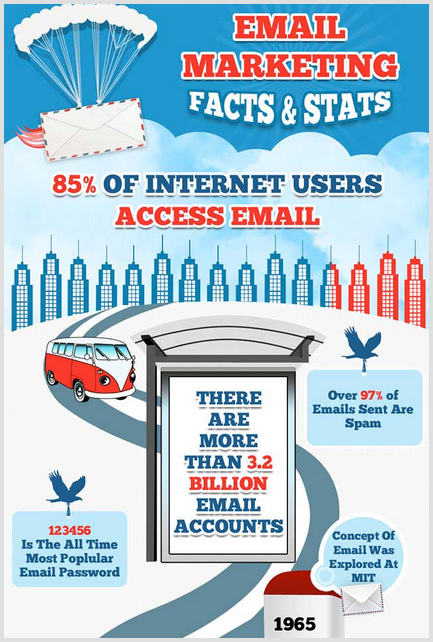
Here are some facts about mobile email from an excerpt from an infographic from Visual.ly.

how to build an email list

Some interesting email facts

Email is a technology that has been with us for over 44 years. The first email was sent in 1971 but the concept was explored at MIT as early as 1965 which is 50 years ago!

Here are some other email facts in another excerpt from an infographic at sociallystacked.com.

how to grow an email list

So they are some interesting facts but where do you start to build that quality list?

Create the Right freebie for the Right subscribers

The most common way to attract subscribers is by offering a freebie like an eBook, a checklist, a cheat sheet or something else that holds value.

To attract the right subscribers, the ones who come with a buying intention, you need to create a freebie that actually inducts them into your sales process.

Don’t treat your freebie as just a list building magnet. Make it the first part of your sales cycle. Use it to qualify subscribers and generate business leads.

For this, you need to design your freebie intelligently because it will determine the kind of subscribers you attract.

Use your freebie as a sample of your paid offer

I’ve seen travel bloggers offer SEO eBooks as giveaways. It increases their subscriber count, but adds no value to their business. Because their subscribers are irrelevant and have no interest in the actual paid offers.

The secret to attracting potential customers, not just subscribers, to your email list is to give them a taste of your paid offer. Lure them into your list by offering a limited version of your premium services and then work on them using a series of auto-responder emails.

For example, if you’re offering SEO and link building services, you can create a freebie that demonstrates your authority and expertise in link building, and at the same time get your potential customers interested in it.

It can be an eBook like “10 Link Building Mistakes That 90% Blogs Make” or a checklist “SEO Checklist: 25 Questions To Ask Yourself Before Publishing Your Next Guest Post.”

Both these freebies are actually samples of your paid services. Your ideal customers want to know about them. But instead of giving them everything for free, give them a taste of what you have to offer. Just make them think. This will establish your authority on the subject and immediately get your subscribers interested in your paid services.

Neil Patel does this in a number of ways on his blog. His primary services are SEO, link building, traffic generation and online branding. See how his freebies are actually advertisements of his paid services.

How To Attract Email List Subscribers Who’re Willing To Pay for Your Services 1

Here’s the other freebie he offers – a free SEO analysis of your website.

How To Attract Email List Subscribers Who’re Willing To Pay for Your Services 2

When you enter your website/blog here, Neil’s tool gives you a detailed SWOT analysis of your website’s SEO strength. It immediately gets the subscribers interested in his services because of the detail in which the report analyzes their website.

So the subscribers he gets are no freebie hunters, they’re potential customers who’re convinced he can help them grow.

There are a number of ways you can implement this to your business.

  • If you’re a freelance copywriter for small business websites, you can create a free content audit checklist as an incentive for visitors to sign up for your email list.
  • If you’re selling an eBook, you can offer the first chapter or a summary of the book for free.
  • If your product is a premium online course, your freebie can be a blueprint that gives high level information about the course.
  • If your services are web development and SEO, you can offer a free website audit.

In all these examples, notice how the freebie is actually an invitation towards the paid product/service. People subscribing to your email list already know that you’re going to sell them stuff. They are no freebie hunters, they already have the buying intention.

Converting subscribers into customers

Once you have the right people subscribing to your email list, more than half of your job is already completed. Your subscribers have the buying intention and, hopefully, after seeing your freebie, they know you are an expert and have real value to offer. Your only challenge now is to convert this buying intention into real sales.

In my experience, you need two key components to trigger this action.

  • An intelligent auto responder sequence
  • A simple and convenient buying process

1. Setting up the auto-responder sequence

Once you have the subscriber on board, a series of automated emails should be sent to him, aimed at nurturing the lead and triggering the sales action. The key here is to create a combination of engaging, convincing, and direct sales emails.

Here’s the typical combination I use.

1) The Congratulatory Email – Telling the subscriber what a great decision he has made to download my freebie and get on the list. This email is about building confidence and establishing trust.

2) The Story Email – This email relates the story of a previous customer who had the same problem that your subscriber has (for example poor copy, poor SEO, no customers, low conversions, etc.) and what he did to overcome it (your product/service as the solution). Be sure to add a link to your sales landing page at the end of the email.

3) The Sales Email – This email also relates a story with your product/service as the solution. But this time the tone is more direct and to the point. The link to your landing page is accompanied by a limited time discount offer.

4) The Warning Email – In this email you tell the subscriber what he’ll miss by not purchasing your product. Again, you relate a story where a previous subscriber got on board and got blown away by the results of your product/service. At the end of the email you add a 24 hour deadline before your offer goes down.

5) The Final Call – This email is a small reminder that your offer is going down in five hours. Again, the link to your landing page is accompanied by a special discount offer.

You can use paid auto-responder services like MailChimp and AWeber to configure this sequence. In MailChimp the auto-responder feature is for paid members only and the subscriber limit is 2000. AWeber, on the other hand, is a completely paid service. You can go for a free auto responder like SendinBlue which has almost the same features. Its free version gives you up to 9000 emails per month, which should be enough for most bloggers. You can read more about configuring it in this post.

2. A simplified buying process

Almost 68 percent of online shoppers abandon product purchases just because of a poor buying experience. So you need to make the buying process as simple as possible.

To be precise, your product’s checkout phase should:

  • Be optimized for mobiles/smartphones/tablets
  • Be secure and credible
  • Involve minimum redirections.
  • Offer as many payment options as possible

I’ve personally had an excellent experience with Selz, an easy to use digital selling tool. It covers all the points I’ve mentioned above and is particularly useful for bloggers and freelancers selling digital products. It is mobile responsive, involves no redirections during the checkout phase, and allows you to accept payments with Master Card, Credit Card, and PayPal.

Note: Here’s a useful comparison of some of the popular digital selling and ecommerce tools that can used to provide a convenient buying experience.

Wrapping it up

Let me summarize the main takeaways from this post.

  1. Building an email list is one of the first steps in building an online business.
  2. To create an email list that is truly valuable for your business and attracts potential buyers (not just subscribers), you need to create a free giveaway that is a sample of your paid products/services.
  3. Once you have the right subscribers, you can convert them into paying customers with intelligent auto-responder sequences and by providing a convenient buying experience.

Do you invest time and efforts in building email lists for product launches? What do you think is the best way to build a subscriber base that is willing to purchase your products?

I’d love to hear your thoughts in the comments.

06 Mar 19:21

8 Reasons Why Your B2B Leads Aren’t Turning Into Sales

by Michael Karp

Are you struggling to turn your B2B leads into sales?

Well, you’re not alone.

Take a look at this alarming statistic from MarketingSherpa:

“Seventy-three percent of all B2B leads are not sales ready.”

If we break it down, this means that if leads generated by marketing are sent directly to sales, only a quarter of them are ready to buy. This makes both marketing and sales look bad.

No wonder the old rivalry between the two departments still rages on.

couples therapy

If there were such a thing as Marketing and Sales couple’s therapy, the first step to alignment would be acknowledging there is a problem.

In this article, we’ve laid out eight of these problems for you. Hopefully, we’ve also given you some guidance on how to solve them.

Even if you act as both the marketing and sales departments for your company, you should find a few helpful nuggets to help you close more of those hard earned leads.

1. The Leads You’re Generating Aren’t Qualified

To find qualified leads, you first have to know who your ideal customers and clients are.

Without this knowledge, you’ll be blindly barking up tree after tree, never knowing which is right and which is wrong.

This is where buyer personas come into play. In reality, you need to know at least three things:

  • What industry your ideal customer is in
  • How much revenue they bring in per year, so you know if they can afford your service
  • What they’re biggest issues are (which your service can solve)

Then, you need to figure out where they hang out online and what content would attract them.

To do this, talk to your existing customers, scour through LinkedIn groups, Facebook groups, Google+ communities, forums, and search engines.

Take note of these key things:

  • The questions that pop up over and over again
  • The biggest problems these people are having
  • Who these people are. What are the character traits? Where do they hang out online? What interests them the most?
  • Anything that will help you better understand the people you’re marketing to

Spend a day gathering data on your ideal customer. What you’re building is in-depth buyer personas, so the content you create will be targeted towards them.

Look at the thread categories. Those are topics of major interest for your target market.

Go through these topics and pick out the issues that pop up again and again. Really get to know the people you’re marketing to. Then, create content that solves these issues better than any of the other content out there, and distribute it where your ideal customers hang out.

The leads you generate with this content will be qualified, because you have attracted the exact people who suffer from the problems your service can solve.

2. Your Leads Are in the Beginning Or Middle Of The Buying Cycle

If your leads aren’t ready to buy, you might be going for the sale too early.

selling-leads-too-early

Or, they have not received enough valuable content to trust your authority.

Content isn’t delivered to your leads for no reason. It has the specific purpose of removing buyer’s remorse.

This content has to build trust in your prospects, and it has to give them confidence your product or service will deliver on its promises.

Every buyer has one major concern: “Will this product or service solve my problem?”

Your content has to let them know, without a shadow of a doubt, that your product will deliver on its promises. They need to know they will get their money’s worth.

For example, let’s say your sales funnel consists of a simple email autoresponder that’s triggered once a prospect opts in.

What you could do next is set up an email nurturing phase. As an example, here’s a 6-part email nurturing phase you can use as a framework:

(The one you create will have to be tailored to your prospect’s specific buying cycle.)

The first three parts should be in-depth, problem-solving pieces of content that blow your prospects away with the value they provide. These three emails break down the possibility of buyer’s remorse.

The fourth email should hint at an offer coming in a later email, but with a special bonus for email subscribers.

The fifth email should present another piece of content, and introduce the special bonus that goes along with the offer.

The final email should present the offer and fully detail the bonus. It should also give prospects a limited window of opportunity to accept the offer before the bonus goes away.

Your final offer could be a free trial of your software. It could be a product. It could simply be the next step in the sales funnel. Whatever it is, your conversion rate will be much higher because of the valuable content you sent out beforehand.

The process is designed to take your prospects on a journey. This journey solves their problems, it educates them, and shows them way to overcome their problems. Finally, it asks for the sale, free demo, free quote, etc.

3. You’re Scaring Your Leads Away By Asking For Too Much Information

The more information you know about your leads, the better you’ll be able to run targeted marketing campaigns with a higher likelihood of closing sales.

One way to do this is to ask for a small amount of information when a prospect first enters your funnel, like a name and email address. Asking for as little information as possible up front will increase the chances of acquiring them as a lead.

asking too much inofrmation

Then, when they download subsequent pieces of content or access other parts of the funnel, ask them to provide more detailed information.

In the beginning, the offer should be off higher value than the amount of information your prospects are giving up. Overall, the information you’re asking for should at least match the value of the offer.

You can use this information to create segmented marketing campaigns that target the specific needs of your audience.

To get a different perspective on who your leads are, you can also view your site stats, including which content they’re downloading most. Then, use the trends in those statistics to better understand who you’re serving.

4. A Lack Of Resources Is Holding You Back

Inbound marketing campaigns are multi-faceted.

They’re a combination of web design, content creation, promotion, lead generation, lead nurturing, and copywriting – among other disciplines.

If you don’t have the resources in-house, they can always be outsourced.

There’s only so much you can do yourself. You don’t want to hold yourself back simply because you can’t juggle every aspect of the marketing process.

So don’t be afraid to delegate certain responsibilities to other people.

You might also be struggling to budget enough to your inbound marketing efforts. As the results from inbound marketing are more long term than short term, it can be tough to shell out the initial investment.

However, inbound marketing acts as long term lead generation asset. The content you create and distribute will continue to bring in leads months and years down the line.

Inbound marketing is your safety net, so it’s well worth the initial investment.

5. Sales And Marketing Are Misaligned

Misalignment arises from a lack of communication and accountability.sales-and-marketing-misaligned

One way to communicate better is to route calls to sales reps based on marketing data.

Using a call tracking system, you can gather data specific to that prospect’s behavior. This data can then be used to route calls to reps who specialize in closing those types of buyers.

For example, let’s say a prospect downloads an eBook on buying the right customer support software. When they call in, your call tracking system can direct them to a rep who specializes in selling that software.

To help with accountability, you can encourage sales to give marketing feedback on lead quality, so marketing knows whether they need to step it up the next month. You can also ask sales to provide marketing with the percent of leads worked that month, so marketing knows their efforts aren’t going to waste.

6. Too Many Leads Are Slipping Out Of The Buying Cycle

This is where customer awareness and support makes an impact, even before these leads become customers.

The way your marketing and sales teams respond to inquiries (and issues) gives leads a test drive of what it would be like to be your customers.

This system has to be fine-tuned. When someone requests help with their free trial, a member of your team has to be by the phone ready to help. When there’s an issue with a download, support needs to be ready to assist them.

“More than two-thirds of 2,000 consumers who encountered a customer service/customer experience issue on a brand’s website left the site or visited a competitor” – 2014 IBM Digital Customer Experience Report

7. You’re Not Utilizing Your Current Lead Database

You might have hot leads sitting on your doorstep, yet you’ve been focusing so intently on generating new leads, you forgot they were there.

Try pouring more resources into nurturing the leads you already have rather than generating new ones.

Send them some special offers. Offer your support for a certain feature. Give them tips to help them with a piece of software.

Odds are, once you figure out how to better convert your current leads into sales, you’ll figure out what you’re missing when trying to convert new leads.

8. You Can Be A Pro Marketer Or Salesman, But Not Both

This is the ultimate qualm of the marketing and sales “Jack of all trades” who runs both departments for their company.

To solve this problem, beef up your knowledge in the area you lack.

The Internet is full of free and paid resources to help you learn what you need to.

Is A Happy Marriage Possible?

Your leads might not be turning into sales for many reasons.

However, you’ve taken the first step in our marketing and sales couple’s therapy. You’re aware of the problems, and you’ve got some direction to help you implement the solutions.

So, is a happy marketing and sales marriage possible?

Yes, it certainly is. All it takes is a deeper understanding of how the two relate, and the right action steps to take to correct any misalignment.

06 Mar 19:21

15 A/B Tests to Ramp Your Facebook Ad Performance

by Sarah Goliger

Facebook ads are an excellent way to drive more traffic to your website and generate more leads for your business. However, setting up a few campaigns and just letting them run on their own won’t garner you much of either.

Aside from keeping an eye on your cost-per-click and cost-per-lead metrics, Facebook ad campaigns can seem like a lot of guess work. You must guess what type of ad content will work best, which audience targeting methods will get your ads in front of the right people and what copy will resonate with them the most.

But running optimized ads shouldn’t be a guessing game. There’s a science to it. You need to run tests, collect data, interpret that data and its implications for your ad campaigns, and then, of course, put all of those takeaways into effect. This begs the question: What tests can you run to learn whether your hunches are going to produce the best results?

This is where the power of A/B testing (also known as “split testing”) comes into play. Let’s take a look at 15 ideas for tests that will collect the right data and improve the performance of your Facebook ads.

Testing Your Ads

1. Short vs. long copy

Although Facebook already limits the amount of text in your ad, you should test whether shorter or longer copy appeals more to your audience within Facebook’s constraints. On the one hand, shorter copy can evoke a sense of suspense or curiosity. However, longer copy can often provide more clarity and context.

As an example, here’s a single-word ad (yes, really) that went for suspense over clarity:

15 AB Tests #1.png

2. Leading with an action verb vs. without one

One of the principles of good ad copywriting is to make it about them, not you. This can often be accomplished by leading with action verbs. Doing so makes it crystal clear what action you want the viewer to take.

In this example from Oyster, both sentences begin with an action verb – “See” and “Start”:

15 AB Tests #2.png

3. Question vs. no question

Using questions in your ads is a great way to increase engagement (this works especially well for newsfeed ads, since people can “Like” or comment on them). Try running a test with one ad that poses a question and another that doesn’t, then look at which drives more clicks and conversions.

4. Use of the word “free”

Long debated in the marketing world is the question of whether the word “free” in your advertising copy will lead to increased conversion. I say, test it out for yourself!

5. Use of social proof

Sometimes the best way to incite action is to tell your audience that “everyone else” is doing it. This can mean showing off the number of customers your business has, or the number of people who have downloaded the eBook you’re promoting.

In this example, Hootsuite encourages the viewer to “join 11 million+ professionals using Hootsuite”:

15 AB Tests #5.png

6. Generic stock photo vs. custom-designed image

Images play a key role in advertising, particularly within the Facebook newsfeed where they’re displayed prominently. So does a generic stock photo do enough to catch your audience’s attention? Should you try using an image more customized to your offer instead?

You should also look at ways to make your stock or custom images a little more personal. (Check out these simple photo editing hacks for marketers.) For example, look at how Sprout Social works the title of their offer into their image:

15 AB Tests #6.png

7. Logo vs. no logo

Whether or not you typically include your logo in other platform and network ads, it’s wise to test both approaches in your Facebook ads. Including a logo may increase brand recognition, but it may also decrease trust if your audience perceives it as sales-y.

8. Regular image vs. video

Have you tried replacing your ad images with videos? Testing different types of media in your ads can yield some very interesting data. You might find that ads with videos attract much higher engagement levels than those with static images, but since audience and ad type can make a difference here, you’ll have to test it out for yourself.

15 AB Tests #8.png

9. Call-to-action

What type of call-to-action (CTA) are you using in your ads? Are you using any at all?

If you said “no” to the latter, definitely start now. Try varying the CTAs that you write in your ad copy, and test out the different buttons that Facebook allows you to select, such as “Download,” “Learn More” and “Sign Up”.

Here, ModCloth uses a strong “Shop Now” CTA to entice viewers to start browsing on their site:

15 AB Tests #9.png

Testing Your Content

10. Type of offer

What are you offering your ad viewers? Different audience segments may respond to different types of content. For example, they may prefer eBooks, webinars, checklists or even free tools.

Just remember: The offer doesn’t have to be something they must download. You can run ads for a free trial of your software, a popular piece of content on your blog or a 30-minute consultation with a member of your team.

15 AB Tests #10.png

11. Content topic

Along with testing content types, try testing different content topics. This is the best way to discover whether you’re promoting content that is both relevant and useful to your target audience.

12. Timely vs. evergreen content

You may find that promoting timely content (meaning, content that is tied to an event, holiday, or anything else current) will attract better click-through and conversion rates. On the other hand, you may find that evergreen topics (those that are always relevant) may perform better. Why not test out both?

Here’s a great example of timely content from WaitBuyWhy, posted the week leading up to Valentine’s Day:

15 AB Tests #12.png

13. Content knowledge level

If you have a wide array of content (bonus points if certain pieces are written for varying degrees of skill), you may want to test ads that promote beginner vs. advanced pieces of content, then see which ones attract more interest.

Testing Your Audience

14. Audience targeting

Facebook offers a multitude of options when it comes to selecting the audience that you would like to target. You can target based on interests, demographic data, behavioral data or any combination of those. You can even upload your own lists in order to target users through Custom Audiences (this is mainly for those running retargeting campaigns).

Though Facebook audience targeting is more of an A-Z test than a simple A/B one, make sure you focus on the most important thing: Uncover all of your audience targeting methods and criteria before pairing each audience segment with the content that will be most relevant to them.

Doing this will also help you increase your relevance score, recently announced by Facebook as a way to help advertisers gauge the relevance of their posts to their intended audiences.

15. Narrow vs. broad audience

Along the same lines, you can choose to keep your audience targeting very broad (all people who live in the United States) or fairly narrow (females aged 18-26 who are interested in DIY crafts and living in the United States). You will likely get a higher volume of clicks and conversions by keeping your audience broad, but conversely, you’ll get higher quality conversions by selecting a closely-targeted audience.

You’ll want to keep a few things in mind before trying the above tests. First, be sure to not run all of them at once! It will muddy your results and leave you wondering whether the longer copy or use of video content got you a certain set of results.

Also, don’t overlook the planning stage of your A/B test workflow and design. Here are a few examples of good Facebook ads to give you some inspiration.

Just remember: Keep testing, and no matter what, always measure your results as you go.

06 Mar 19:21

How To Fix 9 Harmful Misconceptions about Content Marketing

by Stephen Moyers

Moyer-misconceptions-content-marketing-coverContent marketing has become a buzz phrase, not unlike “inbound,” “SEO,” and other words thrown around by digital marketers.

All real and worthwhile concepts, these words – perhaps because of their relative newness – tend to be used as blanket terms that describe a laundry list of things. For example, “content marketing” is often used interchangeably with “social media.”

In passing conversation, this might not be a big deal, but if you make generalization mistakes when creating a content marketing strategy, it can negatively impact your success.

It’s clear why everyone’s interested in content marketing. Consider these recent stats:

  • The ROI of content marketing outweighs the ROI of paid search by more than three times. (Kapost and Eloqua)
  • Yearly growth in unique website traffic is over seven times higher with content marketing leaders versus followers. (Kapost)
  • Content marketing costs 62% less than traditional marketing and generates about three times as many leads. (Demand Metric)

Brands know that they need content marketing, but too often misconstrue what it is or how to implement it. Meanwhile, companies that have had content marketing success may be missing out on even more gains because of an oversight or lack of understanding.

Here are nine common misconceptions to avoid in your content marketing.

1. Content marketing is easy and cheap

The internet is gloriously free. Anyone can start a website or host a social media account. Perhaps, for this reason, some brands assume that content marketing is easy. After all, you don’t need a degree or any special training to create content, right?

This view underestimates the skill involved in making content work well for the brand. Creating the right content requires deep knowledge of your brand, the digital landscape, and your audience, which is no easy task. Does your audience respond more to Facebook posts or videos? Email or blogs? Is your content actually converting?

Keep this in mind when you start a content strategy. If you fail to invest the proper amount of time and resources, you might not get very far in crafting a successful content marketing strategy.

2. Outsourcing is always a good idea

For companies that want to drive content online but don’t have the resources to do it in-house, outsourcing can be a viable option. Some marketing agencies specialize in this kind of work.

However, outsource wisely. Reputable companies will have proven, verifiable track records. Companies that offer ultra-bargain deals or operate in a country other than ones in which you operate may not have the right experience or might use dubious business practices.

For example, a relatively unknown company may seem like a bargain for its promise to generate tons of content and get it posted on different websites. Even if it fulfills the promise, it’s most likely using black-hat SEO tactics, which can backfire. Google penalizes websites if it discovers the brand’s content and links on a less-than-reputable websites – no matter who posted it.

If outsourcing, invest the time to research and work only with reputable companies.

3. Content marketing is only for SEO

The role of SEO is one of the biggest misconceptions about content marketing. Many people assume that all content needs to be targeted toward search engines. True, content is a great way to improve your organic position in search engines. Valuable content that people visit and share will move your site closer to page one of search results.

The mistake many make is to try and game Google. Some brands think that if they stuff their content with keywords relevant to their business, they’ll beat the system. Keyword stuffing might result in a temporary spike in traffic, but Google is watching what its users do. The algorithm is smart, and if it detects your content isn’t valuable to searchers, it will boot your site down the search engine results chain.

When creating content, make it search-engine friendly, but focus first on providing content that your targeted audience would find valuable.

4. The content is only for your audience

As stated, value should guide your content. However, while you shouldn’t manipulate search engines, you do want to give them some direction. There are a number of natural, approved methods of communicating basic information about your content so that search engines can match people’s queries with appropriate responses.

These days, Google is relying more on semantic search, meaning your keywords should be surrounded by relevant words and phrases on the page. Additionally, you can take a handful of simple steps to make sure your pages are search-friendly, such as including meta titles, descriptions, and headers.

5. Content marketing is only for B2Cs

People often assume that only fun, consumer-focused brands can reap the rewards of content marketing. But case studies abound showing how B2Bs have used the core principles of content to improve their power online.

Take SunGard, an IT operations company that supports many Fortune 100 companies. By creating a video series that brought humor to industry trends and pain points, and analyzing its audience’s consumption patterns, the company generated 3,000 leads in three days and scored a cumulative 87.4% click-through rate.

6. Content marketing is the same as brand-awareness marketing

True, brand awareness is perhaps the easiest goal – albeit the hardest to measure – of content marketing. And, to be honest, if its effectiveness ended at brand awareness, I probably wouldn’t be writing this right now.

What a lot of brands don’t realize, however, is that content marketing isn’t just for the first stage of the sales funnel or customer journey. Content should be created and optimized to address customers’ needs as they go through the process of engaging with your products and services.

For example, if a customer visits your website, clicks on a page, and leaves, you could use retargeting tools to track the individual and advertise that departed page’s content to them as they visit other sites. Or perhaps, you secure the visitor’s email address in the first visit and send a follow-up email. Tailor your content to nudge customers further along through the journey.

7. Content marketing’s value is not measurable

According to CMI’s 2015 B2B research, only 35% of marketers have a documented content marketing strategy. It’s no wonder then that some brands often become frustrated with the lack of perceptible results.

A variety of tools can track the impact of your content. Google Analytics is probably the most common method of measuring data gleaned from your website, social media channels, blogs, and more. You can even dig down and get granular results so you know how your audience interacts with specific pages and posts.

The web is basically teeming with tools for measuring, managing and creating content. Figure out which ones work for you and start tracking your efforts today.

8. Content marketing delivers instant results

I’ve seen some brands become frustrated that their content marketing doesn’t pay off as quickly as they would like. This is understandable. If you invest time and money into something, you want to see results as soon as possible.

But content marketing is about building relationships. Just like in life, it takes time. It’s unlikely that someone will view your content and immediately make a purchase. Be prepared to play the long game. You need to establish trust with people before they take further action. Take that person who views your content and get him to provide an email address. Now, you have the start of a relationship.

Remember, with content marketing, the prospect is in the driver’s seat. Brands have to provide value to their targeted audiences to prove their true worth, and that can take months.

Make sure you set manageable benchmarks and set a reasonable time to expect an ROI on your content efforts.

9. Content marketing is the same thing as content creation

Of course, the content itself is essential, but it’s only one part of the overall strategy. Content marketing includes everything from distribution to interaction and communication. You can’t just create and post a blog post and expect it to do all the work for you.

In fact, before you create any content, you should create a documented content marketing strategy. To whom is your content targeted? What do you want your audience to do? How will you promote your content? Which websites can you target in order to get backlinks? Does your plan account for responding to people in real time over social media? How often will you post?

These are just some of the many questions you need to address before implementing your strategy. The takeaway here is that each individual piece of content needs to interact with a larger plan.

What other misconceptions about content marketing have you seen? How did you fix them?

Want to plan ahead for your own content marketing education? Check out the CMWorld 2014 sessions available through our Video on Demand portal and make plans today to attend Content Marketing World 2015.

Cover image by Viktor Hanacek, picjumbo, via pixabay.com

The post How To Fix 9 Harmful Misconceptions about Content Marketing appeared first on Content Marketing Institute.

06 Mar 19:21

Inside Sales Onboaring: An Interview with a Sales Enablement Pro

by tbertuzzi@bridgegroupinc.com (Trish Bertuzzi)

qualtricsWe all know that ramp time is a KPI for inside sales organziations. From our 2015 inside sales research, we also know that the percentage of companies with 5+ month ramp time has tripled since 2010.

Online survey software company Qualtrics takes this seriously. And judging by their Glassdoor reviews, they are nailing it. 

Recently, I had a chance to speak with Charlie Besecker their Head of Sales Development, Sales Enablement and Professional Development. I asked him a few questions that I thought would be of interest to the inside sales community.

When did onboarding become a mission for Qualtrics?

When given the assignment of revamping our onboarding process, I asked what our ultimate goal was, "How will we know when we’ve been successful?" The response was daunting: “You know how Xerox, IBM, and Pitney Bowes, became synonymous with world class training and are spoken about for decades to come? Like that.”

As cheesy as it is, we started with a mission statement: Construct and execute a meticulous, white-glove onboarding process providing individual, personalized success plans to cut new hire time-to-success in half. By "white-glove," imagine the nicest hotel in the world. They anticipate your every need before you even know you need it.

When does your "white-glove" approach to onboarding begin?

It starts with the offer letter. Each role within each department has pre-packaged content sent to them before their start date. In it we are sharing relevant information about the industry, our products, recent successes, and helpful facts about the organization.

We pair the yet-to-start new hire with an informal mentor and share contact information and a brief introduction. Lastly, the day prior to their start, we send a message confirming the time, location, typical attire, and the names and pictures of the training coordinators that will be greeting them.

What happens when they arrive?

We are really well prepared for when they walk in the door. Their work area is set up with great care. It is clean, organized, and complete with all the basic essentials. Cards are draped over the computers with their name, important phone numbers, a map of the building, Wi-Fi passwords, names and extensions of key people, and login information for internal systems.

When starting day finally arrives, new hires see a sign outside the building “Hey Qubie, Your New Career Orientation Starts Right Here!” (Qubie is like Newbie for Qualtrics. Yeah, we’re nerds).

The reception area is decorated like a party (we’re celebrating their arrival), with balloons, couches, breakfast, music, a few Qualtrics golf carts (see above: we’re nerds) and so on. Team leads, formal and informal mentors are invited to join if they can and finally the group is moved to the training facility for the company introduction.

Qubies are given a two-week schedule along with a single day schedule each morning for the first two weeks. Each contains session information such as meeting room, trainer, desired outcome of training, and any helpful hints. Playbooks are given—massive and detailed anthologies about the company and their role—in digital format and the most important elements are given as laminated “desk references.”

Each day for the first two weeks the training coordinator checks in with each new hire and makes sure they have everything they need and answers any questions they may have.

What has been the impact?

In the end, we found the degree of care and personalization around onboarding has dramatically impacted the rate at which many employees get up to speed and appears to have reduced attrition—and this has nothing to do with the actual training process and content (perhaps a topic for another day).

Have you gone "white-glove" in your onboarding? In what ways are you delivering amazing onboarding to your new hires?


06 Mar 19:21

How To Get Your Trade Show Lead Follow-Up Right

by Ben Camerota

There’s nothing quite like wrapping up a successful trade show with pages of new leads. Every one could be an opportunity for a sale, a business relationship, a great referral, or a lifelong customer. But there is one major step that you have to get right first: the follow-up.

Following up with new leads can mean a lot of different things, whether it’s a phone call from your sales team, an email from your booth staff, or a tweet on Twitter. Follow-ups are notoriously tricky, and are hard work after all the excitement of a trade show. But they just might be the most important part of your whole trade show experience. Below are some tips to think about when you plan a follow-up strategy for your next show:

  1. Get Your Timing Right

We’re all eager to get in touch with promising new leads, but reaching out right away isn’t always the best approach. Think about how you feel getting back into the office on Monday after being away for a week – there’s a lot to do and your inbox is full. Be patient; email or call later in the week to reach your leads when they have a little more time to talk, or a less cluttered inbox.

  1. Gather the Right Info with Your Lead Forms

An effective follow-up addresses the specific needs and wants of your lead – more information than you can get from a business card. A good lead form for your booth staff to fill out will solve this problem, if you ask the right questions. Linda Armstrong of Exhibitor Magazine suggests relying on multiple-choice questions for the basics (faster for staff to get through) and then leaving some space for notes about specifics. Whatever you decide on, strike a balance between keeping it short and gathering sufficient information.

  1. Be Specific and Offer Something

Trade show leads will know if you’re sending them a canned email follow-up after an event. Is that really how you want to start a potentially valuable relationship? Make each follow-up personal; if at all possible, the booth staff member who met that lead should be the one following up with them. It’s a great idea to include details of the conversation, to help the lead remember your booth among the many they visited at the show.

This really depends on your booth staff making good use of the lead form and notes section, since it’s impossible to follow up in a specific way without an idea of what the lead is interested in. The best follow-ups include something enticing like a deal, free white paper, or the offer of a free sample, and specific notes will help you send what that lead is really looking for.

  1. Connect on Social Media

Many of your leads are really not ready for a hard sell, or even a sales call – but that doesn’t mean you should discard them. Connect on social media with all your leads, so they can come to know your brand and your offerings in their own time. Eventually when they have a need for your product or services, they’ll turn to you and not your competitors.

Careful, thoughtful follow-ups have the power to turn vague leads into buying customers, or valuable B2B contacts. Planning your follow-up strategy in advance will help booth staff and sales teams know their role, so that you can get the most out of your trade show attendance. Following up with leads in the right way should be your main event goal – not just an afterthought.

06 Mar 19:21

5 Critical Digital Marketing Metrics every business should have

by Expert commentator

Track and optimize these 5 metrics and watch your profits surge

As a digital marketer with access to Google Analytics plus your multiple inbound marketing tools, you have hundreds upon hundreds of metrics to consider while judging your results. Where to start? For example, here is just a tiny list of metrics to consider to start:

  • Number of website visitors
  • Website bounce rate
  • Email subscriber list size
  • Email open rate
  • Advertising CTR (click-through rate)
  • Number of new leads

Overwhelming... I know.

The natural question that arises is, which metrics are the most important to track, and why? This article will answer just that. I'll explain the 5 most critical metrics for your business, and how tracking them will boost your profits immediately.

Business Asset Metrics vs. Operating Metrics

Before we go over the 5 key metrics, I want to briefly explain the importance of Business Asset Metrics and Operating Metrics, and the difference between the two.

Operating Metrics are the numbers that gauge your current performance, such as sales, profits, website bounce rates, etc. On the other hand, Business Assets are resources you acquire or create that have future economic value, such as your email subscriber list.

Importantly, there is often a trade-off between the two. For example, if you spend $50,000 this month in advertising to acquire 10,000 new opt-ins/email addresses, your current month’s profits would decline by $50,000 (assuming none of the new subscribers bought anything right away). However, future sales and profits should increase due to the addition of new email subscribers.

So, when considering metrics, it’s critical to consider both types as this gives you both a short-term and long-term view of your business.

The Top 5 metrics to track

1. Number of New Leads

The first key metric to track is the number of new leads, or potential customers, you’re acquiring. The chart below shows the number of new leads by day, week, and month.

Total Leads Metric from GuidingMetrics Dashboard

This metric is critical because leads are the lifeblood of your business. And if leads decrease today, sales decrease tomorrow. The challenge is that leads are different for type of business, so you have to identify these and customise goals in Google Analytics relevant to your business.

The problem is this: most businesses have no idea when leads go down since they don’t track them closely enough. Rather, they only notice a lead decrease days or weeks later when it’s too late and sales have already dropped.

I call this ’leaving money on the table.’ Had the business been tracking leads on a daily basis, the decrease would have been uncovered immediately. It would then have been evaluated with both business and emotional intelligence, the issue would be fixed and market-optimized, and sales would have increased rather than decreased.

2. Conversion Rate from Leads to Sales

The second key metric to track is your conversion rate from leads to sales.

Conversion Rate measures the process of transforming your leads into sales, which could be one or multiple steps. It is imperative to track your overall conversion rate from lead to sale, and, if you have multiple steps (e.g., talking to a sales rep, then receiving a proposal, etc.), measure the conversion rate for each one.

The chart below shows the conversion rate from leads to sales by day, week and month.

Lead Conversion Rate Dashboard - GuidingMetrics

Once again, visibility is key here. I can’t even begin tell you how many businesses suffer weekly and monthly declines in their conversion rates from leads to sales because they simply aren’t aware of it.

You stop leaving money on the table and boost profits when you identify the conversion rate that’s declining, analyze it, and fix it. The adaptation process is typically accomplished by split testing different options until you find the winner (e.g., testing two different webinar registration pages).

A couple important notes here:

  • The daily conversion rate in the chart above is sometimes above 100%. This is common and occurs when there is no uniformity between when leads come in and when they convert.
  • For this reason among others, it’s important to view metrics on not just a daily, but weekly and monthly basis. This is true for all metrics, but particularly for conversion rates. There will always be variability on a daily basis, so you should typically view a single day’s performance with a grain of salt.

3. Cost Per Advertising Conversion

For most businesses, the most important advertising metric is cost per conversion.

Your cost per conversion is your advertising spend divided by whatever you set as the immediate conversion goal for your ad. For instance, the number of:

  • phone calls received
  • email addresses attained
  • sales generated
  • social media shares

The chart below shows the daily cost per conversion from a Facebook advertising campaign.

FB Ads Cost Per Conversion - GuidingMetrics

While metrics like cost per click are critical to monitor, cost per conversion is even much more so. For example, if you only pay $1 per click but only 10% of those who click convert, then your cost per conversion is $10. Conversely, if you pay five times as much per click ($5), but 80% convert, then your cost per conversion is only $6.25. Obviously we’d prefer the latter.

4. Top Converting Emails

While email metrics like open rates, click through rates and unsubscribe rates are important, the most critical metric to track is your total email conversions.

That is, how many email subscribers took the action you wanted? How many purchased your product or service, called you, or completed a form, etc.?

Once you identify these top converting emails, they become business assets. Since they’ve been proven successful, send them again in the future. Craft more like them. You’ve got some real ammo now.

While overall email conversions are the most important email metric, that’s not to say the other metrics should be ignored. For instance, if an email generated tons of sales, but also many unsubscribes, you might not want to blast that one again.

The chart below shows emails sorted in decreasing order of conversions. In this case, the metric decreases by revenue generated per email.

Top revenue generating emails

5. Contribution Margin

The most important metric that shows your operating results is your Net Profit, or your sales minus all your expenses. However, Net Profit is best viewed on a monthly basis. Why? Because calculating and subtracting the daily pro-rata cost of your office lease and salary expense isn’t exactly practical. Additionally, you don’t want the month to end only to learn then that profits had decreased.

As a result, the best approximation to Net Profit and the key metric you should be reviewing daily is your Contribution Margin. Contribution Margin equals your sales minus your variable costs, such as your costs of goods sold, advertising expenses, sales and/or affiliate commissions, and so on.

Contribution Margin is particularly critical for digital marketers since it’s so easy to increase sales by simply ramping up your online advertising spend. Moreover, this metric serves to ensure on a real-time basis that your company’s profits are strong.

Note: As shown in the chart below, Contribution Margin should be judged against prior periods. The goal is to always be increasing this crucial figure.

Contribution Margin GuidingMetrics

Recap: The Tangible Benefits of Tracking Your Metrics

By tracking and assessing your key metrics:

  • You make more money. Period.
  • You see what’s working and you know to do more of it. Leads converting? Let’s round up more leads. Blast a successful email? Awesome. Do it again.
  • You save money. You’re alerted to problems immediately and can fix them right away.
  • Your employee performance increases. When you let employees see select metrics, they tend to improve their performance since they’re finally being judged on an objective basis.

Bob Parsons, founder and CEO of GoDaddy, might have said it best when he advised, 'Measure everything of significance. Anything that is measured and watched, improves.'

At Guiding Metrics, we’ve been able to add one more key benefit to tracking your metrics: saving time. By integrating with the systems (web analytics, email systems, shopping carts, CRMs, etc.) where your data exists, and automatically pulling, organizing and assessing your metrics from it, the manual labor previously required to run your metrics is eliminated.

So make sure to start tracking your critical metrics today, and you can look forward to your performance consistently improving in the immediate future.

Thanks to Dave Lavinsky for sharing their advice and opinions in this post. Dave Lavinsky is a serial entrepreneur and president of Guiding Metrics, where he has helped hundreds of digital marketers to grow their sales and profits by automatically calculating their key metrics. Dave holds a BS from the University of Virginia and an MBA from The Anderson School of Management at UCLA. You can follow him on Twitter or connect on LinkedIn.
06 Mar 19:20

When Bad Things Happen to Good Leads - Part 4

by dan.mcdade@pointclear.com (Dan McDade)

Multiply Lead Generation Results

So far over the course of this series we’ve covered how marketing to non-lead outcomes, such as pipeline and nurture dispositions*, can substantially increase return on marketing programs. Yes, we have a problem in that sales has a tendency to ignore leads from marketing. Be that as it may, marketing is not exactly making use of the valuable data that results from their efforts either. Our topic here in part 4 is unresponsive outcomes—what we refer to as “no response” dispositions. For every 100 “suspects” dispositioned, 35 - 45 of them will be unresponsive to the first touch cycle; HOWEVER, did you know that a considerable portion of those non-responsive names will close as business for your company (or a competitor) within one year? The key is not to give up too early.

WhenBadThingsHappen_Image_Non-Response_200Why You Should Recycle Non-Responsive Suspects

If you’re familiar with me at all, you’ve heard me reference the story I’m about to share. One of my favorite memories is a project we did for a client some years ago. This client sold business process outsourcing services to large companies, and they were a significant global player.

Our target market was CFOs at the top 50 utilities in North America. On the 42nd touch (a combination of voicemails, emails, and one overnight package over a THREE MONTH PERIOD), the CFO of the 4th largest utility called back and left a message, saying, “Don’t stop calling me. You are my conscience. I want to talk to you but I have been extremely busy. Call me back on Tuesday two weeks from now at 10:00 AM my time and I will take that call.” We called back, generated a lead and it closed as a $1 Billion deal for our client five months later. True story!

This CFO had saved the following (during the previous quarter):

  • A voicemail
  • Two emails
  • The overnight package we sent to him (industry magazine with a cover picture of one of our client’s customers who happened to be the CFO of another large utility).

What would have happened if we had thrown in the towel after the first round? More than likely the business would have been won by a more tenacious competitor.

How to Generate Leads from No Response Dispositions

In any group of 100 suspects you will have 35 - 45 that are unresponsive to a single touch cycle (typically three voicemails and three emails over about ten business days). By the time you analyze results from the first touch cycle, you will have learned that some list segments are unproductive, perhaps bringing down the total number of worthwhile non-responsive suspects to 25 - 35. The beauty of this is that your efforts have not at all been unproductive. Even if you have not yet had a conversation, you’ve been learning about the suspect. The longer the suspect stays unresponsive, the more your messaging starts to tighten up. Eventually suspects become prospects; prospects become nurtures; nurtures become pipelines; and pipelines become leads. On average, 2 - 4 additional leads can be generated per 100 original suspects (25 - 35 non-response suspects). Here’s how we’re stacking up:

  • 5 highly qualified, sales-ready leads generated from a new, “cold” list.
  • 5 pipeline dispositions identified (which will convert to 1 - 2 additional, incremental leads).
  • 25 - 30 companies identified as nurture dispositions. Over time, an additional 5 - 6 leads (or about 20% of the total) will result from nurturing the “nurtures.”
  • 35 - 45 will result in non-responsive outcomes. With further analysis, this number can drop down to about 25 - 35 worthwhile no response dispositions, from which 2 - 4 ADDITIONAL leads can be generated with further nurturing.

What you have is the potential for a total of 15 - 17 leads—three times the number of leads you would have received had you stopped after the first touch cycle. All because you did not give up!

In the next and final installment of this series, we’ll discuss how senior executives respond differently than their junior counterparts and why they are significantly less likely to give up their digital body language via marketing automation. Don’t miss it!

Read the other posts in my "Nurturing" series:

Part 1: Why Are Leads Ignored by Sales?

Part 2: Don't Underestimate the Value of the Pipeline

Part 3: Maximize Revenue with Lead Nurturing

Part 4: This post

Part 5: Reach Out to the C-Suite, They Will Respond

*Disposition - noun: the classification of a prospect account as determined after a cycle of lead qualification activity; verb: to classify prospect accounts using a cycle of lead qualification activity. Standard PointClear disposition categories include: Lead, Pipeline, Nurture, Disqualified, No Response, Bad.

06 Mar 19:20

How to create your ideal customer profile for B2B lead generation

by steli@close.io (Steli Efti)

There are different reasons why a company should create an ideal customer profile, but this post is about creating an ideal customer profile so that you can focus your sales and marketing efforts to generate high-quality sales leads. 

Pretty much every week I speak with founders and sales directors who struggle to reach their sales goals because they haven't nailed their ideal customer profile yet. Many of these are very small teams, but in some cases even startups with millions of dollars in funding aren't clear of who their ideal customer is.

So let's start with the basics...

What is an ideal customer profile?

It’s basically a description of a fictitious organization (company, government agency, non-profit organization…) which gets significant value from using your product/service, and also provides significant value to your company.

Let’s further examine three parts of this ideal customer profile definition.

How does this imaginary organization provide value to your company?

  • First and foremost, they pay you for the value you provide them. But there are many other secondary ways how a customer could benefit your company...
  • They might help refer you to other companies. 
  • They might become advocates for your company.
  • They might give you access to resources to grow your business.
  • They might provide you with valuable insights into new opportunities.
  • They're pleasant to deal with and don't require excessive amounts of support.
  • They might let you use their logo and provide a testimonial that you can use in your marketing materials.
  • They might just be a constant and neverending stream of positive feedback and encouragement for your team.
Having listed all these, it's worth restating that the most important indicator of value they provide to your company is the amount of money they pay you! 

How does this imaginary organization get value from using your product/service?

  • You help them make more money.
  • You reduce their expenses.
  • You alleviate pain points.
  • You increase productivity
  • You raise morale
  • You help them better service their customers
  • You help them to become more successful
  • and a thousand other ways…  

But ultimately in B2B, it's about how you affect the bottom line, and if your solution doesn't have a direct correlation with profits or expenses, you should be able to demonstrate how it indirectly will affected the organizations finances.

Now we said it’s an fictitious organization, but the fiction is based on some solid facts and real data.

You don’t just fabricate an ideal customer profile out of thin air. Instead, you systematically identify shared traits and characteristics of real customers who are succeeding with your solution. We’ll talk in more detail about how to do this, but first, let’s look at some of your real customers.

Make a list of your "best" customers.

Create a list of your 10 best current customers. 

You should be able to call these customers and ask them: “How much are you paying us for our solution? And how much value are you getting out of it?”

The second number they tell you should be a multiple of the first number. So if they pay you $100 a month, they should be getting at least $200 of value in return from using your solution.

It’s not enough that they pay for your solution. They need to actually get significant value from it and be aware of the value derived from your solution.

Sell to your customers in three stages:

Don't assume that this magically happens by itself. You should take charge of making this happen by selling them in three stages:

  1. Before they buy, you need to sell them on the promise of your solution. You need to convince them that your solution has the potential to make them successful, and is worth investing in.
  2. After they buy, you need to sell them on actually implementing your solution. It’s not enough that they just paid you for it - they actually have to invest time and resources into utilizing it, so that the promised value is actually created.
  3. After they've received the value, you need to sell them on realizing that it’s your solution that has created the value. You need to ensure that the people in the organize are aware of the value your solution has created - this is not something that happens by itself, it’s something that needs to be engineered and directed. (Especially in large organizations where there will always be individuals and departments eager to claim credit for achievements.)

Don't have 10 ideal customers yet?

If you can’t come up with 10 customers, drop everything else and focus on getting these 10 ideal customers. Either make it happen by supporting some of your existing customers over to the top until they reach that level of success with your solution, or make it happen by bringing new companies and board making them successful with your solution.

Find common attributes

Now look at this list of your idean ideal customers, and ask yourself: what do they have in common?

This is where you have to brainstorm and do your research. Dig deep and come up with lots of attributes for each of these 10 companies so that you later find commonalities.

Your ideal customer profile template

The best way to go about this is to identify which questions are worth asking your ideal customers. Here are some ideas to get you started in different directions:

  • What’s the size of the organization? (Measured in revenue, number of customers, number of employees…)
  • What’s the size of the relevant department?
  • Do certain certain job titles exist in the organization?
  • Which industry or niche are they serving?
  • From which academic institutions did they recruit their employees?
  • Which companies have current employees previously worked at?
  • Do they largely promote people from within the organization, or do they mostly bring in experienced leadership from outside? (e.g. in the first case, they might value training their personnel higher, vs in the latter they have more demand for recruiting services)
  • How long have they already been in business?
  • What’s the number one reason that would prevent them from buying your solution?
  • What’s the number one reason that would make them decide to buy your solution? What makes your offer appealing to them?
  • What goal do they want to achieve with your solution?
  • How are they currently trying to achieve this goal?
  • Why did they decide to try this approach? (What was the decision making process that led to this choice?)
  • What’s the main pain point with their current approach?
  • What are the 3 most important features for them?
  • What’s their buying process like?
  • Did they ever make a purchasing decision to fulfill the need? If yes, how often did they already do this? 
  • Which industry publications, blogs or websites are they following?
  • What kind of tools or services are they using?
  • Where are they located? (Geographic region? Rural vs urban area?)
  • Any recent personnel changes? Restructuring? Other recent events in the company?
  • Seasonal or temporal factors? (e.g. Spending remaining budgets before end of year? Selling remnant advertising before going to print? Having to meet goals before end of quarter? Low demand during summer?)
  • How have they been affected by changes in the economy or other developments outside their sphere of influence?
  • What kinds of social media platforms do they use?
  • What kind of usage patterns do they show?
  • What’s their culture like, what values do they practice?
  • How do they position themselves in the market?
  • What words do they use to describe their product or service?
  • In which directories do they get listed?
  • Which associations or trade groups are they members of?
  • Are they more driven by a desire to be innovative or to reduce risk?
  • Which trade shows or industry events do they attend?
  • How technically sophisticated are they?
  • Where do they source their materials?
  • What distribution channels do they use?
  • What’s their awareness stage? Do they already know your product and just aren’t motivated enough to buy? Do they know the end-result they want but not that your solution is capable of delivering it? Do they know that they have a problem, but have no idea how to solve it? Aren’t they even aware of the problem, and need to be educated of the fact that they have a tremendous opportunity for improvement?

As you can already see, there are hundreds of questions you could be asking, and it's impossible to provide an exhaustive list. That doesn't mean you should be answering all of these. 

Don't get stuck in generic templates which try to define your ideal customer in terms of broad demographic, psychographic and behavioral attributes. These fill-in-the-blank customer profile templates no basis to create highly targeted lead lists.

teambrainstormidealcustomerprofile

Get together as a team for a couple of hours and brainstorm which questions are relevant to your ideal customers. 

3 ideal customer profile examples

These profiles come in different shapes and sizes. Some are very elaborate and in-depth, others consists of simply two or three telltale signs of being a great fit for your solution. 

If you want three examples of what an ideal customer profile can look like, just enter your email address below.

06 Mar 19:19

The 8 Rules of Influencer Marketing: How to Find Influencers (And Become One Yourself)

by Dan Shewan

Influencer marketing is one of the most effective ways to expand your company’s reach, increase your credibility in your industry, and establish yourself as a thought leader within your field of expertise. However, influencer marketing can be somewhat of a vague concept, and like content marketing, there is more than one way to become an influencer and leverage your status in your marketing campaigns.

Influencer marketing concept illustration

In today’s post, we’ll be looking at eight informal “rules” for becoming an influencer in your field, finding other influencers, and getting other people to sit up and pay attention to what you have to say. Before we dive into that, though, let’s examine what influencer marketing really means.

What Is Influencer Marketing?

You can think of influencer marketing as a way to leverage the status of an individual within your organization to boost the profile and standing of the company as a whole. Many influencers also use their status and reach to launch their own companies or consulting businesses.

Many of the world’s leading influencers’ names are synonymous with those of their organizations. WordStream’s own founder and Chief Technology Officer, Larry Kim, is considered an influencer in the paid search, content marketing, and social media spaces. Larry frequently speaks at conferences around the world, and his extensive knowledge and thought leadership in search has elevated not only his own profile, but that of WordStream as a company.

Influencer marketing Larry Kim Inbound 2014 presentation

The audience eagerly awaiting Larry’s paid search presentation at Inbound 2014

However, influencer marketing isn’t merely capitalizing on someone’s image to increase sales. More often, influencer marketing is about establishing that individual as a trusted authority in their area of expertise and defining the conversations that center around a given topic; in Larry’s case, paid search, content marketing, and social media.

So, if influencer marketing is using the status of a single individual to influence others, but isn’t solely used to gain leads or increase sales, then what is it? How can you become an influencer? And how can you create marketing campaigns that speak to influencers in your industry? Here are eight tips that will put you on the path to influencer marketing mastery and increase your visibility in your industry.

Influencer Marketing Rule 1: Find Influencers in Your Industry

Although you probably already have an idea of who the movers and shakers are in your field, you need to find – and follow – these people to see what they’re talking about.

Social media is hands-down the easiest way to find influencers. Do a search by topic to identify conversations and see who is making their voice heard. Follow influential people, and check out who they follow. Participate in regular conversations relevant to your industry (like, say, the weekly #ppcchat discussion on Twitter).

Alternatively, you can use free online tools like BuzzSumo and Topsy to see who’s sharing your content (or anyone else’s content), as well as how influential they are. In Topsy, simply enter the URL of a piece of content and check out the results:

Influencer marketing finding influencers on Topsy

For BuzzSumo users, it’s just as easy to identify influential people and the content they’re sharing. Click on the “Influencers” tab at the top of the page, enter your search terms (in this example, “PPC”), and check out the results.

Influencer marketing BuzzSumo Influencers report screenshot

It’s worth noting that while you can sort results by several criteria, such as page and domain authority, followers, retweet ratio, and average retweets, the results won’t always display in order. As you can see in the example above, Larry has better performance in every metric than PPC Hero, which is listed as the top result. However, it’s still a very handy way to see who the major players are in your industry.

There are other things you can do to identify influencers in your field. Identify conferences that are relevant to your industry and check out the list of speakers. Ever notice that the same people tend to crop up in a variety of industry publications as columnists and guest posters? These individuals are probably influencers. What names do you hear over and over again in your field? Which articles are constantly being linked back to?

Even a little research will quickly yield a list of influencers whom you should follow and listen to.

Influencer Marketing Rule 2: Understand the Difference Between Influencers and Advocates

Before you can become an influencer, it’s important to realize that advocating for a cause or subject area is not the same as being influential. You can be the world’s biggest cheerleader for content marketing, for example, but that doesn’t necessarily make you a content marketing influencer.

Influencer marketing influencers versus advocates infographic

Image via womma.org

To be perceived as a genuine influencer in a given area, you need to shape and define the conversation, not just advocate for whatever it is that’s being discussed. Are you asking questions that nobody else has thought of (or dared to ask), or are you just repeating what others have said? Is your take on a topic genuinely new, or are you publishing content about the same things as everyone else? Do your ideas and opinions challenge existing conventions about your industry, or do they get lost in the noise?

If you want to become an influencer and reach individuals who are already considered influential in your field, you have to define the conversation, not just nod your head.

Influencer Marketing Rule 3: Own Your Niche

If you’re going to become an authority in your industry, you need to own your niche. It isn’t enough to know a great deal about a few subjects – you need to zero in on one hyper-specific area of focus and make it yours.

Influencer marketing own your niche

A couple of years ago, Larry started discussing the AdWords Quality Score algorithm. Some people dismissed his work on Quality Score, claiming it wasn’t important enough to warrant the kind of attention Larry was devoting to it.

They were wrong.

Larry’s examination of Quality Score, and what it means for AdWords advertisers, is a prime example of owning your niche. Rather than publish content (and host webinars, and speak at conferences) about paid search in general, Larry owned his niche by refining his area of focus even further to Quality Score. Today, Larry is considered one of the most knowledgeable people in the world when it comes to paid search, but he owned an already specialized topic and set to work proving himself as an expert in one of several specific areas – one that many people had overlooked or written off.

Influencer marketing stop obsessing about quality score article

You can read Alistair’s piece here, and Larry’s rebuttal here.

In addition, Larry’s authoritative Quality Score content even prompted Google to address the issue of Quality Score in AdWords.

“When it comes to the details of how exactly the AdWords auction works, for obvious reasons, they would prefer not to give away the secret sauce,” Larry says. “Our research pointed out some obvious loopholes in their literature and they were forced to update it. You know how I know? They didn’t update their Quality Score info for six years. Then, just a few months after my Quality Score bonanza (I think we published 50 or so articles on the topic, as well as a few dozen conference sessions), they update their Quality Score info and released a new white paper called “Settling the Quality Score” (that sounds like a response to something, doesn’t it?). While I’m not called out by name in the refresh, they do refute and confirm specific points that I’ve brought up in the past.”

Influencer Marketing Rule 4: Don’t Confuse Reach with Influence

Many people assume that to become an effective and respected influencer in their field, they have to reach as many people as possible. However, things are a little more complicated than that.

Influencer marketing isn’t just about reaching a lot of people – it’s about reaching the right people. After all, you’ll need at least the implicit endorsement of other experts in your field if your ideas are to gain any traction.

Influencer marketing reaching the right people

This doesn’t mean carpet-bombing the entirety of Twitter with links to your latest brilliant blog post, but making sure the right people see your content and amplify it. The first thing you should do? Start sharing other influencers’ content.

“First, take an interest in amplifying other people’s content,” says Larry. “The principle of reciprocity says that people are more likely to take an interest in your stuff if you take an interest in their stuff first.”

Remember – reach is not the same as influence. It’s more important your content reaches the right people than the most people.

Influencer Marketing Rule 5: Do What Works For You, Not Your Peers

When you’re trying to make a name for yourself, it’s all too easy to look at tactics and strategies your peers (or personal heroes) are using and adopt them for your own purposes. While this might work sometimes, blatantly copying someone else’s approach to influencer marketing won’t always have the desired results. In some cases, it could even harm your personal brand and damage your credibility.

Influencer marketing do what works for you not your peers

Rather than ape someone else’s techniques for establishing yourself as an influencer, focus on the content you’re producing. However, don’t just provide quality content to your regular audience – also focus on creating compelling, original content designed specifically to attract the attention of influencers in your industry.

“Create content that is specifically designed to attract the attention of influencers,” says Larry. “For example, we produced original research on Quality Score, click-through rates, and conversion rates last year. This data ended up in hundreds of podcasts, articles, conference sessions, Rand Fishkin’s presentations, etc. because it was new stuff. That’s what influencers do – they share new, interesting content with their audiences.”

You can get citations from big-name influencers if and only if you create content that’s worth citing.

Influencer Marketing Rule 6: Don’t Underestimate the Importance of Community

So, we’ve established that sharing other influencers’ content and creating your own original content are both crucial to influencer marketing, but one pitfall that many people make – even renowned experts – is failing to appreciate the importance of community in their industry.

Influencer marketing don't underestimate the importance of community

Please don’t do this in meetings.

Communities – Armies of Cheerleaders (or an Angry Mob with Torches and Pitchforks)

Targeting influencers with your content is essential, but don’t overlook the “little people”; the loyal blog readers who subscribe to your newsletter, retweet your tweets, and leave enthusiastic comments on your posts.

Sure, the small-business owner who always reads your content might not be the most influential follower you have, but without her, you won’t get far as an influencer. As we already discussed, a large following isn’t the sole objective, but it definitely helps. Also remember that negative interactions tend to spread far more quickly and have considerably more impact than positive ones. Blow someone off, and you could regret it.

Influencer marketing Simpsons angry mob

Not All Communities Are Alike

Even if your content is exceptional, you need to remember that people interact with you and your brand in different ways. Yes, you should be creating content to attract the attention of other influencers, but a keen understanding of the community in your industry is crucial to expanding your reach and making an impact, one of the many excellent points made by Moz’s Senior Community Manager Erica McGillivray in her interview with Elisa from last year.

Don’t Be ‘That Guy’

Another point worth mentioning here is controversy. Some marketers believe that being deliberately controversial or inflammatory is an excellent way to raise their profile (and therefore, their reach). While this can be true, it’s also a slippery slope, as the community in your field may not respond positively to contentious positions. Contrarian content marketing can be effective, but it’s also something of a touchy subject, depending on the topic in question.

Influencer marketing don't be that guy

Don’t be ‘that guy.’

You shouldn’t exclusively pander to your audience or community, but avoid being controversial for its own sake – the community will remember, and your reputation is everything. If in doubt, err on the side of caution.

Influencer Marketing Rule 7: Be Genuine, Accessible, and Responsive

Social media has transformed the way people interact online. This means that, misguidedly or otherwise, people expect to be able to directly access the people they follow and respect.

I’m not suggesting that you respond to every single tweet or personally reply to every mention on Google+, but I am recommending that you avoid becoming the kind of influencer who only tweets links to their content and never interacts with their followers. If you use social media analytics tool BuzzSumo, you’ll already know the name of these individuals – broadcasters.

Projecting an image of accessibility can go a long way toward improving your standing and increasing your visibility in your field. Social media is an immensely powerful tool in influencer marketing, but don’t forget the “social” part of social media. Interact with your followers, and be an active part of the community.

Also, don’t be afraid to show a little humanity in your online presence. Rand Fishkin’s raw, honest post about his struggles with depression and the pressures of growing a business struck a powerful chord with Moz’s audience (myself included), and helped remind the SEO and digital marketing communities that we’re all human.

This kind of honesty and transparency makes it easier for people to connect with you on another level beyond the professional, and shows a more relatable side of you as a person. A great example of this is Larry’s tweets about his young son, Julian, whom Larry jokingly dubbed #ppckid on Twitter:

Influencer marketing Larry Kim family tweet

Sure, these types of tweets might not “perform” as strongly as those focusing on Larry’s content (a point Larry made in his recent post about Twitter Analytics), but that’s not the point. People want to learn from you, but they also want to get to know you.

You’re a person, not a robot – act accordingly.

Influencer Marketing Rule 8: Be Patient

Success rarely happens overnight, and this maxim most definitely applies to influencer marketing.

In many ways, becoming an influencer in your field is similar to content marketing as a discipline. Many would-be influencers give up out of frustration, having shared the very best content they could, for a long time, with little or no tangible results. With this in mind, check out this interesting graph from one of Rand’s SlideShare decks on why content marketing fails:
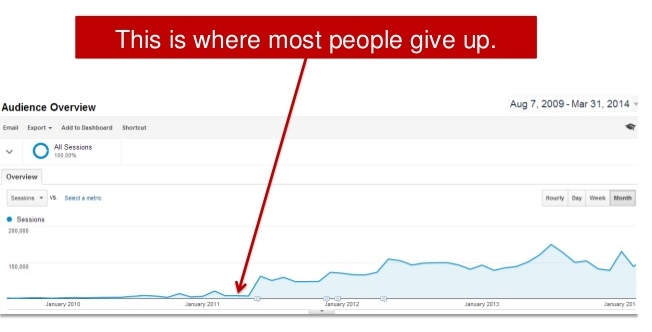
Influencer marketing Rand Fishkin where most people give up

Just as many businesses give up on content marketing right before the payoff, many would-be influencers lack the patience and discipline to go the distance and keep publishing.

Take Larry and WordStream, for example. Larry started blogging around 2009. Imagine if he had given up in 2011, just two years later. In 2012, the WordStream blog and Larry himself began to receive a great deal more exposure in the paid search industry as a result of hard work and consistent effort. External recognition such as press pickups and even television interviews followed this considerable increase in blog traffic.

Influencer marketing Larry Kim Fox News appearance

Larry – and WordStream, by association – wouldn’t be where he is today if he hadn’t persevered.

If you want to become an influencer in your field, you have to be willing to put in the hours (and days, weeks, months, maybe even years) it takes to establish a name for yourself. This will be hard, and you will be tempted to throw in the towel at some point, but you must persevere if you’re going to succeed. Good things come to those who wait.

How to Make Friends and Influence People

Influencer marketing is a powerful tool in today’s highly competitive digital media environment. Unfortunately, there is no one-size-fits-all approach to influencer marketing. You have to be willing to try new things and see what works and what doesn’t.

However, hopefully this post has given you some ideas for establishing a name for yourself as an influencer in your field. If you have any questions for either Larry or myself, be sure to leave them in the comments and we’ll answer them as best we can.

06 Mar 19:19

The Tale of Two Leads — And How They Generated $1 Million in Closed Business

by Dan McDade

Shutterstock_146762978One of our clients is a software and services firm that sells to medium-to-large financial service institutions. During the second half of 2014, the client asked us to make contact with approximately 1,600 organizations, to qualify them (from a size, operating environment and needs standpoint), and to identify highly qualified, sales-ready leads for the client’s consultative sales staff to work and to close.

While this is a work in progress due to a very long sales cycle, there were two opportunities that closed in Q4. Before we dig deeper into how the process works, here are some details about the two leads that closed—each for $500,000.

Lead #1: Privately owned regional bank — $7 Billion in assets

  • We identified the VP of Special Assets and the CFO
  • The CFO directed us to the EVP, Chief Risk Officer, who directed us to…
  • The Director of BSA (Bank Secrecy/Anti-Laundering), who directed us to…
  • The Assistant Manager, BSA
  • That individual was tasked with BSA compliance (based on their unique background)

After 13 call attempts, 5 emails, and 1 scheduled call, it was a lead.

Five months later the lead closed for $500,000.

Lead #2: Privately held Money Transfer Network — $30 Billion in assets

  • We followed up on a web hit
  • Contact engaged on first dial

After 1 call attempt and 0 emails, we were able to deliver to the client a lead.

Four months later the lead closed for $500,000.

The first lead is a classic example of how most leads are produced—that is, via multi-touch, multi-media and multi-cycle processes. On one occasion some years ago, after four touch cycles and 42 touches total, the CFO of the fourth largest utility company in North America called us back and said, “Don’t stop calling me, you are my conscience,” and that lead closed for a billion dollars five months later. Honest! The second lead is a great example of how marketing over time can culminate into what looks like an inbound, bluebird opportunity—and close.

The Process of Generating Leads, Pipeline, and Nurture Opportunities

I get asked all of the time for more details about how the multi-touch, multi-media and multi-cycle process actually works. Essentially, we use a combination of touches: calls, voicemails, emails, and in some cases direct mail, to gain attention and interest of prospects in order to drive a conversation. While it is not rocket science (although we have supported clients that sell a diverse array of solutions including rocket science into the DoD; and genome testing equipment into large labs), there are a LOT of moving parts. Here is an example of the outcomes in addition to two closed pieces of business for this client:

Disposition* (Complete) Type Number Percent
Total 1652 100%
Sales Ready Leads 63 3.8%
Pipeline (still working) 33 2.0%
Nurture 423 25.6%
Not Qualified 119 7.2%
No Response 831 50.3%
Bad, Other 183 11.1%

We disposition* companies at the rate of approximately one per hour. So, to complete 1,652 dispositions requires 1,652 hours. The fee for that number of hours is approximately $100,000. As a result, the score (project to date) is $1,000,000 in closed business at a cost of $100,000. Most people in the software world would agree that is a pretty darn good return—but we’ve only just begun.

In case you’re wondering, I realize how confusing it can be to use “Nurture” as a noun AND a verb—but we have yet to change it. To clarify, the definition of a “Pipeline” disposition is a qualified company, contact, and operating environment with a specific next step scheduled within a reasonable period of time—after which we expect to drive a lead a high percentage of the time. The definition of a “Nurture” disposition (in this case a noun) is a qualified company, contact, and operating environment, but without any specific next step in the short-term. “No Response” dispositions are valuable for a few reasons.

First, this group contains actionable leads that simply have not yet been identified (and probably aren’t ever identified by most companies). Second, since we tend to ferret out “Not Qualified” and “Bad/ Other” dispositions early in our initial touch cycles, this group is by definition cleaner than the initial target list. Third, we are able to do some additional segmentation prior to our subsequent market contact activities (multi-cycle) that allows us to ignore lower ranking segments and focus on higher ranking segments. Unfortunately, most of the time Pipeline, Nurture, and No Response dispositions are ignored by marketing and sales. What a waste!

According to SiriusDecisions, average sales organizations close about 20 percent of highly qualified sales opportunities, while best-in-class close closer to 30 percent. To be conservative for the purpose of this blog, I am going to assume a conservative 10% close rate on highly qualified leads:

With further nurturing of Pipeline, Nurture and No Response dispositions, additional closed business should occur as follows:

 Disposition (Complete) Type Number Lead Rate @ 10% Close


$ Revenue Won/Expected ($500,000 Avg)
Closed Won 2 N/A N/A $1,000,000
Sales Ready Leads 61 (63-2) N/A 6.1 $3,050,000
Pipeline (still working) 33 20% .6 $300,000
Nurture 423 27% 11 $5,500,000
Not Qualified 119 0 0 0
No Response 831 7.5 6 $3,000,000
Bad, Other 183 0% 0 0

The fee to nurture Pipeline, Nurture and No Response in this case is approximately $80,000. This nurturing requires the same multi-touch, multi-media and multi-cycle process required for the initial market qualification work. So, we use a combination of touches: calls, voicemails, emails and in some cases direct mail, to gain attention and interest of prospects in order to drive a conversation. Our philosophy, unlike others, is that we are NOT simply trying to drive a meeting. Why would a sales rep want to spend time with someone who can’t, won’t, or shouldn’t buy?

As you can see, the scorecard shows $12,850,000 in projected closed business; $180,000 in fees for services.

Why Most Companies Don’t See Results Like This

  1. The so-called leads sent to sales from other marketing activities are often not really leads. They are more than likely a mix of hand-raisers and/or inbound scored leads where activity is mistaken for need and interest.
  2. Follow-up by sales is limited to one or two telephone calls and/or emails and opportunities are squandered. You’ll hear, “I tried three times and they did not get back to me.” It often takes 8 – 12 follow-up attempts to reach a decision-maker—even on leads. There are best practices around lead follow-up that include an immediate call and email to position yourself as a value added resource, as opposed to an order-taking, low-level sales rep.
  3. The sales rep engages the lead with the wrong approach. Here’s one of my favorites: “Some telemarketing company in Atlanta said you were interested in our solutions … what do you want to buy?” Seriously, we had this client’s sales rep’s opening statement recorded.

To achieve the results projected in this blog, you have to take advantage of the opportunity to drive up the response from most marketing programs—by up to 3x.

*Dispositionnoun: the classification of a prospect account as determined after a cycle of lead qualification activity; verb: to classify prospect accounts using a cycle of lead qualification activity. Standard PointClear disposition categories include: Lead, Pipeline, Nurture, Disqualified, No Response, Bad.

Accelerate your sales performance with 7 tips to success by downloading the free e-book.

Updated CTAs-09

06 Mar 19:19

The software that’s eating marketing

by Maria Grineva, Orb Intelligence
software-eating-marketing
GUEST:

In 2011, Marc Andreessen famously opined for the Wall Street Journal that “software is eating the world.” His observation has proven true in many sectors of the economy, and especially so in marketing.

B2B predictive analytics vendor 6Sense announced recently the close of a $20 million funding round, coming less than one year after the release of the company’s first product. Just a few weeks before, Infer, a vendor in the same space, touted its $25 million raise, revenue that has been doubling for each of the past six quarters, and a customer list that includes companies like Atlassian, Cloudera, New Relic, Tableau, and Zendesk.

The size and timing of the 6Sense and Infer announcements are indicative of the explosive growth happening in the market for customer data platforms (CDPs), a term coined by industry analyst David Raab.

Per Raab, CDPs “gather customer data from multiple sources, combine information related to the same individuals, perform predictive analytics on the resulting database, and use the results to guide marketing treatments across multiple channels.”

Simply put, CDPs are powerful in their ability to help enterprises create a comprehensive view of their prospects and customers. And, as new data sources and collection and analysis techniques come online, this view is increasingly accurate, insightful, and timely.

The new tools driving modern data-driven marketing

New research by my company, Orb Intelligence, published today in the form of an infographic, builds upon Raab’s work by calling out three major categories and 14 subcategories of customer data platforms, and by explicitly identifying the data sources that feed these platforms. They are:

  1. Intelligence. These tools help sales and marketing organizations gather key information on leads, prospects, competitors, and the market at large. Note that “intelligence” is used here in the sense of “intelligence agency,” as opposed to “artificial intelligence,” as these tools focus on classic information gathering, organizing, and disseminating tasks. Examples of companies in this space include Datanyze, iDataLabs, and SalesLoft. Subcategories include Prospecting Tools, Sales Intelligence, Competitive Intelligence, and Social Media Listeners.
  2. Predictive Analytics. Here is where intelligence means something more akin to “artificial intelligence.” CDP tools in this category apply advanced machine learning and analytic techniques to uncover patterns in data and infer recommendations for sales and marketing teams. 6Sense falls into this category, as do SalesPredict and Lattice Engines. Subcategories include Relationship Intelligence, Predictive Prospecting, Predictive Lead Scoring, Intent Identification and Intelligence, Opportunity Scoring & Revenue Forecasting, B2B Display Advertising, and Upsell & Retention Prediction.
  3. Analytics & Reporting. These tools allow users to aggregate data from multiple sources, perform analytics, and build reports. They don’t necessarily employ sophisticated machine learning; rather, they focus on grouping and filtering data in a way that is easily understood by business users, and presenting this information in the form of attractive charts and graphics. Companies like Birst, Looker, and GoodData fit here. In many ways, one can think of analytics and reporting tools as a window to the past, while predictive analytics is one into the future, inferred from historical data. Subcategories include Business Intelligence & Visualization, Marketing Analytics, and Customer Success Solutions.

We’re studying social media management tools (SMM)…
Add your voice and we’ll share the data with you.


The data that’s feeding the software that’s eating marketing

We’re probably pushing the metaphor too far here, but the point stands: It’s data that gives the CDP, and thus the marketer, its power.

Broadly speaking, customer data platforms integrate internally and externally sourced data, enriching the former with the latter through a process called data appending.

For each record or select records in internal systems such as the CRM, support, finance, or marketing automation system, external data is appended to internal records to help marketing and sales develop a richer profile of the customer or prospect.

External data on companies and individuals comes in a variety of forms and from a variety of sources, including the web, government filings, and manual data collection. Data providers like Orb Intelligence (in our case, focusing on company data) serve as a one-stop data shop for CDP vendors, agencies, and end users by aggregating data from multiple sources and presenting it via easily consumable APIs.

Data, customer data platforms, and the 360-degree customer view

The 50 CDP vendors identified in our infographic represent just a small sample of an exploding data-driven marketing universe. What’s driving the expanding number and capabilities of customer data platforms is data, and the power that a comprehensive customer view offers to sales and marketing organizations.

The notion of a 360-degree view of the customer is not a new one for marketers. However, if you compare the customer insight and visibility offered by the modern CDP with that offered by previous systems purporting to offer this benefit, you’d be generous to attribute to the latter more than 5 or 10 “degrees.”

In hindsight, marketers didn’t have such a complete view of the customer after all, and what limited view they did have took a tremendous effort to achieve.

Perhaps we’ll be saying the same thing about today’s CDP in five years. With a truly comprehensive view of the customer in place, it is inevitable that ever more powerful marketing applications will be built on top of it.

This is already happening, actually, within the CDP space itself. Lattice Engines and SalesPredict are two companies that started out in a single CDP category, offering tools for predictive lead scoring. Both have now expanded to providing predictive support for a larger segment of the full sales and marketing lifecycle: They now predictively score leads early in the funnel, score opportunities as these leads transition into possible sales deals, and predict churn once these deals become paying customers.

These companies are not just growing their product offerings — they’re eating marketing, one data-driven bite at a time.

Orb_Intelligence_Infographic_FINAL-01


maria-grinevaMaria Grineva is a cofounder/scientist of Orb Intelligence, a company that provides business information for marketing software vendors and B2B marketing agencies.


VentureBeat is studying social media marketing tools. Chime in, and we’ll share the data with you.


06 Mar 19:19

[Infographic] How to Close a Sales Lead

Leads are coming in. Now comes the hard part: converting those leads into buyers. This is where top sellers shine. Their responsiveness, knowledge about their solution, personal approach to each prospective customer, and conversation skills give them the edge over average salespeople. The five tips in this infographic illustrate what they do that helps them make the sale. 


06 Mar 19:19

Are You Inadvertently Dismissing Good Sales Leads?

by Gregg Schwartz

moneydowndrain

Every day, companies invest massive amounts of time, money, and effort trying to generate new sales leads. Whether it’s through inbound lead generation techniques or traditional outbound lead generation, getting new business opportunities is a major priority. However, many companies do not put in nearly enough time and effort to develop and manage those new sales leads once they have them.

According to stats from MarketingSherpa, only 56% of B2B sales organizations make any effort to verify valid business leads before passing them on to the sales team. Furthermore, 79% of B2B marketers do not have any formal lead scoring process in place to prioritize sales leads that are most likely to buy.

This is a massive waste of resources and time, as well as a huge missed opportunity. If your company is spending money and time on advertising, content marketing, search engine marketing, and other techniques to bring in new leads, you need to protect that investment by using a consistent sales lead qualification process to evaluate, rank, and focus on the right leads at the right time. 

Lead qualification is the process of talking to prospective customers and asking them questions to draw out more information about their needs. This helps salespeople evaluate whether the prospect is a good fit for what they sell, whether they’re a serious buyer who’s ready to move forward, and how soon they are looking to buy. Asking good questions and learning more about the prospect’s situation up front helps salespeople save time later when they're setting appointments and working through the sales cycle. 

Leads come in many flavors, including short-range and long-range sales leads. Short-range leads are prospects looking to make a purchase from the vendor of their choice within a shorter period of time -- usually weeks or a few months. Long-range sales leads need more time to make their decisions, and can take six to 18 months depending on budget and complexity. 

Salespeople are often hungry for short-range leads, and tailor their qualification questions to uncover these quick opportunities. For example, they might ask qualifying questions such as, “Do you have a set budget for this project?” or “As you look ahead, do you plan on implementing a solution like ours?” And if the prospect responds, “No, we don’t have a specific budget assigned for this yet,” or “No, we don’t have a specific timeline for this year,” salespeople might toss these leads aside in favor of lower hanging fruit. 

But the truth is, just because someone isn’t ready to buy right now doesn’t mean that they’re never going to be ready to buy. It's important to have processes in place for dealing with prospects who represent valuable long-range sales leads. These opportunities require nurturing over time through careful attention and repeated phone and email contacts to gradually build a relationship that readies them to buy.

Here are three considerations to keep in mind when setting up a lead nurturing program: 

Track and Follow

Lead nurturing programs are all about tracking and following long-range leads. You want to stay on the radar of these people, even if they’re not ready to buy quite yet.

The basic tool for tracking and following leads is a Customer Relationship Management (CRM) system with customizable fields. A good CRM system should have a “follow up date” field which can be tracked alongside a “last action” field. For example, if a salesperson called a contact on January 15 and talked with them about their current business challenges but was not able to confirm a definite date for a presentation, they should record this information in the CRM. This way, nothing is forgotten and reps can quickly get up to speed on every lead before each subsequent conversation. 

Keep Score

Another key element of a lead nurturing program is lead scoring. Lead scoring is the process of evaluating your leads based on what you know about them, and assigning each a priority score based on how ready and willing they are to buy.

Lead scoring does not have to be complicated -- in fact, the simpler the better. For example, you could score your leads as “A,” “B,” and “C,” or “1,” “2,” “3,” depending on what you prefer. The important thing is to be consistent and rigorous. Based on the business intelligence you’ve gathered about each prospect from email and phone calls, how likely is it they will be ready to buy any time soon? Which prospects are you most excited about? Which prospects have already hinted (or clearly stated) that they’re not ready to buy yet? Give each lead a score, and then update these scores in real time as your nurturing process moves forward. Some leads will increase in rank as you continue to talk with them and build a relationship.

Listen for Subtle Messages

How do you know which leads are short-range and which are long-range? It takes time and experience to know for sure, but in general, short-range prospects will exhibit “buying behavior.” For example, they will often eagerly ask questions, freely explain their buying timeframe, and reveal pain points with their existing vendor. On the other hand, long-range leads are usually more reserved, non-committal, and vague in their responses.

Of course, there are always exceptions to these rules, and that’s why it’s important to keep getting on the phone and talking to your sales leads. A live conversation is the best way to take the prospect’s temperature and get a sense of their receptivity levels -- nuances that can be missed with an email-only lead nurturing campaign.

Short-range sales leads and long-range sales leads can both be good opportunities, but they require different approaches, and marketing and sales departments need to know how to handle both varieties. Long-range leads require a nurturing program to build relationships and trust, answer questions, and work toward the point where the customer is ready to commit to a purchase.

Of course it’s great to have short-range sales leads who are ready to buy today -- but that’s not the case most of the time. If you put a consistent process in place to qualify sales leads and nurture them over time, you will build a solid pipeline of sales opportunities.

get the free hubspot crm


04 Mar 17:18

84 Percent of Millennials Don’t Trust Traditional Advertising

by Yuyu Chen
Social media has changed the way brands engage with their consumers, say marketing experts from Crowdtap, Weight Watchers, and MRY, who believe brands must put people at the heart of their marketing strategy to create authentic social content.