Shared posts

04 Mar 17:10

Exceptional Pattern Recognition

by Dave Brock

I wrote Obsessive Learning/Relentless Execution as a start of a series on what sets the very best performers apart from everyone else. Periodically, I’ll be adding more articles, as well as video interviews of some of these people (so you can see what makes them tick.)

Amy Chang, CEO of Accompany**, is one of those exceptional performers. On reading the article, she sent me a comment describing much of what connects the learning–execution pieces. She described it as Exceptional Pattern Recognition.

It’s an exceptional talent we see in the very top performers in any feel. They look at the same things everyone else is looking at, but see things differently. They see patterns in markets, what people are doing, what’s happening. They are able to connect what to many of us seem to be disparate, unrelated things, see them differently, add a spark of an idea, and create something new. They not only look for what’s there, but they also look for what’s not there, patterns in the voids, gaps, or holes give us opportunity to innovate, invent, and build entirely new things.

Pattern recognition is really a key concept–more important everyday with data/information/change overload.

One of the real challenges all of us face is knowing what’s important, what’s meaningful, what do we need to pay attention to? Without the ability to sift through all the information we need to deal with or how to figure out when you are in the middle of executing, what’s the most important thing to do now.

Top performers seem blessed with the capability of absorbing huge amounts of information, constantly, and sorting though it, connecting the dots and focusing on what’s important to achieving their goals. They excel at figuring things out, focusing on them, and executing.

But there are some tools that make this easier for the rest of us to sort through everything we face every day and doing those things that enable us to achieve our goals. Too often, however, we ignore them, consequently making things more difficult for ourselves and our customers.

Here are a few ideas:

  1. Our sales process: Someone’s done all the heavy lifting for us, they’ve looked at our company’s collective experiences in winning and losing. They’ve extracted the patterns that create success, outlining them in our sales process.
  2. Our sweet spot: Like the sales process, our sweet spot represents the customers that have the problems our company is the best in the world at solving. Clearly, focusing on those customers drives our success, selling outside our sweet spot causes our win rates to plummet.
  3. Leveraging personas: Understanding the key personas involved in selecting our solutions, what drives them and how we most effectively engage them. Fortunately, marketing has done the heavy lifting on this. They’ve done the research, they understand the drivers, ideally, they’ve provided meaningful content to help us engage them.
  4. Facilitating our customer buying processes: In complex B2B sales, our customers don’t often go through solving these problems, organizing themselves to buy, aligning priorities, agendas, defining the problem, evaluating alternative solutions, selecting, justifying, and selling the solution internally. They struggle with doing this, which is why so many decisions result in no action or no decision made. But we are involved with many customers every day. We know what they should be doing, how they should be organizing and aligning ourselves. Leveraging our experience of going through similar situations dozens of times every year, we know what they should focus on, what others do, and the things that lead customers to successful outcomes.
  5. Developing and delivering Insights to our customers: Insights are nothing more than seeing things our customers may not see. Possibly, because they are so busy, they don’t take the time to look around. Possibly because it’s very far outside their experience base so they simply are unaware. Possibly because they aren’t aware of new innovations and opportunities. We can help them see and take advantage of these opportunities. Help them recognize patterns, they may simply be blind to.
  6. Ideal partner profile/partner enablement programs: If we deal with partners or channels, we have a long history of who our customers buy from, what types of partners produce the best results, what things we need to do with them to produce success. If we haven’t taken the time to understand this, then our likelihood of success is very low, but if we analyze things, looking at the patterns, the combination of a number of sometimes disparate things, we can characterize the profiles of the partners that are most likely to be successful with us, as well as the things we need to do to help them be successful.
  7. Ideal sales candidate profile: Understanding the characteristics of those people that perform the best, the backgrounds, experiences, attitudes, behaviors, competencies and so forth —the profile of our most successful performers help us recruit the people that are most likely to be successful.
  8. Well defined on boarding programs: A well defined onboarding program is based on understanding what drives success in the shortest period of time. We look at our top performers, we look at past errors and great things we’ve done to help people perform in the shortest time possible. If we haven’t taken the time to do this, then we need to, so we maximize the probability of success and shorten ramp time for our people.
  9. Coaching and developing our people: Each of us has certain patterns of behavior. We have attitudes, views, ways we do our jobs every day. Sometimes those patterns serve us well, sometimes they don’t–or we are missing things and can do better. As coaches, it’s our job to help our people recognize those patterns. We can help them recognize those things that create great outcomes, that cause us to learn and grow. We can help them recognize those patterns that don’t serve them, our customers, or our organizations, changing them and improving.
  10. Understanding our relationships and the relationships our customers have: Leveraging our networks, seeing what’s important to each person in our network, figuring out if there is something we can do for them. Understanding who may be connected with who, how we might leverage those. Connecting dots between people, what’s happening that impacts them, who they know. Trying to figure out how we can enrich and create greater value in those relationships. Figuring how we might leverage those for referrals to more effectively connect with others. (For exceptional insight on this, see the note below on Amy’s company–Accompany.**)

I’ll stop here, I hope you are starting to see the pattern I’m developing here (sorry couldn’t resist). Analyzing past performance, understanding what works, what doesn’t work. Understanding our customers, our people, and our organizations— and how we create shared success–as well as those things that cause us or them to fail. Looking not only at what they are doing, but also what they are not doing, or what they may be missing. All of these are basically forms of looking at patterns, and designing our work to focus on those patterns that best serve us.

It doesn’t take the rare talents of exceptional pattern recognition. All it takes is paying attention, being aware, being curious, leveraging the power and experience of everyone in our customers and our own organizations.

Pattern recognition/analysis serves to help us understand disruptive forces that adversely impact the results we are trying to achieve. When the things that we do every day are no longer working, when those patterns that had been successful, no longer are, it’s a call to action. Something’s changed!

Continuing to do those things, producing the wrong results is foolishness. (Thanks Albert Einstein for helping us understand this.*)

This is what the truly outstanding performers, like Amy, tend to see. They see the patterns, they tend to see the holes in the patterns that might be occupied (which could be very disruptive to others). see. They do it in real time. But the rest of us can do similar things, leveraging tools, processes, and data we already have.

But we can also do what Amy and others do, we can amp up our performance and our ability to see patterns where others see chaos or nothing by being obsessive about learning and discovering. Whether we harness that, focusing on our customers and their markets, our companies and strategies, or simply what’s happening in the world around us. Constant, obsessive learning, then taking action, learning from that is the secret to top performance.

Do you recognize the important patterns that impact your customers and your business?

Are you leveraging these patterns to consistently produce the outcomes you want?

Are you recognizing when the patterns are changing, or you need to break them?

* For those of you who don’t know Albert Einstein’s quote, “Insanity is doing the same thing over and over again, expecting a different result.” Perhaps second to his general theory of relativity in terms of important contributions he’s made.

** For those of you who don’t know Accompany you need to get on their Beta List. Accompany is developing a game changing application to the market. Part of it is really about pattern recognition and our relationships. They are tackling the very challenging problem of “How do we recognize things that are happening to people most critical do us?” “How do we recognize disruptions impacting those people we work with, leveraging them in our engagement process?” It’s probably one of the most important tools I’ve seen in helping us connect with the right people, at the right time, engaging them in the most impactful conversations. But, (truth in advertising time), I’m very biased, I’m on their advisory board. I use their tool every day and couldn’t imagine not having it.

04 Mar 17:10

21 inspiring quotes about markets and investing chosen by a top economist

by Shane Oliver, AMP Capital

Inspiring Quote hand written

Investing can be profitable as well as fun, but it can also be unnerving and unprofitable if you don’t understand markets and don’t have the right mindset. The basics of successful investing are timeless and some experts have a knack of encapsulating these in a way that’s insightful.

A year ago I wrote on 21 investment quotes I find useful. Here are some more.

The market and cycles

“The stock market is the story of cycles and of the human behaviour that is responsible for overreactions in both directions.” – Seth Klarman

Cycles are an investing reality. Not just shares – but also bonds, property, infrastructure, term deposits, whatever. They all go through cyclical phases of good times and bad which are driven by the combination of fundamental economic & financial developments invariably magnified by investor behaviour that has a habit of extrapolating current conditions into the future. Some cycles are short term, such as those that relate to the 3 to 5 year business cycle. Some are longer, such as the secular swings seen over 10 to 20 year periods in shares.

Australian Quotes Chart1

“In the old legend the wise men finally boiled down the history of mortal affairs into a single phrase: ‘This too will pass.’” – Benjamin Graham

Just as historical experience tells us there are investment cycles, it also tells us that they pass. Despite all the “new eras”, “new paradigms” and “new normal” commentators wheel out at cycle extremes, all cycles contain the seeds of their own reversal. When someone tells you about a new whatever, it’s probably already run its course. So when, after a major share market collapse in the midst of recession, it seems there is no hope, just remember “this too will pass.”

“It’s so good it’s bad, it’s so bad it’s good.” – Anonimous

In every cycle there comes a point where fundamental conditions are so good that they are bad: economic growth is so strong that its causing inflation to rise and central banks to run ever tighter monetary policies; shares have become overvalued; and investors have piled in at such a rate that there is no one left to invest. This then sets up a market top and a new bear market. And the reverse applies during economic and market downturns. Which brings us to contrarian investing.

Contrarian investing

“The way to make money is to buy when blood is running in the streets.” – John D Rockefeller

This is a bit extreme, but it illustrates a key point. The best time to buy shares and other growth assets is after a sharp fall and a good guide is the economic and financial pain around you. When it is at an extreme and it all looks hopeless then that’s usually a good sign that there is long term value to be found!

“Markets are in a constant state of uncertainty and flux and money is to be made by discounting the obvious and betting on the unexpected.” – George Soros

There are two insights in this. First, markets are always bouncing around – minute by minute, day by day, year by year – because they are trying to discount the future. We just have to get used to it. Second, investment markets can be perverse. If the economy and profits are obviously bad then that is likely already reflected in the share prices and you are better off betting on what is not, eg an economic recovery. And vice versa when things are obviously good.

“In investing, what is comfortable is rarely profitable.” – Rob Arnott

The problem with contrarian investing is that in going against the crowd you lose that warm fuzzy feeling that comes with safety in numbers. You have to go against what you are hearing at BBQ’s or from the media and that can be very uncomfortable.

“The share market’s role is to make the majority of investors wrong.” – Ned Davis

This sounds rather bleak and is a bit simplistic, but it reflects the fact that most don’t invest on a contrarian basis – by definition markets top out when most investors are long and they bottom when most are short or underweight. Hence the comment about the market proving the majority of investors wrong. There are two ways around it: either adopt a contrarian approach which takes positions counter to the crowd at extremes or take a long term approach that looks through cyclical fluctuations. But whatever you do don’t get sucked in (or out) when everyone else is.

Pessimism

“More than any other time in history, mankind faces a crossroads. One path leads to despair and utter hopelessness. The other to total extinction. Let us pray we have the wisdom to choose.” – Woody Allen

I love this quote. Because often the financial commentary around investment markets can only see disaster. Eg, we have been inundated with commentary over the last five years to the effect that the Eurozone will soon blow itself apart or that if it stays together it is doomed to a horrible outlook. And yet not only has it stayed together but it has got bigger!

Process

“A great company is not a great investment if you pay too much for the stock.” – Benjamin Graham

The key to successful investing is not to buy great companies or investments, but to invest well. Shares can give you horrible returns if when you buy they are overvalued and overloved. So you need an investment process that avoids this.

“When the facts change I change my mind. What do you do sir?” – John Maynard Keynes

This is the classic economists’ defence for when their forecasts don’t pan out! But it also highlights that any investment process needs to have a bit of flexibility for when the facts change.

“Don’t look for the needle in the haystack, just buy the haystack!” – John C Bogle

The key insight here is that trying to beat the market by stock picking can be hard and so if you want to grow wealth over time the key is to get a broad exposure to the market and letting compound interest do its job.

“There seems to be a perverse human characteristic that makes easy things difficult.” – Warren Buffett

Whatever you do, don’t overcomplicate your investments. Avoid investments you don’t understand and try and keep your investment process relatively simple and commensurate with the amount of effort you want to put in. You need to be able to see the wood for the trees and understand what’s happening.

“There are two kinds of forecasters: those who don’t know, and those who don’t know they don’t know.” – J.K. Galbraith

While that may be a bit harsh – you might say I would say that being an economist – the reality is that forecasts as to where the share market, currencies, etc, will be at a particular time have a dismal track record. Hence the jokes about economists! Good experts will help illuminate and point you in the right direction, but don’t over rely on expert forecasts.

“Stop trying to predict…” – Warren Buffett

Basically, the same point. If you are going to actively move your investments around the key is to have a process that helps identify extremes – when assets are undervalued, underloved and oversold and vice versa. Or if you don’t have the time or inclination to put the effort in, it’s best to take a long term approach and let others manage cyclical market fluctuations.

Cash flow and time

“Do you know, the only thing that gives me pleasure? It’s to see my dividends coming.” – John D Rockefeller

There have been lots of investments over the decades that have been sold on promises of high returns or low risk but were underpinned by hope based on hot air (the tech boom) or financial alchemy (AAA rated sub-prime trash). By contrast, assets that generate sustainable cash flows (dividends, rents, interest payments) and don’t rely on excessive gearing or financial engineering are more likely to deliver.

“Our favourite holding period is forever.” – Warren Buffett

In investing time is on your side and the more you have of it the better. So while short term market fluctuations can take you away from your objectives – think the first chart in this note, the longer the perspective you take the great the chance you have of achieving them – as per the next chart.

Australian Quotes Chart 2

Right mindset

“In the business world, the rear view mirror is always clearer than the windshield.” – Warren Buffett

We are all subject to behavioural biases, the most serious perhaps being a tendency to extrapolate recent developments off into the future regarding investment returns. So if the recent past has been poor you assume this will continue and want to get out and vice versa. But this just causes us to get wrong footed by the cycle. Just as spending too much time focused on the rear view mirror will get you wrong footed by the road.

“You get recessions, you have stock market declines. If you don’t understand that’s going to happen then you’re not ready, you won’t do well in the markets.” – Peter Lynch

If you can’t handle volatility associated with investment markets then either they are not for you or you should just take a long term approach and leave it to someone else.

“Individuals who cannot master their emotions are ill suited to profit from the investment process.” – Benjamin Graham

This is all about knowing yourself. The reality is that we all suffer from the behavioural biases that give too much weight to recent developments in forming expectations regarding future returns, seek safety in the crowd and give too much weight to loss relative to gain. But smart investors have an awareness of their weaknesses and seek to manage them. One way to do this is to take a long term approach to investing. But this is also about knowing what you want to do. If you want to take a day to day role in managing your investments then regular trading may work, but you need to recognise that this requires a lot of effort to get right and will need a rigorous process.

Reality

“There is no free lunch.” – Anonimous

If an investment looks too good to be true in terms of return or risk, then it probably is. Rather, focus on investments offering sustainable cash flows (dividends, rents, interest) that don’t rely on excessive gearing or financial engineering.

“Money can’t buy me love.” – The Beatles

And finally, just remember that money isn’t everything. Numerous studies show that people with good wealth and incomes are happier than those without, but beyond a certain level more money won’t necessarily make you any happier.

Dr Shane Oliver is Head of Investment Strategy and Chief Economist at AMP Capital. He’s on Twitter at @ShaneOliverAMP. This originally appeared in his newsletter, Oliver’s Insights, and is republished with permission.

Join the conversation about this story »

NOW WATCH: T. Boone Pickens' Strict Morning Routine Will Inspire You To Plan Your Days Better

04 Mar 17:09

5 financial crisis-era charts that haunt Wall Street's nightmares

by Sam Ro

The Federal Reserve released the transcripts from its 2009 FOMC meetings. The document dump also came with accompanying presentation materials.

For the March 2009 FOMC meeting, which was when the stock market had crashed to its lows, System Open Market Account manager Trish Mosser brought a stack of charts that probably haunt the nightmares of Wall Street's veterans.

Five of them remind us of how scary things got.

The first two capture the stock market crashes. The first is of European, Japanese, emerging markets, and US equity indices. The second captures the crashing financial stocks.

charts

The third, fourth, and fifth charts show surging bank credit-default swap (CDS) spreads. CDS is basically insurance against a default, and when they rise, it means people are freaking out.

The initial spikes occurred during the fall of 2008, which is when Lehman Brothers went bankrupt and Merrill Lynch got bought by Bank of America at a huge discount to market value.

charts

For the banks that walked away from the crisis, prices came back CDS spreads crumbled.

"I am concerned that stock prices and credit markets may suffer additional setbacks and make some of our forecasts for the stock market going forward a little more problematic," the Boston Fed's Eric Rosengren said at that meeting. He made that statement days into what has been an epic six year-long bull market.

Join the conversation about this story »

NOW WATCH: Nationwide's Super Bowl commercial about dead children is about corporate profits ... in a way that we can all appreciate

04 Mar 17:09

5 Buyer Persona Myths Debunked

by Kelly Fitzgerald

buyer personas myths debunked

As an inbound marketer, one of the most important tools you’ll use is the buyer persona. What may seem like a simple document is actually the key to your inbound success and the foundation for your content creation. That’s why it’s imperative to know what’s true and what’s not when it comes to building out and using your own personas. Whether you’re creating a buyer persona for your business or for a client’s, you’ll need to know these 5 buyer persona myths and why they’re just not true.

1. Buyer personas are pointless

Hopefully as an inbound marketer you already know the great importance of buyer personas. However, explaining this concept to others, especially clients, can be a hard task. We often hear that buyer personas are pointless, or are not needed. In reality, they are the foundation for all of your marketing efforts. Using a buyer persona as an evolving, dynamic tool will guide your campaigns in the right direction and make them more successful. If you don’t have buyer personas you can’t write appropriate content for the many different people coming to your site. Not using buyer personas will actually do you a disservice. Creating and getting to know your ideal buyer personas will help you write real, impactful, and useful content. This will lead your potential customers to come to your site to get answers to their questions and solve their problems. This is exactly what you want!

2. A buyer persona doesn’t need many details

Some people believe that when thinking about ideal customers, all you need to know is what they want or need. Potential customers’ desires are taken into consideration when a buyer persona is created, but this shouldn’t be the only thing you think about. There are many other details that should contribute to your buyer persona including: demographics, buying habits, where they are in the buyer’s journey, job position and career, and where they go to find their information. The answers are in the details. These precious facts will help you target exactly the type of content each buyer persona is looking for. In essence, the details are the most important component to your buyer personas.

3. A buyer persona is the client you want to sell to

Yes and no. Buyer personas are defined as your ideal customers, or real buyers who will make decisions about the products or services you offer. You don’t want to be in their face, selling them something – this is reminiscent of old school outbound marketing techniques. Instead, you should get to know your buyer persona and their habits, why they would want to visit your website, and how you can help them solve their problems. Of course your end goal is to get your ideal customers to purchase whatever type of service you’re offering, but you want to give them a human experience by helping them and letting them know you understand them. A statement like, “We understand what you’re going through. We’ve been there” is much more impactful than “My product is so amazing, it can help you.” If they know you can relate to them, your buyer personas will be more likely to engage with your brand and become advocates, who share their pleasant experiences with the world.

4. A finished buyer persona document goes on your website

As marketers, you and I understand the importance of buyer personas, but explaining this to clients can be a difficult task. Interviewing clients and customers may bring up questions about where their information will go and why. One of my clients thought that their finished buyer persona would go on their website as a part of the copy. This is not true. A buyer persona is an internal document for use by the marketers like yourself. They will never go on a client’s website. Buyer personas should be kept safe with your important marketing campaign and website building tools. You will need to review them for any type of marketing efforts you take part in.

5. Once you develop buyer personas, you’re done

It’s easy to think that after you create your buyer personas you’ll tap yourself on the back for a job well done, and be on your way to bigger and better things. However, this is just not the case. A buyer persona is a living document that will change as your business changes, or as your client’s business changes. It is ever-evolving and adapting with your marketing efforts. It’s not just a one-time document that you file away once you’re done writing it. You’ll need to review this internal document every time you begin to write website content, blogs, or any downloadable marketing pieces. You’ll even use it when you design a website because giving your website visitors a clear pathway is one of the most important objectives of a site. The bottom line is, you’ll never be done using your buyer personas because they are the foundation of your marketing campaigns.

Buyer personas are like the beams and planks that make up the structure of a house, without them, your marketing campaigns would fall apart. The importance of buyer personas is clear and the myths surrounding them have been thoroughly explained. Now that you know the ins and outs of what is true and not true about buyer personas, you can get started on making these useful documents an integral part of your marketing efforts. Remember: details are key!

The Handy Tool Kit for Launching & Measuring a Remarkable Campaign

04 Mar 17:09

266 | The Secret to Attracting Your Ideal Buyers Pt. 3

by Jeremy Frandsen

IBM266

In this episode, we share specific examples of how to apply the "Four Levels of Conversation" to your marketing so you keep your customers coming back for more.

This is part three of our series on how to attract your ideal buyers.

Right-click here to download the MP3

Listen to Part 1 here

Listen to Part 2 here

In This Episode

  • The common conversation marketing mistakes that will cause you to lose customers without even realizing it...and how to avoid these mistakes.
  • Specific examples of how to use the "Four Levels of Conversation" in your marketing.

Items of Interest

  • Special thanks to Scott and Brendo for the open and close music on the episode.

Get Your Guide Here:

Customer Magnet

Customer Magnet: How to Attract Your Ideal Buyer and Keep Them Coming Back - This action guide shows you exactly how to get into the mind of your ideal buyer so you can attract them and keep them coming back.

Breakthrough

266breakthroughMy book How To Get Out of Debt Living Paycheck to Paycheck became a #1 Bestseller on Amazon for 3 days in two different categories. I did that through a planned 5 day promo where I lowered the price to 99 cents and then promoted the heck out of that 5 day promo. I did it as a test to see why even established authors put their books on sale for 99 cents. I now know why. It works! It brought me some very awesome reviews that help sell the book. Not to mention, I have bestseller screenshots I can use for marketing. It made me feel like a rock star, plus I did make a few bucks in the process.
Camilla Kragius

04 Mar 17:08

14 Tweetworthy Takeaways From Forrester's Sales Enablement Forum

by esnider@hubspot.com (Emma Snider)

tweet

Although attendees of the 2015 Forrester Sales Enablement Forum were split between Marketing and Sales, they had a singular focus: empowering salespeople to sell more efficiently and effectively. 

The two-day event was packed with presentations on digital marketing trends, changing buyer expectations, Sales and Marketing alignment, and even the looming death of the traditional salesman. I rounded up 14 of my favorite one-liners from the event in case you missed it.

1) “If it doesn’t apply to the buyer’s journey, we just don’t do it.” – Shelby Dawirs, director of corporate campaigns at Logi Analytics (Tweet This Quote)

2) "We believe one million [B2B sales] jobs will be net displaced by 2020."- Andy Hoar, principal analyst at Forrester Research (Tweet This Quote)

3) “I banned the term 'demand generation.' Don’t think about it as demand gen -- think about it in terms of customer engagement.” - Stephanie Meyer, head of marketing operations at GE Healthcare (Tweet This Quote)

4) “Your competitor can copy your product or service, but they can't copy the relationships you build.” - Brian Goonan, partner at Ernst & Young (Tweet This Quote)

5) “Random acts of marketing don’t work. They’ve got to be integrated and part of a plan.” – Joanne Moretti, SVP marketing and sales enablement at Jabil (Tweet This Quote)

6) “Marketing and Sales alignment is an abstraction until grounded with clear goals, specific metrics, and continuous refinement.” – Atri Chatterjee, CMO at Act-On Software (Tweet This Quote)

7) “We have a tendency to tell people what something is and what it does, when the most important thing to that person is what it means to them.” – Joanne Moretti, SVP marketing and sales enablement at Jabil (Tweet This Quote)

8) “If I can tell you what my problems are, I'm not dead yet. They're problems, but I don’t have an urgency to solve them." - Tim Riesterer, chief strategy and marketing officer at Corporate Visions (Tweet This Quote)

9) “I define a lead as the person who just [bought]. They are a lead for Marketing to nurture." - Stephanie Meyer, head of marketing operations at GE Healthcare (Tweet This Quote)

10) “Your buyers want to work with salespeople who have empathy for them, who understand their roles and challenges, and who can be prescriptive in helping them.” - Mark Lindwall, senior analyst, Forrester Research (Tweet This Quote)

11) “Just tell the client story and everything else will fall into place.” - Paul Gottsegen, CMO at Mindtree (Tweet This Quote)

12) “Don’t tell a gut story. We’re in the digital age -- everything is trackable.” - Rowena Track, VP of marketing at TE Connectivity (Tweet This Quote)

13) “Who would you rather call -- someone on your website who has just done something, or that person 24 hours later when they’re in a meeting?” - Todd Johntson, sales manager at LogMeIn (Tweet This Quote)

14) “People who come to a B2B site want a B2C experience.” – Neil Ringel, EVP contract division at Staples Advantage (Tweet This Quote)

get the free hubspot crm

04 Mar 17:03

Common Sense Selling: Are You Missing the Buying Signals?

by Deb Calvert
Buyers have a process for buying, just like sellers have a sales process. When the buying and selling processes line up neatly, everyone feels good about the transaction and about the relationship. Sometimes, though, things aren’t quite so tidy. Usually, this misalignment happens when a seller gets ahead of a buyer – for example, trying […]
04 Mar 17:03

Where B2B and B2C Marketers Agree and Disagree

by David Dodd

Salesforce.com recently published the results of its 2015 State of Marketing survey. The 2015 survey was conducted online in October and November of 2014 and generated over 5,000 responses. The survey was directed to marketers in “Salesforce Marketing Cloud locations,” so the respondents may not be a representative sample of all marketers. Still, the number of responses makes this a significant piece of research.

The Salesforce.com survey included a nice balance of B2B and B2C participants. Fifty-six percent of the respondents were from B2C companies, and 44% were affiliated with B2B enterprises. The survey found significant similarities in the viewpoints of B2B and B2C marketers, but the results also revealed a few interesting differences.

Both B2B and B2C participants in the survey were optimistic about marketing budgets for 2015. Eighty-four percent of both B2B and B2C respondents said they plan to increase or maintain their level of marketing spending in 2015.

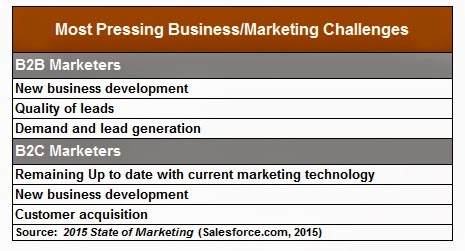
B2B and B2C marketers differed somewhat in how they viewed their most significant marketing challenges. The table below shows the top three challenges identified by B2B and B2C survey respondents.

B2B and B2C marketers differed more significantly on the issue of where they plan to increase marketing spending. The top five areas for increased spending identified by B2B marketers were:

  1. Content marketing (66% of B2B respondents)
  2. Marketing automation (66%)
  3. Mobile applications (65%)
  4. Location-based mobile tracking (65%)
  5. Social media advertising (64%)
The top five areas for increased spending identified by B2C marketers were:
  1. Social media marketing (74% of B2C respondents)
  2. Social media advertising (74%)
  3. Social media engagement (73%)
  4. Social media listening (68%)
  5. Location-based mobile tracking (68%)
These differences in spending priorities are understandable and not at all surprising. Many B2B companies sell complex products or services, and it can be difficult to communicate the value of these solutions in a social media environment. So, it doesn’t surprise me that B2B marketers are more focused on creating content, which almost certainly includes longer-form resources such as videos, white papers, and e-books.
In addition, most of the recent research I’ve seen indicates that, while the use of social media in the B2B buying process is growing, it is still not a major source of information for most B2B buyers. In the B2C world, however, research indicates that social media plays a more significant role on the customer’s path to purchase. So, it’s not surprising the B2C marketers are investing more in social media.
04 Mar 17:02

How Much Is Your Social Media Tax

by Susan Poirier

Ace Concierge - Social Media Tax

No, not a financial burden imposed by the state, but the tax social media can have on an entrepreneur can feel like a huge time-sucker.

Dictionary.com presents five ways to define the word tax, the best fit for this article is:

Social Media Tax

Too Many Hats

An entrepreneur has a lot to do in a bootstrapped business. They are the person performing the customer service or generating the product they deliver to a client AND they are also every other department such as marketing, creative design, accounting, sales, talent management and more. Their passion is clear and focused on the service and product, but it can begin to dwindle with the burden of necessary duties to support that business.

Social Media Visibility

Add to this, there is an expectation that all entrepreneurs are online at all times providing continual content to build a loyal audience and that content must live on social media platforms. After six months to a year of generating content, responding, being conversational to build relationships, and doing everything they can to rise above the noise and be noticed, they grow weary of it all. I heard one woman entrepreneur state that because of social media, she needs a wife, an assistant and a design team because the weight of her business does not fit into the 24 hours she is given. Some days it feels like a heavy tax and burden on an entrepreneur’s day.

The Anchor

The message seems to be, if you are not on social media, you don’t exist. Yet many feel that being tied to the responsibility of social media keeps them from living, much less working on their business. They want to be there interacting with the people who need their business, but it doesn’t always feel like they are reaching an audience when using social media. It is a tough balance, entrepreneurship and all it entails. However, there is a strategy that can be implemented to ease the load on a business owner’s time.

Delegation. Plain and simple.

Delegating is the simple act of entrusting authority to another person. While you can’t or shouldn’t delegate every task or responsibility in your business, you should move some of the non-essentials off of your plate. The ones that are the most time consuming, don’t generate revenue and take you away from the core of your business.

According to VerticalResponse, 23 percent of CEOs and business owners spend between six to 10 valuable hours each week on social media.

In a Constant Contact market survey, they found that:

  • Small business owners spend at least 20 hours per week on marketing
  • 82 percent market their business using many different platforms, including email, e-newsletters, social media

Wow! That is a big chunk of time to give up. I bet this doesn’t even include those hidden hours when you are sucked into the black hole of searching and link clinking. Before you know it, the day is over.

time wasted on social media

Image courtesy of Buffer

Who nurtured your business and your clients?

Yes! Your social media efforts represent the architectural structure that leads to brand recognition, credibility, a positive customer experience, brand advocates, increased web traffic, search rankings and word-of-mouth marketing. There is absolutely NO question that you do need an online presence. It is vital in today’s super social connected world. Everyone does business online; searching brands and companies, reviews, social proof, connections, tips, tools, apps, and addresses. It is only going to continue to expand.

BUT…..

What about the commitment to your business beyond the social engagement?

Are you ready to apply for your social media tax rebate and get back to building your company?

04 Mar 17:02

20 B2B Content Marketing Examples and Case Studies for 2015

by James Anderson

KillerContentAwardsCover

We know that 93% of B2B marketers were using content marketing in 2014. That number is up just a tick from 2013 and will likely climb again in 2015. But what does this slow trend mean for content marketers in the B2B world?

It means that it’s time to step up their content game. It’s no longer enough to simply produce “more” content. Now is the time to produce killer content that knocks the competition out of the water.

If you’re looking for great B2B content marketing case studies, we’ve published 11 killer content examples here and 12 more here. We’ve also collected 20 more B2B content marketing examples from the 2015 B2B Content2Conversion conference. Below you will find a brief example from each winning entry including one for TopRank Online Marketing. I think you’ll find some great ideas and inspiration, just like I did.

C2C_EMC

EMC: Buyer-Focused Content
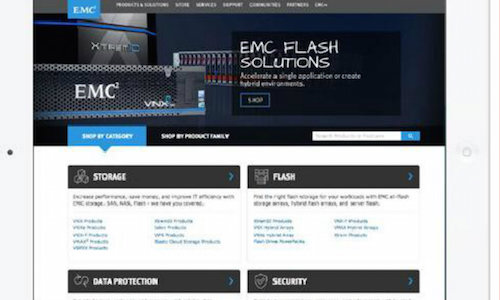
EMC was looking for a solution to bridge the gap between channel partners and digital-only buyers. The answer? A new digital shopping experience for IT professionals that bridged the gap, selling products directly as well as generating leads for EMC partners.

Results: Page views increased 55% month-over-month, average bounce rate: 49%, leads increased by 100%, over $12 million in booked revenue.

C2C_Glassdoor2

Glassdoor: Buyer-Focused Content
Glassdoor created an “Employer Branding for Dummies” eBook to solidify the company as a leader in the human resources and recruiting space.

Results: This was the top performing Glassdoor eBook which contributed 27% of leads and 28% of pipeline from content in 2014.

C2C_Lattice

Lattice Engines: Buyer-Focused Content
While interest in predictive lead scoring picked up in 2014, Lattice Engines wanted to set themselves apart from the growing field of solutions providers in the industry. A buyer’s guide helped distinguish them from the crowd.

Results: The buyer’s guide yielded more than 200 gated downloads and influenced more than 24 opportunities.

C2C_VisualStudio

Microsoft Visual Studio: Buyer-Focused Content
Product release events have been a big part of the Microsoft Visual Studio marketing plan. As product releases increased in frequency and global scope, Microsoft Visual Studio needed an online hub to contain all of the event assets.

Results: This campaign involved 7,200 concurrent users and 30,500 live streams resulting in 81,471 site visits, 180,169 page views and 2,795 click-throughs.

C2C_trapIt

Trapit: Buyer-Focused Content
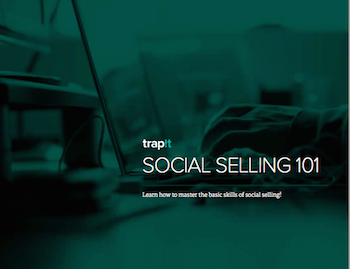
To highlight the benefits of social selling, Trapit developed a white paper that incorporated research findings from notable analyst groups including Forrester Research, who also highlighted steps for implementing a B2B social selling strategy.

Results: More than 10,000 top of funnel leads were generated, creating up to 70% of new pipeline and 2 new customers from the content.

C2C_Panasonic

Panasonic: Combination of Paid, Earned & Owned Media
To follow up with the Toughpad E1 device launch, Panasonic held a sweepstakes that featured a video and a graphic novel that was developed to support the product’s launch. The product plays a significant role in the video.

Results: 53 million traditional media impressions, more than 450,000 social earned media impressions, and 14 million partner and fan post impressions.


C2C_Cision

Cision: Influencer Content
As the PR industry has been changing in recent years, Cision saw the opportunity to partner with an influencer to co-create content that benefited both parties. By partnering with Brian Solis of Altimeter group, Cision developed an eBook on Slideshare that was used both as a tool for a PR audience looking to build tech skills, but also as a key part of a Solis presentation.

Results: 209,673 views on Slideshare, the content was shared by 11 Twitter influencers that reached a combined audience of 2 million. The content also generated 600 sales leads.


Content Marketing Wonderland eBooks

TopRank Online Marketing: Influencer Campaign
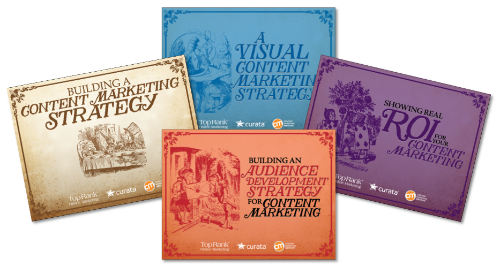
TopRank Marketing planned and implemented an influencer marketing program to create awareness for Content Marketing World 2014. Four separate eBooks, 4 infographics and a series of long form interviews were developed on a common “Alice in Wonderland” theme involving more than 40 marketing industry influencers.

Results: More than 145,000 views on Slideshare, 20,000 views on TopRankBlog.com, 13,000 social shares, 2,000 pdf downloads, 800 leads and 200 event referrals.

C2C_Penton

Penton: Interactive Content
To boost online engagement and capture leads, the Design, Engineer and Sourcing Group at Penton created a “World’s Greatest Engineer Movie” contest. A March Madness style bracket was created and buyers voted down pairings from 32 classic and new films in which engineers and technology drove the plot.

Results: The contest received 63,354 page views, 11,487 total votes, and developed 3,279 unique leads.

C2C_TheTradeDesk

The Trade Desk: Interactive Content
To encourage ad buyers to take advantage of the coming frenzy of World Cup activity, The Trade Desk developed a video that showed how a fictional brand used its platform for realtime ad bidding.

Results: The video generated 276,184 impressions, 2,062 clicks, a .74% CTR, and 83 new contacts.

C2C_Unitrends

Unitrends: Interactive Content
To add fun to a data recovery white paper, Unitrends created a horror-themed game that was released around Halloween.

Results: 300 leads were converted, 185 which were net new, resulting in $300,000 in new sales pipeline and $32,000 in closed sales.

C2C_Experian

Experian Marketing Services: Measurable ROI
Experian developed The Digital Marketer, a long-form trends report to help businesses navigate the digital marketing landscape.

Results: From 8,978 downloads, 4,154 opt-ins were generated, resulting in 359 leads.

C2C_Marketo

Marketo: Measurable ROI
To reach customers just getting started in social media, Marketo developed a sample plan to show prospects how to map a social media strategy.

Results: 40,791 downloads generated 3,847 new names gained in paid programs, 522 social media shares, 1,664 new sales opportunities, $582,471 multi-touch pipeline and $381,671 multi-touch revenue won.

C2C_influitive

Influitive: Multi-Touch Campaign
To educate a larger audience on advocacy marketing and to promote AdvocateHub, a new software tool, Influitive developed content including ebooks and a late night talk show-themed video.

Results: The video was viewed by 1,500 people in the first 24 hours and one of the eBooks generated 49 direct opportunities and $990,000 in sales pipeline.

C2C_Offerpop

Offerpop: Multi-Touch Campaign
Marketers subscribed to Offerpop’s “Staycation” program to receive eBooks, infographics, worksheets and videos to learn about the latest digital marketing trends.

Results: 1,650 prospects registered for the program, campaign received more than 10,000 views, email open rate was 38.8%, 7,013 new sales leads.

C2C_Optum

Optum: Multi-Touch Content
To maintain relevance to its audience in a rapidly-changing healthcare system, Optum developed it’s “Game Changer” campaign, offering eBooks, infographics, white papers and case studies to prospects.

Results: Over 4.9 million impressions were generated, resulting in more than 5,300 form submissions, a 89% open rate, and ultimately $4.9 million in closed business.

C2C_Dell

Dell: Nurture Campaign
Dell developed a Solutions Nurture program that allowed customers to experience content across the entire purchase journey. Modular content capabilities allowed Dell to amplify reach and create a scalable responsive email program.

Results: The campaign reduced email production time by 30%, resulted in 25% open rates, a 4.8% CTR, and a 35% increase in conversion rates, tripling average orders.

C2C_Quintiq

Quintiq: Nurture Campaign
Quintiq developed a content hub containing more than 200 pieces of content translated into 8 different languages. Content was integrated with a CRM to help Quintiq sales staff build customizable content experiences for buyers.

Results: The campaign saw 23.9% open rates, 6.5% increase in email click rate, 132% increase in multi-touch attribution for nurture programs.

C2C_SAPavnet

SAP & Avnet: Nurture Campaign
SAP partnered with Avnet to help data analytics software offerings. To release the new software, content was developed to engage resellers and empower them to sell successfully.

Results: 30 new resellers participated in the program, resulting in 5,450 prospects, more than 500 marketing qualified leads, 23 sales appointments with executive decision makers.

For more details on each of the above case studies, including lessons learned from each project, see the conference site for a complete list and presentation of award winners or check out this full deck for details:

What are your favorites of the award winners, do you have other killer content to point out to our audience?


Email Newsletter Gain a competitive advantage by subscribing to the
TopRank® Online Marketing Newsletter.

© Online Marketing Blog - TopRank®, 2015. | 20 B2B Content Marketing Examples and Case Studies for 2015 | http://www.toprankblog.com

04 Mar 17:01

Fans Are the By-Product of Your Marketing Efforts, Not the Goal

by Dennis Yu

249099_235340163299253_1204880087_n

Yesterday someone approached me asking me if I could help them get to a million fans.
Of course, I told them we could, but that we don’t recommend chasing (or buying) fans for a variety of reasons.

What matters today is your business objective– growing leads, sales, registrations, event attendance, awareness, marketshare, and so forth.

Now that we can tell Facebook what our objectives are, we let their algorithms to do work (via ads).

If you choose fans as your objective, you’ll perhaps get more people who will like your page, but not folks aligned with your business objective.

The more exclusive your product, the higher the price, and the greater level of intellect required to buy it, the more distortion this causes.

The folks you want might actually be less inclined to click “like” on a page.
College educated folks are half as likely to click on ads– heck, do you?
And the cost of hitting folks over 30 is at least double that of teenagers.
Even if you age target, the people who are more inclined to click like on a bunch of stuff have more free time and lower income.

These factors all add up to you growing a fan base that doesn’t engage in the long-run nor convert.
At which point many people blame Facebook for not working for their niche or taking away organic reach.

Consider that in many cases, your content may have greater impact via impressions, even if there’s no click.

Discerning buyers, executives, and business owners, might not click on your ad nor become a fan, but be more likely to visit your store.

They’re more likely to talk to you in person at the tradeshow, speak highly of you to a friend, and be more likely to click on your Google search results.

All this without a click and denied to you if you seek fan growth as your objective.

People become a fan only AFTER they’ve had a great experience with you, not before.
So seek to delight them and they will happily reciprocate at no cost when the timing is right for them.

You’re heard of correlation versus causation– where people abuse statistics, confusing cause and effect.

When I am wearing a suit, I am more likely to attend a funeral, but it doesn’t mean that wearing suits will cause loved ones to die prematurely.

10914830_10100755289800169_7730513911770096458_o

And so with Facebook, having a lot of fans is an indirect measure of having created influence first.
It’s not that having a lot of fans suddenly makes me influential.

I care about fan count only in three narrow cases:

  • To increase friend of fan reach in my ads– creating social endorsement (“Michael likes this”).
  • An indirect gauge of my other marketing efforts– sometimes a TV or offline campaign drives Facebook growth even if you’re not doing anything on Facebook.
  • Optics– for the nearly negligible reason that a higher fan count tells some people you’re more legitimate or trustworthy.

What are your business goals and the corresponding goals for your personal branding efforts?
Are you seeking to delight first, doing such an amazing job that people have no choice but to share?

04 Mar 17:01

5 Key Insights On How To Win Your Buyer’s Heart

by Rebekah Richards

Buyer Demographics

Have you ever wondered how to determine exactly who your Buyer Personas are to be as persuasive as possible with your marketing material? In this article, you will find out exactly what method to follow to get your buyer personas right the first time around. On the 14th of October, we did an interview with Adele Revella from the Buyer Persona Institute. What follows here is a summary of what you need from your buyers and how to get that knowledge from them to set up your Buyer Personas.

Buyer’s personas revisited

Mostly when people think of buyer personas, they boil it down to demographics. In what age group are your buyers, what are their hobbies, etc.?

adele-revella-interview _0There is nothing wrong with getting this information, and it is critical to understand this when you are choosing your niche. But this can be done through intuition and some common sense.

According to Adele, you need to get way deeper than demographics to get to the core and see real results from your Personas. To be persuasive, you also need the psychographics of your buyer.

What I really want a buyer persona to be about is some very specific insight about how, when, and why your target audience chooses a product like yours…..that’s the job we’re in. We’re marketers, and we’re companies selling things. We’ve got to know what it’s going to take to persuade you to choose what we are selling. That’s got to be our primary goal. – Adele Revella; interview at Groove Digital Marketing.

Demographics is the who; psychographics are the how, when, and why

To have a successful marketing campaign, you need both the demographics and the psychographics of the buyer. The psychographics are going to tell you the inner workings of your buyer’s mind before the sale.

When you have that information, you can start fine tuning your marketing to be much more influential. Now that you know what information you need from the buyer we are going into specifics on how to get it.

The intimate interviewthe buyer persona interview goes beyond buyer demographics

The way to get the psychographic information is by scheduling an interview with ten of your clients or would be clients who purchased from a competitor (five of each would be a good idea). It is not a good idea to assign this task to your sales team because the customer’s guard will go up.

Adele lists five key insights that you are looking to gain from this interview, and you must use these to structure the framework of your interview. It is important that it shouldn’t sound scripted; it must be a natural conversation.

The Five Key Insights

  1. The Priority Initiative Insight: What is the reason for why some buyers take action and others don’t. When looking at it from a B2B perspective; what is happening in the buyer’s business or organization that causes them to spend money to alleviate a particular problem?
  1. The Success Factor Insight: This is the positive outcome or benefits that the buyer says and believes that they are going to receive by buying this product or service.
  1. The Perceived Barrier Insight: What are the buyer’s objections? This tells you why your buyer isn’t spending the money on your product or service to alleviate the particular problem you can solve for them. It is important to understand that sometimes the perceived barrier has already been addressed by your company but the buyer may not know this. If that is the case, you need to make a greater effort to make it clear and change their perception.
  1. The Decision Criteria: What features are the buyer attracted to that distinguishes you from your competitors in the eye of the buyer?
  1. The Buyer’s Journey: This is the resources and people that are consulted as the buyer goes through the decision of the buying process.

Art of structuring your interview

“Take me back to the day when you first decided to look for [x product].”

You can use these exact words to start the interview.

The buyer shouldn’t know that it is your agenda to find these five key insights insights. The key here is that you want them to go into story mode, so you want to ask your questions intelligently. Let them spend five to ten minutes on each insight. Here are examples of specific questions you can ask:

  • Tell me how you started to evaluate your options.
  • Did you look on the Internet?
  • What did you hope to find in the websites that you visited?
  • Was there anything that was difficult to find?
  • What was your criteria at the end of the web search to exclude or include any candidates from your consideration?
  • What was your next step?
  • How did you make your decision?
  • What was the process from there?
  • Did you call the sales team?
  • Did they send someone to you?
  • Did you take a trial or demo?
  • Who tested the trial or demo and what were their findings?

In Closing

The insights you stand to gain from these interviews are absolute gold, and this can become the foundation for much of your marketing and sales structure. Adele recommends that you continue to do one interview per month on an ongoing basis.

If you would like more information on how to create a Buyer Persona template, please go here. For some additional resources from the Buyer Persona Institute, please go to their resources page.

Try to take some action immediately from this information to enhance a system or process in your company and comment in our comment section below. Only knowledge that leads to action equals power.

04 Mar 17:01

How To Be An Outstanding Rep: Insight From A Sales Veteran

by Erin P. Friar

Account_settings-red

This week, we spoke with Noel Bielawa who has been a sales representative for food product distributor Paul W. Marks for ten years. Bielawa shared his experience over the last decade in sales and pointed out some important lessons for those in sales today.

1. “Work Smarter, Not Harder”

With the numerous responsibilities and expectations that are inherent with the sales rep position, Bielawa said reps need to remain calm and work intelligently. Calling it the “nature of the beast,” he pointed out that errors with ordering, pricing, etc. will always happen, but that an effective sales rep will strategize to correct these issues. For example, Bielawa always begins his work day by searching for any possible issues he can resolve right away so the rest of the day will run smoothly. Additionally, he stressed how careful planning can lead to a more productive day. For example, reps on sales calls should optimize their time by making sure the identification of the contact (decision maker, admin, etc) is known before the call. Any time saved is money saved for the business, and the rep.

2. Personal Interest

Bielawa also touched on the relevance of personal interest in sales. He used himself as an example, saying previous to his food sales position he worked for a number of years in the restaurant industry. He described his sales job as being non-stop, working some days from 6 a.m. to 7 p.m., yet said he “wouldn’t have it any other way.” He attributes this love for food sales to his knowledge about the restaurant industry. “I can understand what their trials and tribulations are,” he said. Bielawa is just one example of a successful salesperson who excels in their position and brings their business revenue because they are passionate about their mission and products. Teams full of salespeople with a sense of purpose are consistently the most profitable.

3. “Human Aspect”

Beyond personal investment and optimized working, Bielawa spoke with sincerity when he said a sales veteran uses a “human aspect” with customers. He said he believed that almost all salespeople have difficulty confronting clients about late payments. Despite the often uncomfortable nature of these conversations, he suggested that reps approach them in such a way that makes it sound as if you need the client’s help. For example, during a visit you may say “I need your help. I’m having trouble getting a hold of your manager.” This type of cooperative attitude allows the client to feel safe to explain the lateness, which the rep can then evaluate and work with. Bielawa is not alone, as the importance of treating clients as humans and not as profits is becoming increasingly important for business success. To be the best possible sales rep, take advice from a sales veteran: work intelligently, be interested, and be compassionate.

Free Trial

04 Mar 17:01

7 Media Outreach Blunders That Will Hurt Your Campaign

by Charlie Brown

A big part of online marketing and SEO includes outreach. Combining PR endeavors with SEO techniques can result in an effective campaign. It has the power to maximize the exposure of your business in major media channels and authoritative websites within your vertical.

If you employ them correctly, you are likely to enjoy high referral traffic as well as an increase in links, sales, revenue and leads. However it is possible to pour a lot of thought, effort and resources into a campaign with little to show by way of results. You can have all the ingredients for successful media exposure guaranteeing link opportunities and still not be able to capitalize on any.

Here are few examples of things not to do in media outreach:

1. Respond to a media outreach request without thinking through your pitch

Be mindful of the time of day that media requests are distributed (e.g. via HARO). Replying within minutes (or even seconds) of receiving requests could signal to those you’re pitching that you haven’t given proper thought to the response; that you reply to every single request indiscriminately and therefore you aren’t communicating anything of value.

Before responding to a media or press outreach request, take time to understand what they are asking for and the best way to approach it. Craft a thought-out, helpful and well-phrased response that shows you worked on it. You will not only increase your chances of getting published and/or landing the gig, but you have opened the door to creating a long-term partnership that might see you land more opportunities in the future.

2. Use bad grammar and language

You’ll be shocked at just how many people still have no clue about the rudiments of grammar and sentence structure. Run the spell-checker on your work and have a colleague give it a quick read-through to catch any mistakes the spell-checker might miss.

But it isn’t about spelling alone, especially in today’s world of informal and colloquial social media nuances. Ditch such terminology in formal business communication. It’s hard to take you seriously if you’re the one saying “R U Ok with that.” Give your pitch the respect and formality that it requires, even if the client’s request seems informal.

3. Use unprofessional email accounts

Hotmail, Gmail, Yahoo and other free accounts are okay for your personal email accounts and correspondence. However, if you are pitching it is assumed you have a professional website and web-hosting services to handle your email communication. If you absolutely must use free email services, then be sure your prefix is your formal name and not some cute screenname you got in college; hotCandyChiqa21@freemail.com is just not PC.

As a professional, everything associated with you and your brand must resonate branding guidelines and professionalism. No matter how articulate the response may be, few people will take a pitch from hotCandyChiqa21 seriously. It’s most likely going to end up in a trash bin or spam folder.

4. Ctrl+C >> Ctrl+V for outreach emails

A copy-pasted response is very easy to spot. Its tone is usually off; it sounds mechanical and seldom fully addresses all aspects of the original request. It indicates that no thought was put into the reply. The only shot you have at a successful copy-pasted response is if you completely customize it to respond to the question at hand.

The worst thing you can do (and biggest giveaway for copy-pasted responses) is forget to change some variable aspect, such as the addressee at the top, or forgetting the one or two places specific company names were mentioned within the text. Sure, it’s acceptable to have a template, but before hitting “Send” it’s only sensible to read through every word (twice) to make sure your answer fits the client request in all aspects.

5. Ask for link-backs

“In exchange, I’d like a link to my website: www.domainname.com”

Don’t ask for links, ever. When you do, you’re communicating that you’re really not interested in offering them a solution, but rather you just want to promote your site and this was one way to do it.

If you put time into crafting a valid and helpful response, offering the best information phrased intelligently, you will get a link back to your site without having to request it.

6. Give incorrect information

If you’re an expert in a technical field, it’s OK to throw around industry jargon, facts and figures to strengthen your case as an authority on the topic – so long as the information you provide is accurate and relevant. All too often uncorroborated facts and made-up statistics are offered in a bid to elicit certain responses from those to whom pitches are being made.

Remember, quality over quantity. Nobody appreciates being deliberately misled or manipulated with incorrect facts. It won’t help you get what you want (positive exposure and organic links) either.

7. Spread your wings too far

While variety is the spice of life, there is also much to gain from being focused. For instance, if you’re a nutritional expert, don’t chase after opportunities offered by a web developer. Look for opportunities that will put your brand in front of audiences that are (or will be) interested in you. What do you stand to gain from being mentioned in a web design blog as a nutritionist, anyway?

In the end, when building relationships and working with journalists and members of the press, all you need to do is demonstrate professionalism, seriousness, genuineness and commitment.

Sending automated or copy-pasted responses tells prospective clients that they weren’t worth the time and thought required to write a custom response. Grammatical errors show sloppiness while colloquial language and unprofessional email accounts are, well, unprofessional. Giving wrong information indicates manipulation. None of those give a positive image that would make someone want to hire you or feature your brand.

If you take the time to do the proper research so that you offer the recipient exactly what they need and have asked for, there’s no reason you won’t stand a real chance at winning that media coverage.

Content Marketing Summit 2015

04 Mar 02:36

Selling At a Trade Show: How to Kill Your Competition

by Business.com

A few weeks ago, I shared some thoughts on Trade show ROI and a few key strategies to make sure you have a successful trade show. While my main focus at starfunding is working with companies to improve their cash flow, there are steps you need to first take before looking at cash flow issues like sales and driving revenue into your company. More often than not, the answer to cash flow struggles is more and gaining better ROI on your major marketing and sales investments.

Over the last few weeks, I visited The Toy Fair, Agenda, and Magic trade shows. There were so many great brands, beautiful booths and tons of energy in the air. What I also noticed was that there are a lot of people struggling to connect, build relationships and close sales. The struggles I noticed were mostly avoidable with a little awareness and preparation. Since it’s trade show season, I figure why not piggy-back on my prior article and share 3 great tips for selling at a trade show.

1. Train your booth personnel and practice selling skills

Trade shows are your time to shine as an industry expert. It’s true, first impressions are everything. When a prospective client stops by your booth, they need to know that you are on top of your game. This not only comes across with the information you share or how you present the product, but also how you work with prospects. Are you asking the right questions? Are you listening to the thoughts and concerns of your prospective clients? Are you connecting on a personal level?

Selling a product is always more about what you know about your prospect, not just marketing or demonstrating your product. You can sell for days sharing all that you love about your offering, but if you are not demonstrating that you can meet the needs of your customers your presentation will fall flat.

2. Qualify interested parties quickly

Your job at a trade show is to speak with as many qualified customers as possible. This doesn’t mean that you can’t be friendly and meet people that may not be in your target market. However, it does mean that you need to make sure you limit the time you spend with people who won’t buy. The trade show may only be 2-3 days long, so time with qualified buyers is limited. Be sure to gauge whether or not they are genuinely interested, their purchasing influence or decision making capacity and purchasing budget. If you can determine their value as a prospect within the first 1-2 minutes of speaking with them, you can politely guide the conversation to be over within 3-4 minutes in the case they are not qualified.

For Example: If you are selling to retail stores, ask the prospect these simple questions to instantly know if they are your target customer. 1. Where is your retail store? 2. What other brands do you carry in your store? 3. Why are you interested in our brand?

3. Make your visitors feel special

With all of the competition at the trade show, what are you doing to make yourselves memorable and make your booth visitors feel comfortable? Of course you will have a bowl full of chocolate, but you need to make sure to shake hands, maintain eye contact, and ask thoughtful questions so your visitors feel you are genuine.

If you are booking appointments in advance make sure you are on time for those appointments even if your customers are not. You need to manage your appointments so that nobody feels rushed, but everyone appreciates your punctuality.

Trade shows can be some of the most costly marketing and sales efforts any company can make. A strong focus on customer experience can be everything while exhibiting at a trade show and successful trade show execution can make or break your sales for the upcoming season or year. Make sure to pay close attention to practicing selling skills, spending your time wisely with qualified customers and making your visitors feel special.

04 Mar 02:24

Pebble reveals high-end Pebble Time Steel and new ‘Smartstrap’ system

by Patrick O'Rourke

Last week Pebble announced the next iteration of its popular smartwatch, the Pebble Time, breaking the record for the fastest Kickstarter campaign to reach $1 million. Today, the company revealed yet another new watch – the Pebble Time Steel, a smartwatch that shares a striking resemblance to the upcoming Apple Watch, which is reportedly set to be released in April.

The Pebble Time Steel boasts the same user-interface and software as the upcoming Pebble Time, but features a high-end metal body that comes in gold, silver and black. The new Steel watch also features three days more battery life than the Pebble Time, bringing the Steel’s already long-lasting battery to an impressive 10 days.

Pebble
PebbleThe Pebble Time Steel looks very similar to the Apple Watch.

A new accessory Pebble is calling “Smartstraps” also allows third-party developers to create watch-band based enhancements for the device, through its open hardware platform, allowing inventive creators to add additional features to the Pebble Time Steel. Pebble cites possible enhancements such as additional batteries for extended battery life, a heart rate monitor, and a specific GPS microchip designed to work with fitness applications.

Similar to the original Pebble, the usefulness of Smartstrap features will depend on how actively the device is adopted by third-party developers. Pebble’s app store currently has over 6,000 watchfaces and apps. The first shipments of the add-on Smartstrap are expected to begin later this year.

Pebble Time’s crowdfunding campaign has raised $12 million and amassed 54,000 backers since launching last week on Kickstarter, resulting in the Pebble Time being pre-ordered 65,700 times.

The Pebble Time Steel is set to retail for $299, slightly less expensive than the Apple Watch’s expected price point of $349. Current Pebble Time backers can select to upgrade to the Pebble Time Steel without losing their pre-order, but will reportedly have to wait slightly longer for the device since it isn’t set to launch until June.

The first Pebble Time devices are expected to begin shipping in May. Roughly a year after Pebble released its first smartwatch the company launched the Pebble Steel, a high-end version of its original wearable device.

04 Mar 02:21

How a tweet turned Uber's first hire into a billionaire

by Maya Kosoff

ryan graves

In January 2010, Uber CEO Travis Kalanick tweeted, "Looking 4 entrepreneurial product mgr/biz-dev killer 4 a location based service.. pre-launch, BIG equity, big peeps involved--ANY TIPS??"

His car-hailing company, most recently valued at $41 billion, was less than a year old at the time.

A guy named Ryan Graves saw Kalanick's tweet and responded.

"heres a tip. email me :)," Graves said on Twitter. He included his email address too.

Back then, Graves was a normal guy whose work experience included a database administrator position at General Electric and a stint in business development at Foursquare that he acquired by working for them for free after the company initially turned him down.

Five years later, as Forbes' Ellen Huet pointed out, this tweet would make a billionaire out of Graves. 

Kalanick presumably followed up with Graves, who became Uber's first hire. Graves was briefly Uber's CEO before Kalanick replaced him in late 2010. Graves stayed on as Uber's head of global operations, where he remains today.

"Ryan Graves’ first day was March 1st and he hit the ground running," Kalanick said in a blog post detailing Uber's origins. "From the day he got going, we spent about 15-20 hours a week working together going over product, driver on-boarding, pricing model, the whole nine. He learned the startup game fast and worked his ass off to build the Uber team and make the San Francisco launch and subsequent growth a huge success." 

Kalanick, Graves, and Uber cofounder Garrett Camp all made Forbes' list of the world's billionaires for the first time this year. Cofounders Kalanick and Camp have a larger stake in the company than Graves does, which explains their larger net worths ($5.3 billion and $5.3 billion, respectively, as opposed to Graves' $1.4 billion).

Uber expanded its Series E round of funding from $1.2 billion to $2.8 billion last month, bringing the total amount of funding raised by Uber to an astounding $5.9 billion.

SEE ALSO: Uber gets another $1 billion from investors

Join the conversation about this story »

NOW WATCH: 3 things you didn't know about Marissa Mayer

04 Mar 02:18

Here are 11 basic Excel tricks that will change your life

by Sara Silverstein

Microsoft Excel is an amazing piece of software, and even regular users might not be getting as much out of it as they can. Improve your Excel efficiency and proficiency with these basic shortcuts and functions that absolutely everyone needs to know.

1. Jump from worksheet to worksheet with Ctrl + PgDn and Ctrl + PgUp

WorksheetsXX


2. Jump to the end of a data range or the next data range with Ctrl + Arrow

Of course you can move from cell to cell with arrow keys. But if you want to get around faster, hold down the Ctrl key and hit the arrow keys to get farther:

NavigatingX


3. Add the Shift key to select data

Ctrl + Shift +Arrow will extend the current selection to the last nonblank cell in that direction:

SelectX


4. Double click to copy down

To copy a formula or value down the length of your data set, you don't need to hold and drag the mouse all the way down. Just double click the tiny box at the bottom right-hand corner of the cell:

DoubleClick


5. Use shortcuts to quickly format values

For a number with two decimal points, use Ctrl + Shift + !. For dollars use Ctrl + Shift + $. For percentages it's Ctrl + Shift + %. The last two should be pretty easy to remember:

FormatingX


6. Lock cells with F4

When copying formulas in Excel, sometimes you want your input cells to move with your formulas BUT SOMETIMES YOU DON'T. When you want to lock one of your inputs you need to put dollar signs before the column letter and row number. Typing in the dollar signs is insane and a huge waste of time. Instead, after you select your cell, hit F4 to insert the dollar signs and lock the cell. If you continue to hit the F4 key, it will cycle through different options: lock cell, lock row number, lock column letter, no lock.

F4


7. Summarize data with CountIF and SumIF

CountIF will count the number of times a value appears in a selected range. The first input is the range of values you want to count in. The second input is the criteria, or particular value, you are looking for. Below we are counting the number of stories in column B written by the selected author:

COUNTIF(range,criteria)

countif


SumIF will add up values in a range when the value in a corresponding range matches your criteria. Here we want to count the total number of views for each author. Our sum range is different from the range with the authors' names, but the two ranges are the same size. We are adding up the number of views in column E when the author name in column B matches the selected name. 

SUMIF(range,criteria,sum range)sumif copy


8. Pull out the exact data you want with VLOOKUP

VLOOKUP looks for a value in the leftmost column of a data range and will return any value to the right of it. Here we have a list of law schools with school rankings in the first column. We want to use VLOOKUP to create a list of the top 5 ranked schools.

VLOOKUP(lookup value,data range,column number,type) 

The first input is the lookup value. Here we use the ranking we want to find. The second input is the data range that contains the values we are looking up in the leftmost column and the information we're trying to get in the columns to the right. The third input is the column number of the value you want to return.

We want the school name, and this is in the second column of our data range. The last input tells Excel if you want an exact match or an approximate match. For an exact match write FALSE or 0. 

vlookup copy


9. Use & to combine text strings

Here we have a column of first names and last names. We can create a column with full names by using &. In Excel, & joins together two or more pieces of text. Don't forget to put a space between the names. Your formula will look like this =[First Name]&" "&[Last Name]. You can mix cell references with actual text as long as the text you want to include is surrounded by quotes:

ConcatenateX


10. Clean up text with LEFT, RIGHT and LEN

These text formulas are great for cleaning up data. Here we have state abbreviations combined with state names with a dash in between. We can use the LEFT function to return the state abbreviation. LEFT grabs a specified number of characters from the start of a text string. The first input is the text string. The second input is the number of characters you want. In our case, we want the first two characters:

LEFT(text string, number of characters)

left


If you want to pull the names of the states out of this text string you have to use the RIGHT function. RIGHT grabs a number of characters from the right end of a text string.

But how many characters on the right do you want? All but three, since the state names all come after the state's two-letter abbreviation and a dash. This is where LEN comes in handy. LEN will count the number of characters or length of the text string. 

LEN(text string)

len


Now you can use a combination of RIGHT and LEN to pull out the state names. Since we want all but the first three characters, we take the length of our string, subtract 3, and pull that many characters from the right end of the string:

RIGHT(text string,number of characters)

right copy


11. Generate random values with RAND

You can use RAND() function to generate a random value between 0 and 1. D0 not include any inputs, just leave the parentheses empty. New random values will be generated every time the workbook recalculates. You can force it to recalculate by hitting F9. But be careful. It also recalculates when you make other changes to the workbook:

RAND()

RANDX


Already mastered these? Check out these lesser-known Excel shortcuts:

SEE ALSO: RANKED: The 50 US state economies from worst to best

Join the conversation about this story »

NOW WATCH: This is what separates the Excel masters from the wannabes

04 Mar 02:18

60 Ways to Screw Up the Customer Experience

by John Jantsch

60 Ways to Screw Up the Customer Experience written by John Jantsch read more at Small Business Marketing Blog from Duct Tape Marketing

I rarely lead with the negative, but sometimes it’s the best way to get someone’s attention.

Customer Experience

photo credit: Untitled via photopin (license)

When I present marketing strategy to groups I’ll often ask them to identify the characteristics of their ideal customers, and they can’t seem to narrow their thinking beyond people with money. But when I ask them to tell me who they “don’t” want to work with, many characteristics leap to mind.

Here’s the deal – every way, shape and form that your business comes into contact with prospects, customers and friends of friends of both, you are performing a marketing function. So let me ask you this – have you considered the impact or lack of impact of every touch point in your customer’s journey?

In order to expand your thinking on this point, let’s audit the real and potential touch points that impact the customer experience and ultimately your brand, in general. (The main thing we are looking for is an appealing, positive, consistent message across these touch points and a call to action that makes someone want to go on a continuing journey with you.)

Some of you might recognize the categories of know, like, trust, try, buy, repeat and refer as stages in something I’ve been calling the Marketing Hourglass, that point to the logical way to think about a perfect end-to-end customer experience.

Know – This is how people become aware of your business and brand.

  • Website – Many times a prospect visits your website first to learn what you have to offer – what message does this touch point send? (add this question to every point below because that’s what I want you to consider.)
  • Advertising – Your ads may be the first way someone is introduced to your business.
  • Marketing materials – Don’t forget offline materials that help tell your story in more tactile ways.
  • Networking – How you network, where you network and who you are in conversations with, are all part of your brand
  • Networks – What social network you choose to engage in, and how deeply you choose to participate matters.
  • Referrals – When a raving fan refers someone to your business, how are they greeted? Are they treated special?
  • Content – How are you using content to both create awareness and act as a home to send those who encounter your ads?

Like – This is the stage in which people are starting to notice your brand and decide if they want to know more.

  • Community involvement – Encountering your brand through other communities and community involvement can send a strong signal about what you’re passionate about.
  • Events – Demonstrating your expertise and giving advice before you ever start to promote is one way to gain respect and authority.
  • Physical presence – What does your office, your store, your dress say about your brand? I’m not suggesting what it should say, simply that it does speak something.
  • Value proposition – Do people automatically understand that you do something very, very well that matters to them?
  • Social engagement – How you engage on Twitter, Facebook and LinkedIn is observable – have you considered the impact of this on your brand?
  • Graphic design – Many companies have won with a focus on design. Many more don’t give it a second thought. What does the design of your product, service, website, communication, email signature say or not say?
  • Content – Again with content – it has an intentional use at just about every stage, but you must understand each use – for like, content might just be mostly about telling your story.
  • Your people – Culture is marketing and for the most part people experience culture through people. Do your people understand your brand and have they been recruited because your story resonates?

Trust – No one buys from companies they do not trust and it’s never been easier to learn who is trustworthy, and who is not.

  • SEO – I like to put search at the top of the trust list because today if you’re not showing up in a variety of online fronts, you’re throwing off a huge trust downgrade. If you don’t dominate the entire page one for a search on your company name, you’ve got an issue.
  • Reputation – We won’t do business with companies that even total strangers have told us don’t keep their word. Proactively managing your reputation online and off has to be part of the marketing puzzle.
  • Referrals – Referrals, like other elements, show up in different stages because we are no longer really in charge of how people go on a journey. A referral can be the ultimate trust signal if you treat it that way.
  • Demonstrations – People often misinterpret a demo as a way to show what a product or service does – it’s not, it must first be a way to show why what it does is so awesome for me. Fix this part!
  • Influence – Like it not, the last time I checked my Klout score (okay it was today) is was considered pretty good. Yes, people obsess over social proof and that’s what makes it matter as a factor. Work on building your influence by helping others build theirs – more on that.
  • Success stories – Show me proof that other people just like me actually achieved what I want to achieve by working with you.
  • Public relations – I believe someone else who says you are super talented more than I believe you telling me that. Seeing your name penned by others or reading a piece you contributed to a publication I respect send huge trust signals.
  • Consistency – This is a tough one. I guess this is actually a rallying cry for process documentation, but know that one of the greatest eroders of trust is an inconsistent experience. How do you make sure I get the same experience every time and every place?
  • More events – Getting to experience your knowledge and slightly sarcastic sense of humor by way of a webinar or presentation at the lunch network I belong to is one powerful way of building trust.
  • Connecting – Who you are connected to, who you have as a guest on your podcast, and who you reach out and connect me to suggests you are someone to trust.
  • Content – Oh no here it is again – what content are you offering freely that takes our relationship to entirely new level now that I’m really paying attention?
  • Sales process – This might be another call for consistency, but simply having a process for when someone completes an online form or requests a demo is a start. Even better, what could you do that would blow me away in response to my hinting I might need what you offer?

Try – This is a stage that many neglect, but now that I think you have the answer, can you prove it?

  • Demonstrations – The demo shows up here again because now I just might want to know how the thing is going to work for me and my team – this is a different kind of demo, but it still needs to be about me and my team.
  • Freemium offer – Is there a way to let me try it for 30 days first?
  • Starter offer – Is there a smaller version  that would give me a greater sense of why I can’t live without you and your solutions?
  • Switch offer – It’s painful to switch – what could you do to make it fun and risk free?
  • Proof of concept – Personalize something just for me so I could see just how great life will be when you’re my partner.
  • Events – Events are also a pretty good way to let someone see what it might be like to work with you – an event can be a meeting with the executive team of a prospect where you facilitate a discussion and help the team align on priorities.
  • Conversion materials – Blog posts and ebooks are great in the start, but now you have to personalize and demonstrate or calculate the return on investment for me.
  • Upsell process – Okay I’ve tried it out and I love it, but now you want me to pay? What have you done to hammer home the value and let me see that I would be a fool to not jump in full time now?
  • Incentive program – Sometimes you’ve got to have a plan to sweeten the deal to get me act today – let me bring a friend, give me annual pricing or surprise with me something more than I was expecting.

Buy – The buying experience itself is an often overlooked touch point in the marketing process, but it must be as intentional as everything that led to this point.

  • Sales process – What do you do when the phone rings? Remember if this has been done right, I already know, like and trust you – what do you in the sales process that keeps the experience useful?
  • Nurturing process – I can’t make a decision right now or at least I don’t know how to – what do you do to continue to show value – what materials, training, education can you shower me with?
  • Orientation process – I’ve said yes, now what? Do you have a process that makes certain I know what’s going on at all times, I know who to call, what to send, how to get in touch?
  • Training materials – Yes I know you explained how to use your gizmo, but that was a while ago – where can go to learn how again, where can I send my people, how do I become a ninja user?
  • Cross sell process – Worst phrase a business can hear – Oh wait, I didn’t know you also did that, I bought from XYZ company. How will you let me know what else I might need in a way that a friend might tell a friend about something cool?
  • Contract process – Wait, you mean legal is part of the marketing team? Oh yes, and how many sales have been killed by this branch of the marketing team? The contract process is what it is, but does it have to be so painful? Why not make it one of the most playful parts of your brand?
  • Financial engagement – You expect me to pay, I know that, but did you know your billing, shopping cart and even how you communicate about being paid are also marketing functions? Consider this touch point as part of the buying journey.
  • Project management – Depending upon what you do, how you manage the work, communicate progress, add and assign tasks weighs heavily on how smoothly a project goes and whether there will be another.
  • Delivery – This can be the delivery of information or of a physical product in a box, but it’s a marketing touch point. Think about the coolest present and wrapping you ever received, and work from there.
  • Communication – As you work with clients you have to adjust to how they want to communicate. Sometimes that means you have to offer options, show them how to unify communications and teach them some new ways to communicate that will benefit their productivity and amplify your results.

Repeat – One of the best ways to grow a business is to do more with existing clients while you add new.

  • Results review – Now that you think I’m happy what are you going to do to make certain? Do you actually know the value of what you’ve delivered?
  • Events – Events and content are staples in every stage but now that I’m a customer I want to know that you consider me a part of your community.
  • Testimonials – Part of the process of finding out how much value you’ve delivered is to use it as a way to consistently collect rave reviews.
  • Case study – Do you have a process to document what a great result I got?
  • Cross sell – Do  you have a process to make sure I know what else you can do for me?
  • On going training – Keep teaching me more about how to do things I want to do, and I’ll keep buying more of those things from you that allow me to do that.

Refer – Every business loves referrals – most get referrals for good work done, but few intentionally generate referrals.

  • Referral education – Do you have a process to teach your referral champions the best way to spot and refer a prospect?
  • Events – Bring your champions together and make them a network – empower them with extra attention
  • Referral offers – Make a game out of referring your business, and keep your offers (rarely financial) top of mind by reminding me quarterly how to play the game.
  • Referral materials – Do you make it easy for your referral champions to put something tangible in the hands of their friends, neighbors, and colleagues?
  • Partner outreach – Don’t forget about the power of building a team of best of class providers for almost everything your clients might need. This team could be the greatest source of new business for you.
  • Co-marketing – Have you identified 4-5 other businesses that target your same ideal customer? How could you multiply the number of people that come into contact with your brand through this group?
  • Referral content – Yes, I’m going to end on content. What eBook, webinar or presentation could you take to your partners with the idea that they could use this content to shower value on their network while also subtly referring you?

As I read back through this long and winding post it dawned on me that you could view this as a way to guide the customer experience or you could simply employ this as your entire marketing plan – either way, you win.

Related posts:

  1. How to Create the Total Customer Experience For some time now I’ve been sharing a concept I...
  2. How to Create the Ultimate New Customer Experience Tell me about your “buy” process. This simple question causes...
  3. Begin With the Customer Experience in Mind When most businesses create a new product or service offering...
04 Mar 02:18

What Lean Process Leaders Ask About Sales Process Excellence – #1 How Does It Work?

by Terran Webb

1Lean Process Leaders have asked us asked us a lot of questions about Lean process excellence over the years. 

We’re counting down the top five questions, and providing the answers. Last week we answered question #2 How Does Lean Process Thinking Work In Sales And Marketing?

This week, we deal with the most popular question:

#1 How Does Lean Process Thinking Work In Sales And Marketing?

Sales (and marketing) often seem happy in their chaos, allergic to data collection or being constrained to a process. Process leaders are like the little fairytale girl thrown into the dungeon room full of manure. Instead of giving up, they want to dig through the stinky pile because they know “There has got to be a pony in here somewhere!”

This is reflected in questions like “What are the differences between traditional sales process and the Lean approach to sales?”, “How do we implement a visual management system in sales?”, “How does sales add value through all stages of the process?” and “How does Lean help salespeople make their numbers more consistently?” 

So, where is the magnificent pony in sales and marketing manure pile? 

Most people are simply looking in the wrong place. That’s because the Lean process approach is systemic, and this is entirely different than other sales methodologies.

By: Michael Webb

Process excellence separates the men from the boys in business. For a complete guide, visit www.SalesProcessexcellence.com.

04 Mar 02:17

The 5 Components Of Catchy Blog Titles

by Tony Adragna

Blog_ideas

Think about what draws you into reading a blog posts.  It is almost always the title, because that is what you see first. However, blog titles are often thought of as a secondary issue, rather than primary, which shouldn’t be the case. Your blog titles are what draws your audience to your website; and with lackluster titles, you often times will see lackluster results. However, it doesn’t have to be that way, as the five components to a catchy blog title are below, and can help get you on the fast track drawing more readers to your blog.

1. Use Numbers

You don’t have to use numbers in every blog title, but they can help draw in readers to your blog.  There are not industry best-practices on what numbers to use, but typically, people only remember 3-5 points, so keep that in mind.  However, using numbers like 18 or 9 can help grab a readers’ attention because they are not numbers that are typically used.

2. Use Trigger Words

Trigger words are words like “what, how, when, why, etc.”  The use of trigger words often can help you persuade or enable your audience.  For example, the blog title “How you can effortlessly increase leads quickly” uses a trigger word that helps to grab your audience’s attention.  Look at that blog title in comparison to a title like “Increase Your Leads.”  The first one uses just a few different words, but it sounds much more enticing for your audience.

3. Include Your Keyword In A Natural Way

As you should know, your blog titles should have a keyword that your audience is searching for.  While it is good practice to include the keyword in your blog titles, make sure that you are also including it in a natural way and not just stuffing it in the middle of a jumbled title.  Not naturally including the keyword makes your title far from catchy, and it can turn readers away from your blog.

4. Communicate A Benefit

Your blog title should communicate something of value that a viewer will get from reading it.  For example, you can communicate how to solve a problem, you can communicate a new skill within the industry, or even persuade your reader to do something.  Whatever the case may be, make sure that you give your readers a reason to view your blog without overpromising too much.

5. Speak To Your Audience

Use words and language that are specific to your buyer personas that you are trying to reach. There is no sense in creating blog titles that nobody in your audience will click because you use language in the title that isn’t specific to their industry.

As it was mentioned above, creating catchy blog titles is an important aspect to getting readers to view your blog, so make sure that you don’t neglect it.

Do you have other methods you use to create catchy blog titles?

busy marketers guide to increasing traffic

04 Mar 02:17

Sending Emails Your Customers Want…In Another Language

by Monica Montesa

utf8-announce-blog

Creating emails that are brimming with compelling content and engaging visuals is essential to a successful email marketing campaign. But what happens when the person reading your emails can’t understand what you’re trying to say?

When you write emails using unicode characters (a character set that allows you to write foreign characters, symbols and emoticons), it becomes a whole lot easier to create messages that all of your customers and prospects can understand.

Taking the time to send emails in your subscribers’ native language(s) shows that you value your subscribers, which then gives them a reason to trust you more than ever before. And as it becomes possible for you to connect and clearly communicate with new audiences, you can continue growing your email list and developing long-lasting relationships with your customers.

Removing the Language Barrier

Have a target customer base that’s fluent in another language? Or do you have subscribers from all over the world? Not only does unicode allow you to communicate easily with your supporters, it also opens up the opportunity to create personalized experiences with your brand.

Here are three ways you can use unicode to better connect with your subscribers:

1. Send segmented messages.

Segmented message in English, Spanish, German and French
If you have subscribers from various countries, you can make it easier for them to read your emails by sending targeted emails in their native language(s). When they can read your message with ease, it’ll create a more positive experience for your customers and prospects.

Removing language barriers between you and your subscribers also eliminates the possibility of miscommunication. Instead of leaving your subscribers to translate your message on their own, they’re able to understand your message immediately. And when your audience has a clear understanding of the value your products/services will bring to them, they’ll be in a better position to make a purchase.

Pro Tip: Add international keyboards (if you haven’t already) to your computer so you can easily create new email messages in different languages.

2. Personalize your emails.

Subject Line: Hello, Jose
It’s frustrating when you want to send a personalized email to your subscribers, only to discover that a character in their name isn’t supported and consequently, doesn’t display correctly. And if you can’t do this for every single subscriber, it becomes difficult to do it at all.

Fortunately, AWeber sign up forms use UTF-8 (the character encoding system that stores and displays unicode characters properly). So when one of your website visitors who has a symbol or accent in her name (or other personal information) signs up to receive your emails, it will be stored accurately in your email list.

With that information, you can send personalized emails with custom fields (such as “First Name”) with confidence.

Pro Tip: Add “First Name” custom fields to your subject lines and/or within your email messages to grab your subscribers’ attention and create a more individualized experience.

3. Attract the right audience.

Already know that your target audience primarily speaks a specific language? Emails that are written in your subscribers’ native language can be a huge selling point for garnering interest in your email list.

In addition to creating broadcasts and follow ups, you can also change the customizable sections of your confirmation message to a language your subscribers will easily understand.

Pro Tip: If you’re not sure what language your subscribers prefer, consider surveying them before making the change. This can reveal whether or not it’s better to send segmented emails with different languages instead.

A Note Before You Send

While most email clients support unicode (e.g., Gmail, Yahoo, Outlook), not all do. As a result, the characters you use might not display properly for subscribers that use certain email services, such as AOL, so keep this in mind before sending emails with foreign characters.

You should consider testing your opens and click rates to determine the impact it has on the performance of your emails.

Finally, keep in mind that you can’t copy and paste foreign characters from an outside service like Microsoft Word. Your content must be created within the email to ensure language support.

Getting Started

Sending emails to subscribers in their native languages is a simple way to improve the communication between you and your customers and create a enjoyable brand experience.

If you have any questions about sending international emails, don’t hesitate to reach out to an AWeber email marketing expert.

Ready to start sending messages in other languages? Log in to your AWeber account or sign up for a free 30-day trial today!

04 Mar 02:17

Business Highlights

by CB Staff

___

US running out of room to store oil; price collapse next?

NEW YORK (AP) — The U.S. has so much crude that it is running out of places to put it, and that could drive oil and gasoline prices even lower in coming months.

For the past seven weeks, the United States has been producing and importing an average of 1 million more barrels of oil every day than it is consuming. That extra crude is flowing into storage tanks, pushing U.S. supplies to their highest point in at least 80 years, according to the Energy Department.

If this keeps up, storage tanks could approach their operational limits by mid-April and send the price of crude plummeting.

___

A complication for the Fed: Rate cuts by other central banks

WASHINGTON (AP) — The world’s central banks are injecting a new complication into the Federal Reserve’s decision on when to raise interest rates: They’re cutting their own rates.

Last weekend, China’s central bank slashed key rates for a second time in three months to try to stimulate the slowing Chinese economy. That follows the European Central Bank’s decision in January to begin buying bonds to try to revive a flat-lining economy, a step the Bank of Japan is also pursuing.

By contrast, the Fed wants to start raising rates soon to prevent the strengthening U.S. economy from igniting inflation. But it must proceed with caution because raising rates while other central banks are cutting theirs would likely drive up the U.S. dollar’s value.

___

Body-camera maker has financial ties to police chiefs

Taser International, the stun-gun maker and a major supplier of body cameras, has cultivated financial ties to police chiefs whose departments have bought the recording devices, raising conflict-of-interest questions.

Taser is covering airfare and hotels for police chiefs who speak at promotional conferences and is hiring recently retired chiefs as consultants, sometimes months after their cities signed contracts.

The relationships raise questions about whether chiefs are acting objectively in their dealings with Taser, whose contracts for cameras and video storage can cost millions.

___

Target plans $2 billion in cost-cutting moves

NEW YORK (AP) — Target Corp. plans $2 billion in cost cuts over the next two years through corporate restructuring and other improvements.

The goal is to make the Minneapolis-based discounter more agile to compete in an increasingly competitive landscape and appeal to shoppers who are increasingly buying and researching on their mobile devices.

As part of the restructuring plans, Target plans to eliminate several thousand positions at its corporate headquarters over the next two years and establish centralized teams based on specialized expertise.

___

JPMorgan will pay $50M in homeowner bankruptcy settlement

NEW YORK (AP) — The U.S. Department of Justice says JPMorgan Chase will pay $50 million to 25,000 homeowners for failing to properly review payment-change notices sent to homeowners who were in bankruptcy.

The Justice Department says JPMorgan Chase acknowledged it filed about 25,000 payment change notices that were sent to homeowners without a proper review. They were signed in the names of employees who no longer worked for the company or who hadn’t reviewed the filings to check their accuracy.

About 25,000 additional forms were signed by employees of another company who weren’t responsible for checking the accuracy of the filings.

___

Auto industry slows for bad weather, but stays on course

DETROIT (AP) — February threw snowstorms and other roadblocks at the auto industry, but U.S. sales of new cars and trucks are still poised to hit their highest level in more than a decade this year.

Freezing temperatures, disruptions at West Coast ports and rising gas prices took a bite out of U.S. auto sales last month. Still, most automakers reported gains, and analysts say lost sales should be made up as the weather warms in March.

___

Airlines move to better track planes a year after Flight 370

NEW YORK (AP) — Nearly one year ago, Malaysia Airlines Flight 370 vanished in one of aviation’s greatest mysteries.

Airlines and regulators spent the past year debating how much flight tracking is necessary, balancing the economic costs against reassuring travellers another plane won’t disappear.

Now a plan is moving forward that would require airlines, by the end of 2016, to know their jets’ positions every 15 minutes.

___

Greece poised for recession as uncertainty takes its toll

LONDON (AP) — Barely a year after emerging from a savage recession comparable in its intensity to the Great Depression in the U.S., Greece’s economy is shrinking again.

The uncertainty generated by January’s general election and the drama over extending Greece’s financial lifeline is helping to push the economy back toward recession despite encouraging signs from the tourism sector, the country’s biggest money earner.

The uncertainty has damaged confidence among investors, consumers and business owners.

___

AP Exclusive: Airlines reject rechargeable battery shipments

WASHINGTON (AP) — Two major U.S airlines say they will no longer accept rechargeable battery shipments as new government tests confirm that explosions and violent fires are likely to occur when large numbers of batteries enclosed in cargo containers overheat.

Tests conducted last month by the Federal Aviation Administration show that rechargeable batteries, also called lithium-ion batteries, consistently emit explosive gases when they overheat or short-circuit, The Associated Press has learned.

In the recent tests, as well as other FAA tests last year, the buildup of gases — primarily hydrogen — led to fierce explosions.

___

Executive group: Trade would increase hiring in US

WASHINGTON (AP) — Top U.S. business executives are pressing Congress to give President Barack Obama greater authority to negotiate international trade deals, citing the potential for increased hiring in the United States and greater competitiveness for their companies overseas.

In a report Tuesday by the lobbying group Business Roundtable, the chief executives say their expectations for the economy have improved but that business needs more confidence to increase hiring.

The group’s survey of 120 executives found that more than half of them — 54 per cent — said trade would allow them to boost their employment in the United States.

___

By The Associated Press=

The Dow Jones industrial average fell 85.26 points, or 0.5 per cent, to close at 18,203.37. The Standard & Poor’s 500 declined 9.61 points, or 0.5 per cent, to 2,107.78. The Nasdaq gave up 28.20 points, or 0.6 per cent, to close at 4,979.90.

Benchmark U.S. crude rose 93 cents to close at $50.52 a barrel in New York. Brent crude, a benchmark for international oils used by many U.S. refineries, rose $1.48 to close at $61.02 a barrel in London. Wholesale gasoline rose 5.3 cents to close at $1.950 a gallon. Heating oil rose 5.2 cents to close at $1.940 a gallon. Natural gas rose 1.4 cents to close at $2.712 per 1,000 cubic feet.

The post Business Highlights appeared first on Canadian Business.

04 Mar 02:17

How Do B2B Marketers Segment Content?

by Keith Paul

content development

Marketers…listen up. Content marketing is the single most important demand generation activity you should focus on in 2015. Hands down.

The Spiceworks-sponsored B2B Marketing Content Report from @HolgerSchulze is full of interesting insights around B2B content marketing best practices. But for me, it all revolves around the “why” of that content. If you’re not devoted to generating awesome content and content to drive folks to that awesome content, then take a look at this report.

B2B content marketing segment

Source: B2B Content Marketing Report

Why do I consider this ‘most important’?

In B2B technology, we’re too “content” to develop marketing materials based on products, features, etc. Once upon a time, that was okay. Today, if you’re a technology vendor like Apple or Iron Mountain you can probably lead with product. But you already own a very defined brand. Business consumers understand your main value prop.

Now, pretend you’re Xerox or EMC. Both companies have strong core legacies. But if you’re in Xerox’s services organization, you might find it a hard sell positioning Xerox financial outsourcing to an accounting firm that isn’t in the market for a copier.

Looking at the slide above, you see B2B marketers are still focusing on product literature. That’s all well and good, but when a potential customer has a problem in need of a solution, product names and high level positioning might not be the best introduction.

I’m glad to see persona, buyer stage, and pain point are each on this chart. Those are key drivers you should develop content around. But certainly don’t abandon those whitepapers and brochures…or at least the content that goes into them.

Can content be sartorial, or, what’s inside your envelope?

carnac

Late night TV fans might recognize Carnac the Magnificent. It’s a classic bit where John––, er, Carnac, would mention an “answer” and the question for that answer would be inside that sealed envelope.

In meetings, I’m known to hold perfectly content rich whitepapers–not unlike Carnac’s envelope–and ask how many blogs posts, tweets, videos, or infographics could be derived from that document. I like to think it’s clever. At the very least, it breaks the ice and helps open a dialog on how existing content could be used differently.

Another approach is to segment content from rich whitepapers into different “flavors” appealing to different personas. Your business user is approaching a problem differently than an IT user might. The former might be focused on features and outcomes while the latter needs to ensure technical specs will work in your organization’s environment. A finance-focused buyer might look at competing solutions to see which fits best in her budget. In other words, there are many perspectives to consider.

So, continue researching your solutions against the competition. Keep your subject matter experts engaged. But be the marketer and use a mix of tactics and approaches to see which bait catches the most fish.

After all, the expertise and value is clearly there. Why not create some extra magic with it?

04 Mar 02:15

How to Write Top O’ The Funnel Content That Works Like a Charm

by Becky Tumidolsky

Top O The Funnel Content

Are you a marketer who’s hoping to luck out with your next piece of brand awareness/attraction content?

Well, I’m afraid luck has nothing to do with it.

As a B2B content writer, I’ve spent many years at the Top O’ The Funnel, where articles, blog posts, presentations, and similar forms of content reside. The Top O’ The Funnel can be a magical place full of wonder and charm. Or it can be a no man’s land—dull, desolate, and depressing.

It all depends on the caliber of content you’re producing.

Great Top O’ The Funnel content lights a spark, lingers in the consciousness, and draws prospects closer.

Bad Top O’ The Funnel content (a broad category that spans from mediocre to tragically funny) leaves audiences wondering why they bothered. And the “thud” you hear—the sound of content falling flat—makes you feel like you’ve wasted your time, resources, and creative energy.

So what makes the great stuff engaging and effective? What makes the bad stuff annoying, cringeworthy, or forgettable?

I’ll break it down for you here.

The Hallmarks of Great T.O.T.F. Content

Top O’ The Funnel content is not, “Here at Company X, we’re industry pioneers. We do great things for our clients. And we continue to earn recognition and respect….”

In other words, content is not copy.

Top O’ The Funnel content differs from traditional marketing copy (say, a print ad or brochure) by way of the personality it conveys and the feelings it inspires.

Ideally, when you sit down to write T.O.T.F. content, you’re launching from an emotional place (passion and empathy) rather than your knowledge base. Your aim is to build a relationship, not spout impressive facts. You’re letting yourself be human—and vulnerable—to touch your prospects more deeply.

Here are the four characteristics of Top O’ The Funnel content done right.

Easily Digestible Format

You could be the most eloquent public speaker in the world, translating your subject-matter expertise with skill and finesse. But if you made your way onstage in a tattered, ill-fitting suit and cheap shoes, no one would take you seriously.

How you present your brand is critically important. Here I’m referring to organization and appearance—the look and feel of your content.

  • Are your accompanying photos/graphics first class and customized to represent your brand?
  • Is your content broken up into scannable portions?
  • Does the text flow easily, both visually and logically?
  • Are you using subheads to clearly and cleverly convey meaning?
  • Are your spelling, punctuation, and grammar PERFECT?

If you can’t confidently answer “yes” to all five of these questions, you’re not ready to publish.

Ego-Free Narrative

Your prospects really don’t care about you or your brand. They aren’t interested in the office-party pictures you post or your recent inclusion on some “best of” list.

If you deliver self-centered content like this consistently, you’re making yourself—rather than your ideal prospect—the hero of your brand story.

As a Top O’ The Funnel content creator, your job is to understand your prospects’ needs, anticipate their questions, and help them overcome challenges. In essence, you’re giving audiences exactly what they want and need, no strings attached.

The message your egocentric T.O.T.F. content sends is this: “We assume you care as much as we do, or we believe you should. We lack the capacity or will to connect with you meaningfully.”

At the Top O’ The Funnel, you must take yourself out of the equation. Conceive and write content from your prospects’ vantage point. Steep yourself in their world.

  • What do they care most about?
  • What are their biggest hang-ups and turnoffs?
  • What kinds of shared experiences can they relate to?
  • What kinds of cultural references will resonate?
  • What might inspire them, make them laugh, lighten their load, or brighten their day?

If you care enough and take the time to do your homework, it will show. Your prospects will know they are driving your content efforts, and they’ll appreciate it. Thus they’ll be more likely to engage with your content, share it, and come back for more.

One-on-One Conversational Feel

So you’re bursting with industry expertise and dying to share it. That’s great! Be as generous as you wanna be. Just remember: At the Top O’ The Funnel, you’re not addressing your peers. The people you’re trying to reach aren’t living and operating in your industry or technical bubble.

Here’s how you can meet your prospects in their comfort zone.

  • Distill the information and ideas they will value most.
  • Simplify your language (syntax, sentence length).
  • Illustrate by example.
  • Be warm, friendly, and conversational.
  • Add some special sauce—your unique voice. Inject some personality where you can.

In short, write like you’re having a conversation with a friend—someone you’d like to get to know better, build a relationship with, and keep around for a while.

Demonstrates True Thought Leadership, Where It Exists

Many of us have read this someplace: “Want to be a thought leader? Step 1: Start a blog!”

Don’t be fooled. Content is not thought leadership. Content is just a means of transmitting thought leadership in a way that serves readers.

Experts define thought leadership as a fundamentally new way of viewing the market landscape, conducting business, or solving problems. It’s the intellectual heft and courage to question, rethink, and disrupt the status quo. It can’t take root without deep, Zen-like awareness and reflection.

If your goal is to be seen as a thought leader in your industry, that’s not a marketing goal. It’s an organizational goal that requires far more than a clever campaign to achieve.

Truthfully, that bar is too high for most of us.

But if you do have something revolutionary to offer, content is the perfect means of broadcasting it—not as a subject-matter expert, but as an audience advocate.

How Do You Judge Top O’ The Funnel Content?

What’s your formula for outstanding Top O’ The Funnel content? What T.O.T.F. blunders drive you crazy? Please share your thoughts in the comment section below.

04 Mar 02:15

Quit Focusing on Selling Products and Build Value

by Jim Lobaito

The strange thing about value is that most of us can't explain what value is, but we know it when it is absent.

My sons took judo lessons when they were younger. They made it to the yellow belt level before other interests took over. After high school, they took the path that most of us do by joining one health club and quitting, joining another health club and quitting, etc. They would join the club depending on what special was being offered. Then, at age 19, my youngest son was diagnosed with type 2 diabetes. You have heard about the importance of exercise and eating right, but at the same time, I don’t believe any of us truly understands it until we are faced with a disease like diabetes. My son understood. He quickly adapted his diet and began to exercise. The balance of medicine, insulin, diet and exercise paid off. His diabetes was under control.

While he was working out, he felt that he could get into better shape so he joined Farrell’s Extreme Body Shaping. “Is this the same Farrell’s where I sent you for judo lessons?” I asked. “Hardly,” he responded.

At Farrell’s you pay your fees up front and in full. No refunds if you drop out or miss a class. There is a qualifying orientation class you have to take first. You are assigned a coach and put on a team. You show up six days a week for ten weeks for the work-out and there are nutritional classes that you are expected to attend. There is an awards dinner and dance at the end of the program and the one who has improved the most wins $1,000.00.

Classes are consistently sold out.

While health clubs struggle, people line up to go to undoubtedly the toughest 10 weeks of their year at Farrell’s.

What’s Farrell’s promise? It’s transformation.

In business today, it’s not about quality. That is the price of admission, and you had better have it. It’s not about price. Someone will sell what you sell cheaper on the internet. It’s not about expertise. Customers expect you to give that to them for free.

What is it all about? Value. There are, however, different levels of value. What your product does is the first level of value. The second level is the experience it creates. The third, and highest, level of value is when it causes transformation and sometimes transformation comes in the form of a feeling; a feeling of confidence, peace of mind, relief, empowerment, etc.

When the phones are ringing and people are buying, we tend to focus on what they want and what they say they want is our products and services. What we lose sight of is the fact that people don’t want our products and services; they want the net effect they bring.

When people aren’t buying, they stop asking for our products and services, but since that’s all we know to talk about, we keep pitching our products in hopes that they will see the light and buy.

During recession, it’s not that opportunities go away; it’s that buyers start looking for the net effect; the results your products or services produce.

My son was already off insulin shots before he joined Farrell’s and now his doctor has reduced his remaining diabetic medication in half. That’s transformation.

Do you know the net effect you bring? Can you clearly articulate that to the buyer? Do you know the questions to ask to uncover the need for the net effect you produce?

To start understanding the value you bring, ask your customers these questions:

  • What do you like about the way we do business?
  • What is the one thing we should never stop doing?
  • What could we improve upon?
  • What would you tell your best friend about what we do?
  • On a scale of one to five, five being the highest, how would you rate your experience working with our company? (scores 1-3, you’re headed for trouble)
  • Have we helped transform your business, the way you do business or your job in any way?
  • If they outlawed our business today, who would you contact to replace us?
  • What do you think we do well?
  • If you were running our business, what would you do differently?
  • What would it take for us to lose your business?
  • As you look over the next three months, what would have to happen in order for you to feel good about your progress?
  • Lastly, who else do you know who would appreciate the way we do business?

If you get responses back based on quality or price, you are either asking the questions wrong, have the wrong customer, or are in trouble.

Good Selling!!

04 Mar 02:15

Curious About Apple Watch Apps? WatchAware Provides Interactive Previews

by Darrell Etherington
apple-watch-gif Apple’s first wearable is right around the corner, and the Apple Watch will likely debut along a very healthy selection of third-party apps. It might be hard to envision just how those apps will work, however, especially for potential buyers who don’t have the luxury of being able to wander over to an Apple Store and check one out in person. WatchAware, a new site from the… Read More
04 Mar 02:15

Why It's Time to Change Your Selling Tactics

by Hampus Jakobsson
Buyers know a lot more about the market than they did ten years ago. It's time for sales pitches to reflect that.


04 Mar 02:10

How Inaccurate Attribution Can Hurt Your Affiliate Program

by Robert Glazer

A shopper may research several sources and see a number of ads before purchasing online, and retailers struggle to attribute sales accurately to marketing channels. Doing it badly can reward the wrong programs or affiliates. But there are ways to do it well.490822651_web

When a soccer team scores a goal, which player deserves the credit?

Of course, the easiest answer is the player who kicked the ball past the goalie, but it might not be the most accurate answer. After all, scoring isn’t the only statistic that matters. To find the real MPV, you might have to look back a couple plays to the defender who made an amazing steal before booting the ball upfield, where a midfielder easily tapped it into the goal.

A similar scenario happens every day in the digital marketing world. An online consumer may discover your product through a display ad, research it through an affiliate website, and then perform a Google search before making a purchase.

We know that the real heavy lifter in the soccer game was the defender who secured the ball, but that doesn’t mean the midfielder doesn’t deserve any credit. The same can be said when it comes to the consumer purchase path in the digital world. Each channel — display, search, or affiliate — should be rewarded based on the role it plays in the purchase process. Analyzing how much credit each channel deserves, however, is easier said than done.

The Pitfalls Of Inaccurate Attribution

A 2012 Google study found that consumers consult an average of 10.4 media or traditional sources before buying. Digital marketers used to attribute sales to the first or last click before purchase, but the expansion of online channels has made this methodology obsolete. On top of that, inaccurate systems can cause a lot of damage. Here are three side effects of poor attribution:

1. You’ll give credit where it isn’t due. Rewarding affiliates or other marketing channels that aren’t driving incremental sales leads to inefficiencies. And when you use marketing channels that cannibalize other channels, you may end up rewarding an undeserving channel.

2. You’ll lose good affiliates. Affiliate is one of the few channels that you can choose not to pay in the case of multi-channel attribution, but in many cases, this isn’t smart. If your affiliates see that their efforts aren’t being recognized, they’ll lose momentum and interest. You’ll stop seeing as many new-to-file customers. In essence, you’ll lose the defender who made the amazing play in the first place.

For example, let’s say your e-commerce company earned $2 million in annual revenue. Multiple marketing departments may each take credit for the same $1 million of sales, but this purported overlap paints an unclear, incomplete picture.

3. Politics will drive your model. Proper attribution is like grade deflation. Every team thinks its channel is best, and often, internal politics set the model in a way that favors those with power. This is why many companies turn to a third party to help make objective decisions.

To avoid these shortcomings, your company needs to start with an internal attribution model. This system should assign proper credit and resources to the marketing channels that work, decide whether to pay affiliates, and determine the most efficient marketing budgets.

Luckily, there are several tools available that cater to different sizes and budgets. For example, Adometry can help a high-end company set up and manage its attribution model, whereas Convertro might suit the needs of a small to medium-sized business a little better. Lastly, Google Analytics Multi-Channel Funnels can provide the data you need to set up the system yourself.

An internal attribution model will give you the data you need to keep your most valuable players on board, rather than just the ones in the spotlight. Every point in the marketing funnel matters, and proper attribution will get you the results your company deserves.

04 Mar 02:10

How to Increase Traffic with Highly Shareable Content

by Personal Branding Blog

shutterstock_132305048The surefire way to drive traffic to your website is to publish highly shareable and engaging content. Not only does this help enhance your SEO rankings, but also the higher social curation — provided it’s being shared — means that more people will see it. In turn, this will naturally increase your traffic, leads and sales.

The problem is, while shareable content might as well be a guaranteed method to increase traffic, there are no guarantees that the created content will become viral. You will never know just how engaging your content really is until it’s out in the wild. That’s not to say you can’t maximize its potential. On the contrary, there are several things you can do to increase the shareability of your content. That’s the ultimate goal, at least when it comes to increasing traffic.

While you can’t exactly predict whether or not content will go viral, you can certainly do your best to increase its shareability and engagement factor. Here are some tips that will help you do that.

Add Native Social Sharing Buttons

Ensure that you have native social sharing buttons available for visitors, whether they are part of a floating menu, or simply embedded in the content feed.

This small trick will increase engagement and traffic by simplifying the sharing process. Without sharing buttons, the process is time-consuming and that means most won’t bother doing it. If there’s a share button, things are as easy as clicking it and the content is shared automatically to their feed.

Use High-Quality Media

Visual content has taken center stage in the world of marketing, because it resonates with consumers. Always use high-quality images and do your best to find something that really matches the rest of your content. In some cases, visitors may share the images and media over anything else. That’s why infographics, video commercials and simple adverts are most effective. People really like sharing visual content with one another.

It’s also why hundreds of mobile apps like Snapchat, Instagram, Vine and YouTube have grown into powerhouses, aside from the fact that mobile use is growing exponentially. That brings us to our next point.

Adapt Your Content for Mobile Users

According to Bloomberg, global smartphone use will reach 2 billion by the end of 2015. In other words, there are billions upon billions of users browsing the Web via their mobile devices at any given time. To add some insight as to what they’re doing while using their mobile devices: Smartphones are most often used during travel – 72 percent – in restaurants – 64 percent – and in stores – 63 percent. To put it bluntly, mobile users are always on the go. They want to get in and get out quick.

In that respect, long-winded and excessive content is not ideal. Mobile users want bite-sized chunks of information that they can digest quickly during their travels. The great thing about this is that content tailored for mobile users can also be delivered to desktop users — it doesn’t have to be exclusive.

Make Your Content Useful

Useful content is extremely effective in the social world, because people are more willing to share it. Those who specialize in a technical industry could benefit from this point considerably, in particular.

For example, McCall Handling Co., a forklift dealer, created a forklift inspection checklist that can be referenced and used by customers or anyone in the industry. This leveraged their expertise, engaged customers and provided them with useful content that is highly shareable.

To provide useful content, you can consider offering user guides, tutorials, FAQS and how-tos that deliver something valuable to the consumer. Having content that explains the importance of your product to those considering a purchase as well as useful content for previous consumers will entice them to return to your site later for more information or additional purchases.

Become a Thought Leader in Your Niche

Piggybacking off the idea above, you could invest in becoming a thought leader and authority in your niche. This means you’re essentially the go-to expert for a topic. When someone wants to learn something, ask a question or research a subject, they often turn to thought leaders for help.

Thought leaders are people, communities or sources that can provide valuable information about a subject. Becoming a thought leader of your particular niche will not only ensure that people flock to your website for information, it will also mean they’ll come to you for advice and be more willing to purchase goods and services from you.

Guest Blog

A great way to reel in new traffic and grow your online audience is to either host a guest blog, submit your content to another site or do both. Allowing other writers and marketers to post on your site will bring in plenty of traffic from their usual channels. Adversely, posting a guest blog on another site will increase the visibility of your name and brand, which will also result in more traffic. Either way you look at it, guest blogging is a great way to boost the shareability and engagement ratings of your content.

Remain Socially Active

It’s not enough to just post content. Sure, it could go viral on its own, but if it does you miss out on so many opportunities. The idea is to have your name and brand visible when – and if – that happens. It helps if you remain socially active, by posting viable content across multiple platforms and engaging with the big players in your industry.

Try to incorporate your own content into your social game. Of course, we’re not just talking about sharing your content in your feed. We’re talking about using your content to spark discussions or reply to ongoing ones. Be creative and inventive about it and you should do just fine.

Solve Problems With Your Content

Use your content to improve your marketing by addressing consumer pain points in your industry. The main idea is that you’re taking action to solve an issue that causes a customer annoyance or inconvenience. In order to do this you’ll need to spend time researching all the elements in a problem, including demographic behavior and interest, industry or brand impact, and potential solutions.

Become Invested in the Social Community

In order to truly make an impact in the social community, you need to become a user yourself. Keep in mind, this means concentrating your focus on one or two social networks instead of spreading yourself thin trying to cover all of them at once.

Don’t just invest time sharing your own content and engaging with users on your brand page; branch out. Seek out users discussing your brand and products and reach out to them first. Interact with the competition and post comments on their wall and content feeds. Reply to consumers who ask questions or indicate interest in a particular topic. We could go on all day with this list, but hopefully you get the gist of it.

Be Consistent

This is the most important point in this entire list. No matter what you do, where you decide to keep your focus or which one of these points you rely on most, be consistent. Keep publishing blog posts and helpful content. Continue to schedule social posts that pose questions to the community. Once you’ve solved a problem or consumer pain point, find another.

Quite simply, do not stop doing what you’re doing. Unless you’re lucky, there are very few things in this world that happen overnight. It takes lots of invested time, patience and a laser focus to become successful. Don’t ever forget that.