Shared posts

31 Mar 15:51

US-Mexico sign climate co-operation deal as Canada stalls

by The Canadian Press
Sean Kilpatrick/CP

Sean Kilpatrick/CP

OTTAWA – The Harper government is temporarily standing on the sidelines as international negotiations ramp up for a United Nations climate conference at the end of this year.

The conference scheduled for Paris in December is supposed to result in a post-2020 global agreement on cutting greenhouse gas emissions—a successor to the Copenhagen accord signed in 2009.

To help the negotiations, countries that are ready have been asked to submit their emissions targets and climate plans by March 31, a Tuesday deadline Environment Canada says it won’t meet.

The United States is expected to announce its post-2020 emissions targets today or Tuesday, but had already broadly laid out its goals in announcing a climate deal with China last November.

In the meantime, the U.S. and Mexico agreed to a joint task force on climate policy co-operation on Friday after Mexico announced its emissions will peak by 2026 and fall 22 per cent below “business as usual” levels by the year 2030.

Mexico is the first developing nation to submit its nationally determined contribution to the Paris organizers.

The Harper government, which has repeatedly stressed that Canada’s climate policies must be co-ordinated with our continental trading partners, is not party to the new U.S.-Mexico task force.

Nor will it submit its emissions targets to the summit organizers this week.

“Canada wants to ensure we have a complete picture of what the provinces and territories plan before we submit,” a spokesman for Environment Minister Leona Aglukkaq said in an email Sunday.

Ted Laking said the government will submit its nationally determined contribution “well in advance” of the December summit, as organizers have asked.

“Because this is a national contribution and the provinces have targets of their own, we are collecting information on how they intend to meet their targets.”

As for the U.S.-Mexico climate deal, Laking said it “emulates much of the work that Canada is already undertaking bilaterally with Mexico and the U.S., including regulatory alignment, collaboration on more energy efficient electricity grids and clean energy.”

A U.S.-Mexico joint statement posted Friday by the White House stressed “the importance of jointly addressing climate in their integrated economy.”

“The two countries will seize every opportunity to harmonize their efforts and policies toward their common climate goals,” said the statement, including cooperation on everything from grid modernization and appliance standards to global and regional climate modelling.

Canada and the United States signed off on what was called a Clean Energy Dialogue in 2009, which included working groups on specific areas such as automobile fleets and transmission grids.

More recently, Prime Minister Stephen Harper said in a year-end interview last December that Canada can’t regulate its oil and gas sector without coordinating with the U.S. and Mexico.

“We’ve said for some time, it’s very public, we’re seeking a continental response on this particular question, not just with the United States. We’d like to see Mexico as well in it,” Harper told the CBC.

However government statements in recent years have not reflected any substantive talks, let alone agreement, between Canada and the U.S. on common regulation of their oil and gas sectors.

Louise Comeau, the executive director of Climate Action Network Canada, said in an interview the U.S.-Mexico task force appears similar to bilateral groups set up by the Americans with China and India.

“Mexico has put on the table a pretty significant target and indicated it is prepared to negotiate,” further cuts, she said.

Comeau says it is important to get those country contributions on the table now in order for summit organizers to analyse the many different models well before the Paris meeting. Failing to do so “constrains the whole negotiation,” she said.

But Comeau agreed Ottawa ultimately will need to know what additional measures Ontario and Alberta are planning as part of Canada’s national contribution. The Ontario government has promised to bring in a carbon-pricing scheme this year – likely in June – while Alberta is overdue to renew and strengthen its carbon tech fund for large emitters.

Canada will need to cut its emissions by roughly a third from current levels by 2025 in order to keep pace with U.S. targets, said Comeau, and provincial efforts alone are not enough.

“To get there, the feds are going to have to put something on the table,” she said.

The post US-Mexico sign climate co-operation deal as Canada stalls appeared first on Macleans.ca.

30 Mar 21:55

The 2015 VW Golf R’s 4Motion AWD system fights physics, creating a middle-class supercar

by Peter Braun

: The R is different in many ways from other Golfs. What truly sets it apart, though, is its physics-bending 4Motion all-wheel drive system.

The post The 2015 VW Golf R’s 4Motion AWD system fights physics, creating a middle-class supercar appeared first on Digital Trends.

30 Mar 21:55

The Next Billion-Dollar Market Opportunity Is Mobile Enterprise

by Kevin Spain
mobileenterprise Enterprise mobile applications – like enterprise cloud applications a decade before – are poised to become a $100 billion market opportunity. I’ve worked with enterprise technologies exclusively for more than a decade and have watched as cloud apps took the enterprise by storm, giving businesses more flexibility and power than ever before. Now, enterprise mobile is taking a… Read More
30 Mar 21:53

Wearables Market to More than Double in 2015: IDC

Shipments of wearable devices will grow by 133.4 percent this year, thanks, in part, to the soon-to-be-released Apple Watch.
30 Mar 21:43

J.K. Rowling and The Casual Vacancy: A sneak peek at its adaptation

by Brian Bethune

J.K. Rowling’s first post-Potter novel has been turned into a three-part miniseries that will air on HBO later this month. Word is that the series strays from The Casual Vacancy—especially at the end.

Here’s the preview of the production:

And here is Brian Bethune’s review of The Casual Vacancy from September 2012:

Potter’s plotter is in fine long form

Illustration by Julia Minamata

With the witches and wizards all grown up, is there any magic left? That’s been the endlessly posed question during the long wait for The Casual Vacancy, J.K. Rowling’s first novel for adults. Rowling released it as though it were a Harry Potter novel, mostly because she can. No other author can match her for star power, not after sales of 450 million copies of the seven Potter novels made her the first person to become a billionaire by writing fiction. Unless and until she makes a misstep, Rowling, who received a $5-million advance for the new novel, can market as she pleases. So it was no surprise to see Vacancy receive the full Potter, with information about it dispensed in the thinnest of drips.

In February came the announcement the novel existed, along with the barest outline of plot (a man dies, social pretensions are exposed, class and generational warfare explode) and setting (a small West Country town called Pagford), and Rowling’s cultural reach was once more on display. The inhabitants of Tutshill, the West Country village in which Rowling spent her teen years, lined up to tell the Telegraph that Tutshill was no Pagford. “She has a very negative attitude about the place,” sniffed one ex-classmate.

In April, Rowling provided the title. Six weeks ago, the cover arrived, prompting one British news site, in an echo of the media frenzy that accompanied the later Potter books, to seek out a design expert to decode the contents from the image. With publication scheduled to be simultaneous worldwide, and no early reviews permitted, all that was missing were midnight bookshop openings, complete with preteen wizards and witches in costume. The buzz was ratcheted up nicely—pre-orders climbed to two million copies—but so, too, was the pressure on Rowling to deliver. She may have relatively little financial skin in this game—$5 million is less than half a per cent of her estimated worth—but she does care very much for her reputation.

The answer to the speculation finally arrived in bookstores on Sept. 27, in a novel set light years away from the world of quidditch, butter beer and three-headed dogs named Fluffy, yet similar to the Potter novels in most other respects, including its 500-page length. In stripped-down form, devoid of the surface dazzle of Harry’s life—though buoyed by a strong, often rough, sexual current—Rowling shows that, yes, she can write. The Casual Vacancy, in fact, highlights Rowling’s strengths as a writer while obscuring her weaknesses.

She has always been a plotter of genius, which is just another way of saying she is a great storyteller. When Barry Fairbrother—the character who dominates the novel despite dropping dead on page four—dies of an aneurysm, the anthill that is Pagford is kicked over.

A “casual vacancy” is the legal term for what is left on the Parish Council where Fairbrother led the progressive wing, although the gaping hole blown in the town’s moral core by his sudden death is one of the larger meanings Rowling attaches to the phrase. (Virtually every character also has an aura of emptiness, of something missing, usually, the ability to realize that other people suffer, too.) Various individuals, all linked to one another and to many others through a tight social web—almost all with damaged or troubled teenage offspring—start to jostle for Fairbrother’s seat in a story that turns on the intersection of contingency and moral character.

But not on literary characters. Few of them have real depth, despite their creator’s profoundly felt moral outrage. That’s a criticism often levelled at Dickens, another great plotter (and crusader) who obscured his characters’ flatness the same way Rowling does, by moving them about in an intricate plot so smoothly, their flaws are scarcely noticeable.

With her page-turning Dickensian plots, a Thomas Hardy-like ending and a main character (equally notable for his vast gut, his insights into his opponents’ psyches and his silky manners) reminiscent of Count Fosco, the villain of Wilkie Collins’s The Woman in White, Rowling is a 19th-century writer mysteriously unstuck in time. That’s why Harry Potter’s adult fans loved her, and that’s why they will certainly love her new novel, too.

The post J.K. Rowling and The Casual Vacancy: A sneak peek at its adaptation appeared first on Macleans.ca.

30 Mar 21:37

Lessons From Business School: You Can’t Spell “Sales” Without Four Ps

by Business.com

The “four Ps of sales” are the cornerstone of MBA training. You should periodically evaluate your business through the lenses of:

  • Production (also called Product)
  • Placement
  • Promotion
  • Pricing

With the exception of Pricing, which brings in revenue, the Ps are expenses. It doesn’t matter in what order you address them. What matters is that you have control over all four, and you can’t afford not to address them.

Production (Product)

You have a product (or service) that you sell. That product has features and benefits, as well as service needed, a warranty, and installation needs. It is also something that you produce; and that production involves manufacturing processes and costs. (The same applies to services, except the costs are related to how you provide the service and the expense of providing it, primarily involving human capital.)

Your key concerns:

  • Keep production costs as lean as possible. If it costs more to make the product than you are selling it for, that’s a problem (although loss leaders are sometimes used to promote other product lines).
  • Maintain appropriate quality. Keep in mind that what’s considered high quality for a Swiss watch is different from a Swatch watch. You don’t want to disappoint your customers with shoddy goods, but there are different quality expectations for different types of goods. New software releases (as well as new auto platforms), for example, are expected to have a few (or more than a few) glitches in them.
  • Achieve sustainability. You need to make production sustainable. Not just in the environmental sense (though that of course is also good), but also in the sense that you have sufficient resources to meet demand as needed.

Placement

Placement refers to distribution, or how your product gets to customers, and includes warehousing, fulfillment, electronic download, and shipping. Another important element is another P-word, packaging. This includes not only how your product is boxed for inventory and shipment, but how it is displayed and branded. According to the Family Business Experts, packaging is the crucial meeting of marketing and advertising strategies with storing and shipping that improves branding and value proposition to increase sales and profits.

Your key concerns:

  • Does the packaging protect the product, convey the brand, and minimize waste to reduce shipping and packaging costs? For an example, look at anything you’ve ever bought from Apple.
  • Is your supply chain efficient enough to meet customer needs and minimize your operational expenses? Supply Chain Management notes that an effective supply chain management strategy addresses the following:

- Distribution Network: Number and location of suppliers, production facilities, distribution centers, warehouses, and customer sales points.

Distribution Strategy: Centralized vs. decentralized, third-party logistics, fulfillment, and shipment strategies.

Information Systems: Historical, current, and forecasted data concerning inventory, suppliers, transportation, and customer demand

Inventory Management: Quantity and location of raw and finished goods.

Promotion

The philosophy of “build it and they will come” only works in the movies. Promotion includes not just advertising and marketing, but branding. Your company as a whole, not just a particular product, must convey your message to customers.

Your key concerns:

  • What marketing channels are you using, and which get the best results for your advertising buy? These channels include broadcast media, online presence, social media, print, direct mail and billboards.
  • Do I have a consistent brand identity that conveys the essence of the company and its products and services? Again, think Apple.
  • What are the best times to promote? Aside from seasonal patterns, does your product fit into a particular business cycle or social trend? Ahead of the curve is always better than behind it.
  • What’s my competition doing? You may want to respond to competitive advertising, by comparing and contrasting your products with theirs. See Microsoft vs. Apple or, since turnabout is fair play, Samsung vs. Apple.

Pricing

You want to set price points that return a reasonable profit and sustain your business.

Your key concerns:

  • What is the customer willing to pay? Does your product offer added value that justifies premium pricing? Do customers have any price expectations, and are they willing to pay a premium?
  • Discounts? Price reductions could be justified for quantity purchases or to empty inventory levels. In some cases, though, discounts could be perceived as “cheapening” certain premium products. Sometimes customers expect to pay more as an indication of perceived quality.
  • What are your competitors doing? Unless you can offer value-adds, you need to stay in line with what your competition is offering.

If you keep on top of all your Ps, you’ll have one more P to add—Profitability.

30 Mar 21:37

8 Absolutely Brilliant Content Marketing Innovations from the World’s Best Brands

by Neil Patel

content-marketing-Brand-Innovations-cover

You’re about to witness some of the most amazing content marketing efforts in the world. The universe of content marketing is changing, and these brands are driving that change. When it comes to innovation, power, and masterful expertise, these are the ones to watch.

But why should you watch them? So you can learn and imitate. There is still room for innovation in your industry. You may not have the massive audience of, say, IBM, but that’s no reason why you can’t take their innovative ideas and transfer them into your own vertical.

As you read through this list of the paragons of content marketing, take one or two ideas and put them into practice in your content marketing efforts today.

1. IBM – Technical and authoritative expertise

How did IBM become such a respected voice in its field? Part of the reason is its long, rich history. But another part – the part that I’m interested in – is its powerful content strategy.

To uphold the reputation of a more-than-130-year-old company, it has to produce authoritative content. Because the company is a technical one, it has to ensure that the content is technically authoritative. And because the company is trusted by millions, it has to make sure that the content is at expert level.

IBM delivers on all fronts. It’s a huge company, so it has a lot of different blogs. Here’s a sampling:

IBM-blog-example 1-image 1

IBM-blog-example 2-image 2

IBM-blog-example 3-image 3

ibm-blog-social-insights-example-image

IBM-blog-example 4-image 4

IBM works in a variety of industries, and its content reflects these broad areas. Much of its content is collected in a library of resources. These include analyst papers, education, training, case studies, data sheets, executive briefs, FAQs, systems red books, white papers, consultant reports, and just about any other technical documentation you might want.

IBM-resources-example -image 5

All of IBM’s content reinforces these themes: It’s technical. It’s authoritative. It’s expert level.

What you can do about it:

If you want to create a content campaign that will compete with the biggest brands in the industry, take a page from IBM’s playbook. Trustworthy content is well written. It possesses authority. It has an expert voice. And it deals with technical information in a masterful way.

2. Hootsuite – Popular appeal

How do you make a popular product even more popular? You let it ride the coattails of something wildly successful. Hootsuite’s viral video, A Game of Social Thrones, spiraled it to heights of popularity, capitalizing on the success of Game of Thrones:

Hootsuite’s value proposition is that it “lets you do more with social media.”

hootsuite-example 1-image 6

This value proposition could potentially reach a huge audience. Hootsuite knows that its audience consists of people who enjoy Game of Thrones. That’s why a video like Hootsuite’s could garner nearly a million views within a few months.

Hootsuite fights serious and boring content like it’s the plague:

hootsuite-example 2-image 7

Although a lot of Hootsuite’s blog content deals with important topics, it does what it can to make it entertaining, too.

hootsuite-example 3-image 8

Part of the genius of great content is its ability to have popular appeal. Although your brand or product may be technical and specialized, you can still write content with which your audience will identify on a popular level.

What you can do about it:

Don’t be serious all the time. Create some fun, light content now and then.

3. Buffer – Social promotion

Buffer does a lot of things right. Take the blog articles. The top three of the last 12 months each averaged 2,289 words and 22 images. Each is highly authoritative. That alone is reason enough to laud Buffer.

Check out the articles’ stats:

Now, take a look at their social signals:

buffer-example 1-image 9

There’s something going on under the surface. Remember, Buffer is a social-sharing service. It’s not just a blog. It pioneered the generation of scheduled content for maximum visibility and shareability. Buffer is the business that told us to update Facebook at 2 p.m., retweet at 5 p.m., limit tweets to 100 characters, keep Facebook posts to 40 characters, and stick to 60 characters for Google Plus. So, of course Buffer follows its own research in creating, publishing, and promoting its content.

The Buffer articles’ social signals tell the story. The brand’s success is less about killer content (which is a requisite), and more about its highly sharpened spear tip – social strategy.

Why are Buffer’s blogs so eminently shareable on social media? There are at least five reasons. Buffer:

  1. Doesn’t forget about killer content - A blog article is going nowhere fast unless it has the sizzle of great information.
  1. Asks for shares - Most of the articles end with a CTA like this one:buffer-example 2-image 10
  2. Spreads strategically - The data-driven information on best time and length for posting actually works.
  1. Uses subtle cues to advance social sharing - In particular, Buffer’s blog posts reinforce the sharing message by reminding readers about how many others are sharing the brand’s content.buffer-example 3-image 11
  1. Has social fans - Buffer speaks to an audience of social sharers – social media professionals, brand managers, and social gurus. These people click the “share” button in their sleep.

What you can do about it:

Promote the heck out of your content. Social sharing is just as valuable as creating the content itself.

4. Microsoft – The power of story

Humans are wired to listen to stories, love stories, and tell stories.

A Harvard Business Review article explains that storytelling prompts the body to produce the neurochemical oxytocin. Oxytocin is the “feel-good” hormone; it also is released when people demonstrate trust or kindness toward one another. In one study, Berkeley scientists discovered that the body produces oxytocin when exposed to character-driven stories.

If your content can prompt the body to produce oxytocin, then you know you’ve done something right.

That’s exactly what Microsoft has done. And that’s exactly why Microsoft’s content is so compelling.

Microsoft isn’t supposed to be hormonal. After all, it produces software, right? Software isn’t exactly a topic to produce gushing acts of affection or feel-good surges … or is it? Microsoft thinks that it can be, and the blog Stories proves it to be so.

microsoft-example 1-image 12

Stories is just that — stories about people. This article about sportscaster Daniel Jeremiah doesn’t contain the word software. It’s a human-experience story – of triumph, challenge, redemption, and probably a good bit of oxytocin.

microsoft-example 2-image 13

And then there’s this brilliant piece of content, a tear-jerking narrative with the theme of helping others.

microsoft-example 3-image 14

Why does the world’s largest software company tell a bunch of stories about people?

I can think of a few good reasons. There’s one that is especially important: Stories connect people in powerful and compelling ways.

A story of a sportscaster may not cause you to go out and buy Microsoft Office, but it will stick in your mind, maybe pump some oxytocin into your system, and create a few warm-and-fuzzy feelings toward a software company.

What you can do about it:

Tell stories, and make your content about people. You need to speak as a human to other humans. In their November CCO article, Kevin Lund and Eileen Sutton explain three easy steps to speak human:

  1. Be storied. (Sounds kind of like Microsoft’s blog, huh?)
  2. Be humble.
  3. Be relevant.

5. McDonald’s – Customer service through content

McDonald’s has a lot of haters. But, it more than makes up for what it lacks in quality and health with its content genius.

Jay Baer of Convince & Convert is so taken with McDonald’s content strategy that he is using it as a central component of his forthcoming book. He calls McDonald’s strategy “the best example of content marketing ever.” Coming from Jay, that’s a pretty significant statement. He goes on to claim that this “could be the start of a cultural change that impacts every business.”

What is this of which he speaks? Take a look.

mcdonalds-example 1-image 15

McDonald’s Canada took on a campaign to answer customer questions about the food. It received a lot of questions – not all nice ones.

mcdonalds-example 2-image 16

Why would McDonald’s take on the challenge to review 450 questions per day, and answer more than 10,000 in total? What compels McDonald’s to commit to transparency, and let the spite-filled questions linger in a public space?

It’s customer service. McDonald’s wants to answer all food questions, good or bad. It wants people to gather around this information. It wants customers to be informed. It wants customers hungry, not just for Big Macs, but for a brand that speaks truth to them.

Baer interviewed Joel Yashinksy, CMO of McDonald’s Canada. Here’s what he had to say:

If you have a good story to tell, tell it. But you have to do it in a way that’s authentic, and you have to have that conversation with the customer. You can’t just preach to the consumer these things that you know are true. You have to engage them so that they can come to learn it and believe it and build that trust with you.

That sounds to me like a pretty solid customer service plan. And McDonald’s Canada is doing it with content. Not bad.

6. Disney – Spreading magic

Disney’s most treasured asset isn’t something that you can touch, see, measure, weigh, or toggle on Google Analytics. It’s magic.

Disney sells magic in vacation packages. It promotes magic as a lifestyle. Its bus is even called the Magic Express and its cruise name is named Magic, too.

Even if you’re a stalwart and dour parent with extreme self-discipline and a scrooge-like approach to life, you aren’t immune to this Disney magic. It is like a drug. Once people taste it, they crave it. Even children who never visited its theme parks somehow know that Frozen’s Anna and Elsa are wonderfully appealing and oh-so-magical.

Disney knows that its magic is transportable. That’s what it strives to do with its content – spread the magic without spilling.

Look at its blog:

disney-example 1-image 17

This is a helpful post. Parents, eager (or desperate) for a Valentine’s Day party to satisfy the expectations of dream-filled young ones can get some ideas, including how to make a Mickey cake and singing balloon. Disney’s content conveyed its trademark – the intangible commodity of magic.

disney-example 2-image 18

A quick search for “magic” on the Disney blog alone brings up nearly 13,000 results.

disney-example 3-image 19

What you can do about it:

What does your brand specialize in? It doesn’t have to be magic. Whatever it is, be the best at it. Shape all your content around a single concept, and saturate the web with top-notch content on that single theme.

7. HubSpot – Sheer quantity

HubSpot coined the term inbound marketing, which gives it an almost unfair advantage in the content marketing game. The inbound methodology turns “strangers into customers and promoters of your business,” as described by HubSpot.

So what precisely do you do to accomplish such awesome results? Content. It’s all about content. Below is HubSpot’s diagram of the inbound methodology. I put red boxes around content-focused tactics.

hubspot-example 1-image 20

Image Source: http://www.hubspot.com/inbound-marketing

HubSpot explains that “inbound is about creating and sharing content with the world. By creating content specifically designed to appeal to your dream customers, inbound attracts qualified prospects to your business and keeps them coming back for more.”

HubSpot obeys its own dictum with astonishing compliance. Let me prove it.

For starters, HubSpot publishes books or guides in PDF form. They’re detailed. They’re authoritative. And there are hundreds of them freely available in HubSpot’s library.

hubspot-example 2-image 21

HubSpot has more than just e-books. Its content library includes:

  • Marketing kits
  • Templates
  • User guides
  • Case studies
  • Webinars
  • Worksheets

hubspot-example 3-image 22

Plus, HubSpot has video courses, too.

When it comes to topical categories, HubSpot delivers a huge array geared toward marketers:

  • Agencies
  • Analytics
  • Blogging
  • Content creation
  • E-commerce
  • Education
  • Email marketing
  • HubSpot software
  • Inbound marketing
  • Inbound sales
  • Lead generation
  • Marketing automation
  • Media
  • Mobile marketing
  • Nonprofit
  • Other
  • PPC
  • PR
  • SEO
  • Social media
  • Viral marketing
  • Website design

I could stop there, and leave you to gape at HubSpot’s overwhelming amount of content. But there’s more. HubSpot has blogs.

hubspot-example 4-image 23

Each blog category includes a flood of content on a daily basis. I dipped into them on a random Monday morning. Here’s what I saw – two posts published eight minutes ago, one published an hour ago, two hours ago, three hours ago …

hubspot-example 5-image 24

HubSpot doesn’t stop there. It offers hundreds of evergreen pages, product pages, review pages, informational pages, pricing tools, and an incredibly wide variety of other content.

If it weren’t so awesome, the sheer quantity would be exhausting. As it is, HubSpot is clearly winning at the content marketing game. It’s not just because it invented “inbound.” It’s because it innovated content marketing away from a one-and-done-blog concept to create a Vesuvius eruption of content.

What you can do about it:

Don’t create content just to have more content. I focused on HubSpot’s quantity, but more is not better unless that more is better. Quality matters. Produce better content before you think about producing more content.

Create more content deliberately. Drive yourself to become a productive blogger who publishes content worthy of attention.

8. GoPro – Jaw-dropping visual content

You know that you’re supposed to use visual content. It’s a best practice that everyone believes, repeats, and heeds. I’ve discovered huge traffic upticks from infographics and other visual elements.

But have you ever used visual content like this?

gopro-example 1-image 25

Image Source: https://gopro.com/channel/photo-of-the-day

GoPro does. In fact, the video camera company’s entire content strategy is built around the visuals. Its website hosts a huge library of videos. If you’re not careful, you could spend the entire day watching this stuff.

gopro-example 2-image 26

It’s pretty appealing. GoPro’s YouTube channel has 2.7 million subscribers, plus several hundred thousand subscribers to its alternate channels (World, MX, and Tutorials). On Instagram, it has 4.2 million followers, and equally retina-blasting images and videos.

gopro-example 3-image 27

This is a brand that has something to say in a very visual way.

Here’s the thing about GoPro. It doesn’t showcase its product. It’s virtually nonexistent in the brand’s content marketing efforts. Instead, GoPro focuses on its users.

It’s all about being a hero. GoPro makes a camera called the Hero, but it also turns its customers into heroes. Most of the content is created by passionate users who are, in turn, becoming public heroes.

There is power in visual content. I’ve doubled my traffic with infographics. Posts with photos get higher engagement. Visual content is powerful and shareable. It’s the perfect solution to a boring content strategy.

What you can do about it:

What’s that you say? You aren’t in a visually oriented product business? No problem. You can do visual appeal whether you make a camera or sell less-exciting software – think about how to visually tell your stories or use images to enhance your text content.

Conclusion

You can watch and learn from some of the world’s greatest content marketing efforts, learning as you go how to:

  • Become a technical and authoritative master of your subject.
  • Make your content appealing to the masses.
  • Share it like crazy on social media.
  • Tell a story and be human.
  • Focus on a single powerful theme.
  • Produce content in sufficient quantity.
  • Augment your content with amazing visuals.

I guarantee that if you start doing this, your content marketing will never be the same.

What are your favorite content marketing companies, and why?

Want to ensure the magic infuses your content marketing? Connect today with the Content Marketing Institute and sign up for daily and/or weekly highlights of the CMI blog and exclusive content from CMI Founder Joe Pulizzi.

Cover image by Joseph Kalinowski/Content Marketing Institute

The post 8 Absolutely Brilliant Content Marketing Innovations from the World’s Best Brands appeared first on Content Marketing Institute.

30 Mar 21:35

How to ask powerful sales questions

by steli@close.io (Steli Efti)

Everybody who wants to be great at sales needs to master one skill: the art of listening. The better you become at listening, the more you sell.

But don't be the passive listener whom the prospect uses like a psychotherapist - babbling on about whatever he wants to get off his chest. Great salespeople actively direct the course of a conversation by asking astute questions.

 This sounds great in theory - but try putting it into practice, and you'll see how hard it is. Prospects quickly become uncooperative, antagonistic or flat out tell you that they don't want to answer your questions.

Why do these prospects have to make your job so difficult? Why do they put up their defenses just because you ask them a couple of qualifying questions? I've got good news for you: It's not your prospects that suck... it's your questioning technique.

Fortunately, you can hone this skill.

How NOT to ask questions in sales

These are the most common mistakes I see sales reps commit when asking qualifying questions:

  • Robotically going through a list of questions. If the prospect feels like you're just pushing them down a sales assembly line, mindlessly going through the motions and just following protocol without really caring about their responses... don't be surprised if they quickly become uncooperative. Don't be a "survey salesman".
  • The fake "Great!" response to every answer. Nothing says ingenious sleazy sales man like euphorically coming back at every answer you get from a prospect by saying "Awesome!". It's disingenuous, and prospects have very sensitive antennas when dealing with sales reps.
  • Interrogating your prospects. How do you feel when someone pushes you around or treats you like a subordinate? Some sales people try to compensate for their lack of skill by being overly authoritarian, and while this approach tends to work with a certain percentage of prospects... it will mostly result in resistance and push-back. 
  • Anxiously asking. On the other end of the spectrum, you have the nervous sales person who's carefully whispering questions, as to not risk disgruntling the prospect with a question he doesn't like. When you're dealing with a prospect, you always want to operate with benevolent power. [http://blog.close.io/wolf-or-lamb]

There are many ways to improve your questioning techniques, but to become really great at asking questions, you need to shift into a different mental gear.

Care & curiosity

When you bring a genuine sense of curiosity, a real interest to the table, and truly care about providing value to them, it will affect the way you're leading the conversation with your questions.

It'll change the way you ask questions, and the prospect will be more cooperative and provide you with the answers you need to move the sale forward.   

Less interpretation, more elicitation

Don't just interpret your prospect's answers. The less you base your understanding on assumptions, and the more detailed responses you elicit, the better in sync the prospect will be with you.

Here's an example:

Prospect: "Ease of use is really important for us."

Bad sales rep: [assumes: oh, they want a slick user interface and easy onboarding] "Oh great, our software is really easy to use!"

Great sales rep: "Ok, what precisely do you mean when you say ease of use? What about the experience needs to be easy? The initial setup and deployment in your organization? Or the usability for the end-user who'll work with it daily? Do you have an example of an application you're working with now that is easy to use? This would help me to precisely understand what you're looking for when you're thinking about ease of use."

So when a prospect gives you an answer, ask follow up questions that go deep, that explore things in more detail. This will a) help you gain a better understanding of the prospect's wants and needs and b) show the prospect that you care and are truly listening to him.

Just by doing that, you'll stand out from 90% of all the other sales reps from competing vendors. If a prospect feels truly understood by you, they'll trust you and feel better about you and your product.   

Great follow up questions to ask:  

These questions aren't rocket science, they're pretty straight-forward.

  • What does that mean?
  • Do you have an example of that for me?
  • Can you tell me more about this?

Let's say a prospect tells you that five people will be using your software. Rather than just taking note of it and moving to the next question, you can ask further questions:

  • Ok, tell me about these people. Have they been with your organization for a long time, or have they just joined? 
  • Will these people keep using it for a long time, or is this typically a high-turnover position? 
  • What's their workflow like? 
  • Are they all working from the same location? 
  • Will this team grow over the next 12 months? If so, how? 
  • How do they communicate with each other?
  • etc.

The exact questions you ask, of course, depend on the specifics of your product and their organization.

Just use what you learned here about asking questions in sales to improve your next sales calls. Record them and listen to how you're asking questions.

Our sales CRM makes it easy to record your calls automatically and play them back as MP3 anytime you want. Studying your own sales questioning approach this way can help you to quickly take your sales game to the next level.

30 Mar 21:34

Pardon My Bluntness, The Future of Marketing is Screwed…But It Doesn’t Have To Be

by Brian Solis

shutterstock_245690386

The Adobe Summit in London is a pretty special event to me. A big part of it of course has to do with its location. I adore London and all of my friends, and those I’ve yet to meet, make the trip special each time. The other reason is that Adobe’s platform reaches EMEA and thus helps marketers who are pushing for change on a global scale.

To prepare for the event, the team at CMO.com asked me to share my thoughts on the state and future of marketing. Maybe it was because the call took place at 6 a.m. my time or maybe I was just in the mood to share the truth, warts and all. Either way, here is the full interview. I hope it helps you…

Solis: Pardon my bluntness, but the future of marketing is screwed. The innovation in technology and the socialisation of media is becoming pervasive, but it’s making it easy to do all of the things wrong that have been part of the problem of marketing for years; scale and mass broadcasting and the dumbing down of strategies.

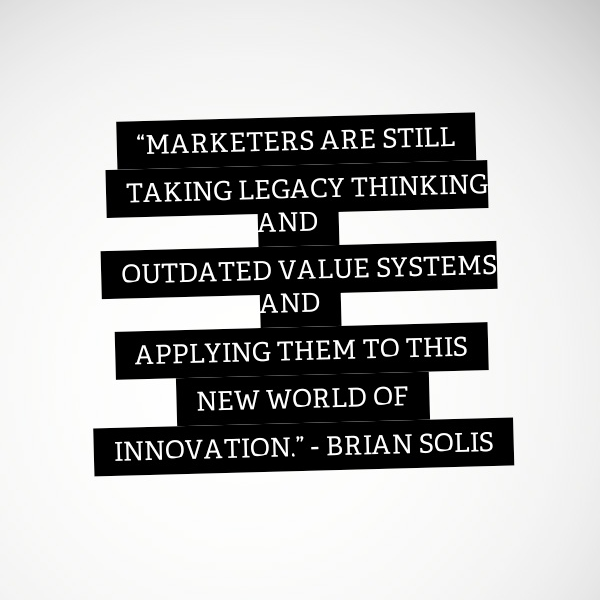
Marketers are putting all their resources against what were traditionally the big things: big commercials, big campaigns, celebrity endorsements. We’re still taking legacy thinking and outdated value systems and applying them to this new world of innovation.

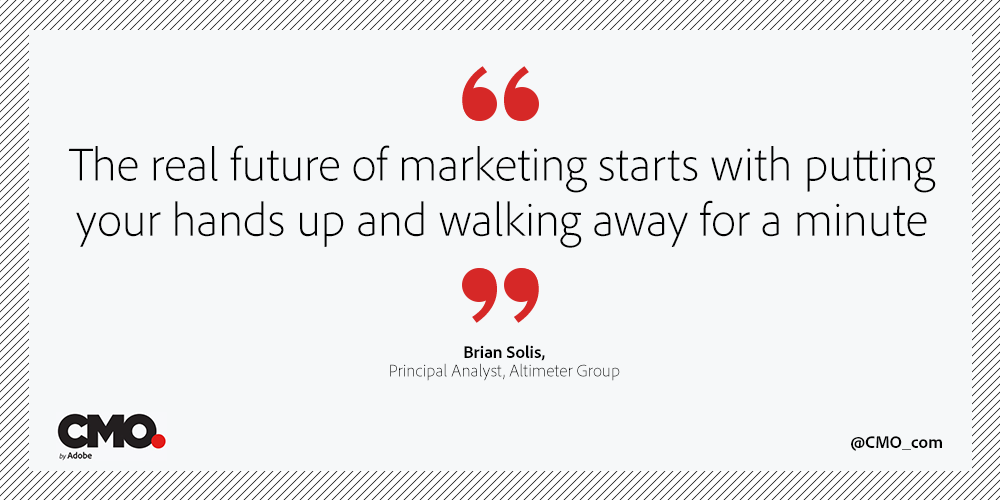
The real future of marketing starts with putting your hands up and walking away for a minute. With understanding how technology has affected behaviour and how that behaviour has affected expectations and values and decision-making.

And when you understand what is different today – all this amazing technology, all the data you can leverage – you recognise the future of marketing starts with an entirely new philosophy about what marketing should or could be. Marketing becomes a true reflection of an always-on society by recognising that it’s not a department. Marketing is now a way of business.

And when I use the word marketing, I’m talking about engagement, understanding who the customer is, how they’re different than customers before, what the context of their engagement is. Then building a digital infrastructure, and a complementary real-world infrastructure, to deliver an entirely new and meaningful experience.

CBVeIRxUcAAVEXV.png_large

CMO.com: How do you start?

Solis: The biggest challenge is not in the understanding or expertise associated with new technology. We can learn that. The biggest problem is our inability to recognise that the experience we have today is not the experience we need going forward.

We have to swallow our pride and recognise that, in order to compete for the future, we’ve got to become a student again. That’s the place I consistently see where no one wants to start. It’s Tolstoy’s quote about how we all talk of change but none of us talk about changing ourselves.

An easier way to answer your question is that you start by understanding the digital customer experience. What does it look like? What are the touch points? What are the screens that people use? What are the frustrations they have? Where did they find success? Immersing yourself – in a social science way – in a digital customer experience is a great start.

I have a statistic that shows 88 percent of companies are going through a digital transformation to better understand the digital customer experience and better meet the needs of the digital customer. That’s almost every company.

Then I learned only 25 percent actually studied the digital customer experience and only 12 percent actually immersed themselves in it. So 88 percent of companies are spending all this money to change digitally but only 25 percent could tell you why.

CMO.com: Does that mean the others are bound to fail?

Solis: I refer to this as digital Darwinism; as technology and society evolve, so must we. Trying to change may or may not be good enough, but digital Darwinism seems to favour those companies that at least try. It might buy them some time. But this is where innovation comes in, because companies have a lot of threats today that they’re not acknowledging.

For example, we view our competition as the competitors we’ve always had; we look at what they do and we try to up the ante. But disruption is happening just as a result of innovation. The taxi industry felt very comfortable in providing mediocre, sub-standard services until Uber came out. They never saw disruption as a competitive threat; they saw competitive taxi companies or black car services or limousines as a threat. Uber better understood the digital customer and what they wanted, and created a product around that. And it was a success because people could inherently embrace it.

Then there’s millennials. They’re different as customers but they’re also different as employees. Companies typically have horrible cultures, built on models from the 1950s and 1960s. There’s no intrepreneurial or entrepreneurial spirit to really motivate younger people, to create places they can relate to and where they’re appreciated. This is creating potential disruption.

Then you have soaring scholastic debts due to the university system. You have the dramatic rise of prices in homes. You have the rise of the sharing economy. All of these things are contributing to create different consumer value systems: “Do I need to own this?” “Do I need to spend the extra money for a luxury good?” “Does that really reflect who am I to who I’m trying to be?”

All of these dynamics are crashing in on organisations, and so just trying to change might be enough in some areas but it’s sorely lacking elsewhere. At some point you’re just consumed by the crashing waves.

What we need right now is a leader, and marketing is a great place to start. But just turning on these new machines doesn’t help us, being more creative or louder doesn’t help us. What helps is understanding how to be more human. Using technology to scale humanity is exactly where the future of marketing begins.

CMO.com: A number of big organisations are investing in funds or setting up incubators to work with emerging businesses.

Solis: That’s a fantastic place to begin. Many companies are opening up incubators to facilitate new technology as a way of fostering disruption. They’re trying intentionally to put themselves out of business. Others are investing in outside accelerators, incubators or in VC funds as a way of nurturing these opportunities.

The challenge happens when they identify new technology and bring it into the existing machine, whether or not that technology is strong enough to be supported by the existing broken models.

Culturally, this is a big challenge. When you find people or technology, how can they be scaled successfully without becoming part of the problem? Entrepreneurs don’t start companies because they dream of being inside a big company. They want to change the world, and that doesn’t go away because they’ve finished one product. Serial entrepreneurialism is something else big businesses can learn from as they’re competing for relevance.

That’s a long way of saying that innovating in your own disruption is counter-intuitive but incredibly productive. But you also need to invest in your culture to be innovative and adaptive, to form new decision-making processes for a real-time world, processes that are less political and less tied to self-preservation but are about becoming a start-up inside a big company.

Pasted_Image_3_30_15__10_07_AM

CMO.com: I’m fascinated by your ideas of the human algorithm and the human API. Can you expand on them for me?

Solis: We hear marketers speaking about big data as if it’s a gold mine. They’re plugging in big data and hiring data scientists as if this was the solution to everybody’s problem.

The human algorithm was this idea that data has to tell a story, and that story has to be meaningful and compelling to different audiences within the organisation. That takes someone not just to understand the data, but to humanise it so that you can see challenges and opportunities.

Today organisations are sluggish in the way they absorb data and act on it. The human algorithm to me was an infrastructure that could be built within the marketing organisation to drive specific change, to iterate and innovate at the same time.

The human API was a much more sophisticated understanding of the human being as a platform. On the business side of things, the signals being produced by big data aren’t necessarily becoming humanised. Instead we get caught up in the technology so we create more products, more wearables, more internet of things. Everyone of these is controlled by its own app, so things become incredibly complicated.

The human API was a different philosophy, saying take the technology out for a moment. What if the person was the platform? How would you design an experience based on what you’re learning from them? How could you make a much more intuitive experience, whether it’s the relationship between them and a product or between them and an ecosystem?

The Apple Watch is taking this approach. It’s not saying you need a watch or you need yet another wearable device. It’s thinking about why you would wear a wearable device. What are you trying to do, and what do you not know you can do? And at the same time we’re going to plug you in to the Apple ecosystem. That’s the idea of the human API.

Pasted_Image_3_30_15__10_10_AM

CMO.com: Another emerging theme is that because marketing is the most customer-facing bit of the organisation, it’s perfectly placed to relay customer wants and needs back to the organisation in a better way. Marketing becomes central to the company’s operation.

Solis: It’s positioned appropriately. It’s not staffed appropriately, nor is it recognised or funded appropriately today. But it is well-positioned and it will become much more significant within the organisation, with greater responsibilities and accountabilities. It starts to drive product road maps. It starts to drive employee engagement. It starts to drive culture. It starts to drive the customer experience including customer service and loyalty.

To me, the marketing organisation could become the most powerful form of the organisation, a new model which everything else could branch from.

Connect with me… Twitter | LinkedIn | Facebook | Youtube | Instagram | Pinterest

Photo credit: Shutterstock

30 Mar 21:33

Email Marketing: Is it Cheap or Does It Have a High ROI?

by Chad White

How you and—more importantly—your boss answer that question easily predicts the future success of your email program.

Here’s Why…

On the spectrum of email marketing investment levels there are two upward curves where incremental returns increase. Toward the low end of the spectrum, there’s a small curve where brands can increase their email marketing ROI by minimizing their investments by:

  • Negotiating for the lowest possible CPM, largely by minimizing ESP functionality
  • Focusing on broadcasting unsophisticated emails to the largest possible audience, often emphasizing list size over list quality
  • Hiring inexperienced email marketing staff—and then minimizing educational costs such as attending conferences

Whether these tactics are used unconsciously or consciously, because of ever-present resource constraints or other structural reasons, they are the hallmark of an “email marketing is cheap” mentality.

Toward the high end of the email marketing investment spectrum, there’s a much, much larger curve where brands can increase their email marketing ROI by investing in tools and tactics that accelerate ROI, such as:

  • Seeking sophisticated ESP functionality that delivers greater returns
  • Focusing on subscriber journeys, segmentation, and personalization to deliver highly tailored experiences that generate high returns, minimize list churn, and maximize subscriber lifetime value
  • Hiring experienced email marketers and investing in their continued education, and bringing in outside experts to assist when needed

These tactics are indicative of an “email marketing’s ROI is high” line of thinking.

Almost three years ago to the day, I wrote about the Widening Email Performance Gap between Haves and Have-Nots. Since then, there’s every indication that this gap is firmly in place and that the Haves, who correctly believe that email marketing has a high return on investment, are increasing their competitive advantage over their peers who chronically under-invest in their email programs.

For Example…

In 2013, 87% of major retailers sent at least one welcome email, according to Salesforce Marketing Cloud research. When I did the same research in 2009, 76% of retailers were sending welcome emails. Considering the span of four years between the two studies, that’s slow adoption of a tactic that’s universally recognized as a best practice. Plus, now more than 25% of major retailers are sending welcome email series, providing an even sharper contrast between them and those that don’t send even one welcome email.

During the May 2013 to April 2014 time period, 83% of email from legitimate senders worldwide made it safely to the inbox without being blocked or junked, according to Return Path research. That number has improved only slightly from the first half of 2011 when 81% of emails made it to the inbox. While many brands still struggle with permission and engagement, others are analyzing performance by acquisition source, perfecting engagement-based segmentation, optimizing their reengagement strategies, and fine-tuning their preference centers and unsubscribe pages to minimize churn.

In the second quarter of 2013, 8% of B2C brands were sending birthday emails, according to Salesforce Marketing Cloud research. Last year, when I looked at birthday email usage again, so little had changed that I deemed the findings not worth publishing. And this is a triggered email that 75% of respondents to our State of Marketing survey said were “effective” or “very effective,” a rating that made it the second most effective triggered email available to marketers. The adoption of most triggered emails is surprisingly low considering the high returns.

In early February, 45% of major B2C brands were still using largely desktop-centric design for their promotional emails, according to Salesforce Marketing Cloud research. While that’s down from 78% in October 2013, during that same timeframe the percentage of brands using responsive email design has grown to 38% from 12%. It’s those with the most experience with responsive design that will likely be first to explore device-targeted design and rich content like email carousels.

The Point…

There’s a disconnect between what brands say are important and what they actually do in regards to their email programs. One the one hand, CMOs and other marketing leaders rate return on investment as their No. 2 marketing success metric behind revenue growth, according to our State of Marketing Leadership survey.

And on the other hand, adoption of mobile-friendly email optimization, triggered emails, and other sophisticated tactics is low and slow-growing, despite the fact that email marketing is either the highest-ROI channel or the second highest behind organic search, depending on whose research you look at. The Direct Marketing Association says email marketing returns $43 for every dollar invested in it. While that’s incredibly impressive, it’s even more impressive when you realize that figure averages in a lot of low-performing programs. I know brands that are generating email marketing ROIs of $80, which they’re achieving with aggressive, smart spending on technology and services.

I fully understand quarter-to-quarter performance pressures, the inertia of internal politics, and the challenge of making ROI-based budget decisions when you’ve also under-invested in ROI-measurement capabilities. However, it’s time to more definitively shift budget away from lower-performing channels to higher-performing ones, such as email marketing. It’s time to move beyond the day-to-day email marketing grind and spend much more time on strategic expansion.

It’s time to acknowledge that email marketing is no longer cheap. The performance gap between basic, entry-level tools and advanced, integrated email marketing platforms has grown too large. The ecosystem in which email operates has become too vast and interconnected. And, most importantly, subscriber expectations have risen too much, driven by the rich, satisfying experiences delivered by brands that have embraced email marketing as an investment vehicle to drive sales.

Cheap email marketing is dead. Long live high-ROI email marketing.

(I encourage you to share this column with your colleagues and with your boss and perhaps your boss’s boss. Their reaction will tell you a lot about the future of email marketing at your company.)

A shorter version of this post originally appeared on MediaPost’s Email Insider blog.

SFDC_Blog_590x160

30 Mar 21:32

Absolutely Everything You Need for Winning at Content Curation

by Jasmine Henry

content curation75% of marketers don’t have time to create custom content, according to Curata. Even if they do, time and resource constraints can limit velocity, quality, or marketers’ ability to effectively promote their branded assets.

Anyone who’s ever tumbled down into an internet rabbit hole of Huffington Post, Reddit, or Upworthy can attest there’s tons of great content on the internet. There is absolutely tons and tons of fascinating videos, well-written articles, and more information than any of us could ever possibly try to absorb.

The amount of information on the web is absolutely staggering, and it doubles in volume every 9 to 24 months. You’ve probably heard phrases like “content saturation” or “information obesity” tossed around. However, it’s crucial not to underestimate the value people place on fresh or relevant content. Articles, videos, and infographics that are on-point for a given audience will always have a place.

Content Curation is the Cure

Today’s super-sharp marketers are investing heavily in content curation. By republishing and recasting existing content with full credit to the original source, you’re able to save time and resources while still providing extraordinary value to your audience.

But where do you get started? Chances are, you’re already doing a fair amount of content curation in your marketing strategy, if you’re publishing external links to your social media accounts. Are your current efforts on-point, or is there room for improvement?

In this blog you’ll learn a simple litmus test for evaluating potential candidates for content curation, as well as a bit of insight on how to make your curation efforts as efficient as possible.

Is This Content Right for Curation?

If you’re considering the pros and cons of republishing a piece of content, it’s crucial to evaluate each of the following factors before adding it to your content calendar:

  • Is this content relevant and targeted? Sharing a three year-old viral video will make your brand seem out-of-touch. Share older content if it’s highly targeted. Share less targeted content if it’s incredibly fresh. Always strive to share the most relevant, fresh, and targeted content.
  • Does this content share unique, targeted value to my company’s buyer personas? Value is often new information, but it can also take the form of amusement, entertainment, or other emotions.
  • Is this information correct? If the statistics, facts, and figures displayed on an infographic seem too extraordinary to be true, it might be because they are in fact untrue. A little fact-checking can save your organization a great deal of potential for embarrassment.
  • Am I (or my management team) comfortable with publically aligning our company with the organization that originally published this content?
  • Does this content have the potential to offend, upset, or disturb any members of our audience? Remember, even if you’re curating content, it will represent your organization to the public.
  • Will this content potentially result in lead generation for a competitor instead of my organization? Even if you’ve uncovered the greatest whitepaper your industry has ever published, your sales team will prefer if you don’t link to a competing organization’s lead generation landing pages!

Bonus Questions

While these factors aren’t crucial for a piece of content to perform well on your blog, LinkedIn Pulse, or social media channels, think of them like a value-add. Add a proverbial point for each of these criteria content meets!

  • Is this content in a format that my team or existing creation resources might not be able to easily create on their own? The average B2B marketer uses 12 different content marketing tactics. Use curation to bolster your own repertoire.
  • Does this content align well with my organization’s curent campaign mindset? Is your company emphasizing your newest shades of lipstick? Being able to share content that’s in sync with your latest messaging and marketing themes will only help you hit your targets better.
  • Have members of my audience already engaged with this content? Always, always strive to share content that’s completely new to your audience, which can require scrappy content marketing methodologies.

A Comprehensive Guide to Curating Rad Content

Now that you know a bit about the difference between super high-quality curated content and articles, infographics, and videos that could be questionable, here is a step-by-step guide to republishing content in a way that will help your brand win at inbound marketing. Remember, there is no specific right or wrong way to approach curation. Concepts like risk and procedure are best handled by your company’s legal counsel and management team. However, this methodology represents just one overview that could be your ticket to success:

1. Dig Deep

Content that’s primed for curation might not have 10,000 repins on Pinterest. It probably isn’t “highly cited,” according to Google News. The more niche, specialized, and small your industry, the more difficult it will be to find ridiculously awesome content. However, the following sources are something each marketer should check daily for industry key words, breaking news, and other curation candidates:

  • Social Media: Hashtag searches, Facebook trends, Pinterest key terms, Google+
  • RSS feeds
  • News Aggregators (think Flipboard or Pulse)
  • Google Alerts

Also? Depending on your organization’s budget and need for curated content, it could be well worth your while to look into some profesional curation tools. One of my favorites is Oktopost, which is a search engine just for curated content.

oktopost content curation

Many marketers also swear by Curata, which is a end-to-end tool for curated content discovery, organization, and even publishing. It’s basically the magical union of Pinterest, Google search recommendations, RSS feeds, Evernote, and HootSuite:

curata content curation

2. Curate Daily

If there was any single recommendation you can’t afford to ignore, it’s this one. If your content calendar prescribes curating content once weekly on Tuesdays, the time to start thinking about curation is NOT Monday afternoon. It’s also probably not Monday morning, though that’s slightly better.

Exceptional professionals consider each day an opportunity for research and self-improvement. There’s a good chance you already have a daily commitment to reading certain blogs, checking YouTube channels, and are subscribed to industry white papers. Always keep your eyes open for potential candidates for curation during your daily research time. Annotate, store, and maintain a list of curation resources in Curata, Evernote or your content calendar.

3. (Optional): Gain Permission

Are you trying to modify the content in any way? Do you plan on adding any caveats or additional recommendations? If your intent is to in any way modify, you probably need to gain permission. Some brands have content use and republication guidelines on their websites. Others don’t, so you’ll need to ask.

Don’t be scared, it’s easier than you think. Draft an email to the author of the content that resembles the following, and simply hit send.

content curation permission email sample

Also important? Don’t publish until you receive a response. Be patient, and wait until you receive an official go-ahead in writing.

4. Give Credit Where Credit is Due

This one is simple, and obvious, but all too often, marketers fail to appropriately credit the sources of their curated content. Always provide credit to the original source using one OR MORE of the following methods:

  • A link to the website
  • The full name of the brand and/or author
  • Links to brand or author social media accounts
  • Title of work or campaign (if applicable)

Even more importantly? Make sure you’re actually crediting the source, and not inadverdently crediting another brand who also curated the content. Do some digging, and if you’re unsure of how to appropriately credit a source, send them an email.

5. Notify the Brand

No one likes having their work stolen. However, learning that your work was curated in a respectful and flattering way with an appropriate amount of credit is a really, really great feeling. Go ahead and reach out to the individual or brand who’s work you’ve shared via social media or email. You could be surprised at how this can open up doors for future collaboration, friendship, or even mutual curation and co-branding opportunities!

Are you curating content? What are your guidelines and recommendations for marketers who are new to this practice?

Content Calendar

header image credit: amanda tipton/flickr/cc

30 Mar 21:32

Social Selling Tips: Converting Trust Into Profits

by Jeff Korhan

Social Selling Tips: Converting Trust into Profits

Today I’d like to share my top five proven social selling tips, which happen to be deceptively simple, and that is why they work so well.

From time to time I will refer back to the foundation of social selling discussed in Episode 33. You may wish to give it a listen if you have not already, but you will still be able to follow along if you choose not to.

I promise these tips will prove invaluable for achieving mutually beneficial outcomes for you and your buyer, regardless of whether you are selling online or face-to-face.

Successfully Selling Is Removing Buying Obstacles

Successful selling is a process of removing buying obstacles so that the buyer and seller both get what they want.

Whether you are selling online with social media or face­to­face, the following tips will prove invaluable for achieving that outcome. I’ve also included the memorable quotes I use when teaching these concepts.

#1. Value Before Pricing

Unless what you sell is a commodity, buyers that insist on knowing your price upfront may not be your buyers. As the seller, you want to set pricing aside until you have had the opportunity to build value.

This starts with first learning more about your buyer and his or her needs. Quoting a price suggests a transaction versus a relationship mindset.

This past week I signed a new client who said he doesn’t necessarily want more, but better customers. This tells me he wants educated customers that are interested in business relationships, not just one­time transactions. That’s what his online media will accomplish.

“Diagnosis before discovery is selling malpractice.”

#2. Keep Everything Moving

It’s up to you as the seller to guide the buyer through a collaborative sales process that takes them where they want to go. The excitement should build as that desired destination nears, which is why delays should be avoided.

One of our rules when operating my landscape business was to never conclude a meeting without scheduling the next. You have to keep the vision alive until the goal is achieved.

“Action and engagement predispose future actions.”

#3. Offer Your Expert Opinion

Many sales professionals are afraid to help the buyer choose for fear of making a wrong decision. Yet, suggestions that are backed by experience are often welcome.

A confused mind says no, so when the time is right the selling company should be prepared to make recommendations based upon its expertise, experience, and accumulated understanding of the buyer and his or her situation.

“Choices are obstacles to be managed.”

#4. Transform Trust Into Profitable Outcomes

We typically think of souvenirs as low-­value, throwaway items. In reality, the value of souvenirs are secondary to their role as a value exchange in support of shared relationships.

Sports fans buy memorabilia to feel a stronger connection with a player or team. The same is true for customers that trust your business and want to support its efforts to deliver consistently favorable customer experiences.

They are your fans. Use your media to honor their support of your business.

“Fans buy souvenirs.”

5. Give Reasons To Convert

In the landscaping industry we are often asked when is the best time to plant a tree.

There is a Chinese proverb that says: The best time to plant a tree is 20 years ago. The second best time is now.

When is the best time (and why) for your buyer to improve their respective situation?

“The best time to take action is today.”

Key Take-Aways

Learn more about understandings the worldview of your ideal customers.

30 Mar 21:30

Nancy’s Sales App of the Week: @MyHushly

by Nancy Nardin

Get to know your sales tools in just 2 minutes a week. This week, Nancy profiles Hushly, a smart marketing tool that increases the ROI on your gated-content and lead generation.

Sales ToolSkool Video Transcript:

This week’s topic is one I’m especially proud to talk about because I’m a co-founder of the venture. I’ll be talking about Hushly. Hushly offers a way for you to discover and communicate with net-new B2B buyers you aren’t reaching today.

Did you know, that on average, 9 out of 10 buyers will abandon your webforms because they don’t want to be spammed.

Hushly is like a safety-net that turns anonymous web visitors into known leads.

Here’s how it works:

You simply install a small piece of ready-made java code on the webform page. Hushly’s code then detects when your visitor is about to abandon your webform.

That’s when Hushly gives your buyer a risk-free option to view your content without completing the form. This gives the visitor extra confidence that your content is worth downloading.

It also gives your visitors choice and when people have a choice, they’ll often opt to go ahead and provide their email. That’s when it becomes a lead that goes into your marketing automation or CRM system.

However, if they choose to continue with the anonymous route that’s ok too. You will still capture a lead.

Downloading your report anonymously visitors use the Hushly platform where they can share your content with colleagues and you can communicate with them. Even though you won’t yet know their name, you’ll see their buyer profile which gives you valuable information about them.

Hushly makes it possible to get net-new leads you without a lot of effort or resources so you get a higher ROI on your lead gen $’s and that’s why we’ve named Hushly one of our top 40 marketing tools of 2014.

Go to Hushly.com and sign up for a free trial.

That’s it for this week’s ToolSkool.

Stay tuned for next week’s episode when we talk about an intelligent platform for accelerating sales.

Until then… Sell Smarter, with smart selling tools.

30 Mar 21:30

Customer Lifecycle Metrics, Part 3: Nurture, Score, Repeat

by Lisa Cannon

Global Business NetworkThis is part three in a series of five blog posts that examines the metrics you should measure throughout the five stages of the customer lifecycle: attract, capture, nurture, convert, and expand.

So, you’ve attracted the attention of your prospects and captured their information. Now it’s time to nurture those prospects and turn them into qualified leads. In part three of this series on customer lifecycle metrics, we’ll focus on the metrics that measure how well you’re nurturing leads, building their trust, and bringing them along on the journey to buy.

Depending on the business you’re in, the lead nurturing road can be a long one. According to the Aberdeen Group, prospects receive an average of 10 marketing touches from the time they enter the top of the funnel until they’re a closed-won customer. And if you think you’ve got a long path to conversion, consider this: marketing agency Starshot manages nurturing campaigns for sales cycles up to three years long! Read the case study to see how they do it.

Of course, the key to success is to reduce the manual labor of continually communicating with your leads and quantifying the results of those communications by each individual. And the secret weapon is marketing automation. Gleanster found that 74% of top-performing companies use automated lead nurturing. Among average- or lower-performing companies that use marketing automation, two-thirds of them fail to leverage the platform’s lead nurturing capabilities.

Let’s take a look at a few of the marketing automation tactics B2B marketers use to nurture prospects and keep them coming back for more:

  • Automated Email Programs: Email campaigns can deliver timely content and offers to leads based on where they are in the funnel, their attributes, what actions they take, and more. Instead of blasting a lead list with one-off emails, automated drip marketing campaigns give you the ability to plan out interaction pathways that take prospects on a customized journey based on their behaviors and preferences.
  • Trigger Emails: These automated emails are triggered based on specific events or dates, such as an action taken (or not) by a website visitor, or a meaningful change in a customer’s behavior or profile. You can set up trigger emails to be sent to prospects or customers based on specific actions, like filling in a form, registering for an event, or abandoning a shopping cart. You can set up emails based on birthday, anniversary, or expiration date triggers.
  • Lead Scoring: Leads are not created equal. Some are ready to buy right now, some will likely be ready soon, and some are just entering the funnel. Lead scoring makes it possible to discern how sales-ready a lead is. A good lead scoring system watches for online and offline buying signals, then increases marketing’s ability to pass qualified leads to sales and helps sales focus time and effort on the most likely buyers. For more information on how to effectively score your leads, take a look at our eBook, How to Prioritize Your Leads by Segmenting & Scoring Your Audience.
  • Smarter Segmentation: When you create well-defined segments by combining profile attributes (such as industry, title, or company) with observed behaviors (such as attendance at a specific webinar), you can market highly personalized, highly relevant offers to each distinct segment.

Before we dive into the metrics for measuring the success of your lead nurturing programs, we should mention a key feature of every good marketing automation solution: funnel reports. They make it possible to watch the progress of your leads as they travel through the path to conversion. These do more than provide instant insight into the effectiveness of your marketing campaigns – they also make it possible to uncover gaps in the process, forecast sales, and determine which campaigns are driving revenue.

funnel

Customer relationship management (CRM) integration is also key to lead nurturing success. Connectivity between marketing automation and CRM makes it possible for marketing to pass qualified leads to sales in a timely way, and that’s obviously important. But it also means sales can send leads back to marketing if they aren’t quite ready to make a purchase. And those leads can continue to be nurtured until they’re finally ready to buy.

Nurture Metrics

During the nurture stage of the customer lifecycle, your primary focus is to build interest and increase engagement. Questions to ask at this stage include: Which nurturing programs are most effective? Where do leads stall or drop out during the nurturing process? Which activities drive up lead scores? Which don’t have any effect? Which assets foster engagement? How many marketing qualified leads are created? The goal is to answer questions and educate the prospect, while building trust and reinforcing need, so that the lead continues to consider your solution as well as your brand.

  • Number of new leads: Prospects who qualify for active marketing.
  • Number of reopened leads: These are older leads who had been deemed not ready and had been put into a drip program of some kind, but who have recently demonstrated some kind of engagement that indicates growing interest.
  • Open rate and clickthrough rate of email programs: Open rates can be deceptive. As an example, if someone reads your email without enabling images, that read will not register as an open. Clickthrough rates are a better indicator of active engagement from an email recipient.
  • Lead score profile of new leads: This metric helps you observe lead quality over time. For this, identify all new leads opened in a month, and look at their lead scores at the end of the month. This could be a very valuable tool while communicating with sales reps (who tend to raise lead quality as an issue from time to time).
  • Number of marketing qualified leads (MQL): This is the target metric of nurturing programs. Keeping track of it allows you to gauge the effectiveness of nurturing programs. Note that it’s critical that sales and marketing together define the metrics that identify the MQL. If sales has input at this stage, it enhances their trust in lead quality and often results in better follow-up rates.
  • Cost per MQL: The marketing program cost to create one MQL. This metric is generated by dividing the program cost (which could include prorated labor and technology costs) by the number of leads generated. By itself, this metric can be misleading because it highlights marketing costs, but it gains more meaning later in the process when you can compare it to value generated.

The best part about the lead nurturing process is that it improves return on investment as well as conversion rates. B2B marketers who have successfully deployed lead nurturing programs average a 20% increase in sales opportunities from nurtured leads versus non-nurtured leads, according to DemandGen Report.

What other metrics do you track in order to measure the success of your lead nurturing campaigns? Share your thoughts in the comments.

For more ideas on how to incorporate your data and metrics into your lead nurturing campaigns, check out our on-demand webinar, “Using Data & Design to Create a Knockout Email Nurture Program.” This on-demand webinar will help you discover how to take your email nurture programs to the next level by using data for better personalization, and content and imagery to increase your prospects engagement.

30 Mar 21:29

Are You Doing Webinars for Lead Gen? You Should Be.

by Jeff Perkins

perkins_webinar

As a marketer, I’m always looking for new ways to engage prospects and drive leads for my sales team. And in the past 6 months, I’ve added a new tactic to my program: webinars.

We had been talking about doing a webinar program at PGi for some time but just hadn’t taken the necessary steps to get it moving. I understand why many companies might be hesitant about doing webinars. It’s not easy.

For every webinar you produce, you have to find speakers, create content, promote the event, track registrants, and much more. You also have to manage the technology and deal with all the technical issues you may encounter during the webinar. That can be a pretty daunting task.

For many marketers, webinars may not be worth the trouble. After all, it’s much easier to write blogs, eBooks, and whitepapers. You can create a high volume of written content quickly, and you don’t have to deal with the technical challenges of a webinar.

But here’s the problem. All that written content requires people to do something they really don’t want to do: READ. Now, I’m an avid reader and writer, and it pains me to admit this, but most people don’t like to read. For example, research shows that visitors to a website are 80% more likely to watch a video, while only 20% will read web copy (source: Digital Sherpa). We’ve actually done A/B tests on PGi.com, and we’ve seen that web pages with videos convert 450% better than pages without video.

That’s why webinars become interesting as a lead generation tactic. You’re able to engage your prospects with your brand/products/message for an extended period of time. You’re able to mash up audio, video, slides, and more to keep the attention of your audience. That’s why you see webinars rated as one of the top lead-gen tactics today (source: Placester).

So, we developed a webinar program and launched our first webinar in November. The title was “Evolve or Die: Surviving the Changing Sales Landscape.” It was high-level thought leadership designed to drive top-of-funnel awareness and interest in PGi. You can watch the on-demand video replay here.

The results from our first webinar were pretty good. Over 100 registrants and 50 people attended the webinar live. An additional 25 people watched the webinar on demand after the event. We generated 23 marketing qualified leads for our sales team to start working right away.

Isaac G

Based on that success, we kickstarted our program doing at least one webinar each month. Overall, we’ve been really impressed with the results. Unlike other forms of advertising, the number of people we reach with our webinars isn’t that big, but the engagement we get is really impressive. With all of the distractions and media fragmentation, there’s huge value in getting people to spend 45 minutes with your brand.

And we’ve seen, the attendees from our webinars convert to warm leads very quickly. Feedback from the sales team is that these prospects are high quality and very interested in learning more about PGi.

So, if you’re thinking about starting a webinar program, here are some lessons we’ve learned along the way.

  1. Promote early and often: If you build it, they will come—but only if you promote it. We use every possible channel we can—email campaigns, social, paid advertising, content syndication, website, etc. Also, make sure your sales people are sending invitations to their prospects and customers. The harder you work to promote your webinar, the more attendees you’ll get
  2. Use the webcam: Webinars can be a highly engaging experience for the viewer. But if you’re just flipping through PowerPoint slides and adding a voiceover, you’re missing an opportunity to truly connect with your audience. Think of it like giving a live presentation. You want the audience to focus on you and what you’re saying. The slides should just support the key points you’re making.
  3. Ask the audience: Polling the audience is a great way to drive up your engagement and keep their attention. In our webinars, we use polls to break up the presentation. We share the live poll results with the audience, so they can see what other people on the webinar think.
  4. Design slides specifically for a webinar: Don’t overload your slides with text, because a webinar is often viewed on a small computer screen. Use large visuals and short headlines to drive your message home. If you’re showing data, make sure to visualize it in a good-looking chart or graph. Remember, with presentation slides, less is more.
  5. Follow up to drive additional viewers: Once the live webinar is over, you still have the opportunity to drive additional viewers to watch it on demand. And as long as the presentation is current, it can live on in your content library and continue driving leads into the funnel.

So, if you’re looking for a new way to drive leads, give webinars a try. I think you’ll find that it’s a great way engage your prospects and create more opportunity for your sales team.

Have webinars been successful in your lead-gen efforts? Any webinar tips to share that I missed? We’d love to hear from you in the comments section below.

29 Mar 23:07

15 stunning entries from Smithsonian Magazine's annual photo contest

by Business Insider

Smithsonian Photo Contest Snake Eating Frog

Smithsonian.com has announced the finalists for its 2014 photo contest, in categories such as natural world, travel, people, Americana, altered images, and mobile.

The competition saw more than 26,000 entries this year from 93 countries. It is the 12th year of the contest.

The Smithsonian is also running a reader's-choice contest where people can vote on their favorite image.

The winners of this year's awards will be revealed on March 31.

Women sew their fishing net in a village near Vinh Hy Bay, Vietnam.


President Barack Obama in the Oval Office of the White House on October 7, 2014.


Light refracts through the curves of a breaking wave in New South Wales, Australia.


See the rest of the story at Business Insider
29 Mar 22:55

Five things to watch for in the Canadian business world in the coming week

by CB Staff

TORONTO – Here are five things to look for in Canadian business this week:

— The price of oil. Often a big factor in determining direction on the Toronto Stock Exchange, oil has been on a wild ride recently. Five straight winning sessions, prompted among other things by renewed tensions in the Middle East, saw it top the $50-a-barrel mark last week before falling back $2.56 to US$48.87 on Friday.

— January GDP data. Statistics Canada issues its report on gross domestic product for January on Tuesday. The consensus estimate of economists is that it will show GDP declined 0.2 per cent in January, according to Thomson Reuters. Regardless of the results, the numbers will likely fuel further debate on whether Bank of Canada governor Stephen Poloz will move on the overnight interest rate next month.

— Bank of Montreal annual meeting. The Bank of Montreal holds is annual meeting on Tuesday. The bank reported last month that its first-quarter profit was down compared with a year ago. BMO chief executive Bill Downe said at the time that the “current operating environment poses both challenges and opportunities.”

— Auto sales. Automakers are expected to report their March sales results this week. Canadians continued the flock to auto dealerships last month and helped push sales to their best February since 2008, with truck sales leading the way.

— Trade data. Statistics Canada reports international merchandise trade results for February on Thursday. Economists expect the country to have posted a trade deficit of $1.8 billion, according to Thomson Reuters. Canada’s trade numbers have taken a hit in recent months, due in larger part to the sharp drop in oil prices from highs of US$107 a barrel last summer.

The post Five things to watch for in the Canadian business world in the coming week appeared first on Canadian Business.

28 Mar 16:35

Google’s robotic research to move into operating room in partnership with Johnson & Johnson

by CB Staff

SAN FRANCISCO – Google is teaming up with Johnson & Johnson to build robots that can help surgeons in the operating room.

The alliance announced this week dovetails with two of Google’s initiatives beyond its main business of Internet search and advertising. Google has been investing in medical research aimed at extending lives and in robotic technology that can free up humans to do other things.

The companies will try to engineer robotic technology that will reduce patient trauma and accelerate post-surgery healing.

Google will work with Ethicon, a medical device company owned by Johnson & Johnson.

Financial terms of the deal aren’t being disclosed.

Johnson & Johnson’s innovation centre in California negotiated the partnership with Google, which is based in Mountain View, California.

The post Google’s robotic research to move into operating room in partnership with Johnson & Johnson appeared first on Canadian Business.

28 Mar 16:34

Airbnb signs deal to sponsor 2016 Olympics, easing Rio’s housing shortage

by CB Staff

RIO DE JANEIRO – Rio de Janeiro’s hotel bed shortage was eased on Friday, as online home share startup Airbnb inked a deal to be the official “alternative accommodations” sponsor of the 2016 Olympic games.

The deal, which saw Airbnb pay an undisclosed amount to local Olympic organizers, means official Olympic sites will feature a link to Airbnb’s site and encourage spectators travelling to Rio for the games to use the service to rent space in private homes and apartments.

This marked the first time the Olympics has had an alternative accommodations sponsor, said officials with the local organizing committee.

Rio’s notoriously poor hotel infrastructure has been long been considered a critical issue. When the city won the Olympic bid in 2009, it had just half the 40,000 beds required for the games. Since then, new infrastructure has been built, and the city now has the 42,000 spots needed to house members of the “Olympic family,” including athletes and their entourages, the media and sponsors.

Airbnb’s around 20,000 offerings in Rio — rooms, apartments, and houses scattered across the width and breadth of this chaotic seaside megacity — will be aimed primarily at Olympic visitors, officials said.

“When we started all that (Olympic bidding process) several years ago, the major problem was hotels. How are we going to host so many people,” Sidney Levy, CEO of the Rio 2016 organizing committee, said at a news conference.

An initial plan to put people up aboard several cruise ships docked in waters off of downtown Rio fell largely flat, and the bankruptcy of Brazil’s one-time richest man, Eike Batista, who was supposed to deliver restored hotels, only aggravated Rio’s housing crunch. Owners of some pay-by-the-hour love motels received subsidies to help transform their establishments into conventional motels, but it didn’t help much. During Pope Francis’ 2013 visit to the city, the flocks of faithful slept largely in churches or on the floors of local schools.

Airbnb’s chief product officer, Joe Gebbia, said Friday’s deal would “make it possible for more people to attend Olympic games next year.”

“We’re ready for the expected 380,000 spectators who are coming to Rio for the Olympic games, and we’re ready to show them what traditional, authentic Brazilian hospitality looks like,” he said, adding that the sponsorship deal represented an “incredible opportunity for Rio residents to care for those visitors.”

Gebbia, who co-founded Airbnb in San Francisco in 2008, said Rio has become one of the company’s top destinations — after Paris, New York and London. During last year’s World Cup, for example, around 100,000 international guests were hosted through the site, he estimated.

Although Gebbia mostly eschewed financial questions, focusing instead on the opportunity for intercultural understanding that can result from residents opening up their homes to foreign visitors, he said Rio-based users of the site averaged incomes of $4000 during the month-long World Cup.

The exorbitant price of accommodations in Rio during the soccer tournament became a hot-button issue after several European delegations announced they’d slashed the number of people attending the tournament in response to spiraling hotel prices. Asked whether Airbnb would be taking any measures to prevent price gouging during the Olympics, Gebbia responded that according to the rules of the site, it’s up to the home owners to decide on pricing.

Fabio Nahon, a former businessman who now lives off income from the properties he lists on Airbnb as well as from managing some 20 other properties for fellow site users, hailed Friday’s deal as “a strategic partnership that benefits everyone — visitors, owners, Airbnb and Rio’s ‘brand.’”

“I think the Olympics will help Airbnb gain even more legitimacy and that the Olympics really put Rio on the tourism map,” he said at Friday’ news conference, in a hall decked out with couches and coffee tables to resemble a living room.

Nahon added that his properties were fully booked during the World Cup, despite a 100 per cent markup during the tournament.

___

Follow Jenny Barchfield on Twitter: www.twitter.com/jennybarchfield

The post Airbnb signs deal to sponsor 2016 Olympics, easing Rio’s housing shortage appeared first on Canadian Business.

28 Mar 16:33

B2B Sales And Marketing Inhibitors

by Ian Dainty

b2b marketing and sales inhibitorsOne of the reasons that B2B companies fail, or don’t grow as quickly as they want to, or need to, is because of a number of different inhibitors that affect their growth. There are a number of inhibitors to great B2B sales and marketing cultures. There are external inhibiting factors and internal inhibiting factors.

EXTERNAL FACTORS

Economy – Recession

There are many external factors that can inhibit great sales and marketing in a B2B company. The biggest external factor is a recession, especially one like we have been going through for the past few years. And we still haven’t fully recovered after more than seven years.

In a recession, no matter how hard or persuasive your marketing is, you cannot get some companies to buy. Usually their clients are not buying from them, and that causes a ripple effect right through the whole economy.

You need to adjust your marketing messages and the way you market and sell. You need to ensure you have a strong VALUE PROPOSITION. You need case studies and testimonials that sell, and you also need to have a compelling offer. Without these factors, your sales could drop dramatically.

B2B Competition

All B2B companies have a lot of competition. You know better than me who your fiercest competitors are, and how you can overcome their weaknesses to secure business. If you do not believe you have much competition, simply ask your clients how many different companies contacted them in the past two months.

You will constantly have competition. You need to discover who your competition is so you can overcome any objections a potential client will throw at you.

Client Affairs

There can also be external factors that can affect certain companies or certain markets from buying at a particular time. For example, a while ago there was a disastrous oil spill in the Gulf of Mexico. The company that caused the spill is BP, one of the largest oil companies in the world. You can bet that trying to sell anything to BP at that time, except a sure-proof way of cleaning up oil spills, was probably going to be a long sales cycle.

Government Regulations

As we all know, governments seem to have more and more of a reach within our personal and business affairs, both through taxation and through the different laws enacted in every country or jurisdiction. In Ontario, the Canadian province I live in, for example, all companies become tax collectors for the government. We already collect GST for them with the products we provide, and Ontario companies also collect PST through the new government HST.

Sarbanes Oxley has also given many companies headaches with its new regulations. However, legal and accounting companies have reaped benefits from many of these laws, as they advise their clients on the right and wrong ways to ensure they are compliant with the new laws.

Now Canada has just passed the Canadian Anti-Spam Legislation (CASL) which can fine any individual up to a $1 million and a company up to $5 million for sending unsolicited emails. This is the toughest ant-spam legislation in any western country. In my opinion, this law is ridiculous as it punishes legitimate marketers from reaching out to companies who could really use these companies’ products and/or services. But we all must comply, even companies outside Canada selling to Canadian firms and consumers.

INTERNAL INHIBITING FACTORS

Executive Buy-In

The internal inhibitors usually revolve around how the executives, especially the CEO, feel about marketing and sales. If the CEO has come up through a marketing and sales background, then marketing, sales and client service play a large role in how that particular company is run.

It is imperative that the executive committee, and especially the CEO, make marketing and sales the major priority of the business, in order to succeed. This is especially true in tough economic times, like we are still going through right now.

Measuring True Marketing

There are a number of B2B companies that realize marketing is a key driver of revenue. Even today, IBM allocates about 50 percent more money to marketing and sales, than it does to Research and Development (R&D). Microsoft also allocates a similar amount of money to marketing and sales versus R&D. Each of them allocates about 21 percent to 23 percent of revenue to marketing and sales. Apple allocates a similar number.

The real inhibitor, to the true marketing side of the B2B business, has generally been that executives know that 50 percent of their marketing is effective, they just don’t know what 50 percent it is. The sales side of the business has always been measured. Sales statistics have usually been readily available, and most sales people are generally paid on some sort of incentive because their contribution can be measured.

However, it has been difficult to measure the contribution of the true marketing side of a B2B business. Advertising has always been difficult to measure, because it was put out to a large audience, and there were very few, if any measurements associated with it.

Sales may have gone up, in any given timeframe. But if a company had a number of marketing initiatives going on at the same time, which of course it should, it was almost impossible to discover which ads were working, and which ones weren’t.

So it has been difficult to measure true marketing in the past. That is, until now. With the advent of the Internet, and all of the tools available for analytics, you can measure your marketing right down to how each individual company buys from you. If you are not measuring some part of your marketing, you shouldn’t be doing that part.

Turf Protection

Another inhibitor of great marketing in B2B companies is “turf protection.” Turf protection is when a partner or relationship manager won’t “allow” any other business units inside his accounts. He has the misguided notion that anyone else in his accounts will disrupt that account. The real thing he fears is that another business unit will take over the account, and leave him out of the profit picture for that account. There is also the reality that the relationship could be put aside for short term gain. This phenomenon is especially true with professional services firms.

There are a number of ways to overcome this anxiety. However, the best way is to have an account structure that allows for other business units to develop within an account, but under the understanding that the account belongs to the account executive or relationship manager. It must also be done with a profit and remuneration structure that is fair to everyone.

Differentiation

Many times, B2B companies have difficulty differentiating themselves from the companies they compete against. This applies to all types of B2B companies.BUILD TRUST and differentiate

The issue here is that too many companies talk about the process they use, rather than the real differentiators. The real differentiators are the value you bring through the issues you resolve for your clients, through the solutions you put into place, and the relationships you build with each client.

The easiest way to find that differentiator is to ask your clients. I have found that most companies do not ask their clients the simple question, “Why do you do business with us?” Who can give you the best reasons you are in business, better than your clients can.

When you do ask your clients, you not only find out what differentiates your company, you also build on your value proposition. As each client tells you what is right and wrong with your products and services, you can correct and build upon those ideas.

Issue Resolution

Almost all B2B companies end up selling features, as opposed to how to resolve particular issues that a prospect client has. Many times, this comes from the way the client asks for you to help.

Your client may say I need these features for my system. If you end up selling this way, then you will never work your way up the relationship ladder. Many B2B companies are happy doing this, but it means you spend a lot of time answering RFP’s, and will never become a Strategic Business Advisor to that company. It also means that you will have plenty of competition for each feature your client is looking for.

To overcome this way of doing business, you need to start resolving issues for your client. Your client doesn’t really want a bunch of features in a product, he wants an issue resolved, so he can reach his and his company’s goals. He probably resolved that issue with a certain feature in the past. Therefore, he believes the same feature can resolve it now. By using some creative thinking, you can show him there is a better way to resolve his issues with your company’s value proposition.

Dig deep, and you will find that you can counsel your client on the best way to solve this problem. It will take more work, but it can also lead to much higher revenues in the future. However, you must also decide on the type of B2B company you are, and if you want to put in the extra work to attain these significantly higher revenues and profits.

Lack Of Account Management

Most B2B companies have some sort of account management. But, many times it is a loose structure, with no apparent process or system involved. As every company needs a CEO, every major client you have, needs an account/ relationship manager. Someone has to be the main point of contact for that client to ensure the promised products and services are delivered.

A structure needs to be in place in which the account manager works with all his team members to ensure that the account plan is moving forward. There needs to be a formal process in place to ensure this happens. And the client needs to know that there is a single point of contact, for anything that client needs.

That doesn’t mean that the account manager fields every single call. It means that the account manager ensures that every call is handled, and that if the client’s senior executives want to talk to someone, they know who that is.

Without a structured account management process, on how to deal with issues, selling new products, using the right analytics, and building the right relationships, that account will falter, and soon will belong to the competition.

Conclusion

As you can see, there are many factors, both internally and externally that can affect the way you sell to your prospects and clients. Work extremely hard to eliminate the internal factors, and be aware of all the external factors that can change the way you market.

You can get a full description of the B2B Sales & Marketing Inhibitors in my eBook THE LEADERSHIP GUIDE TO GREAT MARKETING IN B2B COMPANIES.

28 Mar 16:33

What a $20 billion startup looks like when it's just starting out, and everyone thinks the idea is stupid: Here's Airbnb's first-ever pitch deck

by Alyson Shontell

founders airbnb Joe Gebbia Brian Chesky

Airbnb is a great startup success story. It's reportedly raising a new round of financing that will value the company around $20 billion.

But when Airbnb was first getting started in 2008, the founders struggled and would-be investors snubbed their idea.

The founders shared their first pitch deck with an MBA student, back when it wanted to be an air mattress rental company. Here's what it looked like:

Airbnb was initially called AirBed&Breakfast. It was a marketplace for crashing at a local's apartment on a blow-up air mattress.


"We couldn't wrap our heads around air mattresses on the living room floors as the next hotel room and did not chase the deal," legendary investor Fred Wilson now says regretfully. His team passed on Airbnb's early financing round.


But the founders persisted. They thought the web could be a powerful booking tool. And when investors like Wilson weren't eager to give them funding, they turned to their own devices...


See the rest of the story at Business Insider
28 Mar 16:33

What Is Dynamic Pricing & How Does It Affect Ecommerce?

by Business.com

Dynamic pricing, it seems, is the latest pricing trend that has taken the ecommerce industry by storm. While it is not an entirely new concept and companies have been using it randomly over the years, it is certainly something that is much more relevant in the new age of ecommerce companies.

Simply put, dynamic pricing is a strategy in which product prices continuously adjust, sometimes in a matter of minutes, in response to real-time supply and demand. For example: Amazon, the global ecommerce giant, is one of the largest retailers to have adopted dynamic pricing and updates prices every 10 minutes.

If you own an ecommerce company, you should seriously consider adopting this pricing model since it has several benefits for your business.

Here are a few of them:

1. It Gives You Greater Control on Your Pricing Strategy

A common argument against dynamic pricing is that it reduces your control over product pricing. In reality, it has a completely opposite effect. As a retailer using dynamic pricing, you’ll have access to real-time price trends across thousands of products in your industry. You’ll be able to see the pricing changes of your competitors, and will have a clear idea of the supply and demand of individual products. This will help you set the right prices for different products and maximize your revenues.

2. It Allows Flexibility Without Compromising Your Brand Value

Many eCommerce retailers shy away from dynamic pricing because of the potential damage it can cause to their brand value and user experience. After all, consumers can easily mistake your fluctuating product prices to manipulation or even fraud, right?

Wrong!

Brands can actually protect, and even strengthen, their brand value by implementing dynamic pricing. Retailers can set a price floor that reflects their brand value and allows them the flexibility to stay profitable. They can use dynamic pricing to launch seasonal and promotional offers as well, while still remaining profitable (something quite difficult to achieve with a flat pricing model).

3. It Saves You Money in the Long Run

Dynamic pricing is based on the changes in real-time product supply and demand. It takes into account the price fluctuations in the market, monitors competitor activity and individual product demand and supply. As a result, it gives ecommerce retailers the right data and information that can be used to set optimal product prices and stay profitable despite the price fluctuations.

This saves retailers money in the long run. Since all the calculations are done by web based software and applications, there’s no need for spending money in manual calculations and administrative activities. The reduction in these overheads also adds to your profitability in the long run.

For example, Walmart uses dynamic pricing and changes its product prices almost 50,000 times a month. Using this pricing model, its global sales grew by 30% in 2013 and the trend continued in 2014 as well. Amazon also saw a 27.2% increase in revenues and ended up as one of the top 10 retailers in the US for the first time.

4. It Can Be Managed Effectively with the Right Software

Monitoring hundreds of thousands of products and keeping an eye on the real-time supply and demand trends is a highly complex and challenging task, beyond the scope of most ecommerce businesses. However, it can be easily managed with the right software. Wiser, for example, is a web-based application designed to monitor, calculate and manage dynamic pricing models based on real-time supply and demand trends.

It takes the guesswork out of dynamic pricing and automates the whole process to provide you accurate data that can be used to set optimal product prices. Wiser has also helped global corporations like 3M, McAfee and at&t with dynamic pricing and MAP enforcement over the last two years.

Note: I personally got to know a lot about the fundamentals of dynamic pricing and how it can be integrated with existing pricing models, by reading Arie Shpanya, the CEO of Wiser.

5. It’s Not Error Free, But You’re Still In Control

Dynamic pricing is based on supply and demand changes. But like any other technology based forecast, there is potential for error in dynamic pricing algorithms as well. However, even if the proposed pricing is inaccurate, it’s still just a proposal. You remain in control all the time and can review the pricing changes that your application recommends.

Moreover, the experiences of companies like Amazon, Best Buy and Walmart indicate that potential errors are not only easily manageable but also usually do not have a significant impact on the overall profits, since the changes are so frequent.

eCommerce retailers have grown in numbers over the last few years. With increased competition, they face the tough challenge of maximizing profits while keeping their prices competitive. Dynamic pricing is the ideal solution to this problem since it takes into account the changes in supply and demand, and recommends the optimal pricing structure. If implemented for a sustained period, this pricing strategy can significantly boost your overall revenues and profitability.

28 Mar 16:33

Three Paid Marketing Tools That Are Worth Every Penny

by Justin Wong

3paidmarketingtools-blog-header

As a small business, Curve deeply understands the importance of keeping costs down. There are hundreds of different paid marketing platforms out there, from social media feeds to brand analytics platforms. How do you know which ones are worth the money?

Here are three paid marketing tools that we highly recommend to any marketers, social media managers, or entrepreneurs looking to build their online profile.

Note that Curve Communications is not affiliated with any of these companies. We just love them!

LitmusLitmus

If you’re using an email newsletter to connect with your fans, how confident are you that your emails are showing up properly? This is a huge problem especially if your email newsletters are designed from scratch in HTML, but even pre-made templates might not be perfect on every single platform.

Litmus takes the guesswork out of it for you. You can send a preview email from your email-marketing platform like Constant Contact or Mailchimp to a special email address provided by Litmus. Litmus will then display your email on several dozen different browsers and devices, from iPhones to Outlook to Gmail.

Why is it worth your money?

The time and labour cost it would take to manually send these emails to different devices would be tremendous, especially if you’re managing several emails a week. Litmus cuts this process down to a single streamlined task, and provides a lot of other value-added services like HTML assistance, live editors, and useful webinars.

While the price is still steep, Litmus is invaluable if email marketing is a major part of your marketing plan.

Price: Plans start at $79/month, free 7-day trial available

EdgarrEdgar

Edgar is a brand new social media automation platform. So new, in fact, that you have to request an invitation to be a part of it, but it’s definitely worth the extra effort. Edgar is all about helping you share evergreen content: articles and blog posts that can be posted year-round and aren’t time sensitive.

Let’s say you have a sale you want to promote twice a week. Normally, you would have to copy and paste the text of the tweet and manually schedule it every week.

However, if you used Edgar, you can schedule any promotional tweets to go out on Monday and Wednesday at noon. Next, you just write a couple of tweets (let’s say five) about your sale and label them as promotional. Edgar will then automatically rotate through the five promotional tweets without your input. If you want to add more tweets to the queue, change the times, or remove older tweets, this can be easily done through the dashboard.

Why is it worth your money?

First and foremost, Edgar helps you save an incredible amount of time. Manually scheduling hundreds (or if you’re like us, thousands) of tweets a month for different clients and accounts eats up a tremendous amount of time. We still look for great articles to share on our Twitter feed every day, but the process has been greatly simplified due to Edgar.

Price: $49/month

HootsuiteHootsuite

When it comes to having full control over all your different social media accounts, Hootsuite is the undisputed champion. While Edgar is fantastic for helping you schedule your posts, Hootsuite does all that (although it requires more manual tweaking), and it helps you monitor and track hashtags, mentions, DMs, and anything else you need to be a social media superstar.

In Hootsuite, each account has its own page, and each page has a customizable feed so you can focus on what’s important. Have an account that’s used primarily for tweeting out marketing content? You can prioritize your scheduled tweets and anyone using #Marketing (or any other hashtag) on your feed.

What about a tech support account that focuses on responding to customer questions? You can prioritize Direct Messages and Mentions to make sure you can easily monitor anyone trying to contact you.

Why is it worth your money?

Hootsuite is invaluable for any company that has to manage (and track) social media accounts across different departments and product lines.

Hootsuite isn’t limited to just Twitter. Hootsuite is also compatible with LinkedIn, Facebook, Google+, Foursquare, WordPress and Mixi. If you’re looking for one social media tool for your business, we strongly recommend using Hootsuite Pro.

Price: From $8.99/month for a Pro plan. A free user has limited functionality, with only two social media networks and very basic post scheduling.

Have any other paid platforms you love using? Continue the conversation below.

28 Mar 16:32

Saving Gotham: How to Use Social Media to Improve Sales

by Business.com

With a little luck, clever social media marketing campaigns go viral and bring in sales. Gimmicks are entertaining, but truly successful social media marketing depends upon a campaign structured around a strong, central website hub.

Saving Gotham

Did you hear about how Batman saved San Fran-Gotham just a few years ago? A Twitter and Instagram campaign brought attention to one small cancer survivor’s story, and increased awareness of the Make-A-Wish Foundation.

The City of San Francisco came together and transformed itself into Gotham, in desperate need of saving by none other than Batboy, a.k.a. Miles Scott, a five-year-old Batman fan who had also survived cancer. The buzz achieved on the day of the Gotham transformation was quite remarkable:

  • Over 406,960 Tweets
  • Almost 22,000 photo postings on Instagram and Twitter

Unfortunately, most of us lack the heroic appeal of a superhero, not to mention the bravery of a five-year-old cancer survivor. However, we do have access to the same social marketing tools, you just need to find a compelling story to tell. Here’s how to utilize social media to sell more:

Find the Right Format for Your Business

Facebook excels at creating visibility for a business. Post feel-good non-office endeavors such as town festivities. Tie in a “like” of your site to a dollar pledge supporting a local charity for good will, good PR, and a tax write-off, all wrapped up in one package.

Real-time chatter requires the liveliness of Twitter. When businesses use images with Tweets, many report a 150 percent retweet and share percentage, all for the price of a single tweet. Develop engaging conversation topics, and have people familiar with the platform to handle the tweeting; it is a true skill.

Campaigns reaching out to other professionals who already understand business topics are well suited to LinkedIn. Creating a knowledge base about your business on Wikipedia makes researching your business easier. Every office has at least one wannabe spokesperson who would make a great YouTube performer, and who will lend a “face” to your business name

Own Your Hub

Perhaps overused, the concept of the marketing wheel nonetheless is a great visual concept for social media marketing. Don’t reinvent the wheel; just make it better with social media.

A strong hub is essential as it acts as the point where everything meets, on wheels, in businesses, and even in social settings. A poorly designed, content-poor website makes a lousy social media marketing hub that only loses clients. Strong websites need informative content that draws people in, whether in the form of videos, testimonials, or social media links.

A great hub supports the spokes that lead out to different social media platforms while bringing in business at the same time. It allows your business to reach out to consumers where they spend a lot of time on various social media sites.

Interweave Your Marketing Wheel Spokes with Paid Media

Paid media is just another term for advertising specific to social media sites. Every engaging advertisement on a social media site potentially leads interested consumers back to your hub website, even consumers unfamiliar with your business.

A few things regarding paid media require specific attention:

  • Be sure the website content satisfies expectations
  • Find the right placement for the ad
  • While everyone knows it is an ad, anything overly pushy is a no-no on a social media site

Perfect the Art of Earning Media

Remember the old Smith Barney commercials, with a craggy voiced John Houseman stating, “We make money the old fashioned way. We earn it.” Social media is not old-fashioned, but the best marketing often comes from earned media, where others do the work for you, sharing positive information about your product or company through posts, shares, reviews, and more.
When people come across something that resonates with them, social media apps make it super simple for them to share their thoughts on a post, and if that chatter is positive, it amounts to free, effective marketing for you. Just be sure to provide great services and an engaging place for people to make comments.

Create Rim Benefits

Picture a marketing wheel with a strong hub and ample spokes. The objectives resting around the wheel’s circumference include:

  • Creating trust
  • Expanding reach
  • Generating leads
  • Gaining a following

Attaining these ideals comes from ensuring top quality from the hub out to the spokes all the way to the rim, all the while paying attention to mobile social media and consumer trends.

The beauty of this model is that paid, owned, and earned media work together to carry your message, as long as you regularly add new content and respond to comments not only on the hub website but also on those all-important social media sites.

27 Mar 16:57

8 Tips For Generating Sales Leads

by Andrew Gazdecki

leads_blog

New leads are the lifeblood of every business. While every lead doesn’t always become a sale, every sale starts off as a lead. Knowing how to generate a good lead is critical to maintaining and growing your business. But when your well of leads starts to run dry, how will your agency adapt? Here’s our advice for agencies looking to grow their business by boosting their lead flow and closing more deals.

  • Focus On Lead Capture – Ease of contact, make sure that your website is a lead capture machine. The site should be easy to use and filled with simple forms and calls to action. Develop forms that ask for the right information from potential leads in order to get them into your pipeline. There should little barrier to entry for any prospective lead, how you work with them later will determine their viability.
  • Search Optimization – Use Google’s recommended formatting and tagging so your website can be easily found. Become a thought leader in your space, using blogs and other SEO tools. Social media can be helpful here too, as the more clicks you can generate about your product, the more likely you are to be found.
  • Segmenting Your Contacts – Using tracking, you can ensure that the content you design gets to the right person at the right time. Monitor who visits your website and when. See what forms they use, what emails they open and what they click on. Utilize progressive profiling in order to fully qualify your leads. Bring them in to the funnel with introductory information, but pepper them along the way in order to gather more and more information.
  • Become An Expert – Get certified in your field. Many platforms such as Hubspot, Salesforce, Google AdWords, and Analytics, provide certification programs. Certifications can add value and reputability to your business especially when you’re listed as a recommended expert by the various programs. Brett Farmiloe, Founder of Markitors, saw his business take off after he became a listed as an expert in Mailchimp, the popular email marketing service. “Since I became listed in the Mailchimp directory, I’ve doubled the monthly revenue for my agency and receive anywhere from 4-5 new business inquires per week,” Farmiloe said.
  • Creating Partnerships – Building relationships with other companies and businesses that offer complimentary services is a fantastic idea. These partnerships will help you offer a “bundle” to your customers that will be hard to turn down. It gives them added savings and gives you and your partner extra revenue, not to mention great business relationships.
  • Promoting Local – It is important to a lot of people to “go local.” Use this trend to your advantage, by appealing to those in your area. Customers are often even willing to pay more if it means they can buy local. Make sure you tap into the local market, offering those in your area the best possible services. Find these customers by tapping into things like Local First and your Chamber of Commerce.
  • Develop Referral Strategies – You should have a referral process implemented. Always ask for referrals when the customer is happy and taken care of. Make sure to track these referrals and see how they perform over time.
  • Expand Your Business – If you’ve hit a bit of a lull in lead generation, consider adding to your existing business model to draw new attention. Make sure to continue to grow and you will be noticed. “We’ve decided to not just expand our business via adding clients but also by adding services,” Peter Czech said. Czech, CEO of New Possibilities Group, LLC, continued “This helps us grow in two ways; it provides another valuable service to existing customers, and it gives us a larger pool of prospective customers to pull from.”These are just a handful of ways to further generate leads. If you implement just one or two of these, you’ll see results. Implement all of them and you’re golden!
27 Mar 16:52

PetroChina mulls Canadian oilsands asset swap to ride out low oil

by By Aibing Guo, Bloomberg News

PetroChina Co. said it’s in talks with international oil companies about swapping assets in North America to help it ride out the slump in crude prices.

China’s biggest oil and gas company said the negotiations are mostly focused on the oilsands in Canada, which is the world’s fifth-largest producer albeit at a relatively high cost.

The rationale is that swapping assets would be more efficient than outright sales, which, while oil prices are low, would “cause losses for international oil companies,” Vice-Chairman Wang Dongjin said in Hong Kong Thursday at the company’s earnings briefing. He didn’t name the companies that PetroChina is talking to.

“We may try asset swaps for our North America assets, mostly in Canada, as the low crude environment makes it hard to find willing buyers,” said Wang. “If we can strengthen co- operation with international oil companies and have our assets swapped, that will help us restructure our assets and complement each other.”

PetroChina completed its purchase of Canada’s Dover oilsands project in 2014 for $1.1 billion from Athabasca Oil Corp. In 2012, it paid Encana Corp. $1.2 billion for a 49.9 percent stake in Alberta’s Duvernay formation.

“There is a tax efficiency in an asset swap rather than just a sale, there is no question about that,” said Neil Beveridge, a Hong Kong-based analyst at Sanford C. Bernstein. “But an asset swap doesn’t help you protect the value of your properties.”

Smaller Drop

PetroChina reported a smaller drop in full-year profit than its peers as increased output and stricter cost control helped it counter the plunge in crude prices.

It’s stock rose 0.5% in Hong Kong to trade at HK$8.39 as of 09:47 a.m. The city’s benchmark Hang Seng Index was little changed.

Net income fell 17% to 107.2 billion yuan in 2014 from 129.6 billion yuan a year earlier, according to a statement Thursday. Excluding a one-time gain from pipeline asset sales last year, profit fell 4.5%.

State-owned peer China Petroleum & Chemical Corp. posted a 30% slide in 2014 profit on Sunday, while Chevron Corp., the second-largest U.S. energy producer, reported a 10% drop and Royal Dutch Shell Plc posted a 9.1% decline. Brent, a benchmark for half of the world’s crude trading, dropped 48% last year, forcing explorers worldwide to pare investment and fire workers.

Spending Cuts

“PetroChina did an excellent job in controlling production cost, especially when compared with its peers,” said Laban Yu, a Hong Kong-based analyst at Jefferies Group LLC, who has a buy recommendation for the stock.

Beijing-based PetroChina will cut capital expenditure to 266 billion yuan in 2015 from 292 billion yuan last year, the third consecutive year of reductions. It will invest 75% of that in exploration to maintain growth, Wang said.

“We will make sure our advantage in the upstream business isn’t compromised even as we cut back spending,” he said.

Operating profit from oil and gas exploration and production dropped 1.5% to 189.7 billion yuan. The explorer raised oil and gas production by 3.6% to 1.45 billion barrels last year, according to the statement. The realized crude oil price dropped 13% to 3,939 yuan a ton.

Bloomberg News

27 Mar 16:46

Jim Prentice killed the flat tax

by Colby Cosh
Blair Gable/Reuters

Blair Gable/Reuters

You have to give the Alberta government credit for the clarity of its bad-news 2015 budget, introduced yesterday in advance of an anticipated snap election. Robin Campbell’s finance ministry has moved away somewhat from the complexity and artificiality of the Alison Redford/Doug Horner budgets, and they have even put the myriad new fees and taxes on one convenient web page. This will save the opposition parties enormous labour in creating their election advertising.

Things that became more expensive in Alberta pretty much instantaneously include gasoline, diesel, propane, tobacco, insurance, charitable giving, booze, traffic violations, driver’s licences, birth, marriage, and death certificates, land titles, and mortgages. Former Beatle George Harrison was unavailable for comment, but a spokesman said his accountants were preparing to declare the pennies on his eyes.

Albertans were, all at once, endearingly united in calculating their personal pain from the Prentice budget. (The parking lots of liquor stores and gas stations did get awfully crowded in the eight or so hours before the sin taxes were hiked, presumably by Order-in-Council.) Me, I’m eyeing the cigarettes I use to overcome the terror of the blank page, thinking of the extra $100 or so my combustible idea sticks will cost me over the next 12 months, while also applauding myself for being a non-driver and dodging the first-order hit from the 44 per cent increase in gas tax.

But the big relevant news of wider significance isn’t any individual’s suffering or inconvenience, or even lack thereof. I think it’s the formal abandonment of Alberta’s flat provincial tax structure, crunched down by Ralph Klein and finance minister Stockwell Day in 1999.

In retrospect the Alberta flat tax seems like the last major change in Alberta life engineered by Klein and his cadre of reformers—a sort of victory lap that signalled the final victory of conservative government austerity in Alberta. Klein’s trims in government spending, which still have Alberta leftists howling, have been imitated at times by governments of all stripes around the world; his curtailing of health care was certainly matched next door in NDP Saskatchewan. Democratic socialists and probably even communists everywhere now accept the need to avoid “structural deficits”; in Greece, Syriza and the Eurocrats stare daggers and shout obscenities at one another over the details of the next few years’ public spending, while tacitly agreeing that, in the long run, reality is truly intractable, and the country’s in-flow must exceed its out-go at some point, somehow.

The truth of the Laffer Curve, too, has asserted itself among the advanced and semi-advanced democracies: there is general agreement that marginal tax rates just get stupid and counterproductive at some level, and that those levels were routinely exceeded by Western governments in the 1960s and 1970s. Even the special odiousness of corporate taxation is recognized by pretty left-wing regimes now.

But there is still an ongoing argument over optimum progressivity in the tax structure, and the position taken by Ralph Klein’s Alberta was, against a global background, truly radical. The flat tax is fundamentally a moral, idealistic position: it is the assertion that the citizen is entitled to keep the same fraction of the millionth dollar he earns, at least once he passes the basic personal tax exemption, as that of the first. It makes our contribution to the state proportional to our income, but no more than proportional; it is, in an odd sort of way, a rejection of class distinctions—revolutionary egalité in a particularly bourgeois form.

Socialism was a dream found to be largely incompatible with the realities of the welfare state, and one cannot help wondering if flat taxation has not now been found to be the same sort of thing. If you cannot make a flat tax work in utilitarian, competitiveness-obsessed Alberta, where are you likely to?

Alberta taxation has not, of course, been ostensibly made very un-flat at all. The new personal income tax structure has only three brackets, and, on the plans expounded yesterday, will end up five years from now with only two: the existing 10% core rate, and a rate of 11.5% on taxable income above $100,000. But once you have given way on the principle of bracketing, further changes become much easier thereby. And they will be tempting, for this Alberta government is still covering the hole in its budget mostly through borrowing in the short term. Two classes of Albertan have been set against each other, and a rebound in oil prices would spare us the electoral gameplaying that logically must follow. But betting on such a salvation would be unwise, and is recommended by nothing in the arcana of the market.

Even more progressivity has been injected into the Alberta system of revenue-gathering. There is a “Health Care Contribution Levy” applying only to Albertans with taxable income over $50,000. The money goes into the general revenue, which is not to say that it would matter if the funds were somehow hypothetically earmarked and only used to pay for stethoscopes and X-ray machines. (Some sillier Albertans are complaining that the money “won’t go into health care,” as if the whole point of money wasn’t that dollars are freely substitutable for one another.) The health levy effectively creates another tax bracket, although, since the amounts stop rising in proportion to taxable income at a level of $130,000, it is also tantamount to a small break for the newly stigmatized rich at the high end. There are also new tax credits for lower-income families, so that is two new tax brackets, labelled “AFETC” and “AWFS,” on the poor side.

In short, Alberta’s taxation of incomes, if thought of as a chart of marginal tax rates moving up and down as income grows, will now have a complex, jagged shape more like that of other provinces in Confederation. One presumes, or fears, that this may ultimately make Alberta’s deep politics less distinctive.

Alberta, thanks to the resource-centricness of its economy, is a funny sort of place when it comes to class. In a typical neighbourhood the richest person is very likely to be the one who goes to work in a hard hat and overalls. Ph.D.-holders live next door to people with Grade 10 educations, envying them for retiring at the age of 45. The tug of upward mobility feels stronger, to me, than it did when I was a child; I am somewhat unusual in my social circle in having practised the same trade for most of my adult life and in identifying strongly with it. If I were a real Albertan, I almost feel, I would be doing something shrewd on the side like studying for an accounting credential.

In the last 10 years I’ve seen so many friends and relatives sucked suddenly upward on the income scale—even within the corporate environments that are often reputed to be lacking in adventuresomeness and sensitivity—because they were willing to have extra education paid for, or because they had an underexploited ability that someone spotted. I do not suppose that flat taxation had much to do with this per se, but flat taxation was a sort of collective vote for, even a pledge of faith in, this kind of world—as opposed to a world where at 20 you’re a fish canner and at 60 a slightly better-paid fish canner with nicer working conditions and excellent state-funded medical care. In Alberta, outside the public sector, labour unions are perhaps not so much seen as odious as they are totally pointless: there is always something else you can go do, isn’t there?

The post Jim Prentice killed the flat tax appeared first on Macleans.ca.

27 Mar 16:44

Saudi Arabia threatens to lead Sunni coalition into ground invasion of Yemen to drive out Iran-linked militias

by Richard Spencer & Magdy Samaan, The Telegraph

A mass Sunni coalition led by Saudi Arabia was last night threatening a ground invasion of Yemen with tens of thousands of troops to drive out an Iran-linked Shia militia, which would plunge the Middle East into an openly sectarian regional war.

The Houthi rebel group which has seized much of Yemen and driven the Sunni, Western-backed president, Abd Rabbu Mansour Hadi, into flight said 18 civilians were killed in overnight air raids by the coalition.

Egypt, Morocco, Sudan and Jordan were supporting Yemen’s Gulf neighbours in the operation. Egyptian troop carriers were said to be waiting off Yemen’s coast.

News organisations close to Riyadh said it had 100 jets prepared to join the aerial assault on the rebels, while Morocco, Sudan, Kuwait, the United Arab Emirates, Qatar and Bahrain had sent 85 planes between them.

The coalition is backed by Britain and the U.S. The British Foreign Office cited the Houthis’ “disregard for the political process” as justification for the attacks, though the Ministry of Defence said there was no military involvement.

That, however, is said to be under review, with “conversations” taking place as to future support. The U.S. said it was “coordinating military and intelligence support” with the operation.

FAYEZ NURELDINE/AFP/Getty
FAYEZ NURELDINE/AFP/GettySaudi Brigadier General Ahmed Asiri, spokesman of the Saudi-led coalition forces, speaks to media at the Riyadh airbase on March 26, 2014.

The overnight bombing raids targeted a military base near Sana’a international airport, as well as a house belonging to the Houthi leader’s family in the northern city of Saada, their stronghold.

They also hit a base near the southern city of Aden used until last week for U.S. drone attacks on al-Qaeda in the Arabian Peninsula, the extremist group. Britain and America were both forced to withdraw special forces as the Houthi rebels advanced.

Civilian areas were also struck. Amnesty International said it believed at least six children under the age of 10 were among the victims.

“We didn’t sleep because of the sound of the explosions,” said Mansour Hayel, editor-in-chief of al-Tagamoue newspaper. “It lasted intensively from 2 a.m. to 6 a.m.” Egyptian and other officials said the coalition was planning a ground invasion after the aerial assault had been completed. Pakistan, another Sunni state, was also called on to provide troops.

“I can confirm we have been contacted by Saudi Arabia in this regard,” a foreign ministry spokesman said. “The matter is being examined.”

FAROOQ NAEEM/AFP/Getty
FAROOQ NAEEM/AFP/GettyActivists wave flags in support of Saudi Arabia during a rally in Islamabad on March 27, 2015. Pakistan is considering joining the Saudi coalition fighting Yemen rebels.

Several of the states that have joined the coalition are heavily reliant on aid from the Saudis, who are deeply hostile to Iranian involvement in the Gulf.

Egypt has grim memories of its previous intervention in Yemen in the Sixties when it supported republican opposition to the then Saudi-backed Shia royal family. Egypt’s losses were such that the then dictator, Gamal Abdel Nasser, referred to it as his “Vietnam.”

Egypt said it was committing its air force and navy to “restore stability and preserve Yemen’s Arab identity.”

The Saudi attack was met with fury in Tehran, which has welcomed the Houthi advance across the country while denying reports that it had armed the group. The foreign ministry condemned the attack as an “act of aggression.”

“The Saudi-led air strikes should stop immediately and it is against Yemen’s sovereignty,” the foreign minister, Mohammad Javad Zarif, said. “We will make all efforts to control crisis in Yemen.”

If the Iranians were to send military support, it could bring Saudi and Iranian forces into direct conflict. The Saudis were reported to have mobilized 150,000 troops – though that is double most estimates of the size of the Saudi army.

At a press conference in Washington, the Saudi ambassador, Adel al-Jubeir, said the Obama administration had been consulted closely over the operation, but was not directly involved.

The Houthis, who are from the Zaydi Shia sect, have fought a local insurgency for a decade. Last year they joined forces with the former president, Ali Abdullah Saleh, who was forced out of office in the face of protests in the first year of the Arab Spring.

He had inserted family members and other loyalists into the army and security services, many of whom have joined their units to fight the Houthi cause.

Together they seized the capital Sana’a in September, before moving south earlier this month. On Sunday, they took the third city, Taiz, and on Wednesday took not only the Al-Anad air base but Aden airport. Mr. Hadi fled the presidential palace compound in Aden as it was bombed by jets loyal to Mr. Saleh on Wednesday, and was reported to have left the city by sea.

Officials confirmed yesterday that he had travelled to Oman, and from there flew to Riyadh. He will attend an Arab League summit in Sharm el-Sheikh, Egypt, at the weekend to insist on the promised support being made real.

Opinion in most of Yemen, which is largely Sunni, is likely to be hostile to the Houthis. A separate group long hostile to Mr. Saleh, the Herak or Southern Separatists, welcomed the Saudi intervention.

“The people in the street in the south are extremely happy,” said one Aden resident, Salah al Zaeili. “They consider the operation as rescue from heaven.”

Supporters of the Houthis led a demonstration at the gates of Sana’a’s old city, accusing Saudi Arabia of “buying mercenaries to attack Iran.”

27 Mar 16:35

Takeaways On How To ♥ Enterprise Sales: Learning to Love Selling, Steak Dinners, and Tradeshows

by David Ahn

Last month, Jason Lemkin interviewed OpenDNS CEO, David Ulevitch, who shared his experiences on learning to love enterprise sales, steak dinners, and tradeshows at the SaaStr Annual Conference.

OpenDNS is an Enterprise, Cloud Delivered Security Service, and Ulevitch had the following to say about his company’s pivot from a B2C to B2B market: “We’ve always been a great products company, but I would say that we were building great products for maybe the wrong market or we had the wrong business model – we originally had an ad revenue model… We eventually made the transition to actually say that, ‘Hey, the people we’re actually building a great user experience for – why don’t you pay us?’ And it turned out that that constituency was businesses.”

Top 10 Takeaways From David Ulevitch On How To ♥ Enterprise Sales:

1. Going from consumer to enterprise means they had to refresh 90% of their employees

They lost 20 out of 23 members of the Engineering team during this radical transition!

2. He made one phenomenal hire during the transition from selling to a consumer market to selling to enterprise:

Ulevitch hired a new CTO who came from an enterprise security company who basically called him and said, “Hey, the future of security is going to be cloud-delivered and you have this global infrastructure. The future of security is going to be based on analyzing data, and you have fifteen million daily active users. You should be doing enterprise security.”

3. It’s a numbers game:

  • OpenDNS’ average deal size has almost increased 10X on the Enterprise side in the last 8 quarters, with a 123% CAGR since the launch of their Enterprise business (year over year).
  • They are now averaging 20% quarterly growth.

4. There are no big surprises:

I would say that one of the benefits of SaaS, atypical to security, is that almost every one of our customers is using the product before they buy it… and that means that after they buy it, there’s no big surprises of ‘Oh, I thought you did this thing but you actually don’t…’

5. Steak Dinners are alive and well, and the ROI is extraordinary:

  • Marc Benioff’s book, Behind the Cloud, preaches about the value of “Micro Events” and “Road Shows.”
  • Ulevitch leveraged this concept by providing steak dinners to groups of 25-30 prospective customers, and planting the room with 3-4 existing customers.
  • These peers talk about what issues they are facing and how to use the product.

6. Ulevitch, as CEO, is the chief “Dog and Pony Show Officer.”

He demos the product and almost everybody goes on to the trial after that!

7. It’s worth flying to Tulsa for a $400k ARR deal because you can pack a room.

  • If you’re in New York City, it’s very hard because people are working late and need to commute out of the city.
  • OpenDNS will join forces with another channel partner to drive more interest, as a steak dinner in NYC might not be as appealing as in a smaller city.

8. Any deal that is over $100k, Ulevitch will be in the room within 20 feet of the customers he wants to close.

  • With almost every large deal that has been closed or is being closed, prospects and customers still show up to the dinners.
  • “They are fun events, we learn a lot – what challenges people are facing, what parts of our product need improvement, and they always try to play “stump the chump” where they try to ask you some question that you don’t think you can answer. Being in front of customers is really exhilarating if you have a good product, it feels really good to hear people talk about enjoying your product and liking your product. The fact is, if you know you just close one deal, the whole thing pays for itself more than once, twice, or three times over out of just one dinner.”

9. Early adopters start to get annoyed with price increases or enterprise features that they don’t care about.

  • They want the cutting edge features that the big companies are not asking for.
  • The product has to prioritize the larger customers.

10. The enterprise team has 10X’d their average deal size using a product approach with an analytical aspect to how customers use the product.

OpenDNS turns the dials that they think they have the most control over, and then scales their business from there.

Want more insights on how to love selling to the enterprise and leveraging steak dinners on the road?

Catch the full 30 minute interview between David Ulevitch and Jason Lemkin from the SaaStr Annual Conference below!

The post Takeaways On How To ♥ Enterprise Sales: Learning to Love Selling, Steak Dinners, and Tradeshows appeared first on SalesLoft.

27 Mar 16:14

Like PB&J: Customer Service as a Marketing Strategy

by Business.com

Benjamin Franklin once said, “Well done is better than well said.” Your customers respond better to what you do for them rather than what you say you’re going to do; and this is exactly why outstanding customer service needs to be part of your marketing strategy.

Customer service and marketing should have a harmonious relationship. The two should go hand in hand like peanut butter and jelly.

You rely on your marketing tactics to draw in new customers and increase your revenue, so you should also use it along with customer service to strengthen your relationships with your current customers to retain the customers the marketing budget spent obtaining them in the first place and to retain even more revenue. You have a 60-70% chance of getting business from your existing customers compared to only a 5-20% chance of selling to new prospects.

No matter what your business is, remember you’re not just selling the product or service you provide; you’re selling customer service.

Benefits of Implementing Customer Service Into Your Marketing Strategy

When your business focuses on good customer service as your marketing strategy, it positively affects your bottom line, reducing your business costs and increasing your prices. In fact, 7 in 10 Americans said they’d spend more money with companies they thought provided outstanding customer service.

It gives you a competitive edge, which keeps consumers coming back spending their money with you and referring others to do the same; something Nelson James, Co-Founder and COO of Signs.com, has personally seen and experienced with his online custom signage business for a few years now.

“Customer service is a critical part of our marketing efforts at Signs.com. We work hard to make sure we have incredible customer service that sets us apart from our competitors,” he said. “In addition to our excellent products, our customer service is why people choose us in the first place and the main reason people keep coming back.

The majority of our customer reviews are based on how our customers are treated by our customer service team and we pay close attention to what people say. Good reviews help us establish trust and confidence with our customers.

A positive experience with customer service creates loyal, happy customers that spread the word about our service, driving referrals. On the other hand, bad reviews can severely hinder sales and ultimately damage the brand.

Making sure we have top-of-the-line customer service is one of our most important marketing efforts and it yields serious results. Good customer service gives us a unique selling proposition, repeat business, increased trust, branding and word of mouth. That sounds like excellent marketing to me.”

Combining customer service and marketing also provokes better internal communications and having united messaging throughout your company. When the two work together, your customer service department is aware of any special promotions the marketing department is advertising or content that’s being put out that they can refer customers to. Your overall marketing strategy should encourage cross-departmental cooperation, and that’s exactly what you get when you integrate customer service as a marketing strategy.

It also leads to more people being involved in social media support, which equals better social media support. You most likely have a social media manager or a social media account management team that handles your social media accounts. The problem there is that they’re trained on those platforms, paid ads, etc., but are they trained in properly handling customer service issues? Most likely, no. But those in your customer service department are.

Today, consumers don’t just use social media to engage with their friends and family; they use it to ask for help from companies and share their good and bad experiences with various brands. This is why 75% of marketers that use social media classify customer service as a main use of those platforms, and why your marketing department needs your customer service representatives help in handling sensitive customer service problems, whether that means using a social media management tool like Hootsuite that makes collaboration easy or having your representatives train your social media folk.

The last benefit is having a better understanding of who your customers are, which induces another benefit: generating more content topics. Correlating customer service and marketing gives you a clearer knowledge of your buyer personas. You have a deeper understanding of what your customers’ needs, interests and pain points are, as well as where your customers spend their time online. When you know those things, it helps you craft the right content types that answer your customers’ questions and solves their problems, and you know which online platforms to share your content on.

Marketers know creating valuable, consistent content is extremely important to their marketing strategy, but even content creators who have years of experience can struggle to come up with great content ideas. But when you open the lines of communication between your marketing and customer service teams, problem solved.

How To Improve Your Customer Service Efforts

Too often businesses believe they provide amazing customer service, but their customers don’t always agree. About 80% of companies say they provide great customer service, while only 8% of consumers think those companies deliver great customer service.

Obviously you don’t want such a small percentage of your customers to think you provide good customer service. So, what can you do? How can you improve your customer service, which will then have a ripple effect and improve your overall marketing strategy? Here’s how:

  • Be more efficient.
  • Be reliable.
  • Be accommodating and respectful.
  • Show genuine interest.
  • Say, “Thank you.”
  • Follow through with what you say you’ll do.
  • Use social media as a customer service tool.
  • Listen to what your customers are saying about you online, and respond to the praise and complaints using the right tone.
  • Make great customer service an engrained part of your business.

You can also look to companies known for their outstanding customer service and follow their examples. The first company that pops into most people’s minds is Zappos. This online retailer’s No. 1 family core value is to “Deliver WOW Through Service.” And they do it time and time again. Just do a Google search, and you’ll find story after story of customers raving about the amazing customer service they experienced with Zappos.

Two other companies to put on your radar are Amazon.com and Trader Joe’s. Amazon.com offers free shipping and automatic refunds when service principles aren’t abided by, and they have thousands of customer service representatives who are some of the best in the business. Trader Joe’s earns a mention thanks to stocking shelves with local goods and products local communities recommend, and above all, doing the right thing.

Derek Sivers, entrepreneur and founder of CD Baby, made a bold statement when he said, “Customer service is the new marketing.” And Derek, I couldn’t agree with you more.

Take your marketing strategy up a notch. Be the best in your industry by making customer service part of your marketing strategy.