Shared posts

27 Mar 16:52

U.S. stocks dimming compared to other developed markets ‘for first time in years’

by David Pett

It’s been a while since U.S. equity markets played second fiddle to their global counterparts as stocks south of the border have been the primary driver of returns for many investment portfolios during the past couple of years.

But that hasn’t been the case so far in 2015. Stocks in Europe and Japan have climbed 14.5% and 11.6% (and 3.4% and 12.2% in U.S. dollars), respectively, compared to just 0.1% for the S&P 500.

Many analysts expect this trend to continue, giving so-called EAFE funds that track European, Australasia and Far East indexes a huge potential leg up in the months ahead.

“Most notably, the massive bond-buying programs by the European Central Bank and the Bank of Japan (BOJ) has fueled a sentiment shift, and European and Japanese shares are outperforming the U.S. for the first time in years,” said Carmine Grigoli, chief investment strategist at Mizuho Securities USA, in a note to clients Wednesday.

The last time both the Euro Stoxx 600 and Nikkei 225 topped the S&P 500 in a full calendar year in local currency terms was 2012. In U.S. dollars, the feat hasn’t been accomplished since the financial crisis.

The MSCI EAFE index also topped the U.S. benchmark in 2012, posting a 14% return. The index is up 7% this year.

Mr. Grigoli said stock markets in both Europe and Japan are benefiting from low interest rates, falling oil prices and weaker currencies.

Given a choice, he favours Japan’s stock market over Europe, expecting the Nikkei to climb 50% and reach 30,000 in the medium term based on his colleague Masatoshi Kikuchi’s most recent estimate for the country’s primary benchmark.

Analysts predict, on average, a 16.1% increase in Japanese earnings, compared with an 8% rise in Europe and 2.4% by the S&P 500, Mr. Grigoli said, adding that Japan boasts the most positive earnings estimate revision trend among major countries.

More importantly, he expects the massive corporate reforms happening in Japan to increase valuations and put its on a more sustainable growth path.

“We see signs that the new governance standards are encouraging companies to adopt more shareholder-friendly practices and to use some of the huge buildup of balance sheet cash to increase dividends and repurchase shares,” he said. “Our review of fundamentals indicates that we are in the early stages of a multi-year upturn in share buybacks.”

Despite Mr. Grigoli’s preference for Japan, there is perhaps even more bullish support for European equities among other investment strategists and portfolio managers.

“European stocks have, unsurprisingly given growth worries, under-performed the US benchmark since [ECB chair Mario] Draghi’s ‘whatever it takes’ promise,” said Nick Exarhos, economist at CIBC World Markets, in a note to clients.

“But QE should support the Eurozone economy, along with stock fundamentals, and the euro itself longer term. That should make continental assets more attractive for domestic investors seeking exposure to improving prospects abroad.”

Tobias Levkovich, U.S. equity strategist at Citigroup Capital Markets, said in a note following his recent visit to see clients in Europe that there was “clear discomfort” with the U.S. while European stocks were “very much being favored.”

Japan and Europe (including the U.K.) make up the lion’s share of the EAFE index, but other countries that are part of the mix may also help boost returns.

Australia, in particular, appears to have turned a corner after trailing global equities in 2013.

Despite low commodity prices and struggling mining companies, investors are bidding up Australian banks, which pay relatively high dividends, said Russ Koesterich, chief investment strategist at BlackRock Inc.

“The Australian equity market now offers a dividend yield of over 4%, more than double that of the U.S. market,” he said earlier this month, upgrading his view on the country’s stocks to a benchmark weight.


27 Mar 16:47

Sierra Wireless brings connectivity to the Internet of Things

When Sierra Wireless first started going to the annual Mobile World Congress, it showed off wireless modems and conference-goers marvelled at “anywhere, anytime” Internet connections. But anywhere, anytime has shifted to “everything connected,” and that spells good news for the Richmond company, which is in the forefront of the Internet of Things (IOT) revolution.
27 Mar 16:40

A Millennial Mania for Discounts Is Radically Reshaping Retail

by Ilan Mochari
Online stores will become more transparent about their pricing methodologies. Brick-and-mortar stores will survive by becoming distribution hubs and knowledge centers.


27 Mar 16:40

$100? $150? $200? This site tells you how much to rent your Airbnb property for

by Erika Prafder

Whether you rent places on Airbnb or have a place you loan out, you should check out Beyond Pricing. It uses algorithms to tell hosts what their properties are worth in the rental market.

The post $100? $150? $200? This site tells you how much to rent your Airbnb property for appeared first on Digital Trends.

27 Mar 16:39

This Common Sales Technique Could Be Costing You Thousands Of Dollars

by Kelly Baig

A recent study of IT channel executives revealed an increasing dependence on the channel, and more specifically, on special pricing requests to drive sales and revenue. But what executives don’t realize is that these and other common sales incentives could actually be costing them money in the long run.

Organizations rely on a variety of promotions and incentives to encourage resellers, distributors, and other channel partners to sell their products or services. For example, there are special pricing requests, which are one-off discounts to help partners sell products. These are not to be confused with Special Pricing Agreements, rebates, and chargebacks, which offer pre-arranged pricing discounts. However, these types of incentives are tactical rather than strategic.

What works better? Try engaging your channel partners in co-marketing activities and rewarding them for their investment in expertise and sustainable efforts.

A growing trend with many channel teams is to encourage partners to develop expertise and behaviors that will result in a more sustained selling advantage. For example, investing in co-marketing activities that are planned and funded by the manufacturer, and then performed by partners at the field level, is a more valuable strategy than a one-off sale. The fund which pays for the activity is called a marketing development fund (MDF).

Think about it: One-off price discounts and back-end rebates reward a single sale. This method is short term and high cost by definition. In contrast, rewarding the investment and execution of marketing programs in the channel builds a competitive advantage for your sales efforts and will last far longer. Analysts, like Forrester, report that co-marketing and MDF activities are more cost-effective than one-off pricing—as long as the activities are some of the right ones.

How does your organization engage the channel in co-marketing and MDF planning? If your organization is like most, you struggle. Without a system in place, most teams plan co-marketing activities through phone calls or emails. At best, there is a marketing plan document, but it often is misplaced and out of date before the MDF funds are spent.

Reporting on MDF utilization is another common challenge described by channel teams. For example, requiring and receiving proof of reporting from channel teams are two different things. Most often, reporting is inadequate. But, partners are reimbursed for activities reported because partner engagement, loyalty, and sales productivity are the goal. Payment delays can cause real problems for partner cash-flow and undermine the strategic goal of the MDF program.

As a result of these challenges, channel teams retreat to short-term incentives. But finding ways to overcome the challenges is well worth the effort. Partners are responsive to better business planning and hungry for actionable insights. Channel teams should prepare for quarterly business reviews with partners by obtaining sales performance data within their category, region, and strategic markets, and then help them discern why longer-term co-marketing efforts help sustain sales productivity. A strong foundation of MDF and co-marketing allows your organization to reap the benefits for a long time to come.

The added bonus of the more strategic approach? Channel partners are more engaged, loyal, and sales productive.

For more information and best practices for channel-intensive businesses, download the recording of the recent Revitas webinar titled “Overcoming the Channel Paradox.” The webinar presents information from recent studies that reveal how channel teams are choosing short-term, high-cost tactics over longer-term, sustainable advantages that have been shown to decrease costs while accelerating revenue.

27 Mar 16:30

The Business Case For Social Selling in 2015 [Infographic]

by esnider@hubspot.com (Emma Snider)

stackcoins

If you haven't started incorporating social media into your sales process, you're not alone. According to a survey from PeopleLinx, only 31% of sellers currently use social to sell.

But a quick look at the data backing social selling indicates that the trend will only get stronger in the years to come. For instance, 79% of salespeople who actively engage on social media outperform their peers, and over half of buyers consult social channels as part of their research processes -- up from 19% in 2012.

While there's no shame in not being a social seller today, salespeople who refuse to join the party will get left behind in the near future. Need some convincing? Check out the data in the following infographic from Sales For Life. Better to join the ranks of social sellers late than never.

SocialSelling-in-2015-sales-for-life

get the free hubspot crm

27 Mar 16:30

7 Psychological Reasons Prospects Don't Buy & More Sales Articles You Might've Missed This Week

by esnider@hubspot.com (Emma Snider)

psychology-1

Why do we do the things we do? Most people would say they make decisions after careful deliberation -- or at least a minute or two of reflection. But over the last few years, neuroscience research has revealed that more often than not, we're pulled to one choice or another by innate psychological biases. And the scary part is we often don't even know that these biases exist!

How does this effect buying decisions? In the post "7 Reasons Your Prospects Decide to Run Away From You," Liston Witherill explores how neurological quirks such as anchoring effect, substitution effect, and loss aversion cause buyers to hit the pavement.

"Any time you ask for someone’s attention you’re probably not going to get it. Even worse, requiring their attention means almost certainly that they will be making some sort of error in their thought process," Witherill writes. "The good news: If you understand that your prospects are short and getting shorter on attention, you can tailor your messages to quickly and effortlessly get your point across."

After your psychology lesson, check out five more of the best sales articles of the week below.

1) How Doing Nothing Can Win You the Sale by Brian Burns 

Trying too hard is sometimes worse than not trying at all.

2) How Many Salespeople Will Be Left By 2020? by Tony J. Hughes

Is the sales singularity upon us? Get six thought leader's opinions.

3) The 6 Powers of the Pause by Paul Castain

Pausing after you speak can be ... very powerful. Learn how to wield the pause effectively.

4) Eiminate the Silent Treatment During Your Presentation by Julie Hansen

If the questions you're asking are painfully obvious, it's no wonder you're presenting to crickets. 

5) Rejection-Proof Your Life by Gerhard Gschwandtner

Rejection can change your life, but so can a box of donuts. Just read the post -- it'll all make sense soon.

What were your favorite sales posts from this week? Share in the comments.

get the free hubspot crm

27 Mar 16:30

Do You Know What Your Salespeople Are Doing On LinkedIn?

by Rachel Clapp Miller

guy_with_iphoneMany sales executives understand the importance of getting their teams to use LinkedIn for connecting with prospects and customers. However, many of them lack a line of sight into what their reps are actually doing on LinkedIn.

Sales leaders need to take a hard look at how their sales reps are portraying themselves on social networks. Remember buyers are doing more and more of their vendor research digitally.

If your salespeople aren’t using social platforms to engage key stakeholders during the sales process, they’re missing an opportunity to connect.

As a sales leader, you need to create better insight into what in particular your sales team is doing on LinkedIn. Here are three reasons why social insight is important, along with some quick action items sales leaders can take to enable their teams.

1. Your buyers are researching your solution and your reps on social.

Eighty-four percent of CEOs/vice presidents use social to make purchasing decisions. They’re using LinkedIn to research your company, your solutions, and what connections they may have with specific account executives. When they search for salespeople at your company, what will they find?

Sales Leader Action Items:

  • Encourage your sales reps to optimize their profiles by using keywords and value statements in their headlines and summary pages.
  • Work with your digital team to organize collateral that demonstrates the value of the solutions they sell. Salespeople can share this content on their profiles for prospects that stumble upon their personal pages.
  • Make it easy for your salespeople to use LinkedIn. Provide technology tools that allow them to easily update and maintain engaging, value-based profiles.

2. A LinkedIn profile may be the first experience a buyer has with your company.

Nearly 70% of the buying process is now completed digitally. Your buyers are not only searching social sites for personal connections to your company, they’re also looking for solutions to their business problems. Before they even reach out via email or phone, they’re educating themselves about possible vendors with digital content. When they search for information, what are they able to find out about your company?

If your salespeople are sharing the right pieces of information, LinkedIn will be a useful content channel that drives prospects to your solutions.

Sales Leader Action Items:

  • Reach out to your digital marketing team and determine what content would be most useful for your sales team to post.
  • Develop a process that enables your salespeople to easily share the content your digital content team is already producing. Your sales team won’t assume the burden of creating content — they can simply help spread the word.

3) Your Sales Managers are Spending a lot of Time on LinkedIn.

A study by the Sales Management Association found that sales managers spend an average of six hours a week on LinkedIn. The same respondents believed they needed better training from their organization on social.

Sales Leader Action Items:

  • Your teams want guidance on how to use LinkedIn to its maximum potential. Give them consumable training to make the most of their time spent on this important network.
  • Consider implementing a technology platform that streamlines social prospecting efforts.

With today’s increasingly connected buyer, your sales team’s social media use makes your company relevant. Remember, conversations and engagement are happening on social media — whether you are part of them or not. Don’t get left behind.

social media in your sales process

27 Mar 16:29

Trade Show Booth Fabrication: 11 Mundane Details You’re Forgetting

by Jared DeVincenzo

details-680765-edited

You understand the significant financial investment involved with maintaining a professional presence at major trade shows. The large costs of trade show booth fabrication, personnel, travel and follow-up require you to focus on the return you generate. Giving proper attention to the details are an essential part of that process. Below are 11 items that will go a long way to achieving that objective:

Pre-Show Planning

1. Designating the Team.

Each show has its own character and makeup. You want to bring the right members of your organization to meet attendees’ expectations. For example, you will shift the mix between technical and sales booth staff based on the nature of the show, exhibit booth design and past successes.

preshow2. Defining the Objectives.

As with the first point, understand your goals for each trade show. Is it meeting with customers, introducing your company to prospects and generating leads, introducing new products, or a mixture of all of these?

3. Arranging for All Collateral and Supplies.

Allow plenty of lead-time for all your printed material organization, product set-up and handout promos, as well as all equipment needed in the booth. Things will definitely get hectic last minute, make an effort to curb this as much as possible.

4. Notify Customers and Key Contacts.

Let key prospects, connections and customers know you will be at the show, where to find you and invite them by the booth. Arrange appointments with key industry contacts you hope to see during the show (Some exhibitors will go as far as setting aside meeting space within thier booth for such purposes). This is after all, an event for socialization. Socialize!


Showtime Contingencies and Activities

5. Backups for All Electronics and Presentation Materials.

directions-888857-editedEnsure you have duplicates of all the equipment and programs needed for your booth. Wear and tear is a reality that needs to be addressed. Remember Murphy’s Law: If something can go wrong; it will…

6. Manage Prospect and Customer Flow.

It is easy to get lost in the hubbub of the convention. Assign one person to keep an eye on the overall activity and ensure visitors are getting the attention they deserve. Booth staff are essential to keeping a booth organized and not a chaotic mess.

7. Evaluate the Competition.

Trade shows are long. Take some time to check out the trade show booth fabrication and presence of your competition. You will be surprised what you observe. Often times new ideas and innovations will come to light.

8. Securing Next Year’s Position.

Depending on the show, floor location can be booked years in advance. Don’t leave your next trade show booth location to chance, work hard to get the best possible location if it is a priority.

Post-Show Follow-up

9. Debrief and After Action.

postshow-1-243381-edited-526583-editedSolicit detailed feedback immediately after the show while thoughts are fresh. A team debrief immediately after the doors close is the best time to evaluate this years trade show and plans for the future. Designate someone to take notes so there is a record to refer to.

10. Nurture Leads.

The leads are your gold. Don’t make all that effort to draw them in and leave them hanging. Make sure you follow-up to get the best trade show ROI you want. Of course, closing the deal right there on the spot is ideal.

11. Planning Booth Changes and Enhancements.

Meet with your trade show booth fabrication experts after the show and advise them of any needed changes, ideas, concerns, etc. for the next use of your booth.

Proper planning and follow through will ensure you achieve the best possible trade show results.

16 Ways to Cut Costs on Your Next Trade Show

27 Mar 16:28

Four Inside Sales Management Tips to Grow Your Pipeline: A Closer Look

by Elisa Ciarametaro

Effective Management is Key to Inside Sales Results

Do you ever suspect that your approach to inside sales management isn’t producing up to its potential?

Inside sales managers need to know where to look to make the best impact on results. We recently shared eight factors for sales managers to increase the inside sales pipeline. Since then, readers asked for more insight into the key factors that help a company improve results. So here is a new in-depth look at four places to target management focus to grow your pipeline.

1) Active Management: Inside Sales Management Needs to Provide Specific Skills and Time to Manage Effectively

Management must offer the skill and availability to guide inside sales, in all its complexity. Inside sales teams traditionally perform two functions within an organization. One consists of generating high quality leads for the salesforce. The other takes care of managing and closing deals in a given territory or account.

Managing each role requires a specific skillset. The manager tasked with the lead-generation function must provide daily oversight. Results depend on this person’s ability to work with the voluminous nature of data involved in generating high quality leads.

The manager responsible for meeting a revenue quota must be adept at managing to the number. However, the person also needs to have time to interact with the inside sales representatives one-on-one.

Often, an organization can improve performance by stepping back to make a targeted assessment. Look at inside sales productivity relative to the time and the skillset that the management team is providing to the inside sales force.

2) Compensation: Make Incentives Relevant to Functions that Individuals Perform

Compensation motivates behavior. However, the desired behavior of your inside sales representatives will be different, depending on their roles.

If an inside sales representative’s function is to generate high quality leads, compensation needs to add incentives to improve the quantity and quality of leads, according to the way your organization measures them. Make the tie between performance metrics and compensation clearly understood. Your metrics may include revenue achievement in the supporting territory, and MBO’s such as SFA usage. Your goal is to design a component of compensation that works as a lead generation incentive.

Alternatively, the primary function of your inside sales representative may be to achieve a sales quota. In this case, check how well your compensation, such as commission, clearly rewards success in reaching sales quota.

3) Training: Specialized Training for Specific Roles and Activities is Necessary

New hire training should cover your company, your business culture, and the responsibilities related to the specific functions the new employee is to perform. It should also clearly define the individual’s job functions and the relevant metrics that your company uses to pay incentives and compensation.

In addition to general training, you will want to include specialized training to enable new hires to quickly perform their best in their specific roles.

It is not safe to assume that a given representative will perform equally well in either inbound or outbound prospecting (here’s more on the different skill sets for outbound vs inbound sales). Training for new hires tasked with outbound prospecting should focus on outbound prospecting, phone and email techniques, for example. An inside sales representative responsible for a quota should receive negotiation skills training.

4) Inclusion: Integrate Inside Sales Into Your Organization

Sometimes what stops a sales team from performing comes down to isolation of the sales function from other parts of the company. Sales success is highly dependent on a well-rounded understanding of the buyer. Inside sales may need wider exposure to other interactions you are already having with your customers. Are there activities that your company handles in a closed loop? This might be efficient, but opening these activities might better inform sales and allow representatives to produce better results for the company.

Your company may have workflows such as kickoffs, sales conferences and regular sales calls that typically happen for field sales only. Consider ways to involve inside sales representatives some of these activities. For example, include inside sales representatives in meetings with prospects and customers where appropriate. A field representative might bring an inside sales representative to meet a prospect that the inside sales representative identified as a qualified lead. This is invaluable to help inside sales representatives sharpen their skills and improve in delivering the type of lead your field sales teams are looking for.

Making Adjustments

Managing inside sales functions is very different from managing a field organization or a marketing team.

Here we have looked at solutions that come from focusing on four factors that impact management effectiveness: time spent interacting with the sales force, compensation incentives, the ability to give new hires specialized training, and access to new information about prospects from other areas of the company.

By looking at these factors, managers can make more productive adjustments, allowing inside sales representatives to increase your sales pipeline.

27 Mar 16:28

The Key to Social Selling is Social, Not Selling

by Hillary Byers
The Key to Social Selling is Social, Not Selling

Image via BigStockPhoto.com

The opportunity to make money on social is quickly being embraced by sales teams who are eager to incorporate social selling into their sales tactics. While this excitement around a new method of selling is great, diving in headfirst can be dangerous if you don’t understand what social selling really is, or what outcome you are looking to achieve.

As Devon Wijesinghe, CEO of Insightpool, so perfectly puts it in his most recent post, “Everyone talks about social selling, like the adage when people discussed relative to big data: ‘It’s just like teenage sex: Everyone talks about it, but no one is doing it, or if they are, they are doing it wrong.’ That exact same concept is happening in social selling.”

Currently, most social selling tactics for sales representatives are manual. They spend time trying to identify the right leads on social channels, assessing if they are a qualified lead, and then engaging with them. They think, “Sell first, and act on social second,” which is a backwards tactic.

It’s called social selling because it’s about connecting socially first (as you would during a trade show, dinner meeting, or at the bar) and selling second. (highlight to tweet)

Here are a few ways to connect social and selling in the most effective way.

What is the Outcome You Hope to Achieve?

Figure out what outcome you want the social connection to have first, then work backwards. This could be a meeting, connecting only with CMOs in retail, engaging a thought leader, etc. Discovering your desired outcome will give you a starting point around building your entire social selling strategy.

Identify the Prospects

After figuring out the outcome you hope to achieve, you can move to identifying the “who”—the group of individuals you are looking to target. Start by creating social media filters using keywords and phrases to identify who is talking about the category of products or services you are trying to sell. You could also look for prospects who have a negative view of your competitors’ products or services, or a positive inquiry about yours. Throw out a wide net with the objective of catching as many prospects as possible.

Profile the Leads

After casting a wide net, you need to separate the qualified from the unqualified. Simply getting a Twitter handle or Facebook profile is only one piece of the process. The next step is to create an extended profile for each lead, wherever possible. You can do a far better job of segmenting and targeting your leads if you have as much information about them as possible. Your leads share a lot of information on social channels—make sure you are taking advantage of this information, and then use it to target specific people and drive conversations.

Analyze the Target

The struggle for many sales representatives is not having enough relevant information about their leads. A more targeted profile helps you analyze lead behavior and patterns. What are the top topics the lead interacts with? What hashtags have they used most frequently in the last 30 days? This next step helps your team better understand the segmentation and targeting, so when the call, tweet, or email is made, you are better equipped to start a conversation that is engaging and thought-provoking.

Score Your Targets

Once you have identified and analyzed the targets, how do you know which prospects are the most relevant? The next step is scoring. Just as with traditional drip email marketing systems, you can score your leads on demographic and behavioral attributes. The main difference is that, in this case, the attributes are based on information that is publicly available from social profiles and interactions, such as tweets and posts.

Engage Authentically

Let’s stop for a second and talk about the first part of the equation: social. Since social channels are connected to real people in the real world, the conversations should be sincere and authentic. When connecting with thought leaders and individuals, it’s about developing the relationship first.

Scale Engagement Through Nurturing Prospects

Similar to traditional drip marketing campaigns, you should set up drip campaigns on social channels to nurture the leads you have started conversations with already or identified as potential prospects. It is important to do this at scale while personalizing the context to the furthest extent possible. This can be done manually or using a Social Relationship Intelligence Platform like Insightpool.

Once you have nurtured the lead at scale, inside sales can use the context of the nurture to further qualify and turn it over to outside sales as appropriate. The insights gathered over the entire journey, including lead level analytics, will help sales have a more meaningful conversation and close the deal faster.

Analyze Revenue and Results

The goal of social selling is equipping your sales team with another platform to drive revenue and results. Newly created sales leads captured on social channels should be tagged in your CRM so you can track their progress through the entire sales funnel. This will help you attribute revenue to your social efforts and calculate revenue and results.

Continue the conversation on our Facebook or Google+ pages.


27 Mar 16:28

Where Sales and Services Miss Critical Opportunities For Tight Alignment

by gregg@inalign.com (Gregg Crystal)

brokenchain

There's nothing worse than making a sale only to lose the customer six months later. When this happens, it usually leads to finger pointing between Sales and Service. Essentially, the argument boils down to what was promised by Sales (too much!) and what was delivered by Service (not enough!). 

Often the issue is rooted in a lack of communication and information between the two departments. While it's easy enough to say "create a better process," you may find that both departments are overworked as it is, and neither has more time for more meetings. 

So how to tightly integrate the two departments without taking up more time? Here are five things you could do to automate the sharing of information between Sales and Service. 

1) Establish a common place that all signed proposals go.

Usually a CRM platform has the ability to store proposals, or you could use a specific folder on a file system. Either way, sometimes the best sales fail in the beginning of the project, because something that was promised in the proposal was never communicated to Service. What's in writing needs to be known to all.

2) Give your service department access to the CRM platform so they can record customer emails.

Most CRM packages are designed to not just manage the sale, but the customer relationship after the sale is made. If Service has access to CRM and they log all customer emails, the salesperson can easily keep a pulse on the engagement. With the opportunity to review emails, the salesperson can contact the customer when things are going well and when things are starting to go awry. 

3) Give Service a quick and easy way to indicate that the engagement isn't going well.

Remember that the salesperson may have a had a long relationship with the customer prior to the sale, and more times than not, the customer feels comfortable with the salesperson. Getting a salesperson to reengage is a great way to smooth over any bumps that Service and the customer might be feeling. 

4) Give Service a quick and easy way to indicate that the engagement is going great.

When there's the potential for an upsell, Sales should know it! Service departments don't generally like to sell, but given their involvement with the customer they can certainly recognize when a new opportunity presents itself. Getting the salesperson engaged is the best way to keep Service on task while letting Sales do what they do best -- sell.

5) Add automatic logging from customer-facing software (such as an online ordering tool) and Service-facing software (such as a support ticket system) to the CRM.

Most CRM packages are configurable (like HubSpot's CRM) and allow for other programs to send data to CRM automatically. Imagine if every time a customer logs into your company's online order system, an event is recorded in CRM for your sales staff to see. You can also do this for when an order is placed, or a quote is abandoned. In any scenario, this integration gives the salesperson more opportunity to communicate to the customer in a meaningful way.

Likewise, nothing frustrates a salesperson more than making a follow up call with a customer only to find out there's a critical support ticket outstanding. That client is not in the mood to talk about the next sale! By automating the ticketing event into CRM, the salesperson will know what's going on without having to ask Service. Then they can either delay contacting the customer, or reach out and try to smooth things over as Service fixes the problem. 

As in all relationships, the key to success is communication. Sales and service data should no longer be siloed. After all, shared data helps both functions achieve their ultimate goal: customer loyalty.

get the free hubspot crm


26 Mar 17:37

How to Write Headlines that Get Results

by Rainmaker.FM

headlines-that-get-results

Headline writing is probably the first and most important skill you need to learn as a web writer.

John Caples called it the most important part of an advertisement. That’s why he dedicates four out of 18 chapters to headline writing in his book Tested Advertising Methods.

And you can sum up those four chapters in one hyphenated word.

In this 11-minute episode of Rough Draft with Demian Farnworth, you’ll discover:

  • What that hyphenated word is
  • A simple process for writing headlines that get results
  • The most successful headline ever written for college men
  • A sleazy tactic (you should avoid) that drives readers away
  • Why list headlines will always work (even if you hate them)
  • Two ways to add urgency to your headlines

Click Here to Listen to
Rough Draft on iTunes

Click Here to Listen on Rainmaker.FM
About the author

Rainmaker.FM


Rainmaker.FM is the premier digital marketing podcast network. Get on-demand business advice from experts, whenever and wherever you want it.

The post How to Write Headlines that Get Results appeared first on Copyblogger.

26 Mar 17:37

3 Business Rules at the Foundation of Sales And Marketing Alignment

by Amanda Willard

There’s a lot to be said for the age-old rift between marketing and sales teams. We’ve all heard it. Marketing feels like sales doesn’t follow up with their leads. Sales thinks marketing isn’t sending good leads. Everyone is firing on all cylinders, but no one feels like they’re getting anywhere. If you find yourself in this place, don’t despair.

The Long Game

With the rapid adoption of marketing automation platforms, talk in the board room of traditional buying cycles and sales pipelines has been interchanged with discussions on lead nurturing, customer life cycle journeys and revenue models. If you thought these concepts were a fad, believe me, they aren’t going anywhere. As marketers, we’ve got a long game ahead of us. The driver of this demand is most certainly the expectation that marketing and sales teams alike need to be predicting revenue results—not just reporting on results retroactively like we’ve always done.

salesmarketing

Rather than allowing this new challenge to make the chasm between marketing and sales larger, there’s a change afoot in the C-suite being led by a new generation of marketing technologists who are using their arsenal of automation tools to get the most efficient use of a quote-carrying sales person’s time. When your sales and marketing teams are aligned, the entire organization wins.

While your organization may have unique rules, these three business rules are a must have as the foundation for sales and marketing alignment.

Rule 1. Sales and marketing must agree on which demographic attributes and behavior activity need to be included on prospect records.

Deciding what’s important to include on your lead records can be very subjective, depending on which stakeholders you ask. I once worked with a sales director who didn’t consider a lead qualified unless it had 15 different demographic line items on the record including the company’s website. Even if the prospect came out of a highly qualified nurture program and showed BANT, he had the sales team reject any lead that didn’t have the URL populated. A qualified prospect or not, the website URL is where he drew the line, “because I said so.”

Don’t be the “because-I-said-so” guy. When using marketing automation, which has many data enrichment options available, really focus on what is absolutely important. Consult with your stakeholders to figure out:

  • What fields need to be on every form?
  • Which fields are required to pass along on the lead record?
  • What information do you need to immediately qualify? What can you enrich later?
  • Is it the job of your nurture programs to get qualification questions answered? Or are you relying on your sales development team to do the research?
  • What behavioral actions indicate real buying signals?

Your answers to these questions likely will, and should change over time, so it’s a good idea to revisit them regularly.

Rule 2. Sales must share the realities and insights they learn from buyers with marketing on a regular basis.

Filling in the knowledge gap between sales and marketing isn’t always an easy thing to do. While we as marketers tend to think of the bigger picture, it’s often the sales team that interface with prospects and clients on a daily basis to learn more about their needs.

Once a month or so, get marketing and sales stakeholders together and invite a few of your sales reps for feedback. You’ll want to use this time to review what is or isn’t working with the current lead scoring and lead qualification threshold. Some of the more productive insights can come from discussing:

  • What words do the best prospects use? The least qualified?
  • Are there any new, previously unidentified challenges or use cases are you seeing come up in the sales process?
  • What gets you excited to call someone back?
  • What topics or resources get prospects excited to call you back?
  • Who is buying these days?
  • What kinds of people seem likely to buy, but aren’t ready?
  • What roles or buyer personas do you definitely not want to speak to?
  • How do you feel about the quality of leads from our webinars? Website? Social channels?

A regular sharing of this knowledge is key to evaluating the effectiveness of your marketing campaigns and their relationship to sales success.

Rule 3. Clean data is everyone’s responsibility.

Data is the blessing and the curse of marketing automation, and closing the loop on everything you do is necessary for analytics and tracking. When done right it can yield amazingly valuable insights using very specific and granular data points. When done wrong, you get none of the beautifully crafted dashboards and insight with all of the downsides of messy CRMs.

Closing the loop on many of the automation workflows and programs relies on everyone agreeing upon and adhering to best practices for keeping data clean.

Often times with automation, workflows are triggered from changing data values within fields. If the sales team is not updating those fields, or populating them with alternate or incorrect values, automation won’t be triggered. Making sure that each and every person on the sales team understands exactly what CRM fields are a “must update” is central to making your sales and marketing teams work together as one large demand center.

These new processes will likely require documentation, detailed demonstrations, and regular training updates to make sure that both marketing and sales are keeping the data clean so that all of your marketing technologies can capture and act on it accordingly.

Slow and Steady

Alignment between sales and marketing teams doesn’t happen overnight. Get yourself started by thinking through these items and creating a service agreement between sales and marketing to formalize these rules within your organization. Get this right and you’ll be well on the way toward creating a solid foundation to scale your marketing and sales programs in a way that benefits everyone.

For more guidance on aligning your sales and marketing teams around marketing automation and other best practices, download the 2015 B2B Marketing Advisory.

b2badvisory

26 Mar 17:35

Strengthen Your Professional Network by Doing One Favor Every Week

by Patrick Allan

Your professional network can be your most powerful tool when it comes to most careers. You can keep your network strong by doing one favor for one person in your network every week.

Read more...

26 Mar 16:34

How to Gain Sales Confidence When You're Not Closing

Sales Question: "How do you gain sales confidence when you aren’t closing business? I’m starting to doubt that sales is for me."
SalesBuzz Answer: By Michael Pedone
OK, first things first… Take a deep breath and realize that all great sales people have at one time or another been so frustrated, fearful and discouraged, even to the point of wondering if a career in sales was for them.
Now, how does this fact help you? 
It allows you to realize that there is a way out. They all found a way. And so can you. There is light at the end of the tunnel. But you’re going to have to be willing to adapt, change and hold yourself accountable if you want to succeed.
If what you are doing now isn’t working, some adjustments need to take place.
First place I would start is to clearly understand your job description. 
A salesperson’s job / duty is to: 
Close as many QUALIFIED prospects as fast as possible.
The keyword is QUALIFIED. If they don’t have a problem you can solve, if they can’t make or at least be part of the decision making process, or if they can’t afford your solution no matter how bad they want it, they aren’t qualified.
It’s important to understand that sales are NOT created. They are located. Too often, sales people who are losing confidence with each passing sales call are trying to get water from a stone.
In other words, they are determined to get a square peg to fit in a round hole, with the hopes of making a sale rather than moving on to find a better prospect.
You are more focused on what YOUR NEEDS are (getting a sale in order to pay bills) and not the prospects. And that will almost always end in failure.
Calling a prospect with the intention to discover if you can help them will go a long way in making sure you have a successful career in sales.
No Captain Wing Its
With that said, you need a rock solid game plan with a successful track record.
Simply calling your prospects and saying “whatever feels right” at the moment is a FAILED strategy. Not knowing exactly what to say if you get VOICEMAIL is a failed strategy. Not knowing what to do when the Gatekeeper answers the phone is a FAILED strategy. 
To boost your confidence, create a game plan for each stage of the sales cycle (openers, qualifying, presenting, objection handling, etc) and then ROLE-PLAY with your sales manager. Ask him or her to give you constructive critiques on what you say as well as how you are saying it. And be willing to come in early to do this.
Once you take control of the problem and commit to making it go away, your confidence will rise and the sales will start to flow.
- Michael Pedone
Michael Pedone is the CEO/FOUNDER of SalesBuzz.com. An online sales training company that shows inside sales teams how to: avoid being rejected by gatekeepers, leave voicemail messages that get callbacks and overcome tough pricing objections. Request a proposal here to have Michael teach your sales team his techniques!

Sales Question: "How do you gain sales confidence when you aren’t closing business? I’m starting to doubt that sales is for me."

SalesBuzz Answer: 

OK, first things first… Take a deep breath and realize that all great sales people have at one time or another been so frustrated, fearful and discouraged, even to the point of wondering if a career in sales was for them.

Now, how does this fact help you? 

It allows you to realize that there is a way out. They all found a way. And so can you. There is light at the end of the tunnel. But you’re going to have to be willing to adapt, change and hold yourself accountable if you want to succeed.

If what you are doing now isn’t working, some adjustments need to take place.

First place I would start is to clearly understand your job description. 

A salesperson’s job / duty is to: 

Close as many QUALIFIED prospects as fast as possible.

The keyword is QUALIFIED. If they don’t have a problem you can solve, if they can’t make or at least be part of the decision making process, or if they can’t afford your solution no matter how bad they want it, they aren’t qualified.

It’s important to understand that sales are NOT created. They are located. Too often, sales people who are losing confidence with each passing sales call are trying to get water from a stone.

In other words, they are determined to get a square peg to fit in a round hole, with the hopes of making a sale rather than moving on to find a better prospect.

You are more focused on what YOUR NEEDS are (getting a sale in order to pay bills) and not the prospects. And that will almost always end in failure.

Calling a prospect with the intention to discover if you can help them will go a long way in making sure you have a successful career in sales.

No Captain Wing Its

With that said, you need a rock solid game plan with a successful track record.

Simply calling your prospects and saying “whatever feels right” at the moment is a FAILED strategy. Not knowing exactly what to say if you get VOICEMAIL is a failed strategy. Not knowing what to do when the Gatekeeper answers the phone is a FAILED strategy. 

To boost your confidence, create a game plan for each stage of the sales cycle (openers, qualifying, presenting, objection handling, etc) and then ROLE-PLAY with your sales manager. Ask him or her to give you constructive critiques on what you say as well as how you are saying it. And be willing to come in early to do this.

Once you take control of the problem and commit to making it go away, your confidence will rise and the sales will start to flow.

26 Mar 16:34

Here's another reason Google should be afraid of Facebook: ads on Facebook are 6 times more expensive than YouTube (FB, GOOG)

by Lara O'Reilly

Youtube eye

Facebook is on a charge right now to essentially do many of the things that made Google great, even better.

The announcements at Facebook's annual F8 developers' conference just highlighted that: The social network launched embeddable videos and enhanced LiveRail capabilities that will compete with YouTube and Google's DoubleClick for publishers business. As my colleague Jay Yarow said on Wednesday: "Google should be terrified right now."

And there's already evidence that Facebook's assault is starting to hurt Google.

Data from TubeMogul, compiled by Bloomberg Intelligence, shows that Facebook ads are six times more expensive than those on YouTube.

Pre-roll ads on YouTube cost 3 cents a minute and skippable ads are 12 cents.

Meanwhile, "social" ads (which is basically just Facebook) cost 18 cents.

Tubemogul cost of ads

We asked Bloomberg's head of media research Paul Sweeney to explain the reason for the pricing discrepancy: "Facebook ads are priced at a premium to YouTube because they are better targeted. Advertisers can target their Facebook news feed ads on users that meet their target profile. Facebook is able to charge a premium for this target ability."

However, volume also plays a factor, TubeMogul’s VP of research Taylor Schreiner tells us. TubeMogul supplies far more YouTube inventory than inventory from social, so that drives down prices. But volume is a good thing generally, as long as the price doesn't bottom-out.

The cost metric is also per-minute viewed, not the traditional CPM (cost-per-1,000 views) so as people skip ads, it reduces the total number of minutes viewed and drives that particular price up.

However, the volume factor might be about to change. Facebook has also increased its lead in terms of video views versus YouTube, according to comScore (although these are desktop-only stats.)

A combination of Facebook changing its algorithm to reward videos in the news feed and its acquisition of LiveRail meant Facebook generated 13.5 billion views in January versus YouTube's 12.5 billion. The average Facebook user watched 107 videos a month, compared with Google/YouTube's 76.

us video

It's worth bearing in mind that Facebook and YouTube serve two different roles: Facebook acts as a discovery platform, while YouTube acts as a vast repository of content. But Facebook's recent moves suggest that its video role might change.

And despite the massive library of content on Google's YouTube service, Facebook was able to claim more videos with more than 1 million views in the last 30 days, according to data from Tubular Labs charted for us by BI Intelligence. What makes that more impressive is that YouTube's search functionality is far ahead of Facebook's, and YouTube also offers fewer restrictions and more opportunities for content makers to make money through ads.

1 million video views 

SEE ALSO: Facebook just made a big mobile adtech move against Google's DoubleClick

Join the conversation about this story »

NOW WATCH: Why you need to go download Instagram's new app right now

26 Mar 16:34

Price-Sensitive Customers Will Tolerate Uncertainty

by Rafi Mohammed
MAR15_26_116054624

When I help a company with their pricing strategy, the typical first day of an engagement entails the client company’s vice president saying with a grin: “So, how are you going to help us raise prices?”

While price-raising opportunities generally do exist, this is a provincial view of the upside of revamping a company’s pricing strategy. The real creativity—and often, the bigger opportunity—involves growing a business by activating dormant customers. Contrary to popular thinking, this often requires offering selective discounts—in other words, lowering prices, not raising them.

Wouldn’t it be nice if you could identify price-sensitive customers and discreetly offer them discounts—without having to lower prices to those who are willing to pay full freight? This is the exact goal of individual negotiation. Car salesmen who inquire where you live and what other cars you are considering aren’t making idle chit-chat; they are sizing you up and seeking clues on the most you are willing to pay. This enables them to charge a range of prices for the same product—higher to those wearing designer clothes compared to those who dress down. (This is why my typical car-buying attire is jeans and a ratty T-shirt.)

Of course, negotiating price with each individual customer is labor intensive, so most products and services can’t viably be sold this way. (Can you imagine an individual price negotiation with every customer for each product in their cart at Wal-Mart?) The good news is there are a variety of retail tactics which can be used to offer carefully targeted discounts.

A key pricing strategy involves using hurdles to identify price sensitive customers. While everyone likes lower prices, hurdles separate those who truly won’t buy without a price break from the posers who don’t really care about price. For example, customers who take time to search for, clip, and redeem coupons are jumping over multiple hurdles to prove they are discount-worthy. Ditto for consumers who fill out rebate forms—their actions prove their price sensitivity.

One way to create a hurdle is to introduce uncertainty into your product. Consider the Rolling Stones’ 2013 U.S. tour. The Stones were able to attract plenty of expense-account types and diehard fans who were willing to pay high ticket prices (as much as $2,000)—just not enough to fill arenas. The challenge the Stones faced is how to lower prices without losing these high-margin sales. The solution: They sold $85 tickets with an unusual condition. Specifically, you wouldn’t find out exactly where the seat was until you entered the arena. The rationale, which made sense, is that fans with a high willingness to pay wouldn’t play this seating-roulette game, and would instead pay full price for certainty.

Uncertainty pricing is a powerful driver of new sales. Dubious? Discount travel company Priceline is now valued at over $61 billion based on a business model of using uncertainty to sell to the budget-minded. To book a highly discounted hotel room on Priceline.com, you have to select the general area in a city you want to stay in, as well as hotel quality level (1–5 stars), and then submit a non-refundable bid. Only after inputting this information do you find out if your bid is accepted—as well as which hotel you won. The process adds several elements of uncertainty: What hotel will I get? How much should I bid? The reward to consumers for jumping over these hurdles is big savings. Priceline’s pitch to hotels is just as compelling. It offers a distribution channel to discreetly sell excess capacity without having to advertise rock bottom prices. Regular customers continue paying full price and the hotel’s brand is not tarnished. No one is the wiser…except those who win Priceline bids. (Disclosure: I love Priceline and use it often. I travel to New York for business and even though I pass my travel costs on to clients, it bothers me to pay $450 (plus close to 15% in nightly taxes) for a small room in a non-luxury hotel.)

But now an interesting wrinkle has cropped up for Priceline and its rival Hotwire. Popular web sites such as BetterBidding and BiddingforTravel are now providing information to assist bidders in understanding how much to bid, as well as which hotel they’ll likely get. This resolves much of the uncertainty associated with purchasing through Priceline. Are these sites going to harm Priceline’s business model? Not really. Using them takes time and savvy, which is simply another hurdle. I recently tried to explain to a friend how to benefit from insights on these Priceline-information web sites and he quickly became frustrated, claiming he didn’t need the headache. What he was really saying is that he doesn’t value the cost savings enough to jump over the discount hurdle. Counterintuitively, these rival websites may actually boost Priceline’s sales. I, for instance, wouldn’t use Priceline if BetterBidding did not provide guidance on which hotel I’d likely win.

Most companies overlook the upside from high growth discounting. Creating hurdles can draw in new customers without cannibalizing full price sales.

The question managers should ask themselves: What type of uncertainty can you introduce to your company’s products to grow sales?

26 Mar 16:16

Why There Is No Room For “IF” In Selling

by Keenan

I received this email the other day and it started like this;

If you work in sales enablement you should –

Well, I don’t and I suspect most of the other recipients didn’t either. The email then went on to talk about the value proposition of the podcast they were promoting. After a decent list of benefits the email ended like this:

If you are in sales enablement, and need to scale, you will benefit from listening to this podcast.

The email was short, targeted and offered a decent  value proposition. It wasn’t a bad email, except, it started and ended with “If” and that was the problem.

Recently I was on a demo and the rep continued to move through the demo by saying;

If your people post to XYZ then this feature will bring a lot of value. If your company does ABC then . . .

It was driving me crazy. More than 50% of the time, we didn’t do things that way, our people wouldn’t require the feature I was being shown or our company had little value in the feature being shown.

As sales people, when we ask  a client or prospect, “if,” what we’re basically saying is, we don’t know what they do, who they are or how they run their business. That’s not good.

There is nothing worse than advertising to prospects and clients that you are unprepared and not schooled in their business or company. As sales people, it’s our job to know who we’re talking to, what their issues are and how they run their business. If you don’t know something, ask.  But whatever you do, don’t go with “if.”

The good news is, although this is a terrible habit, it can be fixed rather quickly by simply paying attention and being aware of how you engage prospects. Pay attention to how you deliver information. Listen for the times when you’re about to say something that you don’t know the answer to. One of the best ways to avoid this mistake is to know exactly what issues or challenges you’re going to address for your customer before the meeting starts.  Take the time to know your buyer before you engage with them. If you don’t know enough, then don’t pitch. Use the meeting as a discovery meeting to get more information about their business. If it’s an email, know who you’re sending the email to before you send it. Don’t waste their time by sending them an email that isn’t germane to them. I promise you, it was irritating getting an email for a sales enablement person when I’m not.

Rather than sending out bulk emails to your entire list, consider creating lists by title. Have your sales leadership list. Have your sales enablement list, sales operation list, have your sale people list, etc. This doesn’t prevent you from doing bulk emails, but when bulk isn’t appropriate, you can send targeted emails that matter and tells your prospcet you know who you’re talking to.

When you use “if” when referring to your client or their environment you’re telling everyone within earshot you don’t have a fuckin’ clue. Yes, it’s that bad.  Clueless sales people are the worst. The entire value of sales people is steeped in knowledge, don’t tip your hat and let everyone know you don’t have any.

There is no room for “if” when selling. It’s that simple.


26 Mar 16:16

H. L. Mencken

"The chief value of money lies in the fact that one lives in a world in which it is overestimated."
26 Mar 16:16

The Value In Shaping Your Dream Client’s Thinking

by S. Anthony Iannarino

There are different levels of value you can create for your clients. Every level transcends and includes the level before it.

  • Delivering your product, your service, or your solution.
  • Delivering the product, service, or solution, as well as an exceptional customer experience.
  • Delivering your product, services, solution, an exceptional experience, as well as a tangible business outcome.
  • Delivering your product, service, solution, an exceptional experience, tangible business outcomes that are tied to your client’s strategic business needs.
  • Delivering your product, service, solution, an exceptional experience, tangible business outcomes tied to your client’s strategic business needs after having helped to determine and shape those needs.

The skill sets required to deliver the lowest level of value are relatively easy to obtain. They are easily taught, trained, coached, and developed. The lower levels are more transactional, and the higher levels are more consultative.

Moving up these levels requires greater skills and abilities. It also requires different methodologies.

The highest level of value you create is about shaping your dream client’s thinking. It’s about helping them understand what is possible. You create that value when you help them see their future and how they can get there.

Your product, your service, your solution, an excellent customer experience, tangible business outcomes are all an important components about how you help your client get there, but it your ability to help see that future and shape it that differentiates you in a crowded market of people who look and sound a lot like you.

The post The Value In Shaping Your Dream Client’s Thinking appeared first on The Sales Blog.

26 Mar 16:15

Sales Negotiation: Here Are the 12 Skills I Think Are Essential

by esnider@hubspot.com (Emma Snider)

Before entering the IT business development and sales profession, I resisted working in automotive sales because of my distaste for shady sales negotiation tactics. I preferred to work for companies that were open to negotiations on price, provided the customer bought within a certain timeframe. I also worked for a company or two that held their pricing firm so they didn’t devalue their product or jeopardize their margins. Sales negotiation, after all, is a delicate art.

Free Download: Sales Plan Template

Even when you‘ve properly qualified a prospect and carefully managed their expectations through the sales process, the deal can still end in a negotiation. That’s why every salesperson needs to have a solid grip on how to negotiate effectively — from knowing when to hold your ground to knowing when to compromise on price or payment terms to close a contract.

Let’s explore what sales negotiations are. I’ll review why they're important in sales relationships and identify the tactical and strategic skill set every sales professional should develop to succeed.

Table of Contents

Sales negotiations are a collaborative value exchange between businesses (or a business and a consumer). They are sometimes stressful, often frustrating, and occasionally downright disrespectful. Yet, as a salesperson, when my customer signed a contract after a negotiation process and we both felt like winners: the outcome was worth the effort.

However, it’s also important to remember that as a sales rep or sales leader, you want to protect your company’s profit margins and your reputation for value while negotiating.

I remember a few times in software sales roles when customers would purposely ignore me until the end of a quarter — or the year — hoping to use that leverage against my quota to get a better deal. While it was fun when deals would start flowing in at the eleventh hour, if I compromised too much on price (or if being flexible on contract terms prevented revenue from being recognized for the fiscal period), it was a bitter pill to swallow.

Discounting your products or services for a customer can sometimes convey that you will concede your list price every time they do business with you. When you negotiate with prospects or customers, you should always aim for a mutually beneficial outcome where both the customer and the company feel like they‘ve gained value. A win-win scenario helps sales professionals ensure that the customer’s needs are met without sacrificing their company's standards or reputation.
pull quote from article on aim of good sales negotiation

The balance between accommodating your prospect’s budgetary restrictions and bringing in a financially viable deal is a tricky line to toe. Arriving at a mutually beneficial outcome is often easier said than done — especially in an era where buyers are more empowered and well-informed than ever.

In sales, negotiating price and contract terms are simply inevitable, and being an effective negotiator in our age of AI and online negotiation tools is crucial.

Let's take a closer look at why negotiation is so important in sales to grow your business and mitigate your business risk.

Why is negotiation important in sales?

Sales negotiations are valuable in many ways. Here are what I see as the primary benefits.

Effective sales negotiation:

  • Establishes trust, credibility, and expectations for each party’s conditions of satisfaction.
  • Helps salespeople to tailor contracts like service agreements or proposals to a customer’s unique needs.
  • Enables buyers and sellers to agree on terms where both parties can win.
  • Builds lasting relationships between both parties by providing a safe space for constructive communication.

During negotiation, sellers must remain composed, consultative, and compassionate. Engaging and fair negotiations can set a precedent that a company is easy to do business with — or that there may be difficulties ahead.
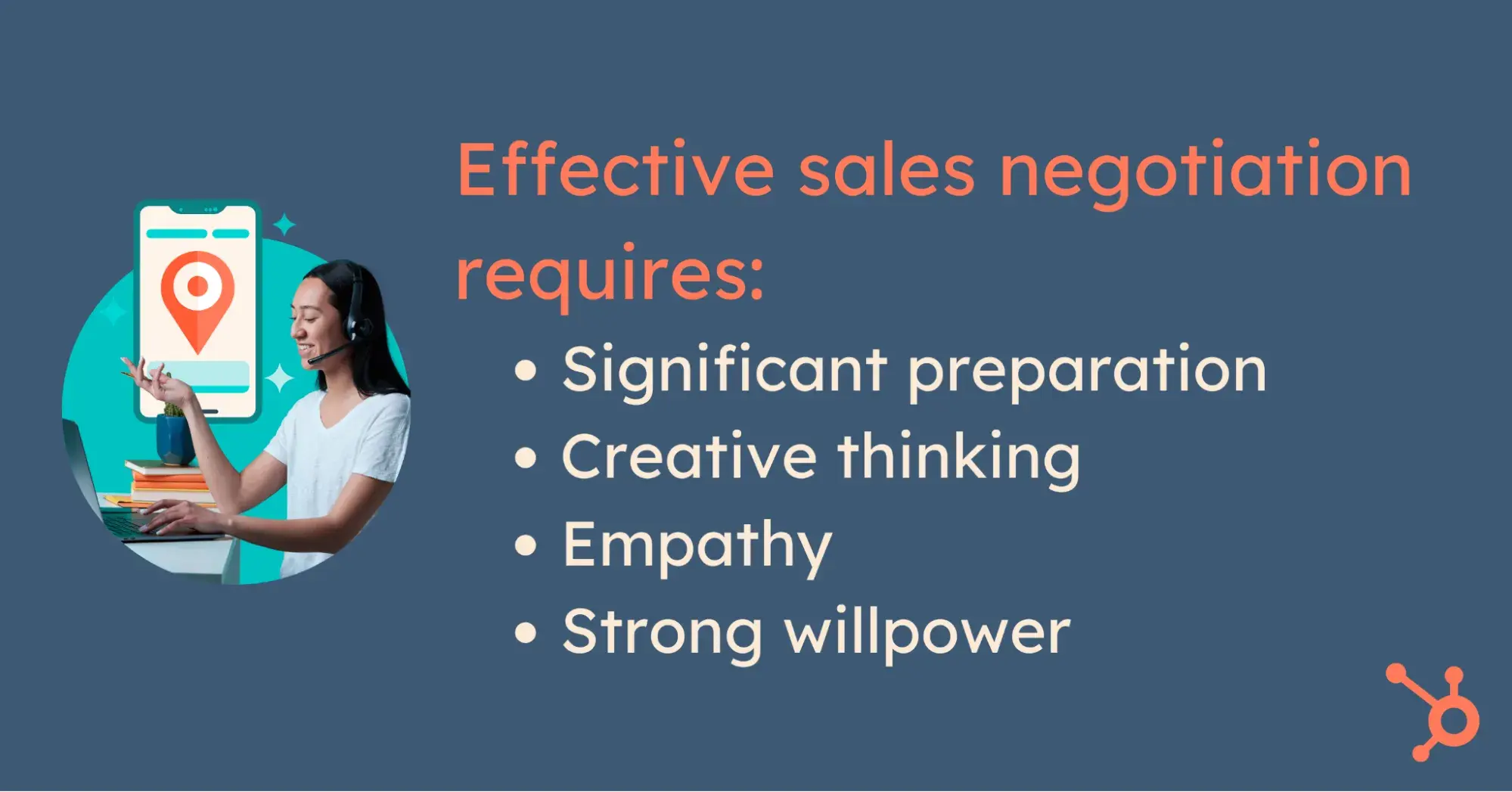
sales negotiation requirements

Good sales negotiation strategies require:

  • Significant preparation. Understand how flexible your company’s finance and legal teams are about negotiating price and contract terms. Going rogue and agreeing to terms your company won’t live up to isn’t a wise career move. It also erodes trust for future negotiations.
  • Creative thinking. Make price discounts conditional on a volume purchase or a series of purchases within a specific timeframe.
  • Empathy. Understanding the other party’s emotions and perspective on a purchase can help you find common ground with the buyer. If you detect that the buyer is nervous about making a significant project investment, you can offer information about warranty terms, project oversight, or customer testimonials. Assure the customer that your relationship doesn’t end when the contract is signed. Empaths can probe for underlying concerns or hesitations and address them before they scuttle the deal.
  • Strong willpower. Define when a business transaction isn’t worth pursuing. I once had a prospect who was using a trial version of a product for approximately sixty days and was peppering me with technical support questions. I went above and beyond to support their project along the way and ultimately closed the deal, but it was only when I drew a line in the sand that we would turn off their proof of concept system if they didn’t subscribe to the SaaS platform for a year.

It’s like the Kenny Rogers song “The Gambler”: You’ve gotta know when to hold ‘em, know when to fold ‘em, know when to walk away, and know when to run. You may lose a deal or two by holding firm. Yet the customers that are worth winning will respect the value of your products, services, and policies. Compromising too much could also strike the wrong tone for a long-term relationship. Both sides need to have “skin in the game” for a relationship built on trust.

I’ve talked a lot about what makes a negotiation effective, and why you need to know how to negotiate effectively. Next, I’ll review the skills you need to negotiate like a pro.

1. Preparation is crucial.

Don’t go into a negotiation without a standard contract and pricing parameters. If the prospect is well-prepared, and you are winging it, the imbalance of power can undermine your credibility. Negotiating from a position of weakness is risky — even if you close a deal.

You must have an intimate understanding of your prospect‘s business, their pain points, and competitive solutions they’ll consider if your negotiation falls through. You might agree to terms and pricing out of desperation that you wouldn’t have if you had a better sense of what is at stake for both parties.

I once worked with a long-term customer who was looking for a new email archiving solution and needed to buy a considerable number of licenses for the application they were already using. The organization’s CTO said there were some stakeholders in the organization who wanted to replace our technology with a competitive solution, while others wanted to leverage their existing investment in my company’s technology.

The client wanted me to arrange for consultants to interview these stakeholders (at no cost to them) to determine which path forward they should take — and support them through a proof of concept with the email management system.

Now, there were regulatory issues with providing the scope of no-charge service that the client wanted. However, I could provide a promotional discount on the software that was equivalent to the service’s costs they wanted my company to swallow to keep their business. I was prepared with (and approved to offer) this arrangement when I met with the CTO. Ultimately, it extended the company’s relationship with the customer for many years, addressed the issues that the stakeholders were facing, and enriched our relationship with the customer.

During negotiations, you need to have a sense of the best alternative to a negotiated agreement (BATNA) for both parties. It establishes whether a negotiation is worth continuing. If stepping away from the negotiating table helps your business protect the value of your products and enables you to focus on winning other opportunities with less friction, it may be your best move.

Defining the BATNA line is vital for both parties to manage their risk, and to prevent them from entering into deals that incur unacceptable reputational damage or costs. Conduct thorough research to define whether a sale is worth winning based on a customer’s non-standard demands.

2. Clearly define how much latitude you have to negotiate terms.

Know your company’s sales strategy inside and out.

In the heat of the negotiations, a 30% discount might seem perfectly acceptable. Yet if offering that deep a discount is against your company’s policy, or above your paygrade, then doing so could prevent a deal from being fulfilled.

Clearly understand and define what your limitations are on price discounts and term modifications before you meet your negotiation partners at the table. Agreeing to a deal you can’t live up to is worse than not coming to an agreement at all.

I learned this lesson well from the Open Text sales operations team, and I’ve adhered to it since. You don’t have to commit to terms or pricing live on the phone. You can always flag a term the prospect finds problematic and have your colleagues in legal or finance decide whether to modify the term or keep it.

3. Active listening is key to negotiations.

Sometimes, when you present the terms of the deal, the prospect will counter your terms to their considerable favor. You are sometimes better off letting the buyer start the conversation.

Salespeople are often tempted to immediately jump in and offer a discount or terms adjustment in the interest of being accommodating. But there's a line between being accommodating and being overly eager.

It pays to listen first and speak second during negotiations. You can‘t know what your prospect is thinking if you don’t let them present their perspective. Stay composed, have them reveal where they stand in the conversation, and use silence to your advantage.

In other words, follow the 70/30 rule of sales communication and listen more than you speak. Find opportunities to concede where it doesn’t cause your company undue risk or erode the value of your products or services. The best negotiations are when both parties win.

Silence can also be advantageous in sales negotiations after submitting a proposal. Silence communicates confidence and strength. It allows both parties to think through their next move and gives customers the opportunity to accept your offer or state any concerns they need to be addressed. Your price may be well within a customer’s range, but second-guessing your offer to break the silence can indicate that you question whether your pricing suits the value of what you have to offer.
sales negotiation skills

4. Negotiate based on specific data points.

If the customer would like money knocked off your product‘s price tag, don’t offer a range of options. If you say something like, “Well, I could probably reduce the cost by between 15 and 20%,” you're setting yourself short by suggesting your lowest acceptable price.

Who would accept 15% when 20% has been offered? Always quote one specific number or figure and then go higher or lower as necessary. The word “between” should be avoided at all costs.

Ambiguity is not your friend in sales negotiations.

5. Don’t “split the difference.”

Offering to “split the difference” on pricing can seem like a clean, easy way to arrive at an agreeable deal, but it usually does more harm than good.

For example, if your product or service costs $10,000 and the prospect wants a 50% discount, don’t counter with $7,500 to try and reach a quick settlement. It might seem fair and mutually beneficial, but those kinds of discounts are often rash and over the top.

When you offer a moderate discount that is close to your original price, the prospect may accept it because you are maintaining your position of strength — and you protect your profit margin. Don’t be afraid to use your company policies to hold firm in negotiations. Check in with your chain of command if the buyer insists on further concessions, but be prepared to walk away from the deal if an executive decision is made to stick to your offer.

6. Write terms at the right time.

Negotiations are often complicated. Offers and counteroffers or redlined terms can go back and forth multiple times in negotiations over complex agreements and high-value transactions. They often require representatives from legal and finance teams from both parties to navigate through to a mutually beneficial arrangement that protects both parties’ interests.

Several options will be proposed. Some conditions will be accepted, and others will be denied. That‘s why you don’t want to commit anything to writing until the meeting has ended — wait until all parties have verbally agreed to terms before you draft and table a legally binding contract.

7. Negotiating is often a team effort.

This tip might seem obvious, but many salespeople make the mistake of negotiating with the wrong person, or they try to negotiate a deal alone that requires oversight from multiple stakeholders.

A company can have several people who might come to the negotiating table without the authority to actually make business decisions. I was always happy to have a legal counsel, my sales manager, or a services principal on contract negotiation calls to ensure the right guardrails were in place to negotiate the best deal for the customer and my employer.

Free Resource: Get your call off on the right foot with these free call scripts.

If your customer has multiple executives from their leadership or legal team at a meeting or online conference, rally equal representation from your team to level the playing field. You can lead the conversation as far as you are able, and gracefully step back and allow your team to contribute as their roles dictate. Executives often like to sit at the negotiation table with their counterparts in your company when negotiating a strategic investment. See the move as relationship-building instead of compromising your control of the negotiations.

8. Give to receive.

Healthy salesperson-customer relationships are borne out of mutual respect and trust. They're not a matter of salespeople bending over backward to accommodate buyers at every turn.

That‘s why salespeople shouldn’t accept every prospect's demand without making some of their own. By keeping the negotiation a win-win for both sides, the salesperson and client remain on equal footing, which lays the groundwork for a productive relationship.

Recently, I’ve been working as a senior proposal writer for a business that serves airports, mixed-use commercial buildings, hospitals, and universities. I’ve worked on and participated in deals where the proposed terms and pricing aren’t the ultimate terms and price.

Even after my company had been selected as the customer’s first choice for strategic deals, the customer asked for a BAFO proposal, or Best and Final Offer. Sometimes, price changes; in other cases, it’s contract terms or products or services. It certainly keeps things interesting down to the final sign-off.

In these circumstances, concessions are often necessary to secure a signed contract and the beginning of a lasting relationship.

9. Negotiate more than fixed and operating costs.

The most commonly negotiated aspect of a sales deal is price, so salespeople should be prepared to talk about discounts — but discounts aren't the only way sellers can sweeten the pot.

Price is tied to value, and value is tied to a customer‘s perception of and satisfaction with a product. That’s why you might want to consider offering other add-ons or freebies to a deal in lieu of a smaller price tag.

That being said, this isn‘t a hard and fast rule. It’s all situational. Sometimes a discount is the best course of action. If you make concessions, you need to consider the circumstances of the deal holistically — additional perks won't always be more appropriate than hard financial concessions.

10. Handle objections with diplomacy

As a salesperson, handling objections is critical to every conversation you have.

Make sure you are clear on what a prospect is objecting to by confirming it back to them and then addressing it. (You can find more insights on expert objection handling by visiting this article on the HubSpot Blog.)
sales negotiation skills

11. Stay calm.

Composure is key when participating in negotiations. Getting flustered or frustrated can turn your prospects off and undermine your ability to frame yourself as a helpful, agreeable, and consultative resource.

Remember that negotiation is, in large part, a relationship-building process. If you lose your cool, your prospects will be less inclined to form a long-term, productive partnership with you. Always keep your cool — for everyone's sake.

12. Walk away if necessary.

Salespeople shouldn‘t be willing to accept any curveball a prospect throws at them. If demands become unreasonable or unprofitable for the company, don’t be afraid to walk away from the deal.

A customer who only agreed to sign if the contract was radically amended or the price was drastically dropped is bound to cause problems down the road.

Those kinds of changes also often signify that the prospect doesn‘t see much value in your offering. That means it’s only a matter of time before they become dissatisfied. Use your instincts, but also know the signs, and be able to walk away when necessary.

Thriving in Sales Negotiation

As I mentioned at the beginning of this article, negotiating skills are essential for success in the sales profession, but they can be challenging to develop without training and experience. I hope the information I shared here will help elevate your sales negotiation strategies and skills.

Maintaining composure, listening with empathy, understanding your offering's value, and making silence your ally can help you thrive in sales negotiations.

Editor's note: This post was originally published in March 2015 and has been updated for accuracy and comprehensiveness.

26 Mar 16:14

Amazon Cloud Drive goes unlimited: $11.99/year for photos and $59.99/year for everything

by Paul Sawers
Amazon Cloud Drive Unlimited
Gaming execs: Join 180 select leaders from King, Glu, Rovio, Unity, Facebook, and more to plan your path to global domination in 2015. GamesBeat Summit is invite-only -- apply here. Ticket prices increase on April 3rd!

Amazon has announced two unlimited storage plans for its cloud-based storage service, Amazon Cloud Drive, which sees a massive price reduction for its giant hard-drive in the sky.

The plans focus on two specific scenarios. For those who have loads of photos, there is the Unlimited Photos plan that costs $11.99 per year. Then there’s the Unlimited Everything plan that, well, does what its name suggests, and costs $59.99 per year. There’s also a free three-month trial available to see how much “unlimited” space you actually need and for what. At any rate, with a monthly cost of $5, it’s almost worthwhile paying for the service irrespective of how much cloud-based storage you actually need.

Before today, Amazon Cloud Storage offered 5GB of storage for free, with a tiered pricing structure thereafter. This ran from 20GB for $10/year all the way up to 1TB/year for $500. So not only does this news today effectively scythe its top-tier offering by 10-fold, but it ups the top-level storage from 1,000GB to unlimited.

For those who were on the free 5GB plan before, it’s not clear whether Amazon will allow users to remain on that plan, or will be upgraded to the $11.99 tier. But the company does say: “Existing Cloud Drive customers can change their plans now by simply logging into their Cloud Drive accounts,” which definitely suggests old plans are being made obsolete, though no timescale is given for this.

As part of the Unlimited Photo plan, it’s worth noting that users also get 5GB of additional space to store non image-based files, including videos. This is already the case for Amazon’s “Prime” subscribers, and those who own an Amazon Fire device.

Comparisons

This is a huge move from Amazon, and it’s an aggressive play for what is an increasingly competitive market.

For comparison, Dropbox charges $10 for 1TB/month, with 2GB available for free; Google charges $9.99/month for 1TB and up to $299.99 for 30TB, though it does offer a generous 15GB completely gratis; and Microsoft charges $6.99/month for 1TB, and 15GB for free too. However, Microsoft also offers a pretty good deal of its own if you know where to look — for $7/month you can subscribe to Office 365, and part of that package includes unlimited cloud storage on OneDrive.

While the Amazon move is undoubtedly brilliant value for money, it’s really just for those who store a lot of stuff in the cloud. The free 15GB that’s available through the likes of Google and Microsoft is actually plenty if it’s just photos and other non-media files that are being stored. However, for those with large movie files, games, and so on — this is where “unlimited” really starts to shine, and $5/month is a really ridiculous price point.

Other companies have dabbled with “unlimited” as part of their core offerings in the past — Bitcasa was one such company, however it pulled the plug on its main selling point last year citing “lack of demand.” It said at the time:

“While our Infinite offering was one of our early value propositions, we have since found that only a small percentage of people use it (only 0.5 percent of our accounts require more than 1TB, and less than 0.1 percent require more than 10TB).”

So while Amazon clearly has the capacity to offer a gargantuan amount of storage to the public, it likely knows that most people don’t have storage needs beyond maybe 1TB or 2TB, with many falling well below even that. That said, at the price it’s asking for, it may well face a large influx of new customers (its intention, no doubt) that have needs far in excess of 2TB.


VentureBeat’s VB Insight team is studying email marketing tools. Chime in here, and we’ll share the results.


26 Mar 16:12

How to Get Ahead in Sales

by Sean Daly

In sales, it’s very easy to get caught up in the longer-term goal of closing the deal and lose sight of what has to be done next. I like to make the analogy that business/sales is like competitive sports (which it often is). Think about when you played a competitive sport like baseball, tennis, hockey, football. When you were in the middle of a competition, what were you thinking about? If I ask 100 people this very question, I bet 95 of them would say winning. But this is the wrong answer. If you think about winning the match the entire time, you will lose because you are not focused on the next point, play or shot.

I think the better question is: What were you focused on? In that case, this group would answer they were focused on executing the play, the point, the ball, the opponent, etc. – everything that ultimately lead to winning a point, or a play, which in turn, lead to those incremental wins, that lead to the big win. If I were to focus on winning the match rather than what lead up to winning a point, I am destined to lose.

Making a sale is the exact same game. If you think about the sale, the sale, the sale, without thinking about your goals, planning your next steps, honing your pitch, your value proposition, your prospect’s Key Performance Indicators (the stats that are most important to him/her), and ultimately doing whatever is necessary for the little wins, the sale will be lost. Both sports and sales are a game of inches. Here are a couple of examples of inches for prospecting and demoing.

Sales Prospecting

Hone my pitch, focus on my numbers, and follow a process. Don’t be afraid to tweak it, and remind yourself that hearing “No” is part of the process. Explore and test new productivity tools to accelerate your process, talk to new titles in your target vertical, become an expert in your vertical, add tweak your objections, rebuttals, etc.

Sales Demoing

Make sure your prospect is informed on your product, and send them valuable documentation and/or videos. Spend at least 15 minutes of research on the organization before the meeting, and write down several potential objections/rebuttals. Tweak the questions you ask the prospect, tweak the short demo (if they are not the decision maker), or the long demo (if they are the DM). Find new ways to get a second meeting if the prospect doesn’t ask for a proposal.

Now I challenge you to think about your steps and document your prospecting “inches” from the first contact through to the close. Knowing sales, like sports, is a game of inches, what are your inches to win the point, the set, and the match?

Learn more sales tips with the free ebook below.

26 Mar 16:11

Howard Marks nails it with his definition of market 'liquidity'

by Myles Udland

Howard Marks

Howard Marks wants to talk about liquidity.

Marks does not think liquidity is whether or not you can sell an asset; true liquidity is how easily you can sell an asset — and at what price — when you're forced to. 

In a note to investors on Wednesday, Oaktree Capital's Howard Marks wrote about the topic, something that is on the mind of investors, particularly those in fixed income who have seen spreads compress as government and investment-grade corporate bond yields have tumbled over the last year.

Marks introduces his memo with a really important discussion about what he sees as the common misconception about the definition of liquidity:

Sometimes people think of liquidity as the quality of something being readily saleable or marketable. For this, the key question is whether it’s registered, publicly listed and legal for sale to the public. "Marketable securities" are liquid in this sense; you can buy or sell them in the public markets. "Non- marketable" securities include things like private placements and interests in private partnerships, whose salability is restricted and can require the qualification of buyers, documentation, and perhaps a time delay.

But the more important definition of liquidity is this one from Investopedia: "The degree to which an asset or security can be bought or sold in the market without affecting the asset's price." (Emphasis added) Thus the key criterion isn’t "can you sell it?" It’s "can you sell it at a price equal or close to the last price?" Most liquid assets are registered and/or listed; that can be a necessary but not sufficient condition. For them to be truly liquid in this latter sense, one has to be able to move them promptly and without the imposition of a material discount. 

Marks' note comes on the heels of this report from the Financial Times on Monday, which cited a number of investors in the bond market who are worried about a potential liquidity crunch in markets.

And the small distinctions between what Marks says liquidity is and isn't are incredibly important. 

Liquidity and solvency became the key terms of the financial crisis, and it is worth revisiting this Paul Krugman column from December 2007 distinguishing the two. A lack of solvency is an inability for an entity to meet its obligations. A lack of liquidity is an inability to raise cash on short notice.

water dropMuch of the anxiety in markets right now centers on bond prices and whether investors, particularly those that manage bond funds, will be able to meet client redemptions if those redemptions ever come en masse (like they did during the financial crisis, for example). This is something the Fed has acknowledged it is keeping an eye on.

And so what Marks is saying is that it does not matter if your portfolio holds a bunch of, say, 'AAA'-rated corporate bonds and highly-rated government bonds like US Treasuries, which are, in theory, highly liquid assets.

(If I owned, for example, $1,000,000 of 10-year Treasury bonds I could very easily sell them at market price right now. If we're in the middle of a financial crisis, that prospect is less clear.)

And so again, Marks notes that what matters is what price you'll be able to get for those bonds if you're forced to sell them quickly. 

Marks writes:

"Usually, just as a holder’s desire to sell an asset increases (because he has become afraid to hold it), his ability to sell it decreases (because everyone else has also become afraid to hold it). Thus (a) things tend to be liquid when you don’t need liquidity, and (b) just when you need liquidity most, it tends not to be there."

And this is really the crux of the whole issue. 

Liquidity is not a contractual concept. You, as a bondholder, are not obligated to liquidity, but are merely counting on its availability. And when you need it most, the market might run dry. 

Marks concludes his letter by citing his colleague Jay Wintrob who joined Oaktree from AIG, the insurance firm that famous required a government bailout during the financial crisis. 

Marks wrote than when he told Wintrob that he didn't think the issue of liquidity was particularly important or profound, Wintrob said:

In September 2008, AIG experienced serious liquidity issues (despite its $1 trillion balance sheet) when it couldn’t post $20-25 billion of liquid collateral related to credit default swap contracts written by one of its subsidiaries. The U.S. government stepped in as a result, lending support that eventually reached $182.3 billion, massively diluting AIG shareholders in the process. When you can’t meet a margin call because you have insufficient liquidity, that’s profound.

And so on days like Wednesday when the stock market sells off, people might be asking about the health of things like the biotech sector. These things are important in their own right, but Marks is writing about something more essential with regard to how the financial system functions, not just what investors and commentators think about certain part element of that system. 

For Marks is asking investors a very basic, fundamental, and not-easily-answered question: if you don't know what you can sell a given asset for, do you really know what it is worth?

Join the conversation about this story »

NOW WATCH: Nationwide's Super Bowl commercial about dead children is about corporate profits ... in a way that we can all appreciate

26 Mar 16:10

You Can Play Nice or You Can Play To Win

by Tibor Shanto

By Tibor Shanto – tibor.shanto@sellbetter.ca 

iStock_000003854002Small

There are times when you hit a wall in a given sale or opportunity, where you have some though choices to make: do you walk away, do you take a different approach with the buyer, or do you abandon the person you have been working with and go around or over them.

As interesting as the choices that people make in these situations, what’s even more interesting and noteworthy from a learning standpoint, is why and how the make those choices.

Not a negative, but a reality is that many sales people positive nature and disposition, a ray of sunshine buyers will be drawn to, a “can do” attitude spiced with plenty of optimism. This drives them to look for positive outcomes, which is often different than the right or profitable outcome.

As an interesting side note, according to recent Harvard Business Review article by Steve W. Martin, What Separates the Strongest Salespeople from the Weakest, the best sales people as measured by performance, are in fact inwardly pessimistic. Questioning the buyer, motives, aspects of the sale, etc. This allows them to qualify/disqualify and be more effective sales winners (as opposed to the large group of relationship starved professional visitors who are in sales). While “possibilities” are endless, reality comes down to fewer choices, some harder than the others.

Of the choices above, abandon, change the facts or change horses, most sales people will be most reluctant to changing horses, going around or above the person they have been dealing with. Odd, because it is generally the most effective, both in terms of outcomes and best use of time.

It all hinges on how you view one fact, what are the potential consequences. The most optimistic relation types see negative consequences (now who is pessimistic), they say “If I go around or over them, it may upset the person I am dealing with, and the deal won’t happen”. The best, high performing sales people say “If I stay on the current path, the deal ain’t happening, I need to engage someone who can make it happen”.

One major difference is that the high performers look at it from the perspective of what’s right and best for the buyer and their company; they look at deal, not the people. Most importantly, they look at the situation as being “who else can I engage”, not necessarily going around or over someone. If that’s what you are looking for, that is what you’ll find.

At it’s core the question is a common one in sales, are you reactive or proactive, do you put more faith in hope or action?

It is not a question of the cup being half full or half empty. What differentiates these two types of sales people is that they both see the half glass, they both aspire to have the glass full. One is hoping that being genteel, nice and smiling will hopefully fill the glass. The other group knows they need to take proactive steps to fill the glass.

Tibor Shanto

Live Cast
26 Mar 16:07

LinkedIn: Funnel Filler, Sales Closer, Referral Generator

by Bob Woods

Busy sales, business development and marketing professionals are interested in using LinkedIn to fill the top of their funnels. That’s a good thing, because the professional network is a good way to do just that… if done correctly and with the proper strategies, of course.

Did you know that you can not only use it concurrently with your entire sales process, but you can even use LinkedIn as a replacement for a customer-relationship management (CRM) system? That’s just how powerful LinkedIn can be as a “partner,” if you will, to your established sales strategy.

I’ll get into the CRM angle later in this post. Meantime, using it at each stage takes strategy and time, but it can be (and often is!) very successful. My list should make the process easier to integrate into your sales strategy.

Prospecting

There’s all different kinds of ways to prospect at all different levels. LinkedIn can play a key role at every level. The most powerful and proprietary feature of LinkedIn is its database that you have access to through your network. It’s your dream to identify who in your network knows your prospect, right? Well, consider this dream fulfilled. Through Company Search, Advanced Searches and searching a specific connection’s connections, LinkedIn is a hotbed for referrals and introductions.

In addition, through LinkedIn’s publishing platform, everyone has the ability to both post engaging content and share it with key decision makers through group messages. There isn’t an easier more effective way to get on your prospects’ radar as a thought leader in their professional world. You can be subject matter expert that they respect and will ultimately buy from.

LinkedIn for the first sales meetingFirst Meeting Preparation

Learning as much as you can about your prospect before meeting them can help give you an edge. You know that, of course. But did you know using LinkedIn for research can tilt the playing field in your direction? You can obtain the full background of not only on your prospect, but on many of the other decision makers and influencers prior to your meeting. You can also learn what the company’s initiatives are, and what they are sharing and talking about from both the personal and company page activities. Additionally, you can quickly research their industry and competitors and compile insights based on what is happening right now in their world.

Here’s a bonus that LinkedIn provides you. When you are on your prospects profile, look on the right hand side for a list of people similar to your prospect as well as “People Also Viewed”. This is a great way to quickly find both others in their company and their competitors. Similar intelligence is available on Company Pages as well.

During Your First Call

Now it’s time to use what you’ve learned during your first meeting prep work. But you’re not quite done yet. With a quick advanced search. you can find former co-workers and decision makers at your prospect company. This is a key area that will help start a meeting and the sales process with an powerful edge.

With all of that knowledge, you can tailor your questions to discover what they have and need prior to your first meeting. Gone are the days when you needed to depend on a predetermined checklist of questions to which we need answers to make the sale. You should probably keep that list handy, though, just in case you’re not able to get all of your answers through your research.

Presentation

When it comes time to dust off the ol’ the Powerpoint for the formal sales pitch and presentation, we can leverage our recommendations and client case studies we have in our LinkedIn profiles. Because these are examples of our clients speaking for us, we have more credibility than ever during the presentation; credibility we couldn’t offer on our own. Don’t know how to do this? Let’s talk! (Look for the offer for a free consultation at the end of this post.)

Overcoming Objections

This goes back to the pre-call planning you did for your first meeting. If we prepared well for that stage, we’ve connected with past employees and learned many of the objections the prospect have before we ever hear them. This intelligence can be insightful, which means you’ll be armed and ready with an effective objection-handling moment. You can even handle the objection before they ever get to say it!

LinkedIn for sales researchClose It Like a Garage Door

This isn’t really a strategy; it’s more of an end result. Because you’ve used LinkedIn throughout your sales process, closing the customer should ideally be easier. After all, when salespeople come in from a referral (in this case, a LinkedIn referral), they’re already a more trusted resource to the prospect. Can you get that from a typical cold call? What’s more, because your referral source likely presented you to the prospect as highly recommended, that person may not even shop your products or services to other vendors.

Post-Sale Referrals

Once you’ve turned prospects into happy clients, use LinkedIn to get some referrals from them. Go into their connections list and identify the people they know who you want to meet. Then ask for introductions.

Tracking Dealflow

You should utilize your CRM software tool if you have access to one. If you don’t have one, though, here’s a tip: You can use LinkedIn’s Tagging feature to track where you are in the sales process with each prospect. (Not sure how to do this? My Official LinkedIn Partner-in-Crime Brynne Tillman shows you how to use LinkedIn tags here.)

LinkedIn is a great tool for the entire sales process, not just filling the top of the proverbial funnel with leads. Use it well and with these strategies in mind, and you’ll see more success than you had without using it.

This article originally appeared on LinkedIn.

26 Mar 16:06

Research Reveals What Sets Top Sales Organizations Apart [Data]

by leslieye@hubspot.com (Leslie Ye)

goldegg

Not all sales organizations are created equal. While some consistently crush their goals, others are constantly chasing them.

So what separates the power teams from those that just can’t seem to get it right? New research from Steve W. Martin, founder of Heavy Hitter Sales, and Nick Hedges, CEO and president of Velocify, suggests that the most successful sales managers set higher than average goals for their reps, aren’t afraid to enforce those high performance standards, and have structured sales processes in place.

High Expectations

According to the study, sales organizations that set lofty expectations for their reps also happen to perform the best. Three-quarters of top-performing organizations raise their salespeople’s quotas by 10% or more annually -- and 15% raise quotas by 50% or more year over year.

“The best performing sales teams consistently set higher quotas and expected fewer sales reps to meet quota,” Martin and Hedges write in the study report.

On the other hand, average or low-performing organizations are more willing to keep quota the same or even lower it. While only one-sixth of top-performing organizations decreased or maintained sales reps’ quotas, 65% of underperforming divisions and 48% of average groups did so.

Of course, not every rep is going to make quota -- even on the strongest sales teams. So what’s the indicator that quota is too high, too low, or just right? When asked what percentage of sales reps hitting their numbers demonstrates an appropriate quota level, nearly half of the top performers responded that less than 60% was ideal.

Team Confidence and Morale

Perhaps unsurprisingly, managers and reps from high-performing organizations were more likely to describe their organizations, and each other, positively. Around three-fourths of managers at top organizations rated their sales teams as “above average” or “excellent.” In contrast, only 51% of managers at underperforming organizations rated their teams at the same level.

The best sales leaders “employ a ‘Darwinian’ sales culture strategy, where they hire talent of such high quality that it actually challenges the more tenured sales team members to perform at the highest level,” Martin and Hedges write. “The optimal sales culture is one where the sales team members are engaged, connected, and collaborating as a team.”

It gets even more interesting when survey participants ranked the most important factors that separate good from great sales organizations. Here are the top two components, according to each respondent cohort:

  • Underperforming organizations: “team morale and collaboration” and “talent of salespeople”
  • Average performers: “lead generation” and “quality of sales leadership” 
  • High-performing organizations: “lead generation and pipeline activity” and “disciplined sales process and systems usage”

The takeaway?

“High-performing sales teams think in terms of strategic sales process management, while underperforming sales teams are more focused on personal sales prowess,” Martin and Hedges write.

Accountability

Higher expectations are great for stellar sales reps, but what happens when a salesperson just isn’t up to snuff?

An organization’s willingness to terminate poor performers can be an indicator of its success, the study found. Almost one-fifth of the top-performing sales divisions said they would fire an underperforming rep after just one quarter, nine times more than the average performers and approximately three and a half times more than underperforming organizations.

The study also revealed that more highly structured organizations perform better. While half of top organizations indicated that their organization employed monitored, enforced, or automated sales processes, only 28% of underperforming groups did so.
Furthermore, just under half of high-performing organizations had a “closely monitored and enforced” process to follow up on leads, but only around a third of average and underperforming organizations did.

Although there’s no one trick that will transform a sales organization overnight, the findings in Martin and Hedges’ report provide valuable insight into some of the best practices that have worked for other companies.

“The results from this study quantify what many sales leaders have intuitively known for years,” Martin and Hedges write. “The best sales organizations have strong leaders who exercise control, monitor team performance, and establish internal processes by which all team members must abide.”

What characteristics do you think set top sales organizations apart? Let us know in the comments.

get the free hubspot crm

26 Mar 16:06

Content Sharing 101 For Salespeople

by Kelsey Meyer

typing-4

Your sales team always needs collateral, especially for sales emails. The question is: What type of content is effective for various parts of the sales cycle? Salespeople need more than just a proposal and a contract. They need content that will attract, nurture, and help convert qualified leads for your business.

Many companies mistakenly approach content solely as a marketing tool. But this thinking is absolutely wrong. In fact, it can take seven to 13 touchpoints to deliver a qualified sales lead, and content plays a crucial role in nurturing prospects throughout this process.

The Dos and Don’ts of Emailing Content

Before you start blasting out content in sales emails, there are a few types you need to avoid:

Press Releases

Potential clients want to know how your product or service will benefit them, not that you recently hired 20 people or raised $2 million in funding. While those facts can build credibility, they don’t supply your audience with information that will make them more qualified leads.

Service or Product Updates

Unless someone is ready to buy or is a current client, brochures and emails touting product updates won’t engage them. You’ll meet most of your prospects in the discovery phase, where they’re learning about their needs and potential solutions. The latest product details won’t win over this crowd until they’re educated enough to realize you’re the right choice.

Irrelevant Information

Don’t just send an article about an unrelated topic because you’re desperate to get back on someone’s radar. Crowding your prospects’ inboxes with information they don’t find valuable is like dropping trash off on their doorstep. Nobody wants that.

Now that I’ve (hopefully) saved you from sending content that simply doesn’t accomplish your lead conversion goals, here are the types of content that will accelerate the sales cycle:

Articles That Pertain to a Specific Email or Phone Call

Reengage a prospect with an article that addresses something you’ve discussed or that ties back to their particular industry. For example, say a prospect is in the smartwatch industry, and you recently read a great analysis on how the Apple Watch will give others in the market a huge boost. Email your prospect a link to this article, and express your excitement. In addition to opening up a conversation the prospect is passionate about, you’ll also show you’re keeping up with trends in the industry and care about their success.

Self-Authored Articles That Showcase Your Expertise

The sales process in most industries hinges on trust with potential customers. Your future clients want to know they’re choosing an expert. By contributing articles to reputable publications, you’re gaining a third-party stamp of approval and positioning yourself and your company as credible experts.

Case Studies and Whitepapers That Offer Value

You can also show your prospective clients what it would be like to work with you by sending case studies of successful clients in similar industries or with comparable goals. Seeing real clients’ success stories will be a testament to your superior service and allow prospects to envision working with you to achieve their goals.

Whitepapers and online resources provide in-depth information that can help prospects solve specific problems, whether it’s an ebook about posting on social media or a knowledge management template to help them create content faster. If you’re offering something valuable, prospects will appreciate it.

Tailor Your Sales Emails to the Buyer’s Journey

All content isn’t created equal. You shouldn’t send a case study to someone who’s just learning about your field or a general industry piece to a lead in the decision making stage. You need to deliver content that speaks to each lead’s specific stage in the buyer’s journey. Here’s a glimpse at what that process should look like:

Cold Outreach

No one enjoys being bombarded with unsolicited emails. But when you provide something useful, your email -- and company -- will stand out to prospects. Always focus on equipping prospects with something valuable in cold emails, such as a whitepaper or a basic template. Avoid sales plugs at all costs.

We use a service called HiP, which specializes in sending cold emails that include a whitepaper to drum up interest and generate leads. Emailing a prospect a whitepaper is less alarming and more effective than simply asking for a call.

Post-Sales Call

After a sales call, follow up with an article about your company that’s relevant to the prospect and illuminates points you discussed during the call. For example, if the potential client expressed concerns about price on the phone, send him an article about how much it would cost to bring your service in-house. Always take note of sales objections during a call, and follow up with content that addresses them.

After Multiple Sales Calls

Once you’ve gained some trust and educated a prospect on your industry and solution, it’s time to drive the sale home. After multiple sales calls, you should be sending case studies that showcase how you’ve solved similar problems for other clients. These case studies need to be results-oriented.

Measuring Email Engagement

Now comes the real question: How do you know whether prospects are even reading your content? You can use a few different tools to see how your email efforts are measuring up:

HubSpot CRM

We use the HubSpot CRM, which allows you to host content within the CRM and easily link to it in emails. It then tracks who opened and read the content, which is a helpful tool for analyzing and refining your approach.

Trackable Links

Before we started using HubSpot, we did it the old-fashioned way by linking the content in emails using trackable links, such as Bitly. Whichever way you choose to do it, always measure the content people are reading, and figure out how it’s fueling the sales cycle.

Content should ultimately help you prime leads and amplify their longevity as future clients. By strategically writing sales emails and offering something valuable before selling your product, you’ll build long-term relationships and start converting more qualified leads. 

get the free hubspot crm

26 Mar 16:05

Event Reporting: It’s More Than Just Leads

by Dan Stratton

introhive booth

Here at Introhive we attend a lot of events. They provide us with great value as they are a excellent source for lead generation, while at the same time strengthening our relationship with the number of customers and partners that we have.

After any event, it’s important to take stock on whether it was a success or not. Here are a few things we take into consideration when deciding on how worthwhile the event was, as well as whether or not we should attend next year:

Pipeline Driven
This is the easiest and one of the most valuable metrics that we track. By creating a Campaign in our CRM around each event, we can track not only how many leads were generated at a particular event, but also the resulting growth of our sales pipeline. This gives us a great indication on how much direct business was generated as we compare and evaluate one event to another.

Relationships Nurtured
We never go into an event and simply put up a booth and hope for the best. Lots of leg-work goes in ahead of time setting up meetings around the event (or at our booth) with key partners, customers, and prospects. After each event we summarize all the meetings to identify a couple of things when evaluating our success:

– Were we able to move existing pipeline along with our prospects?
– Were we able to strengthen our relationship with partners and their customers?
– Were we able to strengthen our relationship with our customer-base?

This analysis give us a good reference point on all the softer analytics that were derived from the event when we look back, which are just as important to us as a booth lead.

New vs. Existing Relationship Breakdown
One of the key things that we always like to track from events is the breakdown between people we met that were brand new to Introhive vs. people we met that we had an existing relationship with. We always record everyone we interacted with at the event in a CRM campaign. Once we have a record of our interactions, we can cross-reference this with our Introhive relationship data, giving us an indication as to the percentage of people from the event that were brand new to Introhive vs. those with an established relationship with our brand that we were able to further the conversation along with.

Taking all 3 of these things into account gives us a good idea as to if an event was a success or not. What are some of the key metrics you use when measuring the success of your events? We’d love to hear them.