Shared posts

19 Jun 16:45

What’s The Ideal Email Marketing Frequency For Our Company?

by Annie Zelm

Email_Marketing-1

Email marketing is a delicate balance: You want to keep in touch with customers and prospects and stay top of mind, but you don’t want to pester them with information they don’t need. You want to achieve a steady stream of leads without too many spam reports or unsubscribes.

We all know how it feels to be on the receiving end of too many useless emails, so it’s good to be sensitive to email marketing frequency. However, we’ve seen many companies take such a cautious approach to email that they miss out on valuable opportunities to nurture prospects and generate sales.

Email is still by far the most cost-effective way to acquire new leads, nurture prospects and retain customers. In fact, every dollar spent on email generates an average ROI of more than $44, according to ExactTarget.

So how often should you send emails?

It’s a question our clients often ask, but it may not be the right question to ask. Here are five questions you should be asking instead.

What Are My Marketing Goals?

Are you looking to grow your existing database? Consider partnering with another relevant company in your industry on a series of joint emails that will allow you to broaden your reach. If your primary audience is human resource professionals, consider sponsoring some content in the Society for Human Resource Management’s monthly e-newsletter.

Looking to nurture a group of potential clients who visited your booth at a recent trade show? This group will likely be more receptive to your mssages because they’ve already shown interest in what you do, so you can contact them with a bit more frequency. You could send a series of follow-up emails once a week to share a few relevant resources and an invitation to learn more.

Another goal might be to re-engage current customers with a new offer or a special deal that’s only available to them. Similar to the list of trade show contacts, you can engage them with an email campaign that includes several targeted messages spread out over a period of time.

If your company has a particularly long sales cycle, perhaps a year or longer, your goal may be simply to promote your thought leadership in the industry so you stay at the top of their minds. In that case, a monthly blog digest might be better received than weekly emails.

What’s Typical For My Industry?

If you’re marketing directly to consumers, you’ll probably get away with emailing more frequently. Personally, I receive emails to my personal inbox several times a week from the same retailers. I let most of them pile up in my inbox unopened, but they don’t bother me enough to unsubscribe or think any less of that retailer. Every once in awhile, I’ll open one if I see a deal on something I’m interested in buying.

I’m much more protective about messages that come to my work email address, and I suspect many people are the same way. Within the B2B realm, frequency also varies by industry. In general, technology companies tend to mail a bit more frequently than manufacturers and healthcare companies, but it really depends on the sales cycle.

It’s worth watching a few of your competitors to see what seems to be typical, but don’t be afraid to try a different approach.

What Is The Quality Of My Email Database?

Consider how you acquired the email addresses in your database. Are they mostly contacts who have shown interest in some way, whether it was by subscribing to your blog or attending an event? Or did a significant portion of them come from purchased lists?

If the majority of your email contacts haven’t “opted in” in some way or you aren’t sure where they came from, it might be time to clean up your database. Considering the fact that about one-third of all email contacts churn each year, due to people changing jobs or email addresses, it’s a good idea to do an audit of your list at least once a year. Send an email asking your contacts to update their preferences and give them the opportunity to opt out if they are no longer interested in hearing from you.

Don’t worry too much about losing contacts this way—chances are, they’re not going to become customers anytime soon, and you’re making room for others who are more likely to buy.

How Have Past Emails Performed?

Take a look at the results from your email marketing efforts over the past year. How were the open rates and click-through rates compared to industry averages? If you have increased your email frequency, how has that impacted those rates?

Additionally, consider your email marketing goals and how close you are to achieving them. If your goal is to increase your sales-ready leads by 5 percent over the next six months and you’re nowhere close to that, you might need to up the email frequency.

What Is My Ability To Target?

No matter who you’re targeting, you’ll get the best response when the emails you send are tailored to that person’s unique interests and challenges. It’s also important to establish the right tone for the person you’re trying to reach, rather than sending everyone the same message. Have you developed buyer personas and segmented your email list accordingly?

Are you using marketing automation software that allows you to segment your lists based on those preferences and the activities of those who engage with you? Just as you wouldn’t talk to a CEO in quite the same way as you might talk to a human resources manager, you don’t want to send an introductory-style email to someone who has already visited your website several times and downloaded a recent piece of content.

One of the biggest advantages of marketing automation software is the ability to establish email workflows to nurture customers and prospects at every stage of their journey, from the time they first show interest to after they’ve made a decision. Since buyers now do the majority of their research before they ever talk to a sales representative, email is one of the most important ways to keep them engaged.

The Bottom Line

When it comes to email marketing, there is no magic number. At Kuno, we typically send emails at least once or twice a week, but not to our entire database. Rather, we’re sending workflow emails to some people who have recently downloaded something, emails to blog subscribers who have selected particular areas of interest, and emails to another group of people to promote a new eBook or webinar. We recently asked our blog subscribers to update their preferences so we could provide more relevant content based on their industry and what they indicated they were most interested in seeing.

On average, these types of lead-nurturing emails generate 50 percent more sales-ready leads at 33 percent lower cost, according to HubSpot. The research also shows nurtured leads produce a 20 percent increase in sales opportunities compared to those who aren’t contacted regularly.

The key is to be consistent and be persistent—even if you don’t see the results you want right away.

18 Jun 15:55

Don’t Spam In Your LinkedIn Long-Form Posts

by Bob Woods

AAEAAQAAAAAAAAOMAAAAJDZiOGY3ODZlLTA5ZDYtNDkyZi1hNmFmLTI1YjhmODU1MTBmZAAs a professional who uses LinkedIn both in my business and for my business, I both enjoy and learn from seeing how other LinkedIn members use the service. I especially like how they use the long-form post feature to share valuable content with their connections.

For the most part, anyways.

You see, many of my connections utilize the long-form post platform in much the same way I do: to provide valuable content that our connections can use in their daily professional lives. That’s called building thought leadership or a reputation, and that’s exactly what the platform is designed to do.

Most important, they share content that doesn’t require a purchase to implement.

Some of my connections, though, don’t use it for that purpose. Instead, they use published posts to blatantly push their goods or services, in ways similar to a newspaper ad or an advertising email, like the example to the left.

In my mind, and the minds of many others, this post is not intended to share and spread valuable information in the hopes of building thought leadership. This, my friend, is spam.

Think of it like this: If you’re publishing a post with your content because you don’t want to buy an ad, you’re doing it wrong.

Thank goodness only some people are using it as a spam-spreader. Even so, it’s bad because LinkedIn doesn’t want us to use long-form posts as a vehicle for spam. It’s up to us, then, to use it in the way it was intended.

Here are five tips on how to make sure you’re not spamming your connections and followers:

  1. Does the title of your post match the content, or is a bait and switch?
  2. Look at the post from the reader’s perspective. Does she or he have at least one take-away that is not just about hiring you, or buying from you?
  3. Is the intent of the post to get your readers to learn something or hire you? (If it’s the latter, consider a pay-per-click advertisement, which does work.)
  4. Does your post solve a problem, fill a need or satisfy a want? If it’s only about selling your solution, you’re done it wrong.
  5. Do you offer enough value in the post that you have earned the right to ask for a call, offer a download linke or sell your book?

As implied in tip #5, I do believe it’s more than okay to sell on LinkedIn. There’s a huge difference, though, between selling and “pitching.” Nothing will turn off readers faster than a pitch. The post I highlighted above is a perfect example of a pitch.

The key here is to publish content above the call-to-action (CTA) that’s useful to your readers. This way, you’re “earning” the right to promote your wares.

I strongly recommend placing your CTA after the main body of the post. I also recommend making the CTA stand apart from the rest of the content body by bolding and/or italicizing the text. Placing a dotted line between the end of the main body text and the ad is also very helpful.

On a platform where your reputation is key to your success, you really don’t want to have a reputation as a spammer… do you? Follow the above tips, and you’ll be sure to share only quality content that your audience will love, and in the process will build your reputation as a thought leader.

This article was originally published on LinkedIn

18 Jun 15:54

How One Company Reduced Email by 64%

by Andrew Shipilov
JUN15_18_email

If you’re going to achieve growth in the knowledge economy, your employees need to be able to quickly find people inside and outside the company whose expertise can help them solve critical business problems. That takes a highly effective communication tool.

Oh, we already have that, you might say: email.

Email is indeed good for enabling employees to communicate with colleagues they already know. But it hasn’t changed much in all these years, and it remains ill-suited for helping employees find experts they don’t know, particularly in other companies.

And as younger employees join the workforce, who are used to communicating with friends via Facebook and Twitter, they find it restrictive to have to rely on email at work.

Frustrated by these limitations, the global information-technology service provider Atos, headquartered in France, sought an internal collaboration system that would do away with email’s “closed” form of communication.

It acquired social-software maker blueKiwi and combined the acquired company’s application with two from Microsoft, creating a platform that allows individuals and teams, including those in partners and clients, to enter virtual “communities” where they can collaborate on complex projects.

Insight Center

The platform functions like a wiki, with members of a community — which might be based on a project, client, or topic — editing documents together and getting approval for changes from community members and other stakeholders. Each community has a volunteer leader who pledges to promote the community among colleagues. The platform ties together strands of communication such as messages and microblogs with discussion groups. It also helps participants maintain CVs that list past positions and projects, so that other community members can find people with needed skills.

The collaboration platform grew out of a 2011 announcement by Atos CEO Thierry Breton that the firm would become a “zero internal email” company over the next three years. Critics scoffed, but Atos took the challenge seriously, investing heavily in an alternative to serve its 86,000 employees in 66 countries. Gartner estimates that the company invested 500 times more than an average organization invests in social collaboration.

Despite the initial skepticism, by the end of May 2013 approximately 4,000 communities were up and running on the platform. By 2014, users had created more than 10,000 communities, some of which linked Atos to its business partners. By this year, 80,000 individuals were connected.

The investment is paying off. Atos employees now routinely use the platform for finding experts internally. For example, some of the company’s executives set up an internal “social help desk” to enable its SAP experts to increase their knowledge through exchanges with other SAP experts. The leader of this community of 2,000 members had previously tried creating the same function via email, but the SAP experts rarely read email queries, so askers weren’t getting responses. With the collaboration platform, Atos’s SAP specialists post a note with a question, and other experts within the community readily reply.

In another case, a corporate customer’s managers were expressing doubts about Atos’s value and were openly discussing dropping Atos and opening an internal IT-consulting unit. To increase the customer’s awareness of Atos’s contributions while improving communication with the customer, one Atos executive created a community that connected Atos employees to those working for the customer. By engaging with Atos’s experts directly through the collaboration platform, the customer’s executives exchanged knowledge with Atos, posted questions, and shared their experiences. This community helped the clients recognize that they were working toward a common goal with Atos. A better understanding of who they were working with at Atos also helped the customer’s executives to speed up problem solving. Thus the community helped Atos retain an important client.

Atos has grown through numerous acquisitions, and the platform has been helpful in enabling the firm to integrate its acquired companies. Atos finds that it now achieves a better level of integration, faster, than before the platform was implemented.

In the end Atos wasn’t able to hit that zero-email goal, but the platform did help the company reduce email by 64% — a big plus for employees who were suffering from email overload. Not only does the collaboration platform reduce email, it also enables community participants to filter content according to their individual needs and professional interests.

Atos’s experience is evidence that an effective collaboration platform isn’t just a tool for communication, it’s a key to achieving smooth, integrated growth and competitive advantage in the knowledge economy.

18 Jun 15:53

How to Use Email Tracking to Dramatically Ramp Up Sales

by Guest Post

How to Use Email Tracking to Dramatically Ramp Up Sales written by Guest Post read more at Small Business Marketing Blog from Duct Tape Marketing

It’s no secret that email marketing metrics offer great insights.  They let you learn from your customers’ behavior and steer your marketing ship accordingly.

Screen Shot 2015-06-18 at 7.04.09 AM

But how do you find the best strategy for connecting with customers and prospects directly?  Welcome to the world of email tracking.

Email tracking will let you use context to your advantage.  This is huge because getting in front of recipients at the right time will drastically increase your likelihood of winning their business.

How Email Tracking Works

Tracking platforms live on your email service.  Most track opens, clicks, and responses, and they let you store and test email templates.

The technology works by embedding a small transparent image in each email, which is hosted on the platform’s servers.  The platform knows the email is opened when the image is accessed.  Email links are converted to tracked links so clicks can be measured.

The Right Strategy

1. Start with a Great Email

Your email should offer value.  When you’re reaching out to a prospect or customer, ask yourself, “What will he helpful to this person, even if they never hire us?”

Here is an example.  It’s optimized for tracking, which we’ll cover next.

Hi Rachael,I’ve been a fan of [COMPANY] since I read about you in Inc.  I’m glad I finally have a good reason to reach out.We created a tool for measuring email marketing ROI (attached), which we’re rolling out to two companies this month.  Our owner suggested I include you because a couple of your competitors, [Co.A] & [Co.B], responded well.In addition to discussing the tool, I’d like to hear what you’re doing for email marketing.  Even if you don’t hire us anytime soon, I promise you will leave with valuable information.

Can we have a quick call on Wednesday @ 2p?  We’ll need less than 15 minutes.

Best,

Dan

2. Track Clicks Strategically

With the above in mind, include the tracked link at the end so you’ll know if the message was read.

3.  Connect with Context  

Use tracking to understand email context and respond accordingly.  As Mike Volpe, CMO of Hubspot, argues, “Getting calls from reps when I’m on their website or actually reading their email is much more relevant to my day and my schedule.”

4.  Follow Up at the Perfect Time

One of the biggest questions is “When should I follow up?”  Tracking answers that question with concrete data.  Use the technology in conjunction with other timing-based tools to improve your follow ups.

5.  A/B Test Templates

When crafting email templates, make the differences big.  Compare apples to apples: don’t stack the results from customers against those from prospects, and vice versa.

6.  Measure Results

After you send a solid number of direct emails (ie. 50+), review the results.  From there, create a new template and test it against the old one.

But What About Privacy Concerns?

If tracking feels weird, remember that you don’t have to track everything.  Track your pitch email only.  Also, you can include a line at the end of your message letting recipients know about the technology, and that no personal information will be shared.

Email Tracking Platforms

YesWare

YesWare hooks up to Gmail as an extension in Chrome or Firefox.  It’s free for up to 100 emails per month, and $12 per user per month for unlimited messages.

SideKick by Hubspot

If you’re already on Hubspot, then SideKick might be your best bet.  It’s free for up to 200 tracked emails per month, and $10 per user/month for unlimited.

ToutApp

Tout is another popular platform.  It’s much more robust than the others in terms of analytics and other features.  It starts at $30/month after a free trial.

SalesForce Tracking for Outlook

If SalesForce and Outlook are your world, then this may be most convenient.

Tracking is a valuable tool, but it’s not a silver bullet: it must be used in conjunction with a strong value proposition.  Assuming you’re reaching out to the right person with the right message, tracking will leverage context and bring you to a higher level.


Screen Shot 2015-06-18 at 7.06.38 AMDan Englander is the author of “Mastering Account Management”.  He’s the founder of Sales Schema, a site that helps professionals find the right balance between sales and customer or client service.  And he’s a decent living room guitarist.  Follow him @danspalace  


Related posts:

  1. Making Sense of the Email Madness Do you use shared email? In other words, an email...
  2. Email Marketing Still a Great Small Business Tool Having lots of channels and lots of ways for folks...
  3. Retargeting Dramatically Improves Conversion The term retargeting has been around marketing for some time...
18 Jun 15:53

When A Loss Is Better Than A Win

by Matthew MacQuarrie

WinLossWe often talk about business owners in the terms of winners and losers—but to be honest, there are times when I’d rather have a loss than a win. Specifically: When I know why the loss happened, and it teaches me something significant and actionable about my business.
I’ll give you an example. As many of you know, I’m the owner of a relatively new e-commerce business, one where the products sold are somewhat high-dollar value. For a long time the policy on the site was that we’d offer free shipping for any order that exceeded $150—which is, to be honest, nearly as little as you can spend on the site.

One day I got it into my head that this policy was causing us to take too heavy a hit on shipping, and that what we needed to do was to up that amount to $200; this wouldn’t affect too many people, I didn’t imagine, but would help prevent us from losing money on shipping these small-ish orders.

So we made the change—and, for a couple of days, all I heard were crickets chirping. No one was placing orders. I thought at first that it was just an anomaly, but then we made it a full week with a steep, shocking decline in sales, and I knew that I’d done something wrong.

I don’t love that we had that bad week, but I do love that I can explain why it happened, and do something about it. It offered me strong insight into my audience and into the ways in which the business needs to appeal to them: Apparently, something as seemingly trivial as the minimum purchase amount to qualify for free shipping, plays a big role in converting “lookers” to customers.

I’ve since offered free shipping on all orders through Father’s Day; I’m toying with the idea of just making it permanent. I know that I’ll lose money on some orders. At the same time, though, I feel like I’ve discovered an important piece of the puzzle, and have a much clearer understanding of the important role that shipping plays in my customers’ mindset.

That week was something of a loss for the business, no question—but because it helped us uncover some important truths about our customer base, I’d also happily call it a win.

18 Jun 15:51

9 Sales Closing Tricks That the Experts Swear By

by fergal.glynn@docurated.com (Fergal Glynn)

nine_ball.jpg

Closing deals is an art. Most sales professionals have their own unique styles. Combine these with their company's specific sales process and the individual customer's needs, and closing deals becomes a highly individualized process. 

Thought leaders often offer up advice on how to close a deal, and their responses are as varied as their personalities. As sales careers expert Thomas Phelps explains, “If you asked 100 sales professionals for their best tips on closing a sale, you would get 100 different responses. You would hear the old school crowd preaching the benefits of the assumptive and Colombo closes. The newer breed would claim that a sale is simply the result of the relationship and rapport you have built with the customer."

Here’s what a few of the most prominent sales thought leaders today have to say about closing deals. What you choose to incorporate into your own process and what you decide to discard is up to you.

Jill Konrath, speaker and author

1) “Know your impact. Make sure you're clearly able to articulate the business value of your offering. You should ensure that you're talking about key business drivers such as reduced operating costs, or improved efficiency. Adding metrics makes your message even more impactful."

2) “Be a storyteller. Share examples of how you've helped other customers improve. Be able to explain how they were doing things before, the challenges they faced, and the results they've achieved since working with you.”

(via JillKonrath.com)

Grant Cardone, international sales expert

3) “Remain seated. [As] the saying goes: Present the product, service, or idea on your feet, but always negotiate from your seat. Even if your prospect stands up, remain seated. Going from a seated position to standing up suggests something has changed and allows your prospect to exit and end the negotiations."

4) “Always present a proposal in writing. People do not believe what they hear -- they believe what they see. Always have a contract available and a writing pad. Points of value should be written down to show buyers what they get when they make a decision with you.”

(via Entrepreneur.com)

Neil Patel, co-founder of Crazy Egg and Hello Bar

5) “Create a bond. “People like doing business with those they can relate to. If you are going to spend money, why not spend it on people you like, right? The best way to get people to relate to you and your product is to create a bond. You can do this by telling stories or by just shooting the sh*t."

6) “One thing I like doing is to talk about my past experiences. I tend to talk about my childhood or teenage years. Once I do this, the other person usually feels comfortable enough to talk about his or her life experiences. The whole purpose of doing this is to get to know the people you are ‘courting’ on an intimate level. At the same time, they’ll quickly feel like they’ve known you for years, when, in fact, you’ve just met.”

(via QuickSprout)

Tom Searcy, account strategy expert and author

7) Establish off ramps. “What happens if things are not working? The schedule sets out the milestones of performance. If the milestones are not met, those involved are going to want to know what the recovery process looks like. Will things halt altogether? Will there be a revision of the budget, staffing, the entire plan? Clarity in the off ramps gives confidence to the cautious.”

8) Be prepared with a landmine map. “If you do not provide an outline of the anticipated problems and your resolution to them, then it will be provided for you. The problem is that when the stakeholders provide the outline it is usually amplified outside the bounds of reasonable expectations. By showing a thoughtful analysis of the risks, you can reduce the resistance.”

(via Hunt Big Sales)

Brian Tracy, author, speaker, and entrepreneur

9) Try the “Give It a Try” method. “The first way to ask for the buying decision is the simplest of all. You say, ‘Well then, why don’t you give it/us a try?’ This is one of the disarmingly effective closing techniques. Or you can even say, ‘Why don’t you take it?’ You then reinforce this by adding the words, ‘And I’ll take care of all the details.’ Often a customer didn’t know how much he or she wanted it until you offered to take care of all the details.”

(via BrianTracy.com)

As Brian Tracy points out, “Your most precious resource is your time. It is all you have to sell. In fact, your entire lifestyle today, your home, your car, your bank account, and so on are the result of how you have traded your time in the past.”

According to Docurated’s 2015 State of Marketing Productivity Report, 89% of companies surveyed measure sales productivity, but just 12% measure marketing productivity.

Still, 85% of CMOs state that supporting the sales team is Marketing’s top priority. Regardless of individual closing styles, there’s an opportunity for sales teams to be better supported by marketing efforts.

Sales reps close more deals when they follow strategic best practices like those listed above, and are equipped with the right sales content to set up the deal. When Marketing assists in the content department, sales reps can focus on the all-important art of the close.

Get HubSpot CRM today!

18 Jun 15:50

Don't sweat it: FitBit goes public and stock takes off like an excited runner

by Jason Abbruzzese
Fitbit
Feed-twFeed-fb

Want some stock in FitBit? Don't sweat it.

FitBit, the maker of fitness-tracking wearables, became a public company on Thursday, as stock in the market leader of the wearable fitness shot up more than 50% to $31.05 in its first morning of trading.

The company's IPO priced at $20 per share, which was already well above the initial range of between $14 and $16 per share. At that price, the company is worth $4.1 billion

FitBIt's initial public offering — the company's first sale of its stock to public buyers — has been among the most anticipated of the year, particularly as significant, popular tech companies have begun to remain private far longer than in the past Read more...

More about Ipo, Wearables, Business, and Fitbit
18 Jun 15:50

How to Use LinkedIn to Drive Leads and Make Sales

by Rainmaker.FM

ml-linkedin-sales-leads

Sales prospecting can be a challenge. But luckily, LinkedIn makes it easy — if you’re smart about how to use it.

Eve Mayer (a.k.a. @LinkedInQueen) is one of the most influential women in social media according to Forbes & CNN, and in this episode of The Missing Link, she shares her insights into how to use LinkedIn for sales leads.

If you have ever been in sales, you know how frustrating it can be to find qualified leads. And while LinkedIn makes sales prospecting easier, if you are not careful you can easily ruin your opportunities.

In this episode of The Missing Link, Sean Jackson and Eve Mayer discuss:

  • How a job search turned into a sale
  • The right way to use LinkedIn for relationship building
  • Why you should help your employees use LinkedIn
  • Why non-profits should be using LinkedIn
  • Why your Company Page on LinkedIn matters
  • The biggest “fails” people make on LinkedIn

Click Here to Listen to
The Missing Link on iTunes

Click Here to Listen on Rainmaker.FM
About the author

Rainmaker.FM


Rainmaker.FM is the premier digital marketing and sales podcast network. Get on-demand business advice from experts, whenever and wherever you want it.

The post How to Use LinkedIn to Drive Leads and Make Sales appeared first on Copyblogger.

18 Jun 15:50

The Do's and Don'ts of Following Up [Infographic]

by esnider@hubspot.com (Emma Snider)

follow_up_leader.jpg

Following up is a key part of any sales job. It's extremely rare that a rep will connect with their prospect on their first attempt, and so they must try again. And again. 

But just because this is common sense doesn't mean it's common practice. According to research from InsideSales.com, the median sales outreach persistency rate for inbound leads is a measly one attempt. So much for following up.

Maybe sales reps don't follow up as much as they should simply because they don't see the value. But consider that even if a lead isn't a good fit for your product or service, that contact could still provide a referral to someone who is. For this reason, it's critical to follow up with each and every single person you meet at an event. 

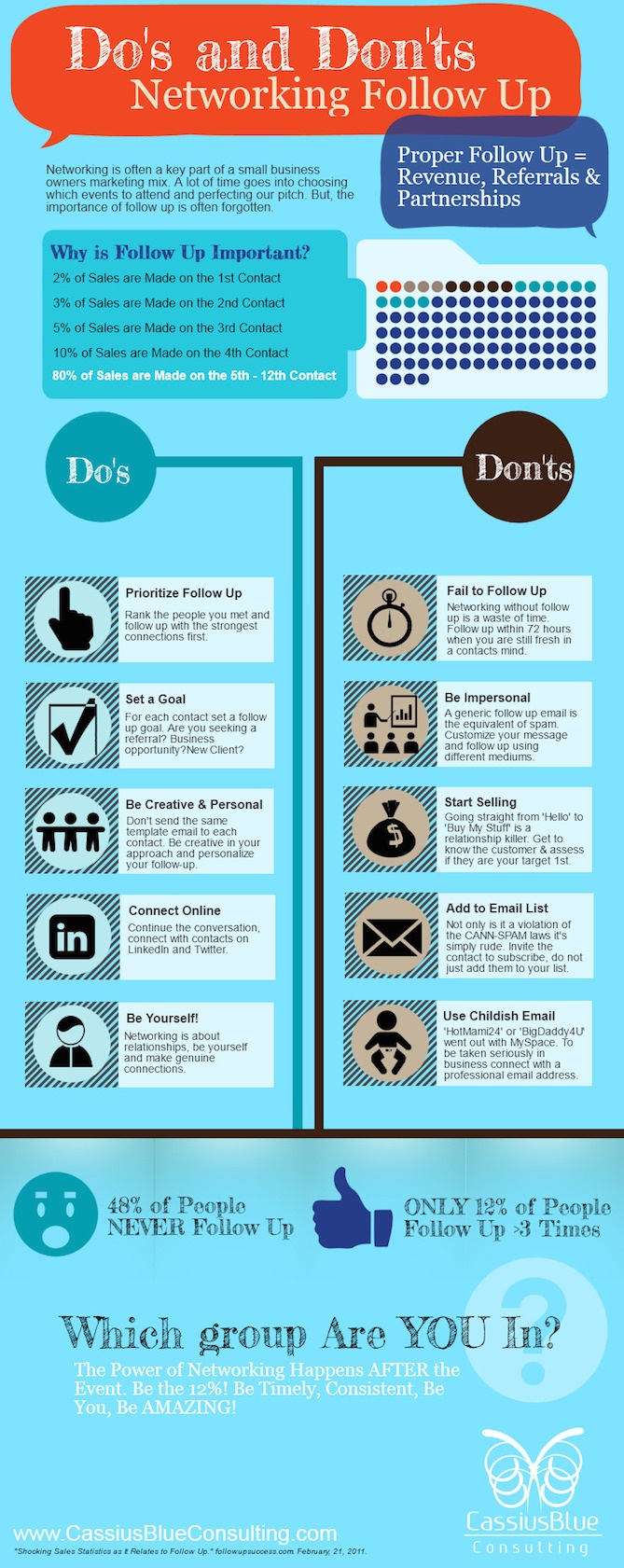
The infographic below from CassiusBlue Consulting lists the do's and don'ts of following up after a networking event. While some tips might be akin to reflex -- for instance, connecting on LinkedIn, and personalizing your message -- others are less obvious. Did you know that adding a contact's email address to your marketing list without permission violates the CAN-SPAM act? And forgetting to set a goal for your outreach (an all too common mistake) can result in a squandered opportunity for a referral or meeting. 

If you only take one thing away from this graphic, make it this: Following up is central to sales. Just 2% of all sales are made on the first attempt. If you don't persist, you're bound to leave money on the table. 

Networking-Follow-Up.jpg

Get HubSpot CRM today!

18 Jun 15:49

Five Areas Where B2B Marketers Can Leverage Big Data

by Joju Mangalam

Big data is now the “New New Thing” in marketing and companies big and small are scrambling on what to make out of this emerging big datahot subject. The articles on this topic are often stark, with the implication of disaster if companies don’t embrace big data – like, your company will be eaten alive by competitors who are more strategic and agile because they embraced big data. This post is an attempt at separating facts from hype, and to suggest key areas for your marketing organization to start tapping into big data.

What is Big Data?

First of all, what is big data? There are plenty of definitions all over. The one I like most in the context of marketing is as follows: “Big data is extremely large data sets that may be analyzed computationally to reveal patterns, trends, and associations, especially relating to human behavior and interactions.” (Oxford English Dictionary)

With the availability of cheap cloud storage utilities like Microsoft Azure or Amazon Web Services, some companies may be inclined to store data in large quantities without any game plan on how to make use of it. In a survey by Gartner, businesses responded that they plan to store all kinds of data in massive quantities – “every data source received 30 to 40 percent of responses including extremely challenging data sources like audio and video.” This is what happens when organizations look for a solution without identifying which problems to solve, and that’s exactly what every high performance marketing team needs to avoid.

First, identify the problems data can solve

Now, how to identify key problems that your business needs to solve with big data? Forrester’s “Forrsights Strategy Spotlight: Business Intelligence And Big Data” study notes that “High-growth firms are more interested in what’s possible tomorrow than what’s painful today.” I think this is a very admirable goal. But the reality is that there are many pain points today that companies can solve by embracing big data. Therefore, realistically, you want to identify a list of the areas that are a combination of existing pain points and future possibilities for your own company. With that in mind, here is my list of the areas that show the greatest promise with big data for B2B marketers:

1. Connect the dots between marketing activities to opportunity creation

Marketing teams are busy planning and implementing campaigns, such as email campaigns, web page optimization, social media participation, tradeshows, and more. How to assess contribution of these activities to outcomes such as “opportunity creation by Sales”? In the simplest form, it requires connecting the worlds of marketing automation and CRM. Such data integration can answer questions ranging from “How many opportunities did my email campaigns create?” to more micro-level questions like “What is the comparison of Opportunity amounts influenced by email A vs. email B?” Such insights will help justify resource investments in campaigns and help marketers plan marketing asset creation better.

2. Find the true ROI of marketing spend

ROIWith basic tools and level integration, marketing organizations can estimate rudimentary KPIs like “cost per lead.” But with a foray into a big data environment, you can gain more significant insights such as true ROI for each dollar spend by initiative. Examples include the return on PPC spend or trade show attendance. With fewer approximations and fuzzy math involved, your ROI estimates will gain a more receptive ear from your CFO, which will prove to be beneficial for your next budget.

3. Identify the true value of a visitor for outbound marketing

Every day thousands of visitors (most of them anonymously) visit your website and research your products. What if you can identify the company the visitor represents using a reverse lookup of IP, combine that with external data (industry, employee size, technologies that they use, etc.), and send alerts to your outbound marketing team? They would love these relevant leads.

4. Identify the priority for following up on an inbound lead

Once a prospect expresses interest in your product, you can attach a number of external variables to the prospect’s record such as demographic (employee size, industry, etc.) and behavioral information (web pages visited, emails opened, etc). You can even factor in fancier data points such as – is this company hiring new employees, did they just receive funding, are they in a buying cycle of new products, the growth rate of their industry, and so on, to further qualify and prioritize the inbound lead.

5. Leverage customer marketing to increase product use and decrease customer support needs

As any high performing marketing organization knows, signing a new customer is not the end of marketing. Marketing efforts need to continue to educate the customer on your product’s features and various ways to generate most benefit (through drip email campaigns, customer webinars, customer summits, etc.). Effective customer marketing also reduces the need for customers to call your customer support team, saving you significant organizational expenses. Big data can connect the world of marketing and customer support, enabling you to install and fine-tune best practices for customer marketing

Go beyond the obvious

Some of you may find the five areas listed above not a big leap from your current capabilities. First, kudos to you if that is the case, because you are already well prepared to embrace big data. Bringing in big data elements (especially combining more data sources, advanced analytics, pattern recognition, and real-time alerts) will allow you to increase the effectiveness of your marketing programs. Moreover, it will allow you to identify opportunities that you had not thought of before, resulting in a more strategic and agile business that can compete in tomorrow’s marketplace.

Also, on the topic of big data, we want to mention our newly announced “Data Studio” feature that allows you to extract data from Act-On platform and even a connected CRM tool (like Salesforce). Furthermore, Data Studio comes with analytics and visualizations capabilities built in, and gives you the ability to use external business intelligence tools. With Data Studio enabled, every Act-On customer is well into the world of big data and better prepared to face the challenges of tomorrow. You can see the details of Data
Studio here
.

New marketing tools – and rapidly changing buyer behaviors – are driving marketers to find better metrics for evaluating their efforts. So what metrics should you focus on today? Find out with this guide, The New Marketing Metrics for B2B – it’s a five-step action plan that will show you how to identify your marketing objectives, select the most powerful metrics that indicate success and track the right data, at the right time.

17 Jun 20:48

The Proper (and Safe) Way to Republish Old Articles

by Rainmaker.FM

ld-republish-old-articles

Content syndication is kind of like guest posting on steroids. You get all the benefits of guest posting without the work.

However, what’s interesting is that a good content syndication strategy begins with guest posting, which builds your visibility.

And once your visibility grows, and you have a few super popular articles on your site, then you can start chasing down your syndication opportunities.

This episode of The Lede will teach you how to do just that.

In this 26-minute episode, you’ll discover:

  • Whether you can skip the guest posting part if you already have a big audience
  • What big sites think about those really popular articles on your site
  • What you need to do so Google won’t punish you if you republish articles
  • Whether or not content syndication traffic is any good
  • How to develop a republishing relationship with a big site
  • How to write a compelling email to pitch republishing an article

Click Here to Listen to
The Lede on iTunes

Click Here to Listen on Rainmaker.FM
About the author

Rainmaker.FM


Rainmaker.FM is the premier digital marketing and sales podcast network. Get on-demand business advice from experts, whenever and wherever you want it.

The post The Proper (and Safe) Way to Republish Old Articles appeared first on Copyblogger.

17 Jun 20:47

Bill Gates believes Studwell has the answer to Asian Economic Miracle and What to do for Africa

by noreply@blogger.com (brian wang)
Joe Studwell’s book How Asia Works is a great look at the factors that drove the rapid economic growth in several Asian countries. The Wealhiest man in the world, Bill Gates, recommends it for anyone who’s doing business in Asia.

Studwell’s answers to the multi-trillion-dollar question of why some Asian countries developed rapidly and others (Philippines, Indonesia, Thailand) did not? He offers a simple, three-part formula:

1. Create conditions for small farmers to thrive.
2. Use the proceeds from agricultural surpluses to build a manufacturing base that is tooled from the start to produce exports.
3. Nurture both these sectors (small farming and export-oriented manufacturing) with financial institutions closely controlled by the government.
Agriculture

Studwell’s book articulates the key role of agriculture in development. He explains that the one thing that all poor countries have in abundance is farm labor—typically three quarters of their population. Unfortunately, most poor countries have feudal land policies that favor wealthy landowners, with masses of poor farmers working for them. Studwell argues that these policies not only produce huge inequities; they also guarantee lousy crop yields. Conversely, he says, when you give farmers ownership of modest plots and allow them to profit from the fruits of their labor, farm yields are much higher per hectare. And rising yields help countries generate the surpluses and savings they need to power up their manufacturing engine.


Read more »
17 Jun 20:47

Using New Technology

by Colleen Francis
Today I’ll speak on new technology and how choosing the right tools can help you improve your work as a sales leader. At the same time, be prepared that I also advocate jettisoning those old technologies that are not serving you well anymore.
17 Jun 20:25

Canadians missing out in billions by not maxing out employer contributions

by CB Staff

OTTAWA – Canadians are missing out on billions of dollars of potential retirement savings every year by not taking full advantage of matching contributions by their employers in group RRSP and defined contribution retirement plans.

Tom Reid of Sun Life Financial estimates more than $3 billion a year of potential company contributions go unmade because employees don’t make the required matching contributions to obtain them.

“That accumulates into a big number in a very short amount of time,” said Reid, senior vice-president of group retirement services at the insurance company.

In a group registered retirement savings plan or DC pension plan, employees and their sponsoring company each make contributions. The amounts vary from plan to plan, with some mandatory and others voluntary.

Reid said it’s “kind of critical” to find a way to get people to contribute the maximum allowed by their plans.

“Where are you going to get a better return?” Reid asks.

“If your company is willing to match dollar for dollar or 50 cents on the dollar for the contributions you put in, you should put in as much as they let you.”

In addition, many defined contribution and group RRSP plans offer lower-fee options that aren’t otherwise available to individual investors.

A survey by Great-West Life found significant numbers of respondents weren’t taking advantage of voluntary plans. It found a 79 per cent participation rate for voluntary DC plans and just 51 per cent for voluntary group RRSPs in 2014.

The report also found large numbers of plan participants are not securing the maximum company matching contribution, with 73.9 per cent of DC plan participants receiving the maximum and just 62.8 per cent of group RRSP participants.

Ken Millard, vice-president of group retirement services, products and pricing at Great-West Life, said younger investors who don’t max out their employers contributions are particularly hurt because of the power of compounding investment returns they are missing out on.

“It is incredibly difficult to make up that ground later in life,” Millard said.

“You need to start early. You need to start with meaningful contributions.”

The post Canadians missing out in billions by not maxing out employer contributions appeared first on Canadian Business - Your Source For Business News.

17 Jun 20:25

Is Uber really cheaper than a taxi?

by Sara Silverstein

Uber cars offer a better price in many cities, but they don't always charge the same rate. In times of high demand Uber initiates surge pricing – you are charged the normal fare times a surge multiplier. We figured out the break-even point for each city. This is the level of surge pricing when the Uber car becomes more expensive than a taxi.

The analysis in this video is based on prices collected in October of 2014. The prices in some cities may have changed since this information was collected. 

Produced by Sara Silverstein

Follow BI Video: On Twitter

Join the conversation about this story »

17 Jun 20:25

How IBM, Intuit, and Rich Products Became More Customer-Centric

by Brad Power
JUN15_17_88559113

How well do you know your customers? This seems to be a key question on the minds of not just marketers, but company strategists these days. We have shifted from a competitive landscape in which companies are more exclusively focused on external forces affecting their industries and sectors, to one that has become significantly more customer centric. This intensive customer focus has increased as technology-enabled transparency and online social media accelerate an inexorable flow of market power downstream from suppliers to customers. Now, every company of any scale and in any sector wants to be closer to its customers, to understand them more deeply, and to tailor their products and services to serve them more precisely.

Yet wanting to be closer with customers, and knowing what actual, operational pathways to take in order to achieve this are two very different things. In this article we look at three very different organizations – IBM, Rich Products, and Intuit – and the three different paths they have taken in reconfiguring their operations for more customer intimacy by changing methods, reengineering processes, and transforming culture.

IBM: Applying a Hybrid Design-Thinking Approach

Consider the battle waged by IBM’s software development teams between competing methods for getting closer to customers. The issue arose as a result of changes to IBM’s business model for software. In the past, IBM mostly provided enterprise software to customers who installed it on their own computers. Its product development teams followed a traditional software development method – called “Waterfall” — in which they spent months defining customer requirements and functional specifications, coding the software, and testing it for quality and reliability. They followed a sequence that resulted in new products or major updates to products every year or two.

The rise of cloud computing changed all this. Technology companies using the cloud model provide their clients software or other computer technologies in the form of services delivered over the internet. The clients don’t have to own or maintain the technology. That makes it possible for the producers of the software to improve it much more frequently, with no effort required by customers.

In response to the rapid advance of cloud computing, IBM’s software engineering groups embraced the Agile development method — with teams focused on incremental delivery of new capabilities every few weeks or months. Over time, teams adopted an even more aggressive approach to software development called continuous delivery,” a highly automated method that enables them to make many small changes per day. This way, they can respond very quickly to new or changing customer needs, incrementally.

Insight Center

At about the same time, however, IBM’s design group, which was created to improve the user experience, was adopting a new “design thinking” approach to application development. This method’s primary aim is to attain deep understanding of customer needs using ethnography, anthropology, and other user-research techniques — putting users, rather than features, first in the planning process. Designers engage directly with individual users, developing empathy, observing how they work, and uncovering surprising ideas to help make their lives better. With this approach, cross-functional teams quickly develop prototypes to bounce off of customers.

Charlie Hill, distinguished engineer and CTO, IBM Design, told us, “To deliver fundamentally different and better user experiences, designers want to take a step back and observe users actually doing their jobs. They want to understand what the user is trying to do at work, not simply how they interact with an existing application. Without this kind of understanding and exploration, a product team’s backlog of coding requirements is unlikely to deliver a compelling user experience. We want to bring our design thinking muscles to explore and play with how the user’s experience could be better in the future.”

As design expertise became more critical to the success of IBM products and services, increasingly designers worked more frequently in collaboration with software engineers on product development. They faced a culture clash, however. The designers were focused on creating better user experiences, while the engineers were focused on speed, quality, and efficiency. To the engineers, the design thinking process seemed like a return to the Waterfall method.

Phil Gilbert, general manager of IBM Design, told us: “In design thinking, you need to listen to the people doing the job, while in continuous delivery you don’t need to talk to users; you just monitor what they do on the web.”

In the end, through many discussions and much gathering of data, the company came up with a hybrid method for product development that combined elements of both approaches, which it calls IBM Design Thinking. It assembled teams for each product or service that combined designers with engineers and created a new development process. The key steps:

1) Clarify three key objectives (called “hills”) framed as target outcomes for users for each software release.

2) Engage people who are going to use the software or service (called “sponsor users”) from start to finish through the development process.

3) Demonstrate the state of the proposed solution from the standpoint of the user in periodic reviews (called “playbacks”).

This effort began two years ago, and more than 100 product teams have embraced IBM Design Thinking. These teams are delivering updates continually. Many of the updates are incremental improvements based on the data collected every time someone uses the application, and some are bigger changes to the experience resulting from insights gained during direct observation of users doing their jobs.

The new approach is working. The parts of the business where the approach is used most intensively grew revenue by double digits in 2014.

Rich Products: Achieving Customer Intimacy through Reengineering

Rich Products, a $3.3 billion food products company, has made a startling transition in its process for developing and introducing new products in response to customer requests. In Rich’s old, functional “silo-based” process, a marketing person with a new customer opportunity would contact his or her favorite R&D associate, the regulatory and quality assurance departments, packaging, and the plant. This ad hoc, sequential approach was replaced by a cross-functional team, which simultaneously accelerated its time to market and created a much more “intimate” relationship between Rich’s associates and its customers.

This transition was triggered both by struggles to meet the needs of customers with urgent turnaround requirements (such as a restaurant with a seasonal offer or a school system that needed to plan its menu) and by executives frustrated with losing the potential business from these custom orders. The pressure created by these inside and outside perspectives resulted in a strategic reengineering effort that targeted their new product development process, refocusing it to increase customer intimacy.

The first step for the process redesign team: living with the customer in order to map customer journeys. They looked at the end use of new products and asked how they could build it faster and stay close to the customer. They expanded the scope of the process to go from generating the new product idea to following up with the customer after the product launched, delivering not just a product, but a service. They mapped the process for their teams, then put the teams together to do it. And they are continuing to refine the process and remove bottlenecks, as they seek to improve new metrics for speed.

The new process design was reengineered with the customer as its main focus and the cross-functional team as its primary vehicle. Functions on the team include: process managers, dedicated coordinators, research and development, sales and marketing, operations, quality assurance, traffic, and regulatory. Rather than simply taking customers’ orders, these teams now push harder into exploring how the customer wants to use products and precisely how Rich’s can help the customer succeed. Bringing all of its functional capabilities together into one team, Rich’s can move far faster and with more agility than in its functional, sequential past. Decisions that once took weeks can now be made in moments as the team works together. These teams focus on more than just product formulation, now constantly probing customer usage, storage, and pricing plans to make sure that both Rich’s and the customer make profitable returns.

“This has been a game-changer for us,” said Maureen Lynch, the new product development process owner.  “We’ve moved from ad hoc day-to-day product planning to the deployment of a long-term disciplined approach supported by purposeful metrics.” The main measure is the number of days from when a customer request comes in to when it goes out. The schedule is visible and there is clear communication about what they’re working on. They focus on fewer customer requests at a time, allowing for a more responsive turnaround.

Results have included improvements in customer satisfaction and an overall positive “Rich experience.” On-time-delivery has improved by 10%. Resource utilization accuracy has increased. Obstacles have been removed in getting resources from functional groups. And visibility has improved.

This new approach was recently on display in Rich’s participation with the “Pizza 4 Patriots” program. Using their new process design, Rich’s was able to ship 5,000 specially designed pizzas to military personnel in Afghanistan within a month to meet a Super Bowl deadline. They had a forum for a triage discussion already in place, and the group understood the requirements. They were ready to execute with a new process, clear roles, and the required tools.

Intuit:  Reviving a Culture Built Around Customers

From its founding 31 years ago, Intuit has been an entrepreneurial company, creating personal finance and tax preparation products such as Quicken, TurboTax, and QuickBooks.

Intuit has always had a reputation as a customer-focused company, which is fairly unique among software companies. Hugh Molotsi, vice president, Intuit Labs Incubator, told us that in the early days (the 1990s), founder Scott Cook taught employees about observing customers and finding real problems in their lives and solving them. There were “usability labs” where customers would try products and employees would observe them and see where they had problems, and “Follow Me Homes” where employees would observe customers at work and at home. And they had an annual big survey to gather customer insights.

But as Intuit grew, informality and entrepreneurship began to morph into procedure and bureaucracy. The focus on customers slowly turned into a hunt for “bugs” and problems rather than acutely listening for and responding to customer needs. In other words, the traditional visits to customers were more focused on problem-solving than discovery. They were “fixing” rather than learning.

As Suzanne Pellican, vice president and design fellow at QuickBooks, told us, “The vast majority of our growth comes from word of mouth. When you fix bugs, it doesn’t generate enthusiasm from our customers. Fixing a bug isn’t compelling to get them to recommend us. We weren’t surpassing customers’ expectations. And it showed in our Net Promoter Scores. They were flat.”

These issues came to a head with “Merlin,” a major initiative intended to simplify building component-based products. After three years of work, the project was abandoned after missing several milestones. However, recognizing that they had drifted away from the customer-centricity that characterized their entrepreneurial past, Intuit embarked on a major new cultural and operating initiative called “Design for Delight,” in recognition of the fact that “Intuit needed to go past meeting customer requirements to delighting them.” There are three core principles to Design for Delight:

  • Deep Customer Empathy – Immerse yourself with customers to know them better than they know themselves. To understand what really matters to customers, you should watch them, talk with them, and put yourself in their shoes.
  • Go Broad to Go Narrow – Create options before making choices. There are lots of possible answers, so to get one great idea, you need to create lots. The first idea is rarely the best.
  • Rapid Experiments with Customers – Get customer feedback early and often to understand the pros and cons of options. Watching customers react to prototypes through trial and error is better than relying on our own opinions.

Using these principles Intuit began driving design thinking deep into its culture and operations. To do this they trained and deployed a cadre of 200 Innovation Catalysts who were embedded into the business units, created and held a large number of immersive experiential workshops, and added design thinking into their leadership training programs.

Here’s more from Suzanne Pellican:

Design for Delight (D4D) is a core capability of our company. We knew that it would take seven years of nurturing to get it in our DNA, and we made an investment in insuring that our employees use it. For example, it takes practicing D4D (our version of design thinking) six or ten times before employees start using it in their daily work. We persisted because our ambition to improve our customers’ financial lives means that we are always falling short. Even when we could start to see the changes in the ways employees work and in some customer outcomes, we kept nurturing it because we needed to see it in better products that we’re proud of and that our customers love.

Throughout these years of cultural transformation, Intuit’s leadership support has been constant. Besides tracking dashboards that measure customer satisfaction, their leaders model behaviors that show the importance of customers. For example, when CEO Brad Smith does his tour of 15 sites to share the state of the company, the first people he meets with at each site are customers. Then he meets with employees. Then he meets with the leadership team.

One Destination, Three Paths

All three of these organizations dramatically improved their level of customer connection, but each achieved it using a different kind of operational approach. IBM developed a hybrid design-engineering-based method which synthesized deep customer analysis and rapid product and service changes. Rich Products reengineered its product development process by demolishing traditional functional silos and creating a team primed for speedy responses to customer needs. And Intuit embarked on a multi-year cultural transformation to re-embed the idea of creating customer delight in its DNA. These approaches certainly are not mutually exclusive. As the business world inevitably becomes more customer-centric, you will need to draw on one or more of them to get and keep a competitive edge through customer intimacy.

17 Jun 20:24

Sales Hacker – Where We’ve Been & Where We’re Going

by Max Altschuler

For those of you who don’t know me personally, you may not know the story behind the Sales Hacker brand.

Quick Backstory

In 2011 I was the first sales hire at a small edtech company called Udemy. Udemy is a marketplace for online education and they needed to add instructors at a rate of 20% month over month growth. The role was very much a mix between sales and modern growth hacking.

We were one of the first companies to take advantage of sales automation software like ToutApp, Toofr, and others. We built our own versions of web and screen scrapers. We leveraged outsourcing in the Philippines to build massive, comprehensive lead databases. I even had them doing the full spectrum of the SDR role at one point.

Other people took notice and we started an invite only meetup, which quickly grew from 4 to about 20 people over the first few months. Our goal was to share knowledge around this new trend of Sales Hacking. I left Udemy after the Series B round. I’m more of a first 12-18 month guy. I live for the creative side of building things from scratch. Udemy recently raised a $65 million Series D, so they’re doing alright.

I went to a company called AttorneyFee as the VP of Business Development. We sold to Legalzoom a few months later and they asked me to switch to Marketing and move to Austin. That was never really a viable option for me. The reality was I had no idea what I wanted to do after AttorneyFee. I’m an entrepreneur first and a salesman second. I had learned a lot from working for other people, but I was done hustling to make someone else rich. I felt I had learned enough to go off on my own.

Fortunately, for some side projects and good negotiating, I wasn’t in a rush to decide. So I went to the group and asked them, “who in here would want to participate in a conference around Sales Hacking?” I left the room with about 6 top-notch speakers and $15k in sponsorships. Within 6 weeks of planning and a team of one, me, we had a very successful 300 person Sales Hacker Conference.

I took the next few months and the winter holidays to figure out whether or not to follow this down the rabbit hole. In March of 2014 we launched SalesHacker.com and the New York City Sales Hacker Conference. Since then, we’ve been firing on all cylinders while trying to figure out what it really is we’re trying to accomplish, and what the best plan of action would be to do that. With that, we move forward.

Our Mission

The Sales Hacker brand is a media company geared towards educating, and helping salespeople build their sales orgs by leveraging technology and modern processes to do it in a more efficient way than ever before. We accomplish this in a number of ways.

1.  Thought Leadership – both High Level and Tactical. This is a one-to-many experience.

  • Conferences
  • Content
    • Blog
    • Webinars

2.  Community Building – Sharing Problems and Solutions. This is a many-to-many experience.

  • Series Events (Meetups)
  • LinkedIn Community
  • Jobs

3.  Buyer/Seller Facilitation – Connecting high probability and high net worth buyers with top sales technology vendors.

  • Conference Expo

4.  Training – Hands on training in Top of the Funnel sales development.

  • Workshops
  • Consulting

Everything we do either needs to serve as a brand builder or a revenue driver. Somethings we do strictly to build reputation, like our blog. And something’s are mainly revenue focused, like Workshops.

Now for the reason you’re reading today. Here’s a recap of what we’ve accomplished and learned in the last 15 months, and where we’re going.

Conferences

Accomplished: We’ve run 5 Sales Hacker Conferences to date, with our most recent being our highest attended, highest revenue, and highest quality feedback.

Learned: People want actionable and practical content. They want to learn about the technology on the spot and they want to mix it up with individuals relevant to their businesses.

Where we’re going:

Sales Stack 2015 Presented by Sales Hacker

A Tech Conference for B2B Sales People

San Francisco

November 10th, 2015

Register Now


Sales Stack 2015 is our new conference concept moving forward. We’re getting back to our roots and are focusing on the technology and real hacks that make your sales orgs run more efficiently. Imagine as an attendee that you can go watch a session from three non-vendor Sales Development Leaders discussing how they do Lead Gen at their companies. They discuss their process and the tools they use. Then you can go right over to the Lead Gen area of the Expo floor, where the top tools discussed are openly available to you.

You can learn about your optimal sales stack and then build it right away. The buckets of the sales process will be mirrored in content and the Expo floor. These buckets are,

  • Pre-Contact (Lead Gen/Research)
  • Inbound (Predictive)
  • Outbound (Messaging)
  • Analytics (Funnel Health)
  • Meeting (Enablement/Demos)
  • Proposal (CPQ/E-Sign)
  • CRM
  • Hiring

Attendees: The first event will have 800-1000 attendees in San Francisco, with a balance of,

  • 30% Startups
  • 30% Mid-Market
  • 30% Enterprise
  • 10% F500, VC, Consulting, Misc

It will take place in San Francisco on November 10th. Sign up for Presale tickets now. The event will be formally launched with the venue announced in a few weeks, so stay tuned for more information.

SalesHacker.com

Accomplished: SalesHacker.com is doubling viewership month over month and is at around 30k monthly users.

Learned: People want more ways to digest content than just via written form.

Where we’re going: We’ll keep delivering the best content on all things sales hacking. Running the show is our new Content Marketing Manager, Jessie Barnes. She’ll be sending you newsletters as well as introducing you to our new Community Roundup, where we showcase things that are going on both in and out of the Sales Hacker world.

We’re also rolling out…

Webinars *NEW*

We will be introducing our new Sales Hacker Webinar program starting June 23rd. Tune in and join thousands of other salespeople every Tuesday at 10am PT, for relevant content delivered via webinar. We’ll offer three different types of webinars.

  • Presentation based – Sales Hacker introduces a speaker to give a presentation with slides and a topic. Check out the one we did with Kyle Porter here.
  • Fireside Chat – Sales Hacker moderating with 2 speakers, a topic and slides that only say the subtopics. We did this for BrightTALK here, and it went really well.
  • Talkshow – Sales Hacker moderating a conversation with 2-3 speakers on a topic without slides, just video, over Google Hangout. This makes for a much more conversational talk show type of webinar and allows us to bring in special guests and discuss edgier topics on the fly.

This is another way for us to provide excellent sales content and create up and coming sales thought leaders with access to the entire community.  Sign up now and join us!

SALES ENABLEMENT – HOW TO CLOSE MORE DEALS WITH THE RIGHT CONTENT

June 23rd, 2015 // 10:00 AM PST

Join Mikita Mikado and Max as they go through the importance of building quality Sales Enablement Collateral for Your Reps.

Sales Hacker Series

Accomplished: Sales Hacker Series events are in 26 cities across the world including Sydney, Dublin, Amsterdam, Toronto, New York, San Francisco, Atlanta, Seattle, Austin, and more. Thousands of people have attended a Sales Hacker event globally.

Learned: People want to spend time connecting and sharing, but it has to be more organized than just a happy hour. When we throw a Series event, we get the best salespeople in the city to come together and open up. Almost everyone in the room could be a speaker.

Where we’re going: We’ll be changing the model on our Series events from presentation driven to forum style, with host committee and host company that facilitates conversation. The new format will be similar to an Open Space model you can find here. This allows us to have open and honest conversations about problems, challenges, and solutions in person, with our local peers. This has been working really well so far in San Francisco.

Sign up for a Series event here.

LinkedIn Community

Accomplished: We have close to 3,000 salespeople chiming in on all sorts of sales topics from pain points to general advice, ranging from what tools to use, to compensation models. The audience is so high quality, it’s really one of the more impressive online communities that many have ever been apart of.

Learned: What problems people seem to be having. It’s a great way for us to keep our finger on the pulse and to understand the industry’s current problems.

Where we’re going: The LinkedIn Community won’t change. This will continue to be a resource for all and an extension of our series events. If you’re not in this yet, you’re missing out. This community is a real game changer for salespeople of all levels. It’s also how we find our up and comers. We’ll continue to turn the best threads into content to be released on SalesHacker.com.

Workshops *New*

Accomplished: At our past two conferences we ran half day workshops as part of the event, that sold out in 3 weeks time. Then we launched the Military Veterans program to give veterans a two day training in sales development. We even connected them to hiring managers for local tech companies, which actually lead to employment!

Learned: People need hands-on training, but in smaller doses and not during work hours. The Series events have done a great job of bringing salespeople together locally. Now it’s time to go deeper.

Where we’re going: We’re rolling out training in 10+ cities over the rest of 2015, plus 3 workshops the day before Sales Stack 15. We plan to deliver hands on training in topics such as Sales Development, Hiring and Onboarding, Partnerships, Enterprise Deal Hunting, and much more. If you’re in one of these cities, sign up now for a workshop in a city near you.

  • New York City, San Francisco, Atlanta, Seattle, Boston, Austin, St. Louis, Miami, Toronto, Amsterdam, London, Dublin, Madrid, Paris, Stockholm

Until we can build a database of veterans or develop larger partnerships, we plan to scholarship out seats to each workshop for local veterans who want to learn the new skills involved in Sales Development.

Sean Daly from Sales Blazer and Jorge Soto from Sales4Startups have both come on board to run these workshops for us. Richard Harris will also be joining them, which leads us to…

Sales Hacker Sales Consulting *New*

As more and more companies raise funding and close deals, they navigate into uncharted territory for their employees. Now, we can help. We can help your company with,

  • SLAs between Sales and Marketing
  • SLAs between SDR/AE/CS
  • Sales Development
  • Sales Process Setup
  • Org Structure/Compensation
  • Copy and Cadence
  • Sales Stack Setup
  • Management Coaching
  • and Much More

This will be run by Richard Harris, who will be coming on board to head up our consulting arm. Richard will also be doing office hours via Google Hangouts for us on every third Thursday of the month. Jorge, Sean, special guests, and I, may join in as well, so come ask us anything! Interested in Sales Hacker Consulting, contact us here.

SaaStr Partnership

Accomplished: In 2015, Sales Hacker partnered with Jason Lemkin’s SaaStr and threw the SaaStr Annual. It was the SaaS event of the century.

Learned: The people want more! In 2016, everything gets bigger and better.

Where we’re going: We’ll be teaming up again for the SaaStr Annual 2016 in San Francisco, Feb 9th-11th. Seriously, if you’re a SaaS founder, you can’t afford to miss this event. We’ll have over 5,000 Founders, CEOs, Execs, and VCs from the biggest and best venture funded SaaS companies in attendance. This is the highest quality audience you’ll ever see at an event in tech. Don’t miss out. Like last year, we will sell out early. Grab you tickets here.

Hacking Sales

Accomplished: We launched the Hacking Sales book in March 2015, which has sold over 3,500 copies worldwide as of today.

Learned: I had no idea I could write that much.

Where we’re going: Over tin the Fall we’ll be releasing Hacking Sales volume 2, with updated tools, tactics, and strategies.

What To Look For In The Future

There’s a lot more going on that I cannot disclose quite yet. Our Job Board, Online Courses, Certifications are all on the table. So stay tuned!

What You Should Do Next

If you’re reading this, you’re probably interested in the work we are doing here at Sales Hacker. So get involved and please share with others. As the network grows, so does the value for our community members. Start signing up for all of the amazing new programs we’re offering and get ready for some new business-changing opportunities.

Most importantly, thank you for following along and supporting us. The messages I get daily for our community make me love what I do even more.

Hope to see you soon,

Max Altschuler

Ps. A big, huge, gigantic thank you to all our supporters that helped us get this far. I can’t name you all or this post would be a novel, but you know who you are.

The post Sales Hacker – Where We’ve Been & Where We’re Going appeared first on Sales Hacker.

17 Jun 20:24

5 Requirements for a Shareworthy Infographic

by Ahfaz Ahmed

Infographics are loved by marketers for their ability to communicate complex (and often data-intensive) ideas very quickly and in a visual way. This is good, because 90 percent of information transmitted to the brain is visual.

And according to Unbounce, demand for infographics has increased rapidly in recent years.

But there’s a right way and a wrong way to make an infographic, and there are countless theories about the best techniques for making a shareworthy infographic. Here are five such ways to make your infographic stand out:

1. Write Better Headlines

Headlines play a vital role in online marketing. Whether for an article or an infographic, a headline should have some impact on the reader. If your headline isn’t attention-grabbing, good luck getting viewers to read the rest of your infographic.

As with most functions of marketing, a variety of tools exist to help you write the perfect headline for your infographic. My favorite is the CoSchedule Headline Analyzer tool and I recommend a headline score of at least 60 for an infographic.

coschedule headline analyzerYou also need to check your headline’s emotional value. According to CoSchedule, posts with a higher emotional value get more shares.

emotional value gets more shares2. Provide Unique Value

It is very important to provide unique value to your readers. Make sure your infographic is truly helpful to the intended audience.

With so much information available on the internet, providing real value is one of the toughest tasks a modern marketer faces. Merge information and data from a variety of sources and present it in your infographic in a special way with a unique slant.

It should go without being said, but providing unique value doesn’t mean that you can add false facts and figures. Always check (and double-check) to ensure your facts, figures and data are correct and your sources are reliable.

3. Choose a Goal

Without a specific, pre-defined goal, your infographic will be ineffective. No matter how cool your design is or how much data you have compiled, your infographic will not serve it’s purpose if it doesn’t revolve around a relevant and interesting theme. And, with a specific goal in mind, it becomes easier to segment and target your intended audience.

4. Effective Design

Effective design means making your infographic simple and useful.

  • Leave enough blank space so that the text and data are readable.
  • Be consistent and limit the variety of fonts.
  • Maintain a logical flow from section to section.
  • Do not use too many colors. (To understand more about colors, read this post by Neil Patel on color Psychology.)
  • Choose the right size for your infographic.

5. Shareability

You didn’t put all the time and effort into research and design of your infographic, just to have it sit idle on a webpage, did you? Of course you didn’t, which is why you also have to simplify and streamline the sharing process. Here are a few best practices to remember:

  • Add an embed code below your infographic.
  • Optimize for both size and resolution. Infographics should load fast and should not be pixelated.
  • Include a Facebook-ready image in your blog post for optimal sharing that doesn’t sacrifice the visual quality of your work.
  • Don’t forget to cite sources at the end of your infographic.
  • Use the word “Infographic” in the blog post that hosts the infographic. This attracts readers and increases social shares because infographics are inherently easier to consume than paragraphs of text.
  • Tweet it to influencers in your niche and ask them to help spread the message.
  • Always include a call to action at the end of your infographic.
  • Consider writing a social media release if your infographic is truly share-worthy.

Building great infographics is often a process of trial and error and learning from your mistakes, but that doesn’t mean you’re doomed to a future of stagnant, boring content that no one wants to share or talk about.

By following these tips (and grabbing these ebooks for additional advice and guidance) you prioritize design and user experience over any other potential benefits, which confirms you’re making infographics for the right reason in the first place: to help users solve a problem that you have the answer to.

premier relevance.com sponsor

17 Jun 20:24

3 Undeniable Reasons Why We’re All in the “Sales Business” Now

by Gregg Schwartz

There used to be a fine dividing line between “sales” and other professional disciplines — there were “salespeople,” and then there were the rest of us. Salespeople were the ones who had to actively build relationships and make phone calls and make things happen and get deals done, and the rest of us did our jobs and helped support the other goals of the organization, but we never really had to “sell” and we didn’t think of ourselves as being “salespeople.” It used to be easier to separate people’s everyday work and roles from that of the sales team — sales was thought of as being a separate skill that only sales specialists needed to have.

This is no longer true. In the digital age, in the era of social media and LinkedIn and an economy that depends more than ever before on relationships, connections, and trust, no matter what profession or industry you’re in, we are all effectively “salespeople” now.

Even if you don’t get paid on commission or even if you’re not expected to reach sales quotas, your job security depends more than ever on your ability to do what salespeople do — build relationships, think on your feet, adapt to changing conditions, and learn how to “make the ask” to get what you want at work and in life.

Here are some professional development tips that any young professionals or mid-career professionals can use to recognize the new rules of the game:

1. Relationships are Everything

Salespeople are in the business of building relationships — but so are the rest of us! No matter what your job title might be, your best long-term job security will come from your ability to win people’s trust, build confidence, and be the sort of person that people want to work with. Just like salespeople need to have a long list of contacts and prospects to keep calling on to keep making sales, we all have to rely on our own network of colleagues, past and future business contacts, friends-of-friends, social media followers, and anyone else who might be able to help connect us with opportunities.

2. Self-Motivation is the New Authority

In the old days, climbing the career ladder was a matter of getting more authority — you would gradually get promoted and have people working under you, and get more prestige and status and money as you went along. But today, the old-style corporate hierarchy has in many organizations been replaced with a flatter organization structure. Instead of a career ladder, we now have a “career lattice,” where your success is more about making good decisions and adding value and showing inspired efforts on specific projects and short-term roles along the way. People who have great careers today are not necessarily the ones with big job titles — they’re the people who have a salesperson’s scrappy knack for carving out opportunities anywhere, and making things happen. Are you a driver of productivity, a catalyst for change, a creative sparkplug, an energetic project manager? Then you’re in the “sales business” now.

3. Sales Skills are More Relevant Than Ever

Sure, maybe your job is not to “sell” a product — but your job is to “sell” yourself and your skills and your vision and talents. You have to constantly be prepared to make your case for why your project matters, why people should listen to you, why your ideas deserve to be heard, why your organization is worthy of support. There is no benefit anymore to being silent. Every time you make your voice heard at work or in life outside of work, you are “selling.”

Whether or not “sales” is part of our formal job description, we all would do well to emulate some basic sales skills to help build relationships, discover opportunities, and get things done faster at work. The future belongs to people who know how to create change, win trust, build support, and energize the people around them to do great things. Does that sound like “sales” to you? It’s the new definition of sales skills for the new rules of career success.

17 Jun 20:24

These are the secrets behind how shopping centres can make us spend £55 million in one minute

by Lianna Brinded

intu Lakeside retail extension int

Intu Properties, formerly Capital Shopping Centres, may not exactly be a household brand name but roughly half of all British people are customers of the company.

It owns some of the biggest and best known shopping centres including Manchester's Trafford Centre and Kent's Lakeside and has 400 million customers going through its shopping centres every year.

Intu is colossal in the UK: It's listed on the London Stock Exchange with a market cap of £4.2 billion ($6.6 billion) and the total value of Intu's properties is worth around £9 billion ($14.1 billion).

Around 1 million people walking through Intu's doors on an average day. The 115,000 people who work in Intu shopping centres also account for 4% of Britain's retail workforce.

But growing to this size isn't easy. 

"It's not widely understood just how huge Intu is," said David Fischel, CEO of Intu, to Business Insider. "We're everywhere, we have 18 centres across the whole of the UK as well as Spain too. We have an annual footfall of 25 million which is the same as filling Wembley stadium every day! But the business has changed dramatically over last 30 years."

"Shopping centres are no longer just big shopping areas with a food court attached – it's an all-singing-and-dancing destination with shops, restaurants, activities and events. Shopping hours have also changed and consumers act differently."

So, with this in mind, Fischel told Business Insider about the secrets behind getting customers to spend more money.

Making customers stay for one more minute a trip makes millions of pounds

intu Trafford Centre 01Fischel told Business Insider that people spend around £5.5 billion ($8.7 billion) a year in Intu's 18 shopping centres in Britain. He also estimates that around half of Britain's population has at some point visited an Intu shopping centre and the average dwell time for a customer is 100 minutes. 

"An average spend per minute in our shopping centres is around £55 million ($87 million). So if shoppers stay for an extra one minute, they spend an extra £55 million ($87 million) and for an extra 5 minutes then the total spend increases by £275 million ($433 million)," said Fischel.

"This chart may look like it points out the obvious but it's really good to see a quantification of how a happy customer will stay longer in a centre and spend more money."

happypeopleMake sure there's a massive amount of choice for food and beverages and non-shopping

In order to keep more people in a shopping centre for longer, Fischel says that everything from the "ambiance, to the signage" makes a huge difference to how long people will stay.

You can have hundreds of shops but it's really about making sure that a family won't leave the centre for the entire day because they don't need to.

As Fischel says, the company wants people to see going to their shopping centres as "making a day of it."

"What we've seen over the last few years in the UK is a really strong growth in the food and beverage area. Initially there 340 units (food outlets) across the centres and now there's over 3,000 and that number is continuing to grow," said Fischel. "Attractions is also a key way to keep people staying in centre for longer."

"The intu Trafford Centre, which is the largest shopping centre we have by market value at £2.2 billion ($3.5 billion) has the Sealife aquarium while intu Brayhead has an indoor sky slope. At Christmas we put up ice rinks. It's all about keeping people entertained."

Make sure there's an Apple Store inside

Tim Cook Apple Store

Apple is famous for the ridiculously long queues to get into their stores on a product launch day — people go crazy and some queue for days.

That's why having an Apple store in a shopping centre is a massive bonus to keeping people in the store and spending more money. 

"Apple has got around 39 stores in the UK and we've got 12 of those in our centres," said Fischel. "Having an Apple store in your shopping centre is a kitemark for being a prime location. The customer flow from just having an Apple store is strong."

"Even if you're not going to buy anything in Apple necessarily, it draws more people to the centres because of the fanfare and the curiosity, meaning people will spend more everywhere surrounding it. It may seem like a paradox because it's a brand that caused the greatest disruption to physical commerce, yet is also one of our best tenants."

pv_dock39Get big brands to do shows or massive launches in your centres

With that in mind, Fischel says that Intu signs deals with major companies to do launch events or hold shows at its centre – drawing in more customers.

They just signed a deal with Fox cinema to do a special event around a movie launch but the details aren't finalised yet.

"In the US, Tesla is a great example of how massive companies can use shopping centres to their advantage. They're not rolling out expensive showrooms – they're using shopping centres to promote and bring in big crowds for their products," said Fischel.

Make sure your website brings people to the shops

Fischel said that while many physical shops may feel threatened by the boom in e-commerce, Intu uses its digital presence to actually bring more people in store.

Making sure Wi-fi and 4G is available for people going through its shopping centres is a huge deal in keeping customers happy, says Fischel, as well as making sure its websites for its centres are streamlined.

"After putting all the shopping centres onto one unified website, it has made a huge difference in terms of customers being better informed before they shop, and maybe go out to a centre for a day because of the promotions we push," said Fischel. "It's also a virtuous circle for getting more advertising and revenue from companies as we're able to offer big marketing packages that encompass online and in-store, as well as huge events."

Join the conversation about this story »

NOW WATCH: Forget the Apple Watch — here's the new watch everyone on Wall Street wants

17 Jun 20:23

Why BlackBerry Ltd is a better turnaround stock than Bombardier Inc right now

by Benjamin Sinclair, Motley Fool

Despite being in different industries, BlackBerry Ltd. (TSX:BB)(NASDAQ:BBRY) and Bombardier Inc. (TSX:BBD.B) have a lot in common.

First of all, both have seen far better days. BlackBerry once dominated the smartphone market, only to be crushed by the iPhone and Android-based devices. Meanwhile, Bombardier was once a clear leader in the business jet market, but has since been put under strain by the development of its CSeries jets.

Each company even struggled to stay afloat at one point. Luckily, those issues have been largely dealt with, at least for now. BlackBerry received a capital injection from Fairfax in late 2013, while Bombardier raised billions in new funds earlier this year.

Now, their main worries are on the top line. BlackBerry’s revenue is still shrinking, and software-based revenues are falling short of expectations. Meanwhile, Bombardier is well short of its target for CSeries orders, and doesn’t have any momentum in this area.

But if either company turns around, shareholders can experience some big gains. So, why is BlackBerry the better option?

BlackBerry’s advantages over Bombardier

While BlackBerry may be struggling to win sales, it has some strong competitive advantages, as well as some prized assets.

To start with, BlackBerry is the undisputed leader in mobile security, which is of ever-increasing importance. The company’s BBM messaging service has over 90 million active users as of last fall. Its QNX operating system is well positioned in the lucrative Internet of Things market. And let’s not forget about its 44,000 patents.

Combined, these assets are likely worth much more than BlackBerry’s stock price. But here’s the catch: BlackBerry is unable to take full advantage, mainly because it has such a bad brand. The good news is that BlackBerry’s assets and capabilities would be extremely valuable in another company’s hands.

So, it should surprise no one that companies have come knocking on BlackBerry’s door. The most serious discussions occurred in January when unnamed sources said Samsung had made a US$7.5 billion offer. That’s more than 50% higher than BlackBerry’s current market value.

Bombardier’s situation is much worse. Rivals are heavily discounting their single aisle aircraft, putting serious pressure on the CSeries. And it’s working. Both Boeing and Airbus are off to strong starts at the Paris Air Show, announcing nearly US$20 billion (based on list prices) in orders between them. As of this writing, Bombardier has yet to announce any new orders for the CSeries.

Unlike BlackBerry, Bombardier has no prized assets that other companies would covet. And because Bombardier has roughly US$9 billion in debt, no competitor would be interested anyways.

So, if you’re looking for a stock that could turn its fortunes around, Bombardier looks like a much longer shot. Personally, I would opt for BlackBerry.

The original version of this article can be viewed at www.fool.ca

17 Jun 20:21

5 Misconceptions About Dealing With the Super Rich

by Rich Palese

You might have a preconceived idea of what the wealthy are like--but if you do, you might just be hurting your own business.

High-end sales is a delicate business, often filled with savvy, no-nonsense buyers.

When dealing with wealthy clients it's often easy to make assumptions about their spending habits, needs and general disposition. While your image of the affluent may be based on Bravo TV characters, don't assume your wealthy clients live like the Housewives-you may regret it!

Here are five assumptions often made when selling to the wealthy and why you should avoid them:

1. Money is No Object

A major misconception of the sales process with wealthy individuals is that you don't need to substantiate pricing in the same manner as with less affluent clients. The basic thinking here is, 'Hey, these people are loaded! Charge whatever you want!'

At evoJets, many of our clients are high-net-worth individuals and we find that this logic is not only flawed, but can often torpedo a sale. While there are exceptions to every rule, most high-end customers are discerning, knowledgeable buyers. They have likely been there before and can spot a seller who is trying to take advantage of their wealth.

So even when it seems like your client stuffs their tissue box with $100 bills, don't assume they ignore prices and swipe their credit card blindly.

2. The Biggest Price Tag is the Best Option

Whether you're selling jets, jewelry or high-end real estate, every client has unique needs and it's your job as the seller to pinpoint them and deliver.

Many of our clients have told us how happy they were to be presented with logical solutions that made practical sense, rather than an arbitrary slate of the most expensive options possible. Rather than rely on your clients' net worth to determine what you offer them, let their feedback be your guide.

Offer your clients the product or service that suits their needs, or you may find yourself behind the 8-ball right from the start.

3. You Need to Appear Wealthy to Win the Business

One thing that I struggled with when I first started in the private jet industry was the idea that my super-wealthy clients would peg me as an 'outsider' and not want to do business with me. Without a ten thousand dollar watch and custom suits I'd be doomed! Wrong.

Once I realized that people just want to work with someone they trust and respect, I began to succeed and develop real relationships with my clients that have paid major dividends.

Corny but true-be yourself, not what you assume someone is looking for.

4. Only Their Assistant Sees the Details

We deal with a lot of executive assistants, managers and concierges in our business-a lot. In fact, I have a client or two that I have never even met or spoken to directly. That's just how a lot of these folks operate.

In this sort of landscape it can be easy to form a bond with your direct contact and assume that your communication, paperwork, etc. is not being reviewed by the actual client. This can be dangerous in many ways, and you should always assume that everything you send over to the contact is being reviewed by the core client.

Be friendly and social when appropriate, but maintain professionalism at all times. Save the YOLOs and LOLs for Instagram, if you're into that sort of thing!

5. They're Rich, so They're Difficult

One common question we get at evoJets is 'Wow, you deal with insanely rich people-are they really hard to work with?'

While there are many different types of clients, some easy to handle and some a bit less so, a major mistake you can make is expecting a wealthy client to put you through the ringer. This kind of preconception can affect your first interactions, which may have an impact on their first impression of you.

Even though the client may indeed be difficult, unreasonable or worse, you should never make that generalization going into the first meeting or phone call, because they will probably sense it.

Instead, let their crazy come forth naturally and just react accordingly!


17 Jun 20:21

Embrace Social Selling because your buyers have embraced Social buying

by Guest Blogger Glenn Gow

This article is reprinted, with the author Glenn Gow's permission, from the WittyParrot "My Best Tip for Sales Success" eBook published in May 2015.

17 Jun 20:21

Want to Inspire Your Buyer? You Can’t Do It Alone

by Deb Calvert
The authors of “The Future of Competition: Co-Creating Unique Value with Customers” nailed it in their 2004 book when they said “We’re entering a ‘bottom-up’ economy in which consumers will migrate to businesses that allow them to be participants in the process of creating what they want.” Buyers today will barely tolerate sellers. They duck […]
17 Jun 20:20

8 Cardinal Principles to Use Personas Effectively in Marketing

by Gerardo A. Dada

Personas in Marketing

Best practices to make personas an effective tool to guide marketing activities by increasing customer understanding and empathy

The recent focus on content marketing has brought increased attention to personas. They can be a very effective tool for guiding most marketing activities by increasing customer understanding and empathy. But, like with every tool, you must get the fundamentals right to get maximum value out of it.

Despite all the attention on personas, many marketers find the concept somewhat ambiguous or confuse it with segmentation. making effective use of personas in practice has been often ineffective. In this post you will learn 8 ideas or best practices, to help you make personas a key tool that increases the effectiveness of all your marketing activities.

The concept of personas is not new. It was developed in 1998 by Alan Cooper, who also invented Visual Basic, as a tool to help with software interaction design. In 2002, Tony Zambito developed the concept of buyer personas to focus on buyer behavior and to guide customer strategies.

I started using personas myself in 2004 to guide the global efforts of a Fortune 50 company in Redmond in a specific customer segment. A conversation with Tony Zambito a couple weeks back (he’s a great guy, by the way) at a Denver BMA event sparked this post.

1. Buyer personas must come from Marketing Strategy

Developing buyer personas is not just a step in a content marketing process. They are far more important than that. They should guide all marketing activities, not just content. If content marketers own the responsibility of defining personas in your organization, your marketing leadership has not done its job and your go-to-market efforts are in big trouble.

You see, personas are an attempt to humanize customer segments, to make them more personal. Deciding who should be your customers is a fundamental part of corporate strategy. The essence of strategy is to define what markets and customers you will serve and how you will build a competitive advantage.

Marketing leadership should be responsible for clearly defining their customer segments and buyer personas. You can’t be a good marketer unless you know clearly who your customer is, why they buy, how they buy, who influences their decisions, what their buying criteria is, where they go for information, etc.

Understanding your customers is the source of value for marketing professionals to the organization. It is the core function, the #1 priority for marketers.

Developing personas helps you paint a more complete and more human portrait of your customers in ways that segmentation can’t. For example, marketing to the customer segment made of marketing leaders at medium to large companies does not give marketers (or content writers) the clarity you get when the segment is transformed into a persona: Joe, the VP of Marketing at Acme Corporation, which makes a variety of rockets and other devices to help Coyotes catch fast birds. Joe is far more personal than “marketing leaders at medium to large companies” and it is far easier to think about Joe evaluating and buying your products.

When building content, crafting a marketing campaign, or defining requirements for a new product, it is more effective to think about what will Joe think about your content and your products or how will Joe react to your messaging than using a ambiguous customer segment definition. That’s the role and power of personas.

2. Personas should be Institutional

For a company to execute, it is important for all parts of it to understand the core of the company strategy (who is the customer, what is our competitive advantage). Therefore, it is important also that everyone in the company understands the personas that represent your buyers and users (not always the same).

Buyer personas should guide all customer activities, including most obviously marketing and sales. User personas should guide customer support, product development, and customer experience efforts. There is often an overlap between buyer and user personas.

The risk is that each team builds their own personas based on their independent understanding of who the customers and the users are. This often results in a bunch of potentially conflicting personas that become noise, and more importantly, a missed opportunity.

If you are, for example, selling CRM software, your buyer personas are likely to be the VP of Sales and someone in IT. Your user personas are likely to be individual salespeople and sales leadership, including the VP of Sales. Imagine how powerful it would be if everyone in the company understood these four personas deeply and if that understanding guided and improved every function in the company.

3. Personas are about focus

The purpose of defining customer segments is to provide clarity about who your customer is – and maybe more importantly – who is not. The value of focus is more often in helping guide what not to do. Personas express who the company should be trying to inform, influence, attract and please – they implicitly state who is not a target.

An organization that is trying to be all things for all people is likely to fail. Focus is a simple concept, but also one that is incredibly powerful.

Using the same example of the CRM software vendor, if the institution agreement is to focus on the defined four personas (sales managers, sales reps, VP of Sales and IT), the company is implicitly stating that they won’t make large investments to reach or please people in purchasing, marketing, finance, or event other roles in sales.

4. Buyer personas must include more than the actual buyer.

In almost every buying situation there is more than one stakeholder: there are users, influencers, stakeholders, approvers, and so on. This is not limited to B2B. The process of parents buying a car for their teenage daughter may include the the teenager as the user, one parent may be the approver while another one is a decision maker, and friends are influencers.

After all, there are fewer differences between B2B and B2C than most people believe. It is all really about B2P – business to person. Whether you are selling to a corporate officer making a multi-million dollar purchase or you are 20 something trying to decide what clothes to bring for a party, decisions are complex, influenced by other people, subject to the same psychological biases, and more importantly, often made emotionally, and then justified rationally.

Missing the influencers or the right person who really makes the buying decisions in your segmentation may lead to the wrong personas, which will negatively impact the effectiveness of all the marketing efforts guided by them.

5. Personas must capture emotion and situation.

If the goal of personas is to help marketing teams feel empathy, it is necessary to capture how customers really feel. It important to understand their predispositions, the emotional needs that they need to satisfy and the emotions and fears that guide their decision making process.

Empathy is the action of understanding, being aware of, being sensitive to, and vicariously experiencing the feelings, thoughts, and experience of another.

It is obvious that customers don’t feel the same way all the time. Their feelings change based on their situation. Personas need to be defined based on the context of a specific situation or scenario. Tony Zambito suggests defining these scenarios as goals: he suggests the most important aspect of personas is to capture their goal-directed behaviors.

Imagine you are a car manufacturer working on a new campaign. We already stated that marketing to Robert and Kathy, a couple in their early 40s with a daughter named Julia is far more powerful than thinking about marketing to an american couple with 2.5 kids, in their mid 30s or 40s, with a median income of at least $80K. However, the most important aspect of this personas, Robert and Kathy, is they are in the process of buying a car for their teenage daughter who is starting to drive.

Scenarios (situations, context and goals) should define personas. The emotions they experience Emotions guide how marketers think about specific personas.

6. Personas should be built from research and experience.

The standard process of building customer segments and personas starts with a research project that often include surveys, interviews, other forms of research, lots of spreadsheets, cluster analysis and other tools. You may even turn it into a big data project if you want to impress the boss (even if you are not really sure what Big Data really means). Of course, I am just making fun of the buzzword.

Market research is a fantastic tool that I have used many times in my career. I would never suggest to a marketer they make any decisions without data. And yet, it is important to understand its limitations, as expressed in the Mirage of Data. Almost every research project is biased by the questions asked, by the sample of customers who responds and by the biases in the research team.

I find personal experience and direct customer interaction is more powerful than research alone. The best decisions are informed by both data and experience. More importantly, if a key goal of personas is to capture how people feel, most research tools do a very poor job at it.

When trying to understand a market (including when building personas), if you don’t have direct personal experience with the industry and buyers, it is important to work closely with someone who does. Research cannot drive empathy, only people can help.

7 Personas must be actionable

When you are learning so much about your customers it is tempting to add all the knowledge you are gaining to your persona definitions. The result is often persona profiles that look like eye charts with full pages of details.

The risk here is that with so much information the rest of your organization either won’t read the personas at all, or won’t be able to remember much of it. Too much data can kill a persona effort by overwhelming marketers with unnecessary details. Is it really important that your buyers have 2.7 kids? does it really help you to know their favorite TV shows? Will it change the way you market to them if you knew their favorite color is blue?

Another risk is to create too many personas. Can your team really develop empathy for 18 different buying personas? how much will they be able to remember? how important is the role for those buyers really?

It’s all in a balance between precision and conciseness/usefulness. your goal should be to capture the information that is actionable.

What details will help a marketer make a better decision on the type of content they need to produce? Which details will help everyone in the company feel empathy for customers in a specific situation, in relation to their buying process? What information does not really impact how we interact with customers?

8. Personas must evolve – but not too fast.

Your buyer personas must be kept up to date. They need to evolve, but only at the rate your customers change. Personas must evolve at the rate your buyers evolve, as their situations, goals, and emotions change.

A good example of persona evolution is Betty Crocker and how they updated their main buyer persona for the better part of a century:

Personas evolve

Personas evolve

Conclusion

Personas are tools to help us develop empathy for our customers. They should be archetypes that represent the customer segments your organization targets, as defined by corporate and marketing strategy. A small number of buyer and user personas, should be understood across the entire company. Personas need to capture context, goals, scenarios and emotions – any information that is actionable in focusing and guiding the actions of the company, including (but not limited to) content marketing efforts.

17 Jun 17:40

The Battle Between Sales and Marketing [Infographic]

by Kevin O'Brien

Battle Between Sales and Marketing

Sometimes, lead conversion can feel like a brutal, dog-eat-dog process. The Starks had fewer enemies gunning for them! What gives reigning IT staffing firms the ability to nurture and manage leads better than others?

A large part depends on the success of their internal sales and marketing team. However, as the below infographic “Sales vs Marketing: The Original Game of Thrones” implies, that’s easier said than done.

The IT Staffing Sales Team

Who gets buyers to sign on the dotted line? It’s the sales team. Good sales reps don’t get comfortable and rest on their laurels, they ante up on their annual new account and revenue goals. New markets open through their force of will and clients bend the knee knowing their sales rep have their interests in mind.

But alone their reach is limited. Sales reps can only directly interact with one buyer. That limits your victories to a smaller scale.

The IT Staffing Marketing Team

Who ensures you look sharp to prospects? It’s the marketing team. Their efforts can reach hundreds of existing and prospective buyers at once. They generate content marketing that knows your CTAs and target audience, they know how to get the upper hand in different social media landscapes, and launch email campaigns that woo buyers.

Yet your marketing team only ever indirectly asks for the sale. To confirm you’re closing, you need sales reps going face-to-face and make that hard work pay off. Let’s take a deeper look.

Sales vs. Marketing: The Original Game of Thrones [#INFOGRAPHIC] - An Infographic from Pardot

Embedded from Pardot

Bringing Sales and Marketing Together

Often, the battle between sales and marketing seems best left alone if they are still getting results, but that’s shortsighted. You need to have a unified army at your disposal (which includes your team of IT staffing recruiters) instead of a nation divided. Only then will buyers be falling at your feet.

If you want inbound marketing that will perfectly partner with your army of sales reps, contact us today.

17 Jun 17:39

A Forty Percent Profit Increase With Fewer Proposals

by Michael Webb

You've spent over $75 with me. When the book arrived, I'm sure it landed on your desk with a thud.

Now my job is to make things as easy as possible for you. For example, a medium sized B2B company started working with me a few months ago. 

Fast forward to today: They expect profits to increase by 40% this year. In their business that is almost $3 million annually.

This will happen while the team does less work – revenue will easily increase 12%, probably more, while they produce fewer quotations and proposals than before.

I thought you might enjoy their story.

A Sense of Frustration About Growing Revenue Profitably

Let me introduce you to Frank. He works for a 70 year old manufacturing company.

A few years ago they implemented some lean practices, and launched a hugely successful new product. Last year he was promoted to VP of Sales and Marketing. In his case that includes parts and service.

The group of sales engineers he inherited was talented, strong-willed, and somewhat frustrated.

It was their responsibility to deal with requests for quotes from every friend and acquaintance in the industry.

It wasn’t the lack of time for handling the emails, calls, and meetings that was frustrating.

It was the internal battles they constantly faced: “Why can’t we ship on time?” “Why has our quality gotten worse?” “Why do our prices have to be so high?”

When customers asked for something outside the company’s specifications, the sales team needed to request modifications or special designs.

Unfortunately, the company’s engineers and production managers were disinterested before the sale. They would approve or deny requests when they felt like it.

The struggle started after the orders came in. Production and engineering would reject the ones they didn’t like. Then the relationship between sales and manufacturing operations felt almost like war.

The Decision to Improve

Sales felt the pain of increasing completion around the world. Margins were frustrating. Forecasts were not reliable.

And Frank knew there was even more to the story. The sales team knew they had problems too.

Fortunately, the company was serious about becoming “Second to none among our customer’s suppliers.” The lean process initiative had shown striking results. They were committed to improving.

Frank thought applying lean process in sales and marketing could be huge.

One of his options was to keep working in the same manner as always. The same amount of time would pass. Why should results be any different than they had always been?

Why not try this new approach? The answer was easy. It seemed risky. He had no experience designing a sales process, much less setting up useful measurements. What if he screwed up?

  • How could he possibly get the sales team on the same page with bitches and opinions flowing hot and heavy all the time?
  • How could you tell what changes would create improvement? Where should he even start?
  • Was increased discipline the right approach? Was it even possible?

Almost immediately after Frank started working with SPC, Inc., we gave his team a constructive new way to think about their problems. There was a way of reconciling different perspectives.

Even the perspectives of some of the other departments. It took a few meetings, and in the end they achieved a remarkable amount of internal agreement:

  • They made the flow of sales opportunities visible.
  • They now have a consistent way of prioritizing their opportunities.
  • Forecast accuracy improved immediately.

Most importantly, everyone in the company now knows the point when customer specifications must be approved, or rejected. And that point is before the order is accepted.

Less time is wasted on internal battles. It is easy to see when a salesperson does a good job. More time is spent on the right customer deals. Less time is spent on the wrong ones.

They can see that profit margins will increase by an average of 1% this year. They expect a 10% increase in close ratios. That means nearly $3 million in additional profits for this company.

Steven, the Sales Director, said:

“Our sales process mapping work turned out fantastic. I can’t believe how quickly you got the sales team aligned to the approach, and how much we got accomplished in such a short time. Great work!”

Bret leads one of Frank’s four departments. The other three managers look forward to similar gains. Since they have a clear idea which improvements to focus on next, the sky is the limit.

Frank's boss is the company’s president. They often present together in front of the rest of the management team and the board of directors.

Now, their projections and recommendations are based on honest evidence. No more guesswork. Less hedging. More confidence. 

Where would you like to be in three to six months?

Hopefully you made the progress you wanted to in the last few months. The question is where would you like to be in the next three months?

The time is going to pass anyway. Is a sound process key to your success? 

Do you need a breakthrough like Frank had? Do you need to align your sales team, like Steven did?

If so, please contact us to set up a time we can meet on the phone to discuss your situation.

17 Jun 17:36

6 Traits You Need to Be Successful in Sales

by Eli Martin

6 Traits You Need to Be Successful in Sales

Sales is a tough gig. It takes a special type of person not only to be successful in a sales position, but also to enjoy it. People in sales need to have a particular set of skills and traits to not only be happy, but to succeed.

I know what makes someone thrive in this business. As the Director of Sales at eZanga, I’ve seen all types of people walk onto my sales floor and walk away from it. It’s a tough business, and I’ve found that the people who succeed are like-minded.

When I’m looking to add new members to our team, here’s some of the traits I look for:

1. An Entrepreneurial Spirit

People with an entrepreneurial spirit look at sales as building their own business. Even when working for a company, they’re proving their worth as an employee. A good salesperson understands the size of their paycheck is directly related to the amount of business they bring in.

They know their sales not only affect their bottom line, but the company’s bottom line, too. They work the phones, jumping right back on the phone after finishing up with a client. And they’re not afraid to prospect, participating in online communities to build additional leads. Clients love them because they go above and beyond to get the sale, and they treat their clients like their only client.

If you want to work in sales, you need to have a desire to be an entrepreneur, or at the very least, the eagerness to act like one.

2. A Hunger for Success

In sales, you can’t be satisfied with the status quo. You’ve got to want it. You’ve got to need it. You’ve got to be hungry. 

When you make a big sale, you don’t sit back and ride the wave of that success, do you? That’s the difference between an okay salesperson and a successful one. Hungry sales people are constantly looking for the next big thing, but will likely never settle, either.

So what makes a salesperson hungry? Here’s some examples of what I look for:

  • Someone who isn’t afraid to ask questions. This shows that they’re trying to learn the business, and they want to be successful.
  • Someone who’s willing to problem solve. Sales is much more than just selling a product to a client. When clients call you months down the line with an issue, you have to be willing to fix it for them.
  • Someone who doesn’t get too hung up on success and failure. Whether they just had a big win or a big loss, they always approach the sales process as if neither of those things happened. After each call, the slate is wiped clean, and they start over.

3. A Competitive Drive

Aggressive salespeople thrive on competition and want to be the top salesperson on the floor. If they aren’t on top at first, they’ll be there in the blink of an eye.

As in any career, salespeople consistently have their performance tracked. The only difference is once their performance is documented, it’s shared with the entire company. With gamification programs in place, anyone can see who is making the most sales at any point in time. The person bringing in the most sales is then rewarded. Sales drive the success (and failure) of a company, so everyone wants to be the top performer.

To be that top performer, I look for someone who’s bothered by being the low man on the totem pole. Not being on top gives them a fire in their belly and an aggressiveness to climb to the top. They do whatever it takes to be #1. They’re going to ask themselves, “What do I need to do to be the top salesperson?”

This isn’t to say that the best salespeople are jerks. Instead, it means that they have a healthy sense of competition. To be the best, they know they have to go above and beyond. That’s why they take calls after hours, or check their email from home. They know the clients’ schedules aren’t always in sync with theirs, and salespeople go above and beyond to accommodate that.

They also have a supreme understanding that the sale isn’t over once the sale is made. Sales is building a relationship with customers so that they come back to you later. It’s keeping in touch so you can address their needs after the initial sale. And they understand that good relationships often lead to great referrals.

A competitive drive isn’t a trait that everyone has nor can it be taught. It’s that certain je ne sais quoi that makes or breaks sales folks.

4. A Thick Skin

Suddenly, a client calls you up and has all sorts of issues. This person is irritated and yelling insults at you. Can you handle that? Better yet, can you turn around and give a quieter client the respect she deserves? In this business, your last client interaction cannot impact the next.

In addition to showing clients respect, take rejection in stride. In sales, a majority of the people you speak to on any given day will say no. It’s a fact. You’ll be rejected more often than you’re going to make a sale. You just have to have a thick skin. Don’t dwell too much on rejection. For every “no” that you get, you’re one step closer to that “yes.”

5. A Social Chameleon

In sales, you come across a variety of personalities everyday and you have to deal with each one differently and effectively.

You must be a chameleon. A successful salesperson won’t handle a fast-talking New Yorker with the same tone as an easy-going Southerner. An ambitious salesperson can adapt to each personality type and match that demeanor.

Have you ever heard an American talking with a British client? You might hear the American say “cheers” or ask about “football” (a.k.a. American soccer). When chatting, they’ll use the client’s vernacular and interests to form a connection. Mimicking the actions of clients is called social mirroring, and it’s a great way to form stronger connections.

The most important thing for a social chameleon to do is to always stay positive. If the interaction stays upbeat, the customer is left with good feelings about the sales rep and the company.

But being a chameleon doesn’t end with the client. To be the best, salespeople have to be imitators who change their approach, their thought process, and their actions to emulate the top salesperson in an organization. They’ll study what makes another salesperson successful, and might view that person as a mentor. However, salespeople feed off each other, and they will try to stay one step ahead of one another.

6. A Knowledge of the Product

A good salesperson doesn’t just sell a product, they know the product. How can you sell something you know nothing about?

Knowledge is power in sales. Do research. Study your product catalog and don’t be afraid to ask your manager questions.

But studying your products is only half the battle. Clients who are considering your product want to know how you can solve their problems. Study the client too. Read their company blogs and see if you can identify areas where they struggle. Look at the strengths and weaknesses within their brand. Is there something happening in their industry that will hurt the client? Know about it and how your service can help them with that pain.

Lastly, stay on top of the industry you’re in. Are there changes happening in your own industry that could affect a client? They might ask for thoughts or opinions on the latest news. For instance, someone in digital marketing may ask an account manager about Mobilegeddon. If the account manager has never heard that term, we just lost the sale.

Conclusion

Not everybody has what it takes to succeed in sales. It’s a fine art, much like painting a masterpiece. But if you think you can cut the mustard, try your hand at it. You may find you’re the Leonardo da Vinci of the sales world!

17 Jun 17:36

Buyer Persona: The Ultimate Guide to Delivering Value to Your Clients

by Austin Iuliano

Ever feel like you’re talking to a wall? Do you hate making blog posts and getting no interaction? How about making a social post that flops?

If you’ve had these experiences, you probably haven’t fleshed out your buyer personas.

According to Hubspot, a buyer persona is:

“A semi-fictional representation of your ideal customer based on market research and real data about your existing customers.

When creating your buyer persona(s), consider including customer demographics, behavior patterns, motivations and goals. The more detailed you are, the better.

Buyer personas provide tremendous structure and insight for your company. A detailed buyer persona will help you determine where to focus your time, guide product development, and allow for alignment across the organization. As a result, you will be able to attract the most valuable visitors, leads, and customers to your business.”

Hubspot explains a buyer persona well, but what goes into making an awesome buyer persona and how does it help you deliver value to your clients?

First let us talk about why you should care to spend the time and resources building your buyer persona. Creating an accurate buyer persona saves time, money and resources in the long run. Let me share a personal example.

When I first started advertising on Facebook, I had no idea who my buyer personas were. My targeting was way off, the copy didn’t speak to the audience, and the images didn’t invoke the right emotions. Obviously, I didn’t know this when I began, otherwise I would have created a more targeted ad that spoke to my audience.

The result? My cost per click was $1.09 and my cost per lead was $5.34. For those of you that don’t know, that is “expensive” for advertising. A cost per click should be under $.50. THis was not a sustainable solution to drive traffic for my marketing budget.

I spent the time and energy learning who my buyers were, and fleshed out my buyer personas. This resulted in a dramatic decrease in cost. Currently my cost per click is .25c and my cost per lead is .75c. That is a significant increase in ROI (return on investment). As I test and refine, these numbers will continue to drop. My goal is to achieve .10c per click and .25c per lead.

You may ask—what did I do to understand my audience? The first thing I did was audit my current clients and clients that I sought to work with. I identified who they were, their hobbies and interests, the ideals they run their lives by and typical demographics like age, income, etc.

Demographic Aspects of A Buyer Persona

By far the easiest part of a buyer persona to define and understand is the demographic information. Demographics are factual based observations about a type of client.

This can include:

  • How old is your ideal client?
  • How much money do they make?
  • What is their profession?
  • Are they male or female?
  • Where do they live?
  • Do they have a family, if so how many in the family?
  • What nationality are they?
  •  Any other relevant data you can acquire that makes sense.

Why is this information important? For example knowing the age of your ideal client allows you to have an understanding of their worldview. A worldview is a frame of reference that someone sees the world through.

For example, a baby boomer with more years of wisdom and who has grown up in a very different environment will not have the same worldview as a millennial.  Baby boomers and millennials have very different trials and tribulations that shape how they understand and interact with the world and their communities.

Age for example allows you to speak to your audience in a certain tone of voice. As a 27 year old, if I were writing to a 40 year old crowd, I would make sure to use a more respectful tone. If I were talking about social media, I would explain more in detail and not assume they have experience on Twitter or the like.

If I were writing to a demographic of 20 something’s, I would write more casually with pop culture references to connect to my audience. References to the soda beverage Surge, would get them to chuckle and say “hey he is one of us”

Now on to the psychographic information: the more challenging to understand and define. This information describes how your audience THINKS and FEELS. The important question to ask when determining psychographic information is—WHY?

Your goal is to be like Louis C.K’s daughter in this skit:

Before we talk about psychographic information we need to understand a fundamental concept. Everyone in the world including your potential customers, have an end goal they wish to achieve. Examples could include spending more time with their loved ones, living a healthier lifestyle, making more money, or just escaping from the world and having a good laugh.

Knowing this information allows us to relate to our customers, and understand what matter to them. As business owners, our goal is to solve their needs and market to them more effectively.

Psychographic information of a buyer persona includes:

  • What do your customer do in their free time? Why?
  • What/who influences their decisions? Why?
  •  What news/media outlets do they read? Why?
  • What defines their life? How do they define their character? Why?
  • What goals do they wish to achieve in life? And why?
  • What is stopping them from achieving their goals? And Why?

Knowing what goals your customers wish to achieve can help you position your business as a leader. You can help your customer achieve their goals with free content; this earns their respect and trust. Eventually you won’t have to sell to them. Your audience will just be looking to buy from you because you’ve become the source of all answers and they trust you.

For example, I am a brand strategist that teaches people how to start and grow their businesses. If someone is looking to start their own business and I help them get up and running and make a profit without charging them a dime– I gain trust.

I can show them how to make a website for free, how to position their company to be a leader, and how to generate traffic. If down the line, after they are making a nice profit, I ask them to buy my online course, they will.

This is a simple principle laid forth by Jay Abraham.

Why is it important to know information such as what your customers do in their free time, or what media outlets they watch?

Let’s assume you are looking to gain more brand exposure. Your audience spends their free time doing extreme sports like BMX, snowboarding, rock climbing, and cliff diving. You could sponsor athletes in those fields or advertise in those publications.

This is exactly what Monster, Redbull, and GoPro did. Those brands sponsor events like the X-games, Olympics, and Guinness book record-breaking attempts. To reach their market: people that love extreme sports. (like me)

How do you build a buyer persona?

There are many ways to build a buyer persona, but I have found using a template saves me a ton of time and energy. If you need a template, I have a free buyer persona template that you can download here.

Next, find out where your ideal customers spend their time.

Here are some examples of where you can find your customers. You need to assess where your audience spends it’s time. I would recommend engaging on all platforms and monitoring where you receive the most engagement.

  • Go into Facebook Graph search and find Facebook groups with your target audience.
    • (For example, if your audience is interested in surfing, join surfing groups).
  •  If you are selling to the B2B market I would suggest Linkedin Groups.
  • Google Plus Communities are alive and well and very active. Join communities that represent your target demographic and engage with them.
  • If your ideal client is based locally, take them out to lunch and listen to what they are saying.
  • If you have never been in business and don’t know whom you are selling too, start by laying out your personal values and goals. See if they align to what you think your audience has. Go out and test and do market research. Create a survey on Typeform and send it to your email list, and post it on social media.

How to research your buyer persona cheaply

Surveys are an easy way and cost effective way to gather the information needed. For example, I recently launched a new consulting program for entrepreneurs. Every week they call for 30mins and we solve a major problem they need to grow their business. “How do I get more clients? How do I manage my workflow? How do I show the value so prospects say Hell YES!”

To determine if this type of program would be of value to my target demographic. I made a survey up using Typeform. From there I asked potential customers to fill it out and the results I received were amazing. I received 20 leads in a matter of days, That whittled down to 10 qualified leads.

I also received answers that would astonish you in terms of learning how the customer thinks and feels. One of my questions was: “why would this program be a perfect fit for you?”

An answer I received verbatim was:

““I need someone to work with who is willing to both push and realize when they’re pushing too hard. I need accountability and the ability to ‘jump’ over things I know and tackle the things I don’t know or haven’t been willing to tackle because of my own internal resistance or lack of understanding.”

Talk about getting deep in one answer. This and other answers I received have allowed me to know exactly how to write my copy so it speaks to my ideal customer.

I literally use their words and phrases in my sales and marketing copy.

How and when to use a buyer persona

A buyer persona is a tool to visualize and speak to your customer. That being said, whenever your business could be interacting with a customer you should be using your buyer persona.

For example, if your market is the millennial audience, going on shows like “The Daily Show” makes sense, because the audience is full of millennials. If your audience is professionals in marketing and entrepreneurship, guest blogging on sites like Business2Community and Small Business Trends will garner you higher results. Knowing where your audience spends its free time is the key component when deciding your PR outreach campaign.

Need a buyer persona template? Download your free workbook pack here.

Have any questions when it comes to building a buyer persona? Leave a comment and I will be happy to answer them for you.

17 Jun 17:36

5 Common Lead Generation Myths Busted

by Taylor Freitas

According to the Content Marketing Institute, 91% of B2B content marketers say lead generation is the biggest goal of their content marketing. It’s a topic marketers are intensely focused on, and as a result, there’s a lot of good information out there. There are also, however, quite a few misconceptions.

On the webinar panel 5 Common Lead Generation Myths Busted, four marketing experts helped dispel some of the most pervasive myths about lead gen. Check out what they had to say below.

1. Social media is ineffective for lead generation

Social media has proven itself as a valuable marketing tool for things like brand awareness and customer interaction, but questions linger around its place in lead generation. However, according to HubSpot, 84% of inbound marketers believe social media is rising in importance as a lead source.

David Pitta: “With any type of campaign, I think what’s most important is that the targeting has to be right. If you don’t put in the time and the effort to get the targeting right, then social can create a lot of waste in these types of campaigns. It’s measure, adjust, and then continue to test and search for what works for you.”

2. New leads are immediately ready to be contacted

Sales teams tend to want to get their hands on a good lead right away, but there are, of course, many factors to be considered before that handover occurs.

Jen Gray: “More often than not, when a net new lead comes to your website, it’s super cold. They’ve downloaded some piece of content or they’ve registered for a webinar, and they haven’t had any of the time to read that content or even really understand what you’re trying to market or sell to them. That’s why we nurture every single lead that fills out any type of form on our site. It gives them a chance to actually warm up and learn more about your business, and it gives you the chance to understand why they’re interested in you.”

3. Webinars are a tired lead generation tactic

Marketing technology is evolving quickly, and it’s always all about the latest and greatest tool. Webinars, however, have been around for longer than many other marketing technologies, which can come with a stigma. But according to CMI’s survey of B2B tech marketers, webinars are tied with in-person events as their #1 most effective lead generation tactic.

Stacy Gentile: “Webinars are gold. You don’t attend an hour-long webinar by accident. You can read a Twitter feed in a couple of minutes; you can even read a white paper in a couple of minutes. Webinars take 30 minutes to an hour, and because time is so important to everybody, you know that the hundreds of people on a webinar have a need. They have a problem; they have a pain; they have an interest. You have to respect that.”

4. Lead quantity is more important than lead quality

Quantity versus quality will always be a divisive topic. Depending on the specific needs of your business, there are many factors to consider for what’s best for you.

Jen Gray: “Increasing lead quantity doesn’t work unless you’re increasing lead quality at the same time. Or if you want to just focus on lead quality and not necessarily raise quantity, that’s probably the way to go in today’s world. We’re getting tons and tons of leads these days — more than I have ever generated for Extole in a quarter — and yet you have to keep an eye on the quality, because the more quantity that you end up getting, sometimes that really reduces your quality overall.”

5. Marketing qualified leads are unnecessary

It’s been argued that “the MQL is dead.” But sales and marketing still need a defined MQL system in place to keep everyone accountable.

Janelle Johnson: “It’s critical for us to understand the different stages and statuses of the market-qualified lead versus a sales-accepted lead. At what point are we qualifying someone to be ready to speak with the sales team? It’s important to have clearly defined rules. It’s not something you set one day and hold onto forever. It’s something you have to revisit. We’re constantly refining that based on what we’re learning.”