Shared posts

10 Jul 16:37

PowerOpinions: Making Lead Scoring a Success Part 2 [Expert Advice]

by dan.mcdade@pointclear.com (Dan McDade)

lead-scoring-success_2

We recently asked top industry experts the following question:

As we enter the second half of 2015, have companies made the adjustments necessary to utilize lead scoring or is the status quo killing results?

Why did we ask? Because it has become clear that marketing automation is making it easier than ever to generate poor quality leads. And sales is sick of it.

Here's the problem. Lead scoring models are:

  • Based on assumptions.
  • Contain inadequate sales input.
  • Overly weighted to arbitrary behavioral signals.

Furthermore, lead scoring teams frequently neglect to establish a baseline or make ongoing adjustments based on feedback and results.

So, we compiled the experts' responses and wrote three blogs that summarize what they have to say.

Here's part two.


Part 1 Part 2 Part 3
Trish Bertuzzi Kyle Porter Matt Heinz
Ardath Albee Todd Schnick Lori Richardson
Tony Jaros Pam Hege Jamie Turner
Amanda Kahlow Rafe VanDenBerg Chad Burmeister
    Rich Wilson

The Sales Development Rep Funnel (Fishing with a Spear) Approach

Kyle Porter of the red hot company, SalesLoft (that just welcomed Derek Grant of Pardot fame to the team), says:

Our clients don't rank leads.

They rely on Sales Development Reps (SDRs) to qualify and book appointments with SQLs. Think of it as putting humans between inbound leads and the sales executives. It works like this:

  1. Inbound SDRs individually process as many as 800 leads per month.

  2. They create a single workflow using a top of the funnel product that combines and processes their emails, calls, social touch points, and even includes accountability.

  3. They contact, qualify, and convert 12% of leads on average to SQLs (demos).

  4. Finally, these are passed to account executives to close.

I recently read a quote by Jon Miller (Marketo founder and now the founder of the new company to watch called Engagio): "Demand generation [via marketing automation] is a highly efficient model for certain kinds (emphasis added) of businesses." Miller compares marketing automation to fishing with a net and account based marketing automation to fishing with a spear. Funnels, in Miller's opinion, should not exist when the target market is finite because you cannot afford to lose ANY prospects.

I think that is a part of what Kyle is saying as well.

The Relying on Algorithms Approach

Intrepid's Todd Schnick says this:

I think people rely too much on technology and algorithms to determine their sales path forward, especially when that technology solution is below par.

The focus needs to be on building friendly relationships. Much easier to pitch a close colleague than pushing a "name in field" in some outdated or inaccurate database.

The Pretending It is Working Approach

Another new contributor, Pam Hege, Managing Partner at Homeport Marketing, had quite a lot of on-point observations about the topic:

In my experience lead scoring continues to remain just another marketing 'to do' that has been checked off as completed with little follow-up on whether or not it is working.

Three Reasons Why This is the Case:

  1. Marketing automation vendors have over-simplified lead scoring.

    Most vendors position lead scoring as part of the platform set-up completed through the following 3-step process:

    • Determine your ideal target.
    • Align sales and marketing objectives.
    • Select the scoring criteria.

    The truth is that successful lead scoring systems are created with a strategic and data-driven approach regardless of the technology used to implement them.

  2. Lead scoring requires an understanding of what success looks like and that remains unknown.

    • Most companies are not using any form of predictive analysis to build their lead scoring; it is all gut instinct.
    • The result: Poorly designed lead scoring systems based on intuition that just don't work.

    Taking the guesswork out of lead scoring will not happen until marketing automation systems have predictive engines built into them.

  3. Companies do not recognize that their lead scoring systems are broken.

    Marketing flips the switch and lets it run, and the sales team ignores the scores.

    Few companies are going to blame poor revenue performance on their lead scoring system, and so the problems will not be diagnosed or repaired.

I am hopeful the recent buyer interaction findings from SiriusDecisions’ 2015 B2B Buyer Study give marketing and sales leadership a legitimate reason to step back and assess their entire lead-to-revenue process.

If they do, I think they’ll find and address the gaps in their leading scoring systems. Without that end-to-end assessment, lead scoring’s impact on revenue performance will remain minimal.

The Guesswork Approach

Rafe VanDenBerg, editor in chief at MindBrew, adds his perspective:

Assumptions, opinions, and guesswork are still the basis for far too many decisions in business today.

  • Most sales and marketing teams just assume that certain prospects are good targets.
  • They just guess about their prospects' hot-buttons and priorities.
  • And of course, everyone has an opinion about why things aren't working the way they want them to.

So, why would lead scoring algorithms and designs be any different?

  • They're often established with very few facts and little data to begin with.
  • Then, imbued with this "data-driven" air of accuracy, they somehow become locked-in and entrenched.

That said, some teams are indeed making adjustments. Which ones? The teams whose only assumption is that whatever they start with will be wrong and will require ongoing adjustment based on in-market feedback and performance. That's my two cents.

In Summary

The common themes are:

  • You can't rely on technology.

We recommend that only the bottom 35 - 40% at the low-end of the market be in your marketing automation strategy, unless you sell a low-ticket commodity.

  • Marketing automation is never checked off the to-do list.
  • Build relationships, not databases of useless names.

Coming Up Next

In the next blog in this series, you’ll hear from the following experts:

  • Matt Heinz talks about how easy yet dangerous it is to stick with the status quo. His daring advice: "Admit you were wrong in the first place."

  • Lori Richardson says she believes more and more sales and marketing teams are finding an agreement on the basic parameters of the definition of a good lead.

  • Jamie Turner talks about the fact that models will never completely reflect reality but that companies are finding ways to adapt.

  • Chad Burmeister is excited about predictive analytics, despite what he sees as their shortcomings.

  • Rich Wilson offers a lot of advice about lead scoring, particularly the importance of collaboration.


09 Jul 16:28

How To Network Your Way To Success On LinkedIn (Without Adding Strangers!)

by Quora
The best thing you can do to have a great network is to become the kind of person that people want to be connected with -- and let the network largely take care of itself.


09 Jul 16:26

Udacity Now Refunds Half Your Tuition When You Graduate Any Nanodegree

by Eric Ravenscraft

Recently, online learning site Udacity offered a brief deal where you could get an Android development education from Google and get a refund for half your tuition when you graduate. Now, the company is making that offer permanent for all of their Nanodegree programs.

Read more...

09 Jul 16:23

Wave of Chinese companies halt stock trading as market tumbles in bid to stem losses

by CB Staff

HONG KONG – Faced with a stomach-turning slide in share prices, many Chinese companies are taking matters into their own hands with a tactic that experts say is bound to backfire: they’re pressing the pause button.

About half of the 2,800 stocks on mainland Chinese markets have been suspended from trading as companies attempt to stem further losses by sitting out the market upheaval.

The trading halts appear to be separate from the flurry of measures rolled out by Beijing over the past week, as the country’s Communist leaders made increasingly desperate attempts to stabilize tumbling markets.

The Shanghai Composite Index has dived about 30 per cent from its June 12 peak. The steep decline comes after a spectacular rally that sent the Shanghai index up 150 per cent in the previous 12 months despite slowing growth in the world’s second biggest economy.

The government fanned the rally by sending encouraging signals through state media that enticed the Chinese public to pile in to the market. But the ensuing downturn and Beijing’s frantic response, which includes banning major shareholders from selling stakes for six months, highlights the limits of its control over the market.

Experts said the wave of trading suspensions could have the opposite of the intended effect. Instead of stabilizing the market, they could add to the selling pressure by transferring it to other shares that remain active.

It’s a naive strategy that shows “how immature the China market is,” said Jackson Wong, an associate director at United Simsen Securities.

Ordinary Chinese investors have mixed feelings about the trading halts.

“I’m worried and happy at the same time,” said Shanghai resident Ella Hong, who plowed 300,000 yuan ($31,400) into six companies starting in May, just before the market turned.

Trading in half of those stocks is now frozen, including two companies whose share prices have dropped by more than half.

“What I’m happy about is that they would not lose more in these next few days,” said Hong. “But what I’m worried about is that I heard once the stock comes back to the market, it would drop anyway.”

Her shares of seafood processor Shandong Oriental Ocean Sci-Tech Co. are stuck at 14.01 yuan after she bought them for 35 yuan. And her shares of hydraulic machinery maker Fujian Haiyuan Automatic Equipments Co., which she bought for 32 yuan a share, are stopped at 12.28 yuan. Both said this week they temporarily suspending trading pending the release of “relevant information,” which they have not yet disclosed.

Hong said she turned to the rest of her portfolio and dumped half of those shares at a big loss. She started playing the market after seeing many other people making quick money and chose stocks based on recommendations from an astrologer and a friend with investing experience.

Her experience illustrates how China’s novice investors tend to be the biggest losers in the event of a market meltdown.

That was the case in the 2007-08 market boom and bust, in which China’s stock market plunged 70 per cent. The boom was a windfall for Chinese companies and big investors who sold before the peak. Small investors who piled in late suffered huge losses.

Most of the companies that have suspended trading are smaller businesses listed on the Shenzhen stock exchange. These firms have been hit harder than the big state firms listed in Shanghai because they don’t benefit as much from recent government support measures, such as a plan for brokerages to buy stocks.

The Shanghai Composite Index rebounded 5.8 per cent on Thursday, continuing a pattern of roller-coaster trading. The market turmoil is rattling neighbouring markets. Hong Kong’s benchmark tumbled as much as 8.5 per cent on Wednesday. However it’s unlikely to seriously affect U.S. investors because they have limited involvement in China’s largely hermetic markets.

Analysts say the trading halts will make the Chinese markets more volatile in coming days.

“If you hold other shares, you think: quick, sell them now before those are frozen,” said Michael Every, head of Asia-Pacific financial market research at Rabobank. “Anything you hold could be frozen at an unrealistic level and you can’t get out.”

“There’s no easy solution to this but China still seems to think there’s a command-economy way to control something as chaotic as an equity market. And there really isn’t,” he said.

China is also revealing to global investors that its markets aren’t fully developed, analysts said. For example, index compiler MSCI’s recent decision to delay China’s inclusion in its global benchmarks, which would have spurred more capital into the country’s markets, now seems justified.

Anyone who was upset about the decision last month is now “probably thinking what a bullet they dodged,” said Every.

With so many shares suspended from trading, many market watchers have suggested, partly in jest, that China completely shut its exchanges to let everyone cool off.

History suggests that won’t be a cure either.

Hong Kong’s stock exchange closed for four days after the Black Friday global market crash in October 1987. When it reopened, the benchmark Hang Seng index plunged 43 per cent, an event that spurred fundamental changes aimed at better protecting investors.

___

Associated Press writers Joe McDonald in Beijing and Bernard Condon in New York and researcher Fu Ting in Shanghai contributed to this report.

___

Follow Kelvin Chan on Twitter at twitter.com/chanman

The post Wave of Chinese companies halt stock trading as market tumbles in bid to stem losses appeared first on Canadian Business - Your Source For Business News.

09 Jul 16:18

Healthcare Cloud Computing Market by Application, Deployment, Service, Pricing & by End-User - Analysis and Global Forecasts to 2020

… . Thus, stakeholders in the healthcare cloud computing market have implemented clinical information … conducted on cloud computing in the U.S. The global healthcare cloud computing market … the healthcare cloud computing market. The report analyzes the healthcare cloud computing market, by …
09 Jul 16:15

A Litte Bit Of Tough Love!

by Hugh Liddle
  To my mind, there’s one reason, and one reason only, to connect with people on social media, and that’s to take the conversation offline, get acquainted and support each other in whatever way is appropriate: doing business, power partners, mastermind partners, friends, etc. Unfortunately, many people ask for or accept connection requests just to […]
09 Jul 16:14

'China has destroyed its stock market in order to save it'

by Greg McKenna and Reuters

Investors look at computer screens showing stock information at a brokerage house in Shanghai, China, July 8, 2015. REUTERS/Aly Song

China has announced a blanket ban on major shareholder selling for the next six months to try to curb crashing prices on Shanghai markets. 

The China Securities Regulatory Commission’s announcement — number 18 for 2015 — orders shareholders with more than 5% to stop selling shares, because the stock market has become “irrational.”

Additionally “directors, supervisors and senior management personnel” are banned from reducing their holdings.

The CSRC said they will deal "seriously" with any breach of the edict.

This is just the latest in the short, but fierce battle to halt the massive slide in the stock market, which saw the Shanghai Composite Index at 3,506, down 18% for the month and up just 8% for the year.

This tweet from Patrick Chovanec, chief strategist at Silvercrest Asset Management, summed up the situation perfectly.

China has destroyed its stock market in order to save it

— Patrick Chovanec (@prchovanec) July 8, 2015

 Separately, major shareholders of top Chinese banks including ICBC and companies including Sinopec pledged to either maintain their holdings or increase their stakes in the listed companies.

The announcements came after China's stock market showed signs of seizing up on Wednesday, as companies scrambled to escape the rout by having their shares suspended and the CSRC warned of "panic sentiment" gripping investors.

The CSI300 index of the largest listed companies in Shanghai and Shenzhen closed down 6.8 percent on Wednesday, while the Shanghai Composite Index  dropped 5.9 percent.

SSEC July 7

More than 30 percent has been knocked off the value of Chinese shares since mid-June, and for some global investors the fear that China's market turmoil will destabilize the real economy is now a bigger risk than the crisis in Greece.

Indeed, the Obama administration is worried the stock market crash could get in the way of Beijing's economic reform agenda.

"The concern, that is a real one, is what does it mean about long-term growth in China," U.S. Treasury Secretary Jack Lew said on Wednesday at an event in Washington on financial stability.

"How do Chinese policymakers respond to this, and what does it mean in terms of core conditions of the economy?"

TRADING HALTS

China stock investor

More than 500 China-listed companies announced trading halts on the Shanghai and Shenzhen exchanges on Wednesday, taking total suspensions to about 1,300 - 45 percent of the market or roughly $2.4 trillion worth of stock - as companies sought to sit out the carnage.

"I've never seen this kind of slump before. I don't think anyone has. Liquidity is totally depleted," said Du Changchun, an analyst at Northeast Securities.

"Originally, many wanted to hold blue chips. But since so many small caps are suspended from trading, the only way to reduce risk exposure is to sell blue chips."

Beijing, which has struggled for more than a week to bend the market to its will, unveiled yet another battery of measures and the People's Bank of China said it would step up support to brokerages enlisted to prop up shares.

China's Finance Ministry and state investor Central Huijin Investment Ltd pledged not to reduce their shareholdings in the country's Big Four banks - Industrial and Commercial Bank of China Ltd (ICBC), China Construction Bank, Agricultural Bank of China Ltd and Bank of China Ltd.

Sinopec Corp, Asia's largest oil refiner, said in a filing on Wednesday that its controlling shareholder Sinopec Group had increased its stake in the listed company by buying 46 million A shares in Shanghai, or 0.04 percent of the total issued share capital.

Nevertheless, world stock indexes fell overnight and the yen jumped against the dollar on concerns over China's market mayhem and lingering worries over the future of Greece in the euro zone.

CHALLENGE FOR XI

xi

The plunge in China's previously booming stock markets, which had more than doubled in the year to mid-June, is a major headache for President Xi Jinping and China's top leaders, who are already grappling with slowing growth.

Beijing's interventionist response has also raised questions about its ability to enact market liberalization steps that are a centerpiece of its economic reform agenda.

China has orchestrated brokerages and fund managers to promise to buy billions of dollars' worth of stocks, helped by a state-backed margin finance company that the central bank pledged on Wednesday to provide sufficient liquidity.

The securities regulator said the Securities Finance Corp had provided 260 billion yuan ($41.8 billion) to 21 brokerages, though that sum is only 40 percent of the amount of leveraged positions that investors have cut since June 18.

Unlike other major stock markets, which are dominated by professional money managers, retail investors account for around 85 percent of China trade, which exacerbates volatility.

Deng Ge, a CSRC spokesman, said in remarks posted on the regulator's official channel on Weibo, China's version of Twitter, that there had been a big increase in "irrational selling" of stocks.

"It's a stampede," added Wang Feng, chief executive officer and founder of hedge fund firm Alpha Squared Capital Co and a former Wall Street trader.

"And the problem of the market is that all the players move in the same direction, and are too emotional,"

(Additional reporting by Pete Sweeney, Kazunori Takada and Adam Jourdan in Shanghai, Shu Zhang and Nicholas Heath in Beijing, Umesh Desai, Saikat Chatterjee and Michelle Chen in Hong Kong and Jason Lange and Douwe Miedema in Washington; Writing by Dean Yates; Editing by Toni Reinhold)

Join the conversation about this story »

NOW WATCH: Take a tour of the $367 million jet that will soon be called Air Force One

09 Jul 16:12

7 Ways to Connect with Your Audiences Using Video

by John Winters

Video is one of the most effective online marketing tools. A recent article, 7 Ways to Use Video to Drive Traffic and Conversions by Anton Eliasson presents different ways to use video to successfully market your business.
Here’s a list of different kinds of video to help your audience connect with your products and services.

1. Produce Videos
Make and produce your own product videos that display the main benefits and functions of your products and upload them on your website.

For instance, if you have an apparel store, aside from posting photos, create a video of people wearing your clothes. If you offer a service, use video to explain what problem your service solves and how it goes about doing so.

2. Tutorial Videos
Tutorial videos attract many viewers and among them might be your prospects. For example, create a how-to video on cooking different yummy recipes using your product. The focus isn’t to sell your product, but to be helpful and show practical skills that incorporate your product.

3. Product Walkthroughs
Walkthrough videos are a great way to help new users learn about your product.
Use Quicktime or another recording tool to create a video that has clear instructions and engaging narration. Once the video is complete, make sure your users have easy access to it by including a link on your web page or sending it in an email.

4. Screencasts
Instead of using text for FAQs, create videos with answers to general questions. Upload the screencasts to your FAQ page and direct customers to the links.

5. Social Proof With Testimonials
Customer testimonials can boost the credibility of your product’s value.
Ask a few of your long-term customers if they would provide a testimonial for your product. Before creating the testimonial video, give them specific questions to consider beforehand: How was their experience as a customer? How has the product benefited them?

6. Video Ads
You can create video ads for your product and upload them to YouTube, Facebook or Instagram.
Make sure that you are targeting the correct audience when posting ads on social media.

7. Retarget Audience
Many guests will visit your website or YouTube channel, but pass on becoming a paying customer.
You can start a new campaign by creating a video remarketing list. Select which YouTube video to promote, as you would when beginning a video campaign.

Conclusion
There are many video tools that you can use to market your company and gain more awareness about your product. Pinpoint your business’ strengths and image, then find a video style that will showcase it best.

09 Jul 16:12

I used the software that people are worrying will destroy the web — and now I think they might be right

by Jim Edwards

broken tv

I have a confession to make, for I have sinned: Over the last few days I have been using Adblock Plus on my work laptop. And frankly, it has been pretty wonderful.

Using an ad blocker on your browser to surf the web is a sin in my profession — news media — because Business Insider, like all digital-media companies, relies on advertising for its revenues. When I read Business Insider now, I no longer see ads, and the company's revenues suffer as a result.

I told a colleague I'd been testing Adblock, and her immediate reaction tells you a lot about how publishers regard the rise of adblockers: "Jim!!! You cannibal!"

It's true. This is suicidal behaviour. Advertising pays my salary at Business Insider. 

There is a social contract between news publishers and readers, which goes like this: We'll give you news for free. You agree to look at the ads next to those stories.

I have betrayed that contract.

And yet ... as a reader, the experience of browsing the web while using Adblock Plus is vastly better than without it, mostly because web pages now load in my browser lightning fast. Ads take up about 25% of all internet bandwidth according to a recent study by a team at the Simon Fraser University in British Columbia. (A study that was funded by Adblock Plus.) Delete the ads and then everything else — the content you want — loads that much faster.

Billions in revenue depend on the speed at which content loads when users click on it. About 144 million people use Adblock, and 41% of users aged 18 to 29 have tried it, according to PageFair, the Adblock monitoring service. Those users have wiped about 10% off Google's revenues, by PageFair's estimates, or $6 billion.

When Apple announced that it would include an ad-blocking add-on option inside its upcoming update to Safari for iPhone, it immediately wiped 7% off the value of stock in Criteo, the web-ad-buying company. 

People think ad blockers could destroy the web by cutting off its ad revenue. Jefferies analyst Brian Pitz and his team wrote in a recent note to investors that "In a worst case scenario, this is Apple against the entire mobile publisher and advertiser ecosystem."

Apple's Safari blocker is a clear signal to publishers that says, "serve your content through apps that can be downloaded in our App Store, not from the web." (Apple has long discriminated against apps that simply serve a mobile-web version of the internet. The company wants a unique, rich experience in the app, which ultimately to benefits the Apple-device ecosystem that serves it up.) 

facebook instant articleThe load-speed issue is why Facebook introduced Instant Articles, in which it lets publishers put their news directly onto Facebook in exchange for a share of the ad revenue. When Facebook users click on a news link it can take eight seconds for the web page to load. (Think of all those times you've clicked on something and then wondered if your phone has crashed while waiting for the article to appear.) Many users abandon web pages before they load, as the wait is so long. An article served directly by Facebook just loads pretty much instantly.

The reason the web has become so slow is due to the sheer volume of stuff that has to be loaded onto a web page in order to show it to a reader and still make money from it. Here is a vastly simplified explanation of that: To load a page, the publisher site has to begin loading the story under the link the reader wants; that triggers a call for advertisers; those advertisers then begin bidding for the ad space and the winner loads their ads into the page. This takes a few seconds because the number of companies — bits of software on each page, all loading separately — can be huge. Here is a diagram of that system from Luma Partners, the tech investment bank:

Luma

Adblock deletes much of this process. The first thing I noticed about using it is that I can now open multiple browser tabs and not have to watch those spinning wheels while each page loads. My computers crash much less often.

My colleagues are going to be angry about this. This is money we could lose if ad blocking becomes more popular. Or if Apple — which owns a 25% share of mobile browsers — succeeds in its ad block plan for iOS 9.

But if publishers and advertisers are serving up an experience that is vastly improved when you delete the ad tech side of it, then at some point, both publishers and advertisers will have to admit that they need to provide a better service. (Alternatively, they could decline to show pages to people using an ad blocker — which broadcasters like Channel 4 and ITV already do when users try to watch their shows on-demand with an ad blocker installed — but that could backfire if users simply go elsewhere for news.)

Myself and my colleague, Lara O'Reilly, who writes about advertising for Business Insider, have had this discussion with a number of ad-tech execs in the last few weeks. Their response is uniform, and it sounds like this: "The answer is to serve a better, more creative, more effective ad experience (and oh, by the way, my company loads ads the fastest)."

That is not likely to be good enough.

turtleWe're 15 years into the ad-tech revolution and pages are still loading like it's 1998. Ads just don't load fast enough. It will likely get worse, too. PageFair offers an Adblock blocker, which puts yet another step into the page-loading process — any user trying to open an article via Adblock will get a workaround that displays the ads anyway. So add another box into that Lumascape.

The endgame is that eventually publishers are likely to tell adtech companies to take a hike. Native content — sponsored articles, special publisher units, and other devices like Facebook's Instant Articles — is already more lucrative for many publishers than standard ad units served via an exchange or ad network. Publishers whose revenue suffers from ad blocking are likely to start sewing more ads directly into their content so that it loads as one with the articles the user actually wants. That would cut page-load times, defeat many adblockers, and maintain the revenue publishers need to survive.

Join the conversation about this story »

NOW WATCH: How you could end up spending thousands on Kate Upton's 'Game of War'

09 Jul 16:11

Want to Succeed as a Sales Executive? Good Luck.

by Kelly Riggs


Succeed As a Sales Executive

“Good luck!”

Who doesn’t love to hear those words?

Typically, they are words of encouragement. Joyful, even enthusiastic. Designed to leave someone with pleasant feelings about the future.

They are NOT, however, designed to be the two words that describe the sum total of a company’s training program.

Really.

Back when I started as a sales representative for a west coast medical company, I went out to corporate headquarters for a 2-day, new-hire training session. Or so I thought.

My first day on the job, I went on a couple of sales calls with a sales manager. We said hello, picked up a couple of small orders (literally, we picked them up, they were written on a piece of paper and left for us), and headed back to the office. After lunch, someone spent some time showing me some of the company’s products and where to find them in a catalog. They were just showing me the products — not explaining or doing anything, you know, instructional.

Then we had a three-day national sales meeting. And I headed back home. “Good luck,” the boss said.

I’m gonna need it, I thought to myself. Training? You can’t be serious. It wasn’t training, it was a disaster. Disorganized. Disjointed. Dis-aster.

One week in and I’m thinking the decision I made to join the company was exactly that – a disaster.

What Does YOUR Training Look Like?

People often ask about sales leadership roles (National Sales Manager or VP Sales or something similar) and ask what it takes to be successful at that level. While there are a number of critical pieces in that puzzle, few, if any, are as important as a comprehensive training and development plan.

But I never cease to be amazed at companies that provide little or no training (initially or ongoing) for their salespeople or their sales management team — outside of product-related training.

Worse, they can’t understand why employee commitment and performance are lacking.

But when a company fails to provide comprehensive and ongoing training and development a couple of things happen, neither of which is good for the company.

First, employees that aren’t well-trained rarely perform up to their potential.

Why would they? Even elite athletes, singers, and stage performers train and train and train. In fact, research clearly indicates that the very best performers get that way through focused, purposeful, long-term training. They are constantly learning, and consistently honing their skills.

Remember, there is a world of difference between twenty years of experience and one year of experience twenty times.

Second, when a company doesn’t invest in training, it sacrifices employee engagement, which, in turn, translates directly in to increased employee turnover, less productivity, and declining morale.

Employees make the direct connection: you don’t want to invest in my training and development, but you do consistently ask me to improve my performance.

No contradictions there!

Recent research indicates that companies who ignore the development of employees at all levels do so to their own detriment. In Profit at the Bottom of the Ladder: Creating Value by Investing in Your Workforce, researchers found that “offering training and career tracks to line workers led to lower turnover and easier recruitment, and served to make employees more efficient while they were with the company.”

Translation: investing in training saves you lots of money.

But We DO Train Our Salespeople

Many sales leaders get a little testy at this point. “We DO train our salespeople,” they say. Maybe they do; maybe they don’t.

In my experience, most employee on-boarding processes are random, disorganized, or incomplete. How would you answer the following questions for your sales organization?

  • Do you have a script for the first 60 days for new salespeople? Does that script include milestones, minimum expectations, testing, ?
  • Do you require salespeople to test regularly in the first six months for core knowledge acquisition?
  • Do you require salespeople to demonstrate proficiency in specific product or service sets prior to releasing them to make calls?
  • Do you provide selling skills training and test for proficiency?
  • Do you have a process for putting new salespeople in the field with senior salespeople or managers during the on-boarding process? Does the “trainer” have a checklist of specific skills/topics to review/demonstrate during that time?
  • Do you even check to see if salespeople can complete an effective sales presentation?

Yes, most people hate “role play.” Many “experts” argue against doing role play. They say that people don’t like to role play, and the scenarios don’t play out like the real world and on and on.

But they don’t have a leg to stand on. Very few people LOVE to practice. Most would rather avoid the scrutiny of their peers or management staff. But the truth is that you are guilty of sales malpractice if let your salespeople practice on customers. Unless, of course, you are more than willing to lose that opportunity. In that case, knock yourself out. Live role-play is even better!

Here is what I see consistently:

Few companies have an intentional and measurable approach to on-boarding new employees.

Few companies have a set of milestones and minimum standards established for testing during the first 60 days of a new employee.

Few companies provide purposeful career-development programs for their sales teams (managers and salespeople).

Few companies provide training to develop critical selling skills. Their “training” regimen consists primarily of product orientation and sales administration (CRM, placing orders, budgets and reports).

And very few companies train their salespeople to develop a comprehensive sales plan for developing their business. CRM is one thing; a sales plan (a business plan) is quite another. The first is retrospective, the second is prospective. Big difference.

But all of these companies say exactly the same thing: ”We train our people.” Sure they do.

All I have to say is “Good luck!”

Start making your new sales hires achieve optimal output as quickly as possible. Click here and download our eBook – “The First 90 Days – How To Get Your New Sales Hires Producing Fast.”  

The post Want to Succeed as a Sales Executive? Good Luck. appeared first on Peak Sales Recruiting.

09 Jul 16:11

Facebook employees reveal 22 awful things about working at Facebook (FB)

by Caroline Moss and Maya Kosoff

mark zuckerberg sad

Facebook has often been regarded as one of the best places to work in the tech industry.

After all, the company's interns make $25,000 more than the average citizen. And famously, employees on Glassdoor have voted Facebook the No. 1 company to work for overall.

Not bad, right?

Wrong, according to some past and present Facebook employees, in a number of open threads on Quora.

Engineers, software developers, and anonymous sources who have spent time at Facebook discuss what they liked least about their experiences at the company.

To be clear, we're not saying these complaints represent the average experience. These are just the opinions of a small number of people. Every large company has its detractors, including Facebook.

SEE ALSO: Facebook made billionaires of these 8 people — here's what they're doing now

"For six weeks out of the year, I'm on 24/7 on-call duty."

During on-call duty, engineers are responsible for keeping the service up and running, come what may. "For those weeks I don't leave town on the weekend; make especially sure not to have 'one too many' at any social gatherings I attend; and most importantly, carry and immediately respond to a charged phone where I can be reached 24/7, including leaving the ringer on the nightstand as I sleep." —Keith Adams, Facebook engineer.


"The wall does not exist at Facebook."

"At most companies, you put up a wall between a work personality and a personal one, which ends up with a professional workspace," says a Facebook engineer who chose to remain anonymous on Quora. Because the culture of Facebook implicitly encourages employees to "be themselves," the company lacks the "professionalism" found at other firms, the engineer says.


"Majority of the management staff has little idea or focus on creating a team."

Facebook's "make an impact" mantra makes the entire company's workforce focus only on personal wins, not on the success of the team as a whole, according to one anonymous former Facebook employee. "There is very little value placed on a manager that has the ability to motivate the masses. This emphasis is also placed on the manager to be an individual contributor as well. The fact that you have people reporting to you seems to be just be something there, rather than your main responsibility," this employee says.

"While I would love to say that my manager(s) were the only ones who struggled with leadership, it's simply not true. Majority of the leaders there do. They are so focused on themselves and what should be tertiary issues of politics and who likes who, little time is focused on the people."


See the rest of the story at Business Insider
09 Jul 16:10

China stocks bounce as Beijing brings down ‘big fist’ on market meltdown, but at what cost?

by Koh Gui Qing and Kazunori Takada, Reuters

BEIJING/SHANGHAI — Beijing’s increasingly frantic attempts to stem a stock market rout were finally rewarded as Chinese shares bounced around 6 per cent on Thursday, but the costs of heavy-handed state intervention are likely to weigh on the market for a long time.

The rebound came after China’s securities regulator, in its most drastic step yet to arrest the slump, banned shareholders with large stakes in listed firms from selling. The banking regulator said separately it would allow lenders to roll over loans backed by stocks.

The CSI300 index of the largest listed companies in Shanghai and Shenzhen raced higher to close up 6.4 per cent, while the Shanghai Composite Index bounced 5.8 per cent for its biggest daily per centage gain in six years.

FP0710_ChinaRebound_C_JR

But China’s malfunctioning stock markets remained semi-frozen, with the shares of around 1,500 listed companies worth around $2.8 trillion — roughly half the market — suspended, and many of those still trading propped up by state-directed buying.

“The authorities are capable of slowing the selling and extending market support,” said Mark Konyn, chief executive officer at Cathay Conning Asset Management Ltd in Hong Kong.

“However, this high level of intervention comes at a significant cost. Such intervention locks up ownership of shares, reduces liquidity and creates an overhang that could plague the market for years.”

More than 25 per cent has been knocked off the value of Chinese shares since mid-June, and for some global investors the fear that China’s market turmoil will destabilize the financial system is now a bigger risk than the crisis in Greece.

“We are inclined to believe that Beijing will escalate policy responses until they start working,” said economists at Credit Suisse in a research note.

“If market conditions do not stabilize, we expect a statement of ‘whatever it takes’ from the Chinese government, given that social stability is at stake and financial systemic risks are evident.”

The United States has voiced worries the stock market crash could get in the way of Beijing’s economic reform agenda.

REFORM DERAILED?

The plunge in China’s previously booming stock markets, which had more than doubled in the year to mid-June, has created a major headache for President Xi Jinping and China’s top leaders, who are already grappling with slowing growth.

Beijing, which had made handing a “decisive” role to the market a centerpiece of its economic reforms, has responded with a battery of support measures, including an interest rate cut, suspension of initial public offerings and enlisting brokerages to buy stocks, backed by cash from the central bank.

“The government will be able to stabilize the market because they have a lot of tools in the toolbox,” said Christopher Moltke-Leth, head of institutional client trading at Saxo Capital Markets.

“But it is concerning that the Chinese government doesn’t allow market forces to work, and that’s something China must change over time.”

The Global Times, an influential tabloid published by the Communist Party’s official newspaper, invoked the “national team” in an editorial rallying support behind the authorities’ efforts to turn the market tide.

“While there are disaster victims everywhere in China’s stock market, the other scene is that the ‘national team’ is truly taking action,” the paper said.

FP0709_NEWChinaMarkets_C_JR

“BIG FIST”

The China Securities Regulatory Commission (CSRC) said on its website late on Wednesday that holders of more than 5 per cent of a company’s stock would be barred from selling for the next six months.

The CSRC, which warned on Wednesday of “panic sentiment” gripping a market dominated by ordinary retail investors, said it would deal severely with any shareholders who violated the restriction.

The prohibition is unlikely to have much impact on foreign investors. No Qualified Foreign Institutional Investor (QFII), one of the main channels of foreign investment in China, holds more than 5 per cent of a Shanghai or Shenzhen listed company. Foreign investors with more than a 5 per cent stake in Chinese firms are all strategic investors.

As the daily barrage of official measures to prop up the market continued, the banking and insurance regulators announced a series of moves to ease margin lending requirements and terms on stock-backed loans.

Two Chinese development banks said they would not sell Chinese stocks, but would look to increase their holdings.

In the latest salvo against short sellers, who bet on falling prices, official news agency Xinhua said police were investigating suspected “malicious” selling of shares. The probe showed that the authorities would “punch back” with a “big fist” against illegal activities, Xinhua said on its microblog.

Some analysts believe more government action will be necessary in the coming days, as investors seeking to cut their risk exposure head for the exit on the back of any bounce.

“It is far from calling it a victory for the rescuers as more than half of listed companies are not trading in the market,” said Du Changchun, analyst at Northeast Securities in Shanghai.

© Thomson Reuters 2015

09 Jul 16:10

The Secret to Loving What You Do

by Gail Graham

In my 30 plus years in business, I’ve noticed that people who achieve great success are often passionately engaged in what they do every day for a living. I’ve figured out that you can choose to be happy or unhappy at work, and there are steps you can take that will improve your professional life and your personal life, too.

Fall in love with your work

The word “job” simply means an activity in exchange for payment and reminds me of the sad Biblical character, Job. In contrast, “work” means exertion of efforts to accomplish something of value — that is much more inspiring! So, I’ve always tried to reframe what I do from a job to “my work,” and as I look across my career, I can truly see my life’s work. It’s very personal and valuable to me.

From early on, my “work” was about learning and growing.  As a waitress, I learned how to strike up a conversation and connect with anyone. Entering my profession, I had technical skills to learn. When I later became a manager of people, I shaped the definition of my life’s work, which I began to  apply to everything I do. This is my personal mission statement: To help people and organizations reach their fullest potential.

Figure out your gift

Starting my career in a training program for commercial bankers, I absolutely hated accounting, but a  college professor saved me with his insight. He said I had excelled in political science and history because I was a gifted storyteller — I could draw from complex sources of information and create context. If I could shift my perspective and see the accounting rules and the numbers as part of a larger story, I would do fine.

Finding the big picture, I became the person who had an instinct for underwriting that helped me advise clients and communicate well to the loan committees. Becoming a storyteller at work, I found my groove, eventually landing as a Chief Marketing Officer, which suits me well.

We all have a gift, and there is a way to apply it at work. Maybe you are a negotiator who can solve conflicts, or an entertainer who can delight customers. Find your gift and pour it into what you do every day.

The value of taking breaks

In my mid-career, I made the mistake of thinking that because I was finding professional success, doing more at work would make things even better! I got caught up in the competition, worrying that if I took breaks I wouldn’t be seen as a serious candidate for the next promotion. In that process, I burned myself out badly. I refer to this time as my mid-career meltdown and I wasn’t feeling any love!

Today, there’s a lot of literature on mindfulness, and scientific research backing up the need for us to recharge ourselves. Great companies like Google have napping pods, and even Goldman Sachs has a meditation room. According to the press, few people use these features, but companies are paying attention to the costs of stress on employee health and decision quality. Only you can act on this.

Just take your breaks. Go on vacation. Get away from your desk and go outside for a few minutes. Exhale and just be. You won’t miss anything, but you’ll gain a lot.

Stay away from negative people

It’s hard to admit, but during that mid-career meltdown, I was one of those people who drag others down due to my low energy and bad attitude. The boss was hard driving and unsupportive; there was too much work; my commute was horrific; and family demands exhausted me. I was a tired and cranky person who hung around with other cynics and skeptics at the office.

My wake-up call came from a lifelong secretary at the company. She took me aside one day and said, “Since you are so clearly unhappy, why don’t you leave so you don’t make us all miserable?” That totally changed my life, leading to the development of my personal mission statement and a lot of other changes. I began to study the habits required to be a happier person, and sought out people with positive attitudes as role models.

Move on when it is necessary

If you are truly miserable, it is time to find a new place to work. After my dressing-down by the wise secretary, I found a position with a nicer boss and better commute. I was able to come home with a more positive outlook and my family was happier. While an attitude change can go a long way, it is not always the answer. If it’s a bad fit do everyone a favor and find a better one — get out of there!

Just like you have to work to have a good relationship, happiness is a choice and requires some effort.  But our “fullest potential” is a life that is meaningful and right for us, making it worthy of our labor.  Figure out how you can fall in love with your work, and success just comes easier.

09 Jul 16:09

The 7 Deadly Healthcare Startup Sins

by steveblank

Todd Dunn is the Director of Innovation and runs the Intermountain Healthcare Transformation Lab, which is working to foster innovation in the healthcare industry. Todd DunnHe’s now run several Lean LaunchPad classes and has seen a ton of healthcare startups. Here’s his advice for startups in this space.

———

I have spent the last 10 years in the Healthcare space. Over the past couple of years as Director of Innovation for Intermountain Healthcare I’ve mentored and worked with many Healthcare-focused startups. During that time I have seen teams that really seem to understand the industry and those who are relatively uninformed.

Our healthcare system is complex, under intense regulatory pressure, the pressure of the aging population, reimbursement changes, and an oncoming shortage of clinicians, among other challenges. It is in need of innovation on many fronts and is also trying to embrace the amazing amount of innovation happening with early-stage companies.

Yet, I have noticed that many healthcare startups make “leap of faith assumptions” as they try to build their businesses. Let me highlight the 7 deadly healthcare startup sins!

Sin 1: Healthcare startups assume hospitals will let them host patient data in “their portal.” The reality is that healthcare customers know that startups’ portals are likely hosted by AWS, Azure, or Google, and therefore pose security and privacy concerns. My reference points on these startups are digital health startups and small device startups that gather data from patients remotely. Many startups make the key assumption that hospitals will trust their data to a startup’s “cloud” for the long term. For a proof of concept or pilot this may be OK. For the longer term it may not be. The only way to know for sure is to test that assumption by getting out of the office and talking to customers.

Sin 2: Startups assume that clinicians will be willing to access yet another portal for their data. Basically, startups make assumptions about clinicians’ workflow that may be myopic. In completing their Business Model Canvas some startups assume that a clear value is having their solution hosted in the cloud but often overlook the workflow impacts from a value perspective. The challenge is that many of them haven’t done enough “get out of the office” work to understand how their proposed solution will or won’t fit into a healthcare provider’s workflow. Doctors and nurses want more time with patients. In addition, doctors have many data points for making decisions. Having to go to multiple places for data about one patient reduces the time they can spend with each patient and complicates sound decision-making. The “job to be done” is to diagnose and prescribe. One pain that doctors and nurses want to avoid is going to multiple locations to get the needed decision support data. Clinical decision support needs to be simplified. Going to another portal for patient data is simply onerous. If your solution reduces the time a clinician can spend with a patient or makes it harder to make a decision you have reduced the value.

Sin 3: That one doctor or hospital lends enough credibility for other organizations to simply accept a startup’s solution. Many startups believe that if they have a doctor on their team or as an advisor (the idea of having a KOL – Key Opinion Leader), or if one hospital has written a letter of support, they have credibility. The reality is that it doesn’t suffice. More homework needs to be done. Healthcare regulations, processes, and delivery approaches often vary from system to system. A broader base of KOL’s would simply lend credibility to the solution’s applicability across multiple customers.   “Getting out of the office” and talking to customers is a necessary endeavor to get these deep and broad insights from KOL’s.

I recommend that teams get a least five KOL’s to support their value claims. This isn’t just about conducting 100 customer interviews. This is about getting evidence that Key Opinion Leaders agree that the value proposition offered by the startup can be realized. As Steve recommends, use an MVP to get evidence that validates those opinions.

Sin 4: Believing that ONE key leader inside a hospital is the decision-maker, influencer, etc. all in one role…. The Startup Owner’s Manual clearly articulates the need to understand “how” a company buys a product. ….Most startups I see want to go directly into a pilot and many want to speak directly with the C-level clinical leaders. Part of the weakness is that most startups aren’t asking learning questions … they are making statements vs. being curious enough to test their assumptions.

Sin 5: Thinking that conducting a “proof of concept” and/or pilot is a simple endeavor. In working with eight early-stage companies in the last two months I have consistently asked, “What do you want from us?” Oddly I found some teams did not have a crisp answer. However, all of them wanted to hop directly into a proof of concept within an extremely short time. In wanting to do so, they overlooked

  • the need for an IRB (institutional review board,) (especially where patients are involved)
  • a security review (especially if they are in “the cloud”)
  • a compliance review
  • the time needed to design a study
  • and last but not least signing a contract!

All of these are easily in the “Activity” portion of the Business Model Canvas and few early-stage companies fully understand these needs, especially when working with a large IDN (integrated delivery network) like Intermountain Healthcare.

Sin 6: There isn’t anyone else out there solving the problem. A large percentage of startups struggle to answer the question, “Why do current solutions fail?” This suggests that they haven’t completed a petal diagram to look at the existing offerings, or analyzed the “job” that someone needs to hire a solution for. As an example, a med-adherence solution approached us recently and offered that there wasn’t “anyone” else with a technology like theirs. That may be true…not likely. I suggest that teams thoroughly think through this.

Sin 7: Believing that startups need to have more answers than questions. Almost unanimously startup teams want to have an answer for every question. I understand their desire to appear knowledgeable. But you don’t get out of the office to have answers – you get out of the office to ask questions. This goes back to a fundamental that I believe all startups need until they truly know: curiosity.

hypotheses experimentMy advice to healthcare startups.

  1. Use the Lean Startup tools! Regardless of where you start, it comes down to your value proposition as a starter or non-starter. Use Alexander Osterwalder’s Value Proposition canvas and Steve’s guidance to “get out of the office.”
    value prop map
  2. This often tries the patience of entrepreneurs. I cannot overemphasize the need to use the learning loop in every single part of the Value Proposition and Business Model canvases. The only way to do that is to GET OUT OF THE OFFICE!
  3. Be curious about workflow and how large IDNs (integrated delivery network) like Intermountain Healthcare are thinking about the integration of patient data into a workflow. Be empathetic to your user.
  4. Study the industry more deeply. While you may have a great value proposition for one or two hospitals, how does your solution fit into the regulatory landscape, workflow, etc. of multiple hospitals?
  5. Listen! Assume you don’t have enough evidence to scale your business yet. Act like you don’t know enough. While an entepreneur’s “go get ’em” attitude is appreciated, it isn’t appreciated when the entrepreneur isn’t open to feedback, seems to have all the answers, and has a condescending attitude toward the way “jobs” get done today. Test your assumptions! Come loaded with questions that are related to your assumptions.
  6. Last but not least, structure a learning plan. Embrace the Lean Startup tools and methods. Following this structure will cause you to write a learning plan. A foundational question to guide your learning plan in every part of your business model is “What do we need to learn before we invest more time and money?”

Best of success! Healthcare needs innovative startups and innovative startups need the knowledge and access that Healthcare can provide.


Filed under: Customer Development, Life Sciences (NIH)
09 Jul 16:09

A Greek jeweler turned down a million dollar offer and a travel agency boss said ‘We are all going to die'

by Elena Holodny

greek greece flag

Local Greek businesses are in disarray, and many Greeks now prefer merchandise to euros.

"My boss came in and said, 'We are all going to die,'" one young woman who works for a small travel agency in Athens told the New York Times. "He gathered us all together, really, to tell us that."

Soon after that, he cut her hours to just two days a week, according to the NYT.

But they're not alone — many companies have been struggling as of late. Pharmacists, who import most of the drugs they sell, faltered almost immediately when the banks closed; other companies are trying to pay all of their taxes for the year right now.

One Greek jeweler even rejected a customer who wanted to buy approximately $1.1 million worth of merchandise because "he was more comfortable holding on to the jewels than having money in Greek banks," according to the Times.

“I can’t believe that there I was, turning away a million-dollar offer,” he told the Times. “But I had to turn down the deal. It’s a measure of the risk we face.”

And he's not the only one preferring merchandise to cash.

Some Greeks are "panic buying" kitchen electronic kitchen appliances such as dishwashers, overs, and refrigerators, fearing the collapse of banks and not being able to withdraw deposits.

Meanwhile, others are splurging on less useful goods. One 48-year old lawyer told the Washington Post that she was thinking about buying a designer handbag — a luxury good she "never would have allowed herself before the banks shut down. But now she considers it an investment, a tangible possession that the government cannot take away."

“You have a feeling that money has lost its value,” she told WaPo. “It’s just a number.”

Join the conversation about this story »

NOW WATCH: Someone figured out the purpose of the extra shoelace hole on your running shoes — and it will blow your mind

09 Jul 16:08

Better Selling Through Learning Science

by Leif Kothe

By Tim Riesterer, chief strategy and marketing officer, Corporate Visions, and Chanin Ballance, president and CEO, MobilePaks

It happens all too often: Salespeople leave a training session energized and motivated like never before to apply their new skills in the field. But then, just weeks later, they forget most of the skills and concepts they trained so diligently to learn. The results of this pattern are as predictable as they are damaging: skills erosion, low adoption and minimal behavior changes in the field.

However, the sales enablement solutions that attempt to address these issues focus overwhelmingly on getting salespeople content more efficiently without sufficiently taking into account two important things:

1. Even when the content resides in a single, authoritative repository that’s up-to-date and easily searched (and let’s be honest here, this is very much an ideal scenario), the fact remains that most of these repositories reside outside of the selling workflow, which interrupts sellers instead of keeping them in the selling context.

For example: If a seller is in the prospect record in the CRM and needs to refresh her memory on key messaging points, she’ll have to leave the CRM, navigate to the content repository, and then waste precious time locating what she needs. These losses in momentum may be small, but they add up rapidly and can end up eating away hours of selling time every week-decreasing seller productivity.

2. Once the seller has located the right piece of content, there’s every chance that it won’t actually help her in that moment—usually because it’s too long, too bulky, or too difficult to remember and use. Some tremendously useful assets, such as sales playbooks, contain wall-to-wall text that’s difficult to absorb and ultimately gets in the way of truly improving sales effectiveness.

Screen Shot 2015-05-20 at 9.36.37 AM

Improving Both Productivity and Effectiveness

Solutions that stop skill erosion and reinforce training more effectively ideally need to integrate with the CRM and intelligently recommend coaching and guidance based on contextual data, as well as provide content that’s easy for sellers to learn, remember and use,  improving both productivity and effectiveness.

The true productivity gains lie with the ability to dynamically change content recommendations as the seller navigates to different prospects from different verticals (and occupying different stages in the sales cycle). This type of system provides minimal disruptions to the seller workflow: The content is right there, in the CRM, and sellers waste far less time searching.

Having content in the workflow isn’t just a productivity booster, it impacts effectiveness as well. Surroundings and context can provide useful cues for recall. Think of all the times you’ve walked to the kitchen to grab something, only to forget what it is when you get there-but remembering when you return to your chair, where you initially made the decision. Providing coaching and reinforcement in the selling workflow helps make the content stickier.

Content delivery is only one piece of the puzzle, however. The other piece is the content itself: how to make the content easier to learn, use and remember so sellers can more easily recall what they need and use it when it matters most. To that end, here are some basic content creation guidelines based on over a hundred years of research into how people learn, remember and use information.

Keep Things Short and Modular

Short-term memory capacity is pretty limited-so beware of overwhelming it. Breaking information into modules makes it easier for sellers to digest and write into long-term memory. Our recommendations:

1. Keep your content to what the average seller can reasonably complete in two to three minutes.

2. Avoid blocks of text longer than 150 words.

3. Add a point of interaction about every 45 seconds—a quick quiz, a flash card, or even a video.

Remind and Repeat

Reviewing information at spaced-out intervals-what’s known in learning science as “spacing”-is one of the most effective ways of improving recall. Having coaching and training refreshers available on-demand provides sellers with the means to refresh their memories as needed, boosting long-term memory retention.

Virtual Coach

Since skill erosion can undermine some of your most important training investments, inadequate skills reinforcement is a problem you can’t afford to ignore. And, thanks to Virtual Coach, a MobilePaks-powered platform from Corporate Visions, you no longer have to.

Corporate Visions’ Virtual Coach improves productivity by giving sellers the right reinforcement from right within the CRM platform or sales portal. Using the MobilePaks Guided Selling system, which intelligently predicts content and enablement support for sellers at each stage of a sale, Virtual Coach provides salespeople with situation-specific coaching content that’s presented in context and aligned to each selling or buying stage. Best of all, the content comes in bite-size chunks optimized for refreshing salespeople on the skills and concepts they need to gain mastery of the key conversations that happen throughout the buying cycle.

By prompting salespeople to use the techniques relevant to each deal stage, you’ll ensure your salespeople not only apply the skills you’ve invested in, but are also highly proficient with them. That will make low adoption and skills erosion a thing of the past. And, it will also get your reps one step closer to shining where it matters most: articulating value on purpose-not by accident-in front of prospects and customers.

09 Jul 16:08

3 steps to increasing email marketing conversions – part 3

by Kath Pay

CONVERT: Achieving the final conversion on the landing page

This post is the final in a 3 part series (read Part 1 and Part 2 here) of articles addressing how to effectively increase your email marketing conversions – looking at the third and final step in this process.

When planning their email campaign, too many email marketers only plan for the first 2 conversions steps, however, the landing page/website/product page is the point where the final conversion happens.

No matter how successful we are at conversion steps #1 and #2 if we fail at the point of conversion then we have failed. I regularly quiz email marketers as to their KPI’s and the majority inform me that they’re rewarded on conversions (Step #3) – not on opens (Step #1) nor on clicks (Step #2). This article looks at the conversion part of the process and how to make sure you don’t throw those opens and clicks away with a poor performing conversion point.

email marketing 3 steps

It is crucial to test and optimise this page and indeed, this whole journey, as any disconnect with the email, too many options, a hard-to-find Call-To-Action or one that is placed outside of the users journey path can have an enormous impact on the success of your email campaign.

If they’ve arrived on the landing page – congratulations!- you’ve converted them to open the email, then converted them to click through on the email – so ensure that you succeed at this conversion step as well and prioritise the optimisation of your landing page.

Ensure there are no disconnects

All too often we focus the majority (or all!) of our efforts on designing and crafting the email itself, and spend no time on the landing page. By doing this we can inadvertently create a disconnect within our email and landing page, as although the email is linking to the landing page, we’ve not taken the time to ensure the message, imagery and offer are the same on the email.

You’ve just converted them to clicking through the email to the landing page, so ensure there is continuity within the email and landing page, in order to build upon what you have just converted them to click on. You don’t want to have to start again because the landing page or offer is so different – or even worse, you don’t want them to bounce off because they’re unsure of why they’re on this page.

Soak&Sleep do a great job of ensuring there is no disconnect between their emails and landing pages. The look and feel of both marketing assets are the same, the offer is the same and is easily seen and this delivers a pleasing and reassuring experience to the customer.

best practice email marketing example

email marketing example

Minimise the distractions

Often we design our landing pages with the ‘more is better’ adage in mind. We think, that whilst we’ve spent time and budget driving them to the landing page, we may as well make the most of this opportunity and offer them a bunch of options to look at.

Consumers look to the website to provide them with clear instructions as to what they should look at and action. Often, however, what we offer them is too much choice and instead of the decision being an easy one to make, as they have been driven to the page by the persuasive email we sent them, we complicate it by making to too busy and drive the customer away.

The 3 key things to remember when creating a landing page are: minimal or no distractions, focus on the objective and test and optimise the page.

As humans we have limited resources to call upon and can only process so much information at one time. This can impact our conversions greatly as the objective of the landing page may be missed entirely by being distracted by something else which doesn’t end in a conversion.

A world famous study by Daniel Simons and Christopher Chabris, authors of “The Invisible Gorilla – How Our Intuitions Deceive Us” involved instructing viewers to watch a video and count how many times the players wearing white t-shirts passed a basketball.

However, as viewers concentrated on counting the passes, a gorilla sauntered through the group of basketball players and beat its chest. The results found that half the people who watched the video missed seeing the gorilla! It’s not that they didn’t recognise the gorilla, they were simply focused on performing the task of counting and focusing on white — at the expense of their other mental applications.

mental focus study

So ensure there are little or no distractions. Test what combination of your page elements (copy, imagery, forms, call-to-action buttons etc.) result in the best conversions. Don’t be fooled by thinking little things don’t matter – they do. Too much copy, too long a form, a subtle sponsored ad or banner ad, all can impact your conversions negatively.

In the below test from Unbounce, they removed the “You may like” links from the bottom of the landing page (seen in the version on the left) so that the landing page was focused on one objective - downloading the guide. They were rewarded by a 31% increase in downloads for having a landing page with no distractions.

31% increase in downloads

Be specific to the next action within your call-to-action

The more specific and relevant you are to the next step in the journey within your call-to-action, the more success you’ll have with your call-to-actions.

For example, the shoes retailer, Schuh, changed their ‘Buy Now’ button to being ‘Add to basket’ and it increased basket adds (conversions) by 17%. So why did replacing ‘buy now’ with ‘add to basket’ have such a positive impact?

Firstly, ‘add to basket’ is actually what happens when you click ‘add to basket’ – or indeed, even if you were to click the old ‘buy now’ call-to-action. It is the most appropriate call-to-action, reflecting what action actually takes place. Having ‘buy now’ at this stage in the buying journey could cause the customer to bounce, as they’re unsure of what actually happens next – it is unclear.

Secondly, ‘add to basket’ is a smaller ask than ‘buy now’. You are not asking them to commit fully to anything…so it is easier for them to commit to this small ask rather than a bigger ask.

schuh ecommerce example

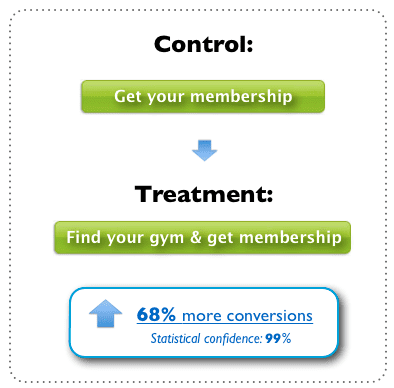
The below test from Contentverve is from a major chain of gyms in Scandinavia. The control ‘get your membership’ is a strong and persuasive call-to-action, however, it’s not addressing specifically what the next step in the process is – leaving the potential customer unclear as to when they select their gym.

Therefore, the treatment addressed this issue by creating a more specific call-to-action, providing reassurance to the potential customer with clarity as to what the next step in the journey entailed. ‘Find your gym & get membership’, resulted in a 68% lift!

Call to action best practice example

 Use Anchoring

Anchoring is a cognitive bias otherwise known as a heuristic, that describes the common human tendency to rely too heavily on the first piece of information you receive (the “anchor”) when making decisions.

The Psychology Dictionary says, “a heuristic is a mental shortcut that allows people to solve problems and make judgments quickly and efficiently. These rule-of-thumb strategies shorten decision-making time and allow people to function without constantly stopping to think about the next course of action.”

So in the example below from Joanna Wiebe of Copyhackers, we see that the cheapest pricing is on the left and the pricing increases as you progress to the right.
Screen Shot 2015-07-09 at 10.00.04

However, when the most expensive pricing was moved to the left and was used as the Anchor, there was an uplift of 500% in click through’s. By having the more expensive pricing as the first price, it has set our value of the product as being this price and anything less than this price is very good value.

This example also uses Goldilock’s principle (sometimes called the Goldilocks Effect) which was discovered by Joel Huber and Christopher Puto in the early 1980s.

The term ‘goldilocks effect’ derives from the children’s story Goldilocks and the Three Bears. In the story Goldilocks decides, amongst other things, to eat one of three bowls of porridge; the first being too hot, the next too cold, but the final one she picks for being 'just right'.

Applied to pricing, it is used to describe the practice of providing a premium as well as a budget option alongside the regularly priced product to make the standard option seem more appealing.

goldilocks effect

Leverage the Rule of 3

The rule of three is one of the oldest in the book. Aristotle wrote about the three unities in his book Rhetoric: dramatic unity of time, place and action.

Simply put, people tend to easily remember three things, thus making your messages sticky and engaging.

Throughout the years it’s been used from rhetoric to religion.

The Latin phrase "omne trium perfectum" (everything that comes in threes is perfect, or, every set of three is complete) conveys the same idea as the 'rule of three', while also (appropriately) using exactly three words.

It’s all to do with patterns - At the root of its success is we, as humans, have been programmed to learn from patterns and 3 is the smallest pattern that can be made.

Throughout history it has been used to communicate complex ideas simply – think of memorable phrases such as:

  • “Blood, sweat and tears”
  • “Faith, Hope and Charity”
  • “Lights, camera, action”

When packaging our sales and marketing in threes we create something that is memorable: think of “It’s as easy as 1,2,3" & “It’s as easy as A,B,C”.

The below example is from one of Themeforests’ landing page templates, designed for Unbounce. This has been designed to leverage the Rule of Three quite powerfully as it has 3 sections of 3!

 rule of 3 email marketing

Follow the approaches and tactics covered in this post and you should be on your way to a landing page that converts those hard earned opens and clicks. But don’t forget to test and keep testing to find the best conversion driving combination of your landing page. You may always be testing to gradually improve on the conversions you are seeing, in line with the interests and motivations of your customers as they change over time.

There you have it – this was the last in a 3 part series of articles on how to increase conversions within your email marketing by ensuring you have all three steps covered. You can read the first two articles here:

Part 1: 3 Steps to Increasing Email Marketing Conversion

Part 2: 3 Steps to Increasing Email Marketing Conversions

To focus on one of the elements of your landing page discussed in this article – take a peek at our webinar all about ‘How to Create Calls-to-Action That Drive Conversions’

09 Jul 16:07

10 Ways Businesses Should Be Rethinking Their Social Media Strategies

by Young Entrepreneur Council

How is your business rethinking its use of social media now, and why?

1. We Switched Our Focus

10 Ways Businesses Should Be Rethinking Their Social Media StrategiesWe’ve found that our clients don’t care about Twitter, Facebook or Google+, but they care a lot about Pinterest. So we focus 95 percent of our efforts on Pinterest. We try and automate the others as much as possible to have a presence. You should focus on what’s making your business money and put less attention toward things that don’t matter. – John RamptonDue


2. We Are Using It Less

13 Best Strategies for Following Up With Business ProspectsUsing social media is important and can be a great way to connect and amplify your content — especially if your audience is looking for you there. That said, it’s too easy to get lost in the ego trap of wanting more likes, re-tweets and comments. We try to focus on the highest value tasks that deliver the most return for our business. In our experience, that’s more deep work, less social media. – Ryan StephensRyan Stephens Marketing


3. We Think of It as an Event

10 Ways Businesses Should Be Rethinking Their Social Media StrategiesWe’re approaching our social media now like we’re all leading up to a big event. I’ll write an article on something relating to a future product on my blog. Then I’ll tweet quotes from that article or other related news or statements and we’ll promote it on YouTube, post something on Tumblr, etc. Our goal is to build momentum. – Rob FultonAudio Luminaries


4. We Have Fun

Angela HarlessWhen we started with social media, we didn’t have a strategy. Then, we wanted to position ourselves as thought leaders. While we have done a fairly good job of showcasing expertise, our engagement wasn’t where we wanted it to be. Now, our new strategy has a good mix of fun and interesting content, which helps boost engagement. And it means more people are watching when we do post more meaty content. – Angela HarlessAcrobatAnt


5. We Use It as a Customer Service and Validation Channel

10 Ways Businesses Should Be Rethinking Their Social Media StrategiesWith organic engagement on Facebook as low as one percent, it’s become harder and harder to break through the noise. So instead of using it as a marketing channel to generate demand, leads or interest, we use it exclusively for customer service and company validation. Customer service is one of our key value propositions, so making it easier for the customer to reach us is an obvious win. – Mark KrassnerKnee Walker Central


6. We Focus on Quality, Not Quantity

Aaron SchwartzSocial media channels evolve over time. Facebook recently restricted organic reach to the point that only about one percent of our fans see posts unless we invest ad dollars behind them. What wont change, however, is that quality content will spread. Instead of worrying about the quantity of posts we have, we’ve begun investing much more into the quality of the content we share. – Aaron SchwartzModify Watches


7. We Build Trust

Elliot BohmWhen you are asking customers to part with their hard earned money, you are asking them to trust you. Social media needs to reflect that there are trustworthy humans behind the professional mask of the company. Posting customer experiences and reviews is one great way to reflect that trust. – Elliot BohmCardcash.com


8. We Go Where Our Customers Are

Sam DavidsonI hate Pinterest. But it’s where our customer is. So, we have to be there as well. Don’t let fear of or unfamiliarity with a platform keep you from authentic connection. Learn the tools or hire someone who knows them and get to work. – Sam DavidsonBatch


9. We Focus on ROI

8 Reasons Your Startup Should Move Off of FacebookYou can measure a lot of useless metrics via social media. We measured all of these metrics and more. The bottom line has been that social media has performed worse than organic, paid search and traditional offline advertising. We now look at it as a supplement to other marketing efforts as opposed to a stand-alone campaign. – Mark CenicolaBannerView.com


10. We Engage Through Teaching

Firas KittanehBecause we want to provide our customers with more than a great product, we are now utilizing social media to create didactic and informational content to further engage our audience. Our blog now features health and lifestyle tips, ranging from how to optimize resources to consistently get the best sleep possible and how to deal with common health problems that might be impeding sleep. – Firas KittanehAstraBeds

09 Jul 16:05

The Problem With Assigning Fixed Percentages To Pipeline Stages

by Bob Apollo

ForecastingOn average, fewer than 50% of forecasted opportunities close at the predicted value and time – and the figure is usually far worse in early stage companies without an established track record of successfully closing business.

Its no wonder that revenue forecast accuracy is a huge frustration for CEOs and a frequent source of tension with both their Board of Directors and their sales leadership. After all, how hard can it be to work out when an opportunity a sales person been pursuing for months is going to close?

The answer of course – as anyone in frontline sales knows all too well – is that accurate sales forecasting is one of the most significant sales challenges, compounded by the fact that sales is a profession that tends to attract more optimists than pessimists.

But despite these acknowledged difficulties, I still see organizations implement processes that make it even harder than it needs to be to judge the true state of the pipeline and the likelihood of converting opportunities into revenue.

Blame it on the CRM vendors

It’s not just the CRM users’ fault. The traditional CRM vendors bear a huge burden of responsibility for this – by encouraging their customers to believe that it is possible to assign a generic probability to individual deals based on their current stage in the pipeline.

Whilst this approximation may be close enough to the truth in a high volume, low value, well-established transactional sales environment, it completely fails to reflect the complexities of high value, long sales cycle complex sales environments.

Why the maths don’t add up…

Allow me to illustrate with a simple example: it’s not unusual for the “proposal” stage to carry a default 50% probability. Now let’s assume that a minimum of three organizations are invited to propose – and they each rate the opportunity the same way in their respective CRM systems.

Let’s further assume that there is a normal 50/50 chance that the prospect will actually end up deciding to do nothing and stick with the status quo. If you do the maths, together they add up to a 300% probability of doing business. How can that make any sense?

The problem is of course compounded by the fact that almost inevitably one of the three options is actually in the driving seat, and the other two are simply there to make up the numbers. Can you see why probabilities based on sales stage are such a nonsense?

But what are the alternatives? Well, the simplest approach – which can somewhat improve forecasting, even if it does not eliminate the root cause – is to adjust the “out-of-the-box” stage percentages to accurately reflect your real-life experience.

A more effective approach

But there are far better ways of dealing with the issue, although they involve more work. The two elements are to:

  • Base pipeline management stages on observable milestones in your prospect’s buying decision process, and adjust probability up or down based on the likelihood that they will do anything.
  • Further adjust opportunity percentages up or down individually based on factors that directly influence your chances of winning the business.

Let’s look at the implications of these two strategies…

The buying decision process as a framework

Most complex B2B buying decisions evolve through a series of identifiable stages:

  • First there is no problem, and no project.
  • Then the prospect becomes aware of an issue.
  • Then the prospect determines whether they need to take action.
  • Then the prospect develops their vision of what a solution should look like.
  • Then the prospect selects the best available option.
  • Then the prospect confirms their decision.
  • Then the prospect places an order on their chosen vendor.

Of course, the prospect can choose to move forward, stick where they are, return to a previous stage or drop out of the process at any time – and this is made more complex with the involvement of multiple stakeholders. But if you know what you are looking for, it is relatively easy to work out what stage the prospect has currently reached in their buying decision process.

What are the chances they will do anything?

Then we’ve got the chance they will actually do anything. Again, if you know what to ask and what to look for, it’s possible to make an informed judgement about this by considering issues like:

  • Have we identified a clear economic case for change?
  • Have we identified business drivers that make addressing the issue urgent?
  • How important is this project relative to other potential initiatives?
  • How powerful is our sponsor in mobilising the rest of the organisation?
  • Do we understand “what’s in it for me” for each of the stakeholders?
  • Does the process have momentum or does it seem to have stalled?

The percentage probability they will do anything is a function of where they are in the process and how likely it is that they will decide to act.

Your chances of winning their business

Once again, your chances of winning their business should they decide to go ahead with the project is typically affected by a handful of critical issues:

  • How good a fit is our solution against their identified problem?
  • To what extent did we help to shape the economic case for change?
  • To what extent did we help to shape their vision of a solution?
  • At what stage did we get engaged in their decision process (earlier is better)?
  • To what extent have they agreed that our solution offers unique advantages?
  • What is our level of engagement with each of the key stakeholders?

The probability they will decide to choose you is a function of how good a fit you have against each of the above factors.

Isn’t this over-complicating matters?

If this seems more complicated than relying on standard percentages, well of course it is – and if standard percentages are resulting in accurate revenue forecasts you should stick with the simple approach. But if – as is the case in most complex sales environments – the standard percentages are NOT generating accurate sales forecasts, then you need to seriously consider changing your process.

To sales people who might complain that this is yet another bunch of data to capture that no one is ever going to look at, I’d simply say the following:

  • If you genuinely believe that you can maximize your chances of winning without knowing this information, you are clearly a magician and should pursue a career on the stage or join one of our competitors.
  • The reason why we are asking for this is that we know that the information is critical, so you can be sure that management will be paying very close attention to it.

Inevitably, you won’t get this completely right to start with – but you’ll get way closer than you would under the traditional approach, and you’ll be able to continuously refine your assumptions based on an analysis of the real-life predictive value of the key factors.

You’ll uncover additional factors that are specific to your business environment, and with experience you’ll almost certainly find that a handful of key factors have the most significant impact – so can focus your sales people’s attention on them.

Or would you rather stick with the status quo, and preserve the illusion that the weighted value of your pipeline bears any relationship to reality?

DiscoverDesignAlign+Refine

09 Jul 16:05

Here’s why it’s so much harder to exercise as you get old

by Christopher Minson

Super Seniors cyclist

I remember the moment a few years ago while watching TV when I realized that if I were riding in the Tour de France, at age 42 I’d be the oldest person in the race. It hit me that my dream of racing in cycling’s biggest event was over…it was not going to happen.

Not that I’d been competing, let alone training seriously, on the bike for a number of years.

Or that not even in my "prime" years for competitive cycling would I have been good enough. It’s just that now I had an excuse…I was too old, too far past my prime years.

So what happened? Is there a physiological reason people in their mid-40’s are no longer able to compete at the professional level in most sports, or is it a constellation of challenges, such as the time devoted to training, motivation, managing kids' schedules or busy work demands?

"Im old" is the common refrain for why we get worse at athletics as we age. But here’s what’s really happening in the body through the years to make world-class performance less possible. And, interestingly, there are a few physiological elements that contribute to athleticism that don’t seem as affected by aging.

The 'sweet-spot' age

In most sports, there is an age "sweet spot," at which the combination of physical, technical and strategic abilities comes together.

In most sports, this age sweet spot falls in the mid-20’s to early 30’s. Although there have been numerous examples of Olympians competing, and sometimes winning medals, over the age of 50, the vast majority of these come from sports requiring exceptional skill and less aerobic or anaerobic power, such as the shooting events, sailing, equestrian and fencing.

For endurance events, the upper cap for competing at the sport’s highest levels appears to be around the age of 40.

Chris Horner won the 2013 edition of the Vuelta a Espana, Spain’s version of the Tour de France, just shy of his 42nd birthday, making him the oldest winner of a Grand Tour in cycling.

The oldest Olympic marathon winner was the 38-year-old Romanian athlete Constantina Dita Tomescu, competing at the Beijing Olympic Games.

Dara Torres, at the age of 41 in 2008, is the oldest swimmer to compete in the history of the Olympics, missing the gold medal in the 50-meter freestyle by hundredths of a second. But these examples are the exceptions, not the rule.

Age changes how our bodies use oxygen

One big reason we see declines in aerobic (or endurance) athletic performance with age is that our bodies can’t use oxygen as effectively.

The maximal ability to utilize oxygen (VO2max) is a predictor of endurance performance across ages. VO2max is a numerical value that describes how much oxygen your body can use per kilogram of body weight.

VO2max is affected by how well your body can bring oxygen into the lungs, how well this is carried in our blood to the working muscles, and how much oxygen the muscles can use to fuel contraction.

olympic swimmersExercise can improve all of these, and the higher the VO2max, the more "aerobically fit" a person is. That is, they can do more endurance work for their body weight.

In the general population, VO2max tends to decline by about 10% per decade after the age of 30. Athletes who continue to compete and train hard can reduce the drop by about half, to 5% per decade after the age of 30.

The reason VO2max declines with age is that our maximal heart rates go down as well.

Maximal heart rate is the highest heart rate in beats per minute one can achieve during increasing intensity of endurance exercise. It is often roughly predicted as "220 – age = maximal heart rate." Although the actual maximal heart rate for a given person is highly variable, as you age, your maximal heart rate decreases, whether you are a highly fit athlete or a couch potato.

And this decrease reduces both cardiac output and oxygen delivery to the muscles, which translates to a lower VO2max and thus to lower performance in endurance events as we age.

Even if oxygen delivery to muscles goes down, the ability of your muscles to efficiently utilize the oxygen they do get relative to a given workload (this is called exercise economy) is well maintained into our 60’s and 70’s, though total muscle mass tends to decline as we age, and can contribute to declines in performance as well.

In terms of competitive endurance exercise, rowers have shown the least decline in VO2max with age, but the difference to other sports isn’t huge. And it might be because rowing is a lower-impact sport than cycling (with crashes) and running (constant pounding).

Let’s not forget the muscles

Some evidence suggest that for sports that require high levels of strength or power, like weightlifting, age-related limitations may reside in our skeletal muscles, those muscles that move our bones and joints.

Bucknell University Students Crew Team RowersFor competitive weightlifters over the age of 40 (masters level), performance drops more precipitously than it does for endurance athletes such as runners, swimmers and cyclists. That’s likely because weightlifting draws on type II muscle fibers (called "fast-twitch" muscles) to produce strength and power. Research indicates that these cells decline in number and function with age.

Not only do these cells decline with age, but so do the cells that support the repair and growth of skeletal muscles in response to exercise decline.

These age-related declines are not as obvious in type I muscles, those muscle fibers most associated with endurance-type exercise.

Recovery can take longer

As they age, many athletes complain that the ability to recover from hard bouts of exercise diminishes.

This can affect the intensity and volume of training of all athletes. But in many contact sports, such as professional American football or rugby, recovering from injuries and the cumulative effects of hard hits becomes the limiting factor in continuing to play at the highest level.

For instance, last season there were only two people in the NFL, Sav Rocca of the Washington Redskins and Adam Vinatieri of the Indianapolis Colts, playing in their 40’s.

Injuries take their toll on people playing non-contact sports as well. For masters athletes, experiencing more training-associated injuries leads to reduced training intensity and volume, and thus poorer performance come race day.

Better training can help you stay at your peak longer

Although all athletes will eventually lose the age versus performance race, with better training and recovery practices, in the coming years we likely will begin to see more athletes in their 40’s remaining competitive at the highest levels of sport. By "training smarter, not harder," athletes can reduce the chances of injuries, maximize gains from training and minimize the effects of aging.

FootballOlder athletes need longer to recover and adapt to a training stimulus, so workout planning needs to change with age.

High-intensity interval training, for instance, focuses on the quality of a workout, rather than the sheer volume of training, and can be used effectively by older athletes to improve aerobic capacity.

Cross-training, such as weightlifting and yoga, can help to maintain muscle mass and flexibility, and reduce overuse injuries in endurance athletes.

An emphasis on "active recovery" strategies (an easy run or swim on your rest days) and improved sleeping habits are important for athletes of all ages, but become essential for older athletes.

Performance decline isn’t just about physical changes, however. As we age, our intrinsic motivation to train diminishes. Even in athletes, the motivation to train may shift somewhat from setting personal records to remaining active and healthy. And that’s a great motivation for any athlete at any age.

Christopher Minson is Professor at University of Oregon.

This article was originally published on The Conversation. Read the original article.

SEE ALSO: Scientists made an online calculator that tells you your ‘fitness age' — and you can try it right now

Join the conversation about this story »

NOW WATCH: The science behind losing weight

09 Jul 16:04

Sales Data Or Insight Driven?

by Tibor Shanto

By Tibor Shanto – tibor.shanto@sellbetter.ca 

The other day I go a resume that had a familiar phrase in it, “John Smith – A Data Driven Sales Professional. While I understand what they were going for, I am not sure it landed right. (Or maybe it was just me). No doubt the age of “big data” or perhaps a better label being used by some, “fast data”, is upon us. Sales is impacted by this as much as any part of business, but there some unique opportunities for sales and sales departments, both good and not so good opportunities.

The amount and quality of data allows sales organizations to be much more efficient at targeting and accelerating sales, by bringing the right resources at each step of the cycle, and leveraged well, to the nature of the sales organization itself. As Miles Austin recently commented on a panel we were, progressive sales organizations with open headcount should look at hiring a sales data analyst instead of another rep. He is right, the proper use of the valuable data in a typical CRM, processed by a sales savvy analyst with the right mandate from leadership can produce more margin, quicker and for a longer term, than hiring another rep.

One example is territory optimization, and not just in the traditional sense, but by matching types of buyers with types of sellers. Think about taking buyer persona to a different level. Much like a sporting coach will mix up his line up based on what they are facing, last minute line changes, all to ensure maximum impact, sales organization can move from geo or vertical views of the world, to what kind of buyer is Johnny best suited to?

Sales organizations who have had SWAT teams to penetrate accounts given specific attributes, have long realized that the minor uptick in selling cost is more than made up in margins and volumes. With the right analysis, you can take this to a level of alignment that could more than likely allow you to run leaner, making up for additional costs that have led to traditional territory make ups.

Analysis can help organizations better plan in a number of ways, allowing them to avoid certain activities, while maximizing others. Patterns in the data that would be lost on most sales ops people, would be gold in the right analyst’s hands. It is not a question of sales ops being deficient, it is more of training and function, and analyst will go deeper and further into the data, extracting more actionable insights. Not coming from sales is in fact their strength, they will approach and read the data differently.

Actionable insight being the key, and what caught my eye in the resume. This candidate would have made a much better impact had they put the emphasis on insights than data. Data is a commodity, information is a commodity. Insights, and the knowledge derived from it, leading to differences measured in revenue and margin are of interest, and yes, you can do both. Being data driven sounds good, but data is data, being driven by insights gleaned from data is the winning proposition.

Tibor Shanto    LI Bottom banner

09 Jul 16:04

How Introverted Writers Transform into Business Professionals

by Sonia Simone

There’s a well-loved myth out there that if you do something reasonably remarkable and distribute passionate content, you’ll automatically have...

The post How Introverted Writers Transform into Business Professionals appeared first on Copyblogger.

09 Jul 16:04

Kik aims to win at mobile messaging by not playing Facebook’s game

by Murad Hemmadi
Kik founder Ted Livingston

Kik founder Ted Livingston, doing his best unicorn impression. (Illustration by Nigel Buchanan)

We’re at the end of our allotted 35 minutes, and the iPhone in Ted Livingston’s hand is ringing. But Livingston hasn’t finished his story, so he informs his caller that he needs an extra 45 seconds, turns to me and sums up. “We view this as one of the most fundamental races in the history of humanity,” he says. “Why would we get out of that race now?”

The anecdote Livingston is recounting comes in response to a question about whether Kik Interactive, the Waterloo, Ont.-based mobile messaging firm he co-founded six years ago, is looking to be acquired. It goes like this: In March 2011, while at the South by Southwest festival in Austin, Texas, Livingston learned that one of Kik’s competitors had sold to Facebook for an estimated US$40 million (Beluga, it was called, would go on to form the basis of the social media giant’s own Messenger app). “Everybody was looking at Kik and saying, ‘Sell now. This is the peak of the messaging bubble,’” recalls Livingston. But Kik wasn’t interested. Then, last year, Facebook bought another messaging company, WhatsApp, for US$22 billion. “So now instead of an M it’s a B—a thousand times larger,” Livingston says. “And everybody is saying the same thing to us. But for us, the logic remains true.”

Kik is not for sale, even if the buzz coming out of the technology industry would have you believe otherwise. A few weeks after our conversation, Kik retained the services of Qatalyst Partners, a Silicon Valley investment bank with a track record of connecting mid-sized technology firms with big money buyers. Livingston insists that Kik is simply looking for “strategic partners” as the chat race intensifies, which could mean a big investment, or a deal to share content or pooled resources, depending on the partner.

Mobile chat, the category of apps that facilitate the exchange of messages, emojis, photos and other content over the Internet from a smartphone or tablet, is an increasingly crowded space. Kik’s current competitors flaunt 11-figure valuations and continent-sized user bases: Leading the pack is Facebook Messenger, with some 500 million monthly active users (MAU), and its subsidiary WhatsApp, which has 700 million; Line, a Japanese app, boasts 170 million users and is eyeing a US$10-billion IPO; and Snapchat’s most recent funding round values its 100 million users at $15 billion. Kik runs in the back of this pack. Its 200 million registered users (Livingston won’t disclose Kik’s MAU figure) make it good enough for eighth place, according to the data aggregator Statista. But based on one common tech industry formula, that puts Kik’s valuation somewhere between $500 million and two billion.

There’s a popular term for companies that cross the billion dollar-valuation mark these days: unicorn. Investors fight to fund these much-celebrated, much-cited companies—the Ubers, Snapchats and Slacks of Silicon Valley—feeding them with more money than they can conceivably need. While Kik likely makes the ten-figure cut (Livingston also won’t disclose Kik’s own valuation figures), it tends not to attract the kind of buzz that venture capitalists and the tech press fawn over. While the rest of Silicon Valley is busy crowning unicorns, Ted Livingston—all of 28 years old—has been quietly building a product used by some 200 million people. (Consider that the U.S., its biggest market, has 319 million residents.) And he’s done it by ignoring the tech industry’s obsession with valuations and buzz in favour of solid, steady improvements. “Anything less than winning the world will be a failure to me,” Livingston will tell you. It’s not for lack of ambition that Kik may never catch up to its competition. But here’s the thing: It may not even have to. There will be room for more than one winner in this race.


When Kik first launched in October 2010, it was the number one chat app in North America—for about a month. What had started as an idea for a music app that would make it easier for BlackBerry owners to listen to music on their devices, had to be downgraded to a mere chat service while Kik waited on licensing deals. It was a surprise hit. Then BlackBerry, where Livingston had spent time as a University of Waterloo co-op student, sued the company for patent infringement and pulled Kik from its app store. “Our growth plummeted,” recalls Livingston. The companies settled the suit in 2013, but the Blackberry setback cost Kik its first-mover advantage.

Little appears to have changed since the days when Livingston was a baby-faced college student who just wanted to listen to tunes on his BlackBerry. The tousled mop of hair he sported in early interviews is gone, replaced by a cleaner cut. But his uniform of jeans and a solid-colour hoodie persists. Taking pages from the Mark Zuckerberg style manual, a willingness to keep people waiting and an unshakeable belief that his product will change the world: so far, so Silicon Valley. But Livingston is no brash tech bro. The first $1 million he made from selling Kik shares went to the University of Waterloo to pay for a startup seed fund. Ask him how it feels to have built a global competitor at such a young age and he reflexively cites the potential to connect people around the world. Contrast that with Snapchat founder Evan Spiegel, who has sullied his company’s rapid rise with his smarter-than-thou tone and revelations of misogynistic emails sent while a Stanford fratboy.

What has changed in that time is the market for third-party messaging apps (i.e. software that doesn’t come preloaded on your smartphone, like iMessage and SMS services). Unlike the social network wars of the mid-2000s, the chat race has drawn more competitors. “We’re certainly seeing more messaging apps than we ever did with social networking,” observes Brian Blau, research director for mobile & wireless consumer technologies at U.S. IT research firm Gartner, Inc. Of course, which chat app you’re familiar with depends on where you live and how old you are. WhatsApp leads globally and in countries with expensive SMS rates like India; Line dominates in Japan; KakaoTalk has been downloaded by 93% of South Korea’s smartphone users; WeChat has a near monopoly in China.

Kik is the chosen vehicle of young North Americans. The majority of its users (70%) are under 25 years old, with two in five U.S. teens using the app. “Most adults haven’t even heard of Kik but it’s the most used social media platform by FAR,” wrote 13-year-old Soroush Ghodsi in May on Medium.com. One reason Kik is popular with teens is because, while most other messaging-first services require a phone number to register, Kik bases accounts on user names instead. That means kids with their own iPod or tablet but no smartphone can still chat with their friends. And once they’ve gotten used to the platform, they stick with it when they do acquire their own phones. “Kik has a special feel to it,” wrote Ghodsi. “It feels like it was made for us, and us only.”

Even though the market for messaging apps is a young one, there’s some sense it may already be maturing. “At this point, if you don’t have a phone and you don’t have a chat app on your phone, you’re probably never going to have either of those two things,” admits Livingston. So Kik and its competitors are turning to the next stage in the messaging marathon: How will they make money from them?


Arrive at the building that houses Kik’s offices and it might seem like you’ve copied out the address wrong. The company operates out of a two-storey industrial park in Waterloo, Ont., several kilometres up the road from a new downtown cluster of tech companies—some of which received their first funding through Livingston’s UW donation. Kik shares signage with a tax preparation firm, a driving school and a personal injury lawyer. It feels more like the headquarters of a parcel delivery service than the site of a billion-dollar tech company. The modest workspace is all part of the plan. “We don’t have a flashy office because we don’t think it contributes to our odds of winning,” Livingston says. “In fact, we actually think it has a risk for detracting from that—‘Flashy office means we’ve made it, so now let’s just all chill out for a bit.’” On the other hand, Livingston says that when something adds to their “probability of winning,” they incorporate it immediately. Kik, he says, was one of the first Waterloo tech firms to cater lunch and dinner every day for its 62 full-time staff. Catered meals make the team more productive and less reliant on the carb-heavy menus of East Side Mario’s, Harvey’s and Subway nearby.

Despite spending a couple of weeks each month in the Valley (the company has offices in San Francisco and New York, as well as a just-announced division called Kik Services run by a former ad agency CEO in Los Angeles), Livingston is adamant that Waterloo is the best place to build his company. The talent coming out of the city’s universities is top-tier and tends to stick around and Kik doesn’t face the same poaching problems as most San Francisco firms. According to Justin Waldron, a co-founder of the Internet gaming company Zynga and advisor to Kik, the only thing staying in Waterloo costs the company is exposure. It’s why he helps Kik make introductions in the Valley and why Livingston says it hired Qatalyst, which has connections in the highest ranks of the tech industry’s top companies. “If there was anything that it was a disadvantage for, I think it would probably only be from a hype and generic buzz standpoint,” says Waldron.

Another thing separating Kik from its Silicon Valley messaging rivals is Livingston’s approach to the capital markets. Snapchat’s recent US$537-million funding round brought the total amount of capital it has raised to $1.4 billion. Kik by contrast has raised just US$70.5 million to date, including a $38.3-million round in November 2014. That’s enough capital to pay the staff, keep the lights on and keep building new features, says Livingston. “Should we have raised $100 to 200 million? Sure, it would have made us feel great, and the press would have been great. But we just don’t need that much money. We don’t know what we would do with [it],” he says flatly.

Still, the money Kik has raised so far is sizeable, says Andrew Parker, a general partner at New York’s Spark Capital and board member of Kik, which is a Spark portfolio company. “Raising venture capital is like you’re on a journey in a car, and you’ve got to stop at the gas station to fill the tank,” Parker says, calling upon a trite—his words—venture capital analogy. “The purpose of the journey is not to make a tour of gas stations, right? So we’re not going to go out there and raise money if we don’t need it.”

What the backers are buying for their multi-million dollar investments is potential—there’s not a lot of revenue in the chat business right now. Livingston says Kik pioneered the platform model, which makes a chat app the doorway to a host of other functionalities and services. The most successful example of the platform model so far is WeChat. “If you kept a journal of all the things you do throughout the day, WeChat plays a role in each of those things,” Livingston says. “When you get taxis, when you buy things, when you share things, they’re making everything better with chat.”

A platform model also means a user never has to leave the app for a competitor. Kik was among the first messengers to feature a full web browser, which allows users to open links and search for content within the app. The company finally added native video capability earlier this year, and in November 2014 it acquired the GIF messaging startup Relay. Both moves appear aimed at Snapchat, the app with which Kik has the highest affinity, says Waldron, meaning users of one are likely to have downloaded the other. Kik already boasts higher engagement than its North American competitors; according to Business Insider’s BI Intelligence service, people spend more time using Kik than Snapchat or Facebook Messenger. “If you can build an ecosystem, then there will be all sorts of services that you can monetize,” Livingston says.

But all that monetization remains firmly in the future. For now, Kik’s revenue-generation strategy is a feature called Promoted Chats. Launched in November, it allows users to opt in to “talk” to a brand. The conversation partner is actually a chatbot, a minor form of artificial intelligence programmed with stock responses to certain keywords. Brands pay Kik for the opportunity to chat with users because it’s a lot easier to program a bot than to respond individually to consumers’ Facebook posts or tweets. The headphone manufacturer Skullcandy got 300,000 chatters in its first three months on the platform, triple the number of Twitter followers it had accumulated over a period of two years. Other brands using Promoted Chats include MTV and the Washington Post.

Brand engagement—advertising—is the dominant form of revenue on most social platforms, says Paul Gray, the product specialist responsible for the chatbots: “Facebook’s product is promoted posts. Twitter’s product was promoted tweets.” Kik offers richer engagement than you’d get on a broadcast-based platform like Facebook or Twitter—the comedy video website Funny or Die, for example, has had conversations with 1.5 million chatters on Kik, and users send an average of seven messages to a brand per chat. But Blau points out brands don’t have infinite resources to spend on engaging potential consumers, and scale will eventually matter. “If it’s an advertising business or some sort of e-commerce play, advertisers are going to be looking for engaged users and market share,” he says. “If Kik is not in one of those top spots maybe in the next five or 10 years, then advertisers may not think about them first.”


Even if you accept Livingston’s insistence that he has no plans to sell Kik—and there’s no reason not to—Blau says you don’t bring on a major Silicon Valley dealmaker like Qatalyst lightly. “You never know what will happen once you hire a bank and they start shopping things around.” A more likely ending might be an IPO. Kik co-founder and chief technology officer Chris Best hinted as much during an episode of The Disruptors on Business News Network, grinning and admitting that “probably, possibly, at some point, yes” that would be the goal. And although Parker wouldn’t speak specifically to Kik’s future plans, he says Spark hopes all its firms end up as “independent, publicly traded companies that are sustainable, profitable, have a global audience and reach, and are employing thousands of people around the world.” If an IPO really is the goal, Kik’s reluctance to disclose its internal valuation makes sense—without a huge number hanging over its head, Kik stands a better chance of a successful share offering. “By the time companies get to market these days, the value [in a company] has largely been realized by private investors,” says Roger L. Kay, president of Endpoint Technology Associates, a Massachusetts-based consultancy firm. Investors cash out, but “the public gets to hold the over-bloated carcass of the thing they finally brought to market,” Kay says.

But Livingston is correct to brush off speculation about a sale or IPO at this point. The chat race isn’t over yet, and Blau for one believes it is possible that Kik could eventually emerge near the front of the pack. “A lot of youth are using messaging, and if they stick with it, [Kik will] be a fixture for many, many years to come,” he observes. “If they can keep user engagement high, keep growing, and figure out how to monetize it in an effective way.”

Moreover, there’s room for more than one app atop the chat podium, and Kik has shown that it’s able to carve out enough of a foothold to make some money and build a sustainable business.

But none of that will stop Livingston from trying to win, and his very Canadian calmness doesn’t altogether mask the chip on his shoulder. He’s willing to admit that losing his 2010 lead in the chat race hurt, and that he wants to make up for it. “A big part of what’s kept us hungry is feeling like we deserve to show the world that we can get back there—that it wasn’t just a fluke, that it was taken away and that we will get back to that point.”

MORE ABOUT STARTUPS & INNOVATION:

The post Kik aims to win at mobile messaging by not playing Facebook’s game appeared first on Canadian Business - Your Source For Business News.

09 Jul 16:03

How To Attract Millennials With Your B2B Marketing

by Meaghan Alvarado

As the baby boomers phase out from being the majority age group in the workforce, millennials like me are stepping up and will account for more than 50% over the next five years. Are you targeting us in your B2B marketing strategy?

Millennials started using computers and the Internet in elementary school. Our first reaction to most questions is: “Google it.” When a millennial is shopping for a product the first thing we do is run a search for reviews, pricing, and maybe even check out the company that makes it. This buying process spills over to the business world. Almost 90% of B2B researchers use the Internet in their research process.

Searchability

Today millennials make up 46% of the B2B researcher demographic. As our presence increases in B2B companies your ability to be found on the web will only become more important.

Before engaging on your brand’s website B2B researchers average 12 searches and most begin with a generic product search. You need to be on their radar early on in order to have a chance of even being considered. This is why you need a comprehensive content marketing strategy that will fuel organic searches and boost your SEO. Paid search can also play a major role in your digital marketing strategy.

Millennial_B2B_Researchers
Image Source: Google/Millward Brown Digital, B2B Path to Purchase Study, 2014.

Content

Millennials’ inclination to search everything only adds to the list of reasons to create relevant content. Creating blog posts describing your products/services and how it will benefit them will give millennials more of what they’re looking for. You will also be deflecting some of your sales costs by assisting them in the consideration stage of the buyers’ journey.

The other obvious benefit to creating content is building trust and establishing your brand as a thought leader. Millennials do not like salesy content, so humanize what you have to say. Infuse humor and include employees from all parts of the business as contributors. By incorporating employee blog contributions you are allowing them to portray their subject matter expertise and relatable personalities.

Videos

Accustomed to the “fast food” mentality of today, millennials want instant gratification and are often multi-tasking. Providing video content allows for easy consumption and it’s another opportunity to humanize your brand.

70% of B2B researchers and buyers are viewing videos during the research process; half of them watching 30 minutes or more. When creating videos in your B2B marketing plan tell people about your product and how it can be used.

Mobile Optimization

Dozing off with a smartphone or tablet in hand, and then hardly opening our eyes in the morning reaching for the phone… this is a common reality for millennials. We are always plugged in and many are using their mobile devices in the B2B buyers’ journey. If your website isn’t optimized for mobile (to the detriment of a possible lead or sale) millennials will have a poor user experience.

A few items to consider when optimizing your website for mobile:

  • Mobile redirects
  • An overall responsive design
  • Embrace white space
  • No flash players (Apple products won’t play it)
  • Simplification of content
  • Option for full site

b2b_smartphone_usage_millennials
Image Source: Think with Google

Social Media

It should come as no surprise that we millennials are looking to social media as part of the B2B buying process. The personal connection from a company’s social media account garners more trust from millennials than websites because we believe the information is more reliable.

Facebook is the most used platform for online adults ages 18-29, and is the preferred social network to connect with companies. With in depth targeting options for ads you should be connecting with millennials and remarketing to your site visitors on Facebook.

Post content that millennials are looking for when they visit Facebook: videos, pertinent news, and educational content about your industry. The ability to provide a timely response to questions on social media is another necessity for keeping this growing demographic happy on your B2B digital marketing journey.

millennial_smartphone_B2B
Image Source: Pexels

Providing educational content that millennials can easily locate is key. When buyers contact a seller today they are over halfway through the buying process. If your company isn’t providing adequate information on your products, buyers are probably going to a competitor. Without a strong Internet presence B2B companies are practically invisible to millennials like myself.

Since social media plays such a huge role in the personal and professional lives of millennials, becoming a social business should be a no-brainer. If you need help becoming a social business but you’re unsure of your next step, take a look at our free eBook: How to Transition from Social Media to Social Business.

09 Jul 16:03

Sales Pipeline Management: 5 Best Practices to Boost Revenue

by Matt Smith

Sales pipeline management is at the core of everything we do in sales. Your sales reps are staring at their funnels all day, everyday. Mastering the sales pipeline is an extremely effective way to increase revenue because it allows sales reps to remain organized and focused on selling. This is undeniably a critical part of the sales process.

What is a Sales Funnel?

sales pipeline management best practices

The sales funnel is a visual representation of your team’s open opportunities. The result of sales prospecting, lead generation, sales calls, outbound emails, meetings, and processes all come together to create the sales pipeline.

What is Sales Pipeline Management?

Sales pipeline management is the organization and tracking of prospects, goals, and quota – as well as understanding whether certain deals need special attention.

Effective pipeline management allows salespeople to keep track of deals by knowing exactly which stage the deal is in, and whether there are enough deals on the board to hit goals and quota.

If you need help with building your sales pipeline or could use a few tips to close more deals, we’ve built a special mastery course you can try here.

Without further delay, here are our 5 best practices for effective pipeline management:

1. Live and Breathe Sales Metrics

sales pipeline metrics

Mastering the sales pipeline is all about understanding the numbers and components of the sales funnel. If sales managers know the averages they are able to better predict and create predictable revenue.

Here’s what you must know:

  • New leads created per month by source
  • Conversion rate of leads to opportunities
  • Conversion rate of opportunities to closed deals
  • Average Won Deal Size
  • Average Sales Cycle Length
  • Win Rate
  • Total # of Open Opportunities

The right data matters! Inaccurate data can hinder any organization’s sales process. Getting better data requires making sure reps are putting quality data into the sales CRM.

Obviously sales managers need to make data quality a priority in order for this to work. History, solid data, and previous trends will help you better predict future results.

Let’s look at an example using the Pipeline Velocity metric. This formula can be interpreted as dollars earned per day by the sales team. The key point with pipeline velocity is to focus on each input not the final output metric.

The equation for Pipeline Velocity is:

Screen Shot 2015-07-08 at 2.46.03 PM

Each of the 4 components of Pipeline Velocity is a lever that can be pulled to impact business results. Below is an example that illustrates how improving any 1 of the 4 metrics can lead to sales growth.

sales pipeline velocity formula

2. Execute Regular Pipeline Reviews

The best way to increase Pipeline Velocity is through increasing the number of qualified, open opportunities.

This is partially due to the fact that the lead generation system, once well-defined, can be scaled rather easily. While increasing the win rate requires focusing on a variety of interrelated factors and activities that can be harder to systemize and improve.

Every Sales Manager conducts regular forecast meetings. Unfortunately, like most things in sales, forecast meetings only focus on opportunities that are expected to close by the following week.

Although forecast meetings can be helpful, Pipeline Reviews are more beneficial. Pipeline Reviews focus on opportunities that are at the top and in the middle of the funnel. In Pipeline Reviews:

  • Sales teams can review the quality of opportunities recently added to the funnel
  • Managers can have a greater influence on the outcome because these are newer opportunities
  • Sales reps and managers have a more comprehensive view of the entire pipeline

According to Aaron Ross author of Predictable Revenue:

“In pipeline reviews or one-on-one coaching sessions, be merciless.”

Grill your reps on the quality of their leads, the decision makers involved, and their sales pipeline management processes.

3. Focus On Small Improvements at Each Stage of The Sales Funnel

As you may have heard 🙂 sales is a numbers game, and teams using a Predictable Revenue system have high volumes of leads to take advantage of. This often causes reps to focus less on quality opportunities.

Limited focus on quality opportunities can be detrimental to their pipelines. Small improvements in pipeline management by funnel stage can lead to some promising results:

sales pipeline management best practices

4. Keep That Sales Pipeline Squeaky Clean

If reps increase conversion rates by 5% in 2 macro funnel stages, there is a potential 50% increase in the number of won deals. Just like with a marketing funnel, a sales funnel must be optimized and measured. The evolution of the SaaS Sales Stack is making sales more like marketing each day. Know the apps, know the funnel metrics, and keep an eye on the pipeline conversion funnel.

Use Pipeline Reviews as an opportunity to eliminate weak sales opportunities. This is a critical component for effective sales pipeline management.

Salespeople are inherently optimistic. This can cause them to waste time on TOFU opportunities because they truly believe these new opportunities are “definitely in our strike zone.”

The reality is a percentage of the opportunities in your team’s funnel are WAY outside of your strike zone. According to Aaron Ross,


“Every month, go in and clear your pipeline clutter to create space for new, high quality…
Click To Tweet


Predictable Revenue ensures steady lead flow. Steady lead flow allows your salespeople to focus on the best qualified opportunities that are in line with your ideal customer profile and strike zone.

5. Create a Formalized Pipeline Management Operations Manual

Create case studies of specific opportunities from open to close. Give reps scripts and specific activities to do at each stage of the funnel.  Sales Managers should ask themselves:

What does the buyer journey look like?

If an opp gets stuck in a specific stage what is the rep supposed to do? What has worked in the past?

What is the average conversion rate by each funnel stage?

All Sales Managers can do a better job of helping their salespeople manage their pipelines. Each sales team member plays a crucial role in building sales pipeline. Sales Development Reps are responsible for the number of opportunities, Account Executives are responsible for win rates, but it is up to the sales manager to manage the machine that is creating the pipeline. Don’t work in the system, work on the system to create a Predictable Revenue pipeline machine.

Editors Note: Guest Post by Matt Smith creator of The Predictable Revenue Bundle. The bundle offers anyone the tools and training of Silicon Valley’s best sales teams.

The post Sales Pipeline Management: 5 Best Practices to Boost Revenue appeared first on Sales Hacker.

09 Jul 16:02

3 KPIs to Measure Your Sales Enablement Efforts

by Pete Gracey

At Quota Factory, we view sales enablement as an aligned function of sales and marketing. It brings process, tools, technology and training together, and the ultimate goal is to drive prospects through the funnel to close at a more rapid rate. In order to measure that, you need core KPIs. It’s important to have real­ time context around statistical analysis to key KPIs you can manage or look at across your sales organization. These KPIs can tell you about the effectiveness of your sales enablement implementation and adoption.

1. Process Adherence

Is the sales enablement process you’ve outlined actually being followed? It’s incredibly important that you understand, at a very high level, what percentage of your salespeople are actually following the process that is outlined in your sales enablement plan, whether that’s prospecting, or selling. Best practice for our clients is a 90% process adherence rate. You could look at that as:

  1. 90% of the functions are done the proper way, or
  2. Nine out of ten salespeople are actually following your process

If you’re below that number, there’s a chance you might need to re-­launch your sales enablement initiative and think about how you’re delivering it. Follow up on it in order to make sure that you get a higher rate of adherence.

If they’re following the process, you know that your salespeople are utilizing your tools and assets, and following your processes. You’ll likely hit your numbers because your salespeople are organized and using assets when they’re supposed to.

From a training standpoint, focus on the low performers. Look at process adherence by rep. Speak to the people that seem to be having difficulty following the plan and using the tools that you’ve put in front of them. Work with those individuals to make sure that they understand the importance of everything that you’re doing for them.

2. Conversion Rate

We define conversion as:

The percentage of meaningful conversations that show up to the sales forecast.

Salespeople convert about 7% of these meaningful or quality conversations to the sales forecast. Therefore, 7% of their meaningful conversations need to show up on the forecast eventually. The goal is 10%, and that’s what we require internally.

Measure this monthly. If it’s below 7%, you’re going to have to investigate data accuracy, SDR methodology, training, and look at your marketplace in general.

Conversion rate is directly related to the effectiveness of your sales enablement plan. The more your salespeople are prepared, regimented, and supported, the better their conversations. An effective sales enablement plan will result in a higher conversion rate. This leads to a bigger forecast, more closed deals, and success tied to the work you’ve done around sales enablement.

3. Database Accuracy

Our customers’ databases average about 25% garbage data. 25% of their phone numbers and email addresses are not deliverable. Additionally, contact information degrades at about 30% per year, so it keeps getting worse.

Constantly measure database accuracy. It should be no worse than 80%. Measure it every month. If you don’t, all the great work that you’re doing around sales enablement is for nothing. Your sales enablement plan is designed to support and foster fantastic activity for your salespeople, but 30% of that activity is simply wasted because the information in front of them isn’t accurate. It’s detrimental to organizations, and it’s the first place to focus to ensure that your sales organization is sales enablement ready.

Bad data affects your sales enablement efforts from equipping, training, and assessment standpoints.

  • Equipping: Your job is to provide salespeople with the easiest path to closing business. That path has to start with high quality data that you’re constantly managing for them. It’s not the job of salespeople to fix this problem. It is a sales enablement, sales leadership, and a marketing leadership problem.
  • Training: With bad data, 25 to 30% of your time will be spent fixing information in your database. Don’t be process adherent because you’re wasting time fixing bad data issues. Make it a key initiative so it’s not a problem down the road. If you fix bad data beforehand, you can spend more time coaching where it matters, such as how to sell to prospects live on the phone, face to face, and via email.
  • Assessing: It’s crucial to assess salespeople on a level playing field. You can’t do that with bad data. 70% data accuracy is not enough to give everyone a fair shot at success.

Use these three KPIs before you start diving in and evaluating your sales enablement effectiveness. Sales enablement isn’t a checkbox that you do simply because you have to. You must focus on it, measure it, and ensure you get better at it everyday.

Get more sales tips in the RingLead ebook, Sphere of Influence Selling: An Inside Sales Approach to Crushing Your Quota.

sphere of influence selling

09 Jul 16:02

These are the countries with the most electric cars

by Graham Rapier

Electric vehicles (EV's) continue to make advances into the global auto market.

Big name automakers like Tesla, BMW and others have invested significant resources into the research and development of EVs that can go faster and farther. And as a result, the market share of EVs continues to grow.

Many countries, like the U.S. and Norway offer significant tax breaks to owners of electric cars, but countries that do not - like Germany - still make the list, thanks to being the headquarters of brands like BMW and Mercedes-Benz.IHS automotive electric vehicles ranked by country

In this research by Colorado-based IHS automotive, countries were ranked percentage of new car registrations that were EVs. 

Despite having almost 15,000 registrations, EVs in the United States  grew by  just a fraction, even with the help of federal and state tax incentives. This small growth was uneven, too, and concentrated in areas with more financial incentive, said senior IHS automotive analyst Ben Scott.

“While the federal tax credit in the U.S. of up to $7,500 USD for plug-in electric vehicles is continuing to encourage sales across the country, the adoption of these vehicles has been uneven," he said in a release.

"Consumer consideration and choice has skewed in favor of states offering additional incentives, like the Clean Vehicle Rebate Project in California or Georgia’s Zero Emission Vehicle Tax Credit.” 

SEE ALSO: Apple wants to start making electric vehicles as early as 2020

8. China

New EVs registered in Q1 2015: 12,555

Share of total registrations: 0.3%

Change from previous year: 744.9%


7. Japan

New EVs registered in Q1 2015: 7,750

Share of total registrations: 0.6%

Change from previous year: -19.5%


8. Germany

New EVs registered in Q1 2015: 4,250

Share of total registrations: 0.6%

Change from previous year: 97.7%


See the rest of the story at Business Insider
09 Jul 16:02

​10 Quick Tips to Gaining Market Share on Social Media

by Amanda Nelson

92% of marketers feel social media is important for their business, however, 83% are concerned about how to target customers and prospects on social media, according to a Social Media Examiner report. While marketers understand the benefits of social media, and seek to gain market share from this channel, we are challenged by the best course of action.

There may not be a perfect path to social media marketing euphoria, but you can start building that road with expert advice. Recently, Jeff Soriano, Senior Director of Demand Generation at OfferPop, and Paul Dunay, award-winning B2B marketing expert and author, joined a recent RingLead webinar to discuss this big marketing challenge.

If you missed it, here’s a look at their top tips for gaining market share on social media.

1. Find the right social channel for your brand and own it. Focus your efforts on one or a few social channels, because that’s where your audience spends there time, and it’s where your brand can shine. Market share means sales, and sales on some of these channels, including others such as Pinterest, will be different for each company. You need to pick the one that is right for your company, and then work towards owning it.

2. Use social media for retargeting. Drop Facebook pixels on your website, for example, to incorporate it into lead scoring, segmenting and more. Leverage the necessary data, such as UTM tags, referral source, lead source, etc. Test the process of authenticating web forms with social profiles. These insights help you confirm that you reached this person through social, and through a specific campaign. Then, you can further dissect the social channels to obtain more data about your prospects and customers. All of this will ultimately allow you to better target, nurture, and find more of the right contacts.

3. Tap LinkedIn for targeted efforts. If you’re looking to do very targeted campaigns, such as account based marketing campaigns, LinkedIn is hyper focused on that. Unfortunately, only 33% of B2B marketers choose LinkedIn as their leading social media platform, according to the same Social Media Examiner report. Account based marketing and B2B marketing can play well on LinkedIn, so consider how you can focus there.

4. Follow the 80/20 rule on Twitter. 80% of what you share should be third party content with great news and tips from the industry, and 20% should be about you. You need to become a news organization. Once you have your audience’s attention and trust, you can start to promote your own content 20% of the time. Building that trust is critical. You’ll start to see that you get more people clicking because they’re interested in what you’re saying.

5. Personal emails can be a gold mine. As Jeff Soriano shares, personal email addresses are associated with your prospects’ social profiles, so they are great tools for targeting on social networks. Those addresses give you a key piece of information about how to reach them directly on Facebook or Twitter.

6. Understand the buyer journey and how social media plays a role. Anyone can buy their way into market share and move prospects to customers by giving them offers to get them off the stick, but then it’s a race to the bottom when it comes to pricing. The reality is that you need to understand where buyers are in their journey to determine what content you should be sharing or creating. If you do this well, and create a real relationship, you build trust that more easily allows you to convert that prospect into a customer.

7. Social is not about coupons, promotions, or a free turkey with purchase. The best companies move the needle by creating great content. While engaging in social media, offer your prospects further insightful information with thought leadership content. According to Megan Tonzi, “Don’t forget to use progressive-profiling or smart forms to garner additional information from your leads. With this additional information,you can gain deeper insight into your prospects and help further qualify them.”

8. There is a huge opportunity in Facebook videos. Videos on Facebook are getting over four billion video views a day, and that number was only at one million last year. If you have video content, get it on Facebook. Video is going to see a huge uplift in social, according to Jeff Soriano. It’s an engaging and powerful medium.

9. Set your metrics, goals and expectations upfront. When you’re looking at social media, there’s a big difference between data and insights. While social insights are in the eye of the beholder, you can set goals upfront, and work to meet those expectations. This approach will give you real insights. However, you must set up your social efforts, data and tracking from the start to make sure that you’re able to tell the accurate story. Without all of the pieces, you might be telling the wrong story.

10. Bad data will always impact marketing, including social media efforts. Whether it’s poor targeting, poor segmenting, or poor use of data, bad data ruins the credibility you worked so hard to establish as a marketer. Cleaning your data is not something you do once a year; it’s a constant process. Consider all of your different data points and how they’re connected. Automate your data quality processes with technology. This will ensure data integrity, which is at the core of your marketing. Set a budget for data quality now, and make it an ongoing program.

Get more lessons on B2B lead generation in the free ebook below.

b2b-lead-gen-ebook

08 Jul 17:54

From fitness trackers to drones, how the Internet of Things is transforming the insurance industry

by John Greenough

Reduction In US Crashes Between Trucks With Vs. Without Safety Systems The ability to bring internet connection to nearly every type of consumer device will have huge implications for the insurance industry over the next five years. Insurers looking to cut costs, improve business practices, and better assess clients' risk levels, will increasingly invest in the Internet of Things (IoT). 

Some auto and health insurers are already offering a new type of insurance — usage-based insurance (UBI) that uses IoT devices to track clients' activity and offer discounts or rewards for healthy and safe behavior. We expect 17 million people will have tried UBI auto insurance by the end of this year.

In a new report from BI Intelligence, we examine the impact of the IoT on the insurance industry. From free fitness trackers to track individuals' exercise habits to drones to assess damages in unsafe post-disaster conditions, we analyze current US insurance markets — including the auto, health, life, and property insurance markets — and look at ways insurers are integrating IoT devices. 

Don't be left in the dark: Stay ahead of the curve and access our full report to get everything you need to know about trends in insurance and the IoT. All in an easy to understand format with helpful graphs. Get the report now >>

Here are some key points from the report:

  • Auto insurers are the leading adopters of UBI insurance models. By 2020, over 50 million US drivers will have tried UBI insurance, according to our estimates. 
  • Healthcare insurers are giving customers free fitness trackers and offering lower premiums or other benefits for meeting daily exercise goals.
  • The IoT is also helping insurers reduce risk and mitigate costs in other ways.
    • Home insurance companies are incentivizing customers to install connected devices that warn of potential danger to properties.
    • IoT-based analytics can be used to predict future events, such as major weather patterns. This can help insurers better price policies and prepare customers for upcoming incidents, which should help reduce damages. 
    • Property insurance companies are increasingly using drones to assess damages after an incident has occurred. Consulting firm Cognizant estimates that drones will make insurance adjusters' work flow 40%-50% more efficient.

This is just a small piece of our comprehensive 21-page report. Become an expert on the topic by accessing the full report now »

In full, the report:

  • Forecasts how much auto insurance companies will save from advancements in car safety technology.
  • Identifies potential barriers that could keep consumers from adopting UBI insurance policies.
  • Examines how various insurance companies are already utilizing the IoT.
  • Analyzes how startup insurance companies are optimizing the use of IoT devices. 
  • Discusses how consumers will benefit from insurance companies utilizing the IoT. 

Don't wait to become a subject matter expert, get the full report now »

Join the conversation about this story »

08 Jul 16:06

Dion Hinchcliffe: Business Transformation in the Era of Digital Everything

by Caroline Castrillon

dion-hinchcliffe-blog-postDion Hinchcliffe, Chief Strategy Officer at Adjuvi, LLC, is an internationally recognized thought leader, business strategist, enterprise architect, book author, frequent keynote speaker, analyst, and transformation consultant. Dion works with the leadership teams of Fortune 500 and Global 2000 firms to drive successful change with emerging digital methods including enterprise social media, digital business models, Internet ecosystems, workforce collaboration, and the future of work in general.

UnboundID: When it comes to digital transformation, you wrote recently that the root issue is the way organizations apportion leadership and responsibility. Can you explain?

Hinchcliffe: The real challenge is that technology belongs to only a few departments, primarily marketing and IT, and those areas aren’t core to revenues. The digital transformation is very different than just saying we’re adding digital processes. It is rethinking the entire business and CEOs must be the ones saying that we must change. Boards are beginning to put on pressure. Yet most organizations are still very behind if you think about a company like Amazon. But change is possible even for a large traditional company. GM just hired 8,000 mobile programmers. They are going through a massive labor shift reorganizing their business around technology.

UnboundID: What else is important for digital transformation?

Hinchcliffe: The first issue is that a lot of companies have technical debt. They don’t have a foundation for change and it’s starting to hit them hard. It can be demoralizing. It’s useful to look at companies that have withstood generational changes such as wars, the industrial age, the information age, and they’re still going strong. This speaks to the importance of having a solid corporate culture. Some of these companies are very old and they are proactively seeking out change and looking for new opportunities. Their view is external and they are not fast followers. What we have also learned in the digital age is that companies that are successful don’t do it alone. The value is in the ecosystem. Take Apple, which built a platform (iOS) that created the ecosystem of apps. Citibank is a 200-year-old company that didn’t know where to start in mobile. So they held a hackathon in 2014 which resulted in about 100 community-developed apps. The company wound up adopting two of these apps.

UnboundID: How can digital transformation benefit customers?

Hinchcliffe: This doesn’t always happen. Sometimes a company does something really innovative and you think, what’s good about this for us? Newspaper publishers have been struggling with this for quite a while. If they want it to be with their customers they need to go to the online channels, but they’re still not getting digital right. Tech companies are disrupting publishing such as Amazon which developed the Kindle. Companies that are building new business models around all the data they are digitizing are getting it. Clear Channel created the wildly successful Internet radio service, iHeartRadio, in 2008. The service now has 245 million monthly listeners and has had 500 million downloads, and makes up about half of the company’s annual revenues.

The theme is to take a product or need from the old world and rethink it for the new world. Airbnb did this for lodging. The founders considered all these properties that aren’t being used to rethink the hotel industry in entirely new terms. In less than five years they easily now have more rooms available than Hilton, one of the world’s largest hotel chains. Traditional industries are doing this more and more. Lending Club is the online company that is disrupting banking through its business model of attracting individual investors who help fund consumer loans and then get a piece of the fees. To make digital transformation meaningful for customers it’s not about spending billions of dollars purchasing assets like properties and fleets of cars anymore. Use what’s already out there and connect the supply and demand chains.

A key aspect of digital customer engagement success is web scale customer identity and preference management. Learn why its important and how you can integrate identity management into your digital transformation plans. Register for the webinar Successful Customer Experiences are Identity-Centric.