If you’re emailing someone that doesn’t already know you, getting your emails read can be an uphill battle. To make your message stand out, don’t be afraid to try getting a little weird with the subject line.
If you’re emailing someone that doesn’t already know you, getting your emails read can be an uphill battle. To make your message stand out, don’t be afraid to try getting a little weird with the subject line.
TORONTO – Dan Vroon says he didn’t set out to transform the South Korean beer industry, but the Abbotsford, B.C., native’s attempt to bring craft beer to the masses has kick-started a revolution in a market long dominated by a duopoly.
Vroon’s Craftworks Taphouse and Bistro in Seoul was one of the first in a new wave of craft breweries that have renewed interest in craft beer in the country, a market long dominated by a local duopoly.
Vroon said before he entered the business in 2010, imports of North American brews from the Boston Beer Company and Edmonton’s Alley Cat Brewing Company were the only way for South Korea’s large ex-pat community to get a taste of home.
He set out to build a craft brewery to serve that crowd, as well as locals looking for something other than the rice-based, low-alcohol lagers from Hite Brewery Company and Oriental Brewing that dominate South Korean taps.
“They were missing the market entirely,” he said.
Vroon said he ran up against the thicket of regulation that had stopped the flow of beer from other craft breweries, even after an early-2000s push from the South Korean government to open up its beer industry.
Vroon pushed back against rules that required breweries have more than one million litres of capacity before selling to wholesalers, which he said essentially prevented anyone but the largest brewers from distributing their products.
He said he also pushed for transparency on taxation after the first brewery he worked with was nearly bankrupted by an unexpected tax bill more than ten times what authorities had predicted.
He said he did his best to work within rules that prevented or made prohibitively expensive the importing of the yeast and hops necessary to make a top-quality brew.
“The brewing laws were written in the 1950s,” he said. “Nobody was around who understood them.”
Vroon’s efforts soon bore fruit as he found the South Korean government receptive to new ideas that could promote local business.
In 2011, the government reduced the distributing requirement from one million litres of capacity to 120,000 litres, one of the first in a series of reforms that Vroon said has reinvigorated the craft beer market.
And as more breweries come online, he said, there are more voices pressuring the government for reform.
“They haven’t given us everything, but they’ve definitely freed up the brewers to distribute their beer, cut some of the taxation and gave rebates for the smaller guys,” Vroon said. “Now, the craft beer scene is booming.”
Some of the beers Craftworks offers: the Jirisan Moon Bear India Pale Ale, the Seorak Oatmeal Stout and Baekdusan unfiltered wheat beer.
Vroon’s work in developing a craft-brew palate among South Koreans has inspired others to bring in Canadian beer to meet the rising demand.
Brock Rodgers, co-founder of the Mission Springs Brewery in Mission, B.C., now exports around 40 per cent of his production of hops-heavy, full-flavoured beers to South Korea after beginning shipments in 2013.
“At that time, Dan (Vroon) was the only guy in town that was doing anything craft and doing it well,” he said.
Rodgers said even with significant import taxes on his products that send the price well above domestic competition, his business is doing well because they are viewed as a premium product.
“There’s a somewhat well-founded belief over there that products from Canada are healthier, that the water’s better, the air is better,” he said. “If it’s made in Busan it kind of loses whatever authenticity it might have.”
The post South Korean beer market gets a Canadian makeover, led by B.C. brewer appeared first on Canadian Business - Your Source For Business News.

It might seem obvious, but there is great value in identifying the exact point at which most sales deals fall through. Deals rarely fail because of a weak approach or a lack of demonstrated value.
If a potential client has been qualified as a legitimate sales opportunity, the most likely point of failure will be when that client raises an objection.
How a salesperson responds to the client’s objection will make or break the deal, so it is critical that he respond in the right way when objections inevitably arise.
Objections can be intimidating, so you must train your salespeople to expect them and prepare for them so that they are not caught off guard.
Many of the critical traits required for success in sales are inborn, but some can be learned.
So, is objection handling a born skill or a learned one?
Thankfully, most of the tactics that work best for handling objections can be learned, so if you find a candidate who shows Drive on his initial salesperson assessment and seems to have raw talent for the trade, you do not need to be discouraged if he cannot immediately deal with customer’s objections effortlessly.
So, what is the one skill required for a salesperson to dance gracefully past objections and into deals? He must be able to think on his feet.
But is the ability to think on your feet a born trait?
Creativity certainly is inherent but, within the parameters of a sales deal, preparation is more important than a creative personality when dealing with customer objections. The best way for a salesperson to be good at thinking on his feet is for him to know his product, industry and sales model inside and out. Then, when a customer asks for a discount, the salesperson will know exactly how much wiggle room he has in his pricing and can cut him/her an appropriate deal.
When a customer expresses reservations about a product’s limitations, the salesperson will be able to provide perspective on any limitations and focus the discussion on what makes the product better than its competitors.
 Do you provide ample resources for your sales team to become experts on your product and on the industry in general?
Do you teach them about your competitors and what makes your company different?
You might feel like some of this information is irrelevant to his sales, but you would be surprised how the smallest pieces of information affect a salesperson’s approach and even his confidence.
There is nothing more disheartening for a salesperson than to have to say to a potential customer “I do not know.” Those words strike down the trust that your salesperson has likely worked hard to build.
Just as there is no such thing as a stupid question, there is no such thing as superfluous information for a salesperson when his is interacting with a client.
Do what you can to keep your sales team informed and encourage them to share information they find relevant with you, so you can all stay up to date.
Sometimes customers are not honest about the real reasons for their objections. Making decisions for their company might be stressful and negotiations are sometimes awkward for people who are not used to the sales environment. Curiosity and sociability are helpful traits for a salesperson to have, but anyone can learn the habit of asking questions. The more your salesperson gets to know his client, the better he will be at understanding her true concerns and getting to the heart of her objection.
What is the customer really objecting to?
All the preparation and industry knowledge in the world will be useless if your salesperson does not have a clear idea of what the client’s real problem is.
Train your salespeople to respond to objections with questions so they will be able to figure out their client’s true concerns and address them with all that industry knowledge they have amassed.
Sometimes when a customer raises an objection like “I just need to think about it” what she is really saying is “I do not trust you enough yet.”
When a salesperson asks questions, it shows the client that he cares about her concerns. The more effort your salespeople spend getting to know clients by asking questions, the more likely those clients will be to trust them and give them their business.
In addition to providing further information about a client’s needs, an open-ended question delivered in response to an objection will give a salesperson time to collect his thoughts and adjust his strategy. There is almost no problem in customer interactions that cannot be solved by asking questions.
Deals are at their most fragile when a customer raises an objection, so it is critical that you teach your sales team the proper way to respond when objections come up. If you have a sales team full of Driven people that you work to keep informed and trained to respond appropriately in the face of objections, they will be unstoppable.
That said, there is no amount of training or informing that will fix an under-performing sales team if they lack the critical characteristics needed for success in sales: Need for Achievement, Competitiveness and Optimism.
So, how can you tell the difference between a lack of training and a lack of Drive?
Unfortunately, a lack of Drive is difficult for most people to spot until it has already cost their company a lot of money in wasted recruiting and training. Using a salesperson assessment during the recruiting process is the most painless way to ensure your company is not wasting time training a candidate that will never pull his weight.
Industry knowledge and asking good questions are incredible objection-obliterating tools in the hands of a Driven salesperson, but no amount of sales training will turn a candidate with the wrong personality into a practical success.
Do yourself, your sales team, and future candidates a favor by testing for Drive from the beginning so you can focus on training your well-qualified team members for success.
The post How to Train Salespeople to Handle Customer Objections appeared first on SalesDrive LLC.
It’s easy to focus on pricing your offering to win your dream client’s business. You consider what your dream client believes they need in the way of pricing, and you consider what your competitors are likely to quote.
When you consider what your dream client wants in the way of pricing, you end up dealing with their desire to have better, faster, and cheaper, an appealing idea that your competitors have been selling them for a long time. The lie that this is possible is why so many people still distrust salespeople, but they still hold onto the dream that merely switching partners will allow them to realize this dream (which might be more accurately described as a hallucination).
When you consider your competitor’s pricing, you end up in all kinds of trouble.
First, you have no control over what they offer. The problem with competing with someone who is willing to destroy themselves to win the business is that they are willing to go someplace you are unwilling to go. Trying to match them only means you destroy yourself instead of allowing them to destroy themselves. It’s a poor strategy.
Second, your competitor’s price has nothing to do with the value that you create. You have to price your offering based on the value you create, and if you create more value, you have to capture more value. Which brings us to the truth of this issue.
You have to price your offering to execute for your dream client. Your price needs to ensure that you can—and will—deliver the outcomes that you sell. It doesn’t help you or your dream client to price your offering to meet their expectations if it doesn’t allow you to deliver the goods. It’s also a mistake to match or beat your competitor’s price to win the business, only to fail your dream client because you couldn’t afford to serve them.
When we sell, we help our clients understand the investment necessary to produce the results they need. This isn’t easy to do. And it is made more difficult when your prospective customer has unrealistic expectations and when your competitors are willing to sell a dream that won’t come true. But selling the value you create and the right investment is what professional salespeople, trusted advisors, or what I call Level 4 Value Creators do. It’s what differentiates and defines us.
The post Pricing to Win or Execute appeared first on The Sales Blog.

That's probably not the least offensive headline I have ever written but it has to be said.
You might be thinking I have created some false tension to mark my arrival on the HubSpot Sales guest blog post scene, but I assure you, I haven’t. This is something that has been getting out of hand of late and this was a perfect opportunity to share that with you.
Don’t worry. I’m not into bait and switch. I fully intend to explain why I strongly believe much of the advice about cold emailing is BS. Some of it boils down to plain old-fashioned lack of awareness but some of it stems from something far more serious.
I'm here to set the record straight. Let's get started.
This for me is by far the worst element creeping into the cold email scene. As a strong advocate of cold emailing (done correctly) and a passionate salesperson, this is the most worrying theme I see.
I’m a member of many Facebook and LinkedIn groups about lead generation, and the topic of cold emailing frequently crops up.
Often I see questions like: "I have run a cold email campaign in which I included a link to my online scheduling service for people to self-service an appointment. I’ve sent out X hundred and had zero response. Can you help with my subject line?" And people respond by offering tweaks in the subject line and the opening pitch.
Stop!
Are you mad? It has absolutely nothing to do with the headline or intro paragraph. The whole strategy is wrong!
No one in their right mind is going to self-service a time in your diary from a cold email. The cold email is there for one purpose only -- to get a response so you can pick up the phone and speak to that person.
It saddens me that there seems to be a whole section of business leaders that believe you can sell without selling.
The cold email is a bridge to a telephone call and nothing else. Yes, there is a huge amount of skill and expertise that goes into a high-performing cold email but don’t ever listen to advice from well-intentioned people who think the email will do the selling job for you. It won't.
Cold email subject lines and opening phrases have become the latest cold calling opening lines and elevator pitches. The people that hunt for them do so because they just don't have a strategy and are looking for the silver bullet.
Let me give you a glimpse into a proper outbound strategy based on cold email and how small changes can ramp up to big gains. In this example, I use our "Outbound System Optimization Calculator."
There are two parts to this:
The total result of these two minor changes = a 54% increase in emails delivered.
Yes, I am aware that doesn't take into account the technical elements of deliverability but that's a different blog post by someone more qualified than me.
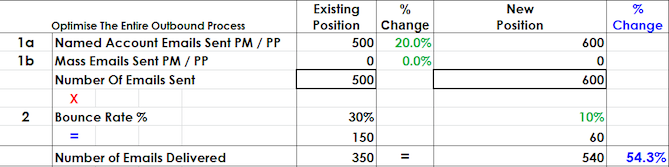
The two parts to this are:

The total result of a 10% increase in opens and a 150% increase in replies is a cumulative increase of 324%, or from 32 a month to 134 a month.
This is a very large omission in many people's strategy.
In our work with clients, we tend to see around a 10% first call conversion rate from email replies. In Figure 3, an increase from 10% to 20% takes the cumulative number of first calls from 3 to 27.
With a tight script and process at this stage, it is relatively easy to achieve a 40%+ conversion on replies to discovery calls.
I lay out our exact script in this blog post which you should be able to implement to bring that level of return.
This is very typical of the type of results we see in a business when they start focusing on their system and reflects the starting and finishing numbers.
And if you can't quite agree with my whole "cumulative" effect concept then serious focus in this one area alone can provide those type of returns.

Phase 4, 5, and 6 of this strategy deal with the conversion rate of calls to business, average deal size, and the number of people prospecting. If you’d like a copy of the Outbound System Optimization calculator download this brilliant whitepaper on how to set up an outbound cold email system and then reply to one of the emails and ask me for a time to run through it with you.
The moral of the story is don't get sucked into the belief that an outbound cold email strategy is based on the power of the pitch or email template. You would be doing yourself a disservice if you did.
As someone who used to teach cold calling for many years, I developed a concept called "learning by role osmosis." This is a principle where people coming into a telesales or cold calling role seemed to acquire the words and phrases (mostly bad) of those around them.
Cold emailing has quickly adopted this trend.
Whatever your beliefs about cold calling, bad or good, cold calling resulted in some significant body of testing and measuring around what words made a strong impact on your success. Unfortunately, that body of knowledge seems to have been discarded in much of the cold email advice I see on the internet.
Let me give some examples:
Using "chat" in cold calling is well known to make conversions tank. The higher in an organization you go, the more emails with "chat" in them will tank.
The reason is fairly obvious. No one has time to chat!
Your prospects are time poor and desperate for results. If all you can offer is a chat and no value, then no one will give you time.
Again, this has been a no-way phrase in cold calling for years. So why is it acceptable in cold emails?
Right from the outset you are:
These are just two examples from many I see in the cold email templates being publicized on the web. If you want to get a strong sales perspective on these things then you can't go wrong with the writings of Jeff Hoffman.
An outbound sales strategy is not based on the success of a magical high-converting email template. But this idea is becoming quite pervasive.
Let me demonstrate a few reasons why if all you've got is a cold email template you have copied from the net then you are in trouble:
Templates are a good starting point, but before you ever start to copy them, run them through a sanity check first:
If you’d like to see the origin of many of the templates being used in today's cold email strategies, I’d strongly recommend reading Barking Up a Dead Horse.
We've covered a lot of ground here, so allow me to summarize.
If you want your outbound prospecting to be wildly successful, keep these key takeaways in mind:


After the shockingly large victory for the No campaign against Greece's bailout deal with Europe, the country has just days to reach some sort of deal that will keep it in the eurozone — or it will painfully tumble out of the currency union.
The real crunch point identified for some time now is a €3.5 billion ($3.85 billion, £2.50 billion) payment due to the European Central Bank (ECB) on July 20. Greece needs to seal a deal ahead of that, with time to spare to get political agreement from parliaments in Athens and Berlin.
So according to the Financial Times, the clear message from EU leaders is that the government has until Sunday to reach a deal — or Grexit (Greek exit from the euro) is all but inevitable. European Council President Donald Tusk said the bloc could face "the most critical moment in our history" if a deal wasn't done.
After the referendum, almost everyone seemed to change their mind and began to regard Grexit as the most likely scenario.
There are good reasons to think that any deal would now be less generous to Greek Prime Minister Alexis Tsipras than it was before the referendum. Here's Deutsche Bank strategist George Saravelos:
Our best guess is that creditor demands are likely to be more strict than under the prior EFSF (European Financial Stability Facility) proposals: on the one hand, Greece's macroeconomic conditions have deteriorated. On the other hand, these commitments will need to refer to a potential third ESM (European Stability Mechanism) program spanning over a longer time horizon and with greater financing needs.
So the two positions have, if anything, widened from where they were a month ago. In Greek politics, Tsipras is now riding high. He's as powerful as he's ever been, having won both the election in January with a higher proportion of the vote than polls suggested, and overwhelmingly triumphed in Sunday's referendum.
As a result, he simply can't accept a deal even less generous than ones he's already campaigned against, both earlier this year and since the first bailout in 2010. It would have been hard enough to get internal political agreement for what was presented before — now that Syriza has had such an impressive victory, it would be disastrous.
Europe is no closer to offering debt haircuts for Greece than it was before the referendum, but the pressure is now much heavier on the government to get some major concession.
Without a deal, the deadline for that debt repayment to the ECB on July 20 will be missed. The ECB also provides the Greek banking system's lifeline in the form of Emergency Liquidity Assistance (ELA). It kept providing that assistance (though didn't increase its level) even after Athens failed to make its International Monetary Fund payment on June 30.
But it won't be able to turn a blind eye to a eurozone government actually defaulting on a debt that's owed directly to Frankfurt. That puts the already-chaotic Greek financial system under terrible risk.
To avoid it, the government could start issuing scrip — a sort of parallel, coupon-like currency. They could pay wages and pensions with that, require that retailers accept it, and save the actual euros for debt repayments.
But it's easy to see how this would be the first concrete step to Grexit. People would want euros rather than the parallel currency, so even when the government pegged the value to the euro, a black market would almost certainly emergence in which it was worth less. At that point, the parallel currency might as well be named the drachma.

Chinese stock markets are in complete collapse right now, with the main Shanghai Composite index losing 30% of its value in just the last three weeks. The turmoil is now starting to spread to other Asian markets and global commodities markets.
The reason behind the crash is this: millions of ordinary Chinese citizens sunk borrowed cash into shares, which inflated prices to unsustainable levels.
When prices began to dip, these investors were forcing to sell shares to pay back the borrowed money and cover losses. That vicious circle of selling is going on right now and it's creating "panic" and pushing down prices.
A huge amount of money has been put into Chinese stock markets over the past year or so by regular Chinese people, something the government has encouraged. There are now 90 million "retail" investors — ordinary people who own stocks — in China, making up 80% of all shareholders. That means there are more stock market investors in China than there are Communist Party members, Bloomberg noted recently.
The rush of money into Chinese stocks coincided with a surge in the benchmark Shanghai Composite, which had risen over 150% since the start of the year when it peaked in June.
 But the companies whose share prices were rising weren't actually getting any better — the prices were going up simply because there was so much demand and people were bidding prices up.
The cracks began to show when shares in a few notable Chinese companies, such as Hanergy, went into free fall earlier this year.
That unleashed the biggest problem of all — margin calls. Most of the retail investors who put money into shares weren't using their own cash, but using their money as collateral to borrow way more money than they had to invest. This is known as "leveraged investing."
Chinese brokerages went all-in on this — Credit Suisse estimated that the figure for borrowed funds invested in the stock exchange reached between 4.4 trillion yuan (£460.1 billion, $708.3 billion) to 5.9 trillion yuan (£617 billion, $949.8 billion) before the pop, according to the South China Morning Post. At the top end that's 9% of the exchange's entire worth.
But when prices went down, the brokerages that had advanced all this money asked investors to put up more cash to cover the fall in value. Sophisticated investors would have the resources to do this and the understanding to calculate whether it was worth the risk.
But most retail shareholders just sold the stock they'd already bought, using this cash to meet the fees. That's now creating the opposite problem to the one that inflated the market — a wealth of sellers, pushing down prices.
Despite the fact that the Shanghai Composite has fallen off a cliff in recent weeks, it looks like the fall will continue. Repeated efforts by the Chinese government to stem the losses have failed and Citi calculates that just 1/4 of leveraged investors have been driven out of the market. Plenty more will be flushed out.
The panic is now starting to spread to other markets that haven't been hit by the same problem. It doesn't look like this isn't going to end well.
China’s stock market has lost over $3.25 trillion in value in less than a month without creating a domino effect across the world. Chinese markets continued their plunge this week, wiping close to 37 percent off the market’s valuation from June 12 peak. The intensity of the loss can be judged from the fact that it is nearly twice the market capitalisation of all stocks traded in India and more than the Spanish, Russian, Italian, Swedish and Dutch stock markets combined.
Since June 12, the Shanghai Composite has lost an unnerving 32%. The Shenzhen market, which has more tech companies and is often compared to America's Nasdaq index, is down 41% over the same period.
Normally when one market falls, especially of the size of China, other markets follow suit. China in fact is the second biggest market in terms of market capitalisation but despite a 37 per cent fall in its value, Dow Jones, representing the largest market, is down by less than only one per cent in a month.
Why is it that China is falling in isolation?
The answer is absence of foreign institutional investors (FIIs) in the country. FIIs exposure to China is through stocks listed in Hong Kong in what is known as H shares. China prevented entry of foreign investors in its country. Reuters reports that a landmark scheme linking Hong Kong and Shanghai stock markets launched last November has failed to get much foreign participation, with concerns about stock ownership and how trades are settled dogging investors. Even MSCI (Morgan Stanley Capital International) index decided to delay inclusion of China’s A share in its list of investable shares.
According to Thomson Reuters data, foreign investors account for less than 1 percent of the mainland equity market as compared to nearly 25 per cent for India. Thanks to this limited exposure by foreign players directly in China, a contagion to other markets has been prevented.
The Shanghai Composite, the country’s main index, has fallen nearly 30% in less than a month. The sell-off of small-cap stocks, which had led the rally, has been even sharper. Chinese regulators may have more levers to pull than their peers in most countries, but even they, it turns out, are powerless to tame the alternation between exuberance and fear that makes stockmarkets yoyo. In fact, their efforts to do so may be exacerbating the volatility.


You may not know it, but you have a stalker on LinkedIn. You can’t get rid of this particular stalker, either. There’s no way to block or report this stalker. What’s more, LinkedIn wants this stalker to “follow” you everywhere.
Once you find out about this stalker, you should actually embrace it.
That’s right. Your “stalker” is your Headline. You know, that line that appears usually next to or below your photo and/or name on LinkedIn.
Think about it. When you post almost any kind of content on LinkedIn, when you appear in someone else’s “Who’s Viewed Your Profile” or “Who’s Viewed Your Posts” feed, or even when you appear in one of your connection’s News Feeds… your Headline “follows” you.
Since LinkedIn is giving you and your stalker this valuable real estate, you should strive to use it to its highest and best use.
Let’s quickly go over what your Headline should NOT be:
None of these Headline examples tells those who see your name, photo and Headline throughout LinkedIn why they should visit your Profile. And that’s the goal of everything you do on LinkedIn: To attract viewers to your Profile.
You want to “attract” people to your Profile by phrasing your Headline to provide your value proposition, or what you bring to your customers or clients when you sell your product or service to them. Few things scare a LinkedIn user away from connecting with someone else than seeing the phrase “sales rep,” “sales manager,” etc., in someone’s headline.
Instead, try writing a Headline that piques curiosity, creates immediate engagement and gets them to click on your name or photo. Here’s a couple of “value proposition” examples:
There’s all kinds of examples out there. But just remember to create engagement and curiosity in your headline to attract LinkedIn users to your Summary and Profile.
A quick note here: I had advised against using keywords in your Headline. Let’s amend that: Use keywords, but utilize them in a natural, non-keyword’y way.
You can even have a very minor call-to-action (CTA) in your Headline. It should ideally “point” people to your own LinkedIn Profile to learn more about what you do. Your Profile should also highlight why you are the person to go to in your industry.
Here’s one example of an almost-perfect Headline CTA: I’ve noticed a lot of my fellow Social Selling practitioners use this phrase (or something to the effect of it) at the end of their headlines:
Learn How in My Summary Below…
This is about as much of a CTA you should have in a Headline. As you might have guessed by now, though, this specific phrase is not totally effective. Why? If a reader sees this in a Headline, but the Headline is in, say, a Group post or “Who’s Viewed Your Profile”… well, there is no “Summary Below,” is there?
You might think, “Well, this person should know they need to go to my Profile to see my Summary.” I’d reply by saying, “Why take that chance?” It’s that simple, actually. Instead, use this type of phrasing (like I do):
Learn How in My Profile Summary…
This tells your reader that to learn more about whatever it is you do, she or he needs to visit your Profile—which they can by clicking your name or Profile photo. It’s a very simple tweak, but an effective one.
By effectively using the 120 precious characters you have in your Headline, you can turn this particular “stalker” from a do-good-for-nothing waste of space into a high-profile (pardon the pun) marketing message that draws people to your Profile from just about anywhere your name is seen on LinkedIn.
This post first appeared on LinkedIn.

What behaviors drive successful salespeople? Last year, research by my people analytics company VoloMetrix identified three things that were highly correlated with top performing reps: More time spent with customers; larger internal networks; and more time spent with managers and senior leadership. These three behaviors persisted regardless of region, territory, or sales role, suggesting that they are foundational ingredients for success.
We came to these conclusions after studying the sales force of a large B2B software company using six quarters of quota attainment data for several thousand employees. We then correlated it against 18 months of VoloMetrix-created people analytics KPIs. Since then, we have had the opportunity to work with several more companies to perform similar and much deeper analyses.
Building off of the earlier findings, we have developed a broader framework for each of the behaviors we idenftified (two of which we combined), plus an additional one:
In total, our new analysis suggests that sales success requires the right engagement model with customers, the right relationships within your own company, and putting in the needed time and energy. These insights may seem intuitive — and in many ways they are — but, according to the data, the details matter. Here’s how our findings play out:
Customer engagement doesn’t just mean spending time with more customers. We’ve stated before that top performers spend up to 33% more time with customers per week which, depending on the company, is typically 2-4 additional hours of time. It’s clear that time with customers matters. However, through further analysis we’ve found that degree of focus can matter as much or more than total time. For example, in one large B2B technology company, top performers spent 18% more time with customers per week. Yet they interacted with 40% fewer accounts over the course of a quarter allowing them to spend more time with each of those accounts relative to lower performers.
Of course, these metrics are not one size-fits-all and the right balance varies by company based on what they are selling (e.g., highly consultative sales processes benefit most from depth whereas more transactional models can benefit from breadth). Regardless, these key metrics relating to time spent with customers and account relationships have emerged both as strong predictors of sales outcomes as well as highly actionable metrics for sales leaders to track, incorporate into territory design and use to help their teams improve performance.
A bigger internal network is generally better, with some nuances in sales support. No matter how we cut the data, top performers have significantly larger networks within their company (30-40% larger, which typically equates to 10-20 more people they interact with regularly), higher centrality (a measure of influence within the network), and spend more time with leadership. When you think about the level of complexity in a large organization, it makes sense that people who find ways to build more relationships get exposed to more ideas from across the business, are able to access expertise quickly when needed, and have more context about what’s happening. All of these things help them to be successful.
But building relationships doesn’t mean attending lots of meetings, especially those with 20 or so attendees. When we measure relationships, it involves both a frequency and an intimacy component. To qualify as a “relationship,” you have to not only interact with someone frequently (at least 2x per month), but that it also has to be in a relatively intimate group (five or fewer people involved in the meeting or email). So to establish a large network, you have to interact with many people, on separate threads, frequently.
This takes a lot of time. The top performers we study typically spend anywhere from 10-15 hours per week interacting with small groups inside their companies. Often sales executives balk at the idea of their reps spending so much time internally instead of out selling, but the data suggests that it is time well spent.
When we work with companies, we help them find ways to minimize large standing meetings and instead create ways to enable broader networks consisting of smaller groups of people. The unfortunate truth is that top performers in most companies are finding ways to build these bigger networks in spite of the processes they work within rather than because of them.
Management relationships are another important aspect of internal networking. Generally speaking, more exposure to senior leadership correlates with successful sales outcomes. That said, we have found a lot of variation in the specific interaction patterns between sellers and front-line managers across regions, product lines, and companies. For example, in some companies we have seen an inverse correlation between front-line manager involvement and seller success, meaning that top sellers spend less time with their direct manager than lower performers do. However, even in these situations, the top sellers spend relatively more time with other members of senior leadership.
Lastly, in complex sales organizations, the relationships between sellers and sales support staff is an area where more relationships is not necessarily better. In fact, in some cases sellers who have more relationships with sales support workers perform worse. This is sometimes the result of inconsistent pairings in which, for example, sellers aren’t able to work with the same pre-sales specialist consistently and instead have to work with a different one each time. This can lead to more relationships, but a weaker team. We’ve also seen that there is a stronger relationship between the time spent with support relationships and the complexity and number of products being sold than there is to actual outcomes. In other words, sellers who are trying to sell a broader portfolio or simply have more complex offerings are more heavily dependent on support resources, regardless of their effectiveness.
Sales is hard work (but you probably knew that already). Consistently, we’ve found that top performers simply put in more time. Their weeks are approximately four hours longer, with up to 40% more time spent outside of normal working hours compared to their lower-performing counterparts. But the answer isn’t saying that everyone should just work harder; even low performers work an average of 50 hours per week.
The implication, instead, is that every hour is precious. So echoing some of the findings above, here are some changes that could be made at the company level:
Lastly, a note on causality. All of the above metrics are highly correlated with sales success, but we haven’t yet accumulated enough data to have confidence on which of these metrics are truly causal. So while it is true that top sellers spend more time with customers, it is not necessarily true that an underperformer would suddenly become more successful simply by spending more time with customers.
That said, rigorously proven causality is not a prerequisite for learning from these insights. Quite a few companies are enjoying immense value in the predictive power of these metrics, which typically account for up to 70% of the variance in sales outcomes quarter by quarter And having access to objective, up-to-date data on what behaviors works and don’t work within a specific sales organization is a powerful compliment to existing management tools and allows leaders to set their teams up for success.

Frankfurt (AFP) - International borrowers are increasingly turning to the euro when borrowing money, thanks to the low interest rates in the single currency area, the European Central Bank said on Wednesday.
"In an environment characterised by low and declining interest rates in the euro area, the euro was increasingly used as a funding currency by international borrowers" in 2014 and early 2015, the ECB wrote in its annual report on the euro's international role.
"The share of the euro in international debt issuance increased by nine percentage points to almost 30 percent in the first quarter of 2015, compared with the same quarter of 2014," it said.
The ECB said that the decline in the value of the euro -- which has fallen by 10 percent in the 12 months to May 2015 -- affected different indicators of the euro's international use.
At constant exchange rates, most indicators used to assess the euro's international use "either recovered further from their dip in the wake of the euro area sovereign debt crisis or remained broadly stable over the review period," the ECB said.
One of the most visible effects of the euro's depreciation over the review period was the decline in the nominal share of the euro in globally disclosed foreign exchange reserve holdings, the ECB said.
The share declined by 2.2 percentage points to 22.2 percent in 2014.
"Adjusting for exchange rate changes, however, the share of the euro remained broadly stable (declining by 0.2 percentage point), which suggests that valuation changes were the overarching determinant of the decline," the report said.
"Despite the impact of globally diverging monetary policy cycles, foreign exchange managers on average were not actively shifting portfolios away from the euro area," said ECB executive board member Benoit Coeure.

Marketers live and die by the numbers. Data helps them plan campaigns, measure success, and make business decisions. With 2015 already half over, we wanted to take a look at some statistics that caught our eye.
These metrics highlight the trends in the industry and point us toward future marketing success.
It’s been a long and steady path for content marketing, but at this point, the numbers don’t lie. With content taking up more and more marketing budget dollars, this is a good signpost of where the industry is going. More professionals are putting their money where their mouths are, and content is bigger than ever. (Contently)
Big data has been a major buzzword across the business world of late, and marketing pros can take advantage of these insights. Putting the power of information behind your business decisions—including marketing—can yield positive results, and this increase in spending on the subject shows how many people believe in this strategy. (MediaMath)
The push into digital campaigns has also changed marketers’ biggest challenges. Sure, budgets are still an issue, but the top problem cited in this survey was happening within IT and web development teams. Lack of time to test and optimize campaigns was the second most common pain point, with 47%. As more departments leverage new technical tools, it’s important that the various programs and groups can work together with ease. (MarketingCharts)
The Internet never sleeps. There’s always new content coming out, and material focused on marketing is no different. More and more brands have realized the importance of maintaining a calendar and schedule in their content strategies, and anyone who has yet to get on that bandwagon will need to do so in order to compete. (Wyzowl)
Marketers know the best ways to connect, and those focusing on reaching businesses have fully concentrated their efforts on content. This stat proves just how thorough the transition to content marketing has been in 2015, and shows that it’s unlikely to let up over the course of the year. (Regalix)
With so much of content marketing staying within the business world, understanding what and how people want to read and share can be a big competitive edge. It’s no surprise that busy professionals are voicing preferences for content that is short, snappy, and easy to digest. (Demand Gen Report)
Our interest in quick consumption means that video has risen in popularity. It’s increasingly common for this medium to play a starring role in content strategies, while other channels have gotten comfortable in the supporting roles. (Regalix)
Just because video is the current darling of the industry doesn’t mean other channels should be neglected. Quite the contrary. Smart B2B marketers are casting a wide net. So yes, do put your resources behind video, but remember that a holistic strategy still needs other formats in order to have the best chance for success. (Demand Gen Report)
Being a strategic marketer isn’t all about data and numbers; it also takes streamlined processes to ensure your team is getting the most out of their time and resources. Without them, companies are wasting significant budget. (Gleanster Research)
The mobile takeover is real. Personal computers and laptops are still in the top spot for ownership among Internet users at 91%, but smartphone ownership for this large demographic is drawing even. Even tablet share is improving, with 47% ownership. This means that marketers need to be making their materials available (and making sure they look good) across a range of devices. (GlobalWebIndex)
The growing popularity of mobile platforms has gone hand-in-hand with important new opportunities for marketing professionals. For the marketing field to be so fully on board with the need for mobile-friendly material this early in the game is an indicator of how quickly smartphones and tablets have come to have dominance. If you’re not in that 71% yet, it may be time to reassess your strategy. (Salesforce)
That may seem stratospheric, but it’s nothing compared to the more than 360% increase in views between Q1 2015 and Q1 2013. In the past few years, mobile has proven itself as a viable platform for the most popular marketing format. When you’re preparing any marketing videos, expect that a good chunk of your views will come on smartphones, and to a lesser extent, tablets. (Ooyala)
Content marketers have to think about two things: the best method for sharing information and the best channels for distribution. That means knowing what kind of content will perform well on what platform. If your brand is focused on Twitter, it’s worth knowing what type of tweets are common. It’s an increasingly visual network, with more than half of tweets including an image. (Hubspot)
Visual content on Facebook is also snowballing, but here it’s more likely to be video. Thanks to the auto-playing features the social network rolled out, this may be one of the best places to get your video content into circulation. (Facebook)
Facebook and Twitter still tend to dominate the social business conversations, but this stat proves that there’s plenty of activity happening on other channels. That said, nobody can be equally attentive to LinkedIn, Google+, Snapchat, Instagram, and Pinterest all at once. In order to best reach their desired audiences, marketers will need to dig deeper to find their people. The more you know about that goal audience, the better you’ll be able to target the channels where your content should be. (GlobalWebIndex)

Every forward-looking company in the nation is currently fine-tuning its sales and marketing strategies to win the affection of the Millennial consumer. If you are a salesperson, you know how difficult a target audience this fast-paced, tech-savvy, whistleblowing generation has proven to be.
Nevertheless, capturing and maintaining the interest of the trillion-dollar demographic is an economic essential, as members of Generation Y account for a soon-to-be majority share of national buying power. You need to woo these future leaders with authenticity, not sweet talk, as they are the most educated generation to date.
The Millennial buyer can be intimidating, but the challenge to gain their trust and interest is nowhere near impossible. Follow these tips to learn how to confidently and effortlessly sell to your most important buyers.
First things first, you have to know your buyer. Luckily, there is a plethora of new findings in market research regarding Millennials to use for reference. Read up on the buying trends, preferences, and other unique characteristics of the consumers to develop a tailored sales approach.
Part of your researching responsibilities will be to distinguish which qualities assigned to Millennials are unfounded stereotypes and which actually reflect truth. Making this distinction will allow you to effectively and accurately size up your buyer. If you do your due diligence, you’ll know to, for example, focus on philanthropic utility in your pitch. Millennials care about global issues, so include how your good or service can provide solutions to these issues in your pitch.
Millennials are a social generation so they will listen to you, but they want their information fast. Quickly drive your point home and then stop trying to persuade.
The ability to smooth-talk is essential to the art of sales. However, another useful skill for a salesperson to possess is knowing when to stop talking. Sales is a balancing act between aggression and passivity. If you think you’re talking too much, you probably are. Studies show that Millennials will likely research reviews of your good or service before buying anyway, so don’t oversell.
Once you’ve taken the time to get acquainted with your buyers, use that insight to make a compelling presentation. We’ve already established that you have a small window of time to capture the attention of Millennials, so it is crucial you perfect your pitch.
Your first impression will undoubtedly be judged on the basis of authenticity. Millennials are skeptical; they want a real, down-to-earth person presenting them with the truth. Don’t try too hard to relate to them; they will be able to tell. Be consistent with any statements you make regarding your good or service. Millennials are researchers, so keep in mind that they will fact-check.
Millennials are big on self-expression. According to a survey commissioned by Comedy Central, comedy provides Millennials a sense of self, more so than sports and music. Members of Generation Y are witty and cunning. Appeal to their inner goofball by cracking a joke or two. It will make you seem more relatable and real. It may even calm your own nerves!
If you found these tips helpful, click here to see more ways you can make yourself stand out to your Millennial buyers.


It’s certainly no secret that content marketers are turning to wire distribution as a way to expand the reach of their content.
By using a newswire service to syndicate or promote content, public relations and marketing professionals can reach new customer segments and build relationships with new influencers.
But what else can a wire provider offer? Here are five ways a newswire service can give your marketing and PR campaigns a boost.
1. Copy Editing: Even if you spend hours writing the perfect press release and asking colleagues to edit it, there’s always the chance that a fresh set of eyes will catch something you might have missed.
From a missed punctuation mark to a typo in your CEO’s name, representatives who prepare press releases for distribution are trained to see—and fix—all sorts of mistakes, allowing their clients to rest easy knowing their news will go out without error.
2. SEO and Social Media Advice: The representatives at your wire provider look at a lot of press releases every day. They know what works and what doesn’t, which clients have seen success and why, and can offer tips to tweak your release for the best possible visibility.
Maybe your release needs a shorter, “tweetable” headline that optimizes your content for social media. Maybe an editor sees a phrase in your text that would make a good click-to-tweet quote. Whatever your goals may be, don’t hesitate to ask your rep for advice.
3. Distribution Counseling: Ready to send your release, but not sure which distribution is best for your news? Wondering what time you should send it to get the most views? Ask the folks who know the ins-and-outs of the wire for suggestions. They might know of a new way to target industry influences or know what time to avoid sending your release in order to receive optimal pickup.
4. Reporting and Data Evaluation: Your release is out, and you’ve received a post-distribution report. Where should you begin when digging into that data? Ask your account representative or a customer service rep for a walkthrough of the report. With their knowledge of how the reports work, they will be able to offer insight into how the data is gathered and what it means in the context of your greater PR campaign or marketing strategy.
5. PR/Marketing Strategy Advice: With unique insight into the plans and goals of clients across various industries, your wire provider can help with many aspects of your overall communications plan — long before you’re even ready to send in a press release.
From identifying content on your brand website and helping adapt it for the wire, to advice on creating and managing an editorial calendar, the representatives at your wire service have the experience that comes only from working with clients during many stages of the content promotion process.
To ensure your press release service provider is the right fit for your brand, you need to ask the right questions. Download the Buyer’s Guide for Press Release Service Providers and view our companion SlideShare to learn more.

Picture by www.vecteezy.com
I’ve recently written about Persona Based Marketing, which led to some interesting responses and a follow on post.
Persona Based Marketing is based on designing buyer journeys for your prospects assuming you can group them into several key “individual types”. It is a technique for businesses to be able to better relate to their key buyers and deliver better tuned marketing content and messaging. Using Persona Based Marketing organizations get to know their buyers better, how they like to purchase, what are the ways to connect and communicate to them, and what they think about your products.
Persona Based Marketing is focused on answering questions such as:
Once implemented, the potential benefits Persona Based Marketing brings are:
If you are considering Persona Based Marketing here are the 5 things you need to know before committing:
Persona Based Marketing is a manual process that is time consuming to go through and maintain. You need to collect information, define personas, validate them and afterwards start to tailor all your marketing content and campaigns towards it. There is a lot of manual labor involved and it will be probably impossible to cover all potential buyers using this method.
Since Persona Based Marketing is focused on creating buyer “typecasts” there is a high risk of overlooking certain buyer types. Since this is a manual effort targeting the key personas it actually encourages you to ignore smaller groups of personas or individuals that don’t fall into specific groups, which means you are back to square one, if not worse as your personas focused content may scare away Non Existing Personas prospects
Since it is all based on manual effort it is hard to identify more personas and add them into the mix. Eventually you do not want a Website that caters to 50 different types of people. This means whatever personas you started with you are stuck with them for a while now.
Once as a business we group Personas and treat them all the same – using all marketing and sales communications in the same way with this specific group, we are not delivering a personal experience but a Group experience. Two potential buyers from financial services organizations can still have different preferences, behaviors and can be in different stages of the buyer journey. Why would you treat them the same?
When a business decides to communicate with X Personas it means that the audience interacting with the business must fall into one of X journeys. Otherwise they will not get the type of information they need. This means the business is forcing the audience to X journeys instead of analyzing the dynamic journeys the individuals are making. On one hand you are analyzing known journeys so your analytics feedback is very limited and on the other hand there is no way to find out other behaviors that were not designed before hand
If you want to learn more about Persona Based Marketing and more modern alternatives such as Segmentation or Personalization see “Persona Based Marketing, Segments and Real Time Personalization – connecting the dots”

We’re all familiar with the expression “less is more.” But, as marketers, do we ever stop to consider how narrowing our focus might give us better results? Sometimes, we get so overwhelmed by the big picture that we miss out on quick wins and immediate opportunities. After all, our standard strategies tend toward seeking out more leads, more data and more engagement.
What if the key to unlocking optimal demand generation from our marketing campaigns is, in fact, doing less—that is, in regard to downsizing swollen campaigns? Indeed, during the recent B2B Content2Conversion Conference, the VP and group director of SiriusDecisions discussed a growing trend across the marketing landscape defined as “micro-campaigns.” It’s a simple, but counterintuitive, objective: We must aim smaller with our marketing campaigns to realize more success.
In order to create a successful micro-campaign, B2B marketers must utilize data in a highly targeted manner which enables campaigns to become focused for a smaller audience. In doing so, you can create more personal marketing messages for a specific group of buyers.
As such, the driver of your micro-campaign success is your marketing database. Marketers must focus on eliminating “dirty data” from their databases so that they can target their campaigns toward the buyers who are most likely to purchase. When a business’s database is cleansed, enriched and segmented properly, marketers can extract more pinpointed insights about their buyers and, in turn, create more-targeted messages.
So, what are some other ways to ensure your micro-campaign proves successful? Here are a couple tips:
So marketers: Think big, aim small! You’ll be surprised by what you see.

We’ve all got that one friend that brags about their high-flying job, their awesome love life or the swanky Apple Watch they just bought … and if you can’t think of who it is in your group then chances are, it’s you.
Awkward.
Anyway my point is those self-obsessed people are really irritating. Eventually you switch off and stop entertaining it, right?
So when it comes to marketing brands, why do we think it’s ok to be self-involved on our social feeds?
Understandably you want to produce branded content so that you can sell more stuff, but to do that you need to grow a large following of loyal fans – and you’ll never achieve that if you don’t indulge their interests once in a while.
So that’s why the 5:3:2 rule exists.
Sorry football fans but we’re not talking about those kind of rules.
When it comes to social sharing, the 5:3:2 rule is a ratio to follow for a well-rounded social strategy that will keep your fans engaged – and help you build more followers.
So for example, if you publish 10 posts per week then:
5: Should be content from others that is relevant to your audience.
3: Should be content from you that is relevant to your audience but not sales focused.
2: Should be personal, fun content that helps humanise your brand.
The key takeaway here is that everything you publish on your social feeds should be posted with your audience firmly in mind. But how do you achieve this?
Check out these 4 simple steps:
So the first step is to make sure the bulk of your content is curated from other places that are relevant to your niche.
The good news is, there’s a whole world of content out there that you can share. So all you gotta do is find the content that will resonate with your audience!
What do they like to share? What do they like to consume? You gotta do your research and find topics that your customers care about.
To do this, check out places such as:
Once you’ve got to grips with the type of content you like, you can then go ahead and find that content.
I’d recommend using content curation tools such as:
So for example when it comes to curated content on our feeds, we share content like this that we found from Gary Vaynerchuck:

The reason it works is because it’s a useful, shareable piece of content about video marketing that our audience (business owners looking to improve their ROI) would be interested in reading. The article seeks out to explain how a video can help increase your engagement on social media pages – making it the perfect type of curated content for us to post.
When posting curated content make sure it’s:
Next step is to post your own content so now you can breathe a sigh of relief as you have the freedom to start talking about yourself!
Well kinda…
You can post offers or promotions if you wish, but try to remember that social media isn’t the best place to give it the hard sell. That’s a sure fire way to see your followers quickly decline.
Social media is all about attracting an audience with valuable content which will in-turn push people to your site and further along the buyers journey – so focus your efforts on creating blogs, infographics, eBook and videos to post, rather than offers.
For example, we recently created a series of mini infographics with fun facts about social media day. As you can see below, the content provides useful information that is tied to a trending topic meaning it’s more likely to be shared. And because it includes our logo, it’ll help us increase our brand’s reach!

When sharing your own content make sure:
Ah, every Social Media Execs dream: finding content that’s weird, wacky and wonderfully fun.
Well, that’s if your audience appreciates weird and wacky of course.
Truthfully everyone likes to kick back and consume a bit of fun content somewhere down the line. But just make sure that it’s the type of fun that your audience likes.
So for example, this post below is a funny pun that we just had to share with social. It’s not really related to what we do, but it got a few laughs and scored us some shares.
And that’s ok if you’ve got the balance right.

Or there’s this gif that we created for the latest Terminator movie.
As you can see, it’s a tribute to Arnie, while poking fun at the fact that he’s still making those movies at the ripe old age of 67!
Not only is this a fun piece of shareable content, but it was created by us so it’s a double win for social success.

When posting fun content make sure:
So now you’ve got your 5:3:2 rule down to a tee, you’re gonna have to set up an automated schedule so that you make sure your feeds are always active.
A social media management tool is the perfect platform to help you do this because you can schedule your posts, manage all platforms in one place, and find content from other sources!
Our top platforms include:
And if you’re wondering what time you should post your content to get the best results then check out this handy infographic from QuickSprout.
So there you have it – the 5:3:2 rule explained! Remember, the only way you’re gonna build a strong social following is if you think about what your audience wants to see.
Try not to be too sales-orientated, show off your human side, and post valuable content that people would love to share.
Good luck!

 For the first time in 40 years, my beloved Golden State Warriors are NBA champions!
While I might attribute this to my lucky socks and pregame ritual, many pundits credit their teamwork. And specifically, their league leading record of assists per game.
"The face of the franchise was Stephen Curry, a point guard who was voted the league’s Most Valuable Player …. a highly aware passer and playmaker (he finished 4th in assists)"
- The Economist
Just like in basketball, sales requires a team effort to win.
I've rarely seem a sales teams make the number by relying on one or two reps (who hit it out of the park). Only by elevating the performance of the majority can the team reach its goal.
Team success is contagious. It improves morale (and Glassdoor reviews) which leads to improved hiring and retention. So how do you make it happen? Here are a few quick thoughts:
The best part about rooting for your home team (besides the beer) is the camaraderie with fellow fans. The same logic applies in selling. A team approach fosters positivity and competitive drive.
Now, let’s hope we don’t have to wait another 40 years for a Warrior win.
Have you added a team emphasis to your sales organization? What results have you seen?
---
(Photo credit: Shea Huening)


The hottest buzzword in the “inbound” landscape these days is inbound sales. Inbound sales is a refinement of more traditional sales processes that focuses on better utilizing data from inbound marketing and making the buyer journey more natural and helpful. Everybody’s talking about it, and the demand for implementing inbound sales along with inbound marketing is growing quickly. There are agencies popping up or realigning themselves to service companies seeking to better handle inbound leads and train sales reps on best practices. So the inbound revolution continues beyond marketing, but how did we get here and where are we going?
Inbound marketing has been around since the mid-2000’s when HubSpot and a few other pioneers started rethinking marketing and sales. The idea has always been to make sales and marketing less intrusive and more valuable to customers. Turning marketing into education and sales into service has been the mantra of the inbound revolution since its inception.
But when the rubber actually hit the road in 2009 and beyond, sales and marketing departments and practitioners in all kinds of industries found the inbound revolution a little hard to swallow. In particular, there were traditional lines drawn between Sales and Marketing institutions, lines that were not to be crossed. Marketing’s job was to attract visitors and leads, and hopefully, some of them would be qualified. Marketing would throw them over the wall to Sales, and Sales would call, qualify and convert leads into opportunities and, again hopefully, close them.
In this mid-decade scenario, inbound marketing was at first treated with skepticism, since it was new. Fast forward to 2015, and it’s pretty much mainstream. Not everybody is practicing inbound well, but most companies are at least dabbling in its various components, blogging, SEO and social media. What has driven the inbound revolution is the changing customer landscape, the fact that everyone is on smartphones now and everyone is good at rejecting spam and other forms of unsolicited advertising. People want great, helpful content delivered where they hang out online – and nothing else!
The trick for inbound marketers has become figuring out what kind of content for each buyer persona and where and when to deliver it for maximum engagement.
Towards the end of the first decade of the 2000s we started to run into another roadblock. Sales. Inbound marketers were becoming so skilled at attracting and converting leads, that converting them into customers was becoming a real challenge due to the sheer volume. The relationship between an inbound lead and a real prospect was often murky at best, and we were forced to continue “nurturing” them with more content, hoping that their true colors would coming shining through (to borrow a phrase from Cyndi Lauper). Sales reps were becoming frustrated because their call lists were doubling or tripling in size without any significant increase in lead quality or close rates. Many companies considered reducing their marketing to reduce this pressure on the Sales team. So we started rethinking the whole process.
A few years ago, thought leaders in marketing figured out that the apparent dysfunction between Sales and Marketing could be fixed by overhauling and aligning processes. Easier said than done, but yes, we all thought sales and marketing alignment was the way to go. Get the two teams on the same page on targeting, lead quality, goals and process, and you would be able to bridge the gap and start improving sales performance right away.
Not so fast!
Sales and marketing alignment is great in theory, but in practice there are still some monumental barriers. For one thing, marketers and sales reps use different tools and criteria to assess, track and develop leads. Marketing technology platforms like HubSpot and CRMs like Salesforce are the tools of choice for most marketers and sales reps these days. In many cases they are integrated, providing instant visibility and accountability as the sales funnel develops from top to bottom. We’ve also become pretty sophisticated at deploying marketing automation workflows that keep us on our toes when something interesting happens. So what’s the problem?
The problem is that we’re still not in the heads of our inbound leads. We don’t really know what their intentions are when they visit our website, even if they come back to visit multiple times. We can infer intention from their engagement and behavior, but unless they fill out a bottom funnel form requesting a consultation, we’re really just guessing about their sales readiness, aren’t we? We don’t often share data views or KPIs that allow us to assess leads consistently and quickly.
Sales reps may be able to see a lead score go up, but what does it mean? When is the right time to call? What should the rep say on the call? How should she prioritize leads and call the best ones first? This is the quandary for inbound sales reps. What’s the best approach to handling inbound leads, qualifying them and closing them when they are ready to buy?
I think we can all agree that technology and customer expectations have forced us to become better marketers and sales reps. We can’t bombard people with advertising anymore and we can’t just cold call and expect any positive results. The key to this apparent dilemma is working together to understand and help our prospects make informed decisions that may or may not lead to a sale for us. Let me suggest a couple of fundamential changes:
Instead of generating lots of traffic and leads, Marketing’s new mission is:
Attract qualified buyers who are looking for what we sell and help them understand our value.
Sales’ new mission becomes equally customer centric:
Learn about prospects during the buyer journey and be prepared to help them further when a conversation is warranted. If a sale is the best solution, help them learn how to be your customer.
These are two sides of the same coin, and they may overlap during the Consideration Stage of the Buyer Journey. There may not even be a hand-off between Marketing and Sales. Instead, there is a shared visibility and responsibility to find likely buyers that are already in your sales funnel using the same tools and metrics. Then, treat them like royalty.
This will certainly involve collaboration and shared goals, along with truly integrated sales and marketing technology and training to make the most of these new tools. Sales reps and marketers must be able to share the same database and see changes to the buyer journey as they happen in real time. The first rep to make that connection at just the right time wins nearly every time.
Are we there yet?
Not even close. Most of us are still dealing with siloed sales and marketing teams and the “always be closing” mentality. Even early adopters of inbound marketing are still struggling with how to converge sales and marketing so that they aren’t just aligned, but actually working together with a common purpose and methodology. You’re going to hear a lot more about inbound sales in the next few months. It’s the next big challenge for inbound beyond 2015. Do we have all the answers yet? No, but we’re working on it.
Please stay tuned.

This week's blog comes from guest blogger, Jordan Greenberg. Jordan is the president of The Pinnacle Source, Inc., a search and placement firm specializing in, but not limited to, the recruiting of sales/sales management talent for IT companies.
I was blessed to have lunch a while ago with two of the brightest young minds in the city of Denver. They were both candidates of mine I placed as sales reps with the same client just about a year ago. The day they were both onboarded, my client of 20 years expressed his gratitude to me, coated with a blanket of caution.
Dave, the VP of sales at this prominent data storage industry institution, told me that he was certain one of the two would go on to be a superstar. The other, he suspected, I would likely need to replace within about three months per my (retainer) agreement with this wonderful client of mine. The challenge, of course, was to quickly discover which one would be future hero, which one to be goat.
Fast forward to my lunch meeting, where we celebrated their success and their recent closure of one of the biggest new deals in the company’s storied 17-year history. Turns out both of them were, and still are, prolific cold-callers! No one knew a year ago that the two would become tied-at-the-hip buddies, share a truly rewarding personal and business relationship, and even plan a vacation in Cabo together with wives and babies in tow.
A truly perceptive hiring authority would have known that both were bound for greatness if they looked beyond the surface (of their resumes) and into their eyes or checked their guts through a thorough and challenging interview process.
I know this because Dave also hired a third rep from me a few months later who, he was almost certain, would cement his legacy with his employer and enable his team to crush an ambitious annual quota. This candidate “had it all,” he exclaimed. And he was right, except that he was referring to what Derek (candidate #3) had on paper, not in his heart. And therein is the moral to the story: Never hire a set of credentials without scrutinizing a candidate’s motives and character traits.
Never Hire Credentials Only
Per his credentials, Derek was ideal. With a degree in mechanical engineering from a fine university and sales roles with Dave’s biggest competitors, he was a slam dunk hire. Derek knew the technology niche as well as anyone in his age group; had a bona fide Rolodex of prospects and existing customers to accompany him; and the bonus was he hadn’t signed a non-compete clause. Clearly Derek was what one of my mentors used to call a “walking invoice” as a candidate.
So, why was Derek absent from the festive, but working lunch? And why were we discussing the need to replace both Derek and Dave, and not just a time to celebrate? The answers are as clear to me as this morning’s sky. Turns out that Derek’s stellar credentials were just that.
Sellers Must Be Grinders
Credentials, degrees, resumes, even existing “books of business,” do not sell! Motivated “grinders” (to use a hockey term) sell. Candidates who possess discipline and work ethic that result in a truly refined approach to sales succeed in the boardrooms of corporate America. My two luncheon guests, who beamed with an internal glow, sold 20 times the business that Derek did because they are highly competitive, and driven to succeed, despite their “inferior” appearance on paper.
So, when we sat down to order fine Mexican cuisine, the verbal fare was not all about them. It was about coming to a better understanding of the ideal profile for Dave’s replacement, and how we, as a team, could finesse the execs at this data storage client to hire the right leader. These street fighting, white collar warriors, want to stay put, and, in order to produce more exceptional results, they now need a new boss who’s “a little more strategic.”
No, they were not there to beat their own chests. But no one nor any competitive force will keep them from moving onward because of their internal constitution (guts) and their focus to consistently overcome obstacles. And frankly that’s what Derek lacked.
Turns out that Derek was and (I hear) still is, focused on that degree in mechanical engineering. He’s turned his sights to a career in engineering and wants to work for an automobile manufacturer. Dave landed on his feet, of course. He’s a proven IT industry executive who has achieved great results over his career. But, he hired one too many Dereks at his previous employer and he was politely shown the door.
 How to Not Hire Derek
So, how do sales VP’s find more guys and girls like the two I dined with while weeding out the Derek’s, you ask?
After 32 (plus) years of executive recruiting experience and over 700 sales/sales management placements with the world’s leading technology firms, here’s a short list of ideas for hirers to focus on from my recruiting desk:
Tip 1 – Rarely is the best interviewer (in sales) the best or the right candidate.
Focus on doers, not talkers. Ask prospects about tough times in their lives and how they overcame adversity in life or in business. Ask them what underlies their successes. If they talk about their personality, people skills, etc., move on. Sales is not fun. The most popular guy or brightest light at the party will fade out after the beating all great sales people learn to endure. Listen for answers about self-discipline, planning, initiative, competitiveness, resilience, work ethic, autonomy and personal motivation. Yes, you need a team player, but individual greatness comes from late nights of consistent and tenacious and often lonely effort.
Tip 2 – Open-ended questions will get you better results.
Allow the candidate to talk at least 60% of the interview time. But if he or she rambles, as most sales people do, reel them back in. Stop then and ask them to address your questions concisely. If they keep rambling, move on. Listening skills are essential elements of sales success.
Tip 3 – Do reference checks right.
It amazes me to this day, what people will say if you ask the right questions. Check previous (and current) managers and customers as well. Conduct these reference checks yourself, or delegate to a trusted colleague. You will learn whom to hire and how to manage him or her this way.
Tip 4 – Require a mini plan.
Require your true contenders for the position to present you with a “mini” business plan for a final interview. Ask them to execute a 30-60-90 day version of what they will do if the territory or position is theirs. Doers will jump on this chance to prove their desire and worthiness. Slackers and ego maniacs will tell you that their leads are confidential and balk at this.
Tip 5 – Ask how they do what they do.
One valuable line of questioning to pursue in order to determine who to have present that mini plan is this: Describe your sales process or methodology to me. How do you find prospects, and then, how do you qualify them and bring them to close? What do you do personally that works, when it comes to your sales methodology?
Tip 6 – Try using assessments.
I never thought I’d say this, but I’ve learned that some online assessments, culture indexes, surveys, whatever you want to call them, can be very insightful if properly instituted. If you can establish a baseline, or a pattern of results based upon existing top performers, you may be able to “map” future hires to those results. But keep in mind that individuals succeed with a myriad of different methods. Also, if you know that you operate successfully in a truly process-driven selling environment versus a transaction-based sales approach (for example), some online tests will point you in the right direction.
(Performance Group suggests using the Objective Management Group Confidential Candidate Screening. It is the only sales executional assessment available. With 96% accuracy, it will predict what sales behaviors your candidate is capable of executing on. To register for a free sales candidate assessment, click here.)
Finally, I close with a favorite quote from the late, great Peter Drucker that has guided me for years:
In sales, more than in any other role, a resume means next to nothing. Determining real quality takes a face-to-face interview to net out what’s true and what’s not, who’s going to ask for the order versus who’s going to ask about the order. It’s the drive, intangible characteristics, and verifiable achievements that make all the difference.


Marketing Automation makes it easier than ever to deliver more poor-quality leads to sales. A key to this trend is lead scoring. According to SiriusDecisions’ Research Brief1, the problem with lead scoring at many organizations is as follows:
My question to you and top industry experts is this: As we enter the second half of 2015, have companies made the adjustments necessary to utilize lead scoring or is the status quo killing results?
14 industry experts responded with excellent feedback that we'll share in three separate installments (displayed below)—plus one clever response from Jim Obermayer that we felt justified a blog all its own. Let's take a look now at what our first group of experts had to say.
| Part 1 | Part 2 | Part 3 |
| Trish Bertuzzi | Kyle Porter | Matt Heinz |
| Ardath Albee | Todd Schnick | Lori Richardson |
| Tony Jaros | Pam Hege | Jamie Turner |
| Amanda Kahlow | Rafe VanDenBerg | Chad Burmeister |
| Rich Wilson |
One of the funniest but also most illustrative responses came from The Bridge Groups’ Trish Bertuzzi who nailed it when she said:
Companies are still thinking marketing automation (MA) is the silver bullet. They are still running lead scoring systems based on activity as opposed to fit to Ideal Customer Profile (ICP). This forces them to process leads as opposed to qualifying opportunities. Here’s an example:
I am Joe Schmo at ACME Co., and I am a loser. I have no decision making authority, but I get a high lead score because I am on your website a lot and interact with your content, sometimes I even engage in conversation with your sales team.
VS.
I am Abe Lincoln at ACME, and I am the ultimate decision maker. But I have no lead score, and no one contacts me because I don’t have any activity on your website. I ask people who work for me to do the research and report back. I am invisible to you.
This is insanity. The lead score should take into account the ideal customer profile fit and force the prospecting team to look beyond who filled out the web form and to proactively go after the right buyer. A lead is an arrow to opportunity if you do the right things with it.
We couldn’t agree more, Trish.
Next up is the always on target, Ardath Albee who weighed in as follows:
The simple answer is no. I don’t believe most companies have turned the corner.
Here’s why:
Most companies don’t have a documented content marketing strategy.
If they’re even using lead scoring, they aren’t scoring the activities that are indicative of intent and qualification.
Someone may have viewed a variety of resources on your website, but as an aggregate, what intent does their viewing indicate?
Here’s what I mean:
If they visit your blog and read the latest 3 posts written on different topics, are they actively showing progress toward the intent to buy? Or are they just catching up on their reading?
If they register for a webinar, the lead usually gets a higher number of points than if they view a webpage, but did they show up? Did they view the recording when it became available on demand?
If they are never exposed to the material, should the points be taken away as if they’ve never taken any action?
The other issue with lead scoring is that there’s a lack of closed-loop feedback from the sales team as to which leads that scored as qualified actually were worthy of pursuit.
What to do:
Marketers need to follow up with sales to find out “why” the lead was qualified.
Does the reason they became a sales-accepted lead correlate to the way the lead was scored? If not, why not?
What can be changed to start aligning those factors?
Lead scoring can definitely play an integral role in increasing the value of marketing programs and demand generation, but it needs to be implemented in a more thoughtful way that reflects the progression of intent to move toward actually buying from you.
We then spoke to SiriusDecisions’ own Tony Jaros who had this to say:
Lead scoring has often failed to live up to expectations because of the flawed way in which many B2B companies and technology have approached it.
Three flaws:
B2B lead scoring focuses on individuals vs. groups. Groups are often responsible for making purchasing decisions.
Companies score leads via marketing automation (MA) based on interactions that are driven by email; however, MA does not recognize offline behaviors or social if not integrated into the system. This grossly inflates the importance of email and does not recognize other important touch points.
Scoring schematics have been designed by humans; therefore, they have biases based on what individuals "think" is a good lead vs. what the data actually tells us. Many of these schematics are not adjusted on a regular basis to reflect new factual inputs.
Because lead scoring has been disappointing to many, companies have reacted in a variety of ways:
Some have turned scoring on, then turned it off.
Some have been reluctant to turn it on publicly, letting it run in the background as a science experiment that has no bearing on the lead management process.
When investing in lead scoring: ensure it is agnostic, predictive and realistic. It’s not a get it, set it and forget it exercise. Marketing must make sure they are setting expectations properly with sales. Lead quality will improve after testing and resetting. Begin by having the proper processes and strategy in place.
We liked that. After that, we spoke with a new contributor, Amanda Kahlow, CEO and Founder of 6sense. She gave us her take on lead scoring via marketing automation:
Companies that are still relying on lead scoring for demand creation are increasingly finding themselves at a serious disadvantage. That’s because they are not able to track the buying activity of 90% of their prospects. Here’s why:
B2B marketers require a new set of enabling capabilities to help them identify “in-market” buying signals and purchase stage indicators of both their prospects and all others who fit their ideal customer profile. They need a full-picture view of every prospect, account, and contact to give marketing and sales teams the ability to more efficiently deploy.
In a recent blog that I wrote, and posted on the CMO.com site in early June 2015 I said:
You might also learn, as we have, that high scores do not actually translate into better prospects. As a matter of fact, just the opposite can be true.
As an example, for one IT security company, consumers of up to five pieces of content were much better prospects than those individuals who consumed six or more pieces of content. In most companies, leads are sent to the sales force too soon. However, in the case of the IT security company, if only those who consumed six plus pieces of content were sent to sales as leads, they would be receiving really poor leads.
In the next blog in this series, you’ll hear from these experts:
Kyle Porter from the red hot company SalesLoft who says, “Our clients don’t rank leads.” Find out what they do instead.
Intrepid’s Todd Schnick talks about the dangers of relying on technology and algorithms when the focus needs to be on building relationships.
Managing Partner at Homeport Marketing, Pam Hege, lists the top three reasons marketing has checked the “done” box on lead scoring whether it’s working or not.
1SiriusDecisions’ Research Brief – Demand Creation: Planning Assumptions for 2015

When you create emails, do you send them out to everyone on your list? If so, you’re suffering from “bulk email disease.” This very common digital illness occurs when small business owners send every email to every single contact on their list.
Common symptoms include low open rates, poor conversions, and confusion about what to do next.
Well, If you’re ready to conquer this condition once and for all, you’ll need a healthy dose of segmentation. This includes dividing your larger list into small, targeted subgroups and coming up with a content strategy for how and when you’ll send emails to each list.
A method with proven results, as illustrated in the chart below, segmentation can increase your open rates by nearly 39 percent. It can also help boost your leads by 24 percent which is much higher than average growth statistics.

Here are six ways you can segment your list and get it back on the mend:
1. Geographic area
Segmenting lists by geographic area is one of the most popular methods and can be helpful for many reasons. This method gives you the opportunity to communicate with and talk to your customers where they are, increasing their ability to relate to your business.
Remember though, there are some businesses like cleaning or meal delivery services, which are limited to a geographical region. For these businesses, splitting contacts into even smaller segments, such as cities or towns, is useful.
2. Demographics
Similar to location, segmenting your list by demographics may work well for a single email or future email campaign series.
Let’s say you run a retail business that caters to women ages 30-60. When you release a new item that appeals more to the under 35 crowd, you can increase your chance of creating buzz with an email specifically for the people on your under 35 list.
The standard business demographics that are frequently used include age, gender, and income level.You can collect this information from customers by including it on a signup form and embedding it on your website or blog.
3. Loyal customers
Everyone likes to be rewarded for their loyalty. You’ll find that your customers are no different. With a marketplace overflowing with options, repeat buyers are a much smaller segment than they once were.
Use this to your advantage through emails that show your frequent customers you appreciate their business. Consider making a ‘Loyal Customer Promo’ or send out an email inviting 15 of your most loyal customers to a sneak peek of a product. You can make the deal even sweeter by giving them a chance to buy it with a select percentage off the final cost.
4. Brand advocates
Every business has a group of customers that advocate for their business without being asked to do so. This is also known as benefiting from the power of word of mouth marketing. Create a segment in your email list for this group. Much like your loyal customers, it’s important to reward those who spread the word about your business.
How do you identify a brand advocate? Look for customers that sing your praises on social media. Customers that have referred friends to your business, or reached out with positive feedback should also make the list.
5. Inactive customers
From those who champion your brand to the group that is nowhere to be found, you’ll need another segment of your list that’s dedicated strictly to inactive customers.
You shouldn’t let inactive customers go without a fight. Okay, maybe “fight” is a strong word, but you shouldn’t let them go without making a targeted effort to bring them back into your sales fold.
Consider sending a promo email to those inactive customers. Use a message titled, “We miss you!” or “It’s been a while, how have you been?” to reestablish contact and attempt to connect with them again. You can also send a survey asking for insight on why these customers have strayed away from your business. Through the survey results, you could make improvements to keep others from straying.
6. Role or position of contact
It goes without saying that to be effective, an email has to land in the right inbox. If an office supply store, for example, sends a promotional email to a CEO rather than the office manager, it’s probably going to be ignored. For this reason, it’s important to break up your list by positions, if possible. By doing so, the right person gets the right email, which leads to increased sales.
A few words on implementation
Curing bulk email disease can take some time. In fact, we suggest starting with only two or three segments listed above. If you overdose on segmentation, you could get frustrated and make your email marketing strategy more complicated than it needs to be.
Need extra guidance? Luckily, we have a resource guide to help you segment your list in your VerticalResponse account. Check out the step-by-step segment instructions to get started.

Excel. Excel is the worst CRM in the world.
There is no competition. In the late 90s and early 2000s I remember using a CRM that had to sync across each computer from a master database daily. It took an hour and crashed frequently. This is still better than Excel. Here is why:
At least teams share Google Docs. Excel spreadsheets are nasty little things that are isolated by nature, and seldom shared. When they are shared, they are not done so with an eye on collaboration. Worst still, updates don’t propagate across the organization, but errors in formulas do.
One of the most frequent mistakes that companies make is to focus so much on closing the initial sale, that they forget about the renewal and upselling process (more on how to improve SaaS renewals here). A well implemented CRM like Salesforce helps ensure employees are reminded to reach out to customers in order to identify upsell opportunities and warm them for renewals. Excel won’t do this and certainly doesn’t notify the Customer Success team to reach out and help onboard new users and regularly check on their progress in adopting your product.
Why do people pay so much for Salesforce? Because its reporting features kill what the cheaper solutions offer. Any CRM includes some pre-canned reports that can be run by someone with little or no knowledge (or perhaps initiative) of boolean logic. CRMs serve two major purposes.
CRMs do all of this quickly and efficiently. The longer and harder it is to run a report, the fewer reports that get run.
When someone says, “I don’t use the CRM, I track that in Excel,” what they are really saying is, “I’m a selfish ass.” Using a CRM is part of contributing to a team and an organization. There is nothing more frustrating than phoning a lead to find out that they are already speaking with Selfish Ass Sam. But if Sam isn’t recording his activities in the CRM, it is inevitable.
Excel, Google Docs and .CSVs are great tools. I spend a significant amount of time each week downloading files, merging them, cleaning them, and importing them into other platforms. They are a great way to manipulate large amounts of data efficiently, especially in advance of importing it into another platform (like Salesforce). Any SEO, CRM or paid advertising specialist knows this.
What Excel isn’t good for is updating and tracking incremental data. Salespeople that rely on Excel because they can’t — or won’t — adapt to using a CRM, are an anchor dragging the team down. Unfortunately some people will never change their work process to include using one, and at some point, sales managers have to start making tough decisions if these team members have a future with the organization.
Get helpful Salesforce insights with the free ebook.


When someone yells your name from across the street, you instinctively stop and look to see who it is. The French philosopher Louis Althusser came up with the term interpellation to explain why this happens, how we create our identities, and how it influences our self-perceptions as individuals in society.
Although the theory gets a bit more complicated when you dig into it, the big takeaway for marketers is that we immediately recognize ourselves when someone, even a person we don’t know, calls out our name and identifies us by our title, whether that’s as Bob the sales rep, Anna the data analyst, or Terry the CMO.
We internalize the connection, and the person hailing us has grabbed our attention. This is just a taste of the power of personalization.
When you consider the sheer magnitude of marketing messages that decision makers are exposed to on a daily basis, how many brands’ products and services do you think stick out in their minds?
Research from The Radicati Group found that more than 196 billion emails were sent every day in 2014. Meanwhile, clicks and impressions from paid ads, search engine optimization, video ads on YouTube, and a variety of other channels add up to an exceedingly crowded digital environment where most brands are shouting, “Hey, you!” and expecting to see leads and revenue start pouring in.
It doesn’t work like that.
Experian explained that personalized emails earn 41% higher click rates and almost 30% greater open rates than generic emails.
In short, you have to interpellate your audience, but go beyond name recognition and truly get at what makes B2B buyers tick as decision makers. It’s only at that point that you can consider personalizing your video marketing content to speak to a specific audience, generate higher-quality leads, and build your client base.
To help you get that point, consider these three keys to personalization:
Your customer relationship management (CRM) software only does so much for your marketing and sales teams. It’s an excellent resource to collect, store, and centralize client data, but you need to keep your ear to the ground to fill your CRM with accurate and up-to-date information.
One way companies have done this is by actively keeping record of every interaction they have with their customers, in order to help develop a clear picture of what their target audience wants and needs.
What motivates them? What are their pain points? What are their needs and preferences?
Many organizations also use surveys and questionnaires to understand which current customers are ripe to target for lead generation. These strategies take a lot of time and effort, and it can be difficult to discover new customers through channels you may not have considered before.
Social listening and analytics software helps you dive deeper into social media to uncover your audience on these powerful platforms. Search algorithms help flesh out an audience by looking at the social breadcrumbs they leave, including the words and phrases they commonly use, their geography, and their industry.
By listening carefully to your existing customers, leads, and prospects, you’re in a much stronger position to target your marketing efforts at a specific group of buyers.
On the opposite end of the spectrum from broadcasting is narrowcasting, a strategy that companies use to get their message in front of the right audience instead of trying to appeal to the widest range of buyers possible. In other words, you need to be more tactical and precise about who you’re trying to attract, and that begins with segmentation.
When you consider that YouTube’s monthly audience consists of about one billion unique visitors, it should be clear why you need to put a fence around your target.
With the wealth of information you’ve collected in your CRM and through social listening and analytics, you should have the data necessary to develop buyer segments that have clearly defined borders. The baseline for many organizations is demographic data that helps isolate buyers from specific geographic locations, industries, company sizes, and revenues.
Beyond that, psychographics for individual decision makers in your audience help you figure out what customers value and the strength of their opinions. These insights are critical for creating marketing campaigns that speak to your audience’s needs.
With well-defined segments, a key part of the personalization equation is using the right channels to get in front of specific buyers. Let’s take email as an example. It’s commonly assumed that video naturally fits on social media sites or video distribution platforms like YouTube.
Email gets forgotten in the conversation, but it has proven to be one of the most effective channels to reach and engage buyers.
For instance, Switch Video helped Vidyard with a holiday-themed video email campaign that was sent to thousands of recipients. In the video, a gift box is passed among multiple staff members, but it’s meant for just one person—Tony—to open. The video keeps you engaged until the very end.
The company was able to get 71% of viewers to watch the 45-second video all the way through, and click-through rates more than doubled compared to previous campaigns. In fact, the video’s performance beat industry standards for open rates and completion rates by 20%.
At the same time, Vidyard delivered content loaded with fresh perspectives on improving your marketing campaign by combining the power of video and email.
Email is just one out of many channels you need to consider to make a big impact with personalization. Your top prospects for a certain product or service may spend more time on social sites, while others are heavy readers of industry websites.
Knowing where your audience can be found is more than half the battle in delivering the right message.
Check out how it worked for Vidyard in their holiday video.
You don’t need to be a French philosopher to understand how powerful personalization is. This strategy is a way to build trust with your audience by showing them that you understand who they are and how their pain points hold them back.
Video is a powerful way to accomplish this because it’s a direct appeal to the buyer, creating characters that he or she can identify with, and using compelling storytelling to get the message to stick.

Today I have some business tools to help you improve your schedule and productivity.
Running a business is a full-time job in itself, but today we have quite a few online resources to help us harness our day. By scheduling and outsourcing your tasks you can focus on generating more leads and sales. There are several resources that can bring in extra assistance, and not break the budget. Do you need to free up more time for your business? Take advantage of these productivity resources, and let me know how these work for you!
Get your customers and team together in one place where problems can be solved quickly and efficiently. Zendesk, which offers the ability for any size business to provide support, includes a lot of user-friendly features including a simple dashboard with easy to find menus, chat services, voice mail, support tickets for tracking, and much more.

Do you need a new look for your landing page or are doing an upgrade? Google Fonts provides countless options with testing features for just about any typeface that works well on the web. Type a word, sentence or paragraph and add your text to collections for later reference. This free tool takes out all of the guesswork in minutes.

Your business has a great idea for a mobile app, but you don’t necessarily have the resources to hire an expensive developer. Gigster includes a large resource of vetted freelance developers who work in a large variety of topics. Get the best deal for your money without sacrificing quality work with over 400 U.S.-based developers to choose from. Previous projects can be viewed right on the website with an option to speak with a freelancer.

If you use times heets for your employees then this tool will cut your time in half. Toggl is simple to set up and can be used for managing your team’s time in a customizable, efficient manner. This provides more flexibility and less confusion on billable time, which means less waste coming out of your expenses.

Hopefully you will find these business productivity tools useful to your brand or business. Are there any that you would like to add as well?
This post is part of a series to help B2B organizations improve sales and marketing cooperation. In part one, you’ll get the basics of beginning the process along with the information and agreements you’ll need to put in place in order to ensure success.
 Sales and marketing alignment is key to business success. You know it, and the research proves it. According to a survey from Demand Metric, 66% of organizations reporting complete alignment achieved their revenue goals, compared to 41% who reported no alignment. Meanwhile, 80% of respondents who said their sales and marketing systems are highly integrated achieved their revenue goals, while only 36% of those who report no integration made theirs.
Clearly, if your sales and marketing teams aren’t going to collaborate, you’ll pay the price as your revenue suffers. What can you do to foster cooperation? First, you have to agree on goals and expectations, and then you build a collaborative sales and marketing process. It sounds simple, but it can be a complex process with a lot of moving parts. Let’s take a look at the basics of gaining alignment between these teams and find out how to build a fully synched-up process that can help these two groups work together more efficiently.
Let’s start with the basics. Many times, sales and marketing cooperation is hindered by a lack of communication and the inability to find a common language that can help the parties reach an agreement. The first step to fostering cooperation is for sales and marketing to sit down and speak with each other. During these conversations, both parties should focus on a few specific areas.
What are the organization’s business goals? These could include increased market share, net new acquisitions, more recurring revenue, reduced churn, a boost in customer lifetime value, or a host of other objectives. Whatever they are, they must first be defined and mutually understood, and agreed on.
 Agree on the target buyer
A failure to reach a decision on who the target buyer actually is one of the biggest breakdowns between sales and marketing. In such a case, marketing tries to attract one type of buyer while sales wants to sell to a different type of buyer. This problem can be avoided by defining the target buyer before executing any marketing or sales process.
The lack of qualified lead definitions is another common breakdown between sales and marketing. A “qualified lead definition” is an agreement about what the stages of qualification are, how you know which one a lead is in, and when a lead is ready to be passed to sales. The definitions should include demographic information (such as company size) and behavioral information (such as a request for a demo of your product). Once the definitions are created, both sides can agree on a lead hand-off process, which will define when and how marketing will pass a lead to the sales team.
Effective cooperation is cemented by accountability between sales and marketing. You’ve already created your common lexicon, with shared definitions for leads and stages; now track metrics to see whether both teams are meeting their commitments. For example, marketing will hold itself accountable to sales by signing up to deliver a minimum number of qualified leads, while sales will be accountable to marketing by guaranteeing they will follow up on those leads in a well-defined, timely manner. (See Get It In Writing.)
Once you’ve covered these basics, you’re ready to move on the developing your process. Here are the 10 steps to ensuring sales and marketing cooperation.
 According to a study from Forrester, only 8% of companies say they have tight alignment between sales and marketing. Watch this webinar to find out why, and get expert tips for getting these teams to work together.
Stay tuned for the next blog post in this series, where you’ll learn how to identify the target buyer and outline the buyer’s journey.
Mobile devices and 24/7 access to information have certainly changed the way business is conducted. Case in point: More than half of all searches on www.Richardson.com are done on mobile devices, the numbers rising to 52% from 19% in less than a year.
In a B2C world, such a dramatic and rapid shift would make more sense, driven by on-the-go searches by consumers looking for restaurants or best product prices. But for a B2B company like Richardson? It’s hard to imagine someone waiting in line for a latte to suddenly tap her iPhone and say, “Siri, I need to implement a sales training transformation for my 5,000 global sales reps — which providers should I call?”
Google has a brilliant name for what’s happening in B2B and B2C marketing: micro-moments. Basically, buyers are having instantaneous impulses when they want information, when they want to watch something, when they want a demo, or when they want to learn more about something. Wherever they are, whatever they are doing, and whatever devices they have access to, they can satisfy these sudden needs and desires in real time. Buyers waiting until they get home or to the office to use a stationary computer for searches is so yesterday.
Where does that leave marketing?
The digital environment has shifted the playing field in favor of buyers, and now, marketing and sales are forced to catch up to their demands. Savvy marketing organizations are starting to transition to the micro-moment approach. They realize the importance of including in their overall strategy such elements as content-based marketing, social marketing, search engine optimization (SEO), and search engine marketing (SEM). Only through these elements can marketers ever hope to satisfy a buyer’s micro-moment, making sure that their brand, value, and products show up when there’s an instantaneous search. 
Additionally, marketing groups need to continue with outbound, push campaigns, while also thinking about and identifying any gaps in content to capture these micro-moment searches. This means leveraging analytics and spending a significant amount of time looking at both short-tail and long-tail key words, reviewing competitive digital strategies, and monitoring website bounce and visitor trails — just to name a few key aspects. Marketing today has to be able to understand the buyer’s complete journey and anticipate potential moves, along with the devices that will be used.
Beyond readiness to meet the buyer’s reactive mode, marketing also needs to develop strategies to create what I call a supplier-induced micro-moment. These strategies leverage such digital tools as re-marketing and both persona and content-based data capture tools that push customized content and recommendations to website visitors based on searches and visited web pages.
BrightInfo is one such tool that does an excellent job in helping to improve conversion rates and leads. It works by tracking a website visitor’s movement, and then, based on that movement, serves up appropriate content. In effect, it creates a flipped micro-moment.
In this brave new digital world, there’s little time to waste. Messaging, positioning, and differentiation are becoming ever more critical for marketers as every competitor is trying to make sense of this trend, which also adds more noise to the marketplace and, to an extent, commoditizes each digital tool and technique.
What does this mean for sales?
Do micro-moments mean the end of sales professionals? Quite the contrary. They are more important than ever before, although their role continues to evolve, change, and grow. During the micro-moment process, buyers may be researching products and company information. They will download content, articles, and brochures. Sales professionals need to be able to follow up, nurture, challenge, and provide insights to buyers to help influence and differentiate themselves and their companies.
Selling with insights and possessing the skills to have extra-ordinary dialogues with well-informed buyers will become ever more critical to sales professionals’ successes. They also will need to prepare for and execute on buyers’ micro-moments, joining the conversation by participating in social media activities, such as tweeting or posting updates on LinkedIn. They need to focus on building a personal brand by blogging and sharing marketing content. I recommend a tool like PeopleLinx for an automated system that enables social selling.
Finally, sales professionals need to be contributing consistent value in group discussions and when talking directly to prospects — not just pitching products or delivering data points. By deploying social-selling and value-added tactics, they are better able to gain quick access to buyers when a micro-moment occurs.
Much work and potential ahead
For organizations to be successful in this new reality, marketing and sales groups must be completely aligned and working in the same direction. Marketing needs to map out the buyers’ journeys and leverage analytics, while sales professionals need the skills to have deep dialogues that provide value. The successful sales professionals will be those who become stronger experts in their fields and products so that they can provide insights and value to clients and prospects.
While the digital environment has initially shifted in favor of buyers, micro-moment sales and marketing tools are helping to restore balance in the playing field.
Contact Us to Learn More!
Learn more about Richardson Selling with Insights Sales Training program

The post Micro-moment Sales and Marketing appeared first on Richardson Sales Enablement Blog.


Every month you probably end up right back in front of that newsletter email template, unsure of what to write. It happens to most marketers in fact. Commonly thought of as the best solution to generate more leads and amplify content, email newsletters can be a great source of joy or stress. They’re a great asset when they generate results and satisfying CTR but they can be a real disappointment when they go un-opened and deleted.
Here are some tips to improve your newsletters’ chances of being opened and enjoyed by their intended audiences:
Promotional emails or event emails have a specific purpose and therefore a specific structure. With newsletters, you have to find the right mix between company and product updates, industry news, content offers etc. Once you’ve accepted that you can’t define a single goal for this email, it’s easier to find the right mix.
Include different types of content but make sure there is a common thread keeping it all together so that it’s not cluttered and unfocused.You can choose to approach a singular topic or industry vertical. This will also help you avoid information overload which is one of the top reasons why people unsubscribe.
Newsletters are a great way to increase brand awareness. By building habitual communication with your subscribers, you give them a chance to get closer to your brand and associate to with a positive feeling. Try to convey your company’s way of doing things and its values with each communication.
That being said, successful emails are only 10% promotional and 90% educational so make sure that your brand awareness translates into valuable not salesy content.
Keep your readers in the loop with your most recent content pieces. If your list is properly segmented, you should have no problem matching the right content with the right audience. Keep it fresh and useful by providing summaries to all your latest blog posts and content offers.
Make sure you’re meeting the expectations set on the subscribing page; if you’ve enticed your readers with weekly updates on a certain topic, make sure you deliver on it.
Make sure your readers have that “Aha” moment where they simply have to share this with a coworker or a friend in the industry.
Brainstorm creative subject lines and test them over and over again. Avoid vague subject lines.
Make sure you avoid spam triggers as well as fake subject lines. I recently got an email with the subject line “Finished watching Game of Thrones?” that had absolutely no connection to the TV show. Not only did I not appreciate it, I actively disliked it.
Even if you’re featuring multiple content pieces, you can and should have one prominent call-to-action. Use design to balance them visually. Make sure that primary call-to-action is compelling; whether it’s simply to click through to see a blog article or just to forward the email to a friend, make it easy for your subscribers to know what you want them to do.
By nature, a newsletter can feel a bit cluttered. You can use simplicity in design to make it easy to digest. Organize the information in sections so that it’s easy to skim and navigate. Make sure you design it to work for multiple inboxes and devices; test different browsers and email providers.
Use a standard format for every newsletter so that it’s recognizable to your subscribers. Use the same layout, the same image alignment, and the same placement of links and calls-to-action so your reader can scan and find the information they want.
It might seem like a really easy thing to put together, especially since it’s usually sent once a month but it most definitely isn’t. If you really want your newsletter to be great, make the necessary investment when it comes to both time and content.
Smart content is the best content. It’s great when you receive an email newsletter that manages to feel personal on some level. Use smart fields and custom content if you can to make sure you’re delivering the right content to the right segment.
There’s no better way to show that you really care about your readers. If they have decided they no longer want to receive your emails, the only decent way to part ways is to make it a friendly break-up.
What other valuable lessons have you learned in your newsletter creation experience?

