Shared posts

14 Jul 17:14

Starbucks to open first store in South Africa, where coffee market is growing

by CB Staff

JOHANNESBURG – Starbucks is jumping into the surging coffee market in South Africa, where the number of cafes has expanded rapidly in recent years.

The company says the first store will open in Johannesburg by mid-2016 through a deal with Taste Holdings, a licensor of global brands in the region.

Even though Starbucks doesn’t yet have locations in sub-Saharan Africa, the company is betting people may be familiar with the name through TV, movies and media. The company’s coffee, which includes sourcing from nine African countries, was available through a foodservice deal during the 2010 Soccer World Cup. And the chain’s green-and-white siren logo could be a familiar draw for people visiting Johannesburg from other parts of the world.

Kris Engskov, who heads Europe, the Middle East and Africa for Starbucks Corp., said South Africa is an “aspirational country” with a growing economy and that there is now a “much larger group of people that can access our brand.”

Starbucks, which has 22,000 locations globally, said the coffee served in the Johannesburg store will be similar to the coffee Starbucks serves elsewhere in the world, but that it will create “special reserves” for the location.

With the addition of the Johannesburg location, Starbucks is entering an already lively coffee market, thanks to a mix of independent cafes and chains that have popped up in recent years.

The Seattle Coffee Company has about 90 stores in the country. Barry Parker, a director for the company, said he’s excited about the arrival of Starbucks, but that independent shops might be worried.

To the contrary, David Donde, owner of Truth Coffee, a Cape Town cafe known for its brass steampunk design and a remodeled 1940s cast iron roasting drum also says he welcomes the competition from Starbucks.

“They’re going to benchmark South African pricing with world pricing. We’ve been selling our coffee too cheap here,” Donde said, adding that he thinks South African coffee drinkers are becoming more discerning about the quality of the brew, favouring “flavour over bitterness.”

Ultimately, coffee drinkers will be the winners, said Karabo Kgole, a media analyst who lives in Johannesburg: “Coffee lovers will benefit from having another brand to explore.”

Alison Ritchie, a communications specialist who lives in Cape Town first walked into a Starbucks’ store while living in South Korea, said she is “stoked” about their arrival in South Africa.

“I loved it in Asia and I will most definitely love it here,” said Ritchie, who is also a regular at Truth Coffee.

Starbucks and Taste aren’t disclosing the financial terms of their deal, but Starbucks says it will similar to its other licensing deals around the world. The companies say their partnership will eventually lead to additional Starbucks stores in South Africa.

Employees from Taste will go travel to Starbucks headquarters in Seattle for training, and stores will be designed by the Starbucks team in London.

As with other Starbucks outside of the U.S., the menu be tweaked to cater to local tastes. For instance, rooibos tea will be part of the menu.

Taste CEO Carlo Gonzaga said Starbucks will do well in South Africa because there’s an affinity for international brands because their presence in the country has been relatively scant.

____

Choi reported from New York.

The post Starbucks to open first store in South Africa, where coffee market is growing appeared first on Canadian Business - Your Source For Business News.

14 Jul 17:12

Beyond the Brand: Why Business Decision Makers Buy Into Strong Cultures

by Christoph Becker

There is nothing more powerful than the culture of a business for establishing an emotional connection with the customer. It is more powerful than a reputation for dominance and innovation, and it is more powerful than the allure of short-term financial gain. These are the most telling facts that we discovered when reaching out to 500 top decision makers.

Too often, company culture is discussed but not properly nurtured and elevated. Why? Because creating a successful culture is one of the most difficult tasks a company can undertake. However, the solution is often closer than it might seem — as our new report, in collaboration with the FORTUNE Knowledge Group, reveals.

In the age of transparency, where anyone can find out anything about any company, it’s up to businesses to safeguard their cultures. It’s not easy. There is nothing harder than culture building because it needs to be authentic and it needs to be focused. However, authenticity can be achieved by getting back to the foundations — by rebuilding from the purity of the idea that started it all.

It’s worth it. People vastly underestimate the external value of culture. They tend to focus on the internal benefits — the ability to keep people and improve performance. But culture has huge external benefits. So much so that the vast majority of respondents in our new survey say that culture is the key factor not only in deciding whom to do business with, but also how long the relationship will last.

As builders of cultures, our own included, we know that businesses that apply an inside-out approach to marketing are the businesses that are winning. This report offers tangible evidence and proof of this fact.

To read our new research study, “Beyond the Brand: Why Business Decision Makers Buy Into Strong Cultures,” visit gyro.com/beyondthebrand.

14 Jul 17:12

How to Share an Update on LinkedIn

by James Potter

Wouldn’t it be great if there was a quick simple way to share a message with your entire network? Something for them to choose to read, nothing pushy, nothing that would be emailed to them or bug them? Well you can – it’s called a status update.

On your LinkedIn home page you can find the “share an update” at the top of your home page when you log in. If you have a photograph on your profile (and you really should) click on the purple speech marks share an update box underneath. If you don’t have a photograph then it is the purple speech marks under the white box with a grey outline in it where your photograph should be!

Share an update 1

If you click on the speech marks then it opens up like this:

share an update 2

Anything you type into this box will appear to all of the people you are connected with at level one, i.e. the people you have invited to connect or vice versa for them to choose to read.

For example:

share an update 3

It is worth bearing in mind it automatically starts with your name so in my case “James Potter ” so remember to start with “is” or something similar or it will look odd. The good news is also if someone comments or “likes” your status update it gets shown to all their connections too! And all your connections can also see their comments so it starts a conversation and spreads the news.

If you’re connected to 500 people and you do a status message every working day for a month, you will have impressed your value and your message 10,000 times or more, assuming no one interacts, so if people comment or like it it goes to even more exponentially.

To make it an even richer source of insight about you and what you’re up to you can also include photograph (if what you do is visual this is ideal), a URL / web link, a blog post or an interesting website. See below for an example:

share an update 4

You can even click on and edit all of the text in the name and body to make it more appealing when someone views it.

So now you have a bespoke personalised message, just like the one below to share with everyone you are directly connected with (at level one) on your LinkedIn network. Just like the final example below:

share an update 5

So if you want to keep in touch with your network, make them aware of what you are up to, the value and range of products, services and expertise you offer start talking to people using your status updates.

14 Jul 17:11

5 Sales & Marketing Tactics Guaranteed to Annoy Customers

by Roman Kniahynyckyj

lw_annoying_marketing_tacticsAt LyntonWeb we approach potential prospects with a desire to understand their business goals and determine if we are the best fit for them as an inbound marketing agency. It’s important to realize that any web design, marketing or integration project is a relationship. Any good relationship starts with making sure you don’t annoy the folks you could be working with for months or years. Here are some ways you can annoy your potential customers and how to avoid them.

Believing You Have the Perfect Product or Service for Each Prospect

There are few things in life that are perfect – a sunset, a first kiss, a Tom Brady spiral. When it comes to your product or service you know your own strengths and weaknesses. And there’s no sense in hiding them from a prospect. Those glossed over imperfections could come back to haunt you later in the project. It’s best to lay out the pros and cons and guide a prospect to a good decision. In some cases, we may not be the best inbound agency for a client and they may not be ready to make full use of HubSpot yet. The last thing I want to do is sell our services to a prospect and then have them feel they’re not ready or they are in over their heads. Recently, after understanding a prospect’s business and then explaining our services to that prospect, we mutually agreed that an inbound agency wasn’t appropriate for them at this time. The startup owner I spoke with indicated that he needed a business advisory firm to help with a business plan, financials and even an elevator pitch resonate digitally. That’s certainly not something an agency does. We build our marketing plans from the business plan and work to make an elevator pitch. The owner and I ended our discussions amicably and I’ll be sure to reach out to him in a few months to check on his progress.

Email or Phone – Pick One

In this world of marketing automation we live in I feel that phones still do matter. It’s true prospects make 60% of their buying decision before talking to a sales rep. That’s OK. Having the context of what parts of a decision a prospect has made through tools like HubSpot or Sidekick is powerful. Being able to pick up a phone and have an educated conversation with that prospect based on that context is even more effective. That’s why I personally prefer a phone call to a sales qualified lead. I know what website pages they’ve visited and content they’ve downloaded and I can offer them a human to help them complete the next 40% of their buying decision. If you prefer email – be specific and identify a time for a demo or other meeting to keep the sales process moving.

Boring Demos

Here’s a pet peeve of mine. A canned demo. I can totally tell when a presenter is running through a demo on autopilot. I get it. I’m probably the seventh demo of the day and the first six all said no, they’re not interested. But seriously, it’s not hard to learn a little about a company and tailor a demo with company specific info. If I’m presenting HubSpot and a prospect is using a HubSpot trial, I’ll ask for access to their portal to see what insights their portal data can offer. Maybe they are already seeing useful referral traffic or have interesting organic search results we can discuss. Data is an easy springboard to further discussion.

Discussing You and Not Them

At some point you’ll need to tell a prospect about yourself. But you really need to learn about the prospect first. What is their business, their value proposition, their company history. If you’re doing most of the talking straight out of the gate that’s a bad sign. Ask about them. You’ll have plenty of time to share your own company’s story later.

Breaking Up The Wrong Way

Breaks up are a part of life. I do think it’s important to agree if a mutual fit does not exist and end conversations. Don’t waste time. A true break up may not come until a prospect has to decide on a vendor. If that vendor isn’t you, then it’s valuable for you to ask for reasons you weren’t selected. The best way to do this (I think) is via phone. I find break up emails a bit cowardly. The best sales deal I lost was when the prospect ask me to call him to have a discussion on why he chose another agency over LyntonWeb. I totally appreciated his honesty and transparency. Because this was a phone conversation I was able to soilict more insightful feedback as compared to a final email.  It was feedback I brought back to our internal sales team. We were able to incorporate that feedback on the next deal and win it. Break ups should serve as a trigger to improve – it’s that simple. They give you an opportunity to reflect back and see what went right and what went wrong.

14 Jul 17:11

Facebook sets speed record as market cap tops $250 billion

Company’s quick rise is even more remarkable because stock lost more than half its value in the four months after its IPO in 2012.
14 Jul 17:11

The Value Of Electronic Health Records Practices

by acomhealthehr
14 Jul 17:11

How to Avoid Common Mistakes Made with Beacon Technology

by Martina Mercer

Beacon technology is in its infancy and some bigger brands have already tested the proximity marketing tool and failed. There are many reasons why.

Proximity marketing using Bluetooth is an incredible clienteling and customer acquisition tool but in unexperienced hands it ca actually have the opposite effect.

What is a Beacon Anyway?

A beacon is an object no bigger than the palm of your hand that can identify a beacon enabled phone from 70metres away. It can trigger the transmission of notifications/ messages to customers when they enter a certain range, such as immediate vicinity, 10 metres away, 20 metres away, 70 metres away.

This expands the usability as the near distances can be used for mapping while the further distances can be used to tempt a customer into the store. Although not recommended, a single beacon could potentially send four different notifications to the same customer as they walk closer or further away from the beacon.

What Are Notifications?

The notifications you can send depend on the usability of the beacon dashboard you use. For example, the BrandStreet beacon dashboard allows you to send many variations such as product, deal, content, menu, webpage, image or video.

Does the Beacon Hold Data?

The beacon itself doesn’t hold user data, the data transmitted will be held in your beacon APP. The beacon transmits a UUID, major and minor, which the APP is constantly searching for. When the APP finds the signal it releases the information to the customer.

What are the Benefits of Beacons for Brands?

Beacons can tempt customers into a store in real time as they pass by. Once a customer enters the store further beacons can map the area or deliver specific information on a product. Along with beacons there are also beacon stickers, known as nearables, which can be attached to anything (a pair of trainers or a dress) and trigger information to be revealed such as stock status, sizes available, other colours and delivery options.

In larger stores, museums and even airports, beacons can map the entire journey for a visitor taking over where Google maps leaves off (usually when you enter a building). Museums especially love beacon apps such as BrandStreet as it allows every single visitor to have their own personal tour guide in the palm of their hand, regardless of the amount of staff.

Can Beacons be Beneficial for Small Businesses?

It’s a common misconception that beacons are only beneficial to multi store brands when they actually offer a lot of value to a small business. When combined with the personal, local touch, the beacons can increase customer loyalty and further personalise the customer’s experience.

To avoid spending over the odds for the features required, the legalities and the terms and conditions associated with beacons it is best to take advantage of an APP like BrandStreet that does all of this for you for free.

How Can Mistakes be Made?

When beacons were first adopted in the UK brands became a little too excited. They didn’t want to miss an opportunity to use proximity marketing. They would assault the customer with notifications that would interrupt the normal use of a smartphone forcing the customers to opt out of beacon technology and thus losing a sale.

Today these notifications can still cause problems as they pop up on the home screen and cover a customer’s personal text messages or browser window. Research we’ve conducted shows that one notification can increase the chance of a sale whereas 3 notifications could put a customer off for life.

We’ve solved this problem at BrandStreet by having a real-time street and so notifications after the first (on the home screen) are delivered directly into the APP which has to be opened to view the promotions. It’s giving the customer an option and it works really well while eliminating the possibility of alienating the user or a brand’s app being deleted.

Privacy and Data Laws

Beacon marketing involves the collection of data as standard, customers are signing up to reveal their location and their presence. Early adopters of beacon technology found this was an obstacle as customers need to accept a whole new set of terms and conditions before being open to notifications.  We’ve found a way round this in this and other problems in this beacon technology blog post.

Beacons are a powerful marketing tool on their own but when combined with strategic marketing, clienteling and personalisation they really come into their own. Despite the teething troubles experienced by many beacons are here to stay and although they will inevitably adapt and change I would recommend learning more about them today.

I’ve been working within beacon marketing for a year now and found it is entirely different to other marketing avenues. Please do keep checking my profile as this is a lightweight beacon post and there are lots more best practice tips and advice to come.

As always I welcome your comments or questions.

14 Jul 16:48

The Logic Behind Amazon’s Prime Day

by Rafi Mohammed
JUL15_13_461842892

Amazon has boldly anointed Wednesday, July 15 as Prime Day. Most holidays revolve around religion, historical events, or appreciation for someone special. So what’s Amazon Prime Day?

At root, it’s a self-interested homage to rock bottom prices and free expedited shipping. To celebrate its 20th anniversary, Amazon has pledged more deals than Black Friday, exclusively for Amazon Prime members – as well as complimentary 30-day trials of its Prime membership. Prime, which normally costs $99 annually, includes benefits such as free two-day shipping, same-day delivery in some areas, streaming video, streaming music, Kindle library, photo storage, and early access to sales.

So why do we care? We’re interested because Amazon doesn’t seem particularly concerned about earning profits. In FY14, for example, Amazon had an impressive $89 billion in revenues. However, operating income was $178 million (thus, a measly 0.2% operating margin) which resulted in a $241 million net loss. Partly because of Amazon’s longstanding lack of concern over profitability, consumers have faith that Amazon is going to roll out awesome deals on Wednesday.

Prime is the lynchpin of Amazon’s plan to rub out brick and mortar retailers. With “free” expedited shipping, the goal of Prime is unabashedly clear: make Amazon the first-choice retail product provider for consumers. One click assures home delivery in two days or less. The purchase loyalty engendered by this program is reflected in the big difference between Prime vs. non-Prime customer spending. In the fourth quarter of 2014, Consumer Intelligence Research Partners (CIRP) estimates Prime had 40 million members – with members spending on average $1,500 annually compared to an average of $625 spent by non-members. (Note: this 40 million member figure includes a significant number of consumers who took advantage of free holiday trials.)

The brilliance of Prime is in how the bundle of benefits is constructed. At its inception, Prime’s key benefit was unlimited two-day shipping. This promotional program was targeted at “Whale Buyers,” those who purchase a lot. For Whales, the calculation is straightforward: “Am I going to make enough purchases – and thus save on shipping costs – to justify the cost of Prime?” If the answer is “yes,” this cost savings justification makes Amazon top of mind for all purchases, including small items such as tweezers normally bought at CVS. And if Amazon loses money on shipping (i.e., cumulative shipping costs are greater than the $99 Prime price) for a particular member, the loss can be rationalized as a volume discount to a big-spending customer.

So why add such seemingly unrelated perks such as streaming video and music and photo storage to the Prime program? And what does the company hope to achieve with Amazon Prime Day? Quite simply, Prime has saturated the Whale Buyer market and is now hunting for smaller volume customers to fuel growth. With an increasingly large stable of benefits, potential members who can’t justify Prime on the grounds of shipping savings can now conclude, for instance, “Netflix costs $108 annually, so I’m already ahead of the game by purchasing Prime for streaming video before even considering the additional benefits.”

Indeed, the data confirms that Prime is moving beyond Whale Buyers and has begun to attract large numbers of lower volume customers. CIRP estimates that in the first quarter of 2015, Prime had 41 million members with members spending on average $1,100 annually vs. non-members’ spend of $700. Thus, more people are signing up for Prime, but the average member spend dropped by 27% compared to the previous quarter.

The downside of Prime – to Amazon’s stockholders, that is – lies in its pledge of unlimited shipping. The challenge of “unlimited” is that it attracts over-users. Consider Red Lobster’s 2003 Endless Crab promotion. Offering all-you-can-eat crab leg dinners for $20 – $25 (depending on market), determined diners ate and ate—and unfortunately for the seafood restaurant chain’s bottom line, they ate some more. After announcing disappointing financial results – drained by endless crab servings – the market value of Red Lobster’s then parent company, Darden Restaurants, dropped by $405 million in one day – one of the biggest stock routs in the company’s history.

Amazon could think creatively about minimizing the risks of its “unlimited” shipping offer. For instance, the current $99 program could allot, say, 15 free shipments a year, with any overages charged at a trivial $1 per shipment. If Amazon put a ceiling on the number of free shipments on its $99 Prime membership, it could then offer a $149 unlimited shipping option. These two options would allow Amazon to serve different volume customers – and the beauty is customers self-select which option works best for them based on their shipping needs. Forrester Research estimates Amazon loses $1 billion to $2 billion annually on Prime shipping costs. Given that this loss is up to 11 times as much as Amazon’s $178 million operating profit, small changes to Prime’s pricing can significantly improve Amazon’s financial well-being.

Remember the vicious discounting wars that occurred during the Internet bubble era? Amazon emerged a clear victor in that virtual retail grab. It’s time for brick and mortar retailers to be on the lookout. With an enhanced Prime program, focus on same day delivery, and now its own holiday, Amazon is clearly setting its sights on fully invading land-based retail territories.

14 Jul 16:45

Hyperlocal Publishers Enable Local Business Word of Mouth

by Scott Barnett

Hyperlocal Publishers Enable Local Business Word Of MouthThere is a renewed focus on the hyperlocal community. These things tend to happen when big companies get involved. Recently news has both Amazon and Google entering the home services market. And this is on top of well funded startups such as Porch and Thumbtack who have been innovating in the home services market for a few years.

The numbers certainly are compelling. The home services industry is estimated to be worth between $400 – 800B and local advertising is pegged at $130B/yr market. Every analyst report shows a massive increase in online and mobile advertising relative to traditional print and mail advertising.

Technology has made information instantly available and allowed consumers to make nearly instant decisions in almost every aspect of commerce. Even so, it’s well known that it is hard to create “Marketplaces” that tie together buyers and sellers – the inertia of even getting the attention of one side of the marketplace is hard enough; to get the attention of both sides and consistently add to both sides of the marketplace is exponentially more complicated.

One of the biggest advantages of technology is that it can create solutions “to scale”. Once the Marketplace works, it can (in theory) work anywhere. So, the same technology can go from managing one town or vertical market to another.

However, there’s one thing that technology cannot do: Technology cannot become local experts in each community.

Most towns have local newspapers that provide specific information about their own community. Over the past 5 years, many of these newspapers have gone online – some exclusively, and some in a hybrid manner where they still have a print presence as well as an online presence. Hyperlocal publishers are the “town criers” of years past – they tend to know the community better than anybody else and are passionate about giving their community timely, accurate and compelling news.

These publishers know both the businesses and the residents of their community. If you’re looking for a great restaurant or a good plumber, wouldn’t they have as much (if not more) insight into these local questions than a technology platform? Isn’t the local publisher the perfect combination of technology and community? Technology in and of itself will never be local, but it scales. Community is always local and doesn’t need to scale. Community requires three components – the residents, local businesses, and the local maven who links them together.

What would be truly compelling is to provide these mavens… the town criers… with technology that helped them not just create and distribute great content, but allow for the local community to be represented online as well as offline. Mobile too. Nearly everybody I speak to; both residents and local businesses; say that word of mouth is the most compelling way to find and market businesses. The hyperlocal publisher is the most obvious and trusted way to enable and promote local business word of mouth in the community.

Community is a three legged stool

It consists of consumers, local businesses and the local maven. You don’t have a true community without all three. Technology companies lack the local expertise, and as long as we keep looking for technology to unilaterally solve the hyperlocal problem, we will keep missing. Once technology works in cooperation with the local experts, we have a chance.

For hyperlocal publishers, the opportunity to provide a highly targeted and influential demographic for local businesses it too great to ignore. Savvy marketers know exactly which social media platform they should target to hit different segments of the market. Many people are now raving about Facebook dark posts as a way to target hyperlocal consumers, but even Facebook with their enormous reach is not enough. Who can honestly say that they have the ability to touch every person in a hyperlocal community other than the hyperlocal publisher?

We see an opportunity for hyperlocal publishers to own and enable their own platform. It’s not global (or even national) in scale. It’s community based, highly targeted, and curated by experts. The true maven’s will create sustainable and lasting value – not just from providing all the local news, but by connecting the community. This is the ultimate hyperlocal word of mouth solution. Something none of the large tech networks can ever do.

14 Jul 16:44

These former Googlers say they have an antidote to one of the most annoying problems with ad tech (GOOG)

by Lara O'Reilly

beeswax

Three former Googlers announced Tuesday the launch of their own company — Beeswax — which they hopie will solve one of the most annoying problems in ad tech.

Beeswax claims to offer the first "bidder as a service" solution, allowing brand marketers, agencies, or ad networks the ability to operate their own cloud-based bidder — a technology that automatically bids on the real-time auctions that take place to buy ad space as a web page loads. The service does away with the cost and time investment it takes to build one from scratch.

There are already ad tech companies that buy ads (they're called "demand-side platforms," or DSPs) and provide bidders. But the drawback here, according to Beeswax, is that the technology is not customizable — so advertisers and ad buyers are essentially stuck using the same tech as their competitors.

Beeswax was founded by ad tech veteran Ari Paparo, who was most recently the EVP of product management at the publicly traded software as a service company Bazaarvoice. Prior to that, Paparo served as SVP of product management at ad tech company AppNexus, and before that he was product director of advertising products at Google. He is joined by chief product officer Shamim Samadi, a 10-year Google veteran who was most recently the lead on its video ad exchange, and chief technology officer Kumar Rengaswamy, who was a former technical lead at Google, including leading its video ad exchange, and as a key architect of Gmail.

Speaking to Business Insider, Paparo explained his thinking behind forming Beeswax: "If you're an ad network, or a really good marketer with a large budget, or someone that's trying to innovate in the advertising space, ultimately using someone else's tech is going to lead to a disadvantage. I kept talking to start-ups who were using a platform that worked, but they couldn't get an edge. All they knew is they had a bunch of dials to turn. Sometimes it worked. Sometimes it didn't."

ari paparo beeswaxHe added that he also kept hearing "horror stories" about it costing some companies $1 million to build their own bidder. "They'd have their best engineers on it for a year and in the end it didn't really work. Or [one company I am an adviser to] built a bidder that produced negative lifts when they turned it on — it de-optimized their ads. It was producing worse results than the baseline, than if they had just bought on Google. Eventually, they fixed it, but that was another three months of intensive work."

Instead, Beeswax will offer a cloud-based bidder, which can be spun up quickly, with the ability to build in extra components as desired. Paparo says Beeswax has opted for a "disruptive" pricing model. While smaller customers will be charged a percentage of their ad spend (the standard DSP model,) larger companies will pay flat fees based on their CPU and data usage. 

Beeswax launches into the market at a somewhat testing time for the ad tech industry. Terry Kawaja, founder and CEO of investment bank Luma Partners predicted back in March that "90%" of the 2,500+ of companies in the ad tech space will fail. There hasn't been an ad tech IPO in months and months. But there has been consolidation on a huge scale: AOLwas bought by Verizon, Oracle purchased Datalogix, and AppNexus acquired Yieldex to name a few recent examples.

Paparo thinks the trend towards consolidation is being driven by a demand for transparency from advertisers and investors. He said: "The companies that used to achieve great margins through re-selling inventory are now finding themselves squeezed. I think that there's a lot of opportunity on the tech side of ad tech, because many of the vendors have fallen down, or chased after the easy money, and have not built real platforms. That's why we built this."

Beeswax differs because it is "very technical," which Paparo believes will set its service apart from the rest of the pack — even those ad tech companies claiming to offer their own cloud-based solutions.

"Many companies who say they're tech companies have grown by taking insertion orders, having big sales forces, and by smothering their clients with service because their product is insufficient: It's just the honest truth. We are taking a different model. We are a tech company ... it's a niche, but we think it's going to be a niche that's going to grow to be quite big," Paparo added.

While it's rare for brand marketers to build their own bidders, there are a growing amount of top-spending brands who are starting to take more control over their digital ad spend, rather than just blindly trusting their ad agencies. P&G has a long-term relationship with Audience Science, AT&T has a direct deal with AppNexus, and Kellogg and Netflix have both experimented with taking their programmatic advertising in-house. Paparo admits Beeswax won't be for everyone, but it is particularly targeting going after customers with large programmatic advertising budgets, or those with internal data science teams that want to invest on the technical side.

Initially, the Beeswax bidder will focus on online video ads, but the plan is to eventually offer a bidder across all formats.

Paparo would not divulge the level of investment funding Beeswax has received, but its institutional investors include RRE, Revel Partners, Highland Capital, and SV Angel. Its angel investors include a number of big name ad tech veterans including the former CEO of DoubleClick David Rosenblatt, LiveRamp CEO Auren Hoffman, MediaMath CEO Joe Zawadski, and former MoPub CEO Jim Payne.

SEE ALSO: A former Googler has declared war on ad blockers with a new startup that tackles them in an unorthodox way

SEE ALSO: The ad tech sector looks an awful lot like a bubble that just popped

Join the conversation about this story »

NOW WATCH: Here are all of Google's awesome science projects — that we know about

14 Jul 16:43

This chart suggests nothing but growth for marketing automation

by Dan Slagen
personalization
If you’re not reaching, engaging, and monetizing customers on mobile, you’re likely losing them to someone else. Register now for the 8th annual MobileBeat, July 13-14, where the best and brightest will be exploring the latest strategies and tactics in the mobile space.

GUEST:

Andrew Jones of VentureBeat Insight recently released a report entitled Identity and Marketing: Capturing, unifying, and using customer data to drive revenue growth. For the report, Jones surveyed 500-plus marketers and spoke to 27 brands directly about their level of knowledge and data specific to customer and prospect information. While the report is quite robust, one chart immediately catches the eye: It highlights the potential for marketing automation to improve over the next few years (which is great news for marketers, considering how well it already works).

The chart is below:

Screen Shot 2015-07-09 at 5.01.15 PM

The glaring trend top to bottom is how low the percentages are:

  • Location – 41 percent
  • Social profile – 22 percent
  • Lifestyle information – 15 percent

Let’s just focus on email for the sake of brevity and say a company is looking to drive qualified leads, sales, and upsells via their email list. By not knowing the location of 59 percent of your email list, there’s a better-than-average chance you’re not sending emails at the right time, according to MailChimp data:

Screen Shot 2015-07-09 at 5.08.56 PM

Above: MailChimp data on email opens by time of day.

In looking at the percentages for Social profile (22 percent) and Lifestyle information (15 percent), not knowing that information will severely inhibit your opportunity to personally segment emails, which again, using MailChimp data, will negatively affect performance:

Screen Shot 2015-07-09 at 5.11.52 PM

Above: The effect of personally segmented emails, according to MailChimp.

More times than not, marketers see a trend like marketing automation take off and then worry they’ve missed the boat. From what the data suggests about how much personal information companies actually have on their prospects/customers, worry not — there’s still a long way to go, and there’s plenty of time to catch up this year.


Check out VB’s report Identity and marketing: Capturing, unifying, and using customer data to drive revenue growth
$99 on VB Insight, or free with your martech subscription


So what is needed to improve marketing automation ROI? In Jones’ report, hundreds of marketers were asked what the most important factor was for increasing the ROI of their marketing automation. The seven responses included:

  1. Unify existing customer data
  2. More relevant content
  3. Cross-channel message coordination
  4. Increase accuracy of customer segments
  5. Better attribution data
  6. Additional headcount
  7. Other

We’ll exclude answers 6 and 7 for this article and focus on 1 through 5. Every marketing team wants to improve #1 and #5 — that’s no secret. The takeaway from this list, though, is the inability for marketers to improve #2 through #4 (marketing production) in a meaningful way without #1 and #5 (internal data) as a core competency. Marketers can always find ways to send more emails, run more tests, and improve cross-channel communications, but without current, detailed customer information that can be applied to campaigns, the disconnect between internal data and marketing production will leave teams unable to produce the consistent results and growth that management needs.

Dan Slagen is VP of marketing at Crayon.co, an insights engine for marketers and designers.


VB's research team is studying mobile user acquisition... Chime in here, and we’ll share the results.


13 Jul 16:31

Death toll from sudden temperature swings may surpass AIDS

New England–area study highlights risks of climate change to public health
13 Jul 16:30

The Uber economy worries Hillary Clinton a little

by Seth Fiegerman
Hillary-clinton
Feed-twFeed-fb

Uber is suddenly becoming a talking point in the 2016 presidential race.

During her first major economic policy address since entering the 2016 presidential race, Hillary Clinton praised the innovation of startups that let "many Americans" make extra money by renting out spare rooms and offering rides in their cars, but she nonetheless tossed out a veiled threat at the way these and other businesses operate.

"I'll crack down on bosses who exploit employees by misclassifying them as contractors or even steal their wages," Clinton said in her economic speech at the New School in Manhattan on Monday Read more...

More about Hillary Clinton, Uber, Business, Us, and Sharing Economy
13 Jul 16:30

4 Killer Benefits Of Implementing an Account-Based Marketing Program

by Sangram Vajre

4 Killer Benefits Of An Account-Based Marketing Program

In our first post in our Account-based Marketing 101 series, we discussed some of the basics of account-based marketing, including the history of ABM and how it works. However, that still doesn’t answer the following question: why is implementing an ABM strategy beneficial to your business?

The major benefits of account-based marketing can be boiled down to four main categories: a more focused sales and marketing strategy, a better customer experience, an improved sales-marketing relationship, and, of course, more revenue. Let’s take a look at each of these in more detail.

  1. A Focused Sales and Marketing Strategy

As we discussed in our previous post in this series, an account-based marketing strategy starts by identifying a set of target accounts that your sales team would like to penetrate, and developing personalized messaging and creative to reach them.

Instead of starting with a list of channels to run your marketing campaigns on — which may or may not reach your target audience — an account-based marketing strategy allows you to focus in on the precise accounts that you would like to target. This hyper-targeting increases the effectiveness of your marketing messages without increasing the resources needed to run more targeted campaigns.

  1. A More Tightly Aligned Sales and Marketing Team

Before you can begin targeting your account-based marketing campaigns, a conversation needs to occur between sales and marketing to identify those target accounts (more on this in our next blog post in the series!). This allows marketing to have a better understanding of sales’ goals, and reinforces marketing’s position as an important part of the selling process in the eyes of the sales team.

When marketing is running programs on the account level, sales sees that marketing can deliver on their target accounts. This can help patch up tensions that the two teams may have experienced over lead quality, while simultaneously bolstering marketing and sales effectiveness.

  1. A Better Customer Experience

At the most basic level, account-based marketing is all about the customer. In a time when B2B buyers are craving more personalized selling experiences, ABM has risen to the forefront of marketing strategies as a way to improve the relevancy of sales and marketing messages. Buyers are no longer looking for a sales call or a marketing email to kick of their research process.

What they do want is relevant outreach that’s personalized to meet their needs — which is exactly what ABM offers. Using targeted advertising, marketers can reach their buyers in an unobtrusive way on the channels that their buyers are already using, so that buyers can choose to engage with marketing messaging on their terms, not on the companies’.

  1. More Revenue

By using account-based marketing and advertising to reach target sales accounts, marketing is setting sales up for more successful conversations with their buyers down the line. By the time sales is reaching out to target accounts, buyers have already been exposed to their company’s messaging.

This speeds up the sales process by cutting down on unnecessary sales introductions and sets the stage for a more personalized buying experience, increasing the likelihood that a lead will turn into a closed deal. Not only that, but ABM ensures that you’re focusing on the right leads from the start, so time and money aren’t wasted chasing down dead-ends.

Ready to start putting account-based marketing into action? Our next post will discuss how sales and marketing can put a process in place to start targeting key accounts.

ABM eBook CTA

13 Jul 16:30

A 6-Step Writing Process to Blog More and Stress Less

by Will Blunt

Blog more and stress less writing process header image

Blogging is sucking the life out of you.

Every time you hit publish, it all just starts again.

Again… and again.

Like a never ending loop, you sit down to write and it feels like groundhog day.

Your brain is fried, you’re out of ideas and your audience is impatiently waiting for more content.

But it doesn’t have to feel like this.

There is a better way to do things, a smarter way to blog – without the stress and all that draining stuff.

I’ve been there and know how you feel.

But I’ve spent some time obsessing over my writing process, so I could systemize it.

What I came up with is a 6-step writing process that I will share with you today – before you know it you’ll be writing better content, more regularly without the pain of doing it.

Want to learn how to get more traffic to your blog and website?

I am running free training on the “5 Key Strategies to Grow Your Traffic” that you can use without paying Google or Facebook a cent!.

These are the exact tactics I used to attract over 16 million people to my blog and have over 400,000 visitors a month read my posts ..Join us

Before we start

Before we dive into the writing process, there are a three things you will need to make this work for you.

1. A writing template – a writing template helps you re-create similar results over and over again. Every time you go to write, start with the same canvas – a base structure for how you will write your post. See an example of mine in Google Docs below;

Blog writing process template

2. A checklist – This is a tangible version of the template. It reminds us of what makes for an engaging post, and how to structure each section of our blog post. The best way to use a checklist is to print it off and physically tick off the things that are important for each section of your post after it is written. You will be surprised how often this process reminds you of things that you may have forgotten to include.

3. A repeatable writing process – Document the exact steps you use to write a post. From coming up with an idea, to researching and eventually writing. How long does it all take? How can you break each part into small components?

You can download the blog post checklist, writing template and writing process I use personally by clicking here.

Now let’s get into the fun stuff.

Step 1 – Find an idea and nail your headline

Figuring out what you want to write about can be frustrating. Sometimes it feels like you’ve written about everything already.

So if you leave this to the last minute, you’re bound to get stressed out.

Try and come up with a bunch of ideas every month or so, and store them in an editorial calendar, spreadsheet or some other place you capture notes.

But what is even more important than coming up with a backlog of ideas, is to be deliberate about what ideas you are choosing.

What posts can you write that will complement your website’s target keywords?

If you have done this pre-work, all you are doing in this stage of the writing process is grabbing an idea from your calendar and getting ready to write.

Once you’ve picked an idea, come up with 4 or 5 headline options for the post.

What headline will grab your readers by the shirt and get them interested?

We will come back and pick the best headline later in the process.

But if you want help picking an engaging headline you might like to check out CoSchedule’s Headline Analyzer.

CoSchedule Headline Analyzer for writing process

This step shouldn’t take you longer than 5 minutes if you have done the preparation.

Step 2 – Research your idea

Step 2 is all about validating your idea and figuring out what you will eventually write about.

Take your chosen topic or keyword and head over to Google.

Writing process search in Google

Sequentially click on any articles that turn up on the first two pages of your search – preferably the ones that sound interesting or are written by someone you respect.

For all the articles you find, paste their links into an appendix below your writing template.

Appendix in writing process template

You don’t need to read these articles right now, so don’t be too picky about the ones you choose.

This step should take about 5 to 10 minutes.

Step 3 – Create a structure and fill it up with content

In this step you will be drawing inspiration from all the best content the chosen topic to come up with a post structure.

Literally read through all of the links saved in your writing template.

As you’re reading, take it old school.

Grab a pen and notepad, and write down the key points, themes or structures you are regularly seeing.

After a couple of edits these scribbles will become your blog post structure.

Your structure may be a step-by-step process or a list – something that makes sense for your topic.

Replace your generic headings in the writing template with this new structure, and start to get messy.

Fill up your template and structure with all the best content you have found in these articles. (I call this ‘Shaking’)

Make sure you do this in a different color font.

Shakin content on how to use the writing process

Literally copy and paste everything you can under each heading. (Don’t worry, we will edit this later so it’s not plagiarism)

The best content you will find useful during this process are compelling introductions, interesting stats and case studies you may like to include in your post.

As well as other people’s content, use this step of the writing process to revisit old ebooks, guest posts or other content you have written – don’t let these gems go to waste.

This part of the process should take you about 30 minutes.

Step 4 – Write without distraction

This is usually when we all panic, stress builds up and we decide to trawl through our Facebook feed rather than do what we should be doing – writing.

But because you have already come up with your topic, researched it thoroughly and created a structure based on that research; this step is way easier.

I like to call this part of the process ‘Baking’, because you are metaphorically baking all of the content you just collected into one well structured, highly engaging blog post.

Sit down, set yourself a timer – for however long you want – and start writing. I don’t care if it is 15 minutes, 30 minutes or an hour – give it a go.

Now that you have broken down your blog post into very specific sections, you can write them separately and bring it all together at once.

Not only will this help you overcome writer’s block when you sit down, but it will also allow you to write one post in multiple stints.

Note: As you’re writing, try and avoid doing anything else. And I mean ANYTHING. Don’t add links, images or any of that polish just yet. You are in a writing flow, so now is the time to capitalize on that.

When you’re in your flow, and want to include an image in your post, use a placeholder instead.

How to add images in the writing process

Disclaimer: Please don’t plagiarize other people’s work during this process. The content you have copied is for inspiration. It is there to give you ideas and help you create a post that is even better than other content on the topic.

This part of the process will take as long as you need it to. If you are genuinely ‘writing without distraction’ you should be able to write about 1,000 words per hour.

Step 5 – Iron out the kinks and make it visual

This step is a time sucker, but a necessary evil.

Now that you have a high-quality blog post you are probably desperate to get it out to the world.

But your work is not quite done yet.

It’s absolutely essential that you read your post from start to finish and iron out any grammatical errors or spelling mistakes.

Then you will need to add in any links you have mentioned and all those fancy images you have written about. (As you can see I use a lot of screenshots, it helps the reader engage with what you are saying)

As you are reading through your post, have your blog post checklist on your desk – ticking things off as you go.

Once you are happy with the post, copy and paste it into your publishing platform. (For me this is taking the post from Google Docs to WordPress, which is a seamless transition)

Adding in images isn’t too challenging, because you have clearly marked where you want them.

Note: When you put a placeholder in your blog draft for an image, make it descriptive. This way when you get to this step it will jog your memory.

I would recommend using Skitch to capture screenshots, it allows you to add in annotations, arrows and boxes.

Skitch image editor for the writing process

Once you have all your images, links and editing done – you’re ready to move onto the next step.

This part of the process can be a little tedious, especially if you use a lot of screenshots and images like I do. I would put aside about 30-60 minutes for step 5.

Step 6 – Don’t forget about SEO, then hit publish

Now for the last step – you made it.

This one is pretty simple but it’s super important for the long-term SEO benefits on your blog.

Pick your blog categories and tags. Then link to other internal posts or pages on your site. This will up your SEO juice for every post.

Finally, optimize your post for SEO using something like WordPress SEO by Yoast.

Yoast reminds you of where to include keywords, how many to include and how to make your post look nice in search engines.

See below;

SEO Yoast plugin used in the writing process

This shouldn’t take longer than 15 minutes.

Now… that glorious moment you’ve been waiting for.

Hit publish!

Wrapping it up

So, you can forget about writer’s block.

Forget about stressing the next time you sit down to write.

A little while ago I chose to find a better way of doing things, and you can make a choice to do the same.

If you’re ready, download the ‘Write Like a Boss Bundle’ and get started.

13 Jul 16:30

How to Fight Writer’s Block on Your Business Blog

by Bonnie Harris

business blogEven when it might not feel like a priority, business blogging is a critical component of your business’ success. At times it may be tempting to give up on your business’ blog, but don’t do it — Hubspot reports that marketers who use blogs receive 67 percent more sales leads than those who don’t.

Here’s how you can sustain you blog easily while still juggling the other aspects of running your own business.

Get Focused

Sometimes, it’s all the little distractions that make creating content for your blog feel like a chore. If you are the sort who is easily distracted or tries to multitask while blogging, it’s time to cut out the distractions.

Everyone has their own personal creativity killer — maybe you like to watch movies while writing or are prone to checking your email a dozen times an hour instead of actually sitting down and writing. If this sounds like you, consider getting a distraction-eliminating program like WriteRoom or DarkRoom. Both programs essentially lock you into your writing window and eliminate anything that might be a distraction. Of course, it can’t turn off the TV in your office or living room, so much of the heavy lifting is still on you.

Once you lock out distractions, writing becomes less of a chore.

Stockpile Content

Sometimes we find ourselves struggling to keep up with the ideas pouring in. If this happens to you, embrace it and use this time to get ahead on your blogging work. Create a content calendar that is filled with your topic ideas, and when inspiration strikes, work your way through the topics. Design a website that allows you to store up several pieces of content in your queue, and release them on a set schedule. This way, new content will be set to go live on a steady schedule, leaving you free to think ahead about the new content still to come.

Read More

One of the quickest ways to get inspired is to read other people’s content. There are so many people blogging out there that you’re sure to find something that gets your creative juices flowing again. After all, Blogging.org reports that there are approximately 31 million bloggers in America alone.

If your creative tank is running low, take a look at what other people in your field are writing about. Oftentimes, they can provide you with insight into what is really relevant in your industry. Furthermore, reading your contemporaries’ blogs may give you a chance to see what is popular and what is falling by the wayside. If certain content is attracting readers, find out what about it is compelling, and keep it in mind when you start to create your own content. The other side effect of reading blogs is that you may find yourself becoming a better writer through immersion.

Take a moment to recharge your batteries and you might just find yourself refreshed and ready to write again, backed by new ideas for exciting content.

13 Jul 16:25

Millennials are forcing Canadian firms to up their mobile game

by Sissi Wang
Business people reviewing blueprint in office

(Hero images/Getty)

Canadian companies need to accelerate their adoption of mobile technology, and not only for the productivity gains it can drive. A robust mobile strategy is increasingly necessary as both a recruitment and employee engagement tool, suggests a new report.

“50% of Gen Y full time employed Canadians are willing to sacrifice something in order to work remotely more often.” That’s the reality of today’s workforce, according to a recent study out of Ryerson University called “Transformation of Work.”

Millennial employees expect more connectivity in the workplace, and managers need to be able to provide them with the flexibility and support for their use of technology in order to bring in and keep new talent. One manager at Ernst & Young noted that “bring-your-own-device” is now, for many firms, table stakes: “You don’t want to be the company without BYOD.” Many businesses now install corporate apps into their employees’ own mobile devices instead of providing them with a corporate one. BYOD policies, however, are only implemented in 30% of Canadian companies.

Screen shot 2015-07-10 at 11.19.15 AM

Mobile technologies (wireless internet & mobile devices, network infrastructure, web-based collaboration tools, cloud-based IT solutions, etc.) affect where, how and when employees work. They’ve also improved access to information, reduced costs, increased communication and collaboration among employees, and raised employee engagement and satisfaction in the workplace according to the study. The good news is that the Canadian workforce is becoming more mobile. The bad news is that only half of the companies in the study reported having an organization-wide mobile strategy, while the rest are still figuring out how to put the technology to use.


Screen shot 2015-07-10 at 11.20.35 AM

The report found that in order to incorporate mobile technology into wider business practices, it needs to be implemented in all aspects of the company to create an unified system, and senior management’s knowledge and support in the implementation process is extremely critical. Research found that companies that successfully adopted mobile technologies nourish a culture of technological innovation, and are open to new activities that challenged their habits. Regular training on mobile technologies is required to enhance the different skills necessary for an organization to be truly mobile in the workplace today.

MORE ABOUT MILLENNIALSMOBILE APPS & REMOTE WORKING

The post Millennials are forcing Canadian firms to up their mobile game appeared first on Canadian Business - Your Source For Business News.

13 Jul 16:24

Chuck Chiang: Canadian presence in Asia requires more than economic interest

While the Canadian government has been busy developing economic ties with the Asia-Pacific Rim region, Ottawa should be doing much more to contribute to the region’s geopolitical security, a report from a Canadian foreign-policy think-tank says. In the paper Canada and Asia: Prosperity and Security, Marius Grinius, a fellow at the Canadian Global Affairs Institute, details how Canada played a prominent role in Asian security matters in the 1990s, only to pull back dramatically since the mid-2000s.
13 Jul 16:23

White House Brief: Things to know about 2016 Republican candidate and Wisconsin Gov. Walker

by CB Staff

MADISON, Wis. – A snapshot of things to know about Wisconsin Gov. Scott Walker, who entered the 2016 race for the Republican presidential nomination:

___

THE BRIEF

Scott Walker rose to national prominence by effectively ending collective bargaining for most public workers, confronting them in the state where their main union was founded. Walker was forced into a recall election because of the fight with unions the following year but won, making him the first governor in U.S. history to survive such an effort. His 2014 re-election as governor continued a 24-year run of holding public office. He’s been dogged by an investigation launched in 2010 that resulted in misconduct and theft convictions of six associates, as well as by a newer probe focusing on whether conservative groups illegally helped his recall campaign. But he’s not been charged with wrongdoing, and courts placed the second investigation on hold. Walker failed to meet his signature campaign promise to create 250,000 jobs in his first term. He’s enacted nearly $2 billion in tax cuts while also shifting the state to the right by signing into law conservative priorities such as abortion-access restrictions, a requirement for photo identification to vote and a law letting people carry concealed weapons. He’s also made Wisconsin a right-to-work state and rejected federal money to pay for expanding Medicaid coverage.

___

RESUME REVIEW

Walker served in the state Assembly for nine years before being elected Milwaukee County executive, the top elected position in Wisconsin’s largest county. He ran for that post in 2002, becoming the first and to date only Republican to hold the office in the heavily Democratic county. Walker benefited from the recall process that would later test his hold on office as governor — his victory as county executive came in a special election called after the incumbent retired following a petition drive to recall him from office. Walker briefly ran for governor in 2006 but dropped out. He won election in 2010, defeated the recall in 2012, and was re-elected in 2014.

___

PERSONAL STORY

The son of a Baptist minister, Walker was born in Colorado Springs, Colorado, on Nov. 2, 1967. Because of his father’s job, Walker’s family moved to Plainfield, Iowa, three years later, then to Delavan, Wisconsin, when he was 10. Walker grew up there. He attended Marquette University in Milwaukee but dropped out 34 credits short of graduation to take a Red Cross job. He could be the first president since Harry Truman, elected nearly 70 years ago, without a college degree. Scott and Tonette Walker have two sons, one attending Marquette and another at the University of Wisconsin-Madison. Walker has said both plan to take a year off from school to help him campaign.

___

CALLING CARD MOMENT

More than 100,000 people rallied at the Capitol in 2011 to protest his legislation curtailing union rights, and Senate Democrats fled the state for three weeks in a failed attempt to stop its passage by denying the legislative body a quorum. More than 900,000 people signed petitions to force the recall election. But Walker’s unprecedented victory came by a wider margin than did his election as governor. He claims more than $3 billion in savings to local governments as evidence that the law succeeded: The law forced public employees except for police and firefighters to pay more for pension and health benefits, and limited their collective bargaining to base wage increases no greater than inflation. Critics say Walker put the state through chaos to weaken unions. “In the Republican field, there are some who are good fighters, but they haven’t won those battles. And there are others who’ve won elections, but haven’t consistently taken on the big fights. We showed you can do both,” he said in a Monday announcement video.

___

EARLY STATE ACTION

Walker has been a frequent visitor to neighbouring Iowa and is travelling more to other influential early-voting states, such as New Hampshire and South Carolina. He launches a six-day announcement tour Tuesday that includes stops in Nevada, South Carolina, New Hampshire and Iowa.

___

READING LIST

Walker, along with columnist and scholar Marc Thiessen, wrote “Unintimidated: A Governor’s Story and a Nation’s Challenge” in 2013. It largely chronicled his battle with the unions and subsequent recall victory, but Walker also devoted a chapter to dissecting what he said Mitt Romney did wrong in the 2012 presidential campaign and argued that his successes in Wisconsin were a blueprint for others to follow. “If we can do it in Wisconsin, we can do it anywhere — even in our nation’s capital,” Walker wrote.

___

ONLINE AND SOCIAL MEDIA

Twitter: https://twitter.com/ScottWalker and https://twitter.com/GovWalker

Instagram: https://instagram.com/scottwalker/

Facebook: https://www.facebook.com/governorscottwalker

The post White House Brief: Things to know about 2016 Republican candidate and Wisconsin Gov. Walker appeared first on Canadian Business - Your Source For Business News.

13 Jul 16:22

Psychological Pricing and the Big-Time Boost It Offers Businesses

by esnider@hubspot.com (Emma Snider)

Business owners don't price their products randomly, they usually refer to tried and true pricing strategies. Their products are typically valued based on competitive analysis and market research, but many forget another dimension — human psychology.

Download Now: Free Sales Pricing Strategy Calculator

Here, we'll get more insight into psychological pricing, the most prevalent ways it's employed, and the advantages and disadvantages of leveraging it.

Psychological pricing is a method — or collection of methods — structured around how customers perceive price points and value. It's a process that considers those trends and tendencies and poses creative ways to play off them.

There are many different methods made to suit various companies better than others. Your business can benefit greatly from finding one that fits your products and promotional preferences. So it's well worth understanding how some of these methods work.

1. Bracketing Pricing Strategy

Bracketing is a psychological pricing strategy that convinces buyers to choose an option at a specific price. This strategy supports businesses that sell products with different attributes and price points. Of all those options, there's a single product you want most buyers to choose, and the other prices will sway prospective buyers into the "right" choice.

To lead buyers to your preferred product, you offer three choices — a lower-quality option, your preferred median option, and a premium option. The key here is to offer your lower option at a bargain and premium option at a significantly higher price point.

The logic here rests on extremeness aversion — the human tendency to avoid extreme options in favor of intermediate ones.

Bracketing Pricing Strategy Example

Let's say you're pricing a portable gaming console. You offer three separate iterations — lite, standard, and pro — at different price points.

bracketing pricing strategy example: nintendo switch

Image Source

  • Switch Lite: $200
  • Standard Switch: $300
  • Switch OLED: $360

You're looking to make the standard option as appealing as possible. The lite option has fewer features than the standard model, and the pro option doesn't offer a considerably different experience than the tier below it.

For this strategy, you'd price the lite option slightly lower than the standard and the Pro model considerably higher than its median counterpart. The idea is that customers won't see the lower-quality option as a considerable bargain and will see the higher-priced option as having frivolous features that aren't necessarily worth the higher price tag.

By bracketing your standard option, you're creating the impression that it's the most sensible, valuable choice.

2. Charm Pricing Strategy

Charm pricing is a psychological pricing strategy where businesses charge "odd prices" to demonstrate perceived value to customers. That usually means ending a price with the number nine.

Charm Pricing Strategy Example

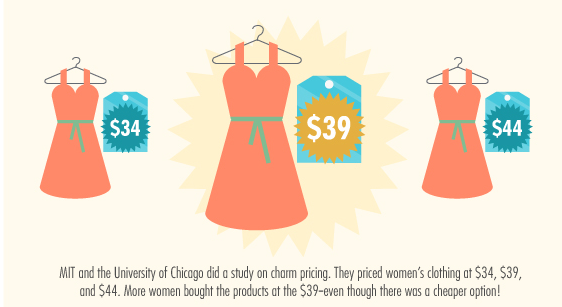
MIT and the University of Chicago experimented with pricing in retail. They offered the same piece of clothing at three different prices — $34, $39, and $44.

charm pricing strategy example: dresses

Image Source

They found that the product sold best at $39 — even better than the option that was $5 cheaper. Another study found that consumer goods priced with ".99" endings were consistently seen as being considerably less expensive than those that ended in ".00." The results of both experiments are a testament to the power of "the magic nine."

Charm pricing is one of the most prominent psychological pricing strategies businesses employ — it's easy to do and incredibly effective.

3. Decoy Pricing Strategy

Decoy pricing relies on changing customer preferences between two options when given a similar third option. It may seem confusing, but it's easy to understand once you see it in practice.

Decoy Pricing Strategy Example

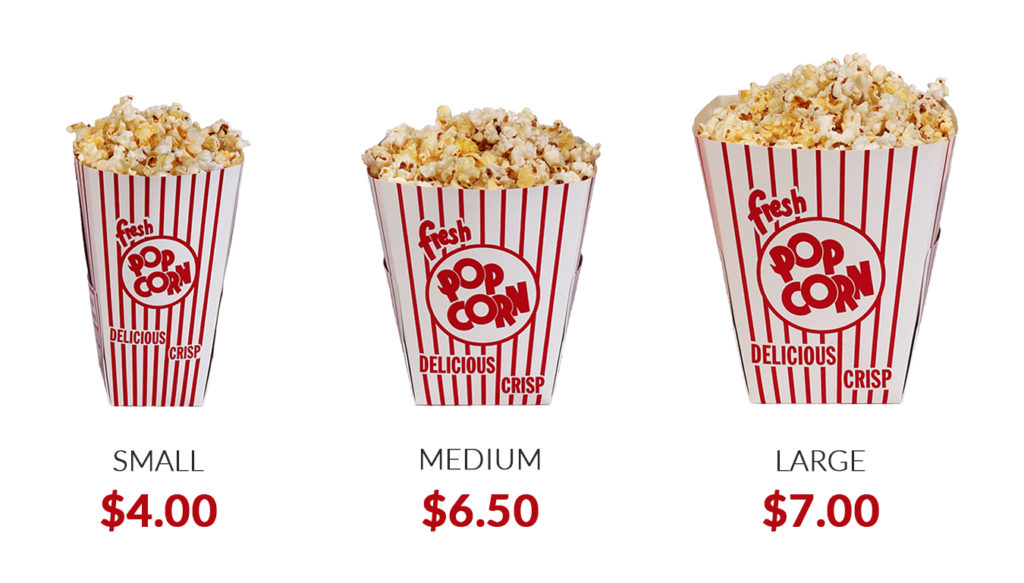
Let's say there are two size options for popcorn buckets at a movie theater — a small option for $3 and a large option for $7.

A disproportionate number of customers will favor the small option because it's the better deal. But if you were to introduce a medium option for $6.50, the $7 would suddenly seem more valuable. Customers will choose the large bucket because they think they're getting a substantial upgrade for just $0.50.

decoy pricing strategy example: popcorn buckets

Image Source

In this case, the medium option would be considered a "decoy." The objective in this scenario was to sell as many large popcorn tubs as possible. The medium option's sole purpose was to frame the large popcorn tub as being more reasonably priced than it was.

4. Innumeracy Pricing Strategy

Innumeracy is a psychological strategy that appeals to customers that don't recognize or understand basic mathematical principles as they apply to everyday life. It sounds mean, but it's a strategy often employed in retail that relies on rephrasing or presenting a deal more desirably.

Innumeracy Pricing Strategy Example

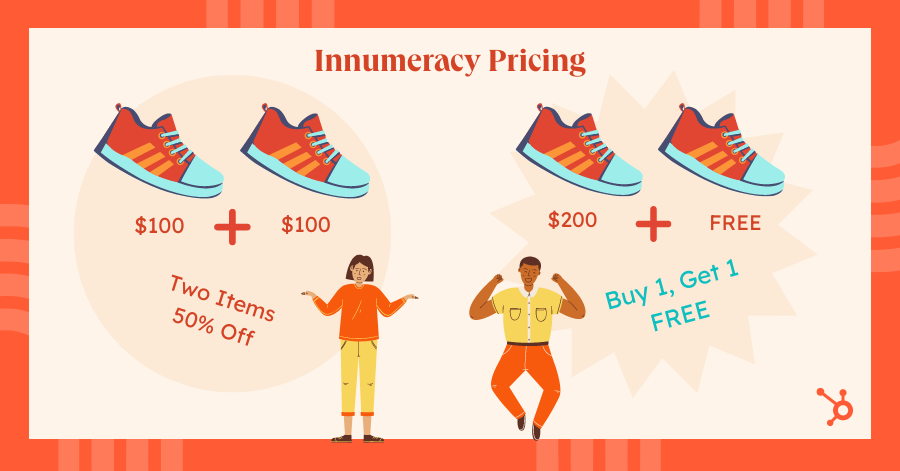
Say you're looking at two deals. One says, "Buy one get one free," the other says, "Two items 50% off." Which of the two sounds better to you? If you're like most customers, you'd probably say the first — even though both pose the same value.

innumeracy pricing strategy example: shoes

The innumeracy pricing strategy plays on customers' lack of motivation, inclination, and ability to apply fundamental math principles in everyday life.

Taking fractions and percentages out of the promotion of flash sales, general discounts, and other deals is a straightforward, effective psychological pricing strategy that businesses should always consider employing.

Advantages and Disadvantages of Psychological Pricing

Psychological Pricing Advantages

1. It yields little impact on profit margins.

Psychological pricing methods require little effort or meaningful price reductions to see higher returns. For instance, dropping a price from $10.00 to $9.99 has virtually no impact on your profit margins but can increase demand through its psychological impact.

2. Streamlining how you price offers a more cohesive buyer experience.

These methods can streamline and enhance the purchasing experience for your customers. Almost every psychological pricing method is centered around creating the impression of a good deal. By leveraging these methods, you can sell at price points that put customers at ease and work well for your business.

3. It can capture more attention when done right.

A well-crafted psychological pricing strategy can also capture consumer attention for similar reasons. If your methods can create a solid perception of value, potential customers will take notice. Everyone loves a good deal, and an effective psychological pricing strategy lets the world know you're offering one.

Psychological Pricing Disadvantages

Psychological pricing might seem like a surefire home run for your business, but it relies on the idea that customers operate according to collective behavior patterns. That assumption can pose some disadvantages.

1. It can make customers feel manipulated.

Customers seeing through your psychological pricing strategy and feeling manipulated is a risk you often run with these tactics. They're often more rational and savvy than some businesses give them credit for. The best way to avoid this pitfall is to be reasonable with your methods.

2. It can cause customer churn instead of loyalty.

If you price specifically to push a deal — that's not in your customers' best interest. A psychological pricing strategy rooted in greediness or shifty intentions might lose credibility with customers you can't get back.

3. It's a short-sighted solution.

Psychological pricing can be a great starting point for a business, but once you gain an audience, they'll expect better deals and offerings to keep them loyal. Businesses are built on recurring revenue from customer happiness.

Price Your Product with Intention

Psychological pricing is a concept that can take on many forms, and it takes time to identify the strategy that works best for your business. Understanding the principles behind it and trying to identify methods that align with your sales process, sales methodology, and company values are worth the effort.

Editor's Note: This article was originally published in May 2020 and has been updated for comprehensiveness.

sales pricing strategy calculator

13 Jul 16:19

5 Creative Sales Motivation Tactics That Don't Cost a Dime

by jeff@mjhoffman.com (Jeff Hoffman)

Sales managers often motivate their reps with SPIFFs and sales contests that award cash prizes. This is a tried and true sales motivation strategy, and monetary rewards generally produce results.

However, they don't really motivate the entire sales force -- only the top performers likely to win. And while it's good to motivate your rock stars, the top line would be better served by getting everyone striving for the prize.

Download Now: Sales Performance Review Template

So if monetary prizes don't do the trick, what does? Here are five creative sales motivation tactics managers can use to fire up their entire team. And the best part? They won't cost a dime.

5 Creative Sales Motivation Tactics

1. Provide coaching.

In my opinion, "coaching" and "feedback" aren't the same thing. While feedback (good or bad) is valuable for the employee, it's rarely motivating. Coaching, on the other hand, can be a motivational force if presented correctly.

I recommend that sales managers treat coaching like a gift. Instead of just serving it up to every employee like it's no big deal, frame it in such a way that the employee understands its value.

For example, instead of simply saying "I'll put some coaching time on your calendar," ask the employee with a bit of fanfare:

"I would love to coach you in X area. You could test some different approaches on me and I can share a few insights I have. Together, we can figure out what works. Would that be beneficial to you?"

Coaching gives reps the opportunity to try out sales tactics in a no-fail zone, and this exercise can be extremely motivating.

2. Use leadership.

I mean this in two ways. First, tap leaders in the company to donate their time and resources that you can then dangle as a prize. Second, extend leadership privileges to high-achieving reps.

Here are three ideas as to how you can use leadership for sales motivation:

  1. Your boss will do your calls. Try a sales contest where the prize or a mid-way bonus is … you! You will work for the leading rep for a few hours doing whatever they direct you to -- calls, demos, presentations, etc. Not only does this motivate your team, but it also shows you aren't afraid to roll up your sleeves and get in the trenches. Plus, it's fun.
  2. CEO takes you out to lunch. Or any C-level executive. Most sales reps crave one-on-one time with a senior leader to share their thoughts and get an inside look into company strategy.
  3. Present at the next sales meeting. Ask a high-performing rep to present an innovative tactic or new approach at the next sales meeting. This kills three birds with one stone -- you're celebrating the rep, their colleagues see that reps who do well earn prestige, and you can delegate some of the responsibility of leading the meeting.

3. Bring in clients.

Your clients possess incredible motivational power. I often bring customers into the office or arrange conference calls so reps can hear how the product they sell is changing someone's life.

Invite customers to team meetings or events to chat with the reps about how they're using your offering, why they chose it over the competition, and what they liked and didn't like about your sales process. Allow for some Q&A where reps can ask questions that will help them optimize their process or messaging.

Not only does this client face time reaffirm to reps why they do what they do, but it also reminds them that it's all about the customer. After spending some time with clients, they'll be excited to get back on the phones and start selling.

4. Invest in education.

Help your reps continue with their personal growth and learning. Check and see if your human resources department has an educational stipend they can use.

If there's a class or course your rep is interested in, you can give them the day off to attend. This will encourage them to keep learning and develop their personal and technical skills.

5. Provide additional opportunities.

If a rep is performing particularly well, provide them with new opportunities. For example, you could give a high performing rep a lead from a different region or territory to test their skills and keep them challenged.

Another opportunity would be to help the rep present a sales pitch at a field marketing event. This will give them exposure to marketing professionals in their region. And the sales rep could also shadow a channel manager -- this allows them to network with more people in their area.

Sales motivation doesn't have to carry a price tag. The most motivating moments are priceless -- literally.

For more sales motivation, check out these motivational sales quotes next.

New Call-to-Action
13 Jul 16:19

Do You Give Greater Value Than What You Charge?

by Robert Terson
Like most teenagers, all three of my children worked part-time jobs during their teen years; Michael, my eldest (he’s 45 now, father to my grandson Jack) held quite a number of them. I’m proud to say all three listened to their father’s advice and always gave more value to a job than their employers required […]
13 Jul 16:18

Here's the fiery speech that vaulted Scott Walker to the top tier of the Republican field

by Brett LoGiurato

Scott Walker Iowa Freedom Summit

Six months ago, it wasn't clear if Wisconsin Gov. Scott Walker (R) would be a force in a crowded Republican field running for president.

He was in a tie for fourth place nationally in a January polls, well behind former Florida Gov. Jeb Bush (R) and New Jersey Gov. Chris Christie (R). In Iowa, he was even further behind — in ninth place, languishing behind fellow upstarts Sens. Ted Cruz (R-Texas) and Marco Rubio (R-Florida), among others.

But a high-profile, fiery speech in which he left a crowd of GOP activists buzzing changed his fortunes, vaulting him to the top tier of the Republican field. It's where he remains today, as he officially announces his run for president.

In late January, Walker was among a slew of Republican hopefuls who delivered remarks at the Iowa Freedom Summit, the first unofficial Republican cattle call of the 2016 campaign.

Leading up to his speech there, strategists and activists had framed him as a potential candidate akin to Minnesota Gov. Tim Pawlenty in 2012. Both were Midwestern governors with records of accomplishment, but Pawlenty never broke through last cycle — in a word, he was "boring."

Walker's speech at the summit broke that developing narrative. One of the biggest applause lines of his speech came when he tested out a line he'd later use in a tweet earlier this month.

"There's a reason we take a day off to celebrate the 4th of July and not the 15th of April," he said, his voice rising. "Because in America we value our independence from the government, not our dependence on it."

He also spoke in detailed and sometimes personal terms about his record in Wisconsin. At one point, he told the crowd of death threats he and his family received while he was in the midst of a fight against public-sector unions. 

"Some of the worst were directed at my family," Walker said. "I remember one of the ones that bothered me the most was someone literally sent me a threat that said they were going to gut my wife like a deer."

Since that speech, Walker has never looked back. Three months before the speech, about four-in-10 Iowa GOP voters didn't know enough about him to form an opinion. About a week after the speech, he was their first choice for the Republican nomination, according to a Des Moines Register poll.

Walker has led every public poll of Iowa since February. He's now a firm second nationally next to Bush. And a video announcing his run, Walker again highlighted his record as a state executive. 

"Now, I am running for President to fight and win for the American people," he said. "Without sacrificing our principles, we won three elections in four years in a blue state. We did it by leading. Now, we need to do the same thing for America."

Watch the Iowa speech below, via C-SPAN:


Join the conversation about this story »

NOW WATCH: Here are all the best moments from Donald Trump's presidential announcement

13 Jul 16:18

Human Data: The Powerful Differentiator

by Ernan Roman Direct Marketing
Article by Ernan Roman
Featured on the DMA Advance Blog.
Human Data: The Powerful Differentiator
“We believed that with tighter targeting we could increase engagement. By acting on insights from Voice of Customer research, we were able to go far beyond our previous segmentation strategies and now use in-depth self-defined life stages and attitudes toward certain product categories. As a result, we are seeing significantly improved responses in a category that has low consumer engagement and inertia.” Kris Gates, VP, Consumer Experience Marketing, MassMutual Retirement Services.
True Personalization is a 2-Step Process: Listen & Respond
Human Data
Findings from the latest B2B and B2C VoC research conducted by our firm, ERDM, indicate that the key drivers for achieving deep customer engagement are self-defined life stages and attitudes toward the company and the product categories. So, today more than ever;
  • Marketers must listen to customers, understand their individual needs and build experiences and products that are competitively differentiating.
  • Use customer insights to understand how your different customer segments define engagement and positive experiences. Then put those insights into action to improve the customer experience across every point of contact with your organization.
  • High quality experiences must be maintained and experientially adjusted throughout the relationship to remain relevant across the individual’s ever-changing life stages. This applies to B2B and B2C customer life cycles.
Here's an important insight from Mike Rude who is responsible for innovating the freight solutions customer experience at FedEx, including FedEx Freight and FedEx Express Freight. He co-authored the original article upon which this blog is based, “Human data: The powerful differentiator for FedEx, MassMutual and Gilt.” The article appeared in the Journal of Digital & Social Media Marketing, Vol. 3 No. 1. Download the article by clicking here.
According to Mike, “We work hard to first understand the needs of the customer. This enables us to ensure that technology deployment will focus on delivering the optimal customer experience at every point of contact and every channel important to our customers. Focus on understanding what the customer wants and how to use technology to deliver on those expectations.”
Gilt, a respected online retailer, also uses customer insights to drive deep personalization across all channels and all touchpoints. Results of these efforts have netted the company increased orders, decreased unsubscribes and higher repeat-purchase rates. “Gilt's commitment to a personalized experience [starts at] the home page of the web site or mobile app ” states Welington Fonseca, former VP of marketing and digital analytics. He continues, “All communication is personalized…Sales [are presented according to] the highest affinity to a consumer's past behavior and preferences (browse, purchase, favorite brands, wish list) with all other sales ranked according to relevance based on previous shopping behavior and collaborative filtering.”
Elements of Human Data and 4 Levels of Trust
Factors in acquiring actionable human data include the following B2B or B2C opt-in self-profiled information regarding;
  • Key issues, needs, expectations of that individual.
  • Decision-making process, roles and titles of influencers and decision makers. This applies to B2C and B2B customers.
  • Messaging and media preferences.
  • And critically, self-described personality types, attitudes, life stages.
However, in order to acquire the precious human data necessary to achieve true personalization, your company must be seen as worthy this information. Four Levels of Trust emerged from the VoC research:
  1. Do what you promised: Deliver on your fundamental brand promise.
  2. Treat me fairly: Fair and customer focused pricing and customer service policies.
  3. Protect my information: Explain the reasons for the opt-in information requests and assure me of the privacy and safety of my data.
  4. Improve my experiences: Use my stated preferences and aversions, to dramatically improve my experiences.
In Summary
A deep understanding of how different customer segments define high-value, personal experiences with your specific company and products will enable you to learn what human data customers want you to use to significantly improve their customer experiences.
The numbers from MassMutual say it all. Following are the results from initial pilots run by Kris Gates and his team using human data versus the control groups;
  • 94 per cent higher open rates
  • 1,062 per cent higher engagement with content
  • Zero Unsubscribes
  • 100 percent deliverability
  • 400% increase in response.
Best wishes for success with your customer experience innovation. For 12 takeaways to help you implement your own human data driven customer engagement strategies, click here.
13 Jul 16:17

Above The Fold Is Where You Mine For Gold On LinkedIn

by Bob Woods

Above the fold on LinkedIn

It’s a phrase that’s been used in both the newspaper business and in Website design. In newspapers, “above the fold” refers to the upper half of the front page of a newspaper, where the “big story” of the day is located. It’s always accompanied by a big headline, and usually has an eye-catching photo.

With Websites, “above the fold,” also known as “above the scroll,” is all about the top portion of a Web page (usually the homepage) that is visible without scrolling. Like in newspapers, what appears above the fold on a Website is whatever the site’s owner deems important for you to read, see, view in a video, etc.

The idea is pretty similar in Social Selling with your LinkedIn Profile. You want to catch people’s attention so they’ll read into your Profile. Your intent is to “sell” them enough so they’ll want to contact you about your product(s) or service(s). That’s why I say, “above the fold is where you mine for gold.”

For our purposes, “above the fold” will refer to three important items in your LinkedIn Profile:

  1. Your banner or background.
  2. Your Profile photograph.
  3. Your Headline.

It’s not enough to have just something or anything in those areas. They’re actually the most important part of your Profile. Keep in mind that you’ve only got three seconds to capture and keep someone’s attention. You do that in those three areas.

What to Do

Simple. Grab ’em and don’t let go. Here’s how:

Banner/background. Here’s where my concept of ABB (always be branding) comes in. Your banner is like having free advertising space on a building somewhere. Don’t underestimate its power. Brand this “real estate” with your Website address, logo and other pertinent images. Also be sure to include your phone number and even email address. Remember the goal of Social Selling is to take your conversations offline, so make it easy for your profile viewers to contact you!

Photo. Your photo must be professional. No photos of you and your spouse (or just you with your spouse cropped out, leaving only her/his hand on your shoulder), you at the Super Bowl, you holding that big fish you caught, etc. While this item is second in this list, it’s probably the most important of the three. Your photo is the first impression many of your prospects will have of you. So, please, do yourself a favor. Invest in a professional headshot.

Headline. This one is pretty simple: Your headline should not be your title and company. As I said in a previous post on LinkedIn Headlines, you want to “attract” people to your Profile by phrasing your Headline to provide your value proposition, or what you bring to your customers or clients when you sell your product or service to them. When you show your clients how you help them in your Headline, they’ll be that much more interested in reading the rest of your Profile.

Keep this in mind, too. If you’re in sales, nothing will scare a prospect away from you faster than having “Sales Associate,” “Account Executive,” “Sales Pro” or anything else sales-y in your Headline. It’s unfortunate, but true. A value proposition-based Headline, though, leaves that stigma in the dust.

There’s so much that goes into crafting the Headline, you should devote a lot of time to it. Again, my previous post will be a huge help with that.

How Important is Above the Fold?

In the mid 1980s, I was an intern in a television news department in Toledo. It was there that a very wise news producer told me that when it came to the “lede”—the first sentence or two—of any news story, I needed to concentrate on a very key concept:

It’s not “why should I (the viewer) care?”; it’s “make me care.”

That was very wise advise that helped me go from intern to (eventually) the 11 PM newscast producer at that station. That same advice will help you in crafting a truly “make me care” Profile.

This article originally appeared at LinkedIn.

13 Jul 16:17

SMBs Seeing More Success With Websites Over Other Channels [Study]

by Shelly Kramer

SMBs Seeing More Success With Websites Over Other Channels [Study]The owners of small to mid-size businesses (SMBs) across the United States are seeing more success from their websites than their other marketing channels. That’s the headline from a recent study and, as someone who firmly believes that a corporate website is the hub of all your business operations, that data is not surprising. That said, a lack of time and resources routinely get in the way of SMBs doing more to update their websites on a regular basis.
Before we go further, let’s talk about what, exactly, defines a small to mid-sized business. According to Gartner, there are two common attributes used to define SMBs: One is number of employees and the other is revenue. A small business is generally one with fewer than 100 employees and revenue of less than $50 million. A mid-size business is defined as having 100-999 employees and revenue greater than $50 million but less than $1 billion. And that, my friends, describes a whole lot of businesses.

What The Study Says About SMBs

Emarketer reports that a Thrive Analytics study revealed that 45 percent of the more than a thousand SMBs surveyed reported that the company website was the most effective marketing tool at their disposal last year. This ranked ahead of social media at 39 percent and print yellow pages at 26 percent, with the rest of the field, including email marketing (11 percent) left well behind.

Here’s a look at the results:

Most effective Marketing Methods

Image via eMarketer

The interesting fact to note though, is that the success of the website is a on a declining path. The percentage of respondents citing the company website as the most effective channel at the same time last year was at 50 percent. This contrasts with almost all of the other channels showing an increase or staying at the same level since last year. I think that that’s due to perhaps a couple of different reasons. First, it’s no longer an easy thing to “buy” search terms and first page Google results which in the past was often a big driver of website traffic and, one would expect, reads.

Secondly, it’s likely that there are so many other things clamoring for a SMB’s attention and budget, sometimes the amount allocated to website maintenance and updating might get overlooked.

Lastly, I think there are many C-Suite executives and marketers who don’t understand the importance of a corporate website and who mistakenly think that a new website every five years or so will tide a business over. Those days are well behind us, and a website should be an ongoing source of refinement and testing, as well as a key part of your digital marketing efforts.

Email on the Decline?

It’s also telling that email is rated so low by study participants on effectiveness. Based on what we see with many of our SMB clients, to our way of thinking, it’s not that email is ineffective, it’s that they aren’t really using it, or at least they’re not using it very effectively. Email, personalization, marketing automation—those things are all table stakes for today’s smart marketers, but we routinely don’t see businesses that we talk with devoting nearly enough effort—or budget—to email, which is a gigantic missed opportunity.

SEO, Social, Blogging and Mobile

Some other aspects from the study relative to the the rating of effectiveness of marketing tools were interesting:

  • SEO was considered to be only half as effective in 2014 as it had been the year before, dropping from 18 percent to just nine percent. There has been much written about the demise of SEO following all of the Google tweaks over the last few years. While I maintain that striving for organic search engine visibility still has its place, this trend is at least an indication that the SMB market is learning SEO alone isn’t the path to effective online marketing, driving traffic and/or leads. Note, however, that the effectiveness of paid search is inching up, which only makes sense.
  • Note also that Facebook and other social media was trending up. I believe this is perhaps because SMBs are starting to understand that social, especially Facebook, is pay-to-play. And if you allocate budget dollars to social media channels, chances are exponentially greater that they will reap some benefits.
  • I wasn’t all that surprised to see blogging bringing up the rear, with a modest rise to just three percent in 2014. For us and for our clients, blog content can be a key element in connecting to and engaging with customers and prospects. The problem, from an SMB standpoint, anyway, is that in the mad rush to push out content, many companies forget that building an online network and distribution channels for that content is as important as, if not more important, than the content itself. In addition, many struggle with the measurement of ROI. Perhaps the ROI is harder to measure than, say, an email campaign or numbers of website hits. But a blog is a great a way to not only put a human face to your business, but also to serve your customers and prospects with information they need on a regular basis. Add to that the fact that blog content equates to feeding your website fresh content, and its value is even greater. It’s unfortunate so many SMBs are failing to appreciate the value of having a blog alongside the corporate web offering, but that’s one of those things that they’ll either figure out—or they won’
  • It was also interesting to note the effectiveness of mobile ads and mobile marketing declined slightly. Businesses are lagging behind when it comes to the power of mobile and how to use (and measure) mobile as a part of their integrated marketing strategies. Another thing they’ll need to figure out.

What the Future Holds for SMBs

The good news is that SMBs report they are still generally positive about their websites and willing to invest in digital solutions. Nearly half (49 percent) say they will increase their marketing budgets this year and more than a third (36 percent) plan to up spending on their website—the highest percentage of all the channels. The study though also highlights that the majority (77 percent) feel that they lack the requisite time and knowledge, and as a consequence are struggling to keep pace with the demands that digital technology are putting on them. This correlates to what we see in the field, when speaking at conferences and doing workshops. There’s so much to know, so much to do, so much to learn—and rarely enough time or money to make it all happen. Marketers are, most definitely, feeling overwhelmed and without the resources they need to do what they know they need to do.

Of course a lack of time and knowledge can be overcome by outsourcing to a third-party. Sadly though, many SMBs surveyed report feeling they are being short-changed by digital marketing providers who don’t take the trouble to find out what they really need. Poor product performance (60 percent) and poor service levels (55 percent) were cited as the main problems leading to this dissatisfaction. There has never been a time when the old adage caveat emptor has been more applicable than there is today. There are snake oil salesmen on every corner (or on every social media site), claiming to have expertise at any one of the services discussed above. Now, more than ever, buyers need to take extra steps to vet potential vendors, ask for references, work samples, and case studies, as well as clearly articulated ROI (and a way to measure that ROI) as a result of the proposed marketing spend.

Unless SMB owners suddenly find the time to train themselves, which isn’t going to happen, outsourcing their website and digital marketing would appear to be the only solution. The emarketer article also draws attention to another report that suggests SMB’s are showing a willingness to do just that. Research by HubShout has suggested that despite limited budgets, many small and medium sized business owners are making website development a priority, and looking for good quality services to help them to do it.

When they were asked which services they were most likely to be outsourcing this year, nearly two-thirds (64 percent) said web development would be a priority. This was well ahead of social media and content marketing which lagged behind at 38 percent and 37 percent respectively. Curiously, respondents put SEO at the top of their list of priorities, which conflicts with the lack of faith in organic search demonstrated in the Thrive Analytics research. It maybe just serves to reinforce that we shouldn’t rely too much on a single piece of research and that really, SMBs are all over the map with the things they are trying, and the things they’re finding success with. Helpful, I know.

Our small to midsize businesses clients clearly appreciate the value of the company website. What they appear to lack is the time and knowledge to do anything about it themselves, combined with a lack of confidence in outsourcing to a third party. There’s a great opportunity here for web development and digital marketing agencies and consultants to tap into this huge SMB market. That will only happen though if the quality of products and services improve to the levels that the best in the sector are already providing.

When that happens, SMBs and providers alike will see the benefits as the declining trend in the effectiveness of the company website is reversed.

Photo Credit: ReidJ14 via Compfight cc

13 Jul 16:14

B2B Buyers Say Interactive Content Is More Effective

by David Dodd

DemandGen Report recently published the findings of its 2015 Content Preferences Survey. DemandGen has been conducting this survey annually since 2012, and it has always provided interesting insights regarding the content consumption behaviors and preferences of B2B buyers.

About two-thirds (67%) of the respondents in the 2015 survey said they are relying more on content now to support purchase decisions than they did a year ago. At the same time, almost three-quarters (74%) of the respondents said they have less time to view content now than they did a year ago. It’s likely, therefore, that business buyers will be forced to become more selective about the content they consume.

Several findings in the 2015 survey echo the results of research by other firms, and some reinforce the findings of earlier DemandGen content preferences surveys. For example:

  • White papers, webinars, e-books, and case studies remain the most widely-consumed types of B2B content.
  • Forty-five percent of the survey respondents said they typically view three to five pieces of content before they talk with a salesperson, and another 22% said they consume five to seven pieces of content before they engage with a sales rep.
  • An overwhelming majority of survey respondents want their prospective vendors to use more research and insights from industry thought leaders and analysts in their content, package related pieces of content together, and curb the sales messages in their content.
Some of the most interesting findings in the 2015 survey related to interactive content. DemandGen asked survey participants whether they had consumed and how much they valued three types of interactive content – interactive presentations, ROI calculators, and assessments. The survey revealed a significant gap between how much interactive content is consumed and how highly such content is valued.
  • Only 31% of respondents said they had accessed interactive presentations in the previous twelve months, but 45% of respondents rated the value of interactive presentations a four or five on a scale of five.
  • Only 23% of respondents had used ROI calculators in the past year, but 42% gave them a value rating of four or five.
  • Twenty-four percent of respondents had accessed an assessment tool during the past year, but 40% placed a high value on this content type.
The value of interactive content is now clear. A 2014 survey by Demand Metric found that interactive content outperforms passive content at three critical marketing functions – producing prospect conversions, educating the buyer, and creating differentiation from competitors.
In the Demand Metric survey, 70% of interactive content users said their content was moderately or very effective at converting prospects, while only 36% of passive content users gave such ratings to their content. Ninety-three percent of interactive content users said their content was somewhat or very effective and educating buyers, but only 70% of passive content users reported the same level of effectiveness. Eighty-eight percent of interactive content users said that interactive content is somewhat or very effective at creating differentiation, while only 55% of passive content users gave such ratings to their content.
The explosive proliferation of marketing content makes it more difficult for B2B marketers to create content that will rise above the clutter. The DemandGen Report and Demand Metric surveys show that one way to address this challenge is to make your content more interactive.
13 Jul 16:13

An Ode to the Evolution of the Pipeline

by Dave Kurlan


Over the weekend, I was thinking about sales pipelines and inaccurate forecasts, how companies are always experiencing issues at the top of the funnel, and it inspired the following poetry. It won't win an award for imagination, creativity, rhyming or flow. I'll stick to my day job for this, I surely know.

The pipeline on the left with all the eggs in one basket
Scares me to death - a business, one hope, surely heading for a casket
The one on the right has a healthier look
With more opportunities for deals to be booked.

Once so simple, my pipeline for next quarter
Suspects, prospects, and the sales cycle was shorter
Names and numbers on cards was a must
In a shoe box or a file box, today they collect dust.

The prospects were familiar - referred or introduced
Not like today where leads are seduced
Tire kickers, assistants and all the wrong folks
Wanting ebooks and samples -- it's all a cruel joke.

13 Jul 16:12

Successful Sales and Marketing Alignment, Part 2: Understand the Buyer

by Lisa Cannon

people-puzzle-piecesThis post is part of a series to help B2B organizations improve sales and marketing cooperation. Part one was about making sure you have the right information to get started. In part two, you’ll learn how to identify the target buyer and outline the buyer’s journey.

After agreeing on your business goals, the next step is one of the most important – making sure you’ve identified the right target buyer. That means both your sales and your marketing teams have to agree on the buyer persona and then design their programs and processes to attract this buyer.

Do research to determine and define your target buyer

To start, determine your organization’s most valuable customers. You can identify your most valuable customers using the factors most meaningful to your business, such as revenue generated, product purchased, sales cycle time, etc. Then look for common characteristics, such as company size, buyer role, or industry. An example target buyer profile might be of owners of small businesses (5-20 employees) in North America who sell (something specific) to the trucking industry. Most sales these days depend on a team of buyers, and you may have personas that are alike except for level or responsibility. Our small business owner might have an employee in finance or ops or marketing that will help make the decision. That buyer should have their own persona, as their concerns, risks and rewards may be different from the business owner’s.

Sales should participate in the identification of this core set of target buyers. Marketing should research these personas to determine whether their marketing campaigns can attract enough of these buyer profiles to justify the investment. Learn more about the basics of developing buyer personas and get tips for building a content plan to meet the needs of your target audience.

Create and agree upon the target buyer definition and journey

It’s also important to identify the steps that your best buyers took to become customers. That way you can create a map of the buyer’s journey that detail how your buyers make their purchasing decisions. Make sure you publish your personas and buying journey maps internally so that everyone in the organization is on the same page. Learn more about creating a map of the buyer’s journey, from initial awareness all the way through to conversion and expansion.

Build your marketing and sales efforts to attract this target buyer

Magnet attracting peopleOnce the target buyer has been defined, it’s time to design the kind of sales and marketing process that will attract these types of buyers. For example, if your target persona is likely to be looking for articles and blog posts around a certain topic, you should begin to build content that will attract them to your website. You might want to develop an email nurture campaign, where a prospect is sent a new message on a regular schedule (often every week) with a relevant article or eBook about the topic.

Here’s an overview of the eight basic steps you should take in order to figure out who your best customers are, and what path they are most likely to follow in order to buy from you.

  1. Look at data to determine your best prospects. Begin the process by looking at data for your current customers. Try to find customer segments that are the most valuable to you by looking at revenue, gross margin, and sales cycle length. You want the segments to be distinctly different from each other.
  2. Look for common traits. Analyze the list of high-value customers by searching for common characteristics: company size, location, the buyer’s role, and industry type are all examples of possible common features.
  3. Meet with individual sales reps to get anecdotal feedback on the data. In most cases, the data will tell you enough to determine your initial profile of the target buyer, but sales has to agree. Meet with sales leaders and get their input on these buyer personas. Agreement may take several conversations and drafts.
  4. Determine whether marketing can generate leads for these buyer types. Before finalizing your personas, make sure you’ve agreed on buyers that you can actually market to. If you choose a persona that is very difficult to attract, marketing won’t be able to deliver on the requisite number of leads and the entire sales and marketing process will break down.
  5. Map the buying process of your target personas. After you have created your personas, outline the steps a buyer takes from their current state to after they purchase your product or service. This insight into the buying process will allow you to create highly effective sales and marketing messaging, programs, and processes. For example, many companies create content for each stage in the buying process to first attract the buyer, then to help the buyer move to the next stage in their process.
  6. Publish (internally) your findings. Once the target buyer personas, journey, and attendant messages are agreed upon, you need to distribute them to sales and marketing to ensure that everyone is targeting the same buyers with the same messaging, at the same stage.
  7. Optimize the target buyer persona definitions quarterly. Each quarter, sales and marketing should evaluate the current buyer personas by leveraging data and anecdotal feedback to determine effective they are. Sales and marketing should also look at any new data to identify opportunities to create new personas. For example, a company that targets small businesses might find that they are starting to close more business with larger customers; they might decide to create an additional target buyer persona as a result. Keep up with this; the market is dynamic and your personas will change over time.
  8. Test new buyer personas. Companies often need to test new buyer personas as they enter new markets. In this case, sales and marketing should agree on the number of test personas and the frequency of the testing. The key is to test likely new personas without disrupting your current efforts.

Did you miss part 1? Catch up here:

Successful Sales and Marketing Alignment, Part 1: Get Started

Stay tuned for the next blog post in this sales and marketing alignment series, where you’ll learn how to design the lead process.

Want to learn more about using buyer personas in your marketing strategy? This Buyer Persona Toolkit is a great place to get started.

Buyer persona toolkit

13 Jul 16:12

4 More Reasons Your Business Needs to Market on Social Media

by Laura Donovan

image (50)

There is no shortage of blogs explaining the importance of Social Media Marketing and Advertising.  Everywhere you turn you are told how crucial Marketing on the Social sites is.  Most marketers agree that it is one of the best ways to grow a business, and they have the statistics to back that up.

Still, some companies just don’t get it.  They cling to their old way of doing business, and are not easily swayed by statistics or real world examples.  They don’t really understand how it works, are a little suspicious of something that started out as a place to rate pretty girls and catch up with high school chums.  They still feel that the only marketing that works is one that bombards people with sales messages.  When they do join social sites, they may hire someone, but soon become upset that the posts are not all about their products and their special offers.  If they do it themselves, they are disillusioned because their overt sales messages don’t get the sales they had hoped for.

While putting up a Facebook Page and posting regularly may not translate to an instant jump in sales, companies that post the right things to the right audience, add a small advertising budget, and actively “listen” to the people on their pages, are seeing their bottom line grow. It may not be overnight, but it does happen.

Still not convinced? Here are 4 more reasons to have a robust Social Media Marketing and Advertising Strategy in place:

  1. Social Media Profiles enhance the business/brand image.

Image matters.  Your prospective clients/customers are looking at businesses on Facebook, and will form an opinion of your company based on “social” presence.  A professional and active Social Media presence matters.  It proves that you not only care about your business, but also about your customers.  Posting valuable content on your site can also establish you as an industry leader,

  1. Social Media is cost-effective.

Updates, Tweets and Pins have the potential to reach hundreds, thousands (and sometimes millions) of people at a fraction of the cost of print or televised media.  When compared to the cost of ad space in a phone book that may sit in a drawer and be forgotten, an active online presence with posts appearing on a daily basis is a much better option.   Social Media keeps you on the top of potential customers’ minds, and can also grab their attention when they need your service.  Add to that the opportunity for people to share your posts with their friends. This gives you the opportunity to reach an even larger audience.

  1. Your Customers and potential Customers are using Social Media.

No matter what your demographic, it is almost certain that your customers and prospective customers are using Social Media.  71% of online adults use the site. (PewNet)

  • 87% of 18-29 year olds use Facebook
  • 73% of 30 to 49 year olds use Facebook
  • 63% of 50 to 64 year olds use Facebook
  • 56% of the over 65 population is using Facebook

Facebook and other social media sites give you the opportunity to join the conversation with your customers. Hanging out with them is a great way to keep track of what is being said about you or even starting the conversation to get your business in front of their Friends and Followers.

  1. Your competitors are using Social Media to market and advertise.

Facebook has over 40 million business pages on its site.  It’s likely your competitors are using Facebook to showcase their brand and promote their products and services.  Your customers and potential customers are probably interacting with them instead of you, this means that if you aren’t using Social Media you are likely losing business.

While your ROI for Social Media may not be as straightforward traditional marketing and advertising, when tracked over time, it will meet or exceed that of traditional marketing.  It provides a good return on your investment in terms of visibility, branding, warm leads, referral sources as well as sales. It is also a very good way to keep your finger on the pulse of your target markets. Finally, it is one of the best customer service tools available today.