Shared posts

16 Jul 23:31

A Practical Guide to B2B Marketing with Attitude

by Chad Pollitt

With over 25 years of marketing experience, Carro Ford has seen our field evolve to what it is today. This experience has allowed her to curate an incredible mix of both marketing and PR tactics in her latest book, “The Smartass Marketer’s Handbook: A Guide to B2B Marketing with Attitude.” Together, these tactics represent a power-packed toolbox for today’s hybrid-marketer.

While this book isn’t written for CMOs, per se, it can serve as a blueprint for what the rest of the marketing department should be doing. It’s about tactics, not strategy. It’s a culmination of some tried and true traditional tactics mixed with some of the hottest ones marketers are clamoring about today – presented with a smartass attitude, too, which makes it a fun read.

The Customer, Your Wardrobe & Content

Ford starts with a basic tactic that all too often gets ignored in our industry – put your customers on your marketing team. She’s not suggesting to literally put them on the team, but to interview them as frequently as possible in order to make their success the focal point of your stories. She suggests making a customer plan and not a marketing one. Some customer-centric examples include:

  • Case Studies
  • Customer Councils
  • Quotes
  • Guest Blogs
  • Special Booth Guest at Trade Shows

She suggests your B2B marketing “wardrobe” should start with the basics: whitepapers, case studies, blogging and press releases. Then accessorize with things like LinkedIn posts, webinars, email campaigns and other prudent tactics.

The book makes it clear that Ford is a staunch supporter of content marketing and its many facets. She considers herself a copywriter, as well as a marketer, so she spends a little extra time writing about the nuances of copywriting.

Influencer Relations, Press Releases & Industry Awards

Media and influencer relations are really hot content promotion tactics these days. It’s clear she has lots of experience putting together and executing these types of campaigns. Prior to reading her book, I had no idea how helpful conference websites could be in both influencer and media relations.

Not only should you add the speakers to your list, but the sponsors may be a treasure trove of influencers, too. She recommends requesting the media list from the event, as well. Next, the book takes a detailed look at analyst relations, an often under-executed outreach target for marketers and communications professionals.

Ford is a staunch supporter of press releases. In fact, she says there’s only one good reason not to write them – when you only plan to do just one. The book also goes into 15 ways to get the most out of an industry award.

All-in-all, the book has 13 actionable chapters on various marketing and PR tactics. The above represent some of my favorites from the book, however, there are many more. As marketers we can sometimes get caught up in our everyday tactical hustle and get tunnel vision.

This is problematic because we often don’t recognize or even see the value in adding different or more traditional tactics to our current mix. Ford’s book forces us to break the tunnel vision and take a wider view on what we do on a regular basis. For experienced marketers this book represents a valuable tune-up and health check. For newer marketers this book is a must-read. In fact, my entry level new hires will be given a copy on their first day.

premier relevance.com sponsor

14 Jul 17:35

The Death Of Cold Calling Is Now

by The Leads Explorer

Once upon a time the daily work of salesmen and sales reps was to cold call a number of people on a list in order to present them a product or service and aiming to get an appointment.
Those days are gone.

As technology evolved a similar technique with faxes and emails has existed but these methods are also doomed.
The main reason lies in the fact that the cold calls are made without or with little information about the potential customer. Whether the customer really has a need or not the call was being made.

Nowadays there are a number of tools or services available that inform the salesman or sales rep about the interest, need or level of interest of a potential customer before any call or contact has been made:

Search Engines

Search engines are probably the main source for your website traffic. Most of these visitors having used a search engine are looking for a solution. The challenge is to get into contact with the visitor. One of the solutions is to install an online chat on your website which will allow the visitor to contact you without the need of leaving any (apparent) contact detail information which gives a level of freedom. The challenge is to turn the chat from an informative conversation into a conversation where the visitor exposes more information than he was intending to do. This will allow to stay in contact with the potential customer afterwards.

Website Contacts

It is rare but some people actually contact your company through the contact page on your website. Nothing easier than to start a conversation with them by email or telephone call.

Inbound Marketing

As all your Marketing communications and campaigns or Content Marketing should generate interest, these marketign efforts will persuade people contacting your company. Once a contact made then no cold is required anymore.

Social Media

Social media – especially LinkedIn – allows to post content which can trigger interest from potential customers. This can be by replies to the post or even direct contact by themselves.
The same can happen by just replying to posts of other people or companies which again triggers the interest of a potential customer resulting in a public conversation on the social media.
No cold calling involved as the salesman or sales rep is already in a conversation with the potential customer.

Website Visitors

In all your marketing communications your website is referred, which is likely to generate traffic on your website.
Companies that visit your website in search of a solution are likely to be potential customers. So if you have installed a web service that reveal the companies visiting with their interest and level of interest, then contacting these visiting companies is no longer real cold calling.

Cold Calling is death (or hardly existent)

Do you still Cold Call ?

Share

14 Jul 17:34

A look inside the secretive business of cybercrime, where hackers make more than $80,000 a month

by Cale Guthrie Weissman

hackers

It's a known fact that hacking makes money. But how much money? And how do hackers carry out their internal dealings with one another so as not to step on each other's toes?

Much like the fine-tuned systems of mafias and gangs that act almost identically to businesses, hackers have also created their own extremely intricate systems — and the scale of their operations is astounding.

Security researchers have been embedding themselves into these online underbellies to see precisely what's going on. This way they can get an early look at the malware hackers are cooking up, while also learning just how the system works.

The research firm Trustwave has been doing just this for years. It now has a lot to show for it, including discovering how much money a hacking gang makes and how precisely the cybercrime ecosystem works.

Trustwave's VP of Security Research Ziv Mador has put together a presentation he gives to customers so they can get a better handle on how to protect themselves. As he put it, it's just a "glance of what we find."

But Mador has given Business Insider an exclusive look at the wheeling and dealing of hackers inside this secretive world — check it out below.

SEE ALSO: The insane ways your phone and computer can be hacked — even if they're not connected to the internet

Forums — the online places where cybercriminals sell their goods.

Forums are "The Craigslist of the underground forums," explained Mador. "You can see how they advertise malware they would like to sell to each other."

It's where hackers and hacking gangs hawk their goods including trojans, bots, and other malicious pieces of software. 

Mador explained that it's "very difficult to get in" to these forums. They require a lot of vetting and trust from other criminals. 


Exploit Kits

Exploit kits are the bread and butter for how cybercriminals successfully hack the masses.

They are a malicious toolkit of various ways to deliver malware. Or, as Mador puts it, an "invisible web application that uses a cocktail of exploits."

Exploit kits have become preferred by cybercriminals because of their heightened success rate. Before, an average of 10% of users were successfully hacked, but with new and better exploit kits being made the success rate has risen to as much as 40%. 


What's in an exploit kit?

Here is a rundown of all the ingredients inside the exploit kit cocktail. These are the various malware cybercriminals have paid for, which they then distributed further to unsuspecting victims.


See the rest of the story at Business Insider
14 Jul 17:34

The most awesome drone photos of 2015 (so far)

by Jack Sommer

1   1st Prize Category Places Above the mist Maring Paran Brazil by Ricardo Matiello2

Talented pros and amateurs submitted more than 5,000 entries to aerial photo-sharing website Dronestagram's annual photo contest

Pulitzer Prize-winning photographer Ken Geiger led the judging team, which consisted of a panel of experts.

Prizes included features in National Geographic, a new drone and controller, an Adobe Creative Cloud subscription, and more.

From French Polynesia to Bulgaria, these are the best drone photos of 2015.

SEE ALSO: 37 incredible drone photos from across the globe that would be totally illegal today

"Tulip Fields" — 3rd place in Places category


"Lost Island, Tahaa, French Polynesia" — 3rd place in Nature category


"Glorieto Rodolfo Sanchez Taboada, Mazatlan, Sinaloa, Mexico" — 3rd place in Most Liked Picture category


See the rest of the story at Business Insider
14 Jul 17:33

There's more than one way to progress your software engineering career

by Vivek Ravisankar
Engineering
Feed-twFeed-fb

The stoic, traditional career ladder is pretty much nonexistent in the world of software engineering

The best engineers have choices: You can venture into the unfamiliar domain of management, in which your biggest challenge is getting all hands on deck to achieve an exciting vision. Or, if you deeply enjoy the art of coding, you can reach incrementally higher peaks as a distinguished individual contributor (IC). The truth is, there’s no real hierarchy etched in stone.

True success comes from playing to your strengths — not manager titles. There may have been a sense of prestige associated with a managerial position in the past. But, like any highly specialized field, developers can grow to become more influential and respected in their technical roles Read more...

More about Engineering, Job Search Series, Business, Dev Design, and Jobs
14 Jul 17:32

These Are the World’s Most Innovative Cities

by BusinessVibes

London, New York, Helsinki are leading the world’s most innovative city list this year, according to the CITIE report which conducted by innovation charity Nesta, Accenture and innovation network Catapult. “We set out to measure the quality of the policy environment — how well city governments are supporting the growth of a tech community,” says John Gibson, study co-author and Director of Government Innovation at Nesta.

The report evaluated 40 major cities in the world and identified nine roles within each city that can support local entrepreneurship from regulator and customer, to host and connector. While the goal is to help policymakers make entrepreneurs‘ lives easier.

most-innovative-cities

According to the data analysis of the report, cities were grouped under four tiers of performance as a strategist, as an investor and as a customer. By grouping them in different ways it allows us to see how each city scores best, and compare them against their competitors.

“Helsinki came as a surprise,” Gibson says, and Amsterdam was another pleasant surprise as these cities have some of the leading innovative companies and city-sponsored smart districts, co-working locations and investment funds. The government just launched their Startup Amsterdam strategy to promote the community globally,” he says.

innovative-cities-investors

innovative-cities-customer

The report also indicates that Sao Paulo got high scores due to government’s policies that allow startup companies to get preferential treatment if their price is up to 10% more than that of large companies. On the contrast, startups in Tokyo were left out as the policies are set up to bring in large corporates, over small businesses.

14 Jul 17:25

5 Inbound Marketing Stats That Prove Your Business Is Falling Behind

by Kevin Gallagher

inbound-marketing-stats

Inbound marketing is revolutionising the way businesses sell to their customers, in the best possible way.

The truth is, you won’t find a bigger champion of inbound than me – you’re probably already aware of that if you’ve looked at any of my previous blogs.

However, the reason inbound marketing is so effective is that it’s a far more engaging, customer-focused way of essentially “selling without selling”. This is because customer behaviours and attitudes have changed, and we have to adapt to meet their evolving needs.

There’s no cold calling, in-your-face ads or overly pushy sales techniques of the past – it’s all about providing value to the customer by solving their problems and answering their questions and concerns.

Below, I’m going to discuss five great inbound statistics that perfectly demonstrate the importance of inbound marketing – before discussing exactly what they mean for your business.

So, without further ado…

The statistics

Before I go over the stats, you can read more about what inbound marketing actually is, and how it could benefit you, right here.

1. 86% of B2C marketers are now using inbound marketing (via Content Marketing Institute)

It’s not just another useless buzzword or phrase – inbound marketing has really taken off, and if it’s not part of your marketing strategy, you’re going to get left behind. If you’re a B2B business, even more of your peers are using inbound – 91% actually.

2. Marketers who make blogging a priority are 13 times more likely to achieve positive ROI (via AkkenCloud)

Are you blogging? The occasional blog here and there, whenever you feel like it or can find the time, isn’t really what inbound marketing is all about. You need to sit down with your team and pinpoint the questions and challenges your customers are facing – and write your content around that. I’d recommend you publish a minimum of two blogs per week if you want decent results.

3. 80% of business decision makers prefer to get information via articles as opposed to ads (via Content Marketing Institute)

This is because people like it when their problems are addressed and it feels like they can relate to what you’re saying – rather than just having your sales messages shoved down their throat. If a customer (or business decision maker in this case) feels like they are getting value, they’re more likely to decide to buy from your company.

4. 93% of companies who use inbound increase their lead generation (via Hubspot)

Inbound marketing is a fantastic way of generating leads, and they also cost a lot less (about 62%) than traditional outbound marketing – it’s no wonder it’s catching on! You too can generate more leads – at a lower cost – by harnessing the power of inbound.

5. 94% of links users click on are organic – not paid for (eConsultancy)

This also means that PPC makes up just 6% of total search clicks – mind blowing, isn’t it? So if you’re still spending the bulk of your marketing budget on PPC, you’d be better off throwing your money down the drain. Instead, come up with quality content that includes the sorts of questions and keyphrases your customers might type into search engines when looking for a solution to their problem. It might be worth brainstorming with your team to come up with some of the most effective ones.

Conclusion

So, are you convinced yet? There’s no doubt that inbound is taking the marketing world by storm, and if you haven’t cottoned on yet, you’re definitely missing a trick. Inbound isn’t about pushy sales tactics, in-your-face ads or cold-calling – but it does have everything to do with creating valuable, quality content that your customers will love. So, go forth and utilise the power of inbound – you might not believe the results!

inbound marketing guide

14 Jul 17:24

BID: Your guide to 123 common work acronyms

by The Daily Muse
Acronyms
Feed-twFeed-fb

Ever feel like your co-workers — or, worse, your boss — are speaking to you in a different language? No, I'm not talking about your team suddenly deciding to conduct a meeting entirely in French. I'm talking about what often seems to be the language of the business world: acronyms.

While some of us have the guts to ask for clarification when we have no idea what's being said, others of us cringe at the thought of asking potentially "stupid" questions. Well, to everyone in the latter group: Today's your lucky day. We've rounded up abbreviations for the most commonly used terms that you're likely to run into at work (or more likely, in an email). Read more...

More about Email, Communication, Language, Work Environment, and Business
14 Jul 17:19

Photo essay: Running with the caribou herds

by Zoe McKnight

Over the years, Yukon-based photographer Peter Mather has faced his share of struggles to capture images of the Porcupine caribou during their annual migration. Just this spring, his bush plane was forced down due to a technical problem, forcing Mather, dragging 136 kg of gear, to ski 100 km—mostly at night, when the lingering snow was reliably firm—in order to try to meet the herd.

That’s nothing compared to what the caribou undergo to reach their calving grounds. At 1,000 km each way, it’s one of the longest land-mammal migrations in the world. To birth their young, female caribou move north in spring, from the interior and over mountain terrain, through deep snow and slushy rivers, to reach a safe spot where food is bountiful and predators are few. They return south in summer with 50,000 new offspring. Only about a third will survive to adulthood, due to predation by grizzly bears, wolves and eagles.

1 of 7

On the move

The herd runs through a thawing landscape as it approaches the calving grounds in Ivvavik National Park

But the summer habitat has been under a more persistent threat: The calving grounds, a grassy plain along the Arctic Ocean coastline, form part of Canada’s Ivvavik National Park and the Arctic National Wildlife Refuge in Alaska, which lie side by side on the Beaufort Sea. A portion of the American side is not officially protected from development, and the threat of oil and gas exploration has loomed over the sensitive area for decades.Many remote northern First Nations, such as the Gwich’in people, still rely on the caribou for their sustenance and culture, and have been fighting to keep the area wild.

In April, U.S. President Barack Obama and the U.S. Fish and Wildlife Service urged greater protection for 4.9 million hectares of the refuge, including its coastal plain, which could hold an estimated 10 billion barrels of oil. It will take an act of Congress to permanently protect the land.

Mather, 40, started taking photos of the 197,000-strong herd a decade ago, and was compelled to return year after year. “It’s a great story,” he said. “The Gwich’in people are a powerful people and a powerful culture, and I just find the caribou amazing.”

The post Photo essay: Running with the caribou herds appeared first on Macleans.ca.

14 Jul 17:18

Everything you need to know about the historic nuclear deal with Iran, from sanctions to the new ‘breakout time’

by Ishaan Tharoor, Washington Post

WASHINGTON — After more than two weeks of wrangling and missed deadlines in Vienna, Iran and its international interlocutors have finally clinched a historic accord over Tehran’s nuclear program. The diplomacy with Iran, which throughout has had its vociferous opponents, was aimed at curbing the Islamic Republic’s ability to produce a nuclear weapon. A tentative framework was inked in April between Iran and its negotiating partners, which include the United States, Russia, Britain, France, China and Germany.

The deal’s proponents argue that talks have yielded the best guarantee possible that Iran won’t be able to move toward nuclear weapons, while also, for the time being, reducing the risk of yet another military escalation in the Middle East.

“This deal offers an opportunity to move in a new direction. We should seize it,” President Barack Obama said Tuesday.

Here’s a guide to how it works.

Extending the breakout time

The main benchmark by which analysts gauge Iran’s ability to produce an atomic bomb is the “breakout” time — the time needed for Iran to enrich enough uranium to assemble a nuclear warhead. It’s currently estimated at around a couple months; under the terms of the deal, that frame has been extended to at least one year.

The implication here is key: One year gives world powers enough time to mobilize action to interrupt Iran’s pathway to a bomb. The extended breakout time also presents in its own right a strategic obstacle to Iran’s leadership, raising the stakes if it ever considered rushing toward building a nuclear arsenal. To be sure, Tehran has always insisted that it has no interest in obtaining a nuclear weapon, but its covert activities in the past raised the world’s suspicions and led to a tough series of international trade, banking and financial sanctions.

Iran’s nuclear facilities

The deal focuses on limiting Iran’s ability to produce and maintain the fissile material needed to build nuclear weapons. Along the lines of the April agreement, Iran will cut its current number of centrifuges — the devices used to enrich uranium gas — from 19,000 to 6,000. Its stockpile of enriched uranium will be reduced from 12,000 kilograms to 300.

The heavy-water reactor at Arak will be re-engineered so that it can only produce one kilogram of plutonium a year, a very small amount. Its spent fuel will be shipped out of the country. Iran has committed to not building another similar reactor for the next 15 years.

Uranium enrichment at the underground facility in Fordow — a concern because some outside observers believe it would be difficult to hit with an airstrike — will be strictly curbed. Iran will be prevented from bringing fissile material into the site over the next 15 years, it will lose more than half of its 2,800 centrifuges and be converted into a nuclear physics research centre.

In all these instances, the deal outlines tight guidelines for monitoring and verification by the IAEA, the U.N.’s atomic agency. IAEA inspectors will be granted regular access to all these major nuclear sites and also monitor the country’s nuclear infrastructure, from its uranium mills to centrifuge storage facilities, for up to 25 years.

The Israeli newspaper Haaretz unpacks how access will be guaranteed at Iran’s most sensitive sites:

According to the agreement, UN inspectors will be able to enter any suspect facility in Iran within a maximum period of 24 days. Iran will be able to present reservations to the IAEA’s requests to visit suspicious facilities. In such cases, a special arbitration committee will be established to make a decision. The committee will include representatives of the six world powers, Iran and the European Union. Iran will be in the minority, with only Russia and China holding positions close to Tehran’s.

Handout / AFP/Getty Images
Handout / AFP/Getty ImagesIranian President Hassan Rouhani delivers a statement in Tehran. Rouhani told Iranians in a live televised address that "all our objectives" have been met by a nuclear deal agreed with world powers.

Sanctions

The deal, in the next week to 10 days, will be sent to the U.N. Security Council — Iran’s negotiating partners included all the permanent members of the Security Council and Germany. There, it will be codified by a new resolution once the IAEA certifies that Iran has stuck to its commitments regarding its enrichment capabilities.

This will lead to the Security Council dropping its wide-reaching sanctions on the Iranian regime, which has crippled the country’s economy. If it violates any terms of the deal, sanctions could be snapped back on Tehran within 65 days.

Separately, a U.N. embargo on conventional weapons sales will be lifted within five years, a ban on missile sales to Iran within eight years. In the last few heated days of talks, this particular element of the dispute appeared to be the most intractable, with Russia pushing aggressively for an end to the arms embargo, but it appears both sides have met half way.

Oil prices have already dropped at the prospect of the Iran’s huge petroleum industry returning to the fold.

14 Jul 17:17

Does Nova Scotia stifle innovation? Disruptors fear province doesn’t welcome new ideas

Entrepreneurs worry that governments in Nova Scotia and across Canada, in their struggle to shut down sharing economy sites like Airbnb and Uber, will drive innovators out of the country
14 Jul 17:17

‘A mistake of historic proportion’: Israel vows to stop arch enemy Iran from acquiring the bomb after deal

Israel’s first course of action looks to be an intense lobbying effort in the U.S. Congress to oppose the deal
14 Jul 17:16

Canadians spending more on fixing homes than buying new ones as renovations top $68 billion

Renovations spending is now such an important part of the overall Canadian economy it accounted for 3.4 of gross domestic product in 2014
14 Jul 17:14

And the Winner for the Best Email Marketing Platform of 2015 is…

by Christopher Jan Benitez

Email marketing is a great non-disruptive way to reach out to your target audience. It all starts with creating an irresistible opt-in form that will compel your blog visitors to sign up to be part of your list. From here, you must craft campaigns that will keep them subscribed and engaged to your content for as long as you like. The campaigns can range from delivering subscribers weekly newsletters of your blog’s latest posts to selling them your products and services!

In order to get this done, however, you need to choose from the best email marketing platforms that will get the job done for you. Below are some of the best ones available and a short breakdown of each tool.

GetResponse

Similar to MailChimp, GetResponse boasts a sleek user experience that is suitable for beginning email marketers. To get a better feel of this email marketing platform, it provides you a free30-day trial gives you access to all its premium features (autoresponder included). I guess the strategy here is to get people’s feet wet using GetResponseso that when the 30-day trial runs out, they’ll be more than willing to pay for the monthly fee and stick it out with this tool.

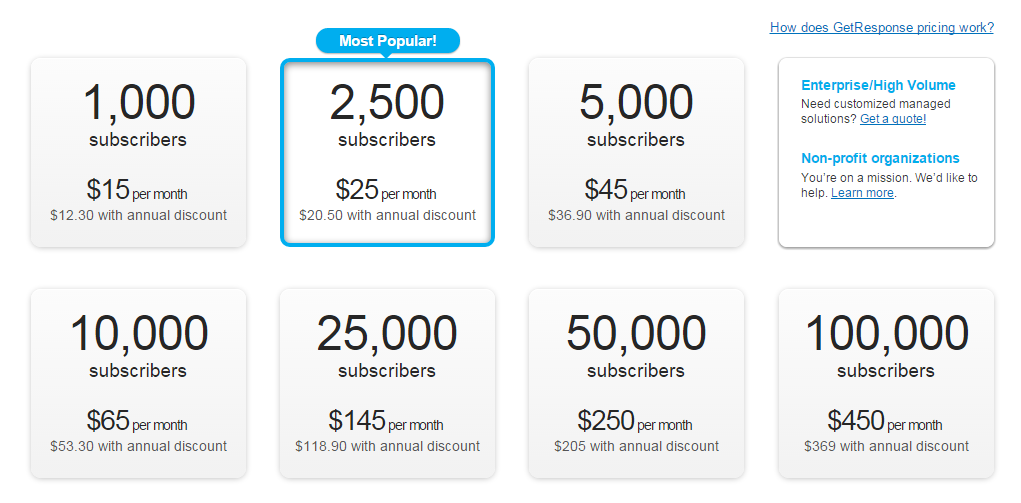
To its credit,the monthly pricing is as reasonable as it can get in comparison to other email marketing platforms.

screenshot-secure.getresponse.com 2015-07-14 12-57-17Given it’s pricing, it’s the most affordable among all email marketing tools out there. The autoresponder feature is benefits from its straightforward and simplistic functions perfectfor beginners. Also, setting up split-testing of email campaign with advanced features has never been this easy.

Aweber

AWeber_EMDlogo_black

One of the oldest and most trustworthy email marketing brands around, Aweber continues to deliver the goods after years of providing excellent service to marketers. Building off this, arguablythe best and most notable feature of this platform is it’s customer support that provides solutions to your problems in using the tool with the fastest response.

Another plus with Aweber is the simple process of setting up an opt-in form for your email list. On top of this, you also have 600+ professional and beautiful email templates to choose from, the most . You can customize each template to fit your branding and to increase open rates.

On the downside, considering that it’s one of the oldest email marketing platforms out there, its user interface is far from being the friendliest compared to others. Also, the$130-day trial does notgive you access to its autoresponder feature, which is an important toolthat marketers should have access tosee how Aweber works in full force.

MailChimp

MailChimp_Logo_DarkBackground

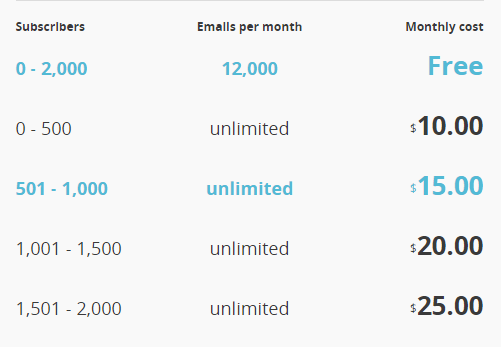
This quirky email marketing platform is a popular choice among email marketing beginners. The simple reason is that everybody can register for a free account without time restrictions – no 30-day trials nor monthly fees (unless you reach more than 2,000 subscribers). While the autoresponder feature is not included in the free account,Mailchimp’s strategy is clear: get people to build a substantial amount of leads and subscribers and retain them once they reach the limit.

Upon registering, you get to enjoy the tool’s intuitive user interface with easy to navigate pages and a drag and drop mail builder that’s a breeze to use.

The only thing going against it is the pricing. Compared to both Aweber and GetResponse (below), MailChimp’s monthly fees are quite expensive.

screenshot-mailchimp.com 2015-07-14 13-35-59

iContact


One of the bulkier email marketing platforms that’s best suited for bigger brands, iContact has the complete solutions for your email campaign needs. The brand is split into three divisions: iContact, iContact Pro, and iContact for Salesforce. The latter integrates iContact withone of the leading CRM tools online to provide you a comprehensive marketing automation tool, where email marketing is just part of your sales pipeline.

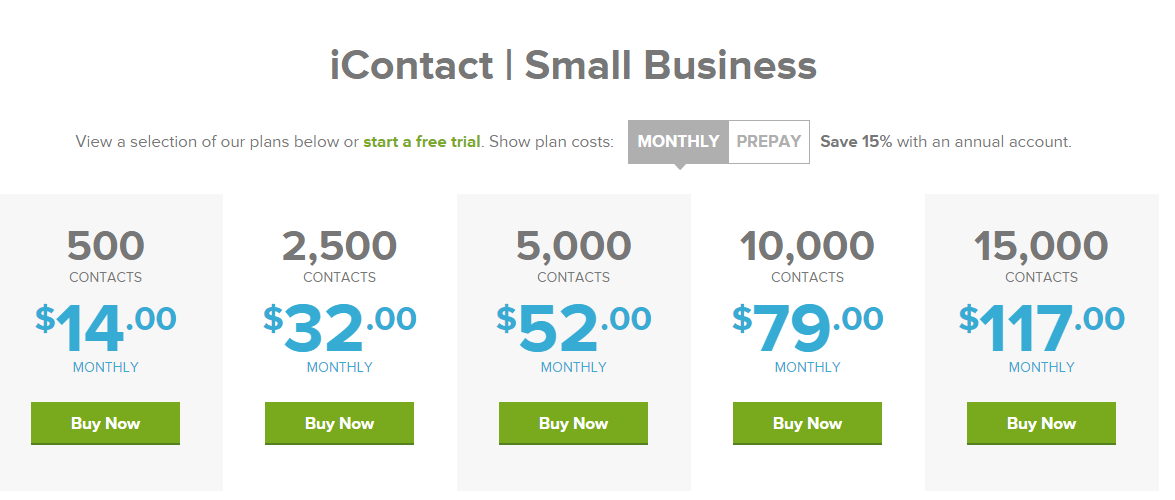
For argument’s sake, we shall stick with the iContact. Asa platform where you can send out and track the performances of your email campaigns, this tool is more than capable to shoulder your demands of reaching out to your target audience. The pricing also compares favorably with GetResponse.

screenshot-www.icontact.com 2015-07-14 13-56-08

Similar to Aweber, however, iContact’s text editor is clunky and suffers from errors due to its outdated interface. That being said, there’s a learning curve that needs to be mended in order to successfully use this platform.

Salesforce Marketing Cloud


If you want to go big with your marketing campaign (email included), you simply can’t go wrong with Salesforce Marketing Cloud. It has all the tools and resources a marketer needs to be successful at his or her craft. The best feature of this tool is the amount of autoresponders you intend on running for your business using the tool’s Automation Studio. This feature alone can help you build a customer lifecycle that will help you attract new customers and retainthem over long periods of time.

When it comes to reporting, however, SFMC suffers from providing campaigns reports that’s tailored for beginning marketers. One will have to edit and customize the report to show the desired results from the campaign, and even getting this done is not easy to do. Suffice to say, the tool needs more work on being more user-friendly if it wishes to attract more marketers to use this tool.

And the winner is…

Depending on your needs.

If you want the most affordable email marketing platform that will provide you comprehensive features, then head on to GetResponse and sign up for an account.

If you’re a newbie email marketer and wish to learn the ropes on how to launch a marketing campaign without being pressured by a trial period, then MailChimp is for you!

If you want a tried and tested tool to send out and track your email campaigns, then you can’t go wrong with Aweber and iContact.

For a marketing automation suite that covers all the bases of what a marketer to become successful, then Salesforce Marketing Cloud is the tool for you.

Personally, I prefer GetResponse. Unlikemarketing automation tools, this platform does one thing and does it quite well: send out and track down the performances of email campaigns. Thanks to its advanced reporting, it lets me create better email campaigns over time, which helps in increasing my subscribers. Also considering itsaffordable pricing and I now have an indispensable tool to help manage my email list!

Final thoughts:While the answer isn’t probably what you’re looking for, let’s face it: there’s no one tool that willget everything done for you. It’s all up to your needs as an email marketer and which among the tools listed above answers your needs the best.


14 Jul 17:14

How to Increase Conversions by 176.33% with The Visitor Vocab Technique [Case Study]

by Giles Thomas

If you run an ecommerce store or saas company and want to get more leads and sales from your landing pages, you’re in the right place.

Most of you know that to improve your landing pages you need to invest in conversion optimization, but many people misunderstand what conversion optimization really means. A/B testing, digital analytics, this is not completely wrong… but in this in-depth guide to optimizing your landing pages you’ll learn that ab testing and data analysis are just a small part of a much larger process for conversion optimization you should be following.

What you’ll learn here:

  • The truth about what conversion optimization really means
  • How to collect and analyse data for customer learning
  • How to turn customer learning into more leads and sales for your business

I’ve also created a free bonus area for those of you who are serious about increasing your conversion rates and profits, you can find this at the end of the guide.

The truth about conversion optimization and why you need it for business growth

Many people think conversion optimization and ab testing are one and the same thing.

There is a common misconception that CRO (conversion rate optimization) is just about analytics.

Yes, it is true, conversion optimization in it’s simplest form is about increasing the number of people who take a desired action, sign up, subscribe or buy for example, but it is actually about much more than just increasing your forms conversion rates. Increasing conversion rates as a business is super easy, simply sell everything for a $1.

POW! Conversion rates go crazy high!


But increasing your conversion rates and revenue is much harder. And not just revenue, increasing your profits is your main goal as a conversion optimization expert.

Now when we think of conversions we think about analytics, and most of us instantly think about digital analytics software like Google Analytics. This is quantitative data, it tells us what happened on our website, on which page and how much we made. But there is another source of data you must collect in conversion optimization especially if you want explosive business growth…qualitative data.

Qualitative data is collected through an exploration of visitor behaviour. It helps you gain an understanding of the reasons, feelings and motivations your customers have throughout their path to conversion along your sales funnel.

visitor behaviour

Your customers have feelings.

Where analytics and quantitative data can tell us what happened, qualitative data can tell us why.

Qualitative data is a powerful data source when making business decisions. Customer development interviews are a great example of qualitative data.

The key to increasing your conversion rates is actually your customer, the very reason you have a product or service to begin with. Conversion optimization is about improving your conversion rates through a deeper understanding of your customer.

This understanding comes from qualitative data collection and analysis…let’s dig deeper.

How qualitative data collection fits into a complete process for conversion optimization

So what does the complete process look like?

Let’s walk through an overview of the CRO process together.

CRO process

Step 1: Set Business Objectives

The first step involves defining your business objectives.

It is important to define objectives even if you can’t accurately estimate your success.

The first iteration of the conversion process will give you the benchmark you need to create your next set of business objectives and KPIs.

Step 2: Collect Data

The second step is data collection.

As we learned the data you collect during the CRO process can be categorized into two types: quantitative and qualitative.

Step 3: Analyse Data

The third step is collecting and analysing all of the data from your various sources.

You do this using software for quantitative data and by aggregating qualitative data, which basically means looking for patterns to gain insight.

Step 4: Create Hypotheses & Customer Theory

The fourth step is creating your list of hypotheses. These are ideas you’ve generated about your customers after studying the data. They are ideas you would like to test and validate as ways to improve your conversion rate and profits.

Step 5: Design

The fifth step is designing according to what you have learned. The design phase includes three main steps: copywriting, wireframing, and visual design.

This is the step in which research is turned into marketing material, and basic structural layouts are turned into beautiful designs.

Step 6: Build

Step six is when you integrate these new designs into your website: It’s time to code. This can involve anything from simple colour and copy changes, to a radical redesign.

Step 7: Testing

In step 7, you validate your ideas and your hypotheses. This can involve A/B testing, multivariate testing and segmentation testing.

Step 8: Learn & Improve

Step eight is where you find out if your ideas or assumptions about the customer were correct.

This is where you interpret test results, look for statistical significance, and then improve and iterate based on your new, deeper customer understanding.

The process then starts all over again.

Remember: Conversion rate optimization is not “one and done”. It is an iterative process that should never end. Markets and customers are continuously evolving. So should your business!

Now let’s learn in-depth how to collect qualitative data from your customers, in this case focusing on customer development interviews.

Step by step process for customer development interviews

Popularized by Steve Blank and the Lean Startup movement customer development interviews are a powerful source of qualitative data.

They allow you to read your prospect’s body language, tone of voice and really dig deeper into learning their needs and wants around your topic or industry.

Step 1: Create your questions

The first step is to create five core questions for your interview.

Here are your questions frameworks for your behavioural study:

What’s your biggest [your topic] challenge right now?

This teaches you their biggest pain point and frustration

What does [your topic] mean to you?

This teaches you how they express your topic or solution, what words they use and the how they say and mean those words.

What’s the main reason you want to [achieve their one true goal]?

This tells you their one true goal, the main outcome of spending money with you, as seen from their perspective.

Tell me about your process now when [trying to achieve their one true goal]?

This allows you to learn about their customer journey, what steps do they take when trying to solve their challenge and achieve their one true goal.

What did you like or dislike about the process?

This tells you how they want the current solutions to improve or how your competitors are flawed, this can help you improve your company and also points out ways you can differentiate yourself within the market.

Remember, you cannot market to everyone, conversion optimization is about relevancy.


Differentiating yourself within your industry can be a huge conversion factor.

Step 2: Record your data with analysis in mind

How you record your customer interview call can determine whether or not it is useful, actionable.

You can use this spreadsheet template (get it in the free bonus area).

spreadsheet template

Let’s walk through the different columns, learn what they are for and how to fill them out:

Name, Sex, Age, Location, Position

These simple demographic and job entries are self explanatory. The position of the person is only useful if your business focuses on larger companies where you need to have direct contact with a decision maker to convert a customer.

Questions

These five questions should be rewritten using the frameworks above.

Make sure the questions are open and cannot be answered easily, like with a yes or no answer.

General Comments

This is where you sum up the interview and write down your biggest takeaways, focus on pain points and desires.

Categorize

Make sure you categorize answers, what was the main takeaway from the call?

Step 3: Write a script

It is important to have a script for your interviews that follows the flow of your spreadsheet.

This will help to guide you as you ask the questions and make sure you don’t get lost.

If for some reason you cannot record the audio of the interviews, make sure you take an extra person along to make notes.

Do not run the interview and make notes at the same time under any circumstances, firstly it is rude and secondly you could miss or lose valuable information.

Make sure the person does not write down their interpretation of what the person says but the exact words they say. We’ll go over this more in the data analysis section later.

Also, ask the person at the end of the interview if they give you a referral for any other interviewees.

Step 4: Find people for customer development interviews

Ok, so it is no secret that getting customers to take the time to chat with you isn’t that easy.

If you are really struggling to find customers to interview try this checklist below:

  1. Perform a social search using your topic or keyword and reach out to people
  2. Google alerts or Buzzsumo alerts, set up emails that let you know when new content on your topic is published, then reach out to the author using email outreach
  3. Ask for introductions from first degree contacts
  4. Cold call people in your target market
  5. Ask for a referral at the end of every customer development call to find new potential customers

The best case scenario is to meet the customer in person to do the interview, however you can always do the calls over video chat like Skype or Google Hangout or over the phone.

Step 5: Complete your interviews and record the interview audio

I recommend to record the audio during your interviews, rather than write or type while you listen.

Record-interview

Record the interview

You will be a much more attentive interviewer and will be able to ask more insightful follow up questions.

Then simply review the audio and make notes straight after the interview or call, while the conversation is fresh in your mind.

If you are doing a call over Skype I highly recommend to use Pamela call recorder software.

Even if you decide to do some interviews over the phone, put some credit on your Skype account and call the telephone number from Skype to allow you to record the calls.

Step by step process for analysing customer development data and increasing conversions

Once you have completed your interviews it is time to analyse the data for customer insights.

Step 1: Compile and organize your data

From your interviews you should have:

  • Interview audio/video
  • Spreadsheet for data analysis

Step 2: Fill in your spreadsheet

Go through each call (you should do at least 3 and shoot for 10), listen to the recording and fill in the spreadsheet fields.

Complete the basic demographic information, this includes:

  • name
  • sex
  • age
  • location
  • job position (if relevant)

Listen back to the entire audio clip and transcribe the exact customers words into the answer boxes for questions 1 – 5.

If you want to outsource the transcription you can use a variety of services.

The next step is to write down a complete takeaway from each call in the ‘General Comments’ section in the spreadsheet.

This again should focus on the biggest takeaway from the interviewee, what did they talk about a lot and with the most passion?

Then categorize the interview as per the big takeaway,this can be about a feature or pricing or whatever the interview focus was.

Add any referrals, then move onto the next call until complete.

Step 3: Tally up the categories

Tally up the top three categories to learn what customers are focussing on the most.

This will guide you in improving your value proposition.

What are the top three categories? Do they point towards a pain point or goal the person has?

Step 4: Create a wordcloud

The next exercise in analysis should be to take all your call transcriptions and paste them into a word cloud (only the customers answers of course, not your sentences).

This word cloud is from the kagansblog.com customer interviews.

You can then get a visual representation of the words your customer are using to express their feelings.

Visualy Representing Your ClientsVisually Representing Your Clients’ Feelings

You should also pull out memorable sentences or phrases customers used in the interviews, especially ones that were echoed by more than one candidate.

As suggested earlier, you need to use the customers exact words, not your interpretation of what they said!

For example from the kagansblog.com calls we recorded these exact customer sentences:

  • “I don’t know how to start investing in real estate”
  • “The most annoying part was trust, knowing who to trust”
  • “I trusted her expertise in the area and saw that she had a recipe that had worked before”
  • “Find a strategy and recipe for investment”

The next step is to take the word cloud and customer sentences and create a list of words to test in your new copy changes.

This is the key to the Visitor Vocab Technique, you create a vocabulary of customer words from qualitative data you have collected.

These words then act as an input to your copywriting process.

Here is the vocabulary list from Kagansblog.com.

  • Honest / Trust
  • Properties
  • Local Area Knowledge
  • Expertise
  • Recipe
  • Start

Step 5: Copywriting

The next step is iterating on your sales and marketing copy.

You use the customers words and phrases as input, this helps you to describe their pains and needs in words they understand and relate to.

marketing copy

In this example the word list was used to create a lead magnet iteration, we rewrote the copy based on the qualitative data we collected and analysed.

Communicate value to your visitors, a value proposition they care about, in words they use to describe their goals and desires.

This is the secret to the Visitor Vocab Technique and a great way to increase conversion rates and profits.

Here is the final version of the landing page from Kagansblog.com :

final landing page

Using the Visitor Vocab Technique increased his conversions and lead generation by 176.33% in 4 weeks. Adding 300k to his bottom line in 2015 alone.

Of course you still need to test your changes, the qualitative data simply acts as a qualified source for generating test hypothesis ideas for your a/b testing. (Rather than the random ideas most people pull out of thin air and test :p )

Conversion Optimization is about Customer Understanding

As we learned here conversion optimization is about more than just a/b testing changes on your website.

You can also collect and analyse qualitative data, like customer development interviews, to help improve your marketing and conversion rates.

Qualitative data is especially useful if you have low traffic or a low monthly conversion volume business, as a/b testing then becomes more or less impossible (no statistical significance to the results).

Let me know in the comments if you’ve ever used qualitative data to improve your conversion rates.

Free Bonus Area

For those of you who are serious about getting seriously high conversion rates, I’ve put together a bonus area.

What you get:

  • Customer development data analysis pack (so you can run your own study)
  • PDF – 25 conversion rate best practices

Click here to access the free bonus area

14 Jul 17:13

Good Forms, Great Leads: How to Use Web Forms Strategically

by Philip Bosley

In order to build a relationship with your audience, you need content – lots of it – and you need to make it available across various media and Good Forms, Great Leadsmultiple channels. Lots of organizations make a common mistake: They wait until a prospective customer is 80% – 90% of the way through the buying process before they create an opportunity to get that prospect’s information using a “Contact Us” form.

In a conventional marketing strategy (especially if you have a long sales cycle) this may seem like good sense, but it can fundamentally cripple your ability to identify, segment, and target that lead so you could nurture them through a faster marketing and sales cycle.

To capture those prospects and turn them into leads, you need to elicit a submitted web form or an email click in order to change someone from an anonymous visitor to a real live potential buyer with a name, and an email address, and maybe even a bit more information.

Known Visitors

Before they decide they trust you and need what you sell enough to let you know who they are, your audience is made up of anonymous numbers in an analytics report. But behind each mysterious website visitor is a real person with a pressing business need. The key to successful digital marketing is being able to identify who these people are, so you can speak to them with personalized messaging.

If you can convert website traffic to known visitors as early in the cycle as possible, you’ll have a larger window in which to figure out what they’re interested in, and how urgent their need is. This helps you engage with content and messaging appropriate to their funnel stage. You’ll be able to create targeted segments, nurture campaigns, and much more to add personalization wherever possible.

As these known visitors interact with your email campaigns, landing pages, forms, landing pages, social media posts, media files, and your website, you can score their actions according to which of these, historically, signify a likely sale. The more highly qualified leads are usually the ones that make themselves obvious with higher lead scores.

But first, before you can interact with known visitors, you need to make it easy for them to tell you who they are. That’s where web forms come in.

Form Strategy

The primary goal of your content will probably be either to create new leads or to help a mid-funnel lead take a next step. You should make lead stage a major factor in your form strategy, so that you can apply the right content to get more conversions.

Take note: It is critical that the information you request in a form is appropriate to the funnel stage.

Content designed for general interest (top of funnel) should be deployed as free content (which means it doesn’t require the prospect to give information to see it). This content should provide compelling reasons for your audience to want more information. Once you establish your brand as a source for great content, then offer more, and make this additional information require a simple form asking for first name, last name, and email address. This will convert your prospect to a known visitor.

Content that promotes a product or service (middle of funnel) is more valuable to your audience, and therefore the price of entry should be higher. In order to create maximum ROI for you, the forms you use for this content can be more robust. In this stage, you will often request first name, last name, email address, company name, and title. You may also seek to capture more demographic information, such as the company size.

Content designed for serious buyers (bottom of funnel) will have longer, more detailed forms. Good examples of this type of content include pricing, demos, rates, comparative studies, and inventory. If a prospect is looking for this information, there’s a good chance they are completing the research phase of the buying process and moving into deliberation. At this stage, it is perfectly reasonably to be seeking specific information from your audience about budget, role, business needs, and timeline to purchase.

Types of Forms

There are several basic types of forms you will probably want to deploy in your content marketing strategy:

  • Sign-up forms
  • Access forms
  • Contact forms
  • Progressive profile forms

Sign-Up Forms

Sign-up forms are presented alongside content and provide a way for the prospect to register or sign up for a resource or event that will happen later, or be delivered later. Common examples of sign up forms include registration for newsletters, webinars, blog feeds, tradeshows, and recreational events.

signup

Access Forms

Access forms let people have access to content right away, for example an on-demand webinar, a video, or a downloadable eBook. Access forms use web pages or landing pages to provide a synopsis of the content being offered, a value proposition for why the prospect should want the information, and the call to action is to submit the form visible on the screen.

eBook Form

Contact Us Forms

Contact Us forms are typically used in the bottom of the funnel and are a very clear indication of serious interest. Contact Us forms often request detailed information from prospects as it relates to a potential purchase.

contact us

Gated URLs/progressive profile forms

When forms are hidden behind a link, they are described as “gated URLs.” A prospect will click on a navigation link or button with the intent to access the information, at which time a form will be presented to the prospect, with completion required in order to finish the navigation to the asset.

Gated content forms also give you the ability to use progressive profiling. That means that as you provide successive forms to a lead, the information requested can be progressively different. For example, suppose form 1 requests first name, last name, and email address. When the lead next interacts with something gated, your marketing automation solution should check and see if this information is already known. If it is, then it will display the second form in the series requesting company name and title. This lets you build up the information you know about a lead over time, without overwhelming them with a long list of required information.

Progressive fields

Best practices for forms at early funnel stages

Forms are the most valuable in the earlier parts of the customer lifecycle, where they do a job no other tactic can do.

In the mid-funnel stages, as you’re nurturing leads, you may choose to do without forms for some assets, providing free content to help keep leads engaged. You could do this in tandem with higher-value gated content, perhaps events such as webinars (which offer good opportunities to apply progressive profiling).

In the bottom of the funnel, you’re less likely to find forms useful, as you’ve built a solid relationship with the lead by then (through earlier form deployment).

To address those early funnel stages:

Attract: The focus of targeted marketing programs to drive awareness and interest in a company’s products and/or services.

Capture: The generation of an inquiry into products or services of a business; the creation of a lead in a company’s process.

If content is considered to be primarily for lead generation, it should always have a form associated with it, and it is prudent to consider using a form to gate your content.

Here is an easy flow chart to help you decide if you should use a form or a gate:

decision-tree1

Should I use Gated URLs or Display Forms?

With the option to use a displayed form or a gated URL, many people ask, “When should I use gated links instead of a displayed form?” To answer this, consider the following:

decision-tree2

How to Deploy Forms

The most common method for deploying forms is by using an Iframe. With Iframes, you are able to embed the form into any online medium such as a web page or landing page without having to write specific code.

You also have the option to direct people to your form URL, or connect existing forms from your site to a form, using external posts.

Using the same methodology, forms can be used at live events or in distribution of syndicated content. By using forms or gated URLs in your promotions, you will gain early insight into the degrees of qualification and engagement of your audience.

This is a highly effective method for realizing quick ROI by feeding your sales team the best leads first.Frictionless Forms

Learning how to compose, design and create effective, easy-to-fill-in forms is critical to the success of your digital marketing efforts and can make a big impact on your conversion rates. For more tips on how to boost your conversions and make it easier for your customers to say ‘yes,’ take a look at our eBook – Frictionless Forms, and learn all the tips and tricks for better form conversions.

14 Jul 17:10

How to Build Authority on LinkedIn in 15 Minutes a Day

by ltoner@hubspot.com (Lisa Toner)

15_minutes.jpg

This post originally appeared on HubSpot's Marketing blog. For more content like this, subscribe to Marketing.

So you followed the step-by-step wizard to completing your LinkedIn profile. Then, maybe you even went a step further and connected your SlideShare account, claimed your vanity URL, and linked your profile to your website and blog. Congratulations, you graduated LinkedIn 101!

But you want to be so much more than that. You want to be an expert in your field.

You have ideas that you want to be seen and heard. 

Good news! With LinkedIn, you can become whoever you want to be if you put in a little bit of time. For the low investment of just 15 minutes a day, you can establish and maintain a solid personal brand. Just follow these simple steps every day, then start to watch your connections grow and the requests for your expertise flood in.

First Things First: Set Yourself Up for Success

Before we get started, you need to get yourself into the habit of investing time in building your personal brand. Allocate a slot on your calendar and make it recur every day of the workweek. When that reminder pops up though, you need to take it seriously -- no snoozing!

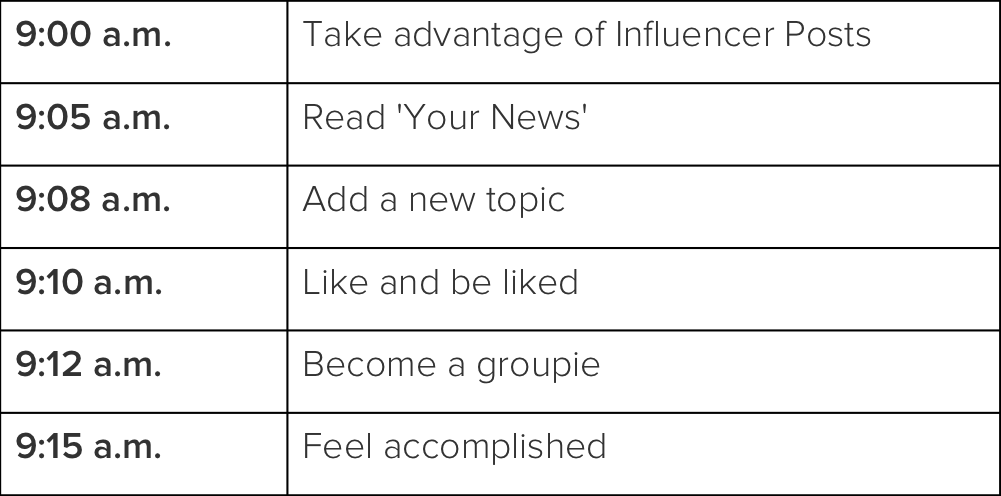
Here’s the agenda we recommend you follow (assuming you want to start at 9 a.m.):

LinkedIn_Schedule-1

9:00 a.m. Take Advantage of Influencer Posts

Though it seems a little counterintuitive, a crucial component to establishing your personal brand is sharing other people's amazing content. And LinkedIn is the perfect place to find that awesome content. It's become a hub for industry leaders who share their thoughts around the topics they are most passionate about, with some authors getting over 2 million views in a single article.

There are two ways you can take advantage of content in LinkedIn's Influence network:

1) Find thought-provoking articles from LinkedIn Influencers to read and share with your network.

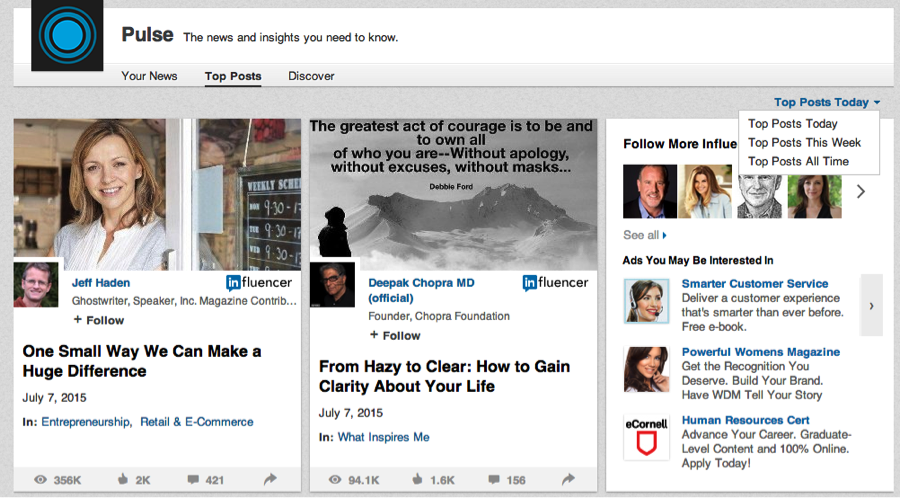
When you log into LinkedIn, go to the "Interests" menu and click on the dropdown item named "Pulse." Then click on the "Top Posts" tab. You can filter by today, this week, or all time. As you'll be coming there every day, choose "Top Posts Today" (the default) so that you will be equipped with timely and topical information to share with your network.

linkedin_pulse_top_posts.png

Influencers are denoted by a special label to the right of their names. Once you find two or three valuable Influencer posts, schedule them to be shared with your network throughout the day. Keep in mind that the earlier you share information to your network, the more valuable you will become to them. If you share a top Influencer post a week after your connections have already read it, your value to them diminishes significantly. And if you find any particularly inspirational experts, make sure you follow them so they will appear in your tailored news section tomorrow. 

2) Follow one new Influencer from the each day.

Next, click on "Follow More Influencers" and find someone to follow.

linkedin_influencers-1.png

We recommend that you not only follow people in your industry but also experts in completely different roles or fields who will inspire you and your network to think in a different way. Following people who will make you think differently though original, thoughtful content will not only give you more content to share throughout the day, but also establish yourself as a quality content curator with your connections. 

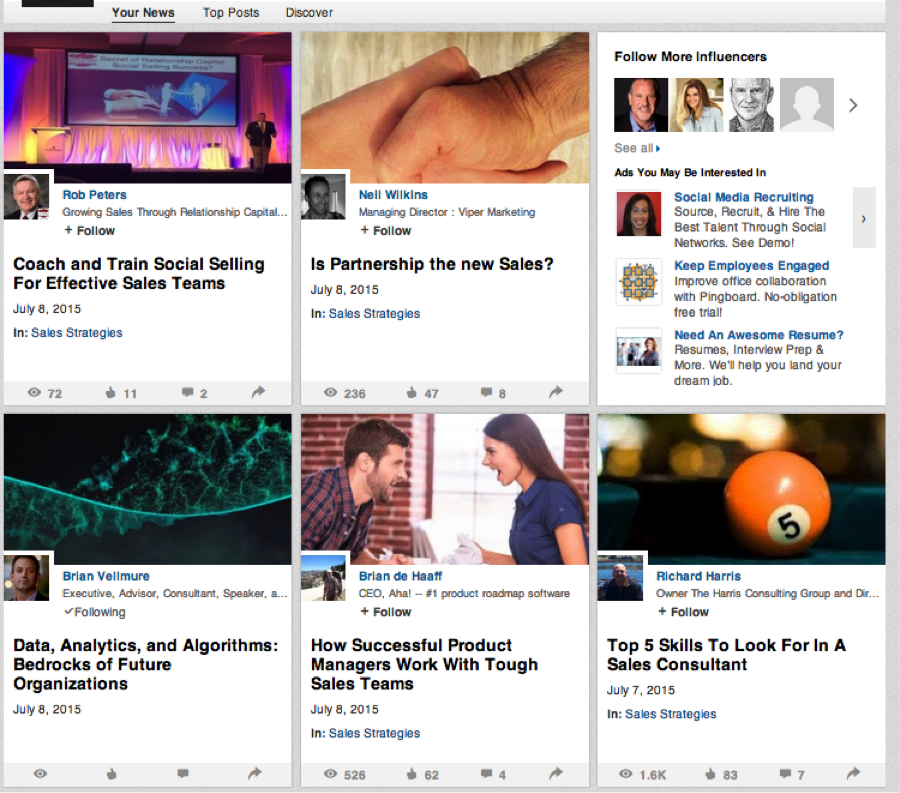
9:05 a.m. Read 'Your News'

In the tab called ‘Your News,’ you'll see the latest and greatest from the people you are already following. Be disciplined and only choose two or three articles to read each day so you don’t lose an hour or more in the genius of these people -- which could be very easy to do!

Curate the articles that you want to share, but don’t blast updates to your followers all in one spree. This will clog up your people's timelines and they will see you as more of a nuisance than a valuable connection. If you have social media software like HubSpot's Social Inbox in place, you can easily schedule updates to go out across the day or week.

your_news_linkedin.png

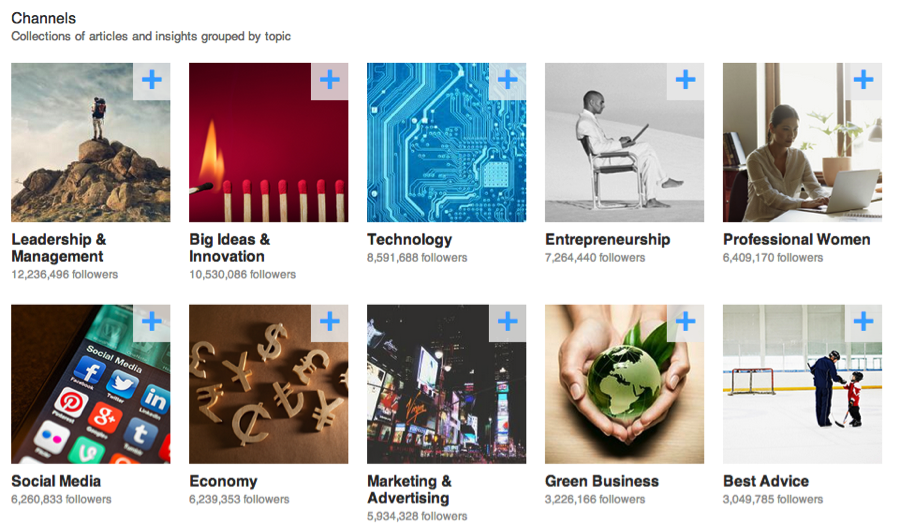
9:08 a.m. Add a New Topic

The next call of business is to go into the "Discover" tab, scroll to the "Channels" section, and choose a topic to follow rather than a person. This should take less than a minute to set up and won’t need to be updated every day -- which gives you extra reading time. 

linkedin_channels.png

9:10 a.m. Like and Be Liked

Posting regular, thought-provoking content to your network is one thing, but on a platform where most members have anywhere from several hundred up to five thousand connections, how do you get them to notice you amongst all of that noise? We recommend spending a few minutes every day going through your news feed and liking, commenting, or sharing any valuable articles your network has shared.

It's the Golden Rule of social networking: If you engage with several of your connections every day, those same connections will start to listen to what you have to say. And if they like the content you're sharing, they will be more likely to share, comment, or like your stuff too! Mix it up and choose different connections to remark on each time, and you'll have a large -- yet engaged -- network in no time.

9:12 a.m. Become a Groupie

Be strategic about the groups you join. LinkedIn allows you to join 50 groups, so choose wisely and leave any groups you have already joined that have not been very active or beneficial. If you haven't joined a group yet, one way to get started with LinkedIn groups is by going local. Joining groups for people in specific regions will enable you to be the big fish in a small pond and your ideas will have better leverage.

And if you're looking to remove yourself from a group, go into that group and click on the gear icon in the upper right corner:

slideshare_linkedin_group.png

Then click the "Leave Group" button at the bottom of the page:

leave_linkedin_group.png

With just a few minutes left in your daily LinkedIn routine, take a few minutes to engage with people in one of your groups. Ask intelligent questions, poll the members, and respond to other people’s posts. Remember, you don’t need to be the group founder to be a standout contributor -- just pick one of your groups each day and add something of value to it.

9:15 a.m. Feel Accomplished

All of that should have taken you about 15 minutes, but the value this routine will add to your personal brand will be significant. Your name will start to become associated with the amazing skills you possess and you could be known as a go-to-expert in your field. What does that mean? It means that you will be approached for business, job opportunities, and speaking engagements. So go ahead and set a calendar invite for tomorrow's 15 minutes -- pretty soon the opportunities will be rolling in!

Get HubSpot CRM today!

14 Jul 17:10

Why it’s Time to Ditch the Autoresponder and Build an Email Sales Funnel Instead

by Matt Ambrose

email sales funnel

Don’t build your farm on rented land. That phrase continues to make marketers look sheepish who spent too much time on their Facebook page and not enough on a channel that works.

What am I talking about? Email marketing, of course. And I don’t mean just sending out a monthly newsletter or setting up an email autoresponder and thinking your work is done. Oh, no. That attitude won’t cut it in the midst of 2015.

Today’s savvy marketers are far more sophisticated. They’re using email to power ‘customer value optimization’ strategies that increase leads and the average order value of every customer. Autoresponders present just one path for leads to follow or to fall off. The new approach to email entails creating an obstacle course of ‘lead magnets’, ‘trip wires’, ‘profit maximizers’ and multiple funnels all delicately arranged to keep readers on their toes and spending money for longer.

Multiple paths to profit. Not just one

Creating email sales funnels (a.k.a. marketing automation) is a strategy used by e-commerce giants like Amazon, information businesses like the Motley Fool and the interwebs brightest digital marketers to run email campaigns that are optimized to within an inch of their life. They’re all earning handsomely from it too.

Want to join them?

If you click on the image below you can download my seven step guide to creating email sales funnels like the internet’s best players. By following this simple strategy, you’ll be able to use email to create a far more powerful path to profit than a well meaning but ultimately ineffective monthly newsletter. When setup correctly, and fed with quality fuel, email funnels act like a finely tuned sales generating machine, converting more of your visitors into leads into friends then into loyal customers.

7 Step Sales Funnel small

Switch off the autoresponder. Build engagement paths instead

If you’re a copywriter or marketer, savvy businesses will throw money at you to implement this strategy thanks to its trackable ROI. If you’re a business owner, I recommend you stop wasting your website’s traffic and setup lead magnets and tripwires to convert visitors into leads as a matter of urgency.

Whatever you decide, not implementing a sales funnel means leaving money on the table. So turn off the autoresponder and ditch the monthly newsletter. Join today’s smart marketers and build profit driving sales funnels instead.

P.S. You can find out more about building funnels in Ryan Deiss’ book ‘Invisible Selling Machine’. He explains how many emails to write for each stage, what to say and a plethora of rock solid email tactics that work.

14 Jul 17:10

Is it time to declutter your salesforce?

by Josiane Feigon

declutter-photoDetaching, decluttering, and detoxing are in. As a big supporter of Feng Shui principles and the Burning Man philosophy of “leave no trace,” I can get behind living and working without clutter.

It all started on my flight from San Francisco to Denver when I was consumed by The Life-Changing Magic of Tidying Up by Marie Kondo. She helps us simplify and declutter our home and office, and encourages us to only hold on to what brings us JOY. Inspired, I’ve started my own journey to shed the no longer meaningful.

Is it also time to declutter our corporate culture? The corporate sales culture likes to expand and reduce according to the economy and trends. The recent Forrester Research article on Death of a B2B Salesman frazzled a lot of salespeople. Maybe technology will not completely replace them. Then again, perhaps an On-Demand Salesforce will be born.

For the moment, inside sales continues to grow, with new functional roles being added to the org chart. Yet thought leaders such as Trish Bertuzzi raise the question Should You Replace Your SDR’s with Automation, and a few believe the low-end roles might be threatened by automation.

I think we can all agree with the Harvard Business Review article that states B2B Salespeople Can Survive if They Reimagine Their Roles. So let’s look beyond roles and check on the value they bring:

Bottom line = Does your sales organization bring you JOY? Here are the qualities you can use to judge how competent your salespeople are:

  • Strong and healthy activity with call volume and funnel activity,
    number of appointments/meetings
  • Deliverables, results, sales performance, paperwork/administrative, expense management
  • Track record of sales success, consistency
  • General momentum, productivity, and efficiency
  • Product and technical knowledge
  • Strong partner relationships, customer satisfaction
  • High tool IQ
  • High social media score, high digital influence
  • Positive attitude and continuing motivation
  • Coachability
  • Team player

Now keep those essential team members, and think about de-cluttering the rest!


The post Is it time to declutter your salesforce? appeared first on TeleSmart Communications.

14 Jul 17:00

3 Tips For Trouble-free Monitoring On Social Media

by Amanda Hicken

Social Media Trouble Zones

Data: This one four-letter word can incite panic in the most stalwart of public relations professionals.

If it seems like there are numbers following you everywhere, that’s because there are. Website traffic, earned media pickup, social media engagement…Understanding these performance metrics and communicating them to others is an inescapable job requirement.

And as CNW Group’s Laurie Smith notes in her two part series, Social Analytics Danger Zones and MORE Social Analytics Danger Zones, it’s easy to lose your away among all of the data that’s out there.

Here are three ways to stay clear of trouble when monitoring and measuring your brand’s communications.

Pay attention to quality over quantity.

When working with analytics, it’s easy to hear what other brands are doing and get caught up in a number.

“More is not always better,” says Eden Spodek, a Toronto-based digital strategist. “What does it mean to have 5,000 Likes on a Facebook page? So you got 36 retweets on a tweet, but is that doing anything for you?” Case in point: She worked with one client who had a very small social media following, but a deeply loyal one that would respond with comments (and purchases) to most of her posts.

The quantity of social activity going on around your brand is only a fraction of what you should look at. Analytics can also give you a solid picture of how your content is being received and by whom, information that is critical to future campaigns.

It takes the careful eye of a PR professional to not accept the numbers at face value and provide context.

Avoid complacency.

Social media is tricky to nail down so when you find success, it can be tempting to try and replicate it again and again.

Although it’s ok to celebrate your victories and figure out what made a particular campaign successful, don’t allow your efforts to stagnate.

“You can get into a comfort zone,” says Gary Edgar, managing director of Ruckus Digital. And he doesn’t mean it in a good way.

Social media algorithms and best practices change all of the time. Even if something is working today, doesn’t mean it will tomorrow. You need to stay current on how social networks treat user content and you need to experiment with new tactics on a regular basis.

Know how to report your analytics clearly.

Analytics are not just useful at developing and improving your campaigns, but also demonstrating the value of your work.

However, if your executive team or clients don’t understand what they see in your reports, it’s all for naught.

The key is defining your goals and KPIs in advance so that everyone sees the same thing when they look at your numbers.

If the numbers aren’t telling you the full story, it may be time to invest in tools that provide more meaningful insight. Although free tools can get you started, social monitoring subscriptions offer in-depth analytics that help you gauge success and benchmark campaigns.

For more tips on effectively tracking your brand’s digital campaigns, check out CNW Group’s original posts on Beyond the Wire or download our white paper Monitoring Your Brand Across the Web.

14 Jul 17:00

China could push world into recession: Morgan Stanley

by Ye Xie and Gavin Serkin, Bloomberg News

Forget about all the shoes, toys and other exports. China may soon have another thing to offer the world: a recession.

That is the prediction from Ruchir Sharma, head of emerging markets at Morgan Stanley Investment Management, who says a continuation of China’s slowdown in the next years may drag global economic growth below 2 per cent, a threshold he views as equivalent to a world recession. It would be the first global slump over the past 50 years without the U.S. contracting.

“The next global recession will be made by China,” Sharma, who manages more than US$25 billion, said in an interview at Bloomberg’s headquarters in New York. “Over the next couple of years, China is likely to be the biggest source of vulnerability for the global economy.”

While China’s growth is slowing, the country’s influence has increased as it became the world’s second-largest economy. China accounted for 38 per cent of the global growth last year, up from 23 per cent in 2010, according to Morgan Stanley. It’s the world’s largest importer of copper, aluminum and cotton, and the biggest trading partner for countries from Brazil to South Africa.

FO0710_CANDA_US_DOWNGRADE_940_AB

The International Monetary Fund last week cut its forecast for global growth this year to 3.3 per cent, down from an estimate of 3.5 per cent in April, citing weakness in the U.S. While the Washington-based lender left its projection on China unchanged at 6.8 per cent, the slowest since 1990, it said “greater difficulties” in the country’s transition to a new growth model pose a risk to the global recovery. The Chinese government expects 7 per cent growth this year.

Fund Performance

China’s economy will continue slowing as the country struggles to reduce its debt, Sharma said. An additional 2 percentage point slowdown would be enough to tip the world into a recession, he said.

The global expansion, measured by market exchange rates, has slipped below 2 per cent during five different periods over the past 50 years, most recently in 2008-09. All the previous world recessions have coincided with contractions in the U.S. economy.

Sharma’s US$1 billion U.S.-traded Emerging Markets Portfolio has returned 2.8 per cent annually over the past five years through Monday, outpacing the 2.5 per cent gain in MSCI Inc.’s developing-nation benchmark, data compiled by Bloomberg show.

Sharma said he’s shunning Chinese stocks and those in countries that rely on China for growth, including Brazil, Russia and South Korea. He favours companies in eastern Europe and smaller Asian countries, such as the Philippines, Vietnam and Pakistan.

Volatile Market

China’s US$6.8 trillion equity market roiled global investors over the last few weeks after a yearlong rally accompanied by record borrowing and surging valuations ended in a bear market.

The Shanghai Composite Index slumped more than 30 per cent in four weeks through June 8, wiping out almost US$4 trillion in market value. The unprecedented government intervention used to bolster the market failed to inspire confidence until last week, when regulators banned major shareholders from selling shares for six months and allowed more than half of listed firms to suspend trading.

The market collapse has challenged some investors’ long-held conviction that the Chinese authorities have a firm grip on the economy and markets and that the government is always able to achieve its goals, said Sharma.

“What happened in China last week was so significant in that for the first time, you’ve got this sign that something is out of control,” Sharma said. “Confidence damage is going to last for a while.”


Bloomberg News

china-gdp-july-15

14 Jul 16:59

8 Questions To Ask A Salesperson BEFORE Hiring

by Will Thomson

HiringaSalesperson

People ask me all of the time, “Why do you like recruiting sales people”? Recruiting sales people has been documented as one of the toughest professions to recruit. I guess in a simple answer, it takes one to know one. I am a sales person.

There isn’t much I haven’t heard or haven’t seen in my career as a recruiter and sales person. I have heard just about every spin on the word “lay off” as you can imagine. I have heard every excuse for not hitting quota. I have heard candidates change the topic to avoid answering the direct question. Yes, sales people are called silver tong devils for a reason.

Here is the thing. I do not do tech recruiting. I don’t understand it, nor claim to understand it. I get the big picture, but I don’t understand how to code Java or C++. I would rather get in a boxing ring with Floyd Mayweather than recruit software development professionals. I know I am going to get my ass kicked either way.

I’m not alone, but I am a minority of the recruiters out there. In Austin, I would say most of the recruiters I know are tech recruiters. It is the hottest industry and tech talent is highly sought after.

The problem with recruiting sales people is that if you aren’t careful, the sales people can convince recruiters that they may have the skills or background to do something that they aren’t capable of doing. It may feel like going to buy a car at a car lot and getting sold a lemon by a someone who is really good at convincing you to buy a car. Managers get frustrated when the sales people hired don’t deliver what they said they would.

Here is what it takes to successfully muddle through all of the muck to get the right sales people. It seems simple, but these questions don’t get asked often enough. Ask directly, and stay on track.

  1. What was your W2 at your last job? – Lets cut through the BS. I don’t care what your “on target earnings” were last year! I care about what you actually made. I want to know your base salary, your on target earnings and what percentage of your quota you actually hit. Yes, I will ask for your W2 if I feel you aren’t telling the truth
  2. What are you looking for in your next role?- As much as we want to hire the right individual, they want to be hired by the RIGHT COMPANY. Ask open ended questions. A sales person needs to be SOLD! They need to understand the value of the company you are selling and why it is the right role for THEM!!
  3. How do you find your Prospects? This tells a lot about the candidate. Almost all sales people cold call. If someone doesn’t want to cold call and won’t roll up their sleeves to do the hard work that selling entails, then you don’t need to hire that individual. There are Account Managers and “Farmers” who build relationships, but even those require calls. No one is above cold calling in sales.
  4. What would it take for you to make a change?- The great thing about sales people is that they return your calls. Sales individuals need to know what the bottom line number is so the candidate and recruiter aren’t wasting each others’ time. If the candidate’s ideal salary is s far below what the salary pays, then you may find out they are unqualified for the role.
  5. Do you work better alone or with direction? There are a ton of remote based opportunities available today. Some managers are very hands off. Other managers require detailed documentation. You need to make sure you are hiring the right person for the role and setting them up for success with the right manager expectations for them.
  6. Why did you leave this company? Sales people usually have expiration dates. They get tired of the management, the quota, or even selling the product. It is rare that you find someone who has been with the same organization for a decade. The main thing I am looking for here is a pattern. If someone leaves every year, then the issue is not the company!
  7. Do you have any questions for me? This is so important. If the candidate has no questions, then they appear to be “just going through the motions”, are uninterested, or really needing A job, not THE job.
  8. Who is the the best salesperson you know? I always like throwing this curveball at my candidates. I want to find out in their mind what makes a good salesperson. They will have to articulate to you what makes someone better than the average sales rep.

So, in conclusion, hiring sales people is an art, but it is my passion. It’s a dance, but it makes a hell of a lot more sense than tech recruiting in my mind.

14 Jul 16:59

10 Twitter Tips From Twitter Experts

by Cameron Bartlett

What You Missed from #TweetSmarter 2015

describe the image

Recently, Twitter and Hubspot hosted a public webinar for marketers and business owners the learn some of the new features and best practices for marketing on Twitter based on case study results they’ve been collecting over the past year, since their #Tweetsmarter 2014. Honestly, I found the results helpful to marketers and business owners of varied levels.

The #Tweetsmarter event hosted by Anne Mercogliano of Twitter and Kipp Bodnar of Hubspot provided marketers on the SMB level with tangible and practical advice which could be implemented for both long-term and immediate strategy. As a marketer, I’m always looking for great resources to help me better the performance and success of my clients and this event did not disappoint, it totally delivered — and in “30 minutes or it was free.” #Dominos

Anne and Kipp get it started with highlighting best practices they recommend based on promoted tweets they’ve done over the past year. Anne determined that, “Every great campaign starts with a strategy.” Ok, so kind of buzz-wordy and simple, but she emphasizes the need to make sure each post first starts with a company goal in place, to which you can compare each tweet and then learn the best ways to track and study that. It’s a good intro which then leads into Kipp’s talk about A/B Testing at Hubspot.

What is A/B Testing, Again?

Trial and error is a huge part of online marketing. It’s actually what makes online marketing so great. If you posted a billboard and thought, “Maybe if we changed the wording people would respond differently…”, you would have to go through a timely expensive process to change it and maybe even learn that it was a mistake, that you should have kept the original sign. With online and social media marketing you can run multiple ads, posts and themes and change anything at anytime to see what’s most efficient. This is the value of A/B Testing.

Kipp mentions the difference between making the decision to implement an incremental or drastic test. He mentions incremental being something like, using a picture of a puppy or altering a phrasing to see how people respond. Whereas drastic testing would include things like keeping all posts to 10 words or using 5 links every time. So we’re talking about small vs. large changes. Where you might learn greater things from more drastic of an approach, it has the potential to have a dramatic positive or negative effect on your campaign. Also, your success might not boost as much from a small change, but it might be this tweaking (not twerking) and tinkering (like Tinker Toys) that allows you to find a better formula for posting.

How Do I A/B Test?

A/B Testing takes time. When you have a plan, make a hypothesis and would like to test it out, you then need to take the time to wait and see what happens. Unless you’ve really messed up, in which case you should probably remove the post. Hypotheses are super important in this process.

This is where you determine what you’d like to test. “I think if I ask more questions, I’ll stir more of a response.” Then you ask more questions, and nothing really happens. Ok. So, now wait. Maybe your questions aren’t engaging. Continue to try things out, until you’ve collected enough data to determine what from this hypothesis was correct and what of it should be implemented in the future. In being statistically significant, Kipp mentions a cool ROI calculator you can use to determine the importance of the info you’ve collected from this. As we know calculators are always cool, so maybe check that out. I’m more of an abacus or counting stones kind of a guy, myself.

The Value of Twitter Cards

Ok so I kept hearing about Twitter cards, but I hadn’t used them in very many social media strategies yet. I’m glad Anne covered this so that I could become more familiarized with how these could be useful in marketing on Twitter. Twitter cards are a richer format of a Twitter post. They stand out, with more white space around the posts, show your brand and then link to something generally using CTAs. Similar to what you would see a Facebook ad look like, Twitter cards have a similar format, but can be used for organic, as well as promoted posting. It’s a great shiny new tool you can work up in Twitter’s ad platform. I love shiny, new things.

twitter cards

Twitter and Hubspot ran some tests together, from which they gained some insightful data which led them to draw 3 themes that led to more engagement on both organic and promoted posts.

Their most successful twitter campaigns over the last year included an emphasis on:

  • images
  • CTAs
  • Tweet copy

Hubspot found that Twitter cards with engaging images drove 55% more leads. Twitter, also, noted that across all of their tweets, those with rich media got 313% more engagement and 52% more RTs.

Twitter cards with engaging images drive 55% more leads. -HubSpot 

10 Twitter Best Practices from the Twitter Experts Themselves

Here are the 10 best practices Twitter and Hubspot have found to be most successful while communicating on Twitter.

1. Showcasing your product.

Showing behind the scenes, screenshots of your app or a high resolution photos of your product. Make sure it’s tailored to your audience. Don’t use Android photos if you are promoting an an iOS app.

product showcase

2. Share the company you keep.

Reference notable brands or affiliations you have. This doesn’t just mean tag your company contacts, but rather find ways to relate your brand to those which are more familiar with others. For example, if you are providing transportation to a festival, mention a few of the bands who are playing there.

share company

3. Explain the process.

The goal is often to reach new customers and so it’s really important to never assume that people know who you are or what you do. One of your followers may not  fully understand your process, or they’ll share with their friends who are unfamiliar with you.

lyft

4. Localize your content.

As mentioned, you shouldn’t use an Android phone to sell an iPhone app. Similarly, don’t post a photo of New York City if you’re trying to reach people in L.A. Unless, of course, you’re promoting something that’s exclusively New York, ie. SNL.

local content

5. Optimize for the desired action.

This is about making sure your call to action matches the next step you want your customer to take. Use “Read More” for blogs, “Install” for apps or even “Use App” for those who have already downloaded your app and who you would like to re engage.

optimized for actions

6. Convey urgency.

In all areas of marketing, but especially online, one of the best ways you can promote action is to convey limited time offers, inventory limitations or anything that will allow you to instill a sense of urgency. Keep it positive, though. People don’t want to be threatened. They do however, appreciate that you are giving a discount to those doing this, now.

convey urgency

7. Minimize distractions.

How Anne and Kipp recommend to minimize distractions was actually surprising to me. They saw greater responses when people weren’t distracted by handles or hashtags. These drive 23% more clicks. People like to click and hashtags and @handles give people the ability to click, and you only really want them to click on your link. Keep your audience focused.

minimize distractions

8. Share reviews and ratings.

When others have raved about your brand, showcase that in your tweet copy.. You can talk about where your product has been featured, or how your customers love their experience with you. Find a good way to brag (without sounding vain) and you’ll see great results.

share reviews

9. Ask questions. 

Looking to have engaging conversations on Twitter? Ask engaging questions. (See what I did there?) Also, finish your post with directing people to your article which answers this question. Questions start conversations and they help users identify with the product.

ask questions

10. Give users a roadmap.

It’s important to mention the next step, such as “read the book”, “buy the shoes”, “get these dresses from $9.99”. You’re not commanding people to do something, you’re just making it clear what you’re trying to communicate. When you are direct,  people will respond accordingly.

be direct

A Few More Helpful Tips and Tools

Make sure to not try and use all 10 of these in each tweet, but rather A/B Test these different strategies, determine what works and then scale. Landing page optimization is also super important when directing people from social to gaining new leads. Kipp spends some time talking about the importance of keeping landing pages consistent with the branding of your posts, as well as keeping things short, simple and visually appealing.

Because images have been so emphasized, Anne mentions a few ways to get your own high quality stock images or how to create your own. Unsplash.com was one of the sites they mentioned and I’ve been loving this tool! Another way to create some great images or even use unsplash photos and enhance it, you can use Canva.com. I had heard of Canva before and feel it’s a super helpful tool.

Check out the webinar yourself

I really loved this webinar and would totally recommend you checking it out. Here’s a link to the replay of the event. I think you’ll really enjoy it!

14 Jul 16:50

The Silliness Of Recapping Seed Rounds

by Brad Feld

Here’s the scenario. A company raises $2m of seed money from angels in a convertible note with a $6m cap. Assuming equity is raised at or above that cap, the total dilution, before the new money, is 33% (equivalent to an equity financing of $2m at a $6m post money valuation.

The company spends the $2m building and launching their first product. The first release is underwhelming, but they iterate aggressively, with feedback and support from some of their angel investors. The product gets a lot better. They go out to raise a Series A, but there are no takers. The feedback is “come back when you’ve made more progress with customers.” They are running out of money.

One of their angel investors, who happens to be a VC firm, decides to invest another $500,000 in the company. But instead of adding it on to the note or doing an equity round with a price, which could still be an early stage price but below the cap, they make the argument that since the company couldn’t raise a round, the company is worthless.

So they recapitalize the company. The term sheet converts all the convertible debt into a post-money valuation of $100k, essentially making the convertible debt worthless. The new money comes in at a pre-money valuation of $100k, but includes a complete refresh of founder equity to 40% of the company. So the new investment gets 60%, the founders get 39.9%, and the $2m of seed money gets 0.1%.

As part of this, all of the seed investors get a chance to participate in the round prorata to preserve their ownership percentage. But this equity round is going to be controlled completely by the VC who just did the recap.

Yup – this just happened to us in an FG Angels deal. It blew my mind. We signed the paperwork, wrote our investment off, and walked away. We have no interest in re-investing alongside a VC firm that doesn’t respect a $2m investment by seed / angel investors. While we understand the pressure the founder was likely under, we don’t accept the notion of the bribe where the founders get 39.9% and the investors, who put up $2m in a convertible note, get 0.1%.

Sure – it happens. It usually happens in a later round, when the company is in fact worth much less than the liquidation preference overhang and insiders use a pay-to-play and a low valuation to reset the preferences and the cap table. The founders usually get wiped out completely, but existing management usually ends up with new options for between 10% and 20% of the company. It’s not pretty, but it happens.

But in this cycle, I hadn’t seen it in a seed round.

When I made 40 seed investments between 1994 and 1996, I had a philosophy that I’d double down on a seed investment. If I put $25k into a company, it made progress, but couldn’t get to the next level where it could raise a round, I’d offer up another $25k at the same price. If I was leading a gang of friends (that’s what I called it before the word syndicate started to be used), and that gang had put in $200k alongside my $25k, I’d encourage my gang to do the same, and they often did. In some cases this turned into nothing, but in a few cases it had magnificent outcomes for me and my gang, along with the entrepreneurs. And, everyone, in either case, felt good about how things played out.

We are big boys and are fine walking away from investments that aren’t working. But it galls us when we make bad people decisions, which happens sometimes, but not that often anymore. In this case, we misread the respect – or lack thereof – that a co-investor and an entrepreneur would have for the other seed investors and the seed capital that helped them get a product built and into customer hands.

While I wish them well as a company, the individuals are no longer part of our gang. And the VC is a firm we have no interest in ever working with again. The entrepreneur and the VC may not care at all, and that’s fine with us, but we’ll remember the behavior for a long time.

In a single turn game, this might be rational behavior. But in a multi-turn game that lasts for a very long time, across multiple contexts, this is a bad strategy. And developing a reputation for recapping seed rounds is, in my book, silly.

The post The Silliness Of Recapping Seed Rounds appeared first on Feld Thoughts.

14 Jul 16:44

4 Reasons Why Email Marketing Is An Asset For Small Businesses

by Tahir Akbar

Marketing has seen immense progress in the four-and-a-half decades since the first email was sent. Improvements like search engine and social media marketing have left companies with no lack of channels to leverage their objective of reaching target demographic. However, in the era of real-time socially driven marketing, companies are still focusing on email as a staple of their marketing strategy. Many small entrepreneurs believe that email marketing is just about adding people to whom they can send a monthly newsletter, which is wrong perception.

In today’s modern world, email marketing has grown to be much more diverse and can be used in a number of ways online to help you make more sales. It can be used for content promotion, blog feed, product information, feature release info, webinars, or any other promotional campaign. If you’re a small business owner or marketer but still confused about effectiveness of email marketing into your business model, we explain it to you. The following 4 factors will testify the need and utility of email marketing for your SMB enterprise.

1. Email is an Easy Way to Reach Mobile Customers:

Gartner study shows that email marketing’s rise in fame was linked to the growing popularity of smartphones, with 74% of smartphone owners checking their emails on mobile device. With the projections of more than 2 billion smartphone owners by the end of 2016; prospects of getting business from mobile turn higher. We already find companies and marketers adopting mobile-focused strategies as 51% email clicks are coming from mobile. In 2014, more than 46% of marketers were using mobile responsive design procedures while building their landing pages and this percentage will surely go up, given the release of Google’s mobile friendly update.

2. It Keeps Customers Informed:

Email marketing isn’t something that marketers do simply because they can and it’s simple. The strategy is extremely effective at helping entrepreneurs and customers stay linked. Nielsen reported that 28% of US online customers subscribe to store or product emails to stay informed. A study from Loyalty360 pointed out that 59% of US mothers would sign up for email updates from brands if prizes were offered. Also, this amazing way to promote your products can be used as an approach to convey content to consumers. You can and should use it as an opportunity to inform people about new products, services and offers.

3. It Provides Actionable Insights:

One of the best advantages of a good email marketing program is the use of comprehensive statistics about your campaign. While we compare this with other marketing channels — like a billboard or TV ad — email marketing metrics give exponentially more data in regards to the success, or failure, of a marketing campaign. Conversions from emails are defined clearly and, thus, are easier to repeat, rather than the vague nature of more conventional broadcast marketing methods.

For an email marketing application, opens and clicks are standard, but you can certainly dig in more and set up multiple metrics to measure success of your marketing campaigns. Checking these analytics offers remarkably valuable and significant insight into what’s working and what isn’t for you.

4. Email Marketing is Inexpensive:

To sum up the best reason to use email marketing: It’s simple, powerful, and inexpensive. Email marketing allows entrepreneurs to reach a huge number of buyers at a rate of pennies for every message. For small entrepreneurs on a budget, this makes it a much better decision than traditional marketing channels like TV, radio, or direct mail. According to a joint study from Shop.org and Forrester Research, “85% of US retailers consider email marketing as a standout amongst the best customer acquisition tactics.” As a buzzword in the industry, it’s stated that for every $1 invested in email marketing, you earn at least $44 return.

Finally, when you’ve decided to run your campaign, make sure you subscribe to the best and low cost marketing platform. You should compare the platforms in terms of features, cross channel integration, 3rd party apps integration, social/mobile/CRM integration, and budget.

14 Jul 16:44

The Change in B2B – 4 Rules To Live By

by Carlos Hidalgo

According to the latest B2B Buyer research published by DemandGen Report, the world of B2B marketing is continuing the get more complex and our buyers more sophisticated. Some of the results from the 2015 B2B Buyers Survey Report, are as follows:

  • 53% of buyers say their time to purchase has increased with 80% of those saying they are taking more time to research and 82% saying they are viewing more sources.
  • 43% stated there is an increase in the number of people who are part of the buying committee with 48% saying there are 1-3 people involved and 35% stating there are 4-6.
  • Buyers are increasingly using the web and social media as sources with 53% saying that social media played a role in their purchase decision.
  • 52% of B2B buyers stated they viewed 2-4 pieces of content before making a decision and 28% stated they viewed 5-7 pieces of content.
  • 85% stated they wanted a vendor with knowledge of their industry

When comparing these responses to the studies of 2013 and 2014, it is clear that B2B buying patterns are growing in sophistication and complexity. As a result, this causes disruption in the world of the B2B marketer and many B2B organizations still have not responded with the necessary changes in their organization and their process to adapt to the rapidly changing world of the B2B buyer.

shutterstock_295562693While a blog will not be able to serve as a complete manifesto on the changes and new approaches marketers need to take in order to be successful in connecting with Buyer 2.0, below are four things for B2B marketers to think about to begin to initiate the needed change:

  1. Stop Talking About Yourself and Enable Sales

I had a conversation with a colleague yesterday who asked me what I thought about instructing sales to get inserted the buying process as early as possible to “paint the vision.”  I asked her how many sales people she knew that were truly industry experts that could paint a vision without pushing their products?

Much of the content or discussion I have with vendors (either digitally or with their sales people) is all focused on them – their products, their services, their unique value proposition. What about the buyer? It is imperative that B2B organizations begin developing content that is much less about what they want to say and tailored to what the buyer wants to hear.

Marketing content should educate and create a dialogue about challenges and issues that are unique to the buyer. This dialogue must extend through to the sales conversation and it is marketing’s job to help educate and enable sales to have this conversation.

  1. It’s a Multi-Channel World

According to the study, B2B buyers use a multitude of mediums to research and explore their purchase options with the web, specifically with social media leading the way. This highlights the need for our marketing messages to be accessible across an array of mediums, not just email.

In order to determine the proper medium, it is imperative that organizations know how their buyers like to consume content and ensure their content is accessible via these channels. Too often organizations rely on social, web and email as the go-to channels and while these are often used; to just assume these are the only channels your buyers uses to consume content is a dangerous proposition. Ensure you are utilizing the channels that your buyers are using and make your content available across all of them. Think multi-channel.

  1. You Will Need More Relevant Content

The days of selling to “the decision maker” are largely over. Multiple buyers with different perspectives and biases are all part of this process and it is necessary to speak to all of them. Consequently, this impacts the content creation process.

While many organizations are spending and creating more content, one must ask if this is the right content? Marketers must begin to understand the various roles that are involved in the buying process and create content specific to them. It is then that marketing will see an improvement in the value of their content and not before. More isn’t better, it’s about relevance.

  1. Strategy Is a Must

As the respondents to the study indicated, the buying process is becoming longer in the majority of cases, not shorter. This only underscores the need for B2B marketing organizations to move away from tactical one-and-done campaigns, to a strategic approach that maps content to this buying process and Engages, Nurtures and Converts the buyer throughout their buying process.

What does this mean? It means that our demand generation programs always have a sense of “what’s next” in terms of content. It means that marketers should not be promoting an asset, but seeking a conversation. This requires a buyer-centric strategy and without this in place, there is no way marketers will be successful in connecting through this ever-growing buying process.

For B2B marketers, the complexity and world in which we operate in a day-to-day basis will only continue to shift, change and grow with increasingly complexity. A tactical approach of spending, creating and pushing more of anything, is not the answer. There must be real transformation that enables us to get to know and Engage our buyers at a deeper level and ultimately, meet them where they are in their process. It’s all about the buyer.

Author: Carlos Hidalgo @cahidalgo is CEO/Principal, ANNUITAS

14 Jul 16:44

What Iran’s nuclear deal means for the global crude oil market

by Grant Smith, Bloomberg News

The nuclear accord reached in Vienna on Tuesday could eventually reshape global oil markets. After almost two years of talks, the holder of the world’s fourth-biggest crude reserves will benefit from an easing of international sanctions on exports in return for curbs on its nuclear program.

How much more oil can Iran produce?

Iranian Oil Minister Bijan Namdar Zanganeh says the country can increase exports by 500,000 barrels a day as soon as sanctions are lifted, then an additional 500,000 a day in the following six months. Iran produced an average of 2.8 million barrels a day this year.

Goldman Sachs Group Inc. says adding 500,000 barrels a day will take about a year because Iran must first demonstrate its compliance with the terms of the nuclear accord and revive aging wells. Further expansion will need foreign investment, BNP Paribas SA says. The country also has 30 million barrels stored on tankers that it could ship more quickly, according to Bank of America Corp.

What’s the timetable for oil exports?

Sanctions will remain in place at least until United Nations monitors report on Iran’s compliance with the deal in December, diplomats involved in the talks said Tuesday. The International Atomic Energy Agency will issue a report by Dec. 15, Director General Yukiya Amano said. The European Union will lift sanctions once Iran has met its nuclear obligations, according to the diplomats.

Restrictions will “snap back” if the terms of the deal are violated, President Barack Obama said.

What is Iran’s potential?

Iran’s oil reserves are estimated at 157.8 billion barrels by BP Plc. That’s enough to supply China for more than 40 years. The first crude deposits found in the Middle East were discovered in Iran in 1908, and the country was pumping 6 million barrels a day seven decades later.

Capacity has since declined as Iran’s wells have been deprived of sufficient investment and advanced technology to offset falling reservoir pressure. Western oil companies have mostly been absent since the 1979 Islamic Revolution.

What does Iran’s return mean for OPEC?

Zanganeh presented his 11 OPEC counterparts with a letter at their meeting last month saying they should prepare for Iran’s return.

The 12-nation group has exceeded its self-imposed limit of 30 million barrels a day since June 2014. Saudi Arabia’s focus on defending market share by increasing production rather than price by curtailing output means all members are free to pump as much oil as they please.

More Iranian crude could amplify Saudi Arabia’s strategy of pressuring producers with the highest costs while also increasing competition among OPEC members for Asian customers.

Global markets are already contending with an oversupply that International Energy Agency data indicates will be about 800,000 barrels a day in the second half. Brent crude is currently forecast to rebound to an average of about US$67 a barrel in the rest of 2015, according to analyst estimates compiled by Bloomberg, as U.S. supply growth slows.

Which markets will Iran target?

Iran’s priorities are Asia and then Europe, Zanganeh said in May. The 1 million barrels of daily sales lost following the 2012 sanctions were split between the two regions. Iran’s Asian trade was mostly taken by Saudi Arabia and Kuwait, whose crudes are chemically similar, according to the U.S. Energy Information Administration. In Europe, Iranian oil was displaced by Russia, Saudi Arabia and Iraq.

Crude exports of about 1.1 million barrels a day have continued to buyers granted exemptions by the U.S.: China, South Korea, Japan, India, Turkey and Taiwan.

Bloomberg News

14 Jul 16:43

4 Kickass Strategies For Aligning Your Sales & Marketing Teams With Account-Based Marketing

by Sangram Vajre

4 Kickass Strategies For Aligning Your Sales & Marketing Teams With Account-Based Marketing

In our last post in our Account-based Marketing 101 series, we discussed some of the benefits of implementing an ABM strategy at your company. Today, we’d like to cover one of the most critical components of a successful account-based marketing strategy (and one of the primary benefits): sales and marketing alignment.

Why Is This Alignment Important?

Let’s start by looking at the following stat:

Only 2% of cold calls result in an appointment.

Yikes! While traditional outreach tactics like cold calling and emailing do have their merits, they also have significant limitations.

Your buyers are busy, which means they’re only going to respond to marketing messages that really resonate with them — and generally, cold calls and mass emails don’t fall into this category. What buyers are looking for is personalized, targeted marketing that really caters to their needs and pain points.

In other words, they’re looking for a relationship.

But how can companies be expected to build these relationships when their buyers won’t pick up the phone or respond to emails? The answer is account-based marketing.

When key accounts are being targeted with personalized advertising, buyers will already be familiar with your product or service by the time sales reaches out to make an introduction, meaning that the relationship-building process is already under way.

An account-based marketing strategy can go a long way toward putting sales and marketing on the same team. Let’s take a closer look at how marketing and sales can work together to achieve success with ABM:

1) Flip the funnel.

At many organizations, sales reps and marketers are struggling to make contact with their buyers via traditional outlets like email and phone. That’s because they’re focusing too much on channels. Instead, flip the funnel on its head and start thinking about the customers first.

Who are your target buyers? What would you consider your “best fit” criteria? In an ideal world, which companies would you like to penetrate? This sets the stage for hyper-targeted marketing messaging down the line.

2) Identify key accounts.

Once you’ve flipped the funnel and started approaching your marketing with a customer-first attitude, it’s time for marketing and sales to have a conversation about target accounts. Find out which accounts your sales team is trying to penetrate, and make those accounts the primary focus of your ABM strategy. This is a conversation that should happen on a regular basis so that both teams are always aligned behind the same objectives.

To assist in this identification process, marketers can use any number of technologies— including Terminus, SalesLoft, Data.com from Salesforce, RingLead, LinkedIn Navigator, and a few others — to help pinpoint the companies that match their best-fit criteria.

3) Determine your channels and messaging.

Using the digital (IP- or cookie-based) targeting discussed in our previous post, marketers can target these key accounts with specific messaging on the channels that buyers are engaging on, whether that’s display, mobile, video, or social. Having a number of options for creative and/or messaging that you can personalize to each account will greatly increase the effectiveness of these campaigns.

And voilà — with no heavy-lifting from sales, you’ve set up targeted multi-channel advertising that reaches your audience on their terms, not yours.

4) Begin active outreach.

Once your messaging is in market, it’s time for your sales reps to begin outreach using more traditional channels. Marketing has created significant coverage for sales using account-based marketing, so when a sales rep makes a call or sends an email, your buyers (and many of their decision makers, too) are already familiar with your company. This increases the effectiveness of sales outreach and gives sales reps more confidence in their marketing counterparts.

5) Measure and optimize.

As always, no marketing strategy is complete without a process in place to measure results. Keep tabs on the performance of your ABM strategy and swap out the creative and the messaging if you’re not seeing results (with a platform like Terminus, you can optimize your campaigns in real time).

Make sure that sales and marketing are constantly communicating about new target accounts, changing goals, buyer personas, and the most successful messaging and channels.

To be successful with account-based marketing, marketing and sales teams need to take a collaborative approach. Not only will input from sales increase the effectiveness of your ABM campaigns, but marketing can then enable sales by putting targeted programs into market, helping sales to create a more powerful dialogue with their buyers.

FlipMyFunnel-Conference-

14 Jul 16:42

PowerOpinions: Making Lead Scoring a Success Part 3 [Expert Advice]

by dan.mcdade@pointclear.com (Dan McDade)

lead-scoring-success_3v2

This is the final installment of a three-part series in response to the following question: 

As we enter the second half of 2015, have companies made the adjustments necessary to utilize lead scoring or is the status quo killing results?

We asked this to top industry experts, then compiled their responses and wrote three blogs summarizing what they have to say.

Why did we ask? Because we care about quality leads. It’s what we do. We generate high quality leads, align sales and marketing, and drive revenue.

We believe marketing automation has a place in the world, but we are aware that if it’s not properly utilized, it very quickly creates a whole lot of nothing. And that’s bad for everybody.

Briefly stated, here’s the problem. Lead scoring models are:

  • Based on assumptions.
  • Contain inadequate sales input.
  • Overly weighted to arbitrary behavioral signals.

And, to make matters worse, lead scoring teams rarely establish a baseline or make ongoing adjustments based on feedback and results.

We wanted to see what the experts had to say about the issue. So, here is part three.

Part 1 Part 2 Part 3
Trish Bertuzzi Kyle Porter Matt Heinz
Ardath Albee Todd Schnick Lori Richardson
Tony Jaros Pam Hege Jamie Turner
Amanda Kahlow Rafe VanDenBerg Chad Burmeister
    Rich Wilson

The Titanic's Deck Chair Approach

Our good friend—Matt Heinz, founder of Heinz Marketing—starts us off:

It can be really difficult for organizations to not only measure what’s working, but to also “re-rally the team” (sales, marketing, product, or all of the above) as findings point to slight, and perhaps frequent, direction changes. Tactically this can be easier to do within functional groups (inside sales, paid media, etc.).

  • But what if the message is wrong?
  • What if the target audience is wrong?

These are bigger, fundamental problems that require broader shifts. Not easy, but necessary if you want to get back on track.

What to do:

  • Admit you were wrong in the first place, no matter how difficult that is to do.
  • Remember that failure and adjustments are the most proven path to progress and innovation.

These things are true at a tactical and strategic level—for small adjustments as well as major shifts.

It’s easier to stick with the status quo. Whether it’s right or not, it’s often comfortable. Easier. But I’m sure that deck chair on the Titanic was comfortable, too, for a while…

The Score More Sales Approach

Lori Richardson of Score More Sales recommends that you "Score More Sales":

In my experience, based on working with sales teams every week in various companies, some have more finely-tuned lead scoring models than others.

In a recent Boston Chapter AA-ISP meeting, EMC marketer Dawn Rodrigues discussed the disconnect between sales and leads that has existed over the years. She says that marketing is now working more closely than ever with sales teams to better deliver value.

Many larger SMBs (small to midsized businesses) are getting it right because they must get it right to benefit from all of the effort and expense to procure leads.

Of course there are still the laggards—those companies whose marketing and sales do not agree on basic parameters of what a good lead is; however, in my opinion, this segment is shrinking due to better data and higher visibility of this issue.

In our experience here at PointClear, very few companies are getting it right. We think our view is shared and clearly expressed by the majority of the panel. Congratulations, Lori, on working with a mix of more advanced clients.

The Models are Models' Perspectives

My buddy Jamie Turner from 60 Second Communications and a frequent guest on CNN chimes in saying:

The nature of scoring models is that they’re just that—models. As such, they’ll never completely reflect reality, because reality is always in a state of flux and evolution.

On the positive side, digital technology has made scoring models better than they have been in the past. Despite the fact that the models remain somewhat inadequate, companies are adapting to these somewhat inadequate systems, albeit slowly.

Predictive Analytics, At Last

Chad Burmeister of ConnectAndSell always has an interesting perspective:

2015 is the year of predictive analytics, finally.

The problem with the current predictive analytics lead scoring solutions is that they can help marketers target "like companies" to their existing clients; however, they don't do much to help with going into new markets to identify the white space.

The sales hack to share, giving credit to Chris Beall (CEO of ConnectAndSell), is to look at meetings in the new market instead of closed/won deals. The meetings scheduled are a leading indicator of closed/won business.

Some companies will tell you that the weather and some other unusual things can predict when and how to approach a lead, not so sure that's ready for prime time yet!

Collaboration is the Key

Another new contributor, Big Scary Cranium's strategy and creative director, Rich Wilson, has a big head (according to his website). He also has A LOT of great advice about lead scoring:

Given the fact that lead scoring can be flawed, the companies who are doing it well are those that:

Break down the barriers between marketing and sales

  • Give sales an authoritative seat at the table.
  • Allow sales to give qualitative feedback to marketing.

With marketing automation and data analytics, you start gathering the data needed to determine what went right or wrong.

Sales must collaborate with marketing

  • A salesperson's view of the customer is often one of someone in the later stages of the buying process.
  • When a buyer interacts with marketing, they are generally at a less evolved stage.
  • Likewise, marketing doesn't have the intimate personal view of the customer that sales gets to see.

Both perspectives are needed to craft an efficient end-to-end marketing and sales process.

Companies must understand the buyer journey and develop content and scoring systems to execute based on that journey.

  • Most companies are at various stages of maturity in this process.
  • It generally takes much longer to get executive buy-in at an enterprise company than it does at a mid-sized company.
  • SMB's can execute much faster, which can be a significant advantage.
  • Larger companies must embrace automation as a true operational change.

You must have the following:

  • An operations improvement plan for gathering input.
  • An internal communications plan to communicate change.
  • A series of follow-ups to go over the process and progress.

Going from zero to full maturity doesn't happen overnight. But if the right stakeholders are aligned, larger businesses can execute a proof of concept in as little as 90 days.

Summary

Now that we’ve heard from all of our contributing experts on the topic of lead scoring, here’s what it boils down to:

  1. Lead scoring is not a silver bullet. It needs to be validated and calibrated.
  2. You have to reach a common definition of a lead between sales and marketing.
  3. You need an environment where sales and marketing talk to each other—otherwise leads and dollars are almost totally wasted.
  4. Unless you have an unlimited universe, leads should not be ranked (and allowed to fall out of the funnel).
  5. You can’t afford to ignore or mistreat any prospect.

And finally, to quote Jim Obermayer who kicked off this series: “In summary, we have to say we agree with George Carlin who said, ‘The status quo sucks.’”


14 Jul 16:42

6 Ways To Repurpose Marketing Content

by David Crane

DES-560_Blog-Post-Graphic_Content-Marketing-ReuseContent is arguably the marketing strategy of the decade. According to a May 2015 Content Marketing Survey by content marketing agency Castleford, 97% of survey participants plan to increase or retain their current level of content investment, while 76% of their C-level superiors view content marketing positively.

Strong ROI is the influential factor in this positive view of content marketing. But just like every other hot marketing strategy, as more marketing orgs jump into the content game and saturate the industry, maintaining current ROI levels will become increasingly difficult.  And we marketers must be smart about the ways we invest in, develop and distribute content.

One of the best way to ensure continuous content success is through repurposing content – across asset types, campaigns, personas and target markets. Indeed, marketers must consider repurposing content one of the most important drivers of content marketing ROI.

Here are six repurposing practices that maximize content ROI.

Create content for multiple buyer personas

There are many more influencers than ever in a B2B purchase decision. You can appeal to multiple influencers with the same content because they’ll share many of the same questions. What often varies between differing personas is perspective or pain points.

For example, I’ve been working on content focused on lead velocity a lot recently. Lead velocity definitions and challenges don’t change across personas, but the ways in which slow velocity affects different individuals in an organization differs substantially – it can mean skewed analytics for marketing ops, while for sales it results in fewer won deals. This means that 80% of the content I write on the subject can remain the same when I’m writing to various roles.

The more you plan content according to differing personas and their top considerations, the more efficiency and ROI you’ll create.

Disassemble content and present it in bite-size chunks

Got a 3,000-word whitepaper with a half dozen graphics? Take three of those graphics and use them to tell one story in a new infographic. Or use those same three data points to drive a series of LinkedIn posts that advance your corporate messaging. Or take one key data point that speaks to your core value proposition, and share it with an email list as a fact of the day. This is what I like to call content deconstruction, and there are endless iterations on this practice.

Create smaller pieces of content and then assemble into larger works

This is the inverse of the previous measure, but there are numerous opportunities here as well. And this is especially true for younger orgs that are just getting into the content game and formulating their POV.

The idea is to start out with small works – blog posts are particularly good, but white papers and infographics also work. Here you’re testing new ideas and seeing how they work. Are they clear and powerful? Do they resonate with audiences?

After you’ve created several smaller works, your focus will be much sharper. You can then take your strongest existing content, weave in new learnings and develop an ebook (or a longer white paper). During this process you’ll very likely find new ideas flowing from your keyboard, which will become perfect fodder for new blog posts.

Reconstitute content in different formats

This practice similarly builds off the preceding two. Four-step processes laid out in blogs can become hands-on workbooks or infographics. Blog series can yield compelling videos. Segments of ebooks can make great blogs.

Experiment with tone, depth, format and design to find the optimal delivery strategy for your target personas while getting maximum mileage from your content. Great ideas and great content hold up in various formats.

Share with sales reps

This is one of the simplest, most effective ways to repurpose marketing content. Keep your reps apprised of recent works, the pain points they address and how reps can use it. Sales enablement content should always go hand in hand with marketing content to ensure alignment anyway, so why not kill two birds with one stone?

Keep it fresh with regular revision

Your content audit or inventory should assign a date to every piece of content. That date defines when you will retire or update each asset for timeliness, although evergreen elements within a given asset can stay the same. This is especially valuable with content that’s performing well: use modest refreshes to extend its lifespan and ROI.

Repurposing content undoubtedly helps deliver value for businesses and customers. But perhaps more importantly, repurposing content sparks new ideas for future projects – and that alone is worth practicing these concepts.

Learn how to generate leads effectively