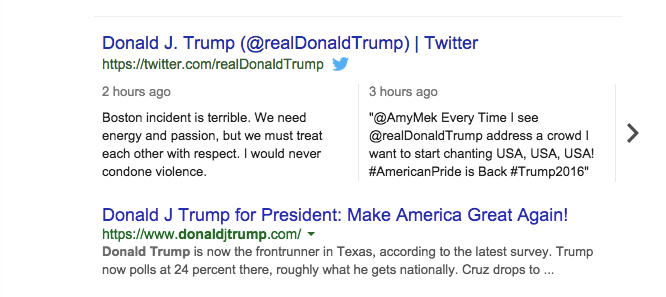
 Back in May, Google and Twitter partnered to bring tweets into mobile search results. It was, and is, a pretty big deal for both companies. The relationship is apparently going well, as Google announced in a short update on its original blog post that it’d be including tweets within search results on desktop as well. Read More
Shared posts
21 Aug 19:12
Back in May, Google and Twitter partnered to bring tweets into mobile search results. It was, and is, a pretty big deal for both companies. The relationship is apparently going well, as Google announced in a short update on its original blog post that it’d be including tweets within search results on desktop as well. Read More


Google Brings Tweets To Desktop Search Results
by Drew Olanoff
Back in May, Google and Twitter partnered to bring tweets into mobile search results. It was, and is, a pretty big deal for both companies. The relationship is apparently going well, as Google announced in a short update on its original blog post that it’d be including tweets within search results on desktop as well. Read More
21 Aug 19:09

Fix All Your Facebook Mistakes With the Activity Log
by David Nield on Field Guide, shared by Whitson Gordon to Lifehacker
You may not yet have stumbled across the Activity Log page in your wanderings around Facebook, but it’s worth exploring. It provides a blow-by-blow account of everything you do on the social network, and you can use it to take back likes or comments, find your favorite posts again, change your privacy settings and more.
Rnordman likes this
21 Aug 19:08
Laura Jones: B.C. cities need heavy-hitter negotiators
Opinion: Municipal unions bring in outside experts for labour talks; the province should fund a team for B.C.’s municipalities

21 Aug 19:07

Trucking companies deck out big rigs with comforts of home to stem driver exodus
by Lauren Thomas and Thomas Black, Bloomberg News
With their kids out of the house, empty-nesters Dan and Cristy Dornbusch cruise U.S. highways with an array of domestic comforts — TV, microwave convection oven, running water — in their vehicle.
They’re not just savouring the scenery: The Dornbusch duo operates a Freightliner M2 truck lugging loads of a metal casting parts as a driving team for closely held Try Hours Inc.
Try Hours is part of a growing wave of truckers customizing their cabs to blunt a driver shortage that consultant FTR Associates Inc. sees approaching 400,000 by the end of 2017. These companies are investing in entertainment systems, ceiling fans and refrigerator/freezers to ease the strain on employees who are on the road for three or four weeks at a time.
“You have just about everything you need, so you can actually stay out longer between trips home,” said Dornbusch, 52, of Wilmington, Ohio. “We call it professional camping.”
They work for a company that’s updating its 20 trucks with more amenities as a recruiting and retention tool. “It’s all about a better experience to keep the drivers,” said Kenneth Lemley, who manages the fleet at Maumee, Ohio-based Try Hours.
Closely held Western Express recently agreed to outfit 1,600 of its 2,400 trucks with satellite television from technology provider EpicVue, and plans to extend that equipment eventually to all its vehicles.
Related
Drivers’ Request
“This is one of the things we’re doing to retain drivers,” Chief Operating Officer Robert Stachura said. “The drivers have been telling us they wanted this in the trucks.”
Finding drivers is a central challenge for U.S. trucking companies. The industry will need to make almost 1 million new hires in the next decade to keep pace with growing cargo demand and a graying workforce, the American Trucking Associations estimated in 2014. Drivers in many fleets average more than 50 years old.
Linda Caffee via BloombergLinda and Bob Caffee's custom-built truck cab.
“The sleeper amenities are how fleet owners fight to get drivers,” said Linda Caffee, 54, who logs about 145,000 miles (230,000 kilometres) a year with her husband. “This is basically our home.”
They drive for Landstar System Inc., whose business model is built on driver-owned vehicles. The cab of their custom-built Freightliner boasts a sink, microwave, refrigerator/freezer, ceiling fan and a bed that folds into a dining table. She used to have to cook meals in a crockpot on the floor with a bungee cord holding down the lid.
Driver Shortage
Companies including U.S. Xpress Enterprises Inc., Con-way Inc. and Celadon Group Inc. raised pay last year to help woo new drivers. But truck owners can’t always afford higher labor expenses, according to the ATA. A heavy and tractor-trailer truck driver, on average, made $41,930 in 2014, according to the U.S. Bureau of Labor Statistics.
“Truck fleets need to give their drivers nicer amenities to attract and retain those drivers,” said President Brian Callan of specialized sleeper-cab maker Bolt Custom Trucks & Manufacturing. “That leads to what we do for a living.”
A custom cab typically costs about US$45,000 — a price that can double when a shower and toilet are included, Callan said.
The rub for truckers: Showers and satellite TV can only go so far in ensuring that their tractors stay on the highway.
“If companies want more drivers they need to pay more,” said Pete Swan, a professor of logistics and operations management at Penn State Harrisburg, an arm of Pennsylvania State University. “But firms are reluctant to do this.”
Try Hours has customized sleeper cabs on most of its trucks — extras that can boost the cost of a new truck by about US$50,000 to US$185,000, said Lemley, the fleet manager. He is now adding entertainment systems, because it’s more costly for Try Hours to have to idle a truck for a month for lack of a driver.
“It’s a very good investment to keep a driver happy,” Lemley said.
21 Aug 19:02
<div>Please enable Javascript to watch this video</div>
37 products with crazy-high markups
by Business Insider
While the accepted retail markup for most items is around 100%, there are some products that go a lot higher. Common items like printer ink have a markup of 300%, while text messages get marked up to nearly 6,000% more than they're worth.
We obtained retail markup data from Sumocoupon, an online marketplace that brings together coupon codes, promo codes, and sales for hundreds of online stores. They calculated their numbers based on production pricing data.
What they found was that people are willing to pay unreasonable amounts of money simply for the sake of convenience. For example, house cleaning and snow removal have markups of 5,900% and 3,900%, respectively.
Restaurant markups are surprising as well. Most people realize that wine at restaurants has a high markup (400%) so they may sometimes opt for soda instead — however, the markup for soda at restaurants is astronomically higher, ringing in at 1,150%. Diners might feel like they are saving, but they aren't really getting their money's worth.
Here are 37 products with crazy high markups:

NOW WATCH: The Best And Worst Deals At A Bar
<div>Please enable Javascript to watch this video</div>
SEE ALSO: 11 Psychological Tricks Restaurants Use To Make You Spend More Money
21 Aug 19:02
Global stocks fall after China factory weakness
by Joe Mcdonald

BEIJING (AP) — Global stocks fell further Friday after unexpectedly weak Chinese manufacturing data fueled concern about global growth.
KEEPING SCORE: In early trading, France's CAC-40 declined 0.6 percent to 4,752.29 points and Germany's DAX was off 0.5 percent at 10,374.54. On Thursday, both lost 1.3 percent and Britain's FTSE was off 0.6 percent. Wall Street was mixed, with futures for the Dow Jones industrial average down 0.1 percent and the Standard & Poor's 500 index up by a similar margin.
ASIA'S DAY: The Shanghai Composite Index suffered another steep drop of 4.3 percent to 3,507.74 points and Toyko's Nikkei 225 was off 2.9 percent at 19,435.83. Seoul's Kospi shed 2 percent to 1,876.07 and Hong Kong's Hang Seng retreated 1.5 percent to 22,409.62. Sydney's S&P ASX 200 lost 1.4 percent and India's Sensex was down 1.2 percent at 27,276.59.
CHINA JITTERS: The preliminary version of the Caixin purchasing managers' index fell to an unexpectedly low 47.1 points from July's 47.8 points on a 100-point scale on which numbers below 50 show a contraction. The orders, exports and employment components of the index all declined. That added to concern about the outlook for China's cooling economy that has caused stocks to plummet this week despite a massive government intervention. Abroad, last week's surprise devaluation of China's yuan has sent shockwaves through other emerging countries that might face tougher competition from lower-priced Chinese exports.
ANALYST'S TAKE: "Global markets are in panic mode as the full scale of China's slowdown becomes clearer and the market pricing for a Fed September rate hike is unwound. Asian markets are a sea of red," said Angus Nicholson of IG Markets in a report. "The phenomenal six-year bull market may finally meet its match in China-induced global deflation."
WALL STREET: Selling on Thursday outweighed buying by a ratio of more than eight to one in heavy trading. Strategists and traders, noting the lack of major U.S. economic news, said the drop in stocks was also likely tied to computerized selling after the S&P 500 moved below one of its most closely watched indicators, a 200-day moving average. While many investors buy and sell stocks based on a company's business outlook, there is a different class of traders who rely on such technical indicators to make investment decisions.
ENERGY: Benchmark U.S. crude fell 26 cents to $41.06 per barrel in electronic trading on the New York Mercantile Exchange. The contract gained 5 cents on Thursday to close at $41.32. Brent crude, used to price international oils, shed 20 cents to $46.40 in London after losing 54 cents the previous day to close at $46.62.
CURRENCY: The dollar sank to 122.9290 yen from Thursday's 123.4500 yen. The euro edged up to $1.1247 from the previous day's $1.1236.
21 Aug 19:01
These academics worked out how the art market puts a price on genius
by Ben Moshinsky

Eight pieces of modern art have fetched more than $100 million (£64 million) since 2010. A ticket to Banksy's Dismaland exhibition costs £3 ($4.70).
This does not sound like the working of a rational market to the average person, more a gambling den for the super rich with some nice pictures thrown in.
But two academics, David Galenson and Simone Lenzu from the University of Chicago, ran the numbers and found that the seemingly crazy art market, worth around €51 billion (£37 billion) in 2014, is perfectly rational.
While some modern art might look like an upturned bin to the casual observer, the market knows better. It puts a high value on innovation and mastery of new techniques and it does so consistently.
They matched up art historians' consensus views on the best work of Jackson Pollock and Andy Warhol with their prices when they were first up for sale.
The academics found that the art market could tell the good stuff from the bad, and what paintings would be considered legendary in the future.
They summed it up in an article on Voxeu.org:
Age-price profiles estimated from auction sales clearly agree with the judgments of art scholars, as recorded in textbooks and retrospective exhibitions, as to when the two greatest painters born in the 20th Century made their greatest works. This agreement decisively rejects the claims of art critics and scholars – art prices follow definite patterns, and these are clearly based on rational judgments.
Here's the graph that shows how Jackson Pollock's peak of artistic creativity in his mid-to-late 30s matches with the highest prices his work fetched:

Join the conversation about this story »
NOW WATCH: You've been rolling your shirtsleeves wrong your entire life
21 Aug 19:01


A Refresher on Price Elasticity
by Amy Gallo
Setting the right price for your product or service is hard. In fact, determining price is one of the toughest things a marketer has to do, in large part because it has such a big impact on the company’s bottom line. One of the critical elements of pricing is understanding what economists call price elasticity.
To better understand this concept and how it impacts marketing, I talked with Jill Avery, a senior lecturer at Harvard Business School and an author of HBR’s Go To Market Tools.
What is price elasticity?
Most customers in most markets are sensitive to the price of a product or service, and the assumption is that more people will buy the product or service if it’s cheaper and less will buy it if it’s more expensive. But the phenomenon is more quantifiable than that, and price elasticity shows exactly how responsive customer demand is for a product based on its price. “Marketers need to understand how elastic, sensitive to fluctuations in price, or inelastic, largely ambivalent about price changes, their products are when contemplating how to set or change a price,” says Avery.
“Some products have a much more immediate and dramatic response to price changes, usually because they’re considered nice-to-have or non-essential, or because there are many substitutes available,” explains Avery. Take for example, beef. When the price dramatically increases, demand may go way down because people can easily substitute chicken or pork.
How is it calculated?
This is the formula for price elasticity of demand:


Let’s look at an example. Say that a clothing company raised the price of one of its coats from $100 to $120. The price increase is $120-$100/$100 or 20%. Now let’s say that the increase caused a decrease in the quantity sold from 1,000 coats to 900 coats. The percentage decrease in demand is -10%. Plugging those numbers into the formula, you’d get a price elasticity of demand of:


Note that the negative is traditionally ignored and the absolute value of the number is used to interpret the price elasticity metric, as it’s the magnitude of distance from zero that matters and not whether it’s positive or negative.
“The higher the absolute value of the number, the more sensitive customers are to price changes,” explains Avery. As she explains in her “Marketing Analysis Toolkit: Pricing and Profitability Analysis,” there are five zones of elasticity. Products and services can be:
- Perfectly elastic where any very small change in price results in a very large change in the quantity demanded. Products that fall in this category are mostly “pure commodities,” says Avery. “There’s no brand, no product differentiation, and customers have no meaningful attachment to the product.”
- Relatively elastic where small changes in price cause large changes in quantity demanded (the result of the formula is greater than 1). Beef, as discussed above, is an example of a product that is relatively elastic.
- Unit elastic where any change in price is matched by an equal change in quantity (where the number is equal to 1).
- Relatively inelastic where large changes in price cause small changes in demand (the number is less than 1). Gasoline is a good example here because most people need it, so even when prices go up, demand doesn’t change greatly. Also, “products with stronger brands tend to be more inelastic, which makes building brand equity a good investment,” says Avery.
- Perfectly inelastic where the quantity demanded does not change when the price changes. Products in this category are things consumers absolutely need and there are no other options from which to obtain them. “We tend to see this only in cases where a firm has a monopoly on the demand. Even if I change my price, you still have to buy from me,” explains Avery.
Marketers should know where their products fall on this spectrum, but “the actual number is less important than knowing which zone your product falls within and what will happen to consumer demand if you change your price,” she says.
How do companies use it?
This is one of the key metrics for marketing managers, says Avery. “Our job is to create products and services that have unique and sustainable value for customers compared with other options available to them in the marketplace. Price elasticity is a way for us to measure how we’re doing in that regard,” she explains. “If my product is highly elastic, it is being perceived as a commodity by consumers.” It tells you how effective you are at marketing your products to consumers.
“A marketer’s goal is to move his or her products from relatively elastic to relatively inelastic,” she continues. “We do that by creating something that is differentiated and meaningful to customers.” When, through branding or other marketing initiatives, a company increases consumers’ desire for the product and their willingness to pay regardless of price, it’s improving the company’s standing compared with competitors. But it can go the other way. “It’s an important metric to watch because your product may become more elastic if a competitor starts offering compelling substitutes or consumers’ incomes go down, making them more sensitive to price,” says Avery.
Keep in mind that price elasticity isn’t just a factor of how well you’re marketing. It is also affected by the type of product you’re selling, the income of your target consumers, the health of the economy, and what your competitors are doing. “You can’t look at it in isolation,” says Avery. “You have to look at it in context of the industry and its competitive structure and in the context of consumers’ lives.”
As you may have figured out, this is a number that you can only calculate for certain after you’ve made an actual price change and seen the resulting impact on demand. And to be truly certain, you’d have to change your price multiple times to see what would happen at each price point. This is not what companies tend to do in practice. Rather, they send out questionnaires, run focus groups, or perform small-scale experiments in certain markets, to give them a sense of what would happen if they changed their price.
While it’s important to understand the price elasticity of your product or service, much more often, in corporate contexts, people talk about price sensitivity in a more qualitative way, explains Avery. You’ll hear managers say, “my product is price sensitive” or “we’re lucky to have a product that’s not sensitive to price.” Elasticity is not the same thing as sensitivity, she warns. “Sensitivity is more of a qualitative concept where elasticity is a quantitative one. But they are closely related.”
What are some of the common mistakes managers make with price elasticity?
Many managers assume they understand the full picture based on their experience pricing their products in the marketplace, that they know how consumers will respond to almost any price change, explains Avery. But rarely have companies tested extreme price changes. More likely, a company has a small sample of consumer responses to certain price changes, such as what happens when price is raised or lowered by 5-20%. More extreme changes in price may elicit significantly different consumer responses. “The math isn’t complicated,” she says, “but it’s tough to pin down how it will play out in the market because price elasticity is a dynamic concept.” What consumers have historically been willing to pay for a particular product is not necessarily what they are willing to pay today or tomorrow.
Therefore, elasticity can often be an inexact calculation. “It’s impossible to know what customers will do at every price point or in the marketplace,” Avery says. Sure, marketers can get a good sense of willingness to pay from survey responses, but “the challenge is that what people say they will do is not what they actually do when they are standing at the shelf.” It’s better, she suggests, to do a in-market A/B test, to put your product out at the new price point and see what the demand is, and compare it to the same product at a different price. That’s how you’ll get the most accurate information. Avery points out that in a digital context, this is easy and inexpensive to do. “You can put your product up at $10 and two minutes later change it to $2, and then sit back and see the resulting consumer response,” she says.
But it’s not just about figuring out the right number; you need to understand consumer behavior as well. “You could run market tests every day,” says Avery, “but you also want to understand why consumers are acting the way they are. Understanding the why behind consumer behavior is critical to predicting how they will respond in the future.” That information will inform your marketing efforts. Therefore, smart marketers supplement any quantitative testing with qualitative research to get at the underlying reasons for consumer behavior.
It’s also important to keep in mind that understanding the price elasticity of demand for your product doesn’t tell you how to manage it. “As a marketer, I want to understand my current price elasticity and the factors that are making it elastic or inelastic, and then to think about how those factors are changing over time,” explains Avery. Ultimately, you want to stay relevant to consumers and differentiated from your competitors. Once you do that, you can adjust price up or down to better represent the level of value you are providing to your customers. Your current price elasticity is just one data point that helps you make those future decisions.
Read refreshers on net present value, breakeven quantity, debt-to-equity ratio, and cost of capital.
21 Aug 18:53


How Leading Brands Should Respond To Attacks
by Mark Di Somma

Branding Strategy Insider helps marketing oriented leaders and professionals like you build strong brands. BSI readers know, we regularly answer questions from marketers everywhere. Today we hear from John, a VP of Marketing in Dallas, Texas who writes…
“We are a global B2B brand and the the market leader in our sector. We have a much smaller brand attacking both us and our offer and using very clever brand messaging to do so. Our response so far has been restrained and very much in keeping with your brand storytelling strategy of redirect, refute, re-position and remind. That hasn’t stopped them. In terms of best practice, when do you feel is the right time for a leader to send a more direct message that draws clear contrasts with the challenger brand offering? I know the inherent risks for giving free mindshare impressions, and generating big guy beating up on little guy perceptions, but keen to hear your thoughts.”
Hi John – thanks for your question. They haven’t given up, and frankly I wouldn’t expect them to because, in reality, they have more to gain from getting your attention than you do from calling attention to the shortcomings in their offer.
You haven’t said what the impact of this activity is having on your sales, and given that they are so much smaller than you, I would be surprised if it was significant at this point. But let’s assume for the moment that at the very least they are playing on your mind, distracting your own people and making their presence felt among your customers and prospects. To your question – how do you address that, without looking like the behemoth?
Start with these four tactics a market leader can use to deflect attacks from challenger brands. In terms of a direct communication initiative, my inclination would be to ‘elevate’ the conversation to the key industry issues where you display provable strengths. I would then call on these fundamental strengths to highlight your contributions and credentials. Think of this in terms of a value proposition like – ‘No other company in our sector can…’ – but make sure that the thing you are best at is the thing that customers really care about. Maintain dignity. Display a little humor. And above all, base everything you respond with around the customer not your brand’s ego.
If you do this well, you will underpin why you are the leader and what people see in you as the leader without adding fuel to the challenger’s bonfire. Because you are a B2B brand, you’re looking to draw attention to the risks (real and implied) of not choosing the trusted incumbent. But don’t just state – allow your audience the opportunity to draw their own conclusions. One of the great benefits of working with a business audience, in terms of what you are looking to achieve, is that they are acutely aware of risk and reputation. Your focus should be on making the strongest possible case to stay with what’s known and proven, not simply responding to the agitator. If you do that in your competitive response you will switch the conversation from the one being had on their terms.
Do you have a question related to branding? Just Ask The Blake Project
The Blake Project Can Help: The Brand Storytelling Workshop
Branding Strategy Insider is a service of The Blake Project: A strategic brand consultancy specializing in Brand Research, Brand Strategy, Brand Licensing and Brand Education
FREE Publications And Resources For Marketers
21 Aug 18:52
How To Get Responses Using LinkedIn InMail For Recruiting
by Clare Saumell

LinkedIn, more than ever, is a competitive space for candidate searches. With over 350 million users, this enormous professional network offers recruiters an appetizing buffet of top talent…for a price. And with the $638 million in revenue LinkedIn made during Q1 ’15, it’s apparent that many see the value in paying extra for that service.
On the recruiting side, one of the biggest draws is LinkedIn InMail, which can be a powerful tool, if used correctly. The trick is making messages into successful conversation starters instead of spam. Because sending an InMail message is not too far from making a cold call. To find the best ways to do that, we spoke with several recruiters to find out how to regularly get responses using LinkedIn InMail.
Keep It Brief
Attention needs to be earned. On the street, a person who launches into a long spiel will get ignored. InMail isn’t too different (even if you have all the right traits as a recruiter). The initial message needs to be short. Though there’s not a magic number, five to seven sentences is a safe length to make an intro, connect, and clearly ask what you want.
Connect, Don’t Command
People are bombarded by hundreds of unsolicited messages every day. Emails, texts, pop ups, commercials, billboards, and plenty of messages compete for attention. Most go unheard. The ones that resonate with their intended audience? They make a connection rather than making a demand.
Niki Atherton of MatchSource LLC says that a good InMail message has the objective to connect in mind. “It’s a relationship building process. When I send an InMail message, it’s never to say ‘you look great for my current position, so help me out would ya?’ It’s about them just as much as it is about you and your client.”
As with networking or any sales interaction, relationship building through InMail comes down to astute observation. What matters most in a candidate’s profile? Is there a narrative you’ve noticed in their work history? Are their motivations aligned with yours? Do they follow the same influencers or share hobbies with you? Any detail, no matter how obscure, can act as your icebreaker.
For example, the observation of one miniscule detail is all it took for Niki to catch the eye of a highly qualified candidate. Buried deep in his LinkedIn profile was a nonchalant line that warned that he wanted “No Brown M&Ms.” Had he gone off the deep end? Not at all.
Niki immediately recognized it as a reference to the notorious “No Brown M&Ms” clause from Van Halen’s touring contract, which was buried deep in technical lighting requirements to find out which venues had read the contract in full. Niki commented on the line in her message and the candidate responded very quickly. She was the only one who had noticed.
Two or three sentences at the beginning should be dedicated to detailed observations that connect with the candidate and lead into the position. A brusque segue into the sales pitch will send them elsewhere.
Be Careful With Humor
Who doesn’t like to laugh? A good joke, when used with the right audience, can melt tension and coax people over to your side. The trick with InMail is that you have to take a shot in the dark about what the recipient finds funny.
Mark Smith of Horizon Search, Inc. has learned from first-hand experience that humor is utterly hit or miss. He said, “You never know how someone is going to interpret your ‘joke.’ Humor can complicate things and I tend to try and keep it simple and straightforward. I think you can have success with humor but you need to be careful and keep it polite and playful.”
Though he has experienced some success with humor, he’s learned it’s important to keep control of the situation. Otherwise, it can become an “exhibition of wits” rather than a discussion of a job opportunity.
If you try to go funny, remain professional and research your audience. Social media accounts are a treasure trove of insight into a candidate’s sense of humor. A quick review will let you know whether to proceed or hold off.
Call The Candidate To Action
You sent an InMail message. What action did you want in response? Every interaction, professional or social, has some type of call to action. Buy, click, share, partner with, or even just chat are encoded into the language of any and every message. Effective communicators consciously employ the right message for the right moment.
Your InMail message’s call-to-action, regardless of the tempo of your recruiting style, needs to ask a direct question. You can flatter their ego and charm them with your wit until the Earth is swallowed by the sun, but if you don’t ask them to do what you want, it’s all for naught. Subtlety is wasted on InMail.
So let’s get to the meat of the CTA question. Like the rest of the InMail message, it’s got to be brief. One sentence max. Additionally, it should avoid asking for any sort of major commitment. How would you feel if a stranger demanded your help out of the blue (you’d probably shrug them off). Don’t be that person.
Instead, ask questions that only ask for a small commitment:
“Would you or someone you know be interested in an opportunity like this? I’d really appreciate 5 mins of your time to explore this more.”
First, it puts the action in the candidate’s hands. They’ll feel like they are electing to share a few minutes of their time rather than having it taken from them. Additionally, it opens them up to referring the InMail message down the line. That way even if this particular candidate is satisfied at work, a valuable connection can be made.
Create A Complete Message
A strong InMail is only the start. However, recruiting as a whole is a challenging exercise and LinkedIn isn’t the only answer. Believe it or not, we’re also experts at knowing how to assess recruiters, so if you’d like to see how you are doing as a whole, check out our recruiter assessment checklist to see where you fall.
21 Aug 18:51
When Nobody Wants Your Innovation
by Jeff DeGraff
 What happens when the comfort of the old is preferable to the risk of the new? This is the situation all innovators face when presenting their ideas or inventions to a hesitant public: we’re dissatisfied with the way things are now, but we’re not yet willing to embrace the future.
Everywhere you look, you’ll see this wildly contradictory set of desires and feelings toward change. We hate traffic jams, but we refuse to try self-driving cars. We dream of improving the quality and length of our lives, but we’re reluctant to tamper with the genetic triggers of a disease. We want to eliminate global hunger, but we have a bias against genetically modified drought-resistant food.
Why are we so frustrated with our present-day reality yet unwilling to accept the alternatives of the better and the new? Radical innovation comes with a high cost–a price many won’t pay. Innovation goes beyond merely eliminating and replacing old ways of doing things–it also eliminates and replaces traditional ways of seeing the world. It shakes the very foundation of our beliefs.
This is why it’s much easier for innovators to develop an idea or come up with an invention than it is to sell it: people are resistant to any kind of change in their belief systems. So when it comes to gaining support for your innovation, it’s not enough to prove that this development will make things faster and easier. You need to synch up your initiative with the worldviews of those whom it will affect. Here are three strategies for turning innovation skeptics into believers.
Connect cause to effect. We’re all naturally short-term thinkers: paying next month’s rent or meeting this quarter’s numbers is more important to us than what will happen ten years in the future. Appeal to this sense of immediacy when presenting your innovation. Show the world why your idea or invention is necessary today. Consider, for example, the way we value our freedom to drive cars. The results of global warming feel far-off, out-of-sight, and unrelated to our driving habits right now. The cost of switching our lives around to take more environmentally friendly forms of transportation feels too high for most people. But when we connect these issues to things that are more recent, dramatic–even traumatic–in our minds, like the brutal winters on the East Coast and the deadly drought on the West Coast, then suddenly the case for change is a compelling one. Indeed, it’s no coincidence that as these present-day weather extremes persist, the rates of adopting new technologies like hybrid cars are increasing. Relate your innovation to real experiences with concrete effects in the current moment.
Appeal to a higher cause. Small advancements can feel like earth-shattering violations of our norms. While it seems perfectly acceptable to give patients pills in order to get better, the idea of artificially growing a new organ and transplanting it into a person may sound like an outrageous disruption of what it means to administer care. In reality, both of these advancements are innovation interventions. What many don’t see is that what seems normal today–administering medication–was once itself a major challenge to prevailing conventions. Since we’re always bound by our own place in history and the perspective that limits us to, it’s crucial to communicate the greater purpose of an innovation. Instead of giving the standard technical account of a new device or service, highlight how it advances our noble aspirations. Identify the larger mission of your individual innovation.
Provide alternatives in small steps. Radical change is best served in incremental doses. Keep the concept of your innovation revolutionary, but implement it in an evolutionary way. Only a decade ago, it would have been unthinkable to suggest that we would have a globally connected super-computer in our pockets–and that’s basically what smartphones are. Traditional universities are still thriving, but even the most prestigious schools in the country offer online programs. Stadiums and athletic venues remain the center of all professional sporting events, though physical attendance continues to decrease as more and more fans consume games through emerging digital venues. These are all major innovations that many people would be otherwise reluctant to accept. In essence, though, these changes have already happened without much resistance, because they’re happening gradually. Pace your innovations to bring the adopters along in steps.
The goal is to change the minds of people who will actually benefit from your innovation. Be honest and transparent in gaining the consent and acceptance of your non-believers. All of our worldviews could benefit from reflection and reconsideration. That is the power of a truly radical innovation.
We live in a world that favors tradition. The public will always support the old, the established, the conventional. It’s your job as an innovator to be an advocate for the new. Remember that the future is already here even if not everyone is aware of it. The next time any innovation skeptics doubt the possibility of your invention or idea, ask them who flew the last airplane they traveled on. Chances are it was on autopilot.
21 Aug 18:51


5 Killer Types Of Wearable Apps For Companies
by Quinton Wall
Guest author Quinton Wall is the director of developer relations at Salesforce.
While wearables may still be in their ramp-up stage, there’s little doubt they are here to stay.
Gartner expects the wearables market will hit $10 billion by next year, while IDC anticipates 120 million devices will be shipped by 2018. We know that fitness trackers are a market success and are a considerable part of those numbers, and we have a pretty good idea that consumers will continue to use them for grabbing notifications and tracking their activities on the go. What many remain unconvinced about is how wearables will impact the enterprise.
They won’t be unconvinced for long. Wearables are set to have a major impact for companies and other organizations.
To be clear, we aren’t talking about wearables as single-purpose devices (such as fitness trackers). We’re looking at wearables as general purpose computers. For businesses, they will provide an unprecedented way to help them improve productivity and safety, and introduce the app economy to industries where apps have been lagging. Think areas like construction or manufacturing. Beyond vertical industry value, these devices will also offer killer applications across all industries.
At Salesforce, we are seeing customers building wearable apps for work. The following are the five killer categories of applications among the most common use cases.
5 Killer Types Of Wearables Enterprise Apps
Security
We’re all familiar with security and building badges. Anyone who visited the large enterprises and government agencies knows that some people have to wear two or three to get around large campuses.
Wearables can be used to provide watch-based security identifiers and replace those traditional photo IDs and badges. In addition to just providing NFC (Near Field Communication) authentication, because of the screen and computer, wearables make it possible to add informational messages to the user.
If there is there a new mandatory meeting employees can be told where and when. If a user is denied access, the security alert can detail why.
Field Service
Manufacturing and construction are billion dollar industries, yet they only spend approximately 2% of their IT budget on mobile. More over, 80% of workers do not have access to technology that allows them to work more efficiently.
Wearable technology—such as Google Glass for hands-free operation, the Fujitsu wearable glove, and even connected clothing that can detect hazardous chemicals—unlocks the potential for re-imagining field service in much the same way industries like transportation have been influenced by mobile apps.
Booking-office resources
Consider the day to day hassle of booking a meeting. What seems to be a simple and easy task—grabbing a conference room—never is simple or easy.
With wearables, anyone can find and book a room with a swift scan of room availability from the wearable. The user can then quickly use the wearable interface to set duration and any necessary equipment. Wearables can also use map features as a way to guide meeting participants to the correct room using augmented reality, or receive by turn directions.
Collaboration
Wearables will also improve how we collaborate. Workers often rely on the advice of colleagues, supervisors, and even public Internet resources, such as YouTube, to provide additional assistance.
Augmented reality in many industries can be used to facilitate collaboration between coworkers—in ways not all that different from how office workers have been using screen-sharing applications. Collaboration will be available everywhere—from the worker at her desk, to the oil rig technical suspended high in the air. They will be able to work together in real-time, hands-free, and immersive ways.
Improvement for task and recording accuracy
Wearables will have a serious role in streamlining back-office functions. A wearable can help track time spent on projects, manage travel expenses, and even help employees take advantage of their benefits with local discounts, annual eyeglasses and vision rebates, credit unions, and more.
Unfortunately, right now, most of these benefits go unused: Employees are either not aware, forget, or do not have access to the information at a time when they can act on it. By creating a wearable app that proactively notifies employees of benefits when they’re near vendors, employees can more easily take advantage of perks.
These are just five examples of how wearable devices can influence the enterprise. The use cases will only grow as the devices become more intelligent, interactive, and less obtrusive. Smart enterprises are at work embracing how wearables can better help them run their businesses.
Lead photo by Intel Free Press

21 Aug 18:50


The unexpected trait Salesforce looks for in job candidates
by Shana Lebowitz

Salesforce receives 1,300 job applications every day.
How can you make yours stand out?
According to Ana Recio, senior vice president of global recruiting, technical chops are hardly enough for the multibillion dollar cloud computing company. In reviewing résumés and in job interviews, Salesforce looks for people who genuinely want to make a difference in the world.
"We just constantly look for people who have that extra sparkle," she said.
If that concept sounds fuzzy, Recio said there are a number of factors the company uses to determine whether a candidate is the change agent they're looking for — no matter whether they're applying for an entry-level or a senior role.
In particular, they look at the impression you made on your previous organization: "What did you do to differentiate your job from others? What was your absolute impact, your legacy? We always look for people who truly were kind of thought leaders and change agents."
For example, Recio said, maybe you launched an incredibly successful product or you marketed that product a little differently than usual.
Just as important, Recio said the company is interested in the way you spend your time outside of work. Many current employees have volunteered abroad; others are renowned musicians; one is a former Olympiad.
"It's almost like work is their hobby because their personal lives are full of these incredible accomplishments," she said.
These experiences are assets in job candidates because Salesforce prides itself on enabling employees to give back to their communities. The company uses the 1-1-1 model, meaning they dedicate 1% of their equity, 1% of their employee time, and 1% of their product to form the Salesforce Foundation.
In fact, Recio said Salesforce gives employees six fully paid days a year "to go out and make a difference." Some people have traveled to Costa Rica to build houses; others have stayed local and volunteered at their kids' schools.
To be sure, Salesforce isn't the only organization that encourages humanitarianism — companies from Deloitte to Autodesk also pay their employees to volunteer. Presumably, these companies also value a job candidate's demonstrated interest in social change.
Yet Salesforce sees itself as the go-to place for talented applicants with the potential and drive to change the world.
"Of course we're going to lead the industry in all these different categories," Recio said, referring to Salesforce's technological innovations. "But in addition we're also going to lead the industry in enabling people to really shine outside of here, too."
SEE ALSO: 3 unconscious biases that affect whether you get hired
Join the conversation about this story »
NOW WATCH: The 10 trickiest Goldman Sachs interview questions
21 Aug 18:50
Unicorns are becoming so common, maybe we should just call them "horses'
by Matt Rosoff
This week, messaging startup Kik became the latest privately held tech company to join the "unicorn" club of companies worth more than $1 billion.
These days, that's hardly news. At this chart from Statista shows, the number of unicorns has almost tripled since the beginning of 2014. Investors and entrepreneurs love to argue whether this indicates another tech bubble like we saw in 1999 and 2000, but the amount of money flowing into tech companies is less than half of what it was in 1999. The difference: companies are staying private a lot longer, so the only way investors can capture a big chunk of their rise in value is by investing in late stage funding rounds, leading to huge valuations. If they waited for an IPO, they might be waiting forever.

Join the conversation about this story »
NOW WATCH: James Altucher defends his outrageous claim that you shouldn't invest in your 401(k)
21 Aug 18:50
Sinking currencies reflect fear over emerging economies as China slows and Fed mulls rate hike
by CB Staff
WASHINGTON – The damage spans the globe.
Thailand’s baht. Kazakhstan’s tenge. South Africa’s rand. Peru’s nuevo sol.
In emerging markets worldwide, currencies are plunging over fears that developing economies are on the verge of a crippling fall. Success stories until recently, emerging economies are seen as casualties now — of slower growth in China, plunging prices for commodities like oil and iron ore, the prospect of higher U.S. interest rates and homegrown threats.
The damage has spilled across oceans, with the turmoil jolting investors in New York, Tokyo and Europe. Investors there worry that China and other major emerging economies will reduce their imports. They also fear a trade-disrupting currency war as some countries desperately lower their currencies’ value to gain a competitive edge. A lower-priced currency makes a country’s goods cheaper for foreigners.
The Dow Jones industrials plunged 530 points, more than 3 per cent, Friday on top of a 358-point drop Thursday. Tokyo’s Nikkei index shed 3 per cent Friday.
For all the markets’ jitters, many economists say they remain confident that the U.S. economy is resilient enough to withstand a slowdown in the developing world. And Europe’s economy appears to be emerging from its long slump.
Even so, the trouble in emerging markets is a surprising and unsettling reversal.
“It’s remarkable just how things turned around so quickly,” says Neil Shearing, an economist at Capital Economics and a former British Treasury official.
Consider Peru. Three years ago, its capital, Lima, was chosen to host an International Monetary Fund’s meeting of global finance officials in what was seen as a celebration of Latin America’s arrival in the economic big leagues.
But with the event six weeks away, Latin America’s outlook has descended from boom to gloom. Peru’s economy has steadily slowed, and its currency, the nuevo sol, has plunged 2.5 per cent against the U.S. dollar in the past month.
And Peru boasts one of the region’s healthiest economies. Brazil’s economy is expected to shrink this year and next. Its currency, the real, is down 7 per cent the past month and more than 30 per cent the past two years. The Mexican peso closed Friday at a record low against the dollar.
It’s hardly just Latin America. Kazakhstan’s currency plummeted this week after the government decided to let it trade freely. The South African rand fell this week to a 14-year-low against the U.S. dollar. Turkey’s lira hit a record low against the dollar this week.
Hung Tran, an executive managing director at the Institute of International Finance, expects developing countries to post 3.8 per cent economic growth this year, down from 4.3 per cent in 2014. The institute is on the verge of cutting that forecast further.
Analysts point to a primary culprit:
“It’s all coming from China,” says Masamichi Adachi, an economist with JP Morgan Chase in Tokyo. “Brazil, South Africa, many countries are commodity exporters, and the final destination is all going to China.”
The Chinese economy is slowing more sharply than most people had expected from the double-digit growth rates of the mid-2000s. The world’s second-biggest economy is expected to grow 7 per cent this year, which would be its slowest pace since 1990.
Beijing is trying to manage a transition from rapid growth based on exports and often-wasteful spending on factories, real estate and infrastructure to slower, steadier expansion based on consumer spending.
That transition means China would need fewer raw materials — Chilean copper, Nigerian oil, Brazilian iron ore. That helps explain why China’s pullback has loosed carnage in global commodity prices: The Standard & Poor’s GSCI commodity index, which tracks 24 commodities prices, is down nearly 20 per cent this year.
Emerging markets were already feeling the squeeze last week, when China devalued its currency, the yuan. That step ignited a semi-panic.
“The devaluation is a red flag about China’s current economic situation,” says Kurt Braybrook, who runs a Shanghai company that does quality control work. A falling yuan raises the risk that other countries will devalue their currencies to catch up.
Most countries can’t blame China and the vagaries of the global commodities market for all their problems.
South Africa is battling labour strife. Brazil is contending with a corruption scandal at state-owned oil giant Petrobras. Turkey is struggling to form a government while its military battles the Islamic State extremist group and Kurdish separatists.
Adding to the pressure: America’s Federal Reserve is expected, perhaps at its September meeting, to raise the short-term rate it controls from near zero. Investors could respond by moving even more money out of emerging markets to seek higher U.S. rates. That would lift the dollar higher and emerging market currencies even lower.
A Fed rate hike could also squeeze emerging market companies that have borrowed in U.S. dollars. Those companies would struggle to accumulate enough local currency to pay their now-more-expensive dollar-denominated debt.
Tran at the Institute for International Finance says dollar borrowing by emerging market companies surged from $700 billion in 2010 to $2 trillion through March.
The rising dollar and the hoard of dollar loans recall the 1997-1998 Asian financial crisis. Back then, a currency sell-off triggered an emerging market debt crisis that became a disaster for countries such as Indonesia and South Korea.
But the picture is less alarming now, analysts say. For one thing, developing countries have stockpiled foreign reserves that they can use to buy their own currencies and stop a crisis.
What’s more, emerging market companies that borrowed in dollars in recent years tended to take out longer-term loans, notes Joaquin Cottani, Standard & Poor’s chief economist for Latin America. During the ’97-’98 crisis, companies had taken out short-term loans and couldn’t refinance when the loans came due during a panic.
“Countries have learned from their experiences,” says Monica de Bolle, visiting fellow at the Peterson Institute for International Economics.
___
Goodman reported from Caracas, Venezuela. AP Writers Elaine Kurtenbach in Tokyo, Kelvin Chan in Hong Kong, Nataliya Vasilyeva and James Ellingworth in Moscow, Suzan Fraser in Istanbul, Lynsey Chutel in Johannesburg and E. Eduardo Castillo in Mexico City contributed to this report.
__
This story has been corrected to fix spelling of the Brazilian oil company to Petrobras, not Petrobas.
The post Sinking currencies reflect fear over emerging economies as China slows and Fed mulls rate hike appeared first on Canadian Business - Your Source For Business News.
21 Aug 18:49
Snapchat, Periscope, Imgur and Yummly: 4 New Ways Brands Can Market to Their Customers
by Liz Papagni
It’s getting harder and harder to reach your audience on cluttered apps and social media sites like Facebook, especially without big advertising budgets. So what’s a marketer to do? The first step is to know your target customers well. Where are they online? What type of content engages them? Where do your current traffic and conversions come from? Answer these questions to develop the best strategy for investing in a new way to communicate with your customers. We’re sharing the latest (and most promising) channels and tools to consider and offering insight on what brands should jump in on the ground floor.
SnapChat
Snapchat is a messaging application for sharing moments between friends or groups. Users can take a photo or a video, add a caption or graphic, and send it to their contacts. Unless users take a screenshot, snaps can only be viewed for a few seconds before they disappear. If your target audience is 13-34 year olds (especially 18-24), we recommend downloading Snapchat to explore. The app has more than 100 million daily active users, and SnapChat claims that 60% of America’s 13-34 year old smartphone users are also Snapchatters. The app also recently launched a “Discover” feature to showcase content from traditional news and media and brand advertisers. Brands winning on Snapchat include Nissan, GrubHub and Taco Bell. Popular tactics are product launches and previews, exclusive offers and discounts, contests and promotions and branded Snaps users can share with friends.
Periscope
Periscope is a new video streaming, live broadcast platform owned by Twitter. And they’ve racked up 10 million users in just four months. Live posts are shared via a link on Twitter and also featured in users’ feeds. Because Periscope is so new, they’ve yet to release user demographics, but it’s safe to say that if your brand has success on Twitter and/or You Tube, Periscope could be a valuable addition to your social media strategy. Brands currently active on Periscope include Red Bull, Spotify and even General Electric. Celebrities like Jimmy Fallon and Ellen DeGeneres are also early adopters. Brand tactics that resonate with Periscope users include expert Q&As, product reviews, how-tos, live streamed events and behind the scenes footage.
Imgur
Imgur is an image-sharing platform that originates many of the photos and memes shared everyday on Reddit, Digg and social media. The site averaged 31 million users a month in early 2015, and is now testing a new native ad product for brands. Despite the huge user base, the site isn’t as well known as Reddit and not in most marketing plans yet. If your target customer is a male teen or millennial and your brand is comfortable with content that is irreverent, humorous and not always family-friendly, you may want to consider getting in on the ground floor. Tactically, Imgur is a great place to inspire user generated content for your brand and visually share your brand story.
Yummly
Yummly is a web site and free smartphone app that provides recipe recommendations and search, storage and sharing for users. They boast more than 10 million monthly unique visitors, with more than 60% coming from mobile. This site is our top recommendation for food, entertaining and kitchen product brands with a prime target of women aged 25-45. Yummly offers great value for brands and advertisers, from custom brand profiles and landing pages to an organized blogger ambassador program. Brands currently publishing on Yummly include Velveeta, Country Crock, Yoplait, Miracle-Gro, Silk Soymilk, Breyers and more. Tactics that resonate on Yummly include programs to inspire user recipes and reviews, influencer content, coupons and promotions.
If you have questions on what new digital and social platforms are perfect for your brand content, We’d love to steer you in the right direction. And if you’ve found early success on one of these channels, please share in the comments below.
21 Aug 18:49
What Mobile Means For The “Single Customer View”
by Tom Farrell
Spend 30 minutes wandering around the meeting rooms and common spaces of any decent-sized B2C organization and likely as not you’ll hear someone talk about the ‘single customer view’. And chances are – they’ll be complaining about a lack of it.
As the ways in which consumers are able to interact with the brands they love has multiplied, so in turn have the data sources that an organization has to integrate in order to get a clear picture of what exactly those consumers are doing.
That in turn creates what is now a familiar paradox: whilst the organizations themselves spend a considerable amount of time, thought and money in figuring out how best to manage the interplay of those channels, the consumers themselves simply couldn’t care less. Tesco or Target are all the same to me whether online or in-store – and I expect everything I receive from that source to be relevant to me. Not ‘online me’ or ‘real world me’. Just good old me.
The Importance Of Relevance
Just in case you are laboring under the illusion that the only cost of single case of irrelevance is a single ineffective marketing campaign, take a brief look at this data from Gigya. Specifically, note the fact that 43% of consumers who received an irrelevant communication ignored future communications from that organization. 20% never purchased again.
A poorly targeted and clearly irrelevant piece of spam (let’s call it what it is) tells the consumer that you don’t care about them or their preferences. And although we know it is difficult to join all the dots when it comes to customer data – the consumer either doesn’t know or doesn’t care.
Enter Mobile
Sucks doesn’t it? And the really great news is that things have just got worse. The mobile app isn’t so much ‘a’ new channel for most consumers, it is ‘the’ channel. In verticals from banking, to gambling, through retail and games, consumers are migrating to the mobile app in their droves.
And they are specifically moving to native apps. As the mobile audience matures, more and more organizations are realizing that mobile internet doesn’t cut it anymore. Sure, it’s easy for us to keep things on mobile internet, but consumers appear hooked on the quality of interaction and performance they get from native apps. At the moment, it’s a brave business that isn’t at least planning a move to ‘full native’.
That, of course, creates all sorts of problems – mainly because native apps are something of a black box when it comes to user data. Of course – and here we go again – the consumer doesn’t think like that. The mobile app is, as far as the man or woman on the street is concerned, just part of the website. So we’ve got the same issue of something the consumer expects being in actual fact awfully difficult to deliver.
But that isn’t necessarily so. Let’s end on three pieces of good news.
- Things aren’t quite that bad. In most cases the mobile app is integrated into some central system of record that means the really key moments (registration, purchase and so on) are recorded. I say this is good news – but of course this doesn’t happen without some effort and purchases are only the beginning. Truly relevant communication demands an understanding of everything the user has done on each channel.
- Things are getting simpler. Yes, here’s the Swrve plug – we work with a number of ‘traditional’ marketing automation providers to ensure that mobile and desktop events can be shared across channels and so create that single customer view we all care about. What these integrations mean is that whilst ultra-granular data relating to user behavior is collected within each channel, it is then shared across and accessible to all channels. So on desktop, emails can be sent based on mobile data insight. Whilst on mobile app experience or push campaigns (for example) can reflect user behavior on the desktop
- Mobile opens up in-store behavior. It has long been an ambition of retailers to connect in-store and digital data and customer profiles. Mobile makes it possible. Nobody took their laptop into the store with them, but by providing ‘added-value’ apps on the phone, it is possible to connect the digital and real-world experience (and share data between the two). One interesting example – it is now possible to modify digital experiences (in-app or on-site) based on dwell time next to specific items in store. That’s relevance!
21 Aug 18:47

7 Tips to Avoid Getting Crushed By Your Competition
by Jim Brodo

As an avid squash player, I compete against players of various styles, skill levels, and ages. The other night I played against someone I usually beat, but on this night I lost.
Sometimes losing is a matter of having an off night or something is weighing on your mind. That wasn’t the case. I lost because I underestimated my opponent and took the match too lightly.
My usual habit during the five-minute warmup is to conduct a mini SWAT analysis. I watch my opponent closely to identify strengths, weaknesses, opportunities, and threats during the match. Then I develop a mental strategic plan that will give me the best chance of winning. Sometimes the plan works from the start, but sometimes I have to adjust my thinking based on the actual play in the game.
My downfall in the losing match was being overly confident, thinking all I needed to do was show up to win. I never even guessed my opponent would shift his strategy or change his style of play to outplay me.
I mention this story because I see similar scenarios happening in sales, both in the pursuit of new accounts and the maintenance or growth of existing accounts. I see sales professionals going into final presentations or responding to a request for proposal totally unprepared because they’re relying on the same old comfortable way they’ve always sold. Let’s face it: Buyers have changed, their criteria have changed, and the way they buy has changed. So has the competition as they change their approach to adjust to the new buying realities.
One salesperson recently told me she had just lost a deal to a traditional competitor, one she normally beats. “Why did you lose?” I asked. To her credit, there were no excuses. “Because the competitor changed, adjusted their methodology, and effectively positioned against our services. I should have been better prepared,” she said. “I underestimated the competitor, and they flat out beat me.”
Just like my squash game, if you want to win in sales, come prepared and wear your game face. Treat every opportunity as a nugget of gold. Do everything possible to understand the client’s needs, the competitor’s strategy, and how you can best position yourself. You may not always know who your direct competitors will be, but you should know the usual players and you better prepare for each touchpoint in the process.
To help you avoid underestimating and consequently getting crushed by your competition, here are seven tips on how to prepare more effectively.
1) Follow your competitors on social media.
Read what competitors are saying on Twitter, LinkedIn, or even Facebook. Are there any hints of changes in approach? Is there information you can use in positioning and messaging? Have they launched a new product? Hired a new executive? All of these may indicate a change in their approach.
2) Set up competitor alerts.
Use Google alerts or another alert system to push information to you via email. Follow what is being said about your competitors in media placements, articles, blog posts, and press releases.
3) Leverage LinkedIn connections.
See if competitors have recently connected with your client contacts, or if your contacts are following a competitor’s site or group on LinkedIn. Look at open positions your competitor is hiring for, as this may also provide insight into a directional shift.
4) Talk to your marketing team.
Don’t forget to talk to your friendly neighborhood marketing department. They most likely keep files on and track your company's direct competitors.
5) Capture and share tribal knowledge.
Check your CRM system or ask sales colleagues about what they are seeing. Whatever you find out, make sure to share competitive information with your team.
6) Sign up for competitor’s blogs and newsletters.
It never hurts to sign up for a competitor’s blogs or newsletters to keep tabs on what they’re saying. Trust they are signed up for yours.
7) Download and review material from competitor websites.
Don’t forget to visit competitors’ websites. You can often find new information, featured white papers, or research on their sites that may show a shift in an approach.
We operate in an ultra-competitive world where barriers to entry are diminished and commoditization threatens many industries. To be successful and avoid underestimating your competition, you must be prepared, strive to differentiate your products and services, and provide extraordinary value to prospects and clients.
How are you underestimating your competition? How many of these tips are you already implementing? What else can be added to this list? Post your ideas in the comments or email me directly at jim.brodo@richardson.com. I will send you a new Richardson t-shirt!
21 Aug 18:47

3 Tactics to Get Salespeople to Embrace Social Selling
by PeopleLinx and HubSpot

Editor's note: This post is an excerpt from the new ebook "How to Mobilize Your Sales Team on Social." For seven more helpful tips and tricks, download the full ebook.
Today’s technology-enabled buyers do their own research before calling a sales rep. They use blogs, discussion forums, Twitter, LinkedIn, and even Facebook to frame business issues, identify options, and evaluate solutions. According to CEB, the average buyer completes nearly 60% of the decision process before contacting anyone in sales.
Great Salespeople look, sound, and act like experts on social media, which can often be a challenge for sales newcomers. PeopleLinx’s State of Social Selling Report found that while 76% of B2B sales reps recognize the value, only 24% of B2B sales professionals feel they know how to use social media for selling. However, when companies offer social sales training to their teams, the number of reps who say they use social networks as part of their sales process jumps from 28% to 74%.
Change requires a program. Whether your company has five, 500, or 5,000 salespeople, you know that changing sales behavior can be a challenge. Continue reading to get three steps that will help you mobilize your sales team on social.
1) Communicate the value to sales reps.
Social selling is a foreign concept for many salespeople. You are, quite literally, asking them to change the way they work.
Position your social selling program as an employee benefit. You’re helping your team use tools and techniques that will make them better salespeople. You’re helping them make quota.
In particular, communicate three main points:
- Social selling is important. Give reps the broader context and help them understand that their world is changing and they need to change with it.
- Social selling helps reps make quota. Make it real: Talk about their current sales process and help them envision a world where online social networks are part of that process. Invite high-performing reps to share stories about how they’ve used social to find a lead, get a meeting, or cultivate a relationship.
- You’re launching a program. Describe the training and tools that you’ll be providing them, what they can expect, and when.
Deliver these messages at a splashy sales kickoff or in informal lunch-and-learns. Do it in person if everyone is together, or via webinar if your reps are distributed in the field. Whatever the medium, keep your communications short, direct, and to the point.
2) Clean up sales reps' profiles.
This is your first big opportunity to deliver value to your reps. You’ll help them create personal brands that are genuine, compelling to buyers, and consistent with your company brand.
Start this phase by designing how you want your reps’ social profiles to look. Here are a few questions to ask yourself before training your sales reps on how to make their online profiles even better.
- Picture: What kinds of profile pictures do you want? Do you want to encourage uniformity or personal expression?
- Company name: What name do you want reps to use -- full name or acronym? Should they include “inc.” or “corp.”?
- Headline: Is there a standard structure you want employees to use for their LinkedIn headlines? For example, “Account Executive at YourCo”?
- Industry: What industry categorization should they use? For example, "Software consultant," "Software sales," or "Software"?
- Professional summary: How would you like sales reps to talk about your company in their summaries? Are there images or videos you’d like them to embed?
- Skills and endorsements: What value does your industry place on skills and endorsements? Some industries love skills and endorsements, while others (e.g., law) prohibit them.
Expert Tip: Bring a professional photographer to internal sales meetings and take headshots to help your salespeople look even more professional on their social profiles.
3) Remind them to connect.
Without connections, your sales reps’ social activity is like the proverbial tree falling in the forest -- heard by no one. At the same time, network quality matters more than size. Your reps need to connect with the right people to drive sales.
Tools like LinkedIn and Twitter have auto-recommendation features that will prompt your salespeople to grow their networks. But those automated tools don’t know who your buyers are. Or your channels partners. Or industry influencers. You do.
Remind your salespeople, on an ongoing basis, to use LinkedIn and Twitter to connect with individuals they already know who:
- Work at companies where you’re trying to develop deeper relationships
- Have job titles that fit your buyer profile
- Are talking about topics that indicate interest or buying intent
As your salespeople nurture these high-value connections, encourage them to leverage the connections they’ve made by listening, commenting, and posting original content on social networks.
Expert Tip: Remind and reiterate to your salespeople that LinkedIn works better for deepening existing relationships and Twitter works better for creating new relationships.
What tips do you have for getting salespeople to embrace social selling? Share in the comments.
21 Aug 18:47
How to Beat Your Competition and Become More Remarkable
by Jeff Charles
Imagine this. . .
You have an incredibly important job that needs to be done as soon as possible and you only have 20 people from whom to choose to get it done. All 20 people look the same, dress the same, and talk the same. They all have the exact same qualifications. They all seem to be clones of one another.
Would you know who to choose? Probably not.
Let’s say one more person joins the group. They have the same qualifications as the other 20 people, but there’s something different about them. They dress and speak differently. They have a style all their own. They have a perspective on the job that is distinctly different from the others.
Now would you know who to choose? Of course you would. You would choose the one that stands out. The one that actually has a personality.
How well is your firm doing against your competition? Are you satisfied with the amount of leads your firm is gaining online? Chances are you’d like to convert more leads into clients.
Since your firm likely has plenty of competition, you have to work even harder to stand out from the others and beat your competition. If your firm doesn’t have a strong and attractive brand, you will never become a leader in your industry. As a result, you may never earn the amount of clients you desire.
Strong branding is essential to the growth of your firm. A crucial component of a strong brand is a strong brand personality.
A Distinct Brand Personality is Crucial to Attracting New Clients
A strong brand personality differentiates your business from the others in your industry. It’s what makes your firm more “human.” It makes you more relatable to your prospective clients.
People don’t want to do business with a faceless company. They want to do business with people that they know, like and trust. They need to see who you are beyond your products and services. This one important factor helps you differentiate your firm from your competitors – and also helps you to beat your competition.
What Does your Brand “Sound” Like?
Part of determining your brand’s personality is creating its voice. What tone will you use to communicate with your audience? Humorous? Serious? Sarcastic? Casual? Authoritative?
Ideally, the voice you use should be one that’s most fitting to your intended audience. When you’re creating content, make sure that the voice you’re using is reasonably consistent. If you constantly change the tone you’re using, your audience won’t be able to figure out who you really are.
An important point to remember is that you shouldn’t be afraid of your voice alienating potential prospects. No matter what voice you use, you won’t be able to please everybody.
Some will be able to relate to your personality, others won’t and that’s okay. You can’t appeal to everyone, but having a strong, distinctive voice will help you create a deeper connection to those who can relate to your voice.
What Does your Brand Stand For?
Nowadays, it’s not enough to just talk about what your firm can do. It’s not enough to just say that your firm is concerned about the customer experience or integrity. Words like these are probably used by every other firm in your industry.
If you’re going to stand out from your competition, you can’t just use the same old hackneyed catchphrases and slogans your competition uses. Part of displaying a strong brand personality is showing your audience what you stand for.
Don’t just say the same things your competition is saying. If you want to stand out, stop being a copycat. Tell your prospect who you really are and what you really feel.
Are you a management consultant who is sick and tired of seeing small businesses fail because of less than stellar leadership? Your prospects should know this when they read your content.
Are you a law firm who wishes they could punish every single large corporation that takes advantage of the little guy? Let this anger show! Are you a real estate agent who loves the feeling they get when they help home buyers find their dream home? If so, your prospects would love to know this.
It may seem counterintuitive, but it’s not. Showing a certain amount of emotion will make you more relatable. When prospects read your content, they won’t feel like they’re interacting with a corporate robot. They will be able to see that your firm has a “soul.” It’s your opportunity to show them who you really are.
Don’t be afraid to let your brand’s personality show. It’s one of the best ways to beat your competition. Nobody else can be you. Your branding personality is your advantage.
If you leverage your brand’s personality effectively, your firm will be more memorable to your prospects.
This post was originally published on Small Business Trends
21 Aug 18:46
3 Innovative Ways SaaS Companies Can Boost Sales Using Personalization
by Carrie Dagenhard

Have you ever received a really awful gift?
I mean, a gift so inconceivably terrible, so obviously not you that you had a difficult time concealing your surprised disappointment? It would be ungrateful and selfish to admit you didn’t like a gift another person went out of her way to purchase, wrap and present to you, so you graciously accept, oohing and aahing over the unwanted item.

But deep down, you can’t help but wonder:
“Why would anyone think this is something I need?”
When you fail to use personalization, that’s precisely the sort of question echoing in the minds of your customers and prospects. But use personalization well, and your customers will light up like a child on Christmas morning — and trust your brand to deliver the software solution they can trust to meet their needs. In fact, a study released by Demand Gen Report shows personalized experiences can increase sales by as much as 20 percent.
No matter how successful your company, everyone is looking for a final-quarter bump. Let’s look at a few of the ways you can use personalization to boost sales — fast.
Use Segmentation to Improve Relationships
Personalization increases engagement for the simple reason that people respond better to things that are about them. Just as including the words “you” and “your” in email subject lines yields higher open rates, and seeing our name grasps our attention immediately, reading content that addresses our specific concerns evokes feelings of familiarity and appreciation.
For example, let’s say your company sells team collaboration software and two of your primary buyer personas are office managers and small-business CEOs. For the office manager, you’d focus on the challenges of wearing many hats and facilitating communication between teams. For the small-business CEO, you’d focus on cost benefits, efficiency and productivity.
By taking the time to segment your audiences and speak directly to the unique pain points of each segment, you prove to your prospects that you understand their specific needs and challenges. Most importantly, you earn their trust and confidence. This not only translates into initial sales, it builds long-term loyalty.
Use Data to Make More Relevant Recommendations

Why did you watch that last show on Netflix? Make that most recent Amazon purchase? The recommendations these companies provide users are so keenly on point, consumers have come to rely on and expect them. Of course, the more binge-watching you engage in, and the more one-click ordering you complete, the better these recommendations become.
Data allows businesses to better understand their consumers, and this understanding allows businesses to recommend products and services more in-line with what their prospects want.
For example, let’s say a consumer recently viewed a blog post titled “3 Tips for Real-time Customer Communication” and then downloaded your eBook “The 5 Best Ways to Communicate with Customers Online.” Based on these actions, you could suggest a mid-funnel blog post about why live chatting increased site engagement or a case study on how implementing chat software decreased a company’s lost sales. By the time you suggest a software demo, your prospect will trust your recommendation ability.
Tailor Content to Referral Sources
The way in which a prospect reaches your site plays a big part in what he’ll engage with your brand. Don’t think so? Consider the following.
Joe is a marketing manager at a large car dealership in the Southeast. He attends an automotive trade show where he stops by your company’s booth, chats with a sales rep and watches a demo for your CRM tool. Intrigued, he signs up for your mailing list.
Jane is also a marketing manager at a large car dealership in the Southeast. While browsing Facebook on her lunch break, she sees an ad for your new eBook on marketing to Millennial car buyers. She fills out a form to receive the eBook.
Joe and Jane have the same job, in the same region, for similar-sized companies. They’re interested in the same product. For all intents and purposes, their buyer journey should be the same. But the method by which they arrived on your site will affect their next steps. By considering their referral sources, and using it to personalize their experience, you can increase your chances of making a sale.
For example, Joe already has spoken with a sale rep and even watched a demo. The best way to engage Joe may be to send an email thanking him for stopping by the booth and inviting him to check out your testimonials. On the other hand, the best way to engage Jane — who has never engaged with your brand until downloading the top-funnel eBook — may be an invitation to subscribe to your blog updates, or read a recent case study, so she can become more familiar with your brand.
Conclusion
Effective personalization requires that you understand your buyer personas, review behavioral data and consider what marketing channels and platforms drive prospects to your site — and that sounds like a lot of work. But by putting in the time to tailor experiences to the expectations and needs of your prospects, you can increase your close rate as well as the satisfaction of your customers.
21 Aug 18:46
5 Steps to Overcome Buyer Perceived Risks to Win the Sale
by William Jones
Today, risk is at the forefront of your buyer’s mind.
Buyer perceived risks are the handbrake on any deal. And if you can’t uncover, address and alleviate those fears, that handbrake isn’t coming off – no matter how fantastic the ride promises to be.
The entire B2B buying process is changing as customers increasingly try to identify risk factors and eliminate unknown variables. What motivates this risk-obsession in the modern B2B decision-maker?
In a word, fear.

A bad purchase decision for a mission-critical business process can erode a company’s profits and end an executive’s career.
Once Bitten, Twice Shy
Business owners and financiers got burned and learned a lesson in the 2008 recession. They’ve changed from risk-takers to risk-managers.
By some estimates $30 trillion in cash is sitting on the sidelines because of it. The Financial Times found that 49% of global influential investors simply ‘didn’t want to take any risk with their money.’
This psychology creates a self-perpetuating cycle of risk aversion that makes it harder to sell to B2B decision-makers. The impacts on buying behaviours are many, as this Buyerology post illustrates. Have you been experiencing the fear-of-risk-handbrake on your deals? Well, there’s no need to let it stop you closing. Here are 5 steps to overcoming your buyer perceived risks.
1. Handle Perceived Risk in Your Offering
Buyers no longer take at face value your claims that the product or service will perform as advertised. Do everything you can to prove that your offering will be implemented properly, will operate, be adopted and will deliver the performance improvements your prospect are hoping for.
You can use case studies or arrange for a current customer to talk to the buyer. You can have independent lab tests prove the quality, or show low warranty claims. Use detailed comparisons with the competition to show how yours is better. Talk to your buyers about their concerns around functionality, and take them seriously. Pass them on to your people in production and design.
There may even be some truth in their concerns, make sure these go away.
2. Handle Perceived Risk in the Outcome
Your promise of desired results is not enough on its own. The buyer must feel absolutely confident beyond doubt that the outcome they need will be achieved in a good time frame. And that your offering is the only way to get there. Give them every reason to feel that this is true.
3. Handle Perceived Risk in You, the Seller
Building a relationship with the buyer, with trust at its core, is essential for the buyer to take your advice seriously. Work on this relationship as a priority, and at every moment demonstrate reliability, competence, and integrity.
This works at both individual and company level. Your buyer is looking closely for any reason to doubt these qualities in you – don’t give them one!
4. Handle Perceived Reputational Risk
Again, this works at company and individual level. Executives are extremely conscious of how they will look coming out of a deal. Personal risks include the potential loss of credibility and political capital from proposing or spearheading an unpopular purchase.
Be conscious of this and help them to see how this deal will boost their personal standing and reputation. With case studies or your existing customers, you can highlight the positive experience of the executive decision-maker within that buyer.
5. Handle These Risks at Every Stage of the Deal
As you begin to understand and develop effective answers to these perceived risks, handle them loud and clear in every stage of your interaction with a buyer. Throughout the pre-sales content, the entire sales interaction and even the post-sale implementation.
For more about buyer perceived risks, this great post from Selling Power illustrates the financial, physical, and social risks which buyers are wary of during any deal.
So oil your sales process well with satisfactory answers to these buyer fears, and ensure your deals stop grinding to a halt. Give the buyer every reason to take that handbrake off and enjoy the ride.
How do you combat perceived risk in your buyers?
Share and let us know.
21 Aug 18:46

From VentureBeat
VB's research team is studying web-personalization... Chime in here, and we’ll share the results.


Bizible adds real-world events to its sales attribution
by Barry Levine
Deciding which digital ad led to a sale is one thing. Deciding which attendance at a real-world conference helped the sale is quite another.
Today, B2B attribution vendor Bizible is putting them together by updating its digital attribution model to add some kinds of offline marketing.
CEO Aaron Bird told me his company is the first B2B attribution provider to include such offline factors as conference and event attendance, content syndication beyond a website, and cold calling in its off-the-shelf model.
From VentureBeat
Your customers are hitting your platform from several different devices — are you prepared? Free webinar on the omnichannel marketing strategy.
Other companies may tally information from offline promotion, he said, but they don’t include it in their attribution model.
Marketers need to know which parts of their marketing spend are delivering sales, but accurate assignment of credit to multiple touchpoints is an art as well as a science. When a customer makes a purchase, how much was that decision driven by the website’s info, the mobile ad, the cold phone call, or the attendance at a conference workshop?

This is complicated even more in B2B sales, Bird pointed out, because many decisions are made by committees. Bizible attempts to deal with this factor by attributing the marketing drivers for each of the decision makers.
A new VB Insight report, “The State of Marketing Analytics: Insights in the age of the customer,” points out that there can be as many as eight people involved in a single B2B purchase decision. And, it notes, nearly 60 percent of the “buyer’s journey” has been completed by the time the sales organization has made first contact, because of the trend for B2B buyers to conduct their own research.
While credit can be assigned to digital marketing and ads by such data as navigational trails, behavioral patterns, and cookies, Bizible assigns credit to offline factors through a collection of clues, such as whether the buyer whose badge was scanned at a conference also signed up for a demo.
The offline data is often obtained via attendance lists made available by conference organizers or by badge scans at booths. It’s then usually added to customer relationship management (CRM) systems, but Bird said other B2B attribution companies’ models, such as Full Circle Insight‘s, don’t include such data.
Prior to this new release, Bizible’s focus was entirely on the client company’s website activity or on paid media that drove traffic to a website. It tracked visitors anonymously via a cookie and then merged that anonymous profile with a known visitor once there’s a login or a registration on the site, such as for a white paper.
However, the Seattle-based company doesn’t include sales from websites in its model. Instead, its focus is on the long sales cycle that involves searches, ebooks, white papers, forms, and, in some cases, conferences. It does not include radio, TV, or print, it says, since other companies track those channels. Bizible’s clients include Optimizely, New Relic, OpenDNS, MongoDB, Kaplan, and Trulia.
Bird said that larger companies have tried to solve offline attribution for real-world events like conferences by building their own systems in-house. B2C attribution companies like VisualIQ and MarketShare don’t have this problem, he said, because consumers — with a few exceptions — usually don’t attend conferences.
More information:
Powered by VBProfiles
VB's research team is studying web-personalization... Chime in here, and we’ll share the results.
21 Aug 18:46

The Prospecting Method That Generates 2X More Opportunities [Infographic]
by leslieye@hubspot.com (Leslie Ye)

In prospecting, is less actually more?
Granted, you can’t prospect effectively without maintaining a minimum level of activity. Calling one prospect a day, for example, is not going to yield results. But is there such a thing as too much prospecting?
Yes and no. Barring headcount and fulfillment obstacles, you’d be hard-pressed to find a sales leader who felt their team had too many prospects ready to be converted into customers. But every salesperson knows that 10 great leads are better than 100 terrible ones, so focusing solely on quantity over quality isn’t a smart idea.
Unfortunately, many companies take this type of “waterfall prospecting” approach, obtaining lists from third-party vendors to cold call and mass email a staggering number of prospects. While these lists contain a ton of information, much of it is out-of-date. Not to mention that the vast majority of people on the average list aren't a good fit for your product or service.
Agile prospecting, on the other hand, prioritizes lower-volume, highly focused outreach. The infographic below from SalesLoft outlines four key characteristics of this prospecting approach:
- Targeted
- Rhythmic
- Accurate
- Sincere
Although waterfall prospecting generates significantly more prospects than agile prospecting, agile strategies create twice as many opportunities as waterfall methods.
Check out the infographic for even more insights into the logic behind agile prospecting, and tips on how to prospect using agile methods.
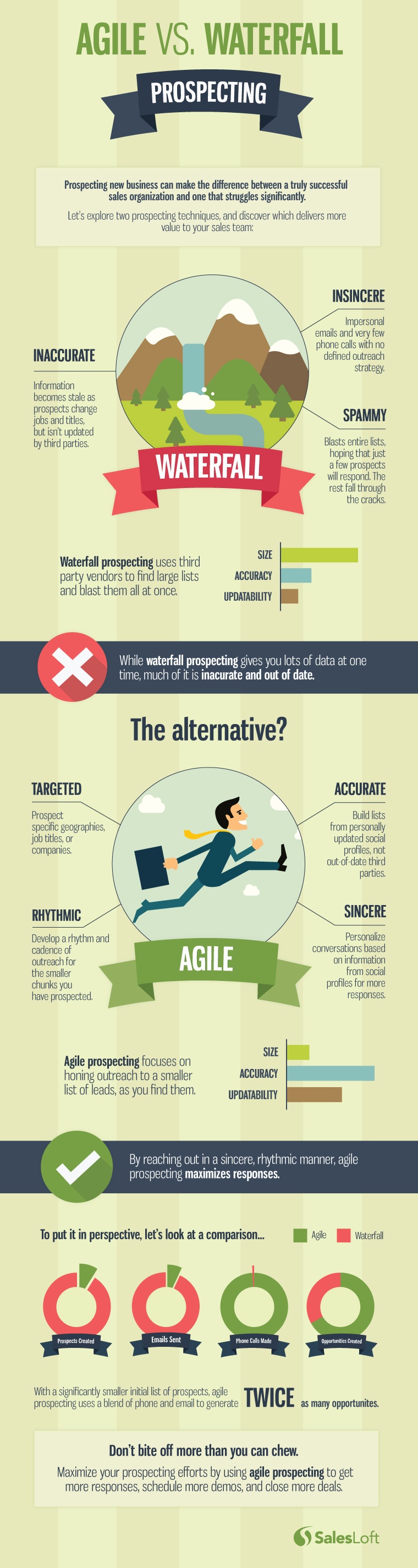
21 Aug 18:46
Defining Sales Intelligence
by Jim Hopkins

We’ve all seen that the Internet has forced sales people to approach potential buyers in a more thoughtful, personalized and intelligent manner. They must provide value beyond just what buyers could find online. They need to know everything about the customer’s industry, their specific business issues, as well as individual stakeholder dynamics, and offer unique insight. Many would classify this as sales intelligence.
Intelligence is one of those words that business has adopted and used to describe something sort of connected to the real-life definition of the word, but probably with too liberal an application. Still, it’s a word that captures the feeling of what we all strive for in business: something of a sixth sense; a Jedi insight into the deep reach of overwhelming data and information. Dictionary.com defines intelligence as, “the capacity for learning, reasoning and understanding.” This definition comes in handy not only for business analysts and the c-suite but increasingly for the sales professional.
Going back to the definition of intelligence, we can outline some clear ways sales can better prospect and connect with buyers:
Learning
This part of intelligence implies becoming familiar with the topic of interest. In a sales scenario, reps must have the ability to quickly acquire and digest key information on prospects. When most of their productive work is done in Salesforce, having to go to other tools, website and sources for learning adds time, energy, and complexity to the process. Ideally, account records would provide, or connect to, all the basic and information you’d need to make yourself familiar with target accounts.
Reasoning
The ability to reason sets us apart from other organisms with brains, and intelligent sales reps must rely on more than just their instincts to make good decisions. Efficient prioritization and qualification of leads can mean the difference between making your number and wasting your time on painful calls with bad prospects. To make those good decisions, you need detailed and accurate account data, financial details, job titles, and other information uniquely relevant to your category of business.
Understanding
An intelligent person often proves their knowledge through some sort of test. For sales reps, their test comes in meeting with potential customers. With information like industry trends, company news, competitive landscape, and other more contextual intelligence, salespeople can find the nuggets that create understanding and connection between the customer’s needs and your products.
As outlined recently by our friend Marika Vilen at Thomson Reuters, the problem is that the pure volume of information that needs to be digested in order to cover the average sales territory would give even the most prolific, elbow-patch-sportcoat-wearing researcher face twitches.
Never fear! At Salesforce, and Data.com, we’re focused on building technology that enables businesses to sell smarter. We’ve added a powerful sales intelligence feature to our Prospector solution that offers deeper business details, financial info and other contextual information on accounts.
Download our new Know Your Customers Better Than Ever e-book and talk to your Salesforce account executive to learn more.

21 Aug 18:45
 Thanks to Jonathan John for sharing their advice and opinions in this post. Jonathan is a freelance writer and a digital marketing enthusiast, helping businesses leverage the power of content marketing to increase website traffic and boost brand authority. You can follow him on Twitter or connect on LinkedIn.

7 ways you could be screwing up your sales funnel
by Expert commentator
Avoid these 7 mistakes at all costs when building and managing your sales funnel
Your sales funnel is the core of your marketing plan. It's the map of a customer's journey, right from the first interaction with your brand all the way to the final sale. Every piece of content you create and every marketing strategy you implement is built around your sales funnel.
In short, your funnel is a critical component that decides your online success. And unfortunately, you could be screwing it up.
In this post, we'll explore 7 of the most common mistakes that plague sales funnels, plus strategies you can apply to overcome each error.
1. You're not tracking enough data
A lot of marketers focus only on the big-picture metrics like page views, visitor-to-customer conversion rate, and bounce rate. Whereas, metrics with smaller scopes—like return visitors, exit pages, and scroll patterns—remain totally ignored.
This is a fatal mistake. Even though big-picture metrics are doubtless important to your sales funnel, the smaller metrics frequently provide much more actionable insight into how you can improve your sales funnel.
For instance, say that your overall traffic conversion rate currently sits at 1%. This is the big picture: 1 out of every 100 of your visitors eventually becomes a customer. Although this metric does give you a broad view of what's happening on your site, it doesn't show you specific areas of your marketing strategy that need improvement.
Now let's say that you go back over your sales funnel armed with a fine-tooth comb. You discover that out of every 100 visitors, 5 end up as email subscribers (5% visitor-to-subscriber conversion rate). However, out of those email subscribers, only 10% regularly open the emails you send.
This low open rate definitely needs work. According to MailChimp, open rates are typically >20% across the board in most industries.
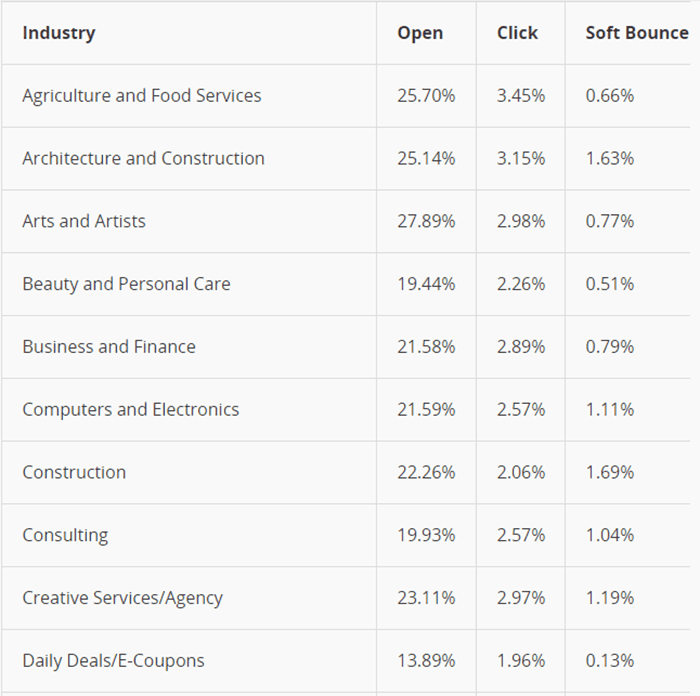
Thanks to this relatively small metric, you now know a specific area in your marketing strategy that needs improvement. If you had focused only on the big-picture metrics, then it's possible that you might have never noticed this loss.
How to fix this
Make sure that you're focusing as much on small-picture metrics as you are on the broader ones. If your current analytics platform doesn't allow you to drill down into the metrics behind each step of your sales funnel, then consider changing over to one that does.
2. You're not testing multiple payment gateways
One of the trickiest parts of building a sales funnel is choosing the right type of payment gateways. The ideal payment methods in the real estate industry, for example, are often very different to those that work best in the Ecommerce industry.
Another problem you have to deal with is selecting the right number of permitted payment gateways. Too few and your sales funnel won't be able to accommodate a part of your audience. Too many, and you could end up scaring away some leads because of the excess choice.
How to fix this
The solution is continual testing. Test various combinations of different types and numbers of payment gateways until you find one that works well for your target audience. Here's a short list of some of the most popular e-payment gateways to get you started:
3. You're not prioritizing lead nurturing
Another common mistake in sales funnels is too much focus on lead generation, and too little on lead nurturing.
When lead generation is the sole focus, then a low lead-to-customer conversion rate is guaranteed to follow. You might have a lot of new leads entering the top of your funnel, but only a very small portion of them will ever make it all the way through and become customers.
How to fix this
Use marketing automation tools like content segmentation to ensure that all of your new leads are drip-fed content personalized to their demographics and tastes. Also, consider using lead scoring to evaluate the contacts that are most ready for the sale and move them along the pipeline accordingly.
4. Your copy sells features, not solutions
I recently came across an excellent quote from copywriter Konrad Sanders.

This tip could be the best one I've ever read on copywriting. When selling a product, the worst possible thing to do is to try to sell it to your audience by the merits of its features. Your customers don't want to know about features: they want to know about solutions. The copy's focus, then, should instead be on the problem your product solves for customers.
How to fix this
Every customer who's ever bought your product did so in order to solve a problem. Survey your current customer base to understand exactly what that problem is. Identify the most common pain points of your customer's experience, then write your copy around that information.
5. You haven't removed buyer inhibitions
Simply put, buyer inhibitions are the things that stop a lead from becoming a customer. Inhibitions are the fears that every customer has about buying a new product or hiring a new service.
Here are a few examples of common fears:
- How do I know I can trust this company to deliver on its promises?
- How do I know this product is the right fit for my specific needs?
- Does this company have a proven track record of success?
If you don't take away these fears, then a large percentage of your leads will never make it through your sales cycle.
How to fix this
Information is key here. If you haven't noticed, a common trend among the fears I just listed is when the lead doesn't know something. Take the first fear, for instance: "how do I know I can trust this company to deliver on its promises?"
This fear deals with trust. Leads who have this inhibition aren't sure whether they can trust your business with your money and they have been provided no information to alleviate this psychological block.
One common way to solve this fear is to use trust symbols and social proof. A trust symbol is a visual signal that communicates trust to viewers, such as a McAfee "secured" badge.
Baymard Institute recently did a survey to discover which trust symbols are preferred by consumers. Norton and McAfee logos came out on top.

Trust symbols aren't the only way to remove buyer inhibitions. Client logos are widely used to build social proof and relieve buyer anxiety. In addition, case studies that show leads exactly how your past customers have benefited from your business can also work to increase conversion rates.
6. You're using the wrong CRM
One prevalent mistake marketers make when maintaining a sales funnel is choosing the wrong CRM to manage their contacts. It's important that you choose carefully. To achieve the right results with your sales funnel, you need to make sure you're using the right technology.
Too often, though, I've seen marketers directly go in for whatever tool is the hottest on the market, or whatever tool they've already heard about from friends or from the blogs they frequent. Once they go in for a CRM without researching all of the available tools in detail, the inevitable result is a waste of time and resources as they endeavor to adapt their sales funnel to their CRM (it should be the other way around).
How to fix this
If your CRM isn't working out for your marketing strategy, then it might be time to change. Here are a few important factors to keep in mind when choosing the right CRM.
Price creep: A majority of CRM tools will charge you according to the number of contacts in your system. While the beginning plan may not be expensive, down the road you might find yourself in a position where you'll have a much larger number of leads in your system. Make sure that your budget will be able to accommodate the higher prices if/when that happens.
Flexibility: Different CRM solutions come packaged with different functions. The CRM you choose should have the flexibility to fulfill all the functions your sales funnel will require.
Data tracking: If you're not interested in using a third-party analytics platform, then make sure you find a CRM that offers built-in tracking so you're aware of all vital metrics.
Onboarding: Consider how much time it will take you to get used to your new CRM. Also think about the onboarding process and how the tool provider works with new customers to ensure they're making the most out of the platform. Some tools levy a mandatory kickstart fee (Infusionsoft, for example, charges $1499 to new accounts).
7. Your marketing and sales departments aren't working together
The biggest screw-ups in sales funnels often result from marketing and sales departments that aren't working together as they should.
Here's what typically happens: marketing focuses on generating as many leads as it can to hand off to the sales department. Sales complains that marketing focuses on lead quantity, not quality, and refuses to work with what they deem to be low-quality leads. Marketing protests this, saying that sales isn't doing their job, and sales responds in kind.
The whole process results in a lot of needless friction between the two departments that engenders revenue loss. This is a very unfortunate problem, especially when you consider that both marketing and sales have the exact same end goal: more revenue.
How to fix this
The best way to resolve interdepartmental disputes starts with discussion. Sit marketing and sales down together, and start talking things over.
The first thing you'll want to do is to agree on a common definition of a quality lead. Let both your marketing and your sales guys come up with a set of guidelines/criteria that each lead must meet. That way, marketing knows exactly the type of lead sales needs to produce conversions, and can plan accordingly.
Next, discuss strategies to generate and nurture these leads. Only when everyone is on the same page strategy-wise can marketing and sales truly be aligned and working in tandem.
Wrapping Up
While it may take you both time and resources to work out all the kinks in your sales funnel, the end result is definitely worth it in the long run. A solid, well-organized sales funnel is the core of every online business: a vital cog without which all marketing strategy is doomed to failure.
Thanks to Jonathan John for sharing their advice and opinions in this post. Jonathan is a freelance writer and a digital marketing enthusiast, helping businesses leverage the power of content marketing to increase website traffic and boost brand authority. You can follow him on Twitter or connect on LinkedIn.
21 Aug 18:45


Is Everyone Coachable? [The Answer Might Surprise You]
by Keenan
This is a guest post in response to my coaching post a week ago. While writing the post I asked my friend Matt if everyone was coachable. He said yes. I didn’t believe him, so I asked him to convince me and write a post supporting his claim.
What follows is one of the best breakdowns of coaching and what coaching means you will read in a blog. Matt’s position is substantive and comprehensive.
If you’ve ever wondered if everyone was coachable, Matt will give you plenty to work with in drafting your opinion.
——————————————–
Keenan asked me a question the other day, “Is everyone coachable?” I said, “Of course!” And he said, “I knew you were going to say it, but I don’t believe it. Prove it.” So, we agreed I’d write this blog post.
I’ve been coaching professionally since 2002. I was coaching internally in organizations five years before I went a got a coaching certification though the Coaches Training Institute. My very first coaching client was a Vice President who had allegedly “spit” at one of her directors in a heated argument, most likely just spittle, but HR didn’t know what to make of it and so tossed it to me. Since then I’ve have over hundreds of coaching clients and stopped counting hours when I crossed the 10K mark back in 2011. My bona fides are there and I can confidently tell you that everyone is coachable.
But what does that mean exactly? Does that mean that everyone can be a rock-star in your organization? That everyone is cut out for Sales? That everyone can master all parts of the sales cycle from first contact to close?
Yes.
Let me rewind and digress for a moment…
When I first started coaching I was a wild man, untrammeled by the loss and divorce that has marked me as an adult, and I was and still am heart centered. I had just finished my master’s degree and Kurt Lewin (founder of social psychology) was my idol.
My background includes cultural anthropology, ecopyschology, biology, developmental psychology, instructional design, organizational development, and coaching. From the very beginning I’ve been fascinated and have worked with systems and so everything is system related to my mind.
I don’t see the individual as separate from the system from within which they’re operating.
You look at the United States military and how instructional design and organizational development function and you see a system that can take young men and women, with different socio and economic backgrounds from all over the country, and turn them into a single fighting force.
That’s impressive!
Kurt Lewin’s equation: B = f (P+E) is Behavior is a Function of the Person + Their Environment
We’re relational by nature.
It’s why I’m leery of organizations that seem to think potential hires either fit or don’t fit their organizational culture. People are adaptable. We have a deep fear of this in the West, but the reality is that out personality, values, behaviors, and principles are all very fluid.
In fact, that’s why leadership is so damn important. It’s why organizational cultures are so damn important.
I’ve seen plenty of shitty organizations chew up and spit out talented individuals, just as I’ve seen great organizations take mediocre people a turn them into rock stars.
This is why Top Grading and Forced Ranking are such awful performance management systems. Everyone is a potential star or a potential fuck up.
I remember I had a boss once say derisively to the team in a meeting, “Matt thinks everyone can be saved!” She thought she was being wise and that I was just a sweet summer child, but jadedness isn’t wisdom.
Everyone can be coached.
You’re skeptical, I can see that… But evaluate how coaching is approached in your organization and see if it allows for and holds to these principles:
1. People Hate Change — As hard as it is to accept people prefer dysfunction, pain, and the collapse of their integrity over facing the unknown that change and growth inevitably brings. It’s built in genetically (from a long line of scary pants ancestors) that we fight to maintain the status quo, maintain it at all costs, even if it sucks, because the unknown is just that You can tell people if they just cross the street all their life dreams will come true and the bucket of shit they’re holding onto can be let go (and we all know the shit we carrying for ourselves and others) and heck you can even show them, but they won’t cross the street. The familiar, even when it breeds contempt, is more powerful than the unknown. With the unknown comes risk and people are generally risk adverse. Every client you meet in coaching has found a way to survive in the current system and they’re unlikely to want to change unless you help them.
2. Begin Where The Client Is — I now start all coaching sessions with a simple question, “What do you want right now? or the similarly worded, “What are you seeking in this moment?” as it’s the very best (and very gestalt way) of checking in to see where the client is. Why leaders often make for lousy coaches is that they begin with the end in mind. They have a place they’d like to see their direct report get to and so are always impatient and pushing their direct report to that end. Coaching doesn’t work that way. You have to walk side-by-side with a client and see the world through their eyes. Empathy is the basis for all emotional intelligence and is the foundation of successful coaching
3. Check Readiness — My mentor is always harping on me to do this and has been for 20 years. I love the work. I love growth and development. I’m always ready to spring off the cliff into the pool below but that’s just me. I’ve dropped acid in the middle of a forest, I’ve fasted for forty days, I’ve sat in T-Groups in Bethal, Maine, I’ve had ferocious therapists over the years who confront as much as love. It’s second nature to me to open the kimono and look within. But I’m scared of actual diving boards. I don’t like them. They’re not fun to me. I see people at the pool have a blast with them and I take that image with me into any session. Just because I’m comfortable doesn’t mean other people are. I’ve had to learn the hard way that the quickest way to lose a client is to be too truthful up front. You constantly need to check people’s tolerance for growth and development. I have a friend who’s a professional dominatrix and her axiom is, “People’s pain thresholds are changing constantly. From moment to moment!” Same is true in coaching. Two steps forward, one step back. Life’s a cha-cha!
4. Systems Are More Powerful Than People — 99% of the time when people are in conflict with each other it’s because a system is broken underneath. If someone isn’t making numbers or closing deals, I’d first look to the system. Sometimes the leads are weak. That’s just reality.
5. Leadership Matters — The post postmodern corporation is a pyramid scheme, there’s only so many spaces at the top, and until that changes leadership will continue to matter. Leaders set the culture. I think every leader should read Brene Brown’s book, “Daring Greatly” to understand how shame functions in organizations. Most organizations are shame driven and shame is a growth and development killer. Leaders set the culture up unto the point where an organization can survive without any one particular leader.
6. Culture Matters — When an organization can survive without its founder, it then has a culture that’s not dependent upon leadership. Think GE, Siemens, U.S. military. At that point culture is king. Organizational cultures that can survive at this level of development do so because their successful in their environment plain and simple. McDonald’s may have to adapt in order to survive because the operational environment has changed, but you can’t deny that for 50 years they’ve been tremendously successful. I hate to burst your bubble, but organization cultures aren’t made up of just catching sayings, values, or even beliefs. Organizational culture is simply: 1. Shared language 2. Shared space 3. Shared tools. Cultures who do these three things efficiently, effectively, and affectionally survive and thrive.
So, do you ever give up and fire someone?
You bet.
Failure is an option.
Just as all divorce is a failure of imagination and cowardliness, so too is all failure at work. While everyone can be coached, it doesn’t mean that every relationship, work or otherwise, ends in success. With every new level of depth, every moment you have courage and grow there are new challenges, new responsibilities, and new opportunities. Sometimes we chicken out. Sometimes we’re not ready. Sometimes we believe ourselves incapable of the consequences of our impending success. So we collapse and fail.
I get that.
I think the interesting thing about The New York Times article on Amazon’s culture and Jeff’s response this past week is that it exposes a truth about all organizational cultures: there are some people who are truly enjoying and thriving in your organizational culture and others who are not. Both truths can coexist. And neither is wholly correct. All relationships ebb and flow and the mark of a great organizational culture is how it handles those who are in ebb due to maternity leave, illness, bereavement or other major life challenges.
I have a .500 mark when coaching “turn around” clients. These are clients that the organization would like to keep but are close to firing. So, half find a way back into the organization with new ideas on how to confront the broken system and/or poor relationship with (customers, clients, peers, direct reports, leadership) and thrive and the other half make another choice.
Either way, they’ve been coached, and have made a choice.
Clients get a big smile on their face then they realize they’re not broken, the system is, and they have a choice about what to do next. I love that part of coaching.
Some of you might be thinking, “But Matt where is personal accountability in this? Some people avoid taking responsibility of any kind!” Yes, but only in shame driven systems.
An old trick of mine was to sit down next to leaders and have them write a list of all their direct reports and star their exemplars and but a check mark by the ones they wound’t fight for if they found out they were thinking of leaving.
This gets back to the old “halo” and Theory X and Theory Y management, but the reality is everyone wants to succeed. If someone has taken the time to shower and show up for work, they want to be successful. They may need help in that endeavor, but they’ve done their part.
It’s now up to you.
—————————————-

Matt is founding parter of Morava + Graham working with organizations in CEO Succession and executive vetting. You can find him on LinkedIn where he’s waxing some of the most robust writing you’ll ever experience.
21 Aug 18:42
Cut Your Lead Forms in Half (and Double Conversions) with Interactive Content
by Elizabeth Wellington

Imagine you stumble upon a new vendor’s website with an extensive resource gallery. Impressed with what you see, you click on the latest ebook offering. To get the ebook, you have to fill out a lead form on a landing page — no big deal. But you realize there are nine required fields, some of which are loaded with drop down menus.
Are you still interested? It depends on how badly you want that content. At this point, you may be second guessing your choice.
As a marketer, you are the brains behind the landing page. You balance the need for rich data and quality prospects with high numbers and low cost per lead.
Walking this line is never easy. Keep reading to find out how you can use interactive content to offer shorter lead forms, increasing your conversion rates while gathering all the prospect data your heart desires.
Advantages of Shorter Lead Forms
As you may have guessed, shorter lead forms improve conversions. They minimize effort on the part of visitors who just want whatever’s on the other side of the form, and they maximize the likelihood your visitor will convert in the short time they spend on a landing page.
Here’s why short lead forms do the trick:
Long lead forms cause high bounce rates.
Dan Zarella analyzed 40,000 of HubSpot’s client landing pages to tease out the ideal lead form length. He found that three to four field forms maximizes conversions.

Image Credit: Hubspot
Short lead forms stay above the fold of your website, eliminating the need to scroll.
With users often leaving web pages between 10-20 seconds of first entering your site, it’s vital that visitors see your lead form immediately. Unbounce offers 6 takeaways for maximizing visitor-to-lead conversion on forms, and keeping the lead form “up and to the right” is a key point.
Additional fields leave room for confusion.
Expedia, for example, found that a form field labeled “Business” befuddled visitors — instead of listing their place of business, people put the name of the bank associated with their credit card.
Longer lead forms can result in funky, fake data.
With a form that’s nine fields long, visitors might resort to “555-555-5555″ and “Jane Doe” just to get through the form. Visitors are also less likely to provide real data for more sensitive information — check out Marketing Sherpa’s graph on the most and least accurate areas for form-submitted information:

Shorter lead forms decrease cost per lead.
Boosting conversion rates with a shorter lead form will yield a corresponding decrease in cost per lead. These companies saw big gains when shortening their lead forms:
- Expedia ditched that confusing form field labeled “business,” and they brought home 12 million dollars! (Yes, you read that correctly.)
- When Marketo utilized a five-field form versus a nine-field form, they decreased their cost per lead by $10 and increased conversion rates by 3.4%.
- Neil Patel boosted his lead conversion by 26% when he deleted one form field from his landing page.

These statistics point to the benefits of embracing short lead forms as a way to grow your prospect pool and lower your cost per lead.
The Problem: Lack of Data
But here’s the issue: with a short lead form, you limit what you can learn about your prospects. Are they genuine leads? Who is this visitor, really?
Longer forms may entail a higher cost per lead due to lower conversions, but they can also attract a group of prospects that’s more serious about your service or product.
Sarah Goliger described the challenge of quality versus quantity leads as early as 2011:
A shorter form usually means more people will be willing to fill it out, so you’ll generate more leads. But the quality of the leads will be higher when visitors are willing to complete more form fields and provide you with more information about themselves and what they’re looking for.
How do you balance the need for high volume and strong leads? Marketers have come up with a couple of workarounds. You could ask for important information after prospects fill out the lead form, collecting more data in another stage of the journey. Or you could follow Marketo’s lead, filling in the holes by purchasing data on prospects. Both of these marketing hacks offer improvements – but there’s a better way.
The Solution: Interactive Feedback
Here’s where interactive content, paired with a short lead form, yields the most (and best) visitor data.
Creating interactive content allows you to camouflage qualifying questions within a format designed to engage, entertain, and educate. At long last, your marketing team is no longer dependent on a lead form to secure the bulk of your data or isolate quality leads. Interactive white papers, quizzes, and assessments can do both — and without dramatically affecting your cost per lead.

With B2B marketers seeing 40-45% opt-in rates on interactive content, infusing questions into a fun experience will heighten your chances of a connection. Just ask Infinio.
Instead of bulking up their lead form, they offered immediate value to prospects in the form of an interactive white paper that also captured heavy-hitting data, enabling their sales team to bring it home. This interactive experience included nine questions alongside information their visitors were looking for, making it a fun and informative experience for the user (while sending important info to Infinio’s marketing database).
Dynamic content also beats long forms because it builds on a brand’s identity, utilizing images and two-way communication to personalize rather than sterilize a first interaction. Participants who stick around to engage with your content are not drop-by visitors, but rather individuals who are investing time on your site – and offer the highest quality lead. With a 15% rate of social sharing for interactive content, you can expect not just one lead from each gamified interaction, but an amplified effect.
SkilledUp built a quiz about Microsoft Excel that resonated with their brand and the interests of their audience. It gave their marketing team information about the knowledge-base of their leads in an entertaining format. SkilledUp asked for an email address before offering the results of the quiz.

Photo Credit: Econsultancy
Note that they didn’t demand an email submission, but rather asked for it in a friendly way, making the value exchange crystal clear. With interactive content, you can try a range of lead techniques to figure out what works best for your company — you don’t have to force the connection, it happens naturally.
Conclusion
Integrating interactive content into your marketing programs allows you to listen for answers without pushing away opportunities to connect with a broader audience. It optimizes and balances short lead forms — contributing to lower cost per lead, higher conversion rates, and excellent data to support all your marketing and sales activities.
And now that you’ve learned all about how your prospects fill out lead forms, how do you compare?
21 Aug 18:42
3 Ways to Improve Sales Enablement Within Your CRM
by Brendan Cournoyer

If you’ve had a conversation about sales enablement lately, chances are the word “content” has come up. In fact, it’s probably come up a lot.
And rightly so. While there are many definitions of sales enablement floating around, it ultimately comes down to one thing: providing reps with the knowledge and resources they need to increase productivity and sell more effectively.
Sales organizations today rely on the right content to:
- Help add value to their sales conversations
- Share with buyers and hold their attention
- Review onboarding and training resources
- Prepare for upcoming sales calls and meetings
So yes, the content you create for sales is important. But HOW that content is delivered and made available to reps? That’s just as critical. Really, it’s about ACCESS – fast, seamless access to the resources reps need, right when they need them.
When you look at it this way, it seems only natural to make the CRM part of your sales enablement strategy. Platforms like Salesforce already represent a major investment, of course; not just as a tool, but as a strategic solution to drive business. Sales enablement technology can help take that investment even further, making the CRM a solution for the big content problems facing a lot of companies today.
The problem of “random acts of sales support”
A while back, Scott Santucci (then a principal analyst with Forrester) wrote about a phenomena he described as “random acts of sales support”, and it’s a topic he recently revisited in a new post titled Is Your Content Drowning Your Sales Force?
The concept basically speaks to uncoordinated efforts where everyone at a company pitches in to support sales, but the result is just the opposite. Content is delivered randomly from all angles, and reps become overwhelmed and confused over what to use.
Instead of increasing sales productivity, you hinder it.
This is a common issue for B2B organizations, and part of the problem is the way resources are delivered to sales teams. Company messages and product updates are delivered from all angles. On-demand training is accessed via a third-party LMS. Prospecting and slide content is found on network drives, SharePoint – I mean, it can be anywhere.
Ideally, all this valuable “stuff” (and it is valuable!) should be housed in a central place where salespeople can easily find what they need when they need it. (Sales enablement should make things easier on reps, not burden them, after all).
That’s where the CRM comes into play. If you’re going to have a single place for all your sales enablement content and resources, why not take advantage of a system reps are already using?
At Brainshark, we’ve integrated a large portion of our sales enablement content and resources right into Salesforce. As a result, we’ve been able to streamline and simplify the delivery of sales content and training in a way that already makes sense for reps.
Three ways to increase productivity within Salesforce
Here are just a few ways sales enablement can fit within a CRM like Salesforce:
#1. Onboarding Resources – Many companies supplement live sales training with some sort of on-demand, self-paced eLearning approach, typically delivered via a third-party learning management system (LMS). This is great for adding flexibility to the onboarding process, but it also creates yet another system for reps to log into.
If you can integrate that same formal learning environment within the CRM, then you can train reps from the same system you want them using anyway. For example, if new hires can see all they need to get ramped up as soon as they get their Salesforce logins, it not only simplifies the learning process, but increases adoption by conditioning reps to use the CRM from Day 1. It immediately becomes the central location for reps to find resources that help them sell better.
#2. Preparation Resources – Obviously, training doesn’t end once reps are out in the field. To add value to their conversations with buyers, they need to stay up-to-date on everything from industry trends to value messaging.
“What do I say to THIS unique buyer, for THIS unique industry, at THIS stage of the sales cycle?” Ideally, if you can bring your sales content into the CRM, you can not only make those resources readily available, but also tie them to the actual leads, contacts, opportunities and accounts reps are dealing with.
#3. Selling Resources – There’s also the content reps use when interacting with buyers. For example, content to share during prospecting, email outreach and social selling, live presentation content, or follow-up materials to send after a meeting.
Once again, by delivering this content via the CRM, you can more easily make it available in context with specific sales situations. At Brainshark, we filter our content for different job titles, products and selling stages, so our reps can find exactly what they need without having to search for it or even leave Salesforce.
These are just three examples of integrating sales enablement processes. With steps like these, you can not only avoid “random acts” and support reps more efficiently, but you can drive Salesforce adoption across your organization as well – which is something every sales organization can get behind.
For more on how to choose the CRM that is right for you and your business, download the free e-book.
21 Aug 16:24
6 Reasons Why LinkedIn Is The Best B2B Ad Network
by Lauren Frye
If you want to hit the bullseye, you first have to aim in the general direction of the dart board. If you’re a B2B marketer doing paid advertising, LinkedIn is your dartboard. It’s full of 380 million business professionals, and a certain demographic of these people create your bullseye. What’s more, the LinkedIn Ad Network gives B2B marketers all the information they need to reach these targets.

REASON 1. It’s Made of 380 Million Tech-Savvy Professionals
As a B2B marketer, you’re out to target business professionals, and LinkedIn is made up of 380 million of them. According to Kim Celestre, a Forrester analyst, “LinkedIn members are highly motivated to maintain their professional profiles and keep their job details current.” New professionals often use their LinkedIn profiles as their resumes, and seasoned professionals maintain their account details for networking purposes. A B2B marketer is knocking at an open door to a goldmine of demographic information that is constantly updated. LinkedIn is full of business professionals who are effectively raising their hands and saying, “Hey, you probably want to talk to me.”
REASON 2. It Can Target for a Myriad of Demographic Details
Following her point about LinkedIn’s profile details, Kim Celestre adds, “This means that B2B marketers who purchase LinkedIn’s ad solutions will be able to tap into users’ high quality profile data for very accurate targeting across a variety of channels.”
On a personal profile, LinkedIn users identify themselves by company, industry, and job title or vocational function. The LinkedIn ad system collects this information about everyone in their network. They know whether a person is a marketing director, a technical writer, an office manager, the head of sales, or the CEO. They know whether that person works for Coca-Cola, Hubspot, Starbucks, or Intel. They know whether a person lives in Boston, Chicago, San Francisco, or Miami.
When using LinkedIn to target your advertising, you can hit the bullseye every time. Optional LinkedIn targeting characteristics include:
- Job Title
- Job Function
- Seniority
- Company Name
- Industry
- Gender / Age
- Company Size
- Geography
- Group
- Skill
- Degree
LinkedIn allows advertisers to specify industry, company size, and job title of the individuals they want to see their display ads. Also, LinkedIn is an ideal way to do account-based marketing, because you can show your ads to individuals who work at specific companies. It’s no use giving an untargeted prospect that chance to cost you an ad click just because they’re curious, so it behooves the B2B marketer to be as targeted as possible. LinkedIn lets you do that.
REASON 3. It Can Accommodate Skills-based Lead Qualifications
We’ll use ourselves as a quick case study. Bizible has learned that LinkedIn advertising works exceptionally well for our company. Sure the clicks cost a bit more, but they convert at a higher rate. Because our product targets a specific type of business professional, we want to advertise to only those people.
As these LinkedIn members build their ‘skills’ in their profiles and receive endorsements left and right, we can see which business professionals would be a good fit for our product and which ones we shouldn’t target. For example, those that have advanced analytics skills or those that have demand-related skills, such as paid search, are an excellent fit for what we do. As a result, we’re able to target those that would benefit the most from a marketing attribution product.
Nowhere else in the vast expanse of cyberspace is there an ad network that allows B2B marketers to segment their ad campaign targets based on unique areas of expertise. More power to the marketer.
During a conversation about LinkedIn advertising AJ Wilcox, a LinkedIn ads expert at B2Linked, said,
“I love using skills to segment out users of a certain product. Let’s say you’re trying to reach users of Salesforce – simply target that skill and show your ads only to users who’ve self-selected that skill. There’s no fussing with whether you’re showing ads to a massive group of irrelevant marketers or salespeople, and it leaves you with your exact target. No wasted impressions on irrelevant eyes.”
REASON 4. The LinkedIn Lead Accelerator
LinkedIn doesn’t leave B2B marketers to sort through the hoards of data and prospect details on their own. Their new Lead Accelerator tool helps facilitate lead nurturing in order for marketers to display their ads to the right people at the right time based on where they are in the buying process. This allows marketers to sequentially organize their ad campaign strategy, and optimize the way they approach and nurture prospects through the funnel. Already, the tool has helped numerous companies across the United States decrease their costs-per-lead and increase their conversion rates by more than 50%.
REASON 5. LinkedIn Ads Convert Well on Gated Content
B2B marketers on average distribute large amounts of gated content. B2B sales cycles and buying processes can be long, and as such, B2B leads benefit from plenty of education prior to the close. Gated content also provides an avenue for email capture and nurturing. In our article on our learnings with LinkedIn ads, we explained how our LinkedIn ads converted well on content offers.
REASON 6. The Majority of B2B Marketers Agree
B2B industry benchmarks presented by the Content Marketing Institute show that 94% of B2B marketers use LinkedIn in some capacity to disseminate content, and this same percentage of marketers agree that LinkedIn is the most effective social network for B2B marketing purposes.
The chart below shows the growth in the LinkedIn’s ad network revenue in millions each quarter since the beginning of 2013. These metrics show that marketers have been increasingly using this network since 2012, and according to the data, those numbers are still rising.

When using ad networks that cost a bit more for the click, it’s incredibly important to have B2B attribution in place to allow you to track how well the clicks convert to revenue. That way, you’re able to see which individual ads cause the most conversions, allowing you to optimize your ad spend for maximum effectiveness. Your marketing will only be as good as the data you have.
