
The whole point of LinkedIn is to connect to others in a professional or career-related capacity, but like other social networks, LinkedIn is also a place where criminals try to gain access to information about you and those you know.
The whole point of LinkedIn is to connect to others in a professional or career-related capacity, but like other social networks, LinkedIn is also a place where criminals try to gain access to information about you and those you know.

We’ve all been there.
We know what we want.
We know exactly how much we can afford.
But the sales person sitting across the desk, has his own agenda and doesn’t want to listen.
It’s frustrating isn’t it?
A sale that should take minutes turns into hours.
The salesperson makes a choice to not listen to you. He makes the choice of not focusing on your wants or needs. And it’s piss poor salespeople like this that give all other salespeople a bad reputation.
When it comes to certain transactions and you’re a good salesperson if you don’t think you can meet the prospect’s wants or needs you have to let them know. Don’t try to push your own agenda and sell them something they do not want. If their budget for a car is X Amount, don’t try to sell them a car that is X+Y+Z Amount.
How does a salesperson not listen to his prospect?
Well, let’s look at an example from my own life.
About a year and half ago, my wife and I were in the market to lease a new car. At the time, we were driving a 2011 Ford Fusion and looking to upgrade to either a Ford Escape or Ford Edge-something with a little more room, for my son’s car seat, stroller and more.
We wanted our monthly payment to be below $250 a month. If the car was going to cost a penny above $250 a month, we would not take it. Sorry, but it’s over our budget.
We went back to the Ford dealer that we leased our 2011 Ford Fusion from, to see if they had a Ford Edge or Ford Escape that fit our budget.
When we sat down to talk to the Ford sales rep, we specifically told him that our max monthly payment would have to be under $250. He said, “I can make that happen, no problem.” He writes down on piece of paper in bold black ink “$250 PAYMENT A MONTH!!”
The Ford sales rep went on to show us 4 different vehicles.
My wife and I became a little irritated.
The sales rep was wasting our time by not listening to us and showing us cars that were way out of our budget. And on top of that we weren’t interested in a Ford Taurus or a Ford Fusion. When we brought that to the rep’s attention. He said, “Oh, I thought you wanted to look at a Ford Taurus and check out the new model of Fusion.”
Before the sales rep could get another word out of his mouth, I stopped him and said, “If you can’t get me into the car that I want, for $250 a month, my wife and I are leaving.”
Shocked at the statement, the sales rep runs to fetch his sales manager.
They both come out trying to hard sell us on the 2013 Ford Escape.
Using a piece of paper with the minimum amount they can lease the car for, the huge sum of money we would have to put down, and length of the lease, the manager starts his sales pitch.
The sales manager starts his pitch: “You look like a pretty nice family, looking to make a smart decision, by upgrading to something bigger for the safety of your child. Do you not feel that the extra $2.63 a day is worth the safety of your child?”
After asking the Reduction to the Ridiculous Close, the sales manager and sales rep smile and look directly at my wife. I guess they were looking for sympathy, but there was none.
I’m waiting to see if they are going to keep silent after asking their closing question and they do. The silence goes on for about 30 seconds. Thinking they have the sale in the bag and never removing their smiles or eyes off of my wife.
“Did you get that close out of Tom Hopkins, How to Master the Art of Selling?”
Their smiles dissipated and their eyes turned to me.
Before they spit out an answer, I said, “Listen, I know what you’re trying to do here and it won’t work. Can you get us into the Ford Edge or Ford Escape for $250 or less a month?”
Trying to avoid the question the manager starts going on and on, about when we leased our car there was a promotion going on with Ford Fusions and there are no promotions on the Ford Escapes or Ford Edges.
My wife and I got up and I said, “thanks for your time, but if you can’t get us into a car within our budget, we need to stop wasting each others time.”
With one last ditch effort, the manager says, “what’s the highest you will go on a lease?”
“Ask the sales rep,” I said.
The rep’s response was “$279, sir.”
My wife and I just walked out the door.
Lies: From the onset of the sales process my wife and I were assured that we would be able to get into a Ford Edge or Ford Escape for less than $250 a month. However, as the sales process moved along, nothing could be further from the truth.
Played Out Sales Tactics: I don’t have an issue with people using sales tactics to make a sale, but if you cannot meet the wants and needs of your customer, let them know from the beginning.
Wasted Time: Not only did the sales rep waste our time, but he also wasted his time and the manager’s time. During the 1 1/2 hours sales debacle of running inventory, finding keys, and asking us the same questions over and over, the sales rep could have been making another sale.
Not Listening to Us: Having a monthly payment above $250 on a leased vehicle, was something we did not want. The sales rep heard us, but didn’t care to listen. He wrote “$250 PAYMENT A MONTH!!” on a piece of paper, but failed to use that information to determine if he could meet our wants and stay within our budget.
After questioning us and listening to our responses; the sales rep would have established the fact that we would only lease a Ford Escape or Ford Edge if it cost less than $250 a Month. Armed with this vital information the sales rep could have done this:
Had an internal conversation with himself.
“I won’t be able to help this couple today, but I believe I can help them in the future. So I don’t want to burn any bridges, because I know they’ve referred people to me in the past. I can possibly make a sale to them in 2 months, when there 2011 Ford Fusion lease is finally up.”
Had an honest conversation with us.
Ford Sales Rep: “I’d like to thank you for coming back to me once again, to help you find a car. At the moment, I don’t have any promotions on a Ford Edge or a Ford Escape, that will get you to your $250 monthly payment. But this is what I can do for you. If you haven’t checked out our new Ford Escape or Ford Edge, I can show you them and if you’d like you can take one for a spin. Now, if you like what you see, then we can sit down and figure out when you need the new car by and how far off the pricing is from your budget. Does that work for you?”
How difficult would it have been for the any half way decent sales person to say something along those lines, and mean it?
Not difficult at all.
However, when you’re dealing with a salesperson that won’t listen, it’s hard to call him halfway decent.
Introduction
Investing money in anything is never without risk. When investing in liquid investments, prices can and do fluctuate daily. Importantly, all liquid investments can fluctuate in price, and that includes both stocks and bonds. I mention this because price volatility, especially when investing in common stocks, represents one of the biggest risks that investors focus on, some to the point of obsession.
However, there is an important distinction that many people either fail to realize or consider. Price and value are not the same things. There are many that argue that the value of anything is the current price that someone is willing to pay. In the short run, they are correct. When dealing with liquid investments, if you are required to immediately sell the asset, for whatever reason, its value will be only what someone else is willing to pay you for it at that moment in time. Therefore, in that situation, price and value is the same thing.
On the other hand, to the longer-term oriented investor, who doesn’t need to sell an asset in a panic, it’s critical for them to know the difference between price and value. Understanding this difference is rooted in the reality that ultimately a business, any business public or private, derives its value based on the underlying performance that the business generates. These value drivers include, but are not limited to, operating results such as earnings, cash flows, sales (revenues) and dividends.
Intrinsic Value VS Daily Price Action
Common sense would indicate that the true intrinsic value of a business based on the fundamental metrics described above doesn’t change very much in a single day or hour. However, in a liquid auction market, it is not uncommon to see the price of a company’s stock change rapidly from one hour to the next.
With liquidity comes price volatility, as individual investors are continuously presenting bids or asking prices at which they’re willing to buy or sell a given stock at any moment in time. This dynamic process is continuously creating overvaluation or undervaluation of a given company’s stock price relative to its fundamental value.
In other words, at any moment in time the market can be mispricing a stock either over or under its true worth. However, as previously stated, common sense tells us that the true value of a large multinational business, or any business for that matter, cannot possibly change as quickly or as much as daily price quotations would indicate.
At this point, it is important to acknowledge that there are many people that believe that assessing fair value is totally subjective; I am not one of those people. Those who hold this view tend to be very price focused. Regardless of the underlying fundamental strength of the business behind the stock, if the price goes up it’s a good stock, if the price goes down it’s a bad stock.
To my way of thinking, people who believe that price and value is the same thing are denying themselves the opportunity to recognize a bargain, or perhaps more importantly, recognize the high long-term risk associated with excessive overvaluation. This brings to mind a famous Oscar Wilde quote. In answer to the question what is a cynic, Oscar Wilde allegedly quipped “A man who knows the price of everything and the value of nothing”
Classic Lessons in Valuation
What follows are what I consider two classic examples representing lessons on valuation. The reason I consider these classic examples is because I believe they clearly and undeniably illustrate the reality that the stock market can, and does, incorrectly price publicly traded companies. Admittedly both of these examples are extreme cases of incorrect stock pricing by the market. However, it is often by examining the extreme that true insights can be obtained.
In addition to providing evidence that the market can and does incorrectly price stocks at times, these examples also provide lessons on the importance of fair valuation. To state this more plainly, these examples also show that if you pay more than fair value when investing in even the best of companies, you can lose money, and do so, while simultaneously taking on too high of a risk. But importantly, the high risk is often obvious and easily avoided if you pay attention to valuation.
Finally, these two examples clearly illustrate the distinction between price and value discussed in the introduction. Stock prices in the short run can be driven by strong emotions such as fear and greed. These two examples present vivid examples of both fear and greed at work. The intrinsic value of a business is driven by fundamentals and can be calculated within a reasonable degree of certainty. Once this calculation is made, sound investing decisions can be made and implemented.
Cisco Systems, Inc.
The first graph on Cisco (CSCO) plots earnings and dividends only since 1996. Simply put, this is a picture of Cisco the business. Over this timeframe, operating earnings grew at the above-average rate of 13.2% and the company instituted its first dividend at the beginning of fiscal year 2011.
Considering that Cisco is a tech stock, the consistency of the company’s operating earnings history is quite remarkable. There was some cyclicality during both recessions, but importantly the company remained profitable. In other words, Cisco did not lose money in either recession. There are few businesses in the overall market that can match Cisco’s historical operating record.
Yet in spite of this historical operating excellence, Cisco is one of the most maligned stocks in the market. Retired CEO John Chambers has also been severely criticized and often referred to as one of the worst CEOs in all of corporate America. I believe that criticism is unjustified based on the business performance that Cisco achieved under his reign as illustrated below.

With this next graph I bring in monthly closing stock prices since fiscal year 1996 and here we find a clue as to why Cisco, and ex-CEO Chambers, has been so severely disparaged. People often refer to the company as a dog that produced dead money for more than a decade. Ironically, they are correct, but not because Cisco the business performed poorly, nor because John Chambers was not an excellent CEO.
The culprit was the stock market because it incorrectly priced the stock relative to the business. Management is not responsible, nor did they have control of the price that the market placed on their shares. All management can do is run the business, generate earnings growth and cash flows, and return capital to shareholders via dividends or share buybacks when appropriate. Market price is often independent of those actions.
The orange line on the following graph represents a fair value P/E ratio of 15, which is appropriate for a company that produced the operating results that Cisco historically has. However, at the peak of excessive valuation in calendar year 2000, Cisco shares were being valued with a P/E ratio in excess of 160. Simple mathematics would indicate that this was approximately more than 10 times the company’s intrinsic value.
Cisco’s poor historical performance was not a result of it being a bad company or because its management was inept. The true culprit was a stock market gone mad.

I have often pointed out that I believe it’s an inevitability that a company’s stock price will eventually move to its intrinsic value. However, sometimes it can happen very quickly and in other times it can take longer. In the case of Cisco, it happened both very quickly initially, and then drifted towards fair value over several years thereafter.
To put this into perspective, I ran a calculation when Cisco’s P/E ratio was above 100 on November 30, 1999. You can see how wacky the market can be at times because its stock price rose dramatically from just over $44 at that time to over $82 by its peak in the spring of 2000. Of course, from there we saw a swift, and what can only be described as a brutal collapse, in stock price. Yet ironically, even through the recession of 2001, Cisco’s stock price never actually fell all the way to fair value (the orange line on the graph).
And even more ironically, the company stayed overvalued until we finally hit the Great Recession of 2008. Stock pricing can be irrational for a very long time, but that does not say that it is not visible. Cisco’s stock was a poor investment even though the company continued generating operating excellence. The bottom line is that long-term shareholders who held the stock from November 1999 until October 2009 would have lost almost half of their money even though the business was strong.
As a side note, I had invested in Cisco for clients in 1995, and starting in 1998 I was ceremoniously selling half of my position at a time. It was clear to me that valuation was excessive, but all clients could see was the price continuing to rise. As a result, I was fired by many clients. However, the vast majority came back after the bubble burst, but alas with a lot less money than they left me with.

As the above graph indicates, the 10-year timeframe 2000-2009 was a horrible decade for Cisco stockholders. However, as the following graph reveals, it was a very good time for Cisco’s business as the company grew earnings at the rate of 14% per annum.

Assessing fair or reasonable valuations is a very important process that can both reduce risk while simultaneously enhancing long-term returns. My final earnings and price correlated F.A.S.T. Graphs on Cisco illustrates the value of investing when valuation is low.
There are two points I would like the reader to focus on. First of all, the following graph includes the time when Cisco initiated its first dividend. Secondly, since the company morphed from an above-average pure growth stock into a dividend growth stock, its earnings growth of 7.1% is approximately half of the earnings growth rate achievements seen previously. Consequently, we now have a lower growing business that pays a dividend, and important to the theme of this article, is being priced at a sound and attractive valuation.

The associated performance results with the above graph illustrate the power and protection of fair valuation. On August 31, 2011, Cisco could be purchased at a P/E ratio lower than 10 instead of a P/E higher than 100, and was paying a dividend that started out low but grew rapidly. The end result was that from sound valuation Cisco outperformed the S&P 500 on both counts – capital appreciation and dividend income.

Medtronic plc
With my second example that illustrates the dangers of excessive valuation, I present Medtronic (MDT), a more traditional dividend growth stock. Medtronic is a Dividend Champion that has increased its dividend for 38 consecutive years according to fellow Seeking Alpha author David Fish’s CCC lists.
As I did with the Cisco example, my first graph looks at Medtronic the business based solely on earnings and dividends. With this example I’m looking at the timeframe for Medtronic’s fiscal years 2001-current time. What we see is a paragon of consistent earnings growth averaging 10.4% per annum (the orange line and dark green shaded area).
We also see that Medtronic’s dividend also consistently rose, but because their payout ratio also increased in 2009, dividend growth averaged over 15% a year or roughly 50% greater than earnings growth. Without stock price to contaminate our view, Medtronic looks like the perfect dividend growth stock to own over this timeframe.

The purpose of choosing this example is to illustrate that excessive overvaluation does not only apply to tech stocks. During the irrational exuberance period that began in 1995 and ran until 2000, many stocks, including the S&P 500 Index, became excessively overvalued.
On May 31, 2000 Medtronic’s stock price rose dramatically above fair valuation to a price of $51.62 and a P/E ratio of 56. This represented excessive overvaluation that was approximately 3 ½ times a fair value P/E ratio of 15. Note how the stock price literally moved sideways for almost a decade as a result. Once again we see an example of a great business but whose shareholders suffered from insane overvaluation. The stock market does not always correctly value stocks.

As I previously stated, a company’s stock price will eventually move back to fair valuation. This is a principle that I have observed thousands of times in the past. The difference between what occurred with Medtronic versus what we saw with Cisco was a long painful period of literally no capital appreciation. Of course, then came along the Great Recession of 2008 and Medtronic’s stock price promptly fell to fair valuation and then below.
The end result was almost a decade of negative returns. The only positive results came from the $3 worth of dividends that long-term shareholders would have received. Take note of this because as I will illustrate with my next graph on Medtronic, overvaluation also impacts dividend income.

There are additional lessons on the importance of valuation that are provided from my next illustration. Had you purchased Medtronic immediately upon it coming in to fair value at a P/E ratio of approximately 15, you would have experienced a short-term capital loss of almost 27% over the next 6 months as price bottomed on March 31, 2009.
However, as I indicated before, price moved back towards fair valuation by April 30, 2010, where you would have been in the black again. But then it dropped again and long-term shareholders suffered slightly more than 3 years of undervaluation before price inevitably moved back to fair valuation, and now beyond.
The end result would be a total annualized rate of return of 11.59%, but some of that comes from current overvaluation. Your total annual rate of return would have been over 9% to the point where Medtronic’s stock price was at a fair valuation P/E ratio of 15 on September 30, 2014.
But the important lesson I alluded to earlier is, note that you would have received $6.88 of dividend income during this timeframe which is approximately 2 years shorter than the 9 years when Medtronic’s stock price was overvalued. So not only did fair valuation provide strong returns from the same company, it also generated more than twice the dividends. Fair valuation lowers risk and increases both capital appreciation and dividend income.

Before I leave this section I would like to point out that I continue to consider Cisco an attractive dividend growth stock at current valuation. However, I believe the above graphs on Medtronic clearly indicate that it is once again an overvalued dividend growth stock.
For disclosure, I am currently long both of these stocks. However, I am currently continuing to favor Cisco but I have placed Medtronic on my overvaluation sell watch list. These are two examples supporting my contention that it is a market of stocks and not a stock market.
Dividend Favorites I Would Not Buy Today
Controlling risk in retirement portfolios by paying attention to fair valuation not only applies to the buy side, it equally applies to the sell side. My next two examples represent two of my favorite dividend growth stocks that I had the good fortune to purchase when they were available at attractive valuations.
Although I continue to admire both of these companies today as much as I did on the days that I purchased them, I no longer consider either appropriate long-term investments. Consequently, both examples are currently also on my sell watch list. This means they are flagged for potential sell on two potential conditions. First, if I see a material deterioration in fundamentals, or second, if I can identify equal quality replacements at fair value.
Kimberly-Clark Corporation
I originally purchased Kimberly-Clark (KMB) in December 2009 because I had funds available and I considered it an extremely high-quality company available at an attractive valuation. In my mind, everything was fine for the next 2 to 3 years until the company’s stock price began to separate from fair value.
Thanks to the company’s current excessive valuation, I have earned an over 14% annualized total rate of return which included a substantial amount of dividend income that grew each year. Frankly, thus far this has been a better return than I originally bargained for, as I will illustrate next.

As I have suggested in previous writings, I believe in calculating a reasonable future rate of return expectation prior to investing in a common stock, dividend growth or otherwise. When I initially invested in Kimberly-Clark, it offered a current dividend yield of approximately 3.8% but only moderate future growth expectations. Therefore, this was a high-quality high-yield income investment in my mind.
The following graph on Kimberly-Clark illustrates that I would have been pleased if the stock was currently trading at fair value instead of being currently overvalued. My expected annual rate of return out to year-end 2015 would be approximately 8.7%, and my growth yield (yield on cost) would be approximately 6.4% over my original 3.8% current yield.
Most investors would be happy with this problem, but I am not. Continuing to own Kimberly-Clark at current valuation represents a higher risk than I am comfortable with in retirement portfolios. If the company did revert to fair value by year-end, which as I previously suggested a company’s stock price eventually will, that would represent approximately a 25% capital loss from today’s levels.

Accenture plc
Accenture (ACN) was a dividend growth stock that was purchased at the end of May 2012 after the company’s price had returned to fair value. In contrast to the Kimberly-Clark purchase reviewed above, this was more of an above-average total return investment. At the time Accenture offered approximately a 2 ½% current yield and the opportunity for above-average growth of both earnings and dividends.
Based on the rate of return calculation in the pop-up on the below graph, this investment has greatly exceeded my original expectations. Most would consider that a good thing, but once again, I do not. Of course, I’m happy to have earned a return in excess of 22% a year, but I’m not happy with the company’s current high valuation.
The point is that I recognize that much of that return has come from an overheated market reaction, and therefore, simultaneously recognize the risk associated with continuing to own it. I hate it when that happens, I would much rather see my investments, so to speak, walk the valuation line.
When that happens I can continue to own them and not be forced into having to make another investment decision in order to replace it. I learned a long time ago that with every investment decision you are forced to make, you are also exposing yourself to the possibility of making a mistake.

As a bonus, I have prepared a free analyze-out-loud video on my website MisterValuation found here that provides a more in-depth and detailed look on controlling risk with blue-chip Dividend Champion Kimberly-Clark.
Summary and Conclusions
In my opinion and experience, investing in common stocks is not always about trying to make the highest return. Once an investor enters retirement years, controlling risk logically becomes a more important goal. However, as stated in the introduction, all investing entails a certain amount of risk. Fixed income investments face a greater risk from inflation. And with today’s low level of interest rates, fixed income offers little in the way of return.
In contrast, investing in common stocks offer no assurances or guarantees. However, when invested in successfully, dividend growth stocks do offer the opportunity for capital appreciation and income growth. But there is also the associated risk of potential loss.
But the primary point of this article is that valuation risk is an obvious risk that can, and should, be avoided. We may never be able to avoid all the risks associated with investing in anything, but we should strive to avoid those risks that we can control and recognize. Overvaluation is one such risk.
So my advice to retired investors that are choosing common stocks, including dividend growth stocks, pay attention to valuation and control risk in today’s generally overvalued stock market. You cannot do that by focusing solely on price action. It’s easy to be happy when the price of your stock is rising, but be on guard if it rises above a reasonable assessment of fair value.
Disclosure: Long CSCO,MDT,ACN,KMB at the time of writing.
Disclaimer: The opinions in this document are for informational and educational purposes only and should not be construed as a recommendation to buy or sell the stocks mentioned or to solicit transactions or clients. Past performance of the companies discussed may not continue and the companies may not achieve the earnings growth as predicted. The information in this document is believed to be accurate, but under no circumstances should a person act upon the information contained within. We do not recommend that anyone act upon any investment information without first consulting an investment advisor as to the suitability of such investments for his specific situation.
A lot of articles talk about ‘creating’ urgency in order to sell your product. However, I don’t think you can base your product’s salability on hoping marketing and sales manipulations will create a motivated customer. If your target customer does not already have some urgency in finding a solution to the problem he has, it will be hard to pump up urgency to a point where a prospect becomes a customer.
The customer who is prepared to take money out of his pocket and give it to you is a motivated customer; he is motivated to find a solution to a problem he knows he has. Motivation drives sales—an unmotivated prospect will not become a customer. The ease with which you create that actionable level of motivation is a direct function of urgency: more urgency, more motivation.
Urgency is used to judge how easy it will be to sell your product. Really easy is good; it means you don’t have to work too hard to make the sale. I’m not saying it is good to be lazy, I’m saying that you can make more profit with X number of marketing/sales dollars than you can if you have to spend hours and XXXX dollars to convince people they should buy the product. It’s just a matter of efficiency.
If you start with a product that inherently evokes a high sense of urgency, things will be easier. If you start with a product in which nobody seems to care much about buying, you will have a very hard time. Most products are somewhere in between.
Urgency also serves to narrow down the available market to the probable market, the ones that will probably buy your product.
Urgency is a function of Frequency and Intensity.
Let’s say you make an expensive headache remedy and you are trying to find the quickest and easiest sales path. There is a huge available market: everybody has a headache at some point in their lives. If you look at one classification—people that have an intense headache once a year—you’ll see intensity but no frequency. If you look at another classification—people that have a ‘tiny’ headache every morning—you’ll see frequency but no intensity. Neither of these groups have enough actionable urgency to find a remedy, especially an expensive one. So, who do you sell to? Answer: the people who have an intense headache every day. You really don’t have to sell very hard, do you? They will rip it out of your hands and shove money in your pocket if it will work for them.
Now, how big is that market? If you remember my Three Critical Questions, you’ll remember that the first question is: Do a lot of people really have the problem you think they do? You can use the urgency test to answer the lot of people part of the question. Out of the total available market, how many have intense headaches every day? That question can only be answered by a strong Customer Investigation process: you ASK a lot of people! If you find that only a handful of people have a level of urgency sufficient to establish a high enough motivation to purchase, maybe the product needs to be re-thought.
Looking at the market in terms of urgency can clarify the prospects for success. Now, I know what you’re thinking: what about Twitter? Who could have projected the level of urgency that would cause millions of people to write 142-character notes to each other all day long? Some urgencies are hidden really deep—and people are still a mystery.
What about Popcorn in a Can, however? If you’ve never heard of that product, there’s a good reason: priced at $3.50, a small can wouldn’t even make a dent in the popcorn craving of one person. You’d have to spend $14.00 to equal the serving you get from a typical microwave bag at $3.49. There may be urgency to have popcorn, but people apply other filters to create Actionable Urgency.
There is just not enough Value in “Popcorn in a Can”.
VALUE = BENEFIT/COST
With Twitter, the Benefits far exceed the Cost.
With Popcorn in a Can, the Cost far exceeds the Benefits. And, no amount of urgency can overcome that. This goes to the third question of the Three Critical Questions: Does your product offer a compelling solution to their problem? Redenbacher just offers a better solution.
The bottom is this: whether you have a struggling product or are thinking through a new product, try to determine the customer’s urgency level in finding a solution. The higher the urgency, the easier the sale and the more revenues you can generate. If very few people have any urgency to buy at all, no amount of slick marketing is going to create a successful product.
The post URGENCY – Foundation of a saleable product appeared first on Timothy Freriks.
Over the past couple of years, familiar consumer websites such as Amazon have led the way in terms of personalising user journeys, delivering products tailored to users buying trends.
This is evident from the images below when landing onto Amazon within an incognito window, presented with a range of products which aren’t tailored:

However, when signed into Amazon, there are a whole range of products specific to the user’s previous buyer behaviour:

More about how Amazon deliver their personalised shopping experience can be viewed here. Other e-commerce organisations have now started to follow Amazon’s example, by tracking the buyer behaviour of users across their sites to deliver related products, and (offpage) retargeting customers back to their site through display ads.
With an abundance of new tools continually flowing through into digital, personalisation can now be achieved more easily. Personalisation links nicely into the conversion rate optimisation (CRO) process, by identifying areas of the website not performing through traditional analytics, then using customer experience analytics tools to identify what is and isn’t working for users when navigating through sites.
Where e-commerce stores may look at rotating tangible products based on popularity that lead to busier baskets and more checkouts, service led organisations often need to think harder about less tangible elements and the psychology behind whether the content being delivered matches user intent.
Maybe a navigation menu needs improving or maybe the content isn’t succeeding to define an organisations proposition. Theories or hypothesis need to be formulated then justified through the process of gathering insight. Most CRO campaigns start with a discovery phase, identifying who is using the website and how they are behaving. User characteristics can typically be identified through looking at personas, usually found from a range of techniques; from conducting competitor research, user interviews, testing or focus groups. Customer relationship management (CRM) tools may also support with the identification of customers, however it is always advisable to look at appropriate tools to establish how users are engaging with content across websites. Our agency uses Decibel Insight to identify customer experiences, utilising heatmaps, visitor replays and funnels to support this process.
Below is a snapshot of a completed visitor replay. This replay showed us where the user entered the site and the content that influenced them to convert. Collecting data such as this over a lengthy period of time helps us to identify how users behave and the most popular pathways that typically lead to conversions.

Journey maps can help to identify how various personas flow through websites. If there have been issues observed across websites through traditional analytics, journey maps can help to show various pathways users have taken to access and engage with content or to convert through forms.
Funnels are generally created when insight is gained into how users are acting and which journeys they take. When pathways are identified, funnels can be established to help organisations understand if there are any areas of the site which obstruct a user converting.
Much more is required beyond building journey maps and funnels. A/B or user testing is often required after digging for insights, trialling the findings to try and establish a winning formula before being launched across a live website.
Website personalisation should be something all organisations should strive for. The process makes perfect sense from a user experience (UX) and CRO perspective, allowing for user experiences to be simplified and conversions to be improved through streamlining website content for users’ requirements.
Being able to persuasively present a value case to a prospect is important. More important, however, are sales skills such as responsiveness, product knowledge, and customer knowledge. Master those first, and you’ll be in a position where your persuasion can make a difference.
When it comes to the perception of your business, you’re not in the driver’s seat. This is the age of the empowered consumer, and your customers are the people who will ultimately make or break your brand. To win them over, you need to deliver outstanding customer service. And to do that, you need to weigh your words.
Words are no less important than actions in the customer service world. It’s no surprise that the language you use has a huge impact on how the customer perceives quality of service. But it might come as a surprise that the 4 most important phrases in customer service are all 4 words or less.
As it happens, those well-crafted, word-perfect customer service scripts aren’t what make the biggest impact on your customers. The sentences that most matter are small and simple. So, here’s the 4 magic customer service phrases that make a difference – all in 4 words or less.
1. “How can I help?”
The combination of these 4 words will always be the single most important phrase in customer service. It’s not about you. It’s about the customer, and they’re only interested in how you can help them.
The fundamental purpose of any customer service function is to add value to customers’ lives. If you’re not helping, you’re not adding value. It’s as simple and essential as that.
For that reason, nothing matters more than finding out how you can help. Everything else is secondary and dependant on the answer to these 4 words. As well as enabling you to add value, establishing that you authentically care and that you’re there to help makes a powerful, positive impact.
“How can I help?” establishes trust. And where trust is the foundation, happy customers are the upshot.
2. “Thank you.”
These two small words make a big difference. If it sounds obvious, just ask yourself when you last took the time to thank your customers purely for being customers. It’s probably not all that recently in most cases… right?
Saying a simple thank you is about showing gratitude: which there’s never too much of in customer service. But it’s about more than appreciation alone. Thanking people – and doing so authentically – automatically makes your business appear warmer and more personable. That combination of appreciation and engagement is winning.
With two small words, you can help strengthen your relationship with customers and win loyalty. Seriously, you can’t afford to forget giving thanks.
3. “What are your thoughts?”
You might be surprised by this one. But think about it: when was the last time you listened to your customers? Actually listened? To their opinions on your brand and products, to their feedback and comments, to what they’d like to see from you in future?
Nothing makes a customer feel valued like showing them that their opinion matters. It’s flattering. And with the opportunity to converse with customers about your business, it’s also a great engagement tool.
By giving customers the opportunity to have their say, you show that you care. More than that, you gain real insight into your company from an external perspective. If you don’t know what your customers think, you can’t give them an improved experience.
To drive a customer centric culture across your business, start using these 4 words. After all, you’re blind without asking for thoughts and feedback.
4. “I’m sorry.”
Never underestimate the power of an unconditional apology. Unhappy customers don’t want excuses: they want ownership and openness.
A genuine apology can work wonders. With a sincere “I’m sorry”, you can instantly transform customers from displeased to appeased. If you’re at fault, admit it. Any explanations and solutions can come after you’ve taken accountability and apologised.
Apologies help repair damaged relationships. They can’t undo the cause of the upset, but they can resolve the aftermath. In the long run, your empathy and answerability help build trust. And as everyone in business knows, trust drives revenue.
There you have it. These are the 4 miniscule phrases with serious customer service muscle. Try using them and see the huge impact of simple, meaningful words.

Chinese markets on Friday led the world in a hair-raising sell off that continues to this moment.
The Shanghai Composite, after already taking a beating during July's sell off, has now erased its gains for 2015.
The government's measures to stop the bleeding didn't stop it earlier this summer, and they don't seem to be stopping it now.
But that doesn't mean the government has stopped trying to use its $3.6 trillion in foreign-exchange reserves to calm the chaos. And that huge number has been a comfort to observers around the world.
But the true picture of China's fortress foreign-exchange reserve pile is actually far more complicated than that. China's reserves have been taking a hit from massive capital outflows for months now. Over the last seven weeks alone, $190 billion has left the country.
This is the number to watch. With every month, that reserve pile dwindles at an accelerated rate. Panic only makes that rate accelerate even more. Capital flight for the first three weeks of August has already reached about $100 billion.
And while China has a $3.6 trillion on paper, that's very likely not the real number the People's Bank of China is working with in cash. To put it simply, it is one thing to have the money, and it is another thing to have the money on hand, especially when the country is in emergency mode with no end in sight.
In a recent research note, star China analyst Charlene Chu of Autonomous Research posited that a lot of China's foreign-exchange reserves are tied up in illiquid assets. As such, it's unclear how much money China will have to make the grand gesture the market seems desperate for.
What is clear is that it isn't $3.6 trillion. It could be far less.
And if it is, then China may have less time to plug the holes in its economic ship — which include an overall economic slow down and a currency devaluation — than everyone thinks.
Before we get into that, though, you've got to understand what has been happening to China's foreign-exchange reserves for the past year or so.
China's reserves have been dropping at a rapid rate since 2013. Since then it has lost about $750 billion to capital flight as investors have grown wary of China's growth model.
Goldman Sachs said in a July note "that capital outflows have become very sizable and now eclipse anything we've seen in the recent past."

It's clear from Chu's note that she does not believe this trend will end anytime soon. In fact, she calculates that by 2018 all of China's excess reserves — cash that it has on hand to use immediately — could be gone.
Now the situation is likely more dramatic. Chu's note was written before the country devalued the yuan — a measure that is sure to spur capital flight as investors convert their cash into a currency that isn't losing value.
When she wrote the note last month, Chu posited that the government only has around $667 billion in excess foreign-exchange reserves to toss around, out of $3.6 trillion.
She calculated that by factoring in precautionary cash requirements the government needs to keep on hand, as well as almost $900 billion in illiquid assets, that it can't access immediately.
Those illiquid assets mostly consist of investments in things like natural resources and the Asian Infrastructure Investment Bank.
The rest of China's foreign-exchange reserves can be put to work, which is exactly what the government has been doing.
On Tuesday, it injected $48 billion into the China Development Bank and $45 billion into the Export-Import Bank of China.
And, given the crisis at hand, there will be more work to do. Analysts polled by Bloomberg think it will take an additional $40 billion a month to keep the yuan where the PBOC wants it through 2015. So add that to the pile.
Also, we don't know exactly how much money the government is using the prop up the stock market, but it's probably a pretty penny. Rallies like the one we saw on Wednesday — when the Shanghai Composite started the day down 5% only to rally gloriously, ending the day up 1.24% — don't come cheap.

Business Insider reached out to another expert to see if there might be more to consider in terms of how much of China's reserves can used in the event of an emergency, and we got a complicated answer — one that only reinforces that the scariest, most mysterious factor in the world of money is always time.
Professor Christopher Balding, a political economist at Peking University, pointed out that the China Investment Corporation actually borrowed most of its capital from the PBOC in the form of USD bonds.
"I don't know the specific amount, but it is probably fair to say that that compromises almost 20-25% of the PBOC reserves," he said.
Of course, if you're the Chinese government you might already be working as quickly as possible (remember, time is everything) to convert illiquid assets into cash you can hold. But even with assets as liquid as US Treasuries, that work is not as easy as you might think.

Balding put it to us like this: "If you believe that US Treasuries are less than completely liquid, you are probably almost at 50% of the PBOC reserves being less than completely liquid," he wrote in an email to Business Insider.
"What I mean by the Chinese [US] Treasury holdings is this: a) If China is just going to sell USD cash to prevent RMB from falling, they can sell USD cash really anywhere in the world. However, b) if they want to sell their US Treasuries in any significant amount, they have to sell the Treasuries to obtain the USD cash and then sell USD cash to maintain [the yuan]."
That kind of movement in the market would be detected by traders around the world the same way sharks smell blood in the water.
"If China really moved to dump large amounts of Treasuries rapidly," Balding continued, "that would really cause problems and be detected. They are probably liquidity constrained."
But they're also obviously time constrained.
.jpg)
So the real danger here is in an emergency — a stock slide, a property-market bust, or a surge in capital flight.
One thing that will contribute to capital flight is a weakening yuan. If people think the Chinese currency is going to keep losing value, they're going to want to convert it into something else such as dollars or euros.
"The risk is that depreciation triggers capital flight, dealing a blow to the stability of China’s financial system. Our calculation is that a 1% yuan depreciation against the dollar triggers about $40 billion in capital flight," Bloomberg economist Tom Orlik wrote in a recent note.
Another measure that could encourage capital flight is a rate cut. China has done four since last fall, and Wall Street fully expects another one. In fact, rumors that a cut could be coming as early as this weekend helped fuel China's stock market rally on Wednesday.
A rate cut means that money in China will yield less for investors — another reason for them to take their money out of the system.
If capital flight kicks up dramatically, that's when China might have to enact some capital controls.
But you know the first rule of capital controls.
Never talk about capital controls.
That only scares people.
SEE ALSO: The world's top China analyst has a doomsday scenario
Join the conversation about this story »
NOW WATCH: New aerial footage shows aftermath of explosion in China

Lots of companies (86% according to the Content Marketing Institute and Marketing Profs) are using inbound marketing to increase visitor traffic to their websites and convert more visitors into leads, and marketers are increasingly ranking inbound marketing as more effective than traditional outbound marketing methods. In many companies (I would actually argue MOST companies), inbound marketing is seen as something that the marketing department does. While it definitely IS something that the marketing department should be doing, it is also something that the sales department should be doing as well.
Huh?
Why should your salespeople be doing inbound marketing?
Because its the easiest way to reach prospective buyers early in their buying cycle, when your chances are greatest of influencing their purchase.
That’s what sales is all about, right? Getting in front of people and striking a deal.
While marketing departments can be very effective at generating leads for sales, there is still a lot that salespeople can do online to proactively develop their own leads and position themselves for greater success when that first contact is made. This is what is called “social prospecting” and, done properly, it establishes your sales team as a relevant and reliable source of information for buyers.
Most salespeople aren’t relevant to the customer or potential buyer until they need something. Think about it. They’re going online, doing their research, and they’re not engaging with a salesperson until they’re pretty far down their purchase path (what we call the “buyer’s journey”). When they finally do decide to contact a salesperson, the first thing they’re going to do is research the salesperson like you’ve researched them. Companies that practice inbound marketing aren’t the only ones that have access to lead intelligence. Your buyers have access to lead intelligence as well.
Social prospecting allows salespeople to stay connected with the marketplace, and to begin building a relationship with buyers earlier in the process – a relationship that goes beyond a vendor, towards a trusted advisor. Despite the incredible growth of the digital world, people buy from people, and social prospecting is an effective way to increase awareness of both the company brand AND the personal brand of the sales rep.
There are a couple of things your sales reps will need to master in order to be effective with social prospecting:
Once your reps have mastered these three things, the next step is for them to post and share valuable content that is relevant to the target audience they are trying to reach. While it’s easy for reps to re-post what their company has written or presented, the truth is that they need to do some work on their own. This is where it pays to have a good relationship and strong alignment between marketing and sales. The marketing department can help your sales reps take problems or questions customers have, or e-mail conversations, and use them to create original content that can be shared online.
What happens if your sales rep identifies a potential customer that is a great fit with your company’s targeted audience persona? They identify the company and the contacts and the next step is typically to make a connection with them. What if that prospect has a really good, active Twitter account? Wouldn’t it make sense to follow them on Twitter, see what they’re posting, and write a connection request based on that intelligence? What do you think the odds are they’ll be successful in connecting with them?
While your sales reps won’t connect with everyone, they are more likely to have an opportunity when they do their social prospecting homework.
The salespeople who are most successful with social prospecting are the ones who are actively posting and sharing content, and who consistently work to expand their networks. These two actions combined are prospecting magic. But it’s easy to make mistakes. Too many times, salespeople post content about their products or services. This type of content is considered self-promotional and if they’re sharing it in places like LinkedIn Groups, there is a good chance they’ll get flagged for moderation and/or get kicked out of groups. Once they get kicked out of one group, it’s like a ripple effect.
Before your sales reps start sharing content online, they should consider what they are going to share, who the audience is, and what their interests are. For example, if they’re sharing in LinkedIn Groups, they need to understand the rules of the group, understand why they are in the group, and then use the content they’re sharing to start conversations that help other group members solve a problem or answer a question.
Over time, if done well, social prospecting will establish your sales reps as thought leaders that prospects will come to for answers. It sure as heck beats picking up the phone and calling off a list, saying “Can I speak to the person in charge of …?” or sending cold emails out to people who’ve never heard of you before. Think about how many emails you get in a day, and how protective you are of your e-mail address. If you’re like me, you don’t want to get spammed. Your prospects are the same way, and you’ll be climbing a long, tall mountain if you’re cold calling in the traditional way.
These days, sales reps are getting pulled in later in the buying process because buyers are doing so much research online. While this may see like a bad thing, it is actually a fantastic opportunity for sales reps who recognize this shift and embrace the concept of inbound marketing, both at the corporate and the personal level. Those reps that put the concepts of inbound marketing into practice and use social prospecting will find that in many cases, buyers will pick up the phone and call them earlier in the purchasing process. If it’s not a call, this contact may come in the form of an e-mail, a tweet or a LinkedIn request. Regardless of the format, the end results is earlier contact with prospects, and a greater chance of ultimately closing the deal.

By Tibor Shanto – tibor.shanto@sellbetter.ca

I was watching a pundit wax poetic about how to qualify prospects on an initial prospecting call. I give him credit for acknowledging that the phone and cold calling is still a viable means of reaching real buyers, but I had issues with some other points he was trying to make, namely, qualifying for budget.
To be fair, let me state the assumption I am working with. This is not a one call sales, it is a bit more involved; the site the piece appeared on was a technology related site, and not one that promoted USB cables, but broader systems integration.
Now don’t get me wrong, I think budget should be established before you go too far in the sale. Investing valuable time and potentially resources without knowing if and how you are going to be paid is not what professional sales people do. On the other hand, on an initial prospecting call, one where at best you may establish engagement, or secure an appointment, is budget really the issue at hand? Given that this call will likely lead to the first of a number of meeting, with multiple people with varying agendas; going down the budget hole could be more fatal than practical. With budget usually being the link in the chain between price and value, it would make a bit of sense to imitate some sense of value first, not part of a prospecting call, and if it is, it will be a short call.
Bringing budget up in that first meeting that results from the prospecting call makes sense, but not on the prospecting call. As mentioned, there is a link between budget and value, so there needs to be some semblance of value first. Now of course the problem with “value” is that it is rarely defined, it is talked to, it is talked about, it is probably part of every sales conversation, but there as many different definitions as there are people asked, often more.
One actionable definition to work with is as follows:
Those services and/or products that remove barriers, obstacles, or help bridge GAPS between where the buyer is now – and – their Objectives!
So until you hone in on the buyer’s objectives, and understand how you can move them towards achieving those objectives, it is hard to talk about budget, in a serious way, and I would suspect that unlike our pundit friend, you are serious about succeeding in selling.
Based on the post, I have to conclude that the pundit in question only works with “inbound” order takers, and here is why. Say we wen his way, and qualified based on budget, we would miss out on a whole bunch of sales. We have all had instances where when we first approached a prospect, they did not have “budget for this kind of thing”. But after engaging and together working towards how what you are selling moves them towards their objective, they are able to produce budget. Could be as simple as helping them see how the purchase may be an operating item vs. a capital spend. Or it can be more complex exercise of bringing other beneficiaries into the process. But in that first call, they would disqualify themselves, and you’d miss out on the sale.


Let’s be real: Most salespeople are annoying. They view their prospects as numbers in their sales funnel, not as people. They believe earning your business is a chess match and a signed contract means they “won the game.”
However, the average prospect doesn't know how to purchase anything that falls outside their area of expertise. Think about it. Do you really know how to buy a TV? Do you know what precise technical questions to ask? You’d probably like some help, right?
But when the salesperson at the electronic store asks if she can help, what do you typically respond with? “No, I'm just browsing.”
The cat-and-mouse game buyers and salespeople play has created an unproductive, competitive environment that doesn't benefit either party.
One of the most common culprits? The questions you're asking your prospects. Luckily, once you know where you're going wrong, you can course-correct. Stop asking these 15 common questions -- or at the least, rephrase them.
Buyers often rationalize lying to salespeople about their budget because they feel it is the necessary first step in a negotiation. And why do you need to know about budget up front anyway? If the buyer has purchased what you are selling in the past, they will have money to spend. If they have not -- how will they know what price is right?
Instead of demanding a budget right off the bat, strive to understand the prospect’s process for buying and their spend tolerance. Simply asking about their buying process for your type of product or service will get you a lot better information than asking specifically about budget.
Shame on you for asking this question. If you beat the competition solely on price, just come out and say it. However if you are not the low-cost provider, you need to build value. Your prospects will naturally associate a given amount of value with “what the product is supposed to cost” so a good salesperson will try to understand that perspective and discuss price from there.
This is a bad question because it’s unclear. Are you asking if they’re the decision maker for which vendors move on to the next step in the buying process? Or are you asking if they can they sign off on the proposal? This puts the prospect in an ego predicament. No one wants to feel as if they are just the informer.
Instead, ask the question,“Who is involved in this process?” Even the CEO gets input from others (or at least he or she should). This should reveal all relevant influencers, stakeholders, and the ultimate decision maker.
Salespeople need to identify the decision makers so they can work with these stakeholders throughout the buying process. Too often we leave it to others to sell our products and services to executives because we failed to appropriately engage them.
You won’t get the answer simply by asking. Most salespeople stop probing for pain once they hear an indicator such as, “If this doesn’t go well, I will get fired.” However, pain is rooted in emotion. In this example, the pain isn’t the potential of getting fired -- it’s the emotion associated with getting fired.
Everything we buy is bought emotionally, so unless you know the pain, how can you truly help? Seek to understand the prospect's underlying emotional need for change.
This is a legitimate sales question to ask if your product or service promises to improve the prospect’s business results. However, if you pose it in this way, prepare yourself for a biased answer.
How can you get an honest response? Ask questions around how the business is doing from a third-party perspective, or versus the competition. For instance:
Ego will not allow your prospect to say “not at all” (even if that’s the truth). On the other hand, if they do show vulnerability, they will likely blame the company or others for it (which shows they are not truly strategic).
Instead of asking this question at all, simply listen to your prospects’ answers to other queries. I guarantee you will discover if they are strategic or not.
When you ask this question, you will likely get blown off one of two ways. You will be either be told “I am happy with my current vendor” or “I don’t want to waste your time.”
Another possibility is that the prospect will gladly take your proposal ... and use it to price check their current vendor. Your proposal then functions as intel for your competition. Finally, the prospect could request your proposal simply to get you out of their hair.
A proposal should simply be a summary of expectations both parties have already agreed upon. It should only be sent once you have agreed on scope, pricing, timing, etc., and serves as documentation for the work being completed. It does not sell anything in and of itself.
Show and tell is for your nine-year-old. If you are presenting, you are not selling. You are bragging. Don't brag.
Do you think your prospects sit in their offices hoping a salesperson calls? There is never time, but people can make time if they want to. This question gives your prospect an easy out. A better way to ask this question is, “Did I catch you at a bad time?”
This question implies that your relationship is only about money, and that’s just not true. Sales is about balancing what the prospect needs with what they want. Your questions should inform you about the prospect’s business so you can discuss appropriate solutions.
Build value, not budgets. If your business offers multiple service levels, ask the relevant questions in order to make a recommendation.
You should do research before you talk to prospects to identify their biggest rivals. Asking this question makes you look like you're uninformed on their industry and company. Have some ideas about who their competition is, but don't want to jump to conclusions? Try asking your prospect, "I did some research, and it looks like your biggest competitors are X, Y, and Z. Does that sound right to you?"
This question allows you to verify your findings without losing face or seeming ill-prepared.
This sets you up for failure because you are now just an order taker. The prospect tells you in this moment what it will take to get a signed contract ... and they will continue to tell you what you have to do for the rest of the relationship. This isn’t exactly the partnership you touted when trying to earn the business. This question also implies that you will take on anyone and are willing to be insincere to close a deal.
Get to know the prospect’s business, their pains, and how you can help. If it makes sense to work together, it will happen. If not, move on.
Who cares? Are you going to be inauthentic and act like someone else to try to earn the business? Would you ask your spouse who was the best person they ever dated? Forgo this question in lieu of more valuable and revealing queries.
The objective here is totally transparent: You're trying to identify weaknesses in your prospect's current supplier relationship so you can position yourself as a better alternative. If the buyer says, "Their shipments are frequently late," you'll predictably say something along the lines of, "We're always on time; ask our customers," or "We move mountains to deliver our goods on the right date."
It's actually less persuasive to present your company's strengths reactively. The prospect will wonder if you're only touting that specific detail because you're trying to amp up their dissatisfaction. Instead, delve into their priorities and needs and position your offering accordingly. Your pitch will feel more genuine.
Unlike questions that dig into your prospect's needs, objectives, and strategic initiatives, asking them to tell you about their business is solely for your benefit. In addition, posing such a high-level, broad question tells the buyer you haven't even bothered to browse their company website before the call.
A good sales professional has virtually no cap on earning potential, but it takes more than practice to attain mastery. Top salespeople continuously develop and refine sales skills through learning -- with the help of a coach, trainer, manager, or on their own. Don't you think asking great questions is one of those critical skills?
This post was originally published in August 2015 and has been updated for comprehensiveness and accuracy.


Vancouver’s booming real estate industry is being targeted in a federal money-laundering audit that could potentially lead to massive fines and jail time for realtors.
Ottawa’s increased examination of Vancouver real estate deals has been under way for several months and has been revealed in a Province investigation that obtained rare internal data and risk-analysis reports from Canada’s financial intelligence unit, Fintrac.
Documents obtained under access to information law — and The Province’s interviews with a wide array of B.C. real estate professionals, money laundering experts and Fintrac officials — suggest dramatic under-reporting of large cash transactions and suspicious transactions that realtors and developers are responsible to make to the federal government.
“We have significantly increased our examinations in the Vancouver area,” a Fintrac official said. “Our compliance people are not happy.”
The Vancouver audit comes in the context of Fintrac documents that state Canada’s real estate sector is seen as “higher risk” for money laundering than all other sectors — such as banks, casinos, and money wiring services — that are required to report to Fintrac to combat money laundering.
These professionals must file reports for cash transactions over $10,000, and more importantly from Fintrac’s perspective, suspicious transactions.
Fintrac contracted Toronto accounting firm Grant Thornton to investigate all reporting sectors in 2014, but asked the firm to prioritize the real estate sector. Specific money laundering risks in Canadian real estate, according to the independent report obtained by The Province, include buyer concealment loopholes involving lawyers and legal trust funds, a “high number of cash transactions” and a lack of “quality or ethics infrastructure,” and “disengagement” with compliance rules.
“The purchase of Canadian real estate assets with offshore money and or by offshore persons was noted as a significant risk factor,” the report said.
We have significantly increased our examinations in the Vancouver area. Our compliance people are not happy
Despite these alleged risks, data obtained by The Province shows that from January 2012 through May 2015 only two large cash transaction reports and five suspicious transaction reports were filed by realtors to Fintrac in the surging Vancouver, Richmond, West Vancouver and North Vancouver property markets.
In comparison, in that time period financial institutions in Vancouver reported 1,278,804 large cash transactions, and 8,246 suspicious transactions, according to Fintrac data. Fintrac is satisfied with reporting compliance from financial institutions, an official said. However, internal Fintrac documents say that banks are erring by not scrutinizing real estate as a high-risk money-laundering sector.
A previous investigation by The Province showed Vancouver’s airport leads North America by a wide margin in the millions of undeclared cash seized from Chinese citizens.
Canadian Border Services data showed that between June 2012 and December 2014 about $10 million in undeclared cash was discovered and then returned to Chinese citizens at YVR.
Experts told The Province those figures represent a fraction of the illicit money from China believed to be pouring into B.C. to be laundered in real estate, in the wake of an aggressive Chinese Communist Party anti-corruption campaign.
The same experts have told The Province that the two large cash transactions reported by Vancouver-area realtors do not add up with anecdotal reports of large cash buys taking place.
Kim Marsh, a private money laundering investigator and former RCMP international crime unit boss who tracks dirty money in Vancouver property for Chinese institutions that want to recover laundered assets, told The Province he currently has at least seven large cash transaction investigations open, compared to the two reports made since 2012 by Vancouver realtors. One file involves four expensive homes purchased for a Chinese buyer in Richmond through a Chinese lawyer within eight weeks, in 2014.
“Why weren’t they reported?” Marsh said.
“For Vancouver realtors to only file seven reports to Fintrac since 2012, that is suspicious,” said Ross Kay, a former realtor who now is a real estate consultant in Ontario.
However, the B.C. real estate industry argues that Fintrac has not provided any evidence of money-laundering risk or large cash transactions taking place in B.C., and that most realtors no longer handle cash over $10,000 because lawyers and notaries almost always handle the large sums in real estate deals. Lawyers are shielded from Fintrac reporting laws.
“I can only speak to what my brokerage does,” said Scott Russell, president of the B.C. Real Estate Association, who owns a Richmond brokerage. “And other brokerages I know don’t accept cash, so that could be the reason.”
Regarding suspicious transaction reporting, Russell said he was aware of Fintrac’s website guidelines but was hard pressed to think of red flags that would trigger a report with Fintrac.
“I’m trying to think of something,” he said. “We offer a level of protection because we don’t handle the cash, so I’m kind of challenged by it.”
Russell said Canadian realtors want to comply with Fintrac, but the government has not been good about consulting with the industry.
“We’re hearing that we are a targeted industry, so from my position, if it is more clear about where we are failing, then let us know,” Russell said. “You certainly have some information that I wasn’t aware of.”
The Province’s investigation, in a number of interviews with B.C. realtors, found a vast disconnect between the industry’s understanding of Fintrac’s legal expectations and the reporting regulations outlined on Fintrac’s website.
Internal Fintrac documents say that banks are erring by not scrutinizing real estate as a high-risk money-laundering sector
If realtors fail to report large cash transactions or suspicious deals they can be fined $500,000 per instance and face five-year jail terms, if they are found to be criminally complicit. But suspicious transaction report filing does not even seem to be on B.C. realtors’ radar.
Most realtors told The Province they believed they were fulfilling obligations by filing “Fintrac” forms for every deal with their brokerages. In these forms realtors attempt to verify the client’s identity and principal form of business.
However, this basic level of record keeping “is just a client ID and not a Fintrac report,” a Fintrac official told The Province.
Some realtors acknowledged they are not incentivized to probe deals.
“It would be very easy to fool an agent,” one experienced realtor told The Province. “We are busy by nature and we live off commissions. How much time would you spend investigating identity, profession, and source of income?”
Another prominent realtor with a large firm that markets Vancouver homes mostly to buyers from China said he understands his obligation with Fintrac is to simply file brokerage client identification forms based “on what we are told” and that the responsibility for determining whether the client information is true or false falls to Canadian government agencies.
Another brokerage manager said Fintrac’s reporting requirements are onerous and its website is flawed, and he claimed to have only ever met one B.C. brokerage manager who has filed a suspicious transaction report.
He said most brokerage managers are unaware of Fintrac’s website and its exhaustive list of red flags for fishy deals.
Fintrac’s website instructions state that if a realtor has a reasonable suspicion that questionable money is involved in a deal, it doesn’t matter if the realtor handles any money, how much the deal is for, or if the realtor receives a commission — the deal must be reported.
The manager criticized a lack of money-laundering prosecutions and fines made by Fintrac, while realtors have filed “millions of pages of forms that no one will ever see.”
“If the public knew how ineffective and costly Fintrac is, they would riot,” the manager said. He said he did not want to be named because “it would probably result in a Fintrac audit.”
Of about 100,000 realtors operating across Canada, Fintrac has fined only seven realtors, for about $10,000 in each case, an official confirmed.
Kay, the Ontario-based consultant, said he believes B.C. realtors are trying to steer attention away from suspicious transaction reporting requirements by claiming they never handle cash over $10,000. In Kay’s opinion, many of the residential property investment deals reportedly occurring in the Vancouver area would clearly include red flags.
Some realtors acknowledged they are not incentivized to probe deals.
It would be very easy to fool an agent. How much time would you spend investigating identity, profession, and source of income?
“I’m shocked if B.C. realtors don’t get this,” Kay said. “My argument is that a non-Canadian buyer would meet so many of the warnings included in the Fintrac guide that it would be practically impossible not to report.”
A Fintrac official said part of the reason Vancouver is being probed is “the result of what we are seeing in the public environment there.”
“Our compliance people are saying, ‘We’ve tried to do a lot in educational awareness, and we have a lot more to do. And at the same time we’re glad examinations are ramping up.’”
I’ve worked with CEOs who want me to report how many emails and phone calls were made on a daily basis. This is painful. They were painful.
I’ve also worked with CEOs who have no sales process or quotas and let everyone do their own thing, thinking they would be motivated by the freedom. This, too, is painful. These CEOs are less painful but often difficult to influence because they assume salespeople would perform like they would. Not always an accurate assumption.
There is much talk these days about the social salesperson. First, let’s be clear. Sales has always been social. It’s always been between people and has morphed from a handshake to a signature on an agreement to a confirmation via email to a click-to-buy button online.
Everyone wants metrics, even salespeople. The question is what should be measured? What information provides the most accurate insight to drive better performance and, in turn, more leads, candidates, members, comments etc. (different data for different companies). Ultimately, conversion to a sale is most important; “the end result” to quote one of my favorite clients. The “how” they arrived at the sale is going to vary from traditional cold calling to social selling today. How does one begin to measure a salesperson’s level of social?
LinkedIn has been testing their Social Selling Index for a while and is now rolling it out to all their members. Note: LinkedIn usually tests new features with a beta group of large companies or teams first and the SSI is no different. It originally was available to teams of 10 salespeople and 100 employees.

Today, you and your team can benchmark individual social selling expertise and use it to further your LinkedIn sales strategy. Why?
Here’s a look at my Social Selling Dashboard:

What I see above shows me where I should focus to create greater influence. I need to spend some time sharing more content and building more relationships.

I can see how consistent I am over a period of time. The goal is to watch index and increase your Social Selling Index score.
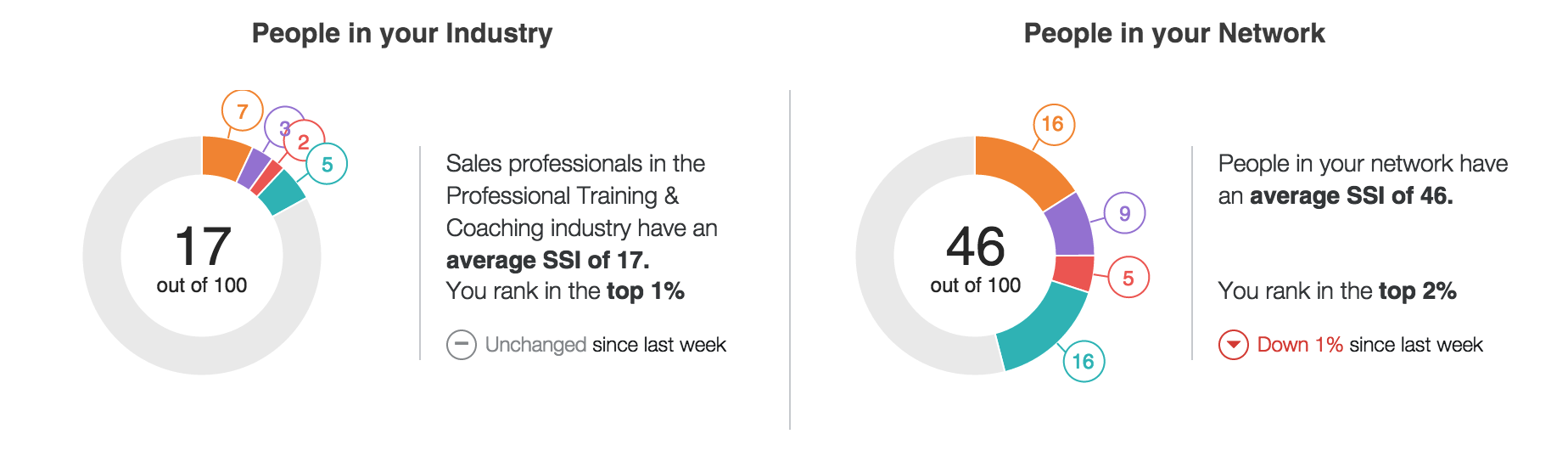
The “People in your Industry” and “People in your Network” data is good for benchmarking. It provides a snapshot of how well I use LinkedIn to further my business objectives.
Take a look at yourself and your team and decide how LinkedIn savvy everyone is. Use this as part of your 1:1 conversations and create a sales and recruiting culture of intentional conversations. Remember, you can’t nurture a relationship until you start a conversation. More on that another time.
 Did you know that approximately 35% of email recipients open an email based on the subject line alone and that 69% of email recipients report an email as spam solely based on the subject line (via ConvinceandConvert)?!
The lesson is clear: if you want higher conversion rates, more leads, loyal customers, and an above-average ROI on marketing efforts, you’ve got to be using the best email subject lines.
What do you get out of being an eCommerce merchant that uses the best email subject lines? You can be part of the 55% of companies generating over 10% of sales from email – eCommerce companies need to be the ones leading the way!
To make sure you get higher open-rates on your emails, here is an awesome list of proven tips and tricks for writing the best email subject lines.
We keep moving forward, opening new doors, and doing new things, because we’re curious and curiosity keeps leading us down new paths. – Walt Disney
What’s the connection to email subject lines? We don’t open all of our emails. Which ones do we open? First, and foremost, we open emails that have subject lines that make us curious and hence desiring more information. In email marketing, using words that signify “discovery” either in the form of a statement or a question, are curiousity builders.
Take me for example. I love all things marketing. When I open my inbox, there are many different subject lines – some good, some bad, and some great. I never delete an email with a subject line that tries to explain something or asks a question.

Have you noticed that more and more blog posts use numbers in titles? The same trend is going on in email marketing, if you haven’t noticed. According to research by the Content Marketing Institute, blog posts with numbers got opened 45% more often than not. You can expect similar a worth-while increase for your emails too.
Look at my inbox. Do the numbers not stand out?

When kids are in their teen years they don’t like authority figures and try to rebel. Well, when it comes to email, authority figures can be game-changers. When a company mentions Google or another very successful (or unsuccessful) company in a headline, it grabs our attention.
The reasoning is simple. We don’t expect to see that and it makes us hungry for more. For instance, I recently received an email from Shopify, and in the subject line they mentioned Netflix. If you think that the tens of thousands of people subscribed to Shopify’s email list opened that email, you are right. What types of “authority” are currently trending? That’d be pop-culture references – something that can work extremely well for any eCommerce merchant.
Usually you hear this saying when people talk about relationships. Luckily for us, this also works extremely well in email marketing. Like numbers, explanations, and questions, email subject lines that use 2 opposite words can stand out – in a good way. Refinery 29 made waves with this subject line: The broke girl’s guide to a luxury vacation. Usually broke people don’t go on luxury vacations – but to every rule there can be exceptions.
Who doesn’t like free things? It turns out that email subject lines that use “free” get opened 10% more than those without. Is “free” the only pricing discount that’ll lead to a higher email open-rate? Fortunately, for all eCommerce merchants (and everyone else) the answer is no.
Below is a table that was created by Adestra:

You can clearly see that 10% discounts perform better than others – even those that are double the size. To strengthen that point – for the doubters – we too found that 10% off is the discount that brings the best results, the “sweet spot”.
Although a 10% discount had a better ratio of visitors to sales than 5%, when the discount got any higher the ratio actually got worse! Now that’s sensational! Instead of rising as expected, the ratio of visitors-to-sales decreased, i.e. the bigger the discount was, the lower the sales per visitors were. – StoreYa Blog, Finding the Discount Sweet Spot
When an offer is urgent it gives off a feeling of exclusivity. Think about it. If someone tells you that the sale is ending tomorrow or that tomorrow something starts, even if it is not just for you, it certainly makes you feel like you’ve got an exclusive offer.
The best email subject lines that drive results for eCommerce merchants are the ones that use urgency better than the rest. It has been shown that an email subject line that creates a sense of urgency and exclusivity can lead to a 22% increase in open-rate. Here is a great table that puts things into perspective, via Marketing Land.

Overusing any of the aforementioned words can have a negative effect on email open (and read) rates, if the same word is used constantly or if the email’s content doesn’t live up to the keyword’s presence.
To make the email subject line more appealing, use names. This includes using your company name and also the subscriber’s name.
Check out the first few rows of something neat that MailChimp created. All of the successful subject lines included the company’s name.
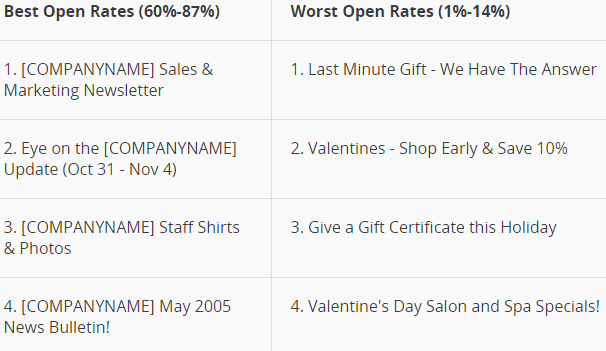
Need a few more ideas? See the entire table that MailChimp put together.
We all want to sell more – and that is great. However, the subject line is not always the place to do that (unless something is free or 10% off!). Instead, the best email subject lines, as outlined here, and seen in MailChimp’s table, don’t come across as a sales pitch.
The subject lines that bring great results are descriptions of the email’s content. Trying to sell something can lead to using words that spam filters hate, leaving you in the spam filter, and not in front of your email subscribers.
See a few examples of descriptions that work.
There are studies that point to shorter subject lines working and there are also studies that show longer subject lines work. There is no one recipe for subject line length. However, because more and more emails are read on mobile devices, you should definitely make sure that your keywords and/or call to action comes earlier, rather than later.
Yesware’s studies have shown that email open-rate is not influenced by the length of the subject line.

Know your audience. It is a simple concept, yet something that is too often forgotten. This is a rule for everything you do in business, and not just for your email marketing. Try to create a list of traits and reasons as to why people are on your email lists. By knowing who your audience is and what their tastes are, you can create subject lines that lead to more opened emails every single time.
If you truly know your audience then you’ll also know what keywords work and which ones won’t. For instance, if my list is comprised of industry leaders then, more than likely, the word “secret” will probably be less successful in achieving a higher open-rate than the word “proven”.What Mashable or BuzzFeed write in their email subject lines don’t necessarily fall under practices for the best email subject lines that work for your audience.
Know who you’re writing to, and then start testing which keywords work and which ones don’t.
 When challenged, we humans have a tendency to resort to the known and familiar path (not taking “the road less traveled”). And in the B2B arena, this can often mean figuring out a way to sell faster, harder, more aggressively, etc. This can mean upgrading sales skills, hiring more sales people, changing comp plans, or finding a new system to move prospects through the sales funnel.
I understand this — my first job in the computer software industry was with a company that was then a startup, but became an industry leader that was later sold for about half a billion dollars. Our software ran on mainframe systems and there was no email, social media or smartphones to conduct promotions. In fact, the PC was just appearing, and this little company called AOL was introducing us (at a snail’s pace of 300 baud) to the joys of being online – with virtually no commerce involved. Many, if not most, readers will have no idea of what I am talking about in the last two sentences, but that’s okay. The point is, if you spend a lot of your career in a sales model that depends heavily on direct sales reps to find, educate, engage, and close prospects, that’s how you will tend to approach the future quest for revenue.
But here is the problem: Today, B2B buyers tend to do a few things that confound the selling traditionalist. First, instead of being found, they tend to do the finding themselves. So your first goal needs to be: Make your company easy to discover. (You may find my recent post on this subject helpful: How Do Potential B2B Buyers Find You?) The second thing required is to make sure every prospect that visits your website (and they all do) has the information needed to educate and qualify themselves. The more information you can supply, the better, not only to educate your prospects, but also to satisfy the various search engine algorithms that will either put you in a good position to be found or consign you to a place hidden from all but the most persistent searchers.
Creating a content-rich environment is critical because, depending on which industry pundit you ask, prospects can do as much as 60-80 percent of their research before they ever engage with you. If your website is poorly designed and/or lacking in information, you will never get a chance to sell many prospects, regardless of how good your sales people are. Yes, by all means upgrade your sales team. Hire the best and the brightest. Tweak the comp plan to incentivize strong performance. Find the best system for converting prospects into buyers. But unless you get your website and content strategy right, an exclusive focus on sales improvement will not allow you to reach your potential.
What will allow you to reach your potential as a B2B company is a strategy that optimizes every aspect of the process, from initial outreach through awareness, leads and revenue. We call this the Lead-to-Revenue (L2R) machine. You can download a free copy of our eBook on this subject here.

Before we get into the reasons why inbound marketing is important for your sales and marketing teams, we first need to answer the question, “what the heck is closed loop marketing?” In a nutshell, closed loop marketing tracks marketing channels from the time a visitor lands on your site to the time your sales team closes a new customer. Technology these days allows you to integrate your marketing software with your CRM system and see which marketing channels are working and which aren’t. Because of this, you can strategize for better results and hotter leads for your sales team in the future.
Closed loop marketing works for organizations of all sizes and complexities. Below are six reasons why it is so important for both your sales and marketing teams.
Let’s face it, your sales and marketing teams aren’t always on the same page (it’s OK, you can admit it). By creating a holistic approach to the sales and marketing process, it allows both teams to better align their goals and work towards the same outcomes. This type of marketing and reporting pushes teams to focus on the channels and campaigns that matter the most. Due to the analytics your teams will be reviewing, all results are objective, rather than subjective, making it difficult to take sides and instead, move forward based off the facts.
When you know which of your campaigns are closing the majority of your sales, you can stop wasting your time with other marketing channels and focus solely on what’s working. This in turn lowers your cost per lead. I think we can all agree that the sales and marketing VPs would be very happy about that.
By knowing what type of content your visitors and leads are looking for, you can trim the fat in your lead nurturing plans and provide smarter communication, which will allow leads to convert into customers faster.
If the customer isn’t happy, nobody is happy. By having a holistic view of your marketing and sales efforts, you are able to see where leads are dropping off and can improve in those areas. You can see which content leads to sales, and which does not. Closed loop marketing allows you to remove or strengthen your weaknesses, providing a better customer experience from both the marketing and sales teams.
Did you know less than half the marketers in the world today have a holistic view of their marketing campaigns? It’s true! Because of this gamble, many CEOs believe marketing is a waste of time and money, which it absolutely is not if you’re using closed loop marketing. This type of marketing shows your boss that the strategies you are developong and implementing are based off facts and analytics, not assumptions. You are able to directly point out to where your leads and customers are coming from and optimize on those campaigns and channels. By focusing on the components that work, you’ll be able to increase your ROI. The more you pay attention to the results and the reasons behind them, the better you’ll be able to strategize moving forward.
If you don’t know what buyer personas are and are planning on implementing closed loop marketing, it’s time you learn! Simply put, a buyer persona is a semi-fictional representation of your ideal customer, and to ensure your marketing efforts are on track, it is imperative you understand who these people are. Closed loop marketing allows you to gain valuable insights about your leads because of your comprehensive view of your campaigns.
Sounds pretty great, right? We think so, and believe us, we’re far from alone. Have you implemented closed loop marketing within your organization? In what other ways is it important to your sales and marketing teams?

Why is there a disconnect between doing content marketing and getting results from content marketing? Although it’s a ubiquitous method, content marketing is not automatically an effective method unless you leverage it in the right way.
Follow this checklist of tips, tricks, hacks, techniques, and practices to improve the impact of your content marketing.
Content marketing usually “fails” because people quit. Never, ever quit.
Many businesses function on the microcosm of the annual quarter. Quarterly earnings, key performance indicators, and metrics must be up and to the right on the graph to validate a current marketing technique. The problem is, content marketing doesn’t work that way. Results – let alone conversions – don’t come instantly.
Organizations must develop a long-term vision of their content marketing efforts. Instant results are unrealistic.
The mantra, “Content is king,” has been modified by the more nuanced expression, “Quality content is king.” To have great quality content, you have to have high-quality writers.
Tip: If you pay $25 an article, you may not find the best writer. The elite writers and content creators usually work at a far higher level of pay.
With the rise of quality as a ranking factor, marketers realized that they couldn’t simply push out vast amounts of content. Instead, they needed to selectively push out the best content.
What constitutes good quality? Here are some guidelines:
I rely on a data-driven approach to my content marketing efforts. It’s not enough to publish, publish, and publish. To truly have an impact, my content must make a bottom-line impact on revenue.
I use the pyramid approach as explained by Joe Pulizzi.
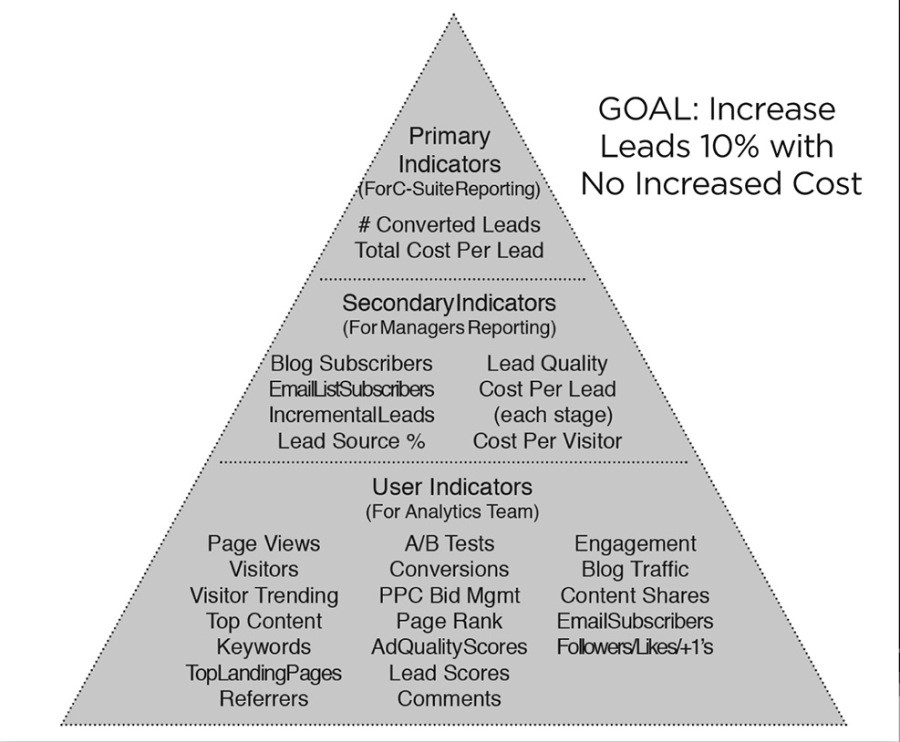
It looks complicated, but at its core, the pyramid is about three things:
I’ve seen content marketing work, so I intuitively expect it to move the needle on sales, cost-savings, and customer retention. I insist, however, on seeing actual impact.
If you can’t see how your content marketing efforts connect to one of the three objectives, you need to re-strategize.
While I like to see myself as an innovator in content marketing, I don’t claim to have a corner on the market of content marketing strategy.
I’ve benefited in incredible ways from observing some of the world’s best and biggest brands. Here are some of the things that I’ve seen to be successful:
The world’s best brands aren’t necessarily the world’s biggest brands. Big brands often have huge budgets that allow them to mass-produce content. Yet, it’s often the small brands that possess the creativity to push the envelope on content marketing strategy.
In an attempt to be innovative, some brands have lost their way. In the wake of a major event, marketers often rush to capitalize on the news for their own gain. When such major events – the death of a celebrity, a natural disaster, or maladaptive cultural issue – are tragic, marketing is cheapened and disgusting.
Innovation for innovation’s sake is not admirable. What is admirable is listening to what your customers need and want, and serving them. Focus on giving value, and you’ll get value back.
I want to repurpose the cliché, “Do your best and forget the rest,” to “Publish your best content where it does the best, and forget the rest of the content platforms.”
There are dozens of places where you could publish content. Just because it’s possible doesn’t mean that you should. If you have the resources and personnel to manage every social account, publish on every blog, comment on every forum, and manage every profile, then go for it.
However, if you can’t do a great job because you’re in too many places, stop. Select the one or two channels where your awesome content gets high engagement, and focus on those.
There’s a cognitive bias known as the “sunk-cost fallacy” – you believe that you should continue on a path that is obviously not the best because you’ve already invested so much time or resources into it.
If something isn’t working, stop it. Reject the sunk-cost fallacy, and do the things that are truly effective.
What are you trying to do with your content marketing? Your list may look something like this:
A list is useless. Why? There is no priority.
A priority is a thing that is regarded as more important than another. If you had to pick a single goal of your content efforts, what would it be?
Focus on that until you achieve it in a measurable way. What about side effects like growing your social media presence? Forget it.
Gary Keller, author of The One Thing, wrote “You need to be doing fewer things for more effect instead of doing more things with side effects.”
Focus on your one thing.
For example, let’s say your business objective is to sell more consulting gigs. You know that most of your leads come from your email list. Your goal, then, is to increase sign-ups to your email list. So, instead of frittering your time on a Facebook strategy, Twitter strategy, Google Plus strategy, Reddit strategy, Pinterest strategy, LinkedIn content strategy, guest-posting strategy, and whatever else, nail your one thing: email sign-ups.
From now on, everything that you do hones in on that one thing. Sweep everything else off the table. From now on, you’re going to have a laser focus.
With email sign-ups as the single focus, what’s the process to achieve your goal?
Write killer content for your blog with the call to action for email sign-ups.
Entrepreneur, author, and speaker, James Clear, offers a good example of this focus. Nearly every page of his website has the form you see below. On some pages, you’ll see more than one form.
James has social media and other channels, but he has a single focus: Get more subscribers. All of his best content is gated. You have to be a subscriber to access it. He reports more than 180,000 subscribers.
There are ways to get better at content marketing that don’t cost a lot of money, don’t require a lot of time, and aren’t insanely complicated.
We won’t get any better at content marketing by simply doing the same things over and over. We’ll get better by thinking strategically and targeting impact, not repetition.
What are some ways that you’ve gained more impact from your content marketing efforts?
We’re just a few weeks away from an intensive few days focused on helping you improve your content marketing. There’s still time to register for Content Marketing World in Cleveland, Ohio. Use code CMI100 to save $100.
Cover image by Joseph Kalinowski/Content Marketing Institute
The post 7 Surefire Ways to Get More Impact From Your Content Marketing appeared first on Content Marketing Institute.

Customers are the lifeblood of any business. Finding quality prospects is one of a marketer’s biggest challenges—how do you find leads that will convert into sales? In fact, 61% of B2B marketers cite generating high-quality leads as their No. 1 challenge. (I bet that even you consumer marketers out there experience this challenge, so stick with me, as I’m sure you’ll find value here, too).
Part of the problem is that everywhere you look, someone is telling you about new-and-better ways to generate leads. But, I stress, don’t fall for every trendy new idea or lead gen hack out there. We’ve analyzed the data and have found that there are two strategies that consistently work well for generating leads: content marketing and in-person connections.
Content marketing has become a proven tool for consumer brands, but many marketers still hesitate, unsure if it will be effective for their business. But for the many B2B marketers that have taken the plunge, they’ve found that it’s an ideal vehicle for building relationships with B2B customers, especially with products and services with long sales cycles.
According to Forbes:
Content marketing also generates 3 times as many leads as traditional outbound marketing and costs 62% less.
The data shows that content marketing works—even for B2B brands. But, where do you start? Content that generates qualified business leads typically lives in three places: your website’s landing pages, your company blog, and your brand’s social media channels. Let’s take a closer look…
1. Website Landing Pages
Don’t assume that everyone who visits your site is starting on your home page. 68% of B2B businesses use strategic landing pages to garner new sales leads. A landing page might be your first opportunity to make a good impression and draw your visitor in.
A content marketing strategy that attracts qualified leads creates evergreen content that will bring in top-of-the-funnel queries. Here are some elements that will showcase your expertise:
2. Company Blog
Blogs are a proven resource for providing information, creating dialogue, and attaching a personality to your company. They work, too. B2B companies that blog generate 67% more leads than those who don’t, and 81% of businesses have reported their blogs as “useful” or “critical” to B2B lead generation.

But blog posts won’t be effective if they are just an afterthought. Spend time creating a plan and ensuring that top-of-the-funnel topics regularly recur in your content calendar. It can be tempting to write about the details and nuances of your industry or business to demonstrate the depth of your knowledge. While that’s a good practice occasionally, remember that your competition is not your audience. Top-of-the-funnel topics build awareness and answer questions that buyers are asking at the beginning of the cycle, so industry basics like “What is [insert your product or niche here]?” and FAQs are good places to start.
Then make sure that each blog post is pulling its weight by learning to craft great titles and metas to make your posts rank high in Google search results and by using strong keywords to optimize each blog post.
3. Social Media
Having a presence on social media can be another critical tool to establish your credibility and create a dialogue. In fact, 78% of small businesses now get at least a quarter of their new customers via social media, and two of the best channels for business are LinkedIn and Twitter.
LinkedIn is not just a great tool for you as a professional; it’s also a key place for your company to establish its credibility. 44% of B2B marketers have generated leads via LinkedIn. Here’s how to use LinkedIn effectively to help generate quality leads:
Twitter is a key source of content for professionals in many industries. People are more likely to visit a B2B tech company’s website, for example, after seeing a tweet from the company. Taking content marketing to a short form like Twitter means:
You can also use Google Alerts to monitor social for brand mentions and then participate in the conversations.
Clearly, content marketing is a proven way to put a face on your company by sharing information about who you are and what you do. Another way to put a “face” on your company is to get out there and meet people in-person. In study after study, marketers continue to report that some of the best leads come from in-person interactions:
For many people, generating leads “in-person” translates to one thing: networking events. But there are a number of other ways to get to know potential customers and collaborators.
1. Tradeshows
Your customers are already at tradeshows—and ready to make improvements or at least explore new solutions—so take advantage of the proximity. The graph below reveals that tradeshows have the highest quality of leads per any one channel:

So, in your effort to make the most of tradeshows, be sure to take the following actions:
2. Networking Events
Networking events are great places to make connections, but here’s the key: you want to fish where the fish are. If you’re a graphic designer, don’t just go to meetings with other graphic designers. Industry groups are important for best practices, but if you specialize in graphic design for real estate agents, attend real estate networking events.
3. Local Small Business Association Meetings
Small Business Association meetings are fertile ground for generating leads because you’re able to meet professionals in all lines of business in one place. Local professionals are usually eager to support fellow small business owners, so it’s a great place to make connections and offer complementary services. Check into sponsoring a meeting—the expense is nominal for many local groups, you’ll have the opportunity to introduce yourself and your company, and you can follow up with a mailing or article on the organization’s website.
This blog wouldn’t be complete without mentioning that referrals are the best type of lead and customer. Period. They come with credibility built-in from someone that your prospective buyer already knows and trusts. Check out this graph showing the most effective B2B lead gen tactics according to B2B marketers themselves (HINT: referrals is at the top!):

The takeaway here is to treat referrals like gold and to never forget to thank the person who referred you. With this in mind, here are some ways to elicit referrals from your satisfied customers:
Until it becomes a habit, asking for referrals in-person may feel awkward, but those first dozen asks will be more comfortable if you have developed a relationship with the client you are asking. It can be difficult, however, to maintain ongoing relationships with every client. Here are a few things you can do online to make the in-person more natural and effective:
Whether you’re at a live event, or signing paperwork in an office, one of the best and time-tested ways to get qualified leads is talking to people face-to-face. Look for opportunities, and be prepared to make the most of them.
We marketers know that qualified leads are the fuel that keeps our company’s engine running. Going after leads both online and in-person will create a 1-2 punch lead gen strategy to keep that funnel full.
Face-to-face relationships is how business has been done for centuries, and human nature still favors live interaction to build trust and nurture relationships. Content marketing takes the strengths of in-person interactions and translates them to the web—social media is the new word-of-mouth, and strategic content is a new metric for building trust. So start creating your top-of-the-funnel blog topics, and repurpose them in the small talk that can generate leads when you are meeting in-person.
Want to dig in deeper? Check out our Definitive Guide to Lead Generation to learn more about these and other actionable lead gen tactics, or our Definitive Guide to Customer Nurturing for a more consumer-centric take on things.

 Messaging affects every aspect of the sales process, from the first communication to negotiation to the close. Problems with sales messaging can lead to bigger problems: negotiating on price rather than value, low productivity, and missed quotas, to name a few.
If your organization is experiencing any of the messaging problems below, it’s time to address them. The longer you wait, the more impact to the bottom line and your revenue growth goals.
More and more, B2B buyers are researching solutions online. This digital behavior demands tight alignment with marketing and sales. When the sales message doesn’t align with what they’re consuming online about the product and company, it creates friction that can slow or even stall the sales process. Consequently, when marketing and sales are articulating the same value message, the customer has a clear understanding of what your solution can do for them.
Marketing and sales messages that sound like every other product on the market won’t drive leads or close sales. To be effective, sales messaging must consistently tie your solution to the buyer’s biggest needs and clearly differentiate its value from the competition. If not, you’ll be forced to negotiate on price and see an uptick in lost deals to the other vendors in the marketplace.
New products and opportunities can drive a buzz in a sales organization. However, when that excitement translates to dilution of the core value message, it creates an environment in which salespeople are focused on product features instead of how the new technology drives value for the customer. Consistently tying those new features to business impact for the buyer drives revenue growth.
Creating value for the prospect throughout the sales process is a key driver to preserving margin in the final stages of the deal. Also, when that value is correlated to a problem with major business impact, garnering a premium for your solution shouldn’t be difficult. A sales messaging initiative gives your salespeople the ability to create value from the first prospect contact to the final procurement negotiations.
When sales leadership jumps from idea to idea, hoping that the “next big thing” will be the driver for change, it hinders your team’s ability to execute. Instead, focus on adoption and reinforcement of the right initiative that will (1) build cross-functional alignment and (2) drive action and results from your sales force.
Any one of these problems can cause stagnant sales growth and they are surprisingly common. High-performing teams, on the contrary, develop strong messaging and support it throughout the sales, marketing, and development teams, to differentiate the product and drive effective sales execution. Here are four key components that successful sales organizations use to drive actions and results from a sales messaging initiative:
1. A practical sales-consumable framework
Integrate the messaging framework across sales, marketing, and product development. Leverage feedback from customers to align messaging and processes across all three areas to differentiate value according to customer needs.
2. Sales-ready messaging and tools
Tools should support the integration of the framework with the sales process. Customer-facing content, prepared discovery questions, and effective technology to support it should all be incorporated.
3. Formalized training and refresher sessions.
The methodology should be rolled out in a formal training process and incorporated into new hire onboarding. Refresher sessions also help with adoption and reinforcement. Learn more about reinforcing a sales initiative in our podcasts here
4. Management-specific training
Training, specifically for your front-line managers, should be included to ensure that they can effectively coach the field, and hold them accountable to proper implementation.
Sales messaging problems are frequently at the core of missed quotas, stagnant growth, and waning market share. Effective sales leaders prioritize solving them.

 When Henry Ford was selling automobiles in the early 20th century, all he had to do was assemble the cars and get them into show rooms as quickly as possible. By the time the cars were in the show room, there were several customers in line waiting to buy them.
Wouldn’t it be great if business were like that today?
Unfortunately, it’s not. Today, there’s much more competition, so we have to 1) attract prospects, 2) drop them in to the top of a sales funnel, then 3) nurture them so we can convert them into customers.
If we don’t use that approach with our sales funnels, then our competitors will – and our business will suffer as a result.
One of the best ways to add people into your sales funnel is to use digital marketing to drive them to your website.
The tools in the digital marketing toolbox include websites; search engine marketing (SEM) – which is an umbrella term that includes search engine optimization (SEO) and paid search – as well as online display advertising; social media marketing; mobile marketing; and email marketing.
While this may seem like a lot of channels, it’s also what makes digital marketing so powerful. With digital marketing, you have multiple touch points where you can engage prospects and deepen your relationship with them across the board.
There’s another reason to love digital marketing – it gives you the ability to see how audiences interact with your brand and react to your marketing. Within hours of launching a campaign, you can gauge whether it’s working by analyzing the metrics you see with your analytics tools.
The bottom line is that digital marketing is one of the biggest things to happen to marketing in the past 100 years, which is why we’re devoting several blog posts to the topic.
In this post, we’ll cover the essentials of digital marketing so that you can have a rock-solid foundation upon which to build your next campaign. In future posts, we’ll take a deeper dive into some of the specifics behind each tactic.
Sound like a plan? Great, let’s get started!

The same site displayed without responsive design, left; and with responsive design, right. Image from Google’s page on responsive design (click the image to go there).
By now, you’ve had a website for quite some time, otherwise you wouldn’t be reading a post about digital marketing, right? But we want to make sure your website is optimized for mobile Why? Because 15% to 40% (or more) of your website visits are going to be via mobile device.
You’ve got choices: You can do a dedicated mobile site, or a responsive site. Most experts believe it’s best to have a responsive website which uses media queries to determine the screen size of the device accessing their content, and automatically adjust to fit the screen.
If you haven’t already updated your website so that it’s mobile-friendly, make sure you ask your web design team to get started on that right away. After all, studies show that businesses that have well-executed mobile websites are more likely to attract prospects than businesses that don’t.
As you know, a search engine is a web-based tool that scours the World Wide Web to help users find the information they’re looking for. Search engine marketing encompasses any activity that attempts to increase your ranking on these search engines.
SEM includes two activities: search engine optimization (SEO) which involves earning visibility within search engine results, and paid search which involves paying to be visible within search engine results.
Both activities have the same objective – to increase visibility by occupying the top spot within search results – however the methods used to attain this goal greatly differ.
SEO
To launch an effective SEO campaign, start by conducting keyword research that identifies which keywords your prospects are using on the web. Once you’ve done that, you’ll want to use those keywords across various sections of your website, particularly your blog. In addition, you’ll want to organize the structure of your website so that it is search engine friendly. (For more indepth guides on SEO, check out our resources on this page of the Act-On website.)
Google, of course, is the largest search engine in the world. That said, 20% of searches in the United States are conducted on Bing, and 13% are conducted on Yahoo, so don’t ignore these other two viable search engines. Depending on your target audience, either could be important to you.
Paid Search
If you want to launch a paid search campaign, you’ll usually use the same set of keywords as you did on your organic search campaign. The majority of paid search campaigns are run on commercial search engine platforms, with the top three being Google, Bing, and Yahoo.
Paid search operates on a pay-per-click model, where the advertiser pays only when someone clicks on their ad. Search engine algorithms determine where your ads will be displayed based on what you’re paying for the ad (your bid) as well as the ad’s quality score (which is based on a number of factors including how many people clicked on the ad, and the relevancy of the landing page to the keyword).
As is the case with all digital advertising, paid search campaigns can be optimized in real time based on how audiences interact with your ads. What’s more, you can use search engine data to uncover a wealth of information about your audience, such as their location, gender, and what time of day they’re likely to search for your product or service category.
Isn’t that great? Not only can you reach customers as they’re searching for you, but you can also gather key insights about your customers to scale and optimize campaigns!
 Online display advertising is, in many ways, a throwback to traditional advertising. In the old days, you would run an ad in a magazine or newspaper to provide information about your product or service. Today, you can use display advertising to accomplish the same thing. However, unlike traditional advertising, digital advertising comes in several different forms such as banner ads, video ads, interactive ads, and rich media ads.
With display advertising, marketers have the benefit of targeting audiences based on website content, geography, and device types. Furthermore, developments in the display ad buying process now allow marketers to pre-define their target audiences based on demographics and psychographics (e.g., tastes, attitudes, aspirations, and other psychological criteria) As an added bonus, you can target your prospects as they move from device to device.
To launch an online display campaign, you’ll begin by determining your goals and objectives. Is the goal of the campaign to increase awareness about a new product or service? Or are you interested in getting people who have visited your website in the past to come back again? Answering questions like these questions will help you identify clear goals and develop a sound approach.
Next, you’ll choose key performance indicators (KPIs), which will help you determine whether the campaign is a success. Typical KPIs for display ad campaigns include impressions served, click-through-rates (CTRs), cost-per-click (CPC), and conversion rates. (Note: If these terms sound a little unfamiliar to you, you’ll want to read this post on the Act-On blog which includes a glossary of many of the terms we’re talking about here.)
Once you’ve established your KPIs, you’re ready to move on to the next step, which is to define your target audience. You’ll start with all the basics – age, gender, income level, etc. But don’t hesitate to go much deeper and get into behaviors and psychographics. For example, are members of your target audience sports fanatics? Do they drink wine? Are they responsible for a global enterprise, or a small local company? Do they sell to government? What’s risky or trendy in their industry right now? You can use all that information (and more) to fine-tune the targeting of your online display campaign.
Once you’ve completed the targeting exercise, you’ll want to buy ads that will be seen by your prospects and customers. Display campaigns are typically priced on a cost-per-thousand (CPM) basis, which denotes the amount you’ll pay for 1,000 ad impressions.
Once these steps are complete, you’re ready to launch the campaign. Just like paid search, display advertising allows you to measure campaign performance and optimize its performance in real time. Often, the data collected through display advertising is used to create remarketing campaigns and lookalike audiences.
We’ll be talking more about digital advertising in an upcoming blog post, so if you’re interested in delving deeper into this topic, be sure to read the next blog in this series.
 The most common form of video advertising can be found on platforms such as YouTube and Dailymotion. A video ad typically plays before, during or after the content an audience intends to watch. You can make the video ads clickable so that they drive more traffic to your website.
In addition to paying to run ads on Dailymotion, YouTube, and similar venues, marketers can also create and distribute their own videos as part of their content marketing strategy. In fact, one study found that 80% of site visitors will watch a video, while only 20% will read a full blog post.
For step-by-step instructions on creating your own video content, check out this guide on the Act-On blog about how to get started in video marketing.
If you’re like most people, you probably have profiles on multiple social networking platforms and have engaged with your favorite (and at times, not-so-favorite) brands on those platforms.
Over the past couple of years, social networking platforms have also evolved into robust advertising platforms. This means you have the ability to run extremely targeted campaigns on these platforms, and ensure that no advertising dollar is wasted.
The most popular websites for both earned and paid marketing are Facebook, Twitter, LinkedIn, Instagram and Pinterest. Each one of these tools has its strengths and weaknesses, so be sure to review your objectives before launching a campaign on any of these platforms.
To find out more about marketing on these platforms, check out Act-On’s social media marketing toolkit here.
 Mobile marketing, a subset of digital marketing, encompasses any marketing activity that targets users on mobile devices such as a tablets or smartphones.
Many marketers feel that developing a mobile app is absolutely essential to reaching and engaging with their customers via mobile. However, there are easier and far more effective channels to reach your target audience on their mobile devices.
These channels could include:
Implemented together, these make the perfect starting point for any mobile marketing campaign. Just as is the case with desktop paid search and display campaigns, mobile campaigns can be tracked and optimized in real-time.
Another burgeoning form of mobile marketing is proximity marketing. As the name suggests, proximity marketing involves wirelessly delivering marketing messages to a mobile device within a specified space. Apple’s iBeacon, Samsung’s Proximity and Hotspot Revenue’s TalkingWiFi are good examples of proximity marketing platforms.
When running a mobile marketing campaign, you’ll have the choice of different technologies to reach consumers. These include SMS, MMS, Bluetooth, mobile applications, the mobile Internet, and social media.
Short MessageService (commonly referred to as SMS or text messaging), which is particularly popular among retailers who use it to send customers promotional offers, app development, and push notifications in text, which display messages on top of a user’s mobile screen. Multimedia Messaging Service (MMS) lets you add multimedia to the ad mix.
 Some marketers and industry pundits downplay the importance of email marketing; however, it turns out, that email is more central to marketing today than ever before. This is mainly because email is the most personal way brands can communicate with customers.
In addition, email marketing can be targeted to prospects based on where they are in your sales funnel. Prospects in the top of the sales funnel would get different messages than those in the middle of the funnel, and prospects in the bottom of the funnel would get still different messages.
To learn more running successful email marketing campaigns, check out The Amazingly Effective Email Guide.
There’s no point in getting all the way to the bottom of an in-depth blog post unless you walk away with action steps, right?
Here are a few things you can do to make sure you leverage digital marketing as much as possible for your business:
Stay tuned for the next blog post in this series, “Getting Started with Display Advertising.” In the meantime, feel free to leave a comment below or ask me a question about Act-On or digital marketing on Twitter @AskJamieTurner.
If you’re ready to take on digital marketing, dive in with our free toolkit: Digital Marketing Funnel Essentials. You can learn more about generating sales leads via your website, tracking online body language, funnel optimization techniques, and key performance indicators to track.


Mark Cuban once said "You only have to be right once." And he is just one of many successful people who sees the value of failure.
"The Other 'F' Word," by University of California Berkeley lecturers John Danner and Mark Coopersmith, lists a seven-step process to help companies work past failure.
The final step is remembering the lessons learned when something went wrong.
"The basic issue around workplace culture is really creating an environment of trust," Danner tells Business Insider. "It must go vertically so employees feel the folks above them can be trusted, and also horizontally so people know their job or reputation isn't at risk if failure occurs."
In the book, Danner and Coopersmith offer four ways you can use past failures to strengthen the culture of your office:
Danner describes stories as a "beautiful thing" because they show more authenticity than a memo — and it's all about confidence and humility.
"Leaders are always in the midst of stories," he says. "It's important to be in a culture that can genuinely talk about its past failures and what they learned, and what those failures actually show about the strength of the underlying culture."
Rituals are repeated activities that highlight the most important aspects from a failure. As an example, Danner describes how Roche Pharmaceuticals hosts celebratory lunches to highlight the lessons learned from failure.
Danner loves this strategy because it "actually gives props to people who have the guts to try something new," which is huge in an industry that fails nine times for every success.
Contrary to stories and rituals, relics are actual artifacts that remind an organization of a failure and what they learned from it. "They can be memos, videos, any number of remembrances of things that didn't go well but turned out to be incredibly important," Danner says. "Failure contains all kinds of insights if you're creative and tenacious enough to try to discover them."
Reports are basically "the formal lifeblood of many organizations," Danner says. Put simply, a report is a formal memorialization of the failure and the lessons learned.
"If an organization isn't conscious of the importance of failure as a strategic resource, it's likely to miss the early signs, and it's likely to delay the awareness when it's really happening," he says.
It's important to note that while these four remembrances of failure won't completely prevent fallibility, they will "help make an organization more failure-savvy," Danner says.
SEE ALSO: 7 steps to help you bounce back from a failure stronger than ever
Join the conversation about this story »
NOW WATCH: Turns out people make these snap judgments about you within seconds of meeting you
In a world where you can get the answer to almost any question you have simply by asking your smartphone, it can be hard to wait.
And in sales, nothing can be more frustrating than a long, dragged out sales cycle where getting a straight and final answer seems next to impossible.
We all are told to strive for shorter sales cycles. Sales velocity is of the utmost importance, and transactional selling is becoming the gold standard. Short sale cycles increase revenue and maximize team efficiency. A sales rep’s energy should be focused on those deals where they can get a yes or no faster, right?
Well, not always. In reality, that long sales cycle is worth your time. Here’s why.
Big deals take a long time to close. If a company is going to dish out top dollar for your product/service, they need to make sure they’re going to see a return on their investment.
Oftentimes this involves a lot of back and forth between the salesperson, the prospect, and various other key stakeholders in the company. Because of this, big deals require more effort than usual, as salespeople conduct more activities with more people during an especially long sales cycle.
Because of the added complexity that comes with the demands of big deals, they are also lost significantly more often than average-sized deals. With more key players and bigger commitments comes more objections. A salesperson could pour all of their energy into a deal that is eventually lost because of a reason out of their control.
There’s just nothing you can do about it.
So with all this downside, is that long sales cycle even worth it? Yes!
Even though big deals with long sales cycles require so much time and energy, they are worth the risk – the potential payoff is that high.
To be more specific, the average annual contract value of a deal in the top quartile is 2.6 times the average annual contract value of an average deal.
So even though big deals have a long sales cycle and require more effort, the time spent working them returns 1.7 times the revenue for the effort expended.
In the end, they’re worth the risk.


Startups throw out bogus metrics all the time when talking to investors and the press. Prominent Silicon Valley venture capital firm Andreessen Horowitz wants them to stop.
Last night, the firm, which was cofounded by Netscape inventor Marc Andreessen and has invested in big names like Airbnb, Buzzfeed, Facebook, and Twitter, put up an excellent list of 16 metrics that every startup — and would-be startup investor — should understand.
For instance:
Read the post and you'll learn all this.
It also exposes some of the common tricks startups use to try and fool outsiders, like presenting cumulative charts — where each quarter includes all the previous quarters' numbers so the chart is always going up and to the right even if the metric in question is declining quarter to quarter — or presenting percentage gains without a base number to go from. And signed letters of intent should never be presented as bookings or revenue.
Also, startups should never talk about the number of downloads they've gotten. They can buy those. They should present statistics that show users are actually using the product after they download it, like monthly average users.
It's important not only for investors thinking about putting money into these companies, but also for founders themselves, who could be accused of fraud if they confuse terms.
SEE ALSO: Startups are cherry picking totally random metrics to show off to would-be investors
Join the conversation about this story »
NOW WATCH: So you've posted something stupid online — here's how to deal with the consequences


There are many different techniques that can be used to retrieve data, and every technique will garner different results. Which of the various data mining techniques in CRM should be implemented depends on the problem to be solved. Different insights are provided with the application of different data mining techniques, so it’s important to first determine what kind of problem you have and how you’d like to solve it.
The objective of data mining is to find information that can be easily understood in order to improve data quality management. Every data management software should be able to provide information from which the user can benefit. Large data sets are impossible to handle manually, so all-around data solutions software is a must.
Searching for information that doesn’t match expected behavior or a projected pattern is called anomaly detection (or outliers, surprises, or exceptions). Anomalies can provide actionable information because they deviate from the average in the dataset. An outlier is numerically distant from other data present in the dataset, and indicates that additional analysis is required for data quality improvement to take place.
This technique enables us to discover relations between data items in huge databases. With association rule learning, hidden patterns are uncovered and the information gained may be used to better understand our customers, learn their habits, and predict their decisions. This is one of the more important data mining techniques in CRM, as it is used in the point-of-sales data.
Clustering is a process that helps us identify similar data sets and allows us to understand both the similarities and differences within the data. Data sets that have similar traits can be used for conversion rate increases. For example, if the buying behavior of one group of customers is similar to that of another group, they can both be targeted with similar services or products.
This technique is used for gathering information about data so that data sets can be placed into proper categories. One example is the classification of email as either regular, acceptable email or as spam. All of the data that is linked to the email is first analyzed and then classified as spam if certain sender names, IP addresses, or words are found.
Regression analysis is one of the advanced data mining techniques in CRM. It tries to find the dependency between different data items and shows which variables are affected by other variables. Unlike correlation, however, regression only shows those variables that are affected by others, and does not indicate which variables can affect others. This technique is used to determine customer satisfaction levels and how- and to what degree- they affect customer loyalty.
Data mining techniques in CRM help businesses find and select relevant information that may then be used to analyze and predict customer behavior. The more data there is in the database, the better data mining techniques can create models, whose use will result in more business value.
Learn more about data mining, quality and standardization with our free ebook below.


Just like any other page on your website, your homepage has best practices to move your website visitors down the funnel and to convert. When guests come to your home, what do you want them to do once they arrive? Do you want them to walk right into the bathroom that is attached to your bedroom? Probably not, but without proper guidance, they won’t know that. Homepages act in the same way by guiding your visitors with these best practices.
As already mentioned, you don’t have a long time to capture your users’ attention, so you must clearly state your value proposition on your homepage. Visitors should clearly see the value of doing business with you.
An example of a homepage with a clearly defined value proposition and a call to action is Opera.com.
As you can see, Opera lets you know that it is a web browser, then also informs you that it’s fast and free. Just below that, there is a call to action to download the browser, with a reminder under the CTA that it is free.
Without a value proposition clearly stated, your website visitors can get lost on/bored with your website and never convert.
When you think about marketing materials in general, whether they are mailers, brochures, billboards, and so on, the design and copy of those materials should be catering to the audience that they are trying to attract. Your homepage is no different.
After you have defined your personas’ pain points, your homepage’s design and copy should offer solutions. If you are able to, personalize your homepage to the specific person that is viewing your website. HubSpot’s Smart Content enables you to do just that. As you learn more about your visitors, you’ll be able to adjust the content of your website to be more personalized and relevant. With HubSpot’s Smart Content, you can customize content for first-time visitors, or customize it based upon where they are located, what devices they are using, or if they are a part of a HubSpot list. The opportunities with Smart Content are endless.
Remember, you don’t have a website for you—you have it for those you are trying to sell your product or service to. Delivering a positive experience to your desired audience makes sense, and that starts with persona-focused design and copy on your homepage.
Your homepage’s navigation is possibly the most essential aspect of your website. Deciding what to include in your homepage’s navigation could be the difference in somebody becoming a customer or leaving your website immediately.
First and foremost, your navigation menu should be user-friendly. A menu that is hard to navigate or click is an instant turnoff for a potential customer, who then may be inclined to leave your website.
Remember, your homepage’s navigation can be the difference between a customer or not, so do not overlook it in your design process.
When somebody reaches your website, it usually was for a certain reason: to find more information on a topic, to research a certain product, and so on. Your homepage should include effective calls to action that help move website visitors down the funnel in their buying process. Types of calls to action that should be on your homepage are:
CTA placement is also important on your homepage. Your primary CTA should be “above the fold.” This just means that your homepage visitors should be able to see the CTA without scrolling down the page. This does not mean that you should clutter all of your CTAs at the top of your homepage, but your primary CTAs should go there. CTAs “below the fold” are OK if your content goes farther down the page.
What is a responsive website design? Simple: It’s a website that is designed to adapt to whatever device a visitor is using. It allows for easy reading and scrolling without constantly adjusting your screen. Responsive designs are able to adjust to any moves you make (i.e., flipping your phone from vertical to horizontal). A responsive design is not just recommended, but should be mandatory.
As mentioned previously, a positive user experience on your website is a must. With mobile website users now having surpassed desktop users on the Web, a non-responsive website would be a pain for them to experience. Aside from that, a responsive design is preferred for SEO because it creates fewer pages for Google to crawl (than if you had an entirely separate mobile site), which also creates less of a chance for on-page SEO mistakes. A responsive design also helps your website adapt to future devices that have not yet even hit the market.
If you haven’t heard about responsive design, or you are worried that your website host doesn’t offer those capabilities, do not fear. HubSpot’s COS (Content Optimization System) comes out-of-the-box optimized for mobile with responsive design on your homepage, other website pages, landing pages, blog, and more. It is the only COS to come integrated with responsive design.

NEW YORK (AP) — Well, that was fun while it lasted.
For years, investors in U.S. stocks shrugged off threats — a government shutdown, fear of a euro collapse, a near U.S. debt default — and just kept on buying. At the sixth anniversary of the bull market in March, the Standard and Poor's 500 index had more than tripled in value.
Now, buyers are hard to find. A wave of selling has hammered major indexes, with the S&P 500 losing nearly 6 percent in the past week. That is its worst weekly slump since 2011, and leaves it close to what Wall Street calls a "correction," or a fall of 10 percent from a recent high.
Is there more selling to come? No one knows, but corrections are natural in a bull market, a pause in the market's march higher, and this one is long overdue. They usually come about once every 18 months. The last one was four years ago.
The big trigger for selling this week was yet more evidence of a slowdown in China's economy, but there were plenty of other worrisome developments weighing on the market. A look at a few of them, and why you may not want to panic, yet.
___
FEARS ABOUT CHINA
Despite Beijing's efforts to restore calm, the Chinese stock market has taken investors on a wild ride this summer. Then last week, the government announced a depreciation of the country's currency, stoking fear that the economic slowdown there was even worse than it had let on.
On Friday, more bad news: A gauge of manufacturing showed that key sector on the mainland is continuing to contract.
What happens in China matters, and not just because it is the world's second biggest economy. Falling Chinese demand has sent prices plunging for all manner of commodities — iron, copper, oil. That has walloped countries that export them.
Its surprise devaluation also triggered other governments to drive their currencies lower, roiling financial markets and spreading fears of a currency war.
___
PLUNGING OIL
The steep drop in the price of oil in the last month has become a major concern for traders. Oil briefly went below $40 a barrel on Friday, its lowest price since the financial crisis six years ago.
If oil keeps falling, it is likely to drag down the S&P 500. Drillers and other energy companies make up a significant chunk of that index. Shares of those companies have plunged 35 percent in the past 12 months.
___
DISAPPOINTING PROFITS
The upside to falling oil is that all the money that drivers are saving at the gas pump should mean more spending by them at stores — and a faster-growing U.S. economy. But Americans are choosing to pay off debt instead of going shopping.
"Household finances are growing more healthy ... but you want to see a pick-up in spending, too," said Tim Courtney, chief investment officer of Exencial Wealth Advisors.
The new frugality helps explain why the biggest long-term driver of stock prices — corporate earnings — have been so disappointing lately. In the second quarter, companies in the S&P 500 grew earnings per share just 0.07 percent from a year ago, according to research firm S&P Capital IQ. That is the worst showing in nearly six years.
The next report card on earnings doesn't arrive until October. In the meantime, investors will be looking at other indicators of economic and corporate health. This coming Friday, the government reports on consumer spending in July.
___
TRADING MILESTONE
Many investors pick and choose stocks based on a company's business outlook, but there is an entirely different class of trader that relies on technical indicators to make investment decisions. Many of their screens were flashing "sell" this week.
The S&P 500 and the Dow have broken through a few key technical levels recently. One important one is their 200-day moving averages, which the two indexes pierced on Thursday, helping to fuel selling. Both indexes dropped 2.1 percent that day, before further tumbling on Friday.
The good news is the last time the S&P 500 broke through its 200-day moving average, in early July, it bounced back from those levels after a few days.
___
RATE JITTERS
The Federal Reserve has been signaling that, with the economy improving, it could start raising rates to keep inflation in check, perhaps as soon as next month. For years, investors have been fretting that the market could drop sharply when the central bank starts raising rates. The rates, held near zero for the entire bull market, have been widely credited with pushing stock prices up.
This week investors did an about-face and started worrying about the opposite. In its minutes from the central bank's July meeting, released Wednesday, Fed officials expressed concern that China's slowdown could pose risks to the U.S. economy. Investors wondered whether that meant the growth here is fragile, and started selling stocks.
Ernie Cecilia, chief investor officer of Bryn Mawr Trust, said the switch in views is ironic, and a little unsettling.
"The market was saying, 'Start lifting rates. Let's get this over with,'" he said. "Now the market is concerned that Fed is worried the economy is slowing."
On the bright side, the U.S. economy is looking healthier lately. Employers have been on a hiring spree, and that has helped push the unemployment rate to a low 5.3 percent.
Investors will get another clue on the economy on Thursday when the government releases its estimate of economic growth in the April-June period.

For years, PR was the intangible service questioned by so many CFOs. When I think back on the earlier years of my career, we were always happy to have the visionary CEO in the boardroom for a pitch meeting. But, somehow, the climate changed when the CFO walked into the room. Having the CFO join the meeting is a huge opportunity to get closer to the person that controls the purse strings. But, you have to know how to use the opportunity to your advantage.
So, when it comes to building a relationships with CFOs, my advice is to think like them, or as close to their thinking as possible. I was the president and acting CFO at my agency for about seven years; a job that I loved to hate. The love part came with the experience of learning new skills and knowledge on how to run a sound business. The hate part was that when I walked into the room, I was always the Kabosher, the Kill Joy and the person who never let anyone have any fun. But, you get used to the titles. 
So, what does it take to understand the CFO and better yet, have the CFO understand what you do, so you co-exist in harmony? If you can think like the CFO, then no matter what type of meeting you’re in or position you hold, you’ll get attention and respect and quite possibly make a business “friend.”
Here are a few of the tips I’ve learned over the years.
These are a few ways that you can make the CFO “sing” your praises after a meeting or any encounter. And, if you’re consistent with delivering valuable information, then you may have just found yourself a new BFF. What are your relationship-building tips and is the CFO your BFF?
The post Five Tips to Make the CFO of the Company Your BFF appeared first on Deirdre Breakenridge.
… Read moreAre you frustrated trying to explain how a blog can generate leads? Start with the facts. Then use an old school example that was ahead of its time.

One of the biggest changes in recent marketing history is that companies no longer must go through a media gatekeeper in order to reach their prospective customers.
In the past, companies had to, as David Meerman Scott says, “buy, beg or bug” to get attention:
“1) You can BUY attention. (This is called advertising). 2) You can BEG for attention. (This is called Public Relations). 3) You can BUG people one at a time to get attention. (This is called sales).”
And while there’s nothing evil about those approaches, they are increasingly less effective. People can tune out unwanted marketing messages with greater ease and success every year thanks to technology like DVRs, caller ID, ad blocking software, RSS readers, satellite radio and podcasts, to name just a few.
What’s so different now is that you can produce your own content and communicate with whomever you wish. Using blogs, videos, podcasts, social media and email, you can establish and deepen relationships with any audience you’d like to reach. The only catch is that you need to offer content people are interested in.
A popular mantra is that all companies are now media companies. They just don’t all understand that yet. That’s because old habits die hard. Particularly with executives who came of age when the order of the marketing universe was to interrupt your way into your customer’s consciousness.
But in fairness to all executives, including marketing executives, there’s an overwhelming amount of change going on:
Fortunately, more companies are beginning to grasp that one of the most important things to implement for modern marketing is blogging.
“No matter what, the very first piece of social media real estate I’d start with is a blog.” ~Chris Brogan
Blogs are simply articles posted to a section of your website (in reverse chronological order) that include the ability for readers to make comments and use social media to share the content. You’re reading a blog right now.
A blog is by far the most important means of increasing the right kind of traffic to your site and converting visitors to leads. And as an added bonus, the more that you blog, the more people will perceive you as an expert.
Creating helpful content will also help with your search engine rankings. Other sites are more likely to link to yours if you are publishing helpful content – and that boosts your rankings and helps improve your website’s discoverability.
These days, marketing and business development people are spending a lot of time explaining modern marketing approaches to their colleagues and management.
And it can be difficult to do because of institutional muscle memory of wanting to use interruptive marketing tactics to get attention. At times I think it must have been a similar challenge for Copernicus 500 years ago. He’s the guy who tried to explain that the Earth revolves around the Sun rather than the opposite. He got a lot of pushback.
That’s why the “old school” expression comes up in marketing circles. That term is generally associated with older people, but it’s actually more of a mindset. I know younger people who have an old school impulse for marketing.
But there are still a lot of older executives who have the old school mindset. They are more comfortable with a megaphone marketing approach than using interesting and helpful content as a magnet to attract attention.
Don’t lose hope – there’s a trick that has helped me get a number of old school executives to see the blogging light to use helpful content to attract interest, traffic, leads and sales.
Are you are dealing with an executive who might have been in front of a television at some point during the 1960s to the 1990s? Chances are they would have seen ads featuring The Shell Answer Man.
In this long-running campaign, Shell Oil would answer common questions from the public about driving, with advice on vehicle maintenance, repair and safety.
The ads were informative and helpful. They established Shell as a trusted authority. They were not boastful about how great Shell Oil was. They also helped sell a lot of fuel and vehicle care, which is why the campaign continued for so long.
The Shell Answer Man was a modern approach to marketing in an era of old school tactics.
When I explain the purpose of blogging to executives who came of career age in the pre-Internet era, The Shell Answer Man example gets the light bulbs to turn on.
At that point, old schoolers start to grasp the idea that their blog should answer customer questions, be helpful and interesting. Just like the Shell Answer Man.

photo credit: Board of Public Works, 1954 via photopin (license)
Happy Friday Sales Hackers!
Cheers- You’ve made it through another week! I’ve put together some of the highlights from our LinkedIn Community this week. We round up the best content that we can for the blog, but we’ve realized there are so many good discussions going on in our community that we don’t want overlooked!
Please let me know if you have any feedback, or have something to contribute to next weeks Community Round Up. I look forward to hearing from you! Enjoy the weekend… you earned it!
Best,
Jessie Barnes
Alex J. Burkholder: Hey All,
I recently reached out to a handful Sales Development leaders to get hold of their best advice for scaling a sales team and I wanted to open it up to the rest of the Sales Hacker Community.
Here’s what I asked:
What is a single piece advice you’d give to another sales professional who’s currently scaling or who is about to start building a Sales Development team?
So go ahead, what’s your advice?
Sabrina Wood: We have to be wiling to hire and develop individuals with little to no experience in inside sales / lead development. There’s a ton of talent available to us if we are willing to think outside the box and put in the work required to build others no matter their pedigree and/or background.
* Make sure you are incentivizing the right behavior and compensating accordingly. I am opposed to have SDR commission tight to closed revenue, since they don’t have direct control on closing deals. Reward only for the outcomes where the SDRs have direct control (number of qualified meetings passed, number of opportunities, opportunity size).
* Pairing the SDR with the field rep might help with demand gen/sales alignment, but be careful: sometimes the SDR ends up becoming the “executive assistant” of the sales rep, doing all the boring tasks that he/she doesn’t want to do. SDRs should not spend time doing non-sales tasks.
* Be very transparent on how you are tracking commissions and how you are monitoring passed leads/passed deals. Don’t over-complicated your commission structure. At the end of the month, my SDRs know EXACTLY how much commissions they made. Always share commission numbers with the entire team, incentivize everyone to perform better. NEVER cap commissions, the more opportunities they pass, the more money they should make.
* During the on-boarding, focus most of the time on learning your product. Until they have a full grasp of your product, they won’t feel comfortable handling phone calls with prospects and your conversion rate will suffer.
* For hiring, two factors are the most important: 1) Organizational skills 2) Motivation. Being organized and methodical is crucial to be able to handle hundreds of leads per week. New SDRs should be hungry and ambitious, ready to give 110% in order to make money and to get promoted to a higher role.
Seth M. List: Treat it as a process. Who you hire and what they do today, WILL ABSOLUTELY BE DIFFERENT a quarter from now, a year from now, etc. There is no “set it and forget it” playbook.
Be flexible, hire flexible people, and be ready and willing to part ways with your people. Whether you lose them to another team internally or another company, go into your hiring exercise knowing that as the business changes, your team will need to as well, and not everyone will be on board with the new program.
Gary Smyth: Implement a data / metrics driven approach to all aspects of the role. This can be implemented to hiring and having a consistent approach to identify key traits, questions to identify those traits and a scoring model for each candidate; leverage same questions and scoring model for each candidate.
For lead generation / sourcing align with Marketing to measure effectiveness by dollar value / lead vs. # of leads. Quality over quantity for opportunities generated, measure aging pipeline, time to convert vs. lost and how many opportunities convert to demo / presentation stage.
The post Advice on Scaling Sales Development Teams? appeared first on Sales Hacker.
