Shared posts

03 Jan 17:40

Would Your Clients Even Miss You

by Anthony Iannarino

In Eat Their Lunch: Winning Customers Away from Your Competition, I wrote about the four levels of value: Level 1: the value of your product, Level 2: the value of the experience, Level 3: the tangible result you produce, and Level 4: your ability to generate strategic outcomes that help your clients move their business forward.

Level 4, as you might imagine, contains the other three levels. Believe it or not, a lot of people still sell at Levels 1 and 2, relying on their company, their products, and their support and services for credibility. They believe these things are the value proposition, and by doing so, they not only absolve themselves of the responsibility to create value, and make it so there is no possible way they can ever be consultative or their client’s trusted advisor. Level 3, where most businesses have been commoditized, isn’t much better. If you have competitors, they can likely match your results.

Level 4 is altogether different. It represents a monumental leap in value creation. It moves to the role of peer and it is what makes you consultative. You are not consultative just because you are not smarmy and ask good questions. You are consultative when you provide the strategic advice that generates results beyond the lower level.

Ask yourself these questions:

  • If you were suddenly gone, would your clients miss you?
  • Could your clients easily find someone else to provide them the ideas and insights you provide them?
  • What is the possibility that you have a competitor who is capable of providing greater advice as it pertains to the strategic outcomes your clients are pursuing?
  • Would your absence subtract enough from the overall value proposition that it would open up an opportunity for one of your competitors to displace your company?

The first three levels of value are easily acquired. They are all commodity level value, including level 3 (your solution solves your prospective client’s problem, as does your competitor’s solution). Only a strategic level of value would be missed were your client deprived of it.

If you want to learn more about Level 4, pick up Eat Their Lunch here.

Get the Free eBook!

Learn how to sell without a sales manager. Download my free eBook!

You need to make sales. You need help now. We’ve got you covered. This eBook will help you Seize Your Sales Destiny, with or without a manager.

Download Now

The post Would Your Clients Even Miss You appeared first on The Sales Blog.

03 Jan 17:40

Marketing the Value Proposition: The Journey: Season 2, Episode 15

by Michael Stelzner

Are your marketing messages not striking a chord with your target audience? Then watch the Journey, Social Media Examiner’s episodic video documentary that shows you what really happens inside a growing business. Watch The Journey This episode of the Journey explores how Social Media Examiner hires a conversion expert to survey nearly 300 customers and […]

The post Marketing the Value Proposition: The Journey: Season 2, Episode 15 appeared first on Social Media Marketing | Social Media Examiner.

03 Jan 17:39

Attention, CFOs: Transactional Marketplaces Are Not Your Friends

by Michael Burdick

geralt / Pixabay

A staggering 43 percent of the U.S. workforce is projected to be part of the gig economy by 2020, which is welcome news for swamped CFOs and their overloaded teams.

Instead of watching bandwidth burnout destroy their best people or continuously pushing nice-to-do projects aside, CFOs are working with freelance financial analysts, controllers, financial managers, and other talented individuals to wipe projects off the whiteboard. After all, the freelance marketplace offers greater access to talent, reduced overhead costs, and faster deployment that can keep a business humming.

Considering that Gallup found that more than half of full-time workers want balance from their jobs rather than a to-do list that doubles every month, this shift is coming at an opportune moment. Marketplaces aimed at overburdened managers have been springing up like weeds. Platforms like Upwork, Freelancer, and Craigslist allow freelance writers, developers, designers, bookkeepers, CFO consultants, and everything in between to pitch for and bid on assignments on the fly.

While these transactional marketplaces serve an important role in educating the business world on the benefits of the freelance economy, they are not without their own downsides and a lot of friction — vetting issues, consistency problems, and a lack of transparency. These hurdles are not insurmountable, but they highlight a few reasons managed marketplaces provide a better fit for CFOs who are tired of trying to do more with fewer people.

Cracks in the Transactional Marketplace Veneer

On the face of things, transactional marketplaces (think Upwork) do offer access to the right talent at the right time. Instead of going through a series of in-depth interviews and negotiating perks and salary, hiring managers can head straight to the meat and potatoes.

These marketplaces serve their purpose, but the managers using them don’t have the best experiences. Considering that more than 57 million Americans are actively freelancing, there is no shortage of available talent. But that means recruiters must sift through dozens — if not hundreds — of profiles to find people who have the skills they need, even with search functionality. These folks have ratings, but often there isn’t enough information to tell you whether they have worked in your specific industry or tech stack.

Even worse, you have no clue whether the person who rated them had the time or knowledge to provide an accurate score. If the supervisor has no accounting experience, for instance, how does he know whether the freelancer’s monthly financial reports are correct?

In general, the platforms don’t intervene much between buyers and sellers. Because of this, you have no idea whether the person you hire has the qualifications he lists — you also don’t have any guarantee of the quality of the end product. One bad experience can quickly sour companies on working with freelancers, which explains why a paltry 36 percent of small businesses told Manta they trusted the freelancer hiring process.

Another issue with transactional marketplaces is a lack of consistency. Most gig workers are around-the-clock multitaskers who serve multiple masters, and they constantly need to bid on dozens of new projects to land one or two to ensure their income. In fact, a recent survey by PayPal found that the chief concern for 38 percent of freelancers is their ability to be paid quickly for a consistent flow of work.

This lack of consistency can eat away at availability, meaning you might not be able to work with your preferred freelancer on a particular project. Moreover, this divided attention can cause freelance workers to lose focus, delivering poorer-quality work simply to complete the task at hand.

While some business leaders are used to a team that works together while considering the company’s holistic needs, freelance workers are not always used to collaboration. Transactional marketplaces aren’t set up to encourage or incentivize collaboration, so if you have a project that requires multiple inputs, it will be like herding cats to find the multiple people you need at the same time and get them to work together when they might have just met (virtually) for the first time.

Transactional marketplaces have their applications, but they also have flaws. Instead of worrying about quality and consistency and struggling through a frustrating, friction-filled transactional marketplace, consider a managed marketplace for a much smoother and more consistent experience.

The Checks and Balances of Managed Marketplaces

Like their transactional counterparts, managed marketplaces can connect you with the contractors you need to tackle a project. The difference between the two types of platforms is the range of checks and balances inherent to the managed system.

In a managed marketplace, the platform serves as a hands-on intermediary rather than a mechanism of exchanging money for work. Accordingly, a managed marketplace’s value-added services allow its principals to charge higher premiums. With the money received from every paid deliverable, the marketplace can invest in stronger customer service and enhanced proprietary technology to differentiate itself and deliver even more value to all constituents.

Compared to their transactional counterparts, managed marketplaces offer a much-needed cushion of trust. The marketplace vets every single gig worker — including skills assessment, phone interviews, reference checks, etc. — which can be particularly useful for executives who might not be experts in certain areas. A manager who wants a financial mobile app created probably isn’t an expert in building mobile apps, for example, but she can rely on the marketplace to provide her with individuals who are. If the marketplace can allay her fears that she will choose someone who cannot complete the task, she will likely pay more money for the peace of mind rather than write off the gig economy.

Managed marketplace algorithms work to match the best possible candidate to each project based on previous experience, a background with companies in similar industries, tech knowledge, and any other number of metrics. Once a hiring manager knows each potential freelancer has the same foundation of skills and knowledge, it boils down to a decision based on personality fit. This can save companies from sifting through dozens of résumés and their dizzying array of prize points, skills, and qualifications. Instead, the best-fit freelancer is delivered to the manager’s doorstep.

Managed marketplaces can also incentivize gig workers to recommend colleagues, allowing companies to hire viable teams whose members mesh well. Many companies would welcome the opportunity to be able to get an accountant’s recommendation from a freelance financial analyst who can vouch for his colleague’s talent. Companies have the ability to build a team of freelancers around their projects and challenges, bringing in individuals to support evolving needs rather than having to go through an extensive vetting process every time they need something done.

There’s little doubt that companies will need to be more open to the freelance economy in the coming years — particularly for assignments and duties that require specific skill sets like finance. While transactional marketplaces can certainly get the job done (if you have the time and energy to navigate them), managed marketplaces can deliver superior results while eliminating a lot of unnecessary headaches. A managed marketplace might have slightly higher rates than a transactional one, but remember that you truly do get what you pay for when it comes to freelancers.

03 Jan 17:39

How To Write an Elevator Pitch You’ll Actually Want to Share

by Heather Steele

The elevator pitch: That short description of your company that you deliver in the time it takes to ride an elevator a few floors, that thing that should be so simple and just so…

Isn’t.

How many of us really feel like we do this well?

How many times have you delivered your quick pitch to an interested audience who instantly moved to action?

Be honest now….

Two elevators with a purple gradient overlaid. Writing an elevator pitch is tough, but if you follow these guidelines, youll end up with an elevator pitch that rocks.

Who Actually Needs an Elevator Pitch?

When you think of an elevator pitch you, probably think of:

  • Networking events
  • Speed-dating-style business events
  • Funding pitches

Or other situations where you need to quickly tell a person what it is that you do.

A good elevator pitch can really be so much more than that.

It can be:

  • Your social media bio info
  • The footer of your emails that remind people what it is that you do and who you serve
  • Content used throughout your website to explain what you do
  • The first paragraph of a job description where you let someone know exactly what kind of company they’re applying to work for

So even if you’re not in a situation where you’re networking or meeting with people face-to-face for the first time, don’t think a good elevator pitch is something that just doesn’t apply to you.

Any of us who are responsible for growing a company are constantly in a position where we’re having to explain to people what exactly it is that we do.

But before you even think about writing an elevator pitch, you need to do one thing that will set you apart from the crowd, one thing that will make your elevator pitch shine.

That one thing?

Identify your target market — the audience that is going to hear this little speech of yours.

Define Your Audience and Get Specific — Uncomfortably Specific

Before you can start writing a good elevator pitch, you really need to think about who, exactly, your customers are.

Now I know this is a topic that’s a little played out. We’ve all heard over and over again that we need to define our target audience and make our target audience as specific as narrow as possible.

But it’s something that you hear over and over for a reason.

If you’re trying to craft a message that reaches everyone, if you think every business owner, or every parent, or every homeowner, or every human who exists is your customer, then you will have a very difficult time crafting a message that actually makes people want to take action.

Now I will be the first to admit that this is really difficult to do. You kind of feel like you’re taking a lot of potential dollars and just throwing them out the window by eliminating all but your very specific, niche audience.

This is a really difficult thing for me to do for my own business, but…

I also know that it’s a very important part of the process.

If you want to go through a full customer persona creation process we have some great resources for you, but right now I’ll take you through a simple exercise that helps you visualize some very specific people that can represent your ideal customer and your target audience.

Exercise Time — Identify Your Target Audience

You might want a pen and paper for this part (or at least a keyboard and a Google doc).

Think about two of your absolute favorite customers or clients. These are going to be people who you enjoy working with, but (and this is important) they’re also profitable clients, so you’re making money when you work with them.

They’re also clients that you feel like you provide abundant value to, clients that you can truly be yourself with, clients you can freely express your beliefs to (in relation to the work you do).

We’ll get more into that last part soon, but think about the people you share common goals with and that you can be transparent with.

Now, instead of thinking about the typical demographics most people associate with building a customer persona, what I want you to do is think about the type of problems you solve for these people.

Consider a few questions:

  • Why did they come to you in the first place?
  • What did they hire you for or purchase your product for?
  • What are their goals (in relation to your product or service)?
  • What are some of the things they struggled with (in relation to those goals)?
  • How does your product or service help them overcome those struggles and reach those goals?

Look for some consistency in these answers. When you start to see a few problems that are consistent across your customer base, write those down.

If you’re finding it hard to narrow down and come up with one very specific problems (since you help your customers with a lot of different problems), then you need to take a step back and look at which of these problems you are the most qualified to solve.

Or, you might try to find a common ground between these problems and get a little bit less granular with your answer.

Now for the pitch.

The audience — small business and startup owners. Writing an elevator pitch is all about writing for your audience.

Pitch a Problem You Can Help Solve

What is the biggest problem you help your customer solve through your products and services?

What internal problems do you help them solve?

For example, if you are a financial planner, you may sell securities, but that’s not the problem you solve…

The problem you solve is removing the fear and uncertainty your clients have about outliving their money.

Go beyond the “what” you provide and focus on that internal, emotional problem you help your customers solve.

I used the word help a lot in that last section for a reason.

You cannot be the hero of this pitch.

You must set yourself up as the guide, the helper, the one who will prop up your customer as the winner, the hero.

The problem — confused and overwhelmed with marketing their businesses.

Don’t Be the Hero — Be the Helper

In StoryBrand, Miller emphasizes the importance of this distinction.

When you introduce yourself as the hero you put yourself in competition with the audience.

As humans, we all visualize ourselves as the hero of our personal narrative, and we are unwilling to relinquish that role to someone who claims to be the next best thing since sliced bread.

Think about every movie you’ve ever watched. The person who actually knows what the hell is going on is not the hero of the story. Instead, there are guides placed in the story to show the hero the path to winning.

Hell, sometimes they aren’t even people!

Take Beauty and the Beast. The Beast is guided by a clock, a candlestick, and a kettle.

Think he could have won Belle over on his own without their help?

Doubtful.

Tell Them What You Believe

People want to be around those who believe what they believe.

Think back to why you started your business or chose your career path. What did you believe in? What were you so passionate about that you decided to wrap your life’s work around it?

Infuse this belief into your elevator pitch in a way that connects you with the audience you’re trying to reach.

Our why — we believe budget shouldnt stand between anyone and their potential greatness. Writing a great elevator pitch means baring your soul a bit and showing the world why you care and why what you do matters to them. Learn more.

Paint a Picture: The Path To Success

You talked about the problem you solve for your customers.

Now, let’s paint them a very clear picture of what success will look like after they’ve used your products and services.

Again, think about that emotional picture more so than the tangible thing you sell.

Don’t be afraid to show them what life might look like without your help and without them reaching that success.

If working with you is the path to great things, what is the consequence of NOT following your path?

Be sure that path includes a strong call to action detailing exactly how they can get on the path to awesome with you.

Customer success — feel confident with their strategic marketing plan. An elevator pitch that doesnt help your customers realize how you can help them reach the success they crave is going to fail. Learn more.

Boil It Down and Remove the Crap

Going through this exercise might just leave you with pages of narrative and ideas.

Remove anything that doesn’t help clearly tell the story of how you help your ideal customers reach their success.

Then, boil it down as much as possible…

And practice.

Practice while you drive, in the shower, or even better, with another human.

Take out anything that just doesn’t feel like it helps tell your story and that feels even a tiny bit less than genuine.

Apply It to Everything You Say and Do

Use this statement as a lens for everything you do in your business.

If you want to do something (create a new product, add a service, take on a new client, try a new marketing approach, etc.) and can’t explain it using this framework (with the why you defined and the path to success you laid out), then it’s probably not a good fit for your business.

If you can apply the framework, then create the pitch, document it for your team, and incorporate it into your marketing and sales flow.

The CTA — visit the marketing forge dot com. Your CTA, or call to action, plays a crucial role in a successful elevator pitch.

Our Final Elevator Pitch

“If confusion and fear are robbing you of your potential for greatness and success, leaving you feeling lost and a bit hopeless, then The Marketing Forge is your refuge, the place where you can get the expert information you need to clarify what you need to do and feel confident that you’re taking the exact steps you need to take to make your marketing successful.

“We’ve always had a soft spot for small businesses and startups, so we decided to share the exact strategies and methods we use in our marketing agency.

“We believe budget shouldn’t stand between you and your potential for greatness, so we created affordable tools that the average marketer and business owner can use, right now, to guide your marketing efforts (and feel confident you’re finally doing it the right way).

“Most people just need a plan and actionable steps to follow so they can go from frustrated and unsure to a confident and strategic marketing pro.”

That’s our elevator pitch — what’s yours?

03 Jan 17:34

Read This if you Want to Consolidate Your Sales Stack Without Compromising Performance

by Gideon Thomas

How To Consolidate Your Sales stack

As you endeavor to improve sales operations efficiencies and effectiveness, you will inevitably face the task of researching and purchasing new sales tools. Adding to your sales stack is overwhelming when you consider the sheer volume of sales tech available. Just take a look at the Sales Technology Landscape created by Nancy Nardin of Smart Selling Tools.

sales technology landscape smart selling toolsSource: Smart Selling Tools

You may be asking yourself these questions:

Which of these tools are a “need to have now” and which are a luxury item to be considered in the future?

Am I purchase a new tool simply to fill a gap? How can I make a strategic decision that will streamline my sales process?

How long will it take to implement and train on the new platform?

How will the new sales solution integrate with my current sales tools?

How can I consolidate my sales stack and get more value for my investment?

These are all valid questions. Consider the following goals in making your decision:

  • reduce time and administration
  • positively impact cash flow and reduce spend
  • reduce training time
  • scale with your organization’s expected growth
  • close more deals, faster

Your new purchase should not:

  • duplicate the functionality of existing tools
  • be a stand alone solution (it should connect to our CRM)

Average Sales Stack Adoption

According to recent research completed by Miller Heiman, Sales Operations teams have already invested in 20 out of the 25 sales tool categories!

Let’s take a look at the category labels listed here:

sales tools and technologies used by sales operations

Source: Miller Heiman Group

If your sales operations team uses multiple sales tools, you may well know the issues that can arise. Using more tools means more vendors to work with, more tools to learn, more money spent, and gaps in coverage. One of the biggest issues, however, is that there is no single source of truth about buyers.

Evaluate Your Current Sales Stack

To begin the process of consolidating your sales stack, it’s helpful to lay out your sales process and align it with the tools you currently use.

Consider this flow:

Prospecting > Qualification > Justification > Quoting > Negotiating > Closing > Onboarding

Look for areas for improvement:

  • Where are you incorporating technology throughout the process and where are the gaps?
  • Where is there duplication of functionality in our current tools?
  • Where are you spending too much time on manual administrative tasks?
  • How can you better engage prospects throughout the sales process?
  • Where are the bottlenecks in your current sales cycle?
  • Where are the opportunities for analytics on buyer interest?
  • How can we increase conversions throughout the pipeline?
  • Where are you using tools that aren’t giving you the ROI you expect?

Keep this in mind. The sales process is everything. Your tech isn’t your process – your tech must automate your process. The technology you use makes the process scalable.

Consolidate Your Sales Stack

Once you have evaluated your current sales process against your sales stack and have determined the gaps and areas for improvement, you’re ready to explore opportunities to consolidate your tools. You may discover you are using tools that can be eliminated and tools you already have that you are underutilizing.

You may also discover that you need to add tools. Look for a platform that covers multiple phases of the buyer’s journey. Remember, you’re looking for a tool that streamlines your sales process, helps sales reps be more productive, and allows them to operate from one source of truth about buyers.

SEP Selection Criteria

When selecting a Sales Engagement Platform, consider these factors:

  1. Who are the winners that will benefit from a consolidated stack?
  • Sales Reps – that spend too much time in admin and away from ‘active selling’
  • Sales Operations – who have to continually upskill and train on how to use the 20+ tools that have been purchased
  • Procurement & Finance – reducing the operational overheads without compromising growth is an ideal outcome, reflecting well for any company that is serious about pursuing an IPO or Exit
  1. What core areas are optimized through this consolidation?
  • Time and administration
  • Cash flow and spend
  • Focus on essential tools that add value
  • Reduced training time
  1. What to avoid when choosing a Sales Engagement Platform:
  • Purchasing a software that was not purpose built
  • Purchasing legacy technology with no product road-map
  • Purchasing a software with hidden additional charges
  • Purchasing a technology that is extremely high-touch and is not intuitive for your average team member to use

The Cost of Not Consolidating

Duplication of information and effort, increased training time, increased costs for implementation and support, time spent monitoring multiple tools – these are just a few of the ways your sales stack may be negatively impacting your ROI.

According to HubSpot, sales reps spend only 34% of their time talking to prospects. If your sales team is spending the majority of their time interacting with complex and varied sales tools, that’s less time spent moving buyers forward in the pipeline. Increased complexity means decreased effectiveness, which has a huge impact on revenue.

Sales Stack Essentials

Focus on the essential tools that add value and insight on your buyers through the sales funnel:

  • Target Accounts (e.g. Zoominfo, DiscoverOrg)
  • CRM (e.g. Salesforce, Microsoft Dynamics, HubSpot)
  • Email / Call Prospecting Automation (e.g. Outreach, InsideSales, SalesLoft)
  • Targeted Channel: Linkedin PPC & Sales Navigator
  • Deal Proposal Platform & CPQ (e.g. DealHub)

Summary

We now know both the cost of not consolidating, as well as the strategic and revenue benefits of consolidating your sales stack.

Consolidating your sales stack enables you to reduce training time, cut administrative costs, and focus on effective sales tools that tie directly into your deal stages. ROI is driven up as sales teams operate from one source of truth when looking at their buyers.

We encourage you to evaluate your sales tech and improve your team’s efficiency and effectiveness. Increase your sales team’s performance by consolidating the software used in the final deal stages using DealHub’s Sales Engagement Platform. Our all-in-one Platform allows you to create a personalized buying experience from prospect to close that includes interactive content, CPQ, contract management and approval workflows to give you the competitive advantage in each deal.

03 Jan 17:28

Why Sales and Marketing Alignment is Critical for ABM Success

by Christina Clark

The concept of account-based marketing (ABM) is taking the business world by storm—and for good reason. Because of its narrow focus and personalized messaging, 80 percent of marketers indicate that ABM significantly outperforms other marketing initiatives. Additionally, of those that have employed ABM tactics, 87 percent agree that these efforts deliver a higher ROI than other marketing activities.

Although this is enough to make any marketer jump for joy and get on the ABM bandwagon, it is often much harder to get the sales team on board. Think about it: ABM challenges the traditional notion that success is driven by a full sales funnel. Instead, it appears that the marketing team is asking sales to work with fewer leads, and that can seem like a risky proposition.

Unfortunately, without buy-in from the sales team, even the best-laid ABM plans will fall flat. The key to overcoming this barrier is to reinforce that both teams are focusing on the same goal: providing valuable, meaningful interactions with key accounts to ultimately drive more revenue. With this guiding principle in mind, let’s dive into the steps you can take to ensure sales and marketing alignment that will lead to ABM success.

What Is ABM?

Before we begin, let’s briefly recap the concept of account-based marketing and how it differs from inbound marketing initiatives.

Rather than cast a wide net with the intent of bringing in as many leads as possible, ABM takes the opposite approach by targeting specific, key accounts that fit a number of predefined criteria. These criteria comprise what is known as the ideal customer profile, a holistic representation of the types of companies that best fit an organization’s product offering or services.

This brings about another important distinction—ABM focuses on targeting companies, not individual people, and tailoring marketing messages to align with the entity’s unique interests and needs. This is a fundamentally different approach from inbound marketing where you mainly focus on targeting buyer personas, a semi-fictional representation of your ideal customer.

The common thread in inbound marketing and ABM is content. In targeting key accounts, ABM still heavily relies on content to nurture prospects through the Buyer’s Journey. In fact, when done right, content can actually do most of the heavy lifting for the sales team and reduce the length of the sales cycle.

This fundamental principle is ultimately what drives the need for sales and marketing alignment—each team needs to work in conjunction with the other to ensure the most valuable and personal experience for key accounts.

How ABM Is Changing Sales and Marketing Interactions

According to a recent study, 50 percent of companies plan to prioritize the alignment of sales and marketing when initiating an ABM strategy. However, 38 percent admitted that doing so would be a challenge. Why?

Well, it’s no secret that sales and marketing tend to butt heads. On the one hand, marketing is responsible for all the activities needed to persuade target customers. On the other, sales has the responsibility of building personal connections and physically closing deals. Even though both teams are focused on the same goal—driving more revenue—they often operate in silos and forget that they are working toward the same goal.

With ABM taking over as a dominant marketing strategy for many B2B businesses, it’s becoming even more critical for sales and marketing to work together. Marketing can’t create content that is going to resonate with prospects without key insight from sales. And sales isn’t going to have substantial conversations with warm or hot leads if marketing isn’t able to attract the right prospects in the first place. The key to working together well is recognizing that each team needs the other in order to succeed.

The good news is that ABM inherently forces both teams to work together—and the motivation behind doing so is the desire to drive more qualified leads.. In fact, companies that use ABM become 67 percent better at closing deals when they sync their marketing and sales teams.

Achieving Sales and Marketing Alignment

To ensure successful alignment between sales and marketing, it is important to clearly define the responsibilities of each team. Not only does this provide a platform for holding one another accountable, but it also makes it easy to identify when a task has fallen through the cracks.

Here are some of the key responsibilities of each team to ensure a seamless lead handoff and contribute to overall ABM success:

Marketing Responsibilities

  1. Develop a library of high-quality, sales enablement content that can assist the sales team during their conversations with prospects in key accounts. Be sure to include collateral for each stage of the Buyer’s Journey and ensure that it speaks to the unique pain points and needs of your ideal customer profile.
  2. Store all of your sales-enablement content in a convenient location and make sure the sales team knows where they can locate it. Google Drive is a helpful tool that can store all of your collateral in a unified location and allows you to easily share documents within your teams, as well as externally with prospects. Additionally, if you ever have to modify content, the real-time updating and autosaving functionality will ensure that your sales team always has the most recent and up-to-date version.
  3. This one is important: Spend ample time educating the sales team! Creating content takes time, and you want to make sure you’re getting the most bang for your buck by empowering the sales team to leverage it throughout their interactions with prospects. At the end of the day, if they don’t know how to use the content, they won’t. And this will ultimately limit your ability to succeed at ABM. Start by educating the team on the Buyer’s Journey and then denote the specific pieces of content that can fit within each stage. Be sure to keep the training going as you add in more content to your ABM strategy.
  4. Use a lead scoring system to ensure leads are qualified before you hand them off to the sales team. They will be much more excited about following up on leads that are truly ready to speak to them.
  5. Ensure a seamless and timely transition of leads from marketing to sales. You can use automation to set internal notifications that are triggered based on a prospect’s activity, including website visits, email engagement, or interaction with ads. Additionally, you can trigger notifications to the sales team if a prospect has taken a desired action that requires some type of follow-up.

Sales Responsibilities

  1. Follow up with leads from the marketing team in a timely manner. Because ABM is narrow in its focus, you will have less prospects in the sales funnel. However, when done right, ABM allows marketing to attract the right types of prospects with the right content at the right time, ensuring leads are hot by the time they reach your team.
  2. Share common pain points or objections that are brought up during sales conversations. This information can help the marketing team develop additional content to support these issues down the road. HubSpot sales software is a fantastic tool that can streamline this process. With full access to an automated stream of interactions with prospects, marketing can get an inside look at what prospects want without needing sales to intervene.
  3. Be transparent about deals that are lost, in addition to those that are won. Getting a grasp on why a prospect didn’t close can help you refine your ABM approach in the future.

In addition to the strategies above, the sales and marketing teams should also schedule regular meetings to ensure continuous, seamless alignment between both parties. The additional facetime will help build trust among teams and facilitate a strong working relationship for years to come.

Want to learn more about how the digital world is transforming the ways sales and marketing teams interact with one another? Check out our free guide, The Evolution of the Sales & Marketing Relationship.

03 Jan 17:28

How the Product Manager Can Drive Growth

by Zach Heller

strategy street.jpg

In most successful businesses you will find the same dilemma. It occurs at a specific time in the company’s lifecycle. The story usually goes something like this:

A successful product hits the market. People love it. Initial growth attracts new investment. A brand develops on the back of the popularity of the initial product. And to improve the long term prospects of the company and capitalize on the existing customer base, the decision is made to invest in a new product or product line. The product development team does the research, commits the time, and creates something the entire company is excited about.

The new product launches, and…nothing happens. Sales are sluggish. This leads to some in-fighting and finger-pointing. Is it the fault of the product developers for creating a bad product? Is it the fault of the salespeople for their lack of enthusiasm? Is it the fault of the existing product line for hogging all the resources?

The Role of Product Managers

This is why we have product managers. Because it is inherently difficult to launch new products. And this is even truer when companies already have successful products in the marketplace.

It runs counter to what might seem like an obvious advantage. People will say that it’s easier to launch a new product within an existing brand because the brand already has credibility.

The problem is, a brand can fall victim to its own success. What worked with the first product might not work with the new. The same marketing strategy, pricing strategy, sales strategy – it might not work this time around. But companies, like people, can be set in their ways.

And so a product manager is needed to introduce a product to the company as much as they are introducing it to the marketplace.

What Does a Product Manager Do?

Product managers are like individual entrepreneurs running their own small business within a larger organization. They are responsible for the success of their product.

A good product manager develops the necessary relationships in every department in order to see that his or her product is successful. They work with the marketing team to make sure that the right customers are being served the right messaging. They work with the technology team to perfect the website and conversion processes. They work with the sales team to ensure they have the right resources and the right script.

It is natural for a company to favor those products that have historically been most successful. But that tendency limits the potential for growth by putting more faith in the past than in the future.

Product managers fight for resources and ensure that new launches get their due.

Using Product Managers for Growth

One affective strategy for growth is to assign product managers to set success metrics for their products and empower them to meet those goals. Incentivize them based on their product or product line, and organize all the departments within the company to support their efforts.

In this way, your company becomes the umbrella under which all of these smaller companies can grow and thrive.

Teams and individuals will still pick favorites, because it is in our nature to do so. But the more you can align departments in support of each and every product manager, the more you can keep that bias from acting as an obstacle to growth.

02 Jan 22:00

Sales Team Management: How to Manage Reps During the Sales Process

by Josh Slone

You’ll find your team progressing through sales stages smoothly, converting leads into accounts before you can say: “revenue growth.”

However, in order to get to that stage, it’s important to set the right foundations and know how to manage sales representatives throughout the sales process.

With this article we’ll help you decide how to assign leads and prospecting responsibilities, as well as show you how you can optimize the 7-step sales process for your representatives.

The key to success starts from the very first step, and here’s how your sales team can be the best of them:

Building your sales team

When building your sales team, you should find not only one right candidate, but multiple.

The ideal sales representative is the one who can do both the prospecting and the closing, especially if you’re in a dynamic field of work. This is beneficial because the representative is familiar with the development of a converted customer from lead to prospect.

They can track the customer’s progress through stages, and having their unique needs in mind, personalize offers and communication to be the best fit.

Depending on your needs and your budget, the number of sales representatives you hire may vary. Ideally, you want to have two representatives to start with.

This is especially significant when it comes to competition.

Even though natural-born salespeople are very competitive by their very nature, it’s good to have competition for motivation.

Additionally, it’s good for each rep to have their own VA for research and prospecting. This allows them to pay more attention in the processes of organizing data, scheduling meetings with leads, and closing deals.

Assigning responsibilities

If you’re building a sales team, you should lay down the rules when it comes to responsibilities.

This isn’t as important if you’ve got a small team that covers one lead type in one territory.

However, if you operate in different territories, locations, or industries, it’s good to assign lead and prospecting responsibilities as soon as possible. This will eliminate any confusion further down the line, and enable everyone on your team to focus on their set of tasks and responsibilities, without confusing overlapping.

Your goal is to make the process and rules as clear as possible so your sales team can focus on what they do best: selling.

The best way to do it is to hire the right people, establish rules, and assign responsibilities from the very start.

Only then is your sales personnel ready for…

Step 1: Prospecting

The first step of the typical sales process you’ll encounter is prospecting.

Prospecting is the search for potential customers in order to advance them through the sales process and ultimately, convert them to customers.

Keep in mind that leads and prospects aren’t one and the same. Leads are people who’ve only shown interest in your product, while prospects are qualified leads who align you’re your targeting criteria.

Prospects are usually people who satisfy the BANT qualifying criteria:

  • Budget
  • Authority
  • Need
  • Timing

This means that your prospect should have a budget, the authority to make a decision to buy from you, a need for your product, and would do it in a set timeframe.

Your sales representative should check whether the prospect satisfies the criteria before engaging with them further.

Typically, there are two types of people your sales rep may encounter in this stage:

1) Decision-makers

The people that satisfy all the necessary criteria, and can be negotiated with further. They have the power to make the decision about buying from you.

2) Gatekeepers

These are people who are obstructing your rep’s path toward the decision-makers. Usually, they’re personal assistants or secretaries.

The existence of gatekeepers is the reason why your sales representatives can use tools like LinkedIn’s Sales Navigator.

Sales Navigator, for example, allows your reps to reach the right prospects with search and filter features. This eliminates gatekeepers from the process, and increases sales velocity.

At the end of this stage, your representative should have a qualified prospect they can advance through the sales pipeline.

Step 2: Preparation and research

Once your sales representatives have identified prospects (with or without the help of their VAs), it’s time for them to prepare for approaching them.

This is where personalization is very important. 74% of customers feel frustrated when content is not personalized, and this is only emphasized in sales.

That’s why it’s important for sales representatives to do their due diligence before approaching a prospect.

Preparation and research include:

1) Researching the market

2) Collecting all information about the product relevant to the customer

3) Developing the sales presentation, and customizing it to fit a customer’s particular needs

Since information about the client’s needs was retrieved during the prospecting step, this step should analyze intelligence, as well as other relevant information about products and the market at large.

When your sales representatives filter that information, they should be able to tailor their approach to the prospect at hand.

This can mean:

  • Pitching with this client’s pain points in mind
  • Adjusting the format (e.g. presentation vs phone call vs event)

If done right, research can go a long way towards answering all the questions a prospect has, and advancing them through the sales process faster.

At the end of this stage, your sales representative should have all the necessary information for tailoring their approach and presentation to the prospect.

Step 3: Approach

After prospecting and preparation, the next stage is building a relationship with the prospect.

Stage 3 (Approach) is where a sales representative will approach the prospect with an offer. In this stage, it’s incredibly important to educate the prospect on all the benefits of a product, and apply the gathered intelligence.

Depending on the format that best suits the prospect, a sales representative can choose one of the three common approaches:

1) Premium approach

This is an approach where a prospect is given a gift at the beginning, in order to warm them up.

2) Question approach

If anything is common, then it’s this approach. Asking a question at the beginning of a call or a meeting evokes interest in a prospect.

3) Product approach

One of the best ways to approach a customer may be by offering them a sample or a trial of the product.

When deciding on possible approaches, it’s good to work with your sales representatives. They should have clear guidelines on what they can and can’t do, with a particular emphasis on the latter.

This also depends on your product, and whether it’s possible for prospects to test it before buying.

The sales approach your representative chooses also depends on their personal preference. There are incredible salespeople who opt for a hard-seller technique, while others can do a lot by listening and turning into the prospect’s friend in a second.

There’s no right way to approach a prospect, so it’s good to give the salespeople you manage enough leeway to tailor their approach.

At the end of this stage, a prospect should have a clear way to advance towards the next step. This can either be a trial of the product, a brochure, or any other action they can take.

Step 4: Presentation

Presentation and approach sometimes get mixed up, but the right sales representative should understand the difference.

Approach is a way to start a conversation, while presentation is a demonstration of why the prospects wants to keep talking.

In the presentation phase, a sales representative will directly address this prospect’s pain points, and demonstrate the benefits of the product for addressing these particular problems.

If they’ve done research right, they’ll be able to explain why it’s in the prospect’s best interest to use your product.

Even though the name of this stage is presentation, often it means listening to the prospect’s needs, and addressing them by showing how the product can solve them.

There are 5 aspects to a successful sales presentation:

1. Customer knowledge (understanding what the customer needs, and how they’d like to be treated)

2. Motivation knowledge (why the customer has a need for this product)

3. Product knowledge (the sales rep should know everything about the product)

4. Competition knowledge (understanding the benefits of your product, as opposed to its competition)

5. Value knowledge (the sales representative should know how to present the features of the product in a way that shows the customer what value and benefits they’re getting)

If all five are combined to make up the presentation, the prospect should be informed enough to advance towards the next stage.

At the end of this stage, the prospect should have all the necessary information about the product, and the personal benefits they’d get by buying it.

Step 5: Handling objections

Most of the time, prospects have additional questions. This isn’t bad. In fact, it’s good, as it shows that the prospect is considering the product seriously.

Your sales representatives should have enough product and customer knowledge to be able to listen and address the prospect’s concerns.

Rejection also occurs in this phase. However, a qualified sales representative should be able to define what type of rejection they’re getting.

There are:

1) Hard rejections (where it’s pointless to keep negotiating, as the prospect has either been poorly qualified earlier in the process or their level of criteria satisfaction decreased)

2) Rejections due to cost (where it’s possible to compare the product to competitors, offer a free trial or a discount, or emphasize the value the prospect is getting)

3) Rejections due to timing (make a limited-time offer)

4) Rejections due to fear of change (emphasize product benefits, statistics, etc.)

5) Rejections due to contracts with competitors (compare the product with competitors)

6) Rejections due to lack of information (offer more information)

Handling objections is the key stage in the sales process, and if a sales representative successfully overcomes it and turns a prospect into a client, it’s a definite sign they’re highly-qualified.

At the end of this stage, a prospect should be ready to move forward and commit.

Step 6: Closing

Closing should always come as a natural step after successful product presentation. It’s a sign that the prospect is well-informed, and has been approached the right way.

Even though the best way to close is by doing it without pressure, there are three most commonly used strategies:

1) Alternative choices

The prospect is offered a choice where both options mean a sale.

2) Extra motivation

The prospect is offered something in addition to the product in order to motivate them to buy.

3) Urgency

Inducing urgency can be a very effective way to close, as the prospect is told that it’s a limited offer, and if they want the product, they should commit as soon as possible.

The key to effective closing is in the handling objections phase. If the objections have been addressed properly, there’ll be no reason for the prospect not to turn into a customer.

That’s why it’s important for the sales representative and their associates to pay particular attention in the prospecting and research stage.

At the end of this stage, a prospect should be ready to buy. If they aren’t, they should agree on the next point of contact with the sales representative.

Step 7: Follow-up

The sales process doesn’t end when the product is sold to a customer.

Since repeat customers make up for 40% of revenue, it’s in your best interest for your sales representatives to keep in touch with the new customers for referrals and repeat sales.

It’s also good to obtain social proof from happy customers at this stage. Prospects extremely value testimonials and hearing from customers who are satisfied with the product.

The follow-up step is also important in case the sale wasn’t closed in Step 6. By having a follow-up set up, a sales representative can nurture the relationship and keep warming up the prospect, assessing their likelihood to buy.

This is also where it becomes clear why it’s important to get a sales representative who can do prospecting and closing. Customers love personalization, and there’s really nothing like perceiving sales as a pleasant business relationship between the prospect and the representative.

After all, people buy from people. Your sales team should know that, and use it.

02 Jan 21:55

5 Results-Oriented Sales Tips To Give You a Head Start in 2019

by Neha Tandon

The sales profession is one of the most difficult in America and it is constantly changing. Hundreds of books have been written on how to excel in it, and with good reason. It is an occupation filled with pressure, high risk and endlessly overwhelming opportunities.

Despite this, more than one in eight jobs in the United States are full-time sales positions according to a study done by The Brevet Group. You’ve already got the shining personalities and knowledge of the product. But true success in sales requires every move you make to be focused on results.

Here are five tips to help keep you up to date in the coming year and focused on the results as you build a truly great sales team.

Build Lifetime Value

Sometimes, the amount of an initial sale is totally irrelevant.

Hearsay? Not really. It may just be that performing flawlessly on that smaller first order is what it takes for a potentially large client to gain trust in you and your mission.

Before your first pitch, have an understanding of how much potential there is over many years. A clear picture of the lifetime value of the customer will help guide how much energy you invest on a prospect.  The beginning of the year is often ideal for doing the homework needed to outline what your expectations are for the customer’s lifetime value.

Plan for ‘What If?”

It may depend on the complexity of the product or service you are selling, but most of the time there is a certain amount of onboarding involved to get your customer up and running. A product can’t simply be sold and shipped, especially when it comes to the complexity of technology in the modern day.  You’ve got to be able to support it, too.

Here’s why. When there is potential for your customers to have issues, the relationship is best served when you address issues proactively. When an issue does arise, your customer wants to be able to make one call, to you, to have the issue fixed. Not being able to do so may cost your customer’s trust. Once that is broken, it is extremely difficult to rebuild that relationship.

That’s why converting a customer is not just about getting the order. You must also make sure your team is made up of experts who can follow through on the steps needed to ensure a smooth launch. Identify any potential problems that could arise with your client before a sale is made. Address them and assign them to your team, or yourself, before they even arise.

Prospect Smarter

Prospecting is one of the most time-consuming and challenging parts of any salesperson’s job. According to a study done by Hubspot, 38 percent of salespeople say that finding good prospects is the most challenging part of the sales process.

It can be hard to narrow the prospect field without feeling as though you are ridding yourself of viable prospects. The key word here is “viable.” Get narrow, specific, and selective with your prospecting in order to spend less time on it and more time on actual selling.

Write out specific parameters that make for the ideal prospect. You should be able to describe your target in one clear, simple and specific sentence. This may sound overly simplified, but it takes time to get used to not worrying about excluding other opportunities outside of this narrow focus.

Make sure you’re using every available tool within your customer relationship management suite to identify and prioritize your ideal prospects. Utilizing this technology in 2019 will help you know where to focus the majority of your time and increase your ROI. Time is money, and focusing on the right prospects means you spend less time disqualifying customers that aren’t a good fit.  

Know The Why Behind Your What

Economist Theodore Levitt famously said “People don’t want the quarter-inch drill. They want a quarter-inch hole.” It may be that nobody knows the ins and outs of your product or service you are selling better than you. But at the end of the day, wading through the particulars and features are often not what the prospect or customer wants to hear right away.

The beginning of the year is a great time to focus (or re-focus) on your Why.

Start off with a succinct benefit and end goal. Paint a true picture of how it will meet your prospect’s key pain point, then stay focused on that end goal.

It’s worth remembering here that the end goal isn’t just about what the client is getting; it’s also about your own end goals. Before approaching a client, have very some specific goals for the conversation you’re about to have. What exactly would you like to accomplish by the end of this conversation? Having a clear and realistic idea of what will constitute a win for both you and the prospect can bring clarity and purpose to every contact you make.

Make Your Prospect’s Problems Your Problems

It is likely you already do some research prior to a sales call or presentation. Depending on your management, or the way your team’s calendar works, you may be doing that research long before the time at which you are actually making a sales call.

If so, take a quick moment before you make a call or visit to refresh yourself and your notes on that client.  What new developments in the industry happened during the past year that could have impacted their business? What’s the most recent announcement they’ve made or new product they’ve introduced?  

The call itself is a huge research opportunity if you can take a moment to ask the right questions before diving straight into the pitch. What are they working on now? What are their goals for the new year? For all you know, your research might have overlooked an important issue that’s just emerged, and you could be the one with the relevant and very timely solution.

Pro Tip: Set up Google Alerts for all of your prospects and current clients AND their competitors.  You’ll not only be able to keep track of news coverage on them, you’ll often be able to see new press releases from the company itself. These company-issued documents are invaluable for gaining insight on how your prospects talk about themselves, their products, and their industries.

You can spend days, months—even years—reading all of the best literature on how to maximize your selling potential. But at the end of the day, the best tips for 2019 are those that are focused and actionable within the industry you’re selling within, and can be incorporated easily into your routine.

The post 5 Results-Oriented Sales Tips To Give You a Head Start in 2019 appeared first on OpenView Labs.

02 Jan 21:55

Kick These 10 Social Media Bad Habits in the New Year

by Rhonda Bavaro

Kick These 10 Social Media Bad Habits in the New Year

The new year is often a time of reflection and making plans for improvement in our personal lives and our businesses. Take a look at these social media bad habits and see if there are any you can eliminate in an effort to improve your social media engagement in the new year.

I have a love/hate relationship with social media. I’ve seen it bring out the best in people, revealing their softer side – their positive worldview, loyalty, and kindness. I’ve also seen it bring out people’s less than admirable qualities: passive-aggressive tendencies, anger, and negativity. Social media drains my time (because I let it) and sucks the soul right out of me (because I fall prey to the cynicism). Yet, I can say without hesitation that my businesses and my personal life have benefited from social media in endless ways.

Sidebar: I’ll take this opportunity to thank Mr. Zuckerberg for creating Facebook which allowed me to build two successful businesses in ways that never would have happened if it weren’t for the ability to connect with and build relationships with people online through his amazing site. Customers have become friends. Friends have become customers. I’ve connected with people who’ve taught me new skills and have inspired me to be a better human being. In fact, I wouldn’t be writing this article if it weren’t for Facebook. I can trace my current position with Shelley Media Arts to something I read about remote work in a Facebook group. That’s the kind of power it has. It’s up to us to use that power for good.

I’m not one for New Year’s resolutions. However, I am a big fan of taking stock of where I am and seeing the areas in my life that need improvement then setting goals to make positive changes. One of those areas I can change is my social media use. I’m sure you can relate. If you see yourself or your friends in one of the following scenarios, make a pact with yourself to do better.

And, if you’re perfect and don’t have any of these shortcomings, then I applaud you. Share this with someone who needs to read it. Or save it for when you notice yourself slipping back into bad habits.

10 Social Media Bad Habits to Kick in the New Year

It’s easier to stop doing something than to do something new. So, I won’t just tell you which habits to break and leave it at that. I’ve added action steps that can help us improve in each area. I’ll preface this list by stating that most of these relate to Facebook, but they can be applied to other social media platforms as well.

#1 Selling on Your Personal Page

Unless you are Amazon.com CEO, Jeff Bezos, not everyone wants what you’re selling. Stop selling to your friends. They know you have a business. They know where to find you when they want to do business with you. An occasional mention of your business is fine. Spamming your friends is a big turn off.

Action step: Set up a business page. Post about your business there.

#2 Being All Business on Your Business Page

People come to social media to learn, to be entertained and to build relationships. If you constantly promote your business on your page, you don’t give your fans an opportunity to know you as a person and to develop the trust that can lead to business.

Action step: Let your fans get to know you through your business page. Be helpful, show your personality, and give them opportunities to engage with you. Don’t forget to share other people’s content on your page. It says, “I liked this and thought of my fans. If you like this, we have something in common.”

#3 Not Engaging With Your Followers

Don’t ignore your fans or followers. When someone takes the time to mention you, leave a review, or comment on a post, they shouldn’t hear crickets. If you don’t respond, it says you don’t value them. It could also indicate to them that your account is inactive.

Action step: Engage with your followers. Be thankful for the mention and reply back. It’s the right thing to do, and it helps build credibility.

#4 Being Inconsistent

This might be the hardest habit to break. It takes effort to plan and carry out a social media strategy.

Action step: Consistency builds momentum. It also builds trust and can help you build authority in your niche. Plan out your social media strategy and use a scheduling tool to make it easier and save time. But beware of #5.

#5 Automation Overload

Scheduling every single post using an automation tool may seem like a time-saver. But your fans and followers are going to get suspicious and wonder if there’s a real person behind all those automated posts. If they start to unlike you or unfollow your account, you’re defeating the purpose.

Action step: Pop in occasionally with trending, relevant content. Post an occasional personal photo or image of your behind-the-scenes business life. Make sure your followers see that a human being is there, someone who wants to make a real connection with them.

#6 Trying to be Everywhere

If you try to be everywhere and you will be nowhere. When you spread yourself too thin, it’s difficult to gain traction on any one platform.

Action step: Find out where your niche congregates online. Then focus on the one or two platforms where it makes the most sense for you to build community and establish yourself as a thought leader.

#7 Inappropriate Tagging

Tagging and mentioning your friends or other business accounts with reckless abandon is another spammy maneuver which will get you unfollowed quickly.

Action step: Use hashtags that make sense and that are helpful to other users who have a common interest in a subject. Only mention accounts directly related to the subject of your post. For more guidelines on using hashtags and mentions, check out our Best Practices for Using Mentions and Hashtags on Twitter.

#8 Only Posting Text

Long text posts are boring and rarely hold the reader’s attention. Visual content grabs people’s attention and makes them stop scrolling long enough to engage with your message.

Action step: Add some variety to your posts with images, video, or infographics. Posts with images or video get higher engagement and more shares. Looking for some tools to help with visual content? Check out this list of 20 Visual Content Tools to Increase Engagement.

#9 Venting and Vaguebooking

I saved the best for last. Venting on social media is the ultimate in bad social media etiquette. Your audience should never be subjected to your tirades and temper tantrums. Related to venting is “vaguebooking.” If you only have a business page, you may not have experienced this phenomenon. However, if you have a personal page, you know what I’m referencing. It’s the attention-seeking, passive-aggressive post, usually ranting about some injustice, addressed to no one in particular but referring to someone specific (apparently we’re supposed to ask what’s going on), which leaves anyone who reads it thinking a) “Is she talking about me?” or b) “He’s nuts!”

Action step: Dial direct. If you have a beef with someone go directly to them with it and work out your problem. Leave the rest of us out of it.

#10 Reader’s Choice

What’s the most annoying habit that you’ve seen on social media? What habit would you like to break? Now’s your chance to share your social media pet peeves. It helps others see their behavior for what it is and helps them make better choices. Feel free to comment. We’d love to know your thoughts.

Strategic use of social media can reap benefits for your business. By aligning your social media presence with your core values, company mission, and growth objectives, you’ll build an audience of followers who truly are “your people.” Building lasting connections online is what it’s all about. Make a pact to break your bad social media habits this year.

Wishing you much success in your digital marketing in 2019!

02 Jan 21:55

The 7-Day Challenge to Jumpstart Your Email Marketing in 2020

by Liz Willits

Every year, 80% of new year's resolutions fail by the time February rolls around. Launching your email marketing strategy shouldn’t be one of them. That’s why we created a simple, 7-day challenge to help you dominate email marketing in 2020. By the end of it, you’ll have launched the most important parts of a successful email marketing strategy. And the best part? You only need 30 minutes or less each day to complete this challenge. (Don’t have an email marketing platform? You’ll need one. Set up a FREE email marketing account in AWeber.)

Day 1: Choose your email template and brand it. (30 minutes)

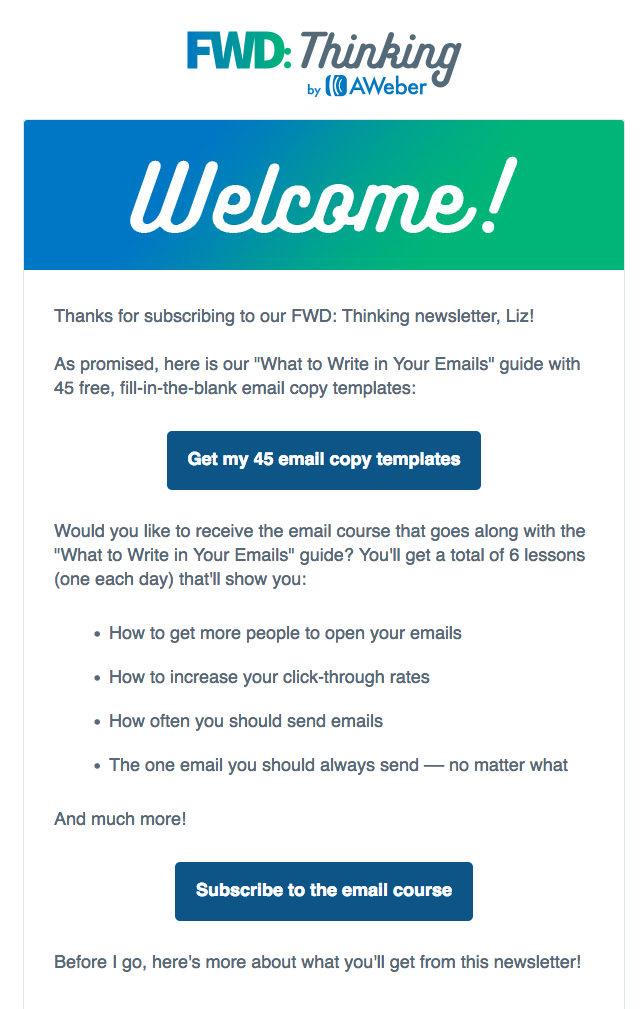
This step is often overlooked. Many people use different email templates every time they send an email. Or, they never fully customize a template to match their brand. But branding an email template and using it consistently are important. Your brand sets you apart from your competitors. It allows you to be unique and develop a personality for your business. It builds credibility and trust between you and your subscribers. Your subscribers can see your content and immediately tie it back to you. Step 1: Choose your email template. Find an email template that works with your brand and your message. A plain template is often better than one already filled with colors and background images, because it’s easier to make it your own. Then, add your logo to the top or bottom of the email. (Inside AWeber, there are 8 NEW email templates you can easily customize to fit your branding. Choose the template format you'd like. Then drag and drop to add your images and build the layout you want.) Step 2: Add your brand colors to your template. Don’t overdo it! Too many colors can be distracting. Try adding your brand colors in just a few places, like your call-to-action buttons, header image, or headlines. For example, in the welcome email of AWeber’s FWD: Thinking newsletter, we incorporate our brand colors by using a header image with AWeber’s green and blue gradient and a call-to-action button with our brand’s shade of blue. Homework: Watch this video on How to Design an Awesome Welcome Email. To do: Choose an email template and add your logo and brand colors to it.

Day 2: Customize your confirmation message. (15 minutes)

A confirmed opt-in message is an email you send people immediately after they fill out your sign up form. It asks them to verify they want to subscribe to your emails by clicking a link or button in the message. Confirmation messages are optional but strongly recommended. They serve as proof that your subscribers definitely want to be on your list. So internet service providers (like Gmail and Yahoo!) may deliver more of your messages to the inbox when you use confirmation messages. Plus, it prevents subscribers from signing up using fake email addresses. To make your subscribers more likely to confirm their subscription, you can follow these common best practices for confirmed opt-in emails:
  1. Keep your content short.
  2. Explain the value your subscribers will receive by subscribing to your list.
  3. Tell them what they need to do to confirm.
Homework: Read Writing Confirmation and Welcome Emails People Love. To do: Set up and customize the subject line and content of your confirmed opt-in email. (If you’re an AWeber customer, you can follow these directions to complete this step.)

Day 3: Create a sign up form. (30 minutes)

Sign up forms allow your subscribers to easily join your email list. You can promote your form by adding it to your website and sharing a hosted sign up form with your audience. Hosted sign up forms allow you to share your form anywhere, even if you don't have a website. Homework: Read 9 Inspiring Sign Up Form Ideas to Grow Your Email List. To do: Write your sign up form copy and build your form using ideas from the homework post you just read.

Day 4: Write your welcome email (30 minutes)

A welcome email is the first message subscribers receive after joining your list and confirming their subscription. And it gets a lot of attention — on average, open rates are 4 times higher and click-through rates are 5 times higher than other emails, according to marketing research company Experian. You can take advantage of this above average engagement by crafting an excellent welcome email. Your welcome email should:
  • Welcome subscribers to your email list.
  • Deliver the lead magnet you promised on your sign up form.
  • Explain what kind of content you’ll send subscribers, how often you'll send it, and what they'll learn.
  • Introduce yourself or your business.
  • Ask subscribers to add you to their address book. (This is called whitelisting and it can help more of your emails bypass the spam folder.)
Once you draft your welcome email, take some time to personalize it! Personalization makes your subscribers feel you’re writing a message specifically to them. Something as simple as including your subscriber’s first name in the subject line or body of your welcome email can boost opens and clicks. Homework: Read The One Email You Should Always Send and How Personalization Can Help You Connect with Subscribers. To do: Write and build a welcome message for your subscribers using AWeber’s Drag and Drop Email Builder.

Day 5: Automate your welcome email. (10 minutes)

You wrote your welcome email. Your next step? Automate it. That way, your subscribers will receive it immediately after they sign up for your list. Simply create an automated series for new subscribers in your email marketing platform. Here's how:
  1. Build a new automation series in your email marketing platform. Make sure it's set up to send to every new subscriber.
  2. Paste your welcome email content into the template you chose on day 1.
  3. Add your welcome email to the series.
  4. Activate your series.
Your email marketing system does the rest! Homework: Read Email Automation 101: How to Use Automation. To do: Create a welcome series using AWeber’s automation platform Campaigns and add in your welcome email. (Here are step-by-step instructions for setting up your own welcome series in AWeber.)

Day 6: Publish your form on your social media channels. (20 minutes)

Your list is set up and your confirmation and welcome messages are ready to go. Now it’s time to put your hard work to the test and start to grow your list! An easy first step is turning you social media followers into email subscribers. People who follow your brand on social media have already shown they want to hear from you. And there’s no better way for them to stay up to date on your latest content and sales than joining your email list. Post a link to your hosted sign up form on Facebook, Twitter, and LinkedIn and ask your social followers to subscribe for exclusive updates. Homework: Read 7 Expert Tricks to Grow Your Email List with Social Media. To do: Add your sign up form to your Facebook profile and tweet out the hosted URL to your form.

Day 7: Share your sign up form with your connections. (20 minutes)

Reach out to the people you already know, like colleagues, friends, or family members. Ask them if they want to sign up for your email list. Let them know what content you are offering and explain the benefits they would receive if they sign up. If they say no, maybe the content you’re offering just isn’t for them. But maybe they know someone it would be perfect for. You never know until you ask! Homework: Read How To Get Your First 50 Email Subscribers in Less Than 30 Days. Use the fill-in-the-blank copy template in this post to easily reach out to people. To do: Contact 5 people you know. Send them the hosted URL to your sign up form and ask if they’d like to join your email list or share it with someone they know.

Ready, set, go!

Congrats! If you completed this 7-day challenge, you’re well on your way to launching a successful email marketing strategy. Want more content like this? Subscribe to our FREE weekly email newsletter FWD: Thinking for email marketing tips from the pros.

Bonus challenge

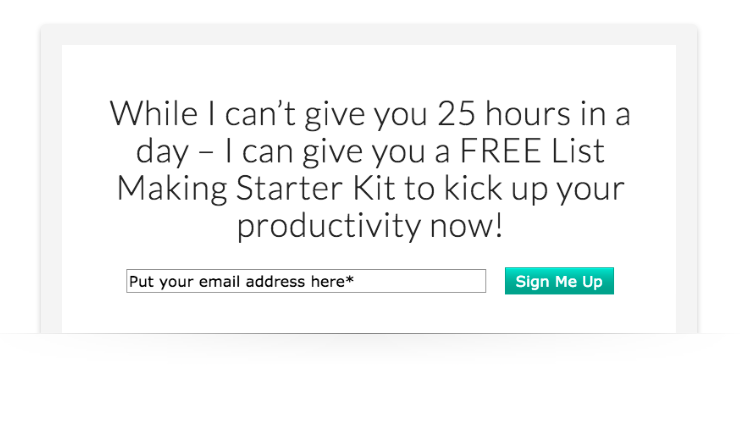
Ready for your next challenge? Then try this: Create a lead magnet — a freebie you give subscribers when they sign up for your list. Lead magnets can increase the conversion rate of your sign up form. For example, author and productivity expert Paula Rizzo offers a free List Making Starter Kit in return for signing up for her email newsletter, which she sends via AWeber. Homework: Read How to Create a Lead Magnet in Less Than a Day. To do: Build a lead magnet, add a link to it in your welcome email, and mention it on your sign up form.
02 Jan 17:51

6 top VCs give their best 2019 predictions for healthcare, from a biotech correction to a 'shadow cash economy' stepping into the light

by Lydia Ramsey

Wende Hutton

  • We asked healthcare and biotech venture capitalists from leading firms like Venrock, Canaan Partners, and General Catalyst Partners to share their predictions for 2019.
  • While some had their eye on new ways to aid mental health, others are on the lookout for biotechs with a more focused approach to drug development.
  • From biotech-market corrections to an ever-growing field of direct-to-consumer healthcare companies, here's what the VCs anticipate will be in store next year.

The healthcare industry is at a crossroads.

Big tech players are encroaching on entrenched healthcare companies, forcing them — as well as startups — to think of different ways to care for patients. In biotech, a red-hot initial-public-offering window appears to be closing.

Looking ahead to 2019, Business Insider turned to six healthcare and biotech investors at top venture-capital firms to find out what they're keeping an eye on going into the new year.

SUBSCRIBE: Dispensed: a weekly dose of pharma, biotech, and healthcare news

Venrock partner Camille Samuels predicts a biotech correction and a slump for Moderna.

Venrock partner Camille Samuels is ready to get back to the basics in biotech.

"I'm enthused by the correction," Samuels told Business Insider. Over the past five years, the Nasdaq biotech index is up 25%, though recently stocks have taken a tumble, putting them into correction territory, a term that refers to a 10% or greater decline from a stock's most recent peak.

In 2019, she said, she's anticipating a return to the basic biotech-business model. That is, instead of a broad platform with six or more potential drugs in the works, a more straightforward focus on one or two lead programs that a company knows super well.

The correction in turn will drive that because there will be less available capital pouring into early-stage companies, forcing them to have a more zoomed-in approach.

"I remain an optimist on the fundamentals of biotech, but the industry has gotten so enthusiastic as to be undisciplined," Samuels said.

On the policy side, Samuels said she expects to see the biopharma industry make a concession on drug pricing to appease the Trump administration. That said, she doesn't expect it to have broad implications.

Another prediction: "Moderna will exit at a $3 billion valuation next year."

Moderna debuted on the public market on December 7 after raising more than $600 million in the biggest IPO in biotech history. While the IPO valued Moderna at $7.5 billion, it's currently trading well below its IPO price, with a market value of $5 billion.

Samuels expects that to drop even further by the end of 2019, to a market value of $3 billion.

"It's hard for me, looking at their pipeline, to figure out why they're valued five times, six times [as much as] other companies with the same pipeline," Samuels said.

Lastly, she sees exhaustion with financing cancer-drug makers sinking in, with interest picking up for other diseases that have been left at the wayside.

Two of the scientific areas she's most interested in at the moment: mitochondrial RNA-based medicines and antiaging biology, particularly a subsection she refers to as "inflamm-aging."


Wende Hutton, a general partner at Canaan Partners, anticipates a more skittish IPO market.

"We're coming out of a very ebullient year," Hutton told Business Insider. As part of the massive year biotech companies had entering the public market, Canaan Partners' portfolio had two entries.

Hutton said she expects to see a lot of new startups form and a lot of early-stage fundraising rounds, given the money that venture funds have raised over the last 18 months. But as the IPO markets start to look more skittish and uncertain, that might signal a slowdown in public debuts for 2019.

Like Samuels, Hutton said she's anticipating a shift in focus from platform-based companies with a number of drugs in the works to companies focused on one or two drugs, in large part because those are easier buys for pharmaceutical companies looking to build up their development pipelines.

"If there's any retrenchment of capital, that's a great place to put your money," Hutton said.

Hutton said she's still seeing a lot of money flowing into cancer-drug makers, particularly those developing drugs that act on the body's immune system. Hers and Canaan's interest, she said, will also be in finding new candidates for neurology and rare diseases.


Ambar Bhattacharyya at Maverick Ventures sees a 'shadow cash economy' stepping into the light.

The way Ambar Bhattacharyya sees it, the economy of consumers willing to pay cash — rather than use their insurance — for healthcare is about to emerge.

"A shadow cash economy is coming out of the shadows," Bhattacharyya told Business Insider.

Companies like GoodRx, 23andMe, and Warby Parker have already paved the way. Now with the explosion of direct-to-consumer health companies like men's health company Hims, in which Bhattacharyya is an investor, the new relationship with healthcare and a willingness to pay cash for services that might otherwise be covered by insurance will cement itself.

Bhattacharyya said he also expects to see interest in cybersecurity pick up in 2019, potentially in the form of services like LifeLock's work in identity theft showing up in medical records to protect from health-insurance fraud.

Maverick, an early investor in One Medical, anticipates seeing more brick-and-mortar doctor's offices for specialties pop up, possibly for diabetes or mental health. Already, he's seen companies like Two Chairs for mental health spring up in northern California and fertility clinic Kindbody in New York.

On the employment side, Bhattacharyya is looking forward to seeing people who are pursuing careers in technology start to consider healthcare in a more serious way, particularly as tech giants like Facebook face reputational challenges.

Two areas Bhattacharyya is less interested in seeing new companies: new approaches to pharmacy benefits management (the companies in charge of negotiating drug prices), and tech services for diabetes (an area that already has a fair amount of competition).


See the rest of the story at Business Insider
02 Jan 17:48

Industrial Workers Will Soon Don Exoskeletons and Achieve Super Strength

by Eliza Strickland
Sarcos Robotics’ full-body suits will let factory workers lift 90 kilograms without breaking a sweat
/image/MzE5NzIzMQ.jpeg
Illustration: Blood Bros.
graphic link to special report landing page

What’s the most important thing for people to know about the full-body exoskeleton from Sarcos Robotics, which can turn an assembly-line worker into a superhero? “We’re taking orders,” says Sarcos CEO Ben Wolff.

The company has been working on this wearable robotics technology since 2000, when engineers in its Salt Lake City headquarters began cobbling together experimental supersoldier suits for the U.S. military. A 2010 proto type, which enabled the wearer to punch through wooden boards, earned the nickname “the Iron Man suit” in homage to the high-tech gear in the eponymous comic book and movies. But that bulky version kept the user tethered to the wall by a power cord—something that would presumably interfere with superhero activities—and the suit remained in R&D.

Now, finally, Sarcos is coming out with a commercial exoskeleton: the Guardian XO. Wolff says the sleek battery-powered suit will be ready at the end of 2019. It’s intended not for the battlefield but rather for industrial settings such as factory floors, construction sites, and mines, where it can provide a substantial return on investment by boosting worker productivity and decreasing injuries.

Wolff says his engineering team made breakthroughs in power management that enabled them to build a practical and reasonably priced suit. “It’s one thing to make a very expensive robot in the lab,” Wolff says. “We’re finally at the point where the exoskeleton’s capabilities coupled with the economics make it a viable product.”

The XO will be available in two models: Workers wearing the basic XO will be able to repeatedly hoist 35 kilograms without strain, while those wearing the heavy-duty XO-Max will easily lift a 90-kg load. Each model has a battery that lasts for up to 8 hours and can be quickly swapped out.

img
Photo: Sarcos Robotics
Strong and Safe: The Guardian XO, a powered exoskeleton from Sarcos Robotics, is intended to make industrial workers more productive and protect them from injury. A worker wearing the heavy-duty XO-Max can repeatedly lift a 90-kilogram load without strain.

Sarcos isn’t the only company building wearables to augment the strength and endurance of industrial workers. Ekso Bionics, a California company best known for its medical-grade exoskeletons that enable paraplegics to walk, recently came out with the EksoVest, an upper-body exoskeleton that supports workers’ arms as they perform overhead tasks. In 2017, Ekso began a pilot project with Ford Motor Co., and last year Ford expanded the trial to 15 factories around the world.

The time may now be right for exoskeletons to proliferate in the workplace, says Rian Whitton, an analyst with ABI Research who recently authored a report on the exoskeleton market. As the technology has matured over the past decade, he says, market conditions have become more favorable. “In the Western world and Japan, we’re seeing a tightening of the labor market, especially when it comes to manufacturing,” Whitton says. “There’s a real incentive for companies to invest in their workforce and make people on the assembly line more productive.”

The recent engineering advances in the Sarcos lab came from studying the human body’s energy-conservation strategies. Consider the biomechanics of walking, for example. Not every muscle requires energy at every moment; there are parts of each step where gravity does the work. Translating that lesson to an exoskeleton, Wolff says, means the suit doesn’t have to power up every joint continuously, and that means a longer battery life.

Sarcos didn’t design the XO for any particular application, but rather wanted to help people perform all manner of tasks. A user manages an XO via a system that Wolff calls “get-out-of-the-way control.” Sensors throughout the suit recognize how the wearer is moving his or her limbs, enabling the suit to instantly mimic the speed, force, and direction of these movements. “The suit moves along with you; you don’t have to think about how to use it,” Wolff says.

While industrial exoskeletons are designed to protect their users, potential buyers may have other safety concerns. At the standards organization ASTM International, Bill Billotte is vice chairman of a committee that’s working on standards for exoskeletons. He says employers will need to think through some of the same questions that arose when collaborative robots started appearing on assembly lines. “If you have one person wearing an exoskeleton, but they’re working next to other people who are not wearing exoskeletons, how do you make that work?” he says.

Companies that are ready to put their money down anyway will be signing on for a “robot as a service” package, in which Sarcos will deliver the Guardian XOs, install the docking stations, and frequently visit the client’s facility for suit maintenance, repairs, and upgrades. The cost of an XO package, Wolff says, “is roughly the equivalent to a fully loaded, all costs included, $25 per hour employee.” Wolff argues that companies will save money by investing in XOs, claiming that an exoskeleton will improve a worker’s productivity by four to eight times, and will reduce injuries to boot. His message to manufacturing companies: “Think about putting this robot on your payroll.”

This article appears in the January 2019 print issue as ““Iron Man” Suits Are Coming to Factory Floors.”

02 Jan 17:48

The Reviews Are In: The 5 CPQ Features That Matter Most to Sales Operations Leaders

by Gideon Thomas

CPQ Features That Matter Most to Sales Operations Leaders

Why do salespeople spend only one-third of their day talking to prospects, while the rest of their day is spent on administrative tasks and communication with prospective buyers that could be automated? That’s a question that CPQ software can answer and a problem it can fix.

As a sales operations leader, one of your main priorities is to make sure your sales department runs like a well-oiled machine. As such, it’s crucial that your sales tech does what it’s intended to do: automate administrative tasks, enable your sales team to work at peak efficiency, add value by making your sales process more effective, and deliver the data needed to make forecasts and improvements.

Our customers tell us that the Configure Price Quote (CPQ) software features that matter most to them are the ones that make their job, and the work of their salespeople, easier. A CPQ must go beyond simply providing a tool with which to configure pricing and produce accurate quotes. There are other value-added features that the best CPQ software offers which directly impact ROI.

These value-added features are so critical to the success of a CPQ software that they are used as rating criteria by G2 Crowd, a leader in helping buyers make better software purchasing decisions through user reviews and ratings. In the G2 Crowd Winter 2019 Usability Index for CPQ Software report, these factors were highlighted as being paramount in determining CPQ user satisfaction.

The 5 CPQ Features That Matter Most to Sales Operations Leaders

Ease of Setup

The last thing a sales operations manager needs is disruption of their team and workflow while new software is being set up and implemented. Sales leaders need a CPQ that is quick and easy to set up and configure, and one that doesn’t require a developer to write custom code. Seamless integration with their CRM is a must.

Ease of Use

Complicated software can spell disaster for a sales team. If they don’t like using it or refuse to use it altogether, you may end up with salespeople who manually perform tasks that could be accomplished by the CPQ, thus defeating the purpose. A CPQ that is intuitive to use and includes features which make selling and quoting easier, such as sales playbooks and pre-configured rules for pricing and discounting, will increase user adoption. Sales operations leaders want a CPQ which requires minimal training time to bring sales reps up to speed.

Ease of Administration

A major benefit of using a CPQ is that it reduces administrative tasks and makes necessary tasks a breeze. Sales operations leaders require a tool that is easy to administer and maintain. Managing the CPQ platform should be simple. If updating pricing, configuring new discounting rules, and adding new products can be accomplished with ease. It saves the organization time and money.

Meets Requirements

Each sales organization has specific requirements in a CPQ solution, but there are a few standard features which are universal. A CPQ which produces accurate quotes and includes document generation, version control, and workflow and approval management will help streamline the sales process. A CPQ that syncs with the company’s CRM yields the most benefit.

Quality of Support

A sales technology purchase should never be a one and done transaction. Ongoing support throughout set up, implementation, and continued use is a CPQ feature that is most prized among sales leaders. Look for a CPQ vendor that is easy to work with and that makes customer support a top priority.

Using CPQ to Evolve Your Sales Operations

The great engineer and management consultant W. Edwards Deming said, “Eighty-five percent of the reasons for failure are deficiencies in the systems and process rather than the employee. The role of management is to change the process rather than badgering individuals to do better.” Utilizing a best-in-class CPQ, integrated with a CRM, allows sales operations to change their processes and achieve better results for their organization, their team, and their customers.

Aberdeen reported that by using a CPQ, best-in-class sales teams were better able to realize efficiencies in the following areas:

  • Minimizing the number of people, functions, etc, required to develop and deliver quotes to buyers
  • Managing by exception with pricing/discounting “guardrails” in place
  • Generating complex quotes in a timely manner
  • Providing sellers with marketing tools to develop, send, and track response to messaging
    (Source: HubSpot and Aberdeen Group Report)

When choosing a CPQ for your organization, look for CPQ vendors that perform well in these areas and that rate highly on the value-added features that are most appreciated by sales leaders as rated by G2 Crowd. Using those guidelines, you will find a CPQ that will make a positive impact and help you meet your sales operations goals.

02 Jan 17:47

Where Marketing Automation Fits Into the Customer Journey

by John Jantsch

Where Marketing Automation Fits Into the Customer Journey written by John Jantsch read more at Duct Tape Marketing

When companies incorporate marketing automation into their approach, they often focus on the middle of the marketing hourglass. They use the automation tool to stay in touch with existing customers or to reach out to prospects who are very near to making their first purchase.

However, marketing automation can be used throughout the entirety of the customer journey to great effect. When you’re smart about automating marketing processes, it frees you up to do more of the prospecting and lead nurturing work that only a real human can do, while taking some of the more tedious and time consuming parts of the marketing process off your plate.

Here, we’ll take a look at the various features that make up marketing automation, and how best to use them throughout the customer journey.

What is Marketing Automation?

Before we dive in, let’s provide a quick definition of marketing automation. It’s the process of using a software platform to automate some of your repetitive marketing tasks. It can be used across channels, and includes social media, email, and certain website actions.

The software allows you to group users by certain attributes or behaviors and to target them with messaging that is most relevant to them. For example, you might group people in the same geographic location together, or group people who have made multiple purchases from your business.

Marketing Automation for the “Know” Phase

At the very top of your marketing hourglass, people are encountering your brand for the very first time. Maybe they’re someone who’s in desperate need of the good or service your provide; maybe it’s someone with a passing interest in your field. How do you sort things out this early on in the game?

One of the first things that marketing automation tools can do is help you with lead capturing efforts. Using the same form across your website allows you to gather the same contact information for everyone who fills out the form. From there, you can begin the process of analyzing their attributes and behaviors to figure out whether or not they’re serious prospects.

Behavior scoring (otherwise known as lead scoring) asks you to take data on your existing clients to build a composite profile for your ideal prospect. Where do they live? What profession are they in? What kind of actions do you expect them to take before they convert?

When you know what your ideal prospect looks like, you can then use your marketing automation tool to compare each lead against this dream prospect. If they’re ticking most of the boxes, this is a lead you know is worth your time. They’re likely to convert, if you play things right, so it’s smart to spend some marketing dollars courting them.

Leads that fall completely outside of this ideal picture are likely not worth your time. They’re just not the kind of person that realistically needs or wants what your business offers, so no amount of time or money will result in them changing their mind.

Marketing Automation for “Like” and “Trust”

Once you’ve identified those leads that are worth approaching, you can begin to use your marketing automation tool to create an effective email campaign.

Marketing automation tools allow you to segment your audience so that you can send specific messaging to different groups of people based on their attributes and interests. It’s also possible to use the tool to personalize the email, setting it to auto-populate with name, company, and job title based on the information you have in your database.

For prospects, you can establish a set of prospecting emails that slowly and methodically introduce them to your company and the problems you can help them solve. Only 23.9 percent of all sales emails are even opened, so it will take several attempts to get a prospect’s attention.

You should start by creating a handful of emails that contain different offers so that prospects can come to know and like your business—an invitation to access a white paper on your area of expertise, an opportunity to join a monthly webinar that you hold, or an offer to book an introductory call with a member of your sales team.

You can then set these messages to send on a regular schedule, with a built-in trigger to turn off the next email in the set if the current email leads to a conversion.

Your marketing automation tool can also help you to tailor the content on your website to the profiles of your visitors. The tool can show specific content that you know will be valuable to a given prospect, and you can create dynamic content that is replaced based on actions a prospect has taken or interest that they’ve expressed in a particular topic. This level of personalization makes a prospect feel seen and heard, which goes a long way to building likability and trust.

Marketing Automation for “Try” and “Buy”

Once you’ve proven to prospects that you understand their specific needs and have the perfect solution for their problems, you begin to move them into the try and buy portion of the hourglass.

Using marketing automation to target them with messaging that is triggered by a specific action can be an effective tactic here. At this point you already know a bit about the prospect, so you can get even more specific about giving them information you know they’ll be interested in.

For example, let’s say a prospect has signed up for your company newsletter, you can use this action to then trigger messaging to drive them to the try phase in the hourglass. Maybe this means a pop-up on your website that invites them to a free trial of your service. Or perhaps it’s an email invitation to an upcoming event on the topic you cover in your newsletter, with a friends and family code so they can attend for free.

Once someone’s made their first purchase, you can set your system to automatically follow up with them. Send them a welcome email that gives them additional information on how to get the most out of their purchase. Then automatically send them an email again in a few weeks’ time to make sure they’re still happy and to offer support with any issues they may have encountered.

Marketing Automation for “Repeat” and “Refer”

You’ve already used your marketing automation platform to get your prospects to convert, but you can continue to use the tool to influence the remainder of their customer journey.

Once a customer has made a specific purchase, you can offer them related products or target them with communications that are focused on their areas of interest. In a recent Marketo survey, 78 percent of respondents said they would only pay attention to promotions that were related to their previous interactions with the brand. That means that most consumers would rather have no deal offered to them at all than have a generic offer sent their way.

Marketing automation can also help you to establish and maintain a strong referral base. With the ability to set up regular communication with your existing customers, marketing automation tools help you to stay top of mind so that customers are likely to have your name on the tip of their tongue when their friend asks for a referral in your field. Additionally, if you choose to establish a referral program, you can use email segmentation to stay in touch with members of that program, offer meaningful rewards, and target new leads coming to you via referral with specialized messaging.

In addition to the benefits that marketing automation provide you throughout the customer journey, the tools offer bigger-picture benefits as well. You should be using the data you collect on the effectiveness of your marketing efforts throughout the customer journey to refine each of the steps you take along the way.

Marketing automation tools compile a lot of information on the effectiveness of your marketing approach across channels, which allows you to identify holes, find logjams, and then invest the time in fixing those issues. When you have a better understanding of your complete marketing approach along the entire customer journey, you’re empowered to create one that is even more optimized for future customers.

02 Jan 17:47

My Sales Resolutions

by Mark Hunter

What sales resolutions are you making for this new year? The beginning of each year brings new opportunities for you to shift your mindset and take your game to the next level. How you approach each day will determine the results you get from each day. If you’re intentional about looking for the positive in the situations you encounter, it’s amazing how many great things you’ll find!

Here are 15 “sales resolutions” for you to think about and put into practice this new year:

1. I will never put off a call that needs to be made.

2. I will pick up the phone and call rather than just sending an email.

3. I will always start the day by having a list of prospects to call that same day.

4. I will never start off a sales call talking about myself or how great our products are.

5. I will make sure all notes are recorded in my CRM system; I will not trust my mind to remember everything.

6. Regardless of how bad a sales call might go, I will not allow it to negatively affect me.

7. After I make a sale or simply have a great sales call, I will immediately move forward and work on making the next sale.

8. I will never talk negative about a customer regardless of what they may or may not have done.

9. I will not talk bad about my competitors or what they sell.

10. I will begin each day with the mindset that there are always opportunities to help others.

11. I will end each day with thankfulness for the day and each conversation I was able to have.

12. I will never allow myself to speak with “commission breath.” Rather, I will be 100% customer centered.

13. I will stay in contact with every customer, even those I’m no longer doing business with.

14. Each day, I will look to improve my skills and become a better salesperson.

15. I will do my part to improve the sales community, give back to others and help them improve their selling skills.

What will 2019 hold for you? None of us know for sure, so all we can do is try to make the most of each day. This is the approach I take every day, week, month and year.

Remember that nothing happens in business until something is sold and nothing is sold until somebody prospects. May this be the year you do more prospecting than ever, and may you have your best year yet!

Don’t forget: A coach can help you excel in your sales career. Invest in yourself by checking out my coaching program today!

Copyright 2018, Mark Hunter “The Sales Hunter.” Sales Motivation Blog. Mark Hunter is the author of High-Profit Prospecting: Powerful Strategies to Find the Best Leads and Drive Breakthrough Sales Results

02 Jan 17:46

New Study Reveals Key Features of Closed-Won Deals Influenced by Sales Navigator

by Liza Castaneda
LinkedIn Sales Navigator

Understanding how to use modern selling techniques is critical to winning deals. It may seem like a complicated new world, but we looked at over 3,300 closed-won deals influenced by Sales Navigator to uncover four core modern selling actions that reveal a path to success.

While we’ll describe the sales process as sequential here, these actions often take place at various stages of the deal cycle. The end goal and value behind each of those activities remains the same – establishing trust.

Viewing LinkedIn Profiles

Not surprisingly, the most frequently occurring action is viewing profiles. This makes sense. Before deciding who to follow and where to invest your energy, you need to identify the right decision makers. We found that reps who closed deals using Sales Navigator viewed at least 10 profiles of people at their target account.

Saving Leads in Sales Navigator

The second action that occurs most frequently is saving leads – at least 5 per account. Once you identify the buying team through viewing their profile, the next logical step is to save them as leads. In the world of Sales Navigator, saving leads means you will be automatically notified of their activity via emails or on the homepage feed.

If you’re trying to grow an account, for example, and one of your key connections switches jobs, Sales Navigator notifies you of this change, making sure you’re deal doesn’t go dark. Better yet, visibility into your saved leads’ activity arms you with insights to reach out in a way that adds the most value.

Establishing Connections

Establishing connections at a target account is next in the journey. A connection represents a milestone in relationship building and it’s often the result of thoughtful outreach. Connecting with a prospect lowers the barriers of interaction with your target account, giving you a more efficient and direct avenue to pitch and grow that account.

Engaging With Content

Finally, our study found that sellers engaged with content posted by their saved account and/or leads at least once, before winning that account. (We define engagement as sharing, liking or commenting on content posted by your saved leads.)

Engaging with members of the buying team is certainly an art. You don’t want to engage too early and appear intrusive. You also don’t want to wait too long after connecting with a key player before making yourself visible through a like or comment.

While it makes sense that engaging with content happens seldomly, another one of our studies found that when it does happen, it pays off handsomely. On average, deals where reps engaged with their prospects’ content saw a 29% lift in win-rates.

Selling is both an art and a science. Here, we showed you four core features exhibited by closed-won deals. Now it’s your turn to incorporate modern selling into your practice to build the right relationships, win and grow more business.

To learn more about the latest thinking in closing deals, subscribe to the LInkedIn Sales Blog today

#PoweredByInsights


31 Dec 18:00

Simple Tech for Small Business Owners, Part 7: Video Campaigns

by Paige Duffy

mohamed_hassan / Pixabay

If you’ve ever used a video streaming service, then you’ve likely seen a video ad before. Video is an increasingly popular form of media, which makes it the perfect form of advertising. Not just for large companies, but for smaller businesses as well. When you make use of a video campaign, you’re creating some great opportunities for attracting customers and increasing conversion rates, which pave the way for growth.

How Video Campaigns Help Your Small Business

Video campaigns are more than just another way to get your message out there to potential customers. While the internet has provided a great way for customers and businesses to connect, the remote access can sometimes lead to a lack of close relationship in comparison to interactions in a physical store. While a blog can increase SEO, Video lets you put a face and voice out there, letting you bring your in-store sales strategies to the forefront.

People are also much more likely to remember what they hear and see in a video than what they read in a blog post, plus customers engage more with emails and webpages when videos are involved. While we’re at it, people are also much more likely to make purchases after watching a video. This means that with video, you can increase brand recognition, engagement, and conversions, all in one fell swoop.

Getting involved with video also means you can show up on the second most popular search engine in the world: YouTube. When people have questions about something, there’s a strong chance they’ll look up a how-to video about it. When you’re there, you get to build authority by showing your knowledge of the topic, plus show off your brand.

Video also works for every demographic, unlike some other forms of media. Even when you change your marketing tactics, video will still be appealing to your audience. You also get a way to engage with mobile users – as shocking as it may seem, mobile viewers actively watch video ads for much longer than desktop ones.

And even if you don’t build an ongoing campaign with your video, integrating them into your website has SEO advantages. In our post about SEO we talked about the idea of “rich media,” where websites incorporate more than just text. Video is one of those rich media options, which means you could get a ranking boost by having a few on relevant webpages.

Types of Videos to Start With

With all those benefits to keep in mind, getting your small business involved with video may start to seem like a good idea. Even so, there’s a lot you can do with a video besides just build an advertisement. Video is a vast media that allows for an extensive array of content to give your audience. If you’re not sure where to start, consider these types:

  • Introductions. What is your company? What do you do? Answering these questions for your audience is one of the first steps of successful marketing. But putting all that into a bunch of text that’s informative while still engaging the reader can seem like a near-impossible challenge. Creating a 90 second (or less) introduction video is a lot more effective.
  • Give More Details. Your introduction video provides a great start to letting customers know what you do. A great video series to take on is letting customers know what you do – in more detail. Delve into different product features or services to win your customers over.
  • Educate Your Audience. When you know your audience well, you know how to offer them help. There’s no better way to show your authority in your field than by educating your audience. No matter what type of company you have, there’s something you can help audiences understand. When your company leaders host these videos, you’re also showing off their skill as well.
  • Bring in Outside Testimonials. You can talk about your success story all you want, but what really convinces people that your product or service is worthwhile is the word of satisfied customers. Have someone else talk about how you helped them.
  • Tell Your Creation Story. People love stories, so one of the best things you can do is give them yours. Tell about where you came from, plus incorporate how your background helps your customers.
  • Share Your Culture. Much like your creation story, customers care about who you are. Put together a video that shows off your values and employees. The more faces a viewer can see, the more personal their connection with your business becomes.
  • Try Video Blogging. Blogging is a relatively simple form of content that doesn’t have to be super structured to bring your audience in. Even if it’s little snippets of company life or employee thoughts, potential customers care. These videos don’t necessarily need high production value, either, making them easy to put together.
  • Go Behind the Scenes. How is it that you do what you do? If you have a physical product, show how you make them. If you offer services, show how your team works. Customers get a picture of who you are and where your product is coming from in the process!
  • Thank Your Customers. When in doubt, thank your customers – after all, they’re the reason you’re in business! Putting together a simple video lets customers feel appreciated. This is a great type of video to slip into an email update or other mailing list.

With so many options for video, you can reach out to your customers in an engaging way. Even better, with advances in technology, you don’t even have to invest in expensive equipment to create great looking video content. Filming with your cellphone is entirely an option, and you can transform your office space into a quick recording area with some simple touch-ups.

Integrating video is a great way to spruce up your marketing campaign, and there’s always more tech for small businesses to discover. Stay tuned for our next post on CSS!

31 Dec 17:47

Best 18 Sales Articles of 2018 from Sales Hacker

by Colin Campbell
best sales articles of 2018 image

Here’s a recap of the best sales articles from 2018 from Sales Hacker!

With 2019 is right on the horizon, I’m taking this as an opportunity to look back at the kickass year we had at Sales Hacker. As usual, we were lucky enough to play host to many brilliant people contributing amazing content.

Thanks to ALL our contributors and readers (now over 106k! Wow!) for making Sales Hacker what it is. You rock! We look forward to engaging with you in new ways very soon! (More on that later…)

For now, if you’d like to contribute to Sales Hacker, please fill out our contributor survey so we can add you to our database.

The 18 best sales articles of 2018 from Sales Hacker

The SaaS Executive’s Guide To Building A Winning Go-To Market Strategy by Jacco Van Der Kooij

The Winning By Design Blueprint Series provided practical advice for every part of a SaaS sales organization. This particular piece of the series outlines a tactical approach to building a go-to-market strategy. Use it to diversify your revenue, make your business more resilient to economic setbacks, and help you plan for growth.

Notable Stats

  • Page views: 12972
  • Avg Time on Page: 23:50
  • Total Shares: 62
  • Backlinks: 260

The Sales Hacker Deck On Sales Decks: Learn How To WOW Your Prospects And Convert! by Alli McKee

The demo-only approach doesn’t work in sales anymore. With an average of 6.8 people involved in each B2B deal, you need a deck if you want your message to travel from the champion you met to the buyer you didn’t. This article will help you build the most compelling sales deck possible.

Notable Stats

  • Page views: 12622
  • Avg Time on Page: 30:44
  • Total Shares: 112
  • Backlinks: 212

Do You Make These 13 Mistakes During Your Sales Conversations? by Chris Orlob

Mistakes during your sales conversations cost you deals. Buyers have dozens of options and more power than ever before. That means you can’t afford to slip up during sales conversations. Your buyers won’t have it. Knowing the most common mistakes will help you avoid them. This article analyzes over one million B2B sales call recordings to tease out what’s working and what’s not, based on hard data.

Notable Stats

  • Page views: 11535
  • Avg Time on Page: 13:40
  • Total Shares: 380
  • Backlinks: 225

How To REALLY Run An Effective Sales Discovery Call by Richard Smith

It’s no secret that discovery is one of the most crucial parts of any sales opportunity, and ultimately – delivering demos without this vital component is likely to be wasted time and effort. Sales reps often struggle to ask the right questions or get the right answers to help build up the urgency to buy. Many sales leaders are unsure how to coach their reps to have better discovery calls. This article breaks down how to run effective discovery calls within the sales process, in just 7 easy steps.

Notable Stats

  • Pageviews – 10745
  • Avg Time on Page: 22:25
  • Total Shares: 59
  • Backlinks: 828

How to Write a Follow-Up Email That Actually Works by Sujan Patel

Failing to follow up on the sales emails you send can have a disastrous impact on your sales efficiency. You’re just leaving too much opportunity untouched. Unfortunately, effective follow-up these days isn’t always as simple as shooting off a “just checking in” message. Follow-up emails deserve as much attention as your initial outreach, and this article was designed to help you do just that. There are even 6 templates for you to try out!

Notable Stats

  • Page views: 10745
  • Avg Time on Page: 22:25
  • Total Shares: 59
  • Backlinks: 828

31 Simple, Yet Brilliant Lead Generation Techniques to Supercharge Your Sales Pipeline by Tom Whatley

In this article, you’ll learn 31 lead generation techniques across 14 categories to fill your own sales pipeline and build career-changing relationships that will last forever. Waiting for someone else to bring you leads is a sure way to a slow death. But as Tom showed us, it doesn’t have to be a painful slog to generate your own leads.

Notable Stats

  • Page views: 8151
  • Avg Time on Page: 10:31
  • Total Shares: 238
  • Backlinks: 176

Why Cold Calling Is the #1 Skill You MUST Master to Double Your Income in 2018 by Tony Hughes

Cold Calling is the top sales skill you should be developing to gain a competitive edge, not just for prospecting and landing meetings with C-Level decision makers, but at every stage of the funnel. This article presents some very convincing points to support that case.

Notable Stats

  • Page views: 6912
  • Avg Time on Page: 12:40
  • Total Shares: 352
  • Backlinks: 108

The Scientific Approach To Setting Sales Goals For Your SDR Team by Tito Bohrt

In the tactical breakdown offered by this article, you’ll learn how to understand SaaS costs basics, and how to accurately set sales goals and metrics that drive success for your sales team. Also review how to determine if your team structure is working or not, as this is a crucial factor that impacts revenue goals. As an additional bonus, it has a checklist you can use to put your plans into action.

Notable Stats

  • Page views: 6848
  • Avg Time on Page: 10:57
  • Total Shares: 233
  • Backlinks: 215

If You’re Building Your B2B Marketing Strategy, Start Here by Andrei Zinkevich

A proven B2B marketing strategy framework that will help you identify the most prolific market segments, your ideal customer profile, and the right marketing channels to generate leads. You’ll get a fresh perspective on what to improve in your marketing strategy and how to create a new one from scratch.

Notable Stats

  • Page views: 6714
  • Avg Time on Page: 13:28
  • Total Shares: 92
  • Backlinks: 446

Demystifying Sales Enablement: What Is It, Why It Matters, And How To Do It Right by Roderick Jefferson

To see what selling on steroids looks like, check out companies with the best sales enablement strategies. You’ll discover a lively place, with a lot of things like revenue, productivity, and win rates going up, and a lot of things like speed to revenue, sale cycle period, customer churn, and staff attrition rate going down. This article explores the up-and-down ride that moves the needle where it matters, driving sales teams to peak performance and customers to brand loyalty.  

Notable Stats

  • Page views: 5708
  • Avg Time on Page: 13:41
  • Total Shares: 124
  • Backlinks: 257

7 Habits of Highly Successful SDRs by Dan Murphy

Although it’s sometimes considered an entry-level job for those with little to no experience, that is less and less the case. The SDR role is a surprisingly complex one, often requiring both sales and marketing skills with a numbers-driven approach. After a lot of research about the different daily and weekly habits that Sales Development Team can focus on, this article has boiled it down to the 7 key habits that end up making the difference.

Notable Stats

  • Page views: 5674
  • Avg Time on Page: 11:23
  • Total Shares: 144
  • Backlinks: 89

35 Most Influential Women in Sales by Max Altschuler

This exclusive list honors not just female leaders that promote their own sales platform but those that take it even a step further by being incredibly intentional about promoting the next generation of female salespeople and making their path a little easier. They say “You can’t be what you can’t see,” and the sales floor is no exception.

Notable Stats

  • Page views: 4695
  • Avg Time on Page: 24:03
  • Total Shares: 764
  • Backlinks: 14.4k

6 Discovery Call Questions To Help You Prioritize Your Pipeline by Bardia Shahali

In sales, it’s normal to spend hours rehearsing for an upcoming demo and fine-tuning the deck. But when it comes to the discovery call, many assume that they can wing it. The risk of doing it poorly or not at all is getting stuck in “the land of no decision” with the deal and your quota on the line. That’s why it’s so important to ask the right questions at this crucial step in the sales process.

Notable Stats

  • Page views: 4070
  • Avg Time on Page: 11:15
  • Total Shares: 71
  • Backlinks: 638

4 Ways to Ask Indisputably Better Probing Questions in Sales by Emily Meyer

On the first call, regardless of what you’re selling, the questioning should always start the same. Start broad and then narrow down. Often reps make the mistake of only asking leading questions that are not open-ended, looking for “yes”. This article talks about probing questions in sales and how to craft them perfectly.

Notable Stats

  • Page views: 3774
  • Avg Time on Page: 8:47
  • Total Shares: 68
  • Backlinks: 82

What Not to Do in B2B Sales — 7 Signs You’re About to Kill the Deal by Manish Nepal

One of the reasons why B2B sales is so complicated is because of the many blind spots it involves that can ambush sales deals. You can optimize your prices, comply with necessary regulations, and have the best sales tools at your disposal. But the deal can fail if you don’t know what NOT to do in B2B sales. This article highlights the seven hidden traps in the B2B sales process that might be holding you back.

Notable Stats

  • Page views: 3019
  • Avg Time on Page: 9:59
  • Total Shares: 69
  • Backlinks: 259

How to Own it, Crush it, and Stay Motivated in Sales [9 Tips for AEs] by Nima Mogharei

To say that sales can be a grind would be an understatement. Here are some of the key takeaways on how to stay motivated by a seasoned salesperson. Follow these 9 steps and don’t let the hustle get to you.

Notable Stats

  • Page views: 2638
  • Avg Time on Page: 7:59
  • Total Shares: 87
  • Backlinks: 417

Why You Should Throw Your Sales Playbook in the Trash (And What to Use Instead) by Pavel Dmitriev

The sales playbook is a tale as old as time, and that’s exactly the problem. This time-honored tool is now dusty and dated. Yet it continues to be the main resource for many organizations. Pavel points out why it’s problematic, and how to transform the traditional playbook with the most powerful tool – data.

Notable Stats

  • Page views: 2560
  • Avg Time on Page: 13:06
  • Total Shares: 70
  • Backlinks: 209

How to Become a VP of Sales by the Time You’re 30 by Christien Louviere

This article explores the A to Z of how can you become a VP of Sales. Are you prepared to be in charge of the company’s most critical assets? Are you ready to hire and retain a sales team of the best and brightest? Can you spot sales performance issues before they blow up? Are you ready to create predictable revenue based solely on your leadership skills?

Notable Stats

  • Page views: 1970
  • Avg Time on Page: 17:24
  • Total Shares: 28
  • Backlinks: 1500

The post Best 18 Sales Articles of 2018 from Sales Hacker appeared first on Sales Hacker.

31 Dec 17:46

Why High-Quality Content Writing is Worth the Price

by Beth Walker

Why High-Quality Content Writing is Worth the Price

There is nothing more frustrating than searching for the answer to a question on Google, clicking a link only to discover the article has a great title but does not answer your question (or provide any answers for that matter!). This is something Google understands which is why they measure bounce rate. Website links with high bounce rates are less likely to pull up in future searches which benefits searchers but may also harm your marketing efforts.

Many claim “content is king.” At SMA we believe content within context is most important. And with the implementation of Hummingbird it seems Google agrees. Search Engine Land explains, “If you used a search engine during the early days of the Internet, you’ll recall how it could be difficult to find what you’re looking for when your knowledge of a particular subject was lacking. Hummingbird sought to solve this by focusing on synonyms and theme-related topics.”

As digital marketing strategies seek to incorporate more content the demand for freelance writing also grows, but as I’ve said before when it comes to freelance writing you get what you pay for. Still, for small businesses, the need for high-quality content adds yet another task to already overflowing to-do lists and is something easily outsourced.

Entrepreneur magazine says, “Unique, high-quality content blended with creativity supports SEO efforts.” At SMA our goal is to help our clients connect with their ideal buyers. All the content we develop incorporates that strategy, so what is the point of taking the time to create and publish content that no one will see?

Here’s Why High-Quality Content Writing is Worth the Price

Content is a Long-Term Investment

An excellent piece of blog content will continue to attract buyers to your social media and website for an extended period of time. At SMA some of most searched content is from two or more years ago because it is still relevant today. Not only does high-quality writing continue to attract readers in search, it’s easily repurposed.

You can extend the initial investment of purchasing an article by reworking the content into a video or infographic, allowing for layers of opportunities to attract the attention of your ideal buyer with minimal effort.

Well Researched

Since most freelance companies pay by word count the writer does not have much incentive to research your company and take the time to learn about the unique aspects that set you apart from your competition. This often produces blog articles or emails that convey vague concepts about your industry but lack personality.

Philosophies differ among industry professionals. When a content writer does not have the full picture of your specific convictions, they are unable to develop articles which present your company’s ideas, mission, and values.

At SMA we’ve developed a team of content writers who work directly with our account managers to create content that is consistently on brand. Whereas many companies choose content based solely on which is the least expensive, we know that this strategy produces inferior content.

Our in-house writers are assigned to a specific account. As a team member, they understand that the more accurately our content represents a client’s personality and mission the happier they are; as part of the SMA team they are invested in the account.

Seeing the full picture of the content calendar as well as the company’s buyer persona affords our writers the opportunity to create content that shares a common theme, forming a more cohesive story.

Conveys Personality

One of the most challenging parts of content writing is accurately representing a company’s personality. Even when a business owner writes their own content there is no guarantee that the reader will understand implied tone.

The better a writer understands a client’s preferences such as how much humor to include or which sources to cite for accurate statistics the higher-quality the content will be and the more accurate your personality will be represented.

SEO Inclusion

High-quality content writers understand the importance of implementing SEO best practices into every blog post, web page, and email they create. There are many details that make a piece of content high-quality for SEO.

Here are a few details to consider:

  • Internal and external links
  • Contextually appropriate links
  • Headers
  • Lists
  • Word length of 400 words or more
  • Accurate spelling, grammar, and punctuation

You may pay slightly more for a high-quality piece of content, but your investment will save you time proofreading as well as restructuring articles to include SEO best practices.

Sounding Human

High-quality content that is SEO focused feels like it comes from the company that paid for it, and not a third-party writer. As you read a blog post ask yourself these questions from Hubspot:

  1. Is this the way a normal person will say things?
  2. How will someone feel hearing what I have written?
  3. Am I making my points clear enough? Answering yes to each of these questions will help you confirm you are working with a great content writer who is producing high-quality articles.

High-quality content increases your opportunities to connect with your ideal buyer online. As more consumers begin their shopping research in the comfort of their home it’s increasingly important for all businesses to have a strong presence online. An investment in high-quality content writing is a key component of developing a long-lasting digital marketing strategy.

31 Dec 17:46

Anatomy of a Buyer Intent Signal

by Kevin Blackwell

The accuracy of buyer intent data depends upon an accurate interpretation of an intent signal. Intent signals are given off by a prospective buyer’s behavior during their web-based research. The anatomy of these signals, however, is often vaguely interpreted and unreliable.

Below is a list of the vital parts of a valid intent signal — for this example, I’ve used the category of ‘Corporate Wellness Programs,’ which would be targeted towards HR and benefits staff in medium and large corporations.

Signal Keywords. These are salient words that indicate intent signals within a category. Solutions must include natural language processing (NLP) to detect variations of these words (tense, plurals, hyphens, stop words, etc.), and to avoid false positive signals.

Core Category Keywords phrases and acronyms that an article contains if written about the target category (i.e., ‘workplace wellness program’, ‘wellness incentive’, ‘employee wellness’, etc.)

Adjacent Category Keywords – words that indicate research in a related category. Adjacent Categories are vital to identifying an early buying journey in the Core. Often, buyers in the Core Category are also on the buying committee of the Adjacent Category (i.e., ‘employee benefits’, ‘weight loss’, ‘group health insurance’).

Stage Keywords. These are words that indicate the position within the buyers journey.

Early Stage Words – certain prominent phrases indicate early journey stages, as the prospective buyer educates themselves on industry trends and terminology (i.e., ‘how to’, ‘definition’, ‘why’, ‘idea’, ‘white paper’, etc.)

Mid-Stage Words – words that indicate the buyer is evaluating solutions (i.e., ‘case study’, ‘example’, ‘best practice’, etc.)

Late Stage Words – words that indicate the buyer is choosing between vendors (i.e., ‘price’, ‘vendor’, ‘consulting’, ‘WorkStride’, ‘LifeDojo’, etc.)

Signal Sources. Signals can and should come from many places. Proper interpretation of these signals, given the source, is very important.

Core Publications – sites that are squarely aimed at potential buyers within your category (ex., http://www.corporatewellnessmagazine.com)

Adjacent Publications – sites that aimed at relevant adjacent categories (ex., http://www.workforce.com)

Review Sites – sites that vendors pay to register on for exposure among category vendors (i.e., G2Crowd.com, Capterra.com, PathFactory.com, etc.)

General News Sites – news articles about the category that catch the attention of your buyer. These complement core publication signals for a better understanding of the stage and intensity of the buyers’ journey (i.e., ‘Fitbit’s Game Plan for Making Your Company Healthy’, ‘https://www.forbes.com’, etc.).

Your Web Site – Integrating your web traffic with 3rd-party intent signals is critical to proper interpretation and attribution.


Do you know which specific companies are currently in-market to buy your product?

Wouldn’t it be easier to sell to them if you already knew who they were, what they thought of you, and what they thought of your competitors?

Good news – It is now possible to know this, with up to 91% accuracy. Check out Aberdeen’s comprehensive report Demystifying B2B Purchase Intent Data to learn more.

31 Dec 17:46

How Intent Data Reveals the Anatomy of an AI Buyer

by Michael Lock

Among the many uses of web-based intent data is its ability to profile the buyer’s journey for B2B technology.

Consider today’s most talked about technology – AI and Machine Learning. If you were interested in deploying this technology in your organization, how would you go about that process? Would you look for analogous examples of the technology being used in organizations similar to yours? Would you plan out a resource roadmap for how you might staff up to support such an endeavor? Would you explore vendors and solution providers that you might partner with?

Aberdeen’s intent data tracks buyer behavior and content consumption across millions of websites to connect web-based search activity to discernible buying intent signals. Not only does the data provide intelligence about topics and concepts of high interest to B2B buyers, it will provide URL-level detail to demonstrate the exact content being consumed, as well as visibility into the number of devices (i.e. individuals) consuming it.

Given the current level of hype surrounding AI in today’s business and consumer environments, it would be reasonable to assume a high degree of browsing based on news-worthy human-interest stories, and Aberdeen’s data confirms this. However, limiting the data to present-day, business-relevant content, the findings reveal an interesting breakdown of topics. Measured by the number of unique device IDs interacting with content of three main types, Aberdeen’s breakdown of the top 50 most visited websites is as follows (Figure 1).

Figure 1: What Are Buyers Reading? Top AI / Machine Learning Web Activity

Each category depicted above is described in more detail below.

Vendor-related. Content that discusses vendors active in the AI / Machine Learning sector. From Amazon and IBM Watson to smaller start-ups, this includes companies actively solving business problems with AI & Machine Learning technology. Uses include: early stage vendor exploration, technology consideration.

General education. Content discussing definitions of terms and technologies within the AI / Machine Learning sector. Also includes content providing present-day news, statistics, and general information about the business landscape for AI / Machine Learning technology. Uses include: hiring and talent acquisition, skill building.

Practical use case. Content exploring different ways to utilize AI / Machine learning in a live business environment – by industry, job role, or functional area. Uses include: business problem solving, evaluating organizational fit.

In the face of these findings and the strong slant in favor of vendor-related content, one might be compelled to ask – is this what people want to read, or is this simply what’s available? It’s been said that content consumed doesn’t necessarily equal content desired, and Aberdeen’s additional research in the Analytics and Big Data space shows that there might be a greater desire for practical examples bubbling up within our workforces. According to a recent survey, more than 80% of companies see value in AI that ranges from future potential to present-day strategic priority (Figure 2).

Figure 2: A Strong Outlook for AI in the Enterprise

The buyer’s journey is not a cookie-cutter process from company to company, but there are certain elements that remain common experiences. Findings from Aberdeen’s large pool of intent data demonstrate a slant toward vendor-related content, but additional research findings validate the need for more educational content that can guide buyers along a more savvy path toward implementation.


Do you know which specific companies are currently in-market to buy your product?

Wouldn’t it be easier to sell to them if you already knew who they were, what they thought of you, and what they thought of your competitors?

Good news – It is now possible to know this, with up to 91% accuracy. Check out Aberdeen’s comprehensive report Demystifying B2B Purchase Intent Data to learn more.

31 Dec 17:45

Pricing in 2019 - Where to find leverage

by Steven Forth
181228.png

I recently published a post over on OpenView ‘Five Pricing Resolutions for 2019.’ The five possible resolutions proposed for the the coming year are …

  1. Update your segmentation

  2. Compare customer lifetime value (LTV) and value to customer (V2C)

  3. Monitor your tiered architecture and see if it is doing its job

  4. Talk value before price in your sales process

  5. Make discounting strategic

Most companies will not want to take on all five of these, as least not at one time, so here are some questions you can ask to set some pricing priorities for 2019.

Are the executive, marketing, product management and sales aligned on pricing goals?

Pricing is a powerful lever to achieve many different business goals: grow top line revenues, improve gross margin, increase market share, build a larger market, or shape a two-sided market. But it cannot do all things at the same time. Pricing execution requires a strategy that everyone is aligned on. Have multiple people in your company use the Ibbaka Self Assessment tool and compare the results.

Do you understand how different sets of customers get value from your solutions compared to the alternatives?

If you can answer ‘yes’ to this question, you have built the foundation for pricing excellence. If you believe that all of your customers get value in the same way, you are probably fooling yourself. There are several ways to check into this. Begin by looking at usage patterns. Do all users use your solution in the same way? Probably not, but what drives the differences? You should also be talking to enough users to see the differences in value perception. Complement these conversations with more formal surveys if you can (but remember that people are over surveyed and there is a a lot of selection bias built into most surveys).

A good segmentation model is the key to successful pricing. A good model clusters customer and potential customers by what they value and how they get value. If you have questions about this, start by reviewing your market segmentation.

Have you mapped customer lifetime value (LTV) to how much value your customers will get from your solution?

Over the long-term, we should all provide more value than we capture. This means that customer lifetime value should be lower than lifetime value to the customer. (V2C). To answer this question you will likely need to segment your customers by how they get value. Do not assume that either LTV or V2C is the same for all customers, it almost certainly is not. Part of your work is to segment your market by customer lifetime value so that you can focus on the most valuable customers. See Peter Fader and Daniel McCarthy’s work on this. Then, see how you are creating value for these customer segments and ask if you will continue to create value for them over the course of their engagement with you. You can model their total ROI on their investment in your services (you should probably do this using a Monte Carlo model to reflect the uncertainty and to explore the risk). If you are claiming more value than you are delivering your estimate of LTV is probably too optimistic.

Is your pricing still doing the job it was intended to do?

Too often pricing is a frozen accident. Price was set long ago, often by people who are no longer even at the company, and for an offer materially different from the most recent release. Even when there is a clear set of agreed on goals, the pricing model supports the value proposition and sharpens differentiation, and is well communicated, it is easy for things to drift out of focus. Check the goals and assumptions of your current pricing model. Make sure they are written down. Test them. Set up a system by which you are collecting the data you need to assess pricing and are reviewing it monthly (or more often if your sales cycle is measured in days or weeks, not months or years). See: ‘Is your pricing a frozen accident?’

Do you know the role played by pricing and value along the customer journey?

Customer experience is emerging as a core concern for leadership. As commodification accelerates and customers look for solutions, not simple products and services the customer experience delivered becomes central to competitive positioning. Value needs to be central to this. Pricing is subservient to this. Ask how prospects and customers understand, resonate with, receive and pay for value across the full customer journey. Look for disconnects where pricing is communicated out of context, or where discounts are made reactively and not as part of the overall sales and pricing. Laying this out visually and showing who is responsible at each touchpoint is critical to an effective longterm pricing strategy, one that keeps value to the customer higher than customer lifetime value and sees pricing problems coming before they arrive. For those of you in Vancouver, this is the theme of our January 17 Meetup: Value and pricing along the customer journey.

Pricing should be a top level concern for all executive teams in 2019. If you do not have clear answers to these five questions, make sure you have a plan to get the answers you need.

  1. Are the executive, marketing, product management and sales aligned on pricing goals?

  2. Do you understand how different sets of customers get value from your solutions compared to the alternatives?

  3. Have you mapped customer lifetime value (LTV) to how much value your customers will get from your solution?

  4. Is your pricing still doing the job it was intended to do (or has it become a frozen accident)?

  5. Do you know the role played by pricing and value along the customer journey?

Permalink

31 Dec 17:44

3 Common Small Business Mistakes (And How to Fix Them)

by Thomas Griffin

Starting a business isn’t easy, especially if you’re doing it all on your own. As a small business owner you have to wear many different hats; the salesperson hat, the accounting hat, the marketing hat and so on and so on. And you can’t be perfect at everything.

There are so many things to think about and strategies to consider that you might be making a few mistakes and missing out on opportunities to grow your business. Don’t worry, you’re not alone. With so much to do and so little time, many small business owners are just like you. But it’s not too late to reverse those mistakes.

Get your business back on the track to great success, check out these three common small business mistakes and how to fix them.

Undervaluing your products or services.

A lot of small business owners make the mistake of undervaluing their products or services. They may feel a lack of confidence in themselves or have a fear of failing so they price their products or services too low in hopes that more people will buy from them. Underpricing will either result in not making enough money to keep your business afloat or deter people from buying your products altogether because many consumers equate a low price with low quality.

Be sure to not let your doubts affect your pricing. Take a look at your competition’s prices and see how yours compare, if they’re much lower then you need to raise your prices to match. Furthermore, survey your ideal customers to find out how much they’re willing to pay and figure out what value your business can add to justify a higher price.

Don’t worry about driving customers away with high prices either. In fact, according to the Harvard Business Review, overpricing can actually stimulate curiosity. In an experiment, they discovered that students would be willing to pay a premium of 20 percent but when the products were at an 80 percent premium, they recalled nearly twice as much product information. The overpricing also evoked a more passionate response from people which led to a willingness to spend much more money than they intended.

Not blogging.

Blogging is one of the most effective and low-cost strategies to increase organic traffic to your small business website. People are constantly searching the web to find products and services to solve their needs. In fact, according to Adaptive Marketing, 97 percent of consumers in 2017 used the internet to find a local business. If you’re not blogging, you’re missing out on the opportunity to get found online by tons of consumers who’re searching the web for a business like yours.

So, start blogging for your business on a regular basis. Make sure that your blog posts are relevant to your business and the needs of your customers. For instance, if you’re a B2B accounting business, consider writing content about accounting tips for other small businesses. And be sure to include keywords that will help you rank higher in search engine results. Think about what your customers would be searching for on the web, like “small business accounting services Springfield (your city name)” or “accounting tips for small business” and sprinkle them throughout your posts. Providing useful content for readers that includes relevant keywords is what will help you get to the top of Google search results.

Not building an email list.

Building an email list gives you a direct line to your customers. Anytime you have something to say like announcing a sale, updating your customers on important company news or introducing a new product or service, you can get your message straight into the inboxes of your best customers. And the people on your email list are like your biggest fans and they’re the shoppers most likely to take your desired action.

Wondering how to build an email list? Start with an exit-intent popup on your website like Home Fabrics Online did to gain more email subscribers.

Image Source: https://optinmonster.com/exit-intent-popup-examples/

A good exit-intent popup will entice the users on your website into signing up for your email list. You can also check out a free email marketing software like MailChimp that will allow you to easily design beautiful emails that your subscribers will look forward to receiving.

Over to you.

Your small business doesn’t have to stay small in growth or in sales. Now that you’re aware of some of the most common small business mistakes and how to fix them, you’ll be able to take your business to the next level. Start fixing these mistakes now and watch your small business blossom!

31 Dec 17:44

Stop Measuring Your B2B Marketing Campaigns with B2C KPIs. Here’s How

by Brittany Klokkenga

B2B marketers: Stop evaluating B2B marketing campaigns through a B2C key performance indicator (KPI) lens.

We all know there are fundamental differences between consumer-focused marketing and an integrated marketing campaign targeted at business decision-makers. It’s time to ditch B2C metrics and formulate measurement tools that make sense for your department and your ideal customer’s path to purchase. B2B marketers have more steps in the buyer’s journey to track and measure than ever before due to increasingly large buying committees and the dissemination of complex multichannel marketing campaigns. And (with rare exceptions), B2C marketers don’t need to measure six- to nine-month sales cycles.

According to the Harvard Business Review,

“The number of people involved in B2B solutions purchases has climbed from an average of 5.4 two years ago to 6.8 today [2017].”

B2B purchase decisions are driven by more than just emotion or impulse, and therefore, KPIs are entirely different from B2C measurements such as visitor-to-customer conversion rates. To employ the right demand gen and account-based marketing (ABM) KPIs, it’s important to understand how B2B differences impact the ways you measure marketing performance accurately.

Why B2B Marketing KPIs are Different From B2C Metrics

B2B marketing is to B2C marketing like chess is to checkers (that statement may irritate a few B2C marketers, but hey…you’re not my target audience). The board is similar, but the pieces, rules and complexity of strategies are considerably different. There are quite a few moving pieces in play; the length of the B2B sales cycle is often much longer as companies must acquire buy-in from multiple decision-makers among targeted accounts. B2C marketing, in contrast, generally encompasses just one or two decision makers, and sales cycles are typically much shorter.

Key Difference #1: Logic vs. Emotional Buying

Different priorities and pain points drive B2B and B2C marketing playbooks. B2B decision-makers are risk-averse and lean heavily on logic to evaluate solutions. While emotion plays a role in any human decision process, B2B purchases are based on calculated reason far more than B2C buying decisions.

Ardath Albee, CEO & B2B Marketing Strategist at Marketing Interactions, writes,

“Spending company funds comes with a lot of expectations and pressure. Depending on the nature and size of the purchase, the decision a B2B buyer makes could affect a whole lot of people and even the company’s sustainability or growth potential.”

Key Difference #2: Solution-Fit vs. Impulse Buying

In contrast, B2C product purchases are more impulse-based. B2C marketers must master emotionally driven marketing to capture the hearts of consumers. The motivations of want, rather than need or overall value, have a greater impact on consumer purchases.

4 B2B Marketing KPIs that B2C Marketers Don’t Follow

For most B2C marketers, concepts like marketing qualified leads (MQLs) aren’t a priority (or even a known term), because sales cycles are much shorter. There are exceptions for some B2C verticals, such as mortgages and other big-ticket purchases. However, most B2C marketers measure success with metrics such as:

  • Website traffic
  • Email click-through rate (CTR)
  • Simple conversion rates
  • Time on page
  • Crawl rate
  • Customer acquisition cost (CAC)

In B2B marketing, these metrics aren’t enough (in fact, they’re little more than vanity metrics, accept for maybe CAC). Demand gen marketers need to know the conversion rate of each stage of the sales funnel and the velocity that leads pass between funnel stages. B2B marketers need reporting and analytics tools that measure which combination of messaging, content, channels and sources/partners are contributing to sales pipeline. Compared to consumer-based marketing metrics, the KPIs that matter in B2B are more diverse and complex.

1. Marketing Qualified Leads and Sales Qualified Leads

Primary KPIs for B2B marketing organizations are quarterly and annual MQLs and SQL targets. At some organizations, these are two primary success measures for marketing teams. In most B2C industries, marketers don’t have to worry about qualifying their marketing and sales leads. In such cases, their sales cycle doesn’t require a formalized sales process, therefore the MQL/SQL system doesn’t add value.

2. Stage Velocity

Lead velocity is an important measurement to understand the impact of demand generation activities on the B2B sales pipeline. By following the speed leads and/or accounts pass through the sales funnel, marketers can adjust goals and tactics.

Formula: [(MQLs in current month) minus (MQLs in previous month)]/(MQLS in previous month)] x 100.

Due to the comparatively short length of sales cycles at most B2C organizations, the use of stage velocity tools for strategic planning isn’t valuable.

3. Average Deal Size / Average Contract Value

The average size of a new customer contract equates to average deal size. In B2B, it’s an important metric used to determine the number of annual deals needed to hit revenue goals as well as the amount of budget and resources to invest in each account. This KPI also has a great deal of value when it’s comes to understanding your ideal customer profile (ICP); for example, if you find that larger contract values are more likely to expand (or at least less likely to churn), you may decide not to target smaller businesses that can’t commit to such deal sizes.

Formula: (Total Revenue Closed/Number of Accounts Closed) = Average Deal Size

Average deal size reveals changes in the value of new customer contracts over time, as well as the impact of new product releases or strategic modifications on new customer spend.

Average deal size is rarely used in B2C because, with exceptions depending on industry vertical, there are no B2C customer contracts. B2C marketers may use metrics to measure customer lifetime value (LTV) or other parameters, but there are rarely varying initial deal sizes to track.

4. Customer Lifetime Value

Customer lifetime value (LTV) is the average value of a customer relationship. This metric is especially crucial at B2B organizations that depend on recurring customer revenue, such as software as a service (SaaS), professional services or industries with a contract.

For B2B organizations, LTV is a critical KPI for understanding revenue health, customer marketing and customer satisfaction. Analysts often evaluate LTV by cohorts comprising companies that became customers during a specific period.

Formula: (Total Customer Lifetime Spend/Total Customers) = Average Customer Lifetime Value

Within any B2B vertical with recurring customer spend, LTV can be used to measure satisfaction and loyalty. It can also be used to shape future demand generation efforts when LTV is used to measure the most profitable personas or industries. Except for consumer-facing subscription apps and services, LTV is not a relevant metric for most B2C companies.

How to Get Accurate Numbers

B2B marketers use quite a few channels for top-funnel lead generation. To scale lead generation efforts without sacrificing lead quality, demand marketers may rely on many inbound, outbound, paid and organic channels. According to the 2018 Chief Marketer B2B Lead Gen Outlook report, the following channels are the top lead sources for demand marketers:

  1. Email (53%)
  2. Content marketing (44%)
  3. Search (44%)
  4. Live events (40%)
  5. PPC/Display (16%)
  6. Print (12%)
  7. Retargeting (10%)

For accurate B2B marketing KPIs, demand marketers must develop tools for measuring the top of the funnel, including difficult-to-measure tactics, such as events, partnerships and trade shows.

The challenges associated with scaling top-funnel lead generation efforts and measuring across diverse sources has created a need in B2B for Demand Marketing Orchestration Software. These solutions, such as Integrate’s, create efficiency, ensure data quality and generate holistic measurement capabilities throughout the top of the funnel. With demand orchestration, B2B marketers can manage and measure diverse lead sources, govern lead data, automate lead routing and achieve closed-loop performance measurement for real-time campaign optimization.

Putting B2B Marketing KPIs to Work

Measuring marketing success is never simple, regardless of whether an organization is in B2B or B2C. However, for marketers who are making the transition to B2B, it’s common to have confusion about how to measure demand generation.

Longer sales cycles, a higher number of decision-makers and more top-funnel lead sources dictate the need for B2B marketers to adopt different KPIs and solutions to scale success with high-quality data insights.

Your team’s ability to measure performance is only as good as the quality of your database. If you’re curious about how you can get your database clean and keep it that way, download the new eBook “6 Steps to Clean & Maintain Your B2B Marketing Lead Data.”

28 Dec 18:54

Email Marketing Statistics That Prove It’s Still An Effective Marketing Strategy [Infographic]

by Jomer Gregorio

The digital marketing landscape has significantly evolved for the past recent years, with new and more advanced platforms, tools, and strategies being introduced for different marketing objectives and agendas year by year. However, these rapid advancements don’t leave out the more than a decade-old strategy which many digital marketing experts believe is still very effective today – email marketing.

Despite the rise of social media platforms and chat messaging solutions tailored for business such as LinkedIn and WhatsApp for Business, many marketing professionals still regard email as one of the most powerful communication channels out there. With over 74 trillion emails being sent every year, email as a communication channel is far from dying which many of its doomsayers are saying. It’s also forecasted that people will send and receive 281 billion emails per day in 2018, and for the next five year, there will be even more email – with an expected 333 billion emails sent.

These statistics only prove why no business – regardless of its size and nature – should underestimate the value of email as a marketing tool. If you are still unconvinced on how it can enhance your marketing campaigns, then here are the key takeaways of the infographic below from Digital Marketing Philippines, which listed down some interesting statistics which supports the idea that email marketing is still an effective marketing strategy:

  • 53% of marketers believe email marketing is as good an excellent strategy.
  • Email marketing has a 3200% ROI.
  • 49% of customers like to receive brand emails.
  • Email is the 3rd most influential source of information for B2B audiences.
  • 80% of retail professionals say email marketing is the greatest tool for customer retention.
  • Personalized emails have 50% higher open rates
  • Multiple abandoned cart emails can lead to 69% more orders.

Learn more about these email marketing statistics by checking out the full infographic below.

Email Marketing Statistics That Prove It’s Still An Effective Marketing Strategy

28 Dec 18:50

Conversations That Matter: Solar power that actually works

by Stephen Snelgrove

Solar power has been held out as a reliable and viable source of electricity. The biggest challenge to relying on solar is access to direct sunlight. In Canada, there are a few places where it works as a supplemental source of energy.

For solar to be the primary and solo source of reliable energy, the panels need to be exposed to direct sunlight for extensive periods of time each day and the sun has to shine bright just about everyday.

Africa is one such place — Malawi in West Africa in particular. It’s a place with limited access to hydro power. In fact, you’re lucky if you can get electricity 25 per cent of the time. The problem is a  dwindling supply of water as the reservoir is too low. When the turbines in the dam stop spinning, diesel generators turn on and produce what amounts to stop gap power.

It’s costly, it’s environmentally unfriendly and, until now, it was the only option. With advances in solar technology and a drop in the cost of the panels, solar is now competitive with diesel. Even better, solar is hyperlocal: the appropriate number of panels can be installed within metres of the community that requires electricity. This reduces costs and environmental footprint, as well as creates economic opportunities and creates wealth.

We invited Justin Woodward to join us for a Conversation That Matters about transforming economies that until now lived with intermittent and unreliable electricity.

Simon Fraser University’s Centre for Dialogue presents Conversations That Matter. Join veteran Broadcaster Stuart McNish each week for an important and engaging Conversation about the issues shaping our future.

Please become a Patreon subscriber and support the production of this program, with a $1 pledge here.

28 Dec 18:43

5 Essential Sales Forecasting Techniques

by Anna Washenko

Sales forecasting is a key component of any business. It helps companies make better business decisions and affects many areas such as the sales process, operations, marketing planning, and budget allocations. Unfortunately, many sales leaders struggle with implementing effective sales forecasting techniques. In fact, just 31% of businesses consider their forecasts to be effective in terms of accuracy and helping guide pipeline management.

Inaccurate sales forecasts can have serious business-wide repercussions. If you overestimate sales, you start to spend money that won’t be coming in. Underestimating sales leaves you ill prepared for an influx of orders.

It’s crucial to get your sales forecasting methods right early on. Correct sales forecasting has numerous benefits including:

  • Spotting problematic issues in advance
  • Evaluating sales opportunities
  • Tracking sales rep progress
  • Preparing post-sales support such as implementation, materials, support, and infrastructure

With the value that forecasting adds to a business, why do so many sales leaders struggle with correct sales forecasting? The simple answer? It is a difficult, quantitative topic — one with many factors to consider. Becoming a sales forecasting expert takes time and practice. But there are steps you can take to gain skills in the area and choose the right techniques.

Before diving into methods for sales forecasting, take a look at the video below. We provide an overview of forecasting strategies to give you a better understanding of the topic.

Now let’s get specific. Choosing the right forecasting methods will ultimately depend on your company, but here are five possible techniques, three quantitative and two qualitative, that will help you and your company begin making better business decisions.

1. Opportunity stages forecasting

Opportunity stages forecasting allows you to calculate the chances of a deal closing in the pipeline. It is best to use when you want an objective understanding of your pipeline stages (your sales reps’ opinion on deals, while possibly accurate, are subjective). Also use when you want to assess your sales team performance and check where they need improvement moving a prospect down the pipeline.

Most businesses can break their pipeline down into a general set of stages:

  • Prospecting
  • Qualified
  • Quote
  • Closing
  • Won or lost

The farther along a deal gets through this chain of stages, the better chance it has of making it all the way to “Won.”

To adopt this forecasting technique, you’ll need to analyze and understand your sales team’s past performance. It requires extrapolating, so a solid understanding on the rates of success from each stage is necessary to get a good estimate on future results.

If about half of your deals that reach the quote stage end up as won, then you know you’ve got a 50/50 shot for all the deals in that stage during a given quarter.

Example: Multiply a deal’s potential by the win likelihood (this can be determined in most CRMs). Say that you have a $1,500 deal opportunity with a 10% likelihood to be won. Your opportunity forecast would, therefore, be $150. Complete this exercise for each deal in your pipeline and add for the overall forecast amount.

Based on the image above, let’s review three deals in the pipeline. Deal 1 is in the incoming stage. Deal 2 is in the qualified stage and Deal 3 is in the negotiation stage. Multiple Win Likelihood by each deal amount:

  • Deal 1: 10% x $1,500 = $150
  • Deal 2: 25% x $2,000 = $500
  • Deal 3: 75% x $1,000 = $750

The overall forecast amount for these three deals is $1,400.

Advantages: This basic calculation allows you to quickly estimate incoming revenue. You also have a better understanding of future opportunities based on past information.

Disadvantages: Although it does make a numbers-based prediction, forecasting based on opportunity stages is an imperfect calculation:

  • It can’t account for individual characteristics of a given deal, such as a repeat client versus a new one.
  • The deal value and close date have to be accurate and up-to-date in your CRM.
  • In most cases, success will be binary.

Opportunity stage forecasting is a good technique for assessing deals in your pipeline and understanding incoming revenue and sales rep performance. Just remember to take your sales reps’ opinions into consideration for each deal to effectively combine objective and subjective elements and get a more accurate forecast.

2. Length of sales cycle

Forecasting by the length of your sales cycle is a quantitative method that helps you predict when a deal is likely to close. Rather than analyzing success rates based on stage, this approach makes assessments based on the age of the deal. It requires your team to crunch how long your average sales cycle is. Use this technique to objectively learn about different types of deals in your pipeline.

The basic formula for average sales cycle is Total # of Days to Close Deals / # of Closed Deals:

Example: To provide a more in-depth illustration, let’s say you have five deals you recently closed. Calculate the amount of days it took to close each one:

  • Deal 1: 62 days
  • Deal 2: 60 days
  • Deal 3: 59 days
  • Deal 4: 55 days
  • Deal 5: 60 days
  • Total: 296 days

Divide this number by the number of deals (which is five) and you get your average sales cycle of 59.2 days or roughly two months.

Now that you know your average sales cycle, you can apply to individual opportunities in your pipeline. Maybe one of your sales reps has reached the proposal stage with a lead after one month. Based on your average sales cycle length of two months, you might forecast that the rep has a 50% chance of closing the deal.

Advantages: Since it’s not tied to strictly defined categories, using the length of sales cycle approach can open up the option for creating algorithms based on different types of deals. So you could have a separate set of numbers for the average repeat customer, or the average lead who comes from a website query.

Disadvantages: Like the opportunity stages approach, this method still requires that accurate data finds its way into your CRM. Especially if you have multiple equations in the works, you’ll need to make sure that deals are being tagged and categorized correctly so that the math gives you a reliable prediction.

This technique allows you to objectively answer questions about when a deal starts, when it will end, where your sales team is in the process, and what skills they need to be applying to close the deal.

3. Regression analysis

One of the most mathematically focused choices for forecasting is regression analysis. Use this technique if you want an in-depth quantitative review of factors that might be affecting your sales and to make changes, if needed, to your sales process. Success with this method requires a good grasp on statistics as well as on the factors influencing your company’s sales performance. It involves calculating the relationships between variables that impact sales. Traditional steps with a regression analysis include:

  • Determine the reasons for forecasting (what you want to learn and why).
  • Determine the factor that is being affected such as sales (your dependent variable).
  • Determine factors that might be affecting your sales (your independent variables).
  • Determine the time period you want to review.
  • Collect the data for both dependent and independent variables.
  • Choose a regression model and run.
  • Look for correlation between variables.

Example: You want to forecast sales for the next year to help you plan for budget allocations and to determine if more sales reps need to be hired. Sales will be your constant, dependent variable — the factor that you are trying to understand.

To complete a single variable analysis, let’s say you determine that the variable impacting sales include sales calls. This is your independent variable.

  • Dependent Variable (y): Sales (SALES)
  • Independent Variables (x): Sales Calls (SALESCALLS)

You collect data for both your dependent and independent variables over an eight-year time frame: your annual sales for 2010-2018 and the number of sales calls during that time period.

The simple regression model equation is Y = a + bX. Your equation could therefore be: SALES = a + b * (SALESCALLS) with a representing the intercept and b representing the slope respectively. Use a regression software (Excel has this capability) to run the analysis. Note that you will not have to compute a or b yourself — this will be generated by the regression software.

You are looking for the “line of best fit” to approximate the relationship between the variables. Your plot might look something like this:

b, the slope, is 0.907 and a, the intercept is -313.

Based on this model, sales calls do look closely correlated to sales and may be causing better sales. However, just because a variable is correlated does not mean it is the cause. You have to consider a variety of factors too in-depth for this exercise. This is also a simple linear example. You will normally have a multiple linear regression with multiple independent variables such as number of emails sent, number of demos given, number of meetings held, etc.

Advantages: Regression analysis helps you determine which variables actually have an impact on your sales.

Disadvantages: While this approach can yield very accurate forecasts, it’s one of the most advanced levels of forecasting. For some companies, being able to account for many variables that go into a successful sale may require a PhD in mathematics. In addition, a large quantity of clean and accurate data is required for meaningful results.

Regression analysis takes skill and practice to execute and understand results properly. However, running regressions correctly can reveal valuable information about your business that will help with future growth.

4. Forecast stages

This qualitative approach is best used if you want an individual sales rep assessment technique and/or if you want to determine the expected value of deals. It relies on the insights and intuition of the sales reps rather than on a deal moving through pre-determined stages. With forecast stages, reps make a personal projection about the outcome of any given sales opportunity. For instance, they may be certain that a customer is ready and willing to make a purchase, or the opportunity may need several things to come together for success.

The exact terminology may vary from one business to another, but the key here is that the reps are making a judgment call on how likely each of their deals is to close. When this information comes at the beginning of a deal’s lifespan, it can help managers and execs to get a long-range view of results. The sooner they have that intel, the better their financial predictions will be.

Your sales reps make predictions on opportunities in the sales pipeline and sort into categories. These categories typically include:

  • Best Case
  • Commit
  • Pipeline
  • Closed/Won

Example: Your sales rep might record something like the following for two deals:

  • Deal 1 – Best Case: “I’m not sure about this opportunity, the lead seems hesitant and has mentioned a competitor several times. I think the only way he’s going to buy is if Rob contacts him with a customized proposal on Monday.”
  • Deal 2 – Commit: “I just started on this profile, but given certain indications in our phone calls and emails, I believe that this customer is going to buy. I’m on it with the demo and dedicated to closing this one!”

Advantages: Since this technique is not subject to waiting until an opportunity makes it to a later stage, you can forecast in advance. Your sales reps also know the opportunities/deals best and should be able to make closer predictions.

Disadvantages: The downside to this approach is that it’s not a hard science. It’s subjective. It requires that your whole team of reps is able to make honest assessments of their potential clients and their own skills. If you don’t have confidence in your reps, then this approach will lead to lots of disappointment for your business.

This technique gives you an inside look at your sales team’s opinions on deals and helps you determine if additional steps need to be taken to close them.

5. Scenario writing

Our final technique is another qualitative approach, which is excellent to use for long-term planning and for possible extremes that data may not always be able to account for. Just like forecast stages, it also is dependent on a subjective understanding of business and sales. In this approach, you project the likely outcomes based on a specific set of assumptions. You draft several different pictures that could unfold based on the different sets of assumptions, say best- and worst-case scenarios for the deals in progress.

Here is an eight-step process for strategically thinking about the planning process for scenario writing:

Example: Scenario writing is based on storytelling. Say that your focal issue is your yearly sales. You then move to key internal factors that you believe are affecting your sales such as sales calls, or inquiries received, or demo meetings held. Some of the external factors that might have an impact are competitors or government restrictions.

For critical uncertainties, examine what difficulties might arise over the next year. Will the customer start leaning more towards new technology? Will possible government policies affect the nature of your business? Based on this information, you can begin to develop specific scenarios and understand how you would go about handling each one.

Advantages: This approach helps you think strategically about what could happen with your sales and helps you make plans accordingly. Think of it as a type of contingency plan.

Disadvantages: As with forecast stages, this strategy involves at least one person having a keen eye for both business activity and psychology. Both of these subjective strategies are more an art than a strict science, so they’re best used as a complement to a more numbers-driven method. Combining the strengths of both approaches will be more likely to create a full picture of what the future holds for your company.

For scenario writing to be effective, plan your scenarios around uncertainties with your business and have a clear action plan if one of the scenarios were to occur.

Next steps

Whichever sales forecasting techniques you choose, remember that you aren’t limited to just one. Use multiple forecasts to get a full picture of your sales approach. Decide which ones will be most effective for your company and begin applying. Don’t get caught up in “paralysis by analysis” either. Although accurate data is important, the aim is for valuable, not perfect, information.

Using any of these techniques appropriately takes practice, but will assist you in being more objective with your sales process and look to the future.

Are you ready to start producing powerful insights for your business? You can try Zendesk Sell for free for 14 days and discover our sales forecasting features.

28 Dec 18:37

Increase Email Open Rates: Email Experts Give Their Top Strategies

by James Scherer

Increase Email Open Rates: Email Experts Give Their Top Strategies

Email marketing is one of the most effective channels to drive business growth.

Better than social media. For ROI it’s even better even than advertising.

But if nobody opens your email, what’s the point?

Your offers don’t get seen. Your links don’t get clicked. Sales don’t get made.

To give your business the best chance at improving your email open rates, I asked email marketing experts a simple question:

Can you give our readers a recent strategy or test which increased your email open rates the most?

By posting this question on the leading and most active marketing communities, I got some excellent responses that you need to hear.

Jon Buchan, Director of Charm Offensive

The punchline subject line: “Re: Fake subject line to get your attention”

Don’t get me wrong, usually I hate using “Re:” in broadcast emails. It’s tricking the reader and I don’t like that.

However, this subject line admits that it’s trickery immediately. It’s kind of like a mini joke in the subject line.

People can get a hearty chuckle, and then they open your email.

Every time I’ve done this, I’ve seen my open rates go up significantly.

Of course, this is not something you can do regularly. People will quickly get bored of being told the same joke over and over.

But used sparingly, it’s an effective trick that makes most readers smirk, smile or laugh out loud before opening your emails.

A Few More Crafty Tricks To Maximize Open Rates

These are not the most sophisticated of tricks but they work.

You have a few variables to play with to get people’s attention in your inbox:

  • The subject line.
  • The first line or two of your email.
  • Your name.

Obviously, you can use urgency in your subject line.

For example, “Not long left,” or the far less subtle, “LASTTTTT CALLLLLL.”

You can also use emojis. The more unusual the better.

You can include one at the start of the subject line, and a different one in the first line of your email.

These are all really basic pattern interrupts.

As people are scrolling through emails on their phone, they may stop because, well, they’ve never seen an email start with :star: or :snowman:.

However, don’t go overboard. And don’t do this all the time. It’ll lose its efficacy to your more long-standing subscribers.

The other trick I use is to change my name.

Instead of “Jon Buchan”, I become “JON” or “jon buchan” or “Charm Offensive” It’s a tiny little change. Sure, it’s a bit of a cheap trick, but at least it’s not dishonest.

That’s still my name. I’ve just written it differently.

Sure, it won’t force them to open the email. But it might stop them from scrolling. If your copy is good enough, they’ll open it. Mission accomplished.

Again, this isn’t something you should deploy all the time, as it’ll lose its effect.

But every now and then, you can deploy it, and it’ll work. You’ll get high open rates.

And none of it is unethical. It might be a little on the cheap side, sure. But I’ll pick ethical cheap tricks over sophisticated dishonesty any day, and I’d wager your audience would too.

My Thoughts:

My primary thought for all of Jon’s strategies is to reiterate what he says a couple times: “This isn’t something you should deploy all the time.”

The worst thing with being in a business’ email list is the frequency and repetitiveness of their mailouts. Nothing makes someone unsubscribe or mark as spam more quickly than a fun or quirky subject line they’ve heard a half dozen times already.

So my takeaway is this: Space out the same subject line type you use. Don’t be the “always quirky” business, nor the “always very serious” business. Be both, sometimes.

Jeffrey John, partner at Conversations Business

For cold B2B emails, we find (for our clients and in our own outreach) that subject lines that use some form of personalization (e.g. a {Variable}) get the best opens. Using their company name always works well.

If I helped reduce churn some examples could be:

  • Reducing {Company} churn
  • Churn @ {Company}?
  • {Company} losing customers?

Some other quick notes:

  • Short subject lines are usually the best as they display fully on mobile. However if your subject needs to be longer to make sense, don’t chop it down just to be shorter.
  • When not using variables/personalization your subject needs to be really unique and quirky.
  • “Quick Question” does not work well and is overused in 2018 going into 2019. This worked a few years ago, not so well anymore.
  • You can run into spam issues with cold emails if all your subjects are the same, therefore use personalization to combat this.
  • Look at bringing in custom information into the subject. For example, we identified Shopify agencies that were on the Shopify Experts site and took the information on their minimum budget. We then used the subject “clients with budgets of {Budget} for {Company}” which in practice was “clients with budgets of $10k+ for Agency”. This got 85% opens on a cold email.

My Thoughts:

We improved our own cold outreach email open rates significantly when we added [company name] to the subject line, exactly as Jeffrey recommends.

In fact, there’s nothing which has had a bigger influence on our opens (or replies, for that matter) than business-focused personalization.

My recommendation, therefore, is to start collecting lead information now, and create a segment of your leads with whom you can use personalization.


Felix Langlet, from Triggerbee.com

To my question, Felix initially responded with “I have some tests to talk about with ~80% open rate to a cold list of 600 people.”

That got my attention. I followed up immediately.

Well, first thing is the offer. To get 80% opens and over 50% clicks you need a perfect offer.

We sponsored an event called Conversion Jam. As a sponsor, you got access to the emails of all the attendees.

So, we went to the event, listened to all the speakers, took notes, and compiled all our notes in a “Speaker Notes” PDF.

We had already prepared the email campaign and the landing page the day before, so all we needed to do was upload the list of emails and paste in the url to the PDF.

We sent out the campaign the day after the event, and it was just a floodstorm of people downloading the PDF.

80% open and 54% CTR for a list of cold leads:

Increase Email Open Rates: Email Experts Give Their Top Strategies

My Thoughts: This campaign might seem like a very specific one, but you can take away a single actionable thought:

Do your prep work fully before sending a single email.

This campaign worked as well as it did because they’d prepared for it before the conference even started. It worked well because it sent something which they were confident the recipients wanted. And it worked well because it sent that thing at the right time: not two weeks later, but as soon as the conference was over.

They did their homework, determined what would be desirable, built the framework to ensure the campaign would succeed, and launched at the right time.

Don’t half-ass email marketing. If there’s anything to take from these email marketing experts, it’s that these people are successful because they put the work in.

Will Cannon, Founder & CEO at UpLead

There are proven elements that will make your cold email more likely to succeed.

For instance: your subject line should be short but sweet, and your email copy should show how your product/solution solves your reader’s pain points. You might not hit a home-run and score a 35% open rate and click through rate on your first try, though, so be sure to constantly A/B test your emails.

My Thoughts:

Short and sweet, Will’s advice (at the end there particularly) should be taken to heart:

You may not always hit a home-run, but don’t let that get you down. Keep testing. Keep iterating.

Even if none of the strategies in this article – none of the subject line recommendations or takeaways – work for you, that doesn’t mean that email marketing won’t.

Arsalan Sajid, CEO at Cloudways

We at Cloudways improved our open rate from 4% to 6-7% by working on the email subject and scheduling the email based on the time zone of the target audience.

We used more action verbs in our subject line while keeping it relevant to the articles we added in our newsletter. We believe adding a call to action(s) in the subject line is working for us.

For example, “Analyze, Plan and Prepare – Make the Most of This Holiday Season”

My Thoughts:

These are two huge takeaways in a short response:

  1. Use actionable language in your subject line.
  2. Schedule your mailout based on your audience’s timezone.

James Scherer, Head of Inbound Marketing at Wishpond

Yes, this is me. And yes, I’m adding myself to this article, but it’s for a good reason:

I want you to know about one of our most impactful tests which increased our email open rates by 80%.

Yes, you heard that right. 80%.

And it was a test I didn’t want to run.

Our outreach team tried a subject line without any capitalization at all, and saw a 10% improvement, so we used it as inspiration for our own tests:

Here’s the newsletter a/b test:

Increase Email Open Rates: Email Experts Give Their Top Strategies

Boom: 80% increase in open rates.

My thoughts:

My suspicion here is that a subject line without capitalization makes the email look like it was sent by a person, rather than a business or computer.

It’s also one of the easiest tests we’ve ever run, so it’s well worth a try.

Final Thoughts

Hopefully the words and recommendations from these experts will give you the push and inspiration you need to improve your own email open rates.

If you have any questions about email marketing or how to optimize your business’ communication, don’t hesitate to reach out in the comment section!

28 Dec 18:37

3 Demand Generation Trends to Watch in 2019

by Kayla Hyrnyk

Data Driving Personalization and Account-Based Marketing While Protecting Buyer Privacy

Adobe announced that consumer demand for personalized content reached an all-time high in 2018, a theme that underscored some of the most prominent trends of the year. In this new world where 42% of buyers become “annoyed” by non-personalized content, adoption of account-based targeting strategies and innovative marketing technology solutions is growing rapidly in marketing organizations. And as the quest to improve the customer experience has made buyer data more precious than ever, marketers have had to tighten their approach to collecting it thanks to GDPR.

As we wrap up another busy year in marketing, I’d like to reflect on the major trends of the year and project how they’ll play out in 2019:

#1: Account-Based Marketing

2018 was the year Forbes declared Account-Based marketing (ABM) no longer a buzzword, but a fully baked marketing strategy. At ANNUITAS we would argue that most practitioners treat it more like a tactic than a strategy, but nearly a quarter of survey participants in Engagio’s 2018 ABM Outlook survey reported having ABM programs that were well underway or advanced, and about half reported having just started. To be successful, these companies will need to “do” ABM right — but there’s a lot of evidence the approach can pay off. Avoiding common Account-Based Marketing mistakes like excluding existing customers, neglecting inbound efforts and content strategy, and leaving it all to sales will significantly increase their likelihood of success.

What did success look like in 2018? DemandGen’s 2018 State of Account-Based Marketing report showcases the results from top-performing ABM practitioners: 89% saw an improvement in pipeline to closed deals and 91% of respondents reported higher average deal sizes for their ABM accounts compared to non-ABM accounts. Yet only a third of respondents reported having integrated their ABM strategy with their demand generation strategy, a missed opportunity to align common objectives and create an even greater impact.

Creating a strategy for existing customers actually became even more important in 2018, and will continue as a significant need in 2019. Earlier in the year, Deloitte found that more than a third of corporations with revenue over $1 billion intended to pick up the pace on acquisitions. For many organizations, that meant increased opportunities for cross-selling — an easier target than going after new deals with 60-70% success versus 20% for prospects (Marketingland). For companies looking to be acquired, the additional revenue from selling to existing customers could make or break the deal.

What can we expect in 2019? Hogan Lovells projects a continuation of what we saw in 2018 in terms of a healthy environment for mergers and acquisitions to take place. Particularly if your business serves Tech customers, you should consider the benefit of bringing your customer success team into the ABM fold and have your cross-sell playbook ready. Other trends for ABM will center around data and technology innovations. Forbes noted that ABM is becoming more doable with advancements in artificial intelligence, which leads us to our next point:

#2: MarTech: Personalization

In 2019 and beyond, increased adoption of AI technologies will move marketers away from simplistic data segmentation tactics toward a more granular approach to data splicing in the name of hyper-personalization. Context will join content at the throne as marketers acquire the insights they need to optimize distribution and show up in more relevant ways.

Although your CMO probably won’t be replaced anytime soon, marketers edged further into the realm of AI with technologies like personalization engines in 2018. According to Gartner, personalization engines “apply context about individual users and their circumstances to select, tailor and delivery messaging such as content, offers and other interactions through digital channels in support of three use cases – marketing, digital commerce and customer experience.” This was the year Gartner released its first global magic quadrant for personalization engine software solutions, noting its featured vendors had projected a 35% increase in revenue between year over year.

Adobe’s 2018 Digital Trends study revealed that content and experience was the primary focus for marketing, creative and IT professionals worldwide, and their top performing organizations were more than twice as likely to be using AI in their marketing efforts. At ANNUITAS, one of the ways we help clients meet buyers where they are is by applying that personalization technology across both inbound and outbound marketing efforts to improve the buyer experience. When a lead visits a website, content will be served up based on their persona, position in the buying journey, and projected solution areas of interest.

As the line between “creepy” and customized becomes finer than ever, we’ll have data and privacy on the brain, which leads me to the next trend to watch:

#3: GDPR (data and privacy)

GDPR officially became law in May of 2018, forcing marketers to truly put customers first. You likely noticed the ubiquitous “cookie” notifications across the sites you visit, and likely scrambled to update your privacy policy. Marketing organizations have had to reconfigure opt-ins, justify the processing of personal data they collect, and offer consumers the right to access and request removal of their personal data — or risk fines.

As daunting as the new restrictions sounded, marketers were optimistic about the effect it would have on customer experience — but a consumer survey done by Marketing Week at the three-month mark showed that the majority of respondents (65%) had experienced no change in their experience with brands. Also, more than a third of consumers feel that their data had been used without their consent since the implementation of GDPR. On the business end, a 2018 Demandbase survey shows that 80% of marketers still have some degree of concern that their marketing tech vendors will expose them to legal risk due to not being compliant themselves.

Coming off our first year with GDPR in place, there’s apparent room for improvement in 2019. As marketers recover from the panic of getting set up, we can focus on fixing any gaps and honing communications with the ultimate goal of regaining consumer trust. If that happens, the initial stress of GDPR compliance will be long forgotten as we reap the benefits of better buyer relations. Marketers will need to improve top-of-funnel targeting with more specific personas, more customized content, and more thoughtful engagement channel investment. If you know your personas could use a makeover, head over to our blog post on creating actionable personas.